
Waukesha Village City Zoning Code
ARTICLE II
- GENERAL PROVISIONS
Sec. 42-27.- Compliance with regulations.
Except as may be otherwise specifically provided, the use, size, height and location of buildings now existing or hereafter erected, converted, enlarged or structurally altered, the provision of open spaces, and the use of any land shall be in compliance with the regulations established herein for the district in which such land or building is located.
(Amend. of 1-9-2025)
Sec. 42-28.- Building permit.
(a)
Required. No building or structure shall be erected, structurally altered, or relocated until a building permit has been issued by the building inspector, certifying that such building, as proposed, would be in compliance with the provisions of this chapter and with the building code of the village.
(b)
Plat of survey. A plat of survey prepared by a registered land surveyor showing the location of proposed boundaries, dimensions, elevations, uses and sizes of the following: subject site, proposed and existing buildings or structures, existing and proposed easements, other public ways, off-street parking, loading areas and driveways, existing highway access restrictions and existing, proposed street, side and rear yards and any C-1 zoned lands. In addition, the plat of survey shall show the location, elevation and use of any abutting lands and their structures within 40 feet of the subject site. Applicants may utilize an existing plat of survey that indicates the house location as noted above, for decks, additions and accessory buildings when drawn to scale at the discretion of the building inspector. The building inspector shall have the right to request a re-certification of any structure location and elevations if the structure is closer than three feet to the minimum offset, setback or elevation requirements.
(c)
Sewage disposal system. Where the use involves human occupancy, a plan of the proposed sewage disposal system which, if not connected to an approved municipal sewage system, shall require the certification of the building inspector and the plumbing inspector that it conforms to all village ordinances and other governmental laws or regulations then applicable to sewage disposal systems. Prior to the granting of a building permit, a county sanitary permit is needed, signifying conformance with the county sanitary ordinance.
(d)
Water supply. Satisfactory evidence that a safe and adequate supply of water is to be provided, and the location of any well for that purpose on the property.
(Amend. of 1-9-2025)
Sec. 42-29.- Occupancy and use permit.
(a)
Required. No vacant land shall be occupied or used except for agricultural purposes, and no building shall be hereafter erected, structurally altered, relocated, used or occupied, until occupancy and use permits have been issued, certifying that any such building, use or occupancy complies with the provisions of this chapter, and like permits shall be obtained before any change is made in any business, commercial or industrial use, or before any nonconforming use for business, commercial or industrial use is resumed or changed.
(b)
Inspection and issuance. Within ten days after the notification of the completion of the erection, alteration or relocation of a building, or of intent to commence a use, the building inspector shall make an inspection of the premises and any buildings thereon, and if such buildings, use or occupancy complies with the requirements of this chapter, an occupancy and use permit shall be issued.
(c)
Expiration. If within six months of the date of issuance of a permit the proposed construction or preparation of land for use has not commenced or if within 18 months an occupancy and use permit has not been issued, said permit shall expire, except that, upon showing of valid cause, the building inspector may grant an extension of such permit for a period not to exceed six months.
(d)
Temporary occupancy and use permit. Pending the issuance of a regular occupancy permit, a temporary occupancy permit may be issued for a period not exceeding 90 days during the completion of alterations or during partial occupancy of a building pending its permanent occupation. Such temporary occupancy permit shall not be issued except under such restrictions and provisions as will adequately ensure the safety of the occupants. A temporary occupancy permit shall be voided if the building fails to conform to the provisions of this chapter to such a degree as to render it unsafe for the occupancy proposed.
(Amend. of 1-9-2025)
Sec. 42-30.- Site plan and plan of operation review.
(a)
Purpose, scope and intent. For the purpose of promoting compatible development, stability of property values, and to prevent impairment or depreciation of property values, no person shall commence any use or erect any structure or addition, with the exception of single-family and two-family dwellings, accessory buildings or related structures, without first obtaining the approval of the village plan commission and village board of detailed site plans, plan of operation and architectural plans as set forth in this section.
(1)
The village plan commission and village board, hereinafter in this section referred to as the village, shall approve, conditionally approve, or reject the detailed site and architectural plans. The village shall review the site, existing and proposed structures, architectural plans, neighboring uses, utilization of landscaping and open space, parking areas, driveway locations, loading and unloading in the case of commercial and industrial uses, highway access, traffic generation and circulation, drainage, sewerage and water systems and the proposed operation.
(2)
The plan commission and village board will review the architectural principles and the architectural, landscaping, exterior lighting, and exterior site usage standards of each development review application to determine if it conforms to the intent of these principles and standards. Modifications to the principles and standards may be permitted, as determined appropriate by the plan commission and the village board, in response to unusual, unique, or existing site conditions that impede full compliance, provided such modifications are otherwise consistent with the purpose and intent of this chapter of promoting health, safety, and general welfare of the citizens by preserving and enhancing the village's natural environment, facilitating the creation of an attractive and harmonious community, protecting and enhancing property values, and encouraging the appropriate use and orderly development of land.
(b)
Pre-application. It is recommended that, prior to formal submittal of a site plan and plan of operation, the applicant submit a preliminary site plan and plan of operation for review by the plan commission. This pre-application meeting is neither formal nor mandatory. The purpose of the pre-application is to obtain comments from the plan commission prior to expending time and resources on the formal submittal. This review by the plan commission is not binding on the village or the applicant.
(c)
Administration/application. Plan data shall be submitted to the village clerk-treasurer who shall transmit all applications and their accompanying plans to the village, zoning administrator/planner, and building inspector for their review. Plans shall be accompanied by the application fee established by resolution. Plan data to be submitted with all plan review applications shall include the following:
(1)
Site plan drawn to a recognized engineering scale not to exceed one inch equals 60 feet.
(2)
Name of project noted.
(3)
Owner's and developer's name and address noted.
(4)
Architect and/or engineer's name and address noted.
(5)
Date of plan submittal.
(6)
Scale of drawing noted on plan.
(7)
Existing and proposed topography shown at a contour interval not less than two feet. Topography shall extend 40 feet onto adjacent property or to the building on the adjacent lot, whichever is greater.
(8)
The characteristics of soils related to contemplated specific uses.
(9)
Total number of parking spaces and layout, including driveways shall be shown on the plan.
(10)
The type, size and location of all structures with all building dimensions shown.
(11)
Indicate height of building.
(12)
Indicate existing and proposed street locations on the site plan.
(13)
Indicate existing and proposed public rights-of-way and widths.
(14)
North arrow shown.
(15)
Locate existing and general location of proposed sanitary sewers, storm sewers and water mains.
(16)
Submit a stormwater management plan indicating all facilities, including detention/retention areas. The design criteria shall meet the requirements as stated in the county erosion control and stormwater ordinance.
(17)
Locate existing trees that are six inches in diameter or larger.
(18)
Note location, extent, and type of proposed plantings.
(19)
Note location of pedestrian sidewalks and walkways.
(20)
A graphic outline of any development staging that is planned is required to be shown on the site plan.
(21)
Architectural plans, elevations and perspective drawings and sketches illustrating the design and character of proposed structures.
(22)
Landscaping plan and point calculations.
(23)
Lighting plan and a photometrics plan may be required upon village request.
(d)
Plan of operation. No use shall be approved until the village and staff has reviewed/approved the plan of operation application form that shall indicate:
(1)
The proposed use of the land and/or structures;
(2)
Activities to occur both inside and outside all principal and accessory structures;
(3)
The frequency and duration of all activities;
(4)
The number of employees of any commercial or industrial enterprise;
(5)
The estimated number of occupants of a residential use;
(6)
The number, size and type of all vehicles associated with the use;
(7)
Plans for compliance with the performance standards set forth in this chapter;
(8)
The season, days and hours of operation;
(9)
The expected starting and completion dates of construction;
(10)
The proposed phasing of the project, if appropriate;
(11)
Other information as requested by the village.
(e)
General architectural principles. To implement and define criteria for the purposes set forth in this chapter, the following principles are established to apply to all new structures and uses and to changes or additions to existing structures and uses:
(1)
No building regulated by this section shall be permitted the design or exterior appearance of which is of such unorthodox or abnormal character in relation to its surroundings as to be unsightly or offensive to generally accepted taste and community standards.
(2)
No building regulated by this section shall be permitted the design or exterior appearance of which is so identical with those adjoining as to create excessive monotony or drabness.
(3)
No building regulated by this section shall be permitted where any exposed facade is not constructed or faced with a finished material that is aesthetically compatible with the other facades and presents an attractive appearance to the public and to surrounding properties.
(4)
No building or sign regulated by this section shall be permitted to be sited on the property in a manner which would unnecessarily destroy or substantially damage the natural beauty of the area, particularly insofar as it would adversely affect values incident to ownership of land in that area; or which would unnecessarily have an adverse effect on the beauty and general enjoyment of existing structures on adjoining properties.
(5)
No building or use regulated by this section shall be permitted that would have a negative impact on the maintenance of safe and healthful conditions in the village.
(6)
Buildings and uses regulated by this section shall maintain existing topography, drainage patterns, and vegetative cover insofar as is practical. The plan commission may require that drainage easements be executed.
(7)
Buildings and uses regulated by this section shall provide for adequate site construction erosion control measures. The plan commission may require erosion control plans and may establish time schedules for landscaping and re-vegetation of construction sites.
(8)
Buildings and uses regulated by this section shall provide for safe traffic circulation and safe driveway locations.
(9)
Buildings and uses regulated by this section shall provide adequate parking and loading areas.
(10)
Buildings and uses regulated by this section shall be provided with adequate public services as approved by the appropriate utility.
(11)
Use of exterior lighting shall be designed in such a manner that all light rays are directed downward onto the property. No rays shall be directed towards adjacent properties (see subsection (h) of this section).
(f)
Detailed architectural standards. To implement the purposes set forth in subsection (a) of this section, the following architectural criteria and review guidelines are established:
(1)
Building facades.
a.
For retail business, service, multifamily and office uses, all building exteriors shall be brick, decorative masonry, glass panel E.F.I.S. for only 50 percent of the exterior building face, or other appropriate finished façade, as may be approved by the plan commission and village board. Colors need to be shown and material samples need to be submitted as requested by the village planner, plan commission or village board.
b.
For industrial and warehouse use, all building exteriors facing a street or approved way shall have 50 percent of the street face constructed with brick, decorative masonry, glass panel, or other appropriate similar finished facade as may be approved by the plan commission and village board. Such brick, masonry, glass, or other decorative facing shall extend for a distance of at least 25 feet along the sides of the structure from the street face.
(2)
Overhead doors. No overhead doors in a business, industrial, or public district shall face a public street. The plan commission may permit overhead doors to face a public street when it has made a finding that there is no feasible alternative location for such doors.
(3)
Heating, air conditioning and ventilating equipment. HVAC equipment shall be located in a manner to be unobtrusive and screened from view. Landscaping is to be used to screen equipment.
(4)
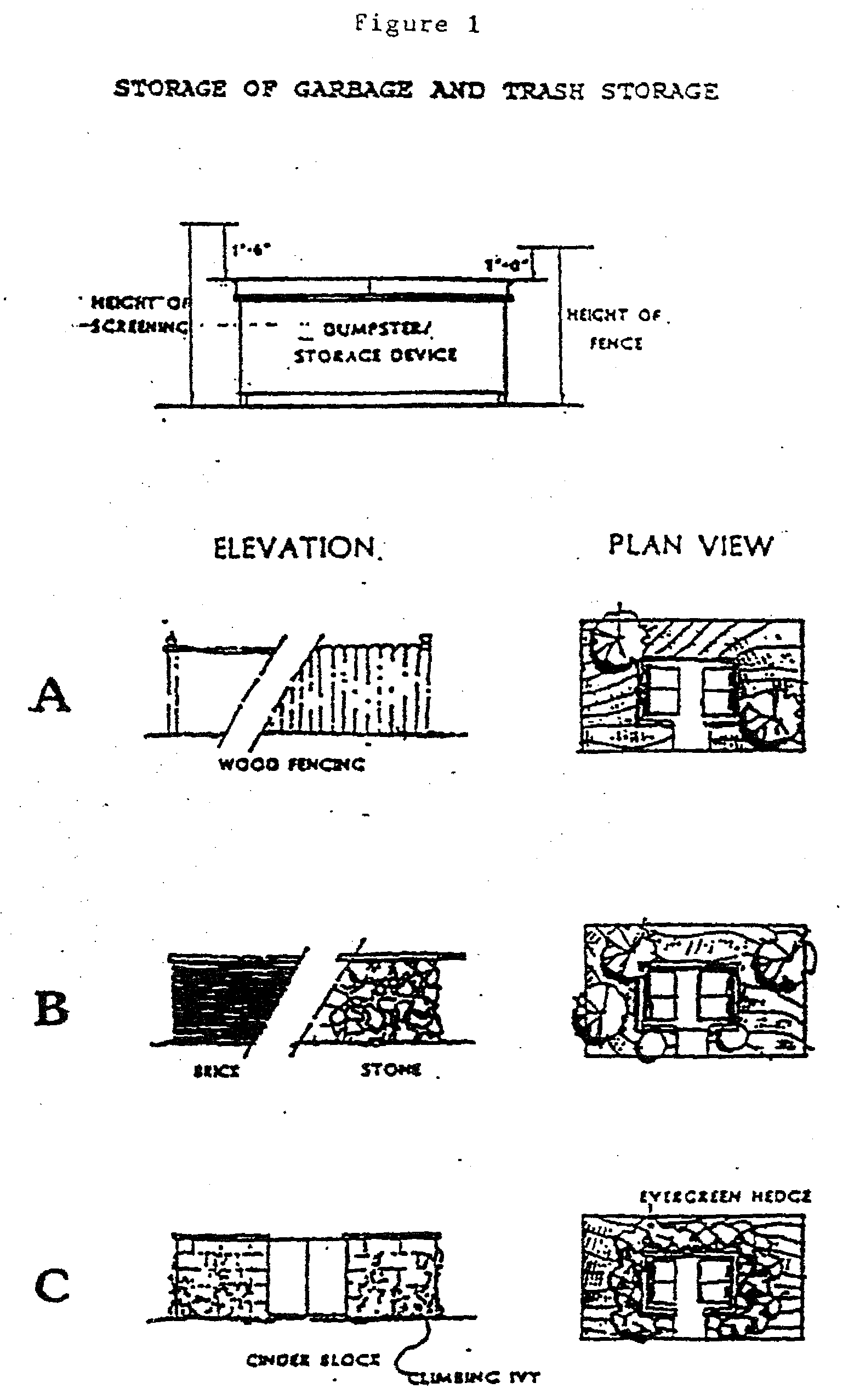
Storage of garbage/trash. All garbage cans, trash containers, and other storage devices situated on any lot shall be in closed containers with lids and shall be concealed or suitably screened from public view. Fencing or landscaping shall be used to totally obstruct vision into the storage areas by the alternatives set forth in Figure 1 or their equivalent.
(5)
Other architectural standards. The plan commission and village board may impose other architectural standards deemed appropriate such as, but not limited to, building material samples, building color samples, roof pitch designs and architectural breaks in walls over 75 feet in length. Except for flat roofs, the minimum pitch shall be 2:12. The plan commission and village board may allow a roof pitch less than 2:12 when it has made a finding that there is no feasible alternative to meet the 2:12 roof pitch.
(g)
Landscaping. The following landscape standards are to be utilized in preparing landscaping plans to be submitted with site plans:
(1)
Landscaping point system and minimum installation sizes for plants. On-site landscaping shall be required for all development. All landscaping standards are stated in terms of the number of landscaping points. The number of landscaping points is dependent upon the size of the development. A different number of points are awarded for each plant, depending upon its typical growth rate, its mature height, and whether it is a deciduous or evergreen species. A minimum installation size is required for each of these plant categories. These recommendations are per Table 1.
(2)
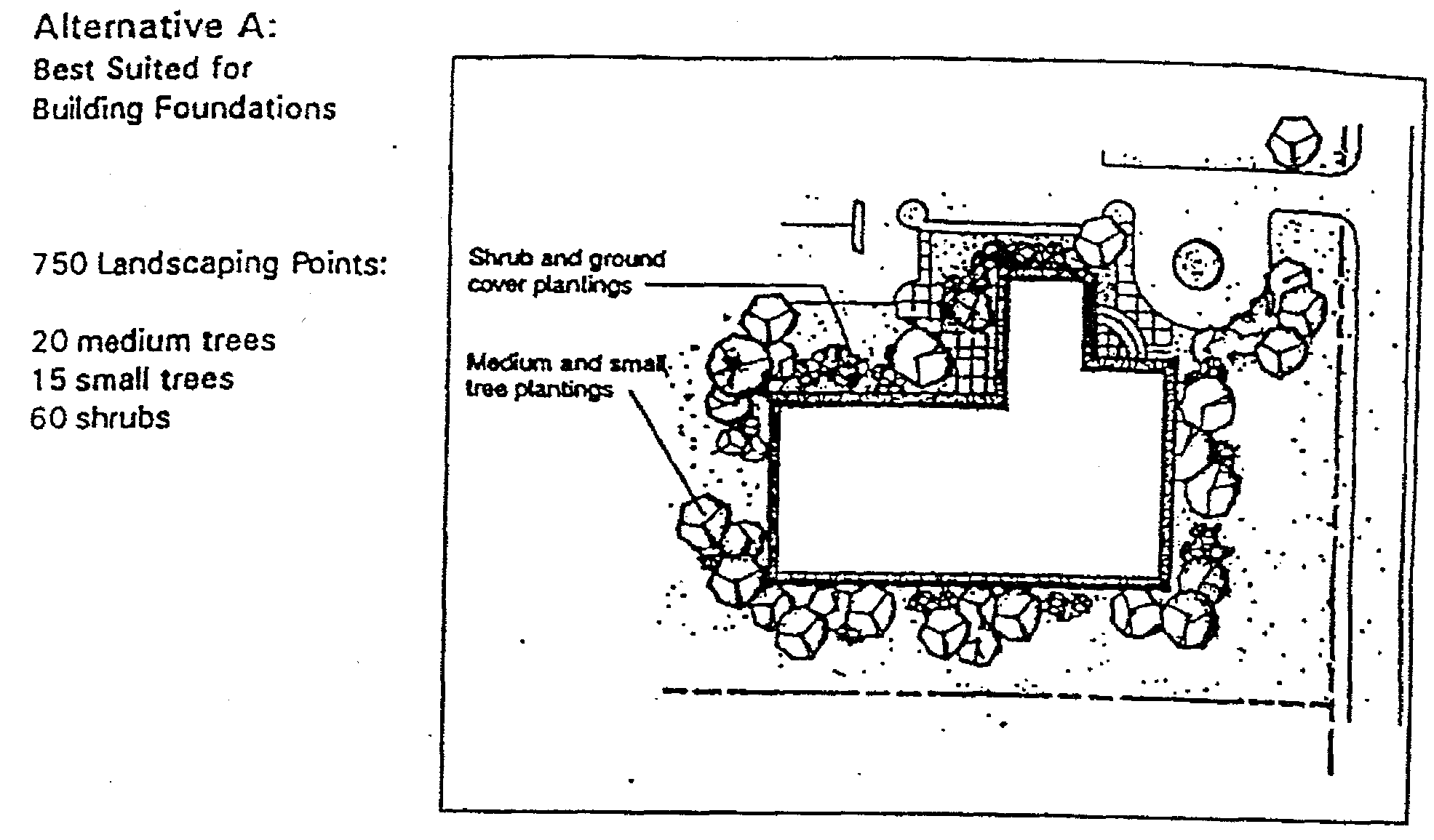
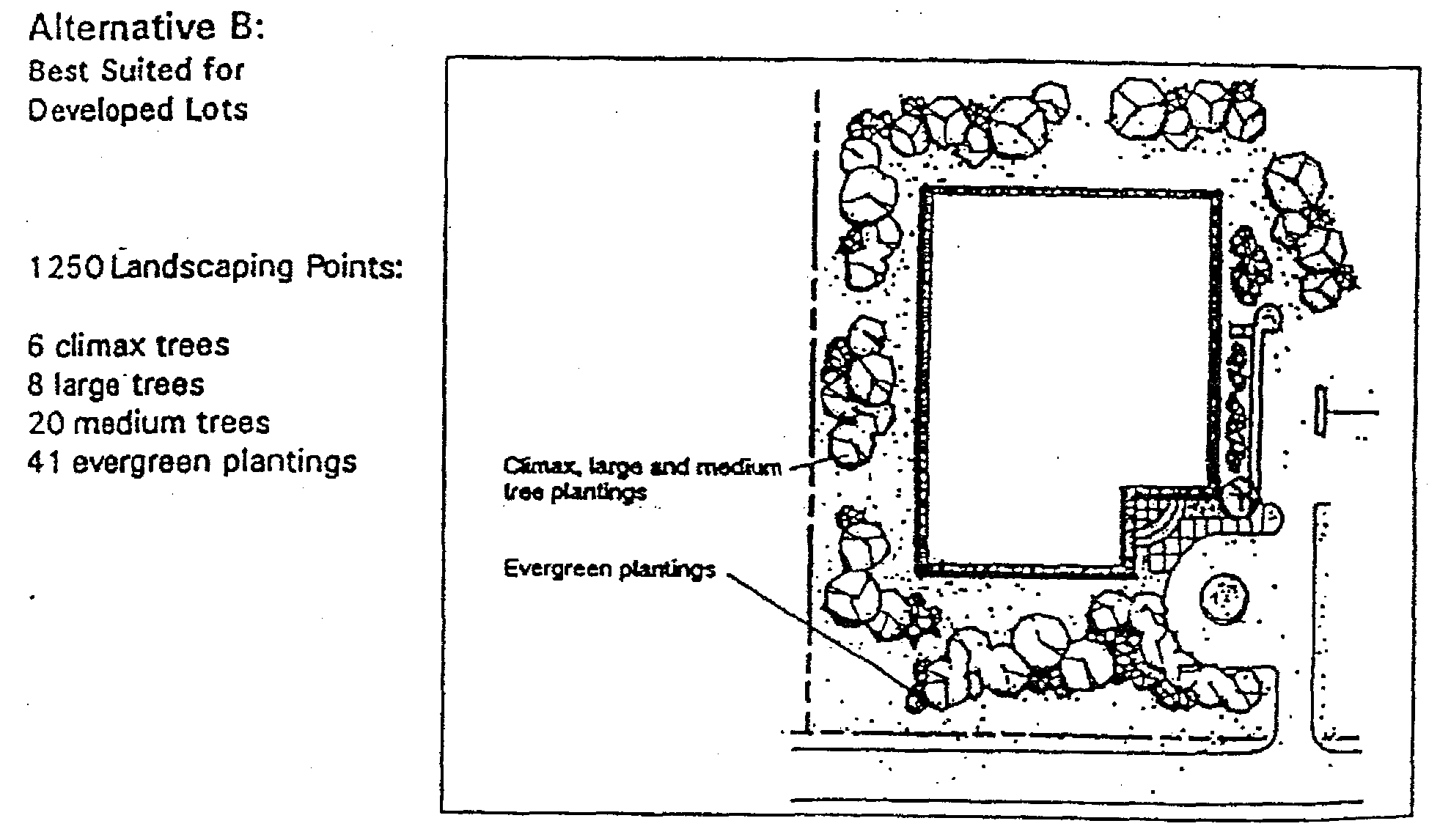
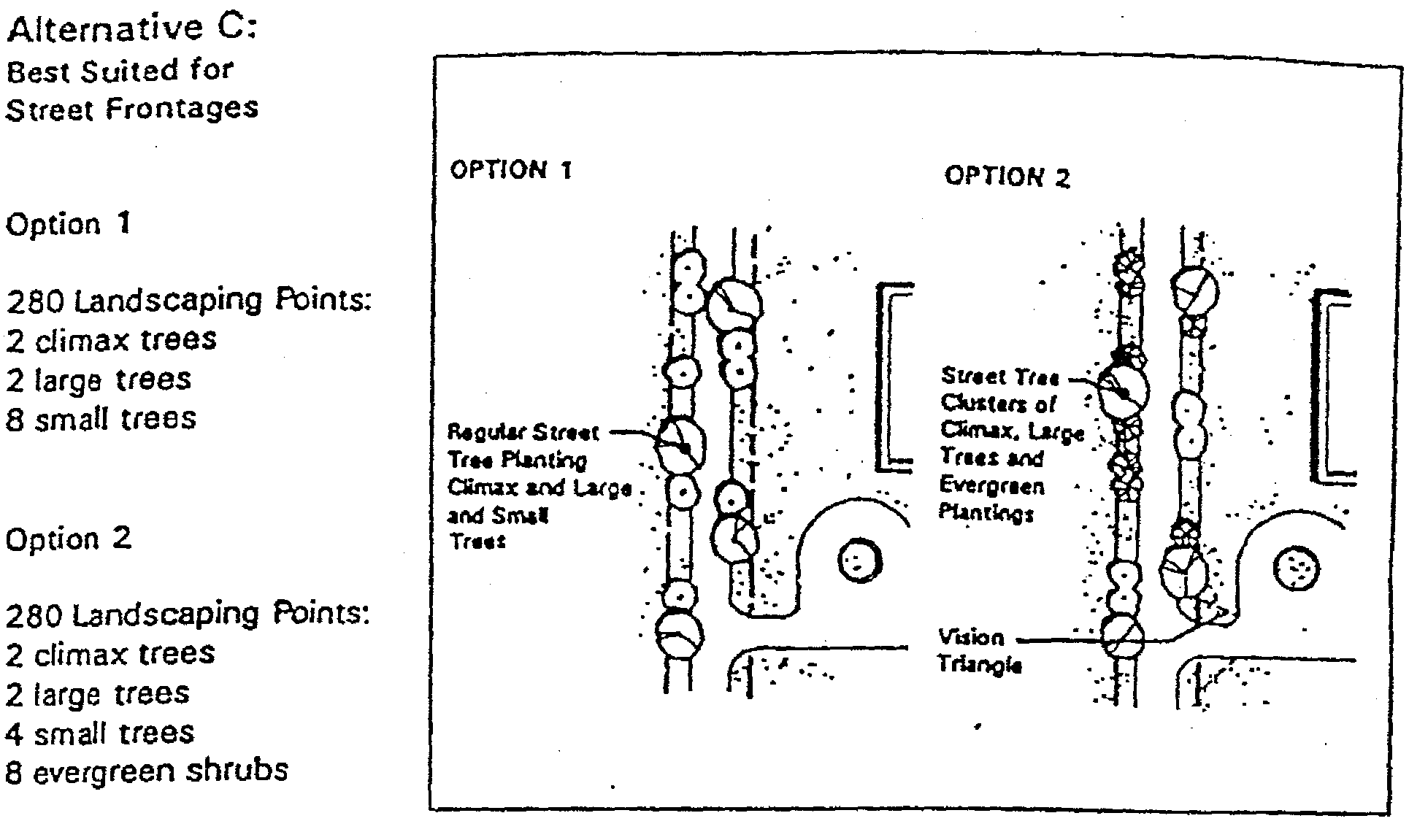
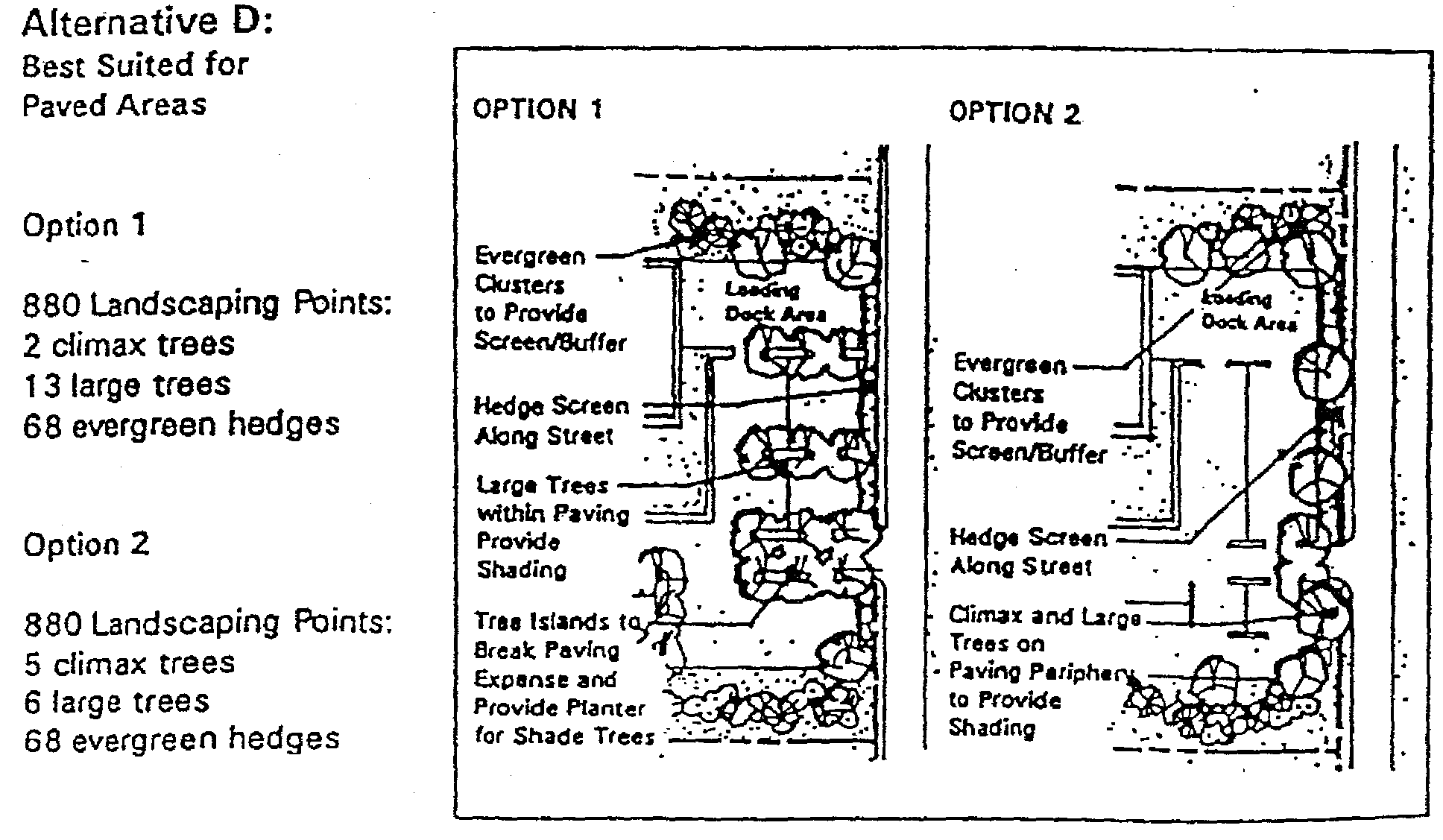
Depiction of sample landscaping schemes. Figures 2, 3, 4 and 5 shown on the following pages, depicts sample landscaping schemes that may be used for building foundations, developed lots, street frontages and paved areas. In general, landscaping schemes similar to Figure 2 are best for building foundations, Figure 3 are best for developed lots, Figure 4 are best for street frontages and Figure 5 are best for paved areas (including parking lots, walkways and plazas).
(3)
Measurement for landscaping standards. A minimum amount of landscaping points are required for the linear feet of building foundations, the gross floor area of buildings on developed lots, the linear feet of street frontage and the total combined area of paved areas.
(4)
Landscaping standards for building foundations.
a.
New buildings and additions shall be accented by a minimum amount of landscaping placed within a minimum depth of seven feet from the building foundation.
b.
Landscaping for building foundations shall be placed so that at maturity, the plant's drip line is located within ten feet of the building foundation. Such landscaping shall not be located in those areas required for landscaping as street frontages or paved areas. See Figure 2 for a suggested scheme. Landscaping shall not impede vehicle or pedestrian visibility.
c.
For each 100 feet of building foundation perimeter, 40 landscaping points shall be provided on a prorated basis, and installed and permanently maintained.
d.
Tall or medium trees shall not be used to meet this requirement. The intent of this section is to require a visual break in the mass of buildings and to require a visual screen of a minimum of five feet in height for all exterior perimeter appurtenances (such as HVAC/utility boxes, standpipes, stormwater discharge pipes and other pipes).
(5)
Landscaping standards for developed lots.
a.
This section shall apply to already developed lots when building additions or remodels with improvements of more than 25 percent of the assessed value of the structure are proposed.
b.
Landscaping for developed lots shall be placed away from those areas required for landscaping as building foundations, street frontages, and paved areas. See Figure 3 for a suggested landscape scheme. Landscaping shall not impede vehicle or pedestrian visibility.
c.
For each 1,000 square feet of gross building floor area, ten landscaping points shall be provided on a prorated basis, and installed and permanently maintained.
d.
The intent of this section is to provide yard shade and to require a visual screen of a minimum of five feet in height for all detached exterior appurtenances (such as HVAC, electrical transformers, utility boxes, standpipes, stormwater discharge pipes and other pipes).
(6)
Landscaping standards for street frontages.
a.
Street frontages for new buildings and additions shall contain a minimum amount of landscaping in those areas that abut the right-of-way of a public street.
b.
Landscaping for street frontages shall be located within ten feet of the public right-of-way. In no instance shall such landscaping be located within a public right-of-way. Landscaping shall not impede vehicle or pedestrian visibility.
c.
For each 100 linear feet of street frontage where a developed lot abuts a public street right-of-way, 40 landscaping points shall be provided on a prorated basis, and installed and permanently maintained.
d.
Shrubs shall not be used to meet this requirement. A minimum of 50 percent of all points shall be devoted to tall and medium deciduous trees and a minimum of 30 percent of all points shall be devoted to medium and low evergreen trees.
(7)
Landscaping standards for paved areas.
a.
Paved areas for new buildings and additions shall contain a minimum amount of landscaping within ten feet of the paved area. The intent of this subsection is to provide a visual screen of the parking lot from abutting properties that breaks up the parking lot look and separates the parking lot stalls by providing shade trees within the parking lot. The screening around the perimeter of the parking lot shall have a minimum height of 40 inches from the street view.
b.
A minimum of 270 square feet of landscaped area, which shall be located in the parking lot for every ten linear stalls of the paved area. The landscape island shall take up 1½ parking stalls. See Figure 5 for a suggested landscaping scheme. Plants used to fulfill the perimeter requirement should provide 50 percent solid screening of the parking, loading and circulation areas from view from public streets. Plants used for landscape islands shall be tall and medium deciduous trees and low shrubs.
c.
For every 20 off-street parking stalls located in a development, one landscaped island, a minimum of 270 square feet, shall be installed and permanently maintained. Each island shall have a minimum of 80 landscaping points and be devoted to tall or medium deciduous trees and shrubs.
d.
A ten-foot-wide green buffer shall be provided around the perimeter of all lots excluding areas for driveway connections to the public street or approved way.
(8)
Classification of plant species. For the purpose of these standards, plant materials are classified into 12 groupings: "tall deciduous tree," "medium deciduous tree," "low deciduous tree," "tall evergreen tree," "medium evergreen tree," "low evergreen tree," "tall deciduous shrub," "medium deciduous shrub," "low deciduous shrub," "medium evergreen shrub," "low evergreen shrub," and "non-contributory plants." The plan commission and village board shall review proposals for, and the applicability of, species not contained in this list and is authorized to approve appropriate similar species.
(9)
Requirements for installation of landscaped areas.
a.
Installation. All landscaping material recommended by the provisions of these standards and guidelines shall be installed on the subject property, per the approved site plan, within 365 days of the issuance of an occupancy permit for any building on the subject property or as determined by the plan commission but no later than the time period stated above.
b.
Cash deposit.
1.
If the subject property is to be occupied prior to the installation of all required landscaping material, the property owner shall file, subject to approval by the planner, a certificate of deposit or a certified check in the amount equal to 110 percent of the estimate of landscaping materials and installation cost. An enforceable contract, for all work on the subject property indicated on the detailed landscaping plan required under the provisions of these standards and guidelines, from a qualified contractor (valid for a 365-day period), shall be used to determine the amount of surety.
2.
If a part of a phased project approved per the requirements of the standards and guidelines, said amount may be split into amounts which are applicable to phases of the project.
3.
Governmental units to which these bond and guarantee provisions apply, may, in lieu of said contract or instrument of guarantee, file a resolution or letter from officers authorized to act in its behalf, agreeing to comply with the provisions of these standards and guidelines.
c.
Existing plant material which meets the recommendations of these standards and guidelines and which will be preserved on the subject property following the completion of development, may be counted as contributing to the landscaping recommendations.
d.
All landscaping areas shall be seeded with lawn or native ground cover unless such vegetation is already fully established.
e.
The exact placement of required plans and structures depicted on the required detailed landscaping plan component of the required site plan shall be the decision of each property owner within the recommendations of this section, except that the following requirements shall be met:
1.
Evergreen shrubs shall be planted in clusters in order to maximize their chance of survival.
2.
Where a combination of plant materials, and/or berming and/or fencing is used, the fence and/or berm shall be located toward the interior of the subject property and the plant material shall be located toward the exterior of the subject property.
3.
In no manner shall landscaping materials be selected and/or located in a manner that results in the creation of a safety or visibility hazard.
(10)
Requirements of maintenance. The continued and continual maintenance of all required landscaping materials shall be a requirement of these standards and guidelines and shall be the responsibility of the owner of the property on which said materials are required. This requirement shall run with the property and is binding upon all future property owners. Development of any and all property following the effective date of the ordinance from which these standards and guidelines were derived shall constitute an agreement by the property owner to comply with the provisions of these standards and guidelines. Upon failure to comply with these provisions, the village may enter upon the property for the purpose of evaluating and maintaining all required landscaping materials, and may specially assess the costs thereof against the property. Failure to comply with this requirement shall be considered a violation of these standards and guidelines, and shall be subject to any and all applicable enforcement procedures and penalties.
(11)
Use of required landscaped areas.
a.
Any and all required landscaped areas may be used for passive recreation activities. Said areas may contain pedestrian, bike, or equestrian trails provided that:
1.
No required materials are eliminated;
2.
The total width and area of required landscaping is maintained; and
3.
All other regulations of these standards and guidelines are met.
b.
In no event, however, shall swimming pools, tennis courts, sports fields, golf courses, or other such active recreation use be permitted in such areas. Furthermore, in no instance shall any parking be permitted in such areas, nor shall any outdoor display or storage of materials be permitted in such areas. Paving in such areas shall be limited to that required for necessary access to, through, or across the subject property.
(12)
Utility easements. Landscaping materials, fences and berms that are located within a duly-recorded utility easement and/or a pedestrian easement shall not count toward meeting a landscape requirement. However, the width of such areas may be counted as part of a landscaping requirement.
(13)
Calculating landscaping recommendations. In calculating the number of recommended landscaping points under the provisions of these standards and guidelines, all areas and distances on which required calculations are based shall be rounded up to the nearest whole number of square feet or linear feet. Any partial plan derived from the required calculations of these standards and guidelines (for example, 23.3 points shall be rounded up to the nearest whole 24 points).
(h)
Exterior lighting standards. These standards are intended to protect motorists and surrounding areas from excessive light or glare. This section is not, however, intended to apply to public street lighting.
(1)
Internal lot lighting. Lighting standards and luminaries for parking lots, internal roads, drives and walkways shall conform to the following requirements:
(2)
Method of light measurement. Illumination shall be measured in foot-candles at six inches above the ground level in a horizontal position at the lot line. A direct reading portable light meter with color and cosine corrected sensor and multiple scales shall be used. The meter shall have been tested and calibrated to an accuracy of plus or minus five percent within one year of its use. Measurements shall be made after dark. The difference between "lights on" measurements and "lights off" measurements shall be used to determine the illumination, thereby eliminating the effects of ambient light.
(3)
Types of luminaries. Luminaries and lighting which may be used:
a.
No cut-off luminaire. This is a luminaire whose light source is visible from above a line parallel to the ground running through the center of the luminaire (i.e., an angle of greater than 90 degrees.) such luminaries have the maximum glare potential.
b.
Cut-off luminaire. This luminaire has a cut-off of less than 90 degrees, so that at the centerline of the street, the luminaire is totally shielded from view. this fixture reduces glare to a minimum. except as in subsection (h)(3)c of this section, all cut-off fixtures shall be designed and located so that the cut-off line is at least ten feet within the lot line.
c.
Floodlighting. Floodlighting of buildings shall not exceed three foot-candles measured from a height equal to one-half the building height at the face of the building and shall be focused on the building with no fugitive light leaving the fixture (shielded).
(4)
Additional lighting regulations. Notwithstanding any other provision of this section to the contrary:
a.
No flickering or flashing lights shall be permitted.
b.
Light sources, or luminaries, shall not be located within buffer yard areas except on pedestrian walkways.
(i)
Exterior site usage.
(1)
Outdoor storage. In A-1, P-1, B-1, B-2, B-3, I-1 and I-2 zoning districts, the outdoor storage of any goods, material, merchandise, or vehicles and equipment may be permitted subject to the following:
a.
Storage area is allowed in the rear yard only as determined by the plan commission. The side yard could be used if the plan commission determines the rear yard is not a practical location with screening of the side yard.
b.
Storage area shall not be visible from any public right-of-way.
c.
Storage area shall be bounded by:
1.
A minimum six-foot-high wooden or vinyl solid fence;
2.
A minimum six-foot-high chainlink fence with landscape plantings at the height of the fence at planting to screen the view of the chainlink fence from the public right-of-way; or
3.
A landscaped treatment as approved by the plan commission. The landscape treatment may include, but not be limited to, earth berms constructed of topsoil and stabilized with seed, landscape plantings (i.e. shrubs, deciduous trees, evergreens, etc.), landscape materials/structures (i.e., decorative concrete block walls, landscape timbers, boulders, etc.), or a combination thereof. The landscape treatment shall be constructed high and dense enough and to sufficiently screen the view from the public right-of-way.
d.
Storage area shall not exceed 20 percent of the lot area.
e.
Stored items shall be accessory to the approved business operation.
(2)
Outdoor display. In the B-1, B-2, B-3, I-1 and I-2 zoning districts, the outdoor display of any goods, material, merchandise, or vehicles and equipment may be permitted subject to the following:
a.
Scaled site plan requires approval by the village plan commission and village board.
b.
Display area is allowed in any yard with layout and use detailed on a plat of survey and approval by plan commission and village board.
c.
Display area shall not exceed 30 percent of lot area.
d.
Displayed items shall be in working condition and displayed in a neat and orderly condition at all times so that the premises will not detract from the neighboring premises.
(j)
Modifying and/or termination of site plan or plan of operation. If any item of the site plan or plan of operation does not continue in conformance with the approved plan or operation, the use and site plan approval may be modified and/or terminated by action of the village board. Notwithstanding the foregoing, prior to any decision made by the village board which would result in the modification and/or termination of the use and site plan as previously approved, the property owner shall be given written notice of the proposed action to be taken by the village board, and shall be afforded an opportunity to present evidence and be heard by the village board prior to any final action being taken by the village board which could result in the modification or termination of the use and site plan.
(Amend. of 1-9-2025)
Sec. 42-31.- Site regulations.
(a)
Building must be on a lot.
(1)
In all residential districts, every building hereinafter erected, structurally altered or relocated shall be located on a lot, as defined herein, and in no case shall there be more than one principal building on a lot except as authorized through:
a.
A conditional use permit for multifamily units per section 42-35(d)(6),
b.
A conditional use permit for senior housing per section 42-35(d)(7) or as permitted in the Business Districts.
c.
A condominium plat for single-family residential units. Individual condominium units shall meet all zoning regulations for an equivalently sized residential lot including:
1.
Minimum size, minimum width, front setback, side and rear offsets, minimum home size, and maximum building footprint.
2.
Accessory building size, quantity limits, and location and compatibility standards.
3.
Maximum animal units (horses and livestock) and minimum setbacks and offsets for buildings that house animals.
(2)
In all other districts where buildings are permitted, more than one principal building may be located on a lot, subject to the approval of the village plan commission, and where such grant would not be contrary to the spirit or intent of this chapter, and provided that sufficient lot area is available for each principal building to be so located as to individually meet the setback, offsets, lot size, and open space requirements of the district in which they are located.
(3)
No accessory building, except in the C-1 Conservancy Overlay District where all buildings or structures are accessory to a principal use, shall be constructed until the principal building is under construction or completed.
(4)
In the A-1 Agricultural District, barns, storage sheds, pens, coops, and other agricultural buildings related to and necessary for the pursuit of agriculture on that parcel of land will be considered as accessory buildings and may be permitted without the requirement that a principal residential use be in existence on that parcel with plan commission and village board approval. In a residential district, barns, storage sheds, pens, coops, and other agriculture buildings related to and necessary for the pursuit of agriculture on that parcel of land are also permitted on a parcel without a principal residence provided: the parcel was previously zoned A-1, the structures existed prior to rezoning to a residential district, and the rezoning from A-1 to residential occurred as part of a comprehensive rezoning of the entire village.
(5)
In the A-1 Agricultural District, where planned unit developments exist, agricultural buildings related to or necessary for the pursuit of agriculture shall not be allowed without plan commission or village board approval.
(b)
Construction standards for private streets and private drives.
(1)
Definitions. The following words, terms and phrases, when used in this section, shall have the meanings ascribed to them in this subsection, except where the context clearly indicates a different meaning:
Private drive includes all private routes of ingress and egress from any public right-of-way, which provides access to one residential dwelling/unit, commercial building or property. Notwithstanding anything contained herein to the contrary, this chapter shall not apply to private drives that are 300 feet in length or less, as measured from the edge of the public right-of-way along the centerline of the proposed driveway to the nearest exterior point of the principal building located on that property.
Private street includes all private routes of ingress and egress from any public right-of-way which provides access to two or more residential dwellings/units, commercial buildings, or properties.
(2)
Construction standards for private streets.
a.
At the end of the private street, a minimum paved cul-de-sac shall be provided. This cul-de-sac and the private street shall be constructed in accordance with the village's standard road specifications and the village's standard road sections in effect at the time of construction.
b.
The road ditch construction along the private street shall be required per the village's standard road specification and road section. The property owner shall obtain all drainage easements necessary to construct these ditches.
c.
All costs necessary for the maintenance of the private street to conform to these requirements for the safe passage of emergency vehicles shall be at the property owner's expense.
(3)
Construction standards for private drives in excess of 300 feet in length.
a.
All private drives shall be constructed utilizing a compacted subgrade consisting of quality material suitable for standard highway loading.
b.
Drainage structures or culverts, at least 24 feet long with end sections, shall be installed under the surface at the low points in grades, sloped to drain to the existing storm drainage outlet. These structures or culverts shall be sized to drain their entire storm drainage contributing areas based on the ten-year frequency storm design.
c.
A minimum of road ditch construction along these private drives shall be required in those areas where storm runoff would otherwise be forced onto the traveled surface due to the topography. The property owner shall obtain all drainage easements necessary to construct these ditches.
d.
The minimum depth of the stone base shall be five inches of 1½-inch crushed stone traffic bond (TB) material compacted in place, over which five inches of three-quarter-inch crushed gravel or crushed stone (TB) material shall be compacted in place.
e.
All private drives shall have a gravel surface not less than 16 feet in width, together with turnaround areas as provided in subsection (b)(3)h of this section, and together with emergency vehicle pull-off areas, as noted below, with final approval by the village board. The emergency pull-off areas shall be:
1.
Every 300 linear feet of driveway.
2.
50 feet long—ten feet wider than driveway.
3.
Same construction standards as indicated in subsection (b)(3)d of this section.
4.
All branches and shrubbery shall be cut back to a distance of five feet beyond the edge of the pull-off area as provided in subsection (b)(3)f of this section.
f.
All vegetation, trees and shrubbery must be cut back so that a 14-foot clearance height is provided. All branches and shrubbery shall also be cut back to a distance of 15 feet on either side of the centerline of the traveled surface portion of the private drive.
g.
All curves and bends in the surface shall be constructed to safely transport a fire truck with cab and trailer so that this vehicle is confined to the 14-foot surface width.
h.
At the end of the private drive, a cul-de-sac or turnaround area shall be provided for emergency vehicle use. The minimum size shall be a minimum 45 foot radius cul-de-sac or 40 foot depth by 40 foot wide T turnaround.
i.
All costs necessary for the maintenance of the private drives to conform to these standards for safe passage shall be at the property owner's expense.
(4)
Plan submittal and review.
a.
The applicant shall submit construction, site and drainage plans to the village clerk-treasurer's office indicating dimensions, location and construction materials as needed/requested by the village. The plans shall be drawn to scale and shall not exceed one inch equals 50 feet for private streets and one inch equals 200 feet for private drives. The applicant shall submit copies of the plans as determined by the village board.
b.
The village shall review the plans for compliance with this chapter and forward recommendations to the village plan commission and board for review. Village board approval is required prior to building permit issuance.
c.
The private driveway or street shall be completed prior to an occupancy permit being issued.
d.
The village building inspector or designee may inspect the private driveway and streets at the following stages:
1.
After subgrade is graded.
2.
After stone/gravel is installed.
3.
During asphalt installation (if applicable).
e.
The cost of reviewing the plans by the village engineer or other village officials, as well as any inspection services required to ensure installation of the private drive and/or private street in accordance with this chapter, shall be borne by the property owner. The property owner shall reimburse any such expense within 30 days after invoicing, and if not reimbursed, shall constitute a special assessment upon the property in accordance with the provisions of law.
(c)
No undesirable objects or structures. No structure or building shall be erected, structurally altered or relocated, and no lumber, materials, furniture or other equipment shall be stacked, piled or stored in a manner which adversely affects the property values and general desirability of the neighborhood. A motor vehicle which is no longer licensed, which has been abandoned, disassembled, is non-operable, disabled, junked or wrecked, shall not be stored anywhere on any premises except in an authorized salvage yard or unless it is completely enclosed in a structure.
(1)
The building inspector may submit any such case in question to the plan commission for its determination.
(2)
The plan commission shall base its determination upon the following considerations:
a.
Design or appearance of such unorthodox or abnormal character in relation to the surroundings as to be considered unsightly or offensive to the degree that would have a substantial adverse effect on the property values and general desirability of the neighborhood.
b.
Identical design and appearance with adjoining buildings to the degree that monotony and commonness would have a substantial adverse effect on the property values and general desirability of the neighborhood.
(3)
The decision of the plan commission shall be stated in writing and include the reason for refusing a permit or any conditions of approval.
(d)
Street grade. Every building hereafter erected, structurally altered, or relocated shall be at a grade approved by the building inspector as being in satisfactory relationship with the established street grades, if any, and if not, with the existing street grade where one is established, with particular consideration for proper drainage and safe vehicular access.
(e)
Preservation of topography. In order to protect the property owner from possible damage due to change in the existing grade of adjoining lands, and to aid in preserving and protecting the natural beauty and character of the landscape, no change in the existing topography of land shall be made which would result in increasing any portion of the slope to a ratio greater than three horizontal to one vertical within a distance of 20 feet from the property line, except with approval of the plan commission, or which would alter the existing drainage or topography in any way as to adversely affect the adjoining property. In no case shall any slope exceed the normal angle of slippage of the material involved, and all slopes shall be protected against erosion.
(Ord. No. 2024-4, § 1, 12-12-2024; Amend. of 1-9-2025)
Sec. 42-32.- Drainage regulations.
(a)
Adequate drainage required. In no case may a principal building be located in an area zoned conservancy or field delineated as wetland. No principal building shall be erected, or relocated, and no below-grade structures shall be expanded on newly created or existing lots that are not in compliance with the site drainage standards contained in the county stormwater management and erosion control ordinance, including all counts technical procedures and forms used to enforce these standards (chapter 14-342(c)). The lowest floor, including any basement floor, shall not be less than one foot above the highest seasonal groundwater level. For the purposes of this section, the highest groundwater level is defined as the upper limit of the zone of soil saturation caused be underlying groundwater at its highest level. Where groundwater limitations exist, subdivision plats and certified survey maps shall state the lowest allowed floor elevation for any proposed principal structure as needed to ensure compliance with the above-noted site drainage standards. All basement elevations must comply with the subdivision plat or certified survey map master grading plan or with the master grading plan referenced on the subdivision plat or certified survey map. The village building inspector and/or village engineer may request, at the owner's expense, the advice and assistance of a licensed professional engineer specializing in soils engineering or other qualified person in fulfilling their duties pursuant to this provision. Building, drainage, grading or other similar plans may be required to determine compliance with this section. The village accepts no liability for construction activities involving groundwater limitations and property owners are solely responsible for protecting their interests in this regard.
(b)
Obstruction to drainage prohibited. The damming, filling, relocating or otherwise interfering with the natural flow of surface water along any surface water drainage channel or natural watercourse shall not be permitted except with approval of the village plan commission and the department of natural resources pursuant to Wis. Stats. ch. 30.
(c)
Building restricted adjacent to drainage channels or watercourses. No building other than a bridge, dam or revetment subject to the aforesaid approval, shall be erected, structurally altered or relocated within 35 feet of the average annual high water line of such natural watercourse nor so that the lowest floor of said building is less than two feet above the average annual high water line or 100-year flood elevation.
(Amend. of 1-9-2025)
Sec. 42-33.- Sanitation and water supply.
(a)
Safe sewage disposal possible. No principal building shall be erected, structurally altered, or relocated unless it has been certified by the building inspector that it conforms to all village ordinances and other governmental laws or regulations then applicable to sewage disposal systems, and that satisfactory evidence has been submitted to show that suitable provision for disposal of sewage, based on the proposed use, is possible on said lot if it is not served by an approved municipal or other state-approved sewage disposal system.
(Explanatory note: While every attempt has been made, through control of minimum lot size, building location and plumbing standards, to ensure that proper disposal of sewage will be provided on any lot, it is recognized that no such standards will completely ensure adequate disposal in every situation. This section has been written for the purpose of giving the community the authority to require whatever additional provisions are necessary to prevent a sanitary problem from development in a situation where the normal requirements will not ensure proper sewage disposal.)
(b)
Approved septic system. No principal building shall be erected, structurally altered or relocated unless a sewer is installed running to a septic tank designed and located in accordance with the village ordinances and other governmental laws or regulations then applicable to sewage disposal systems, or to an approved municipal or other state-approved sewage disposal system.
(c)
Outhouses prohibited. No outhouse or privy shall be hereafter erected in the village unless specifically authorized by the county board of health and in strict compliance with the county sanitary code.
(d)
Water supply required. No occupancy and use permit shall be issued for a building used for residence purposes unless provision is made for a safe and adequate supply of water in or within 300 feet of said dwelling or connection is to be made to an approved municipal or community water system.
(e)
Public water systems.
(1)
Purpose. The purpose of this subsection is to regulate test wells or permanent wells within the village that are intended to be used as part of a community water system, a municipal water system, a public water system, or a high-capacity water system as those terms are defined herein. This chapter is adopted in accordance with the provisions of Wis. Stats. § 62.23(7) and is intended to:
a.
Provide advance notice of the installation or construction of a test well or permanent well for the previously described systems;
b.
To protect the existing and future groundwater resources of the village; and
c.
To provide security to protect village residents against injury caused by the installation or operation of a test well or permanent well as defined herein.
(2)
Definitions. The following words, terms and phrases, when used in this subsection, shall have the meanings ascribed to them in this section, except where the context clearly indicates a different meaning:
Adequate water supply means water supply that has a yield, where obtainable, and the pump capacity to provide the quantity of water which is reasonably necessary to maintain use for drinking, culinary, personal hygiene, and other purposes for which the water is reasonably intended to be used. This chapter is intended to protect the existing water supply of village residents.
Community water system, as defined by Wis. Admin. Code NR 108.02(2), which is incorporated herein as if fully set forth.
Contaminant means any matter which may render water bacteriologically or chemically impure or turbid so as to make it unfit for human consumption.
Distribution system means all pipes, conduits, structures or buildings, which are used for the collection, treatment, storage and distribution facilities under the control of the operator of the public water system, and used primarily in connection with the public water system.
Drawdown means the extent of lowering the water level when water is pumped or flows from a private well.
Groundwater means subsurface water which is within the zone of saturation, including, but not limited to, perched water tables, shallow regional groundwater tables and aquifers or zones that are seasonally, periodically or permanently saturated.
Groundwater source means all groundwater obtained from horizontal collectors, infiltration lines, springs and dug, drilled or other types of test wells or permanent wells.
High-capacity water supply or system means one where new and existing wells to be constructed, reconstructed, rehabilitated, installed or operated on one property whose operating capacity singly or in the aggregate with that of other wells on the property will be in excess of 70 gallons per minute.
Living unit means a domicile located within the village's boundaries.
Municipality means any city, village, village, county, county utility district, sanitary district, utility district, school district or metropolitan sewage district or any other public entity created under state law and having authority to collect, obtain, store, treat or convey water for domestic, commercial or industrial use.
Municipal water system, as defined by Wis. Admin. Code NR 108.02(9), which is incorporated herein as if fully set forth.
Person means an individual, corporation, company, association, cooperative, trust, institution, partnership, state, municipality, or federal agency.
Private water supply means one or more sources of groundwater, including facilities for storage and conveyance of groundwater, such as wells, springs, pumps, pressure tanks and reservoirs, on one property, other than those serving a public water system.
Public water system, as defined by Wis. Admin. Code NR 108.02(12), which is incorporated herein as if fully set forth.
Specific capacity means the continuance yield of a well at a given well water or pressure drawdown expressed in gallons per minute, per foot of drawdown.
Supplier of water means any person who owns or operates a public water system.
Utility means a public utility, as defined in Wis. Stats. ch. 196, and as the same may be modified or amended.
Waterworks or water system means any facility installed or constructed to obtain, store, treat or convey water for drinking or domestic, commercial or industrial use for a public water system.
Well means an excavation or opening into the ground made by digging, boring, drilling, driving or other methods for the purpose of obtaining groundwater or for monitoring groundwater movement. This definition applies to all wells, whether for test purposes or for permanent use.
Well driller means any person, firm or corporation, whether private or public, employed in obtaining groundwater from a well by digging, boring, drilling, driving or other methods for the purpose of obtaining groundwater.
Yield means the quantity of water which may flow or be pumped from the well per unit of time.
(3)
Notice requirements.
a.
No test well or permanent well shall be constructed in the village if such well is intended as part of a community water system, a municipal water system, a public water system, or a high-capacity water system, unless written notice of such well and its intended use is given to the village within ten days of the submission of preliminary plans and specifications to the state department of natural resources under Wis. Admin. Code NR 108.04, or 30 days prior to the commencement of any test or permanent well construction; whichever is earlier. Said notice shall be provided to the village clerk-treasurer and shall contain the following information:
1.
The name of the supplier of water and/or owner of the well;
2.
The type of water system for which the well will be used;
3.
The location of the well and the name of the owner of the site location;
4.
The description and location of the distribution system for the water system, identifying affected roads, rights-of-way, and easements to be utilized in transporting the water to its ultimate user;
5.
The name and address of the well driller;
6.
Identification of all existing wells located in the village, whether public, private, municipal, community and/or high capacity, within a two-mile radius of the well site;
7.
The estimated specific capacity of the well, whether a test or permanent well;
8.
The estimated yield of the test and/or permanent well, utilizing calculations based on per minute yields, per day yields, and annual yields;
9.
The groundwater source to be utilized by the well;
10.
The estimated time for completion of the permanent water supply and distribution systems;
11.
The estimated useful life of the well and water system;
12.
The contact person having authority to respond to inquiries regarding the application;
13.
The preliminary plans and specifications submitted to the state department of natural resources under Wis. Admin. Code NR 108.04.
b.
Any information identified above which is not available at the time of the required submission of the notice shall be supplied immediately as the same becomes available or determinable. The notice required by this section shall be in addition to any and all reports, applications and/or notices required elsewhere in any village ordinance applicable to wells or the location of wells. The applicant shall be responsible for supplementing or updating the submitted application as new information is obtained or as circumstances change.
(4)
Filing of reports. If the water system proposed or under construction is a reviewable project under Wis. Admin. Code ch. NR 108, copies of any and all reports required to be filed with the state department of natural resources shall be filed simultaneously with the village clerk-treasurer.
(5)
Costs incident to well construction.
a.
The provisions of this and any other village ordinance notwithstanding, each well owner and supplier of water subject to this chapter shall be solely responsible for all costs of repairs to roads, public rights-of-way, topography or other surfaces or locations damaged or disturbed in any manner due to the construction of any well and/or water distribution system servicing a community water system, municipal water system, public water system and/or high-capacity water system. The plans and specifications for all water distribution systems located within the village shall be filed with the village clerk-treasurer 60 days prior to commencement of construction of any such distribution system or portion thereof. The information to be submitted shall include specification of the size, type and exact location of the distribution system and its appurtenances and shall indicate whether such is to be located within private or public lands and shall indicate the owners of all lands upon which the system shall be located. The well owner and water supplier shall be solely responsible for obtaining the necessary easements, public or private, for location of the well and distribution system and for conformance to all village, state and federal requirements governing the same. The village board may limit and/or regulate the location of wells and distribution systems in conformance with applicable zoning ordinances and uses allowed in accordance therewith.
b.
The plans and specifications for all water distribution systems described in subsection (5)a of this section shall be accompanied by an application and fee established by resolution and reimbursement to the village for any costs of professional services incurred by the village for the review of the application, inspection or other related professional services by the village engineer, planner, outside consultant hired by the village board and reasonable attorney fees will be invoiced by the village clerk-treasurer's office.
c.
In addition to all other requirements set forth herein, the permit applicant shall perform, at its cost, static and pumping operating levels for all wells of whatever depth within a two-mile radius. Thereafter, the well permittee shall perform follow-up well surveys within the same areas at two-year intervals. The follow-up surveys shall be performed during the same month or season as the initial well surveys in order to maintain comparability in the data. The village shall assist the permit applicant or permittee by providing a letter addressed to the relevant village residents requesting cooperation in the well surveys.
(6)
Groundwater protection fund.
a.
The existence of wells servicing community water systems, municipal water systems, public water systems and/or high-capacity water systems in the village may have future adverse effects on the groundwater and groundwater sources utilized by village residents. Protection of groundwater and groundwater sources is necessary for the maintenance of the health, welfare and economic well-being of the village and its residents. There presently exists the scientific knowledge and expertise necessary to reasonably determine the effect of such wells on prior, existing, normal capacity private wells and the groundwater sources for such private wells. To protect village property owners from adverse effects of the existence and location of community, public, municipal and/or high capacity wells in the village, and to provide for reasonable compensation for any losses which may be incurred thereby, there is hereby established a groundwater protection fund, to be administered as set forth herein.
b.
A special permit shall be required prior to the installation and operation of all permanent wells servicing community, municipal, public and/or high-capacity water systems located within the village. An applicant for a special permit shall submit his request on forms to be supplied by the village clerk-treasurer. The village shall act on the permit application within 45 days of receipt.
c.
There shall be imposed upon all new permanent wells servicing community, municipal, public and/or high-capacity water systems an initial special permit fee payable to the village prior to the installation of said permanent well established by resolution. Furthermore, there shall be imposed upon all new permanent wells servicing community, municipal, public and/or high-capacity water systems an annual operation fee payable to the village no later than February 1 of the year following each year, or fraction thereof, such a well is operating in the village established by resolution. The special permit fee and the annual operation fee shall be escrowed pursuant to the terms of subsection (f)(6)d of this section.
d.
The initial special permit fees and the annual operation fees shall be deposited into a separate interest-bearing insured account denominated "Groundwater Protection Fund." The account may be in the name of and controlled by the permittee, provided no withdrawals occur except as authorized by mutual agreement between the village board and the permittee or by direction of the arbitration panel as provided herein. The annual operation fee shall continue to be paid until the account balance, including accumulated interest thereon, reaches a balance of $500,000.00. The permittee shall be entitled to the interest earned on the account after the $500,000.00 balance has been met. In the event the account balance falls below $500,000.00, the annual operation fee shall resume and earned interest shall be retained until such time as the $500,000.00 balance has been restored. The Groundwater Protection Funds shall be administered as follows:
1.
Disbursements to be made from the Groundwater Protection Fund to private well owners who incur damages or expenses as a result of any adverse effect created by wells are subject to the jurisdiction of this chapter. Such damages or expenses shall include, but are not limited to, the following:
(i)
Contamination of private water supply;
(ii)
Depletion of groundwater sources resulting in the drawdown of private wells;
(iii)
Depletion of groundwater sources resulting in a significant lowering of well water level in private wells;
(iv)
Such other and similar expenses or damages reasonably shown to have been caused by wells regulated under this chapter.
2.
Any damages or expenses found to be compensable under subsection (f)(6)d.1 of this section shall be presumed to have been caused by the operation of the community, public, municipal and/or high capacity well. In the event this presumption is rebutted, or in the event it is deemed that the presumption does not apply for any reason, then damages or expenses incurred by private well owners may be compensable under this section if sufficient evidence is presented to reasonably establish a causal connection between the damage or expense and the community, municipal, public and/or high capacity well. The presumptions set forth above may be rebutted by clear and satisfactory evidence presented by hearing before the arbitration panel described below.
3.
Distributions from the Groundwater Protection Fund shall be made upon submission by the private well owner of evidence of damages or expenses incurred, or to be incurred. The private well owner's submission shall include two bids identifying the work required and the cost thereof. Compensable expenses shall be limited to the following:
(i)
Obtaining an alternate water supply for the period beginning with submission of the written request for a distribution from the Groundwater Protection Fund, and continuing until an acceptable replacement water supply has been provided.
(ii)
A satisfactory replacement water supply.
(iii)
Equipment used for treating the contaminated private water supply only if it is not feasible to remedy the contamination with a replacement water supply.
(iv)
Reasonable consulting or cost estimate fees, incurred in obtaining the submittals required under the terms of this chapter.
(v)
Any state, county or local permit fees.
(vi)
Other costs as deemed necessary by the village board to accomplish this chapter, including costs, expenses and professional fees incurred by the village as a result of the village's participation in any arbitration proceeding authorized in this chapter.
(vii)
Future costs incurred by impacted well owners for replacement of the original equipment or services required to remedy the drawdown caused by a regulated well except that such replacement costs shall be limited to the difference between the cost of a system as was on existence prior to operation of the regulated well compared to the cost of a system required due to the drawdown caused by the regulated well.
4.
Distributions from the Groundwater Protection Fund shall not be made for the following ineligible costs:
(i)
The replacement of a sand point well with a drilled well unless:
A.
The village board determines that replacement with another sand point well is not feasible;
B.
The village board determines that the claimant had no knowledge or reason to believe the sand point well would become contaminated at the time it was constructed; and
C.
The well serves a principal residence.
(ii)
Any costs incurred prior to the date of the ordinance from which this chapter is derived.
(iii)
A replacement well greater than seven inches in diameter.
(iv)
A replacement well screen greater than ten feet in length.
(v)
Relocation, replacement or abandonment of sewer piping, buried gasoline or fuel oil tanks, or similar items.
(vi)
Mileage, phone, postage, and other miscellaneous costs incurred by the claimant.
(vii)
Any other well construction costs which exceed the dollar limits set forth in Wis. Admin. Code NR 123.24(3).
5.
Within ten days of receipt of a private well owner's claim, but in no event prior to approval or disapproval of said claim, the village shall notify the relevant permittee by certified mail of the filing of a compensation claim. The notice to the permittee shall include all supporting documentation filed by the private well compensation/claimant. The permittee shall have 14 days to object to the compensation claim filed with the village. All objections shall be in writing setting forth the grounds thereto with specificity. Upon receipt of a timely objection, the village, the permittee and the claimant shall attempt to resolve the dispute on a voluntary basis. If the parties are unable to resolve the dispute within 30 days, the matter shall be submitted to a third person arbitration panel for resolution as follows:
(i)
The village and the permittee shall each designate a representative to serve on the panel. The two designated representatives shall name a third panel member. If the two designated representatives are unable to agree on a third panel member, they shall contact the department of natural resources for a list of five qualified individuals. Names shall be stricken from the list on an alternate basis in order to arrive at the third panel member.
(ii)
The arbitration panel shall meet within 30 days for the purpose of resolving the compensation claim dispute. The meetings shall be informal and shall not be subject to the procedural requirements set forth in Wis. Stats. ch. 68. Notwithstanding the informal nature of the hearings, all parties shall be given the opportunity to present evidence in support of their positions.
(iii)
The arbitration panel shall rule on the compensation claim within 30 days of the close of the meeting described in subsection (f)(6)a.10.(ii) of this section. In making its determination, the arbitration panel shall consider the evidence and argument of the parties consistent with the remedial purposes of this chapter.
(iv)
The award of the arbitration panel shall be final and binding. The successful party may petition county circuit court for judgement affirming the award pursuant to the provisions of Wis. Stats. ch. 788.
(v)
The permittee shall be responsible for the costs of the arbitration proceedings unless it is the prevailing party, in which event, it shall be reimbursed by the relevant Groundwater Protection Fund for the fees and disbursements of the third arbitrator.
6.
Distributions from the Groundwater Protection Fund shall be in addition to, and not in lieu of, other compensations which may be available to a private well owner, but in no case shall distributions be made other than for actual damages and/or expenses for which compensation or reimbursement has not been received from another source.
7.
Nothing in this chapter or the Groundwater Protection Fund created hereunder shall be deemed to be a property right of a property well owner. Distributions from the Groundwater Protection Fund are qualified by and limited to available monies. Nothing contained herein shall obligate the village to maintain a fund in amounts sufficient to compensate private well owners.
(7)
Emergency water provisions. The village board shall have authority under this chapter to require a permittee to provide emergency water supplies to village residents, including farms for livestock use, in all cases where it is reasonably determined by the village board that the operation of the community, municipal, public and/or high-capacity water system has depleted, contaminated, or has otherwise caused the loss of an adequate water supply. The exercise of the emergency powers herein are in addition to all other powers granted to the village board under this chapter, or as authorized by law.
(8)
Private well permits. A permit accompanied by a permit fee established by resolution shall be required from the village prior to anyone drilling, redrilling, renovating, rehabilitating or replacing a private well in the village. No permit is required for the replacement of a private well pump. The village shall maintain a permanent record of all permits issued under the provisions of this section. This record shall be available for public inspection. All permit fees shall be maintained by the village in a segregated fund, whose use shall be limited to groundwater protection activities as approved by the village board.
(9)
Nonexclusivity. Adoption of this chapter does not preclude the village board from adopting any other ordinance or providing for the enforcement of any other law or ordinance relating to the same or other matters. The jurisdiction and duties defined herein shall not preclude the village board or any other village officer from proceeding under any ordinance or law or by any other enforcement method to enforce any ordinance, regulation or order.
(10)
Enforcement. The village board shall have the authority to institute the appropriate action or proceedings to prevent, restrain, correct or abate a violation of this chapter. Enforcement remedies created by this chapter are cumulative and shall be in addition to all other remedies available under law. Any person who violates any provision of this chapter or any order, rule, or regulations promulgated shall, upon conviction, be fined not less than $100.00, nor more than $1,000.00, for each offense, together with the costs of prosecution. Each day that a violation continues shall be considered a separate offense.
(11)
Interpretation. The provisions of this chapter shall be considered minimum requirements. Where the provisions of this chapter impose greater restrictions than any statute, other regulation, ordinance, or covenant, the provisions of this chapter shall prevail. Where the provisions of any statute, other regulation, ordinance or covenant impose greater restrictions than the provisions of this chapter, the provisions of such statute, other regulation, ordinance or covenant shall prevail.
(12)
Severability. If any provision of this chapter is invalid or unconstitutional, or if the application of this chapter to any person or circumstance is invalid or unconstitutional, such invalidity or unconstitutionality shall not affect the provisions or applications of this chapter which can be given effect without the invalid or unconstitutional provision or application.
(Amend. of 1-9-2025)
Sec. 42-34.- General use regulations.
(a)
Uses restricted. In any district, no building nor land shall be used and no building shall be hereafter erected, structurally altered or relocated except for one or more of the uses as hereinafter stated for that district and in compliance with the regulations hereinafter established for that district.
(b)
Accessory uses. In any district, accessory structures and uses customarily incident to the permitted uses in that district shall be permitted, but not until the principal structure is present or under construction, and shall be subject to such requirements as may be hereinafter designated for that district in which they are located. Residential accessory uses shall not involve the conduct of any business, trade, or industry, except as provided for under the district regulations where household occupations or professional home offices are allowed.
(1)
Outdoor lighting installations in residential districts and in other districts when adjacent to a residential district or a residential use may be permitted, and where not specifically otherwise regulated, shall not exceed 15 feet in height and shall be adequately shielded or hooded and so placed that no excessive glare or illumination is cast upon the adjoining residential use. Lighting facilities including, but not limited to, street lights, athletic field lighting, parking lot lights, other lighting poles, towers, apparatus and/or equipment erected on municipal or public school property or public streets or alleys are exempt from this section.
(2)
Game courts shall not be permitted closer than five feet to an abutting property line and shall be screened from view of adjoining property by adequate landscaping or architectural screen or a combination thereof.
(3)
Fences, retaining or decorative walls and other architectural or landscape screening devices, when anchored to supports imbedded in the ground, shall be considered permanent structures not needing a building permit for their erection, but subject to the following:
a.
Location and height of fences.
1.
Except as provided herein, a fence may be erected, placed or maintained along a lot line on residentially zoned property or adjacent thereto to a height not exceeding six feet above the ground level, except that no fence that is located in a required street yard shall exceed a height of 4½ feet. Where such lot line is adjacent to a nonresidentially-zoned property, there shall be a 10-foot limit on the height of a fence along such lot line that is not in the street yard.
2.
Except as set forth in subsection (b)(3)a of this section, the height of such structure shall be the vertical distance measured from the top of the structure to the lot grade level, at the point of measurement, of the lot on which it is located.
b.
Security fences. Security fences are permitted along property lines in all districts except residential districts, except as noted above, but shall not exceed ten feet in height and shall be of an open type construction.
c.
Barbwire. Barbwire may be placed on top of security fences. The barbwire shall project inward toward the fenced property and shall be a minimum of ten feet above the ground. Barbwire shall be no more than two feet in height from the top of the fence to the top of said barbwire.
d.
Vision triangle. No such structure, excepting fences of 50 percent open construction, shall be permitted in the vision setback area if it exceeds a height of three feet above the elevation of the center of the intersection.
e.
Aesthetics. The finished aesthetic side of all fences shall be toward the adjacent properties.
f.
Prohibited fences.
1.
No fence shall be constructed which conducts electricity or is designed to electrically shock except for agricultural uses.
2.
No barbwire fence, except as may be necessary for the purpose of confining livestock in connection with farming operations and on top of security fences, shall be constructed in any residentially developed area of the village.
g.
Maintenance. All fences shall be maintained and kept safe and in a state of good repair as determined by the plan commission or building inspector.
(c)
Unclassified uses. Any use not specifically listed as a permitted use shall be considered to be prohibited except as may be otherwise specifically provided hereinafter. In case of question as to the classification of a use, the question shall be submitted to the village plan commission for determination.
(d)
Additional requirements. Any use in any district which becomes hazardous, harmful, noxious, offensive or a nuisance to the surrounding neighborhood may be required to correct or improve such condition by such measures as are directed by the village board, consistent with reasonable technological and economic practicality.
(e)
Temporary uses. Temporary uses such as real estate sales field offices, shelters for materials and equipment being used in the construction of a permanent structure, or living unit in conjunction with constructing a dwelling, shall be permitted, provided that such use is not contrary to the intent of this chapter. The village board shall review and issue a permit if they find the temporary use meets the intent of this chapter. Such permit shall be valid for a period of six months and may be renewable for one additional six-month period.
(f)
Agricultural uses. Any existing agricultural use may be continued in any non-agricultural district except that construction of accessory buildings shall be subject to the provisions of section 42-83.
(g)
First Amendment protected adult-oriented establishments.
(1)
Findings of fact, purpose and intent.
a.
The board finds that adult-oriented establishments, as defined in this Code, require special zoning in order to protect and preserve the health, safety and welfare of the village.
b.
Based on its review of studies conducted in Phoenix, AZ, Garden Grove, CA, Los Angeles, CA, Whittier, CA, Indianapolis, IN, Minneapolis, MN, St. Paul, MN, Cleveland, OH, Oklahoma City, OK, Amarillo, TX, Austin, TX, Beaumont, TX, Houston, TX, Seattle, WA, and the findings incorporated in City of Renton v. Playtime Theaters, Inc., 475 U.S. 41 (1986), Colman A. Young v. American Mini-Theaters, Inc., 427 U.S. 50 (1976), Waukesha and by the United States Court of Appeals in its decisions in, for example, Hang On, Inc. v. City of Arlington (65 F.3d 1248 (5th Cir., 1995), Fantasy Ranch v. City of Arlington Texas (459 F.3d 546 (5th Circuit, 2006)), and Andy's Restaurant and Lounge, Inc. v. City of Gary (466 F.3d 550 (7th Cir., 2006), the board finds that there is convincing evidence that the secondary effects of adult-oriented establishments include an increased risk of prostitution, high-risk sexual behavior, crime, lewd behavior, assault, public indecency, obscenity, illicit drug use and drug trafficking, negative impacts on surrounding properties, urban blight, litter, and sexual assault and exploitation and other deleterious effects upon existing businesses and surrounding residential areas, and decreased property values.
c.
The board intends to control the impact of these secondary effects in order to protect the health, safety and welfare of the citizenry; protect the citizens from increased crime; preserve the quality of life; and preserve the property values and character of surrounding neighborhoods and areas.
d.
It is not the intent of the board to suppress any speech activities protected by the First Amendment, but to enact a content-neutral ordinance that addresses the secondary effects of adult-oriented establishments while providing an outlet for First Amendment protected activities.
e.
In order to minimize and control the secondary effects of adult-oriented establishments upon the village, it is the intent of the board to prevent the concentration of adult-oriented establishments within a certain distance of each other and within a certain distance of other specified locations which are incompatible with and would suffer from the secondary effects of adult-oriented establishments.
f.
Based upon its review of materials linking alcohol consumption and high-risk sexual behavior and materials linking alcohol consumption and crimes such as sexual assault, the board finds that a geographic separation of adult-oriented establishments from alcohol beverage licensed premises is warranted.
g.
The purpose of this section is to promote the health, safety, and general welfare of the village through the establishment of regulations concerning the licensing and operation of adult-oriented establishments. The village board intends that the enforcement of this section shall be used to combat and prevent the negative secondary effects associated with adult-oriented establishments such as, for example, personal property crimes, prostitution, lewd behavior, assault, public indecency, obscenity, illicit drug use and drug trafficking, negative impacts on surrounding properties, urban blight, litter, and sexual assault and exploitation. The provisions of this chapter have neither the purpose nor effect of imposing a limitation or restricting the content of any speech or communicative materials, including sexually-oriented materials and the regulations set forth herein shall never be used for harassment or censorship purposes against materials or performances having serious artistic, literary, political, educational or scientific value. The village board further intends that this section shall be construed and enforced in a manner consistent with the First Amendment to the United States Constitution; article I, section 3 of the state constitution; and the compelling state interest in protection of the free flow of ideas.
(2)
Location of First Amendment protected adult-oriented establishments.
a.
The First Amendment and other provisions of the United States Constitution, as interpreted by the United States Supreme Court and other courts, require that adult-oriented establishments, as defined by the this chapter, are entitled to certain protections. Therefore, only if an adult-oriented establishment license has been granted by the village, and if all the requirements of this section of the zoning code are met, an adult-oriented establishment shall be a permitted use in the I-1 and I-2 zoning districts and shall be a prohibited use in any other zoning district. The adult-oriented establishment may locate in the I-1 and I-2 zoning districts only if an adult-oriented establishment license has been granted by the village, and all requirements of this section and the applicable zoning district's regulations are met.
b.
Adult-oriented establishments shall be located at least 1,000 feet from:
1.
Any residential district line, playground lot line, or public park lot line;
2.
Any structure used as a residence, place of religious worship, public or private school, or youth facility as defined herein;
3.
Any other structure housing an adult-oriented establishment;
4.
Any structure housing an establishment which holds an alcohol beverage license.
c.
Distance requirements are to be measured in a straight line in any direction regardless of intervening structures, from the structure housing the adult-oriented establishment to the above residential district boundary lines, to the lot line of any lot used for a park, playground, or the lot line of any structure listed in subsection (g)(2)b.1—4 of this section.
d.
The measurements from a structure shall be taken from the farthest point a structure extends in the direction of the measurement, including overhanging roofs or similar projections.
e.
For adult-oriented establishments located in conjunction with other buildings and clearly separate from other establishments, such as in a shopping center, measurements shall be taken from the boundaries of the space occupied by the adult-oriented establishment.
f.
For any adult-oriented establishment located above ground level in a multi-story structure and clearly separate from other establishments within the structure, the distance measurements shall be taken from the ground floor public entrance/exit nearest the adult-oriented establishment (excluding emergency exits).
g.
The purpose of this section is to promote the health, safety, and general welfare of the village through the establishment of these regulations. The village board intends that the enforcement of this section shall be used to combat and prevent the negative secondary effects associated with adult-oriented establishments such as, for example, personal property crimes, prostitution, lewd behavior, assault, public indecency, obscenity, illicit drug use and drug trafficking, negative impacts on surrounding properties, urban blight, litter, and sexual assault and exploitation. The provisions of this section have neither the purpose nor effect of imposing a limitation or restricting the content of any speech or communicative materials, including sexually-oriented materials and the regulations set forth herein shall never be used for harassment or censorship purposes against materials or performances having serious artistic, literary, political, educational or scientific value. The village board further intends that this section shall be construed and enforced in a manner consistent with the First Amendment to the United States Constitution; article I, section 3 of the state constitution; and the compelling state interest in protection of the free flow of ideas.
h.
A licensed adult-oriented establishment is not disqualified from holding an adult-oriented establishment license by the subsequent location of any of the establishments described in subsection (2)b of this section, within 1,000 feet of the licensed premises after the grant or renewal of its license. This provision applies only to renewal of an existing license and does not apply when an application for a license is submitted after a license for that location has not been renewed or has been revoked.
(3)
Definitions. The following words, terms and phrases, when used in this section, shall have the meanings ascribed to them in this subsection, except where the context clearly indicates a different meaning:
Adult arcade means any place to which the public is permitted or invited wherein coin, slug, electronically, or mechanically controlled or operated still or motion picture machines, projectors, computers, or other image-producing devices are maintained to show images to five or fewer persons per machine at any one time, and where the images are so describing specified sexual activities or specified anatomical areas.
Adult bathhouse means a commercial establishment which provides a bath as a service and which provides to its patrons an opportunity for engaging in special sexual activities.
Adult body painting studio means a commercial establishment wherein patrons are afforded an opportunity to be painted or to paint images on specified anatomical areas. An adult body painting studio does not include a tattoo parlor.
Adult bookstore means any commercial establishment having as its stock in trade the sale, rental or lease for any form of consideration, any one or more of the following:
1.
Books, magazines, periodicals or other printed matter, photographs, films, motion pictures, video cassettes, video reproductions, slides, or other visual representations which are distinguished or characterized by their emphasis on specified sexual activities or specified anatomical areas;
2.
Instruments, devices, or paraphernalia which are designed for use in connection with specified sexual activities;
3.
Facilities for the presentation of adult entertainment, as defined herein, including adult-oriented films, motion pictures, video cassettes, video reproductions, slides or other visual representations for observation by patrons therein.
Adult cabaret means a nightclub, bar, restaurant, or similar commercial establishment which features:
1.
Live performances which are characterized or distinguished by the exposure of specified anatomical areas or the removal of articles of clothing; or
2.
Films, motion pictures, video cassettes, video reproductions, slides or other visual representations which are distinguished or characterized by depicting or describing specified sexual activities or specified anatomical areas.
Adult entertainment means any exhibition or any motion picture, videocassette or recording, photographic reproduction, closed-circuit transmission, cable/satellite transmission, subscriber programming, or other physical medium that allows an image to be displayed or transmitted; and/or any live performance, display or dance of any type, which has as its dominant theme, or is distinguished or characterized by any one or more of the following:
1.
Specified sexual activities;
2.
Specified anatomical areas;
3.
Removal of articles of clothing.
Adult massage parlor means a commercial establishment with or without sleeping accommodations which provides the service of massage or body manipulation, including exercise, heat and light treatment of the body, and any form or method of physiotherapy, which also provides its patrons with the opportunity to engage in specified sexual activities.
Adult motel means a hotel, motel or other similar commercial establishment which:
1.
Offers accommodations to the public for any form of consideration, provides patrons with closed circuit television transmissions, film motion pictures, video cassettes, video reproductions, slides, or other visual reproductions characterized by depicting or describing specified sexual activities or specified anatomical areas and has a sign visible from the public right-of-way which advertises the availability of this type of adult entertainment;
2.
Offers a sleeping room for rent for a period of time that is less than ten hours; or
3.
Allows a tenant or occupant of a sleeping room to sublet the room for a period of time that is less than ten hours.
Adult-oriented establishment includes adult arcade, adult bathhouse, adult body painting studio, adult bookstore, adult cabaret, adult massage parlor, adult motel, adult theater and any commercial establishments presenting adult entertainment, whether or not such establishment is operated or maintained for a profit.
Adult theater means an enclosed building such as theater, concert hall, auditorium, or other similar commercial establishment that is used for presenting adult entertainment.
Specified anatomical areas.
1.
Showing of human genitals in a state of sexual stimulation or arousal or stimulated to be in a state of sexual arousal, even if completely and opaquely covered; or
2.
Any of the following, or any combination of the following, when less than completely and opaquely covered:
(i)
Any human genitals, pubic region, or pubic hair;
(ii)
Any human buttocks; or
(iii)
Any portion of the female breast or breasts that is situated below a point immediately above the top of the areola.
Specified sexual activities (means simulated or actual):
1.
Acts of masturbation, sexual intercourse, sodomy, bestiality, necrophilia, sadomasochistic abuse, fellatio or cunnilingus;
2.
Fondling or erotic touching of another's or one's own human genitals, pubic region, perineum, buttocks, anus, or female breasts; or
3.
Excretory functions as part of, or in connection with, any of the activities set forth in subsections 1 and 2 of this definition.
Youth facility means any facility where minors gather for education or recreational activities, including, but not limited to, playgrounds, swimming pools, libraries, licensed childcare facilities or youth clubs.
(4)
Exemptions. The provisions of this section relating to the zoning locations of adult-oriented establishments shall not apply to:
a.
Any business operated by or employing a licensed psychologist, licensed physical therapist, licensed masseuse, licensed vocational nurse, registered nurse, licensed athletic trainer, licensed cosmetologist, or licensed barber, provided such licensed individual is only engaged in performing the normal and customary functions authorized under the license held;
b.
Any business operated by, or employing a licensed physician or licensed chiropractor while engaged in practicing the healing arts;
c.
Any retail establishment whose principal business is the offering of wearing apparel for sale to customers and that does not exhibit merchandise on live models; or
d.
An activity sponsored by:
1.
A school licensed by the state or a college, junior college or university supported entirely or partly by taxation; or
2.
A private college or university that maintains or operates educational programs in which credits are transferable to a college, junior college, or university supported entirely or partly by taxation.
e.
Any activity conducted or sponsored by an entity identified in this subsection (d) must meet all of the following requirements:
1.
The activity must be situated in a structure that has no sign or other advertising visible from the exterior of the structure indicating a nude person is available for viewing;
2.
In order to participate in a class, a student must enroll at least three days in advance of the class; and
3.
No more than one nude model is on the premises at any one time.
(h)
Keeping of female chickens.
(1)
Purpose and intent. It is the desire of the village board to permit residents in single-family residential zoning districts, to keep a small number of female chickens on their property on a non-commercial basis, as a permissible accessory use, while also protecting neighbors and the community from noise, odors, and other negative aspects of raising chickens. This section does not limit the keeping of poultry or domestic livestock for lots at least three acres in size in accordance with the provisions of the respective zoning district.
(2)
The keeping of female chickens for non-commercial use is permitted for all single-family residences, and limited to ten adult female chickens.
(3)
Only female chickens may be kept.
(4)
Roosters or female chickens that crow are not permitted.
(5)
All female chickens must be provided adequate shelter with appropriate ventilation. Coops shall conform to the provisions of section 42-36(e) accessory buildings, subsection (d) of this section, and the location requirements of the applicable zoning district. However, structures dedicated to the keeping of female chickens shall not be considered in the calculation of the maximum floor area of structures.
(6)
All female chickens must be allowed to roam outside of the shelter in a confined yard. The confined area must respect the mandatory off-set requirements of the district.
(7)
All feed must be stored in sealed containers to prevent attracting vermin.
(Amend. of 1-9-2025)
Sec. 42-35.- Conditional uses.
Certain uses and situations are of such a special nature or are so dependent upon actual contemporary circumstances that it is impractical to predetermine the permissibility of such uses or to detail in this chapter all of the specific standards, regulations or conditions which would permit such uses in each individual situation. Such uses may, however, be permitted as conditional uses. The applicant for a conditional use must demonstrate that the application and all requirements and conditions established by the village relating to the conditional use are, or shall be satisfied, both of which must be supported by substantial evidence. The village's decision to approve or deny any such conditional use permit will be based upon substantial evidence presented at a public hearing. Only those uses specifically listed herein can be granted a conditional use. Any other uses not specifically listed shall require an amendment to this code to be considered by the plan commission and village board.
(a)
Application. Application for a conditional use permit shall be made on forms furnished by the village and submitted to the village clerk-treasurer, setting forth the proposal, and shall include the following where pertinent and necessary for adequate review:
(1)
A plat of survey with topographic information, drawn to scale of not less than 200 feet to one inch by a registered land surveyor showing the land in question, its legal description and location, location and use of existing buildings, sanitary systems and private water supplies on such land; the high water elevation of any navigable waters within 100 feet of the land in question, and the proposed location and use of any buildings, sanitary systems and wells on such land and within 300 feet of such land in question and any and all information listed in section 42-30 - Site Plan and Plan of Operation Review.
(2)
The names and addresses of all owners of property within 300 feet of any part of the land included in the proposed change.
(3)
Additional information as may be required by the village.
(4)
A fee, to be established by resolution, shall be payable to the village clerk-treasurer to defray the cost of official notification of public hearing. Costs incurred in obtaining legal, planning, engineering and other technical and professional advice in connection with the review of conditional use applications and preparation of conditions to be imposed on such uses shall be charged/paid by the applicant.
(5)
Where necessary, to comply with certain state statutes, an application will be submitted to the department of natural resources.
(b)
Review and approval. The plan commission and village board shall review the site, existing and proposed structures, architectural plans, neighboring uses, parking areas, driveway locations, highway access, traffic generation and circulation, drainage, sewerage and water systems, the proposes operation, and other factors the plan commission and village board determines are appropriate when considering a conditional use permit
(1)
Process.
a.
The applicant shall meet with the village zoning administrator in a pre-application conference to discuss the application, plans and requirements.
b.
The applicant applies for a conditional use permit by completing the village application and all required information. If the application is complete as determined by the village administrator or designee, the administrator sets the public hearing date. If the application is incomplete, the petitioner is notified of the deficiencies and the application is returned to the petitioner.
c.
Joint public hearing before the plan commission and village board:
1.
Refer to section 42-49.
2.
Any person may appear in person, by agent, or attorney.
3.
The plan commission and village board shall afford the applicant and each interested person opportunity to present evidence to rebut or offer countervailing evidence.
4.
The plan commission and village board shall take minutes of the proceedings and shall mark and preserve all exhibits.
5.
At the joint public hearing, the plan commission and village board will hear from the applicant, village, and the public on the application's compliance with the standards of the Code. The purpose of the hearing is to gather the record, for the petitioner to prove with substantial evidence they meet the standards of the Code or the public to prove they do not. During the hearing, concerns from the public, plan commission, and/or village board shall also be addressed. Only substantial evidence may be considered by the plan commission and village board. at the summation of the initial public hearing date, the plan commission and village board may take the following action:
(i)
Direct the petitioner and public to address any remaining questions and standards to be considered at an adjourned public hearing date.
(ii)
Require additional appropriate conditions to be included in the conditional use order. The petitioner will need to prove they can meet those at the adjourned public hearing date.
(iii)
Approve the requested conditional use and direct staff to prepare the conditional use order or find that the petitioner does not meet the standards for approval for consideration at the next meeting. The plan commission and village board may also delay either of these directions to hear more evidence at the next meeting, although such delay will result in another adjourned public hearing date for due process purposes.
(iv)
Adjourn the public hearing to a date certain.
6.
At the adjourned public hearing date, if the public hearing was extended for additional evidence collection, the plan commission and village board will hear from the applicant, village, and the public on evidence in support or opposition to items needing further consideration and to the conditional use order itself. The purpose of the hearing is to gather the record on any additional standards imposed by the plan commission and village board from the first public hearing and to gather evidence on the conditional use order itself. Only substantial evidence will be considered by the plan commission and village board. at the summation of the public hearing the plan commission and village board will give direction requesting additional evidence and adjourn the public hearing to a date certain or close the public hearing.
7.
After the closing of the public hearing, the plan commission and village board during its regular meeting or at a subsequent meeting where the agenda item is duly noticed, shall discuss the plans and conditional use order or findings for denial and act on the agenda item(s). The decision shall be based upon the record from the public hearing(s). The burden of proof is on the applicant to prove they have met the standards of the ordinance and those set forth by the plan commission and village board during the process. The plan commission and village board shall render its written determination and the reasons for the same in a timely manner following the public hearing. The clerk shall mail a copy of the determination to the applicant.
8.
Conditions such as landscaping, architectural design, type of construction, flood proofing, anchoring of structures, construction commencement and completion dates, sureties, lighting, fencing, planting screens, operational control, hours of operation, improved traffic circulation, deed restrictions, highway access restrictions, increased yards, parking requirements, or length of approval may be required by the plan commission and village board upon its finding that these are necessary to fulfill the purpose and intent of this ordinance.
9.
No use is hereby authorized unless the use is conducted in a lawful, orderly and peaceful manner. Nothing in a conditional use order shall be deemed to authorize any public or private nuisance or to constitute a waiver, exemption, or exception to any law, ordinance, order or rule of the Village Board, County of Waukesha, State of Wisconsin, or the United States of America, or other duly constituted authority. A conditional use order does not constitute a building permit, nor shall a conditional use order constitute any other license or permit required by village ordinance or law.
(2)
Compliance with all other provisions of this ordinance, such as lot width and area, yards, height, parking, loading, traffic, and highway access shall be required of all conditional uses unless otherwise specifically authorized to be modified by this Code. Variances shall only be granted as provided in section 42-47 of this ordinance.
(3)
Changes in use subsequent to the initial issuance of a conditional use permit shall result in a need to change the initial conditions and shall require an amendment to the conditional use permit. If any holder of a conditional use permit wishes to extend or alter the terms of such permit, the permit holder must apply for an amendment to the conditional use permit through the procedure of application for conditional use permits detailed herein. The process for amending a permit shall generally follow the procedures for granting a permit as set forth in this section, and shall require the filing of an application and a hearing as provided above. The conditional use order may describe changes that can be made without requiring a new permit.
(c)
Expiration of conditional use status. Conditional use status will terminate when, after public hearing, the village board, after receiving a recommendation from the plan commission or upon the passing of 60 days from the public hearing, whichever occurs first, determines any of the following:
(1)
The conditional use has not continued in conformity with the conditions of the permit.
(2)
A change in the character of the surrounding area or in the conditional use itself causes such use to be no longer compatible with surrounding uses.
(3)
The conditional use has been discontinued for a period of 12 consecutive or 18 cumulative months in a three-year period. A business of a seasonal nature shall not be deemed discontinued during periods in which it is normally inactive (i.e., summer camps, snowmobile courses, ski areas, marinas, quarries, etc.)
Upon such determination, the owner of the premises shall be required to bring all such land and buildings into conformity with the district regulations of the district in which such former conditional use is located, and all other provisions of this chapter, within 90 days from such determination.
(d)
Conditional uses permitted. Subject to the foregoing, the following may be permitted as conditional uses where specified within the zoning districts:
(1)
Commercial and residential ponds, fish or bait ponds, hatcheries, recreational ponds, ditching, draining, grading, dredging, topsoil and sod removal and channel improvement, but not including normal road and home construction or agricultural ditching and draining as may be excepted by Wis. Stats. ch. 30—subject to the following:
a.
The location, site plan and plan of operations shall be submitted to and approved by the village plan commission and board. No such use shall create flooding, concentrated runoff, inadequate drainage, unfavorable topography or restrict navigation in navigable waters.
b.
No such use shall be permitted on a parcel less than five acres in area.
c.
No building other than one used only for residence purposes shall be closer than 50 feet to the lot line of an adjoining lot in a district permitting residential use.
(2)
Commercial kennels and laboratories using animals or animal products—subject to the following:
a.
The location, building and site plans and plan of operations shall be submitted for approval following section 42-30.
b.
No such use shall be permitted on a lot less than five acres in area.
c.
No building shall be closer than 50 feet to any lot line.
d.
Off-street parking shall be provided as required for office buildings and customer service establishments.
e.
The number of dogs for commercial kennels shall be one dog per acre with a maximum of 20 dogs total.
f.
All animals shall be restricted by a fence or other approved barrier to keep the animals a minimum of 20 feet from any lot line.
g.
Animal feces shall be picked up and disposed of on a weekly basis, or more often, to prevent odors from causing a nuisance to surrounding properties as determined by the plan commission and village board.
h.
The issuance of the use permit is subject to the village finding that such use permit will not adversely affect the use of adjacent lands and is compatible with surrounding and nearby land uses.
i.
The village may deny the request for such use permit on the basis of a finding that such use would be incompatible with surrounding and nearby land uses, a possible nuisance and/or not in the public interest.
(3)
Commercial vehicle operation and parking in agricultural and residential districts—subject to the following conditions:
a.
The parking of a commercial vehicle may be allowed as long as the vehicle is owned or leased and operated by the owner or occupant of the premises. No such use shall be allowed on any parcel except as may front or abut directly upon an arterial street or collector street. No such activity shall be allowed in an existing or proposed residential subdivision unless such lot directly abuts or fronts on an arterial street or collector street.
b.
No more than one commercial vehicle shall be allowed to be parked on the premises. Such vehicle shall be fully operative and in active use.
c.
No such vehicle shall be allowed to be parked or stored closer than 50 feet to any adjacent lot line, and not closer than 100 feet from the base setback line. In the case of refrigerator trucks, the refrigeration unit may not be operated in the open if said truck is parked closer than 500 feet to the nearest neighboring residential structure.
d.
In determining whether or not the proposed conditional use permit should be issued, a determination of compatibility with adjacent land uses shall be made by the village board, upon receipt of a recommendation from the village plan commission. If it is determined that it would in any way be incompatible and represents an adverse effect or nuisance to adjacent land uses, the conditional use permit shall not be issued.
e.
The conditional use permit shall be reviewed as determined by the village in order to determine conformance with the terms of the permit and if it is determined that the use is no longer compatible with adjacent land uses as they develop in the vicinity, the conditional use permit may be revoked in accordance with the revocation procedures contained in this chapter.
f.
A conditional use permit is not required if the commercial vehicle is parked within a completely enclosed accessory building on the premises. Commercial vehicles parked in residential districts shall comply with section 42-39(b).
(4)
Drive-through lanes which provide a service directly to a motor vehicle or where the customer drives a motor vehicle onto the premise and to a window or mechanical device through or by which the customer is serviced without exiting the vehicle. Drive-through lanes may be associated with restaurants, coffee shops, financial institutions, retail stores, pharmacies, car washes and similar, but do not include fueling stations. Drive-through lanes are subject to the following conditions:
a.
Outdoor drive-through features, such as windows, menu boards, pneumatic tubes, communication devices, stacking lanes, or similar features shall be limited to the rear or side of the principal building and shall be located no closer than 30 feet from any adjacent residential properties. This distance shall be measured from the outermost edge of the outdoor drive-through feature to such property line.
b.
A detailed traffic impact study prepared by a professional engineer qualified in traffic engineering shall be submitted for any drive-through facility. The study shall include existing conditions (average daily and peak hour volumes, accident data, and levels of service of intersections and streets affected by the development), projected traffic conditions for design year of occupancy, projected impacts (projected peak hour and daily traffic), and proposed mitigation plans to minimize traffic and safety impacts.
c.
Drive-through stacking lanes (continuous on-site lanes for queuing of vehicles within stacking spaces waiting to order and/or finish a drive-through transaction) shall be delineated from traffic aisles, other stacking lanes and parking areas with striping, curbing, landscaping or the use of alternative paving materials or raised medians.
d.
Adequate stacking spaces (areas for queuing vehicles that comprise drive-through stacking lanes) shall be provided, with the number of spaces based on generated traffic evidenced by the traffic impact study.
e.
Entrances to stacking lanes shall be clearly marked and a minimum of 60 feet from the closest intersection with the public street. The distance shall be measured from the beginning of the stacking lane entrance to the edge of street pavement or the street curb line, whichever is greater.
f.
Each stacking space shall be a minimum of 20 feet in length and ten feet in width.
g.
Stacking lanes shall be designed to prevent circulation congestion, both on site and on adjacent streets. The on-site circulation shall separate drive-through traffic from site circulation; not impede or impair access into or out of parking spaces; not impede or impair vehicular pedestrian traffic movement; and minimize conflicts between pedestrian and vehicular traffic with physical and visual separation between the two. Stacking lanes shall not interfere with required loading and trash storage areas, and loading or trash operations shall not impede or impair vehicular movement. If a separate stacking lane is curbed, an emergency by-pass or exit shall be provided.
h.
Stacking lanes shall not enter or exit directly into a public street. Stacking lanes shall be integrated with the on-site circulation pattern.
i.
Speakers associated with drive-through lanes shall incorporate automatic volume control that adjusts the sound level based on ambient noise. The sound levels shall not exceed 15 dB above the ambient noise levels measured one foot from the speaker. Speakers shall be oriented away from public roads to reduce the ambient noise.
j.
Lighting associate with drive-through lanes and menu boards shall comply with section 42-30(h) of this ordinance.
k.
Noise, exhaust fumes and lighting impacts of automobiles on adjacent residential properties as they queue for drive-through services shall be minimized to the maximum extent practical through the installation of solid fencing/decorative walls with landscaping along any residential property line that is exposed to the drive-through so as to provide a buffer for adjacent residential properties. Buffering shall also be provided to screen residential properties located directly across the street from headlights of automobiles in drive-through lanes.
(5)
In-law unit—subject to the following:
a.
The location, building plan, site plan and plan of operation shall be submitted for approval per section 42-30.
b.
The county environmental resources department shall certify that the septic system will accommodate the proposed use in accordance with all federal, state, county and local sanitary codes, including COMM 83.
c.
Maximum living area per in-law unit shall not exceed 800 square feet and shall contain no more than two bedrooms. There shall be an additional parking space for the in-law unit. There shall be no more than one in-law unit per single-family lot.
d.
Architecture of the residence shall be compatible with the adjacent residential neighborhood and shall appear to be a single-family residence. All other appropriate zoning district requirements for the principal living unit shall be complied with.
e.
The units shall have contiguous living space with internal access between the units.
f.
A deed restriction shall be filed in the county register of deeds office and a copy of the recorded document presented to the building inspector prior to issuance of the building permit. This deed restriction shall state that the in-law unit is to be occupied by not more than two persons related by blood or marriage to the family occupying the principal unit and the conditional use is not transferable without formal approval of the village plan commission and village board.
g.
Both units of the structure must have smoke alarms installed and in working order at the time the final occupancy permit is issued.
(6)
Multifamily units—Subject to the following conditions:
a.
Location, building plans, site plan and plan of operation shall be submitted for approval per section 42-30.
b.
These units shall only be permitted on an arterial or collector street, as defined in the village land division ordinance, and not on an interior subdivision street within the village.
c.
No more than one two-unit structure on a lot may be considered when served by either a private onsite waste system and a private onsite well. All provisions of the underlying zoning district shall apply except for the following:
1.
A two-unit structure (duplex) shall have a minimum floor area of 850 square feet per unit.
2.
The minimum open space area as required by the underlying zoning district shall apply to each unit.
3.
The maximum building footprint shall be 1½ times as required by the underlying zoning district.
4.
The minimum lot area and the minimum average lot width shall be 1½ times as required by the underlying zoning district.
5.
Each two-unit structure shall provide a minimum of a two-car attached garage with a minimum size of 440 square feet.
d.
More than one two-unit structure or more than two units per structure on a lot may be considered when served by both a municipal sewer system and municipal water system. All provisions of the underlying zoning district shall apply except for the following:
1.
A two-unit structure (duplex) shall have a minimum floor area of 850 square feet per unit.
2.
More than two-units per structure shall have a minimum floor area of 600 square feet for a one-bedroom unit, 700 square feet for a two-bedroom unit, and 800 square feet for a three-bedroom unit. An additional 100 square feet shall be required for each additional bedroom over a three-bedroom unit.
3.
The density shall not exceed 15 dwelling units per acre if the parcel is contiguous to an incorporated municipality, and shall not exceed eight dwelling units per acre if not contiguous to an incorporated municipality.
4.
The minimum open space required shall be 40 percent, and a maximum of 20 percent of any land zoned C-1 may be used in the calculation.
5.
The maximum building footprint shall be two times as required by the underlying zoning district.
6.
Structures with more than two residential units shall provide a minimum of one parking stall within an attached garage and a minimum of one surface parking stall. The location and arrangement of the garages are subject to approval by the village board upon recommendation of the village plan commission.
e.
The method of waste disposal must be approved by the state and/or the county.
(7)
Senior housing. The term "senior housing" refers to a dwelling unit designed and constructed to be occupied by senior persons. A senior person is a person who is 55 years of age or older on the date such person intends to occupy the premises, or one's spouse who is a senior person as defined herein. Guests are allowed to stay no more than 30 days in any calendar year.
a.
The appropriateness of a particular site for senior housing as a conditional use shall be decided at the discretion of the plan commission and village board following the criteria herein.
b.
Senior housing is a conditional use in the R-3 Residential District and a permitted use in the B-1, B-2 and B-3 Business Districts subject to the following conditions:
1.
Building plans, site plans, landscaping plans and plan of operation shall be submitted for approval per section 42-30. Prior to the public hearing being held, the petitioner shall review the proposal with the plan commission. Such facilities shall be located in close proximity to retail shopping including grocery stores, pharmacy, banking and restaurants or transportation services such as municipal bus, taxi, van/bus shuttle service, etc., shall be available on site or along the street directly abutting the lot.
2.
The primary entrance shall be located on an arterial or collector street with sidewalks. Such facilities shall be served by municipal sewer. Municipal water, if available, shall be used to serve the facilities. If a private well or water system will be utilized, a municipal size/capacity water supply system is required to meet the needs of the facility pursuant to the state plumbing code.
3.
No such use shall be permitted on a lot less than two acres in area.
4.
A minimum of 30 percent of the site's area shall be retained as green space. There shall be at least one area of continuous green space that provides for outside walking area and sitting area with a minimum width of 20 feet and a minimum size of 10,000 square feet.
5.
Offsets and setbacks shall conform to the minimum dimensions required in the zoning district in which it is located with a minimum offset of 20 feet. The building height maximum is 35 feet.
6.
Minimum living areas shall apply as follows: 650 square feet for a one bedroom unit, 850 square feet for a two bedroom unit or greater. Efficiency units shall not be permitted. Laundry facilities shall be provided on each floor of the building. A common use room is required for the residents.
7.
Underground or aboveground garage parking shall be provided for at least two-thirds of the units. A minimum parking ratio of 1.05 parking spaces per unit shall be provided.
8.
Density shall be no more than 20 units per acre.
9.
The 55 year age restriction shall not apply to one unit that is occupied by the owner, manager or operator of the building with one or more family members of such owner, manager or operator, if any of such persons that are regularly engaged in the performance of substantial duties is directly related to the management or maintenance of the building.
(8)
Event venue. An event venue is a location (i.e., premise, lot, building, and/or structure) which is rented to third parties for events (i.e., weddings, fundraisers, meetings/conferences, birthday celebrations, and/or anniversaries). Food shall be prepared and served by a professional catering service. Beverages will be sold/served by the owner/operator of the venue or a professional catering service. An event shall not exceed 300 guests. Only one event may take place at one time. The assembly of temporary tents, canvas, plastic, etc., is prohibited. Event venues are subject to the following:
a.
The location, building, and site plan and plan of operation shall be submitted for approval per section 42-30.
b.
No such use shall be permitted on a lot less than 20 acres in area.
c.
No such use shall be allowed on any parcel except as may front or abut directly upon an arterial or collector street and the event venue access to the parcel shall be from the arterial or collector street.
d.
No such use shall be permitted unless served by a private onsite waste system and a private on-site well, a municipal sewer system and municipal water system, or a combination of a private system and municipal system.
e.
No building, structure and/or use shall be closer than 100 feet to the lot line of an adjoining lot in a district permitting a residential use.
f.
Off-street parking shall be provided in accordance with section 42-39.
g.
Live/amplified music shall not exceed 75 decibels at the property line. The village plan commission and board may prohibit music being piped, amplified or permitted outside of a building and/or structure if the noise level becomes an issue. The term "event venue" does not apply to private clubs, private commercial recreational facilities, theaters, dance halls and other amusement places, and restaurants.
(9)
Wireless telecommunications mobile service facilities.
a.
Purpose. This section is intended to regulate mobile service facilities to the full extent allowed by Wisconsin Statutes Section 66.0404 and other applicable laws. Nothing herein is intended to regulate or to authorize the regulation of mobile service facilities in a manner that is preempted or prohibited by Wisconsin Statutes Section 66.0404 or other applicable laws.
b.
Definitions. All terms used herein shall have the meaning described in Wisconsin Statutes Section 66.0404(1).
c.
New towers and facilities. The siting and construction of a new mobile service support structure and facilities shall be subject to the following requirements:
1.
Application process. The applicant shall submit a written application which shall include all of the following information:
(i)
The name and business address of, and the contact individual for, the applicant.
(ii)
The location of the proposed tower.
(iii)
The location of the mobile service facility.
(iv)
A construction plan which describes the tower, equipment, network components, antennas, transmitters, receivers, base stations, power supplies, cabling, and related equipment to be placed on or around the new tower.
(v)
An explanation as to why the applicant chose the proposed location, and why the applicant did not choose collocation, including a sworn statement from the responsible party attesting that collocation within the applicant's service area would not result in the same mobile service functionality, coverage, and capacity; is technically infeasible; or is economically burdensome.
2.
Determination of completeness within 10 days of submittal. The Village of Waukesha Clerk or the Village of Waukesha Clerk's designee shall review the application and determine whether the application is complete. If the application includes all of the foregoing information, the application shall be found to be complete. The Village of Waukesha Clerk or the Village of Waukesha Clerk's designee shall notify the applicant in writing within ten days of receiving the application if it is found not to be complete, and such notice shall specify in detail the required information that was incomplete. Applicants are allowed to resubmit their applications as often as necessary until it is complete.
3.
Conditional use review procedure. The wireless telecommunications mobile service facility shall be a conditional use; however, it is not subject to the procedures of section 42-35 (a) and (b) of this Code, and instead shall be reviewed pursuant to the following procedures:
(i)
Plan commission. Within a reasonable time after an application and all required information has been filed, the matter shall be referred to the Village of Waukesha Plan Commission for its review and recommendation to the Village of Waukesha Board. The plan commission may choose to attend the public hearing, described below, jointly with the Village of Waukesha Board, prior to making its recommendation.
(ii)
Public hearing. Upon class 2 notice, a public hearing shall be held by the Village of Waukesha Board in accordance with §§ 62.23(7)(d) and (de), Wisconsin Statutes and in addition mailed notice shall be attempted to all owners of property located within 100 feet of the property lines of the proposed location at least 5 days before the public hearing.
(iii)
Fee. Any application shall be accompanied by a fee as set from time-to-time by the Village of Waukesha Board to defray the cost of notification and holding of public hearing. Costs incurred by the Village of Waukesha in obtaining legal, planning, engineering and other technical and professional advice in connection with the review of the conditional use and preparation of the conditions to be improved shall be charged to the applicant. Such fee shall not exceed the limits established by Wisconsin Statutes § 66.0404(4)(d).
(iv)
Requirements.
A.
Conditional use status shall not be granted to communication towers unless the tower is located so that there is sufficient radius of clear land around the tower so that its collapse shall be completely contained on the property, subject to the following. Except as provided in Subsection iv. below, if an applicant provides the Village of Waukesha with engineering certification showing that the tower is designed to collapse within a smaller area than the radius equal to the height of the tower, the smaller area shall be used unless the Village of Waukesha has and provides to the applicant substantial evidence that the engineering certification is flawed.
B.
All facilities shall meet all state and federal codes.
C.
Adverse impact. The proposed wireless communications towers, antennas, and associated accessory structures and facilities use will not have a substantial or undue adverse or detrimental effect upon or endanger adjacent property, the character of the area, or the public health, safety, morals, comfort, and general welfare and will not substantially diminish and impair property values within the community or neighborhood and:
1)
Interference with surrounding development. Will be constructed, arranged, and operated so as not to unreasonably interfere with the use and development of neighboring property according to the applicable zoning district regulations.
2)
Adequate public facilities. Will be served adequately by any required essential public facilities and services.
3)
Traffic congestion. Will not cause undue traffic congestion nor draw significant amounts of traffic through residential streets. Adequate measures will be taken to provide ingress and egress so designed as to minimize traffic congestion on the public streets.
4)
Destruction of significant features. Will not result in the destruction, loss, or damage of any points of visual interest, including views of waterways, open spaces, historic buildings or historic landscapes or architecturally significant structures, or other scenic views or natural, scenic, or historic feature of significant importance.
5)
Hazard protection. Will reasonably protect persons and property from erosion, flooding, fire, noise, glare, falling debris or ice, or similar hazards.
6)
Compliance with State of Wisconsin Statutes and the Wisconsin Administrative Code. The proposed facilities shall be in compliance with all applicable State of Wisconsin Statutes and Wisconsin Administrative Code provisions and requirements.
D.
Any tower that is constructed on or adjacent to a parcel of land on which single-family residential use is permitted shall be setback from every lot line of a parcel for which single-family residential use is permitted by a distance that equals or exceeds the height of the tower.
(v)
Aesthetic requirements. All wireless telecommunications facilities shall comply with the following aesthetic standards:
A.
In areas where facilities are currently nonexistent or underground, undergrounding is required.
B.
No new above ground structures, including co-locations on existing structures, shall be placed within 500 feet of historic structures or historic districts designated by the National Register of Historic Places in Wisconsin or listed on the State Register of Historic Places. The 500-foot separation is waived for installations that are completely concealed from view, or are not visible from locations where the historic structure can be observed.
C.
Attachments to existing structures shall be designed to be flush with the existing structure as much as can reasonably be done, shall be a color that matches the existing structure and shall be the smallest size possible to reasonably accommodate the intended purpose. If the structure to which the attachment is made changes color due to repainting, resurfacing or other means, the attachment shall be modified to match the new color.
D.
Any party objecting to the requirements of this subsection e. shall have an opportunity to demonstrate that the requirement constitutes an effective prohibition in violation of state or federal law, upon application to the Village of Waukesha Board, and the Village of Waukesha Board shall waive the requirement if it finds the standard to effectively prohibit the expansion of wireless technology in the Village of Waukesha or otherwise violates state or federal law.
(vi)
Determination. The Village of Waukesha Board shall make a decision on the application within a reasonable time after the public hearing, provided further that final action shall be taken within 90 days of receipt of a complete application unless the time extended by the applicant. Said decision shall be stated in writing and a copy made a permanent part of the Village of Waukesha records. If conditional use status is not granted, the reasons therefor will be included in such record.
(vii)
Changes or additions. Subsequent change or addition to the approved plans or use shall first be submitted to the Plan Commission for recommendation to the Village of Waukesha Board, and then to the Village of Waukesha Board for action. If in the opinion of the Village of Waukesha Board, such change or addition constitutes a substantial alteration, a public hearing shall be held before the Village of Waukesha Board shall be required and notice thereof be given pursuant to this chapter.
(viii)
Conditions. Conditions such as landscaping, architectural design, type of construction, floodproofing, anchoring of structures, construction commencement and completion dates, sureties, lighting, fencing, planting screens, operational control, hours of operation, improved traffic circulation, deed restrictions, highway access restrictions, increased yards, or parking requirements, among other issues as deemed appropriate may be required by the Village of Waukesha Board upon its finding that these are necessary to fulfill the purpose and intent of this chapter; subject to the limitations of section D, below. Particular conditions may include the following:
A.
Interference with air traffic prohibited. The proposed antenna or antenna structure shall not result in restriction or interference with air traffic or air travel to or from any existing or proposed airport and must meet the applicable Federal Aviation Administration (FAA) regulations.
B.
Interference with radio or television reception and/or any other form of wireless communication prohibited. The proposed tower, alternative tower structure and/or antenna(s) shall not result in interference with radio and/or television reception and/or any other form of wireless communication in nearby residential or nonresidential areas based upon the applicable Federal Communications Commission (FCC) regulations. In the event that any complaints of interference are received and they are reasonably suspected by the Village of Waukesha to be caused by the tower, alternative tower structure and/or antenna (s), the Village of Waukesha shall notify the applicant and property owner. The applicant shall have a period of 30 days following receipt of said notification to investigate said complaints and respond to the Village of Waukesha. In the event that it is determined that the tower, alternative tower structure and/or antenna(s) is the source of interference, the applicant shall have ten days to correct all problems.
C.
Access. The use shall be located along and have direct vehicular access to a public street. Access to and from the site shall be in accord with the requirements of the applicable highway or arterial street access authority, including the Wisconsin Department of Transportation, Waukesha County and/or the Village of Waukesha.
D.
Limitation on use of drives or required off-street parking spaces. No wireless communications towers, antennas, and associated accessory structures and facilities shall occupy any drive and/or off-street parking space which is required by this chapter for the principal use of the property.
E.
Blocking of ingress/egress routes prohibited. No wireless communications towers, antennas, and associated accessory structures and facilities shall block any permanent vehicular and/or pedestrian ingress and egress route or access aisle or drive (including entrances and/or exits to a site or building).
F.
Visibility and safety. The location of wireless communications towers, antennas, and associated accessory structures and facilities on the property shall not block visibility for vehicles or pedestrians on or off the lot in a way that would create a safety hazard.
G.
All new towers to be of a monopole or special design unless otherwise determined by the Village of Waukesha Board. Unless otherwise determined by the Village of Waukesha Board as provided herein, all new wireless communications towers shall be of a monopole tower design and shall not exceed a width or diameter of five feet in diameter as measured at its base. However, the Village of Waukesha Board shall have authority to require a special design of new wireless communications towers where findings of particular sensitivity are made, such as proximity to historic or aesthetically significant structures, views and/or community features or other factors as determined by the Village of Waukesha Board.
H.
Wireless communications towers, antennas, and associated accessory structures to be structurally self-supporting. All wireless communications towers, antennas, and associated accessory structures and facilities shall be structurally self-supporting without the use of guy wires and shall be specified or plan approved by a structural professional engineer licensed in the State of Wisconsin. All wireless communications towers, antennas, and associated accessory structures and facilities shall be permanently anchored to the ground.
I.
Minimum of four service providers to be allowed to use tower facilities. Unless specifically waived by the Village of Waukesha, new towers shall be designed to accommodate at least three other wireless communication service providers at market rate. The applicant shall allow the sharing of the antenna support facilities with three or more other service providers through the use of a collocation agreement. The holder of a conditional use permit for an antenna support facility shall not make access to the antenna support facility and site economically unfeasible. If additional users demonstrate (through an independent arbitrator or other pertinent means) that the holder of a conditional use permit for an antenna support facility and site has made access to such antenna support facility and site economically unfeasible, then the conditional use permit for said facility shall become null and void. All towers and structures shall be designed structurally, electrically, and in all respects to:
1)
Accommodate both the applicant's antennas and comparable antennas.
2)
Allow for the future rearrangement of antennas upon the commercial communication tower or structure.
3)
Accept antennas mounted at varying heights, provided that said heights do not exceed the maximum height approved or the height of the approved commercial communication tower or existing structure.
J.
Buildings, enclosures, equipment and associated devices. All buildings, enclosures, equipment, and other associated devices ancillary to wireless communications towers and antennas shall be placed in close proximity to the base of the tower located on the wireless communications site. If the wireless communications facility does not have a tower, the buildings, equipment, and other associated devices shall be placed in close proximity to the alternative tower structure. If the wireless communications facility has a roof-mounted antenna support structure, an equipment enclosure may be located on the roof, provided that such enclosure is placed as unobtrusively as possible and in compliance with all applicable building codes and this chapter.
1)
All buildings, enclosures, equipment, and other associated devices shall be kept locked at all times.
2)
Each building, enclosure, equipment, and other associated device shall have a label attached to it. The label shall give the name, address, and telephone number of the person who should be contacted in the event of an emergency.
3)
The aggregate floor area of all buildings and enclosures shall not exceed 500 square feet per tower.
4)
The total height of the structures shall not exceed 15 feet in height, and the construction materials shall consist of a brick exterior on all sides of the structures.
5)
Backup electrical power generators, if provided, shall only be operated during electrical power outages and for testing and maintenance purposes. If the electrical power generator is located within 100 feet of a residential zoning district boundary line, noise attenuation measures shall be included to reduce noise levels to an exterior noise level of not greater than 45 Ldn at the property line. Testing and maintenance of said electrical power generators shall only take place on weekdays between the hours of 9:00 a.m. and 5:00 p.m.
6)
An "RF Safety Hazard" sign per ANSI Standard C95.2-1982, including descriptive wording or warning information at the user's option, shall be located on the tower and facilities where appropriate to create an awareness of a possible RF exposure to personnel. Sign lettering is recommended to conform to ANSI Z35.1-1972m while the yellow triangle shall conform to ANSI Z53.1-1979. ANSI Z35.1-1972 details construction guidance in the selection of finishes, illumination and placement.
K.
Anticlimbing measures required. Towers shall be designed to prevent children and trespassers from climbing on those structures. Sufficient anticlimbing measures shall be incorporated into the facility to reduce the potential for trespass and injury. Ladder rungs on towers shall be placed a minimum of 20 feet above the ground.
L.
Advertising and signage. No form of advertising or signage (other than warning or equipment information signage) shall be allowed on the wireless communications towers, antennas, and associated accessory structures and facilities. All signage shall be according to the sign regulations set forth in the Village of Waukesha sign regulations. In addition, the following signs are hereby prohibited:
1)
Any sign which, or any part of which, is in motion by any means, including fluttering or rotating, or other signs set in motion by movement of the atmosphere. This includes all flags (except that of the United States of America, State of Wisconsin, and Village of Waukesha), pennants, whirling objects, banners, or other entities attached to strings or lines.
2)
Inflatable advertising devices or signs.
3)
Changeable copy and portable trailer signs, either fixed or moveable.
4)
Banners which are temporary signs or devices of paper, fabric, plastic, or other flexible materials and are suspended by wires or poles to advertise a special event (except as may be permitted by the Village of Waukesha Board).
5)
Statues and stuffed animals.
M.
Cable installation. All cable to and from the antenna and/or antenna structure shall be installed underground unless the antenna is mounted on a building where cable will go directly into the structure. Above ground cable installation may be allowed if it is adequately screened from view from outside the fenced area as determined by the Village of Waukesha Board upon receipt of a recommendation from the plan commission.
N.
Security and fencing. The base of the tower and its associated accessory structures shall be enclosed and fenced by a security fence not less than six feet in height and secured so that it is not accessible by the general public. Fence design, materials, and colors shall reflect the character of the surrounding area as determined by the Village of Waukesha Board upon receipt of a recommendation from the plan commission. Electrical fencing is prohibited. All fencing shall meet the applicable fence requirements of the Village of Waukesha Code.
O.
Landscaped buffer yard required. A buffer yard of plant materials of sufficient maturity and size (as determined by the Village of Waukesha Board) to immediately and effectively screen the equipment cabinets, structures, or buildings from public view and from adjacent properties shall be provided.
1)
The minimum buffer yard shall consist of a landscaped strip at least 10 feet in width outside the entire perimeter of the wireless communications facility.
2)
In locations where the visual impact of the tower would be minimal (as determined by the Village of Waukesha Board), the landscaping requirement may be reduced or waived with the approval of the Village of Waukesha Board.
3)
Existing mature tree growth and natural land forms shall be preserved to the maximum extent possible. In some cases, when such towers are sited on large, wooded lots, natural growth around the property perimeter may be a sufficient buffer yard.
4)
All landscaping requirements detailed here shall be properly maintained in perpetuity.
5)
The minimum size of plant materials used in the required buffer yard shall be as indicated below:
P.
Lighting. No tower, antenna support structure, or antenna shall be artificially illuminated unless required by the Federal Aviation Administration or other applicable authority. This subsection does not prohibit the use of motion detectors and associated lighting for security nor the use of full cutoff luminaire design outdoor lights when the wireless communication provider's personnel are present. This subsection is not intended to prohibit any lighting required by any local, state, or federal law, rule, or regulation. If lighting is required by such law, rule, or regulation, the operator and owner shall choose the lighting which causes the least disturbance to the occupants of the adjacent properties.
Q.
Color and finish. All towers and antennas shall be of a color that best allows them to blend into the surroundings so as to reduce visual obtrusiveness or to camouflage the tower and antennas. The use of grays, blues, and greens may be appropriate; however, each case shall be evaluated by the Village of Waukesha on an individual basis. All finishes shall be nonreflective.
R.
No outdoor storage permitted. There shall be no outdoor storage of any vehicles, equipment, or other goods permitted in conjunction with wireless communications towers, antennas, and associated accessory structures and facilities. This subsection does not apply to overnight storage of vehicles or equipment necessary for the construction or repair of the wireless communications tower, antennas, and associated accessory structures and facilities.
S.
Hazardous materials. There shall be no use of, generation of, storage of, or disposal of any hazardous materials on, under, about, or within the land in violation of any law or regulation in conjunction with wireless communications towers, antennas, and associated accessory structures and facilities.
T.
Maintenance. All wireless communications towers, antennas, and associated accessory structures and facilities shall be maintained in a clean, rust-free, sanitary, and safe manner and kept free from trash, refuse, and debris. In addition, all wireless communications towers, antennas, and associated accessory structures and facilities shall be maintained in accordance with all applicable local, state, and federal regulations. If the zoning administrator concludes that a wireless communications tower, antenna(s), and associated accessory structure(s) and facility(s) fail to comply with such codes and regulations and constitute a danger to persons or property in the vicinity, the Village of Waukesha Zoning Administrator shall notify the owner or operator of the wireless communications tower, antenna(s), and associated accessory structure(s) and facility(s) of such fact. The notice shall be in writing and shall require the owner or operator to bring the facility into compliance with such codes and regulations within a time frame set forth by the Village of Waukesha Zoning Administrator but not to exceed 30 days of the date of service of the notice whichever is earlier. If the owner or operator fails to bring the wireless communications tower, antenna(s), and associated accessory structure(s) and facility(s) into compliance within the time provided, the Village of Waukesha Zoning Administrator may order the wireless communications tower, antenna(s), and associated accessory structure(s) and facility(s) to be removed to the extent necessary to protect persons or property in the vicinity. The cost of removing the wireless communications tower, antenna(s), and associated accessory structure(s) and facility(s) shall be at the owner's expense.
U.
Antennas on existing towers. The attachment of a new antenna on an existing tower may be allowed to minimize adverse visual impacts associated with the proliferation and clustering of towers.
V.
Electrical wiring. Electrical wiring shall be installed by a licensed electrical contractor and approved by the Village of Waukesha Electrical Inspector.
W.
Financial guaranty and agreement for abandoned facilities removal and site restoration required. An applicant shall provide to the Village of Waukesha, as a condition of issuance of a conditional use permit for wireless communications towers, antennas, and associated accessory structures and facilities, an irrevocable letter of credit or cash in the amount of $20,000 to guaranty facilities removal and site restoration if the wireless communications towers, antennas, and associated accessory structures and facilities are abandoned or no longer used. The property owner shall also sign, as a condition of issuance of a conditional use permit, an agreement and record (with the Waukesha County Register of Deeds) a deed restriction to remove the wireless communications tower, antenna(s), and associated accessory structure(s) and/or facility(s) within six months of the discontinuance of its use.
X.
Certificate(s) of insurance required. No use shall be permitted until the applicant has placed on file with the zoning administrator a certificate or certificates of insurance indicating that there is in effect general public liability insurance covering any damages arising out of the use or operation of any devices and facilities operated in connection with such wireless communications towers, antennas, and associated accessory structures and facilities. Such insurance shall be in the minimal amount of $2,000,000 per person, $2,000,000 for each accident and $6,000,000 property damage. Said certificate or certificates of insurance shall be furnished the zoning administrator annually.
Y.
Indemnification. The owner and operator agree to indemnify, defend, and hold harmless the Village of Waukesha and its elected officials, officers, employees, agents, departments, agencies, committees, boards, and representatives from and against any and all claims, costs, losses, expenses, demands, actions, or causes of action, including reasonable attorney fees and other costs and expenses of litigation, which may be asserted against or incurred by the Village of Waukesha or for which the Village of Waukesha may be held liable, which arise from the negligence, willful misconduct, or other fault of the owner and operator or their employees, agents, or subcontractors from the installation, operation, use, maintenance, repair, removal, or presence of such wireless communications towers, antennas, and associated accessory structures and facilities on any property.
Z.
Debris. Any debris arising from the permittee's use, whether arising from construction or at any time thereafter, must be promptly removed by the permittee. Debris remaining for more than five (5) business days constitutes a violation of this ordinance subject to the violations and penalties provisions of Sections 17.42 and 25.04 of this Code. Each day that the debris remains after such time constitutes a separate offense.
AA.
No assignment. The respective rights and obligations granted to the applicant shall not be assigned to any other person or entity without the express written consent of the Village of Waukesha, except to any entity which controls, is controlled by, or is under common control with the applicant, or to any partner, or to any partnership which the applicant is general partner.
(4)
Limitations upon authority. The Village of Waukesha review and action in the matter shall be subject to the limitations imposed by Wisconsin Statutes Section 66.0404(4). In the event the applicant believes the Village of Waukesha has exceeded its authority in this regard, the applicant shall notify the Village of Waukesha, Board in writing and the Village of Waukesha Board reserves the right to reconsider the matter, to ensure that applicable laws are followed.
d.
Modifications. The construction of modifications to an existing mobile service support structure or mobile service facility shall be subject to the following requirements:
1.
Substantial modification.
(i)
Application and review process. The application and review process for a substantial modification is identical to the application and review process for a new tower, as described above, except that the required plans should describe the proposed modifications, rather than describe the new structure.
2.
Not substantial modifications.
(i)
Application information. The applicant shall submit a written application that describes the applicant's basis for concluding that the modification is not substantial, and all of the following information:
A.
The name and business address of, and the contact individual for, the applicant.
B.
The location of the affected support structure.
C.
The location of the proposed facility.
(ii)
Completeness determination within five days. The Village of Waukesha, Clerk or Village of Waukesha, Clerk's designee will determine whether the application is complete. If the application includes all of the foregoing information, the application shall be found to be complete. The Village of Waukesha Clerk or Village of Waukesha Clerk's designee must notify the Applicant in writing within five (5) days of receiving the application if it is found not to be complete, specifying in detail the required information that was incomplete. The applicant may resubmit as often as necessary until it is complete.
(iii)
Fee. Any application shall be accompanied by a fee as set from time-to-time by the Village of Waukesha Board to defray the cost of review. Costs incurred by the Village of Waukesha in obtaining legal, planning, engineering and other technical and professional advice in connection with the review of the conditional use and preparation of the conditions to be improved shall be charged to the applicant. Such fee shall not exceed the limits established by Wisconsin Statutes Section 66.0404(4)(d).
(iv)
Determination. The Village of Waukesha Board shall make a decision on the application within a reasonable time, provided further that final action shall be taken within 45 days of receipt of a complete application unless the time extended by the applicant. Said decision shall be stated in writing and a copy made a permanent part of the Village of Waukesha records. If approval is not granted, the reasons therefor will be included in such record.
(v)
Limitations upon authority. The Village of Waukesha review and action in the matter shall be subject to the limitations imposed by Wisconsin Statutes Section 66.0404(4) and 66.0414 as applicable, and such other laws as may apply which may include 47 USCA §1455. In the event the applicant believes the Village of Waukesha has exceeded its authority in this regard, the applicant shall notify the Village of Waukesha Village Board in writing and the Village of Waukesha Village Board reserves the right to reconsider the matter, to ensure that applicable laws are followed.
(10)
Legal nonconforming use. This conditional use is subject to the following conditions:
a.
The petitioner proving the current use of the property was at the time legal when the Code was modified making it legal nonconforming, and has operated pursuant to section 42-44(b)(1)(h).
b.
The grant of a conditional use for the current legal nonconforming use shall be determined to be not adverse to the public health, safety, or welfare. If the legal nonconforming use is determined to be adverse to the public health, safety, or welfare it cannot get conditional use status, but it will continue as a legal nonconforming use.
c.
The grant of a conditional use for the current legal nonconforming use shall be determined to not interfere with the orderly development of the village. If the existing legal nonconforming use is determined to interfere with the orderly development of the village, it cannot get conditional use status, but it will continue as a legal nonconforming use.
d.
The grant of a conditional use for the current legal nonconforming use shall be determined to be not detrimental to the community and particularly the surrounding neighborhood. If the existing legal nonconforming use is determined to be detrimental to the community, it cannot get conditional use status, but will continue as a legal nonconforming use.
e.
The grant of a conditional use for the current legal nonconforming use can only be granted to comply with a regulation or is needed to continue the existing legal nonconforming use; the conditional use shall prohibit the expansion of the legal nonconforming use, the building(s) containing the use, and modification of the property boundaries.
f.
A site plan and plan of operation is required in accordance with section 42-30 of the Village Zoning Ordinance.
(e)
Continuation of existing conditional permits. Any conditional use permit granted pursuant to conditional use authority that has since been repealed and that was in effect, and the use was legally in operation on the date of such repeal, that is no longer an allowed use of the property, shall be allowed to continue as a conditional use subject to all conditions stated in the conditional use order. Any such conditional use permit that requires compliance with a section of the Village of Waukesha Zoning Code that has since been repealed, shall continue to require compliance with the referenced Code section as it existed immediately prior to such repeal and the repeal of such provision is stayed solely for such existing conditional use permit(s). These continuation provisions are intended to preserve the status quo for all rights and responsibilities incurred or accrued prior to the adoption of this ordinance. Nothing herein shall be interpreted to prevent existing conditional use permit holders from applying to amend their conditional use pursuant to all laws in effect at the time of the application, or as set forth in the conditional use permit including those amendments requiring a public hearing.
(Ord. No. 2024-3, § 3, 11-14-2024; ; Amend. of 1-9-2025; Ord. No. 2025-1, §§ 1, 2, 1-9-2025)
Sec. 42-36.- Building location.
(a)
Road setbacks.
(1)
Base setback lines, from which building setbacks shall be measured, are hereby established for all streets and highways in the village as follows, unless otherwise specified by action of the village board:
a.
On all streets or highways for which the ultimate width is fixed by ordinance of the county, the base setback line shall be located at a distance from the centerline equal to one-half such established width as designated on the "Established Street and Highway Width Map of Waukesha County."
b.
On all other streets, which shall be designated as "local streets," the base setback line shall be 33 feet from the centerline of such street or 60 feet from the center point of a cul-de-sac unless specifically designated otherwise by action of the village board.
c.
When a lot abuts a frontage road, the base setback line shall be located at a distance from the centerline of the frontage road equal to one-half the right-of-way width of said frontage road.
d.
Such setback lines shall be parallel to and measured at right angles to the centerline of the street or highway.
(2)
Vision setback lines at the intersections of public streets or highways and of a street or highway with a railroad, where the grade is not separated, are hereby established as follows:
a.
Across each sector between the intersection of a street or highway with a railroad, a vision setback shall be established by a straight line connecting points on the base setback line and the railroad right-of-way line, which points are located 120 feet from the intersection of the base setback line and the railroad right-of-way line.
b.
Across each sector between intersecting streets or highways, one or more of which has been established at a width of 100 feet or more, a vision setback line shall be established by a straight line connecting two points on the intersecting base setback lines, which points are located 60 feet distance from the intersection of said base setback lines.
c.
Across each sector between any other intersecting streets, a vision setback line shall be established by a straight line connecting two points on the intersecting base setback lines, which points are located 30 feet distance from the intersection of said base setback lines.
(3)
No principal building or its accessory buildings, nor any other permanent structure shall be hereafter erected, altered or placed so that any part of the structure, excluding a roof overhang measuring 24 inches or less, is closer to the base setback line than the setback distance hereinafter specified by the regulations for the district in which such building or structure is located.
(4)
No other structures of any kind, except necessary highway and traffic signs, public utility lines, fences, rural mailboxes, and those signs permitted in a residential or agricultural district shall be hereafter erected, altered, or placed within such base setback area.
(5)
In the vision setback area, no structure of any kind shall be permitted which exceeds a height of three feet above the elevation of the center of the intersection, except for necessary highway and traffic signs, public utility lines, and open fences through which there is clear vision, nor shall any plant material be permitted which obscures safe vision of the approaches to the intersection.
(6)
The plan commission shall have the power and authority to grant a special exception from the setback and/or offset requirements of this chapter to the extent the plan commission finds it necessary to do so, based upon the facts of an individual case, in order to provide a reasonable accommodation to a disabled person. A property owner may apply for the special exception upon payment of the fee established by resolution. A special exception shall not be granted if it would alter the fundamental purpose of the zoning regulations or impose undue financial or administrative burdens on the village. A special exception granted under this subsection expires upon the termination of the occupancy of the property by the disabled person, and the plan commission shall so condition the grant of the special exception and require the recording of a deed restriction setting forth the terms of the special exception and giving notice of its termination requirements. For purposes of this subsection, the term "disability" shall be construed to have the meaning set forth in 42 USC § 12102, title II of the Americans With Disabilities Act, and regulations pertaining thereto, as amended from time to time.
(7)
In all cases where any of the highways for which setback lines are established by this section are located on municipal boundaries, such establishment shall apply only with the unincorporated area.
(8)
On corner lots of record, as of the date of adoption of the ordinance from which this chapter is derived, the effect of the setback regulations shall not reduce the buildable width of such corner lot to less than 30 feet. Where such reduction would result in an area narrower than 30 feet after applying the offset reduction, the village board shall have the authority to modify the setback or offset provision to the extent necessary to minimize the encroachment on both the offset and setback standard while maintaining the 30 feet area required herein.
(b)
Wetland setbacks. Every structure shall have a setback of at least 75 feet from a wetland boundary, except for the following:
(1)
A retaining wall shall be located outside of the wetland boundary.
(2)
A single stairway or walkway may be permitted within the wetland setback. If the walkway is proposed in an area designated as wetland, the walkway shall be constructed on pilings.
(3)
Where there is an existing pattern of development with principal buildings having setbacks less than 75 feet from the wetland boundary line, the setback requirements for new principal buildings or additions to principal buildings shall be allowed to be reduced in accordance with the following setback averaging formula; however, in no case shall the required minimum wetland setback be reduced to less than 35 feet:
a.
Building within wetland setback on one side only. If there is a principal building that is located less than 75 feet from the wetland with a similar use as the proposed building and located on an adjacent lot on one side of the proposed building and within 250 feet of the proposed building, the average of the wetland setback of that building of similar use and the required minimum wetland setback shall apply.
b.
Buildings within wetland setback on both sides. If there are two principal buildings which are located less than 75 feet from the wetland with similar uses as the proposed building and located on adjacent lots on each side of said building and within 250 feet of the proposed building, the average of the wetland setbacks of those buildings of similar use shall apply.
c.
Addition to an existing building within wetland setback. In the case of a proposed addition to an existing principal building which has less than the required wetland setback, the wetland setback of such existing building may be used to determine the required wetland setback for the proposed addition as set forth below.
1.
If there are no existing buildings with a similar use as the building with the proposed addition on either of the adjacent lots, the average of the wetland setback of the existing building and the required wetland setback shall apply to the addition.
2.
If there is only one existing building with a similar use as the building with the proposed addition on an adjacent lot, the average of the wetland setback of the existing building and the existing building on the adjacent lot shall apply to the addition.
3.
If there are existing buildings with similar uses as the building with the proposed addition on both adjacent lots but one of the adjacent buildings is located further from the wetland than the existing building with the proposed addition, the average of the wetland setback of the existing building and the building on the adjacent lot located closest to the wetland shall apply to the addition.
4.
In applying these wetland setback averaging formulas to a proposed principal building or addition to a principal building, the wetland setback measurements shall be taken from other principal buildings only and the measurements shall not be from any immediately adjacent structures, such as decks or patios, retaining walls, swimming pools or sports courts.
5.
In applying these wetland setback averaging formulas to a proposed structure, such as a deck or patio, which is immediately adjacent to the principal building, the wetland setback measurements may be taken from other principal buildings or immediately adjacent structures, such as decks or patios, but not from retaining walls, swimming pools and sports courts.
6.
If an existing building is located, totally or partially, within the wetland setback, but no part of the existing building is in the wetlands, additions to the existing building shall be allowed without meeting the 75 foot setback requirements, provided:
a.
The addition does not result in any new net impervious surface on the site,
b.
The addition is no closer to the wetland boundary than the existing building, and in no case closer than 50' to the wetland boundary,
c.
The addition is located on previously impervious or developed land,
d.
Water runoff from the site into the wetland, shall not increase as a result of the addition, and
e.
The quality of the water runoff from the site into the wetland shall remain the same or improve as a result of the addition.
(4)
The effect of the wetland setback regulations in combination with the road setback regulations shall not reduce the buildable depth of such lot to less than 30 feet. Where such reduction would result in a depth less than 30 feet after applying the wetland setback and road setback, the village board, upon recommendation of the village plan commission, shall have the authority to modify the wetland setback and road setback provisions to the extent necessary to minimize the encroachment on the wetland setback and road setback standards while maintaining the 30-foot depth.
(5)
One accessory structure with a maximum size of 200 square feet may be located as close as 35 feet from the wetland, provided there is no other conforming location available and no other accessory structures located on the lot.
(6)
If the above exceptions do not apply and an improvement or addition is proposed to an existing legal nonconforming structure, the provisions of section 42-44 shall apply.
(c)
Offsets.
(1)
No principal building or its accessory buildings, nor any other permanent structure shall be hereafter erected or altered so that any portion thereof, excluding a roof overhang measuring 24 inches or less, is closer to any lot line than the offset distance hereinafter specified by the regulations for the district in which such building or structure is located with the following exceptions: In the case of any lot of record which has a minimum average width less than that required by the district in which it is located, the offset from a side lot line may be reduced proportionately to the ratio between the actual minimum average width and the required minimum average width; provided, however, that no offset shall in any case be less than ten feet, except that offsets for detached accessory buildings on lots of 100 feet in width or less may be reduced to five feet, provided that no detached accessory building shall be located closer than ten feet to any structure used for residential purposes.
(2)
Where a lot abuts a district boundary line, the offset from such line in the district of less restricted use shall be not less than that required for the district of more restrictive use.
(3)
In the case of multiple family or commercial use structures, the offsets may be modified as follows:
a.
Two or more buildings on adjoining lots may be erected with common or directly adjoining walls, provided the requirements of the state commercial building and HVAC code relative to such construction, are complied with, and provided that at both ends of such row-type buildings, the applicable offset requirements shall be complied with.
b.
The required offset may be reduced on one side of a structure provided the offset on the other side is increased by an equivalent amount and provided the owners of any property adjoining the area of reduced offset shall file with the village board a copy of a recorded deed restriction stipulating that no building shall be erected on said property so as to reduce the combined offset in such case to a distance less than that resulting from the normal application of the minimum offset requirements to both properties, except as permitted under subsection (c)(3)a of this section.
(d)
Maintenance and use setback and offset areas. Any such required setback or offset area shall be landscaped and kept clean and free from the accumulation of debris or refuse and shall not be used for the storage or display of equipment, products, vehicles or any other material.
(e)
Accessory buildings.
(1)
Application and approval.
a.
Accessory building zoning permit application. An application for an accessory building zoning permit shall be submitted to the village clerk-treasurer, including building plans and specifications, rendered elevations, and a plat of survey (or certified survey map) illustrating the location of the accessory building with respect to property lines (i.e., setback and offsets), adjacent buildings, and the location of well and septic fields on the subject property, along with payment of the applicable fee established by resolution.
b.
Review and approval.
1.
Village building inspector. Any residential or agricultural accessory building 1,200 square feet or less in area shall be reviewed and approved by the village planner and building inspector. The zoning permit is issued by the planner and the building permit is issued by the building inspector.
2.
Village plan commission and board. Any residential or agricultural accessory building greater than 1,200 square feet in area or exceeding the maximum height requirement for an accessory building per the applicable zoning district shall be reviewed and approved by the village plan commission and board. The zoning permit is issued by the village planner and the building permit is issued by the building inspector.
c.
Recertification of location for a residential or agricultural accessory building. Per section 42-28(b), the village building inspector shall have the right to request a re-certification of any structure location and elevations at any time during the construction or upon completion of the same if the village building inspector has reason to question whether the building location and elevation meet the requirement of the building minimum offset, setback or elevation requirements.
(2)
Location.
a.
No accessory building shall be erected, structurally altered or placed on a lot in any district so that any portion thereof, is closer than ten feet to the principal building or other accessory building or structure on said lot. Accessory buildings may be located closer than ten feet from other buildings or structures, but no closer than five feet, provided that proper fire rated construction is provided to be approved by the village building inspector.
b.
Standard or double-frontage lot. No accessory building or structure in any district other than in the C-1 Conservancy and A-1 Agricultural District shall project closer to the base setback line from the primary street than the principal building and shall meet the setback requirement for the district in which it is located from the secondary street. The primary street shall be the street where the driveway provides access to the principal building.
c.
Corner lot. Accessory buildings on corner lots must meet the setback requirement as measured from the primary street and any secondary street or other public right-of-way abutting the corner lot. The primary street shall be the street where the driveway provides access to the principal building.
(3)
Size. The aggregate total floor area of any accessory building used for residential or agricultural purposes, may be constructed in accordance with the following table, and may not exceed the maximum building footprint of the applicable zoning district:
a.
Any property improved with a single-family residence that does not have an attached garage, may construct a detached garage in accordance with Column 2 of the above table, and may also construct an accessory building in accordance with Column 1 of the above table; provided, however, that the detached garage shall be located within 50 feet of the residential structure. Any property improved with a single-family residence that does have an attached garage shall be limited to the accessory building maximum square feet shown in Column 1 of the above table.
b.
Any outdoor area adjacent to the accessory building that is covered by an attached roof overhang or porch shall not exceed 30 percent of the total enclosed accessory building square footage. Outdoor areas covered by roof overhang or porch shall not be used for the purpose of outdoor storage or enclosed with exterior walls at any time unless approved by the village plan commission and village board.
(4)
Quantity. In residential districts the maximum number of detached accessory buildings shall be limited to three structures, providing the aggregate square footage does not exceed the maximum size allowed or required open space. In all other zoning districts, there shall be no limit for the number of accessory buildings, providing the aggregate square footage does not exceed the maximum size allowed or required open space.
(5)
Use.
a.
Accessory buildings shall be permitted only for uses subordinate to and customarily incidental to the permitted principal use of the property or buildings. The village plan commission and/or village board may require a deed restriction to be recorded with the property limiting the use of the structure to residential and/or agricultural purposes for buildings greater than 1,200 square feet.
b.
A structure attached to the principle building via a breezeway shall be considered an accessory building unless all of the following conditions are met:
1.
The breezeway is fully enclosed and no longer than ten feet.
2.
The structure is fully enclosed with materials that match the principal building.
3.
The structure is built on a foundation or basement (post, pier, or grade beam foundations are prohibited).
c.
On properties where residential uses are permitted, an attached garage may be converted into residential living space, provided that the property owner simultaneously constructs an attached garage to the residential structure, which attached garage shall meet the minimum requirements set forth in this chapter, and otherwise complies with this Code.
(6)
Appearance and compatibility. Accessory buildings shall be compatible with the principle structure.
a.
The village building inspector shall review buildings 1,200 square feet or less in area, while the village plan commission and/or village board shall review buildings greater than 1,200 square feet for compatibility.
b.
Specific building elements which may be required to be compatible with the principal structure include:
1.
Building materials.
2.
Material colors.
3.
Roof pitch.
4.
Windows.
5.
Building massing and scale.
c.
Accessory buildings do not necessarily require the same elements as the principal structure to be compatible, provided the overall design is compatible and complementary to the principle structure and surroundings.
(7)
Request for waiver or modification. A petitioner may request that the village board, upon receipt of a recommendation from the village plan commission, waive enforcement or allow modification of one or more provisions of this chapter dealing with size, quantity and location limitations stated in this section as follows:
a.
Written request. In addition to the accessory building application, the petitioner shall submit a written request for a waiver or modification to the village clerk-treasurer which shall include: a statement specifying the specific provision that the petitioner requests the village board to waive or modify and what, if any, substantial reasons exist for the request for waiver or modification; what, if any, effect the proposed accessory building will have on the subject property and adjacent property; and whether or not the proposed accessory building is consistent with the general neighborhood.
b.
Procedure. Upon receipt of such request for a waiver or modification, the village clerk-treasurer shall place the matter on a village plan commission and board agenda within a reasonable time and shall give written notice of the request for waiver or modification to all property owners within 300 feet of the property being discussed.
c.
Considerations. The village board, upon receipt of recommendation from the village plan commission, shall make a determination which shall include consideration, but not necessarily an affirmative finding, of the following factors:
1.
Whether the request is inconsistent or contradictory to the purpose, spirit or intent of this chapter.
2.
Whether the request violates the spirit or general intent of this chapter.
3.
Whether the request is contrary to the public health, safety, or welfare.
4.
Whether the request is hazardous, harmful, noxious, offensive or a nuisance by reason of noise, dust, smoke, traffic congestion, odor or other similar factors.
5.
Whether, for any other reason, the request will cause substantial adverse effect on the property values and general desirability of the neighborhood.
6.
Whether the request is incompatible to the surrounding land uses.
d.
Grant or denial of request for waiver or modification. After considering the above-listed factors and any other factors that may be relevant to the matter, the village board, upon receipt of a recommendation from the village plan commission, shall then determine whether it is objectively reasonable to grant the request for a waiver or modification. A request for a waiver or modification may be granted without making an affirmative finding concerning any one or more of the above-listed factors if, on the whole, it is objectively reasonable to do so.
e.
Past noncompliance not waived. A waiver or modification that is granted pursuant to a written request, as described in this section, shall not waive or modify any fines, forfeitures or other penalties that may have accrued due to violations of this chapter that took place prior to the date of the request for waiver or modification being granted, unless specifically stated otherwise in the decision of the village board.
(Amend. of 1-9-2025)
Sec. 42-37.- Height regulations.
(a)
Maximum height restricted. In any district, no building or structure shall hereafter be erected or structurally altered to a height in excess of that hereinafter specified by the regulations for that district.
(b)
Exceptions. The following shall be excepted from the height regulations of a district; however, the height of any such structure shall not exceed two times the distance from the nearest lot line.
(1)
Chimneys and flues.
(2)
Agricultural buildings used solely for agricultural purposes, but not to exceed 85 feet in height, and then, on farms of 15 acres or more in area only.
(3)
Cooling towers, elevator bulkheads, fire towers, monuments, penthouses, stacks, scenery lofts, tanks, water towers, ornamental towers, spires, radio, television and/or communication towers, masts, radio and television receiving antennas, windmill towers and necessary mechanical appurtenances.
(4)
The maximum height of a single story accessory building in any agricultural or residential district may exceed the allowable accessory building height of the district, when the height is increased to allow conformity with the roof pitch of the primary residence, as determined appropriate by the plan commission and village board, provided unique or unusual conditions exist that make full compliance with applicable accessory building height restrictions unreasonably burdensome and where the increase in height sought is otherwise consistent with the purpose and intent of the accessory building height restriction of promoting the health, safety and general welfare of the citizens by facilitating the achievement of an attractive and harmonious community, protecting and enhancing property values, and encouraging the appropriate use and orderly development of land.
(c)
Increase permitted. The maximum height of any building or structure may be increased by not more than ten feet, providing all required offset and setbacks are increased by two feet for each one foot when such building exceeds the height limit of the district in which it is located. Any increase in height of any building or structure, as provided in this section, must be approved by the village plan commission and village board. The village can require screening/landscaping to break up the view of adjacent properties or from the street.
(Amend. of 1-9-2025)
Sec. 42-38.- Area regulations.
(a)
Floor area. Regulations involving floor area include:
(1)
Any building intended in whole or part for residential purposes shall provide a minimum floor area as hereinafter specified by the regulations for the district in which such building is located. Such minimums are stated in terms of the minimum total floor area required for a building and that portion of the total which must be provided on the first-floor level. Such minimum total shall be increased by 300 square feet for any building not having a basement of at least 300 square feet in area.
(2)
Floor area shall be measured at each living level from the outside edge of wall to outside edge of wall, but for the purpose of computing total minimum required living floor area, the following spaces shall not be included: basements, attached garages, open porches, or attics having an average height of less than eight feet or other non-living storage areas, nor any accessory buildings. In a split-level building, the first-floor level shall include all area which is not over another living area of the building. Basements shall not be included in determining the required minimum floor area, but approved living space at a lower level, not classified as basement space, may be so counted. All living spaces utilized in computing the total minimum required floor area, if on different levels, must be connected by a permanent, fixed staircase.
(b)
Lot size. Regulations involving lot size include:
(1)
No building shall be erected on a lot of less area or of minimum width less than hereinafter specified by the regulations of the district in which such building is located.
(2)
For the purpose of this chapter, the lot area shall be the area of contiguous land bounded by lot lines exclusive of land provided for public rights-of-way.
(3)
In no event shall the lot width at the base setback line be less than 66 feet along a straight road or curved road section or 45 feet on a cul-de-sac bulb turnaround.
(4)
No lot area shall be reduced by any means so as to create a lot of less than the required size or so that the existing offsets, setbacks, open space or lot area would be reduced below that required by the regulations for the district in which such lot is located.
(5)
Where a lot has less land area or width than required for the district in which it is located and was of record at the time of the passage of the ordinance from which this chapter is derived, such lot may be used for any purpose permitted in such district but not for residential purposes for more than one family; provided, however, that in no case shall the setback and offset requirements be reduced to less than that required in section 42-36 and the open space requirements be reduced to less than 10,000 square feet. Such substandard lot shall be in separate ownership from abutting lands. If abutting parcels or lands and the substandard lot are in the same ownership, the substandard lot shall not be sold or developed unless it has a minimum average width of 100 feet and a minimum lot area of 20,000 square feet. Subject to approval by the village plan commission, where each of the abutting lots under the same ownership are improved, the owner may dispose of or sell the lots separately if each one has a principal building located thereon and if each building has at least double the market value of the lot on which it is located. The determination of market value shall be made by a certified appraiser approved by the village, and any expense incurred by the village shall be paid for by the owner of the properties that are in question.
(c)
Open space. Regulations involving open space include:
(1)
No building shall be erected, structurally altered or placed on a lot so as to reduce the usable open area of such a lot to less than that hereinafter specified by the regulations for that district.
(2)
To be considered usable, such open area shall be readily accessible and of a size and shape which can be reasonably considered to provide for the amenities and necessities of light, air, play space, drying, yard, garden, etc. Crop, pasture and wooded land may be included in computing such open space.
(3)
No part of the open space provided for any building shall be included as part of the open space required for another building.
(Amend. of 1-9-2025)
Sec. 42-39.- Off-street parking.
(a)
Spaces required. Any building hereafter erected or structurally altered shall be provided with an off-street parking space not greater than 500 feet from the principal use. A parking space shall be nine feet in width by not less than 18 feet in depth for 30-degree, 60-degree, or 90-degree (angled) parking and not less than 25 feet in depth for 0-degree (parallel) parking, and there shall be at least 24 feet of width between opposite facing parking stalls for ingress and egress. The following schedule shall be utilized to determine the number of parking spaces for various uses allowed by this chapter:
(1)
Two spaces per dwelling unit (such dimensions as enumerated above, however, are not required for single-family detached housing).
(2)
Auditoriums, churches, theaters, community centers and other places of public assembly: one space for every two seats.
(3)
Retail business establishments, restaurants, etc.: seven spaces for the first 1,000 square feet then 5½ spaces per 1,000 square feet thereafter of primary floor area devoted to the principal use of the property. This requirement does not apply to the area of the building utilized for storage purposes. No additional space will be required for such storage space.
(4)
Wholesale and other general business establishments: one space for each two employees during any 12-hour period and one space per 300 square feet of office floor area.
(5)
Office buildings: one space for each 300 square feet of floor area.
(6)
Medical and dental clinics: five spaces for each doctor and one space for each employee.
(7)
Industrial buildings and warehouse buildings: one space for each employee during any 12-hour period and one space per 300 square feet of office space.
(8)
Sanitariums, institutions, rest homes, nursing homes: one space for each two beds, plus one space for every two employees.
(9)
Hospitals: one space for each two beds, plus one space for every two employees.
(10)
Hotels and motels: one space for each guestroom, plus one space for every two employees.
(11)
Colleges, vocational and night schools, secondary and elementary schools: one space for each employee, plus one space for every two students except that the requirement for parking at elementary schools may not include student parking. At secondary schools, the number of stalls for student parking shall be determined by the plan commission and appropriate provisions made consistent with the intent of this section.
(b)
Parking in residential districts.
(1)
Parking of passenger motor vehicles shall be limited to those used by the owner or occupant of the premises or for temporary parking for guests of the owner or occupant of the premises.
(2)
No more than one each and two in combination of the following vehicles may be parked on the premises in a residential district:
a.
Camper trailer;
b.
Utility trailer;
c.
Recreational trailer and accessories (i.e., snowmobile trailer, ATV trailer, etc.);
d.
Boat trailer, with or without a boat; and
e.
Motor home or recreational trailer.
(3)
The parking of commercial vehicles and commercial trailers are prohibited in residential districts unless parked within an enclosed structure or by a conditional use permit per section 42-35(d)(3).
(4)
This section shall not be interpreted to repeal, abrogate, annul, impair or interfere with any recorded deed restrictions or covenants that are more restrictive than the requirements of this section.
(c)
Parking in nonresidential districts.
(1)
General requirements.
a.
Parking of commercial vehicles and commercial trailers shall be limited to the premises containing the principal use. Subject to approval of a site plan, the village board, upon receipt of a recommendation from the village plan commission, may approve the parking for commercial vehicles and commercial trailers.
b.
All commercial vehicles and commercial trailers shall be parked in a designated location that does not obstruct the use of parking lots, access lanes, etc.
(2)
Specific requirements.
a.
Subject to approval of a site plan, the village board, upon receipt of a recommendation from the village plan commission, shall determine the total number of commercial vehicles and commercial trailers allowed on the premises based on the type and location of the business or industrial use.
b.
Subject to approval of a site plan, the village board, upon receipt of a recommendation from the village plan commission, the commercial vehicles and commercial trailers shall be located in a manner that minimizes the public view of the commercial vehicles and commercial trailers.
(d)
Surfacing. Any off-street parking area, other than that provided for a residence, shall be surfaced and maintained in a dustless condition. Bituminous asphalt, concrete, or similar material may be used with approval by the village board, upon receipt of a recommendation from the village plan commission.
(e)
Screening. Any off-street parking area, other than that provided for a residence, which abuts or faces a residence district, shall provide a planting screen, landscaped fence, or wall, at least five feet in height, along the side abutting or fronting on a residence district.
(f)
Offset. In any off-street parking area, no passenger motor vehicle, camper trailer, utility trailer, recreational trailer and accessories, boat trailer with or without a boat, or motor home or recreational vehicle shall be allowed to park closer than the lesser of the following, as applicable:
(1)
One foot to the abutting lot line if located on a driveway;
(2)
Five feet to the abutting lot line if the subject premises is less than one acre in size; or
(3)
Ten feet to the abutting lot line if the subject premises is one acre or greater in size.
(g)
Setback. No vehicle shall be parked closer than ten feet to the base setback line.
(h)
Lighting. Lights provided in any parking area shall be hooded or beamed so as not to create undesirable glare of illumination of adjacent property.
(Amend. of 1-9-2025)
Sec. 42-40.- Off-street loading and unloading.
(a)
Required. In any local business, general business, limited industrial or general industrial district, an off-street loading space shall be provided, in addition to the defined off-street parking area, for every 10,000 square feet or fraction thereof in excess of 3,000 square feet of building area, exclusive of storage areas used for commercial purposes.
(b)
Areas. Each such loading space shall have an area at least ten feet wide by 45 feet long and with a minimum of 14 feet height clearance.
(Amend. of 1-9-2025)
Sec. 42-41.- Signs.
(a)
All signs shall be constructed and maintained in accordance with and subject to the provisions of the existing ordinance of the village regulating signs and any amendments thereto which may hereafter be adopted by the village.
(1)
Purpose and intent. It is declared that the regulation of signs within the village is necessary and in the public interest to:
a.
Protect property values within the village;
b.
Preserve the beauty and the unique character of the village;
c.
Aesthetically complement the development which a sign identifies;
d.
Promote a healthy and properly design business environment;
e.
Safeguard the general public from damage and injury which may be caused by the faulty and uncontrolled construction of signs within the village;
f.
Protect against hazards to vehicular traffic movement through improper placement of signs;
g.
Promote the public safety, welfare, convenience and enjoyment of travel and the free flow of traffic within the village;
h.
Prevent blight;
i.
Prevent clutter; and
j.
Encourage free speech compliance.
(2)
No sign shall hereafter be located, erected, moved, reconstructed, extended, enlarged, converted, or structurally altered without first complying with the provisions of this chapter.
(b)
Definitions. The following words, terms and phrases, when used in this section, shall have the meanings ascribed to them in this subsection, except where the context clearly indicates a different meaning:
Actively marketed means proactive measures are being taken to connect and engage with potential customers, which may include listing with a real estate agent, publishing advertisements in a newspaper or other print publication, engaging in online advertising activities, such as posting on a website, and these actions are repeated, updated, and modified regularly to continue to seek engagement with potential purchasers. The mere fact of placing a sign on a lot does not itself demonstrate that the property is being actively marketed.
Building frontage means the baseline measure, in lineal feet, of a building facade.
Bulletin sign means a sign carrying advertising or information to the public.
Copy means a sign legend or message.
Double faced means a sign which has two readable areas, placed back-to-back.
Flashing sign means a sign which has lights which operate in a pulsating or intermittent manner.
Freestanding pole sign means a sign supported by uprights or braces in, or upon, the ground surface and in no way affixed to a building structure.
Gross surface area means the entire area within a single continuous perimeter enclosing the extreme limits of the sign, excluding structural elements. The dimensions of the structural elements shall be proportionate to the gross surface area of the sign. The gross surface area, including the structural elements, shall not exceed 1½ times the gross surface area of the sign face.
Illuminated sign means a sign designed to give forth or reflect artificial light, from a light source incorporated in the sign or indirectly from another light source.
Lot frontage means the lineal distance that a parcel abuts a public right-of-way.
Monument sign means a sign placed upon or supported by the ground independent of any other structure for the purpose of delineating a neighborhood or a commercial development area. Monument signs are tantamount to government signs, to identify neighborhoods or commercial development areas, and to assist with the provision of emergency services.
Off premises sign means a sign not intended to be temporary (see Temporary sign), and for a use not conducted on the parcel where the sign is located. Off premise signs are not permitted in any district unless recommended by the plan commission and approved by the village board on the basis of the criteria contained within this subsection. An off premises sign may be approved where allowed by section 42-41(f):
a.
Two or more adjacent parcel owners will share the sign to be located on one of the respective parcels; or
b.
The road that fronts the use or uses has been, or within one year will be, converted from a through road to a dead-end as a result of a road improvement project.
All off premises signs shall require all parties involved to enter into a written agreement with respect to its use, location, maintenance, modification, replacement and/or its ultimate removal. Parties shall include the property owner(s) where the sign is to be located and the owner(s) of all uses for which the sign is intended. The agreement shall be subject to review and approval of the village board and the village attorney, and recorded with the register of deeds prior to installation of the sign. The sign shall be otherwise consistent with the purpose and intent of the village off premises sign restriction of minimizing visual clutter.
Official sign means any sign that is owned, operated, or required by a governmental entity having jurisdiction, including, but not limited to, the signs designated in this chapter as official signs, and signs that are required by applicable laws. Such signs include official traffic, fire and police signs, signals, devices, and markings of the state and the village or other public authorities, or posted notices as required by law.
Permanent sign means a sign not intended to be temporary. (See Temporary sign.)
Pole sign means a freestanding sign with the bottom edge of its frame ten feet or more above the surface of the ground.
Portable sign means a sign which is not permanently attached to the ground or building.
Poster sign means a temporary paper sign which is posted in a public place to advertise an event.
Projecting sign means a sign which is attached directly to the building wall and whose extreme point extends not more than 18 inches from the face of the wall. For the purposes of defining projecting signs, mansard roofs or overhangs are not considered as part of a wall. Except as provided in this chapter, projecting signs shall be on the building side facing a street unless a variance is granted.
Rear entrance sign means a permanent sign which directs attention to a business at a rear or secondary entrance.
Right-of-way means land covered by a public road or sidewalk, either owned or through easement.
Roof sign means a sign of a permanent or temporary nature which is constructed on the roof of a building.
Setback means the shortest lineal distance measured from the public right-of-way to the structure.
Shopping center means a geographically-contiguous area consisting of a single building or group of buildings containing a variety of retail establishments and having a common identification and with privately-owned access and parking facilities which are held out to the public for use of their vehicles.
Sign means any name, structure or device designated to inform or attract attention for the purpose of advertising, identifying, or directing.
Substantially altered means any major alteration to a sign, but not including routine maintenance, painting or change of copy of an existing sign.
Temporary sign means any sign, banner, pennant, valance or advertising display constructed of cloth, canvas, light fabric or cardboard, wallboard or other light materials, with or without frames, intended to be displayed for not more than 30 days.
Wall sign means a display or sign which is attached directly or painted on a building wall and whose extreme point extends not more than 18 inches from the face of the wall. The distance from the wall to the outermost edge of a mansard roof or overhang is considered in computing this 18-inch limitation. Except as provided in this chapter, wall signs shall be on the building side facing a street unless a variance is granted.
Window sign means a sign of a permanent nature which is hung in, or lettered upon, a window.
(c)
Signs permitted in all districts without a permit. The following signs shall be permitted in all zoning districts subject to the following regulations:
(1)
Bulletin boards are subject to the following:
a.
Shall be located on the premises which the sign represents, and shall be set back a minimum of ten feet from all lot lines.
b.
Shall not exceed 12 square feet of sign display area.
(2)
Official signs which control traffic, parking restrictions, information, and notices.
(3)
Flagpoles shall be regulated as signs not requiring a permit, and are subject to the following:
a.
Shall be set back a minimum of ten feet from all lot lines.
b.
Shall not exceed the height restriction for the district in which the flagpole is located.
c.
Shall not exceed three flagpoles on any parcel of land.
(4)
Sidewalk/sandwich signs are allowed in business and industrial districts and are subject to the following:
a.
Shall be located out of the right-of-way on private property.
b.
Shall not exceed a maximum of five feet in height.
c.
Shall not exceed 12 square feet on one side/board or 24 square feet, all sides.
d.
Shall be used during hours of operation. Signs shall not be set out before 8:00 a.m. or after 10:00 p.m.
(5)
Temporary signs. Any temporary sign 11 square feet or less in area, subject to compliance with all applicable total sign area limitations of the applicable lot.
(6)
Property markings. Address markers and nameplate signs, not to exceed four square feet in total area; as such signs are tantamount to government signs, to assist with the provision of emergency services. These signs are tantamount to official signs, as they are required for emergency services and other governmental purposes.
(7)
Works of art that do not contain any commercial message and are not intended to attract attention to the type of business or activity conducted on the premises.
(d)
Temporary signs. Temporary signs shall be placed in conformance with this Code for no longer than 120 days, unless a longer time is expressly allowed by Wis. Stats. § 12.04, or other applicable laws, or as follows. In the event a longer time is expressly allowed by Wis. Stats. § 12.04, such sign shall be placed for no longer than the time expressly allowed by such statute.
(1)
Signs on property under construction. Temporary signs may be permitted by the code enforcement officer in any district for the duration of a building permit, where a building permit is in effect and construction is occurring. The code enforcement officer may restrict the number, size, and location of temporary signs on any property to ensure safety for traffic and pedestrians.
(2)
Signs on property marketed for sale or lease. Temporary signs may remain on a property for all time that the property is actively marketed, as defined herein, for sale or lease. Whether the property is being actively marketed for sale or lease shall be subject to the determination of the code enforcement officer. Any such sign that would exceed 11 square feet in area shall require a permit, and such sign shall be treated as a permanent sign for purposes of permitting, but shall remain a temporary sign for purposes of removal once the marketing of the property is concluded. The sign must be removed no later than ten calendar days after the marketing of the property is concluded. The total sign area requirements of the district in which the sign is located shall apply.
(3)
Signs on property under development. Temporary signs may remain on a property under some circumstances while the property is under development, subject to the following limitations. A sign permit is required for any such sign. Such sign shall be treated as a permanent sign for purposes of permitting, but shall remain a temporary sign for purposes of removal once the approval for the sign expires. All such signs may remain on the lot for one year following the date the sign permit is granted, unless otherwise restricted in the grant of the sign permit. Prior to expiration of the sign permit or any extension thereof, upon request of the owner or developer, the plan commission may extend the sign permit for successive periods of up to one year each if the plan commission finds the development is actively proceeding and the sign is not otherwise in violation of the standards of this section. The sign must be removed no later than 30 calendar days following the expiration of the permit unless specified otherwise by the plan commission. The total sign area requirements of the district in which the sign is located shall apply, except as follows: if during the process of development, the property is rezoned, the sign area calculations of the original zoning district shall continue to apply for the duration of the development; and if the property being developed includes multiple continuous parcels, the calculation of sign area shall include all such continuous parcels as though they were one parcel.
(e)
Signs permitted with architectural approval and permit.
(1)
Each individual sign proposed in accordance with the provisions of this chapter must be applied for, and submitted to, the building inspector pursuant to subsection (i) of this section. All applications for permits for such individual signs, except such applications as may be determined by the village board, shall be forwarded by the building inspector to the village board for review. The village board is hereby empowered to:
a.
Withhold the application pending the submittal of any additional information which the village board may require.
b.
Deny the application based upon non-conformance with the provisions of this chapter, or based upon the village board's determination that the proposed sign will violate the purpose and intent of this chapter.
c.
Approve the application as presented, or approve with additional conditions or restrictions which the village board may impose based on the purpose and intent of this chapter. This chapter expressly allows regulation of all signs in the village to be based upon the finding of the village board that such signage will not violate the purpose and intent of this chapter. This chapter cannot prevent the village board from establishing more or less stringent requirements and conditions prior to approval of any sign application.
(2)
All sign applications will be returned to the building inspector with the action of the village board clearly stamped on said application. Applications which have been approved by the village board and reviewed for completeness and accuracy by the building inspector pursuant to subsection (i) of this section, shall be issued. All sign permits, unless otherwise specified by the village board, shall be issued by the building inspector.
(f)
Signs permitted in all business, industrial, park recreation and public districts with architectural approval and permit. The following signs are restricted in total display area as follows: the total sign display area of all signs on any one parcel of land is limited to the area requirements set forth in subsections (f)(1)—(6) of this section. If multiple signs are desired, the total sign display area must be apportioned between these signs based on building frontage.
(1)
Free-standing signs/pole signs/ground signs which are self-supporting, are not attached to, or reliant upon, any other structure for support, are subject to the following restrictions:
a.
Shall not exceed a maximum height of 25 feet above the lot grade at the base of the sign; provided, however, that the setback shall be increased one foot for each one foot of height increased to a maximum of 30 feet above the lot grade at the base of the sign.
b.
Shall be set back a minimum of ten feet from all lot lines unless modified by the village board.
c.
Shall not exceed 200 square feet of sign display area per side, nor 400 square feet of sign display area on all sides.
d.
May be illuminated in accordance with subsection (f) of this section.
(2)
Wall-supported signs that are required to be secured to a building or structure for support are subject to the following restrictions:
a.
Shall not extend above the parapet wall or the top of the roof of the building which supports it.
b.
Shall not project more than 12 inches from the wall which supports it.
c.
Shall not exceed 400 square feet of sign display area.
d.
May be illuminated in accordance with subsection (f) of this section.
(3)
Window signs which are painted, placed in, or affixed to a window are subject to the following restrictions:
a.
Shall be placed on the interior of the window surface.
b.
Sign display area shall not exceed 50 percent of the window area in which the sign is displayed.
c.
May be illuminated in accordance with subsection (f) of this section, unless modified by the village board.
(4)
Changeable and movable copy signs which are designed to allow the display message to be changed, either manually or electronically, are subject to the following restrictions:
a.
Shall, following a public hearing held pursuant to Wis. Stats. ch. 985 for a Class 1 Notice, be approved by the village board; provided, however, that the village board may waive the public hearing requirement. In granting a request for permit, the village board may impose such conditions as the board deems reasonable and necessary so as to carry out the purpose and intent of this chapter.
b.
May be illuminated in accordance with subsection (f) of this section.
(5)
Roof signs.
a.
Height shall not project more than five feet above the roof line.
b.
Area shall not exceed 100 square feet on one side, nor 200 square feet of total sign display area.
c.
May be illuminated in accordance with subsection (f) of this section.
(6)
Off premises signs shall follow the requirements for sign types set forth in subparagraphs (1)—(5) above except off premises signs approved per section 42-41(b)b.:
a.
Shall not exceed 64 square feet of sign display area on all sides for a single advertised use, nor 128 square feet of sign display area for multiple advertised uses.
b.
Shall serve the same purpose as an on-premises sign for the business or uses existing on the property for which the sign is intended.
c.
Shall be located within one-half mile of the property for which the sign is intended.
d.
Shall be limited to a maximum duration of five years and shall not be renewed.
e.
May be permitted in any zoning district provided the location of the sign is not within a residential subdivision.
(g)
Sign illumination and nuisance prevention. Illumination of all signs permitted in the village must conform to the following restrictions:
(1)
Signs which are internally illuminated shall not face adjacent lands which are zoned for, or used as, single-family or duplex use unless approved by the village board after consideration of whether the request would have a substantial adverse effect on adjacent residential property. Factors to be considered shall include:
a.
Distance between the proposed sign and existing or potential future single-family or duplex residential uses;
b.
Screening or buffers between the proposed sign and existing or potential future single-family or duplex residential uses;
c.
Size of the proposed sign; and
d.
Whether the adjacent property is currently used for single-family or duplex residential.
(2)
Signs shall not resemble, imitate, or approximate traffic or railroad signs, signals, or devices; shall not cause glare, mislead or confuse traffic, or impair driver visibility on public ways, private roadways, or adjoining properties; shall not be flashing, revolving, blinking, strobe, or animated.
(3)
No illuminating element of any kind may be visually exposed.
(4)
The level of illumination as measured at one foot perpendicular to any face of an illuminated sign may not exceed 100 footcandles of daytime (6:00 a.m. to 7:00 p.m.) candle power, nor 45 footcandles of nighttime (8:00 p.m. to 6:00 a.m.) candle power.
(5)
Signs shall conform to the requirements of Wis. Admin. Code ch. SPS 316 (National Electrical Code).
(6)
Signs shall not be constructed, operated, or maintained so as to constitute a nuisance to adjoining properties, or materially affect or detract from the value of the adjoining properties.
(h)
Sign construction and maintenance standards.
(1)
Wind pressure and dead load requirements. All signs and other advertising structures shall be designed and constructed to withstand wind pressure of not less than 20 pounds per square foot of area.
(2)
Protection of the public. The temporary occupancy of a sidewalk or street or other public property during construction, removal, repair, alteration, or maintenance of a sign is permitted, provided the space occupied is roped off, fenced off, or otherwise isolated.
(3)
Maintenance. The owner of any sign shall keep it in good maintenance and repair, which includes restoring, repainting, or replacement of a worn or damaged legal, conforming sign to its original condition, and shall maintain the premises on which the sign is erected in a clean, sanitary, and inoffensive condition, free and clear of all obnoxious substances, rubbish, weeds, and grass.
(4)
Supporting members or braces of all signs shall be constructed of galvanized iron, properly-treated wood, steel, copper, brass, or other noncorrosive, fire-resistant material. Every means or device used for attaching any sign shall make use of sound engineering practices.
(5)
No signs, or any part thereof or sign anchors, braces, or guy rods shall be attached, fastened, or anchored to any fire escape, fire ladder, or standpipe, and no such sign or any part of any anchor, brace or guy rod shall be erected, constructed, or maintained so as to hinder or prevent ingress or egress through such door, doorway, or window or so as to hinder or prevent the raising or placing of ladders against such building by the village fire department of the village, as necessity may require.
(i)
Measuring sign display area. In calculating the sign display area to determine whether it meets the requirements of this section, the building inspector shall include the sign copy and any border or frame surrounding that copy. Supporting members of a sign shall be excluded from the sign display area calculation. Sign display area of irregular-shaped signs or signs containing two or more detached elements shall be determined by the area of the smallest regular polygon that will encompass all elements of the sign.
(j)
Sign permit. Application for a permit shall be made on forms provided by the building inspector and made available in the village clerk-treasurer's office, and shall contain, or have attached thereto, the following information:
(1)
Name, address, and telephone number of the applicant. Location of the building, structure, or lot to which, or upon which, the sign is to be attached or erected.
(2)
Name of person, firm, corporation, or association erecting the sign.
(3)
Written consent of the landowner or lessee of the building, structure, or land to which, or upon which, the sign is to be erected.
(4)
A scale drawing (and scale sectional drawing) of such sign indicating the dimensions, the materials to be used, the type of illumination, if any, and the method of construction and attachment.
(5)
A scale site survey indicating the location and position of such sign in relation to nearby buildings, structures, lot lines, vehicular and pedestrian access ways, public and private rights-of-way, and existing signs on the parcel or on adjacent parcels within 150 feet.
(6)
Copies of any other permits required and issued for said sign, including the written approval by the electrical inspector in the case of illuminated signs, who shall examine the plans and specifications, inspecting all wiring and connections to determine if the same complies with the village electrical code.
(7)
Additional information as may be required by the building inspector or the village board.
(8)
Sign permit applications shall be filed with the building inspector who shall review the application for its accuracy and completeness. The building inspector shall submit all applications to the village board pursuant to subsection (d) of this section. Applicants shall be notified of the village board's decision within 30 days after receipt of the application. A sign permit shall become null and void if work authorized under the permit has not been completed within six months of the date of issuance.
(k)
Conflict of laws. In the event that Wis. Stats. § 12.04 would permit a sign that is larger than the size limitations described in this section, such sign, regardless of sign content, is allowed only for the period described in Wis. Stats. § 12.04.
(l)
Non-commercial signs permitted. Any sign authorized or otherwise permitted under this chapter shall be allowed to contain non-commercial copy in lieu of other copy.
(Amend. of 1-9-2025)
Sec. 42-42.- Airport safety zone.
(a)
Maximum height. No building, structure or object of natural growth located within three miles of the boundaries of any airport, landing field, or landing and take-off strip and within a band of 500 feet on each side of the centerline extended of any runway shall hereafter be erected, altered or permitted to grow to a height above the elevation of the nearest point of such runway greater than 1/15 of the distance from said point.
(b)
Control of use. No building, structure or land located within three miles of the boundary of any airport, landing field, or landing and take-off strip shall be so used that by reason of the emission of smoke, gas or other emanation it shall produce a hazard to the operation of aircraft.
(c)
Exceptions. The aforesaid regulations shall not apply to growing field crops which are harvested at least once a year, nor fences not over five feet high.
(d)
Letter of approval. All buildings, structures or objects of natural growth located within three miles of the boundaries off any airport, landing field, or landing and take-off strip shall require a letter of approval from the county airport manager.
(Amend. of 1-9-2025)
Sec. 42-43.- Mobile homes.
Human habitation prohibited. No mobile home shall be used for the purpose of human habitation in the village. Human habitation being defined as entering the mobile home for any purpose other than maintenance; provided, however, that the village board may grant an occupancy permit for one continuous six-month period of habitation, provided that:
(1)
The habitation is accessory to the current construction of a principal residential structure owned by the same person who is applicant for the permit.
(2)
The construction of the principal residential structure is not on vacant land but is related to rebuilding a dwelling that was damaged by fire, wind or other catastrophe.
(3)
The waste disposal facilities and water supply facilities are approved by the county health department. (Connection to electricity, gas as needed for lights and heat, full bath, kitchen with sink and sleeping area are needed.)
(Amend. of 1-9-2025)
Sec. 42-44.- Legal nonconformity.
(a)
Continuance of use.
(1)
Any lawfully established use of a building, structure or land at the time of the enactment of the ordinance from which this chapter is derived, or any amendment applicable thereto, that does not conform to the use regulations for the district in which it is located shall be deemed to be a legal nonconforming use and may be continued, except as otherwise provided herein.
(2)
Any lawfully established construction of a building or structure at the time of the enactment of the ordinance form which this chapter is derived, or any amendment applicable thereto, that does not conform to the dimensional regulations for the district in which it is located shall be deemed a legal nonconforming structure and may be continued, except as otherwise provided herein.
(3)
Any lawfully established lot or parcel of land at the time of enactment of the ordinance form which this chapter is derived, or any amendment thereto, which does not meet the requirements for the district in which it is located shall be deemed to be a legal nonconforming lot and may be used in accordance with this chapter and as provided herein.
(b)
Classification and regulations.
(1)
Existing nonconforming uses.
a.
The lawful nonconforming use of land without buildings or structures;
b.
The lawful nonconforming use of water;
c.
The lawful nonconforming use in a conforming building or structure;
d.
The lawful nonconforming use in a nonconforming building or structure;
e.
The lawful nonconforming use on a conforming lot;
f.
The lawful nonconforming use on a nonconforming lot;
g.
The lawful nonconforming use of land with conforming buildings or structures; or
h.
The lawful nonconforming use of land with nonconforming buildings or structures which existed at the time of the enactment of the ordinance from which this chapter is derived or any amendment applicable thereto may be continued, although the use does not conform with the provisions of this chapter; however:
1.
Only that use in actual existence at the time of the enactment of the ordinance from which this chapter is derived, or any amendment applicable thereto, may be so continued as a legal nonconforming use and said use may not in any way be extended, enlarged, substituted, intensified, moved, added to or changed.
2.
No structure containing a legal nonconforming use or, on lands containing a legal nonconforming use, may be extended, enlarged, rebuilt, substituted, intensified, moved, remodeled, modified, or added to except when required to do so by law or until the legal nonconforming use has been made to conform with this chapter.
3.
No lot on lands containing a legal nonconforming use may be reduced in size, modified, increased in size or changed in any manner except when required to do so by law or until the legal nonconforming use has been made to conform to this chapter.
4.
If a legal nonconforming use is discontinued or terminated for a period of 12 months, any future use of the structure, land or water shall conform to the provisions of this chapter.
(2)
Existing conforming uses on nonconforming lots containing conforming structures.
a.
A conforming building or structure existing at the time of enactment of the ordinance from which this chapter is derived, or any amendment applicable thereto, may be continued, although the lot does not conform to the requirements of this chapter, as long as all uses on the lands containing the building or structure and all uses of the buildings or structures on the lands are legal conforming uses.
b.
The aforementioned building or structure may be extended, enlarged, substituted, moved, remodeled, modified, or added to as long, as any such change conforms with the established setback, offset, height, parking, loading, and access provisions of this chapter or may be totally rebuilt if such reconstruction is identical in size, style, shape and use to the original building or structure.
(3)
Legal conforming uses on a conforming lot or nonconforming lot containing legal nonconforming structures.
a.
The legal conforming use of a nonconforming building or structure existing at the time of the adoption or amendment of this chapter, whether on a conforming lot or nonconforming lot, may be continued, although the building's or structure's size or location does not conform with the established setback, offset, height, parking, loading or access provisions do not conform with this chapter.
b.
The aforementioned building or structure may be extended, enlarged, substituted, moved, remodeled, modified or added to as long as any such change conforms with the established setback, offset, height, open space, parking, loading, and access provisions of this chapter, except the village board, upon receipt of a recommendation from the plan commission, may approve an extension, enlargement, substitution, movement, remodeling, modification or addition to a single family residence located within the minimum required setback for a local village road, private street or easement on a conforming lot provided that:
1.
The requested modification is located no closer to the base setback line than the existing building or no closer to the right-of-way than 30 feet, whichever is greater;
2.
There are no plans on record for widening or expansion for the road or right-of-way from which the setback is measured.
3.
The footprint of the requested modification is limited to no more than an additional 30 percent of the existing legal non-conforming building or structure.
4.
Any portion of the subject property within village road right-of-way shall be dedicated to the village through Certified Survey Map at the petitioner's expense.
5.
An exception for an extension, enlargement, substitution, movement, remodeling, modification or addition to the single family residence on the property under this provision has not been previously granted. The petitioner shall record a deed restriction on the property, in a form approved by the village attorney, giving notice that no additional exceptions under section 42-44(b)(3)b of the Village of Waukesha Code of Ordinances may be granted.
6.
The village board considers the following factors:
(i)
Whether the request is contrary to the public health, safety, or welfare.
(ii)
Whether the request is hazardous, harmful, noxious, offensive or a nuisance by reason of noise, dust, smoke, traffic congestion, odor or other similar factors.
(iii)
Whether, for any other reason, the request will cause substantial adverse effect on the property values and general desirability of the neighborhood.
(iv)
Whether the request is incompatible with the surrounding land uses.
c.
Legal nonconforming buildings or structures existing at the time of the adoption or amendment of the ordinance from which this chapter is derived with a legal conforming use whether on a conforming or nonconforming lot may be moved, and if moved, must conform with the established building setback lines along streets and the yard, height, parking, loading, and access provisions of this chapter.
d.
Notwithstanding subsections (b)(3)a, b, and c of this section, repair, maintenance, renovation, remodeling and restoration of such legal nonconforming building or structure can be conducted under circumstances allowed by Wis. Stats. § 62.23(7)(hb) or (hc), in full compliance with statutes. This subsection (b)(3)d is intended to comply with Wis. Stats. § 62.23(7)(hb) and (hc).
(4)
Current file. A current file of all legal nonconforming uses, legal nonconforming structures, and legal nonconforming lots shall be maintained by the code enforcement officer listing the following: the owner's name and address; description of all uses of the structure, land or water; a site plan of the property showing the location and size of all structures on the same; a plat map showing the dimensions of the lot; and equalized value of the land and improvements at the time the legal non-conformity was created.
(5)
Burden of proof. The property owner has the burden of showing that a use, structure or lot is legal nonconforming. The determination shall be made by the plan commission after a majority of the members of the plan commission have been satisfied by proof presented by the property owner or agent that the use, structure and/or lot is in fact legal nonconforming. Appeals from the decision of the plan commission concerning the determination of legal nonconformity may be made by any person aggrieved to the village board. Such appeal shall be filed with the clerk-treasurer within 30 days after the determination by the plan commission.
(6)
Reversion. Once a legal nonconforming use, legal nonconforming structure or legal nonconforming lot has been changed to conform, it shall not revert back to legal nonconforming status.
(7)
Substandard lots. In any district, substandard lots are regulated by section 42-38(b)(5).
(8)
Limited shoreland exception. Notwithstanding limitations that may apply to structures and lots by this section 42-44, in locations that are subject to the jurisdiction of the village shoreland zoning, and state DNR shoreland zoning standards, legal nonconforming structures may be located, maintained, expanded, replaced, repaired or relocated as allowed by the state DNR shoreland zoning standards; and construction of buildings or structures may be allowed on legal nonconforming lots as allowed by the state DNR shoreland zoning standards; provided that this exception applies only to the extent as is required by Wis. Stats. § 59.692. The village shoreland-wetland ordinance includes specific provisions for legal nonconforming structures and uses for locations subject that ordinance.
(c)
Conditional use status: Subject to the provisions of section 42-35, conditional use status may be granted by the village board, after receipt of a recommendation by the plan commission, to existing legal non-conforming uses upon petition of the owner where such use is determined to be not adverse to the public health, safety, or welfare, would not conflict with the spirit or intent of the ordinance, or would not be otherwise detrimental to the community and particularly the surrounding neighborhood. Such conditional use status shall be granted only with the approval of the village board following a public hearing in the manner provided in section 42-35(b)(1).
(Ord. No. 2024-1, § 1, 9-12-2024; Ord. No. 2024-3, §§ 1, 2, 11-14-2024; Amend. of 1-9-2025)
Sec. 42-45.- Prior permit.
(a)
Construction permitted. Nothing herein contained shall require any change in the plans, construction, size or designated use of any building or part thereof for which a building permit has been issued before the effective date of the ordinance (July 24, 1979) from which this chapter is derived, and the construction of which shall have been substantially started within six months from the date of such permit.
(b)
Subsequently nonconforming. Any such use that does not conform to the use regulations of the district in which it is located shall, however, subsequently be considered a legal nonconforming use.
(Amend. of 1-9-2025)
Sec. 42-46.- Swimming pools, private.
(a)
Use permitted. Above- and below-ground swimming pools are permitted in any district other than the C-1 Conservancy Overlay District and HG High Groundwater Overlay District.
(b)
Building code. No person shall construct, install, or enlarge a swimming pool not enclosed in a permanent building in the village except in accordance with the regulations of section 8-22.
(Amend. of 1-9-2025)
Sec. 42-47.- Board of appeals.
(a)
Establishment meetings and powers. There shall be a board of appeals which shall be constituted and shall have such powers as described in Wis. Stats. § 62.23(7)(e), which is incorporated herein by reference, subject to this section 42-47, and provided that the statutory references to common council shall be interpreted to apply to the village board and the statutory references to the mayor shall be interpreted to apply to the village chair.
(b)
Appeals.
(1)
Data required. In addition to all information required on the petition form, the petitioner shall supply the following:
a.
A plat of survey drawn to a scale of not less than 100 feet to the inch showing the land in question, its location, the length and direction of each boundary thereof, the location and existing use of all buildings on such land and the principal use of all properties within 300 feet of such land.
b.
The names and addresses of the owners of all properties within 300 feet of any part of the land included in the proposed change.
c.
A detailed description of the intended development or use.
d.
Any further information, as required by the village, to facilitate the making of an evaluation of such request, such as a site plan depicting proposed buildings, parking, traffic impact, landscaping treatment, drainage, sanitary sewer, erosion control and other factors as would be pertinent including the impact on public facilities.
(2)
Hearing. The village clerk-treasurer, after consultation with the chairperson of the board of appeals, shall process the application for appeal and shall fix a reasonable time for a hearing on the appeal or other matter referred to it and give a Class 1 Notice, under Wis. Stats. ch. 985, of the time and place of the hearing. In addition, written notice shall be mailed to all property owners within 300 feet of the property in question by regular mail. A decision on the appeal shall be made within a reasonable period of time but not to exceed 30 days from the date of the public hearing. At the hearing any party may appear in person or by agent or by attorney.
(c)
Powers.
(1)
Additional requirements. In making its determination, in addition to the statutory considerations, the board shall consider whether the proposed exception, variance, or use would be hazardous, harmful, noxious, offensive or a nuisance to the surrounding neighborhood by reason of physical, social or economic effects; and may impose such requirements and conditions with respect to location, construction, maintenance and operation, in addition to any which may be stipulated in this chapter, as the board may deem necessary for the protection of adjacent properties and the public interest and welfare.
(2)
Performance standards. In order to reach a fair and objective decision, the board may utilize and give recognition to appropriate performance standards which are available in model codes or ordinances, or which have been developed by planning, manufacturing, health, architectural, and engineering research organizations.
(3)
Required vote. The concurring vote of a majority of the members present shall be necessary to reverse any order, requirement, decision or determination of any such administrative official, or to decide in favor of the applicant on any matter upon which it is required to pass under this chapter, or to effect any variation therefrom. The grounds of every such determination shall be stated.
(Amend. of 1-9-2025)
Sec. 42-48.- Changes and amendments.
(a)
Authority. Subject to the provisions of applicable law, the village board may from time to time, after first submitting the proposal to the village plan commission for report and after notice and public hearing, as hereinafter provided, amend, supplement, or change the boundaries of districts or the regulations as established herein or which may be subsequently established. Such proposal may be initiated by the board on its own motion, by recommendations of the village plan commission, or by petition of one or more property owners.
(b)
Procedure; filing of petitions. All petitions for any change in the text or map of the zoning ordinance submitted by any person or agency other than the village board or the village plan commission shall be prepared on printed forms provided by the village. Such petition shall be filed with the village clerk-treasurer and shall be accompanied by a fee established by resolution, payable to the village to defray the cost of advertising, investigation and possible changes in the text or map of this zoning ordinance.
(c)
Data required. In addition to all information required on the petition form, the petitioner shall supply the following:
(1)
A plat of survey drawn to a scale of not less than 200 feet to the inch, showing the land in question, its location, the length and direction of each boundary thereof, the location and existing use of all buildings on such land, and the principal use of all properties within 300 feet of such land. The number of copies shall be a minimum of 13 or as determined by the village board.
(2)
The names and addresses of the owners of all property within 300 feet of any part of the land included in the proposed change.
(3)
When a petition for change of zoning of any lands in the village is filed requesting a change of zoning to a classification other than residence, conservancy or agricultural, the applicant shall submit a detailed proposed development plan for the lands involved. Such development plans shall be filed in triplicate and shall show the architectural design of the building to be constructed, the type of materials to be used in such construction, size of each building proposed to be constructed, the location of each building with reference to each other and with reference to boundary lines of lands involved, the nature and type of business or industry to be conducted on said premises and within the building proposed to be constructed thereon, roadways and driveways to be constructed, parking areas to be provided, public highways or highways adjacent to the lands involved, drainage facilities to be provided, the location, size and type of all signs or advertising media to be constructed on the site, construction schedules to be followed, and any further information which may be required by the village plan commission to facilitate the making of a comprehensive report to the village board.
(d)
Procedure.
(1)
The village clerk-treasurer shall schedule a public hearing to be held jointly by the village plan commission and the village board. Publication and notice of the time and place of said hearing shall be provided as set forth in section 42-49(b).
(2)
The village clerk-treasurer shall transmit without delay one copy of such notice and one copy of the development plan, where required, to the village plan commission and village board, and one copy of such petition and one copy of the development plan to the county park and planning commission.
(3)
Upon completion of the public hearing, the plan commission will consider the testimony taken at the public hearing, along with the detailed development plan submitted to them by the applicant along with any other pertinent information regarding the proposed amendment. It shall review all pertinent technical information and make a recommendation to the village board relative to whether or not the proposed amendment should be approved, modified and approved, or denied.
(4)
Upon receipt of the plan commission's recommendation relative to the proposed amendment, the village board shall consider such recommendation and shall either approve, approve and modify, or reject the amendment.
(5)
In case of protest against such change duly signed and acknowledged by the owners of 20 percent or more either of the areas of land included in such proposed amendment, supplement or change, or by the owners of 20 percent or more of the area of the land directly opposite hereto extending 100 feet from the street frontage of such opposite land, or in the event that such change is contrary to the recommendation of the village plan commission, such amendment, supplement or change shall require a¾ vote of the members of the village board.
(6)
If approved, the village board shall cause to be drafted an ordinance amending the zoning ordinance and shall submit three signed copies of the amending ordinance to the county park and planning commission and the county clerk for review, report and approval by the county board. A copy of the minutes of the public hearing held thereon shall accompany the amending ordinance sent to the county. Any such change or amendment shall become effective in the village upon the approval of the county board.
(Amend. of 1-9-2025)
Sec. 42-49.- Public hearings; notice.
(a)
Purpose. In order that the owners of property involved and other legitimately interested parties may have fair opportunity to be heard, adequate notice shall be given of any public hearing required by the provisions of this chapter.
(b)
Procedure.
(1)
Publishing and notice.
a.
Such notice of public hearing shall be given not less than ten days prior to the date of such hearing. The notice shall be published as a Class 2 notice under Wis. Stats. ch. 985, such notice shall be published once during each of the two weeks prior to such hearing, in the newspaper of general circulation within the village.
b.
When the hearing involves a proposed change in the zoning district classification of any property, or the granting of a conditional use, a copy of the notice of the public hearing shall be sent to all property owners within 300 feet of the property in question, and such notice shall be mailed. It shall be sent at least ten days before such public hearing. Failure of such notice to reach any property owner, provided such failure is not intentional, shall not invalidate any amending ordinance.
c.
A copy of such notice, along with pertinent information relative to the specific nature of the matter to be considered, shall also be transmitted to the county park and planning commission prior to such hearing.
(2)
Information. Such notices shall state the time and place of such public hearing and the purpose for which the hearing is held.
(Amend. of 1-9-2025)
Sec. 42-50.- Special exceptions.
(a)
Approval required. Where certain developments or uses are of such special nature, or such a unique situation, or their effect is so dependent upon actual contemporary circumstances as to make impractical the absolute predetermination of permissibility, or listing of specific standards which would be automatically applied in each case to determine permissibility, an application for a special exception may be made to the plan commission and village board. In such case, the development or use may be permitted , after a public hearing, if the village board, upon receipt of a recommendation from the plan commission, determines that there is or will be compliance with the standards or conditions set forth in this section. In order to approve a special exception, the plan commission and village board do not necessarily require the demonstration of an unnecessary hardship or practical difficulty.
(b)
Limited jurisdiction. The village board shall have no authority to grant a special exception to any of the requirements of this chapter except as described herein. The village board's authority to grant special exceptions is limited to the following issues:
(1)
In all districts where in-law conditional uses are allowed, the village board may by special exception increase the otherwise applicable maximum living area limitation up to a maximum of 1,200 square feet.
(2)
In all districts, the village board may, by special exception, reduce the otherwise applicable side and rear yard offset requirement by not more than 25 percent.
(3)
The village board shall have such additional special exception authority as may be specifically granted to the board of appeals by this section. No such authority shall be implied, but shall apply only if described in this section by reference to the village board by name and specifically authorizes a special exception.
(c)
Procedures. The following procedure shall be followed by the plan commission and village board when considering the granting of special exceptions to this chapter:
(1)
Petition made. A petition for special exception shall be made to the plan commission and village board for consideration.
(2)
Filing a petition. Such petition shall be prepared and submitted on printed forms provided for this purpose and shall be filed with the village clerk-treasurer, who shall present it to the plan commission and village board at a joint meeting.
(3)
Data required. In addition to all information required on the petition form, the petitioner shall supply the following:
a.
A plat of survey drawn to a scale of not less than 100 feet to the inch showing the land in question, its location, the length and direction of each boundary thereof, the location and existing use of all buildings on such land and the principal use of all properties within 300 feet of such land.
b.
The names and addresses of the owners of all properties within 300 feet of any part of the land included in the proposed change.
c.
A detailed description of the intended development or use.
d.
Any further information as required by the village to facilitate the making of an evaluation of such request, such as a site plan depicting proposed buildings, parking, traffic impact, landscaping treatment, drainage, sanitary sewer, erosion control and other factors as would be pertinent including the impact on public facilities.
(4)
Hearing. The plan commission and village board shall hold a joint public hearing upon receipt of such petition. Notice of the time and place of such hearing shall be given in the manner prescribed under section 42-49.
(5)
Fee. Any petition shall be accompanied by a fee established by resolution to defray the cost of publication, notification, and holding a public hearing, administrative expenses and expenses of board members. The petitioner shall also pay to the village all costs incurred for legal, planning, engineering, and administrative work necessary to administer the application and oversee the development.
(d)
Basis of approval. An application for a special exception may be approved, denied, or approved with conditions. If approved, the village board, after receipt of a recommendation from the plan commission, must determine that the approval, except as elsewhere herein expressly provided, shall not:
(1)
Be inconsistent with or contradictory to the purpose, spirit or intent of the zoning ordinance;
(2)
Violate the spirit or general intent of this chapter;
(3)
Be contrary to the public health, safety, or welfare, but rather shall promote the public health, safety and welfare;
(4)
Be hazardous, harmful, noxious, offensive or a nuisance by reason of noise, dust, smoke, traffic congestion, odor or other similar factors;
(5)
For any other reason, cause substantial adverse effect on the property values and general desirability of the neighborhood; and
(6)
Be a use which is incompatible to the surrounding land uses.
(e)
Determination. The action of the village board shall be stated in writing, and shall include findings of fact setting forth the basis upon which the special exception is granted, utilizing and referring to the criteria set forth above. A copy of the village board's action shall be made a permanent part of the village records. If a special exception is not approved, the reasons therefor will be included in such record. Approval of special exceptions shall be by the concurring vote of four members.
(Amend. of 1-9-2025)
Sec. 42-51.- Enforcement officer.
(a)
Building inspector designated. The building inspector is hereby designated as the enforcement officer for the provisions of this chapter under the direction of the village board of supervisors.
(b)
Duties. In the enforcement of this chapter, the building inspector shall perform the following duties:
(1)
Issue the necessary building and occupancy and use permits, provided the provisions of this chapter and the building code have been complied with.
(2)
Keep an accurate record of all permits, numbered in the order of issuance, in a record book provided by the village for this purpose.
(c)
Authority. In the enforcement of this chapter, the building inspector shall have the power and authority for the following:
(1)
At any reasonable time, and for any proper purpose, to enter upon any public or private premises and make inspection thereof.
(2)
Upon reasonable cause or question as to proper compliance, to revoke any building or occupancy permit and issue cease and desist orders requiring the cessation of any building, moving, alteration or use which is in violation of the provisions of this chapter, such revocation to be in effect until reinstated by the building inspector or the board of appeals.
(3)
In the name of the village, commence any legal proceedings necessary to enforce the provisions of this chapter or the building code including the collection of forfeitures provided for herein.
(Amend. of 1-9-2025)
Sec. 42-52.- Violations.
(a)
Penalties. Any person, property owner, tenant, firm, company, or corporation who violates, disobeys, omits, neglects or refuses to comply with, or who resists the enforcement of any of the provisions of this chapter, shall be subject to a forfeiture of not less than $25.00 and not more than $500.00 for each offense per day, together with the costs of the action, and in default of the payment thereof, shall be imprisoned in the county jail for a period of not to exceed six months, or until such forfeiture and the subsequent costs have been paid. Property owners and tenants who violate this chapter will both be held responsible and be subject to forfeitures as noted herein. Each day that a violation is permitted to exist shall constitute a separate violation and be punishable as such.
(b)
Enforcement by injunction. Compliance with the provisions of this chapter may also be enforced by injunctional order at the suit of the village or one or more owners of real estate situated within the area affected by the regulations of this chapter.
(c)
Nuisances. Any building erected, structurally altered, or placed on a lot, or any use carried on in violation of the provisions of this chapter is hereby declared to be a nuisance per se, and the village may apply to any court of competent jurisdiction to restrain or abate such nuisance.
(Amend. of 1-9-2025)

