
Wautoma City Zoning Code
ARTICLE VIII
FENCES2
Editor's note—Ord. No. 2016-02, § I, adopted March 14, 2016, enacted provisions designated as §§ 66-68—66-77. Inasmuch as sections so numbered already exist, in order to maintain Code format and similar subject matter, said provisions were redesignated as art. VIII, §§ 66-441—66-449, at the discretion of the editor.
Sec. 66-441.- Fences.
(a)
Fences. Fences are a permitted accessory use in any district and may be erected provided that the fence is maintained in good repair, that the finished or decorative side of the fence shall face the adjoining property, and comply with the following requirements:
(1)
Residential fences. Residential fences, including solid fences, are permitted, in the side and rear yards of residential districts, and may be placed on the lot line, but shall not exceed a height of six feet, and shall not extend into the front yard or any street yard. No fence shall be located closer than three feet to any alley right-of-way line. This provision shall not apply to structures which have a different setback as established by the zoning code (see summary of area, setback, and height requirements table in section 66-35 for reference.) See also section 66-36 for additional regulations pertaining to residential fences.
(2)
Decorative fences. A decorative fence is a fence that is 50 percent or more open. Decorative fences are permitted, adjacent to the lot line in any district, but shall not exceed a height of four feet when located in a front yard or street yard in a residential district. Wrought iron fence is an example of a decorative fence. See also section 66-36 for additional regulations pertaining to decorative fences.
(3)
Security fences. Security fences are permitted, adjacent to all property lines in all districts except residential districts, but shall not exceed a height of six feet. Security fences shall comply with the vision triangle requirements set forth in section 66-36. See also section 66-36 for additional regulations pertaining to security fences.
(4)
Good neighbor fences. A fence constructed of solid or spaced boards, where the face boards are installed at the center of the posts so that the fence looks the same from both sides.
(Ord. No. 2016-02, § I, 3-14-2016)
Sec. 66-442. - Setback requirements.
For setback requirements specific to each district type, see, at this time, chapter 66, article V, or the summary of area, setback, and height requirements table contained in section 66-35.
(Ord. No. 2016-02, § I, 3-14-2016)
Sec. 66-443. - Fences along state and county highways.
If a fence abuts or is adjacent to a state or county highway, the fence construction shall comply with all state laws and county ordinances with regard to setbacks and fences. Copy of state/county setback rules must accompany this article.
(Ord. No. 2016-02, § I, 3-14-2016)
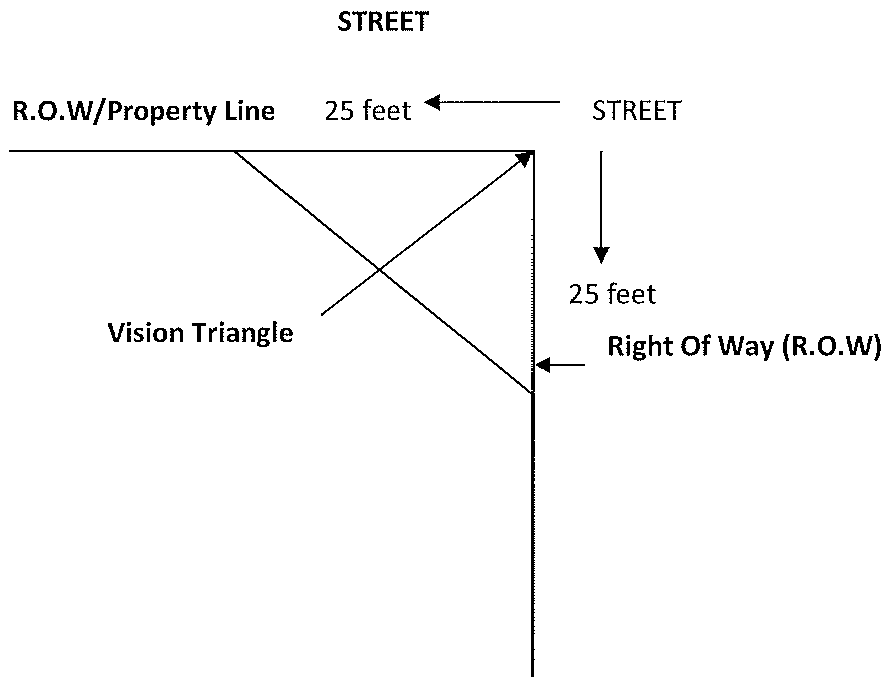
Sec. 66-444. - Vision triangle requirements.
Fences shall not conflict with the vision triangle requirements set forth in section 66-36(d).
(Ord. No. 2016-02, § I, 3-14-2016)
Sec. 66-445. - Prohibited fences.
(a)
No fence shall be constructed, erected, reconstructed, rebuilt or replaced which exceeds seven feet in height.
(b)
No electrically charged or other inherently dangerous fence shall be permitted in a nonindustrial area. This includes barbed wire or chicken wire, and/or agricultural type fencing.
(c)
Exceptions.
(1)
In an industrial area where barbed wire is used, the lowest strand shall be a minimum of six feet above the grade.
(2)
Electrically charged invisible pet fences are permitted in residential areas if the wire is buried at least one inch below the surface of the ground.
(Ord. No. 2016-02, § I, 3-14-2016)
Sec. 66-446. - Special purpose fences.
(a)
Fences for swimming pools, confining dogs, gardens, etc. shall not exceed six feet in height and shall be no larger than necessary for such purpose and shall conform to the building setback requirements.
(1)
Fencing required. No swimming pool shall be used, constructed, erected or maintained in any residence or rural development district unless said swimming pool, or the property on which it is located, shall be surrounded by a fence or a wall no less than four feet in height above the ground which shall have a gate with a lock so as to prevent uncontrolled access by children to the pool water.
(2)
Definition. A swimming pool is defined as any below ground enclosure of water including, but not limited to, a natural or manmade tank or pool of sufficient size, depth, or height to enclose water at any point of greater than one and one-half feet in depth.
(3)
Garden fence. Purpose of which to keep wildlife out of personal garden space. Special approval can be obtained for alternate building materials for this purpose.
(Ord. No. 2016-02, § I, 3-14-2016)
Sec. 66-447. - Fence installation.
(a)
General requirements. No fence shall be installed, except in strict compliance with this article, site specific conditions, and the following requirements:
(1)
The height of any fence erected under this article shall be determined by the measurement from the highest point of the fence to the existing ground level of the property.
(2)
The height of walls and fences shall be measured vertically from the finished grade on the exterior side of the fence. Raising the finished grade by placing fill solely for the purpose of adding additional height to a fence is prohibited. If a fence is placed on a berm, the berm shall be included in the height of the fence and the height shall be measured vertically from the base of the berm.
(3)
All fences shall be no closer than 12 inches to the public sidewalk.
(4)
Fences shall be installed plumb and level and the top finish of the fence shall be uniform. Fences shall follow the contour of the ground to the extent practical.
(5)
Fences shall be installed with the finished side facing the adjacent property or public right-of-way, and the fence posts must be located on the inside of the fence facing the property on which the fence is located, except when the style of fence commonly described as a "Good Neighbor Fence" is installed.
(b)
Modifications. All modifications to an existing fence shall comply with this article.
(c)
Approved fence materials. All fences shall meet the following material requirements:
(1)
Fences to be situated in side and/or rear yards shall be constructed using materials suitable for residential-style fencing, including, but not limited to, brick, wrought iron, vinyl, chain link (which requires top rail support).
(2)
No fence shall be constructed of used or discarded materials that are in disrepair, or any other items including, but not limited to, pallets, tree trunks, trash, junk, or other similar items. Materials not specifically manufactured for fencing, such as railroad ties, wooden doors, landscape timbers or utility poles shall not be used for, or in the construction of a fence.
(3)
Agricultural/farm fences shall only be permitted in agriculturally zoned or use districts and shall not exceed six feet in height.
(4)
Residential front yard fences shall be 50 percent open (see-through) and be of split rail, wrought iron or picket design. Chain-link fencing is not permitted in residential front yards.
(d)
Maintenance of fences. Fences shall be maintained in a manner as to prevent rust, corrosion and deterioration. They will not become a public or private nuisance. They will not be a danger to adjoining property owners or the public. Fences shall not create an appearance of patchwork, which is indicative of a state of disrepair. Every fence installed shall be maintained by the owner in such a way that it will remain plumb, level, and in a good state of repair.
(Ord. No. 2016-02, § I, 3-14-2016)
Sec. 66-448. - Nonconforming fences.
Any fence which existed at the time of adoption of this article which does not conform to the provisions set forth herein shall not be altered without making the entire fence conform to the provisions of this article.
(Ord. No. 2016-02, § I, 3-14-2016)
Sec. 66-449. - Special exceptions.
(a)
The common council is authorized to grant a special exception to waive or modify any requirements of this article if, in the judgment of the common council, it would be inappropriate to apply literally the provisions of this article due to exceptional circumstances, to the extent deemed just and proper on a case-by-case basis. The procedures and standards to be applied are as follows:
(1)
Procedures.
a.
Petition. A party seeking a special exception shall file a petition with the city administrator.
b.
Petition data required. The petition shall include all of the following:
i.
A plot map drawn to scale of not less than 100 feet to the inch showing the land in question, its location, the length and direction of each boundary thereof, the location and existing use of all buildings on such land and the principal use of all properties within 300 feet of such land.
ii.
The names and addresses of the owners of all properties within 300 feet of any part of the land included in the proposed change.
iii.
A detailed description of the intended development or use.
iv.
Any further information as required by the city staff or common council to facilitate the making of an evaluation of such request, such as a site plan depicting proposed buildings, parking, traffic impact, landscaping treatment, drainage, sanitary sewer, erosion control and other factors as would be pertinent including the impact on public facilities.
c.
Hearing. The common council shall hold a public hearing upon receipt of such petition. Notice of such public hearing shall be provided as described in Wis. Stats. ch. 985.
d.
Fee. The petition shall be accompanied by a fee payment as set from time to time by the common council to defray the cost of publication, notification, and holding a public hearing, administrative expenses and expenses of council members. The petitioner shall also pay reimbursement to the city for all costs incurred for legal, planning, engineering, and administrative work necessary to administer the application and oversee the project.
(2)
Basis of approval. An application for a special exception may be approved, denied, or approved with conditions. In order to approve the special exception, the common council must find that the applicant has demonstrated all of the following:
e.
That there are exceptional, extraordinary, or unusual circumstances or conditions applying to the lot or parcel, structure, use, or intended use, such that a literal enforcement of the requirements of this article would result in a severe burden; and, also, that such circumstances do not apply generally to other properties or uses in the same district, or are of such a recurrent nature as to suggest that the zoning ordinance should be changed.
f.
That the special exception is necessary for the preservation and enjoyment of substantial property rights possessed by the applicant, and is not inconsistent with substantial property rights possessed by other properties in the same vicinity.
g.
That the special exception will not create substantial detriment to adjacent property or the general desirability of the city and its environs, and will not materially impair or be contrary to the purpose and spirit of this article or the public interest.
(3)
Determination. The action of the common council shall be stated in writing, and shall include findings of facts setting forth the basis for the decision. If a special exception is granted, or is conditionally granted, it shall be subject to the written approval of the applicant, and upon such approval it shall be recorded at the office of the Waushara County Register of Deeds. The decision of the common council shall be final, and shall not be subject to appeal.
(Ord. No. 2016-02, § I, 3-14-2016)

