
Waveland City Zoning Code
ARTICLE III
- INTERPRETATIONS AND DEFINITIONS
Sec. 301. - Interpretations of terms.
For the purpose of this Ordinance, certain words or terms used herein shall be interpreted as follows:
301.1
When not inconsistent with the context, words used in the present tense include the future tense. Words used in the singular include the plural, and words used in the plural include the singular.
301.2
The word "shall" is always mandatory and not merely directory; the word "may" is permissive.
301.3
The word "building" includes the word "structure" or "premises."
301.4
The word "lot" includes the word "plot," "tract" or "parcel."
301.5
The word "person" includes a firm, organization, association, partnership, trust, company, or corporation as well as an individual.
301.6
The word "used" or "occupied" as applied to any land or building shall be construed to include the words "intended," "arranged," or "designed" to be used or occupied.
301.7
"Map" means the "Zoning Map of the City of Waveland, Mississippi."
Sec. 302. - Definitions of terms.
Except where specifically defined herein, all words used in this Ordinance shall carry their customary meanings.
302.1
Accessory Use or Structure: A use or structure on the same lot and of a nature customarily incidental and subordinate to the principal use of the structure.
302.2
Alteration of Building: Any change in the supporting members of a building (such as bearing walls, columns, girders), except such change as may be required for its safety; any addition to a building; any change in use from that of one district classification to another; or of a building from one location to another.
302.3
Bed and Breakfast: A use accessory to an owner-occupied, single-family detached dwelling consisting of guest rooms available for short-term, overnight rental and the provision of breakfast service to overnight guests.
302.4
Board of Mayor and Alderman: The elected Mayor and the four elected Ward Aldermen serving as the Governing Authority of the City of Waveland.
302.5
Buffer Area: An area set aside to remain vacant or to be planted and landscaped to reduce the blighting effect of commercial or industrial uses on adjacent residential property.
302.6
Building, Height of: The vertical distance measured from the average elevation of finished grade along the front of the building to the highest point of the coping of a flat roof, to the deck line of a mansard roof, or the height of the highest ridge of a gable, hip or gambrel roof.
302.7
Building, Width: The horizontal distance between the furthest extensions of the side exterior walls of the principal mass of a structure.
302.8
Building Permit: A permit issued by the Building Official authorizing the construction or alteration of a specific building on a specific lot.
302.9
Building, Principal: A building in which is conducted the main or principal use of the lot on which said building is situated.
302.10
Building Official: The individual designated by the City of Waveland to administer and enforce the regulations of the building code and certain provisions of this Zoning Ordinance.
302.11
Building Setback: The minimum distance, as prescribed by the Ordinance, between property lines of a lot or a parcel of land and any point on a building or structure related thereto, exclusive of those architectural features permitted to extend thereinto.
302.12
Carport: See Garage, Private.
302.13
Centerline of Street: That line surveyed and monumented by the governing body shall be the centerline of the street; or if such centerline has not been surveyed, it shall be that line running midway between the outside curbs or ditches of such street.
302.14
Child Care Center: A place that provides shelter and personal care on a regular basis for children who are not related within the third degree computed according to civil law to the operator, for four (4) or more hours of any part of a twenty-four (24) hour day, whether such place be organized or operated for profit or not. The term "child care center" includes child care facility, kindergarten, nurseries or any other facility that falls within the scope of definitions set forth above, regardless of auspices.
302.15
Commercial Motor-Driven Vehicle: Any self-propelled vehicle used for commercial purposes on the highway to transport passengers for hire; transport equipment, materials, merchandise or tools; or draw other vehicles.
302.16
Conditional Use: A conditional use is a use that would not be appropriate generally or without restriction through the zoning district but which, if controlled as to number, area, location, or relation to the neighborhood, would promote the public health, safety, morals, order, comfort, convenience, appearance, prosperity or general welfare. Such uses may be permitted in such zoning districts as conditional uses, if specific provisions for such conditional use are made in this zoning ordinance.
302.17
Condominium: A dwelling or commercial unit available for sale in fee simple contained in a multi-occupancy project subject to covenants, conditions, and restrictions placing control over the common facilities owned by the condominium entity. Condominium entity shall mean a condominium, cooperative, trust, partnership or other similar association.
302.18
Conforming Use: Any lawful use of a building or lot which complies with the provisions of this Ordinance.
302.19
Convenience Store: A small store selling retail items generally necessary or desirable for everyday living, such as food, sundries, and newspapers.
302.20
Court, Inner: An open space without a roof surrounded on four sides by a building or structure.
302.21
Court, Outer: An open space without a roof surrounded on less than three sides with a building or structure.
302.22
Density: A number of units or items permitted on an area. Usually expressed in dwelling units per square feet of lot area, and typically categorized as low, medium or high density for residential dwelling units.
302.24
Developer: Any person engaged in developing or improving a lot or group of lots or structures thereon for use or occupancy.
302.25
Development: The act of building structures or installing site improvements.
302.26
Duplex: See Two-Family Dwelling Unit.
302.27
Dwelling: A building designed or used for permanent living quarters for one or more families.
302.28
Dwelling, Single-family: A detached house or building designed and intended for, or to be occupied exclusively by, one (1) family and having no party wall or walls in common with an adjacent house or houses, building or buildings. A recreational vehicle is not a single-family dwelling.
302.29
Dwelling, Two-Family: A building designed and intended for, or occupied exclusively by, two (2) families living independently of each other.
302.30
Dwelling, multiple: A detached or semi-detached building or portion thereof used or designed and intended as residences for three (3) or more families living independently of each other, including apartment houses, apartment hotels, apartment cooperatives, condominiums, bungalow courts, and flats.
302.31
Dwelling unit: One room or rooms connected together constituting a separate, independent housekeeping establishment for owner occupancy, rental or lease on a weekly, monthly, or longer basis, and physically separated from any other rooms or dwelling units which may be in the same structure, and containing independent cooking and sleeping facilities.
302.32
Easement: A grant by the property owner of the use of a strip of land by the public, an entity, corporation or individual for specified purposes. For example:
A.
Access: An easement allowing a private path which is permanently reserved for vehicle or pedestrian access to abutting property. The terms of use of which are public record.
B.
Drainage: An easement reserving space for conveyance of water.
C.
Utility: An easement reserving space for utilities.
302.33
Family: One or more persons occupying a dwelling and living as a single housekeeping unit.
302.34
Farm: Any parcel of land which is used for gain in the raising of agricultural products, livestock, poultry and dairy products. It includes necessary farm structures within the prescribed limits and the storage of equipment used. It excludes the raising of fur-bearing animals, riding academies, livery or boarding stables and dog kennels.
302.35
Fence: A barrier intended to make a boundary, screen a view or prevent intrusion. All fences shall be able to withstand normal wear, function as a barrier and keep an attractive appearance and shall be built in a sound workmanlike manner, with adequate footings. Fencing materials shall include wire mesh, steel mesh, chain link, louvered stake and similar materials, wood, wrought iron, stone or masonry. Vinyl or fiberglass composite materials may be utilized if designed and constructed for fencing material.
302.36
Flea Market: An enclosed retail complex operated on a sustained basis in which used items, such as antiques and collectibles, are sold by management on consignment or by vendors in sublet space.
302.37
Floor Area: Where ever the term "floor area" is used in this Ordinance as a basis for requiring off-street parking for any structure, it shall be assumed that, unless otherwise stated, said floor area not only applies to the ground floor area but also to any additional stories or basement of said structure.
302.38
Floor Area, Gross: The total number of square feet of floor area space within the exterior walls of a building, not including unconditioned space.
302.39
Front: The side of a lot bordering on a street right-of-way, except in the case of a corner lot or other double-frontage lots, in which case the owner of the lot must designate in his application for a building permit which side bordering a street is the front.
302.40
Garage, Apartment: A dwelling unit erected above a private, detached garage.
302.41
Garage, Private: An accessory building or portion of a main building used for vehicular storage. The term includes carport.
302.42
Garage, Public: A building or portion thereof, other than a private or storage garage, designed or used for servicing, repairing, equipping, hiring, selling or storing motor-driven vehicles.
302.43
Grade, Finished: The completed surfaces of lawns, walks and roads, brought to grades as shown on official plans or designs relating thereto.
302.44
Grocery Store: A store established primarily for the retailing of food.
302.45
Home Occupations: Any use conducted within a dwelling and carried on by the inhabitants thereof. The home occupation use is clearly incidental and secondary to the use of the dwelling for residence purposes and does not change the character thereof. It does not adversely affect the uses permitted in the residential district of which it is a part, nor does it create additional traffic to the residence. No more than one person may be employed by the home occupation other than the residents. No outdoor storage of materials, equipment and/or supplies is permitted.
302.46
Hospital: A building, or portion thereof, used for the treatment of the sick, injured or infirmed and accredited by the American Hospital Association.
302.47
Hotel: Any building, or portion thereof, containing living units to be used for transients, but not including motels, mobile home parks, dormitories, fraternities, sororities, boardinghouses or roominghouses or recreational vehicle parks. A hotel is a business use rather than a residential use.
302.48
Illumination: Light originating on or within a sign, or projected on a sign, except incidental light.
302.49
Industry: The processing of products or raw materials.
302.50
Industry, Heavy: Those industries whose processing operations result in the outdoor storage or processing of materials or products, the emission of any atmospheric pollution, visible light flashes or glare, odors, noise or vibration which may be heard or felt off the premises, or those industries which constitute a fire or explosion hazard.
302.51
Industry, Light: Those industries whose processing operations result in none of the conditions of "Heavy Industry" and are conducted wholly within a building.
302.52
Item of Information: In relation to signs, a syllable of a word or abbreviation, or a separated letter, initial, symbol, or logo; or a distinct geometric shape forming part of a sign.
302.53
Junkyard: A parcel of land upon which the principal or accessory use is the accumulation of used, discarded, or worn out materials, or manufactured products, or junk cars, any of which may or may not be reusable or salable. This definition does not include storage of operational vehicles.
302.54
Kennel: The keeping for sale or boarding of more than three (3) dogs or other animals that are more than six (6) months old.
302.55
Land Development Permit: A permit issued by the Building Official authorizing site work, such as clearing, grading, excavation, filling, and temporary or permanent road construction.
302.56
Loading Space: An off-street space or berth on the same lot with a building, or contiguous to a group of buildings, for the temporary parking of a commercial vehicle while loading and unloading merchandise or materials and which abuts on a street, alley or other appropriate means of access.
302.57
Lot: A parcel of land which is, or may be, occupied by a building, its accessory buildings and uses customarily incident thereto, together with such yards or open spaces within the lot lines as may be required by the Ordinance, and fronting upon a public dedicated street.
302.58
Lot Area: The total horizontal area included within the lot lines.
302.59
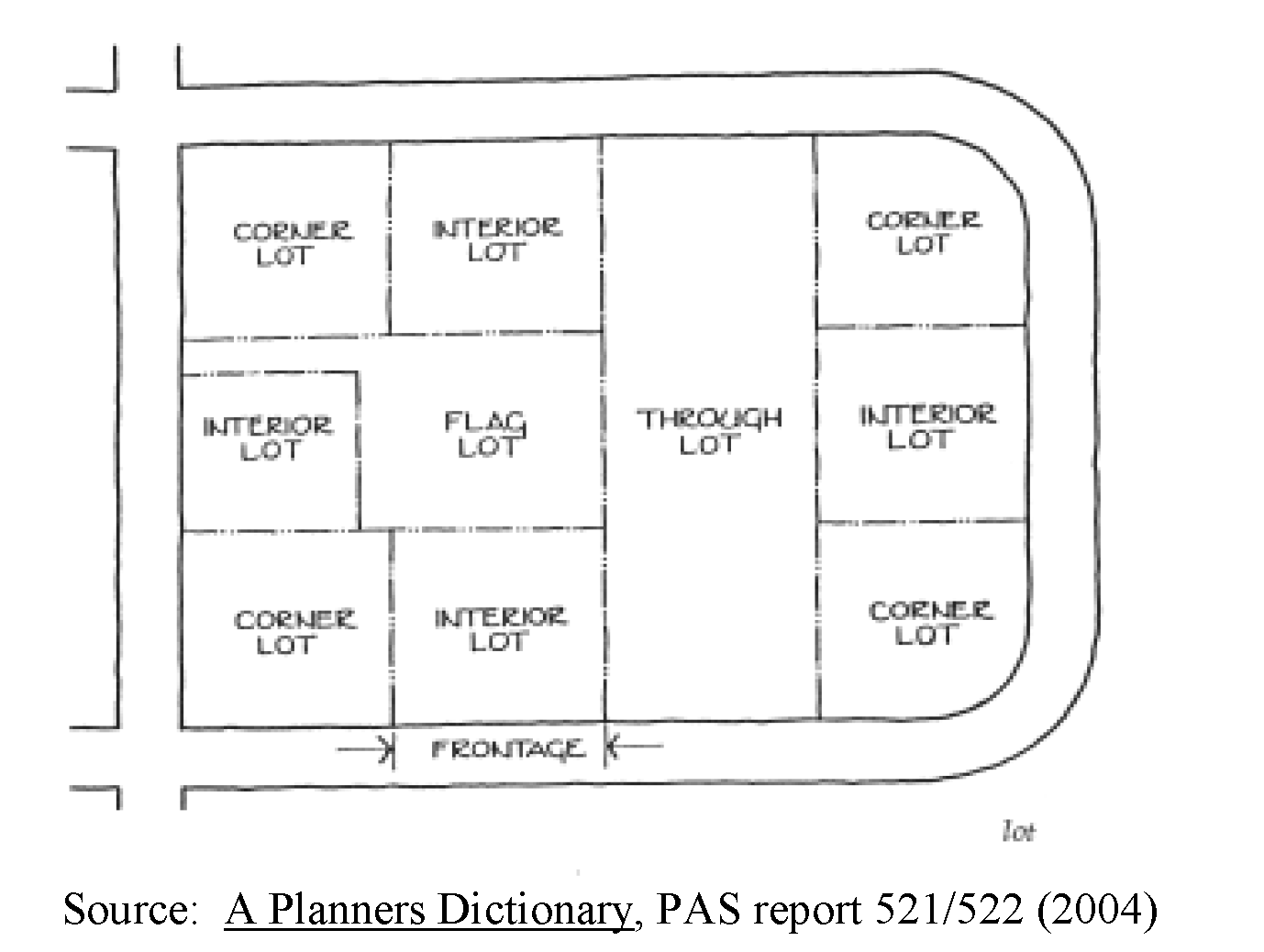
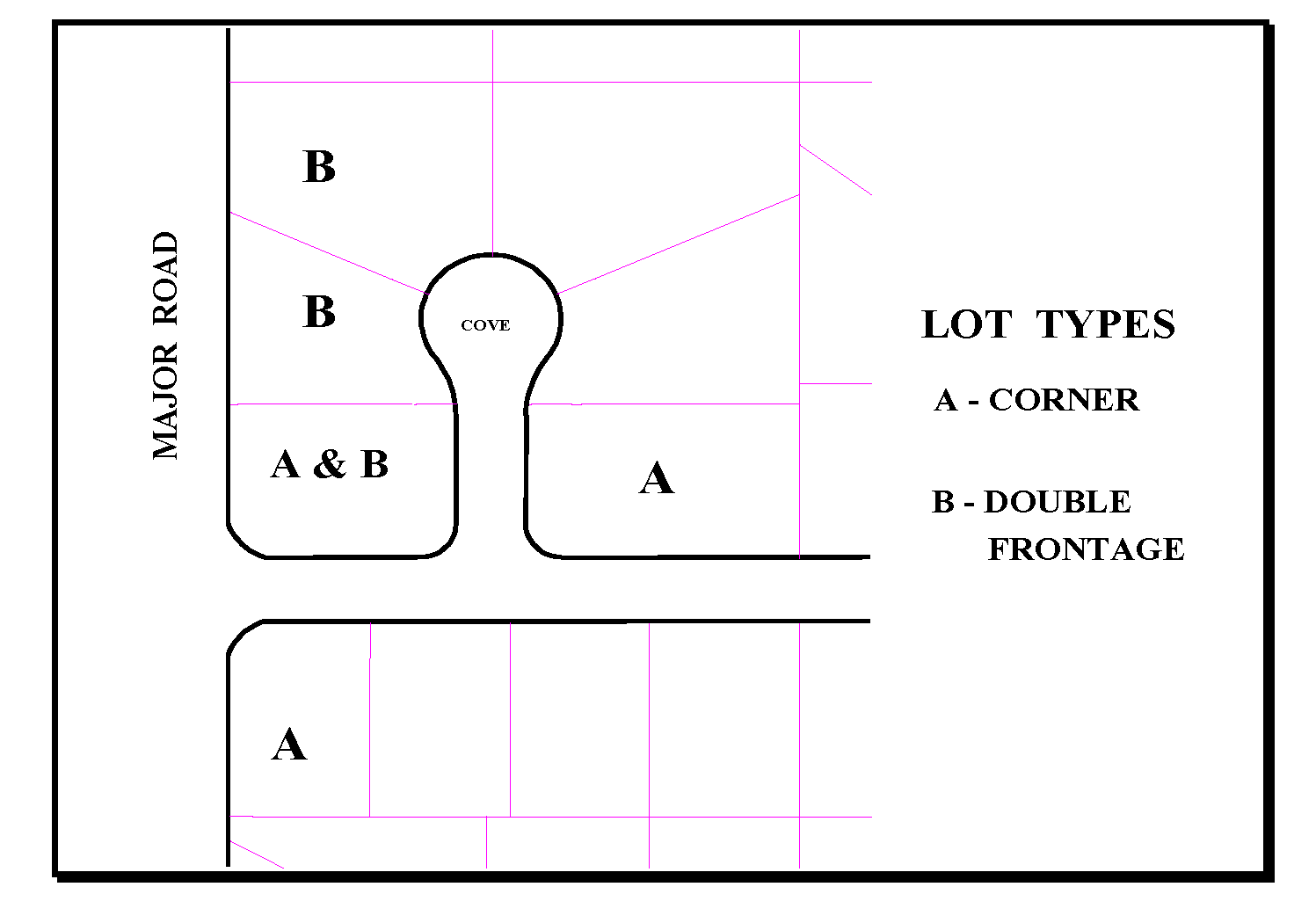
Lot, Corner: A lot of which at least two (2) adjoining sides abut for their full length on public streets (see illustration).
302.59
Lot Depth: The distance from the street right-of-way line to the rear lot line, measured along the side lines of the lot.
302.60
Lot, Double Frontage: A lot which runs through a block from street to street and has two opposite sides abutting on two or more streets, also known as a "through lot" (see illustration).
302.61
Lot Frontage: That measurement of a lot abutting on a public street, measured along the street right-of-way line from side lot line to side lot line (structures on corner lots fronting on a particular street shall be deemed to have frontage on that street).
302.62
Lot, Interior: A lot other than a corner lot (see illustration).
302.63
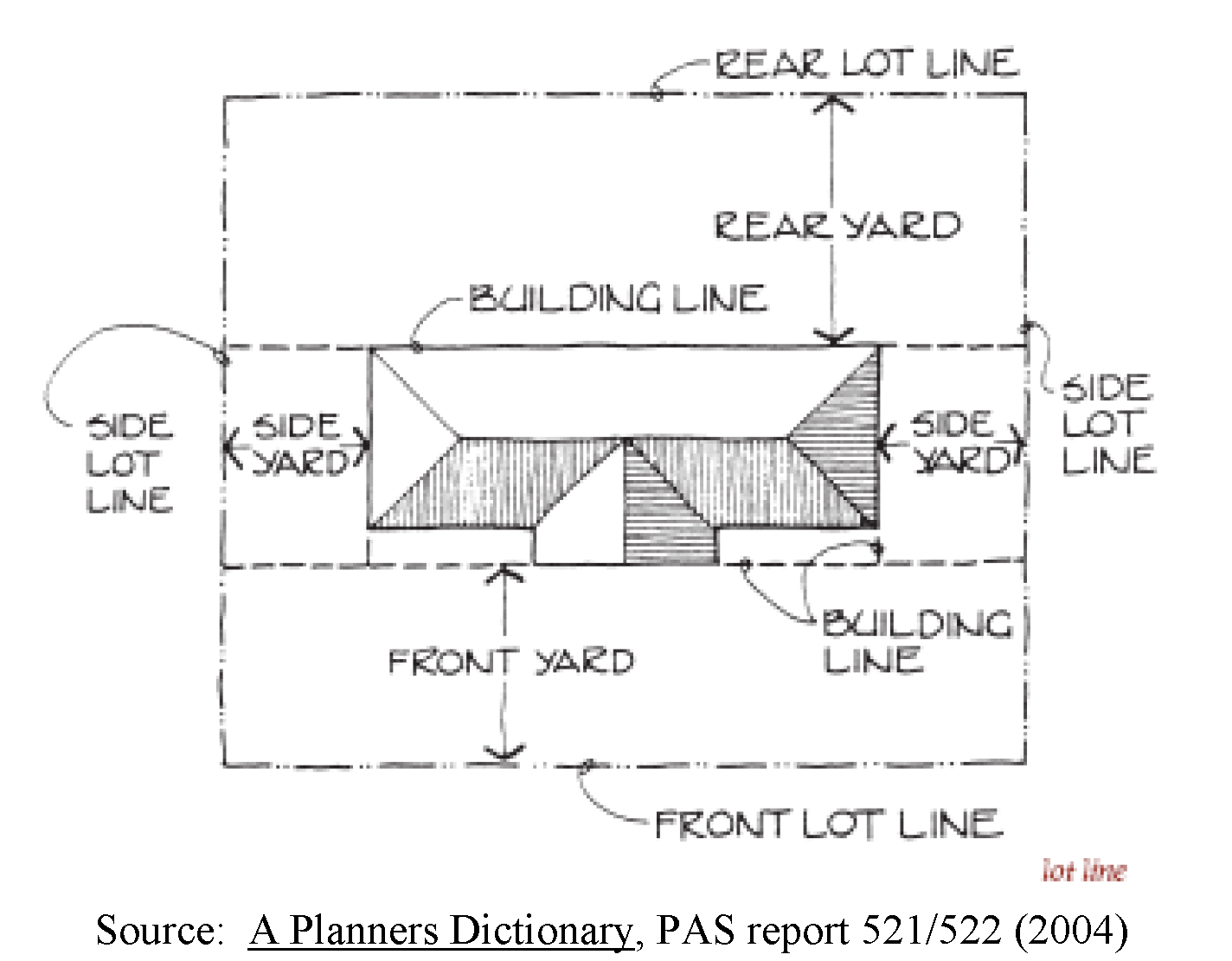
Lot Lines: The lines bounding a lot as defined herein (see illustration under Yards).
302.64
Lot Line, Front: In the case of an interior lot, the line separating said lot from the street. In the case of a corner or double frontage lot, the line separating said lot from the street which the dwelling will face, to be determined from the request for a Building Permit.
302.65
Lot Line, Rear: The lot boundary opposite and most distant from the front lot line. In the case of a pointed or irregular lot, it shall be an imaginary line parallel to and farthest from the front lot line.
302.66
Lot Line, Side: The side lot line is the property boundary line between the front and rear lot lines.
302.67
Lot of Record: A lot, the plat, deed or act of sale of which has been recorded in the Office of the Chancery Clerk of Hancock County, Mississippi.
302.68
Lot Width: The width of a lot at the front building setback line, measured along the street right-of-way line.
302.69
Manufactured Home: A factory-built, single-family structure that is manufactured after June 15, 1976, under the National Manufactured Home Construction and Safety Standards Act, is transported in one or more sections, is built on a permanent chassis, and is used as a place of human habitation, but which is not constructed with a permanent hitch or other device allowing transport of the unit other than for the purpose of delivery to a permanent site, and which does not have wheels or axles permanently attached to its body or frame. It must be permanently connected to two or more components that can be separated when transported but designed to be joined into one integral unit. It does not include mobile homes, modular homes, commercial trailers, or recreational vehicles.
302.70
Manufactured Home/Mobile Home Park: An area of land upon which ten (10) or more non-transient manufactured homes or mobile homes occupied for dwelling or sleeping purposes are located, either free of charge or for revenue purposes, for which is offered for such use. It includes any building, structure, vehicle or enclosure used or intended to be used as a part of the facilities or equipment of such mobile home park. The term "mobile home park" shall include "trailer park," "trailer court," and similar terms.
302.71
Marina: A water-based facility with docks, launching ramps or other launching systems, supplies and services for small boats.
302.72
Marine Supply Store: A commercial establishment primarily engaged in sales to the general public of merchandise customarily used in connection with water-based activities.
302.73
Mini-Warehouse: A storage enterprise dealing with the reception of goods and residential or commercial orientation that lie dormant over extended period of time. Separate storage units are rented to individual customers who are entitled to exclusive and independent access to their respective units. Storage units range from closet size to bedroom size or larger. Each unit has its own door; each renter locks his/her own unit and keeps his/her own key. Each storage unit may be rented on a monthly or annual basis. Almost anything may be stored in the units with the exception of flammable materials, illegal goods and perishable foods.
302.74
Mining operation: A lot or parcel of land, or part thereof used, for the purpose of extracting sand, gravel, or soil for sale.
302.75
Mobile Home: A dwelling, still fit for human habitation, constructed prior to June 15, 1976, transportable in one or more sections, which is built on a permanent chassis and designed to be used with or without a permanent foundation when connected to the required utilities. It does not include modular homes, recreational vehicles or travel trailers; a mobile home by this definition does not qualify as a manufactured housing unit.
302.76
Modular Home: A residential structure built in modules in a factory, transported to a building site on truck beds and then assembled on-site on a permanent foundation. A modular home must conform to all applicable current building codes and procedures.
302.77
Motel: A building, or group of buildings, comprising individual living quarters, or dwelling units, for the accommodation of transient guests, which is so designed that parking is on the same building site and is conveniently accessible from the living units without having to pass through any lobby or interior court. This definition includes auto courts, tourist courts and motor hotels, but does not include accommodations for mobile homes. A motel is a business use rather than a residential use.
302.78
Non-conforming use: A building, structure or use of land existing at the time of enactment of this Ordinance or amendment hereto, and which does not conform to the regulations of the district or zone in which it is situated. (See Section 402 for details.)
302.79
Nuisance: Any act, omission, condition or thing that:
A.
Injures or endangers the comfort, repose, health or safety of others;
B.
Offends decency;
C.
Is offensive to the senses;
D.
Unlawfully interferes with, obstructs or tends to obstruct or renders dangerous for passage any public or private street, highway, sidewalk, stream, ditch or drainage;
E.
In any way renders other persons insecure in life or the use of property;
F.
Essentially interferes with the comfortable enjoyment of life and property, or tends to depreciate the value of the property of others.
302.80
Nursing or Convalescent Home: Any dwelling in which aged, chronically ill, or incurable persons are housed and furnished with meals and nursing care for compensation.
302.81
Open Air Market: An enclosed space for organized assembly of individual vendors to sell otherwise permitted items on an ad hoc basis.
302.82
Open Space: An unoccupied space open to the sky on the same lot with the building.
302.83
Pedestrian Way: A right-of-way, however designated, either across or within a block, intended for use by pedestrian traffic.
302.84
Planning and Zoning Commission: The Planning and Zoning Commission of the City of Waveland shall consist of members appointed by the Board of Mayor and Aldermen.
302.85
Portable Storage Container: A portable, weather-resistant receptacle designed and used for the storage or shipment of household goods, wares, building materials or merchandise. The term shall not include yard waste containers.
302.86
Principal Use: The specific primary purpose for which land or a building is intended to be used.
302.87
Public Body: A government or governmental agency of the City of Waveland, County of Hancock, State of Mississippi or of the United States of America.
302.88
Public Building: A building owned or used exclusively by the City of Waveland, County of Hancock, State of Mississippi or the United States Government.
302.89
Public Use: Includes public parks and recreation, schools and other educational or cultural facilities, libraries, hospitals and other public offices or administrative facilities.
302.90
Public Utility: Any person, firm, corporation, municipal department or board duly authorized under state or municipal regulations to furnish such public services as electricity, gas, water, sewer, telephone, telegraph, transportation or other public utility services to its subscribers or customers.
302.91
Recreational Facilities: Country clubs, golf courses, swimming pools, playgrounds, recreational centers and other non-commercial recreation area and facilities.
302.92
Recreational Vehicle: For the purpose of this ordinance, Recreational Vehicles are of four classifications: Camping Trailer, Motor Home, Travel Trailer and Truck Camper, all of which are considered either a vehicle or vehicle accessory providing temporary living quarters, but are not considered dwellings or structures, regardless of any on-site modifications thereto.
A.
Camping Trailer: A vehicular portable unit mounted on wheels and constructed with collapsible partial side walls which fold for towing by another vehicle, and unfolds at a camp site to provide temporary living quarters for recreational, camping or travel use.
B.
Motor Home: A vehicular unit built on a self-propelled motor vehicle chassis primarily to provide temporary living quarters for recreational, camping or travel use.
C.
Travel Trailer: A vehicular unit mounted on wheels designed to provide temporary living quarters for recreational, camping or travel use. A travel trailer is of such size and weight as not to require a special movement permit when towed behind a motorized vehicle (MDOT requires a Commercial Vehicle Permit for a trailer more than eight and one-half (8 ½) feet wide). A travel trailer has a gross trailer area not greater than three hundred and eighty-two and one half (382.5) square feet (calculated by a maximum width of eight and one half (8 ½) feet wide and a maximum length of forty-five (45) feet long).
D.
Truck Camper: A portable accessory unit constructed to provide temporary living quarters for recreational, camping or travel use, consisting of a roof, floor, and sides designed to be loaded unto and unloaded from the bed of a pickup truck.
302.93
Recreational Vehicle Park: An area of land which has a purpose of providing a location for transient recreational vehicles to locate. The park is actively managed to provide services to the transient users.
302.94
Rest Homes: The rooming or boarding of any aged or convalescent person, whether ambulatory or non-ambulatory, for which a license is required by a city, county, state or federal agency.
302.95
Right-of-Way (ROW): A strip of land acquired by reservation, dedication, forced dedication, prescription, or condemnation, and intended to be occupied by a road or other transportation pathway, communication device, electric transmission line, oil or gas pipeline, water line, sanitary sewer line, storm water or other drainage line, and similar uses.
302.96
Right-of-way line: The line delimiting the public/private boundary of the right-of-way (ROW), and being identical with the property line of persons owning property fronting upon the ROW.
302.97
Setback Line: The distance from the public right-of-way or abutting property lines to the nearest point of a building, excluding uncovered porches.
302.98
Sign: A lettered, numbered, symbolic, pictorial, light or audio means of attracting and holding public attention out of doors and directly evident from a public way, or to identify, announce, direct, inform, or promote any condition, circumstance, event, enterprise or activity. Types of signs:
A.
Attached. An on-premises sign that is attached to a building or other surface. Awning signs, canopy signs, window signs, projecting or suspended signs, and wall signs are all considered attached.
B.
Awning or Canopy. An on-premises sign, displayed, attached to or incorporated into the surface of an architectural projection or shelter projecting from or supported by the exterior wall of a building and composed of a covering of non-rigid materials and/or fabric on a supporting framework that may be either permanent or retractable.
C.
Banner. A sign which is designed and intended for temporary use only and made or constructed of such lightweight material or materials so as to be considered temporary in nature; or a sign which advertises or calls attention to some special event or promotion which is or will be occurring on the premises where the banner is located.
D.
Construction. A construction sign indicating the parties involved in the project such as contractors, financial interests, engineers, and the potential occupant(s). The allowable sign area of a construction sign varies according to the zoning district in which it is sited.
E.
Directory. A sign listing multiple occupants or activities on a parcel.
F.
Electronic Message Board. A sign or portion of a sign that displays an electronic image and/or video to form a sign message or messages which may or may not include text. Such signs include any sign or portion of a sign that uses changing lights to form a sign message or messages or uses electronic means to change the sign message. Electronic message boards include, but are not limited to, signs known as Electronic Reader Boards.
G.
Freestanding. A sign supported by one or more uprights, posts, bases, or directly fixed in the ground and not attached to any part of a building.
H.
Gas Price. A sign located on the premises of a retail fuel vendor which displays only the prices of the fuels sold and the name or logo of the company or brand name.
I.
Identification. A freestanding sign identifying a commercial, industrial, residential, institutional, or governmental development, park, district, subdivision, mall or campus.
J.
Menu Board. A sign solely for the drive-through food service establishments designed and located to be viewed by patrons.
K.
Nameplate. A sign not exceeding two (2) square feet in area and bearing only the name of the occupants or premises, address, or year of construction. A nameplate may be externally illuminated to an extent just sufficient to make out the information items shown if passing slowly along the public way nearest to the sign.
L.
Outdoor Advertising (Off-premises). The words "Outdoor Advertising Sign" are applied exclusively to signs which advertise activities or events of any kind offered or taking place elsewhere than on the premise where the sign is located.
M.
Portable. A sign which is not permanently attached or designed to be permanently attached to the grounds or to a building. All portable signs are considered temporary.
N.
Projecting. A sign attached to and projecting from the wall of a building and not in the same plane as the wall.
O.
Real Estate. A sign to advertise the offering of a property for sale, rental or lease on each public way on which the property has frontage. The allowable size of the real estate sign varies according to the zoning district in which it is sited.
P.
Temporary. A sign indicating a specific, individual, and distinct commercial, institutional, or public event, occasion, campaign and the like, which lasts for a brief interval, except as provided for off-premise outdoor advertising signs.
Q.
Wall. A sign painted on or attached to the wall of a building and in the same plane or a plane closely parallel to the plane of the wall.
R.
Window. An on-premise sign that is permanently etched into, attached to, or painted on the outside of a window and is legible from the outside of the window.
302.99
Signable Area: An area of the wall of a building which is free of architectural details on the façade of the building or part of the building in which the activity associated with the sign is located.
302.100
Site Plan Review Committee: A committee of City officials which reviews site plans for consistency with municipal regulations and ordinances.
302.101
Specialty Retail: An establishment selling unique items or lines of items that may include apparel, art, decorative accessories, pre-packaged foods and jewelry.
302.102
Story: That portion of a building included between the surface of any floor and the surface of the floor next above it; if there is no floor above it, then the space between the floor and the ceiling next above it.
302.103
Street: A public thoroughfare open to general public use and having a pavement or roadbed width of not less than twenty (20) feet which affords the principal means of access to abutting property.
A.
Arterial. A major street or highway, which is characterized by high volumes of traffic at higher speeds, with limited access to adjacent properties.
B.
Collector. An intermediate level street that carries traffic from local streets to arterials at moderate speed, and provides access to adjacent properties.
C.
Cul-de-sac (or Cove). A short local street having one end open to traffic and being permanently terminated by a vehicle turn-around.
D.
Dead End Street. Any local street, other than a cul-de-sac, which has only one outlet. It is anticipated that dead end streets could be extended with additional development.
E.
Local Street. A minor street designed primarily to provide access to abutting properties and low-speed travel.
F.
Private Drive. A right-of way which has the characteristics of a street, as defined herein, except that it is not dedicated for public use. A driveway located on a lot which serves only that lot is not considered a private drive.
302.104
Structure: Anything constructed or erected, the use of which requires more or less permanent location on the ground, or which is attached to something having more or less permanent locations on the ground.
302.105
Supermarket: A large self-service retail market that sells food and household goods.
302.106
Usable Open Space: That portion of a lot which is free of buildings, is not devoted to driveway and parking areas, is available and accessible to all the occupants of dwelling units on the lot, and is of reasonable dimension to allow its use for active, or passive, recreation or other outdoor activities. Usable open space may include play lots, gardens, sundecks, courts, courtyards and other yard areas.
302.107
Utility Substation: A facility containing high voltage electrical equipment, transformers or specialized transmission facilities for gas, water, sewer, telephone or other public utilities enclosed in a single area and connected to a transmission network, but not requiring office space, or other space with regular attendants.
302.108
Utility Trailer: A trailer used to transport materials, goods, equipment, or boats. It shall not have more than two axles and not exceed twenty-five (25) feet in length.
302.109
Variance: A variance is a minor adjustment of terms in this Ordinance where such variance will not be contrary to the public interest. Variances are caused by conditions peculiar to the property and not the result of the actions of the applicant, where a literal enforcement of the Ordinance would result in unnecessary and undue hardship. The establishment or expansion of a use otherwise prohibited shall not be allowed by variance. Nor shall a variance be granted because of the presence of non-conformities in the zoning district or uses in an adjoining zoning district.
302.110
Wall: Any structure or device forming a physical barrier which is so constructed that fifty (50) percent or more of the vertical surface is closed to prevent the passage of light, air and vision through said surface in a horizontal plane. This shall include concrete, concrete block, wood or other materials that are solids and are so assembled as to form a solid barrier.
302.111
Way: A street, thoroughfare or easement permanently established for passage of persons or vehicles.
302.112
Wireless Communication Facilities (WCF): Any unstaffed facility for the transmission and/or reception of wireless telecommunication services, usually consisting of an antenna array, cabling and associated ground equipment and a support structure. Also called cell towers.
302.113
Yard: A space on the same lot with the principal building open, unoccupied and unobstructed by buildings or structures from ground to sky, except where encroachments and accessory buildings are expressly permitted (see illustration below).
302.114
Yard, Front: An open, unoccupied space on the same lot with a principal building, extending the full width of the lot and situated between the street lines and the front line of the building projected to side lines of the lot.
302.115
Yard, Rear: An open, unoccupied space, except by a possible accessory building, on the same lot with a principal building, extending the full width of the lot and situated between the rear lines of the building projected to side lines of the lot.
302.116
Yard, Side: An open, unoccupied space on the same lot with a principal building, situated between the building and the side line of the lot and extending from the rear line of the front yard to the front line of the rear yard.
302.117
Zoning Official: The individual designated by the City of Waveland to administer this Ordinance. Duties of the Zoning Official shall include receiving applications, assisting applicants and appellants in the procedures required hereunder, reviewing development plans, and acting as Secretary to the Planning and Zoning Commission.

