
Webster Groves City Zoning Code
ARTICLE VI
PERFORMANCE STANDARDS
Sec. 53.181. - Purpose.
The regulations contained in this section and the following sections shall govern the size, number, location, and design of all off-street parking and loading facilities
Sec. 53.182. - Off-street parking.
The requirements of this section shall apply when any new structure is constructed or any existing structure is reconstructed, enlarged or converted for a use needing additional parking and loading capacity.
a.
Minimum and maximum parking and loading space requirements.
1.
Minimum parking space requirements. The minimum number of off-street parking spaces required for permitted and conditional uses are found in section 53.186 of this article. Where no minimum requirement is specified, or when one or more of the parking requirements may be construed as applicable to the same use, lot or building, the final determination of required parking shall be made by the director of planning and development.
2.
Maximum parking space requirements. The maximum number of off-street parking spaces allowed for permitted and conditional multiple family residential, commercial, industrial and institutional uses shall be no more than 120 percent of the space requirements found in section 53.186 of this article.
3.
Minimum loading space requirements.
i.
Dimensional requirements. Each loading space shall have a minimum dimension of 12 by 35 feet and a minimum vertical clearance of 14 feet. Each loading space shall include maneuvering space with a minimum depth of 49 feet.
ii.
Commercial uses. One loading space shall be provided on the lot for each 15,000 square feet of floor area, or fraction thereof, in excess of 5,000 square feet devoted to commercial purposes.
iii.
Industrial uses. One loading space shall be provided on the lot for each 10,000 square feet of floor area, or fraction thereof, in excess of 5,000 square feet devoted to industrial purposes.
4.
Computation of parking and loading requirements.
i.
Applicability. When an existing structure is reconstructed, enlarged, or converted for a use needing additional parking capacity, the new number of parking and loading spaces required shall be calculated incrementally based upon the net additional gross square footage of the new or expanded use. In the event it is not possible to accommodate the additional needed off-street parking, a reduction to the parking requirement may be requested in accordance with section 53.185.
ii.
Fractions. When measurements of the number of required spaces result in a fractional number, any fraction shall be rounded down to the next lower whole number.
iii.
Multiple uses. Lots containing more than one use shall provide parking and loading in an amount equal to the total of the requirements for all uses, except as prescribed in section 53.185
iv.
Area measurements.
A.
Unless otherwise specified, all square footage-based parking and loading standards shall be calculated on the gross floor area of the use.
B.
Structured parking within a building shall not be included as floor area of the use.
v.
Off-street loading and service areas. Required off-street loading spaces shall not be counted as off-street parking spaces. Parking spaces located in the bays of vehicle repair or service facilities, or stacking spaces in drive-through lanes for any use that requires additional parking spaces shall not be counted as parking spaces for the purpose of meeting the required parking for such a use.
b.
Off-street parking facility design.
1.
Minimum dimensions. Except as otherwise provided for in this subsection, the requirements for off-street parking facilities shall be implemented with regard to the minimum dimensions in the following table 53.182A. Required parking stalls, aisles, and curbs shall be clearly and visibly marked. In the event that the desired parking angle is not specified by the following table, the director of the department of planning and development may specify other equivalent dimensions associated with the desired parking angle by interpolating from dimensions listed in the table.
Table 53.182A: Parking facility minimum dimensions
| A. parking angle | 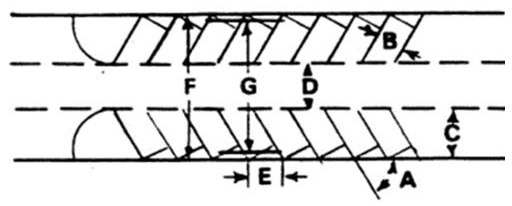 |
| B. stall width | |
| C. 19' min. stall to curb | |
| D. aisle width | |
| E. curb length per car | |
| F. curb to curb | |
| G. center to center width of double row with aisle between |
2.
Location. All parking and loading spaces required by this Code shall be located on the same parcel of land as the use to be served except as provided in sections 53.184 and 53.185.
i.
In the "A1" through "A4" residence districts, required parking spaces shall be located behind the existing front building line of the primary structure. This space can be located in a driveway or in an approved attached garage or accessory structure.
ii.
In the "D" commercial district, all parking spaces shall be located behind the existing front building line of the primary structure.
iii.
In all commercial and industrial districts, no commercial vehicles, trailers or equipment with a gross vehicle weight rating exceeding 26,000 pounds, as defined by the United States Federal Highway Administration, shall be parked or stored at any time in the front yard with the exception of trucks making delivery to the premises, which may be parked in the front yard area for a period not exceeding one hour per day.
3.
Construction and stormwater management. All off-street parking facilities shall be constructed to adhere to the building code and land disturbance code requirements of the Municipal Code.
4.
Tree and landscape design. All new off-street parking facilities and modification of existing parking facilities in which six or more additional parking spaces will be established shall adhere to the tree and landscape design standards of the Municipal Code.
5.
Accessible parking. The number and design specifications for required accessible parking spaces shall adhere to the building code requirements of the Municipal Code.
6.
Additional driveway design requirements..
i.
Residential driveway width.
A.
At single- and two-family dwellings, driveway width shall meet a minimum of eight feet with the exception of the one required parking space per dwelling unit and the curb cut width at the right of way. The required parking space shall meet the minimum nine-by-19-foot parking stall dimensions and the curb cut shall meet the dimensions in ii below.
B.
At single- and two-family dwellings, driveway width in the portion of the front yard located directly in front of the dwelling shall not exceed that which is necessary to access the required one parking space located in the rear yard or that portion of the side yard which lies between the main building and the side lot lines or that which is necessary to access the parking stalls of a front entry attached garage.
C.
Requests to exceed the maximum driveway width in the portion of the front yard located directly in front of the dwelling shall be accompanied by a site plan produced by a licensed professional engineer for the review of the director of planning and development. Requests may be administratively approved if the applicant meets its burden of proof by showing clear and convincing evidence that the requested modifications are appropriate to the site and do not cause detriment to the adjacent properties.
ii.
Driveway curb cut width. Driveway curb cut width shall not be narrower than ten feet and shall not exceed 24 feet at the front lot line.
iii.
Minimum turning radius. Driveways shall have a minimum outside turning radius of 28 feet.
iv.
Driveway materials. The use of pervious materials and designs are encouraged. A solid surface will be required for the location of the tires of the vehicle. Designs must meet all other city codes for land disturbance (chapter 81) and stormwater (chapter 82).
c.
Bicycle parking.
1.
Required number of bicycle parking spaces. When any new structure is constructed or any existing structure is enlarged, bicycle parking shall be provided as follows for any net additional square footage:
2.
Design and location.
i.
Bicycle parking facilities shall include a rack or storage facility (e.g. locker) that enables bicycles to be secured. Where racks are used, they shall meet the following standards:
A.
The bicycle frame and one wheel can be locked to the rack with a high-security, U-shaped shackle lock when both wheels remain attached to the bicycle.
B.
A bicycle six-foot long can be securely held with its frame supported so that the bicycle cannot be pushed or fall in a manner to block free pedestrian access or access to other bicycle parking spaces.
C.
The rack must be securely anchored.
D.
Bicycle racks and storage facilities shall be accessible without moving another bicycle.
ii.
Bicycle racks and storage facilities shall be located in convenient, visible, well-lit areas with easy access within 50-foot of main entrances of all commercial, residential and institutional buildings. Such locations shall be clearly noted with signage.
iii.
Bicycle racks and storage facilities shall be located so they do not interfere with pedestrian traffic and shall be protected from potential damage by motor vehicles.
iv.
Bicycle racks and storage facilities shall not be located within any required landscape area.
v.
When incorporated with a site plan including a parking structure, half of required bicycle parking spaces shall be provided within said structure on the parking level closest to the primary pedestrian entrance.
3.
Reduction in required vehicle parking for bicycle parking. The total number of required off-street vehicle parking spaces pursuant to section 53.182(a) may be reduced at a ratio of one vehicle parking space per every two bicycle parking spaces provided. The total number of required vehicle parking spaces shall not be reduced by more than ten percent for any project due to bicycle parking. Said reduction shall be included within the calculations for any request for modification of parking standards pursuant to section 53.185.
4.
Computation of parking and loading requirements.
i.
Fractions. When measurements of the number of required bicycle parking spaces result in a fractional number, any fraction shall be rounded down to the next lower whole number.
ii.
Multiple uses. Lots containing more than one use may share bicycle facilities but shall provide bicycle parking in an amount equal to the total of the requirements for all uses
iii.
Area measurements.
A.
Unless otherwise specified, all square footage-based bicycle parking standards shall be calculated on the gross floor area of the use.
B.
Structured parking within a building shall not be included as floor area of the use.
(Ord. No. 9131, §1, 12-1-2020)
Sec. 53.183. - Parking and vehicle storage in residential districts.
a.
Commercial vehicles.
1.
Commercial vehicles used in connection with the operation of a licensed home occupation shall adhere to the requirements of section 53.206.
2.
Except as provided below, all other commercial vehicles stored in residence districts shall be parked in an enclosed garage or on a parking space within the rear yard where screening from neighboring properties and the public right-of-way can be provided by means of an appropriate year-round vegetative buffer, fencing, or combination thereof.
3.
Commercial vehicles not in excess of a gross vehicle weight rating of 10,000 pounds, as defined by the United States Federal Highway Administration, may be parked on a parking space in a front yard or side yard in a residence district if the owner or operator of such trailer or truck may establish to the satisfaction of the city that:
i.
The expense of constructing a garage would constitute a real, substantial, and genuine financial hardship to said owner or operator, or
ii.
The topography or shape of the lot or location of the structures on the lot makes the construction and use of a garage or rear yard parking space physically impossible.
iii.
To establish such a hardship, the owner of such vehicle residing upon the property in question may apply for such relief by filing with the director of planning and development, a duly executed affidavit setting out all the facts upon which such claim if any, for relief may be made, and the director may in approving such applications, designate that portion of the yard of the premises where said trailer or truck may be parked. Such determination, based upon such affidavit, shall be made by the director within 30 days of the date of said application, and such decision, in allowing or disallowing such application, shall be final and binding but shall be subject to judicial review. Approved applications shall be effective for 12-month periods renewable under the same conditions as the original application. Any approved application shall automatically expire when the vehicle mentioned therein is disposed of or sold.
b.
Trailers, campers, boats, and RVs.
1.
In residence districts, trailers, campers, boats, RVs, and similar such vehicles as determined by the director of planning and development which are not used for commercial or industrial purposes may be parked or stored on a parking space in a rear yard in compliance with the appropriate district regulations pertaining to the location of accessory buildings and structures.
2.
Such vehicles may be stored on a paved driveway surface in the front or side yards of any residence district for a period of not more than ten days two times per year.
c.
Dumpsters. Dumpsters and trailers serving as a trash receptacle during remodeling, construction of a home, or removal of debris, may be stored on a paved driveway surface in the front or side yards in a residence district for a period of not more than 90 days. In no event shall the use continue for more than 15 days following the completion of such activity on the property.
(Ord. No. 9131, §1, 12-1-2020)
Sec. 53.184 - Development standards for accessory parking facilities.
Accessory parking facilities shall be permitted upon meeting the conditions below, and upon compliance with the provisions of section 53.170, et seq.
a.
Accessory parking facilities may be located within 300 feet of the primary use.
b.
Accessory parking facilities shall not be located in a required or established front yard.
c.
Parking shall not be located within ten feet of a rear or side lot line abutting a residence district.
d.
Accessory parking facilities shall adhere to the tree and landscape design standards in chapter 10 of the Municipal Code.
e.
In residence and commercial districts, accessory parking facilities shall not be used for the parking or storage of trailers, RVs, commercial tractor-trailers, or similar such vehicles as determined by the director of planning and development.
(Ord. No. 9131, §1, 12-1-2020)
Sec. 53.185. - Modification of parking standards.
A request for an exception from the off-street parking requirements applicable to single family dwelling and two-family dwelling uses may be submitted to the board of adjustment, in accordance with section 53.300 et al.
With respect to all other uses, an applicant may request a modification of the requirements of this section of the City Code by providing a parking demand study, as defined below, whereby the applicant demonstrates by clear and convincing evidence that the requested modifications are appropriate for the site and do not cause detriment to adjacent properties.
a.
Applicability. A parking demand study is required when an applicant requests a reduction in the minimum parking requirements; requests to exceed the maximum parking requirements in the zoning district; requests to modify the parking standards for shared parking; or requests any other modification to the standards of this section.
b.
Elements of a parking demand study. The parking demand study shall contain the following information:
1.
The study shall be signed by a licensed professional engineer or certified planner.
2.
A plan which graphically depicts where the parking spaces, loading spaces, stacking areas, and structured parking facilities are to be located, as well as the onsite circulation for automobile, pedestrian, and bicycle movement.
3.
A report which demonstrates how everything on the plan complies with, or varies from, the applicable standards and procedures of the city.
4.
The plan shall show all entrances and exits for any structured parking facility and the relationship between surface parking lot or structured parking facilities and the circulation.
5.
The plan, supported by the report, shall show the use, number, location, and typical dimensions of parking for various vehicle types including passenger vehicles, trucks, vehicles for mobility-impaired persons, motorcycles, buses, other transit vehicles and bicycles.
6.
The plan, supported by the report, shall include any phasing plans for the construction of structured parking facilities and any interim facilities planned.
7.
Whenever the applicant requests to reduce the number of required parking spaces, or to exceed the maximum parking provided for in this code, the required report shall document how the proposed parking was calculated and upon what assumptions such calculations were based.
8.
Such other information as determined by the department of planning and development to be necessary to process the parking demand study.
c.
Design features and review criteria. Design features and review criteria including, but not limited to those listed below, will be reviewed when in conjunction with requests for modification of any requirements of this section as applicable.
1.
The parking demand study provides sufficient number and types of spaces to serve the uses identified on the site.
2.
Adequate provisions are made for the safety of all parking facility users, including motorists, bicyclists and pedestrians.
3.
Sites are designed to minimize or alleviate traffic problems.
4.
Parking spaces are located near uses they are intended to serve and shall provide safe and convenient access for pedestrian access to the facility.
5.
Adequate on-site parking is provided during each phase of the development.
6.
The development provides opportunities for shared parking or for other reductions in trip generation through the adoption of transportation demand management (TDM) techniques to reduce trip generation, such as car pools, van pools, bicycles, employer transit subsidies, compressed work hours, and high occupancy vehicle (HOV) parking preference.
7.
Reductions in the number of parking spaces should be related to significant factors such as, but not limited to:
A.
Shared parking opportunities;
B.
Hours of operation;
C.
The availability and incorporation of transit services and facilities;
D.
Opportunities for reduced trip generation through pedestrian circulation between mixed-uses;
E.
Off-site traffic mitigation measures;
F.
Recognized variations in standards due to the scale of the facilities;
G.
Parking demand for the specified use; and
H.
The provisions of accessible parking spaces beyond those required per the City Code.
d.
Review procedure and approval. Requests for modifications will be considered by the director of planning and development and may be approved if the applicant meets its burden of proof showing by clear and convincing evidence that the requested modifications are appropriate to the site and do not cause detriment to the adjacent properties. If said request for modifications is approved, the property owner(s) involved in the parking demand study shall submit a written agreement to the city requiring that the parking facility and any associated transportation demand management (TDM), as that term is used by the U.S. Department of Transportation, Federal Highway Administration, and as amended from time to time, shall be maintained without alteration unless such alteration is authorized by the Director of Planning and Development. Such written agreement shall be approved by the city and filed with the city clerk prior to the issuance of a building permit.
1.
Requests for a reduction in the minimum parking requirement:
A.
The director of planning and development shall review and may approve requests for reduction for up to 20 percent of the minimum parking requirement.
B.
Requests for a reduction that exceed 20 percent shall be subject to the review and approval of the city plan commission.
At least ten days in advance of the date of the city plan commission meeting to consider the parking reduction, notice of the proposed parking request shall be hand delivered or placed in a U.S. Post Office mailbox by first class mail to the owners within 185 feet of the subject property, as listed in the real estate index of St. Louis County, announcing. The meeting agenda shall be posted on the bulletin board at city hall and on the city website at least 24 hours in advance of the meeting.
2.
Requests to provide parking in excess of the maximum parking requirement:
A.
Requests to provide off-street parking in excess of 120 percent of the minimum parking requirement shall be subject to the review and approval of the city plan commission. Where city plan commission approval is required for the proposed parking, the applicant shall submit a statement that identifies measures to mitigate for the increase in parking area.
At least ten days in advance of the date of the city plan commission meeting to consider the parking reduction, notice of the proposed parking request shall be hand delivered or placed in a U.S. Post Office mailbox by first class mail to the owners within 185 feet of the subject property, as listed in the real estate index of St. Louis County, announcing. The meeting agenda shall be posted on the bulletin board at city hall and on the city website at least 24 hours in advance of the meeting.
Mitigation measures shall be subject to the review and approval of the city plan commission and may include, but not be limited to, the following:
(i)
Increased open space;
(ii)
Pervious pavements;
(iii)
Green roofs;
(iv)
Cool pavement materials;
(v)
Structured parking facilities; or
(vi)
Native vegetation.
3.
Requests for shared parking: Where two or more land uses listed in separate use categories share a parking lot, parking lots, or structure, the total off-street parking required for those uses may be reduced based on a parking study approved by the director of planning and development and/or the city plan commission in accordance with section 53.185d.1. Said study should explain the parking demands of the land uses within the development and how business practices or hours of operation impact the demand for parking at different times of the day. Subsequent to approval of such a parking study, an appropriate legal instrument shall be recorded by the property owner with the county recorder of deeds. This legal instrument shall be binding upon the owner and his successors and assigns and shall limit and control the use of land included in the development to those uses and conditions approved by the director.
(Ord. No. 8851, 1-6-2015; Ord. No. 9131, §1, 12-1-2020)
Sec. 53.186 - Minimum required off-street parking by use table.
(Ord. No. 9131, §1, 12-1-2020)
Sec. 53.190. - Development standards for golf courses.
A golf course shall comply with the following development and operating standards, except that any portion of the existing playing area, including any practice driving range area as of the effective date of this amendment shall not be subject to such standards. Property newly acquired or converted to golf course use after the date of this amendment, intended to be used as part of the golf course, shall be subject to the following standards:
a.
Greens shall be setback a minimum of 25 feet from any property line abutting a non-golf course use.
b.
Enclosed buildings and accessory structures which have a roof shall be:
1.
Setback a minimum of 50 feet from any property line; and
2.
Screened with vegetation as defined below; and
3.
May not exceed 20 feet in height if within 100 feet of any property line.
c.
Where screening is required, it shall consist of dense evergreen planting at least eight feet in height, and of sufficient density so as to screen year-round the building or activity as viewed from neighboring properties.
d.
Outdoor or open storage shall be prohibited.
e.
Exempted from setback regulations are: fairways, rough, landscaped areas, natural planting or vegetated areas, tees, tee markers, ball washers, benches, signage, monuments, out-of-bounds markers, lateral hazard markers, and similar markers and posts.
f.
A golf course shall not be artificially illuminated on any playing area except for security lighting or illumination of tennis courts or pools. If illuminated tennis courts or pool areas are within 50 feet of any property line abutting a non-golf course use, the source of the illumination shall be shielded from the neighboring properties.
Sec. 53.191. - Development standards for sexually oriented businesses.
a.
No such business or use may be located on a parcel which is within 1,000 feet, as measured by the director of planning and development or his or her designee, of a parcel of land which is owned by a religious institution, educational institution, or the city, and which is occupied by or used as a place of worship, educational facility, or public park.
b.
No customer entrance for such business may be located closer than 100 feet, as measured by the director of planning and development or his or her designee, to any property zoned for residential use.
c.
No such business may be located on a parcel of land which is within 500 feet, as measured by the director of planning and development or his or her designee, of a parcel of land which is used for a child day care center.
d.
No window display or signage, whether temporary or permanent, for such a business may graphically depict or include words referencing any human anatomy, sex toy, or similar instruments, devices, or paraphernalia which is visible from off premises.
e.
No such business or use may be located within 250 feet, as measured by the director of planning and development or his or her designee, of another sexually oriented business.
(Ord. No. 9064, §1, 4-16-2019)
Sec. 53.192. - Development standards for small loan businesses, pawnshops, tattoo or body piercing establishments, and marijuana facilities.
The establishment of new small loan businesses, pawnshops, tattoo or body piercing establishments, and marijuana facilities shall be consistent with the development standards as required in the underlying zoning district. Where the standards of the underlying district conflict with the standards herein, the following development standards shall apply. The purpose of these provisions is to limit the overconcentration of small loan businesses, pawnshops, tattoo or body piercing establishments, and marijuana facilities within the city by applying minimum distance standards between these uses and other sensitive land uses and ensuring compatibility with surrounding uses by limiting the hours of operation. In addition to the development standards of the underlying zoning district, the following special standards shall apply to all new small loan businesses, pawnshops, tattoo or body piercing establishments, and marijuana facilities:
a.
No such business or use may be located on a parcel which is within 1,000 feet, as measured by the director of planning and development or his or her designee, of a parcel of land which is owned by a religious institution, educational institution, or the city, and which is occupied by or used as a place of worship or educational facility.
b.
No such business may be located on a parcel of land which is within 500 feet, as measured by the director of planning and development or his or her designee, of a parcel of land which is used for a child day care center.
c.
No new small loan businesses, pawnshops, tattoo or body piercing establishments, or marijuana facility may be located within 150 feet, as measured by the director of planning and development or his or her designee, of another such business.
d.
The hours of operation for small loan businesses, pawnshops, tattoo or body piercing establishments, and marijuana facilities shall be limited to between 8:00 a.m. and 9:00 p.m. daily.
e.
Marijuana dispensary facilities, comprehensive or microbusiness, and tattoo or body piercing establishments proposed within 1,000 feet of a parcel of land which is owned by a religious institution, educational institution, or the city, and which is occupied by or used as a place of worship or educational facility are permitted under the requirements specified in section 53.170 et seq.
(Ord. No. 9064, §1, 4-16-2019; Ord. No. 9217, § 1(Exh. A), 3-7-2023; Ord. No. 9252, § 1(Exh. A), 5-7-2024)
Sec. 53.195. - Fence regulations.
No person shall erect a new or replacement fence without first having obtained a fence permit from the director of planning and development. Repairs to existing fences do not require a permit. A repair is defined as the replacement of a portion of fence which is less than 25 percent of its total linear distance (whether interrupted or not), or 300 square feet of fence surface, whichever is less, with the same material, at the same height, in the same location.
The application for a fence permit shall include a scaled drawing of the property showing all property lines, structures, and the location & dimensions of existing and proposed fencing. The application shall also include design specifications for the fence to be erected. The application shall be accompanied by a fee of $40.00.
Unless otherwise indicated in the body of these regulations, fences may be either sight proof (solid) or open.
All fences shall be erected and continuously maintained in accordance with the provisions of the building code, the minimum housing standards ordinance, the comprehensive nuisance ordinance, and the following design standards.
Sec. 53.196. - Fence height.
All fence heights shall be measured from the top-most point of the fencing material vertically to the ground. Posts may be up to six inches taller than the fencing material. Fence height shall be as follows:
a.
Fences may be erected to a height of four feet on any part of a lot, except within 30 feet of an intersection of two or more streets, in which case the maximum height is two feet subject to approval by the public works director. The public works director will determine if such a fence will obstruct the vision of vehicular operators or pedestrians.
b.
On corner lots, no fence in the side street front yard shall exceed four feet in height.
c.
On reversed corner lots, no fence which exceeds four feet in height shall be erected closer to the street line than the front line of the main building on the adjacent property.
d.
Fences may be erected to a height of six feet in any part of the rear yard of a lot.
e.
On lots with double frontage abutting Elm Avenue, Edgar Road, Rock Hill Road, Newport Avenue, Laclede Station Road, Short Avenue and College Avenue, that face streets in both the front and rear where 75 percent or more of existing dwellings have observed a uniform building orientation so that the portion of the yard facing those streets is treated as a back yard by the occupants, fences may be erected ten feet back from the property line abutting those streets to a height of six feet.
f.
Fences may be erected to a height of eight feet within the buildable area provided for the main structure of a lot; or along the common property line between:
1.
Properties zoned residential and commercial; or
2.
Properties zoned residential and industrial; or
3.
A property zoned residential and a railroad right-of-way; or
4.
A property zoned residential and an interstate highway right-of-way.
g.
Fences enclosing an institution, a public park, a public playground, an elementary or high school site, or a commercial or industrial occupancy shall not exceed ten feet in height.
h.
Fences surrounding tennis courts shall be of open mesh construction and shall not exceed 15 feet in height.
i.
Notwithstanding the aforementioned height requirements, fences on side yard lot lines may be erected to an equal height as that permitted by right on immediately adjacent lot lines of abutting properties developed with residential structures. However, in no case shall a fence taller than four feet be permitted beyond the front building face of the main building on the lot where the fence is constructed.
(Ord. No. 8840, §2, 6-3-2014)
Sec. 53.197. - Fence materials and design.
a.
No fragile, readily flammable material such as paper, cloth or canvas, shall constitute any part of any fence, nor shall any such material be employed as an adjunct or supplement to any fence.
b.
(1)
Every fence erected in front of the front line of the main building, and/or in the front yard area, of a lot in residentially zoned districts shall be decorative or ornamental, and constructed of wood, wrought iron, ornamental wire, brick, stone, or like materials. Chain link fences, wire fences, wire mesh fences, snow fences, glossy plastic or similar synthetic fences, or fences constructed in any part with such materials shall not be considered decorative or ornamental. Fences constructed in front of the front building line and/or in the front yard, regardless of zoning district, shall be sufficiently similar in style to approved fence designs as presented in the "approved front yard fences guide", as published and updated from time to time by the city architectural review board.
(2)
Notwithstanding the foregoing, fences used in connection with non-residential playgrounds, athletic fields and tennis courts only may be constructed of chain link fencing or decorative wire, however all such fencing must be coated with dark-colored vinyl or equivalent material intended to be stealth in nature as approved by the architectural review board.
c.
No fence shall have any electric current running through it, except as approved by city council.
d.
All supporting posts, cross members and protruding bolts, screws and/or hardware of any fence shall be inside the property and face toward the interior of the property of the person who erects, constructs or causes to have constructed the fence.
e.
No fence shall be erected within 12 inches of any public sidewalk, public walkway, or public street.
Sec. 53.198. - Exceptions.
Double frontage and corner lots abutting MO Route 366 (Watson Road), when developed with single-family residences and having no driveway, curb-cut, or any other vehicular access point to MO Route 366 and adjoining at least one other such lot, may consider the yard abutting MO Route 366 a "rear yard" for purposes of sections 53.195 through 53.199. Notwithstanding the above, all other yard areas with street frontage shall be considered a "front yard" for purposes of sections 53.195 through 53.199.
Sec. 53.199. - Appeals regarding fences.
a.
The city council or any person aggrieved by any order, requirement, decision, or determination of the director of planning and development with respect to the fence regulations contained in section 53.195 et seq. may appeal to the board of adjustment as provided in section 53.304 of the Code; provided, however, that if the appeal is in relation to the design of front yard fences (section 53.197(b.1.), the appeal shall not be heard by the board of adjustment, but by the architectural review board.
1.
An appeal to the architectural review board with regard to the design of front yard fences (section 53.197(b1) must be made within 15 days of the director of planning and development's order, requirement, decision, or determination which is being appealed. The architectural review board will review the appeal to determine if the fence complies with the requirements of section 53.197(b.1.). The architectural review board will review the appeal in accordance with the procedures set forth in sections 56.060 through 56.130 of this Code.
2.
Appeals to the "approved front yard fences guide", shall be reviewed by the architectural review board for inclusion as an approved front yard fence design for all future permits. These appeals review the fence design exclusive of the site location.
3.
Site specific front yard fence design appeals can be reviewed on an individual basis by the architectural review board. Applicants must provide the following information for the appeal:
A.
Photographs of all elevations of the existing primary structure on the site.
B.
Drawings or renderings of the proposed fence.
C.
Design statement regarding the fence design and its relation to the site and existing structures.
b.
With regard to fence permits for non-residential use in a residential district (as provided for in 53.197(b2), the application must be first reviewed and approved as submitted, or as modified, by the architectural review board pursuant to sections 56.060 through 56.160 and 56.220 through 56.230. In the event the ARB denies such an application, the applicant may appeal the decision to the city council. If the application is denied by the ARB and no appeal is taken, or if an appeal is denied by the city council, then no such fence permit shall be issued.
(Ord. No. 8840, §4, 6-3-2014)
Sec. 53.201. - Occupancy.
1.
Certificate of occupancy, generally. No vacant land shall be occupied or used, except for truck gardening and farming purposes, and no building hereafter erected or structurally altered shall be occupied or used until a certificate of occupancy shall have been issued by the city in compliance with all applicable ordinances.
2.
Certificate of occupancy for a building. Certificate of occupancy for a new building or the reconstruction or alteration of an existing building shall be applied for coincident with the application for a building permit and said certificate shall be issued within three days after the request for same shall have been made in writing to the director of planning and development after the erection or alteration of such building or part thereof shall have been completed, in conformity with the provisions of these regulations. Pending the issuance of a regular certificate, a temporary certificate of occupancy may be issued by the director of planning and development for a period not exceeding one year, during the completion of alterations or during partial occupancy of a building pending its completion. Such temporary certificate shall not be construed as in any way altering the respective rights, duties or obligations of the owners or of the city relating to the use or occupancy of the premises or any other matter covered by this zoning code, and such temporary certificate shall not be issued except under such restrictions and provisions as will adequately insure the safety of the occupants.
3.
Certificate of occupancy for land. Certificate of occupancy for the use of vacant land or the change in the character of the use of land as herein provided, shall be applied for before any such land shall be occupied or used, and a certificate of occupancy shall be issued within three days after the application has been made, providing such use is in conformity with the provisions of these regulations.
4.
Contents of certificate of occupancy; file retention; fees. A certificate of occupancy shall state that the building or proposed use of a building or land complies with all the building and health laws and ordinances and with the provisions of these regulations. A record of all certificates shall be kept on file in the office of the director of planning and development and copies shall be furnished, on request, to any person having a proprietary or tenancy interest in the building affected. No fee shall be charged for a certificate of occupancy.
5.
Construction and occupancy of accessory building. No accessory building shall be constructed upon a lot until the construction of the main building has been actually commenced, and no accessory building shall be used for dwelling purposes other than by domestic servants employed entirely on the premises.
6.
Occupancy of basements or cellars. No basement or cellar shall be occupied for residential purposes until the remainder of the building has been substantially completed.
7.
Temporary buildings. Temporary buildings that are used in conjunction with construction work only may be permitted in any district during the period that the building is being constructed, but such temporary buildings shall be removed upon completion of the construction work.
8.
Excavation permits. No permit for excavation for any building shall be issued before application has been made for certificate of occupancy.
9.
Plats. Application for certificate of occupancy shall be accompanied by a drawing or plat, in duplicate, showing the lot plan, the location of the building on the lot, accurate dimensions of building and lot, and such other information as may be necessary to provide for the enforcement of these regulations. A careful record of the original copy of such applications and plats shall be kept in the office of the director of planning and development.
Sec. 53.202. - Reserved.
Editor's note— Ord. No. 9146, § 1(Exh. A), adopted May 4, 2021, repealed § 53.202, which pertained to preservation of existing grade and derived from the Original Code.
Sec. 53.203. - Additional attached garage regulations.
a.
Front entry garages. Front entry garages are permitted if 40 percent or more of the single-family dwellings on both sides of the street on the same block have front entry garages. When the vehicle doors face a street, the following standards must be met:
1.
For single-family dwellings with front elevation widths of 44 feet or greater, garage width shall be limited to a maximum of 42 percent of the front elevation or 22 feet, whichever is greater.
2.
For single-family dwellings with front elevation widths less than 44 feet, garage width shall be limited to a maximum of 50 percent of the front elevation.
3.
The garage-portion of the front elevation may project a maximum of six feet beyond the remainder of the front elevation provided that if the garage projects four or more feet beyond the remaining front elevation, then an architecturally integrated covered porch shall extend along the remainder of the front elevation.
4.
Garage doors with a width of ten feet or greater shall have architectural treatment as approved by the architectural review board.
5.
For single-family dwellings with a garage constructed below the first floor due to the natural grade of the site, garages up to 20 feet wide are permitted regardless of total front elevation width.
6.
For the purpose of determining garage width as used in this section, "garage width" is defined as that portion of the exterior elevation which, by virtue of front façade off-set, vehicle door placement, roof lines and/or other exterior architectural treatment, is clearly discernible as space designed for parking of automobiles and similar vehicles.
7.
Front entry attached garages shall not be permitted on attached single family dwellings, two-family dwellings, multiple family dwellings, or commercial uses.
8.
For buildings located on corner lots, the above regulations shall apply to the primary front elevation as determined by the architectural review board.
Size exception: If an applicant can demonstrate that 40 percent of the dwellings on the same block, both sides of the street, exceed these size limits, then the ARB may approve a design for a front entry garage that exceeds these size limits.
b.
Side/rear entry garages. When the vehicle doors do not face a street, the following standards must be met:
1.
The total length of the street-facing elevation, including the garage portion, must be architecturally integrated.
2.
The garage-portion of the front elevation may project a maximum of six feet beyond the remainder of the front elevation provided that if the garage projects four or more feet beyond the remaining front elevation, then an architecturally integrated covered porch shall extend along the remainder of the front elevation.
3.
Garage width on a side elevation of a two-family dwelling, multiple family dwelling, or commercial use shall not exceed the lesser of 50 percent of the side elevation width or 26 feet,
4.
Where a multiple family dwelling or commercial use includes a side entry or rear entry garage, a minimum of 40 percent of the area of the first story of the primary front elevation shall consist of windows and a pedestrian entrance.
5.
For buildings located on corner lots, the above regulations shall apply to the secondary front elevation as determined by the architectural review board.
(Ord. No. 8519, § 2, 11-21-06; Ord. No. 9154, § 1(Exh. A), 8-17-2021)
Sec. 53.204. - Temporary signs.
The city manager shall have authority to grant permission for the installation and maintenance of temporary construction and display signs (as herein defined) in any zone without public hearing, for a period not exceeding 30 days to be fixed by the city manager (and in the event the city manager shall fail to fix such 30-day period, all such temporary signs shall be subject to removal upon the expiration of 30 days from the date of the granting of permission), provided that the owner of the property shall make application and pay a license fee of $15.00 for each such sign (subject to waiver of this fee by the city manager for purely charitable enterprises), and provided further that the plan of construction thereof and specifications shall be approved by the director of planning and development and the application shall contain the agreement of the owner to hold the city harmless of any damages resulting to any person by reason of the maintenance of such signs; provided further that such temporary display signs shall not exceed 12 square feet and construction signs shall not exceed six square feet total area.
Sec. 53.205. - Reserved.
Editor's note— Ord. No. 9154, § 1(Exh. A), Adopted Aug. 17, 2021, repealed § 53.205, which pertained to additional minimum street setbacks and derived from the Original Code.
Sec. 53.206. - Development standards for home occupations.
Home occupations shall comply with the following development and operations standards. When the standards of the underlying zoning district conflict with the standards herein, the following development standards shall apply. Should the home occupation proposed not meet the following standards, variations from the standards may be reviewed and approved through the conditional use permit procedure under the requirements of section 53.170 et seq.
a.
All home occupations shall have a valid occupancy permit and obtain a business license.
b.
The business shall be owned by a member of the household listed on the occupancy permit. Renters shall obtain permission from the property owner to apply for a home occupation.
c.
Other than the household residing within the dwelling, there shall be no more than one full time equivalent employee and no more than one employee at a given time. Applications for more than one full time equivalent employee or multiple part time employees are permitted under requirements specified in section 53.1170 et seq.
d.
The use of the dwelling unit for a home occupation shall be clearly incidental and subordinate to its use for residential purposes. The home occupation shall be conducted entirely within the residence or accessory structure of the property.
e.
There should be no visible evidence of the home occupation, including but not limited to, alterations to the exterior of the residence which changes the character of the residence, exterior displays or the outdoor storage of materials or equipment used in the home occupation.
f.
The home occupation shall not require the installation of mechanical, electrical or plumbing equipment or service other than that which is typical for domestic or hobby purposed.
g.
Hours of operation for businesses which have customers, clients, or students coming to the property shall maintain hours of operation of 8:00 a.m. to 7:00 p.m.
h.
No more than three customers, clients, or students may be at the property at one time for home occupation purposes. Applications for more than three customers, clients, or students are permitted under requirements specified in section 53.170 et seq.
i.
Larger sales of products or events associated with the home occupation shall follow section 70.291 garage, estate, moving and yard sales.
j.
No traffic shall be generated in greater volume than would normally be expected in a residential neighborhood.
k.
No signage shall be allowed for the home occupation.
l.
The following performance standards shall apply to all home occupations:
1.
Vibration. Every use shall be so operated that the maximum ground vibration generated is not perceptible without instruments at any point on the lot line of the lot on which the use is located.
2.
Noise. Every use shall be so operated that it does not disturb the peace, quiet and comfort of neighboring residential property or at any time with a volume louder than is necessary for convenient hearing for the persons who are in the structure or on the property in or on which the noise is generated under the following additional conditions:
i.
The maximum volume of sound or noise generated does not exceed 60 dB(A) at any point on the lot line of the lot on which the use is located on Mondays through Fridays between the hours of 7:00 a.m. to 8:00 p.m. local time; on Saturdays between the hours of 7:00 a.m. to 7:00 p.m. local time; and on Sundays between the hours of 9:00 a.m. to 7:00 p.m. local time.
ii.
The maximum volume of sounds or noise generated does not exceed 55 dB(A) at any point on the lot line of the lot on which the use is located for all hours not listed in b.1 above.
iii.
Outdoor loudspeakers and audible communication systems are not permitted within 1,000 feet of a residential district.
iv.
Operating, playing or permitting the operation or playing of any radio, television, drum, musical instrument, sound amplifier or similar device which reproduces or amplifies sound is also considered "sound or noise" as listed in 2.i. and 2.ii. above.
3.
Odor. Every use shall be so operated that no offensive or objectionable odor is emitted in accordance with the requirements of the Air Pollution Code, Chapter 612 of the St. Louis County Revised Code.
4.
Smoke. Every use shall be so operated that no smoke from any space shall be emitted or exceeds the emission levels in the requirements of the Air Pollution Code, Chapter 612 of the St. Louis County Revised Code.
5.
Emission of dirt, dust, fly ash or other forms of particulate matter. Emission of dirt, dust, fly ash and other forms of particulate matter shall not exceed the emission levels of the requirements of the Air Pollution Code, Chapter 612 of the St. Louis County Revised Code.
m.
All vehicles used for the primary purpose of the home occupation and that have indicators that the vehicle is designed or used for commercial purposes shall be parked in an enclosed garage on the site with the following exceptions:
1.
A commercial vehicle may be permitted to park in the rear yard in instances where screening from neighboring properties and the public right-of-way can be provided by means of an appropriate year-round vegetative buffer, fencing or a combination thereof.
2.
A single trailer with a cargo area/work platform, not to exceed the length of 14 feet and attached to a vehicle which is customarily used in the home occupation may be stored on the premises, but no construction or business equipment/materials may be stored on such trailer.
n.
Deliveries related to home occupations shall be limited to the United States Postal service, parcel delivery services and messenger services. Home occupations shall not involve commercial delivery by tractor-trailer of materials or products to or from the premises.
o.
Off street parking shall be provided under the following in addition to meeting section 53.182 off-street parking of the City Code:
1.
One off street parking space for employees that do not reside in the dwelling;
2.
One off street parking space for home occupations that have regular customer visits or deliveries of material, supplies or products to the home.
p.
The following uses are required to obtain a conditional use permit under the requirements specified in section 53.170 et seq.
1.
Construction companies (exception for the home office use of the business only).
2.
Landscape care (exception for the home office use of the business only).
q.
The following is a list of prohibited "home occupations":
1.
Ammunition or firearm sales.
2.
Automotive repair and services.
3.
Dancing academy.
4.
Funeral homes.
5.
Food production or sales with the exception of those businesses allowed under a "cottage food operation" with permits and licenses through the St. Louis County Health Department.
6.
Medical marijuana dispensary.
7.
Medical or dental offices.
8.
Restaurants.
9.
Tattoo parlors.
10.
Veterinary clinic.
11.
Other activities the director of planning and development determines to be substantially similar in character, nature, intensity or impact to the activities listed above.
r.
The following uses are regulated under other zoning code sections and are not considered "home occupations":
1.
Bed and breakfast facility.
2.
Day care home, adult which may be required to obtain a CUP under other sections of the zoning code.
3.
Day care home, child which may be required to obtain a CUP under other sections of the zoning code.
4.
Kennels.
5.
Short term rentals.
(Ord. No. 9074, § 1, 7-16-2019)
Sec. 53.220. - Accessory utility uses and facilities; all districts.
Every public utility, cable company, video service provider and other users of the city rights-of-way or adjacent easements to provide services shall comply with the supplemental regulations in this section regarding the placement of accessory utility facilities on public or private property. Except where limited by other provisions of city ordinance, accessory utility facilities shall be subject to the following supplementary regulations:
a.
Approval; design; location; application; notice. The design, location, and nature of all accessory utility facilities on private or public property shall require approval of the city, which approval shall be considered in a nondiscriminatory manner, in conformance with this ordinance, and subject to reasonable permit conditions as may be necessary to meet the requirements of this ordinance. To that end, prior to any construction, excavation, installation, expansion or other work on any accessory utility facility, the facility owner shall apply to the city and submit detailed plans for the city's review and approval. Contemporaneous with such application, the facility owner shall provide notice to all property owners within 185 feet of the location of the proposed construction, excavation or other work. Such notice shall include a detailed description of the proposed work to be done, the exact location of proposed work and the anticipated time and duration of the proposed work. Notice shall be given at least five business days prior to the commencement of any such work. In considering individual applications or multiple location applications, the city shall review the request to ensure the proposed accessory utility facilities do not impair public safety, harm property values or significant sight-lines, or degrade the aesthetics of the adjoining properties or neighborhood, taking into consideration reasonable alternatives. Any material changes or extensions to such facilities or the construction of any additional structures shall be subject to the requirements and approvals as set forth herein. Unless otherwise prohibited, accessory utility facilities subject to this subsection may be located in minimum setback areas provided that all other requirements are met. To the extent permitted by RSMo 67.2707.1(3), the time, method, manner and location of facilities to be located in the rights-of-way may be established or conditioned by the city to protect the rights-of-way or to ensure public safety. an inspection fee shall be required as may be established by the city to reimburse the city for the costs of review and inspection of accessory utility facilities as may be permitted by applicable law. Permit and inspection fees shall be as provided for in chapter 10 (excavation) and chapter 20 (building) of the City Code.
b.
General regulations. The following general regulations apply to all accessory utility facilities:
1.
All such facilities shall be placed underground, except as otherwise provided in subsections (b), (c) and (d) herein or as approved by conditional use permit.
2.
All such facilities shall be constructed and maintained in such a manner so as not to emit any unnecessary or intrusive noise.
3.
Abandoned facilities shall be removed within 30 days thereafter at the cost of the utility. All facilities for which use has commenced shall be deemed abandoned after six continuous months of non-use. Land from which abandoned facilities are removed, whether private or public property, shall be restored within 30 days of removal by the facility owner or have costs of such remedies charged to the facility owner. The facility owner shall restore the land using similar plantings or sod of the same type of grass immediately surrounding the land and shall replace all existing plantings damaged by the removal work with like plantings and shall replace all damaged existing grass areas with sod of the same type of grass as was damaged.
4.
Unless otherwise restricted, utility poles for authorized above ground lines or facilities shall be permitted up to 45 feet in height where utilities are not otherwise required to be placed underground; provided that such poles shall be no higher than necessary, maintained so as to avoid leaning from upright position, and without use of guy wires crossing rights-of-way or pedestrian routes except where approved by the city as necessary due to the lack of feasible alternatives.
5.
Accessory utility facilities placed in designated historic areas may be subject to additional requirements regarding the placement and appearance of facilities as may be necessary to reasonably avoid or reduce any negative impact of such placement.
6.
Any damage to landscaping or vegetation on private or public property during installation or maintenance of facilities shall be remedied by the facility owner within 30 days of such damage.
7.
No facility may be located so as to interfere, or be likely to interfere, with any public facilities or use of public property or contrary to any sight distance regulation of the city.
8.
All such facilities proposed to be located within a historic district or landmark shall be required to obtain a certificate of appropriateness in accordance with the provisions set forth in chapter 52 of the City Code.
9.
All utility facilities not authorized by this subsection or specifically addressed elsewhere in this Code shall be authorized only by a conditional use permit pursuant to this chapter 53, or otherwise authorized pursuant to section 12.020 "location of facilities" and section 20.555 "underground utility service lines," incorporated herein.
c.
Residential districts. In residential districts and rights-of-way adjacent thereto, accessory utility facilities less than three and one-half feet in height and covering less than eight square feet in area may be installed above ground with the prior approval of the city. Except as otherwise may be authorized herein, any larger facility shall be installed underground or authorized to be installed above ground only by conditional use permit. All above ground facilities, where authorized, shall be placed in the rear yard wherever practical. If locating these facilities in the rear yard is not practical, then such facilities may be located in the side yard. Such facilities shall not be located in the front yard or within the public rights-of-way unless otherwise approved by the city upon a determination that all other alternatives are not feasible. In determining whether a front yard installation is permissible, the city shall employ the criteria for determination of variances set forth in section 53.307(b) of the zoning code. Any installation located within a side or rear yard shall meet the setback requirements for accessory structures.
d.
Non-residential districts. In non-residential districts and rights-of-way adjacent thereto, accessory utility facilities with a height of less than five feet and covering less than 16 square feet in area may be installed above ground with the prior approval of the city. Except as otherwise may be authorized herein, any larger facility shall be installed underground or authorized to be installed above ground only by conditional use permit. All above ground facilities, where authorized, shall be placed in the rear yard wherever practical. If locating these facilities in the rear yard is not practical, then such facilities may be located in the side yard. Such facilities shall not be located in the front yard or within the public right-of-way unless otherwise approved by the city upon a determination that all other alternatives are not feasible. In determining whether a front yard installation is permissible, the city shall employ the criteria for determination of variances set forth in section 53.307(b) of the zoning code.
e.
Landscape screening. A sight-proof landscape screen shall be provided for all authorized above ground facilities taller than two feet in height or covering in excess of four square feet in area. Such screen shall be required to sufficiently conceal the facility. A landscape plan identifying the size and species of landscaping materials shall be submitted by the accessory utility facility owner and approved by the city prior to installation of any facility requiring landscape screening. The accessory utility facility owner shall be responsible for the installation, repair, maintenance, or replacement of screening materials. Alternative screening or concealment may be approved by the city to the extent it meets or exceeds the purposes of these requirements. Alternative screening or concealment may be required by the city to the extent it is located in a historic district or other prominent location. Facilities located in rear yards may be exempted from screening where located so as not to be visible from (1) any public property and (2) more than two residential dwelling units. Any required screening shall be completed within the timeframe set forth in the permit required under this section, or not less than 30 days from issuance of the permit, if not otherwise stated.
f.
Compliance with other laws. All accessory utility facilities shall be subject to all other applicable regulations and standards as established as part of the City Code, including but not limited to building codes, zoning requirements and rights-of-way management regulations in addition to the supplementary regulations herein. The provisions of this section shall not apply to any circumstance or entity in which application under such circumstances is preempted or otherwise precluded by superseding law or to the extent a city officer charged with enforcement reasonably determines that public safety would be negatively impacted by any specific application. When a conflict occurs between the provisions of this section and other regulations of the City Code, the most restrictive shall apply.
(Ord. No. 8721, § 3, 6-21-2011)
Sec. 53.221. - Wireless telecommunications facilities code.
Sections 53.221 through 53.229 shall be known and may be cited as the "Wireless Telecommunications Facilities Code" of the City of Webster Groves, Missouri.
Sec. 53.222. - Purpose and applicability.
The purposes of this wireless telecommunications facilities code are to:
a.
Statement of purpose. The general purpose of this wireless communications facilities code ("wireless code") is to regulate the placement, construction, and modification of telecommunications wireless communications facilities to protect the health, safety, and welfare of the public, while at the same time not unreasonably interfering with the development of the competitive wireless telecommunications marketplace in the City of Webster Groves. Specifically, this wireless code is intended to:
1.
Provide for the appropriate location and deployment of wireless communications infrastructure to better serve the citizens and businesses of the city;
2.
Minimize adverse visual impacts of wireless communications facilities through careful design, siting, landscape screening, and innovative camouflaging techniques that provide predictability for nearby property owners and others that future uses will not materially alter such approved aesthetic protections without zoning hearing procedures and input from interested parties;
3.
Ensure that any new wireless communications facilities are located in an area compatible with the neighborhood or surrounding community to the extent possible; and
4.
Ensure that regulation of wireless communications facilities does not have the effect of prohibiting the provision of personal wireless services and does not unreasonably discriminate among functionally equivalent providers of such service and promotes the provision and availability of communication services within the city.
b.
Applicability; preemption. Notwithstanding any ordinance to the contrary, the procedures set forth in this wireless code shall be applicable to all wireless communications facilities existing or installed, built or modified after the effective date of this wireless code to the fullest extent permitted by law. No provision of this wireless code shall apply to any circumstance in which such application shall be unlawful under superseding federal or state law and furthermore, if any section, subsection, sentence, clause, phrase, or portion of this wireless code is now or in the future superseded or preempted by state or federal law or found by a court of competent jurisdiction to be unauthorized, such provision shall be automatically interpreted and applied as required by law.
Sec. 53.223. - Application procedures; timing.
a.
Applications. Applications for permitted, administrative, or conditional uses pursuant to this wireless code shall be subject to the supplementary procedures in this wireless code. Applications shall be submitted to the City as a complete application on forms provided by the city. A "complete application" shall be an application submitted on the forms provided by the city, fully executed by the applicant, identifying the specific approval sought, and containing all attachments, fees as may be established to reimburse the city for its inspection and review costs, and information as required thereon or by the city, consistent with this wireless code. Applications shall be accompanied by a building permit application and other applicable forms.
b.
Proof of owner consent. Applications for permitted, administrative, or conditional uses pursuant to this wireless code shall be required to provide proof of landlord consent, which shall minimally include:
1.
Written consent to pursue the application by all fee simple owners of the underlying real estate (or where located in street right-of-way, the right-of-way owner thereof), including when the proposed location is also in a utility easement; and
2.
Written consent to pursue the application of the owner of the structure on which such facility is to be placed, if different than applicant.
c.
Timing. Applications shall be decided upon within a reasonable time, subject further to state or federal specific additional time requirements as may apply to the particular application.
Sec. 53.224. - General requirements.
a.
Applicability. The requirements set forth in this wireless code shall be applicable to all wireless communications facilities within the city installed, built, or modified after the effective date of this wireless code to the full extent permitted by law.
Such zoning review and approvals required in this wireless code shall be in addition to any other generally applicable permitting requirement, including applicable building, excavation, or other right-of-way permits.
1.
Principal or incidental use. Towers may be either a principal or incidental use in all commercial and industrial zoning districts, subject to any applicable requirement relating to yard or setback. An incidental use subject to a leasehold interest of a person other than the lot owner may be approved for a tower only if the leasehold area separately meets all requirements for a separate subdivided lot, including dedicated access, parking, setbacks, and lot size, applicable to a primary use in the district in which the use is proposed as if it was a separate subdivided lot. No other district shall allow towers unless required by law. All other wireless facilities other than towers, may be a principal or incidental use in all districts subject to the requirements herein. No more than one tower may be erected on any lot in the city.
2.
Building codes, safety standards, and zoning compliance. Wireless communications facilities shall be constructed and maintained in compliance with all standards contained in applicable state and local building codes. A certified engineer's structural report shall be required for all applications to construct a new or modify, or any way alter, a support structure, a utility pole, or antenna, including small wireless facility and fast track, unless waived upon application to the director stating why such report is unnecessary to the specific application and a determination in the discretion of the director approving such statement. In addition to any other approvals required by this wireless code, no wireless communication facility or portion thereof shall be erected, replaced, or expanded prior to receipt of a certificate of zoning compliance, unless otherwise required by law, and the issuance of a building permit. For sites within city right-of-way, (1) the most restrictive adjacent underlying zoning district classification shall apply unless otherwise specifically zoned and designated on the official zoning map, (2) no application shall be submitted for permit approval without attaching the city's consent to use the right-of-way for the specific construction application, to the extent permitted by applicable law; (3) wireless communications facilities shall be installed and maintained as not to obstruct or hinder the usual travel or public safety on the right-of-way or obstruct the legal use of such right-of-way by authorities or authorized right-of-way users; and (4) such use shall be required to obtain applicable permits and comply with the city's ROW management rules and regulations set forth in chapter 10.
3.
Regulatory compliance. All wireless communications facilities shall meet or exceed current standards and regulations of the FAA, FCC, and any other local, state, or federal agency with the authority to regulate wireless communications facilities, and including all required licenses, permits, and taxes applicable to such structure and/or modification. Should such standards or regulations be amended, then the owner shall bring such devices and structures into compliance with the revised standards or regulations within the time period mandated by the controlling agency. No approval for any placement, construction, or modification of any wireless communications facilities permitted by this wireless code shall be granted for any applicant having an uncured violation of this wireless code, any zoning regulation regarding the lot on which the structure is proposed, or any other governmental regulatory, licensing, or tax requirement applicable to such wireless communications facilities within the city unless preempted by applicable law.
4.
Security. All wireless communications facilities shall be protected from unauthorized access by appropriate security measures. A description of proposed security measures shall be provided as part of any application to install, build, alter, or modify wireless communications facilities. additional measures may be required as a condition of the issuance of a building permit as deemed necessary by the director or by the city council in the case of a conditional use permit.
5.
Lighting. Antenna, small wireless facilities, fast track, and support structures shall not be lighted unless required by the FAA or other state or federal agency with authority to regulate, in which case a description of the required lighting scheme will be made a part of the application to install, build, alter, or modify the antenna, small wireless facilities, fast track, or support structure. Lighting may also be approved as a consistent component of a disguised support structure. Equipment cabinets and shelters may have lighting only as approved by the director or city council on the approved site plan.
6.
Advertising. Except for a disguised support structure in the form of an otherwise lawfully permitted sign, the placement of advertising on wireless communications facilities is prohibited other than identification signage or required safety signage of not greater than one square foot on ground equipment.
7.
Design.
A.
Color. Subject to the requirements of the FAA or any applicable state or federal agency, wireless communications facilities and attachments shall be painted a neutral color consistent with the natural or built environment of the site or an alternative painting scheme approved by the director, or the city council in the case of conditional use permits, consistent with the requirements of this wireless code. Unpainted galvanized steel support structures are not permitted.
B.
Ground equipment. When authorized, equipment shelters or cabinets shall have an exterior finish compatible with the natural or built environment of the site and shall also comply with any design guidelines as may be applicable to the particular zoning district in which the facility is located. All equipment shall be either placed underground, contained in a single shelter or cabinet, or wholly concealed within a building or approved walled compound.
C.
Antenna design. Antenna attached to a disguised support structure or tower shall be contained within the disguised support structure or within or mounted flush on the surface of the tower to which they are mounted. Antenna attached to an existing building, utility pole, or structure shall be of a color identical to the surface to which they are mounted. antenna on the rooftop or attached to a building shall be screened or constructed and/or colored to match the structure to which they are attached and shall not exceed 20 feet from the highest point of the building, other than for licensed amateur radio uses. All antenna shall be designed to be disguised and maximally concealed on or within the support structure, or other structure. Exposed antenna on "crow's nest" or other visible platforms or extensions are prohibited.
D.
Height. Support structures and antenna shall be no taller than necessary. Support structures may exceed underlying zoning district height restrictions for buildings and structures only where shown to be necessary, provided that no reasonable alternative exists. To the extent permitted by applicable law, district height restrictions shall be considered by the city in determining the appropriateness of the design and location of the application under the applicable standards for approval. No support structure shall be approved at a height exceeding 100 feet AGL unless the applicant clearly demonstrates that such height is required for the proper function of the applicant's system.
E.
Monopole design. All towers shall be of a monopole design. Lattice, guyed towers, or other non-monopole tower designs shall not be permitted.
F.
Compound walls/landscaping. All towers shall be surrounded by a minimum of a six foot high decorative wall constructed of brick, stone, or comparable masonry materials and a landscape strip of not less than ten feet in width and planted with deciduous trees not less than two and one-half inches in caliper, which will provide a visual barrier to a minimum height of six feet, at the time of planting. The landscape strip shall be exterior to any security wall. In lieu of the required wall and landscape strip, an alternative means of screening may be approved by the director, or by the city council in the case of a conditional use permit, upon demonstration by the applicant that an equivalent degree of visual screening will be achieved. Landscaping or other improvements may be required for disguised support structures if needed to implement an approved disguise.
G.
Setbacks. All support structures, including any portions of any wireless communications facilities thereon and associated structures, fences, and walls (except for parking associated with the wireless communications facility) shall be separated from any public right-of-way, sidewalk or street, alley, parking area, playground, or other building, and from the property line of any adjacent property at least a horizontal distance equal to the height of the support structure, including any portions of any wireless communications facilities thereon. Towers shall not be located within 200 feet of any residential structure.
H.
Storage. Vehicle or outdoor storage on any wireless communications facilities site is prohibited, unless otherwise permitted by the zoning district.
I.
Parking. On-site parking for periodic maintenance and service shall be provided at all support structure locations consistent with the underlying zoning district and the type of antenna or support structure approval granted.
J.
Decorative poles. In districts where there are utility poles which were specifically designed for their aesthetic nature and compatibility with the built environment of that district, as determined by the city, such utility poles shall be deemed to be decorative utility poles. Such decorative utility poles, when authorized to be replaced by an applicant for wireless communications facilities pursuant to applicable law and in compliance with this wireless code and zoning code, shall only be replaced with a substantially similar decorative utility pole which matches the aesthetics and decorative elements of the original decorative utility pole being replaced. Such replacement expenses shall be bore wholly by the applicant seeking to place wireless communications facilities on such decorative utility pole.
K.
Wiring. All wiring to or from ground mounted antennas or support structures located more than five feet from the nearest building wall shall be underground; provided, however, that feed lines to and from antennas for licensed amateur radio facilities which must be open to the air in order to operate as designed (so called "open wire feed lines") need not be enclosed or located underground.
8.
Public property. Wireless communications facilities located on property owned, leased, or otherwise controlled by the city shall be subject to the requirements of this wireless code. A license or lease with the city authorizing the location of such wireless communications facilities shall be required for each site.
9.
As-built plans. Within 60 days of completion of the initial construction and any additional construction, two complete sets of plans drawn to scale and certified as accurately depicting the location of all wireless communications facilities constructed shall be furnished to the city.
10.
Historic preservation; 30-day hearing period. To the extent permitted by law, approval shall not be issued for any wireless communications facility that the director or city council determines would create a significant negative visual impact or otherwise have a significant negative impact on the historical character and quality of any property within a historic preservation district or such district as a whole. For collocation of any certified historic structure as defined in RSMo 253.545, in addition to all other applicable time requirements, there shall be a 30-day time period before approval of an application during which one or more public hearings on collocation to a certified historic structure are held. The director shall provide public notice in accordance with the provisions of section 53.800 "changes and amendment" et seq. The city may require reasonable, technically feasible and technological neutral design and concealment measures as a condition of approval of a wireless communication facility within a historic district.
11.
Exemptions. A disguised support structure proposed to be located within a public or private right-of-way or parking lot may be exempted from the general requirements of this article relating to setbacks, storage, and parking, unless determined by the director of planning and development as applicable to the specific location.
b.
Administration. The director shall have the authority to establish forms and procedures consistent with this wireless code and applicable federal, state, and local law to ensure compliance and to facilitate prompt review and administration of applications.
(Ord. No. 9065, §1, 4-2-2019)
Sec. 53.225. - Permitted use.
a.
Permitted use. The placement of wireless communications facilities fully conforming with the general requirements in this wireless code are permitted in all zoning districts only as follows:
1.
Collocations on existing support structures. The attachment of additional or replacement complying antenna or equipment to any existing fully conforming support structure or as otherwise authorized by state or federal law where local zoning is preempted, provided that building permit requirements, national safety codes, and other applicable codes including recognized accepted industry standards for structural, safety, capacity, reliability, and engineering are satisfied, including specifically the requirement to submit a certified structural engineering report as provided in section 53.223.
2.
Antenna on high-voltage towers. The mounting of antenna on or within any existing high-voltage electric transmission tower, but not exceeding the height of such tower by more than ten feet, provided that all requirements of this wireless code and the underlying zoning ordinance are met, except minimum setbacks provided in this wireless code shall not apply.
3.
Antenna on existing buildings/structures. In all districts, except not on single-family residential or two-family dwellings, the mounting of antenna on any existing and conforming building or structure (other than a support structure or utility pole) provided that the presence of the antenna and equipment is concealed by architectural elements or fully camouflaged or concealed by painting a color identical to the surface to which they are attached, and further provided that all requirements of this wireless code and the underlying zoning ordinance are met.
4.
Amateur radio facility. Wireless facilities or support structures for the operation of a licensed amateur radio facility within the city.
A.
The director shall issue an amateur radio antenna/structure permit if it is determined that: (a) any antenna(s) mounted on a roof shall not extend more than 68 feet AGL; (b) any tower-mounted antenna(s) shall not extend more than 62 feet AGL when fully extended; and (c) the requirements of this section regarding location, structural components and wiring are complied with. Permits for ground mounted antennas and supports intended exclusively for the support of wire antennas which are so erected as to be readily capable of being relocated from time to time shall describe the area within which such an antenna or support may be positioned.
B.
Any person desiring to install, erect or maintain an amateur radio antenna at any height greater than set forth in the preceding subsection shall file an application therefor with the board of adjustment. No fee shall be required for this application. The board of adjustment may grant a permit to allow construction to such height as it shall determine if it finds that topographical circumstances or other operational parameters of the antenna(s) and the associated radio equipment so require and that there are adequate provisions to protect adjoining properties.
C.
Wireless facilities or support structures for licensed amateur radio uses that are ground-mounted shall be located in the rear of the lot between the rear line of the principal building on the lot and six feet from the rear lot line. No such antenna, nor any portion of any base or support therefore, may be closer than six feet to any lot line; provided, further, that on corner lots no antenna may be closer to any street than the principal building.
5.
Collocation of small wireless facilities on utility poles. In accordance with RSMo 67.5112, a wireless provider may collocate small wireless facilities and install, maintain, modify, operate, and replace utility poles, at heights below the height limitations outlined in this section, which shall be a permitted use in all districts except single-family residential and historic districts provided the proposed installation does not:
A.
Materially interfere with the safe operation of traffic and control equipment or city-owned communications equipment;
B.
Materially interfere with compliance with the American Disabilities Act, or similar federal or state standards regarding pedestrian access or movement;
C.
Materially obstruct or hinder the usual travel or public safety on the rights-of-way;
D.
Materially obstruct the legal use of the rights-of-way by the city, utility, or other third-party;
E.
Fail to comply with the spacing requirements within section 10.1009(B)(2);
F.
Fail to comply with applicable national safety codes, including recognized engineering standards for utility poles or support structures;
G.
Fail to comply with the decorative pole replacement requirements herein;
H.
Fail to comply with undergrounding requirements within section 10.1009(B)(2); or
I.
Interfere or impair the operation of existing utility facilities, or city or third-party attachments.
6.
New, replacement, or modification of utility poles under the following circumstances shall not be considered a permitted use under this section:
A.
Proposals to construct or modify a utility pole which exceeds the greater of:
i.
Fifty feet AGL; or
ii.
More than ten feet above the tallest existing utility pole as of January 1, 2019 within 500 feet of the proposed utility pole in the city; and
B.
Proposals to collocate on an existing utility pole in place on August 28, 2018 which exceeds the height of the existing utility pole by more than ten feet.
b.
Application procedure. Application for a permitted use under this section shall require submission of an application with proof of owner consent as required by section 53.222 and an application fee to partly cover the city's actual costs, but not to exceed such amounts as may be limited by law, as follows:
If the applicant is not a wireless services provider, then the applicant must submit evidence of agreements or plans, or otherwise provide attestations to the same, which conclusively demonstrate to the city that the proposed site(s) will become operational and used by a wireless services provider within one year of the permit's issuance date. For any application for a small wireless facility, the applicant shall provide an attestation that the proposed small wireless facility complies with the volumetric limitations as required to meet the definition of a small wireless facility in accordance with this wireless code and pursuant to applicable law. Applicant shall also submit a certified structural analysis as required in the general requirements of this wireless code. Applications requesting any information that is prohibited by federal or state law under the applicable circumstance shall be deemed inapplicable to the subject application. The director shall issue a decision on the application for a permitted use within the time-frame permitted by applicable law. A decision to deny an application shall be made in writing and state the specific reasons for the denial.
Sec. 53.226. - Administrative approval.
a.
Administrative approval. The placement of wireless communications facilities fully conforming with the general requirements in this wireless code are permitted in all zoning districts by administrative permit approved by the director only as follows:
1.
Disguised support structures.
A.
General requirements. For purposes of qualifying as a disguised structure, the structure must meet the following criteria:
i.
It is consistent with and contributes to and does not detract from the character and property values and use of the area and neighborhood in which it is located;
ii.
It does not contain distorted proportions, size, or other features not typically found on the type of structure or feature to which it is designed to replicate;
iii.
It cannot be identified as a support structure by persons with reasonable sensibilities and knowledge;
iv.
Its equipment, accessory buildings, or other aspects or attachments relating to the disguised support structure are wholly concealed using a manner consistent with and typically associated with the architectural or natural structure or feature being replicated; and
v.
It is of a height, design, and type that would ordinarily occur at the location and neighborhood selected.
B.
Special requirements. The construction of a disguised support structure meeting the above criteria, is permitted by administrative permit provided that all related equipment shall be placed underground or concealed within the structure. Equipment may be placed in an appropriately concealed cabinet if the disguised support structure is incidental to an industrial, commercial, or other non-residential use and fits with the natural built environment or the disguised support structure. Any disguised support structure shall have as a condition of approval, unless expressly exempted in the approval, an obligation and corresponding covenant recorded on the property that runs with the land to the benefit of the city on behalf of the public, prohibiting modifications to the disguised support structure that eliminate or are materially detrimental to the disguise, unless such proposed modification is approved by a duly authorized zoning or conditional use approval. If the applicant does not wish to have such a covenant, the application shall not qualify for administrative permit approval, unless another mechanism is proposed and approved to ensure that the disguise is not subsequently eliminated or materially detrimentally altered.
2.
"fast-track" small wireless facilities. An application for a "fast-track" small wireless facility may be approved administratively by the director, subject to meeting the following requirements:
A.
General requirements. The following requirements shall generally apply to all "fast-track" small wireless facilities located within the city:
i.
The antenna and associated equipment shall meet the following requirements:
1)
No more than seven cubic feet in volume (comprised of no more than 27 square feet of exterior surface area, excluding the surface width equal to the width of the existing structure or utility pole to which it is mounted, on an imaginary enclosure around the perimeter thereof, excluding cable or cable conduit of four inches or less). Volume shall be the measure of the exterior displacement of the antenna and associated equipment;
2)
Located with the consent of the owner on an existing structure or utility pole, or concealed within or on a replacement utility pole if the appearance is not materially altered and the replacement existing structure or utility pole is no more than five feet taller;
3)
Not exceeding six feet above the top of an existing structure or utility pole for a total height not exceeding 45 feet (nor taller than more than six feet above the average of similar poles within 300 feet).
ii.
The "fast-track" shall substantially match any current aesthetic or ornamental elements of the existing structure or utility pole, or otherwise be designed to maximally blend in to the built environment, with attention to the current uses within the district at the proposed site;
iii.
Any portion above the existing structure or utility pole shall be concealed and of the same dimensions and appearance so as to appear to be a natural extension of the existing structure or utility pole in lieu of an enclosure or concealment;
iv.
The "fast-track" equipment shall not emit noise audible from the building line of any residentially zoned or used property; and
v.
Location, placement, and orientation of the "fast-track" shall, to the extent feasible, minimize the obstruction to, or visibility from, the closest adjacent properties unless otherwise required by the city for safety reasons.
B.
Additional requirements when sited near pedestrian and vehicle ways. When a "fast-track" is proposed to be located on an existing structure or utility pole on or adjacent to public or private streets, sidewalks, or other pedestrian or vehicle ways:
i.
Only one "fast-track" shall be permitted per structure or utility pole in the rights-of-way;
ii.
The height of all portions of the "fast-track" shall be located at least eight feet above ground level;
iii.
No ground equipment shall be permitted; and
iv.
No portions of the "fast-track" shall extend horizontally from the surface of the utility pole or existing structure more than 16 inches.
C.
Waiver for good cause shown. Additionally, the director may for good cause shown increase any one or more of the maximum volumetric specifications from the definition of a "fast-track" by up to 50 percent if the applicant demonstrates that it:
i.
Does not in any location nationally use equipment capable of meeting the specifications and the purpose of the equipment; and
ii.
Cannot feasibly meet the requirements as defined and described.
The city council may further waive one or more of the requirements found in the definition of "fast-track", or from a. general requirements or b. additional requirements when sited near pedestrian or vehicle ways of this section upon good cause shown by the applicant, and provided a showing that the waiver is the minimum necessary to accomplish the purposes of this wireless code. The burden of proof for any waiver shall be wholly on the applicant and must be shown by clear and convincing evidence.
b.
Application procedures. Applications for administrative permits shall be made on the appropriate forms to the director consistent with the requirements of this wireless code. Applications requesting any information that is prohibited by federal or state law under the applicable circumstance shall be deemed inapplicable to the subject application.
1.
General application requirements. Applicant shall submit along with its completed application form:
A.
An application fee as required to partly cover the city's actual costs, but not to exceed such amounts as may be limited by law; any amount not used by the city shall be refunded to the applicant upon request after a final decision. The application fee shall be as follows;
B.
A Detailed site plan, based on a closed boundary survey of the host parcel, shall be submitted indicating the exact location of the facility, all dimensions and orientations of the facility and associated equipment, in addition to all existing and proposed improvements including buildings, drives, walkway, parking areas, and other structures, public right-of-way, the zoning categories of the subject and adjoining properties, the location of and distance to off-site residential structures required setbacks, required buffer and landscape areas, hydrologic features, and the coordinates and height AGL of the utility pole, or existing structure, if applicable;
C.
Specifications, dimensions, photos, or drawings of the completed installation;
D.
Proof of owner consent as required by section 53-222.
E.
Certified structural analysis as required in the general requirements of this wireless code;
F.
If the applicant is not a wireless services provider, then the applicant must submit evidence of agreements or plans, or otherwise provide attestations to the same, which conclusively demonstrate to the city that the proposed site(s) will become operational and used by a wireless services provider within one year of the permit's issuance date; and
G.
All other information necessary to show compliance with the applicable requirements of this wireless code.
2.
"Fast-track"-specific application requirements. In addition to the above general application requirements, applications for a "fast-track" shall include the following:
A.
An attestation that the proposed "fast-track" meets the volumetric and other requirements to meet the definition of "fast-track" provided in this wireless code; and
B.
Information demonstrating that the applicant's proposed plans are in compliance with RSMo 67.5113.3(9) to the satisfaction of the city.
3.
Review. The application shall be reviewed by the director to determine compliance with the above standards, including specifically design, location, safety, and appearance requirements and transmit the application for review and comment by other departments and public agencies as may be affected by the proposed facility.
4.
Additional information may be required. In reviewing an application, the director may require the applicant to provide additional information, including technical studies, to the extent permitted by applicable law. An application shall not be deemed complete until satisfaction of all application requirements and submission of all requested information as provided herein.
5.
Decisions; denials required in writing. The director shall issue a decision on the permit within the time-frame permitted by applicable law. The director may deny the application or approve the application as submitted or with such modifications or conditions as are, in his/her judgment, reasonably necessary to protect the safety or general welfare of the citizens and property values consistent with and to affect the purposes of this wireless code. The director may consider the purposes of this wireless code and the factors established herein for granting a conditional use permit as well as any other considerations consistent with the wireless code. A decision to deny an application shall be made in writing and state the specific reasons for the denial.
Sec. 53.227. - Conditional use permit required.
All proposals to construct or modify a wireless communications facilities not permitted by section 53-224 or section 53-225 or not fully complying with the general requirements of this wireless code shall be permitted only upon the approval of a conditional use permit authorized consistent with section 53.170 et seq. following a duly advertised public hearing by the planning and zoning commission and city council, subject to the following additional requirements, procedures, and limitations:
a.
Applications. Applications for conditional use permits shall be filed on such forms required by the director and processed subject to the requirements of and in the manner established by applicable law, herein, and for conditional use permits in the zoning code and, in addition to such other requirements, shall be accompanied by a deposit of $1,500.00, to the extent permitted by applicable law to the specific wireless communications facility. Any amount not used by the city shall be refunded to the applicant upon written request after a final decision. Except as otherwise provided by law, no application for a conditional use permit under this section shall be deemed complete until the applicant has paid all fees and deposits required under this wireless code, submitted certified engineering plans, and provided proof of owner consent as required by section 53-222. Applications requesting any information that is prohibited by federal or state law under the applicable circumstance shall be deemed inapplicable to the subject application.
b.
Decision and findings required. A decision shall be contemporaneously accompanied by substantial evidence supporting the decision, which shall be made a part of the written record of the meeting at which a final decision on the application is rendered. Evidence shall be under oath and may be submitted with the application or thereafter or presented during the public hearing by the applicant or others.
c.
Additional minimum requirements. No conditional use permit shall be issued unless the applicant has clearly demonstrated by substantial evidence that placement of wireless communications facilities pursuant to section 53-224 or section 53-225 of this wireless code is not technologically or economically feasible. The city may consider current or emerging industry standards and practices, among other information, in determining feasibility.
d.
Findings required. In addition to the determinations or limitations specified herein and by the applicable provisions of section 53-170 et seq. of this zoning code for the consideration of conditional use permits, no conditional use permit shall be approved by the city council unless findings in the affirmative are made that the following conditions exist:
1.
That the design of the wireless communications facilities, including ground layout, maximally reduces visual degradation and otherwise complies with provisions and intent of this wireless code;
2.
That the design is visually compatible with the area, will not distract from the view of the surrounding area, is maximally concealed or blended in with the environment, and will not adversely affect property values;
3.
That such conditional use shall not be inconsistent or adversely affect the regular permitted uses in the district in which the same is located;
4.
And that the proposal fully complies with applicable law including the general requirements herein; provided that an exception to the general requirements, other than building or safety code compliance, may be approved upon evidence that compliance is not feasible or is shown to be unreasonable under the specific circumstances shown.
Sec. 53.228. - Unlawful facilities and removal of structures.
a.
Commercial operation of unlawful wireless communications facilities. Notwithstanding any right that may exist for a governmental entity to operate or construct wireless communications facilities, it shall be unlawful for any person to erect or operate for any private commercial purpose any wireless communications facilities in violation of any provision of this wireless code, regardless of whether such wireless communications facilities are located on land owned by a governmental entity.
b.
Removal of support structure. Any wireless communications facility or portion thereof that is no longer in use for its original communications purpose shall be removed at the owner's expense. In the case of multiple operators sharing use of a single support structure, this provision shall not become effective until all users cease operations. Any wireless support structure not in use for a period of one year shall be deemed a public nuisance and may be removed by the city at the owner's expense. Removal of facilities shall not be a condition of approval of any application.
Sec. 53.229. - Penalty and appeals.
a.
Penalty. Except as may otherwise be provided by law, any person violating any provision in this wireless code shall be subject to section 1.060.
b.
Appeals. The procedures of article VIII of chapter 53, shall govern appeals by any aggrieved person of a final action of any city officer, employee, board, commission, or the city council that are claimed by an aggrieved person to be unlawful or an unconstitutional taking of property without compensation. To the fullest extent permitted by law, the review procedures of article VIII of chapter 53 shall be exhausted before any action may be filed in any court against the city or its officers, employees, boards, officials or commissions. Nothing herein shall be deemed to unlawfully limit any remedy that is required to be available as a matter of law.
(Ord. No. 8853, § 1, 8-19-2014; Ord. No. 9054, § 1, 1-22-2019)

