
Wentzville City Zoning Code
ARTICLE III
SUPPLEMENTARY DISTRICT REGULATIONS
Sec. 405.340.- Purpose.
Unless otherwise stated, the regulations hereafter established shall apply to all districts established by this chapter. These general regulations supplement and qualify the district regulations appearing elsewhere in this chapter.
(Code 2006, § 405.175; Code 2008, § 405.175; Ord. No. 1076, §§ 1, 2, 7-26-1990; Ord. No. 1684, § 6, 8-23-2000)
Sec. 405.350. - Land and buildings.
(a)
Number of buildings permitted per lot.
(1)
Every single-family dwelling hereafter erected, or structurally altered shall be located on a separate lot or tract. In no case shall there be more than one detached single-family dwelling on one lot or tract (except for accessory buildings or uses).
(2)
No accessory land use or development shall be established until a primary structure or use is established on the same lot. No accessory land use or development shall be allowed to continue after termination of the primary use or development on a lot.
(3)
In the event two or more permitted, conditional or accessory uses are conducted on the same tract of land, each having different minimum area requirements, the minimum area regulations for the combined uses shall be the largest of the required minimum areas for each of the particular uses.
(b)
Approved lots. Every building or complex of buildings erected or structurally altered after the effective date of the ordinance from which this chapter is derived shall be located on a lot that meets the requirements of this chapter and subdivision regulations. The open space requirements for the district in which each lot is located must likewise be met.
(c)
Minimum lot size. Land dedicated for street right-of-way shall not be included in computing minimum lot area for the purposes of this chapter. However, if through dedication of street right-of-way, the area of any lot or parcel already established via the provisions of the land use and subdivision regulations is decreased below the minimum area required in the applicable zoning district, development rights shall not be denied.
(d)
Right-of-way acquisitions. If any legal lot of record, because of the acquisition of right-of-way by the city or other governmental entity, is caused to fall below the minimum applicable setback, lot width, lot coverage or open space requirement established by the lot's zoning district, the lot shall not be considered a non-conforming lot and the minimum setback, lot width, lot coverage or open space requirements for that lot, if less than the applicable minimum standards, shall be those of the lot after such right-of-way acquisition. Any building or structure on such lot that, prior to the city's acquisition of right-of-way, would have been permitted to be expanded under the applicable setback, lot width, lot coverage or open space requirement may still be expanded or enlarged so long as the deviation from the requirement does not exceed 25 percent of the regulation or regulations in question.
(Code 2006, § 405.180; Code 2008, § 405.180; Ord. No. 1076, §§ 1, 2, 7-26-1990; Ord. No. 1080, 7-26-1990; Ord. No. 1684, § 6, 8-23-2000; Ord. No. 2919, § 5, 8-27-2008; Ord. No. 3174, § 1, 8-24-2011)
Sec. 405.360. - Height exceptions.
(a)
Public and semi-public buildings. In any district, public or semi-public buildings, such as hospitals, churches, sanitariums or schools, either public or private, may be erected to a height not exceeding 75 feet, provided that such buildings shall have yards that shall be increased one foot on all sides for each additional foot that such buildings exceed the specified height limit as established by the regulations of the district in which such buildings are situated.
(b)
Structural projections.
(1)
Chimneys, cooling towers, elevator headhouses, fire towers, grain elevators, monuments, stacks, stage towers, or scenery lofts, tanks, water towers, ornamental towers, and spires, church steeples, radio and television towers or necessary mechanical appurtenances, usually required to be placed above the roof level and not intended for human occupancy, shall not exceed the height regulations of the district in which the structure is situated by more than 15 percent, except as indicated below.
(2)
Structural projections exceeding the above height limitations shall be considered as conditional uses and shall be processed in accordance with article VIII of this chapter. In no event shall a private radio aerial or television antenna support in a residential district extend more than 25 feet above the ridge of a roof in any residential district.
(Code 2006, § 405.185; Code 2008, § 405.185; Ord. No. 1076, §§ 1, 2, 7-26-1990; Ord. No. 1614, § 1, 3-23-2000; Ord. No. 1684, § 6, 8-23-2000; Ord. No. 3536, § 2, 10-28-2015)
Sec. 405.370. - Building color.
(a)
Applicability. The requirements for building colors set forth in this section shall apply to:
(1)
All new construction within commercial and industrial zoning districts, except lots located within the "WP" Wentzville Parkway Overlay District or the "HF" Highway Frontages Overlay District; or
(2)
Any changing of building colors for a pre-existing building within any commercial or industrial district, including the "WP" Wentzville Parkway Overlay District or the "HF" Highway Frontage Overlay District.
(b)
Requirements.
(1)
Exterior building colors shall be approved by the community development director or his designee unless otherwise directed.
(2)
Exterior colors proposed for new, proposed buildings or any change in exterior building color for existing buildings as set forth in subsection (a) of this section shall comply with the following standards:
a.
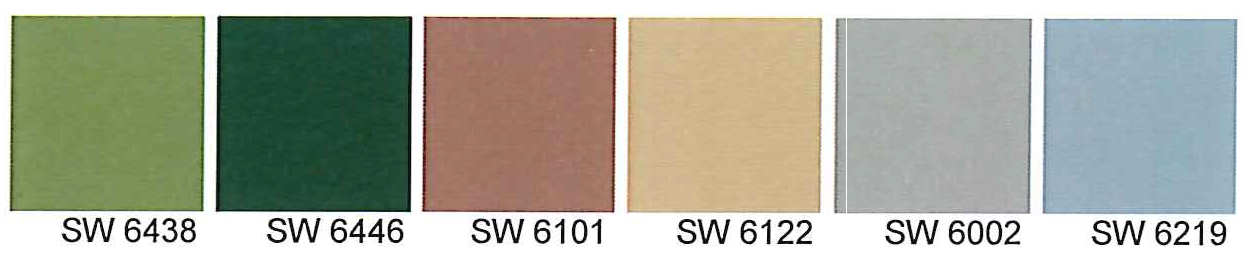
Acceptable colors are earth tone colors, including, but not limited to, the following (Sherwin Williams color code):
b.
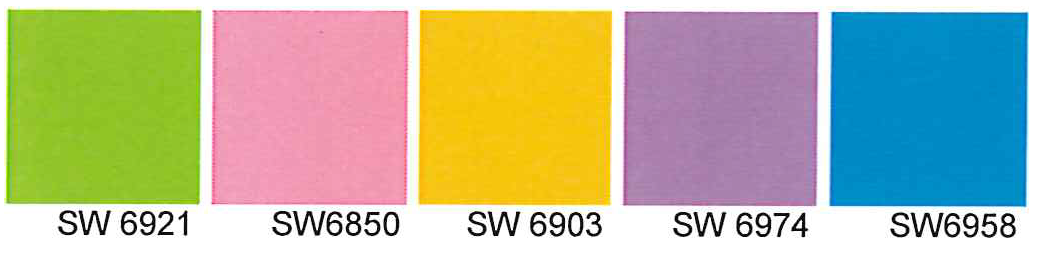
All fluorescent colors shall be prohibited. Examples of fluorescent colors include, but are not limited to, the following examples (Sherwin Williams color code):
c.
Other colors approved by the planning and zoning commission, via application under the requirements of section 405.810, as applicable.
(Code 2008, § 405.187; Ord. No. 3202, § 6, 1-25-2012)
Sec. 405.375. - Exterior lighting.
(a)
Intent. It is the intent of this section to establish lighting regulations and measures of lighting by which the negative aspects of excessive or careless light use can be minimized while preserving safety, security and the nighttime use and enjoyment of all properties within the city.
(b)
Applicability. The requirements of this section shall apply to all exterior lighting within the city in both residential and non-residential districts. However, this section shall not apply to:
(1)
The use of temporary outdoor lighting used during customary holiday seasons.
(2)
Temporary outdoor lighting used for special events, civic celebrations, festivals, and similar outdoor gatherings as permitted by the city's adopted regulations.
(3)
Lighting required by emergency services or government agencies to illuminate response areas or to secure government buildings or structures. This includes any lighting necessary for the safe operations of aircraft.
(4)
Lighting permanently or temporarily installed to illuminate public or private rights-of-way or to regulate traffic. This includes lighting necessary to facilitate the repair or maintenance of such rights-of-way or any facilities within them.
(5)
Temporary lighting necessary to install, repair or maintain public or private utility infrastructure.
(6)
Lighting of recreational facilities for public parks and publicly-owned facilities such as a public school or a city recreational sports complex. The design and installation of such lighting shall achieve no greater luminance levels for activity than those recommended by the Illuminating Engineering Society of North America (IESNA) or similar association/organization.
(7)
Lighting necessary to illuminate the nighttime display of the national, state, county, city or memorial flags. Such lighting shall be specifically reviewed as part of the city's flagpole permitting process to avoid glare or nuisance concerns.
(c)
General provisions. The following requirements shall be applicable to all properties within the jurisdictional limits of Wentzville, unless otherwise provided for within the city's adopted regulations.
(1)
Lighting design.
a.
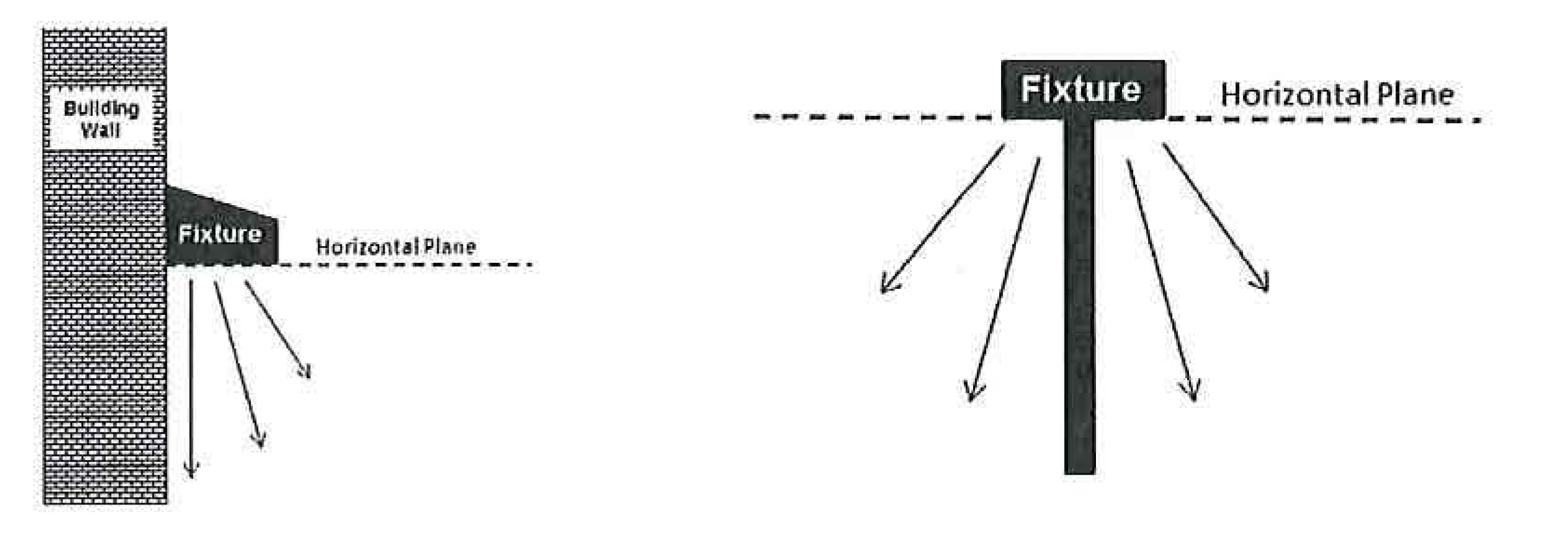
Multi-family, office, commercial and industrial developments. All new exterior lighting fixtures installed within the city for multi-family, office, commercial or industrial developments shall utilize cutoff or full cutoff designs to ensure that no light is emitted above a horizontal plane, as depicted in the images below. The replacement of fixtures within existing projects in the city shall be brought into compliance with this section. Exterior lighting shall be part of the architectural concept and all fixtures, standards and exposed accessories shall be harmonious with the building design. All exterior lighting fixtures, parking lot pole standards, and pole bases shall be black unless otherwise approved by the city.
b.
Single-family and two-family homes. Exterior lighting fixtures installed upon single-family and two-family homes are not required to utilize cutoff or full cutoff designs. However, such lighting shall be focused, directed and arranged to avoid producing glare or unwanted illumination upon an adjacent property or nearby area. The use of shielding is encouraged and may be required by the city for any lighting which is determined to be a nuisance to neighboring properties or creates a safety hazard.
c.
Decorative lighting. The use of non-cutoff decorative lighting fixtures for new multi-family, office, commercial and industrial developments may be considered by the city's planning and zoning commission during the site plan review process for recommendation to the board of aldermen when such lighting would add to the historical or aesthetic appeal of the property or to accent landscaping or architectural features. Such lighting may not generate excessive glare or constitute a nuisance or safety concern for adjacent properties or rights-of-way. Requests for non-cutoff decorative lighting upon existing sites or buildings will be evaluated by the planning commission through the site plan review process to ensure that such lighting is adhering to the spirit of the existing development and that negative impacts are minimized.
d.
Lamp/bulb selection. All new exterior lighting fixtures installed within the city for multi-family, office, commercial or industrial developments shall utilize light-emitting diode (LED) lamps. The use of alternative lamp/bulb options for such developments may be considered by the city's planning and zoning commission during the site plan review process for recommendation to the board of aldermen when such alternatives would add to the historical or aesthetic appeal of the property.
Single-family and two-family properties within the city may select and install any lamps types, including LEDs, so long as they are able to conform with the other requirements of this section.
e.
Underground wiring. All new exterior lighting within the city shall be served by underground cables. Existing properties which do not meet this requirement shall be brought into conformity upon redevelopment unless otherwise recommended by the city's planning and zoning commission and decided upon by the board of aldermen, subject to site plan review.
(2)
Property and parking lot illumination levels.
a.
Parking area lighting shall be required for all new public parking lots used by patrons of the property associated with the primary use of the property, designed and installed so as to achieve the illumination levels set forth below. Lighting shall be maintained so as to achieve not less than eighty (80) percent of the minimum illumination levels set forth by the following table.
b.
The planning and zoning commission may accept and recommend to the board of aldermen lighting arrangements exceeding the maximum levels set forth below to allow lighting designs for specific land uses which exceed the required illumination levels.
c.
For the purpose of the table below, the term "residential" refers to areas that are zoned "R-1A," "R-1B," "R-1C," "R-1D," "R-1E," "R-2" or "R-3B," and "office/commercial/industrial" refers to parking areas for any land use, regardless of zoning designation, in which goods or services are offered on the premises, or office warehouse, wholesale operations are present.
d.
Light standards utilized for parking lot lighting shall not exceed a maximum height of twenty (20) feet within the C-1 Neighborhood Commercial Zoning District. The parking lot light standard height within all other zoning districts of the city shall not exceed twenty-five (25) feet in height. Light standards utilized for non-parking areas shall not exceed twenty (20) feet in height. The source of pole standard illumination shall not be lower than ten feet above grade except as approved by the community development director.
e.
Light standards shall be maintained in compliance with the initial installation. Leaning, rusting or damaged poles/fixtures shall be repaired, removed or replaced.
f.
The applicant for all new development shall indicate compliance with this section. The city may require documents to be certified by a lighting certified designer. Initial readings as required by this section shall be provided with a light loss factor of one (1.0).
(d)
Prohibited lights. The following light and lighting methods are hereby declared to be unlawful.
(1)
The use of laser source light or any similar high-intensity light for outdoor advertising or entertainment, including the operation of searchlights for advertising purposes.
(2)
Animated, flashing, flickering, or other distracting lights.
(3)
Exposed neon or LED tubes.
(4)
Any light which generates excessive glare or light-trespass upon adjacent properties or roadways.
(5)
Lighting placed within building interiors in a manner intended to attract attention or create a nuisance to exterior areas.
(Ord. No. 4147, § 5, 1-13-2021)
Sec. 405.380. - Yard and setback exceptions.
(a)
Commercial/industrial front yards. In districts "C-O" to "I-2" inclusive, where buildings located in the same block on the same side of a street have provided front yards of greater depth than herein required, the planning and zoning commission may require a similar or average setback for buildings or structures constructed thereafter.
(b)
Determination of setbacks. In measuring a yard, the minimum horizontal distance between the proposed right-of-way line and the main building shall be used. The required setback line shall be measured from the proposed right-of-way line, that shall be determined by the community development director. Minimum setbacks shall be enforced from proposed right-of-way line as identified by the adopted comprehensive plan. The required width of the street in question shall be determined by the community development director, based upon the transportation chapter of the comprehensive plan.
(c)
Structural projections. Every part of a required yard shall be open from its lowest point to the sky unobstructed, except for the ordinary projection of sills, belt courses, cornices, chimneys, buttresses, ornamental features, bayed areas (such as bay windows, doors and other interior space, with or without usable floor space), and roof eaves; provided, however, that none of the above projections shall extend into a minimum yard more than twenty-four (24) inches or as otherwise provided for in this chapter; and provided further that outside stairways, balconies, canopies, fire escapes or open porches may project a maximum of six feet into the required front yard, and shall not be enclosed; and provided further that no dwelling unit shall have a bayed area that exceeds twenty (20) square feet in area or that encroaches into an easement. Mechanical units are specifically excluded from this exception as it applies to front and side yard areas, whether attached or detached. For structures other than single-family, single-family attached and two-family dwellings, outside stairways, fire escapes and balconies may project into a required side yard not more than half the width of such yard, but not more than six feet from the building. Notwithstanding anything to the contrary above, no projection allowed hereunder shall project or extend into a side yard more than five feet from any side yard property line.
(d)
Rear yard setback. For single-family and two-family dwellings, the rear yard setback on irregular shaped corner lots shall be determined by the community development director. In no case shall the rear setback be less than 20 feet unless further adjusted by approval of an appeal to the board of adjustment. In addition, the rear setback on triangular shaped lots shall be determined by measuring the required distance on both side lines from the point of intersection.
(e)
Accessory buildings and structures. See section 405.410.
(f)
Sight triangle. On a corner lot in any district, new residential, commercial and industrial developments shall conform to the requirements of the sight triangle in which nothing shall be erected, placed, planted, or allowed to grow in such a manner as to materially impede vision between a height of two feet and eight feet above the grades at the back of the curb of the intersecting streets, within the triangular area formed by the right-of-way lines and a line connecting them at points 30 feet from their point of intersection or at equivalent points on private streets, except that the site triangle shall be increased for certain uses when deemed necessary for traffic safety by the community development director.
(g)
Commercial/industrial rear yards. In districts "C-2" to "I-2" inclusive, if the rear line adjoins a railway right-of-way or has a rear railway track connection, no rear yard shall be required. Proposed development shall conform to all other area standards within the district located.
(h)
Uncovered slabs. Uncovered slab type porches or paved terraces and patios having a maximum height of not more than 12 inches above ground elevation at any point may project into any yard except that the projection into the front yard shall not exceed ten feet.
(Code 2006, § 405.190; Code 2008, § 405.190; Ord. No. 1076, §§ 1, 2, 7-26-1990; Ord. No. 1080, 7-26-1990; Ord. No. 1614, § 1, 3-23-2000; Ord. No. 1684, § 6, 8-23-2000; Ord. No. 2737, § 1, 6-27-2007; Ord. No. 3177, § 1, 8-24-2011; Ord. No. 4033, § 10, 11-20-2019)
Sec. 405.390. - Area regulations.
(a)
Maximum lot coverage calculation. In computing the amount of residential lot coverage, the amount of coverage shall include the total area of all principal and accessory buildings, including decks and above ground pools, as measured along the outside wall at ground level or as viewed from above and includes all projections other than open, unroofed porches, fire escapes, or a roof overhang. Roads, driveways, parking lots, patios and inground swimming pools shall not be included in maximum lot coverage requirements.
(b)
Corner lots. Where a lot in any zoning district is located at the intersection of two or more streets, the front yard setback required by that zoning district shall be provided on each street frontage regardless of the orientation of the building upon the lot, except as otherwise provided by this chapter. In those instances where rear yard setback exceeds the front yard setback in depths for the applicable zoning district, it shall be substituted for the front yard setback where the orientation of the building upon the lot makes its use appropriate.
(Code 2006, § 405.195; Code 2008, § 405.195; Ord. No. 1076, §§ 1, 2, 7-26-1990; Ord. No. 1684, § 6, 8-23-2000)
Sec. 405.400. - Access regulations.
(a)
Access to commercial and industrial districts. No land that is located within a residential district shall be used for a primary access route to any land that is located in any commercial or industrial district; provided, however, that this section shall not prohibit pedestrian walks and driveway connections between residential districts and neighborhood shops when incorporated as a part of a planned development district.
(b)
Street access. All lots shall have access to a public street, other than an alley, for a width of at least 50 feet.
(c)
Double-frontage (through) lots. Access to double frontage lots, that is lots with street frontage along both the front and rear property lines, shall be provided as follows:
(1)
For lots in residential districts access shall be limited to the lesser street, i.e., where the access option is between an arterial or collector street, access shall be to the collector; collector or minor street access to the minor street.
(2)
For lots in commercial and industrial districts ("C-O" through "I-2"), access shall be determined by the planning and zoning commission as an element of site plan approval.
(3)
Through lots having one end abutting a limited access highway, with no access permitted to that lot from the highway, shall be deemed to front upon the street, which gives access to that lot.
(Code 2006, § 405.200; Code 2008, § 405.200; Ord. No. 1076, §§ 1, 2, 7-26-1990; Ord. No. 1080, 7-26-1990; Ord. No. 1614, § 1, 3-23-2000; Ord. No. 1684, § 6, 8-23-2000)
Sec. 405.405. - Marijuana land use separation requirements.
New medical or comprehensive marijuana facilities, marijuana microbusiness facilities, or marijuana testing facilities located within the city shall not be sited, at the time of application for license or for local zoning approval, whichever is earlier, within 1,000 feet of any then existing elementary or secondary school, daycare, church or other marijuana facilities. The distance shall be measured along the shortest path between the demarcation points that can be lawfully traveled by foot in accordance with the following:
(1)
Freestanding marijuana facilities. In the case of a new freestanding marijuana facility, the 1,000 foot distance requirement shall be measured from the external wall of the proposed marijuana facility closest in proximity to the existing school, daycare, church or marijuana facility to the closest point of the property line of the existing school, daycare, church or marijuana facility. In situations where the existing school, daycare, church or marijuana facility is part of a larger structure, such as an office building or strip mall, the distance shall be measured to the entrance or exit of the existing school, daycare, church, or marijuana facility closest in proximity to the new marijuana facility.
(2)
Marijuana facilities within larger structures. In the case of a new marijuana facility which is part of a larger structure, such as an office building or strip mall, the distance between the proposed facility and the existing school, daycare, church or marijuana facility shall be measured from the property line of the existing school, daycare, church or marijuana facility to the proposed facility's closest entrance or exit. In situations where the existing school, daycare, church or marijuana facility is also part of a larger structure, the distance shall be measured to the entrance or exit of the existing school, daycare, church, or marijuana facility closest in proximity to the new marijuana facility.
(Ord. No. 4449, § 3, 1-10-2024)
Editor's note— Ord. No. 4449, § 3, adopted Jan. 10, 2024, repealed the former § 405.405 and enacted a new § 405.405 as set out herein. The former § 405.405 pertained to medical marijuana land use separation requirements and derived from Ord. No. 3962, § 11, adopted May 22, 2019; and Ord. No. 4033, § 12, adopted Nov. 20, 2019.
Sec. 405.410. - Accessory buildings and structures.
No accessory building or structure shall be used prior to the principal building or use except as a construction facility for the principal building. An accessory building attached to the principal building of a lot shall be made a structural part thereof and shall comply with the provisions of this chapter. Accessory buildings must be located in the rear yard of a lot and must conform to all provisions of this chapter. Vehicle storage garages may be located in a side or rear yard.
(1)
Open air and unenclosed attached decks. Open air and unenclosed attached decks may project into a required rear yard up to ten feet. In no case shall an open unenclosed attached deck be closer than 15 feet to the rear property line.
(2)
Detached accessory buildings and structures.
a.
Height. In any district, a detached accessory building or structure shall not exceed the height of the primary structure.
b.
Yard and area requirements. No detached accessory building or structure, except vehicle garages, shall be erected in any required front or side yard. No detached building or structure shall be erected closer than five feet to the rear or side lot line. In no case shall any accessory structure be located in a required transition strip or a recorded easement area A detached accessory structure shall not have direct access to the primary structure.
c.
Building bulk regulations. No accessory building or structure in any residential zoned district shall be larger in total area than 40 percent of the total building area of the principal structure on the lot. General and specialized farm buildings and structures on property zoned "A" Agricultural District shall not exceed a maximum area of 1,500 square feet for parcels at least one acre, but less than three acres in size, and 3,000 square feet for parcels three acres or larger in size.
d.
Corner lots. On corner lots all street frontages are considered front yard areas. Therefore, accessory structures shall be located in the rear yard area along the interior side lot line (the side lot line shared with the next adjoining lot).
(3)
Satellite dish antennas. Satellite dish antennas greater in size than the standard 18-inch dish for residential use located within all zoning districts must be in conformance with the following regulations:
a.
General.
1.
No satellite dish antenna shall be constructed in any front or side yard, but shall be constructed to the rear of the residence or main structure. In the case of a corner lot, the antenna shall be placed along the common lot line, rather than the street side of the lot and shall be so placed to maximize screening from the street.
2.
No satellite dish antenna, including its concrete base slab or other substructure, shall be constructed less than 15 feet from any property line.
3.
All structural supports shall be of galvanized metal.
4.
Wiring between the satellite dish antenna and a receiver/transmitter shall be buried.
5.
All satellite dish antennas shall be designed to withstand a wind force of 85 miles per hour without the use of supporting guy wires.
6.
Any driving motor shall be limited to 110 volts maximum power design and be encased in protective guards.
7.
All satellite antennas shall be bonded to a grounding rod.
8.
Antenna dishes and screening shall be removed at the owner's expense upon termination or revocation of the required antenna permit.
9.
Maximum heights and diameters according to the zoning district are as follows:
* "PD" district: For each use, as they would fall under the applicable standard zoning district above.
** When placed upon the roof of the structure, maximum height shall be measured from the base of the roof mount.
b.
Residential district regulations.
1.
A maximum of one satellite dish antenna shall be permitted per lot, and shall be permitted for the private, non-commercial use of that property owner only, and shall not be attached to stations on any other lot.
2.
The highest portion of a satellite dish antenna may not exceed a grade height of 11 feet above the ground.
3.
In the multi-family district, and non-conforming mobile home parks in the "MHD" district, one master satellite dish antenna may be permitted to service the entire development at the discretion of the board of aldermen.
c.
Non-commercial and industrial district regulations.
1.
Roof-mounting of satellite dish antennas shall be permitted upon commercial and industrial buildings within the "C-1" through "C-3" and "I-1" through "I-2" zoning districts, provided that the antenna is placed in such a fashion as to not be visible from surrounding properties or the public street. In addition:
(i)
No satellite dish antennas shall be mounted upon appurtenances such as chimneys, towers, trees, poles or spires.
(ii)
The satellite dish antenna shall be designed to withstand a wind force of 85 miles per hour.
2.
More than one satellite dish antenna may be permitted per commercial or industrial lot in the "C-O," "C-1," "C-2," "PD" or "I-1" district.
d.
Permit required. No person, firm, or corporation shall erect a satellite dish antenna, or cause same to be undertaken, without first securing the appropriate permit from the building official/community development director, or his authorized representative. An application for such a permit shall be filed, prior to commencement of any work, for his review and approval, and shall include:
1.
A site plan showing the adjacent properties, antenna location including distances from the main structure of the lot and adjoining property lines, and proposed screening features.
2.
A drawing or picture of the antenna with all pertinent dimensions.
3.
A drawing of the method of installation, including footings and base supports.
e.
Code compliance. In addition to the aforementioned construction performance standards outlined, construction and installation of the satellite dish antenna shall conform to all requirements of the city's adopted building and electrical codes.
(Code 2006, § 405.205; Code 2008, § 405.205; Ord. No. 1076, §§ 1, 2, 7-26-1990; Ord. No. 1080, 7-26-1990; Ord. No. 1614, § 1, 3-23-2000; Ord. No. 1684, § 6, 8-23-2000; Ord. No. 2674, § 5, 1-24-2007; Ord. No. 3167, § 3, 8-24-2011; Ord. No. 3177, § 1, 8-24-2011; Ord. No. 3202, § 7, 1-25-2012; Ord. No. 3563, § 1, 1-13-2016)
Sec. 405.415. - Landscaping and buffering.
(a)
Intent. The intent of this section is to establish minimum landscaping and buffering requirements in an effort to beautify properties and enhance the visual and natural appeal of the city as a whole. These requirements are also intended to screen undesirable views, minimize impacts between differing land uses, and provide environmental benefits associated with the installation and maintenance of appropriate vegetation.
(b)
Applicability. The requirements of this section shall apply to all new developments and redevelopment projects within the city. However, this section shall not apply to:
(1)
Properties zoned "A" Agricultural.
(2)
Mobile home developments as administered by section 405.200.
(3)
Single-family residential lots as defined and administered in section 410.320.
(4)
Natural watercourse and riparian buffer areas as defined and administered in chapter 410, article VI.
(5)
Public parks, playgrounds and recreational areas which are operated by the city or similar public agency. This exemption is not applicable to any privately owned or operated amenity or recreational areas or facilities.
(c)
Definitions: The following words, terms and phrases used in this section shall have the meanings ascribed to them as follows, except where the context clearly indicates a different meaning.
Berm means a mounding of soil which is planted with living plant material designed as a natural landscape buffer to screen incompatible land uses or to absorb or otherwise reduce nuisance impacts.
Bush/shrub means a self-supporting, woody, plant which is smaller than a tree and usually branching from or near the ground. Ornamental grasses are not considered bushes/shrubs and may not be used to satisfy any bush/shrub requirement stated within this section.
Deciduous tree means a tree which typically loses its leaves in the fall (autumn).
Evergreen tree means a tree which naturally retains green foliage throughout the year.
Ground cover means low-lying, and typically perennial, plants that spread or creep across sections of ground to provide visual appeal with minimal maintenance.
Green space means those portions of a site which do not contain buildings, paved areas or stormwater facilities. Green space areas may contain either landscape planting areas or open yard spaces.
Hedge means a solid and unbroken visual screen of self-supporting living plant material.
Landscape buffer means a continuous edge of land provided along the perimeter of a lot where a combination of landscaping, berms and fences/walls are used to separate and screen adjacent uses.
Landscape strip means a defined area along the interior of a parcel's property line which contains trees and other vegetation as required by this section.
(d)
General provisions. All applicable developments and redevelopment projects within the city shall adhere to the following:
(1)
A scaled landscape plan shall be submitted as a part of any site/development plan associated with new development or redevelopment projects for review by the city. This landscape plan shall demonstrate compliance with this section via a detailed location plan, a schedule containing quantity/size/types of plantings, overall material calculations for the project, and any associated diagrams or details.
(2)
Landscaping shall include, to the extent necessary to further the intent of this section, the use of living bushes/shrubs, hedges, trees, grasses, seasonal plantings, ground cover plantings, decorative walls or fencing. In extraordinary circumstances, the use of synthetic or artificial plants to satisfy the material requirements of this section will be considered by the director of community development upon receipt of an individual written request and justification.
(3)
Landscape designs shall take into account sight visibility distance triangles associated with the adjacent intersection of any streets and at the project's vehicular entrance/exits. These sight distance triangles shall be depicted upon the plan and plantings within these areas shall be limited to ground cover or low-growing bushes/shrubs not exceeding two feet in mature height. Any fences, walls or berms installed within these areas as part of the landscape design shall also not exceed two feet in overall height.
(4)
In no case shall the landscape strip or buffer requirements discussed within this section be met by driveways, parking lots, loading spaces, or other forms of impervious surface. Landscape strips and buffers shall remain open to the sky at all times and not used for vehicle or equipment storage, parking, loading or location of accessory buildings.
(5)
Any required landscaping or buffer shall be provided and maintained in appropriate areas or along property line(s) by the property owner or developer of the associated project. All landscaping and buffer areas shall be located within the property owner's or developer's project area.
(6)
All green space areas shall be finish-graded and sodded. All landscape planting areas shall be treated with vegetative ground cover species, mulch, decorative rock, decorative stone or similar material beneath trees and bushes/shrubs. The use of seed/straw for larger green space areas may be available subject to site plan approval.
(7)
The use of topographical relief or berms is encouraged, where appropriate, to enhance the appearance of developments. The planning commission may recommend and the board of aldermen may require such features via site plan review if deemed necessary and feasible. The use of earth sculpting or berms shall be designed to avoid erosion, drainage or maintenance problems.
(8)
When determining the minimum material requirements listed within this section, any calculations which result in a fraction of a plant shall be rounded up to the next whole number.
(9)
Existing vegetation within the developed area of a site may be credited towards the corresponding landscape requirement for trees, shrubs and ground cover. All retained materials shall be in good condition and protected during construction.
(10)
Each site, upon development, shall have an automatic, permanent irrigation system designed to cover all landscaped areas. The use of alternative watering techniques for larger green space areas may be available subject to site plan approval. The irrigation method and coverage areas shall be depicted upon the landscape plan provided for the project. All irrigation systems shall be designed to maximize efficient water use and minimize the waste of water.
(11)
Perimeter landscaping.
a.
Notwithstanding the requirements of section 405.550(f), a perimeter landscaped strip shall be provided and maintained at a width of not less than ten feet along all front, side and rear property lines, unless otherwise stated within this section.
b.
Landscape strips along roadway frontages shall be populated with deciduous or evergreen trees planted every thirty-five (35) feet on-center located parallel to the right-of-way upon the subject property. A minimum of one bush/shrub or hedge shall also be provided for every ten feet of lot frontage or fraction thereof. Bushes/shrubs or hedges are not required to be planted on-center and may be clustered or grouped to provide an enhanced landscaped appearance along the entirety of the property frontage.
c.
Deciduous shade trees shall be provided along all side and rear property lines at a rate of one tree per every one hundred (100) linear feet of property line. Deciduous shade trees are not required to be planted one hundred (100) feet on-center but may be clustered to provide an enhanced landscape appearance.
d.
Tree and material placement shall take public sidewalks and right-of-way locations into consideration. Landscaping shall not grow to interfere with any sidewalk or public rights-of-way in accordance with section 215.100.
e.
Alternative materials and layouts may be considered via site plan review to accommodate unique property characteristics or to accentuate desirable building architectural features and/or building entrances. Such requests may include clustering or expanded spacing of tree plantings along street frontages so long as a dispersed decorative appearance is achieved along the entirety of the lot frontage.
(12)
Parking and vehicle maneuverability areas.
a.
In addition to any required perimeter or foundation landscaping, a minimum of ten square feet of interior landscaped area shall be provided within parking lots and/or adjacent to proposed buildings for each parking space when four or more spaces are required. This requirement shall not be applicable to vehicle storage lots, approved outdoor storage areas, or multi-level parking structures.
b.
Interior landscaping areas shall be in one or more areas so as to minimize and reduce the apparent size of parking areas and to provide shade, minimize heat and glare, and to improve the community appearance. In no instance shall there be less than two trees provided in conjunction with the development of any parking facility or lot.
c.
One or more of the following alternatives shall be used for interior landscaping within parking lots, subject to site plan review and approval:
1.
A continuous or interrupted landscape strip or island consisting of shade trees, bushes/shrubs and ground cover with a minimum width of five feet between rows of parking spaces.
2.
Landscape islands of no less than one hundred (100) square feet and not more than two hundred (200) square feet, with a minimum width of six feet, to be located throughout the lot planted with shade trees, bushes/shrubs and ground cover.
3.
Landscaped islands of no less than nine feet in width and twenty (20) feet in length to be located at the end of or in between rows of parking spaces and to be planted with shade trees, bushes/shrubs and ground cover.
4.
Diamond-shaped islands along interior parking aisles.
d.
Trees placed within interior landscaping areas shall be coordinated with the project's photometric design in order to avoid conflicts with existing or planned light standards.
e.
Off-street parking, loading, drive aisles, and drive-thru window lanes shall be appropriately screened with landscaping, fences/walls, or berms to prevent headlight glare from impacting adjacent streets or residential land uses. Any fence/wall within fifteen (15) feet of the public right-of-way shall not exceed three and one-half feet in height. Any landscaping hedge used for headlight screening shall be planted initially to twenty-four (24) inches and maintained to a maximum of three and one-half feet in height. The specific design and method of headlight screening is subject to site plan review and approval and based upon the characteristics and surroundings of the proposed project.
f.
All landscaped areas adjacent to paved parking, loading, vehicle drive aisles, or any areas which can be encroached upon by a motor vehicle shall be provided with a permanent six-inch vertical Portland cement concrete curb. This shall include any interior landscape islands or strips. Adequate scuppers or weep holes shall be provided through the curbing to permit drainage. Paved areas immediately adjacent to approved stormwater facilities may be exempted to accommodate the city's stormwater management criteria, subject to site plan review and approval.
(13)
Easement and utility coordination.
a.
The landscape plan shall identify any existing overhead utility lines and alternative materials and layouts may be considered via site plan review to accommodate the needs of the utility provider and to avoid conflicts once the materials mature.
b.
Unless otherwise approved as part of a site plan, trees shall not be installed within five feet of an underground utility or lateral line. The specific placement of materials near underground water, sewer, or stormwater lines is also subject to review and approval by the city's engineering department.
c.
The placement of landscaping materials within established easements is not recommended as they may require future removal should work within the easement be required. The city is not responsible for the cost of material replacement related to work within easements.
(e)
Specific district requirements. In addition to the general provisions listed within this chapter, the following standards will be applicable to properties based upon their respective zoning districts. In cases of conflict with other portions of this section, the specific requirements of a district shall govern.
(1)
"R-3B" Multi-Family Residential.
a.
A landscaped yard thirty (30) feet in width shall be provided if the side or rear line of an "R-3B" project borders any side or rear lot line of property used for commercial or industrial purposes.
b.
A landscape yard fifteen (15) feet in width shall be provided if the side or rear line of an "R-3B" project borders any side or rear lot line of property zoned "R-1A" through "R-1E" or "R-2."
c.
A six-foot masonry wall, solid fence, or equivalent landscape buffer shall be in the side or rear yard bordering a side or rear yard of any property used for new construction or expansion of an "R-3B" project.
(2)
Commercial and Industrial zoning districts ("C-O" through "C-3," "I-1" and "I-2").
a.
A twenty-foot wide landscape buffer will be required whenever a commercial or "I-1" zoned parcel directly adjoins a residential zoning district ("R-1A" through "R-1E," "R-2," "MHD" or "PD-R"), or is located across a public street or alley from a residential zoning district. This buffer shall be increased to forty (40) feet in width for "I-2" zoned parcels.
b.
Along the inner side of any required landscape buffer, except where such a buffer adjoins a public street, a continuous visual screen at least six feet in height above grade shall be provided. This visual screen shall consist of dense evergreen hedge/foliage, an ornamental masonry wall, or a solid vinyl fence. Fence and wall placement shall comply with the city's adopted fence regulations. Examples A and B below illustrate the available buffer design options.
c.
Landscape buffers adjoining public streets shall be planted with trees and bushes/shrubs in accordance with the general provisions of this section.
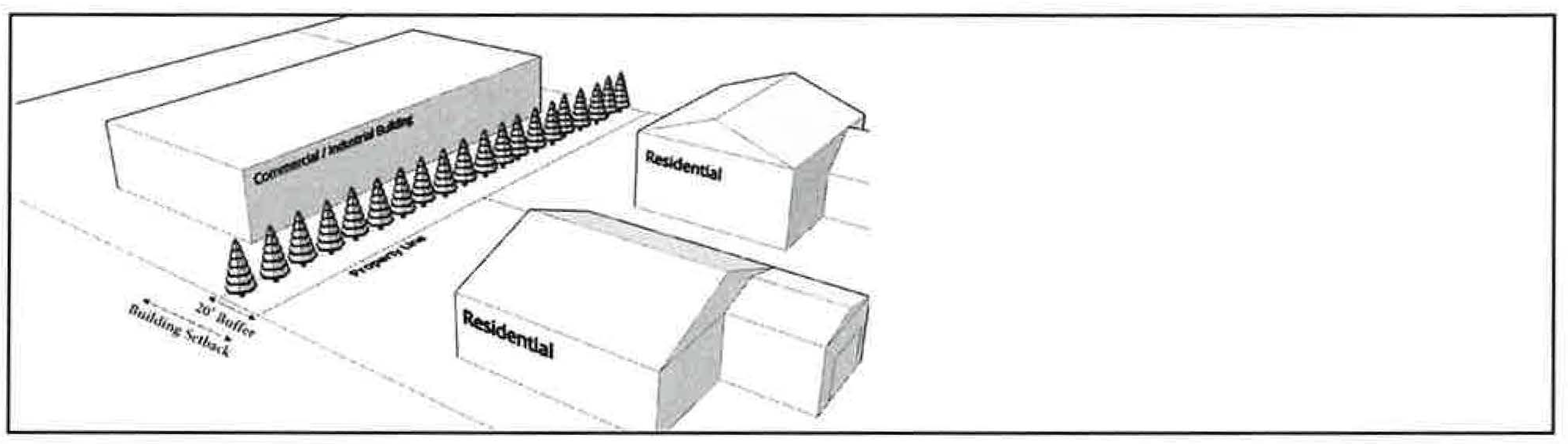
Example A: Buffer utilizing evergreen screening option
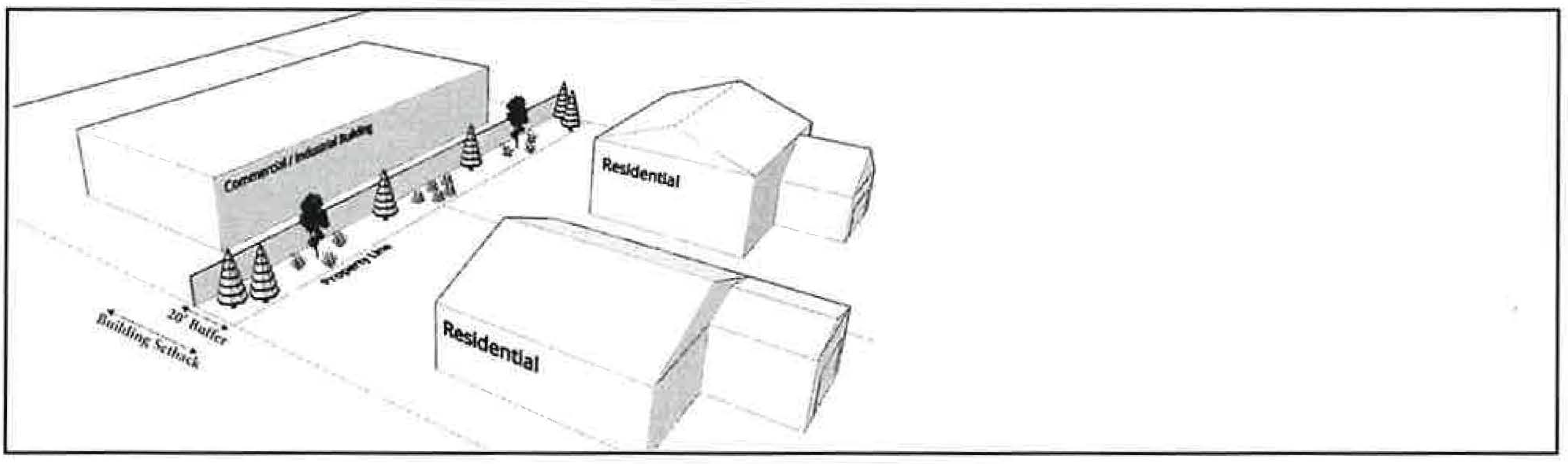
Example B: Buffer utilizing 6' wall / fence screening option
(3)
"PD" Planned Development districts.
a.
A twenty-foot wide landscape buffer will be required whenever a "PD-R" development includes residential lots along the perimeter of the site at a higher density than an adjacent residential district. The buffer area shall be free of buildings, structures or impervious surfaces and shall be permanent and landscaped, or preserved with natural features so that the higher-density residential development is visually screened from the lower-density development.
b.
Landscaping and irrigation shall be provided in accordance with the planned developments underlying zoning district and specific land uses as listed within this section, unless an alternative approach is authorized via a project's planned development approval.
(4)
"HF" Highway Frontage Overlay District.
a.
Residential developments.
1.
Residential projects fronting along Highway 40/61 or Interstate 70 shall provide for berming and/or dense landscaping in order to mitigate the effects of roadway noise on dwelling units. This combination of berming and landscaping shall achieve an overall minimum initial height of ten feet at the time of construction.
b.
Non-residential developments.
1.
All yards and open spaces shall be landscaped with ground cover, trees and bushes/shrubs and shall have installed an automatic, permanent irrigation system designed to cover all landscaped areas, if significant in size, and per site development plan approval.
2.
A minimum landscape strip of fifteen (15) feet in width shall be provided and maintained within the required front yard along all public and private streets. This landscape strip shall be populated with trees planted every thirty-five (35) feet on center and a continuous row of five-gallon container bushes/shrubs planted at a ratio of ten per forty (40) lineal feet of lot frontage. Frontage areas applicable to this requirement shall be determined subject to project plan review.
3.
A minimum landscape strip of ten feet in width shall be provided and maintained within any yard abutting Highway 40/61 or Interstate 70. This landscape strip shall be populated with trees planted every thirty-five (35) feet on center and a minimum of one bush/shrub or hedge provided for every ten feet of lot perimeter or fraction thereof. Bushes/shrubs may be clustered to provide an enhanced landscaped appearance.
4.
Foundation planting shall be planted and maintained along publicly viewed exterior walls of all buildings at the ratio of one plant material for every five lineal feet of the exterior wall. The plant material may be clustered or otherwise arranged for optimum visual effect rather than being spaced evenly along the building perimeter.
5.
A twenty-foot wide landscape buffer will be required whenever the parcel directly adjoins a residential zoning district ("R-1A" through "R-1E," "R-2," "MHD" or "PD-R"), or is located across a public street or alley from a residential zoning district.
6.
Along the inner side of any required landscape buffer, except where such a buffer adjoins a public street, a continuous visual screen at least six feet in height above grade shall be provided. This visual screen shall consist of dense evergreen hedge/foliage, an ornamental masonry wall, or a solid vinyl fence. Fence and wall placement shall comply with the city's adopted fence regulations. See visual examples A and B above.
7.
Landscape buffers adjoining public streets shall be planted with trees and bushes/shrubs in accordance with the general provisions of this section.
8.
The minimum area to be devoted to green space and landscaping shall be equal to a percentage of the gross area of the site as follows:
(5)
"WP" Wentzville Parkway Overlay District.
a.
A twenty-foot wide landscape buffer will be required whenever the parcel directly adjoins a residential zoning district ("R-1A" through "R-1E," "R-2," "MHD" or "PD-R"), or is located across a public street or alley from a residential zoning district.
b.
Along the inner side of any required landscape buffer, except where such a buffer adjoins a public street, a continuous visual screen at least six feet in height above grade shall be provided. This visual screen shall consist of dense evergreen hedge/foliage, an ornamental masonry wall, or a solid vinyl fence. Fence and wall placement shall comply with the city's adopted fence regulations. See visual examples A and B above.
c.
Landscape buffers adjoining public streets shall be planted with trees and bushes/shrubs in accordance with the general provisions of this section.
d.
A minimum landscape strip of fifteen (15) feet in width shall be provided and maintained within any yard abutting Wentzville Parkway or West Pearce Boulevard. This landscape strip shall be populated with trees planted every thirty-five (35) feet on center and five-gallon container bushes/shrubs planted at a ratio of ten per forty (40) lineal feet of lot frontage.
e.
Foundation plantings shall be planted and maintained along all publicly viewed exterior walls of all buildings at a ratio of one plant material for every five lineal feet of the exterior wall. The plant material may be clustered or otherwise arranged for optimum visual effect rather than being spaced evenly along the building perimeter.
(6)
Historic downtown districts ("HD-1," "HD-2," "HD-3").
a.
In recognition of the unique and historic attributes of parcels located within the city's historic downtown districts, these parcels are not subject to the specific landscaping or buffering requirements listed within this section. Landscaping and buffering requirements will instead be considered via site plan review based upon available property area, configuration, and the surrounding environs of each individual parcel.
(f)
Material specifications.
(1)
All landscaping shall be permanently maintained in good condition with at least the same quality and quantity as initially approved. Irreparably damaged, diseased, or dead materials shall be removed and replaced with a comparable species as needed or directed by the City of Wentzville. In the event that required landscaping is not replaced by the property owner in a timely fashion, taking into consideration the season of the year, it shall be deemed a violation of this chapter and subject to the penalties outlined in article IX of this chapter.
(2)
In addition to the general pruning requirements of section 245.060, all landscaping required by this section shall be professionally pruned on a routine basis following ANSI A300 industry standards in order to maintain a quality appearance and to encourage healthy growth patterns and maintain a neat and orderly appearance.
(3)
Deciduous trees shall have a minimum caliper of two and one-half inches in the trunk measured one foot above the ground. Evergreen trees shall be a minimum of six feet in height at planting, provided, however, evergreen trees used for interior landscaping shall be a minimum of three feet in height.
(4)
Required landscape hedges and bushes/shrubs shall be planted initially at a minimum height of eighteen (18) inches and maintained to a maximum height of three and one-half feet unless otherwise stated within this section.
(5)
All materials shall be provided with sufficient open area to allow for adequate growth and life of the selected species. Installation of all landscaping shall be done in a sound manner according to quality planting procedures.
(6)
Existing, healthy vegetation located upon a parcel may be utilized on a one-to-one ratio to satisfy the requirements of this section, subject to site plan approval. Any existing vegetation used in such a manner shall be identified upon the site plan, along with specific information about how such materials will be preserved during construction activities. Invasive, damaged, or dying vegetation shall be removed from the site and may not be counted towards any material requirement.
(7)
The city encourages diversity in the species of trees and shrubs in order to enhance visual appeal and to avoid large-scale losses in the event of pests or blight. As such, no more than fifty (50) percent of the total number of installed trees, bushes/shrubs, or ground cover materials upon a site shall be from the same species or cultivar.
(8)
The following tree species are approved for uses within the city and shall be utilized for all projects seeking to satisfy the requirements of this section. The city will consider alternative species which demonstrate desirable growth patterns and a comparable level of hardiness upon request.
Evergreen Trees
(needed for many required landscape buffers)
Evergreen Trees
(needed for many required landscape buffers)
Large Deciduous Trees
(50+ feet mature height)
Medium Deciduous Trees
(30—50 feet mature height)
Small Deciduous Trees
(less than 30 feet mature height)
(Ord. No. 4509, § 13, 7-24-2024)
Sec. 405.420. - Regulation of wireless communications facilities.
(a)
Purpose. The general purpose of this section is to regulate the placement, construction and modification of commercial wireless communications facilities, including towers, support structures, and antennas in order to protect the health, safety, morals and general welfare of the community, while at the same time encourage utilization of existing telecommunication towers, and other publicly and privately owned facilities to minimize the unnecessary proliferation of new facilities and to not unreasonably interfere with development of the competitive wireless telecommunications marketplace within the city. Specifically, this section is intended to:
(1)
Provide for the appropriate location and development of wireless communications facilities and systems to serve the citizens and businesses of the city;
(2)
Minimize adverse visual impacts of wireless communications facilities through careful design, location, landscape screening, and innovative camouflage techniques;
(3)
Maximize the use of existing and new support structures so as to minimize the need to construct new or additional facilities;
(4)
Maximize the co-location of facilities on any new support structures and facilitate the fewest and least visible new support structures capable of achieving these objectives;
(5)
Ensure that any new wireless communications facility is located in an area compatible with the neighborhood or surrounding community to the extent possible;
(6)
Ensure that regulation of wireless communications facilities does not have the effect of prohibiting the provision of personal wireless services, and does not unreasonably discriminate among functionally equivalent providers of such service.
(b)
Definitions. The following words, terms and phrases, when used in this section, shall have the meanings ascribed to them in this subsection, except where the context clearly indicates a different meaning:
AGL (above ground level). Ground level shall be determined by the average elevation of the natural ground level within a radius of 50 feet from the center location of measurement.
Antenna means any device that transmits or receives radio waves for voice, data, or video communications purposes, including, but not limited to, television, AM/FM radio, microwave, cellular telephone and similar forms of communications. The term "antenna" excludes satellite earth station antennas less than two meters in diameter (mounted within 12 feet of the ground or building-mounted) and any receive-only home television antennas.
Cabinet means a structure for the protection and security of communications equipment associated with one or more antennas where direct access to equipment is provided from the exterior and that has horizontal dimensions that do not exceed four feet by six feet and vertical height that does not exceed six feet.
Director means the director of community development of the city or his designee or official acting in such capacity.
Disguised support structure means any freestanding, manmade structure designed for the support of antennas, the presence of that is camouflaged or concealed as an appropriately placed and designed architectural or natural feature. Depending on the location and type of disguise used, such concealment may require placement underground of the utilities leading to the structure. Such structures may include, but are not limited to, clock towers, campaniles, observation towers, light standards, flagpoles and artificial trees. For purposes of this definition, a structure "camouflaged or concealed as an appropriately placed and designed architectural or natural feature" shall meet the following additional criteria:
(1)
It is consistent with and contributes to and does not detract from the character and property values and use of the area and neighborhood in which it is located;
(2)
It does not contain distorted proportions, size, or other features not typically found on the type of structure or feature to which it is designed to replicate;
(3)
It cannot be identified as an antenna support structure by persons with reasonable sensibilities and knowledge;
(4)
Its equipment, accessory buildings, or other aspects or attachments relating to the disguised support structure are wholly concealed using a manner consistent with and typically associated with the architectural or natural structure or feature being replicated; and
(5)
It is of a height, design and type that would ordinarily occur at the location and neighborhood selected.
FAA means the Federal Aviation Administration.
FCC means the Federal Communications Commission.
Height means the vertical distance measured from the average grade of the base of the structure at ground level to its highest point and including the main structure and all attachments thereto.
Incidental use means any use authorized herein that exists in addition to the principal use of the property.
Modification means any addition, deletion, or change, including the addition or replacement of antennas, or any change to a structure requiring a building permit or other governmental approval.
Shelter means a building for the protection and security of communications equipment associated with one or more antennas and where access to equipment is gained from the interior of the building. Human occupancy for office or other uses or the storage of other materials and equipment not in direct support of the connected antennas is prohibited.
Support structure means a tower or disguised support structure.
Tower means a structure designed for the support of one or more antennas and including guyed towers, self-supporting (lattice) towers or monopoles but not disguised support structures or buildings. The term "tower" shall also not include any support structure that includes attachments of 65 feet or less in height owned and operated solely for the use by an amateur radio operator licensed by the FCC.
Tower, guyed, means a communication tower that is supported, in whole or in part, by guy wires and ground anchors.
Tower, lattice, means a guyed or self-supporting three- or four-sided, open, steel frame structure used to support telecommunications equipment.
Tower, monopole, means a communication tower consisting of a single pole constructed without guy wires and ground anchors.
Wireless communications facility means any antenna, cabinet, shelter, and support structure and associated equipment.
(c)
Application procedures; timing. Applications for permitted, administrative, or conditional uses pursuant to this section shall be subject to the supplementary procedures in this section. Applications shall be submitted to the city as a complete application on forms provided by the city. A complete application shall be an application submitted on the forms provided by the city, fully executed by the applicant, identifying the specific approval sought, and containing all attachments, fees and information as required thereon or by the city consistent with this section. Applications shall be accompanied by a building permit application and other applicable forms, and such application fees as may be established to reimburse the city for its inspection and review costs. Unless otherwise required by law or good cause exists, the director shall process applications as follows:
(1)
Co-location requests. A final decision on all applications to co-locate antennas or related equipment on an existing support structure shall be made no later than 90 days after receipt of a complete application from an applicant, unless such period is extended by the director for good cause or by consent of the applicant.
(2)
Other applications; new support structures. A final decision on all other applications, including applications for new support structures, under this section shall be made no later than 150 days after receipt of a complete application from an applicant, unless such period is extended by the director for good cause or by consent of the applicant.
(3)
Incomplete applications. Within 30 days after receipt of an incomplete application, the director shall provide notice to such applicant stating that the application is incomplete and generally identifying one or more application requirements not satisfied or information not provided that the applicant must satisfy for a complete application commencing the city's review process. Nothing in this procedure shall alter the affirmative obligation of each applicant to review the applicable code and satisfy all applicable provisions as may apply to the applicant's specific submission.
(d)
General requirements. The requirements set forth in this section shall be applicable to all wireless communications facilities installed, built, or modified after the effective date of the ordinance from which this section is derived to the full extent permitted by law.
(1)
Permits generally.
a.
The city may reject applications not meeting the requirements stated herein or that are otherwise incomplete.
b.
No wireless telecommunications facilities shall be installed, constructed or modified until the application is reviewed and approved by the city, and the applicable permit has been issued.
c.
Any and all representations made by the application to the city of the record during the application process, whether written or verbal, shall be deemed a part of the application and may be relied upon in good faith by the city.
d.
An application for a permit for wireless telecommunications facilities shall be signed on behalf of the applicant by the person preparing the same and with knowledge of the contents and representations made therein and attesting to the truth and completeness of the information.
(2)
Principal or incidental use. Wireless communications facilities may be either a principal use in all zoning districts or an incidental use to institutional or non-residential uses, subject to any applicable district requirements relating to yard of setback. An incidental use subject to a leasehold interest of a person other than the lot owner may be approved for a tower only if the leasehold area separately meets all requirements for a separate subdivided lot, including dedicated access, parking, and lot size, applicable to a primary use in the district in which the use is proposed.
(3)
Building codes, safety standards and zoning compliance. To ensure the structural integrity of wireless communications facilities, support structures, antennas and related improvements and equipment shall be constructed and maintained in compliance with all standards contained in applicable state and local building codes. A certified engineer's structural report shall be required with each application, unless waived upon application to the director stating why such report is unnecessary to the specific application and a determination in the discretion of the director approving such statement. The applicant shall provide certification with documentation (structural analysis) including calculations that the wireless communications facilities and foundation and attachments, rooftop support structure, water tank structure and any other supporting structure as proposed to be utilized are designed and will be constructed to meet all local, city, state and federal structural requirements for loads, including wind and ice loads. In addition to any other approvals required by this section, no wireless communications facilities shall be erected, replaced, or expanded prior to receipt of a letter of zoning compliance and the issuance of a building permit.
(4)
Regulatory compliance. All wireless communications facilities shall meet or exceed current standards and regulations of the FAA, FCC and any other local, state or federal agency with the authority to regulate wireless communications facilities, and including all required licenses, permits and taxes applicable to such wireless communications facilities. Should standards or regulations be amended, then the owner shall bring such wireless communications facilities into compliance with the revised standards or regulations within the time period mandated by the controlling agency. No approval for any placement, construction or modification of any wireless communications facilities permitted by this section shall be granted for any applicant having an uncured violation of this section, any zoning regulation regarding the lot on which the structure is proposed, or any other governmental regulatory, licensing, or tax requirement applicable to such antenna or structures within the city.
(5)
Security. Wireless communications facilities shall be protected from unauthorized access by appropriate security measures. A description of proposed security measures shall be provided as part of any application to install, build, or modify wireless communications facilities.
(6)
Lighting. Support structures shall not be artificially lighted unless required by the FAA or other state or federal agency with authority to regulate, with documentation being provided. Appropriate lighting may also be approved as a consistent component of a disguised support structure. Equipment cabinets and shelters may have lighting only as approved on the approved site development plan. Security lighting associated with equipment cabinets and shelters shall not exceed one-half footcandle at the property line.
(7)
Signage. A sign no greater than one square foot is to be installed containing the names of the owners and operators of the antennas as well as emergency phone numbers. The sign shall be on the equipment shelter or cabinet of the applicant and be visible from the access point of the site and must identify the equipment owner of the shelter or cabinet. Signs required under FCC regulations shall be present, as applicable. The signs shall not be lighted, unless required by applicable law, rule or regulation. No other signage, including advertising, shall be permitted, except for a disguised support structure in the form of an otherwise lawfully permitted sign.
(8)
Design.
a.
Subject to the requirement of the FAA or any other applicable state or federal agency, towers shall be painted a neutral color consistent with the natural or built environment of the site. Unpainted galvanized steel support structures are not permitted.
b.
Equipment shelters or cabinets shall have exterior finish compatible with the natural or built environment of the site and shall also comply with any design guidelines (exterior material requirements) as may be applicable to the particular zoning district where the facility is located. All equipment shall be placed underground, contained in a single shelter or cabinet, or wholly concealed within a building.
c.
All towers shall be of a monopole design. Lattice, guy towers or other non-monopole designs shall not be permitted.
d.
All towers shall be surrounded by a minimum six-foot-high fence and a landscape buffer strip of not less than ten feet in width and planted with materials, which will provide a visual barrier to a minimum height of six feet. The fencing material shall be sight-proof and be subject to staff review. The landscaped buffer strip shall be exterior to any security fence. In lieu of the required security fence and landscape strip, an alternative means of screening upon demonstration by the applicant that an equivalent degree of visual screening will be achieved, is available or may be requested and approved by the director. Utilization of existing landscaping around the site may be used in lieu of the required landscaping requirements in cases where the existing vegetation accomplishes the spirit and intent of the landscaping requirement, and will be permanent.
e.
Antennas attached to an existing building or structure shall be of a color identical to or closely compatible with the surface to which they are mounted. Antennas attached to a disguised support structure or tower shall be contained within the disguised support structure or within or mounted flush on the surface of the tower to which they are mounted. All antennas shall be designed to be disguised and maximally concealed on or within the support structure. Exposed antennas on "crow's nest" or other visible platforms or extensions are prohibited.
(9)
Spacing. No two telecommunication towers shall be located within a one-mile radius, except as approved by conditional use permit by the board of aldermen. In order for towers to be located closer than the one-mile radius, documentation is required to be submitted for review by the city which indicates substantial evidence that placement of a tower pursuant to the one-mile radius is not technically or economically feasible. The radius distance shall be calculated from the center of the base of the tower.
(10)
Lot size and setbacks. All proposed support structures shall be set back from abutting parcels, and recorded rights-of-way by the greater of the following distances:
a.
Residential zoning districts. A distance equal to the height of the support structure plus ten percent of the height of the support structure or the height of the support structure plus the existing setback requirement of the underlying zoning district, whichever is greater.
b.
Commercial and industrial zoning districts. Setbacks shall be 50 percent of the height of the support structure, except:
1.
Instances where commercial and industrially zoned parcels are directly adjacent to residential, school, health care facility or child care uses, the setbacks from such residential, school, or child care uses shall be a distance equal to the height of the support structure plus ten percent of the height of the support structure or the height of the support structure plus the existing setback requirement of the underlying zoning district, whichever is greater.
2.
Instances where residential, school, health care facility or child care uses exist on the commercial or industrially zoned property, the setbacks shall be a distance equal to the height of the support structure plus ten percent of the height of the support structure from the residential use.
(11)
Shared use. Any new tower shall be designed and constructed to accommodate at least two additional users. Each applicant shall provide a letter of intent to co-locate on the new tower from at least one additional user, or document its attempts to secure such letter of intent if a letter of intent cannot be obtained. The letter of intent shall include the name, address and phone numbers of all proposed users.
(e)
Permitted uses. The placement of wireless communications facilities are permitted in all zoning districts only as follows:
(1)
The attachment of additional or replacement complying antennas to any fully conforming support structure provided that:
a.
Additional equipment is located within the existing shelter;
b.
No expansion of the compound area or increase in height occurs; and
c.
All requirements of this section and the underlying zoning ordinance are met.
(2)
The mounting of antennas on any existing building or structure, such as a water tower, billboard, light pole, or other freestanding non-residential structure, other than a support structure, provided all related equipment shall be located in a concealed cabinet or underground.
(3)
The mounting of antennas on or within any existing high-voltage electric transmission tower, but not exceeding the height of such tower by more than ten feet.
Applications for uses authorized under this section shall be on forms as may be established by the director with such information as necessary to determine applicability of the specific permitted use and shall be accompanied by a building permit application and such application fees as may be established to reimburse the city for its inspection and review costs.
(f)
Authorization by administrative permit.
(1)
The placement of wireless communications facilities are permitted in all zoning districts by administrative permit approved by the director only as follows:
a.
The attachment of additional or replacement antennas, cabinets or shelters to any non-conforming support structure existing on the effective date of the ordinance from which this section is derived or subsequently approved in accordance with these regulations and not satisfying the requirements for such attachment pursuant to subsection (e) of this section as long as the applicant provides documentation from which the director has reasonably determined that the applicant will bring the support structure (including ground equipment and site) into conformance with this section to the maximum extent feasible. A "non-conforming support structure" shall be any support structure that does not comply with all of the requirements of this section, including, but not limited to, the general requirements herein and the requirements of the underlying zoning district.
b.
The one-time replacement of any tower existing on the effective date of the ordinance from which this section is derived or subsequently approved in accordance with these regulations so long as the purpose of the replacement is to accommodate shared use of the site or to eliminate a safety hazard and the new structure otherwise complies with this section. The new tower shall be of the same type as the original except that a guyed or self-supporting (lattice) tower shall be replaced by a monopole. The height of the new tower may exceed that of the height of the original by not more than twenty (20) feet. Subsequent replacements shall require the approval of a conditional use permit.
c.
The placement of camouflaged antennas on wooden or steel functioning utility poles not to exceed twenty (20) feet in height in any residentially zoned district and on any such poles (or functional replacement poles of no greater height) existing in any other district on the date of adoption of this chapter. All related equipment of antennas permitted by this subsection shall be located outside of the rights-of-way in a concealed cabinet or underground and shall otherwise comply with requirements for accessory utility facilities provided in section 405.450.
d.
Towers erected and maintained for a period not to exceed forty-five (45) days for replacing an existing tower, testing an existing or proposed network, or special events requiring mobile towers.
e.
The construction of a disguised support structure, provided that all related equipment shall be placed underground or concealed within the structure or associated buildings consistent with the disguise when the structure is located in any district other than an industrial district. Equipment may be placed in an appropriately concealed cabinet if the disguised support structure is incidental to an industrial, commercial, institutional or other non-residential use.
(2)
Application procedures.
a.
At such time that a person submits an application for administrative permit review, such person shall pay an application fee of $1,000.00 to the city's office of community development. The permit fee shall be used to reimburse the city for administrative costs and any telecommunications or other consulting fees or costs that the city may incur in review of the permit in the administration of these standards. In addition to the above fee, upon request by the director, an applicant shall pay additional fees necessary to cover administrative costs and any telecommunications or other consulting fees or costs that the city may reasonably incur in review of the application. Any amount not used by the city shall be refunded to the applicant upon written request after a final decision.
b.
The applicant shall submit along with its completed application form:
1.
A descriptive statement of the objectives for the new facility or modification including and expanding on a need such as coverage or capacity requirements;
2.
Documentation that demonstrates and proves the need for the wireless telecommunications facility to provide service primarily and essentially within the city. Such documentation shall include propagation studies sealed by a professional engineer of the proposed site and all adjoining planned, proposed, in-service or existing sites, including those wireless communications facilities that are located outside the city that project a signal into the city, that demonstrates a significant gap in coverage or if a capacity need, include an analysis of current and projected usage;
3.
The name, address and phone number of the person preparing the report;
4.
The postal address and tax map parcel number of the property;
5.
Size of the property stated both in square feet and lot line dimensions, and a survey showing the location of all lot lines;
6.
The location and distance of the nearest residential structure as measured from the base of the proposed tower;
7.
The location, size and height of all existing and proposed structures on the subject property;
8.
The type, locations and dimensions of all proposed and existing landscaping and fencing/screening requirements;
9.
The size and centerline height location of all proposed and existing antenna on the supporting structure including the number, type and model of the antennas proposed with a copy of the specification sheet;
10.
The make, model, type and manufacturer of the tower and design plan stating the tower's capacity to accommodate multiple users;
11.
A site plan describing the proposed tower and antennas and all related fixtures, structures, appurtenances and apparatus, including height above pre-existing grade, materials, color and lighting compliant with section 405.820, as applicable;
12.
A written report demonstrating its meaningful efforts to secure shared use of existing towers or the use of alternative buildings or other structures within the city. Copies of written requests and responses for shared use shall be provided to the city in the application, along with any letters of rejection stating the reason for rejection;
13.
Certification with documentation (structural analysis) including calculations that the wireless communications facilities and foundation and attachments, rooftop support structure, water tank structure and any other supporting structure as proposed to be utilized are designed and will be constructed to meet all local, city, state and federal structural requirements for loads, including wind and ice loads; and
14.
Photo simulations (before and after) from key viewpoints as may be appropriate, including, but not limited to, state highways and other major roads, and parks. Guidance will be provided concerning the appropriate key area at the required pre-application meeting. A map indicating where these photos were taken from shall be required as a submittal requirement.
(3)
Issuance of decision. The director shall issue a decision on the permit within the time set forth in subsection (c) of this section, or the application shall be deemed approved unless the time period for review and action is extended by writing of the director or the board of aldermen for reasonable cause. The director may deny the application or approve this application as submitted or with such modifications as are, in his judgment, reasonably necessary to protect the health, safety and welfare of the citizens consistent with and to effect purposes of this section. The director may consider the purposes of this section and the factors established herein for granting a conditional use permit as well as any other considerations consistent with this section. A decision to deny an application will be made in writing and state the specific reasons for the denial.
(4)
Variances. No variance from any provision of this section shall be granted in order to issue building permits for any wireless communications facility under this subsection (f). Any such wireless communications facilities which cannot be permitted by an administrative permit issued pursuant to these subsection standards shall be permitted only as a conditional use permit issued pursuant to requirements in subsection (g) of this section and article XIII of this chapter.
(g)
Conditional use permit required.
(1)
Applicability. The placement of wireless communications facilities are permitted in all zoning districts by conditional use permit only as follows: All proposals to install, build or modify a wireless communications facilities not permitted by subsections (e) and (f) of this section shall require the approval of a conditional use permit following a duly advertised public hearing by the planning and zoning commission and the board of aldermen, subject to the forthcoming limitations. This section shall not pertain to any existing wireless communications facilities which require repair/maintenance, amateur radio, public entities, and receive only antennas licensed and regulated by the FCC.
(2)
Submittal requirements.
a.
In addition to all other required information as stated in this section, all applications for a conditional use permit for the construction or installation of new wireless telecommunications facilities or modification of an existing facility shall contain the information herein set forth in subsection (f)(2)b of this section.
b.
A pre-application meeting with staff shall be required prior to placement of the conditional use permit application onto a public hearing agenda. The purpose of the pre-application meeting is to assist the applicant to address issues of compliance and highlight ordinance requirements that may help to expedite the review and permitting process.
(3)
Application fee. At the time that a person submits an application for a conditional use permit (CUP) under this section, such person shall pay an application fee of $2,000.00 to the city, sufficient to reimburse the city for reasonable review and consultation or expert evaluation connected with the review of any application. In addition to the above fee, upon request by the director, an applicant shall pay additional fees necessary to cover administrative costs and any telecommunications or other consulting fees or costs that the city may reasonably incur in review of the application. Any amount not used by the city shall be refunded to the applicant upon written request after a final decision.
(4)
Location of wireless communications facilities.
a.
Applicants shall locate, site and erect the wireless communications facilities in accordance with the following priorities, 1 being the highest priority and 3 being the lowest priority:
1.
On existing structures on property within the city.
2.
A new support structure on properties in areas zoned for industrial, commercial and agricultural uses.
3.
A new support structure on properties zoned for residential uses.
b.
If the proposed site is not proposed for the highest priority listed above, then a detailed explanation must be provided as to why a site of a higher priority was not selected. The person seeking such an exception must satisfactorily demonstrate the reason or reasons why such a permit should be granted for the proposed site and the hardship that would be incurred by the applicant if the permit were not granted for the proposed site.
c.
Notwithstanding the above, the city may approve any site located within an area in the above list of priorities, provided that the city finds that the proposed site is in the best interest of the health, safety and welfare of the city and its citizens and will not have a deleterious effect on the nature and character of the community and neighborhood.
d.
Notwithstanding that a potential site may be situated in an area of highest priority or highest available priority, the city may disapprove an application for any of the following reasons:
1.
Conflict with safety and building codes;
2.
The use or construction of wireless communications facilities that is contrary to an already stated purpose of a specific zoning or land use designation;
3.
The placement and location of wireless communications facilities which would create a risk to the health, safety, morals and general welfare of the community;
4.
Conflicts with this section.
(5)
Height. Height of a tower approved by CUP shall be reviewed through the application procedure and shall be approved by the board of aldermen upon receipt of a recommendation from the planning and zoning commission. No tower shall be approved at a height exceeding 125 feet AGL unless the applicant clearly demonstrates that such height is required for the proper function of the applicant's system or that of a public safety communications system of a governmental entity sharing the tower. Such showing must also be supported by the opinion of a telecommunications consultant hired by the city at the expense of the applicant. The opinion of the consultant shall include a statement that no available alternatives exist to exceeding the height limit, including, but not limited to, the use of two or more support structures, and the reason why such alternatives are not viable.
(6)
Scope of review. The planning and zoning commission shall consider the following factors in addition to the factors listed above as well as factors listed in article XIII of this chapter in determining a recommendation on an application for a conditional use permit for a telecommunication tower:
a.
Height of the proposed wireless communications facilities;
b.
Proximity of the wireless communications facilities to residential structures and residential district boundaries;
c.
Nature of uses on adjacent and nearby properties;
d.
Surrounding topography;
e.
Surrounding tree coverage and foliage;
f.
Design of the wireless communications facilities, with particular attention paid to design characteristics that have the effect of reducing or eliminating visual obtrusiveness;
g.
Availability of suitable existing support structures and other structures which may negate the need for a proposed wireless communication facility, considering:
1.
Height;
2.
Structural strength;
3.
Resulting signal interference;
4.
Feasibility of retrofitting;
5.
Feasibility of redesigning the applicant's network; or
6.
Other limiting conditions that render support structures, or other structures or buildings within the applicant's required geographic area unsuitable;
h.
The design of the wireless communications facilities, including ground layout, maximally reduces visual degradation and otherwise complies with provisions and intent of this section;
i.
The proposal minimizes the number or height and visibility of support structures that will be required in the area. Where alternate technology or design exists or is reasonably available that would satisfy the general need for the proposal, this factor is ordinarily not satisfied;
j.
The applicant has not previously failed to take advantage of reasonably available shared use opportunities or procedures provided by this section or otherwise;
k.
That no land owned by any agency of the federal or state government, or by any political subdivision of the state, is available for locating the wireless communications facility.
(7)
Performance guarantee. Upon final approval of the conditional use permit, the applicant shall deposit with the community development department a bond, or other form of security acceptable to the city as to type of security and the form and manner of execution in an amount to insure performance of certain obligations of the applicant to make improvements shown upon the approved plan or attested to in any of the accompanying documents pursuant to section 405.900. Improvements that are to be guaranteed by escrow are as follows, but shall not be limited to: required fencing, landscaping, and access roads/public roadway extensions.
(8)
RF engineer certification required; additional studies. The city may require, at the expense of the applicant, any additional studies or the hiring of an external consultant, including technical and legal services, to review exhibits or other requirements in accordance with this section. Applications for a new tower shall be considered only after a letter, certified by a radio frequency engineer under oath, stating that the planned telecommunication equipment cannot be accommodated on an existing or already approved support structure that is capable of shared use and providing facts including:
a.
All alternatives considered; and
b.
Precise cost estimates where cost is a basis for the determination clearly demonstrating one or more of the following conditions:
1.
Planned telecommunications equipment would exceed the structural capacity of an existing or approved support structure, and the support structure cannot be reinforced to accommodate planned telecommunication equipment at a reasonable cost;
2.
Planned telecommunications equipment will cause radio frequency interference with other existing or planned telecommunications equipment for that support structure and the interference cannot be prevented at a reasonable cost;
3.
Existing or approved support structures do not have space on which the planned telecommunications equipment can be placed so it can function effectively and at least in parity with other similar telecommunications equipment in place or approved by the city or other area jurisdictions; or
4.
Other reasons that make it impractical and not feasible to place the telecommunications equipment planned by the applicant on an existing or approved support structure.
(h)
Removal of obsolete towers. Any tower that is no longer in use for commercial communication purposes shall be removed at the owner's expense. The owner shall provide the city with a copy of the notice to the FCC of the intent to cease operations and shall be given 90 days from the date of ceasing operations to remove the obsolete tower and accessory structures. In the case of multiple operators sharing use of a single tower, this provision shall not become effective until all users cease operations. The equipment on the ground is not to be removed, however, until the tower structure has first been dismantled and removed.
(i)
Default and/or revocation. If a wireless telecommunications facility is repaired, rebuilt, moved, relocated, modified or maintained in a way that is inconsistent or not in compliance with this section or of the conditional use permit, then the city shall notify the holder of the applicable permit in writing of such violation. A permit holder in violation may be considered in default and subject to fines as in article IX of this chapter and if a violation is not corrected to the satisfaction of the city in a reasonable period of time, the permit is subject to revocation.
(j)
Commercial operation of unlawful wireless communications facilities. Notwithstanding any right that may exist for a governmental entity to operate or construct wireless communications facilities, it is unlawful for any person to erect or operate for any private commercial purpose any wireless communications facilities in violation of any provision of this section, regardless of whether such wireless communications facilities are located on land owned by a governmental entity.
(Code 2006, § 405.210; Code 2008, § 405.210; Ord. No. 1524, §§ 1—3, 6-23-1999; Ord. No. 1684, § 6, 8-23-2000; Ord. No. 3177, § 1, 8-24-2011; Ord. No. 2012-3209, § 1, 3-28-2012; Ord. No. 3917, § 11, 11-14-2018)
Sec. 405.430. - Regulations for alternative energy systems.
(a)
Purpose. The purpose of the regulations of alternative energy systems is to oversee the permitting of these systems while promoting the health, safety and welfare of city residents.
(b)
Regulations for ground source heat pump systems.
(1)
Permitted districts. Ground source heat pump systems in accordance with the standards in this section are allowed as an accessory use in all zoning districts.
(2)
Standards.
a.
System requirements. Only closed loop ground source heat pump systems utilizing heat transfer fluids as defined in section 405.050 are permitted. Open loop ground source heat systems are prohibited.
b.
Setbacks.
1.
All components of ground source heat pump systems, including pumps, borings and loops, shall be set back at least five feet from all property lines.
2.
Above ground equipment associated with ground source heat pumps shall not be installed in a front yard. Equipment shall be located in the side or rear yard, set back at least five feet from the property line.
3.
Ground source heat pumps systems shall not be located or encroach upon any recorded easement.
c.
Screening. Ground source heat pump systems are considered mechanical equipment and are subject to mechanical screening requirements of the zoning district.
(c)
Regulations for wind energy conversion systems (WECS).
(1)
General rules.
a.
Access.
1.
All ground-mounted electrical and control equipment shall be labeled or secured to prevent unauthorized access.
2.
The WECS shall be designed and installed so as to not provide step bolts or a ladder readily accessible to the public for a minimum height of eight feet above surrounding grade.
b.
Electrical wires. All electrical wires associated with a WECS, other than wires necessary to connect the wind generator to the tower wiring, the tower wiring to the disconnect junction box, and the grounding wires, shall be located underground.
c.
Tower type. Only monopole towers are permitted (no lattice structures).
d.
Lighting. A WECS and generator shall not be artificially lighted unless such lighting is required by the Federal Aviation Administration.
e.
Appearance, color and finish. The WECS shall remain painted or finished the color or finish that was originally applied by the manufacturer.
f.
Signs. All signs, other than the manufacture's or installer's identification, appropriate warning signs, or owner identification on a wind generator, tower, building or other structure associated with a WECS visible from any public road shall be prohibited.
g.
Utility notification and interconnection. Applicant shall be required to notify all necessary utilities of construction of a WECS.
h.
Location. All WECS shall be located in the rear yard.
i.
Number of WECS. No more than one WECS is permitted per parcel unless otherwise allowed in this chapter.
j.
Abandonment. If the WECS remains non-functional or inoperative for a continuous period of one year, the system shall be deemed to be abandoned and shall constitute a public nuisance. The owner shall remove the abandoned system at their expense after a demolition permit has been obtained. Removal includes the entire structure including foundations to below natural grade and transmission equipment.
(2)
General WECS requirements by zoning classification.
a.
Agricultural districts.
1.
Power output. Only small wind energy systems are permitted.
2.
Setbacks. A wind tower for a small wind energy system shall have a setback height:
(i)
Equal to the distance from any public road right-of-way;
(ii)
Equal to the distance of any overhead utility lines, unless written permission is granted by the affected utility;
(iii)
Equal to the distance from the closest property line.
b.
Residential districts. Not permitted.
c.
Commercial and industrial districts.
1.
Power output. No limitation on power output.
2.
Setbacks. A wind tower for a wind energy system shall have a setback height:
(i)
Equal to the distance from any public road right-of-way;
(ii)
Equal to the distance from any overhead utility lines, unless written permission is granted by the affected utility;
(iii)
Equal to the distance from a residence, school, hospital, church, public library, or parking lot;
(iv)
Equal to the distance from the closest property line.
3.
Fencing (landscaping). Security fencing is required surrounding a tower and all other mechanical equipment associated with a WECS. This requirement may be waived if site is already fenced per ordinance.
(d)
Regulations for photovoltaic cell (PV)/solar systems.
(1)
General rules.
a.
Electrical wires. All electrical wires associated with a ground-mounted PV shall be located underground.
b.
Require utility notification and interconnection.
(2)
General solar requirements by zoning classification.
a.
Agricultural district.
1.
Type. Roof- and ground-mounted PV systems are permitted.
2.
Setbacks. Shall meet accessory structure setbacks.
3.
Height. Shall maintain compliance with height restrictions for a main structure and if roof mounted to be mounted parallel to the roof and in close proximity to the roof (not to exceed 12 inches) so as to not appear to project above the original design surface from the roof.
b.
Residential districts.
1.
Type. Roof-mounted PV systems are permitted. Roof applications shall not extend beyond the footprint of the main structure.
2.
Height. Shall maintain compliance with height restrictions for a main structure and to be mounted parallel to the roof and in close proximity to the roof (not to exceed 12 inches) so as to not appear to project above the original design surface from the roof.
c.
Commercial and industrial districts.
1.
Type. Roof- and ground-mounted PV systems are permitted.
2.
Setbacks. Ground-mounted PV panels shall maintain setbacks of the underlying zoning district.
3.
Height. Shall maintain compliance with height restrictions for a main structure and if roof mounted to be mounted parallel to the roof and in close proximity to the roof (not to exceed 12 inches) so as to not appear to project above the original design surface from the roof.
(Code 2008, § 405.211; Ord. No. 2011-3178, § 4, 8-24-2011)
Sec. 405.440. - Regulations concerning high pressure pipelines.
(a)
In all zoning districts, the property owner/developer shall locate, via survey data, the centerline of an existing pipeline upon new development and shall establish a 50-foot-wide area of subdivision common ground measured 25 feet on both sides of the centerline of any high-pressure pipeline under the jurisdiction of the federal department of transportation.
(b)
In all zoning districts, buildings requiring excavations, except for fences and accessory storage sheds, shall be set back a minimum of 25 feet from any area of common ground containing a high-pressure pipeline under the jurisdiction of the federal department of transportation.
(c)
Setback distances shall be doubled for all principal buildings used for community recreation services, private or public education, spectator entertainment or sports, exhibition and convention facilities, major health services, religious assemblies or facilities used for public gatherings.
(d)
Common ground containing the pipeline shall be kept clear of all trees, bushes and other perennial plantings. Paving for commercial, industrial or public assembly uses or utilities and plantings, that are harvested annually or more often, shall be permitted (i.e., crops), with the consent of the easement owner.
(e)
No structure, whether residential, commercial or industrial, nor any accessory structure may be built within the required common ground area of a high pressure pipeline regulated by the federal department of transportation; however, this shall not prevent paving for commercial, industrial or public assembly uses or utilities and plantings, that are harvested annually or more often, shall be permitted (i.e., crops) with the consent of the property owner. Paved areas shall identify the pipeline via monuments as directed by the city engineer.
(f)
Where a developer seeking approval for a proposed subdivision of land places the pipeline in common ground pursuant to the requirements of sections 410.110(b)(1)f and 410.150(b)(4)h, the area within the common ground encompassed by the pipeline may be applied to reduce the size of lots in the subdivision, subject to the following conditions:
(1)
The lot size reductions shall not exceed the area encompassed within such common ground area.
(2)
No lot may be reduced to a size smaller than that permitted under the next highest level of density allowed in the residential zoning hierarchy established in this Code. In no instance shall the size of any lot be less than that allowed in the "R-1E" Single-Family Residential District, unless otherwise expressly authorized through an approved planned district under section 405.270.
(3)
Those lots that are reduced in size shall also be entitled and have applied to them the yard, area, lot widths and setbacks under the next highest level of density allowed in the residential zoning hierarchy established in this Code.
(Code 2006, § 405.212; Code 2008, § 405.212; Ord. No. 2427, § 2, 12-14-2005)
Sec. 405.450. - Accessory utility uses and facilities; all districts.
(a)
Accessory uses authorized. Unless otherwise restricted, the following public utility uses are permitted accessory uses in any district: poles, wires, cables, conduits, vaults, laterals, pipes, mains, valves, regulator, or any other similar distributing equipment subject to requirements relating to utility facilities and other applicable regulations. Installation shall conform to this section, and other applicable federal, state and city rules and regulations. Major installations, such as power substations, radio towers, storage yards, and maintenance centers, shall conform to zoning district regulations and require a "PD" Planned Development District approval or conditional use permit.
(b)
Supplementary regulations. Every public utility, cable company, video service provider and other users of the city rights-of-way or adjacent easements or property to provide services shall comply with the supplemental regulations in this section regarding the placement of accessory utility facilities on public or private property. For purposes of this section, the term "accessory utility facilities" means such non-city facilities, including pedestals, boxes, vaults, cabinets, or other ground-mounted or below ground facilities that directly serve the property or local area in which the facility is placed, are not primarily for transmission or distribution to other locations, do not materially alter the character of the neighborhood or area, and otherwise are customarily found in such areas. Except where limited by other provisions of city ordinance, accessory utility facilities shall be subject to the following supplementary regulations:
(1)
Approval; design; location; application. The design, location, and nature of all accessory utility facilities on private or public property shall require approval of the city, which approval shall be considered in a non-discriminatory manner, in conformance with this section, and subject to reasonable permit conditions as may be necessary to meet the requirements of this section. In considering applications, individual or multiple location applications, the city shall review the request to ensure the proposed facilities do not impair public safety, harm property values or significant sight lines (see section 405.380(f)) or degrade the aesthetics of the adjoining properties or neighborhood, and taking into consideration reasonable alternatives. Any material changes or extensions to such facilities or the construction of any additional structures shall be subject to the requirements and approvals as set forth herein. Unless otherwise prohibited, utility facilities subject to this subsection may be located in minimum setback areas, provided that all other requirements are met. To the extent permitted by RSMo 67.2707 (3), the time, method, manner or location of facilities to be located in the rights-of-way may be established or conditioned by the city to protect the rights-of-way or to ensure public safety. An inspection fee may be required as established by the city to reimburse the city for the costs of review and inspection of accessory utility facilities as may be permitted by applicable law.
(2)
General regulations. The following general regulations apply to all accessory utility facilities:
a.
All such facilities shall be placed underground, except for good cause shown or except as otherwise provided in subsections (b)(2)d and (b)(2)e of this section or as approved by conditional use permit.
b.
All such facilities shall be constructed and maintained in such a manner so as not to emit any unnecessary or intrusive noise.
c.
All facilities and utility boxes shall be deemed abandoned after six continuous months of non-use, and shall therefore be removed within 30 days thereafter at the cost of the utility.
d.
Unless good cause is shown and unless otherwise restricted, utility poles for authorized above ground lines or facilities shall be permitted up to 55 feet along arterial roads and 45 feet in height elsewhere where utilities are not otherwise required to be placed underground; provided that such poles shall be no higher than necessary, maintained so as to avoid leaning from upright position, and without use of guy wires crossing rights-of-way or pedestrian routes except where approved by the city as necessary due to the lack of feasible alternatives.
e.
Utility facilities placed in designated historic areas may be subject to additional requirements regarding the placement and appearance of facilities as may be necessary to reasonably avoid or reduce any negative impact of such placement.
f.
Any damage to landscaping or vegetation on private or public property during installation or maintenance of facilities shall be promptly remedied by the facility owner.
g.
At least 48 hours prior to any installation, replacement or expansion of any facility located on private property, the facility owner shall provide notice to all property owners within 185 feet from the site. Notice shall include detailed description of work to be done, the exact location of work and the time and duration when it will be undertaken.
h.
No facilities may be located so as to interfere, or be likely to interfere, with any public facilities or use of public property.
i.
All such facilities proposed to be located within any zone designated for historic preservation shall be required to obtain site plan approval in accordance with the provisions of such zone.
j.
All utility facilities not authorized by this section as an accessory use or specifically addressed elsewhere in this Code shall be authorized only as a conditional use permit or "PD" Planned Development District.
(3)
Residential districts. In residential districts and rights-of-way adjacent thereto, accessory utility facilities less than 3½ feet in height and covering less than eight square feet in area may be installed above ground with the prior approval of the city. Except as otherwise may be authorized herein, any larger utility facility shall be installed underground or authorized to be installed above ground only by conditional use permit. All above ground facilities, where authorized, shall be placed in the rear yard wherever practical. If locating these facilities in the rear yard is not practical, then such facilities may be located in the side yard. Such facilities shall not be located in the front yard or within the public right-of-way unless otherwise approved by the city upon a determination that all other alternatives are not feasible.
(4)
Non-residential districts. In non-residential districts and rights-of-way adjacent thereto, accessory utility facilities with a height of less than five feet and covering less than 16 square feet in area may be installed above ground with the prior approval of the city. Except as otherwise may be authorized herein, any larger utility facility shall be installed underground or authorized to be installed above ground only by conditional use permit. All above ground facilities, where authorized, shall be placed in the rear yard wherever practical. If locating these facilities in the rear yard is not practical, then such facilities may be located in the side yard. Such facilities shall not be located in the front yard or within the public right-of-way unless otherwise approved by the city upon a determination that all other alternatives are not feasible.
(5)
Landscape screening. A sight-proof landscape screen shall be provided for all authorized above ground facilities taller than three feet in height or covering in excess of four square feet in size, unless waived for good cause pursuant to a site plan approval. Such screen shall be required to sufficiently conceal the facility. A landscape plan identifying the size and species of landscaping materials shall be submitted by the utility and approved by the city prior to installation of any facility requiring landscape screening. The utility shall be responsible for the installation, repair, or replacement of screening materials. Alternative screening or concealment may be approved by the city to the extent it meets or exceeds the purposes of these requirements. Facilities located in rear yards may be exempted from screening where located so as not to be visible from:
a.
Any public property; and
b.
More than two residential dwelling units.
(6)
Compliance with other laws. All accessory utility facilities shall be subject to all other applicable regulations and standards as established as part of this Code, including, but not limited to, building codes, zoning requirements and rights-of-way management regulations in addition to the supplementary regulations herein. The provisions of this section shall not apply to any circumstance or entity in which application under such circumstances is pre-empted or otherwise precluded by superseding law.
(Code 2008, § 405.214; Ord. No. 2816, § 2, 12-19-2007)
Sec. 405.460. - Home occupations.
(a)
General restrictions and limitations. Home occupations shall be permitted as an accessory use to a residential use in any residential district subject to the requirements of this section.
(1)
No more than two home occupations shall be operated from the residence and the two combined shall not occupy more than fifteen (15) percent of the total floor area of the main residential building, with the use of the dwelling for a home occupation being clearly incidental and subordinate to its use for residential purposes by its occupants. For the purposes of this section, the term "total floor area" does not include unimproved basements, attics, or non-habitable portions of the principal building such as mechanical rooms.
(2)
No alteration of the exterior of the principal residential building shall be made which changes the character thereof as a residence or creates other visible evidence of conduct of the home occupation either by the use of colors, materials, construction, lighting or sounds.
(3)
No exterior display or outdoor storage of materials, equipment, merchandise or inventory used in the home occupation shall be permitted other than in a fenced rear yard. Materials, equipment and merchandise shall not be visible from the street. Vehicles shall comply with the off-street parking and loading requirements listed in article V of this chapter and the use shall not create a parking demand in excess of that which can be accommodated in an existing driveway.
(4)
No permitted home occupation shall require internal or external construction features not customarily found in the residence.
(5)
Permitted home occupations involving teaching shall not exceed the occupancy limit for the residential dwelling.
(6)
Parking of commercial vehicles associated with any permitted home occupation shall maintain compliance with provisions of section 405.570(e) and (q).
(7)
All home occupations shall comply with the requirements of article IV of this chapter. In no case shall any equipment or process be used which creates visual or audible interference in any radio or television receiver of the premises or cause fluctuation in line voltage beyond the property line of the lot upon which the home occupation is conducted.
(8)
No offensive noise, vibration, smoke, dust, odors, heat or glare shall be produced.
(9)
The conduct of a home occupation is limited to the resident of the property. The total number of employees and clients onsite at one time may not exceed the occupancy limit for the residential dwelling. Upon sale or transfer of the property, the home occupation shall not continue to be operated by the previous owner from that location and shall terminate. This requirement shall not be construed as prohibiting the new owner of the property from pursuing any legally permissible home occupation in his own right.
(10)
No machinery or equipment shall be permitted that is not customarily found within or incidental to residential use of property.
(11)
In instances where an applicant seeks to conduct a home occupation providing for the sale or distribution of firearms or ammunition, the city may process an application for registration of the home occupation before the applicant has obtained any federal or state permit for engaging in such business, however such applicant may not actually engage in the sale or distribution of firearms or ammunition until the applicant has demonstrated that he has complied with all federal, state and local regulations pertaining to the handling, sale and distribution of firearms and ammunition by providing a copy of any required federal or state license or permit to the city.
(b)
Permitted home occupations. Home occupations are permitted in the residential districts so long as the use meets the requirements of subsection (a) of this section and are not prohibited by subsection (c) of this section. Specific accessory uses permitted as home occupations may include, but are not limited to, the following:
(1)
Dressmakers, seamstresses, tailors.
(2)
Instructional services, or personal service.
(3)
Artists, sculptors, authors, composers, home crafts and other forms of home product sales where orders are taken and deliveries of the product are made at the home or business of the patron.
(4)
Home office of a salesman, sales representative or manufacturer's representative.
(5)
Home office of an accountant, architect, broker, engineer, insurance agent, land surveyor, professional consultant, lawyer, real estate agent or computer programmer. Not more than one client on the premises at a time shall be permitted.
(6)
Manufacturing, providing or selling of goods or services that is owned and operated by the owner or tenant of the residential dwelling, provided the total number of employees and clients onsite at one time does not exceed the occupancy limit for the residential dwelling, does not cause a substantial increase in traffic through the residential area, does not violate any parking regulations established by the city and is not visible from the street.
(c)
Uses that are prohibited; specific examples of home occupations prohibited. Home occupation shall not, in any event, be deemed to include, but not be limited to, the following uses:
(1)
Automobile, truck, trailer or motor vehicle service/repair/painting (other than personal), unless performed inside a closed garage, and does not involve storage of any motor vehicles.
(2)
Stables or kennels.
(3)
Eating or drinking establishments.
(4)
Private or public clubs.
(5)
Storage of construction materials or contractor's equipment.
(6)
Mortuaries or embalming services/establishments.
(7)
Nursery schools, kindergartens and child sitting services or non-medical elderly companion/respite services having more than four children/individuals at any one time, not including members of the immediate family of the operator.
(8)
Escort businesses or any sexually orientated land use.
(9)
Any use listed as a conditional use in the commercial or industrial zoning districts.
(d)
Registration. Applicants for home-based businesses shall register their business on a form provided by the city at the office of the city clerk, in lieu of receiving approval of a business license for operation. The operation of the business shall conform to the standards of this section. At the time of registration the applicant/owner of the home occupation shall acquire a copy of this Code's standards to maintain compliance with these regulations. The registration shall terminate if, for any reason, the registered use ceases for more than six months.
(e)
Violations/penalty. If a violation to the standards of this section is determined, the community development director or designee shall give notice to the owner of the home-based business or, if the business owner cannot be located, the owner of record of the property on the premises of the home-based business requiring compliance with this section. The city may at any reasonable time inspect the home occupation to determine if the applicant/owner is adhering to city standards. That person found to be in violation of any provision of this section shall be subject to provisions of article XI of this chapter.
(Code 2006, § 405.215; Code 2008, § 405.215; Ord. No. 1076, §§ 1, 2, 7-26-1990; Ord. No. 1080, 7-26-1990; Ord. No. 1684, § 3, 8-23-2000; Ord. No. 2973, §§ 1—5, 2-25-2009; Ord. No. 4005, §§ 1, 2, 9-11-2019; Ord. No. 4336, § 5, 11-30-2022)
Sec. 405.470. - Group homes; all residential districts.
The city has determined that it is necessary and desirable to provide suitable sites for group homes in residential areas while, in furtherance of the recognized goals of deinstitutionalization and dispersal, ensuring that group homes are not unduly concentrated in neighborhoods so as to afford mentally or physically disabled persons every opportunity to be integrated in the community. To that end, group homes in residential districts shall comply with the following:
(1)
To promote deinstitutionalization and dispersal, no group home may:
a.
Be located within 500 feet of another group home, measured by the straight line distance between the nearest points of the exterior walls (exclusive of overhangs) of the buildings within which the relevant facilities or uses are located;
b.
Adjoin any lot upon which another group home already exists; or
c.
Be separated from any lot upon which an existing group home already exists only by a street or roadway.
(2)
The exterior appearance of the home and property, occupancy limitation, signage and other standards applicable to single-family dwellings shall apply equally to group homes.
(3)
Parking of commercial vehicles shall maintain compliance with provisions of section 405.570(e) and (q).
(4)
The use shall comply with the requirements of article IV of this chapter.
(5)
Notwithstanding any other provision of this section to the contrary, any individual, group or entity may make a request for reasonable accommodation from this section pursuant to the procedures set forth in chapter 225, article IV.
(Code 2008, § 405.216; Ord. No. 3328, § 7, 9-25-2013)
Sec. 405.480. - Temporary uses.
(a)
Temporary use permit. Notwithstanding anything to the contrary in the schedule of district regulations for specific zoning districts, the building official/community development director is authorized to issue a permit for the temporary uses, listed in subsection (d) of this section, within any zoning district provided it meets the requirements of this section, including specific requirements of any subsection below. The permit shall be issued for the specified period of time and shall require compliance with health, safety, environmental performance standards, traffic regulations and business license requirements. The building official/community development director may require such assurances or guarantees of compliance with conditions as is reasonable and appropriate under the circumstances.
(b)
Requirement for authorization by administrative permit. Prior to issuance of a temporary use permit, a completed application is required and shall include a written description, floor plan or site plan of the temporary use as may be required by the building official/community development director. A certificate of occupancy shall be required as applicable by the building official for occupied structures associated with any special event/temporary use for which a building is occupied. Structures used in connection with a special event or temporary use shall meet applicable sight distance criteria and be removed immediately following the cessation of the special event or temporary use. Parking associated with the special event/temporary use shall be adequate for traffic circulation to meet the needs for the event and shall not occupy emergency lanes and required traffic lanes. Adequate on-site restrooms and litter/solid waste control shall be provided.
(c)
Exceptions. The following special events/temporary uses are exempt from the requirements of this section:
(1)
Special events/temporary uses sponsored or co-sponsored by the city;
(2)
Persons acting pursuant to an order or process of a court of competent jurisdiction;
(3)
Any business that operates pursuant to an approved development plan that allows and regulates the display and sale of outdoor goods; and
(4)
Garage sales.
(d)
Temporary uses permitted. The following temporary uses shall be permitted subject to the permit requirements of subsections (a) and (b) of this section, and any specific requirements for such temporary use:
(1)
Christmas tree sales. Christmas tree sales in any commercial or industrial district for a period not to exceed sixty (60) days. Display of Christmas trees need not comply with the applicable yard setback requirements, provided that no display or equipment will encroach within the thirty-foot sight triangle of a street or driveway intersection as defined in section 405.380(f) or contribute to traffic safety concerns. No display or equipment shall be located within or upon required greenspace or landscape buffer areas.
(2)
Contractor's offices. Temporary buildings or trailers may be used as construction offices/field offices for construction management or property sales or for storage of materials to be used in connection with the development of the tract, provided that the temporary structures are removed from the tract within thirty (30) days after completion of the project development. Temporary buildings or trailers must also be removed from the tract within thirty (30) days after voluntary suspension of work on the project or development or after revocation of building permits or on order by the building official/community development director upon a finding that the temporary structure is deemed hazardous to the public health and welfare. Gravel parking surfaces shall be permitted recognizing the contractor's office is a temporary component of a larger approved commercial, industrial or residential project. The gravel surface shall be removed upon completion of the development activities or removal of the contractor's office.
(3)
Temporary outdoor retail sales and displays. Sidewalk sales conducted outdoors of a permanent place of business, by that business, for a period of seven days or less, and which do not occur more often than four times a year. Merchandise placed on sidewalks for display purposes shall not reduce the usable width of the sidewalk to less than three feet, occupy any required parking space, extend into any required setback or obstruct the thirty-foot sight triangle of any driveway access or public street.
(4)
Seasonal sales. Seasonal sales of farm produce grown on the premises shall be permitted in an agricultural district. Structures incidental to such sale shall comply with the applicable front yard requirements and shall not be located within the thirty-foot sight triangle of a street or driveway intersection as defined in section 405.380(f).
(5)
Carnivals and circuses; festivals.
a.
Carnivals and circuses. A carnival or circus may be permitted in any zoning district, but only for a time period that does not exceed two weeks. Such use shall comply with the applicable yard setback requirements, shall not encroach within the required yard setback for the district in which it is located, and shall comply with applicable International Building Code requirements.
b.
City operated festivals and events. The intent of this section is to establish vehicular and use restrictions within a defined area during the city operated festival and event to ensure public safety. The festival area and street closures for the festival shall be as specified by the board of aldermen from year to year by ordinance. Skateboards, skates and bicycles are prohibited from the festival area unless participating in official scheduled activities. In addition, no vehicular traffic is permitted on the streets within the festival area unless participating in official scheduled activities or required for official festival business or to provide goods or services to a business located within the festival area.
(6)
Special events.
a.
Duration and Frequency. Special events within the city shall be permitted not to exceed four days in any zoning district except as provided in subsection (e) of this section. No special event shall be held more than four times per year and no two occurrences of such special event shall be held consecutively, but instead there must be at least seven days between two occurrences of a special event.
b.
Permits/approvals. Any temporary structures to be used in conjunction with the special event shall be required to receive a building permit and occupancy approval, as applicable, before use and shall be located in compliance with applicable zoning district setbacks and sight triangle provisions of these regulations. Applicants shall be required to obtain business license approval and shall comply with applicable provisions of chapter 605. Individual permit approvals for the sale of merchandise regularly offered for sale on the premises shall not exceed four in any calendar year. A special event on public property shall require board of aldermen approval. Exceptions: road closures less than six hours in duration or use of any city park.
c.
Signage. In addition to any on-premises signage, the special event shall be permitted to display up to three temporary off-premises directional signs advertising the event. Such temporary off-premises directional signage shall not exceed thirty-two (32) square feet in area per individual sign and may only be located at intersections of primary public streets (outside of the right-of-way) with approval of property owners or upon a city-approved location with approval of property owners. Multiple signs at any one location shall not exceed one hundred twenty-eight (128) square feet in total sign area. These signs shall pertain to the special event only and shall not contain any commercial/business advertisement unrelated to the event. No signs, whether on-premises or off-premises, shall be located in a sight triangle as defined in section 405.380(f). Signage may not be displayed more than two weeks prior to an event and all signs shall be removed immediately following the special event. The city shall review signage in connection with a special event, although a separate sign permit is not required unless otherwise required by the sign regulations.
(7)
Recycling collection points. Recycling collection points shall be allowed in any zoning district as a temporary use hereunder subject to the following regulations:
a.
Enclosure requirement. Recyclable materials temporarily stored at recycling collection points shall be kept within enclosures or receptacles. Where possible, the receptacles shall be located adjacent to the primary permanent structure.
b.
Signage. Signs may be posted or painted on each receptacle listing which material shall be disposed of in that receptacle. The name and phone number of the person responsible for maintenance of the enclosure and the party benefiting from the collection or receptacle shall be posted.
c.
Location and setbacks. Recycling enclosure or receptacle shall be located on a paved surface as designated in the permit and shall not be located in any required setback or greenspace area.
d.
Parking. Except where expressly permitted by the city, no recycling enclosure or receptacle shall be located in any required parking space.
e.
Regular collection. The property owner is responsible for contracting with the recycling brokers for regular pickup of recyclable material. Recyclable material shall not be allowed to accumulate outside of the receptacle such that a visual or public health or safety nuisance is created.
f.
Security. The recycling enclosure and receptacles may be secured to prevent theft of recyclable materials by unauthorized persons, yet the enclosure shall be accessible for disposal of materials by authorized persons.
g.
Maintenance. Maintenance of each recycling enclosure or receptacle shall be the responsibility of the property owner.
h.
Number of receptacles. Unless otherwise approved by the city, no more than three receptacles shall be allowed per lot.
i.
Business license. Approval of a business license is required compliant with chapter 605 for all recycling collection facilities/establishments.
(8)
Fireworks stands. Subject to the general requirements of this section and the requirements and conditions of this subsection (d)(8), sales of fireworks now or hereafter classified as "1.4G Class C Common Fireworks" by the United States Department of Transportation at fireworks stands located in "C-2," "C-3," "I-1" or "I-2" zoning districts as defined in this chapter shall be permitted for a period of June 25 through July 5 each year. Any such sale of fireworks and operation of a fireworks stand shall be subject to all of the following conditions:
a.
It shall be unlawful for any person to sell, offer to sell or expose for sale any fireworks of any type whatsoever within the city without first having obtained a fireworks stand license for each location at which fireworks are sold or offered for sale from the community development department; provided, however, that this section shall not apply to the sale of fireworks in wholesale lots from a permanent business location that complies with all zoning requirements for such permanent business operation.
b.
The community development department is authorized to issue to any person a fireworks stand license to permit sales of fireworks now or hereafter classified as "1.4G Class C Common Fireworks" by the federal department of transportation. Licenses shall be issued for fireworks stands located only in "C-2," "C-3," "I-1" or "I-2" zoning districts as defined in this chapter or other similar zoning of the county on property which has been annexed by the city but has not received a zoning designation by the city.
c.
For each separate proposed location for fireworks sales, an application for a fireworks stand license, which may be obtained from the community development department, shall be submitted to the department by May 1 and shall include the following:
1.
A permit fee of $5,000.00 for each proposed location for fireworks sales.
2.
A written statement that the applicant agrees to comply strictly with the terms of this chapter, the laws of the state, the county and the city.
3.
A cash deposit, irrevocable letter of credit or a surety bond made payable to the city in the amount of $3,000.00 for each location to be operated by the applicant shall be submitted. Such deposit, letter or bond shall ensure compliance with the provisions of this section, including, but not limited to, the removal of the stand, provisions for temporary electrical service including the removal of any poles set for power supply or lighting purposes and the cleaning and restoration of the site upon which it was located in accordance with the provisions of this section. In the event the licensee does not comply with the provisions of this section or does not remove the stand or restore the site as required, the city may do so or cause the same to be done and the reasonable cost thereof shall be charged against the licensee and the deposit, letter of credit or surety bond.
4.
A site plan showing the following:
(i)
Address or site location;
(ii)
Property owner authorization and operator names, addresses and phone numbers;
(iii)
Size of the lot and tent, including locations depicted of all tent entry/exit locations;
(iv)
Location of the tents in relation to property lines, including all other structures or equipment including trailers and storage units located on the lot;
(v)
Location of proposed access and all existing driveway entrances and temporary parking lot areas;
(vi)
Location of required restroom facilities (a minimum of one portable facility on site is required);
(vii)
Location of required dumpsters (a minimum of one two-yard dumpster for a location having one thousand (1,000) square feet or less of sales area and a minimum of two two-yard dumpsters or one four-yard dumpster for a location having more than one thousand (1,000) square feet of sales area);
(viii)
Location of required on-site, off-street customer parking spaces (a minimum of six spaces per one thousand (1,000) square feet of sales area is required);
(ix)
Location of nearest fire hydrant;
(x)
Location depicted on the site plan of all storage containers for fireworks;
(xi)
An electrical layout showing the location of power and all outlets/lighting provided;
(xii)
Proof of a valid state sales tax number and a letter of "no tax due" from the state department of revenue;
(xiii)
Submittal of the flyer to be used by the stand operator to be distributed to all purchasers of fireworks from the stand; and
(xiv)
Other information as may be required by the city to ensure public health and safety.
5.
An electrical inspection, associated with this temporary use permit must be obtained from the department of community development. All electrical work including generators must be performed by an electrician licensed with the county. Firework stands are required to have underground electric supply lines.
6.
A certificate of flame resistance must be submitted for each tent and a completed fireworks seasonal retailer inspection survey shall be obtained and completed by the city fire protection district.
7.
Approval of the driveway entrance and approval of the construction of any temporary surfacing for a parking lot from the department of public works are required if a new driveway or temporary surfacing (defined as aggregate, asphalt millings, or other approved material used to cover the ground surface for the purpose of temporarily improving the ground surface to better enable it to serve vehicular or foot traffic) is to be installed. These approvals must address the following:
(i)
If a vertical curb is present at the entrance location, a concrete approach may be constructed and left in place to the right-of-way line. If an approach is not constructed, the existing curb must be removed prior to use of the parking lot and replaced within sixty (60) days of the removal. Access management standards of the city shall apply to any new curb cut access locations.
(ii)
Temporary parking is permitted for no more than thirty (30) consecutive calendar days and the construction of the parking facility must not begin more than fourteen (14) calendar days before the beginning of the intended use.
(iii)
No portion of city-owned right-of-way shall be surfaced and a minimum of a ten-foot parking setback from the right-of-way shall be provided.
(iv)
Where used, temporary paving material shall be removed and vegetation re-established on the site to return the property to substantially the same condition as it was prior to the temporary use, within sixty (60) calendar days of the final date of fireworks sales.
(v)
In addition to the requirements of this section where temporary surfacing material is used, a cash deposit, irrevocable letter of credit or a surety bond made payable to the city, will be required by the community development director or his designee. The security should be in an amount equal to the amount required to perform the reparative measures described in this section, based on an estimate approved by the community development director or his designee. The security shall be subject to the condition that the reparative measures (actions taken to return disturbed land to the condition and appearance that existed before the temporary use) be performed within the first sixty (60) days following the intended usage of the temporary facility as indicated on the temporary parking lot application. The security shall be held by the city for a sixty-day period after which it will be forfeited to the city if reparative measures are not complete. If the reparative measures are not completed within the specified time, the city may use the funds from the security or any necessary portion thereof to complete the reparative measures. If the security is inadequate to pay for the costs of the reparative measures, the city shall recover the balance from the property owner or applicant.
(vi)
Each application for construction of a temporary parking lot or new entrance shall include the following: a sketch showing the property dimensions, parking lot dimensions, entrance locations and dimensions and color photographs (a minimum of six) of the site to depict the condition of the site before any construction of parking facilities or installation of tents. Parking space dimensions and aisle width shall be compliant with city standards in article V of this chapter.
8.
A certificate of occupancy for any tent or structure from the department of community development shall be required, and only issued upon field inspection/verification of compliance with these standards including the submittal of inspection approvals from the city fire protection district, and a state fireworks stand license.
d.
The following standards shall be used for the review of any application for a fireworks stand license and shall apply to the operation of the facility:
1.
Structures from which fireworks are to be sold or stored shall not be located within one hundred (100) feet of any permanent structure or building, public park, swimming pool or public or private playground.
2.
Structures from which fireworks are sold or stored shall not be located within one hundred (100) feet of any structure in which petroleum products are sold or dispensed in any manner other than in closed containers.
3.
A maximum of two semi-truck storage trailers or the equivalent area of trailer storage as determined by the fire marshal shall be allowed, per location. Such trailers shall maintain a minimum of ten-foot separation, have DOT labels on them and must be marked "EMPTY" with four-inch letters when all contents are removed.
4.
All weeds and combustible materials shall be cleared from any sales location including a distance of at least twenty-five (25) feet surrounding the sales location.
5.
A sign bearing the message "Discharge of fireworks is prohibited at all times within the city limits except between the hours of 12:00 p.m. and 11:00 p.m. on July 3 and July 4" in letters at least three inches tall shall be conspicuously displayed at each sales location. Such sign shall not count towards the limits of allowable signage provided for by this section. Additionally, the operator shall distribute to each purchaser of fireworks a flyer of at least twenty-four (24) square inches containing the statement: "Per Municipal Code Section 210.1050, Discharge of Consumer Fireworks Within the City of Wentzville is Prohibited Except Between the Hours of 12:00 p.m. and 11:00 p.m. on July 3 and July 4. Violators may be punished by a fine up to $500.00 or up to three months imprisonment or both." Such written statement shall be in at least fourteen-point font.
6.
Fireworks stands shall comply with the provisions of the currently adopted building code relative to temporary structures. All stands shall be erected in a manner that will reasonably ensure the safety of all occupants, patrons and surrounding property. A minimum three-foot-wide, unobstructed aisle running the length of the stand, inside and behind the sales counter, shall be provided.
7.
Each stand up to twenty-four (24) feet in length must have at least two exits. Each stand in excess of twenty-four (24) feet must have at least three exits. Exit locking devices, if any, shall be easily released from the inside without special knowledge, key or effort.
8.
Each stand shall maintain a two and one-half-gallon, 2A-rated water-pressure type fire extinguisher or an ABC minimum 2A:10BC rated fire extinguisher near each exit and such extinguishers shall be kept in good working order and shall be easily accessible.
9.
Signage shall not be subject to the provisions of this chapter, but shall meet the following requirements:
(i)
No pennants, streamers, balloons, searchlights, strobe lights, beacons, neon lights, or inflatable signs are permitted;
(ii)
No portable signage or off-premises signage is permitted except as provided herein;
(iii)
No signage may be attached to non-commercial vehicles;
(iv)
Signage may not extend above or beyond the limits of the primary structure or the commercial vehicle associated with the business;
(v)
All signage must be attached to the primary structure being used for the sale of fireworks or to a commercial vehicle being used as storage or an integral part of the operation;
(vi)
No signage may be located in a public right-of-way or on public property;
(vii)
Total square footage of all signage viewable from any one angle for one location shall not exceed three hundred (300) square feet; and
(viii)
When a location does not abut a public right-of-way and does not have direct access from such right-of-way, one off-site, freestanding sign or banner not to exceed thirty-two (32) square feet shall be permitted, provided such sign does not interfere with public safety and is not within the public right-of-way or a sight triangle as required in section 405.380(f). Such sign shall not contribute to the three hundred (300) square foot signage allowance.
10.
Persons under sixteen (16) years of age shall not be employed upon the premises. If any person under eighteen (18) years of age is employed at a location selling fireworks, the location shall be supervised by at least one person over the age of twenty-one (21).
11.
Sales of fireworks shall be permitted only during the period of June 25 through July 5 each year. No sales shall be permitted prior to 8:00 a.m. or after 10:00 p.m. on any day, except on July 1, 2, 3 and 4, upon which days the closing time may be 11:00 p.m.
12.
No sales of fireworks shall be made to any person under eighteen (18) years of age.
13.
Licensees shall not permit smoking or any type of open flames upon the premises and shall prominently post at least two signs prohibiting smoking.
14.
Licensees shall not permit debris, wrappers or papers to accumulate on the premises and dumpsters shall be emptied as necessary to maintain the premises in a clean and orderly manner.
15.
Licensees and employees shall not attract customers by means of flagging of vehicles or engage in any activity which obstructs or interferes with the free flow of traffic upon any street or highway. Living signs as defined in section 405.050 shall be prohibited.
16.
Licensees shall be required to, at all times, possess and give to each paying customer, at no cost, a flyer clearly outlining both the days and times on which it is legal to set off, use, burn, explode or fire-off fireworks as indicated in chapter 210.
e.
All items permitted under RSMo ch. 320, except those classified as "1.4G Class C Common Fireworks" by the United States Department of Transportation, may be sold without acquiring a fireworks stand license.
f.
Any license granted hereunder may be suspended and all sales prohibited by the mayor and/or his designee upon violation of any of the provisions listed in this section or chapter 210, article XV which pose a danger to the public or if any ordinance violation remains uncorrected for twenty-four (24) hours after the licensee has been given notice to correct a violation by the city. If a written request is delivered to the office of the mayor within ten days of the suspension, a hearing shall be held within ten days of the receipt of such written request by the mayor to determine the existence of the violation and the appropriateness of the suspension. Any licensee whose license has been suspended and does not request a hearing before the mayor, or whose suspension is upheld by the mayor, shall not be licensed in the next succeeding year for fireworks sales.
g.
The city shall issue no more than five fireworks stand licenses each year. Applications are considered and licenses are granted on a first-come first-served basis. The annual application period shall open on February 1 and close on May 1.
(9)
Mobile food vendors.
a.
Definitions. The following words, terms, and phrases, when used in this subsection, shall have the meanings ascribed to them in this subsection except when the context clearly indicates a different meaning:
Mobile food vendor means an automobile or trailer designed and used for cooking, preparation, assembling, and/or serving of a full or limited menu of single-service food items from the automobile or trailer for use by consumers.
b.
Permit required. Applicants seeking to place and/or operate a mobile food vendor upon any site within the City of Wentzville shall first obtain a mobile food vendor permit from the community development department, unless otherwise exempted by subsection (q) of this section. The application will require written consent of the owner of the site or the operator of the primary business on the site upon which the mobile food vendor is to be located.
c.
Location. No more than one mobile food vendor shall be permitted as an ancillary use on the premises of an individual business within the "C-2 General Commercial, "C-3 Highway Commercial," "I-1 Light-Industrial," "I-2 Heavy Industrial," "HD-1 Historic Downtown Core," "HD-2 Historic Downtown Corridor," "HD-3 Historic Downtown Light Industrial/Loft" or "PD-MXD Planned Development Mixed Use" districts at one time. Mobile food vendors may be permitted in residentially-zoned districts within the city (i) as part of a special event for which a special event permit has been issued by the city, or (ii) upon approval of an application submitted by an established homeowners association to the community development director where such mobile food vendor or vendors shall be located on established common ground in the subdivision. No use of the public street or right-of-way is permitted for placement of a mobile food vendor unless as part of a special event for which a special event permit has been issued by the city. Mobile food vendors shall not be permitted on vacant or undeveloped properties.
d.
Duration. Mobile food vendors within the City of Wentzville shall be permitted on a specific site for a period not to exceed two consecutive days. A mobile food vendor may only operate during the hours that the primary business located on the site is open for business.
e.
Site placement. All mobile food vendors shall be placed upon private property within the interior of an existing development with the written consent of the property owner. The placement of a mobile food vendor shall be subject to the city's review of a site location map during the permit review process. This process shall ensure that the functions of the existing site design, including the presence of adequate employee and customer parking, are not impeded by the presence of the mobile food vendor. All mobile food vendors shall be placed upon a concrete or asphaltic surface in a manner which is safely accessible to pedestrian traffic internal to the site. Mobile food vendor applicants shall demonstrate that the vehicle is readily moveable if requested by the city.
f.
Setbacks. Mobile food vendor setbacks shall be governed by the underlying zoning district regulations.
g.
Height. Mobile food vendors shall not exceed fifteen (15) feet in height.
h.
Visual screening. For mobile food vendors located on property in commercial or industrial zoned districts for the purpose of serving the business's employees, as opposed to the business's patrons, the mobile food vendor shall be placed in a manner which limits its visibility from the public right-of-way as much as possible. The owners of such businesses shall provide a plan for city review which shows that this visual screening is accomplished through any combination of fencing, landscaping, berms, or by virtue of the mobile food vendor's placement in relation to the existing structures on the property.
i.
Outdoor seating. Except when the primary business on the site already has patron seating, mobile food vendors may request permission to provide outdoor seating in conjunction with their food sales. Proposed seating areas shall be placed in close proximity to the mobile food vendor and the mobile food vendor shall appropriately protect seated patrons from on-site traffic. All proposed seating areas are subject to city review during the mobile food vendor permit application process.
j.
Pedestrian safety. Patrons of the mobile food vendor shall be reasonably protected from on-site traffic when ordering and waiting for food. This can be accomplished by placing mobile food vendors in areas not exposed to vehicular traffic or by providing safety fencing around the customer service areas, subject to city review during the mobile food vendor permit application process.
k.
Signage. Signage advertising mobile food vendors shall be limited to signage affixed to the automobile or trailer designed and utilized for the food vending operation and one "a-frame" menu board not to exceed nine square feet in size. This menu board shall be located within six feet of the customer order window and not placed in a location intended to be visible from the right-of-way. No other on-premise, off-premises, or directional signs advertising or directing consumers to the mobile food vendor shall be permitted.
l.
Speakers. No outdoor loudspeakers shall be utilized by mobile food vendors for either advertisement or entertainment purposes.
m.
Food storage. All food and supplies shall be stored within the confines of the mobile food vendor automobile or trailer.
n.
Restrooms. Associated with the property owner's written consent referenced in letters "a" and "e" above, the property owner shall also provide written consent that employees and customers of the mobile food vendor are allowed to utilize on-site restroom facilities as needed.
o.
Waste receptacles. Adequate waste receptacles shall be provided by the mobile food vendor operator in reasonably close proximity to the sales window. Waste receptacles shall be maintained in a clean and orderly fashion.
p.
Products. A permitted mobile food vendor shall only sell food items described within the permit application and shall not sell any non-food items. The sale of alcoholic beverages is prohibited.
q.
Exemptions. The following types of business shall be exempt from the provisions of this section:
1.
Delivery persons delivering food that has been purchased or ordered previously.
2.
Deliveries of food items being made to a business for resale by the business.
3.
Ice cream trucks which operate within the city otherwise licensed by the City of Wentzville.
4.
Food vendors, including mobile food vendors, associated with an approved special event permit.
r.
Other. Prior to being permitted under this section, an applicant shall demonstrate that all necessary approvals, licenses, and permits have been obtained from all appropriate agencies. This includes a business license from the City of Wentzville and permit approval from the St. Charles County Health Department.
(e)
Terms and conditions.
(1)
The building official/community development director or planning commission, via petition, may establish any reasonable conditions deemed necessary to ensure compatibility with adjacent land uses and to minimize potential adverse impacts on nearby uses, including, but not limited to:
a.
Event-specific restrictions on the hours of operation, duration of the event, size of activity or other operational characteristics;
b.
The provision of traffic control or security personnel to ensure the public safety and convenience;
c.
The provision of liability and personal injury insurance in the forms and amounts that the city finds necessary to protect the safety and general welfare of the community;
d.
Limitations and conditions on signs;
e.
Temporary arrangements for on-site restroom facilities, parking and traffic circulation; and
f.
Requirements for screening/buffering and guarantees for site restoration and cleanup following the special event such as the posting of a performance bond to help ensure that the operation of the event and the subsequent restoration of the site are conducted according to required special event standards and conditions of approval.
Notwithstanding anything herein, no temporary use permitted pursuant to subsection (d) of this section shall be permitted on a lot used or subdivided for a single-family or two-family residential dwelling except property zoned agricultural with three acres or more.
(f)
Authorization by the planning and zoning commission. All temporary uses not listed in this section, as well as any request for extensions beyond the specified time limits set by this section or the building official/community development director, shall be automatically referred to the planning and zoning commission for review and approval under the general requirements of this section. Petitions to the planning and zoning commission shall be filed for inclusion on the next available agenda a minimum of thirty (30) days prior to the start date of the planned special event/temporary use. The submittal timeframe may be waived by the community development director if sufficient review and processing time is available for inclusion on the next available agenda.
(g)
No vested right created. Because the intention of this section is to allow for the temporary use of property under specific controlled conditions, the city's issuance of a special event permit is not intended to, and expressly does not, create a vested property right in any use of property allowed by the city's grant of a special use permit nor does it create a right or expectation in the property owner to the city's issuance of a subsequent special use permit for the same special use. The city may, at its sole discretion based upon the health, safety and welfare of the citizens of the city and the community as a whole, revoke an existing special event permit for violation of its terms or other exigent circumstances or decline issuance of further permits based on changed circumstances or compliance issues.
(h)
Fee. A fee of $50.00 shall be paid to the city for administration of city services associated with applications for approval of temporary uses or special events permitted in subsections (d)(5) through (d)(7) of this section, and a fee of $25.00 shall be required for applications submitted by nonprofit organizations, as defined by the Internal Revenue Code, section 501(c)3, with satisfactory evidence being provided to the permit official for approval of temporary uses or special events permitted in subsections (d)(5) through (d)(7).
(Code 2006, § 405.220; Code 2008, § 405.220; Ord. No. 1076, §§ 1, 2, 7-26-1990; Ord. No. 1080, 7-26-1990; Ord. No. 1614, § 1, 3-23-2000; Ord. No. 1684, § 4, 8-23-2000; Ord. No. 2997, § 2, 5-27-2009; Ord. No. 3177, § 1, 8-24-2011; Ord. No. 3595, 4-28-2016; Ord. No. 3680, 1-11-2017; Ord. No. 3702, § 2, 2-8-2017; Ord. No. 3917, § 12, 11-14-2018; Ord. No. 4033, §§ 1—3, 11-20-2019; Ord. No. 4123, § 5, 9-23-2020)
Sec. 405.490. - Fence requirements.
(a)
General rules.
(1)
Barbed wire fences or barbed wire on fences shall be prohibited except as specified.
(2)
Chain link fences shall be the double knuckle type at the top.
(3)
The use of the property shall supersede the zoning of the property.
(4)
All fences shall be of adequate strength to resist required wind pressures.
(5)
Fences or enclosures charged with, or designed to be charged with, electric current are prohibited.
(6)
It shall be the responsibility of the property owner to ensure that a fence does not block or obstruct the flow of stormwater.
(b)
General fence requirements by zoning classification.
(1)
Agricultural areas. Barbed wire fences customarily used in agricultural applications shall be permitted, however, no barbed wire fence shall be placed within ten feet of a public roadway; and shall not exceed six feet in height.
(2)
Residential areas.
a.
No person shall erect or maintain a fence between the front building line of the residence and the public roadway. On corner lots, no person shall erect or maintain a fence between the residential building line and public roadway for the front/primary elevation of the home. Fences on corner lots along the secondary street frontage shall not be established closer than ten feet to the property line along the secondary frontage provided such placement of a fence adjacent to a secondary street frontage shall not cause any sight distance or safety issues for automobile travel. Due to the exceptional nature of double frontage lots (or through lots), fences proposed along the rear of the property adjacent to public streets shall not be located any closer than the street right-of-way.
b.
In multi-family developments such as apartments, condominiums, or mobile home parks, an ornamental fence or wall shall be placed no closer than 20 feet from the public roadway, shall not exceed four feet in height and shall not be chain link construction.
c.
In mobile home parks, no fence shall be erected on individual sites of less than 5,000 square feet. No fence on such sites shall exceed four feet.
d.
Fences may be erected at the property line in all rear yards and side yards, provided that such fences in a side yard do not extend forward of the front corner of the principal building of any lot.
e.
Fences constructed of masonry, vinyl or wood shall be constructed no higher than six feet above the surrounding grade. Chain link fences shall be constructed no higher than four feet above the surrounding grade.
f.
Fences shall be composed of masonry, wood, vinyl, chain link, or ornamental material. No fence shall be constructed of cloth, canvas, wire or other impermanent material, except as provided herein.
(3)
Commercial areas.
a.
No person shall erect or maintain a fence between the front building line and the public roadway. On corner lots no person shall erect or maintain a fence between the front building line and the public roadway on all sides which front a public roadway.
b.
All material storage areas shall be enclosed by a privacy fence not less than six feet in height.
c.
Fences shall not exceed a height of six feet above the surrounding grade, unless modified by the provisions of a conditional use permit required by the "C-3" Highway Commercial Zoning District for outdoor material storage.
d.
Fences shall be composed of masonry, wood, vinyl, chain link or ornamental material. No fence shall be constructed of cloth, canvas, wire or other impermanent material, except as provided herein.
(4)
Industrial areas.
a.
No person shall erect or maintain a fence between the front building line and the public roadway. On corner lots no person shall erect or maintain a fence between the front building line and the public roadway on all sides which front a public roadway.
b.
Barbed wire on fences shall not be permitted on fences less than eight feet in height.
c.
Fences shall not exceed a height of eight feet above the surrounding grade, unless modified by the provision of a conditional use permit required by the industrial zoning district for outdoor material storage.
d.
Fences shall be composed of masonry, wood, vinyl, chain link or ornamental material. No fence shall be constructed of cloth, canvas, wire or other impermanent material, except as provided herein.
(c)
Swimming pool fences. Swimming pool fences shall be governed by chapter 500.
(d)
During construction. Every construction operation located five feet or less from a public roadway may be enclosed with a fence not less than eight feet in height to prevent entry from unauthorized persons. When located more than five feet from the public roadway, a fence or other barrier shall be erected when required by the building inspector.
(e)
Permit. A fence permit is required prior to the erection of any fence within the city limits. The cost of such permit shall be established by the building official, and payment shall be accompanied by a sketch or diagram of the proposed fence, a location survey/map and the type of fence material to be used.
(f)
Maintenance. Property owner shall repair, paint, remove or otherwise maintain a fence if it becomes unsightly or a nuisance to the public health, safety or welfare.
(g)
Manner of construction. All fences shall be constructed so that horizontal and vertical supports are interior to the lot and are hidden from both neighbors and public view. Fences must be straight and run parallel to the lot lines.
(h)
Recreational amenity fences. Fences surrounding tennis courts and backstop fencing for baseball/softball fields and other recreational amenities may be of chain link construction and shall not exceed 16 feet in height.
(i)
Special fences. Notwithstanding other requirements of this section, special fences exceeding these requirements as they may be utilized by industries for enclosing buildings, vehicles or materials, or such fences as they may be used in conjunction with institutions, parks, playgrounds, schools or other public uses, shall be subject to review and approval by the planning and zoning commission as to materials, construction, location and height.
(Code 1988, § 6-2; Code 2006, § 405.225; Code 2008, § 405.225; Ord. No. 1684, § 5, 8-23-2000; Ord. No. 3174, § 2, 8-24-2011; Ord. No. 4292, §§ 20, 21, 7-13-2022)

