West Chicago City Zoning Code
ARTICLE XIV
LANDSCAPING REQUIREMENTS5
Editor's note— Ord. No. 08-O-0079, §§ 1—16, adopted March 16, 2009, amended Appendix A, Article XIV, §§ 14.1—14.11 to read as herein set out. Formerly, Article XIV pertained to similar subject matter, and derived from Ord. No. 03-O-0115, § 9, adopted December 15, 2003.
14.1.- Scope of regulations.
The provisions of this article shall apply to the following:
(A)
New construction except single-family districts when retention and/or detention ponds and basins are not required.
(B)
When screening and/or buffering is required under the zoning ordinance.
(C)
Construction of a parking lot containing eight (8) or more spaces.
(Ord. No. 08-O-0079, §§ 1,2, 3-16-2009)
14.2. - Plan preparation.
All landscape plans required by this section shall be prepared and signed by a professional landscape architect or landscape designer.
(Ord. No. 08-O-0079, § 4, 3-16-2009)
14.3. - Submittal requirements.
The submittal package shall include the following information:
(A)
Site elements.
(1)
Title block including the name of the project, designer's name, scale of the plan (minimum 1"=30'), identification of the plan as either a "Preliminary" or "Final" Landscape Plan, north arrow and date of the plan. The plan shall be sized no smaller than 24" x 36" and no larger than 36" x 48".
(2)
Property lines.
(3)
Location, dimensions, height, and use of all existing and proposed buildings and other structures, and all entry/exit points.
(4)
Location and dimensions of all existing and proposed parking lots (including striping and curbs), driveways, rights-of-way, sidewalks, bicycle paths, signs, lighting, fences, walls, refuse disposal areas, freestanding decorative and recreational equipment including street furniture, screens, sculptures, fountains, setbacks, and easements.
(5)
Zoning and use of all abutting properties.
(6)
Natural features such as ponds, lakes, streams, large boulders, rock outcroppings, and delineation of 100-year floodplain and wetland boundaries.
(7)
Existing and proposed stormwater management ponds and areas
(8)
Required landscape setbacks.
(9)
Approved grading plan at one (1) foot contour interval, with slopes of 4:1 labeled.
(10)
Proposed size, construction materials, drainage and scheduled maintenance of landscaped islands and planting beds.
(B)
Planting elements.
(1)
Location, general type and quality of existing vegetation, specimen trees of 4" caliper and greater, and natural areas. Note methods and details for protection of existing vegetation during construction. Location and keyed labels of all proposed plants.
(2)
Location of all proposed areas to be seeded and/or sodded.
(3)
Plant list or schedule with key symbols, quantity, correct botanical and common names, size, condition, and category of all proposed plants. The following categories shall be used: shade trees, ornamental trees, evergreen trees, tall shrubs, short shrubs, groundcover plants, grasses, and perennials.
(4)
Plant names shall be in accordance with "Hortus Third..." by L.H. Bailey, 2000.
(5)
All plant sizes and conditions listed shall conform to the "American Standards For Nursery Stock," as published by the American Association of Nurserymen, latest edition.
(6)
Planting installation details as necessary to insure conformance with "American Standards For Nursery Stock," latest edition, and standards as specified in this section.
(7)
Explanation of proposed construction procedures.
(C)
Temporary occupancy permit. A temporary occupancy permit may be issued when the project's buildings may be occupied but landscaping has not been installed due to weather conditions. A final occupancy permit will be issued, and any posted bond released, upon completion of all landscaping and any other outstanding required work.
(Ord. No. 08-O-0079, §§ 3,5, 3-16-2009)
14.4. - Landscape standards.
Appropriateness: The landscape plan should consider the proposed project's intensity of activity and use plants that will integrate the site into the surrounding area. Adjacent existing uses will determine the type and extent of screening and buffering required.
(A)
Screening. Screening may be accomplished with plants, fences, walls, and berms. Screens shall be arranged in plant clusters (rather than spaced equally) to create optimum screening according to site conditions.
(B)
Fences and Walls. Screening fences and walls should be built of materials compatible with that of the main building. The use of corrugated metal, corrugated fiberglass, sheet metal, chain link or wire mesh shall not be counted as a screen in landscape yard calculations. Long stretches of a single wall or fence shall not be continued to the point of visual monotony, but shall be varied by using change in height, different material combinations, offset angles or other types of articulation in combination with landscaping.
(C)
Berms. Berms shall be at least two and one-half (2½) feet high and twelve (12) feet wide. Slopes shall not exceed 4:1. Berms should be designed with gently curving slopes to reduce erosion. Staggering berms allows for drainage and provides visual variety. Ground cover plants may be utilized on berms to reduce mowing.
(D)
Groundcover. All drainage swales and slopes with slope of 3:1 or greater shall be sodded. All other ground areas not covered by buildings, parking, sidewalks, or other impervious surfaces, or occupied by planting beds shall be graded smooth with a minimum of six (6) inches of black dirt after compacting and removing stumps, rocks and other debris, and shall be seeded or sodded to prevent soil erosion and sedimentation of public drainage systems, creeks, streams, rivers and wetlands.
(Ord. No. 08-O-0079, § 6, 3-16-2009)
14.5. - Plant materials standards.
(A)
All plants shall conform to the "American Standards for Nursery Stock," latest edition, and shall be installed according to the current standards of the American Association of Nurserymen, latest edition.
(B)
All plants shall be readily available and shall be proven to be reliably hardy and disease- and pest-resistant in USDA Zone 5. Plants shall have a vigorous root system and shall be free from defects, insects and diseases.
(C)
Deciduous trees shall be fully branched, have a minimum caliper of three (3) inches for nonresidential and two and one-half (2½) inches for residential development measured six (6) inches above ground level. Specimens shall be properly pruned to maintain a natural form.
(D)
Evergreen trees shall be a minimum of six (6) feet in height and fully branched to the ground. Shrubs shall be supplied on one (1) gallon or larger containers or balled and burlapped and at least eighteen (18) inches in height or spread, whichever applies.
(E)
Ground cover plants shall be planted so that an effective covering is obtained within two (2) growing seasons.
(F)
Perennials shall be supplied in one (1) gallon or larger containers.
(Ord. No. 08-O-0079, § 7, 3-16-2009)
14.6. - Safety and maintenance.
(A)
Plant materials, including deciduous and evergreen trees, shall not cause a hazard. Landscape plant material overhanging walks, pedestrian or bicycle paths and seating areas shall be pruned to a minimum height of eight (8) feet; to a minimum height of fifteen (15) feet over streets and highways; and to a minimum height of twelve (12) feet above parking lot aisles and spaces.
(B)
Landscape plant materials shall be selected which do not generally interfere with utilities above or below ground level at maturity.
(C)
Parking Lot Clearance—No shrub or tree shall be planted closer than two (2) feet from any curb face.
(D)
A curb shall be provided for all parking spaces adjacent to planting or pedestrian areas to prevent vehicle overhang, except in the case of handicapped access ramps.
(E)
Planting Space Required—Trees planted in cutouts, walks, or in pedestrian areas shall have an open area of soil at least 4' x 4' in size or 5' in diameter, and shall be protected by the use of tree grates or edging that do not pose a hazard to pedestrians.
(F)
Landscape plant materials shall be properly guyed and staked in accordance with current industry standards, where necessary. Stakes and guy wires shall not interfere with vehicular or pedestrian traffic.
(G)
Landscape plant materials shall be protected from damage due to foot and vehicular traffic by protective tree grates, pavers, curbs or other suitable methods that prevent soil compaction.
(H)
Each landscaped island shall be protected by a continuous barrier curb. The width shall be measured back-of-curb to back-of-curb.
(I)
Planting beds shall be mulched in their entirety with shredded bark or other similar organic material a minimum of three (3) inches deep. Lava rock, bark chips larger than one and one-half (1½) inches in diameter, gravel, and stone mulches are not permitted. Mulch beds at the time of planting shall extend a minimum of two (2) feet beyond the center of a shrub.
(J)
Appropriate methods of care and maintenance of the landscape shall be provided by the owner of the property. All plantings that die or are destroyed shall be replaced within the first two (2) months of the next planting season, as specified in Section 302.10 of the adopted International Property Maintenance Code.
(Ord. No. 08-O-0079, § 8, 3-16-2009)
14.7. - Intersection visibility.
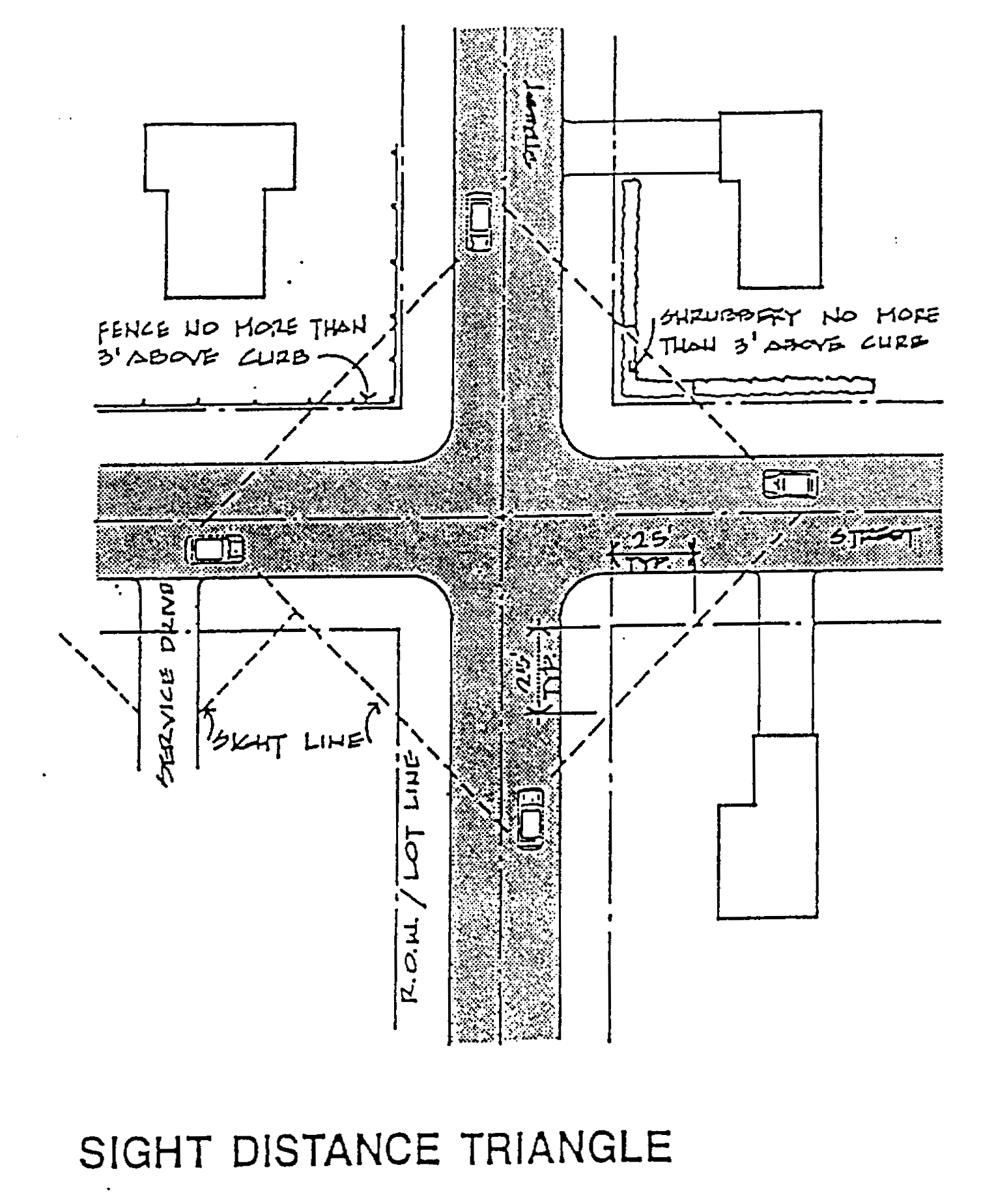
Landscaping shall be designed and installed to minimize potential obstruction of critical sight lines associated with visibility triangles. Within a visibility triangle, unobstructed visibility between two and one-half (2½) feet and eight (8) feet above grade shall be maintained. No berms, shrubs, or other landscape material that will reach a mature height greater than two and one-half (2½) feet shall be permitted within a visibility triangle. Trees may be permitted within visibility triangles provided the lowest branching begins not less than eight (8) feet above grade.
(Ord. No. 08-O-0079, § 9, 3-16-2009; Ord. No. 17-O-0002, § 6, 1-16-2017)
14.8. - Landscape yards.
A continuous perimeter landscape yard is required in two instances: a) to satisfy landscape yard requirements, and b) for screening and buffering dissimilar uses.
(A)
The applicant shall provide a landscape screen/buffer for all landscape yards as indicated in the regulations for each business and manufacturing district. Such buffer may include plant materials, fences, walls and berms, and must provide a certain number of points. Such number is determined by the following formula:
(Yard length (parallel to property line) in feet) x (5) = points required for that yard
All plant materials, fences, wall, and berms used to provide the required number of points shall be located within the required landscape yard, except when otherwise approved by the city council.
(B)
The applicant shall provide a landscape yard with a full screen/buffer along corner-side, interior side, and/or rear lot lines, according to the following schedule. The setbacks required may overlap the general landscape setbacks required for each district.
(C)
Point values:
Ornamental grasses .....1 point
Perennials .....1 point
Low shrubs .....10 points
Tall shrubs .....15 points
Ornamental trees .....50 points
Evergreen trees .....60 points
Shade trees .....100 points
(D)
Solid screening fences or walls at least six (6) feet in height may contribute up to fifty (50) percent of the required landscape points for full screen/buffers. The location and size of a proposed fence is subject to the provisions of Section 7.1. The determination of the value of a proposed fence is calculated as follows:
(fence length) x (2.5) = points achieved by fence
(E)
Continuous or staggered berms may contribute up to fifty (50) percent of the total landscape points for that portion of a landscape yard. The determination of the value of a proposed berm is calculated as follows:
((berm height) x (length of berm)) / (2) = points achieved by berm
(F)
Fencing may be used in combination with berms. If so, the contributions from fence points plus berm points shall not exceed sixty (60) percent of the required points, and at least fifty (50) percent of the remaining required points shall be achieved by trees.
(G)
In any landscaping scheme not using fences and/or berms that is utilized to satisfy the requirements of subsections (A) and (B) above, at least fifty (50) percent of the points to be achieved by vegetation shall be achieved by trees.
(H)
The proposed landscaping must function so that maximum effective screening is provided. Both overhead and lower screening and buffering is required in order to meet these requirements. Plant selection should include a variety of plant types. Fences, walls or berms may be used to increase effective screening. Trees and shrubs should be used on berms and in front of fences and walls.
(I)
Additional landscape screening/buffering may be required when an incompatible use occurs which may have a high impact on adjacent development, as determined by the city. A high impact use is one that is expected to have a strong adverse effect on adjacent properties.
(J)
Ornamental grasses and perennial shall not account for more than fifteen (15) percent of the required landscape points.
(Ord. No. 08-O-0079, §§ 10—13, 3-16-2009)
14.9. - Landscaping required.
The following landscaping is required in addition to the landscaping required in section 14.8 and shall not be counted towards satisfying any landscape yard point requirement:
(A)
Parking lots. To define circulation within a parking lot and to visually and physically break up long rows of parking spaces, landscaped islands shall be provided within parking lots. The applicant shall provide a landscaped island at the end of each parking row. The island shall have a minimum width of nine (9) feet and shall have a depth equal to the adjoining parking space. Each landscaped island shall contain one (1) shade tree if at the end of a single row of parking spaces, and two (2) shade trees if at the end of a double row of (head-to-head) parking spaces. The applicant shall also satisfy the requirements of at least one of the following.
(1)
Provide one (1) landscaped island having a minimum width of nine (9) feet and a depth equal to the adjoining parking spaces, for each twenty (20) parking spaces in the parking row. Said landscaped islands shall be dispersed throughout the parking row. Each said landscaped island shall contain one (1) shade tree if within a single row of parking, and two (2) shade trees if within a double row of parking spaces.
(2)
Provide a continuous landscaped island having a minimum depth of nine (9) feet between parking rows. Said landscaped island shall not be used in parking rows along the perimeter of a parking lot. Each said landscaped island shall contain one (1) shade tree for each twenty (20) parking spaces in the parking row.
(3)
Provide a twenty (20) percent increase in the width of all required landscape setbacks.
(4)
Increase the width of one (1) required landscaped end island for every twenty (20) existing and proposed parking spaces in the parking lot. Such islands shall be eighteen (18) feet in width and planted with at least two (2) shade trees.
(B)
Building foundations. Foundation landscaping shall be provided around the perimeter of all new buildings in the business and manufacturing districts, except for the B-1, Central Business District. Such landscape areas shall be:
(1)
Provided to achieve a certain number of points. Such number shall be determined by the following formula:
(length of building perimeter in feet) X (4) = points required
Point values shall be calculated as established in subsection 14.8(C).
(2)
Provided continuously around the entire perimeter of the building, except where walkways, driveways, or loading areas provide necessary access to the building. Where foundation landscaping cannot be installed because of pedestrian or vehicular access to the building, up to a fifty (50) percent reduction in the number of points required may be permitted.
(3)
A minimum of four (4) feet wide and shall be located immediately adjoining the building wall.
(4)
Planted with materials that range in size and type and that relate to the size of the building. A coordinated design including at least four (4) of the following shall be provided: shade trees, ornamental trees, evergreens, shrubs, ornamental grasses, and perennials. Turf grass shall not be counted as foundation landscaping.
(5)
Designed to soften large expanses of building walls, accent building entrances and architectural features, screen mechanical equipment, and separate parking areas from buildings.
(C)
Signs. All freestanding, development identification and shopping center identification signs shall minimize the impact on surrounding properties and rights-of-way by providing vegetative enhancement in accordance with the following:
(1)
A landscape area equal to one and one half (1½) times the sign area installed around the base of the sign. Where the area around the base of a sign is insufficient in size to accommodate landscaping, the administrator may permit installation of a portion of the required landscaping at an alternate location on the site.
(2)
The landscaped area shall consist of any combination of flowering annuals, perennials, shrubs or trees. Sod or turf areas shall not qualify as part of the required landscape area.
(3)
The landscaped area shall not be located or maintained within a public right-of-way.
(D)
Retention and detention basins. Landscaping shall be provided in accordance with this section for all basins designed for holding storm water either temporarily or permanently.
(1)
Location. Landscaping shall be provided around the perimeter of retention and detention ponds, primarily at least ten (10) feet outside of the high water level. Only plants adaptable to inundation may be planted within ten (10) feet of the high water level.
(2)
Design. All landscaping elements shall be planted in a natural and nonlinear design. Water edge planting shall be designed to discourage Canadian Geese and other nuisance water fowl. Ornamental grasses shall be planted in small groupings of three (3) to seven (7) plants to minimize the potential for bird nesting areas.
(3)
Quantity. The quantity of required landscaping improvements shall be based upon the length of the perimeter of the retention or detention pond area measured at the designed high water level.
(4)
Trees and planting beds. A minimum of one (1) of the following landscaping elements shall be provided for detention or retention pond areas having a perimeter dimension of fifty (50) linear feet or less. Detention or retention pond areas having a perimeter dimension of fifty-one (51) linear feet or greater shall provide a combination of at least two (2) of the following landscaping elements for every fifty (50) linear feet or portion thereof:
a.
One (1) shade tree,
b.
Three (3) ornamental trees,
c.
A planting bed or beds containing a total of at least twenty (20) deciduous or evergreen shrubs and/or perennials. Planting beds shall contain a sufficient quantity of plants to provide full ground coverage at plant maturity. For purposes of this subsection, perennials are considered to be mature at two (2) years after planting, and shrubs at four (4) years after planting.
(5)
Turf. Except where occupied by planting beds or permanently covered by water, all pond or basin perimeters shall be sodded or seeded. Where pedestrian traffic and/or significant recreational use of the area are not issues, these areas shall be planted with native alternatives to lawn grasses such as prairie, meadow, and wetland plants."
(Ord. No. 08-O-0079, §§ 14, 15, 3-16-2009)
14.10. - No plant zones.
The following no plant zones shall apply around a utility structure (i.e., fire hydrant, buffalo box, water shut off valve, valve vault, manhole, catch basin, inlet, etc.):
(A)
Trees (evergreen, shade, ornamental, etc.) shall not be planted within fifteen (15) feet of a utility structure.
(B)
Shrubs (low or tall) shall not be planted within ten (10) feet of a utility structure.
(C)
Perennials shall not be planted within five (5) feet of a utility structure.
(Ord. No. 08-O-0079, § 16, 3-16-2009)
14.11. - Reserved.
Editor's note— Ord. No. 08-O-0079, § 16, adopted March 16, 2009, deleted section 14.11 in its entirety, which pertained to definition of terms and derived from Ord. No. 03-O-115, § 9, adopted December 15, 2003. For current provisions relating to definition of terms see appendix A, article IV, section 4.1.
14.12. - Prohibited vegetation.
(A)
TREES:
(B)
SHRUBS AND HERBACEOUS PLANTS:
(Ord. No. 03-O-0115, § 9, 12-15-2003; Ord. No. 17-O-0002, § 7, 1-16-2017)
Editor's note— At the city's request the schedule of regulations from App A, § 14.12 was deleted.
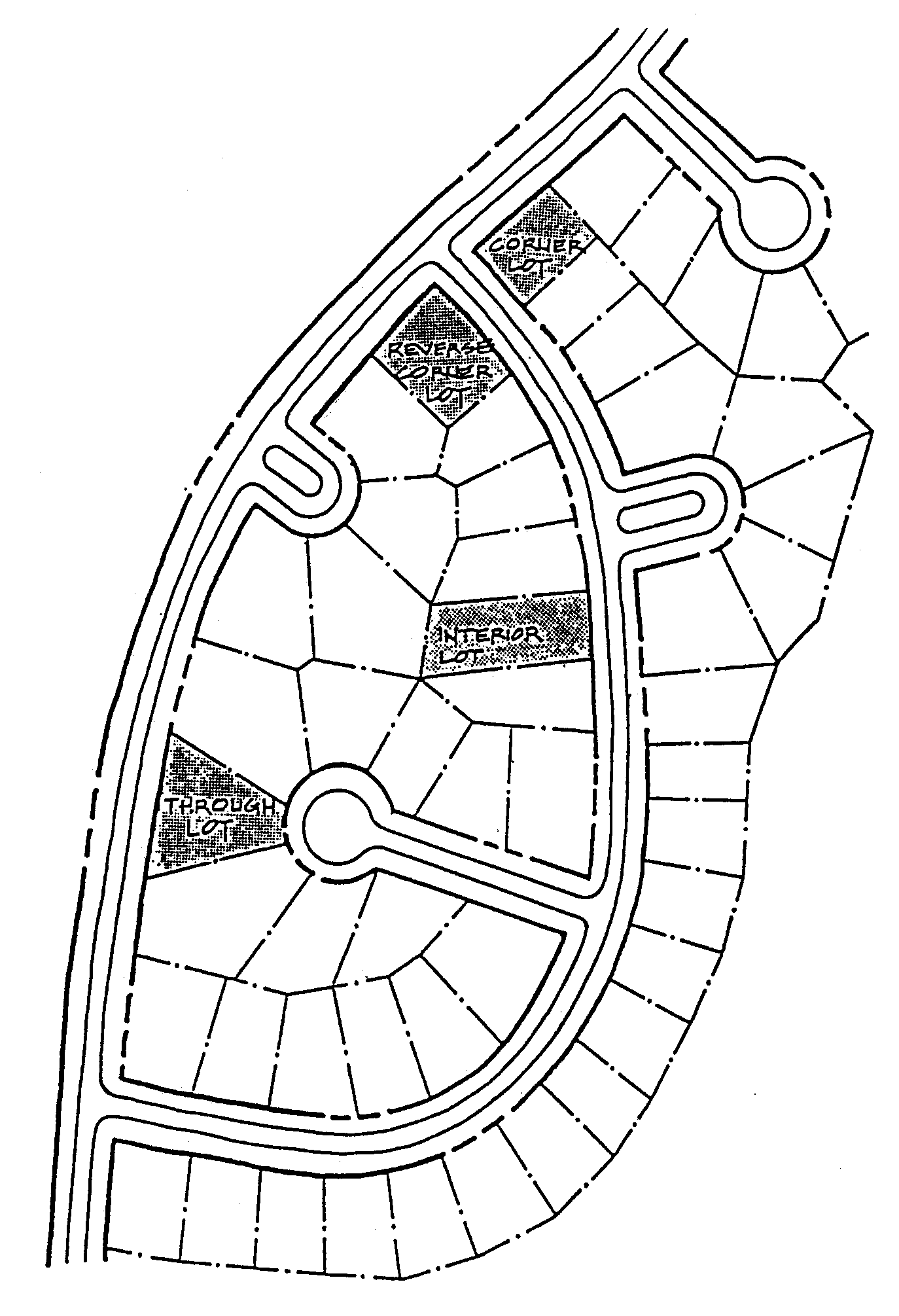
LOT TYPES
Lot Types