
West Plains City Zoning Code
ARTICLE III
DISTRICTS
DIVISION 14. - ENTERTAINMENT DISTRICT[2]
Editor's note—Ord. No. 4769, adopted April 15, 2024, set out provisions intended for use as § 50-455. Inasmuch as there were already provisions so designated, said section has been codified herein as § 50-450 at the discretion of the editor.
Sec. 50-110. - Establishment of zoning districts and zoning map.
(a)
The incorporated area of the city is hereby divided into the following districts in order to:
(1)
Classify and regulate the location of businesses, trades, industries, residences and other land uses and the location of buildings designed for specific uses;
(2)
Regulate and limit the height and bulk of buildings erected, reconstructed or altered;
(3)
Regulate and limit the intensity of the use of lot areas; and
(4)
Regulate and determine the area of yards, courts and other open spaces within and surrounding such buildings.
(b)
The zoning district map attached to the ordinance from which this chapter derives showing the ten zoning districts listed in subsection (a) of this section is hereby adopted as the official zoning district map of the city.
(Code 2002, § 102-126; Ord. No. 4080, § 1, 7-21-2008; Ord. No. 4537, Exh. A(50-110), 12-20-2017)
Sec. 50-111. - Interpretation of district boundaries.
(a)
Where zoning district boundaries are indicated as approximately following the centerlines of streets or highways, street lines, or highway right-of-way lines, such centerlines, street lines, or highway right-of-way lines shall be construed to be such boundaries.
(b)
Where district boundaries are so indicated that they approximately follow the lot lines, such lot lines shall be construed to be such boundaries.
(c)
Where district boundaries are so indicated that they are approximately parallel to the centerlines or street lines of streets or the centerlines or right-of-way lines of highways, such district boundaries shall be construed as being parallel thereto and at such distance therefrom as indicated on the zoning district map. If no distance is given, such dimension shall be determined by the use of the scale shown on the zoning district map.
(d)
Where the boundary of a district follows a railroad line, such boundary shall be deemed to be located in the middle of the main tracks of the railroad line.
(e)
Where the boundary of a district follows a stream, lake or other body of water, the boundary shall be the limit of the city's jurisdiction, unless otherwise indicated.
(Code 2002, § 102-127; Ord. No. 4080, § 1, 7-21-2008; Ord. No. 4537, Exh. A(50-111), 12-20-2017)
Sec. 50-112. - Vacated areas.
Whenever any street, alley, public way, railroad right-of-way, waterway or other similar area is vacated by proper authority, the zoning districts adjoining each side of such street, alley, public way, railroad right-of-way or similar area shall be extended automatically to the center of such vacation, and all area included in the vacation shall then and thenceforth be subject to all appropriate regulations of the extended districts. For a partial vacation, the adjoining district or district nearest the portion vacated shall be extended automatically to include all the vacated area.
(Code 2002, § 102-128; Ord. No. 4080, § 1, 7-21-2008; Ord. No. 4537, Exh. A(50-112), 12-20-2017)
Sec. 50-113. - Additional district regulations.
(a)
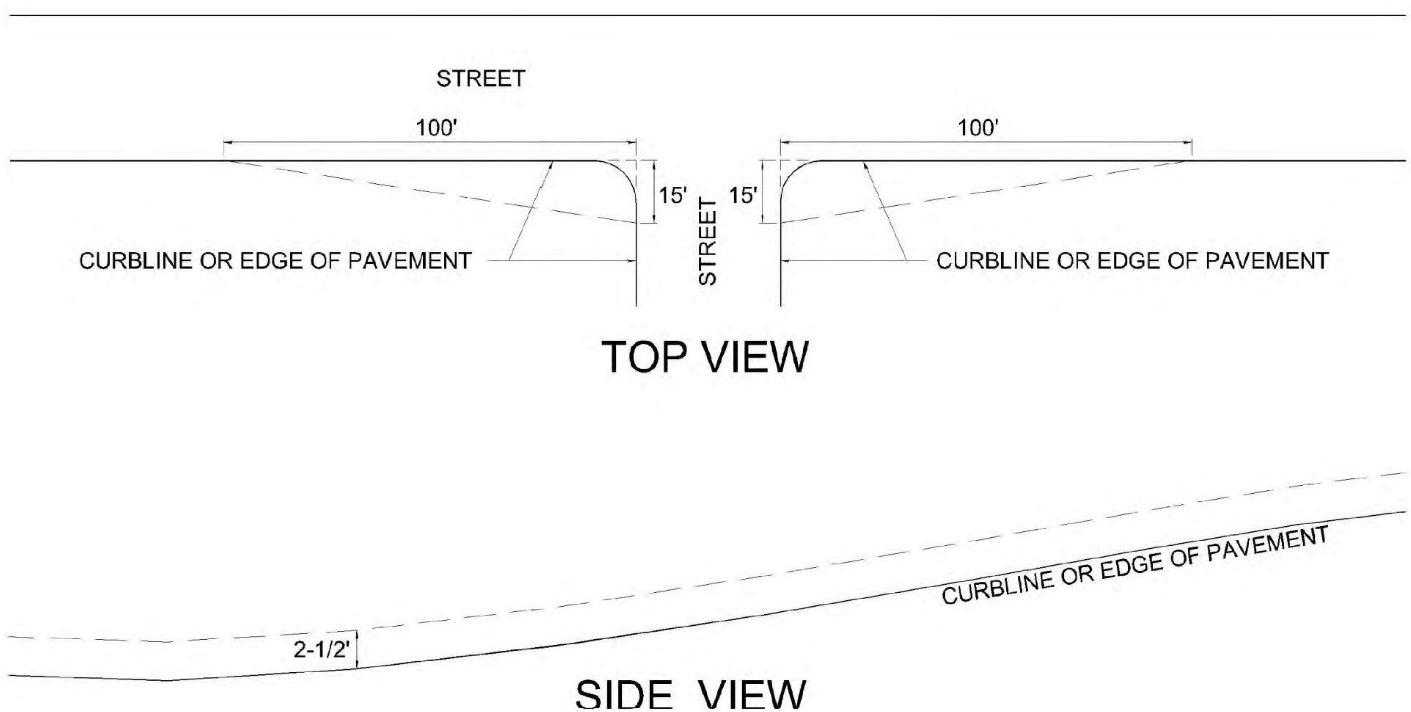
Sight triangle at intersections. All corner lots shall provide sight distance triangles, the short leg of which shall be 15 feet, and the long leg of which shall be 100 feet, measured along the curbline or edge of the pavement. Such area shall remain free of shrubbery, solid-panel fences, merchandise, equipment, vehicles or other obstructions to vision more than 2½ feet in height measured from and along the roadway curbline or edge of the pavement and shall be enforced by city ordinance.
(b)
Walls and hedges. Notwithstanding other sections of this chapter, walls and hedges may be permitted in any required yard or along the edge of any yard, provided that no wall or hedge along the sides or front edge of any front yard shall be over 2½ feet in height.
(c)
Installation of premanufactured carports and the construction of lean-tos. These structures must be authorized and permitted by the city building official prior to installation.
(d)
Access to structures. Every building erected or moved after the effective date of the ordinance from which this chapter derives shall be on a lot adjacent to a public street, and all structures shall be so located on lots as to provide safe and convenient access for servicing, fire protection and required off-street parking.
(e)
Parking, storage or use of major recreational equipment. For purposes of this chapter, major recreational equipment is defined as including boats and boat trailers, travel trailers, pickup campers or coaches designed to be mounted on automotive vehicles, motorized dwellings, tent trailers, and the like, and bases or boxes used for transporting recreational equipment, whether occupied by such equipment or not. Recreational vehicles can be stored in the driveway, side yard, or rear yard if there is access. No such equipment shall be used for living, sleeping or housekeeping purposes when parked or stored on a residential lot or in any location not approved for such use.
(f)
Parking and storage of certain vehicles. Automotive vehicles or trailers of any kind or type without current license plates shall not be parked or stored on any residentially zoned property other than in enclosed buildings or carports.
(Code 2002, § 102-129; Ord. No. 4080, § 1, 7-21-2008; Ord. No. 4537, Exh. A(50-113), 12-20-2017)
Sec. 50-114. - Additional height, area and yard regulations.
The following additional regulations for height, area and yards shall qualify and/or supplement, as the case may be, the district regulations appearing elsewhere in this chapter:
(1)
Area. Additional area regulations shall be as follows:
a.
No accessory building shall be constructed upon a lot until the construction of the main building has been actually commenced, and no accessory building shall be used for dwelling purposes unless the main building on the lot is also being used for dwelling purposes.
b.
More than one industrial, commercial, multiple-dwelling or institutional building may be erected upon a single lot or tract, but the yards and open spaces required around the boundaries of the lot or tract shall not be encroached upon by any such buildings, nor shall there be any change in the intensity of use requirements.
c.
Where an open space is more than 50 percent surrounded by buildings, the minimum width of the open space shall be 30 feet for one-story buildings, 40 feet for two-story buildings, and 50 feet for three-story buildings.
(2)
Yards. Additional yard regulations shall be as follows:
a.
In computing the depth of a rear yard, where such yard opens onto an alley, one-half of the alley width may be included as a portion of the rear yard.
b.
Accessory buildings which are not a part of the main building may be built in a rear yard within five feet of the rear lot line. An accessory building which is not a part of the main building shall not occupy more than 30 percent of the required rear yard.
c.
Every part of a required yard shall be open to the sky, unobstructed, except for accessory buildings in a rear yard, and except for the ordinary projections of skylights, sills, belt courses, cornices and ornamental features projecting not to exceed 12 inches. This requirement shall not prevent the construction of fences not exceeding eight feet in height, except on that portion of lots within 30 feet of the intersection of two or more streets.
d.
Open or lattice-enclosed fire escapes, fireproof outside stairways, and balconies opening upon fire towers projecting into a yard not more than five feet and the ordinary projections of chimneys and flues may be permitted by the building and zoning officer.
e.
For the purposes of side yard requirements, a two-family dwelling shall be considered as one building occupying a single lot.
f.
An open unenclosed porch not more than one-story in height or a paved terrace may project into the required front yard for a distance not exceeding ten feet. An enclosed vestibule containing not more than 40 square feet may project into the required front yard for a distance not to exceed four feet.
g.
Terraces, uncovered porches, platforms and ornamental features which do not extend more than three feet above the floor level of the first (ground) story may project into a required yard, provided these projections are distant at least two feet from the adjacent side lot line.
h.
When 40 percent of a block frontage is developed with two or more buildings, the depth of the front yards established after the effective date of the ordinance from which this chapter derives shall be adjusted in the following manner:
1.
When the building furthest from the street provides a front yard not more than ten feet deeper than the building closest to the street, the average depth of the front yard for such frontage shall be the minimum depth of front yards for new buildings in such block.
2.
When subsection (2)h.1 of this section is not the case and the lot is within 100 feet of an existing building on each side, excluding, however, buildings on corner lots which front upon the intersecting street, the depth of the front yard is determined by a line drawn from the closest front corners of these two adjacent buildings.
3.
When neither subsection (2)h.1 or (2)h.2 of this section is the case and the lot is within 100 feet of an existing building on one side only, excluding, however, buildings on corner lots which front upon the intersecting street, the depth of the front yard is the same as that of the existing adjacent building.
i.
Sight triangle at intersections. All corner lots shall provide sight distance triangles, the short leg of which shall be 15 feet, and the long leg of which shall be 100 feet, measured along the curbline or edge of the pavement. Such area shall remain free of shrubbery, solid-panel fences, merchandise, equipment, vehicles or other obstructions to vision more than 2½ feet in height measured from and along the roadway curbline or edge of the pavement and shall be enforced by city ordinance.
j.
Buildings in all zones on corner lots shall provide a side yard adjacent to the side street of not less than the front yard established for buildings on interior lots, provided that this shall not be so interpreted as to reduce the buildable width of a corner lot of record on the effective date of the ordinance from which this chapter derives to less than 65 percent of the total width of such lot.
k.
In single-family dwelling districts R-1 and R-2, when 80 percent of the frontage of a block on both sides of the street between two intersecting streets or between an intersecting street and a cul-de-sac has been developed with main buildings and accessory buildings with side yards less than that required by the dwelling district in which such property is situated, the side yard requirement for any main buildings or accessory buildings in such block shall be the average yard of all parcels of property in such block rather than the side yard set forth in the dwelling district in which such parcel or property is situated. In determining the existing side yard of any developed parcel, in order to compute the average, the side yard of the main building on any developed parcel shall be used, except that when an accessory building exists with a smaller side yard than the main building has, the side yard shall be taken as being the average between the side yard of the main building and the side yard of the accessory building. The average value for the side yard of all parcels of property shall be determined by the applicant by means of a certified statement of a registered professional land surveyor.
(Code 2002, § 102-130; Ord. No. 4080, § 1, 7-21-2008; Ord. No. 4537, Exh. A(50-114), 12-20-2017)
Sec. 50-115. - Fences.
It shall be unlawful for any person to erect or maintain any fence or other like structure except as follows:
(1)
Privacy fences. Privacy fences may be erected on any lot, except as provided in subsection (6) of this section, and shall be no more than eight feet high and shall not be located closer to the front property line than the nearest portion of the front of the building.
(2)
Decorative fences. Decorative fences may be erected on any lot, except as provided in subsection (6) of this section, and shall be no more than four feet high and be of open construction.
(3)
Security fences. Security fences may be erected on any business or industrial lot to a height of not more than 12 feet. The top four feet must be of open wire, woven wire or barbed wire construction.
(4)
Open wire fences. Open wire fences for the enclosure of private recreational courts may be constructed to a height of no more than 12 feet, but must be set back from all property lines at least six feet. Such fences may be of any material, except as provided in subsection (6) of this section. The top four feet must be open wire or woven wire construction.
(5)
Design. Permanent fence design standards are included in the regulations for aesthetic, maintenance and safety reasons.
a.
Fences may not include paper, cloth, or similar readily flammable material.
b.
Fences may not include corrugated metal or corrugated tin.
c.
Wire mesh and/or wire grid (i.e. cattle panel, chicken wire) are prohibited fence materials in front of the front building line of a residential home. Chain link fence is not prohibited.
d.
Fences may not be constructed of lattice panels.
e.
If there is a finished surface to a fence, it must face outward from the property. Protruding bolts or members must face inward.
(6)
Maintenance. No person shall permit, cause, keep, maintain or allow a fence within the corporate limits of the city in a dilapidated or dangerous condition.
(7)
Barbed wire fences, electrified fences and other dangerous fences. Any person who shall place or permit to be placed or remain on or along any railroad or building front or any part of a building, fence or premises adjacent or contiguous to any right-of-way or public way or residence any spikes or sharp-pointed cresting, or any barbed wire or other things, except as permitted in subsection (3) of this section, or electrical fence, dangerous or liable to tear, snag, cut or injure anyone coming in contact therewith, shall be deemed guilty of a misdemeanor and punishable per section 50-5.
(8)
Violations declared nuisance. All fences or other like structures erected or maintained in violation of this division are hereby deemed and declared to be a nuisance, and any owner or occupant of a lot or tract of land upon which such nuisance exists shall be deemed guilty of a misdemeanor. Each day on which such violation continues shall constitute a separate offense.
(Code 2002, § 102-131; Ord. No. 4080, § 1, 7-21-2008; Ord. No. 4537, Exh. A(50-115), 12-20-2017)
Sec. 50-116. - Establishment of office and commercial use groups.
This section classifies office and commercial land uses and activities into use groups on the basis of common functional, product, or physical characteristics. Characteristics include the type and amount of activity, the type of customers or users, how goods or services are developed, sold or delivered, and certain site factors. The use groups provide a systematic basis for assignment of present and future uses to zones. The decision to allow or prohibit the use groups in the various commercial districts is based on the goals and policies of the comprehensive plan.
(1)
Offices.
a.
Characteristics. Office uses are characterized by activities conducted in an office setting that focus on the provision of goods and services, usually by professionals. General office uses are characterized by activities that generally focus on business, government, professional, or financial services. General office uses also include some activities that are less service-oriented and focus on the development, testing, production, processing, packaging, or assembly of goods and products, which may include digital products such as internet home pages, media content, designs and specifications, computer software, advertising materials, and others. The medical office use group includes medical and dental offices and clinics and is listed separately from general office because these uses tend to generate higher traffic counts and require more off-street parking.
b.
Accessory uses. Accessory uses may include cafeterias, health facilities, parking or other amenities primarily for the use of employees in the firm or building.
c.
Examples. Examples include uses from the two subgroups listed below:
1.
General office use group. Professional services such as lawyers or accountants; financial businesses such as lenders, brokerage houses, banks, or real estate agents; sales offices; government offices and public utility offices; blood collection facilities; software and internet content development and publishing; computer systems design and programming; graphic and industrial design; engineers, architects; telecommunications service providers; data processing; television, video, radio, internet, and recording studios and broadcasting; scientific and technical services; and medical and dental labs.
2.
Medical office use group. Medical and dental offices and clinics.
d.
Exceptions.
1.
Offices that are part of and are located with a firm in another category are considered accessory to the firm's primary activity. Headquarters offices, when in conjunction with or adjacent to a primary use in another category, are considered part of the other category.
2.
Contractors and others who perform services off-site are included in the general office category if equipment and materials are not stored on the site and fabrication, services, or similar work is not carried on at the site.
3.
Medical and dental laboratories and research facilities do not include the manufacture of pharmaceutical or other products for general sale or distribution. In addition, no toxic substances, explosives, radioactive material, highly flammable substances or other materials that pose a threat to public health and safety, due to their quantities or location, shall be utilized in the research operations.
(2)
Commerce and services.
a.
Retail sales use group.
1.
Characteristics. Retail sales firms are involved in the sale lease or rent of new or used products to the general public. They may also provide personal services or entertainment or provide product repair or services for consumer and business goods.
2.
Accessory uses. Accessory uses may include offices, storage of goods, manufacture or repackaging of goods for on-site sale, and parking. Restricted production and repair of goods sold on-site or similar goods is also permitted as an accessory use.
3.
Examples. Examples include, but are not limited to, pawn shops, stores selling, leasing or renting consumer, home, and business goods, including art, art supplies, bicycles, clothing, dry goods, electronic equipment, fabric, furniture, garden supplies, gifts, groceries, hardware, home improvements, household products, jewelry, liquor sales, pets, pet food, pharmaceuticals, plants, printed material, stationary, and videos; food sales, and sales or leasing of consumer vehicles including passenger vehicles, motorcycles, light and medium trucks, and other recreational vehicles if outdoor activities are permitted by the district.
4.
Exceptions.
i.
Lumber yards and other building material sales that sell primarily to contractors and do not have a retail orientation are classified as wholesale sales.
ii.
Sales, rental, or leasing of heavy trucks and equipment is classified as wholesale sales.
b.
Personal services use group.
1.
Characteristics. Personal service uses are establishments for the sale of personal services or establishments engaged in providing services involving the care of a person of his personal goods or apparel, but not including personal storage.
2.
Accessory uses. Accessory uses may include offices, storage of goods and parking.
3.
Examples. Examples include, but are not limited to, locksmiths; laundromats; photographic studios; photocopy and blueprint services; hair, tanning, and personal care services; dance or music classes; and animal grooming.
c.
Eating and drinking establishments use group.
1.
Characteristics. The eating and drinking establishments use group includes uses that are involved in the preparation and sale of food and drink primarily for consumption as a meal on-premises; however this use group also includes uses that offer the sale of food for consumption off-premises. This use group includes drive-in, pick-up window and drive-through facilities unless restricted by the district.
2.
Accessory uses. Accessory uses may include offices, storage of goods, manufacture or repackaging of goods for on-site sale, and parking.
3.
Examples. Examples include, but are not limited to, restaurants, cafes, delicatessens, taverns, bars and coffee shops.
d.
Entertainment-oriented use group.
1.
Characteristics. Service firms involved in providing entertainment-type activities to the general public.
2.
Accessory uses. Accessory uses may include food and liquor sales for on-site consumption; parking.
3.
Examples. Examples include, but are not limited to, the following uses: bowling alleys; dance halls; video game arcades; billiard parlors; roller skating and ice skating arenas; in-door movie theaters; athletic clubs; fitness centers; miniature golf, if outdoor activities are permitted by the district; and other small-scale sports facilities.
4.
Exceptions.
i.
Major event venues, such as stadiums, arenas and fairgrounds, are classified as major event entertainment.
ii.
Drive-in movie theaters, golf driving ranges, archery ranges and similar uses are classified as commercial outdoor recreation.
e.
Temporary lodging use group.
1.
Characteristics. The temporary lodging use group includes facilities where tenancy of all rooms may be arranged for periods of less than one month. The facility may or may not have food preparation facilities, and shower or bath facilities may or may not be shared.
2.
Accessory uses. Accessory uses may include offices, food and liquor sales for on-site consumption, and recreational facilities for occupants, and parking.
3.
Examples. Examples include, but are not limited to, hotels, motels, inns and hostels.
4.
Exceptions.
i.
If the facility is managed by a public or non-profit agency to provide short-term housing, with or without a fee, the facility shall not be considered temporary lodging.
ii.
Boardinghouse, lodginghouse, fraternity house and sorority house uses shall not be considered temporary lodging.
iii.
Bed and breakfast uses shall not be considered temporary lodging.
f.
Major event entertainment use group.
1.
Characteristics. Major event entertainment uses are characterized by activities and structures that draw large numbers of people to specific events or shows. Activities are generally of a spectator nature.
2.
Accessory uses. Accessory uses may include restaurants, bars, concessions, parking, and maintenance facilities.
3.
Examples. Examples include, but are not limited to, stadiums, sports arenas, coliseums, race tracks (auto, horse, dog, etc.), auditoriums, exhibition and meeting areas and fairgrounds.
4.
Exceptions.
i.
Exhibition and meeting areas with less than 20,000 square feet of total event area are classified as retail sales.
ii.
Banquet halls and meeting areas that are part of hotels or restaurants are accessory to those uses, which are included in the retail sales and temporary lodging categories.
iii.
Drive-in theaters are classified as commercial outdoor recreation.
g.
Commercial outdoor recreation use group.
1.
Characteristics. Commercial outdoor recreation uses are large, generally commercial uses that provide continuous recreation or entertainment oriented activities. They generally take place outdoors. They may take place in a number of structures which are arranged together in an outdoor setting.
2.
Accessory uses. Accessory uses may include concessions, restaurants, parking, caretaker's quarters, and maintenance facilities.
3.
Examples. Examples include, but are not limited to, amusement parks, theme parks, golf driving ranges, drive-in movie theaters and archery ranges.
4.
Exceptions. Uses which draw large numbers of people to periodic events, rather than on a continuous basis, are classified as major event entertainment.
(Ord. No. 4537, Exh. A(50-116), 12-20-2017)
Sec. 50-117. - Visual buffers and screening.
(a)
Intent. The intent of this section is to provide minimum separation and screening of dissimilar uses on properties adjacent to each other; to minimize adverse visual effects of commercial and industrial land uses on the surrounding property; and to buffer land uses in dissimilar zoning districts which have a detrimental visual effect on each other. In instance of a parcel's rezoning or change in use to residential, any existing adjacent higher intensity uses shall not be subject to buffer and screening requirements set forth in this section.
(b)
Buffer plans required. A buffer plan shall be submitted with all applications for a change in land use or for site plan approval. Buffers shall be located on the site for which approval is requested. The buffer plan shall show in detail the layout of the proposed development including the arrangement of buildings, parking areas, permanent open spaces, and the location of proposed buildings and of existing or proposed buildings on adjacent properties. The plan shall also show the location of proposed buffers including a detailed description or sketch of such buffer materials to be used.
(c)
Approval of buffer plan. The city building official shall review and approve buffer plans. Appeals of the building official's determination shall be made to the planning commission.
(d)
Required buffers.
(e)
Screening design requirements. Except where otherwise allowed by this chapter, any fence or wall shall be opaque so as to prevent the passage of light and debris, and shall be constructed of decay resistant wood or materials to ensure the longevity of the structure.
(f)
Unfinished concrete block shall not be permitted.
(1)
The height of a fence or wall shall not exceed eight feet in height, except as allowed by other sections of this chapter.
(2)
Any area between the property line and the fence or wall shall be maintained as an open area in conformance with city codes.
(3)
The height of a fence or wall shall be measured from the finished grade at the base of the structure to the top of the fence or wall, but shall not include columns or posts.
(4)
The construction and maintenance responsibility shall be placed on the applicant for site development of the higher intensity use.
(5)
The requirement of screening will be triggered upon the development of the site of the higher intensity use even if the residentially zoned adjacent property is undeveloped.
(g)
Variances. The planning and zoning commission may approve variances from these requirements at the request of the developer if all of the following findings are made:
(1)
The variance would be in keeping with the overall character of the area.
(2)
The variance would not be contrary in the purpose and intent of these regulations.
(3)
The variance would not be detrimental to existing or proposed surrounding uses.
(4)
The variance would serve public purposes to a degree equal to or greater than the standards replaced.
(Ord. No. 4537, Exh. A(50-117), 12-20-2017)
Sec. 50-144. - Description.
The A-1 Agriculture District is a district for agricultural and related uses in areas where nonfarm residential development is not of a significant portion and is presently not anticipated. It is the intent of this district to allow accessory residential dwellings to the extent required for sale and proper operation of a principal permitted use. No manufactured home, mobile home or trailer house shall be permitted.
(Code 2002, § 102-156; Ord. No. 4080, § 1, 7-21-2008; Ord. No. 4537, Exh. A(50-144), 12-20-2017)
Sec. 50-145. - Permitted uses.
Permitted uses in the A-1 Agriculture District are as follows:
(1)
Agricultural building or storage.
(2)
Single-family homes.
(3)
Field, row, and tree crops.
(4)
Nurseries and greenhouses.
(5)
Churches.
(6)
Schools.
(7)
Recreational structures and properties.
(8)
Cultural structures and properties.
(9)
Public service structures and properties.
(10)
Forestry.
(Code 2002, § 102-157; Ord. No. 4080, § 1, 7-21-2008; Ord. No. 4537, Exh. A(50-145), 12-20-2017)
Sec. 50-146. - Accessory uses.
Accessory uses in the A-1 Agriculture District are as follows:
(1)
Employee living quarters.
(2)
Private garages.
(3)
Home occupations.
(4)
Roadside stands (agricultural products).
(5)
Temporary construction buildings.
(6)
Equipment storage.
(Code 2002, § 102-158; Ord. No. 4080, § 1, 7-21-2008; Ord. No. 4537, Exh. A(50-146), 12-20-2017)
Sec. 50-147. - Conditional uses.
Conditional uses in the A-1 Agriculture District are as follows:
(1)
Railroad tracks.
(2)
Streets and highways.
(3)
Public utility transmission lines.
(4)
Mobile home (hardship and temporary).
(5)
Livestock and poultry raising.
(6)
Sawmills and wood processing.
(7)
Cemeteries.
(8)
Veterinary hospitals and clinics.
(9)
Airports.
(10)
Incineration and garbage disposal.
(11)
Cellular phone, radio and television towers.
(12)
Rifle, skeet, trap and pistol ranges.
(13)
Kennels.
(14)
Artificial lake, one acre or more.
(15)
Private dairies and stables.
(16)
Wastewater treatment plant.
(17)
Any other use deemed compatible by the planning commission.
(Code 2002, § 102-159; Ord. No. 4080, § 1, 7-21-2008; Ord. No. 4537, Exh. A(50-147), 12-20-2017)
Sec. 50-148. - Minimum requirements.
The minimum requirements in the A-1 Agriculture District are as follows:
(1)
Minimum lot area: Five acres.
(2)
Minimum lot width: 200 feet.
(3)
Minimum front yard: 50 feet.
(4)
Minimum side yard: 50 feet.
(5)
Minimum rear yard: 50 feet.
(6)
Distance from R district (building with animals): 100 feet.
(7)
Off-street parking: Two spaces per dwelling.
(8)
Parking distance from R district: 25 feet.
(Code 2002, § 102-160; Ord. No. 4080, § 1, 7-21-2008; Ord. No. 4537, Exh. A(50-148), 12-20-2017)
Sec. 50-180. - Description.
The R-1 Single-Family Residential District is a district for single-family homes with no more than four dwelling units per acre, provided each are developed on a lot of record, served by the city water and sewer systems and protected from nonresidential uses. No manufactured home, mobile home or trailer house shall be permitted.
(Code 2002, § 102-186; Ord. No. 4080, § 1, 7-21-2008; Ord. No. 4537, Exh. A(50-180), 12-20-2017)
Sec. 50-181. - Permitted uses.
Permitted uses in the R-1 Single-Family Residential District are as follows:
(1)
Single-family homes.
(2)
Churches.
(3)
Schools.
(Code 2002, § 102-187; Ord. No. 4080, § 1, 7-21-2008; Ord. No. 4537, Exh. A(50-181), 12-20-2017)
Sec. 50-182. - Accessory uses.
Accessory uses in the R-1 Single-Family Residential District are as follows:
(1)
Private garages.
(2)
Home occupations.
(3)
Temporary construction buildings.
(4)
Daycare, limited (conducted as home occupation).
(Code 2002, § 102-188; Ord. No. 4080, § 1, 7-21-2008; Ord. No. 4537, Exh. A(50-182), 12-20-2017)
Sec. 50-183. - Conditional uses.
Conditional uses in the R-1 Single-Family Residential District are as follows:
(1)
Mobile homes (hardship and temporary). These special conditions are defined in chapter 26 of this Code.
(2)
Cemeteries.
(3)
Artificial lake, one acre or more.
(4)
Daycare, general.
(5)
Off-street parking areas.
(6)
Recreational structures and properties.
(7)
Administrative structures and properties.
(8)
Public service structures and properties.
(9)
Any other use deemed compatible by the planning commission.
(Code 2002, § 102-189; Ord. No. 4080, § 1, 7-21-2008; Ord. No. 4537, Exh. A(50-183), 12-20-2017)
Sec. 50-184. - Minimum requirements.
The minimum requirements in the R-1 Single-Family Residential District are as follows:
(1)
Minimum lot area: 10,000 square feet.
(2)
Minimum lot width: 80 feet.
(3)
Minimum front yard: 30 feet.
(4)
Minimum side yard: Ten feet.
(5)
Minimum rear yard: 20 feet.
(6)
Off-street parking: Two spaces per dwelling.
(7)
Maximum structure height: Three stories from grade.
(Code 2002, § 102-190; Ord. No. 4080, § 1, 7-21-2008; Ord. No. 4537, Exh. A(50-184), 12-20-2017)
Sec. 50-207. - Description.
The R-2 Urban Residential District is a district for single-family homes, duplexes, triplexes and small apartments with an average density of no more than eight dwelling units per acre served by city water and sewer systems and protected from nonresidential uses. No manufactured home, mobile home or trailer house shall be permitted.
(Code 2002, § 102-216; Ord. No. 4080, § 1, 7-21-2008; Ord. No. 4537, Exh. A(50-207), 12-20-2017)
Sec. 50-208. - Permitted uses.
Permitted uses in the R-2 Urban Residential District are as follows:
(1)
Single-family homes.
(2)
Churches.
(3)
Schools.
(4)
Duplexes.
(5)
Triplexes.
(6)
Apartment buildings (eight units maximum).
(Code 2002, § 102-217; Ord. No. 4080, § 1, 7-21-2008; Ord. No. 4537, Exh. A(50-208), 12-20-2017)
Sec. 50-209. - Accessory uses.
Accessory uses in the R-2 Urban Residential District are as follows:
(1)
Private garages.
(2)
Home occupations.
(3)
Temporary construction buildings.
(4)
Daycare, limited (conducted as home occupation).
(Code 2002, § 102-218; Ord. No. 4080, § 1, 7-21-2008; Ord. No. 4537, Exh. A(50-209), 12-20-2017)
Sec. 50-210. - Conditional uses.
Conditional uses in the R-2 Urban Residential District are as follows:
(1)
Mobile homes (hardship and temporary).
(2)
Cemeteries.
(3)
Nursing homes and independent or assisted living facilities.
(4)
Artificial lake, one acre or more.
(5)
Daycare, general.
(6)
Off-street parking areas.
(7)
Recreational structures and properties.
(8)
Administrative structures and properties.
(9)
Public service structures and properties.
(10)
Any other use deemed compatible by the planning commission.
(Code 2002, § 102-219; Ord. No. 4080, § 1, 7-21-2008; Ord. No. 4537, Exh. A(50-210), 12-20-2017)
Sec. 50-211. - Minimum requirements.
The minimum requirements in the R-2 Urban Residential District are as follows:
(1)
Minimum lot area: 8,000 square feet.
(2)
Minimum lot width: 75 feet.
(3)
Minimum front yard: 30 feet.
(4)
Minimum side yard: Ten feet.
(5)
Minimum rear yard: 20 feet.
(6)
Open space: 2,000 square feet per dwelling unit.
(7)
Off-street parking: Two spaces per dwelling.
(8)
Maximum structure height: Side yard plus ten feet.
(Code 2002, § 102-220; Ord. No. 4080, § 1, 7-21-2008; Ord. No. 4537, Exh. A(50-211), 12-20-2017)
Sec. 50-231. - Description.
The R-3 Multifamily Residential District is an area for apartments, offices and home occupations with an average density of no more than 16 dwelling units per acre served by city water and sewer and protected from nonresidential uses. No manufactured home, mobile home or trailer house shall be permitted.
(Code 2002, § 102-246; Ord. No. 4080, § 1, 7-21-2008; Ord. No. 4537, Exh. A(50-231), 12-20-2017)
Sec. 50-232. - Permitted uses.
Permitted uses in the R-3 Multifamily Residential District are as follows:
(1)
Single-family homes.
(2)
Churches.
(3)
Schools.
(4)
Duplexes.
(5)
Triplexes.
(6)
Apartment buildings (16 units maximum).
(7)
Roominghouses, boardinghouses.
(Code 2002, § 102-247; Ord. No. 4080, § 1, 7-21-2008; Ord. No. 4537, Exh. A(50-232), 12-20-2017)
Sec. 50-233. - Accessory uses.
Accessory uses in the R-3 Multifamily Residential District are as follows:
(1)
Private garages.
(2)
Home occupations.
(3)
Temporary construction buildings.
(4)
Daycare, limited (conducted as home occupation).
(5)
Off-street parking areas.
(6)
Offices.
(Code 2002, § 102-248; Ord. No. 4080, § 1, 7-21-2008; Ord. No. 4537, Exh. A(50-233), 12-20-2017)
Sec. 50-234. - Conditional uses.
Conditional uses in the R-3 Multifamily Residential District are as follows:
(1)
Manufactured and mobile home parks.
(2)
Manufactured and mobile homes (hardship and temporary).
(3)
Cemeteries.
(4)
Artificial lake, one acre or more.
(5)
Daycare, general.
(6)
Off-street parking areas.
(7)
Recreational structures and properties.
(8)
Administrative structures and properties.
(9)
Public service structures and properties.
(10)
Any other use deemed compatible by the planning commission.
(Code 2002, § 102-249; Ord. No. 4080, § 1, 7-21-2008; Ord. No. 4537, Exh. A(50-234), 12-20-2017)
Sec. 50-235. - Minimum requirements.
The minimum requirements in the R-3 Multifamily Residential District are as follows:
(1)
Minimum lot area: 6,500 square feet.
(2)
Minimum lot width: 75 feet.
(3)
Minimum front yard: 30 feet.
(4)
Minimum side yard: Ten feet.
(5)
Minimum rear yard: 20 feet.
(6)
Open space: 1,500 square feet per dwelling unit.
(7)
Off-street parking: Two spaces per dwelling.
(8)
Maximum structure height: Side yard plus ten feet.
(Code 2002, § 102-250; Ord. No. 4080, § 1, 7-21-2008; Ord. No. 4537, Exh. A(50-235), 12-20-2017)
Sec. 50-264. - Description.
The C-1 Neighborhood Commercial District is a district for retail stores providing convenience shopping for residential neighborhoods. These stores should be grouped into a center with access to traffic arteries, with plenty of off-street parking and with architecture and landscaping that harmonizes with neighboring residential areas. This district must be served by city water and sewer systems. No single-family, duplex, or triplex, manufactured home, mobile home or trailer house shall be permitted.
(Code 2002, § 102-276; Ord. No. 4080, § 1, 7-21-2008; Ord. No. 4273, § 1, 8-20-2012; Ord. No. 4537, Exh. A(50-264), 12-20-2017)
Sec. 50-265. - Permitted uses.
Permitted uses in the C-1 Neighborhood Commercial District are as follows:
(1)
Churches.
(2)
Personal services use group.
(3)
Daycare, limited (general or commercial).
(4)
General office use group, excluding banks and financial institutions with automatic teller machines and drive-through facilities.
(5)
C-1 district is intended to be used as an advantageous form of spot-zoning to encourage commercial use that supports a larger residential neighborhood. Eliminating multifamily housing focuses the purpose of this zone.
(6)
Eating and drinking establishments use group, excluding drive-in, pick-up window, or drive-through facilities.
(7)
Retail sales use group, excluding convenience stores with gas pumps.
(8)
Mortuaries.
(Code 2002, § 102-277; Ord. No. 4080, § 1, 7-21-2008; Ord. No. 4273, § 1, 8-20-2012; Ord. No. 4537, Exh. A(50-265), 12-20-2017)
Sec. 50-266. - Accessory uses.
Accessory uses in the C-1 Neighborhood Commercial District are as follows:
(1)
Off-street parking areas.
(2)
Garages and storage buildings.
(Code 2002, § 102-278; Ord. No. 4080, § 1, 7-21-2008; Ord. No. 4273, § 1, 8-20-2012; Ord. No. 4537, Exh. A(50-266), 12-20-2017)
Sec. 50-267. - Conditional uses.
Conditional uses in the C-1 Neighborhood Commercial District are as follows:
(1)
Cemeteries.
(2)
Carwashes.
(3)
Community gardens.
(4)
Recreational structures and properties.
(5)
General office use group, including banks and financial institutions with automatic teller machines and drive-through facilities.
(6)
Schools and colleges.
(7)
Mixed-use residential: dwelling units subordinate to a primary commercial use.
(8)
Recreational structures and properties.
(9)
Cultural structures and properties.
(10)
Administrative structures and properties.
(11)
Public service structures and properties.
(12)
Any other use deemed compatible by the planning commission.
(Code 2002, § 102-279; Ord. No. 4080, § 1, 7-21-2008; Ord. No. 4273, § 1, 8-20-2012; Ord. No. 4537, Exh. A(50-267), 12-20-2017)
Sec. 50-268. - Minimum requirements.
(a)
The minimum requirements in the C-1 Neighborhood Commercial District are as follows:
(1)
Minimum lot area: 7,500 square feet.
(2)
Minimum lot width: 50 feet.
(3)
Minimum front yard: 30 feet.
(4)
Minimum side yard: Ten feet.
(5)
Minimum rear yard: 20 feet.
(6)
Visual buffering and screening requirements apply per section 50-117.
(7)
Off-street parking: two parking spaces per dwelling unit (residential) or one per 500 square feet of floor space (commercial). Minimum: two parking spaces.
(8)
Maximum structure height: Side yard plus ten feet.
(b)
Exceptions regarding minimum requirements may be permissible on existing lots of record.
(Code 2002, § 102-280; Ord. No. 4080, § 1, 7-21-2008; Ord. No. 4273, § 1, 8-20-2012; Ord. No. 4537, Exh. A(50-268), 12-20-2017)
Sec. 50-300. - Description.
The C-2 General Commercial District is intended to provide for the orderly and attractive grouping at appropriate locations of commercial activities of a more general retail and wholesale nature, and service facilities serving a larger community trade area. All uses in the C-2 General Commercial District shall be connected to city water and sewer systems. No single-family home, duplex, triplex, manufactured home, mobile home or trailer house shall be permitted.
(Code 2002, § 102-306; Ord. No. 4080, § 1, 7-21-2008; Ord. No. 4273, § 1, 8-20-2012; Ord. No. 4537, Exh. A(50-300), 12-20-2017)
Sec. 50-301. - Permitted uses.
Permitted uses in the C-2 General Commercial District are as follows:
(1)
Churches.
(2)
Schools and colleges.
(3)
Retail sales use group.
(4)
Personal services use group.
(5)
Daycare, limited (general or commercial).
(6)
General office use group.
(7)
Multifamily housing (minimum of four dwelling units on-site and a maximum of 16 units per acre). Multifamily housing shall be permitted in the C-2 District if the development meets the minimum required open space standards as set forth in the R-3 Multifamily District section 50-235(6).
(8)
Eating and drinking establishment use group.
(9)
Entertainment-oriented use group.
(10)
Temporary lodging use group.
(11)
Major event entertainment use group.
(12)
Carwashes.
(13)
Automobile service stations and garages.
(14)
Mortuaries.
(15)
Recreational structures and properties.
(16)
Cultural structures and properties.
(17)
Administrative structures and properties.
(18)
Public service structures and properties.
(Code 2002, § 102-307; Ord. No. 4080, § 1, 7-21-2008; Ord. No. 4273, § 1, 8-20-2012; Ord. No. 4537, Exh. A(50-301), 12-20-2017)
Sec. 50-302. - Accessory uses.
Accessory uses in the C-2 General Commercial District are as follows:
(1)
Off-street parking areas.
(2)
Garages and storage buildings.
(Code 2002, § 102-308; Ord. No. 4080, § 1, 7-21-2008; Ord. No. 4273, § 1, 8-20-2012; Ord. No. 4537, Exh. A(50-302), 12-20-2017)
Sec. 50-303. - Conditional uses.
Conditional uses in the C-2 General Commercial District are as follows:
(1)
Cemeteries.
(2)
Truck freight terminals.
(3)
Medical office use group.
(4)
Commercial outdoor recreation use group.
(5)
Mixed-use residential: dwelling units subordinate to a primary commercial use.
(6)
Animal or veterinary hospital or clinic with indoor operations only.
(7)
Self-service storage facility.
(8)
Major event entertainment use group.
(9)
Any other uses deemed compatible by the planning commission.
(Code 2002, § 102-309; Ord. No. 4080, § 1, 7-21-2008; Ord. No. 4273, § 1, 8-20-2012; Ord. No. 4537, Exh. A(50-303), 12-20-2017)
Sec. 50-304. - Minimum requirements.
The minimum requirements in the C-2 General Commercial District are as follows:
(1)
Minimum lot area: 10,000 square feet.
(2)
Minimum lot width: 75 feet.
(3)
Minimum front yard: 30 feet.
(4)
Minimum side yard: Ten feet; 20 feet from R districts.
(5)
Minimum rear yard: 30 feet.
(6)
Visual buffering and screening requirements apply per section 50-117.
(7)
Off-street parking: Two spaces per dwelling unit (residential) or one per 300 square feet of floor space (commercial). Minimum: Two parking spaces.
(8)
Maximum structure height: Side yard plus ten feet.
(9)
Number of loading berths: Minimum of one or one per 10,000 square feet of floor space. (Loading berth requirements may be increased based on development plan review by planning commission.)
(10)
Maximum number of street entrances: Two. (Entrance requirements may be increased based on development plan review by planning commission.) State entrances shall be permitted by the state department of transportation.
(Code 2002, § 102-310; Ord. No. 4080, § 1, 7-21-2008; Ord. No. 4273, § 1, 8-20-2012; Ord. No. 4537, Exh. A(50-304), 12-20-2017)
Sec. 50-327. - Description.
The C-3 Mid-Town Commercial District is for a complete range of retail specialty shopping, governmental services, financial services, cultural activities and business professional service. Developmental standards and policies in this area favor compact urban business. This area is also intended to serve pedestrian clientele, central city residence, and students enrolled at the university. This district must be served by city water and sewer systems. No single-family home, duplex, triplex, manufactured home, mobile home or trailer house shall be permitted.
(Code 2002, § 102-336; Ord. No. 4080, § 1, 7-21-2008; Ord. No. 4537, Exh. A(50-327), 12-20-2017)
Sec. 50-328. - Permitted uses.
Permitted uses in the C-3 Mid-Town Commercial District are as follows:
(1)
Churches.
(2)
Schools and colleges.
(3)
Retail sales use group.
(4)
Daycare, limited (general or commercial).
(5)
General office use group.
(6)
Multifamily housing (minimum of four dwelling units on-site and a maximum of 16 units per acre). Multifamily housing is permitted in the C-3 District so long that the development meets the minimum required open space standards as set forth in the R-3 Multifamily District section 50-235(6).
(7)
Eating and drinking establishment use group.
(8)
Personal services use group.
(9)
Printing and publishing.
(10)
Recreational structures and properties.
(11)
Cultural structures and properties.
(12)
Administrative structures and properties.
(13)
Public service structures and properties.
(Code 2002, § 102-337; Ord. No. 4080, § 1, 7-21-2008; Ord. No. 4537, Exh. A(50-328), 12-20-2017)
Sec. 50-329. - Accessory uses.
Accessory uses in the C-3 Mid-Town Commercial District are as follows:
(1)
Off-street parking areas.
(2)
Garages and storage buildings.
(Code 2002, § 102-338; Ord. No. 4080, § 1, 7-21-2008; Ord. No. 4537, Exh. A(50-329), 12-20-2017)
Sec. 50-330. - Conditional uses.
Conditional uses in the C-3 Mid-Town Commercial District are as follows:
(1)
Cemeteries.
(2)
Carwashes.
(3)
Hospitals.
(4)
Mixed-use residential: dwelling units subordinate to a primary commercial use.
(5)
Entertainment-oriented use group.
(6)
Any other use deemed compatible by the planning commission.
(Code 2002, § 102-339; Ord. No. 4080, § 1, 7-21-2008; Ord. No. 4537, Exh. A(50-330), 12-20-2017)
Sec. 50-331. - Minimum requirements.
The minimum requirements in the C-3 Mid-Town Commercial District are as follows:
(1)
Minimum lot area: 6,000 square feet.
(2)
Minimum lot width: 50 feet.
(3)
Minimum front yard: 30 feet.
(4)
Minimum side yard: Ten feet.
(5)
Minimum rear yard: Ten feet.
(6)
Visual buffering and screening requirements apply per section 50-117.
(7)
Off-street parking: One space per 700 square feet.
(8)
Maximum structure height: Side yard plus ten feet.
(9)
Number of loading berths: One per 10,000 square feet of floor space. (Loading berth requirements may be increased based on the development plan review by the planning commission).
(Code 2002, § 102-340; Ord. No. 4080, § 1, 7-21-2008; Ord. No. 4537, Exh. A(50-331), 12-20-2017)
Sec. 50-351. - Description.
The C-4 Central Business District is for a complete range of retail trades and services to serve the city and the central business area. Compact development is desirable so that the shopper and businessman may park their cars and do business anywhere in the district. This district must be served by city water and sewer systems. No single-family home, duplex or triplex, manufactured home, mobile home or trailer house shall be permitted.
(Code 2002, § 102-344; Ord. No. 4080, § 1, 7-21-2008; Ord. No. 4537, Exh. A(50-351), 12-20-2017)
Sec. 50-352. - Permitted uses.
Permitted uses in the C-4 Central Business District are as follows:
(1)
Churches.
(2)
Schools and colleges.
(3)
Retail sales use group.
(4)
Mixed-use residential: dwelling units subordinate to a primary commercial use.
(5)
Daycare, limited (general or commercial).
(6)
General office use group.
(7)
Eating and drinking establishments use group, excluding drive-in, pick-up window, or drive-through facilities.
(8)
Entertainment-oriented use group.
(9)
Printing and publishing.
(10)
Temporary lodging use group.
(11)
Mortuaries.
(12)
Clubs and lodges.
(13)
Personal services use group.
(14)
Recreational structures and properties.
(15)
Cultural structures and properties.
(16)
Administrative structures and properties.
(17)
Public service structures and properties.
(Code 2002, § 102-345; Ord. No. 4080, § 1, 7-21-2008; Ord. No. 4537, Exh. A(50-352), 12-20-2017)
Sec. 50-353. - Accessory uses.
Accessory uses in the C-4 Central Business District are as follows:
(1)
Off-street parking areas.
(2)
Garages and storage buildings.
(Code 2002, § 102-346; Ord. No. 4080, § 1, 7-21-2008; Ord. No. 4537, Exh. A(50-353), 12-20-2017)
Sec. 50-354. - Conditional uses.
Conditional uses in the C-4 Central Business District are as follows:
(1)
Cemeteries.
(2)
Carwashes.
(3)
Hospitals.
(4)
Bus depots.
(5)
Railroad terminals.
(6)
Taxicab stands.
(7)
Medical office use group.
(8)
Major event entertainment use group.
(9)
Any other use deemed compatible by the planning commission.
(Code 2002, § 102-347; Ord. No. 4080, § 1, 7-21-2008; Ord. No. 4537, Exh. A(50-354), 12-20-2017)
Sec. 50-355. - Minimum requirements.
Minimum requirements in the C-4 Central Business District are as follows:
(1)
Minimum lot area: None.
(2)
Minimum lot width: None.
(3)
Minimum front yard: None.
(4)
Minimum side yard: Five feet abutting R district.
(5)
Minimum rear yard: Ten feet.
(6)
Visual buffering and screening requirements apply per section 50-117.
(7)
Off-street parking: None.
(8)
Maximum structure height: None.
(9)
Number of loading berths: Minimum of one or one per 10,000 square feet of floor space.
(Code 2002, § 102-348; Ord. No. 4080, § 1, 7-21-2008; Ord. No. 4537, Exh. A(50-355), 12-20-2017)
Sec. 50-384. - Description.
The M-1 Warehousing and Limited Manufacturing District is a district for rail and truck terminals along with warehousing and light industries for packaging, fabrication and limited manufacturing activity. These plants are clean, quiet, landscaped and generally good neighbors to nearby areas. No manufactured home, mobile home or trailer house shall be permitted.
(Code 2002, § 102-366; Ord. No. 4080, § 1, 7-21-2008; Ord. No. 4537, Exh. A(50-384), 12-20-2017)
Sec. 50-385. - Permitted uses.
Permitted uses in the M-1 Warehousing and Limited Manufacturing District are as follows:
(1)
Warehouses.
(2)
Wholesale sales.
(3)
Contractors' yards.
(4)
Materials processing.
(5)
Mechanical equipment shops.
(6)
Bottling plants.
(7)
Woodworking.
(8)
Building materials, storage and sales.
(9)
Packaging operations.
(10)
Fabrication plants.
(11)
Equipment storage.
(12)
Monument making and sales.
(13)
Heavy equipment sales and repair.
(14)
Metalworking.
(Code 2002, § 102-367; Ord. No. 4080, § 1, 7-21-2008; Ord. No. 4537, Exh. A(50-385), 12-20-2017)
Sec. 50-386. - Accessory uses.
Accessory uses in the M-1 Warehousing and Limited Manufacturing District are as follows:
(1)
Off-street parking areas.
(2)
Garages and storage buildings.
(Code 2002, § 102-368; Ord. No. 4080, § 1, 7-21-2008; Ord. No. 4537, Exh. A(50-386), 12-20-2017)
Sec. 50-387. - Conditional uses.
Conditional uses in the M-1 Warehousing and Limited Manufacturing District are as follows:
(1)
Incineration and garbage disposal.
(2)
Cellular phone, radio or television tower.
(3)
Wastewater treatment plants.
(4)
Restaurants and eating places.
(5)
Convenience stores.
(6)
Service stations.
(7)
Industrial parks.
(8)
Mineral or topsoil removal and storage.
(9)
Truck terminals.
(10)
Railroad terminals.
(11)
Recreational structures and properties.
(12)
Cultural structures and properties.
(13)
Administrative structures and properties.
(14)
Public service structures and properties.
(15)
Any other use deemed compatible by the planning commission.
(Code 2002, § 102-369; Ord. No. 4080, § 1, 7-21-2008; Ord. No. 4537, Exh. A(50-387), 12-20-2017)
Sec. 50-388. - Minimum requirements.
The minimum requirements in the M-1 Warehousing and Limited Manufacturing District are as follows:
(1)
Minimum lot area: Two acres.
(2)
Minimum lot width: 150 feet.
(3)
Minimum front yard: 50 feet.
(4)
Minimum side yard: 50 feet.
(5)
Minimum rear yard: 50 feet.
(6)
Visual buffering and screening requirements apply per section 50-117.
(7)
Off-street parking: One space per employee and one per 5,000 square feet.
(8)
Maximum structure height: Side yard plus ten feet.
(9)
Number of loading berths: Minimum of one or one per 10,000 square feet.
(10)
Maximum number of street entrances: Two. (Entrance requirements may be increased based on development plan review by planning commission.) State entrances shall be permitted by the state department of transportation.
(Code 2002, § 102-370; Ord. No. 4080, § 1, 7-21-2008; Ord. No. 4537, Exh. A(50-388), 12-20-2017)
Sec. 50-420. - Description.
The M-2 General Manufacturing District is a district to provide for manufacturing and industrial development of a more general and less restrictive nature than in the M-1 district in those areas where the relationship to surrounding land uses would create fewer problems of compatibility and would not necessitate stringent regulatory controls. Certain offensive uses permitted in this district must observe greater setback and yard requirements when adjacent to residential areas. Manufactured home, mobile home or trailer house shall be permitted.
(Code 2002, § 102-396; Ord. No. 4080, § 1, 7-21-2008; Ord. No. 4537, Exh. A(50-420), 12-20-2017)
Sec. 50-421. - Permitted uses.
Permitted uses in the M-2 General Manufacturing District are as follows:
(1)
Warehouses.
(2)
Wholesale yards.
(3)
Contractors' yards.
(4)
Materials processing.
(5)
Mechanical equipment shops.
(6)
Bottling plants.
(7)
Woodworking.
(8)
Building materials, storage and sales.
(9)
Packaging operations.
(10)
Fabrication plants.
(11)
Equipment storage.
(12)
Monument making and sales.
(13)
Heavy equipment sales and repair.
(14)
Metalworking.
(15)
Feed mills.
(16)
Grain elevators.
(17)
Concrete mixing.
(18)
Bulk oil storage.
(19)
Food processing.
(20)
Building materials manufacturing.
(21)
Liquefied petroleum storage.
(22)
Animal slaughter.
(23)
Lumber mills.
(24)
Wood processing.
(25)
Leather products.
(26)
Cellular phone, radio or television tower.
(27)
Wastewater treatment plants.
(28)
Industrial parks.
(Code 2002, § 102-397; Ord. No. 4080, § 1, 7-21-2008; Ord. No. 4537, Exh. A(50-421), 12-20-2017)
Sec. 50-422. - Accessory uses.
Accessory uses in the M-2 General Manufacturing District are as follows:
(1)
Off-street parking areas.
(2)
Garages and storage buildings.
(3)
Caretaker's quarters.
(Code 2002, § 102-398; Ord. No. 4080, § 1, 7-21-2008; Ord. No. 4537, Exh. A(50-422), 12-20-2017)
Sec. 50-423. - Conditional uses.
Conditional uses in the M-2 General Manufacturing District are as follows:
(1)
Restaurants and eating places.
(2)
Convenience stores.
(3)
Service stations.
(4)
Mineral or topsoil removal and storage.
(5)
Truck terminals.
(6)
Railroad terminals.
(7)
Recreational structures and properties.
(8)
Cultural structures and properties.
(9)
Administrative structures and properties.
(10)
Public service structures and properties.
(11)
Airports.
(12)
Junkyards, auto salvage.
(13)
Stockyards.
(14)
Incineration and garbage disposal.
(15)
Any other use deemed compatible by the planning commission.
(Code 2002, § 102-399; Ord. No. 4080, § 1, 7-21-2008; Ord. No. 4537, Exh. A(50-423), 12-20-2017)
Sec. 50-424. - Minimum requirements.
The minimum requirements in the M-2 General Manufacturing District are as follows:
(1)
Minimum lot area: Two acres.
(2)
Minimum lot width: 300 feet.
(3)
Minimum front yard: 100 feet.
(4)
Minimum side yard: 100 feet.
(5)
Minimum rear yard: 100 feet.
(6)
Visual buffering and screening requirements apply per section 50-117.
(7)
Off-street parking: One space per employee and one per 5,000 square feet of floor space.
(8)
Maximum structure height: Side yard plus ten feet.
(9)
Number of loading berths: Minimum of one or one per 10,000 square feet.
(10)
Maximum number of street entrances: Two. (Entrance requirements may be increased based on development plan review by planning commission.) State entrances shall be permitted by the state department of transportation.
(Code 2002, § 102-400; Ord. No. 4080, § 1, 7-21-2008; Ord. No. 4537, Exh. A(50-424), 12-20-2017)
Sec. 50-429. - Purpose and intent.
The quality development corridor (QDC) overlay is established to promote high quality development in areas of the city that meet one or more of the following criteria:
(1)
Are largely undeveloped but in the path of rapid substantial commercial or industrial development which it is anticipated will radically change the character of the lands within the district's boundaries.
(2)
Are major commercial corridors with high visibility which will have a strong influence on the perception of the City of West Plains.
(3)
Are commercial corridors or districts which have been developed haphazardly or have deteriorated and are in need of visual improvements.
(4)
Are areas in need of commercial or industrial investment which is currently not being attracted due to poor area perception or high investment risk.
(5)
This overlay district is designed to encourage high quality development by establishing restrictions and standards to protect the natural environments, promote optimum development, and so that investment values will be maximized and will not be endangered by unsightly, undesirable, or incompatible developments descending upon adjacent properties in the foreseeable future.
(6)
The QDC district shall overlay other zoning districts so that all lands lying within the QDC district shall also be included within other zoning districts. Each parcel of land within the QDC district shall be subject to the provisions, regulations, standards and restrictions of both the QDC district and of the other zoning district within which it lies.
(Ord. No. 4537, Exh. A(50-429), 12-20-2017)
Sec. 50-430. - Development requirements.
(a)
Site development plans for projects located within a QDC district must be development by a licensed architect or engineer.
(b)
Any commercial, office, wholesale, distribution, storage facility, manufacturing or industrial use located within a QDC district, in addition to meeting all requirements and standards of the district within which it is located, shall also comply with the following minimum standards and restrictions:
(1)
Building design requirements.
a.
Exterior surface materials of buildings in the QDC district shall be divided into "primary materials" and "secondary materials," and building shall incorporate each of the materials as follows:
1.
Primary materials (60 percent or more of the area front and side walls including gables). Fired clay brick or brick face natural stone including granite, marble, sandstone, field stone or any other natural stone approved by the city building official. Manufactured stone, including imitation field stone, marble terrazzo, and any other manufactured architectural finish stone; architecturally treated slabs, precast or tilt up concrete panels either fluted or with exposed aggregate, stucco on lathe.
2.
Secondary materials (40 percent or less of the area front and side walls including gables). Wood either vertical or horizontal board siding patterns, shingle patterns painted or stained, finished concrete siding, fiber-cement planks and panels either lap siding, shingle siding or vertical siding panels painted or stained, aluminum if painted or covered in a non-metallic finish, mirrored or reflective glass, and clay tile with baked-on enamel, vinyl, steel vinyl, textured paint, unfinished concrete, EIFS, fiberglass.
b.
Materials such as cinder block and plastic are prohibited.
c.
Exposed roof materials shall be architectural asphalt shingles, wooden shingles, standing seam metal roof or lap seam metal roofing panel, terra cotta, and slate shingles.
d.
Attached awnings, either metal or fabric, shall be in a color complimentary to the main wall color.
e.
Building and site elements shall be well maintained and repaired or replaced in a timely manner should damage or deterioration occur. Any damage or deterioration shall be corrected within 60 days of notice.
(2)
Landscaping requirements.
a.
Each site shall have a minimum landscaped area of 20 percent of the net site area unless a permitted C-4 storefront development. The calculated landscaped areas may include tree islands within required parking areas.
b.
A minimum ten-foot-wide strip adjacent to the street right-of-way shall be planted and attractively maintained in trees, grass, flowers, low shrubs or other suitable plant material approved by the city building official or other appropriate staff. The characteristics of the planted strip shall be included in the site development application.
c.
Required landscaped areas shall be planted and attractively maintained in trees, grass, flowers, low shrubs or other suitable plan material approved by the city building official or other appropriate staff. The location and description of the landscaping shall be included in the site development application.
(3)
Parking areas.
a.
All areas used for parking, loading or vehicular drives shall be paved.
b.
Automobile parking areas are encouraged to be located in the side and rear yards of buildings.
c.
Trucks and tractor trailers shall be parked only to the rear of buildings.
d.
Off-street parking development must meet the city's stormwater management guidelines.
(4)
Screening and buffering.
a.
All loading areas, service equipment, and all storage areas including those for service trucks, buses, or the storage of any other vehicles or equipment shall be screened from view by an approved wall or fence. Such wall or fence shall not be less than six feet in height and not more than eight feet in height.
b.
Visual buffering and screening requirements of the location's underlying zoning district apply per section 50-117.
c.
All service equipment including but not limited to electrical service transformers, HVAC units, and other utility or mechanical equipment that will be located on a rooftop shall be screened from ground level view behind a parapet wall or other architectural extension. Such extension shall be compatible in design and integrated architecturally with the building.
(5)
Outside storage. Outside storage may be permitted only the rear or non-street side yard in areas show on the site development plan where surfaces are adequately paved or otherwise improved.
(6)
Sign requirements.
a.
Signs shall conform to the city's sign ordinance.
b.
Signs should be of wood, stone or other similar materials and shall compliment the material and color of the building. Sign supports shall be faced with the primary material used on the primary structure.
(7)
Decorative fences and walls.
a.
Any fences or walls not required for screening or buffer purposes shall be of wood, stone, decorative iron, stucco on block, decorative block or plant materials. These fences or walls shall not exceed four feet in front or street side yards.
b.
Chain link, unfinished concrete or cinder block, plastic, fiberglass, barbed wire and plywood fences are prohibited. Paint shall not be considered a finish material.
(Ord. No. 4537, Exh. A(50-430), 12-20-2017)
Sec. 50-431. - Design review.
(a)
All developments in the quality development corridor overlay district shall submit a site development application to the city building official. This application is required for all new building construction, reconstruction, additions, alterations, accessory buildings and site improvements.
(b)
Site development applications within a QDC district shall include the following:
(1)
Drawings which indicate dimensions of proposed structures, including all related accessory structures including but not limited to solid waste and recycling containment areas, electrical service transformers, HVAC units, satellite dishes, and other utility or mechanical equipment. Locations and screening materials shall be clearly noted and described.
(2)
A site layout indicating the how the site will meet landscaping requirements.
(3)
The exterior finish and appropriate ratios thereof shall be clearly noted and described.
(4)
Proposed signage design shall be included in the application.
(5)
Other information as may be deemed necessary by the building official to evaluate the appearance of the completed development.
(6)
Design review procedure.
(c)
The building official shall review all materials for compliance with this chapter and provide approval for those applications that utilize the appropriate percentages of primary and secondary materials. All other applications not meeting the appropriate percentages and any use of materials not specified in this chapter must be approved by the planning commission at its next available meeting.
(Ord. No. 4537, Exh. A(50-431), 12-20-2017)
Sec. 50-432. - Establishment of applicability standards for the QDC Quality Development Corridor Overlay District.
(a)
New nonresidential development. All new nonresidential development shall be subject to all provisions of this district.
(b)
Expansion of structures.
(1)
Expansion of structures in excess of 25 percent but less than 50 percent of the existing gross floor area shall subject only the expansion area to the standards of this section.
(2)
Expansion of structures in excess of 50 percent of the existing gross floor area shall subject the entire structure to the standards of this district.
(3)
Prohibited exterior building materials as delineated elsewhere in this chapter shall not be used as part of any structure expansion.
(4)
Regulated expansions shall conform to the appropriate percentages of primary and secondary materials set forth in this sections.
(c)
Remodeling. Exterior structure remodeling covering more than 50 percent of the total wall area shall subject the structure to the standards of this section. Painting of existing exterior wall finish will not subject structure to the standards. Prohibited exterior building materials as delineated elsewhere in this district shall not be used as part of any remodeling or renovation work concerning exterior walls regardless of the percentage.
(d)
Damage to structures. If any structure is destroyed by any means and to an extent greater than 50 percent of its replacement cost at the time of destruction, then such structure shall only be rebuilt in accordance with the standards of this district.
(e)
Change of ownership/use.
(1)
Transfer of business ownership from one entity to another shall not subject the structure to the provisions of the overlay district.
(2)
Change of use from one permitted business to another shall not subject the structure to the provisions of the overlay district.
(f)
Minor repairs. This section shall not be construed in any way as to prevent the ordinary maintenance or minor repairs of existing structures.
(Ord. No. 4537, Exh. A(50-432), 12-20-2017)
Sec. 50-433. - Location of QDC (Reserved).
(Ord. No. 4537, Exh. A(50-433), 12-20-2017)
Sec. 50-439. - Purpose and intent.
The healthcare district (HC) is meant to establish and provide for the logical expansion of medical offices in response to the growing healthcare needs of the community and region. Medical uses vary in need and impact on the community and its infrastructure. The HC district is also intended to establish and accommodate highly-specialized, unique land uses and development types related to the medical field and to accommodate additional specialized needs and growth of the medical field and community. It is the express intent of this HC district to be as generous as possible in permitted uses while at the same time maintaining a clean, attractive community that provides an extension of the medical office needs for medical practices and appropriate facilities for the medical community it serves. Property located within the established HC district shall conform to the regulations and guidelines set forth in this chapter. The provisions relating to nonconformities in article VII of this chapter shall apply to all properties within the HC district.
(Ord. No. 4537, Exh. A(50-439), 12-20-2017)
Sec. 50-441. - Development requirements.
The following overlay district is hereby established: Healthcare-HC. Uses and standards allowed in this district shall be as follows:
(1)
Permitted uses.
a.
Medical offices.
b.
Hospitals.
c.
Medical and dental clinics.
d.
Laboratories for medical and dental uses.
e.
Nursing homes.
f.
Funeral homes.
g.
Child and adult daycare facilities and group home facilities.
h.
Adult congregate living facilities.
i.
Helistop in conjunction with hospitals.
j.
Emergency services.
k.
Parking structures.
l.
Colleges, vocational, trade, or business schools with all associated uses including dormitory facilities related to the medical field.
m.
Essential services.
n.
Hospital related out-patient services (ambulatory surgery and diagnostic clinics).
o.
Independent living facilities.
p.
Retail business which sell, lease and repair prosthetic or ambulatory devices used for patient rehabilitation, mobility or installation/modification of handicap unique support aids.
q.
Restaurants and eating places.
r.
Mixed-use with residential. The residential use shall be subordinate to the primary use, shall make up at least 25 percent of the total area of the building and be located on the upper floors only.
(2)
Permitted accessory uses and structures.
a.
Uses and structures which are customarily incidental and subordinate to permitted uses.
b.
Complimentary service or retail uses contained within the structure of a permitted or approved conditional use.
c.
Such other uses as determined by the city's building official or his designee to be:
1.
Appropriate by reasonable implication and intent of the district.
2.
Similar to another use either explicitly permitted in district or allowed by special exception.
(3)
Conditional uses.
a.
Detoxification centers and substance abuse centers associated primarily with a primary medical facility.
b.
Personal services, branch banks, drive-through ATM, offices, conference facilities and similar workplace support uses.
c.
Beauty shop, barber, and salons.
d.
Hotel.
e.
Research and development.
f.
Crematoria.
g.
Administrative structures and properties.
h.
Public service structures and properties.
i.
Recreational structures and properties.
(4)
Prohibited uses and structures.
a.
Any use or structure not specially, provisionally, or by reasonable implicated permitted herein.
b.
Automotive repair garages, car lots, pool halls and game rooms.
c.
Gasoline or diesel filling stations shall not be located within 100 feet from the property line of in-patient care or treatment facilities.
(5)
General requirements.
a.
Buildings shall comply with all applicable site development standards set forth in this chapter and all other applicable city ordinances and regulations and specified in this section.
b.
Mixed-use buildings shall be vertically mixed in use. Nonresidential uses shall be placed at street level.
c.
Conditional uses, variances, and other requests for special exceptions shall follow the established procedures set forth elsewhere in this chapter.
d.
Any development within this district which may require the alteration or closure of any public right of way must be approved by the city council.
(6)
Development standards.
a.
The C-3 Mid-Town Commercial minimum requirements and area and dimensional requirements shall apply with the HC district.
b.
Any congregate living facility, hotel, dormitory, nursing home or convalescent use within the HC shall not exceed the density established for the R-3 Multifamily Residential District.
c.
The exterior construction material of any building visible from a public street or right of way shall not utilize more than 33 percent exposed metal.
d.
HC district shall be subject to quality development corridor standards in instances where QDC zone overlies the district.
e.
The city building official shall review a site development plan for compliance with this chapter and provide approval for those plans that comply with development standards. All other applications not meeting the appropriate percentages and any use of materials not specified in this chapter must be approved by the planning commission at its next available meeting.
(Ord. No. 4537, Exh. A(50-441), 12-20-2017)
Sec. 50-442. - Standards for marijuana dispensaries.
No building shall be constructed, altered or used for a marijuana dispensary without complying with the following regulations of this subchapter:
(1)
Distance requirement. No marijuana dispensary shall be located within 500 feet of a then existing elementary or secondary school, university, child day care center, park or church*. Said 500 feet shall be measured from the closest property line to property line, as described in the license application.
(2)
Onsite usage prohibited. No marijuana may be smoked, ingested, or otherwise consumed on the premises of a marijuana dispensary building at any time.
(3)
Hours of operation. All sales or distribution of marijuana and any other products sold to the public through a marijuana dispensary shall take place between the hours of 8:00 a.m. and 10:00 p.m., Monday—Sunday. Marijuana dispensaries shall be secured and closed to the public after the hours listed in this subsection and no persons not employed by the marijuana dispensary may be present in such a facility at any time it is closed to the public.
(4)
Display of license required. The marijuana dispensary license issued by the State of Missouri shall be prominently in a highly visible location, easily seen by customers on the dispensary's sales floor.
(5)
Zoning limitations. Marijuana dispensaries shall be in any general commercial business district located in the City of West Plains and shall be treated no differently than any business application for a pharmacy, healthcare clinic, dental, or doctor's office, except for the distance restrictions set forth herein.
(6)
Site plan review. Any plans for a marijuana dispensary shall meet the standard new construction requirements of all general business and commercial district construction outlined in this chapter and approved subject to the standard procedures of section 40-124 of the City of West Plains general business and commercial zoning code. The city shall not impose any additional requirements in the type of facility described in this section.
(Ord. No. 4620, § 2, 7-22-2019; Ord. No. 4757, 11-16-2023)
*Editor's note—"Then existing" shall mean any school, child day-care center, or church with a written building permit from the city to be constructed, or under construction, or completed and in use at the time the marijuana dispensary first applies for either zoning or a building permit, whichever comes first.
Sec. 50-443. - Standards for marijuana-infused products manufacturing facility.
No building shall be constructed, altered or used for a marijuana-infused products manufacturing facility without complying with the following regulations of section 50-443:
(1)
Distance requirement. No marijuana-infused products manufacturing facility using any combustible gases or CO 2 in the extraction process shall be located within 1,000 feet of a then existing elementary or secondary school, university, licensed child day care center, park or church*. Any other marijuana-infused products manufacturing facility may be located in any location where a marijuana dispensary may be located as detailed above. Said 1,000 feet shall be measured from closest property line to property line, as described in the license application.
(2)
Outdoor operations or storage. All operations and all storage of materials, products, or equipment shall be within a fully secured area inside the building structure or outdoors on the property in an area enclosed by a razor wire fence at least ten feet in height, not including the razor wire.
(3)
Onsite usage prohibited. No marijuana may be smoked, ingested, or otherwise consumed on the premises of any marijuana-infused products manufacturing facility at any time.
(4)
Hours of operation. All marijuana-infused products manufacturing facilities shall be closed to the public, between the hours of 10:00 p.m. and 8:00 a.m. No persons not employed by the business shall be on the premises at any time without being approved entry and logged in by building security personnel and are required to obtain a visitor pass.
(5)
Display of licenses required. The marijuana-infused products manufacturing facility license issued by the State of Missouri shall be displayed in a prominent place in plain view near the front desk of the facility.
(6)
Site plan review required. Any plans for a marijuana-infused products facility using combustible gases or CO 2 in the extraction process shall meet the standard new construction requirements of the "Light Industrial District" outlined in this title and approved subject to the standard procedures of section 50 of the City of West Plains Code for "Light Industrial Districts" or "Heavy Industrial Districts." The city shall not impose any additional requirements on the type of facility described in this section. Furthermore, this section clarifies that a marijuana-infused products facility may be built in either a "Light Industrial" or "Heavy Industrial District."
(Ord. No. 4620, § 3, 7-22-2019; Ord. No. 4757, 11-16-2023)
*Editor's note—"Then existing" shall mean any school, child day-care center, or church with a written building permit from the city to be constructed, or under construction, or completed and in use at the time the marijuana dispensary first applies for either zoning or a building permit, whichever comes first.
Sec. 50-444. - Standards for marijuana cultivation facilities.
No building shall be constructed, altered or used for a marijuana cultivation facility without complying with the following regulations of the heavy industrial district or agricultural and cultivation district or the city Code of West Plains, Missouri.
(1)
Distance requirement. No marijuana cultivation facility shall be located within 1,000 feet of a then existing elementary or secondary school, university, state licensed child day-care center, park or church. Said 1,000 feet shall be measured from closest property line to property line, as described in the license application.
(2)
Outdoor operations or storage. All operations and all storage of materials, products, or equipment shall be within a fully secured area inside the building structure or outdoors on the property in an area enclosed by a razor wire fence at least ten feet in height, not including the razor wire.
(3)
Onsite usage prohibited. No marijuana may be smoked, ingested, or otherwise consumed on the premises of any marijuana cultivation facility at any time.
(4)
Hours of operation. All marijuana cultivation facility shall be closed to the public, between the hours of 10:00 p.m. and 8:00 a.m. No persons not employed by the business shall be on the premises at any time without being approved entry and logged in by building security personnel and are required to obtain a visitor pass.
(5)
Display of licenses required. The marijuana cultivation facility license issued by the State of Missouri shall be displayed in a prominent place in plain view near the front entrance of the facility.
(6)
Site plan review required. Any plans for an indoor "marijuana cultivation facility" shall meet the standard new construction requirements of the "Heavy Industrial District" outlined in this chapter and approved subject to the standard procedures of section 40-124 of the City of West Code of Ordinances.
"Marijuana cultivation facility" shall meet the standard requirements for any other crop, except as otherwise set forth herein. The city shall not impose any additional requirements on the type of facility described in this section.
(Ord. No. 4620, § 4, 7-22-2019)
*Editor's note—"Then existing" shall mean any school, child day-care center, or church with a written building permit from the city to be constructed, or under construction, or completed and in use at the time the marijuana dispensary first applies for either zoning or a building permit, whichever comes first.
Sec. 50-450. - Downtown West Plains Entertainment District; open cup.
(a)
The Downtown West Plains Entertainment District boundary is defined by attached exhibit A.
(b)
Any on-premises retail alcohol beverage permittee located within the entertainment district shall comply with all laws, rules and regulations which govern its permit type, except that a patron, guest or member of that licensee may exit the permitted premises during any times said permitted retail establishment is open, with no more than one open cup of alcoholic beverage, beer and/or wine, and continue to consume said alcoholic beverages, beer and/or wine anywhere within the confines of the entertainment district in which the alcoholic beverages, beer and/or wine was obtained, subject to the following regulations:
1.
A person may not enter other permitted premises with an open container or closed container of alcoholic beverage, beer or wine acquired elsewhere.
2.
A permittee located within the entertainment district shall only allow alcoholic beverages, beer or wine to be removed from permitted premises in a designated cup.
3.
Permittees located in the districts shall post a map of the boundaries of the district.
(c)
The city reserves the right to modify or repeal this section, and any district designation created hereunder, at any time, with or without notice.
(d)
It shall be unlawful for any person to consume or possess any alcoholic beverage, beer, or intoxicating liquor upon the private business premises of another without permission of the owner or person in control of such premises.
(e)
Any person found violating the provisions of this section shall be deemed guilty of a misdemeanor and be punishable by a fine of not more than $500.00 or imprisonment for a term not to exceed 90 days, or by both such fine or imprisonment.
(Ord. No. 4769, 4-15-2024)
Editor's note— Exhibit A is attached to the ordinance from which this section derived and on file with the city.

