
Whitfield County Unincorporated
City Zoning Code
City Zoning Code
ARTICLE II
- DEFINITIONS
2-1 - Use of definitions.
For purposes of this Ordinance, certain words, terms, or phrases are defined hereinbelow. These definitions and all other provisions of this Ordinance are subject to the rules of interpretation as provided hereinabove. Any word or term not herein defined shall be as defined elsewhere in this Ordinance or, if not defined elsewhere in this Ordinance, as defined in Webster's Collegiate Dictionary, latest edition, the said definition to be read in context with the purposes and provisions of part of the ordinance it is being used to define. The following is not intended to be an exhaustive listing of all words or phrases used within this Ordinance. Several sections hereinafter contain definitions of words or phrases which relate particularly to the subject matter of such section.
2-2 - Definitions:
Accessory structure. A structure detached from a principal building on the same lot and customarily incidental and subordinate to the principal building or use. Accessory structures include, but are not limited to: satellite dishes, open sheds and shelters that contain two hundred (200) square feet or less, or water or storage tanks for either liquid, semi-liquid, or gaseous substances, of one thousand (1,000) gallons or more. A building permit shall not be required for accessory structures.
Accessory use. A use of land or of a structure, or portion thereof, customarily incidental to and subordinate to the principal use of the land or structure and located or utilized upon the same lot or parcel as the principal use.
Adult business. 1) any business where employees or patrons expose specified anatomical areas, or engage in specified sexual activities, or 2) any other business or establishment which offers its patrons services, products, or entertainment characterized by an emphasis on matter depicting, describing, discussing, or relating to specified sexual activities or specified anatomical areas.
Agritourism. A portion of the travel industry which, for a fee, offers education, entertainment, relaxation, hospitality, shopping, or dining experiences in the context of outdoor adventures, while visiting working farms, orchards, ranches, wineries, and other agricultural operations.
Alley. A public or private thoroughfare which affords only a secondary means of access to abutting property and not intended for general traffic circulation.
Alteration of building. Any change in the supporting members of a building (such as bearing walls, beams, columns, or girders) except such change as may be required for its safety; any addition to a building; or of a building from one location to another.
Amusements, commercial. Businesses that operate for a profit by amusing or entertaining patrons through the use of electronic/ video pinball games; pool/ping pong tables; miniature racetracks, gaming devices, etc.; services may include light food/refreshment services, but not including establishments serving alcoholic beverages or indoor/outdoor shooting ranges.
Animal hospital. A building used for the treatment, housing, or boarding of small domestic animals such as dogs, cats, rabbits, birds, or fowl by a veterinarian.
Animal shelter. See "Kennel."
Apartment. See "Dwelling, Multi-family."
Assisted living home. Synonymous with Personal Care Home.
Bed and breakfast home. A dwelling, not a hotel, which while retaining its residential appearance and character, offers nightly lodging and a morning meal for a combined fee to persons who are unrelated to the resident owner or resident tenant of the dwelling. Such accommodations shall be provided in not more than five (5) bedrooms on any given night and shall be provided to no person for more than five (5) consecutive nights.
Bed and breakfast inn. A dwelling, not a hotel, which while retaining its residential appearance and character, offers nightly lodging and a morning meal for a combined fee to persons who are unrelated to the resident owner or resident tenant of the dwelling. Such accommodations shall be provided to no greater than eighteen (18) persons on any given night and shall be provided to no person for more than five (5) consecutive nights.
Berm. A mound of earth, or the act of pushing earth into a mound.
Board of zoning appeals, unified. The Board authorized to hear and decide appeals and variance requests relating to the enforcement of this Ordinance.
Boarding house. See rooming house.
Boutique hotel. A small lodging facility with fifty (50) or fewer guest rooms that are rented to occupants on a daily basis for not more than 14 consecutive days. Access to each guest room shall be through an inside lobby supervised at all times.
Brewery/distillery/winery. Facilities using traditional brewing/distilling/vintnering practices and producing more than 10,000 barrels per year. Also subject to other locally adopted ordinances.
Brewpubs. Any eating establishment in which beer or malt beverages are manufactured or brewed, subject to the barrel production limitation prescribed in O. C. G.A. 3-5-36 (10,000 barrels per year for on-site consumption and 5,000 barrels per year for sale to a licensed wholesale dealer) for retail consumption on the premises and solely in draft form. As used in this definition, the term "eating establishment" is one which is licensed to sell distilled spirits, malt beverages, or wines and which derives at least 50 percent of its total annual gross food and beverage sales from the sale of prepared meals or food. Also, per O.C.G.A. 3-5-36 (2) (C), barrels of beer sold per year to licensed wholesale dealers shall not be used when determining the total annual gross food and beverage sales. Also subject to other locally adopted ordinances.
Buffer, stream. The area of land immediately adjacent to the banks of State waters in its natural state of vegetation, which facilitates the protection of water quality and aquatic habitat. In contrast, see "Buffer, Zoning."
Buffer, zoning. An area of natural vegetation or man-made construction that is intended to provide a visual and dimensional separation between dissimilar land uses. In contrast, see "Buffer, Stream."
(1)
Natural buffer: A visual screen created by vegetation of such density so as to present an opaque visual separation when viewed from one side to the other throughout the year.
(2)
Structural buffer: A visual screen created through construction of a solid wooden fence, decorative masonry wall, earthen berm, or combination of fence or wall with an earthen berm, which may be supplemented with vegetation, so as to present an opaque visual separation when viewed from one side to the other throughout the year.
Building. Any structure attached to the ground which has a roof and which is designed for the shelter, housing, or enclosure of persons, animals or property of any kind.
Building height. The vertical distance measured from the finished grade of a building measured from the middle of the front of the building to the highest point of roof surface of a flat roof or parapet wall; the deck line of a mansard floor; and to the mean height level between eaves and ridges of a gable, hipped, or gambrel roof. Height shall not include vertical projections from a building, including chimneys, flagpoles, flues, spires, steeples, belfries, and cupolas.
Building line. A line parallel to the street right-of-way line at a distance therefrom equal to the depth of the front yard required for the zoning district in which the lot is located. When the lot frontage is an arc and less than the minimum required lot width, the building line is parallel to the chord of the arc and located where the minimum lot width requirement is obtained.
Building, principal. A building in which is conducted the main use of the lot on which said building is located.
Camp, private. A lot or parcel which may include multiple structures owned and/or operated for fraternal, social, educational, recreational, cultural, or religious enrichment and which may or may not be a for-profit operation. Such facilities may provide overnight camping, cabin, or lodging facilities when such accommodations are directly related to and utilized in connection with the overall purpose of the camp. A private camp shall not include for-profit campgrounds or motor lodges.
Cemetery. A place for the exclusive burial of dead persons, including a mausoleum and/or columbarium.
Cemetery, pet. A parcel of land used for the interring of animal remains.
Chief building official. The officer or other designated authority charged with the administration and enforcement of the State of Georgia construction codes, as adopted.
Child caring institution, (also known as group home.) A child-welfare facility licensed by the Georgia State Department of Human Services, which either primarily or incidentally provides full-time room, board, and watchful oversight to six (6) or more children through eighteen (18) years of age outside their own homes.
Church. A building in which persons regularly assemble for religious worship of the same faith and which is publicly designated as a church, but shall not include a parsonage, thrift, or clothing store, food service, or accessory uses of a church.
Church, accessory use of. A use customarily incidental and subordinate to the principal use of a building as a church, including uses, such as day care facilities, kindergartens, family exercise or sport facilities, cemeteries, mausoleums, and columbariums.
Clinic. A building or a portion of a building where patients are not lodged overnight, but are admitted for medical examination and treatment by one or more physicians, licensed professional counselors, or dentists practicing together.
Club, lodge, civic or fraternal organization. An incorporated or unincorporated association for civic, social, cultural, literary, political, recreational, or like activities, operated for the benefit of its members and not open to the general public. Excludes clubs which are operated for profit, shooting clubs, and places of religious worship or assembly.
Columbarium. A vault with niches for urns containing the ashes of cremated human remains.
Communication transmission tower. A structure that is intended to support antennae that or receive radio, television, or telephone communications, or for dispatching communications.
Community center. A building or facility used to provide recreational, social, educational and cultural activities for an area of a community, which is owned and operated by the management agency of that community, or the Homeowner's Association of that community. A community can be an incorporated area, a developed subdivision, or a planned development.
Community living arrangement. An establishment regulated by the Georgia Department of Community Health and operated by any person, firm, partnership, association, proprietorship, company or corporation, which, for a fee, provides or arranges for the provision of daily personal services, supports, care, or treatment exclusively for two (2) or more adults who are not related to the owner or administrator by blood or marriage and whose residential services are financially supported, in whole or in part, by funds designated through the Department of Behavioral Health and Developmental Disabilities (DBHDD.)
Condominium. A building, or group of buildings, in which units are owned individually, and the structure, common areas and facilities are owned by all the owners on a proportional, undivided basis.
Conference/convention center. A facility typically designed to accommodate three hundred (300) or more people and used for conventions, conferences, seminars, product displays, recreation activities, and entertainment functions, along with accessory functions, including outdoor displays, food and beverage preparation, and service for on-premise consumption of alcoholic beverages. The accommodations can include sleeping, eating, and recreation. The site shall be of sufficient size to accommodate all off-street parking associated with an individual event.
Convenience center. A site where one or more containers are located for temporary storage of solid waste brought to the site by persons transporting only their own household solid waste. A convenience center may also include a recycling collection station.
Convenience store. Any retail establishment offering for sale prepackaged food products, household items, and other goods commonly associated with the same.
Crosswalk. A right-of-way within a block dedicated to public use, intended primarily for pedestrian use designed to provide access to adjacent roads and lots.
Cul-de-sac. A road having one end open to traffic and the other end terminated in a minimum right-of-way and paved turnaround with a minimum outside diameter of eighty (80) feet.
Cultural facility. A structure or portion of a structure used as an art gallery, museum, historical display, performing arts theatre, library, and other uses similar in character to those listed.
Day care facility. A facility at which day time care, supervision, and recreation for children of pre-school age, for children before and/or after school, for adults with disabilities, or for the elderly is provided. There are four (4) separate sub-categories of day care facilities recognized by this Ordinance:
Family day care home. A private residence operated by a resident thereof who, for a fee, supervises and/or cares for not less than three (3) and not more than six (6) children under eighteen (18) years of age who are (a) not related to such person; (b) whose parents or guardians are not residents thereof; and (c) and who remain at such establishment for not more than sixteen (16) hours per day.
Group day care home. An establishment regulated by the Georgia Department of Family and Children's Services (DFCS) and operated by any person, firm, partnership, association, proprietorship, company, or corporation which, for a fee, supervises and/or cares for not less than seven (7) and not more than eighteen (18) children under eighteen (18) years of age who remain at such establishment for not more than sixteen (16) hours per day.
Child care learning center. An establishment regulated by the Georgia Department of Family and Children's Services (DFCS) and operated by any person, society, agency, firm, partnership, proprietorship, company, or corporation, which, for a fee, supervises and/or cares for not less than nineteen (19) children under eighteen (18) years of age, who remain at such establishment for not more than sixteen (16) hours per day.
Adult day center. An establishment regulated by the Georgia Department of Community Health and operated by any person, firm, partnership, association, proprietorship, company, or corporation which, for a fee, supervises, cares for, provides recreational and social services and/or health and rehabilitative services for three (3) or more persons eighteen (18) years of age or older who, because of some mental or physical impairment, which either limits either the person's major life activities or has a record of impairing such activities, remain at such establishment for not more than sixteen (16) hours per day.
Debris. All sand, gravel, slag, brickbats, rubbish, waste material, metal cans, refuse, garbage, trash, litter, dead animals, or discarded materials of every kind and description, including loose or scattered handbills, newspapers, posters and other such items which may be carried by the wind or water.
Density. The number of dwelling units per acre of land. Gross density refers to the number of units per acre of the total land to be developed. Net density refers to the number of units per acre of land devoted to residential use.
District. A section or sections of Whitfield County for which the zoning regulations governing the use of buildings and premises are uniform.
Dwelling. A building which is designed or used exclusively for residential purposes, including single-family, and multi-family residential buildings, boarding houses, fraternities, sororities, dormitories, manufactured homes, and industrialized homes, but not including hotels and motels.
Dwelling, loft. A dwelling unit with the following characteristics:
(1)
A dwelling unit(s) located above the ground floor level of a building;
(2)
Each loft dwelling(s) shall have a private entry door;
(3)
Shall have either a private access stairway to the ground floor or a common stairway in conjunction with a common upstairs foyer;
(4)
Shall be located in the rear of the building if a commercial use is carried on in any portion of a floor above the ground level of the building.
(5)
Where applicable, reference is made to Section 54-34 in the City of Dalton Code of Ordinances.
Loft dwelling(s) located on the first floor above ground level shall be permitted by right, but units proposed two or more floors above ground level shall require approval as a special use as set forth in this ordinance.
Dwelling, multi-family. A building in single ownership containing three (3) or more dwelling units, including what is commonly known as apartment buildings, triplexes and fourplexes, rooming and boarding houses, fraternities, sororities, dormitories, townhouses and condominiums.
Dwelling, single-family. A detached building containing one (1) dwelling unit only.
Dwelling, single family attached. A structure subdivided by a coincidental property line and common wall which separates the structure into a maximum of two (2) dwelling units, each occupying its own lot. Such structure must meet all front, rear, and side yard setback requirements in the zoning district in which it is located, except for the coincidental property line and wall. Such wall shall be at a minimum two (2) hour fire rated masonry construction with no openings or penetrations and shall extend from the foundation through the roof line for a minimum of thirty (30) inches. The same fire wall shall extend front and rear for a minimum distance of eighteen (18) inches unless the units are staggered by three (3) feet or more. The fire wall separating single story units and units of two or more stories must extend only to the roof decking of the higher roof.
Dwelling, two-family (duplex). A single structure situated upon a single lot or parcel which contains two (2) separate and distinct dwelling units, each of which is completely separated from the other by an un-pierced wall, extending from ground to roof, or an un-pierced ceiling/floor, extending from exterior wall to exterior wall, except possibly for a common stairwell exterior to each unit.
Dwelling unit. One or more rooms within a dwelling constituting a separate, independent housekeeping establishment, with provisions for cooking, eating, personal hygiene (sanitary and bathing facilities) and sleeping, and physically set apart from any other rooms or dwelling units in the same structure.
Dwelling, urban. A dwelling unit with the following characteristics:
(1)
A dwelling unit(s) located within a structure that maintains a commercial storefront;
(2)
No more than 90 percent of the gross leasable floor area of the building in which such dwelling unit(s) is located is dedicated to residential purposes;
(3)
Each dwelling unit(s) shall have a private entry door which exits to the outside or to a common interior hallway;
(4)
Shall have no doorway or window inter-connection between other urban dwellings;
(5)
Where applicable, reference is made to Section 54-34 in the City of Dalton Code of Ordinances.
To preserve the commercial purpose of the building in which the dwelling is located, any residential frontage shall be limited to the width of the exterior doorway providing ingress and egress to the dwelling unit.
Dwelling, zero lot line. A type of single-family detached residence in which one interior side yard may be lawfully reduced to zero on any lot within an approved development for the purpose of creating larger, more useable, and more easily maintained yard spaces, particularly on smaller lots.
Easement. The right of a person, governmental agency, or public utility company to use public or private land owned by another for a specific purpose.
Event center. A facility used for weddings, anniversaries, birthdays, showers, reunions, recitals, dances, and ethnic and religious celebrations, etc. The accommodations can include sleeping, eating, and recreation. The site shall be of sufficient size to accommodate all off-street parking associated with an individual event.
Facade. The architectural details of the face of a building which are intended to be viewed by the public. The front facade of the building is the wall which contains the primary entrance to the building.
Farming. The business of cultivating land, or employing it for the purposes of animal husbandry, including the cultivation and fertilization of the soil as well as caring and harvesting the crops. (Also see Organic Farming and Processing.)
Fence. An artificially constructed barrier of any materials or combination of material erected to enclose or to screen areas of lands. A privacy fence is one which is solid and is otherwise designed to limit visibility.
Flea market. A commercial marketing use, temporary or permanent in nature, held in an open area or structure where groups of individual sellers, leasing or renting spaces from the owner, offer goods for sale to the public.
Flood plain. Any land area susceptible to being inundated by from any source.
Floor area, heated. The gross floor area of all spaces within a building that are heated by mechanical means, known also in dwelling units as "living area." Heated floor area does not include garages, unheated basements or cellars, attic storage areas, partially unenclosed decks or lanais, and areas open to the sky.
Frontage. The side of a lot abutting upon a road.
Garage, parking. A building or portion thereof designed or used primarily for the parking and storage of motor-driven vehicles.
Garage, private. An accessory building designed or used for the storage of motor-driven vehicles owned and used by the occupants of the buildings to which it is accessory.
Garage, general service. A building or portion thereof, other than a private storage or parking garage, designed or used for equipping, servicing, repairing, hiring, selling or storing of motor-driven vehicles, but not including the storage of wrecked or junked vehicles.
Garage, yard or carport sales. Any sale of used household goods, clothes, or other items of personal property conducted at or near a residential dwelling by the owner or occupant of said dwelling who is not a merchant with respect to the goods sold.
Governing authority. With respect to unincorporated Whitfield County, Georgia, the Governing Authority is the duly elected Whitfield County Board of Commissioners. With respect to any city located within Whitfield County, the Governing Authority is the duly elected Mayor and Council of such city.
Gross floor area. The floor area within the inside perimeter of the exterior walls of the building under consideration, exclusive of vent shafts and courts, without deductions for corridors, stairways, closets, the thickness of the interior walls, columns or other features. The floor area of a building, or portion thereof, not provided with surrounding exterior walls shall be the useable area under the horizontal projection of the roof or floor above. The gross floor area shall not include shafts with no openings or interior courts.
Group home, (also known as child caring institution.) A child-welfare facility licensed by the Georgia State Department of Human Services, which either primarily or incidentally provides full-time room, board, and watchful oversight to six (6) or more children through eighteen (18) years of age outside their own homes.
Habitable floor area. The total floor area of all habitable rooms within a dwelling unit. No portion of any room which is less than seven (7) feet in width shall be included in determining habitable floor area.
Habitable room. Any room within a dwelling unit other than kitchens, bathrooms, toilet rooms, laundry rooms, mud rooms, pantries, dressing rooms, storage spaces, closets, foyers, hallways, utility rooms, garages, car ports, boiler rooms, heater rooms, recreation rooms, interior rooms not provided with natural light and ventilation, and special purpose rooms shared by more than one (1) dwelling unit.
Halfway house. A building for temporary residence by non-related persons, who are recovering from alcohol abuse or other chemical-based substances, with one or more surrogate parents that provide services that include room, meals, supervision, rehabilitation, and counseling to enable residents to move back into society and live independently.
Health clubs. A facility designed for the major purpose of physical fitness or weight loss which includes, but is not limited to, such equipment as weight resistance machines, whirlpools, saunas, showers, and lockers. This shall not include municipal or privately owned recreation buildings.
Health department. Depending upon the proper context, either the Georgia Department of Community Health, and/or the Whitfield County Health Department and/or the Whitfield County Board of Health.
Historic preservation commission. The duly appointed group of persons who are authorized by a Governing Authority to administer any historic or similar ordinance within the territorial boundary of the respective Governing Authority.
Holiday tree and produce farm. A lot or parcel whereby pumpkins, corn, gourds, and the like, evergreen trees, and/or greenery for use as holiday decorations are grown or produced. A corn maze may be included thereon.
Holiday tree lot, temporary. A lot or parcel whereby retail sales of Holiday trees, wreaths, garlands, and related accessories are conducted seasonally during the months of November and/or December only.
Home occupation. An occupation, profession, business activity, or use which is clearly customary, incidental, and subordinate to the use of a residential dwelling unit and which is carried on wholly within such dwelling unit by a member of the family who resides upon the premises. General farming and gardening activities are not considered home occupations. See Article VII.
Hospice. A building or portion thereof in which terminally ill persons live in order to receive appropriate Medicare-certified hospice services.
Hotel. A building offering overnight sleeping accommodations for travelers; ingress and egress to and from all rooms are made through an inside lobby or office supervised by a person in charge at all hours. Such use has eighty (80%) percent of the rooms occupied by a different registered guest at least every five (5) days, provides patrons with daily maid service and a telephone switchboard service to receive incoming/outgoing messages, and shall comply with the applicable requirements of the Health Department and O.C.G.A. § 31-28-1 et seq., and may provide additional services such as restaurants, retail gift shops, meeting rooms, swimming pools, and exercise facilities.
Hotel, boutique. A small lodging facility with 35 or fewer guest rooms that are rented to occupants on a daily basis for not more than 14 consecutive days. Access to each guest room shall be through an inside lobby supervised at all hours.
Impervious surface. A man-made structure or surface which prevents the infiltration of stormwater into the ground below the structure or surface. Examples are buildings, roads, driveways, parking lots, decks, swimming pools, or patios.
Industrialized building. Any structure or component thereof which is wholly or in substantial part made, fabricated, formed, or assembled in manufacturing facilities for installation on a building site and has been manufactured in such a manner that all parts or processes cannot be inspected at the installation site without disassembly, damage to, or destruction thereof.
Inert waste landfill. A disposal site accepting only wastes which will not or are not likely to cause production of leachate of environmental concern. Such wastes are limited to earth and earth-like products, concrete, cured asphalt, rock, bricks, yard trimmings, stumps, limbs, and leaves. This definition excludes industrial and demolition wastes as defined by Georgia Department of Natural Resources, Environmental Protection Division Rules and Regulations, Solid Waste Management.
Junk vehicles. Any automobile, vehicle, or part thereof which is in an inoperative condition, by reason of its having been wrecked, dismantled, partially dismantled, abandoned, or discarded, and which does not have a valid license plate and current year tag attached thereto. For purposes of this Ordinance, a vehicle is "inoperative" if it is incapable of movement by its own power. This definition shall not apply to any vehicle in a carport, shed, or other accessory structure.
Junk yard. A property used for indoor or outdoor storage, keeping or abandonment, whether or not for sale or resale, of junk, including scrap metal, rags, paper or other scrap materials, used lumber, household appliances or furniture, salvaged house wrecking and structural steel materials and equipment or for the dismantling, demolition or abandonment of automobiles or other vehicles or machinery or parts thereof.
Kennel, commercial. Any premises at which three (3) or more dogs, cats, or other domestic or non-domestic animals, four (4) months old or older, are kept either permanently or temporarily for the purpose of sale, care, breeding, or training, and for which a fee is incurred by the owner of such animal.
Livestock. The term "livestock" as used herein shall mean and include cattle, horses, goats, sheep, swine, poultry, ducks, geese, and other fowl; and rabbits, minks, foxes and other fur or hide-bearing animals customarily bred or raised in captivity for the harvesting of their skins; whether owned or kept for pleasure, utility or sale.
Lot. A developed or undeveloped tract of land in single ownership, legally transferable as a single unit of land. Synonymous with "Parcel."
Lot area. The gross area of any lot shall be the area bounded by the lot lines, the right-of-way line of any road adjoining the lot, and the centerline of the right-of-way of any private access easement adjoining the lot.
Lot area requirement. For the purpose of determining the lot area per dwelling unit, the total lot area shall be measured with the exclusion of land in the public or private road right-of-way/easement and land dedicated for park or school purposes or common purposes.
Lot, corner. A lot or parcel of land abutting upon two (2) or more roads at their intersection and having two (2) front setbacks and two (2) side lines.
Lot depth. The mean horizontal distance between the front and rear lot lines measured within the lot boundaries.
Lot, double corner. A corner lot which has frontage on three (3) or more roads.
Lot, flag. Lots or parcels where the panhandle is an access corridor to a lot located behind lots or parcels with normal street frontage.
Lot frontage. The width of a lot in linear feet where it abuts the right-of-way of any public or private street.
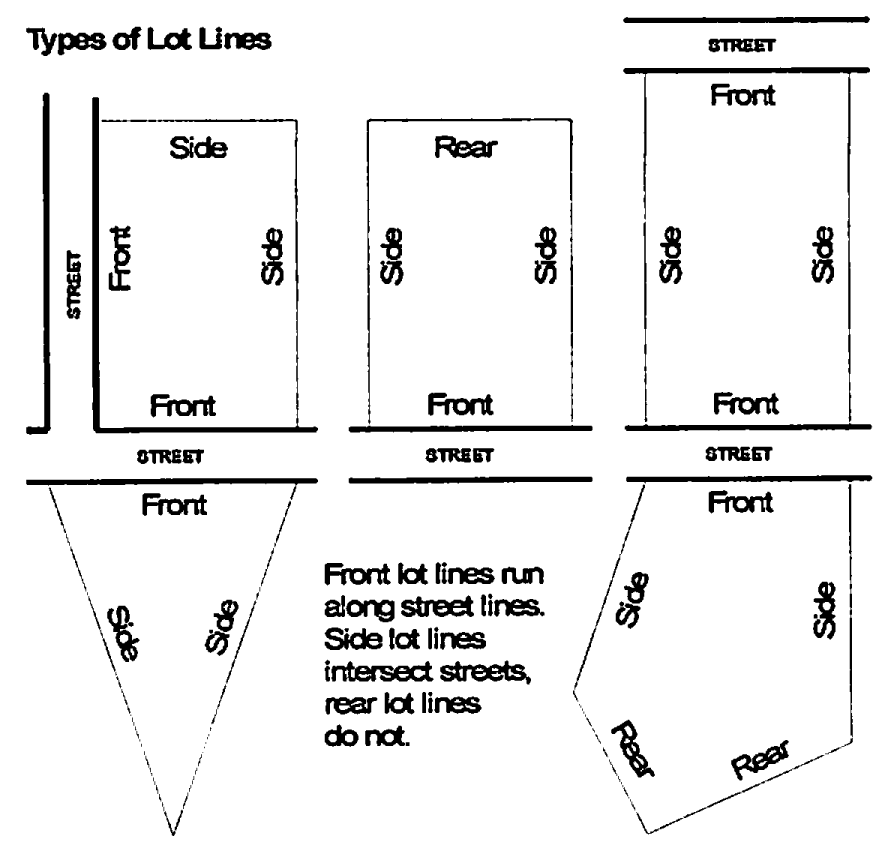
Lot line. The boundary dividing a given lot from the street or adjacent lots; the boundary defining the limit of ownership of a property.
(1)
Front lot line: Any boundary line of a lot that abuts a street. A lot adjacent to more than one street will have more than one front lot line.
(2)
Rear lot line: Any boundary line of a lot that does not intersect with a street right-of-way line and is not a front lot line.
3.
Side lot line: Any boundary line of a lot that intersects with a street right-of-way line and is not a front lot line.
Lot of record. A lot which lawfully existed prior to the adoption or subsequent amendment of this Ordinance, as shown or described on a plat or deed in the records of the Whitfield County Superior Court Clerk.
Lot, through (also known as double frontage lot). A lot which fronts upon two (2) parallel roads, or which fronts upon two roads which do not intersect at the boundaries of the lot.
Lot width. Measured along the established front building line, the lot width shall be the distance between the side lot lines, and measured at right angles to the lot depth.
Lot width, curvilinear road. For a lot or parcel having frontage upon a curvilinear road, the lot width shall be the distance between the side lines of the lot or parcel where the minimum lot width is obtained, measured parallel to the chord formed by the two (2) outermost points of intersection of such lot or parcel with the road right-of-way line. The lot width line is synonymous with the building line in this circumstance.
Manufactured home. A building, transportable in one or more sections, built on a permanent chassis and designed to be used with or without a permanent foundation when connected to the required utilities. Such Buildings shall be constructed in accordance with the Federal Manufactured Home Construction and Safety Standard, which came into effect June 15, 1976, and shall bear an insignia issued by the U. S. Department of Housing and Urban Development (HUD).
Mausoleum. A building where bodies are interred above ground in stacked vaults.
Microbrewery. A craft or designer facility, absent food service, for the brewing of beer that produces less than 10,000 barrels per year and can include a tasting room and retail space to sell the beer to patrons for consumption on the premises or sale of packaged products to wholesalers. Also subject to other locally adopted ordinances.
Micro-distillery/winery. A craft or designer facility, including a tasting room, in which wine or alcoholic spirits are produced from non-animal agricultural products (fruits, grains, or vegetables), subject to production limits of 60,000 gallons per year, and subject to applicable Georgia law, as amended. Also subject to other locally adopted ordinances.
Mini-warehouse. A building in a controlled access and fenced compound that contains varying sizes of individual, compartmentalized and controlled-access stalls or lockers for storing the excess personal property of an individual or family when such is not with their residence, such as a passenger motor vehicle, house trailer, motorcycle, boat, camper, furniture, limited commercial storage (items of local retail merchants, small contractors, and professionals), and other items of personal property generally stored in residential accessory structures. No business activities other than the rental of storage units shall be conducted on the premises.
Mobile home. A structure, transportable in one or more sections, which, in the traveling mode, is eight (8) body feet or more in width or forty (40) body feet or more in length or, when erected on site, is three hundred twenty (320) or more square feet and which is built on a permanent chassis and designed to be used as a dwelling with or without a permanent foundation when connected to the required utilities and includes the plumbing, heating, air-conditioning, and electrical systems contained therein and manufactured prior to June 15, 1976. In contrast, see the definition of "Manufactured Home."
Modular home. See "Industrialized Building."
Motel. A permanent building or group of permanent buildings in which overnight sleeping accommodations are provided for travelers and having a parking space near or adjacent to the entrance of the room. Such use has eighty (80%) percent of the rooms occupied by a different registered guest every five (5) days, provides patrons with daily maid service, twenty-four (24) hour desk/counter clerk service, and a telephone switchboard service to receive incoming/outgoing messages, and shall comply with the applicable requirements of the Health Department and O.C.G.A. §31-28-1 et.seq., and may provide additional services such as restaurants, retail gift shops, meeting rooms, swimming pools, and exercise facilities.
Motor lodge. Synonymous with "Motel."
Non-conforming use. A use or activity that was lawfully established prior to the adoption or amendment of this Unified Zoning Ordinance, but which, by reason of such adoption or amendment, is no longer a use or activity permitted by right or no longer meets or conforms to the use regulations of this Ordinance.
Non-conforming structure. A structure or building whose size, dimensions, location on a property or other features were lawful prior to the adoption or amendment of this Unified Zoning Ordinance, but which, by reason of such adoption or amendment, no longer meets or conforms to one or more such requirements of this Ordinance.
Non-conforming lot. A lot of record whose area, frontage, width or other dimensions, or location were lawful prior to the adoption or amendment of this Ordinance, and which, by reason of such adoption or amendment, no longer meets or exceeds one or more such requirements of the applicable zoning district.
Nuisance. An interference with the enjoyment and use of real property.
Nursing home. An extended or intermediate care facility licensed or approved to provide full-time convalescent or chronic care to individuals who, by reason of advanced age, chronic illness, or infirmity, are unable to care for themselves. A twenty-four (24) hour facility providing skilled nursing care.
Office, professional. Includes offices for professionals such as accountants, architects, attorneys, chiropractors, dentists, doctors, engineers, etc.
Office, business. Includes offices for general business, insurance, real estate, etc.
Off-street parking space. The area required to park one motor vehicle.
Off-street loading space. The area designated for the loading or unloading of goods or other material.
Open space. [Synonymous with "Greenspace," as defined at O.C.G.A. § 36-22-3(3)] shall mean permanently protected land and water, including agricultural and forestry land, that is in its undeveloped, natural state or that has been developed only to the extent consistent with, or is restored to be consistent with, one or more of the following goals:
(1)
Water quality protection for rivers, streams, and lakes;
(2)
Flood protection;
(3)
Wetlands protection;
(4)
Reduction of erosion through protection of steep slopes, areas with erodible soils, and stream banks;
(5)
Protection of riparian buffers and other areas that serve as natural habitat and corridors for native plant and animal species;
(6)
Scenic Protection;
(7)
Protection of archaeological and historic resources;
(8)
Provision of recreation in the form of boating, hiking, camping, fishing, hunting, running, jogging, biking, walking, and similar outdoor activities; and
(9)
Connection of existing or planned areas contributing to the goals set out in O.C.G.A. § 36-22 et seq.
Organic farming and processing. A unique farm environment often holding State or National certifications regarding the natural purity of grown or raised farm products free from typical agricultural chemicals or vaccines. Such farms, an integral part of the agritourism business, can process some of those same agricultural products for retail purchase or public consumption on-site, or for off-site wholesale or retail marketing.
Parking lot. An off-street, ground level area, usually surfaced and improved for the temporary storage of motor vehicles.
Personal care home. Any dwelling, whether operated for profit or not, which undertakes through its ownership or management to provide or arrange for the provision of housing, food service, and one (1) or more personal services for two (2) or more adults who are not related to the owner or administrator by blood or marriage. For purposes of this Ordinance, Personal Care Homes are sub-classified, as follows:
Family personal care home. A home for adults in a family type residence, non-institutional in character, which offers care to two (2) to six (6) persons.
Group personal care home. A home for adults in a residential setting, non-institutional in character, which offers care to seven (7) to fifteen (15) persons.
Congregate personal care home. A home for adults which offers care to sixteen (16) or more persons.
Planning commission. The Dalton-Whitfield County Planning Commission or any successor entity.
Poultry farming, commercial. A production system for raising of domesticated birds including but not limited to chickens, turkeys, ducks, and geese for the purpose of producing meat or eggs for food or poultry byproducts. The commercial production scale shall be reached if the facility meets the criteria of either the USD A (U.S. Department of Agriculture) and/or EPA (U.S. Environmental Protection Agency) for an "Animal Feeding Operation (AFO)" or "Concentrated Animal Feeding Operation (CAFO)."
Premises. A lot, parcel, tract, or plot of land together with all buildings and structures existing thereon.
Principal use. The primary and/or predominant reason for which a lot or parcel is occupied and/or used.
Putrescible wastes. Wastes that are capable of being quickly decomposed by microorganisms. Examples of putrescible wastes includes, but are not necessarily limited to, kitchen wastes, animal manure, offal, hatcher and poultry processing plant wastes, and garbage.
Recreational facilities, indoor. Any commercial or non-commercial indoor facility such as bowling alley, shooting gallery, video game center etc.
Recreational facilities, outdoor. Any commercial or non-commercial outdoor facility such as a miniature golf course, a golf or baseball driving range, tennis courts, swimming pools, drive-in theater, etc.
Recreational vehicles. A vehicular type portable structure without permanent foundation, which can be towed, hauled or driven and primarily designed as temporary living accommodation for recreational, camping and travel use and including but not limited to travel trailers, truck campers, camping trailers and self-propelled motor homes.
Recycling center. A non-governmental facility in which recoverable resources, such as paper, glass, plastics, and metal cans are stored, flattened, crushed or bundled by hand or machines. Vehicles, internal combustion engines, vehicle parts, tires, and the like shall not be considered recoverable resources within the meaning of Recycling Center for the purposes of this Ordinance.
Recycling collection station. An incidental use which serves as a neighborhood drop off point for temporary storage of recoverable resources. No processing of such items shall be allowed. Such facility would generally be located in a commercial parking lot, or at other public/quasi-public areas, such as churches or schools.
Right-of-way. A strip of land occupied or intended to be occupied by a road, crosswalk, railroad, electric transmission line, gas pipeline, water main, sanitary or storm sewer main, shade trees, or other special use.
Rooming house (or "boarding house" or "boarding home.") A dwelling, not a hotel, where for a fee and by prearrangement for definite periods of time, either meals or meals and lodging are provided for three (3) or more persons, who are unrelated to the residents of the dwelling.
Salvage yard. Synonymous with "Junk Yard."
Screening. A method of visually shielding or obscuring one abutting or nearby structure or use from another by fencing, walls, berms or densely planted vegetation.
Service buildings. A building, housing facilities such as recreational, maintenance, laundry, and offices necessary to the successful management of a manufactured home park.
Setback. The required minimum distance from the road right-of-way line or any other lot line that establishes the area within which the principal structure(s) and accessory structure(s) must be erected or placed.
Sewage management system, central on-site. A community-wide on-site sewage management system regulated by EPD (Environmental Protection Division of the Department of Natural Resources.)
Sewage management system, on-site. A sewage management system other than a public or community sewage treatment system, whether serving single or multiple buildings, mobile homes or manufactured homes, recreational vehicles, residences or other facilities designed or used for human occupancy or congregation. Included are conventional septic tank systems, chamber septic tank systems privies, experimental and alternative on-site sewage management systems that may be approved by the Health Department.
Sewage treatment system, public or community. Any sewage treatment system, including pipe lines or conduits, pumping stations, force mains and all other construction, devices, and appliances appurtenant thereto, designed for treating or conducting sewage for treatment and disposal into lakes, streams, or other bodies of surface water.
Shopping center. A group of commercial establishments planned, constructed and managed as a total entity with customer and employee parking provided on-site, and including provision for goods delivery separated from customer access.
Small animals. Domestic small livestock, poultry and fowl, including rabbits, chinchillas, or similar animals, chickens, turkeys, pigeons, and small birds and ducks kept for non-commercial purposes.
Solid waste. Putrescible and non-putrescible wastes, except water-carried body waste, but shall include garbage, rubbish, ashes, road refuse, dead animals, sewage sludge, animal manures, industrial wastes, abandoned automobiles, dredging wastes, construction wastes, hazardous wastes and other waste material in a solid or semi-solid state not otherwise defined in these regulations.
Solid waste handling facility. Any facility, the primary purpose of which is the storage, collection, transportation, treatment, utilization, processing, or disposal, or any combination thereof, of solid waste. This term encompasses the terms Solid Waste Landfill, Inert Waste Landfill and Transfer Station.
Solid waste landfill. A disposal site where putrescible wastes are disposed of using solid waste landfilling techniques.
Solid waste landfilling. An engineered method of disposing of putrescible wastes on land by spreading them in thin layers, compacting them to the smallest practical volume, placing an earthen cover thereon, and such other measures as are necessary to protect human health and the environment.
Specialty food stores. A retail store specializing in a specific type or class of foods such as an appetizer store, bakery, butcher, delicatessen, fish, gourmet and similar foods.
Structure. Anything constructed or erected with a fixed location on or in the ground, or attached to something having a fixed location on the ground. Structures include, but are not limited to the following: site built buildings, industrialized buildings, manufactured homes, mobile homes, billboards, swimming pools, advertising signs, fall-out shelters, stadiums, reviewing stands, platforms, staging, observation towers, radio and television towers, trestles, and open sheds, garages, carports, and shelters, any of which have a floor area over one hundred forty-four (144) square feet.
Swimming pool. A body of water in an artificial or semi-artificial receptacle or other container intended for swimming, which has a minimum depth of eighteen (18) inches of water.
Swine farming, commercial. A production system for raising and/or breeding domestic pigs, swine, or hogs for the purpose of producing meat and animal byproducts. The commercial production scale shall be reached if the facility meets the criteria of either the USDA (U.S. Department of Agriculture) and/or EPA (U.S. Environmental Protection Agency) for an "Animal Feeding Operation (AFO)" or "Concentrated Animal Feeding Operation (CAFO)."
Temporary structure. A structure with neither foundation nor footings which is removed, when either the designated time period or activity or use for which the temporary structure was erected has ceased.
Townhouse (row house) a single-family dwelling unit constructed in a group of three (3) or more attached units. Each unit extends from foundation to roof, not more than three (3) stories in height, with a separate means of egress, and with an open space/yard or public way on at least two (2) sides. Each townhouse shall be considered a separate building with independent exterior walls and shall be separated by a two-hour fire-resistance-rated wall assembly.
Transfer station. A facility used to transfer solid waste from one (1) transportation vehicle to another for transportation to a solid waste handling facility.
Transitional housing. A single or multi-family dwelling housing persons experiencing an abrupt transition in lifestyle such as, but not limited to, recently incarcerated individuals, displaced families, or elderly individuals, operating as a single housekeeping unit under a common housekeeping management plan based on an intentionally structured relationship providing the organization and stability of home environment.
Utility facilities. Structures that provide for the distribution of services of public or private utilities, such as electrical transformer stations, gas regulator stations, telephone exchanges, water pump stations, and sewer lift stations, etc.
Vendor stands. Any cart, table, equipment, or apparatus which is not a structure, which is designed and intended so as to not be a permanent fixture on a lot, and which is used for the retail sale, display, and accessory advertising of merchandise or food.
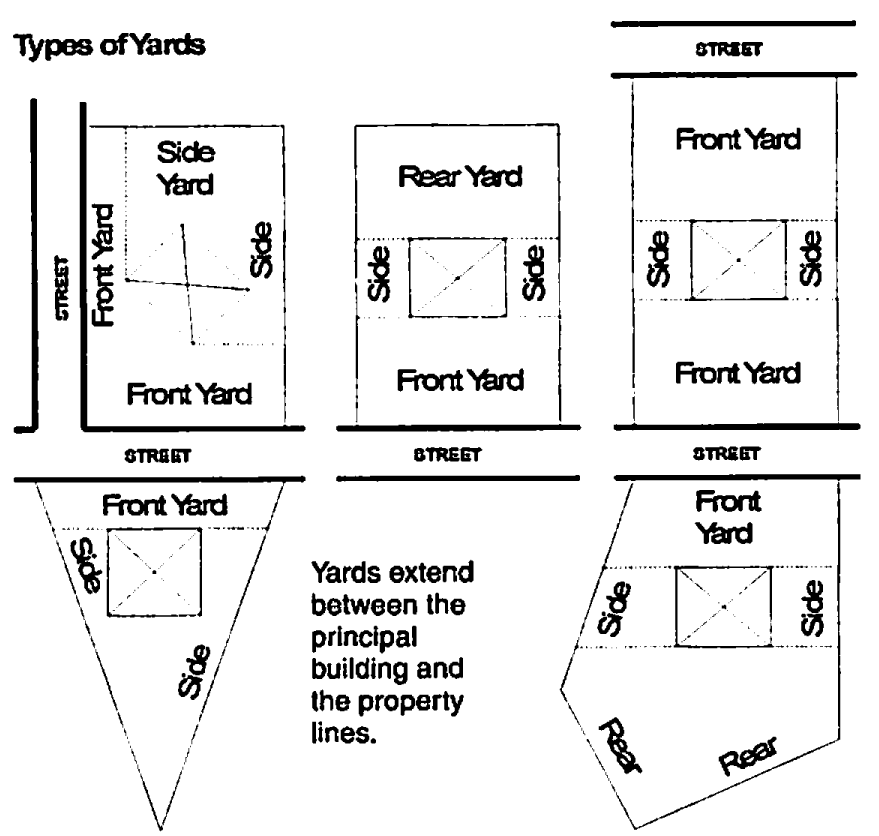
Yard. An area that lies between the principal building on a lot and the nearest lot line.
(1)
Front yard: a yard extending the full width of the lot, located between the street line and the front line of a principal building, projected to the side lines of the lot.
(2)
Rear yard: a yard extending the full width of the lot and situated between the rear lot line of the lot and the rear of a principal building projected to the side lines of the lot.
(3)
Side yard: a yard located between the side of a principal building and the side line of the lot and extending from the rear line of the front yard to the front line of the rear yard.
Work day. Monday through Friday of any week, exclusive of official holidays established by the federal, state or local government during which the local government is not open for business.
Zoning. The power of local governments and local governing authorities within Whitfield County to provide, within its respective territorial boundaries, for the zoning of property for various uses and the prohibition of other or different uses within such zones or districts and for the regulation or development and the improvement of real estate within such zones or districts in accordance with the uses of property for which said zones or districts were established.
Zoning administrator. The official designated by a Governing Authority to manage, administer and coordinate enforcement of this Unified Zoning Ordinance on behalf of the Governing Authority.
(Ord. No. 2024-18, § 1, 1-8-24)

