
Williamston City Zoning Code
ARTICLE VIII
BUFFERYARDS
Sec. 90-222.- Purpose.
(a)
Bufferyard requirements under the provisions of this section are intended to:
(1)
Minimize potential nuisances between adjacent land uses such as visual impacts, transmission of noise, dust, odor, litter, and glare of lights from adjacent properties; and
(2)
Provide for a separation of space and establish a sense of privacy.
(b)
Bufferyards shall be of different types, based upon the relationship between the two adjacent land uses between which the buffer yard is to be located.
(c)
The appropriate use of existing landscaping is encouraged to enhance the aesthetic appearance of bufferyards and blend new development with the natural landscape.
(d)
Several options for bufferyards are provided to allow flexibility for the developer while maintaining the appropriate size and density of plantings for each situation.
(Ord. No. 2008-02, § 701, 6-2-2008)
Sec. 90-223. - Location.
Buffer areas shall be located on the outer perimeter of a lot or parcel, extending to the lot or parcel boundary line. They shall not be located on any portion of an existing street or right-of-way; however, they may occupy part or all of any front, side, or rear yard or setback required by this chapter. Where required, buffer areas and/or buffer area structures shall be developed as an integral part of the proposed use.
(Ord. No. 2008-02, § 702, 6-2-2008)
Sec. 90-224. - Determination of bufferyard requirements.
To determine the bufferyard required between two adjacent parcels, the following procedure shall be followed:
(1)
Identify the proposed land use;
(2)
Identify the use of lands adjacent to the proposed use; and
(3)
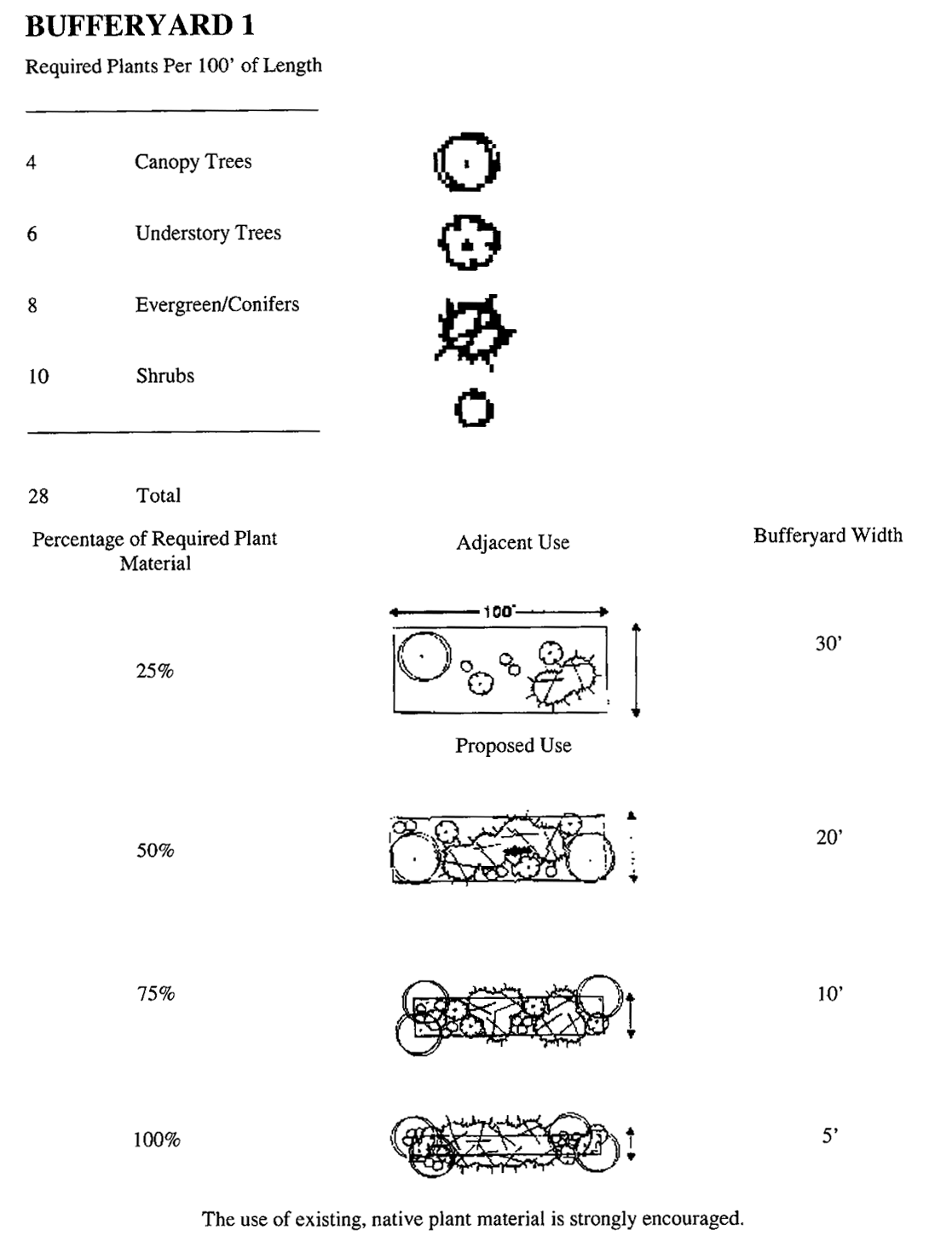
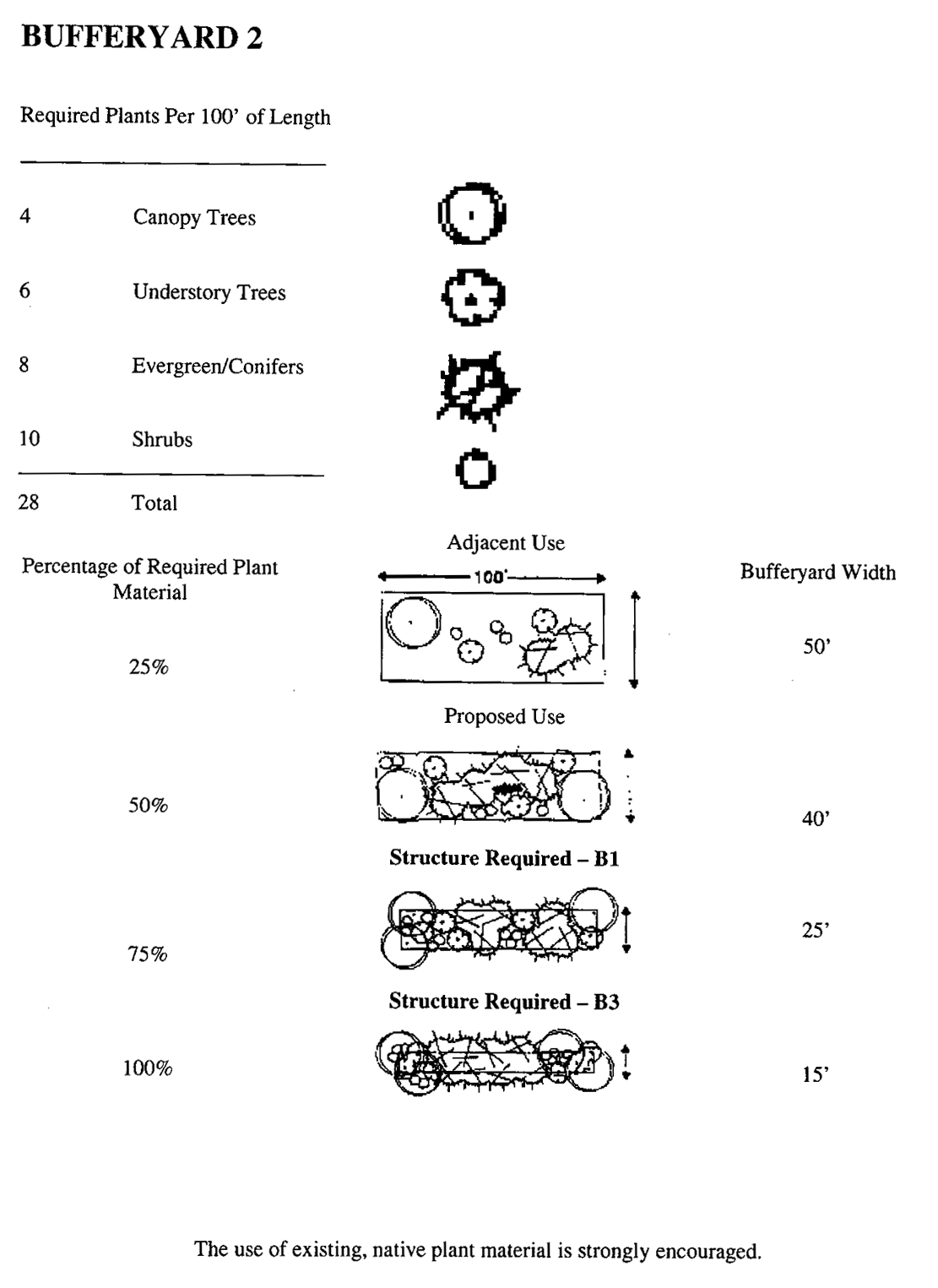
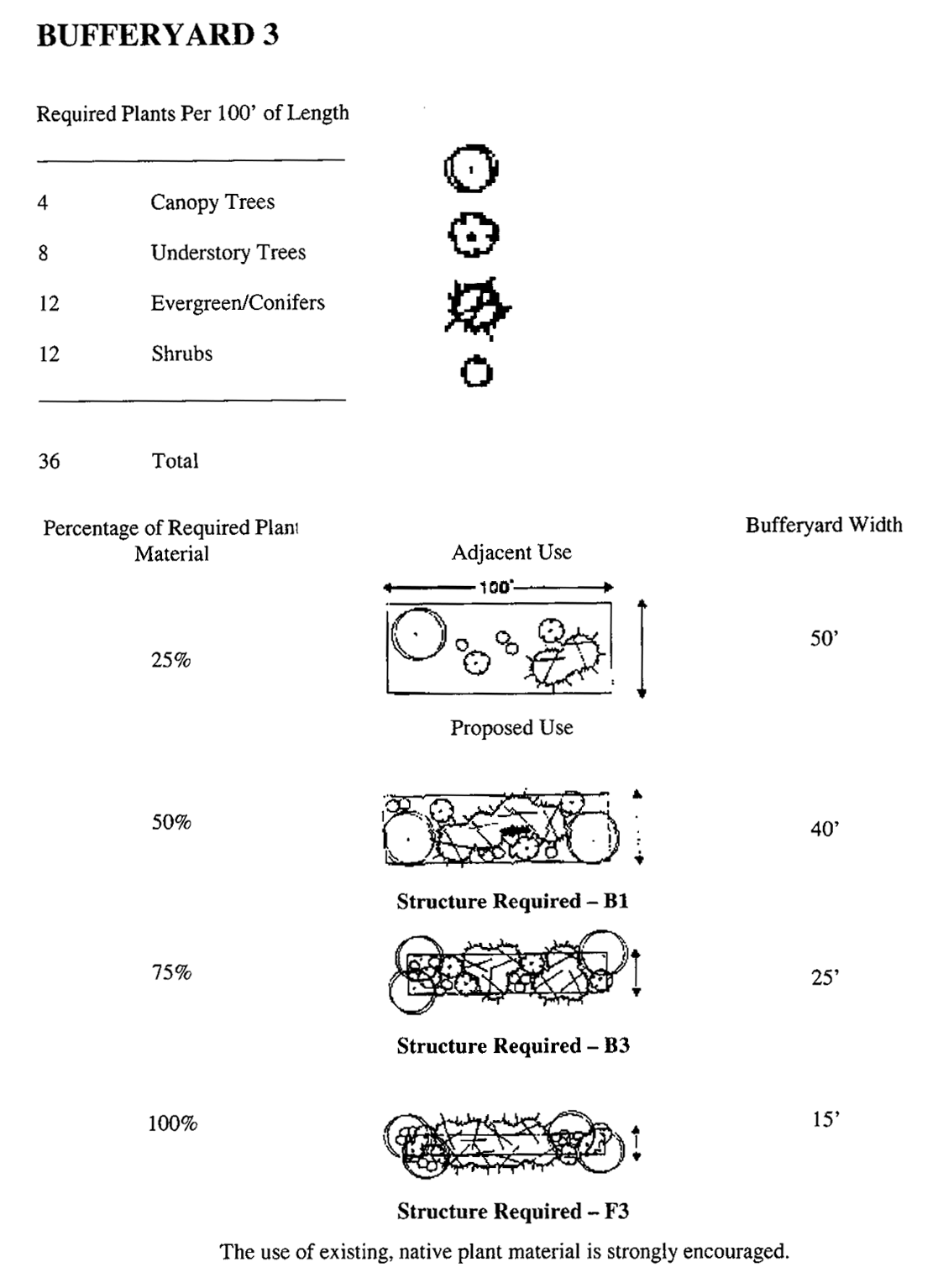
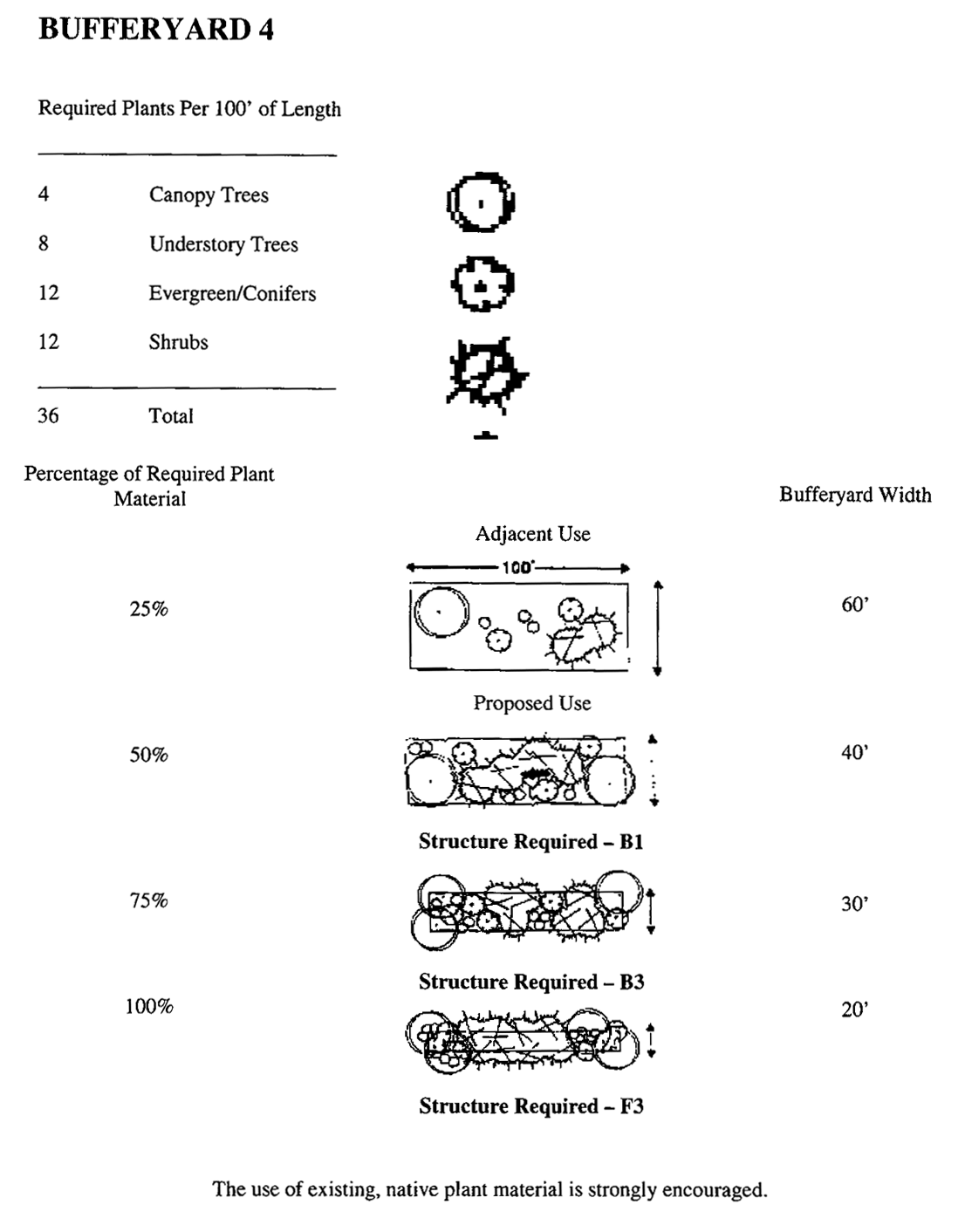
Determine the bufferyard required on each boundary or segment thereof for the proposed land use by referring to table 3 of bufferyard requirements (section 90-234 bufferyard 3 table) and illustrations contained herein which specify the bufferyard options required between a proposed use and the existing adjacent uses.
(Ord. No. 2008-02, § 703, 6-2-2008)
Sec. 90-225. - Responsibility for bufferyard/screening.
(a)
Generally, the responsibility for screening is that of the more intense land use. When a use is the first to develop on two adjacent vacant parcels, the first use shall provide the buffer, specified by the table of bufferyards requirements for vacant land.
(b)
The second use to develop shall, at the time it develops, provide all additional plant material, structures and/or land necessary to provide the total bufferyard required between the two uses, as specified by the table of bufferyard requirements.
(Ord. No. 2008-02, § 704, 6-2-2008)
Sec. 90-226. - Bufferyard specifications.
(a)
These landscaped planting yards are intended to ensure that a natural area of appropriate size and density of plantings is planted or preserved between zoning districts and/or uses. The following illustrations specify the type and quantity of plant materials required by each bufferyard. The requirements are stated in terms of width of the bufferyard and the number of plants required per 100 feet of bufferyard. The requirements of a bufferyard may be met by any of the options illustrated. The "plant unit multiplier" is a factor by which the basic number of plant materials required for a particular bufferyard is determined when there is a change in the width of that yard. Each illustration depicts the total bufferyard required between two uses. Whenever a wall, fence, or berm is required within a bufferyard, these are shown as "structures" in the illustrations wherein their respective specifications also are shown.
(b)
The exact placement of required plants shall be the decision of the developer except that evergreen (or conifer) plants shall be planted in clusters rather than singly in order to maximize their chances of survival and increase screening capabilities. All bufferyards shall be seeded with lawn grass or have a suitable ground cover.
(Ord. No. 2008-02, § 705, 6-2-2008)
Sec. 90-227. - Minimum plant size.
Plants shall be sized according to the following table of minimum plant sizes to ensure buffering and screening at the time of installation. Where the bufferyard illustrations indicate a mass or line of plants parallel to the length of the property line, the plant materials shall be sufficiently sized to ensure obscurity at the time of installation. However, seeding plants may be used where berms or structures are required as part of the bufferyard.
MINIMUM PLANT SIZES
(Ord. No. 2008-02, § 706, 6-2-2008)
Sec. 90-228. - Bufferyard substitutions.
Any existing healthy, well-formed plant materials which are greater than or equal to the recommended buffer and which otherwise satisfy the requirements of this section may be counted towards satisfying all such requirements. Where, owing to existing land use, lot sizes, or configurations, topography, or circumstances peculiar to a given piece of property, the buffer area requirements of this particular section cannot reasonably be met, the developer may request and the planning commission may approve the substitution of the appropriate screening, in the way of a fence or wall structure along the property line of the proposed use.
(Ord. No. 2008-02, § 7071, 6-2-2008)
Sec. 90-229. - Use of bufferyards.
A bufferyard may be used for passive recreation; however, no plant material may be removed and such use shall not be a nuisance to abutting properties.
(Ord. No. 2008-02, § 708, 6-2-2008)
Sec. 90-230. - Containers and dumpsters/outdoor utility equipment.
If utility equipment or a dumpster is to be located on-site, it shall be located in such a manner as to minimize impact on adjoining properties, with special consideration for properties used for single-family purposes. All exterior dumpsters or exterior garbage containers (excluding containers or groups of containers with a combined capacity of less than six cubic yards) shall be screened from all street views, on all but one side by opaque fence or wall, intensive landscaping, or other suitable opaque enclosure. The average height of the enclosure shall be one foot more than the height of the container but shall not be required to exceed eight feet in height. The open side shall not be visible from the street.
(Ord. No. 2008-02, § 701, 6-2-2008)
Sec. 90-231. - Appearance of fences and walls.
All fences and walls used as part of the bufferyard requirements must have a finished side that is facing the adjoining property. The interior side of the fence or wall may be finished as the owner deems appropriate. Where fences or walls are applicable bufferyards, they shall be established along the inside line of the bufferyard, toward the proposed use, except for ornamental fences, which may be built on the property line.
(Ord. No. 2008-02, § 710, 6-2-2008)
Sec. 90-232. - Berms.
Where required, berms may be located anywhere within the bufferyard, provided they parallel the property line.
(Ord. No. 2008-02, § 711, 6-2-2008)
Sec. 90-233. - Required maintenance.
The maintenance of required bufferyards shall be the responsibility of the property owner. All such yards shall be properly maintained so as to ensure continue buffering. Failure to do so is a violation of this chapter, and may be remedied in the manner prescribed for other violations.
(Ord. No. 2008-02, § 712, 6-2-2008)
Sec. 90-234. - Bufferyard requirements.
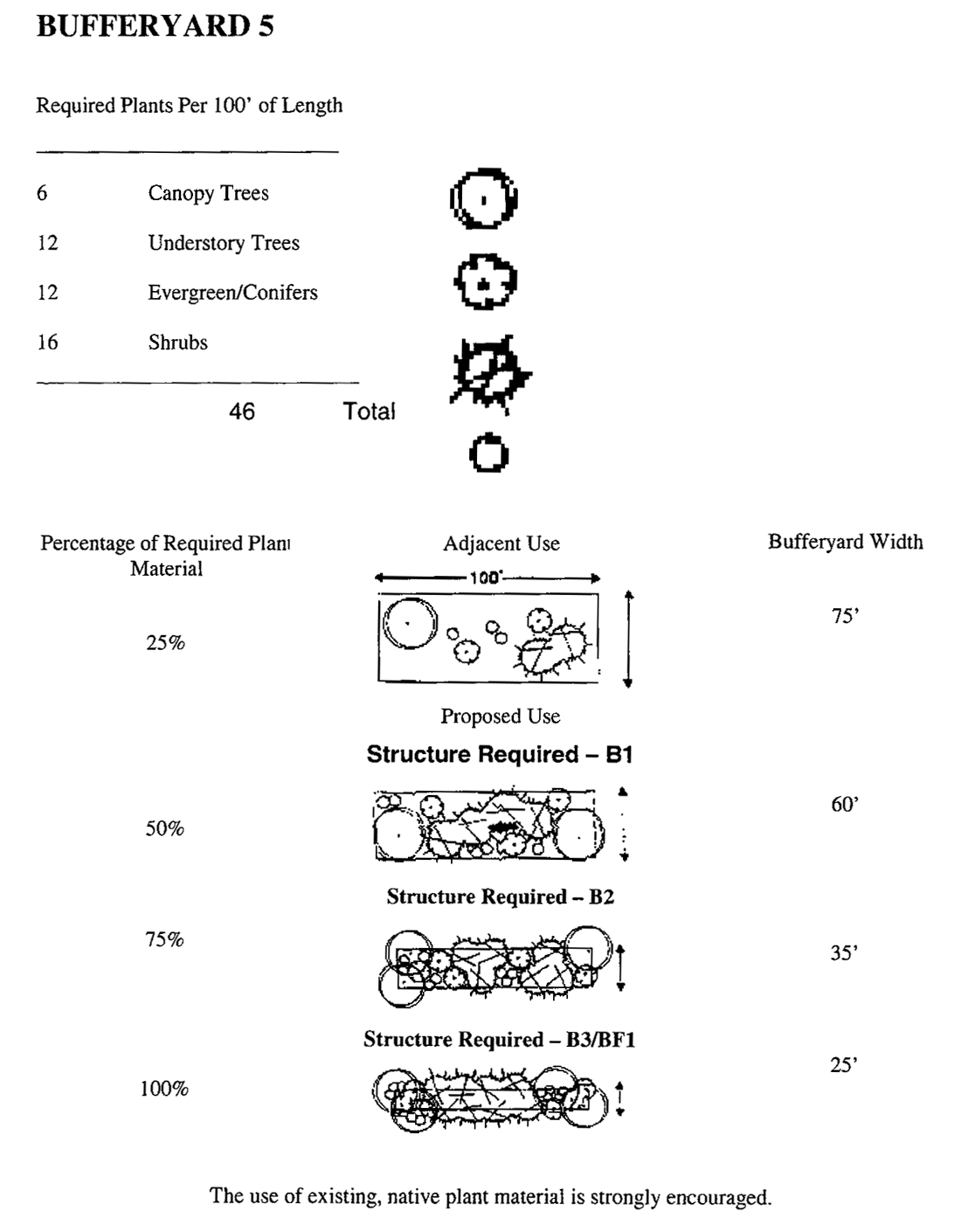
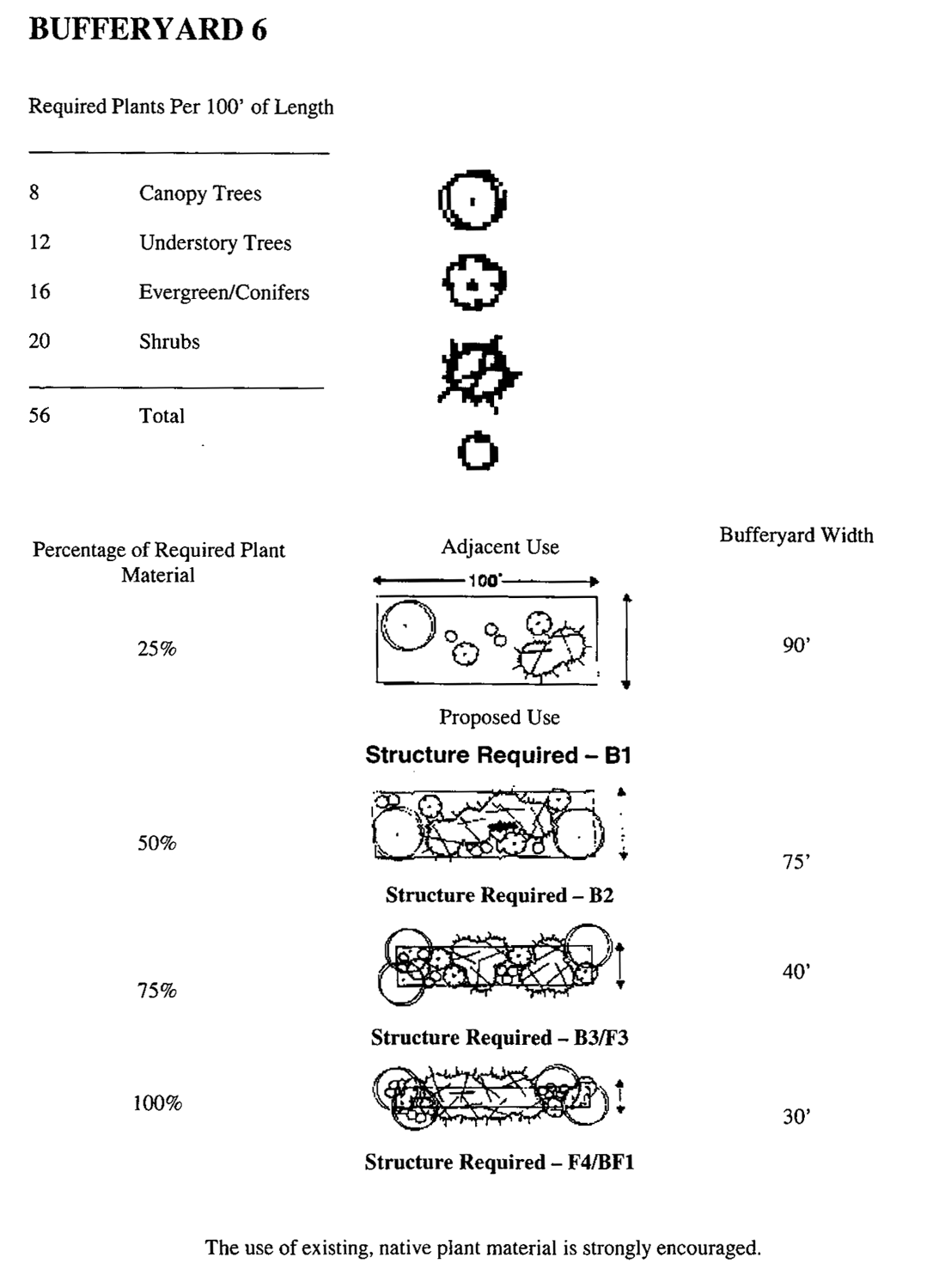
(Ord. No. 2008-02, 6-2-2008)
Sec. 90-235. - Structure illustrations.
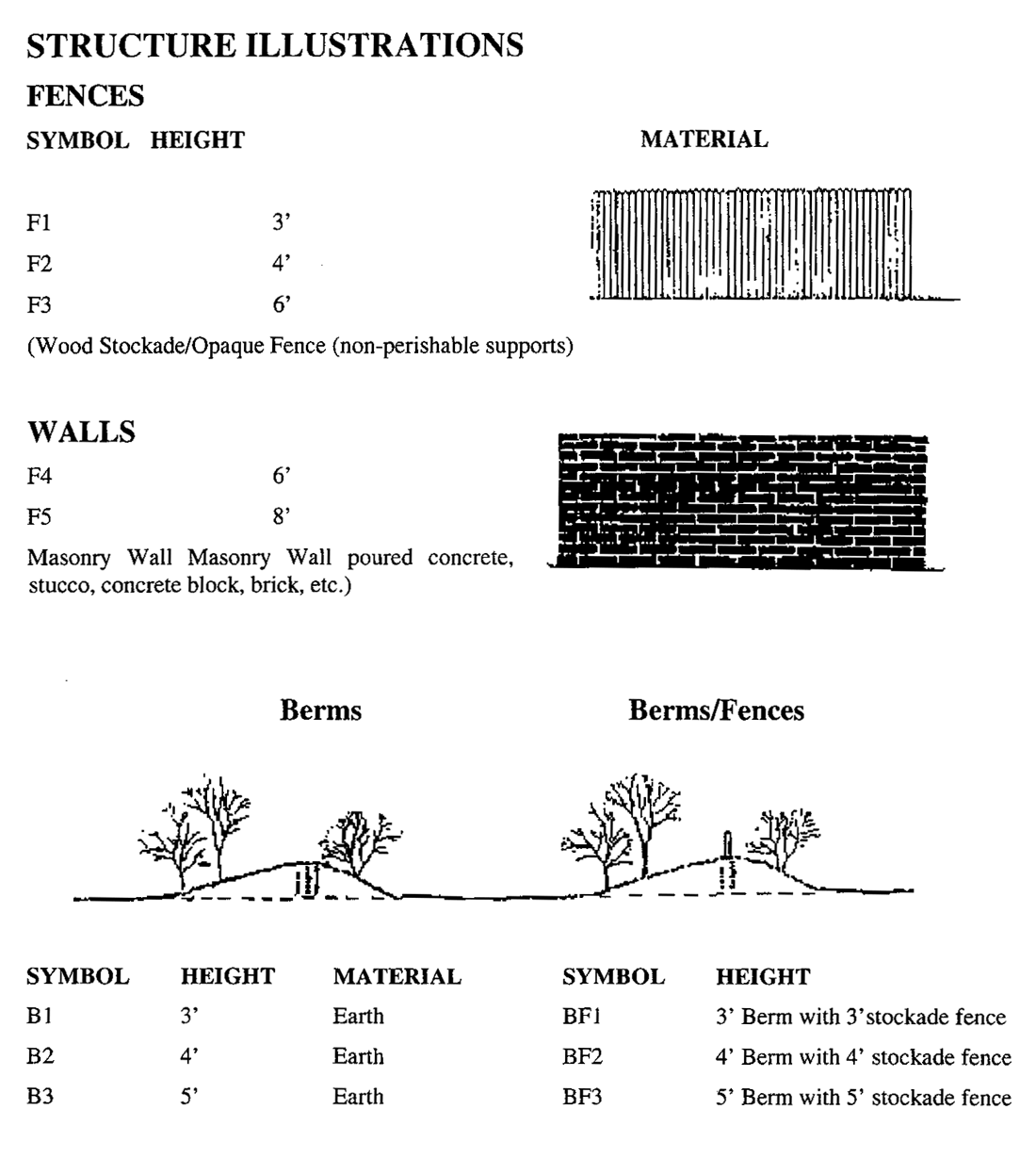
(Ord. No. 2008-02, 6-2-2008)
Sec. 90-236. - Uses table.
(Ord. No. 2008-02, 6-2-2008; Ord. No. 2019-05, § 6, 7-8-2019)

