
Willow Springs City Zoning Code
CHAPTER 1
GENERAL ZONING PROVISIONS
9A-1-1: DEFINITIONS
For the purpose of this title, certain terms and words are hereby defined. Words used in the present tense shall include the future, the singular number shall include the plural and the plural the singular; the word "building" shall include the word "structure" and the word "shall" is mandatory and not discretionary. (Ord., 1-9-1964)
ACCESSORY BUILDING, STRUCTURE, OR USE: An accessory building, structure, or use is one which:
- Is subordinate to and serves a principal building, principal structure or principal use; and
- Is subordinate in building area, intensity of use, or purpose to the principal building, principal structure or principal use served; and
- Contributes to the comfort, convenience, or necessity of occupants of the principal building, principal structure or principal use served. (Ord. 90-0-18, 8-9-1990)
ALLEY: A public or private thoroughfare which affords only a secondary means of access to property abutting thereon.
APARTMENT: A suite of rooms in a multiple- or two-family dwelling, or where more than one living unit is established above nonresidential uses, intended or designed for use as a residence by a single family.
APARTMENT HOUSE: See Dwelling, Multiple. (Ord., 1-9-1964)
AUDITORIUM: A room, hall, or building, often a part of a church, theater, school, recreation building, or other building, used for the gathering of people as an audience to hear lectures, plays, and other presentations.
AUTOMOBILE ACCESSORY STORE: A place of business being operated solely for the sale and purchase of automotive parts and accessories. The installation, replacement, addition, or modification of any parts of accessories shall not be allowed.
AUTOMOBILE LAUNDRY (CAR WASH): A building or portion thereof containing facilities for washing motor vehicles. It may use automatic production line methods; a chain conveyer, blower, steam cleaning device, or other mechanical devices, or it may provide space, water, and equipment for the hand washing of motor vehicles, whether by the customer or the operator.
AUTOMOTIVE SERVICE STATION (GAS STATION): Any building or premises used for dispensing, sale, or offering for sale any automotive fuels or oils which has pumps and storage tanks. Also, any building or premises where battery and tire sales or other similar services are rendered but only if rendered wholly within a building. When such dispensing, sale or offering for sale of any fuels or oils is incidental to the conduct of an automotive repair garage, the premises shall be classified as an automotive repair garage. Automotive service stations shall not include automobile or trailer sales lots, new or used, on which such vehicles are parked for purposes of inspection and sale. The enclosed storage of automobiles, trucks, trailers, or other motor vehicles for purposes other than awaiting repair shall be prohibited.
BANKS AND FINANCIAL INSTITUTIONS: Commercial banks, currency exchanges, savings and loan associations, brokerage offices, and other similar financial institutions, but not including loan offices, finance companies and pawn shops.
BANQUET HALL: A building, or portion thereof, primarily intended to accommodate one or more groups of diners or patrons for functions such as banquets, wedding receptions, etc.
BASEMENT: A story, partly underground having one-half (1/2) or more of its floor to ceiling height above the average level of the adjoining ground and with a floor to ceiling height of not less than six and one-half feet (6 1/2'). (Ord. 90-0-18, 8-9-90)
BUILDING: Any structure designed or intended for the support, enclosure, shelter or protection of persons, animals, chattels, or property. When a structure is divided into separate parts by unpierced walls extended from the ground up, each part is deemed a separate building.
BUILDING, HEIGHT OF: The vertical distance from the grade to the highest point of the coping of a flat roof or to the deck line of a mansard roof, or the mean height level between eaves and ridge, for a gable, hip and gambrel roof.
CLUB or LODGE, PRIVATE: A nonprofit association of persons who are bona fide members paying annual dues, which owns, hires, or leases a building, or portion thereof, the use of such premises being restricted to members and their guests. The affairs and management of such "private club or lodge" are conducted by a board of directors, executive committee, or similar body chosen by the members at their annual meeting. It shall be permissible to serve food and meals on such premises, providing adequate dining room space and kitchen facilities are available. The sale of alcoholic beverages to members and their guests shall be allowed, provided it is secondary and incidental to the promotion of some other common objective of the organization, and further provided that such sale of alcoholic beverages is in compliance with the applicable Federal and State laws and ordinances of the Village. (Ord., 1-9-64)
DECK: An accessory structure which consists of a platform which connects to the exterior wall of a residence, is exposed to open air, has access to the interior of the residence, and is supported by posts or columns extending to the ground. (Ord. 94-0-3, 2-24-94)
DENSITY: The numerical value obtained by dividing the total number of dwelling units in a development by the area of the tract of land (in acres) within a development.
- Density, Gross: Gross density calculations shall include all nonresidential land uses and private streets of the development as well as the rights of way of existing dedicated streets on the borders of the development shall be excluded from gross density calculations. The result is the number of dwelling units per gross acre of land.
- Density, Net: Net density calculations shall include only the area of the actual tract of land upon which the dwelling units are proposed to be located, associated parking areas, common open space, and associated recreational facilities within the area. Rights of way of existing dedicated and private streets (existing and proposed) circulation drives, and other nonresidential uses shall be excluded. The result is the number of dwelling units per net acre of land.
DETENTION/RETENTION:
- Detention: The temporary on-site restraining of storm water. A detention pond is a "dry-bottom" pond.
- Retention: The permanent on-site maintenance of storm water. A retention pond is a "wet bottom" pond. (Ord. 90-0-18, 8-9-90)
DISTRICT: A section or sections of the Village for which the regulations governing the use of buildings and premises, the height of buildings, the size of yards, and intensity of use are uniform. (Ord., 1-9-64)
DRIVE-IN or DRIVE-THROUGH ESTABLISHMENT: A place of business being operated for the sale and purchase at retail of food or beverages and other goods, services, or entertainment which is designed and equipped so as to allow its patrons to be served or accommodated while remaining in their motor vehicles. Examples of drive-in or drive-through establishments include, but are not limited to, the following:
- Drive-In Bank or Financial Institution: A building or portion thereof where normal financial activities such as depositing or withdrawing funds, cashing checks, making utility payments, etc., are carried on directly by a customer seated in a motor vehicle and a teller within the building at a drive-up window.
- Drive-In Theater: An open lot with its appurtenant facilities devoted primarily to the showing of motion pictures or theatrical productions on a paid admission basis to patrons seated in motor vehicles.
- Drive-Through Restaurant: A building or portion thereof where food and/or beverages are sold in a form ready for consumption and where all or a significant portion of the consumption takes place or is designed to take place off the premises. (Ord. 90-0-18, 8-9-90)
DWELLING: Any building or portion thereof, but not a trailer, which is designed and used exclusively for residential purposes.
DWELLING, MULTIPLE: A building designed for or occupied exclusively by more than two (2) families.
DWELLING, SINGLE-FAMILY: A building designed for or occupied exclusively by one family.
DWELLING, TWO-FAMILY: A building designed for or occupied exclusively by two (2) families.
DWELLING UNIT: A "dwelling unit" consists of one or more rooms, arranged or used as living quarters for one family. Individual bathrooms and complete kitchen facilities permanently installed shall be included for each "dwelling unit".
FAMILY: Excepting domestic employees, any number of persons related by blood, marriage or adoption or not to exceed five (5) persons not so related, living together in a room or rooms comprising a single housekeeping unit. (Ord., 1-9-64)
FLOOR AREA: (For the purpose of determining the floor area ratio, conversions of existing structures, and maximum size of business establishments.) The sum of the horizontal areas of the floor space contained in all floors, including a basement floor but not including a cellar floor, of a building or buildings on a lot. Floor area is measured in square feet from the exterior faces of the exterior walls of each building or from the center line of party walls separating two (2) buildings.
Such floor area shall also include:
- Space devoted to elevator shafts and stairwells at each floor;
- Floor space used for mechanical equipment when the structural headroom exceeds seven feet ten inches (7'10") in height, except equipment such as bulkheads, water tanks, and cooling towers, when located on the roof, whether or not such equipment is in the open or enclosed;
- Floor space in that part of a half-story where headroom is seven feet ten inches (7'10") or more in height;
- Floor space devoted to interior balconies, mezzanines, and enclosed porches;
- Floor space devoted to accessory uses in the principal building and in the accessory building or buildings; and
- Floor space devoted to enclosed off-street parking and off-street loading.
FLOOR AREA: (For the purpose of determining off-street parking and off-street loading requirements.) The sum of the gross horizontal areas of the several floors of the building or portion thereof devoted to such use requiring off-street parking and off-street loading including accessory storage areas located within selling or working space (such as counters, racks or closets), and any basement floor area devoted to dwelling purposes, to retailing activities, to the production or processing of goods, or to business or professional offices. However, such floor area shall not include: floor area devoted primarily to storage purposes (except as otherwise noted herein); floor area devoted to off-street parking or loading facilities including aisles, ramps, and maneuvering space; or cellar floor area other than area devoted to retailing activities, to the production or processing of goods, or to business or professional office.
FLOOR AREA RATIO: The numerical value obtained through dividing the gross floor area of a building or buildings by the net lot area on which such a building or buildings are located. (Ord. 90-0-3, 2-26-90)
GARAGE: A deck, building, or structure, or part thereof, used or intended to be used for the parking and storage of motor vehicles.
- Garage, Bus: Any building used or intended to be used for the storage of three (3) or more passenger vehicles of the Second Division (motor buses or motor coaches used in public transportation including school buses).
- Garage, Detached: A structure which is accessory to the principal building on a zoning lot.
- Garage, Private Residential: A structure which is accessory to, or an accessory portion of, a residential building and which is used for the parking and storage of vehicles of the First Division owned and operated by the residents thereof, and which is not a separate commercial enterprise available to the general public. Such a garage may be used for the storage of not more than one vehicle of the Second Division.
- Garage, Automotive Repair: Any building other than a private residential garage or a storage garage where motor vehicles are equipped, repaired, serviced, hired, sold, or stored.
- Garage, Public Parking: Any structure intended to be used for the temporary, daily, or off-street parking of passenger vehicles and commercial vehicles under one and one-half (1 1/2) tons rated capacity and available to the public, whether for compensation, free, or as an accommodation to clients or customers.
- Garage, Storage: Any building used for the storage only of motor vehicles pursuant to previous arrangements and not to transients, and where no equipment, parts, fuel, grease, or oil is sold and vehicles are not equipped, serviced, repaired, hired, or sold.
- Garage, Truck: Buildings which are used or intended to be used for the storage of nonpassenger vehicles of the Second Division (motor trucks, truck trailers, tractors, and commercial vehicles). (Ord. 90-0-18, 8-9-90)
GRADE OR GRADE LEVEL: The average elevation at the corners of the smallest polygon formed by the intersecting lines of the minimum required front yard, rear yard, and side yards. Grade shall be established prior to any development, demolition, or issuance of a drainage or tree removal permit. (Ord. 2006-O-04)
HOME OCCUPATION: Any occupation or profession carried on by a member of the immediate family, residing on the premises, in connection with which there is used no sign other than a name plate not more than one square foot in area. There is no display that will indicate from the exterior that the building is being utilized in whole or in part for any purpose other than that of a dwelling; there is no commodity sold upon the premises; and no person is employed there other than a member of the immediate family residing on the premises.
HOTEL: An establishment which is open to transient guests, in contradistinction to a lodging house, and is commonly known as a hotel in the community in which it is located and which provides customary hotel services such as maid service, furnishing and laundering of linen, telephone and secretarial or desk service, the use and upkeep of furniture, and bell boy service.
HOTEL APARTMENT: A hotel on which at least ninety percent (90%) of the hotel accommodations are occupied by permanent guests. (Ord., 1-9-64)
HOTEL - MOTEL: An establishment containing lodging accommodations designed for use by transients, travelers, or temporary guests. Facilities provided may include maid service, laundering of linen used on the premises, telephone and secretarial, or desk service, meeting rooms, restaurants, including the sale of alcoholic beverages.
JUNK YARD: An area where hunk, waste, scrap, discarded or salvaged materials are brought, sold, exchanged, stored, baled, packed, disassembled, or handled, including, but not limited to scrap iron and other metals, paper, rags, rubber tires and bottles. A junk yard includes automobile wrecking or salvage yards, any lot on which one or more unregistered, inoperable motor vehicles are placed, house wrecking yards, used lumber yards and places or yards for storage of salvaged house wrecking and structural steel materials and equipment, but does not include uses established entirely within enclosed buildings.
KENNEL: Any premises or portion thereof on which four (4) or more pets over four (4) months of age are kept, or any premises or portion thereof on which more than two (2) such animals are maintained, boarded, bred, or cared for in return for remuneration, or are kept for the purpose of sale.
LABORATORY, RESEARCH: A building or groups of buildings in which are located facilities for scientific research, investigation, testing, or experimentation, provided that no more than fifty percent (50%) of the floor area of the building or buildings so occupied may be used for offices for executive or administrative purposes. No more than fifteen percent (15%) of a building so occupied may be used for ancillary manufacturing, fabricating, processing, assembly, storage, repair, or service facilities. All such facilities shall be subject to compliance with the required conditions and performance standards of Section 9A-7A-9.
LAUNDERETTE: A business that provides coin operated self-service type washing, drying, dry cleaning, and ironing facilities, providing that: (1) not more than four (4) persons, including owners are employed on the premises; and (2) no pick up or delivery service is maintained.
LODGING HOUSE (Including Boarding and Rooming House): A residential building, or portion thereof, other than a motel or hotel, containing lodging rooms which accommodate persons who are not members of the keeper's family. Lodging with or without meals provided for compensation on a weekly or monthly basis.
LODGING ROOM: A room rented as sleeping and living quarters, but without cooking facilities and with or without an individual bathroom. In a suite of rooms without cooking facilities, each room which provides sleeping accommodations shall be counted as one lodging room. (Ord. 90-0-18, 8-9-90)
LOT: A parcel of land designated as a lot on a plot of subdivision duly recorded.
LOT OF RECORD: A lot which is a part of a subdivision, the map of which has been recorded in the office of the Recorder of Deeds or a parcel of land, the deed of which was recorded in the office of the Recorder of Deeds, prior to the date of the adoption of these regulations.
MANUFACTURING or INDUSTRY: Any use in which the major activity is the treatment, processing, rebuilding, repairing or wholesale storage of material, products or items and where the finished product is not acquired by the ultimate user on the premises, as distinguished from a rental use where the treatment, processing, repairing or storage is secondary to the sale, exchange or repairing of materials or products on the premises.
MEDICAL CANNABIS CULTIVATION CENTER: An establishment operated by an organization or business that is registered by the Department of Agriculture to perform necessary activities to provide only registered medical cannabis dispensing organizations with usable medical cannabis in accordance with the laws of the State of Illinois. In addition, a cultivation center must be located at least 2,500 feet of the property line of a pre-existing public or private preschool or elementary or secondary school or day care center, day care home, group day care home, part day child care facility, or an area zoned for residential use.
MEDICAL CANNABIC DISPENSING FACILITY: An establishment operated by an organization or business that is registered by the Department of Financial and Professional Regulation to acquire medical cannabis from a registered cultivation center for the purpose of dispensing cannabis, paraphernalia or related supplies and educational materials to registered qualifying patients in accordance with the laws of the State of Illinois. In addition, a dispensary cannot be located within 2,500 feet of the property line of a pre-existing public or private preschool or elementary or secondary school or day care center, day care home, group day care home, or part day child care facility. A registered dispensing facility may also not be located in a house, apartment, condominium, or an area zoned for residential use. (Ord. 2014-O-22)
MOTEL: An establishment consisting of a group of attached or detached living or sleeping accommodations with bathroom and closet space, located on a single lot and designed for use by transient automobile tourists. A "motel" furnished customary hotel services such as maid service and laundering of linen, telephone and secretarial or desk service, and the use and upkeep of furniture. In a "motel" less than thirty percent (30%) of the living and sleeping accommodations are occupied or designed for occupancy by persons other than transient automobile tourists.
NONCONFORMING USE: A use lawful at the time of passage of the original zoning ordinance or any amendment thereto, which does not conform after the passage of the zoning ordinance or amendment thereto with the use regulations of the district in which it is situated. (Ord., 1-9-64)
NOTICE - LEGAL PUBLICATION: Notice - legal publication, shall be in compliance with Chapter 100 Notices, of the Illinois Revised Statutes.
NOXIOUS MATERIALS: Material capable of causing injury to living organisms by chemical reaction or capable of causing detrimental effects upon the psychological, social, or economic well being of human beings.
OCTAVE BAND FILTER: An electrical frequency separation designed according to standards promulgated by the American Standard Association and used in conjunction with a sound meter to take measurements in specific octave intervals. (American Standard for Sound - Level Meters, A.S.S. 224.3-1944)
OFF-STREET LOADING AND UNLOADING SPACE or BERTH: An open, hard surfaced area of land, other than a street, or a public way, the principal use of which is for the standing, loading, and unloading of motor vehicles, tractors and trailers to avoid undue interference with public streets and alleys. Such space shall comply with Section 9A-9-7 of this Title.
OFF-STREET PARKING SPACE: A temporary storage space for motor vehicles within a public or private parking area in compliance with the requirements set forth in Section 9A-9-6 of this Title.
OPEN SALES LOT: A lot or parcel of land used or occupied for the purpose of buying, selling or trading of all goods and commodities and including the storage of same prior to sale or exchange. An open sale lot is not allowed as a principal use land; an open sale lot shall only be allowed as an accessory use to permitted or special use. (Ord. 90-0-18, 8-9-90)
OPEN SPACE:
- Public Open Space: Areas permanently reserved for open space purposes which are owned, operated, and maintained by local political jurisdiction with no limitations on access or use.
- Private Open Space: Areas permanently reserved which are under private ownership and management and which have limitations on access or use by the general public. (Ord. 90-0-3, 2-26-90)
PARKING SPACE: A durably surfaced area, enclosed in the main building, in an accessory building, or unenclosed, sufficient in size to store one standard automobile, and if the space is unenclosed, comprising an area of not less than two hundred fifty (250) square feet, exclusive of a driveway connecting the parking space with a street or alley and permitting ingress and egress of an automobile. (Ord., 1-9-64)
PLANNED UNIT DEVELOPMENT (PUD): A tract of land which developed as a unit under single ownership or unified control, which includes one or more principal buildings or uses, and is processed under the planned unit development provisions of this Title. Also, a parcel of land planned as a single unit rather than as an aggregate of individual lots, with design flexibility from traditional siting and/or zoning regulations (such as side yards, setbacks and height limitations) or land use restrictions (such as prohibitions against mixing land uses within a development). The greater flexibility in locating buildings and in combining various land uses often makes it possible to achieve certain economies in construction, as well as the preservation of open space and the inclusion of amenities. (Ord. 90-0-3, 2-26-90)
RESTAURANT: The following types of restaurants are classified according to the number of operation and anticipated traffic type generated any off-street parking demand needs:
- Conventional Sit Down Restaurant: Any place of business being operated where there is furnished, for sale, food or drink of any kind for consumption therein. Drive-in, fast food and carryout restaurants are not considered restraints within the concept of this definition.
- Carry-Out Restaurant: Any place of business being operated where there is furnished, for sale, food or drink of any kind for consumption entirely off premises. No tables, stools or dining facilities are provided in such facilities.
- Drive-In Restaurant: A building or portion thereof where food and/or beverages are sold in a form only for consumption and where all on a significant portion of the consumption taken place or is designed to take place outside the boundaries of the building, usually in a motor vehicle on the site.
- Fast Food Restaurant: Any establishment whose principal business is the sale of foods, frozen desserts, or beverages to the customer in a ready to consume state for consumption in the building, or outside the building on the premises or for carry-out with consumption off premises.
RETAIL: The sale of commodities and services directly to customers when such commodities and services are used or consumed by the customer and not purchased primarily for the purpose of resale. (Ord. 90-0-18, 8-9-90)
SERVICE ESTABLISHMENT: Shop wherein the major activities are the repair and maintenance of wearing apparel, sporting goods, and articles for use in the home, including household appliances. (Ord., 1-9-64)
SHOPPING CENTER: A complex of three (3) or more businesses or commercial establishments, the whole planned, developed and maintained as a single unit sharing common parking facilities. (Ord. 90-0-18, 8-9-90)
STORY: That portion of a building other than a cellar, included between the surface of any floor and the surface of the floor next above it or, if there be no floor above it, then the space between the floor and the ceiling next above it.
STORY, HALF: A space under a sloping roof which has the line of intersection of roof decking and wall space not more than three feet (3') above the top floor level, and in which space not more than sixty percent (60%) of the floor area is finished off for use.
STRUCTURAL ALTERATION: Any change in the supporting members of a building, such as bearing walls or partitions, columns, beams or girders, or any substantial change in the roof or in the exterior walls.
STRUCTURE: Anything constructed or erected, that use of which requires permanent location on the ground, including, but without limiting the generality of the foregoing, advertising signs, billboards, back stops for tennis courts, and pergolas. (Ord., 1-9-64)
TAVERN or LOUNGE: A building or portion thereof where liquors are sold to be consumed on the premises, but not including restaurants where the principal business is serving food. (Ord. 90-0-18, 8-9-90)
TERRACE: A raised, flat level or series of levels of earth with sloping sides used for flower beds, landscaping and/or erosion control purposes. (Ord. 94-0-3, 2-24-94)
USE: A purpose for which a building, structure, or tract of land may be designed, arranged, intended, maintained, or occupied. Also, any activity, occupation, business, or operation carried on, or intended to be carried on, in or on a building or structure or on a tract of land. Said use or uses shall comply with all performance standards contained in this Chapter.
- Use, Accessory: A subordinate use which is clearly and customarily incidental to the principal use of a building or premises, and which is located on the same lot as the principal building or use, except for such accessory parking facilities, and are specifically authorized to be located elsewhere.
- Use, Nonconforming: Any use of land, buildings, or structures which is not permitted in the zoning district in which such use is located, but which use conformed with all of the codes, ordinance, and other legal requirements applicable at the time such use was established.
- Use, Principal: The main use of land or buildings as distinguished from a subordinate or accessory use. The principal use may be either a permitted or a special use.
VILLAGE ADMINISTRATOR: The Village Administrator of the Village.
VILLAGE BOARD OF TRUSTEES: The Village Board of Trustees of the Village.
WAREHOUSE: A structure, part thereof, or area used principally for the storage of goods and merchandise.
- Warehouse, Mini: A structure containing separate spaces of varying sizes leased or rented to the general public on an individual basis. (Ord. 90-0-18, 8-9-90)
WIRELESS TELECOMMUNICATION ANTENNA: A specific device, the surface of which is used to transmit and/or receive radio frequency signals, microwave signals, or other signals transmitted to or from other antennas. (Ord. 2014-O-18)
WIRELESS TELECOMMUNICATION TOWER: A structure designed and constructed to support one (1) or more Wireless Telecommunication Antennas and including all appurtenant devices attached to it. A tower can be freestanding or supported. (Ord. 2014-O-18)
YARD: An open space on the same lot with a building, unoccupied and unobstructed by any portion of a structure from the ground upward, except as otherwise provided herein. In measuring a yard for the purpose of determining the width of a side yard, the depth of the front yard, or the depth of a rear yard, the mean horizontal distance between the lot line and the main building shall be used. (Ord., 1-9-64)
YARD, CORNER SIDE: A yard extending along the corner side lot line from the front yard to the rear lot line. (Ord. 90-0-3, 2-26-90)
YARD, FRONT: A yard extending across the front of a lot between the side yard lines, and being the minimum horizontal distance between the street line and the main building or any projection thereof other than the projection of the usual steps.
YARD, REAR: A yard extending across the rear of a lot, measured between the side lot lines, and being the minimum horizontal distance between the rear lot line and the rear of the main building or any projections other than the steps. On corner lots the rear yard shall be considered as parallel to the street upon which the lot has its least dimension. On both corner lots and interior lots the rear yard shall in all cases be at the opposite end of the lot from the front yard.
YARD, SIDE: A yard between the main building and the side line of the lot, and extending from the front lot line to the rear yard line. (Ord., 1-9-64)
ZONING LOT: A single tract of land, which (at the time of filing for a building permit), is designated by its owner or developer as a tract to be used, developed, or built upon as a unit, under single ownership or control. Zoning lot lines shall not cross zoning district boundary lines unless otherwise permitted in this Chapter. Therefore, a zoning lot or lots may or may not coincide with a lot of record.
(Ord. 90-0-3, 2-26-90)
9A-1-2: COMPLIANCE REQUIRED, EFFECT OF PENDING CHANGE
- Permitted Uses: It shall be unlawful to use or occupy any premises, building or structure in the Village for any use or purpose other than one permitted by the terms of this Title in the zoning district wherein such premises, building or structure is located.
- Permit Issuance, Compliance Required:
- Buildings: No building or structure shall be erected, and no permit for the erection or alteration of any building or structure shall be issued, if such construction or alteration would result in a violation of the provisions of this Title; or if the completed or altered building or structure would not be in compliance herewith.
- Utilities: No permit for connection with or service from any Municipality-operated water distribution system or other utility shall be issued for connection with service to any building or premises used or maintained in violation of the provisions of this Title.
- Permit or License Pending Change in Zoning: No permit for the erection of any building or structure, or license or permit for the conduct of any use, shall be issued for a period of three (3) months after the question of amending the zoning ordinance, so as to prohibit the use or building contemplated in the area concerned, has been referred by the Village Board of Trustees to a board or commission to hold a public hearing on the question of adopting such amendment. Provided, that if final action by the Village Board is not taken on the question within three (3) months of the time the matter is so referred to hold a public hearing, the permit shall issue. If within such three (3) month period the governing body of the Municipality shall pass an ordinance amending the zoning ordinance so as to prohibit such building, structure or use, no such permit shall be issued. If a permit for any such building or structure, or a license for the conduct of any such business or use, has been issued prior to such reference, but the business or use has not been established, or no substantial part of the construction has been completed at the time of such reference, such license or permit shall be suspended and no action taken thereunder for a period of three (3) months after the question of amending the zoning ordinance has been so referred. If final action by the Board of Trustees is not taken on the question within three (3) months of the time of reference, the rights under the permit or license may be exercised. If within such three (3) month period the governing body of the Municipality shall pass an ordinance prohibiting the use of a building or structure on the site involved, such prohibition shall be applicable to the holder of such permit or license.
9A-1-3: OCCUPANCY AND BUILDING PERMITS
- Application for Certificates of Occupancy and Building Permits:
- Certificates for occupancy and compliance shall be applied for coincident with the application for a building permit and shall be issued within ten (10) days after the erection or alteration of such buildings shall have been completed. A record of all certificates shall be kept on file in the office of the Village Clerk and copies shall be furnished on request, to any person having a propriety or tenancy interest in the building affected.
- No permit for excavation for or the erection of any building shall be issued before application has been made for a certificate of occupancy and compliance. No building or premises may be occupied until such certificate shall have been issued.
- All applications for building permits shall be accompanied by a plat in triplicate, drawn to scale, showing the actual dimensions of the lot to be built upon, the size of the building to be erected, and such other information as may be necessary to provide for the enforcement of these regulations. A record of such application and plats shall be kept in the office of the Village Clerk.
- Compliance With Regulations Required: No land shall be occupied or used and no building hereafter erected or altered shall be occupied or used in whole or in part for any purpose whatsoever until a certificate shall have been issued by the Building Commissioner stating that the building complies with all the building and health laws and ordinances and with the provisions of these regulations. No change of use shall be made in any building or part thereof now or hereafter without a certificate of occupancy and compliance having been issued by the Building Commissioner, and no permit shall be issued to make such change unless it is in conformity with the provisions of this Title or amendments hereto, hereafter duly enacted.
- Location Restriction, Certain Buildings: No building shall be built, used or occupied as a tavern, saloon or where intoxicating beverages are sold to the public within one thousand two hundred feet (1,200') of any public school or church within the Village limits.
The Building Commissioner shall inspect all applications and measure off said distance and report to the Village Board his findings as to the distance measured by him before he shall issue said license. - Continuance of Present Use: Nothing in this Section shall prevent the continuance of the present occupancy or use of an existing building, except as may be necessary for safety of life and property.
9A-1-4: INTENSITY OF USE OF LOT; SETBACK LINES
- Setback Lines: It shall be unlawful to erect or alter any building or structure closer to the street than the distance prescribed in the following regulations:
Every part of a building or structure hereafter erected or relocated shall be located or set back from the established center line of every section line, road or street, at least eighty feet (80'); from the established center line of every half section line, road or street, at least seventy feet (70'); and from the established center line of every other road or street fronting a lot or building plot, at least sixty three feet (63'). This regulation shall not be interpreted to reduce buildable width of a corner lot, or of a corner and adjoining lot in single ownership, subdivided and recorded by law at the time of the passage of these regulations, to less than fifty feet (50').
EXCEPTIONS:- On a lot of a recorded subdivision existing on the day of the adoption of these regulations, having an original depth of less than one hundred sixty feet (160'), the setback shall not be more than one-fourth (1/4) of said recorded depth, as measured back from the original front line of said recorded lot.
- No part of a new or relocated residence in the same block, on the adoption date of these regulations, more than one foot (1') for each three feet (3') of distance between such buildings or parts thereof.
- Where more than thirty percent (30%) of the frontage on one side of the street of a block is occupied by residences, the average setback shall be not less than fifty feet (50') and not greater than one hundred feet (100') from the established center line of the road or street.
- Steps, open terraces and underground structures.
- Fences, hedges and shrubbery, provided that such obstructions located on land at road or street corners within the vision triangle created by the required building, setback and side yard shall preserve a clear view between points four feet (4') above the crown of each intersecting street or road.
- Eaves, chimneys, bay windows, and other ordinary building projections may extend into the required setback area but not more than eighteen inches (18").
- Gasoline pumps and air and water services of retail service stations, provided the centers thereof shall be at least thirteen feet (13') distant from the street or highway right of way lines.
- Side Yards: In the R-1, R-2 and R-3 districts any buildings or structures or parts thereof, hereafter erected, and any residence erected or relocated in any other district shall be provided with an open space or side yard at least five feet (5') wide along each line of the building plot which is a side line of the plot used or of the plot adjoining.
(Ord., 1-9-1964)
9A-1-5: SPECIAL USES
- Special Use Permit: The development and execution of this zoning title is based upon the division of the village into districts, within which districts the use of land and buildings and the bulk and location of buildings and structures in relation to the land are substantially uniform. It is recognized, however, that there are uses which, because of their unique characteristics, cannot be properly classified in any particular district or districts without consideration, in each case, of the impact of those uses upon neighboring land and of the public need for the particular use of the particular location. Such special uses fall into two (2) categories:
- Uses operated by a public agency or publicly regulated utilities, or uses traditionally affected with a public interest; and
- Uses entirely private in character but which are generally similar to the uses permitted in the district to which such proposed use is sought to be located but which may give rise to unique problems with respect to their impact upon neighboring property or public facilities.
- Initiation Of Special Uses: Any person owning or having a proprietary interest in the subject property may file an application for a special use permit with the village clerk setting forth the nature of the special use requested in ordinance with the guidelines set forth in subsection A of this section. Said application shall be forwarded by the village clerk to the plan commission.
- Authorization: An application for a special use shall be acted upon by the president and board of trustees only after a public hearing has been held by the plan commission, and the findings and recommendations of the plan commission have been reported to the president and board of trustees. The President and Board of Trustees shall place on agenda and approve, deny, or table the recommendations within sixty days (60) days of its next regular meeting following receipt of the written recommendations of the Plan Commission. The plan commission of the village is hereby designated as the commission or committee, as provided by the statutes of the state of Illinois, for the purpose of conducting the required public hearings. Notice of the time and place of such public hearing shall be given at least once not more than thirty (30) nor less than fifteen (15) days before the hearing by publishing a notice thereof in one or more newspapers published in the village, or if no newspaper is published therein, then in one or more newspapers with a general circulation within the village. (Ord. 2015-O-16A)
The plan commission shall make findings based upon the evidence presented to it in each specific case with respect to each of the following matters:- The establishment, maintenance or operation of the special use will not be unreasonably detrimental to or endanger the public health, safety, morals, comfort or general welfare;
- The special use will not be injurious to the use and enjoyment of other property in the immediate vicinity for the purposes already permitted, nor substantially diminish and impair property values within the neighborhood;
- The establishment of the special use will not impede the normal and orderly development and improvement of surrounding property for uses permitted in the district;
- If applicable, adequate utilities, access roads, drainage and/or other necessary facilities have been or are being provided;
- Adequate measures have been or will be taken to provide ingress and egress so designed as to minimize traffic congestion in the public streets; and (Ord. 83-0-3, 3-24-1983)
- The special use shall, in all other respects, conform to the applicable regulations of the district in which it is located. (Ord. 19-O-2004, 7-8-2004)
- Special Use Conditions And Limitations: Prior to granting any special use, the plan commission may recommend certain conditions and restrictions, and the president and board of trustees, in addition to the conditions and restrictions recommended by the plan commission or in lieu thereof, may stipulate certain conditions and restrictions, including, but not limited to, those upon the establishment, location, construction, maintenance and operation of the special use as deemed necessary for the protection of the public interest and to secure compliance with the standards and requirements specified herein, or as may be from time to time required. In all cases in which special uses are granted, the president and board of trustees shall require such evidence and guarantees as it may deem necessary as proof that compliance will be made with the said stipulated conditions. Special uses and the issuance of special use permits shall be authorized by an ordinance duly enacted. A certified copy of the ordinance authorizing the special use and the issuance of a special use permit shall be recorded by the village clerk in the office of the recorder of deeds of Cook County, Illinois, or the registrar of Torrens titles of Cook County, Illinois, as the case may be.
- Termination Of Special Use Permit:
- A special use permit granted by the president and board of trustees shall be subject to termination in the manner provided herein below under any of the following circumstances:
- Failure to commence construction of the proposed use within eighteen (18) months from and after the date of the granting of said permit. Construction shall not be deemed to have commenced unless and until all necessary building and other village permits have been obtained.
- Following the issuance of occupancy permits, abandonment or other failure to utilize the property for the purposes permitted by the special use for a period of two (2) months out of any consecutive six (6) month period.
- Upon written application, the president and board of trustees may authorize extensions of any time period specified hereinabove but each such extension shall not exceed one year at a time.
- Upon the written application of any person or any village official following the expiration of any time period or authorized extension thereof, as provided hereinabove filed with the village clerk, the plan commission shall hold a public hearing with regard to whether any of the conditions described in subsection E1 of this section exist and whether on account of such conditions and other circumstances the special use permit shall be terminated or whether the property shall be rezoned to another use. Public notice of such hearing shall be given by newspaper publication and the legal owner of record of the subject property shall be notified by certified mail, return receipt requested. The hearing shall otherwise be conducted in accordance with the procedures required by this title for an amendment to these zoning regulations.
- Following such hearing, the plan commission shall prepare written findings of fact and its recommendations regarding the continuation or termination of the special use and regarding the rezoning of the property to another reclassification. Such findings and recommendations shall be transmitted forthwith to the president and board of trustees for final action. The president and board of trustees, within sixty (60) days after its next regular meeting after receiving such findings and recommendations, may grant a further extension of the special use permit or may terminate the special use permit. (Ord. 2015-O-16A)
- In making its determination, the plan commission and the president and board of trustees shall consider the effect of changed conditions, if any, upon the property. When the property in question was granted a change in zoning category contemporaneously with its special use or achieved such a use as part of an annexation agreement, the plan commission and the president and board of trustees shall consider whether the property would have been granted the zoning classification underlying its special uses if it were not for the conditions which were imposed by the special use or by an annexation agreement, as the case may be. It is the intent of this provision to prevent the rezoning of land to a higher (less restrictive) category based upon the promise of development of a well planned special use subject to various conditions, the abandonment of that use and attempted development of the property without proper planning controls under a zoning category which would not have been granted, but for the planning requirements imposed under the special use.
- During the time that the plan commission and president and board of trustees are considering the disposition of a special use which has prima facie been abandoned in accordance with the time period set forth in this subsection E, no permits for new construction shall be issued for the property and no buildings for which permits have been previously issued shall be constructed until the president and board of trustees has made a final decision regarding the future zoning of the property.
- A special use permit granted by the president and board of trustees shall be subject to termination in the manner provided herein below under any of the following circumstances:
(Ord. 83-0-3, 3-24-1983)
9A-1-5-1: SPECIAL USE - PLANNED UNIT DEVELOPMENTS
- Policy Statement: It is the policy of the village to promote progressive development of land and construction thereon by encouraging more creative and imaginative design for land developments than is possible under the more conventional zoning regulations by allowing planned unit developments as a particular type of special use within each zoning district. Therefore, the authorization for special use - planned unit developments is contained in section 9A-1-5 of this chapter. Whenever the term "planned unit development" is used in this section, or elsewhere in this title, it shall mean a "special use - planned unit development". The planned unit development provisions are intended to allow more efficient use of land and thus result in more economical land development. Further, the planned unit development provisions allow greater design flexibility than is normally permitted by the district regulations, thereby encouraging more rational utilization of the topographic and natural characteristics of the property as a means of promoting preservation of natural site qualities, better urban amenities, more open space and a higher quality project. (Ord. 19-O-2004, 7-8-2004)
- The following objectives may be obtained through the use of the planned unit development procedures:
- To permit a maximum choice in the types of environment available to the public by allowing a variety of uses in a single development and permitting a flexible application of the individual district regulations for each use;
- To promote a more useful pattern of open space and recreation areas and, if permitted as part of the project, more convenience in the location of commercial uses serving nearby residential areas;
- To encourage a development pattern which preserves and utilizes natural topography and geological features, scenic vistas, trees and other vegetations, and prevents the disruption of natural drainage pattern;
- To facilitate a development pattern more in harmony with the objective of the comprehensive plan for land use, transportation facilities and community facilities.
- The planned unit development is intended to provide for developments incorporating a single type of a variety of related uses which are planned and developed as a unit. Such development should provide amenities not otherwise required by law and establish facilities and open space greater than the minimums required by law.
- The planned unit development may provide for a wide range of development techniques and ownership methods, including conventional subdivisions, cluster developments, zero lot line subdivisions with common areas controlled by an owners' association, condominium ownership of land and buildings, or other ownership techniques. The entire development shall be controlled by means of a planned unit development ordinance including graphics which establishes densities, approximate height and location of buildings and improvements and records the locations of natural features of property in keeping with the land use development policies of the village.
- The following objectives may be obtained through the use of the planned unit development procedures:
- General Requirements: The basic provisions and requirements concerning planned unit development are as follows: (Ord. 90-0-3, 2-26-1990)
- A planned unit development shall initially, at time of approval, be under single ownership or unified control. "Unified control" is deemed to exist once a person, or persons, have exercised control over the land subject to the proposed planned unit development, pursuant to proper authorization, whether as owner(s) or prospective purchaser(s). (Ord. 19-O-2004, 7-8-2004)
- Public improvements shall be constructed in accordance with existing ordinances and regulations of the village.
- The village board of trustees may, upon recommendation of the plan commission as to benefits to the village, vary the lot, yard, and bulk regulations of this title for planned unit development if such variations are consistent with the general purpose of the ordinance and will result in better site planning and, thus, be of greater benefit both to the occupants of the development, to the surrounding neighborhood, and to the village as a whole. (Ord. 90-0-3, 2-26-1990)
- The planned unit development shall not have undue negative impacts on existing or proposed transportation systems nor upon other public services or systems.
- Planned unit developments should generally in all cases strive to adhere to the development guidelines and directions provided by the village's comprehensive land plan. Provided, however, that the plan commission may recommend and/or village board may approve a planned unit development plan that is not entirely consistent with the guidelines and directions provided by the village's comprehensive land plan, but only in cases where the plan commission and/or village board first finds, based upon sufficient clear and convincing testimony and evidence presented to the plan commission by the applicant, that both the proposed planned unit development, and the uses proposed therein, are appropriate for the general area of the proposed development and the adjacent and surrounding zoning district classifications and uses already in existence. (Ord. 19-O-2004, 7-8-2004)
- Concept Plan:
- Preapplication Conference: A preapplication conference shall be held with the plan commission prior to filing a formal application. At such conference, the applicant may provide any information necessary to clearly explain the planned unit development to the plan commission.
- Plan Commission Review: The purpose of a preapplication conference and presentation is to provide advice and assistance by the plan commission to the applicant before presentation of the preliminary plan, so that the applicant may determine:
- Whether the proposed planned unit development appears in general to be in compliance with the provision of the Zoning Ordinance and other applicable ordinances;
- Whether any zoning amendment or variation is required in connection with the proposed planned unit development.
- Whether the proposed planned unit development will be in conformity with the Official Comprehensive Plan and other planning policies adopted by the Village.
- Preliminary Plan:
- Application and Processing: Application for approval of a planned unit development shall be filed in quadruplicate with the required fee with the Village Administration, on a form provided by the Village Clerk to the Plan Commission for a public hearing thereon and their recommendations to the Village Board of Trustees. The application shall include as a minimum:
- Maps: The map or maps which shall be included as part of the application shall be drawn at a scale of one hundred feet (100') to the inch (1" = 100') and shall show an additional two hundred feet (200') on adjacent property around the perimeter of the proposed development.
The following maps shall be prepared:- Boundary Survey: A boundary line survey of the subject site which shall be prepared and certified by a registered land surveyor.
- Topography: A map showing the existing topographic character of the land with contours shown at intervals no greater than two feet (2'). Topographic data shall refer to the U.S.G.S. North American Datum - Mean Sea Level Elevation.
- Site Analysis: A detailed site analysis of the property which shall show the following:
- Physical factors information:
- Existing land uses both on the site and adjacent to it;
- Wooded areas;
- Soil problem areas based upon a soil survey of the site to include a report from the Cook County Soil and Water Conservation District. Additional soil information may be requested by the Plan Commission, and/or the Village Engineer;
- Portions of the site in any floodway and/or flood plain fringe area;
- Streams, drainage ditches, culverts, and standing water;
- Isolated preservable trees six inches (6") or more in diameter at one foot (1') above ground level; and
- General directions of the storm water run-off across the property.
- Other information:
- Existing County and/or Municipal zoning on all parts of the subject site and on adjacent properties;
- Municipal corporate boundaries across and adjacent to the subject site;
- School district boundaries across and adjacent to the subject site; and
- Easements (location, width, and purpose) across and adjacent to the subject site.
- Physical factors information:
- Land Use Plan: A proposed land use plan which shall be drawn upon a print of the topographic map for the site. The proposed land use plan shall contain the following information:
- Identification and description:
- Name of the planned unit development;
- Location of the subject site by section, town and range or by other approved legal descriptions;
- Name and address of the land planner and/or engineer;
- Name and address of the owner and/or trust beneficiary or developer;
- Scale, north point, and date of preparation; and
- Acreage.
- Design features information which shall show:
- Right of way alignments, widths and names for all streets. Street names within the planning jurisdiction of the Village shall be chosen so that they are of a simple phonetic spelling and so that no conflicts will be created with the names of existing Village streets by sound-alike names. Such street names shall not duplicate the name of any street heretofore used in the Village or its environs unless such street is an extension of or is in line with an already named street in which event that name shall be used. The Village Board reserves the right to approve all street names.
- The location and height of all nonresidential (by use), multi-family, or single-family attached buildings and structures;
- Off-street parking and service areas;
- All areas to be dedicated as common open space and all sites to be conveyed, dedicated, or reserved for parks, playgrounds, school sites, public buildings, and similar public and quasi-public uses;
- The pedestrian circulation system, any parkway belt system, or bicycle circulation system; and
- All other information necessary to clearly show the proposed elements of the planned unit development.
- Identification and description:
- Preliminary Engineering Plan: Preliminary engineering plans for all public or private support facilities including roads, sidewalks, drainage ditches, culverts and water retention areas, sanitary sewers, storm sewers, water supply lines, lighting and landscaping. The preliminary engineering plans shall be subject to the approval of the Village Engineer.
- Preliminary Plat: A preliminary plat prepared in accordance with the procedures of the Willow Springs Subdivision Control Ordinance.
- Written Documents. Written documents which shall be included as part of the application for approval of the preliminary plan are:
- Statement of Objectives: A statement of planning objectives to be achieved by the particular approach proposed by the applicant. This statement should include a description of the character of the proposed development and the rationale behind the assumptions and choices made by the applicant.
- Statement of Ownership and Occupancy Intentions: A statement of the applicant's intentions with regard to the future selling or leasing of all or portions of the land areas or structures.
- Quantitative Summary: A quantitative summary including, but not limited to, the following:
Acreage and square footage of the subject parcel;
Residential density;
Total square footage of coverage by principal buildings;
Total square footage of coverage by accessory buildings;
Square footage of roads;
Square footage of exterior parking areas;
Number of parking spaces;
Percentage of ground cover for principal buildings, accessory buildings, parking areas, roads, and recreational facilities - individually and collectively;
Square footage of uncovered ground on site; and Square footage of commonly owned and maintained open space. - Open Space Statement: A statement describing why the area for usable common open space was chosen, the unique advantages it offers, and how it is envisioned that residents will utilize the space either actively or passively.
- Staging: The stages in which the project will be built and the approximate dates when construction of each stage can be expected to begin and to end, with emphasis given to area density, use, and public facilities such as open space to be developed in each stage.
- A proposed draft of covenants, conditions and regulations to assure proper maintenance and repair of and to provide for maintainable adequate personnel to assure security of all areas and facilities under common ownership, including, but not limited to common area utilities, designated open areas, recreational facilities and drainage facilities, with provisions for the payments for such maintenance, repairs and security and enforceability thereby, by or on behalf of the Village. The proposed draft shall include, where appropriate, any proposed charter and/or bylaws of an association for owners or tenants within the planned unit development and/or a copy of any proposed condominium easements or other instruments.
- Evidence of the capability of the developers to implement the general type of development proposed in the P.U.D. application.
- Other Information: Other information may be requested if the Plan Commission finds that the planned unit development may create special problems for traffic, parking, landscaping, and/or economic feasibility. Such information shall be provided at the developer's expense. Information may include, but is not limited to, any of the following:
- An off-street parking and loading plan;
- A traffic study indicating the volume of traffic to be generated by the planned unit development or a phase of it and proposing any special engineering design features and/or traffic regulation devices needed to insure the proper safety of traffic circulation to, through, and around the planned unit development or a phase of it;
- A Fiscal Impact Analysis: A tax impact study detailing the impact taxing bodies;
- A landscaping planting plan, indicating the height, size, location, quantities, and variety of stock to be planted, using botanical and common names.
- Maps: The map or maps which shall be included as part of the application shall be drawn at a scale of one hundred feet (100') to the inch (1" = 100') and shall show an additional two hundred feet (200') on adjacent property around the perimeter of the proposed development.
- Plan Commission Review and Hearing on Preliminary Plan: No special use - planned unit development shall be granted by the Village Board of Trustees except after a public hearing before the Plan Commission as required under this Section. Within no more than sixty (60) days following adjournment of the public hearing, the Plan Commission shall:
- Submit its written recommendations, which may include the recommendations of the Village Engineer, Village Administrator and/or Village Attorney, to the Board of Trustees with a copy being sent to the applicant; or
- Advise the applicant in writing if any changes, additions, or corrections are required in the preliminary plan. Following such changes, additions or corrections, the applicant shall re-submit ten (10) copies of the revised preliminary plan for consideration by the Plan Commission. The applicant shall do so without paying an additional filing fee. The Plan Commission shall submit its recommendations in writing to the Village Board which may also include the recommendations of the Village Engineer, Village Administrator and/or Village Attorney. A copy shall also be sent to the applicant. Changes in an application for planned unit development initiated by the petitioner shall require an additional filing fee;
- The Plan Commission and the Village Board may utilize the services of the professional Village consultants in arriving at recommendations or decisions. The applicant shall pay the Village the reasonable cost incurred for the services rendered by its consultants within ten (10) days after the submission of the bill from the Village to the applicant. The Village consultants shall include, but not be limited to, the persons who provide the Village with advice in the fields of engineering, law, planning, traffic, design, and finance;
- The Plan Commission shall review the preliminary plan at a regularly scheduled monthly meeting within forty five (45) days after transmittal of said application by the Village Administrator. After review of the application for special use - planned unit development, the Plan Commission shall prepare a report of its findings and recommendations and shall submit said report to the Village Board of Trustees.
- Action by the Village Board: The Village Board of Trustees shall accept or reject the preliminary plan within sixty (60) days after its next regular meeting following the receipt of the written recommendations of the Plan Commission. The applicant and the Village Board of Trustees may mutually agree to extend the sixty (60) day period. The Village Board may require such special conditions in the approval of the preliminary plan, as it may deem necessary to insure conformity with the intent of all Comprehensive Plan elements and the stated purpose of the planned unit development:
- If the preliminary plan is disapproved, the Village Board shall state in writing the reasons for the disapproval. Such writing, shall be filed with the Village Clerk, and a copy shall be sent to the applicant.
- If the preliminary plan is approved, the Village Board shall authorize the applicant to submit a final development plan for the planned unit development.
- Upon approval by the Village Board of the preliminary plan by ordinance, a record shall be prepared including findings of fact and setting forth the terms of relief and/or variances granted from existing ordinances. The final development plan shall be approved as the final land use and zoning plan if it conforms with the preliminary plan. The preliminary plan and final development plan may be filed and approved simultaneously, if all requirements hereof are met.
- Approval of the preliminary plan shall not constitute approval of the final development plan. Rather it shall be deemed an expression of approval of the layout submitted on the preliminary plan as a guide to the preparation of the final development plan or plans. No building permit shall be issued for any structure until a final development plan has been approved and filed with the appropriate Recorder of Deeds.
- The final development plan or plans shall be submitted by the developer to the Plan Commission not later than one year after adoption of the preliminary plan or such other additional time, as may be authorized by the ordinance adopting the preliminary plan.
- Application and Processing: Application for approval of a planned unit development shall be filed in quadruplicate with the required fee with the Village Administration, on a form provided by the Village Clerk to the Plan Commission for a public hearing thereon and their recommendations to the Village Board of Trustees. The application shall include as a minimum:
- Final Development Plan:
- Within one year following the approval of the preliminary development plan, the applicant shall file with the Plan Commission, a final development plan for at least the first stage of development, containing in final form the information required in the preliminary plan. The Village Board may at its sole discretion agree by motion to grant extensions of this one year period. The final development plan shall also include the following:
- A final land use plan, suitable for recording with the appropriate County Recorder of Deeds. The purpose of the final development plan is to designate the land subdivided into lots as well as the division of other lands not so treated, into common open areas and building areas, and to designate and limit the specific internal uses of each building or structure, as well as of the land in general;
- An accurate legal description of the entire area under immediate development within the planned unit development;
- A subdivision plat in the same form and meeting all the requirements of a normal final subdivision plat, to the extent that compliance with the subdivision regulations of the Village shall be required;
- An accurate legal description of each separate unsubdivided use area, including common open space;
- Designation of the location of all buildings to be constructed, and a designation of the uses for which each building is designed;
- Certificates, seals and signatures required for the dedication of land, and recording the document;
- Tabulations of each separate legal description required for the dedication of land, and recording the document;
- Final landscaping plan;
- Final utilities and drainage plan;
- Condominium declaration, final agreements, bylaws, provisions or covenants which govern the use, maintenance and continued protection of the planned unit development and any of its common open area or the common facilities. These documents must be approved by the Village Attorney;
- Final development and construction schedule;
- Final architectural plans; and
- Final engineering drawings.
- The final development plan shall be considered or approved as follows:
- The plan commission shall review the final development plan within thirty five (35) days of its submission and shall recommend approval if it is in substantial compliance with the preliminary development plan. The plan commission shall certify to the village board that the final development plan is in conformity with the previously filed preliminary development plan. If the final development plan is substantially changed from the approved preliminary development plan, the plan commission shall recommend to the village board that a new public hearing be held in conformance with the procedures for approval of the preliminary development plan.
- The village board, after receipt of the recommendation of the plan commission, shall itself review the final development plan and shall, within sixty (60) days after its next regular meeting following the receipt of the recommendation, if it is in conformity with the preliminary development plan, authorize issuance of building permits after recording of the final development plans. If the final development plan is held not to be in substantial conformity with the preliminary development plan, the village board shall inform the applicant with regard to the specific areas found to be not in compliance and shall order a public hearing before the plan commission after which a recommendation shall be made as to whether such modifications shall be approved, rejected or approved as further changed by the board.
- Approval by the village board of the final development plan for any proposed planned unit development shall be effective only for a period of sixty (60) days after the date of such approval unless, within such sixty (60) day period, the applicant shall record or cause the recordation of the final land use plan, the final subdivision plat, the final restrictive covenants, and the deeds and/or easement agreement required or approved by the village board, in the office of the recorder of deeds of Cook County, Illinois.
- Within one year following the approval of the preliminary development plan, the applicant shall file with the Plan Commission, a final development plan for at least the first stage of development, containing in final form the information required in the preliminary plan. The Village Board may at its sole discretion agree by motion to grant extensions of this one year period. The final development plan shall also include the following:
- Changes And Modification Of The Planned Unit Development After Approval Of The Final Development Plan:
- After the approval of the final development plan, the use of land and the construction, modification or alteration of any buildings, or structures within the planned unit development shall be governed by the approved final development plan rather than by any other provisions of the zoning ordinance of the village.
- No change shall be made in the approved final development plan except upon application to the appropriate agency according to the following procedures:
- During the construction of the planned unit development, the procedure shall be as follows:
- Minor changes may be made by the village which do not change the concept or intent of the development as required by engineering or other circumstances not foreseen at the time that the final plat was approved.
- All other changes in the approved final development plan shall be made by the village board of trustees under the procedures authorized by the zoning ordinance for an amendment to the zoning map.
- Any changes which are approved for the final plat shall be recorded as amendments to the recorded copy of the final plat. If changes are allowed in a final site plan, a new site plan reflecting such changes shall be filed with the village and the appropriate county.
- The plan commission may consider the planned unit development subject to revocation if construction falls more than one year behind the schedule filed with the developer, who shall be notified at least sixty (60) days prior to any revocation hearing authorized by the village board.
- After the completion of the construction of the planned unit development, the procedure shall be as follows:
- Any minor extension, alterations, or modifications of existing buildings or structures may be permitted by the administrator within the standards of the planned unit development consistent with the purpose and intent of the final plat and final land use plan.
- Any building or structure that is totally or substantially destroyed may be reconstructed only in compliance with the final plat unless an amendment to the final plat is approved. Such amendment shall follow the procedures authorized by the zoning ordinance for an amendment to the zoning map.
- All other changes in the final plat shall be made by the village board of trustees, under the procedure authorized by the zoning ordinance for an amendment to the zoning map. No changes may be made in the final plat unless they are required for the continued successful functioning of the planned unit development, or unless they are required by changes in conditions that have occurred since the final development plan was approved, or by changes in the development policy of the village. (Ord. 90-0-3, 2-26-1990)
- During the construction of the planned unit development, the procedure shall be as follows:
- Standards: No planned unit development shall be recommended for approval by the plan commission unless the plan commission shall find and recommend, in addition to the special use standards contained in subsections 9A-1-5C1 through C6 of this chapter, that the following standards shall be met: (Ord. 19-O-2004, 7-8-2004)
- General:
- The uses permitted by such exceptions as may be requested or recommended or necessary or desirable and appropriate to the purpose of the development.
- The uses permitted in such development are not of such a nature or so located as to exercise an undue detrimental influence or effect upon the surrounding neighborhood.
- The site plan effectively treats the developmental possibilities of the subject property, making appropriate provisions for the preservation of streams, wooded areas, floodplain areas, and similar physical features.
- When private facilities are made part of a planned unit development, the applicant shall submit, as part of the application, the method and arrangement whereby these private facilities shall be operated and maintained. Such arrangements for operating and maintaining private facilities shall be subject to the approval of the village board. Private facilities include, but are not limited to, common driveways, and private common open space or recreation facilities.
- Any bulk exceptions shall be solely for the purpose of promoting an integrated site plan which is more beneficial to the residents or occupants of such development as well as the neighboring property; that would be obtained under the bulk regulations of this title for buildings developed on separate zoning lots. (Ord. 90-0-3, 2-26-1990)
- All planned unit developments shall comply with the performance standards, if any, contained within the underlying zoning district's regulations herein.
- The site of a planned unit development shall be accessible from public roads which are adequate to carry the traffic that will be imposed upon them by the proposed development. The streets and driveways on the site of the proposed development shall be adequate to serve the uses located in the proposed development. Traffic control signals will be provided without expense to the village when the village board of trustees determine that such signals are warranted and/or required to prevent traffic hazards or congestion in adjacent streets. (Ord. 19-O-2004, 7-8-2004)
- All of the planned unit developments shall provide for underground installation of utilities (including electricity and telephone) in both public ways and private extensions thereof. Provisions shall be made for acceptable design and construction of storm water facilities including grading, gutter, piping and treatment of turf to handle storm waters.
- Industrial Planned Unit Developments:
- The standards for an industrial planned unit development shall conform to the applicable performance standards of this title.
- At least ten percent (10%) of the industrial land use areas shall be reserved for landscape and open space purposes. (Ord. 90-0-3, 2-26-1990)
- Village Center - Planned Developments:
- General Objectives: Overall land use and design objectives for development within the village center-planned development district include:
- Dwellings, shops, and workplaces generally located in close proximity to each other.
- Generally rectilinear patterns of connected streets and blocks.
- A hierarchy of public and/or private streets, with facilities for automotive vehicles, public transit, bicycles and pedestrians.
- Well configured squares, plazas, greens/commons, landscaped streets, and parks woven into the pattern of the village center and dedicated to collective social activity, recreation and visual enjoyment.
- Civic buildings for assembly, or for other civic purposes, that act as landmarks, symbols, and activity centers for community identity.
- On-street parking and centralized parking facilities to collectively support principal uses in the Village Center.
- Land Use And Design Guidelines:
- General Design Guidelines Applicable To All Uses:
- Residential Land Use Density:
- As defined in the Comprehensive Plan amendment for the Village Center for various types of residential uses provided for therein.
- Residential uses shall be prohibited on the ground floor in commercial and mixed use areas.
- Land Use Allocation And Use Limitations:
- The Village Center should have a Village green, plaza or other public gathering place within the mixed use commercial portion of the development.
- One hundred percent (100%) of the total of all block frontages within the mixed use commercial portion of the Village Center should be occupied by pedestrian-oriented businesses on the ground floor, preferably retail stores and shops. Nonretail, commercial service businesses (e.g., offices, cleaners, etc.) should not exceed thirty percent (30%) of the total of all block frontages within the mixed use commercial portion of the Village Center.
- A minimum of twenty five percent (25%), and a maximum of fifty percent (50%) of the total gross land area within the Village Center should be residential use, excluding residential uses part of mixed use buildings.
- At least five percent (5%) of the total land area within the Village Center should be for civic uses and/or mass transit facilities, including parking.
- Restaurants shall be allowed to operate outdoor cafes on sidewalks, including areas within the public right of way and in courtyards, provided that each owner/operator secures an outdoor use permit from the Village. The following are minimum standards that shall apply to all outdoor cafes:
- Planters, posts with ropes or other similar removable enclosures are permitted as a way of defining the area occupied by the cafe.
- Pedestrian circulation and access to store entrances shall not be impaired.
- Extended awnings, canopies or large umbrellas shall be permitted. Colors shall complement building colors.
- Outdoor cafes shall provide additional trash receptacles in the outdoor eating area.
- Operators of outdoor cafes shall be responsible for maintaining a clean, litter-free and well-kept appearance within and immediately adjacent to the area of their activities.
- All utility distribution lines located within the Village Center shall be placed underground. Utilities should be located within alleys wherever possible.
- Lot And Block Layout:
- The perimeter of a full block should generally range from one thousand four hundred feet (1,400') to one thousand six hundred feet (1,600'), measured at the property (right-of-way) line.
- Each block should be designed to include service access or an alley.
- Access And Parking:
- The principal pedestrian entrance to all commercial and mixed use buildings shall be from the front sidewalk, public plaza, square or green.
- Pedestrian and bicycle linkages shall be established within and between blocks in the Village Center and between the Village Center and surrounding neighborhoods or activity centers.
- Sidewalks shall be provided adjacent to all streets. Such sidewalks shall be at least ten feet (10') wide within commercial and mixed use areas and at least five feet (5') wide within residential areas.
- Generally on-street parking should be provided throughout the Village Center.
- All off-street parking lots shall be landscaped and shall not interfere with the reasonable continuity of building facades and pedestrian activity. No surface parking lot space may be located closer than ten feet (10') from any street right-of-way line.
- Cumulative parking requirements for mixed use occupancies and districts may be reduced where it can be determined that the peak requirement of the several occupancies occurs at different times (either daily or seasonally). The "Shared Parking" report published by the Urban Land Institute may be used as a guideline in the estimation of parking demand for mixed use buildings, sites and districts.
- Off-street parking facilities and private garages shall have access from alleys or from streets at locations which do not conflict with vehicular or pedestrian circulation.
- All above-grade parking structures shall be designed in a manner that is integrated with nearby building architecture to minimize visual impact.
- Rear alleys should be provided for all residential lots within the Village Center.
- Street Design: Streets should be organized according to a hierarchy based on function, size, capacity and uses served. Streets and right of ways are, therefore, expected to differ in dimension. Each type of street shall be separately detailed. All streets and right of ways should be designed in accordance with the design guidelines contained in the Comprehensive Plan for the Village Center for the type of street planned in the Village Center.
- Building Design:
- Residential and nonresidential buildings should be designed to emulate the architectural tradition and history of the towns along the Illinois and Michigan Canal, in accordance with the design guidelines contained in the Comprehensive Plan amendment for the Village Center.
- All rooftop mechanical shall be enclosed in building material that matches the structure or is visually compatible with the structure.
- All building elevations shall have a high quality architectural finish, consisting of materials that are similar to those used on building facades that face a public street.
- Facades:
- Blank Walls: No blank wall that faces a public street, public plaza or walkway should exceed fifty feet (50') in length.
- Storefronts: Storefronts are an integral part of a building and should be integrally designed with the upper floors to be compatible with the overall facade character. Buildings with multiple storefronts should have sufficient articulation to minimize monotonous appearance, and be unified through the use of architecturally compatible materials, colors, details, awnings, signs, and lighting fixtures.
- Outdoor Activity: Commercial, condominium and mixed use buildings should promote and accommodate outdoor activity with balconies, arcades, terraces, decks and courtyards for customers', residents' and employees' use.
- Windows: Ground floor retail, service and restaurant uses shall have large pane display windows. Ground floor windows should be provided for over fifty percent (50%) of the ground floor front elevation for retail uses and over twenty five percent (25%) for all other nonresidential uses. Such windows should be framed by the surrounding wall and should not exceed seventy five percent (75%) of the total ground level facade area. Windows should be set to the inside of the building face wall.
- Projections: Balconies, awnings, and projecting wall signs shall be permitted to encroach within sidewalk areas as follows:
- Balconies: three feet (3').
- Awnings: six feet (6').
- Signs: four feet (4').
- Signs: Signs within the Village Center should have their own unique character designed to complement the overall architecture of the development. As a general principle, signs shall be treated as a pedestrian amenity and designed to be viewed in a "slow traffic" environment. The following guidelines are intended to apply to all types of signs in the Village Center:
- Location: Signs should be placed to avoid disrupting the rhythm of windows and trim or obscuring any of a building's more significant architectural details or ornamentation. Wall signs and projecting signs shall be placed at or above the transom level, below a second story windowsill on a multi-story building and below the roof on a single-story building. Roof signs are prohibited.
- Size: Signs should be sized in proportion to the building and other signs in the district. Wall signs, awnings, and canopies should extend the width of the storefront, unless such store occupies more than one adjoining building, in which case individual signs should be provided on each building to expose the building piers.
- Style: Information and decoration on signs should be limited in order to harmonize with the setting. Colors on signs should coordinate with overall building colors. Signs with a dark background and light colored lettering have the most impact. Lettering should consist of simple, easy-to-read typefaces, with no more than two (2) letter-type families per sign. Generally, the area of the sign covered by the letter forms should occupy a maximum of seventy five percent (75%) of the sign area.
- Lighting: Internal illumination and flashing signs are prohibited. Where provided, lighting should be simple in design and/or concealed. Concealed up-lit light fixtures, fixtures of simple design, or fixtures appropriate to the period of the building are recommended.
- Materials: Materials should be compatible with the structure to which the signs are attached and with other signs in the historic district. The materials originally used for signs on the building should serve as examples for new signs.
- Awnings And Canopies: Awnings and canopies should be integrated with the building facade. Awning and canopies throughout a block should produce a consistent pattern through their size and shape. Graphics should appear only on the overhanging valance, and such valance should be no more than twelve inches (12") in height.
- Multiple Signs: Where multiple storefronts exist on a single building, the individual signs for each store should relate well to each in terms of height, proportion, color and background value.
- Examples Of Signs: Below are some examples of signs:
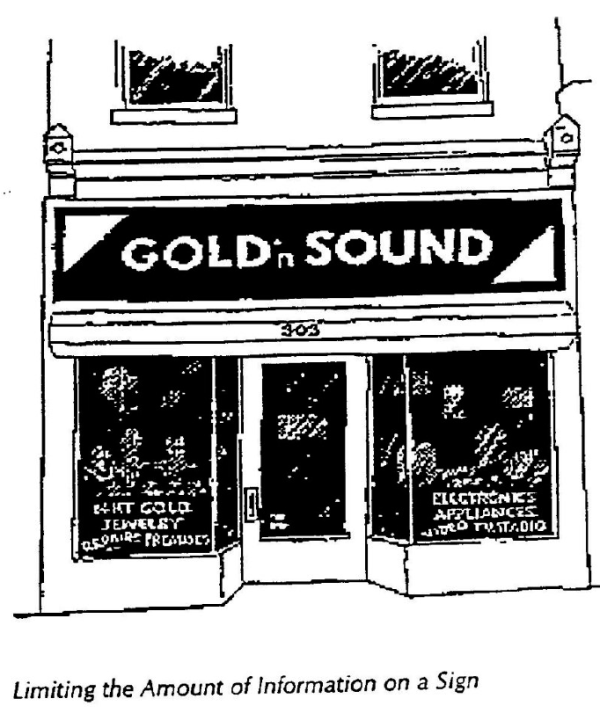
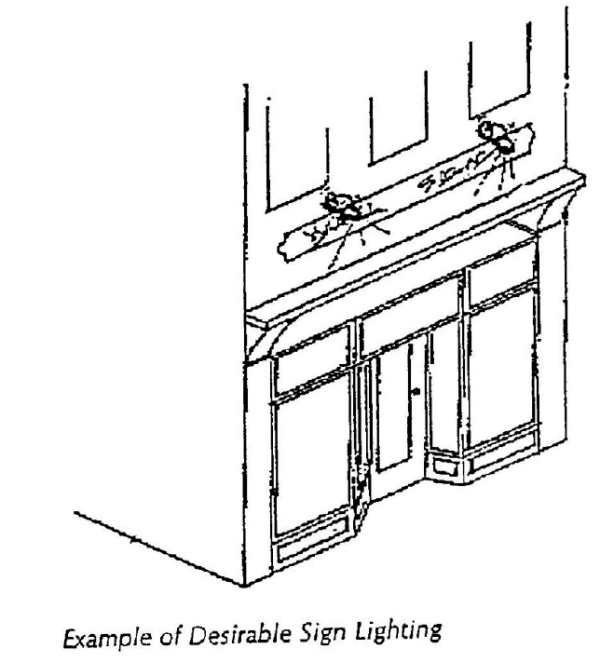
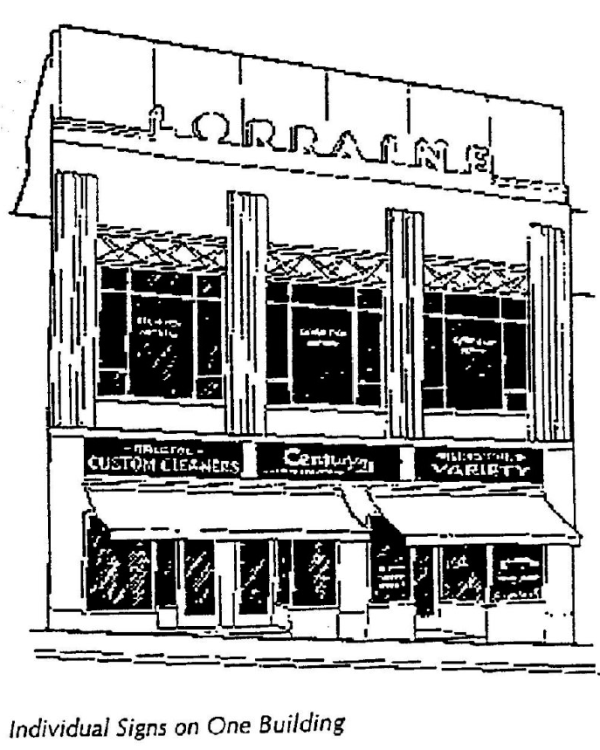
- Lighting: Lighting must be controlled in both height, intensity and design to create the desired "traditional" character of the Village Center.
- Light fixtures shall not produce glare on adjacent residential properties. To achieve this, luminaries shall be shielded to prevent light shining beyond the lot lines onto neighboring properties.
- Where business uses and off-street parking lots abut residential uses, light standards shall not exceed twelve feet (12') in height.
- Lighting fixtures within the public right of way should be of a "traditional" character to reinforce the distinction of the Village Center from other retail areas.
- Residential Land Use Density:
- Nonresidential And Mixed Use Areas:
- Lot Requirements: No minimums.
- Building/Yard Setbacks:
- Front: No minimum; fifteen feet (15') maximum.
- Side: No minimum, except fifteen feet (15') required when abutting a lot used or planned for single-family use.
- Rear: No minimum, except thirty feet (30') required when abutting a lot used or planned for single-family use.
- Setbacks From Major Arterial Streets: Building setbacks from the Archer Avenue right of way shall not be greater than eighty feet (80') to reduce the amount of parking placed in front of buildings and to ensure adequate landscape screening areas. All parking areas shall be setback a minimum of fifteen feet (15') from the Archer Avenue right of way to provide adequate screening.
- Building Height:
- Not to exceed four (4) stories.
- Where the distance between building facades across a public street is one hundred ten feet (110') or less, the fourth story of a building shall be set back a minimum of ten feet (10') as measured at the intersection of the floor plane of the fourth story and the property line along the public street frontage.
- Where the distance between building facades across a public street is greater than one hundred ten feet (110'), the fourth floor building setback shall not apply.
- Not to exceed four (4) stories.
- Lot Coverage: No maximum.
- Frontage Buildout: Buildings facades in commercial mixed use areas should occupy at least ninety percent (90%) of the lot frontage.
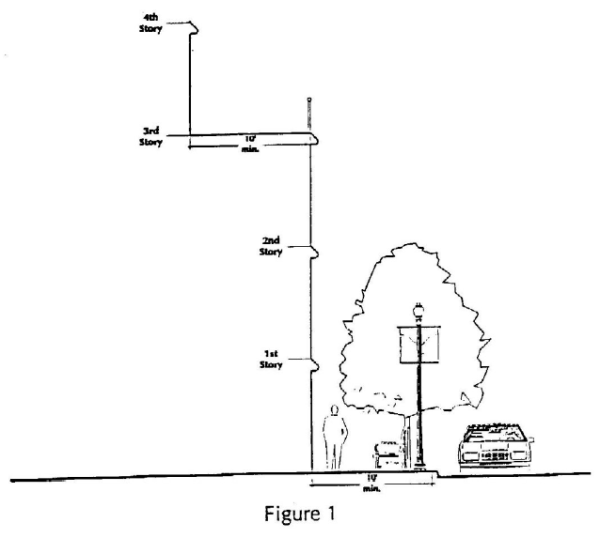
- Residential Uses:
- Lot Size: Attached single-family: one thousand nine hundred (1,900) square feet average, excluding right of way. Condominium: no requirement.
- Lot Width: Attached single-family: twenty four feet (24') minimum. Condominium: no requirement.
- Building/Yard Setbacks:
- Front: Ten feet (10') minimum; fifteen feet (15') maximum. No requirement for residential uses part of mixed use sites.
- Side: Attached single-family: no minimum. Condominium: no minimum, except fifteen feet (15') required when abutting a lot used or planned for single-family use.
- Rear: Attached single-family: twenty feet (20') minimum. Condominium: no minimum, except thirty feet (30') required when abutting a lot used or planned for single-family use.
- Building Height: Attached single-family: two (2) stories. The height may be increased by one story if the required off street parking occupies not less than sixty percent (60%) of the ground floor area. Condominium: three (3) stories, freestanding. If part of a mixed use building or complex, see above height requirements for nonresidential and mixed use areas.
- Lot Coverage: Attached single-family: 0.70 maximum. Condominium: no requirement. (Ord. 99-0-6, 3-11-1999)
- General Design Guidelines Applicable To All Uses:
- General Objectives: Overall land use and design objectives for development within the village center-planned development district include:
- North Willow Springs Road Corridor - Planned Development:
- General Objectives: Overall land use and design objectives for development within North Willow Springs Road Corridor-Planned Development District (NWSRC-PD) include:
- Shops, open space, and Senior Residential Housing should be located in close proximity to each other to create an integrated development that is pedestrian oriented and accessible for vehicles.
- Parks and passive open space shall be incorporated into each Residential and Senior Residential Housing development within the NWSRC-PD.
- New development should respect the residential character of nearby areas through establishment of transitional zones, adequate setbacks, landscape buffer areas, minimum lighting levels, and screening between such residential areas and incompatible uses.
- Future road access points should be minimized and coordinated with existing and planned streets.
- The opportunity for cut-through traffic in residential areas should be minimized.
- Development within existing woodland areas should be restricted if viable woodland areas exist based upon a recent certified tree survey.
- The identity and image of the Willow Springs Road corridor, and other arterial roads in the district, as defined by the Comprehensive Plan, should be enhanced with landscaping, streetscape elements, and infra-structure improvements.
- The impact on local school districts should be minimized, and positive financial benefits to local school districts should be enhanced.
- Land Use and Design Guidelines:
- General Design Standards Applicable to All Uses:
- Land Use Allocation: All land uses shall conform to the intent of the Village of Willow Springs Comprehensive Plan, as amended. The standards below shall serve as guidelines in the review of a specific project:
- SR-3 Single family residential: 20% Minimum to 40% Maximum of total NWSRC-PD District.
- B-1 Neighborhood Commercial: 10% Minimum to 15% Maximum of total NWSRC-PD District with access and frontage restricted to Willow Springs Road only.
- Public Accessible Parks & Open Space: 10% minimum of total NWSRC-PD District. Required setback areas, retention areas, and detention areas, shall not be used in calculating open space.
- Senior Residential Housing: 35% minimum to 60% maximum of total NWSRC-PD District with a density of not greater than 12 living units per acre, including Independent, Minimal Care, Intermediate Care and Skilled Care Housing (a majority of Senior Residential Housing shall be Independent Housing).- Any development within the NWSRC-PD District should reserve and maintain a minimum of fifty percent(50%) of each development site area for publicly accessible parks and/or "outdoor" open space. This should include preservation of the Burr Oak forest at the southwest corner of Willow Springs Road and 79th street, and any other significant trees worthy of preservation. Required setback areas shall not be used in calculating open space.
- The balance of the land within the NWSRCPD District shall consist of a mix of residential and non-residential uses that conforms to the intent of the Comprehensive Plan. Except as otherwise may be provided, for the purposes of this Section 9A-1-5-1G.9 "Senior Residential Housing" developments as permitted in Section 9A-12-3 shall be classified as a non-residential use.
- Evergreen trees: Not less than eight (8’) feet in height.
- Ornamental trees: Not less than ten (10’) feet in height.
- Shade Trees: Not less than three and 1/2 (3.5") inches in caliper, as measured six inches above grade.
- Shrubs: Not less than twenty-four (24") inches in height, unless used for screening, in which case shrubs shall not be less than four (4') feet in-height-
- Buffer Yards:
- A minimum landscape buffer yard of one hundred (100)feet shall be required along the full length of willow Springs Road and all other arterial roads within the NWSCR-PD District, and shall include an undulating berm having an average height of eight (8) feet with a 3:1 slope; the final design of such berm shall be approved as part of a final planned development plan.
- A minimum landscape buffer yard of one hundred (100) feet shall be required along the full length of 79th Street and German Church Road, and all other major collector roads.
- A minimum landscape buffer yard of one hundred (100) feet shall be required along the entire lot line of all uses that abut an existing or planned residential property.
- No buildings or parking area shall be permitted within a required buffer yard.
- Unless otherwise provided, internal buffer yards between buildings or uses shall be as defined in the planned development special use permit ordinance.
- Minimum Density of Plant Materials in Buffer Yards:
- The following table (see Appendix attached for illustrations of the minimum number of plantings required in each bufferyard) classifies bufferyards into two categories: A and B. To calculate the minimum number of plants required in a buffer yard, the length of each side of a property requiring a bufferyard should be divided by one hundred feet (100') and multiplied by the number of plants shown in the appropriate illustration; fractions of plants should be rounded up to the next whole number. BUFFER YARD DENSITY*
Adjacent Land Use*Note: At least 20% of the area of all buffer yards shall be planted with perennial and annual bedsProposed Land Use Senior Housing Non Residential Arterial Roads Collector Roads Residential Senior Housing A A B+ A B Non-Residential A A B+ A B
+Requires use of an undulating berm, masonry wall, or wood fence or a combination of these elements - All landscape areas shall be irrigated.
- See Appendix attached for illustrations of landscaped buffer yards A and B. The final design of all buffer yards. Shall be approved as part of the planned development special use ordinance.
- The following table (see Appendix attached for illustrations of the minimum number of plantings required in each bufferyard) classifies bufferyards into two categories: A and B. To calculate the minimum number of plants required in a buffer yard, the length of each side of a property requiring a bufferyard should be divided by one hundred feet (100') and multiplied by the number of plants shown in the appropriate illustration; fractions of plants should be rounded up to the next whole number. BUFFER YARD DENSITY*
- Parkways and Street Trees:
- All dedicated and private collector roads should include a minimum 10 foot parkway strip between the sidewalk and the roadway.
- All dedicated and private collector roads shall have street trees within the parkway strip on both side of the street, with not less than one tree for every 40 linear feet of right-of-way or fraction thereof, provided, however, that clustered landscape designs that provide a more creative parkway treatment are encouraged.
- All parkways and other areas to be grassed shall be sodded grass and not seeded.
- Parking Lots and Screening:
- Subject to sub-paragraphs (a) and (b) below, all parking lots shall include landscape islands at a ratio of one landscape island for every fifteen (15) parking spaces or fraction thereof, such that no parking space may be greater than one hundred and thirty-five feet (135') away from a landscape island. Each island shall be a minimum of 10' by 20' in size and shall be concrete curbed and ground covered and shall include at least one tree in addition to other shrubs and plant materials.
- The maximum spacing requirement between parking spaces and landscaped islands may be waived to allow for a lesser number of larger landscaped islands to be provided, which islands shall be of sufficient size to sustain a diversity of plant material and shall be designed to be irregularly shaped and placed within the parking lot in a non-grid fashion in order to create relief in the monotonous layout of the parking lot; and
- All landscaped islands shall be irrigated.
- In addition to the requirements of part I(i) immediately preceding, and within a distance of thirty (30') feet surrounding parking areas, not less than one tree shall be rov ded for every two (2) spaces.
- All parking lots located in front of the primary building and that is not otherwise fully screened from the public right-of-way shall be screened with a hedge, berm, or similar treatment covering one hundred 100%) percent of the width of the parking lot. Hedges and berms should be maintained between 30 and 40 inches in height and berms should generally maintain a slope of 1:2 (vertical: horizontal) and have a natural undulating design.
- All parking lots located adjacent to Senior Residential Housing developments shall be screened from view using a continuous hedge of six feet (6') in height along one hundred (100%) percent of the width of the parking lot. Shrubs shall be spaced at a maximum of four feet (4') on center. A solid screen may be achieved by clustering shrubs beneath shade or ornamental trees, by using evergreen trees, berms or any mix thereof, or by providing a six foot (6') solid commercial grade wood fence or masonry wall along the length of the property. Shade trees shall be provided inside the fence at the equivalent of one (1) tree every fifty lineal feet (50'), or faction thereof.
- Loading docks, service yards, trash receptacles, and open storage yards shall be screened from view from the public right-of-way and adjacent properties by a masonry wall, or solid year-round landscaping.
- There should be sufficient quantities of shade, ornamental, and evergreen trees, shrubs and ground covers to adequately screen unattractive views at the side and rear of adjacent buildings.
- Subject to sub-paragraphs (a) and (b) below, all parking lots shall include landscape islands at a ratio of one landscape island for every fifteen (15) parking spaces or fraction thereof, such that no parking space may be greater than one hundred and thirty-five feet (135') away from a landscape island. Each island shall be a minimum of 10' by 20' in size and shall be concrete curbed and ground covered and shall include at least one tree in addition to other shrubs and plant materials.
- Foundation Landscaping:
- At minimum an eight (8') foot wide landscape area should be provided adjacent to all building walls (excluding driveways, entrance areas, covered walkways, service and delivery areas).
- Foundation landscape areas shall be planted with a balance of understory and evergreen trees, shrubs, flowers, and ground covers, designed to provide year-round colors.
- Foundation landscape plantings should emphasize the softening of large expanses of building walls length and height, accent building entrances and architectural features and screen mechanical equipment adjacent to buildings.
- Tree Preservation: Tree surveys shall be required for all developments within the INTWSRC-PD District. Every effort in the design of building and parking areas shall be made to protect the existing quality trees. Particular attention shall be made to preserve the Burr Oak Forest at the southwest corner of Willow Springs Road and 79th Street and other high quality trees, where located in the NWSRC-PD District.
- Building Design:
- Bulk and Mass: All buildings should be designed with treatments to break up the mass and bulk. Buildings shall include vertical architectural treatment to break down the scale of the building into visually smaller components. Any facade with a blank wall shall be screened through landscaping, berming, and/or fencing. Architectural details shall continue on all facades visible from the public right-of-way. Large expanses of blank walls facing the street are inappropriate.
The following design elements should be incorporated to break up the horizontal plane of a building or wall:- Change in color, texture, or materials;
- Projections, recesses, and reveals, structural bays, entrances;
- Grouping of windows or doors; and/or
- Materials and Color:
- A minimum of 80% of all facades (discounting windows and doors), visible from the public right-of-way or surrounding residential areas, should be covered with face brick, natural stone, or some other masonry product of similar quality so as to add-texture, color and visual interest and, to avoid the bland appearance of large walls, roofs and facades.
- Ribbed metal/vinyl siding is prohibited as a primary exterior surface material. It may be used as trim material covering no more than 10% of any facade.
- Smooth faced gray concrete block and tilt up concrete panels are prohibited on all facades visible from the public right-of-way or neighboring properties. These products may be used for structural purposes provided they are covered with an appropriate material such as face brick.
- E.I.F.S (commonly known as Drivit) should be used for accent purposes only, and should not cover more than 10% of any facade visible from the public right-of-way.
- Facade colors should be earth tone colors with low reflectance. High-intensity, metallic, or fluorescent colors are prohibited.
- All final building materials, specifications, and colors shall be listed in the planned development special use permit ordinance.
- Mechanical Equipment: Roof-mounted heating, ventilation and air conditioning equipment (excluding roof vents), ductwork, air compressors, and other fixed operating machinery shall be fully screened from public view with architectural treatments that complement the overall design of the structure.
- Bulk and Mass: All buildings should be designed with treatments to break up the mass and bulk. Buildings shall include vertical architectural treatment to break down the scale of the building into visually smaller components. Any facade with a blank wall shall be screened through landscaping, berming, and/or fencing. Architectural details shall continue on all facades visible from the public right-of-way. Large expanses of blank walls facing the street are inappropriate.
- Lighting:
- Light fixtures shall not produce glare on adjacent residential properties. To achieve this, luminaries shall be shielded to prevent light from shining beyond the lot lines onto neighboring properties, and light levels shall not exceed 0.2 foot-candle measured at the property line. All light fixtures, with the exception of decorative fixtures used in pedestrian areas when expressly approved by the Village, shall consist of flush mounted, cut-off lighting, such that no part of the bulb or fixture lens extends below the fixture housing.
- Light standards shall not exceed twelve (12') feet in height.
- Decorative lighting fixtures and standards shall be provided in all development areas.
- For buildings and ground surfaces the following average maintained levels of illumination shall not be exceeded:
- Building and Monuments (floodlighted)
Foot-candle Light Surfaces 5.0
Medium Light Surfaces 10.0
Medium Dark Surfaces 15.0
Dark Surfaces 20.0 - Parking Areas
Senior Residential Housing 2.0
Other Uses 4.5 - Building Entrances and Exits 0.5
Notwithstanding the foregoing, the Village may authorize higher levels of illumination for certain uses upon a determination that demonstrates that the level of light produced from the site will not negatively impact adjacent property or the character of the Village.
- Building and Monuments (floodlighted)
- All developments shall submit catalogue cuts of all proposed lighting fixtures and styles and a photometric study and plan indicating light levels for buildings and parking areas within the entire site.
- Light level measurements shall be in preformed in accordance with the Illuminating Engineering Society of North America, IES Lighting Handbook standards.
- Signs:
- Maximum Sign Area per Zoning Lot by Street Classification and Use. The maximum total area of all monument signs along arterial roadways on a zoning lot for which a permit is required, shall not exceed the following: (All street classifications shall be as identified in the Comprehensive Plan of the Village of Willow Springs).
- Regional Arterial Road
- Commercial Use = 3.0 square feet/lineal foot, but not to exceed 350 square feet
- Senior Housing = 0.25 square feet/lineal foot, but not exceed 200 square feet
- Community/Local Arterial Road
- Commercial Use = 1.5 square feet/lineal foot, but not exceed 200 square feet
- Senior Housing = 0.20 square feet/lineal foot, but not exceed 100 square feet
- Regional Arterial Road
- Number Dimensions, Location of Individual Signs by Street Classification. Individual monument signs subject to the limits of N(i)(a) and (b) immediately preceding shall not exceed the applicable maximum number, dimensions, or setbacks provided below:
- Square Feet per Lineal Foot of Frontage**:
Regional Arterial Road- Commercial Use = 0.35 square feet/lineal foot
- Senior Housing = 0.15 square feet/lineal foot
Community/Local Arterial Road- Commercial Use = 0.20 square feet/lineal foot
- Senior Housing =0.10 square feet/lineal foot
**No permitted free-standing sign shall be required to be less than 25 square feet.
Freestanding signs shall not exceed 125 square feet in area.- Height: eight feet (8')
- Setback: fifteen feet (15')
- Number of Signs Permitted Per Zoning Lot: one (1)
- Each zoning lot shall be allowed one (1) sign; provided that any lot with more than 1,000 lineal feet of frontage on any single street shall be permitted one (1) additional sign for every additional 500 lineal feet of frontage.
- Lots fronting on two or more streets are allowed the permitted sign area for each street frontage, but signs cannot be accumulated and used on one street in excess of that allowed for lots with only one street frontage.
- Building Signs. Building signs shall be authorized on any zoning lot in accordance with the Village Sign Code or as authorized in the POD Ordinance.
- Design Standards:
- Applicants shall describe in graphic form, the proposed design for all signs for the purpose of establishing a uniform format and appearance.
- Signs along roadways shall be monument signs. These signs should be made of a high-quality neutral material such as brick, stone, or other similar products, in order to maintain the historically rural character of the community. Pole or pylon signs are prohibited.
- The colors and materials of signs shall be similar to and compatible with the architectural style, colors and materials of the related building. Every sign shall be designed as an integral architectural element of the building and site to which it relates.
- The number of graphic elements on a sign shall be held to the minimum needed to convey the rigs message and shall be composed in proportion to the area of the sign face.
- Internal illumination of signs is prohibited.
- Changeable copy on signs and message signs are prohibited.
- Signs should be oriented to vehicular traffic as well as pedestrians, and scaled appropriately.
- Except as specified above, all signs shall meet the requirements of the Village's Sign Code.
- Square Feet per Lineal Foot of Frontage**:
- Maximum Sign Area per Zoning Lot by Street Classification and Use. The maximum total area of all monument signs along arterial roadways on a zoning lot for which a permit is required, shall not exceed the following: (All street classifications shall be as identified in the Comprehensive Plan of the Village of Willow Springs).
- Underground Utilities: All utilities, including electric, telephone, gas and cable within and along all public and private roads shall be installed underground.
- Utility Meters/Transformers: Wall-mounted utility meters shall not be mounted on the front elevation of a building. Wall-mounted utility meters and ground supported transformers shall be painted to match the nearest building. If visible from residential areas or the public right-of-way, meters and transformers shall be screened by landscaping equal in height to the tallest meter or transformer.
Senior Housing Design and Service Standards:
- Land Use Allocation: All land uses shall conform to the intent of the Village of Willow Springs Comprehensive Plan, as amended. The standards below shall serve as guidelines in the review of a specific project:
- The following design and services standards shall apply to all Senior Residential Housing Developments:
- Density: Not to exceed twelve (12) living units per acre.
- Building Height: Not to exceed three (3) stories or 36 feet. An increase in height may be justified if a project achieves an excellence of design, provides more open space and/or other amenities than required, and demonstrates that the added height will not negatively impact surrounding properties.
- Maximum Lot Coverage: Fifty Percent (50%) of total site area, including all structures, drive aisles, and parking areas.
- Parking Requirements:
- One (1) underground resident parking space shall be provided for each (1) living unit, and such spaces shall be marked for use by the Senior Residential Housing. All developments shall comply with the handicapped parking space requirements under the American Disabilities Act.
- One (1) visitor parking space shall be provided for every two (2) living units, and such spaces shall be marked for use by the Senior Residential Housing.
- Employee parking stalls shall equal the highest number of employees on duty during any one shift.
- Walkways and Curbs: All external walkways and curbs shall contain ramps in place of, or in conjunction with, steps. Ramp slope shall not exceed five percent (5%)
- The following design and services standards shall apply to Senior Residential Housing developments:
- Minimum Living Unit Size: Independent Housing components within a Senior Residential Housing development shall comply with the following minimum requirements for each living unit:
- Studio, 800 square feet square feet
- One-Bedroom Units, 1000 square feet
- Two-Bedroom Units, 1200 square feet
- Building Height: Shall not exceed three (3) stories or thirty-six (36) feet. when adjacent to a residential area, building heights shall not exceed two (2) stories or twenty-four (24) feet. Variations based on design excellence or increase amenities shall be limited to four (4) stories or forty-eight (48) feet.
- Gross density: Shall not exceed twelve (12) living units per acre and shall include all levels of care facilities (independent, minimal, intermediate and skilled)
- Laundry Facilities: All Senior Residential Housing developments shall provide laundry facilities adequate to accommodate the number of living units proposed within each individual residential structure. For structures containing multiple living units a minimum of one (1) washer and one (1) dryer per each ten (10) living units shall be provided; however in no case shall there be less than two (2) washers and dryers provided within a multiple unit structure. All free-standing and/or attached units, which provide primary access to the unit through an independent exterior door, shall contain one (1) washer and one (1) dryer.
- Required Services and Amenities for Senior Residential Housing:
- A building manager or supervisory employee shall be on site 24 hours per day.
- A 24-hour internal emergency response system call button shall be provided in all units.
- All residents shall have access to an on-site health care facility, which maintains at least one employee on duty 24 hours per day who is trained in the administration of first aid and who is certified in cardio-pulmonary resuscitation for the elderly.
- The owner and operators or manager shall, on at least a semiannual basis, survey the personal and service needs of the residents and document changes in medical history or conditions.
- The manager shall maintain a detailed and current written emergency medical plan for each resident. This plan shall be based upon the semiannual survey and upon any supplemental information provided by the resident.
- All residents shall have access to a shared dining facility located within the development.
- All residents shall have access to a full service fitness center which shall provide a wide range of equipment and services to accommodate the recreational and medical needs of seniors.
- Interior community space and related equipment shall be required to provide social and recreational opportunities for project occupants. Included may be such facilities as game rooms, meeting rooms, music and craft rooms.
- Elevators shall be provided in all buildings containing living units that are completely contained on a story above the first floor. In such cases, an elevator shall not be more than one hundred feet (100') from a living unit it is intended to serve.
- Minimum Living Unit Size: Independent Housing components within a Senior Residential Housing development shall comply with the following minimum requirements for each living unit:
- General Design Standards Applicable to All Uses:
- Commercial Design Standards (not including Senior Residential Housing): All bulk and area standards for commercial uses within the NWSRC-PD shall comply with the regulations set forth in Section 9A-5-5, except for the following:
- Floor Area Ratio: FAR of .25
- Building Height: 3 stories or 35'
- Maximum Impervious Surface Coverage: 50% of planned development area; 3 stories or 35'
- Maximum impervious Surface Coverage: 50% of planned development area
- General Objectives: Overall land use and design objectives for development within North Willow Springs Road Corridor-Planned Development District (NWSRC-PD) include:
- General:
- Exceptions To Minimum Requirements: Whenever an applicant for a planned unit development proposes to provide and set out, by platting, deed, dedication, restriction, covenant or other legal method, any land or space separate from single-family or multi-family residential areas or commercial or industrial areas to be used for parks, playgrounds, commons, greenways, pathways or other open areas, the plan commission may consider and recommend to the village board deviations to, and the village board may authorize deviations from, the applicable minimum requirements of the village's subdivision regulations and the zoning ordinance, including, but not limited to:
- Front yard;
- Rear yard;
- Side yard;
- Lot area;
- Bulk standards; and
- Off street parking.
- Special Use - Planned Unit Developments Conditions And Limitations; Recording Ordinance; Major/Minor Changes: Prior to granting any planned unit development, the plan commission may recommend certain conditions and restrictions, and the village board, in addition to the conditions and restrictions recommended by the plan commission, or in lieu thereof, may stipulate certain conditions and restrictions, including, but not limited to, those upon the establishment, location, construction, maintenance and operation of the planned unit development as deemed necessary for the protection of the public interest and to secure compliance with the standards and requirements specified herein, or as may be from time to time required. In all cases in which planned unit developments are granted, the village board shall require such evidence and guarantees as it may deem necessary as proof that compliance will be made with the said stipulated conditions. Planned unit developments shall be authorized by an ordinance duly enacted. A certified copy of the ordinance authorizing the planned unit development shall be recorded by the village attorney in the office of the recorder of deeds of Cook County, Illinois. All planned unit development projects shall be developed by only according to the ordinance approving the planned unit development and all supporting data. The ordinance and supporting data, together with all amendments shall be binding on the applicants, their successors, grantees and assigns and shall limit and control the use of premises and location of structures in the planned unit development project as set forth therein. Changes to the approved and recorded planned unit development may be made, but only as follows:
- Major Changes: Changes which alter the concept or intent of the planned unit development specifically, including, but not limited to: increases in density; increases in the height of buildings; reductions of proposed open space; significant changes in building locations; significant changes in building elevations; changes in proposed amenities; changes in the development schedule; changes in road standards; or other similar significant changes, may be approved only by submission of a new final planned unit development plat and supporting data, the review and approval of which must follow the "final plat" procedure. All changes to the "original" final plat shall be recorded with the county recorder of deeds as amendments to the final plat or reflected in the recording of the new "corrected" final plat.
- Minor Changes: The director of planning and zoning may approve minor changes in the planned unit development which do not change the concept or intent of the development. Minor changes shall be any change not defined as a "major change".
- Effect Of Denial Of A Planned Unit Development: After a public hearing, no application for a planned unit development which has been denied wholly or in part by the village board shall be resubmitted for a period of one year from the date of said order of denial, except on the grounds of substantial new evidence or proof of changed conditions found to be valid by the village board.
- Termination Of Planned Unit Development: The terms, provisions, requirements, conditions and the process for the termination of special use permits as contained in subsection 9A-1-5E of this chapter, entitled "Termination Of Special Use Permit" shall apply to the termination of planned unit developments as if fully set forth herein.
(Ord. 19-O-2004, 7-8-2004)
9A-1-6: NONCONFORMING USES
The lawful use of land or buildings existing at the time of the adoption of these regulations may continue although such use does not conform to the regulations specified by this title for the district in which such land, use or building is located.
For purposes of this section a building or structure initially established on or before August 9, 1990, shall be deemed to include any building or structure for which a building or permit has been lawfully issued.
- Authority To Continue Nonconforming Buildings, Structures And Uses: Any building, structure or use which existed lawfully at the time of the adoption of this title, and which becomes nonconforming upon the adoption of this title (August 9, 1990) or of any subsequent amendment thereto, may be continued only in accordance with the following regulations:
- Repairs And Alterations: Ordinary repairs and alterations may be made to a nonconforming building or structure, provided that no structural alterations shall be made in or to such building or structure, all or substantially all of which is designed or intended for a use not permitted in the district in which it is located, except those required by law, or except to make the building or structure and use thereof conform to the regulations of the district in which it is located. Ordinary repairs and alterations shall be determined by the building inspector and shall include, among other things, the replacement of storage tanks where the safety of operation of the installation requires such replacement.
- Additions And Enlargements:
- A nonconforming building or structure all or substantially all of which is designed or intended for a use not permitted in the district in which it is located shall not be added to or enlarged in any manner unless such nonconforming building or structure and use thereof, including all additions and enlargements thereof, is made to conform to all the regulations of the district in which it is located.
- A nonconforming building or structure which is nonconforming only as to the bulk restrictions of subsection D of this section, may be added to or enlarged, provided such additions or enlargement conform to all regulations of the district in which it is located.
- Moving: No nonconforming building or structure shall be moved in whole or in part to any other location unless every portion of such building or structure, and the use thereof, is made to conform to all regulations of the district in which the moved building is to be located.
- Restoration Of Damaged Nonconforming Building Or Structure: Any nonconforming building which has been destroyed or damaged by fire, explosion, act of God, or by a public enemy to the extent of sixty percent (60%) or more of its assessed valuation shall thereafter conform to the provisions of this title. Where more than forty percent (40%) of the assessed value of the building remains after such damage, such structure may be restored to the same nonconforming use as existed before such damage.
- Discontinuance Of Use In Nonconforming Building Or Structure: A nonconforming building or structure, or portion thereof, in which the use has ceased by discontinuance or abandonment, on July 15, 1994, or thereafter, or which is abandoned and remains unoccupied, or is not used for a continuous period of six (6) months, shall not thereafter be occupied or used, except by a use which conforms to the use regulations of the district in which it is located.
- Change Of Use In Nonconforming Building Or Structure: The nonconforming use of a nonconforming building or structure, or portion thereof, may be changed to a use permitted in the district in which the building or structure is located.
- The nonconforming use of a part of such building or structure shall not be expanded or extended into any other portion of such building or structure, nor changed to any other nonconforming use.
- If a nonconforming use of such a building or structure is discontinued, or abandoned for a period of six (6) consecutive months, it shall not be renewed, and any subsequent use of such building or structure shall conform to the use regulations of the district in which the premises are located.
- Once a use is changed to a conforming use, however, such building or structure shall not thereafter be used for a nonconforming use.
- Nonconforming Use of Conforming Buildings or Structures: The existing nonconforming use of a part or all of a conforming building or structure may be continued subject to the following provisions:
- The nonconforming use of a part of such building or structure shall not be expanded or extended into any other portion of such building or structure, nor changed to any other nonconforming use.
- If a nonconforming use of such a building or structure is discontinued, or abandoned for a period of six (6) consecutive months, it shall not be renewed, and any subsequent use of such building or structure shall conform to the use regulations of the district in which the premises are located.
- Conversion of Nonconforming Building, Structure or Use: Any nonconforming building, structure or use may be converted to a permitted "special use" by the granting of a special use permit, pursuant to subsection C below.
- Amortization:
- Amortization of Nonconforming Building or Structures, Lots or Uses: Except for the criteria listed in B2 below, any nonconforming building, structure, lot or use which existed lawfully on August 9, 1990, or any subsequent amendments thereto, and which remains nonconforming, and any such building, structure, or use which shall become nonconforming upon the adoption of any subsequent amendments thereto, shall be discontinued and cease in accordance with the following:
- Where no building or structure is employed in connection with such use, such use shall be discontinued within one year of July 15, 1994.
- Where all or substantially all of the physical improvements employed in a nonconforming building or structure, have an assessed valuation, on July 15, 1994, of ten thousand dollars ($10,000.00) or less, such use shall be discontinued within two (2) years from July 15, 1994.
- All nonconforming signs, billboards and outdoor advertising structures shall be removed in accordance with this Title.
- Any nonconforming use in a conforming building or structure existing in any residential district on July 15, 1994, shall be entirely discontinued within five (5) years from July 15, 1994.
- Any nonconforming structure that was erected, converted, or structurally altered in violation of the provisions of this Title which this Section amends shall not be validated by the adoption of this amendment, and such violations, or any violations of this Section may be ordered removed or corrected by the proper officials at any time.
- Any nonconforming use in any business or industrial district shall be entirely discontinued with any change in occupancy, but in no case shall the nonconforming use continue beyond five (5) years after July 15, 1994.
- Certification of Nonconforming Use:
- Any nonconforming use which existed lawfully on August 9, 1990, and which remains nonconforming on July 15, 1994, or of any subsequent amendment thereto, may be continued, provided that a certificate of nonconformance is obtained from the Building Commissioner. The certificate shall not be issued unless the basis therefor is clear and contradicted, such as a lawfully issued building permit. The obligation for obtaining such certificate rests solely with the owners or interests of the nonconforming use.
- Failure to obtain a certificate of nonconformance within a period of six (6) months from July 15, 1994, will require the amortization procedures of this Section. This does not negate the option of applying for a special use permit as provided for herein.
- Amortization of Nonconforming Building or Structures, Lots or Uses: Except for the criteria listed in B2 below, any nonconforming building, structure, lot or use which existed lawfully on August 9, 1990, or any subsequent amendments thereto, and which remains nonconforming, and any such building, structure, or use which shall become nonconforming upon the adoption of any subsequent amendments thereto, shall be discontinued and cease in accordance with the following:
- Special Use:
- Conversion to Special Use: Subject to the requirements of this subsection, any nonconforming use in the B-1 Community Shopping district or B-2 commercial and business service district may become a permitted "special use" by the granting of a special use permit.
- Granting Of Permit: A special use permit may be granted only when it is shown and the village finds that the nonconforming use is providing a particular service to the residents of Willow Springs or that the use is not detrimental to the village as a whole or to adjacent properties. The village may impose such reasonable conditions as are necessary to ensure compliance with the above finding(s) and to ensure the eventual elimination of the use.
- Exceptions:
- No building, structure or use lawfully established by virtue of a lawfully issued building permit on or before August 9, 1990, shall be subject to amortization under this title solely by reason of being nonconforming with respect to the bulk and other standards prescribed below for any of the following:
- Floor area ratio;
- Yards - front, side and rear;
- Lot area;
- Lot width;
- General area/lot coverage of structures;
- Gross floor area.
- No building, structure or use lawfully established by virtue of a lawfully issued building permit on or before August 9, 1990, shall be subject to amortization under this title solely by reason of being nonconforming with respect to the bulk and other standards prescribed below for any of the following:
- Penalty:
- Any person, firm or corporation who violates, disobeys, omits, neglects, refuses to comply with, or who resists enforcement of any of the provisions of this section shall upon conviction be fined not less than fifty dollars ($50.00) nor more than one thousand dollars ($1,000.00), or the maximum allowable under state law for each offense. Each day a violation is permitted to exist shall constitute a separate offense.
- In the event any building or structure erected, constructed, reconstructed, altered, repaired, converted or maintained, or any building, structure or land is used in violation of this section, the building commissioner or director of code enforcement or any owner or tenant of real property in the same contiguous zoning district as the building, structure or land in question, in addition to other remedies, may institute any appropriate action or proceeding: a) to prevent the unlawful erection, construction, reconstruction, alteration, repair, conversion, maintenance or use, b) to prevent the occupancy of the building, structure or land, c) to prevent any illegal act, conduct, business or use in or about the premises, or d) to restrain, correct or abate the violation.
(Ord. 94-0-12, 8-11-1994, 2014-O-24)
9A-1-7: AMENDMENTS
- Authority: The regulations imposed and the districts created under the authority of this title may be amended, from time to time, by ordinance in accordance with applicable statutes of the state of Illinois. An amendment shall be granted or denied by the board of trustees only after a public hearing before the plan and zoning commission and a report of its findings and recommendations has thereafter been submitted to the board of trustees. The plan and zoning commission is hereby designated the commission or committee as provided by the statutes of the state of Illinois for the purpose of conducting the required public hearing.
- Initiation Of Amendments: Amendments may be proposed by the president and board of trustees, plan and zoning commission, or by any resident of or owner of real estate in the village or any resident or owner of real estate outside the territorial limits of the village proposing to annex real estate to the village.
- Processing: An application for an amendment shall be filed with the plan and zoning commission in care of the village clerk, which shall hold a public hearing and submit to the president and board of trustees a report of its findings and recommendations. Notice of the time and place of such public hearing shall be given at least once not more than thirty (30) nor less than fifteen (15) days before the hearing by publishing a notice thereof in one or more newspapers published in the village, or if no newspaper is published therein, then in one or more newspapers with a general circulation within the village.
- The plan and zoning commission shall make findings based upon the evidence presented to it in each specific case with respect to each of the following matters: (Ord. 83-0-3, 3-24-1983; amd. Ord. 12-O-2005, 8-11-2005)
- The amendment will not be unreasonably detrimental to or endanger the public health, safety, morals, comfort or general welfare;
- The amendment will not be injurious to the use and enjoyment of other property in the immediate vicinity nor substantially diminish and impair property values within adjoining areas; and
- The amendment will not impede the normal and orderly growth, development and improvement of surrounding property as well as the village at large. (Ord. 83-0-3, 3-24-1983)
- The president and board of trustees, within sixty (60) days after its next regular meeting following receipt of the findings and recommendations of the plan and zoning commission and without further public hearing, may grant or deny any proposed amendment in accordance with applicable statutes of the state of Illinois 2, or may refer it back to the plan and zoning commission for further considerations. (Ord. 83-0-3, 3-24-1983; amd. Ord. 12-O-2005, 8-11-2005)
- If a written protest against any proposed amendment of the regulations or districts, signed and acknowledged by owners of twenty percent (20%) of the frontage proposed to be altered, or by the owners of twenty percent (20%) of the frontage immediately adjoining or across an alley therefrom, or by the owners of twenty percent (20%) of the frontage directly opposite the frontage proposed to be altered, is filed with the village clerk, the amendment shall not be passed except by a favorable vote of two-thirds (2/3) of all members of the board of trustees then holding office. In such cases, a copy of the written protest shall be served by the protestor or protestors on the applicant for the proposed amendment and a copy upon the applicant's attorney, if any, by certified mail, return receipt requested, at the address of such applicant and attorney shown in the application for the proposed amendment, and proof of such service shall be filed with the village clerk at the time the written protest is filed.
- The plan and zoning commission shall make findings based upon the evidence presented to it in each specific case with respect to each of the following matters: (Ord. 83-0-3, 3-24-1983; amd. Ord. 12-O-2005, 8-11-2005)
(Ord. 83-0-3, 3-24-1983)
9A-1-8: ENFORCEMENT; PENALTY
- Penalty: Any person, firm or corporation who violates, disobeys, omits, neglects, refuses to comply with, or who resists enforcement of any of the provisions of this title shall upon conviction be fined not less than fifty dollars ($50.00) nor more than one thousand dollars ($1,000.00), or the maximum allowable under state law for each offense. Each day a violation is permitted to exist shall constitute a separate offense.
- Enforcement: In the event any building or structure erected, constructed, reconstructed, altered, repaired, converted, or maintained, or any building, structure or land is used in violation of this title, the building commissioner or director of code enforcement or any owner or tenant of real property in the same contiguous zoning district as the building, structure or land in question, in addition to other remedies, may institute any appropriate action or proceeding: 1) to prevent the unlawful erection, construction, reconstruction, alteration, repair, conversion, maintenance, or use, (2) to prevent the occupancy of the building, structure or land, (3) to prevent any illegal act, conduct, business or use in or about the premises, or (4) to restrain, correct, or abate the violation.
(Ord. 90-0-3, 2-26-90, 2014-O-24)
9A-1-9: SITE PLAN REVIEW
- Intent: In order to exercise a more orderly control of land development within zoning districts of specific concern, the Village hereby established a site plan review process. It is recognized that the very nature of development creates potential for traffic generation problems, overcrowding and adverse environmental effects. It is within the R-3, B-1, B-2 and L-1 Zoning Districts which the Village intends to subject to site plan review so that the meaning and intent of the Zoning Ordinance and all the provisions thereof are complied with.
- Procedure: A written application for site plan review shall be submitted to the Village Administrator who will schedule the item for review by the Plan Commission. Ten (10) copies of the site plan shall be submitted by the property owner or his certified agent to the Village Administrator at least ten (10) days prior to the Plan Commission meeting at which the site plan will be reviewed. The Village Administrator shall review the site plan for conformance with the Zoning Ordinance of the Village, and shall make a report to the Plan Commission. After reviewing the report of the Village Administrator, the Plan Commission shall recommend approval or denial of the site plan, with or without conditions, or may defer the item for further study. Once a recommendation is made, the site plan shall be forwarded to the Village Board for consideration and approval. Consultation with the appropriate Village staff and consultants is encouraged throughout this process to insure a minimum of delay. The Village Board may approve, approve with conditions, table, or deny the site plan. The President and Board of Trustees shall take action on the site plan within sixty (60) days after its next regular meeting following the receipt of the written recommendations of the Plan Commission. (Ord. 2015-O-16A)
- Site Plan Details: The site plan shall contain the following detail information.
- A base map, drawn to scale, showing all lot boundaries and dimensions and a written description of the property;
- The area (square footage) of the following must be included on all site plans:
- Total lot area,
- Total building area,
- Total landscaped area,
- Total area devoted to parking lots and driveways,
- Total area of interior parking lot landscaping.
- Location and dimensions of existing and proposed buildings and structures, existing zoning and land use within two hundred feet (200') including adjacent lot lines and significant features and buildings on adjoining properties.
- The location and dimensions of all existing, and proposed parking lots and drives, roadways and rights of way, sidewalks, bicycle paths, ground signs, refuse disposal areas, bicycle parking areas, fences, free standing electrical equipment, free standing HVAC/mechanical equipment and other free standing structural features as determined necessary by the Village Administrator.
- Names and addresses of owner, application, planner, architect, engineer, landscape architect, as appropriate.
- Scale, north arrow, date.
- Title of the project or property.
- Location and dimensions of existing and proposed buildings and structures, including adjacent lot lines and significant features and buildings on adjoining properties.
- Ground elevations, existing and proposed, top of foundation elevations on all adjacent structures.
- Location of flood plains, existing vegetation, fences, walls, etc.
- Vehicular, service and pedestrian access, including driveways, sidewalks, curbs, street pavement markings, traffic signals and on-site parking, circulation signage and curb cuts within two hundred feet (200') of site.
- Off-street parking and loading areas, including number of spaces and dimensions.
- Lighting standards, including location, size, height, illumination and intensity.
- Outdoor storage areas, if any.
- Waste disposal areas, including type of containers, bins, dumpsters, etc., and enclosure methods.
- Engineering, drainage, grading, flood plain, and on-site water detention areas.
- Horizontal elevations of all proposed structures, including detailed description of exterior construction materials. Elevations shall represent those colors which will be utilized in the design.
- Other plan details as determined necessary by the Village Administration, including, but not limited to:
- Performance standards evaluation authorized under subsection 9A-7A-1A9.
- Traffic impact analysis.
- Market research analysis.
- Flood plain mitigation measures.
- Erosion control measures.
- Timetable for construction of proposed improvements.
- Design Criteria: Approval of site plans shall be based upon conformity to zoning regulations as well as general conformance to overall site design criteria. A developer should seek to integrate the following design characteristics into those plans submitted for site plan approval:
- Integration and Compatibility: The overall design shall integrate neighborhood and site characteristics into a compatible expression of building mass, scale, color and circulation.
- Minimalization of Impacts: Spatial designs should minimize the impacts of traffic, noise, reflected light, debris, and other undesirable effects of development, upon abutting properties and the neighborhood as a whole.
- Architectural Innovation: Developers should seek to provide innovative design of structures by varying vertical planes of building facades and/or by varying the elevation of roof lines.
- Loading/Refuse Area: Design of loading and refuse areas should be sensitive to aesthetic concerns and provide screening compatible with abutting properties. Where possible, such loading and refuse areas should be located so as to not be visible from public roads.
- Parking Lots: Parking lots and driveways shall be designed to safely and effectively circulate vehicles throughout the site. When appropriate, cross easements should be provided between adjoining properties to allow for circulation of vehicles.
- Vehicle Access and Curb Cuts: Vehicular systems for both on-site and off-site traffic should be designed in a manner which facilities smooth progression of movement, yet is sensitive to other design considerations such as pedestrian activity and off-street parking. Curb cuts shall be located to safely and efficiently allow vehicle ingress and egress to the site. The use of shared curb cuts and cross easements shall be provided when appropriate. One curb cut shall be allowed for ingress/egress unless specific documentation is provided demonstrating the need for additional curb cuts.
- Pedestrian Circulation: Site and building design shall accommodate pedestrian circulation on site from parking areas, plazas, open space, and public rights of way. Pedestrian and vehicular circulation shall be separated to the greatest extent possible.
- Uniform Signage: Signage shall be designed to provide compatibility with building form, shape and color. Signage shall be uniform or complimentary in color and overall design. Signage shall not conflict with signage from adjoining properties. All signs must comply with Chapter 9A-8, Sign Regulations.
- Open Space: Design of any development shall provide for a maximum use of open space, particularly along the perimeter of the site, in parking lots and near the building foundation. Larger developments should include designs which allow for the centralized open space containing detention/retention ponds, passive recreation areas, bike/pedestrian paths, and other amenities which will serve the development.
- Detention/Retention Ponds: When appropriate, detention and retention ponds should be designed to provide for shared storage between property. Ideally, such shared storage should include the greatest land area possible.
- Lighting: On-site lighting standards shall be compatible with the architectural and spatial designs, and shall provide for safe illumination on the site for vehicles and pedestrians.
- Site Landscaping Design Criteria: A landscape plan must accompany any application for site approval. Landscape plans shall meet the requirements of Section 8-10-1 of this Code except that any and all procedural requirements and standards related to plan approval are hereby null and void in favor of the procedures for site plan approval of this chapter.
- Performance Guarantee: As a condition of approval, the plan commission may recommend that the applicant be required to file with the village treasurer a letter of credit or a performance guarantee approved by the village attorney to ensure completion of approved landscaping, fencing, parking, and loading, drainage and all other specific items of the site plan. The amount of the performance guarantee and the required completion date shall be recommended by the village administrator based on current costs and set by the village board. If upon inspection of the completed project by the building commissioner, it is found that the conditions of the site plan have been met, the performance bond shall be released to the applicant.
If the applicant does not complete the development of the items specified on the site plan within the time specified in its bond or other security, the village administrator shall give written notice to the applicant and the surety or other guarantor. If site development in conformity with the conditions of the site plan have not been completed thirty (30) days prior to the expiration of the performance guarantee, the village will take action as is necessary to ensure completion in conformity with the conditions of the site plan within the time period specified, but that adversities not of his making have prevented such completion, the village board may permit him to extend the performance guarantee for an additional specified period of time. - Amendments To Site Plan: The required site plan and timetable may be amended by the village board after review and recommendation by the plan commission.
- Building Permits: Building permits for earth moving, construction, alteration, or any other purpose shall not be issued for a site until a site plan is approved by the village board.
(Ord. 90-0-18, 8-9-1990)
9A-1-10: PLAN COMMISSION RECOMMENDATIONS
- Notwithstanding any other term or provision to the contrary contained in either this title or title 9B of this code, all required recommendations and findings or reports to be provided from the plan commission to the president and board of trustees, whether or not public hearings are required, including, but not limited to, applications for zoning amendments, special uses (including planned unit developments), variations, site plan reviews and subdivision reviews, shall be in writing. The President and Board of Trustees shall take action on said recommendations within sixty (60) days after its next regular meeting following the receipt of the written recommendations. (Ord. 2015-O-16A)
- All written recommendations and findings or reports from the plan commission to the president and board of trustees shall be transmitted to the president and board of trustees within fifteen (15) days following, either:
- The completion of any required public hearings on the application; or
- The final review meeting of the plan commission for any matters not requiring a public hearing, such as site plan review, subdivision reviews or other matters referred by the president and board of trustees to the plan commission for review.
- In the event the plan commission shall fail to provide such written recommendations and findings and/or reports within said fifteen (15) days as aforesaid, then, and in that event, the president and board of trustees shall act for purposes of its final action as if the plan commission has made a favorable recommendation and/or report, with no conditions.
(Ord. 92-0-25, 8-27-1992)
9A-1-11: PUBLIC HEARING NOTICE REQUIREMENTS
All applicants or petitioners for any zoning approvals under this title shall comply with the following public hearing notice requirements:
- Written Notice: In addition to the publication of notice of public hearings by the village as required by law, an applicant or petitioner for any public hearing required by this title shall, not less than fifteen (15) days and not more than thirty (30) days prior to the date set for the public hearing, serve written notice by registered or certified mail, return receipt requested, on the owners of record as recorded in the office of the recorder of deeds of Cook County or as appears from the authentic tax records of Cook County of all property located within two hundred fifty feet (250') in each direction of the property lines of the subject property for which the public hearing is requested; provided, the distance of all public roads, streets, alleys and other public ways shall be excluded in computing the two hundred fifty foot (250') requirement. A copy of the notice served together with a copy of the list of names and addresses served with the notice shall be delivered to the village administrator at the time notice is given to the owners or taxpayers. The notice required herein shall contain the address or specific references to the location for which the public hearing is requested, a brief statement of the nature of the application or petition, the names and addresses of the legal and beneficial owners of the property and the applicant or petitioner, and the time, date and location of the public hearing.
- Notice By Signposting: Not less than fifteen (15) days prior to the public hearing, the applicant, at the applicant’s expense, shall post or cause to be posted upon the real estate which will be the subject of a public hearing, a sign bearing the following statement:
THIS PROPERTY IS SUBJECT TO A REQUEST WHICH REQUIRES A PUBLIC HEARING BEFORE THE PLANNING AND ZONING COMMISSION. FOR FURTHER INFORMATION, OR TO REVIEW SUBMITTED DOCUMENTATION REGARDING THE REQUEST, PLEASE CALL THE VILLAGE ADMINISTRATOR AT (708) 467-3700, OR VISIT WWW.WILLOWSPRINGS-IL.GOV. THIS NOTICE IS POSTED PURSUANT TO VILLAGE CODE.
The sign shall be printed on a white background and shall be not less than 24 inches in height and thirty-six inches in width with a minimum 1 inch high black printed block letters, except that the words "NOTICE OF PUBLIC HEARING" shall be in a minimum one and one half inch (1½") high red capital printed block letters. (Ord. 2019-O-04, 2-14-2019) - Affidavit Of Notice: Prior to the commencement of the public hearing, the applicant or petitioner shall file an affidavit certifying to compliance with the notice requirements of subsections A and B of this section. Said affidavit shall have attached thereto the list of names and addresses served with notice, together with the original return receipt cards for the registered or certified mail service.
(Ord. 19-O-2004, 7-8-2004)

