
Windsor City Zoning Code
ARTICLE I
Zone Districts
Sec. 16-1-10. - Establishment of zone districts.
Zoning districts are established by Table 16-1-10 and as shown on the Official Zoning District Map of the Town. Previous zoning districts are hereby reclassified to the zoning districts established by Ordinance Number 2020-1620 as shown in Table 16-1-10.
* The PP zoning district was added by a citizen initiative duly adopted in November of 2022.
(Ord. 2020-1620 §3; Ord. of 2-3-2023 §§2, 3)
Sec. 16-1-20. - Application of individual lot regulations.
(a)
Setbacks. No building or structure shall hereafter be erected, structurally altered or relocated so that any portion thereof is closer to the setback line than the minimum setback distance specified herein by the regulations of the district in which it is located except for the following:
(1)
Signs shall be subject to the setback requirements set forth in the sign regulations section of the Windsor Municipal Code, and not the individual zone district setbacks.
(2)
Multifamily, commercial, or industrial use structures, where two (2) or more buildings on adjoining lots may be erected with common or directly adjoining walls, in compliance with the applicable building codes. Both ends of such row-type buildings shall comply with applicable side and rear setback requirements.
(3)
The features listed in Table 16-1-20(a) may encroach into the required setbacks of the applicable zoning district, provided they do not extend into or over an easement, do not impede stormwater drainage, and comply with applicable building and fire codes.
(b)
Contextual Setbacks. The decision maker may approve contextual setbacks pursuant to the following criteria. In single-family residential zoning districts, the applicant has the option to propose a building setback equal to the average of the existing front setbacks of buildings located on the same block on the same side of the street pursuant to the following:
(1)
Contextual setbacks can only be applied where fifty percent (50%) or more of the lots on the same block on the same side of the street, are developed with single-family residential dwellings.
(2)
Single-family residential dwellings shall be the only lots included in the average setback calculation.
(3)
Vacant lots shall be considered as having the minimum front setback as required by the zoning district for purposes of calculating the mean average.
(c)
Reduced Setbacks in General Commercial. The decision maker may approve reduced side and rear setbacks in the General Commercial Zone District when the following criteria are met:
(1)
A site plan shall be submitted concurrently with the request;
(2)
The reduced setback shall be no less than ten (10) feet from all property lines;
(3)
The reduced setback is not adjacent to a residential use or residential zoning;
(4)
The height of the building within the reduced setback area is no more than a single story in height; and
(5)
Required easements, landscaping, and utilities can be accommodated within the reduced setback area.
(d)
Building Height. Building height is measured from the average finished grade at the center of all walls of the building to the highest point of the building. Features listed in Table 16-1-20(b) may extend beyond the height limitations of the applicable zoning district, so long as the features are designed to be consistent with surrounding height, scale, and context to the maximum extent practicable. These exceptions apply to all zoning districts unless otherwise stated. Modification of Building Height Regulations is governed by Section 14-2-160.
(Ord. 2020-1620 §3; Ord. 2024-1694 §4)
Sec. 16-1-30. - Estate residential (ER) zone district.
(a)
Purpose. The purpose of the ER zone district is:
(1)
To establish and preserve low-density single-family residential neighborhoods with urban level services that, in general, are located in a rural setting.
(2)
To provide an estate transition from higher urban densities in the Town to outlaying rural densities and preserve environmentally sensitive areas.
(3)
To provide for generous building setbacks and lot frontages that ensure significant space between dwellings, resulting in an estate residential appearance within developed neighborhoods.
(b)
General Development Standards. Development in the Estate Residential zones shall adhere to the standards contained in Table 16-1-30(b) and this Section. Reduced Lot sizes are allowed in accordance with Sub-Section 16-1-30(c).
(c)
Conservation Design. To encourage the clustering of homes to preserve open space within the ER District, reduced minimum lot sizes may be granted which will allow more than one (1) dwelling unit per acre. The criteria for granting the reduced lot sizes within a master plan or a subdivision plat are as follows:
(1)
The applicant shall demonstrate adequate utility capacity is available to serve the development.
(2)
Minimum lot sizes shall be based on the percentage of open space provided in accordance with Table 16-1-30(c).
(3)
Open space shall be permanently protected as designated open space through designation on the subdivision plat and restrictive covenants.
(4)
Designated open space shall be retained in a natural, undisturbed state, except as required for active management or restoration according to a conservation agreement and management plan written by a qualified natural resource professional and except as listed below:
a.
Agricultural cultivation and pastures for properties historically used as such.
b.
Passive (non-motorized) trails and recreational uses.
c.
Stormwater facilities designed in accordance with the principles of Low Impact Design.
d.
Other uses subject to approval of the Town Board which are demonstrated to not negatively impact the natural and/or cultural amenities preserved in the open space.
(5)
The following shall not qualify as designated open space:
a.
Individual building lots.
b.
Roads, access drives, or parking lots unless specifically designed to access the open space.
c.
Utility facilities.
d.
Any area that is less than one hundred (100) feet in width.
e.
Areas within one hundred (100) feet of oil and gas facilities, including plugged and abandoned facilities.
(6)
Ownership and Management. All Open Space shall require documentation that outlines the ongoing maintenance plans, as well as administrative and financial management of the space according to these standards. Open space shall be maintained in perpetuity either by the Property Owner, a Property Owner's Association, Metropolitan District, or other legal entity approved by the Town.
(d)
Uses permitted by right. Principal uses permitted by right. All uses by right as set forth in this Section shall be subject to the exercise of the Town's police powers as are otherwise set forth in this Code, including but not limited to site planning requirements and building code compliance.
(1)
Single-family dwellings.
(2)
Public parks and recreation areas.
(3)
Public and private schools.
(4)
Places of assembly (small).
(5)
Golf courses.
(e)
Permitted accessory uses.
(1)
Accessory dwelling.
(2)
Private garages, carports and paved parking areas.
(3)
Private residential and private group outdoor recreational facilities, including, by way of example but not of limitation, swimming pools and tennis courts.
(4)
Home occupations, subject to the provisions of this Chapter.
(5)
Service buildings and facilities normally incidental to the use of a public park or recreation area.
(6)
Any other structure or use clearly incidental to and commonly associated with the operation of a principal use permitted by right.
(7)
Keeping of animals. Contrary provisions of this Code notwithstanding, large domestic animals shall be permitted as an accessory use in the Estate Residential (ER) District on lots two and one-half (2.5) acres in size or greater. For the purpose of this Section only, large domestic animals are defined as and shall be limited to horses, ponies, mules, donkeys, and llamas. For each permitted animal, one (1) acre of lot area inclusive of improvements shall be required. Offspring shall be allowed until the weaning process is complete.
(Ord. 2020-1620 §3; Ord. 2022-1663 §§16, 17)
Sec. 16-1-40. - Single family (SF-1) zone district.
(a)
Purpose. The purpose of the SF-1 zone district is to establish and preserve low-density single-family residential areas, with ample open areas and connections to nearby employment or commercial activity centers.
(b)
Lot Development Standards. Development in the SF-1 zone district shall adhere to the standards contained in Table 16-1-40(b) and this Section.
(c)
Use regulations. A building or lot may be used for the following uses and no other:
(1)
Principal uses permitted by right. All uses by right as set forth in this Section shall be subject to the exercise of the Town's police powers as are otherwise set forth in this Code, including but not limited to site planning requirements and building code compliance.
a.
All single-family dwellings
b.
Public parks and recreation areas.
c.
Public and private schools.
d.
Places of assembly (small).
(2)
Permitted accessory uses.
a.
Accessory Dwelling
b.
Private garages, carports and paved parking areas.
c.
Private residential and private group outdoor recreational facilities, including, by way of example but not of limitation, swimming pools and tennis courts.
d.
Home occupations, subject to the provisions of this Chapter.
e.
Service buildings and facilities normally incidental to the use of a public park or recreation area.
f.
Any other structure or use clearly incidental to and commonly associated with the operation of a principal use permitted by right.
(3)
Conditional uses. The following uses shall be permitted in this District upon approval of a conditional use grant as provided in Section 14-2-130:
a.
Child care centers.
b.
Nursing and rest homes.
c.
Private commercial outdoor recreational facilities.
d.
Public administrative offices and service buildings.
e.
Public utility installations, including transmission lines and substations.
f.
Oil and gas facilities pursuant to the conditional use regulations contained in this Chapter.
g.
Small group living facilities pursuant to the conditional use regulations contained in this Chapter.
h.
Any use which is compatible for inclusion within this District and which meets the standards and requirements of conditional use grants as set forth in Section 14-2-130.
i.
Subject to the applicable requirements of this Chapter, open or surface mining operations for the development or extraction of solid materials as defined in this Code.
(Ord. 2020-1620 §3)
Sec. 16-1-50. - Single-family attached residential (SF-2) district (Trevenna Annexation and a portion of Tacincala Annexation, only).
(a)
Applicability. Except for the Trevenna Annexation and a portion of the Tacincala Annexations, which have been previously zoned SF-2 pursuant to this section, no other properties shall hereafter be zoned SF-2. For all future purposes, this SF-2 zone district shall and is being repealed and shall no longer be an available zone district.
(1)
Purpose. The purpose of the SF-2 zone district is:
a.
To establish and preserve compact, pedestrian oriented residential neighborhoods with a variety of housing types and densities.
b.
To provide for a gradual transition from single-family residential to multifamily or commercial uses.
(2)
Lot Development Standards. Development in the SF-2 zone district shall adhere to the standards contained in Table 16-1-50(b) and this Section.
(3)
Master Plan. In addition to the Master Plan requirements of Chapter 14, prior to approval of a subdivision plat, a Master Plan is required and shall depict the approximate location and acreage of all land uses and building types. Building types and land uses shall be allowed only in accordance with an approved Master Plan. The Master Plan shall be recorded with the county Clerk and Recorder.
(4)
Roadway Design. All local streets serving residential areas shall include a detached sidewalk in accordance with the Residential Parkway street parameters contained in the Design Criteria and Construction Specifications.
(5)
Use regulations. A building or lot may be used for the following purposes and no other:
a.
Principal uses permitted by right. All uses by right as set forth in this Section shall be subject to the exercise of the Town's police powers as are otherwise set forth in this Code, including but not limited to site planning requirements and building code compliance.
1.
Single family attached dwellings of two (2) or more units but not more than six (6) dwelling units per structure;
2.
Duplexes, including standard and over-under duplexes;
3.
Townhouses;
4.
Multiplex dwellings;
5.
Public parks and recreation areas;
6.
Public and private schools;
7.
Places of assembly (small).
b.
Permitted accessory uses. Any accessory use permitted in the Single-Family Residential District.
c.
Conditional uses. The following uses shall be permitted in this District upon approval of a conditional use grant as provided in Section 14-2-130:
1.
Any conditional use permitted in the Single-Family Residential District.
2.
Oil and gas facilities pursuant to the conditional use regulations contained in this Chapter pertaining thereto.
3.
Small group living facilities pursuant to the conditional use regulations contained in this Chapter pertaining thereto.
4.
Subject to the applicable requirements of this Chapter, open or surface mining operations for the development or extraction of solid materials, as defined in this Code.
(Ord. 2022-1663 §18)
Editor's note— Ord. No. 2022-1663, § 18, adopted Sep. 26, 2022, repealed the former § 16-1-50 and enacted a new section as set out herein. The former § 16-1-50 pertained to single-family attached residential (SF-2) district and derived from Ord. 2020-1620, § 3.
Sec. 16-1-60. - Multifamily residential (MF) district.
(a)
Purpose. The purpose of the MF zone district is to establish and preserve residential districts that are appropriate for multifamily housing. The MF district is intended to be conveniently located near collector and arterial streets, with access to major employment and activity centers, and public amenities or complementary uses and activities such as schools, parks, and open space.
(b)
Lot Development Standards. Development within the MF zone district shall adhere to the standards contained in Table 16-1-60(b) and this Section.
(c)
Use regulations. A building or lot may be used for the following purposes and no other:
(1)
Principal uses permitted by right. All uses by right as set forth in this Section shall be subject to the exercise of the Town's police powers as are otherwise set forth in this Code, including but not limited to site planning requirements and building code compliance.
a.
Multifamily dwellings of two (2) or more units.
b.
Public parks and recreation areas.
c.
Places of assembly (small).
(2)
Permitted accessory uses.
a.
Private garages, carports and paved parking areas.
b.
Signs, subject to the provisions of this Code.
c.
Private residential and private group outdoor recreational facilities.
d.
Service buildings and facilities normally incidental to the use of a public park or recreation area.
e.
Any other structures or use clearly incidental to and commonly associated with the operation of a principal use permitted by right.
(3)
Conditional uses. The following uses shall be permitted in this District upon approval of a conditional use grant as provided in Section 14-2-130:
a.
Private commercial outdoor recreational facilities.
b.
Oil and gas facilities pursuant to the conditional use regulations contained in this Chapter pertaining thereto.
c.
Small group living facilities pursuant to the conditional use regulations contained in this Chapter pertaining thereto.
d.
Subject to the applicable requirements of this Chapter, open or surface mining operations for the development or extraction of solid materials, as defined in this Chapter.
(Ord. 2020-1620 §3)
Sec. 16-1-70. - Residential mixed use one (RMU-1) district.
(a)
Purpose. The purpose of the RMU-1 zone district is to establish and preserve neighborhoods that allow for a variety of housing types and densities, commercial activity centers, and other public amenities or complementary uses as defined on an approved master plan.
(b)
Lot Development Standards. Development with the RMU-1 zone district shall adhere to the standards contained in Table 16-1-70 and this Section.
(c)
Master Plan. In addition to the Master Plan requirements of Chapter 14, prior to approval of a subdivision plat, a Master Plan is required and shall depict the approximate location and acreage of all land uses. Building types and land uses shall be allowed only in accordance with an approved Master Plan. The Master Plan shall be recorded with the county Clerk and Recorder.
(d)
Land Use Allocation. No more than twenty-five (25%) of the gross land area of an RMU-1 development may be designated for commercial or industrial uses.
(e)
Use Regulations. All uses by right as set forth in this Section shall be subject to the exercise of the Town's police powers as are otherwise set forth in this Code, including but not limited to site planning requirements and building code compliance. The following uses shall be permitted in the RMU-1 zoning district:
(1)
Any principal, accessory or conditional use permitted in any residential district, provided that such use, as proposed to be located, scaled and operated, meets the Purpose of the RMU-1 zoning district as defined in Section 16-1-70(a) above;
(2)
Recreational and open space uses;
(3)
Office buildings and facilities required for the operation, administration and maintenance of the RMU-1 development;
(4)
Fully enclosed light industrial uses such as research and development facilities; light manufacturing and assembly facilities; electronics manufacturing facilities; printing and publishing firms; public and semipublic utility offices and installations, etc.; and
(5)
Convenience centers, including retail stores and customer service establishments, subject to the following conditions:
a.
Convenience centers shall be designed to serve as integral parts of the development plans of RMU-1 zoning districts, with the principal functions of convenience centers being to serve the residents of the development;
b.
By reason of their location, construction, method of operation, signs, lighting, parking arrangements or other characteristics, convenience centers shall not cause adverse effects to the residential uses which are located either within or adjacent to the RMU-1 zoning district, and, likewise, the convenience centers shall not create traffic congestion problems or traffic hazards for either vehicular traffic or pedestrians; and
c.
Convenience stores and shops may be located within multiple-use buildings or a multiple-use building complex which contains residential dwelling units, administrative offices, recreational uses or common facilities which are designed to be used primarily by the residents of the development.
(6)
Mixed Use Buildings.
(7)
Seasonal sales and farmers markets, subject to the provision of this Chapter.
(8)
Mobile food vending as an accessory use as set forth in this Chapter.
(Ord. 2020-1620 §3; Ord. 2022-1663 §19)
Sec. 16-1-80. - Residential mixed use two (RMU-2) district.
(a)
Purpose. The purpose of the RMU-2 zone district is to establish and preserve compact, pedestrian-oriented neighborhoods with a variety of housing types and densities, commercial activity centers, and other public amenities or complementary uses as defined on an approved master plan.
(b)
Lot Development Standards. Development within the RMU-2 zone district shall adhere to the standards contained in Table 16-1-80(b) and this Section.
(c)
Master Plan. In addition to the Master Plan requirements of Chapter 14, and prior to approval of any subdivision plat, an approved Master Plan shall depict the approximate location and acreage of all land uses, building types, streets and alleys, open and civic Spaces, and Neighborhood Center, if provided.
(1)
Building types and land uses shall only be allowed in accordance with an approved Master Plan.
(2)
The Master Plan shall be recorded with the county Clerk and Recorder.
(d)
Minimum Size. No lot or group of lots less than forty (40) acres in size shall be eligible for RMU-2 zoning. The Community Development Director or their designee shall have the power to adjust this requirement to a lesser acreage, so long as the proposal is consistent with the criteria outlined in the purpose statement in subsection (a) above.
(e)
Minimum Commercial Acreage.
(1)
Developments shall designate on an approved master plan the general location and minimum acreage for commercial development as follows:
a.
Five (5) acres for overall developments less than two hundred (200) acres;
b.
Ten (10) acres for overall developments over two hundred (200) acres.
(2)
The land allocated to meet the requirements of this subsection shall be considered buildable land and shall not include any of the following:
a.
Open spaces;
b.
Drainage controls;
c.
Water quality controls;
d.
Roadways other than those providing direct access to individual lots;
e.
Significant encumbrance by easements or agreements that render a large portion of the property unusable or result in highly-restricted usage.
(3)
Alternative Compliance. Upon request by the applicant, the decision maker may approve an alternative commercial land use allocation that does not meet the standard of Section 16-1-80(e)(1) if in the judgment of the decision maker, commercial development is not currently viable or not likely to be viable within ten (10) years due to conditions such as, but not limited to:
a.
Proximity to existing commercial development, provided convenient access is provided or exists from the proposed development to the existing commercial;
b.
Limited vehicular access, such as no full movement access to a collector or arterial roadway; or
c.
Low surrounding population or roadway traffic counts.
(f)
Maximum Commercial/Industrial Acreage. A maximum of twenty-five percent (25%) of gross development may be allocated on an approved Master Plan to commercial or industrial uses.
(g)
Roadway Design. All local residential streets shall include a detached sidewalk in accordance with the Residential Parkway street parameters contained in the Design Criteria and Construction Specifications.
(h)
Neighborhood Center. A Neighborhood Center is a mixed-use or commercial center of an RMU-2 community which may be designated on the applicable Master Plan subject to the following:
(1)
Shall not exceed twenty (20) acres in size;
(2)
Shall not be located immediately adjacent to existing single-family dwellings outside the RMU-2 zone district;
(3)
Land uses shall be limited to Retail, Service and Employment, Civic/ Institutional, Multifamily, Mixed Use, and Open/ Civic Space. Gas stations and drive through restaurants are not allowed uses;
(4)
Development shall comply with Table 16-1-80(b) and Table 16-1-80(g). When the two (2) tables conflict, Table 16-1-80(g) shall apply; and
(5)
The standards contained within Table 16-1-80(g) shall be included on the applicable Master Plan.
(i)
Use Regulations. All uses by right as set forth in this Section shall be subject to the exercise of the Town's police powers as are otherwise set forth in this Code, including but not limited to site planning requirements and building code compliance.
(1)
The following uses shall be permitted in the RMU-2 zoning district:
a.
Single Family Dwelling;
b.
Duplex;
c.
Townhouse;
d.
Live/Work Dwelling;
e.
Multiplex;
f.
Multifamily;
g.
Mixed Use Dwelling;
h.
Place of Assembly - Small;
i.
Cultural and Public Service;
j.
Public open space, park, or playground;
k.
School - Public/Private;
l.
Nursing and rest homes;
m.
Medical laboratory or research;
n.
Medical or Dental Clinic;
o.
Mixed Use Building;
p.
Golf Course;
q.
Recreation/Entertainment - Indoors;
r.
Bar or nightclub;
s.
Restaurant- Drive-Through;
t.
Restaurant;
u.
Brewery, winery, or distillery with tasting room (minor);
v.
Artist Studio;
w.
Office;
x.
Personal Services;
y.
Child Care center;
z.
Retail;
aa.
Lodging;
bb.
Vehicle Fueling - Limited;
cc.
Artisan Industry;
dd.
Light Industry.
(2)
Conditional uses. The following uses shall be permitted in this District upon approval of a conditional use permit as provided in Section 14-2-130:
a.
Outdoor theater.
b.
Oil and gas facilities pursuant to the conditional use regulations contained in this Chapter pertaining thereto.
c.
Small group living facilities pursuant to the conditional use regulations contained in this Chapter pertaining thereto.
d.
Subject to the applicable requirements of this Chapter, open or surface mining operations for the development or extraction of solid materials, as defined in this Code.
(3)
Permitted Accessory Uses.
a.
Accessory Dwelling;
b.
Accessory Home Occupation;
c.
Day Care - In-home;
d.
Mobile food vending as set forth in this Chapter.
(Ord. 2020-1620 §3; Ord. 2024-1694 §5)
Sec. 16-1-90. - Mobile home (MH) district.
(a)
Purpose. The purpose of the MH zone district is to establish and preserve mobile home parks to provide lower cost housing with ample open spaces and connections to nearby employment or commercial activity centers.
(b)
Lot Development Standards. Development within the MH zone district shall adhere to the standards contained in Table 16-1-90(b) and this Section.
(c)
Use Regulations.
(1)
Principal uses permitted by right. All uses by right as set forth in this Section shall be subject to the exercise of the Town's police powers as are otherwise set forth in this Code, including but not limited to site planning requirements and building code compliance.
a.
Mobile home dwelling units as defined in this Code.
b.
Single-family dwellings for occupancy by the mobile home park owner, manager or caretaker.
c.
Places of assembly (small).
d.
Common uses and uses accessory to mobile home dwelling units, including recreation facilities for the use of residents of the park only, management offices, laundry rooms, tenant storage lockers, parking areas and garbage and trash disposal facilities.
(Ord. 2020-1620 §3)
Sec. 16-1-100. - Neighborhood commercial (NC) district.
(a)
Purpose. The purpose of the NC zone district is to:
(1)
Establish and preserve small areas of low-impact, neighborhood-oriented businesses which are integrated or adjacent to residential neighborhoods.
(2)
Allow for development of infill sites or constrained sites that are not suitable for the intensity associated with General Commercial zone district.
(b)
Lot Development Standards. Development within the NC zone district shall adhere to the standards contained in Table 16-1-100(b) and this Section.
Table 16-1-100(b): NC District Lot Development Standards
(c)
Use Regulations. A building or lot may be used for the following purposes and no other:
(1)
Principal uses permitted by right. All uses by right as set forth in this Section shall be subject to the exercise of the Town's police powers as are otherwise set forth in this Code, including but not limited to site planning requirements and building code compliance.
a.
Retail stores, including but not limited to the following:
1.
Food store, supermarket.
2.
Food store, convenience.
3.
Delicatessen.
4.
Bakery goods store.
5.
Liquor store.
6.
Hardware store.
7.
Drug store.
b.
Customer service establishments, including but not limited to the following:
1.
Barber and beauty shops.
2.
Restaurant and bar.
3.
Laundromat and coin-operated dry-cleaning establishment.
4.
Laundry and dry-cleaning pick-up station.
5.
Fine art studio.
c.
Business, professional or public service offices, not in excess of one thousand five hundred (1,500) square feet per establishment.
d.
Seasonal sales and farmers markets, subject to the provisions of this Chapter.
e.
Places of assembly (small).
f.
Other similar uses as defined in this Code.
(2)
Permitted accessory uses.
a.
Off-street parking and loading areas.
b.
Signs, subject to the provisions of this Code.
c.
Residential quarters on upper floors of commercial buildings for the owner, proprietor, commercial tenant, employee, or caretaker, located in the same building as the business.
d.
Commercial buildings with commercial uses on the main floor and residential uses on the upper floors.
e.
Any other structure, including garages for storage of vehicles in conjunction with the operation of a business, or use clearly incidental to and commonly associated with the operation of a principal use permitted by right.
f.
Temporary greenhouse structures in which growing plants are kept for sale to the public.
g.
Mobile food vending as set forth in this Chapter.
(3)
Conditional uses. The following uses shall be permitted in this District upon approval of a conditional use permit as provided in Section 14-2-130:
a.
Gasoline service stations.
b.
Public utility installations.
c.
Oil and gas facilities pursuant to the conditional use regulations contained in this Chapter pertaining thereto.
d.
Subject to the applicable requirements of this Chapter, open or surface mining operations for the development or extraction of solid materials, as defined in this Chapter.
(Ord. 2020-1620 §3; Ord. 2024-1694 §6)
Sec. 16-1-110. - Central business (CB) district.
(a)
Purpose. The Central Business (CB) District is intended to produce a vibrant downtown that promotes a mix of uses and types of high quality development that will allow for an active and walkable downtown, designed to a human scale. It is the further intent of this District to conserve and enhance the existing central business area and to promote an aesthetically pleasing and safe walkable environment for the benefit of the community as a whole.
(b)
Street types. The Central Business District is characterized by two (2) types of streets; primary streets and secondary streets, as identified on Map 16-1-110. Street types shall determine permitted uses and select standards. Buildings and uses fronting a primary street are held to a higher standard in support of pedestrian activity than buildings and uses along or fronting secondary streets.
Map 16-1-110—Primary and Secondary Streets in the Central Business District.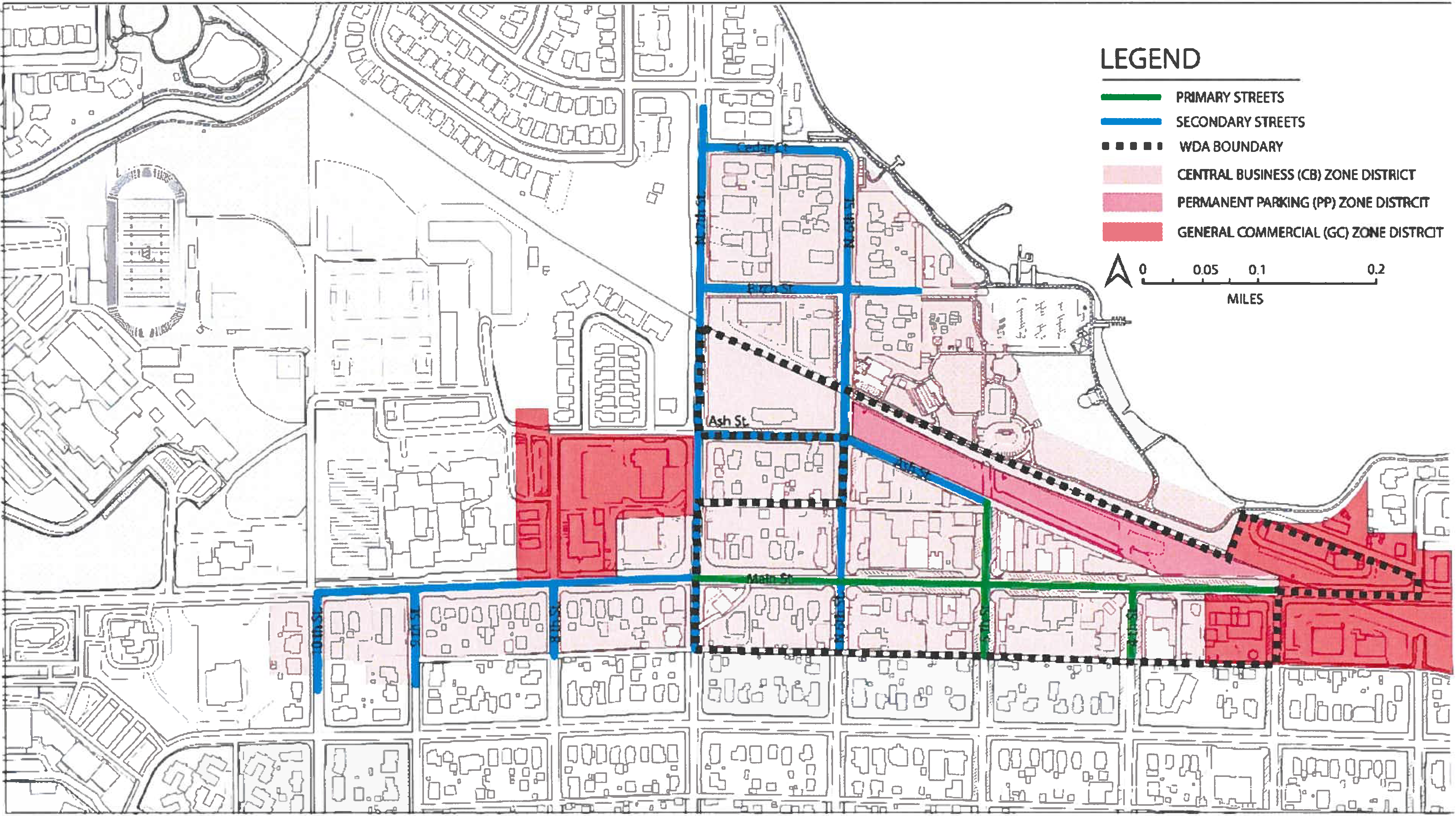
(c)
Use regulations.
(1)
Permitted uses by right. Principal uses permitted by right in the Central Business Zone District are listed in Table 16-1-111 with a "P". These uses are allowed where they comply with the development standards, and other applicable regulations of this Code.
(2)
Conditional uses. Uses allowed in the Central Business Zone District if approved through the conditional use process outlined in Section 14-2-130, are listed in Table 16-1-111 with a "CU". These uses are allowed as long as they comply with the conditional use approval criteria, development standards, and other regulations of this Code.
(3)
Special Conditional Uses. Uses allowed in the Central Business District, if approved through the Special Conditional Use process outlined in Section 14-2-230, are listed in Table 16-1-111 with an "S-CU". These uses are allowed as long as they comply with the Special Conditional Use approval criteria, development standards, and other regulations of this Code.
(4)
Prohibited uses. If use is not listed in table, it is prohibited. Existing uses in categories listed as prohibited may be subject to the regulations of Section 16-3-40(b)(9).
Table 16-1-111:
Central Business District Principal Uses
Key:
P—Permitted Use (by right)
CU—Conditional Use
S-CU—Special Conditional Use
NP—Not Permitted
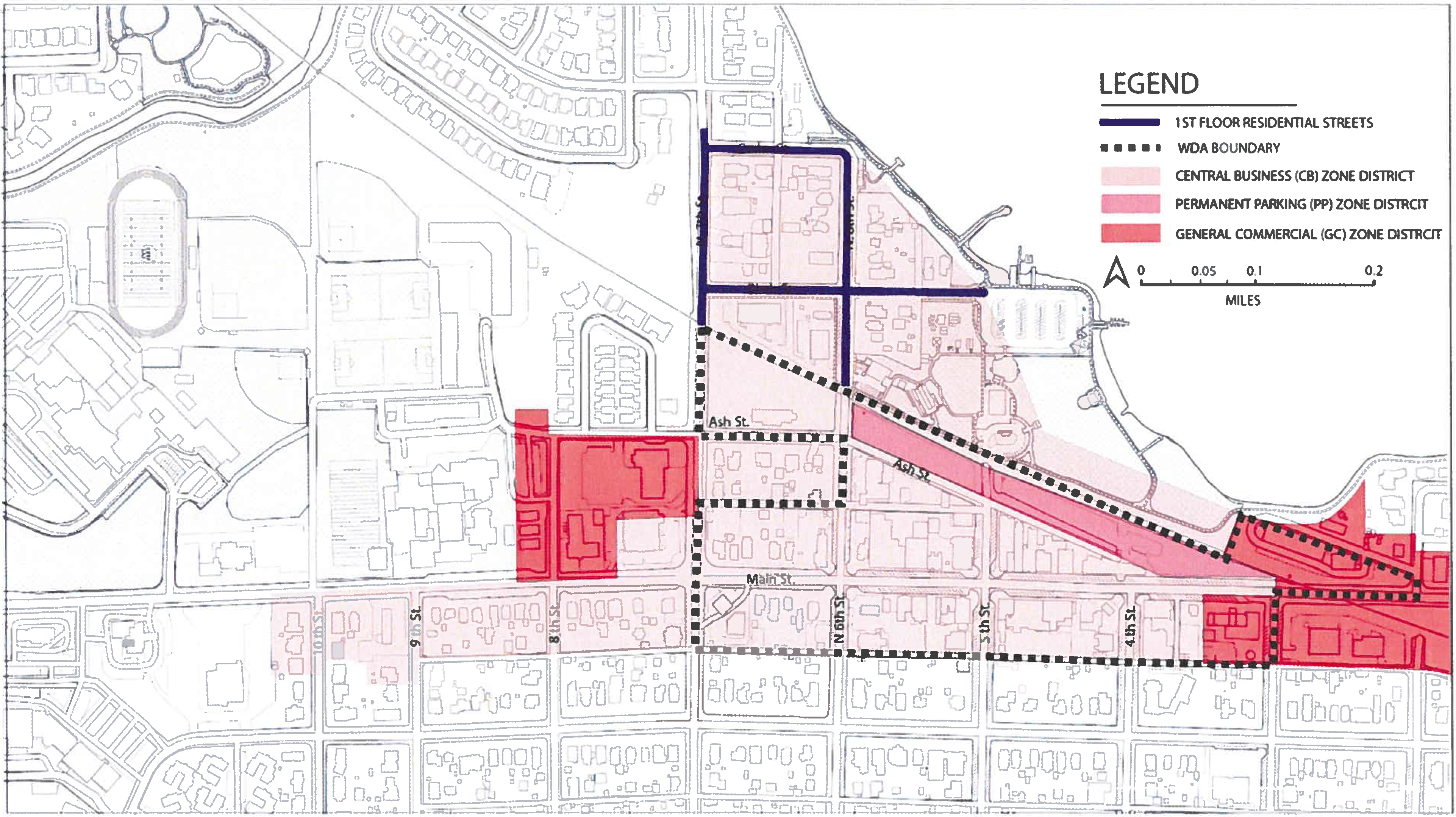
1. Permitted only on streets within the CB zone district identified as "1 st floor residential streets" on Map 16-1-112.
Map 16-1-112—1st Floor Residential Streets
(5)
Permitted accessory uses.
a.
Off-street parking and loading areas.
b.
Signs, subject to the provisions of this Code.
c.
Residential quarters on upper floors of commercial buildings for the owner, proprietor, commercial tenant, employee, or caretaker, located in the same building as the business.
d.
Commercial buildings with commercial uses on the main floor and residential uses on the upper floors.
e.
Any other structure, including garages for storage of vehicles in conjunction with the operation of a business or use clearly incidental to and commonly associated with the operation of a principal use permitted by right.
f.
Temporary greenhouse structures in which growing plants are kept for sale to the public.
g.
Mobile food vending as set forth in this Chapter.
(d)
Development standards.
(1)
Building height in the Central Business District.
a.
Purpose. The purpose of using stories as the measurement of height in addition to feet in the Central Business District is to provide an incentive for the creation of buildings with improved exterior and interior proportions resulting from greater floor-to-ceiling heights.
b.
General. The dimension of each story shall be limited to fifteen (15) feet between finished floor and finished ceiling. This precludes the possibility of inserting additional stories within an allowable story. Interstitial space (between stories) shall only be permitted for the use of mechanical, electrical, plumbing, or similar equipment and materials and must be approved by the Director.
(e)
Building design standards abutting primary streets.
(1)
These standards are limited to portions of buildings with frontages that face a primary street. Buildings that front a primary street shall provide twenty (20) feet of habitable space along seventy percent (70%) of the front façade. Habitable space shall be measured from the interior wall of the front façade. For new construction, first (1 st ) floor habitable space must have a minimum height of fourteen (14) feet.
(2)
All new buildings that front designated primary streets must select and adhere to a minimum of one (1) of the frontage types listed in Table 16-1-113. Encroachments into the right-of-way ("R.O.W.") are subject to applicable permits.
Table 16-1-113: Primary Street Frontage Design Standards.
| Frontage Type | Detail |
|---|---|
Awning/Canopy/Marquee
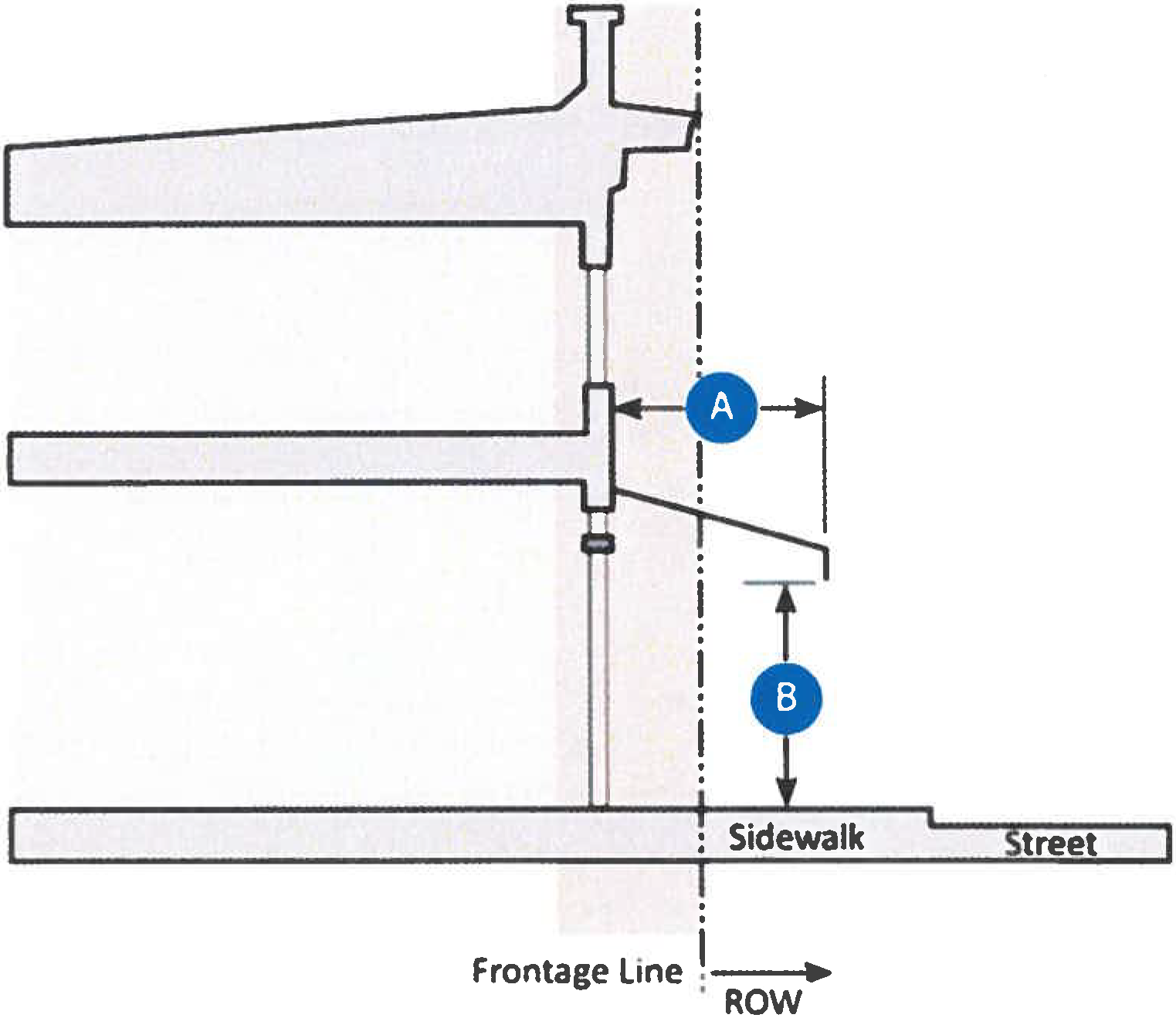 |
A. Awnings/Canopies shall have a minimum depth of five (5) feet measured perpendicular
to the wall face.
B. Awnings/Canopies/Marquees shall have a minimum clearance heigh of eight (8) feet measured from the sidewalk to the lowest portion of the Canopy/Awning/Marquee. Awnings/Canopies/Marquees shall be established at the top of the first-floor façade. There are no minimum requirements for additional awnings or canopies above the first floor. Awnings/Canopies shall not extend closer than two (2) feet from the back of curb (street). |
Arcade/Gallery
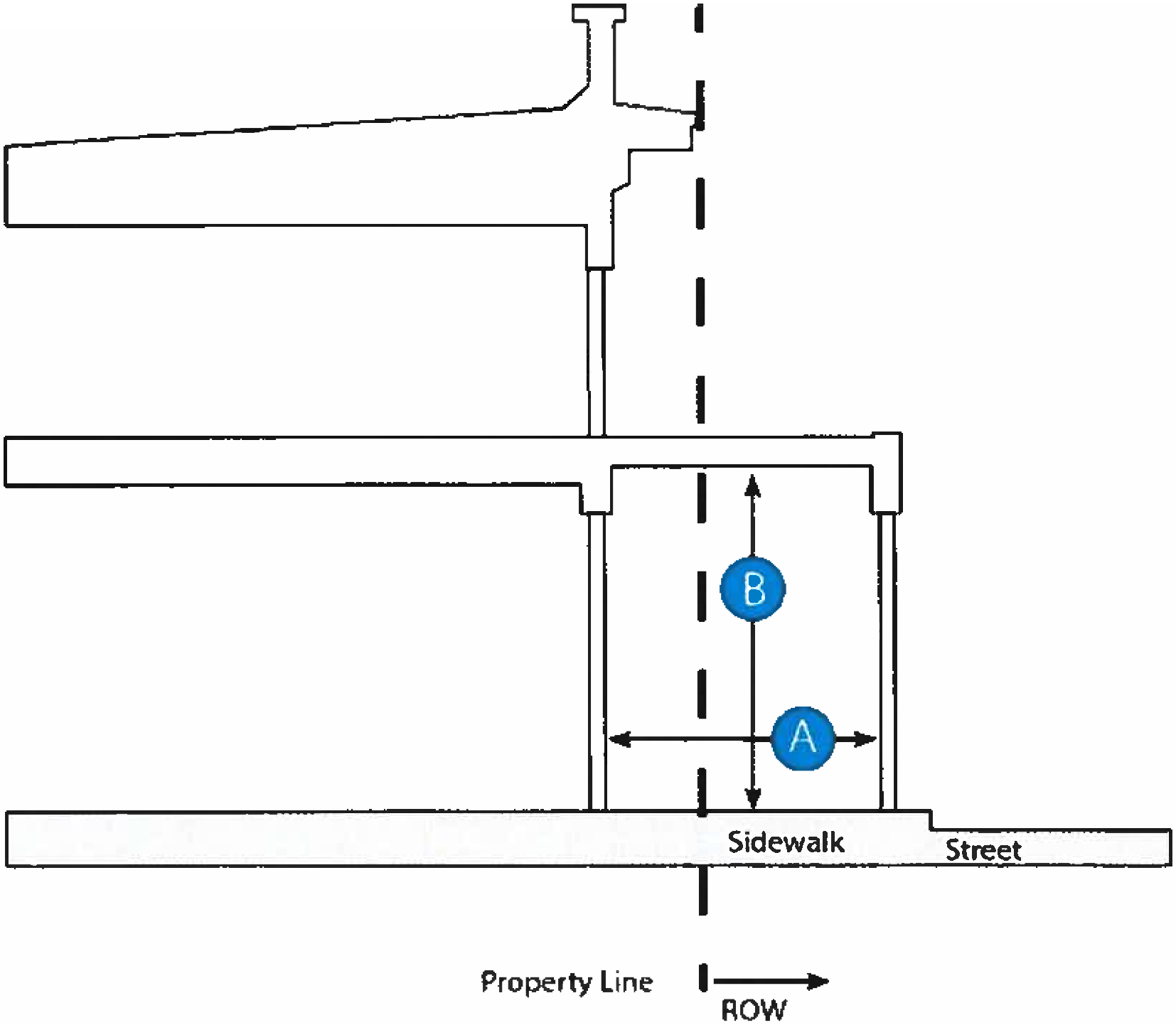 |
A. The Arcade/Gallery shall be no less than ten (10) feet wide (measured from the
building façade to the inside of the column). Where the curb along the frontage is
irregular, the predominant curb line along the block shall be used. The Arcade/Gallery
may encroach in the R.O.W. with a permit.
B. The minimum clear height within the first story walkway space shall be twelve (12) feet. Pedestrian activation such as street furniture, outdoor dining, etc. is encouraged within the arcade/gallery structure. A permit for any encroachment into the R.O.W. may be required. |
Porch and Fence
 |
A. Porches shall be no less than six (6) feet deep and may be utilized as habitable
space if programmed for activity.
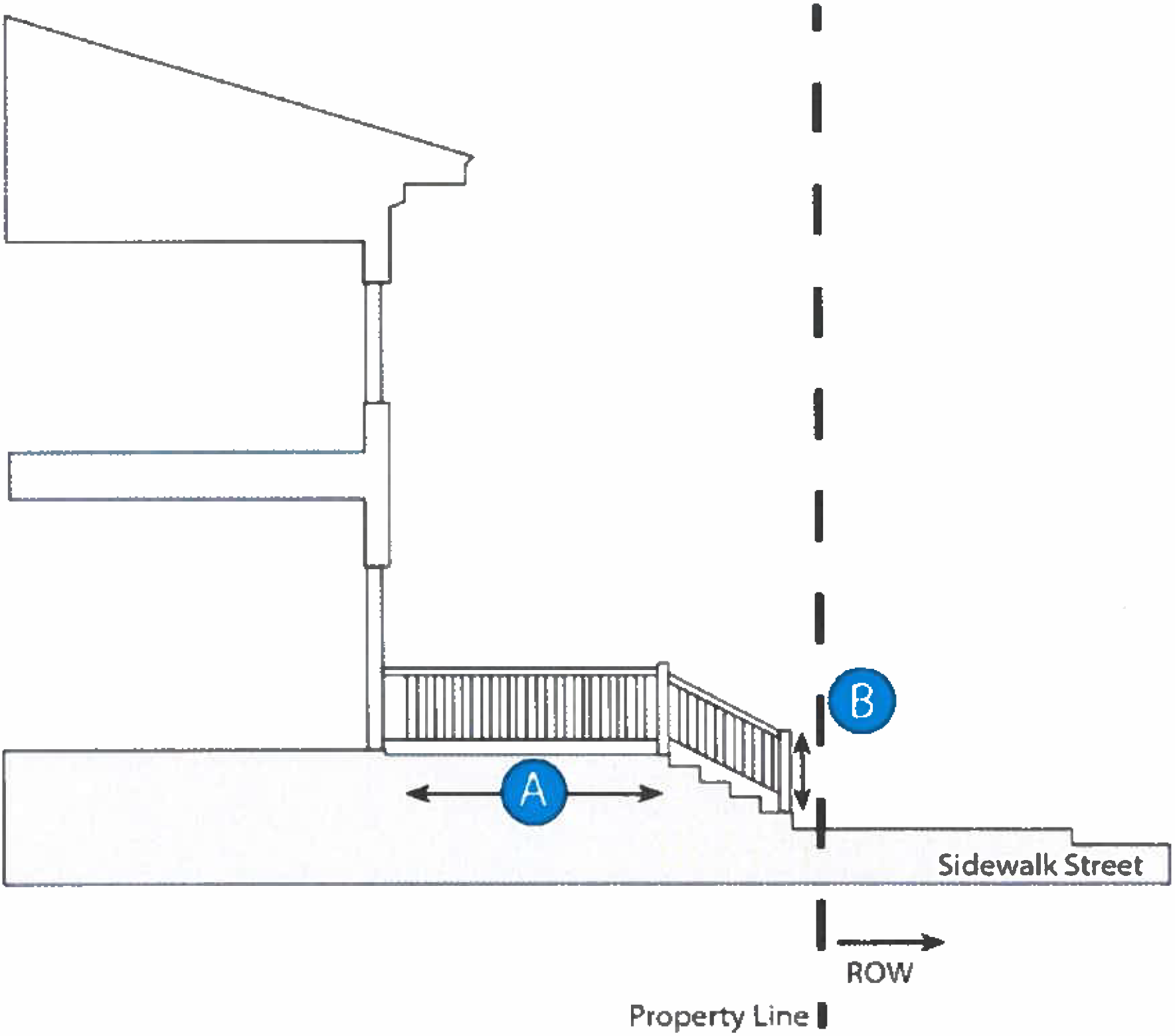
B. Fencing shall not exceed four (4) feet in height, shall be of an open design (wrought iron or similar high-quality material, maintaining seventy-five percent (75%) transparency, and shall not interfere with pedestrian, bicycle or vehicular visibility). A fence may be installed on private property near the front property line(s), separating the porch and the adjacent right-of-way. |
(f)
Architectural Design Standards.
General standard. New infill development or alterations to existing building façades shall be compatible with the established architectural character of such areas by using a design that is complementary. The architecture of new infill development shall set an enhanced standard of quality for future projects in the Central Business District. New infill development within the Central Business District shall meet the architectural standards outlined in Table 16-1-114.
Table 16-1-114: Architectural Design Standards
(g)
Parking.
The following additional standards apply to parking in the Central Business zone district and supersede where in conflict with other parking provisions.
(Ord. 2020-1620 §3; Ord. 2024-1694 §7; Ord. 2025-1722 §7)
Sec. 16-1-115. - Permanent parking (PP) district.
(a)
Purpose. The purpose of the PP zone district is to preserve:
(1)
Permanent parking within the CB district; and
(2)
Vehicular and pedestrian access to the parking areas and businesses for commercial and recreational activities.
(b)
Lot Development Standards.
(1)
The PP zone district development will be permanently restricted to paved, striped parking following Town standards for spacing and ADA compliance.
(2)
Areas within the PP zone district with shapes of square footage not capable of being developed into parking may be developed with open space, walking paths, art, or seating.
(3)
Portions of the PP zone district may be developed as necessary to provide for vehicular and pedestrian access to the parking areas and for commercial activities such as pickup and delivery to businesses, or trash services.
(c)
Use regulations. The PP zone district will only be used for parking and access as set forth in subsection (b) of this Section.
(Ord. of 2-3-2023 §4)
Sec. 16-1-120. - General commercial (GC) district.
(a)
Purpose. The purpose of the GC zone district is to:
(1)
Establish and preserve areas of commercial development in proximity to arterial roadways.
(2)
Foster attractive, human scale development that positively contributes towards the Town's unique character.
(3)
Provide efficient and safe pedestrian, bicycle and automobile circulation, including direct connections to adjacent residential development.
(4)
Promote economic vitality.
(b)
Lot Development Standards. Development within the GC zone district shall adhere to the standards contained in Table 16-1-120(b) and this Section.
Table 16-1-120(b): GC District Lot Development Standards
(c)
Use Regulations.
(1)
Principal uses permitted by right. All uses by right as set forth in this Section shall be subject to the exercise of the Town's police powers as are otherwise set forth in this Code, including but not limited to site planning requirements and building code compliance.
a.
Drive-in restaurants.
b.
Grocery stores and supermarkets.
c.
Gasoline service stations.
d.
Commercial lodging.
e.
Restaurants and bars.
f.
Outdoor sales areas, such as garden shops.
g.
Automobile sales and service establishments, including used car lots.
h.
Lumber and building supply yards.
i.
Public, private, commercial, and private group outdoor recreational facilities.
j.
Bowling alleys.
k.
Business and professional offices.
l.
Places of assembly (small).
m.
Places of assembly (large).
n.
Other similar uses as defined in this Code.
o.
Natural medicine healing centers, as defined in Chapter 14, Article V of this Code, and subject to site plan approval.
(2)
Permitted accessory uses:
a.
Any accessory use permitted in the Central Business CB District, excluding any residential use.
b.
Mobile food vending as set forth in this Chapter.
c.
Accessory outdoor storage:
1.
Shall be used only for storage of materials, inventory or equipment used or offered for sale in the ordinary course of the business activity occurring on-premises, including overstock or bulk items.
2.
Outdoor storage areas shall be located in the rear or side of the building and shall not abut or face arterial or major collector streets as defined by the Town's street standards.
3.
Shall not displace any off-street parking spaces depicted on the approved site plan for the premises.
4.
Items located in outdoor storage areas shall be permanently and fully screened from adjacent residential property, public rights-of-way and private drives by opaque structural walls, opaque fencing and/or a combination thereof that is at least as tall as the tallest items in storage. Screening materials shall conceal all items in storage, shall be opaque and consist predominately of colors and materials generally matching the principal building on the premises. Chain link screening material, with or without slats, is prohibited.
5.
If site constraints preclude items in storage from being fully concealed as required in subsection iv above, a proposed screening plan shall be reviewed and subject to approval based on the conditional use permit standards and requirements applicable to the conditional use permit process as elsewhere provided in this Code.
d.
Outdoor display of merchandise for sale on-site:
1.
Outdoor display of merchandise shall be incidental to the primary retail use.
2.
Merchandise on outdoor display shall consist only of inventory offered for sale within the principal building on the premises.
3.
Outdoor merchandise display shall be adjacent to the principal building and shall be within forty (40) feet of a customer entrance to the principal building, while maintaining at all times no less than four (4) feet of clear width on the sidewalk for pedestrian use.
4.
Outdoor merchandise display shall not displace any off-street parking spaces depicted on the approved site plan.
e.
Seasonal sales:
1.
Outdoor display of merchandise for seasonal sales shall be located in the site plan-approved parking area for the premises.
2.
The seasonal sales outdoor display area shall not displace more than five percent (5%) of site-plan required off-street parking spaces or impede parking lot circulation.
3.
All seasonal sales inventory, structures and improvements shall be removed upon the conclusion of the seasonal sale period, and the parking surface shall be restored to its former condition. For purposes of this Section, seasonal sales shall mean temporary sales of inventory or services offered for sale on a seasonal basis in the principal building for a duration of no longer than ninety (90) consecutive days for each seasonal display, whether or not such inventory or service is displayed in a temporary structure.
(3)
Conditional uses. The following uses shall be permitted in this District upon approval of a conditional use permit as provided in Section 14-2-130:
a.
Outdoor theater.
b.
Non-accessory signs.
c.
Oil and gas facilities pursuant to the conditional use regulations contained in this Chapter pertaining thereto.
d.
Subject to the applicable requirements of this Chapter, open or surface mining operations for the development or extraction of solid materials, as defined in this Code.
e.
Carwash facilities, whether a principal use or an accessory use, shall meet minimum use-specific criteria for consideration of a conditional use permit. Carwash facilities approved prior to enactment of the conditional use permit approval requirement shall remain lawful. Any expansion of an existing carwash shall be subject to a conditional use permit and use specific criteria.
1.
Site shall be setback a minimum of two hundred (200) feet from residential, commercial lodging, facilities housing residents such as nursing and assisted living facilities, or properties zoned for residential uses, and shall provide Bufferyard Standard D, per Code Section 15-3-30(b)(8).
2.
Adequate water supply. Applicant shall supply accurate water supply data to the Town for adequate water supply evaluation, adhere to all Town raw water dedication requirements, water efficiency policies and standards, as amended.
(Ord. 2020-1620 §3; Ord. 2024-1694 §8; Ord. 2025-1727 §4)
Sec. 16-1-130. - Limited industrial (LI) zone.
(a)
Purpose. The purpose of the LI zone district is to:
(1)
Establish and preserve areas for a variety of low to moderate intensity industrial and commercial uses including manufacturing, and warehousing distribution with limited outdoor storage.
(2)
Minimize potential conflicts between heavy truck traffic and passenger vehicle, bicycle, and pedestrian traffic by providing convenient access to rail corridors, arterial roadways and state highways.
(3)
Promote economic vitality.
(b)
Lot Development Standards. Development within the LI zone district shall adhere to the standards contained in Table 16-1-130(b) and this Section.
Table 16-1-130(b): LI District Lot Development Standards
(c)
Use Regulations.
(1)
All uses by right as set forth in this Section shall be subject to the exercise of the Town's police powers as are otherwise set forth in this Code, including but not limited to site planning requirements and building code compliance. In addition to the site plan requirement, proposed users shall submit evidence satisfactory to the Town that the proposed use will comply in all respects with the Performance Standards for Industrial Zones as set forth in this Chapter.
(2)
Uses by right. Subject to the requirements set forth in Subsection (a) above, the following uses shall be permitted in the Limited Industrial (LI) District:
a.
Manufacture of electronic instruments.
b.
Preparation of food products.
c.
Pharmaceutical manufacturing.
d.
Research and scientific laboratories.
e.
Manufacturing, assembly, processing and fabrication plants.
f.
Transportation terminals.
g.
General warehousing.
h.
Enclosed storage facilities.
i.
Printing and publishing houses.
j.
Automobile body repair shops.
k.
Plumbing and heating contractors.
l.
Painting and decorating contractors.
m.
Electrical contractors.
n.
Glazing, insulation, carpentry and masonry contractors.
o.
Public utility offices and installations.
p.
Places of assembly (small).
q.
Places of assembly (large).
r.
Any use otherwise permitted in the General Commercial GC District.
s.
Other similar uses as defined in this Code.
(3)
Accessory uses. Assuming approval of designated uses by right as aforesaid, the following shall be permitted accessory uses in the Limited Industrial L-I District:
a.
Office, power supply and other such uses normally auxiliary to the principal industrial use.
b.
Parking and service areas.
c.
Accessory signs as otherwise regulated by this Code or the laws of the State.
d.
Residential quarters for guards and caretakers.
e.
Accessory outdoor storage that is normally auxiliary to the principal industrial use of the property. The total square footage of accessory outdoor storage in the Limited Industrial (LI) District shall not exceed sixty-five percent (65%) of the total square footage of the property. Any such storage located adjacent to a public or private street shall utilize screen walls, earth berms, landscaping, opaque fencing and/or a combination thereof to completely screen the storage, and no such storage shall be visible above or between said methods of screening. Chain-link fencing with slats shall not be considered adequate opaque fencing. Additionally, such outdoor storage areas may be surfaced with aggregates or recycled asphalt meeting CDOT Class 5 or 6 aggregate base course gradation, or any subsequent amendments thereto. Such surface materials shall require a plan for perpetual maintenance and dust abatement to be approved by the Engineering Department. However, all areas which are designed to be used for parking of vehicles and all interior drives connecting such parking areas shall be paved with asphalt or concrete. For the purposes of this Section, portions of the aggregate surface outdoor storage area may be utilized for parking of company-owned vehicles with a valid state license plate upon identification and Town approval of a site plan application. Such areas for parking of company-owned vehicles as identified on the approved site plan shall not be included in the calculation of outdoor storage for the site.
f.
Any other structure or use clearly incidental to and commonly associated with the operation of a principal use permitted by right, conditioned upon the approval of such accessory use pursuant to the site plan requirements set forth herein.
g.
Mobile food vending as set forth in this Chapter.
(4)
Conditional uses:
a.
Oil and gas facilities pursuant to the conditional use regulations contained in this Chapter pertaining thereto.
b.
Subject to the applicable requirements of this Chapter, open or surface mining operations for the development or extraction of solid materials, as defined in this Code.
c.
Set forth below is a listing of addresses for parcels of land which shall be deemed exempt from the requirements and limitations set forth in Section 16-1-130(c)(3)e. above. Such exemption shall be deemed to run with the land identified below:
1.
7250 Greenridge Road;
2.
4477 Greenfield Drive;
3.
780 Garden Drive; and
4.
620 Technology Circle.
(Ord. 2020-1620 §3)
Sec. 16-1-140. - Heavy industrial (HI) district.
(a)
Purpose. The purpose of the HI zone district is to:
(1)
Establish and preserve areas suitable for heavy industrial use, including those that might impact surrounding neighborhoods and businesses.
(2)
Ensure appropriate separation from neighborhoods and businesses which may be negatively impacted by heavy industrial uses.
(3)
Minimize potential conflicts between heavy truck traffic and passenger vehicle, bicycle, and pedestrian traffic by providing convenient access to rail corridors, arterial roadways and state highways.
(4)
Promote economic vitality.
(b)
Lot Development Standards. Development within the HI zone district shall adhere to the standards contained in Table 16-1-140(b) and this Section.
Table 16-1-140(b): HI District Lot Development Standards
(c)
Use Regulations.
(1)
All uses by right as set forth in this Section shall be subject to the exercise of the Town's police powers as are otherwise set forth in this Code, including but not limited to site planning requirements and building code compliance. In addition to the site plan requirement, proposed users shall submit evidence satisfactory to the Town that the proposed use will comply in all respects with the performance standards for industrial zones as set forth in this Chapter. The proposed user shall be responsible for all costs incurred by the Town in the evaluation and analysis of the evidence presented by the user of compliance with the performance standards for industrial zones. This shall include, but shall not be limited to, costs incurred for services rendered by the respective health department of either Weld County or Larimer County or similar public or private agencies.
(2)
Uses by right. Subject to the requirements set forth in Subsection (a) above, the following uses shall be permitted in the Heavy Industrial HI District:
a.
Petrochemical industries.
b.
Rubber refining industries.
c.
Primary metal and related industries.
d.
Trucking operations.
e.
Slaughterhouses.
f.
Foundries.
g.
Automobile, farm equipment and machinery sales.
h.
Places of assembly (small).
i.
Places of assembly (large).
j.
Any use otherwise permitted in a Limited Industrial LI Zoning District.
k.
Any use otherwise permitted in a General Commercial GC Zoning District.
l.
Other similar uses as defined in this Code.
m.
Class VI wells, as defined in Section 16-5-60(a) of this Code.
n.
Natural medicine businesses, as defined in Chapter 14, Article V of this Code, and subject to site plan requirements.
(3)
Accessory uses. Assuming approval of designated uses by right as aforesaid, the following shall be permitted accessory uses in the Heavy Industrial HI District:
a.
Office, power supply and other such uses normally auxiliary to the principal industrial use.
b.
Parking and service areas.
c.
Accessory signs as otherwise regulated by this Code or state laws.
d.
Residential quarters for guards or caretakers.
e.
Accessory outdoor storage that is normally auxiliary to the principal industrial use of the property. Such outdoor storage areas may be surfaced with aggregates or recycled asphalt meeting CDOT Class 5 or 6 aggregate base course gradation, or any subsequent amendments thereto. Such surface materials shall require a plan for perpetual maintenance and dust abatement to be approved by the Engineering Department. However, all areas which are designed to be used for parking of vehicles and all interior drives connecting such parking areas shall be paved with asphalt or concrete.
f.
Any other structure or use clearly incidental to and commonly associated with the operation of a principal use permitted by right, conditioned upon the approval of such accessory use pursuant to the site plan requirements set forth herein.
g.
Mobile food vending as set forth in this Chapter.
(4)
Conditional uses.
a.
Kennels.
b.
Oil and gas facilities pursuant to the conditional use regulations contained in this Chapter.
c.
Subject to the applicable requirements of this Chapter, open or surface mining operations for the development or extraction of solid materials, as defined in this Code.
d.
Adult businesses.
(Ord. 2020-1620 §3; Ord. 2022-1671 §2; Ord. 2025-1727 §5)
Sec. 16-1-150. - Recreation and open lands (ROL) district.
(a)
Purpose. The purpose of the ROL zone district is to:
(1)
Preserve certain large open land areas, which by reason of topographical features or proximity to natural drainage courses are unsuitable for intense development.
(2)
To preserve designated open space that is managed to preserve the natural environment and protect native flora and fauna.
(3)
Provide recreational opportunities.
(b)
Lot Development Standards. Development within the ROL zone district shall adhere to the standards contained in Table 16-1-150(b) and this Section.
(c)
Use Regulations. All uses by right as set forth in this Section shall be subject to the exercise of the Town's police powers as are otherwise set forth in this Code, including but not limited to site planning requirements and building code compliance.
(1)
Principal uses permitted by right.
a.
Public parks and recreation areas.
b.
Public schools.
c.
Public, private, commercial and private group outdoor recreational facilities.
d.
Other similar uses as defined in this Code.
(2)
Permitted accessory uses.
a.
Service buildings and facilities normally incidental to the use of a public park and recreation area.
b.
Any other structure or use clearly incidental to and commonly associated with the operation of a principal use permitted by right.
(3)
Conditional uses. The following uses shall be permitted in this District upon approval of a conditional use grant as provided in Section 14-2-130:
a.
Public administrative offices and services buildings.
b.
Public utility installations, including transmission lines and substations.
c.
Oil and gas facilities pursuant to the conditional use regulations contained in this Chapter pertaining thereto.
d.
Subject to the applicable requirements of this Chapter, open or surface mining operations for the development or extraction of solid materials, as defined in this Code.
(Ord. 2020-1620 §3)
Sec. 16-1-160. - Agriculture holding (AH) district.
(a)
Purpose. The purpose of the AH zone district is to provide a zoning designation for properties which have been annexed to the Town and at the time of annexation are:
(1)
Either being used for agricultural purposes and/or have no specific future land use proposed at the time of annexation; and
(2)
Are in a transitional stage with regard to the property's ultimate development.
(b)
Use Regulations. All uses by right as set forth in this Section shall be subject to the exercise of the Town's police powers as are otherwise set forth in this Code, including but not limited to site planning requirements and building code compliance.
(1)
Principal uses permitted by right.
a.
Agriculture
b.
Single-family dwellings
(2)
Permitted accessory uses.
Service buildings and facilities normally incidental to agricultural uses.
(3)
Conditional uses. The following uses shall be permitted in this District upon approval of a conditional use grant as provided in Section 14-2-130:
a.
Public utility installations, including transmission lines and substations.
b.
Oil and gas facilities pursuant to the conditional use regulations contained in this Chapter pertaining thereto.
c.
Subject to the applicable requirements of this Chapter, open or surface mining operations for the development or extraction of solid materials, as defined in this Chapter.
d.
Open or surface mining operations for the development or extraction of solid materials.
(c)
Restriction on Subdivision. No property zoned AH shall be subdivided for the purpose of allowing further land development. Subdivision for the purpose of development shall require appropriate zoning other than AH.
(d)
Lot Development Standards. Development within the AH zone district shall adhere to the standards contained in Table 16-1-160(d) and this Section.
(Ord. 2020-1620 §3)
Sec. 16-1-170. - Planned unit development (PUD) district.
(a)
Intent. The Planned Unit Development Overlay District (PUD) is enacted pursuant to the Planned Unit Development Act of 1972 as amended (C.R.S. § 24- 67-101, et. seq.). The PUD is an overlay zone district that supplements the underlying standard zone district. A PUD is expected to preserve critical environmental resources, provide above- average open space and recreational amenities, include exceptional design, and provide greater efficiency in the layout and provision of roads, utilities and other infrastructure. The intent and purpose of this district is:
(1)
To permit and encourage innovative design and high quality, master planned developments on large parcels of land.
(2)
To allow and encourage compatible uses to be developed in accordance with a unified development plan in harmony with the environment and surrounding neighborhood.
(3)
To permit greater flexibility in the application of zoning and development standards and greater freedom in providing a mix of land uses in the development of a balanced community.
(b)
Permitted Uses. Uses permitted in the PUD shall be those uses permitted in the underlying standard zone district for the property. An applicant for a PUD may request modifications to the permitted uses of the underlying zone district to remove those uses that may be deemed incompatible or inappropriate for the overall PUD development or add uses necessary to meet the foregoing statement of Intent for PUDs.
(c)
PUD Restrictions and General Requirements. Properties utilizing the PUD shall be subject to the following:
(1)
All PUD applications shall include a gross land area of not less than forty (40) acres. The Community Development Director, or their designee, shall have the power to adjust this requirement to a lesser acreage, so long as the proposal is consistent with the intent of subsection (a) above.
(2)
All requirements set forth in this Code otherwise applicable to the area of land proposed for a PUD shall govern unless explicitly otherwise approved in the PUD.
(3)
No PUD may be approved by the Town without the written consent of the landowner whose property is included within the PUD.
(4)
A proposed PUD shall be in conformance with an approved Master Plan or a Master Plan shall be concurrently submitted and reviewed.
(d)
Minimum Standards. The following standards are considered minimum standards and are not eligible for modification:
(1)
Town standards for bicycle and pedestrian facilities.
(2)
Street connectivity standards.
(3)
Subdivision open space standards.
(4)
Density. Overall density shall be in accordance with the Comprehensive Plan Land Use Map and Town sanitary sewer capacity determinations.
(e)
Amendments to Approved PUD.
(1)
Minor changes to an approved PUD may be authorized administratively by the Director. Such changes may be authorized without additional public hearings and shall be reviewed on the basis of conformance with the Town's Comprehensive Plan and this Code. The Director may refer the decision regarding proposed changes to an approved PUD to the Planning Commission and, if so referred, the decision by the Planning Commission shall constitute a final decision which may be appealed to the Town Board pursuant to the provisions of this Code.
(2)
Major changes to an approved PUD shall be treated as a new PUD application under the provisions of this Section. Major changes to an approved PUD shall be reviewed in the same manner as the review process required for approval of a PUD and shall demonstrate proof of a material change of circumstances that renders the prior approval inconsistent with the objectives of the Section.
Major changes shall be defined as meeting any one (1) or more of the following:
a.
A change in the land uses allowed under the PUD;
b.
A change in the character of the development which would result in a change in the outward appearance of the development as a whole, or increase impacts on the surrounding area;
c.
An increase in the impacts to traffic and/or public utilities;
d.
A change which would result in the development no longer meeting the standards of this Chapter under which the project was approved;
e.
An increase in the approved gross leasable floor areas of commercial or industrial developments;
f.
An increase in the approved number of residential dwelling units;
g.
Removal of a recreational amenity; or
h.
A modification to any dimensional standard.
(3)
In order for the Town to consider a proposed PUD amendment, the applicant shall provide written approval of the proposed amendment by not less than seventy-five percent (75%) of the owners of not less than seventy-five percent (75%) of the land area for PUD plans approved after the effective date of this Section. The applicant may submit at the time of initial PUD application, and the Town may (but shall not be required to) approve, a provision which permits less than seventy-five percent (75%) of the owners of not less than seventy-five percent (75%) of the land area in a PUD to approve of a proposed PUD amendment. In no event shall an amendment be permitted which has less than fifty-one percent (51%) of the owners of less than fifty-one percent (51%) of the land area giving written approval for the proposed amendment.
(f)
Development Control Committee.
(1)
Internal Governance. Developer shall be responsible for the creation of a private internal development control committee (DCC) for any PUD development to review site plan and building permit applications for new buildings within the subdivision.
(2)
Applicability. Any person or entity applying to the Town for approval of a site plan or building permit to construct a new building, excluding accessory buildings, shall be subject to review and written recommendation by the DCC to the Town.
(3)
Review. The DCC shall review the application and forward to the Planning Department a recommendation of approval or denial based solely with the applicable lot development standards contained within the PUD.
(4)
Private Covenants. The DCC may review and enforce private covenants, conditions, and restrictions, but such review shall be separate from and independent from the recommendation to the Town.
(5)
Timely Review. The DCC shall review all such applications in a timely manner in accordance with established schedules.
(6)
DCC Composition. Among other potential members, the DCC may include: the developer or designee of the subdivision, an outside architect or design professional, a property owner within the subdivision.
(7)
Waivers. The Director may waive the requirement for the establishment of the DCC or review by the DCC if it is determined it is unnecessary to implement the requirements of the zone district.
(Ord. 2020-1620 §3; Ord. 2023-1684 §1)

