
Windsor Village City Zoning Code
ARTICLE III
- GENERAL PROVISIONS, REGULATIONS, AND STANDARDS.
Sec. 52-20. - General restrictions, provisions and exceptions.
(1)
Principal buildings. There shall not be more than one principal building on a lot except within:
(a)
The C-1 and C-2 commercial districts;
(b)
The MF-3 Multiple Family Residential District for multiple family structures;
(c)
The GI, Government and Institutional District;
(d)
Condominium plats; and
(e)
The A-1 (EX) Exclusive Agriculture district for:
1.
Secondary farm residences; and
2.
Single family dwellings or mobile homes occupied by parents or children of the farm operator.
(2)
Agricultural accessory structures. No principal building(s) together with its accessory structures shall exceed ten percent of the lot area.
(3)
Commercial accessory structures. No principal building(s) together with its accessory structures shall exceed the maximum lot coverage permitted within the applicable zoning district.
(4)
Residential accessory structures. Accessory structures associated with a principle permitted or conditional use are permitted on lots in the various zoning districts, subject to the regulations specified below and in the applicable district regulations of this ordinance:
(a)
Principal use required. A principal use or building must exist or be under construction prior to the erection or placement of an accessory structure, unless allowed under the applicable district regulations of this ordinance.
(b)
Sanitary fixtures. Sanitary fixtures are prohibited.
(c)
Number limitation. The total number of accessory structures on lots in the R-1, R-2, R-3, R-4, MF-2, ER, and CR residential districts shall be limited to three, unless additional structures are approved through the conditional use process. Accessory structures may include any of the following:
1.
Detached garage (provided a detached garage does not already exist on the lot);
2.
Gazebo;
3.
Shed;
4.
Pool house;
5.
Swimming pool;
6.
Chicken coop and run; or
7.
Similar accessory structures as determined by the Planning and Zoning Specialist.
(d)
Size and lot coverage limitations.
1.
In the R-1, R-2, R-3, R-4, ER, and CR residential districts, the total of all accessory building footprints shall be limited to five percent of the lot area. In the MF-2 District, total accessory building footprint shall be limited to 120 square feet per dwelling unit on the lot. In addition, the following shall also be included in the footprint calculation:
a.
Any roof overhang or eave exceeding two feet; and
b.
Any finished loft space above the first floor.
2.
The total of all buildings on the lot shall not exceed the maximum building coverage permitted within the applicable zoning district.
3.
The total of all structures on the lot shall not exceed the maximum impervious coverage permitted within the applicable zoning district. Below ground swimming pools may not count toward the maximum impervious coverage limit provided they are designed with an approved below ground overflow infiltration system as determined by the Planning and Zoning Specialist and/or Village Engineer.
4.
Special exceptions to the size and lot coverage limitations may be approved through the conditional use process.
(e)
Compatibility.
1.
Accessory structures greater than 120 square feet in size shall be compatible with the principal buildings(s) on the lot. Compatibility criteria include, but are not limited to:
a.
Roof type/pitch;
b.
Materials and colors. Materials and colors are not required to be identical to the principle structure, but shall include similar and/or complementary components and features for substantial portions of the elevations;
c.
Scale and massing; and
d.
Window proportions and trim treatment;
(f)
Setback requirements. No accessory structure shall be erected, moved or structurally altered so as to be nearer the highway or road than is prescribed by subsection 52-21(1).
(g)
Side and rear yard requirements.
1.
Accessory structures less than 120 square feet in size shall be located not less than four feet from any side or rear lot line.
2.
Accessory structures 120 square feet or larger in size shall be located not less than ten feet from any side or rear lot line.
(h)
Existing accessory structures. All accessory structures lawfully existing as of (insert adoption date) shall be considered a permitted use. Notwithstanding the provisions of sections 52-24 and 52-25 regarding nonconforming uses, such structures may be added to, altered, restored, repaired, replaced or reconstructed, provided the locational requirements of the district in which the structure is located are followed.
(i)
Permits required. No accessory structure may be erected or placed without first obtaining a building and/or zoning permit as specified in subsection 52-101(12), except as provided below.
1.
Accessory structures less than 120 square feet in gross floor area require a building permit. Accessory structures greater than 120 square feet in gross floor area require a building permit and zoning permit. It shall be the responsibility of the owner to demonstrate compliance with the setback requirements of this ordinance upon request.
(5)
Use.
(a)
Any use not listed as a permitted use in a district is prohibited in that district and except as otherwise expressly provided, any use listed as a permitted use in any other district shall be construed as a prohibited use in any other district.
(b)
The following uses shall be allowed, subject to a building permit, in any district when these uses do not alter the character of the premises in respect to their use for the purposes permitted in that district:
1.
Real estate offices and signs advertising, and in conjunction with, property for sale and new development for a period not to exceed one year.
2.
Temporary buildings and structures and the temporary storage of materials and equipment incidental to the construction of buildings on the premises for a period not to exceed one year. Each parcel shall be limited to one temporary building or structure.
3.
Temporary, moveable storage containers for a period not to exceed six months. Each parcel shall be limited to one temporary storage container.
(c)
In the agriculture districts: The production of fuel, using products or byproducts from a farm operation on the premises, is a permitted use incidental to the farm operation. Surplus fuel not needed for the farm operation may be sold as any other farm commodity.
(6)
Height.
(a)
No building or structure shall be erected, nor shall any existing building or structure be removed, reconditioned, added to or structurally altered to exceed the height limit established by this ordinance for the district in which that building or structure is located.
(b)
Hospitals, churches, schools, communication towers, water towers, chimneys, spires, cupolas, silos, windmills and similar structures may be erected to a height greater than the maximum permitted in the district in which they are located; provided, however, that no part of that structure above such height limit shall be used for residential purposes.
(7)
Lot area, frontage, coverage, open space, and population density.
(a)
No building or structure shall hereafter be erected, nor shall any existing building be moved, altered, enlarged or rebuilt, nor shall any open spaces surrounding any building or structure be encroached upon or reduced in any manner, nor shall a greater percentage of lot be occupied, except in conformity to the building site requirements and the area and yard regulations established by this ordinance, for the district in which such building or structure is located.
(b)
No building, structure or premises shall be erected, occupied or used so as to provide a greater density of population than is allowed by the terms of this ordinance for the district in which such building, structure or premises is located.
(c)
No yard or other open space provided about any building or structure for the purpose of complying with the regulations of this [chapter] shall be considered as providing yard or open space for any other building or structure. No lot area shall be so reduced or diminished that the yard or other space shall be smaller than prescribed by this ordinance.
(8)
Earth-disturbing activities.
(a)
Purpose. The purpose of this subsection is to set forth the minimum requirements for earth-disturbing activities and further the following interests.
1.
Promote the public health, safety, convenience and general welfare;
2.
Limit earth-disturbing activities detrimental to erosion and sedimentation control and stormwater management practices resulting from the construction of any building, structure, or impervious surface; and
3.
Preserve the general aesthetics and character of the surrounding area.
(b)
Definitions.
1.
Development. Any activity requiring a zoning permit or certificate of compliance, including earth-disturbing activities that will lead to the installation of footings, piers, posts, pilings or foundations.
2.
Earth-disturbing activities. Any activity involving the clearing, cutting, excavating, filling, or grading of earth or any other activity that alters earth topography or vegetative cover.
(c)
Standards.
1.
The established grade within five feet of any property line as depicted on a certified survey map or subdivision plat shall remain unchanged.
2.
Infill development. The Planning and Zoning Specialist shall require the submittal of a detailed grading plan per subsection 52-20(8)(d) before commencement of the earth-disturbing activities when the adjoining properties have been built-out. The established grade of the adjoining properties shall determine the finished grade at the property line for the earth-disturbing activities on the subject property.
3.
Utility easements, drainage easements and natural watercourse. The established grade for all utility easements, drainage easements and natural watercourses as depicted on a certified survey map or subdivision plat shall remain unchanged.
4.
Minimum lowest opening exposure. The lowest opening exposure shall not be less than the lowest opening exposure elevation specified for the lot as depicted on a certified survey map or subdivision plat.
If the lowest opening exposure elevation is not specified on a certified survey map or subdivision plat, the lowest exposure elevation shall be a minimum of 24 inches above the lowest lot corner elevation as depicted on a certified survey map, subdivision plat, or grading plan.
5.
Maximum top of foundation wall elevation. The maximum top of foundation wall elevation shall not be greater than 48 inches above the highest lot corner elevation as depicted on a certified survey map, subdivision plat, or grading plan.
6.
Driveway angle of approach. The vertical angle of the driveway surface between the right-of-way and the edge of pavement shall comply with the Village of Windsor Code of Ordinances, chapter 42, section 42-60(b)—Angle of Approach.
(d)
Special Exception.
1.
The Planning and Zoning Specialist may grant a special exception to the terms of this subsection, only if the earth-disturbing activities are not contrary to the purpose of this subsection. Prior to considering such a special exception, the Planning and Zoning Specialist shall require the submittal of a detailed grading plan to include the following:
a.
Scaled grading plan for the lot illustrating proposed buildings or structures, protected window wells/egress openings, patios, decks, retaining walls, driveways, culverts, etc.;
b.
Lot setbacks and distances between proposed buildings or structures;
c.
Lot easements;
d.
Lot boundaries, boundary lengths, and bearings;
e.
Elevations of lot corners;
f.
A minimum of one existing grade elevation along "side lot boundary" near mid-point of building or structure. Additional grade elevations may be required for lot boundaries greater than 200 feet;
g.
Elevations at top of foundation wall, lowest opening exposure, protected window well/egress opening, centerline of driveway over culvert, edge of sidewalk or path, and street and/or curb to match proposed improvements and existing conditions; and
h.
Proposed driveway length and slope at centerline.
(Ord. No. 2016-27, § 1(Att. A), 11-1-2016; Ord. No. 2019-15, § 1 (Exh. A), 7-18-2019; Ord. No. 2023-07, § 1, 5-4-2023; Ord. No. 2025-11, § 1(Exh. A), 6-19-2025)
Sec. 52-21. - Setback regulations.
(1)
Setback.
(a)
For the purpose of determining the distance buildings and other structures shall be setback from streets and highways, the streets and highways in the Village of Windsor are divided into the following classes:
1.
Class A highways.
a.
All state and federal highways are hereby classified Class A highways.
b.
The setback line for a Class A highway shall be 100 feet from the centerline of the highway right-of-way or 42 feet from the right-of-way line, whichever is greater.
c.
Service roads to Class A highways a distance of 100 feet from the centerline of said highways shall be considered Class C, D or E highways for the purpose of determining the setback along said service roads.
2.
Class B highways.
a.
All county trunks except as otherwise provided, are hereby designated Class B highways. For the purpose of this ordinance any road will be considered as a county trunk after it has been placed on the county trunk system by the county board and approved by the state highway commission.
b.
The setback from Class B highways shall be 75 feet from the centerline of any highway right-of-way or 42 feet from the right-of-way, whichever is greater.
3.
Class C highways.
a.
All Village roads not included within the boundaries of a recorded subdivision or plat are hereby designated Class C highways.
b.
The setback from Class C highways shall be 63 feet from the centerline of such highway right-of-way or 30 feet from the right-of-way line, whichever is greater; provided, however, that in the case of a service road, contiguous to the right-of-way of a main highway, where buildings can be built on only one side of such service road, the minimum setback shall be 30 feet, regardless of the width of such service road, and provided, further, that if such service road shall be a street in a platted subdivision, then the setback provisions governing such platted street shall apply.
4.
Class D highways.
a.
Roads and streets in subdivisions platted prior to the adoption of zoning regulations, except those designated Class A or Class B highways, are hereby designated as Class D highways.
b.
For all Class D highways setback lines are hereby established, parallel to and distant 20 feet from the right-of-way line or front lot line.
5.
Class E highways.
a.
All streets, highways and roads not otherwise classified are hereby designated Class E highways.
b.
For all Class E highways setback lines are hereby established, parallel to and distant 30 feet from the right-of-way or front lot line.
(b)
Where interior lots have frontage on two streets (double frontage lots), no building shall extend into the setback area of either street.
(c)
For purposes of entry to buildings, steps, stoops, decks or ramps may be constructed in such a manner that they intrude into the required front yard setback area provided that all of the following limitations and conditions are satisfied:
1.
Height shall not exceed five feet above ground level, not including railings;
2.
Width shall not exceed 12 feet side to side;
3.
Structure shall extend no farther than ten feet from the front of the building to which it is attached or up to the front property line, whichever is less;
4.
Structure shall not be enclosed. Railings which do not exceed three and one-half feet in height and which are of open architecture and not solid in appearance are permitted;
5.
Structure shall not interfere with existing or planned roads, sidewalks, gas and electrical lines, sewers, drainageways, and other utilities or public improvements. The zoning administrator may require written verification from appropriate agencies before issuing a zoning permit; and
6.
No part of the structure shall extend into any required vision clearance triangle.
(2)
Side and rear yard. Buildings and structures shall conform to side and rear yard requirements found in the respective zoning districts in this ordinance, except for residential accessory structure provisions in subsection 52-20(4)(g) and corner lots as follows:
(a)
When the long side of a corner lot is formed by a Class A, B or C highway the side yard on that street shall conform to the setback requirements for such highway.
(b)
When the long side of a corner lot is formed by a Class D or E highway, the setback from the lot line of the long side shall not be less than one-fifth of the lot depth measured from the long side except on lots of less than 60 feet, then the setback shall not be less than 12 feet. For buildings with attached garages facing the long side and having access to the long side of the lot, the minimum setback of the garage from the lot line shall be not less than 20 feet.
(3)
Section lines disregarded. Any provision of this chapter 52 which requires a building or structure to be constructed a specified distance from a lot line shall not apply to lot lines in which all of the following conditions are met:
(a)
The lot line in question is a section line or quarter section line pursuant to the Public Land Survey System; and
(b)
The parcels on each side of the lot line are owned by the same owner; and
(c)
The parcels on each side of the lot line are located in one of the following zoning districts:
1.
CO-1 Conservancy District
2.
RE-1 Recreational District
3.
A-1 (EX) Exclusive Agriculture District
4.
A-2 Agriculture District
5.
A-3 Agriculture District
6.
A-4 Small Lot Agriculture District
7.
A-B Agriculture Business District
8.
GI Governmental and Institutional District
9.
NMO Nonmetallic Mining Operation
(Ord. No. 2016-27, § 1(Att. A), 11-1-2016; Ord. No. 2024-08, § 1, 5-16-2024)
Sec. 52-22. - Off-street parking and loading.
(1)
Purpose. The purpose of this section is to provide off-street vehicle parking, loading and circulation standards sufficient to prevent congestion of public rights-of-way and provide safe and efficient public access to properties, while minimizing the impact of off-street parking areas on nearby properties and the natural environment.
(2)
Applicability. In all districts, in connection with all uses, at the time any new structure is erected, any use of a structure or land is enlarged or increased in intensity, or any other use or change of use is established, off-street parking, loading and circulation areas shall be provided and located in accordance with the requirements of this section. Off-street parking areas in existence as of the effective date of this ordinance shall not hereafter be reduced below or further below the requirements for a similar new building or use.
(3)
General provisions.
(a)
A scaled and dimensioned parking, loading and circulation plan shall be included within a development plan submitted to and approved by the zoning administrator prior to issuance of a zoning permit for construction or expansion of any use. When a use requires a conditional use permit or site plan review, the parking plan shall be submitted as part of the required application materials.
(b)
No areas designated for parking, loading or circulation may be used for any other purposes. Required parking spaces shall be used solely for the parking of licensed automobiles of occupants, patrons and employees and licensed service vehicles.
(c)
All parking spaces required to serve buildings erected or uses established shall be located on the same zoning lot as the building or use served, except that parking may be located off-site on another zoning lot provided all of the following criteria are satisfied:
1.
Off-site parking shall be located only in the C-1 and C-2 districts.
2.
The lots including the principal use and off-site parking shall be located no farther than 500 feet from one another;
3.
Adequate pedestrian connection and directional signage between the sites exists or shall be provided;
4.
The continued availability of such off-site parking areas, necessary to meet the requirements of this section, shall be ensured by an agreement among all involved property owners describing the rights and limitations of all property owners and businesses. Such agreement shall bind all heirs, successors and assigns of each owner and shall be approved by the zoning administrator before being recorded with the register of deeds.
5.
Off-site parking areas shall be subject to the same design standards as on-site parking areas.
(d)
The parking or storage of motor vehicles provided for in subsection 52-22(8) shall not occur within parking spaces otherwise required by this section.
(4)
Design standards.
(a)
Access. Adequate ingress and egress to parking and loading areas by means of clearly limited and defined drives shall be provided. Access drives shall be perpendicular to the public right-of-way wherever possible. Access drives shall be spaced a safe distance from street intersections and each other, shall not be located within vision triangles at intersections, and may be limited in number and location according to applicable village, county, state and federal standards.
(b)
Surfacing.
a.
Within urban service areas, and platted subdivisions outside of urban service areas, all parking areas, loading areas, driveways and circulation areas shall be paved with a hard, all-weather surface such as asphalt, concrete, Portland cement or brick.
b.
Outside of urban service areas, excluding platted subdivisions, gravel surfacing is permitted. Grass surfacing may be permitted for seasonal parking only. Seasonal means limited to a period no longer than six months in a 12-month period, or related to a unique or annually occurring event or condition of limited duration. All parking areas shall be maintained in a smooth and dust free condition.
(c)
Dimensions of parking spaces. Each required off-street parking space shall have a stall width of at least nine feet and a stall length of at least 18 feet for 90-degree and angle parking and 23 feet for parallel parking. Parking for people with disabilities shall be provided at a size, number, location and with signage as specified by state and federal regulations, in addition to those spaces required in subsection 52-22(5). All spaces on hard-surfaced lots shall be striped.
(d)
Circulation. Minimum width of internal aisles providing two-way traffic access to parking spaces shall be 24 feet. Minimum width of internal aisles providing one-way traffic access to spaces shall be as follows: Ten feet for parallel (zero-degree) to 45-degree parking, 16 feet for 46 degree to 60 degree parking, and 20 feet for 61 to 90 degree parking. Two-way traffic aisles shall not be permitted to serve angle parking. Directional marking or signage, or both, shall be provided where required to facilitate safe, efficient circulation. Uses with drive-through facilities shall provide sufficient space on-site for all vehicles queuing to be served by or otherwise waiting to do business at the facility. Such queuing space shall not interfere with the use or operation of parking spaces, circulation aisles, access drives, entrances or public roads.
(e)
Loading areas. Uses which involve deliveries or removal of goods, materials, supplies or waste by truck shall provide adequate off-street loading and unloading facilities on the same lot as the principal use. Space reserved for loading and unloading shall not be used for off-street parking spaces or vehicle circulation. For such uses located in buildings with over 10,000 square feet of gross floor area, at least one loading berth shall be provided. Each off-street loading berth shall have a width of at least ten feet and a length of at least 50 feet, and shall be located no closer than 30 feet from any residence district.
(f)
Drainage. Suitable grading and drainage shall be provided to collect and transmit stormwater to appropriate retention or detention basins, drainageways, ditches or storm sewers.
(g)
Lighting. Any lighting used to illuminate off-street parking areas shall be directed away from adjacent properties and public rights-of-way.
(h)
Setbacks. Parking, loading and circulation areas may be provided within required front setbacks and side and rear yards. Areas for parking, loading and circulation shall be a minimum of five feet from all property lines, except where this requirement prohibits a proposed joint driveway or proposed shared parking.
(i)
Screening and landscaping. Screening and landscaping shall be provided in accordance with the Village of Windsor Code of Ordinances, chapter 10, article IX, site plan review section 10-526.
(5)
Required off-street parking spaces. Minimum off-street parking spaces serving uses hereinafter designated shall be provided as follows:
(a)
Airport; auction house; conference, convention or exhibition center; salvage recycling center: Spaces in adequate number to serve the public and employees.
(b)
Auto sales: One space per 1,000 square feet of occupiable floor area and outdoor display area.
(c)
Bed and breakfast, boarding or rooming house, community living arrangement, hotel and motel: One space per lodging room and two spaces for owner/manager, plus 50 percent of the requirement for any other associated use. For community living arrangements, parking spaces need not be provided for residents who do not have driver's licenses.
(d)
Bowling alley: Four parking spaces per alley, plus the requirement for any other associated use.
(e)
Church or theater: One space per six seats.
(f)
Day care: One space per six children.
(g)
Contractor business, fire or police station, mineral extraction operation: One space per 1.3 employees on the largest shift plus one space per service vehicle.
(h)
Funeral home: One space per 100 square feet of occupiable floor area.
(i)
Furniture or carpet store: One space per 800 square feet of occupiable floor area.
(j)
Golf course: Four spaces per golf hole, plus 50 percent of the requirement for any other associated use.
(k)
Golf driving range or miniature golf: One space per tee area or miniature golf hole.
(l)
Hospital: Two spaces per bed.
(m)
Hotel or motel: One space per room.
(n)
Kennel or stable: One space per 1,000 square feet of gross floor area or yard area devoted to the use, not including outdoor training or riding areas.
(o)
Manufacturing or research and development facility: One space per 1.3 employees working on the largest shift.
(p)
Medical, dental or veterinary clinic: Four spaces per examination or treatment room.
(q)
Mini-warehouse: One space per storage unit, which may be located immediately in front of each unit.
(r)
Nursing home: One space per four beds.
(s)
Nursery or greenhouse: One space per 1,000 square feet of occupiable floor area within a building or greenhouse, plus one space per 2,000 square feet of outdoor area devoted to retail sales.
(t)
Office or bank: One space per 300 square feet of occupiable floor area.
(u)
Outdoor recreation facilities: Four spaces per horseshoe pit; ten spaces per volleyball court; 20 spaces per baseball, softball, football or soccer field; plus the requirement for any other associated use adjacent to such recreational facility.
(v)
Residential:
1.
Multifamily—Efficiency, one bedroom, two bedrooms; mobile home: One and one-half spaces per dwelling unit.
2.
Multifamily—Three or more bedrooms: Two spaces per dwelling unit.
3.
Senior housing: One space per dwelling unit.
4.
Single family or duplex: Two spaces per dwelling unit.
(w)
Restaurant, tavern, club or lodge: One space per 75 square feet of indoor occupiable floor area, plus one space per 100 square feet of outdoor eating/drinking area, plus the requirement for any area occupied by an outdoor recreation facility.
(x)
Retail or service use not listed elsewhere: One space per 300 square feet of occupiable floor area, plus one space per 2,000 square feet of outdoor area devoted to retail sales or service.
(y)
School: Two spaces per classroom for elementary or middle school, four spaces per classroom for high school, plus one space per four seats in an auditorium or gymnasium. Ten spaces per classroom for an adult educational or training facility.
(z)
Service and repair of motor vehicles, gas station, or car wash: Three spaces per service bay, one space per fuel nozzle (not including filling area), plus the requirement for any other associated use.
(aa)
Warehouse or wholesaling: One space per 2,000 square feet of gross floor area.
(bb)
Other uses not listed: The zoning administrator shall determine the required number of off-street parking spaces for uses not listed based on the most similar listed use.
(6)
Potential reductions in required spaces. The zoning administrator may decrease the required number of off-street parking spaces by up to 25 percent of the requirement based on one or more of the following criteria:
(a)
Technical documentation supplied by the applicant indicates, to the satisfaction of the zoning administrator, that actual parking demand for that particular development is less than the standard would suggest;
(b)
Bicycle parking facilities will be provided through racks, lockers or equivalent structures located convenient to the proposed use;
(c)
A public transportation route is located within 1,000 feet of the property;
(d)
Shared parking for more than one use will be implemented, provided that the applicant(s) demonstrate that the same spaces may adequately serve two or more uses by reason of the hours of operation of such uses. The continued availability of such shared parking areas shall be ensured by an agreement among all involved property owners describing the rights and limitations of all property owners and businesses, and providing that if any of the uses sharing the parking changes, the agreement shall become null and void. Such agreement shall bind all heirs, successors and assigns of each owner and shall be approved by the zoning administrator before being recorded with the register of deeds.
(7)
Reserve area. In the event the number of required spaces is reduced as allowed by subsection 52-22(6), the zoning administrator may also require that sufficient area be held in reserve for potential future development of parking to meet the requirements under subsection 52-22(5). If required, such reserve area shall be shown and noted on the site plan, maintained in open space use and developed with parking spaces when the zoning administrator determines that such development is necessary due to parking demand which exceeds original expectations, the loss of bicycle or public transit access or facilities, or the dissolution of a shared parking agreement.
(8)
Off-street parking and storage of vehicles and trailers.
(a)
Purpose. The purpose of this subsection (8) is to regulate off-street parking and storage of passenger motor vehicles, trailers, recreational vehicles, and commercial motor vehicles so as to promote the health, safety, and general welfare of the public.
(b)
Applicability. This subsection (8) applies to lots one acre in size or less and located in any of the following residential zoning districts:
R-1, Single Family Residential District
R-2, Single Family Residential District
R-3, Single Family Residential District
R-4, Single Family Residential District
MF-2, Two-Family Residential District
MF-3, Multiple Family Residential District
ER, Estate Residential District
CR, Countryside Residential District
(c)
Definitions.
1.
Passenger motor vehicle. A motorized vehicle with no more than two axles and used primarily for the transportation of persons.
2.
Trailer. A non-motorized, open or enclosed structure built on a chassis and on wheels, designed to be towed by a passenger motor vehicle or commercial motor vehicle.
3.
Recreational vehicle. A motorized vehicle or non-motorized structure with one of the following characteristics:
a.
A motorized vehicle that is designed and/or used as a temporary dwelling for travel, recreation, vacation, or other temporary use; or
b.
A non-motorized, folding or rigid structure, built on a chassis and on wheels, designed to be towed by a passenger motor vehicle, and used as a temporary dwelling for travel, recreation, vacation, or other temporary use; or
c.
A non-motorized, folding or rigid structure, mounted on or within the bed of a pick-up truck, and used as a temporary dwelling for travel, recreation, vacation, or other temporary use.
4.
Commercial motor vehicle. A motorized vehicle with one of the following characteristics:
a.
A vehicle with a gross weight rating or gross combination weight rating of 10,001 pounds or more, whichever is greater; or
b.
A vehicle designed or used to transport more than eight passengers, including the driver, for compensation; or
c.
A vehicle designed or used to transport more than 15 passengers, including the driver, and is not used to transport passengers for compensation; or
d.
A vehicle used in transporting material found by the Secretary of Transportation to be hazardous and transported in a quantity requiring placarding.
(d)
Exemptions.
1.
The provisions of this subsection (8) shall not apply to passenger motor vehicles, trailers, recreational vehicles, and commercial motor vehicles, that are parked or stored within a fully enclosed building or structure, which complies with the requirements of the applicable zoning district.
2.
The provisions of this subsection (8) shall not supersede more restrictive standards as established by a Declaration of Covenants, Conditions, and Restrictions, or similar legal instrument, recorded with the Dane County Register of Deeds for a specific subdivision or development.
3.
The provisions of this subsection (8) shall not supersede more restrictive standards as established by the following sections:
a.
Section 34-150Storage and accumulation junk and debris; and
b.
Section 42-336Roads; and
c.
Section 52-20(8) Earth-Disturbing Activities; and
d.
Section 52-22(4)(b) Surfacing; and
e.
Section 52-32Vision Clearance Triangles.
(e)
General provisions.
1.
All passenger motor vehicles, trailers, recreational vehicles, and commercial motor vehicles, parked or stored on the subject premises shall be registered with the State of Wisconsin Department of Transportation to a person residing at the subject premises, or operated by a person residing at the subject premises.
2.
All passenger motor vehicles, trailers, recreational vehicles, and commercial motor vehicles, shall display current vehicle registration tags as required by State law.
3.
Parked or stored passenger motor vehicles, trailers, recreational vehicles, and commercial motor vehicles shall not be used for the storage of goods, materials, or equipment, other than those items considered to be part of the vehicle or essential for its immediate use.
(f)
Specific provisions.
1.
Passenger motor vehicles, shall comply with the following:
a.
All passenger motor vehicles shall be completely parked or stored on a surface as described in section 52-22(4)(b) of the Code of Ordinances.
2.
Trailers, shall comply with the following:
a.
The total number of trailers parked or stored on the subject premises shall not exceed two.
b.
All trailers, required by State law to have vehicle registration tags, shall be completely parked or stored on a surface as described in section 52-22(4)(b) of the Code of Ordinances.
c.
All trailers, not required by State law to have vehicle registration tags, may be parked or stored on the side or rear yard lawns.
3.
Recreational vehicles, shall comply with the following:
a.
The total number of recreational vehicles parked or stored on the subject premises shall not exceed one.
b.
The maximum length of recreational vehicles parked or stored on the subject premises shall not exceed 24 feet, as measured from bumper to bumper or trailer tongue to bumper.
i.
A recreational vehicle exceeding the maximum length may obtain an exemption from the provisions of this subsection (8) if the recreational vehicle is registered with the State of Wisconsin Department of Transportation to a person residing at the subject property, and is registered with the Village on or before January 31, 2020.
ii.
A recreational vehicle, with exemption status, may be replaced with a newer classification or model, of equal to or lesser in total length, and maintain the exemption status.
iii.
A recreational vehicle shall lose its exemption status if either; (1) the person to whom the recreational vehicle is registered changes, other than to a spouse of the person; or (2) the property to which the recreational vehicle is registered changes.
c.
Recreational vehicles exceeding the maximum length may be temporarily parked or stored on the subject premises, not to exceed a total of seven consecutive days prior to and subsequent to an overnight trip or vacation with the recreational vehicle, for the purpose of maintenance, service, charging, loading and unloading.
d.
Recreational vehicles are prohibited from use as dwellings or for overnight accommodation. A transient guest, with a recreational vehicle registered to him/her, visiting a person residing at the subject property, may sleep in their recreational vehicle overnight for periods not exceeding three consecutive nights and not more than 12 nights in any one calendar year.
e.
All recreational vehicles shall be completely parked or stored on a surface as described in section 52-22(4)(b) of the Code of Ordinances.
4.
Commercial motor vehicles, shall comply with the following:
a.
The total number of commercial motor vehicles parked or stored on the subject premises shall not exceed one.
b.
All commercial motor vehicles with a gross vehicle weight rating or gross combination weight rating of 20,001 pounds or more are prohibited.
c.
All commercial motor vehicles shall be completely parked or stored on a surface as described in section 52-22(4)(b) of the Code of Ordinances.
(g)
Special exceptions The Village Board may grant a special exemption from the provisions of this subsection (8) upon application by the owner of the subject premises demonstrating such a special exemption will not be contrary to the public interest where, owing to special conditions, a literal enforcement of the provisions of this subsection (8) will result in practical difficulty, so that the spirit of this subsection (8) shall be observed, public safety and welfare secured, and substantial justice done. Any special exemption granted herein shall be limited as follows:
1.
It shall be granted only to the subject premises and not transferable to another premises.
2.
It shall not run with the land and apply to any subsequent owner of the subject premises.
3.
It may only provide relief from the following provisions of this subsection (8):
a.
Surface. Any provisions of this subsection (8) which require the passenger motor vehicles, trailers, recreational vehicles, and commercial motor vehicles to be completely parked or stored on a surface as described in section 52-22(4)(b), may be exempted so as to substitute a different type of surface.
b.
Number. The maximum number of any particular type of trailers, recreational vehicles, and commercial motor vehicles permitted on the subject premises may be exempted so as to permit a different number, provided the maximum total number of all passenger motor vehicles, trailers, recreational vehicles, and commercial motor vehicles regulated under this subsection (8) permitted on the subject premises is no greater than four.
(9)
Except as provided in Wis. Stats. § 341.266(4), a motor vehicle that is inoperable or unlicensed is considered salvage or junk and shall only be stored in a licensed salvage recycling center. Trucks licensed on a monthly or quarterly basis shall be considered currently licensed if they have been licensed for at least one period during the previous year.
(Ord. No. 2016-27, § 1(Att. A), 11-1-2016; Ord. No. 2019-31, § 1 (Exh. A), 11-7-2019; Ord. No. 2019-32, § 1, 11-7-2019)
Sec. 52-23. - Signs.
(1)
Purpose. The purpose of this section is to regulate signs for all properties within the jurisdiction of this ordinance and to ensure the public safety, preservation of scenic beauty and the implementation of the desired overall character of the community and its constituent zoning districts.
(2)
General definitions and regulations.
(a)
Ground. The average elevation of the ground upon which the sign supports are placed, except when the sign supports rest upon a berm or other area elevated above the surrounding ground. In such cases, the average elevation of the base of such berm or other area shall be considered as the ground.
(b)
Intersection. The point at which the right-of-way lines meet or, for highway interchanges, the beginning and ending points of the on and off ramps. A "T" intersection shall be considered the same as a four-way intersection in the determination of the required distance of signs from said intersection.
(c)
Interstate highway. Any highway officially designated as a part of the national system of interstate and defense highways by the Wisconsin Department of Transportation and approved by the appropriate authority of the federal government.
(d)
Logo. An emblem, symbol or trademark identification placed on signs. Logos may contain only the emblem and/or name of the business located on the same property or, on farm and crop signs, the name or emblem of the business sponsoring the signs.
(e)
Off-premise advertising. Signage which directs attention to a business, commodity, service or entertainment conducted, sold or offered elsewhere other than upon the premises where the sign is displayed.
(f)
On-premise advertising. Signage which directs attention to a business, commodity, service, items or entertainment sold, offered or conducted on the same premises that the sign is located.
(g)
Road classification. Refer to the system of classifying roads outlined in subsection 52-21(1).
(h)
Sign copy area. The total area of a sign face which may be used for display of advertising, message announcement, etc. The supporting structure or bracing of a sign shall not be counted as a part of sign copy area unless such structure or bracing is made a part of the sign's message.
1.
The total sign copy area of all on-premise signs related to a business shall not exceed the maximum permitted sign copy area. Sign copy area shall be measured in the following manner: The copy area of signs which have a face, border or trim shall consist of the entire surface area of the sign on which copy could be placed. Copy area of a sign whose message is applied to a background which provides no face, border or trim shall be the area of the smallest rectangle which can encompass all words, letters, figures, emblems and other elements of the sign message.
2.
Sign face. The total surface of a sign including the trim and copy area.
a.
Back-to-back. Signage mounted back to back with the sign faces in opposing directions or on a 'V-shaped' frame with an internal angle of less than 40 degrees. 'V-shaped' frame signs with an internal angle larger than 40 degrees shall be considered side-by-side signs. The copy area of back-to-back signs shall be computed using the copy area of only one side. The side used shall be the larger of the two sides.
b.
Side-by-side. Two or more signs mounted adjacently on the same structure. Signs mounted on a 'V-shaped' frame that has an internal angle larger than 40 shall be considered side-by-side signs. The copy area of side-by-side signs shall be computed using the copy area of all signs. V-shaped frame. A sign support structure which will accommodate two signs in a back-to-back position with one end of each sign mounted on a common support with the other sign. The other ends of the signs are mounted on separate, individual supports.
(i)
Sign. Any object, device, display, structure or part thereof, situated outdoors, which is used to advertise, identify, display, direct or attract attention to an object, person, institution, organization, business, product, service, event or location by any means, including words, letters, figures, designs, symbols, fixtures, colors, illumination or projected images. As used herein sign does not include:
1.
The flag or emblem of any nation, organization of nations, or other governmental or municipal agencies or units;
2.
Traffic control or other public agency signs;
3.
Community information signs;
4.
Displays within the confines of a building;
5.
Merchandise, pictures or models of products or services incorporated in a window display;
6.
Works of art which in no way identify a product or service; sculptural representations of an organization's or business's logo which do not contain any words and are not illuminated except that only one such representation of a particular business's or organization's logo is permitted;
7.
Scoreboards located on athletic fields; and
8.
Signs mounted or painted on commercial vehicles and the same are excluded from regulation under this section.
(j)
Signable wall area. The designated area of the wall of a building, up to the roof line, which is free of windows and doors or major architectural detail.
(k)
Trim. A separate border or framing around the copy area of a sign. Sign trim is permitted on all signs and may be installed around the outside of the sign copy area. The square foot area of the trim shall not be greater than 25 percent of the permitted copy area of the sign unless is counted toward the sign copy area.
(3)
Sign type definitions and regulations.
(a)
Sign types (requiring a sign permit).
1.
Apartment complex. An on-premise sign that provides identification for an apartment complex on which the sign is located. Apartment complex signs may be installed on-premises for identification of an apartment building or apartment complex and may be either ground or wall signs. Apartment signs shall have a maximum size of 32 square feet and be erected to a height not to exceed eight feet. Not more than one such sign is permitted per road frontage.
2.
Auxiliary. An on-premise sign mounted separately and apart from the primary sign and which provides supplemental information such as services, price, hours of operation, directions, parking information, entrance/exit location, warnings, etc. Auxiliary signs may not include any other information regarding goods or services, but may include the logo or name of the related business. Auxiliary signs shall have a maximum size of five square feet with a total copy area not to exceed 50 square feet for the site.
3.
Awning. An on-premise advertising sign painted or installed on an awning. Awning signs are subject to wall sign regulations.
4.
Billboard. An off-premise advertising sign, along the interstate highway, shall have a with a maximum copy area of 500 square feet and be erected to a height not to exceed 150 feet. Billboards which are mounted one above the other are not permitted. Billboard signs shall comply with applicable the Wisconsin Department of Transportation regulations relative to control of advertising adjacent to interstate highways. There shall be no more than one billboard per property and a minimum distance of 500 feet between billboards.
5.
Electronic. An advertising sign where the message may be changed by electronic process. Electronic signs may be used only to advertise activities conducted or goods and services available on the property on which the signs are located or to present public service information. Electronic signs may not display a message for less than one-half of a second and may not repeat a message at intervals of less than two seconds. A traveling message may not travel slower than 16 light columns per second nor faster than 32 light columns per second. Electronic signs shall conform to the regulations for the type of installation, whether ground, projecting, pylon, or wall sign.
6.
Farm. An on-premise sign identifying a farm by its name or by the farmer's name. Farm signs may contain additional historical information such as date of founding or century farm designation or name or logo of the sign sponsor. Farm signs shall have a maximum size of 32 square feet and a maximum height of eight feet. Farm signs shall be located not less than one-quarter mile from other signs and not more than one mile from the site advertised on the sign.
7.
Ground. A freestanding, on-premise advertising sign mounted on a structural base or posts where the bottom edge of the sign is less than eight feet above the ground. Ground signs shall have a maximum size of 96 square feet, and a height not to exceed 16 feet. Ground signs may contain advertisement for multiple businesses or attractions. There shall be no more than one ground sign for each road frontage.
8.
Limited family business. An on-premise sign which advertises a permitted limited family business. A maximum of two signs are permitted: one wall sign limited to a maximum size of 12 square feet and a maximum height of eight feet, located on the building in which the business advertised on the sign is located; and one driveway entrance sign limited to a maximum size of 16 square feet and a maximum height of eight feet.
9.
Marquee. An on-premise advertising sign mounted on an overhanging canopy of a theater, auditorium, fairground, museum or similar use. Marquee signs shall have a maximum size of 300 square feet, with no more than three sides, and a maximum height of 20 feet. The bottom edge of such sign shall be located a minimum of eight feet from ground level directly under the sign. Such signs shall be located on the building containing the business advertised on the sign. Marquee signs shall count as a wall sign for the purpose of signage totals. Copy displayed on marquee signs shall be limited to names, dates and times of events scheduled on the premises.
10.
Mobile or portable. A sign mounted on a frame or chassis designed to be easily relocated and not permanently affixed to the ground or other structure. Mobile signs are not permitted.
11.
Projecting. An on-premise advertising sign, which is attached to and projects out from a wall or a building. Projecting signs shall have a maximum size of 32 square feet and a maximum height of 15 feet. The bottom edge of such sign shall be located a minimum of eight feet from ground level directly under the sign. Projecting signs may not be located directly over a public or private street, drive or parking area. Projecting signs count toward the maximum number of walls signs allowed for each building.
12.
Pylon. A freestanding, on-premise advertising sign erected upon one or more pylons or posts where the bottom edge of the sign is at least eight feet above the ground. A pylon sign shall have a maximum copy area of 200 square feet and be erected to a height not to exceed 35 feet. Pylon signs, along the interstate highway, shall have a maximum copy area of 500 square feet, be erected to a height not to exceed 150 feet, and comply with the applicable Wisconsin Department of Transportation regulations relative to control of advertising adjacent to interstate highways. Pylon signs which are mounted one above the other are not permitted. There shall be no more than one pylon sign per property.
13.
Subdivision. A permanently installed sign located on the subdivision property which identifies the subdivision name. Subdivision signs shall have a maximum size of 64 square feet and be erected to a height not to exceed ten feet. There shall be no more than one subdivision sign per primary entrance.
14.
Wall. An on-premise advertising sign mounted on and parallel to a building or other wall that projects no more than 18 inches from the wall surface. Wall signs shall have a maximum size of 300 square feet, and shall not be located higher than the roof line of the building. Buildings with frontage on one road are limited to two wall signs, buildings will road frontage on two roads are limited to three wall signs, while buildings with frontage on three or more roads are limited to four wall signs. There shall be no more than two wall signs on any one side of a building. In addition:
a.
Buildings that contain multiple businesses may have up to one wall sign per business on each building side where the business has exposure. The combined square footage total for individual business wall signs shall not exceed the maximum allowable building total, except that each business shall be allowed a minimum of 25 square feet of sign area.
b.
Wall signs shall be located only on the building containing the business advertised on the sign.
c.
Wall signs shall be located only on the signable wall area.
d.
Wall signs shall not extend beyond the end of any wall or other surface to which they are mounted.
e.
Signs on the sides of a service station pump island roof structure shall be considered wall signs.
f.
Signs painted directly on or otherwise permanently embedded in the facade are not permitted.
(b)
Sign types (not requiring a sign permit)
1.
Agriculture. A sign advertising agricultural products which are available at a specific farm or are being produced on the farm on which the sign is located. Agriculture signs shall have a maximum size of 32 square feet and a maximum height of eight feet. Agriculture signs shall be located not less than one-quarter mile from other signs and not more than one mile from the site advertised on the sign.
2.
Construction. An on-premise sign which describes or identifies a demolition or construction project taking place on the premises. To qualify as a construction sign, a sign shall identify the project and may include the names of the contractors, engineers or architect, or products being used in the construction of a building but only during the time that construction or development is actively under way. The sign shall be removed within 30 days of the completion of the project. Construction signs shall have a maximum size of 64 square feet and a maximum height of 12 feet. There shall be no more than one construction sign on each of the site's road frontages.
3.
Crop. A sign which designates a variety, brand, or provides other identification of an agricultural crop, fertilizer, herbicide or pesticide that is being grown or used at a specific location. Crop signs are permitted only while the crop is being grown and for no more than 30 days after harvest. Crop signs shall have a maximum size of three square feet and a maximum height of ten feet. Crop signs shall be located not less than 50 feet from the site advertised on the sign, and there shall not be more than one such sign per row of crop. Crop signs shall be located within 50 feet of the crop identified.
4.
Development. An on-premise sign which advertises a pending development project. Development signs shall have a maximum size of 64 square feet and a maximum height of 12 feet. Development signs shall be located not less than one-quarter mile from other such signs. Signs shall be removed within 30 days of completion of the project.
5.
Garage sale. A temporary, on-premise sign advertising the occasional sale of personal property items. A garage sale sign does not include a sign advertising business goods, services, or produce. A garage sale sign may be displayed seven days prior to the date of the sale and must be removed no later than the day following the event.
6.
Home occupation. An on-premise sign which advertises a permitted home occupation. Home occupation signs shall have a maximum size of two square feet and mounted on the residence in which the occupation is located.
7.
Political. A sign, the message of which relates to a political party, a candidate for public office or a political issue. Political signs installed on underlying structures capable of being classified as specific types of signs, such as awning signs, billboards, directory signs, ground signs, projecting signs, or pylons signs shall comply with all regulations applicable to the underlying sign structure.
8.
Private property protection. An on-premise sign containing the words "no trespassing", "no hunting", "no entry", "private property" or similar language indicating an intent to deny entry to the general public. Private property protection signs include signs erected to conform to Wis. Stats. § 943.13(2)(a) or (b). Private property protection signs shall have a maximum size of 324 square inches.
9.
Real estate. An on-premise sign that provides identification of property that is for lease, rent or sale. Real estate signs shall have a maximum size of 64 square feet and a maximum height of eight feet. There shall be no more than one real estate sign for each road frontage. Real estate signs are permitted on all properties advertised for lease, sale or rent. Signs shall be removed within 30 days of occupancy, lease or sale.
10.
Street banner. An off-premises sign (i.e. pennant, streamer, flag, etc.) that is suspended over or projecting into a public right-of-way or easement and is sponsored by the Village or a recognized community agency or organization.
11.
Temporary. An on-premise sign which is installed for a limited time period for the purpose of advertising a forthcoming event, e. g., retailer's signs temporarily displayed for the purpose of informing the public of a sale or special offer, garage sale signs, church or club event signs, etc. A permanently mounted sign shall not be considered as temporary even though the message displayed is subject to periodic changes.
a.
Temporary signs shall have a maximum size of 64 square feet and a maximum height of 12 feet.
b.
There shall be no more than one temporary sign per parcel and the sign shall be located on the site advertised on the sign.
c.
Except as provided otherwise by this ordinance, any property is permitted to display temporary signs for a maximum of 30 days within any 12 month period. Furthermore, any property is limited to use of temporary signs a maximum of two times in any 12 month period. Political signs are exempt from this restriction.
d.
Events of public interest, such as a neighborhood, church or club fair, festival, bazaar, etc., may have one sign, not over 64 square feet in area, located upon the site of the event. Such sign shall not be erected more than 30 days before the event and shall be removed within 24 hours after the event. Directional signs, not more than four square feet in area, showing only a directional arrow and the name of the event are permitted. Such signs shall not be erected more than ten days before the event and shall be removed within five days after the completion of the event.
(4)
Permitted zoning districts. Signs are only permitted by zoning district as indicated by a dot in the following tables. Signs may also be permitted as part of a PUD:
(a)
Signs requiring a permit.
(b)
Signs not requiring a permit.
(5)
General requirements.
(a)
Illumination of signs must be designed so that the lighting element is shielded from view from any adjacent residence and from vehicular traffic. Neon and fiber-optic lighting and electronic signs are exempt from this regulation.
(b)
No sign shall use any word, phrase, symbol, shape, form or character in such manner as to interfere with moving traffic, including signs which incorporate typical street-type or traffic control-type sign designs and colors. No sign may be installed at any location where by reason of its position, wording, illumination, size, shape or color it may obstruct, impair, obscure, interfere with the view of, or be confused with, any official traffic control sign, signal or device.
(c)
No sign may block or interfere with the visibility for ingress or egress of a driveway.
(d)
Each primary building housing a separate unaffiliated business on a parcel is allowed to have the total related signs as permitted by this ordinance, e. g., each building in a condominium plat and each leased or rented building in a complex shall be entitled to the total number of signs. Businesses located in one building must share the total signs allocated to the building.
(e)
No sign other than community information signs shall be located within a road right-of-way.
(f)
No sign, temporary or otherwise, shall be affixed to a tree or utility pole, fence or fence pole, or be painted on a stone.
(g)
Separation between signs or distance from intersections shall be measured along the pertinent rights-of-way.
(h)
No sign shall be installed on a roof.
(i)
Flashing or rotating lights on signs are not permitted.
(j)
Except for time and temperature signs and electronic signs, no fluttering, undulating, rotating, or other moving signs shall be permitted.
(k)
All signs within the jurisdiction of this ordinance shall remain in a state of proper maintenance. Proper maintenance shall be the absence of loose materials including peeling paint, paper or other material, prevention of excessive rust, the prevention of excessive vibration or shaking and the maintenance of the original structural integrity of the sign, frame and other supports, its mounting and all components thereof.
(l)
Signs found to be in violation of the provisions of this section shall be repaired or removed.
(6)
Setback regulations.
(a)
No sign shall be erected or maintained in a vision clearance triangle per section 52-32.
(b)
All signs shall be located a minimum of ten feet from the road right-of-way except as otherwise provided by this ordinance.
(c)
All signs shall be located a minimum of five feet from all other lot lines except as otherwise provided by this ordinance.
(d)
This section shall not be construed to supersede, abridge or amend state and federal regulations which are more restrictive.
(7)
Regulations pertaining to nonconforming signs and use.
(a)
Signs existing prior to the effective date of this ordinance which do not conform to the provisions of the ordinance shall be nonconforming signs. Nonconforming signs shall not be rebuilt, altered or moved to a new location without being brought into compliance with the requirements of this ordinance. Routine maintenance of a sign is permitted unless the cost exceeds 50 percent of the current value of the sign, if the maintenance cost is more than 50 percent of the value of the sign said sign shall be considered rebuilt.
(b)
Signs advertising a nonconforming use may be continued but such signs shall not expand in number, copy area, height or illumination. New signs may be erected only upon the complete removal of all nonconforming signs.
(c)
Nonconforming signs shall be brought into compliance or removed when the principal use of the premises is changed to a different use.
(8)
Special exceptions. Special exceptions from the requirements of this section may be granted by the Village Board after consideration of recommendation of the Village Plan Commission. Special exceptions are limited as follows:
(a)
Special exceptions may be granted from the maximum height or area (but not both) requirements for all signs regulated by this section, except as limited by this section.
(b)
Special exceptions for maximum height or area may not exceed maximums specified in this section by more than 20 percent.
(c)
Special exceptions may not be granted for maximum height, maximum area, or minimum separation requirements for off-premise advertising signs.
(d)
All other requests for exception to the requirements of this section shall follow the process for variances outlined in subsection 52-101(8).
(9)
Sign permits. All signs requiring a permit as identified in subsection 52-23(3)(a) shall comply with the procedure set forth in subsection 52-101(7).
(Ord. No. 2016-27, § 1(Att. A), 11-1-2016; Ord. No. 2018-16, § 1(Exh. A), 8-16-2018)
Sec. 52-24. - Nonconforming uses.
(1)
Any lot or parcel shown on a recorded subdivision, plat or assessor's plat, or conveyance recorded in the office of the Register of Deeds for Dane County prior to the adoption of this ordinance, may be used as a building site, or for any use permitted in the zoning district in which the lot is located even though such lot or parcel does not conform to the minimum frontage or area requirements of the district in which it is located; provided, however, that no multiple family dwelling or residential unit in combination with some other use shall be erected, altered or converted in use on lots having a width of less than 50 feet.
(2)
The lawful use of a building or premises existing at the time of adoption of this ordinance may be continued as a nonconforming use, but if such nonconforming use shall be discontinued for a period of one year, such nonconforming use will be deemed to have terminated and any future use shall be in conformity to the provisions of this ordinance except as otherwise provided by this ordinance.
(3)
Any nonconforming use, the location of which is changed to another part of the premises, shall be considered abandoned one year after the locational change and, in any event, any nonconforming use at the new location shall be invalid.
(4)
Any use, which is not the principal use of the land on which it is located, shall not be considered a valid nonconforming use.
(5)
Any building or premises lawfully erected prior to the adoption of this ordinance which does not conform to the requirements of this ordinance may be continued in use, but any future additions or structural alterations shall conform to the provisions of this [chapter].
(6)
Any existing nonconforming use may be changed to another nonconforming use of a similar or more restricted classification or to a conforming use; provided, however, that when a use has been changed to a conforming use or a more restricted nonconforming use it may not again be changed to a less restricted use.
(7)
Specific uses.
(a)
Mineral extraction operations which existed prior to 1969 and were registered with and approved by the Dane County Zoning Administrator shall be considered nonconforming uses.
(b)
Mineral extraction sites that were registered as nonconforming sites as provided by this ordinance shall not be considered abandoned or discontinued if the site is inactive for more than one year.
(c)
The stockpiling and processing of asphalt and concrete pavements for the purpose of recycling for reuse in asphalt or concrete mixtures or as base course products shall be allowed as part of a nonconforming mineral extraction site.
(Ord. No. 2016-27, § 1(Att. A), 11-1-2016)
Sec. 52-25. - Completion, restoration or enlargement of existing structures.
(1)
Nothing herein contained shall require any change in the plans, construction or intended use of a structure or premises for which plans have been prepared heretofore, and the construction of which shall have been diligently pursued within three months after the effective date of this ordinance.
(2)
Nothing herein contained shall prevent the alteration, restoration or repair of any legal structure occupied by a nonconforming use at the effective date of this ordinance; provided, however, that the cost of such alteration, restoration or repairs shall not during the life of the building exceed 50 percent of the assessed valuation of such structure, such valuation being that in effect for the year in which such use became nonconforming. No structure used as a nonconforming use shall be added to or structurally altered so as to increase the facilities of such nonconforming use.
(3)
Nothing contained in this section shall prevent the restoration of a nonconforming structure damaged or destroyed by wind, vandalism, fire, flood, ice, snow, mold, or infestation, if the structure is restored to the size, location, and use that it had immediately before the damage or destruction occurred. Such restoration shall occur within two years of the damage or destruction. A structure may be restored to a larger size than it was immediately before the damage or destruction if necessary to comply with applicable state or federal requirements, but no larger than necessary to comply with said requirements.
(4)
A structure is considered to be demolished and nonexistent if during the course of restoration, enlargement or other improvement, more than 50 percent of the pre-existing structure is removed or must be replaced to maintain structural integrity. Continuation of the construction or repair shall be subject to the entire structure being in compliance with current zoning regulations based on the parameters for entirely new construction and disregarding any nonconforming status. Any variance that may have been issued for said building or structure shall be null and void and any zoning permits shall be rescinded pending verification of compliance. Except for the provisions of subsection (3), this section shall supersede all other pertinent sections of this ordinance including nonconforming ("grandfathered") use or locational status.
(Ord. No. 2016-27, § 1(Att. A), 11-1-2016)
Sec. 52-26. - Standards for solar and wind energy systems.
Refer to the provisions of Wis. Stats. §§ 66.0401 and 66.0403.
(Ord. No. 2016-27, § 1(Att. A), 11-1-2016)
Sec. 52-27. - Mobile tower siting regulations.
Refer to the provisions of Wis. Stats. § 66.0404.
(Ord. No. 2016-27, § 1(Att. A), 11-1-2016)
Sec. 52-28. - Standards for limited family business.
(1)
Purpose. To provide centralized procedures and standards of operation for limited family businesses which may be permitted as a conditional use in the agricultural districts. A conditional use permit for a limited family business is designed to accommodate small family businesses without the necessity for relocation or rezoning while at the same time protecting the interests of adjacent property owners. Applicants for this conditional use permit should recognize that rezoning or relocation of the business may be necessary or may become necessary if the business is expanded.
(2)
Requirements.
(a)
All employees, except one or one full-time equivalent, shall be a member of the family residing on the premises.
(b)
Using applicable conditional use permit standards, the committee shall determine the percentage of the property that may be devoted to the business.
(c)
The conditional use permit holder may be restricted to a service oriented business and thus prohibited from manufacturing or assembling products or selling products on the premises or any combination thereof.
(d)
The conditional use permit may restrict the number and types of machinery and equipment the permit holder may be allowed to bring on the premises.
(e)
Structures used in the business shall be considered to be residential accessory structures and shall meet all requirements for such buildings. The design and size of the structures is subject to conditions set forth in the conditional use permit.
(f)
The conditional use permit shall automatically expire on sale of the property or the business to an unrelated third party.
(Ord. No. 2016-27, § 1(Att. A), 11-1-2016)
Sec. 52-29. - Standards for keeping chickens in single family residential yards.
(a)
Purpose. To provide standards that shall apply to the keeping of chickens in the yards of single-family residences. The standards are designed to ensure that the keeping of chickens is done in a responsible manner that protects the public health, safety, and welfare and avoids conflicts with neighboring uses.
(b)
Use. The keeping of six chickens in a single-family residential district (R-1, R-2, R-3, R-4, or ER) shall be a permitted use, if such use complies with the following:
(1)
Chickens shall be limited to non-crowing females;
(2)
Chickens shall not be slaughtered;
(3)
Chickens shall not be allowed to roam free;
(4)
Chickens shall have one covered enclosure (coop), one attached fenced enclosure (run), and an egg-laying nest box(es), and subject to the following:
a.
The coop shall be a minimum of four square feet per chicken and shall not exceed 40 square feet in total size;
b.
The coop shall be well ventilated, dry, odor free, and easy to clean;
c.
The attached run shall be a minimum of eight square feet per chicken and shall not exceed a maximum of 60 square feet in total size;
d.
The coop and run shall be constructed of predator- and rodent-proof building materials on all sides; and
e.
The coop and run shall be constructed and maintained in a manner that is compatible with the character of the area and so as to not constitute a public nuisance.
(c)
Registration for keeping chickens. The property owner must obtain a livestock premises registration from the Department of Agriculture, Trade and Consumer Protection (DATCP). A livestock premises registration shall be renewed every three years, or as amended by DATCP. (Registration—no fee.)
(d)
Building permit for keeping chickens. A building permit must be obtained prior to the erection, placement or construction of the coop and run.
(e)
Location for a coop and run. A coop and run shall be located:
(1)
Within the side or rear yard only;
(2)
At least four feet from any side or rear lot line;
(3)
At least 25 feet from any residential structure on an adjacent lot; and
(4)
At least 35 feet from the ordinary high-water mark of any lake, river, or stream.
(f)
Violations. Any violation of these standards shall be subject to the penalties set forth in subsection 52-100(7)(b).
(Ord. No. 2016-27, § 1(Att. A), 11-1-2016; Ord. No. 2020-07, § 1(Exh. A), 8-20-2020; Ord. No. 2023-20, § 1(Exh. A), 8-17-2023; Ord. No. 2025-11, § 1(Exh. A), 6-19-2025)
Editor's note— Ord. No. 2020-07, § 1(Exh. A), adopted Aug. 20, 2020 amended § 52-29 and in doing so changed the title of said section from "Standards for keeping domestic fowl in single family residential yards" to "Standards for keeping chickens in single family residential yards," out set out herein.
Sec. 52-31. - Standards for adult businesses and entertainment.
Refer to the provisions the Village of Windsor Code of Ordinances, Chapter 4—Adult Business and Entertainment.
(Ord. No. 2016-27, § 1(Att. A), 11-1-2016)
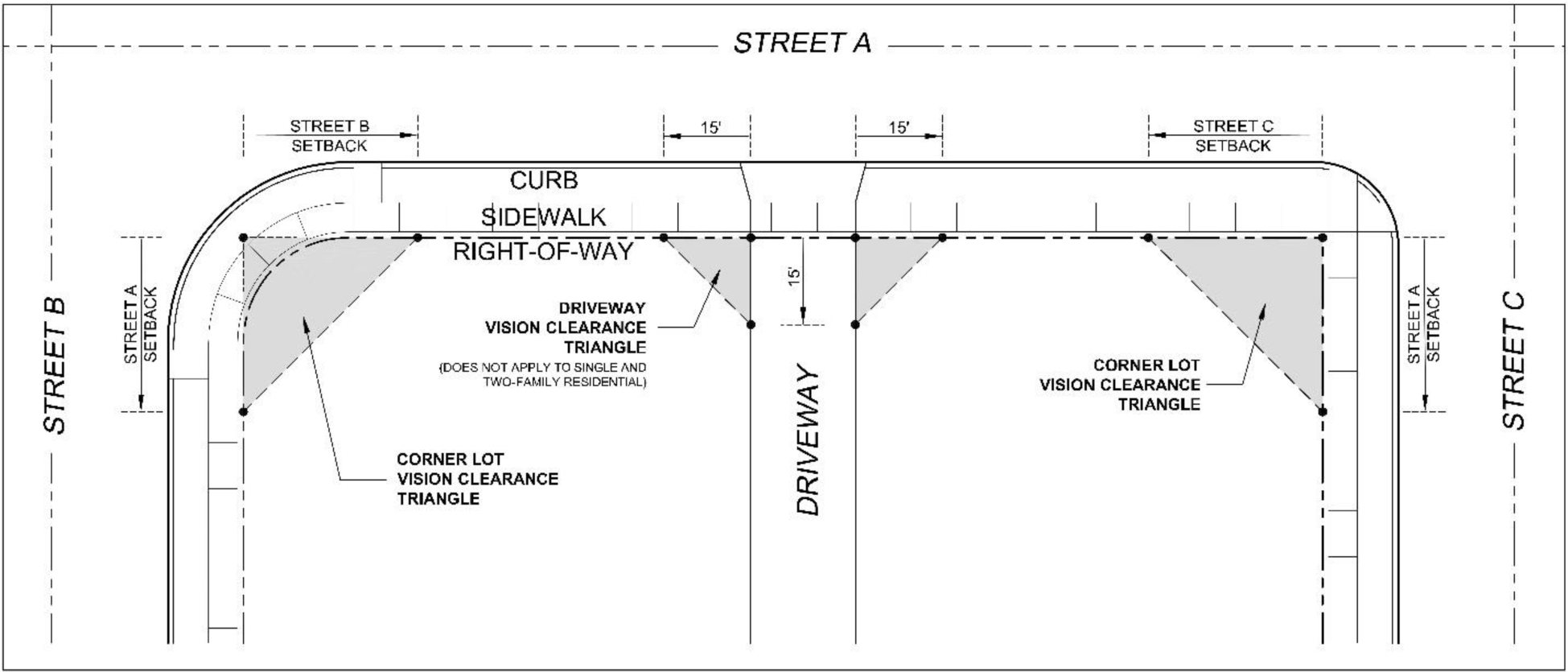
Sec. 52-32. - Vision clearance triangles.
(1)
Corner lots. The vision clearance triangle on a corner lot is bounded by the:
(a)
Rights-of-way of the adjacent streets or highways; and the
(b)
Vision clearance setback line connecting points on each right-of-way which are located a distance back from the intersection equal to the setback required on each street or highway according to subsection 52-21(1).
(2)
Driveways. The vision clearance triangle adjacent to a driveway is bounded by the:
(a)
Right-of-way of the highway or street;
(b)
Edge of the driveway; and the
(c)
Vision clearance setback line connecting points on the right-of-way and driveway edge which are located 15 feet back from the intersection of the right-of-way and driveway edge.
(3)
Vision clearance triangle illustration. The following illustrates how to determine the extent of vision clearance triangles per subsections 52-32(1) and (2).
(4)
No building, structure, sign, fence or parking space shall be located in a vision clearance triangle.
(5)
Landscaping and vegetation is allowed in a vision clearance triangle with the following limitations:
(a)
The total height shall not exceed three feet.
(b)
Trees shall not be planted within a vision clearance triangle.
(c)
Tree branches and canopies that extend into a vision clearance triangle shall be at least ten feet above the ground.
(6)
The minimum vision clearance triangle requirement may be increased by the Village Engineer where required for safety based on American Association of State Highway and Transportation Officials (AASHTO) standards.
(Ord. No. 2016-27, § 1(Att. A), 11-1-2016)
Sec. 52-33. - Nonmetallic mineral extraction operations.
(1)
Classification of nonmetallic mineral extraction operations.
(a)
Exempt—This section does not apply to the following activities:
1.
Excavations or grading by a person solely for domestic or farm use at that person's residence or farm.
2.
Excavations, grading, borrow pits and/or disposal sites conducted for the construction, reconstruction, maintenance or repair of a highway, railroad, or any other transportation facility where the excavation, grading, borrow pits and/or disposal sites is entirely within the property boundaries of the highway, railroad or other transportation facility.
3.
Grading conducted for preparing a construction-site or restoring land following a flood or natural disaster.
4.
Excavations for building construction purposes conducted on the building site.
5.
Borrow pits that are distinct and reasonably distinguished from processing facilities or mine sites.
6.
Removal from the earth of products or commodities that contain only minor or incidental amounts of nonmetallic minerals, such as commercial sod, agricultural crops, ornamental or garden plants, forest products, Christmas trees or plant nursery stock.
(b)
Processing facility or site—A location off of the mine site on which any facilities, structures, equipment, private roads or haulage ways associated with nonmetallic storage facilities, stockpiles, washing, drying, processing, separation, blending or screening operations are conducted.
(c)
Nonmetallic mining operation or site—Land from which nonmetallic minerals will be extracted for sale or use by the Operator; all land in or contiguous to areas excavated for nonmetallic mining on which any structures, equipment, storage facilities, stockpiles, washing, drying, processing, separation, blending or screening facilities, private roads or haulage ways associated with nonmetallic mining operation are or will be located; and all contiguous lands to the nonmetallic mining operation under common ownership or control of the owner or Operator. A nonmetallic mining operation or site does not include or allow manufacturing of concrete building blocks or similar products, asphalt mixing, and production of ready-mix concrete.
(2)
Review and approval requirements for nonmetallic mining operations.
(a)
Processing facility or site.
1.
Village of Windsor:
a.
Issuance of a conditional use permit.
b.
Issuance of a processing facility permit per chapter 55 of Village of Windsor Code of Ordinances.
2.
Dane County:
a.
Issuance of an erosion control and stormwater management permit.
3.
All additional applicable federal, state, county and local requirements.
(b)
Nonmetallic mining operation or site.
1.
Village of Windsor:
a.
Rezoning of subject properties to NMO Nonmetallic Mining Operation Zoning District for sites requiring a Mining Operator's license per chapter 55 of Village of Windsor Code of Ordinances. The rezone process shall follow subsection 52-101(4)(d) and requires a conceptual site plan.
b.
Issuance of a Mining Operator's license or mining registration license per chapter 55 of Village of Windsor Code of Ordinances.
2.
Dane County:
a.
Issuance of an erosion control and stormwater management permit.
b.
Issuance of a non-metallic mining reclamation plan permit.
3.
All additional applicable federal, state, county and local requirements.
(Ord. No. 2016-27, § 1(Att. A), 11-1-2016)
Sec. 52-34. - Standards for landscape, lawn and garden business.
(a)
Purpose. To provide standards that shall apply to the operation of a landscape, lawn and garden business in the Agricultural (A-2 and A-B) and Commercial (C-1 and C-2) zoning districts. The standards are designed to ensure that the operation of a landscape, lawn and garden business is done in a responsible manner that protects the public health, safety, and welfare and avoids conflicts with neighboring uses.
(b)
Requirements.
(1)
The conditional use permit shall comply with all applicable federal, state, county and local regulations.
(2)
The conditional use permit shall comply with the procedures and requirements as defined in section 52-101(5).
(3)
The conditional use permit may restrict the percentage of the property that may be devoted to the business.
(4)
The conditional use permit may restrict the percentage of the property that may be devoted to outdoor storage and parking.
(5)
The conditional use permit shall prohibit such business on any parcel that does not have direct access to a Class A, B and C highway as defined per section 52-21.
(6)
The conditional use permit may restrict such business to a service-oriented business prohibiting the manufacturing, assembling and/or selling of products on the premises.
(7)
The conditional use permit may restrict the hours of operation for such business.
(8)
The conditional use permit may restrict the number and types of vehicles, trailers, machinery and equipment the permit holder may be allowed to bring on the premises.
(9)
The conditional use permit shall comply with the procedures and requirements as defined per section 52-23.
(Ord. No. 2018-06, § 1(Exh. A), 5-3-2018)

