
Winter Haven City Zoning Code
ARTICLE III
DEVELOPMENT DESIGN AND IMPROVEMENT STANDARDS
DIVISION 3. - OFF-STREET PARKING AND LOADING[2]
Editor's note— Ord. No. O-18-02, § 1(Exh. A), adopted March 12, 2018, repealed div. 3, §§ 21-141—21-147 and reenacted a new div. 3, §§ 21-141—21-148. Former div. 3 pertained to similar subject matter and derived from Ord. No. O-00-09, Art. 3 (3.03.01—3.03.07), adopted April 24, 2000; Ord. No. O-00-19, § 3(N), adopted July 10, 2000; Ord. No. O-01-39, § 1, adopted July 9, 2001; and Ord. No. O-02-46, § 1, adopted October 14, 2002.
DIVISION 9. - RESERVED[3]
Editor's note— Ord. No. O-17-33, § 3, adopted October 23, 2017 repealed Div. 9, §§ 21-201 and 21-202, which pertained to Cluster/Zero Lot Line Development, and derived from Ord. No. O-00-09, Art. 3 (3.09.00; 3.09.01), adopted April 24, 2000; Ord. No. O-00-19, § 3(P), adopted July 10, 2000; and Ord. No. O-06-96, § 3, adopted October 9, 2006.
Sec. 21-111. - General provisions.
The purpose of this article is to provide development design and improvement standards applicable to all development activity within the City of Winter Haven.
(1)
Responsibility for improvements. Unless otherwise specifically provided, all improvements required by this article shall be designed, installed, and paid for by the developer.
(2)
Principles of development design. The provisions of this article are intended to ensure functional and attractive development. Development design shall first take into account the protection of natural resources as prescribed in Article V of this Code. All development shall be designed to avoid unnecessary impervious surface cover; to provide adequate access to lots and sites; and to avoid adverse effects of glare, noise, odor, traffic, drainage, and utilities on surrounding properties.
(Ord. No. O-00-09, Art. 3 (3.01.00), 4-24-00)
Sec. 21-121. - General provision.
(a)
This section establishes minimum requirements applicable to the development of the transportation system, including public and private streets, bikeways, pedestrian ways, parking and loading areas, and access control to and from public streets. The standards in this section are intended to minimize the traffic impacts of development, to insure that all developments adequately and safely provide for the storage and movement of vehicles consistent with good engineering and development design practices.
(b)
All required elements of the transportation system shall be provided in compliance with engineering design and construction standards adopted by the City of Winter Haven.
(Ord. No. O-00-09, Art. 3 (3.02.01), 4-24-00)
Sec. 21-122. - Thoroughfare plan and right-of-way widths.
(a)
It is the intent of this section that its provisions shall be liberally construed to accomplish its stated objectives. The general purposes and intent of the City in the adoption of this official thoroughfare plan and the establishment of right-of-way widths are as follows:
(1)
To provide for a convenient, interconnected, and adequate thoroughfare network to meet the present and future needs of residential, commercial and industrial traffic through and around the City.
(2)
To reduce the use of local streets for through traffic, thus contributing to the safety and comfort of dwellers and businesses along such local streets.
(3)
To provide an efficient, practical and economical basis for City programs for the acquisition of street rights-of-way, and a basis for design and construction appropriate for such streets.
(4)
To guide planning and the control of land use along principal arterial, minor arterial, collector or local streets intersecting such principal arterial, minor arterial and collector streets in order to minimize potential marginal interference with free traffic flow, to increase pedestrian and traffic safety, and to protect present and future uses along such streets from the potentially damaging effects of concentrated traffic flow.
(5)
To ensure that adequate provisions exist for pedestrian and bicycle traffic, as well as public transit.
(b)
Establishment of City's street and roadway thoroughfare plan.
(1)
Designation of arterial and collector roadways within and abutting the City shall be as provided for in Tables 21-122A and 21-122B.
Table 21-122A: Table of Arterial Roadways
Table 21-122B: Table of Collector Roadways
(2)
All streets not designated by Tables 21-122A and 21-122B as an arterial or collector street are hereby designated as local streets. A local street is a street that has the primary function of providing access to abutting property and carrying internal neighborhood traffic only.
(c)
Right-of-way widths shall be as provided in Table 21-122C.
Table 21-122C: Right-of-Way Width Minimums
(Ord. No. O-00-09, Art. 3 (3.02.03), 4-24-00; Ord. No. O-23-38, § 2(Exh. B), 8-28-23)
Sec. 21-123. - Local street minimum widths.
(a)
All streets not designated on the official thoroughfare and base building line map as principal arterial, minor arterial and collector streets are hereby designated as local streets.
(b)
A local street is a street that has the primary function of providing access to abutting property and carrying internal neighborhood traffic only.
(c)
Minimum widths shall be determined by consultation with the City engineer. General minimum widths for fire and emergency vehicles to pass is twenty (20) feet. General minimum widths that must be paved is twenty-four (24) feet wide.
(Ord. No. O-00-09, Art. 3 (3.02.03), 4-24-00)
Sec. 21-124. - Property frontage minimums on public road.
(a)
No commercial or industrial building or structure shall be erected on a parcel of land which does not abut a public or privately maintained road for a minimum width of forty (40) feet.
(b)
No residential dwelling unit shall be erected on a lot which does not abut at least one (1) public or privately maintained road for a minimum of twenty (20) feet.
(c)
Flag lots shall be permitted in residential zoning districts where such lots make possible the best utilization of irregularly shaped properties, especially properties with exceptional depth. Flag lots shall not be permitted where the effect would be to increase the number of driveway access points to a collector or arterial roadway.
(Ord. No. O-00-09, Art. 3 (3.02.04), 4-24-00)
Sec. 21-125. - Corner lots.
Development on corner lots or parcels shall be subject to street-side setback requirements contained in Tables 21-32(B) and 21-32(C) of this Code. The front, street-side, side, and rear lot lines for the corner lot or parcel shall be designated at the time of site plan review, or at the time of building permit issuance if no site plan review is required by this Code.
(Ord. No. O-00-09, Art. 3 (3.02.05), 4-24-00; Ord. No. O-06-96, § 2, 10-9-06)
Sec. 21-126. - Street design standards.
(a)
The specifications for construction and repair of streets are on file with the City engineer.
(b)
It is the intent of this section to provide maximum safety at intersections of streets with each other and with driveways, to protect pedestrians, operators and passengers of automotive vehicles and all other transportation devices through the use of visibility triangles at such intersections. Visibility triangles shall be provided as stated below:
(1)
Within such visibility triangles nothing shall be erected, placed, parked, planted or allowed to grow in such a manner as materially to impede vision between a height of two (2) feet and ten (10) feet above the established grade of the centerlines of intersecting streets and driveways, or if no grade has been officially established, then above the average elevation of the existing surface of such intersecting streets and driveways.
(2)
The requirements within the latest version of the Florida Department of Transportation (FDOT) Manual of Uniform Minimum Standards for Design, Construction and Maintenance of Streets and Highways for Sight Distance for Intersection Maneuvers shall be followed.
(3)
Where unusual and extreme conditions and/or terrain features present substantial obstacles to provision and maintenance of such visibility triangles, the Development Special Magistrate may permit, as a special approval, the provision and maintenance of lesser visibility clearance, but such clearance shall be the maximum which is reasonably practicable to provide and maintain.
(Ord. No. O-00-09, Art. 3 (3.02.06), 4-24-00; Ord. No. O-00-19, § 3(M), 7-10-00; Ord. No. O-11-07, § 2, 5-23-11; Ord. No. O-12-19, § 3(exh. A, pt. I), 5-29-12)
Sec. 21-127. - Sidewalks and bikeways.
(a)
Design and construction of sidewalks and bikeways shall conform to all applicable engineering requirements adopted by the City of Winter Haven, including provisions for access by physically handicapped persons.
(b)
Projects abutting collector or arterial facilities shall provide sidewalks adjacent to such roadways. Location of sidewalks shall be consistent with planned roadway improvements. Where a proposed development includes improvements or new construction of collector or arterial facilities, facility designs shall include provision for sidewalks and bikeways within the right-of-way.
(c)
The minimum requirement is that sidewalks shall be provided on one (1) side in all residential developments. Residential streets that are privately maintained shall be exempt from this requirement.
(d)
Pedestrian-ways or crosswalks, not less than ten (10) feet wide with a sidewalk meeting the requirements of this section, may be required to be placed in the center of blocks more than eight hundred (800) feet long where deemed necessary to provide circulation or access to schools, playgrounds, shopping centers, transportation and other community facilities.
(e)
Sidewalks shall be constructed when right-of-way exists for all new road improvement projects.
(Ord. No. O-00-09, Art. 3 (3.02.07), 4-24-00)
Sec. 21-128. - Access points onto streets.
All proposed development shall meet the following standards for vehicular access and circulation:
(a)
The maximum number of points of access permitted onto any one (1) road shall be as shown in Table 3.2:
Table 3.2 Access Points
(b)
In lieu of any two (2) openings permitted onto any one (1) road, there may be permitted a single point of access up to thirty-six (36) feet in width.
(c)
There shall be a minimum distance of twenty (20) feet (a car length) between any two (2) openings onto the same street.
(d)
No point of access shall be allowed within twenty (20) feet (a car length) of the intersection of the right-of-way lines of any public road.
(e)
No curb shall be cut or altered, and no point of access or opening for vehicles onto a public road shall be established without a permit issued by the engineering department.
(Ord. No. O-00-09, Art. 3 (3.02.08), 4-24-00)
Sec. 21-129. - Standards for drive-through facilities.
All facilities providing drive-through service shall provide on-site stacking lanes in accordance with the following standards:
(a)
The facilities and queuing lanes shall be located and designed to minimize turning movements in relation to driveway access to streets and intersections.
(b)
The facilities and stacking lanes shall be located and designed to avoid conflicts between vehicular traffic and pedestrian areas such as sidewalks, crosswalks, or other pedestrian access ways.
(c)
A bypass lane shall be provided.
(d)
Minimum stacking lane length, which is measured beginning at the service window, shall be as follows:
(1)
Financial institutions shall have a minimum length of two hundred (200) feet. Two (2) or more stacking lanes may be provided that together total two hundred (200) feet.
(2)
All other uses shall have a minimum length of one hundred twenty (120) feet.
(e)
Alleys or driveways in or abutting areas designed, approved, or developed for residential use shall not be used for circulation of traffic for drive-through facilities.
(f)
Where turns are required in the exit lane, the minimum distance from any drive-through station to the beginning point of the curve shall be thirty-four (34) feet. The minimum inside turning radius shall be twenty (25) feet.
(g)
Construction of stacking lanes shall conform to all engineering design standards adopted by the City of Winter Haven.
(Ord. No. O-00-09, Art. 3 (3.02.09), 4-24-00)
Sec. 21-141. - Intent and applicability.
(a)
The intent of this division is to allow flexible methods of providing an adequate number of parking and loading spaces, while creating or improving multi-modal connectivity and reducing excessive paved surfaces which lead to unnecessary heat buildup and stormwater runoff.
(b)
This division shall apply to all new construction requiring off-street parking and redevelopment, provided a change of use requires an increase in the number of existing off-street parking spaces by ten (10) percent or more.
(Ord. No. O-18-02, § 1(Exh. A), 3-12-18)
Sec. 21-142. - Number of spaces.
(a)
In all zoning districts, unless exempted or modified by this section, off-street parking shall be provided as set forth in Table 21-142A. Table 21-142A establishes minimum requirements necessary. Certain combinations or mixes of uses may require additional off-street spaces to be provided and may require the submittal of an alternative parking analysis acceptable to the growth management director.
Table 21-142A Required Number of Parking Spaces
*
Square Feet, for the purpose of Table 21-142A, is gross leasable area (SFGLA) and is defined as the floor area of a building, less storage, restrooms, equipment rooms, and similar areas. Storage areas used in conjunction with a manufacturing or industrial use are included.
(b)
Downtown. Uses within the C-1, commercial-downtown zoning district, shall be exempt from providing off-street parking.
(c)
Shared parking. Notwithstanding any other parking requirements set forth in this section for individual land uses, when any land or building is used for two (2) or more distinguishable purposes (i.e. joint or mixed use development), the minimum number of parking spaces required to serve the combination of all uses may be reduced according to Table 21-142B, shared parking generation, or any similar methodology as approved by the growth management director.
(1)
Shared parking spaces located off-site must be located within six hundred sixty (660) feet of the primary entrance of all uses served, unless remote parking shuttle service is provided.
(2)
A request must be made to the City as part of a site plan application that clearly demonstrates the feasibility of shared parking. This request must address, at a minimum, the size and type of all proposed development, the composition of tenants/uses, the anticipated rate of parking turnover, and the anticipated peak parking and traffic loads for all uses that will be sharing off-street spaces. Use of the data in Table 21-142B may be used for calculating shared parking demand.
(3)
To calculate the minimum shared parking space requirement, multiply the minimum parking requirements for each individual use as set forth in Table 21-142A by the appropriate percentages as set forth below in Table 21-142B, for each of the five (5) designated time periods, and then add the resulting sums from each vertical column (Where the computation results in a fractional number, a fraction over one-half (½) shall require one (1) space). The column total having the highest total value is the minimum shared parking space requirement for that combination of land uses.
Table 21-142B Shared Parking Generation
(4)
The applicant may request approval of shared parking based on the latest urban land institute parking study or equivalent study as an alternative to the parking demand rates provided in Table 21-142B. The applicant must provide evidence to the satisfaction of the growth management director that the alternative parking demand rates more accurately represent the parking demand and peak parking demand for the development.
(5)
A shared parking and access agreement shall be included at site plan review.
(d)
Bicycle parking. New developments or redevelopments consisting of commercial, industrial, and institutional uses, along with multi-family uses of five (5) or more units, shall provide on-site bicycle parking facilities subject to the following standards:
(1)
All uses providing a minimum of ten (10) or more vehicular parking spaces shall also provide the greater of two (2) bicycle spaces or a total number of bicycle parking spaces equal to ten (10) percent of the provided number of vehicular parking spaces; however, no use shall be required to provide more than fifteen (15) bicycle parking spaces.
(2)
Bicycle parking areas shall be located within seventy-five (75) feet of the main entrance to the building.
(3)
All bicycle racks shall be anchored to the ground in a manner that will resist removal and constructed of materials that will resist rust or corrosion.
(4)
Multi-family uses of five (5) or more units may provide the required bicycle parking facilities within an internal, enclosed and/or secured facility.
(e)
Alternative parking analysis. The applicant may demonstrate adequate off-street parking, including bicycle parking, either reducing or increasing the number of spaces required by Table 21-142A with the submittal of an alternative parking analysis subject to approval by the growth management director.
(f)
Tree preservation reduction. Where specimen trees exist within a proposed parking area for a non-residential use, the growth management director may allow a reduction of up to ten (10) percent of the total number of required parking spaces, as necessary to preserve the existing specimen tree(s). In no instance shall this reduction be combined with any other allowable reduction that results in more than a ten (10) percent total reduction of the minimum required parking spaces.
(Ord. No. O-18-02, § 1(Exh. A), 3-12-18; Ord. No. O-24-32, § 1(Exh. A), 8-26-24)
Sec. 21-143. - Location of off-street parking spaces.
(a)
The location of off-street parking spaces will adequately serve the use for which it is intended and shall have vehicular access to a dedicated public street or alley.
(b)
No portion of an off-street parking space shall exist upon, and no portion of any vehicle shall overhang, the right-of-way of any public road, street, alley, or walkway unless specifically approved by the City as part of an approved site plan.
(c)
Required parking areas for all uses shall be provided on the same development site with the main building, or not more than six hundred sixty (660) feet distant, except as provided for in section 21-96, Alcoholic Beverage Establishments or Section 21-144(p), as measured along the nearest pedestrian walkway. Parking areas not located on the same development site with the main building must be located within a zoning district in which a parking lot - stand-alone is permitted, or approved by special use, according to Table 21-32(A), Table of Land Uses.
(d)
To provide for a pedestrian friendly environment, the placement of parking spaces in the side or rear yard of the principal use or development site is encouraged.
(Ord. No. O-18-02, § 1(Exh. A), 3-12-18; Ord. No. O-19-43, § 2(Exh. B), 11-12-19)
Sec. 21-144. - Parking lot standards.
All off-street parking shall meet the following standards:
(a)
The parking area shall be buffered and landscaped, including a tree canopy provided pursuant to article III, division 7, section 21-181, Compatibility, Landscaping and Buffering Standards, of this Code.
(b)
Parking lots shall be surfaced with asphalt, concrete, pervious all-weather hard surface, including pervious pavement, paver bricks, open-joint pavers or another durable material approved by the Engineering Services Manager.
(c)
The use of pervious all-weather hard surface is encouraged and can reduce the minimum parking spaces required by Table 21-142A by a maximum of ten (10) percent, provided ten (10) percent or more of the required parking spaces utilize a pervious hard surface approved by the Engineering Services Manager. In no instance shall this reduction be combined with any other allowable reduction that results in more than a ten (10) percent total reduction of the minimum required parking spaces.
Example: Minimum required number of spaces = 100
Spaces paved with pervious surface = 10 (10% of required)
Reduced total number of required spaces = 90 (10 pervious)
(d)
Parking spaces provided in excess of one hundred ten (110) percent of the minimum required by Table 21-142A shall utilize a pervious hard surface approved by the Engineering Services Manager or an alternative parking surface material provided the spaces comply with the requirements identified in section 21-144(e)(2).
(e)
Alternative parking surface materials.
(1)
Gravel parking surfaces may be utilized only if all of the following criteria are met (items a-h):
a.
The parking area is used for any of the following:
i.
The number of parking spaces required is eight (8) or less; or
ii.
The use generates less than forty (40) Average Annual Daily Trips (AADT) per day; or
iii.
The parking space(s) are designated for employee parking only; or
iv.
The parking area is a stand-alone parking lot located in the R-1, R-2, R-3, R-4, or R-5 zoning districts approved via Special Use approval as allowed by Table 21-32(A).
b.
Gravel is to be stone size #57 (three-fourths (¾) inch or larger).
c.
Gravel parking spaces requires the installation of an appropriate sub-grade and drainage plans approved by the engineering services manager.
d.
Gravel parking lots shall be designed and constructed such that siltation resulting from stormwater run-off does not enter adjacent properties or public rights-of-way. The lots must be designed so as to prevent loose aggregate or other materials from leaving the lot.
e.
A concrete apron, constructed as per City standards, shall be installed from the edge of the pavement to the property line for all entrances and exits to the parking area.
f.
All drive aisles shall be concrete, asphalt, or a pervious all-weather hard surface, as per City standards. Stand-alone parking lots located in the R-1, R-2, R-3, R-4, or R-5 zoning districts approved via Special Use approval as allowed by Table 21-32(A) are exempt from this requirement.
g.
The area surrounding the gravel lot shall have a minimum of a six (6) inches band of concrete or asphalt, a curb, or an elevated landscaped area so as to contain the gravel in the parking lot.
h.
Any required handicapped parking space shall be paved.
(2)
Pervious parking surfaces, including gravel, turf or other similar surface may be permitted with the written approval of the engineering services manager or his/her designee in the following circumstances:
a.
Uses with intermittent parking such as churches and other similar establishments. All required handicapped parking spaces shall be paved.
b.
Parking spaces and vehicle driving surfaces for parking areas which are designed as temporary parking, overflow or storage lots, or generate less than forty (40) average daily trips.
i.
A temporary parking lot is any property, located within any zoning district which allows parking lots, that provides interim parking until permanent parking for a use is provided or the site can be developed.
ii.
Overflow parking for this section shall mean an area of land that is either a part of a development site or not more than six hundred sixty (660) feet distant, as measured along the nearest pedestrian walkway, that provides in excess of one hundred ten (110) percent of the minimum number of parking spaces required by Table 21-142A.
iii.
Storage lots are used to park vehicles that are not moved on a daily basis (e.g. car dealerships, body shops, vehicle rental companies, or similar uses).
iv.
Drive aisles may be required to be paved with asphalt, concrete, paver bricks or another durable material approved by the engineering services manager.
c.
The lot shall meet all drainage standards required by this Code or other regulatory authority.
d.
A scaled plan shall be submitted clearly indicating the property owner, entity responsible for the vehicles parked on the property, ingress/egress, parking space layout, drive aisles, adjacent uses, any landscaping/buffer requirements, and a maintenance plan which includes provisions for trash or debris removal, erosion control, and landscape management. The temporary, overflow, or storage lot shall conform to the plan and this section.
(3)
Alternative impervious surfaces such as asphalt millings, compacted shell or other similar surface may be permitted with the written approval of the Engineering Services Manager or his designee in the following circumstances.
a.
Parking spaces and vehicle driving surfaces for parking areas which are designed as temporary or storage lots, as described in section 21-144(e)(2)(b) or employee only designated parking areas. Employee only parking areas must be clearly identified by appropriate signage.
b.
Alternative impervious surfaces must provide stormwater attenuation and treatment in compliance with section 21-144(l).
(f)
Maintenance of alternative parking surfaces.
(1)
Off-street parking areas approved for gravel surfaces shall be properly maintained to prevent the growth of grass and weeds, potholes and ruts, uneven gravel surface and gravel spreading outside of the designated parking lot area.
(2)
Off-street parking spaces approved for turf surfaces shall be maintained and the turf kept in good condition and not allowed to be overgrown or taken over by weeds. In the event the frequency of parking or the length of time parked vehicles use turf surfaces causes the turf to be damaged or destroyed to the extent the grass ceases to grow, the City may require the turf to be replaced with durable pervious material such as turf grid, gravel, porous asphalt, pervious concrete, or open joint pavers.
(3)
Evidence of a violation of this section includes but is not limited to:
a.
The settlement or alteration of the alternative parking surface such that drainage patterns are redirected onto off-site properties rather than the intended stormwater management facilities.
b.
The absence or failed condition of the approved alternative parking surface.
c.
Introduction of sediment, material or debris from the alternative parking surface onto City rights-of-way, easements or neighboring properties.
(3)
To remedy a violation, the City may require the area to be paved or require the installation of pervious hard surfaces such as pervious concrete, porous asphalt, or open joint pavers. If paving is deemed necessary by the City, the property owner will be required to demonstrate compliance with all drainage standards required by this Code or other regulatory agency.
(g)
Parking space type and dimensions.
(1)
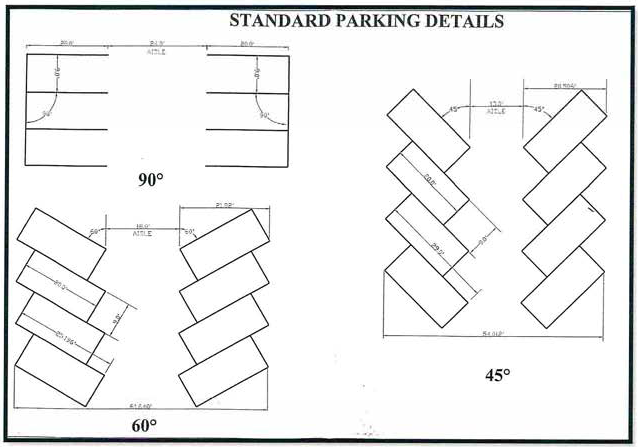
Standard parking stalls shall be a minimum of nine (9) feet wide and twenty (20) feet in length; however, parking stalls measuring eighteen (18) feet in depth may be permitted provided there is a minimum of two (2) feet of green space in front of the space and a wheel stop and/or curb is provided.
(2)
Angled parking may be provided at either forty-five (45) or sixty (60) degrees according to the Standard Parking Details below:
(3)
Handicap stall dimensions shall follow regulations contained in section 21-145.
(4)
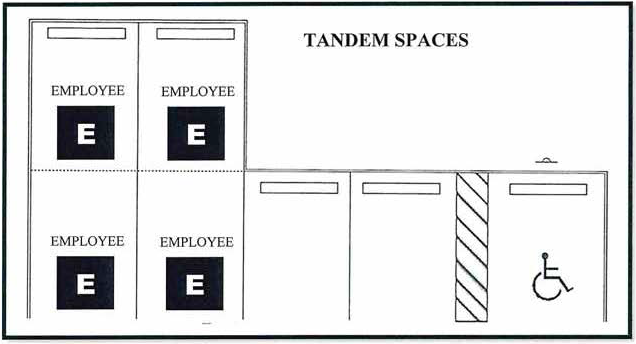
Tandem parking shall be permitted subject to the following:
a.
Residential uses. Tandem parking spaces shall be allowed for single-family, duplex and townhome residential uses.
b.
Multifamily residential uses. Tandem parking spaces shall be allowed for condominium and multifamily residential uses provided:
i.
The tandem spaces are assigned and reserved for the same residential unit.
ii.
At least ten (10) of the total parking spaces provided on site must be unassigned spaces which are available for the use of visitors. These spaces shall be provided as single, non-tandem spaces.
c.
Commercial uses. Tandem parking spaces shall be allowed provided:
i.
The tandem spaces must be reserved for use by employees only. Such spaces shall be identified or designated for employee parking through the use of signage or pavement markings and no more than forty (40) percent of the total required spaces may be tandem spaces; or
ii.
The tandem spaces are managed by a valet service.
d.
Tandem spaces may be gravel or turf provided compliance with section 21-144(e) can be demonstrated.
(h)
Individual parking spaces or stalls shall be identified in all parking lots, regardless of the surface material, by utilizing striping, wheel stops, or similar methods.
(i)
Parking bays shall extend no more than twelve (12) parking spaces without an intervening landscape island or landscape peninsula a minimum of ten (10) feet in width. Landscaped end cap islands are required at the end of each interior row of parking spaces to separate parking spaces from travel lanes.
(j)
Interconnection between parking areas is required for non-residential developments with frontage on, or access to collector or arterial roadways. Such interconnection shall be achieved by providing driveway improvements and driveway "stub-outs" to property lines to facilitate existing and future interconnection of parking areas to adjacent sites. All interconnecting driveways shall follow the following standards:
(1)
Parking lot access driveways and driving isles shall be designed and located to connect to adjacent properties or to marginal access roadways that serve the subject site and adjacent properties. All access points and interconnecting driveways shall be designed and constructed to accommodate safe and efficient vehicle travel between adjacent sites, as approved by the engineering services manager.
(2)
All connecting driveway improvements shall be paved according to applicable standards, including proper paving widths, construction specifications and treatment of transition grades.
(3)
The engineering services manager may waive the interconnected parking area requirements at terminal points where non-residential development abuts a residential district, or in circumstances where mixing different types of traffic (e.g., automobile versus truck) is undesirable; where separation of traffic is necessary for traffic safety; where physical design constraints preclude interconnection of adjacent sites; where the necessary easement has not been able to be obtained.
(k)
Paved sidewalks or pedestrian walkways a minimum of five (5) feet in width shall be provided from all adjoining public sidewalks and parking areas to the building's entrance. Such walkways shall be designed to discourage walking into and through landscaped areas and drive isles except at designated crossings.
(l)
Lighting shall be provided for all parking and loading areas intended for public use after dark. Light fixtures shall utilize full cut-off luminaires, utilize energy efficient technology, and be installed so as to reflect toward the ground and shield light away from any adjacent property and public right-of-way. Average illumination, except as provided for in section 21-144(p), shall be a minimum of 0.4 foot-candles and not to exceed 2.5 foot-candles. Site plans shall contain notes which indicate compliance with this requirement.
(m)
Unless exempt by this Code and the Southwest Florida Water Management District, all off-street parking lots shall provide for the attenuation and treatment of stormwater utilizing the following methods:
(1)
A stormwater management system designed by a Florida licensed professional engineer and permitted by the Southwest Florida Water Management District; and
(2)
A stormwater treatment area meeting the City's stormwater treatment standards contained in section 21-161 of this Code.
(3)
To the greatest extent possible, all required landscape and buffer areas shall be designed and located to filter, store and/or convey the expected stormwater flows from surrounding paved areas through the use of low impact development techniques such as:
a.
Vegetated swales;
b.
Bioretention areas (Rain Gardens);
c.
Dry Detention Basins;
d.
Infiltration systems; and
e.
The use of tree canopy to intercept rainfall and mitigate stormwater flow.
(n)
Parking lots shall be kept clean and free of rubbish and debris. All trees and plant materials shall be maintained in a healthy condition and wherever necessary shall be replaced with new trees or plant materials to insure continued compliance with any applicable screening requirements. All surfaces, lighting, fences, barriers, and walls shall be maintained in good repair and whenever necessary shall be replaced.
(o)
Parking lots shall be utilized for parking motor vehicles only and shall not be utilized as permanent storage areas, product display areas, or collection points.
(p)
Stand-alone parking lots or areas not located on the same development site with the principal use or main building must be located within a zoning district a parking lot (stand-alone) is permitted or approved by a special use, according to Table 21-32(A), Table of Land Uses.
(1)
Stand-alone parking lots located in R-1, R-2, R-3, R-4, or R-5 zoning districts must follow the following standards:
a.
Parking areas shall be provided not more than three hundred (300) feet distant from the main building as measured by way of ordinary and legal pedestrian travel utilizing sidewalks and marked crosswalks.
b.
Parking spaces shall utilize a pervious hard surface approved by the Engineering Services Manager or an alternative parking surface material provided the spaces comply with the requirements identified in section 21-144(e)(1).
c.
A landscape buffer, a minimum of 5 feet wide, shall be provided along any property line adjacent to a residential use in accordance with the table below. The use of Florida Friendly plantings shall be required.
d.
A landscape buffer, a minimum of 10 feet wide, shall be provided along any street frontage in accordance with the table below. The use of Florida Friendly plantings shall be required.
e.
Lighting shall be provided for all parking areas intended for public use after dark. Light fixtures shall utilize full cut-off luminaires, utilize energy efficient technology, and be installed so as to reflect toward the ground and shield light away from any adjacent property and public right-of-way. Average illumination shall be a minimum of 0.4 foot-candles and not to exceed 1.0 foot-candles. Lighting fixtures shall be no higher than 17 feet above grade. Site plans shall contain notes which indicate compliance with this requirement.
(Ord. No. O-18-02, § 1(Exh. A), 3-12-18; Ord. No. O-19-43, § 2(Exh. B), 11-12-19)
Sec. 21-145. - Physically disabled parking spaces.
(a)
Each parking space which is restricted for the use of physically disabled persons shall be identified, posted and maintained with a permanent sign meeting the following criteria:
(1)
Shall bear the international symbol of accessibility, being a white reflectorized symbol with a blue reflectorized background, as referenced in American National Standards specifications ANSI, A117.1-1980.
(2)
Shall bear the caption "Parking by Disabled Permit Only" being a black opaque legend on a white reflectorized background.
(3)
Shall bear the monetary fine for parking violations.
(4)
All lettering shall be at least one (1) inch high.
(5)
Sign shall have a minimum width of twelve (12) inches.
(6)
Sign shall have a minimum height of eighteen (18) inches, not including that portion displaying fine amount.
(7)
Bottom of sign shall be at least seven (7) feet above edge of pavement.
(8)
Sign shall be placed in the middle one-third (⅓) of the parking space wherever it is practicable to do so.
(9)
Signs required by law for parking spaces reserved for physically disabled persons shall not require a sign permit.
(10)
Signs and all components thereof, including the post, shall be maintained in good repair.
(b)
All parking spaces for physically disabled persons shall meet the following standards:
(1)
Minimum of twelve (12) feet wide, clearly striped, and paved.
(2)
Located as near as possible to a curb ramp or curb-cut, where necessary to allow access to the building served.
(3)
Parallel parking spaces shall be located either at the beginning or end of a block or adjacent to entrances. Curbs adjacent to such spaces shall be of a height which will not interfere with the opening and closing of motor vehicle doors.
(4)
Parking space standards specified in F.S. § 316.1955 and the latest edition of the Florida Accessibility Code for Building Construction shall apply.
(c)
All uses, except residential uses requiring twenty-five (25) or fewer parking spaces, shall provide off-street parking for physically disabled persons as shown in Table 21-145A:
Table 21-145A Ratio of Required Disabled Parking Spaces
(Ord. No. O-18-02, § 1(Exh. A), 3-12-18)
Sec. 21-146. - Parking requirements for residential zoning districts.
For the purpose of implementing this section, residential zoning districts include AG1, RE, R1, R2, R3, R4, R5, RM and MX zoning districts.
(a)
All residential buildings containing less than five (5) dwelling units shall provide an area for off-street parking either in a driveway, carport, garage, or parking lot. No parking shall be permitted on unimproved portions of the front yard.
(b)
Residential uses containing less than five (5) dwelling units may construct driveways and parking areas according to section 21-144(e). The portion of the driveway located within the right-of-way shall be constructed of asphalt, concrete, brick or decorative pavers. The portion of the driveway located within the property boundaries shall be constructed of asphalt, concrete, brick or decorative pavers, grid pavers, crushed stone, rock gravel or other material approved by the engineering services manager.
(c)
Parking for residential properties containing five (5) or more dwelling units shall follow the requirements contained in sections 21-143 and 21-144 of this Code.
(d)
Section 21-144(c) notwithstanding, driveways shall be constructed of concrete, asphalt, brick, concrete pavers, or similar hard surface, all-weather material. No driveway shall be constructed without a permit.
(e)
Commercial vehicles shall be prohibited from parking in residential zoning districts, including, but not limited to, truck tractors, semitrailers, tow trucks, dump trucks, vehicles with more than two (2) axles, and vehicles equipped with air brakes, refrigeration equipment, hydraulic lifts, cranes, loading ramps, or similar equipment.
(1)
The following shall be exempt from the requirements of section 21-146(e).
a.
Commercial vehicles that have less than two (2) tons load capacity, are less than nine (9) feet in height (including the load, bed, or box), and less than twenty-six (26) feet in length;
b.
Commercial vehicles owned by a public or private utility provider conducting regular or emergency services;
c.
The temporary parking of construction vehicles on private land in residential districts where construction is underway and for which a current and valid building permit has been issued by the City of Winter Haven.
d.
The parking of agricultural equipment and vehicles on private land for which the agricultural equipment and vehicles are being used for bona fide agricultural purposes.
(f)
Trailers may be parked, for storage purposes only, within the side yard or rear yard area, not less than five (5) feet from the property line. Trailers shall not be parked between any public street and the living area of the principal building. When parked for storage, trailers shall be maintained in good repair, shall not be used for the accumulation of junk or trash, and shall not be used for sleeping, eating, living, or conducting business. A trailer, for the purposes of this Code, is defined as an unpowered vehicle designed to be drawn behind another vehicle with an intended use of transporting materials, goods, or equipment.
(g)
Recreational vehicles may be parked, for storage purposes only, within the side yard or rear yard area, not less than five (5) feet from the property line. Except as otherwise provided, recreational vehicles shall not be parked between any public street and living area of the principal building. A recreational vehicle, for the purposes of this Code, is defined as a vehicular unit which is built on a self-propelled motor vehicle chassis or is designed to be drawn by another vehicle, and is primarily designed to provide temporary living quarters for recreational, camping or travel use.
(1)
Recreational vehicles may be parked up to seven (7) days in any calendar year in front of the living area of the principal building but only within the area specified below. For the purposes of this section, a day shall be defined as anything exceeding eight (8) hours during a 24-hour period.
a.
In the driveway or within an area ten (10) feet in width parallel to the driveway on the side closest to a property line.
b.
No less than fifteen (15) feet from the curb or street pavement edge.
c.
No less than five (5) feet from the side property line.
d.
Shall not overhang any sidewalk.
(2)
Recreational vehicles may be parked for storage purposes indefinitely in the area defined in subparagraph (g)(1) above so long as it is at least sixty (60) feet from the front property line.
(2)
When parked for storage, recreational vehicles shall be maintained in good repair, shall not be used for the accumulation of junk or trash, and shall not be used for sleeping, eating, living, or conducting business.
(h)
Watercraft may only be located in the side yard, the rear yard, or on a driveway, and not less than five (5) feet from the property line. No watercraft, or accompanying trailer, shall be parked within fifteen (15) feet of the edge of the street pavement. Driveway parking and storage is limited to a total of two (2) watercraft per property. Watercraft and accompanying trailers shall be maintained in good repair and shall not be used for the accumulation of junk or trash. A watercraft, for the purposes of this Code, is defined as a vehicular unit intended for operation on the water. This includes both mechanically and non-mechanically powered watercraft.
(i)
Unless under common ownership of a contiguous lot with a principal structure, no vehicle, recreational vehicle, trailer, truck, or watercraft shall be parked on a lot within a residentially zoned district that does not contain a principal structure.
(j)
Self-contained/master planned communities may set aside a common area within the community for the purpose of storing recreational vehicles, trailers, and watercraft. This storage area shall be located a minimum of sixty (60) feet from the front boundary of the community and shall also provide visual screening so as to visually shield neighboring properties from the storage area.
(Ord. No. O-18-02, § 1(Exh. A), 3-12-18)
Sec. 21-147. - Off-street loading requirements.
Off-street loading spaces shall be provided as follows:
(a)
Hospital, institutional uses, retail operations, wholesale operations, and industrial operations shall provide sufficient space for loading and unloading operations in order that the free movement of vehicles and pedestrians over a sidewalk, street or alley shall not be impaired.
(b)
Every off-street loading and unloading space shall have direct access to a public street or alley, and shall have the following minimum dimensions:
(1)
Length: Thirty (30) feet;
(2)
Width: Twelve (12) feet;
(3)
Height: Fourteen (14) feet.
(c)
Manufactured home sales establishments shall provide adequate space off of the public right-of-way for the maneuvering of manufactured homes and trailers into position on the property without blocking traffic on the abutting street or road.
(d)
The C-1, Commercial-Downtown zoning district, shall be exempt from providing off-street loading.
(Ord. No. O-18-02, § 1(Exh. A), 3-12-18)
Sec. 21-148. - Commercial vehicle parking waiver.
Upon demonstration of the ability to comply with the criteria set forth below, to the satisfaction of the development special magistrate, a waiver may be granted to section 21-146(e), allowing for the ability to park one (1) commercial vehicle upon a parcel within a residential zoning district.
The development special magistrate shall have the authority to impose conditions upon such waiver requests as deemed necessary to mitigate against potential off-site impacts.
(a)
All applications for a commercial vehicle parking waiver must demonstrate compliance with all of the following criteria:
(1)
No such waiver shall be granted for any parcel smaller than two (2) acres in size;
(2)
The owner of the commercial vehicle must reside on the property;
(3)
The commercial vehicle must be located to the rear of the principal structure or screened in such a way as to not be visible from the public right-of-way;
(4)
The commercial vehicle shall not be permitted to idle;
(5)
Maintenance of the commercial vehicle shall not be permitted on site; and
(6)
Any other such conditions of approval that the development special magistrate deems necessary in the interest of mitigating against any potential off-site impacts.
(Ord. No. O-18-02, § 1(Exh. A), 3-12-18)
Sec. 21-151. - Requirements for all developments.
The following basic utilities are required for all developments subject to the criteria listed herein:
(a)
Every principal use and every lot within a newly platted subdivision shall be provided with central potable water and wastewater hookups.
(b)
All developments served by a central water system shall include a system of fire hydrants consistent with design standards adopted by the City of Winter Haven.
(c)
Every principal use and every lot within a subdivision shall have available to it a source of electric power adequate to accommodate the reasonable needs of such use and every lot within such subdivision.
(d)
Every principal use and every lot within a subdivision shall have available to it a telephone service cable adequate to accommodate the reasonable needs of such use and every lot within such subdivision.
(e)
All streets, driveways, sidewalks, bikeways, parking lots and other common areas and facilities in developments shall provide illumination meeting design standards adopted by the City of Winter Haven.
(Ord. No. O-00-09, Art. 3 (3.04.01), 4-24-00; Ord. No. O-07-80, § 2, 9-10-07; Ord. No. O-20-50, § 1(Exh. A), 1-11-21)
Sec. 21-152. - Design standards.
(a)
All utilities required by this chapter shall meet or exceed minimum design standards approved by the City Engineer.
(b)
All electric, telephone, cable television, and other communication lines (exclusive for transformers or enclosures containing electrical equipment, including, but not limited to, switches, meters, or capacitors that may be pad mounted), and gas distribution lines shall be placed underground within easements or dedicated public rights-of-way, installed in accordance with the City's adopted design standards.
(c)
Lots abutting existing easements or public rights-of-way where overhead electric, telephone, or cable television distribution supply lines and service connections have previously been installed may be supplied with such services from the utility's overhead facilities, provided the service connection to the site or lot is placed underground.
(d)
Development of property in excess of 500 acres for industrial and/or warehouse uses as a planned unit development, which includes a master site development plan and provides a central collector road may provide overhead electric, telephone, or cable television distribution supply lines within the rights-of-way on one (1) side of said collector road. Poles used for overhead distribution in this manner shall be concrete and service connection to individual buildings, sites, or lots shall be placed underground.
(Ord. No. O-00-09, Art. 3 (3.04.02), 4-24-00; Ord. No. O-15-28, § 1, 8-24-15)
Sec. 21-153. - Utility easements.
When a developer installs or causes the installation of water, sewer, electrical power, telephone, or cable television facilities and intends that such facilities shall be owned, operated, or maintained by a public utility or any entity other than the developer, the developer shall transfer to such utility or entity the necessary ownership or easement rights to enable the utility or entity to operate and maintain such facilities.
(Ord. No. O-00-09, 1(Art. 3, 3.04.03), 4-24-00)
Sec. 21-154. - Water conservation.
(a)
Intent and purpose. It is the intent and purpose of this section to implement uniform procedures that promote water conservation through more efficient landscapes, irrigation systems and methods, and installation of more efficient plumbing fixtures and appliances.
(b)
Definitions. For the purposes of this section, the following words and terms shall have the meaning given herein:
Automatic irrigation system shall mean an irrigation system designed to operate following a preset program entered into an automatic controller.
Automatic controller shall mean a mechanical or electrical device capable of automated operation of valve stations to set the time, duration and frequency of a water application.
Distribution equipment shall mean the water emitters on irrigation systems, including but not limited to sprinklers, rotors, spray heads and micro-irrigation devices.
ENERGY STAR® shall mean a joint program of the U.S. Environmental Protection Agency and the U.S. Department of Energy, with the purpose of reducing energy costs and protecting the environment, through energy- and water-efficient products and practices.
Florida Water StarSM shall mean a certification program for new residential and commercial construction that is intended to include indoor and outdoor water-efficient options and prevent leaks.
Florida Water Star inspector shall mean a person that verifies Florida Water Star program criteria in accordance with program documents. Inspectors demonstrate sufficient knowledge to verify appropriate subcategories (irrigation, landscape and plumbing). Inspectors are permitted to use construction documents, affidavits, and field verification during the verification period. See Florida Water Star certification program process web page at FloridaWaterStar.com.
Florida Water Star Irrigation and Landscape Accredited Professional (AP) shall mean a landscape or irrigation professional who has successfully passed the Florida Water Star AP exam and is in good standing with the program.
Head-to-head spacing shall mean spacing of sprinkler heads so that each sprinkler throws water to the adjacent sprinkler.
High-volume irrigation shall mean an irrigation system with a minimum flow rate per emitter of more than thirty (30) gallons per hour (gph) or higher than 0.5 gallons per minute (gpm). High-volume is usually measured as gpm.
Irrigation professional shall mean any person installing or maintaining an irrigation system in the City of Winter Haven for payment.
Irrigation design professional shall mean an irrigation design professional shall include state-licensed plumbers operating within the limits of the Florida Building Code. Professional engineers or landscape architects licensed by the State of Florida. Florida Water Star Irrigation and Landscape Accredited Professionals and irrigation designers certified by the Irrigation Association or the Florida Irrigation Society.
Irrigation system shall mean a set of components that may include the water source, water distribution network, control components, and other general irrigation equipment which has been in stalled to provide irrigation.
Landscaped area shall mean the entire parcel less the building footprint, driveways, hardscapes, decks and patios, and nonporous areas.
Licensed irrigation professional. An irrigation specialty contractor who obtains the irrigation specialty license from The Florida Construction Industry Licensing Board and maintains continuing education requirements.
Low-volume irrigation shall mean any emitter or sprinkler that applies less than thirty (30) gallons per hour (gph) or 0.5 gallons per minute (gpm).
Matched precipitation shall be expressed in inches per hour, precipitation rate is the rate at which sprinklers apply water. Matched precipitation usually implies that all the sprinklers in a particular zone apply similar amounts of water to a given area.
Micro-irrigation shall mean the application of small quantities of water directly on or below the soil surface or plant root zone, usually as discrete drops, tiny streams, or miniature sprays through emitters placed along the water delivery pipes (laterals). Micro-irrigation encompasses a number of methods or concepts, including drip, subsurface, micro-bubbler, and micro-spray irrigation, previously known as trickle irrigation, low volume or low-flow irrigation.
Rotor shall mean a sprinkier that rotates and specifically, a gear-driven sprinkler. Often delivers a thin stream of water in a circular pattern over a longer distance with a precipitation rate from 0.1 inches per hour to one and one-half (1.5) inches per hour.
Side-strip sprinkler shall mean a sprinkler nozzle that sprays a long, but narrow pattern.
Spray head shall mean a sprinkler head with a fixed orifice that does not rotate.
Substantial modification shall mean any modification to an existing irrigation system such that fifty (50) percent or more of the irrigation system (by area) is replaced or altered.
Temporary establishment irrigation shall mean the temporary use of irrigation for the establishment of new vegetation that shall be removed once the plants are established or within two (2) years, whichever occurs first.
WaterSense® shall mean a program sponsored by the U.S. Environmental Protection Agency to promote the use of water-efficient products and services (Florida Water Star).
(c)
Efficient plumbing requirements.
(1)
Contractors obtaining City of Winter Haven Building Permits, for all new residential, commercial and institutional construction, no more than sixty (60) days after the effective date of this section, shall incorporate WaterSense plumbing fixtures (faucets, showerheads and toilets) and ENERGY STAR appliances (clothes washer and dishwasher) into said construction. All new construction shall incorporate WaterSense plumbing fixtures and ENERGY STAR appliances prior to issuance of certificate of occupancy.
(2)
In appliances where WaterSense plumbing fixtures and ENERGY STAR appliances are not available, a written request for an exception must be submitted and approved by the City. For an exception to be approved, a best alternative water and/or energy conservative fixture and/or appliance must be identified in the submittal.
(d)
Florida Water Star certification effect.Florida Water Star is a water conservation certification program for new and existing homes and commercial developments that meet specific water-efficiency criteria for indoor fixtures and appliances, landscape design and irrigation systems. Residential and commercial properties obtaining the Florida Water Star Certification will exceed conservation requirements imposed by this section.
Upon receipt of certification from the Florida Water Star program that a residential or commercial property has obtained the Florida Water Star certification, the City will not require the submission of the Letter of Certification of the Design for an Irrigation System, or the Letter of Completion Certifying Compliance with Design for an Irrigation System.
(e)
Irrigation system design and installation standards.
(1)
Applicability. Irrigation system design and installation standards shall apply to the following:
a.
All new residential, commercial, and institutional construction where a new landscape irrigation system is required.
b.
Where significant rehabilitation (fifty (50) percent or greater) of an existing landscape irrigation system will be conducted.
(2)
General.
a.
Nothing within this section shall require the installation of an irrigation system.
b.
All irrigation systems shall be designed by an irrigation professional consistent with appliable irrigation systems standards and as set forth in this section.
c.
Where Florida Water Star certification will not be obtained, a "Letter of Certification of the Design for an Irrigation System" signed by the contracted irrigation professional certifying the design is consistent with the requirements of this section shall be required to obtain a building or irrigation permit before issuance of said permit.
d.
Florida Water Star certification or a "Letter of Completion Certifying Compliance with Design for an Irrigation System" signed by the contracted irrigation professional certifying the installation is consistent with the design shall be required before issuance of a certificate of occupancy.
e.
All irrigation systems must be properly installed and maintained and must operate technology such as rain and/or soil moisture sensors that inhibit or interrupt operation of the irrigation systems during periods of sufficient moisture.
f.
Compliance with this section shall not exempt an individual from any other local, state or federal requirements.
(3)
System design and installation standards. Irrigation system design and installation shall be consistent with the irrigation system standards and the following requirements:
a.
The maximum total irrigated area on residential lots, regardless of lot size, shall not exceed ten thousand (10,000) square feet. This provision does not apply to temporary irrigation such as portable hoses and sprinklers.
b.
High-volume irrigation area shall not exceed sixty (60) percent of the landscaped area. This standard is applicable on residential lots over six thousand (6,000) square feet and commercial lots over twenty-one thousand seven hundred fifty (21,750) square feet. This standard applies to common areas and open space in developments. This standard excludes vegetable gardens and fruit or nut trees on individual lots or community gardens.
c.
Narrow areas, four (4) feet wide or less. shall not be irrigated unless correctly installed low-volume irrigation or correctly installed side-strip irrigation are used.
d.
High-volume irrigation shall not be used for trees, shrubs, or groundcover beds. Permanent micro-irrigation may be used in these areas. The City encourages the use of temporary establishment irrigation.
e.
Irrigation zones shall be divided according to vegetated groupings (e.g., turfgrass, shrubs, native plants, trees) and the water requirements of the plants. Turf grass and landscaped beds, such as trees. shrubs, and groundcover beds, shall not be irrigated in the same zone as each other.
f.
Sprinkler head types, such as spray heads and rotors, shall not be mixed in the same zone.
g.
Distribution equipment in each zone shall have matched precipitation rates.
h.
Rotors and spray sprinkler heads in turfgrass areas shall be spaced to provide head-to-head coverage.
i.
A minimum separation of four-inches shall be required between distribution equipment and pavement.
j.
A minimum separation of 24-inches shall be required between distribution equipment and buildings and other vertical structures, except fences.
k.
Technology that inhibits or interrupts operation of the irrigation system during periods of sufficient moisture shall be required on all irrigation systems to avoid irrigation during periods of sufficient rainfall. Examples of such devices include soil moisture sensors, weather stations, and rainfall shut off devices. The technology shall override the irrigation cycle when adequate rainfall has occurred. Technology that depends on rainfall for bypassing irrigation shall be placed where it is exposed to unobstructed natural rainfall and in compliance with F.S. ch. 373.62, as amended.
l.
Permanent irrigation systems shall be equipped with an automatic control system to provide the following minimum capabilities:
1.
Ability to be programmed in minutes, by day of week, season, and time of day;
2.
Ability to accommodate multiple start times and programs;
3.
Automatic shut off after adequate rainfall;
4.
Ability to maintain time during power outages: and
5.
Operational flexibility to meet applicable year-round water conservation requirements.
m.
Sprinklers in low-lying areas have check valves to prevent head drainage.
n.
Irrigation system equipment shall be installed in accordance with manufacturer's specifications.
o.
No direct spray shall be allowed onto walkways, buildings, roadways, drives and impervious surfaces.
p.
Pipelines shall be designed to provide the system with the appropriate pressure required for maximum irrigation uniformity.
q.
All sprinkler heads with spray nozzles (non-rotary) shall be pressure-regulated at the head or zone valve.
r.
All irrigation system underground piping shall have minimum soil cover of six inches.
s.
Sprinklers shall rise above turfgrass height: a minimum of 6-inch pop-up for sprays and 4-inch pop-up for rotors for St. Augustine, Zoysia and Bahia grasses: a minimum of a 4-inch pop-up for sprays and rotors for Centipede, Bermuda and Seashore Paspalum grasses.
(f)
Maintenance of irrigation systems.
(1)
An irrigation professional responsible for installing or substantially modifying an irrigation system shall provide the property owner with a maintenance checklist affixed to or near the controller and accompanied by a recommended maintenance schedule, proper irrigation system settings according to season, recommendations for checking technology that inhibits or interrupts operation of the system during periods of sufficient moisture, filter cleaning recommendations, if applicable, and information on the current water restrictions.
(2)
A property owner shall ensure that irrigation systems on their property are inspected at least annually for leaks, overspray, maladjusted heads, and heads that may be capped due to changes in the landscape, such as maturity or changes in plants. Technology that inhibits or interrupts operation of the system during periods of sufficient moisture may need to be replaced every few years and shall be correctly functioning to be in compliance with this article. Irrigation systems with known leaks shall not be operated until the leaks are repaired, except for testing purposes.
(3)
Within sixty (60) calendar days after landscape installation, the property own er shall ensure that the irrigation controller is adjusted to operate according to normal, established landscape conditions or irrigation restrictions, if the irrigation system is installed as part of newly established landscaping.
(g)
Exemptions. The following are exempted from the provisions of this section, but should follow the Florida Department of Environmental Protection's applicable "Florida-Friendly Best Management Practices for the Protection of Water Resources by the Green Industries":
•
Bona fide agricultural activities;
•
Vegetable gardens and fruit and nut trees;
•
Athletic fields;
•
Golf course play areas;
•
Cemeteries;
•
Nurseries; and
•
Temporary establishment irrigation.
(h)
Alternative compliance.
(1)
An applicant may submit a proposal that varies from the strict application of the requirements of this section (also known as "alternative compliance") in order to accommodate unique site features or characteristics, utilize innovative design, prevent extraordinary hardship, or to promote the overriding public interest or general public welfare. Diminished value of property or inconvenience is not an extraordinary hardship.
(2)
An applicant seeking authorization for alternative compliance shall have the burden of demonstrating to the City the reasons why the strict application of the requirements of this section should not apply.
(3)
Requests for alternative compliance shall be submitted in writing as part of the irrigation system approval process.
(4)
The City may approve an alternative compliance plan upon finding that the alternative compliance plan fulfills the purpose and intent of this section at least as well as a plan that strictly adheres to the requirements of this section.
(5)
The City may require a site inspection and corresponding site inspection fee for systems which are installed according to an approved alternative compliance plan.
(i)
Enforcement. Violation of any provision of this article shall be subject to penalties as provided for by this Code or by local law and compliance with this article may be enforced by any available remedy under applicable Florida law and this Code of Ordinances.
(Ord. No. O-23-11, § 1, 2-27-23)
Sec. 21-161. - Stormwater Management.
Stormwater runoff is recognized, both as a valuable natural resource critical to the maintenance of water quantity in the Central Florida lakes, as well as a significant contributor of pollutants which affect the quality of the lake waters. This division is enacted in order to:
•
Control stormwater runoff and prevent or minimize damage to persons or property which may occur as a result of heavy rainfall;
•
Define stormwater management control areas and restrict those activities within the areas that are not compatible with sound stormwater management;
•
Establish runoff limitations in order to ensure suitable treatment and reduction in the amounts of undesirable pollutants discharged to outfalls or receiving waters of those lakes located in the City;
•
Prevent the installation of improvements which adversely affect stormwater management and drainage patterns;
•
Implement a program of stormwater management within the City for the continued projection of a vital natural resource; and
•
Require the treatment of stormwater from redeveloped sites which otherwise would be exempt from State and regional stormwater treatment requirements. For purposes of treatment of stormwater on redeveloped sites, the word treatment shall be defined as the reduction of the pollutants contained in stormwater through detention, retention, filtration or other physical, chemical or biological processes.
(a)
The provisions of this division shall not apply to:
(1)
Bona fide agricultural or forest operations, including land clearing operations in connection therewith; provided, however, if such land is subsequently changed to another type of use, the use of such land shall thenceforth be subject to this division.
(2)
Home gardening or other minor clearing or excavation work not incident to a substantial change in the existing residential use of land which may be reasonably expected not to contribute any substantial amount of on-site generated runoff beyond the boundaries of the property of the residence involved.
(3)
Emergency repairs, on public or private projects, necessary for the preservation of life, health, or property where taken to implement and accomplish the beneficial purposes of this division as set forth herein under such circumstances where it would be impractical to obtain approval from the City Engineer prior to making such emergency repairs.
(4)
Routine maintenance or repair work on public or privately owned portions of a structural stormwater or drainage control system which does not constitute major construction or rebuilding.
(5)
Single-family residential lots where the property owner will reside in the residence upon its completion or completion of any addition thereto.
(6)
Single-family residential lots located outside the one hundred-year floodplain (individual lots only).
(7)
Redeveloped structures which undergo less than fifty (50) percent demolition of their entire footprint area and are adding no new building square footage.
(8)
Redeveloped lots or parcels which are less than one-half acre (21,780 square feet) in size.
(9)
Lots or parcels located within the C-1, Commercial-Downtown zoning district or an approved development with zero lot line requirements.
(10)
Redeveloped lots or parcels that are a part of a regional stormwater treatment system which is designed to treat stormwater to the extent required by the regulations contained in this division.
(b)
Any person proposing development or redevelopment in the City, which is not exempted by section 21-161(a), shall submit, as part of, or attached to, site plans for the proposed development, a stormwater management plan which demonstrates the measures to be implemented by such person for controlling runoff as required under provisions of this division. The site and stormwater management plans shall include information necessary to illustrate the means by which compliance with applicable control standards will be achieved. Approval of the stormwater management plan shall be a condition prior to the issuance of a Development Approval Certificate and/or building permit.
Minimum requirements for supporting documentation that shall be included are:
(1)
The nature and extent of clearing, grading and development operations;
(2)
Contour elevations for existing and post-development conditions;
(3)
Hydrologic engineering analysis of runoff for existing and post-development conditions (drainage calculations);
(4)
The projected sequence of work (for large-scale development projects); and
(5)
Impact upon waterways affected by the proposed development.
(c)
The maximum volume of post-development off-site discharge shall not exceed the pre-development discharge. The post-development peak rate of runoff leaving the site shall not exceed the pre-development peak rate of runoff for the designated storm event.
(d)
The following shall be the maximum allowable rate of runoff under this division.
(1)
All changes to land use resulting in facilities for parking and roadways shall limit the post-development peak rate of runoff to both:
a.
That generated by a pre-development ten-year, 24-hour design storm, and the maximum allowable runoff coefficient for that land use area; and
b.
That allowed by the capacity of the existing system to accommodate the peak runoff without damage to upstream and downstream property.
(2)
All other land use changes shall adhere to subsection 21-161(e)(a.) and (b.) except that the design storm shall be a twenty-five-year, 24-hour design storm.
(e)
The following stormwater treatment standards shall apply for those areas undergoing redevelopment:
(1)
Redeveloped lots or parcels equal to or larger than one-half acre in size (21,780 square feet) but less than two (2) acres in size shall treat one-quarter (¼) inch of runoff from all impervious areas.
(2)
Redeveloped lots or parcels which are two (2) acres or more in size shall treat one-half (½) inch of runoff from impervious areas.
(3)
Redeveloped non-residential and multifamily lots or parcels requiring a State or regional permit shall be required to meet the treatment standards outlined above only for those areas not covered by treatment facilities designed for the project.
(f)
Maintenance requirements. It shall be the duty of the property owner to provide proper maintenance of the stormwater management system so that the system continues to meet the requirements of this section. The City shall have access to inspect stormwater management systems and facilities and to require such maintenance, repair, and replacement of facilities as necessary.
(g)
Stormwater system standards.
(1)
Stormwater systems as required by this chapter shall be designed so as to be readily accessible from rights-of-way, parking lots, courtyards, or other open areas so that maintenance and clean-out of these areas can be easily accomplished.
(2)
The appearance and buffering of stormwater pond areas shall meet the requirements of the City's landscape code.
(3)
Retention areas shall be designed and function to prohibit the abilities of mosquitos to breed and hatch. When soil conditions will permit, dry retention areas shall be utilized.
(Ord. No. O-00-09, 1(Art. 3, 3.05.00), 4-24-00; Ord. No. O-01-06, § 1, 2-26-01; Ord. No. O-17-38, § 1, 10-23-17)
Sec. 21-171. - Generally.
All uses shall conform to the standards of performance described within the article below and shall be constructed, maintained and operated so as not to be injurious or offensive to the occupants of adjacent premises by reason of the emission or creation of noise, vibration, smoke, dust or other particulate matter, toxic or noxious waste materials, odors, fire and explosive hazard or glare. Within one hundred (100) feet of a residential district, all processes and storage, except for vehicle parking, shall be in completely closed buildings. Processes and storage located at a greater distance shall be effectively screened by a solid wall or fence at least six (6) feet in height. Where other ordinances or regulations (whether Federal, State, or local) which may be adopted hereinafter impose greater restrictions than those specified herein, compliance with such other ordinances and regulations is mandatory.
(Ord. No. O-00-09, Art. 3 (3.06.00), 4-24-00)
Sec. 21-172. - Performance standards.
(a)
Noise. Every use shall be so operated as to comply with the maximum performance standards governing noise described below. Objectionable noises due to intermittence, beat frequency or shrillness shall be muffled or eliminated so as not to become a nuisance to adjacent uses. Sound levels shall be measured with a sound level meter and associated octave band filter manufactured according to standards prescribed by the American Standards Association.
(b)
Vibration. There shall be no perceptible earth vibration. All stamping machines, punch presses, press brakes, hot forgings, steam board hammers, or similar devices shall be placed on shock-absorbing mountings and on suitable reinforced concrete footings. No machine shall be loaded beyond the capacity prescribed by the manufacturer.
(c)
Smoke. There shall be no emission of visible smoke, dust, dirt, fly ash or any particulate matter from any pipes, vents or other openings, or from any other sources, into the air. All fuel shall be either smokeless in nature or shall be used so as to prevent any emission of visible smoke, fly ash, or cinders into the air.
(d)
Industrial sewage and waste. Every use shall be so operated as to prevent the discharge into any stream, lake or the ground of any waste which will be dangerous or discomforting to persons or animals or which will damage plants or crops beyond the lot line of the property on which the use is located. Industries shall comply with DEP requirements.
(e)
Sewage. There shall be no discharge at any point of liquid or solid waste into any public sewage disposal system which will overload such system or create detrimental effects in the flow and treatment of public sewage. There shall be no discharge of industrial wastes into any private sewage disposal system, stream, or into the ground of a kind or nature which would contaminate any water supply or otherwise cause the emission of dangerous or objectionable elements or conditions. There shall be no accumulation of solid wastes conducive to breeding of rodents or insects.
(f)
Hazardous wastes. The handling and discharge of all hazardous waste shall follow all applicable standards established by the county health department, State legislature and the U.S. Congress. The City Planning Department and the fire department (along with any other appropriate departments) shall review all procedures involving the handling and discharge of all hazardous waste to ensure that it does not create any safety or health problems.
(g)
Odor. There shall be no emission of odorous gases or other odorous matter in such quantities as to be offensive, obnoxious, or unpleasant beyond the property line of the lot on which the principal use is located. Any process, including the preparation of food, which may involve the creation and emission of such odors, shall be provided with both a primary and a secondary safeguard system so that odor control may be maintained in the event of failure of the primary safeguard system.
(h)
Fumes, vapors and gases. There shall be no emission of any fumes, vapors, or gases of a noxious, toxic or corrosive nature which can cause any damage or irritation to health, animals, vegetation or to any form of property.
(i)
Glare. Every use shall be so operated as to prevent the emission of glare of such intensity as to be readily perceptible at any point on the lot line of the property on which the use is located.
(j)
Fire and safety hazard. Each use shall be operated so as to minimize the danger from fire and explosion. The specific regulations to be met are set forth in the building code and the fire prevention code of the City.
(k)
Heat, cold, dampness or movement of air. Activities which shall produce any adverse effects on the temperature, motion, or humidity of the atmosphere beyond the lot line shall not be permitted.
(l)
Radioactive emission. There shall be no radiation emitted from radioactive materials or by-products exceeding a dangerous level of radioactive emissions at any point. Radiation limitations shall not exceed quantities established as safe by the U.S. Bureau of Standards.
(m)
Electromagnetic interference. For the purpose of this chapter, electromagnetic interference shall be defined as disturbances of an electromagnetic nature which are generated by the use of electrical equipment other than planned and intentional sources of electromagnetic energy, which would interfere with the proper operation of electromagnetic receptors of quality and proper design.
(Ord. No. O-00-09, 1(Art. 3, 3.06.01), 4-24-00)
Sec. 21-173. - Noise.
Governed by Chapter 12, Article II, "Noise," sections 12-26 through 12-38 of the City of Winter Haven Municipal Code.
(Ord. No. O-00-09, 1(Art. 3, 3.06.02), 4-24-00)
Sec. 21-174. - Dumpsters.
All commercial and multi-family residential developments shall have adequate solid waste collection areas with adequate access and egress, independent of parking and loading facilities. Where dumpsters are to be used, dumpster pads and access drives shall meet the requirements currently issued by the City's Public Works Department. Any new installment, change in use, change in business, or replacement of a dumpster will require compliance with this Code and must be inspected and approved by the Solid Waste Division.
(a)
Screening. Dumpster areas shall be screened to shield dumpsters from view from public roads, public rights-of-way, and residential areas permitted by zoning. Screening shall meet the following requirements:
(1)
The screening material shall be one hundred (100) percent opaque and shall be of similar material or color as the principal structure. Screening materials may include fencing, retaining walls, plant material, or a combination thereof. If vegetative plantings are used for screening, the plantings shall provide a living visual screen of adequate height (no less than five (5) feet at planting) and density to accomplish effective screening within twenty-four (24) months.
(2)
The entry doors and gates to the dumpster area must be no more than fifty (50) percent opaque and shall be kept closed and secured.
(3)
Screening materials shall be installed in a workmanlike manner and installed in accordance with the manufacturer's installation instructions.
(4)
Dumpster enclosures, screening materials, gates, and all portions thereof shall be maintained and kept in good repair and free from defects.
(5)
Dumpster lids must be kept closed and secured.
(6)
Areas located inside and surrounding the dumpster enclosure shall be kept free of loose or bagged garbage or other solid waste debris.
(b)
Exemptions.
(1)
Dumpsters located behind the principle structure or one-hundred (100) or more feet from the roadway shall be exempt from the screening requirement, provided a minimum six-foot wall or opaque fence exists between the dumpster and any residentially or recreationally zoned property.
(2)
Temporary construction dumpsters shall be exempt from the requirements of this section provided an active permit is in effect for the property on which the construction dumpster is located.
(c)
Waivers. The Economic Opportunity and Community Investment Director, or his/her designee, may grant a waiver from this section if the Development Review Committee (DRC) determines the screening is physically infeasible.
(d)
For the purposes of this Code, dumpsters and required dumpster enclosures, are not considered accessory structures for setback purposes.
(Ord. No. O-05-06, § 1, 2-14-05; Ord. No. O-10-05, § 1, 2-22-10; Ord. No. O-21-05, § 1(Exh. A), 2-22-21)
Sec. 21-181. - General purpose and intent.
The purpose of this division is to protect Winter Haven's urban forest resource, encourage tree species diversity, expand tree canopy cover, grow a sustainable and resilient urban forest, promote the use of street trees, and achieve buffering between incompatible land uses.
This division establishes the minimum requirements applicable to the protection of trees in Winter Haven, provides standards for the planting of street trees, and provides standards for landscape buffer yards.
(Ord. No. O-00-09, 1(Art. 3, 3.07.00), 4-24-00; Ord. No. O-24-40, § 1(Exh. A), 9-23-24)
Sec. 21-182. - Definitions.
Unless otherwise expressly stated, the following words and terms shall, for the purposes of this division, have the meanings shown below. Where terms are not defined in this division and are defined in section 21-531 of this Code, such terms shall have the meanings ascribed to them in that section. Where terms are not defined in this division or by section 21-531, such terms shall have ordinarily accepted meanings such as the context implies.
ANSI. Acronym for American National Standards Institute.
ANSI A300. The United States industry-developed, national consensus standards of practice for tree care.
ANSI Z133. The United States industry-developed, national consensus safety standards of practice for tree care.
ANSI Z60.1. The United States industry-developed, national consensus standards for nursery stock.
DBH. Diameter at breast height. Measured at four and a half (4.5) feet above ground level with a specially calibrated tape measure called a diameter tape (D-tape).
Drip line. The area defined by the outermost circumference of a tree canopy where water drips from and onto the ground.
Florida invasive species. An introduced (intentionally or unintentionally) species which is non-native to the region that causes or is likely to cause environmental harm, economic harm, and/or harm to humans. Invasive species are defined by the Florida Invasive Species Council (FISC). For the purpose of this division, invasive species shall mean any species listed on the most recent FISC "List of invasive plant species".
Hatracking. To flat-cut the top or sides of a tree, severing the leader or leaders; to make internodal cuts; to prune a tree by stubbing off mature wood larger than three (3) inches in diameter, or reducing the total circumference of canopy spread not in conformance with industry standards or best management practices.
Heritage oak. Any live oak (Quercus virginiana) which measures thirty-four (34) inches DBH or greater and is in good health. The developer shall preserve all trees identified as grand oak unless authorized for removal by the administrator.
Grades and standards for nursery plants. The publication Grades and Standards for Nursery Plants, 2nd Edition, February 1998, State of Florida, Department of Agriculture and Consumer Services, Division of Plant Industry, Tallahassee, and amendments thereto. This publication is available from the Division of Plant Industry at http://www.doacs.state.fl.us/pi/pubs.html.
ISA certified arborist. A professional certified by the International Society of Arboriculture (ISA) who possesses an active certification number and the technical competence through experience and related training to provide for or supervise the management of trees and other woody plants in the residential, commercial, and public landscape.
Large tree. Trees with an expected height at maturity of over forty (40) feet.
Medium tree. Trees with an expected height at maturity between twenty to forty (20-40) feet.
Prohibited tree. Prohibited tree species, reflected in Table A, are not protected by this Code and do not require approval or mitigation for removal.
Protected tree. Any tree which measures between six (6) inches and twenty-three (23) inches in diameter at breast height (DBH) and which is not a species identified as a prohibited tree (listed below) or a listed species on the Florida Invasive Species Council's most recent list. In addition, all single-trunk palms with a minimum clear trunk of eight (8) feet between the ground level and the lowest frond are considered protected trees.
Pruning. The act of cutting or sawing to remove a dangerous hazard in a tree, or to maintain or improve the structure, form or health of a tree, in a manner generally consistent with the current ANSI A300 Part 1—Pruning, as may be amended.
Small tree. Any tree with an expected height at maturity of below twenty (20) feet.
Specimen tree. Any tree which is twenty-four (24) inches in diameter at breast height (DBH) and which is not a species identified as a prohibited tree species (listed below) or a listed species on the Florida Invasive Species council's most recent list.
Topping. According to arboricultural industry standards, topping refers to inappropriate pruning techniques to reduce tree size that may result in unnecessary risk, tree stress, or decay.
Tree protection/mitigation plan. A plan developed per the guidelines in this division for any person conducting construction activities such as: excavation, filling, tunneling, trenching, compacting, demolition, utility work or other land disturbing activity within close proximity to existing trees. The tree protection/mitigation plan shall depict all existing trees (six (6) inch DBH and greater) and existing palms (eight (8) foot clear trunk and greater) with species identification, as well as methods of protection including, but not limited to, tree protection fencing, limits of root pruning, specifications, and details for implementation.
Tree relocation. To transplant, reestablish, or move a tree to another place within a site or off-site.
Tree removal permit. A permit for the removal, relocation, or replacement of a tree obtained pursuant to the provisions of this division.
(Ord. No. O-24-40, § 1(Exh. A), 9-23-24)
Sec. 21-183. - Applicability.
(a)
Except as specifically excluded herein, the requirements and regulations of sections 21-182 through 21-188 of this division shall apply to all land within the City of Winter Haven.
(b)
Exemptions. The following are exempt from all tree-related requirements of sections 21-182 through 21-188 of this division:
(1)
Single-family detached and duplex residential land uses.
(2)
Tree removal for the purpose of maintaining existing utility lines or facilities, or for the construction of new public utility lines or facilities.
(3)
Removal or relocation of containerized trees and nursery stock trees.
(4)
Removal of dead, diseased, or naturally fallen trees.
(5)
Removal of any tree species listed on the most recent FISC "list of invasive plant species" list.
(6)
Removal, relocation, or replacement of any tree on public property performed by public employees or public contractors.
(Ord. No. O-24-40, § 1(Exh. A), 9-23-24)
Sec. 21-184. - Tree removal permit required.
No person shall engage in any activity prohibited by sections 21-182 through 21-285 of this division without first obtaining a tree removal permit issued by the City manager or his or her designee issued pursuant to this division.
(Ord. No. O-24-40, § 1(Exh. A), 9-23-24)
Sec. 21-185. - Tree mitigation and removal regulations.
(a)
Tree mitigation/removal plan required. Prior to the issuance of a building permit, the building division shall require the submission of a tree mitigation/removal plan. The tree mitigation/removal plan shall be drawn to scale with sufficient clarity and detail to indicate the type, nature and character of the improvements required by this division. The tree mitigation/removal plan shall contain:
(1)
A tree survey with tree list including all existing trees over six (6) inches DBH within the site and clear indication of tree DBH, species identification, and which trees are to be retained or removed;
(2)
The location of the proposed development and all site improvements;
(3)
The location of all existing and proposed underground utilities;
(4)
The location of limits of grading / limits of improvement;
(5)
The location of silt fencing;
(6)
Proposed methods of tree protection, including but not limited to, tree protection fencing, limits of root pruning, tree protection fencing details, and specifications; and
(7)
If trees must be removed, relocated or replaced in order to accomplish the intended on-site construction activity, a summary of tree mitigation calculations and replacement requirements in the form identified in Table 21-185A.
(b)
Tree protection during construction. Prior to initiating any construction activity, and during all periods of construction activity, all protected trees, specimen trees, and heritage oaks shall be protected by a fence constructed to be a minimum of four (4) feet tall around each minimum tree protection area described herein. All protected trees shall have a minimum protection area of ten (10) feet from the outside edge of the trunk (palms shall have a minimum protection area of five (5) feet from the outside edge of the trunk). All specimen trees shall have a minimum protection area of fifteen (15) feet from the outside edge of the trunk. All heritage oaks shall have a minimum protection area covering the extent of the dripline or a minimum distance of twenty (20) feet from the outside edge of the trunk, whichever is less.
(c)
Signage required. Signs shall be installed on the protective fence (minimum of one (1) sign every three hundred (300) linear feet) of every required tree protection area. The size of each sign must be a minimum of one (1) foot by one and one half (1.5) feet and shall contain the following bilingual text in both English and Spanish: "TREE PROTECTION ZONE: KEEP OUT."
(d)
Mulch or compost protection required. A minimum of four (4) inches of mulch or compost shall be spread throughout every required tree protection area for all protected trees and specimen trees and a minimum of six (6) inches of mulch or compost shall be spread throughout every required tree protection area for heritage oaks.
(e)
Professional certification and City inspection. A signed affidavit shall be furnished by the building permit applicant to serve as confirmation that fencing and protective barricades for the project have been installed and accepted by the project engineer of record or landscape architect of record in conformance with the required locations and specifications on the approved tree protection/mitigation plan, and that such protective barricades have been clearly identified on the project construction plans. No tree removal permit shall be issued until the City has inspected and approved the installation of tree protection fencing and signage as required herein.
(f)
No activity permitted within required tree protection areas. No construction, grading, parking, equipment storage, material storage, or any other construction-related activity shall be allowed within the fenced required tree protection area at any time during a project.
(g)
Mitigation requirements and calculations.
(1)
Each tree protection/mitigation plan shall include a table of tree replacement requirements in the form shown in Table 21-185A of this Code.
(2)
Required replacement ratios for protected trees, specimen trees and heritage oaks:
a.
If a protected tree, or palm must be removed on the tree protection/mitigation plan, it must be replaced on a one to one (1:1) ratio based on the DBH of the removed protected tree.
b.
If a specimen tree is scheduled to be removed on the tree protection/mitigation plan, it must be replaced on a one and a half to one (1.5:1) ratio based on the DBH of the removed specimen tree.
c.
If a heritage oak is scheduled to be removed on the tree protection/mitigation plan, it must be replaced on a two to one (2:1) ratio based on the DBH of the removed heritage oak tree.
(3)
Preservation credits. Credits, based on size, shall be given when existing trees are preserved toward required replacement inches, landscape buffer requirements, interior parking requirements, and/or general site canopy coverage requirements.
(4)
Standards for replacement trees. Replacement trees shall be Florida Grade A trees with a minimum size of three (3) caliper inches and a minimum height of ten (10) feet. Palms shall have a minimum clear trunk of eight (8) feet. On-site irrigation is required for replacement trees. Replacement trees shall be planted using generally accepted "right tree right place" principles.
Table 21-185A Tree Mitigation Calculations Form and Example
(Ord. No. O-24-40, § 1(Exh. A), 9-23-24)
Sec. 21-186. - Penalty for noncompliance.
Removing a protected tree or palm, a specimen tree, or a heritage oak tree without first obtaining a tree removal permit, and/or damaging a protected tree or palm, specimen tree, or a heritage oak during construction, shall be punishable by a fine equal to: two hundred dollars ($200.00) per inch of DBH removed for protected trees and palms and specimen trees; four hundred dollars ($400.00) per inch of DBH removed for heritage oaks; and for trees where DBH cannot be determined, an amount calculated by the City manager, or his or her designee, based on the latest aerial imagery showing overall canopy coverage removed. In addition, any person who removes a protected tree or palm, a specimen tree, or a heritage oak tree without first obtaining a tree removal permit, and/or damaging a protected tree or palm, specimen tree, or a heritage oak during construction must replace the removed tree or damage tree at double the required replacement ratio identified above in paragraph (e).
(Ord. No. O-24-40, § 1(Exh. A), 9-23-24)
Sec. 21-187. - Landscape buffer yard and tree canopy requirements.
For landscaping landscape buffer and tree canopy requirements for new developments, please see the Landscape Ordinance, Appendix A.
(Ord. No. O-24-40, § 1(Exh. A), 9-23-24)
Sec. 21-188. - Certificate of final inspection and landscape inspection required.
No certificate of occupancy, certificate of completion, or substantial equivalent, shall be issued until the City has conducted a final inspection and landscape inspection and the property is found to be in compliance with this division.
(Ord. No. O-24-40, § 1(Exh. A), 9-23-24)
Sec. 21-191. - Planning standards.
(a)
Subdivision design shall be in conformity with the goals, objectives and policies of the City as defined in the comprehensive plan and with adopted policies guiding the physical development or redevelopment of properties within the City.
(b)
Subdivision lot design shall be in conformity with the zoning district regulations and all general provisions pertaining thereto.
(c)
The proposed street layout shall be integrated with the circulation network of the surrounding area. The following planning standards shall promote public convenience and safety:
(1)
Right-of-way widths shall be designed based on the expected functional classifications as defined in the traffic circulation element of the Winter Haven Comprehensive Plan and as specified in adopted land development regulations;
(2)
Where subdivisions are bordered by public right-of-way, additional right-of-way may need to be dedicated so as to meet minimum widths specified in the comprehensive plan;
(3)
No partial right-of-way shall be accepted along subdivision boundaries;
(4)
Where dedicated right-of-way is extended to an adjoining property or street, there shall be no reserved strips affording private control of future access. The City may require public reserved strips where such reservations promote the public health and safety and implement the comprehensive plan;
(5)
No subdivision shall be approved without access to at least one (1) off-site public right-of-way having a minimum width of fifty (50) feet;
(6)
Permanent dead-end streets extending more than two (2) lots or more than one hundred twenty-five (125) feet shall provide a cul-de-sac turnaround, the location and specifications of which shall be established by the City engineer and the fire department;
(7)
No residential lots having a width less than one hundred twenty-five (125) feet shall abut an arterial thoroughfare without also directly abutting a local or collector street;
(8)
No lot shall be approved with less than twenty (20) feet of frontage on a public or private street right-of-way;
(9)
Corner lots in all subdivisions shall contain a buildable area comparable to that provided in all other lots in the subdivision;
(10)
No public streets shall be dedicated within forty (40) feet of the high water elevation of any lake, except where public access to the lake is to be provided;
(11)
No street shall be accepted as a public street unless the extreme high water table or a new water table established as the result of the installation of an approved underdrain system is at least one (1) foot below the road base course;
(12)
Private ownership of streets may be permitted with approval by the City commission, if the developer, in writing, assures the City that these private improvements shall be kept in a satisfactory state of repair and maintenance by the developer or by legally established homeowners association, which shall be clearly stated on the face of the final plat.
(d)
All subdivisions shall provide sidewalks in accordance with the following standards:
(1)
Sidewalks shall be provided on both sides of all internal streets, whether public or private. The sidewalks on building lots must be installed prior to the issuance of a certificate of occupancy for that lot. Where a common lot(s) abuts an internal street, the sidewalk shall be installed by the developer prior to approval of the final plat.
(2)
Sidewalks located on internal streets shall be a minimum of four (4) feet in width.
(3)
Where a subdivision abuts an adjoining collector or arterial roadway, the developer shall also install a minimum five-foot sidewalk along the subdivision's frontage.
(4)
Sidewalks shall be located in the rights-of-way or in a public easement approved by the City Engineer. All sidewalks shall be located a minimum of three (3) feet from the curb, or edge of pavement if no curb is present. Subject to the City's approval in advance, sidewalks may on occasion be located closer to the curb or edge of pavement to protect mature trees and above ground utility equipment.
(5)
All sidewalks shall conform to the latest Americans with Disabilities Act (ADA) standards in effect at the time of site plan approval.
(6)
Developers of private communities may petition the City Manager to allow payment of a fee in lieu of the construction of sidewalks along internal streets. The fee shall be based on the number of linear feet of sidewalk required by this Code multiplied by the cost per linear foot as determined by the utility and engineering services' director. The developer shall still be required to install sidewalks along adjoining roadways where required by this Code.
(e)
Except where alleys are provided for the purpose of access and utility placement, easements no less than fifteen (15) feet wide or wider as the City engineer deems necessary shall be dedicated for the installation of underground utilities by the City or franchised utility providers. Easements for watercourses or drainage ways traversing a subdivision shall be of a width sufficient to convey the volume of stormwater projected to be generated by the twenty-five-year storm event. Such easements shall be approved by the City engineer.
(Ord. No. O-00-09, Art. 3 (3.08.01), 4-24-00; Ord. No. O-00-19, § 3(O), 7-10-00; Ord. No. O-04-33, § 1(Exh. A), 6-14-04)
Sec. 21-192. - Engineering standards.
(a)
All subdivision improvements required under these regulations shall be constructed in accordance with utility/engineering services department, public services department, and fire department standards adopted by the City commission. Water and sewer connections shall be provided for each lot. All sanitary and storm sewers shall be of sufficient size to provide for future extension to serve the tributary area. Where improvements are required to be designed to serve more extensive areas outside the subdivision boundaries, the City may participate in the cost of facilities with water/sewer connection fee credits to the extent that such participation reflects the goals and policies set out in the capital improvements element of the Winter Haven Comprehensive Plan.
(b)
Roads and streets shall be constructed in accordance with standard specifications as set forth in the Municipal Code and other applicable standards adopted by the City. When required by the City Engineer, the City commission or the planning commission, traffic studies shall be performed at the developer's expense in order to determine where off-site roadway improvements are needed.
(c)
Sidewalks shall be constructed in accordance with standards set forth in the Municipal Code and other applicable standards adopted by the City.
(d)
Surface drainage improvements shall be designed by a State-registered professional engineer proficient in this field and constructed in accordance with standard specifications as set forth in the Municipal Code and the provisions of other regulatory agencies.
(e)
A looped water distribution system shall be designed by a State registered professional engineer proficient in this field and constructed in accordance with applicable standard specifications adopted by the City. Water mains shall be sized, minimum eight (8) inches in diameter, and installed in such a manner as to provide all subdivision lots with domestic and fire protection use.
(f)
The water system shall be looped and be capable of delivering minimum residual pressures and fire flows for intended land uses within the subdivision. Mains and fire hydrants shall be installed and fire flows provided in accordance with standards and other applicable specifications adopted by the City.
(g)
A sanitary sewage collection and transmission system shall be designed by a State-registered professional engineer and constructed in accordance with the applicable standard specifications adopted by the City.
(h)
Street identification signs shall be provided and erected at the developer's expense at each intersection and shall be designed in accordance with standard specifications adopted by the City.
(i)
Traffic signs shall be installed in conformance with uniform traffic-control standards adopted by the City.
(j)
Street lighting shall be installed within all new subdivisions in accordance with the following minimum standards:
(1)
Subdivision street lighting shall be installed at a ratio of one (1) light per three hundred (300) linear feet of street pavement. The lighting shall consist of the standard cobra head fixture with one hundred (100) watt lamps. Lighting installed at a greater ratio than the code allows or the use of decorative fixtures shall be maintained at the expense of the developer or the homeowners' association.
(2)
The utility/engineering services department director or City Engineer may approve lighting installations at ratios greater than the allowable ratios and/or approve decorative fixtures as long as the installation meets the intent of this Code.
(3)
A lighting plan must be submitted to the City's engineering division for review at the time the site plan is submitted. Upon approval, the plan will be stamped and signed by the City Engineer. A letter detailing the approval status and cost assumption will be forwarded to the developer or owner and the local utility company. For public subdivisions, the City will assume the monthly costs to operate the lighting based on the aforementioned requirements. The developer/homeowners' association shall pay all other charges associated with the lighting such as, installation. In subdivisions that are private, all costs associated with lighting shall be the responsibility of the developer or homeowners' association.
(k)
The developer/subdivider shall cause a registered surveyor to install permanent reference monuments in accordance with F.S. ch. 177, plus two (2) or more permanent bench marks as determined by the City engineer.
(l)
The developer/subdivider shall cause a registered surveyor to place a permanent control point within the subdivision in accordance with F.S. ch. 177. The location shall be coordinated with the City Engineer.
(m)
Upon completion of all public improvements and before acceptance by the City, the developer's engineer shall submit electronic copies of all public improvement "as-builts," including, but not limited to, roads, storm drainage, water and sewer; and a one (1) year maintenance guarantee.
(Ord. No. O-00-09, Art. 3 (3.08.02), 4-24-00; Ord. No. O-04-33, § 1(Exh. A), 6-14-04; Ord. No. O-05-12, § 1, 6-13-05; Ord. No. O-07-80, § 1, 9-10-07; Ord. No. O-20-50, § 2(Exh. B), 1-11-21; Ord. No. O-22-04, § 4, 1-24-22)
Sec. 21-211. - Generally.
(a)
A home occupation is: an accessory use in a residential area consisting of an occupation carried on entirely within a dwelling and only by members of the immediate family; where no evidence of the home occupation is noticeable from outside the property lines; where no pedestrian or vehicular traffic in excess of that which is customary in residential areas is generated; and where no commercial vehicles are kept on the property or parked overnight on the property, unless otherwise permitted by this Code. Usual home occupations include, but are not limited to, personal services such as are furnished by a musician, artist, beauty operator, seamstress, notary public; home party sales venue such as makeup, home accessories, clothing, cleaning products and catalogue sales; telephone sales; computer work; piece work; work conducted by a professional such as an architect, attorney, certified public accountant, consultant, financial advisor, insurance broker/salesman, mapper or planner; artists and crafters who produce inventory for sale in commercial shops or settings.
It is not the intent of the City to regulate home businesses, but rather to enforce a set of regulations to protect the character of the residential setting in which home businesses are conducted.
(b)
In residential zoning districts, a home occupation shall be allowed provided it shall be clearly incidental and secondary to the use of the dwelling for dwelling purposes and shall not change the character of the neighborhood. Home occupations shall be conducted in accordance with the following minimum standards of performance.
(1)
No equipment or process will be used in the home occupation which creates excessive noise, vibration, glare, noxious odors, or electrical interference detectable to the normal senses off the lot. In the case of electrical interference, no equipment or process shall be used which creates a visual or audible interference in any radio or television receiver off the premises, or causes fluctuations in line voltage off the premises. In addition, the use shall not produce any effects which would be detrimental to public health, safety or welfare, nor would it contribute to the lowering of abutting property values.
(2)
There shall be no display of goods visible from outside the property lines; no goods shall be displayed in the yard; and no commodity shall be sold upon the premises.
(3)
A non-illuminated name plate, not exceeding two (2) square feet in area, may be displayed, provided the same is affixed flat against the exterior surface at a position not more than two (2) feet distant from the main entrance to the residence.
(4)
No home occupation shall occupy more than twenty (20) percent of the living area of the residence.
(5)
A home occupation shall be conducted in the principal residence. A home occupation may be conducted in an accessory dwelling unit, such as a garage apartment, provided that the apartment is not occupied as a living unit and no other activity is conducted in the accessory unit.
(6)
No person other than members of the immediate family shall be engaged in any home occupation.
(7)
No motor power other than electric motors shall be used in conjunction with such home occupations. The total horsepower of such motors shall not exceed one (1) horsepower, or one-third (⅓) horsepower for any single motor.
(8)
Those home occupations herein permitted which generate volumes of traffic greater than would normally be expected in a residential neighborhood are prohibited. However, no dwelling in which a home occupation is housed shall generate in excess of fifteen (15) vehicle trips per twenty-four-hour day.
(c)
If the operation of a home occupation does not comply with the laws of the City of Winter Haven, the code enforcement officer will issue a citation and/or the offending person(s) shall be asked to come before the code enforcement board for a review of activities in the home. Proceedings shall go forward as adopted in the regulations for the code enforcement board, Article VIII, of this chapter.
(d)
This article shall not affect any existing home occupations operating under a valid permit from the City in accordance with existing ordinances.
(Ord. No. O-00-09, Art. 3 (3.10.00), 4-24-00)
Sec. 21-221. - Generally.
The purpose of this section is to reserve an section for development standards other than those listed in the Table of Development Standards, Article II, section 21-32(b). The intent of this section is to ensure that certain uses are compatible with surrounding properties. Where standards provided herein exceed and/or create greater restrictions than those of the underlying zoning district, this section shall supersede any other provision of this Code. Where no standard is established in this section, that of the relevant zoning district shall apply.
(Ord. No. O-00-09, Art. 3 (3.11.00), 4-24-00)
Sec. 21-222. - Manufactured home parks.
The purpose of this section is to establish locations suitable for manufactured home development on undivided property, along with open space and other amenities for the common use of residents; to designate those uses and activities that are appropriate for and compatible with such areas; and to establish standards and provisions necessary to ensure proper development and public safety in a manufactured home park setting.
Manufactured home parks are a permitted use in an RM zoning district. However, the development standards set forth in this section shall supersede normal development standards applicable for the zoning district.
(a)
No manufactured home park may be developed or expanded until a site development plan has the approval of the City staff, which approval shall be given provided the plans as submitted meet the requirements contained in this chapter.
(b)
Before undertaking the preparation of plans for a manufactured home park, the owner or developer should first meet with the planning director for a preliminary review of zoning requirements, in addition to review of related considerations such as access, traffic flow, the effect of adjacent or nearby existing or proposed land uses, proposed new streets or street widening programs, the availability of public utilities and their capacity to handle additional service demands.
(Ord. No. O-00-09, Art. 3 (3.11.01), 4-24-00)
Sec. 21-223. - Development standards.
The manufactured home park shall be designed and constructed in accordance with the following requirements:
(a)
The minimum area allowable for a park shall be ten (10) acres and the maximum density of manufactured homes within the park shall be eight (8) manufactured homes or eight (8) travel trailers per gross acre. (Gross acreage includes all area within the approved manufactured home park boundaries.)
(b)
Minimum requirements.
(1)
Minimum size for development site: Ten (10) acres, with a width of not less than one hundred fifty (150) feet and a depth of not less than two hundred (200) feet.
(2)
Minimum size for manufactured home site: Four thousand (4,000) s.f., with a width of not less than forty (40) feet.
(3)
Minimum size for manufactured home unit: 14 × 60 feet.
(4)
Maximum building height: Thirty-five (35) feet.
(5)
Minimum floor area: Eight hundred forty (840) square feet.
(6)
Minimum yard requirements:
a.
No manufactured home or structure shall be placed less than twenty-five (25) feet from the front lot line or ten (10) feet from other lot lines. No carport or other appurtenant structure may be installed on a manufactured home less than ten (10) feet from another manufactured home or appurtenant structure. This distance shall be measured between the closest points of the units.
b.
Manufactured homes and structures shall be placed at least twenty-five (25) feet from the pavement edge of private park roads.
c.
Freestanding structures serving as common facilities shall be at least fifteen (15) feet apart.
(7)
Maximum impervious surface ratio:
a.
Manufactured home parks: Sixty (60) percent.
b.
Manufactured home lots: Eighty (80) percent.
(Ord. No. O-00-09, Art. 3 (3.11.01.01), 4-24-00)
Sec. 21-224. - Allowable accessory uses.
(a)
Clubhouse, laundry, swimming pool, and other shared facilities for the common use of the residents of a development.
(b)
No more than one (1) conventionally built single-family home, at least six hundred (600) square feet in size, for the use of a resident manager.
(c)
Carports, porches, and awnings that are physically attached to manufactured homes. Such structures shall not exceed the length, width or height of the manufactured home to which it is attached, and shall not encroach into any required yard or setback.
(d)
Storage area for boats, recreational vehicles, and other types of vehicles that exceed thirty (30) feet in length. Storage area is for the use of park residents only, and shall be fenced and landscaped. Storage of these units shall be prohibited on individual manufactured home sites or on park roads.
(Ord. No. O-00-09, Art. 3 (3.11.01.02), 4-24-00)
Sec. 21-225. - Other requirements.
(a)
Manufactured home parks may not be platted or otherwise divided by fee simple ownership; however, the sale of interests or memberships on a condominium basis is permitted. All facilities, including roads, shall be privately owned or owned in common by residents of the park, and shall not occupy parcels of land that are deeded separately from the rest of the park. The City of Winter Haven shall not be responsible for maintenance and/or repair of common facilities within a manufactured home park.
(b)
For each manufactured home site, one (1) paved off-street parking space of ten (10) feet by twenty (20) feet shall be provided.
(c)
An area comprising twenty (20) percent of the development site or five (5) acres, whichever is less, shall be set aside as common open space as defined in Article IX.
(d)
No new manufactured homes may be added to an existing manufactured home park in an RM zone that does not comply with applicable requirements of this Code. However, previously installed units may be moved and additional property and common facilities may be incorporated into the site if such activities will eliminate nonconforming conditions or reduce the degree of nonconformity.
(e)
No manufactured homes, structures or facilities shall be installed or constructed until a site development plan meeting the requirements of this section that has been submitted and approved by the City of Winter Haven. All improvements, regardless of timing or project phasing, shall be substantially consistent with the approved site development plan.
(f)
All streets and driveways shall be paved in accordance with the specifications as set forth in the City's subdivision regulations and shall have a minimum pavement width of twenty (20) feet for streets and twelve (12) feet for driveways.
(g)
All streets or driveways within the park shall be lighted at night with electric lights providing a minimum average illumination of two-tenths (0.2) foot-candles. All utilities shall be put underground.
(h)
An electrical outlet supplying at least two hundred twenty (220) volts and sixty (60) amperes shall be provided for each manufactured home space. All such outlets to each space shall be weatherproof and all lines underground.
(i)
All manufactured home parks shall be served by the City of Winter Haven water and sanitary sewer system. Capacity must be reserved during the site development plan review process.
(j)
Approved garbage cans supplied with tight fitting covers shall be provided in quantities adequate to permit disposal no farther than three (300) feet from any manufactured home space. The cans shall be collected and disposed of as frequently as may be necessary to ensure that the garbage cans do not overflow. The use of a central garbage collection system shall be permitted as an alternative.
(k)
Every park shall be adequately equipped at all times with fire extinguishing equipment in good working order. No open fires shall be permitted at any place which may endanger life or property. No fires shall be left unattended at any time.
(l)
Buffers shall be required in manufactured home parks as follows:
(1)
Manufactured home parks shall be surrounded by buffer strips pursuant to the landscape ordinance. No side or rear buffer is required between adjacent manufactured home developments. Streets may be located in buffer strips.
(2)
Buffers shall be attractively landscaped and neatly maintained and shall otherwise be unoccupied except for permitted utility facilities, signs, or entrance ornamentation.
(m)
Intercommunication systems must not be audible beyond the park boundary. Outdoor public address systems shall not be permitted.
(n)
All manufactured homes shall be tied down with both tiedowns and anchors as approved by the building official. All anchors and tiedowns shall be inspected annually and replaced as specified by the manufacturer.
(o)
Owners or occupants of manufactured homes on spaces rented or leased for a period of three (3) months or more shall be required by the park owner or operator to install underskirting around the manufactured home from the ground to the bottom of the manufactured home of a type and appearance approved by the park owner or operator.
(Ord. No. O-00-09, Art. 3 (3.11.01.03), 4-24-00)
Sec. 21-226. - Reserved.
Editor's note— Ord. No. O-17-06, § 4, adopted May 22, 2017, repealed § 21-226, which pertained to drinking establishments or nightclubs and derived from Ord. O-00-09, Art. 3(3.11.02), adopted April 24, 2000. See § 21-96 for provisions regarding alcoholic beverage establishments.
Sec. 21-231. - Purpose.
(a)
The purpose of this section is to provide for the siting, performance, and construction standards, and general regulations governing communication towers and communication antennas; and to:
(1)
Protect the public health, safety, and welfare, and residential areas and land uses, and other adjacent properties, from potential adverse impacts of communication towers and antennas; and
(2)
Minimize adverse visual impacts of communication towers and antennas through appropriate design, siting, and landscape screening; and
(3)
Accommodate the growing need for communication towers and antennas, while promoting and encouraging collocation of antennas on new and existing towers as a primary option rather than construction of additional single-use towers.
(Ord. No. O-00-09, Art. 3 (3.11.03.01), 4-24-00)
Sec. 21-232. - Definitions.
As used in this section, definitions for "camouflaged construction," "communication tower," "communication antenna," "FAA" and "FCC" are hereby added to Article IX, "Definitions," also:
(a)
Height shall mean, when referring to a communication tower or other structure, the distance measured from the finished grade of the parcel to the highest point on the tower or other structure, including the base pad and any antenna.
(b)
Section shall mean sections 21-231 through 21-238 of this Code.
(Ord. No. O-00-09, Art. 3 (3.11.03.02), 4-24-00; Ord. No. O-01-55, § 2, 10-8-01)
Sec. 21-233. - Applicability.
(a)
New communication towers and communication antennas. All new communication towers and communication antennas located in the City shall be subject to the regulations contained in this section except as provided herein.
(b)
Amateur radio station operators. This section shall not apply to any communication tower or communication antenna that is owned and operated by a Federally licensed amateur radio station operator, and under one hundred (100) feet in height; provided however, that the owner/operator must comply with any and all applicable Federal and State laws, regulations and standards and the installation and use of the equipment must be in accordance with manufacturer's specifications, and grounding standards in conformance with those established by the National Electric Safety Code.
(c)
Receive only antennas/residential personal wireless services. This section shall not apply to antennas that are used exclusively to receive signals, such as those that receive video programming services via multi-point distribution services, and those which receive television broadcast signals. Further, this section shall not apply to antennas attached on single-family dwelling units which are utilized, solely, to provide personal wireless services, as defined in Section 704 of the Telecommunications Act of 1996, to the occupants of the single-family dwelling unit.
(d)
AM array. For purposes of this section, an AM array, consisting of one (1) or more tower units and supporting ground system that functions as one (1) AM broadcasting antenna, shall be considered one (1) tower. Measurements for setbacks and separation distances shall be measured from the outer perimeter of the towers included in the AM array. Additional tower units may be added within the perimeter of the AM array.
(e)
All communication towers and communication antennas legally installed in the City prior to the effective date of this section shall be considered permitted uses, allowed to continue their usage as they presently exist; provided, however, that anything other than routine maintenance, shall comply with the requirements of this section.
(f)
This section shall not apply to communication towers and/or communication antennas approved by the City and that are governmentally owned and/or operated and primarily used for public health and safety.
(Ord. No. O-00-09, Art. 3 (3.11.03.03), 4-24-00)
Sec. 21-234. - Communication antennas.
(a)
To encourage collocation and to minimize the number of communication towers within the City, communication antennas shall be considered a permitted accessory use when placed on or attached to any structure which constitutes a principal use, including existing communication towers (whether or not such tower is considered a principal or accessory use).
Subject to the height restrictions on communication towers set forth at section 21-235, communication antennas height restrictions shall be as follows:
(1)
For residentially zoned districts, communication antennas shall not extend more than twenty (20) feet above the tallest portion of the structure on, or to, which it is attached.
(2)
For all other zoning districts, communication antennas shall not extend more than thirty (30) feet above the tallest portion of the structure on, or to, which it is attached.
(b)
Communication antennas shall not be placed on, or attached to, any structure used as a single-family dwelling unit.
(c)
Communication antennas, including any supporting electrical and mechanical equipment, must be operated and installed in accordance with all applicable State or Federal laws, regulations and standards, including applicable FCC regulations relating to radio frequency emissions and manufacturer standards.
(d)
Where reasonably practical, communication antennas, and any supporting electrical and mechanical equipment, shall be designed and installed to blend into or meet the aesthetic character of the principal structure to which it is attached. Other than camouflaged communication antennas, communication antennas shall not be placed on historic landmarks, recognized by Federal, State, local law or ordinance, or listed in the National Register of Historic Places.
(e)
If a communication antenna is installed on a structure other than a tower, the antenna and supporting electrical and mechanical equipment shall be of a neutral color that is identical to, or closely compatible with, the color of the supporting structure so as to make the antenna and related equipment as visually unobtrusive as possible.
(f)
Communication antennas, including any supporting electrical or mechanical equipment, shall comply with the minimum accessory building setback requirements of the district in which they are located.
(Ord. No. O-00-09, Art. 3 (3.11.03.04), 4-24-00; Ord. No. O-01-55, § 3, 10-8-01)
Sec. 21-235. - Performance and construction requirements for communication towers.
Communication towers shall be permitted, subject to special approval as set forth in this section and the procedures of section 21-462 of this chapter, only in areas designated as commercial, industrial, or institutional in the future land use element of the City's comprehensive plan.
(a)
Lot sizes. For purposes of determining whether the installation of a communication tower complies with the City's Unified Land Development Code, including, but not limited to, set back requirements, lot-coverage requirements, and other such requirements, the dimensions of the entire lot shall control, even though the tower may be located on leased parcels within such lot.
(b)
Aesthetics. Communication towers shall meet the following requirements:
(1)
Towers shall either maintain a galvanized steel finish or, subject to any applicable standards of the FAA, be painted a neutral color so as to reduce visual obtrusiveness. Communication towers not requiring FAA painting/marking shall have either a galvanized finish or be painted a non-contrasting blue, gray, or black finish. The color should be selected so as to minimize the equipment's obtrusiveness.
(2)
The design of the buildings and related structures at a tower site shall, to the extent practicable, use materials, colors, and textures that will blend them into the natural setting and surrounding buildings.
(c)
Building codes; safety standards. To ensure the structural integrity of towers, the owner of a tower shall ensure that communication towers, and any accessory structures are designed, constructed, and maintained in compliance with the City's building codes and to the extent not in conflict therewith, the applicable standards that are published by the Electronic Industries Association, as amended. Designs for new communication towers shall be signed and sealed by an engineer registered in the State of Florida.
(d)
Setbacks. Communication tower setbacks shall be measured from the base (including foundations above ground level) of the tower or protruding accessory building structure at the base of the tower, whichever is closest to the property line of the parcel on which it is located. Communication towers must be set back a distance equal to a least twenty-five (25) feet from any property line.
(e)
Separation from off-site uses/designated areas.
(1)
The following separation from off-site uses/designated areas shall apply to all communication towers.
Communication tower separation shall be measured from the base of the tower to the lot line of the off-site uses and/or designated areas as specified in Table 3.6 below:
Table 3.6 Separation Distances for Communication Towers
(2)
Separation distances between communication towers. Separation distances between communication towers shall be measured between the proposed tower and the preexisting tower and shall be as specified in Table 3.7 below. The separation distance shall be measured by drawing or following a straight line between the base of the existing tower and the proposed base, pursuant to a site plan.
Table 3.7 Separation Distances for Communication Towers
(f)
Security fencing. Communication towers, including accessory structures, shall be enclosed by security fencing not less than six (6) feet in height and shall also be equipped with an appropriate anti-climbing device.
(g)
Landscaping. In addition to the requirements of section 21-181 the following landscaping and buffering of communication towers shall be required around the perimeter of the tower and accessory structures:
(1)
A row of trees a minimum of eight (8) feet tall and a maximum of twenty-five (25) feet apart shall be planted around the perimeter of the fence;
(2)
A continuous hedge at least thirty (30) inches high at planting capable of growing at least thirty-six (36) inches in height within eighteen (18) months shall be planted in front of the tree line referenced above; and
(3)
All landscaping shall be of the evergreen variety; and once installed, shall be preserved and maintained in an appropriate manner.
Landscaping, as required by this section, shall be installed on the outside of security fences. Further, existing vegetation shall be preserved to the maximum extent practicable and may be used as a substitute of or in supplement towards meeting landscaping requirements. Existing mature tree growth and natural landforms on the site shall be preserved to the maximum extent practicable. In cases, such as towers sited on large, wooded lots, natural growth around the property perimeter may be a sufficient buffer. Further, in cases where the tower is sited on paved or impervious surfaces, such as parking lots, the placement of landscaping required by this subsection may be modified so long as equivalent screening is provided.
Camouflaged communication towers are exempt from the requirements of this subsection.
(h)
Height.
(1)
No communication tower, whether freestanding or installed on another structure, shall exceed two hundred (200) feet in height from ground level.
(2)
An existing communication tower may be modified to a taller height, not to exceed two hundred (200) feet in total height, to accommodate the collocation of an additional communication antenna(s); provided however, that any communication tower modified by greater than forty (40) feet must continue to be in compliance with all requirements of this section.
(i)
Type of construction. Communication towers shall be monopole, guyed, lattice, or camouflaged construction.
(j)
Signs and advertising. The use of any portion of a communication tower for sign or advertising purposes including, without limitation, company name, banners, or streamers, is prohibited.
(k)
Illumination. Communication towers shall not be artificially lighted except to assure human safety or as required by the FAA.
(l)
Collocation.
(1)
Monopole communication towers shall be engineered and constructed to accommodate a minimum of one (1) additional communication service provider.
(2)
Lattice communication towers shall be engineered and constructed to accommodate a minimum of two (2) additional communication service providers.
(3)
Camouflaged communication towers may be engineered and constructed without accommodating additional communication service providers.
(4)
Communication towers located within electrical substations may be engineered and constructed without accommodating additional communication service providers.
(5)
On-site relocation. A communication tower which is being rebuilt to accommodate the collocation of an additional communication antenna may be moved on-site within fifty (50) feet of its existing location, however, the tower shall meet the setback requirements of this section. After the communication tower is rebuilt to accommodate collocation, only one (1) tower may remain on the site. The relocation of a tower in accordance with this subsection shall in no way be deemed to cause a violation of this section.
(m)
Non-interference. No communication tower or communication antenna shall interfere with public safety communication. Frequency coordination is required to ensure non-interference with public safety systems and/or public safety entities.
(n)
Variance. In addition to authorized variances as specifically set forth in section 21-421, a variance request may be granted to reduce separation distances required in subsection (e) of this section where the applicant meets all of the criteria set forth in section 21-422. As evidence of special conditions, special circumstances, and/or hardship, the applicant may submit engineering data, including a map depicting the propagation coverage, which indicates technological deficiencies in service coverage and/or capacity at other legally permissible site locations within the City.
(Ord. No. O-00-09, Art. 3 (3.11.03.05), 4-24-00; Ord. No. O-01-55, § 4, 10-8-01)
Sec. 21-236. - Approval of communication towers by the planning commission.
(a)
Documentation required. In addition to any information required for requests for special approvals pursuant to article VII, applicants shall submit the following information:
(1)
A site plan, scaled at a standard engineering scale, clearly indicating the location, type and height of proposed tower, on-site land uses and zoning, adjacent land uses and zoning, comprehensive plan land use designation of the site and all properties within the applicable separation distances as set forth in Tables 3.6 and 3.7 of this section [section 21-235]; adjacent roadways, proposed means of access, setbacks from property lines, elevation drawings of proposed tower and any other structures, topography, parking, and any other information deemed by the City to be necessary to assess compliance with this section;
(2)
Legal description of the parent tract and leased parcel (if applicable);
(3)
The separation distance between the proposed tower and nearest residential unit, platted residentially zoned properties, and unplatted residentially zoned properties;
(4)
The separation distance from other existing towers; within one (1) mile of the site including information about the location, height and design of each tower; all to be shown on an updated site plan or map. The applicant shall also identify the type of construction of the existing tower(s) and the owner/operator of the existing tower(s), if known;
(5)
A proposed landscape plan showing specific landscape materials;
(6)
Method of fencing, finished color, and if applicable, the method of camouflage and illumination;
(7)
A notarized statement of the applicant as to whether construction of the tower will accommodate collocation of additional communication antennas for future users;
(8)
A map or site sketch identifying the applicant's existing communication towers and communication antennas, if any, within the City;
(9)
A description of suitability of the use of existing towers, or other structures not requiring the use of a new tower, which may be used to provide the proposed services as an alternative to a new tower;
(10)
A description of compliance with the lot coverage, setbacks, aesthetics, and separation distances, as required by this section; and
(11)
A description of the applicant's authorized radio frequencies.
(b)
Factors considered for special approvals for towers. In determining whether to grant a special approval, the Planning Commission shall consider the following factors:
(1)
Height of the proposed tower;
(2)
Proximity of the tower to residential structures and residential district boundaries;
(3)
Nature of uses on adjacent and nearby properties;
(4)
Surrounding topography;
(5)
Surrounding tree coverage and foliage;
(6)
Design of the tower and particular reference to design characteristics that have the effect of reducing or eliminating visual obtrusiveness, such as camouflaged construction;
(7)
Proposed ingress and egress;
(8)
Availability of suitable existing towers, other structures not requiring the use of towers; and
(9)
The Planning Commission shall not consider the environmental effects of radio frequency emissions, to the extent that the proposed tower, and attached communication antennas and related structures comply with the FCC's regulations concerning such emissions.
(c)
Availability of suitable existing towers, or other structures. No special approval shall be granted for a new tower unless the applicant demonstrates that no existing tower or structure can accommodate the applicant's proposed communication antenna(s). In this regard, an applicant shall submit information, which may consist of the following:
(1)
No existing towers or structures are located within the geographic area which meet the applicant's engineering requirements.
(2)
Existing towers or structures are not of sufficient height to meet the applicant's engineering requirements.
(3)
Existing towers or structures do not have sufficient structural strength to support applicant's proposed communication antenna and related equipment.
(4)
The applicant's proposed communication antenna would cause electromagnetic interference with the antenna(s) on the existing towers or structures, or the antenna on the existing towers or structures would cause interference with the applicant's proposed communication antenna.
(5)
The fees, costs, contractual provisions required by the owner in order to share an existing tower or structure or to adapt an existing tower or structure for sharing are unreasonable. Costs exceeding new tower development are presumed to be unreasonable.
(6)
The applicant demonstrates that there are other limiting factors that render existing tower and structures unsuitable.
(d)
Denial of special approval. Any decision of the Planning Commission to deny a request for special approval for a communication tower shall be in writing and supported by competent, substantial evidence contained in a written record.
(Ord. No. O-00-09, Art. 3 (3.11.03.06), 4-24-00; Ord. No. O-01-55, § 5, 10-8-01; Ord. No. O-12-20, § 2, 5-29-12)
Sec. 21-237. - Removal of abandoned towers.
In the event the use of any communication tower or communication antenna has been discontinued for a period of one hundred eighty (180) consecutive days, the tower or antenna shall be deemed to have been abandoned. Upon such abandonment, the owner/operator of the tower or antenna shall have an additional one hundred eighty (180) days within which to reactivate the use, transfer the ownership/operation to another actual user, or dismantle the tower. The owner of the real property shall be ultimately responsible for all costs of dismantling and removal, and in the event the tower is not removed within one hundred eighty (180) days of abandonment, the City may initiate legal proceedings to do so and assess the costs against real property.
(Ord. No. O-00-09, Art. 3 (3.11.03.07), 4-24-00)
Sec. 21-238. - Rebuilding damaged or destroyed nonconforming towers or antennas.
Notwithstanding the requirements of this section, legally nonconforming communication towers or antennas that are damaged or destroyed may be rebuilt without having to first obtain special approval, and without having to meet the separation requirements specified in this section. The type, height and location of the tower on-site shall be the same type and intensity as the original facility. Building permits to rebuild the facility shall comply with applicable building codes and shall be obtained within one hundred eighty (180) days from the date the facility is damaged or destroyed. If no permit is obtained, or said permit expires, the communication tower or antenna shall be deemed abandoned as specified in this section.
(Ord. No. O-00-09, Art. 3 (3.11.03.08), 4-24-00; Ord. No. O-01-55, § 6, 10-8-01)

