
Zolfo Springs City Zoning Code
ARTICLE 2
- REGULATIONS FOR SPECIFIC DISTRICTS
2.01.00 - General Provisions
The purpose of this Article is to set forth the general provisions concerning land use. The provisions established herein shall regulate land use, density and intensity, establish building lot and yard requirements, establish land use districts that identify the location of land uses in the Town of Zolfo Springs, establish standards for land use in the Town, and provide for a map locating the permitted land uses in the Town. All land in Zolfo Springs shall be subject to the provisions of this Article, and shall be shown on the Official Zoning Map as provided in Section 8.05.00. More than one permitted use may be co-located on a single parcel of land in any zoning district within the Town, so long as it meets all lot area and setbacks for each structure.
2.01.01 Development Approval
(A)
No development approval shall be issued unless the proposed development conforms to the design regulations prescribed within the applicable zoning district. The design regulations, including lot layout, height, and density/intensity standards, are included in Table 2.04.01B.
(B)
No use is permitted unless it is listed as a permitted, permitted with conditions, or special exception in the Table of Land Uses. However, uses that are required to be permitted in any zoning district by state statute may be permitted in accordance with state law whether or not the use is included in the Table of Land Uses.
(C)
A use not specifically mentioned or described by category in the Table of Land Uses is prohibited. Evaluation of these uses shall be as set forth in Section 2.01.02 of this chapter.
2.01.02 Interpretation—Materially Similar Uses
(A)
The Development Director shall determine if a use not mentioned can reasonably be interpreted to fit into a use category where similar uses are described. It is the intent of this Code to group similar or compatible land uses into specific zoning districts, either as permitted uses (P), uses authorized as special exceptions (S), uses approved as a site development plan (D), or uses approved as a conditional use (C). Uses not listed in the Table of Uses (Table 2.04.01(A)) as P, S, or D are presumed to be prohibited from the applicable zoning district. In the event that a particular use is not listed in the Table of Uses, and such use is not listed as a prohibited use under the specific zoning district and is not otherwise prohibited by law, the Development Director shall determine whether a materially similar use exists in this section.
(1)
Should the Development Director determine that a materially similar use does exist, the regulations governing that use shall apply to the particular use not listed, and the Development Director's decision shall be recorded in writing.
(2)
Should the Development Director determine that a materially similar use does not exist; the matter may be referred to the Planning and Zoning Board for consideration for amendment to the LDC to establish a specific listing for the use in question. Unless an appeal is timely filed pursuant to Article 8, the Development Director's decision is valid.
(3)
Periodically, the Development Director shall forward the materially similar use decisions to the Planning and Zoning Board for ratification of interpretations and to be considered as potential text amendments to the LDC. If, when seeking periodic ratification of interpretations, the Development Director's interpretation is reversed, then decisions made in reliance on the Development Director's interpretation become non- conforming uses.
(B)
Rules of Interpretation
(1)
The Development Director may determine that a use is materially similar if the use is of the same general type as the uses permitted there by this Code based on characteristics, use patterns, and land use and traffic impacts.
(2)
The Development Director may utilize the following resources in making a determination of materially similar use.
a.
The use is listed as within the same structure or function classification as the use specifically enumerated in the Table of Land Uses, as determined by the Land-Based Classification Standards (LBCS) of the American Planning Association (APA). The Development Director shall refer to the following documents in making this determination, which documents are incorporated by reference and are maintained on file in Town Hall:
1.
LBCS Activity Dimension with Detail Descriptions (April 1, 2001);
2.
LBCS Function Dimension with Detail Descriptions (April 1, 2001);
3.
LBCS Structure Dimension with Detail Descriptions (April 1, 2001); and
4.
LBCS Tables (April 1, 2001).
The use shall be considered materially similar if it falls within the same LBCS classification.
b.
If the use cannot be located within one of the APA's LBCS classifications pursuant to subsection (A), above, the Development Director may refer to the most recent North American Industry Classification System (NAICS) Manual. The use shall be considered materially similar if it falls within the same industry classification of the most recent NAICS Manual.
2.02.00 - General Regulations for All Zoning Districts
2.02.01 Regulations for Historic Sites
(A)
Criteria for Designation of Historic Sites. The purpose of this Section is to establish criteria for identifying structures and sites of historical significance in Zolfo Springs, and to establish procedures to preserve them. The Town Commission, after receiving recommendation(s) from the Planning and Zoning Board, shall designate historic sites based on the following criteria:
(1)
The site or structure is associated with events that are significant to local, state, or national history; or the site or structure embodies the distinctive characteristics of a type, period, or method of construction, or represents the work of a master, or possesses high artistic values, or represents a significant and distinguishable entity whose components may lack individual distinction.
(2)
The property is one which, by its location, design, setting, materials, workmanship, feeling and association adds to the town's sense of time and place and historical development.
(3)
The property's design, setting, materials, workmanship, form and character have not been so altered that the overall integrity of the site has been irretrievably lost.
(4)
The structure or site is more than 50 years old, or less than 50 years old where there is a strong justification concerning its historical or architectural merit.
All properties listed in the National Register of Historic Places and/or the Florida Master Site File of Historic Places shall be presumed to meet the above criteria, and shall be classified as Designated Historic Sites. Any other property may be so classified by the Town Commission upon a finding that it meets the above criteria. The Building Official may issue an official certificate of historic significance to the owners of Designated Historic Sites, and is authorized to issue and place official signs at such locations.
Structures and buildings classified as Designated Historic Sites shall be entitled to modified enforcement of the Florida Building Code.
(B)
Criteria for Modification of Historic Structures. No demolition, alteration, or relocation of a historic structure shall be permitted except as provided below:
(1)
Work that does not require a construction permit and that is done to repair damage or prevent deterioration or decay of a structure or part thereof as nearly as possible to its condition prior to the damage, deterioration, or decay.
(2)
Activity approved by the Building Official that restores the structure's original appearance, or a reasonable approximation.
(3)
Activity approved by the Town Commission that will preserve or re-create the structure's original appearance. The Planning and Zoning Board shall review the proposal and make a recommendation prior to the Town Commission's vote.
(C)
New Construction on Historic Sites. All new construction within a Designated Historic Site shall be reviewed by the Planning and Zoning Board and approved by the Town Commission. New structures, parking lots, drainage facilities, and other objects shall be depicted on a site development plan or sketch plan, which shall be submitted to the Building Official prior to review by the Planning and Zoning Board. All site alterations shall be consistent with the approved site plan.
In approving new structures or facilities on a historic site, the Town Commission shall determine that the proposal would not hinder the use or enjoyment of the historic site or surrounding historic properties. Also, the Commission shall find that the new site feature(s) would be hidden to the greatest extent possible and/or are appropriate and compatible with the balance of the site and adjacent historic sites. The Commission may place any conditions on approval that it determines are necessary to protect the integrity of the historic site or area.
2.02.02 Family Foster Home and Group Home
(A)
Facility shall be licensed by the Florida Department of Health & Rehabilitative Services.
(B)
The total number of residents shall not exceed 15.
2.02.03 Assisted Living Facility and Nursing Home
(A)
Facility shall be licensed by the Florida Department of Health & Rehabilitative Services.
2.02.04 Moving of Buildings. No structure shall be moved from one development site to another unless such structure shall, at the new location, comply with all applicable provisions of this Code and all other applicable codes. All such moves must be approved by the Town Manager, or his/her designee.
2.02.05 Requirements for Lots Divided by a Right-of-Way. Where a single lot or parcel that has been recorded in the public records of Hardee County under a unified legal description is divided by a public or private right-of-way, road, alley or easement, the following standards shall apply:
(A)
Where the land area on each side of the right-of-way meets the minimum size requirement of the applicable zoning district, the property shall be considered two lots for the purposes of this Code.
(B)
Where the land area on one or both sides of the right-of-way fails to meet the minimum size requirement, then the property shall be considered one lot for the purposes of this Code. The principal structure shall be located on the larger portion of the property.
(C)
No subdivision plat that includes a lot divided by a right-of-way shall be approved unless such lot meets the applicable size requirement on at least one side of the right- of-way.
2.02.06 Alteration of Lot Size. No existing lot shall be reduced in area or dimension below the minimum requirements applicable to such lot under the provisions of this Code, except that when a lot is reduced in dimension or total area by 20% or less by the voluntary dedication and acceptance of a portion of such lot for a public use, the lot shall be considered to contain the dimensions and area it contained prior to such dedication. However, for purposes of measuring compliance with setback requirements of this Code, the dimensions and area of such lot as it exists after the voluntary dedication shall apply.
2.02.07 Limitations on Animals. All animals, whether maintained as pets or livestock, shall at all times be kept on the owner's property or maintained under the owner's control.
No person shall keep or maintain (includes fostering of animals) in connection with any residential dwelling unit more than three adult dogs. No person shall keep or maintain more than two dogs in connection with any building used for commercial or industrial purposes.
Except in A-C districts, no person shall breed or maintain farm animals, fowl, or other livestock within Zolfo Springs. These shall include, but are not limited to, bees, chickens (including roosters), peacocks, horses, cattle, sheep, goats, pigs, and pigeons. Where permitted, such animals shall be maintained in healthy conditions. Where non-agricultural districts abut agricultural property, pens, cages, grazing areas and other structures or facilities for such animals shall be located no less than 50 feet from any residential structure in any district other than A-C.
No person shall breed or maintain any wild animal or poisonous reptile that, in the opinion of the Development Director, poses a threat to human safety in Zolfo Springs. Excluded from this restriction are zoos, pet shops, animal shelters, medical or scientific facilities, or other locations where the showing or maintenance of such animals is a permitted use under the provisions of this Code.
2.02.08 Fence Height Limitations. No fence or solid wall on any property shall exceed six feet in height in any residential zoning district, or eight feet in any commercial or industrial zoning district. Within the "Visibility Triangle" (page 3-10) no fence, wall, hedge, or other obstruction (including signs having less than eight feet (8') of ground clearance), shall exceed four feet in height. In all zoning districts, fences or walls shall be limited to four feet in height within required front or side street setback areas.
On a through lot, other than a corner lot, a six foot fence may be placed on the rear property line adjacent to an arterial road. If residential structures on abutting properties face or have access to the arterial road, this exception shall not apply.
Berms within the front setback, or within 25 feet of a street intersection, used in conjunction with fences or walls, shall be considered as included in the height restriction for such fences or walls. The height of a fence or wall shall be measured from finished grade prior to berming. Fences or walls that exceed the height limits established in this Section shall meet side and rear setback requirements applicable to accessory structures, and front setback requirements applicable to principal structures.
2.02.09 Height Limitations
(A)
In all Residential Districts, any use other than residential is restricted to a height of 50 feet. Height requirements specific to satellite dishes and antennas are provided in Section 2.03.03 of this LDC.
(B)
The height regulation in the individual zoning districts may be exceeded in the case of some structures, including but not limited to, communication towers, water towers, church steeples, industrial structures and airport structures. Where the height limit is exceeded, the setback from all property lines to the structure shall be one foot for every foot of height.
2.02.10 Residential Yard Sales. Yard sales are restricted to A-C and residentially zoned areas and allowed no more than six times per calendar year for the sale of the owner's personal items. Block yard sales are allowed two times per calendar year for the combination sale of individuals residing in the area. Yard sales shall be limited to three days in duration, and shall require the issuance of a permit by the Town.
Signs: Signs of two s.f. or less, that include no letters, symbols, logos or designs in excess of two inches in vertical or horizontal dimension, are permitted. Such signs may be posted one day before the Yard Sale and must be removed one day after the sale is concluded.
A fee for a permit to hold a Yard Sale and a fine for noncompliance with this Code has been established by Resolution of the Town Commission. Permits can be obtained from the Town Offices.
2.02.11 Septic Tank Systems. Where septic tanks are permitted, each individual single family residence shall have its own septic tank. No septic tank system, including drain field, may be located less than ten feet from any property line.
2.02.12 Mobile Home Skirting. All existing mobile homes and park models must be skirted within 90 days of notice; and, all newly placed mobile homes and park models must be skirted within 90 days of placement.
2.02.13 Sale of Alcoholic Beverages. The sale of alcoholic beverages for consumption on the premises where such beverages are sold is prohibited, except as provided in this subsection. "Bottle clubs" or other establishments where alcoholic beverages are consumed, but not sold, on the premises, are allowed in C-H, C-S, and I-L districts.
(A)
Private Clubs. Private clubs, including country clubs and civic or fraternal organizations, may serve alcoholic beverages upon obtaining the necessary licenses and permits from the State of Florida, when such service is incidental to the main use of the property and is limited to the exclusive use of members and guests of the club.
(B)
Restaurants. The sale of alcoholic beverages in restaurants shall be permitted in all zoning districts that allow restaurants if more than 50 percent of the establishment's revenues are derived from the sale of food and nonalcoholic beverages.
(C)
Drinking Establishments. The on premises consumption of alcoholic beverages in drinking establishments shall be permitted in C-H, C-S, and I-L districts and permitted with a Site Development Plan in C-C. Review of an application for approval of a Site Development Plan is governed by Article 7. In these districts the sale of alcoholic beverages is subject to the following standards:
(1)
All public entrances of the establishment are located at least 500 feet from a place of worship, day care center or public school.
(2)
All public entrances of the establishment are located at least 500 feet from any residentially zoned property.
(3)
Points of ingress/egress to the property connect to a road having a functional classification of "Collector" or higher.
2.02.14 Adult Entertainment Establishments
(A)
New Establishments. New adult entertainment establishments shall be permitted in commercial or industrial zoning districts subject to the following standards:
(1)
No adult entertainment establishment shall be located within 500 feet of any property zoned for agricultural or residential use.
(2)
No adult entertainment establishment shall be located within 2,000 feet of any day care center or public recreation facility.
(3)
No adult entertainment establishment shall be located within 2,500 feet of any place of worship or school.
(4)
No adult entertainment establishment shall be located within 1,000 feet of another adult entertainment establishment.
(B)
Non-Conforming Establishments. Adult entertainment establishments legally in operation prior to the effective date of this Code may continue to operate as a non-conforming use in accordance with Section 7.11.00.
Adult entertainment businesses established under paragraph (A) above shall not be rendered non-conforming by any of the following subsequent occurrences:
(1)
The rezoning of property within the Town of Zolfo Springs or unincorporated Hardee County for agricultural or residential use.
(2)
The placement of a day care center or public recreation facility within 2,000 feet.
(3)
The establishment of a place of worship or school within 2,500 feet.
(C)
Measurement of Distances. Distances shall be measured from public entrance to public entrance, along the shortest distance between property lines, without regard to the route of normal travel.
(D)
Applicability of Other Laws and Ordinances. Nothing in this subsection shall be construed to permit the operation of any business or the performance of any activity prohibited under any other section of this Code or other applicable law or regulation. Additionally, nothing in this Code shall be construed to authorize, allow, or permit the establishment of any business, the performance of any activity, or the possession of any item, that is obscene under the judicially established definition of obscenity.
2.02.15 Temporary Tents. Tents may be erected temporarily on property in a commercial district where a commercial structure is already established, and on property occupied by a place of worship, regardless of its zoning district, subject to the following requirements:
(A)
Tents may not be erected more than once quarterly, for periods not exceeding two weeks.
(B)
If located in a parking area, no more than 10% of the existing parking area is used, and the tent does not block any point of ingress or egress to the development site.
(C)
All electrical connections must be inspected and approved by the Building Official.
(D)
The tent must be inspected and approved by the Hardee County Fire Department as being in compliance with all relevant Fire Code regulations.
2.02.16 Flea Markets. Flea markets may be erected temporarily on property in the public institutional district during daylight hours only, with the following regulations:
(A)
Flea markets may not be operated more than two days per month with the exception of Pioneer Park Days.
(B)
Public sanitary facilities must be provided during operating hours.
(C)
No permanent structures are allowed.
2.03.00 - General Regulations for Accessory Uses
Accessory uses are incidental and secondary to a principal use that is permitted in a given zoning district. It is the purpose of this Section to regulate the height, size, location, setback and use of accessory structures to ensure that they do not adversely affect nearby residents or surrounding properties.
Typical accessory structures associated with residential uses are detached garages and carports; storage buildings; swimming pools; bath houses; yard structures, such as a gazebo; boat houses, docks, slips and piers; satellite dish antennas; antennas for ham or CB radios; and other similar structures.
Commercial and industrial uses also have accessory structures and uses, which include; garages, sheds, satellite dishes, antennas, security structures, special fencing and walls, solid waste pads and collection structures, and similar structures.
In addition to the standards provided below, accessory structures shall meet all requirements set forth in individual zoning districts and other applicable provisions of this Code. One or more accessory structures may be permitted on a development site, provided that the following requirements are met:
(A)
Accessory structures shall not be constructed prior to the principal structure.
(B)
All accessory structures shall comply with the Florida Building Code and all standards of this Code pertaining to the principal use.
(C)
Accessory structures shall not be located in a required landscape buffer or in the minimum front building setback area.
(D)
Accessory structures shall be included in all calculations of impervious surface and stormwater runoff.
(E)
All accessory structures shall be shown on a Site Development Plan when one is required under Article 7, Section 7.05.00, "Site Development Plans" of this Code.
(F)
In residential districts: accessory structures shall not be located forward of the front building line or within the required side street setback area on a corner lot; bathroom facilities in an accessory structure shall not include tubs or showers.
(G)
Accessory structures shall not be served by an electrical meter separate from that of the principal use.
(H)
Except where otherwise provided, accessory structures shall be separated from each other and from the principal structure by at least five feet.
(I)
Accessory structures shall be a minimum of five (5) feet from any interior lot line.
(J)
The following may not be used as accessory buildings: containers from ships, tractor trailer containers, truck bodies, trailers, the bed or back of pick-up trucks, RVs, motor homes, mobile homes or the like.
(K)
When associated with a commercial or industrial use, the accessory use may not generate more than 49% of the total revenue of the business.
2.03.01 Swimming Pools. Swimming Pools are permitted in all Residential districts as an accessory use. Pools located in any residential district shall meet the following requirements:
(A)
Swimming pools shall be permitted accessory to a residential use only, and shall be at least 5 feet from any lot line or building, as measured from the edge of the pool structure.
(B)
Swimming pools, including all decking and screen enclosures, shall be located to the rear of the front building line, and shall not encroach into side street setback areas.
(C)
Screen enclosures over and around swimming pools shall be erected so as to conform to setback requirements for accessory buildings; however, such enclosures may be attached to the principal building. Lighting for pools shall be located and installed such that no direct light nor reflected light shines on adjoining property.
(D)
Swimming pools shall not be located within public utility or drainage easements along side and rear lot lines.
(E)
All swimming pools shall be completely enclosed by a fence or a wall not less than four feet high.
(F)
No pool in residential districts may be used for commercial purposes.
2.03.02 Boat Slips/Ramps and Docks. Boat slips/ramps, docks, boat houses and fishing piers are permitted in R-1A, R-1B R-1C, C- C, R-MHA, R-MHB, PR and CN districts as an accessory use. Private boat slips/ramps and docks may be constructed by the owner on any lot bordering a lake, providing they comply with the following:
(A)
Docks shall not extend into the lake a distance greater than fifty (50) feet measured from the regulatory water line, which shall be established by the Town Commission on any lake that is not a meandering lake.
(B)
In residential districts, no boat house or permanent structure covering a dock, pier, boat slip or boat ramp is permitted beyond the regulatory water line. Permanent accessory structures may be permitted landward of the regulatory water line, when permitted and constructed in accordance with all pertinent Codes of Zolfo Springs.
(C)
No permit shall be issued for a boat house, dock, pier, boat slip or boat ramp, except with the review by the Planning and Zoning Board for recommendation to the Town Commission. The applicant shall provide to the Building Official complete plans, specifications and details, at least thirty (30) days prior to a regular meeting of the Planning and Zoning Board and Town Commission at which the proposed structure is to be considered. The Building Official shall determine if such plans meet all requirements of this Code, any state or other governmental rules or regulations and transmit his findings to the Planning and Zoning Board and Town Commission. The applicant shall post a cash or surety bond, as the Town Commission may determine, to assure that the work proposed is completed in a manner fully consistent with an approved Development Order.
2.03.03 Satellite Dishes and Antennas
(A)
A satellite dish or antenna shall be an accessory use only, and shall not be the principal use of the property, except as noted in commercial districts.
(B)
Antennas and dishes shall not exceed 30 feet in height.
(C)
Antennas and dishes shall not be located forward of the front building line or within a required side street setback area.
(D)
An antenna or dish not mounted on or affixed to a principal structure shall be set back from all property lines a distance equal to its height.
(E)
An Antenna Installation Permit shall be required for all antennas, whose combined height of mast and antenna exceed 25 feet, and satellite dishes of greater than four feet (4') in diameter. Applications for this permit shall include a site plan, sketch plan or other scaled drawing showing all structures on the property, and the location, height and size of the proposed antenna or dish.
(F)
The following regulations apply to antennas or dishes in A-C, R-1A, R-1B, R-1C, R- MHA and R-MHB districts:
(1)
A satellite dish or antenna shall be permitted only as an accessory use to a single family detached dwelling unit, or for the common use of the residents of a multiple-family structure or a mobile home park.
(2)
Roof-mounted satellite dishes or antennas of less than 24 inches in diameter shall be permitted in single family developments. Roof-mounted dishes or antennas larger than 24 inches in diameter may only be permitted in multi- family developments and mobile home parks, and shall be affixed only to buildings of conventional construction.
(G)
The following regulations apply to antennas or dishes in C-C, C-H, C-S, I-L, and PI districts.
(1)
A satellite dish or antenna shall be permitted either as an accessory use or, if permissible in the zoning district, a principal use. However, the dish or antenna shall not be installed prior to construction of a building at least 300 s.f. in size.
(2)
More than one dish or antenna per lot are permitted in commercial and industrial districts, but prohibited elsewhere.
(3)
Roof-mounted satellite dishes and antennas less than 24 inches in diameter shall be permitted.
(4)
No more than two dishes or antennas larger than 24 inches in diameter, either ground- or roof-mounted, shall be placed on any one lot or development site, except at schools, colleges and broadcast studios.
2.04.00 - Establishment of Districts
In order to classify, regulate, and restrict the uses of land, water, buildings, and structures; to regulate and restrict the height and bulk of buildings; to regulate the area of yards, courts, and other open spaces between buildings; and to regulate the intensity of land use, all the area of the Town of Zolfo Springs is classified into one of the following base zoning districts:
Table 2.04.00(A)
Base Zoning Districts
The Town of Zolfo Springs establishes the overlay districts set out in Table 2.04.00(B). These impose additional requirements on certain properties and/or provide additional opportunities within one or more underlying base zoning districts. Information on overlay districts is provided in Section 2.04.03.
Table 2.04.00(B)
Overlay Districts
* Map ID added behind the base zoning district Map ID, for example C-C(DOD)
2.04.01 Zoning District Summary Tables. The tables on the following pages present, in a quick-reference form, information regarding permitted and special exception land uses, and development standards for all base zoning districts. These tables must be read in conjunction with the regulations for specific base zoning districts in Section 2.04.02 and regulations for specific overlay districts in Section 2.04.03. The key to the table is as follows:
P = Permitted Use—Use is permitted by right subject to all other applicable standards
S = Special Exception—Use is permitted if it meets the conditions in Section 3.09.00, subject to all other applicable standards, and only after review and approval by the Planning and Zoning Board.
D = Site Development Plan—Use is permitted if it meets standards in Section 3.08.00, and all other applicable standards. At the Development Director's discretion, any development larger than 5 acres or that proposes high-intensity uses or activities that may have a substantial impact on surrounding properties may be sent to the Planning and Zoning Board for their action.
C = Conditional Use—Use is permitted if it meets the conditions in Section 3.10.00, subject to all other applicable standards, and only after review and approval by the Planning and Zoning Board and Town Commission.
(Ord. No. 2021-09 , § 1(Exh. A), 11-23-2021)
2.04.02 Establishment of Base Zoning Districts. The following zoning designations are hereby established within the Town of Zolfo Springs:
2.04.02.01 A-C Agriculture/Single Family Residential
(A)
FLUM Designation: Low Density Residential Classification
(B)
Purpose: To establish areas which are uniquely appropriate for the conservation of open space and the natural environment, the conservation and controlled productivity of natural resources, and for productive agricultural use; to designate those uses and services deemed appropriate within said zoning district; and to establish appropriate standards to ensure proper development and the maintenance of open space in the Town of Zolfo Springs.
(C)
Permitted Principal Uses & Structures: Uses permitted in this district are detailed in the Table of Land Uses in Section 2.04.01(A). Permitted uses are designated by the letter "P". Uses designated by the letter "D" are also permitted, but require the submission and approval of a Site Development Plan prior to application for a Development Permit. Review of an application for approval of a Site Development Plan is governed by Article 7.
(D)
Accessory Uses: Accessory uses and structures customarily incidental and subordinate to permitted principal uses and structures; provided, however, that no accessory structures shall be located on property other than that on which the principal structure is located. Section 2.05 contains detailed guidance and regulations for permitted accessory uses.
(E)
Special Exception Uses: Uses permitted as Special Exceptions in this district are detailed in the Table of Land Uses in Section 2.04.01(A). Such uses are designated by the letter "S". Special Exception uses require the submission of an application and approval by the Board of Adjustment prior to application for a Development Permit. Review of an application for approval of a Special Exception is governed by Article 7.
(F)
Development Standards: Development standards for uses in this district are detailed in the Table of Development Standards in Section 2.04.01(B). Specifically, standards are established for Maximum Density; Minimum Lot Size; Minimum Lot Width; Minimum Lot Depth; Minimum Floor Area; Floor Area Ratio (as applicable); Setbacks; Maximum Lot Coverage; and Maximum Building Height.
(1)
Side Yards: Each lot shall have two side yards, each of which shall have a minimum width of 30 feet, unless otherwise provided in this Code.
(G)
Other Requirements:
(1)
Home Occupation: An activity conducted in a residential dwelling unit that employs only members of the immediate family residing there. The activity may not occupy more than 25% of the dwelling nor may it display anything that will indicate from the exterior that the building is being utilized for any purpose other than that of a dwelling, except for a sign less than two feet square. Sign regulations are contained in Article 4. Specific regulations are contained in Section 7.04.00 of this Code.
(2)
Clubhouses: Clubhouses and similar facilities are permitted within platted subdivisions on parcels retained by the developer or dedicated to and maintained by a homeowners association. Appropriate development standards will be determined by the Development Director and a Site Development Plan must be approved by the Development Director.
(3)
Golf Course: Private golf courses are permitted in conjunction with platted subdivisions of 50 lots or more. A Site Development Plan must be approved by the Development Director.
(4)
Private schools: Private schools offering a general curriculum in any or all of grades K-12 are permitted on property abutting a 60-foot right-of-way. A Site Development Plan must be approved by the Development Director.
(5)
Bed and Breakfast: Not more than four rooms for rent per property are allowed. Off-street parking is required at one space per room plus one space for the homeowner. The minimum acceptable surface for off-street parking shall be compacted marrow or shell. No parking allowed in required front yard. Signs shall be in accordance with regulations in Article 4.
2.04.02.02 R-1A Single Family Residential
(A)
FLUM Designation: Low Density Residential Classification
(B)
Purpose: To establish areas which are uniquely appropriate for low-density residential neighborhoods with ample open space and outdoor living areas; to designate appropriate uses and services within the district; and to establish development standards appropriate to ensure proper development and a low- density residential environment.
(C)
Permitted Principal Uses & Structures: Uses permitted in this district are detailed in the Table of Land Uses in Section 2.04.01(A). Permitted uses are designated by the letter "P". Uses designated by the letter "D" are also permitted, but require the submission and approval of a Site Development Plan prior to application for a Development Permit. Review of an application for approval of a Site Development Plan is governed by Article 7.
(D)
Accessory Uses: Accessory uses and structures customarily incidental and subordinate to permitted principal uses and structures; provided, however, that no accessory structures shall be located on property other than that on which the principal structure is located. Section 2.05 contains detailed guidance and regulations for permitted accessory uses.
(E)
Special Exception Uses: Uses permitted as Special Exceptions in this district are detailed in the Table of Land Uses in Section 2.04.01(A). Such uses are designated by the letter "S". Special Exception uses require the submission of an application and approval by the Board of Adjustment prior to application for a Development Permit. Review of an application for approval of a Special Exception is governed by Article 7.
(F)
Development Standards: Development standards for uses in this district are detailed in the Table of Development Standards in Section 2.04.01(B). Specifically, standards are established for Maximum Density; Minimum Lot Size; Minimum Lot Width; Minimum Lot Depth; Minimum Floor Area; Floor Area Ratio (as applicable); Setbacks; Maximum Lot Coverage; and Maximum Building Height.
(1)
Side Yards: In no case shall a side yard be less than ten (10) feet in width. In the case of a corner lot, the required front yard depth shall apply to both road frontages.
(G)
Other Requirements:
(1)
Home Occupation: An activity conducted in a residential dwelling unit that employs only members of the immediate family residing there. The activity may not occupy more than 25% of the dwelling nor may it display anything that will indicate from the exterior that the building is being utilized for any purpose other than that of a dwelling, except for a sign less than two feet square. Sign regulations are contained in Article 4. Specific regulations are contained in Section 7.04.00 of this Code.
(2)
Clubhouses: Clubhouses and similar facilities are permitted within platted subdivisions on parcels retained by the developer or dedicated to and maintained by a homeowners association. Appropriate development standards will be determined by the Development Director and a Site Development Plan must be approved by the Development Director.
(3)
Golf Courses: Private golf courses are permitted in conjunction with platted subdivisions of 50 lots or more. A Site Development Plan must be approved by the Development Director.
(4)
Private schools: Private schools offering a general curriculum in any or all of grades K-12 are permitted on property abutting a 60-foot right-of-way. A Site Development Plan must be approved by the Development Director.
(5)
Parking of construction equipment: Except on active construction sites, the parking of vehicles or motorized equipment exceeding 25 feet in length or 1.5 tons in capacity is prohibited.
(6)
Bed and Breakfast: Not more than four rooms for rent per property are allowed. Off-street parking is required at one space per room plus one space for the homeowner. The minimum acceptable surface for off-street parking shall be compacted marrow or shell. No parking allowed in required front yard. Signs shall be in accordance with regulations in Article 4.
2.04.02.03 R-1B Single Family Residential
(A)
FLUM Designation: Low Density Residential Classification
(B)
Purpose: To locate and establish areas appropriate for moderately low-density residential neighborhoods, with ample open space; to designate appropriate uses and services within said district; and to establish such standards as are appropriate to ensure proper development in a low-density residential environment.
(C)
Permitted Principal Uses & Structures: Uses permitted in this district are detailed in the Table of Land Uses in Section 2.04.01(A). Permitted uses are designated by the letter "P". Uses designated by the letter "D" are also permitted, but require the submission and approval of a Site Development Plan prior to application for a Development Permit. Review of an application for approval of a Site Development Plan is governed by Article 7.
(D)
Accessory Uses: Accessory uses and structures customarily incidental and subordinate to permitted principal uses and structures; provided, however, that no accessory structures shall be located on property other than that on which the principal structure is located. Section 2.05 contains detailed guidance and regulations for permitted accessory uses.
(E)
Special Exception Uses: Uses permitted as Special Exceptions in this district are detailed in the Table of Land Uses in Section 2.04.01(A). Such uses are designated by the letter "S". Special Exception uses require the submission of an application and approval by the Board of Adjustment prior to application for a Development Permit. Review of an application for approval of a Special Exception is governed by Article 7. Special exceptions of note are:
(1)
Duplexes: A minimum foundation of 1,800 s.f. is required, exclusive of porches, breezeways, garages, or carports; and, a minimum of one of the two units must be 900 s.f. There is a maximum of eight dwelling units allowed i.e. four buildings with two families each.
(2)
Two story buildings: There is a minimum foundation of 1,000 s.f. required. There is a maximum of eight dwelling units allowed i.e. four buildings with two families each.
(F)
Development Standards: Development standards for uses in this district are detailed in the Table of Development Standards in Section 2.04.01(B). Specifically, standards are established for Maximum Density; Minimum Lot Size; Minimum Lot Width; Minimum Lot Depth; Minimum Floor Area; Floor Area Ratio (as applicable); Setbacks; Maximum Lot Coverage; and Maximum Building Height.
(1)
Side Yards: In no case shall a side yard be less than 7.5 feet in width. In the case of a corner lot, the required front yard depth shall apply to both road frontages.
(G)
Other Requirements:
(1)
Home Occupation: An activity conducted in a residential dwelling unit that employs only members of the immediate family residing there. The activity may not occupy more than 25% of the dwelling nor may it display anything that will indicate from the exterior that the building is being utilized for any purpose other than that of a dwelling, except for a sign less than two feet square. Sign regulations are contained in Article 4. Specific regulations are contained in Section 7.04.00 of this Code.
(2)
Clubhouses: Clubhouses and similar facilities are permitted within platted subdivisions on parcels retained by the developer or dedicated to and maintained by a homeowners association. Appropriate development standards will be determined by the Development Director and a Site Development Plan must be approved by the Development Director.
(3)
Golf courses: Private golf courses are permitted in conjunction with platted subdivisions of 50 lots or more. A Site Development Plan must be approved by the Development Director.
(4)
Private schools: Private schools offering a general curriculum in any or all of grades K-12 are permitted on property abutting a 60-foot right-of-way. A Site Development Plan must be approved by the Development Director.
(5)
Parking of construction equipment: Except on active construction sites, the parking of vehicles or motorized equipment exceeding 25 feet in length or 1.5 tons in capacity is prohibited.
(6)
Bed and Breakfast: Not more than four rooms for rent per property are allowed. Off-street parking is required at one space per room plus one space for the homeowner. The minimum acceptable surface for off-street parking shall be compacted marrow or shell. No parking allowed in required front yard. Signs shall be in accordance with regulations in Article 4.
2.04.02.04 R-1C Single Family Residential
(A)
FLUM Designation: Low Density Residential Classification
(B)
Purpose: To establish areas within the Town of Zolfo Springs, principally within neighborhoods where a pattern of development has become established, which are deemed to be appropriate for the development and maintenance of low-density residential neighborhoods; to designate those uses and services deemed appropriate and proper for location and development within said zoning district; and to establish such development standards and provisions as are appropriate to ensure proper development and a medium-density residential environment.
(C)
Permitted Principal Uses & Structures: Uses permitted in this district are detailed in the Table of Land Uses in Section 2.04.01(A). Permitted uses are designated by the letter "P". Uses designated by the letter "D" are also permitted, but require the submission and approval of a Site Development Plan prior to application for a Development Permit. Review of an application for approval of a Site Development Plan is governed by Article 7.
(D)
Accessory Uses: Accessory uses and structures customarily incidental and subordinate to permitted principal uses and structures; provided, however, that no accessory structures shall be located on property other than that on which the principal structure is located. Section 2.05 contains detailed guidance and regulations for permitted accessory uses.
(E)
Special Exception Uses: Uses permitted as Special Exceptions in this district are detailed in the Table of Land Uses in Section 2.04.01(A). Such uses are designated by the letter "S". Special Exception uses require the submission of an application and approval by the Board of Adjustment prior to application for a Development Permit. Review of an application for approval of a Special Exception is governed by Article 7. Special Exceptions of note are:
(1)
Duplexes: A minimum foundation of 1,800 s.f. is required, exclusive of porches, breezeways, garages, or carports; and, a minimum of one of the two units must be 900 s.f. There is a maximum of eight dwelling units allowed i.e. four buildings with two families each; and
(2)
Two story buildings: There is a minimum foundation of 1,000 s.f. required. There is a maximum of eight dwelling units allowed i.e. four buildings with two families each.
(F)
Development Standards: Development standards for uses in this district are detailed in the Table of Development Standards in Section 2.04.01(B). Specifically, standards are established for Maximum Density; Minimum Lot Size; Minimum Lot Width; Minimum Lot Depth; Minimum Floor Area; Floor Area Ratio (as applicable); Setbacks; Maximum Lot Coverage; and Maximum Building Height.
(1)
Side Yards: In no case shall a side yard be less than five feet in width. In the case of a corner lot, the required front yard depth shall apply to both road frontages.
(G)
Other Requirements:
(1)
Home Occupation: An activity conducted in a residential dwelling unit that employs only members of the immediate family residing there. The activity may not occupy more than 25% of the dwelling nor may it display anything that will indicate from the exterior that the building is being utilized for any purpose other than that of a dwelling, except for a sign less than two feet square. Sign regulations are contained in Article 4. Specific regulations are contained in Section 7.04.00 of this Code.
(2)
Bed and Breakfast: Not more than four rooms for rent per property are allowed. Off-street parking is required at one space per room plus one space for the homeowner. The minimum acceptable surface for off-street parking shall be compacted marrow or shell. No parking allowed in required front yard. Signs shall be in accordance with regulations in Article 4.
2.04.02.05 R-2 Multi Family Residential
(A)
FLUM Designation: Moderate Density Residential Classification
(B)
Purpose: Provide the opportunity for areas of conventional multi-family dwelling units such as duplex, cluster housing, townhouse, and apartment structures in appropriate areas of the Town, compatible with existing development, and in conformance with the provisions of the Comprehensive Plan. The density for such uses shall not exceed the permitted densities of the Comprehensive Plan.
(C)
Permitted Principal Uses & Structures: Uses permitted in this district are detailed in the Table of Land Uses in Section 2.04.01(A). Permitted uses are designated by the letter "P". Uses designated by the letter "D" are also permitted, but require the submission and approval of a Site Development Plan prior to application for a Development Permit. Review of an application for approval of a Site Development Plan is governed by Article 7.
(D)
Accessory Uses: Accessory uses and structures customarily incidental and subordinate to permitted principal uses and structures; provided, however, that no accessory structures shall be located on property other than that on which the principal structure is located. Section 2.05.00 contains detailed guidance and regulations for permitted accessory uses.
(E)
Special Exception Uses: Uses permitted as Special Exceptions in this district are detailed in the Table of Land Uses in Section 2.04.01(A). Such uses are designated by the letter "S". Special Exception uses require the submission of an application and approval by the Board of Adjustment prior to application for a Development Permit. Review of an application for approval of a Special Exception is governed by Article 7.
(F)
Development Standards: Development standards for uses in this district are detailed in the Table of Development Standards in Section 2.04.01(B). Specifically, standards are established for Maximum Density; Minimum Lot Size; Minimum Lot Width; Minimum Lot Depth; Minimum Floor Area; Floor Area Ratio (as applicable); Setbacks; Maximum Lot Coverage; and Maximum Building Height.
(1)
Side Yards: In no case shall a side yard be less than twenty (20) feet in width. In the case of a corner lot, the required front yard depth shall apply to both road frontages.
(G)
Other Requirements: None
2.04.02.06 R-MHA Mobile Home Residential
(A)
FLUM Designation: Low Density Residential Classification
(B)
Purpose: To establish areas within the Town of Zolfo Springs which are deemed to be uniquely appropriate for the development and maintenance of low-density mobile home neighborhoods with ample open space and outdoor living areas; to designate those uses and services deemed appropriate and proper for location and development within said zoning district; and to establish such development standards and provisions as are appropriate to ensure proper development and a low-density mobile home environment.
(C)
Permitted Principal Uses & Structures: Uses permitted in this district are detailed in the Table of Land Uses in Section 2.04.01(A). Permitted uses are designated by the letter "P". Uses designated by the letter "D" are also permitted, but require the submission and approval of a Site Development Plan prior to application for a Development Permit. Review of an application for approval of a Site Development Plan is governed by Article 7.
(D)
Accessory Uses: Accessory uses and structures customarily incidental and subordinate to permitted principal uses and structures; provided, however, that no accessory structures shall be located on property other than that on which the principal structure is located. Section 2.05 contains detailed guidance and regulations for permitted accessory uses.
(E)
Special Exception Uses: Uses permitted as Special Exceptions in this district are detailed in the Table of Land Uses in Section 2.04.01(A). Such uses are designated by the letter "S". Special Exception uses require the submission of an application and approval by the Board of Adjustment prior to application for a Development Permit. Review of an application for approval of a Special Exception is governed by Article 7.
(F)
Development Standards: Development standards for uses in this district are detailed in the Table of Development Standards in Section 2.04.01(B). Specifically, standards are established for Maximum Density; Minimum Lot Size; Minimum Lot Width; Minimum Lot Depth; Minimum Floor Area; Floor Area Ratio (as applicable); Setbacks; Maximum Lot Coverage; and Maximum Building Height.
(1)
Side Yards: Each lot shall have 2 side yards, each of which shall have a minimum width of 10% of the width of the lot, but in no case less than 7½ feet. In the case of a corner lot, the required front yard depth shall apply to both road frontages.
(2)
Skirting: All existing mobile homes and park models must be skirted within 90 days of notice; and, all newly placed mobile homes and park models must be skirted within 90 days of placement.
(G)
Other Requirements:
(1)
Home Occupation: An activity conducted in a residential dwelling unit that employs only members of the immediate family residing there. The activity may not occupy more than 25% of the dwelling nor may it display anything that will indicate from the exterior that the building is being utilized for any purpose other than that of a dwelling, except for a sign less than two feet square. Sign regulations are contained in Article 4. Specific regulations are contained in Section 7.04.00 of this Code.
2.04.02.07 R-MHB Mobile Home Residential
(A)
FLUM Designation: Low Density Residential Classification
(B)
Purpose: To establish areas within the Town of Zolfo Springs which are deemed to be uniquely appropriate for the development and maintenance of low-density mobile home neighborhoods with ample open space and outdoor living areas; to designate those uses and services deemed appropriate and proper for location and development within said zoning district; and to establish such development standards and provisions as are appropriate to ensure proper development and a low-density mobile home environment.
(C)
Permitted Principal Uses & Structures: Uses permitted in this district are detailed in the Table of Land Uses in Section 2.04.01(A). Permitted uses are designated by the letter "P". Uses designated by the letter "D" are also permitted, but require the submission and approval of a Site Development Plan prior to application for a Development Permit. Review of an application for approval of a Site Development Plan is governed by Article 7.
(D)
Accessory Uses: Accessory uses and structures customarily incidental and subordinate to permitted principal uses and structures; provided, however, that no accessory structures shall be located on property other than that on which the principal structure is located. Section 2.05 contains detailed guidance and regulations for permitted accessory uses.
(E)
Special Exception Uses: Uses permitted as Special Exceptions in this district are detailed in the Table of Land Uses in Section 2.04.01(A). Such uses are designated by the letter "S". Special Exception uses require the submission of an application and approval by the Board of Adjustment prior to application for a Development Permit. Review of an application for approval of a Special Exception is governed by Article 7.
(F)
Development Standards: Development standards for uses in this district are detailed in the Table of Development Standards in Section 2.04.01(B). Specifically, standards are established for Maximum Density; Minimum Lot Size; Minimum Lot Width; Minimum Lot Depth; Minimum Floor Area; Floor Area Ratio (as applicable); Setbacks; Maximum Lot Coverage; and Maximum Building Height.
(1)
Side Yards: Each lot shall have 2 side yards, each of which shall have a minimum width of 10% of the width of the lot, but in no case less than 7½ feet. In the case of a corner lot, the required front yard depth shall apply to both road frontages.
(2)
Skirting: All existing mobile homes and park models must be skirted within 90 days of notice; and, all newly placed mobile homes and park models must be skirted within 90 days of placement.
(G)
Other Requirements:
(1)
Home Occupation: An activity conducted in a residential dwelling unit that employs only members of the immediate family residing there. The activity may not occupy more than 25% of the dwelling nor may it display anything that will indicate from the exterior that the building is being utilized for any purpose other than that of a dwelling, except for a sign less than two feet square. Sign regulations are contained in Article 4. Specific regulations are contained in Section 7.04.00 of this Code.
2.04.02.08 C-C Community Commercial
(A)
FLUM Designation: Commercial Classification
(B)
Purpose: To designate areas within the Town of Zolfo Springs which are deemed to be uniquely appropriate, by reason of central location and convenient access, for the development and operation of community shopping and business uses; to encourage the grouping and interrelationship of said uses so as to permit a high level of pedestrian movement within the district; to designate such uses as are appropriate for development within a central community commercial area; and to set forth such development standards and provisions as are appropriate to ensure the proper development and functioning of uses within the district.
(C)
Permitted Principal Uses & Structures: Uses permitted in this district are detailed in the Table of Land Uses in Section 2.04.01(A). Permitted uses are designated by the letter "P". Uses designated by the letter "D" are also permitted, but require the submission and approval of a Site Development Plan prior to application for a Development Permit. Review of an application for approval of a Site Development Plan is governed by Article 7.
(D)
Accessory Uses: Accessory uses and structures customarily incidental and subordinate to permitted principal uses and structures; provided, however, that no accessory structures shall be located on property other than that on which the principal structure is located. Section 2.05 contains detailed guidance and regulations for permitted accessory uses.
(E)
Special Exception Uses: Uses permitted as Special Exceptions in this district are detailed in the Table of Land Uses in Section 2.04.01(A). Such uses are designated by the letter "S". Special Exception uses require the submission of an application and approval by the Board of Adjustment prior to application for a Development Permit. Review of an application for approval of a Special Exception is governed by Article 7.
(F)
Development Standards: Development standards for uses in this district are detailed in the Table of Development Standards in Section 2.04.01(B). Specifically, standards are established for Maximum Density; Minimum Lot Size; Minimum Lot Width; Minimum Lot Depth; Minimum Floor Area; Floor Area Ratio (as applicable); Setbacks; Maximum Lot Coverage; and Maximum Building Height.
(1)
Minimum Lot Requirements: No specific minimum lot area or width is required; however, the lot shall be of adequate size and proportion so as to properly accommodate the use and comply with all applicable provisions of this ordinance.
(2)
Minimum Yard Requirements: In order to permit a maximum of variety and flexibility in the design and location of buildings and uses within the zoning district, no specific yard requirements are established. It shall be the intent of this ordinance, however, that each use of property within the zoning district be established and carried out with the utmost consideration of the relationship of said use to the efficiency, design, physical attractiveness, and general welfare of the district as a whole and to all adjacent properties, buildings, and uses both within the zoning district and within the other zoning districts immediately abutting said district.
(G)
Other Requirements:
(1)
Bed and Breakfast: Not more than four rooms for rent per property are allowed. Off-street parking is required at one space per room plus one space for the homeowner. The minimum acceptable surface for off-street parking shall be compacted marrow or shell. No parking allowed in required front yard. Signs shall be in accordance with regulations in Article 4.
2.04.02.09 C-H Highway Commercial
(A)
FLUM Designation: Commercial Classification
(B)
Purpose: To locate and establish areas within the Town of Zolfo Springs which are deemed to be uniquely appropriate for the development and operation of commercial uses to serve the motoring public; to designate such uses as are appropriate for development within a highway commercial area; and to set forth such development standards and provisions as are appropriate to ensure the proper development and functioning of uses within the district.
(C)
Permitted Principal Uses & Structures: Uses permitted in this district are detailed in the Table of Land Uses in Section 2.04.01(A). Permitted uses are designated by the letter "P". Uses designated by the letter "D" are also permitted, but require the submission and approval of a Site Development Plan prior to application for a Development Permit. Review of an application for approval of a Site Development Plan is governed by Article 7.
(D)
Accessory Uses: Accessory uses and structures customarily incidental and subordinate to permitted principal uses and structures; provided, however, that no accessory structures shall be located on property other than that on which the principal structure is located. Section 2.05 contains detailed guidance and regulations for permitted accessory uses.
(E)
Special Exception Uses: Uses permitted as Special Exceptions in this district are detailed in the Table of Land Uses in Section 2.04.01(A). Such uses are designated by the letter "S". Special Exception uses require the submission of an application and approval by the Board of Adjustment prior to application for a Development Permit. Review of an application for approval of a Special Exception is governed by Article 7.
(F)
Development Standards: Development standards for uses in this district are detailed in the Table of Development Standards in Section 2.04.01(B). Specifically, standards are established for Maximum Density; Minimum Lot Size; Minimum Lot Width; Minimum Lot Depth; Minimum Floor Area; Floor Area Ratio (as applicable); Setbacks; Maximum Lot Coverage; and Maximum Building Height.
(1)
Minimum Lot Requirements: No specific minimum lot area or width is required; however, the lot shall be of adequate size and proportion so as to properly accommodate the use and comply with all applicable provisions of this ordinance.
(G)
Other Requirements:
(1)
Bed and Breakfast: Not more than four rooms for rent per property are allowed. Off-street parking is required at one space per room plus one space for the homeowner. The minimum acceptable surface for off-street parking shall be compacted marrow or shell. No parking allowed in required front yard. Signs shall be in accordance with regulations in Article 4.
2.04.02.10 C-S Service Commercial
(A)
FLUM Designation: Commercial Classification
(B)
Purpose: To locate and establish areas within the Town of Zolfo Springs which are deemed to be uniquely appropriate, by reason of location and vehicular accessibility, for the development and operation of general commercial service uses; to designate such uses as are appropriate for development within a service commercial area; and to set forth such development standards and provisions as are appropriate to ensure the proper development and functioning of uses within the district.
(C)
Permitted Principal Uses & Structures: Uses permitted in this district are detailed in the Table of Land Uses in Section 2.04.01(A). Permitted uses are designated by the letter "P". Uses designated by the letter "D" are also permitted, but require the submission and approval of a Site Development Plan prior to application for a Development Permit. Review of an application for approval of a Site Development Plan is governed by Article 7.
(D)
Accessory Uses: Accessory uses and structures customarily incidental and subordinate to permitted principal uses and structures; provided, however, that no accessory structures shall be located on property other than that on which the principal structure is located. Section 2.05 contains detailed guidance and regulations for permitted accessory uses.
(E)
Special Exception Uses: Uses permitted as Special Exceptions in this district are detailed in the Table of Land Uses in Section 2.04.01(A). Such uses are designated by the letter "S". Special Exception uses require the submission of an application and approval by the Board of Adjustment prior to application for a Development Permit. Review of an application for approval of a Special Exception is governed by Article 7.
(F)
Development Standards: Development standards for uses in this district are detailed in the Table of Development Standards in Section 2.04.01(B). Specifically, standards are established for Maximum Density; Minimum Lot Size; Minimum Lot Width; Minimum Lot Depth; Minimum Floor Area; Floor Area Ratio (as applicable); Setbacks; Maximum Lot Coverage; and Maximum Building Height.
(1)
Minimum Lot Requirements: No specific minimum lot area or width is required; however, the lot shall be of adequate size and proportion so as to properly accommodate the use and comply with all applicable provisions of this ordinance.
(G)
Other Requirements:
(1)
Bed and Breakfast: Not more than four rooms for rent per property are allowed. Off-street parking is required at one space per room plus one space for the homeowner. The minimum acceptable surface for off-street parking shall be compacted marrow or shell. No parking allowed in required front yard. Signs shall be in accordance with regulations in Article 4.
2.04.02.11 I-L Industrial
(A)
FLUM Designation: Industrial Classification
(B)
Purpose: To locate and establish areas within the Town of Zolfo Springs which are deemed to be uniquely appropriate, by reason of location and vehicular accessibility, for the development and operation of light industrial uses; to designate such uses as are appropriate for development within an industrial area; and to set forth such development standards and provisions as are appropriate to ensure the proper development and functioning of uses within the district.
(C)
Permitted Principal Uses & Structures: Uses permitted in this district are detailed in the Table of Land Uses in Section 2.04.01(A). Permitted uses are designated by the letter "P". Uses designated by the letter "D" are also permitted, but require the submission and approval of a Site Development Plan prior to application for a Development Permit. Review of an application for approval of a Site Development Plan is governed by Article 7.
(D)
Accessory Uses: Accessory uses and structures customarily incidental and subordinate to permitted principal uses and structures; provided, however, that no accessory structures shall be located on property other than that on which the principal structure is located. Section 2.05 contains detailed guidance and regulations for permitted accessory uses.
(E)
Special Exception Uses: Uses permitted as Special Exceptions in this district are detailed in the Table of Land Uses in Section 2.04.01(A). Such uses are designated by the letter "S". Special Exception uses require the submission of an application and approval by the Board of Adjustment prior to application for a Development Permit. Review of an application for approval of a Special Exception is governed by Article 7.
(F)
Development Standards: Development standards for uses in this district are detailed in the Table of Development Standards in Section 2.04.01(B). Specifically, standards are established for Maximum Density; Minimum Lot Size; Minimum Lot Width; Minimum Lot Depth; Minimum Floor Area; Floor Area Ratio (as applicable); Setbacks; Maximum Lot Coverage; and Maximum Building Height.
(1)
Minimum Lot Requirements: The lot shall be of adequate size and proportion so as to properly accommodate the use and comply with all applicable provisions of this ordinance.
(2)
All portions of a building or structure shall be set back from the nearest point of any lot adjacent to a residential zoning district a distance equal to the height of its highest point.
(G)
Other Requirements: None.
2.04.02.12 P-I Public Institutional District
(A)
FLUM Designation: All
(B)
Purpose: To establish locations for properties and/or facilities owned by government and used for purposes related to the public health, safety and welfare.
(C)
Permitted Principal Uses & Structures: Uses permitted in this district are detailed in the Table of Land Uses in Section 2.04.01(A). Permitted uses are designated by the letter "P". Uses designated by the letter "D" are also permitted, but require the submission and approval of a Site Development Plan prior to application for a Development Permit. Review of an application for approval of a Site Development Plan is governed by Article 7.
Buildings, facilities or activities owned or operated by governments or other public agencies and having a public purpose. Where residential uses are established, allowable density shall not exceed that of the underlying land use designation, as depicted on the Future Land Use Map of the Town of Zolfo Springs Comprehensive Plan. Recreational facilities are excluded except as accessory uses.
(D)
Accessory Uses: Accessory uses and structures customarily incidental and subordinate to permitted principal uses and structures; provided, however, that no accessory structures shall be located on property other than that on which the principal structure is located. Section 2.05 contains detailed guidance and regulations for permitted accessory uses.
Customary uses which are secondary and incidental to principal uses, including caretakers' residences, dining facilities, and playing fields and other recreational facilities located on school grounds. Accessory structures shall be subject to the same setback requirements as principal structures. Minimum building spacing shall be 15 feet.
(E)
Special Exception Uses: Uses permitted as Special Exceptions in this district are detailed in the Table of Land Uses in Section 2.04.01(A). Such uses are designated by the letter "S". Special Exception uses require the submission of an application and approval by the Board of Adjustment prior to application for a Development Permit. Review of an application for approval of a Special Exception is governed by Article 7.
(F)
Development Standard: Development standards for uses in this district are detailed in the Table of Development Standards in Section 2.04.01(B). Specifically, standards are established for Maximum Density; Minimum Lot Size; Minimum Lot Width; Minimum Lot Depth; Minimum Floor Area; Floor Area Ratio (as applicable); Setbacks; Maximum Lot Coverage; and Maximum Building Height.
(G)
Other Requirements: Each application for the P-I zoning designation shall be accompanied by a site development plan or sketch plan which accurately depicts the following:
(1)
lot lines, easements, adjacent rights-of-way and existing structures;
(2)
proposed use of the property;
(3)
all existing structures; and, proposed new structures, including floor area of buildings and setback distances from property lines;
(4)
building heights;
(5)
parking areas, roads and driveways; and
(6)
tracks, play equipment or other site improvements not qualifying as structures.
Development proposals which include Public Institutional lands and facilities shall be considered by the Planning and Zoning Board and Town Commission, subsequent to respective public hearings. All construction and improvements shall be substantially consistent with the submitted site plan, as determined by the Development Director.
2.04.02.13 P-R Public Recreation District
(A)
FLUM Designation: Recreation & Open Space Classification
(B)
Purpose: To establish locations for publicly-owned recreation facilities and properties reserved for open space.
(C)
Permitted Principal Uses & Structures: Uses permitted in this district are detailed in the Table of Land Uses in Section 2.04.01(A). Permitted uses are designated by the letter "P". Uses designated by the letter "D" are also permitted, but require the submission and approval of a Site Development Plan prior to application for a Development Permit. Review of an application for approval of a Site Development Plan is governed by Article 7.
Lands, structures, and facilities owned and/or operated by government or other public agencies for recreational or open space uses.
(D)
Accessory Uses: Accessory uses and structures customarily incidental and subordinate to permitted principal uses and structures; provided, however, that no accessory structures shall be located on property other than that on which the principal structure is located. Section 2.05 contains detailed guidance and regulations for permitted accessory uses.
Customary uses which are secondary and incidental to principal uses, including caretakers' residences, pavilions, and public restrooms. Accessory structures shall be subject to the same setback requirements as principal structures. Minimum building spacing shall be 15 feet.
Each application for the P-R zoning designation shall be accompanied by a site development plan or sketch plan which accurately depicts the following:
(1)
lot lines, easements, adjacent rights-of-way and existing structures;
(2)
proposed use of the property;
(3)
all existing structures; and, all proposed new structures, including floor area of buildings and setback distances from property lines;
(4)
building heights;
(5)
internal roads and driveways;
(6)
parking areas; and
(7)
tracks, play equipment or other site improvements not qualifying as structures.
Development proposals which include Public Recreation lands shall be considered by the Planning and Zoning Board and Town Commission, subsequent to respective public hearings. All construction and improvements shall be substantially consistent with the submitted site plan, as determined by the Development Director.
2.04.02.14 CN Conservation District
(A)
FLUM Designation: Conservation Classification
(B)
Purpose: To preserve the proper functioning of natural resources, such as wetlands, floodplains, and groundwater recharge areas.
(C)
Permitted Principal Uses & Structures: Uses permitted in this district are detailed in the Table of Land Uses in Section 2.04.01(A). Permitted uses are designated by the letter "P". Uses designated by the letter "D" are also permitted, but require the submission and approval of a Site Development Plan prior to application for a Development Permit. Review of an application for approval of a Site Development Plan is governed by Article 7.
Publicly owned wetlands, floodplains, and other areas in which limited development is permitted in order to preserve a natural resource. Municipal wellfields and associated facilities. Boat docks and marinas, provided that all structures and parking areas are above the 100-year flood elevation.
(D)
Accessory Uses: Accessory uses and structures customarily incidental and subordinate to permitted principal uses and structures; provided, however, that no accessory structures shall be located on property other than that on which the principal structure is located. Section 2.05 contains detailed guidance and regulations for permitted accessory uses.
Customary uses which are secondary and incidental to principal uses, including restrooms, caretaker and security guard residences, pavilions, boardwalks, and pedestrian/bicycle paths.
(E)
Special Exception Uses: Uses permitted as Special Exceptions in this district are detailed in the Table of Land Uses in Section 2.04.01(A). Such uses are designated by the letter "S". Special Exception uses require the submission of an application and approval by the Board of Adjustment prior to application for a Development Permit. Review of an application for approval of a Special Exception is governed by Article 7.
(F)
Development Standards: Development standards for uses in this district are detailed in the Table of Development Standards in Section 2.04.01(B). Specifically, standards are established for Maximum Density; Minimum Lot Size; Minimum Lot Width; Minimum Lot Depth; Minimum Floor Area; Floor Area Ratio (as applicable); Setbacks; Maximum Lot Coverage; and Maximum Building Height.
(G)
Other Requirements: Where any form of development is proposed in a CN zoning district, a site development plan shall be submitted which accurately depicts the following:
(1)
wetlands, flood-prone areas, and natural drainage features;
(2)
lot lines, easements, adjacent rights-of-way and existing structures;
(3)
proposed use of the property;
(4)
all proposed new structures, including floor area of buildings and setback distances from property lines;
(5)
building heights;
(6)
internal roads and driveways;
(7)
parking areas; and
(8)
tracks, play equipment or other site improvements not qualifying as structures.
Development proposals which include Conservation lands shall be considered by the Planning and Zoning Board and Town Commission, subsequent to respective public hearings. All construction and improvements shall be substantially consistent with the submitted site plan, as determined by the Development Director.
2.04.03 Establishment of Overlay Districts
(A)
Overlay districts provide a means to incorporate various development regulations across a specified area. Overlay districts address special siting, use, and compatibility issues that require use and development regulations in addition to those found in the underlying base zoning districts. These districts are special zones that lie on top of existing base zoning categories to supplement or supersede existing regulations. They usually provide a higher level of regulation than that required by the existing zoning classification, but they can also permit exceptions or require a less-restrictive guideline. In cases where conflicting standards are given by an overlay district and the underlying base zoning district, those of the overlay district take priority. The boundaries of an overlay district may or may not coincide with the boundaries of the underlying base zone, and an overlay district may contain parts of more than one existing zone.
The zoning designation of property located within an overlay district shall consist of the base zoning district acronym and the overlay district symbol as a suffix. For example, if a parcel is zoned "C-C" (Community Commercial) and is also located within a "DOD" (Downtown) overlay district, the zoning designation of the property is "C-C(DOD)."
(B)
Relationship to Underlying Zoning District Provisions. The land use regulations applicable to the underlying zone remain in full force and effect except where superseded herein. Where there is a provision not expressed in the underlying zone, or where a provision hereof is in conflict with the underlying zone, the provision of the overlay district shall be controlling.
2.04.03.01 Downtown Overlay District (DOD). The Town of Zolfo Springs establishes a Downtown Overlay District ("DOD") for the general purpose of implementing the Zolfo Springs Downtown Vision Plan ("Vision Plan").
2.04.03.01.01 Purpose and Intent. The purpose of the DOD is to recognize the reconfiguration of the US-17 corridor through Zolfo Springs and address the changes it will have on the Town's Downtown area. The DOD focuses on the development of the new US-17 corridor, the emerging Main Street, and the surrounding transitional areas by encouraging appropriate new development, infill development, redevelopment, and reinvestment in the expanding Downtown area to promote the community's economic and livable community goals. The provisions of this district recognize the economic challenges inherent in adjusting to the impacts of the reconfiguration of the US-17 corridor and provide methods to promote public and private re-investment within the downtown area. The specific objectives of the DOD are:
(A)
Facilitate the development of uses along the US-17 realignment while ensuring increased economic growth and success of the Main Street corridor.
(B)
Facilitate the development of a transitional zone by providing housing opportunities and support services that will support the Main Street and US- 17 areas and serving as the directed areas for future growth and expansion of these zones.
(C)
Accommodate growth within the downtown area by encouraging and facilitating new development on vacant and underutilized land within areas that already have infrastructure, utilities, and public facilities.
(D)
Allow and encourage a mixed-use pattern of development in the downtown area.
(E)
Provide development standards and guidelines that stimulate infill, redevelopment, and improvement within the downtown area.
(F)
Create a compact mixture of land uses, including shops, workplaces, civic buildings, entertainment uses, and residences that generate and satisfy market demand within the downtown area.
(G)
Provide an environment that promotes safe pedestrian access and connections between developments, more pedestrian-scale amenities, and an identifiable downtown area.
(H)
Create opportunities to improve the quality of development and retail services within the downtown area.
(I)
Create opportunities to enhance property values and increase economic and financial benefits to the Town, business owners, and property owners.
(J)
Provide clear, understandable, predictable, and consistent development standards that promote compatibility between existing and future development.
(K)
Encourage development of needed housing in close proximity to downtown employment and services.
(L)
Promote downtown preservation and enhancement through redevelopment of blighted, distressed, and underutilized properties.
(M)
Encourage the development of flexible space for small and emerging businesses.
(N)
Facilitate development proposals that are responsive to current and future market conditions.
2.04.03.01.02 Zones and Boundaries. The DOD is comprised of three zones, which include the Main Street Core (MSC) zone, the US-17 zone, and the Downtown Transitional (DT) zone. Figure 2.04.03.01.02(A) illustrates the location of each of the zones as they exist at the establishment of the DOD. The current DOD boundaries are depicted on the Official Zoning Map.
The three zones differ in their development intensity, development character, and their specific design standard requirements. Each zone has a unique focus and role within the DOD, intended to foster a diverse and vibrant business, commercial, and residential environment within the heart of Zolfo Springs. A description of each of the zones is provided below.
(A)
Main Street Core (MSC) Zone. The Main Street Core (MSC) zone is the heart of the Town where the greatest concentration of businesses, infrastructure, and public services are located. A mix of uses and services including commercial retail, professional offices, governmental and civic facilities, with a residential component characterize the Main Street Core zone. The overlay district and design standards for this zone provide for an urban pattern of development, facilitating a more vibrant, walkable environment supported by a mix of land uses and public service amenities. To foster a compact, pedestrian oriented environment that will support downtown businesses, the design standards established for the MSC zone are built to encourage mixed-use development, promoting greater walkability and improved economic success within the Town.
(B)
US-17 Zone. The US-17 zone parallels the US-17 realignment through the Downtown District. The US-17 zone primarily serves higher-intensity highway and service commercial development types typified by automobile or large truck oriented land uses that benefit from a location on a major highway. The design standards are developed to support the auto-centric nature of the zone while respecting the Town's small town feeling to ensure travelers know they have reached a destination.
(C)
Downtown Transitional (DT) Zone. The Downtown Transitional (DT) zone is where complementary uses to the Main Street Core and US-17 zones may be located. This zone is comprised of established residential neighborhoods on the periphery of the Main Street Core and US-17 zones, characterized by a mix of existing single-family residential and commercial-business uses. The Downtown Transitional zone is intended to promote an adaptive reuse of properties promoting small business establishments and professional offices within existing residential structures or new structures compatible with the existing residential area. The establishment of business and professional uses in the DT zone is intended to serve the local neighborhood, as opposed to a regional area. The design standards are developed to support a mix of land uses that are compatible with the characteristics of the transition area, while supporting future growth of the Main Street Core and US-17 zones.
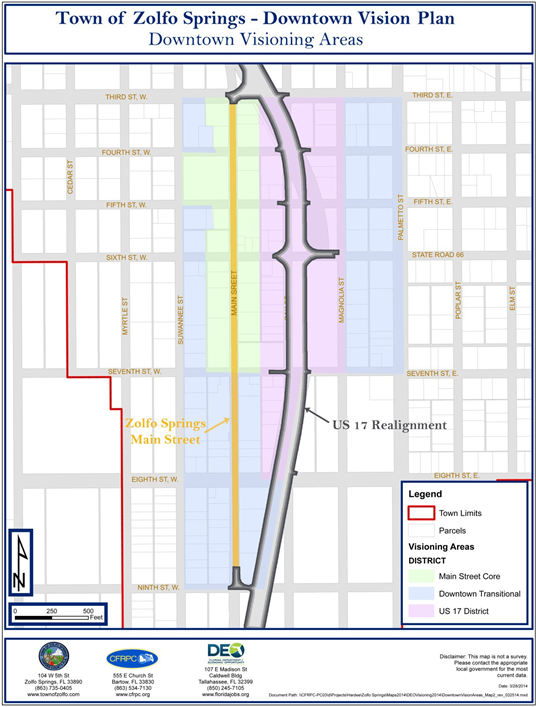
Figure 2.04.03.01.02(A)
2.04.03.01.03 Administration and Enforcement of DOD
(A)
Applicability and Effective Date. Commencing with the date of the adoption of this Code by Ordinance No. 2017-05, October 1, 2017, the DOD provisions shall apply to the development of all land therein whether publicly or privately held. No development shall be undertaken without prior authorization pursuant to the Downtown Overlay Zone. Within each of the development zones, the regulations of the underlying zoning district shall continue to apply, except as expressly supplemented or modified under the provisions of these design guidelines. The DOD standards apply to the following:
(1)
All new construction of buildings or structures.
(2)
All exterior building improvements requiring a building permit.
(3)
All new or reconstructed parking areas requiring five or more spaces.
(4)
Any building, structure, or parking area that lawfully exists at the time the DOD is enacted, which would not otherwise be permitted under the DOD, may be continued in the same manner as it existed before the effective date of the DOD. Any future construction, additions, reconstruction, or renovation shall be subject to the requirements of the DOD.
(B)
Compliance with Downtown Overlay District Requirements. At the time of application for any building permit and/or site development plan relating to the external structure, the applicant shall demonstrate that the proposed building, structure, improvement, or renovation, complies with the requirements of the DOD. No building permit shall be issued until the requirements of the DOD have been met. It is the applicant's responsibility to provide the necessary information to Town staff in order to determine compliance with this section.
The Development Services Director or his or her designee shall apply the DOD standards and guidelines to all development activity within the downtown overlay district, including new construction and exterior renovations, in keeping with Table 2.04.03.01.03(A). The Town will consider flexibility of site and building design requirements and guidelines for all development proposals so long as proposed improvements meet the intent of these regulations. See Section 2.04.03.01.03(D) for additional information concerning flexibility and alternative design considerations.
(C)
Required and Encouraged Design Standards. Table 2.04.03.01.03(A) includes the list of Design Standards applicable in the DOD. These standards shall apply to all property within the DOD except for those uses that are exempt in accordance with Section 2.04.03.01.03(F). These standards are designed to be flexible. Design flexibility shall be considered based on the magnitude of the development type and individual site constraints (Section 2.04.03.01.03(C)(2)). Detailed descriptions and options for each design standard is provided in Section 2.04.03.01.04.
(D)
Flexibility and Alternate Design Considerations
(1)
The Town recognizes that individual sites and/or proposed uses may have different needs and requirements. The Town will work with applicants to provide flexibility through alternate design considerations as long as the proposed improvement meets the intent of these regulations. Alternate design considerations may be sought for standards that are identified as "Required" or "Encouraged." Design departures are not applicable for certain development standards (i.e. floor area ratio, building height, sidewalks), unless otherwise specified in this Code.
(2)
The Town Manager, at his or her discretion, may forward any request for alternate design consideration to the Planning Board for recommendation to the Town Commission for consideration.
(3)
Alternate design considerations may be approved if any of the following conditions are met:
a.
The proposed alternative meets the general intent set forth by a specific guideline or standard.
b.
The specific alternative is equal to or superior in design quality to that potentially achieved by a specific guideline or standard.
c.
The proposed alternative is necessary to better address specific aspects of a site condition, proposed use, or its surroundings.
d.
The proposal offers an overall, thoughtful and comprehensive project design alternative for the project as a whole or to the vision of the adopted Downtown Master Plan.
(E)
Exemptions from Compliance with Downtown Overlay District Requirements. Under the following circumstances, the Town will not enforce the requirements of the Downtown Overlay District, unless specifically stated, but the Town encourages compliance with the recommendations and guidelines as feasible.
(1)
All single-family residential uses are exempt from the requirements of the DOD, except for landscape buffering provisions.
(2)
Renovation work that is completed wholly within the interior of the building.
(3)
Maintenance items such as roof repair or replacement, HVAC repair and replacement, electrical and plumbing repair, foundation stabilization, masonry repair, replacement of rotten wood, and repair of existing windows and doors that do not alter the exterior appearance or significantly change the architectural character of a building.
(4)
Improvement of a structure to correct existing violations of state or local health, sanitary, or safety code specifications which have been identified by the local code enforcement official and which are the minimum necessary to ensure safe living and/or working conditions.
(F)
Standards Conflict: The provisions of the DOD shall prevail in case of conflicts between the standards set forth in this section and standards of the underlying base zoning district, other requirements of the Land Development Code, or other applicable rules, regulations, covenants, and agreements.
(G)
Relationship to Subdivision Regulations: The character of proposed development within the DOD may require that standards for lot size, shape, and frontage be subject to modification from standards established in adopted subdivision regulations. An application for a final development plan for a site within the DOD shall be deemed to be an application for preliminary subdivision approval, with no separate filing required.
(H)
Review and Approval Process: To ensure that development, redevelopment, and improvements made to property located within the DOD are consistent with the goals of this Article, the following reviews and reports will be required prior to the issuance of building permits and/or approval of site plans by the Town:
(1)
Application process
a.
Pre-Application Meeting. At the request of the applicant, a pre-application meeting to discuss the purpose and intent of the DOD and the criteria and standards contained herein may occur. The pre- application meeting provides an opportunity for the applicant to become familiar with applicable zoning regulations and procedures and receive initial comments on the specific proposal by Town staff.
The applicant is encouraged to provide a site map and any supporting data and analysis at the pre-application meeting for discussion. The purpose of these items is to ensure that the applicant has adequately identified important features of the site prior to the creation of a full site development plan.
The applicant's site map may be a sketch for the pre- application meeting but should include the following features:
1.
Property boundaries.
2.
Representation of adjacent lots, existing buildings, adjacent streets, and opportunities for connectivity.
3.
Location of proposed uses and buildings on the lot.
b.
Application. The applicant shall submit an application to the Town for review and approval with the appropriate application fees and the following items as determined by the Town Manager:
1.
Sketch of site including proposed changes
2.
Site plan meeting the requirements of Section 7.05.03 of this Code.
3.
If not demonstrated on the site plan, a statement of how the plan meets the requirements of the DOD and other requirements of this Code.
4.
Proposed alternative design considerations, if any, with a statement as to how they meet the intent of the requirements and why site should not have to meet the requirements.
5.
Proposed encouraged design standards.
6.
Any applicable studies required by the Development Guidelines and Standards, per Section 2.04.03.01.04.
c.
Application Fees. The Town Commission shall set application fees associated with plan review and approval of development or redevelopment projects in the DOD.
(2)
Approval Process.
a.
Staff Level Approval. The Town Manager, or his/her designee, has the authority to approve applications on behalf of the Town. As a part of that approval, the Town Manager or his/her designee, may approve alternate design conditions, unless specified in this Code.
b.
Town Commission Approval. At the Town Manager's discretion, any development that may have compatibility concerns or special requests may be sent to the Planning Board for recommendation to the Town Commission for approval.
(3)
Appeals. Decisions made by the Town Manager may be appealed to the Town Commission.
2.04.03.01.04 Development and Design Principles and Guidelines. Design and development guidelines encourage variety while promoting aesthetic standards and ensuring a high quality design. They are intended to guide the applicant through the design development process while promoting the aesthetic character and economic vitality of the area. These design principles and guidelines include items that affect appearance, landscaping, pedestrian access, building location, compatibility with surrounding neighborhoods, and cost effectiveness in design.
The following principles and guidelines outlined below serve as the basis for growth and development within the DOD. In conjunction with the Downtown Vision Plan, the development principles and guidelines included below serve as direction for Town Staff, the Planning and Zoning Board, and the Town Commission in the decision making process for properties and projects located in each of the zones in the DOD.
(A)
DOD—General Design Principles. The following design principles highlight important concepts in the establishment of the DOD in the Town of Zolfo Springs. These principles provide the foundation for specific design guidelines and standards which have been established to actualize the Town's vision.
(1)
Design for the Human Scale: Create a sense of place that is safe, walkable, and attractive to residents, businesses, shoppers, and other visitors to the Zolfo Springs downtown area.
(2)
Design Character: Provide an end product which results in a unique and visually appealing physical environment. The guidelines and standards depict traditional dense, urban design methods for the area within the Main Street Core and US-17 zone, while the Downtown Transitional zone provides a mix of development types intended to support future growth of the entire downtown area.
(3)
Mixed Uses: The guidelines and standards support regulations for development within the DOD providing for a mix of residential, commercial, and professional land uses which aim to vitalize the community and encourage people to live, work, shop, and play within the downtown area.
(4)
Property Values and Investment: The guidelines and standards provide elements of design that are aimed at encouraging business development, attracting residents and visitors, and increasing the overall value and investment of property in the downtown area.
(5)
Design and Development Flexibility: While the design criterion of the guidelines and standards establishes the Town's desired architectural character for the DOD, the review process encourages reasonable architectural expression in each individual business and property owner. The guidelines and standards are designed to provide a clear direction for quality development, but at the same time, promote flexibility that fosters creative design. This flexibility is intended to support individualism in design, while also acknowledging distinct site conditions and other constraints that may exist on properties in the downtown area.
(B)
DOD—General Site and Building Design Guidelines. The design and functionality of buildings and spaces within the DOD shall meet, as best as feasibly possible, the following general site and building design guidelines.
(1)
Site design should be organized to respect the arrangement of buildings, open space, accessibility, and landscape elements on adjacent lots in the DOD. All structures and open spaces should be designed and located to provide mutual benefits of natural light, accessibility, circulation, and views.
(2)
Multi-story buildings should be designed to minimize overall building massing. This can be accomplished through upper story setbacks, façade articulation, and other architectural treatment methods.
(3)
Flexibility in building orientation shall be recognized to promote an interesting visual environment. A building's orientation may vary depending on site constraints and the need to accommodate other design guidelines and/or regulations.
(4)
Building orientation with a primary operable entrance on the street- side of a lot is encouraged to help create an active street frontage.
(5)
Lots/projects in the DOD that have frontage on two of the three following streets (double frontage) are required to orient building entrances and features to address both frontages.
•
Main Street
•
US-17
•
SR 66 (Florida Cracker Trail)
(6)
To support the high numbers of people who utilize walking or bicycling as a primary means to traverse the Town, the site and building design should support these activities. It is highly encouraged that the planned-use of land support walkability between destinations within and around the DOD.
(7)
Site and building designs should be responsive to climate patterns of the Central Florida region in order to provide shade and provide protection for pedestrians from inclement weather conditions.
(8)
Buildings within the same development envelope are encouraged to utilize similar architectural treatments consistent with other buildings on the same lot.
(9)
Exposure of corrugated metal siding on buildings must be limited to a maximum of 20% of each façade.
(C)
DOD—Development Design Guidelines and Standards. The Required and Encouraged Design Standards Table, Table 2.04.03.01.03(A), provides the required and encouraged development standards for the different zones in the DOD. This Section is the companion to Table 2.04.03.01.03(A) as it provides descriptions of each guideline or standard and outlines options for addressing the guideline or standard.
(1)
Building Setbacks
a.
Front Yard:
1.
Front yard building setbacks shall respect the front yard building setbacks of buildings on adjacent lots and the maximum front yard setback follows.
(a)
Main Street Core: Proposed buildings directly fronting a street shall not exceed the average front yard depths of the nearest lots directly abutting either side of the subject lot or a maximum of 15 feet, whichever is less,
(b)
US-17 Zone: Proposed buildings directly fronting a street shall not exceed the average front yard depths of the nearest lots directly abutting either side of the subject lot or a maximum of 30 feet, whichever is less,
See Figure 2.04.03.01.04(B).
2.
A portion of a building along a street front may be setback farther than the maximum setback in order to accommodate outdoor seating areas. In order to preserve the continuity of the street wall, at least 40 percent of the building façade shall be located within the maximum setback line. The total area of an outdoor seating area located between a public sidewalk and the building façade shall not exceed 15 times the building's street frontage in linear feet. See Figure 2.04.03.01.04(C).
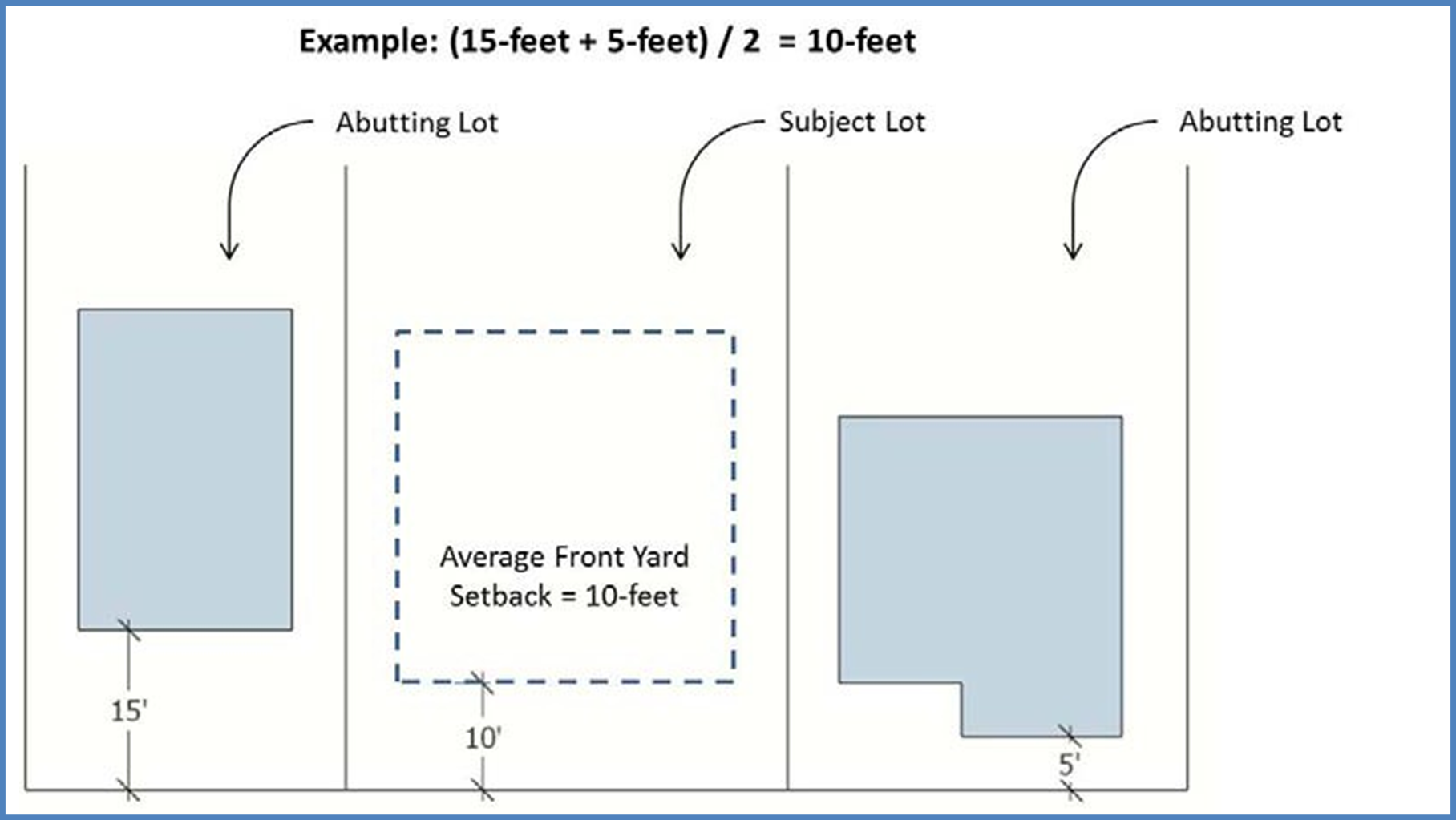
2.04.03.01.04(B)
Calculating Front Yard Setbacks
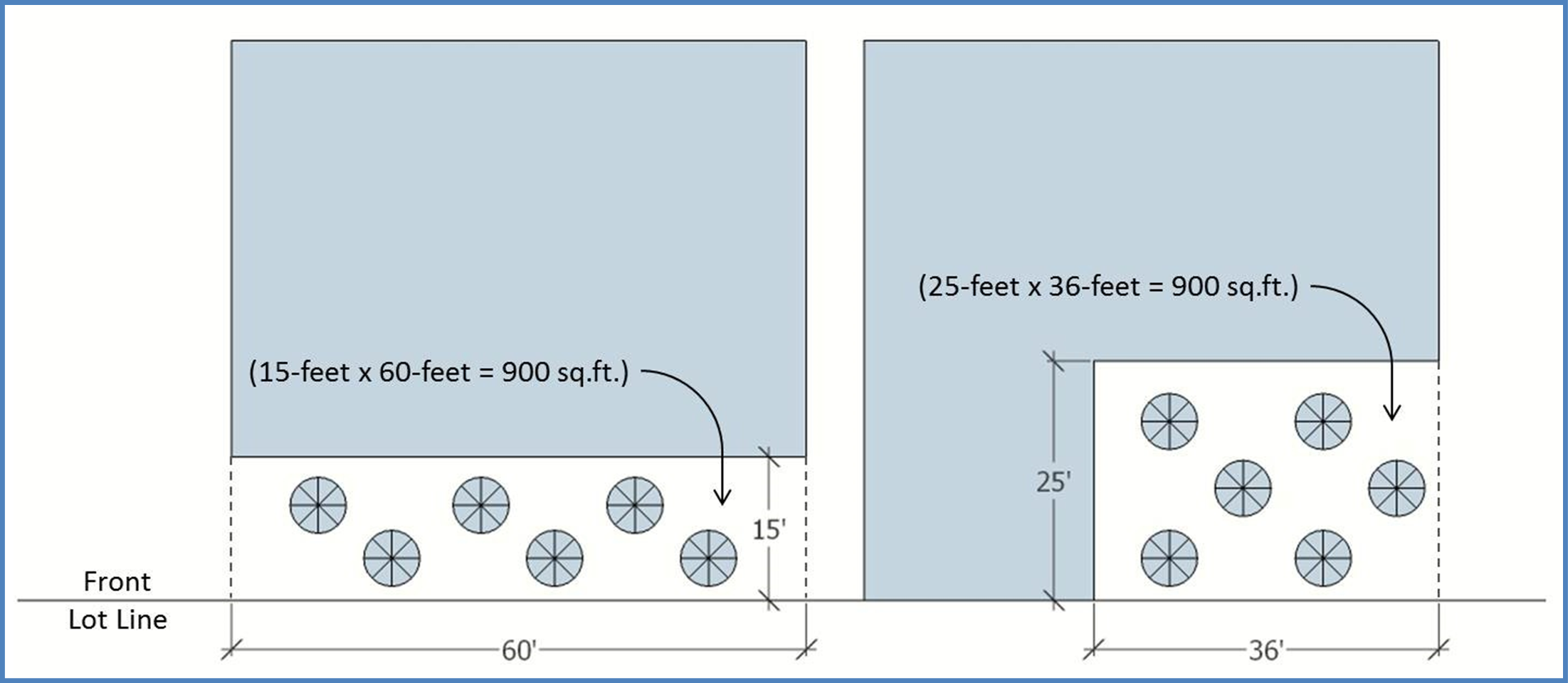
2.04.03.01.04(C)
Exception to Front Yard Setbacks
b.
Rear Yard:
1.
No minimum rear yard building setbacks are required, unless otherwise provided by the base zoning district or in this section.
2.
A commercial lot whose rear yard abuts a residential lot shall maintain a rear yard building setback for all buildings and structures, providing for the necessary space to accommodate any required landscape buffer in accordance with Article 3, Section 3.07.04, Buffer Yards, of this Code.
c.
Side Yard:
1.
No minimum side yard building setbacks are required, unless otherwise provided by the base zoning district or this section.
2.
A lot whose side yard abuts a residential lot shall maintain a side yard building setback for all structures, providing for the necessary space to accommodate any required landscape buffer in accordance with Article 3, Section 3.07.04, Buffer Yards, of this Code.
(2)
Architectural Treatments. Architectural treatments enhance the attractiveness of buildings and structures.
a.
Applicability
1.
A minimum of one (1) of the established architectural treatments listed in subsection b. below shall be applied in a consistent manner along all sides of a building façade within the Main Street Core and US- 17 Districts.
2.
Lots/projects in the DOD that have frontage on two of the three following streets (double frontage) are required to provide architectural treatments on both street frontages:
•
Main Street
•
US-17
•
SR 66 (Florida Cracker Trail)
b.
Application Standards and Requirements
1.
Painting of the exterior façade.
2.
Painting of murals in the Main Street Core.
3.
Horizontal banding or belt course (shall have a minimum vertical dimension of 12 inches and be projected outward from wall 2 inches).
4.
Architectural moulding. This may be decorative framing around windows and doors, decorative caps on columns, or other architectural expression on wall surfaces.
5.
Decorative cornice (shall have a minimum vertical dimension of 12 inches and be projected outward from wall 2 inches).
6.
Other similar architectural treatments as approved by the Town Manager or his or her designee.
(3)
Building Massing and Façade Articulation. Building massing addresses the combined physical impact of the shape and bulk of a building, as demonstrated by its height, width, and depth and façade articulation addresses the physical changes in the depth of the surface of a building façade.
a.
Requirements. While the Town encourages the development of the façade appearance within the Main Street Core and US-17 Districts, the following requirements exist.
1.
Structures with façades 150 feet or more in length are required to incorporate building massing and façade articulation.
2.
Buildings whose primary operable entrance is not located on the street-side of the building must provide visual interest to the street-side through the use of windows and/or other openings or simulated or opaque windows.
3.
Lots/projects in the DOD that have frontage on two of the three following streets (double frontage) are required to provide visual interest to both street frontages through the use of windows and/or other openings or simulated or opaque windows:
•
Main Street
•
US-17
•
SR 66 (Florida Cracker Trail)
b.
Guidelines. In general, the following concepts should be carefully considered:
1.
Large buildings should be broken into smaller elements in order to scale the appearance down in size.
2.
Large, blank walls should be avoided.
3.
Incorporation of storefront glazing, awnings, and other pedestrian amenities at street-facing facades is encouraged.
4.
Use of decorative building elements in a rhythmic pattern (architectural rhythm) is suggested to break up large building masses.
5.
Columns, pilasters, window placement, and other architectural features need to be used to subdivide the facades of larger buildings into several smaller vertical segments to reflect the scale and proportion of adjacent properties.
6.
Multiple storefronts that are part of the same building should have complementary façade designs, particularly with respect of color, cornice line and decorative materials.
(4)
Connections and Cross-Access. Connections and cross-access for pedestrians, bicycles, and vehicles are necessary to facilitate a diverse and vibrant business, commercial, and residential environment within the downtown area of Zolfo Springs.
a.
Pedestrian Access
1.
Direct ADA-compliant pedestrian access shall be provided from the public sidewalk to the primary operable entrance of the business with a minimum of 5-foot sidewalk or by clearly delineated crosswalks through vehicular parking areas.
2.
All sites shall provide cross-access connectivity between adjacent lots for future pedestrian interconnectivity. Such connections shall be constructed of a paved or other approved hard surface material.
3.
All crosswalks, direct-access, and cross-access pedestrian walkways within vehicular parking areas shall be marked with paint or constructed of a different surface material than that of the general parking area and associated driveways. The materials used shall clearly designate such access-ways from the surrounding parking and driveway surface areas.
b.
Bicycle Access. The Town recognizes the importance of providing safe, easy to use bicycle access for both the people who rely on bicycles as their primary mode of transportation and recreational bicycle users. Increased bicycle access is encouraged in the DOD. Bicycle access can be increased through:
1.
Provision of additional bicycle racks.
2.
Provision for long-term bicycle parking.
3.
Allowing for bicyclists to bring bicycles into their offices for storage.
c.
Vehicular Access
1.
Driveway improvements shall be provided to facilitate existing and future interconnection of parking areas with adjacent lots.
2.
Continuous drive aisles between adjacent lots are encouraged. Drive aisle widths shall meet the standard minimum requirements as provided in Article 3, Section 3.03.04 of this Code.
3.
Driveway stub-outs shall be extended to adjacent property lines to provide future interconnectivity. Stub-outs providing shared access across property lines may be utilized and shall require a property owner agreement. All access/easement agreements shall be recorded with the Hardee County Clerk of Courts prior to final approval of a site development plan.
(5)
Parking. Parking requirements for all development in the DOD shall respect the parking standards of Article 3, Section 3.03.00 of this Code. Specific requirements and opportunities for the Main Street Core zone are outlined in Section 3.03.02(I).
a.
Location
1.
Parking areas for motor vehicles shall be located to the sides and rear of buildings to shield and minimize the overall appearance of parking areas and to promote a safe and inviting pedestrian environment.
2.
Off-street parking areas shall include internal landscaped islands to help visually soften the impact of paved surfaces.
3.
Parking areas for corner lots shall be located to the interior corner of the lot, as best as feasibly possible. Where a parking area for a corner lot, or any other lot, encroaches on a street, screening shall be provided as established in Section 2.04.03.01.04(C)(6)(g).
b.
Amendment or Alteration. Any adjustments or alternatives to parking requirements not expressly provided in this Code must be submitted to the Town Manager for review and the Planning Board for recommendation to the Town Commission for approval. As required by the Town Manager, a parking study shall be provided to support adjustments as established in Section 2.04.03.01.04(C)(5)(f).
(6)
Screening. Screening of items such as dumpsters, utility service cabinets, loading and servicing areas, outdoor storage areas, and parking areas help to improve the aesthetics of the area. Screening, as described below, is required to the best feasibility of the site and/or project.
a.
Dumpsters shall be fully screened from view. A dumpster enclosure shall be constructed at a height of 7-feet using durable building materials and colors coordinated with the overall building design as illustrated in Figure 2.04.03.01.04(D).
b.
Utility service cabinets and mechanical equipment installed at the ground level shall be located, as best as feasibly possible, where such equipment can be screened from view. Utility equipment shall not be located within a landscaping island in a parking area. Consideration should be given to accessibility for required service and maintenance of such facilities.
c.
Ground-level utilities and mechanical equipment shall be screened using decorative elements like lattice or other constructed features coordinated with the look and character of the building. Landscaping may also be used to screen such equipment. (See Figure 2.04.03.01.04(E).
d.
Rooftop utilities and mechanical equipment shall be screened by architectural features like a parapet roof and/or painted to match the color of the building or roof. Figure 2.04.03.01.04(F) provides an illustration of what is desired and what is prohibited.
e.
Loading and service areas shall not be visible from public roadways and shall be shielded from parking areas, as best as feasibly possible.
f.
Outdoor storage areas shall be located behind or on the side of buildings and shall not be visible from public roadways or pedestrian activity areas.
g.
Parking areas abutting a street shall be screened to visually shield the parking area from view of the street. Screening shall be accomplished by one or more of, but not limited to, the following:
1.
A landscape buffer meeting the design standards of a "Type A" buffer shall be provided as established in Article 3, Section 3.07.04 of this Code.
2.
Designation of a public open space area. (See Section 2.04.03.01.04(C)(11)).
3.
Other buffering mechanism as approved by the Town Manager or his or her designee.
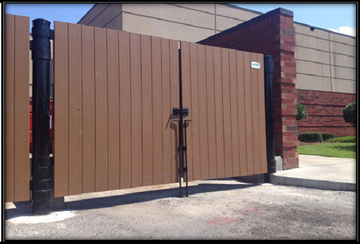
Figure 2.04.03.01.04(D)
Dumpster Enclosure.
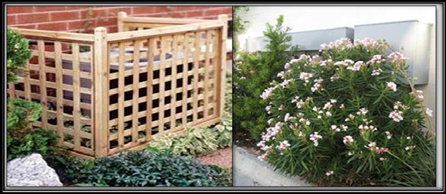
Figure 2.04.03.01.04(E)
Desired Ground-Level Utilities Screening.
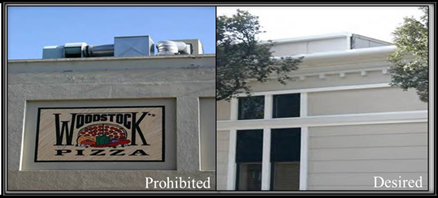
Figure 2.04.03.01.04(F)
Rooftop Utilities Screening.
(7)
Landscaping. Landscaping requirements for all development in the DOD shall respect the landscaping standards of Article 3, Section 3.07.00 of this Code, except as expressly supplemented or modified in this section.
a.
Guidelines. The following guidelines are encouraged within the Main Street Core and the US-17 zone.
1.
Canopy trees or other small to medium-sized trees are encouraged to be planted along street edges. Buildings with a primary operable entrance on the street-side of the building are encouraged to coordinate such plantings with the placement of pedestrian walkway enhancements, signage, entranceways, and storefront windows.
2.
All landscaping shall meet the standards of approved plantings established by the Town of Zolfo Springs.
(8)
Low Impact Development. Developments within the Main Street Core and US-17 zones are encouraged to incorporate Low Impact Development (LID) practices into design proposals, in order to provide mutual environmental, stormwater management, and aesthetic benefits. Incorporating LID strategies into a development plan can reduce the cost of constructing traditional stormwater management facilities, help offset costs for potable water consumption, and increase the developable area of a site.
a.
Examples of LID strategies that may be used on site include, but are not limited to the following.
1.
Permeable pavement: a hard, yet penetrable surface which reduces surface water run-off by allowing water to move thru the pavement surface and directly into the ground below.
2.
Vegetated swales and landscape islands: An alternative to traditional curb and gutter systems, where surface water run-off is purposely directed to landscaped infiltration points/areas along streets and within parking areas.
3.
Green/Eco-roof systems: These systems can significantly reduce the rate and quantity of stormwater run-off from a roof and provide buildings with thermal insulation and enhanced aesthetics.
4.
Bio-retention basins and Rain gardens: Small vegetative depressions in the landscape which collect and filter stormwater directly into the ground.
5.
Stormwater reuse: Engineered surface ponds and other catchment devices which store rainfall for future irrigation purposes. Small scale systems can include cisterns and rain barrels.
b.
Application. Developments wishing to incorporate LID practices into site development plans shall be required to coordinate with the Town Manager or his or her designee. Additional coordination may be required with the State of Florida and the Southwest Florida Water Management District to meet engineering and permitting requirements.
(9)
Pedestrian Walkway Enhancements. Pedestrian walkway enhancements are included within the DOD to provide protection to pedestrians and other users of the street from unnecessary heat gain from sun exposure and inclement weather conditions. Within the Main Street Core, provisions for protection from sun and elements for pedestrians must be provided. Provisions are encouraged in the US-17 and the Downtown Transitional zones.
a.
Awnings and canopies shall meet the following requirements. Example of permitted types of awnings and canopies are provided in Figure 2.04.03.01.04(G):
1.
Shall consist of opaque materials.
2.
Shall be uniform in design pattern and color.
3.
Shall not be back lit or internally illuminated.
4.
Shall be hung above display windows, or other openings but may extend the length of the building.
5.
Shall provide a minimum of 8-foot vertical clearance above any pedestrian walkway.
6.
Sign lettering and/or logos shall comprise no more than 30% of the total display surface of any awning or canopy, and shall be included in the calculation of the allowable sign area.
b.
Cantilevered roofs, arcades, and colonnades, including columns or other supporting structures associated with such elements, shall meet the following requirements. Examples of desirable cantilevered roofs, arcades, and colonnade are provided in Figure 2.04.03.01.04(H):
1.
Shall be constructed with a minimum vertical clearance of 9-feet above any pedestrian walkway.
2.
Shall not encroach on the right-of-way line of any State or County designated roadway.
3.
May be constructed up to the curb-line within the right-of-way of any local roadway. A legal agreement between the Town and the property owner shall be established acknowledging any encroachments on a right-of-way. The agreement shall be approved as to form by the Town Attorney and recorded with the Hardee County Clerk of Courts prior to final approval of a site development plan.

Figure 2.04.03.01.04(G)
Permitted Awnings and Canopies.
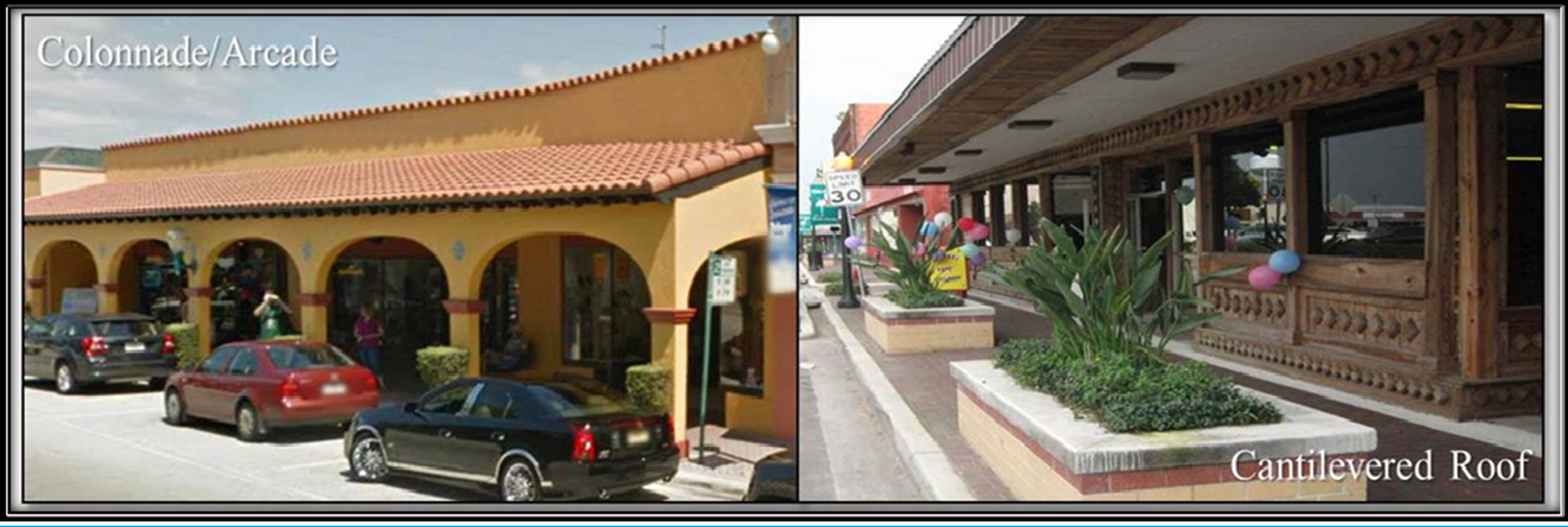
Figure 2.04.03.01.04(H)
Colonnade, Arcade, Cantilevered Roof.
(10)
Parklets. Parklets increase the walkability of the Main Street Core by providing areas of shade and rest for pedestrians and other uses of the street, while offering opportunities for areas of interest. The Main Street Core parklets are intended to be dynamic, multi-use spaces that support community stewardship and prioritize the pedestrian experience.
The Town encourages the co-development of parklets along Main Street in the Main Street Core. While the parklets will be located within the Town's right-of-way, the Town will work with businesses to determine the best location.
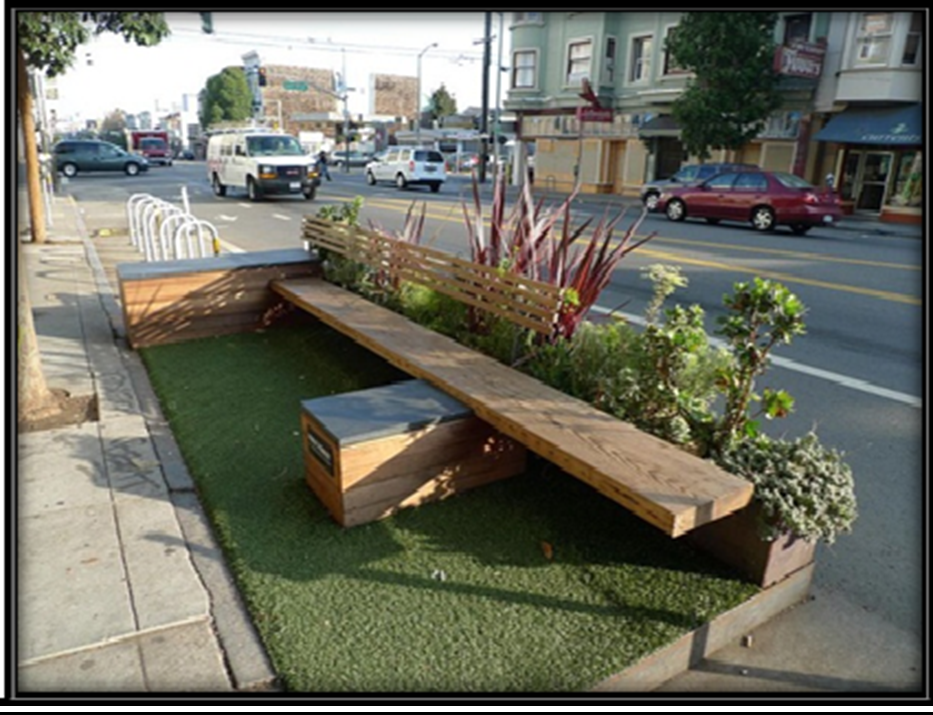
Figure 2.04.03.01.04(I)
Parklet.
(11)
Public Open Spaces. Developments within the DOD are encouraged to include public open spaces, such as hardscape plazas, open green spaces, water features, public seating areas, and play areas because they are desirable elements which help contribute to the character of the DOD, and should be treated as visual and functional focal points. Public open spaces should meet the following requirements.
a.
Open space(s) for use by the public on a development site should constitute, at a minimum, five percent (5%) of the total gross square footage of building area on the site.
b.
Integration of public art is encouraged and can be incorporated in less space than required above,
(12)
Long-Term Bicycle Parking. Long-term bicycle parking provides employees, residents, commuters, and others who generally stay at a site for several hours, a secure and preferably weather-protected place to park bicycles.
a.
Requirements
1.
Long-term bicycle parking is highly encouraged.
2.
Within the Main Street Core and the US-17 zone, covered long-term bicycle parking and/or bicycle lockers may be developed in place of some required parking.
3.
Racks for all bicycle parking shall meet the design standards as provided in Section 3.03.02(E)(1) of this Code.
b.
Design Standards
1.
Long-term bicycle parking should be located on site or within 300 feet of the site as measured along the nearest pedestrian walkway;
2.
Areas devoted to long-term bicycle parking should be paved of a hard surface material.
3.
Long-term bicycle parking should be provided in racks or in lockers.
4.
Where lockers are provided, such lockers shall be securely anchored and installed per the manufacture's design standards.
5.
Covered long-term bicycle parking must meet the following standards:
(a)
Provided inside buildings, under roof overhangs, awnings, or canopies, within bicycle lockers, or within or under other approved structures.
(b)
For covered spaces not located in a building or within a locker, the cover shall be:
i.
Constructed as a permanent structure;
ii.
Designed to protect the bicycle from rainfall; and
iii.
Constructed at a height of at least 7- feet above the finish grade of the paved surface.
(13)
Public Art. Public Art provides interest to the area. The inclusion of art available for the public to interact with or see is highly encouraged. The use of art in building or properties with empty uses is encouraged.

