
Abbeville City Zoning Code
CHAPTER 5
- SUPPLEMENTAL REGULATIONS
§ 5-100. - Definitions.
a.
"Communications tower" as used in this ordinance shall mean a tower, pole, or similar structure which supports a telecommunications antenna operated for commercial purposes above ground in a fixed location, free-standing, guyed, or on a building.
b.
"Telecommunications," as defined in the federal Telecommunications Act of 1996, means the transmission, between or among points specified by the user, of information of the user's choosing, without change in the form or content of the information as sent and received.
c.
"Antenna" means a device, dish or array used to transmit or receive telecommunications signals.
d.
"Height" of communication tower is distance from base of tower to top of structure.
§ 5-101. - Communications Tower and Antenna Permitted as Conditional Use.
A communications tower and/or antenna may be permitted by the Zoning Administrator without further review upon determination that all of the applicable conditions in this ordinance are met.
§ 5-102. - Special Exceptions.
A tower, pole, or antenna may be permitted by special exception granted by the Zoning Board of Appeals after public hearing and findings of fact based on the following criteria:
§ 5-200. - Federal Emergency Management Agency Standards Applicable.
Compliance with applicable Federal Emergency Management Agency standards pursuant to the City Code shall be a prerequisite to issuance of a zoning permit.
§ 5-300. - Purposes for Required Landscaping.
These regulations are established to protect and enhance the natural landscape of Abbeville and ensure the appropriate use of plant material in new construction. It is the intent of these regulations to preserve natural tree cover and establish new tree planting with development in order to:
A.
Reinforce community identity;
B.
Reduce visual blight and noise;
C.
Increase building and property values;
D.
Prevent soil erosion;
E.
Reduce storm water runoff;
F.
Create shade and reduce solar overheating.
Landscaping is required as described in this ordinance for the specific zoning district to provide for buffering of adjacent zones, sound and light abatement, and screening of commercial uses and parking. All required landscaping shall be installed and maintained in compliance to the following general requirements:
A.
All plant material installed shall be healthy and of the best quality.
B.
All trees shall be a minimum 2 inch caliper at breast height at installation.
C.
A maintenance agreement for the plant material shall be included in the property covenant.
D.
Maintenance and replacement per the original approved plan of damaged, destroyed, or dead plant materials is the responsibility of the property owner.
E.
Plant material shall be bonded for one year. A planting schedule shall be included in the bond and shall be based on seasonal considerations.
F.
Landscaping shall be provided in accordance with these regulations whenever a building or use is changed or experiences a 10% enlargement in floor area.
G.
Landscaping shall not conflict with the visibility at street intersections.
H.
Wheel stops shall be placed three (3) feet from required landscaping areas.
I.
Existing vegetation may be used to satisfy portions of the landscaping requirements.
Landscaping is encouraged in residential districts. At a minimum, all residential uses should have shrubbery and ground covering grass within the front yard or street side of the residence. This shrubbery and grass should be maintained according to city ordinance standards.
_____
Large Maturing Trees: The following is a list intended for general reference and should not be considered all inclusive.
Small Maturing Trees: The following is a list intended for general reference and should not be considered all inclusive.
§ 5-303. - Tree Protection.
Intent: These regulations are established to protect trees by regulating the cutting down, damaging, planting and replacement of trees during development in order to:
A.
Maintain the environmental and aesthetic benefits that trees provide;
B.
Improve the appearance of vehicular use areas;
C.
Protect and conserve property values within the City.
The provisions herein shall not be interpreted to prohibit or unduly inhibit development of private property.
Exemptions:
A.
Residential Exemption: Existing single and small multi-family residential uses are exempt from the requirements of this section unless such use is in the process of being converted into a commercial or industrial use.
B.
Commercial Timber Operation Exemption: Commercial timber operations shall be exempt from the provisions of this Ordinance. The City encourages the retention of a fifty foot (50') buffer of existing trees adjacent to all public rights-of-ways.
Protection of Trees Prior to Development: On a vacant parcel of land, where a building permit or subdivision approval has not been issued, the destruction, within any five (5) year period, of more than twenty-five percent (25%) of the protected trees on any one (1) parcel of non-exempt land shall be prohibited. The total number of protected trees existing on any one parcel shall not be reduced below a total number equal to twenty (20) protected trees per acre.
Protection of Trees During Development: For parcels of land proposed for development, a minimum number of protected trees (eight inches (8") or greater DBH) on the entire parcel equal to twenty (20) protected trees per acre shall be saved. For parcels containing less than twenty (20) protected trees per acre, the total number of protected trees required to be saved shall equal the total number of protected trees existing on the parcel. Grand trees (twenty-four inches (24") or greater DBH) to be saved may be used to calculate the total number of protected trees to be saved.
A.
Protective Barricades Required: Protective barricades shall be placed around all protected trees and grand trees located in development areas, and designated to be saved, prior to the start of development activities, and shall remain in place until development activities are complete or construction in accordance with standards set forth in this Section commences. The area within the protective barricade shall remain free of all building materials, dirt or other construction debris, vehicles and development activities. Barricades shall be erected at a minimum distance of ten feet (10') from the base of each protected and grand tree.
B.
Construction within the Protective Barricade: Construction of impervious surfaces shall not be permitted within five feet (5') of a protected tree or within twelve feet (12') of the base of a grand tree, unless special construction methods, including but not limited to tree feeders and porous paving materials, are used and certified as acceptable by a reputable tree service or other qualified organization.
C.
All roots outside the protective barricade to be removed during development shall be severed clean and a two inch (2") layer of mulch shall be applied over the surface of exposed roots during development.
D.
All pruning of protected trees and grand trees shall be done according to the National Arborists Association, Pruning Standards for Shade Trees.
Standards for Removal of Protected or Grand Trees:
A.
The removal of a protected tree shall be approved if the Zoning Administrator finds that one or more of the following conditions exist. This section shall not apply to grand trees.
1.
The protected tree is located where a proposed building or accessory structure is to be placed in accordance with other zoning standards; or
2.
The protected tree creates unsafe vision on a public street or right-of-way.
B.
Each protected tree or grand tree that is determined by the Zoning Administrator to be diseased or injured to the extent it is irreparably damaged shall be approved for removal. Replacement trees shall not be required.
Tree Removal, Relocation, or Replacement:
A.
Tree Replacement Required: Removal of each protected or grand tree shall require replacement with two (2) same or similar species and at least ten feet (10') in height on the same parcel. Applicant shall submit to the Zoning Administrator the species and size of replacement trees for approval.
B.
Relocation of Protected Trees: Relocation may be accomplished by relocating the tree on land under the same ownership within the town limits or to public land within town limits.
C.
Tree Planting Criteria: In the relocation or the replacement of a protected or grand tree, all trees used shall be vigorous, well shaped, branched and foliated.
D.
Maintenance: The owner of the parcel shall be responsible for the maintenance of all protected, grand, relocated or replaced trees.
Application for a Zoning Permit: Application for a permit where land development, new construction, or addition in the footprint of a structure is proposed shall require the submission of a site plan or plat which includes the following:
A.
A tree survey which locates all protected and grand trees identified by DBH and species. Groups of trees in close proximity may be designated as a clump of trees, with the predominant species, estimated number and average diameter indicated. For developments which exceed ten (10) acres, an aerial photograph may be substituted for a tree survey with the approval of the Zoning Administrator in instances that they would provide the same information as the tree survey.
B.
Location of all existing and proposed structures, improvements, rights-of-way, and easements on the property and designation of all public rights-of-way and other public lands adjacent to the property.
C.
Designation of protected trees to be saved and those to be relocated or removed.
[§ 5-400.] - Parking General Design Standards.
A.
Unless no other practicable alternative is available, any off-street parking area shall be designed so that vehicles may utilize such areas without backing onto a public street.
B.
Off-street parking areas of all developments shall be designed so that sanitation, emergency, and other public service vehicles can serve such developments.
C.
Circulation areas shall be designed so that vehicles can proceed safely without posing a danger to pedestrians and without interfering with parking areas.
D.
No off-street parking area shall be located over an active or auxiliary septic tank field.
E.
Retaining walls, screen, landscaping, and building walls shall be protected from vehicle contact.
F.
A permanent turn-around shall be required when the dead-end aisle exceeds 500 feet, measured along the centerline of the dead-end aisle, from the last aisle or public roadway.
[§ 5-401.] - Parking Space Dimensions.
A.
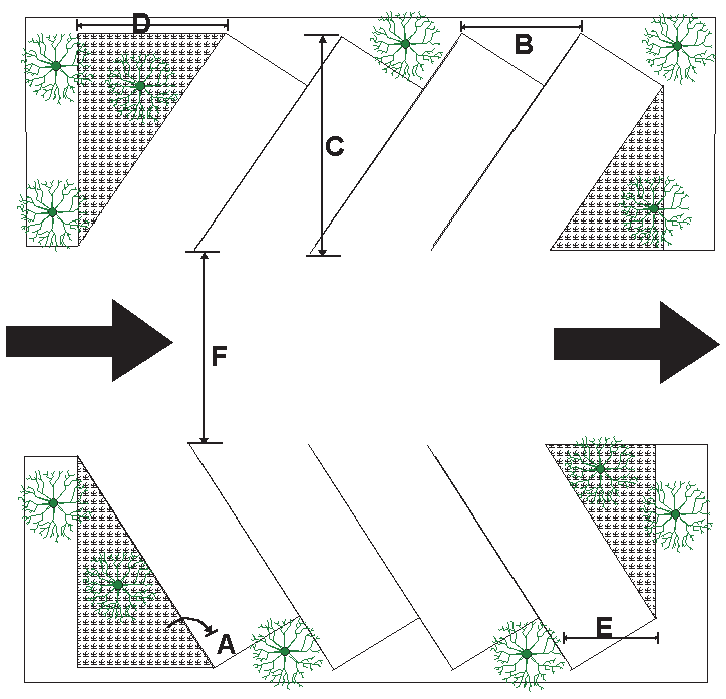
Each parking space shall contain a rectangular area of at least 180 square feet.
B.
Parallel parking shall provide a space of 20 feet by 9 feet.
C.
Parking areas and widths shall conform to the following table:
[§ 5-402.] - Parking spaces for those with a disability.
A.
Except for a lot containing a single family or duplex dwelling, all uses shall be required to provide and designate the following number of spaces designed for disabled persons.
B.
Off-street parking spaces for the disabled shall be designed as follows:
1.
All spaces for the disabled shall have access to a curb-ramp or curb-cut when necessary to allow access to the building served, and shall be located so that users will not be compelled to wheel behind parked vehicles, and shall be located the shortest possible distance between the parking area and the entrance to the principal building it serves.
2.
Parallel parking spaces for the disabled shall be located either at the beginning or end of a block or adjacent to alley entrances. Curbs adjacent to such spaces shall be of a height which will not interfere with the opening and closing of motor vehicle doors.
3.
Each parking space for the disabled shall be paved and prominently outlined with paint and with a permanent sign bearing the internationally accepted wheelchair symbol, posted at the head of the parking space.
4.
The size of the parking space shall be per building code specifications.
[§ 5-403.] - Cooperative Parking.
A.
Refer to required parking in this ordinance for the specific zoning district. These requirements may be met with cooperative parking.
B.
Cooperative provisions for off-street parking may be made by contract between two or more adjacent property owners. The parking area provided on any one lot may be reduced to not less than one-half (½) the number of required parking spaces for the use occupying such lot. These lots shall be interconnected where feasible in the HC district.
[§ 5-404.] - Application of Parking Requirements.
A.
Mixed Uses: When more than one (1) principal or accessory use occupy the same building or parcel; the parking spaces required shall equal the sum of the requirements of the various uses computed separately.
B.
Change in Use, Alteration of Use, or Extension of Use: Off-street parking spaces shall be provided in accordance with these regulations whenever a building or use is changed, altered or enlarged by at least 50% in floor area, number of employees, number of dwelling units, seating capacity, or otherwise.
C.
A scale drawing or layout of all required parking areas showing the location, size, and arrangement of the individual parking spaces, loading spaces, and landscaped areas shall be submitted to the Zoning Administrator for approval.
[§ 5-405.] - Lighting Standards.
A.
All parking space area lighting shall be energy efficient and designed so that any glare is directed away from adjacent properties or create any hazardous traffic conditions.
B.
Lighting shall be provided to illuminate any off-street parking or loading spaces within developments providing customer service to the public after 5:00 p.m. Required lighting shall be designed at a mounting height, luminance, and spacing to provide a minimum average horizontal illumination of 0.6 foot-candles within the parking area and at primary building entrances.
[§ 5-406.] - Sight Triangle.
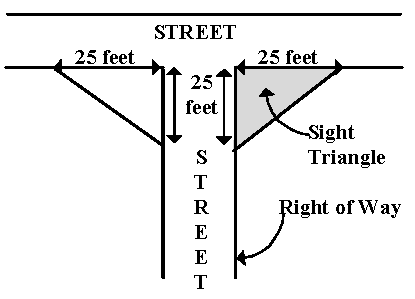
Intent: For protection against traffic hazards, no impediment to visibility shall be placed, allowed to grow, erected or maintained within visibility triangles described as follows;
Size of Sight Triangle: A triangular-shaped portion of land 25 feet wide and 25 feet deep at the intersection.
No structure, sign, or landscaping material shall exceed 3½ feet in height within the sight triangle.
No parking is not allowed within the sight triangle.
_____
§ 5-500. - Sign Regulations.
The following sign regulations shall apply to signs in all zoning districts.
§ 5-501. - Permitted Signs.
The following signs are permitted in the districts indicated.
§ 5-600. - Purpose and Intent.
It is the purpose of this Article to regulate sexually oriented businesses to promote the health, safety, morals, and general welfare of the citizens of the city, and to establish reasonable and uniform regulations to prevent the continued deleterious location and concentration of sexually oriented businesses within the city. The provisions of this Article have neither the purpose nor effect of imposing a limitation or restriction on the content of any communicative materials, including sexually oriented materials. Similarly, it is not the intent or effect of this Article to restrict or deny access by adults to sexually oriented materials protected by the First Amendment, or to deny access by the distributors and exhibitors of sexually oriented entertainment to their intended market. Neither is it the intent or effect of this Article to condone or legitimize the distribution of obscene material.
§ 5-601. - Definitions.
a.
Adult arcade means any place to which the public is permitted or invited wherein coin-operated or slug-operated or electronically, electrically, or mechanically controlled still or motion picture machines, projectors, or other image-producing devices are maintained to show images to five (5) or fewer persons per machine at any one time, and where the images so displayed are distinguished or characterized by the depicting or describing of "certain sexual activities" or "specified anatomical areas."
b.
Adult bookstore or adult video store means a commercial establishment which, as one of its principal business purposes, offers for sale or rental for any form of consideration any one or more of the following:
(1)
Books, magazines, periodicals or other printed matter, or photographs, films, motion picture, video cassettes or video reproductions, slides, or other visual representations which depict or describe "specified sexual activities" or "specified anatomical areas"; or
(2)
Instruments, devices, or paraphernalia which are designed for use in connection with "specified sexual activities." A commercial establishment may have other principal business purposes that do not involve the offering for sale or rental of material depicting or describing "specified sexual activities" or "specified anatomical areas" and still be categorized as an adult bookstore or adult video store. Such other business purposes will not serve to exempt such commercial establishment from being categorized as an adult bookstore or adult video store so long as one of its principal business purposes is the offering for sale or rental for consideration the specified materials which depict or describe "specified sexual activities" or "specified anatomical areas."
c.
Adult cabaret means a nightclub, bar, restaurant, or similar commercial establishment which regularly features:
(1)
Persons who appear in a state of nudity; or
(2)
Live performances which are characterized by the exposure of "specified anatomical areas" or by "specified sexual activities"; or
(3)
Films, motion pictures, video cassettes, slides, or other photographic reproductions which are characterized by the depiction or description of "specified sexual activities" or "specified anatomical areas."
d.
Adult motel means a hotel, motel or similar commercial establishment which:
(1)
Offers accommodations to the public for any form of consideration; provides patrons with closed-circuit television transmissions, films, motion pictures, video cassettes, slides, or other photographic reproductions which are characterized by the depiction or description of "specified sexual activities" or "specified anatomical areas"; and has a sign visible from the public right-of-way which advertises the availability of this adult type of photographic reproductions;
(2)
Offers a sleeping room for rent for a period of time that is less than 10 hours; or
(3)
Allows a tenant or occupant of a sleeping room to subrent the room for a period of time that is less than 10 hours.
e.
Adult motion picture theater means a commercial establishment where, for any form of consideration, films, motion pictures, video cassettes, slides, or similar photographic reproductions are regularly shown which are characterized by the depiction or description of "specified sexual activities" or "specified anatomical areas."
f.
Adult theater means a theater, concert hall, auditorium, or similar commercial establishment which regularly features persons who appear in a state of nudity or live performances which are characterized by the exposure of "specified anatomical areas" or by "specified sexual activities."
g.
Escort means a person who, for consideration, agrees or offers to act as a companion, guide, or date for another person, or who agrees or offers to privately model lingerie or to privately perform a striptease for another person.
h.
Escort agency means a person or business association who furnishes, offers to furnish, or advertises to furnish escorts as one of its primary business purposes for a fee, tip, or other consideration.
i.
Establishment means and includes any of the following:
(1)
The opening or commencement of any sexually oriented business as a new business;
(2)
The conversion of an existing business, whether or not a sexually oriented business, to any sexually oriented business;
(3)
The additions of any sexually oriented business to any other existing sexually oriented business; or
(4)
The relocation of any sexually oriented business.
j.
Permittee and/or licensee means a person in whose name a permit and/or license to operate a sexually oriented business has been issued, as well as the individual listed as an applicant on the application for a permit and/or license.
k.
Nude model studio means any place where a person who appears in a state of nudity or displays "specified anatomical areas" is provided to be observed, sketched, drawn, painted, sculptured, photographed, or similarly depicted by other persons who pay money or any form of consideration.
l.
Nudity or a state of nudity means the appearance of a human bare buttock, anus, male genitals, female genitals, or female breast.
m.
Person means an individual, proprietorship, partnership, corporation, association, or other legal entity.
n.
Semi-nude means a state of dress in which clothing covers no more than the genitals, pubic region, and areolae of the female breast, as well as portions of the body covered by supporting straps or devices.
o.
Sexual encounter center means a business or commercial enterprise that, as one of its primary business purposes, offers for any form of consideration:
(1)
Physical contact in the form of wrestling or tumbling between persons of the opposite sex; or
(2)
Activities between male and female persons and/or persons of the same sex when one or more of the persons is in a state of nudity or semi-nude.
p.
Sexually oriented business means an adult arcade, adult bookstore or adult video store, adult cabaret, adult motel, adult motion picture theater, adult theater, escort agency, nude model studio, or sexual encounter center.
q.
Specified anatomical areas means the male genitals in a state of sexual arousal and/or the vulva or more intimate parts of the female genitals.
r.
Specified sexual activities means and includes any of the following:
(1)
The fondling or other erotic touching of human genitals, pubic region, buttocks, anus, or female breasts;
(2)
Sex acts, normal or perverted, actual or simulated, including intercourse, oral copulation, or sodomy;
(3)
Masturbation, actual or simulated; or
(4)
Excretory functions as part of or in connection with any of the activities set forth in a. through c. above.
s.
Substantial enlargement of a sexually oriented business means the increase in floor areas occupied by the business by more than 25 percent, as the floor areas exist on July 1, 1997.
t.
Transfer of ownership or control of a sexually oriented business means and includes any of the following:
(1)
The sale, lease, or sublease of the business;
(2)
The transfer of securities which constitute a controlling interest in the business, whether by sale, exchange, or similar means; or
(3)
The establishment of a trust, gift, or other similar legal device which transfers the ownership or control of the business, except for transfer by bequest or other operation of law upon the death of the person possessing the ownership or control.
§ 5-602. - Classification.
Sexually oriented businesses are classified as follows:
(1)
Adult arcades;
(2)
Adult bookstores or adult video stores;
(3)
Adult cabarets;
(4)
Adult motels;
(5)
Adult motion picture theaters;
(6)
Adult theaters;
(7)
Escort agencies;
(8)
Nude model studios; and
(9)
Sexual encounter centers.
§ 5-603. - Permit Required.
a.
A person commits a misdemeanor if he operates a sexually oriented business without a valid permit issued by the city for the particular type of business.
b.
An application for a permit must be made on a form provided by the zoning administrator. The application must be accompanied by a sketch or diagram showing the configuration of the premises, including a statement of total floor space occupied by the business. The sketch or diagram need not be professionally prepared but must be drawn to a designated scale or drawn with marked dimensions of the interior of the premises to an accuracy of plus or minus 6 inches.
c.
The applicant must be qualified according to the provisions of this chapter and the premises must be inspected and found to be in compliance with the law by the health department, fire department, and building official.
d.
If a person who wishes to operate a sexually oriented business is an individual, he must sign the application for a permit as applicant. If a person who wishes to operate a sexually oriented business is other than an individual, each individual who has a 10 percent or greater interest in the business must sign the application for a permit as applicant. If a corporation is listed as owner of a sexually oriented business or as the entity which wishes to operate such a business, each individual having a 10 percent or greater interest in the corporation must sign the application for a permit as applicant.
e.
The fact that a person possesses other types of state, county, or city permits and/or licenses does not exempt him from the requirement of obtaining a sexually oriented business permit.
§ 5-604. - Issuance of Permit and Fee.
a.
The city zoning administrator shall approve the issuance of a permit to an applicant within 30 days after receipt of an application unless he finds one or more of the following to be true:
(1)
An applicant is under 18 years of age.
(2)
An applicant or an applicant's spouse is overdue in his payment to the city of taxes, fees, fines, or penalties assessed against him or imposed upon him in relation to a sexually oriented business.
(3)
An applicant has failed to provide information reasonably necessary for issuance of the permit or has falsely answered a question or request for information on the applicant form.
(4)
An applicant is residing with a Person who has been denied a permit by the city to operate a sexually oriented business within the preceding 12 months, residing with a person whose license to operate a sexually oriented business has been revoked within the preceding 12 months.
(5)
The premises to be used for the sexually oriented business have not been approved by the health department, fire department, and the building official as being in compliance with applicable laws and ordinances.
(6)
The permit fee required by the ordinance codified in this section has not been paid.
(7)
An applicant of the proposed establishment is in violation of or is not in compliance with any of the provisions of the ordinance codified in this section.
(8)
The permit, if granted, shall state on its face the name of the person or persons to whom it is granted, the expiration date, and the address of the sexually oriented business. The permit shall be posted in a conspicuous place at or near the entrance to the sexually oriented business so that it may be easily read at any time.
b.
The annual fee for a sexually oriented business permit is $500.00.
§ 5-605. - Inspection.
An application of permittee shall permit representatives of the police department, health department, fire department, zoning department, or other city departments or agencies to inspect the premises of a sexually oriented business for the purpose of ensuring compliance with the law, at any time it is occupied or open for business, and it is unlawful to refuse to permit such inspection of the premises at any time it is occupied or open for business.
§ 5-606. - Expiration of Permit.
a.
Each permit shall expire one year from the date of issuance and may be renewed only by making application as provided herein. Application for renewal should be made at least 30 days before the expiration date, and when made less than 30 days before the expiration date, the expiration of the permit will not be affected except for good cause shown.
b.
When the zoning administrator denies renewal of a permit, the applicant shall not be issued a permit for one year from the date of denial. If, subsequent to denial, the zoning administrator finds that the basis for denial of the renewal permit has been corrected or abated, the applicant may be granted a permit.
§ 5-607. - Suspension of Permit.
The zoning administrator may suspend a permit for a period not to exceed 30 days if he determines that a permittee or an employee of a permittee has:
(1)
Violated or is not in compliance with any section of this ordinance;
(2)
Engaged in excessive use of alcoholic beverages while on the sexually oriented business premises;
(3)
Refused to allow an inspection of the sexually oriented business premises as authorized by this chapter;
(4)
Knowingly permitted gambling by any person on the sexually oriented business premises.
§ 5-608. - Revocation of Permit.
a.
The zoning administrator shall revoke a permit if a cause for suspension in § 5-607 occurs and the permit has been suspended within the preceding 12 months for willful and knowing violation of the ordinance codified in this section.
b.
The zoning administrator shall revoke a permit if he determines that:
(1)
A permittee knowingly gave false or misleading material information in the application submitted to the zoning department during the application process;
(2)
A permittee or an employee has knowingly allowed possession, use, or sale of controlled substances on the premises;
(3)
A permittee or an employee has knowingly allowed prostitution on the premises;
(4)
A permittee or an employee knowingly operated the sexually oriented business during a period of time when the permittee's permit was suspended;
(5)
A permittee or an employee has knowingly allowed any act of sexual intercourse, sodomy, oral copulation, masturbation, or other sexual conduct to occur in or on the permitted premises;
(6)
A permittee is delinquent in payments to the city, county, or state for any taxes or fees past due related to the sexually oriented business.
c.
When the zoning administrator revokes a permit, the revocation shall continue for one year, and the permittee shall not be issued a sexually oriented permit for one year from the date revocation became effective. If, subsequent to revocation the zoning administrator finds that the basis for the revocation has been corrected or abated, the applicant may be granted a permit if at least 90 days have elapsed since the date the revocation became effective.
§ 5-609. - Transfer of Permit.
A permittee shall not transfer his permit to another, nor shall a permittee operate a sexually oriented business under the authority of a permit at any place other than the address designated in the application.
§ 5-610. - Location of Sexually Oriented Businesses; Nonconforming Uses.
a.
A sexually oriented business may be located only within an LI district.
b.
A person commits a misdemeanor if he operates or causes to be operated a sexually oriented business outside of a designated LI district.
c.
A person commits a misdemeanor if he operates or causes to be operated a sexually oriented business within 1,000 feet of:
(1)
A church;
(2)
A public or private elementary or secondary school;
(3)
A boundary of any single residence or residential district;
(4)
A public park adjacent to any residential district;
(5)
The property line of a lot devoted to residential use;
(6)
A day care facility.
d.
A person commits a misdemeanor if he causes or permits the operation, establishment, substantial enlargement, or transfer of ownership or control of a sexually oriented business within 1,000 feet of another sexually oriented business.
e.
A person commits a misdemeanor if he causes or permits the operation, establishment, or maintenance of more than one sexually oriented business in the same building, structure, or portion thereof, or the increase of floor areas of any sexually oriented business in any building, structure, or portion thereof containing another sexually oriented business.
f.
For purposes of this Article, measurement shall be made in a straight line, without regard to intervening structures or objects, from the nearest portion of the building or structure used as a part of the premises where a sexually oriented business is conducted, to the nearest property line of the premises of a church or public or private elementary or secondary school, or to the nearest boundary of an affected public park, residential district, or residential lot.
g.
For purposes of this Article, the distance between any two sexually oriented businesses shall be measured in a straight line, without regard to intervening structures or objects, from the closest exterior wall of the structure in which each business is located.
h.
Any sexually oriented business lawfully operating on July 1, 1997 that is in violation of this section shall be deemed a nonconforming use. The nonconforming use will be permitted to continue for a period not to exceed two years, unless sooner terminated for any reason or voluntarily discontinued for a period of 30 days or more. Such nonconforming uses shall not be increased, enlarged, extended or altered except that the use may be changed to a conforming use. If two or more sexually oriented businesses are within 1,000 feet of one another and otherwise in a permissible location, the sexually oriented business which was first established and continually operating at a particular location is the conforming use and the later-established business is nonconforming.
i.
A sexually oriented business lawfully operating as a conforming use is not rendered a nonconforming use by the location, subsequent to the grant or renewal of the sexually oriented business permit, of a church, public or private elementary or secondary school, public park, residential district, or a residential lot within 1,000 feet of the sexually oriented business. This provision applies only to the renewal of a valid permit, and does not apply when an application for a permit is submitted after a permit has expired or has been revoked.
§ 5-611. - Additional Regulations for Adult Motels.
a.
Evidence that a sleeping room in a hotel, motel, or a similar commercial establishment has been rented and vacated two or more times in a period of time that is less than ten hours creates a rebuttable presumption that the establishment is an adult motel as that term is defined in this chapter.
b.
A person commits a misdemeanor if, as the person in control of a sleeping room in a hotel, motel, or similar commercial establishment that does not have a sexually oriented permit, he rents or subrents a sleeping room to a person and, within ten hours from the time the room is rented, he rents or subrents the same sleeping room again.
c.
For purposes of this section, the terms "rent" or "subrent" mean the act of permitting a room to be occupied for any form of consideration.
§ 5-612. - Regulations for Exhibition of Sexually Explicit Films or Videos.
a.
A person who operates or causes to be operated a sexually oriented business, other than an adult motel, which exhibits on the premises in a viewing room of less than 150 square feet of floor space, a film, video cassette, or other video reproduction which depicts specified sexual activities or specified anatomical areas, shall comply with the following requirements:
(1)
Upon application for a sexually oriented permit, the application shall be accompanied by a diagram of the premises showing a plan thereof specifying the location of one or more manager's stations and the location of all overhead lighting fixtures and designating any portion of the premises in which patrons will not be permitted. A manager's station may not exceed 32 square feet of floor area. The diagram shall also designate the place at which the permit will be conspicuously posted, if granted. A professionally prepared diagram in the nature of an engineer's or architect's blueprint shall not be required; however, each diagram should be oriented to the north or to some designated street or object and should be drawn to a designated scale or with marked dimensions sufficient to show the various internal dimensions of all areas of the interior of the premises to an accuracy of plus or minus six inches. The zoning administrator may waive the foregoing diagram for renewal applications if the applicant adopts a diagram that was previously submitted and certifies that the configuration of the premises has not been altered since it was prepared.
(2)
The application shall be sworn to be true and correct by the applicant.
(3)
No alteration in the configuration or location of a manager's station may be made without the prior approval of the zoning administrator or his designee.
(4)
It is the duty of the owners and operator of the premises to ensure that at least one employee is on duty and situated in each manager's station at all times that any patron is present inside the premises.
(5)
The interior of the premises shall be configured in such a manner that there is an unobstructed view from a manager's station of every area of the premises to which any patron is permitted access for any purpose excluding restrooms. Restrooms may not contain video reproduction equipment. If the premises has two or more manager's stations designated, then the interior of the premises shall be configured in such a manner that there is an unobstructed view of each area of the premises to which any patron is permitted access for any purpose from at least one of the manager's stations. The view required in this subsection must be by direct line of sight from the manager's station.
(6)
It shall be the duty of the owners and operator, and it shall also be the duty of any agents and employees present in the premises to ensure that the view area specified in subsection (5) of this section remains unobstructed by any walls, merchandise, display racks or other materials at all times and in every booth or room in which viewing of videos, as defined in subsection (a) of this section, is taking place the bottom of the door must be at least 18 inches above the floor level, and to ensure that no patron is permitted access to any area of the premises which has been designated as an area in which patrons will not be permitted in the application filed pursuant to subsection (a) of this section.
(7)
No viewing room may be occupied by more than one person at any time.
(8)
The premises shall be equipped with overhead lighting fixtures of sufficient intensity to illuminate every place to which patrons are permitted access at an illumination of not less than one footcandle as measured at the floor level.
(9)
It shall be the duty of the owners and operator and it shall also be the duty of any agents and employees present in the premises to ensure that the illumination described above, is maintained at all times that any patron is present in the premises.
b.
A person having a duty under this section commits a misdemeanor if he knowingly fails to fulfill that duty.
§ 5-613. - Exemptions.
It is a defense to prosecution under this article that a person appearing in a state of nudity did so in a modeling class operated:
(1)
By a proprietary school, licensed by the state of South Carolina; a college, junior college, or university supported entirely or partly by taxation;
(2)
By a private college or university which maintains and operates educational programs in which credits are transferable to a college, junior college, or university supported entirely or partly by taxation; or
(3)
In a structure:
(a)
Which has no sign visible from the exterior of the structure and no other advertising that indicates a nude person is available for viewing; and
(b)
Where, in order to participate in a class a student must enroll at least three (3) days in advance of the class; and
(c)
Where no more than one nude model is on the premises at any one time.
[§ 5-700. - Fence and Wall Standards.]
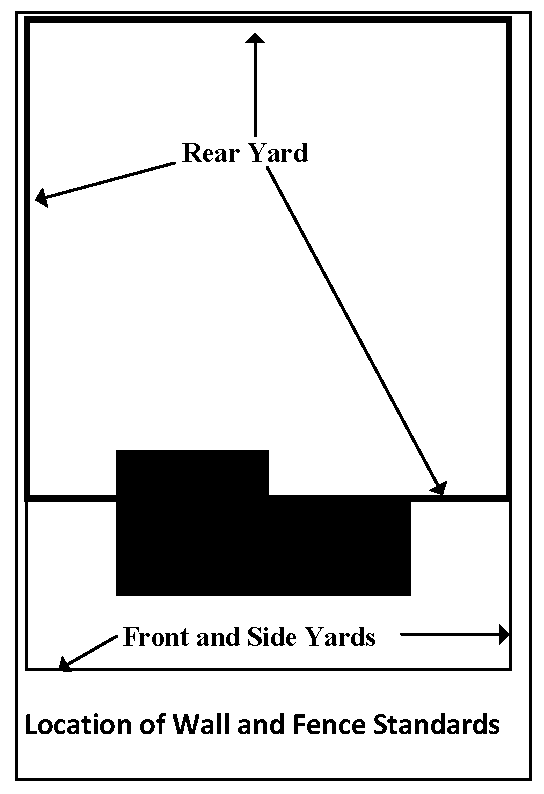
Except as otherwise noted in this Ordinance, fences or walls are permitted in the various districts subject to the following regulations:
Residential Use.
A.
Rear yard fences and walls.
1.
Max. Height: 8 feet.
B.
Side and front yard fences.
1.
Max. Height: 4 feet.
2.
Materials: Chain link, wrought iron, hedge or other opaque barrier that allows light and air to pass through.
Commercial and Industrial Use.
A.
Rear yard fences and walls.
1.
Max. Height: 8 feet.
2.
Materials: Brick, stucco, chain link (barbed wire is permitted for rear yard fences not visible from a street), wrought iron, stone, wood, concrete, or combinations of the above. When combination of 2 or more materials is used, the heavier material shall be below.
B.
Side and front yard fences and walls.
1.
Max. Height: 5 feet (exceptions: required screening for the affected district).
2.
Materials: Brick, stucco, chain link (barbed wire is permitted for side yard fences not visible from a street), wrought iron, stone, wood, concrete, or combinations of the above. When combination of 2 or more materials is used, the heavier material shall be below.
Civic and Institutional Use.
A.
Fences and walls in all yards.
1.
Max. Height: 8 feet.
2.
Materials: Brick, stucco, wrought iron, stone, wood, concrete, or combinations of the above. When combination of 2 or more materials is used, the heavier material shall be below.
[§ 5-800. - Vibration.]
No inherent and recurring generated vibration shall be perceptible without instruments at the property line.
[§ 5-801. - Light.]
The source of exterior lighting shall not be arranged in such a manner as to be detrimental to adjacent properties or the traveling public.
[§ 5-802. - Noise.]
No persistent noise shall be detectable beyond the property line in excess of the average level of street and traffic noise generally heard at the point of observation, and no noise below such level shall be objectionable with respect to intermittence, beat, frequency, or shrillness.
[§ 5-803. - Odor.]
No objectionable odor shall be detectable beyond the property line and the emission of odors, regardless of type shall not be such as to be detrimental to the value and use of adjacent property.
[§ 5-900. - Yard Sales.]
Yard, garage, tag, patio, and apartment sales must have permission of the property owner or leaser of the lot, as an accessory use on any residentially or institutionally developed lot in any district. Such sale shall be limited to no more than 4 sales per calendar year on the same lot and are subject to the existing rules and regulations of the City.
[§ 5-1000.] - Private Kennel.
Kennel shall mean any place in or at which dogs, cats, or other household pets are kept, except for the primary purpose of grooming, in numbers greater than the following:
A.
Two (2) unspayed male or female cats and two (2) unspayed male or female dogs over the age of six (6) months upon any lot.
B.
Four (4) unspayed male or female cats and four (4) unspayed male or female dogs over the age of six (6) months subject to the following provisions;
1.
Minimum lot size of 20,000 square feet or more.
2.
Such dogs shall be kept not less than twenty-five (25) feet from all property lines.
C.
Additional unspayed pets above the six (6) allowed in Section B may be kept, provided that, in addition to the requirements those requirements, the setback is increased ten (10) feet not to exceed a maximum of one hundred (100) feet and the lot area is increased 10,000 square feet for each additional two (2) unspayed pets.
D.
This section shall not apply to any veterinary hospital, animal hospital or any other establishment or premise wherein or whereon the practice of veterinary medicine, surgery, or dentistry, or any part thereof, is conducted.
[§ 5-1100. - Carports, Garages, Outbuildings, Storage Facilities or Structures.]
No carport, garage, outbuilding, storage facility or structure shall be located in the front yard of any land use. These types of facilities may be allowed in the rear or to the side of structures and may not be located in the required setback unless a variance is granted by the City of Abbeville. The front yard is defined as the area between the main entrance and the street across the entire width of the property.
Carports, garages, outbuildings, and storage facilities or structures, if allowed in a particular district, must conform to the general appearance of the main structure and be constructed in a professional manner and appearance.
There shall be no more than one (1) outbuilding other than a detached garage per residential lot. An outbuilding shall be no larger than 150 square feet.
[§ 5-1200. - Parking of Residential, Commercial and Unlicensed Vehicles.]
No commercial vehicle or trailer shall be parked or stored in any residential district, except for temporary loading and unloading. The Board of Zoning Appeals may grant a variance for vehicles used in home occupations in case of unnecessary hardship.
No vehicle or trailer subject to State Licensing which does not display a current license plate shall be parked or stored in any residential district, except in an enclosed building located on a lot.
Commercial vehicles are defined as any vehicle with a gross weight of 5,000 pounds or more, or any vehicle that extends beyond 17' (the average length of a standard parking space) and/or exceeds 85% of the width of the parking space (the area between the inside of the two white curb separator lines).
For the purpose of the definition, commercial vehicles shall not be deemed to include any vehicle operated by a public agency, or any vehicle used exclusively for the transportation of persons to and from a school or place of religious worship.

