
Ada Township City Zoning Code
ARTICLE XX
A.- PLANNED VILLAGE MIXED-USE OVERLAY PVM DISTRICT11
Editor's note— Ord. No. O-01-10-11-1, § 1, adopted Jan. 18, 2011, added §§ 78-464 through 78-379. Inasmuch as § 78-464 already existed and to enable growth in art. XX, at the editor's discretion and with the approval of the city, the new provisions have been renumbered as herein set out.
Sec. 78-471.- Purpose.
The Planned Village Mixed-Use Overlay (PVM) district provides development standards and review and approval procedures to encourage development and redevelopment within the Ada Village area that implements the urban form and design principles contained in the Ada Village Design Charrette, Final Report, January, 2007, which has been adopted by reference as a component of the Ada Township Master Plan. The design principles which this district is intended to advance include the following:
(1)
The Ada Village area should have an interconnected street network that disperses traffic among multiple route choices and a network of sidewalks and nonmotorized trails that provides for safe and convenient nonmotorized travel within the village.
(2)
Development and redevelopment within the Ada Village area should provide high-quality public spaces, with all building facades having windows and doors facing tree-lined streets, plazas, squares, and neighborhood parks.
(3)
Development and redevelopment within the Ada Village area should result in compact development, thereby creating a walkable environment and conserving land and energy through reduced automobile usage.
(4)
The Ada Village area should be characterized by a variety of building types, land uses and open spaces providing for people of all ages and every form of mobility.
(5)
Standards and procedures for development and redevelopment in the Ada Village area should enable the village area to be a resilient and sustainable neighborhood, with a mix of land uses that is adaptable over time to changing economic conditions.
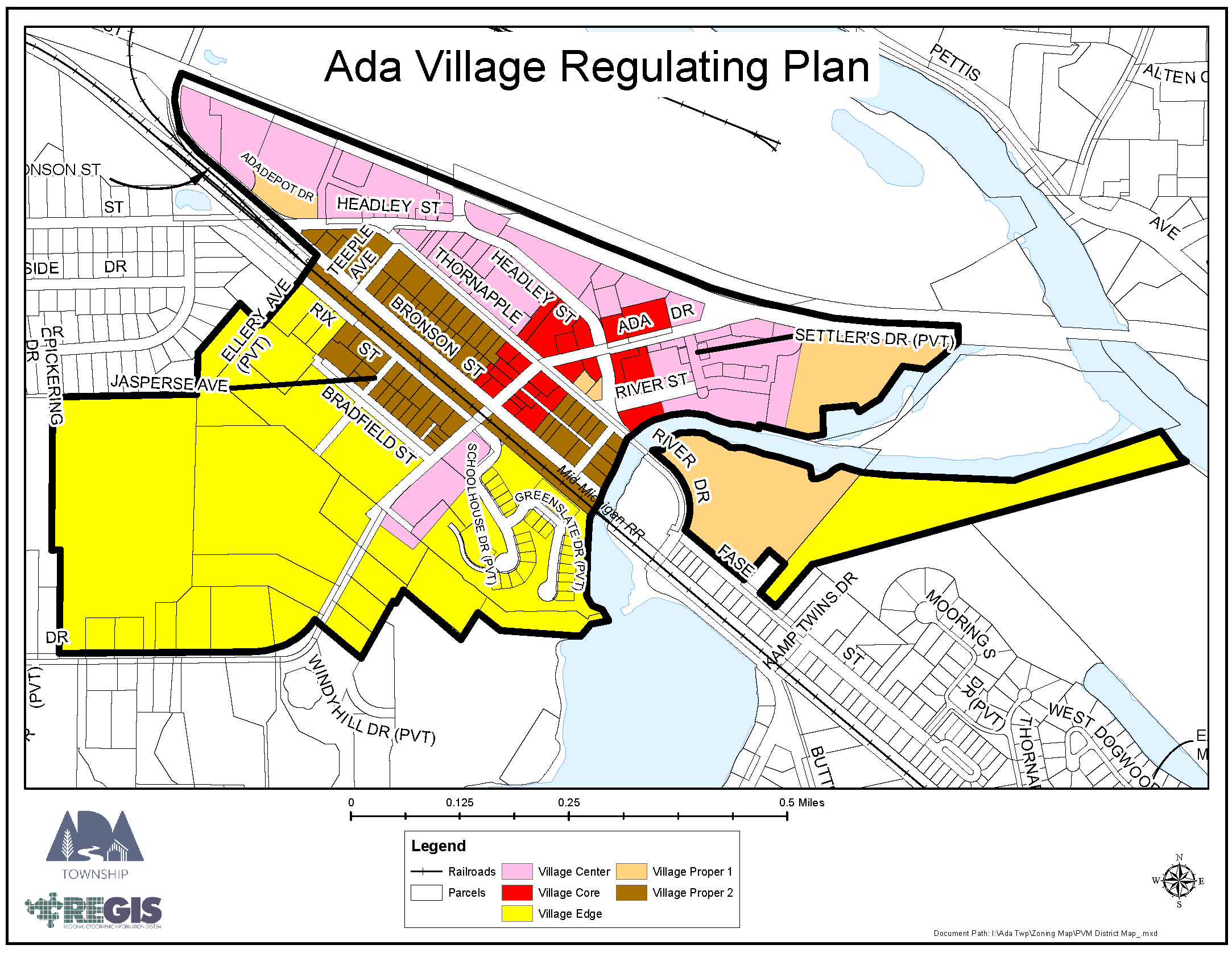
The Planned Village Mixed-Use Overlay district applies to properties within the area designated on the "Ada Village Regulating Plan," attached to and part of this article. The standards and procedures provided by this district may be elected to be applied to lands within the district, at the discretion of the property owner and/or applicant for development plan approval.
(Ord. No. O-01-10-11-1, § 1, 1-18-2011)
Sec. 78-472. - Transect zones and lot types, generally.
(a)
The Ada Village Regulating Plan, which is attached to and part of this article, establishes the following transect zones: Village Core, Village Center, Village Proper 1, Village Proper 2 and Village Edge. In each transect zone, specific lot types are permitted, as provided in section 78-474. The lot type designations govern the placement and intensity of buildings and allowable uses of land within each transect zone.
(b)
An application for development plan approval within the PVM district must clearly identify the proposed assignment of lots within the entire development site. The allocation of multiple lot types will produce desirable variations within each site including a mix of land uses and lot types. The assignment of lot types should ensure compatibility with surrounding neighborhoods and implement other provisions of the Ada Township Master Plan. Assignment of lot types within each transect zone shall be carried out in accordance with the following standards:
(1)
Lot and building types of similar intensities should face across streets. Changes in lot types should occur along rear alleys or lanes.
(2)
Mixed-use centers should vary in character internally and should include multiple lot types.
(3)
The highest intensities should be located in occasional nodes along or near arterial streets. Medium intensities may be along or near arterial or collector streets. Lower intensities should adjoin neighborhoods of similar intensity or natural areas.
(4)
Where new development will abut an existing or approved neighborhood, the new development should establish similar or compatible transect conditions. Transect conditions that are more intense than an abutting neighborhood may be approved by the planning commission where warranted by natural conditions or where establishment of similar or compatible transect conditions is determined to be inappropriate.
(Ord. No. O-01-10-11-1, § 1, 1-18-2011)
Sec. 78-473. - Lot types defined.
The lot types permitted in the PVM district are described as follows:
Village blockfront lot. A lot located and designed to accommodate offices or multiple dwellings on upper stories and various commercial uses on the ground story. A village blockfront or main street building is often a mixed-use building up to three stories in height. Ground floors often contain retail uses, a lobby for access to the upper floors, with commercial, office or residential uses on upper floors. The facade on a village blockfront lot building is often "transparent" with ample window space on the ground and upper floors to allow "eyes on the street." These buildings are constructed with little or no side yard and minimal front yard setbacks, thus creating a continuous street wall. A village blockfront lot is often not large enough to accommodate on-site parking and often requires shared parking. Short term parking is available on the street.
Rowhouse lot. A lot located and designed to accommodate a residential building with common walls on both side lot lines and a private garden to the rear.
Apartment house lot. A lot located and designed to accommodate a detached building which resembles a large house but which contains multiple dwellings above and beside each other.
Duplex lot. A lot located and designed to accommodate a detached building with small side yards and a large front yard and containing two dwellings.
Village shop lot. The village shop, which houses commercial uses, resembles a residential building. Village shop lot and buildings are developed on compact, walkable blocks that may or may not have an alley system for access. Village shops are one or two stories in height. Vertically oriented windows provide transparency on the upper stories. The village shop is slightly set back from the sidewalk. Parking is located in the rear and can be accessed from an alley or a front drive. Shared parking exists and is centrally located to serve long term parking needs. Short term parking is available on the street.
Village house lot. The village house lot and building are developed in compact and walkable blocks with the narrowest residential lots permitted. These lots and buildings contain single-family units. The village house building can be up to three stories if the third story is located within the roof structure. The base of the building is slightly elevated above grade. The raised building allows residents some privacy, while still allowing a clear view of activities on the street. The buildings are also slightly set back from the property line and street. These buildings often have a pitched roof or a pitched roof with dormers. Parking is located in the rear of the lot. Private garages and accessory dwelling units are located so they cannot be visible from the street. Access is from an alley or a shared driveway from the street. On-street parking can serve as visitor parking.
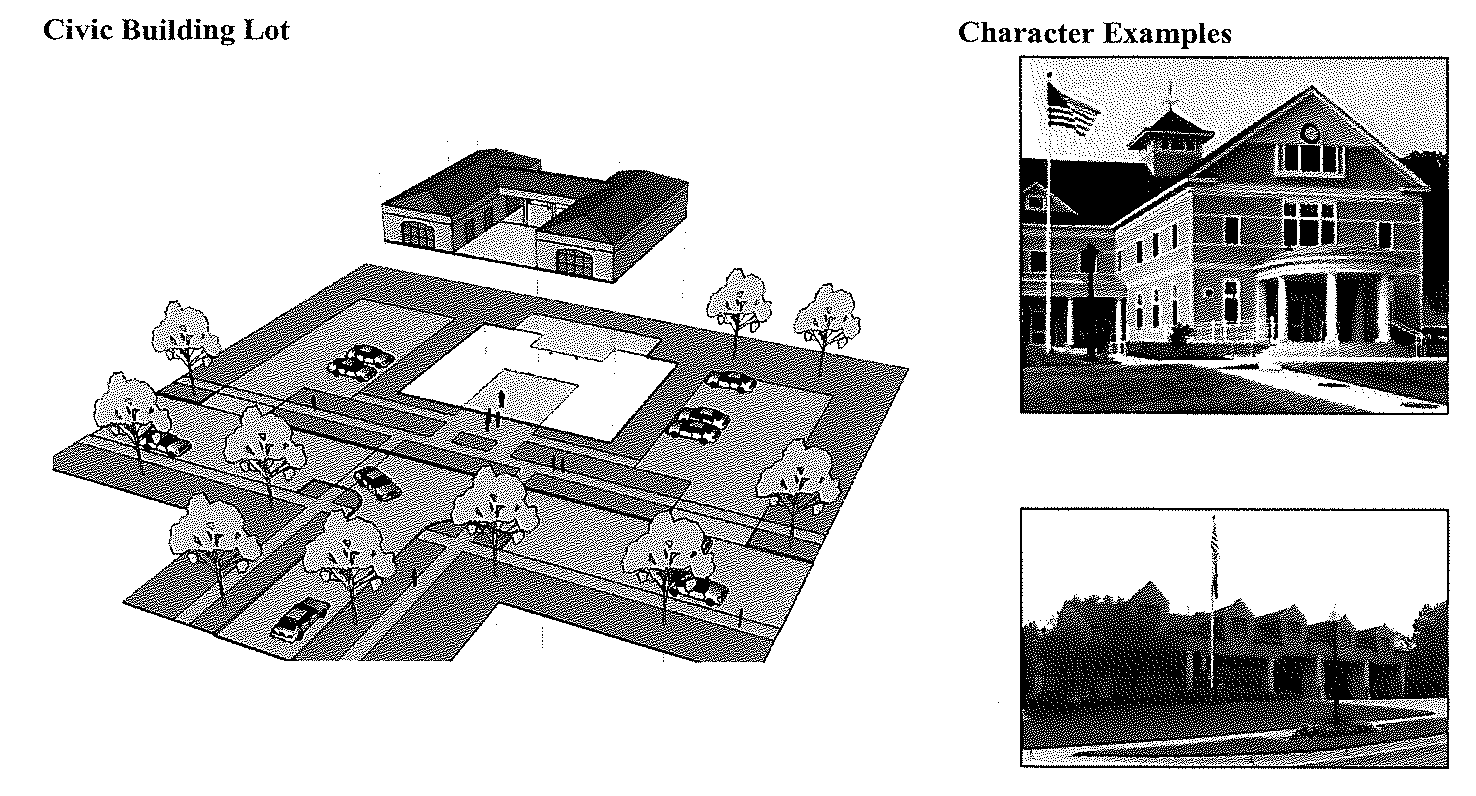
Civic building lot: A lot located and designed to accommodate or which has accommodated a building which contains or has contained public or civic uses such as community services, education, government, places of worship, or social services. A civic building is or was originally designed for a specific civic function. Civic buildings should be sited in locations of particular importance, such as anchoring a major public space or terminating a vista.
Civic space lot. A lot located and designed to accommodate a civic space, which depending on its transect zone may be a green, square, plaza, neighborhood park, playground, community garden, above-ground stormwater management area, or natural area worthy of preservation.
(Ord. No. O-01-10-11-1, § 1, 1-18-2011)
Sec. 78-474. - Permitted lot types by transect zone.
Specific lot types are allowed within the corresponding Transect Zones as identified by the letter "X" in table XX-A.1.
Table XX-A.1—Lot Types Permitted by Village Transect Zone
(Ord. No. O-01-10-11-1, § 1, 1-18-2011; Ord. No. O-021317-1, § 2, 2-13-2017)
Sec. 78-475. - Placement of buildings on each lot type.
The various lot types and proper building placement for each lot type are illustrated on the following pages. Some of the dimensional requirements found in table XX-A.2 are shown on each diagram (refer to table XX-A.2 for complete details). Character examples are provided for each lot type for illustrative purposes only; the dimensions in table XX-A.2 control for regulatory purposes.
(Ord. No. O-01-10-11-1, § 1, 1-18-2011)
Sec. 78-476. - Lot dimensions; building form and placement.
(a)
Dimensions for each lot type. Table XX-A.2 provides dimensional requirements that apply to all lots of each designated lot type. These requirements supersede any contradictory requirements in the Ada Village codes.
(b)
Primary entrances. The primary entrance of every building must directly face a street or a civic space.
(c)
Frontage percentages. Frontage percentage is the percentage of the width of a lot that is required to be occupied by its building's primary facade. Table XX-A.2 provides minimum and maximum frontage percentages for each lot type, subject to the following additional provisions:
(1)
Up to 50 percent of the width of the primary facade may be counted as meeting the frontage percentage requirement even though it may be set back up to 10 feet further from the street than the primary facade's principal plane.


(2)
The location of the primary facade's principal plane is not changed by facade extensions such as bay windows, awnings, porches, balconies, stoops, colonnades, or arcades, or by upper stories that are set back further from the street.
(3)
The width of a porte cochere may be counted as part of the primary facade.
(d)
Forecourts. For village blockfront lots, a portion of the building's primary facade may be set back up to 20 feet further from the street than the primary facade's principal plane if this space is constructed as a forecourt or pedestrian entryway that is open to the sidewalk. This recessed portion may be up to 25 percent of the total width of the primary facade and may not be used by vehicles.
Table XX-A.2—Dimensional Standards for Lot Types
(e)
Front porches. Front porches may extend up to ten feet into street yards provided they are at least eight feet deep. Partial walls, screened areas, and railings on porches that extend into the street yard may be no higher than 42 inches. Porches must remain set back at least the following distances from a public right-of-way:
(1)
In the Village Core and Center transect zones, zero feet.
(2)
In the Village Proper 1 and 2 transect zones, two feet.
(3)
In the Edge transect zone, five feet.
(f)
Stoops. Stoops may extend into street yards in the Village Core and Village Center transect zones, provided their upper platform is no higher than 60 inches above the sidewalk. Partial walls and railings on stoops that extend into the front yard may be no higher than 42 inches.
(g)
Windows on primary facades. Primary facades on all village blockfront lots must have between 15 percent and 75 percent of the primary facade of each story in transparent windows, in compliance with the transparency standards contained in section 78-479. In addition, retail stores must comply with the following:
(1)
The ground story's primary facade must have transparent storefront windows covering no less than 75 percent of its principal plane in order to provide clear views of merchandise in stores and to provide natural surveillance of exterior street spaces.
(2)
Storefronts must remain unshuttered at night to provide views of display spaces and are encouraged to remain lit from within until 10:00 p.m. to provide security to pedestrians.
(3)
Doors allowing public access to streets must be provided at intervals no greater than 75 feet to maximize street activity, to provide pedestrians with frequent opportunities to enter buildings, and to minimize any expanses of inactive wall.
(h)
Story heights. The ground story of village blockfront lot buildings must be from 11 feet to 14 feet tall. Each story above the ground story in commercial buildings must be from eight feet to 12 feet tall; any upper story taller than 12 feet will count as two stories. Story heights are measured from the floor to the bottom of the lowest structural member that supports the story above.
(i)
Residential floor heights. Residential buildings must have their first habitable floor raised at least two and one-half feet above the adjacent sidewalk. If the first floor is more than five feet above the adjacent sidewalk, the space below the first floor counts as the ground (first) story.
(j)
Accessory dwelling units. Each rowhouse, duplex and village house is permitted one accessory dwelling unit in addition to its principal building. Accessory dwelling units must maintain the same side yards as required for the principal building.
(k)
Front or side driveways. Rear lanes are desirable but not required in the Village Core and Village Center zones; if a rear lane is not provided, a front or side driveway is permitted to village house lots only, with the following restrictions:
(1)
Detached garages must always be located in the rear of the lot. All walls of attached garages must be at least 20 feet behind the principal plane of the house's primary facade.
(2)
Garage doors should face the side or the rear of the lot rather than the front. Where space does not permit a side- or rear-facing garage door, front-facing garage doors may be provided but each door may not exceed ten feet in width.
(3)
Driveways may not exceed ten feet in width except within 30 feet of the garage entrance.
(Ord. No. O-01-10-11-1, § 1, 1-18-2011; Ord. No. O-041315-1, § 1, 4-13-2015; Ord. No. O-021317-1, § 3, 2-13-2017; Ord. No. O-111119-1, § 1, 11-11-2019; Ord. No. O-05-08-23-1, § 2, 5-8-2023)
Sec. 78-477. - Permitted uses by lot type.
(a)
Permitted uses. Table XX-A.3 identifies the permitted and limited uses for each lot type.
(b)
Accessory uses. Accessory uses and structures not listed in table XX-A.3, including detached garages are regulated in the same manner as the Ada Township zoning regulations would otherwise provide for each permitted use.
Table XX-A.3—Permitted Uses by Lot Type
(Ord. No. O-01-10-11-1, § 1, 1-18-2011; Ord. No. O-01-09-23-2, § 1, 1-9-2023)
Sec. 78-478. - Off-street parking.
Mixed-use infill developments are located in proximity to on-street parking facilities, in proximity to existing or future public transit, adjacent to an extensive public sidewalk system and within an area having a mix of different but compatible land uses that can share parking spaces. Based on these factors, the following standards pertaining to off-street parking supply apply in the PVM district:
(1)
Minimum required off-street parking. The minimum off-street parking requirements shown in Off-Street Parking and Loading Spaces, article XXVII, will be multiplied by the factors in table XX-A.4 to produce modified off-street parking requirements for the PVM district. Off-street parking may be provided on the lot it serves or within 600 feet of the primary entrance of the building it serves; however, off-street parking may not be the principal use of a lot.
Table XX-A.4 Off-Street Parking Standard Reduction Factors in the PVM District
N/A—Not Applicable
(2)
Location of off-street parking. To the maximum extent practicable, off-street parking spaces must be located within buildings or behind buildings so that buildings can screen parking areas from sidewalks and streets. In no case may parking be located in the street yard in front of a building. Parking lots in side yards may be permitted provided the buildings they serve can meet the lot width and frontage percentage requirements of table XX-A.2 and provided these lots are set back a minimum of 20 feet from lot lines adjoining rights-of-way, excluding alleys.
(3)
Access to off-street parking.
i.
In the Village Core and Village Center transect zone, rear lanes are the most desirable source of access to off-street parking (see special requirements in section E, 14 where vehicular ingress is from the street). Parking along alleys or lanes may be 90-degree, angle, or parallel.
ii.
Alleys may be incorporated into parking lots as if they were standard parking access aisles. Access to all properties adjacent to the alley must be maintained.
iii.
Cross-access is required between adjoining rear parking lots on any combination of these lot types: village shop lot, village blockfront lot, rowhouse lot and apartment house lots.
(Ord. No. O-01-10-11-1, § 1, 1-18-2011)
Sec. 78-479. - Architectural standards.
(a)
General principles and intent.
(1)
Tradition.
a.
These standards favor an aesthetic that is representative of buildings that were constructed in the village between approximately 1860 and 1940. They specify an architecture language of load-bearing walls and regional materials. The standards also specify certain details, such as column and pier spacing, window proportions, roof or cornice configurations, storefronts, and overhangs.
b.
The intent behind these standards is to utilize a discipline of form when designing new buildings in order to foster a coherent aesthetic.
c.
All building materials to be used shall express their specific properties. For example, stronger and heavier materials (masonry) support lighter materials (wood).
(2)
Equivalent or better. The materials, techniques, and product types prescribed herein are minimum requirements. Use of equivalent or better practices and products is encouraged. Where substitution of equivalent or better practices or products is proposed, information regarding the proposed substitution shall be included in the application materials submitted for approval.
(3)
Energy efficiency and environmental conservation. Use of Leadership in Energy and Environmental Design (LEED) standards in new development and redevelopment in the PVM district is encouraged.
(4)
Applicability.The standards contained in this section shall be applicable to all building facades which either have frontage on or are clearly visible from a public or private street, and on all building facades with frontage on or clearly visible from a public parking lot or a shared-use privately-owned parking lot (principal facades). On other building facades other than principal facades, the standards contained herein shall be applicable as follows:
a.
On a newly-constructed building, building facades other than the principal facade shall be clad with the same material that is the predominant material on the principal facade.
b.
On additions to existing buildings, building facades other than the principal facade shall use the same exterior material that is the predominant material on the principal facade on a minimum of 20 percent surface area of the facade.
(b)
Building walls (exterior).
(1)
Intent. Building walls should express the construction techniques and structural constraints of traditional, long-lasting, building materials.
(2)
Standards.
a.
The following materials are permitted:
• Brick and tile masonry;
• Stucco (cementitious) finish;
• Native stone (or synthetic equivalent);
• Precast masonry (for trim and cornice elements only);
• Glass fiber reinforced concrete (GFRC) (for trim elements only);
• Metal (for beams, lintels, trim elements and ornamentation only);
• Split-faced block (only for piers, foundation walls and chimneys, and limited to no greater than 25 percent of any building facade facing a street);
• Wood lap siding or fiber cement lap siding.
b.
The following configurations and techniques are permitted:
1.
Walls.
• Wall openings shall not span vertically more than one story.
• Wall openings shall correspond to interior space and shall not span across building structure such as the floor structural and mechanical thickness.
• Wall materials shall be consistent horizontally (i.e. joints between different materials must be horizontal and continue around corners) except for chimneys and piers.
• Material changes shall be made within a constructional logic—as where an addition (of a different material) is built onto the original building.
2.
Wood siding and wood simulation materials.
• Lap siding (horizontal) configuration;
• Board-and-batten siding, with battens spaced at no greater than 16 inches on center.
3.
Brick, block and stone.
• Must be properly detailed and in load-bearing configurations appropriate to the materials being used or simulated.
4.
Stucco (cementitious finish).
• Smooth or sand only, no "cake icing" finish.
(c)
Roofs and parapets.
(1)
Intent. Roofs and parapets should demonstrate a common-sense recognition of the climate by utilizing appropriate pitch, drainage, and materials in order to provide visual coherence to the PVM District.
(2)
Standards.
a.
The following materials are permitted:
• Clay or concrete (faux clay);
• Tile (flat roman only);
• Cedar shakes (synthetic of equivalent or better quality permitted);
• Slate (synthetic of equivalent or better quality permitted);
• Metal (standing seam 5-v crimp, equivalent or better);
• Dimensional asphalt shingles;
• Cornices and soffits may be a combination of wood, vinyl, and/or metal.
b.
The following configurations and techniques are permitted.
1.
Pitched roofs.
• Pitch (exclusive of roofs behind parapet walls):
• Hip and gable roofs shall be symmetrically pitched between 6:12 and 12:12.
• Shed roofs, attached to the main structure, shall be pitched between 3:12 and 7:12.
2.
Parapet roofs (cornice, entablature, and coping standards).
• Allowed for village blockfront lots only, where the roof material is not visible from any adjacent street only.
Cornices and other features.
• Buildings without visible roof surfaces and overhanging eaves may satisfy the overhang requirement with a cornice projecting horizontally between six and 12 inches beyond the building walls. For buildings three stories or taller, the cornice projection shall increase an additional six to 12 inches per story.
• Skylights and roof vents are permitted only on the roof plane opposite the primary street or rear building line (RBL) or when shielded from street view by the building's parapet wall.
• Overly elaborate, "postmodern" and/or "high-tech" designs are discouraged. However, ornamentation which contributes to the character of the building is encouraged. Consult the administrative review team for appropriate configurations.
• Green roof technologies are encouraged. Vegetative cover should be considered for flat roofs and solar panels should be considered for integration into pitched roof structures.
(d)
Street walls and fences.
(1)
Intent. Street walls establish a clear edge to the street where the buildings do not. PVM district requirements include masonry walls that define outdoor spaces and separate the street from the private realm (parking lots, trash cans, gardens, and equipment). All street wall facades shall be as carefully designed as the building facade, with the finished side out, i.e. the "better" side facing the street.
(2)
Standards.
a.
The following materials are permitted:
• Native/regional stone and equivalent imitation stone;
• Metal (wrought iron, welded steel and/or aluminum [black] for gates only);
• Brick;
• Stucco on concrete block (or poured) only with brick or stone coping;
• A combination of materials (e.g. stone piers with brick infill panels).
b.
The following configurations and techniques are permitted:
• Street walls along any unbuilt required building line shall be built to a height of six feet above the adjacent ground;
• Stucco street walls shall have a hardy species of climbing vine planted along them;
• Metal work may additionally be treated to imitate a copper patina;
• Copings shall project between one inches and four inches from the face of the wall.
(e)
Windows and doors.
(1)
Intent. Window frames shall be divided by multiple panes of glass. This helps the window "hold" the surface of the facade, rather than appealing like a "hole" in the wall (an effect produced by a large single sheet of glass). All windows and doors should be selected with their energy conservation value in mind so as to achieve the highest possible energy savings.
(2)
Standards.
a.
The following materials are permitted:
• Windows shall be of anodized aluminum, wood, clad wood, vinyl, or steel;
• Window glass shall be clear, with light transmission at the ground story at least 90 percent and for the upper stories 75 percent (modification as necessary to meet any applicable building code requirements). Specialty windows may utilize stained, opalescent, or glass block (one per facade maximum);
• Window screens shall be black or gray;
• Screen frames shall match window frame material or be dark anodized;
• Door frames shall be of wood, clad wood, or steel.
b.
The following configurations and techniques are permitted:
1.
The following requirements apply to all windows:
• Windows may be ganged horizontally (maximum five group) if each grouping is separated by a mullion, column, pier or wall section that is at least seven inches wide;
• Windows shall be no closer than 30 inches to building corners (excluding bay windows and where the building corner is also a block corner);
• Exterior shutters, if applied, shall be sized and mounted appropriately for the window (one-half the width), even if inoperable.
2.
The following requirements apply to all upper-story windows:
• Windows shall be double-hung, single-hung, awning, or casement windows;
• Fixed windows are permitted only as a component of a system including operable windows within a single wall opening;
• Residential buildings/floors: panes of glass no larger than 36 inches vertical by 30 inches horizontal;
• The maximum pane size for office uses is 48 inches vertical by 40 inches horizontal;
• Egress windows may be installed according to the appropriate building code.
3.
Shopfront (ground floor) windows and doors:
• Single panels of glass not larger than six feet in height by four feet wide;
• Ground floor windows shall not be made opaque by window treatments (excepting operable sunscreen devices within the conditioned space);
• Double-height entryways (those that span more than one story) are not allowed;
• Roll-down security gates and doors are prohibited.
(f)
Lighting and mechanical equipment.
(1)
Intent. Materials and equipment chosen for lighting fixtures should be durable, energy efficient and weather well. Appropriate lighting is desirable for nighttime visibility, crime deterrence, and decoration. However, lighting that is too bright or intense creates glare, hinders night vision, and creates light pollution.
(2)
Standards,
a.
Lighting.
• In order to minimize light pollution, light should be directed downward to the immediate area being lighted and away from any living quarters.
• Street lighting: lights shall be located 16 feet above grade with a maximum average spacing (per block face) of 60 feet on center located on the street tree alignment line or within the furniture zone on each side of the street and travel lanes.
• At the front of the building, exterior lights shall be mounted between six feet and 14 feet above adjacent grade
• All lots with alleys shall have lighting fixtures within five feet of the alley right-of-way.
This fixture shall illuminate the alley, shall be between nine and 14 feet in height, and shall be shielded or aimed in such a way that they do not shine into other lots, the street, or direct light out of the PVM district.
• Floodlighting shall not be used to illuminate building walls (i.e. no up-lighting).
• Site lighting shall be of a design and height and shall be located so as to illuminate only the lot. An exterior lighting plan must be approved as consistent with these standards by the township staff.
• No flashing, traveling, animated, or intermittent lighting shall be visible from the exterior of any building whether such lighting is of temporary or longterm duration.
• Lighting for parking garages shall satisfy crime prevention through environmental design (CPTED) principles and guidelines, as established by the International CPTED Association.
b.
Mechanical equipment.
• The following shall be placed away from any rear building line, shall not be stored or located within any street, and shall be screened from view from the street: air compressors, mechanical pumps, exterior water heaters, water softeners, utility and telephone company transformers, meters or boxes, garbage cans, storage tanks and similar items.
• Roof-mounted equipment shall be placed away from the rear building line and be screened from view from the street.
(Ord. No. O-01-10-11-1, § 1, 1-18-2011)
Sec. 78-480. - Development plan application requirements and review and approval procedure.
(a)
[Planning commission action required.]Except as otherwise provided by this section, review and approval of a development plan by the planning commission shall be required in accordance with the procedures of this article prior to the issuance of a building permit for the construction, reconstruction, erection or expansion of any building or structure in the PVM zoning district, and prior to the initiation or expansion of any special land use in the PVM district.
(b)
[Exceptions.] Unless specifically required by other applicable provisions of this chapter, development plan review and approval by the planning commission in accordance with the procedures of this article shall not be required for certain structures, uses or activities, as follows:
(1)
Construction of or expansion of a single-family dwelling or structures accessory thereto on an existing lot.
(2)
Expansion of existing nonresidential structures or construction of new non-residential structures if:
a.
The proposed expansion or new construction will not exceed 500 square feet and is located on a site occupied by one or more existing buildings or structures having a total floor area of less than 5,000 square feet; or
b.
The proposed expansion or new construction will not exceed 1,000 square feet and is located on a site occupied by one or more existing buildings or structures having a total floor area of 5,000 square feet or greater.
(c)
[Zoning administrator review.] Development plans which are not subject to review and approval by the planning commission as provided in this section shall be reviewed by the zoning administrator for compliance with provisions of the PVM district. Notwithstanding this provision, the zoning administrator may refer any development plan to the planning commission for review and approval in accordance with the procedures provided by this article.
(d)
Submission of PVM application and development plan. An application for approval of a development plan in the PVM district shall include all of the maps, drawings and accompanying written materials, as follows:
(1)
[Site regulating plan.] A site regulating plan, drawn to a common engineering scale as acceptable to the planning and zoning department, containing all of the following information:
a.
Legal description of the subject site;
b.
Legal description of proposed lots;
c.
A vicinity map, of sufficient size, scale and detail to locate the site in relation to the surrounding area;
d.
Title block with project name, north arrow, scale indicator, date of initial preparation and subsequent revisions, and name and address of preparer;
e.
Gross acreage of the subject property and net acreage, net of existing rights-of-way;
f.
Minimum sheet size of 24 inches by 36 inches, at the following scale, based on site acreage:
160 acres or more: 1" = 200'
Five acres to 159.9 acres: 1" = 100'
Two acres to 4.99 acres: 1" = 50'
One acre to 1.99 acres: 1" = 30'
Less than one acre: 1" = 20'
g.
Existing property boundaries and dimensions, including right-of-way width;
h.
Existing and proposed access and utility easements;
i.
Existing site improvements, including building footprints, driveways, parking areas, walks and other paved areas, above- and below-ground utilities;
j.
Existing and proposed topographic contours, at a maximum contour interval of two feet;
k.
Existing water features of the subject property, including river and stream banks, pond edges, and edges of other submerged lands;
1.
Boundaries of any areas of the site within the 100-year floodplain or a regulatory floodway;
m.
Wetland areas, including limits of state-regulated wetlands, limits of nonregulated wetlands, and areas of hydric soil types, based on the Kent County soil survey;
n.
Existing vegetation on the site, including edge of woodland tree canopy, and individual deciduous trees of six-inch caliper or larger and individual evergreen trees of eight-foot height or larger, when not included within an area of solid woodland cover;
o.
Proposed buildings, including building footprints, dimensions and setbacks;
p.
Floor plans of proposed buildings;
q.
Elevation drawings of proposed buildings, drawn to an architectural scale, illustrating the proposed shape, materials, height and appearance of the proposed buildings, from all sides visible from a street or from a residential district;
r.
Calculations of area and percentage of the site area covered by building footprint and paved areas;
s.
Proposed lot layout, including lot dimensions, identification of minimum building setback lines or proposed building envelopes; for site condominiums, identify the boundaries, dimensions, area and intended use of general common elements;
t.
Area and percentage of site proposed to be designated open space;
u.
The total number of proposed lots, area of each lot, dimensioned width of each lot, minimum lot area and average lot area;
v.
For multiple-family development, a breakdown of number of units by type, size and number of bedrooms;
w.
If multiphased development is proposed, identification of the land area and site improvements included in each phase;
x.
For nonresidential uses, the total proposed floor area, and breakdown of floor area by type of use;
y.
Layout and dimensions of proposed public and private streets, including rights-of-way, pavement edges, grades, lane configuration, accell/decell tapers, bypass lanes; extent and type of curbing; typical cross-section showing surface and sub-base materials and dimensions;
z.
Location, width, surfacing and typical cross-section of sidewalks or other proposed nonmotorized facilities;
aa.
Existing and proposed public water, sewer and storm drainage facilities, including pipe routing, manholes, catch basins, valves, fire hydrants; existing and proposed service lines and laterals; existing and proposed utility easements; stormwater retention/detention areas;
bb.
Stormwater management facilities, designed in accordance with standards contained in the township stormwater ordinance, chapter 30, article V;
cc.
Landscape plan, in conformance with article XXV of this chapter;
dd.
Parking area layout, including location and width of driveway accesses, dimensions of a typical parking space; dimensions of driving aisles, delineation of barrier-free spaces, and identification of total spaces provided compared to calculations based on ordinance requirements;
ee.
Exterior lighting details, including location of all building-mounted or pole-mounted light fixtures, mounting height, type of lamp, wattage of lamp, and manufacturer's fixture specification;
ff.
Location of ground-mounted mechanical equipment;
gg.
Location and means of screening of refuse containers;
hh.
Location, height, size and method of illumination of proposed signage.
(2)
[Narrative statement.] A narrative statement shall also be submitted, addressing the following aspects of the proposed development:
a.
Phasing;
b.
Protection of historic lands and structures;
c.
Building and site design standards;
d.
Open space standards;
e.
Off-street parking and loading;
f.
Landscape, buffers, and screening;
g.
Circulation plan, including street standards, visibility at intersections and traffic-calming measures;
h.
Vehicular access control;
i.
Sidewalks and pedestrian paths.
(3)
Site illustrative plan. The application shall also include a nonbinding illustrative plan drawn to the same scale as the proposed site regulating plan. The purpose is to illustrate the likely built results of the site regulating plan by showing buildings on each lot and preliminary designs for streets and civic spaces, if any are proposed, in compliance with all applicable PVM district standards and the proposed site regulating plan.
(e)
Review and approval procedure. Following receipt of a complete application for development plan approval in the PVM district, the application and supporting materials shall be scheduled for review by the planning commission at a regular or special meeting. The planning commission shall review the site plan and either approve, deny or conditionally approve the application and development plan, if it determines that the application and development plan conform with all of the following standards:
(1)
The application and all accompanying documentation are consistent with the recommendations of the Ada Village design charrette final report.
(2)
The application and all accompanying documentation conform to the statement of purpose and design principles for the PVM district contained in Section 78-471.
(3)
The application and accompanying documentation ensures that all development provided for in the development plan will be consistent with all applicable PVM district standards, including, but not limited to, allowable lot and building types, building height, building placement and orientation, building form, architectural and streetscape standards, parking and exterior lighting.
(4)
The application and accompanying documentation conforms to all other applicable sections of the zoning regulations, chapter 78 of the Code of Ordinances.
(f)
Modifications to an approved development plan.
(1)
Minor modifications to an approved development plan may be approved by the zoning administrator, provided they conform to the approval standards contained in paragraph (c), above, and all conditions that resulted from the original PVM approval process, and subject to the following limitations:
a.
Minor modifications may not change transect zones, increase allowable building heights, increase overall density, reduce the average block size, or reduce the diversity of lot types shown on the approved PVM site regulating plan, but may substitute similar lot types that are allowed in the designated transect zone.
b.
Modifications that exceed these limitations shall be subject to review and approval by the planning commission.
(g)
Duration of approval; extension of approval; expiration of approval.
(1)
A PVM district development plan approval granted on or after the effective date of the amendment ordinance enacting this subsection 78-480(g) shall be valid for a period of 18 months from the date of approval by the planning commission or zoning administrator, whichever granted the original approval. Plans granted approval prior to the effective date of the amendment ordinance enacting this subsection 78-480(g) shall be valid for a period of 18 months following said effective date.
(2)
If a building permit has been issued within 18 months from the date of plan approval, the plan approval shall remain valid so long as the building permit remains valid. If no building permit has been issued within 18 months from the date of plan approval, the development plan approval shall be deemed expired and no longer valid.
(3)
Upon submittal of a written request prior to the date of expiration of the development plan approval, a one-year extension of the approval period may be granted by the planning commission or zoning administrator, whichever granted the original approval. If approved, the extension period shall begin from the date of the original development plan approval.
(4)
A maximum of two one-year extensions of development plan approval may be granted.
(5)
In considering whether to approve a request for an extension of development plan approval, the standards contained in subsection 78-480(e) shall govern.
(Ord. No. O-01-10-11-1, § 1, 1-18-2011; Ord. No. O-102218-1, § 1, 10-2-2018)
Sec. 78-481. - Departure from PVM district standards.
(a)
Purpose. Unless otherwise indicated in this section, the planning commission, or in the case of an application or development plan approval that is not subject to planning commission approval, the zoning administrator, may authorize a departure from the strict application of the standards of the PVM district, subject to conformance with the standards contained in this section. The intent of this section is to authorize a departure from the PVM district standards in limited situations where the use of an alternative site or building design feature or combination of design features on a specific site will result in development that complies with the spirit and intent of the PVM district to a greater degree than would the case without authorization of the departure.
(b)
Standards for approval. A departure from the PVM district standards shall not be approved unless it complies with all of the following standards:
(1)
Approval may only be granted for a departure from the following PVM district standards:
a.
Use of a lot type in a transect zone in which it is not permitted, according to table XX-A.1. The planning commission shall hold a public hearing on such requests, and such requests shall also be subject to approval by the township board.
b.
Departure from the dimensional requirements for lot types contained in table XX-A.2. The planning commission shall hold a public hearing on such requests.
c.
Departure from the architectural standards contained in section 78-479.
(2)
The proposed alternative is consistent with the purpose and intent of the PVM district.
(3)
The proposed alternative, in comparison to conformance with the PVM district standards, will not have a detrimental impact on adjacent property or the surrounding neighborhood.
(4)
The proposed alternative is necessary and appropriate to accommodate a superior design of the proposed development.
(5)
The proposed departure from PVM district standards is clearly identified as a part of the development plan approval application.
(Ord. No. O-01-10-11-1, § 1, 1-18-2011; Ord. No. O-05-08-23-1, § 3, 5-8-2023)
Sec. 78-482. - Defined terms.
Ada village plan. The plan adopted as part of the Ada Village charrette and included in the Ada Village design charrette, final report, January, 2007.
Arcade. A series of piers topped by arches that support a permanent roof over a sidewalk.
Balcony. An open portion of an upper floor extending beyond a building's exterior wall that is not supported from below by vertical columns or piers.
Charrette. A multiday collaborative workshop that involves the public and multiple professional disciplines to create solutions to complex development problems.
Civic building. Civic buildings contain or have contained public or civic uses of special significance to residents, employees, or visitors. Civic buildings are used or have been used for the following purposes: community services, day care, education, government, places of worship, or social services.
Civic space. Civic spaces are commonly owned open spaces that are strategically placed to serve a specialized community function. An urban civic space is for active use and may be configured as a formal green, square, plaza, park, playground, or community garden. A preserve civic space allows only passive recreational uses and may be a project boundary buffer or above-ground stormwater management area or a natural area worthy of preservation,
Colonnade. Similar to an arcade but supported by vertical columns without arches.
Frontage percentage. The percentage of the width of a lot that is required to be occupied by its building's primary facade. See section E.
Intensity. Intensity of development means the height, bulk, area, density, setback, use, and other similar characteristics of development.
Live-work building or unit. A building, or portion thereof, used for units which are each a combination of space used for business purposes and space used as a dwelling, and in which the dwelling space and business space are occupied and used as an integrated working and living environment.
Maximum extent practicable. No feasible or practical alternative exists and all possible efforts to comply with the regulation or minimize potential adverse impacts have been undertaken. Economic considerations may be taken into account but cannot be the overriding factor in determining "maximum extent practicable."
Maximum lot coverage. A limit on the percentage of total lot area that may be covered by building footprints and paved surfaces.
Mixed-use center. A concentration of nonresidential and higher density residential land uses, as defined in the Ada village plan.
Planting strip. A grassed strip of land with a row of street trees that is located between a sidewalk and a gravel or parking lane. In urban areas, planting strips are often replaced by street trees planted in tree pits, wells, or vaults that are recessed into a sidewalk that extends to the curb.
Porte cochere. A roofed porch or portico-like structure extending from the side entrance of a building over an adjacent driveway to shelter those getting in or out of vehicles. A porte cochere has no front or rear wall and differs from a carport in that it is not used to store parked vehicles.
Primary facade. A primary facade is the elevation(s) of the building, which directly faces a public street or public thoroughfare; a building may have more than one primary facade.
Principal plane. (For the purpose of placing buildings along setbacks). The front plane of a building not including stoops, porches, or other appurtenances.
Site regulating plan. A particular type of development concept plan that must be submitted to the Ada Township with an application for the PVM district. A regulating plan identifies proposed transect zones, lot types, and street types to define the character of the proposed development. If approved, a regulating plan becomes an integral part of a PVM approval. See section M.
Stoop. A staircase on the facade of a building that leads either to a small un-walled entrance platform or directly to the main entry door.
Story. That portion of a building included between the upper surface of any floor and the upper surface of the floor next above, except that the topmost story shall be that portion of a building included between the upper surface of the topmost floor and the ceiling or roof above. If the finished floor level directly above a usable or unused under-floor space is more than six feet above grade at any point, such a usable or unused under-floor space shall be considered as a story.
Transect zone. A distinct category of physical form ranging from the most urban to the least urban. The PVM district requires the application of one of five transect zones: Core, Center, Village Proper 1, Village Proper 2, and Edge.
Transect zone, Village Core. The Core transect zone is the most intensely occupied zone, with mostly attached buildings that create a continuous street facade within walking distance of surrounding primarily residential areas.
Transect zone, Village Edge. The Edge transect zone has lots for detached homes that are similar in scale to adjoining neighborhoods with suburban character.
Transect zone, Village Center. The Center transect zone has a mixture of uses and a wide variety of lot types. Buildings may be attached or detached and are separated from the street with small street yards. See sections B and C.
Transect zone, Village Proper 1. The Village Proper 1 transect zone has lots for detached homes and live-work units within the historic village plat.
Transect zone, Village Proper 2. The Village Proper 2 transect zone has lots for detached homes within the historic village plat.
(Ord. No. O-01-10-11-1, § 1, 1-18-2011)
(Ord. No. O-021317-1, § 1, 2-13-2017; Ord. No. O-071122-1, § 1, 7-11-2022)
Sec. 78-483. - Temporary moratorium.
(a)
Findings.
(1)
The provisions of the zoning ordinance regarding the village proper 2 transect zone within the planned village mixed-use overlay (the "zone") have not kept pace with development patterns, placement and intensity of buildings, and the allowable uses of land within the zone.
(2)
The township board desires to study and potentially revise portions of the Ada Township Zoning Ordinance (the "zoning ordinance") with regard to the zone and other matters.
(3)
Imposing a moratorium, on a limited temporary basis, is reasonable and necessary in order to allow time for the review of potential amendments to the zoning ordinance.
(4)
During this forty-five-day moratorium period, the township board and planning commission will continue to investigate potential modifications to the zoning ordinance regarding the zone and related matters.
(5)
This new section 78-483 will supplement and be interpreted consistently with Ada Township Ordinance No. O-032723-1.
(b)
Administrative action. A moratorium is hereby imposed upon the approval or issuance of any township permit, zoning compliance permit, license, zoning approval, rezoning, variance or similar or other approval for any land lying in the village proper 2 transect zone within the planned village mixed-use overlay. During the moratorium term as specified in this section, no township official, employee, agent, body, board, commission, or agent shall issue or approve any such permit, zoning approval, rezoning, license, variance, or other approval.
(c)
Exemptions. This section and the moratorium imposed herein shall not apply to:
(1)
Any construction or development that, as of the effective date of this ordinance from which this section derives, has currently pending properly completed applications for, or has obtained approval of, all zoning compliance permits, zoning approvals, rezonings, variances, or similar approvals as required by the zoning ordinance to complete the construction or development.
(2)
Any interior renovations or interior remodeling not involving changes to the exterior structure or footprint of a residence or building.
(3)
Any proposed construction or renovation of decks, gazebos, sheds, pools, or similar accessory structures.
(4)
Any other structure or use similar to the two exemptions listed in subsection b and c above as determined by the zoning administrator.
(5)
Any development involving ongoing construction that has been completed to a "substantial character" as determined by the zoning administrator.
(d)
Term of this moratorium. The moratorium imposed by this section shall remain in effect for 45 days following the effective date of this section/section amendment. Prior to the expiration of this moratorium, the township may extend the moratorium to allow sufficient time to complete any such amendments to the ordinances.
(Ord. No. O-05-08-23-2, § 1, 5-8-2023)

