
Albany City Zoning Code
ARTICLE II
- RESIDENTIAL BUILDING REGULATIONS
Sec. 8-19. - Jurisdiction, authority, purpose and objective.
(a)
Authority. These regulations for residential dwellings are adopted by the town board of aldermen in accordance with the provisions of R.S. 33:101 et seq., in the interest of health, conveniences, safety and general welfare of the community.
(b)
Jurisdiction. Any division or extension of any existing division of property located in designated residential area in the town comes under the jurisdiction of this article.
(c)
Purpose; land division or the first step in the process of community development. It safeguards the interest of the homeowner, the community and local government. The division of land sooner or later becomes a public responsibility, in that roads and streets must be maintained and various public services customary to urban areas must be provided. Once land has been cut up into streets, lots and blocks, and has been publicly recorded, the correction of defects is costly and difficult. The welfare of the entire community is, as a result, affected in many important respects. It is therefore to the interest of the public, the community, the developer and future homeowner that; single-residential dwellings will be conceived; designed; and developed; in accordance with sound rules and intelligent development standards.
(d)
Objective. To protect and ensure the residential community from unwelcome structures that will destroy the residential section of our community. To establish regulation to ensure the well-being, interest, health, safety and general welfare of the citizens of this community. To establish a master residential plan for the town, and a master business district plan so this community can thrive and live in harmony that we might grow and prosper. These regulations are intended to provide a common ground of understanding and cooperation between the residential community, developer, builder and town council.
(Ord. of 11-14-2005(2))
Sec. 8-20. - Single residential dwelling.
(a)
Zone R-1 is for single residential dwellings only located on secondary roads, establish subdivisions within the town limits.
(b)
The purpose of this article is for a developer, builder or seller of land for the purpose of building in a residential area of the town. (Zone R-1 is for single residential dwellings only.)
(c)
Residential lot requirements. No residential lot may have a width at the building lines of less than 80 feet, a minimum length of 120 feet, and shall not contain less than 9,600 square feet minimum. Lot requirements also apply to mobile homes located in existing residential areas. (See section 8-21.)
(1)
Variances may be granted for lot size in Zone R-1 single residential dwelling. A variance may be requested for a single lot size (single lot meaning not owning land adjacent to or adjoining to a lot for which the variance is being requested); less than the required 80 feet wide by 120 feet minimum length or 9,600 square feet, or for lots in the original township.
(2)
Variances must be requested and approved before any construction begins.
(3)
Variance requests must be submitted in writing with a map, a notarized deed to show proof of purchase of the lot or lots requiring the variance within two weeks prior to the next town meeting. (Meeting every second week of the month at 6:00 p.m.)
(4)
All variances must be approved by the mayor and board of aldermen within 30 days, or by the next regular meeting. Variance decisions, approved or disapproved shall be in writing and approved by the mayor.
(d)
Building setback lines. No front building setback line shall be less than 25 feet from the street right-of-way lines. The residential dwelling setback lines must be shown on the plat or civil drawing. No side yard dimensions shall be less than ten feet. Corner lots shall have extra width to permit appropriate residential setback lines from and orientation to both streets.
(e)
Servitude and right-of-ways. The town council shall require the dedication of servitudes or right-of-ways if the residential lot or lots border existing streets, with non-existing utilities. If utilities exist in an existing servitude or right-of-way, this section does not apply. The minimum servitude shall be 15 feet wide starting, or eight feet wide on either side of the street; starting at the street right-of-way lines.
(1)
Servitudes and right-of-ways are dedicated to the town for the use of utilities only.
(2)
Servitudes and right-of-ways will be kept free of any restrictions such as fences, trees, buildings, etc.
(3)
Permits will be granted in writing with a copy of this article when access is required for a driveway or sidewalk crossing. With the understanding by the home builder, buyer or homeowner that the town is not responsible for any damages due to settling of ground caused by sewer and water lines, or any conditions relating to town utilities on the town servitudes. Permits for driveway or sidewalk access will be issued by the town clerk or his assistant.
(f)
Drainage culverts. No drainage culvert with a diameter less than 15 inches by 20 feet long, minimum, may be installed, the location, size and length must be approved by the town, water, sewer and streets superintendent. (Culverts must be installed before any construction can begin.) (Permit required.)
(Ord. of 11-14-2005(2))
Sec. 8-21. - Residential building permits requirements.
(a)
Apply for address. Apply with town hall.
(b)
Flood zone determination. Apply with town hall clerk. If your property is located within flood zone "X" you will be issued a flood exemption. If your property is located within flood zones "A" or"A1-A99" you must provide this office with a FEMA (Federal Emergency Management Agency) National Flood Insurance Program Elevation Certificate signed and sealed by a surveyor, engineer or architect to show that the structure is above the base flood elevation. This is a requirement of FEMA, not the town building permit office.
(c)
Plan review. All residential plans must be submitted to the town council at least two weeks before the next town meeting and shall contain the following:
(1)
Description of building. House trailers (mobile homes) are not permitted in the town limits unless the property is owned prior to May 12, 2000. Any excepted mobile home must meet same requirements as Ordinance No. 12-2015 (mobile home parks) and chapter 20.
(2)
Size of lot and date of lot purchase.
(3)
Plot plan. Supply diagram of lot showing measurements to all building setback lines, to new and existing structures and distances required for all servitudes and structure footprint on lot.
(4)
Floor plan. Provide sealed diagram of structure to be built. If structure is a modification or an addition to an existing structure, plan must indicate clearly all existing and new portions and where connected.
(5)
Foundation and footing plan. Furnish scaled diagram of foundation footprint on lot with all dimensions and detailed footing illustrations with applicable measurements for each footing.
(6)
Electrical plan. Show scaled wiring diagram for structure. (May be overlaid on floor plan for house.) Diagram must show all switches, convenience outlets, GFCI outlets, circuits, smoke detectors, water heater, HVAC unit, ceiling fans, etc. Electrical plans must include specifications list and symbols key.
(7)
Mechanical plan. Supply separate sealed diagram of mechanical plan with detailed specifications and symbols key. (Must be overlaid on a separate floor plan from electrical plans.) Plans must show all mechanical equipment, ducts, vents, catwalks, required work space platform, return air, attic access to equipment, drain lines, drain pan with float switch, gas supply line, and all electrical needs and fixtures with all required distance measurements shown also.
The approved set of plans must be on the jobsite at all times during the inspection procedures.
(d)
Plans approval. After review, if all conditions are met, plans should be approved by next scheduled town meeting.
(e)
Permit application. Application must be completed by the contractor performing the work. All contractors that are hired for building, electrical, plumbing and mechanical are to be licensed with the state. If you are a homeowner and building your own home, you must fill out the homeowner/builder affidavit and have it notarized.
(f)
Pay proper fees. (Listed under residential fees.)
(g)
Obtain proper permits. (Permits will be issued only after review by building department and town officials.)
(h)
Violation of any permits subject to a fine.
(1)
Failure to apply for and receive a required permit before beginning a job will result in doubling of the original fees. In addition, the town may require removal of work begun, fines and halting of work and payment of any and all legal fees.
(2)
Pouring a foundation without an inspection shall result in the following:
a.
First offense: $500.00 fine and approval letter from an engineer.
b.
Second offense: $1,000.00 fine and an approval letter from an engineer.
c.
Third offense: $1,000.00 fine and removal of foundation.
(3)
Other requirements. Before and during construction.
a.
Permit on jobsite.
b.
Port-a-can must be located on-site before any construction begins.
c.
On-site dumpster and all debris, trash, etc., shall be picked up daily.
d.
All concrete trucks or pump trucks must be cleaned on jobsite lots. (Not in ditches, streets, etc.)
e.
Any ditch crossing from town streets will require a culvert and approval from the town.
f.
Water, sewer and streets superintendent. (A culvert or temporary pipe of sufficient size as not to restrict water flow must be installed until construction is completed.)
g.
Any water and sewer hookups will be located by the town water, sewer and streets superintendent.
h.
When building permit is approved, the town council expects all ordinances regarding building and construction to be in compliance with sound rules and intelligent development and building standards.
(Code 1999, § 12-3003)
Sec. 8-22. - Residential permit fees.
Residential permit fees and relevant criteria shall be as established from time to time.
(Code 1999, § 12-3004)
Sec. 8-23. - Permit violations.
(a)
Failure to apply for and receive a required permit before beginning a job will result in doubling of the original fees. In addition, the town may require removal of work begun, fines and halting of work and payment of any and all legal fees that may occur.
(b)
Pouring a foundation without an inspection shall result in the following:
(1)
First offense: $500.00 fine and approval letter from an engineer.
(2)
Second offense: $1,000.00 fine and an approval letter from an engineer.
(3)
Third offense: $1,000.00 fine and removal of foundation.
(Code 1999, § 12-3005)
Sec. 8-24. - Certificate of occupancy (residential).
The following criteria must be satisfied before a certificate of occupancy will be issued:
(1)
All ditches clean and free from obstruction.
(2)
No debris present on lot. (No leftover building material of any type.)
(3)
Structure must be 100 percent complete.
(4)
Flood elevation turned in, if required.
(5)
All fees must be paid in full.
(6)
All inspections must be complete and approved by the building department.
(7)
Parking areas and sidewalks must be complete.
(8)
Project must meet all required ordinances.
(9)
Culvert elevation turned in, if required.
(10)
Sewer inspection completed.
(11)
Interior must be cleaned.
(l2)
Affidavit for termite treatment approved.
(Code 1999, § 12-3006)
Sec. 8-25. - Residential fences.
(a)
Definitions.
Boundary fence means any structure or partition that is more than 12 inches in height and constructed or erected parallel to and on or within any lot line and shall be constructed of uniform materials of a neutral color.
Decorative fence means any structure, partition or chain dividing a piece of land, other than a boundary fence, into distinct portions or into two or more separate contiguous parcels of land, regardless of the size of the resulting parcels. A decorative fence shall include any fence, structure, partition or other similar border that is more than 12 inches in height and shall be constructed of material approved by town planning and zoning committee and be a neutral color. (Shades of white, brown, gray, black or green to be approved by the planning and zoning committee that is aesthetically conducive to the surrounding area.)
(b)
Permit required. Prior to construction of a fence or walls, plans shall be submitted and approved by the planning and zoning committee. To apply for a fence permit, a fence permit application must be completed and a fee of $15.00 (check or cash only) must be paid. The application will show a site plan drawing of the property indicating the location of the proposed fence, along with a description of the fence height, materials and color.
(c)
Fence height.
(1)
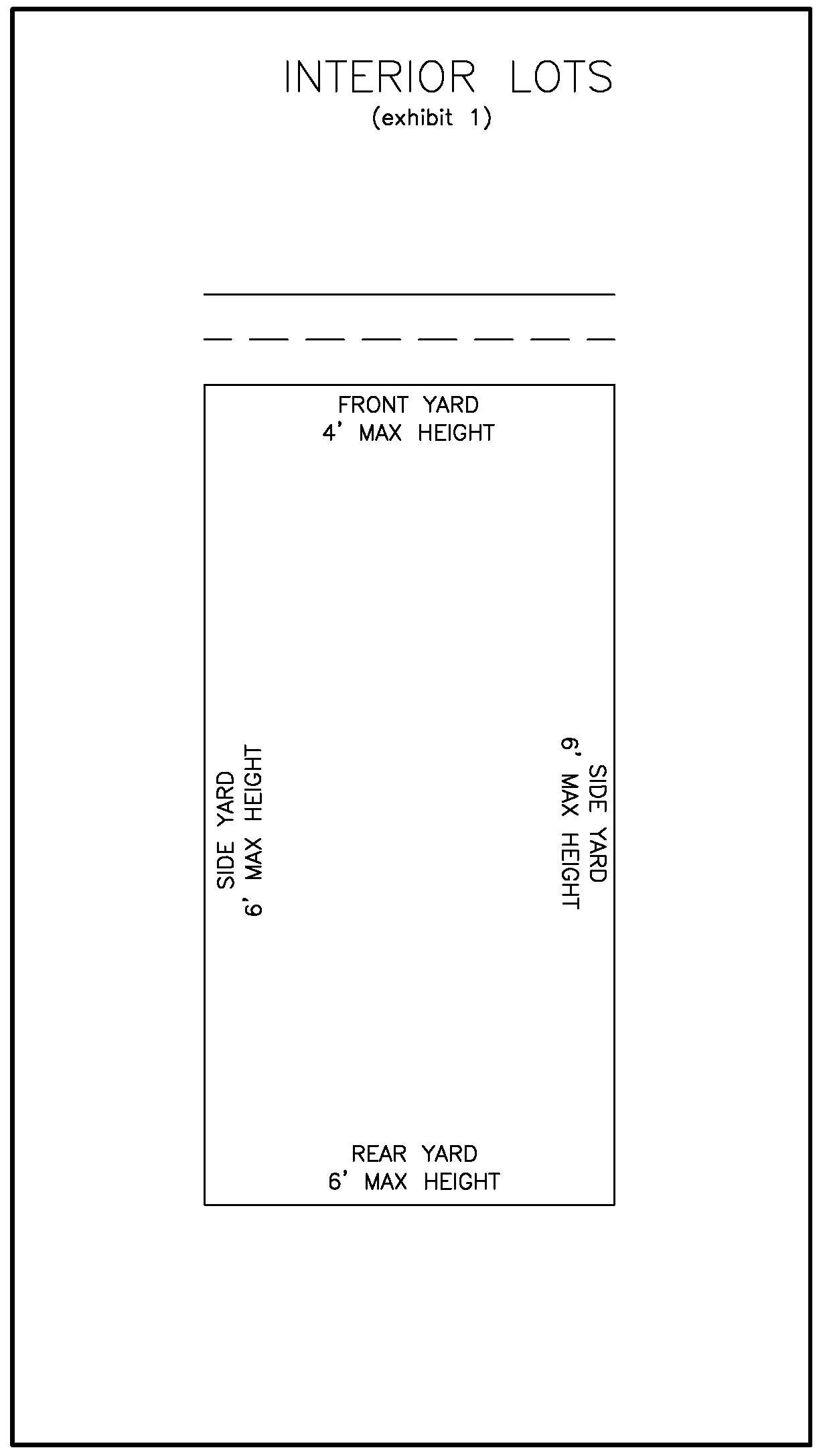
Interior lots:
Front yard - Four feet maximum height.
Side yards - Six feet maximum height.
Rear yard - Six feet maximum height.
(2)
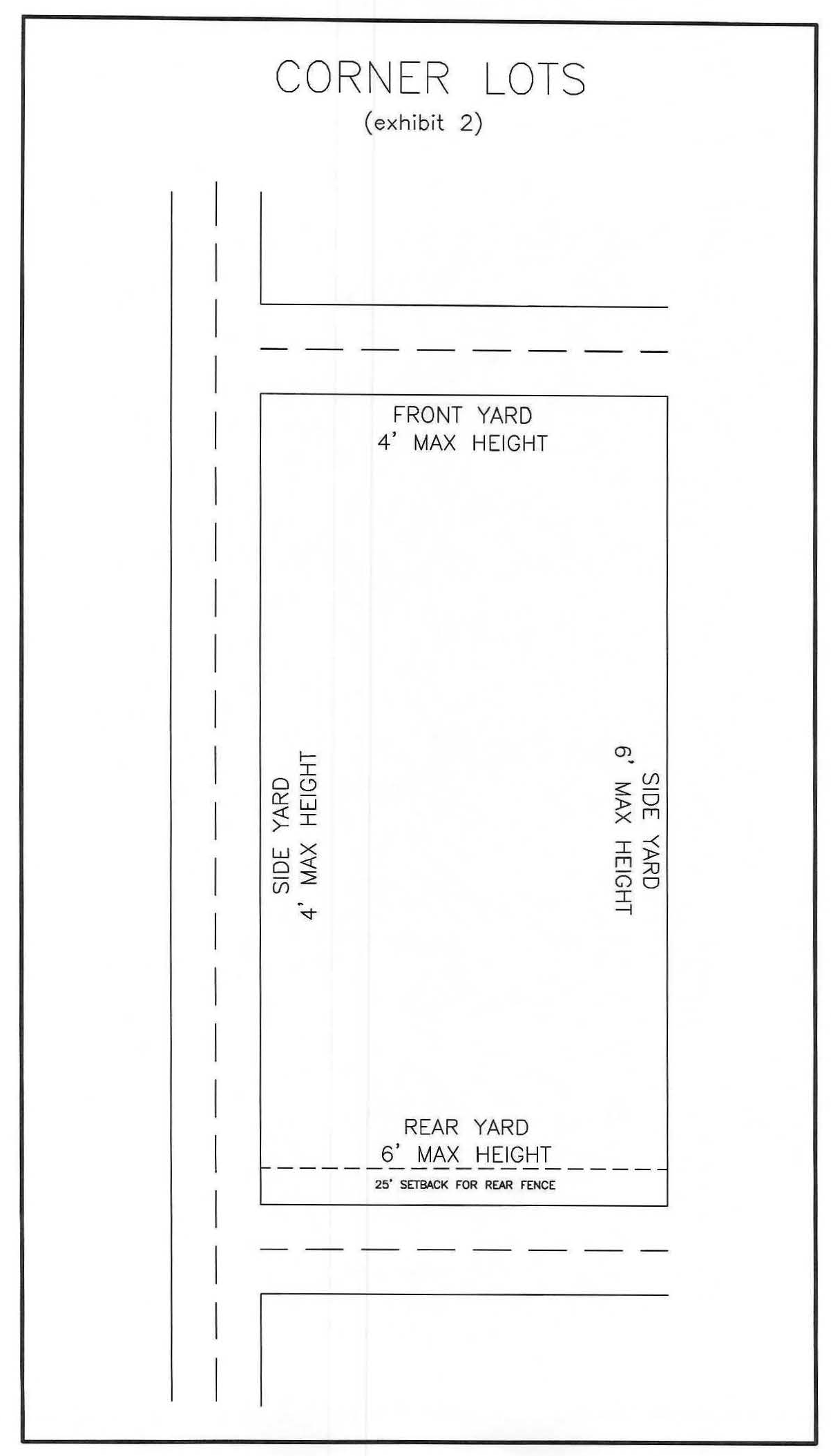
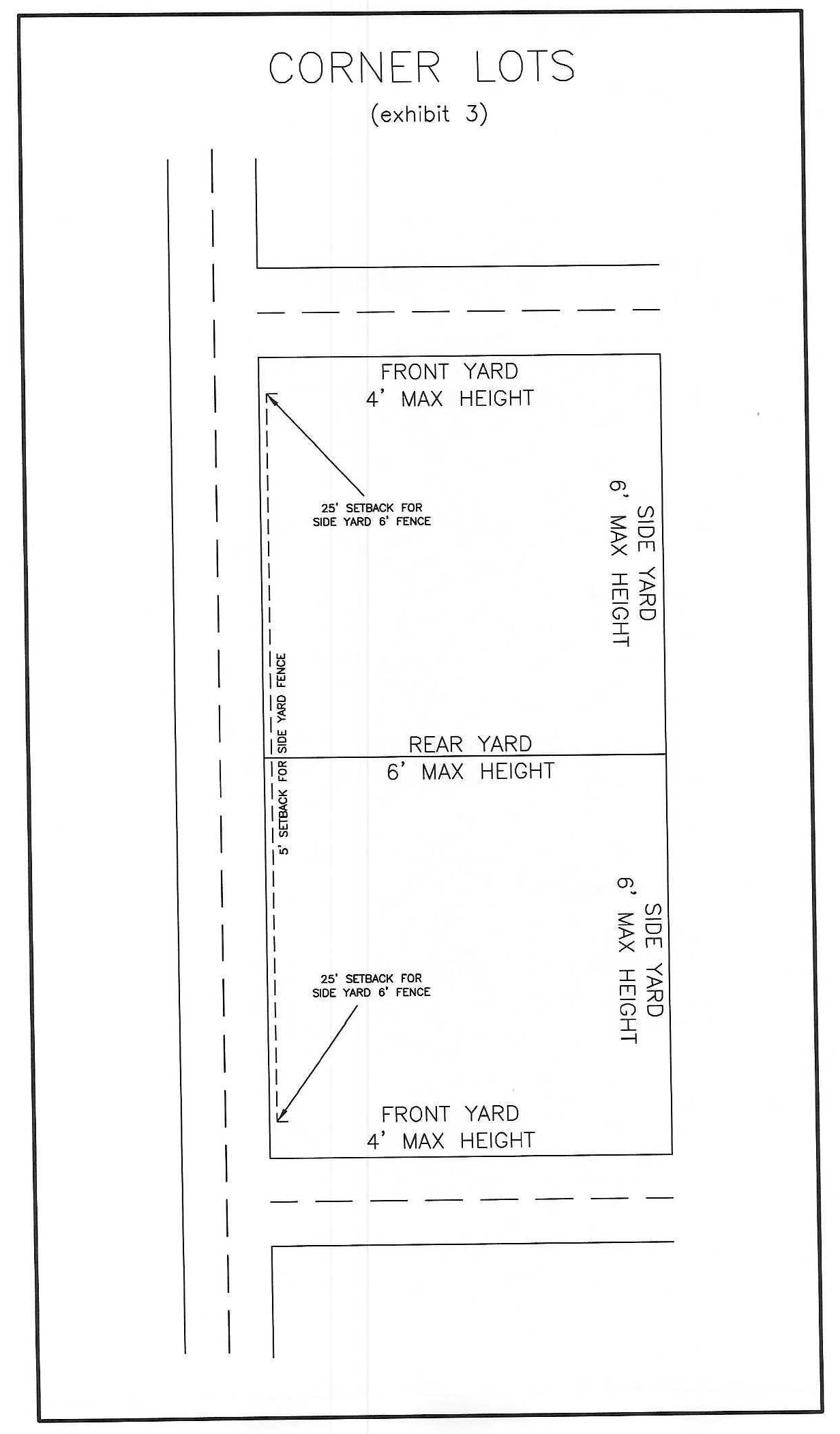
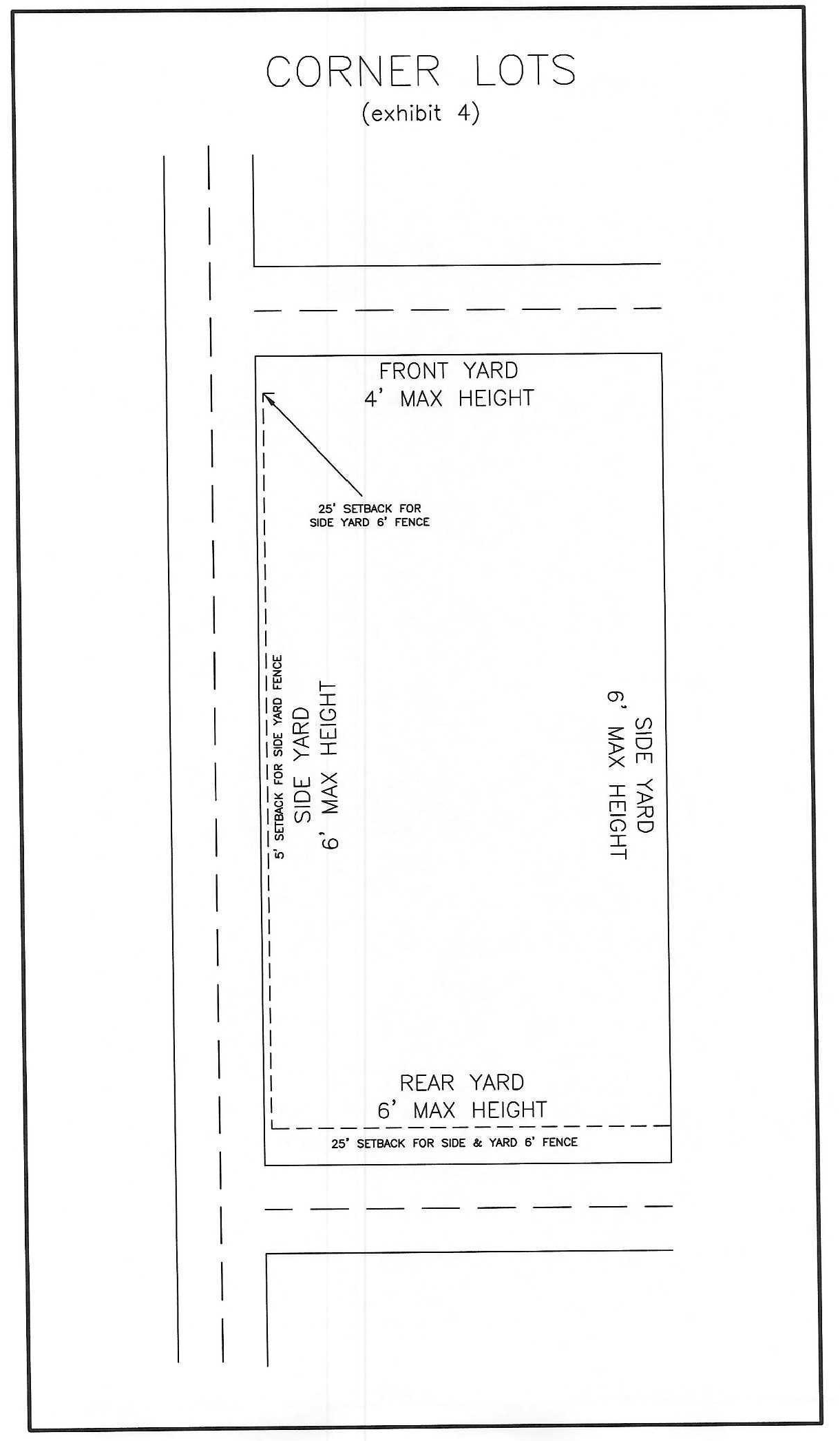
Corner lots:
Front yard - Four feet maximum height.
Corner side yard - Four feet maximum height.*
Side yards - Six feet maximum height.
Rear yard - Six feet maximum height.
Clear view/site triangle - Four feet maximum height and at least 50 percent see through.
(3)
Corner side yard exceptions:
Decorative wrought iron fencing or fencing that is similar in appearance and that is at least 70 percent see through may be installed up to six feet in height one foot behind sidewalk.
Corner lots that are adjacent to each other with rear yards abutting may have up to a six-foot solid fence setback at least five feet from street side yard property line and must end 25 feet from the front yard property line. (See attached diagram.)
Corner lots with rear yard abutting the street may have a six-foot solid fence setback at least five feet from street side yard property line and 25 feet from rear yard facing street property line. (See attached diagram.)
(d)
Unsafe or dangerous fences; failure to maintain (public nuisance). No owner, occupant or agent in charge shall keep or maintain any fence which is unsafe or dangerous. A fence shall be deemed unsafe or dangerous whenever:
(1)
More than 50 percent of the fence is in need of paint or other minor repair.
(2)
Any portion has been damaged by wind, flood, fire or other cause in such a manger that structural strength or stability is appreciably less than it was previous to such event.
(3)
Any portion of any structural member of the fence is likely to fall, to become detached or dislodged or to collapse and thereby injure persons or damage property.
(4)
More than ten percent of the fence area is in need of major repair.
"Minor repair" means repairs dealing primarily with nonstructural portion of the fence, as well as appearance.
"Major repair" means repairs directly connected to the structural portion of the fence.
(e)
Maintenance of nuisances. The town shall notify the owner of the property of the existence of such nuisance and the owner must abate the nuisance within 15 days after receiving such notice, in the case of immediate danger to life or property, the town may require immediate abatement.
(f)
Special purpose fences.
(1)
Barbed wire and electrified fences. Barbed wire, electric, or other fences or walls dangerous to persons or property shall not be constructed within ten feet of any property line which adjoins a street or public walkway.
(g)
Violations and penalty. Any person violating or failing to comply with the provisions of this section shall be responsible for a civil infraction. Each day of violations continues shall be deemed a separate offence and a fine of $25.00 per day assessed.
(Ord. of 6-10-2024(1))

