
Albert Lea City Zoning Code
ARTICLE I
- IN GENERAL
Sec. 50.0001.- Preamble.
This chapter incorporates the ordinance establishing comprehensive zoning regulations for the city and providing for the administration, enforcement and amendment thereof, in accordance with Minn. Stats. § 462.357, and for the repeal of all amendments in conflict with this chapter. The council deems it necessary to the end that adequate light, pure air, and safety from fire and other dangers may be secured; that the taxable value of land and buildings throughout the city may be conserved; that congestion in the public streets may be lessened or avoided; that the hazards to persons and damage to property resulting from the accumulation or runoff of stormwaters or floodwaters may be lessened or avoided; and that the public health, safety, comfort, morals, and welfare may be otherwise promoted. The council, pursuant to Minn. Stats. § 462.354, has established the planning commission, and the planning commission has given reasonable consideration to the plans and maps prepared as a part of the comprehensive planning process. The planning commission has further caused to be prepared, reviewed and transmitted to the council the zoning ordinance contained within this chapter. All requirements of Minn. Stats. § 462.357 have been met.
(Code 1980, § 11.01; Code 1997, § 74-1)
Sec. 50.0002. - Definitions.
(a)
As used in this chapter, the term "used" or "occupied" includes the term "intended, designed, or arranged to be used or occupied."
(b)
The following words, terms and phrases, when used in this chapter, shall have the meanings ascribed to them in this section, except where the context clearly indicates a different meaning:
Accessory structure means a structure subordinate to the principal use of the land, located on the same parcel as the principal use and principal structure, and serving a purpose customarily incidental to the principal use and principal structure.
Accessory use means a use subordinate to the principal use of the land, located on the same parcel as the principal use, and serving a purpose customarily incidental to the principal use.
Agriculture means the tilling of the soil, the raising of crops, horticulture and gardening, but not including the keeping or raising of domestic animals or fowl, except household pets, and not including agriculture, industry or business such as fruit packing plants, fur farms, animal hospitals or similar uses.
Alley means a public or private way affording only secondary means of access to abutting property.
Antenna means any structure or device used for the purpose of collecting or transmitting electromagnetic waves, including, but not limited to, directional antennas, panels, microwave dishes, satellite dishes, and omni-directional antennas, and which shall not extend more than twenty-five (25) feet above the highest point or surface of the ground or structure on which the antenna is mounted or attached.
Apartment means a room or suite of rooms in a multifamily or multiuse building arranged and intended as a place or residence for a single-family or a group of individuals living together as a single housekeeping unit.
Apartment building means any building or portion thereof which is designed, built, rented, leased, let or hired out to be occupied or which is occupied as the home or residence of three (3) or more families living independently of each other and doing their own cooking in the building, and the term "apartment building" includes flats and apartments.
Architectural and landscape lighting means lighting of shape and/or form of structures, plant materials or other landscape features and for which lighting for any other purpose is incidental.
Automobile or trailer sales means an open area other than a street used for the display, sale or rental of new or used motor vehicles or trailers in operable condition.
Automobile wrecking means the dismantling or disassembling of used motor vehicles or trailers, or the storage, sale or dumping of dismantled, partially dismantled, obsolete or wrecked vehicles or their parts.
Basement means that portion of a building located partly underground, including crawl spaces, but having less than half its clear floor to ceiling height below the average grade of the adjoining ground or having one (1) sidewall area two-thirds (⅔) exposed above the average grade of the adjoining ground and the two (2) walls adjoining the above side having one-third (⅓) or more of wall area above the average grade of the adjoining ground. A basement having its sides more than one-half (½) below the adjoining ground is defined as a cellar.
Basement-floodplain means any area of a structure, including crawl spaces, having its floor or base sub-grade below ground level on all four (4) sides, regardless of the depth of excavation below ground level.
Block means a tract of land bordered on all sides by streets or by one (1) or more streets and a railroad right-of-way, stream or river of unsubdivided acreage.
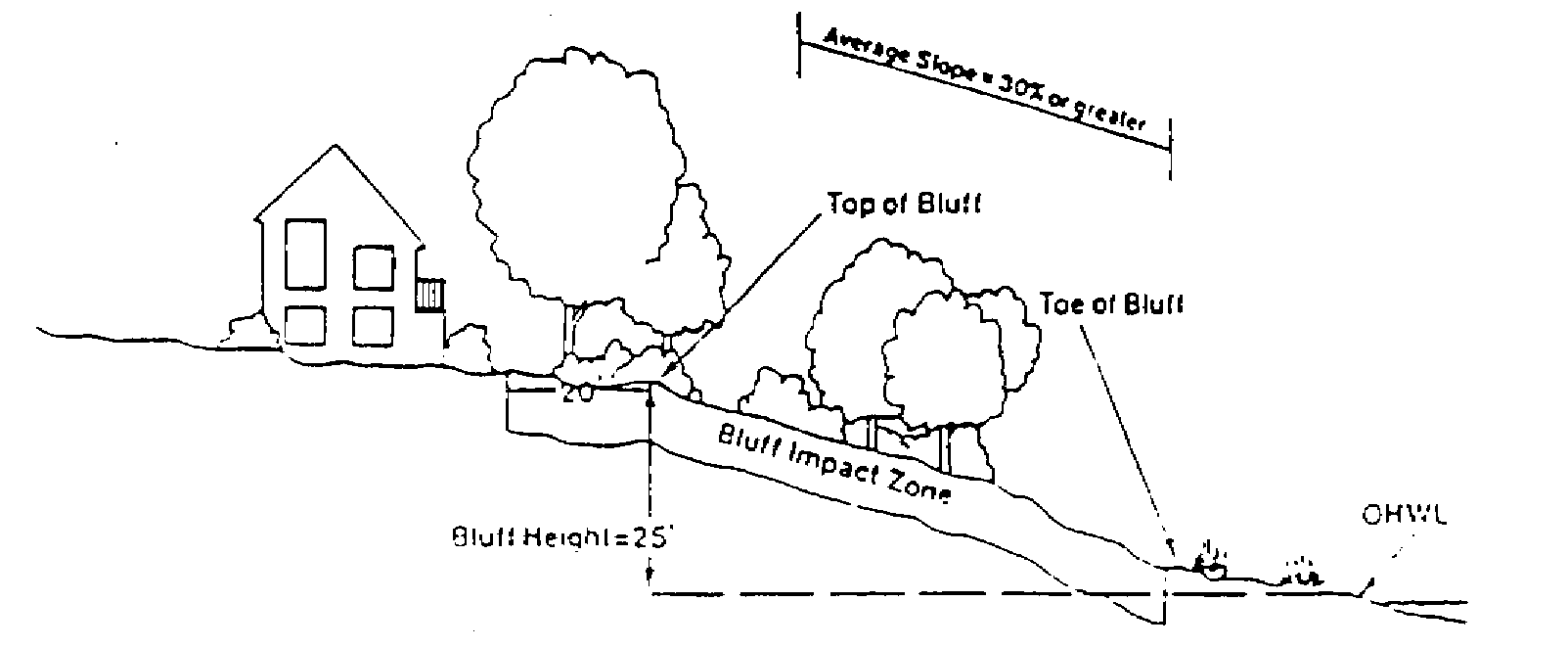
Bluff means a topographic feature, such as a hill, cliff, or embankment, having the following characteristics (an area with an average slope of less than eighteen (18) percent over a distance for fifty (50) feet or more shall not be considered part of the bluff):
(1)
Part or all of the feature is located in a shoreland area;
(2)
The slope rises at least twenty-five (25) feet above the ordinary high water level of the waterbody;
(3)
The grade of the slope from the toe of the bluff to a point twenty-five (25) feet or more above the ordinary high water level averages thirty (30) percent or greater; and
(4)
The slope must drain toward the waterbody.
Bluff impact zone means a bluff and land located within twenty (20) feet from the top of a bluff.
Boathouse means a structure designed and used solely for the storage of boats and boating equipment.
Buildable area means that area of a lot which is exclusive of all yards and within which the principal building must be constructed.
Building means any structure for the shelter, support or enclosure of persons, animals, chattel or property of any kind and when separated by dividing walls, without openings, each portion of such building, so separated, shall be deemed a separate building.
Accessory building means a building which is subordinate to the principal building, separated from it, and utilized only in accordance with the permitted accessory uses as permitted within the zoning district in which it is located.
Principal building means a building placed on a permanent frost-free support system enclosed by sidewalls and a roof and utilized for the primary land use on the site.
Building, height of, means the vertical distance above grade, as defined in this section, to the highest point of the coping of a flat roof or to the deck line of a mansard roof or to the average height of the highest gable of a pitched roof or hipped roof. The measurement may be taken from the highest adjoining sidewalk or ground surface within a five (5) foot horizontal distance of the exterior wall of the building, when such sidewalk or ground surface is not more than ten (10) feet above grade. The height of a stepped or terraced building is the maximum height of any segment of the building.
Building line means a line parallel to a lot line or the ordinary high water level of a protected water at the required setback beyond which a structure may not extend.
Building, principal facing area, refers to the property lines or lease lines at the front of the building in which the business is located or the location of the main public entrance of the building.
Candela means the Systeme International d'Unities (SI) of luminous intensity. One (1) candela is one (1) lumen per steradian. Formerly known as candle.
Cargo container means any device creating a partially or fully enclosed space that can be used to contain, store, and transport objects or materials. The term "cargo container" includes any receptacle or enclosure for holding a product used in packaging and shipping, and intermodal containers.
Carport means any open-sided automobile shelter that is open on more than one (1) side.
Cellar means a story having one-half (½) or more of its height below grade.
Cemetery means land used or intended to be used for the burial of the human dead and dedicated as a cemetery for such purposes.
Church or synagogue means and includes a church, synagogue, rectory, parish house or similar building incidental to the principal use which is maintained and operated by an organized group of people for religious purposes.
Clinic means a place used for the care, diagnosis and treatment of sick, ailing, infirm and injured persons and those who are in need of medical or surgical attention, but who are not provided with board or room or kept overnight on the premises.
Club means a nonprofit association of persons who are bona fide members, paying regular dues, and are organized for some common purpose, but not including a group organized solely or primarily to render a service customarily carried on as a commercial enterprise.
Commercial use means the principal use of land or buildings for the sale, lease, rental, or trade of products, goods, and services.
Commissioner means the commissioner of the department of natural resources.
Conditional use means a specific type of structure or use of land listed within the district regulations that may be allowed only after an in-depth review procedure and with appropriate conditions or restrictions as provided within this chapter and upon a finding that:
(1)
Certain conditions as detailed in this chapter exist; and
(2)
The structure or land use conform to the comprehensive plan and are compatible with the existing neighborhood.
Condominium means a form of individual ownership within a development of more than one (1) dwelling, business use or industrial use, which entails joint ownership of common areas and facilities and joint responsibility for maintenance and repairs, and individual ownership of the individual dwellings, commercial or industrial space, and the immediate surrounding site area assigned to the unit, if any.
Convalescent, nursing or rest home means any building or group of buildings providing personal assistance or nursing care for those dependent upon the services because of age or physical or mental impairment, but not for the treatment of contagious diseases, addicts or mental illness.
Court means a space, open and unobstructed to the sky, located at or above grade level on a lot and bounded on three (3) or more sides by walls of a building.
Critical erosion area means an area where degree of slope, length of slope, soil erodibility and surface cover are such as is likely to result in soil being transported off-site to high valued damaged areas.
Cutoff means the IES of North America classification that describes a luminaire having a light distribution in which the candela per one thousand (1,000) lamp lumens does not numerically exceed twenty-five (25) (two and one-half (2½) percent) at or above an angle of ninety (90) degrees above nadir, and one hundred ten (110) percent at or above a vertical angle of eighty (80) degrees above nadir. This applies to all lateral angles around the luminaire.
Cutoff angle means the maximum angle formed by a line drawn in the direction of emitted light rays at the light source and a line perpendicular to the ground from the light source.
Deck means a horizontal, unenclosed platform with or without attached railings, seats, trellises, or other features, attached or functionally related to a principal use or site.
Detached clustered dwellings means detached single-family homes on individual lots which may not require street frontage or side yard setback areas, but which are only permitted in planned and coordinated developments.
Development, floodplain, means any manmade change to improved or unimproved real estate, including buildings or other structures, mining, dredging, filling, grading, paving, excavation or drilling operations, or storage of equipment or materials.
District means any section of the city as shown on the official zoning map for which the regulations governing the use of buildings and premises and the height and area of buildings are uniform.
Drive-in restaurant means any eating or drinking establishment designed for the consumption of food or drinks by persons in vehicles parked on the premises.
Drive-thru, drive-in, or drive-up uses means a business where customers drive through a specified locality or place, especially driving into a place of business, completing a transaction from one's car, and driving out.
Dwelling means one (1) room or a suite of two (2) or more rooms designed for or used by one (1) family for living and sleeping purposes and having its own cooking and sanitary facilities and being within a principal building.
Dwelling, attached, means a dwelling which is joined to other dwellings at two (2) or three (3) sides by party walls with no dwelling above or below any other dwelling and arranged in a row, including the dwellings at the ends.
Dwelling, detached, means a residential building which is entirely surrounded by open space on the same lot.
Dwelling, four (4) family, means a principal building designed for or occupied by four (4) families and containing four (4) dwelling units.
Dwelling, multiple, means a principal building or portion thereof designed for three (3) or more families and containing three (3) or more dwelling units.
Dwelling, semidetached, means the dwelling which is joined to another dwelling at one (1) side only by a party wall.
Dwelling, single-family, means a principal building designed for or occupied by one (1) family and containing one (1) dwelling unit.
Dwelling site means a designated location for residential use by one (1) or more persons, including temporary or movable shelters and camping and recreational vehicle sites.
Dwelling, three (3) family, means a principal building designed for or occupied by three (3) families and containing three (3) dwelling units.
Dwelling, two (2) family, means a principal building designed for or occupied by two (2) families and containing two (2) dwelling units.
Equal degree of encroachment means a method of determining the location of floodway boundaries so that floodplain lands on both sides of a stream are capable of conveying a proportionate share of flood flows.
Erosion and sediment control plan means a plan for the control of soil erosion and sediment resulting from a land-disturbing activity.
Established residential neighborhoods in built-up urban areas means a tract of land which, prior to July 2, 1979, was partially developed or ready for development and included some if not all of the following improvements: public sanitary sewer, public water, subdivided building sites, graded streets, paved streets, curb and gutter, developing and completed residential structures.
Extractive use means the use of land for surface or subsurface removal of sand, gravel, rock, industrial minerals, other nonmetallic minerals, and peat not regulated under Minn. Stats. §§ 93.44—93.51.
Family means a person living alone or two (2) or more persons related by blood or marriage living together as a housekeeping unit and occupying a single dwelling unit; or a group of not more than four (4) persons, who need not be related by blood or marriage, living together as a single housekeeping unit on a nonprofit, cost-sharing basis.
Farm means an area which is used for the growing of usual farm products such as vegetables, fruit, trees and the raising thereon of the usual farm poultry and farm animals, such as horses, cattle, sheep and swine. The term "farming" includes the operating of such an area for one (1) or more of the uses listed in this definition, including dairy farms, with the necessary accessory uses for treating or storing produce; provided, however, that the operation of any such accessory uses shall be secondary to the normal farming activities. The term "farm" does not include intensive livestock raising such as feed lots or large batteries of rabbit or other animal hutches.
Fence means an accessory structure forming an enclosed barrier or boundary and constructed of posts, boards, wire, stakes or rails; or a wall of brick, stone, concrete or similar materials.
Flood means a temporary increase of the flow or stage of a stream or in the stage of a lake or the temporary ponding of surface runoff that results in the inundation of normally dry areas.
Flood frequency means the average frequency, statistically determined, for which it is expected that a specific flood stage or discharge may be equaled or exceeded.
Flood fringe means that portion of the floodplain outside of the floodway. The term "flood fringe" is synonymous with the term "floodway fringe" used in the flood insurance study for the county and incorporated areas. For lakes, the flood fringe shall be the floodplain above the ordinary high water level.
Floodplain means the beds proper and the areas adjoining a wetland, lake or watercourse which have been or may be covered by the regional flood and areas subject to periodic ponding from local runoff.
Floodplain zoning map means a portion of the zoning map adopted in accordance with section 50.0003 as required therein.
Floodproofing means a combination of structural provisions, changes or adjustments to properties and structures subject to flooding, primarily for the reduction or elimination of flood damages.
Floodway means the bed of a wetland or lake and the channel of the watercourse and those portions of the adjoining floodplain which are reasonably required to carry, store, and discharge the regional flood. For lakes, the floodway shall be the floodplain area at or below the ordinary high water level.
Forest land conversion means the clear cutting of forested lands to prepare for a new land use other than re-establishment of a subsequent forest stand.
Fraternity or sorority house means a building rented, occupied or owned by a general or local chapter of some regularly organized college fraternity or sorority or by or on its behalf by a building corporation or association as a place of residence.
Frontage means all the property on one (1) side of a street or place between two (2) intersecting streets or places (crossing or terminating) measured along the line of the street or place or, if the street or place is dead ended, all the property abutting one (1) side between an intersecting street or place and the dead end of the street or place, but not including the dead end of the street.
Fully shielded luminaire means a luminaire that emits no direct uplight, but which has no limitation on intensity in the region between eighty (80) degrees and ninety (90) degrees.
Garage, private, means an attached or detached accessory building designed or used for the storage of motor-driven vehicles, not more than two (2) of which are owned by other than the occupants of the main building.
Garage, public, means any principal building or portion of a principal building, except that defined in this section as a private garage, used for the storage of motor vehicles, or where any such vehicles are kept for remuneration or hire, including the sale of gasoline, oil and accessories.
Garage, repair, means any facilities for the repair or maintenance of motor vehicles, but not including factory assembly of such vehicles, auto wrecking establishments, or junkyards.
Gazebo means a roofed accessory structure that offers an open view of the surrounding area, typically used for relaxation or entertainment.
General floodable area means an area of the city designated by the city engineer as floodable by local runoff for a temporary and indefinite period of time.
Glare means direct light emitted from a light source which causes eye discomfort.
Grade means the lowest point of elevation of the finished surface of the ground, paving or sidewalk within the area between the building and the property line or, when the property line is more than five (5) feet from the building, between the building and a line five (5) feet from the building.
Grading, filling and excavating means any land change which may result in soil erosion from water or wind, or the movement of sediments into state waters or onto lands in the state without regard to who titleholders of such receiving lands may be, including, but not limited to, tilling, clearing, grading, excavating, transporting and filling of land.
Hardship means the same as that term is defined in Minn. Stats. ch. 462.
High valued damaged areas means lakes, ponds, reservoirs, streams, residential areas, commercial areas, and drainage systems, both natural and manmade.
Home occupation means any occupation which is clearly incidental to the principal use of the premises, is conducted by a resident occupant and does not change the character of the principal use.
Homeowners' association means an organization of property owners established for the purpose of providing maintenance, financial and legal responsibility, for a parcel of land in which they have a defined common interest.
Hospital means an institution providing health services primarily for inpatient medical or surgical care of the sick or injured and including related facilities, such as laboratories, outpatient department, training facilities, central service facilities, and staff offices which are an integral part of the facility.
Hotel or motel means any building or portion thereof, including clusters of unattached or semi-attached cabins or cottages, which is intended or designed to be used or which is used, rented or hired out to be occupied for sleeping purposes by more than five (5) guests. All or a portion of a hotel or motel may be used for extended stay. Extended stay shall mean for periods of up to thirty (30) days, and thirty (30) day contracts or contracts for lesser periods may be renewed at the discretion of the hotel or motel management.
Illuminating Engineering Society (IES) means a recognized technical and educational authority on illumination with a mission to improve the lighted environment by bringing together those with lighting knowledge and by translating that knowledge into actions that benefit the public.
Industrial use means the use of land or buildings for the production, manufacture, warehousing, storage, or transfer of goods, products, commodities, or other wholesale items.
Initial luminaire lumen means the output calculated as the sum of the initial lamp lumens for all lamps within an individual luminaire, multiplied by the luminaire efficiency. If the efficiency is not known for a residential luminaire, assume seventy (70) percent. For luminaires with absolute photometry per IES LM-79, it is the total luminaire lumens. The lumen rating of a luminaire assumes the lamp or luminaire is new and has not depreciated in light output.
Institution means a building occupied by a nonprofit corporation or a nonprofit establishment for public use.
Intensive vegetation clearing means the complete removal of trees or shrubs in a contiguous patch, strip, row or block.
Junkyard means a place where waste, discarded or salvaged materials are brought, sold, exchanged, stored, baled, packed, disassembled or handled, including auto wrecking yards, house wrecking yards, and used material yards, but not including pawnshops, antique shops, and places for the sale, purchase or storage of used furniture and household equipment, used cars in inoperable condition or salvaged materials incidental to manufacturing operations.
Landing means a platform at the top or bottom of a staircase or a platform interrupting a flight of stairs.
Landscaping is the process of developing and enhancing a site with coordinated live and inert materials to create an attractive three (3) dimensional image of large shade and decorative deciduous trees, large and decorative evergreens, mid-level and small decorative shrubs and flowering plants and varieties of ground cover applied to all areas of a site that are not used for buildings, parking and driveways.
Light pollution means the shining of light produced by a luminaire above the height of the luminaire and into the sky.
Light trespass means the shining of light produced by a luminaire beyond the boundaries of the property on which it is located.
Limited occupancy specialty hotel means a hotel for not more than fifteen (15) guestrooms where one (1) or more sit-down meals are provided for each guest with the meal being served within the hotel facilities specifically designed for dining purposes and provided as part of the basic cost of occupancy.
Limited retail in historic residence means a retail facility of not more than two thousand (2,000) square feet gross retail area located in an existing residence constructed prior to 1937 and meeting conditions as established in this chapter.
Live/work means a land use concept which mixes residential and a commercial or industrial activity within the same vertical space with the residential activity being above the commercial or industrial activity, but not necessarily separated therefrom. Live/work spaces provide the opportunity for one to carry out his profession or vocation within the same vertical land use space. Live/work is a land use entity in itself and is not regulated as a customary home occupation as provided in section 50.0022.
Lodginghouse means any building or portion thereof containing not more than five (5) guestrooms where rent is paid in money, goods, labor or otherwise.
Lot means, for zoning purposes, a parcel of land intended for occupancy by one (1) or more principal buildings and any accessory buildings. Such lot shall have frontage on a public street and shall be of at least sufficient size to meet minimum zoning requirements for use, coverage and area to provide such yards and open spaces as required within the district in which it is located. Manufactured home parking sites in manufactured home parks are not defined as lots in accordance with this section. Lots approved as part of a condominium, semidetached, attached, to clustered dwelling developments are exempt from the requirements of this section; however, such lots are regulated in accordance with the specific requirements of the approved plan for such exempt developments. A lot may consist of:
(1)
A single lot of record.
(2)
A portion of a lot of record.
(3)
A combination of complete lots of record, or a combination of completed lots of record and portions of lots of record, provided that it is recorded as one (1) lot.
(4)
A parcel of land described by metes and bounds description and recorded by the county recorder prior to the adoption of the ordinance from which this chapter is derived or any newly described metes and bounds parcel of less than five (5) acres, and in no case of division or combination shall any residential lot or parcel be created which does not meet the requirements of this chapter.
Lot, corner, means a lot located at the intersection of two (2) or more streets. A lot abutting on a curved street shall be considered a corner lot if straight lines drawn from the foremost points of the side lot lines to the foremost points of the lot meet at an interior angle of less than one hundred twenty (120) degrees.
Lot coverage means that percentage of a lot which, when viewed in its horizontal plane, would be covered by a structure or any part thereof.
Lot frontage means the front of a lot, which shall be construed to be the portion nearest the street. For the purpose of determining yard requirements on corner lots and through lots, all sides of a lot adjacent to streets shall be considered frontages, and yards shall be provided as indicated under the definition of the term "yard" in this section.
Lot lines means the lines bounding the lot.
Lot measurements are computed as follows:
Lotdepth means horizontal distance between the midpoints of straight lines connecting the foremost points of the side lot lines in front and the rearmost points of the side lot lines in the rear.
Lotwidth means the distance between the horizontal lines connecting front and rear lot lines at each side of the lot measured across the rear of the required front yard; provided, however, that width between side lot lines at their foremost points, where they intersect with the street line, shall not be less than eighty (80) percent of the required lot width except for lots on the turning circle of a cul-de-sac, where the eighty (80) percent requirement shall not apply.
Lot area means the area contained in a horizontal plane defined by the lot lines.
Lot of record means a lot which is part of a subdivision, the plat of which has been recorded in the office of the county recorder, or a lot described by metes and bounds, the description of which has been recorded in the office of the county recorder.
Lot, interior, means a lot other than a corner lot with only one (1) frontage on a street other than an alley.
Lot, through, means a lot other than a corner lot with frontage on more than one (1) street other than an alley. Through lots with frontage on two (2) streets may be referred to as double-frontage lots.
Lot, reversed frontage, means a lot in which the frontage is at right angles or approximately right angles to the general pattern in the area involved. A reversed frontage lot may also be a corner lot or an interior lot.
Lowest floor, floodplain, means the lowest floor of the lowest enclosed area (including basement). An unfinished or flood-resistant enclosure, used solely for parking of vehicles, building access, or storage in an area other than a basement area, is not considered a building's lowest floor.
Lumen means the unit of measure used to quantify the amount of light produced by a lamp or emitted from a luminaire (as distinct from watt, a measure of power consumption).
Luminaire means a complete lighting unit consisting of a light source and all necessary mechanical, electrical and decorative parts.
Manufactured home means a structure, transportable in one (1) or more sections, which in the traveling mode is eight (8) body feet or more in width or forty (40) body feet or more in length or, when erected on site, is three hundred twenty (320) or more square feet and which is built on a permanent chassis and is designed to be used as a dwelling, with or without a permanent foundation, when connected to the required utilities and includes the plumbing, heating, air conditioning and electrical systems contained therein, except that the term "manufactured home" includes any structure which meets all the requirements and with respect to which the manufacturer voluntarily files a certification required by the secretary of the department of housing and urban development and complies with the standards established under this chapter. The term "manufactured home" does not include the term "recreational vehicle."
Manufactured home, floodplain, means a structure, transportable in one (1) or more sections, which is built on a permanent chassis and is designed for use with or without a permanent foundation when attached to the required utilities. The term "manufactured home" does not include the term "recreational vehicle."
Manufactured home park means a parcel of land which has been planned and improved for the placement of two (2) or more manufactured homes for nontransient use.
Motor freight/warehousing means a building in which freight brought by motor truck is assembled and sorted for routing in shipment.
Motor fuel stations means a business where gasoline is stored in underground tanks for operation of automobiles and is retailed directly to the public on-premises and includes minor accessories and services for automobiles or minor convenience sales.
Nadir means, in the lighting discipline, the angle pointing directly downward from the luminaire, or zero (0) degrees. Nadir is opposite the zenith.
Nonconforming use means a building, structure or premises legally existing or used at the time of adoption of the ordinance from which this chapter is derived or any amendment thereto and which does not conform to the use provisions of this chapter for the district in which the premises is located.
Obstruction means any dam, wall, wharf, embankment, levee, dike, pile, abutment, projection, excavation, channel modification, culvert, building, wire, fence, stockpile, refuse, fill, structure or matter in, along, across or projecting into any channel, watercourse or regulatory floodplain which may impede, retard or change the direction of the flow of water, either in itself or by catching or collecting debris carried by such water.
Ordinary high water level means the boundary of public waters and wetlands, and shall be an elevation delineating the highest water level which has been maintained for a sufficient period of time to leave evidence upon the landscape, commonly that point where the natural vegetation changes from predominantly aquatic to predominantly terrestrial.
Outdoor seating means an area of additional seating for a dining or other similar business establishment on or adjacent to the public right-of-way or public property.
Outside storage, active, means any materials, products, operable vehicles and machinery, displays, stockpiles or any other thing left in a location on the premises that is not located in a fully enclosed building that is actively used as part of the principal use of the property, including the display of merchandise for sale, lease or rental.
Outside storage, inactive, means any materials, products, operable vehicles and machinery, displays, stockpiles or any other thing left in a location on the premises that is not located in a fully enclosed building that is not actively used as part of the principal use of the property, including the long-term storage of such items. Under no scenario is inactive storage intended to include any items defined in a junkyard, salvage yard, or declared a nuisance by this section.
Parking lot means a parcel of land containing one (1) or more unenclosed parking spaces whose use is principal to the lot as differentiated from an accessory use, as on a residential lot.
Parking space means a surfaced area, enclosed or unenclosed, sufficient in size to store one (1) motor vehicle, together with a street or alley, and permitting ingress and egress of an automobile.
Patio homes means attached dwellings having separate ground level entrances and no other dwelling units above or below.
Pergola means an accessory structure garden feature forming a shaded walkway, passageway, or sitting area of vertical posts or pillars that usually support cross-beams and a sturdy open lattice.
Person means an individual, firm, partnership, corporation, company, association, joint stock association or body politic and includes a trustee, receiver, assignee, administrator, executor, guardian or other representative.
Place means an open unoccupied space other than a street or alley permanently reserved as the principal means of access to adjoining property.
Porch means a covered structure forming an entrance to a building and generally having a separate roof or as a recess within the roofline of the building forming an entrance, vestibule or veranda.
Predominantly tobacco and tobacco paraphernalia retail means a retail location that greater than twenty-five (25) percent of the shop's gross revenue is from the sale of tobacco, tobacco-related devices and electronic delivery devices or a greater than twenty-five (25) percent of the shop's volume of inventory or twenty-five (25) percent of display space or usable shelf space is tobacco, tobacco-related devices and electronic delivery devices.
Principal use means the purpose for which land or a building or structure thereon is designed, arranged, intended or maintained or for which it is or may be used or occupied.
Public waters means any waters as defined in Minn. Stats. § 103G.005, subds. 14 and 15.
Reach means a hydraulic engineering term to describe a longitudinal segment of a stream or river influenced by a natural or manmade obstruction. In an urban area, the segment of a stream or river between two (2) consecutive bridge crossings would most typically constitute a reach.
Recreational camping area means any area, whether privately or publicly owned, used on a daily, nightly, weekly or longer basis for the accommodation of five (5) or more units, consisting of tents, travel trailers, pickup coaches, motor homes or camping trailers, and whether use of such accommodation is granted free of charge or for compensation.
Recreational vehicle means a vehicle that is built on a single chassis, is four hundred (400) square feet or less when measured at the largest horizontal projection, is designed to be self-propelled or permanently towable by a light-duty truck, and is designed primarily not for use as a permanent dwelling but as temporary living quarters for recreational, camping, travel, or seasonal use. For the purposes of this section, the term "recreational vehicle" shall be synonymous with the term "travel trailer/travel vehicle" or "motor home."
Recycling center means any area or structure, whether privately or publicly owned and operated, that engages in recycling or reclamation of metals, paper, or other materials, including crushing, shredding, baling or compacting materials such as auto bodies, scrap metal, etc.
Regional flood means a flood which is representative of large floods known to have occurred generally in the state and reasonably characteristic of what can be expected to occur on an average frequency in the magnitude of the one (1) percent chance or one hundred (100) year recurrence interval. The term "regional flood" is synonymous with the term "base flood" used in the flood insurance study.
Regulatory flood protection elevation means an elevation no lower than one (1) foot above the elevation of the regional flood plus any increases in flood elevation caused by encroachments on the floodplain that result from designation of a floodway. For watercourses, the regulatory flood protection elevation shall be calculated by adding one (1) foot to the base flood one (1) percent annual chance floodwater surface elevations with floodway that are listed in the floodway data table of the flood insurance study reports of the and incorporated areas, adopted in subsection 50.0003(d)(2). For lakes, the regulatory flood protection elevation shall also be determined to the nearest one-tenth (0.1) foot by adding one (1) foot to the one hundred (100) year flood elevation as specified in the respective flood insurance study reports as adopted in subsection 50.0003(d)(2).
Repetitive loss means flood related damages sustained by a structure on two (2) separate occasions during a ten (10) year period for which the cost of repairs at the time of each such flood event on the average equals or exceeds twenty-five (25) percent of the market value of the structure before the damage occurred.
School, primary, secondary, college oruniversity means any school having regular sessions with regularly employed instructors teaching subjects which are fundamental and essential for a general academic education, under the supervision of and in accordance with the applicable state statutes.
Semi-public use means the use of land by a private, nonprofit organization to provide a public service that is ordinarily open to some persons outside the regular constituency of the organization.
Sensitive resource management means the preservation and management of areas unsuitable for development in their natural state due to constraints, such as shallow soils over groundwater or bedrock, highly erosive or expansive soils, steep slopes, susceptibility to flooding, or occurrence of flora or fauna in need of special protection.
Service station orgasoline station means any building or premises used principally for the dispensing, sale or offering for sale at retail of automobile fuels or oils or for the servicing of motor vehicles.
Setback means the minimum horizontal distance between a structure, sewage treatment system, or other facility and an ordinary high water level, sewage treatment system, road, highway, property line, or other facility.
Sewage treatment system means a septic tank and soil absorption system or other individual or cluster type sewage treatment system.
Sewer system means pipelines or conduits, pumping stations, and force main, and all other construction, devices, appliances, or appurtenances used for conducting sewage or industrial waste or other wastes to a point of ultimate disposal.
Shed means a simple roofed accessory structure, typically made of wood or metal, used as a storage space.
Shopping center means a land development for retail purposes which shall have all of the following characteristics:
(1)
Having a gross floor area of two hundred thousand (200,000) square feet or more.
(2)
Having one (1) or more buildings or parcels and ten (10) or more retail outlets.
(3)
Having one (1) or more retail outlets which is an anchor store with fifty thousand (50,000) square feet or more in retail services.
(4)
Located on ten (10) or more acres of land.
(5)
Providing shared parking facilities through common landownership, common leases or cross easements.
(6)
Having a common identification name and image.
Shore impact zone means land located between the ordinary high water level of a public water and a line parallel to it at a setback of fifty (50) percent of the structure setback.
Shoreland means land located within one thousand (1,000) feet from the ordinary high water level of the lakes classified in section 50.0789 and land located within three hundred (300) feet from the streams classified in section 50.0789, shoreland management or the landward extent of a floodplain designated by ordinance on a river or stream, whichever is greater. The limits of shorelands may be reduced whenever the waters involved are bounded by topographic divides which extend landward from the waters for lesser distances and when approved by the commissioner.
Shoreland development standards means specific criteria applied to land within the shoreland management district.
Shoreland management district means all shorelands of the protected waters extending up to three hundred (300) feet from the ordinary high water mark, or the first tier of lots on existing riparian development, or the first tier of lots beyond a public street in existing development when the street is adjacent to public waters.
Significant historic site means any archaeological site, standing structure, or other property that meets the criteria for eligibility to the National Register of Historic Places or is listed in the state register of historic sites, or is determined to be an unplatted cemetery that falls under the provisions of Minn. Stats. § 307.08. An historic site meets these criteria if it is presently listed on either register or if it is determined to meet the qualifications for listing after review by the state archaeologist or the director of the state historical society. All unplatted cemeteries are automatically considered to be significant historic sites.
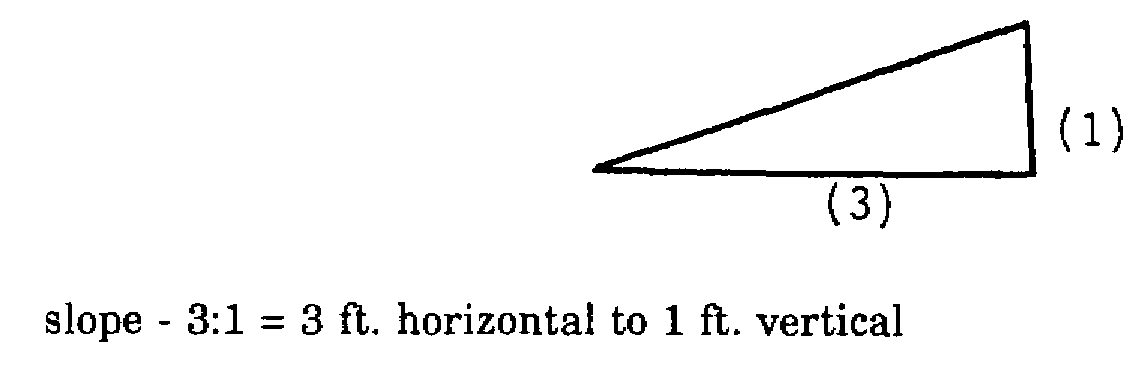
Slope means an incline from the horizontal expressed in an arithmetic ratio of horizontal magnitude to vertical magnitude.
Slope
Solar collector or collector means a device or combination of devices, structures or part of a device or structure that collects solar radiation and converts it to thermal, mechanical, chemical or electrical energy. The term "solar collector" or "collector" includes solar windows and glazing.
Solar energy means radiant energy (direct, diffused and reflected) received from the sun.
Solar energy system means a complete design or assembly consisting of a solar collector; an energy storage facility, where used, and components for distribution of transformed energy, to the extent such components cannot be used jointly with a conventional energy system, or thermal gas components, such as water tanks or masonry walls and floors.
Steep slope means land where development is either not recommended or described as poorly suited due to slope steepness and the site's soil characteristics as mapped and described in available county soil surveys or other reports, unless appropriate design and construction techniques and farming practices are used in accordance with the provisions of this section. Where specific information is not available, steep slopes are lands having average slopes over twelve (12) percent, as measured over horizontal distances of fifty (50) feet or more, that are not bluffs.
Steradian (sr) means a unit of measure equal to the solid angle subtended at the center of a sphere by an area on the surface of the sphere equal to the square of the sphere radius.
Story means that portion of a building included between the upper surface of any floor and the upper surface of the floor next above, except that the topmost story shall be the portion of a building included between the upper surface of the topmost floor and the ceiling or roof above. If the finished floor level directly above a basement, cellar or unused underfloor space is more than six (6) feet above grade as defined in this section for more than fifty (50) percent of the total perimeter or is more than twelve (12) feet above grade, as defined in this section, at any point, such basement, cellar or unused underfloor space shall be considered as a story.
Story, half, means a space under a sloping roof which has the line of intersection of roof decking and wall face not more than three (3) feet above the top floor level, and in which space not more than two-thirds (⅔) of the floor area is finished off for use. A half-story containing independent apartment or living quarters shall be counted as a full story.
Street means the entire width between property lines of a way or place dedicated, acquired, or intended for the purpose of public use for vehicular traffic or access other than an alley.
Street line means a dividing line between a lot, tract or parcel of land and a contiguous street.
Structural alteration means any change in the supporting members of a building, such as bearing walls or partition columns, beams or girders, or any substantial change in the roof or in the exterior walls.
Structure means an object constructed or installed by man, including, but without limitation, buildings, towers, smokestacks, overhead transmission lines, signs and billboards and walls.
Subdivision means land that is divided for the purpose of sale, rent, or lease, including planned unit developments.
Substantial damage means damage of any origin sustained by a structure where the cost of restoring the structure to its before damaged condition would equal or exceed fifty (50) percent of the market value of the structure before the damage occurred.
Substantial improvement means within any consecutive three hundred sixty-five (365) days, any reconstruction, rehabilitation, including normal maintenance and repair, repair after damage, addition, or other improvement of a structure, the cost of which equals or exceeds fifty (50) percent of the market value of the structure before the start of construction of the improvement. This term "substantial improvement" includes structures that have incurred substantial damage, regardless of the actual repair work performed. The term "substantial improvement" does not, however, include either:
(1)
Any project for improvement of a structure to correct existing violations of state or local health, sanitary or safety code specifications which have been identified by the city's designated code enforcement official and which are the minimum necessary to ensure safe living conditions.
(2)
Any alteration of an historic structure provided that the alteration will not preclude the structures continued designation as an historic structure. For purposes of this section, historic structure shall be as defined in CFR part 59.1.
Supervised living facility means a residential facility consisting of multiple dwellings and common facilities providing for twenty-four (24) hour professional staff counseling and assistance to residents.
Surface water-oriented commercial use means the use of land for commercial purposes, where access to and use of a surface water feature is an integral part of the normal conductance of business. Marinas, resorts, and restaurants with transient docking facilities are examples of such use.
Tattoo parlors means a business intended to complete the service of performing tattoos or permanent body art, which are described as a permanent mark or design made on the skin by a process of pricking and ingraining an indelible pigment or by raising scars.
Temporary accessory structure means any construction trailer, cargo container, tent, canvas, cloth, wood, or plastic covered framed structures, any other enclosure of any type that does not meet state building code.
Temporary lighting means lighting installed and operated for periods not to exceed sixty (60) days, completely removed and not operated again for at least thirty (30) days such as for seasonal celebrations, and outdoor events.
Timeshare means any individual housing unit, whether permanently or temporarily occupied, intended for shared use by more than one (1) household and under management control by a single management entity.
Top of the bluff means the upper point of a fifty (50) foot segment with an average slope exceeding eighteen (18) percent (See illustration below).
Bluff
Tower means any ground, building, or roof mounted pole, spire, structure, or combination thereof taller than twenty-five (25) feet above the highest surface on which the structure is mounted, including supporting lines, cables, wires, braces, and masts, intended primarily for the purpose of mounting an antenna, meteorological device, or similar apparatus above grade.
Townhouse means attached dwelling units, each with a separate entrance to front and rear yards.
Tree means any object of natural growth.
Variance means a modification of a specific permitted development standard required in this chapter to allow an alternative development standard not stated as acceptable in this chapter, but only as applied to a particular property for the purpose of alleviating a hardship, practical difficulty or unique circumstance as defined and elaborated upon in this chapter.
Vehicle wash or car wash means any commercially-operated washing station for vehicles, whether intended as full-service or self-service.
Veterinary clinic means a place for the care, diagnosis and treatment of sick, ailing or diseased animals which may include kennels for domestic pets, but does not include areas for the boarding of farm animals.
Warehousing and storage lots means a building or stockyard intended for the sole purpose of storing materials and goods for use in manufacturing operations or retail sales.
Wetland means a surface water feature classified as a wetland in the Federal Manual for Identifying and Delineating Jurisdictional Wetlands (January 1989).
Wind energy conversion system (WECS) means any device that converts wind power to useable energy, such as electricity or heat. A wind energy conversion system may also be referred to by such common names as "wind charges," "wind turbine" and "windmill."
Yard means a required open space unobstructed by any structure or portion of a structure from the ground upward; provided, however, that fences and walls may be permitted in any yard subject to height limitations as indicated in this chapter.
Yard, front, means a yard extending between side lot lines, the depth of which is measured parallel to and beginning at the street right-of-way line. For purposes of determining the front yard on a corner lot, the front yard shall be that portion of the lot having the shortest distance on the public right-of-way or the owner may seek a determination or confirmation from the zoning official as to the front yard. Owner must demonstrate that access and orientation of the primary structure on the larger dimension would not create a traffic hazard. Such determination shall be recorded with the city as being the front yard of record from that date.
Yard, rear, means a yard extending across the rear of the lot between side lot lines beginning at the rear of the principal structure and extending to the rear lot line. For through lots, there will be no rear yard. For corner lots, the rear lot shall extend from the interior side lot line to the setback line required along the side street. Depth of the required rear yard shall be measured at right angles to a straight line across the lot adjoining the rearmost points of the side lot lines or, for a dedicated alley, it shall be measured from the rearmost points of the side lot lines when extended to the centerline of the alley. For irregular rear yards (i.e., lakeshore, curves, angles, etc.), the depth of a required rear yard shall be measured at right angles to a straight line which represents the average distance of the rearmost points of the side lot lines projected to the rear of the lot or parcel.
Yard, side, means a yard extending from the rear line of the required front yard to the rear yard. For through lots, side yards shall extend from the rear lines of the front yard required. Width of required side yards shall be measured at right angles to a straight line joining the ends of front and rear lot lines on the same side of the lot. For irregular side yards (i.e., lakeshore, curves, angles, etc.), the width of a required side yard shall be measured at right angles to a straight line which represents the average distance of the ends of the front and rear lot lines on the same side of the lot projected to the exterior side lot line. The inner side yard line of a required side yard shall be parallel to the straight line so established.
Zoning inspector means the zoning inspector is the appropriately designated official appointed by the city manager for the purpose of administrating and enforcing this chapter.
(Code 1980, § 11.02; Code 1997, § 74-2; Ord. No. 425, 2d, §§ 1, 2, 11-28-1994; Ord. No. 438, 2d, § 1, 11-27-1995; Ord. No. 447, 2d, § 1, 11-12-1996; Ord. No. 3, 3d, § 2, 7-14-1997; Ord. No. 45, 3d, § 1, 12-11-2000; Ord. No. 93, 3d, § 1, 6-27-2005; Ord. No. 114, 3d, § 1, 2-11-2008; Ord. No. 157, 4d, § II, 12-10-2012; Ord. No. 172, 4d, § 1, 10-14-2013; Ord. No. 175, 4d, § 1, 10-28-2013; Ord. No. 176, 4d, § 1, 11-25-2013; Ord. No. 188, 5d, § 2, 10-27-2014; Ord. No. 213, 7d, § 1, 4-9-2018; Ord. No. 218, 9d, § 1, 9-11-2018; Ord. No. 227, 14d, § 1, 10-28-2019; Ord. No. 24-127, § 1, 9-9-2024)
Sec. 50.0003. - Official zoning map.
(a)
The official zoning map shall be identified by the signature of the mayor, attested to by the clerk and bearing the seal of the city under the following words: "This is to certify that this is the Official Zoning Map referred to in Chapter 50 of the City Code," together with date of adoption.
(b)
If, in accordance within provisions of this chapter, changes are made in district boundaries or other matter portrayed on the official zoning map, the change shall be recorded promptly after the amendment has been approved by the council together with an entry on the official zoning map as follows: "By Ordinance Number ___ adopted (date) by the city, the following change or changes were made in the Official Zoning Map: Description of change," which entry shall be signed by the mayor and attested to by the clerk.
(c)
Any unauthorized change of the official zoning map of whatever kind by any person shall be considered a violation of this chapter and punishable under section 1.013.
(d)
The official zoning map consists of the following:
(1)
A map entitled "General Zoning District Map," which designates the basic land use zones of the city.
(2)
A map entitled "Floodplain Zoning Map," which designates floodable areas and floodplain zones and includes by reference the flood insurance study for the county and incorporated areas, and the flood insurance rate maps: 27047C0209C, 27047C0216C, 27047C0217C, 27047C0218C, 27047C0219C, 27047C0228C, 27047C0236C, 27047C0237C, 27047C0238C, 27047C0239C, 27047C0245C, 27047C0377C, 27047C0380C and 27047C0381C, all of which are dated November 19, 2014, prepared by the Federal Emergency Management Agency (FEMA), and declared to be a part of the official zoning map. The floodplain zoning map described in this subsection is an overlay zone to the general zoning map and takes precedence thereto.
(3)
A map entitled "Airport Safety Zone Map," designating airport safety zones which are overlay zones to the general zoning map and take precedence thereto.
(4)
A map entitled "Air Space Zoning Map," which designates airspace zones which are overlay zones to the general zoning map and which take precedence thereto.
(e)
The map is on file and available in the city clerk's office.
(Code 1980, § 11.04; Code 1997, § 74-3; Ord. No. 114, 3d, § 1, 2-11-2008; Ord. No. 188, 5d, § 3, 10-27-2014)
Sec. 50.0004. - Annexation.
The council shall designate the zoning of annexed parcels in the annexation ordinance or by separate ordinance at the time of annexation, considering the zoning, if any, prior to annexation and the compatibility of use of zoning in the area to be annexed with the zoning adjacent thereto within the city. If the zoning district of the annexed area is not specified in the annexation ordinance, the land annexed shall be deemed to be specified as an R-1 single-family residence district until changed by the procedure set forth for amendments to the official zoning map. The flood insurance rate map panels adopted by reference in section 50.0003(d)(2) include floodplain areas that lie outside of the corporate boundaries of the city at the time of adoption of the ordinance from which this section is derived. If any of these floodplain land areas are annexed into the city after the date of adoption of the ordinance from which this section is derived, the newly annexed floodplain land shall be subject to the provisions of this section immediately upon the date of annexation into the city.
(Code 1980, § 11.05; Code 1997, § 74-4; Ord. No. 114, 3d, § 1, 2-11-2008)
Sec. 50.0005. - Vacations.
Whenever any street, alley or other public way is vacated by official action of the council, the zoning districts adjoining each side of such street, alley or public way shall be automatically extended to the center of such vacation, and all area included in the vacation shall then be subject to all appropriate regulations of the extended districts.
(Code 1980, § 11.06; Code 1997, § 74-5)
Sec. 50.0006. - Compliance.
Except as provided in this chapter, no building, structure or land shall be used or occupied and no building, or structure or part thereof shall be erected, constructed, reconstructed, moved or structurally altered unless in conformity with all of the regulations specified in this chapter for the district in which it is located.
(Code 1980, § 11.10, subd. 1; Code 1997, § 74-6)
Sec. 50.0007. - Building requirements.
No building or other structure shall be erected or altered to exceed in height, to accommodate or house a greater number of families, to occupy a greater percentage of lot area, or to have narrower or smaller rear yards, front yards, side yards or other open spaces than required in this chapter or in any other manner contrary to this chapter.
(Code 1980, § 11.10, subd. 2; Code 1997, § 74-7)
Sec. 50.0008. - Area requirements.
(a)
No part of a yard or other open space or off-street parking or loading space required about or in connection with any building for the purpose of complying with this chapter shall be included as part of a yard, open space or off-street parking or loading space similarly required for any other building, except as modified in this chapter.
(b)
No yard or lot existing at the effective date of the ordinance from which this section is derived shall be reduced in size or area below the minimum requirements set forth in this chapter. Yards or lots created after the effective date of the ordinance from which this section is derived shall meet at least the minimum requirements established by this chapter.
(Code 1980, § 11.10, subd. 3; Code 1997, § 74-8)
Sec. 50.0009. - Minimum requirements.
In their interpretation and application, the provisions of this chapter shall be held to be minimum requirements adopted for the promotion of the public health, safety, convenience, comfort, prosperity or general welfare. Wherever the requirements of this chapter are in variance with the requirements of any other lawfully adopted rules, regulations, provisions of this Code, deed restrictions or covenants, the most restrictive or that imposing the higher standards shall govern.
(Code 1980, § 11.10, subd. 4; Code 1997, § 74-9)
Sec. 50.0010. - Dwelling on lot of record.
In any zoning district where dwellings are permitted, a one (1) family detached dwelling may be erected on any lot of official record at the effective date of the ordinance from which this section is derived, irrespective of its area or width, provided the applicable yard and other open space requirements are satisfied or modified by the board of zoning appeals as set forth in chapter 2, article VI, division 3.
(Code 1980, § 11.10, subd. 5; Code 1997, § 74-10)
Sec. 50.0011. - Inapplicability of certain height limitations.
The height limitations stipulated in this chapter shall not apply to the following, except within the airspace and airport safety zone:
(a)
Utility and service structures and architectural features. Church spires, belfries, cupolas, domes, monuments, communications transmission and reception systems, water towers, chimneys, smokestacks, electrical transmission towers, fire towers, hose towers, cooling towers, poles, wind energy conversion systems, except as regulated in article VII of this chapter, elevators, and other similar utility, service structures and architectural features. There shall be a maximum height limitation of one thousand four hundred (1,400) feet MSL in any district.
(b)
Places of public assembly. Places of public assembly, such as churches, schools and other permitted public and semipublic buildings, provided that, for each two (2) feet by which the height of such building exceeds the maximum height otherwise permitted in the district, the building's side and rear yards shall be increased in width or depth by an additional one (1) foot more than the required side or rear yards for the district, and further provided that the board of zoning appeals shall find that such additional height will not be materially detrimental to surrounding property.
(c)
Maximum height limitation. There shall be a maximum height limitation of one thousand four hundred (1,400) feet MSL for all structures or parts of structures including towers and antennas for any location or zoning district in the city, unless otherwise restricted by zoning district limitations.
(Code 1980, § 11.10, subd. 6; Code 1997, § 74-11; Ord. No. 3, 3d, § 3, 7-14-1997; Ord. No. 24-114, § 1, 5-28-2024)
Sec. 50.0012. - Inapplicability of certain yard and frontage limitations.
The yard and frontage limitations stipulated elsewhere in this chapter shall not apply to the following:
(1)
Average depth of front yards, front yards observed. In any district where front yards are required and where forty (40) percent or more of the frontage on one (1) side of a street between two (2) intersecting streets is developed with buildings that have a front yard that is less than the required front yard in the district, no building shall project beyond the average front yard so established.
(2)
Through lots. For through lots, unless the prevailing front yard pattern or adjoining lots indicates otherwise, front yards shall be provided on all frontages. Where one (1) of the front yards that would normally be required on a through lot is not in keeping with the prevailing yard pattern, the development services department may waive the requirement for the normal front yard requirement which shall not exceed the average of the yards provided on adjacent lots.
(Code 1980, § 11.10, subd. 7; Code 1997, § 74-12)
Sec. 50.0013. - Yard space.
(a)
Generally. Any building or structure erected, altered or established shall comply with the yard space requirements of the district in which it is located (as detailed in section 50.0199) except as specified in this section. The required yard space for any building, structure or use shall be contained on the same lot as the building, structure or use, and such required yard space shall fall entirely upon land on where the principal use is located. Fences and walls which meet the requirements of section 50.0018 and shall be allowed within required yards as follows: Nothing shall be permitted to be constructed, placed or maintained which materially impedes vision across the visibility sight triangle at public streets between the height of two and one-half (2½) and eight (8) feet above the ground.
(b)
Encroachments; projections into yards.
(1)
Exceptions. Every part of a required yard shall be open from its lowest point to the sky, unobstructed by any building or structure, except as follows:
a.
Accessory buildings and structures in residential districts. All accessory buildings and structures shall meet the requirements of section 50.0018. Additionally, in residential zones, the construction and use of a private garage for joint storage of automobiles by two (2) owners built upon the dividing lot lines is allowed when no more than the total size, number and area of accessory structures is met for each lot.
b.
Sills, belt courses, cornices, buttresses, and eaves may project not more than three (3) feet over or into any required yard or court.
c.
Walks, steps for negotiating around slopes, retaining walls, fences, paved terraces and paved areas, structures used ornamentally or for gardening or for private recreational purposes, all accessory to and customarily incidental to the principal use, are permitted in yards, provided that they are setback at least one and one-half (1½) feet from side and rear property lines or no higher than two (2) feet above the ground level, except a fence which must meet the requirements of section 50.0018.
d.
The following shall apply to decks located in yard setback areas:
1.
Decks up to eighteen (18) inches above the surrounding terrain as measured to the top of the floor of the deck may:
(i)
Extend into the required interior side yard a distance not to exceed three (3) feet.
(ii)
Extend into the required front and rear yard a distance not to exceed eight (8) feet, but shall not in any case be nearer than fifteen (15) feet from the front or rear property line.
2.
Decks higher than eighteen (18) inches above the surrounding terrain as measured to the top of the floor of the deck may:
(i)
Extend into the required front or rear yard a distance not to exceed six (6) feet, but in no case shall the deck be nearer than fifteen (15) feet to the front or rear property line.
(ii)
Extend into the required interior side yard a distance not to exceed three (3) feet.
3.
No deck may extend into the required exterior side yard on a corner lot. However, where there is an existing entrance to a structure facing a side yard, or landings up to three (3) feet by three (3) feet in size or steps, they may extend into the side yard as regulated by adopted building code.
4.
No deck extending into a required yard setback area shall be covered from above or along the sides with any materials that would restrict access or visibility. A deck extending into a yard setback area shall not be used for covered or uncovered storage.
e.
Openwork fire balconies and fire escapes may extend not more than three and one-half (3½) feet into a required yard or court.
f.
Chimneys and flues may extend not more than two (2) feet into a required yard or court.
g.
Temporary ramps for handicapped residents may be built in required yards, but must be removed within sixty (60) days after the handicapped ramp ceases to be required.
(c)
Exception for steep slopes. In any residential districts where the natural grade of a lot within the required front yard has an average slope, normal to the front lot line at every point along such line, of such a degree or percent of slope that it is not practicable to provide a driveway with a grade of twelve (12) percent or less to a private garage conforming to the requirements of this chapter, such garage may be located within such front yard, but not in any case closer than twelve (12) feet to the street line.
(d)
Drain discharge. Drains from roofs and sump pumps on principal and accessory structures of the property may discharge into required yards of the same property but shall not discharge closer than three (3) feet to a property line.
(e)
Visibility sight triangle. No building, structure, wall, fence, sign, vegetation, or other obstruction shall be permitted in any yard or setback which poses a danger to vehicular traffic or pedestrians by obscuring the view from any street intersecting with another street, alley or driveway entrance generally used by the public. Visibility from the street shall be unobstructed above a height of two and one-half (2½) feet from the ground up to a height of eight (8) feet. This clear zone shall be within a triangle established extending back from the corner intersection of the lot lines along the property lines for twenty-five (25) feet with the third side being a line connecting the other sides, except where dimensions are otherwise specified in specific zoning district standards.
Zoning District Setback Requirements
(Code 1980, § 11.10, subds. 8—10; Code 1997, § 74-13; Ord. No. 439, 2d, § 1, 11-27-1995; Ord. No. 205, 6d, § 1, 5-8-2017)
Sec. 50.0014. - More than one (1) principal building on lot.
Not more than one (1) principal building shall be located on a lot in R-1 and R-2 residence districts, except as provided in division 16 of article III of this chapter. In any district where there is to be located a unit group of residential buildings, there shall be provided on the lot an unobstructed accessway of not less than thirty (30) feet wide from the street on which the lot fronts to all principal buildings on the lot. For any unit group of residential buildings, the lot frontage shall be not less than one hundred (100) feet. Open space between buildings that are parallel or within forty-five (45) degrees of being parallel shall have a minimum dimension of twenty (20) feet for one (1) story buildings. For buildings greater than one (1) story, an additional one (1) foot of open space per each foot of height is required. There shall be no residential building on the same lot with another building devoted to any principal use other than residential. Where there is only one (1) principal building, such building may contain mixed occupancies, provided such occupancies are for uses permitted by the appropriate district regulations.
(Code 1980, § 11.10, subd. 11; Code 1997, § 74-14)
Sec. 50.0015. - Private swimming pools.
A private swimming pool shall include a pool, manmade pond or open tank not located within a completely enclosed building and containing or normally capable of containing water to a depth of at least one and one-half (1½) feet. No such swimming pool shall be allowed in any district unless it complies with the requirements of the state building code and the following conditions:
(1)
The pool, including any walks or paved areas or accessory structures thereto, may not be located closer than five (5) feet to any property line of the property in which it is located.
(2)
The swimming pool or the entire property on which it is located shall be so walled or fenced as to prevent uncontrolled access by children from the street or adjacent properties.
(3)
The pool shall be screened by means of a masonry wall, board fence, compact hedge, or other suitable vegetation of sufficient height so as to generally obscure the view of the pool from the street and adjacent properties.
(Code 1980, § 11.10, subd. 12; Code 1997, § 74-15)
Sec. 50.0016. - Temporary buildings.
Temporary buildings that are used in conjunction with construction work only may be permitted in any zoning district during the period that the building is being constructed, but such temporary buildings shall be removed upon completion of the construction work.
(Code 1980, § 11.10, subd. 13; Code 1997, § 74-16)
Sec. 50.0017. - Assembly buildings.
On a lot occupied by a church or other building in which persons congregate or which is designed, arranged, remodeled or normally used for the congregation of persons in numbers in excess of twenty-five (25), the width of each side or rear yard shall not be less than twenty-five (25) feet. This section shall take precedence over other regulations in this chapter as to width of side or rear yards, insofar as it applies to churches or other public or semi-public buildings in which persons normally congregate in numbers in excess of twenty-five (25).
(Code 1980, § 11.10, subd. 14; Code 1997, § 74-17)
Sec. 50.0018. - Accessory buildings, fences and site appurtenances.
(a)
Fences and walls.
(1)
No fence or wall shall be permitted which materially impedes vision across a required front yard.
In residential zones, no fence shall be more than six (6) feet in height in any side yard or rear yard or more than three (3) feet in height in any front yard. A four (4) foot fence in the front yard will be permitted if such fence is over ninety (90) percent see through such as a welded wire or chain-link fence.
(2)
In residential zones, no fence shall be more than six (6) feet in height in any side yard or rear yard or more than three (3) feet in height in any front yard.
(3)
In commercial and industrial districts, fences greater than seven (7) feet in height are required to have a building permit.
(4)
Retaining walls over four (4) feet in height require a building permit.
(5)
Fences shall be required to meet the visibility sight triangle requirement of section 50.0013(e) but no additional setback requirements apply.
(6)
All walls and fences shall be durable and kept in a condition so as not to become a nuisance. Drywall, cardboard, plywood and particle panels shall not be used as fencing materials. Standard fence materials shall include cedar fence posts and boards, treated wood fence posts and boards, PVC or vinyl fence posts and panels designed and manufactured for us as fence sections, aluminum fence posts and panels, wrought iron fence panels, steel fence panels designed and manufactured for use as fencing, chain link fencing with wood or tubular steel posts and frames and other materials as approved by the zoning administrator.
(b)
Accessory structures in all residential districts, agricultural districts, and residential uses within a PD district unless specifically addressed in the accepted PD plan or CUP shall meet the following requirements.
(1)
The height of all accessory structures shall meet the requirements of section 50.0199 with the following exceptions:
a.
Accessory buildings containing a dwelling unit for servants' quarters or for private guests on a second story may have a height not exceeding twenty-five (25) feet.
b.
Where the principal structure is a residence and is two (2) stories or taller, one (1) accessory structure may be taller than the maximum height specified in section 50.0199, but shall be no taller than the principal structure.
(2)
All accessory buildings or structures shall be no less than three (3) feet from a side or rear lot line or less than five (5) feet from any alley property line.
(3)
Accessory buildings (garages, carports, or sheds) shall not be located closer to the front lot line than the principal building. In no case shall an accessory building be located less than twenty-five (25) feet to the front lot line. On lots of record where the primary structure setback is sixty (60) feet or greater, a maximum required setback of sixty (60) feet shall apply.
(4)
An accessory building or structure attached to or part of the main building or located within the ten (10) feet of the rear or side wall of the main or principal building shall maintain the same side yard or rear yard as is required for the main or principal building.
(5)
Individual private residential accessory structures shall meet the following standards based on lot sizes and other limitations found in city Code.
(6)
No more than three (3) accessory structures (carports, garages or sheds) shall be allowed per lot or parcel in residential and agricultural districts.
(7)
Detached carports may be allowed as an accessory structure (garage or shed) in a back yard only. Attached carports may be located in the side or front yard subject to all setbacks.
(8)
The dimensions of any accessory structure shall not exceed a three to one (3:1) ratio between width and depth.
(9)
All development on a lot including principal and accessory structures shall not exceed more than forty (40) percent of total lot area.
(10)
This subsection shall not prevent the construction or use of a private garage for joint storage of automobiles by two (2) owners built upon the dividing lot lines when no more than the total size, number and area of accessory structures is met for each lot.
(11)
Temporary accessory structures may be allowed for thirty (30) days within any given calendar year or up to six (6) months within any calendar year with a permit issued by the inspection department. Conditions of a six (6) month approval shall relate to public safety, visibility of the structure from neighboring private or public property, general site conditions, limits on period of use, and the general health, safety, and well-being of the neighborhood. Additional time will be considered under the application for an interim use permit (per section 50.0053). Temporary structures shall not be allowed in any side or front yard for longer than thirty (30) days.
(c)
Accessory building and structures in business and industrial districts may occupy any of the ground area which the principal building is permitted to occupy.
(1)
Accessory buildings such as buildings for parking attendants, guard shelters, gate houses and transformer buildings may be located in the front or side yard in I-2 district.
(2)
Temporary accessory structures allowed in B-1, B-2, B-3, B-4, IDD, I-1, I-2, I-3, and DCD districts.
a.
Tents over four hundred (400) square feet in size require a permit issued by the city fire department. Conditions of approval shall relate to public safety, visibility of the tent from neighboring private or public property, general site conditions and limits on period of use and the general health, safety, and well-being of the neighborhood.
b.
Cargo containers are permitted as temporary accessory structures only. (Subject to applicable building and structure setbacks.)
Exception: In the I-2 and I-3 industrial zones, each parcel may utilize up to a maximum of three (3) cargo containers for permanent storage use only. Any modifications to the cargo containers shall be certified by a Minnesota licensed designer as to engineering and building code standards.
c.
Temporary accessory structures shall be allowed for thirty (30) days within any given calendar year or up to six (6) months within any calendar year with a permit issued by the inspection department. Conditions of a six (6) month approval shall relate to public safety, visibility of the structure from neighboring private or public property, general site conditions, limits on period of use, and the general health, safety, and well-being of the neighborhood. An extended period of use may be granted if an applicant seeks an interim use permit pursuant to section 50.0053.
d.
In all zoning districts accessory structures including fences and walls and associated landscaping shall meet the requirements of subsection 50.0013(e) for vision clearance.
(Code 1980, § 11.10, subd. 15; Code 1997, § 74-18; Ord. No. 205, 6d, § 2, 5-8-2017; Ord. No. 213. 7d, § 2, 4-9-2018; Ord. No. 227,15d, § 1, 10-28-2019; Ord. No. 20-247, § 1, 10-12-2020; Ord. No. 22-082, § 1, 10-10-2022; Ord. No. 24-107, § 1, 3-11-2024; Ord. No. 24-115, § 1, 5-28-2024; Od. No. 25-134, § 1, 5-27-2025; Ord. No. 25-134, § 1, 5-28-2024)
Sec. 50.0019. - Recreational vehicles and cabins.
It is unlawful for any person to maintain, install, construct, erect or permit, on any property within the city, except as otherwise permitted in this section, the parking or standing of a recreational vehicle or any small houses, known as cabins, for the use of transients or permanent guests for lodging, dwelling or sleeping. This shall not apply to the location and placement of recreational vehicles in an area used as a trailer camp or court which provides the necessary sanitary, water and laundry facilities for service to mobile homes and recreational vehicles.
(Code 1980, § 11.10, subd. 16; Code 1997, § 74-19)
Sec. 50.0020. - Minimum grade level of county ditch 25.
It is unlawful for any person to construct any building or structure at an elevation of less than seventy-two (72) feet above city datum for grade around such building or structure, as established by the city engineer within the drainage area of county ditch 25 within the city, the drainage area map of county ditch 25 being a matter of public record and on file in the office of the county engineer.
(Code 1980, § 11.10, subd. 17; Code 1997, § 74-20)
Sec. 50.0021. - Lot area and frontage where sewer unavailable.
In any residence district where a public sanitary sewer is not accessible, the otherwise specified lot area and frontage requirements, if less than the following, shall be:
(1)
Lot area, twenty thousand (20,000) square feet.
(2)
Lot frontage at building line, one hundred (100) feet.
(Code 1980, § 11.10, subd. 18; Code 1997, § 74-21)
Sec. 50.0022. - Home occupations.
Home occupations in any zoning district shall be subject to the following:
(1)
No unreasonable use of material or mechanical equipment not recognized as being part of and compatible with normal household use shall be permitted.
(2)
The use shall not generate pedestrian or vehicular traffic beyond that reasonable or normal to the district in which it is located.
(3)
It shall not involve the use of commercial vehicles for delivery of occupational materials to or from the premises.
(4)
No accessory building or space outside of the principal building shall be used for such purposes.
(5)
No special space within the principal building shall be designed or arranged for such use so that it would require any major internal or external alterations or involve construction features not customary to dwellings, either by color, materials, construction, lighting, sound or noise, vibration or electrical interference, etc.
(6)
There shall be no use of utilities or community facilities beyond that reasonable to the use of the property for residential purposes.
(7)
There shall be no consistent commercial or media advertising except one (1) on-site sign.
(Code 1980, § 11.10, subd. 19; Code 1997, § 74-22)
Sec. 50.0023. - Grading, filling and excavation of land.
(a)
No owner or agent of the owner of any parcel of land larger than two (2) acres located within the boundaries of the city shall grade, clear, alter or change the terrain of such parcel prior to obtaining approval of a grading and erosion control plan and receiving a permit from the city.
(b)
A plan to grade, fill or excavate a parcel which contains or involves areas subject to periodic flooding or extremely poor drainage or adverse topography may be approved if the plan provides for an improvement to the poor drainage and if other improvements provide for a water storage area which would be equivalent to the area subject to periodic flooding that is being modified in such a way as not to reduce the holding capacity of the area for floodwaters, and which in no other way would result in features or modifications which would be harmful to the health, safety or welfare of the future residents of the area to be developed or other areas of the city.
(c)
In grading or excavation of any land, due regard shall be shown for all natural features, such as tree growth, watercourses, or similar conditions, which if preserved will add attractiveness and stability to the proposed development.
(d)
When a proposed grading or excavation on a parcel of less than two (2) acres is in a critical erosion area, all earth disturbing activity shall be subject to surveillance and site investigation by the city to determine compliance with standards and regulations.
(e)
When a proposed grading or excavation involves more than two (2) acres and is in a critical erosion area, the person owning or responsible for the grading or excavating shall obtain approval of an erosion and sediment control plan from the soil conservation service prior to application to the city for a permit. Such plan shall include specific requirements established by the city and shall be filed with the city planning office and shall comply with the following:
(1)
Plans shall indicate specific critical sediment source areas to be disturbed. Plans shall be submitted by the developer to the city planner for initial comments before final plans are prepared. Final construction plans and revegetation in all critical erosion areas and erosion control measures and approved practices shall be incorporated in the final development.
(2)
The plan shall consist of a map or drawing at a scale of one hundred (100) feet to an inch delineating and showing correctly the boundaries of the proposed property to be graded or excavated and shall have a north point and scale indicated and shall have topographic information showing contours, physical features, such as watercourses, ponds, wetlands, and tree areas, and existing public utilities, together with what happens to such features after such grading.
(Code 1980, § 11.10, subd. 20; Code 1997, § 74-23)
Sec. 50.0024. - Liability in floodplains.
Floodplain regulations within this chapter and floodplain districts designated on the floodplain zoning map do not imply that areas outside of the floodplain districts or land uses permitted within such districts will be free from flooding or flood damages. This chapter shall not create liability on the part of the city or any officer or employee thereof for any flood damages that result from reliance on this chapter or any administrative decision lawfully made thereunder.
(Code 1980, § 11.10, subd. 21; Code 1997, § 74-24)
Sec. 50.0025. - Minimum requirements for detached principal buildings in residential districts.
Detached principal buildings in any residential zoning district shall have a minimum width of eighteen (18) feet and a minimum ground floor area of four hundred fifty (450) square feet, except in the planned development district, where building width may be established as part of the planned development district.
(Code 1980, § 11.10, subd. 22; Code 1997, § 74-25)
Sec. 50.0026. - Public facilities.
(a)
Publicly owned and operated facilities or city franchise operated facilities, or facilities of county, state, federal governments and school districts, that are required to provide services to the community may be located in any zoning district subject to site plan review and approval by the city council upon recommendation by the planning commission. Such facilities may include parks, playgrounds, recreation and community center buildings, schools, golf courses, swimming pools and similar recreational uses, including accessory structures and concessions as are necessary for their operation, administrative buildings, and utility stations or substations.
(b)
For site plan review, a site development plan shall be submitted to the city planner for review and recommendation to the planning commission. Site plan review shall consider the impact of the proposed facility on the surrounding area, the need for access, traffic generation, parking, site screening, environmental concerns and safety measures.
(c)
This section does not apply to communication towers as they are specifically regulated in article IX of this chapter.
(Code 1997, § 74-26; Ord. No. 10, 3d, § 2, 1-12-1998)
Sec. 50.0027. - Sexually oriented businesses.
(a)
Definition. A sexually oriented business under this section shall be defined as provided for in section 12.212. All terms defined in section 12.212 are incorporated into this section as if fully set forth herein.
(b)
As conditional use. Sexually oriented businesses shall be considered conditional uses and may be permitted only within qualifying areas of the B-2 community business district and I-2 industrial district.
(c)
License. No sexually oriented business may be granted a conditional use permit under this section unless it has applied for and received a license pursuant to section 12.213. Application for the sexually oriented business license and a conditional use permit may happen concurrently or a conditional use permit may be granted under this section subject to the applicant receiving a license pursuant to section 12.213. An applicant for a conditional use permit under this section shall also include a copy of the application for the license under section 12.213 with the application under this section.
(d)
Location. The above listed use shall be setback a minimum of one thousand (1,000) feet of a school or five hundred (500) feet of a daycare, residential treatment facility, or an attraction within a public park that is regularly used by minors, including a playground or athletic field; and a minimum of five hundred (500) feet between like uses. Additionally, no sexually oriented business may be located or operated within five hundred (500) feet of:
(1)
A church, synagogue, mosque, temple or building which is used primarily for religious worship and related religious activities;
(2)
A public or private educational facility, including, but not limited to, child day care facilities, nursery schools, preschools, kindergartens, elementary schools, private schools, intermediate schools, junior high schools, middle schools, high schools, vocational schools, secondary schools, continuation schools, special education schools, junior colleges, and universities. For the purpose of this subsection, the term "school" includes the school grounds, but does not include facilities used primarily for another purpose and only incidentally as a school;
(3)
A boundary of a residential district as defined in this chapter;
(4)
A public park or recreational area which has been designated for park or recreational activities, including, but not limited to, a park, playground, nature trails, swimming pool, reservoir, athletic field, basketball or tennis courts, pedestrian/bicycle paths, wilderness areas, or other similar public land within the city which is under the control, operation, or management of the city park and recreation authorities;
(5)
A public theater;
(6)
A shopping center; or
(7)
An airport.
No sexually oriented businesses may be located or operated within one thousand five hundred (1,500) feet of an interstate highway.
(e)
Location near other sexually oriented businesses. The operation, establishment, substantial enlargement, or transfer of ownership or control of a sexually oriented business may not occur within five hundred (500) feet of another sexually oriented business. In addition, there shall not be more than one (1) sexually oriented business within a block front even if said block is greater than five hundred (500) feet in length.
(f)
Multiple uses or enlargement of uses. The operation, establishment, or maintenance of more than one (1) sexually oriented business in the same building, structure, or portion thereof, or the increase of floor area of any sexually oriented business in any building, structure, or portion thereof containing another sexually oriented business, is prohibited.
(g)
Measurement from certain uses. For the purpose of subsection (d) of this section, measurement shall be made in a straight line, without regard to the intervening structures or objects, from the nearest portion of the building or structure used as the part of the premises where a sexually oriented business is conducted, to the nearest property line of the premises of a use listed in subsection (d) of this section. Presence of a city, county or other political subdivision boundary shall be irrelevant for purposes of calculating and applying the distance requirements of this section. Such distance shall be measured across property lines, regardless of ownership of the property.
(h)
Measurement between sexually oriented business. For the purposes of subsection (e) of this section, the distance between any two (2) sexually oriented businesses shall be measured in a straight line, without regard to the intervening structures or objects or political boundaries, from the closest exterior wall of the structure in which each business is located.
(i)
Nonconforming use. Any sexually oriented business lawfully operating on January 1, 2000, that is in violation of subsections (a) through (h) of this section shall be deemed a nonconforming use. The nonconforming use will be permitted to continue until terminated for any reason or voluntarily discontinued for a period of thirty (30) days or more. Such nonconforming uses shall not be increased, enlarged, extended, or altered except that the use may be changed to a conforming use. If two (2) or more sexually oriented businesses are within one thousand (1,000) feet of one another and otherwise in a permissible location, the sexually oriented business which was first established and continually operating at a particular location is the conforming use and the later established business is nonconforming.
(j)
Lawful operation. A sexually oriented business lawfully operating as a conforming use is not rendered a nonconforming use by the location, subsequent to the grant or renewal of the conditional use permit under this section, of a use listed in subsection (d) of this section within one thousand (1,000) feet of the sexually oriented business. This provision applies only to the renewal of a valid license, and does not apply when an application for a license is submitted after a license has expired or been revoked.
(Code 1997, § 74-27; Ord. No. 36, 3d, § 1, 2-28-2000; Ord. No. 24-127, § 1, 9-9-2024)
Sec. 50.0028. - Notification for watercourse alterations.
The zoning administrator shall notify, in riverine situations, adjacent communities and the commissioner of the department of natural resources prior to the community authorizing any alteration or relocation of a watercourse. If the applicant has applied for a permit to work in the beds of public waters pursuant to Minn. Stats. ch. 103G, this shall suffice as adequate notice to the commissioner of natural resources. A copy of said notification shall also be submitted to the Chicago Regional Office of the Federal Emergency Management Agency.
(Code 1997, § 74-28; Ord. No. 114, 3d, § 1, 2-11-2008)
Sec. 50.0029. - Notification to Federal Emergency Management Agency (FEMA) when physical changes increase or decrease the one hundred (100) year flood elevation.
As soon as is practicable, but not later than six (6) months after the date such supporting information becomes available, the zoning administrator shall notify the Chicago Regional Office of FEMA of the changes by submitting a copy of said technical or scientific data.
(Code 1997, § 74-29; Ord. No. 114, 3d, § 1, 2-11-2008)
Sec. 50.0030. - National Flood Insurance Program compliance.
This section is adopted to comply with the rules and regulations of the National Flood Insurance Program, codified as 44 CFR 59—78, as amended, so as to maintain the community's eligibility in the National Flood Insurance Program.
(Code 1997, § 74-31; Ord. No. 188, 5d, § 5, 10-27-2014)

