
Amherst City Zoning Code
ARTICLE I
- IN GENERAL
Sec. 24-1.- Short title.
This chapter shall be known as the "Zoning and Subdivision Ordinance of the Town of Amherst, Virginia."
(Zoning Ord. 2003, § 18.1-104)
Sec. 24-2. - Definitions and rules of construction.
(a)
Generally. Except as otherwise provided herein, all words shall have the customary dictionary meaning. The present tense includes the future tense. The singular number includes the plural and the plural includes the singular. The masculine gender includes the feminine and neuter genders. The term "person" includes a firm, corporation, association, organization, trust or partnership. The term "lot" includes plot or parcel. The term "building" includes structure. The term "shall" is always mandatory. The term "used" or "occupied," as applied to any land or building, shall be construed to include the terms intended, arranged, or designed to be used or occupied.
(b)
Specific definitions. The following words, terms and phrases, when used in this chapter, shall have the meanings ascribed to them in this subsection, except where the context clearly indicates a different meaning:
Accessory building, use or structure means a building, use or structure on the same lot with, and of a nature customarily incidental and subordinate to, the principal use or structure. Examples of accessory uses are private garages, storage sheds, playhouses and swimming pools and satellite dish antennas.
Administrator, zoning, means the town manager or his designee who is charged with the enforcement of this chapter.
Alley means a passage or way open to the public or for private travel, generally affording a secondary vehicular access to abutting lots or upon which service entrances or buildings abut, and not intended for general traffic.
Animal hospital. See Veterinary hospital.
Antique and gift shop means a commercial establishment which is used primarily for the indoor display and retail sale of merchandise, primarily furniture, silverware, glassware and other curios and collectibles, the value of which is derived from age, rarity and materials of such items and/or the workmanship of a particular historic period; flea markets and furniture stores shall not be included.
Apartment means a unit in a multifamily dwelling for a single family in which separate access to the outside is usually not provided, and in which the major orientation of the unit is horizontal rather than vertical; or any condominium unit of similar physical character, appearance and structure.
Automobile graveyard means any lot or place, or part thereof, which is exposed to the weather and upon which more than five motor vehicles of any kind incapable of being operated, and which it would not be economically practical to make operative, are placed, located or found.
Automobile service station means any area of land, including structures thereon, used for the retail sale of gasoline or oil, automobile accessories, and incidental services including facilities for lubricating, hand washing and cleaning, or otherwise servicing automobiles, but excluding painting, major repair, or automatic washing.
Base map means a document on which property lines are depicted to the most accurate scale available.
Bed and breakfast lodging means a single-family dwelling containing sleeping and breakfast accommodations as an accessory use to the principal use. Such lodging shall have no more than five room accommodations for transient persons and wherein a charge is normally paid for such accommodations.
Board of appeals. The town board of zoning appeals as established under this chapter.
Buffering or screening means any device or natural growth, or a combination thereof which shall serve as a barrier to vision or noise between adjoining properties wherever required by this chapter. Whenever used for screening or buffering purposes, the term "natural growth" shall be taken to mean evergreen trees, bushes and shrubbery.
Buildable area means the area of a lot remaining after required yards, open spaces, parking, loading and access areas have been provided.
Building means any structure designed or intended for support, enclosure, shelter, or protection of persons, animals, chattels or property.
Building, height of, means the vertical distance measured from the level of approved street grade opposite the middle of the front of the building to the highest point of roof surface of a flat roof; to the deck line of a mansard roof; and to the mean height level between eaves and ridge of a gable, hip or gambrel roof; in the case of a building set back from the street line 35 feet or more, the building height is measured from the average elevation of finished ground surface along the front of the building; and on corner lots exceeding 20,000 square feet in area, the height of the building may be measured from either adjoining curb grade.
Building inspector means the duly appointed building official responsible for enforcing the provisions of the Uniform Statewide Building Code within the town or his designated representative or agent.
Building, main, means a building in which is conducted the main or principal use of the lot on which said building is situated.
Building permit means a permit which is issued by the building inspector before a building or structure is started, improved, enlarged or altered as proof that such action is in compliance with the county building code.
Bulk storage means aboveground storage of liquid in excess of 1,500 gallons.
Cemetery means any land or structure used or intended to be used for the interment of human remains. The sprinkling of ashes or their burial in a biodegradable container on church grounds or their placement in a columbarium on church property shall not constitute the creation of a cemetery.
State Law reference— Mandatory provisions, Code of Virginia, §§ 15.2-2288.5, 54.1-2310.
Childcare center means a facility operated for the purpose of providing care, protection and guidance to a group of children separated from their parents or guardians during part of the day only, and meeting the licensing requirements for childcare centers of Code of Virginia, title 22.1, ch. 14.1, art. 3 (Code of Virginia, § 22.1-289.10 et seq.), as amended.
Circuit court means the Circuit Court of Amherst County, Virginia.
Club, private, means an establishment operated for the social, education, or recreation benefit of the members thereof, in which no enterprise is conducted, except for the convenience of the members thereof and their guests.
Commercial means a wholesale, retail, or service business activity established to carry on trade for a profit.
Commission means the planning commission of the town.
Condominium means a single unit in a multiple unit residential or commercial structure that is offered for sale and shall be part of a condominium project with general common elements as defined in Code of Virginia, § 55.1-2000, as amended.
County means Amherst County, Virginia.
Craft brewery means a facility that produces and distributes beer or other fermented malt beverages in quantities not exceeding 15,000 barrels (15,000 BBL) per year and at which beer, ale or other fermented beverages are served to customers for on-premises or off-premises consumption and at which food may be served.
Craft distillery means a facility that produces and distributes spirits, as defined in the Alcoholic Beverage Control Act, in quantities not exceeding 36,000 gallons of alcoholic beverages other than wine or beer per calendar year and at which such spirits produced at such facility are served to customers for on-premises or off-premises consumption and at which food may be served.
Cul-de-sac means a street with only one outlet terminating in a circular turning area.
Dance hall means a building open to the general public for purpose of providing a place for dancing and where an admission is charged for the purpose of making a profit, except when sponsored by civic, charitable or nonprofit groups.
Development means a tract of land developed or to be developed as a unit under single ownership of unified control which is to be used for any business or industrial purpose or is to contain five or more residential dwelling units.
District means a section or area of the town within which the zoning regulations are uniform.
Domestic use means normal family or household use of water, including drinking, laundering, bathing, cooking, heating, cleaning and flushing toilets.
Drainfield space means an area set aside and dedicated for use in the absorption and evaporation of fluid from an initial and/or existing on-site sewerage system.
Dwelling means any building or portion thereof which is designed for or used for residential purposes.
Dwelling, multifamily, means a building designed for or occupied exclusively by three or more families living independently of each other in three or more dwelling units; the term "multifamily dwelling" includes condominiums of similar physical appearance, character and structure.
Dwelling, semi-detached, means a residential unit on its own individual lot attached to one, and only one, other residential unit which is separated from the other unit by a common vertical wall with no openings.
Dwelling, single-family, means a building designed for and occupied exclusively by one family in a single dwelling unit.
Dwelling, two-family (duplex), means a building designed for or occupied exclusively by two families living independently of each other in two dwelling units.
Dwelling unit means one or more rooms in a residential building or in a mixed building which are arranged, designed, used or intended for use by one family, and which include lawful cooking space and lawful sanitary facilities reserved for the occupants thereof.
Easement means a grant by a property owner of the use of land for a specific purpose or purposes by the general public, a corporation, or a certain person.
Emergency services means emergency services include fire, police, rescue squads and other similar activities.
Engineer means a person designated as a licensed professional engineer by the Commonwealth of Virginia.
Family, except as provided in Code of Virginia, §§ 15.2-2292—15.2-2292.1, means one or more persons occupying a single dwelling unit, provided that, unless all members are related by blood or marriage, no such family shall contain more than five persons, but further provided that domestic servants employed on the premises may be housed on the premises without being counted as a family.
Flood means a general temporary inundation of lands not normally covered by water that are used or usable by man. Concurrent mudslides shall be deemed to be included in this definition.
Flood hazard areas means the maximum area of the floodplain which is likely to be flooded once every 100 years or for which mudslides can be reasonably anticipated.
Flood, 100-year, means a flood that, on the average, is likely to occur once every 100 years; that has one percent chance of occurring each year, although the flood may occur in any year.
Floodplain means an area, usually a relatively flat or low land area adjoining a river, stream, or watercourse which is subject to partial or complete inundation; or an area subject to the unusual and rapid accumulation or runoff of surface waters from any source.
Floodproofing means a combination of structural provisions, changes or adjustments to properties and structures subject to flooding required for new construction in the floodway by the county building code.
Floodway means the channel of a stream or other watercourse and the adjacent land areas required to carry and discharge the waters of the 100-year flood.
Floor area means the sum of the gross areas of the several floors of a building or buildings measured from the exterior faces of exterior walls or from the center lines of walls separating two buildings.
(1)
In particular, floor area includes:
a.
Basement space, except such space in a basement which has at least one-third of its height below curb level, and which is located in a residential building with not more than two stories entirely above curb level;
b.
Elevator shafts or stairwells at each floor;
c.
Floor space in penthouse;
d.
Attic space (whether or not a floor has been laid) providing structural headroom of eight feet or more;
e.
Floor space in interior balconies or mezzanines;
f.
Floor space in open or roofed terraces, exterior balconies, breezeways, or porches, if more than 50 percent of the perimeter of such terrace, balcony, breezeway, or porch is enclosed;
g.
Any other floor space used for dwelling purposes, no matter where located within a building, when not specifically excluded;
h.
Floor space in accessory buildings except for floor space used for accessory off-street parking.
(2)
Floor area of a building shall not include:
a.
Cellar space, except that cellar space used for retailing shall be included for the purpose of calculating requirements for accessory off-street parking spaces and accessory off-street loading berths;
b.
Elevator or stair bulkheads, accessory water tanks, or cooling towers;
c.
Uncovered steps;
d.
Attic space, whether or not a floor actually has been laid, providing structural headroom of less than eight feet;
e.
Floor space in open or roofed terraces, exterior balconies, breezeways, or porches, provided that not more than 50 percent of the perimeter of such terrace, balcony, breezeway, or porch is enclosed;
f.
Unenclosed floor space used for permitted or required accessory off-street parking spaces;
g.
Floor space used for accessory off-street loading berths;
h.
Floor space used for mechanical equipment.
Garage, private, means an accessory structure, or a portion of the main building, designed for the storage of automobiles owned and used by the occupants of the main building.
Garage, public, means a building or portion thereof, other than a private garage, designed or used for storing motor driven vehicles.
Gardening means any use of land unenclosed except for fencing for the raising of grass, flowers, vegetables, crops, trees, or other botanical objects of natural growth, but not including accessory structures used for the same purpose.
Gas means natural gas formed beneath the surface of the earth, including any gas or vapor, or both gas and vapor, indigenous to an oil stratum and produced from such stratum with oil, obtained from gas or combination wells regardless of its chemical analysis.
General convenience store means a single store, the ground floor area of which is 4,000 square feet or less and which offers for sale primarily most of the following articles: bread, milk, cheese, canned and bottled foods and drinks, tobacco products, candy, papers and magazines, and general hardware articles. Gasoline may also be offered for sale but only as a secondary activity of a country general store and no more than four gasoline and/or diesel dispensers shall be permitted, subject to the restrictions in section 24-473(d) and (e).
Greenhouse means a structure for the raising of plants or flowers indoors for private or retail purposes.
Grocery store means a single store building with a ground floor area of not more than 10,000 square feet which primarily offers for sale food to be prepared and consumed off the premises.
Hazardous waste means solid or liquid waste which, because of concentration, quantity, physical, chemical or infectious characteristics may:
(1)
Cause or significantly contribute to an increase in mortality or an increase in serious irreversible or incapacitating illness; or
(2)
Pose a substantial present or potential hazard to human health or the environment when improperly treated, stored, transported, disposed of or otherwise managed.
Health department means the county health department or its designated agent or representative.
Home occupation means an accessory use of a dwelling unit, located either in the main building or an accessory building, for financial gain or support involving the manufacture, provision, or sale of goods and/or services which is clearly incidental to or secondary to the residential use of a dwelling unit.
Highway, primary means all state highways in the state highway system so designated by the state highway and transportation commission (board) under requirements of Code of Virginia, § 33.2-214, as amended.
Highway, secondary, means all roads of the Commonwealth of Virginia not currently in the primary system of state highways.
Hospital means and includes sanatorium, preventorium, clinic or rest home, and is deemed to mean a place for the treatment of human disorders and ailments; an institution providing health services for inpatient medical or surgical care, care of sick or injured, and related laboratories, offices, and outpatient facilities and services.
Industrialized building means a combination of one or more sections or modules, subject to state regulations and including the necessary electrical, plumbing, heating, ventilating and other service systems, manufactured off-site and transported to the point of use for installation or erection, with or without other specified components, to comprise a finished building. Manufactured homes, defined in Code of Virginia, § 36-85.3, as amended and certified under the provisions of the National Manufactured Housing Construction and Safety Standards Act, shall not be considered industrialized buildings for the purposes of this chapter.
Jail means any institution operated by or under authority of any local, regional, state or federal governmental authority whether obtained by purchase, lease, construction, reconstruction, restoration, conversion, improvement, alteration, repair or other means or any physical betterment or improvement relating to the housing of inmates. The term "jail" includes prisons and correctional facilities.
Junk means old or scrap copper, brass, rope, rags, batteries, paper, trash, rubber, debris, waste; or junked, dismantled or wrecked automobiles, or parts thereof; iron, steel and other old or scrap ferrous or nonferrous material.
Kennel means any location where raising, grooming, caring for or boarding of dogs, cats or other small animals for commercial purposes is carried on. Outdoor runs properly screened are included.
Lot means a measured portion or parcel of land separated from other portions or parcels by description in a site plan or a recorded plat, or by metes and bounds, intended to be a unit for the purpose, whether immediate or future, of transfer of ownership or of development or separate use. The term "lot" applies to units of land whether in a subdivision or a development.
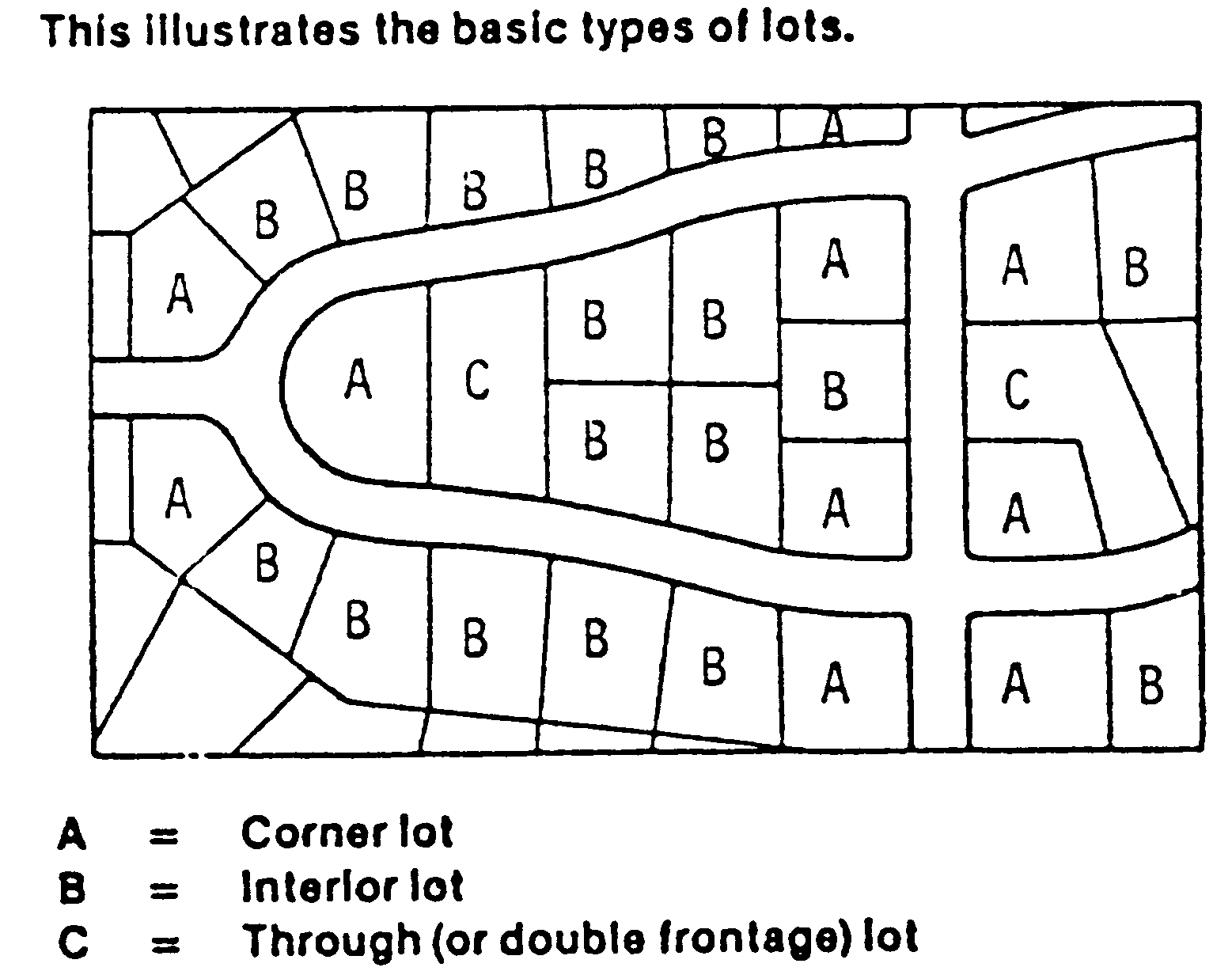
Figure 1
Lot of record means a lot or parcel of land whose existence, location and dimensions have been legally recorded in the office of the clerk of the circuit court on May 14, 2003.
Lot, corner, means a lot located at the intersection of two or more streets. A lot abutting on a curved street or streets shall be considered a corner lot if straight lines drawn from the foremost points of the side lot lines to the foremost point of the lot meet at an interior angle of less than 135 degrees. (Item A in Figure 1.)
Lot coverage means the ratio of the horizontally projected area of the main and accessory buildings on a lot to the total area of the lot, except where otherwise defined herein.
Lot frontage width means the distance between side property lot lines measured at the front lot line.
Lot, interior, means a lot other than a corner lot with only one frontage on a street. (Item B in Figure 1.)
Lot line (property line) means the boundary of a lot.
Lot, through, means a lot other than a corner lot with frontage on more than one street. Through lots abutting two streets may be referred to as double frontage lots. (Item C in Figure 1.)
Lot width means the average horizontal distance between side property lot lines.
Manufacture and/or manufacturing means the processing and/or converting of raw, unfinished materials or products or either of them into articles or substances of different character or for use for a different purpose.
Manufactured home means a structure subject to federal regulation, which is transportable in one or more sections; is eight body feet or more in width and 40 body feet or more in length in the travelling mode, or is 320 or more square feet when erected on site; is built on a permanent chassis; is designed to be used as a single-family dwelling, with or without a permanent foundation, when connected to the required utilities; and includes the plumbing, heating, air-conditioning, and electrical systems contained in the structure.
Manufactured home park means any site, lot, or tract of land which contains spaces for parking two or more mobile, manufactured, or modular homes or any combination thereof.
Mixed use development means property that incorporates two or more different uses, and may include a variety of housing types, within a single development.
Mobile home means a factory-assembled structure or structures equipped with the necessary service connections and made to be readily moveable as a unit or units on its (their) own running gear and designed to be used as a dwelling unit without a permanent foundation and built before 1976. (See also manufactured home, modular home, and industrialized building.) This unit does not meet the requirements of the council of American Building Officials (CABO) or the uniform statewide building code Use Group R-4. The phrase "without a permanent foundation" indicates that the support system is constructed with the intent that the manufactured home placed thereon will be moved from time to time at the convenience of the owner. Mobile homes are allowed only in manufactured home parks.
Modular home means a structure constructed to meet the state requirements of an industrialized building, uniform statewide building code Use Group R-4, and Council of American Building Officials (not a mobile home or manufactured home). As such, a modular home shall be considered the equivalent of a residence built on-site for the purposes of this chapter.
Motel means a building or a group of buildings containing sleeping accommodations for rental primarily to automobile transients and in which ingress and egress to and from each sleeping room is generally to the outside of the building.
Natural resource means and includes soil, sand, gravel, stone or other mineral (other than oil and gas) naturally formed on or beneath the surface of the earth.
Nonconforming lot means an otherwise legally platted lot that does not conform to the minimum area or width requirements of this chapter for the district in which it is located, whether on June 2, 2003, or as a result of subsequent amendments to this chapter.
Nonconforming structure means an otherwise legal building or structure that does not conform with the lot area, yard, height, lot coverage, or other area regulations of this chapter, or is designed or intended for a use that does not conform to the use regulations of this chapter, for the district in which it is located, either at the effective date of the ordinance from which this chapter is derived or as a result of subsequent amendments of the ordinance from which this chapter is derived.
Nonconforming use means the otherwise legal use of a building or of a tract of land that does not conform to the use regulations of the ordinance from which this chapter is derived for the district in which it is located, either at the effective date of the ordinance from which this chapter is derived or as a result of subsequent amendments to the ordinance from which this chapter is derived.
Non-public water system means a water system which, as a general rule, does not provide water to the public for drinking or does not meet the requirements for a public water system; or a well used for obtaining water for drinking or domestic use located on an individual lot for the purpose of serving the main dwelling on said lot, with any new well to be at least a Class III-A drilled well as approved by the health department.
Normal pool elevation means the height, above sea level, of the water held in any reservoir as it begins to overflow its spillway structure.
Nursing home means an establishment that provides long-term care services, as defined in Code of Virginia, § 51.5-134, to older persons who reside in such establishment.
Oil means a liquid substance known as crude petroleum oil or petroleum.
On-site sewage system means a sewage system designed not to result in a point source discharge, including individual septic tanks used by the main dwelling on an individual lot, and approved by the health department.
Open space means a yard area which is not used for or occupied by a driveway, off-street parking, loading space, refuse storage space.
Outdoor display means [a] display of goods for sale outside of business. Where goods are typically those that are outdoor in nature, such as automobiles, trailers, farm equipment, outdoor display is permitted without limitation as governed by the zoning district. Where the goods are typically inside, a small display of goods may be outside of the building, limited to no more than 20 square feet of area, so long as the display is not in any required area, such as parking, setbacks, public rights-of-way.
Outdoor storage means outdoor storage of goods or equipment for sale or rent, as allowed in the applicable zoning district, shall be screened from public right-of-way or adjacent uses. No outdoor storage of goods and equipment is permitted in residentially zoned areas. Outdoor storage cannot be an independent use and must be associated with a business on the same parcel. Screening shall be accomplished as outlined in section 24-695 of the zoning ordinance.
Owner means any person, agent, firm or corporation having a legal or equitable interest in the property.
Permanent tributary means any perennial, intermittent stream, including lakes or ponds, which provides natural drainage to a larger body of water, as officially indicated on U.S. Geological Survey topographic maps.
Permitted use means a use of the land which is allowed by right in the zoning district in which the land is situated.
Plat means the schematic representation of land divided or to be divided.
Prescriptive easement means an easement granted to the state department of transportation for the construction and maintenance of public roads owned by said department.
Preserved area means an area containing sensitive lands with features such as steep slopes, stream bottoms, critical viewshed, established trees or other vegetation or public ownership where the town council has determined that such features are worthy of preservation by the inclusion of such in the comprehensive plan. No clearing or grading is allowed in a preserved area prior to specific approval by the town council or planning commission of a rezoning, special use permit or site plan. The minimum of clearing and grading necessary for sanitary sewer mains and other uses may be allowed provided that the approving authority has adequate assurances that appropriate vegetation will be reestablished. For the purposes of this definition, active management of a preserved area in the form of cutting grass or noxious weeds, clearing underbrush, maintaining trees or similar activities shall not be considered clearing or grading.
Professional office means an office for the conduct of a professional use by persons generally engaged in rendering personal, executive, sales or administrative services or activities, including law, medicine, theology, architecture, accounting, engineering, insurance, real estate, stockbrokers, and administrative agencies considered professional in character. Characteristics of a professional office include desks, telephone and computer equipment, filing cabinets, and conference rooms and display areas. The term "professional office," however, does not include repairs or sales of tangible personal property stored or located within the structure nor any use which would create any loud noises or noxious odors, storage of salable materials, construction equipment or construction materials.
Proffer means an offer or proposal to which the property owner, or his agents, commits himself as additional requirements or restrictions on his property.
Public building means a building owned or leased and occupied and used by an agency or political subdivision of the United States of America, the Commonwealth of Virginia, or Amherst County.
Public sewerage system means a sewerage system owned and operated by the town; or any sewerage system resulting in a point source discharge and approved by the health department.
Public utilities means public service structures such as power plant substations; water lines, treatment plants or pumping stations, sewage disposal systems and treatment plants; or such similar operations publicly or privately owned furnishing electricity, gas rail transport, communication or related services to the general public.
Public water supply agency means the administrative organization, department or agency which manages the daily and long-term activities of public water system.
Public water system means a water system owned and operated by the town or any water system for drinking or domestic use, approved by the health department, that generally has at least 15 connections or an average of 25 individuals for at least 60 days out of the year.
Ramada means a structure erected over a mobile home for the purpose of providing shade or shelter.
Residential facility means as provided in Code of Virginia, § 15.2-2291.
Reserve drainfield space means an area set aside and dedicated for future use in the absorption and evaporation of fluid from an on-site sewerage system.
Reservoir means any impoundment of water, owned, operated or controlled by a public water supply agency to provide drinking water to citizens of their community at the present or in the future.
Resident engineer means the resident engineer for the town, employed by the state department of transportation, or his designated agent.
Residential use means a building or part of a building containing dwelling units or rooming units, including single-family or two-family houses, multiple-family dwellings, mobile homes, boardinghouses or roominghouses, dormitories, fraternity or sorority houses or apartment hotels; but not including monasteries, convents, transient accommodations, such as hotels, motels, tourist cabins, or travel trailer parks, or that part of a mixed building used for any nonresidential use, except accessory to residential uses.
Restaurant means any building in which, for compensation, food or beverage are dispensed to persons not residing on the premises including, among other establishments, cafes, delicatessens, refreshment stands, or drive-in facilities.
Retail stores and shops means buildings for display and sale of merchandise at retail or for the rendering of personal services (but specifically exclusive of coal, wood, and lumber yards) such as the following which will serve as illustration only and are not to be considered exclusive: drug store, newsstand, food store, candy shop, milk, dispensary, dry goods and notions store, antique store and gift shop, hardware store, household appliance store, furniture store, florist, optician, music and radio store, tailor shop, barber shop, and beauty shop.
Right-of-way means access over or across particularly described property for a specific purpose.
Right-of-way line means the dividing line between a lot, tract, or parcel of land and a contiguous street, railroad, or public utility right-of-way.
Right-of-way, state owned, means the right-of-way owned outright by the state department of transportation on which public roads are constructed and maintained.
Satellite dish antenna means an accessory use that is a combination of:
(1)
Antenna or dish antenna whose purpose is to receive communication or other signals from orbiting satellites or other extraterrestrial sources;
(2)
A low noise amplifier (LNA) which is situated at the focal point of the receiving component and whose purpose is to magnify and transfer signals; and
(3)
A coaxial cable whose purpose is to carry the signals to the exterior of the building.
Schools means an institution providing full-time instruction and including accessory facilities traditionally associated with a program of study which meets the requirements of the laws of the state. School support facilities shall not be included.
School support facilities means facilities which are required to maintain efficient operation of a school or school system but which are not directly related to the academic program of study and which may be characterized by potential nuisance factors such as fuel storage, noise, or vibration. Such supportive facilities include school system administrative offices, maintenance shops, storage warehouses, vehicle storage lots and the like.
Setback line means a line parallel to a street and extending the full width of the lot for a specified distance at all points from the street right-of-way line, and thus defining an area in which no building or structures or portions thereof may be constructed.
Shopping center means a group of commercial establishments, planned and developed as a unit, with common off-street parking provided on the property, located on a parcel of land ten or more acres in size.
Short-term rental means the provision of a room or space that is suitable or intended for occupancy for dwelling, sleeping, or lodging purposes, for a period of fewer than 30 consecutive days, in exchange for a charge for the occupancy.
Sign means any words, lettering, parts of letters, figures, numerals, phrases, sentences, emblems, devices, designs, trade name or marks, or combinations thereof, by which anything is made known, such as the designation of an individual, a firm, an association, a profession, a public business, a commodity, or product, which are visible from any public way and used as an outdoor display.
Sign area means the smallest square, rectangle, triangle, circle, or combination thereof, encompassing the entire advertising area, excluding architectural trim and structural supports.
Sign, commercial, means a sign informing or advertising products or activities for sale or profit.
Sign, directional, means a sign indicating only the name and direction to a business, farm or activity.
Sign, on-site, means a sign relating to its subject matter to the premises on which it is located, or to products, accommodations, services, or activities on the premises. On-site signs do not include signs erected by the outdoor advertising industry in the conduct of the outdoor advertising business.
Sign, off-site, means a sign, either free standing or attached to a building, for the purpose of conveying information, knowledge, or ideas to the public about a subject not specific to the premises upon which it is located.
Sign, outdoor advertising, means a structural poster panel or painted sign, either free standing or attached to a building, for the purpose of conveying information, knowledge, or ideas to the public about a subject unrelated to the premises upon which it is located.
Sign, temporary, means any sign, banner, pennant, valance, or advertising display constructed of cloth, canvas, light fabric, cardboard, wallboard, or other materials with or without frames intended to be displayed for a period of not more than 60 consecutive days.
Special use means a use of the land which may be allowed in a zoning district in which the land is situated subject to the approval of the town council, after a public hearing thereon.
Special use permit means a legislative enactment by the town council authorizing (often with conditions) a special use on a particular lot or lots. The term "zoning certificate for a special use" refers to a special use permit.
Street means a strip of land comprising the entire area within the right-of-way intended for possible use as a means of vehicular and pedestrian circulation to provide access to more than one lot. The term "street" includes road, thoroughfare, parkway, avenue, lane, boulevard, expressway, highway (except as herein defined), place, throughway, square, alley, or however designated with the above-mentioned right-of-way.
Street centerline means a line generally parallel to the right-of-way lines that equally divide the street right-of-way.
Street, half, means a street that does not meet the minimum right-of-way width requirements set forth or referenced in this chapter.
Street, private, means any road, street, highway or other means of vehicular access to a parcel of land not maintained by the state department of transportation (or any other public agency) regardless of ownership.
Street, public, means a strip of land comprising the entire area within the right-of-way intended for public use as a means of vehicular and pedestrian circulation to provide access to more than one lot and which is presently a portion of the state department transportation's street and road system, or is a proposed addition to the state department of transportation's street and road system in which case the improvement of which shall meet the construction standards of the state department of transportation.
Structure means anything constructed or erected, the use of which requires a location on the ground, or attached to something having a location on the ground.
Subdivider means any person owning a tract or parcel of land to be subdivided.
Subdivision means any division of a piece of land or alteration of the boundary lines of any piece of land. The term "subdivision" includes condominiums, wherein the purchaser acquires both ownership of the condominium units and ownership of an interest in common elements.
Surveyor means a land surveyor certified by the Commonwealth of Virginia.
Theater, indoor, means a building designed and/or used primarily for the commercial exhibition of motion pictures to the general public or used for performance of displays, acts, dramas by actors and/or actresses.
Theater, outdoor, means an area not to exceed five acres containing a screen projection booth, refreshment stand, parking spaces and sound transmission devices to individual parking spaces only for the purpose of commercial exhibition of motion pictures.
Time-share means a time-share estate or a time-share use plus its incidental benefits.
Time-share estate means a right to occupy a unit or any of several units during five or more separated time periods over a period of at least five years, including renewal options, coupled with a freehold estate for years in a time-share project of a specified portion thereof.
Time-share instrument means any document, however denominated, which creates the time-share project and program, and which may contain restrictions or covenants regulating the use, occupancy, or disposition of time-shares in a project.
Time-share program (or program) means any arrangement of time-shares in one or more time-share projects whereby the use, occupancy, or possession of real property has been made subject to either a time-share estate or time-share use in which such use, occupancy, or possession circulates among owners of the time-shares according to a fixed or floating time schedule on a periodic basis occurring over any period of time in excess of five years.
Time-share project means all of the real property subject to a time-share program created by the execution of a time-share instrument.
Time-share unit (or unit) means the real property or real property improvement in a project which is divided into time-shares and designated for separate occupancy and use.
Time-share use means a right to occupy a time-share unit or any of several time-share units during five or more separated time periods over a period of at least five years, including renewal options, not coupled with a freehold estate or an estate for years in a time-share project or a specified portion thereof. The term "time-share use" shall not mean a right to use which is subject to a first-come, first-served space available basis as might exist in a country club, motel, hotel, health spa, campground, or membership or resort facility.
Town means the governmental entity of the town.
Town building code means the uniform statewide building code.
Town comprehensive plan means a document prepared and adopted in accordance with Code of Virginia, title 15.2, ch. 22, art. 3 (Code of Virginia, § 15.2-2223 et. seq.), as amended, for the purpose of guiding and accomplishing a coordinated, adjusted and harmonious development of the town.
Town council means the elected governing body of the Town of Amherst, Virginia.
Town development area means areas defined in the comprehensive plan that are appropriate for higher density development, redevelopment, or infill development due to their proximity to transportation facilities, public water and sewer systems and existing areas of higher density development.
Town manager means the town manager of the town.
Townhouse means a residential unit in a series of from three to 12 single-family attached dwellings separated from one another by common vertical walls with no openings.
Townhouse lot means a lot upon which a townhouse is or is to be erected.
Travel trailer means a vehicular, portable structure designed as a temporary dwelling for travel, recreational and vacation uses which is not more than eight feet in body width and is of any weight provided its body length does not exceed 29 feet.
Urban development area means areas defined in the comprehensive plan that are appropriate for higher density development, redevelopment, or infill development due to their proximity to transportation facilities, public water and sewer systems and existing areas of higher density development.
Use means the principal purpose for which a lot or the main building thereon is designed, arranged, or intended and for which it is or may be used, occupied, or maintained.
Variance means a reasonable deviation from those provisions regulating the shape, size, or area of a lot or parcel of land or the size, height, area, bulk, or location of a building or structure when the strict application of this chapter would unreasonably restrict the utilization of the property, and such need for a variance would not be shared generally by other properties, and provided such variance is not contrary to the purpose of this chapter. It shall not include a change in use, which change shall be accomplished by a rezoning or by a conditional zoning.
Veterinary hospital means a structure or series of structures used for the treatment of diseases and injuries of animals by a veterinarian licensed by the Commonwealth of Virginia, without outdoor runs except for exercise purposes.
Watershed means any area drained by a stream and its tributaries upstream from a public water supply intake structure.
Yard means a space on the same lot with a main building, such space being open, unoccupied, and unobstructed by buildings from ground to sky except where encroachments and accessory buildings are expressly permitted.
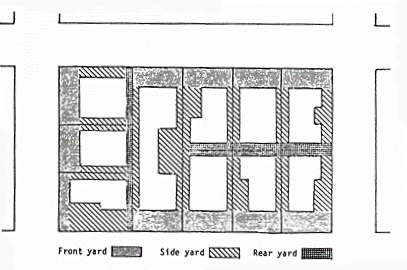
Figure 2
Yard, front, means an open, unoccupied space on the same lot with the main structure, extending the full width of the lot and situated between the right-of-way line and the front line of the structure projected to the side lines of the lot. The depth of the front yard shall be measured between the front line of the structure and the right-of-way line. Covered porches, whether enclosed or unenclosed, shall be considered as part of the main structure and shall not project into a required front yard. On corner lots the front yard shall be considered as parallel to the street upon which the lot has its least dimension. (See Figure 2.)
Yard, rear, means an open space on the same lot with the main structure, such space being unoccupied except possibly by an accessory building and extending the full width of the lot and situated between the rear line of the lot and the rear line of the main structure projected to the side lines of the lot. On all corner lots the rear yard shall be at the opposite end of the front yard. (See Figure 2.)
Yard, side, means an open, unoccupied space on the same lot with a main structure, situated between the side line of the structure and the adjacent side line of the lot extending from the rear line of the front yard to the front line of the rear yard. If no front yard is required, the front boundary of the side yard shall be the front line of the lot and if no rear yard is required, the rear boundary of the side yard shall be the rear line of the lot. On the corner lots, the side yard shall be considered as parallel to the street upon which the lot has its greatest dimension. (See Figure 2.)
Zoning map means the official zoning district map for the town.
(Zoning Ord. 2003, §§ 18.1-301, 18.1-302; Ord. No. 240410A, 4-10-2024)
Sec. 24-3. - Nonexclusionary intent.
It is not the intent of this chapter to exclude any economic, racial, religious, or ethnic group from enjoyment of residence, land ownership, or tenancy within the town; nor is it the intent of this chapter to use public powers in any way to promote the separation within the town of economic, racial, religious, or ethnic groups, except as may be the incidental result of meeting the purposes of this chapter.
(Zoning Ord. 2003, § 18.1-202)
Sec. 24-4. - Uniform application of regulations.
The regulations established herein shall be minimum regulations and be uniformly applied to each class of structure or land, except as hereinafter provided.
(Zoning Ord. 2003, § 18.1-401)
Sec. 24-5. - Subdivision of land.
Any owner or owners of any tract of land located within the town, in whole or in part, who subdivides the same as provided herein shall cause a plat of such subdivision to be made in accordance with procedures set forth in this chapter.
(Zoning Ord. 2003, § 18.1-402)
Sec. 24-6. - Use.
No building or land shall hereafter be used or occupied and no building or part thereof shall be erected, constructed, moved, or structurally altered except in conformity with the regulations herein specified for the district in which it is or is to be located.
(Zoning Ord. 2003, § 18.1-403)
Sec. 24-7. - Permitted uses.
A permitted use is one allowed in the district in which the land is situated. Where the proposed use is permitted and is in accordance with other regulations herein, a zoning certificate will be issued by the zoning administrator, without hearing thereon, in accordance with section 24-38(2).
(Zoning Ord. 2003, § 18.1-403.01)
Sec. 24-8. - Special uses.
A special use is one which may be allowed when the town council, after review of the application and hearing thereon, finds as a fact that the proposed use or uses are consistent with the comprehensive plan and the policies of the town council and the public interest. Where the use is a special use, a zoning certificate will be issued by the zoning administrator, in accordance with section 24-38(3), after such special use has been approved by the town council.
(Zoning Ord. 2003, § 18.1-403.02)
Sec. 24-9. - Buildings.
No building shall hereafter be erected, constructed, or altered so as to exceed the height limit, to accommodate or house a greater number of families, or to occupy a greater percentage of the lot area than is required or specified in the regulations herein for the district in which it is located.
(Zoning Ord. 2003, § 18.1-404)
Sec. 24-10. - Lots and yards.
(a)
No new lot nor yard shall hereafter be created, nor shall any lot or yard existing on May 14, 2003, be moved so that lot width, depth, or area requirements; front, side or rear yard requirements; inner or outer court requirements; or other requirements of this chapter are not maintained, except when a portion of a lot is acquired for public use. No new building lot shall hereinafter be created unless such lot adjoins at least 25 feet on a public street except that this provision shall not apply to:
(1)
Any property designated for business use and involving the sale of individual sites designated for business use; or
(2)
Situations involving joint or shared use access in any business district as approved by the planning commission.
(b)
No part of a yard nor other open space required for any building for the purpose of complying with the provisions of this chapter shall be included as part of a yard or other open space similarly required for another building. Every part of a required yard or court shall be open from its lowest point to the sky unobstructed, except for the ordinary projections of sills, cornices, buttresses, ornamental features, chimneys, flues, and eaves, provided such projections shall not extend into the required yard areas for a distance exceeding two feet.
(Zoning Ord. 2003, § 18.1-405)
Sec. 24-11. - Nonconforming lots, buildings and uses and vested rights.
(a)
As provided in the Code of Virginia, nothing in this chapter shall be construed to impair any vested right, except that this chapter recognizes that the elimination of existing lots, buildings and structures or uses that are not in conformity with the provisions of this chapter is as much a subject of health, safety, and general welfare as if the prevention of the establishment of new uses that would violate the provisions of this chapter. It is, therefore, the intent of this chapter to permit these nonconformities to continue, but not to encourage their survival or permit their uses as grounds for adding other structures or uses prohibited elsewhere within the same district.
(b)
Therefore, any structure or use of land existing at the time of the enactment of the ordinance from which this chapter is derived, and amendments thereto, but not in conformity with its regulations and provisions, may be continued subject to the following provisions:
(1)
Lots of record. Where a lot of record at the time of enactment of the ordinance from which this chapter is derived or amendment thereof does not contain land of sufficient area or width to permit conformity with dimensional requirements of this chapter, the following provision shall apply: When a lot was legally created and platted at the time of enactment of the ordinance from which this chapter is derived, or amendments thereto, and the lot has width or lot area less than is required by the district in which it is located, such lot may be used as a single-family building site, provided that yard dimensions, and requirements other than those applying to area or width of the lot shall conform to the regulation for the district in which such lot is located and safe provision and appropriate permitting has been made for water and wastewater. Variances of yard requirements may be obtained only through an appeal to the board of appeals, as outlined in section 24-132.
(2)
Nonconforming structures. Where a lawful structure exists at the time of enactment or amendment of this chapter that could not be built in the district in which it is located by reasons of restrictions on area, lot coverage, height, yard dimensions or other requirements, such structure may be continued so long as it remains otherwise lawful, subject to the following provisions:
a.
Any structure or portion thereof declared unsafe by the building inspector, or destroyed, damaged or demolished in any way by any means, may be restored to a safe condition or replaced in the same location, provided that the requirements of this section are met and the restoration or replacement work is underway with two years after the declaration, destruction, damage or demolition.
b.
A nonconforming structure may be enlarged or altered as necessary, provided such enlargement or alteration does not exceed a cumulative 50 percent of the floor area of the original nonconforming structure, and provided all yard and other appropriate requirements herein are met; any structure or portion thereof may be altered to decrease its nonconformity.
c.
Notwithstanding the above, whenever repairs on or installation of plumbing facilities in residential structures are required by law or administrative action of the health department or the building inspector, such alterations shall be permitted, provided that, where such alterations require an addition to the structure, such addition shall be no nearer the lot line than permitted by the requirements of this chapter. Where an existing residential structure exceeds these requirements, the said addition shall extend no nearer the lot line than the existing building line.
d.
Should a nonconforming structure be moved, it shall thereafter conform to the yard dimension requirements of the district in which it is located after it is moved.
(3)
Nonconforming uses of land. Where a lawful use of land exists at the time of enactment or amendment of this chapter that would not be permitted by the regulations imposed herein, such use may be continued as long as it remains otherwise lawful, subject to the following provisions:
a.
A nonconforming use may be enlarged or increased or extended to occupy a greater area not exceeding 50 percent of the floor area that was occupied at the time of enactment of or amendment to this chapter.
b.
No such nonconforming use shall be moved in whole or in part to any portion of the lot or parcel other than that occupied by such use at the time of enactment of or amendment to this chapter.
c.
In the event that such use ceases for any reason for a period of more than two years, any subsequent use shall conform to all requirements of this chapter for the district in which the land is located.
d.
No additional structure not conforming to the requirements of this chapter shall be constructed in connection with such nonconforming use.
(4)
Nonconforming uses of structures. Where a lawful use of individual structure, or of structures of premises in combination, exists at the time of enactment of or amendment to the ordinance from which chapter is derived that would not be permitted in the district in which it is located under the requirements of this chapter, such use may be continued as long as it remains otherwise lawful, subject to the following provisions:
a.
A structure existing at the time of enactment of or amendment to the ordinance from which this chapter is derived devoted to a nonconforming use may be enlarged, extended, or structurally altered, provided such enlargement, extension or alteration shall not exceed 50 percent in the aggregate of the floor area of the original structure devoted to a nonconforming use and provided all yard and other appropriate requirements herein are met. The provision shall not apply to the changing of the use of a structure to a conforming use.
b.
A nonconforming use of a structure may be extended to include use of the entire structure, or any enlargement, extension or alteration thereof provided herein, but shall not be extended to include either additional structures or land outside the structure.
c.
When a nonconforming use of a structure and premises in combination is discontinued or abandoned for 24 consecutive months, except when government action impedes access to the premises, or when a nonconforming use is superseded by a permitted use, the structure and premises shall not thereafter be used except in conformity with the regulations of the district in which it is located.
d.
Where a structure which is used in combination with its premises for a use not in conformity with the regulations herein is destroyed by any means, the use of the land shall be allowed to continue after reconstruction of the structure, provided such reconstruction of the structure adheres to the yard and other appropriate requirements of the district in which said structure is located as approved by the board of appeals in accordance with section 24-10, and provided the ownership of said structure remains the same as before such destruction.
(5)
Oil and gas leases. If a property owner has legally executed a lease for oil and gas exploration prior to the enactment of the ordinance from which this chapter is derived, such lease for exploration, and any resultant development of the property for extraction and production of oil and gas, shall constitute the nonconforming use of such land as provided in section 24-11(3), and provided that there is compliance with all applicable state laws and rules.
(6)
Vested rights.
a.
Pursuant to Code of Virginia, § 15.2-2307, as amended, nothing in this chapter shall be construed to authorize the impairment of any vested right. Without limiting the time when rights might otherwise vest, a landowner's rights shall be deemed vested in a land use and such vesting shall not be affected by a subsequent amendment to a zoning ordinance when the landowner obtains or is the beneficiary of a significant affirmative governmental act which remains in effect allowing development of a specific project; relies in good faith on the significant affirmative governmental act; and incurs extensive obligations or substantial expenses in diligent pursuit of the specific project in reliance on the significant affirmative governmental act.
b.
For purposes of this chapter and without limitation, the following are deemed to be significant affirmative governmental acts allowing development of a specific project:
1.
The governing body has accepted proffers or proffered conditions which specify use related to a zoning amendment;
2.
The governing body has approved an application for a rezoning for a specific use or density;
3.
The governing body or board of zoning appeals has granted a special exception or use permit with conditions;
4.
The board of zoning appeals has approved a variance;
5.
The governing body or its designated agent has approved a preliminary subdivision plat, site plan or plan of development for the landowner's property and the applicant diligently pursues approval of the final plat or plan within a reasonable period of time under the circumstances;
6.
The governing body or its designated agent has approved a final subdivision plat, site plan or plan of development for the landowner's property; or
7.
The zoning administrator or other administrative officer has issued a written order, requirement, decision or determination regarding the permissibility of a specific use or density of the landowner's property that is no longer subject to appeal and no longer subject to change, modification or reversal under Code of Virginia, § 15.2-2311(C).
c.
Land, buildings, and structures and the uses thereof which do not conform to the zoning prescribed for the district in which they are situated may be continued only so long as the then-existing or a more restricted use continues and such use is not discontinued for more than two years, and so long as the buildings or structures are maintained in their then structural condition; and that the uses of such buildings or structures shall conform to such regulations whenever, with respect to the building or structure, the square footage of a building or structure is enlarged, or the building or structure is structurally altered as provided in the uniform statewide building code (Code of Virginia, § 36-97 et seq.). If a use does not conform to the zoning prescribed for the district in which such use is situated, and if a business license was issued by the town for such use and the holder of such business license has operated continuously in the same location for at least 15 years and has paid all local taxes related to such use, the town shall permit the holder of such business license to apply for a rezoning or a special use permit without charge by the town or any agency affiliated with the town for fees associated with such filing. No nonconforming use may be expanded, and no nonconforming building or structure may be moved on the same lot or to any other lot which is not properly zoned to permit such nonconforming use.
d.
Notwithstanding any ordinance to the contrary, if the town has issued a building permit, the building or structure was thereafter constructed in accordance with the building permit, and upon completion of construction, the town issued a certificate of occupancy or a use permit therefor, or the owner of the building or structure has paid taxes to the town for such building or structure for a period of more than the previous 15 years, such building or structure shall not be illegal and shall not be subject to removal solely due to such nonconformity. Such building or structure shall be nonconforming.
e.
The owner of any residential or commercial building damaged or destroyed by a natural disaster or other act of God may repair, rebuild, or replace such building to eliminate or reduce the nonconforming features to the extent possible, without the need to obtain a variance as provided in Code of Virginia, § 15.2-2310. If such building is damaged greater than 50 percent and cannot be repaired, rebuilt or replaced except to restore it to its original nonconforming condition, the owner shall have the right to do so. The owner shall apply for a building permit and any work done to repair, rebuild or replace such building shall be in compliance with the provisions of the uniform statewide building code (Code of Virginia, § 36-97 et seq.) and any work done to repair, rebuild or replace such building shall be in compliance with the provisions of the local floodplain regulations adopted as a condition of participation in the National Flood Insurance Program. Unless such building is repaired, rebuilt or replaced within two years of the date of the natural disaster or other act of God, such building shall only be repaired, rebuilt or replaced in accordance with the provisions of the zoning ordinance of the locality. However, if the nonconforming building is in an area under a federal disaster declaration and the building has been damaged or destroyed as a direct result of conditions that gave rise to the declaration, then there shall be an additional two years for the building to be repaired, rebuilt or replaced as otherwise provided in this section. For purposes of this section, an "act of God" shall include any natural disaster or phenomena including a hurricane, tornado, storm, flood, high water, wind-driven water, tidal wave, earthquake or fire caused by lightning or wildfire. For purposes of this section, owners of property damaged by an accidental fire have the same rights to rebuild such property as if it were damaged by an act of God. Nothing herein shall be construed to enable the property owner to commit an arson under Code of Virginia, § 18.2-77 or 18.2-80, and obtain vested rights under this section.
f.
Notwithstanding any ordinance to the contrary, an owner of real property shall be permitted to replace an existing on-site sewage system for any existing building in the same general location on the property even if a new on-site sewage system would not otherwise be permitted in that location, unless access to a public sanitary sewer is available to the property. If access to a sanitary sewer system is available, then the connection to such system shall be required. Any new on-site system shall be installed in compliance with applicable regulations of the state department of health in effect at the time of the installation.
g.
Nothing in this section shall be construed to prevent the land owner or home owner from removing a valid nonconforming manufactured home from a mobile or manufactured home park and replacing that home with another comparable manufactured home that meets the current HUD manufactured housing code. In such mobile or manufactured home park, a single-section home may replace a single-section home and a multi-section home may replace a multi-section home. The owner of a valid nonconforming mobile or manufactured home not located in a mobile or manufactured home park may replace that home with a newer manufactured home, either single- or multi-section, that meets the current HUD manufactured housing code. Any such replacement home shall retain the valid nonconforming status of the prior home.
(Zoning Ord. 2003, § 18.1-601)
State Law reference— Similar provisions, Code of Virginia, § 15.2-2307.
Sec. 24-12. - Permits issued prior to effective date of ordinance from which this chapter is derived.
Nothing contained herein shall require any change in the plans or construction of any building or structure for which a permit was granted prior to June 2, 2003. However, if such construction does not commence within 30 days after June 2, 2003, or if construction is discontinued for a period of six months or more, further construction shall be in conformity with the provisions of this chapter for the district in which the operation is located.
(Zoning Ord. 2003, § 18.1-406)
Sec. 24-13. - Zoning certificates required; uses exempt from a zoning certificate.
(a)
Except as provided in this section, no new use shall be commenced without a zoning certificate for that use, certifying pursuant to section 24-38 that the use complies with the provisions of this chapter.
(b)
Incidental agriculture is permitted without a zoning certificate in any district that allows residential uses, provided that such agricultural use shall not occupy over five acres and shall not be objectionable by reason of odor, dust, noise, pollution and erosion or drainage.
(c)
Yard sales and garage sales by the resident owner, and bazaars, flea markets and sales conducted by nonprofit organizations shall be exempt from zoning certificate requirements, provided such sales are limited to 48 hours per sale and no more than one such sale per month.
(d)
Within districts that permit commercial activity by right, wayside stands for the sale of agricultural or horticultural products shall not require a zoning certificate.
(Zoning Ord. 2003, § 18.1-407)
Sec. 24-14. - Number of dwellings on a single lot.
Except for permitted apartments in single-family dwellings, two-family dwellings, multifamily dwellings and manufactured home parks where permitted, no more than one dwelling unit may be permitted on a lot or parcel of land.
(Zoning Ord. 2003, § 18.1-408)
Sec. 24-15. - Access through another zoning district.
Private access to a parcel of land used appropriately in a zoning district as provided herein shall be prohibited through another zoning district. For the purposes of this section, access to a parcel of land shall not be considered a use and shall therefor be subject to the variance procedure as outlined herein.
(Zoning Ord. 2003, § 18.1-409)
Sec. 24-16. - Flag lots.
The creation of flag lots will only be considered in those instances where topographic constraints or unusual existing lot lines make this type of arrangement the only feasible way to develop the tract. Flag lots must meet the following criteria:
(1)
Each flag lot must have a minimum of 25 feet of frontage on the street.
(2)
The required minimum lot area shall meet the zoning ordinance requirement of the district in which it is located and shall not include the area of the long narrow "flagpole" portion.
(3)
The development of one flag lot behind another flag lot shall be prohibited.
(4)
A home on a flag lot must meet all setbacks within the "flag" portion of the lot, not including the "pole" portion of the lot.
(5)
Additional prohibitions regarding lots apply to the Ambriar Access Area, as outlined in section 24-435.
(Ord. 231011B, 10-11-2023)
Sec. 24-17. - Dwelling units accessory to single-household residences.
Dwelling units, which include guest houses, garage apartments, additional dwellings within a home, mother-in-law dwellings, and other residential accommodations, may be established accessory to a single-household residence either in the principal dwelling or as a detached accessory structure subject to the following provisions:
(1)
Accessory dwelling units within the home shall retain the appearance of a single household residence, or be located in an accessory structure located in the rear yard and outside the required setback lines for principal structures.
(2)
The number of dwellings shall not exceed the limits established in the applicable zoning district.
(3)
One additional accessory dwelling may be allowed above the limits established in the applicable zoning ordinance, if the additional unit meets the area requirements for subdivision for the district, meets all primary dwelling setbacks, and meets the requirements for water and wastewater provision.
(4)
Accessory dwellings shall comply with all applicable parking, building coverage and density requirements.
(5)
No lot shall contain more than two accessory dwellings, for a total of three dwellings on a lot, which in the case of three total dwellings, shall be contained in no more than two structures, in that where there are a total of three dwelling units on a lot, two of them must be contained within the same structure.
(6)
Before a zoning certificate will be issued for development of an accessory dwelling unit, acceptable provision for water and wastewater must be obtained.
(Ord. No. 231213, 12-13-2023)

