
Anderson City Zoning Code
ARTICLE XIII
- TREE PRESERVATION, LANDSCAPE, SCREENING, SIDEWALKS AND WALKWAYS4
Editor's note— Ord. No. 23-10, adopted July 10, 2023, amended Art. XIII in its entirety to read as herein set out. Former Art. XIII pertained to similar subject matter, consisted of § 13.0, and derived from Ord. No. 97-29, adopted January 12, 1998.
Sec. 13.1. - Tree preservation.
(A)
General provisions.
(1)
Purpose. In order to maintain and promote public health, safety and welfare, the city has established regulations governing the preservation and replacement of trees. The importance of trees is recognized for their contribution toward quality of life, visual quality of the city, and improved property values. It is the city's intent to prevent the indiscriminate removal of trees without denying the reasonable use and enjoyment of real property. Each person shall be responsible for the normal care of trees located on its premises.
(2)
Applicability.
(a)
The provisions of section 13.1, tree preservation shall apply to all parcels throughout the city other than those in the CBD district and those developed with and zoned for a single-family dwelling.
(b)
Replacement and preserved trees, if located in a required landscape zone as detailed in section 13.2, shall count towards required landscape elements in said zone, as approved by the director.
(c)
Applicable parcels shall be considered in violation of this section if:
(I)
Willful injury or disfigurement of any tree growing within the city is done.
(II)
Any sign, notice or other object is attached to any tree or fasten wires, cables, nails, or screws to any tree in a manner that could prove harmful to the tree.
(III)
Any material is poured on any tree or on nearby ground which could be harmful to the tree.
(IV)
Any unnecessary fire or burning is willfully caused or encouraged near or around any tree.
(V)
A concrete asphalt, brick, or gravel sidewalk is constructed in a manner which significantly compacts the soil, places fill material, or creates other impervious or semi-impervious surfaces around any tree so as to cut off air, light or water from the roots of the tree so as to adversely impact the tree's root system.
(VI)
Building materials or equipment are piled around any tree so as to cause injury thereto.
(VII)
Routine maintenance, watering, and reasonable arboricultural care are denied to existing and newly established trees as may be required as a result of activities taking place under this section.
(VIII)
Any grading or construction activity is conducted prior to the submission and approval of a tree plan.
(IX)
Any tree is removed without a tree removal permit.
(X)
A tree on commercial property during non-development activity is removed or pruned unless ISA industry standard protocols for pruning are followed or if written approval from the director is received.
(XI)
Any vehicle is parked on the unpaved area underneath existing tree canopies.
(3)
Exemptions. The following shall be exempt from the provisions of this section:
(a)
The removal of trees with a permit.
(b)
The removal of trees from horticultural properties such as farms, nurseries, or orchards. This exception shall not be interpreted to include timber harvesting incidental to development of the land.
(c)
The necessary removal of trees by a utility company within dedicated utility easements.
(d)
The removal of trees on public rights-of-way conducted by, on behalf of, or any activity pursuant to work to be dedicated to, a federal, state, county, municipal or other governmental agency in pursuance of its lawful activities or functions in the construction or improvement of public rights-of-way.
(e)
The removal of trees from lakes and detention ponds, and drainage easements, unless specifically planted to be part of the stormwater system.
(f)
The removal of any tree which is dead or has become or threatens to become a danger to human life or property.
(g)
Existing single and two-family residences and redevelopment of lots previously containing single- or two-family residences.
(h)
New development of less than four lots containing single- or two-family residences, or new construction of single- or two-family residences.
(B)
Developed sites and undeveloped sites ten acres or less in area. No grading or construction activity shall commence on any developed site or undeveloped site ten acres or less in area in the city, other than those currently developed with and zoned for a single-family dwelling, prior to the submittal and approval of a tree plan.
(1)
Tree survey, prior to the submittal of a tree plan, a tree survey shall be conducted by an ISA-certified arborist, registered landscape architect, registered surveyor, or registered forester which identifies and breaks all existing trees on a parcel into the following four categories:
(a)
Specimen trees. Specimen trees include any tree that meets the criteria established in Table 13-01(B)(1)(a) below.
(b)
Established trees. Established trees shall be any tree, other than specimen trees, or invasive/noncontributing trees, with a diameter at breast height of eight inches or greater.
(c)
Young trees. Young trees shall be any tree, other than specimen trees or invasive trees, with a diameter at breast height of more than five and less than eight inches.
(d)
Invasive/noncontributing trees. Invasive trees shall be any tree species identified as invasive by the state of South Carolina Forestry Commission, Noncontributing trees shall be any tree species not recommended by the South Carolina Forestry Commission.
(2)
Tree preservation, replacement, and removal.
(a)
Tree preservation, replacement, and removal shall be required per tree category as detailed in Table 13-01(B)(2) below.
(b)
All required replacement trees shall have a minimum caliper of three inches and a minimum height of 12 feet upon planting.
(c)
Elm, ash, sweetgum, and Bradford pear trees are exempt from same species replacement requirements.
(d)
All trees to be preserved, replaced, and removed as well as required tree protection measures, as established in section 13.1(D) shall be identified in the tree plan.
(C)
Undeveloped sites over ten acres. No grading or construction activity shall commence on any undeveloped site greater than ten acres in area in the city, prior to the submittal and approval of a tree plan.
(1)
Tree survey. Prior to the submittal of a tree plan, a tree survey shall be conducted utilizing the latest available aerial photograph identifying:
(a)
The boundaries of one or more tree canopy retention areas and the grading and other major development activities proposed adjacent to the area(s).
(b)
The boundaries of the tree canopy retention area shall include all land within the driplines of all individual trees and stands of trees proposed to be retained in accordance with section 13.2(C)(2), tree canopy retention.
(c)
In cases where the applicant is seeking to use existing trees to comply with the landscape requirements established in section 13.2, such trees shall be identified and shall meet all tree protection requirements of section 13.1.
(2)
Tree canopy retention.
(a)
A vacant site greater than ten acres in area shall retain and protect a minimum percent of existing tree canopy coverage as detailed below.
(I)
Nonresidential and mixed use development: 15 percent.
(II)
Residential development: 20 percent.
(III)
Conservation development areas as identified in Anderson's Comprehensive Plan: 30 percent.
(3)
Tree canopy retention priority areas and standards.
(a)
Tree canopy retention priority areas. Priority areas for tree canopy retention shall be as listed below, in priority order:
(I)
Area including one or more specimen tree.
(II)
Area within a wetland, riparian buffer zone, floodplain, or other environmentally sensitive area identified by the director.
(III)
Area adjacent to neighboring residential uses or adjacent to tree canopy retention area on adjacent parcel.
(IV)
Area adjacent to parcels in the historic overlay district, trails, greenways, freeways, or railroad rights-of-way.
(b)
Tree canopy retention area standards. Minimum required tree canopy coverage shall be retained in one or more tree canopy retention area(s).
(I)
No tree canopy retention area shall measure less than 1,600 square feet in size.
(II)
No tree canopy retention area shall measure less than 20 feet in width at its narrowest point.
(III)
Tree canopy retention areas shall be located within required common open space or public recreation areas.
(D)
Tree protection during development activity.
(1)
Responsibility. During any development activity (including demolition activity), the property owner or developer shall be responsible for protecting trees identified in the tree plan for compliance with the requirements of section 13.1.
(2)
Mechanical and chemical injury.
(a)
Purpose. Protective barriers are required to prevent mechanical injuries to trees identified in the tree plan for compliance with the requirements of section 13.1 that are caused by soil compaction, unnecessary cutting of roots, fire, collisions with heavy equipment, carelessness with tools, or girding with guy wires, and injury caused by solvents, paints, oils, or other chemicals.
(b)
Enclosure of drip line area. A fence, or other structurally significant protective barrier approved by the director shall enclose areas within the drip line(s), and exposed roots outside such line(s), of each trees or group of trees to be preserved.
(I)
Such barrier shall be clearly marked with signage identifying it as a tree protection area.
(II)
Such barrier shall be visible enough to be seen easily by equipment operators.
(III)
Removal of brush and weeds within this barrier shall be performed with hand tools only. To avoid chemical damage to trees, equipment shall not be cleaned within the barrier.
(IV)
No equipment, materials, fill, or debris shall be stored within the barrier.
(c)
Bark protection. Trunks of trees to be preserved that surround the immediate building site and border access roads shall be wrapped with sections of snow fence or boards wired together. No nails or spikes shall be driven into trees to be preserved, nor shall such trees be used for signs, fencing, raping, or cables.
(3)
Grade changes.
(a)
Purpose. Because changing the grade of the land surrounding a tree can impair the ability of its roots to obtain necessary amounts of air, water, and land minerals, protective measures shall be taken as specified herein.
(b)
Raising of grade.
(I)
Tree preservation measures. Before the grade of the land around a tree to be preserved is raised by land filling, the director may, in consultation with an arborist or urban forester, require the party undertaking the grading to:
a.
Relocate the tree if feasible, or
b.
Install an aeration system consisting of a dry well around the trunk together with a layer of gravel and stone and a system of drain tiles over the root system at the level of the original grade, or
c.
If an aeration system is impractical or financially infeasible, take other measures to protect the tree.
d.
Any aeration system shall be configured to provide, in the judgment of the director, adequate air and water circulation and drainage of water away from the trunk.
(II)
Exemption. Fills are exempt from the provisions of section 13.1(D)(3)(b)(1) above if they:
a.
Are six inches or less in depth, and
b.
Do not contain clay, marl, or other heavy impervious fills of any depth in the judgment of the planning director, and
c.
Consist only of porous, loamy, or gravelly soil high in organic matter.
(c)
Lowering of grade. To protect trees intended to be preserved from removal of or damage to feeder roots or changes to the water table, the area within the drip line shall not be lowered. Such area shall be separated from a lowered grade by either terracing or, for grade differences of less than two feet, construction of a dry retaining wall.
(4)
Excavations.
(a)
Location. Excavations for utility pipelines shall be routed within a drip line of a tree to be preserved only if in the judgment of the director:
(I)
No route bypassing the root area is practical, and
(II)
Tunneling under the roots with a power-driven soil augur is impractical or financially infeasible in relation to the value of the tree.
(III)
The director shall consult with the public utilities to avoid conflicts with this provision.
(b)
Root protection. Parties excavating within the root area shall:
(I)
Minimize the number of roots cut, especially large main roots, and
(II)
Cleanly cut with proper tools such roots as must be cut and re-trim them after excavation, and
(III)
Use Lac Basalm as determined necessary, by the director to address fungal spread, and
(IV)
Backfill the trench as soon after excavation as possible to minimize the time roots are exposed to the air, and
(V)
Leave no pockets of air when backfilling, and
(VI)
Mix peat moss with fill soil at no more than 20 percent amendment by volume to promote new growth.
(5)
Damage mitigation. Where, despite the foregoing provisions, significant damage has been done to the roots, the tree shall be fertilized and excess branches that cannot be supported by the remaining undamaged roots shall be pruned. Tree limbs damaged during construction shall be pruned in accordance with ANSI A300 standards.
(6)
Cleanup.
(a)
Disposal of debris. Debris shall not be burned on site but shall be hauled away to a city-approved disposal site.
(b)
Removal of barriers. Protective fences and barriers around trees shall be removed only as the final stage of post-construction cleanup.
(E)
Enforcement, appeals, and variances.
(1)
Enforcement. All requests for permits and all applications for tree removal shall initially be submitted to and reviewed by the director.
(2)
Appeals.
(a)
Requests for appeal of any administrative decision shall first be addressed to the director.
(b)
Written requests for appeal of any administrative decision are permitted and must be submitted to the board of zoning appeals within ten days after notice of such decision. Such written appeal shall be made in the form of a letter, which outlines the salient points upon which the appeal is based.
(c)
The board of zoning appeals shall schedule a hearing as soon as reasonably practicable to consider the appeal and shall issue a written decision within 30 days of the hearing.
(d)
If the appeal concerns an administrative decision regarding specimen trees, trees of quality, tree groupings, or boundary trees it shall be the applicant's burden to demonstrate that reasonable alternatives have been considered in order to save said trees (as described herein). Documented evidence shall be filed by the applicant with the written request for appeal and shall include, but not be limited to, the following:
(I)
Boundary survey showing topography, easements, creeks and other features of the property.
(II)
Two alternative development plans, which include the specimen tree(s), trees of quality, groupings of trees, or boundary trees.
(III)
An itemized estimate of additional costs associated with saving the trees.
(3)
Variances.
(a)
The director shall have the authority to grant variances to the minimum standards of this article.
(b)
Variances can be granted only in the case of extreme hardship or unusual circumstance. The factors to be taken into consideration by the director may include the following, but shall not be solely economic:
(I)
The ease with which the applicant can alter or revise the proposed development or improvement to accommodate existing trees.
(II)
The economic hardship that would be imposed upon the applicant were the variance denied.
(III)
The heightened desirability of preserving tree cover in densely developed or densely populated areas.
(IV)
The need for visual screening in transitional zones or relief from glare, blight, commercial or industrial unsightliness or any other visual affront.
(V)
Whether the continued presence of the tree or trees is likely to cause danger to a person or property.
(VI)
Whether the topography of the area in which the tree is located is of such a nature to be damaging or injurious to trees.
(VII)
Whether the removal of the trees is for the purpose of thinning a heavily wooded area where some trees will remain.
(VIII)
Whether tree removal would have an adverse impact upon existing biological and ecological systems.
(IX)
Whether free removal would affect noise pollution by increasing source noise levels to such a degree that a public nuisance may be anticipated, or a violation of the noise control ordinance will occur.
(X)
Whether the general health and life expectancy of the tree or trees warrant the measures necessary to prolong the life of the trees based upon accepted ISA practices.
(F)
Penalties. Any person, firm, corporation, limited liability company, responsible party, or other entity found guilty of violating or knowingly assisting in the commission of a violation of this section shall be subject to the penalties specified herein. Each day any violation of any provision of this section shall occur and each day any violation shall continue shall constitute a separate offense of this article.
(1)
A violation of this article shall constitute a misdemeanor punishable by a fine of up to $500.00 per incident. Replacement plantings shall also be required. Penalties and fines, including replacement plantings must be satisfied within the timeline stated on the violation and/or stop work order. Appeals can be filed with the board of zoning appeals.
(2)
In the event that a tree is damaged or removed without a permit, it shall be replaced according to Table 13-01(F)(2).
(3)
In addition to subsections (1) and (2), upon notice from the director, work on any development that is being done contrary to the provisions of this article shall immediately cease. The stop-work notice shall be in writing and shall go to the owner of the property, or to his agent, or to the person doing the work, and shall state the conditions under which work may be resumed. When an emergency exists, the director shall not be required to give written notice prior to stopping the work. Further, in the event that work on any development is being done contrary to the provisions of this section, the director may revoke any permit pertaining to the development activity for which the land disturbance permit has been issued and may refuse to issue any further permit until, at the discretion of the director, the work on the development is brought into compliance with the provisions of this section.
(Ord. No. 23-10, 7-10-2023)
Sec. 13.2. - Landscape.
(A)
General provisions.
(1)
Purpose. The City of Anderson recognizes the aesthetic and economic value of landscaping and screening, and therefore requires their use to:
(a)
Promote the establishment of vegetation in urban areas for aesthetic, health, and urban wildlife reasons;
(b)
Establish and enhance a pleasant visual character which recognizes aesthetics and safety issues;
(c)
Promote compatibility between land uses by reducing the visual, noise, and lighting impacts of specific development on users of the site and abutting uses;
(d)
Improve environmental conditions and manage on-site stormwater.
(e)
Unify development, and enhance and define public and private spaces;
(f)
Promote the retention and use of existing vegetation; and
(g)
Aid in energy conservation by providing shade from the sun and shelter from the wind.
(2)
Applicability.
(a)
All required landscape zones applicability. The landscape requirements of all required landscape zones established in this section, with the exception of the residential buffer landscape zone and the residential streetscape landscape zone, shall apply in the following instances unless otherwise specified in subsections (be) below:
(I)
All new multifamily, mixed-use, and nonresidential, development.
(II)
Substantial reinvestment or redevelopment the cost of which, over the course of a five-year period, comprises 50 percent or greater of the site's market value.
(b)
Building foundation landscape zone applicability.
(I)
The building foundation landscape zone requirements shall apply to all instances established in section 13.2(A)(2)(a).
(II)
The building foundation landscape zone requirements shall apply to all building facades.
(III)
The building foundation landscape zone requirements shall not apply to development in the CBD.
(IV)
The building foundation landscape zone requirements shall not apply to food processing facilities regulated by the FDA.
(c)
Parking area perimeter landscape zone applicability.
(I)
The parking area perimeter landscape zone requirements shall apply to all instances established in section 13.2(A)(2)(a).
(II)
Parking area perimeter landscape zone requirements shall apply to the construction or installation of any new off-street parking area,
(III)
Parking area perimeter landscape zone requirements shall apply to the expansion of any existing off-street parking area, in which case the parking area perimeter landscape zone requirements apply only to the expanded area.
(IV)
Parking area perimeter landscape zone requirements shall apply to parking area drive-aisles and drive- through stacking lanes.
(d)
Parking area interior landscape zone applicability.
(I)
The parking area interior landscape zone requirements shall apply to all instances established in section 13.2(A)(2)(a).
(II)
Parking area interior landscape zone requirements shall apply to a parking area with 15 or more parking spaces is constructed or installed,
(III)
Parking area interior landscape zone requirements shall apply to any existing parking area is reconfigured or expanded in a manner that would result in 15 or more new parking spaces, in which case the parking area interior landscape zone requirements apply only to the reconfigured and/or expanded area.
(IV)
Parking area interior landscape zone requirements shall apply to parking areas with fewer than 15 parking spaces shall be required to install parking area end caps at the end of any bay of parking, meeting all requirements of section 13.2(F)(4).
(e)
Transition zone applicability.
(I)
The transition zone requirements shall apply to all instances established in section 13.2(A)(2)(a).
(II)
The transition zone requirements shall apply to the expansion of any existing primary building or primary use that results in an increase in gross floor area by more than five percent or 1,000 square feet, whichever is greater. In the case of expansions that trigger compliance with transition landscape zone requirements, transition landscape zone elements are required only in proportion to the degree of expansion. The director is authorized to allow the transition zone to be established adjacent to the area of expansion or to disperse transition landscape zone landscaping along the entire site transition landscape zone area.
(III)
The transition zone requirements shall not apply to development in the CBD.
(f)
Residential buffer landscape zone applicability. The applicable instances established in section 13.2(A)(2)(a) shall not apply to the residential buffer landscape zone. The residential buffer landscape zone requirements shall only apply to residential subdivisions of five or more parcels.
(g)
Residential streetscape landscape zone applicability. The applicable instances established in section 13.2(A)(2)(a) shall not apply to the residential streetscape landscape zone. The residential streetscape landscape zone requirements shall only apply to residential subdivisions of five or more parcels.
(3)
General requirements.
(a)
Landscape improvements required by this chapter [article] shall consist of living vegetation in a combination of plants, trees, shrubs, ornamental grasses, perennials, and/or groundcover, as required.
(b)
All new plant material shall be installed and maintained in accordance with ANSI A300 Standards.
(c)
All new trees shall be properly guyed or staked at the time of planting.
(d)
In all instances, all required landscaping must be installed prior to the issuance of a final certificate of occupancy.
(e)
The installation of any required landscaping may be deferred during periods of extreme weather in the summer and winter months, to the next planting season, but in no case, for more than six months. In the instance that landscaping is deferred, a temporary certificate of occupancy may be issued prior to the installation of all required landscaping.
(B)
Planting types. Unless otherwise stated in this section, all size specifications for plant materials shall be based upon the time of planting. When caliper is specified for tree planting, the caliper of the tree trunk shall be measured at six inches above the soil level. Any plant materials used to meet the requirements of this section shall meet ANLA standards and shall not include any plant material identified as invasive or noxious by the State of South Carolina.
(1)
Canopy trees. A deciduous tree with an average dbh of 24 inches or more at maturity.
(2)
Understory trees. A deciduous tree with an average dbh of less than 24 inches at maturity.
(3)
Evergreen trees. A tree having foliage that persists and remains green throughout the year and has a height of not less than six feet at installation and maturing to a height of not less than 20 feet.
(4)
Shrubs. A woody plant (deciduous or evergreen) of low to medium height characterized by multiple stems continuous from its base and having a height of not less than two feet, unless classified as a shrub by the State of South Carolina.
(5)
Ornamental grasses. Perennial grasses and perennial plants with a grass-like appearance with a height of not less than two and no more than four feet.
(6)
Herbaceous perennials. Plants with non-woody stems whose above-ground growth largely or totally dies back during winter months but whose underground plant parts (roots, bulbs, etc.) survive.
(7)
Groundcover. Spreading herbaceous plants, other than turf grass, or prostrate shrubs, or woody vines normally reaching an average maximum height of 18 inches at maturity.
(C)
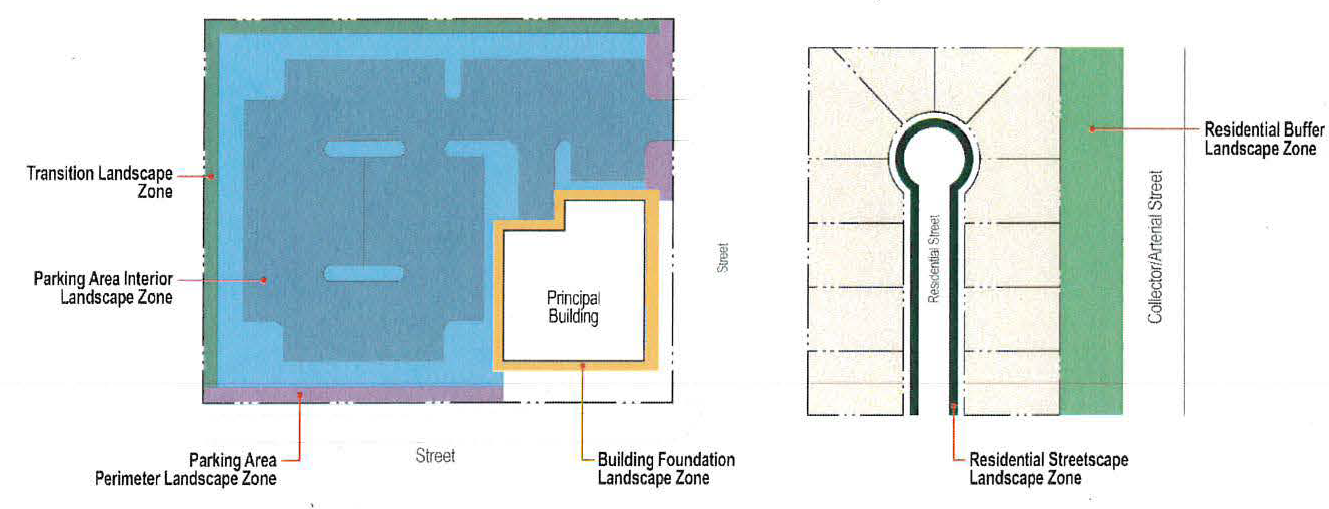
Required landscape zones. Figures 1 and 2 illustrate the location of the required landscape zones as detailed in the following sections.
Figure 1: Required Landscape zones
(D)
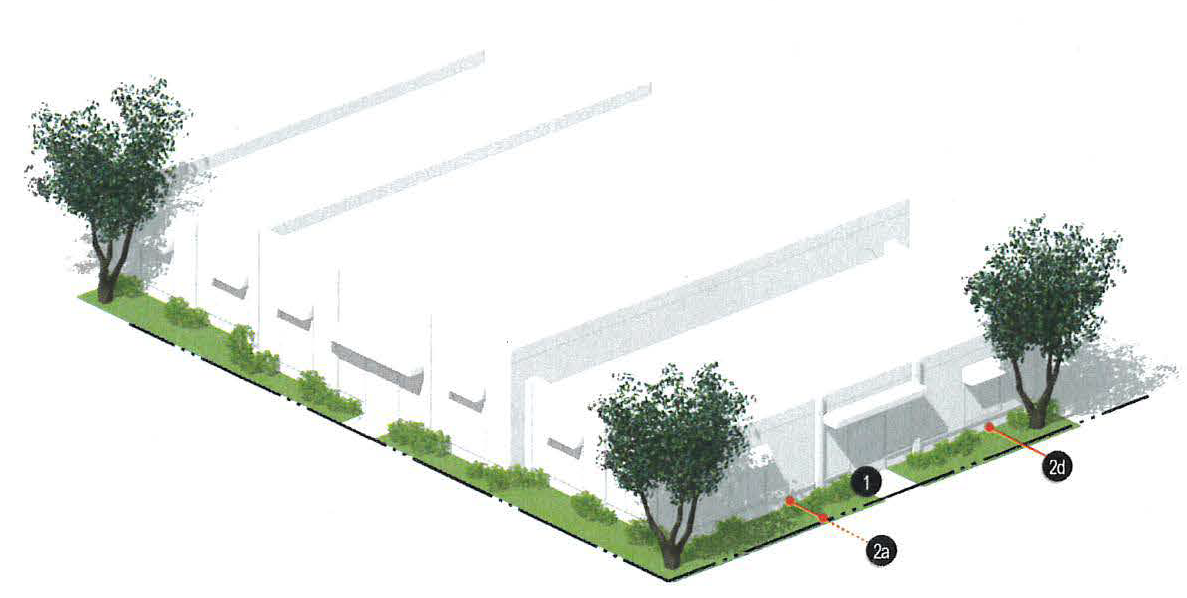
Building foundation landscape zone. Landscape required by this section shall be in addition to landscape required under other sections of this ordinance [article]. It is the objective of this section to provide a softening effect at the base of buildings.
(1)
The building foundation landscape zone shall have a minimum width of seven feet.
(2)
Building foundation landscape shall be designed to supplement other required landscape and to frame important views, while visually softening long expanses of walls.
(3)
Building foundation landscape shall be installed across 60 percent of the length of each facade of the building.
(4)
Foundation plantings may include trees, shrubs, ornamental grasses, and groundcover.
(5)
Above-ground stormwater planter boxes along building facades may be substituted for foundation plantings.
Figure 2: Building Foundation Lanscape Zone
(E)
Parking area perimeter landscape zone. Landscape required by this section shall be in addition to landscape required under other sections of this UDO. It is the objective of this section to provide screening between off-street parking areas and rights-of-way, and to provide for the integration of stormwater management with required landscaping.
(1)
Location. All off-street parking areas which abut a street right-of-way, shall include landscape and trees as required by this section located between the back of curb of the off-street parking area and the street right-of-way.
(2)
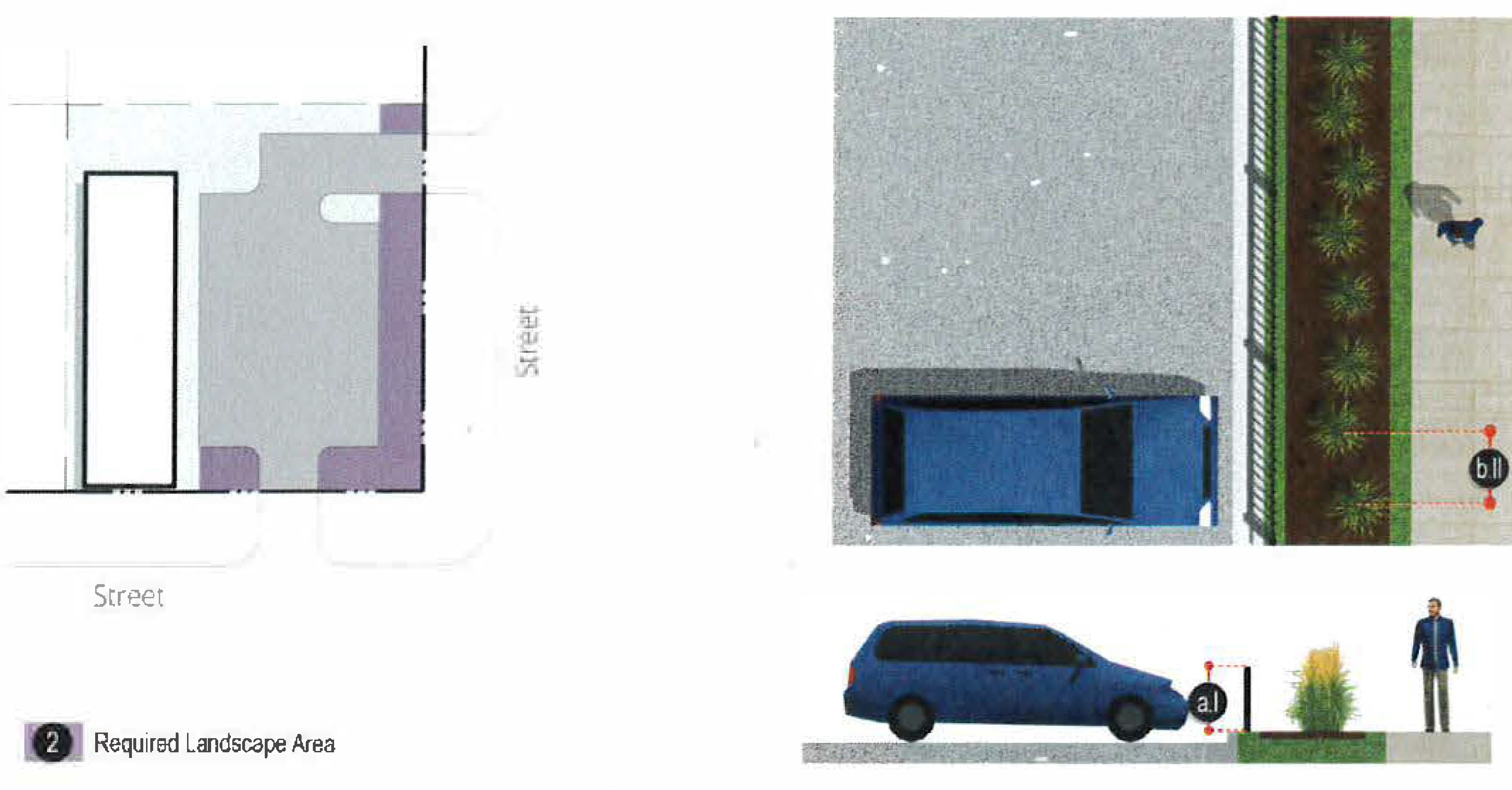
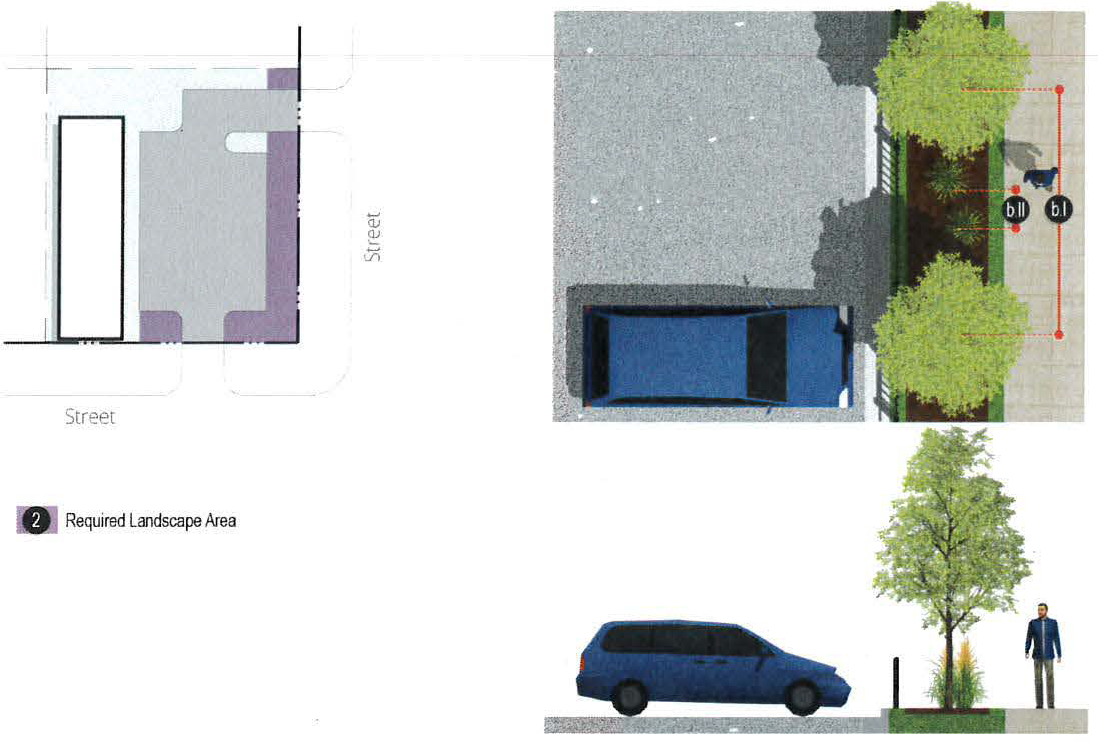
Requirements. Perimeter landscape shall have a minimum width of ten feet as measured from the back of curb of the off-street parking area or property fine, to accommodate vehicle bumper overhang and ensure planting areas that are adequate in size.
(a)
CBO district.
(I)
A low masonry wall or ornamental wrought iron fence, with a minimum height of three feet and a maximum height of four feet shall be installed between the parking area back of curb and perimeter landscape zone.
(II)
One shrub or ornamental grass shall be planted every four feet of perimeter landscape zone length. Such plantings may be clustered or spaced at even intervals as deemed appropriate by the city.
Figure 3: Perimeter Parking Lot Landscape Zone: CBD district
(b)
All other districts.
(I)
One canopy tree shall be planted every 40 feet of perimeter landscape zone length.
A.
Where a canopy tree is required and overhead utility lines exist, two understory trees shall be substituted with the approval of the director.
(II)
One shrub or ornamental grass shall be planted every four feet of perimeter landscape zone length, exclusive of perimeter landscape zone area within the dripline of required canopy trees.
Figure 4: Perimeter Parking Lot Landscape Zone: All other districts
(F)
Parking area interior landscape zone. Trees and landscape required by this section shall be in addition to trees and landscape required under other sections of this UDO. It is the objective of this section to provide shade within parking areas, break up large expanses of parking area pavement, support stormwater management where appropriate, improve the appearance of parking areas as viewed from rights-of-way, and provide a safe pedestrian environment.
(1)
Requirements. The amount of required parking area interior landscape shall be determined by the location of the off-street parking area as detailed below.
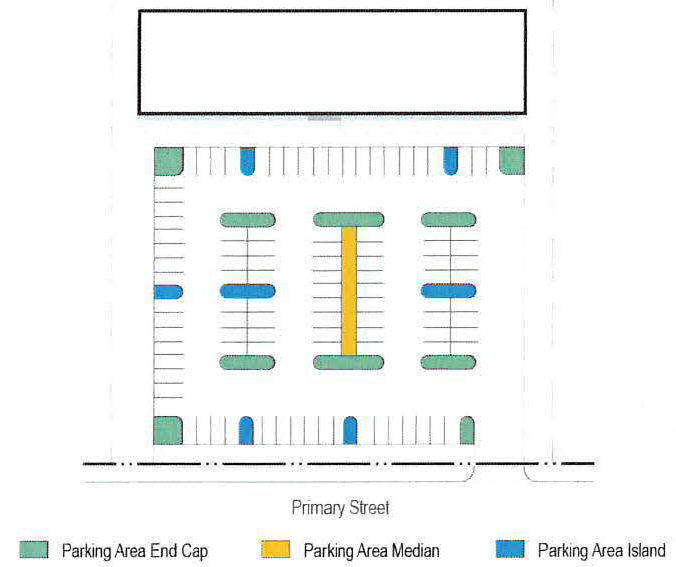
(a)
Off-street parking areas in front or to side of principal buildings.
(I)
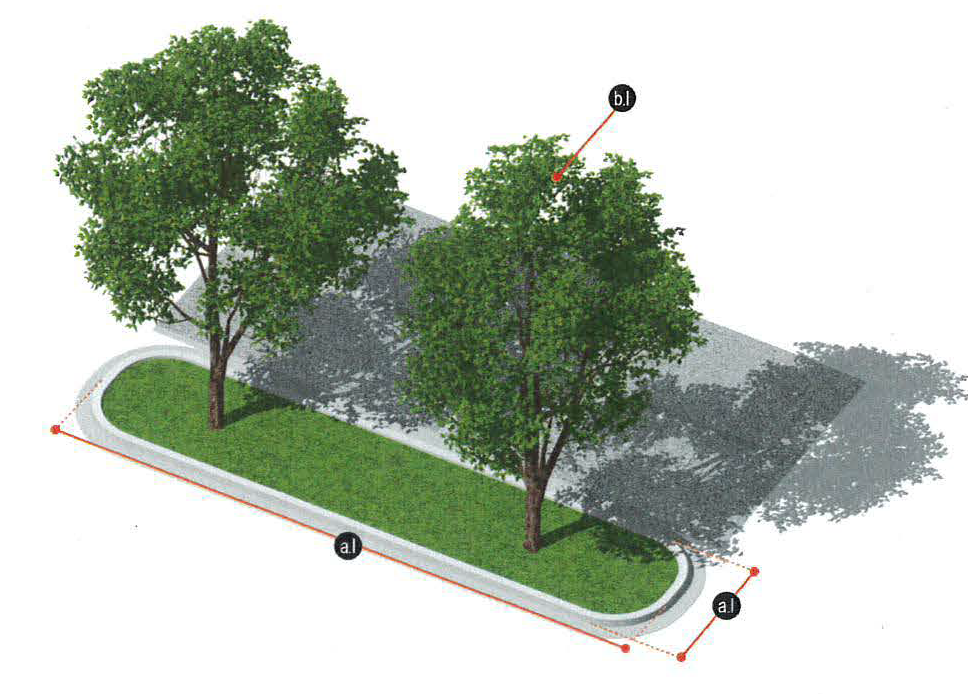
Parking area end caps. A parking area end cap shall be located at the end of any bay of parking bordered by a drive aisle, public or private street, or pedestrian circulation system.
(II)
Parking area medians. Parking area medians shall be placed between every third bay of parking.
(III)
Parking area islands. Parking area islands shall be located on parking bays which are not required to have parking area medians. Parking area islands shall be spaced not more than 135 feet or 15 continuous spaces apart.
Figure 5: Interior Parking Lot Landscape Zone, to Front or Side of Principal Building
(b)
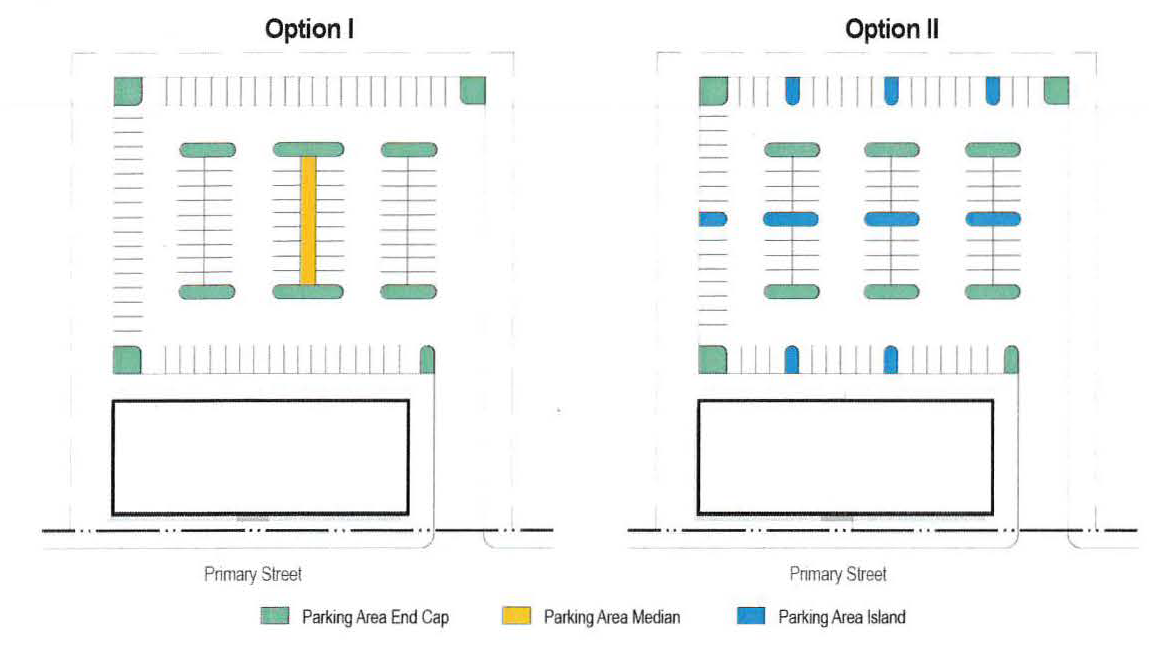
Off-street parking areas in rear of principal building.
(I)
Parking area end caps. A parking area end cap shall be located at the end of any bay of parking bordered by a drive aisle, public or private street, or pedestrian circulation system.
(II)
Parking area medians or parking area islands. The developer may choose to install either parking area medians or parking area islands, in compliance with the location and spacing requirements detailed in section 13.2(F)(1)(a).
Figure 6: Interior Parking Lot Landscape Zone, to Rear or Principal Building
(2)
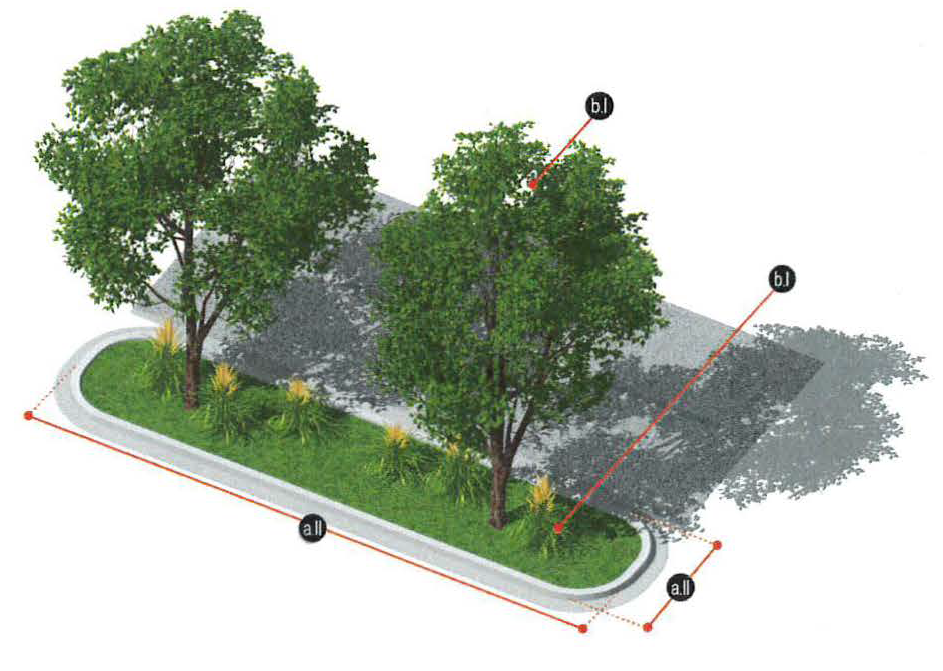
Parking area end cap standards.
(a)
Size.
(I)
Parking area end caps shall be a minimum of nine feet wide by 18 feet long and shall have a minimum soil depth of 36 inches.
(II)
Double rows of parking shall provide parking area end caps opposite one another to form a continuous single end cap.
(b)
Planting.
(I)
A minimum of one canopy tree and three shrubs or ornamental grasses shall be provided for every parking area end cap.
(II)
If the end cap extends the width of a double bay, then two canopy trees and six shrubs or ornamental grasses shall be provided.
(III)
A minimum of two cubic feet of soil volume per one square foot of projected tree canopy at maturity shall be provided per canopy tree.
(c)
Design. Parking area end caps shall be protected with concrete curbing or other suitable barriers approved by the director. Such end caps shall be properly drained and/or irrigated as appropriate to the site conditions to ensure survivability of plant materials or proper stormwater management function.
Figure 7: Parking Area End Caps
(3)
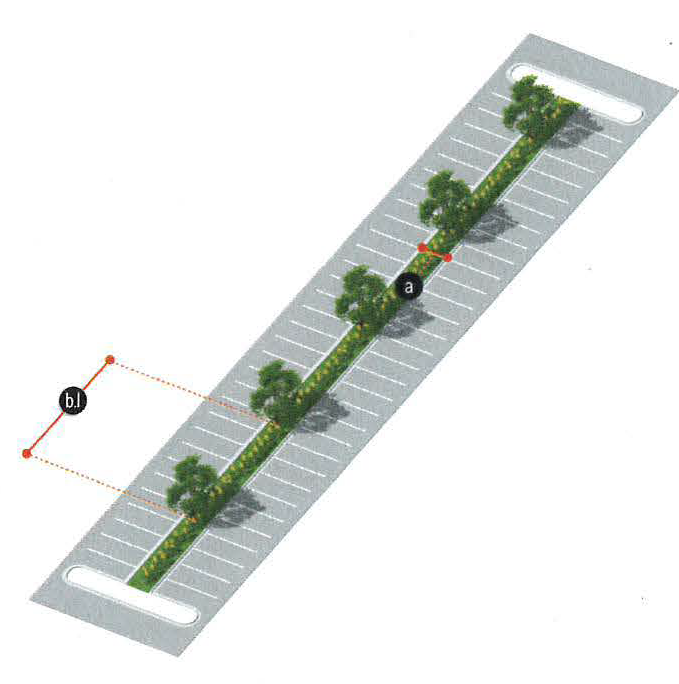
Parking area median standards.
(a)
Width. Parking area medians shall have a minimum width of nine feet and minimum soil depth of 36 inches.
(b)
Planting.
(I)
A minimum of one canopy tree and 15 shrubs or ornamental grasses shall be planted for each 50 linear feet of parking area median.
(II)
A minimum of two cubic feet of soil volume per one square foot of projected tree canopy at maturity shall be provided per canopy tree.
(c)
Design.
(I)
Parking area medians shall be protected with concrete curbing unless the parking area median is designed to be utilized for stormwater management in which case the perimeter shall be protected by wheel stops, or other suitable barriers approved by the director.
(II)
Parking area medians shall be properly drained or irrigated as appropriate to the site conditions to ensure survivability of plant materials and proper stormwater management function.
Figure 8: Parking Area Medians
(4)
Parking area island standards.
(a)
Size.
(I)
Parking area islands shall be a minimum nine feet wide by 18 feet long and shall have a minimum soil depth of 36 inches.
(II)
Double rows of parking shall provide parking area islands opposite one another to form a continuous single islands.
(b)
Planting.
(I)
A minimum of one canopy tree shall be provided for every parking area island.
(II)
If the island extends the width of a double bay, then two canopy trees shall be provided.
(III)
A minimum of two cubic feet of soil volume per one square foot of projected tree canopy at maturity shall be provided per canopy tree.
(c)
Design. Parking area islands shall be protected with concrete curbing or other suitable barriers approved by the director. Such islands shall be properly drained or irrigated as appropriate to the site conditions to ensure survivability of plant materials or proper stormwater management function.
Figure 9: Parking Area Islands
(G)
Transition zone landscape requirements. Landscape required by this section shall be in addition to landscape required under other sections of this UDO. It is the objective of this section to minimize land use conflicts and enhance aesthetics.
(1)
Location. Transition zone landscape shall be located along all nonresidential, mixed use, and multifamily property lines not adjacent to a street or alley right-of-way.
(2)
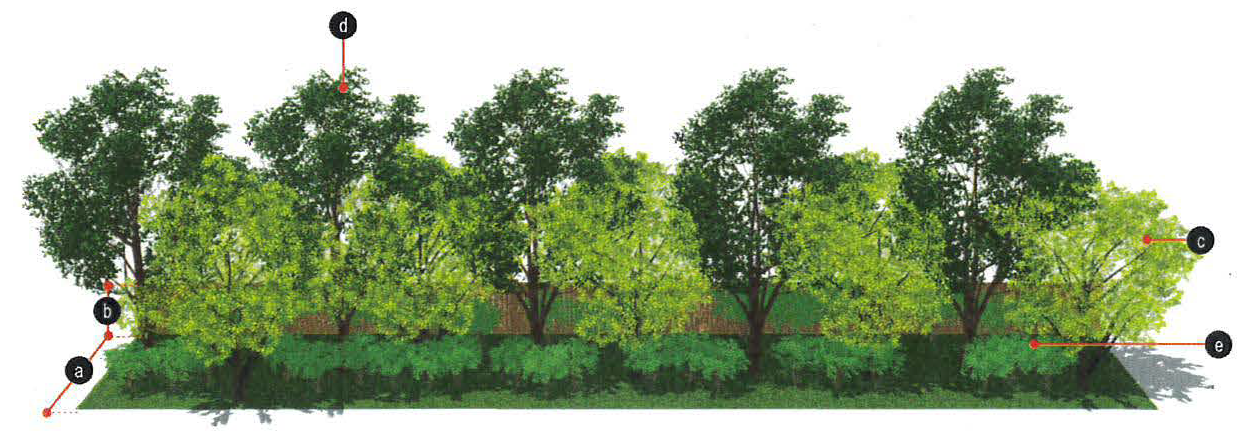
Transition zone types. Four transition zone types are established in recognition of the different contexts that may exist, as shown in Table 13-02(H)(3). Transition zones may include a combination of elements including setback distances for separation, planting types, solid fencing, green walls, vegetated stormwater management areas, living groundcover, or turf.
Figure 10: Transition Zone A
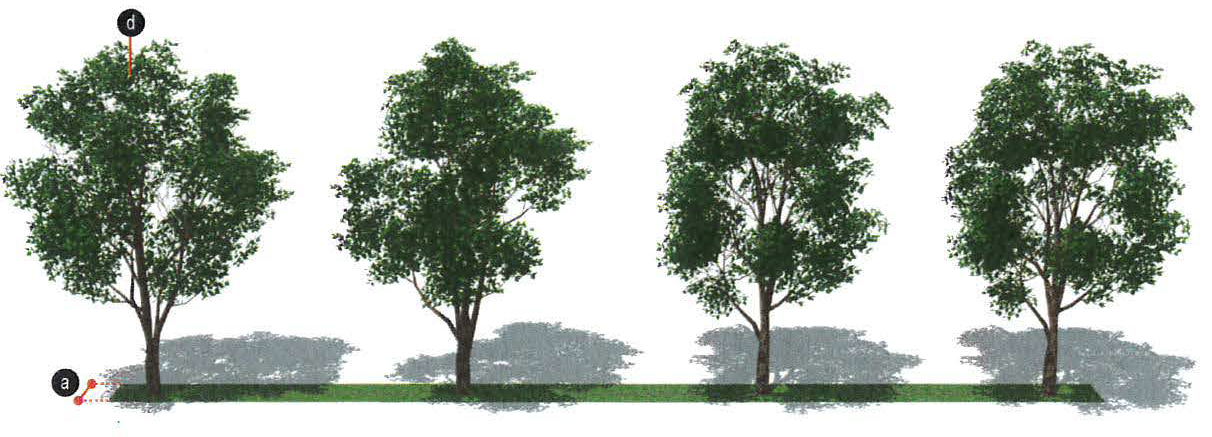
Figure 11: Transition Zone B
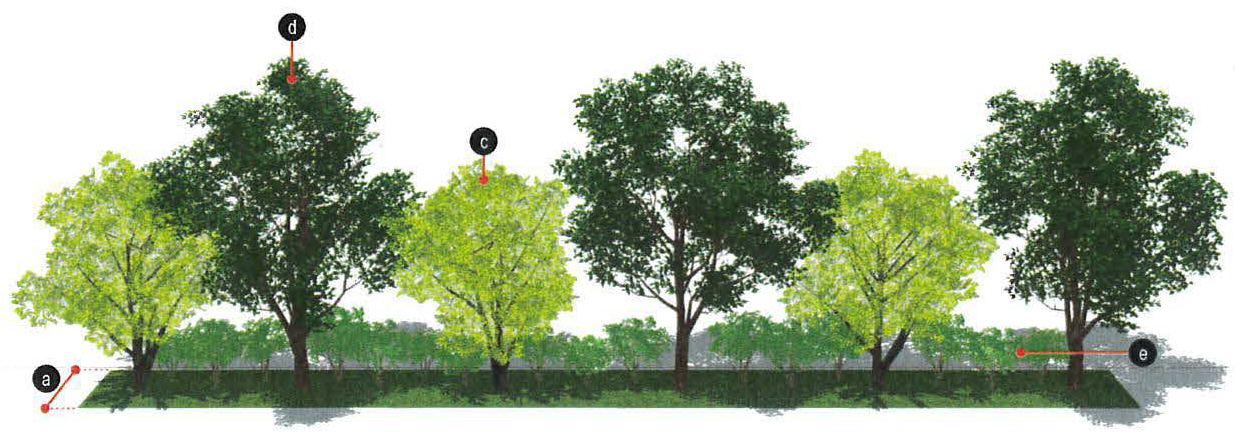
Figure 12: Transition Zone C
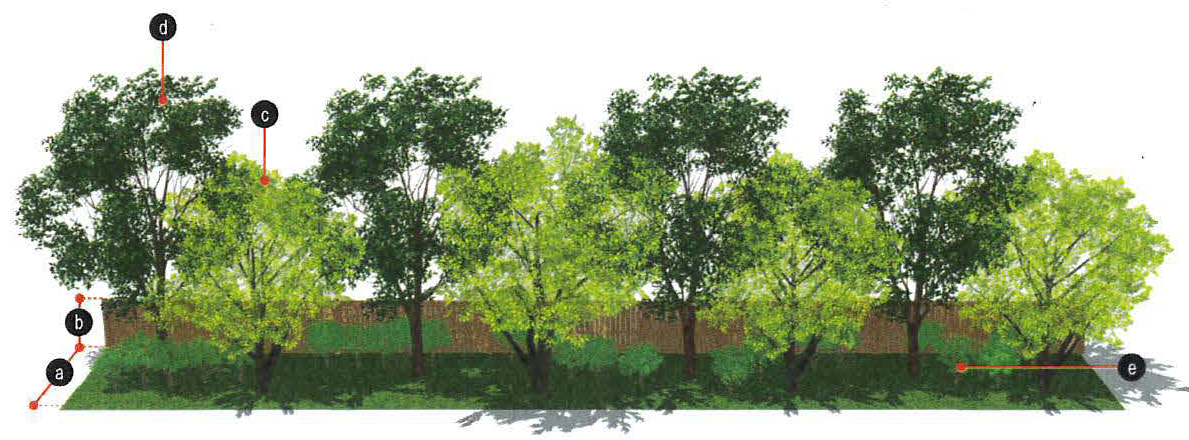
Figure 13: Transition Zone D
(3)
Application of transition zone types. Transition zones shall be provided based on Table 13-02(H)(3), except where adjacent uses are of a similar nature, scale, and intensity as determined by the director. As per Table 13-02(H)(3), the type of required transition zone is dependent upon the zoning district designation of the subject lot and the zoning district designation of the adjacent lot(s).
(H)
Residential buffer landscape zone.
(1)
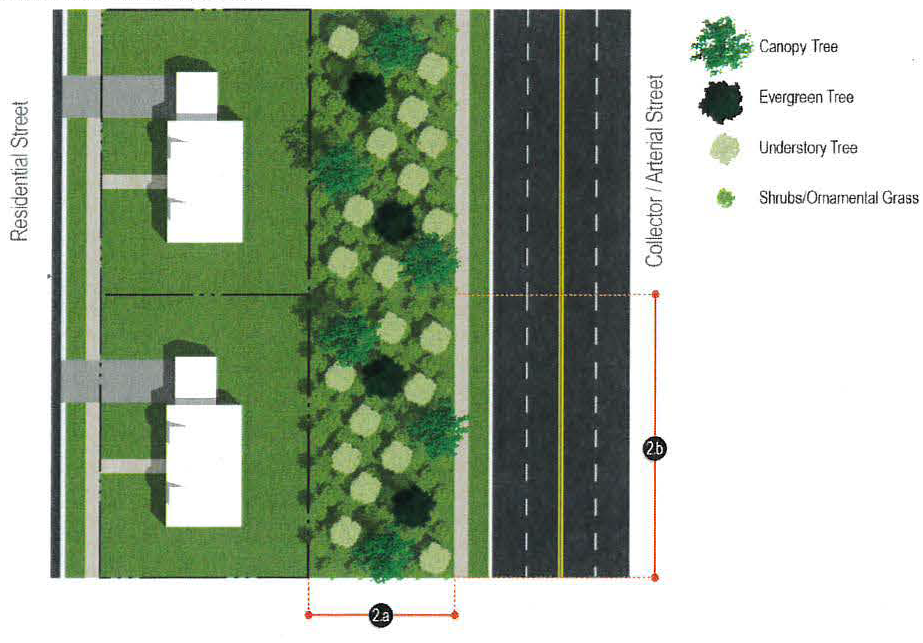
Location. A residential buffer landscape zone shall be located along the perimeter of a residential subdivision adjacent to a collector or arterial roadway, as identified in the city's comprehensive plan.
(2)
Requirements.
(a)
Width. A residential buffer landscape zone shall have a minimum width of 50 feet.
(b)
Landscape elements. A residential buffer landscape zone shall include the following minimum number of landscape elements per every 100 linear feet:
(I)
Canopy/evergreen trees: Five.
(II)
Understory trees: Ten.
(III)
Shrubs or ornamental grasses: 70.
Figure 14: Residential Buffer Landscape Zone
(I)
Residential streetscape landscape zone.
(1)
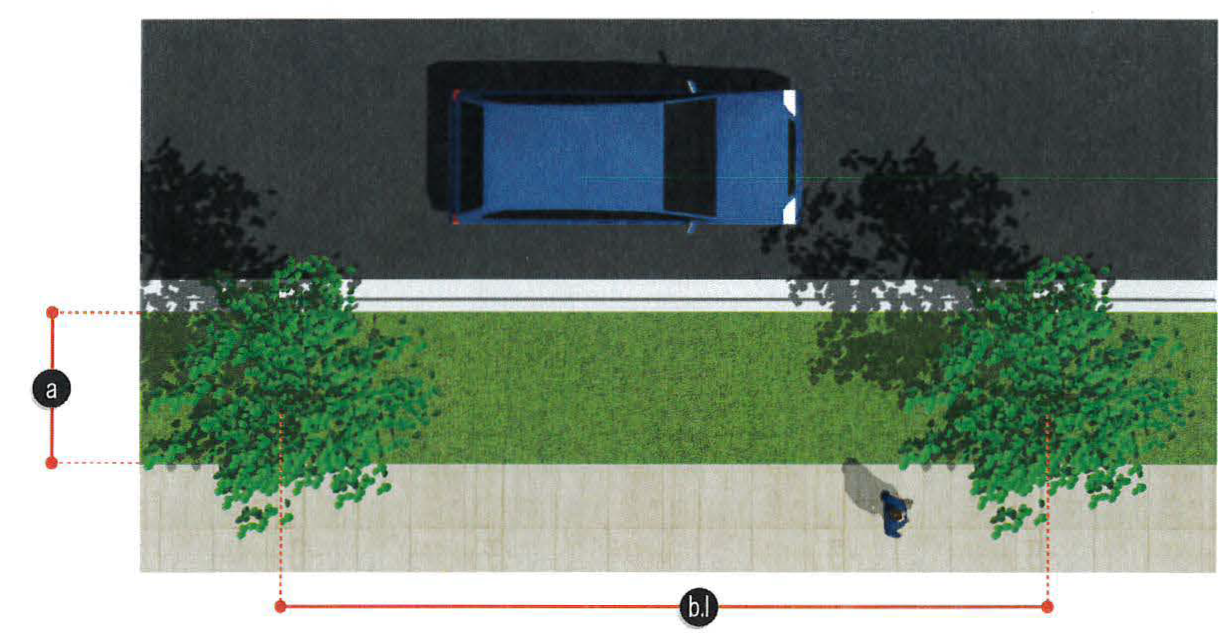
Location. A residential streetscape landscape zone shall be located in the street right of way for all roadways internal to a residential subdivision between the sidewalk and the roadway back of curb, unless otherwise approved through the applicable development approval process.
(2)
Requirements.
(a)
Width. A residential streetscape landscape zone shall have a minimum width of seven feet.
(b)
Landscape elements.
(I)
One canopy tree shall be planted every 40 feet of residential streetscape landscape zone length.
(II)
Where a canopy tree is required and overhead utility lines exist, two understory trees shall be substituted with the approval of the director.
Figure 15: Residential Streetscape Landscape Zone
(J)
Landscape species diversity requirements. The following species diversity standards shall be required for all developments, unless otherwise approved by the director in conjunction with approval of vegetated stormwater management areas:
(1)
A minimum of 50 percent of the landscape elements utilized on a parcel that is less than one-half acre shall be drought tolerant native species.
(2)
A minimum of 60 percent of the landscape elements utilized on a parcel that is between one-half and five acres shall be drought tolerant native species. Total landscape elements, excluding turf, shall not be comprised of more than 30 percent of any single species or 50 percent of any genus.
(3)
A minimum of 75 percent of the landscape elements utilized on a parcel that is greater than five acres shall be drought tolerant native species. Total landscape elements, excluding turf, shall not be comprised of more than 20 percent of any single species or 25 percent of any genus.
(Ord. No. 23-10, 7-10-2023)
Sec. 13.3. - Screening.
(A)
Grease traps, trash, and recycling receptacles. The following regulations shall apply to all nonresidential, mixed-use, and multifamily residential development:
(1)
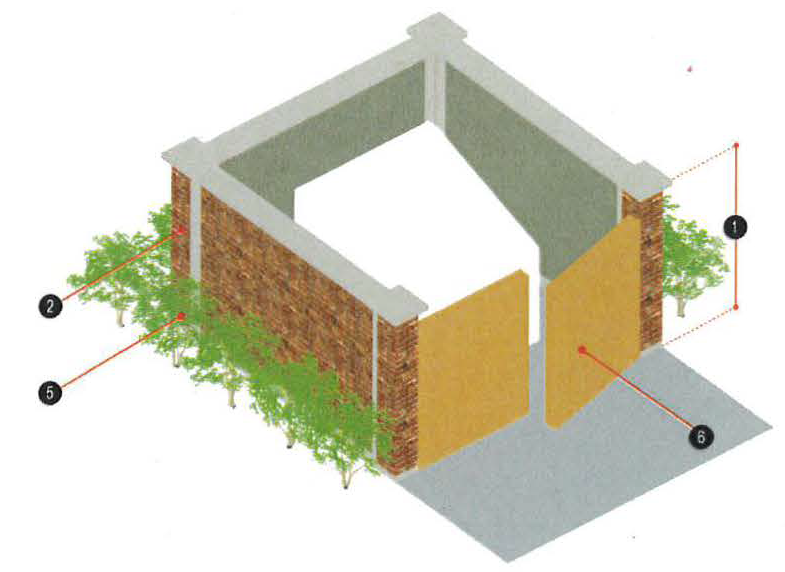
Grease traps, trash, and recycling receptacles shall be screened on three sides with a solid, opaque material with a minimum height of six feet and a maximum height of eight feet.
(2)
Materials used for screening shall complement the exterior building cladding materials of the primary building.
(3)
Materials and elevations for enclosures that are attached to buildings shall be designed to be integrated into the primary building.
(4)
If enclosures are to be attached to buildings, they shall comply with applicable fire and building codes.
(5)
Shrubs shall be installed every three feet along the exterior of the enclosure, with the exception of enclosure openings, to provide a softening effect.
(6)
Enclosure openings shall be gated with an opaque material.
(7)
Enclosure openings shall be kept closed at all times except for when the receptacle is being accessed.
(8)
Property owners shall be responsible for ensuring that grease traps, trash, and recycling receptacles be placed in the enclosure at all times other than when it is being accessed.
(9)
Access drives shall be constructed of materials and to a thickness which accommodates truck loading. Year-round access to the enclosure area for service trucks shall be maintained by the property owner or tenant.
(10)
Enclosures shall be of an adequate size to accommodate expected containers. The enclosure shall be designed to be expandable to accommodate future additional containers.
(11)
Enclosure structures shall be designed to protect the walls from damage by containers. Such protection may be provided by the use of barrier curbing, reinforced masonry walls, or other similar means.
(12)
Grease traps, trash, and recycling receptacle enclosures shall not occupy areas used for required parking spaces.
Figure 16: Grease Traps, Trash, and Recycling Receptacle Screening
(B)
Ground/wall mounted mechanical units. The following regulations shall apply to all ground/wall-mounted mechanical units, including, but not limited to, generators, air-conditioning condensers, heat pumps, ventilation units, computer cooling equipment, etc., and any related utility structures and equipment. Tanks and/or silos accessory to a brewery, winery, and/or distillery are exempt from these requirements.
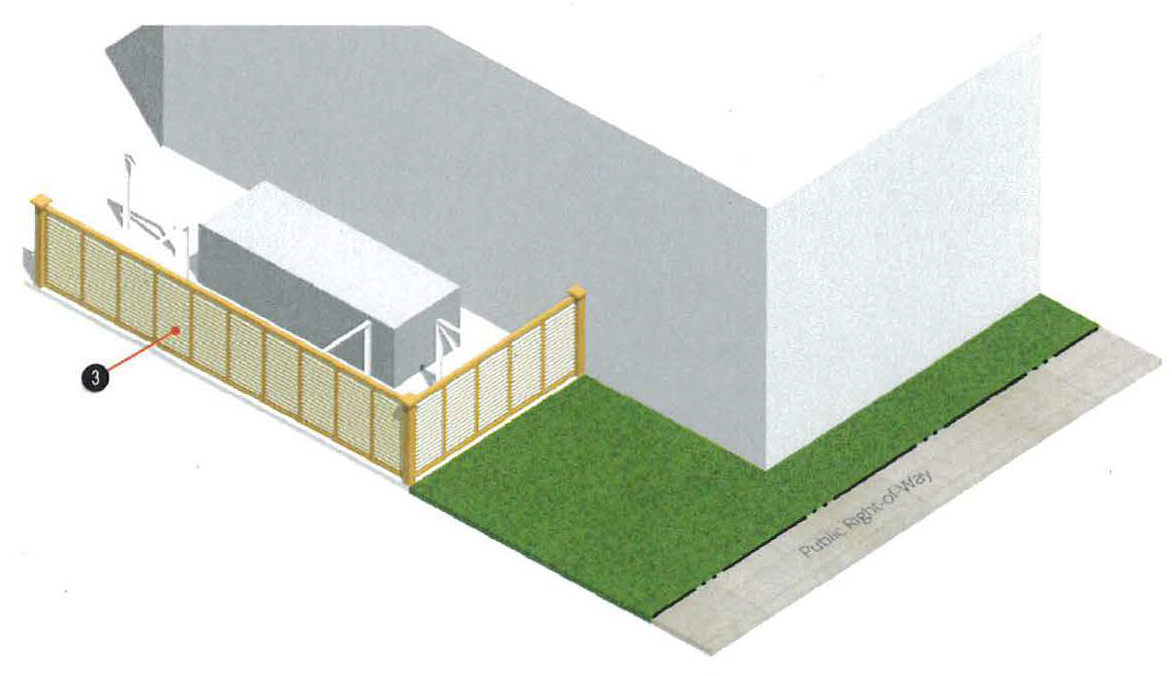
(1)
Locating mechanical units within the primary building is strongly encouraged to minimize exterior visual impacts. Ground-mounted mechanical units are prohibited within the front yard, regardless of whether screening is provided.
(2)
Ground/wall mounted mechanical units that are visible from any public right-of-way or adjacent residential property shall be screened from public view.
(3)
Materials used for screening shall be designed and established so that the area or element being screened is no more than 20 percent visible through the screen. Evergreen hedges or non-transparent walls such as stone masonry shall be allowed.
(4)
Chain-link fence or slats in chain-link fence shall not be used to meet this requirement.
Figure 17: Ground- or Wall-Mounted Mechanical Equipment Screening
(C)
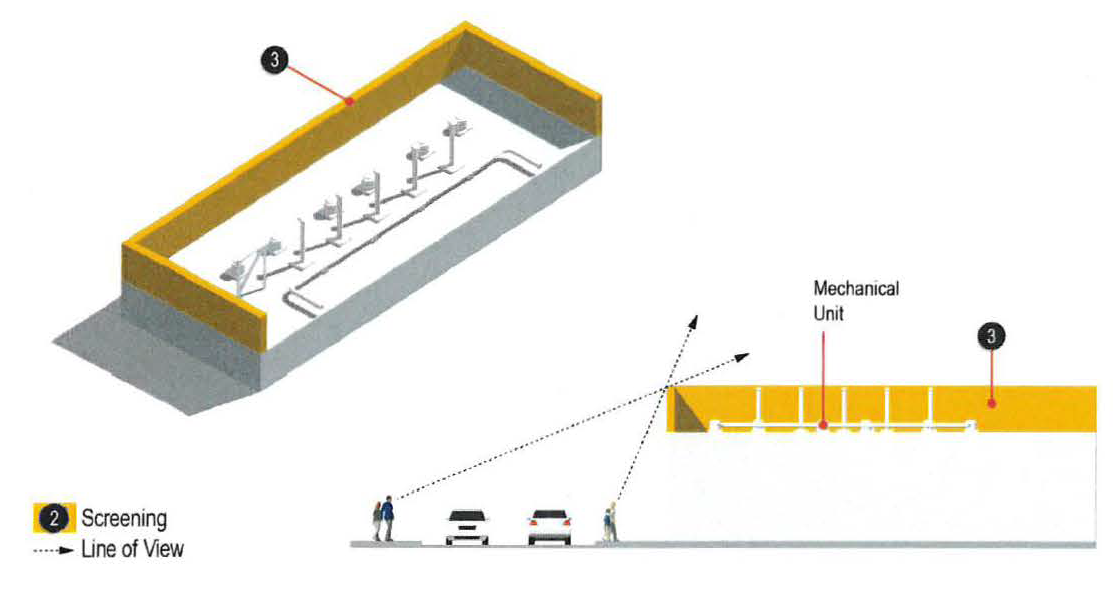
Roof-mounted mechanical units. The following regulations shall apply to all roof-mounted mechanical units, including, but not limited to, air-conditioning condensers, heat pumps, ventilation units, computer cooling equipment, etc., and any related utility structures and equipment which service multifamily residential, nonresidential, or mixed-use developments,
(1)
Locating mechanical units within the primary building is strongly encouraged to minimize exterior visual impacts.
(2)
Roof-mounted mechanical units that are visible from any public right-of-way or adjacent residential property shall be completely screened from public view.
(3)
Materials used for screening shall be architecturally integrated with the building and shall be continuous and permanent,
(4)
Screening shall be required when new equipment is installed and shall be provided around both new and existing roof mounted mechanical units in order to provide visual continuity. Normal maintenance of roof mounted mechanical units shall not mandate the screening requirements.
(5)
Additional screening may be required due to topographic differences in the adjoining properties.
Figure 18: Roof-Mounted Mechanical Equipment Screening
(D)
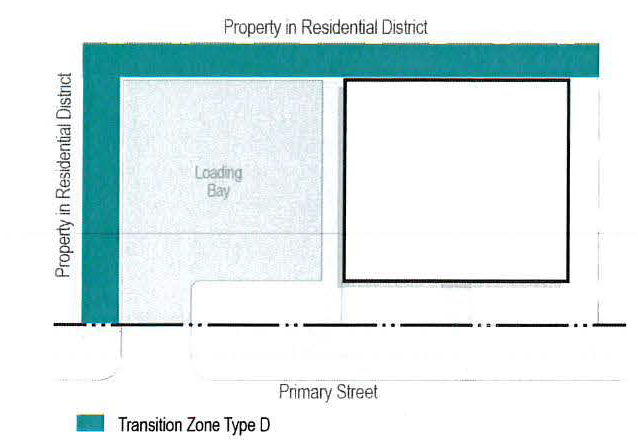
Loading docks and truck-parking areas. Loading docks and truck-parking areas that are visible from any property in a residential district shall be completely screened from view with a Type D transition zone as specified in Table 13-02(H)(2).
Figure 19: Loading Dock and Truck Parking Area Screening
(Ord. No. 23-10, 7-10-2023)
Sec. 13.4. - Sidewalks and walkways.
(A)
Requirements.
(1)
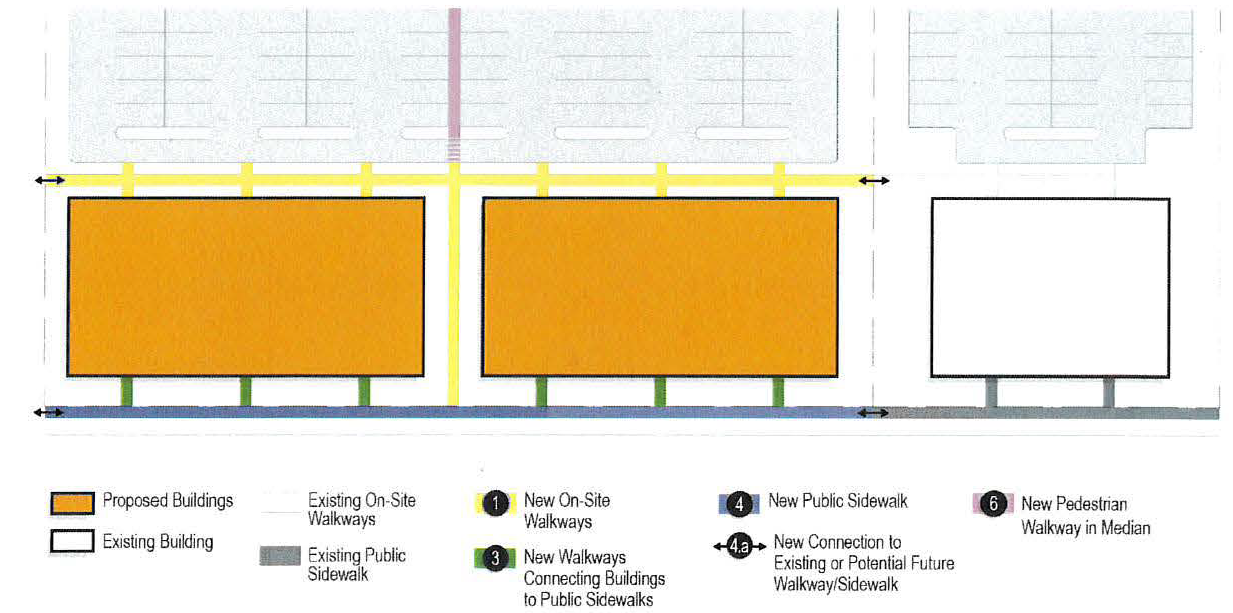
Sidewalks and walkways shall be provided on-site to ensure the safety of pedestrians, bicyclists, and motorists throughout the site and to connect off-street parking, the on-site destination, and public sidewalks.
(2)
The on-site walkways shall connect all buildings on the site to one another and provide connections to parking areas.
(3)
The on-site walkways shall connect building entrances to adjacent public sidewalks along direct routes of travel.
(4)
Where public sidewalks do not exist, they shall be provided along each frontage to connect to adjacent properties.
(a)
New sidewalks shall connect to existing sidewalks or walkways on adjacent properties, or to the likely future location of walkways on those properties.
(b)
The director may waive this requirement upon determining that such connection would create a safety hazard.
(5)
Where driveways, parking, and loading entrance and exits cross pedestrian walkways, the pedestrian walkway shall be designed with minimal disruptions to safe, continuous pedestrian connectivity.
(6)
In parking lots with an interior parking lot median, pedestrian walkways shall be collocated with the median, unless otherwise approved by the director.
(a)
The collocation of the pedestrian walkway with the median shall not cause a pedestrian to walk over or through required landscape materials.
(B)
Materials. All sidewalks and walkways shall be surfaced with a durable, hard surfaced pavement, approved by the city engineer.
(C)
Design criteria.
(1)
All sidewalks and walkways shall comply with the South Carolina Accessibility Code and ADA standards.
(2)
All sidewalks or walkways shall be the width of the sidewalk/walkway to which it would connector a minimum of five feet if no such sidewalk/walkway exists, unless otherwise approved or required by the director.
Figure 20: Sidewalks and Walkways
(Ord. No. 23-10, 7-10-2023)

