
Anoka City Zoning Code
ARTICLE V
- DISTRICT REGULATIONS
Sec. 78-210. - Uses and activities restricted to specific districts.
Notwithstanding any other provisions of this chapter, establishments in which charitable gambling has been licensed by the state, pursuant to M.S.A. ch. 349, shall not be located in a residential district.
(Prior Code, § 74-191)
Sec. 78-211. - Planned unit developments.
(a)
Application and short name.
(1)
Application. This section shall apply to planned unit development zoning districts.
(2)
Short name. The term "planned unit development" may be referred to as PUD in this Code.
(b)
Purpose and intent.
(1)
Purpose. Planned unit development districts are designed to achieve the following purposes:
a.
To provide for various types and combinations of land uses that take advantage of large-scale site planning.
b.
To allow diversification of land uses as they relate to each other in a physical and environmental arrangement, while insuring compliance with the provision of this chapter.
c.
To encourage and permit unified planning to achieve a compatible mixture and variety of land uses within the Planned Unit Development District and with the existing and anticipated development in the surrounding area.
d.
To promote economical and efficient land use, an improved level of amenities, appropriate and harmonious variety, creative design and sensitivity to the natural environment. Planned unit developments may be established where tracts suitable in location, area, and character will be planned and developed on a unified basis. Suitability of tracts for the development proposed shall be determined with reference to the existing and prospective character of surrounding development.
(2)
Intent. The procedures established in this section are intended as a substitute for strict application of the underlying zoning district standards in recognition of the fact that traditional density, bulk, spacing and use regulations may impose inappropriate and unduly rigid restrictions upon the development or redevelopment of parcels which lend themselves to an individual, planned approach. In addition, a development plan should be designed to ensure that the following general goals will be achieved:
a.
The design of the proposed development promotes achievement of the stated purposes of the city community plan (comprehensive plan);
b.
The proposed development efficiently utilizes the available land while protecting and preserving the natural features;
c.
The proposed development provides for harmonious and coherent site and building design that creates a sense of place;
d.
The proposed development provides greater densities and variety in the type of environments available to city residents; and
e.
The proposed development provides transitions in land use in keeping with the character of adjacent land uses.
(c)
Definitions. The following words, terms and phrases, when used in this section, shall have the meanings ascribed to them in this subsection, except where the context clearly indicates a different meaning:
Density means the number of residential dwelling units per acre.
Dwelling, attached, (group house, row house ortownhouse) means a dwelling joined to one or more other dwellings by party walls.
Dwelling, detached, means a dwelling unit entirely surrounded by open space.
Dwelling unit means one or more rooms in a dwelling designed for occupancy by one family for living purposes and having its own permanently installed cooking and sanitary facilities.
Integrated design means a harmonious selection of uses in groupings of buildings, services, parking areas, traffic and pedestrian circulation and open spaces, all planned and designed as an integrated unit.
Intensity means the extent of development considering such factors as land coverage by buildings, the number of stories, the floor area ratio, the bulk of the buildings, the proximity of buildings on a site in relation to each other, etc.
Open space, common, means land within or related to a development, not individually owned or dedicated for public use, that is designed and intended for the common use or enjoyment of the residents and their guests and may include such complementary structures and improvements as are necessary and appropriate.
Open space, private, means common open space, the use of which is normally limited to the occupants of a single dwelling or building or property.
Open space, public, means open space dedicated to the city and maintained by it for the use and enjoyment of the general public.
Original district means the zoning district from which land is proposed to be rezoned to a planned unit development.
Planned commercial development (PCD) means a planned development to accommodate retail, service, commercial, or office uses, or a combination of such uses, and appurtenant common areas and accessory uses incidental to the predominant uses.
Planned development means an area of a minimum contiguous size, as specified by ordinance, to be planned, developed, operated, and maintained according to plan as a single entity and containing one or more structures with appurtenant common areas.
Planned industrial development (PID) means a planned development consisting primarily of industrial uses, but may include retail service uses as well as recreational facilities to accommodate the work force.
Planned residential development (PRD) means a planned development containing one or more residential structures or planned unit residential clusters; appropriate commercial, public, or quasi-public uses may be included if such uses are primarily for the benefit of the residential development.
Planned transit-oriented development (PTOD) means a planned development containing one or more residential clusters and one or more areas of retail, service and office uses or industrial uses or a combination of such uses designed to accommodate area mass transit services and, including appurtenant common areas and accessory uses incidental to the predominant uses.
Planned unit development (PUD) means an area of minimum contiguous size, as specified by ordinance, to be planned, developed, operated, and maintained as a single entity and containing one or more residential clusters or planned unit residential developments or one or more public, quasi-public, commercial, or industrial areas in such ranges or ratios of nonresidential uses to residential uses as specified in the ordinance.
Street, private, means a street on the interior of a development which is jointly owned, constructed and maintained by the developer or homeowners' association, is designed and constructed in conformance with the specifications determined by the city engineer, and is not an essential part of the circulation plan of the city.
Street, public, means a street which is dedicated to and maintained by the city.
Unified control means property in single ownership or under the management and supervision of a central authority, or otherwise subject to such long-term leases or other ownership controls as the council deems necessary.
(d)
General regulations.
(1)
Effect of Planned Unit Development District approval. Approval of a Planned Unit Development District shall constitute an amendment to the zoning map. PUD approval affecting lands within the Mississippi River Critical Area Corridor or the Rum River Management District is contingent upon approval by the department of natural resources in accordance with legal procedures. Designation of a property as one of the types of planned unit development districts in accordance with an approved development plan shall supersede all existing overlay districts such as the Mississippi River Critical Area Corridor, the Rum River Management District, the Floodplain Management District, or the Shore land Management District. Such property shall, for zoning purposes, be identified by the letters for the appropriate Planned Unit Development District followed by an identifying number.
(2)
Departure from original zoning district regulations. Except for lands within the Mississippi River Critical Area Corridor, the Rum River Management District, the Floodplain Management District, or a Shore land Management District, the various zoning regulations and requirements (e.g., use, building setback, height, etc.) which may apply to the original zoning district may be considered as guidelines only and may be departed from in the approval of a planned unit development. More restrictive zoning regulations and requirements for the lands within the Mississippi River Critical Area Corridor, the Rum River Management District, the Floodplain Management District, or the Shore land Management District shall apply, except as approved by the department of natural resources.
(3)
Design and unified control. All planned unit developments shall include integrated design and shall be developed under unified control.
(4)
Coordination with subdivision regulations. Subdivision review of this Code shall be carried out simultaneously with review of a proposed planned unit development.
(5)
Minimum district area. Planning unit development districts (PCD, PID, PRD, PTOD), which may consist of a parcel or contiguous parcels of land, will not be less than two acres in size. Tracts of less than two acres shall be approved only if the applicant can demonstrate that a project of superior design can be achieved or that greater compliance with comprehensive pan goals and policies or adopted master plans can be attained through the creation of a PUD district.
(6)
Usesand densities permitted. The development plan shall specify, both for the project as a whole or for subareas within the project, those principal and accessory uses and development densities that are to be permitted. The city council may include or exclude uses from the development plan or include uses with attached conditions as determined appropriate to achieve the intent of this section. In making the determination of the uses and development densities to be permitted within the Planned Unit Development District, the council shall consider the compatibility and relationship of uses within the project, the compatibility and relationship of permitted uses adjoining or in proximity to the Planned Unit Development District, the appropriateness of permitted uses for the area in general and their overall impact on the community, and the consistency of the permitted uses with the city community plan and other adopted plans and policies.
(e)
Planned unit development districts and allowable uses.
(1)
Establishment of planned unit development districts. The following table denotes the types of planned unit development districts, the abbreviations for such planned unit development districts, and the allowable uses within each Planned Unit Development District:
(2)
Mixed land uses. Uses other than the allowable uses listed in subsection (e)(1) of this section are permitted in a Planned Unit Development District, provided that:
a.
The use is one that is authorized in one of the four types of planned unit development districts; and
b.
Such additional use shall not occupy more than one-third of the area within the planned unit development.
(f)
Planned unit development concept proposal statement. Any person requesting to establish a Planned Unit Development District shall first submit a planned unit development concept statement to the planning director. The purpose of the planned unit development concept proposal statement is to afford such person an opportunity to have the general feasibility of a planned unit development proposal informally reviewed by the city, without incurring substantial expense.
(1)
Required information. A planned unit development concept proposal statement shall provide the following information:
a.
Name and address of persons requesting establishment of the Planned Unit Development District;
b.
An original and six copies of the sketch plan which identifies the location and delineates the boundary line of the proposed Planned Unit Development District;
c.
A detailed written description of the proposed planned unit development, which includes project funding and the planning objectives to be achieved;
d.
Conceptual schematic drawings of the proposed planned unit development;
e.
Anticipated development timing for each stage of development; and
f.
Any additional information that would help the city determine the feasibility of the proposed planned unit development.
(2)
Response to the planned unit development concept proposal statement. Within 20 days after receiving a completed planned unit development concept proposal statement, the planning director shall produce a written response to such statement which may include comments or recommendations. A planned unit development application may proceed only after a response has been submitted to the applicant. Acceptance of, or response to, the planned unit development concept proposal by the planning director shall not constitute approval of the planned unit development application, planned unit development rezoning, final development plan, or related approvals.
(g)
Planned unit development application.
(1)
Required materials. Upon completion of the required actions in subsection (f) of this section, the applicant for a planned unit development shall submit an original and six copies of the application materials outlined in this section.
(2)
Materials related to rezoning. Consistent with this section, the applicant shall submit an application and all related materials to support a rezoning from the original district to one of the four types of planned unit development districts.
(3)
Subdivision materials. If the land within a planned unit development is to be platted, replatted, or subdivided, the applicant shall submit an application and all related materials for review of a subdivision consistent with chapter 58.
(4)
Ownership. A tract of land to be developed as a planned unit development is under the control of:
a.
A single owner; or
b.
A group of landowners where each owner agrees in advance to be bound by the conditions and regulations which will be effective within the district and to record such covenants, easements and other provisions with the county recorder/registrar of titles.
(5)
Project identification materials. The following information shall be submitted in regard to project identification:
a.
A list identifying all current owners, legal and equitable, of land or improvements within the proposed planned unit development;
b.
A list identifying all proposed owners, legal and equitable, of land or improvements within the proposed planned unit development;
c.
A list identifying all developers and parties involved in the development; and
d.
Additional information as identified by the planning director.
(6)
Preliminary plan submission materials. The following materials shall be submitted:
a.
A site plan indicating the following:
1.
The boundaries, dimensions, and area of the proposed Planned Unit Development District;
2.
The location, dimensions, and gross floor area of proposed structures;
3.
The proposed land uses for each parcel and each building, the amount of floor area devoted for each use, and all areas to be designated for mixed land uses;
4.
The location, arrangement, and number of parking spaces, loading facilities, and mass transit facilities, including bus turnouts and shelters;
5.
The location and dimension of all curb cuts and driveways, and their relationship to all existing and proposed public streets; and
6.
The proposed location, design, and dimension of pedestrian and bicycle facilities, walks, skyways, plazas, courts or other related areas;
b.
Preliminary building plans, elevations, and general specifications of materials, and unusual structural systems, prepared by an architect registered in the state;
c.
A preliminary land/building use profile, including computations of gross and leasable square footage, housing unit breakdown to square footage, bedrooms, persons per unit, and parking requirements;
d.
A preliminary stormwater management plan and site grading plan, including an analysis of the adequacy of surface drainage, storm sewer and catch basin drainage, stormwater retention, and erosion control;
e.
A preliminary plan depicting natural features, including those to be preserved, as well as existing vegetation with detailed locations of trees 12 inches or larger in diameter;
f.
A preliminary utility plan showing easements, sewer, water, and power services of all proposed uses;
g.
A preliminary plan showing utilities and utility easements to remain, to be installed, to be relocated, and to be removed or vacated;
h.
A preliminary landscape plan showing the proposed location and dimensions of all walls, fences, and landscape plantings;
i.
A plan showing the proposed location and dimensions of all signs and lighting fixtures, including the illumination characteristics of all lighting;
j.
A soils map that depicts surface and subsurface conditions that may affect construction; and
k.
Additional information as required by the planning director.
(7)
Legal instruments. As part of the planned unit development application, the applicant shall submit proposed declarations of covenants, conditions and restrictions, articles of owners, associations and all other such documents as the city may deem necessary to ensure that adequate property control is provided to protect the individual owner's rights and property values, to establish responsibility for maintenance and upkeep, and to ensure continuing compliance with the planned unit development as approved. The city shall require that such declarations of covenants, conditions and restrictions, or other documents provide that, in the event any association or corporation fails to maintain properties in accordance with the applicable ordinances and regulations of the city, fails to pay taxes or assessments on properties as they become due or, in the event the city incurs any expenses in enforcing its ordinances or rules or regulations, the city shall have the right to assess each property its pro rata share of such expenses. These assessments, together with interest thereon and costs of collection, shall be a lien on each property against which each such assessment is made.
(h)
Review of planned unit development application. Procedure. Upon receipt of a completed planned unit development application and the fee established by the city council, the following review procedure shall be followed:
(1)
Planning commission review. The planning commission shall conduct a public hearing on the planned unit development application according to the procedures set forth in M.S.A. § 462.357, subd. 3. After the public hearing, the planning commission shall submit its recommendation to the city council. The planning commission may recommend approval of the proposal with or without modifications, or may recommend denial of the planned unit development.
(2)
City council consideration. Following action by the planning commission, the city council shall consider rezoning the area described in the plan. If the planned unit development plan is approved, the area shall be rezoned as one of the four types of planned unit development districts. Pursuant to M.S.A. § 15.99, an application for a planned unit development approval shall be approved or denied within 60 days from the date of its official and complete submission unless notice of extension is provided by the city or a time waiver is granted by the applicant. If applicable, processing of the application through required state or federal agencies shall extend the review and decision-making period an additional 60 days unless this limitation is waived by the applicant. Approval of a planned unit development shall require a two-thirds vote of the city council.
(3)
Required findings. The findings necessary for approval of a planned unit development application shall be as follows:
a.
The proposed development conforms with the goals and objectives of the city's community plan and any applicable redevelopment plans;
b.
The proposed development is in substantial conformity with the purpose and intent of the original district, and departures from the original district regulations are justified by the design of the development;
c.
The proposed development is designed in such a manner as to form a desirable and unified environment within its own boundaries;
d.
The development will not create an excessive burden on parks, schools, streets, or other public facilities and utilities which serve or are proposed to serve the development;
e.
The development will not have undue adverse impacts on neighboring properties; and
f.
The terms and conditions proposed to maintain the integrity of the plan are sufficient to protect the public interests.
(i)
Final development plan. Upon approval of the first reading of the planned unit development rezoning, but prior to commencement of any construction or development of land, the applicant shall submit a final development plan which is consistent with the planned unit development application and any recommended changes made during the preliminary plan review. Approval of such final development plan requires a second reading of the ordinance to establish the planned unit development zoning.
(1)
Contents of the final plan. A final development plan shall consist of the following:
a.
If required, a final plat of the land to be developed;
b.
All materials required under subsection (g) of this section, in final form; and
c.
Additional information as required by the planning director or city council.
(2)
Legal instruments. As part of the final development plan, the applicant shall submit final declarations of covenants, conditions and restrictions, articles of owners, associations and all other such documents as the city may deem necessary pursuant to subsection (g) of this section.
(j)
Compliance with the planned unit development plan and final development plan.
(1)
Changes. The development of a Planned Unit Development District shall be in substantial compliance with the approved planned unit development plan and final development plan. Compliance shall not be considered substantial if there is:
a.
More than ten percent change in floor area in any one structure;
b.
More than a ten percent change in the approved separation of buildings;
c.
Any change in the original approved setbacks from the property line;
d.
More than five percent change in the ground area covered by the building; and
e.
Any change in the ratio of off-street parking and loading space to gross floor area.
(2)
Referral to planning commission. If it is determined that the final development plan is not in substantial compliance, the final development plan will be referred to the planning commission for review prior to approval by the city council.
(3)
Building permits. A building permit may not be issued for a structure within the Planned Unit Development District until the planning director certifies that the structure conforms to the provisions and conditions of the planned unit development plan and final development plan. Upon approval by the planning director, the building permit application, along with the appropriate information required for building permits, shall be submitted to the building inspector who shall process the building permit in conformance with the building code.
(4)
Certificate of occupancy. Certificates of occupancy shall not be issued for a structure within the Planned Unit Development District until the planning director certifies that the structure conforms to the provisions and conditions of the planned unit development plan and final development plan. Upon approval by the planning director, the building inspector shall issue the certificate of occupancy.
(k)
Cash escrow. The city council may require an applicant to provide the city with a cash escrow or letter of credit or bond prior to the issuance of any building permits within a planned unit development. Such escrow amount shall be in an amount of 1¼ times the approved estimated cost of labor and materials for site improvements and shall be submitted to the planning director. Upon satisfactory completion of all construction within the planned unit development, the escrow shall be released by the planning director.
(l)
Plan amendments. The planning commission shall hold a public hearing on a proposal to amend a final development plan as it may consider necessary, but at least one public hearing shall be held. The planning commission shall recommend to the city council approval with or without modifications, or may recommend denial of the amendment to the planned unit development. The planning commission and city council may consider all factors considered in connection with rezoning the Planned Unit Development District as well as any other factors relevant to the public health, safety, and welfare. Any planned unit development amendment that changes the classification of the Planned Unit Development District shall require a two-thirds vote of the city council.
(m)
Fees. The application fee for a planned unit development or amendment thereto shall be established by resolution of the city council. In addition, legal fees, consultant fees, and other reasonable costs incurred by the city in its review and consideration of the planned unit development application shall be paid by the applicant. The application fee shall be paid at the time of the submission of the planned unit development application.
(n)
Enforcement. If no construction has begun in the planned unit development within 12 months from the date of approval of the planned unit development, such approval shall lapse and be of no further effect. The planning commission, upon showing of good cause by the developer, may extend the time for beginning construction for periods of 12 months.
(Prior Code, § 74-192; Ord. of 10-15-2018)
Sec. 78-212. - Adult Establishment District.
(a)
District established. This article establishes the Adult Establishment District which overlies a portion of the M-1 district. All provisions of the M-1 Light Industrial District of this chapter apply to all uses within the Adult Establishments District.
(b)
Adult Establishment District. The Adult Establishment District is the area described as follows: the south half of the northeast quarter of section 35, township 32, range 25, and the southwest quarter of the northwest quarter of section 36, township 32, range 25, Anoka County, Minnesota.
(Prior Code, § 74-193)
Sec. 78-213. - Raising of crops.
The raising of crops, including community gardens, is permitted on vacant parcels within the city, subject to the following:
(1)
Accessory structures, fencing and other miscellaneous improvements are subject of the standards of this chapter.
(2)
Dead plants and produce not to be used for composting or other garden functions shall be removed from the site in a timely manner.
(3)
Garbage and other trash shall be removed from the site in a timely manner.
(4)
Plantings shall not obstruct any site triangle.
(5)
Chemicals, fertilizers or other toxic materials may not drain onto adjacent properties, into waterways, or onto public rights-of-way. Chemicals and flammable materials must be disposed of in accordance with federal and state requirements. If stored on-site, they must be kept in a locked structure when unattended.
(Prior Code, § 74-194)
Sec. 78-237. - Special requirements for residence districts.
(a)
Purpose and application.
(1)
Purpose. The purpose of this section is to establish minimum standards for residential use of properties in the city.
(2)
Application. The provisions of this section shall apply to all R-1, R-2, R-3 and R-4 residence districts.
(b)
Floor area requirements.
(1)
Single-family dwellings. For single-family dwellings the minimum ground floor area of the main structure, exclusive of one-story open porches and garages, shall be as follows:
a.
For single-family dwellings built after July 31, 1982, including manufactured homes built in conformance with M.S.A. §§ 327.31 to 327.35, that are built on a full basement or cellar which is at least 7½ feet from floor to ceiling and underneath the entire structure, excepting garages:
1.
Single-story dwelling: 960 square feet.
2.
Story and one-half dwelling: 960 square feet.
3.
Two or more story dwelling: 832 square feet.
4.
Split entry (or split foyer) dwelling: 960 square feet.
b.
For single-family dwellings that are not built on a full basement or cellar which is a least 7½ feet from floor to ceiling and underneath the entire structure, excepting garages:
1.
Single-story dwelling: 1,200 square feet.
2.
Story and on-half dwelling: 1,200 square feet.
3.
Two or more story dwelling: 1,040 square feet.
4.
Split entry (or split foyer) dwelling: 1,200 square feet.
(2)
Multifamily dwellings.
a.
For multifamily dwellings the minimum net floor area shall be as follows:
1.
Efficiency dwelling unit: 400 square feet.
2.
One bedroom dwelling unit: 600 square feet.
3.
Two-bedroom dwelling unit: 800 square feet.
4.
Three or more bedrooms per unit shall have an additional 100 square feet of floor area for each bedroom in excess of two bedrooms.
b.
For the purposes of measurement, the net floor area of a dwelling unit means that area within a building used as a single dwelling unit, and shall be measured from the inside walls to the center of partitions bounding the dwelling unit being measured, but shall not include public stairways, public entries, public foyers, public balconies or unenclosed public porches, separate utility rooms, furnace areas or rooms, or storage areas not within the apartments or garages.
(c)
Design and construction requirements in multifamily residence districts. The design and construction requirements in multifamily residence districts shall be as follows:
(1)
Design review. A site plan for a multifamily dwelling must be reviewed by the planning commission and approved by the city council prior to construction.
(2)
Accessory buildings. The city council may require common walls for accessory buildings where common walls will eliminate unsightly and hazardous areas. Exteriors of accessory buildings shall have the same exterior finish as the main structure or some other compatible finish approved during the site plan review.
(3)
Recreation and open space. Multifamily residential projects shall contain an adequate amount of land for park, recreation or local open space use, exclusive of sump and drainage areas, consistent with the requirements of chapter 58.
(d)
Home occupations.
(1)
Purpose. The purpose of this subsection (d) is to prevent competition with business districts and to provide a means, through the establishment of specific standards and procedures, by which home occupations can be conducted in residential neighborhoods without jeopardizing the health, safety and general welfare of the surrounding neighborhood.
(2)
Application. Subject to the nonconforming structure and use provisions of this chapter, all occupations conducted in the home shall comply with the provisions of this subsection (d).
(3)
Inspection. The city reserves the right, upon approval of any home occupation, to inspect the premises in which an occupation is being conducted to ensure compliance with the provisions of this subdivision (d) or any conditions additionally imposed.
(4)
Violations. After two nuisances or code violation complaints have been made and verified with written notices to the home occupation, a public hearing may be called to reconsider the home occupation within 60 days of the last complaint.
(5)
Revocation. An interim use permit for a home occupation may be revoked if the property is found to be in violation of the conditions listed in the interim use permit or if access to the property for the purpose of making an inspection is refused to the zoning administrator or his designee. The same process established for granting an interim use permit for a home occupation shall be followed when considering revocation of an interim use permit for a home occupation.
(6)
Penalty. Violation of the home occupation performance standards shall be subject to the enforcement and penalty provisions as contained in this chapter.
(7)
Performance standards. Performance standards for home occupations shall be as follows:
a.
The home occupation must be clearly incidental and secondary to the residential use of the premises, shall not change the residential character thereof, and shall not result in incompatibility or disturbance to the surrounding residential uses.
b.
No home occupation shall require external alterations or involve construction of features not customarily found in dwellings except where required to comply with the state fire and building code regulations.
c.
No retail sales of products fabricated off the premises is allowed except for occasional sales of retail products if the dwelling serves as an office for a person regularly engaged in retail sales outside the dwelling but has no other office and if such occasional sales are incidental to and not the primary purpose of the home occupation.
d.
No stock-in-trade other than that permitted under subsection (d)(7)c of this section shall be kept or sold on the premises.
e.
Only members of the family occupying the dwelling unit may carry on the home occupation.
f.
There shall be no exterior display, exterior signs, interior displays or interior signs which are visible from outside the dwelling, unless approved with an interim use permit and the property fronts a road designated as an "A" minor arterial by the Future Functional Classification Plan Map in the city community plan. Home occupation business signs may be either wall- or freestanding-type signs. Freestanding signs shall be a maximum of five square feet in area, a minimum of five feet from property lines, shall not be within the sight triangle of any intersection or driveway, and shall be limited to six feet in overall height.
g.
No outside storage or display is permitted.
h.
No significant increase in levels of noise, dust, smoke, gas, heat, vibration, glare, fumes, odor or electrical interference shall be detectable to the normal senses off the premises.
i.
No on-street parking of vehicles related to the home occupation is permitted.
j.
No more than one client or customer may patronize the dwelling unit at one time.
k.
The space devoted to the occupation shall have an inside entrance into the dwelling area.
l.
All home occupations shall be conducted entirely within the dwelling and not in an attached or detached garage or in an accessory building.
m.
No more than 25 percent of the gross floor area of the dwelling unit shall be used for the occupation.
n.
There is no increase in sewer, water, gas, electricity, or garbage usage in excess of what is normal in a residential neighborhood such that the neighborhood is adversely affected.
o.
No customer waiting areas are allowed.
p.
All licenses or permits required to carry on the occupation shall be obtained.
q.
All home occupations shall be conducted at the sole risk of the dwelling occupants conducting the home occupation. The city shall not be responsible or liable to the dwelling occupants or any third party as a result of the home occupation, and the occupants conducting the home occupation shall indemnify and hold the city harmless from all claims and causes of action associated with the home occupation.
(8)
Permitted home occupations. The following home occupations and similar occupations as determined by the city council are permitted accessory uses in all residential districts only if all conditions in subsection (d)(7) of this section are fully observed:
a.
Artists, authors, composers, sculptors.
b.
Home crafts, such as model making, rug weaving, woodworking, and similar activities, provided that no machinery or equipment shall be used or employed other than that which would customarily be found in the home, including machinery or equipment that would ordinarily be employed in connection with a hobby or avocation not conducted for gain or profit.
c.
Dressmakers, seamstresses and tailors.
d.
Beauticians and barber shops.
e.
Home offices for accountants, architects, engineers, lawyers, realtors, insurance agents, brokers, clergy, consultants, contractors, land surveyors, musicians, salesmen, sales representatives, manufacturer's representatives, travel agents, home builders and home repair contractors.
f.
Mail order, not, including retail sales from the site.
g.
Music and art teachers or other tutoring services.
h.
Telephone answering.
i.
Work at home activities where employees of a business, located at another location, perform work for the business in their own residence, provided all physical contact between the business and the employee occurs at the place of business and not the residence, other than the initial installation of any equipment or other work facilities. The work activities of the employee shall conform with all other requirements of subsection (d)(7) of this section.
j.
Food preparation for sale, when registered with the department of agriculture under the cottage food exemption in M.S.A. § 28A.152.
k.
Other occupations that fully comply with the standards in subsection (d)(7) of this section.
(9)
Home occupations allowed with an interim use permit. The following home occupations are permitted as an accessory use upon approval of an interim use permit by the city council after recommendation by the planning commission:
a.
Home occupations with the following characteristics:
1.
A maximum of one outside employee.
2.
Outside parking of no more than one commercial type vehicle identified for business purposes not to exceed one-ton capacity and used for both personal and business transportation. The vehicle is to be owned and registered to an occupant of the property and parked in a screened location.
b.
Ceramic classes with a kiln up to six cubic feet in size.
c.
Domestic animal grooming.
d.
Other home occupations which substantially comply with the standards set forth in subsection (d)(7) of this section.
e.
Other proposed home occupations that are determined to be similar in character to those listed in subsection (d)(8) of this section.
(10)
Particular home occupations prohibited. The following uses, and similar uses, shall not be permitted as a home occupation in any residential district:
a.
Antique shops, boutiques, dress shops, and gift shops.
b.
Photo studios, processing labs, and portrait studios.
c.
Restaurants, coffee shops, and tearooms.
d.
Offices for physicians, dentists, veterinarians, physical or massage therapists, and chiropractors.
e.
Animal hospitals or kennels.
f.
Auto repair and painting, including the repair of engines, motor vehicles, motorcycles, and heavy equipment.
g.
Dancing schools and studios.
h.
Dispatching of transfer and moving vans at the site.
i.
Furniture repair and refinishing.
j.
Palm reading or fortune telling.
k.
Preparation of food for sale, unless specifically permitted in this section.
l.
Radio, television and appliance repair shops.
m.
Raising of animals for sale.
n.
Shops for contractors and tradesmen, such as electricians, plumbers and carpenters.
o.
Sign painting.
p.
Boardinghouses and lodginghouses, unless specifically permitted by the district regulations.
q.
Tattoo businesses.
r.
Tanning salons.
s.
Any occupation that requires a federal firearms license, including the sale of firearms; except where each of the following conditions exist:
1.
An occupant residing on the premises holds a valid and current federal firearms license and has held the license continuously since December 31, 1995;
2.
The occupant had an established occupation at the premises that required a federal firearms license as of December 31, 1995, and has not discontinued such occupation; and
3.
At the time of the most recent renewal of the occupant's federal firearms license:
(i)
The premises were inspected by the city and the city certified that the premises were equipped with an adequate security system and were otherwise adequately protected against theft of firearms from the premises;
(ii)
The occupant has met all the criteria for licensing under the federal firearms code and the individual, in the opinion of the city police department, has been found to be honest, reliable and of good character; and
(iii)
The police department has not received more than three complaints within the past five years related to this use of the premises.
t.
Trash hauler operations other than a home office.
u.
Any home occupation which does not substantially comply with the standards set forth in subsection (d)(7) of this section.
(11)
Application materials.
a.
Prior to the issuance of an interim use permit for a home occupation, an application must be submitted which contains the following information:
1.
The owner of the property and the person who will be conducting the home occupation.
2.
The street address of the dwelling.
3.
The type of home occupation.
4.
The type of equipment that will be used.
5.
The days and hours which the home occupation will be conducted.
6.
A description of any motor vehicles which will be used in connection with the occupation, and whether or not the applicant has had any previous denials for a similar request elsewhere.
7.
A plan or drawing of the dwelling which shows clearly and in reasonable detail the portion of the dwelling which is to be used for the home occupation, the number of square feet of living area contained in the dwelling, and the number of square feet to be used for the home occupation.
b.
The application for an interim use permit for a home occupation will be processed according to section 78-33.
(12)
Amendment to an interim use permit for a home occupation. The applicant must seek an amendment to the permit in order to change the conditions set forth in the home occupation interim use permit. The amendment will be processed according to section 78-33.
(e)
Division of two-family dwellings. Two-family dwellings may be divided into single parcels of record with the party wall acting as the dividing lot line subject to the following conditions:
(1)
Each of the lots created in subdividing lands on which a two-family structure is located shall be equal in area or as near equal as is reasonably possible.
(2)
Each lot so created shall contain no less than 40 percent of the minimum land area requirement for each unit in a two-family dwelling, and shall be shown on a registered survey.
(3)
Except for setbacks along the common property line, all other setback and yard requirements shall be met.
(4)
To the extent reasonably feasible, separate services shall be provided to each residential unit for sanitary sewer, water, electricity, natural gas, telephone, and other utilities.
(5)
The two-family units, either existing or proposed, must be constructed in a side-by-side manner.
(6)
To protect the safety and property of the owner and occupants of each individual unit, no existing duplex structure may be split into two separate ownerships unless and until the common party wall fire rating is brought up to new construction standards contained in the state building code which currently requires a one-hour rating for the party wall and no opening shall be allowed in the party wall. Party walls must provide sound transmission control ratings as per the state building code.
(7)
The owner of property to be subdivided shall execute and record at their expense a declaration of covenants, conditions and restrictions, as prepared by the city attorney. Such document is necessary to protect the rights of the individual owners sharing a single structure and the public as it relates to maintenance, repair, and construction in case of damage to the original structure. The declarations, covenants, conditions, and restrictions shall provide protection to the property owners and the city on the following subjects:
a.
Building and use restrictions.
b.
Party walls.
c.
Relationship among owners of adjoining living units, including arbitration of disputes.
d.
Separate or shared services.
(8)
The intent of these regulations is to promote harmony between the neighbors sharing a single structure and to protect the city and neighborhood from improper maintenance or disputes such as the following examples: one living unit being painted one color and the other unit having a different color or one side of the structure having one roof color and type of roof and the other side being of a different type and color. The city is concerned that all such disputes be avoided and that the regulations contained in this subsection (e) are designed to establish the rights of the parties prior to their entering into joint ownership of one structure. The city shall be a beneficiary of these declarations, covenants, conditions, and restrictions.
(9)
The authority to divide a single structure containing two dwelling units shall be subject to chapter 58 relating to park dedication and other subdivision requirements and the city council may impose other reasonable conditions.
(Prior Code, § 74-211; Ord. No. 2018-1699, 10-15-2018)
Sec. 78-238. - Rezoning required prior to development.
Any property currently zoned R-F farm residence district at the time of adoption of this amendment must be rezoned prior to development.
(Ord. No. 2018-1699, 10-15-2018)
Sec. 78-239. - R-1 Low Density Residential District.
(a)
Purpose. The purpose of the R-1 district is to provide a district for single-family detached dwellings in those areas where such development is consistent with the low-density residential designation of the community plan and compatible with the surrounding land use characteristics. Development within the R-1 district shall occur at densities of 1—4 units per acre. Density may be increased with approval of a PUD.
(b)
Permitted uses. The following are permitted uses in the R-1 Low Density Residential District:
(1)
Single-family detached dwellings, but not more than one dwelling unit per lot.
(2)
Parks and recreational areas owned or operated by public bodies.
(3)
State-licensed residential facilities or housing with services establishments registered under M.S.A. ch. 144D, serving six or fewer persons as allowed under M.S.A. § 462.357, subd. 7.
(4)
Group family day care facilities licensed under Minn. R. 9502.0315 to 9502.0445, to serve 14 or fewer children as allowed under M.S.A. § 462.357, subd. 7. A conditional use permit obtained pursuant to this chapter is required for the operation of such schools or facilities on nonresidential premises within this district. Residential facilities whose primary purpose is to treat juveniles who have violated criminal statutes related to sex offenses or have been adjudicated delinquent on the basis of conduct in violation of criminal statutes relating to sex offenses shall not be considered a permitted use.
(5)
Essential services, including electrical, gas, water, sewer distribution and collection lines, pumping facilities for water and sewer systems, rights-of way for transportation modes, and telephone switching facilities.
(c)
Accessory structures and uses.
(1)
Generally. Within the R-1 district, the following accessory structures and uses shall be permitted provided they are subordinate to, associate with and located on the same lot as a permitted use. An accessory structure or use shall not predate a principal structure or use, unless granted an interim use permit as permitted by this chapter.
a.
Private recreation facilities, swimming pools, tennis courts, etc., for the use and enjoyment of residents and guests.
b.
Uses customarily incidental to the permitted, conditional or interim uses allowed in the district.
c.
Private garages and off-street parking and loading as regulated by this chapter.
d.
Signs as regulated by this chapter.
e.
The operation of necessary facilities and equipment in connection with schools, universities, hospitals, colleges, and other instructions permitted or conditionally permitted in the district.
f.
Recreation, refreshment and service buildings in public parks and playgrounds.
g.
Boarding or renting of rooms to not more than two individuals as regulated by this chapter and the city's property maintenance regulations. A person providing home health care shall not be considered as a boarder or renter for the purposes of this subsection.
h.
Home occupations as permitted by this chapter.
i.
Tool houses, sheds and other structures for the storage of domestic supplies and equipment.
j.
Radio and television receiving antennas, including single satellite dish TVROs (television receiving only) one meter or less in diameter, short-wave radio dispatching antennas, and antennas necessary for the operation of electronic equipment, including radio receivers and federally licensed amateur radio station if the antenna is 35 feet or less in height.
k.
Outdoor sales and fundraising events sponsored by nonprofit uses allowed in this district and limited to six events per calendar year, no one event to exceed four days.
l.
Garage and yard sales limited to three events per calendar year, no one event to exceed three days.
m.
Model homes and temporary real estate offices until development is completed.
n.
Solar equipment.
o.
Minor mass transit facilities, including benches, which may include advertising signs.
p.
Air conditioning machinery located on an exterior pad.
q.
Home schools.
(2)
Standards for accessory structures in the R-1 Single-Family Residence District. Standards for accessory structures in the R-1 Single-Family Residence District shall be as follows:
a.
Where the principal use is a single-family dwelling, garages shall contain at least 440 square feet and not more than 1,056 square feet.
b.
For residential uses, the total area of all accessory building, including attached garages, shall not exceed 1,200 square feet.
c.
A lot shall contain no more than three accessory buildings, including attached garages.
d.
An accessory building shall be attached to and made structurally part of the principal building if it is less than five feet from the principal building.
(d)
Conditional uses. The following uses of land or structures are permitted in the R-1 Low Density Residential District if granted a conditional use permit:
(1)
Nurseries, greenhouses for growing only, landscape gardening and tree farms.
(2)
Private recreation, including golf courses, driving ranges, clubhouses, country clubs, swimming clubs or tennis clubs.
(3)
Public schools or private schools having a course of instruction approved by the state board of education for students enrolled in grades K through 12, or any portion thereof, provided they do not include boarding or residential facilities.
(4)
Churches or other religious or philanthropic instructions.
(5)
Cemeteries or memorial gardens.
(6)
Public and community buildings owned or operated by public bodies.
(7)
Wireless communication antennas not located on a public structure or existing tower as regulated by this chapter.
(8)
Bed and breakfast facilities.
(9)
Single satellite dish and TVROs greater than one meter in diameter.
(10)
Public or private nursing or convalescent homes.
(11)
Licensed day care facilities for more than six persons, provided they are located within a religious or educational structure that is not used for residential purposes.
(12)
Greenhouses for home use.
(13)
Other uses similar to those permitted by this section, as determined by the city.
(e)
Interim uses. The following uses of land or structures are permitted in the R-1 Single-Family Residential District if granted an interim use permit:
(1)
Home occupations as regulated by this chapter.
(2)
Radio and television receiving antennas, including single satellite dish TVROs (television receiving only) one meter or less in diameter, short-wave radio dispatching antennas, and antennas necessary for the operation of electronic equipment, including radio receivers and federally licensed amateur radio station if the antenna is over 35 feet height.
(3)
Land filling and excavation/grading operations, including mining, if more than 1,000 cubic yards of material.
(4)
Temporary classroom structures.
(5)
Temporary real estate offices until development is completed.
(6)
Major mass transit facilities, including park and ride facilities and inter-modal transfer points and bus shelters.
(7)
Other uses similar to those permitted by this subsection (e) or determined to be consistent with the standards for interim uses as regulated by this chapter.
(f)
Prohibited uses.
(1)
Residential facilities whose primary purpose is to treat juveniles who have violated criminal statutes related to sex offenses or have been adjudicated delinquent on the basis of conduct in violation of criminal statutes relating to sex offenses.
(2)
Micro apartments.
(3)
Accessory apartments.
(4)
Rooming, boarding and lodging facilities.
(5)
Transitional housing.
(6)
Social service agencies that provide on-site housing.
(7)
Soup kitchens.
(8)
Homeless shelter.
(9)
Shelter.
(10)
Two-family dwelling/duplex.
(11)
Apartment building.
(12)
Drop-in center.
(13)
Live-work dwellings, other than home occupations as permitted by this chapter.
(14)
Any use not specifically listed as permitted, conditionally permitted, permitted with an interim use permit, or as allowed elsewhere in this Code, shall be considered prohibited in the R-1 Low Density Residential District. A prohibited use may be changed to a permitted, conditionally permitted or interim use upon amendment of this chapter.
(g)
Lot area requirements. The lot area requirements for the R-1 Low Density Residential District are as follows:
(1)
Every lot on which a single-family dwelling is erected shall not be less than 10,000 square feet except riparian lots.
(2)
Every lot on which a single-family dwelling is erected shall not be less than 75 feet in width, nor less than 120 feet in depth. Lots on cul-de-sac streets shall have a minimum frontage of 50 feet on the right-of-way line. Corner lots shall have at least ten feet extra width and sufficient depth for established building setbacks on both streets.
(3)
Riparian lots shall not be less than 15,000 square feet and shall not be less than 75 feet in width, nor less than 200 feet in depth. No more than 30 percent of the lot shall be covered by impervious surface. Such surface must be a minimum of 50 feet from the ordinary high water level and screened by natural materials.
(4)
In no case shall the impervious surface coverage of a nonriparian lot exceed 35 percent of the area of the lot.
(h)
Front, side, and rear yard requirements. Front, side, and rear yard requirements in the R-1 Low Density Residential District shall be as follows:
(1)
Front yard regulations. Front yard requirement shall be as follows:
a.
There shall be a front yard having a depth of not less than 25 feet. On corner lots, there shall be a front yard on each side that abuts a street and a side yard on each side that does not. In no case shall there be more than two front yard setbacks applied to any lot. No accessory building shall project beyond the front yard line of any street. If the average front yard setback on a block is greater than the required 25 feet, all new home construction, including residential additions, must be set back a distance equal to the average setback.
b.
The front yard setback for uses other than residential shall be 35 feet.
c.
Riparian lots shall have front yards of 100 feet from the ordinary high water level. On riparian lots, the term "front yard" means the area which abuts the water.
d.
No detached accessory structure shall be closer to the front lot line than the principal structure.
(2)
Side yard regulations. Side yard regulations shall be as follows:
a.
Except as provided in subsection (h)(2)b of this section and section 78-559, there shall be a side yard on each side of a building having a width of not less than ten feet, except a minimum five-foot side yard is allowable next to either an attached or detached garage or accessory structure.
b.
Whenever a lot of record existing at the time of passage of the ordinance from which this chapter is derived has a width of less than 66 feet, the side yard on each side of the building may be reduced to a width of not less than ten percent of the width of the lot, but no side yard shall be less than five feet.
c.
The side yard setback for uses other than residential shall be 25 feet.
(3)
Rear yard regulations. Rear yard regulations shall be as follows:
a.
Each lot shall have a rear yard of not less than 25 feet, with respect to detached accessory uses and structures which may be located five feet from the rear lot line.
b.
The rear yard setback for uses other than residential shall be 40 feet.
(i)
Maximum building height. The maximum building height in the R-1 Low Density Residential District shall be as follows:
(1)
No structure shall exceed 2½ stories or 35 feet in height, whichever is less.
(2)
A detached accessory building shall not exceed 15 feet in height for a building with a shed or flat roof, 18 feet in height for a gable, hip, gambrel, mansard, arch or round roof, or the height of the principal building, whichever is less.
(3)
The wall height of a detached accessory building shall not exceed 12 feet.
(4)
Attached garages shall not exceed the height of the principal building.
(5)
Where the average slope of a lot is greater than one foot rise or fall in seven feet of horizontal distance from the established street elevation at the property line, one additional story than the number permitted under this subsection (i) shall be permitted on the downhill side of the building.
(6)
Public and semi-public buildings, schools, churches, hospitals and other institutions permitted in this district may be erected to a height not exceeding 50 feet. In such cases where the height of the structure is increased beyond 35 feet, the front, rear and side yards shall be increased one foot for each foot of building height that exceeds 35 feet.
(j)
Special regulations. Special regulations in the R-1 Low Density Residential District shall be as follows:
(1)
A detached accessory building, other than a garage, shall not be located in a required front yard, or closer than five feet from any rear or side lot line.
(2)
No residential structure shall have a width of less than 24 feet at its narrowest point. Width measurements shall not take into account overhangs or other projections beyond the principal exterior walls.
(3)
All residential structures shall have permanent concrete or wood foundations, which comply with the state building code and which is solid for the complete circumference of the house.
(4)
All residential dwellings must be built in conformance with the state building code.
(5)
Two enclosed parking spaces of not less than 440 square feet shall be required for a single-family dwelling.
(Prior Code, § 74-213; Ord. of 10-15-2018)
Sec. 78-240. - R-2 Medium Density Residential Districts.
(a)
Intent. The R-2 Medium Density Residential District is intended to allow development at medium density in areas consistent with the comprehensive plan and planning policies. Development within the R-2 district shall occur at densities of 5-10 units per acre. Density may be increased with approval of a PUD.
(b)
Permitted uses. The following are permitted uses in the R-2 Medium Density Residential District:
(1)
Single-family dwellings.
(2)
Townhouses, attached or detached, or row houses (not to exceed eight units per building or six in a linear configuration).
(3)
Golf courses (except club houses, miniature courses and driving tees operated for commercial purposes).
(4)
Group family day care facilities licensed under Minn. R. 9502.0315 to 9502.0445, to serve 14 or fewer children as allowed under M.S.A. § 462.357, subd. 7. A conditional use permit obtained pursuant to this chapter is required for the operation of such schools or facilities on nonresidential premises within this district. Residential facilities whose primary purpose is to treat juveniles who have violated criminal statutes related to sex offenses or have been adjudicated delinquent on the basis of conduct in violation of criminal statutes relating to sex offenses shall not be considered a permitted use.
(7)
State-licensed day care facilities serving 12 or fewer persons as allowed under M.S.A. § 462.357, subd. 7.
(8)
State-licensed residential facilities or housing with services establishments registered under M.S.A. ch. 144D, serving six or fewer persons as allowed under M.S.A. § 462.357, subd. 7.
(9)
Essential services, including electrical, gas, water, sewer distribution and collection lines, pumping facilities for water and sewer systems, rights-of-way for transportation modes, and telephone switching facilities.
(c)
Accessory structures and uses. The following are permitted accessory structures uses in the R-2 Medium Density Residential District, provided they are subordinate to, associated with and located on the same lot as a permitted use. An accessory structure or use shall not predate a principal structure or use, unless granted an interim use permit as permitted under this chapter.
(1)
Private recreation facilities, swimming pools, tennis courts, etc., for the use and enjoyment of residents and guests.
(2)
Uses customarily incidental to the permitted, conditional or interim uses allowed in the district.
(3)
Private garages and off-street parking and loading as regulated by this chapter.
(4)
Signs as regulated by this chapter.
(5)
The operation of necessary facilities and equipment in connection with schools, universities, hospitals, colleges, and other instructions permitted or conditionally permitted in the district.
(6)
Recreation, refreshment and service buildings in public parks and playgrounds.
(7)
In one- and two-family dwellings, boarding or renting of rooms to not more than two individuals per dwelling unit as regulated by this chapter and the city's property maintenance regulations. A person providing home health care shall not be considered as a boarder or renter for the purposes of this article.
(8)
Home occupations as permitted by this chapter.
(9)
Recreational vehicles and equipment parking as regulated by this chapter.
(10)
Tool houses, sheds and other structures for the storage of domestic supplies and equipment.
(11)
Radio and television receiving antennas, including single satellite dish TVROs (television receiving only) one meter or less in diameter, short-wave radio dispatching antennas, and antennas necessary for the operation of electronic equipment, including radio receivers and federally licensed amateur radio station if the antenna is 35 feet or less in height.
(12)
Outdoor sales and fundraising events sponsored by nonprofit uses allowed in this district and limited to six events per calendar year, no one event to exceed four days.
(13)
Garage and yard sales limited to three events per calendar year, no one event to exceed three days.
(14)
Model homes and temporary real estate offices until development is completed.
(15)
Solar equipment.
(16)
Minor mass transit facilities, including benches, which may include advertising signs.
(17)
Air conditioning machinery located on an exterior pad.
(18)
Home schools.
(19)
Uses customarily incidental to permitted, conditional or interim uses allowed in the district.
(d)
Conditional uses. The following uses of land or structures are permitted in the R-2 Medium Density Residential District if granted a conditional use permit:
(1)
Private recreation, including golf courses, driving ranges, clubhouses, country clubs, swimming or tennis clubs.
(2)
Public schools or equivalent private schools.
(3)
Churches or other religious or philanthropic institutions.
(4)
Municipal administrative or service buildings or uses, including public and semi-public institutions, libraries, museums, post offices, etc., except industrial type use.
(5)
Railroad rights-of-way.
(6)
Cemeteries.
(7)
Convalescent and nursing homes.
(8)
State-licensed residential facilities serving seven through 16 persons as allowed under M.S.A. § 462.357, subd. 8.
(9)
State-licensed day care facilities serving 13 through 16 persons as allowed under M.S.A. § 462.357, subd. 8.
(10)
State-licensed day care facilities serving any number of persons on nonresidential premises provided state space requirements are met and upon obtaining a conditional use permit as provided in this chapter. Permits for nonresidential day care facilities will not be granted unless the site meets one of the following conditions:
a.
The facility will be located in an existing institutional building; or
b.
The site is suitable for commercial uses and will not be disruptive or detrimental to an existing residential area.
(e)
Interim uses. The following uses of land or structures are permitted in the R-2 Medium Density Residential District if granted an interim use permit:
(1)
Home occupations as regulated by this chapter.
(2)
Radio and television receiving antennas, including single satellite dish TVROs (television receiving only) one meter or less in diameter, short-wave radio dispatching antennas, and antennas necessary for the operation of electronic equipment, including radio receivers and federally licensed amateur radio stations if the antenna is over 35 feet in height.
(3)
Land filling and excavation/grading operations, including mining, if more than 1,000 cubic yards of material.
(4)
Temporary classroom structures for use by public or private schools.
(5)
Temporary real estate offices until development is completed.
(6)
Major mass transit facilities, including park and ride facilities and inter-modal transfer points and bus shelters.
(7)
Other uses similar to those permitted by this subsection (e) or determined to be consistent with the standards for interim uses as regulated by this chapter.
(f)
Prohibited uses.
(1)
Residential facilities whose primary purpose is to treat juveniles who have violated criminal statutes related to sex offenses or have been adjudicated delinquent on the basis of conduct in violation of criminal statutes relating to sex offenses.
(2)
Apartment building.
(3)
Micro apartments.
(4)
Accessory apartments.
(5)
Rooming, boarding and lodging facilities.
(6)
Soup kitchens.
(7)
Drop-in center.
(8)
Transitional housing.
(9)
Social service agencies that provide on-site housing.
(10)
Homeless shelter.
(11)
Shelter.
(12)
Live/work dwellings other than home occupations as permitted by this Chapter.
(13)
Two-family dwelling/duplex.
(14)
Any use not specifically listed as permitted, conditionally permitted, permitted as an interim use, or as allowed elsewhere in this Code, shall be considered prohibited. A prohibited use may be changed to a permitted, conditionally permitted or interim use upon amendment of this Chapter.
(g)
Lot area requirements. Except as otherwise provided in this chapter, every dwelling hereafter erected, enlarged, relocated, altered or reconstructed in the R-2 Medium Density Residential District shall be located upon lots containing the following areas:
(1)
A lot on which there is erected a single-family dwelling shall contain an area of not less than 7,500 square feet, and shall not be less than 60 feet wide at the building setback line, nor less than 130 feet in depth.
(2)
A lot on which there is erected a multiple-dwelling shall contain an area of not less than 12,000 square feet for the first two dwelling units plus 2,000 square feet for each additional dwelling unit and shall not be less than 75 feet wide at the building setback line nor less than 130 feet in depth.
(3)
Townhouse lot area regulations. The minimum lot area per dwelling unit shall not be less than 4,500 square feet and the minimum total lot area shall not be less than 22,500 square feet.
(4)
Riparian lots shall have a minimum area of 15,000 square feet and a lot width of 75 feet and a lot depth of 200 feet. No more than 30 percent of the total lot area may be covered by an impervious surface and such surface area must be at least 50 feet from the ordinary high water level of the river and screened by natural material.
(5)
Corner lots shall have at least ten feet extra width and sufficient depth for established building setback on both streets.
(h)
Front, side and rear yard requirements. Front, side and rear yard requirements in the R-2 Medium Density Residential District shall be as follows:
(1)
Front yard regulations. Front yard regulations shall be as follows:
a.
For multifamily structures there shall be a front yard having a depth of not less than 35 feet. For any single-family structure there shall be a front yard having a depth of not less than 25 feet. There shall be a front yard on each street side of a corner lot. No accessory buildings shall project beyond the front yard line of either street.
b.
Riparian lots shall have front yards of 100 feet from the ordinary high water level. On riparian lots, the front yard is defined as the area which abuts the water.
(2)
Side yard regulations. Side yard regulations shall be as follows:
a.
For any multifamily structures there shall be a side yard on each side of a building, having a width of not less than 15 feet. For any single-family structure there shall be a side yard of not less than ten feet. A minimum five-foot side yard setback is allowable next to either an attached or detached garage.
b.
There shall be a side yard which shall have a width of not less than 20 feet on each side of a three-story building.
(3)
Rear yard regulations. One-family dwellings shall have a rear yard of not less than 25 feet. Three or more family dwellings shall have a rear yard of not less than 30 feet. All nonresidential uses shall have a rear yard area of not less than 40 feet. Detached permitted accessory uses and structures may be located five feet from the property line.
(i)
Maximum building height.
(1)
No structure shall exceed 2½ stories, or 35 feet in height, whichever is less.
(2)
A detached accessory building shall not exceed 15 feet in height for a building with a shed or flat roof, 18 feet in height for a gable, hip, gambrel, mansard, arch or round roof, or the height of the principal building, whichever is less.
(3)
The wall height of a detached accessory building shall not exceed 12 feet.
(4)
Attached garages shall not exceed the height of the principal building.
(5)
Where the average slope of a lot is greater than a one foot rise or fall in seven feet of horizontal distance from the established street elevation at the property line, one additional story than the number permitted in this article shall be permitted on the downhill side of the building.
(6)
Public and semi-public buildings, schools, churches, hospitals and other institutions permitted in this district may be erected to a height not exceeding 50 feet. In such cases where the height of the structure is increased beyond 35 feet, the front, rear and side yards shall be increased one foot for each foot of building height that exceeds 35 feet.
(j)
Special regulations. Special regulations for the R-2 Medium Density Residential District shall be as follows:
(1)
Lot coverage; minimum required parking spaces.
a.
No more than the following percentage of each lot shall be covered by buildings, drives, and parking areas:
b.
The minimum number of required surfaced off-street parking spaces for the following residential uses:
1.
Multifamily—a minimum of 2.5 spaces per unit. At least one (1) space per unit shall consist of an enclosed garage.
(2)
The minimum distance between principal buildings on the same lot is 30 feet.
(3)
All residential dwellings must be in conformance with the state building code.
(4)
Parking and driving areas.
a.
The minimum number of spaces for a single-family dwelling shall be two and shall be an enclosed garage of at least 440 square feet.
b.
The minimum number of required surfaced off-street parking spaces for the following residential uses:
1.
Existing two-family and quad: a minimum of two spaces per dwelling unit and shall be an enclosed garage of at least 400 square feet.
2.
Townhouse: a minimum of two driveway spaces per unit. At least one space per unit shall consist of an enclosed garage.
3.
Existing multifamily: a minimum of 2.5 spaces per unit. At least one space per unit shall consist of an enclosed garage.
c.
No parking shall be permitted or drives constructed within five feet of any property line or within 20 feet of any right-of-way line. There shall be no parking permitted in the sight triangle as described in this chapter.
d.
Parking is permitted in the side, front, or rear yard areas in multifamily housing developments provided that the parking area is effectively screened from public view by a combination of fences, plantings and berms.
(5)
Garages and accessory buildings.
a.
Where the principal use is a single-family dwelling, garages shall contain at least 440 square feet and not more than 1,056 square feet.
b.
For existing two-family units, new garages shall not contain less than 400 square feet and not more than 1,056 square feet of floor area.
c.
An accessory building shall be attached to and made structurally part of the principal building if it is less than five feet from the principal building.
d.
For single-family and existing two-family residential uses, the total area of all accessory building on a lot, including attached garage space, shall not exceed 1,200 square feet.
e.
For single-family and two-family residential uses, a lot shall contain no more than three accessory buildings, including attached.
(6)
No parking of any kind shall be permitted in the public right-of-way, boulevard, or sidewalk areas.
(k)
Architectural standards. The architectural control and appearance for townhomes, attached or detached, row homes, and multifamily dwellings in the R-2 district shall be regulated as follows. The following standards apply to all newly constructed buildings, structures, or additions. New additions may use exterior materials that are similar to the existing structure materials. New buildings and structures, additions and renovations must be constructed of durable materials. Projects involving only ordinary maintenance or the replacement of existing or identical materials of an existing building are exempt.
(1)
Standards for townhomes, attached or detached, row homes, or multifamily dwellings with four or fewer units.
a.
Exterior materials.
1.
Facades fronting a public or private street must be 50 percent brick, or natural or cementitious stone. The remaining materials may be any combination of materials listed in subsection (k)(1)a.3 of this section, except vinyl siding.
2.
Side facades must be 33 percent brick, or natural or cementitious stone. The remaining materials may be any combination of materials listed in subsection (k)(1)a.3 of this section.
3.
Rear facades not fronting a public or private street must be a combination of two or more of the following materials:
(i)
Brick.
(ii)
Natural or cementitious stone.
(iii)
Fiber-cement or cement board siding.
(iv)
Stucco or EIFS.
(v)
Wood shingles or lap siding.
(vi)
Vinyl siding (minimum 0.44 mm thickness).
b.
Prohibited materials. The following materials are prohibited:
1.
Concrete block or panels.
2.
Metal panels.
3.
Aluminum or fiberglass siding or roofing materials.
4.
Painting previously unpainted brick.
c.
Architectural elements. Any individual facades that utilize one primary material for 75 percent or more of the facade must provide at least two of the following architectural elements within the design:
1.
Dormers.
2.
Varied roof line.
3.
Projecting or inset windows.
4.
Balconies, porches, or decks.
5.
Shutters, window boxes, etc.
6.
Projecting eaves.
7.
Projections or recessions in the facade.
8.
Other aesthetic enhancements as approved by city council.
(2)
Standards for multifamily dwellings with more than four units.
a.
Exterior materials.
1.
Facades fronting a public or private street must be 50 percent brick, or natural or cementitious stone. Side facades must be 33 percent brick, or natural or cementitious stone. The remaining materials may be any combination of materials listed in subsection (k)(2)a.2 of this section.
2.
Rear facades not fronting a public or private street must be a combination of two or more of the following materials:
(i)
Brick.
(ii)
Natural or cementitious stone.
(iii)
Fiber-cement or cement board siding.
(iv)
Stucco or EIFS.
(v)
Architecturally designed glass.
(vi)
Metal accent material.
(vii)
Cast stone.
(viii)
Split face rock.
b.
Prohibited materials. The following materials are prohibited.
1.
Smooth concrete block.
2.
Pre-cast concrete panels.
3.
Metal panels.
4.
Metal or fiberglass siding or roofing materials.
5.
Vinyl siding.
6.
Painting previously unpainted brick.
c.
Architectural elements. Any facades that utilize one primary material for 75 percent or more of the facade must provide at least three of the architectural elements within the design:
1.
Dormers.
2.
Varied roof line.
3.
Projecting or inset windows.
4.
Balconies, porches, or decks.
5.
Shutters, window boxes, etc.
6.
Projecting eaves.
7.
Projections or recessions in the facade.
8.
Decorative roof cornice.
9.
Other aesthetic enhancements as approved by city council.
d.
Ground floors to be distinguishable. In multistory buildings, the ground floor shall be distinguished from the floors above by the use of a combination of the following:
1.
An intermediate cornice line.
2.
A difference in building materials or detailing.
3.
An offset in the facade.
4.
An awning, loggia, or arcade.
5.
Special window lintels.
6.
Brick/stone corbels.
e.
Width. A building more than 45 feet in width shall be divided into increments of no more than 45 feet through articulation of the facade. This can be achieved through combination of the following techniques:
1.
Division of breaks in materials.
2.
Window bays.
3.
Special treatment at entrances.
4.
Subtle variations in rooflines and parapet detailing.
5.
Building setbacks, facade recesses and projections.
6.
Awnings.
7.
Repetitive elements.
(3)
Alternative design or materials. To encourage creativity, imagination, innovation, and variety in architectural design, the planning commission may recommend modification of the requirements of this section and the city council may approve such modifications upon determining that the proposed architecture design or exterior facade materials meet all of the following conditions:
a.
The proposed design or material is consistent with the purposes of this section.
b.
The proposed design or material would enhance the architectural appearance of the building and would be equal or superior to designs or materials permitted by this section.
c.
The proposed design or material would be in harmony with the character of adjacent buildings and the surrounding district.
(4)
Dumpster and refuse enclosures. Dumpster and refuse enclosures must be gated and completely screened using enclosures constructed of materials architecturally compatible with the principal building, and must be located in designated side or rear yards or inside the building.
(Prior Code, § 74-215; Ord. No. 2017-1672, exh. A(§ 74-215), 5-1-2017; Ord. of 10-15-2018)
Sec. 78-241. - R-3 High Density Residential District.
(a)
Intent. The R-3 High Density Residential District is intended to create, preserve and enhance areas for higher densities. The R-3 High Density Residential District is typically appropriate only in areas served by public utilities, with good accessibility to thoroughfares, public community centers, libraries, and shopping centers and where such development fits the comprehensive plan and planning policies. Development within the R-3 district shall occur at densities of a maximum of 11 units per acre. Density may be increased with approval of a PUD.
(b)
Permitted uses. The following are permitted uses in the R-3 High Density Residential District:
(1)
Single-family dwellings.
(2)
Townhouses, attached or detached, or row houses (not to exceed eight units per building or six in a linear configuration).
(3)
Multifamily dwellings. A multifamily residential facility through an approved Planned Unit Development (PUD) limited to the following: condominiums, cooperatives, assisted living and elderly housing.
(4)
Parks and recreational areas owned or operated by public bodies.
(5)
Golf course (except club houses, miniature courses and driving tees operated for commercial purposes).
(6)
State-licensed day care facilities serving 12 or fewer persons as allowed under M.S.A. § 462.357, subd. 7.
(7)
Group family day care facilities licensed under Minn. R. 9502.0315 to 9502.0445, to serve 14 or fewer children as allowed under M.S.A. § 462.357, subd. 7. A conditional use permit obtained pursuant to this chapter is required for the operation of such schools or facilities on nonresidential premises within this zone. Residential facilities whose primary purpose is to treat juveniles who have violated criminal statutes related to sex offenses or have been adjudicated delinquent on the basis of conduct in violation of criminal statutes relating to sex offenses shall not be considered a permitted use.
(8)
State-licensed residential facilities or housing with services establishments registered under M.S.A. ch. 144D, serving six or fewer persons as allowed under M.S.A. § 462.357, subd. 7.
(9)
Essential services, including electrical, gas, water, sewer distribution and collection lines, pumping facilities for water and sewer systems, rights-of-way for transportation modes, and telephone switching facilities.
(c)
Accessory structures and uses. The following are permitted accessory structures uses in the R-3 district, provided they are subordinate to, associated with and located on the same lot as a permitted use. An accessory structure or use shall not predate a principal structure or use, unless granted an interim use permit as permitted under this chapter.
(1)
Private recreation facilities, swimming pools, tennis courts, etc., for the use and enjoyment of residents and guests.
(2)
Uses customarily incidental to the permitted, conditional or interim uses allowed in the district.
(3)
Private garages and off-street parking and loading as regulated by this chapter.
(4)
Signs as regulated by this chapter.
(5)
The operation of necessary facilities and equipment in connection with schools, universities, hospitals, colleges, and other instructions permitted or conditionally permitted in the district.
(6)
Recreation, refreshment and service buildings in public parks and playgrounds.
(7)
In one- and existing two-family dwellings, boarding or renting of rooms to not more than two individuals per parcel as regulated by this chapter and the city's property maintenance regulations. A person providing home health care shall not be considered as a boarder or renter for the purposes of this subsection.
(8)
Home occupations as permitted by this chapter.
(9)
Recreational vehicles and equipment parking as regulated by this chapter.
(10)
Tool houses, sheds and other structures for the storage of domestic supplies and equipment.
(11)
Radio and television receiving antennas, including single satellite dish TVROs (television receiving only) one meter or less in diameter, short-wave radio dispatching antennas, and antennas necessary for the operation of electronic equipment, including radio receivers and federally licensed amateur radio station if the antenna is 35 feet or less in height.
(12)
Outdoor sales and fundraising events sponsored by nonprofit uses allowed in this district and limited to six events per calendar year, no one event to exceed four days.
(13)
Garage and yard sales limited to three events per calendar year, no one event to exceed three days.
(14)
Solar equipment.
(15)
Minor mass transit facilities, including benches, which may include advertising signs.
(16)
Air conditioning machinery located on an exterior pad.
(17)
Home schools.
(18)
Uses customarily incidental to permitted, conditional or interim uses allowed in the district.
(d)
Conditional uses. The following uses of buildings or land are permitted in the R-3 High Density Residential District if granted a conditional use permit:
(1)
Private recreation, including golf courses, driving ranges, clubhouses, country clubs, swimming or tennis clubs.
(2)
Public schools or equivalent private schools.
(3)
Churches or other religious or philanthropic institutions.
(4)
Municipal administrative or service buildings or uses, including public and semi-public institutions, libraries, museums, post offices, etc., except industrial type use.
(5)
Essential public service and utility structures and uses.
(6)
Railroad rights-of-way.
(7)
Cemeteries.
(8)
Temporary real estate offices until development is completed.
(9)
Food store or delicatessen, retail, personal service uses and professional offices as secondary uses in buildings with any permitted principal use and whether or not in buildings with a permitted principal use if part of a PUD.
(10)
State-licensed residential facilities serving 13 to 16 persons as allowed under M.S.A. § 462.357, subd. 8.
(11)
A convalescent and nursing homes.
(12)
State-licensed day care facilities serving seven through 16 persons as allowed under M.S.A. § 462.357, subd. 8.
(13)
Public and community buildings owned or operated by public bodies.
(e)
Interim uses. The following uses of land or structures are permitted in the R-3 High Density Residential District if granted an interim use permit:
(1)
Home occupations as regulated by this chapter.
(2)
Radio and television receiving antennas, including single satellite dish TVROs (television receiving only) one meter or less in diameter, short-wave radio dispatching antennas, and antennas necessary for the operation of electronic equipment, including radio receivers and federally licensed amateur radio stations if the antenna is over 35 feet in height.
(3)
Land filling and excavation/grading operations, including mining, if more than 1,000 cubic yards of material.
(4)
Temporary classroom structures.
(5)
Temporary real estate offices until development is completed.
(6)
Major mass transit facilities, including park and ride facilities and inter-modal transfer points and bus shelters.
(7)
Other uses similar to those permitted by this subsection (e) or determined to be consistent with the standards for interim uses as regulated by this chapter.
(f)
Prohibited uses.
(1)
Residential facilities whose primary purpose is to treat juveniles who have violated criminal statutes related to sex offenses or have been adjudicated delinquent on the basis of conduct in violation of criminal statutes relating to sex offenses.
(2)
Apartment building.
(3)
Micro apartments.
(4)
Accessory apartments.
(5)
Apartment building
(6)
Rooming, boarding and lodging facilities.
(7)
Transitional housing.
(8)
Live/work dwellings other than home occupations as permitted by this Chapter.
(9)
Social service agencies that provide on-site housing.
(10)
Soup kitchens.
(11)
Homeless shelter.
(12)
Shelter.
(13)
Drop-in center.
(14)
Two-family dwelling/duplex.
(15)
Any use not specifically listed as permitted, conditionally permitted, permitted with an interim use permit, or as allowed elsewhere in this Code, shall be considered prohibited. A prohibited use may be changed to a permitted, conditionally permitted or interim use upon amendment of this Chapter.
(g)
Lot area requirements. Except as otherwise provided in this chapter, every dwelling hereafter erected, enlarged, relocated, altered or reconstructed in the R-3 High Density Residential District shall be located upon lots containing the following areas:
(1)
A lot on which there is erected a single-family dwelling shall contain an area of not less than 7,500 square feet, and shall not be less than 60 feet wide at the building setback line, nor less than 120 feet in depth.
(2)
A lot on which there is erected a multifamily dwelling shall contain an area of not less than 9,000 square feet for the first three dwelling units plus 1,000 square feet for each additional dwelling unit.
(3)
Townhouse lot area regulations. The minimum lot area per dwelling unit shall not be less than 4,500 square feet and the minimum total lot area shall not be less than 22,500 square feet.
(4)
Riparian lots shall have a minimum area of 15,000 square feet and not be less than 75 feet and 200 feet in depth. No more than 30 percent of the total lot area may be covered by an impervious surface. Such surface area must be a minimum of 50 feet from the ordinary high water level and screened by natural material.
(5)
Corner lots shall have at least ten feet extra width and sufficient depth for established building setback on both streets.
(h)
Front, side and rear yard requirements. Front, side and rear yard requirements in the R-3 High Density Residential District shall be as follows:
(1)
Front yard regulations. Front yard regulations shall be as follows:
a.
For multifamily structures there shall be a front yard having a depth of not less than 35 feet. For any single-family structure there shall be a front yard having a depth of not less than 25 feet. There shall be a front yard on each street side of a corner lot. No accessory buildings shall project beyond the front yard line of either street.
b.
Riparian lots shall have front yards of 100 feet from the ordinary high water level. On riparian lots, the front yard is defined as the area which abuts the water.
(2)
Side yard regulations. Side yard regulations shall be as follows:
a.
For multifamily structures there shall be a side yard on each side of a building, having a width of not less than 15 feet. For any single-family structure there shall be a side yard of not less than ten feet. A minimum five-foot side yard setback is allowable next to either an attached or detached garage.
b.
There shall be a side yard which shall have a width of not less than 20 feet on each side of a three-story building.
(3)
Rear yard regulations. One-family dwellings shall have a rear yard of not less than 25 feet. Three or more family dwellings shall have a rear yard of not less than 30 feet. All nonresidential uses shall have a rear yard area of not less than 40 feet. Detached permitted accessory uses and structures may be located five feet from the property line.
(i)
Maximum building height.
(1)
No building shall be erected in an R-3 district to exceed 35 feet in height or three stories, except greater heights may be allowed by a conditional use permit providing each side yard is increased by one foot for each additional foot of height above 35 feet.
(2)
A detached accessory building shall not exceed 15 feet in height for a building with a shed or flat roof, 18 feet in height for a gable, hip, gambrel, mansard, arch or round roof, or the height of the principal building, whichever is less.
(3)
The wall height of a detached accessory building shall not exceed 12 feet.
(4)
Attached garages shall not exceed the height of the principal building.
(j)
Special regulations. Special regulations for the R-3 High Density Residential District shall be as follows:
(1)
Lot coverage; minimum required parking spaces.
a.
No more than the following percentage of each lot shall be covered by buildings, drives, and parking areas:
b.
The minimum number of required surfaced off-street parking spaces for the following residential uses:
1.
Multifamily—a minimum of 2.5 spaces per unit. At least one space per unit shall consist of an enclosed garage.
(2)
The minimum distance between principal buildings on the same lot shall be one-third the sum of the building heights but not less than 35 feet.
(3)
All residential dwellings must be in conformance with the state building code.
(4)
Parking and driving areas.
a.
The minimum number of spaces for a single-family dwelling shall be two and shall be an enclosed garage of at least 440 square feet.
b.
The minimum number of required surfaced off-street parking spaces for the following residential uses:
1.
Existing two-family and quad: a minimum of two spaces per dwelling unit and shall be an enclosed garage of at least 400 square feet.
2.
Townhouse: a minimum of two spaces per unit. At least one space per unit shall consist of an enclosed garage.
3.
Multifamily: a minimum of 2.5 spaces per unit. At least one space per unit shall consist of an enclosed garage.
c.
No parking shall be permitted or drives constructed within five feet of any property line or within 20 feet of any right-of-way line. There shall be no parking permitted within the sight triangle described in this chapter.
d.
Parking is permitted in the side, front, or rear yard areas in multifamily housing developments provided that the parking area is effectively screened from public view by a combination of fences, plantings, and berms.
(5)
Garages and accessory buildings.
a.
Where the principal use is a single-family dwelling, garages shall contain at least 440 square feet and not more than 1,056 square feet.
b.
For existing two-family units, garages shall not contain less than 400 square feet and not more than 1,056 square feet of floor area.
c.
An accessory building shall be attached to and made structurally part of the principal building if it is within five feet of the principal building.
d.
For single-family and existing two-family residential uses, the total area of all accessory buildings on a lot, including attached garage space, shall not exceed 1,200 square feet.
e.
For single-family and two-family residential uses, a lot shall contain no more than three accessory buildings, including attached garages.
(6)
No parking of any kind shall be permitted in the public right-of-way, boulevard or sidewalk areas.
(k)
Architectural standards. The architectural control and appearance for townhomes, attached or detached, row homes, and multifamily dwellings in the R-3 district shall be regulated as follows. The following standards apply to all newly constructed buildings, structures, or additions. New additions may use exterior materials that are similar to the existing structure materials. New buildings and structures, additions, and renovations must be constructed of durable materials. Projects involving only ordinary maintenance or the replacement of existing or identical materials of an existing building are exempt.
(1)
Standards for townhomes, attached or detached, row homes, or multifamily dwellings with four or fewer units.
a.
Exterior materials.
1.
Facades fronting a public or private street must be 50 percent brick, or natural or cementitious stone. The remaining materials may be any combination of materials listed in subsection (k)(1)a.3 of this section, except vinyl siding.
2.
Side facades must be 33 percent brick, or natural or cementitious stone. The remaining materials may be any combination of materials listed in subsection (k)(1)a.3 of this section.
3.
Rear facades not fronting a public or private street must be a combination of two or more of the following materials:
(i)
Brick.
(ii)
Natural or cementitious stone.
(iii)
Fiber-cement or cement board siding.
(iv)
Stucco or EIFS.
(v)
Wood shingles or lap siding.
(vi)
Vinyl siding (minimum 0.44 mm thickness).
b.
Prohibited materials. The following materials are prohibited:
1.
Concrete block or panels.
2.
Metal panels.
3.
Aluminum or fiberglass siding or roofing materials.
4.
Painting previously unpainted brick.
c.
Architectural elements. Any individual facades that utilize one primary material for 75 percent or more of the facade must provide at least two of the following architectural elements within the design:
1.
Dormers.
2.
Varied roof line.
3.
Projecting or inset windows.
4.
Balconies, porches, or decks.
5.
Shutters, window boxes, etc.
6.
Projecting eaves.
7.
Projections or recessions in the facade.
8.
Other aesthetic enhancements as approved by city council.
(2)
Standards for multifamily dwellings with more than four units.
a.
Exterior materials.
1.
Facades fronting a public or private street must be 50 percent brick, or natural or cementitious stone. Side facades must be 33 percent brick, or natural or cementitious stone. The remaining materials may be any combination of materials listed in subsection (k)(2)a.2 of this section.
2.
Rear facades not fronting a public or private street must be a combination of two or more of the following materials:
(i)
Brick.
(ii)
Natural or cementitious stone.
(iii)
Fiber-cement or cement board siding.
(iv)
Stucco or EIFS.
(v)
Architecturally designed glass.
(vi)
Metal accent material.
(vii)
Cast stone.
(viii)
Split face rock.
b.
Prohibited materials. The following materials are prohibited:
1.
Smooth concrete block.
2.
Pre-cast concrete panels.
3.
Metal panels.
4.
Metal or fiberglass siding or roofing materials.
5.
Vinyl siding.
6.
Painting previously unpainted brick.
c.
Architectural elements. Any facades that utilize one primary material for 75 percent or more of the facade must provide at least three of the architectural elements within the design:
1.
Dormers.
2.
Varied roof line.
3.
Projecting or inset windows.
4.
Balconies, porches, or decks.
5.
Shutters, window boxes, etc.
6.
Projecting eaves.
7.
Projections or recessions in the facade.
8.
Decorative roof cornice.
9.
Other aesthetic enhancements as approved by city council.
d.
Ground floors to be distinguishable. In multistory buildings, the ground floor shall be distinguished from the floors above by the use of a combination of the following:
1.
An intermediate cornice line.
2.
A difference in building materials or detailing.
3.
An offset in the facade.
4.
An awning, loggia, or arcade.
5.
Special window lintels.
6.
Brick/stone corbels.
e.
Width. A building more than 45 feet in width shall be divided into increments of no more than 45 feet through articulation of the facade. This can be achieved through combination of the following techniques:
1.
Division of breaks in materials.
2.
Window bays.
3.
Special treatment at entrances.
4.
Subtle variations in rooflines and parapet detailing.
5.
Building setbacks, facade recesses and projections.
6.
Awnings.
7.
Repetitive elements.
(3)
Alternative design or materials. To encourage creativity, imagination, innovation, and variety in architectural design, the planning commission may recommend modification of the requirements of this section and the city council may approve such modifications upon determining that the proposed architecture design or exterior facade material meets all of the following conditions:
a.
The proposed design or material is consistent with the purposes of this section.
b.
The proposed design or material would enhance the architectural appearance of the building and would be equal or superior to designs or materials permitted by this section.
c.
The proposed design or material would be in harmony with the character of adjacent buildings and the surrounding district.
(4)
Dumpster and refuse enclosures. Dumpster and refuse enclosures must be gated and completely screened using enclosures constructed of materials architecturally compatible with the principal building, and must be located in designated side or rear yards or inside the building.
(Prior Code, § 74-216; Ord. No. 2017-1672, exh. A(§ 74-216), 5-1-2017; Ord. of 10-15-2018)
Sec. 78-242. - R-4 Manufactured Home Park Residence District.
(a)
Intent. The R-4 Manufactured Home Park Residence District is intended to allow manufactured home park development in areas generally meeting the locational requirements of the R-3 district; however, due to the unique site development requirements, the R-4 district is established to ensure compatible development.
(b)
Permitted uses. The following are permitted uses in the R-4 Manufactured Home Park Residence District: parks and recreational areas owned or operated by public bodies.
(c)
Conditional uses. The following uses are permitted in the R-4 Manufactured Home Park Residence District if granted a conditional use permit:
(1)
Churches or other religious or philanthropic institutions.
(2)
Essential public service and utility structures or uses.
(3)
Home occupations as regulated in this chapter.
(4)
Manufactured home parks.
(d)
Accessory uses. The following are permitted accessory uses in the R-4 Manufactured Home Park Residence District:
(1)
Parking and signs as regulated in this chapter.
(2)
Private recreation facilities, swimming pools, tennis courts, etc., for the use and enjoyment of residents and guests.
(3)
Private garages.
(4)
Uses customarily incident to permitted or conditional uses allowed in the district.
(e)
Location of manufactured homes outside manufactured home parks. The location of manufactured homes outside manufactured home parks in a R-4 Manufactured Home Park Residence District shall be regulated as follows:
(1)
It is unlawful within the city for any person to park any manufactured home on any street, alley or highway or other public place, or on any tract of land owned by any person, occupied or unoccupied, except as provided in this section.
(2)
Emergency or temporary stopping or parking is permitted on any street, alley or highway for not longer than three hours subject to any other and further prohibitions, regulations or limitations imposed by the traffic and parking regulations or ordinances for that street, alley or highway.
(3)
No person shall park or occupy any manufactured home on either the premises of any occupied dwelling or on any lot which is not a part of the premises of any occupied dwelling which is situated outside of an approved manufactured home park; except that the parking of only one manufactured home unoccupied in an accessory private garage building, side yard or rear yard is permitted provided no living quarters shall be maintained or any businesses practiced in the manufactured home while such manufactured home is so parked or stored.
(4)
Temporary special permits may be issued by the building inspector for use of a trailer as an office by persons directly connected with new construction in the city, provided that such person has obtained a building permit for the construction and is proceeding with such work. Such temporary special permits shall be limited to periods of not more than ten days following completion of the project.
(f)
Manufactured home park permits. Manufactured home park permits in the R-4 Manufactured Home Park Residence District shall be regulated as follows:
(1)
Application for a permit to establish, construct and maintain a manufactured home park under the provisions of this section shall be made to the city.
(2)
The application for a permit shall be accompanied by four copies of the manufactured home park plan showing the following, either existing or proposed:
a.
The extent and area proposed for manufactured home park purposes;
b.
Roads and driveways;
c.
Location of sites or lots for manufactured homes;
d.
Location and number of sanitary conveniences;
e.
Proposed disposition of surface drainage;
f.
Proposed street surfacing and lighting;
g.
Utility easements;
h.
Off-street parking;
i.
Patios;
j.
Location of community buildings;
k.
Location of recreation facilities;
l.
Location of sidewalks;
m.
Location of setback lines;
n.
Location of screening, plantings and green areas;
o.
Any other information requesting by the city.
(3)
Each application for a permit shall be accompanied by a certificate of ownership as to all of the property within 300 feet of any boundary line of the proposed manufactured home park site.
(4)
Each applicant shall be required to pay a fee at the time that such application is filed with the city. Such fee shall be as established by resolution of the city council and this money shall be used by the city to defray the expenses of processing the application.
(5)
No permit for any manufactured home park shall be issued by the city council until after a public hearing has been held.
(g)
Building permit for manufactured home park. Building permits for manufactured home parks in R-4 Manufactured Home Park Residence Districts shall be regulated by the following:
(1)
The applicant for a building permit for the construction of a manufactured home park or any part thereof shall comply with all applicable provisions of the city building code.
(2)
Each application shall be accompanied by four copies of detailed plans of the proposed construction and improvement of the site.
(3)
Every application for a building permit to construct a manufactured home park or to expand an existing manufactured home park shall be accompanied by plans approved by the state department of health showing that the applicant is complying with all recommendations, suggestions and laws under the jurisdiction of that department.
(4)
The building permit shall be issued by the city building inspector after it has been approved by a majority vote of the city council. The building permit fee shall be based on a registered engineer's estimate of total construction costs.
(5)
Each segment of a proposed manufactured home park or expansion of an existing manufactured home park shall be complete as to design standards of this section before occupancy is permitted.
(h)
Site requirements. Site requirements for the R-4 Manufactured Home Park Residence District shall be as follows:
(1)
Each lot shall have a gross area of not less than 5,000 square feet.
(2)
Each lot shall have a minimum width of 50 feet; corner lots shall have a minimum width of 60 feet. The length of a lot shall be measured from the curb face to the rear lot line.
(3)
The front yard to a manufactured home lot shall be no less than ten feet from the curb and no less than five feet from the sidewalk. Such front yard shall not be occupied by parked vehicles.
(4)
Where an alley is provided adjacent to the rear lot line, there shall be a minimum rear yard of ten feet. Where there is no alley, the rear yard shall be not less than 20 feet.
(5)
There shall be a side yard of not less than five feet between a manufactured home and any side lot line.
(6)
There shall be not less than 20 feet of area between manufactured homes in all directions.
(7)
A patio shall be constructed on the ground beside each manufactured home parking space; this patio shall be not less than 200 square feet in area constructed of concrete with four-inch minimum thickness.
(8)
At least one suitable shade tree other than of the elm variety (minimum diameter two inches at time of planting) shall be placed and maintained on each lot.
(9)
Except for the areas used for the manufactured home, patio, sidewalk, driveway and off-street parking space, the entire lot shall be sodded and maintained with grass or plantings.
(10)
Each lot shall abut on and have access to a public or private street. All streets, driveways and off-street parking areas shall be constructed in accordance with city street standards.
(11)
A concrete curb or curb and gutter shall be constructed on each side of the street and the face of this curb shall be at least 17 feet from the centerline of the street. The curb design shall be in accordance with the city curb standards.
(12)
A concrete sidewalk, not less than 36 inches wide and four inches thick, shall be constructed parallel with and on the lot side of the curb. This sidewalk shall be connected to the required patio by a concrete walk not less than 24 inches in width. All sidewalks shall be constructed in accordance with city sidewalk standards.
(13)
There shall be a yard of not less than 50 feet in depth along each public street or way adjacent to the park and this area shall be sodded or planted.
(14)
Every manufactured home park shall provide for a minimum yard of at least 20 feet on all sides of the manufactured home park except where abutting upon a public street, way or residential area. This area shall be planted to provide a screen between the manufactured home park and adjacent property.
(15)
Where a manufactured home park abuts any residence district there shall be a yard of at least 50 feet and this area shall be landscaped.
(16)
No more than one manufactured home shall be parked on any manufactured home lot; except that an unoccupied camper or pickup truck may be parked in the driveway of the lot.
(17)
No manufactured home may be inhabited by a greater number of occupants than that for which it was designed by the manufacturer.
(18)
Water facilities, sewage disposal and street lighting shall be installed and maintained by the owner of the manufactured home park and shall be constructed in accordance with state law, the recommendations of the state health department and this Code and other ordinances and requirements of the city.
(19)
Design and placement of fire hydrants throughout the area shall be such as to satisfy the fire chief that adequate fire protection is achieved.
(20)
An off-street parking area of at least 440 square feet shall be provided on each lot or adjacent to each lot if joint parking facilities are provided.
(21)
All utility lines and services within the manufactured home park shall be placed underground.
(22)
A minimum of ten percent of the total manufactured home park area shall be devoted to usable park and recreation space and shall be furnished with playground-type equipment meeting city standards for quality, durability and safety.
(23)
All boats, trailers, snowmobiles, hauling trailers and all other equipment not stored within the manufactured home or the utility enclosure that may have been provided shall be stored in a separate area provided by the park and not upon the lots occupied by manufactured homes, nor upon the streets within the manufactured home park.
(24)
All manufactured homes occupied or stored in the manufactured home park shall be registered with the motor vehicle division of the state and shall display license plates for the current year.
(25)
An adequate office and community building, including a storm shelter as regulated by the state, common laundry facilities and sanitation facilities shall be provided adjacent to an area to be used for exterior clothes drying. No exterior clothes drying shall be permitted within any lot or any other area of the manufactured home park except in an area specifically provided.
(26)
The manufactured home park operator shall remove snow from all street and sidewalk areas within the park.
(27)
No domestic animals or house pets of manufactured home occupants shall be allowed to run at large, or commit any nuisances within the limits of a manufactured home park.
(i)
Administration of section; manufactured home park license; variances.
(1)
This section shall be administered and enforced by the building inspector, who is designated as the enforcing officer. The building inspector may institute in the name of the city any appropriate actions or proceedings against a violator as provided by law.
(2)
Before any person shall operate and maintain a manufactured home park in the city, such person shall first obtain a license to do so as provided in this subsection. An application for a license shall be filed with the city clerk on forms furnished by the city. The fee for each license shall be as established by the council per annum. The clerk shall submit the license application to the city council for its approval. Licenses shall expire on January 1 following the date of issuance unless sooner revoked or forfeited.
(3)
The city council shall have the power to revoke the manufactured home park license of any person who fails to comply with the requirements of this section or any other municipal or state law that is applicable.
(4)
The city council shall have the right to vary or modify the strict application of any of the regulations or provisions contained in this section in cases in which there are practical difficulties or unnecessary hardships in the way of strict application.
State Law reference— Regulation of manufactured home parks, M.S.A. § 462.357, subd. 1a.
(Prior Code, § 74-218; Ord. of 10-15-2018)
Sec. 78-243. - Manufactured home park closings.
(a)
Intent/purpose. In view of the unique nature and issues presented by the closure or conversion of manufactured home parks, the city council finds that the public health, safety and general welfare will be promoted by requiring relocation assistance or compensation to displaced homeowners and residents of such parks. The purpose of this section is to require park owners to pay displaced homeowners and residents reasonable relocation costs and purchasers of manufactured home parks to pay additional compensation, pursuant to the authority granted under M.S.A. § 327C.095.
(b)
Definitions. The following words, terms and phrases, when used in this section, shall have the meanings ascribed to them in this subsection, except where the context clearly indicates a different meaning:
Closure statement means a statement prepared by the park owner clearly stating the park is closing, addressing the availability, location and potential costs of adequate replacement housing within a 25-mile radius of the park that is closing and the probable relocation costs of the manufactured homes located in the park.
Displaced resident means a resident of an owner-occupied manufactured home who rents a lot in a manufactured home park, including the members of the resident's household, as of the date the park owner submits a closure statement to the planning director, acting on behalf of the planning commission.
Lot means an area within a manufactured home park, designed or used for the accommodation of a manufactured home.
Manufactured home means a structure, not affixed to or part of real estate, transportable in one or more sections, which in the traveling mode is eight body feet or more in width or 40 body feet or more in length, or, when erected on the site is 320 or more square feet, and which is built on a permanent chassis and designed to be used as a dwelling with or without a permanent foundation when connected to the required utilities, and includes the plumbing, heating, air conditioning, and electrical systems contained in it.
Manufactured home park means any site, lot, field or tract of land upon which two or more occupied manufactured homes are located, either free of charge or for compensation, and includes any building, structure, tent, vehicle or enclosure used or intended for use as part of the equipment of the manufactured home park. The term "manufactured home park" does not include facilities that are open only during three or fewer seasons of the year.
Park owner means the owner of a manufactured home park and any person acting on behalf of the owner in the operation or management of the park.
Person means any person, firm, incorporated and unincorporated association or other legal or commercial entity.
Relocation costs incurred means the reasonable cost actually incurred by a displaced resident of relocating a manufactured home from a manufactured home park within the city that is being closed or converted to another use to another manufactured home park within a 25-mile radius of the park, as follows:
(1)
Preparation for move. Reasonable costs incurred to prepare the eligible manufactured home for transportation to another site. This category includes crane services if needed, but not the cost of wheel axles, tires, frame welding or trailer hitches.
(2)
Transportation to another site. Reasonable costs incurred to transport the eligible manufactured home to another manufactured home park within a 25-mile radius. This category also includes the cost of insuring the manufactured home while the home is in the process of being relocated, and the cost of obtaining moving permits. This category does not include the cost of moving personal property separate and distinct from the manufactured home and separate and distinct from the appliances and appurtenances of the manufactured home.
(3)
Hook-up at new location. The reasonable cost of connecting the eligible manufactured home to utilities at the relocation site, including crane services if needed. The park owner shall not be required to upgrade the electrical or plumbing systems of the manufactured home. Relocation costs do not include the cost of any repairs or modifications to the manufactured home needed to bring the home into compliance with the state and federal manufactured home building standards for the year in which the home was constructed. Relocation costs also do not include the cost of any repairs or modifications to the home or appurtenances needed to bring the home into compliance with the rules and regulations of the manufactured home park to which the manufactured home is to be relocated, if these rules and regulations are no more stringent than the rules and regulations of the park in which the home is located.
(c)
Notice of closing. If a manufactured home park is to be closed, converted in whole or part to another use or terminated as a use of the property, the park owner shall, at least nine months prior to the closure, conversion to another use, or termination of use, provide a copy of a closure statement to a resident of each manufactured home and to the planning director, acting on behalf of the planning commission, and to the commissioners of health and the housing finance agency.
(d)
Notice of public hearing. The planning director shall submit the closure statement to the city council and request the city council to schedule a public hearing. The city shall mail a notice at least ten days prior to the public hearing to a resident of each manufactured home in the park and to the park owner stating the time, place and purpose of the hearing. The park owner shall provide the city with a list of names and addresses of at least one resident of each manufactured home in the park at the time the closure statement is submitted to the city.
(e)
Public hearing. A public hearing shall be held before the city council for the purpose of reviewing the closure statement and evaluating what impact the park closing may have on the displaced residents and the park owner. The city council shall determine the adequacy of the closure statement and direct payment of relocation costs pursuant to this section.
(f)
Conditions of closing.
(1)
As a condition of closing of the manufactured home park, the park owner shall pay the relocation costs to displaced residents. If the park owner determines less than six months prior to the date of closure of the park that the park will not be closed, the park owner may rescind the notice of closure and shall pay any actual relocation costs incurred by any of the park's manufactured homeowners. If the park owner determines at least six months to the date of closure of the park that the park will not be closed, the park owner may rescind the notice of closure, and not be liable for any relocation costs.
(2)
The city shall not issue a building permit in conjunction with the reuse of the manufactured home park property unless the park owner has paid the relocation costs or the park purchaser has compensated displaced residents in accordance with the requirements of this section. Approval of any application for a rezoning, platting, conditional use permit, planned unit development, interim use permit, or variance in conjunction with a park closing or conversion shall be conditioned on compliance with the requirement of this chapter.
(g)
Displaced resident statement. Within 90 days of receipt of a closure notice, the displaced resident shall provide the park owner with a written statement of relocation costs, or, in the alternative, a written statement that the resident cannot relocate his manufactured home to another manufactured home park within a 25-mile radius. If a resident determines not to relocate as defined within this section, the resident must state whether he elects to receive relocation costs under subsection (h) or (i) of this section.
(h)
Election to relocate.
(1)
If a manufactured home can be relocated to another manufactured home park within a 25-mile radius, the owner of the park shall pay displaced residents' relocation costs as defined herein.
(2)
The park owner shall make relocation payments directly to contractors providing the relocation services, or shall reimburse the displaced resident directly after the resident submits to the park owner proof of payment or relocation costs. The park owner shall be entitled to receive documentation of relocation costs, including costs of proposals, invoices, estimates and contracts for relocation services.
(3)
If a displaced resident cannot relocate the manufactured home within a 25-mile radius of the park that is being closed or some other agreed upon distance, and the resident elected not to tender a title to the manufactured home, the resident is entitled to relocation costs based upon an average of relocation costs awarded to other residents of the park, or, if no other homes have been relocated, the reasonable costs of relocating the home within a 25-mile radius.
(4)
A displaced resident compensated under this section shall retain title to the manufactured home and shall be responsible for its prompt removal from the manufactured home park. All rent due and owing to the park owner, and all property taxes for the current and prior years shall be paid by the displaced resident prior to removing the manufactured home from the park.
(i)
Election to receive compensation. If a resident cannot relocate his manufactured home to another manufactured home park within a 25-mile radius or some other agreed upon distance and tenders title to the manufactured home, the resident is entitled to compensation to be paid by the owner of the park in order to mitigate the adverse financial impact of the park closing. In such instance, the compensation shall be an amount equal to the estimated market value or the tax assessed value of the manufactured home, whichever is greater, as determined by a state-licensed independent appraiser experienced in manufactured home appraisal and approved by the city manager. The owner of the park shall pay the cost of the appraisal or shall reimburse the city for any advances it makes to such appraiser for such cost. The owner of the park shall pay such compensation into an escrow account, established by the owner of the park, for distribution upon transfer of title to the home. The amount otherwise due the displaced resident may be tendered on the date of transfer of title from the escrow account for payment on liens and encumbrances. The resident shall transfer title of the manufactured home to the owner of the park free and clear of all liens and encumbrances. All rent due the property owner and all property taxes for the current and prior years shall be paid by the displaced resident prior to distribution to the displaced resident from the escrow account.
(1)
In the event that the owner is unable to locate the title to the manufactured home, the owner of the home shall sign an affidavit setting forth:
a.
The inability to locate the title;
b.
The homeowner's desire to transfer ownership of the home to the park owner for disposal purposes; and
c.
The homeowner's agreement to transfer ownership and releasing the park owner from any liability for the home's eventual disposal.
(2)
Compensation under this subsection (i) shall be paid to the displaced residents no later than 90 days prior to the earlier of closing of the park or its conversion to another use.
(j)
Limitation of relocation costs and compensation. The total amount of compensation paid to displaced residents shall not exceed the greater of 25 percent of the city assessor's estimated market value of the manufactured home park, as determined by the city assessor for the year in which the park is scheduled to close, or 25 percent of the purchase price of the park, whichever is greater.
(k)
Proof of residency. If any disputes arise regarding the right of an individual to receive compensation, the individual can prove a right to compensation by providing evidence of legal occupancy in the park. Such evidence includes, but is not limited to, legal title to the home, tax records indicating ownership of the home, records from the department of transportation showing ownership of the home, a copy of a signed lease agreement, or proof of payment of rent. Additionally, any resident on the list provided by the park owner to the city within the closure statement is presumed to be a legal resident.
(l)
Enforcement.
(1)
A violation of any provisions of this section shall be a misdemeanor.
(2)
Any provisions of this section may be enforced by injunction or other appropriate civil remedy.
(Prior Code, § 74-219; Ord. of 10-15-2018)
Sec. 78-265. - B-1 Highway Business District.
(a)
Purpose of district. The purpose of the B-1 Highway Business District is to provide for the establishment of services and limited retail businesses primarily oriented toward motorists and requiring high volumes of traffic and visibility from major roads in order that highway service types of land uses can be provided in a manner compatible with the needs for traffic movement and adjacent residential uses.
(b)
Permitted uses. Within a B-1 Highway Business District, no building or land shall be used except for one or more of the following uses:
(1)
Retail store, showroom or service uses, including drive-through establishments.
(2)
Restaurants or delis, including drive-through establishments or similar uses that provide goods and services to patrons in automobiles.
(3)
Drying cleaning establishments, provided the cleaning process does not occur on-site.
(4)
Medical and dental offices or clinics.
(5)
Hotels or extended stay hotels.
(6)
Mortuaries or funeral homes.
(7)
Professional offices.
(8)
Brewpubs.
(9)
Veterinary clinics, animal hospitals, or kennels with no outdoor runs.
(10)
Health, athletic or fitness clubs.
(11)
Banks, savings and loan, insurance offices.
(12)
Day care centers.
(13)
Grocery stores.
(14)
Liquor stores.
(15)
Cannabis retailers subject to the license limitations and location ineligibility limitations set forth in chapter 22, article XIV, of the City Code.
(16)
Parks.
(17)
Essential services, including electrical, gas, water, sewer distribution and collection lines, pumping facilities for water and sewer systems, rights-of-way for transportation modes, and telephone switching facilities.
(c)
Conditional uses. The following are permitted conditional uses:
(1)
Multifamily residential facility through an approved Planned Unit Development (PUD). This is limited to condominiums, cooperatives, assisted living and elderly housing.
(2)
Automobile sales, trailer sales, or any other establishment engaged in the business of selling, leasing, displaying for sale, or renting motorized or licensed vehicles, subject to the conditions as required by this Code or reasonably imposed by the city council.
(3)
Automobile repair shops.
(4)
Automobile service stations, for the sale of gasoline, oil and accessories.
(5)
Churches, religious uses, places of worship.
(6)
Libraries.
(7)
Public schools or private schools having a course of instruction approved by the state board of education for students enrolled in grades K through 12, or any portion thereof, provided they do not include boarding or residential facilities.
(8)
Sports arenas, indoor skating rinks, stadiums, dance halls, pool and billiard rooms, bowling alleys and gymnasiums, provided that buildings are located not less than 150 feet from any residential district boundary line.
(9)
Trade schools, vocational schools.
(10)
Universities.
(11)
Service businesses with showrooms or workshops, including office-warehouse (contractor, painter, HVAC).
(12)
Boat and marine sales and services.
(13)
Other highway business uses which in the opinion of the city planning commission and city council are similar and which are established for the convenience of the community, but only after a conditional use permit has been secured from the city council.
(14)
Indoor self-storage facility.
(15)
Small specialized online auto sales office and showroom.
(d)
Interim uses. The following are permitted interim uses:
(1)
Overnight parking of more than three mid-sized vehicles.
(2)
Outdoor display of materials such as tires, lumber, building supplies, landscape materials offered for sale at retail.
(e)
Accessory uses. The following are permitted accessory uses:
(1)
Uses customarily incidental to the permitted and conditional uses in the B-1 Highway Business District.
(2)
Product assembly/manufacturing of retail goods/products sold on-site or sold/shipped by a permitted retail establishment limited to no more than 50% of the gross floor area.
(3)
Outdoor seating.
(4)
Outdoor merchandise display (permanent) of seasonal or convenience items (e.g., windshield washer fluid, softener salt) associated with an allowed principal use.
(5)
Accessory car washes/vacuums.
a.
No more than one car was bay shall be allowed.
b.
The car wash shall be designed to be an integral part of the principal building and may not be a separate freestanding structure.
c.
The site shall provide stacking space for the car wash. The amount of stacking space shall take into account the type of car wash and the amount of time it takes to wash a vehicle. Stacking spaces shall not interfere with parking spaces or traffic circulation.
d.
The exit from the car wash shall have a drainage system which is subject to the approval of the city and gives special consideration to the prevention of ice build-up during winter months.
e.
Neither the car wash, nor an accessory vacuum shall be located within 300 feet of any residentially zoned or guided property or residential land use, unless completely screened by an intervening building or located across an arterial or major collector roadway from residentially zoned or guided property or residential use.
f.
Both the car wash and accessory vacuum shall conform to the noise ordinance.
(f)
Prohibited uses. The following are prohibited uses:
(1)
Trucking or package distribution centers.
(2)
Implement sales and showrooms.
(3)
Yards for storage, sale and distribution of building materials.
(4)
Manufacturing/warehousing facilities.
(5)
Tree care service businesses.
(6)
Transportation services (ambulance, limousine, package delivery, taxi cab, etc.).
(7)
Outdoor self-storage facilities.
(8)
Apartment building.
(9)
Room, boarding and lodging facilities.
(10)
Transitional housing.
(11)
Social service agencies that provide on-site housing.
(12)
Soup kitchens.
(13)
Homeless shelter.
(14)
Drop-in center.
(15)
Live-work dwellings unless as a home occupation as permitted by this chapter.
(16)
Any use not specifically listed as permitted, conditionally permitted, permitted with an interim use permit, or as allowed elsewhere in this Code, shall be considered prohibited. A prohibited use may be changed to a permitted, conditionally permitted or interim use upon amendment of this chapter.
(g)
Height and setback regulations.
(h)
Lot coverage regulations. No more than 50 percent of a lot or plat area shall be occupied by buildings and no more than 75 percent of the lot may be covered by impervious surface. No impervious surface may be closer than 50 feet from the ordinary high water level of the river and must be screened by a natural material.
(i)
Specific conditional use permit standards. The standards in this subsection apply to the uses that are listed as conditional uses within the B-1 district and shall apply in addition to the general criteria for granting conditional use permits.
(1)
Drive-through service windows (drive-up facilities). The conditions are as follows:
a.
Curb cut entrances for queuing driveways and exit driveways shall be consolidated with any other driveway entrances or exits on the site.
b.
A minimum of 100 feet leading to the drive-up window for one lane and 60 feet per lane when more than one lane shall be provided for queuing.
c.
The queuing area shall not contain any pedestrian crosswalks or sidewalks. Driveway lanes shall be designed to that queuing vehicles do not interfere with other vehicle and pedestrian circulation on the site.
d.
Driveways shall not be located between a principal building and the street, or if a corner site, all adjacent roadways.
e.
All queuing lanes shall be clearly identified using striping, landscaping, or signs. Drive-up windows shall be located to the rear or side of a building.
(2)
Automobile sales, trailer sales, or any other establishment engaged in the business of selling, leasing, displaying for sale, or renting motorized or licensed vehicles. In addition to the requirements of section 78-108(b), the site plan shall show:
a.
Setbacks as follows:
1.
Complying with all requirements of the B-1 Highway Business District unless specifically covered by subsection (i)(2)a.2 of this section.
2.
Setbacks shall be physically maintained to prevent vehicle overhang through landscaping, concrete curbing, tire bumper blocks, a fence, or some other approved means.
b.
A plan for the display of vehicles along with the required traffic circulation and parking plan, designating all vehicle storage and display areas with painted striping on a paved surface, providing widths of 12 feet for one-way traffic and 18 feet for two-way traffic, and which will permit any displayed or stored vehicle to be moved off-premises without moving any other vehicle.
c.
Adequate employee parking, a minimum of three customer parking spaces, plus one additional parking space for 25 displayed or stored vehicles for the site. All customer parking stalls shall be adequately signed. All parking areas shall be paved.
d.
Site plan shall show a permanent building on footings, with restroom facilities, and connections with sewer and water, all in conformance with the building code, with a minimum of 400 square feet. The exterior building construction shall be consistent with the architectural standards of this section.
e.
A used car lot shall have a total lot area of not less than 1½ acres.
f.
Positive drainage, including storm sewer basins if necessary to adequately handle runoff, with concrete curbing around the perimeter of the paved display storage area on all sites which have not previously been licensed for used car sales and those sites which cannot otherwise adequately control drainage.
g.
No more than 70 percent of the available parking stalls can be used for displaying vehicles not owned by the licensed car dealer.
h.
Operation of the business shall conform to the approved site plan.
i.
Owner-to-owner sales are not allowed unless specifically provided for in a conditional use permit or amended conditional use permit.
(3)
Automobile repair shops.
a.
All vehicles parked or stored on-site shall display a current license plate with a current license tag.
b.
Outside storage of any kind is prohibited.
c.
Junk vehicles may not be located outside at any time.
d.
All vehicles, other than junk vehicles, waiting for repair or pickup shall be stored on the site within an enclosed building or in parking spaces in compliance with section 78-317.
e.
As a condition of approval, the planning commission and city council may limit the number of vehicles that may be stored overnight.
f.
All repairs shall be performed within a completely enclosed building.
(4)
Other. Any multifamily use permitted in the R-4 district subject to the conditions in section 78-242 and any others required by this chapter or reasonably imposed by the city council.
(5)
Indoor self-storage facility.
a.
The facility must provide a fully enclosed and heated drive-in unloading area.
b.
All storage units must be accessed from the interior of the building unless otherwise approved by city council.
c.
No outdoor storage of tenants' goods or wares is allowed.
d.
Automobile/trailer and truck rentals are prohibited. A loaner truck for tenant use that is owned by the facility may be permitted as approved by city council.
e.
Overnight parking of vehicles and trailers is prohibited. A loaner truck for tenant use that is owned by the facility may be permitted to be parked overnight as approved by city council.
f.
The facility must be located on a minimum two-acre lot.
(6)
Small specialized online auto sales office and showroom.
a.
The business shall have a used motor vehicle dealer license for the property, issued by the State of Minnesota.
b.
All for-sale motor vehicles and motor vehicles for display shall at all times be stored within an enclosed building and limited to no more than six motor vehicles.
c.
There shall be no open sales lot, outdoor storage of vehicles or open storage of any materials.
d.
Adequate onsite parking shall be provided, including a minimum of four parking stalls clearly marked and signed for the exclusive use by the business. All parking areas shall be paved.
e.
No mechanical work, body work, detailing, dismantling for parts, or other repair work shall be permitted.
f.
All customer showings shall be by appointment only and conducted within an enclosed building with the exception of test drives. Walk-in customers and showings shall not be allowed.
(j)
Exterior site requirements.
(1)
Outdoor storage and display. Outdoor storage of product or merchandise offered at wholesale, material stored for salvage or disposal, or items used in the operation of the business, is prohibited except when specifically permitted elsewhere in this section. Outdoor display of materials such as tires, lumber, building supplies, and landscape materials offered for sale at retail is prohibited unless an interim use permit is first obtained and it is demonstrated that such display is not a hazard to the public health, safety, convenience or welfare.
(2)
Refuse. Dumpsters, recycling containers, compactors, and solid waste handling areas are permitted in any setback and shall be screened from adjacent property and from public view with a six-foot-high solid and finished masonry wall with closeable gates. In no instance shall a chainlink fence, wood, vinyl or barbed wire fence be permitted.
(3)
Mechanical screening. All mechanical equipment on the ground or roof, such as heating and air conditioning units and transformers, shall be screened on all sides or placed so as not to be visible from public streets. Such screening shall be compatible with the building. Camouflaging heating and air conditioning units is an acceptable method of screening and the intent of the screening is to distract the review of these areas, not to provide total screening.
(4)
Outdoor patio seating.
a.
The front yard setback may be used as a plaza provided it is constructed according to the requirements in this subsection (4).
b.
A barricade such as a fence, landscaping hedge, decorative bollards or similar barricade as approved by the city shall be used to separate the plaza from a public sidewalk to define the space.
c.
The use must be separated from any adjacent residential use by a building wall or six-foot fence. This provision will not apply if the residential use is located on an upper story above the principal use.
d.
No speakers or other electronic devices which emit sounds are permitted if the use is located within 500 feet of a residential use.
e.
The hours of operation shall be limited to 7:00 a.m. to 10:00 p.m. if the use is located within 500 feet of a residential use.
f.
Additional parking will not be required if the outdoor seating area does not exceed 500 square feet or ten percent of the gross floor area of the principal use, whichever is less. Parking will be required at the same rate as the principal use for that portion of outdoor seating area in excess of 500 square feet or ten percent of the gross floor area.
g.
An outdoor seating area shall not obstruct the movement of pedestrians along sidewalks or through areas intended for public use.
(5)
Exterior lighting.
a.
Exterior lighting shall be used to provide illumination for the security and safety of entry drives, parking, service and loading areas, pathways, courtyards and plazas, without intruding on adjacent properties, and shall comply with the following standards:
1.
Poles and fixtures shall be architecturally compatible with structures and lighting on-site and on adjacent properties.
2.
Security lighting shall be adequate for visibility.
3.
Metal halide lighting shall be used with a concealed light source of the "cut off" variety to prevent glare and light trespass onto adjacent buildings and sites.
4.
Poles within landscaped areas and plazas shall have a maximum height of 20 feet, measured from grade.
5.
Poles in parking lots shall have a maximum height of 24 feet, measured from finished grade.
b.
Light intensity.
1.
A photometric lighting plan is required for all proposed developments to ensure that adequate and appropriate light levels are provided for each site condition.
2.
Lighting shall not exceed 0.1 footcandle at residential property lines or 0.5 footcandle on nonresidential property lines measured on a vertical plane.
3.
Site lighting should provide consistent levels of illumination, avoiding pockets of very high or low levels of illumination.
(6)
Screening.
a.
All service entrances, utility structures associated with a building, and loading docks or spaces shall be screened from the abutting property and from public view from a public street.
b.
Any fences or walls used for screening or other purposes shall be constructed in a durable fashion of brick, stone and other masonry materials specifically designed as fencing materials. The finished side of the fence shall face the abutting property. Chainlink, wood, vinyl or barbed wire fences are not permitted.
c.
The composition of the screening material and the placement on the lot shall be left up to the discretion of the property owners as long as the intent of this section is met. A wall cannot be substituted for a planting strip along any public street unless supplemented by landscaping.
d.
Landscaping used for screening shall be evergreen and at least four feet tall with a minimum spread of two feet when planted and no further apart than five feet. Shrubs shall be adequately maintained so that an average height of five to six feet can be expected as normal growth within four years of planting. The average expected height may be reduced to four feet for screening along public streets.
e.
The maximum height for walls and fences shall be six feet or whatever is sufficient to visually screen the use, but not less than four feet.
(7)
Landscaping.
a.
All landscaped areas where sod is present shall be irrigated with an underground sprinkler system. Areas considered natural may be exempt from irrigation requirements as determined by city staff.
b.
Landscaped islands shall be provided in parking lots to break up and soften large areas of paving. At least one tree shall be provided in each island. If possible, portions of stormwater created from parking lots should be collected in the landscaped islands as a source of irrigation.
c.
All areas not covered by impervious surface or landscaping or left natural shall be planted with cultured sod.
d.
All landscaping shall be maintained as to be compliant with the approved landscape plan submitted as part of the site plan approval.
(k)
Architectural standards.
(1)
In the B-1 district the primary exterior opaque materials on each elevation of a nonresidential building must be brick, stone, decorative masonry, or similar materials or a combination thereof.
(2)
No more than 25 percent of the building exterior opaque materials on each elevation, except for the service side of the building, shall be comprised of the following accent materials:
a.
Cast stone.
b.
Wood shingles (cedar shingles with six-inch maximum exposure).
c.
Lap siding, cedar or redwood (six-inch width, no diagonal siding).
d.
Tongue and groove paneling, cedar or redwood (six-inch width, no diagonal siding).
e.
Copper (untreated).
f.
Stucco and EFIS.
g.
Cement board.
h.
Glass (does not include windows).
i.
Dark anodized aluminum or metal as accent.
j.
Materials that are similar in character to those listed above.
(3)
The following materials are not allowed as exterior opaque materials on new buildings:
a.
Smooth surfaced concrete block.
b.
Prefabricated steel panels.
c.
Aluminum, vinyl or fiberglass siding or roofing materials.
d.
Pre-cast concrete panels, unless specifically approved by the city council for a new commercial building.
e.
Painting of previously unpainted brick.
f.
Wooden exteriors, except for those listed as allowed above.
(4)
Gas station and convenience stores. The gas canopy shall have similar colors and materials to the building fascia.
(5)
Franchises or national chains with standardized architecture and signage shall comply with the standards contained in this section. Aggressive or bright signage must be altered and scaled down to meet the intentions of these standards.
(6)
Facades.
a.
Visual breaks. The exterior of new buildings shall be designed with visual breaks through the use of decorative tile work, masonry (but not flat concrete block), belt courses of a different texture and color, projection cornices, medallions, opaque or translucent glass, artwork, vertical articulation, lighting fixtures, or architectural elements not listed herein as approved by the city council.
b.
Width. A building more than 45 feet in width shall be divided into increments of no more than 45 feet through articulation of the facade. This can be achieved through combinations of the following techniques:
1.
Division or breaks in materials.
2.
Window bays.
3.
Special treatment at entrances.
4.
Subtle variations in rooflines and parapet detailing.
5.
Building setbacks.
6.
Awnings.
7.
Repetitive elements.
(7)
Leadership in energy and environmental design (LEED) standards. The city encourages the use of sustainable building materials and construction techniques through programs such as the U.S. Green Buildings Council's LEED program.
(8)
Alternative designs or materials. To encourage creativity, imagination, innovation, and variety in architectural design, the planning commission may recommend modifications of the requirements of this section and the city council may approve such modifications upon determining that the proposed architectural design or exterior facade materials meet all of the following conditions:
a.
The proposed design or material is consistent with the purposes of this section.
b.
The proposed design or material would enhance the architectural appearance of the building and would be equal or superior to designs or materials permitted by this section.
c.
The proposed design or material would be in harmony with the character of adjacent buildings and the surrounding district.
(9)
Multifamily residential. In addition to the regulations in this section, architectural control and appearance shall be regulated as follows:
a.
Facades.
1.
Visual breaks. The exterior of new buildings shall be designed with visual breaks through the use of decorative tile work, masonry (but not flat concrete block), belt courses of a different texture and color, projecting cornices, medallions, opaque or translucent glass, artwork, vertical articulation, lighting fixtures, or architectural elements not listed herein as approved by the city council.
2.
Width. A building more than 45 feet in width shall be divided into increments of no more than 45 feet through articulation of the facade. This can be achieved through combination of the following techniques:
(i)
Division of breaks in materials.
(ii)
Window bays.
(iii)
Special treatment at entrances.
(iv)
Subtle variations in rooflines and parapet detailing.
(v)
Building setbacks, facade recesses and projections.
(vi)
Awnings.
(vii)
Repetitive elements.
b.
Exterior materials and detailing.
1.
New buildings and structures, additions, and revocations must be constructed of durable materials.
2.
In multistory buildings, the ground floor shall be distinguished from the floors above by the use of a combination of the following:
(i)
An intermediate cornice line.
(ii)
A difference in building materials or detailing.
(iii)
An offset in the facade.
(iv)
An awning, loggia, or arcade.
(v)
Special window lintels.
(vi)
Brick/stone corbels.
3.
Facades.
(i)
The exterior opaque materials on each respective elevation of a multifamily residential building must be brick, stone, decorative masonry or similar materials or a combination thereof according to the following:
A.
Public facade: 50 percent;
B.
Side facade: 33 percent;
C.
Interior facade: 25 percent.
(ii)
The brick, stone, or decorative masonry shall be focused on prominent architectural features, particularly the office components of the building, elevations that include primary building entrance or multiple tenant entrances, corners of buildings, and the prominent building elevations front on public streets.
4.
The remaining percentage of the building exterior opaque materials shall be comprised of the following materials:
(i)
Cast stone.
(ii)
Wood shingles (cedar shingles with six-inch maximum exposure).
(iii)
Lap siding, cedar or redwood (six-inch width, no diagonal siding).
(iv)
Tongue and groove paneling, cedar or redwood (six-inch width, no diagonal siding)
(v)
Copper (untreated).
(vi)
Stucco and EFIS.
(vii)
Cement board.
(viii)
Glass (does not include windows).
(ix)
Dark anodized aluminum or metal as accent.
(x)
Materials that are similar in character to those listed above.
5.
The following materials are not allowed as exterior materials:
(i)
Smooth surfaced concrete block.
(ii)
Prefabricated steel panels.
(iii)
Aluminum, vinyl or fiberglass siding or roofing materials.
(iv)
Pre-cast concrete panels, unless specifically approved by the city council for a new commercial building.
(v)
Painting of previously unpainted brick or concrete block.
(vi)
Wooden exteriors, except for those listed as allowed above.
(10)
Accessory building and garages. Exterior wall finishes of accessory buildings and garages shall have the same exterior finish as the main structure or other compatible finish approved during site plan review. No detached garages or accessory building shall be closer to the front lot line than the principal structure. Such structure shall be set back behind the principal building regardless of the existing front yard setback of the principal building.
(l)
Parking requirements.
(1)
General regulations. Parking shall be as required under article IX, division 2 of this chapter. In instances where parking areas abut the street, the parking lot edge must be delineated with landscaping, architectural fencing or other decorative features.
(2)
Off-street parking of large vehicles. The following standards shall apply:
a.
Oversized vehicles are prohibited from overnight parking if visible from a public street.
b.
No more than three mid-sized vehicles that are visible from a public street may be parked overnight on any one property used for commercial purposes provided that sufficient off-street parking is available. Such mid-sized vehicles must be used primarily for business-related purposes of a business located on the same property.
c.
Vehicles on residential property are regulated by section 78-561.
d.
This section shall not prohibit vehicles or trailers from short-term parking or when loading, unloading, or rendering a service.
e.
This section shall not regulate the size of vehicles for sale, lease or rent provided such vehicles are located upon a property that has obtained a conditional use permit for such use.
(m)
General standards applying to all properties adjacent to residential property.
(1)
Screening. Commercial uses adjacent to residential uses shall be screened by walls of buildings, screening fence or landscaping compatible with the principal building and surrounding land uses as approved by the city. A minimum six-foot-high fence or landscaping shall be maintained along the property lines adjacent to residential property to provide screening of the site.
(2)
Noise. No impact noise shall be audible from any residential property, consistent with the noise ordinance.
(3)
Vehicle storage. Outside vehicle storage shall be screened from any abutting residential uses.
(4)
Outdoor activities. Any outdoor activities, including, but not limited to, patio seating, shall be limited to the hours of 7:00 a.m. to 10:00 p.m. This does not include outdoor areas for smoking purposes.
(5)
Access. Primary access from local residential streets shall be prohibited.
(6)
Specific land uses.
a.
Gas station or convenience store. The conditions are as follows:
1.
The fuel sales are incidental to a retail store.
2.
Wherever fuel pumps are to be installed, pump islands shall be installed.
3.
Provisions are made to control and reduce noise.
4.
All signing and information or visual communication devices shall be minimized toward residential uses and in compliance with the sign ordinance.
b.
Animal handling. The conditions are as follows:
1.
No animals or pens shall be kept outside the building or cause offensive odor or noise discernible at the property line of the lot on which the activity is being conducted.
2.
Where animals are boarded, the facility shall be located a minimum of 100 feet from any parcel that is zoned residential and used or subdivided for residential or has an occupied institutional building, including, but not limited to, schools, religious institutions, and community centers.
c.
Drive-through service windows (drive-up facilities). The conditions are as follows:
1.
If the drive-up facility is adjacent to residential property, such facility shall establish sound barriers and be screened from vehicle lights in stacking areas.
2.
The hours of operation are limited to 7:00 a.m. to 10:00 p.m. unless extended by the city council as part of a conditional use permit.
(7)
City may impose further conditions. The city may impose further conditions for uses to protect the health, safety, and general welfare of the public.
(n)
Application of standards. The B-1 district standards apply to the following:
(1)
All newly constructed buildings, structures or additions. New additions may use exterior materials that are similar to the existing structure materials.
(2)
All exterior improvements or renovations.
(3)
All new or reconstructed parking areas with five or more spaces.
(o)
Exemptions. The following are exempt from this section:
(1)
Projects involving only work, maintenance or repairs to the interior of a building or structure.
(2)
Projects involving only ordinary maintenance or the replacement of similar or identical materials of an existing building.
(p)
Pre-existing structures. Any building, structure, parking area or sign that lawfully exists on the effective date of ordinance from which this section is derived, which is otherwise not permitted under this section, may be continued in the same manner as existed before the effective date of ordinance from which this section is derived. Buildings that are destroyed by an act of nature may be reconstructed with similar materials as existed prior to being destroyed. All redevelopment of properties shall be subject to the requirements of this section.
(q)
Compliance. No conditional use permit, interim use permit, site plan approval, building permit, or sign permit shall be issued until the requirements of this section have been met. It is the applicant's responsibility to provide the necessary information to city staff to determine compliance with this section.
(r)
Approval process, site plan procedures. All development proposals under this section shall be reviewed under the site plan approval process as set forth in this chapter.
(s)
Enforceability, violation. Unless expressly provided otherwise, it shall be a misdemeanor for any person or entity to violate any provision of this chapter, including this section, any rule or regulation adopted in pursuance of any such provision, or any order lawfully enforcing this chapter, including specifically this section. In addition to prosecuting a violation as a misdemeanor, the city may separately, or in conjunction with the misdemeanor prosecution, bring an action for specific performance to enforce any provisions of this chapter, including this section, any rule or regulation adopted in pursuance of such provision, or any order lawfully enforcing this chapter, including this section.
(Prior Code, § 74-236; Ord. No. 2018-1697, § 1(74-236), 9-17-2018; Ord. of 10-15-2018; Ord. No. 2022-1756, § 1, 1-3-2022; Ord. No. 2024-1768, § 1, 3-18-2024; Ord. No. 2024-1791, § 1, 7-1-2024; Ord. No. 2024-1796, § 1, 12-16-2024)
Sec. 78-266. - B-2 Shopping Center Business District.
(a)
Purpose of district. The B-2 Shopping Center Business District is intended to provide a district which may be applied to land in single ownership or unified control for the purpose of developing a planned business center with a unified and organized arrangement of buildings and service facilities at locations which are suitable for such use.
(b)
Permitted uses. Within a B-2 Shopping Center Business District, no building or land shall be used except for one or more of the following uses:
(1)
Any use permitted in the B-1 Highway Business District; except that no dwellings shall be permitted.
(2)
Antique or gift shops.
(3)
Appliance stores.
(4)
Art and school supply stores.
(5)
Auto accessory stores.
(6)
Artist's studios.
(7)
Bakery or pastry shops selling retail only.
(8)
Bowling alleys.
(9)
Bank and savings institutions.
(10)
Barber or beauty shops.
(11)
Bicycle sales and repair shops.
(12)
Book or stationery stores.
(13)
Bus stations.
(14)
Business, commercial or trade schools.
(15)
Department stores.
(16)
Discount stores.
(17)
Candy, ice cream, soft drinks or confectionery stores, excluding drive-in type of service.
(18)
Camera or photographic supply stores.
(19)
Carpet and rug stores.
(20)
Churches.
(21)
Classrooms.
(22)
Clinics, for people only.
(23)
Clothing stores.
(24)
Community centers.
(25)
Dancing, gymnastics, or martial arts schools.
(26)
Delicatessens.
(27)
Drug stores.
(28)
Dry-cleaning or laundry collection stations.
(29)
Electrical appliance or equipment stores.
(30)
Essential services, including electrical, gas, water, sewer distribution and collection lines, pumping facilities for water and sewer, rights-of way for transportation modes, and telephone switching facilities.
(31)
Fitness and health clubs, gyms.
(32)
Florists or gift shops.
(33)
Furniture stores, including upholstery when conducted as a secondary use.
(34)
Glass, china or pottery stores.
(35)
Grocery, fruit or vegetable stores.
(36)
Hardware stores.
(37)
Hobby stores.
(38)
Interior decorating studios.
(39)
Jewelry stores and watch repair.
(40)
Leather goods and luggage shops.
(41)
Libraries.
(42)
Loan and finance companies.
(43)
Meat market, but not including the processing of meat products other than those sold on the premises.
(44)
Music shops.
(45)
Music studios and musical instrument stores.
(46)
Newsstands.
(47)
Offices, business or professional, including ticket sales.
(48)
Paint and wallpaper stores.
(49)
Pet shops.
(50)
Photographer studios.
(51)
Plumbing, television or radio repair when operated as an accessory use to a retail sales establishment.
(52)
Postal substations.
(53)
Restaurants, tearooms, cafes, taverns and package liquor stores excluding drive-in type of service.
(54)
Sewing machine sales and service shops.
(55)
Shoe stores or shoe repair shops.
(56)
Sporting goods stores.
(57)
Tailor shops.
(58)
Telephone booths (outside).
(59)
Theaters, excluding drive-in type of service.
(60)
Tobacco shops.
(61)
Toy stores.
(62)
Taxi stands.
(63)
Service stations for gasoline and oil, excluding motor, body or fender repair, provided that they are designed as an integral part of the district.
(64)
Video stores.
(65)
Brewpubs.
(66)
Electronic cigarette/vaporizer shops.
(67)
Cannabis retailers subject to the license limitations and location ineligibility limitations set forth in chapter 22, article XIV, of the city Code.
(c)
Permitted accessory uses. Within a B-2 Shopping Center Business District, the following uses shall be permitted accessory uses:
(1)
Accessory uses customarily incidental to the uses permitted in subsection (b) of this section, provided that any incidental repair or processing necessary to conduct a permitted use shall not occupy more than 30 percent of the floor space.
(2)
Off-street parking and loading as regulated by this chapter.
(3)
Signs as regulated by this chapter.
(d)
Interim uses. Other uses that in the opinion of the city council are similar to the permitted uses in the B-2 Shopping Center Business District and that are established for the convenience of the community.
(e)
Prohibited uses.
(1)
Any use specifically prohibited in the B-1 District.
(2)
Any use not specifically listed as permitted, conditionally permitted, permitted with an interim use permit, or as allowed in this chapter, shall be considered prohibited. A prohibited use may be changed to a permitted use, conditionally permitted or interim use upon amendment of this chapter.
(f)
Height, yard, area and lot coverage regulations. Height, yard, area and lot coverage regulations for the B-2 Shopping Center Business District shall be as follows:
(1)
Height regulations. No building shall hereafter be erected or structurally altered in a B-2 district to exceed three stories or 40 feet in height.
(2)
Front yard regulations. There shall be a front yard having a depth of not less than 50 feet; except that on every lot in a B-2 Shopping Center Business District located across the street from any one of the classes of residence districts there shall be a front yard of not less than 75 feet.
(3)
Side yard regulations. There shall be a side yard on each side of a building, having a width of not less than 30 feet; except that no building shall be located within 50 feet of any side lot line abutting a lot in any of the classes of residence districts.
(4)
Rear yard regulations. There shall be a rear yard having a depth of not less than 30 feet; except that no building shall be located within 50 feet of any rear lot line abutting a lot in any of the classes of residence districts.
(5)
Lot area regulations. The minimum area of land to be included in a B-2 Shopping Center Business District shall be at least 2½ acres.
(6)
Lot coverage. Not more than 40 percent of the lot or plot area shall be occupied by buildings.
(7)
Outdoor storage and display. Open storage of products or merchandise offered at wholesale, material stored for salvage or disposal, or items used in the operation of the business, is prohibited. Open display of materials such as tires, lumber, building supplies, or landscape materials offered for sale at retail is prohibited unless a conditional use permit is first obtained. Open display of other products or merchandise offered for sale at retail is allowed, provided that the city council may require a conditional use permit for any exterior display if it is demonstrated that such display is a hazard to the public health, safety, convenience, or welfare.
(8)
Refuse. All waste material, debris, refuse, or garbage shall be kept in an enclosed building or properly contained in a closed container designed for such purposes and housed in a refuse enclosure or within a building. Refuse enclosures shall screen garbage containers on three sides and shall have a concrete floor.
(g)
General regulations. General regulations for the B-2 Shopping Center Business District shall be as follows:
(1)
All business shall be conducted within an enclosed yard or building.
(2)
Additional regulations in the B-2 Shopping Center Business District are set forth in various sections of this chapter.
(h)
Administrative procedure.
(1)
The proponents of a B-2 Shopping Center Business District shall submit a general development plan, along with the application for rezoning, to the city planning commission for their review and recommendation to the city council. The general development plan shall be drawn to scale and the plan shall show:
a.
The proposed site and existing developments on adjacent properties.
b.
Proposed size, location and arrangement of buildings.
c.
Parking areas and stall arrangement.
d.
Entrance and exit drives.
e.
Landscaping.
f.
Dimensions.
(2)
If the zoning change is approved, the general development plan is attached to and is a part of the ordinance establishing the zoning change. Any substantial change in the plan will require a resubmission to and approval by the city planning commission and city council.
(3)
If the zoning change is approved, the first phase of construction must begin within two years after approval of the general development plan and zoning change by ordinance or the district may be zoned back to its original zoning district classification or other appropriate zoning district classification.
(4)
The owner or developer must agree to comply with all the requirements of the city regarding lighting, noise abatement, traffic control and regulation, maintaining order and keeping the premises free from debris.
(Prior Code, § 74-237; Ord. of 10-15-2018; Ord. No. 2024-1796, § 1, 12-16-2024)
Sec. 78-267. - B-3 General Business District.
(a)
Purpose of district. The B-3 General Business District is designed to accommodate the central retail and office activities, which are of citywide and of regional significance with a wide variety of retail shopping opportunities. The retail and office uses which are allowed in this district are those which are basically retail in nature in order that a convenient, compact regional shopping area can be provided. The B-3 district also accommodates residential uses that complement the B-3 Central Business District activities and that can benefit from existing commercial and public services and facilities.
(b)
Use regulations.
(1)
Permitted uses. The following uses shall be considered permitted uses in the B-3 General Business District:
a.
Any use permitted in the B-1 Highway Business District, unless specifically listed as a conditional or prohibited use in this section.
b.
Hotels.
c.
Retail stores.
d.
Restaurants or delis.
e.
Offices, agencies or studios.
f.
Banks, savings and loan associations, insurance offices.
g.
Personal service and repair establishments such as barber and beauty shops, shoe repair, etc.
h.
Clinics, medical, dental, or veterinary.
i.
Employment agencies.
j.
Personal service and craftsman shops.
k.
Municipal and public buildings and utility structures.
l.
Grocery stores.
m.
Parking garages or lots.
n.
Newspaper publishing; job printing establishments.
o.
Theaters.
p.
Clubs, lodges.
q.
Confectionery shops that are primarily retail.
r.
Incidental repair or processing necessary to conduct a permitted use, provided that such use shall not occupy more than 30 percent of the floor space.
s.
Essential services, including electrical, gas, water, sewer distribution and collection lines, pumping facilities for water and sewer systems, rights-of-way for transportation modes, and telephone switching facilities.
t.
Brewpubs.
u.
Microbreweries with taprooms, subject to the following standards:
1.
The establishment must include a taproom that is open a minimum of two days or eight hours per week.
2.
The malt liquor sold for consumption at the business must be produced by the brewer on the licensed premises.
3.
The malt liquor may be sold to other bars, restaurants or wholesalers for distribution on a limited scale according to federal and state regulations.
4.
The bottling process shall be manual or semi-automated, not fully automated.
5.
The establishment shall obtain all applicable federal, state, and city licenses.
6.
A microbrewery located at street level shall provide at least 50 percent of the total floor space at the front one-half of the building to be used for sales, tasting, or restaurant purposes.
v.
Microdistilleries with tasting room/cocktail room, subject to the following standards:
1.
The establishment must include a tasting room/cocktail room that is open a minimum of two days or eight hours per week.
2.
The distilled spirits sold for consumption at the business must be produced by the brewer on the licensed premises.
3.
The distilled spirits may be sold to other bars, restaurants or wholesalers for distribution on a limited scale according to federal and state regulations.
4.
The bottling process shall be manual or semi-automated, not fully automated.
5.
The establishment shall obtain all applicable federal, state, and city licenses.
6.
A microdistillery located at street level shall provide at least 50 percent of the total floor space at the front one-half of the building to be used for sales, tasting, or restaurant purposes.
(2)
Accessory uses. The following shall be considered accessory uses: Uses customarily incidental to the permitted and conditional uses in the B-3 General Business District.
(3)
Conditional uses. The following shall be considered conditional uses in the B-3 General Business District:
a.
A multifamily residential facility through an approved Planned Unit Development (PUD) limited to the following: condominiums, cooperatives, assisted living and elderly housing.
b.
Places of amusement, recreation, or assembly other than a theater, when conducted indoors.
c.
Libraries.
d.
Churches.
e.
Hospitals.
1.
Setbacks.
(i)
Front yard regulations. In the B-3 General Business District no front yard shall be required except as follows: On every lot in the district of which the front is directly opposite of any classes of residential districts (across the street) there shall be a front yard of not less than 25 feet. Off-street parking may be allowed in the required front yard provided a ten-foot setback is required and when across from a residential district provided a 20-foot setback is required from any street right-of-way.
(ii)
Side yard regulations. In the B-3 Central Business District there shall be no side yard required except as follows: Along the side of every lot in the district that abuts or adjoins any classes of residential districts there shall be a side yard of not less than 15 feet. Such side yard may be used for off-street parking and loading provided a ten-foot setback is provided when abutting a single- or two-family residential district and five feet when abutting a multifamily, commercial or industrial district.
(iii)
Rear yard regulations. In the B-3 Central Business District no rear yards shall be required. Rear yards may be used for off-street parking and loading provided a ten-foot setback is provided when abutting a single- or two-family residential district and five feet when abutting a multifamily, commercial or industrial district.
2.
Lot coverage. No more than 30 percent of the total area of a riparian lot shall be covered with an impervious surface unless adequate measures are taken to control the rate and enhance the quality of runoff.
3.
Height. No building shall hereafter be erected or structurally altered in the B-3 district to exceed three stories or 40 feet.
4.
Parking. Off-street parking shall be determined as necessary by the planning commission and city council.
5.
Lot area requirements. For newly constructed buildings, lot area requirements shall follow the requirements for multifamily structures as required in section 78-239. Existing buildings do not need to meet lot area requirements.
6.
Floor area requirements. Floor area requirements shall follow the requirements for multifamily dwellings as required in section 78-235.
f.
Schools, public and private.
g.
Any use of the same general character as any of the B-3 permitted or conditional uses.
(4)
Prohibited uses. The following are prohibited uses:
a.
Automobile service stations, gasoline and oil stations.
b.
Cabinet and carpenter shops.
c.
Carting or hauling stations.
d.
Distribution stations for milk or other beverages.
e.
Fabrication and light manufacturing.
f.
Implement sales and showrooms.
g.
Yards for storage, sale and distribution of building materials.
h.
Micro apartments.
i.
Accessory apartments.
j.
Apartment building.
k.
Extendcd stay hotel.
l.
Rooming, boarding and lodging facilities.
m.
Transitional housing.
n
Social service agencies that provide onsite housing.
p.
Soup kitchens.
q
Homeless shelter.
r.
Shelter.
s.
Drop-in center.
t.
Any use not specifically listed as permitted, conditionally permitted, permitted with an interim use permit, or as allowed elsewhere in this chapter, shall be considered prohibited. A prohibited use may be changed to a permitted, conditionally permitted or interim use upon amendment of this chapter.
(c)
Heights, yard and design regulations. Heights, yard and design regulations for the B-3 General Business District shall be as follows:
(1)
Height regulations. No building shall hereafter be erected or structurally altered in a B-3 district to exceed a height equal to the width of the street upon which it fronts. Towers or spires may exceed the height allowed upon securing of a conditional use permit from the city council.
(2)
Area and design regulations. Area and design regulations shall be as follows:
a.
A complete plot plan showing the buildings and surrounding land areas of the entire project must be submitted for approval.
b.
A complete set of building plans and specifications certified by a registered architect and engineer, sewerage disposal, and water supply plans must accompany the plot plan.
c.
Additional area and design requirements may be imposed so as to establish a B-3 General Business District which will best serve the general welfare and benefit of the entire city.
d.
Off-street parking and loading spaces shall be provided as required in article IX, division 2, of this chapter.
(3)
Front yard regulations. In the B-3 General Business District, no front yard shall be required except as follows: On every lot in the district the front of which is directly opposite any of the classes of residential districts (across the street) there shall be a front yard of not less than 25 feet which may not be used to provide off-street parking or loading spaces.
(4)
Side yard regulations. In the B-3 General Business District, no side yard shall be required except as follows:
a.
Along that side of every lot in the district that abuts or adjoins any of the classes of residential districts there shall be a side yard of a width not less than the width of a side yard required in the residential district.
b.
As required to conform with article IX, division 2, of this chapter.
(5)
Rear yard regulations. In the B-3 General Business District, no rear yards shall be required, except provision shall be made for off-street loading and unloading of merchandise and supplies.
(6)
Amount of impervious surface. No more than 30 percent of the total lot area of a riparian lot shall be covered with an impervious surface unless adequate measures are taken to control the rate and enhance the quality of runoff.
(7)
Distance of impervious surface from river. No impervious surface for the purpose of roads or parking areas may be closer than 50 feet from the ordinary high water level of the river and must be screened by natural material.
(8)
Buildings near river. No building may be closer than 75 feet from the ordinary high water level of the river and must be screened from the river by mature trees. Buildings within the Rum River Overlay District may not exceed 35 feet in height unless fully screened from the river by mature trees. Such buildings in excess of 35 feet in height shall not exceed the height of mature trees, nor be clearly visible from the river at the ordinary high water level on the opposite bank.
(9)
Width of riparian residential lots. All riparian residential lots shall have a width of not less than 75 feet.
(10)
Outdoor storage and display. Open storage of products or merchandise offered at wholesale, material stored for salvage or disposal, or items used in the operation of the business, is prohibited. Open display of materials such as tires, lumber, building supplies, or landscape materials offered for sale at retail is prohibited unless a conditional use permit is first obtained. Open display of other products or merchandise offered for sale at retail is allowed, provided that the city council may require a conditional use permit for any exterior display if it is demonstrated that such display is a hazard to the public health, safety, convenience, or welfare.
(11)
Refuse. All waste material, debris, refuse, or garbage shall be kept in an enclosed building or properly contained in a closed container designed for such purposes and housed in a refuse enclosure or within a building. Refuse enclosures shall screen garbage containers on three sides and shall have a concrete floor.
(Prior Code, § 74-238; Ord. of 10-15-2018)
Sec. 78-268. - B-4 Limited Business District.
(a)
Purpose of district. The B-4 Limited Business District is intended to provide a district for a limited range of office or professional service needs at the periphery of residential neighborhoods or integrated with residential uses. The district is established to provide locations for businesses that typically serve nearby neighborhoods. Because of compatibility factors adjacent to residential uses, other nonretail uses may be permitted only with a conditional use permit. The district is typically located near the intersection of collectors and thoroughfares in areas that are otherwise developed with residences.
(b)
Use regulations.
(1)
Permitted uses. A building or premises in a B-4 Limited Business District shall be used only for the following purposes:
a.
Clinics, medical offices.
b.
Convalescent and nursing homes.
c.
Financial institutions.
d.
Laboratories, medical, dental.
e.
Mortuaries, funeral homes, monument sales.
f.
Hotels.
g.
Offices: administrative, executive, professional, governmental, medical, or research, without merchandising services.
h.
Personal service and repair establishments such as barber and beauty shops, shoe repair, etc.
i.
Coffee shops/delicatessens.
j.
Professional portrait studio and film shop.
k.
Retail services such as eyeglass fitting, quick printing, tailor shops, photo pickup stations, etc.
l.
Single-family dwellings.
m.
State-licensed residential facilities or housing with services establishments registered under M.S.A. ch. 144D, serving six or fewer persons as allowed under M.S.A. § 462.357, subd. 7.
n.
State-licensed day care facilities serving 12 or fewer persons as allowed under M.S.A. § 462.357, subd. 7.
o.
Group family day care facilities licensed under Minn. R. 9502.0315 to 9502.0445 to serve 14 or fewer children as allowed under M.S.A. § 462.357, subd. 7. A conditional use permit obtained pursuant to this chapter is required for the operation of such schools or facilities on nonresidential premises within this district. Residential facilities whose primary purpose is to treat juveniles who have violated criminal statutes related to sex offenses or have been adjudicated delinquent on the basis of conduct in violation of criminal statutes relating to sex offenses shall not be considered a permitted use.
(2)
Accessory uses. Uses that are customarily incidental to permitted and conditional uses in the B-4 Limited Business District.
(3)
Conditional uses. The following are conditional uses:
a.
Any permitted business use if the lot is adjacent to any residential district.
b.
Convention halls, armories, exhibition halls.
c.
Offices with merchandising services.
d.
Planned business developments that have as a principal use any permitted or conditional use allowed in this section, and may have any other permitted or conditional use as a secondary uses.
e.
Churches.
f.
Accessory structures, other than garages.
g.
State-licensed day care facilities.
h.
Hospitals.
i.
Libraries.
j.
Public schools or private schools having a course of instruction approved by the state board of education for students enrolled in grades K through 12, or any portion thereof, provided they do not include boarding or residential facilities.
k.
A multifamily residential facility through an approved Planned Unit Development (PUD) limited to the following: condominiums, cooperatives, assisted living and elderly housing.
l.
Other commercial uses determined by the city council to be of the same general character of the permitted and conditional uses above and found not to be detrimental to the general public health and welfare.
(4)
Prohibited uses.
a.
Micro apartments.
b.
Accessory apartments.
c.
Apartment building.
d.
Rooming, boarding an lodging facilities.
e.
Transitional housing.
f.
Social service agencies that provide on-site housing.
g.
Soup kitchens.
h.
Shelter.
i.
Homeless shelter.
j.
Drop-in center.
k.
Live/work dwellings unless as a home occupation as permitted in this chapter.
l.
Any use not specifically listed as permitted or, conditionally permitted, permitted with an interim use permit, or as allowed elsewhere in this Code, shall be considered prohibited. A prohibited use may be changed to a permitted, conditionally permitted or interim use upon amendment of this chapter.
(c)
Minimum lot size. In the B-4 Limited Business District the lot area shall be large enough to meet the requirements of this section and all other applicable sections contained in this chapter.
(d)
Minimum setbacks. Minimum setbacks in the B-4 Limited Business District shall be as follows:
(1)
Building setbacks are established as follows: from another building, 25 feet; from street or street right-of-way, 25 feet; from adjacent residential district, 20 feet; from adjacent to commercial or other district, side yard, ten feet, rear yard, ten feet; and from parking and drives, ten feet.
(2)
Parking and drives shall be set back from the street right-of-way, ten feet; adjacent residential district, 20 feet (the planning commission may reduce to five feet when the use on the abutting property is a nonresidential use); and other adjacent property, five feet.
(e)
Maximum lot coverage. In the B-4 Limited Business District, no more than 40 percent of a lot shall be covered by buildings.
(f)
Maximum building height. Building heights in the B-4 Limited Business District shall not exceed three stories or 40 feet.
(g)
Landscaping. In the B-4 Limited Business District, at least 15 percent of the lot area shall be landscaped. A buffer yard or green space with a minimum depth of 20 feet shall be provided in the B-4 Limited Business District adjacent to an abutting residential district. The planning commission may waive this requirement when the use on the abutting property is a nonresidential use.
(Prior Code, § 74-239; Ord. of 10-15-2018)
Sec. 78-269. - B-5 Regional Business District.
(a)
Purpose of district. The purpose of the B-5 Regional Business District is to provide an area intended to promote commercial development, including retail, office, entertainment, service and other complimentary uses serving a trade area beyond the city boundaries. Development should be designed in an integrated and unified manner according to an overall plan emphasizing minimal impacts to adjacent land use, encouraging pedestrian activity, and have attractive and high quality buildings, decorative lighting, landscaping, signage, sidewalks and trails.
(b)
Definitions. The following words, terms and phrases, when used in this section, shall have the meanings ascribed to them in this subsection or section 78-2, except where the context clearly indicates a different meaning. Words not defined shall have the plain meaning generally ascribed to them.
Restaurant, convenience, means an establishment which sells ready-to-eat foods, in bulk or individual servings, primarily for consumption off the premises, and is not a fast-food restaurant.
Restaurant, fast-food, means an establishment whose design or principal method of operation includes three or more of the following characteristics:
(1)
A permanent menu board is provided from which to select and order food.
(2)
Customers pay for food before consuming it.
(3)
A self-service condiment bar is provided.
(4)
Trash receptacles are provided for self-service bussing.
(5)
Most main course food items are substantially prepared or cooked on premises and packaged in individual, nonreusable containers.
Restaurant, sit down, means an establishment engaged in the preparation and retail sale of food and beverages, which is characterized by table service to customers and that is not a convenience or fast-food restaurant.
(c)
District boundaries. The B-5 district is as shown on the official zoning map and is further divided into two sub districts:
(1)
North. Generally located north of the road connection from 7th Avenue to the western boundary of the district.
(2)
South. Generally located south of the road connection from 7th Avenue to the western boundary of the district.
(d)
Permitted uses. The following are permitted uses in this district:
(1)
B-5 district, North.
a.
Corporate office campus and retreats.
b.
Professional offices.
c.
Laboratories, medical, dental.
d.
Medical/dental/veterinary clinics/hospitals.
e.
Personal service uses (barber, nails, tanning), but not, including tattooing, branding, body piercing or similar establishments.
f.
Sit down restaurants.
g.
Brewpubs.
h.
Convenience and fast-food restaurants when not located in their own freestanding buildings.
i.
Retail, when not in an individual space greater than 15,000 square feet.
j.
Hotels.
k.
Bank/financial institutions.
l.
Drug stores/pharmacies.
m.
Dance studios.
n.
Coffee shops.
o.
Ice cream shops.
p.
Toy stores.
q.
Photographer's studios.
r.
Pet shops.
s.
Jewelry stores.
t.
Florist or gift shops.
u.
Professional portrait studios and film shops.
v.
Essential services, including electrical, gas, water, sewer distribution and collection lines, pumping facilities for water and sewer systems, rights-of-way for transportation modes, telephone switching facilities, and fiber optics.
(2)
B-5 district, South.
a.
Personal service uses (barber, nails, tanning), but not, including tattooing, branding, body piercing or similar establishments.
b.
Sit-down restaurants.
c.
Brewpubs.
d.
Retail.
e.
Hotels.
f.
Medical/dental/veterinary clinics/hospitals.
g.
Banks/financial institutions.
h.
Drug stores/pharmacies.
i.
Dance studios.
j.
Grocery stores.
k.
Movie theaters.
l.
Health, athletic or fitness clubs.
m.
Coffee shops.
n.
Convenience and fast-food restaurants when not located in their own freestanding buildings.
o.
Ice cream shops.
p.
Toy stores.
q.
Sporting goods stores.
r.
Photographer's studios.
s.
Pet shops.
t.
Jewelry stores.
u.
Florist or gift shops.
v.
Hardware stores.
w.
Professional portrait studios and film shops.
x.
Cannabis retailers subject to the license limitations and location ineligibility limitations set forth in chapter 22, article XIV, of the city Code.
y.
Liquor store.
z.
Essential services, including electrical, gas, water, sewer distribution and collection lines, pumping facilities for water and sewer systems, rights-of-way for transportation modes, telephone switching facilities, and fiber optics.
(e)
Conditional uses. The following are conditional uses in the B-5 district:
(1)
Drive-through/drive-up window or teller service as accessory to the permitted use.
(2)
Building heights exceeding the lesser of three stories or 40 feet in height.
(3)
Other business uses which in the opinion of the city planning commission and city council are similar and which are established for the convenience of the community, but only after a conditional use permit has been secured from the city council.
(f)
Interim uses. Outdoor displays and sales associated with the business.
(g)
Accessory uses. Uses customarily incidental to the permitted and conditional uses in the B-5 district.
(h)
Prohibited uses. The following are prohibited uses in this district.
(1)
Auto-oriented uses, including, but not limited to, repair, gas/service stations, car washes and sales.
(2)
Pawn shops.
(3)
Residential uses.
(4)
Fast-food restaurants located in a freestanding building.
(5)
Transitional housing.
(6)
Homeless shelter.
(7)
Shelter.
(8)
Rooming, boarding and lodging facilities.
(9)
Micro apartments.
(10)
Accessory apartments.
(11)
Drop-in centers.
(12)
Social services that provide om site housing.
(13)
Apartment building.
(14)
Live/work dwellings unless allowed as a home occupation under this chapter.
(15)
Soup kitchens.
(16)
Any use not specifically listed as permitted, conditionally permitted, permitted with an interim use permit, or as allowed elsewhere in this chapter, shall be considered prohibited. A prohibited use may be changed to a permitted, conditionally permitted or interim use upon amendment of this chapter.
(i)
Height and setback regulations. Height and setback regulations for the B-5 district shall be as follows:
(1)
Height regulations. No building shall hereafter be erected or structurally altered in a B-5 district to exceed three stories or 40 feet in height, whichever is less. Greater heights may be allowed upon issuance of a conditional use permit.
(2)
Building setbacks to public right-of-way. Setbacks from 7th Avenue and Bunker Lake Boulevard shall be a minimum of 25 feet and a maximum of 40 feet. A minimum setback of ten feet shall be provided from all other right-of-way.
(3)
Building setbacks to adjacent property. A minimum setback of ten feet shall be provided to adjacent property except as noted otherwise in this section. This setback requirement does not apply to buildings with common walls and a zero lot line development.
(4)
Parking and drives. A minimum setback of 25 feet shall be provided from 7th Avenue and Bunker Lake Boulevard except that parking may not be located in front of the building setback line. A minimum setback of ten feet shall be provided from all other rights-of-way. A minimum setback of five feet shall be provided from all other adjacent property except as noted otherwise in this section.
(5)
Setbacks to city limits and Anoka Nature Preserve. A minimum setback of 25 feet for a building and 50 feet for a parking lot/drive shall be provided from adjacent city limits and the Anoka Nature Preserve.
(6)
Lot coverage regulations. Not more than 50 percent of a lot shall be covered by buildings and no more than 75 percent of a lot may be covered by impervious surface.
(j)
Exterior site requirements.
(1)
Outside storage. Outdoor storage is prohibited except for shopping cart corrals and maintenance equipment storage as shown on an approved site plan. The cart corrals shall be used for the temporary storage of carts. Area for the storage of materials and equipment directly related to site maintenance and safety shall be completely screened in an enclosure constructed of materials similar to and compatible with the principal structure.
(2)
Service areas. Areas for loading, truck parking, trash compaction and collection, and other service functions shall be designed with the same exterior materials and to complement the overall design of the buildings being served by them. Such areas shall be screened from view of adjacent lots, public streets, and building entries. Trash enclosures shall be screened with a six-foot masonry wall enclosure and gate or located in the service area.
(3)
Mechanical screening. All mechanical equipment on the ground or roof, such as heating and air conditioning units and transformers, shall be screened on all sides or placed so as not to be visible from public streets. Such screening shall be compatible with the building. Camouflaging heating and air conditioning units is an acceptable method of screening and the intent of the screening is to distract the view of these areas, not to provide total screening.
(4)
Exterior lighting.
a.
Exterior lighting shall be used to provide illumination for the security and safety of entry drives, parking, service and loading areas, pathways, courtyards and plazas, without intruding on adjacent properties, and shall comply with the following standards:
1.
Poles and fixtures shall be architecturally compatible with structures and lighting on-site and on adjacent properties.
2.
Security lighting shall be adequate for visibility.
3.
Metal halide lighting shall be used with a concealed light source of the cut-off variety to prevent glare and light trespass onto adjacent buildings and sites.
4.
Poles within landscaped areas and plazas shall have a maximum height of 20 feet, measured from grade.
5.
Poles in parking lots shall have a maximum height of 24 feet, measured from finished grade.
b.
Light intensity.
1.
A photometric lighting plan is required for all proposed commercial developments to ensure that adequate and appropriate light levels are provided for each site condition.
2.
Lighting shall not exceed 0.1 footcandle at residential property lines or 0.5 footcandle on nonresidential property lines measured on a vertical plane.
3.
Site lighting should provide consistent levels of illumination, avoiding pockets of very high or low levels of illumination.
(5)
Landscaping.
a.
All landscaped areas where sod is present shall be irrigated with an underground sprinkler system. Areas considered natural may be exempt from irrigation requirements as determined by city staff.
b.
Landscaped islands shall be provided in parking lots to break up and soften large areas of paving. At least one tree shall be provided in each island. If possible, portions of stormwater created from parking lots should be collected in the landscaped islands as a source of irrigation.
c.
All areas not covered by impervious surface or landscaping or left natural shall be planted with cultured sod.
d.
All landscaping shall be maintained as to be compliant with the approved landscape plan submitted as part of the site plan approval.
(6)
Parking area screening from 7th Avenue, Bunker Lake Boulevard, and city limits. All parking lots abutting any of the above-mentioned shall be screened by one of the following:
a.
Planting screen. A planting screen consisting of a row of alternating evergreen shrubs and deciduous trees. The deciduous trees shall be a minimum of two to 2½ inches caliper and shall be spaced not more than 15 feet apart. Shrubs shall be a minimum of two to three feet in height at time of planting, with a mature height of four to six feet, and shall be spaced between the trees in such proximity as will form a screen. Planting screens shall be maintained in a neat and healthy condition. As an alternative, a planting screen may consist of a continuous row of evergreen trees, no less than four feet in height at time of planting and ten feet apart.
b.
Berm. A berm no less than six feet in height with a side slope of no greater than 1½ to two. The berm shall be sodded or seeded, mulched, and maintained until sod develops. Slopes greater than 1½ to two may be used if the slopes are stepped, using retaining walls. Plant materials resistant to erosion may be substituted for sod or seed with the prior approval of the city council.
c.
Others. Topography, existing vegetation, permanent buildings, or other barriers may be substituted for the provisions of this subsection (6), if in the determination of the planning commission and city council they provide equivalent screening.
(k)
Parking requirements. Required number of off-street parking spaces based on use shall be determined by regulations set forth in section 78-610.
(l)
Architectural standards.
(1)
In the B-5 district the primary exterior opaque materials on each elevation of a building must be brick, stone, decorative masonry, rock faced concrete block or similar materials or a combination thereof.
(2)
In the B-5 district no more than 25 percent of the building exterior opaque materials on each elevation shall be comprised of the following accent materials:
a.
Cast stone.
b.
Copper.
c.
Stucco and EFIS.
d.
Cement board.
e.
Glass (does not include windows).
f.
Aluminum.
g.
Materials that are similar in character to those listed above.
(m)
Signs.
(1)
Signage shall be designed to be integral with the architectural character of the building to which they belong. Specifically, the scale, proportion and color shall be appropriate to the building to which the sign is attached. Elements to be considered include architectural appearance, sign size, type of illumination, sign motion, sign setback, surface colors, and items of information. The architectural appearance of the sign shall not be so dissimilar to the existing signage on surrounding buildings as to cause impairment in property value or constitute a blighting influence.
(2)
The following sections shall also apply to signs within the B-5 district: sections 78-514 through section 78-515; and section 78-516. If provisions of this section are in conflict with other standards in this chapter, the most restrictive shall apply.
a.
The total surface area of business signs for a business shall not exceed four square feet per linear foot of building frontage.
b.
No single business sign surface shall exceed 200 square feet in area, nor shall two or more smaller signs be so arranged and integrated as to create a surface area in excess of 200 square feet.
c.
Pylon signs are prohibited.
d.
Monument signs are permitted for individual businesses on the property the businesses are located on. No monument sign or any part thereof may project higher than ten feet above average grade at the building line. All portions of the sign must be set back a minimum of five feet from the property line. Monument signs may not exceed 40 square feet and shall be included in the total calculation for site signage.
e.
One entrance monument sign for the development is permitted at each of the primary entrances from 7th Avenue and Bunker Lake Boulevard. No monument sign or any part thereof may project higher than ten feet above average grade. All portions of the sign must be set back a minimum of five feet from the property line. Monument signs may not exceed 300 square feet. The intent of the entrance monument is to identify businesses within the development.
f.
No rooftop signs shall be permitted.
g.
Integral roof signs are permitted.
h.
Consistently changing, flashing, moving, rotating, traveling, or scrolling electronic variable signs are prohibited.
i.
LED signs shall be prohibited.
(n)
Site plan approval process, procedures. All development approvals shall be required pursuant to section 78-36, as amended.
(o)
Enforceability, violation. Unless expressly provided otherwise, it shall be a misdemeanor for any person or entity to violate any provision of this chapter, including this section, any rule or regulation adopted in pursuance of any such provision, or any order lawfully enforcing this chapter or this section. In addition to the prosecuting of a violation as a misdemeanor, the city may separately, or in conjunction with the misdemeanor prosecution, bring an action for specific performance or abatement to enforce any provisions of this chapter, including this section, any rule or regulation adopted in pursuance of such provision, or any order lawfully enforcing this chapter, including this section.
(Prior Code, § 74-240; Ord. of 10-15-2018; Ord. No. 2024-1796, § 1, 12-16-2024)
Sec. 78-270. - B-6 Neighborhood Commercial Business District.
(a)
Purpose and intent of district. The purpose of the B-6 Neighborhood Commercial Business District is to provide appropriately located areas for low intensity retail stores, offices, and personal service establishments patronized by residents of the neighborhood area. The uses allowed in this district are to provide goods and services on a limited community market scale and located in areas which are well served by collector or arterial street facilities at the edge of residential districts. It is intended that the standards will achieve the following specific purposes:
(1)
Maintain the visual environment of the city, protect the general welfare, and ensure that the city's property values, buildings, designs, appearance, character, and economic well-being are preserved and respected through minimum design and appearance standards;
(2)
Reinforce and support a healthy development pattern in which new buildings and building modifications maintain the city's unique character and heritage through complementary and appropriate use of building materials, massing and architectural details;
(3)
Encourage a diversity of uses and activities that promote pedestrian activity;
(4)
Promote the use of quality construction;
(5)
Enhance the visual and aesthetic appeal of the corridor;
(6)
Group compatible business uses that will draw trade that is naturally compatible and promotes the business prosperity and public convenience;
(7)
Protect the private investors who commit to redevelopment;
(8)
Encourage creativity, imagination, innovation, and variety in architectural design and building composition through design principles that promote harmony in the physical relationships between residential and commercial structures and compatible land uses.
(b)
Application of standards. The B-6 district standards apply to the following:
(1)
All newly constructed buildings, structures or additions. New additions may use exterior materials that are similar to the existing structure materials.
(2)
All exterior improvements or renovations.
(3)
Changes in exterior color to any building within the district.
(c)
Exemptions. The following are exempt from this section:
(1)
Projects involving only work, maintenance or repairs to the interior of a building or structure.
(2)
Projects involving only ordinary maintenance or the replacement of similar or identical materials of an existing building.
(d)
Pre-existing structures. Any building, structure, parking area or sign that lawfully exists on the effective date of ordinance from which this section is derived, which is otherwise not permitted under this section, may be continued in the same manner as existed before the effective date of ordinance from which this section is derived. Buildings that are destroyed by an act of nature may be reconstructed with similar materials as existed prior to being destroyed. All redevelopment of properties shall be subject to the requirements of this section.
(e)
Compliance. No conditional use permit, interim use permit, site plan approval, building permit, or sign permit shall be issued until the requirements of this section have been met. It is the applicant's responsibility to provide the necessary information to city staff to determine compliance with this section.
(f)
Permitted, conditional, interim, accessory and prohibited uses.
(1)
Permitted uses. The following are permitted uses in this district:
a.
Retail stores.
b.
Retail services such as eyeglass fitting, quick printing, tailor shops, photo pickup stations, etc.
c.
Dine in restaurants.
d.
Fast-food restaurants without drive-through.
e.
Offices, such as administrative, executive, professional, governmental, medical, or research, without merchandising services.
f.
Medical and dental clinics and offices.
g.
Bakeries.
h.
Dry-cleaning pickup.
i.
Police and fire stations.
j.
Banks, savings and loan, insurance offices.
k.
Personal service and repair establishments such as barber, and beauty shops, shoe repair, etc.
l.
Hardware and craftsman shops.
m.
Grocery stores/specialty food markets.
n.
Coffee shops.
o.
Brewpubs.
p.
Liquor stores.
q.
Tobacco shops.
r.
Professional portrait studios and film shops.
s.
Pet grooming.
t.
Sign making.
u.
Dance and music studios, martial arts, judo, boxing.
v.
Laundromats.
w.
Clubs, lodges.
x.
Health/wellness centers or clubs.
y.
Parks.
z.
Mortuaries, funeral homes and chapels.
aa.
Veterinary clinics, animal hospitals with no outdoor runs.
bb.
Photocopying, printing, publishing.
cc.
Flower shops.
dd.
Mail order businesses.
ee.
Essential facilities and services, including electrical, gas, water, sewer distribution and collection lines, pumping facilities for water and sewer systems, rights-of-way for transportation modes, and telephone switching lines.
ff.
Electronic cigarette/vaporizer shops.
gg.
Cannabis retailers subject to the license limitations and location ineligibility limitations set forth in chapter 22, article XIV, of the city Code.
(2)
Conditional uses. The following are conditional uses in this district:
a.
Fast-food restaurants with drive-through.
b.
Drive-up windows or teller services as accessory uses to permitted use.
c.
Churches, religious uses, places of worship.
d.
Libraries.
e.
Public or private schools, provided they do not include boarding or residential facilities.
f.
Trade schools, vocational schools, colleges, universities, institutions of higher learning.
g.
Outdoor activities other than patio seating when property is located adjacent to residential property.
h.
State-licensed facilities serving seven to 16 persons.
i.
State-licensed day care facilities serving 13 to 16 persons.
j.
Townhouses, row houses (not to exceed eight units per building or six in a linear configuration) and each dwelling unit shall have separate and individual front and rear entrances and solid walls of at least five feet in height and 12 feet in length extending to the rear of each dwelling unit so as to substantially enclose on at least three sides a semiprivate outdoor space.
k.
A multifamily residential facility through an approved Planned Unit Development (PUD) limited to the following: condominiums, cooperatives, assisted living and elderly housing.
l.
Automobile service stations, gasoline and oil stations.
1.
Pump, pump islands, and canopies may be located in the front yard, except where located directly across from a residential property, and provided they are not less than 15 feet from the property line.
2.
Temporary promotional signs affixed to freestanding signs, pumps, pump islands, canopies, or any structure other than the main structure shall be prohibited.
m.
Automobile repair shops.
1.
All vehicles waiting for repair or pickup shall be stored on the site within an enclosed building or in parking spaces in compliance with off-street parking regulations.
2.
All repairs shall be performed within a completely enclosed building.
3.
All vehicles parked or stored on-site shall display a current license plate with a current license tag. Outside storage of automotive parts or storage of junk vehicles shall be prohibited except within an approved enclosed storage area.
4.
The sales of vehicles shall be prohibited.
5.
The use shall employ best management practices regarding the venting of odors, gas and fumes. Such vents shall be located a minimum of ten feet above grade and shall be directed away from residential uses. All storage tanks shall be equipped with vapor tight fittings to preclude the escape of gas vapors from the fill pipes.
n.
Indoor shooting ranges.
1.
When accessory to a permitted use specializing in firearms education/training and retail sales;
2.
All local, state, and federal laws related to the operation of an indoor shooting range shall be met;
3.
Specialized inspections and documentation by a qualified professional shall be required as part of the building permit process to verify the indoor gun range system is constructed and installed to the manufacturer's specifications;
4.
All indoor shooting ranges shall be designed and expected to meet the noise regulations of the city;
5.
Firearms used in indoor shooting ranges shall be limited to the capabilities of the range's system and building construction;
6.
Indoor range hours of operation shall be approved by the city council.
o.
Service businesses with showrooms or workshops, including office-warehouse (contractor, painter, HVAC).
p.
Any other uses found to be of the same general character of the permitted uses.
(3)
Interim Uses:
a.
Overnight parking of more than three mid-sized vehicles.
b.
Event Centers.
(4)
Accessory uses. The following are accessory uses in this district:
a.
Transit facilities.
b.
Information kiosks.
c.
Farmer's markets.
d.
Outdoor patio seating.
e.
Outdoor merchandise display (permanent) of seasonal or convenience items (e.g., windshield washer fluid, softener salt) as an accessory use in association with an allowed principal use provided that:
1.
The area so occupied shall not exceed ten percent of the gross floor area of the principal building or 100 square feet, whichever is less.
2.
No display of merchandise shall occur within the required front, rear, or side yards.
3.
Such outdoor display of merchandise shall be limited to the area of customer entrance areas or within pump islands. No outdoor business display shall be located where it obstructs the line of sight of passing motorists.
4.
Such outdoor display of merchandise shall not exceed five feet in height.
5.
Such outdoor display area shall be included in the calculations for parking spaces required for the use and shall not occupy space required for parking as regulated by this Code, except as may be exempted for cause by the zoning administrator.
f.
Accessory car washes/vacuums.
1.
No more than one car wash bay shall be allowed.
2.
The car wash shall be designed to be an integral part of the principal building, and may not be a separate freestanding structure.
3.
The site shall provide stacking space for the car wash. The amount of stacking space shall take into account the type of car wash and the amount of time it takes to wash a vehicle. Stacking spaces shall not interfere with parking spaces or traffic circulation.
4.
The exit from the car wash shall have a drainage system which is subject to the approval of the city and gives special consideration to the prevention of ice build-up during winter months.
5.
The car wash and accessory equipment (i.e., vacuum) shall conform to the noise ordinance.
(5)
Prohibited uses. The following are prohibited uses in this district:
a.
Transportation services (ambulance, limousine, package delivery, taxi cab, etc.).
b.
Self-storage facilities.
c.
Manufacturing/warehousing facilities.
d.
Yards for storage, sale and distribution of building materials.
e.
Multi-screen movie theaters with more than five screens.
f.
Hospitals.
g.
Tree care services.
h.
Micro apartments.
i.
Accessory apartments.
j.
Rooming, boarding or lodging facilities.
k.
Transitional housing.
l.
Social service agencies provide on-site housing.
m.
Soup kitchens.
n.
Homeless shelter.
o.
Shelter.
p.
Drop-in center.
q.
Two-family dwelling, duplex.
r.
Live/work dwelling unless as a home occupation allowed by this chapter.
s.
Apartment building.
t.
Any uses not specifically listed as permitted, conditionally permitted, permitted with an interim use permit, or as allowed elsewhere in this chapter, shall be considered prohibited. A prohibited use may be changed to a permitted, conditionally permitted or interim use upon amendment of this chapter.
(g)
Bulk and dimensional standards.
(1)
The following table establishes bulk and dimensional standards:
PROPERTIES NOT ADJACENT OR ABUTTING RESIDENTIAL
(2)
For particular property lines adjacent to residential property, the following table shall be used. For the purpose of this subsection, properties with residential across rights-of-way shall not be considered as adjacent to or abutting residential property.
PROPERTIES ADJACENT OR ABUTTING RESIDENTIAL
(3)
Density standards for residential uses. The density for residential uses shall be no less than four units, but not more than 11 units per acre. Density may be increased with approval of a PUD.
(4)
Garages and accessory buildings.
a.
Where the principal use is a single-family dwelling, garages shall contain at least 440 square feet and not more than 1,056 square feet.
b.
For existing two-family units, garages shall not contain less than 400 square feet and not more than 1,056 square feet of floor area.
c.
An accessory building shall be attached to and made structurally part of the principal building if it is less than five feet from the principal building.
d.
For single-family and existing two-family residential uses, the total area of all accessory buildings on a lot, including attached garage space, shall not exceed 1,200 square feet.
e.
For single-family and existing two-family residential uses, a lot shall contain no more than three accessory buildings, including attached.
f.
Exterior wall finishes of accessory building shall have the same exterior finish as the main structure or other compatible finish approved during site plan review. No detached garages or accessory buildings shall be closer to the front lot line than the principal structure. Such structure shall be set back behind the principal building, regardless of the existing front yard setback of the principal building.
(h)
Architectural standards.
(1)
Facades.
a.
Visual breaks. The exterior of new buildings shall be designed with visual breaks through the use of decorative tile work, masonry (but not flat concrete block), belt courses of a different texture and color, projecting cornices, medallions, opaque or translucent glass, artwork, vertical articulation, lighting fixtures, or architectural elements not listed above as approved by the city council.
b.
Width. A building more than 45 feet in width will be divided into increments of no more than 45 feet through articulation of the facade. This can be achieved through combinations of the following techniques:
1.
Division or breaks in materials.
2.
Window bays.
3.
Special treatment at entrances.
4.
Subtle variation in rooflines and parapet detailing.
5.
Building setbacks.
6.
Awnings.
7.
Repetitive increments.
c.
Color schemes. All exterior finish colors shall be consistent with the acceptable color palettes currently on file with the city planning department charged with such oversight.
(2)
Exterior materials and detailing.
a.
New buildings and structures, additions and renovations must be constructed of durable materials.
b.
Where the original facade has been removed and replaced with an unsympathetic alteration, the reinstatement of earlier styles in keeping with the character of the building is encouraged.
c.
In multistory buildings, the ground floor shall be distinguished from the floors above by the use of a combination of the following:
1.
An intermediate cornice line.
2.
A difference in building materials or detailing.
3.
An offset in the facade.
4.
An awning, trellis, loggia or arcade.
5.
Special window lintels.
6.
Brick/stone corbels.
d.
The primary exterior opaque materials on each elevation of a building, except for the service side, must be brick, stone, decorative masonry, or similar materials or a combination thereof.
e.
No more than 25 percent of the building exterior opaque materials on each elevation, except for the service side of the building, shall be comprised of the following accent materials:
1.
Cast stone.
2.
Wood shingles (cedar shingles with six-inch maximum exposure).
3.
Lap siding, cedar or redwood (six-inch width, no diagonal siding).
4.
Tongue and groove paneling, cedar or redwood (six-inch width, no diagonal siding).
5.
Copper (untreated).
6.
Stucco and EFIS.
7.
Cement board.
8.
Glass (does not include windows).
9.
Dark anodized aluminum or metal as accent.
10.
Materials that are similar in character to those listed above.
f.
The following materials are not allowed as exterior opaque materials on new buildings:
1.
Smooth concrete block.
2.
Pre-fabricated steel panels.
3.
Aluminum, vinyl or fiberglass siding or roofing materials.
4.
Pre-cast concrete panels, unless specifically approved by the city council for a new commercial building.
5.
Painting of previously unpainted brick.
6.
Wooden exteriors, except for those listed as allowed above.
g.
Leadership in energy and environmental design (LEED) standards. The city encourages the use of sustainable building materials and construction techniques through programs such as the U.S. Green Buildings Council's LEED program.
h.
Alternative designs or materials. To encourage creativity, imagination, innovation, and variety in architectural design, the planning commission may recommend modifications of the requirements of this section and the city council may approve such modifications upon determining that the proposed architectural design or exterior facade materials meet all of the following conditions:
1.
The proposed design or material is consistent with the purposes of this section.
2.
The proposed design or material would enhance the architectural appearance of the building, and would be equal or superior to designs or materials permitted by this section.
3.
The proposed design or material would be in harmony with the character of adjacent buildings and the surrounding district.
i.
The use of bars, chains or similar security devices that are visible from a public street or sidewalk shall be prohibited.
(3)
Franchise or national chain architecture. Franchises or national chains with standardized architecture and signage shall comply with the standards contained in this section. Aggressive and bright signage must be altered and scaled down to meet the intentions of these standards.
(4)
Exterior lighting.
a.
Exterior lighting shall be used to provide illumination for the security and safety of entry drives, parking, service and loading areas, pathways, courtyards and plazas, without intruding on nonadjacent properties, and shall comply with the following standards:
1.
Poles and fixtures shall be architecturally compatible with structures and lighting on-site and on adjacent properties.
2.
Security lighting shall be adequate for visibility, but not overly bright.
3.
Metal halide lighting shall be used with a concealed light source of the cut-off variety to prevent glare and light trespass onto adjacent buildings and sites.
4.
Poles within landscaped areas and plazas shall have a maximum height of 20 feet, measured from grade, and shall be coordinated with city standards.
5.
Poles in parking lots shall have a maximum height of 24 feet measured from finished grade.
6.
Lighting fixtures mounted directly on structures shall be permitted when utilized to enhance specific architectural elements or to help establish scale or provide visual interest.
7.
Wall paks shall be permitted only in loading and service areas and shall be down-lit and shielded from view.
8.
Shielded illumination or fixtures shall be permitted to light building-mounted signage, building facades, or pedestrian arcades if they are integrated into a building's architectural design.
9.
Lighting should highlight entrances, art, terraces, and special landscape features.
10.
Separate pedestrian scale lighting or other low-level fixtures, such as bollards, shall be incorporated for all pedestrian ways through parking lots and drop-off areas at entrances to buildings.
11.
All primary walkways, steps or ramps along pedestrian routes shall be illuminated.
b.
Light intensity.
1.
A photometric lighting plan is required for all proposed commercial developments to ensure that adequate and appropriate light levels are provided for each site condition.
2.
Lighting shall not exceed 0.1 footcandle at residential property lines or 0.5 footcandle on nonresidential property lines measured on a vertical plane.
3.
The following minimum levels of illuminations must be maintained for each of the specific locations. Values given are in minimum average maintained horizontal footcandles which are measured at the average point of illumination between brightest and darkest areas, four to five feet above the ground surface. (Source: IES Lighting Handbook, 4th edition)
4.
Site lighting should provide consistent levels of illumination, avoiding pockets of very high or low levels of illumination.
(5)
Outdoor seating, plazas and patios.
a.
The front yard setback abutting a street may be used as a plaza provided it is constructed according to the requirements listed in this subsection (5).
b.
A barricade such as a fence, landscaping hedge, decorative bollards or similar barricade as approved by the city shall be used to separate the plaza from a public sidewalk to define the space.
c.
The use must be separated from any adjacent residential use by a building wall or six-foot fence. This provision will not apply if the residential use is located on an upper story above the principal use.
d.
No speakers or other electronic devices which emit sound are permitted if the use is located within 500 feet of a residential use.
e.
The hours of operation shall be limited to 7:00 a.m. to 10:00 p.m. if the use is located within 500 feet of a residential use.
f.
Additional parking will not be required if the outdoor seating area does not exceed 500 square feet or ten percent of the gross floor area of the principal use, whichever is less. Parking will be required at the same rate as the principal use for that portion of outdoor seating area in excess of 500 square feet or ten percent of the gross building area, whichever is less.
g.
An outdoor seating area shall not obstruct the movement of pedestrians along sidewalks or through areas intended for public use.
(i)
Utility areas, mechanical equipment and screening.
(1)
Mechanical screening. All mechanical equipment on the ground or roof, such as heating and air conditioning units and transformers, shall be screened on all sides or placed so as not to be visible from public streets. Such screening shall be compatible with the building. Camouflaging heating and air conditioning units is an acceptable method of screening and the intent of the screening is to distract the view of these areas, not to provide total screening.
(2)
Service areas and refuse. Areas for loading, truck parking, trash compaction and collection, and other service functions shall be designed with the same exterior materials and to complement the overall design of the buildings being served by them. Such areas shall be screened from view of adjacent lots, public streets, and building entries. Trash enclosures shall be screened with a six-foot masonry wall enclosure and gate or located in the service area.
(3)
Outdoor storage. Outdoor storage shall be prohibited except when specifically permitted elsewhere in this section.
(j)
General standards applying to all properties adjacent to residential.
(1)
Screening. Commercial uses adjacent to residential uses shall be screened by walls of buildings, screening fences or landscaping compatible with the principal building and surrounding land uses as approved by the city. A minimum six-foot-high fence or landscaping shall be maintained along the property lines adjacent to residential property to provide screening of the site.
(2)
Noise. No impact noise shall be audible from any residential property, consistent with the noise ordinance.
(3)
Vehicle storage. Outside vehicle storage shall be screened from any abutting residential uses.
(4)
Outdoor activities. Any outdoor activities, including, but not limited to, patio seating, shall be limited to the hours of 7:00 a.m. to 10:00 p.m. This does not include outdoor areas for smoking purposes.
(5)
Access. Primary access from local residential streets shall be prohibited.
(6)
Specific land uses.
a.
Gas station or convenience store.
1.
The fuel sales are incidental to a retail store.
2.
Wherever fuel pumps are to be installed, pump islands shall be installed.
3.
Provisions are made to control and reduce noise.
4.
All signing and information or visual communication devices shall be minimized toward residential uses and in compliance with the sign ordinance.
b.
Animal handling. The conditions are as follows:
1.
No animals or pens shall be kept outside the building or cause offensive odor or noise discernible at the property line of the lot on which the activity is being conducted.
2.
Where animals are boarded, the facility shall be located a minimum of 100 feet from any parcel that is zoned residential and used or subdivided for residential or has an occupied institutional building, including, but not limited to, schools, religious institutions, and community centers.
c.
Drive-through service windows (drive-up facilities). The conditions are as follows:
1.
If the drive-up facility is adjacent to residential property, such facility shall establish sound barriers and be screened from vehicle lights in stacking areas.
2.
The hours of operation are limited to 7:00 a.m. to 10:00 p.m. unless extended by the city council as part of a conditional use permit.
(7)
City may impose further conditions. The city may impose further conditions for uses to protect the health, safety, and general welfare of the public.
(k)
Landscaping. The use of window boxes, hanging flower baskets, vines or other seasonal landscaping is encouraged. Window boxes, hanging baskets and planters should be used around entries. Vines may be used to cover blank walls.
(l)
Parking requirements.
(1)
General regulations. Off-street parking and loading spaces shall be provided as required in article IX, division 2 of this chapter.
(2)
Off-street parking of large vehicles. The following standards shall apply:
a.
Oversized vehicles are prohibited from overnight parking if visible from a public street.
b.
Storage of mid-size vehicles associated with the company are permitted only in screened areas approved by the city.
c.
No more than three mid-sized vehicles that are visible from a public street may be parked overnight on any one property used for commercial purposes provided that sufficient off-street parking is available. Such mid-sized vehicles must be used primarily for business-related purposes of a business located on the same property.
d.
Vehicles on residential property are regulated by section 78-561.
e.
Overnight parking of semi tractors or trailers, dump trucks, fire trucks, buses, recreational vehicles, boats, farm trucks or tractors, tank trucks, stored vehicles and special mobile equipment are prohibited regardless of length, height, or gross vehicle weight.
f.
This subsection (2) shall not prohibit vehicles or trailers from short-term parking or when loading, unloading, or rendering a service.
g.
This subsection (2) shall not regulate the size of vehicles for sale, lease or rent provided such vehicles are located upon a property that has obtained a conditional use permit for such use.
(3)
Parking lots. In instances where parking areas abut the street, the sidewalk edge must be delineated with landscaping, architectural fencing or other decorative features.
(4)
Vehicular circulation and parking. Parking and vehicular circulation shall comply with the following standards:
a.
Parking drives and drive-through service windows (drive-up facilities) should be located away from building entrances, be designed to minimize pedestrian conflicts, and shall not be located between the main building entrance and the street.
b.
Access for all commercial uses shall be from a roadway identified in the comprehensive plan as a collector or arterial or otherwise located so that access can be provided without generating significant traffic on local residential streets.
(m)
Signs. Signage shall be designed to be integral with the architectural character of the building to which they belong. Specifically, the scale, proportion and color shall be appropriate to the building to which the sign is attached. Elements to be considered include architectural appearance, sign size, type of illumination, sign motion, sign setback, surface colors, and message. The architectural appearance of the sign shall not be so dissimilar to the existing signage on surrounding buildings as to cause impairment in property value or constitute a blighting influence. Signage shall be consistent with section 78-518. The following sections shall also apply to signs within the B-6 district: sections 78-514 through 78-516. Residential signs shall be regulated by the provisions in chapter 74, article VIII of this chapter related to residential signs.
(1)
Business signs, and nameplate signs are permitted, subject to the following regulations:
a.
One identification sign, not to exceed 32 square feet in area, for private educational institutions, community centers, rest homes, nursing homes, and dental offices. It may be illuminated, but nonflashing. A second sign may be permitted if located at a primary entrance on a major thoroughfare.
b.
For business and professional office buildings, a business sign not exceeding 40 square feet in surface area or four percent of wall area upon which it is placed, whichever is greater, and indicating only the name and address of the building, occupant or management, may be displayed. For corner lots, two such signs, one facing each street, shall be permitted but may be combined to have one sign not to exceed 60 square feet.
c.
Notwithstanding the provisions in subsection (m)(1)b of this section, business signs for multi-tenant centers shall be regulated as follows:
1.
A multi-tenant center will be allowed a freestanding nameplate sign not exceeding 60 square feet in surface area.
2.
The city may recognize separate sign plans for multi-tenant buildings which will supersede this chapter. The sign plans which have been approved by the city council will have the effect of a sign ordinance for specific property. The procedure for approval of sign plans that exceeds the limits of this Code shall be that of a variance described in this chapter.
d.
Notwithstanding the provisions in subsection (m)(1)a of this section, business signs for single-tenant conditional or permitted uses shall be limited to 200 square feet in area, including all signs, with not more than 150 square feet of signage attached to the building and not more than 60 square feet of ground sign. Businesses which have frontage on two arterial streets may have two pylon signs, but may not exceed 200 square feet of total signage.
(2)
In the B-1 Highway Business District, no sign shall project higher than 25 feet above average grade at the building line or the height of the building, whichever is greater. Integral roof signs are permitted in the B-1 district.
(3)
All signs and signposts must be placed at a minimum of five feet setback from the property line in the B-6 Neighborhood Commercial Business District.
(n)
Approval process, site plan procedures. All development proposals under this section shall be reviewed under the site plan approval process as set forth in this chapter.
(o)
Enforceability, violation. Unless expressly provided otherwise, it shall be a misdemeanor for any person or entity to violate any provision of this chapter, including this section, any rule or regulation adopted in pursuance of any such provision, or any order lawfully enforcing this chapter or this section. In addition to prosecuting a violation as a misdemeanor, the city may separately, or in conjunction with the misdemeanor prosecution, bring an action for specific performance to enforce any provisions of this chapter, including this section, any rule or regulation adopted in pursuance of such provision, or any order lawfully enforcing this chapter, including this section.
(Prior Code, § 74-241; Ord. No. 2018-1692, 5-21-2018; Ord. of 10-15-2018; Ord. No. 2020-1732, § 1, 12-7-2020; Ord. No. 2023-1767, § 1, 2-6-2023; Ord. No. 2024-1768, § 1, 3-18-2024; Ord. No. 2024-1796, § 1, 12-16-2024)
Sec. 78-289. - M-1 Light Industrial District.
(a)
Purpose of district. The M-1 Light Industrial District is established to provide exemplary standards of development for certain industrial uses that prefer to be located in choice of strategic sites. The M-1 Light Industrial District is intended for administrative, wholesaling, manufacturing and related uses which can maintain high standards of appearances, including open spaces and landscaping; limit external effects such as noise, odors, smoke and vibration; and not require a high level of public services. With proper control, these areas should become compatible with commercial or residential areas.
(b)
Permitted uses. The following are permitted uses in the M-1 Light Industrial District:
(1)
Art equipment suppliers, manufacturers.
(2)
Bags, boxes and paper containers, manufacturing and storage.
(3)
Baker products.
(4)
Bottling establishments.
(5)
Books, loose-leaf binders, fabrication and assembly.
(6)
Cabinet and woodworking establishments.
(7)
Books and bookbinding.
(8)
Camera and photographic manufacturing.
(9)
Cold storage plants.
(10)
Commercial printing, publishing, engraving and reproduction firms.
(11)
Confectionary and related products, manufacture and packaging.
(12)
Dental instruments and supplies.
(13)
Dry-cleaning and drying establishments.
(14)
Electric lighting and wiring equipment, manufacture.
(15)
Electric measuring and testing equipment, manufacture.
(16)
Electric tubes and other components, manufacture.
(17)
Electrical products and appliances, manufacture and assembly.
(18)
Fabricated metal products, warehousing and administration.
(19)
Food and kindred products, warehousing and administration only.
(20)
Footwear, manufacture and fabrication.
(21)
Furniture and fixtures, warehousing and administration only.
(22)
Hand and edge tools (except machine tools), manufacturing and assembly.
(23)
Hardware warehousing and distribution operations.
(24)
Ice plants and ice cream plants.
(25)
Jewelry manufacture.
(26)
Laboratory instruments and associated equipment, scientific and testing.
(27)
Luggage, handbags, and similar items, manufacture and assembly.
(28)
Lumber and wood products.
(29)
Mail order houses.
(30)
Medical and surgical instruments and supplies.
(31)
Machine tool, manufacture.
(32)
Newspaper plants and offices.
(33)
Optical instruments and lenses, manufacture and assembly.
(34)
Paper and allied products, warehousing and administration.
(35)
Patterns, design and manufacture.
(36)
Pottery shops.
(37)
Precision instruments.
(38)
Plastic extrusion and molding and fixture.
(39)
Plumbing fixture and equipment, wholesale.
(40)
Radio and television, assembly and parts fabrication.
(41)
Sport equipment, manufacture and assembly.
(42)
Scientific and research instruments and equipment, manufacture and assembly.
(43)
Signs and advertising display materials.
(44)
Stone, clay and glass products, warehousing and administration.
(45)
Telephone and telegraph technical apparatus, manufacture and assembly.
(46)
Temperature controls, fabrication and assembly.
(47)
Textile products, warehousing and administration only.
(48)
Trade schools.
(49)
Welding supply.
(50)
Wholesale business facilities.
(51)
Manufacturing of building materials.
(52)
Office uses directly related to the above uses.
(53)
Breweries, micro.
(54)
Breweries, national.
(55)
Breweries, regional.
(c)
Conditional uses. The following uses may be allowed only upon the city's issuance of a conditional use permit:
(1)
Any manufacturing, production, processing, cleaning, storage, servicing, repair and testing of materials, goods or products similar to those permitted uses which conform with the performance standards set forth in this district.
(2)
Other manufacture, processing, storage or commercial uses as determined by the planning commission to be of the same general character as the permitted uses above and found not to be obnoxious, unhealthful, or offensive by reason of the potential emission or transmission of noise, oxidation, smoke, dust, odors, toxic or noxious matters or glare or heat.
(3)
Retail and service establishments providing goods and services that are complimentary to the principal uses in the district.
(4)
Broadcast antennas, radio and television.
(5)
Day care facilities.
(d)
Accessory uses. The following are considered accessory uses:
(1)
Uses customary with and incidental to the principal use are permitted, but shall not exceed 30 percent of the gross floor area of the principal use.
(2)
Signs, off-street parking and loading areas as regulated by this chapter.
(3)
Taprooms.
(e)
Prohibited uses. The following are prohibited uses in this district:
(1)
Public schools or private schools for students enrolled in grades K through 12, or any portion thereof.
(2)
Single-family, two-family and multifamily residential dwellings.
(3)
Any use not specifically listed as permitted, conditionally permitted, permitted with an interim use permit, or as allowed elsewhere in this chapter, shall be considered prohibited. A prohibited use may be changed to a permitted, conditionally permitted or interim use upon amendment of this chapter.
(f)
Site design standards. Site design standards in the M-1 Light Industrial District shall be as follows:
(1)
Minimum lot size.
a.
A lot area of not less than one-half acre is required.
b.
A lot width of not less than 75 feet abutting a public right-of-way is required.
c.
A lot depth of not less than 150 feet is required.
d.
A minimum of ten percent of the total lot area shall be reserved for landscaping use. Such landscaping shall conform in design and appearance to other sections of this chapter as approved by the planning commission.
(2)
Front, side and rear yard requirements. Front, side and rear yard requirements shall be as follows:
a.
Front yard. There shall be a front yard having a depth of not less than 25 feet between buildings and the street right-of-way line devoted exclusively to landscaping except for necessary points of access.
b.
Distance from highways or thoroughfares. No building shall be erected closer than 30 feet to the right-of-way line of any state highway, major, or secondary thoroughfare.
c.
Side yard. There shall be two side yards, one on each side of any building, each of a width of not less than 20 feet, except that where the district abuts or adjoins a residence district, the side yard width shall not be less than 50 feet.
d.
Rear yard. There shall be a rear yard having a depth of not less than 30 feet, except that where the district abuts or adjoins a residential district, there shall be a rear yard of not less than 50 feet.
e.
Distance from adjacent residential district. No building shall be erected closer than 50 feet to any lot line adjacent to a residential district. The areas between buildings and streets or lot lines shall be landscaped as buffer strips planted with grass, shrubs, and trees and shall be continuously maintained by the property owner in a sightly manner. Additionally, or in the alternative, the city may require a fence, with a finished side out, to screen the property from view from the residential district.
(3)
Maximum ground coverage. No more than 50 percent of a lot shall be covered by buildings.
(4)
Zero lot line development. Industrial lots may be platted or subdivided in such a manner that common property lines will have a zero lot line setback; provided, however, that each lot meets all performance, safety and other standards required by the zoning administrator.
(5)
Common areas. The developer may provide open storage, parking, driveways, and loading areas in an area common to all units of the building. Common areas shall be deeded to and held in the name of an owner's association created by the developer and, including all owners of property in the project. Declarations, in form and substance acceptable to the city attorney, governing the usage and maintenance of such common areas shall be adopted and filed by the developer.
(6)
Party wall agreements. Agreements to ensure maintenance of party walls shall be approved by the city attorney.
(7)
Off-street parking and loading area requirements. Establishments within an M-1 Light Industrial District must be designed to provide vehicle parking space for employees and visitors and space for truck loading and unloading on their own property, as no parking shall be permitted on-streets within or bordering an M-1 district.
a.
Drainage and surface. The surfaces of parking stalls and aisles, truck standing spaces and access driveways shall be blacktop, concrete, or other hard surface and designed and maintained for adequate drainage and free from dust, dirt, and mud. Such maintenance includes keeping the blacktop, concrete, or other hard surface in good condition and free from chuckholes and other types of surface cracks and breakage.
b.
Curbing. The entire perimeter of the parking stalls and aisles, truck standing spaces and access driveways shall be curbed with a six-inch-high curbing of poured or pre-cast concrete.
c.
Parking. All required parking stalls shall be located on the premises to which such requirements apply or on an off-street space distant not more than 500 feet from such premises, provided that stalls required for employees and proprietors of any premises may be located on an off-street space distant not more than 1,000 feet from such premises.
d.
Parking stalls. For the purpose of this section, each parking stall shall be not less than 300 square feet in area, including a minimum width of nine feet and a minimum depth of 20 feet and whatever area is required for satisfactory movement into and out of such stall.
e.
Prohibited off-street parking. Off-street parking is prohibited in the following areas:
1.
Any portion of a required 25-foot front yard.
2.
Any more than two-thirds of a required rear yard.
3.
Any closer to a lot line than five feet.
4.
Any closer to a main building than five feet.
f.
Driveway requirements.
1.
A maximum driveway width of 32 feet at the curb opening, excluding the entrance radii, may be constructed without the approval of the zoning administrator.
2.
The parking aisle shall be at least 25 feet in width, unless otherwise approved by the zoning administrator.
3.
The edge of the curb opening shall not be closer to the nearest portion of a street right-of-way intersection than 75 feet or two-thirds of the lot width (whichever is smaller); except that where a T intersection exists, a drive may be located opposite the end of the intercepted street.
4.
A minimum driveway angle to the street shall be 60 degrees.
5.
The driveway pavement must:
(i)
Be at least five feet from any lot line.
(ii)
Be at least five feet from the main building.
(iii)
Have a minimum driveway radii of ten feet.
g.
Truck berths.
1.
Each business, commercial, manufacturing or industrial use having deliveries made by truck more than once a day between the hours of 8:00 a.m. and 6:00 p.m., or where the time of loading and unloading materials or goods exceeds ten minutes between those hours, shall provide off-street truck loading space on the lot, such space to be not less than 35 feet in length, 12 feet in width and 15 feet in height.
2.
Loading and unloading facilities are to be located in the rear yard; or side yard if properly screened by a solid six-foot fence or other acceptable means.
3.
The space needed for the loading and unloading facilities must be adequate to handle the loading and unloading needs, without obstructing rights-of-way.
h.
Parking ratio requirements. The parking areas shall include the following ratio of parking stalls plus adequate aisles, walks and open spaces:
1.
Manufacturing. One parking stall per 500 square feet of building or one stall per 1.5 employees on major shift plus one for each company vehicle, whichever is greater.
2.
Office. One parking stall per 250 square feet of floor area.
3.
Warehousing. One parking stall per 1.5 employees plus one for each company vehicle, or one per 2,000 square feet of floor area, whichever is greater.
4.
Other uses. For other uses, parking stall requirements shall be at least comparable to similar uses in other districts, but also subject to additional provisions as provided by the city.
5.
Joint use of parking. Provisions of parking stalls jointly used by several uses in the same block or in the same vicinity is permissible; in which case, the number of stalls required shall be the sum total of the individual requirements, provided that where it is found by the planning commission upon application thereto that the need for parking stalls required in this section is substantially less, the planning commission may recommend to the city council and the council may reduce the total number of parking stalls to be jointly provided.
6.
No reduction of parking space. All required parking spaces provided on a lot or in a building shall be unobstructed and useable for the purpose and shall not be reduced.
i.
Berming of parking lots and adjacent streets. Berming of parking lots and adjacent to streets will be required where it is deemed appropriate by the planning commission.
(8)
Open storage areas.
a.
Open storage areas are permitted in the following areas:
1.
Side yards not adjacent to or across the street from any residential district.
2.
Rear yards except within 50 feet of a property line adjacent to any residential district.
b.
Building setbacks. No open storage shall be permitted in building setbacks from rights-of-way.
c.
Screening. Open storage areas shall be screened by walls of buildings or a screening fence compatible with the principal building and surrounding land uses. The screening requirements shall be satisfied by the use of one of the following as required by the planning commission:
1.
Screening fence. A screening fence at least six feet in height with a minimum opaqueness of 80 percent. The fence shall be compatible with the principal building and surrounding properties. Screening fences shall be painted or stained, whenever necessary, to prevent fading, chipping or discoloration. Damaged or destroyed fences shall be repaired or restored in a reasonable period of time.
2.
Planting screen. A planting screen consisting of a row of alternating evergreen shrubs and deciduous trees. Only honey locust, hard maples, green ash, ginkgo, or other long-lived shade trees approved by the city forester shall be planted. The trees shall be a minimum of two to 2½ inches caliper and shall be spaced not more than 15 feet apart. The shrubs shall be a minimum of two to three feet in height at time of planting, with a mature height of four to six feet, and shall be spaced between the trees in such proximity as will form a screen. Planting screens shall be maintained in a neat and healthy condition. Dead materials shall be replaced in a reasonable period of time. As an alternative, a planting screen may consist of a continuous row of evergreen trees, no less than four feet in height at time of planting and ten feet apart.
3.
Berm. A berm no less than six feet in height with a side slope of no greater than 1½ to two. The berm shall be sodded or seeded, mulched, and maintained until sod develops. Slopes greater than 1½ to two may be used if the slopes are stepped, using retaining walls. Plant materials resistant to erosion may be substituted for sod or seed with the prior approval of the planning commission.
4.
Others. Topography, existing vegetation, permanent buildings, or other barriers may be substituted for the provisions of this subsection c, if in the determination of the planning commission they provide equivalent screening.
d.
Garbage receptacles or refuse areas must be located in rear or side yards, be constructed of masonry with a gate and must be screened from public view.
e.
Storage of company vehicles over 9,000 pounds gross vehicle weight is permitted only in screened areas approved by the planning commission.
f.
Businesses which require outside storage that are adjacent to properties, which through private covenants have prohibited all outside storage, shall not be erected closer than 50 feet to any lot line. The area between buildings storage areas and the lot line shall be landscaped and buffer strips planted with grass, shrubs, and trees and shall be continuously maintained by the property owner. Additionally, or in the alternative, the city may require a fence, with the finished side out, to screen the outside storage from view.
(9)
Landscaping.
a.
All open areas of any site, lot, tract, or parcel shall be graded to provide proper drainage and, except for areas used for parking driveways or storage, shall be landscaped with trees, shrubs, and planted ground cover. Location, size, and species of trees and shrubs shall be indicated on the site plan and subject to the landscaping ordinance and approval by the planning commission.
b.
It shall be the owner's responsibility to see that this landscaping is maintained in an attractive and well-kept condition. If any trees or shrubs die, the owners shall replace them with a like species. Any dead or damaged sod also shall be replaced.
c.
All vacant lots, tracts, or parcels shall be properly maintained in an orderly manner, free of litter and junk.
d.
All landscaped areas and sodded areas which abut a public street shall include an underground sprinkling system.
(g)
Performance standards. It is the intent of this subsection to provide that industry and related activities in the M-1 Light Industrial District shall be established and maintained with proper appearance from streets and adjoining properties and to provide that each such permitted use shall be a good neighbor to adjoining properties by the control of emission of noise, odor, glare, vibration, smoke, dust, liquid wastes, radiation, radioactivity, etc.
(1)
Noise. Noise shall be measured on any property line of the tract on which the operation is located. Noise shall be muffled, so as not to become objectionable due to intermittence, beat frequency, shrillness or intensity.
(2)
Odor. No activity or operation shall cause at any time the discharge of odorous matter in such concentrations as to be readily detectable at any point along the property boundary line or in such concentration as to create a public nuisance or hazard beyond such boundary line. Detailed plans for the prevention of odors crossing property lines may be required before the issuance of a building permit.
(3)
Glare. Glare, whether direct or reflected, such as from floodlights or high temperature processes, and as differentiated from general illumination, shall not be visible at any property line.
(4)
Exterior lighting. Any lights used for exterior illumination shall direct light away from adjoining properties.
(5)
Smoke, dust, fumes, or gases. Every operation shall conform to state pollution control standards.
(6)
Storage of materials. Open storage of materials in any required front, side or rear yard shall be prohibited. Any other outside storage shall be located or screened, so as not to be visible from any of the classes of residence districts.
(7)
Hazard. Every operation shall be carried on with reasonable precautions against fire and explosion hazards.
(8)
Water supply. The design and construction of water supply facilities and water supply sources shall be in accordance with city health standards and requirements.
(9)
Waste. All sanitary sewage and industrial wastes shall be treated and disposed of in such manner as to comply with health standards and requirements of the city and the state department of health and the state water pollution control commission.
(h)
Architectural control and appearance. Architectural control and appearance in the M-1 Light Industrial District shall be regulated as follows:
(1)
All buildings erected shall conform to the state building code.
(2)
Building specifications must contain sufficient data to indicate elevations, all materials, textures, colors, and finishes for all foundations, exterior walls and roofs of buildings and for all storage fencing and walls.
(3)
The planning commission and city council will review the overall appearance of the proposed buildings in terms of the structure's relationship and impact on adjacent land uses and development. The building should conform with the existing design and character of the industrial park, and any adjacent businesses. The standards for architectural treatment will be higher for sides of buildings facing a street or a residential area.
(4)
All exterior wall finishes on any building shall be one or a combination of the following:
a.
Face brick.
b.
Natural stone.
c.
Decorative block, if used with brick, stone, or glass.
d.
Specially designed pre-cast concrete units, if the surfaces have been integrally treated with an applied decorative material or texture.
e.
Factory fabricated or pre-engineered steel and finished metal framed panel construction, if the panel materials are any of those named above, glass, prefinished (other than galvanized iron), or a plastic, and if there is a color retention guarantee of a minimum of 20 years, and if 42-inch full perimeter frost footings are included. If any metal materials are utilized, there must not be any exposed fasteners used and guardrails or posts, curbs, or buffer strips must be installed to prevent impact to the building.
(5)
The building design should exhibit architectural uniqueness in building lines, shades, and angles to enhance energy conversation and when practical use active or passive solar design.
(6)
All buildings shall be constructed so as to screen all electrical and mechanical equipment on the roof or to secure such equipment mounted at ground level by appropriate screening.
(7)
Every exterior wall, foundation and roof of any building or structure shall be reasonably watertight, weathertight and rodent-proof and shall be kept in a workmanlike state of maintenance and repair. Exterior walls shall be maintained and kept free from dilapidation by cracks, tears or breaks or from deteriorated plaster, stucco, brick, wood or other material that is extensive and suggests neglect. The protective surface on exterior walls of a building above ground level shall be maintained in good repair so as to provide a sufficient covering and protection of the structural surface underneath against its deterioration. Without limiting the generality of this subsection, a protective surface of a building shall be deemed to be out of repair if:
a.
More than 25 percent of the area of any plane or wall on which the protective surface is painted is blistered, cracked, flaked, scaled or chalked away; or
b.
More than 25 percent of the pointing of any brick or stone wall is loose or has fallen out.
(i)
Plat and plan approval. Plat and plan approval of property in the M-1 Light Industrial District shall be as follows:
(1)
A site plan and security agreement shall be required pursuant to section 78-36.
(2)
A complete set of building plans and specifications certified by a registered architect and engineer, sewage disposal and water supply plans must accompany the site plan.
(3)
No development shall be allowed until the planning commission has reviewed and made a recommendation and the city council has approved the deed restrictions for such a district and evidence of filing such restrictions is given to the city council.
(Prior Code, § 74-256; Ord. of 10-15-2018)
Sec. 78-290. - M-2 General Industrial District.
(a)
Purpose of district. The M-2 General Industrial District is established to provide industrial uses that are more intensive than uses permitted in other industrial districts based on performance, site requirements, and site use. Uses in the district are permitted based on the geography of the city being a fully developed community with limited area and smaller parcels which may limit industrial uses that require larger areas to operate. Additionally, the M-2 General Industrial District, when located near residential or commercial zoning districts or other land uses, will require additional performance standards and limitations of use to ensure compatibility with such districts and land uses.
(b)
Permitted uses. The following are permitted uses in the M-2 General Industrial District:
(1)
Dry-cleaning, laundry and drying establishments.
(2)
Government maintenance facilities.
(3)
Laboratories for medical science research.
(4)
Laboratories for physical science research.
(5)
Manufacturing of:
a.
Flour and other grain mill products;
b.
Fats and oils;
c.
Cereal breakfast-foods;
d.
Sugar;
e.
Confectionary;
f.
Frozen and canned food;
g.
Dried and dehydrated food and pasta;
h.
Dairy products;
i.
Bakery products;
j.
Flour, cookie, and cracker mixes;
k.
Tortillas;
l.
Coffee and tea;
m.
Soft drinks and bottled water;
n.
Ice;
o.
Malt beverage, wine, distilled and blended liquors;
p.
Tobacco;
q.
Yarn, thread, broad woven, narrow and nonwoven fabrics;
r.
Schiffli machine embroideries;
s.
Textile finishing, household textile products;
t.
Coated fabrics;
u.
Carpets and rugs;
v.
Canvas and related products;
w.
Rope, cordage, and twine;
x.
Hosiery, socks, hats, caps, neckware and other clothing/apparel;
y.
Footwear;
z.
Luggage and leather goods;
aa.
Sawmills and cut stock, resawing;
bb.
Wood preservation;
cc.
Hardwood and softwood veneer and plywood;
dd.
Engineered wood member, truss and prefabricated wood buildings;
ee.
Wood container and pallet;
ff.
Paperbox and container;
gg.
Plastics, foil, and paper packaging;
hh.
Coated and laminated paper and foil;
ii.
Paper office supply;
jj.
Sanitary paper product;
kk.
Commercial printing;
ll.
Manifold business forms and checkbooks;
mm.
Book printing, binding, post press and service industries for the printing trade;
nn.
Inorganic, organic and synthetic fabric, dye and pigment;
oo.
Plastics material resin and synthetic rubber;
pp.
Drugs and medicinal chemical manufacturing;
qq.
Paint and coating;
rr.
Adhesives;
ss.
Soaps, detergents, polishes and related products;
tt.
Toilet preparation;
uu.
Printing ink;
vv.
Custom compounding of purchased resin;
ww.
Photographic film, paper and plate;
xx.
Unlaminated plastics film and sheet (except packaging);
yy.
Plastic bottles and plastic profile shapes;
zz.
Plastic pipe and fittings;
aaa.
Laminated plastics plate, sheet, and shapes;
bbb.
Plastic foam products;
ccc.
Plastic plumbing fixtures;
ddd.
Tire manufacturing;
eee.
Rubber and plastic hoses and belting;
fff.
Rubber products;
ggg.
Vitreous china, fine earthenware and porcelain;
hhh.
Brick and other structural clay products, except refractories;
iii.
Flat, pressed, blown and fabricated glass;
jjj.
Abrasive products;
kkk.
Cut stone and stone products;
lll.
Aluminum sheet, plate, foil and extruded products;
mmm.
Copper rolling, drawing and extruding;
nnn.
Copper wire drawing;
ooo.
Forging;
ppp.
Custom roll forming;
qqq.
Crown and closures;
rrr.
Powder metallurgy parts;
sss.
Cutlery, flatware, kitchen utensil, pot and pans;
ttt.
Hand and edge tools, hardware;
uuu.
Saw blade and handsaw;
vvv.
Metal window and doors;
www.
Sheet metal;
xxx.
Ornamental and architectural metal work;
yyy.
Metal can and containers;
zzz.
Spring (heavy and light gauge);
aaaa.
Machine shops;
bbbb.
Precision turned product;
cccc.
Bolt, nut, screw, river, and washers;
dddd.
Metal coating, engraving and allied activities;
eeee.
Industrial valves;
ffff.
Fluid power valve and hose fitting;
gggg.
Plumbing fixture fitting;
hhhh.
Ball and roller bearing;
iiii.
Fabricated pipe and pipe fitting;
jjjj.
Enameled iron and metal sanitary ware;
kkkk.
Fabricated structural metal;
llll.
Farm, turf, lawn and garden machinery;
mmmm.
Construction and mining equipment;
nnnn.
Woodworking machinery;
oooo.
Textile machinery;
pppp.
Printing trades machinery and equipment;
qqqq.
Food products machinery;
rrrr.
Vending machines;
ssss.
Commercial laundry equipment;
tttt.
Optical instrument and lens;
uuuu.
Photographic equipment;
vvvv.
Blowers, exhaust and ventilation fans;
wwww.
Heating equipment;
xxxx.
Refrigeration, air conditioning and warm air equipment;
yyyy.
Machine tool accessories;
zzzz.
Metal working machinery;
aaaaa.
Turbines;
bbbbb.
Mechanical power transmission;
ccccc.
Pumps and compressors;
ddddd.
Conveying and elevating equipment and industrial trucks;
eeeee.
Hoists, cranes and monorails;
fffff.
Power-drive hand tools;
ggggg.
Welding apparatus;
hhhhh.
Packaging machinery and equipment;
iiiii.
Industrial furnaces and ovens;
jjjjj.
Fluid power equipment;
kkkkk.
Scales and balances;
lllll.
Special dies, tools, jigs, fixtures;
mmmmm.
Cutting tool and machine tool accessories;
nnnnn.
Computing and office machines;
ooooo.
Communications equipment;
ppppp.
Radio receivers and television sets;
qqqqq.
Electronic components;
rrrrr.
Electric enclosures;
sssss.
Musical instruments;
ttttt.
Clocks, watches and watchcases;
uuuuu.
Discs and recording devices;
vvvvv.
Household appliances, cabinets, countertops, mattresses, furniture;
wwwww.
Motors, generators;
xxxxx.
Switchgear, switchboard;
yyyyy.
Storage batteries, primary batteries;
zzzzz.
Fiber optic cable, wire and other communication cable;
aaaaaa.
Carbon and graphite products;
bbbbbb.
Motor vehicles, boats, trains, airplanes and parts associated with;
cccccc.
Aerospace industries;
dddddd.
Blinds and shades;
eeeeee.
Medical and dental equipment;
ffffff.
Jewelry;
gggggg.
Hollowware and flatware;
hhhhhh.
Sporting and athletic goods;
iiiiii.
Toys, games, dolls, and children's vehicles;
jjjjjj.
Pens, pencils, marking devices;
kkkkkk.
Signs and displays;
llllll.
Burial caskets;
mmmmmm.
Brooms, brushes, and mops;
nnnnnn.
Buttons, needles, pins, fasteners.
(6)
Offices.
(7)
Public utilities and services.
(8)
Retail sales and showrooms when done in association with a permitted or conditionally permitted use.
(9)
Warehousing or distribution centers.
(10)
The manufacture of ammunition and all processes related to the manufacture of ammunition, the development of the materials and components used in the manufacture of ammunition and the storage of the materials and components used in the manufacture of ammunition.
(11)
Breweries, micro.
(12)
Breweries, national.
(13)
Breweries, regional.
(14)
Manufacturing of wine, distilled and blended liquors.
(c)
Conditional uses. The following uses may be allowed only upon the city's issuance of a conditional use permit:
(1)
Automotive repair;
(2)
Concrete product manufacturing;
(3)
Day care;
(4)
Electroplating, coating, engraving and allied activities;
(5)
Metal heat treating;
(6)
Prefabricated metal building and component manufacturing;
(7)
Resilient floor covering manufacturing;
(8)
Power boilers, heat exchangers, and heavy gauge metal tank manufacturing;
(9)
Mixed municipal recycling facility;
(10)
Tire retreading facility;
(11)
Compost facility;
(12)
Any junkyard that is entirely within an enclosed building and does not require any open storage;
(13)
Other manufacturing, process, storage or commercial uses as determined by the planning commission to be of the same general character as the permitted uses and found not to be obnoxious, unhealthful, or offensive by reason of the potential emission or transmission of noise, oxidation, smoke, dust, odors, or toxic or noxious matters;
(14)
Any permitted use located directly adjacent to a residential zoning district.
(d)
Prohibited uses. The following are prohibited uses in this district:
(1)
Alkalis and chlorine manufacturing;
(2)
Alumina refining;
(3)
Animal slaughtering;
(4)
Animal food manufacturing;
(5)
Asphalt and tar roofing, siding, and paving products;
(6)
Carbon black manufacturing;
(7)
Cement, lime, and gypsum products manufacturing;
(8)
Cyclic crude and intermediate manufacturing;
(9)
Demolition debris land disposal facilities;
(10)
Energy recovery facilities;
(11)
Ethyl alcohol manufacturing;
(12)
Feedlots;
(13)
Fertilizer, pesticides and other agricultural chemicals facilities;
(14)
Fish and other seafood processing;
(15)
Foundries;
(16)
Ground or treated mineral and earth manufacturing;
(17)
Industrial gas manufacturing;
(18)
Industrial solid waste land disposal facilities;
(19)
Iron, steel mill, and electrometallurgical products manufacturing;
(20)
Landfills;
(21)
Junkyards not meeting the requirements under subsection(c)(13) of this section;
(22)
Leather tanning facilities;
(23)
Metal recycling facilities;
(24)
Mixed municipal solid waste land disposal facilities;
(25)
Paper and paperboard mills;
(26)
Petrochemical manufacturing;
(27)
Poultry processing;
(28)
Pulp mills;
(29)
Ready-mix concrete manufacturing;
(30)
Rendering and meat byproduct processing;
(31)
Rolling, drawing and extruding of nonferrous metals;
(32)
Public or private schools;
(33)
Single family, two-family/duplex and multifamily residential dwellings;
(34)
Slaughtering of animals;
(35)
Smelting;
(36)
Solid waste land disposal facilities;
(37)
Solid waste management facilities;
(38)
Transfer stations;
(39)
Any use not specifically listed as permitted, conditionally permitted, or as allowed elsewhere in this chapter, shall be considered prohibited. Any prohibited use may be changed to permitted or conditionally permitted upon an amendment to this chapter.
(e)
Accessory uses. The following are considered accessory uses: Taprooms.
(f)
Site design standards. Site design standards in the M-2 General Industrial District shall be as follows:
(1)
Height regulations. No building or structure shall hereafter be erected or structurally altered to exceed a height of 50 feet. Greater heights may be allowed upon issuance of a conditional use permit. Accessory structures used exclusively for the storage of materials processed, used, or manufactured on-site shall be exempt from height regulations.
(2)
Front, side and rear yard requirements. Front, side and rear yard requirements shall be as follows:
a.
Front yard regulations. In the M-2 General Industrial District, there shall be a front yard of not less than 20 feet; except that, on every lot in the M-2 General Industrial District that is located across the street from any of the classes of residential districts, there shall be a front yard of not less than 25 feet.
b.
Side yard regulations. In the M-2 General Industrial District, there shall be a side yard of not less than ten feet, except that, when the property abuts or adjoins any of the classes of residential districts, there shall be a side yard of a width of not less than 20 feet. When the property abuts or adjoins a railroad, no side yard is required.
c.
Rear yard regulations. In the M-2 General Industrial District, there shall be a rear yard of not less than 20 feet except that, when the property abuts or adjoins any of the classes of residential districts, there shall be a rear yard of a depth equal to, but not less than, twice the depth of a rear yard required in the abutting district. When the property abuts or adjoins a railroad, no rear yard is required.
(3)
Impervious surface and riparian lots.
a.
Maximum ground coverage. No more than 50 percent of a lot shall be covered by buildings. No more than 85 percent of a lot shall be covered by impervious surface.
b.
Impervious surface cover on riparian lot. No more than 30 percent of the total lot area of a riparian lot shall be covered with an impervious surface unless adequate measures are taken to control the rate and enhance the quality of runoff as determined by the city engineer.
c.
Distance of impervious parking surface from the Rum River. No impervious surface for the purpose of driveways or parking areas may be closer than 50 feet from the ordinary high water level of the river and must be screened by natural material.
d.
Distance from high water level of the Rum River. No building may be closer than 100 feet from the ordinary high water level of the river and may not exceed 35 feet in height.
(4)
Off-street parking and loading areas. Establishments within an M-2 General Industrial District must be designed to provide vehicle parking space for employees and visitors and space for truck loading and unloading on their own property.
a.
Drainage and surface. The surfaces of parking stalls and aisles, truck standing spaces and access driveways shall be bituminous, concrete, or similar surface not, including Class V gravel and designed and maintained for adequate drainage and free from dust, dirt, and mud.
b.
Curbing. If the parking lot is bordered by a right-of-way that contains drainage gutters and storm sewers, the perimeter of parking lots, truck standing places and access driveways shall be curbed with poured or pre-cast concrete.
c.
Prohibited off-street parking. Off-street parking is prohibited in the following areas:
1.
Within any required front yard when directly across from a residential zoning district.
2.
Within five feet of any property line.
d.
Nonconforming parking and loading areas. Nonconforming parking, driving, and loading areas shall be allowed to continue, but shall comply with subsections (f)(4)a and b of this section upon the need for a site plan approval by the city council or issuance or amendment of a conditional or interim use permit.
(5)
Parking ratio requirements. The parking areas shall include the following ratio of parking stalls plus adequate aisles and walks:
a.
Manufacturing. One parking stall per 500 square feet of building or one stall per 1.5 employees on major shift plus one for each company vehicle, whichever is greater.
b.
Office. One parking stall per 250 square feet of floor area.
c.
Warehousing. One parking stall per 1.5 employees plus one for each company vehicle, or one per 2,000 square feet of floor area, whichever is greater.
d.
Other uses. Other uses shall be subject to other off-street parking requirements in this chapter.
(6)
Open storage areas.
a.
Open storage is permitted in side or rear yards except within 25 feet of a property line adjacent to a residential district.
b.
All open storage shall be screened from any classes of residential or commercial districts, or from any public right-of-way that has a grade difference of less than 12 feet. Storage shall be screened by buildings or the use of one or a combination of the following:
1.
Screening fence. A screening fence at least six feet in height with a minimum opaqueness of 80 percent. The fence shall be compatible with the principal building and surrounding properties. Screening fences shall be gate style, painted or stained whenever necessary, to prevent fading, chipping or discoloration. Damaged or destroyed fences shall be repaired or restored in a reasonable period of time as determined by the planning department.
2.
Planting screen. A planting screen consisting of a row of evergreen shrubs or deciduous trees, as recommended by the city forester. Only honey locust, hard maples, green ash, ginkgo, or other long-lived shade trees approved by the city forester shall be planted. The trees shall be a minimum of two to 2½ inches caliper and shall be spaced not more than 15 feet apart. The shrubs shall be a minimum of two to three feet in height at time of planting, with a mature height of four to six feet, and shall be spaced between the trees in such proximity as will form a screen. Planting screens shall be maintained in a neat and healthy condition. Dead materials shall be replaced in a reasonable period of time as determined by the planning department. As an alternative, a planting screen may consist of a continuous row of evergreen trees, no less than four feet in height at time of planting and ten feet apart.
3.
Berm. A berm no less six feet in height with a side slope of no greater than 1½ to two. The berm shall be sodded or seeded and maintained until sod develops. Slopes greater than 1½ to two may be used if the slopes are stepped, using retaining walls.
4.
Others. Topography, existing vegetation, permanent buildings or other barriers may be substituted for the provisions of this subsection b., if in the determination of the planning commission they provide adequate screening.
c.
The parking, keeping, storage or accumulation of junk motor vehicles upon any private land or premises owned, occupied or controlled by any person or legal entity unless authorized by this Code or other ordinance shall be prohibited. For the purposes of this section, a junk vehicle means any motor vehicle as defined in M.S.A. § 169.011, subd. 3, part of a motor vehicle, or former motor vehicle stored which is:
1.
Unusable or inoperable because of a lack of or defects in component parts;
2.
Damage from collision, deterioration, or otherwise;
3.
Beyond repair, and, therefore, not intended for future use as a motor vehicle;
4.
Being retained on the property for possible use of salvageable parts; or
5.
Not properly and currently licensed for operation.
d.
Hazardous chemicals and materials as defined by state law are prohibited from being stored outside.
e.
Open storage shall not affect the required amount of parking stalls needed on a site.
f.
Open storage may not be stacked higher than 12 feet unless it is fully screened from any property line.
g.
All waste material, garbage or refuse shall be kept in an enclosed container and screened from any public right-of-way.
h.
For the purposes of this section, the storage of trailers associated with the use shall not be considered open storage provided the trailers are licensed, operable, and are used for the transportation of materials associated with the business and not storage of materials.
(7)
Landscaping.
a.
All yards not occupied by parking, permitted open storage, or loading space, shall either be landscaped and green areas or be left in a natural state. If any yards are to be landscaped, they shall be landscaped attractively with lawn, trees, shrubs, etc. Any areas left in a natural state shall be properly maintained in a sightly and well-kept condition. Yards adjoining residential districts which are otherwise not screened shall be landscaped with buffer planting screens.
b.
It shall be the owner's responsibility to see that landscaping is maintained in an attractive and well-kept condition. Any dead vegetation shall be required to be replaced upon notice from the planning department.
c.
All vacant lots, tracts, or parcels shall be properly maintained in an orderly manner, free of litter and junk.
(g)
Performance standards. It is the intent of this subsection to provide that industry and related activities in the M-2 General Industrial District shall be established and maintained with proper appearance from streets and adjoining properties and to provide that each such permitted use shall be a good neighbor to adjoining properties by the control of emission of noise, odor, glare, vibration, smoke, dust, liquid wastes, radiation radioactivity, etc. Performance standards in the M-2 General Industrial District shall be as follows:
(1)
Noise. Any noise emitted must meet requirements set forth in this Code pertaining to noise as a public nuisance.
(2)
Odor. Every operation shall conform to state pollution control agency standards. Detailed plans for the prevention of odors crossing property lines may be required before the issuance of a building permit.
(3)
Glare. Glare, whether direct or reflected, such as from floodlights or high temperature processes, and as differentiated from general illumination, shall not be visible at any property line.
(4)
Exterior lighting. Any lights used for exterior illumination shall direct light away from adjoining properties. Lighting shall not exceed 0.1 footcandle at residential property lines and 0.5 footcandle at nonresidential property lines measured on a vertical plane.
(5)
Vibration. No person or device shall cause any unreasonable or annoying vibration which constitutes a public nuisance as defined in chapter 30, article II.
(6)
Smoke, dust, fumes or gases. Every operation shall conform to state pollution control agency standards.
(7)
Hazard. Every operation shall be carried on with reasonable precautions against fire and explosion hazards. Reasonable precaution means that the operation is in compliance with local, county, state and federal regulations.
(8)
Water supply. The design and construction of water supply facilities and water supply sources shall be in accordance with city health regulations and requirements.
(9)
Wastes. All sewage and industrial wastes shall be treated and disposed of in such manner as to comply with city health regulations and requirements.
(h)
Architectural control and appearance. Architectural control and appearance in the M-2 General Industrial District shall be regulated as follows:
(1)
All buildings erected shall conform to the state building code.
(2)
Building specifications must contain sufficient data to indicate elevations, all materials, textures, colors, and finishes for all foundations, exterior walls and roofs of buildings and for all storage fencing and walls.
(3)
Any exterior wall finishes of new principal buildings and exterior sides of accessory buildings that can be viewed from a public street shall be required to be one or a combination of the following:
a.
Face brick.
b.
Natural stone.
c.
Decorative concrete block, if used with brick, stone, or glass.
d.
Specially designed pre-cast concrete units, if the surfaces have been integrally treated with an applied decorative material or texture, not, including raked texture.
e.
Architectural metal accent panels, generally with a value greater than pre-cast concrete units.
f.
Alternative designs or materials. To encourage creativity, imagination, innovation, and variety in architectural design, the planning commission may recommend modifications of the requirements of this section, and the city council may approve such modifications upon determining that the proposed architectural design or exterior wall materials meet all of the following conditions:
1.
The proposed design or material is consistent with the purposes of this section.
2.
The proposed design or material would enhance the architectural appearance of the building, and would be equal or superior to designs or materials permitted by this section.
3.
The proposed design or material would be in harmony with the character of adjacent buildings and the surrounding district.
(4)
The following exterior wall materials shall be prohibited: Factory fabricated or pre-engineered steel and finished metal framed panel construction.
(5)
Any pre-existing structures or buildings that lawfully exist on the effective date of the ordinance from which this section is derived may be expanded using similar materials of the existing building provided all other requirements of this Code are met.
(Prior Code, § 74-257; Ord. of 10-15-2018)
Sec. 78-291. - M-3 Light Industrial/Commercial Overlay District.
(a)
Purpose of district. The purpose of this section is to establish an overlay district to address the unique characteristics of properties adjacent to Bunker Lake Boulevard, west of St. Francis Boulevard. The M-3 Light Industrial/Commercial Overlay District is established to provide exemplary standards of development for certain industrial and commercial uses as well as multifamily residential uses in this district. These uses shall maintain high standards of appearance, including open spaces and landscaping; limit external effects such as noise, odors, smoke and vibration; and not require a high level of public services. With proper control, these areas should become compatible with surrounding commercial or residential areas. The city has determined that future growth within the overlay district must be responsibly managed under a planned framework of development parameters. A crucial element of planned development management involves the maintenance of acceptable levels of traffic operation on regional and local road systems. In order to maintain the functional capacity of area road systems, consideration was made for large vehicle traffic generation and types of land use to facilitate compatibility between these uses and neighboring residential developments. The M-3 Light Industrial/Commercial Overlay District attempts to create a reasonable balance between the interests of the property owner in development of the property, and at the same time protect the interest of the surrounding properties and the city.
(b)
Intent. Bunker Lake Boulevard has unique traffic management needs, development pressures, and aesthetic characteristics that require the establishment of additional development standards to meet the city's goals and fulfill the purpose of this section. The intent of the M-3 Light Industrial/Commercial Overlay District is to require development along the corridor that maintains the visual environment of the city and protects the general welfare, responsive to development pressures, and proportional to the area's traffic management issues. The overlay district regulations are intended to supplement the regulations of the underlying M-1 Light Industrial District and to provide for compatibility of development along the identified corridor.
(c)
Applicability. In the event other city ordinances or state statutes address the same topics covered in this section, the more restrictive language shall apply.
(d)
Establishment of district boundaries. Boundaries for the M-3 Light Industrial/Commercial Overlay District areas are shown on the official zoning map. The district shall include the following properties:
(e)
Permitted uses. The following are permitted uses in the M-3 Light Industrial/Commercial Overlay District:
(1)
Art equipment suppliers, manufacturers.
(2)
Bags, boxes and paper containers, manufacturing and storage.
(3)
Baker products.
(4)
Books, loose-leaf binders, fabrication and assembly.
(5)
Cabinet and woodworking establishments.
(6)
Books and bookbinding.
(7)
Camera and photographic manufacturing.
(8)
Cold storage plants, refrigeration and warehouse.
(9)
Commercial printing, publishing, engraving and reproduction firms.
(10)
Confectionary and related products, manufacture and packaging.
(11)
Dental instruments and supplies.
(12)
Electric lighting and wiring equipment, manufacture.
(13)
Electric measuring and testing equipment, manufacture.
(14)
Electric tubes and other components, manufacture.
(15)
Electrical products and appliances, manufacture and assembly.
(16)
Fabricated metal products, warehousing and administration.
(17)
Food and kindred products, warehousing and administration only.
(18)
Footwear, manufacture and fabrication.
(19)
Furniture and fixtures, warehousing and administration only.
(20)
Hand and edge tools (except machine tools), manufacturing and assembly.
(21)
Hardware warehousing and distribution operations.
(22)
Ice plants and ice cream plants.
(23)
Jewelry manufacture.
(24)
Laboratory instruments and associated equipment, scientific and testing.
(25)
Luggage, handbags, and similar items, manufacture and assembly.
(26)
Mail order businesses.
(27)
Medical and surgical instruments and supplies, manufacture and assembly.
(28)
Machine tool, manufacture.
(29)
Newspaper plants and offices.
(30)
Optical instruments and lenses, manufacture and assembly.
(31)
Paper and allied products, warehousing and administration.
(32)
Patterns, design and manufacture.
(33)
Pottery, wholesale and making pottery.
(34)
Precision instruments.
(35)
Plumbing fixture and equipment, wholesale.
(36)
Radio and television, assembly and parts fabrication.
(37)
Sport equipment, manufacture and assembly.
(38)
Scientific and research instruments and equipment, manufacture and assembly.
(39)
Signs and advertising display materials.
(40)
Stone, clay and glass products, warehousing and administration.
(41)
Telephone and telegraph technical apparatus, manufacture and assembly.
(42)
Temperature controls, fabrication and assembly.
(43)
Textile products, warehousing and administration only.
(44)
Welding supply.
(45)
Wholesale business facilities.
(46)
Contractor and construction supply shops, conducted wholly within an enclosed building, including, but not limited to, plumbing, HVAC, drywall, roofing and electrical.
(47)
Medical and dental clinics.
(48)
Offices such as administrative, executive, professional, governmental, medical, and research.
(49)
Employment agencies.
(50)
Dance and music studios, martial arts, judo, boxing, gymnastics.
(51)
Wellness centers, fitness and health clubs, gyms.
(52)
Mortuaries, funeral homes.
(53)
Craft and artisan shops such as model making, rug weaving, wood products, and similar activities.
(54)
Artists, authors, composers, sculptors.
(55)
Music and art teachers or other tutoring services.
(56)
Professional art or photo gallery.
(57)
Professional portrait studios and film shops.
(58)
Catering.
(59)
Paint, wallpaper stores, interior decorating studios.
(f)
Conditional uses. The following are conditional uses in this district:
(1)
A multifamily residential facility through an approved Planned Unit Development (PUD) limited to the following: condominiums, cooperatives, assisted living, and elderly housing.
(2)
Day care facilities.
(3)
Retail and service establishments providing goods and services that are complimentary to the principal uses in the district and qualify as an accessory use under this section.
(4)
Other manufacturing, production, processing, cleaning, storage, servicing, repair and testing of materials, goods or products or other commercial uses, not identified as, but similar to, those permitted uses as determined by the city and shall be of the same general character as the permitted uses above with similar traffic volume generation and found not to be obnoxious, unhealthful, or offensive by reason of the potential emission or transmission of noise, oxidation, smoke, dust, odors, toxic or noxious matters or glare or heat.
(g)
Accessory uses. The following are considered accessory uses:
(1)
Uses customary with and incidental to the principal use are permitted, but shall not exceed 30 percent of the gross floor area of the principal use.
(2)
Signs, off-street parking and loading areas as regulated by this chapter.
(h)
Prohibited uses. The following are prohibited uses in this district:
(1)
Public schools or private schools for students enrolled in grades K through 12, or any portion thereof, trade schools, vocational schools, colleges, universities, institutions of higher learning.
(2)
Yards for storage, sale and distribution of building materials or landscaping products and materials.
(3)
Motor vehicle repair businesses.
(4)
Gas, service stations or convenience stores.
(5)
Hospitals.
(6)
New or used car sales.
(7)
Residential facilities whose purpose is to treat juveniles who have violated criminal statutes related to sex offenses or who have been adjudicated delinquent on the basis of conduct in violation of criminal statues relating to sex offenses shall not be a permitted use.
(8)
Single-family, two-family dwellings/duplex, apartment building.
(9)
Any use not specifically listed as permitted, conditionally permitted, or as allowed elsewhere in this chapter, shall be considered prohibited. A prohibited use may be changed to a permitted, conditionally permitted or interim use upon amendment of this chapter.
(i)
Site design standards. Site design standards in the M-3 Light Industrial/Commercial Overlay District shall be consistent with the requirements set forth in the M-1 Light Industrial District standards, with the following additional regulations:
(1)
Height regulations. No building shall hereafter be erected or structurally altered to exceed three stories or 40 feet in height.
(2)
Lot area requirements. Every dwelling hereafter erected, enlarged, relocated, altered or reconstructed shall be located upon lots containing the following areas: For multifamily dwelling, the minimum lot area shall be not less than 12,000 square feet for the first two dwelling units plus 2,000 square feet for each additional dwelling unit and shall not be less than 75 feet wide at the building setback line, nor less than 130 feet in depth.
(3)
Density standards for residential uses. The density for residential uses shall be no less than four units nor more than ten units per acre.
(4)
Floor area requirements. Residential floor area requirements required in section 78-235(b) shall apply to this section.
(5)
Impervious surface. The impervious surface coverage for multifamily dwellings shall not be more than 50 percent. Impervious surface coverage for other uses shall be consistent with requirements set forth in the M-1 Light Industrial District standards.
(6)
Off-street parking and loading requirements.
a.
Off-street parking and loading shall be consistent with the standards in the M-1 Light Industrial District. The parking ratios for manufacturing, office and warehousing uses in the M-1 district shall apply. For other uses allowed in the M-3 Light Industrial/Commercial Overlay District, parking stall requirements shall be at least comparable to similar uses in other districts, but also subject to additional provisions as provided by the city and consistent with article IX, division 2 of this chapter.
b.
No more than six company vehicles (vans, semis, etc.) may be parked overnight on any one property, provided sufficient off-street parking is available to accommodate the vehicles. Such vehicles must be used primarily for business-related purposes of a business located on the same property. Vehicles defined as being a mid-size vehicle or larger are permitted only in screened areas approved by the city as required by this section.
(7)
Outdoor storage areas.
a.
With the exception of loading and unloading of commodities, and parking and storage of vehicles and trailers, all business activities shall be within an enclosed building.
b.
Outdoor storage of products or merchandise offered at wholesale, material stored for salvage or disposal, or items used in the operation of the business is prohibited.
c.
Inoperative vehicles or equipment, or other items typically stored in a junkyard or salvage yard, shall not be stored outside on the property and shall be considered public nuisances affecting peace and safety, pursuant to section 30-35.
(8)
Screening.
a.
Stored vehicles and outdoor storage areas shall be screened by walls of buildings or a screening fence compatible with the principal building and surrounding land uses. The screening requirements shall be satisfied by the use of one of the following as recommended by the planning commission and approved by the city council:
1.
Screening fence. A screening fence at least six feet in height with a minimum opaqueness of 80 percent. The fence shall be compatible with the principal building and surrounding properties. Screening fences shall be painted or stained, whenever necessary, to prevent fading, chipping or discoloration. Damaged or destroyed fences shall be repaired or restored in a reasonable period of time.
2.
Planting screen. A planting screen consisting of a row of alternating evergreen shrubs and deciduous trees. Only honey locust, hard maples, green ash, ginkgo, or other long-lived shade trees approved by the city forester shall be planted. The trees shall be a minimum of two to 2½ inches caliper and shall be spaced not more than 15 feet apart. The shrubs shall be a minimum of two to three feet in height at time of planting, with a mature height of four to six feet, and shall be spaced between the trees in such proximity as will form a screen. Planting screens shall be maintained in a neat and healthy condition. Dead materials shall be replaced in a reasonable period of time. As an alternative, a planting screen may consist of a continuous row of evergreen trees, no less than four feet in height at time of planting and ten feet apart.
3.
Berm. A berm no less than six feet in height with a side slope of no greater than 1½ to two. The berm shall be sodded or seeded, mulched, and maintained until sod develops. Slopes greater than 1½ to two may be used if the slopes are stepped, using retaining walls. Plant materials resistant to erosion may be substituted for sod or seed with the prior approval of the planning commission and city council.
4.
Others. Topography, existing vegetation, permanent buildings, or other barriers may be substituted for the provisions of this subsection a., if in the determination of the planning commission and city council they provide equivalent screening.
b.
Garbage receptacles or refuse areas must be located in rear or side yards, be constructed of masonry with a gate and must be screened from public view.
(9)
Landscaping.
a.
All open areas of any site, lot, tract, or parcel shall be graded to provide proper drainage and, except for areas used for parking, driveways, or storage, shall be landscaped with trees, shrubs, and planted ground cover. Location, size, and species of trees and shrubs shall be indicated on the site plan and subject to the landscaping ordinance and approval by the planning commission and city council.
b.
It shall be the owner's responsibility to see that this landscaping is maintained in an attractive and well-kept condition. If any trees or shrubs die, the owner shall replace them with a like species. Any dead or damaged sod also shall be replaced.
c.
All vacant lots, tracts, or parcels shall be properly maintained in an orderly manner, free of litter and junk.
d.
All landscaped areas and sodded areas which abut a public street shall include an underground sprinkling system.
(j)
Performance standards. It is the intent of this subsection to provide that industry and related activities in the M-3 Light Industrial/Commercial Overlay District shall be established and maintained with proper appearance from streets and adjoining properties and to provide that each such permitted use shall be a good neighbor to adjoining properties by the control of emission of noise, odor, glare, vibration, smoke, dust, liquid wastes, radiation, radioactivity, etc.
(1)
Noise. Noise shall be measured on any property line of the tract on which the operation is located. Noise shall be muffled, so as not to become objectionable due to intermittence, beat frequency, shrillness or intensity.
(2)
Odor. No activity or operation shall cause at any time the discharge of odorous matter in such concentrations as to be readily detectable at any point along the property boundary line or in such concentration as to create a public nuisance or hazard beyond such boundary line. Detailed plans for the prevention of odors crossing property lines may be required before the issuance of a building permit.
(3)
Glare. Glare, whether direct or reflected, such as from floodlights or high temperature processes, and as differentiated from general illumination, shall not be visible at any property line.
(4)
Exterior lighting. Any lights used for exterior illumination shall direct light away from adjoining properties.
(5)
Smoke, dust, fumes, or gases. Every operation shall conform to state pollution control standards.
(6)
Hazard. Every operation shall be carried on with reasonable precautions against fire and explosion hazards.
(7)
Water supply. The design and construction of water supply facilities and water supply sources shall be in accordance with city health standards and requirements.
(8)
Waste. All sanitary sewage and industrial wastes shall be treated and disposed of in such manner as to comply with health standards and requirements of the city and the state department of health and the state water pollution control commission.
(k)
General regulations.
(1)
All commercial use outdoor activities such as loading and unloading shall be located a minimum of 100 feet from any parcel that is zoned residential and used or subdivided for residential, or has an occupied institutional building, including, but not limited to, schools, religious institutions and community centers.
(2)
Where uses are located on sites which abut residential zoning districts or residential uses, all outdoor activities, including trucking are limited to normal hours of operation except for those specifically excluded. Normal hours of operation are defined as being between the hours of 7:00 a.m. and 10:00 p.m. Monday through Saturday, inclusive, and includes all outdoor activities, loading and unloading, truck maneuvering and movement of equipment and other materials. It does not include administrative or office functions, or maintenance, manufacturing, or cleanup work conducted entirely within a structure. Operations may be conducted between the hours of 10:00 p.m. and 7:00 a.m., subject to the following conditions:
a.
The person conducting operations outside of normal business hours shall apply for a temporary permit for hours of operation between 10:00 p.m. and 7:00 a.m. The application for such permit shall specify the name and address of the applicant, the location of the temporary operation, the nature of the activity, the anticipated duration of such activity and the name and telephone number of the responsible person available on the premises while temporary operations are being conducted.
b.
A temporary permit may be granted for a period not to exceed 15 days. A person receiving a temporary permit may apply for extensions, provided that the number of days in which temporary permits are granted shall not exceed 90 days in any calendar year.
c.
A permit may be denied to any applicant who has had two violations of a temporary permit or has violated any other provision of this section within a period of one year preceding the date of application.
d.
A permit issued pursuant to this section shall be revoked upon a violation of this section or the terms of the permit by the permit holder or any person or entity acting on behalf of, or at the request of, the permit holder.
e.
No permit shall be issued for the time from 10:00 p.m. Saturday to 7:00 a.m. Monday.
f.
When a permit is issued for a period of time exceeding five days, the city shall send notice to owners of residential property abutting the property for which a permit is granted, informing them of the terms of the permit. The holder of the temporary permit shall reimburse the city for the cost of such notice.
g.
Employee parking during temporary operations shall be located on the site as far as possible from any parcel that is zoned residential and used or subdivided for residential use, or has an occupied institutional building, including, but not limited to, schools, religious institutions, and community centers.
(3)
Uses shall not generate significant traffic on local residential streets. Where possible, truck activity routes shall be accessed from a roadway identified in the comprehensive plan as a collector or arterial road.
(l)
Architectural control and appearance. The architectural control and appearance standards in the M-1 district shall apply to nonresidential buildings and structures in the M-3 Light Industrial/Commercial Overlay District with the exception as stated in subsection (l)(5) of this section. The architectural control and appearance for multifamily residential uses shall be as follows:
(1)
Architectural control and appearance shall be regulated as follows:
a.
Facades.
1.
Visual breaks. The exterior of new buildings shall be designed with visual breaks through the use of decorative tile work, masonry (but not flat concrete block), belt courses of a different texture and color, projecting cornices, medallions, opaque or translucent glass, artwork, vertical articulation, lighting fixtures, or architectural elements not listed herein as approved by the city council.
2.
Width. A building more than 45 feet in width shall be divided into increments of no more than 45 feet through articulation of the facade. This can be achieved through combination of the following techniques:
(i)
Division of breaks in materials;
(ii)
Window bays;
(iii)
Special treatment at entrances;
(iv)
Subtle variations in rooflines and parapet detailing;
(v)
Building setbacks;
(vi)
Awnings;
(vii)
Repetitive elements.
b.
Exterior materials and detailing.
1.
New buildings and structures, additions, and renovations must be constructed of durable materials.
2.
In multistory buildings, the ground floor shall be distinguished from the floors above by the use of a combination of the following:
(i)
An intermediate cornice line;
(ii)
A difference in building materials or detailing;
(iii)
An offset in the facade;
(iv)
An awning, loggia, or arcade;
(v)
Special window lintels;
(vi)
Brick/stone corbels.
3.
Exterior opaque materials requirements.
(i)
The exterior opaque materials on each respective elevation of a multifamily residential building must be brick, stone, decorative masonry or similar materials or a combination thereof.
A.
Public facade: 50 percent;
B.
Side facade: 33 percent;
C.
Interior facade: 25 percent.
(ii)
The brick, stone, or decorative masonry shall be focused on prominent architectural features, particularly the office components of the building, elevations that include primary building entrance or multiple tenant entrances, corners of buildings, and the prominent building elevations fronting on public streets.
4.
The remaining percentage of the building exterior opaque materials shall be comprised of the following materials:
(i)
Cast stone;
(ii)
Wood shingles (cedar shingles with six-inch maximum exposure);
(iii)
Lap siding, cedar or redwood (six-inch width, no diagonal siding);
(iv)
Tongue and groove paneling, cedar or redwood (six-inch width, no diagonal siding);
(v)
Copper (untreated);
(vi)
Stucco and EFIS;
(vii)
Cement board;
(viii)
Glass (does not include windows);
(ix)
Dark anodized aluminum;
(x)
Materials that are similar in character to those listed above and approved by the city.
5.
The following materials are not allowed as exterior materials:
(i)
Painted or unpainted concrete block;
(ii)
Aluminum, vinyl or fiberglass siding or roofing materials;
(iii)
Pre-cast concrete materials, unless specifically approved by the city council for a new commercial building;
(iv)
Painting of previously unpainted brick;
(v)
Wooden exteriors.
6.
Leadership in energy and environmental design (LEED) standards. The city encourages the use of sustainable building materials and construction techniques through programs such as the U.S. Green Buildings Council's LEED program.
7.
Alternative designs or materials. To encourage creativity, imagination, innovation and variety in architectural design, the planning commission may recommend modifications of the requirements of this section and the city council may approve such modifications upon determining that the proposed architectural design or exterior facades materials meet all of the following conditions:
(i)
The proposed design or material is consistent with the purposes of this section.
(ii)
The proposed design or material would enhance the architectural appearance of the building and would be equal or superior to designs or materials permitted by this section.
(iii)
The proposed design or material would be in harmony with the character of adjacent buildings and the surrounding district.
c.
Accessory building. The city council may require common walls for accessory buildings where common walls will eliminate unsightly and hazardous areas. Exteriors of accessory buildings shall have the same exterior finish as the main structure or some other compatible finish approved during site plan review.
(2)
All buildings erected shall conform to the state building code.
(3)
Building specifications must contain sufficient data to indicate elevations, all materials, textures, colors, and finishes for all foundations, exterior walls and roofs of buildings and for all storage fencing and walls.
(4)
The planning commission and city council will review the overall appearance of the proposed buildings in terms of the structure's relationship and impact on adjacent land uses and development. The building should conform with the existing design and character of the industrial park, and any adjacent businesses. The standards for architectural treatment will be higher for sides of buildings facing a street or a residential area.
(5)
A building that has an exterior wall finish of factory fabricated or pre-engineered steel and finished metal framed panel construction may have exposed metal fasteners on walls that are adjacent to a minimum six-foot berm and six-foot fence, on a wall facing the interior of the site, or adjacent to a tree line or landscaping with six-foot evergreen trees ten feet on center, limiting the visibility of the public. All other exterior walls must not have exposed fasteners.
(m)
Exterior lighting.
(1)
Exterior lighting shall be used to provide illumination for the security and safety of entry drives, parking, service and loading areas, and pathways, without intruding on adjacent properties, and shall comply with the following standards:
a.
Poles and fixtures shall be architecturally compatible with structures and lighting on-site and on adjacent properties.
b.
Metal halide lighting shall be used with a concealed light source of the cut-off variety to prevent glare and light trespass onto adjacent buildings and sites.
c.
Poles in parking lots shall have a maximum height of 24 feet, measured from finished grade.
d.
Wall paks shall be down-lit and shielded from view.
e.
Security lighting shall be adequate for visibility, but not overly bright.
f.
Section 78-609 shall also apply as applicable.
(2)
Lighting intensity.
a.
A photometric lighting plan is required to ensure adequate and appropriate light levels are provided for each site condition.
b.
Lighting shall not exceed 0.1 footcandle at residential property lines or 0.5 footcandle on nonresidential property lines measured on a vertical plane.
(n)
Plat and plan approval. Plat and plan approval of property in the M-3 Light Industrial/Commercial Overlay District shall be as follows:
(1)
A site plan and security agreement shall be required pursuant to section 78-36.
(2)
No development shall be allowed until the planning commission has reviewed and made a recommendation and the city council has approved the development.
(3)
In cases where there is uncertainty or disagreement about compliance with the standards in this section, the planning director or designee may refer development approvals to the planning commission and city council to determine whether the proposal meets the standards of this section.
(o)
Enforceability, violation. Unless expressly provided otherwise, it shall be a misdemeanor for any person or entity to violate any provision of this chapter, including this section, any rule or regulation adopted in pursuance of any such provision, or any order lawfully enforcing this chapter or this section. In addition to prosecuting a violation as a misdemeanor, the city may separately, or in conjunction with the misdemeanor prosecution, bring a civil action to enforce any provisions of this chapter, including this section, or any rule or regulation adopted in pursuance of such provision.
(Prior Code, § 74-258; Ord. of 10-15-2018; Ord. No. 2024-1768, § 1, 3-18-2024)
Sec. 78-316. - Main Street Mixed-use District (MS).
(a)
Purpose and intent of district. The purpose of the standards for the Main Street Mixed-use District (MS) is to promote harmonious development, redevelopment and rehabilitation of structures along Main Street. It is intended that the standards will:
(1)
Maintain the visual environment of the city, protect the general welfare, and ensure that the city's property values, buildings, designs, appearance, character, and economic well-being are preserved and respected through minimum design and appearance standards;
(2)
Encourage creativity, imagination, innovation, and variety in architectural design and building composition through design principles that promote harmony in the physical relationships between structures in the city and are reflective of the river city heritage;
(3)
Preserve the unique river city heritage, history, and architectural character of existing buildings as these buildings are renovated and reused and as improvements are made;
(4)
Reinforce and support a healthy development pattern in which new buildings and building modifications maintain the city's unique character through complementary and appropriate use of building materials, massing and architectural details;
(5)
Encourage a diversity of uses and activities that promote pedestrian activity;
(6)
Reinforce the unique character of existing Main Street facade/streetscape sightlines;
(7)
Promote the use of quality construction;
(8)
Enhance the visual and aesthetic appeal of Main Street;
(9)
Protect private investors who commit to redevelopment along the Main Street corridor; and
(10)
Inhibit criminal activity and provide a pleasant, rich and diverse experience for pedestrians through minimum facade transparency requirements.
(b)
Definitions. The following words, terms and phrases, when used in this section shall have the meanings ascribed to them in this subsection and section 78-2, except where the context clearly indicates a different meaning. Words not defined shall have the plain meaning generally ascribed to them.
Arcade means a frontage wherein the facade is above a colonnade that overlaps the sidewalk to one side of the sidewalk.
Articulation means architectural composition in which elements and parts of the building are expressed logically, distinctly, and consistently, with clear joints.
Awning means a roof-like covering place over a door or window to provide shelter from the elements. An awning usually consists of a metal frame covered with fabric.
Bollard means a short vertical post, often used to control traffic.
Character means those attributes, qualities, and features that make up and distinguish a neighborhood, street, or an individual development project and give such place or project a sense of purpose, function, definition, and uniqueness.
Colonnade means a series of columns set at regular intervals and usually supporting the base of a roof structure.
Convenience store means any retail establishment offering for sale a relatively limited selection of prepackaged food products, household items, and other related goods, not necessarily, including gasoline or fuel sales, and characterized by a rapid turnover of customers and high traffic generation.
Corbel means a bracket of stone, wood, brick, or other building material, projecting from the face of a wall and generally used to support a cornice or arch.
Cornice means any projecting ornamental molding along the top of a building or wall.
Exterior insulation finish system (EIFS) means a type of building product that provides exterior walls with a finished surface, insulation and waterproofing in an integrated composite system. EIFS is also known as "synthetic stucco" and "Dryvit," a popular EIFS brand.
Facade means the face or front of a building.
Footcandle means the amount of light from one candle at one foot from the source of light.
Group family day care facilities means day care facilities licensed under Minn. R. 9502.0315 to 9502.0445.
Leadership in energy and environmental design (LEED) means the LEED Green Building Rating System, TM, the nationally accepted benchmark for the design, construction, and operation of high performance green buildings.
Lintel means a horizontal structural member, such as a beam or stone that spans an opening, as between the uprights of a door or window or between two columns or piers.
Live/work dwelling means dwelling units used for both dwelling purposes and any nonresidential use permitted in that zoning district.
Loggia means a space within the body of a building but open to the air on one side, serving as an open-air room or as an entrance porch.
Monolithic street facade means a street facade that is imposing in size or bulk or is characterized by massiveness and total uniformity.
New car sales shall have the meaning as defined in M.S.A. § 168.27.
Photometric means the measurement of the properties of light, especially luminous intensity.
Pitched roof means any of the following:
Gable roof means a roof with a central ridge line and vertical wall ends.
Gambrel roof means a roof with a double pitch terminating in a small gable at the ridge.
Hip roof means a roof with sloped instead of vertical ends.
Mansard roof means a roof having a double slope, the lower pitch being longer and steeper than the upper.
Plaza means an area used for public purposes, such as outdoor seating, outdoor gathering areas or landscaped courtyards but cannot be used for outdoor sales or storage or for a parking space or drive lane.
School means a public or private school having a course of instruction approved by the state board of education for students enrolled in grades K through 12, or any portion thereof.
Signs.
Freestanding sign means a sign that is supported by one or more uprights, poles or braces in or upon the ground.
Monument or ground sign means a sign not supported by exposed posts or poles that is architecturally designed and located directly at grade, and where the base width dimension is 50 percent or more of the greatest width of the sign.
Pylon sign means a sign supported by a column-type structure that is firmly set in or below ground surface and finished in a material consistent with the sign.
Sandwich board sign means a sign not supported in the ground, nor attached to or erected against a permanent structure and is capable of being moved.
State-licensed day care facilities means a day care facilities licensed by the state.
State-licensed residential facilities or housing with services establishments means a residential facilities registered under M.S.A. ch. 144D.
Used car sales shall have the meaning as defined in M.S.A. § 168.27.
Vehicle. The definitions in M.S.A. § 168.002, are adopted by reference.
Mid-size vehicle means any motorized vehicle or trailer more than 22 feet and up to 25 feet in length, or more than 12,000 pounds and up to 15,000 pounds gross vehicle weight.
Oversized vehicle means any motorized vehicle or trailer more than 25 feet in length or more than 15,000 pounds gross vehicle weight.
Stored vehicle means a parked vehicle that has remained in the same location for seven consecutive days or more. Any vehicle moved less than 300 feet shall be deemed to have remained in the same location.
Wall pak means a wall mounted light fixture, often used for outdoor security lighting and small general area lighting.
(c)
District and subdistrict boundaries. The Main Street Mixed-use District (MS) shall include the Main Street Corridor from TH 10 to the eastern boundary of the city as shown on the official zoning map. The Main Street Mixed-use District (MS) shall be further divided into the following subdistricts:
(1)
West Main Street (WM), from TH 10 to the Main Street Rum River Bridge.
(2)
East Main Street Subdistrict 1 (EM-1), from immediately east of the Main Street Rum River Bridge to 5 Avenue, as shown on the official zoning map.
(3)
East Main Street Subdistrict 2 (EM-2), East of the East Main Street Subdistrict 1 (EM-1) boundary as shown on the official zoning map.
(4)
East Main Street Subdistrict 3 (EM-3), East of the East Main Street Subdistrict 2 (EM-2) boundary as shown on the official zoning map.
(5)
East Main Street Subdistrict 4 (EM-4), East of the East Main Street Subdistrict 3 (EM-3) boundary as shown on the official zoning map.
(d)
Application of standards. The Main Street Mixed-use District (MS) standards apply to the following within the Main Street Mixed-use District (MS):
(1)
All newly constructed buildings, structures or additions. New additions may use exterior materials that are similar to the existing structure materials.
(2)
All exterior improvements or renovations.
(3)
Changes in exterior color to any building within East Main Street Subdistricts 1 and 2 (EM-1 and EM-2).
(4)
Sign changes that require a building or sign permit.
(5)
All new or reconstructed parking areas with five or more spaces.
(6)
Temporary signage.
(e)
Exemptions. The following are exempt from this section:
(1)
Projects involving only work, maintenance or repairs to the interior of a building or structure.
(2)
Projects involving only ordinary maintenance or the replacement of similar or identical materials of an existing building.
(f)
Pre-existing structures. Any building, structure, parking area or sign that lawfully exists on the effective date of ordinance from which this section is derived, which is otherwise not permitted under this section, may be continued in the same manner as existed before the effective date of ordinance from which this section is derived. Buildings that are destroyed by an act of nature may be reconstructed with similar materials as existed prior to being destroyed. All redevelopment of properties shall be subject to the requirements of this section.
(g)
Compliance. No conditional use permit, interim use permit, site plan approval, building permit, or sign permit shall be issued until the requirements of this section have been met. It is the applicant's responsibility to provide the necessary information to city staff to determine compliance with this section.
(h)
Permitted, conditional, interim, accessory and prohibited uses.
(1)
West Main Street Subdistrict (WM).
a.
Permitted uses. The following uses are permitted uses in the West Main Street Subdistrict (WM):
1.
Any permitted uses in the East Main Street Subdistrict 1 (EM-1);
2.
Mortuaries, funeral homes and chapels;
3.
Health, athletic or fitness clubs;
4.
Veterinary clinics;
5.
Pawn shops;
6.
Tattoo parlors;
7.
Group family day care facilities serving 14 or fewer children;
8.
Taxi, mini-bus service and facilities.
9.
Cannabis retailers subject to the license limitations and location ineligibility limitations set forth in chapter 22, article XIV, of the city Code.
b.
Conditional uses. The following uses are permitted in the West Main Street Subdistrict (WM) upon obtaining a conditional use permit:
1.
New car sales or leasing, subject to the general standards for conditional uses and the following standards:
(i)
A plan for the display of vehicles along with the required traffic circulation and parking plan, designating all vehicle storage and display areas with painted striping on a paved surface, providing widths of 12 feet for one-way traffic and 18 feet for two-way traffic, and which will permit any displayed or stored vehicle to be moved off the premises without moving any other vehicle.
(ii)
Adequate employee parking, a minimum of three customer parking spaces, plus one additional space per 25 displayed or stored vehicles. All customer parking stalls shall be adequately signed. All parking areas shall be paved.
(iii)
Any lot used for the sale of vehicles shall have a total area of no less than one acre.
(iv)
Operation of the business shall conform to the approved site plan.
(v)
All vehicles parked or stored on-site shall be properly licensed. Open storage of automobile parts or storage of junk vehicles shall be prohibited. Vehicles shall be stored within an approved enclosed (fenced) storage area.
(vi)
The site shall have positive drainage.
(vii)
All site plans for newly established car lots shall include a permanent building on footings, with restroom facilities, and connection with sewer and water, all in conformance with the building code, of a minimum size of 400 square feet. The exterior building walls shall consist of one or a combination of either face brick or rock face or split face concrete block.
2.
Renting of vehicles, subject to the general standards for conditional use permits and the following:
(i)
A plan for the display of vehicles along with the required traffic circulation and parking plan, designating all vehicle storage and display areas with painted striping on a paved surface, providing widths of 12 feet for one-way traffic and 18 feet for two-way traffic, and which will permit any displayed or stored vehicle to be moved off premises without moving any other vehicles.
(ii)
The sale of vehicles shall be prohibited.
(iii)
Any lot used for the renting of vehicles shall have a total area of no less than one-half acre.
3.
Automobile service stations, gasoline and oil stations, subject to the general standards for conditional use permits and the following:
(i)
Temporary outside display of merchandise at service and gasoline stations is allowed as an accessory use. Such display shall be maintained in a neat and orderly fashion appurtenant to a permanent structure and shall not exceed 150 square feet or five percent of the gross building floor area, whichever is less.
(ii)
Pumps, pump islands, and canopies may be located in the front yard, except where located directly across from a residential zoning district, and provided they are not less than 15 feet from the property line.
(iii)
Temporary promotional signs affixed to freestanding signs, pumps, pump islands, canopies, or any structure other than the main structure shall be prohibited.
4.
Automobile repair, subject to the general standards for conditional uses and the following:
(i)
All vehicles waiting for repair or pickup shall be stored on the site within an enclosed building or in parking spaces in compliance with off-street parking regulations.
(ii)
All repairs shall be performed within a completely enclosed building.
(iii)
All vehicles parked or stored on-site shall display a current license plate with a current license tag. Outside storage of automotive parts or storage of junk vehicles shall be prohibited except within an approved enclosed storage area.
(iv)
The sales of vehicles shall be prohibited.
(v)
The use shall employ best management practices regarding the venting of odors, gas and fumes. Such vents shall be located a minimum of ten feet above grade and shall be directed away from residential uses. All storage tanks shall be equipped with vaportight fittings to preclude the escape of gas vapors from the fill pipes.
5.
Drive-up window or teller service as accessory to permitted use.
6.
State-licensed residential facilities serving seven through 16 persons.
7.
State-licensed day care facilities serving 13 through 16 persons.
8.
Group family day care on nonresidential properties.
9.
Any other uses found to be of the same general character as any of the West Main Street subdistrict permitted uses.
10.
Churches, religious institutions.
11.
Public or private schools, provided they do not include boarding or residential facilities.
12.
Libraries.
13.
Trade schools.
14.
Vocational schools.
15.
Colleges, universities, institutions of higher learning.
16.
A multifamily residential facility through an approved Planned Unit Development (PUD), limited to the following: condominiums, cooperatives, assisted-living, and elderly housing.
c.
Interim uses. The following uses are permitted in the West Main Street Subdistrict (WM) upon obtaining an interim use permit:
1.
Rental of vehicles if accessory to a use other than new or used car sales;
2.
Outside storage of more than three mid-sized vehicles to allow overnight parking.
d.
Accessory uses. The following accessory uses are permitted in the West Main Street Subdistrict (WM):
1.
Used car sales as an accessory use to new car sales;
2.
Renting or leasing vehicles as an accessory use to new car sales;
3.
Transit facilities;
4.
Information kiosks.
e.
Prohibited uses. The following uses are prohibited in the West Main Street Subdistrict (WM):
1.
Residential facilities whose purpose is to treat juveniles who have violated criminal statutes related to sex offenses or who have been adjudicated delinquent on the basis of conduct in violation of criminal statutes relating to sex offenses;
2.
Amusement arcades;
3.
Distribution buildings or beverages;
4.
Yards for storage, sale and distribution of building materials;
5.
Multi-screen movie theaters with more than five screens;
6.
Hospitals;
7.
Manufacturing/warehousing facilities;
8.
Micro apartments.
9.
Accessory apartments.
10.
Apartment building.
11.
Rooming, boarding or lodging facilities.
12.
Transitional housing.
13.
Social service agencies that provide on-site housing.
14
Homeless shelters.
15.
Shelters.
16,
Soup kitchens.
17.
Extended stay hotels.
18.
Motel.
19.
Hotel.
20.
Drop-in center.
21.
Live/work dwellings unless allowed as a home occupation under this chapter.
22.
Two-family dwelling, duplex.
23.
Any use not specifically listed as permitted, conditionally permitted, permitted with an interim use permit, or as allowed elsewhere in this chapter, shall be considered prohibited. A prohibited use may be changed to a permitted, conditionally permitted or interim use upon amendment of this chapter.
(2)
East Main Street Subdistrict 1 (EM-1), Historic Downtown Core.
a.
Permitted uses. The following uses are permitted in the East Main Street Subdistrict 1 (EM-1):
1.
Retail stores.
2.
Retail services such as eyeglass fitting, quick printing, tailor shops, etc.
3.
Dine in restaurants.
4.
Fast-food restaurants without drive-through.
5.
Convenience stores.
6.
Offices, such as administrative, executive, professional, governmental, medical, or research, without merchandising services.
7.
Medical and dental clinics.
8.
Hotels/motels.
9.
Bakeries.
10.
Dry-cleaning pickup.
11.
Live theaters.
12.
Essential facilities and services, including electrical, gas, water, sewer distribution and collection lines, pumping facilities for water and sewer systems, rights-of-way for transportation modes, and telephone switching lines.
13.
Police and fire stations.
14.
Banks, savings and loan, insurance offices.
15.
Personal service and repair establishments such as barber and beauty shops, shoe repair, etc.
16.
Hardware and craftsman shops.
17.
Grocery stores.
18.
Parking ramps or lots.
19.
Coffee shops.
20.
Brewpubs and wine bars.
21.
Liquor stores.
22.
Attorneys.
23.
Professional portrait studios and film shops.
24.
Specialty food markets.
25.
Employment agencies.
26.
Dance and music studios, martial arts, judo, boxing.
27.
Laundromats.
28.
Clubs, lodges.
29.
Wellness centers.
30.
Parks.
31.
Microbreweries with taprooms, subject to the following standards:
(i)
The establishment must include a taproom that is open a minimum of two days or eight hours per week.
(ii)
The malt liquor sold for consumption at the business must be produced by the brewer on the licensed premises.
(iii)
The malt liquor may be sold to other bars, restaurants or wholesalers for distribution on a limited scale according to federal and state regulations.
(iv)
The bottling process shall be manual or semi-automated, not fully automated.
(v)
The establishment shall obtain all applicable federal, state, and city licenses.
(vi)
A microbrewery located at street level shall provide at least 50 percent of the total floor space at the front one-half of the building to be used for sales, tasting, or restaurant purposes.
32.
Microdistilleries with tasting rooms/cocktail rooms, subject to the following standards:
(i)
The establishment must include a tasting room/cocktail room that is open a minimum of two days or eight hours per week.
(ii)
The distilled spirits sold for consumption at the business must be produced by the brewer on the licensed premises.
(iii)
The distilled spirits may be sold to other bars, restaurants or wholesalers for distribution on a limited scale according to federal and state regulations.
(iv)
The bottling process shall be manual or semi-automated, not fully automated.
(v)
The establishment shall obtain all applicable federal, state, and city licenses.
(vi)
A microdistillery located at street level shall provide at least 50 percent of the total floor space at the front one-half of the building to be used for sales, tasting, or restaurant purposes.
b.
Conditional uses. The following are conditional uses in this district:
1.
Drive-up windows or teller services as an accessory use to a permitted uses.
2.
Churches, religious institutions.
3.
Libraries.
4.
Public or private schools, provided they do not include boarding or residential facilities.
5.
Trade schools.
6.
Vocational schools.
7.
Colleges, universities, institutions of higher learning.
8.
State-licensed residential facilities serving seven through 16 persons as allowed under M.S.A. § 462.357, subd. 8.
9.
State-licensed day care facilities serving 13 through 16 persons allowed under M.S.A. § 462.357, subd. 8.
10.
Event centers.
11.
Any other uses found to be of the same general character of the East Main Street subdistrict 1 permitted uses.
12.
A multifamily residential facility through an approved Planned Unit Development (PUD). This is limited to condominiums, cooperatives, assisted living, and elderly housing.
13.
Apartments above the first floor of existing historic buildings.
14.
Any other uses found to be of the same general character of the East Main 1 permitted uses.
c.
Accessory uses. The following are permitted accessory uses in the East Main Street Subdistrict 1 (EM-1):
1.
Transit facilities;
2.
Information kiosks;
3.
Farmer's markets.
d.
Prohibited uses. The following uses are prohibited in the East Main Street Subdistrict 1 (EM-1):
1.
Amusement arcades;
2.
Distribution stations for beverages;
3.
Manufacturing/warehousing facilities;
4.
Yards for storage, sale and distribution of building materials;
5.
Multi-screen movie theaters with more than five screens;
6.
Hospitals;
7.
Gas or service stations;
8.
Tobacco shops;
9.
Any commercial use selling drug paraphernalia;
10.
Cannabis retailer;
11.
Tattoo shops;
12.
Body piercing shops;
13.
Pawn shops;
14.
Electronic cigarette/vaporizer shops;
15.
Micro apartments.
16.
Accessory apartments.
17.
Apartment building.
18.
Rooming, boarding or lodging facilities.
19.
Extended-stay hotel.
20.
Transitional housing.
21.
Social service agencies that provide on-site housing.
22.
Soup kitchens.
23.
Homeless shelter.
24.
Shelter.
25.
Two-family dwellings, duplexes.
27.
Drop-in center.
28.
Live/work unless allowed as a home occupation under this chapter.
29.
Any uses not specifically listed as permitted, conditionally permitted, permitted with an interim use permit, or as allowed elsewhere in this Code, shall be considered prohibited. A prohibited use may be changed to a permitted, conditionally permitted or interim use upon amendment of this chapter.
(3)
East Main Street Subdistrict 2 (EM-2).
a.
Permitted uses. The following uses are permitted in the East Main Street Subdistrict 2 (EM-2):
1.
All permitted uses listed in the East Main Street Subdistrict 1 (EM-1);
2.
Medical or dental laboratories;
3.
Mortuaries, funeral homes and chapels.
b.
Conditional uses. The following are conditional uses in this district:
1.
All conditional uses listed in the East Main Street Subdistrict 1 (EM-1);
2.
Group family day care on nonresidential properties;
3.
Fast food restaurants with drive-through;
4.
Any other use found to be of the same general character of the East Main Street Subdistrict 2 permitted uses.
c.
Interim uses. The following uses are permitted in the East Main Street Subdistrict 2 (EM-2) upon obtaining an interim use permit: Overnight parking of more than three mid-sized vehicles.
d.
Accessory uses. The following accessory uses are permitted in the East Main Street Subdistrict 2 (EM-2):
1.
Transit facilities;
2.
Information kiosks.
e.
Prohibited uses. The following uses are prohibited in the East Main Street Subdistrict 2 (EM-2):
1.
Residential facilities whose purpose is to treat juveniles who have violated criminal statutes related to sex offenses or who have been adjudicated delinquent on the basis of conduct in violation of criminal statutes relating to sex offenses shall not be considered a permitted use under subsection (f)(1) of this section.
2.
Amusement arcades.
3.
Distribution buildings for beverages.
4.
Manufacturing facilities.
5.
Motor vehicle repair businesses.
6.
Gas or service stations.
7.
Yards for storage, sale and distribution of building materials.
8.
Multi-screen movie theaters with more than five screens.
9.
Hospitals.
10.
Micro apartments.
11.
Accessory apartments.
12.
Apartment building
13.
Rooming, boarding or lodging facilities.
14.
Extended-stay hotel.
15.
Transitional housing.
16.
Social service agencies that provide housing on site.
17.
Soup kitchens.
18.
Homeless shelter.
19.
Shelter.
20.
Drop-in-center.
21.
Two-family dwellings, duplexes.
22.
Live/work dwellings unless allowed as a home occupation under this chapter.
23.
Any use not specifically listed as permitted, conditionally permitted, permitted with an interim use permit, or as allowed elsewhere in this Code, shall be considered prohibited. A prohibited use may be changed to a permitted, conditionally permitted or interim use upon amendment of this chapter.
(4)
East Main Street Subdistrict 3 (EM-3).
a.
Permitted uses. The following uses are permitted in the East Main Street Subdistrict 3 (EM-3):
1.
All permitted uses listed in the East Main Street Subdistrict 1 (EM-1 and EM-2);
2.
Vet (Veterans) center.
3.
Liquor stores.
4.
Cannabis retailers subject to the license limitations and location ineligibility limitations set forth in chapter 22, article XIV, of the City Code.
b.
Conditional uses. The following are conditional uses in this district:
1.
All conditional uses listed in the East Main Street Subdistrict 1 (EM-1 and EM-2).
c.
Interim uses. The following uses are permitted in the East Main Street Subdistrict 3 (EM-3) upon obtaining an interim use permit: Overnight parking of more than three mid-sized vehicles.
d.
Accessory uses. The following accessory uses are permitted in the East Main Street Subdistrict 3 (EM-3):
1.
Transit facilities;
2.
Information kiosks.
e.
Prohibited uses. The following uses are prohibited in the East Main Street Subdistrict 3 (EM-3):
1.
Residential facilities whose purpose is to treat juveniles who have violated criminal statutes related to sex offenses or who have been adjudicated delinquent on the basis of conduct in violation of criminal statutes relating to sex offenses shall not be considered a permitted use under subsection (f)(1) of this section.
2.
Amusement arcades.
3.
Distribution buildings for beverages.
4.
Manufacturing facilities.
5.
Motor vehicle repair businesses.
6.
Gas or service stations.
7.
Yards for storage, sale and distribution of building materials.
8.
Multi-screen movie theaters with more than five screens.
9.
Hospitals.
10.
Micro apartments.
11.
Accessory apartments.
12.
Apartment building.
13.
Rooming, boarding or lodging facilities.
14.
Extended-stay hotel.
15.
Transitional housing.
16.
Social service agencies that provide housing on-site.
17.
Soup kitchens.
18.
Homeless shelter.
19.
Shelter.
20.
Drop-in-center.
21.
Two-family dwellings, duplexes.
22.
Live/work dwellings unless allowed as a home occupation under this chapter.
23.
Any use not specifically listed as permitted, conditionally permitted, permitted with an interim use permit, or as allowed elsewhere in this Code, shall be considered prohibited. A prohibited use may be changed to a permitted, conditionally permitted or interim use upon amendment of this chapter.
(5)
East Main Street Subdistrict 4 (EM-4).
a.
Permitted uses. The following uses are permitted in the East Main Street Subdistrict 4 (EM-4):
1.
Medical and dental clinics.
2.
Mortuaries, funeral homes.
3.
Offices: administrative, executive, professional, governmental, medical, or research, without merchandising services.
4.
Personal service and repair establishments such as barber and beauty shops, shoe repair, etc.
5.
Professional portrait studios and film shops.
6.
Retail services such as eyeglass fitting, quick printing, tailor shops, photo pickup stations, etc.
7.
Single-family residential dwellings.
8.
Libraries.
9.
Professional art or photo galleries.
10.
Parks.
11.
Essential facilities and services, including electrical, gas, water, sewer distribution and collection lines, pumping facilities for water and sewer systems, rights-of-way for transportation modes, and telephone switching lines.
12.
Craft and artisan shops such as model making, rug weaving, woodworking, and similar activities.
13.
Mail order businesses.
14.
Antique shops
15.
Artists, authors, composers, sculptors.
16.
Music and art teachers or other tutoring services.
17.
Coffee shops.
18.
Ice cream parlors.
19.
Sign making.
20.
Bed and breakfast facilities.
21.
Book stores.
22.
Specialty bakeries.
23.
Flower shops.
24.
Catering.
25.
Wellness centers.
26.
Boutiques, dress, and designer clothing shops.
27.
Candy stores.
28.
Gift shops.
29.
Kitchen supply stores.
30.
Cheese stores.
31.
Specialty cigar shops.
32.
State-licensed residential facilities or housing with services establishments registered under M.S.A. ch. 144D, serving six or fewer persons under M.S.A. § 462.357, subd. 7.
33.
State-licensed day care facilities serving 12 or fewer persons as allowed under M.S.A. § 462.357, subd. 7.
b.
Conditional uses. The following are conditional uses in this district:
1.
Churches, religious institutions.
2.
State-licensed residential facilities serving seven through 16 persons as allowed under M.S.A. § 462.357, subd. 8.
3.
State-licensed day care facilities serving 13 through 16 persons allowed under M.S.A. § 462.357, subd. 8.
4.
A multifamily residential facility through an approved Planned Unit Development (PUD). This is limited to condominiums, cooperatives, assisted-living, live-work and elderly housing.
5.
Any other use found to be of the same general character of the East Main Street Subdistrict 3 permitted uses.
c.
Prohibited uses. The following uses are prohibited in the East Main Street Subdistrict 4 (EM-4):
1.
Residential facilities whose purpose is to treat juveniles who have violated criminal statutes related to sex offenses or who have been adjudicated delinquent on the basis of conduct in violation of criminal statutes relating to sex offenses shall not be considered a permitted use under subsection (f)(1) of this section;
2.
Amusement arcades;
3.
Distribution buildings for beverages;
4.
Manufacturing facilities;
5.
Motor vehicle repair businesses;
6.
Gas or service stations;
7.
Yards for storage, sale and distribution of building materials;
8.
Multi-screen movie theaters;
9.
Hospitals;
10.
New or used car sales;
11.
Micro apartments.
12.
Accessory apartments.
13.
Apartment building.
14.
Rooming, boarding or lodging facilities.
15.
Extended-stay hotel.
16.
Transitional housing.
17.
Social service agencies that provide on-site housing.
18.
Soup kitchens.
19
Homeless shelter.
20.
Shelter.
21.
Drop-in center.
22.
Two-family dwellings, duplexes.
23.
Any use not specifically listed as permitted, conditionally permitted, permitted with an interim use permit, or as allowed elsewhere in this chapter, shall be considered prohibited. A prohibited use may be changed to a permitted, conditionally permitted or interim use upon amendment of this chapter.
(i)
Bulk and dimensional standards.
(1)
General. The following tables establish bulk and dimensional standards for the Main Street Mixed-Use District:
WEST MAIN STREET SUBDISTRICT (WM)
EAST MAIN STREET SUBDISTRICTS 1 AND 2 (EM-1 AND EM-2)
*The front yard setback abutting Main Street may be used as a plaza but no parking or drive lanes are allowed between a building and Main Street.
EAST MAIN STREET SUBDISTRICTS 3 (EM-3)
EAST MAIN SUBDISTRICT 3 (EM-4)
(2)
Density standards. Multifamily residential developments in the Main Street Mixed-use District (MS) shall be consistent with the density standards set forth in the R-3 High Density Residential District standards. Density bonuses may be granted, in the sole discretion of the city council, for developments that are consistent with this section.
(3)
Floor area ratios. Residential floor area ratios required in section 78-235(b) shall apply to this section.
(4)
Lot area requirements. Any single-family residential lot in the Main Street Mixed-use District (MS) shall be consistent with the lot area requirements set forth in the R-3 High Density Residential District standards.
(5)
Garages and accessory buildings. Any garage or accessory building located in the EM-4 subdistrict shall be consistent with the garage and accessory building dimensional standards set forth in the R-3 High Density Residential District.
(j)
Architectural standards.
(1)
Facades.
a.
Visual breaks. The exterior of new buildings shall be designed with visual breaks through the use of decorative tile work, masonry (but not flat concrete block), belt courses of a different texture and color, projecting cornices, medallions, opaque or translucent glass, artwork, vertical articulation, lighting fixtures, or architectural elements not listed above as approved by the city council.
b.
Width. A building more than 45 feet in width will be divided into increments of no more than 45 feet through articulation of the facade. This can be achieved through combinations of the following techniques:
1.
Division or breaks in materials;
2.
Window bays;
3.
Special treatment at entrances;
4.
Subtle variation in rooflines and parapet detailing;
5.
Building setbacks;
6.
Awnings;
7.
Repetitive increments.
c.
Color schemes. In the East Main Street Subdistrict 1 (EM-1), all exterior finish colors shall be consistent with the acceptable color palettes then currently on file with the city department charged with such oversight.
(2)
Materials and detailing.
a.
New buildings and structures, additions and renovations must be constructed of durable materials.
b.
Where the original facade has been removed and replaced with an unsympathetic alteration, the reinstatement of earlier styles in keeping with the character of the building is encouraged.
c.
In multistory buildings, the ground floor shall be distinguished from the floors above by the use of a combination of the following:
1.
An intermediate cornice line;
2.
A difference in building materials or detailing;
3.
An offset in the facade;
4.
An awning, trellis, loggia or arcade;
5.
Special window lintels;
6.
Brick/stone corbels.
d.
In the East Main Street Subdistricts 1, 2, 3 and West Main Street Subdistrict (EM-1, EM-2, EM-3 and WM), the primary exterior opaque materials on each elevation of a building, except for the service side of the building unless facing Main Street, must be brick, stone, decorative masonry or similar materials or a combination thereof.
e.
In the East Main Street Subdistricts 1, 2, 3 and West Main Street Subdistrict (EM-1, EM-2, EM-3 and WM), no more than 25 percent of the building exterior opaque materials on each elevation, except for the service side of the building unless facing Main Street, shall be comprised of the following accent materials:
1.
Cast stone;
2.
Wood shingles (cedar shingles six-inch maximum exposure) for trim;
3.
Lap siding, cedar or redwood (six-inch maximum width);
4.
Tongue and groove paneling cedar or redwood (six-inch width, no diagonal siding);
5.
Copper (untreated);
6.
Stucco and EFIS is not permitted in the underlying historic downtown core district in East Main Street Subdistrict 1 (EM-1);
7.
Cement board;
8.
Glass (does not include windows);
9.
Dark anodized aluminum;
10.
Materials that are similar in character to those listed above.
f.
In the East Main Street Subdistrict 4 (EM-4), the primary exterior opaque materials on each elevation of a building, except for the service side, must be brick, stone, decorative masonry, lap siding (cedar or redwood), aluminum, vinyl or fiberglass siding, or similar materials or a combination thereof.
g.
In the East Main Street Subdistrict 4, no more than 25 percent of the building exterior opaque materials on each elevation, except for the service side of the building, shall be comprised of the following accent materials:
1.
Cast stone;
2.
Wood shingles (cedar shingles six-inch maximum exposure) for trim;
3.
Tongue and groove paneling (cedar or redwood six-inch width, no diagonal siding);
4.
Copper (untreated);
5.
Stucco;
6.
Cement board;
7.
Glass (does not include windows);
8.
Dark anodized aluminum;
9.
Materials that are similar in character to those listed above.
h.
The following materials are not allowed as exterior opaque materials on new buildings in the East Main Street Subdistricts 1, 2, 3 and West Main Street Subdistrict (EM-1, EM-2, EM-3 and WM):
1.
Painted or unpainted concrete block;
2.
Aluminum, vinyl or fiberglass siding or roofing materials;
3.
Pre-cast concrete panels;
4.
Painting of previously unpainted brick;
5.
Wooden exteriors.
i.
The following materials are not allowed as exterior opaque materials on new buildings in the East Main Street Subdistrict 4:
1.
Painted or unpainted concrete block;
2.
Painting of previously unpainted brick;
3.
Pre-cast concrete panels.
j.
For buildings in the downtown historic core as defined in chapter 38, exterior building material regulations set forth in chapter 38 shall apply to this section.
k.
Leadership in energy and environmental design (LEED) standards. The city encourages the use of sustainable building materials and construction techniques in Main Street projects through programs such as the U.S. Green Buildings Council's LEED program.
l.
Alternative designs or materials. To encourage creativity, imagination, innovation, and variety in architectural design, the planning commission may recommend modifications of the requirements of this section and the city council may approve such modifications upon determining that the proposed architectural design or exterior facade materials meet all of the following conditions:
1.
The proposed design or material is consistent with the purposes of this section;
2.
The proposed design or material would enhance the architectural appearance of the building, and would be equal or superior to designs or materials permitted by this section;
3.
The proposed design or material would be in harmony with the character of adjacent buildings and the surrounding district.
m.
The use of bars, chains or similar security devices that are visible from a public street or sidewalk shall be prohibited.
(3)
Franchise or national chain architecture. Franchises or national chains with standardized architecture and signage shall comply with the standards contained in this section. Aggressive and bright signage must be altered and scaled down to meet the intentions of these standards.
(4)
Exterior lighting.
a.
Exterior lighting shall be used to provide illumination for the security and safety of entry drives, parking, service and loading areas, pathways, courtyards and plazas, without intruding on nonadjacent properties, and shall comply with the following standards:
1.
Poles and fixtures shall be architecturally compatible with structures and lighting on-site and on adjacent properties.
2.
Security lighting shall be adequate for visibility, but not overly bright.
3.
Metal halide lighting shall be used with a concealed light source of the cut-off variety to prevent glare and light trespass onto adjacent buildings and sites.
4.
Poles within landscaped areas and plazas shall have a maximum height of 20 feet, measured from grade, and shall be coordinated with city standards.
5.
Poles in parking lots shall have a maximum height of 24 feet, measured from finished grade.
6.
Lighting fixtures mounted directly on structures shall be permitted when utilized to enhance specific architectural elements or to help establish scale or provide visual interest.
7.
Wall paks shall be permitted only in loading and service areas and shall be down-lit and shielded from view.
8.
Shielded illumination or fixtures shall be permitted to light building-mounted signage, building facades, or pedestrian arcades if they are integrated into a building's architectural design.
9.
Lighting should highlight entrances, art, terraces, and special landscape features.
10.
Separate pedestrian scale lighting or other low-level fixtures, such as bollards, shall be incorporated for all pedestrian ways through parking lots and drop-off areas at entrances to buildings.
11.
All primary walkways, steps or ramps along pedestrian routes shall be illuminated.
b.
Light intensity.
1.
A photometric lighting plan is required for all proposed commercial developments to ensure that adequate and appropriate light levels are provided for each site condition.
2.
Lighting shall not exceed 0.1 footcandle at residential property lines or 0.5 footcandle on nonresidential property lines measured on a vertical plane.
3.
The following minimum levels of illuminations must be maintained for each of the specific locations. Values given are in minimum average maintained horizontal footcandles which are measured at the average point of illumination between brightest and darkest areas, four to five feet above the ground surface. (Source: IES Lighting Handbook, 4th edition)
4.
Site lighting should provide consistent levels of illumination, avoiding pockets of very high or low levels of illumination.
(5)
Awnings.
a.
Use. Awnings may be allowed to enhance the historic character of Main Street. Awnings shall be primarily designed to protect pedestrians, display windows, and public entrances from the weather and to add color and visual interest to the street level facade. Awnings shall not be used for advertising but may contain the name, phone number and logo. Such graphics shall be included in the overall square footage for allowed signage.
b.
Maintenance. Awnings shall be kept in good repair to maintain the original appearance and ensure public safety.
c.
Dimensions.
1.
Awnings cannot extend across multiple storefronts or multiple buildings or exceed a width of 40 feet unless otherwise approved by the city council.
2.
No portion of any awing shall extend nearer than four feet to the face of the nearest curb measured horizontally. The pitch of the awning shall be from ten to 40 degrees.
3.
All portions of any awning on the first floor of a building shall have a minimum clearance of eight feet in height above the finished grade.
4.
No bubble type awnings are permitted unless they are used over a curved door entrance or a curved window.
d.
Materials. Awnings must be constructed of durable, protective, water-repellent and fire-resistant fabric. The use of vinyl, plastic, rigid fiberglass, or metal panels shall be prohibited.
e.
Color. Dark solid colors are suggested (i.e., dark brown, navy, blue, black, dark green, dark red).
f.
Lighting. Backlit or illuminated awnings are not allowed.
g.
Secured to building. All awnings shall be securely attached to the building.
(6)
Signs.
a.
Signage shall be designed to be integral with the architectural character of the building to which they belong. Specifically, the scale, proportion and color shall be appropriate to the building to which the sign is attached. Elements to be considered include architectural appearance, sign size, type of illumination, sign motion, sign setback, surface colors, and message. The architectural appearance of the sign shall not be so dissimilar to the existing signage on surrounding buildings as to cause impairment in property value or constitute a blighting influence.
b.
The following sections shall also apply to signs within the Main Street Mixed-use District (MS): sections 78-514 through 78-516. If provisions of this section are in conflict with other standards in this chapter, the most restrictive shall apply. Residential signs shall be regulated by the provisions of article VIII of this chapter, related to residential signs.
1.
East Main Street Mixed-use Districts Subdistricts 1, 2, 3 and 4 (EM-1, EM-2, EM-3 and EM-4). Business signs, and nameplate signs are permitted, subject to the following regulations:
(i)
The total surface area of all business signs on a lot shall not exceed four square feet per linear foot of lot frontage. Business nameplates shall not exceed the sum of three square feet for each linear foot of lot frontage.
(ii)
In the case of corner lots, the shortest length of all sides of the lot with frontage shall be used to calculate the permitted total surface area.
(iii)
No single business sign surface shall exceed 200 square feet in area, nor shall two or more smaller signs be so arranged and integrated as to create a surface area in excess of 200 square feet.
(iv)
Pylon signs are prohibited.
(v)
Monument signs are permitted. No monument sign or any part thereof may project higher than ten feet above average grade at the building line. All portions of the sign must be set back a minimum of five feet from the property line. Monument signs may not exceed 40 square feet and shall be included in the total calculation for site signage.
(vi)
No freestanding sign shall be permitted within the sight triangle.
(vii)
No rooftop signs shall be permitted.
(viii)
Integral roof signs are permitted.
(ix)
Sandwich board signs are prohibited.
(x)
Consistently changing, flashing, moving, rotating, traveling, or scrolling electronic variable signs are prohibited.
(xi)
Design details. Signs cannot block or obliterate design details, windows, or cornices of the building upon which they are placed.
(xii)
In the East Main Street Subdistrict 1 (EM-1), only one hanging sign shall be permitted per storefront and shall be limited to 4½ square feet per side. The hanging sign and decorative supporting arm shall not project more than two feet from the building, and the lowest point of a hanging sign must be no less than eight feet above the sidewalk or ground. Hanging signs will not be included when calculating the total sign area allowed on a property.
(xiii)
In the East Main Street Subdistrict 3 (EM-4), no neon, or light of similar appearance may be used for interior or exterior signage visible from Main Street, or to accentuate the building in any manner except for signs that display open or closed and provided such signage does not exceed four square feet.
2.
West Main Street Mixed-use District (WM). Business signs and nameplate signs are permitted subject to the following regulations:
(i)
One identification sign, not to exceed 32 square feet in area, for private educational institutions, community centers, rest homes, multifamily uses, nursing homes, and dental offices. It may be illuminated, but nonflashing. A second sign may be permitted if located at a primary entrance onto West Main Street.
(ii)
For single-tenant business, professional office, and retail buildings a business sign not exceeding 40 square feet in surface area or four percent of street facade wall area upon which it is placed, whichever is greater, and indicating only the name and address of the building, occupant or management, may be displayed. For corner lots, two such signs, one facing each street, shall be permitted.
(iii)
Signage shall be limited to 200 square feet in area, including all signs, with not more than 150 square feet of signage attached to the building and not more than 60 square feet of ground sign.
(iv)
Pylon signs are permitted. Businesses that have frontage on two arterial streets may have two pylon signs but may not exceed 200 square feet of total signage.
(v)
For multi-tenant business, professional office, and retail buildings with multiple entrances, business nameplate signs shall be limited to one flat wall sign which shall not extend more than 18 inches from the face of the building or one awning sign. Each nameplate sign shall not exceed the sum of three square feet for each linear foot of frontage. Frontage is measured as the distance parallel to a parking area, public right-of-way, or other area in front of the space the tenant occupies.
(vi)
For multi-tenant business, professional office, and retail buildings where there is one common entrance to the inside of the building, one business nameplate sign is permitted which shall not extend more than 18 inches from the face of the building not exceeding 40 square feet or four percent of street facade wall area, whichever is greater. In no case shall the allowed signage exceed 150 square feet. Such sign shall be located above or next to the entrance of the building on the wall facing the public right-of-way. If the entrance to the building does not face the public right-of-way, a sign may be located on the wall facing the public right-of-way and a secondary sign no larger than 16 square feet may be located above or next to the entrance of the building.
(vii)
No freestanding sign may project higher than 25 feet above average grade at the building line and all portions of the sign must be set back a minimum of five feet from the property line. No freestanding sign shall be permitted within the sight triangle.
(viii)
Sandwich board signs are prohibited.
(ix)
Rooftop signs are prohibited.
(x)
Integral roof signs are permitted.
(xi)
Signs shall not block or obliterate design details, windows, or cornices of the building upon which they are placed.
(7)
Building relationship to street and pedestrian area. In the East Main Street Subdistricts 1 and 2 (EM-1 and EM-2), all new commercial, office, and mixed-use buildings shall provide a variety of active uses along a public street or major pedestrian corridor. This includes, but is not limited to, the use of multiple street-front shops or businesses, multiple entrances into large single-tenant buildings and design treatments of entrances, windows, and facades. New buildings and developments shall comply with the following standards for building orientation and entrances:
a.
Buildings in the East Main Street Subdistrict 1 (EM-1) will together create the wall of buildings effect associated with the traditional Main Street areas.
b.
All buildings shall have at least one patron entrance facing an abutting public street, rather than the parking area. A building may have more than one patron entrance. Patron entrances shall be open to the public during all business hours.
c.
Patron building entrances shall be architecturally emphasized and visible from the street by utilizing such design features as awnings, canopies, pillars, special building materials or architectural details.
d.
Commercial or mixed-use structures that have over 60 linear feet of frontage on a major pedestrian area, public sidewalk, or major street shall have a patron entrance onto the major pedestrian area, public sidewalk or major street. For building facades over 200 feet in length facing a street, two or more patron entrances on the street must be provided.
e.
Building entrances shall incorporate arcades, roofs, porches, alcoves, porticoes and awnings that protect pedestrians from the rain and sun.
f.
Buildings shall include changes in relief on 15 percent of their facades, such as cornices, bases, window treatments, fluted masonry or other designs for pedestrian interest and scale.
g.
Building facades greater than 100 feet in length shall have offset jogs, using elements such as bay windows, recessed entrances or other articulation so as to avoid long continuous unbroken building facades.
(8)
Windows, window walls, blank walls and design of ground floor on nonresidential buildings.
a.
All development shall provide ground floor windows along facades, parks, plazas, or other public outdoor spaces. Required window areas must be either windows that allow views into working areas or lobbies or pedestrian entrances or display windows. Required windows shall have a sill no higher than four feet above grade, except as follows: Where interior floor levels prohibit such placement, the sill height may be raised to allow it to be no more than two feet above the finished floor level up to a maximum sill height of six feet above grade.
b.
No less than 25 percent of the ground level facade facing Main Street shall be transparent (clear or lightly tinted, nonreflective) glass. The applicant must provide calculations of glass and solid surfaces. The use of shutters, louvers or interior blinds is allowed where privacy or restricted views are needed.
c.
Darkly tinted, frosted windows or any windows that block two-way visibility are prohibited as ground floor windows along Main Street facades.
d.
All window frames must be dark anodized aluminum.
(9)
Upper story setbacks.
a.
In the East Main Street Subdistrict 1 (EM-1), upper story setbacks shall be required for structures over three stories that are adjacent or across a street from residential or public park lands. Upper story setbacks shall be achieved by:
b.
Floors above the third floor or 50 feet shall be stepped back a minimum of ten feet; and
c.
All buildings shall be stepped back such that the height of the building facade does not exceed an angle greater than 45 degrees from the average street elevation, beginning at a point at the curb on the opposite side of the street.
d.
Exception. The planning director or designee may waive the setback requirements of this subsection (9) provided that the applicant clearly demonstrates that the proposed project:
1.
Includes window treatments, entry placement, facade relief and other architectural treatments to provide visual interest and pedestrian-sensitive design at the street level and to maintain a human scale in the streetscape; and
2.
Extends the same architectural features above the ground floor level through variations in design, detail and proportion and by avoiding designs featuring a monolithic street facade.
(10)
Roofs and parapets.
a.
In the East Main Street Subdistrict 1 (EM-1), rooflines must complement the character and design of historic East Main Street businesses.
b.
Sloped roofs are not allowed unless the roof form is concealed by a parapet or false front. Exceptions may be granted if the sloped roof is used on top of a multistory building to reduce the overall height of the facade.
(11)
Utility areas, mechanical equipment and screening.
a.
General. Utility areas, mechanical equipment and screening must be designed so that they do not detract from the aesthetic appeal of the district.
b.
Materials. The screening of exterior trash, storage areas, service yards, loading areas, transformers, heating, and air conditioning units must use the same materials, colors or style as the primary front facade materials.
c.
Roof equipment. All roof equipment will be screened from public view so as not to be visible from the street. Equipment screens shall be well designed and detailed, using dark colors.
d.
Screening of utility areas.
(1)
All exterior trash and storage areas, service yards, loading areas, heating and air conditioning units must be screened from view. Camouflaging heating and air conditioning units is an acceptable method of screening. The intent of the screening is to distract the view of these areas, not to provide total screening.
(2)
Trash collection areas shall be screened from public rights-of-way and adjacent uses through the use of a six-foot masonry wall enclosure and gate. Trash enclosures shall be compatible with the architectural character of the building they serve and shall incorporate similar materials and colors.
e.
Outdoor merchandise displays. Outdoor merchandise displays must be placed against the building or within the landscaped area between the sidewalk and the street. Outdoor merchandise displays shall be displayed only during business hours. No outdoor business display shall be located where it obstructs the line of sight of passing motorists.
f.
Open storage. Open storage of material, merchandise offered at wholesale, items for salvage or disposal, or items used in the operation of the business, is prohibited.
(k)
Landscaping. The use of window boxes, hanging flower baskets, vines or other seasonal landscaping is encouraged. Window boxes, hanging baskets and planters should be used around entries. Vines may be used to cover blank walls.
(l)
Parking requirements.
(1)
General regulations.
a.
Parking in the Main Street Mixed-use District (MS) must adequately serve the users without distracting from the compact design that makes it a successful commercial corridor.
b.
Exceptions. It is recognized that there may be projects that require a departure from the requirements of this subsection (1) in order to be feasible. Possible grounds to be considered in determining possible reasons for granting exceptions to this subsection (1) are as follows:
1.
Safety;
2.
Unique site or building characteristics;
3.
Application of the standards would have a detrimental effect on the use of the property;
4.
Public benefit.
(2)
Off-street parking of vehicles.
a.
Off-street parking must be located on the side or rear of buildings in the East Main Street Subdistricts 1, 2 and 4 (EM-1, EM-2, and EM-4). Parking will be allowed in the front yard of a lot that abuts an intersection of two major roadways (those designated as an A minor arterial or major collector roadway), but is not permitted in front of a building along Main Street.
b.
Oversized vehicles are prohibited from overnight parking in the Main Street Mixed-use District (MS) if visible from a public street.
c.
Mid-sized vehicles are prohibited from overnight parking in the East Main Street Subdistrict 1 (EM-1) if visible from a public street.
d.
No more than three mid-sized vehicles that are visible from a public street may be parked overnight on any one property used for commercial purposes in the East Main Street Subdistrict 2 (EM-2) and the West Main Street Subdistrict (WM) provided that sufficient off-street parking is available. Such mid-sized vehicles must be used primarily for business-related purposes of a business located on the same property.
e.
Vehicles on residential property are regulated by section 78-561.
f.
Overnight parking of semi tractors or trailers, dump trucks, fire trucks, buses, recreational vehicles, boats, farm trucks or tractors, tank trucks, stored vehicles and special mobile equipment are prohibited regardless of length, height, or gross vehicle weight.
g.
This subsection (2) shall not prohibit vehicles or trailers from short-term parking or when loading, unloading, or rendering a service.
h.
This subsection (2) shall not regulate the size of vehicles for sale, lease or rent provided such vehicles are located upon a property that has obtained a conditional use permit for such use.
(3)
Minimum off-street parking. The following table establishes minimum parking standards for uses in the West Main Street and East Main Street Subdistricts 2, 3 and 4 (WM, EM-2, EM-3 and EM-4); these requirements may be imposed for new mixed-use or multifamily residential construction or upon a change in use in the East Main Street Subdistrict (EM-1) that includes a multifamily residential use if determined by the city council to best serve the general welfare of the city.
(4)
Maximum off-street parking. Provisions for maximum off-street parking shall be as follows:
(5)
Shared parking. Shared parking between complementary uses is encouraged. Access, circulation, use and maintenance agreements are required as part of the overall development approval for uses with shared parking.
(6)
Parking lots. In instances where parking areas abut the street, the sidewalk edge must be delineated with landscaping, architectural fencing or other decorative features.
(7)
Vehicular circulation and parking. Parking and vehicular circulation shall comply with the following standards:
a.
Parking drives and drive-throughs (drive-up facilities) should be located away from building entrances, be designed to minimize pedestrian conflicts, and shall not be located between the main building entrance and Main Street.
b.
Surface parking lots shall be oriented behind or to the sides of buildings unless otherwise allowed in this section.
c.
Parking ramps shall be designed to be architecturally integrated into the overall site and be made of comparable materials and decorative elements.
(m)
Approval process.
(1)
Site plan procedures. All development proposals under subsection (d)(1) of this section shall be reviewed under the site plan approval process as set forth in this subsection (m).
a.
Application. Application for a site plan review shall be made to the planning department on forms provided by the city and shall be accompanied by the following:
1.
A survey or plat of the property.
2.
Evidence of ownership or an interest in the property.
3.
The fee specified in the city's fee schedule.
4.
Information regarding project phasing and timing.
5.
Complete development plans as specified under section 78-2, signed by a registered architect, civil engineer, landscape architect or other appropriate design professional, as required by the state building code.
6.
Architectural plans (for new construction), showing the following:
(i)
Colored elevations of all sides of the building.
(ii)
Type, color and samples of exterior building materials.
(iii)
Typical floor plans.
(iv)
Dimensions of all structures.
(v)
The location of exterior trash storage areas and of exterior electrical, heating, ventilation, and air conditioning equipment.
(vi)
Utility plans, including water, sanitary sewer, and storm sewer.
(vii)
A plan showing landscape, lighting and signs.
(viii)
Illustrations that show adjacent building elevations to show the scale of adjacent buildings and landscaping.
(ix)
Such other information as may be required by the city to process the application.
b.
Public hearing. Upon receipt of a completed application, a date shall be set for a public hearing before the planning commission. The hearing will be held no less than ten days after mailed notice is sent to the owners of the property located wholly or partially within 350 feet of the site. The planning commission shall submit its recommendation to the city council. Following appropriate review, the council shall make a decision regarding the application.
(2)
Other approvals. In cases where there is uncertainty or disagreement about compliance with the standards of this section, the planning director or designee may refer development approvals, as listed in subsections (d)(2) through (6) of this section, to the planning commission and city council to determine that the proposal meets the standards of this section.
(n)
Enforceability, violation. Unless expressly provided otherwise, it shall be a misdemeanor for any person or entity to violate any provision of this chapter, including this section, any rule or regulation adopted in pursuance of any such provision, or any order lawfully enforcing this chapter or this section. In addition to prosecuting a violation as a misdemeanor, the city may separately, or in conjunction with the misdemeanor prosecution, bring an action for specific performance to enforce any provisions of this chapter, including this section, any rule or regulation adopted in pursuance of such provision, or any order lawfully enforcing this chapter, including this section.
(Prior Code, § 74-265; Ord. No. 2018-1687, § 1(74-265), 3-5-2018; Ord. of 10-15-2018; Ord. No. 2020-1731, § 1(Exh. A), 12-11-2020; Ord. No. 2021-1746, § 1, 9-7-2021; Ord. No. 2024-1790, § 1, 6-3-2024; Ord. No. 2024-1796, § 1, 12-16-2024)
Sec. 78-317. - Transit Oriented Development District (TOD).
(a)
Purpose and intent of district. The TOD districts are designed and intended to encourage a mixture of residential, commercial and civic uses in proximity to the commuter rail station at densities and intensities that support and increase transit use. The districts are also intended to:
(1)
Encourage a safe and pleasant pedestrian environment near the rail station and to limit conflicts between pedestrians and vehicles.
(2)
Maximize access to transit.
(3)
Encourage use of transit infrastructure.
(4)
Provide parking in an unobtrusive manner.
(5)
Encourage a sense of activity and liveliness along the street level of building facades.
(b)
Applicability. The TOD district regulations shall apply to the TOD districts as shown on the official zoning map.
(c)
Definitions. The following words, terms and phrases, when used in this section, shall have the meanings ascribed to them in this subsection or section 78-2, except where the context clearly indicates a different meaning. Words not defined shall have the plain meaning generally ascribed to them.
Community center means a public facility where individuals from a neighborhood or community can gather for social, educational, recreational, or cultural activities. These centers often host events, classes, and meetings, and provide resources and support to the local community. They aim to foster a sense of belonging and enhance the overall well-being of community members.
Community resource center (CRC) means a nonprofit facility that provides onsite access to resources and services for people in need. CRCs can offer free or low-cost services and support including food distribution, clothing, childcare, and on-site meal service for families. Housing of any type is not included in this definition of a CRC.
Data center means a facility used to house computer systems and associated components, such as telecommunications and storage systems. The term "data center" generally includes redundant or backup power supplies, redundant data communications connections, environmental controls (e.g., air conditioning, fire suppression) and security devices.
Essential services means underground or overhead gas, electrical, steam, or water transmission or distribution system; collection, communication, supply, or disposal systems, including poles, wires, mains, drains, sewers, pipes, conduits, cables, fire alarm boxes, police call boxes, traffic signals, hydrants, or other similar equipment or accessory equipment in conjunction therewith, not including buildings.
Floor area ratio (FAR) means the relationship between the amount of useable floor area permitted in a building and the area of the lot on which the building is located. FAR is calculated by dividing the gross floor area of a building by the total area of the lot.
Gross floor area means the sum, in square feet, of the gross horizontal areas of all floors of a building, as measured from the exterior walls of a building, including supporting columns and unsupported wall projections (except eaves, uncovered balconies, fireplaces and similar architectural features), or, if appropriate, from the center line of a dividing wall between buildings.
Laboratory, medical or dental, means an establishment primarily engaged in providing professional analytic or diagnostic services to the medical profession, or to the patient, at the direction of a physician; or an establishment primarily engaged in making dentures, artificial teeth, and orthodontic appliances to order for the dental profession.
Mixed-use buildings means buildings that accommodate a range of uses in a vertical format. Typically they contain retail or other active uses at grade and residential or offices on the upper floors. Community uses such as a day care or medical offices may also be located in a mixed-use building.
Research, development and testing laboratory means an establishment in which facilities for scientific research, investigation, testing or experimentation are located, but not facilities for the manufacture of products, except as incidental to the main purpose of the laboratory.
(d)
Transit Oriented Development Districts.
(1)
TOD-R: Transit Oriented Development District with a Residential Emphasis. This district is intended to facilitate the creation of compact, pedestrian-oriented neighborhoods. The resulting neighborhood would be predominantly residential in nature but may include limited commercial in areas consistent with the adopted master plan for the district/neighborhood. Designation as a TOD-R is intended to create a zoning district with the following characteristics:
a.
Concentrations of multifamily and attached housing near the commuter rail station area with density decreasing as distance from the rail station increases.
b.
New nonresidential uses that are transit-supportive and compatible with surrounding residential uses.
c.
A pedestrian-friendly environment that includes access to transit and pedestrian connectivity within the district.
(2)
TOD-E: Transit Oriented Development District with an Employment Emphasis. This district is intended to facilitate the creation of a high employment area in relatively close proximity to the rail station area. Streets and buildings should be arranged for pedestrian circulation. This district targets office and commercial uses. Public and semipublic uses are allowed but limited to areas consistent with the adopted master plan for the district/neighborhood. Mixed use buildings consisting of commercial and residential may be allowed with approval of a Planning Unit Development (PUD). Designation as a TOD-E would create a zoning district with the following characteristics:
a.
Concentrations of jobs and business development opportunities within the district.
b.
Established commercial/business presence along the U.S. Highway 10 corridor.
c.
An emphasis on pedestrian connectivity.
d.
An area of street level activity.
(e)
Use regulations. The following table indicates allowed land uses within the TOD districts. As shown in the chart, P is for permitted uses; C is for conditionally permitted uses; and N is for not permitted. Uses that are not listed as permitted or permitted with a conditional use permit are considered prohibited. Surface parking lots not related to a particular use are not permitted unless used for public transit-related parking.
* Must be located east of 6th Avenue and have a minimum lot size of 2.0 acres with street frontage on 7th Avenue and Buchanan Street.
;adv=q;** Must obtain a Planned Unit Development (PUD) approval.
(f)
Specific conditional use permit standards. The standards in this subsection apply to the uses that are listed as conditional uses within the TOD districts and shall apply in addition to the general criteria for granting conditional use permits.
(1)
Schools for business, trade, dancing and music.
a.
All activities shall be conducted within an enclosed building.
b.
To the extent practical, all new construction or additions to existing buildings shall be compatible with the scale and character of the surroundings. Exterior building materials shall be harmonious with other buildings in the neighborhood.
c.
An appropriate transition area between the use and adjacent property shall be provided by landscaping, screening and other site improvements consistent with the character of the neighborhood.
(2)
Drive-throughs.
a.
Curb cut entrances for queuing driveways and exit driveways shall be consolidated with any other driveway entrances or exits on the site.
b.
A minimum of 100 feet leading to the drive-up window for one lane and 60 feet per lane when more than one lane shall be provided for queuing.
c.
The queuing area shall not contain any pedestrian crosswalks or sidewalks. Driveway lanes shall be designed so that queuing vehicles do not interfere with other vehicle and pedestrian circulation on the site.
d.
Driveways shall not be located between a principal building and the street, or if a corner site, all adjacent roadways.
e.
All queuing lanes shall be clearly identified using striping, landscaping, or signs. Drive-up windows shall be located to the rear or side of a building.
(3)
Vehicle rental.
a.
All vehicles parked or stored on-site shall display a current license plate with a current license tag. Outside storage of automotive parts or storage of junk vehicles shall be prohibited.
b.
No fuel pumps shall be provided on-site.
c.
Parking areas must be in conformance with the parking requirements set forth in this section.
d.
The sale or repair of vehicles shall be prohibited.
e.
As a condition of approval, the planning commission and city council may limit the number of vehicles displayed for rent on the site.
(g)
Bulk and dimensional standards. The following requirements apply to all buildings or uses in a TOD district unless otherwise specified:
(1)
Height and setbacks.
(2)
Height and setback standards.
a.
If new construction incorporates an existing structure located within a minimum setback, the city may allow the setback for the building addition to be reduced to the established setback.
b.
All aboveground utility structures associated with electric, natural gas, telecommunication, cable television distribution lines, pipes, conduits or other public utilities shall be located behind the minimum setback unless otherwise approved as part of the site plan approval. This applies to air vents, utility boxes and backflow preventers.
c.
Driveways may cross the front setback, but shall be as near as perpendicular to the street for pedestrian safety and to minimize the intrusion into any landscaped area.
d.
Side and rear yards adjacent to properties zoned for single-family residential (R-1). When a lot abuts an existing single-family residence or a property that may be used for single-family residential purposes, a minimum side yard of 15 feet and a rear yard of 25 feet shall be required.
e.
Maximum height adjacent to single-family residential. The permitted maximum height shall be determined by the distance of the structure to the boundary line of the nearest R-1 Single-Family Residential District. Any required side or rear yard setback shall be increased one foot for each additional foot of height.
f.
High density residential structures along Grant Street may be required to step-back the front street-side façade for levels greater than three stories.
(3)
Minimum residential density.
a.
Residential developments shall meet the minimum densities as specified in the adopted Comprehensive Plan.
b.
For large and phased projects, the residential density for each phase shall meet or exceed the minimum density requirements. If phases cannot meet this requirement, but the overall master plan for the development meets or exceeds the minimum density requirement, then approval may be granted.
(4)
Floor area ratio (FAR).
a.
The total minimum floor area ratio of buildings on a development site shall not be less than 0.50 square feet of floor area to one square foot of the development site (0.50 FAR).
b.
For large or phased projects, the FAR for each phase shall meet or exceed the minimum FAR requirements. If phases cannot meet this requirement, but the overall master plan meets or exceeds minimum FAR requirements, approval may be granted.
c.
Plazas, courtyards, outdoor cafes, rooftop gardens, and widened public sidewalks that enhance pedestrian spaces and amenities can be credited toward meeting the minimum required FAR. If the pedestrian space/amenities are available to the public, then the square footage of the amenity shall be credited at 100 percent. If private, then the square footage shall be credited at 50 percent. In no instance shall more than 20 percent of the pedestrian area be credited toward the required FAR.
d.
An FAR credit of 50 percent shall be given for structured parking facilities that devote at least 75 percent of the linear street level frontage of the building to retail, office, civic or institutional uses. Similarly, an FAR credit shall also be given for structured parking facilities that provide such uses above the street level or on any other side of the building.
e.
The following uses are exempt from meeting the minimum FAR requirement:
1.
Transit stations (bus or rail), parking facilities for such facilities, and bus shelters.
2.
Existing development and expansions of existing developments.
3.
Public parks and playgrounds.
4.
Utilities and related facilities.
(h)
Open storage prohibited. Except as otherwise specified in this section, outside storage shall be prohibited in the TOD districts.
(i)
Open space requirement. Developers will be expected to work with the city to provide a minimum of five percent of the project site as open space. The open space may be designed as a square, plaza, terrace, or green, with a variety of landscaped and paved surfaces and seating areas. This requirement may be waived in cases where the city's master plan specifies the location and design of open space.
(j)
Parking requirements.
(1)
The off-street parking standards shall conform to the general requirements for off-street parking located in article IX, division 2 of this chapter, except as otherwise provided for in this section.
(2)
No surface parking or maneuvering space shall be permitted within a required setback or between the primary structure and the front yard, except that driveways providing access to the parking area may be installed across these areas. It is the intent that these driveways be as nearly perpendicular to the street right-of-way as possible for pedestrian safety and to minimize intrusion into the landscaped areas.
a.
Exceptions. It is recognized that there may be development that require a departure from the requirements of this section to be developed and capitalize on the site attributes unique to individual sites based on location. Criteria to be considered in determining an exception to this section are as follows:
1.
Sites with housing adjacent to the river. Housing along the Rum River shall capitalize on the riverfront views and the parking may be located between the primary structure and the street right-of-way to preserve the views to the river.
2.
Sites that are surrounded on all sides by street rights-of-way. Buildings and parking shall be placed on sites balancing visibility along Highway 10 with the desire for a strong building presence along Pierce Street. Perimeter surface parking is allowed with enhanced tree planting, landscaping, and site amenities.
(3)
Shared parking shall be permitted and encouraged.
(4)
Bicycle parking facilities are encouraged.
(5)
All parking areas for more than ten motorized vehicles (except for parking areas for two-family and townhouse dwellings on a single lot) shall provide screening. If a wall is provided, then the area devoted to the wall shall be wide enough to allow for its maintenance. The screening may be eliminated if abutting parking lots are combined or interconnected with vehicular and pedestrian access.
(6)
Structured parking facilities shall meet the following additional requirements:
a.
At least 50 percent of the linear street level frontage of the facility shall be devoted to retail, office, civic, institutional, or residential uses. If 75 percent or more of the linear street frontage is devoted to such uses, then the total square footage of these uses shall be credited 100 percent toward the required FAR minimums.
b.
If retail, office, civic, institutional or residential uses are constructed on the rear or side of the facility or above the ground floor on the street frontage of the facility, then the total square footage of these areas shall be credited 100 percent toward the required FAR minimums.
c.
Underground parking structures are permitted. Subsurface parking located in the minimum setback shall be permitted with an eight-foot clearance from the top of the subsurface structure to the sidewalk, subject to an approved encroachment agreement. No ventilation shall be permitted in the setback.
d.
A minimum nine-foot clearance shall be maintained on the first level and any additional level that provides disabled parking spaces. A minimum seven-foot clearance shall be maintained throughout the remainder of the parking deck to ensure the safe movement of vans and emergency vehicles.
(7)
Loading standards.
a.
Nonresidential buildings and structures, excluding parking structures, subject to the provisions of this section, shall provide a minimum number of off-street service/delivery loading spaces. The loading spaces shall be designed and constructed so that all parking maneuvers can take place entirely within the property lines of the premises and shall not interfere with the normal movement of vehicles and pedestrians on the public rights-of-way. The loading spaces shall be a minimum of ten feet by 25 feet and shall be provided in accordance with the following:
1.
Nonresidential uses with gross floor area.
2.
Existing buildings are exempt from these standards.
b.
No loading spaces shall be permitted within any required or established setback, or between the primary structure and the required setback, except that driveways providing access to the loading area may be installed across these areas.
(k)
Design standards.
(1)
Architectural standards.
a.
Facades.
1.
Visual breaks. The exterior of new buildings shall be designed with visual breaks through the use of decorative tile work, masonry (but not flat concrete block), belt courses of a different texture and color, projecting cornices, medallions, opaque or translucent glass, artwork, vertical articulation, lighting fixtures, or architectural elements not listed herein as approved by the city council.
2.
Width. A building more than 45 feet in width shall be divided into increments of no more than 45 feet through articulation of the facade. This can be achieved through combinations of the following techniques:
(i)
Division or breaks in materials;
(ii)
Window bays;
(iii)
Special treatment at entrances;
(iv)
Subtle variations in rooflines and parapet detailing;
(v)
Building setbacks;
(vi)
Awnings;
(vii)
Repetitive elements.
b.
Exterior materials and detailing.
1.
New buildings and structures, additions and renovations must be constructed of durable materials.
2.
In multistory buildings, the ground floor shall be distinguished from the floors above by the use of a combination of the following:
(i)
An intermediate cornice line;
(ii)
A difference in building materials or detailing;
(iii)
An offset in the facade;
(iv)
An awning, loggia or arcade;
(v)
Special window lintels;
(vi)
Brick/stone corbels.
3.
The exterior opaque materials on each elevation of a building must be brick, stone, decorative masonry or similar materials or a combination thereof according to the table below. The brick, stone, or decorative masonry shall be focused on prominent architectural features, particularly the office components of the building, elevations that include a primary building entrance or multiple tenant entrances, corners of buildings, and the prominent building elevations fronting on public streets.
4.
The remaining percentage of the building exterior opaque materials shall be comprised of the following materials:
(i)
Cast stone;
(ii)
Wood shingles (cedar shingles with six-inch maximum exposure);
(iii)
Lap siding, cedar or redwood (six-inch width, no diagonal siding);
(iv)
Tongue and groove paneling, cedar or redwood (six-inch width, no diagonal siding);
(v)
Copper (untreated);
(vi)
Stucco and EFIS;
(vii)
Cement board;
(viii)
Glass (does not include windows);
(ix)
Dark anodized aluminum;
(x)
Materials that are similar in character to those listed above.
5.
The following materials are not allowed as exterior materials:
(i)
Painted or unpainted concrete block;
(ii)
Aluminum, vinyl or fiberglass siding or roofing materials;
(iii)
Pre-cast concrete materials, unless specifically approved by the city council for a new commercial building;
(iv)
Painting of previously unpainted brick;
(v)
Wooden exteriors.
6.
Leadership in energy and environmental design (LEED) standards. The city encourages the use of sustainable building materials and construction techniques through programs such as the U.S. Green Buildings Council's LEED program.
7.
Alternative designs or materials. To encourage creativity, imagination, innovation and variety in architectural design, the planning commission may recommend modifications of the requirements of this section and the city council may approve such modifications upon determining that the proposed architectural design or exterior facades materials meet all of the following conditions:
(i)
The proposed design or material is consistent with the purposes of this section.
(ii)
The proposed design or material would enhance the architectural appearance of the building and would be equal or superior to designs or materials permitted by this section.
(iii)
The proposed design or material would be in harmony with the character of adjacent buildings and the surrounding district.
(2)
Screening standards.
a.
All service entrances, utility structures associated with a building, and loading docks or spaces shall be screened from the abutting property and from public view from a public street.
b.
Any fences or walls used for screening or other purposes shall be constructed in a durable fashion of brick, stone and other masonry materials specifically designed as fencing materials. The finished side of the fence shall face the abutting property. Chainlink, wood, vinyl or barbed wire fences are not permitted.
c.
The composition of the screening material and the placement on the lot shall be left up to the discretion of the property owners as long as the intent of this section is met. A wall cannot be substituted for a planting strip along any public street unless supplemented by landscaping.
d.
Landscaping used for screening shall be evergreen and at least four feet tall with a minimum spread of two feet when planted and no further apart than five feet. Shrubs shall be adequately maintained so that an average height of five to six feet can be expected as normal growth within four years of planting. The average expected height may be reduced to four feet for screening along public streets.
e.
The maximum height for walls and fences shall be six feet or whatever is sufficient to visually screen the use, but not less than four feet.
f.
Dumpsters, recycling containers, compactors, and solid waste handling areas are not permitted in any setback or yard and shall be screened from adjacent property and from public view with a six-foot-high solid and finished masonry wall with closeable gates. In no instance shall a chainlink fence, wood, vinyl or barbed wire fence be permitted.
(3)
Buffer standards.
a.
All uses, other than single-family detached dwelling units, shall provide landscaping along all property lines abutting residentially used property located adjacent to a TOD district. This requirement also applies in situations where an alley with a right-of-way width of 25 feet or less separates uses in a TOD district from a non-TOD residential property. Landscaping shall be provided along all property lines abutting the alley when adjacent to residential uses. Multifamily developments in a TOD district are exempt from this landscaping requirement when they abut other multifamily uses.
b.
In no instance shall a chainlink, wood, vinyl or barbed wire fence be permitted. Decorative fencing, such as wrought iron, may be allowed at the discretion of the city.
(4)
Exterior lighting standards.
a.
Exterior lighting shall be used to provide illumination for the security and safety of entry drives, parking, service and loading areas, pathways, courtyards and plazas, without intruding on adjacent properties and shall comply with the following standards:
1.
Poles and fixtures shall be architecturally compatible with structures and lighting on-site and on adjacent properties.
2.
Security lighting shall be adequate for visibility, but not overly bright.
3.
Metal halide lighting shall be used with a concealed light source of the cut-off variety to prevent glare and light trespass onto adjacent buildings and sites.
4.
Poles within landscaped areas and plazas shall have a maximum height of 20 feet, measured from grade, and shall be coordinated with city standards.
5.
Poles in parking lots shall have a maximum height of 24 feet, measured from finished grade.
6.
Lighting fixtures mounted directly on structures shall be permitted when utilized to enhance specific architectural elements or to help establish scale or provide visual interest.
7.
Wall paks shall be permitted only in loading and service areas and shall be down-lit and shielded from view.
8.
Shielded illumination or fixtures shall be permitted to light building-mounted signage, building facades, or pedestrian arcades if they are integrated into a building's architectural design.
9.
Lighting should highlight entrances, art, terraces, and special landscape features.
10.
Separate pedestrian scale lighting or other low-level fixtures, such as bollards, shall be incorporated for all pedestrian ways through parking lots and drop-off areas at entrances to buildings.
11.
All primary walkways, steps or ramps along pedestrian routes shall be illuminated.
b.
Light intensity.
1.
A photometric lighting plan is required for all proposed commercial developments to ensure that adequate and appropriate light levels are provided for each site condition.
2.
Lighting shall not exceed 0.1 footcandle at residential property lines or 0.5 footcandle on nonresidential property lines measured on a vertical plane.
3.
The following minimum levels of illumination must be maintained for each of the specific locations. Values given are in minimum average maintained horizontal footcandles which are measured at the average point of illumination between brightest and darkest areas, four feet to five feet above the ground surface. (Source: IES Lighting Handbook, 4th edition)
4.
Site lighting should provide consistent levels of illumination, avoiding pockets of very high or low levels of illumination.
(5)
Connectivity and circulation. Transit-oriented development uses shall be integrated with the surrounding area, easily accessible, and have a good internal circulation system for a variety of travel modes. A pedestrian sidewalk system shall meet the following standards:
a.
Internal sidewalk connections are required between buildings and from buildings to all on-site facilities (parking areas, bicycle facilities, open space, etc.). All internal sidewalks shall be finished with a hard surface as required by the city.
b.
External sidewalk connections are required to provide direct connections from all buildings on-site to the existing or required sidewalk system and to adjacent multi-use trails, parks and greenways. Sidewalks shall be constructed with a hard surface and of a width as required by the city.
c.
The on-site pedestrian circulation system shall be lighted to a level where employees, residents and customers can safely use the system at night.
(6)
Urban open spaces.
a.
Urban open space for public congregation and recreational opportunities is encouraged for all new buildings. Such buildings must provide useable open space behind the required setback and on private property proportionate to the building square footage according to the following schedule:
b.
Open space may be located on roofs of buildings or enclosed on the ground floor. A maximum of 30 percent of the required open space may be provided on an enclosed ground floor level.
c.
All required open space shall be accessible to the users of the building and shall be improved with seating, plantings, and amenities and be visible from the street or pedestrian areas.
d.
Floor area ratio credits are allowed for all new developments when the pedestrian space is available for use by the public, including widened sidewalk areas.
(m)
Street design.
(1)
Street walls.
a.
All nonresidential buildings fronting directly on a street shall be designed so that the first-floor street facade of the buildings along all streets include clear glass windows and doors to create pedestrian interest. These openings shall be arranged so that the uses are visible from and to the street on at least 50 percent of the length of the first-floor street level frontage.
b.
For all other uses, buildings shall be designed so that the first-floor street facade along all streets includes the use of clear glass windows and doors arranged so that the uses are visible from or accessible to the street on at least 25 percent of the length of the first-floor street frontage. When this approach is not feasible, a combination of design elements shall be used on the building facade or included into the site design to animate and enliven the streetscape. These design elements may include, but are not limited to, the following: ornamentation, molding, string courses, changes in material or color, architectural lighting, works of art, fountains and pools, street furniture, stoops, landscaping and garden areas, and display areas.
c.
The first floor of all buildings, including structured parking facilities, shall be designed to encourage and compliment pedestrian scale interest and activity.
d.
Expanses of blank walls shall not exceed 20 continuous feet in length. A blank wall is a facade that does not add to the character of the streetscape and does not contain clear glass windows or doors or sufficient ornamentation, decoration or articulation.
e.
No reflective surfaces shall be permitted on-street level exterior facades.
f.
Ventilation grates on the building or emergency exit doors located on the first-floor street facades shall be decorative and part of the overall building design.
(2)
Base of multistory buildings.
a.
The first three floors above street grade shall be distinguished from the remainder of the building with an emphasis on providing design elements that will enhance the pedestrian environment. Such elements as cornices, corbelling, molding, string courses, ornamentation, changes in material or color, recessing, architectural lighting and other sculpturing of the base as are appropriate shall be provided to add special interest to the base.
b.
In the design of the building facade, attention shall be paid to the appearance both during the day and at night. Material and color changes alone do not meet the requirements of this section. Design elements that are used to meet the requirements of this section shall be visually continuous around the building. In the event that a building facade is not visible from a public right-of-way, this requirement may be waived.
c.
Special attention shall be given to the design of windows in the base. Band windows are prohibited. Recessed windows that are distinguished from the shaft of the building through the use of arches, pediments, mullions, and other treatments are permitted.
(3)
Top of buildings. All rooftop mechanical equipment on commercial and high density residential buildings shall be screened from above or below (based on the type of mechanical equipment utilized) by integrating it into the building and roof design to the maximum extent feasible.
(4)
Building entrances and orientation. At least one or more operable pedestrian entrances per building shall be provided, unless if all three of the circumstances below exist, only two entrances shall be required:
a.
When a lot abuts a public street right-of-way, at least one entrance shall be provided along all building facades fronting all public rights-of-way.
b.
When a lot abuts an existing or proposed public open space system, multi-use trail, or greenway, entrances shall be provided on the building facade closest to the public open space, multi-use trail, or greenway.
c.
When abutting a sidewalk in the rail station area, an entrance shall be provided on the building facade closest to the station area sidewalk.
(5)
Structured parking facilities.
a.
Structured parking facilities shall be designed to encourage and complement pedestrian-scale interest and activity. Such facilities shall be designed so that motorized vehicles parking on inside levels of the facility are screened from the street, the commuter rail station, or from residentially zoned or used property. Decorative elements such as grillwork or louvers may be utilized to accomplish this requirement.
b.
Openings at the street level are limited to vehicular entrances, pedestrian access to the structure, and ventilation openings. All such openings shall be decorative and be an integral part of the overall building design.
(6)
Canopies. Canopies, awnings, cornices and similar architectural accents are permitted on exterior building walls. Such features shall be constructed of rigid or flexible material design to complement the streetscape of the area. Any such feature may extend from the building no more than four feet. In no instance shall such feature extend over or interfere with the growth or maintenance of any required tree plantings. Minimum overhead clearance shall be eight feet. Ground supports for these features are not permitted in the minimum setback, sidewalk or public right-of-way.
(7)
Signs, banners, flags and pennants. Signage shall be designed to be integral with the architectural character of the building to which it belongs. Specifically, the scale, proportion and color shall be appropriate to the building to which the sign is attached. Elements to be considered include architectural appearance, sign size, type of illumination, sign motion, sign setback, surface colors, and message. The architectural appearance of the sign shall not be so dissimilar to the existing signage on surrounding buildings as to cause impairment in property value or constitute a blighting influence. Where signs, banners, flags and pennants for identification or decoration are provided, they shall conform to the following:
a.
Wall signs shall have a maximum of 150 total square feet or five percent of the building wall area occupied by the user, whichever is less. Wall signs may be increased by 20 square feet per sign in lieu of a ground-mounted or monument sign.
b.
Signs are permitted to project up to two feet into the minimum setback as measured from the building. Under no circumstances shall a sign project more than four feet from the back of the curb. A minimum overhead clearance of eight feet from the sidewalk shall be maintained.
c.
Ground-mounted or monument signs are permitted as follows:
1.
Signs shall not exceed ten feet in height and 40 square feet in area.
2.
Signs shall be located behind the right-of-way and out of any sight distance triangle.
3.
Signs shall be set back five feet from any property line.
d.
No freestanding pole signs shall be permitted.
e.
No off-premises signs shall be permitted.
f.
The following sections shall also apply to signs within the TOD districts: sections 78-514 through 78-516. If provisions of this section are in conflict with other standards in this chapter, the most restrictive shall apply. Residential signs shall be regulated by the provisions of article VIII of this chapter, related to residential signs.
(n)
Preliminary review. It is strongly recommended that anyone planning to develop or redevelop property in a TOD district meet with the planning department staff:
(1)
During the conceptual design process in order that the staff may offer input into meeting the TOD design objectives; and
(2)
During the design development stage to ensure that the plans meet the minimum TOD district standards.
(o)
Enforceability, violation. Unless expressly provided otherwise, it shall be a misdemeanor for any person or entity to violate any provisions of this chapter, including this section, any rule or regulation adopted in pursuance of any such provision, or any other order lawfully enforcing this chapter or this section. In addition to prosecuting a violation as a misdemeanor, the city may separately, or in conjunction with the misdemeanor prosecution, bring an action for specific performance to enforce any provisions of this chapter, including this section, any rule or regulation adopted in pursuance of such provision, or any order lawfully enforcing this chapter, including this section.
(Prior Code, § 74-266; Ord. of 10-15-2018; Ord. No. 2025-1802, § 1, 3-3-2025)
Sec. 78-318. - South Ferry Riverfront District (SFRD).
(a)
Purpose and intent of the district. The purpose of the standards for the South Ferry Riverfront District (SFRD) is to promote harmonious development, redevelopment and rehabilitation of structures in this district. It is intended that the standards will:
(1)
Protect the riparian areas and promote recreational use of this stretch of the Rum River.
(2)
Encourage the redevelopment of some areas adjacent to the river and to strengthen connections to and from the remainder of the city.
(3)
Encourage the transformation over time of certain areas to open space and mixed-use development.
(4)
Improve the quality of development along the higher-volume South Ferry Street, which serves as a gateway into the city.
(5)
Encourage biking and walking.
(b)
Definitions. The definitions in Minn. Adm. Rules part 6106.0050 are adopted by reference. For the purposes of this section, the following words and phrases shall have the meanings ascribed by section 78-2. Words not defined shall have the planning meaning generally ascribed to them.
(c)
Subareas and intended character. The SFRD has been divided into four subareas, each of which are intended to achieve the general character described below:
(1)
Subarea 1 (North Mixed-use). This area is intended to transition to a mix of high-density housing and a small area of commercial, with the Main Street frontage accommodating low-traffic commercial use and the Ferry Street frontage as high-density residential with gardens and walking paths along the river frontage.
(2)
Subarea 2 (Open Space—Low-density Residential). This area is intended to transition to a mix of open space and low-density residential or commercial (restaurant, office, bed and breakfast) use of the existing historic property. The open space will provide prominent views of the river to enhance the gateway nature of South Ferry Street.
(3)
Subarea 3 (Low-density Residential). This area is intended to preserve the low-density residential that exists along the corridor. Existing and future single-family homes along the river in this area will complement the riverfront lots available to the community.
(4)
Subarea 4 (South Mixed-use). This area is intended to transition to a mixed-use area to include public and private recreation, lodging, restaurants, service retail, and high-density residential. This area includes Peninsula Point Park which can accommodate an excursion boat service, docks, canoe launching and other additional recreational uses.
(d)
Permitted uses. Different uses are permitted in each subarea as shown in the following table. Abbreviations used in the table shall have the following meanings: "P" indicates that a use is permitted by right; "C" indicates a use that is permitted upon obtaining a conditional use permit; and "I" indicates a use that is permitted upon obtaining an interim use permit. A blank cell indicates that the listed use is not allowed in the respective subarea. Any uses not specifically listed as permitted, conditionally permitted, or permitted with an interim use permit, or as allowed elsewhere in this chapter, shall be considered prohibited.
*Uses permitted by M.S.A. § 462.357
**Must obtain a conditional use permit and a Planned Unit Development. (PUD) approval.
(e)
Accessory uses. The following accessory uses are permitted in the South Ferry Riverfront District:
(1)
Transit facilities;
(2)
Information kiosks;
(3)
Accessory uses typical to residential use of property;
(4)
Accessory uses typical to commercial use of property, if approved with the site plan approval.
(f)
Bulk and dimensional standards. The following table includes the bulk and dimensional standards for each subarea in the SFRD:
(g)
Architectural standards.
(1)
Design elements for commercial and mixed-use buildings.
a.
New buildings and structures, additions and renovations must be constructed of durable materials.
b.
The primary exterior opaque materials on each elevation of a building, except for the service side, must be brick, stone, decorative masonry or similar materials or a combination thereof.
c.
No more than 25 percent of the building exterior opaque materials on each elevation, except for the service side of the building, shall be comprised of the following accent materials:
1.
Cast stone;
2.
Wood shingles (cedar shingles six-inch maximum exposure) for trim;
3.
Tongue and groove paneling (cedar or redwood six-inch width, no diagonal siding);
4.
Copper (untreated);
5.
Stucco;
6.
Cement board;
7.
Glass (does not include windows);
8.
Dark anodized aluminum;
9.
Materials that are similar in character to those listed above.
d.
The following materials are not allowed as exterior opaque materials:
1.
Painted or unpainted concrete block;
2.
Aluminum, vinyl or fiberglass siding or roofing materials;
3.
Pre-cast concrete panels;
4.
Painting of previously unpainted brick;
5.
Wooden exteriors.
e.
In multistory buildings, the ground floor shall be distinguished from the floors above by the use of a combination of the following:
1.
An intermediate cornice line;
2.
A difference in building materials or detailing;
3.
An offset in the facade;
4.
An awning, trellis, loggia or arcade;
5.
Special window lintels;
6.
Brick/stone corbels.
f.
Leadership in energy and environmental design (LEED) standards. The city encourages the use of sustainable building materials and construction techniques in SFRD projects through programs such as the U.S. Green Buildings Council's LEED program.
g.
Alternative designs or materials. To encourage creativity, imagination, innovation, and variety in architectural design, the planning commission may recommend modifications of the requirements of this subsection (1) and the city council may approve such modifications upon determining that the proposed architectural design or exterior facade materials meet all of the following conditions:
1.
The proposed design or material is consistent with the purposes of this section.
2.
The proposed design or material would enhance the architectural appearance of the building, and would be equal or superior to designs or materials permitted by this section.
(2)
Design elements for single-family and multifamily.
a.
At least 75 percent of the opaque materials of the front facade must consist of two of the following materials:
1.
Brick or stone (if 75 percent of the facade is brick or stone a second material is not required).
2.
Wood.
3.
Cement board lap siding with accent shakes.
4.
Vinyl or aluminum siding (no more than 30 percent of the front facade shall consist of vinyl or aluminum siding).
5.
Other additional materials may be used only if 75 percent of the facade consists of materials listed above.
b.
A minimum of 11 design features listed below must be incorporated into the design of each house unless otherwise specified in other parts of this section, as follows:
1.
At least four design features from the following list must be used in construction of a residential building:
(i)
Change in elevation of roof ridge.
(ii)
Change in direction of roof ridge.
(iii)
Roof with dormers (minimum of two dormers, unless Eyebrow Dormer).
(iv)
Bay or oriel window.
(v)
Porch or veranda (covering a minimum of 40 percent of the overall width of the front facade and a minimum of eight feet in depth).
(vi)
Portico or shed roof accent over the front entry (minimum covered area of four feet by ten feet).
(vii)
Facade modulation (other than items listed herein; minimum of 12 inches in depth)
(viii)
Roof overhangs (minimum 12 inches on front, side and rear elevations).
(ix)
Roof pitch of 8-12 or 12-12.
2.
At least three design features from the following list must be used in construction of a residential building:
(i)
Hip roof.
(ii)
Gable accent.
(iii)
Side-by-side windows (within eight inches; minimum of 50 percent of windows in each story).
(iv)
Door sidelights.
(v)
Door transom.
(vi)
Window transom.
(vii)
Side garage bump-out (minimum size three feet by ten feet, exclusive of garage area).
3.
The remaining four items may be selected from the following list or from the items listed above:
(i)
Decorative door architrave.
(ii)
Decorative window architrave.
(iii)
Decorative window cornice.
(iv)
Decorative trim molding (including, at a minimum, fascia, soffit and corner trim).
(v)
Architectural elements (e.g., quoins, pilasters, soldier courses, friezes, cornices, dentils, etc.).
(vi)
Pent roof or pent roof return.
(vii)
Accent siding.
(viii)
Shutters (all front, rear and side elevations).
(ix)
Window grids (permanent).
(x)
Decorative front door (minimum 25 percent glazing).
(xi)
Decorative gable vents.
(xii)
Keystone (over all first-floor, front facade windows and doors).
c.
In multistory buildings, the ground floor shall be distinguished from the floors above by the use of a combination of the following:
1.
An intermediate cornice line.
2.
A difference in building materials or detailing.
3.
An offset in the facade.
4.
An awning, trellis, loggia or arcade.
5.
Special window lintels.
6.
Brick/stone corbels.
d.
Leadership in energy and environmental design (LEED) standards. The city encourages the use of sustainable building materials and construction techniques in SFRD projects through programs such as the U.S. Green Buildings Council's LEED program.
e.
Alternative designs or materials. To encourage creativity, imagination, innovation, and variety in architectural design, the planning commission may recommend modifications of the requirements of this subsection (2) and the city council may approve such modifications upon determining that the proposed architectural design or exterior facade materials meet all of the following conditions:
1.
The proposed design or material is consistent with the purposes of this section.
2.
The proposed design or material would enhance the architectural appearance of the building, and would be equal or superior to designs or materials permitted by this section.
(3)
Exterior lighting. Exterior lighting shall be used to provide illumination for the security and safety of entry drives, parking, service and loading areas, pathways, courtyards and plazas, without intruding on adjacent properties and shall comply with the following standards:
a.
Poles and structures shall be architecturally compatible with structures and lighting on-site and on adjacent properties.
b.
Security lighting shall be adequate for visibility, but not overly bright.
c.
Metal halide lighting shall be used with a concealed light source of the cut-off variety to prevent glare and light trespass onto adjacent buildings and lots.
d.
Poles within landscaped areas and plazas shall have a maximum height of 20 feet, measured from grade, and shall be consistent with city standards.
e.
Poles in parking lots shall have a maximum height of 24 feet measured from finished grade.
f.
Lighting fixtures mounted directly on structures shall be permitted when used to enhance specific architectural elements or to help establish scale or provide visual interest.
g.
Wall paks shall be permitted only in loading and service areas, shall be down-lit and shielded from view.
h.
Shielded illumination of fixtures shall be permitted to light building-mounted signage, building facades, or pedestrian arcades if they are integrated into a building's architectural design.
i.
Lighting should highlight entrances, art, terraces and special landscape features.
j.
Separate pedestrian scale lighting or other low-level fixtures, such as bollards, shall be incorporated for all pedestrian ways through parking lots and drop-off areas at entrances to buildings.
k.
All primary walkways, steps or ramps along pedestrian routes shall be illuminated.
(4)
Light intensity.
a.
A photometric lighting plan is required for all proposed commercial developments to ensure that adequate and appropriate light levels are provided for each site condition.
b.
Lighting shall not exceed 0.1 footcandle at residential property lines or 0.5 footcandle on nonresidential property lines measured on a vertical plane.
c.
The following minimum levels of illuminations must be maintained for each of the specific locations. Values given are in minimum average maintained horizontal footcandles which are measured at the average point of illumination between brightest and darkest areas, four to five feet above the ground surface. (Source: IES Lighting Handbook, 4th Edition)
d.
Site lighting should provide consistent levels of illumination, avoiding pockets of very high or low levels of illumination.
(h)
Signs.
(1)
Signage shall be designed to be integral with the architectural character of the building to which they belong. Specifically, the scale, proportion and color shall be appropriate to the building to which the sign is attached. Elements to be considered include architectural appearance, sign size, type of illumination, sign motion, sign setback, surface colors, and message. The architectural appearance of the sign shall not be so dissimilar to the existing signage on surrounding buildings as to cause impairment in property value or constitute a blighting influence.
(2)
The following sections shall also apply to signs within the South Ferry Riverfront District (SFRD): sections 78-514 through 78-516. If provisions of this section are in conflict with other standards in this chapter, the most restrictive shall apply. Residential signs shall be regulated by the provisions of article VIII of this chapter, related to residential signs.
a.
Business signs and nameplate signs are permitted, subject to the following regulations:
1.
The total surface area of all business signs on a lot shall not exceed four square feet per linear foot of lot frontage. Business nameplates shall not exceed the sum of three square feet for each linear foot of lot frontage.
2.
In the case of corner lots, the shortest length of all sides of the lot with frontage shall be used to calculate the permitted total surface area.
3.
No single business sign surface shall exceed 200 square feet in area, nor shall two or more smaller signs be so arranged and integrated as to create a surface area in excess of 200 square feet.
4.
Pylon signs are prohibited.
5.
Monument signs are permitted. No monument sign or any part thereof may project higher than ten feet above average grade at the building line. All portions of the sign must be set back a minimum of five feet from the property line. Monument signs may not exceed 40 square feet and shall be included in the total calculation for site signage.
6.
No freestanding sign shall be permitted within the sight triangle.
7.
No rooftop signs shall be permitted.
8.
Integral roof signs are permitted.
9.
Sandwich board signs are prohibited.
10.
Consistently changing, flashing, moving, rotating, traveling, or scrolling electronic variable signs are prohibited.
b.
Design details. Signs cannot block or obliterate design details, windows, or cornices of the building upon which they are placed.
(i)
Utility areas, mechanical equipment and screening.
(1)
Design. Utility areas, mechanical equipment and screening must be designed so they do not detract from the aesthetic appeal of the district.
(2)
Materials and screening. All exterior trash, storage areas, service yards, loading areas, transformers, heating and air conditioning units must be screened and must use the materials, colors or style of the primary front facade materials. Trash collection areas shall be screened from public rights-of-way and adjacent uses through the use of a six-foot masonry wall enclosure and gate. Trash enclosures shall be compatible with the architectural character of the building they serve and shall incorporate similar materials and colors.
(3)
Roof equipment. All mechanical equipment on the ground or roof, such as heating and air conditioning units and transformers, shall be screened on all sides or placed so as not to be visible from public streets. Such screening shall be compatible with the building. Camouflaging heating and air conditioning units is an acceptable method of screening and the intent of the screening is to distract the view of these areas, not to provide total screening.
(4)
Outdoor merchandise displays. Outdoor merchandise displays must be placed against the building or within the landscaped area between the sidewalk and the street. Outdoor merchandise displays shall be displayed only during business hours. No outdoor business shall be located where it obstructs the line of sight of passing motorists.
(5)
Open storage. Open storage of material, merchandise offered at wholesale, items for salvage or disposal, or items used in the operation of a business, is prohibited.
(j)
Vegetation. Within the shore impact zones, the vegetation must be managed as follows:
(1)
Existing vegetation in a natural state shall be maintained;
(2)
Restoration of vegetation to a natural state is encouraged;
(3)
Limited cutting, trimming, or clearing of trees, shrubs, understory, and groundcover vegetation is allowed for:
a.
The minimum necessary for development as permitted by city ordinance, county and state law;
b.
Docks, slips, mooring facilities, marinas or other similar recreational uses;
c.
The removal of trees, limbs, or branches that are dead, dying, diseased, or infested, which removal is necessary to prevent spread of disease or infestation or to address a safety hazard as determined by a representative designated by the local government;
d.
The removal of invasive, nonnative plants as determined necessary by a representative designated by the local government;
e.
Woodland or habitat management and restoration activities sponsored and approved by a resource agency or the city;
(4)
In areas cleared of vegetation, vegetation must be re-established either by allowing regeneration naturally or with plantings subject to a restoration plan approved by a resource agency or the city.
(k)
Parking requirements. Parking shall be as required under article IX, division 2 of this chapter. In instances where parking areas abut the street, the parking lot edge must be delineated with landscaping, architectural fencing or other decorative features.
(l)
Approval process.
(1)
Site plan procedures. All development proposals under section 78-316(d)(1) shall be reviewed under the site plan approval process as set forth in this subsection (1).
(2)
Application. Application for a site plan review shall be made to the planning department on forms provided by the city and shall be accompanied by the following:
a.
A survey or plat of the property;
b.
Evidence of ownership or an interest in the property;
c.
The fee specified in the city's fee schedule;
d.
Information regarding project phasing and timing;
e.
Complete development plans as specified under section 78-2, signed by a registered architect, civil engineer, landscape architect or other appropriate design professional, as required by the state building code; and
f.
Architectural plans (for new construction), showing the following:
1.
Colored elevations of all sides of the building;
2.
Type, color and samples of exterior building materials;
3.
Typical floor plans;
4.
Dimensions of all structures;
5.
The location of exterior trash storage areas and of exterior electrical, heating, ventilation, and air conditioning equipment;
6.
Utility plans, including water, sanitary sewer and storm sewer;
7.
A plan showing landscaping, lighting and signs;
8.
Illustrations that show adjacent building elevations to show the scale of adjacent buildings and landscaping;
9.
Such other information as may be required by the city to process the application.
(3)
Public hearing. Upon receipt of a completed application, a date shall be set for a public hearing before the planning commission. The hearing will be held no less than ten days after mailed notice is sent to the owners of the property located wholly or partially within 350 feet of the site. The planning commission shall submit its recommendation to the city council. Following appropriate review, the council shall make a decision regarding the application.
(4)
Other approvals. In cases where there is uncertainty or disagreement about compliance with the standards of this section, the planning director or designee may refer development approvals, as listed in section 78-316(d)(2) through (6), to the planning commission and city council to determine that the proposal meets the standards of this section.
(m)
Enforceability. Unless expressly provided otherwise, it shall be a misdemeanor for any person or entity to violate any provision of this chapter, including this section, any rule or regulation adopted in pursuance of any such provision, or any order lawfully enforcing this chapter or this section. In addition to prosecuting a violation as a misdemeanor, the city may separately, or in conjunction with the misdemeanor prosecution, bring an action for specific performance to enforce any provisions of this chapter, including this section, any rule or regulation adopted in pursuance of such provision, or any order lawfully enforcing this chapter, including this section.
(Prior Code, § 74-267; Ord. of 10-15-2018)
Sec. 78-340. - Sensitive Development District.
(a)
Purpose and intent. The purpose and intent of the Sensitive Development District is to create residential development that is designed to prevent and mitigate irreversible damage to natural resources and to preserve and enhance their values to the public. Development shall be regulated to minimize the risk of environmental damage to these areas. This is accomplished through density control, lot size, public land dedication and tree preservation. Residential development in these areas should encourage creativity, variety and use of quality materials. River use and recreation on and along the Rum River is encouraged as the Rum River is viewed as a recreational asset to the city.
(b)
Establishment of district boundaries. Boundaries for the Sensitive Development District are as shown on the official zoning map.
(c)
Applicability. In the event other city ordinances or state statutes address the same topics covered in this section, the more restrictive language shall apply.
(d)
Uses. Permitted, interim, accessory, and prohibited uses in this district shall be governed by the R-1 Single-Family District, with the following exceptions:
(1)
Conditional uses in the R-1 district shall be prohibited in the Sensitive Development District.
(2)
Townhouse use is permitted east of the westerly line of the southeast corner of the northwest quarter of section 31, township 32, range 24.
(e)
Lot requirements. The lot area requirements for the Sensitive Development District are as follows:
(1)
Every lot within the Rum River Wild and Scenic River District on which a single-family dwelling is to be erected shall not be less than 15,000 square feet. Every lot not within the Rum River Wild and Scenic River District on which a single-family dwelling is to be erected shall not be less than 12,500 square feet, except for lots east of the easterly line of the west half of the southwest corner of the southwest quarter of section 30, township 32, range 24 may be a minimum of 10,000 square feet.
(2)
Townhouse lot area regulations. The minimum lot area per dwelling unit shall not be less than 4,500 square feet.
(3)
Every lot on which a single-family dwelling is to be erected shall not be less than 75 feet in width, nor less than 120 feet in depth. Lots on cul-de-sac streets shall have a minimum frontage of 50 feet on the right-of-way line.
(4)
In no case shall the impervious surface coverage of a nonriparian single-family lot exceed 35 percent of the area of the lot. Lots within the Rum River Wild and Scenic River District shall not exceed a 25 percent impervious surface coverage. Impervious surface coverage for townhomes shall not exceed 50 percent of the area of the lot.
(5)
Lots within the Rum River Wild and Scenic River District shall be governed by requirements set forth in the state department of natural resources' Rum River Wild and Scenic Regulations and the city Rum River Protection Ordinance.
(f)
Density. No more than 45 single-family lots may be created west of the westerly line of the southeast corner of the northwest quarter of section 31, township 32, range 24. No more than 60 townhouse lots or 35 single-family lots may be created east of the westerly line of the southeast corner of the northwest quarter of section 31, township 32, range 24. Residential densities in all other Sensitive Development District areas shall be governed by lot size requirements listed in this section.
(g)
Front, side, and rear yard requirements. Front, side, and rear yard requirements shall be governed by the R-1 Low Density Residential District standards for single-family use and by the R-2 Medium Density Residential District standards for townhomes.
(h)
Maximum building height. The maximum building height shall be governed by the R-1 Low Density Residential District standards for single-family use and by the R-2 Medium Density Residential District standards for townhomes.
(i)
Special regulations. Special regulations in the Sensitive Development District shall be as follows:
(1)
Riparian lots may only be used for public purpose. Private docks may be located on public lands provided agreements are in place to allow such docks. Any installation of docks must meet regulations set forth by the state department of natural resources and the city. Any other public uses of land shall follow regulations set forth in the city Rum River Protection Ordinance.
(2)
Any lot line of nonriparian lots west of the westerly line of the southeast corner of the northwest quarter of section 31, township 32, range 24 must be set back a minimum of 220 feet from the property line of the river.
(3)
Planned unit developments (PUDs) are not permitted within the Sensitive Development District.
(4)
Private lots may not be located upon any existing public easements used for trail purposes.
(j)
Tree preservation/reforestation.
(1)
Any tree removal must meet regulations set forth in other sections of this Code, including, but not limited to, the Rum River protection and tree preservation sections.
(2)
Each single-family lot shall be required to have a minimum of four trees on the lot. Trees shall be a minimum of 2½ inches in diameter if deciduous, or six feet in height if coniferous, measured at 4½ feet above ground. Trees that exist on a newly subdivided lot may be used towards this calculation.
(3)
Each single-family lot shall be required to have a total of ten shrubs located on the lot, four of which shall be located in the required front yard.
(k)
Architectural control.
(1)
General. No more than one single-family dwelling with the same exterior configuration shall be erected on any five abutting, contiguous, successive or adjoining lots starting at any point, leading in any direction or around any corner.
(2)
Garages.
a.
Side or rear entry garages. For single-family dwellings, the primary garage entry may face either the rear or side property line, but shall not face the interior of the lot. If this option is chosen, only eleven design features in subsection (k)(3)c of this section shall be required. Driveways leading to the garage shall be no greater than 12 feet wide starting at the front property line until a point eight feet in front of the front line of the garage.
b.
Front facing garages. For single-family dwellings, if the primary garage entry faces the right-of-way, the following design features shall be required:
1.
The garage must be stepped back five feet from the front line of the house for property that is zoned sensitive development and is located south of County Road 116.
2.
Windows on the garage door.
3.
Decorative paneling. Flat front garage doors are prohibited.
4.
The color of the garage door must be similar to that of the house.
c.
Townhouse garages. For townhouses, the primary garage entry door shall be located at the rear of the unit.
(3)
Design elements for single-family and townhouses.
a.
At least 75 percent of the opaque materials of the front facade must consist of two of the following materials:
1.
Brick or stone (if 75 percent of the facade is brick or stone a second material is not required).
2.
Wood.
3.
Cement board lap siding with accent shakes.
4.
Vinyl or aluminum siding (no more than 30 percent of the front facade shall consist of vinyl or aluminum siding).
b.
Other additional materials may be used only if 75 percent of the facade consists of materials listed above.
c.
A minimum of 11 design features listed below must be incorporated into the design of each house unless otherwise specified in other parts of this section.
1.
At least four design features from the following list must be used in construction of a residential building:
(i)
Change in elevation of roof ridge.
(ii)
Change in direction of roof ridge.
(iii)
Roof with dormers (minimum of two dormers, unless Eyebrow Dormer).
(iv)
Bay or oriel window.
(v)
Porch or veranda (covering a minimum of 40 percent of the overall width of the front facade and a minimum of eight feet in depth).
(vi)
Portico or shed roof accent over the front entry (minimum covered area of four feet by ten feet).
(vii)
Facade modulation (other than items listed herein; minimum of 12 inches in depth).
(viii)
Roof overhangs (minimum 12 inches on front, side and rear elevations).
(ix)
Roof pitch of 8-12 or 12-12.
2.
At least three design features from the following list must be used in construction of a residential building:
(i)
Hip roof.
(ii)
Gable accent.
(iii)
Side-by-side windows (within eight-inch; minimum of 50 percent of windows in each story).
(iv)
Door sidelights.
(v)
Door transom.
(vi)
Window transom.
(vii)
Side garage bump-out (minimum size three feet by ten feet, exclusive of garage area).
3.
The remaining four items may be selected from the following list or from the items listed above:
(i)
Decorative door architrave.
(ii)
Decorative window architrave.
(iii)
Decorative window cornice.
(iv)
Decorative trim molding (including, at a minimum, fascia, soffit and corner trim).
(v)
Architectural elements (e.g., quoins, pilasters, soldier courses, friezes, cornices, dentils, etc.).
(vi)
Pent roof or pent roof return.
(vii)
Accent siding.
(ix)
Shutters (all front, rear and side elevations).
(x)
Window grids (permanent).
(xi)
Decorative front door (minimum 25 percent glazing).
(xii)
Decorative gable vents.
(xiii)
Keystone (over all first-floor, front facade windows and doors).
(l)
Enforceability, violation. Unless expressly provided otherwise, it shall be a misdemeanor for any person or entity to violate any provisions of this chapter, including this section, any rule or regulation adopted in pursuance of any such provision, or any other order lawfully enforcing this chapter or this section. In addition to seeking prosecution of a violation as a misdemeanor, the city may separately, or in conjunction with the misdemeanor prosecution, bring an action for specific performance to enforce any provisions of this chapter, including this section, any rule or regulation adopted in pursuance of such provision, or any order lawfully enforcing this chapter, including this section.
(Prior Code, § 74-270; Ord. of 10-15-2018)
Sec. 78-341. - Mississippi River Corridor Critical Area (MRCCA).
(a)
Authority, intent and purpose.
(1)
Statutory authorization. This Mississippi River Corridor Critical Area (MRCCA) section is adopted pursuant to the authorization and policies contained in Minnesota Statutes, chapter 116G, Minnesota Rules, parts 6106.0010—6106.0180, and the planning and zoning enabling legislation in Minnesota Statutes, chapters 462 and 473.
(2)
Policy. The Legislature of Minnesota has delegated responsibility to local governments of the state to regulate the subdivision, use and development of designated critical areas and thus preserve and enhance the quality of important historic, cultural, aesthetic values, and natural systems and provide for the wise use of these areas.
(b)
General provisions and definitions.
(1)
Jurisdiction. The provisions of this section apply to land within the river corridor boundary as defined in this section and shown on the official City of Anoka Zoning Map.
(2)
Enforcement. The City of Anoka is responsible for the administration and enforcement of this section. Any violation of its provisions or failure to comply with any of its requirements including violations of conditions and safeguards established in connection with grants of variances or conditional uses constitutes a misdemeanor and is punishable as defined by law. Violations of this section can occur regardless of whether or not a permit is required for a regulated activity listed in subsection (c)(2) of this section.
(3)
Severability. If any subsection, clause, provision, or portion of this section is judged unconstitutional or invalid by a court of competent jurisdiction, the remainder of this section shall not be affected thereby.
(4)
Abrogation and greater restrictions. It is not intended by this section to repeal, abrogate, or impair any existing easements, covenants, or deed restrictions. However, where this section imposes greater restrictions, the provisions of this section shall prevail. All other sections inconsistent with this section are hereby repealed to the extent of the inconsistency only.
(5)
Underlying zoning. Uses and standards of underlying zoning districts apply except where standards of this overlay district are more restrictive.
(6)
Definitions. Unless specifically defined below, words or phrases used in this section shall be interpreted to give them the same meaning they have in common usage and to give this section its most reasonable application. Where this section defines words or phrases defined elsewhere in the City of Anoka City Code, the definitions within this section shall prevail. For the purpose of this section, the words "must" and "shall" are mandatory and not permissive. All distances, unless otherwise specified, are measured horizontally.
Access path means an area designated to provide ingress and egress to public waters.
Adjacent means having a boundary that physically touches or adjoins.
Agricultural use means a use having the meaning given under Minnesota Statutes, section 40A.02.
Alternative design means subdivision design methods such as conservation design, transfer of development density, or similar zoning and site design techniques that protect open space and natural areas.
Biological and ecological functions means the functions of vegetation in stabilizing soils and slopes, retaining and filtering runoff, providing habitat, and recharging groundwater.
Bluff means a natural topographic feature having:
a.
A slope that rises at least 25 feet where the grade of the slope averages 18 percent or greater, measured over any horizontal distance of 25 feet, from the toe of the slope to the top of the slope. Where the slope begins below the ordinary high water level, the ordinary high water level is the toe of the slope. See Figure 1; or
Figure 1. Bluff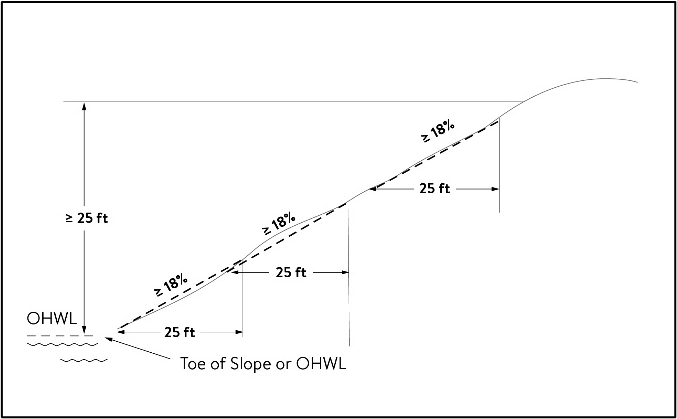
b.
A natural escarpment or cliff with a slope that rises at least ten feet above the ordinary high water level or toe of the slope, whichever is applicable, to the top of the slope, with a slope of 75 degrees or greater. See Figure 2.
Figure 2. Natural Escarpment Bluff and Bluff Impact Zone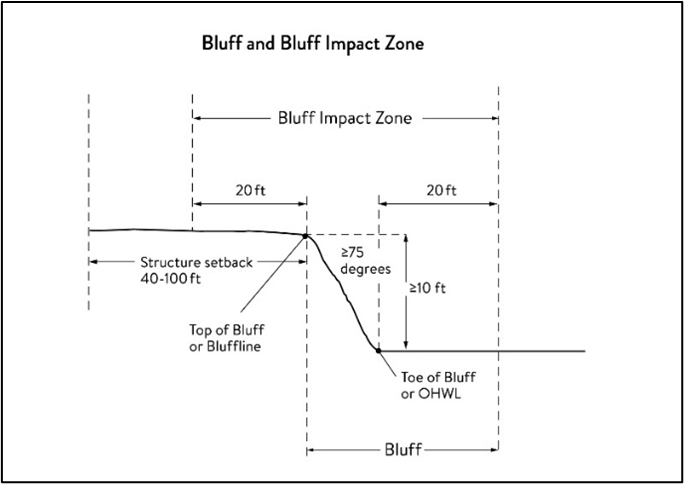
Bluff impact zone (BIZ) means a bluff and land located within 20 feet of the bluff. See Figure 2 for natural escarpment or cliff example and Figure 3 for more common bluff example.
Figure 3. Bluff Impact Zone, Bluffline, Toe of Bluff, and Top of Bluff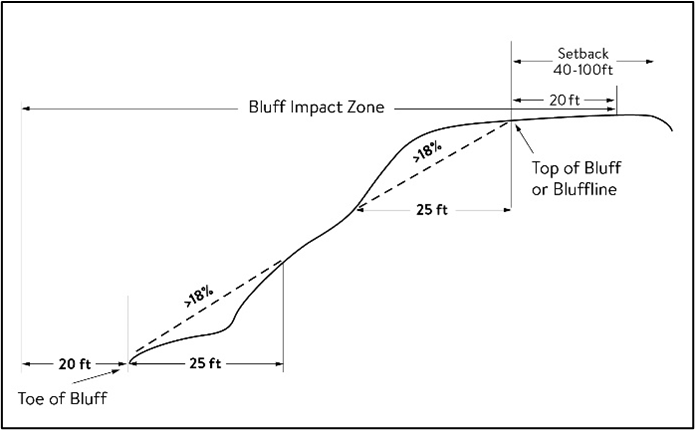
Bluffline means a line delineating the top of the bluff. More than one bluffline may be encountered proceeding landward from the river. See Figure 2 for natural escarpment or cliff example and Figure 3 for more common bluff example.
Bluff, Toe of, means a line along the bottom of a bluff, requiring field verification, such that the slope above the line exceeds 18 percent and the slope below the line is 18 percent or less, measured over a horizontal distance of 25 feet. See Figure 2 for natural escarpment or cliff example and Figure 3 for more common bluff example.
Bluff, Top of, means a line along the top of a bluff, requiring field verification, such that the slope below the line exceeds 18 percent and the slope above the line is 18 percent or less, measured over a horizontal distance of 25 feet. See Figure 2 for natural escarpment or cliff example and Figure 3 for more common bluff example.
Buildable area means the area upon which structures may be placed on a lot or parcel of land and excludes areas needed to meet requirements for setback, rights-of-way, bluff impact zones, historic properties, wetlands, designated floodways, land below the ordinary high water level of public waters, and other unbuildable areas.
Building means a structure with two or more outside rigid walls and a fully secured roof and affixed to a permanent site.
Certificate of compliance means a document written after a compliance inspection, certifying that the development complies with applicable requirements at the time of the inspection.
Commissioner means the commissioner of the Minnesota Department of Natural Resources.
Conditional use means a use having the meaning given under Minnesota Statutes, chapters 394 and 462.
Conservation design means a pattern of subdivision that is characterized by grouping lots within a portion of a parcel, where the remaining portion of the parcel is permanently protected as open space.
Conventional subdivision means a pattern of subdivision that is characterized by lots that are spread regularly throughout a parcel in a lot and block design.
Deck means a horizontal, unenclosed, aboveground level structure open to the sky, with or without attached railings, seats, trellises, or other features, attached or functionally related to a principal use or site.
Developer means having the meaning given under Minnesota Statutes, section 116G.03.
Development means having the meaning given under Minnesota Statutes, section 116G.03.
Discretionary action means an action under this section related to land use that requires a public hearing by local ordinance or statute, such as preliminary plats, final subdivision plats, planned unit developments, conditional use permits, interim use permits, variances, appeals, and rezonings.
Dock means having the meaning given under Minnesota Rules, chapter 6115.
Electric power facilities means equipment and associated facilities for generating electric power or devices for converting wind energy to electrical energy as identified and defined under Minnesota Statutes, section 216E.
Essential services means underground or overhead gas, electrical, communications, steam, or water distribution, collection, supply, or disposal systems, including storm water. Essential services include poles, wires, mains, drains, pipes, conduits, cables, fire alarm boxes, traffic signals, hydrants, navigational structures, aviation safety facilities or other similar equipment and accessories in conjunction with the systems. Essential services does not include buildings, treatment works as defined in Minnesota Statutes, section 115.01, electric power facilities or transmission services.
Feedlot means having the meaning given for animal feedlots under Minnesota Rules, chapter 7020.
Floodplain means having the meaning given under Minnesota Rules, chapter 6120.
Fully reconstructs means the reconstruction of an existing impervious surface that involves site grading and subsurface excavation so that soil is exposed. Mill and overlay and other resurfacing activities are not considered fully reconstructed.
Hard-surface trail means a trail surfaced in asphalt, crushed aggregate, or other hard surface for multi-purpose use, as determined by local, regional, or state agency plans.
Historic property means an archaeological site, standing structure, site, district, or other property that is:
a.
Listed in the National Register of Historic Places or the State Register of Historic Places or locally designated as a historic site under Minnesota Statutes, chapter 471; or
b.
Determined to meet the criteria for eligibility to the National Register of Historic Places or the State Register of Historic Places as determined by the director of the Minnesota Historical Society; or
c.
An unplatted cemetery that falls under the provisions of Minnesota Statutes, chapter 307, in consultation with the Office of the State Archaeologist.
Impervious surface means a constructed hard surface that either prevents or retards the entry of water into the soil and causes water to run off the surface in greater quantities and at an increased rate of flow than prior to development. Examples include rooftops, decks, sidewalks, patios, parking lots, storage areas, and driveways, including those with concrete, asphalt, or gravel surfaces.
Intensive vegetation clearing means the removal of all or a majority of the trees or shrubs in a contiguous patch, strip, row, or block.
Interim use means a use having the meaning given under Minnesota Statutes, chapters 394 and 462.
Land alteration means an activity that exposes the soil or changes the topography, drainage, or cross-section of the land, excluding gardening or similar minor soil disturbances.
Local government means counties, cities, and townships.
Lot means having the meaning given under Minnesota Rules, chapter 6120.
Lot width means the shortest distance between lot lines measured at both the ordinary high water level and at the required structure setback from the ordinary high water level. See Figure 4.
Figure 4. Lot Width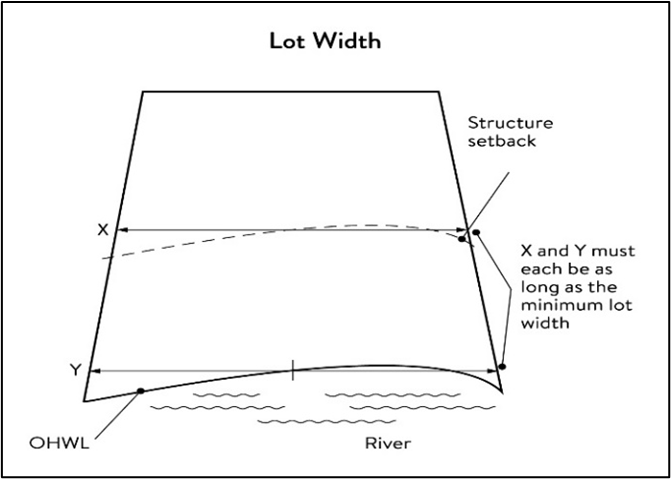
Marina means having the meaning given under Minnesota Rules, chapter 6115.
Mississippi River Corridor Critical Area (MRCCA) means the area within the river corridor boundary as defined in this section.
Mississippi River Corridor Critical Area (MRCCA) Plan means a chapter in the City of Anoka comprehensive plan.
Mooring facility means having the meaning given under Minnesota Rules, part 6115.0170.
Native plant community means a plant community identified by the Minnesota Biological Survey or biological survey issued or adopted by a local, state, or federal agency.
Natural-surface trail means a trail composed of native soil and rock or compacted granular stone, primarily intended for hiking, equestrian, or mountain bike use, as determined by local, regional, or state agency plans.
Natural vegetation means any combination of ground cover, understory, and tree canopy that, while it may have been altered by human activity, continues to stabilize soils, retain and filter runoff, provide habitat, and recharge groundwater.
Nonconformity means having the meaning given under Minnesota Statutes, section 394.22.
Nonmetallic mining means construction, reconstruction, repair, relocation, expansion, or removal of any facility for the extraction, stockpiling, storage, disposal, or reclamation of nonmetallic minerals such as stone, sand, and gravel. Nonmetallic mining does not include ancillary facilities such as access roads, bridges, culverts, and water level control structures. For purposes of this definition, "facility" includes all mine pits, quarries, stockpiles, basins, processing structures and equipment, and any structures that drain or divert public waters to allow mining.
Off-premise advertising signs means those signs that direct attention to a product, service, business, or entertainment venue that is not exclusively related to the premises where the sign is located.
Ordinary high water level (OHWL) means having the meaning given under Minnesota Statutes, section 103G.005.
Overlay district means a zoning district applied over one or more previously established zoning districts, establishing additional or stricter standards and criteria for covered properties in addition to those of the underlying zoning district. Overlay districts are often used to protect historic features and natural resources such as shoreland or floodplain.
Parcel means having the meaning given under Minnesota Statutes, section 116G.03.
Patio means a constructed hard surface located at ground level with no railings and open to the sky.
Picnic shelter means a roofed structure open on all sides, accessory to a recreational use.
Planned unit development (PUD) means a method of land development that merges zoning and subdivision controls, allowing developers to plan and develop a large area as a single entity, characterized by a unified site design, a mix of structure types and land uses, and phasing of development over a number of years. Planned unit development includes any conversion of existing structures and land uses that utilize this method of development.
Plat means having the meaning given under Minnesota Statutes, sections 505 and 515B.
Port means a water transportation complex established and operated under the jurisdiction of a port authority according to Minnesota Statutes, chapter 458.
Primary conservation areas (PCAs) means key resources and features, including shore impact zones, bluff impact zones, floodplains, wetlands, gorges, areas of confluence with tributaries, natural drainage routes, unstable soils and bedrock, native plant communities, cultural and historic properties, and significant existing vegetative stands, tree canopies, and other resources identified in local government plans.
Private facilities means private roads, driveways, and parking areas, private water access and viewing facilities, decks and patios in setback areas, and private signs.
Professional engineer means an engineer licensed to practice in Minnesota.
Public facilities means public utilities, public transportation facilities, and public recreational facilities.
Public recreation facilities means recreational facilities provided by the state or a local government and dedicated to public use, including parks, scenic overlooks, observation platforms, trails, docks, fishing piers, picnic shelters, water access ramps, and other similar water-oriented public facilities used for recreation.
Public river corridor views (PRCVs) means views toward the river from public parkland, historic properties, and public overlooks, as well as views toward bluffs from the ordinary high water level of the opposite shore, as seen during the summer months and documented in the MRCCA plan/chapter of the comprehensive plan.
Public transportation facilities means all transportation facilities provided by federal, state, or local government and dedicated to public use, such as roadways, transit facilities, railroads, and bikeways.
Public utilities means electric power facilities, essential services, and transmission services.
Public waters means having the meaning given under Minnesota Statutes, section 103G.005.
Readily visible means land and development that are easily seen from the ordinary high water level of the opposite shore during summer months.
Resource agency means a federal, state, regional, or local agency that engages in environmental, natural, or cultural resource protection or restoration activities, including planning, implementation, and monitoring.
Retaining wall means a vertical or nearly vertical structures constructed of mortar and rubble masonry, rock, or stone regardless of size, vertical timber pilings, horizontal timber planks with piling supports, sheet pilings, poured concrete, concrete blocks, or other durable materials.
Rock riprap means natural coarse rock placed or constructed to armor shorelines, streambeds, bridge abutments, pilings and other shoreline structures against scour, or water or ice erosion.
River corridor boundary means the boundary approved and adopted by the Metropolitan Council under Minnesota Statutes, section 116G.06, as approved and adopted by the legislature in Minnesota Statutes, section 116G.15, and as legally described in the State Register, volume 43, pages 508 to 518.
River-dependent use means the use of land for commercial, industrial, or utility purposes, where access to and use of a public water feature is an integral part of the normal conduct of business and where the use is dependent on shoreline facilities.
Selective vegetation removal means the removal of isolated individual trees or shrubs that are not in a contiguous patch, strip, row, or block and that does not substantially reduce the tree canopy or understory cover.
Setback means a separation distance measured horizontally.
Shore impact zone (SIZ) means land located between the ordinary high water level of public waters and a line parallel to it at a setback of 50 percent of the required structure setback or, for agricultural use, 50 feet landward of the ordinary high water level. See Figure 5.
Figure 5. Shore Impact Zone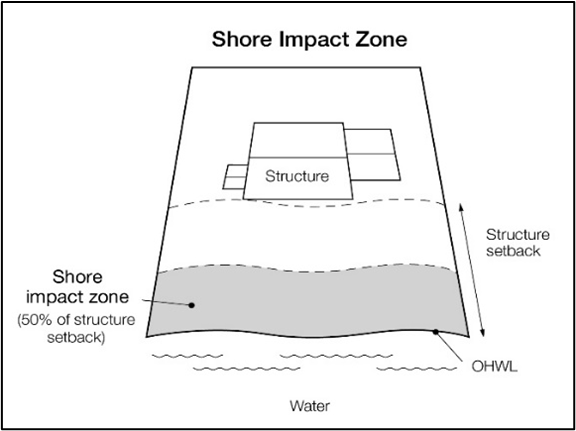
Shoreline facilities means facilities that require a location adjoining public waters for ingress and egress, loading and unloading, and public water intake and outflow, such as barge facilities, port facilities, commodity loading and unloading equipment, watercraft lifts, marinas, short-term watercraft mooring facilities for patrons, and water access ramps. Structures that would be enhanced by a shoreline location, but do not require a location adjoining public waters as part of their function, are not shoreline facilities, such as restaurants, bait shops, and boat dealerships.
Steep slope a natural topographic feature with an average slope of 12 to 18 percent, measured over a horizontal distance equal to or greater than 50 feet, and any slopes greater than 18 percent that are not bluffs.
Storm water management facilities means facilities for the collection, conveyance, treatment, or disposal of storm water.
Structure means a building, sign, or appurtenance thereto, except for aerial or underground utility lines, such as sewer, electric, telephone, or gas lines, and utility line towers, poles, and other supporting appurtenances.
Subdivision means having the meaning given under Minnesota Statutes, section 462.352.
Subsurface sewage treatment system means having the meaning given under Minnesota Rules, part 7080.1100.
Transmission services means:
a.
Electric power lines, cables, pipelines, or conduits that are:
1.
Used to transport power between two points, as identified and defined under Minnesota Statutes, section 216E.01, subd. 4; or
2.
For mains or pipelines for gas, liquids, or solids in suspension, used to transport gas, liquids, or solids in suspension between two points; and
b.
Telecommunication lines, cables, pipelines, or conduits.
Treeline means the more or less continuous line formed by the tops of trees in a wooded area when viewed from a particular point. The treeline is determined during all seasons as if under full foliage.
Variance means having the meaning given under Minnesota Statutes, section 394.22.
Water access ramp means a boat ramp, carry-down site, boarding dock, and approach road, or other access that allows launching and removal of a boat, canoe, or other watercraft with or without a vehicle and trailer.
Water-oriented accessory structure means a small building or other improvement, except stairways, fences, docks, residential irrigation pump covers, and retaining walls, that, because of the relationship of its use to public waters, needs to be located closer to public waters than the normal structure setback. Examples include gazebos, sheds, screen houses, fish houses, pump houses, and detached decks and patios.
Water quality impact zone means land within the shore impact zone or within 50 feet of a public water, wetland, or natural drainage route.
Wetland means the meaning given under Minnesota Statutes, section 103G.005.
Wharf means having the meaning given under Minnesota Rules, part 6115.0170.
(c)
Administration.
(1)
Purpose. The purpose of this section is to identify administrative provisions to ensure this section is administered consistent with its purpose.
(2)
Permits. A permit is required for the construction of buildings or building additions (including construction of decks and signs), the installation and/or alteration of sewage treatment systems, vegetation removal consistent with this section.
(3)
Variances. Variances to the requirements under this section may only be granted in accordance with Minnesota Statutes, section 462.357 and must consider the potential impacts of variances on primary conservation areas, public river corridor views, and other resources identified in the MRCCA plan. In reviewing the variance application, the governing body shall:
a.
Evaluate the impacts to these resources. If negative impacts are found, require conditions to mitigate the impacts that are related to and proportional to the impacts, and
b.
Make written findings that the variance is consistent with the purpose of this section.
(4)
Conditional and interim use permits. All conditional and interim uses, required under this section must comply with Minnesota Statutes, section 462.3595 and must consider the potential impacts on primary conservation areas, public river corridor views, and other resources identified in the MRCCA plan. In reviewing the application, the governing body shall:
a.
Evaluate the impacts to these resources and if negative impacts are found, require conditions to mitigate the impacts that are related to and proportional to the impacts.
(5)
Application materials. Applications for permits and discretionary actions required under this section must submit the following information unless the zoning administrator determines that the information is not needed.
a.
A detailed project description; and
b.
Scaled maps and plans, dimensional renderings, maintenance agreements, and other materials that identify and describe:
1.
Primary conservation areas;
2.
Public river corridor views;
3.
Buildable area;
4.
Existing and proposed topography and drainage patterns;
5.
Proposed storm water and erosion and sediment control practices;
6.
Existing and proposed vegetation to be removed and established;
7.
Ordinary high water level, blufflines, and all required setbacks;
8.
Existing and proposed structures; and
9.
Existing and proposed impervious surfaces.
(6)
Nonconformities.
a.
All legally established nonconformities as of the date of this ordinance may continue consistent with Minnesota Statutes, section 462.357, subd. 1e.
b.
New structures erected in conformance with the setback averaging provisions of this section are conforming structures.
c.
Site alterations and expansion of site alterations that were legally made prior to the effective date of this ordinance are conforming. Site alterations include vegetation, erosion control, storm water control measures, and other nonstructural site improvements.
d.
Legally nonconforming principal structures that do not meet the setback requirements of this section may be expanded laterally provided that:
1.
The expansion does not extend into the shore or bluff impact zone or further into the required setback than the building line of the existing principal structure (see Figure 6); and
2.
The expanded structure's scale and bulk is consistent with that of the original structure and existing surrounding development.
Figure 6. Expansion of Nonconforming Structure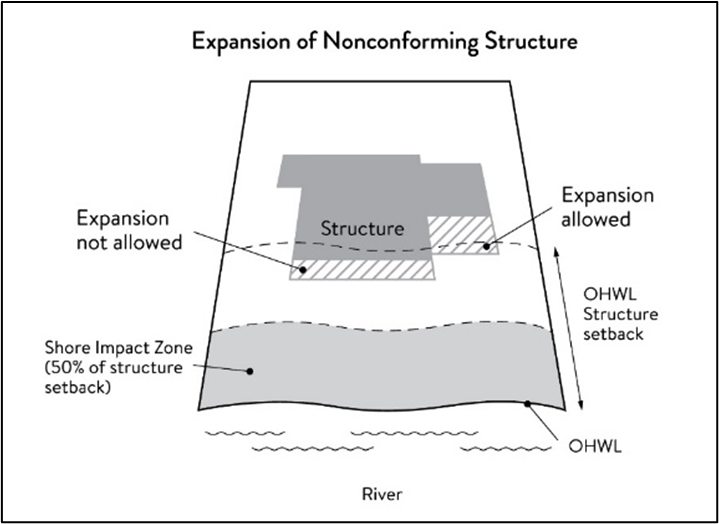
(7)
Notifications.
a.
Amendments to this section and to the MRCCA plan must be submitted to the commissioner as provided in Minnesota Rules, part 6106.0070, subp. 3, items B—I.
b.
Notice of public hearings for discretionary actions, including conditional and interim use permits, variances, appeals, rezonings, preliminary plats, final subdivision plats, and PUDs, must be sent to the following entities at least ten days prior to the hearing:
1.
The Commissioner in a format prescribed by the DNR;
2.
National Park Service; and
3.
Where building heights exceed the height limits specified in this section as part of the conditional use or variance process, adjoining local governments within the MRCCA, including those with overlapping jurisdiction and those across the river.
c.
Notice of final decisions for actions in subsection (c)(7)b. of this section including findings of fact, must be sent to the Commissioner, the National Park Service, and adjoining local governments within the MRCCA within ten days of the final decision.
d.
Requests to amend district boundaries must follow the provisions in Minnesota Rules, part 6106.0100, subp. 9, item C.
(8)
Accommodating disabilities. Reasonable accommodations for ramps or other facilities to provide persons with disabilities access to the persons' property, as required by the Federal Americans with Disabilities Act and the Federal Fair Housing Act and as provided by Minnesota Rules, chapter 1341, must:
a.
Comply with this section; or
b.
If this section cannot be complied with, ramps or other facilities are allowed with an administrative permit provided:
1.
The permit terminates on either a specific date or upon occurrence of a particular event related to the person requiring accommodation; and
2.
Upon expiration of the permit, the ramp or other facilities must be removed.
(d)
MRCCA Districts.
(1)
Purpose. The purpose of this section is to establish districts under which building height and structure placement are regulated to protect and enhance the Mississippi River's resources and features consistent with the natural and built character of each district.
(2)
District description and management purpose. The MRCCA within the city is divided into the following MRCCA Districts:
a.
Rural and Open Space (ROS).
1.
Description. The ROS District is characterized by rural and low-density development patterns and land uses, and includes land that is riparian or visible from the river, as well as large, undeveloped tracts of high ecological and scenic value, floodplain, and undeveloped islands. Many primary conservation areas exist in the district.
2.
Management purpose. The ROS District must be managed to sustain and restore the rural and natural character of the corridor and to protect and enhance habitat, parks and open space, public river corridor views, and scenic, natural, and historic areas.
b.
River Neighborhood (RN).
1.
Description. The RN District is characterized by primarily residential neighborhoods that are riparian or readily visible from the river or that abut riparian parkland. The district includes parks and open space, limited commercial development, marinas, and related land uses.
2.
Management purpose. The RN District must be managed to maintain the character of the river corridor within the context of existing residential and related neighborhood development, and to protect and enhance habitat, parks and open space, public river corridor views, and scenic, natural, and historic areas. Minimizing erosion and the flow of untreated storm water into the river and enhancing habitat and shoreline vegetation are priorities in the district.
c.
River Towns and Crossings (RTC).
1.
Description. The RTC District is characterized by historic downtown areas and limited nodes of intense development at specific river crossings, as well as institutional campuses that predate designation of the MRCCA, and that include taller buildings.
2.
Management purpose. The RTC district must be managed in a manner that allows continued growth and redevelopment in historic downtowns and more intensive redevelopment in limited areas at river crossings to accommodate compact walkable development patterns and connections to the river. Minimizing erosion and the flow of untreated storm water into the river, providing public access to and public views of the river, and restoring natural vegetation in riparian areas and tree canopy are priorities in the district.
d.
Separated from River (SR).
1.
Description. The SR District is characterized by its physical and visual distance from the Mississippi River. The district includes land separated from the river by distance, topography, development, or a transportation corridor. The land in this district is not readily visible from the Mississippi River.
2.
Management purpose. The SR district provides flexibility in managing development without negatively affecting the key resources and features of the river corridor. Minimizing negative impacts to primary conservation areas and minimizing erosion and flow of untreated storm water into the Mississippi River are priorities in the district. The RTC district must be managed in a manner that allows continued growth and redevelopment in historic downtowns and more intensive redevelopment in limited areas at river crossings to accommodate compact walkable development patterns and connections to the river. Minimizing erosion and the flow of untreated storm water into the river, providing public access to and public views of the river, and restoring natural vegetation in riparian areas and tree canopy are priorities in the district.
(3)
MRCCA district map. The locations and boundaries of the MRCCA districts established by this section are shown on the official Anoka Zoning Map which is incorporated herein by reference. The district boundary lines are intended to follow the centerlines of rivers and streams, highways, streets, lot lines, and municipal boundaries, unless a boundary line is otherwise indicated on the map. Where district boundaries cross un-subdivided property, the district boundary line is determined by use of dimensions or the scale appearing on the map.
(e)
Special Land Use Provisions.
(1)
Purpose. To identify development standards and considerations for land uses that have potential to negatively impact primary conservation areas and public river corridor views.
(2)
Underlying zoning. Uses within the MRCCA are generally determined by underlying zoning, with additional provisions for the following land uses:
a.
Agricultural Use. Perennial ground cover is required within 50 feet of the ordinary high water level and within the bluff impact zone.
b.
Feedlots. New animal feedlots and manure storage areas are prohibited. Existing animal feedlots and manure storage areas must conform with Minnesota Rules, chapter 7020.
c.
Forestry. Tree harvesting and biomass harvesting within woodlands, and associated reforestation, must be consistent with recommended practices in Conserving Wooded Areas in Developing Communities: Best Management Practices in Minnesota.
d.
Nonmetallic mining. Nonmetallic mining requires a conditional use permit or interim use permit issued by the local government, subject to the following:
1.
New nonmetallic mining is prohibited within the shore impact zone and bluff impact zone and within the required structure setback from the bluffline and OHWL;
2.
Processing machinery must be located consistent with setback standards for structures as provided in this section;
3.
Only one barge loading area, which must be limited to the minimum size practicable, is permitted for each mining operation;
4.
New and, where practicable, existing nonmetallic mining operations must not be readily visible and must be screened by establishing and maintaining natural vegetation. The unscreened boundaries of nonmetallic mining areas are limited to only the barge loading area;
5.
A site management plan must be developed by the operator and approved by the local government before new nonmetallic mining commences. Operations must be consistent with the site plan throughout the duration of operations at the site. The site management plan must:
i.
Describe how the site will be developed over time with an emphasis on minimizing environmental risk to public waters;
ii.
Explain where staged reclamation may occur at certain points during the life of the site;
iii.
Address dust, noise, storm water management, possible pollutant discharges, days and hours of operation, and duration of operations; and
iv.
Describe any anticipated vegetation and topographic alterations outside the pit, and reclamation plans consistent with the stated end use for the land.
6.
Existing and new nonmetallic mining operations must submit land reclamation plans to the local government compatible with the purposes of this ordinance.
e.
River-dependent uses. River-dependent uses must comply with the following design standards:
1.
Structures and parking areas, except shoreline facilities and private roads and conveyances serving river-dependent uses as provided in this section must meet the dimensional and performance standards in this section, must be designed so that they are not readily visible, and must be screened by establishing and maintaining natural vegetation;
2.
Shoreline facilities must comply with Minnesota Rules, chapter 6115 and must:
i.
Be designed in a compact fashion so as to minimize the shoreline area affected;
ii.
Minimize the surface area of land occupied in relation to the number of watercraft or barges to be served;
3.
Dredging and placement of dredged material are subject to existing federal and state permit requirements and agreements.
f.
Wireless communication towers. Wireless communication towers require a conditional or interim use permit and are subject to the following design standards:
1.
The applicant must demonstrate that functional coverage cannot be provided through co-location, a tower at a lower height, or a tower at a location outside of the MRCCA;
2.
The tower must not be located in a bluff or shore impact zone; and
3.
Placement of the tower must minimize impacts on public river corridor views.
4.
Comply with the general design standards in this section.
(f)
Structure height and placement and lot size.
(1)
Purpose. To establish standards that protect primary conservation areas and public river corridor views from development impacts and ensure that new development is sited consistent with the purpose of the MRCCA.
(2)
Structure height. Structures and facilities must comply with the following standards unless identified as exempt in subsection (l) of this section.
a.
Structures and facilities must comply with the following standards unless identified as exempt in subsection (l) of this section.
1.
ROS District: 35 feet.
2.
RN District: 35 feet.
3.
RTC District: 48 feet, provided tiering of structures away from the Mississippi River and from blufflines is given priority, with lower structure heights closer to the river and blufflines, and that structure design and placement minimizes interference with public river corridor views. Structures over 48 feet are allowed as a conditional use in accordance with this section.
4.
SR District: Height is determined by underlying zoning, provided the allowed height is consistent with that of the mature treeline, where present, and existing surrounding development, as viewed from the OHWL of the opposite shore.
b.
Height is measured on the side of the structure facing the Mississippi River.
c.
In addition to the conditional use permit requirements of this section, criteria for considering whether to grant a conditional use permit for structures exceeding the height limits must include:
1.
Assessment of the visual impact of the proposed structure on public river corridor views, including views from other communities;
2.
Determination that the proposed structure meets the required bluff and OHWL setbacks;
3.
Identification and application of techniques to minimize the perceived bulk of the proposed structure, such as:
i.
Placing the long axis of the building perpendicular to the river;
ii.
Stepping back of portions of the facade;
iii.
Lowering the roof pitch or use of a flat roof;
iv.
Using building materials or mitigation techniques that will blend in with the natural surroundings such as green roofs, green walls, or other green and brown building materials;
v.
Narrowing the profile of upper floors of the building; or
vi.
Increasing the setbacks of the building from the Mississippi River or blufflines;
4.
Identification of techniques for preservation of those view corridors identified in the MRCCA Plan; and
5.
Opportunities for creation or enhancement of public river corridor views.
d.
Structure and impervious surface placement.
1.
Structures and impervious surface must not be placed in the shore or bluff impact zones unless identified as an exemption in subsection (l) of this section.
2.
Structures, impervious surfaces, and facilities must comply with the following OHWL setback provisions unless identified as exempt in subsection (l) of this section.
i.
ROS District: 200 feet from the Mississippi River.
ii.
RN District: 100 feet from the Mississippi River and 75 feet from the Rum River.
iii.
RTC District: 75 feet from the Mississippi and Rum River.
3.
Structures, impervious surfaces, and facilities must comply with the following bluffline setback provisions unless identified as exempt in subsection (l) of this section:
i.
ROS District: 100 feet.
ii.
RN District: 40 feet.
iii.
RTC District: 40 feet.
iv.
SR District: 40 feet.
4.
Where principal structures exist on the adjoining lots on both sides of a proposed building site, the minimum setback may be altered to conform to the average of the adjoining setbacks, if the new structure's scale and bulk riverward or bluffward of the setbacks required under this section are consistent with adjoining development. See Figure 7.
Figure 7. Structure Setback Averaging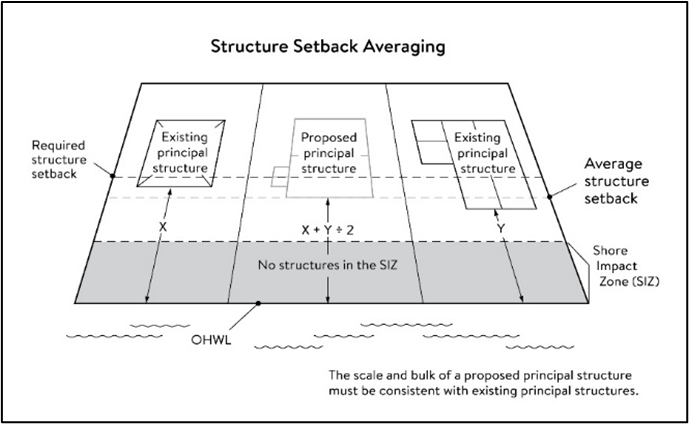
5.
Subsurface sewage treatment systems, including the septic tank and absorption area, must be located at least 75 feet from the ordinary high water level of the Mississippi River and all other public waters.
e.
Lot size and buildable area.
1.
The width of lots abutting the Mississippi River in the ROS District must be at least 200 feet, unless alternative design methods are used that provide greater protection of the riparian area.
2.
All new lots must have adequate buildable area to comply with the setback requirements of this section, so as to not require variances to use the lots for their intended purpose.
(g)
Performance standards for private facilities.
(1)
Purpose. To establish design standards for private facilities that are consistent with best management practices and that minimize impacts to primary conservation areas, public river corridor views and other resources identified in the MRCCA plan.
(2)
General design standards. All private facilities must be developed in accordance with the vegetation management and land alteration requirements of this section.
(3)
Private roads, driveways, and parking areas. Except as otherwise provided in this section, private roads, driveways and parking areas must:
a.
Be designed to take advantage of natural vegetation and topography so that they are not readily visible;
b.
Comply with structure setback requirements in accordance with this section; and
c.
Not be placed within the bluff impact zone or shore impact zone, unless otherwise exempt under this section, and designed in accordance with this section.
(4)
Private water access and viewing facilities.
a.
Private access paths must be no more than:
1.
Eight feet wide, if placed within the shore impact zone; and
2.
Four feet wide, if placed within the bluff impact zone.
b.
Private water access ramps must:
1.
Comply with Minnesota Rules, parts 6115.0210 and 6280.0250; and
2.
Be designed and constructed consistent with the applicable standards in Design Handbook for Recreational Boating and Fishing Facilities.
c.
Design and construction of private stairways, lifts, and landings are subject to the following standards:
1.
Stairways and lifts must not exceed four feet in width on residential lots. Wider stairways may be used for commercial properties and residential facilities held in common, if approved by the zoning administrator;
2.
Landings for stairways and lifts on residential lots must not exceed 32 square feet in area. Landings larger than 32 square feet are allowed for commercial properties and residential facilities held in common, if approved by the zoning administrator;
3.
Canopies or roofs are prohibited on stairways, lifts, or landings;
4.
Stairways, lifts, and landings must be located in the least visible portion of the lot whenever practical; and
5.
Ramps, lifts, mobility paths, or other facilities for persons with physical disabilities are allowed for achieving access to shore areas in accordance with this section.
d.
One water-oriented accessory structure is allowed for each riparian lot or parcel less than 300 feet in width at the ordinary high water level, with one additional water-oriented accessory structure allowed for each additional 300 feet of shoreline on the same lot or parcel. Water-oriented accessory structures are prohibited in the bluff impact zone and must:
1.
Not exceed 12 feet in height;
2.
Not exceed 120 square feet in area; and
3.
Be placed a minimum of 10 feet from the ordinary high water level.
(5)
Decks and patios in setback areas. Decks and at-grade patios abutting the principal structure may encroach into the required setbacks from the ordinary high water level and blufflines without a variance, when consistent with this section, provided that:
a.
The encroachment of the deck or patio into the required setback area does not exceed 15 percent of the required structure setback;
b.
The area of the deck or patio that extends into the required setback area occupies no more than 25 percent of the total area between the required setback and the 15 percent using the formula:
[Required setback depth (feet) x 0.15 x lot width at setback (feet) x 0.25 = maximum total area]
c.
The deck or patio does not extend into the bluff impact zone. See Figure 8.
Figure 8. Deck and Patio Encroachment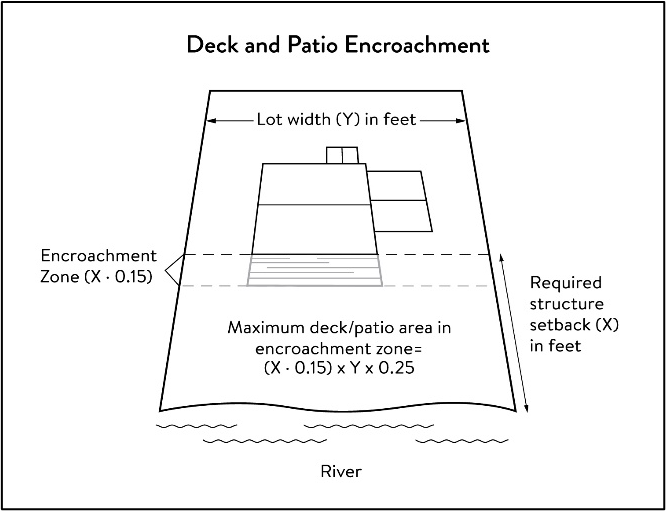
(6)
Off-premise and directional signs.
a.
Off-premise advertising signs must:
1.
Meet required structure placement and height standards in this section.
2.
Not be readily visible from the Mississippi or Rum rivers.
b.
Directional signs for patrons arriving at a business by watercraft must comply with the following standards:
1.
They must be consistent with Minnesota Statutes, section 86B.115.
2.
Only convey the location and name of the establishment and the general types of goods and services available, if located in a shore impact zone.
3.
Be no greater than ten feet in height and 32 square feet in surface area; and
4.
If illuminated, the lighting must be fully shielded and directed downward to prevent illumination out across the river or to the sky.
(7)
Fences. Fences between principal structures and the river are allowed if fences are:
a.
Not higher than four feet, unless immediately surrounding a swimming pool and appurtenances thereto such as a patio or deck, which in that case, not higher than six feet.
b.
A maximum opaqueness of 50%.
c.
Not located within a bluff.
d.
Not located in the regulatory floodplain.
(h)
Performance standards for public facilities.
(1)
Purpose. To establish design standards for public facilities that are consistent with best management practices and that minimize impacts to primary conservation areas, public river corridor views and other resources identified in the MRCCA plan. Public facilities serve the public interest by providing public access to the Mississippi River corridor or require locations in or adjacent to the river corridor and therefore require some degree of flexibility.
(2)
General design standards. All public facilities must be designed and constructed to:
a.
Minimize visibility of the facility from the river to the extent consistent with the purpose of the facility;
b.
Comply with the structure placement and height standards in subsection (f) of this section, except as provided in subsection (l) of this section;
c.
Be consistent with the vegetation management standards and the land alteration and storm water management standards of the section, including use of practices identified in Best Practices for Meeting DNR General Public Waters Work Permit GP 2004-0001, where applicable;
d.
Avoid primary conservation areas, unless no alternative exists. If no alternative exists, then disturbance to primary conservation areas must be avoided to the greatest extent practicable, and design and construction must minimize impacts; and
e.
Minimize disturbance of spawning and nesting times by scheduling construction at times when local fish and wildlife are not spawning or nesting.
(3)
Right-of-way maintenance standards. Right-of-way maintenance must comply with the following standards:
a.
Vegetation currently in a natural state must be maintained to the extent feasible;
b.
Where vegetation in a natural state has been removed, native plants must be planted and maintained on the right-of-way; and
c.
Chemical control of vegetation must be avoided when practicable, but when chemical control is necessary, chemicals used must be in accordance with the regulations and other requirements of all state and federal agencies with authority over the chemical's use.
(4)
Crossings of public water or public land. Crossings of public waters or land controlled by the commissioner are subject to approval by the commissioner according to Minnesota Statutes, sections 84.415 and 103G.245.
(5)
Public utilities. Public utilities must comply with the following standards:
a.
High-voltage transmission lines, wind energy conversion systems greater than five megawatts, and pipelines are regulated according to Minnesota Statutes, chapters 216E, 216F, and 216G respectively; and
b.
If overhead placement is necessary, utility facility crossings must minimize visibility of the facility from the river and follow other existing right-of-ways as much as practicable.
c.
The appearance of structures must be as compatible as practicable with the surrounding area in a natural state with regard to height and width, materials used, and color.
d.
Wireless communication facilities in accordance with subsection (e)(2)f. of this section.
(6)
Public transportation facilities. Public transportation facilities shall comply with structure placement and height standards in subsection (f) of this section. Where such facilities intersect or about two or more MRCCA districts, the least restrictive standards apply. Public transportation facilities must be designed and constructed to give priority to:
a.
Providing scenic overlooks for motorists, bicyclists, and pedestrians;
b.
Providing safe pedestrian crossings and facilities along the river corridor;
c.
Providing access to the riverfront in public ownership; and
d.
Allowing for use of the land between the river and the transportation facility.
(7)
Public recreational facilities. Public recreational facilities must comply with the following standards:
a.
Buildings and parking associated with public recreational facilities must comply with the structure placement and height standards in subsection (f) of this section, except as provided in subsection (l) of this section;
b.
Roads and driveways associated with public recreational facilities must not be placed in the bluff or shore impact zones unless no other placement alternative exists. If no alternative exists, then design and construction must minimize impacts to shoreline vegetation, erodible soils and slopes, and other sensitive resources.
c.
Trails, access paths, and viewing areas associated with public recreational facilities and providing access to or views of the Mississippi River are allowed within the bluff and shore impact zones if design, construction, and maintenance methods are consistent with the best management practice guidelines in Trail Planning, Design, and Development Guidelines.
1.
Hard-surface trails are not allowed on the face of bluffs with a slope exceeding 30 percent. Natural surface trails are allowed, provided they do not exceed eight feet in width.
2.
Trails, paths, and viewing areas must be designed and constructed to minimize:
i.
Visibility from the river;
ii.
Visual impacts on public river corridor views; and
iii.
Disturbance to and fragmentation of primary conservation areas.
d.
Public water access facilities must comply with the following requirements:
1.
Watercraft access ramps must comply with Minnesota Rules, chapters 6115.0210 and 6280.0250; and
2.
Facilities must be designed and constructed consistent with the standards in Design Handbook for Recreational Boating and Fishing Facilities.
e.
Public signs and kiosks for interpretive or directional purposes are allowed in the bluff or shore impact zones, provided they are placed and constructed to minimize disturbance to these areas and avoid visual impacts on public river corridor views.
f.
Public stairways, lifts, and landings must be designed as provided in this section.
(i)
Vegetation management.
(1)
Purpose. To establish standards that sustain and enhance the biological and ecological functions of vegetation; preserve the natural character and topography of the MRCCA; and maintain stability of bluffs and steep slopes and ensure stability of other erosion-prone areas.
(2)
Applicability. This section applies to:
a.
Shore impact zones;
b.
Areas within 50 feet of a wetland or natural drainage route;
c.
Bluff impact zones;
d.
Areas of native plant communities; and
e.
Significant existing vegetative stands identified in the MRCCA plan.
(3)
Activities allowed without a vegetation permit.
a.
Maintenance of existing lawns, landscaping and gardens;
b.
Removal of vegetation in emergency situations as determined by the City of Anoka;
c.
Right-of-way maintenance for public facilities meeting the standards of this section;
d.
Agricultural and forestry activities meeting the standards of this section;
e.
Selective vegetation removal, provided that vegetative cover remains consistent with the management purpose of the MRCCA District, including removal of:
1.
Vegetation that is dead, diseased, dying, or hazardous;
2.
Vegetation to prevent the spread of diseases or insect pests;
3.
Individual trees and shrubs; and
4.
Invasive non-native species.
(4)
Activities allowed with a vegetation permit.
a.
Only the following intensive vegetation clearing activities are allowed with a vegetation permit:
1.
Clearing of vegetation that is dead, diseased, dying, or hazardous;
2.
Clearing to prevent the spread of diseases or insect pests;
3.
Clearing to remove invasive non-native species.
4.
Clearing to prepare for restoration and erosion control management activities consistent with a plan approved by the City of Anoka.
5.
The minimum necessary for development that is allowed with a building permit or as an exemption under subsection (l) of this section.
b.
General performance standards. The following standards must be met, in addition to a restoration plan under this section, in order to approve a vegetation permit:
1.
Development is sited to minimize removal of or disturbance to natural vegetation;
2.
Soil, slope stability, and hydrologic conditions are suitable for the proposed work as determined by a professional engineer.
3.
Clearing is the minimum necessary and designed to blend with the natural terrain and minimize visual impacts to public river corridor views and other scenic views;
4.
Vegetation removal activities are conducted so as to expose the smallest practical area of soil to erosion for the least possible time; and
5.
Any other condition determined necessary to achieve the purpose of this section.
(5)
Prohibited activities. All other intensive vegetation clearing is prohibited.
(6)
Vegetation restoration plan.
a.
Development of a vegetation restoration plan and reestablishment of natural vegetation is required:
1.
For any vegetation removed with a permit under this section;
2.
Upon failure to comply with any provisions in this section; or
3.
As part of the planning process for subdivisions as provided in this section.
b.
Restoration plan performance standards. The vegetation restoration plan must satisfy the application submittal requirements in this section, and:
1.
Vegetation must be restored in one or more of the following restoration priority areas:
i.
Areas with soils showing signs of erosion, especially on or near the top and bottom of steep slopes and bluffs;
ii.
Shoreline areas within 25 feet of the water with no natural vegetation, degraded vegetation, or planted with turf grass;
iii.
Areas on steep slopes and bluffs that are visible from the river with no natural vegetation, degraded vegetation, or planted with turf grass; or
iv.
Other approved priority opportunity area, including priorities identified in the MRCCA plan, if none of the above exist.
2.
Include vegetation that provides suitable habitat and effective soil stability, runoff retention, and infiltration capability. Vegetation species, composition, density, and diversity must be guided by nearby patches of native plant communities and by Native Vegetation Establishment and Enhancement Guidelines;
3.
Any highly erodible soils disturbed during removal and/or restoration must be stabilized with deep-rooted vegetation with a high stem density;
4.
Vegetation removed must be restored with vegetation to the greatest extent practicable. Replacement of non-native vegetation with native vegetation is encouraged. The area (square feet) of the restored vegetation should be similar to that removed to the greatest extent practicable.
5.
For restoration of removed native plant communities, restored vegetation must also provide biological and ecological function equivalent to the removed native plant communities. The area (square feet) of the restored vegetation should be equivalent to that removed;
6.
Be prepared by a qualified individual; and
7.
Include a maintenance plan that includes management provisions for controlling invasive species and replacement of plant loss for three years.
c.
A certificate of compliance will be issued after the vegetation restoration plan requirements have been satisfied.
(j)
Land alteration standards and stormwater management.
(1)
Purpose. To establish standards that protect water quality from pollutant loadings of sediment, nutrients, bacteria, and other contaminants; and maintain stability of bluffs, shorelines, and other areas prone to erosion.
(2)
Land alteration.
a.
Within the bluff impact zone, land alteration is prohibited, except for the following, which are allowed by permit.
1.
Erosion control consistent with a plan approved by the local government or resource agency and consistent with this section;
2.
The minimum necessary for development that is allowed as an exception under subsection (l) of this section; and
3.
Repair and maintenance of existing buildings and facilities.
b.
Within the water quality impact zone, land alteration that involves more than ten cubic yards of material or affects an area greater than 1,000 square feet requires a permit.
(3)
Rock riprap, retaining walls, and other erosion control structures.
a.
Construction, repair, or replacement of rock riprap, retaining walls, and other erosion control structures located at or below the OHWL must comply with Minnesota Rules, part 6115.0215, subp. 4, item E, and 6115.0216, subp. 2. Work must not proceed until approved by the commissioner, permitted by the U.S. Army Corps of Engineers, and any other permits are obtained. See Figure 9.
Figure 9. Riprap Guidelines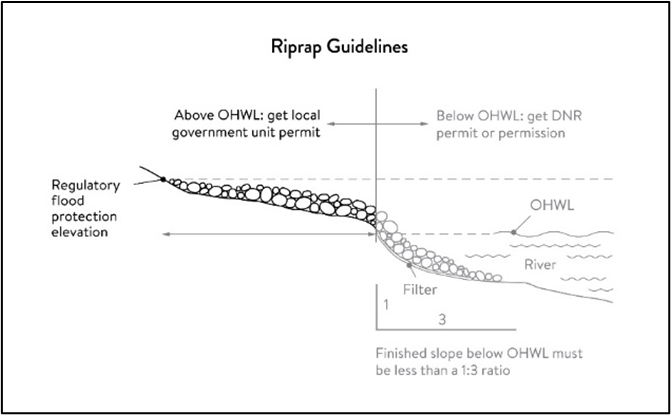
b.
Construction or replacement of rock riprap, retaining walls, and other erosion control structures within the bluff impact zone and the water quality impact zone are allowed with a permit consistent with provisions of this section provided that:
1.
If the project includes work at or below the OHWL, the commissioner has already approved or permitted the project.
2.
The structures are used only to correct an established erosion problem as determined by the City of Anoka.
3.
The size and extent of the structures are the minimum necessary to correct the erosion problem and are not larger than the following, unless a professional engineer determines that a larger structure is needed to correct the erosion problem:
i.
Retaining walls must not exceed five feet in height and must be placed a minimum horizontal distance of ten feet apart; and
ii.
Riprap must not exceed the height of the regulatory flood protection elevation.
c.
The use of gabion cages/walls is prohibited unless no other erosion control technique or structure(s) is feasible.
d.
For retaining walls, the use of natural stone is encouraged such as fieldstone boulders.
e.
Repair of existing rock riprap, retaining walls, and other erosion control structures above the OHWL does not require a permit provided it does not involve any land alteration.
(4)
Stormwater management.
a.
In the bluff impact zone, storm water management facilities are prohibited, except by permit if:
1.
There are no alternatives for storm water treatment outside the bluff impact zone on the subject site;
2.
The site generating runoff is designed so that the amount of runoff reaching the bluff impact zone is reduced to the greatest extent practicable;
3.
The construction and operation of the facility does not affect slope stability on the subject property or adjacent properties; and
4.
Mitigation based on the best available engineering and geological practices is required and applied to eliminate or minimize the risk of slope failure.
b.
In the water quality impact zone, development that creates new impervious surface, as allowed by exemption in subsection (l) of this section, or development that fully reconstructs existing impervious surface of more than 10,000 square feet, requires a stormwater permit. Multipurpose trails and sidewalks are exempt if there is down gradient vegetation or a filter strip that is at least five feet wide.
c.
In all other areas, storm water runoff must be directed away from the bluff impact zones or unstable areas.
(5)
Development on steep slopes. Construction of structures, impervious surfaces, land alteration, vegetation removal, or other construction activities are allowed on steep slopes if:
a.
The development can be accomplished without increasing erosion or storm water runoff;
b.
The soil types and geology are suitable for the proposed development; and
c.
Vegetation is managed according to the requirements of this section.
(6)
Conditions of land alteration permit approval.
a.
Temporary and permanent erosion and sediment control measures retain sediment onsite consistent with best management practices in the Minnesota Stormwater Manual;
b.
Natural site topography, soil, and vegetation conditions are used to control runoff and reduce erosion and sedimentation;
c.
Construction activity is phased when possible;
d.
All erosion and sediment controls are installed before starting any land disturbance activity;
e.
Erosion and sediment controls are maintained to ensure effective operation;
f.
The proposed work is consistent with the vegetation standards in this section; and
g.
Best management practices for protecting and enhancing ecological and water resources identified in Best Practices for Meeting DNR General Public Waters Work Permit GP 2004-0001.
(7)
Compliance with other plans and programs. All development must:
a.
Be consistent with Minnesota Statutes, chapter 103B, and local water management plans completed under Minnesota Statutes, chapter 8410;
b.
Meet or exceed the wetland protection standards under Minnesota Rules, chapter 8420; and
c.
Meet or exceed the floodplain management standards under Minnesota Rules, sections 6120.5000—6120.6200.
(k)
Subdivision and land development standards.
(1)
Purpose.
a.
To protect and enhance the natural and scenic values of the MRCCA during development or redevelopment of the remaining large sites;
b.
To establish standards for protecting and restoring biological and ecological functions of primary conservation areas on large sites; and
c.
To encourage restoration of natural vegetation during development or redevelopment of large sites where restoration opportunities have been identified in MRCCA Plans.
(2)
Applicability.
a.
The design standards in this section apply to subdivisions, planned unit developments and master-planned development and redevelopment of land involving ten or more acres for contiguous parcels that abut the Mississippi River and 20 or more acres for all other parcels, including smaller individual sites within the following developments that are part of a common plan of development that may be constructed at different times:
1.
Subdivisions;
2.
Planned unit developments; and
3.
Master-planned development and redevelopment of land.
b.
The following activities are exempt from the requirements of this section:
1.
Minor subdivisions consisting of three or fewer lots;
2.
Minor boundary line corrections;
3.
Resolutions of encroachments;
4.
Additions to existing lots of record;
5.
Placement of essential services; and
6.
Activities involving river-dependent commercial and industrial uses.
(3)
Application materials. Project information listed in subsection (c)(5) of this section must be submitted for all proposed developments.
(4)
Design standards.
a.
Primary conservation areas, where they exist, must be set aside and designated as protected open space in quantities meeting the following as a percentage of total parcel area:
1.
CA-ROS District: 50%;
2.
CA-RN District: 20%;
3.
CA-RTC, CA-UM, and CA-UC Districts: 10%; and
4.
CA-SR District: 10% if the parcel includes native plant communities or provides feasible connections to a regional park or trail system, otherwise no requirement.
b.
If the primary conservation areas exceed the amounts specified in this section, then protection of native plant communities and natural vegetation in riparian areas shall be prioritized.
c.
If primary conservation areas exist but do not have natural vegetation (identified as restoration priorities in the MRCCA Plan), then a vegetation assessment must be completed to evaluate the un-vegetated primary conservation areas and determine whether vegetation restoration is needed. If restoration is needed, vegetation must be restored in accordance with this section.
d.
If primary conservation areas do not exist on the parcel and portions of the parcel have been identified in the MRCCA plan as a restoration area, vegetation must be restored in the identified areas in accordance with this section and the area must be set aside and designated as protected open space.
e.
Storm water treatment areas or other green infrastructure may be used to meet the protected open space requirements if the vegetation provides biological and ecological functions.
f.
Land dedicated for public river access, parks, or other open space or public facilities may be counted toward the protected open space requirement.
g.
Protected open space areas must connect open space, natural areas, and recreational areas, where present on adjacent parcels, as much as possible to form an interconnected network.
(5)
Permanent protection of designated open space.
a.
Designated open space areas must be protected through one or more of the following methods:
1.
Public acquisition by a government entity for conservation purposes;
2.
A permanent conservation easement, as provided in Minnesota Statutes, chapter 84C;
3.
A deed restriction; and
4.
Other arrangements that achieve an equivalent degree of protection.
b.
Permanent protection methods must ensure the long-term management of vegetation to meet its biological and ecological functions, prohibit structures, and prohibit land alteration, except as needed to provide public recreational facilities and access to the river.
(l)
Exemptions.
(1)
Purpose. To provide exemptions to structure placement, height and other standards for specific river or water access dependent facilities as provided in Minnesota Statutes, section 116G.15 Subd. 4.
(2)
Applicability.
a.
Uses and activities not specifically exempted must comply with this section. Uses and activities exempted under shore impact zone and bluff impact zone must comply with the vegetation management and land alteration standards in this section.
b.
Uses and activities in this section are categorized as:
1.
Exempt - E. This means that the use or activity is allowed;
2.
Exempt if no alternative - (E). This means that the use or activity is allowed only if no alternatives exist; and
3.
Not exempt - N. This means that a use or activity is not exempt and must meet the standards of this ordinance.
(3)
Use and activity exemptions classification.
a.
General uses and activities.
b.
Public utilities.
c.
Public recreational facilities.
d.
River-dependent uses.
1 River-dependent commercial, industrial, and utility structures are exempt from height limits only if greater height is required for operational reasons.
e.
Private residential and commercial water access and use facilities.
(Ord. No. 2023-1780, § 1, 10-16-2023)
Sec. 78-369. - Anoka County Rum River Human Services (ACRRHS) District.
(a)
Purpose and intent. The purpose and intent of the Anoka County Rum River Human Services District is to provide a basis for current and future space needs planning within the district.
(b)
Application. This district is designed as a special purpose district. The standards contained in this section will apply only to the Anoka County Rum River Services District, generally described as the area north of an extension of existing Grant Street, west of 7th Avenue, east of the Rum River, and south of the Anoka High School, and specifically as shown on the official zoning map for the city.
(c)
Permitted uses. The following uses shall be permitted in the ACRRHS district only if the uses are at the direction or under the control of the state or the county:
(1)
Residential treatment facilities for chemical dependency, corrections, mental health, and those in transition from treatment to independent living.
(2)
Transitional housing.
(3)
Homeless shelter.
(4)
Drop-in center.
(5)
Administration and program offices/facilities.
(6)
Cafeterias/food service.
(7)
Program space for distribution of household goods.
(d)
Accessory uses. The following uses shall be permitted as accessory uses in the ACRRHS district:
(1)
Heating facilities/power plant.
(2)
Laundry.
(3)
Maintenance facilities.
(4)
Storage structures.
(5)
Transit shelters.
(6)
Outdoor recreation areas.
(7)
Trails.
(8)
Pavilions.
(e)
Setbacks. The following setback regulations shall apply in the ACRRHS district:
(1)
Structures, whether principal buildings or accessory structures, shall be set back a minimum of 25 feet from neighboring properties.
(2)
Parking shall be a minimum of 15 feet from neighboring properties.
(3)
The distance between structures within the campus shall be a minimum of 15 feet or as required by the state building code, whichever is greater.
(f)
Height.
(1)
Existing structures shall not be increased in height. Additions to existing structures shall be of the same or lesser height as the existing structure.
(2)
New structures shall be limited to a maximum of four stories unless a conditional use permit to increase the height is obtained from the city.
(g)
Site plan required. Site plan approval is required for construction of principal buildings and accessory structures in the ACRRHS district. Information shall be submitted for site plan review according to section 78-36. In addition, the following information must be submitted: Applicable information, such as number of beds, number of employees on a major shift, seating capacities, etc., to determine required parking spaces and traffic circulation impacts.
(h)
Exterior materials on existing buildings. All accessory structures and subsequent additions to a principal building existing at the time of adoption of the ordinance from which this section is derived shall:
(1)
Be constructed of the same exterior materials or materials designed to simulate the materials on the principal building;
(2)
Be of the same general appearance; and
(3)
Be of the same architectural design.
(i)
Building permits. Building permits shall be obtained as required by the state building code.
(j)
Overlay district standards.
(1)
The following environmental overlay district standards shall apply where appropriate:
a.
Shore land regulations;
b.
Rum River Wild and Scenic Regulations;
c.
Floodplain regulations.
(2)
Where overlay district standards are in conflict, the most restrictive standard shall apply.
(k)
Parking and loading. Unless otherwise regulated by this section, parking and loading shall be regulated by article IX, division 2 of this chapter.
(l)
Impervious surface. No more than 85 percent of a lot may be covered by impervious surface, and no more than 50 percent of a lot may be covered by buildings.
(m)
Enforceability, violation. Unless expressly provided otherwise, it shall be a misdemeanor for any person or entity to violate any provisions of this chapter, including this section, any rule or regulation adopted in pursuance of any such provision, or any other order lawfully enforcing this chapter or this section. In addition to seeking prosecution of a violation as a misdemeanor, the city may separately, or in conjunction with the misdemeanor prosecution, bring an action for specific performance to enforce any provisions of this chapter, including this section, any rule or regulation adopted in pursuance of such provision, or any order lawfully enforcing this chapter, including this section.
(Prior Code, § 74-276; Ord. of 10-15-2018)

