
Arcadia City Zoning Code
Division 2
- Zones, Allowable Uses, and Development Standards
9102.01.010 - Purpose and Intent.
The purpose of the residential zones is to:
1.
Provide for a full range of housing types and densities consistent with the General Plan;
2.
Preserve, protect, and enhance the character of Arcadia's residential neighborhoods and the quality of life of City residents;
3.
Ensure adequate light, air, privacy, and open space for each dwelling; and
4.
Ensure that the scale and design of new development and alterations to existing structures are compatible with surrounding homes and appropriate to the physical characteristics of the site and the area where the project is proposed.
A.
R-M Residential Mountainous Zone. The R-M zone is intended to provide areas for detached single-family dwelling units on estate-type lots in the hillside and valley areas of the City and accessory uses compatible with the residential use of the zone. This zone implements the General Plan Residential Estates designation.
B.
R-0 Very Low Density Residential Zone. The R-0 zone is intended to provide areas for detached single-family dwelling units on large lots and accessory uses compatible with the residential use of the zone. This zone implements the General Plan Residential Estates, Very Low Density Residential, and Low Density Residential designations.
C.
R-1 Low Density Residential Zone. The R-1 zone is intended to provide areas for detached single-family dwelling units and accessory uses compatible with the residential use of the zone. This zone implements the General Plan Very Low Density Residential and Low Density Residential designations.
D.
R-2 Medium Density Residential Zone. The R-2 zone is intended to provide areas for a variety of dwelling types and accessory uses compatible with the residential use of the zone. Types of dwelling units include attached or detached single-unit and multi-unit homes and duplexes at a density of six to 12 dwelling units per acre. This zone implements is the General Plan Medium Density Residential designation.
E.
R-3 High Density Residential Zone. The R-3 zone is intended to provide areas for a variety of medium- to high-density residential development and accessory uses compatible with the residential use of the zone. Types of dwelling units include single-unit attached, townhomes, condominiums, and apartment structures at a density of 20 to 40 units per acre. This zone implements the General Plan High Density Residential designation.
F.
R-3-R Restricted High Density Residential Zone. The R-3-R zone is intended to provide areas for medium to high-density residential development at a density of 12 to 30 units per acre but restricted to one story in height. Accessory uses compatible with the residential use of the zone are also permitted. This zone implements the General Plan High Density Residential designation.
(Ord. No. 2400, § 4(Exh. A), 2-20-24)
9102.01.020 - Land Use Regulations and Allowable Uses.
A.
Allowed Uses. Table 2-1 (Allowed Uses and Permit Requirements for Residential Zones) indicates the uses allowed within each residential zone and any permits required to establish the use, pursuant to Division 7 (Permit Processing Procedures). The regulations for each zone are established by letter designations as follows:
"P" represents permitted (allowed) uses.
"A" represents accessory uses.
"M" designates uses that require the approval of a Minor Use Permit subject to requirements of Section 9107.09 (Conditional Use Permit and Minor Use Permit) of this Development Code.
"C" designates uses that require the approval of a Conditional Use Permit subject to requirements of Section 9107.09 (Conditional Use Permit and Minor Use Permit) of this Development Code.
"—" designates uses that are not permitted.
B.
Director Determination. Land uses are defined in Division 9 (Definitions). In cases where a specific land use or activity is not defined, the Director shall assign the land use or activity to a classification substantially similar in character. Land uses not listed in the table or not found to be substantially similar to the land uses below are prohibited.
C.
Specific Use Regulations. Where the last column in Table 2-1 (Allowed Uses and Permit Requirements for Residential Zones) includes a Section, Subsection, or Division number, the regulations in the referenced Section, Subsection, or Division shall apply to the use.
D.
Housing Element Candidate Sites. Pursuant to Government Code Section 65583.2(c), residential uses shall be allowed by-right for housing development in which at least 20% of the units are affordable to lower-income households for sites that:
1.
Are non-vacant and identified in the 5 th Cycle Housing Element planning period; and
2.
Vacant sites included in two or more consecutive Housing Element planning cycle;
3.
Eligible sites can be found in the City's 2021-2029 Housing Element (6 th Cycle). Development shall meet all of the requirements of the respective zone in which such sites are located in unless otherwise permitted by this Division, and shall comply with the provisions of applicable environmental documents for such site, if any.
E.
Multi-Family Uses Permitted By-Right. Multifamily residential uses are permitted by-right in the following zones when 20% or more affordable units are provided per Gov't Code Section 65583.2(i): R-2, R-3, R-3-R, MU, DMU, and RF and DMU overlays.
(Ord. No. 2347, § 4(Exh. A), 6-6-17; Ord. No. 2348, § 3, 8-1-17; Ord. No. 2369, § 3, 12-17-19; Ord. No. 2370, § 3, 1-21-20; Ord. No. 2397, § 4(Exh. A), 11-7-23; Ord. No. 2400, § 4(Exh. A), 2-20-24; Ord. No. 2401, Exh. A, 4-15-25)
9102.01.030 - Development Standards in Single-Family Residential Zones (R-M, R-0, R-1).
New land uses and structures, and alterations to existing land uses and structures, shall be designed, constructed, and/or established in compliance with the requirements in Tables 2-1 (Allowed Uses and Permit Requirements for Residential Zones), 2-2 (Development Standards for Single-family Residential Zones), and 2-3 (Additional Development Standards for Homeowners Association Areas), and the development standards in Division 3 (Regulations Applicable to All Zones-Site Planning and General Development Standards). Additional regulations are denoted in the right hand column of Table 2-2 and Table 2-3. Exceptions and additional regulations are included in Subsection 9102.01.040 (Additional Residential Development Standards in Single-Family Residential Zones). Standards for accessory structures and accessory dwelling units are outlined in Subsection 9102.01.060 (Accessory Structures in Single-family Residential Zones) and Subsection 9102.01.080 (Accessory Dwelling Units). Development standards for garages and other parking areas are located in Section 9103.07 (Off-Street Parking and Loading). Development standards for fences, walls, and gates are outlined in Section 9103.05 (Fences, Walls, and Gates). Development standards for landscaping requirements are located in Section 9103.09.040.B (Landscape Requirements for Residential Zones).
Notes:
(1) In cases where the underlying zoning's Development Standard is greater than the requirements stated in Table 2-3, Additional Development Standards for Homeowners Association Areas Single-family Residential Zones (R-M, R-0, R-1), the underlying zoning shall be used unless an exception is specifically identified.
(2) See Subsection 9103.01.030 (Measuring Floor Area and Floor Area Ratio)
(3) See Subsection 9102.01.040(J) for additional regulations regarding garages and carports.
Figure 2-1
Encroachment Plan - R-0 and R-1 Zones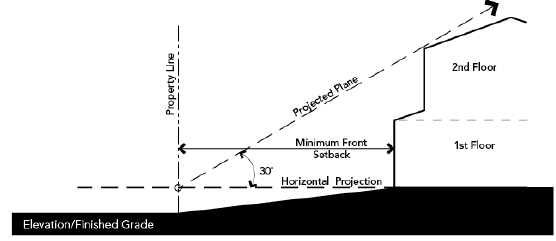
(Ord. No. 2347, § 4(Exh. B), 6-6-17; Ord. No. 2363, § 4(Exh. A), 11-5-19; Ord. No. 2401, Exh. A, 4-15-25)
9102.01.040 - Additional Residential Development Standards in Single-Family Residential Zones.
A.
Front Setbacks - Additional Standards in R-M, R-0, and R-1 Zones.
1.
Front Setback Exceptions.
a.
Front Setback Exception: R-M Zone. The front setback shall be the average of the two nearest developed lots that front on the same street, unless a greater setback is specified in Subsection 9102.01.030, Table 2-3 (Additional Development Standards for Homeowners Association Areas) or Subsection 9103.01.060 (Setback Measurements and Exceptions).
b.
Front Setback Exception: R-0 Zone. The front setback shall be the greater of (a) 35 feet; and (b) the average of the two nearest developed lots, unless a greater setback is specified in Subsection 9102.01.030, Table 2-3 (Additional Development Standards for Homeowners Association Areas) or Subsection 9103.01.060 (Setback Measurements and Exceptions).
c.
Front Setback Exception: R-1 Zone. The front setback shall be the greater of (a) 25 feet; and (b) the average of the two nearest developed lots, unless a greater setback is specified in Subsection 9102.01.030, Table 2-3 (Additional Development Standards for Homeowners Association Areas) or Subsection 9103.01.060 (Setback Measurements and Exceptions).
B.
No Parking within Front and/or Street Side Setbacks. No parking shall be allowed within required front or street side setbacks, or within any landscaped area not designated as a driveway or parking space.
C.
Exceptions to Rear Setbacks on Corner and Reverse Corner Lots in R-0 and R-1 Zones - Attached Single-Story Garage. On corner and reverse corner lots in the R-0 and R-1 zones, an attached garage portion of a main dwelling that does not exceed one story and 16 feet in height may be located within 15 feet of the rear property line.
D.
Height Exception for Chimneys and Roof-Mounted Vents. Chimneys and roof-mounted vents shall be allowed to exceed height limits to the minimum extent required by Article VIII (Building Regulations).
E.
Temporary/Portable Structures. One temporary or portable structure, with the exception of tents and canopies, not exceeding 120 square feet in area and eight feet six inches in height is permitted. The structure shall comply with all setback requirements and, if applicable, be approved by the City's established Homeowners' Association.
F.
Roof Decks. Roof decks are not permitted in the R-M, R-0, and R-1 zones.
G.
Basements.
1.
Extent. Basements shall not extend beyond the external walls of the first story of the structure above the basement.
2.
Minimum Setback. On any lot, the minimum setback to the basement wall is 10 feet from any property line.
3.
Light Wells. Light wells for basements and exterior stairways to basements are permitted to the extent necessary to comply with Building and Fire Codes. Light wells for basements and exterior stairways shall be set back a minimum of five feet from any property lines.
H.
Porch Height.
1.
There shall be no vertical or architectural elements located above the building primary entrance entry that emphasizes the scale and massing of the structure.
2.
For projecting porches, the maximum allowable height as required in Table 2-2 shall be measured to the uppermost point of the projecting feature, including roof ridges, railings, cornices, and other decorative features. For recessed porches, the height shall be measured to the uppermost point of the opening.
I.
Hillside Development Standards. Hillside development standards outlined in this Subsection shall apply to development of all new structures, additions to existing structures, and other property improvements in the R-M zone and any lot with an average slope of 20 percent or greater. For the purposes of this Subsection, swimming pools, spas, and fish ponds constructed on a lot shall all be considered structures.
1.
Minimum Distance between Structures and Slopes. In addition to the setback requirements that apply to the underlying zone, the minimum distance between a structure and the top or toe of slope where the slope is between the structure and front, side, and/or rear property line(s) shall be 5 feet. See Figure 2-2 (Minimum Distance Between Structures and Slopes).
Figure 2-2
Minimum Distance Between Structures and Slopes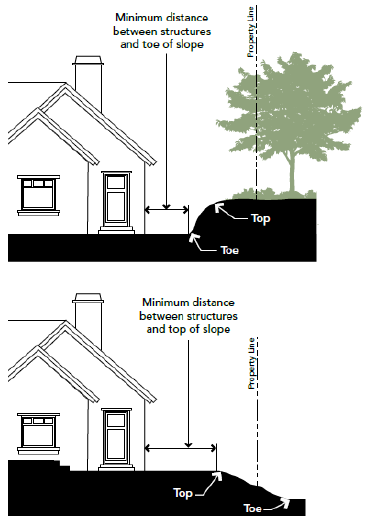
2.
Ridgeline Protection.
a.
Structures shall be located so that a vertical separation of at least 30 feet is provided between the top of the structure and the top of the ridge or knoll to maintain the natural appearance of the ridge. Grading should also be avoided within 30 vertical feet of the top of a ridge or knoll. Placement of structures should also take advantage of existing vegetation for screening, and should include the installation of additional native plant materials to augment existing vegetation, where appropriate.
b.
Structures shall not be placed so that they appear silhouetted against the sky when viewed from a public street, except where the Review Authority determines that the only feasible building site cannot comply with this standard. See Figure 2-3 (Ridgeline Protection - Residential Hilltop Line of Sight).
Figure 2-3
Ridgeline Protection - Residential Hilltop Line of Sight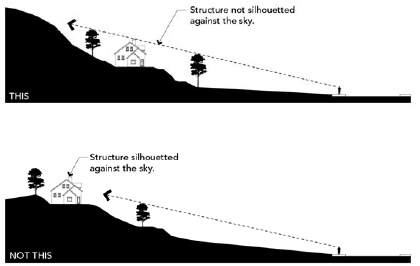
3.
Landscaping Requirements. All cut or fill slopes exceeding six feet six inches in vertical height between two or more contiguous lots shall be planted with adequate plant material to protect the slope against erosion. Said planting shall cover the bank within two years from the time of planting. The permittee, owner or developer shall water the planted slopes at sufficient time intervals to promote growth.
4.
Maintenance and Grading Permit Required. The owner of any property, or any other person or agent in control of such property, on which is located any retaining walls, cribbing, drainage structures, planted slopes and other protective devices, required pursuant to a permit granted under this Division or required pursuant to the issuance of a grading permit, shall maintain said retaining walls, cribbing, drainage structures, planted slopes and other protective devices in good condition and repair at all times.
J.
Garages and Carports in Homeowners Association Areas. Carports shall not be permitted in the Homeowners Association Areas. The following regulations shall apply to garages in Homeowners Association Areas:
1.
Santa Anita Village: Garages shall not dominate the front elevation and shall be setback from the front façade or located in the backyard.
2.
Lower Rancho: Garages shall not dominate the front elevation and shall be setback from the front façade or located in the backyard.
3.
Santa Anita Oaks: No garage shall be closer to the front property line than the main dwelling. Front facing garages are strongly discouraged. A detached garage shall not be located less than 150 feet from the front property line.
Exceptions:
Tract 11013 which shall be a minimum of 140 ft. Tracts 13345, 14656, and 13544 shall
be a minimum of 125 ft.
4.
Upper Rancho: No garage door shall be allowed to face the public right-of-way within the front 150 ft of the property. No garage door shall be closer to the street than the dwelling. Corner lots shall be evaluated on a case-by-case basis.
Exception:
Lots 1 through 20 of Tract No. 13184
(Ord. No. 2347, § 4(Exh. B), 6-6-17; Ord. No. 2363, § 4(Exh. A), 11-5-19)
9102.01.050 - Permitted Projections in Single-Family Residential Zones.
A.
Permitted Architectural Projections in Single-Family Residential Zones. In R-M, R-0, and R-1 zones, architectural and similar features may extend into required setback areas as identified in Table 2-4 (Permitted Projections and Encroachment into Required Setback in Single-Family Zones).
Notes:
(1)
Front Setback Exception (R-M Zone only) - Architectural features shall not project into the front setback in the R-M zone.
(2)
Side Setback Exception (R-M Zone only) - A portion of a gable roof and walls thereunder which do not exceed a maximum height of 20 feet and which enclose a portion of the first story living area and/or interior stairwells which have no window(s) facing the side yard, may encroach into the required setback but in no event shall such encroachment be less than the required first story setback except as may be approved pursuant to an Administrative Modification (Section 9107.05).
(3)
Rear Setback Exception (R-M Zone only) - Architectural features shall not project into the rear setback in the R-M zone.
(4)
In all zones, bay windows, garden windows, and other similar architectural projections shall have a vertical distance of 30 inches or greater between the lowest surface of the projection and the finished floor.
(5)
Eaves Exception (R-M Zone only) - Eaves may extend or project a maximum of two feet beyond the required setback on both the first and second stories.
B.
Mechanical Equipment Projections in Single-Family Residential Zones. Mechanical equipment shall comply with the required setbacks set forth for the structure the mechanical equipment will serve. Exceptions: (1) Tankless water heaters and solar batteries may encroach into the required side and rear setbacks by 30 inches. (2) Mechanical equipment serving swimming pools, spas, and water features shall not be set back less than three feet from the rear property line.
(Ord. No. 2347, § 4(Exh. B), 6-6-17; Ord. No. 2401, Exh. A, 4-15-25)
9102.01.060 - Accessory Structures in Single-Family Residential Zones.
Accessory structures, as defined in Division 9 (Definitions) of this Development Code, but excluding required garages, are allowed in residential zones and are subject to the development standards set forth in Table 2-5 (Development Standards for Accessory Structures in the R-M, R-0, and R-1 Zones). Accessory dwelling unit regulations are set forth in Subsection 9102.01.080 (Accessory Dwelling Units). Any allowable accessory structure that does not require a building permit shall meet the requirements of this Development Code for use, placement on the lot, height, and size. The construction and/or relocation of an accessory structure shall require review and approval per the Site Plan and Design Review, as set forth in Section 9107.19 (Site Plan and Design Review).
A.
Restrictions on Number and Use.
1.
Primary Building Required. An accessory structure(s) is allowed onsite only when there is a primary dwelling on site.
2.
Number Allowed. A maximum of two detached accessory structures are allowed on any one lot. This maximum number is reduced by the number of legal accessory dwelling units on the lot.
3.
Kitchen. No kitchen is allowed within the accessory structure.
4.
Bathroom. The accessory structure may contain a sink, a toilet and/or a shower.
5.
Rooms. No more than one room is allowed within the accessory structure, aside from a bathroom containing a sink, toilet and/or a shower.
6.
Covenant Required. A covenant approved as to form by the City shall be recorded prior to the issuance of any building permit for any accessory structure stating that the accessory structure will not be used for overnight stay, rented, or used as a dwelling unit.
B.
Development Standards.
1.
General Standards. Accessory structures shall comply with the development standards set forth in Table 2-5 (Development Standards for Accessory Structures in the R-M, R-0, and R-1 Zones).
2.
Consistent Exterior Appearance. All accessory structures on a permanent foundation shall be consistent in exterior appearance with the primary structure through the use of similar/matching exterior paint colors, material types, and architectural styles.
(Ord. No. 2347, § 4(Exhs. A, B), 6-6-17; Ord. No. 2369, § 3, 12-17-19; Ord. No. 2370, § 3, 1-21-20; Ord. No. 2401, Exh. A, 4-15-25)
9102.01.070 - Swimming Pools, Spas, Water Features, and Ornamental Features.
A.
Purpose and Applicability. The provisions of this Subsection supplement those pertaining to swimming pool enclosures set forth in Article VIII (Building Regulations), Chapter 5 (Swimming Pool Enclosures and Safety Devices) of the Municipal Code.
B.
Pools and Spas Setbacks in the R-M, R-0, and R-1 Zones. Private swimming pools and spas may not be constructed and maintained in any required front yard, nor within five feet of any side or rear lot line, nor within 10 feet of the property line on the street side of a corner lot. Pools in the street side yard shall be fully screened from the public right-of-way. The open portions of such pools or spas shall be deemed as open and unobstructed areas for the purposes of computing landscaping area requirements.
C.
Water Features. The following limitations shall apply for the installation of any water feature (including fountains and ponds, but not including swimming pools and spas) and its mechanical equipment:
1.
Maximum Height. The maximum height of a water feature shall not exceed four feet six inches, as measured from the adjacent existing grade.
2.
Minimum Front Setback. All water features and related mechanical equipment shall be at least 15 feet from the front property line.
3.
Minimum Side and Rear Setbacks. All water features that require external mechanical equipment shall comply with applicable side and rear setback requirements of the accessory structure.
4.
Maximum Depth. The maximum water depth of a water feature shall not exceed 18 inches measured from the highest possible water level, or as required by California Building Code Chapter 31 (Special construction), Section 3119.B.5 (Pools), as it may be amended from time to time.
D.
Ornamental Features. The following limitations shall apply for the installation of any ornamental feature (including statues and other ornamental art, but not including pools, spas, fountains, or ponds):
1.
Maximum Height. The maximum height of an ornamental feature shall not exceed four feet six inches, as measured from the adjacent existing grade.
2.
Minimum Front Setback. All ornamental features shall be at least 15 feet from the front property line.
3.
Maximum Number. The maximum number of ornamental features located within the front yard shall not exceed two.
(Ord. No. 2347, § 4(Exh. B), 6-6-17)
9102.01.080 - Accessory Dwelling Units.
A.
Purpose. The purpose of this section is to allow and regulate accessory dwelling units (ADUs) and junior accessory dwelling units (JADUs) in compliance with Chapter 13 of Division 1 of Title 7 of the California Government Code.
B.
Effect of Conforming. An ADU or JADU that conforms to the standards in this section will not be:
1.
Deemed to be inconsistent with the City's General Plan and zoning designation for the lot on which the ADU or JADU is located.
2.
Deemed to exceed the allowable density for the lot on which the ADU or JADU is located.
3.
Considered in the application of any local ordinance, policy, or program to limit residential growth.
4.
Required to correct a nonconforming zoning condition, as defined below under Definitions. This does not prevent the City from enforcing compliance with applicable building standards in accordance with Health and Safety Code Section 17980.12.
C.
Definitions. As used in this section, terms are defined as follows:
1.
"Accessory dwelling unit" or "ADU" means an attached or a detached residential dwelling unit that provides complete independent living facilities for one or more persons and is located on a lot with a proposed or existing primary residence. An accessory dwelling unit also includes the following:
a.
An efficiency unit, as defined by Section 17958.1 of the California Health and Safety Code; and
b.
A manufactured home, as defined by Section 18007 of the California Health and Safety Code.
2.
"Accessory structure" means a structure that is accessory and incidental to a dwelling located on the same lot.
3.
"Complete independent living facilities" means permanent provisions for living, sleeping, eating, cooking, and sanitation on the same parcel as the single-family or multifamily dwelling is or will be situated.
4.
"Efficiency kitchen" means a kitchen that includes all of the following:
a.
A cooking facility with appliances.
b.
A food preparation counter and storage cabinets that are of a reasonable size in relation to the size of the JADU.
5.
"Junior accessory dwelling unit" or "JADU" means a residential unit that satisfies all of the following:
a.
It is no more than 500 square feet in size.
b.
It is contained entirely within an existing or proposed single-family structure. An enclosed use within the residence, such as an attached garage, is considered to be a part of and contained within the single-family structure.
c.
It includes its own separate sanitation facilities or shares sanitation facilities with the existing or proposed single-family structure.
d.
If the unit does not include its own separate bathroom, then it contains an interior entrance to the main living area of the existing or proposed single-family structure in addition to an exterior entrance that is separate from the main entrance to the primary dwelling.
e.
It includes an efficiency kitchen, as defined above.
6.
"Livable space" means a space in a dwelling intended for human habitation, including living, sleeping, eating, cooking, or sanitation.
7.
"Living area" means the interior habitable area of a dwelling unit, including basements and attics, but does not include a garage or any accessory structure.
8.
"Nonconforming zoning condition" means a physical improvement on a property that does not conform with current zoning standards.
9.
"Passageway" means a pathway that is unobstructed clear to the sky and extends from a street to one entrance of the ADU or JADU.
10.
"Proposed dwelling" means a dwelling that is the subject of a permit application and that meets the requirements for permitting.
11.
"Public transit" means a location, including, but not limited to, a bus stop or train station, where the public may access buses, trains, subways, and other forms of transportation that charge set fares, run on fixed routes, and are available to the public.
12.
"Tandem parking" means that two or more automobiles are parked on a driveway or in any other location on a lot, lined up behind one another.
D.
Approvals. The following approvals apply to ADUs and JADUs under this section:
1.
Building-permit Only. If an ADU or JADU complies with each of the general requirements in subsection (E) below, it is allowed with only a building permit in the following scenarios:
A.
Converted on Single-family Lot: One ADU as described in this subsection and one JADU on a lot with a proposed or existing single-family dwelling on it, where the ADU or JADU:
1.
Is either: within the space of a proposed single-family dwelling; within the existing space of an existing single-family dwelling; or (in the case of an ADU only) within the existing space of an accessory structure, plus up to 150 additional square feet if the expansion is limited to accommodating ingress and egress; and
2.
Has exterior access that is independent of that for the single-family dwelling; and
3.
Has side and rear setbacks sufficient for fire and safety, as dictated by applicable building and fire codes.
4.
The JADU complies with the requirements of Government Code sections 66333 through 66339.
B.
Limited Detached on Single-family Lot: One detached, new-construction ADU on a lot with a proposed or existing single-family dwelling (in addition to any JADU that might otherwise be established on the lot), if the detached ADU satisfies each of the following limitations:
1.
The side and rear yard setbacks are at least four (4) feet.
2.
The total floor area is 800 square feet or smaller.
3.
The height does not exceed the applicable height limit in subsection below under "Height."
C.
Converted on Multifamily Lot: One or more ADUs within portions of existing multifamily dwelling structures that are not used as livable space, including but not limited to storage rooms, boiler rooms, passageways, attics, basements, or garages, if each converted ADU complies with state building standards for dwellings. At least one converted ADU is allowed within an existing multifamily dwelling, up to a quantity equal to 25 percent of the existing multifamily dwelling units.
D.
Limited Detached on Multifamily Lot: No more than two detached ADUs on a lot with a proposed multifamily dwelling, or up to eight detached ADUs on a lot with an existing multifamily dwelling, if each detached ADU satisfies all of the following:
1.
The side and rear yard setbacks are at least four feet. If the existing multifamily dwelling has a rear or side yard setback of less than four feet, the city will not require any modification to the multifamily dwelling as a condition of approving the ADU.
2.
The height does not exceed the applicable height limit provided in subsection below under "Height."
3.
If the lot has an existing multifamily dwelling, the quantity of detached ADUs does not exceed the number of primary dwelling units on the lot.
2.
ADU Permit.
A.
Except as allowed under subsection (D)(1) above, no ADU may be created without a building permit and an ADU permit in compliance with the standards set forth in subsections (E) and (F) below.
B.
The city may charge a fee to reimburse it for costs incurred in processing ADU permits, including the costs of adopting or amending the city's ADU ordinance. The ADU-permit processing fee is determined by the director of community development and approved by the city council by resolution.
3.
Process and Timing.
A.
An ADU permit is considered and approved ministerially, without discretionary review or a hearing.
B.
The city must approve or deny an application to create an ADU or JADU within 60 days from the date that the city receives a completed application. If the city has not approved or denied the completed application within 60 days, the application is deemed approved unless either:
1.
The applicant requests a delay, in which case the 60-day time period is tolled for the period of the requested delay, or
2.
When an application to create an ADU or JADU is submitted with a permit application to create a new single-family or multifamily dwelling on the lot, the city may delay acting on the permit application for the ADU or JADU until the city acts on the permit application to create the new single-family or multifamily dwelling, but the application to create the ADU or JADU will still be considered ministerially without discretionary review or a hearing.
C.
If the city denies an application to create an ADU or JADU, the city must provide the applicant with comments that include, among other things, a list of all the defective or deficient items and a description of how the application may be remedied by the applicant. Notice of the denial and corresponding comments must be provided to the applicant within the 60-day time period.
D.
A demolition permit for a detached garage that is to be replaced with an ADU is reviewed with the application for the ADU and issued at the same time.
E.
General ADU and JADU Requirements. The following requirements apply to all ADUs and JADUs that are approved under subsections (D)(1) or (D)(2) above:
1.
Zoning.
A.
An ADU subject only to a building permit under subsection (D)(1) above may be created on a lot in a residential or mixed-use zone.
B.
An ADU subject to an ADU permit under subsection (D)(2) above may be created on a lot that is zoned to allow single-family dwelling residential use or multifamily dwelling residential use.
C.
In accordance with Government Code section 66333(a), a JADU may only be created on a lot zoned for single-family residences.
2.
Height.
A.
Except as otherwise provided by subsections (E)(2)(B) and (E)(2)(C) below, a detached ADU created on a lot with an existing or proposed single family or multifamily dwelling unit may not exceed 16 feet in height.
B.
A detached ADU may be up to 18 feet in height if it is created on a lot with an existing or proposed single family or multifamily dwelling unit that is located within one-half mile walking distance of a major transit stop or high quality transit corridor, as those terms are defined in Section 21155 of the Public Resources Code, and the ADU may be up to two additional feet in height (for a maximum of 20 feet) if necessary to accommodate a roof pitch on the ADU that is aligned with the roof pitch of the primary dwelling unit.
C.
A detached ADU created on a lot with an existing or proposed multifamily dwelling that has more than one story above grade may not exceed 18 feet in height.
D.
An ADU that is attached to the primary dwelling may not exceed 25 feet in height or the height limitation imposed by the underlying zone that applies to the primary dwelling, whichever is lower. Notwithstanding the foregoing, ADUs subject to this subsection (E)(2)(D) may not exceed two stories.
E.
For purposes of this subsection (E)(2), height is measured from existing legal grade or the level of the lowest floor, whichever is lower, to the peak of the structure.
3.
Fire Sprinklers.
A.
Fire sprinklers are required in an ADU if sprinklers are required in the primary residence.
B.
The construction of an ADU does not trigger a requirement for fire sprinklers to be installed in the existing primary dwelling.
4.
Rental Term. No ADU or JADU may be rented for a term that is shorter than 28 days. This prohibition applies regardless of when the ADU or JADU was created.
5.
No Separate Conveyance. An ADU or JADU may be rented, but, except as otherwise provided in Government Code section 66341, no ADU or JADU may be sold or otherwise conveyed separately from the lot and the primary dwelling (in the case of a single-family lot) or from the lot and all of the dwellings (in the case of a multifamily lot).
6.
Reserved.
7.
Owner Occupancy.
A.
ADUs created under this section on or after January 1, 2020 are not subject to an owner-occupancy requirement.
B.
As required by state law, all JADUs are subject to an owner-occupancy requirement. A natural person with legal or equitable title to the property must reside on the property, in either the primary dwelling or JADU, as the person's legal domicile and permanent residence. However, the owner-occupancy requirement in this subsection (E)(7)(B) does not apply if the property is entirely owned by another governmental agency, land trust, or housing organization.
8.
Deed Restriction. Prior to issuance of a certificate of occupancy for a JADU, a deed restriction must be recorded against the title of the property in the County Recorder's office and a copy filed with the Director. The deed restriction must run with the land and bind all future owners. The form of the deed restriction will be provided by the city and must provide that:
A.
The JADU may not be sold separately from the primary dwelling.
B.
The JADU is restricted to the approved size and to other attributes allowed by this section.
C.
The deed restriction runs with the land and may be enforced against future property owners.
D.
The deed restriction may be removed if the owner eliminates the JADU, as evidenced by, for example, removal of the kitchen facilities. To remove the deed restriction, an owner may make a written request of the Director, providing evidence that the JADU has in fact been eliminated. The Director may then determine whether the evidence supports the claim that the JADU has been eliminated. Appeal may be taken from the Director's determination consistent with other provisions of this Code. If the JADU is not entirely physically removed but is only eliminated by virtue of having a necessary component of a JADU removed, the remaining structure and improvements must otherwise comply with applicable provisions of this Code.
E.
The deed restriction is enforceable by the Director, or designee for the benefit of the city. Failure of the property owner to comply with the deed restriction may result in legal action against the property owner, and the city is authorized to obtain any remedy available to it at law or equity, including, but not limited to, obtaining an injunction enjoining the use of the JADU in violation of the recorded restrictions or abatement of the illegal unit.
9.
Building & Safety.
A.
Must comply with Building Code. Subject to subsection below, all ADUs and JADUs must comply with all local building code requirements.
B.
No change of occupancy. Construction of an ADU does not constitute a Group R occupancy change under the local building code, as described in Section 310 of the California Building Code, unless the Building Official or Code Enforcement Division makes a written finding based on substantial evidence in the record that the construction of the ADU could have a specific, adverse impact on public health and safety. Nothing in this subsection prevents the city from changing the occupancy code of a space that was uninhabitable or that was only permitted for nonresidential use and was subsequently converted for residential use in accordance with this section.
F.
Specific ADU Requirements. The following requirements apply only to ADUs that require an ADU permit under subsection (d)(2) above.
1.
Maximum Size.
A.
The maximum size of a detached or attached ADU subject to this subsection (F) is 850 square feet for a studio or one-bedroom unit and 1,000 square feet for a unit with two or more bedrooms.
B.
An attached ADU that is created on a lot with an existing primary dwelling is further limited to 50 percent of the floor area of the existing primary dwelling.
C.
Application of other development standards in this subsection (F), such as FAR or lot coverage, might further limit the size of the ADU, but no application of the percent-based size limit in subsection (F)(1)(B) above or of an FAR, front setback, lot coverage limit, or open-space requirement may require the ADU to be less than 800 square feet.
2.
Floor Area Ratio (FAR). No ADU subject to this subsection (F) may cause the total FAR of the lot to exceed 45 percent, subject to subsection (F)(1)(C) above.
3.
Setbacks.
A.
ADUs that are subject to this subsection (F) must conform to four (4) foot side and rear setbacks. ADUs that are subject to this subsection (F) must conform to 25-foot front setbacks, subject to subsection (F)(1)(C) above.
B.
No setback is required for an ADU that is subject to this subsection (F) if the ADU is constructed in the same location and to the same dimensions as an existing structure.
4.
Lot Coverage. No ADU subject to this subsection (F) may cause the total lot coverage of the lot to exceed 45 percent if the primary dwelling is one-story or 35-percent if the primary dwelling is two-story, subject to subsection (F)(1)(C) above.
5.
Minimum Open Space. No ADU subject to this subsection (F) may cause the total percentage of open space of the lot to fall below 50 percent, subject to subsection (F)(1)(C) above.
6.
Passageway. No passageway, as defined by subsection (C)(9) above, is required for an ADU.
7.
Parking.
A.
Generally. One off-street parking space is required for each ADU. The parking space may be provided in setback areas or as tandem parking, as defined by subsection (C)(12) above.
B.
Exceptions. No parking under subsection (F)(7)(A) is required in the following situations:
1.
The ADU is located within one-half mile walking distance of public transit, as defined in subsection (C)(11) above.
2.
The ADU is located within an architecturally and historically significant historic district.
3.
The ADU is part of the proposed or existing primary residence or an accessory structure under subsection (D)(1)(A) above.
4.
When on-street parking permits are required but not offered to the occupant of the ADU.
5.
When there is an established car share vehicle stop located within one block of the ADU.
6.
When the permit application to create an ADU is submitted with an application to create a new single-family or new multifamily dwelling on the same lot, provided that the ADU or the lot satisfies any other criteria listed in subsections (F)(7)(B)(1) through (5) above.
C.
No Replacement. When a garage, carport, covered parking structure, or uncovered parking space is demolished in conjunction with the construction of an ADU or converted to an ADU, those off-street parking spaces are not required to be replaced.
8.
Architectural Requirements.
A.
The exterior lighting must be limited to down-lights or as otherwise required by the building or fire code.
B.
The ADU must have an independent exterior entrance, apart from that of the primary dwelling. An attached ADU entrance must not be visible from the public right-of-way.
C.
The ADU may have an attached porch or covered entry way not exceeding 60 square feet in area and with a maximum depth of six (6) feet.
D.
All windows that are located nine (9) feet in height above the finished floor must be clerestory windows (no dormers) and must be frosted or obscure glass.
E.
The ADU and primary dwelling must use the same driveway to access the street, unless otherwise required for fire-apparatus access, as determined by the City's Fire Department.
F.
The ADU must have clear addresses visible from the street. Addresses must be at least 4 inches high and shall be shown on the curb next to the primary address number.
G.
No mezzanine or partial floor, including a loft, is allowed in an ADU.
9.
Historical Protections. An ADU on a property that is listed in the California Register of Historic Resources must be located so as to not be visible from any public right-of-way.
10.
Allowed Stories. No ADU subject to this subsection (F) may have more than one story, except that an ADU that is attached to the primary dwelling may have the stories allowed under subparagraph (E)(2)(D) of this section.
G.
Fees. The following requirements apply to all ADUs that are approved under subsections (D)(1) or (D)(2) above.
1.
Impact Fees.
A.
No impact fee is required for an ADU that is less than 750 square feet in size. For purposes of this subsection (G)(1), "impact fee" means a "fee" under the Mitigation Fee Act (Gov. Code § 66000(b)) and a fee under the Quimby Act (Gov. Code § 66477). "Impact fee" here does not include any connection fee or capacity charge for water or sewer service.
B.
Any impact fee that is required for an ADU that is 750 square feet or larger in size must be charged proportionately in relation to the square footage of the primary dwelling unit. (e.g., the floor area of the ADU, divided by the floor area of the primary dwelling, times the typical fee amount charged for a new dwelling).
2.
Utility Fees.
A.
If an ADU is constructed with a new single-family home, a separate utility connection directly between the ADU and the utility and payment of the normal connection fee and capacity charge for a new dwelling are required.
B.
Except as described in subsection (G)(2)(A), converted ADUs on a single-family lot that are created under subsection (D)(1)(A) above are not required to have a new or separate utility connection directly between the ADU and the utility. Nor is a connection fee or capacity charge required.
C.
Except as described in subsection (G)(2)(A), all ADUs that are not covered by subsection (G)(2)(B) require a new, separate utility connection directly between the ADU and the utility for any utility that is provided by the city. All utilities that are not provided by the city are subject to the connection and fee requirements of the utility provider.
1.
The connection is subject to a connection fee or capacity charge that is proportionate to the burden created by the ADU based on either the floor area or the number of drainage-fixture units (DFU) values, as defined by the Uniform Plumbing Code, upon the water or sewer system.
2.
The portion of the fee or charge that is charged by the city may not exceed the reasonable cost of providing this service.
H.
Nonconforming Zoning Code Conditions, Building Code Violations, and Unpermitted Structures.
1.
Generally. The city will not deny an ADU or JADU application due to a nonconforming zoning condition, building code violation, or unpermitted structure on the lot that does not present a threat to the public health and safety and that is not affected by the construction of the ADU or JADU.
2.
Unpermitted ADUs and JADUs constructed before 2020.
A.
Permit to Legalize. As required by state law, the city may not deny a permit to legalize an existing but unpermitted ADU or JADU that was constructed before January 1, 2020, if denial is based on either of the following grounds:
1.
The ADU or JADU violates applicable building standards, or
2.
The ADU or JADU does not comply with state ADU or JADU law or this ADU ordinance Section 9102.01.080.
B.
Exceptions:
1.
Notwithstanding subsection (H)(2)(A) above, the city may deny a permit to legalize an existing but unpermitted ADU or JADU that was constructed before January 1, 2020, if the city makes a finding that correcting a violation is necessary to comply with the standards specified in California Health and Safety Code section 17920.3.
2.
Subsection (H)(2)(A) above does not apply to a building that is deemed to be substandard in accordance with California Health and Safety Code section 17920.3.
(Ord. No. 2347, § 4(Exh. A), 6-6-17; Ord. No. 2369, § 3, 12-17-19; Ord. No. 2370, § 3, 1-21-20; Ord. No. 2375, § 4(Exh. A), 4-6-21; Ord. No. 2390, § 4(Exh. C), 9-6-22; Ord. No. 2396, § 4(Exh. A), 4-18-23; Ord. No. 2401, Exh. A, 4-15-25)
9102.01.090 - Development Standards in Multifamily Residential Zones (R-2, R-3, R-3-R).
New land uses and structures, and alterations to existing land uses and structures, shall be designed, constructed, and/or established in compliance with the requirements in Tables 2-1 (Allowed Uses and Permit Requirements for Residential Zones) and 2-6 (Development Standards for Multifamily Residential Zones), and the development standards in Division 3 (Regulations Applicable to All Zones-Site Planning and General Development Standards). Additional regulations are denoted in the right hand column of Table 2-6. Development standards for accessory dwelling units are located in Section 9102.01.080 (Accessory Dwelling Units), garages and other parking areas are located in Section 9103.07 (Off-Street Parking and Loading).
(Ord. No. 2347, § 4(Exh. A), 6-6-17; Ord. No. 2400, § 4(Exh. A), 2-20-24)
9102.01.100 - Additional Residential Development Standards in Multifamily Zones.
A.
Exceptions to Minimum Density in R-2 and R-3.
1.
Lot Width Exception. If a lot regulated by this Division has a width of 50 feet or less, it may be developed with less than the required minimum density but not less than two dwelling units on the lot. Development of this type shall be considered through the Modification process described in Section 9107.05 (Administrative Modifications).
2.
Lot Size Exception. If a lot regulated by this Division has a lot size of 6,000 square feet or less, it may be developed with less than the minimum density, including one single-family dwelling unit. Development of this type shall be considered through the Administrative Modification process described in Section 9107.05 (Administrative Modifications). A new or expansion to an existing single-family dwelling shall be reviewed in compliance with the regulations applicable to the zone in which the dwelling is located.
B.
No Parking within Front and/or Street Side Setbacks. No parking shall be allowed within required front and/or street side setbacks, or within any landscaped area not designated as a driveway or vehicle parking area.
C.
Exception to Side Setback in R-2, R-3, and R-3-R. On lots that are less than 65 feet in width, the enclosed single-story garage portion of a dwelling unit may encroach a maximum of five feet into the required interior side setback, provided that no living space is included in the encroachment.
D.
Exception to parking dimensions in R-2, R-3, R-3-R. On Lots that are 50 feet or less, a minimum back-up space of 23 feet shall be allowed.
E.
Open Space Requirements for R-2, R-3, and R-3-R.
1.
Type. Open space shall be in the form of private or common open space via balconies, courtyards, at-grade patios (rear and side of the units), rooftop decks, gardens, or terraces.
2.
Minimum Dimension. Balconies that are 30 inches or less in width or depth shall not be counted as open space.
3.
Location. Private open space shall be contiguous and directly accessible from the unit it serves, with a minimum dimension in all directions of 10 feet.
F.
Roof Decks. Roof decks are permitted, subject to Site Plan and Design Review, in the R-2 and R-3 zones provided that roof decks meet the following development standards:
1.
Location. Roof decks shall be set back five feet from all building lines of the structure. The building line shall be measured from the roof edge of the story directly below the deck.
2.
Height Limits. The guardrail and other objects, whether permanent or temporary, which rest upon the roof deck such as patio furniture, landscaping, swimming pool features, and storage, shall be allowed to exceed the maximum height limit specified in Subsection 9102.01.090 (Development Standards in Multifamily Residential Zones) by up to five feet. Exterior stairways and other access features such as stairwells or elevators for access to roof decks shall not exceed the residential zoning district's height limit by more than 10 feet and shall be architecturally integrated into the design of the structure.
3.
Screening. The roof deck area shall be appropriately designed so as not to be visible from all sides of the structure or from the grade below. Appropriate screening shall be architecturally compatible with and integrated into the existing structure as determined by the Director. The solid screening may include roofing, solid parapet walls, or other methods architecturally compatible with the design of the structure.
4.
Architecturally Compatible. The roof deck shall be architecturally compatible with the existing exterior materials and colors of the existing structure, and appear as an integral part of the roof system.
5.
Furniture. All furniture and accessories located on a roof deck shall be secured as necessary to prevent wind damage or dislocation.
G.
Laundry. If a laundry area is not provided in every unit, a common laundry area shall be provided with a minimum of one washer and one dryer for each eight units. Such common laundry area shall be centrally located to the units to be served.
H.
Water Features in the R-2, R-3, and R-3-R Zones. The following limitations shall apply for the installation of any water feature (including fountains and ponds, but excluding swimming pools and spas) and its mechanical equipment:
1.
Maximum Height. The maximum height of a water feature shall not exceed four feet six inches, as measured from the adjacent existing grade.
2.
Minimum Front Setback. All water features shall be at least 15 feet from the front property line.
3.
Minimum Side and Rear Setbacks. All water features shall comply with applicable side and rear setback requirements of the primary structure.
4.
Maximum Depth. The maximum water depth of a water feature shall not exceed 18 inches measured from the highest possible water level, or as required by California Building Code Chapter 31 (Special construction), Section 3119.B.5 (Pools), as it may be amended from time to time.
I.
Exception to Height Limit in R-2 and R-3 Zones. In the R-2 and R-3 zones, the ridge of a pitched roof on a primary structure may extend up to three feet above the maximum height limit. No portion of a roof with only one sloping plane may extend beyond the maximum height limit (commonly known as "shed roof" design).
J.
Setbacks when Abutting a Single family Zoned Property.
1.
When abutting a single family zoned property, any structure shall be setback a minimum distance of 20 feet.
2.
Where a property line abuts a dedicated alley which separates the property from abutting a multi-family zoned property, the setback shall be measured from the centerline of the alley, and no portion of any structure shall encroach through a plane projected from an angle of 45 degrees, as measured at the ground level along the centerline of any alley.
(Ord. No. 2347, § 4(Exh. B), 6-6-17; Ord. No. 2375, § 4(Exh. A), 4-6-21)
9102.01.110 - Permitted Projections in Multifamily Zones.
A.
Permitted Architectural Projections in R-2, R-3, and R-3-R Zones. In multifamily zones, architectural and similar features may extend into required setback areas as identified in Table 2-7 (Permitted Projections and Encroachment into Required Setback Areas in Multifamily Zones).
Notes:
(1)
Bay windows, garden windows, and other similar architectural projections shall have a vertical distance of 30 inches or greater between the lowest surface of the projection and the finished floor.
B.
Permitted Mechanical Equipment Projections in Multifamily Residential Zones. Mechanical equipment shall not be located within any required front or side yard setback, and shall not be set back less than three feet from the rear lot line. Exception: Tankless water heaters and solar batteries may encroach 24 inches into any required interior side or rear yard provided that a minimum setback of four feet is maintained.
(Ord. No. 2401, Exh. A, 4-15-25)
9102.01.120 - Site Design and Architectural Standards.
Structures erected or modified to accommodate the land use activities listed in this Division 2 (Zones, Allowable Uses, and Development Standards) shall be subject to Section 9107.19 (Site Plan and Design Review) of this Development Code.
9102.01.130 - Exterior Lighting Standards for Residential Properties and Zones.
A.
Light Fixtures. Exterior lighting shall be hooded and arranged to reflect away from adjoining properties and streets. Light standards shall comply with the provisions for accessory buildings. Exterior light fixtures may be mounted on any exterior wall or structure at a maximum of 15 feet above the adjacent finished floor level. However, a light fixture adjacent to a second story balcony, deck, or exterior doors may be mounted on the wall at a maximum height of eight feet above the finished floor level.
B.
Level of Illumination. Exterior lighting shall represent the minimum level of illumination necessary to meet the aesthetic and security needs of the property. Light sources, intensity of light, and color of light shall be designed and located to achieve security or decorative lighting goals without causing an adverse impact on neighboring properties. Light sources shall be designed and located to minimize spillover of light or glare onto neighboring properties.
1.
Mounted Light Location. Building-mounted lights shall be installed below the eave line. Pole or fence-mounted lights shall be located no more than eight feet above grade, except in residential parking lots.
2.
General Light Location. Lighting shall only be installed adjacent to structures, walkways, driveways, or activity areas (decks, patios, spas and pools, and similar use areas) and focal landscape areas close to the residence or activity area.
3.
Lighting Intensity. The lighting intensity within parking lots and adjacent areas shall be at least 1.0 foot-candle at all points, but shall not exceed an average of 3.0 foot-candles over the entire parking lot. Overall height of light standards shall be no more than 22 feet above finished grade.
C.
Lighting Plan. Lighting plans may be required for common open space or recreation areas in multifamily developments to include a photo analysis demonstrating compliance with these lighting standards.
9102.01.140 - Other Applicable Regulations.
In addition to the requirements contained in this Section 9102.01 (Residential Zones), regulations contained in the following Sections may apply to development in residential zones.
Division 2 - Zones, Allowable Uses, and Development Standards (Section 9102.11 Overlay Zones).
Division 3 - Regulations Applicable to All Zones - Site Panning and General Development Standards.
Division 4 - Regulations for Specific Land Uses and Activities.
9102.01.150 - Urban Lot Splits.
Purpose.
The purpose of this section is to implement the provisions of Government Code section
66411.7 for urban lot splits in single-family residentially zoned properties (R-M,
R-0, and R-1).
Applicability.
This section shall only apply to the extent that the City is required to ministerially
approve urban lot splits under Government Code Section 66411.7. If Government Code
section 66411.7 is repealed, determined to be unlawful or otherwise unenforceable,
then this section shall only govern lots previously created through an urban lot split
and no applicant for an urban lot split may claim any rights hereunder. The intent
of this section is to only implement the requirements of Government Code Section 66411.7,
and this section shall not be construed to allow any greater rights to an urban lot
split than the City is required to grant under state law.
Definitions.
1.
"City" means the City of Arcadia, California.
2.
"Director" means the Development Services Director for the City or designee.
3.
"Individual property owner" means a natural person holding fee title individually or jointly in the person's own name or a beneficiary of a trust that holds fee title. "Individual property owner" does not include any corporation or corporate person of any kind (partnership, LP, LLC, C corp, S corp, etc.) except for a community land trust (as defined by Revenue and Taxation Code Section 402.1(a)(11)(C)(ii)) or a qualified nonprofit corporation (as defined by Revenue and Taxation Code Section 214.15).
4.
"Specific adverse impact" has the same meaning as in Government Code Section 65589.5(d)(2), which is a significant, quantifiable, direct, and unavoidable impact, based on objective, identified written public health or safety standards, policies, or conditions as they existed on the date the application was deemed complete and does not include (1) inconsistency with the zoning ordinance or general plan land use designation or (2) the eligibility to claim a welfare exemption under Revenue and Taxation Code Section 214(g).
5.
"Urban lot split" means the subdivision of an existing, legally subdivided lot into two lots in accordance with the requirements of Government Code Section 66411.7 and this section pursuant to a ministerial approval process.
A.
Requirements and Approval Authority.
1.
Only individual property owners may apply for an urban lot split.
2.
The Director shall ministerially approve all applications for urban lot splits that are subject to approval. Such applications shall be approved or denied in accordance with subsection (B) below. Notwithstanding Division 5 of this Code, the parcel map shall be approved by the Director, and these decisions shall be final. The Director shall not waive the requirement to submit a tentative parcel map for an urban lot split.
3.
An application and tentative parcel map for an urban lot split must be submitted on the City's approved form. Only a complete application will be considered. The City will inform the applicant in writing of any incompleteness within 30 days after the application is submitted. The City's application form shall, at a minimum, require the applicant to submit the following:
a.
Evidence that the applicant is an individual property owner of the lot to be split.
b.
A signed affidavit stating that the applicant intends to occupy one of the dwelling units on one of the resulting lots as the applicant's principal residence for a minimum of three years after the urban lot split is approved.
c.
Proof that none of the circumstances set forth in Subsections (B)(3)(f) & (g) are present.
d.
Proof that the lot to be split was not established through a prior urban lot split under this section.
e.
Proof of any inspections required under Subsection (B)(3)(d).
f.
If the lot would result in the demolition or alteration of existing housing, proof that no housing on the lot has been occupied by a tenant within the past three years.
4.
The tentative parcel map may not be recorded until the final parcel map has been approved ministerially by the Director. The owner must demonstrate that the required documents have been recorded, such as deed restriction and easements. The tentative parcel map expires six months after the approval. No extension shall be granted.
5.
The application fee for an urban lot split will be the same as the City's Lot Line Adjustment fee within the approved Fee Schedule. This fee may be changed from time to time by the City Council, in accordance with applicable law.
B.
Requirements; Grounds for Denial.
1.
Objective Development Standards for Urban Lot Split. An urban lot split, and any development of a parcel created from an urban lot split, shall comply with all requirements of this Chapter, all objective development standards set forth in this Code or otherwise established by the City, and all other City requirements that are not in conflict with Government Code Section 66411.7.
a.
The new lot line must be at a straight line starting from the front property line to the rear property line, or side if it is a corner lot. There shall be no curve or angles when subdividing the lot.
2.
Subdivision Standards.
a.
Except as otherwise expressly provided in this section, an urban lot split must conform to all applicable objective requirements of the Subdivision Map Act (Government Code section 66410 et. seq.) and Division 5 of Article IX (Subdivisions) of this Code.
b.
No dedication of rights-of-way or construction of offsite improvements shall be required for an urban lot split, except for those necessary to complete standard sidewalk, parkway, and/or drainage improvements directly associated with the subject property. To the extent that dedication of rights-of-way or construction of offsite improvements are necessary to avoid a specific adverse impact, the application shall be subject to denial.
3.
Denial. The Director shall deny an application for an urban lot split if any of the following are true:
a.
Development and Subdivision Standards. The lot to be split does not satisfy the requirements of subsections (B)(1) or (B)(2) above or (C) below.
b.
Zone. The lot to be split is not zoned for single family residential uses.
c.
Lot Location. The lot to be split does not satisfy the requirements of Government Code Section 65913.4(a)(6)(B)—(K). (See Government Code Section 66411.7(a)(3)(C).)
d.
Inspection.
i.
For lots within a high fire hazard severity zone, the application does not include proof of an inspection confirming full compliance with all fire-hazard mitigation measures required by state statutes. The inspection shall be conducted by the City's fire marshal or person authorized by the City to perform building inspections.
ii.
For lots within a delineated earthquake fault zone, the application does not include proof of full compliance with applicable seismic protection building code standards.
e.
Historic.
i.
The lot to be split is a historic property or within a historic district that is included on the State Historic Resources Inventory.
ii.
The lot to be split is within a site that is designated by ordinance as a city landmark, is considered a local historic property or resource, or is located within a local historic district.
f.
Prior Urban Lot Split.
i.
The lot to be split was established through a prior urban lot split.
ii.
The lot to be split is adjacent to a lot that was established through a prior urban lot split by the owner of the lot to be split or by any person acting in concert with the owner.
g.
Impact on Protected Housing. The urban lot split requires or includes the demolition or alteration of any of the following types of housing:
i.
Housing that is income-restricted for households of moderate, low, or very low income.
ii.
Housing that is subject to any form of rent or price control through a public entity's valid exercise of its police power.
iii.
Housing, or a lot that used to have housing, that has been withdrawn from rental or lease under the Ellis Act (Government Code Sections 7060—7060.7) at any time in the 15 years prior to submission of the urban lot split application.
iv.
Housing that has been occupied by a tenant in the last three years.
h.
Lot Size.
i.
The lot to be split is smaller than 2,400 square feet.
ii.
Either or both of the resulting lots are less than 1,200 square feet.
iii.
Either of the resulting lots is more than 60% or less than 40% of the original lot area.
i.
Easements. The applicant does not convey all easements required for the provision of public services and facilities.
j.
Specific Adverse Impacts. If the Director makes a written finding, based on a preponderance of the evidence, that the project would have a "specific, adverse impact" on either public health and safety or on the physical environment and for which there is no feasible method to satisfactorily mitigate or avoid the specific adverse impact.
k.
No Legal Requirement. If for any reason, including but not limited to repeal of Government Code Section 66411.7, initiative or referendum, court decision or any circumstance in which Section 66411.7 does not obligate the ministerial approval of an urban lot split or if for any reason the Director is not required to ministerially approve an urban lot split. To the extent that approval of an urban lot split is considered a municipal affair of a charter city, the intent of this section is that the Director shall deny an urban lot split notwithstanding any state statute to the contrary.
C.
Standards Specific to Urban Lot Splits. The following development standards shall apply to urban lot splits approved under this section. In the event of a conflict between this subsection and any other development standard contained outside of the Development Code, this subsection shall govern.
1.
Lot Access. Each resulting lot must adjoin the public right-of-way with no more than 60% of the original frontage and no less than 40% of the original frontage of the lot.
2.
Unit Quantity. No more than two units of any kind are permitted on any lot created by an urban lot split. For purposes of this paragraph, "unit" means any dwelling unit, including, but not limited to an ADU, or a JADU.
3.
Unit Size. Notwithstanding Section 9102.01 for Single-Family Residential Zones:
a.
The total floor area of each residential unit developed on a lot created by an urban lot split must be less than or equal to 800 square feet and at least 500 square feet.
b.
A primary dwelling that was legally established prior to the urban lot split and that is larger than 800 square feet in floor area may remain as its lawful floor area and structural footprint at the time of the urban lot split.
c.
A primary dwelling that was legally established prior to the urban lot split and that is smaller than 800 square feet in floor area may be expanded to 800 square feet in floor area after the urban lot split.
d.
The unit size shall comply with the setbacks, height, parking, and other applicable standards in Section 9102.01.160 for Two-Unit Units Projects approved under an urban lot split.
4.
Objective Development Standards and Other Regulations. Units built following an Urban Lot Split shall comply with the setbacks, height, FAR and lot coverage, and parking requirements found in Section 9102.01.160(C), all objective development standards found in Section 9102.01.160(F), and the City's Tree Ordinance as provided in Division 10 of this Code.
5.
Utilities.
a.
Each dwelling unit on the resulting lots must have its own direct utility connection to the utility service provider.
For each dwelling unit on the resulting lots that is or that is proposed to be connected to an onsite wastewater treatment system, the applicant must: (1) demonstrate that each primary dwelling unit will have its own septic tank and leach line; (2) submit a percolation test completed within the last five years or, if the percolation test has been recertified, within the last 10 years. This section shall not be interpreted to allow an onsite wastewater treatment system where connection to a sewer system is available or required.
D.
Fire-Hazard Mitigation Measures. A site in a very high fire hazard severity zone must comply with each of the following fire-hazard mitigation measures:
1.
Emergency access and water supply requirements shall comply with the California Code of Regulations Title 14 and Title 24, Part 9.
2.
All new structures on the site must comply with current building code standards for dwellings in a very high fire hazard severity zone.
E.
Separate Conveyance.
1.
Within a resulting lot:
a.
Dwelling units on a single lot that is created by an urban lot split may not be owned or conveyed separately from each other.
b.
Condominium airspace divisions and common interest developments are not permitted on a lot that is created by an urban lot split.
c.
All fee interest in a lot must be held equally and undivided by all individual property owners.
2.
Between resulting lots. Separate conveyance of the resulting lots is permitted. If dwellings or other structures (such as garages) on different lots are adjacent or attached to each other, the urban lot split boundary may separate them for conveyance purposes if the structures meet building code safety standards and are sufficient to allow separate conveyance. If any attached structures span or will span the new lot line, the owner must record appropriate conditions, covenants, restrictions, easements or other documentation that is necessary to allocate risk and responsibility between the owners of the two lots.
F.
Restriction of Uses.
1.
Residential-only. No non-residential use is permitted on any lot created by urban lot split.
2.
No Short-Term Rentals. No dwelling unit on a lot that is created by an urban lot split may be rented for a period of less than 28 days.
3.
Owner Occupancy Affidavit. The applicant for an urban lot split must sign an affidavit stating that the applicant intends to occupy one of the dwelling units on one of the resulting lots as the applicant's principal residence for a minimum of three years after the urban lot split is approved.
G.
Deed Restriction.
1.
The owner must record a deed restriction for the benefit of the City, in a form acceptable to the Director and the City Attorney, that does each of the following:
a.
Gives notice that the parcel was created through an urban lot split.
b.
Gives notice of any site limitations resulting from the urban lot split.
c.
Expressly prohibits any development or construction on the parcel that would be inconsistent with this Chapter.
d.
Expressly prohibits any rental of any dwelling on the property for a period of less than 28 days.
e.
Expressly prohibits any non-residential use of the lots created by the urban lot split.
f.
Expressly prohibits any separate conveyance of a primary dwelling on the property, any separate fee interest, and any common interest development within the lot.
g.
Identifies the City as an intended third-party beneficiary with the right, but not the obligation, to enforce its terms and provisions.
h.
Provides a statement of intent to occupy a unit for a period of three years.
The Director shall not issue a building permit for development on any lot created through an urban lot split unless the applicant provides a recorded copy of a deed restriction that satisfies the provisions above.
(Ord. No. 2388, Exh. A, 7-19-22; Ord. No. 2401, Exh. A, 4-15-25)
9102.01.160 - Two-Unit Projects.
Purpose.
The purpose of this section is to allow and appropriately regulate two-unit projects
in accordance with Government Code Section 65852.21.
Applicability.
This section shall only apply to the extent that the City is required to ministerially
approve urban two-unit projects under Government Code Section 65852.21. If Government
Code Section 65852.21 is repealed, determined to be unlawful or otherwise unenforceable,
then this section shall only govern then existing two-unit projects and no applicant
for a two-unit project may claim any rights hereunder. The intent of this section
is to only implement the requirements of Government Code Section 65852.21 and this
section shall not be construed to allow any greater rights to a two-unit project than
the City is required to grant under state law.
Definitions.
1.
"City" means the City of Arcadia, California.
2.
"Director" means the Development Services Director for the City, or designee.
3.
"Individual property owner" means a natural person holding fee title individually or jointly in the person's own name or a beneficiary of a trust that holds fee title. "Individual property owner" does not include any corporation or corporate person of any kind (partnership, LP, LLC, C corp, S corp, etc.) except for a community land trust (as defined by Revenue and Taxation Code Section 402.1(a)(11)(C)(ii)) or a qualified nonprofit corporation (as defined by Revenue and Taxation Code section 214.15).
4.
"Specific adverse impact" has the same meaning as in Government Code Section 65589.5(d)(2), which is a significant, quantifiable, direct, and unavoidable impact, based on objective, identified written public health or safety standards, policies, or conditions as they existed on the date the application was deemed complete and does not include (1) inconsistency with the zoning ordinance or general plan land use designation or (2) the eligibility to claim a welfare exemption under Revenue and Taxation Code section 214(g).
5.
A "two-unit project" means the development of two primary dwelling units or, if there is already a primary dwelling unit on the lot, the development of a second primary dwelling unit on a legally subdivided lot in accordance with the requirements of this section.
A.
Applicants; Approving Authority.
1.
Only individual property owners may apply for a two-unit project.
2.
The Director shall ministerially approve all applications for two-unit projects that are subject to approval. Such applications shall be approved or denied in accordance with subsection (B) below. The Director's decisions on applications shall be final.
3.
An application for a two-unit project must be submitted on the City's approved form. Only a complete application will be considered. The City will inform the applicant in writing of any incompleteness within 30 days after the application is submitted. The City's application form shall, at a minimum, require the applicant to submit the following:
a.
Evidence that the applicant is an individual property owner.
b.
Proof that none of the circumstances set forth in Subsection (B)(2)(f) are present.
c.
Proof of any inspections required under Subsection (B)(2)(e).
d.
Proof that the requirements of Subsection (B)(2)(g) are satisfied.
e.
In accordance with Subsection (D)(2), a signed acknowledgment stating the applicant understands that the City will not approve the application if all nonconforming zoning conditions are not corrected.
4.
The application fee for a two-unit project shall be the same as the City's Preliminary Plan Review fee for Multi-Family Residential projects, as may be modified by the City Council from time to time, in accordance with applicable law.
B.
Requirements and Grounds for Denial.
1.
Objective Development Standards. A two-unit project shall comply with all requirements of this Chapter, all objective development standards set forth in this Code or otherwise established by the City, and all other requirements that are not in conflict with Government Code Section 65852.21.
2.
Denial. The Director shall deny an application for a two-unit project if any of the following are true:
a.
Development Standards. The two-unit project does not satisfy the requirements of Subsection (B)(1) above or (C) and (F) below.
b.
Lawful Subdivision. The lot was not legally subdivided.
c.
Zone. The lot is not zoned for single-family residential uses.
d.
Lot Location. The lot does not satisfy the requirements of Government Code Section 65913.4(a)(6)(B)—(K). (See Government Code Section 66411.7(a)(3)(C).)
e.
Inspection.
i.
For lots within a high fire hazard severity zone, the application does not include proof of an inspection confirming full compliance with all fire-hazard mitigation measures required by state statutes. The inspection shall be conducted by the City's fire marshal or person authorized by the City to perform inspections.
ii.
For lots within a delineated earthquake fault zone, the application does not include proof of full compliance with applicable seismic protection building code standards.
f.
Historic.
i.
The lot is a historic property or within a historic district that is included on the State Historic Resources Inventory.
ii.
The lot is within a site that is designated by ordinance as a city landmark, is considered a local historic property or resource, or is located within a local historic district.
g.
Impact on Protected Housing. The two-unit project requires or includes the demolition or alteration of any of the following types of housing:
i.
Housing that is income-restricted for households of moderate, low, or very low income.
ii.
Housing that is subject to any form of rent or price control through a public entity's valid exercise of its police power.
iii.
Housing, or a lot that used to have housing, that has been withdrawn from rental or lease under the Ellis Act (Government Code Sections 7060—7060.7) at any time in the 15 years prior to submission of the urban lot split application.
iv.
Housing that has been occupied by a tenant in the last three years.
h.
Specific Adverse Impacts. If the Director makes a written finding, based on a preponderance of the evidence, that the project would have a "specific, adverse impact" on either public health and safety or on the physical environment and for which there is no feasible method to satisfactorily mitigate or avoid the specific adverse impact.
i.
No Legal Requirement. If for any reason, including but not limited to repeal of Government Code Section 65852.21, initiative or referendum, court decision or any circumstance in which Section 65852.21 does not obligate the ministerial approval of a two-unit project, or if for any reason the Director is not required to ministerially approve a two-unit project. To the extent that approval of an urban lot split is considered a municipal affair of a charter city, the intent of this section is that the Director shall deny an urban lot split notwithstanding any state statute to the contrary.
C.
Standards Specific to Two-Unit Projects. The following development standards shall apply to two-unit projects approved under this section. In the event of a conflict between this subsection and any other development standard contained outside of this Code (Development Code), this subsection shall govern.
1.
Unit Quantity.
a.
No more than two units of any kind may be built on a lot that results from an urban lot split. For purposes of this paragraph, "unit" means any dwelling unit, including, but not limited to, a primary dwelling unit, a unit created under this section of this code, an ADU, or a JADU.
b.
A lot that is not created by an urban lot split may have a two-unit project under this section.
2.
Unit Size. Notwithstanding Section 9102.01 for Single-Family Zones:
a.
The total floor area of each residential unit developed must be less than or equal to 800 square feet and at least 500 square feet.
b.
A primary dwelling that was legally established prior to the urban lot split and that is larger than 800 square feet in floor area may remain as its lawful floor area and structural footprint at the time of the urban lot split.
c.
A primary dwelling that was legally established prior to the urban lot split and that is smaller than 800 square feet in floor area may be expanded to 800 square feet in floor area after the urban lot split.
3.
Maximum Height.
a.
The dwelling unit may not exceed one story or 16 feet in height, measured to the top of the roof ridge.
b.
No rooftop deck is permitted on any new or remodeled dwelling or structure on a lot resulting from an urban lot split or two-unit project.
4.
Setbacks.
a.
All setbacks must comply with the standards set forth in Section 9102.01 for Single-Family Residential Zones (R-M. R-0, and R-1), with the exception of those units that are subject to subsections c and d below.
b.
No setback is required for an existing legally established structure or for a new structure that is constructed in the same location and to the same dimensions as an existing legally established structure.
c.
A unit may encroach into the side or rear setback only if strict application of the setback standard would have the effect of physically precluding the construction of up to two units on the lot or that would result in a unit size of less than 800 square feet in floor area, in which case the encroachment into the setback shall be only as necessary to enable construction of the unit or units at a maximum size of 800 square feet in floor area. However, in no event may any unit be constructed without at least providing a four-foot setback from the side and rear lot lines.
d.
Front Setback Area. The front yard setback for the new dwellings shall comply with the underlying zoning regulations or Homeowners Associations regulations set forth in Section 9102.01.030.
5.
FAR and Lot Coverage. The floor area ratio (FAR) and lot coverage of the underlying zoning designation is applicable to the extent that it does not prevent two primary dwelling units on the lot at 800 square feet each.
6.
Parking. Subject to Government Code Section 65852.21(c)(1)(A)—(B), each new primary dwelling unit must provide at least one off-street parking space per unit. A driveway must lead to the parking space. An enclosed garage is allowed but shall be limited to two parking spaces with a minimum dimension of 10 feet by 20 feet (interior clearance) for each space and the garage will not be counted toward the unit size. The garage must comply with the setback standards set forth in Section 9103.07.050.
D.
Other Applicable Regulations.
1.
Demolition Cap. The two-unit project may not involve the demolition of more than 50% of the existing exterior walls of an existing dwelling unless the site has not been occupied by a tenant in the last three years.
2.
Nonconforming Conditions. A two-unit project may only be approved if all nonconforming zoning conditions are corrected.
3.
Utilities.
a.
Each primary dwelling unit on the lot must have its own direct utility connection to the utility service provider.
b.
Each primary dwelling unit on the lot that is or that is proposed to be connected to an onsite wastewater treatment system, the applicant must: (1) demonstrate that each primary dwelling unit will have its own septic tank and leach line; (2) submit a percolation test completed within the last five years or, if the percolation test has been recertified, within the last 10 years.
4.
Fire-Hazard Mitigation Measures. A lot in a very high fire hazard severity zone must comply with each of the following fire-hazard mitigation measures:
a.
Emergency access and water supply requirements shall comply with the California Code of Regulations, Title 14 and Title 24, Part 9.
b.
All new structures on the site must comply with current building code standards for dwellings in a very high fire hazard severity zone.
5.
Separate Conveyance.
a.
Primary dwelling units on the lot may not be owned or conveyed separately from each other.
b.
Condominium airspace divisions and common interest developments are not permitted within the lot.
c.
All fee interest in the lot and all the dwellings must be held equally and undivided by all individual property owners.
6.
Restriction of Uses.
a.
Residential-only. No non-residential use is permitted on the lot.
b.
No Short-Term Rentals. No dwelling unit on the lot may be rented for a period of less than 30 days.
c.
Owner Occupancy. Unless the lot was formed by an urban lot split, the individual property owners of a lot with a two-unit project must occupy one of the dwellings on the lot as the owners' principal residence and legal domicile.
E.
Deed Restriction. The owner must record a deed restriction for the benefit of the City, in a form acceptable to the Director and the City Attorney, that does each of the following:
1.
Gives notice that the two-unit project was created pursuant to this section.
2.
Gives notice of any site limitations resulting from the two-unit project, including but not limited to restrictions on off-street parking, the size of units on the parcel and on the ability to obtain a standards modification for the parcel.
3.
Expressly prohibits any development or construction on the parcel that would be inconsistent with this Chapter.
4.
Expressly prohibits any rental of any dwelling on the property for a period of less than 30 days.
5.
Expressly prohibits any non-residential use of the lot.
6.
Expressly prohibits any separate conveyance of a primary dwelling on the property, any separate fee interest, and any common interest development within the lot.
7.
Expressly requires the individual property owners to live in one of the dwelling units on the lot as the owners' primary residence and legal domicile.
8.
Identifies the City as an intended third-party beneficiary with the right, but not the obligation, to enforce its terms and provisions.
9.
The Director shall not issue a building permit for any two-unit project unless the applicant provides a recorded copy of a deed restriction that satisfies the provisions in this Subsection.
F.
Objective Development Standards.
Architectural Standards and Site Layout
1.
If there is no legal primary dwelling unit on the lot prior to the urban lot split, or if an existing unit is demolished to leave no units on the resulting lot, the dwelling units on the same lot must match in architectural style or design and this architectural style and design must be prevalent in the surrounding neighborhood. Examples of matching elements shall include materials of the exterior walls, roof, eaves, and windows and doors. Units must have the same roof pitch. Any second unit must be located behind the front unit.
2.
If there are legal primary dwelling units on the lot that were approved prior to the urban lot split, any new dwelling unit must match the existing primary dwelling unit(s) in exterior materials, colors, and dominant roof pitch.
3.
The roof slope shall not be less than 4 in 12. No flat roofs are permitted. No metal roofs are permitted, unless it is used as accent over a window.
4.
The minimum distance between each detached dwelling unit shall be at least 6 feet.
5.
No basements are allowed.
6.
The exterior lighting must be limited to down-lights or as otherwise required by the building or fire code.
7.
The units must have indentations and/or projections that are at least 8-inches in depth on at least two of the exterior walls to break-up flat wall planes. The interior wall height shall be at least seven feet.
8.
All windows that are located 9-feet in height above the finished floor must be clerestory windows (no dormers), and must be frosted or obscure glass.
9.
All windows shall be recessed at least two inches from the face of the wall.
10.
One front entry covered porch may be allowed for each unit. Porches shall not exceed 12 feet, as measured from finished grade to the top of the porch ridge and the highest point of the porch must be at least 3 feet below the ridge of the unit. No flat roofs are permitted.
11.
Each unit may have one covered patio or trellis and it shall not be visible from the public right-of-way. The covered patio shall not exceed 150 square feet in area. The covered patio shall maintain the same setbacks of the new dwelling unit. If a new covered patio or trellis is added to an existing legal non-conforming house, then it shall not be located less than 6 feet from the side or rear property lines.
12.
Chimney and roof-mounted vents shall be allowed to exceed height limits to the minimum extent required by Article VIII (Building Regulations). Chimneys shall not encroach more than 18-inches into the front yard setback and shall maintain a three foot setback from the side or rear property lines.
13.
Garden and bay windows may only be allowed to encroach 6 inches into the side and rear yard setback area but in no case shall it be closer than four feet from the side or rear property lines.
14.
A carport or detached garage must be located behind the dwelling unit or units. If an attached garage is proposed, it must be located behind the front elevation of the dwelling unit by at least two feet. Carports are not allowed in Homeowners Association Areas.
Landscape
15.
Landscaping around the units must be drought-tolerant or low water-using plants that utilize a variety of drought tolerant resistant grasses, turf substitutes, or ground covers that maintain a living, continuous planting area, and provide screening between the units and adjacent parcels. Desert landscape or rock garden designs are not allowed.
16.
At least one 15-gallon size plant shall be provided for every five linear feet of exterior wall along the side and rear. Alternatively, at least one 24" box size plant shall be provided for every 10 linear feet of exterior wall.
17.
All landscaping utilized must be taken from the City's approved planting materials listed in the City's Single-Family Design Guidelines.
18.
The area between the street side property line and the fence, wall, or gate shall have an appropriate irrigation system and decorative landscaping (shrubs, ground cover, flowers, plants, etc.).
Fences, Walls and Gates
19.
A new perimeter wall or fence is required along any new property lines, except in the front yard area. New walls shall be stuccoed with a decorative trim cap. The maximum size of a decorative cap is 30 inches by 30 inches.
20.
New fences, walls and gates for all projects shall comply with the development standards and height provided in Section 9103.05.030 and Subsection 9103.01.070 (visibility standards).
21.
No spears (apache, aristocrat with crushed spears, or any spear-like features) shall be allowed on a fence, wall, or gate.
22.
Chain link, corrugated fiberglass, bamboo fencing, and wire type fencing shall not be allowed, except chain link fencing is allowed as a fencing material enclosing sports courts and temporary construction fencing.
Parking
23.
Each parking space shall be at least 10 feet in width and 20 feet in length. When a parking space is adjacent to a solid wall or structure, the parking space shall be 11'-6" in width and 20 feet in length.
24.
Each parking space that is provided in a garage shall be at least 10 feet wide and 20 feet long and have at least seven and a half feet vertical clearance.
25.
The driveway must lead to the parking space and comply with regulations set forth in Section 9103.07.050.
Other Standards
26.
On flag lots, the dwelling units must use the same driveway to access the street, unless otherwise required for fire-apparatus access.
27.
Mechanical equipment shall not be visible from the City's public right-of-way.
28.
Swimming Pools, Spas, Water Features, and Ornamental Features shall adhere to Section 9102.01.070.
29.
Every unit must have clear addressing visible from the street. Addresses must be at least 4 inches high and shall be shown on the curb next to the primary address number.
(Ord. No. 2388, Exh. A, 7-19-22)
9102.01.170 - Multifamily Objective Development Standards.
A.
Purpose. The purpose of these design standards is to provide the public, building and design professionals, and decision-makers with objective criteria for eligible residential development in the City. The intent is to provide clear design direction that enhances an area's unique character and sense of place, respects existing neighborhood compatibility and privacy, and ensures a high-quality living environment.
B.
Background. Since 2017, the Governor has signed into law multiple housing bills, including Senate Bill 35 and Senate Bill 330 which provide for streamlined, ministerial approval processes for eligible multifamily residential development (two or more residential units), subject to certain conditions which may include affordability requirements, and where consistent with objective zoning and design standards.
C.
Applicability. The provisions of this chapter apply to all newly constructed residential projects, in all zones, that qualify for streamlined, ministerial processing per the Housing Accountability Act (HAA), and which meet the definition of "housing development projects" under California Government Code §69988.5(h)(2). These include multifamily housing with two or more units, and mixed-use projects with up to two-thirds of the project. Eligible residential projects shall comply with all objective development standards, City policies, thresholds of significance, zoning regulations, and design standards as established in the General Plan and the Arcadia Development Code.
1.
Modification. Residential projects seeking a modification(s) to any development standards set forth in the Arcadia Development Code shall not be eligible for streamlined, ministerial processing per SB 35.
2.
Waiver on Objective Development Standards. Up to three (3) objective development standards from all of the individual sub-items under each category may be waived for any eligible mixed-use residential project without the requirement for an additional application. The applicant must provide an explanation as to why the development standard is not applicable or cannot be achieved. The waiver is subject to review and approval by the Director or designee. These decisions are not appealable.
3.
Conflicting Standards. Projects must meet objective development standards in this Division, in addition to all pertinent sections of the Arcadia Development Code and the California Building Code (CBC). If there is any conflict between these objective standards and existing City and/or State requirements, the more restrictive objective standard applicable to the project shall apply.
4.
Severability. In the event that a development standard is found to be unenforceable, invalid or unconstitutional by the decision of any court of competent jurisdiction, such decision shall not affect the validity of the remaining portions of this Division, and all other development standards will remain enforceable.
D.
Objective Development Standards Site and Building Design.
1.
Site Design. Site planning refers to the arrangement of - and relationships between - buildings, parking areas, common and private open space, landscaping, and pedestrian connections. The site planning topics in this chapter include site layout and building placement, vehicular surface parking and access, pedestrian circulation and access, landscaping, and common and private open space.
a.
Existing mature trees should be preserved and incorporated into development proposals.
b.
Decks and balconies should be recessed and/or incorporated into the massing of the home, rather than protruding out of the home, to enhance privacy.
2.
Building Form, Massing, and Articulation. Building form, massing and façade articulation facilitates the distinction of individual units, or groups of units, through varied heights, projections, setbacks, and recesses. Materials and colors emphasize changes and hierarchy in building form.
a.
Massing. Where applicable, the third floor of the building must be set back a minimum of three feet from the first or first and second floor footprint.
b.
Wall Plane Variation. All exterior walls must have a minimum two-foot variation in depth at least every 40 feet of wall length to provide relief along the wall plane. In addition, all walls shall include at least two of the following features: windows, trellises, arcades, balconies, different exterior material, or awnings.
c.
Cantilevers. The upper floors shall not overhang or cantilever more than four feet over any of the lower floors.
d.
Four-sided Architecture. Buildings shall be designed and articulated with details, articulation, different materials and/or colors, and different elements on all sides. The street-facing façade(s) shall feature additional elements or materials. Entirely blank walls are not allowed along any façade.
3.
Roofs.
a.
Roofs shall consist of a single style and slope throughout the project. On a building with a pitched roof, no portion of the main roof shall be flat.
4.
Parapets.
a.
Parapets shall be capped with precast treatment, continuous banding, or projecting cornices, dentils, or similar edge treatment.
b.
Parapet material should match the building façade.
5.
Building and Unit Entries.
a.
Street-Facing Entry. Buildings located adjacent to the street shall have a ground-level primary building entry facing the primary street. The development shall also have front facing units that faces the site's primary public street.
b.
Non-Street-Facing Entry. Buildings not located adjacent to a street shall have unit front entryways oriented to face internal common open space areas such as landscaped courtyards, plazas, or paseos.
c.
Corner Buildings. An entry to a residential unit must be located within 25 feet of the corner of the building.
d.
Every building shall contain at least one pedestrian entry that does not require access through a parking garage.
e.
Corinthian columns are not permitted.
f.
Definition of Entries. Both primary building and individual unit entries shall incorporate the following to clearly define the entrance:
i.
Entry shall match the first floor plate height. Entry designs greater than one-story are not allowed.
ii.
Entries should provide a sheltered area in front of the primary door. Flat roof porches are not allowed.
6.
Windows. Window materials, color, and style shall be the same on all elevations.
a.
Windows shall be recessed at least two inches from the face of the exterior wall.
b.
When utilized, functional and decorative shutters shall be at least one-half the width of the window (for paired shutters), or a matching width (for a single shutter).
c.
Architectural window detailing, such as sills, trim, and/or awnings should be provided.
7.
Materials and Colors.
a.
Colors and Materials. No more than three exterior paint colors and three façade materials shall be used. Glossy and/or reflective colors and materials are prohibited.
b.
Restriction on Materials Where Visible from Public Right-of-Way. Bare concrete masonry unit blocks and slumpstone are prohibited on any area of the development visible from a public right-of-way.
c.
Material Transitions. Changes or transitions in façade treatment, such as veneers or textured materials, shall wrap around the corners of the building and extend at least 6 feet beyond the corners, or terminate at the nearest window or door.
d.
Architectural Consistency. Affordable units and market rate units within the same development shall be constructed of the same materials and details such that the units are not distinguishable from one another.
E.
Vehicular Parking and Access. Vehicular parking and access shall comply with the provisions of Section 9103.07, Off-Street Parking and Loading, of the Arcadia Development Code.
1.
Enhanced Paving for Entry Driveways. The first 15 feet of the primary vehicular driveway, starting from the property line, shall use colored, stamped, or textured concrete, pavers, or permeable paving treatments such as grass-crete. The enhanced paving shall be applied throughout the driveway to break up the appearance of the concrete.
2.
Projects with Controlled Entrances. Projects with controlled entrances, including vehicular access gates to parking areas, shall accommodate at minimum the length of one vehicle (20 feet) entering the site without queuing into the street or public sidewalk.
F.
Pedestrian Circulation and Access.
1.
Pedestrian Walkways. Pedestrian walkways shall be provided according to the following standards:
a.
Walkway Width. Pedestrian walkways shall be provided with a minimum width of four feet.
b.
Materials. Pedestrian walkways shall be constructed of firm, stable and slip-resistant materials such as poured-in-place concrete (including stamped and textured concrete), concrete pavers, or permeable pavers.
2.
Walkways Adjacent to Driveways. Clear, safe pedestrian access should be provided from parking areas to building entrances within pedestrian walkways. When all unit entries face a driveway, pedestrian walkways shall be located parallel to the driveway to minimize the need for pedestrians to cross drive aisles.
G.
Common Public and Private Open Space. Common and private open spaces shall be provided as required by the underlying zone in Division 2, Zones, Allowable Uses, and Development Standards, of the Arcadia Development Code.
1.
Common Open Space. Projects providing common open space shall satisfy the requirements below with passive or active recreation amenities as defined below. An applicant may provide common open space through an amenity not on this list if it is readily accessible by all residents for recreation and social purposes.
a.
Passive Recreation Amenities. Picnic/barbeque area, open courtyard, dog park/dog run, rooftop deck, fire pit area, or other outdoor gathering spaces.
b.
Active Recreation Amenities. Athletic gyms or courts (e.g. basketball, tennis, bocce ball), swimming pool or spa, playground.
c.
Common Open Space Requirements. Common open space shall be located and arranged to allow visibility into the space from pedestrian walkways on the interior of the site.
2.
Private Open Space. When roof decks are proposed, landscape planters such as planter boxes, potted plants, and/or boxed trees, shall be located along the edges of the roof deck to provide a screening buffer.
H.
Landscaping. Landscaping shall be utilized for all outdoor areas that are not specifically used for parking, driveways, walkways, patios, or open space. Landscape planters must be provided throughout the development.
1.
Plant Selection. Projects shall utilize native California and drought-tolerant plants selected from the City's Residential Landscaping Guide.
I.
Parking Area Design.
1.
Semi-subterranean parking structures are not allowed. A parking structure shall be considered to be semi-subterranean if the structure is partially underground.
2.
Materials and Colors. Where applicable, a parking structure shall utilize the same colors and materials as the primary residential buildings.
3.
Orientation. Parking areas shall be located behind or within the building or buildings so that it is not visible from the primary street frontage.
4.
Garage Doors. Garage doors shall be oriented to face away from the primary street.
5.
Access. Where applicable, alleys should be utilized to provide access to parking and service areas.
J.
Fences and Walls. Site walls shall be constructed to match the primary building colors and materials. Fences and walls shall be constructed of materials such as wood, vinyl, wrought iron, brick, and stone. Chain link is prohibited. Refer to the Arcadia Development Code for additional regulations associated with fences and walls.
1.
Both sides of all perimeter walls and fences should be architecturally treated. Walls shall be finished with a trim cap.
2.
Where fences and walls of different materials or finishes intersect, a natural transition or break (such as a column or pilaster) shall be provided.
K.
Lighting. Outdoor light fixtures, including pole lights, wall-mounted lights and bollards shall be fully shielded and downward-facing in order to minimize glare and light trespass within and beyond the project site.
L.
Vents and Exhaust. All wall-mounted utility elements shall be located to ensure they are concealed from public view. All flashing, sheet metal vents, exhaust fans/ventilators, and meter boxes shall be painted to match the building wall material and/or color.
M.
Rooftop Equipment. Rooftop equipment that is not able to be concealed within the architecture of the building shall be screened from view behind a parapet wall or through the use of screens. Screens must have the same façade treatment as the structure.
(Ord. No. 2390, § 4(Exh. A), 9-6-22)
9102.01.180 - Mixed-Use Objective Development Standards.
A.
Purpose. The purpose of these design standards is to provide the public, building and design professionals, and decision-makers with objective development standards for mixed-use development in the City. The intent is to provide clear design direction that enhances an area's unique character and sense of place, respects existing neighborhood compatibility and privacy, and ensures a high-quality living environment.
B.
Background. In 2017, the Governor signed into law multiple housing bills, including Senate Bill 35 and SB 330 which provide for streamlined, ministerial approval processes for eligible multifamily and mixed-use residential development, subject to certain conditions which may include affordability requirements, and consistent with objective zoning and design standards.
C.
Applicability. The provisions of this chapter apply to all newly constructed residential projects, in all zones, that qualify for streamlined, ministerial processing per the Housing Accountability Act (HAA), and which meet the definition of "housing development projects" under California Government Code §69988.5(h)(2). These include mixed-use projects with up to two-thirds of the project dedicated to residential square footage. Eligible residential projects shall comply with all objective development standards, City policies, thresholds of significance, zoning regulations, and design standards.
1.
Modification. Residential projects seeking a modification(s) to any development standards set forth in the Arcadia Development Code shall not be eligible for streamlined, ministerial processing per SB 35.
2.
Waiver on Objective Development Standards. Up to three (3) objective development standards from all of the individual sub-items under each category may be waived for any eligible mixed-use residential project without the requirement for an additional application. The applicant must provide an explanation as to why the development standard is not applicable or cannot be achieved. The waiver is subject to review and approval by the Director or designee. These decisions are not appealable.
3.
Conflicting Standards. Projects must meet objective standards in this Division, in addition to all pertinent sections of the Arcadia Development Code and the California Building Code (CBC). If there is any conflict between these objective standards and existing City and/or State requirements, the more restrictive objective standard applicable to the project shall apply.
4.
Severability. In the event that a development standard is found to be unenforceable, invalid or unconstitutional by the decision of any court of competent jurisdiction, such decision shall not affect the validity of the remaining portions of this Division, and all other development standards will remain enforceable.
D.
Site and Building Design.
1.
Site Design.
a.
Existing mature trees shall be preserved and incorporated into development proposals.
b.
Decks and balconies shall be recessed and/or incorporated into the massing of the building, rather than protruding out of the building, to enhance privacy.
c.
Where applicable, active commercial uses, including retail, restaurant, and personal services shall be located on the ground floor fronting the sidewalk.
d.
Where applicable, private amenities, such as plazas and open space shall be located in the interior of the site or otherwise away from the street.
2.
Building Form, Massing, and Articulation. Building form, massing and façade articulation facilitates the distinction of individual units, or groups of units, through varied heights, projections, setbacks, and recesses. Materials and colors emphasize changes and hierarchy in building form.
a.
Massing. For projects over two stories in height, portions of the upper stories shall be recessed at least two feet from the front façade to reduce the overall massing of the building at the pedestrian level.
b.
Wall Plane Variation. All exterior walls must have a minimum two-foot variation in depth at least every 40 feet of wall length to provide relief along the wall plane. In addition, all walls must include at least two of the following features: windows, trellises, arcades, balconies, different exterior material, or awnings.
c.
Four-sided Architecture. Buildings shall be designed and articulated with details, articulation, materials, and elements on all sides. The street-facing façade(s) shall feature additional elements or materials. Entirely blank walls are not allowed along any façade.
3.
Setbacks Facing Primary Street. Setbacks facing the primary street shall be landscaped and/or be publicly accessible except where used for outdoor dining (subject to a separate permit). These setbacks shall contain at least two public amenities per 50 linear feet such as benches, shade structures, public art pieces, planters, or other design element.
4.
Ground Floor Character.
a.
Ground Floor Transparency. Exterior walls facing a public street must include windows and doors for at least 50 percent of the building wall area. Parking garages are not required to meet this requirement.
b.
Weather Protection. Awnings or similar weather protection elements may be fixed or retractable.
5.
Corner Buildings. Corner buildings greater than 30 feet in height shall include at least one of the following features:
a.
A building entrance should be located within 40 linear feet of the corner of the building.
b.
A different material application and window arrangement from the rest of the building façade for the corner of the building.
c.
At the building corner, there must be a break in the building wall or it must be stepped back to break-up the straight plane.
6.
Building and Unit Entries.
a.
Street-Facing Entry. Mixed-use buildings located within 20 feet of the primary street right-of-way shall provide a ground-level primary building entry directly from the public sidewalk. Primary building entries shall provide one or more of the following:
1.
Entry flanked by columns, decorative fixtures, or other similar elements.
2.
Entry recessed within a large arch or cased decorative opening.
3.
Entry emphasized by a change in roofline of at least 12 inches, a tower, or a break in the wall façade.
4.
Entry covered by a large portico projecting at least 6 feet from the wall façade.
5.
Entry covered by an awning.
6.
Entry accessed from a common open space area such as a landscaped courtyard, plaza, or paseo.
b.
Entry designs greater than one story are not allowed.
c.
Every building shall contain at least one primary building entrance that does not require access through a parking garage.
d.
Corinthian columns are prohibited.
7.
Roofs. Roofs must consist of a single style and slope throughout the project.
8.
Parapets.
a.
Parapets shall be capped with precast treatment, continuous banding, or projecting cornices, dentils, or similar edge treatment.
b.
Parapet material shall match the immediately adjacent building façade.
9.
Windows. Window materials, color, and style shall be the same on all elevations.
a.
Windows shall be recessed at least two inches from the face of the exterior wall.
b.
When utilized, functional and decorative shutters shall be at least one-half the width of the window (for paired shutters), or a matching width (for a single shutter).
c.
Architectural window detailing, such as sills, trim, and/or awnings shall be provided.
d.
A single window style and material shall be used throughout the development to provide a coordinated appearance.
10.
Materials and Colors.
a.
Colors and Materials. No more than three exterior paint colors and three façade materials shall be used. Glossy and/or reflective colors and materials are prohibited.
b.
Restriction on Materials Where Visible from Public Right-of-Way. Bare concrete masonry unit blocks and slumpstone are prohibited on any area of the development visible from a public right-of-way.
c.
Material Transitions. Changes or transitions in façade treatment, such as veneers or textured materials, shall wrap around the corners of the building and extend at least 6 feet beyond the corners, or terminate at the nearest window or door.
d.
Architectural Consistency. Affordable units and market rate units within the same development shall be constructed of the same materials and details such that the units are not distinguishable from one another.
E.
Vehicular Parking and Access. Vehicular parking and access shall comply with the provisions of Chapter 17.38, Parking and Loading, of the Arcadia Development Code.
1.
Enhanced Paving for Entry Driveways. The first 15 feet of the primary vehicular driveway, starting from the property line, shall use colored, stamped, or textured concrete, pavers, or permeable paving treatments such as grass-crete. The enhanced paving shall be applied throughout the driveway to break up the appearance of the concrete.
2.
Projects with Controlled Entrances. Projects with controlled entrances, including vehicular access gates to parking areas, shall accommodate at minimum the length of one vehicle (20 feet) entering the site without queuing into the street or public sidewalk.
3.
Parking Structure Location. Parking structures and garages shall not be located adjacent to the primary street frontage. See Section 9102.01.150.J, Parking Structure Design.
F.
Pedestrian Circulation and Access.
1.
Pedestrian Walkways. Pedestrian walkways shall be provided according to the following standards:
a.
Walkway Width. Pedestrian walkways shall be provided with a minimum width of four feet.
b.
Materials. Pedestrian walkways shall be constructed of firm, stable and slip-resistant materials such as poured-in-place concrete (including stamped and textured concrete), concrete pavers, or permeable pavers.
2.
Walkways Adjacent to Driveways. Clear, safe pedestrian access shall be provided from parking areas to building entrances within pedestrian walkways. When all unit entries face a driveway, pedestrian walkways shall be located parallel to the driveway to minimize the need for pedestrians to cross drive aisles.
3.
Through-Lot Connections. Through lots located more than 300 feet from an intersecting street or pedestrian walkway shall provide a publicly accessible sidewalk or pedestrian walkway connecting the two streets.
G.
Common and Private Open Space. Common and private open spaces shall be provided as required by the underlying zone in Division 2, Zones, Allowable Uses, and Development Standards, of the Arcadia Development Code.
1.
Common Open Space. Projects providing common open space shall satisfy the requirements below with passive or active recreation amenities as defined below. An applicant may provide common open space through an amenity not on this list if it is readily accessible by all residents for recreation and social purposes.
a.
Passive Recreation Amenities. Picnic/barbeque area, open courtyard, dog park/dog run, rooftop deck, fire pit area, or other outdoor gathering spaces.
b.
Active Recreation Amenities. Athletic gyms or courts (e.g. basketball, tennis, bocce ball), swimming pool or spa, playground.
c.
Common Open Space Requirements. Common open space shall be located and arranged to allow visibility into the space from pedestrian walkways on the interior of the site.
2.
Private Open Space. When roof decks are proposed, landscape planters such as planter boxes, potted plants, and/or boxed trees, shall be located along the edges of the roof deck to provide a screening buffer.
3.
Mixed Use Developments. Where a project includes both residential and commercial uses, the open space provided for residents must be secured and accessible only from the residential area of the project. Publicly accessible open space such as plazas and courtyards does not count as open space for the residential uses.
H.
Landscaping. Landscaping shall be utilized for all outdoor areas that are not specifically used for parking, driveways, walkways, patios, or open space. Projects shall utilize native California and drought-tolerant plants selected from the City's Residential Landscaping Guide.
I.
Parking Structure Design.
1.
Semi-subterranean parking structures are not allowed. A parking structure shall be considered semi-subterranean if the parking garage/structure is partially underground.
2.
Materials and Colors. The parking structure shall utilize the same colors and materials as the residential building of residential portion of the building.
3.
Orientation. Parking structure and garage entries shall face away from the primary street where possible. Where a parking garage is proposed, it shall be wrapped with residential units along street frontages to allow for continuation of the street scene. No garage shall face the primary street, unless it is the only point of access or a secondary access is necessary.
4.
Parking separation. For mixed-use projects, parking for residents shall be separated from commercial and guest parking. This may be achieved through the implementation of a gate within a parking structure.
5.
Access. Where applicable, alleys shall be utilized to provide access to parking and service areas.
J.
Fences and Walls. Site walls shall be constructed to match the primary building colors and materials. Fences and walls shall be constructed of materials such as wood, vinyl, wrought iron, brick, and stone. Chain link is prohibited. Refer to the Arcadia Development Code for additional regulations associated with fences and walls.
1.
Both sides of all perimeter walls and fences shall be architecturally treated. Walls shall be finished with a trim cap. Walls shall be finished and designed to complement the surrounding development.
2.
Where fences and walls of different materials or finishes intersect, a natural transition or break (such as a column or pilaster) shall be provided.
K.
Lighting. Outdoor light fixtures, including pole lights, wall-mounted lights and bollards shall be fully shielded and downward-facing in order to minimize glare and light trespass within and beyond the project site.
L.
Vents and Exhaust. All wall-mounted utility elements shall be located to ensure they are concealed from public view. All flashings, sheet metal vents, exhaust fans/ventilators, and meter boxes shall be painted to match the building wall material and/or color.
M.
Rooftop Equipment. Rooftop equipment that is not able to be concealed within the architecture of the building shall be screened from view behind a parapet wall or through the use of screens. Screens must have the same façade treatment as the structure.
(Ord. No. 2390, § 4(Exh. A), 9-6-22)
9102.03.010 - Purpose and Intent.
A.
Purpose. The purpose of the Commercial and Industrial zones is to:
1.
Provide appropriately located areas for a wide range of commercial, office, and industrial uses to ensure the stability of the City's economy; provide a variety of goods and services for residents, employees, and visitors; and increase employment opportunities close to home for current and future residents consistent with the General Plan; and
2.
Ensure that new commercial, office, and industrial development is designed to minimize traffic and parking and impacts on surrounding residential neighborhoods, and is appropriate to the physical characteristics of the site and the area where the project is proposed.
B.
C-O Professional Office Zone. The C-O zone is intended to provide sites for development as administrative, financial, business, professional, medical and governmental offices. This zone implements the General Plan Commercial designation.
C.
C-G General Commercial Zone. The C-G zone is intended to provide areas for retail and service uses, offices, restaurants, public uses, and similar and compatible uses. This zone implements the General Plan Commercial designation.
D.
C-R Regional Commercial Zone. The C-R zone is intended to serve a regional market through regional commercial uses, retail uses, entertainment, restaurants and other similar compatible uses within regional shopping malls. This zone implements the General Plan Regional Commercial designation.
E.
M-1 Industrial Zone. The M-1 zone is intended to provide areas for an array of warehouse, distribution, light manufacturing, and assembly uses. This zone implements the General Plan Industrial designation.
9102.03.020 - Land Use Regulations and Allowable Uses.
A.
Allowed Uses. Table 2-8 (Allowed Uses and Permit Requirements for Commercial and Industrial Zones) indicates the land use regulations for Commercial and Industrial zones and any permits required to establish the use, pursuant to Division 7 (Permit Processing Procedures). The regulations for each zone are established by letter designations as follows:
"P" represents permitted (allowed) uses.
"A" represents accessory uses.
"M" designates uses that require the approval of a Minor Use Permit subject to requirements of Section 9107.09 (Conditional Use Permits and Minor Use Permits) of this Development Code.
"C" designates uses that require the approval of a Conditional Use Permit subject to requirements of Section 9107.09 (Conditional Use Permits and Minor Use Permits) of this Development Code.
"—" designates uses that are not permitted.
B.
Director Determination. Land uses are defined in Division 9 (Definitions). In cases where a specific land use or activity is not defined, the Director shall assign the land use or activity to a classification substantially similar in character. Land uses not listed in the table or not found to be substantially similar to the land uses below are prohibited.
C.
Specific Use Regulations. Where the last column in Table 2-8 includes a Section, Subsection, or Division number, the regulations in the referenced Section, Subsection, or Division shall apply to the use.
Note:
(1) Residential Uses Only Permitted if affordable units provided per the City's Density Bonus requirements (Section 9103.15).
(Ord. No. 2375, § 4(Exh. A), 4-6-21; Ord. No. 2397, § 4(Exh. A), 11-7-23; Ord. No. 2400, § 4(Exh. A), 2-20-24)
9102.03.030 - Development Standards.
New land uses and structures, and alterations to existing land uses and structures, shall be designed, constructed, and/or established in compliance with the requirements in Table 2-8 (Allowed Uses and Permit Requirements for Commercial and Industrial Zones) and Table 2-9 (Development Standards for Commercial and Industrial Zones), and the development standards in Division 3 (Regulations Applicable to All Zones - Site Planning and General Development Standards). Additional regulations are set forth in the right hand column of Table 2-9 (Development Standards for Commercial and Industrial Zones).
Note:
(1)
All structures in the C-R zone shall be constructed within the Building Areas shown on the Design Overlay Site Plan as indicated by the applicable City Council Resolution, on file with the Planning Department. See also Subsection 9102.03.050 (Additional Regulations in C-R Zone).
9102.03.040 - Additional Development Standards in All Commercial and Industrial Zones.
A.
Abutting Residential Zone.
1.
Encroachment Plane. When abutting a residential zone, no portion of any structure shall encroach through a plane projected from an angle of 45 degrees as measured at the ground level along the residentially abutting property line.
2.
Alley Adjacent. Where a property line abuts a dedicated alley which separates the property from abutting residential zoned property, the setback shall be measured from the centerline of the alley, and no portion of any structure shall encroach through a plane projected from an angle of 45 degrees as measured at the ground level along the centerline of the alley.
3.
Public Entrances on Street Side of Corner Lot. No public entrances to any permitted business shall be located on the side street of a corner lot nearer than 100 feet to property in any residentially zoned district.
B.
No Parking within Front and/or Street Side Setbacks. No parking shall be allowed within required front and/or street side setbacks, or within any landscaped area not designated as a driveway or vehicle parking area.
C.
Minimum Ground Floor Height. The minimum ground-floor height for structures with commercial uses on the ground floor shall be not less than 12 feet, six inches.
9102.03.050 - Additional Regulations in C-R Zone.
A.
Limitations on Non-Retail and Restaurant Uses.
1.
Limit on Non-Retail Uses. For any regional shopping center within the C-R zone, the amount of gross leasable floor area occupied by non-retail uses shall be limited to 20 percent of the total gross leasable floor area of the center. For the purposes of this Subsection, non-retail uses shall include theaters, health clubs, offices, medical-related uses, and other uses as may be interpreted by the Director pursuant to Subsection 9101.02.030 (Procedures for Interpretation).
2.
Limit on Large Restaurant Uses. For any regional shopping center within the C-R zone, all restaurant uses shall be considered a retail use and shall not be subject to the 20 percent limitation indicated in Subsection 9102.03.050.A.1 (Limit on Non-Retail Uses). The amount of gross leasable floor area occupied by large restaurant uses (individually greater than 3,500 square feet) shall not exceed 10 percent of the total gross leasable floor area of the center.
3.
No Limit on Small Restaurant Uses. For any regional shopping center within the C-R zone, individual restaurant uses smaller than 3,500 square feet shall be considered a retail use and shall not be subject to the 20 percent limitation indicated in Subsection 9102.03.050.A.1 (Limit on Non-Retail Uses) nor the 10 percent limitation indicated in Subsection 9102.03.050.A.2 (Limit on Large Restaurant Uses).
4.
Zoning Clearance Required. Each new use within the C-R zone shall require a Zoning Clearance pursuant to Section 9107.27 (Zoning Clearances) to confirm compliance with this Subsection's limitation on types of uses.
B.
Parking Calculation. Parking for regional shopping center uses shall be based on the gross leasable area. Any floor area within the mall common area(s) devoted to portable carts (including kiosks) shall not be subject to the required off-street parking requirements.
C.
Setbacks and Building Heights near Property Lines. All structures in the C-R zone shall be constructed within the areas shown on the Design Overlay Site Plan, as set forth by City Council Resolution (on file with the Planning Department). Structures located within Building Areas A and B, as shown in the applicable City Council Resolution, shall maintain a minimum setback of 20 feet from the Baldwin Avenue property line and shall be limited to one story, with a maximum height limit of 25 feet. Any structure maintaining a minimum setback of 35 feet from Baldwin Avenue shall be a maximum of one story, with a maximum height of 30 feet.
D.
Building Areas Maximums. No more than one building containing a maximum square footage of 10,000 square feet shall be allowed within each Building Area A and Building Area B, as shown on the Design Overlay Site Plan, as set forth by City Council Resolution.
E.
Kiosks. The minimum distance required between kiosks and carts shall comply with the California Building Code requirements. Each individual kiosk or cart and shall not exceed 300 square feet in floor area.
F.
Valet Parking. Valet parking service in the C-R zone shall occupy no more than 10 percent of the total number of required off-street parking spaces of the associated use.
9102.03.060 - Site Plan and Design Review.
Structures erected or modified to accommodate the land use activities listed in Division 2 (Zones, Allowable Uses, and Development Standards) shall require the approval of a Site Plan and Design Review subject to the requirements of Section 9107.19 (Site Plan and Design Review) of this Development Code.
9102.03.070 - Other Applicable Regulations.
In addition to the requirements contained in this Section 9102.03 (Commercial and Industrial Zones), regulations contained in the following Sections may apply to development in commercial and industrial zones.
Division 2 - Zones, Allowable Uses, and Development Standards (Section 9102.11 Overlay Zones).
Division 3 - Regulations Applicable to All Zones - Site Panning and General Development Standards.
Division 4 - Regulations for Specific Land Uses and Activities.
9102.05.010 - Purpose and Intent.
The purposes of the Downtown zones are to:
1.
Promote mixed use residential, retail, and office development at locations that will support transit use; and
2.
Promote commercial and mixed-use development that will foster and enhance surrounding residential neighborhoods by improving access to a greater range of facilities and services.
A.
CBD Commercial Business District Zone. The Commercial Business District zone is intended to promote a strong pedestrian-oriented environment and to serve community and regional needs for retail and service uses, professional offices, restaurants, public uses, and other similar and compatible uses. Residential uses are permitted above ground floor commercial or adjacent to a commercial development. Both uses must be located on the same lot or on the same project site. This zone implements the General Plan Commercial designation.
B.
MU Mixed Use Zone. The Mixed Use zone is intended to provide opportunities for commercial and residential mixed-use development that takes advantage of easy access to transit and proximity to employment centers, and encourages pedestrian activity. A wide range of integrated commercial and residential uses are appropriate. Residential uses are permitted above ground floor commercial or adjacent to a commercial development, or as standalone projects if affordable housing units are provided. This zone implements the General Plan Mixed Use designation.
C.
DMU Downtown Mixed Use Zone. The Downtown Mixed Use zone is intended to provide opportunities for complementary service and retail commercial businesses, professional offices, and residential uses located within the City's downtown. A wide range of commercial and residential uses are appropriate, oriented towards pedestrians to encourage shared use of parking, public open space, and interaction of uses within the zone. Residential uses are permitted above ground floor commercial or adjacent to a commercial development, or as standalone projects if affordable housing units are provided. This zone implements the General Plan Downtown Mixed Use designation.
D.
C-M Commercial Manufacturing Zone. The C-M zone is intended to provide areas for a complementary mix of light manufacturing businesses, minor vehicle service and repairs, and support office and retail uses. A wide range of small-scale industrial and quasi-industrial uses with minimal impact to surrounding uses are appropriate. Retail uses are limited to business services, food service, and convenience goods for those who work in the area. Residential uses are limited to various properties north of Downtown as allowed under the Downtown Mixed Use Overlay Zone. This zone implements the General Plan Commercial/Light Industrial designation.
(Ord. No. 2356, Exh. A, 8-7-18; Ord. No. 2400, § 4(Exh. A), 2-20-24)
9102.05.020 - Land Use Regulations and Allowable Uses in Downtown Zones.
A.
Allowed Uses. Table 2-10 (Allowed Uses and Permit Requirements for Downtown Zones) indicates the land use regulations for the Downtown zones and any permits required to establish the use, pursuant to Division 7 (Permit Processing Procedures). The regulations for each zone are established by letter designations as follows:
"P" represents permitted (allowed) uses.
"A" represents accessory uses.
"M" designates uses that require the approval of a Minor Use Permit subject to requirements of Section 9107.09 (Conditional Use Permits and Minor Use Permits) of this Development Code.
"C" designates uses that require the approval of a Conditional Use Permit subject to requirements of Section 9107.09 09 (Conditional Use Permits and Minor Use Permits) of this Development Code.
"UF" designates uses that are permitted on upper floors only, and are not allowed on the ground floor of a structure.
"—" designates uses that are not permitted.
B.
Director Determination. Land uses are defined in Division 9 (Definitions). In cases where a specific land use or activity is not defined, the Director shall assign the land use or activity to a classification substantially similar in character. Land uses not listed in the table or not found to be substantially similar to the land uses below are prohibited.
C.
Specific Use Regulations. Where the last column in Table 2-10 (Allowed Uses and Permit Requirements for Downtown Zones) includes a Section, Subsection, or Division number, the regulations in the referenced Section, Subsection, or Division shall apply to the use.
Notes:
(1) Accessory dwelling units are subject to the development standards in Subsection 9102.01.080.
(2) Residential uses are permitted by-right when 20% or more affordable units are provided for lower-income households. By-right development will not require a MUP, planned unit development permit, or other discretionary review or approval except for the City's Subdivision requirements and Objective Development Standards.
(Ord. No. 2348, § 4, 8-1-17; Ord. No. 2356, Exh. A, 8-7-18; Ord. No. 2369, § 3, 12-17-19; Ord. No. 2370, § 3, 1-21-20; Ord. No. 2375, § 4(Exh. A), 4-6-21; Ord. No. 2397, § 4(Exh. A), 11-7-23; Ord. No. 2400, § 4(Exh. A), 2-20-24)
9102.05.030 - Development Standards in Downtown Zones.
New land uses and structures, and alterations to existing land uses and structures, shall be designed, constructed, and/or established in compliance with the requirements in Table 2-10 (Allowed Uses and Permit Requirements for Downtown Zones) and Table 2-11 (Development Standards for Downtown Zones) and the development standards in Division 3 (Regulations Applicable to All Zones - Site Planning and General Development Standards). Additional regulations are denoted in the right-hand column of Table 2-11 (Development Standards for Downtown Zones); section and subsection numbers in this column refer to other sections and subsections of this Code.
Notes:
(1) See City Center Design Plan for additional design guidelines.
(2) FAR maximum is applicable only to nonresidential component of a development.
(3) Utilize DMU Zone development standards for a residential project located on a C-M zoned parcel within the DMU Overlay area and use the RF Development standards for a residential project located on a C-M zoned parcel with the RF Overlay area.
(4) Where a property in the C-M Zone fronts First Avenue, the front setback shall be 0 ft (10 ft maximum) and the side (street side) setback shall be 0 ft (5 ft maximum).
(Ord. No. 2356, Exh. A, 8-7-18; Ord. No. 2400, § 4(Exh. A), 2-20-24; Ord. No. 2401, Exh. A, 4-15-25)
9102.05.040 - Additional Development Standards in Downtown Zones.
A.
Commercial Uses along Street Frontages. In order to maintain an active pedestrian environment within all Downtown Zones, commercial uses shall be encouraged, but not required along street frontages. Residential may be permitted above ground floor commercial or adjacent to a commercial development, where allowed per Table 2-10 and in compliance with development standards set forth in Table 2-11.
B.
Setbacks When Abutting a Residential Zone.
1.
When abutting a residential zone, no portion of any structure shall encroach through a plane projected from an angle of 45 degrees, as measured at the ground level along the residentially zoned abutting property line.
2.
Where a property line abuts a dedicated alley which separates the property from abutting residential zoned property, the setback shall be measured from the centerline of the alley, and no portion of any structure shall encroach through a plane projected from an angle of 45 degrees, as measured at the ground level along the centerline of the alley.
C.
No Parking within Front and/or Street Side Setbacks. No parking shall be allowed within required front and/or street side setbacks, or within any landscaped area not designated as a driveway or vehicle parking area.
D.
Minimum Ground Floor Height. The minimum ground-floor height for structures with commercial uses on the ground floor shall be not less than 12 feet, six inches.
E.
Open Space Requirements for Residential Uses in CBD, MU and DMU Zones.
1.
Type. Open space shall be in the form of private or common open space via balconies, courtyards, at-grade patios (rear and side of the units), rooftop gardens, or terraces.
2.
Minimum Dimension. Balconies that are 30 inches or less in width or depth shall not be counted as open space.
3.
Encroachment. Balconies that project over a public right-of-way shall be subject to approval by the City Engineer.
F.
Roof Decks. Roof decks are permitted, subject to Site Plan and Design Review, in the MU and DMU zones provided that roof decks meet the following development standards:
1.
Location. Roof decks shall be set back five feet from all building lines of the structure. The building line shall be measured from the roof edge of the story directly below the deck.
2.
Height Limits. The guardrail and other objects, whether permanent or temporary, which rest upon the roof deck such as patio furniture, landscaping, swimming pool features, and storage, shall be allowed to exceed the maximum height limit specified in Subsection 9102.05.030 (Development Standards in Downtown Zones) by up to five feet. Exterior stairways and other access features such as stairwells or elevators for access to roof decks shall not exceed the residential zoning district's height limit by more than 10 feet and shall be architecturally integrated into the design of the structure.
3.
Screening. The roof deck area shall be appropriately designed so as not to be visible from all sides of the structure or from the grade below. Appropriate screening shall be architecturally compatible with and integrated into the existing structure as determined by the Director. The solid screening may include roofing, solid parapet walls, or other methods architecturally compatible with the design of the structure.
4.
Architecturally Compatible. The roof deck shall be architecturally compatible with the existing exterior materials and colors of the existing structure, and appear as an integral part of the roof system.
5.
Furniture. All furniture and accessories located on a roof deck shall be secured as necessary to prevent wind damage or dislocation.
(Ord. No. 2356, Exh. A, 8-7-18)
9102.05.050 - Mixed-Use Lot Consolidation Incentive Program.
To encourage the assemblage of smaller lots into larger lots that can be developed more efficiently into a mixed-use project, the following incentives may be provided to a qualifying development at the Director's discretion:
A.
Waiver of planning permit application fees.
B.
Priority in permit processing.
9102.05.060 - Site Plan and Design Review.
Structures erected or modified to accommodate the land use activities listed in Division 2 (Zones, Allowable Uses, and Development Standards) shall require the approval of a Site Plan and Design Review subject to the requirements of Section 9107.19 (Site Plan and Design Review) of this Development Code.
9102.05.070 - Other Applicable Regulations.
In addition to the requirements contained in this Section 9102.05 (Downtown Zones), regulations contained in the following Divisions may apply to development in mixed use zones.
Division 2 - Zones, Allowable Uses, and Development Standards (Section 9102.11 Overlay Zones).
Division 3 - Regulations Applicable to All Zones - Site Panning and General Development Standards.
Division 4 - Regulations for Specific Land Uses and Activities.
9102.07.010 - Purpose and Intent.
The Special Use (S-1) zone is intended to provide for the continued operation of the Santa Anita Racetrack and to allow for horseracing, related activities, and authorized special events. This zone implements the General Plan Horse Racing designation.
9102.07.020 - Land Use Regulations and Allowable Uses.
A.
Allowed Land Uses. Table 2-12 (Allowed Uses and Permit Requirements for Special Purpose Zones) establishes the land use regulations for the Special Use zone and any permits required to establish the use, pursuant to Division 7 (Permit Processing Procedures). The regulations for the zone are established by letter designations as follows:
"P" represents permitted (allowed) uses.
"A" represents accessory uses.
"M" designates uses that require the approval of a Minor Use Permit subject to requirements of Section 9107.09 (Conditional Use Permits and Minor Use Permits) of this Development Code.
"C" designates uses that require the approval of a Conditional Use Permit subject to requirements of Section 9107.09 (Conditional Use Permits and Minor Use Permits) of this Development Code.
"—" designates uses that are not permitted.
For Temporary Uses, see Subsection 9102.07.020.D (Permitted Uses Exception).
B.
Director Determination. Land uses are defined in Division 9 (Definitions). In cases where a specific land use or activity is not defined, the Director shall assign the land use or activity to a classification substantially similar in character. Land uses not listed in the table or not found to be substantially similar to the land uses below are prohibited.
C.
Specific Use Regulations. Where the last column in Table 2-12 (Allowed Uses and Permit Requirements for Special Purpose Zones) includes a Section, Subsection, or Division number, the regulations in the referenced Section, Subsection, or Division shall apply to the use.
D.
Permitted Uses Exception. The Director shall review all proposed individual events and activities listed as Permitted Uses in Subsection 9102.07.020.B (Director Determination). Permitted uses listed in Table 2-12 (Allowed Uses and Permit Requirements for Special Purpose Zones) that exceed 10,000 people at any given time and/or that the Director finds to have additional impacts may be subject to a Temporary Use Permit pursuant to Section 9107.23.
E.
Allowed Special Event/Temporary Uses.
1.
Temporary Use Permit Required. Any use not listed as a permitted use in Table 2-12 12 (Allowed Uses and Permit Requirements for Special Purpose Zones) and not held in conjunction with live racing is required to apply for a Temporary Use Permit subject to the requirements of Section 9107.23 (Temporary Use Permits) of this Development Code. A Temporary Use Permit is not required for any temporary uses, individual events, and activities that are held within any of the parking lot(s), infield area and/or paddock area during a live racing event.
2.
Types of Events. Temporary Uses allowed in the S-1 zone and subject to a Temporary Use Permit shall include, but are not limited to the following:
a.
Circuses, carnivals, and fixed-run traveling or seasonal shows;
b.
Concerts and outdoor entertainment;
c.
Cultural, lifestyle, music, and technology festivals;
d.
Sporting events and shows;
e.
Farmers' Markets, antique shows, and craft fairs;
f.
Movie festivals and premiers;
g.
Planned helicopter landings and air shows;
h.
Parades, cycling and running/walking events;
i.
Specialty auto, truck, motorcycle and recreational vehicle shows; and
j.
Trade shows and expos.
3.
Location. Temporary uses are not permitted within the parking lots, unless otherwise allowed by Temporary Use Permit.
4.
Number of Events. Temporary events on Racetrack properties are limited to two simultaneous events, regardless of whether the event is listed as a Permitted Use in Table 2-12 (Allowed Uses and Permit Requirements for Special Purpose Zones) or as an Allowed Special Event/Temporary Use by Subsection 9102.07.020.F.2 (Types of Events), unless all events are less than 5,000 persons and as otherwise approved by the Director.
5.
Conditions of Approval and Referral to Council. The Director may place conditions on any use or event, or may refer any application for such use or event to the City Council for consideration. Conditions of approval may include, but are not limited to the following:
a.
Additional setbacks and buffers;
b.
Restrictions on outdoor lighting;
c.
Restriction of points of vehicular and/or pedestrian ingress and egress;
d.
Regulation of noise, vibration, odors, etc.
e.
Regulation of the number, height and size of structures, equipment and/or signs;
f.
Limitation of the hours and/or days of the proposed use;
g.
If special sales are proposed, limitations on the locations where sales may occur, the number of vendors, and the types of goods sold; and
h.
If food sales are located outside, a requirement that all appropriate health department permits have been secured and are in good standing.
F.
Sporting Event Viewing (not live) Performance Standards. The following performance standards shall be applied to allowable activities using a satellite feed, as identified in Subsection 9102.07.020 (Land Use Regulations and Allowable Uses).
1.
Hours and Number of Persons. No persons, other than employees of the race track, shall be allowed in the unenclosed areas of the grandstand and race track between the hours of 6:00 p.m. and 8:00 a.m., except that between 6:00 p.m. and 8:00 a.m., up to 3,500 patrons of the racetrack may occupy the outside box seat, Club Court, and Turf Club areas existing at the racetrack as of May 2, 2000, in order to watch and listen to individual televisions located at tables therein or to view the big screen monitor in the infield of the racetrack.
2.
No Outdoor Sound Amplification. There shall be no outdoor sound amplification or use of outdoor loudspeakers between the hours of 6:00 p.m. and 8:00 a.m., unless approved by a Temporary Use Permit.
3.
Closed Windows. Windows in the enclosed restaurant located within the grandstand structure shall be closed between the hours of 6:00 p.m. and 8:00 a.m.
4.
Parking Fee. There shall be no parking fee for events taking place after 6:00 p.m. The northerly parking lot shall not be utilized for patron parking.
(Ord. No. 2375, § 4(Exh. A), 4-6-21; Ord. No. 2400, § 4(Exh. A), 2-20-24)
9102.07.030 - Development Regulations Specific to S-1.
A.
General. New land uses and structures, and alterations to existing land uses and structures, shall be designed, constructed, and/or established in compliance with the requirements in this Section—unless a Master Plan or Specific Plan has been approved—and the development standards in Division 3 (Regulations Applicable to All Zones). Standards for accessory structures are outlined in Subsection 9103.03.050 (Canopy Structures).
B.
Development Standards.
1.
Floor Area Ratio. The maximum permitted floor area ratio (FAR) is 0.3.
2.
Height Limit and Lot Size. No height limit or minimum lot size is established for this zone.
C.
Additional Setbacks.
1.
Huntington Drive Setback. Other than service/fueling stations, no building or structure shall be located closer than 150 feet to the outside edge of the Huntington Drive right-of-way.
2.
Setback for Stables. No stable or other building or structure for the shelter of horses or other animals shall be located within 250 feet of any public street or highway.
9102.07.040 - Site Plan and Design Review - S-1.
A.
Applicability and Authority. Structures erected or modified to accommodate the land use activities listed in Division 2 (Zones, Allowable Uses, and Development Standards), including issuance of a building permit or sign permit, approval or conditional approval of a conditional use permit, variance or modification with respect to any and all exterior alterations, additions and new construction, installation of exterior lighting for the infield and parking areas, and installation of perimeter and parking lot landscaping and signing improvements, shall require the approval of a Site Plan and Design Review subject to the requirements of Section 9107.19 (Site Plan and Design Review) of this Development Code and this Section. In the S-1 Zone, the review and approval, conditional approval or disapproval shall be by the Commission and Council, except as noted in Subsection 9102.07.040.C (Administrative Design Review). The provisions of this Section shall not apply to building permits for work which is located entirely within a building and which does not alter the external appearance of the building.
B.
Design Review Procedures. The following design review procedures are intended to implement the goals of the City's General Plan and the following purposes:
C.
Ensure that the architectural design of any additions, exterior alterations and new structures, and their materials and colors are visually harmonious and compatible with the existing racetrack architectural design and functionally build upon the racetrack's attributes.
D.
Ensure that the location and configuration of structures are visually harmonious with their sites and with surrounding sites and structures and do not dominate their surroundings to an extent inappropriate to their use.
1.
Ensure that new buildings and structures respect the architectural and cultural heritage represented by the existing racetrack buildings.
2.
Ensure that the grandstands remain recognizable from key locations along the perimeter of the racetrack.
3.
Ensure that the design and location of signs and their materials and colors are consistent with the character and scale of the buildings to which they are attached or which are located on the same site and ensure that signs are visually harmonious with surrounding development.
E.
Administrative Design Review. The Director shall have the authority to review and approve, conditionally approve, or disapprove applications for:
1.
Minor exterior alterations not affecting the architectural integrity of the existing grandstand façade.
2.
Minor modifications to existing housing for racetrack employees.
3.
Minor improvements directed towards stabling and care of thoroughbreds.
4.
Minor exterior lighting plans within the infield and parking areas.
5.
Landscaping improvements.
6.
Minor sign improvements.
9102.07.050 - Other Applicable Regulations.
In addition to the requirements contained in this Chapter 9102.07 (Special Use Zone), regulations contained in the following Chapters may apply to development in special use zones.
Division 2 - Zones, Allowable Uses, and Development Standards (Section 9102.11 Overlay Zones).
Division 3 - Regulations Applicable to All Zones - Site Panning and General Development Standards.
Division 4 - Regulations for Specific Land Uses and Activities.
9102.09.010 - Purpose and Intent.
A.
Purpose. These zones are established to provide for areas designated public facilities, open spaces, and railroad facilities in the City.
B.
PF - Public Facility Zone. The PF zone is intended to accommodate public, semi-public, and institutional uses, including but not limited to offices and facilities used by federal, state, and local government; special districts; public schools; hospitals; colleges and universities; rail stations and railroad rights-of-way; and other public agencies and public utilities. This zone implements the General Plan Public/Institutional designations.
C.
OS-OR - Open Space - Outdoor Recreation Zone. The OS-OR zone is intended to provide areas to be used for active and passive recreational activities, such as parks, golf courses, trails, and the Los Angeles County Arboretum. This zone implements the General Plan Open Space-Outdoor Recreation designation.
D.
OS-RP - Open Space - Resources Protection Zone. The OS-RP zone is intended to identify areas to be used for detention basins, conservation, view shed management areas, sensitive habitat areas, groundwater recharge basins, hillside areas, and special management or regulation because of unusual environmental conditions such as earthquake fault zones, steep slopes, flood zones, high-risk fire areas, and areas required for the protection of water quality. This zone implements the General Plan Open Space-Resource Protection designation.
E.
RR-Rail Right-of-Way Zone. The RR zone applies to that portion of land within railroad rights-of-way, including related structures and uses. The RR zone allows a continuance of railroad transportation facilities and open space uses above or adjacent to railroad rights-of-way.
9102.09.020 - Land Use Regulations and Allowable Uses in PF, OS-OR, OS-RP, and RR Zones.
A.
Table 2-13 (Allowed Uses and Permit Requirements for Special Purpose Zones) establishes the land use regulations for Special Purpose zones and any permits required to establish the use, pursuant to Division 7 (Permit Processing Procedures). The regulations for each zone are established by letter designations as follows:
"P" represents permitted (allowed) uses.
"A" represents accessory uses.
"M" designates uses that require the approval of a Minor Use Permit subject to requirements of Section 9107.09 (Conditional Use Permits and Minor Use Permits) of this Development Code.
"C" designates uses that require the approval of a Conditional Use Permit subject to requirements of Section 9107.09 (Conditional Use Permits and Minor Use Permits) of this Development Code.
"-" designates uses that are not permitted.
B.
Director Determination. Land uses are defined in Division 9 (Definitions). In cases where a specific land use or activity is not defined, the Director shall assign the land use or activity to a classification substantially similar in character. Land uses not listed in the table or not found to be substantially similar to the land uses below are prohibited.
C.
Specific Use Regulations. Where the last column in Table 2-13 (Allowed Uses and Permit Requirements for Special Purpose Zones) includes a Section, Subsection, or Division number, the regulations in the referenced Section, Subsection, or Division shall apply to the use.
9102.09.030 - Regulations Specific to PF, OS-OR, OS-RP, and R-R Zones.
A.
General. New land uses and structures, and alterations to existing land uses and structures, shall be designed, constructed, and/or established in compliance with the requirements in Table 2-13 and Table 2-14 and the development standards in Division 3 (Regulations Applicable to All Zones). Additional regulations are denoted in the right hand column of Table 2-14.
(1)
Additional height may be allowed through the issuance of a Conditional Use Permit pursuant to Section 9107.09 (Conditional Use Permits and Minor Use Permits).
9102.09.040 - Site Plan and Design Review.
Structures erected or modified to accommodate the land use activities listed in Division 2 (Zones, Allowable Uses, and Development Standards) shall require the approval of a Site Plan and Design Review subject to the requirements of Section 9107.19 (Site Plan and Design Review) of this Development Code.
9102.09.050 - Other Applicable Regulations.
In addition to the requirements contained in this Section 9102.09 (Public Facilities, Open Space, and Rail Right-of-Way Zones), regulations contained in the following Divisions may apply to development in PF, OS-OR, OS-RP, and RR zones.
Division 2 - Zones, Allowable Uses, and Development Standards (Section 9102.11 Overlay Zones).
Division 3 - Regulations Applicable to All Zones - Site Panning and General Development Standards.
Division 4 - Regulations for Specific Land Uses and Activities.
9102.11.010 - D - Architectural Design Overlay Zone.
A.
Purpose and Intent. The Architectural Design Overlay zone, indicated on the Zoning Map as "D," is intended to ensure that the development of structures, signs, and landscaping contribute in a positive manner to the aesthetic character of the area in which they are located and do not create unsightly conditions that would be detrimental to other properties and improvements in the vicinity. This zone is additive to the requirements of the underlying zone. Where conflicts may exist between the Architectural Design Overlay zone and the underlying zone occur, the more restrictive standards shall apply, as determined by the Director.
B.
Site Plan and Design Review. Structures erected or modified to accommodate uses located within this zone shall be subject to Site Plan and Design Review pursuant to the requirements of Section 9107.19 (Site Plan and Design Review) of this Development Code and the additional requirements of this Section.
C.
Development Standards. All development in the Architectural Design Overlay zone shall conform to standards established for the underlying zone where the overlay is applied. However, the following development features, inclusive, shall be considered in establishing the architectural and landscaping requirements for affected properties:
1.
Height, bulk, and area of buildings.
2.
Setbacks.
3.
Colors and materials on the exterior of structures.
4.
Type and pitch of roofs.
5.
Size and spacing of windows, doors, and other openings.
6.
Size, type and location of signs.
7.
Towers, chimneys, roof structures, flagpoles, radio and television masts.
8.
Plot plan, landscaping and automobile parking areas.
9.
The relation to existing structures in the general vicinity and area.
10.
Lighting of structures, signs, and grounds.
D.
Establishment of Design Standards. Concurrent with the proceedings for the establishment of property in the Architectural Design Overlay zone, the Commission shall investigate the nature, location, and extent of the properties and improvements within the area to be so classified, and in its recommendation for applying the Architectural Design Overlay zone shall recommend regulations governing the structures, signs, landscaping, and other improvements to be constructed or maintained upon a property to accomplish the purpose specified in Subsection 9102.11.010.A (Purpose and Intent). Concurrent with the adoption of an ordinance establishing property in the Architectural Overlay zone, the Council shall, by Resolution, determine and establish regulations it finds to be necessary and reasonable to accomplish the purposes specified in Subsection 9102.11.010.A (Purpose and Intent).
E.
Compliance of Plans.
1.
Commercial and Industrial. Plans of the exterior architectural design and appearance of all structures, plot plans, landscape plans, advertising plans, parking area plans, and structure setback plans shall comply with the regulations determined and established by the Council in compliance with Subsection 9102.11.010.D (Establishment of Design Standards), and no building permit shall be issued for plans which do not clearly comply with the regulations, unless such plans are approved by the Commission.
2.
Residential. The following areas are subject to application of the Architectural Design Overlay zone and the regulations promulgated by Council Resolutions applicable to areas as designated by reference to the applicable Homeowners Association. All property, residents, and occupants within each area are subject to this Section and applicable City Council Resolutions. Specific property descriptions with reference to each respective association and are subject to the Ordinance codified in this Section and related Resolutions are on file with the Planning Department.
a.
Santa Anita Village Association: North of Huntington Drive, west of Baldwin Avenue, east of Michillinda Avenue and generally south of Hugo Reid Drive.
b.
Rancho Santa Anita Residents Association: Generally North of Hugo Reid Drive, west of Colorado Street, east of Michillinda Avenue, and south of Colorado Street.
c.
Rancho Santa Anita Property Owners Association: North of Foothill Boulevard, west of Baldwin Avenue, east of Michillinda Avenue, and south of Orange Grove Avenue.
d.
Highland Oaks Home Owners Association: North of the commercial properties fronting on Foothill Boulevard, south of the northerly City limit, east of Santa Anita Avenue, and west of Los Angeles County Flood Control District extending to the east end of Sycamore Avenue, but excluding those properties located in Tract 15073 (1500 to 1538 and 1503 to 1537 Highland Oaks Drive) and 1501 Highland Oaks Drive and 307 A, B, C and D Foothill Boulevard.
e.
Santa Anita Oaks Association: North of Foothill Boulevard; west of Santa Anita Avenue; east of Baldwin Avenue, and south of Orange Grove Avenue.
3.
Appeals.
a.
Commercial and Industrial. In the event that the Director determines that plans submitted do not clearly comply with the regulations established by the Council in compliance with Subsection 9102.11.010(D) (Establishment of Design Standards), the person submitting plans may, within 30 days after a decision, appeal in writing to the Commission for approval of the plans.
b.
Residential. Concerning all appeals to the Commission or Council in compliance with the Resolutions referred to above, failure to comply with the procedural requirements outlined in the Resolutions shall constitute grounds for the Commission or Council to reverse any decision of the Architectural Review Board/Committee (ARB), or remand to the ARB any decision made by the ARB that has been appealed.
F.
Regulations for New Homeowners Associations. Prior to the consideration of any application or request to apply the Architectural Design Overlay zone to any area of the City where it does not apply, any prospective or pending Homeowners Association shall follow those formation criteria established by Resolution of the Council.
Proof of substantial compliance with the formation criteria established by Resolution is a necessary prerequisite to the required review and action necessary for the Council to apply the Architectural Design Overlay zone and enact the Resolutions of regulation for the overlay zone, if approved, in compliance with Subsection 9102.11.010.D (Establishment of Design Standards).
9102.11.020 - DO Downtown Overlay Zone.
A.
Purpose and Intent. The Downtown Overlay Zone (DO) is the extension of the General Plan's Downtown focus area. The Downtown Overlay Zone is intended to provide opportunities for more intense, high-quality development in the areas including and surrounding the downtown core.
B.
Allowed Uses. Any use permitted in the Downtown Overlay zone will conform to use regulations established within the zone to which the overlay is applied.
C.
Development Standards. All development regulations in the Downtown Overlay zone will conform to standards established within the underlying zone where the overlay is applied, with the following exceptions:
1.
Maximum Floor Area Ratio (FAR). Maximum FAR shall be 1.0 for non-residential uses.
2.
Maximum Structure Height. Structure height shall be limited to 48 feet.
9102.11.030 - DTP - Downtown Parking Overlay Zone.
A.
Purpose and Intent. The Downtown Parking Overlay Zone, indicated on the Zoning Map as "DTP," is intended to provide opportunities for economic development within the Downtown area through shared parking mechanisms and the reduction in certain parking requirements.
B.
Located Onsite. All required surface parking spaces shall be provided in a surface lot or parking garage located on the same building site or within the same development, except where allowed by Section 9102.11.030.C (Off-Site Parking), below.
C.
Off-Site Parking. Off-site parking for new uses or new nonresidential construction may be permitted on either a privately owned property or public property through the Site Plan and Design Review process or other applicable discretionary review permit process for an individual use or development project, subject to Section 9103.07.090 and the following regulations:
1.
Location of Off-Site Parking. An off-site parking facility serving a use within the Downtown Parking Overlay Zone shall be located within the Downtown Parking Overlay Zone.
2.
Irrevocable Access and/or Parking Easement. If parking is provided at an off-site location, an irrevocable access and/or parking easement shall be obtained on the other site for use and benefit of the site in issue. Such access and/or parking agreement, when fully exercised, shall not diminish the available parking capacity of the site subject to the easement to less than required by this Chapter.
D.
Change in Use. No additional parking is required when there is a change in use within the Downtown Parking Overlay Zone. This requirement does not apply to any development that was previously approved under a Conditional Use Permit or Minor Use Permit.
E.
Parking Modifications for New Structures and Expansions. Property owners in the Downtown Parking Overlay Area may request an Administrative Modification to reduce the required off-street parking requirement, pursuant to Section 9107.05 (Administrative Modifications).
F.
Elimination of Parking Minimums. No minimum off-street parking spaces shall be required for an expansion to an existing commercial use that is 3,000 square feet or less on a property that is zoned Central Business District (CBD) and within 150 feet from the City's public parking lot. The distance shall be measured from property lines to property lines. Any addition that is more than 3,000 square feet, may request an Administrative Modification under Subsection 9102.11.030(E) and shall not rely on the City's parking supply, or make an in lieu payment pursuant to the requirements in Section 9103.07.090 (Shared/Joint Use, Off-Site Parking, and In-Lieu Parking).
(Ord. No. 2375, § 4(Exh. A), 4-6-21; Ord. No. 2401, Exh. A, 4-15-25)
9102.11.040 - H Special Height Overlay Zone.
A.
Purpose and Intent. The Special Height "H" Overlay zone is intended to regulate all structures within the Overlay Zone that exceed the height restrictions as outlined in the underlying zone without requiring review and approval of a Variance.
B.
Allowed Uses. Any use permitted in the Special Height Overlay zone will conform to use regulations established within the underlying zone.
C.
Development Standards. Subject to approval of a Conditional Use Permit pursuant to the requirements of Section 9107.09 (Conditional Use Permits and Minor Use Permits), the height of structures within the Special Height Overlay Zone may exceed the standards of the underlying zone as follows:
1.
Height Limit. Any structure in Zone H may, by complying with the provisions of this section, exceed the height limitation applicable to the underlying zone in which it is located; provided, however, that no structure shall in any event exceed the following height limits:
a.
Zone H4 - 45 feet.
b.
Zone H5 - 55 feet.
c.
Zone H6 - 65 feet.
d.
Zone H7 - 75 feet.
e.
Zone H8 - 95 feet.
9102.11.050 - RF Residential Flex Overlay Zone.
A.
Purpose and Intent. The Residential-Flex "RF" Overlay Zone is established to provide for greater flexibility in land use planning and to maximize the housing types and styles at a more affordable price range than may be possible under the strict application of other sections of this Division. The RF Overlay Zone provides the option to build a residential project in a commercial zone. Given the state of commercial development throughout the City and region, there are locations that may benefit from this flexibility; also, a residential project may serve as a catalyst for other types of development in the surrounding area. The RF Overlay Zone is intended to maintain compatibility between residential and non-residential uses on adjacent lots through development standards and design guidelines. The standards in this section are applicable to stand-alone residential projects only; all other projects are subject to the requirements of the underlying zoning designation.
B.
Allowed Uses. In addition to the land use regulations of the underlying zone, [residential developments are allowed] by-right when 20 percent or more of the units are affordable to lower income households on sites identified as part of the Residential Flex Overlay Zone. By-right development will not require a CUP, planned unit development permit, or other discretionary review or approval except for the City's Subdivision requirements and Objective Development Standards. Refer to Section 9103.15.030 of the Code for additional incentives and concessions for affordable housing development.
C.
Development Standards. New land uses and structures, and alterations to existing land uses and structures, shall be designed, constructed, and/or established in compliance with the requirements in Table 2-15 (Development Standards for Residential Flex Overlay Zone) and the development standards in Division 3 (Regulations Applicable to All Zones - Site Planning and General Development Standards). Additional regulations are denoted in the right hand column of Table 2-15 (Development Standards for Residential Flex Overlay Zone).
Notes:
(1) Refer to Section H for additional setback provisions.
(2) Residential units are permissible if affordable units are provided per the City's Density Bonus requirements (Section 9103.15). Properties with the CG zone with a Residential Flex Overlay may only be developed with residential uses if identified in the available sites list within the 6 th Cycle Housing Element Update on file in the Development Services Department. A property within the CG Zone, but which is not listed in the available sites list, may be consolidated with an adjacent lot/s identified in the available sites list where all properties are under the same ownership. Consolidation of a site not on the available sites list will be subject to a Site Plan and Design Review—Director (Minor Review) (Section 9107.19.030).
D.
No Parking within Front and/or Street Side Setbacks. No parking shall be allowed within required front and/or street side setbacks, or within any landscaped area not designated as a driveway or vehicle parking area.
E.
Parking Requirements. New residential development in the R-F Overlay Zones shall require a minimum of 1 space per studio unit and 1.5 spaces per unit. Unless parking reductions or modifications are allowed in compliance with provisions identified, parking spaces shall be provided in compliance with Table 3-3 (Off-Street Parking Requirements: Residential Uses).
F.
Laundry Facilities. If an area for installation of laundry facilities is not provided in every unit, a common laundry area shall be provided with a minimum of one washer and one dryer for each eight units. The common laundry area shall be centrally located to the units served.
G.
Open Space.
1.
Type. Open space shall be in the form of private or common open space via balconies, courtyards, at-grade patios (rear and side of the units), rooftop gardens, or terraces.
2.
Minimum Dimension. Balconies that are 30 inches or less in width or depth shall not be counted as open space.
3.
Encroachment. Balconies that project over a public right-of-way shall be subject to approval by the City Engineer.
H.
Special Setback and Stepback Requirements. The purpose and intent of this section is to provide minimum standards for property line setbacks and building stepbacks in cases where existing residential development is adjacent to new construction within the RF Overlay to protect adjacent residential neighborhood integrity and character. These special requirements apply to residential uses that were in existence at the time of adoption of these special provisions. The following standards shall apply:
1.
Adjacent to Existing Residential.
a.
10-foot minimum building setback from property line (See "A" in Figure 2-B).
b.
3-foot minimum building stepback for building heights greater than 30 feet (See "B" and "C" in Figure 2-B), when significant adjacent view impacts can be demonstrated.
c.
Appropriate planting, trees or other natural materials shall be provided within the view plane of adjacent residential uses.
i.
All plantings or other natural materials shall be at full maturity within 1 year of installation and shall be maintained in a manner that preserves its natural state.
ii.
Planting materials shall be primarily evergreen and shall limit shedding or loss of leaves during winter months.
iii.
Deciduous trees and plantings shall be limited in a manner that does not demonstrably impact the screening from adjacent properties.
2.
Exceptions. Special exceptions may be granted to setback, stepback and screening requirements through the processing of a modification application if the following can be demonstrated by the project applicant. All exception requests shall be subject to the provisions of the City's adopted Objective Design Standards.
a.
The setback standards preclude the applicant from reaching minimum densities and can be demonstrated conclusively by the applicant.
b.
The standards preclude the development of affordable housing units and can be demonstrated conclusively by the applicant.
c.
Unique site conditions or factors that may preclude the ability to comply with setback standard and/or the installation of landscape screening.
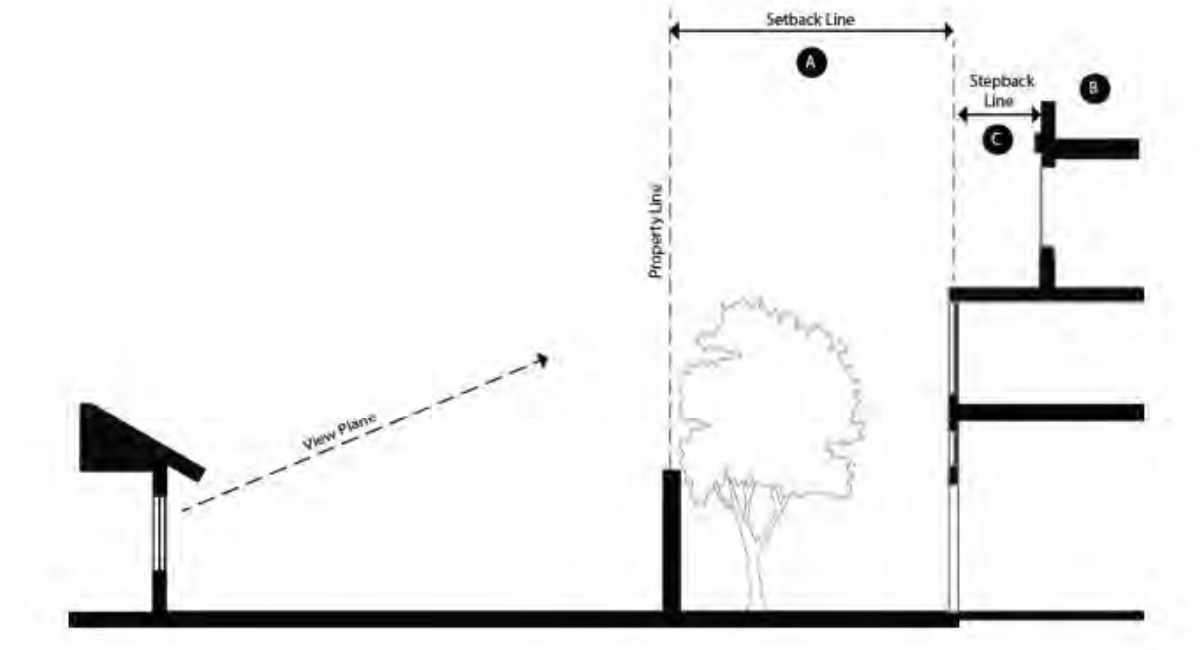
Figure 2-B: Setback and Step Back Provisions
I.
Design Review.
1.
Applicability. Structures erected or modified to accommodate the land uses allowed by this Section shall require the approval of a Site Plan and Design Review subject to the requirements of Section 9107.19 (Site Plan and Design Review) of this Development Code.
2.
Design Review Criteria. The project design shall be compatible with the scale and quality of development within the underlying zone and surrounding area. In conducting a review of projects subject to the requirements of this Section, the Review Authority may utilize design guidelines/criteria that have been adopted by the City in order to provide guidance to project proponents on how to best achieve the City's expectations for quality development; implementation of the applicable General Plan goals and policies; and maintenance of the public health, safety, general welfare and property throughout the underlying zone. Existing land uses shall be considered in the review of projects utilizing the Residential Flex Overlay Zone. Neighborhood Serving Retail, such as supermarkets/grocery stores shall be retained and integrated into new projects to the extent feasible to maintain commercial retail and services to serve the needs of the local and surrounding community.
(Ord. No. 2400, § 4(Exh. A), 2-20-24; Ord. No. 2401, Exh. A, 4-15-25)
9102.11.060 - RTE Race Track Event Overlay Zone.
A.
Purpose and Intent. The Race Track Event "RTE" Overlay Zone is established to regulate the use of portions of the property occupied by the Santa Anita Racetrack so that such use does not adversely affect the use of adjacent properties zoned for residential use.
B.
Allowed Uses. All temporary and special event uses permitted in Section 9102.07 (Special Use Zone) are permitted in the Race Track Event Overlay Zone, except as otherwise restricted by the provisions of Subsections 9102.07.020 (Land Use Regulations and Allowable Uses) and 9102.11.060.C (Restriction on Development Standards).
C.
Restriction on Development Standards. No equipment or apparatus shall be placed or maintained within 100 feet of any adjacent residentially-zoned property line.
9102.11.070 - P Vehicle Parking Overlay Zone.
A.
Purpose and Intent. The Vehicle Parking "P" Overlay zone is established to allow for the development of structures and areas for off-street parking as a stand-alone use.
B.
Allowed Uses. In addition to the uses permitted in the underlying zone, the open air, temporary parking of private, transient vehicles is allowed in the P Overlay zone, provided that such surface parking uses conform with Section 9103.07 (Off-Street Parking and Loading).
C.
Development Standards. All development regulations in the P Overlay zone shall conform to the standards established for the underlying zone.
9102.11.080 - Downtown Mixed Use Overlay Zone.
A.
Purpose and Intent. The Downtown Mixed Use Overlay Zone (DMU) is established as an overlay on commercial manufacturing (C-M) zoned parcels adjacent to the existing Downtown Mixed Use Zone in the Downtown area. The DMU Overlay Zone provides opportunities for high density residential projects in a commercial zone to revitalize the downtown district. Given the state of commercial development throughout the City and region, there are locations that may benefit from this flexibility; also, a residential project may serve as a catalyst for other types of development in the surrounding area. The Downtown Mixed Use Overlay Zone is intended to provide opportunities for more intense residential uses on commercial parcels that encourages transit-oriented development in proximity to transit centers, employment centers, and commercial uses.
B.
Allowed Uses. Any use permitted in the Downtown Mixed Use Overlay Zone will conform to the use regulations established within the zone to which the overlay is applied. Residential uses are allowed subject to the development standards mentioned in Section 9102.11.080(C)(1) below.
C.
Development Standards. All development regulations in the Downtown Mixed Use Overlay zone will conform to the standards established within the underlying zones where the overlay is applied, with the following exceptions:
1.
Utilize development standards for Downtown Mixed Use (DMU) zones if a residential project is developed with units affordable to low- and lower- income households. Refer to Table 2-11 Development Standards for Downtown Zones.
D.
Incentives for Affordability Provisions. Allow residential developments by-right when 20 percent or more of the units are affordable to lower income households. By-right development will not require a MUP, planned unit development permit, or other discretionary review or approval except for the City's subdivision requirements and Objective Design Standards. Refer to Section 9103.15.030 of the Code for additional incentives and concessions for affordable housing development.
(Ord. No. 2400, § 4(Exh. A), 2-20-24)
9102.13.010 - Purpose and Intent.
The Specific Plan (SP) zone is established to implement Sections 65450 through 65457 of the California Government Code. As provided for in the Government Code, a Specific Plan is designed to provide for flexibility, innovative use of land resources and development, a variety of housing and other development types, and an effective and safe method of pedestrian and vehicular circulation. A Specific Plan may be adopted for any property or group of properties meeting the criteria set forth in this Division and Section 9107.21 (Specific Plans). The Specific Plan zone shall apply to all properties lying within the bounds of a specific plan that has been adopted by resolution or ordinance of the Council.
9102.13.020 - Effect of Specific Plan Zone.
Once adopted, a specific plan shall govern all use and development of properties within the bounds of that specific plan. Where a specific plan is silent with regard to particular development standards, the provisions of this Code shall govern. The Director shall have the authority to determine which provisions of this Code apply where a specific plan is silent.
9102.13.030 - Required Contents of a Specific Plan.
The required contents of a specific plan shall be as set forth in Government Code Section 65450 et seq.
9102.13.040 - Land Use and Development Standards.
Each adopted specific plan establishes the land use regulations and development standards applicable to the properties within the specific plan. To the extent that any development standard is not provided by an individual specific plan, such standard shall be in accordance with the provisions of the zone in this Division that most closely resembles the zone in the specific plan.
9102.13.050 - Establishment of Specific Plan Zones.
Adopted specific plans in Arcadia are listed below. These specific plans define the development standards and guidelines for each corresponding specific plan zone.
A.
SP-SA1 (Hale Medical Center). The Hale Medical Center Specific Plan regulates the development and design of the Hale Medical Center structure and is designated SP-SA1 on the Zoning Map. Regulations and design elements for the SP-SA1 zone, with related implementing actions, are set forth in the Hale Medical Center Specific Plan.
B.
SP-SP (Seabiscuit Pacifica). The Seabiscuit Pacifica Specific Plan regulates the development and design of structures within the Seabiscuit Pacifica Specific Plan, designated SP-SP on the Zoning Map. Land use regulations, development standards, and required design elements for the SP-SP zone, with related implementing actions, are set forth in the Seabiscuit Pacifica Specific Plan.
C.
SP-ALC (Arcadia Logistic Center). The Arcadia Logistic Center Specific Plan regulates the development and design of structures within the Arcadia Logistic Center Specific Plan, designated SP-ALC on the Zoning Map. Land use regulations, development standards, and required design elements for the SP-ALC zone, with related implementing actions, are set forth in the Arcadia Logistic Center Specific Plan.

