
Arcadia City Zoning Code
Division 3
- Regulations Applicable to All Zones - Site Planning and General Development Standards
9103.01.010 - Purpose and Intent.
The purpose of this Division is to ensure that all development results in buildings and places that contribute in a positive manner to the character and quality of Arcadia's neighborhoods and districts, harmonize with existing and future development, are consistent with and implement the General Plan, and protect the use and enjoyment of neighboring properties.
9103.01.020 - Measuring Distances.
A.
Measurements Are Shortest Distance. Where a required distance is indicated, such as the minimum distance between a structure and a lot line, the measurement shall be made at the closest or shortest distance between the two objects, unless otherwise specifically stated.
B.
Distances Are Measured Horizontally. When determining distances for setbacks, all distances shall be measured along a horizontal plane from the appropriate line, edge of building, structure, storage area, parking area, or other object. These distances shall not be measured by following the topography or slope of the land.
C.
Measurements Involving a Structure. Measurements involving a structure shall be made to the closest support element of the structure. Structures or portions of structures that are underground shall not be included in measuring required distances unless otherwise specifically stated.
9103.01.030 - Measuring Floor Area and Floor Area Ratio.
A.
Floor Area.
1.
Residential Floor Area. The floor area for buildings in single-family residential zones shall be measured as the total horizontal floor area of all the floors of a building from the outside walls. The total horizontal floor area shall include: the residential floor area of any building(s) located on the lot including the main dwelling, detached accessory structures, accessory dwelling units, all garage area except as exempted in Subsection a. below, enclosed patios, and high volume ceilings (all interior areas above 14 feet in height). The following shall be excluded from floor area for the purposes of calculating floor area ratio:
a.
For houses less than 5,000 square feet in size, floor area shall exclude required parking spaces (450 square feet for a two-car garage and 650 square feet for a three-car garage). For houses 5,000 square feet or larger, floor area shall exclude up to four parking spaces (850 square feet maximum).
b.
Floor area shall exclude basements.
c.
Floor area shall exclude non-enclosed covered structures such as covered patios or porches, decks, and balconies.
2.
Non-Residential Floor Area. The floor area shall include the total horizontal floor area of all the floors of a building measured from the outside walls, exclusive of vents, shafts, courts, elevators, stairways, mechanical, electrical, and communications equipment, and similar facilities. Floor area shall include mezzanine and lofts. The following shall be excluded from floor area for the purposes of calculating floor area ratio.
a.
Floor area shall exclude required parking areas in a garage (with each required parking space not exceeding 200 square feet), but shall include any additional enclosed parking spaces provided in addition to the minimum requirements.
b.
Floor area shall exclude fully subterranean garages and basements.
c.
Floor area shall exclude non-enclosed covered structures such as decks, patios, porches, and balconies enclosed on three or fewer sides.
3.
Commercial-Regional (C-R) Floor Area Exception. For development located in the Commercial-Regional zone which is further regulated by resolution(s) of the City Council, floor area shall be defined by the Gross Leasable Area.
B.
Floor Area Ratio (FAR).
1.
Residential Floor Area Ratio. The floor area ratio shall be the numerical value obtained by dividing the residential floor area of any building(s) located on a lot by the net area of the lot.
2.
Non-Residential Floor Area Ratio. The floor area ratio shall be the numerical value obtained by dividing the non-residential floor area of any building(s) located on a lot by the net area of the lot.
9103.01.040 - Measuring Lot Coverage.
A.
Lot Coverage Measurement. As defined in Division 9 (Definitions), structures included in lot coverage calculations shall be measured from the outside walls exclusive of architectural features.
B.
Excluded from Lot Coverage. The following uses and features shall not count toward lot coverage:
1.
Open and uncovered projections such as balconies, platforms, landing places, decks, and eaves (that do not extend more than three feet from the wall), and steps and/or stairways, and walkways, any of which are not more than 18 inches above the finished grade, at any point, on which they are placed.
2.
Uncovered swimming pools and spas, sports courts, and other athletic and/or recreational surfaces that are not more than 18 inches above the adjacent finished grade, at any point, on which they are placed.
3.
Basements that do not extend above the level of the first floor of the building nor 18 inches above the adjacent finished grade at any point.
C.
Exceeding Lot Coverage Requirements. Exceptions to the lot coverage requirement shall be permitted only by action of the Planning Commission, or the City Council on appeal.
9103.01.050 - Height Measurements and Exceptions.
A.
General. No building or structure shall be erected, constructed, reconstructed, or established to exceed the height limit established in Division 2 (Zones, Allowable Uses, and Development Standards) in the zone in which such building is located, except as specified in the following subsections.
B.
Height of Structures and Measurement.
1.
Height Measurement.
a.
Structure Height. Structure height shall be measured from the average level of the highest and lowest existing grade elevation points of that portion of the site covered by the building, to the highest portion of the roof (excluding chimneys), except as otherwise specified by this Development Code. "Existing grade" shall be established by the Director, consistent with lots in the immediate vicinity. See Figure 3-1 (Measurement of Structure Height: Flat Ground Level and Slopes of Less than 20 Percent).
Figure 3-1
Measurement of Structure Height: Flat Ground Level and Slopes of Less than 20 Percent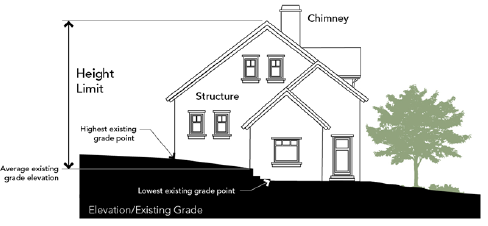
b.
Structure Height on Slopes with 20 Percent Grade. For lots with an average slope of 20 percent or greater, structure height shall be measured from the adjacent existing grade to the topmost point of the roof (excluding chimneys), except as otherwise specified by this Development Code. The maximum allowable height shall be measured as the vertical distance from the existing grade of the site to an imaginary plane located the allowed number of feet above and parallel to the grade. "Existing grade" shall be established by the Director, consistent with lots in the immediate vicinity. See Figure 3-2 (Measurement of Structure Height: Slopes of 20 Percent of Greater).
Figure 3-2
Measurement of Structure Height: Slopes of 20 Percent or Greater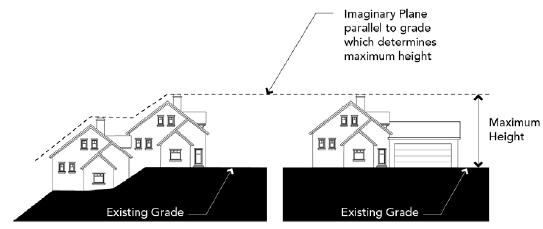
c.
Porch Height. For projecting porches, the height shall be measured from the finished grade on which the porch is established to the uppermost point of the projecting feature, including railings, cornices, and other decorative features. For recessed porches, the height shall be measured to the uppermost point of the opening.
d.
Height Regulations by Lot Width. The lot width for determining height shall be measured from the front property line or at the required front setback line, whichever is greater.
C.
Exceptions to Height Limits in All Zones.
1.
Flagpoles. Ground-mounted flagpoles shall be allowed in residential zones to a maximum height of 25 feet and in non-residential zones to a maximum height of 40 feet.
2.
Antennas. Height exception for antennas and other wireless communications facilities are outlined in Subsection 9104.02.050 (Antennas and Wireless Communications Facilities).
D.
Mechanical Equipment Exception to Height Limits in Non-Residential Zones. In any Commercial, Industrial, or Mixed-Use Zone, mechanical equipment, including elevators, stairways, tanks, ventilating fans, heating, cooling and air conditioning equipment, equipment appurtenant to solar collectors (but not including solar collector panels; see Subsection 9103.01.100: Solar Energy System) and similar equipment required for the operation of or maintenance of structures, may exceed the maximum height limit by up to 10 feet, provided that no area above the specified height limit is used for the purpose of providing additional floor space.
9103.01.060 - Setback Measurements and Exceptions.
A.
General. This Section establishes standards for the measurement of setbacks and required setback areas. These provisions, in conjunction with other applicable provisions of this Code, are intended to provide for open areas around structures; access to natural light and ventilation; separation of incompatible land uses; space for privacy, landscaping, and recreation; and access to structures for function and safety.
B.
Measurement of Setbacks.
1.
All setback distances shall be measured at right angles from the designated property line to the building or structure, and the setback line shall be drawn parallel to and at the specified distance from the corresponding front, side, or rear property line. See Figure 3-3 (Setback Measurement).
a.
Exception. The lot width for determining an interior side setback shall be measured from the front property line or at the required front setback line, whichever is greater.
b.
Exception. Where the front property line is located beyond the curb (i.e. within a street or common driveway), the front setback is defined as the minimum distance between a structure and the edge of curb.
c.
Exception. The lot width for determining setbacks on lots with more than 50 percent frontage on a cul-de-sac terminus shall be measured at the required structure setback line.
2.
For sloped lots the measurement shall be made as a straight, horizontal line from the property line to the edge of the structure, not up or down the hill slope. See Figure 3-4 (Setback Measurement for Sloped Lots).
3.
For flag lots, the pole portion of the parcel shall not be used for defining setback lines.
4.
For special setbacks Subsection 9103.01.060.F (Special Setbacks-Santa Anita Avenue and Second Avenue), each special setback shall be measured from the centerline of the particular street described. Any deviations to the special setbacks shall be subject to an Administrative Modification pursuant to the requirements of Section 9107.05 (Administrative Modifications).
Figure 3-3
Setback Measurement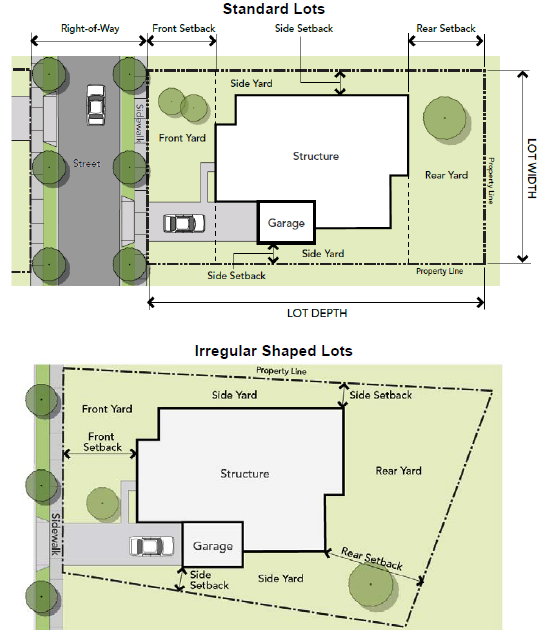
Figure 3-4
Setback Measurement for Sloped Lots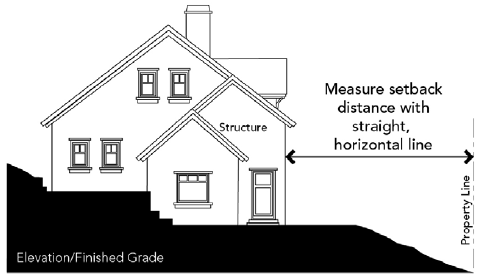
C.
Setback Areas to Remain Unobstructed. No portion of any habitable structure and/or accessory structure shall occupy any portion of a required front setback area, except as provided in Subsections 9102.01.050 (Permitted Projections in Single-Family Residential Zones), 9102.01.080 (Accessory Dwelling Units) and 9102.01.110 (Permitted Projections in Multifamily Zones). Every required setback area shall be open and unobstructed from the ground to the sky.
D.
Setback Applies to One Property Only. No setback or open space on an adjoining property shall be considered as providing a setback or open space on a lot on which a building is to be erected.
E.
Modification of Side Setback Requirement on Combined Lots. When the common property line separating two or more contiguous lots under common ownership is covered by a structure or permitted group of structures, or when the placement of a structure or structures with respect to such common property line or lines does not fully conform to the required setback area on each side setback common property line or lines, such lots shall constitute a single site for the purposes of the requirements of this Code, and the required side setback area shall not apply to such common property line.
F.
Special Setbacks - Santa Anita Avenue and Second Avenue. The following special setbacks shall apply as indicated in Table 3-1 (Special Setbacks) to all properties abutting the streets indicated.
G.
Setback Requirements for Property Abutting Future Street Right-of-Way. No structure shall be erected or maintained on any lot which abuts a street or private roadway having only a portion of its required width dedicated unless the setbacks provided and maintained in connection with that structure have a width or depth sufficient to accommodate completion of the public road width, plus the width or depth required to satisfy the setback requirements for the zone in which the property is located. However, this requirement does not require a setback of such width or depth as to reduce the buildable width of a corner lot to less than 50 feet.
(Ord. No. 2347, § 4(Exh. A), 6-6-17)
9103.01.070 - Vehicular Visibility Standards.
A.
Purpose. To safeguard against vehicular, bicycle, and pedestrian collisions caused by visual obstructions at street and alley intersections, and at any point where a driveway intersects a street or alley, there shall be no visual obstruction within the standard vehicular visibility area established in this Section.
B.
Vehicular Visibility Area Requirements. Within 25 feet of an intersection of a vehicular way with a vehicular and/or pedestrian way; no buildings, structures, fences, walls, shrubs, landscape, architectural features, or dense landscaping shall exceed a height of three feet as measured from the surface of the vehicular ways. See Figure 3-5 (Vehicular Visibility-Driveways and Intersections) for standards for lots with and without sidewalks.
C.
Off-Street Parking Location. Off-street parking shall not be located within any required clear site or vehicular visibility area on a corner lot.
Figure 3-5
Vehicular Visibility - Driveways and Intersections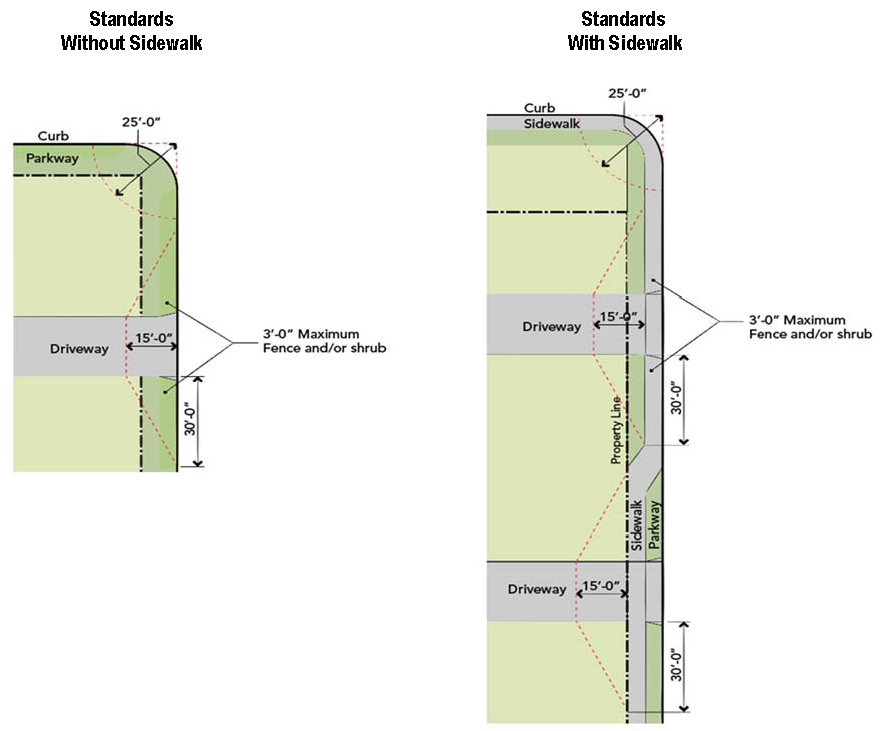
(Ord. No. 2347, § 4(Exh. B), 6-6-17)
9103.01.080 - Mechanical and Electrical Equipment Screening.
A.
Screening Required.
1.
Mechanical equipment, including but not limited to heating and air conditioning devices, shall be located within the building or if mounted elsewhere, shall be screened from public view. Mechanical equipment on the ground or on the roof shall be screened from view from adjacent properties and the public right-of-way by an enclosure designed as part of the building or by appropriate landscaping. See Figure 3-6 (Equipment Screening).
Figure 3-6
Equipment Screening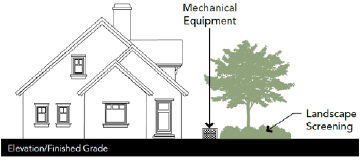
2.
Water heaters, electrical boxes, gas meters, landscape irrigation equipment, and similar utility boxes shall either be painted to match the structure, appropriately screened from view, or integrated into the floor plan of the structure.
3.
Where feasible and as determined by the Director, appurtenant equipment, plumbing, and related solar energy fixtures shall be installed in the attic, or if infeasible, flush mounted or ground mounted. Appurtenant equipment, plumbing, and related solar energy fixtures shall comply with the setback requirements of the applicable zone and shall be screened from public view.
9103.01.090 - Access.
Access shall be maintained to mechanical equipment as may be required by building codes.
9103.01.100 - Solar Energy System.
A.
Purpose and Intent. It is the intent of this section to protect and maintain the importance of solar energy systems in implementing the environmentally sustainable goals and policies adopted by the City of Arcadia, and to implement all solar energy system regulations as appropriate per the laws of the State of California.
B.
Applicability. The provisions set forth in this section shall not apply to Subsection 9103.01.110 (Solar Energy System, Small Residential Rooftop) as that term is defined in Division 9 (Definitions). The provisions applicable Solar Energy System, Small Residential Rooftop are set forth in Subsection 9103.01.110.
C.
Location and Performance Standards. In any single-family, Accessory Dwelling Units (ADU) and multifamily dwelling, solar energy shall be permitted subject to the provisions set forth below and consistent with Exceptions to Height Limits in All Zones (Subsection 9103.01.050.C).
1.
The City shall not require the approval for any solar energy system permit based on the approval of the system by an association, as that term is defined in Section 4080 of the Civil Code.
2.
Ground-mounted systems and freestanding solar structures shall conform to the setback requirements for any accessory structure in single-family residential zones and the same as the main structure in multifamily residential zones and shall be located outside of the front yard area and to minimize their visibility from any public right-of-way.
3.
All ground-mounted or freestanding solar structures shall not exceed a height of six (6) feet.
4.
Where practical, solar collector panels shall be roof mounted. Solar storage tanks and associated equipment shall be ground mounted.
5.
Roof-mounted collector panels shall be flush mounted at the same or as close as possible to the pitch of the roof, and where feasible, be placed in the location least visible from public streets without reducing the operating efficiency of the collectors.
6.
Equipment appurtenant to solar collectors, including plumbing, electrical, and related fixtures, shall be installed within a structure on which the collectors are mounted, and painted to match the roof or building, where feasible, or shall be screened public view. Ground-mounted appurtenant equipment outside of a building shall comply with applicable setback requirements.
7.
A solar panel or module array shall not exceed the maximum permitted building height as set forth in this Development Code.
8.
Hot water storage tanks shall be located within an enclosed structure. If within the garage area, the storage tank(s) and other associated equipment shall not encroach into the required parking area.
9.
All solar energy systems shall meet applicable health and safety standards and requirements imposed by the State and the City of Arcadia.
10.
Solar energy systems for heating water in single-family residences and for heating water in commercial or swimming pool applications shall be certified by an accredited listing agency, as defined by the California Plumbing and Mechanical Code.
11.
Solar energy systems for producing electricity shall meet all applicable safety and performance standards established by the California Electrical Code, the Institute of Electrical and Electronics Engineers, and accredited testing laboratories such as Underwriters Laboratories and, where applicable, rules of the Public Utilities Commission regarding safety and reliability.
D.
Grounds for Site Plan Review. Certain solar energy systems, due to their specific placement or orientation on a building or lot, may have a specific, adverse impact upon public health and safety. If the Director makes a finding, based on substantial written evidence, that a solar energy system could have specific, adverse impact upon the public health and safety, the solar energy system shall require the approval of Minor Use Permit pursuant to the requirements of Section 9107.09 (Conditional Use Permits and Minor Use Permits) of this Development Code. "Specific, adverse impact" means a significant, quantifiable, direct, and unavoidable impact based on objective, identified, and written public health or safety standards, policies, or conditions as they existed on the date the application was deemed complete.
(Ord. No. 2375, § 4(Exh. A), 4-6-21)
9103.01.110 - Solar Energy System, Small Residential Rooftop.
A.
Purpose and Intent. It is the intent of this Section to protect and maintain the importance of solar energy systems in implementing the environmentally sustainable goals and policies adopted by the City of Arcadia, and to implement all solar energy system regulations as appropriate per the laws of the State of California. Further, it is the purpose of this Section to create an expedited, streamlined permitting process for small residential rooftops solar energy systems, in accordance with California Civil Code Section 714 and California Government Section 65850.5. It is also the purpose of this Section to promote and encourage the use of small residential rooftop solar energy systems and to limit obstacles to their use, in accordance with the standards adopted by the City pursuant to this Section and State law, while allowing the City to protect the public health and safety.
B.
State Law. Where the provisions of this Section conflict with an applicable State law or regulation, such State Law or regulation shall govern.
C.
Location. In any, residential dwelling, solar energy systems, as defined in Division 9 (Definitions), shall be permitted subject to the provisions set forth below.
D.
Applicability. This Section applies to the permitting of all small residential rooftop solar energy systems, as defined herein, in the City. Small residential rooftop solar energy systems legally established or permitted prior to the effective date of this Section are not subject to these requirements unless physical modification or alteration are undertaken that materially change the size, type, or components of a small rooftop solar energy system in such a way as to require new permitting. Routine operation and maintenance or like-kind replacements shall not require a permit.
E.
Duty of City to Create and Publish Application and Requirements. A checklist of requirements, documents required for an application, and the application required for small residential rooftop solar energy systems shall be made available to the public during regular business hours within Arcadia City Hall where permitting for solar energy systems is processed, and via other methods determined by the Director. The Director may from time to time revise the checklist of requirements required for an application, documents required for an application and the required applications as long as any revisions are consistent with the most recently adopted resolution of the City Council, and are consistent with Section 65850.5 of the Government Code. Systems shall meet applicable health and safety standards and requirements imposed by State and local permitting authorities, consistent with Section 65850.5 of the Government Code.
F.
Review. Review of the application to install a small residential rooftop solar energy system shall be limited to an expedited administrative, nondiscretionary review by the Community Development Department. Review of the application shall be limited to the Building Official's review of whether the application meets local, State, and federal health and safety requirements. The application shall be exempt from Section 9107.19 (Site Plan and Design Review).
G.
Inspection. Only one inspection shall be required and performed by Building Division for small residential rooftop solar energy systems eligible for expedited review. The inspection shall be done in a timely manner and should include consolidated inspections. If a small residential rooftop solar energy system fails inspection, a subsequent inspection is authorized.
(Ord. No. 2375, § 4(Exh. A), 4-6-21)
9103.01.120 - Exterior Lighting.
A.
General. This Section establishes exterior lighting standards that are intended to balance safety and security needs for lighting with efforts to guard against adverse light trespass (spill light), light pollution, and glare onto surrounding properties.
B.
Applicability. Unless specifically exempted, this Section applies to any exterior lighting that is not within a fully enclosed building or structure. For additional standards associated with lighting in parking lots, see Section 9103.07.060 O. (Parking Lot Lighting).
C.
Exemptions. The following are exempt from the provision of this Section:
1.
Exterior lights associated with a temporary event for which a Temporary Use Permit has been granted.
2.
Temporary exterior lights used for holiday decorations.
3.
Emergency lighting, or any exterior lighting erected for official purpose by a local, State, or federal agency.
D.
General Standards for Exterior Lighting.
1.
Lighting shall be shielded or recessed so that direct glare and reflections are confined to the maximum extent feasible within the boundaries of the site, and shall be directed downward and away from adjoining properties and public rights-of-way.
2.
No lighting on private property shall produce an illumination level greater than 1.0 foot-candle on any property within a residential zoning district, except on the site of the light source.
3.
All lighting fixtures shall be appropriate in scale, intensity, and height to the use they serve.
4.
No permanently installed lighting shall blink, flash, or be of unusually high intensity of brightness.
5.
Lighting fixtures shall make use of full-cutoff fixtures to avoid glare and up-light.
E.
Prohibited Lighting. The following exterior light fixtures shall be prohibited. Existing light fixtures legally allowed or authorized be the effective date of this ordinance may be maintained.
1.
Uplighted and back-lighted canopies or awnings.
2.
Searchlights, except as authorized for a special or temporary event authorized by a Temporary Use Permit.
3.
Flashing lights, except as used in conjunction with a security alarm system.
4.
Roof-mounted lights.
5.
Any light that imitates or causes visual interference with a traffic signal or other necessary safety or emergency light.
9103.01.130 - Trash Enclosures.
A.
Purpose and Applicability. This Section establishes standards for the location, development, and operations of trash enclosures to ensure that the storage of trash and recyclable materials do not have significant adverse health consequences and minimize adverse impacts on surrounding properties. The provisions in this Section shall apply to trash enclosures that are not subject to the Hazardous Materials and Recycling Facilities regulations of Division 3.
B.
When Required. All new and expanded commercial and industrial projects with a floor area exceeding 500 square feet, all intensifications of commercial and industrial uses, all new multifamily residential projects located in any zone, all new mixed-use development projects shall be required to provide and maintain at least one trash enclosure. Trash enclosures may be located indoors or outdoors to meet the requirements of this Section. Outdoor trash enclosures shall require review and approval of Site Plan and Design Review pursuant Section 9107.19 (Site Plan and Design Review) of this Development Code.
C.
Number Required; General Standards.
1.
Trash, recyclables, and other refuse materials that are temporarily stored outside a building shall be located within a trash enclosure that enables convenient collection and loading.
2.
The minimum size of a trash enclosure shall be nine feet wide by six feet deep by six feet high.
3.
A one (1) foot interior clearance shall be provided between the bin and/or carts and the trash enclosure wall.
4.
All development projects with five or more dwelling units shall provide at least one trash enclosure. If a project contains 10 dwelling units or more, at least two trash enclosures or a larger trash enclosure shall be provided, the location and size of which shall be subject to the review and approval of the Director.
5.
All commercial development with more than one tenant, all industrial developments, and all other non-residential developments shall contain at least one trash enclosure.
D.
Location.
1.
Outdoor trash enclosures required under this Section for residential projects shall not be located within any front yard or street-facing yard area.
2.
No outdoor trash enclosures shall be located within any required landscaped areas, required off-street parking spaces, public rights-of-way, or in any location where it would obstruct pedestrian walkways, vehicular ingress and egress, reduce motor vehicle sightline, or in any way create a hazard to health and safety as required by the California Building Code.
E.
Maintenance. Outdoor trash enclosures required shall be maintained in the following manner:
1.
There shall be the prompt removal of visible signs of overflow of garbage, smells emanating from enclosure, graffiti, pests, and vermin.
2.
Trash enclosure covers shall be closed when not in use.
3.
Trash enclosures shall be easily accessible for garbage collection.
4.
Trash enclosures shall be regularly emptied of garbage.
5.
Outdoor trash enclosures shall be locked and/or sealed at the end of business day.
F.
Design of Enclosure Area.
1.
Each trash enclosure shall on three sides consist of minimum six-foot-high, fully grouted, decorative masonry walls, with the fourth side consisting of a solid metal gate with latch, painted a color that is compatible with the enclosure walls. The exterior wall shall be of a material and colors that complement the architecture of the buildings they serve or shall have exterior landscape planting that screens the walls.
2.
The interior dimensions of the trash, recyclable, and refuse enclosure shall provide convenient and secure access to the containers to prevent access by unauthorized persons and minimize scavenging, while allowing authorized persons access for disposal and collection of materials.
3.
All trash enclosures shall have full roofs to reduce storm water pollution and to screen unsightly views. The design of the roof and the materials used shall be compatible with the onsite architecture, with adequate height clearance to enable ready access to any containers.
G.
Modification. Request of relief from the requirements of this section shall be processed via the Modification process defined in Section 9107.05 (Administrative Modifications) of this Development Code.
(Ord. No. 2375, § 4(Exh. A), 4-6-21)
9103.03.010 - Canopy Structures in Residential Zones.
The following regulations shall apply to canopies and canopy structures, as defined in Division 9 (Definitions), in all residential zones.
A.
Permanent Canopy Structures. Permanent canopy structures are prohibited.
B.
Decorative Awnings. Decorative awnings constructed as a component or feature of an overall architectural design are allowed as architectural projections, subject to the provisions of Section 9102.01.050 (Permitted Projections in Single-Family Residential Zones) and Section 9102.01.110 (Permitted Projections in Multifamily Zones).
C.
Temporary Tents and Canopies. Temporary tent and canopies of any size may be erected in any location with the exception of the front setback and/or street side setback areas for a period that is not in excess of three days.
9103.03.020 - Canopy Structures in All Other Zones.
The following regulations shall apply to canopies and canopy structures in all other zones:
A.
Permanent Canopy Structures. Permanent canopy structures shall be permitted in the rear yard only, subject to issuance of a Site Plan and Design Review.
B.
Decorative Awnings. Decorative awnings constructed as a component or feature of an overall architectural design are allowed as architectural projections, subject to Section 9107.19 (Site Plan and Design Review). Awnings that project over a public right-of-way shall also be subject to approval by the City Engineer.
C.
Temporary Tents and Canopies. Temporary canopies and canopy structures, of any size, may be erected in any non-residential zone in any location on a lot subject to the issuance of a Temporary Use Permit pursuant to Section 9107.23 (Temporary Use Permits). All such canopies must be secured in a manner to prevent wind from dislocating them.
(Ord. No. 2375, § 4(Exh. A), 4-6-21)
9103.03.030 - Repair and Maintenance.
Awnings, canopies and canopy structures shall be maintained in good condition. Any structure considered to be in disrepair, as determined by the Director, shall be repaired, replaced, or removed from the site.
9103.05.010 - Purpose and Intent.
A.
This Section establishes standards and regulations for the construction and maintenance of fences, walls, and gates, as the terms are defined in Division 9 (Definitions). The standards are intended to ensure that these types of structures provide the desired privacy and safety while avoiding becoming a public safety hazard or nuisance.
B.
For Specific Plans and Planned Developments, fence and wall heights shall comply with the standards contained within the applicable Specific Plan or Planned Development. Where the Specific Plan or Planned Development is silent with regard to fence and wall height, the standards for the zone that most closely reflects the Specific Plan or the Planned Development shall apply, as determined by the Director.
9103.05.020 - Permit Requirements.
Construction of new fences, walls, and gates shall be subject to Site Plan and Design Review according to Section 9107.19 (Site Plan and Design Review).
9103.05.030 - Development Standards.
A.
General.
1.
The fence or wall height shall be measured from the lowest adjacent grade to the uppermost part of the fence or wall. Refer to Figure 3-7 (Fence Height Measurement).
2.
When there is a full landscaped parkway with no sidewalk, a fence and/or columns, excluding vehicular entry gate(s), may be placed adjacent to the front property line.
3.
The need for any retaining walls and/or fences, and their heights, shall be determined by the Director and the Building Official through the Site Plan Review process. An administrative modification is not required for retaining walls and/or fences where there is a grade difference between the abutting property.
4.
Temporary construction fencing that is of chain link or wire type may be allowed within the front and street side setback areas, provided it does not exceed six feet in height.
5.
All fences, walls, and gates shall be subject to the height limitations described in Section 9103.01.070 (Vehicular Visibility Standards) of this Development Code.
Figure 3-7
Fence Height Measurement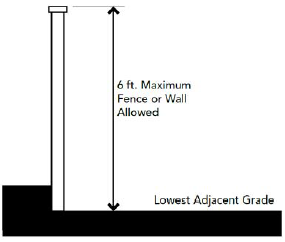
B.
Fence Height with Difference in Grade. Where there is a difference in a grade between properties, a fence, wall, or gate may be a maximum height of six feet adjacent to the rear and property lines if such fence, wall, or gate maintains a minimum setback that is equal to the difference in grade between the properties. See Figure 3-8 (Fence Height Measurement with a Difference in Grade). In all other situations, the wall height shall comply with the provisions of this Section.
Figure 3-8
Fence Height Measurement with a
Difference in Grade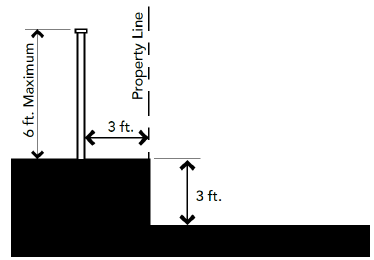
C.
Residential Zones.
1.
Fences, Walls, and Gates Located in the Front Setback.
a.
The required setbacks, height dimensions, and spacing for fences, walls, and gates shall be as indicated in Table 3-2 (Fences, Walls, and Gates) and Figure 3-9 (Fences, Walls, and Gates).
Figure 3-9
Fences, Walls, and Gates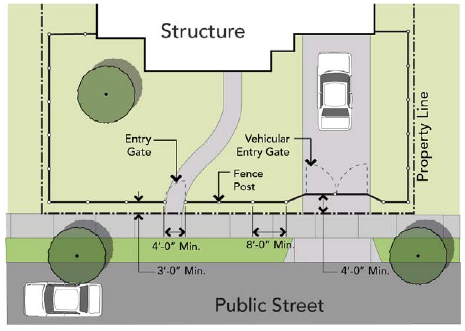
2.
Special Regulations for Fences, Walls, and Gates Located in the Front Setback—Residential Zones.
a.
R-M and R-0 Zones.
(1)
A solid wall adjacent to the interior side property line may be allowed in the front setback area, provided that it does not exceed four feet in height.
(2)
Only one pedestrian gate with decorative columns shall be allowed within the front setback area.
(3)
All fences shall be of open work design (a minimum of four inches between vertical and horizontal members). A two-foot high solid wall may be combined within the allowed height of the decorative fence. Refer to Figure 3-10 (Fence in R-M and R-0 Zones).
Figure 3-10
Fence in R-M and R-0 Zones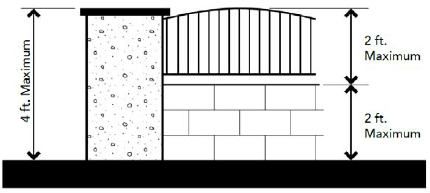
b.
R-1 Zone.
(1)
All fences shall be of open work design (a minimum of four inches between vertical and horizontal members). A solid decorative masonry base for fences may be allowed in the front setback area, provided that it does not exceed eight inches in height. Refer to Figure 3-11 (Fence in R-1 Zone).
Figure 3-11
Fence in R-1 Zone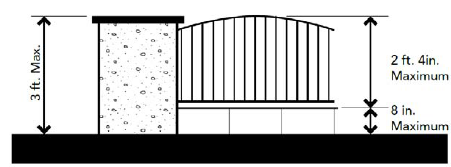
(2)
A solid wall adjacent to the interior side property line may be allowed in the front setback area, provided that it does not exceed three feet in height.
(3)
Only one pedestrian gate with decorative columns shall be allowed within the front setback area.
3.
Fences, Walls, and Gates—Corner Lots.
a.
All fences, walls, or gates, including height, design, and location within the street side setback or special setback area, shall be subject to Site Plan and Design Review pursuant to requirements Section 9107.19 (Site Plan and Design Review) in the R-2 and R-3 zones.
b.
On corner lots, fences, walls, and gates within the required street side setback or special setback are allowed up to six feet in height, measured at the street side property line, except as restricted by Subsection 9103.01.070 (Vehicular Visibility Standards).
c.
Fences, walls, and gates shall be setback a minimum of 18 inches from the street side property line.
d.
The area between the street side property line and the fence, wall, or gate shall have an appropriate irrigation system and decorative landscaping (shrubs, ground cover, flowers, plants, etc.). However, when there is a full landscaped parkway with no sidewalk, a fence, wall, and gate, excluding entry gate(s), may be placed to the street side property line in R-M, R-0, and R-1 Zones.
4.
Fences, Walls, and Gates—Flag Lots.
a.
Fences, walls, and gates on flag lots shall not be allowed in R-2, R-3-R, and R-3 zones.
b.
In areas zoned R-M and R-0, a fence or wall may be allowed in the front setback and driveway area, provided that it does not exceed four feet in height. In the R-1 zone, the height shall not exceed three feet.
c.
Where a fence or wall is located within the front setback of a flag lot and the front property line of that flag lot abuts the rear property line of an adjacent lot, it may be allowed up to six feet in height. See Figure 3-12 (Fences and Walls on Flag Lots).
Figure 3-12
Fences and Walls on Flag Lots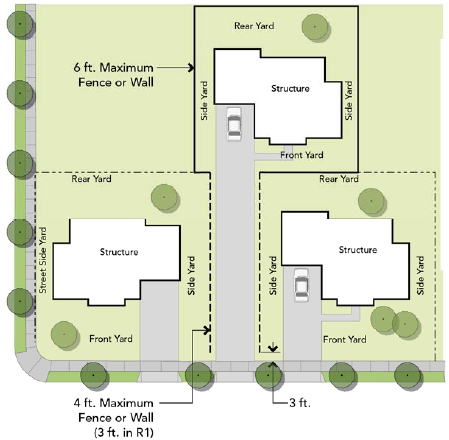
5.
Fences, Walls, and Gates—Side and Rear Setback Areas.
a.
Fences, walls, and gates located within a required side and/or rear setback area(s) are allowed up to six feet in height, provided that no portion of any such fence, wall, or gate extends into the required front setback area.
b.
Where there is a difference in grade between properties, a wall or fence is allowed up to six feet in height adjacent to the rear and side property lines if the wall or fence maintains a minimum setback that is equal to the difference in grade between the properties. Where there is no difference in grade between properties, a wall shall comply with the height limitations unless it complies with the setbacks required for an accessory building. Refer to Figure 3-13 (Fences Walls and Gates with a Grade Difference). However, if the grade has been altered due to previous grading, the finished grade shall be subject to review and approval by the Director.
c.
Fences and walls are allowed adjacent to the property line in the side and rear setback areas.
Figure 3-13
Fences Walls and Gates with a Grade Difference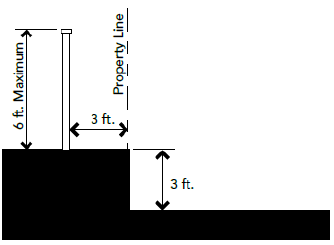
6.
Walls for Tennis Courts.
a.
A six-foot high solid masonry wall shall be installed on the property lines between the tennis court and adjacent properties. In the R-M, R-0 and R-1 zones, where the entire side of a tennis court is a minimum distance of 25 feet from a property line, a six-foot high solid masonry wall shall not be required along the property line.
D.
Commercial Zones.
1.
Fences, walls, and gates shall not exceed three (3) feet along the front property line and must be of an open design. Any gate placed across a court setback opening or a fence around an outdoor dining area shall have a minimum of 50 percent transparency.
2.
Fences and walls located at rear and interior side setback areas are limited to six feet in height.
(Ord. No. 2347, § 4(Exh. B), 6-6-17; Ord. No. 2401, Exh. B, 4-15-25)
9103.05.040 - Prohibited Fencing Materials in All Zones.
A.
No spears (apache, aristocrat with crushed spears, or any spear-like features) shall be allowed on a fence, wall, or gate.
B.
Chain link, corrugated fiberglass, bamboo fencing, and wire type fencing shall not be allowed, except chain link fencing is allowed as a fencing material enclosing sports courts and temporary construction fencing.
9103.07.010 - Purpose and Intent.
This Section establishes regulations to:
A.
Regulate off-street parking and loading to minimize traffic congestion and hazards to motorists, bicyclists, and pedestrians;
B.
Provide off-street parking in proportion to the needs generated by different land uses;
C.
Ensure access to projects by emergency response vehicles; and
D.
Ensure that parking areas are designed to operate efficiently and effectively and in a manner compatible with on-site and surrounding land uses.
9103.07.020 - Applicability.
A.
All terms defined in Division 9 (Definitions), except as provided, shall apply to this Section. The minimum off-street parking spaces established in this Section shall be provided for new construction or intensification of use, and for the enlargement or increased capacity and use of land.
B.
All required parking spaces shall be maintained in connection with the building or structure and use of land. The regulations within this Section apply:
1.
At the time of the erection of any building and/or structure; or
2.
Before the time any building or structure is enlarged or increased in capacity by adding dwelling units, guest rooms, floor area or seats; or
3.
At a time that a usage requiring a higher number of parking spaces than the existing or previous use is applied.
C.
Nothing in this Section shall be deemed to limit the power of the Director, Commission, or Council, acting either on its own or on appeal, to require parking of increased numbers or alternative types and arrangements as part of the conditions of approval to a discretionary permit or to mitigate environmental impacts.
9103.07.030 - Permit Requirements.
A.
New Parking Lots. New parking lot design shall be reviewed as part of the building permit process and any other land use or development permit process required for a project. A site plan of the premises shall be required for all new parking. The site plan shall be submitted to the Director in conjunction with the required permit(s) and shall include sufficient detail to determine compliance with the provisions of this Section. The site plan shall be approved, modified, and/or denied through the normal process of approving, modifying, and/or denying the permit causing the submission of the site plan or other discretionary permit.
B.
Modification of Existing Parking Lots. Except otherwise stated in this Section, modification or improvement to an existing parking lot which impacts the parking space layout, configuration, and/or number of stalls shall require the review and approval by the Director of a Site Plan and Design Review pursuant to the requirements of Section 9107.19 (Site Plan and Design Review).
9103.07.040 - Exemptions.
A.
Modification of Existing Lots. The following parking lot improvements shall be considered minor in nature, as long as the number and/or configuration of parking stalls are not altered. These improvements shall be exempt from permit requirements, except for permits that may be required by the Building Official.
1.
Repair of any defects in the surface of the parking area, including holes and cracks.
2.
Resurfacing, slurry coating, and restriping of a parking area with identical delineation of parking spaces.
3.
Repair or replacement of damaged planters and curbs in the same location.
4.
Installation of parking stalls reserved as accessible parking stalls in compliance with the Americans with Disabilities Act (ADA), and any required ADA passenger loading areas.
9103.07.050 - Off-Street Parking for Residential Uses.
A.
Number Required. Unless off-street parking reductions are allowed in compliance with provisions identified, off-street parking spaces shall be provided in compliance with Table 3-3 (Off-Street Parking Requirements: Residential Uses). These standards shall be considered the minimum required to preserve the public health, safety, and welfare of the community. An increase or decrease in the parking requirements may be determined by the Review Authority in particular circumstances where these requirements are inadequate for a specific project. These cases shall be determined through a parking study as outlined in this Division.
B.
Off-Street Parking Requirement Calculations. Table 3-3 (Off-Street Parking Requirements: Residential Uses) establishes the off-street parking requirements for number of spaces. Except as otherwise specifically stated, the following rules apply:
1.
"Square feet" or "sf" shall mean "square feet of floor area" and refer to floor area as defined in Division 9 (Definitions), unless otherwise specified.
2.
Any fractional parking space greater than or equal to one-half shall be rounded to the next whole number. If the fraction is less than 0.49 of a space, the total number of spaces shall be rounded down to the nearest whole number.
C.
Off-Street Residential Parking Requirements for Residential Uses.
1.
Uses Not Listed. The number of parking spaces required for land uses not specifically listed shall be determined by the Director based on common functional, product, or compatibility characteristics and activities. The determination is considered a formal interpretation of the Development Code and shall be decided and recorded accordingly. The interpretations shall have the same force of law as the provisions of this Section. Any inclusion of land uses in this Section shall be defined and included in Division 9 (Definitions), and shall be included in the land uses in Division 2 (Zones, Allowable Uses, and Development Standards).
Notes:
(1) A tandem parking space may be allowed to satisfy the third required, or any non-required, parking space, subject to Design Review approval.
(2) Parking standards shall not be imposed on an accessory dwelling unit in any of the following circumstances:
a. The accessory dwelling unit is located within one-half mile of public transit
b. The accessory dwelling unit is located within an architecturally and historically significant historic district
c. The accessory dwelling unit is part of the existing primary residence or an existing accessory structure
d. When on-street parking permits are required but not offered to the occupant of the accessory dwelling unit
e. When there is a car sharing vehicle located within one block of the accessory dwelling unit
2.
Residential Use: When Required Covered or Garage Parking Cannot Be Provided. Apart from the requirements for parking in a garage contained in Table 3-3 (Off-Street Parking Requirements: Residential Uses) for residential uses, wherever required covered or garage parking cannot be provided due to physical limitations on a property, an alternative parking arrangement for the remaining required parking can be arranged by the approval of an Administrative Modification subject to the requirements of Section 9107.05 (Administrative Modifications).
D.
Parking Location.
1.
Parking spaces shall be designed, constructed, and maintained in a manner that does not preclude direct and free access to stairways, walkways, elevators, any pedestrian way, and fire safety equipment.
2.
Vehicle parking (and access thereto) shall be provided on a permanently paved surface.
3.
When required off-street parking spaces are provided on a separate lot from the building or land use, Subsection 9103.07.090 (Shared/Joint Use and Off-site Parking) shall apply.
Figure 3-14
Single-Family Parking Location Requirements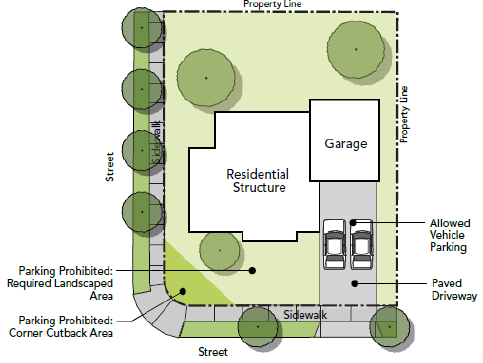
E.
Residential Parking Location—Specific Requirements.
1.
R-M Zone.
a.
A garage or carport opening directly upon a side street shall be located not less than 20 feet from the street side lot line.
2.
R-0 and R-1 Zones.
a.
Required parking spaces shall be provided on the same site as the main building in an enclosed garage. Each parking space provided beyond the minimum required shall also be within an enclosed garage.
b.
Each required parking space shall be in a garage located behind the required front setback and shall be served by a driveway no less than nine feet in width, except as specified in Section 9103.07.050.D.
c.
Only one driveway shall lead to an enclosed garage, unless it is a circular driveway.
d.
Below grade or subterranean parking spaces shall not be allowed unless an Administrative Modification is granted pursuant to Section 9107.05 (Administrative Modifications). Not more than one story below grade shall be allowed.
e.
On lots less than 100 feet in width, no more than a two-car garage shall be allowed facing the front and/or street-side areas. On lots 100 feet or greater in width, no more than a three-car garage shall [be] allowed facing the front and/or street-side areas.
f.
An enclosed two-car garage shall have a minimum opening of 16 linear feet, and an enclosed three-car garage shall have a minimum opening of 24 linear feet.
3.
R-2, R-3, and R-3-R.
a.
For enclosed garages, the minimum garage opening is 16 linear feet.
F.
Standard Residential Parking Stall Dimensions. Required parking stalls, including guest parking spaces, within all residential zones shall meet the dimension requirements set forth in Table 3-4 (Parking Space Dimensions-Residential Zones). Dimensions shall be measured from interior building wall.
G.
Residential Driveways.
1.
Paving. All parking areas and driveways shall be paved with cement concrete. Other paving materials, including brick may be substituted with review and approval by the Director of a Site Plan and Design Review pursuant to the requirements of Section 9107.19 (Site Plan and Design Review).
2.
Width. The maximum width of driveways within residential zones shall be 20 feet for single-family zones and 25 feet for multifamily zones. The maximum width for all single-family and multi-family residential common driveways shall not exceed 30 feet.
3.
Does Not Fulfill Parking Requirement. No portion of any required driveway shall be used to fulfill any parking space requirements, except as specified in Section 9103.07.050.D.
4.
R-M, R-0 and R-1 Zones.
a.
Only one driveway shall be allowed for each residential lot. The number may be increased to two for an approved circular driveway pursuant to Section 9103.07.050.H (Circular Driveways for Residential Zones).
b.
A driveway shall not be less than nine feet in width.
c.
Pedestrian walkways and driveways shall occupy no more than 40 percent of the required front setback or street side setback.
d.
Driveways shall have at least 10 feet of unobstructed vertical clearance.
e.
Driveway slope shall not exceed 10 percent.
5.
R-2, R-3 and R-3-R Zones.
a.
Each driveway to a parking space shall be at least 10 feet wide.
b.
Every driveway serving as access to more than 12 required parking spaces or which is more than 125 feet long shall have a minimum width of 18 feet. Two 10-foot wide driveways may be provided in lieu of one 18-foot driveway.
c.
Each driveway adjacent to a garage or parking space shall have a minimum width of 25 feet.
d.
"Guest Parking Only" signs with letters not less than two inches in height shall be properly located to designate guest parking spaces.
e.
Common/shared driveways shall be allowed, provided the owners of the lots show proof of a recorded easement or other legal instruments authorizing the use of a shared driveway arrangement and further provided that a covenant, in recordable form by its terms to be for the benefit of, enforceable by, and to be released only by the City, is executed by the owners of all property affected. The covenant shall state that the common/shared driveway shall be usable by the tenants and owners of the properties proposed to be served by the driveway. Recordation of this instrument shall be completed before the issuance of a Building Permit.
f.
Eaves and bay windows which are at least 10 feet above the pavement may overhang any driveway by a distance of not more than three feet.
H.
Circular Driveways for Residential Zones.
1.
Lots with street frontage of 100 feet or greater are eligible for circular driveways.
2.
On lots with more than one street frontage, a circular driveway shall be located on the street frontage that is 100 feet or greater; provided, however, that not more than one circular driveway shall be allowed for any one lot.
3.
The circular driveway shall not be less than nine feet in width and shall not have a width greater than 15 feet.
4.
The inside edge of the circular driveway shall be located a minimum distance of 25 feet from the property line at the street right-of-way.
I.
Tandem Parking Spaces. Tandem parking spaces may be allowed in residential and mixed-use zones in compliance with the following requirements, and subject to Site Plan and Design Review pursuant to Section 9107.19 (Site Plan and Design Review).
1.
For multifamily development projects, tandem spaces shall not constitute more than 20 percent of all required spaces and shall not be permitted to meet guest parking requirements.
2.
For single-family units, tandem parking may be provided within a garage, provided that such garage has an interior space measuring at least 20 feet by 20 feet adjacent to the garage door and at least one required parking space shall be in a regular (non-tandem) format.
3.
The size of the tandem parking space shall be 10 feet by 19 feet and shall allow adequate maneuvering room for both vehicles and pedestrians around the tandem spaces.
(Ord. No. 2347, § 4(Exh. A), 6-6-17; Ord. No. 2369, § 3, 12-17-19; Ord. No. 2370, § 3, 1-21-20; Ord. No. 2375, § 4(Exh. A), 4-6-21; Ord. No. 2400, § 4(Exh. A), 2-20-24; Ord. No. 2401, Exh. B, 4-15-25)
9103.07.060 - Off-Street Parking for Non-Residential Uses.
A.
Number Required. Unless off-street parking reductions are allowed in compliance with provisions identified, off-street parking spaces shall be provided in compliance with Tables 3-5 through 3-8 (Off-Street Parking Requirements:). These standards shall be considered the minimum required to preserve the public health, safety, and welfare of the community. An increase or decrease in the parking requirements may be determined by the Review Authority in particular circumstances where these requirements are inadequate for a specific project. These cases shall be determined through a parking study as outlined in this Division.
B.
Off-Street Parking Requirement Calculations. Tables 3-5 through 3-8 establish the off-street parking requirements for number of spaces. Except as otherwise specifically stated, the following rules apply to Tables 3-5 through 3-8:
1.
"Square feet" or "sf" shall mean "square feet of floor area" and refer to floor area as defined in Division 9 (Definitions), unless otherwise specified.
2.
Any fractional parking space greater than or equal to one-half shall be rounded to the next whole number. If the fraction is less than 0.49 of a space, the total number of spaces shall be rounded down to the nearest whole number.
C.
Off-Street Parking Requirements for Non-Residential Uses. The following minimum number of off-street parking spaces shall be provided as indicated in Tables 3-5 through 3-8 and shall be maintained for each of the following uses. Temporary reductions may be allowed by the Business License office for parking lot sales and for promotional entertainment events.
D.
Parking Reduction Near Light-Rail Station. A 25 percent reduction will be applied to the off-street parking requirement for any commercial use that is located within 1,320 feet (¼ mile) of a light rail station.
E.
Parking Requirement Determined by Parking Study. Off-site parking spaces may be relied upon to serve commercial uses, provided a shared-parking study is completed by the applicant/developer and approved by the Director. In the event the proposed land use is for a multi-tenant and/or mixed use development or involves a Specific Plan or Planned Development Permit, the Director may also authorize the preparation of a parking study to determine the required number of parking spaces as an alternative to the number of off-street parking as outlined in Tables 3-5 through 3-8 (Off-Street Parking Requirement) and other applicable provisions of this Section, subject to the following conditions:
1.
Off-street parking standards determined by a parking study shall be approved, modified, and/or denied in accordance to the use classification and/or required planning permit for the proposed use. If there are no planning permits required for the proposed use but the Director has determined a parking study is required, then the review and approval of parking study shall be processed pursuant to the requirements of Section 9107.05 (Administrative Modification).
2.
The City shall maintain the right to select a consultant, which will be paid for by the applicant.
3.
The study shall have been undertaken and completed by a traffic engineer registered by the State of California and shall bear the stamp of that engineer.
4.
If the required parking is determined by such a parking study, future modification or improvement to the parking area which impacts the parking space layout, configuration, and/or number of stalls or if any such building or structure in the project is enlarged or increased in capacity by floor area or seats, or at such time that a usage requiring a higher number of parking spaces than an existing or previous use is applied, a new parking study pursuant to this Section shall be provided showing that the existing and/or proposed parking is adequate for such expansion and/or increased usage. Alternative to a revised parking study, at the time of such expansion or increased usage, the applicant may comply with all provisions of this Section in effect at the time of the application.
F.
Multiple Tenants. Except as otherwise provided in this Section, for each separate use, a site with multi-tenants, or a combination of principal uses in any one facility, the development shall provide the aggregate number of parking spaces required for each separate use unless a parking study has been prepared and approved in compliance with this Chapter or except as provided for in Subsection 9103.07.090 (Shared/Joint Use and Off-site Parking).
G.
Parking Plan at a Commercial Center. A Parking Plan with an associated Parking and/or Traffic Study may replace the required parking for each land use on a property that has multiple uses at a commercial center. The Plan must provide justification for a specific parking rate and format, subject to review and approval of the Review Authority pursuant to the requirements of Section 9107.05 (Modification).
H.
Pick-up and Drop-off Area for Educational Uses. Educational uses that serve children shall be required to submit a parking plan that indicates the location of pick-up and drop-off area (separate from the driveway aisle) subject to the review and approval of the Review Authority pursuant to the requirements of Section 9107.19 (Site Plan and Design Review).
I.
Parking Location: All Non-Residential Uses.
1.
Parking spaces shall be designed, constructed, and maintained in a manner that does not preclude direct and free access to stairways, walkways, elevators, any pedestrian way, and fire safety equipment.
2.
Vehicle parking (and access thereto) shall be provided on a permanently paved surface.
3.
When required off-street parking spaces are provided on a separate lot from the building or land use, there shall be recorded in the office of the County Recorder against the lot on which such parking spaces are provided, a covenant in the form approved by the City Attorney that the owner of such lot will continue to maintain such parking spaces as long as the use in the building or the land use requiring such parking is maintained.
J.
Parking Location: Commercial, Mixed Use, and Industrial Zones. Required parking spaces shall be located either on the same lot or site as the uses served or within 250 feet of the uses served, unless otherwise allowed pursuant to Subsection 9102.11.030 (Downtown Parking Overlay Zone).
(1)
Minimum stall width for stalls adjacent to a wall shall be 11 feet, six inches.
K.
Parking Location: Commercial—Adult Businesses. Parking for adult businesses shall be located with 495 feet of the use that the parking spaces serve.
L.
Parking Stall and Drive Aisle Size: Commercial, Mixed Use, and Industrial Zones.
1.
Commercial, Industrial, and Mixed Use Zones. Drive aisles and parking spaces in a parking lot or parking structure shall have the minimum dimensions listed in Table 3-10 (Standard Vehicle Space Requirements-Commercial, Industrial, and Mixed Use Zones).
Figure 3-15
Parking Stall Standards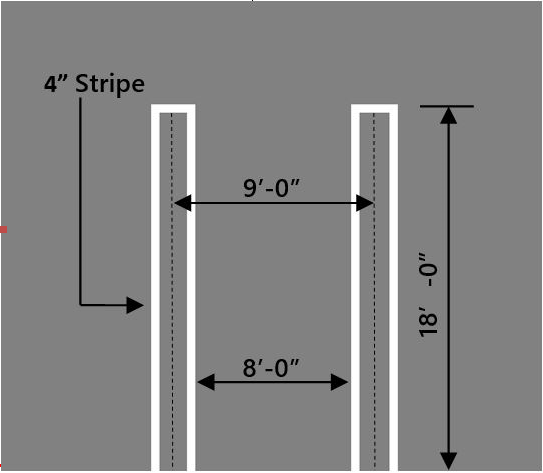
M.
Driveways.
1.
The maximum width for driveways in commercial, mixed use, and industrial zones shall be 35 feet.
a.
All driveways shall have a minimum vertical clearance of 14 feet six inches.
2.
A driveway for one-way circulation shall have a minimum width of 12 feet six inches. A driveway for two-way circulation shall have a minimum of 25 feet.
3.
No driveway shall be situated so as to create a blind intersection that would hinder public safety.
N.
Circulation. No parking space backup area shall occur in the first 20 feet from the street right-of-way and a parking lot entrance or exit.
O.
Marking and Signs.
1.
Each parking space shall be identified by four-inch-wide stripes of paint, or other durable striping material approved by the Director. All parking stalls shall be clearly outlined with double stripes to provide a parking stall with a nine foot width, measured to the center of the lines.
2.
Drive aisles, approach lanes, and maneuvering areas shall be marked and maintained with directional arrows and striping to expedite traffic movement. Any area not intended for parking shall be signed, or in areas where curb exists, the curb may be painted red in lieu of signs.
3.
The City Engineer may require the installation of the traffic signs in addition to directional arrows to ensure the safe and efficient flow of vehicles in a parking facility.
4.
Compact and carpool spaces, where allowed, shall be clearly identified for compact vehicle and carpool usage, respectively.
5.
Disabled parking spaces shall be striped and marked according to the applicable state standards.
P.
Parking Lot Lighting.
1.
Lighting shall be hooded and arranged to reflect away from adjoining properties and streets.
2.
Light standards within parking lots shall be the minimum height required to effectively illuminate the parking area and eliminate spillover of light and glare onto adjoining properties. To accomplish this, a greater number of shorter light standards may be required as opposed to a lesser number of taller standards.
3.
Light standards shall be a maximum of 20 feet in height. The height of the light standard shall be measured from the elevation of the adjacent pavement of the parking lot. When the subject property abuts a residentially zoned property or is within 100 feet of residentially zoned property, light standards within 100 feet of the property shall not exceed 15 feet in height.
4.
Parking lots, driveways, pedestrian walkways, and building entrances/exits shall be illuminated for security and safety purposes during business hours of operation.
Q.
Wheel Stops or Planter Curbs. Wheel stops or a planter curb shall be provided for each parking space adjacent to and facing a wall, building, walkway, utility cabinet, or structure. The wheel stops or planter curbs shall be set a minimum of 36 inches from the forward end of the parking stall and shall be six inches high and made of concrete or other durable material subject to the approval of the Director. If a planter curb is used in lieu of a wheel stop, the planted area contained in the required parking space shall not be considered as part of any required dimensions of landscape buffers and shall not be included in the percentage of the parking area required to be landscaped.
(Ord. No. 2347, § 4(Exh. B), 6-6-17; Ord. No. 2375, § 4(Exh. A), 4-6-21)
9103.07.070 - Mixed-Use (Nonresidential and Residential Combined) Parking Standards.
A.
Mixed-Use with Residential. This subsection applies to mixed-use developments as defined in Division 9 (Definitions) and where allowed by Division 2 (Zones, Allowable Uses, and Development Standards).
1.
The number of parking stalls provided shall be as outlined in Tables 3-3, 3-5, 3-6, 3-7, and 3-8.
2.
No more than 50 percent of the required guest parking spaces for the residential units may be shared with the required commercial parking spaces.
3.
The parking for the residential use required to be in a fully enclosed garage in compliance with Table 3-3 may be provided within an underground or aboveground parking structure rather than a garage.
4.
With the exception of the guest parking, parking for the residential uses shall be provided and maintained separate and secure from the on-site public parking.
5.
A 25 percent reduction may be applied to the project for all commercial uses if the parking area is located within 1,320 feet of a light rail station.
6.
If affordable residential units are proposed with mixed-use developments, refer to Section 9103.15.030 of the Arcadia Municipal Code for incentives and concessions to parking standards.
(Ord. No. 2375, § 4(Exh. A), 4-6-21; Ord. No. 2400, § 4(Exh. A), 2-20-24)
9103.07.080 - Parking Area Design Standards Applicable to All Zones.
A.
General Requirements.
1.
All required off-street parking areas shall be paved. Paving materials, methods, soils compaction, and base materials shall be shown on building plans prepared by a State licensed architect, civil engineer or structural engineer.
2.
All required parking spaces shall have adequate individual access and safe ingress and egress.
3.
No parking space shall be arranged in a manner that requires the moving of any other vehicle on the premises in order to enter or leave any other parking space, other than as permitted by Section 9103.07.050.I (Tandem Parking Spaces). This provision shall not apply at such times as attendant parking is provided.
4.
When determined necessary by the Director, painted directional signs shall be provided in each aisle or driveway.
5.
No parking space backup area shall occur in the first 20 feet from the street right-of-way, parking lot entrance, or parking lot exit.
6.
No driveway shall be constructed within three feet of any fire hydrant, ornamental light standards, telephone or electric pole, meter box or underground vault, or manhole.
7.
All driveways and drive approaches within the public right-of-way shall be constructed of standard Portland cement concrete, six inches thick. No variations in material within the public right-of-way shall be allowed.
a.
All required parking facilities shall be permanently maintained, free of litter and debris, potholes, obstructions and stored material.
b.
Each parking space shall have a minimum of 25 feet of clear back-out space. Alternatively, if the site does not have a back-out clearance of 25 feet straight, it may be measured from a seventy-five (75) degree angle, as measured from the garage door, or opening, in the direction of the back-up subject to the discretion of the Director.
8.
A minimum of distance of 14 feet six inches is required between any driveway openings, unless otherwise specified in this section. The distance shall be measured from the closest points between any two driveways. Driveway openings for the purpose of this subsection shall be the first five feet along the length of the driveway measured from the point where the opening abuts the roadway.
Figure 3-16
Off-Street Parking Standards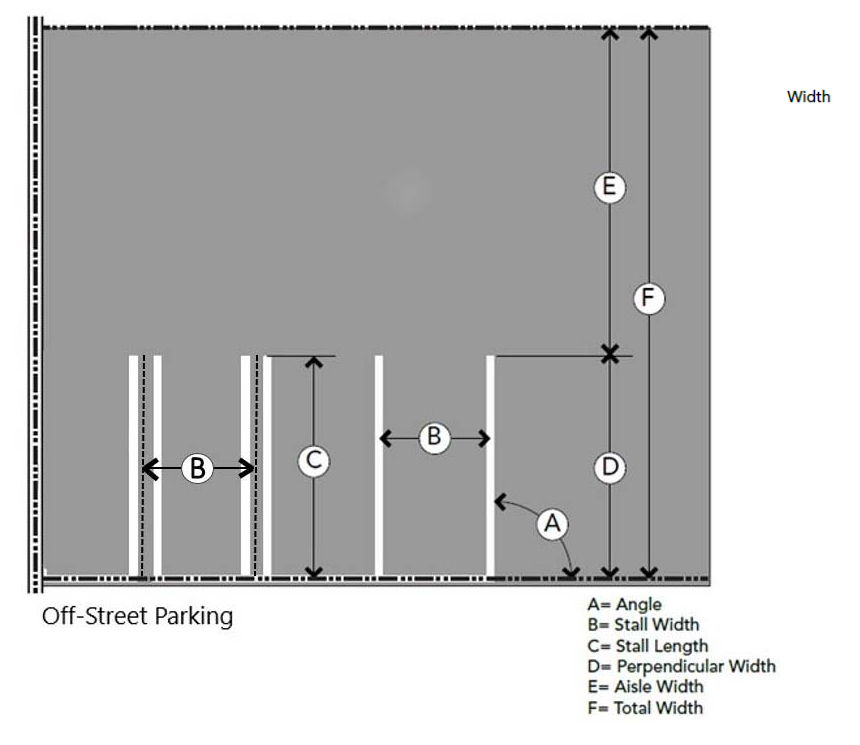
(Ord. No. 2375, § 4(Exh. A), 4-6-21)
9103.07.090 - Shared/Joint Use, Off-site Parking, and In-Lieu Parking.
A.
Authority. The Director shall be the designated Review Authority for the review and approval of any proposal shared, joint use, on or off-site parking arrangements, or In-lieu parking fee, unless parking is included in an application requiring approval of another Review Authority. In these cases, the ultimate Review Authority per Division 7 (Permit Processing Procedures) shall be the Review Authority for the shared, joint use, off-site parking agreement, or In-lieu payment.
B.
Eligibility for Shared/Joint Use and Off-site Parking. Where it can be demonstrated that two or more land uses can effectively share common parking facilities due to the nature of the uses and distinctly different demand for parking, or where off-site parking is proposed to meet parking requirements, then an application may be filed for such parking arrangement. Such application shall include a parking study that identifies the parking demand of all subject land uses and that clearly demonstrates how and why parking facilities can be shared.
1.
The following categories of development shall be eligible to use shared use and/or off-site parking arrangements to meet parking requirements:
a.
Nonresidential new construction.
b.
Additions to existing structures, rehabilitation of existing structures, or changes in use or occupancy in existing structures.
2.
New and existing residential uses are not eligible to use shared use or off-site parking arrangements.
C.
Eligibility for In-Lieu Parking. For any new developments that are within the Central Business District or Downtown Mixed Use zones, the property owners may make an in-lieu payment for future construction, maintenance and operation of public off-street parking instead of providing off-street parking spaces.
D.
Circumstances and Requirements for Allowing Shared Parking Arrangements.
1.
Off-site parking spaces may be relied upon to serve commercial uses, provided a shared parking study is completed by the applicant/developer and approved by the Director. The parking study shall be prepared by a registered traffic engineer and shall specifically analyze the parking demand for each use proposing to share the parking, each use's hours of operation, and other related issues of all involved uses.
2.
No joint use or shared facility shall be located more than 1,500 feet from the use it is intended to serve unless located within the Downtown Parking Overlay.
3.
Shared use parking standards are based on the assumption that patrons will use a single parking space for more than one destination and that one parking space will be open and available for short-term parking to serve many different uses which may have different peak hours.
E.
Findings for Granting Shared/Joint Use and Off-site Parking Arrangements. In granting a request for shared/joint use or off-site parking, the Review Authority shall make all of the following findings:
1.
There is clear and convincing evidence that peak hour parking demand from all uses does not coincide and/or the uses are established in a way that the hours of operation are different for the various businesses or uses.
2.
There is adequate parking provided for all participating users.
3.
The shared/joint use or off-site parking arrangement will be an incentive to, and a benefit for, the nonresidential development.
4.
Adjacent or nearby properties will not be adversely affected by the shared/joint use or off-site parking.
5.
The parking arrangement is consistent with the General Plan and all requirements of this Code.
F.
In-Lieu Parking Fee. In-lieu fees, at the owner's option, may be paid in a lump sum or in annual installments, and may be adjusted annually for inflation. If paid annually, the first annual payment of an in-lieu fee shall be due as a condition of occupancy, and subsequent payment shall be made per the agreement the City enters into with the owner. In-lieu payment under the In-Lieu Parking program shall be used for establishing such public parking funds, as established by the City Council.
G.
Legal Agreement Required.
1.
All joint, shared, and off-site parking arrangements shall be required to enter into an agreement with the City and recorded with the Office of the County Recorder, requiring the parking to be operated on a nonexclusive basis, to be open and available to the public for shared use, short-term parking during normal business hours.
2.
All In-Lieu parking arrangements shall be required to enter into an agreement with the City.
H.
Change in Use. In the event of a change in use, a new application shall be filed or the existing agreement amended to the satisfaction of the Director.
(Ord. No. 2356, Exh. A, 8-7-18)
9103.07.100 - Valet Parking.
A.
Where Permitted and Approval Process. Valet parking may be permitted in commercial and mixed-use zones subject to the approval of a Minor Use Permit, based on the approval process outlined in this Section.
B.
Review Criteria.
1.
Valet parking shall be subject to review of hours of operation, circulation and other pertinent impacts. All proposals for valet parking shall be accompanied by a parking study, prepared by a registered traffic engineer, that addresses circulation impacts, operational characteristics of the use, parking space size and configuration and other issues deemed necessary by the Director.
2.
Valet parking shall be provided on the same site as the business for which the valet parking is being approved. In the event the location for the valet parking is off-site of the business, the provisions in this Section regulating off-site parking shall also be applicable.
C.
Development Standards for Valet Parking Uses.
1.
Because of the unique characteristics of valet parking facilities, parking space size shall be determined on a case-by-case basis and not necessarily subject to the standards listed in this Section.
2.
Valet parking facilities shall not be permitted to use parking that is specifically set aside or required for another use, unless a shared parking or off-site parking agreement, as applicable, is approved by the City.
9103.07.110 - Parking Structures.
A.
Parking spaces within a parking lot or structure shall be designed and located so that any required maneuvering into or out of the space will not interfere with vehicles entering or exiting the parking lot, and so that vehicles can enter an abutting street in a forward direction. The drive aisles shall be designed so that a vehicle is not required to enter a street to move from one drive aisle to another.
B.
Within a parking structure, piers and pillars shall not encroach within the minimum clearance of required parking stalls.
C.
Subterranean parking structures and above-ground parking structures shall have a minimum vertical clearance of eight feet and six inches.
D.
Preferential parking spaces reserved for vanpools shall be accessible to vanpool vehicles. When located within a parking structure, a minimum vertical interior clearance as required by the California Building Code and the subsection above 9103.07.110.C. Each parking space shall be provided for those spaces and access ways to be used by such vehicles. Adequate turning radii and parking space dimensions shall also be included in vanpool parking areas.
E.
Above-ground parking structures shall not be subject to the landscaping requirements applicable to parking lots.
(Ord. No. 2375, § 4(Exh. A), 4-6-21)
9103.07.120 - Prohibition on Commercial Vehicle Parking in Residential Zones.
A.
No commercial vehicle, as defined by the California Vehicle Code, which exceeds three tons in unladen gross weight shall be parked or left standing between the hours of 12:00 a.m. midnight and 4:00 a.m. of any day on any part of any property zoned or used for residential purposes.
9103.07.130 - Landscape Standards for Parking Lots.
A.
Purpose and Intent. Landscaping, where required by this Section, shall be installed and well maintained, to keep landscaping alive, attractive and free of disease. It is the intent of this Section to preserve and enhance the appearance and visual appeal of the community.
B.
Applicability. Landscaping requirements outlined in this Section shall be applicable to all new development and to improved nonconforming lots when the nonconforming lot is to be modified by a change of more than 20 percent in the square footage of structures. The Director may approve modifications to these standards on nonconforming lots where the revised site design does not allow for full compliance with these provisions due to the space and dimensions created by those structures and other improvements being retained.
C.
General Landscaping Requirements. Landscaping of parking areas shall be provided and maintained according to the general standards of Section 9103.09 (Landscaping), as well as the standards within this subsection. Proposed parking lot landscaping as required by this Section shall be reviewed and approved by the Review Authority through a Site Plan Design Review, pursuant to the requirements of Section 9107.19 (Site Plan and Design Review) of this Development Code.
D.
Landscaping Plan Required. Within parking lots, landscaping shall be used for shade and climate control, to enhance project design, and to screen the visual impact of vehicles, light pollution, and large expanses of pavement. Landscaping materials shall be provided throughout the parking lot area using a combination of trees, small shrubs, and groundcover. A comprehensive landscape and irrigation plan shall be submitted for review and approval in compliance with Section 9103.09 (Landscaping).
E.
Minimum Landscape Coverage. A minimum of five percent of the parking lot area shall be landscaped and maintained in perpetuity. Required planting areas between parking areas and adjacent public streets and residentially zoned properties shall not be considered part of the required landscape coverage. When landscaping is designed to allow vehicles to overhang into the landscaping, none of the overhang area shall be counted towards the five percent required landscaping.
F.
Trees. Trees shall be planted and maintained in all parking lots at a ratio of at least one tree per 10 parking spaces. Trees shall be of a variety that provides a wide canopy, subject to the review and approval of the Director. All newly planted trees shall be a minimum 15-gallon size with a one-inch diameter at breast height.
G.
Location of Landscaping. Parking lot landscaping shall be designed and planted so that pedestrians are not required to cross landscaped areas to reach building entrances from parked cars. This shall be achieved through proper orientation of the landscaped fingers and islands. Planting areas shall be as evenly distributed as possible throughout the entire area. Concentration in one location is not acceptable.
H.
Curbing. Where the front end of a parking stall abuts a landscaped area, the landscaped area shall extend into the parking stall so that the curb bordering the landscaped area will also serve as the wheel stop for the parking stall.
I.
Visibility and Clearance. Landscaping in planters and at the end of parking aisles shall not obstruct drivers' vision of cross traffic both vehicular and pedestrian. Mature trees shall have a foliage clearance of eight feet from the surface of the parking lot maintained.
J.
Perimeter Parking Lot Landscaping.
1.
Adjacent to Streets. A perimeter planter with a minimum width of five feet and not more than three feet in total height (measured from the finished grade of the parking lot) shall be provided between parking areas and property lines which are located between parking areas and public streets (including alleys). Screening materials may include any combination of plant materials, solid masonry walls, raised planters, or other screening device deemed appropriate by the Review Authority in complying with the intent of this requirement.
2.
Adjacent to Residential Use. Where parking areas for nonresidential uses are within 20 feet of residentially zoned property, a landscaped buffer strip with a minimum width of five feet shall be provided between the parking area and the common property line bordering the residential use.
9103.07.140 - Parking for Electric and Alternative Fuel Vehicles.
The City recognizes the importance of encouraging and accommodating the use of electric and other alternative fuel vehicles as a means of reducing regional air pollutant emissions. The requirements in this Section are provided to ensure that adequate provision is made for accommodating locations within required parking areas where electric and alternative fuel vehicles can recharge and/or be provided with priority parking.
A.
Applicability. As part of the Site Plan and Design Review process, the responsible Reviewing Authority shall have the authority to require that parking facilities be provided to accommodate electric or other alternative fuel vehicles. Generally, facilities shall be provided where more than 100 parking spaces are required per this Section, or whenever the redesign of an existing parking lot with 150 or more spaces is proposed.
B.
Developmental Standards - Electric Vehicle Recharging Facilities. Electric vehicle ready charging infrastructure shall be provided in multifamily housing developments and non-residential developments according to the standards outlined by the California Green Building Standards Code. Where electric vehicle recharging stations are provided, they shall follow the development standards outlined in the California Green Building Standards Code.
9103.07.150 - Bicycle Parking Requirements.
A.
General Provisions. All new development, except that located in the R-M, R-0, and R-1 zones, shall be designed with the following:
1.
Bicycle parking shall be located within 200 feet of a building entrance, not interfere with pedestrian access, and be located in a visibly secure location adjacent to the building.
2.
For each bicycle parking space required, a stationary object shall be provided to which a user can secure both wheels and the frame of a bicycle with a user-provided six-foot cable and lock. The stationary object may be either a freestanding rack or a wall-mounted bracket.
3.
When bicycle parking areas are not clearly visible to approaching cyclists, signs shall be provided to indicate the locations of the facilities.
B.
Bicycle Parking Requirements. Bicycle parking is required for multifamily development, mixed-use development, public and civic facilities, private schools, retail commercial, industrial, hospital, and office uses in compliance with Table 3-10 (Bicycle Parking Requirements). Bicycle parking for commercial recreation and entertainment uses shall be as specified by Conditional Use Permit.
(Ord. No. 2375, § 4(Exh. A), 4-6-21)
9103.07.160 - Off-Street Loading.
A.
General Loading Requirements. All loading spaces shall have adequate ingress and egress, and shall be designed and maintained so that the maneuvering, loading, or unloading of vehicles does not interfere with vehicular and pedestrian traffic.
B.
No Use of Public Streets. All industrial, commercial, and mixed-use developments shall be designed to prevent truck back-up maneuvering within any public street.
C.
Minimum Loading Space Requirements.
1.
Required Spaces. Every new building, and every building enlarged by more than 5,000 square feet that is to be occupied by a manufacturing establishment, storage facility, warehouse facility, retail store, eating and drinking, wholesale store, market, hotel, hospital, mortuary, laundry, dry-cleaning establishment, or other use similarly requiring the receipt or distribution by vehicles or trucks of material or merchandise shall provide off-street loading and unloading areas as follows. Such onsite loading space shall be maintained during the existence of the building or use that it is required to serve. See Table 3-12 (Minimum Loading Space Requirements).
a.
Exception: Minimum loading space requirements shall not apply in the following zones: DMU, MU, and CBD.
b.
In any zone, the minimum loading space requirement may be reduced or waived upon a finding by the Director that the applicant has satisfactorily demonstrated that due to the nature of the proposed use, such loading space(s) will not be needed.
c.
In any zone, the required number of loading spaces may be increased to ensure that trucks will not be loaded, unloaded, or stored on public streets. Such requirement shall be based on the anticipated frequency of truck pickups and deliveries and of the truck storage requirements of the use for which the on-site loading spaces are required.
2.
Multi-Tenant Buildings. The square footage of the entire building shall be used in determining spaces for multi-tenant buildings. A common loading area may be required, if each tenant space is not provided a loading area. Drive-in roll-up doors for multi-tenant industrial projects may be substituted for required loading areas.
3.
Loading Space Design.
a.
Each on-site loading space required by this subsection shall be provided with driveways for ingress and egress and maneuvering space of the same type and meeting the same criteria required for onsite parking spaces. Truck-maneuvering areas shall not encroach into required parking areas, travelways, or street rights-of-way. This requirement may be modified upon a finding by Director that sufficient space is provided so that truck-maneuvering areas will not interfere with traffic and pedestrian circulation. On site-loading spaces shall be designed and maintained so that the maneuvering, loading, or unloading of vehicles does not interfere with vehicular and pedestrian traffic.
b.
Each on-site loading space required by this subsection shall not be less than 10 feet wide by 25 feet long and at least 14 feet high, with adequate provision for egress and ingress. If the loading space is adjacent to a wall or structure, the loading space shall be not less than 11 feet, six inches wide by 25 feet long. The minimum size requirements may be modified upon a finding by the Director that the applicant has satisfactorily demonstrated that due to the nature of the proposed use, an alternative size for the loading space is appropriate.
c.
In no event shall the outer radius of any turning area to a required loading space be less than 25 feet.
d.
Loading areas shall be striped indicating the loading spaces and identifying the spaces for "loading only." The striping shall be permanently maintained in a clear and visible manner at all times.
e.
For all loading areas facing residentially zoned property or facing a public right-of-way, there shall be a minimum 10-foot high solid architecturally treated decorative masonry wall, approved by the Director, to screen the loading area(s) from view from the public right-of-way or residentially zoned property. All wall treatments shall have architectural treatment on both sides of the screening.
D.
Loading Docks.
1.
Loading bays, doors and/or docks shall generally be located on the rear of the structure.
2.
Bays and doors may be located on the side of a building away from a street frontage where it can be demonstrated that the bays, doors, and related trucks will be adequately screened from public view from any street or public right-of-way.
E.
Special Regulation: Commercial Day Care Loading. Adequate facilities shall be provided for the safe loading and unloading of children either by a circular driveway or a driveway terminating in the area designated for off-street parking.
9103.07.170 - Free Off-Street Parking for Large Retail Developments.
A.
Purposes and Intent. The voters of the City of Arcadia, find that off-street self parking for large retail development s in the City of Arcadia historically has been provided free of charge.
The voters of the City of Arcadia, believe that providing free off-street self parking for patrons, visitors, employees, and residents of large retail developments protects the health and welfare of the citizens of the City of Arcadia because it encourages them to use parking spaces provided at the retail developments, and reduces harmful impacts on neighboring City and residential streets.
The voters of the City of Arcadia support a policy that requires large retail developments to provide off-street self parking for their patrons, visitors, employees, and residents free of charge for any length of time and without any restriction or requirement to obtain parking validation of any kind from a retail establishment in the development.
B.
Large Retail Development. For the purpose of imposing a prohibition on charging for parking, a Large Retail Development shall mean any development that includes a planned integrated commercial development comprising more than two hundred thousand (200,000) square feet of Gross Leasable Area to be used for retail restaurant, entertainment, and movie theater purposes.
C.
Free Off-Street Self Parking for Retail Developments. Off-street parking spaces provided for all Large Retail Developments in the City, regardless of the zoning of the Large Retail Development property, shall be provided free of charge to all patrons, visitors, employees, and residents without time limits, and they shall not be required to obtain parking validation from a commercial establishment within the Large Retail Development in order to enjoy free self parking at the Large Retail Development property.
D.
Valet Parking. Valet Parking is a service provided by a Large Retail Development where customers arriving at the Large Retail Development can drop off their cars to be parked and have their cars returned to them upon departure, for a fee or validation. A Large Retail Development may require Valet Parking validation from a commercial establishment or charge a fee for Valet Parking, as long as the Valet Parking service uses no more than 10% of the total number of off street parking spaces of the Large Retail Development.
(Ord. No. 2221, §§ 1, 2, 1-10-07)
Editor's note— Ord. No. 2221, adopted January 10, 2007, was saved from repeal by the comprehensive zoning amendment of 2016 and incorporated as § 9103.07.170 at the city's direction.
9103.09.010 - Purpose and Intent.
The City promotes the value and benefits of landscapes while recognizing the need to conserve water and other resources as efficiently as possible. This Section establishes minimum landscape standards for all uses in compliance with applicable state standards and guidelines and to promote sustainable development. The purpose of this Section is to establish a structure for planning, designing, installing, maintaining, and managing water-efficient landscapes in new construction and rehabilitated projects.
9103.09.020 - Applicability.
A.
General. This Section shall supplement the Water Efficient Landscaping Ordinance (Sections 7554.2—7554.9) and shall apply to all of the following landscape projects, as listed in Section 7554.3:
1.
New construction projects with an aggregate landscape area equal to or greater than 500 square feet requiring a building or landscape permit, plan check, or design review;
2.
Rehabilitated landscapes projects with an aggregate landscape area equal to or greater than 2,500 square feet requiring a building or landscape permit, plan check, or design review; and
3.
Existing landscape areas that are one acre or more for which a water efficient landscape worksheet shall be prepared according to the specifications for existing landscapes in the Landscape Documentation Package.
B.
Exemptions. The provisions of this Section shall not apply to:
1.
Registered local, state or federal historical sites;
2.
Ecological restoration projects that do not require a permanent irrigation system;
3.
Mined-land reclamation projects that do not require a permanent irrigation system; or
4.
Botanical gardens and arboretums open to the public.
9103.09.030 - Landscape Plan Required; What Constitutes Landscape Materials.
A.
Plan Check Requirements and Content. A Landscape Documentation Package prepared by a licensed landscape architect shall be required for all applicable projects as described in the Water Efficient Landscaping Ordinance (see Section 7554.3), and for any project involving the installation of artificial turf within the front or street side yards.
9103.09.040 - Landscape Requirements.
A.
Applicability. The standards in this Section shall apply to residential and non-residential uses.
B.
Landscape Requirement for Residential Zones. All areas of a site not devoted to structures, driveways, or walkways shall be landscaped with lawn, trees, shrubs, or other plant materials, and shall be permanently maintained in a neat and orderly manner.
1.
R-M, R-0 and R-1 Zones.
a.
The front and street-side areas shall be landscaped with lawn, trees, shrubs, or other plant materials, and shall be permanently maintained in a neat and orderly manner.
b.
Hardscape materials, of driveways and pedestrian walkways but not including pavement, concrete, interlock pavers, and the use of artificial turf, shall not cover more than 40 percent of the front or street side yard. See Figure 3-17 (Front Yard Area-60% Landscaping Required).
Figure 3-17
Front Yard Area - 60% Landscaping Required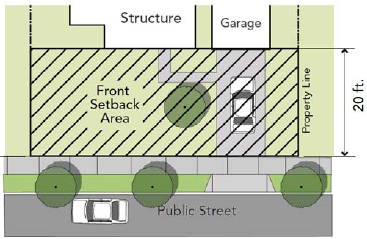
2.
R-M Zone. All cut or fill slopes exceeding six feet six inches in vertical height between two or more contiguous lots shall be planted with adequate plant material to protect the slope against erosion. The planting shall cover the bank within two years from the time of planting. The permittee, owner, or developer shall water the planted slopes at sufficient time intervals to promote growth.
3.
R-2 and R-3, and R-3-R Zones.
a.
The front/street side yard areas shall be landscaped with lawn, trees, shrubs, or other plant materials, and shall be permanently maintained in a neat and orderly manner.
b.
Hardscape materials, of driveways and pedestrian walkways but not including pavement, concrete, interlock pavers, and the use of artificial turf, shall not cover more than 40 percent of the front or street side yard. See Figure 3-17 (Front Yard Area-60% Landscaping Required).
C.
Landscape Requirement for Commercial, Mixed Use, and Industrial Zones.
1.
Required Areas. All setbacks, parkways, open areas, plazas, paseos, and non-work areas that are visible from a public street/alley or from a parking lot available to the general public shall be landscaped.
2.
Landscape Coverage Requirement. Shrubs, groundcover, and other plant material shall cover all areas not occupied by structures, parking areas, storage, trash enclosures, driveways, and sidewalks at the time of issuance of a Certificate of Occupancy. Embellished pavement, fountains, and similar hardscape materials may, in part, be substituted for the required landscaping through the Site Plan and Design Review process.
3.
Parkway-adjacent Planting and Maintenance. All landscaped parkway areas located between the sidewalk and the edge of development shall meet the following requirements:
a.
The ground surface shall contain low shrubbery, mulch, or ground cover to provide coverage within two years.
b.
If a wall or fence separates the development from the street, planting vines or espalier shrubs shall be incorporated into the planting design.
4.
Required Landscaping for Loading Areas. Loading areas shall incorporate landscaping to provide screening if visible from the public right-of-way, adjacent uses, and pedestrians.
5.
Special Requirements for Drive-through Businesses.
a.
Five-foot-wide raised planters shall be located along the street side property line, except for curb cut openings.
b.
Three-foot-wide raised planters shall be located along the walls of the interior property lines to a distance equal to the front building line. For this purpose, canopies and other such structural appurtenances shall not be considered the front building line.
c.
A minimum of 150 square feet of raised planting area shall be located at the intersection of two property lines at a street corner.
d.
A minimum of 30 square feet of raised planting area shall be located along the building facades fronting on the street.
e.
All planting areas shall be separated from adjacent asphaltic concrete paving by six-inch minimum curb walls.
D.
Artificial Turf.
1.
Locations Permitted.
a.
Back Yards and Interior Side Yard Areas. Artificial turf is permitted in any zone within any back yard and/or interior side yard areas.
b.
Front and Street-Side Yards. In any zone, a maximum of 15 percent of the yard area within the front or street side yards may be installed with artificial turf. Artificial turf shall not be installed within 10 feet of a sidewalk or within 20 feet from the curb if there is no sidewalk.
c.
Not Permitted in Parkways. Artificial turf is not permitted within any parkway areas.
2.
Minimum Standards. To be used in the front or street-side yard, artificial turf must meet minimum standards for materials, installation, and maintenance.
a.
Materials and Style. Artificial turf must have a minimum eight-year no-fade warranty as issued by the manufacturer; be cut-pile infill and made from lead-free polypropylene, polyethylene or a blend of such fibers on a permeable backing; and, have a minimum blade length (pile height) of 1.5 inches, or as determined by the Director as manufacturing processes are updated. Nylon-based or plastic grass blades are not permitted. The use of indoor/outdoor carpeting, and artificial shrubs, flowers, trees and vines instead of natural plantings is prohibited. Infill medium must consist of ground rubber; rubber coated sand or other approved mixtures and must be brushed into the fibers of the artificial turf. The style of the fiber, color, and texture shall resemble fescue, rye, and other common natural grass blades.
b.
Installation. Artificial turf must be installed per all manufacturer's requirements and must include removal of all existing plant material and top three inches of soil in the installation area; placement of filter fabric or synthetic porous material over compacted and porous crushed rock or other comparable material below the turf surface to provide adequate drainage; and, the area must be sloped and graded to prevent excessive pooling, runoff, or flooding onto adjacent property. Artificial turf areas must be sufficiently drained to live planting areas to provide complete infiltration of runoff. Artificial turf must be separated from live planting areas by a barrier such as a mow strip or bender board to prevent mixing of natural plant materials and artificial turf. Artificial turf must be permanently anchored with nails and glue, and all seams must be nailed, or sewn, and glued, with the grain pointing in a single direction.
c.
Maintenance. Artificial turf must be maintained in a green, fadeless condition; free of weeds, stains, debris, tears, holes, depressions, ruts, odors, and looseness at edges and seams. Damaged or worn areas in the artificial turf surface must be repaired or removed and replaced in a manner that results in consistent appearance with the existing artificial turf. The artificial turf surface must be replaced once it is unable to be maintained as required. Vehicle parking on artificial turf is prohibited.
(Ord. No. 2375, § 4(Exh. A), 4-6-21; Ord. No. 2401, Exh. B, 4-15-25)
9103.09.050 - Landscape Irrigation and Maintenance.
A.
The owner of any property, or any other person or agent in control of a property, on which is located any retaining walls, cribbing, drainage structures, planted slopes and other protective devices, required according to a permit granted under this Code or required under the issuance of a grading permit, shall maintain the retaining walls, cribbing, drainage structures, planted slopes, and other protective devices in good condition and repair at all times.
B.
All landscaped areas in non residential zones shall be provided with a permanent irrigation system installed below grade except for sprinkler heads. All domestic water supply lines to which irrigation systems are connected shall, when necessary, be protected by installation of atmospheric or pressure type vacuum breakers. At least one hose bibb shall be located each 100 linear feet, starting with one hose bibb at the front wall. Hose bibbs, wherever possible, shall be located in planting beds. In no case shall hose bibbs be located where they will interfere with pedestrian or vehicular circulation.
9103.11.010 - Purpose.
Because of the need to protect and enhance the City's unique character (including special places and features such as a vibrant Downtown, the urban forest, attractive streetscapes, diverse parks, historic buildings and places, and entertainment destinations), to protect public safety and property values, and to promote economic development and tourism through enhanced aesthetic appeal, the Council finds that proper sign control is an important governmental interest. The intent of the standards in this Section is as follows:
A.
Provide each sign user an opportunity for adequate identification while guarding against the excessive and confusing proliferation of signs by appropriately regulating the time, place, and manner under which signs may be displayed.
B.
Preserve and enhance the community's appearance by regulating the type, size, location, quality, design, character, scale, color, illumination, and maintenance of signs.
C.
Encourage well-designed signs that attract and invite rather than demand the public's attention.
D.
Encourage the design of signs that complement the structures and uses to which they relate and that are harmonious with their surroundings.
E.
Ensure freedom of expression for sign uses, including noncommercial speech, by maintaining a content-neutral approach to sign regulation.
F.
Enhance the safety of motorists and pedestrians by minimizing the distraction of intrusive signs, as well as to protect the life, health, property, and general welfare of City residents and visitors.
G.
Provide a review process for signs to ensure compliance with the requirements of this Section.
9103.11.020 - Applicability.
A.
Regulatory Scope. This Section regulates signs, as defined in this Section, that are placed on private property or on property owned by public agencies other than the City and over which the City has zoning authority.
B.
Applicability. The regulations in this Section shall apply to all signs in all zones that come within the regulatory scope as defined in Subsection A, above, unless specifically exempted. Sign Permits shall be required in compliance with Section 9103.11.120 (Procedures for Sign Permits, Exemptions, and Revocations). In addition, the provisions of Municipal Code Article VIII (Building Regulations) relating to building and electrical codes, fees, penalties, and a method of enforcement shall also apply. Applications for Sign Permits that comply with all of the applicable requirements of this Section, and other applicable laws, shall be granted. Signs approved in conjunction with any other application shall be consistent with this Section, unless modified by a discretionary permit. Where approval of a Conditional Use Permit, Minor Use Permit, Modification, Site Plan and Design Review, or Variance has been obtained, any applicable conditions of that approval shall supersede the requirements of this Section.
C.
Sign Permit Required. A Sign Permit shall be required for all signs, including change of copy allowed under the provisions of this Chapter. Only signs that comply with all of the applicable provisions of this Chapter shall be granted. Content of a noncommercial message shall not be considered when any required Sign Permit application is reviewed. Content of a commercial message shall be considered only to the extent required to determine whether the sign is an on-site sign. See Section 9103.11.120 (Procedures for Sign Permits, Exemptions, and Revocations).
D.
Nonconforming Signs. An existing legally allowed sign that does not conform to the requirements of this Section shall be deemed a nonconforming sign and shall be subject to the requirements of Section 9103.11.160 (Nonconforming Signs).
E.
Specific Plans. Sign regulations contained in an adopted specific plan document shall not be less restrictive than the regulations in this Section. If the adopted specific plan does not provide regulations for a particular sign type or situation, the requirements of this Section shall prevail.
9103.11.030 - General Provisions.
The policies, rules, and regulations stated in this Section apply to all signs subject to compliance with this Section.
A.
Compliance Required. No person shall erect, re-erect, construct, maintain, enlarge, alter, change copy, repair, move, improve, remove, convert, or equip any sign or sign structure, or paint a new wall sign, in the City, or cause or permit the same to be done, contrary to, or in violation of, any provision of this Section.
B.
Interpretations by Director. Interpretations of the requirements of this Section shall be exercised in light of the City's content neutrality policy. Where a particular type of sign is proposed in a permit application, and the type is neither expressly allowed nor prohibited by this Section, or whenever a sign does not qualify as a "structure" as defined in the California Building Code, then the Director shall approve, conditionally approve, or deny the application based on the most similar sign type that is expressly regulated by this Section.
C.
Content Neutrality. It is the City's policy to regulate signs in a constitutional manner that is content neutral with respect to both noncommercial and commercial messages. For the purposes of this Section, a content-neutral regulation is a so-called "time, place, or manner" regulation, which, as the name suggests, does no more than place limits on when, where, and how a message may be displayed or conveyed.
D.
Message Substitution. Signs authorized by this Section are allowed to carry noncommercial messages in lieu of any other commercial or noncommercial messages. Substitution of messages may be made without an additional permitting process unless a building permit is required. This provision prevails over any more specific provision to the contrary within this Section. The purpose of this provision is to prevent an inadvertent favoring of commercial speech over noncommercial speech, or favoring of any particular noncommercial message over any other noncommercial message. This provision does not create a right to increase the total amount of signs on a parcel, nor does it affect the requirement that a sign structure or mounting device be properly constructed.
E.
Rules for Non-Communicative Aspects of Signs. Rules and regulations concerning the non-communicative aspects of signs (e.g., number, type, location, size, height, illumination, spacing orientation, etc.) stand enforceable independently of any permit or review process.
F.
Address Signs. Address signs are exempt from the provisions of this Section and are required to comply with Municipal Code Section 9266.2.8.11 (Address Numbers) in Article III (Public Safety).
G.
Property Owner's Consent Required. Signs shall not be displayed without the consent of the legal owner of the property, or the designated agent, on which the sign is mounted or displayed. For purposes of this regulation, "owner" means the holder of the legal title to the property and all parties and persons holding a present right to possession, control, or use of the property.
9103.11.040 - Exempt Signs.
The signs listed in this Section are exempt from the permit requirement and do not count toward the total display area limit which is otherwise applicable. However, the signs described in this Section shall be subject to the applicable safety codes and to all other applicable laws. Any such exempt sign shall not block or interfere with the visibility triangle.
A.
Address Signs. Address signs made up of numbers and/or letters 12 inches high or less.
B.
Flags. Flags of any nation, state, or city when displayed in compliance with the Flag Code (36 USC, Section 173 et seq.).
C.
Names of Buildings, Commemorative Tables, and the Like (with Limitations). Names of buildings, commemorative tables, and the like when carved into stone, set in concrete or similar material, or constructed out of bronze, aluminum, or other permanent material.
D.
Public Notices and Warnings. Signs displayed by a public body or officer in the performance of a public duty or by any person pursuant to a governmental requirement or legal duty of function. This section applies to and includes signs whose function is to provide legal notice or functional information such as traffic signs, public transit signs, utility company signs, public restroom signs, warning signs, and signs placed by a public agency for the purpose of guiding persons to emergency centers and places of public interest.
E.
Public Signs within a Right-of-way.
1.
Public signs posted by or for government agencies that provide public information, identify public property, post legal notices, or direct or regulate traffic of any kind.
2.
Bus or train stop signs posted by public transit agencies.
3.
Public utility signs that convey information about its lines, pipes, poles, or other facilities.
4.
Emergency warning signs posted by a governmental agency, public utility, or contractor doing authorized work in the public right-of-way.
F.
Security and Warning Signs. Signs established for the sole purpose of alerting the public of the presence of security personnel, cameras, or other control on a site, provided that any individual sign is not more one foot by foot in size.
G.
Signs Advertising Properties for Sale or Lease.
1.
Only one sign advertising properties for sale or lease shall be allowed per property per street frontage. Signs shall be limited to a total height of six feet, with a maximum face area size of six square feet in residential zones and 24 square feet in non-residential zones. For new commercial and industrial developments, the maximum face area is 32 square feet.
2.
Primary sign may have one secondary attached sign not to exceed one square foot, and one brochure box.
3.
The sign may be placed in a yard, in a window, or on a wall.
4.
All signs shall be removed within 14 days after the sale, lease, or rental that has been completed. For those properties that continuously advertise properties for lease, such as a commercial center or an office building, such signs shall not be required to be removed but shall be integrated into the overall site and building design.
5.
Signs shall only be posted on the subject property for sale, lease, or rent.
H.
Signs or emblems of a religious, civil, philanthropic, or historical markers or plaques.
I.
Traffic Control and Directional Signs (with Limitations). On-site traffic control signs and signs providing directions to specific areas including, but not limited to, building entrances, parking facilities, and onsite facilities may be displayed. Such signs shall have a maximum area of four square feet and a maximum height of four feet.
J.
Vending Machine Signs. Signs on approved vending machines.
(Ord. No. 2347, § 4(Exh. B), 6-6-17; Ord. No. 2375, § 4(Exh. A), 4-6-21)
9103.11.050 - Prohibited Signs.
The following signs and sign types shall be prohibited throughout all zones in the City.
A.
Abandoned Signs. Abandoned signs, subject to Section 9103.11.170 (Abandoned Signs).
B.
Banners, Pennants, Streamers, and Similar Devices. All types of signs and exterior decorations that can be considered banners and/or pennants, except as otherwise allowed by Section 9103.11.100 (Temporary Signs).
C.
Off-site Commercial Signs (Billboards). The City prohibits the construction, erection, or use of off-site signs displaying off-site commercial messages (i.e., billboards) other than those that legally exist in the City, or for which a valid permit has been issued and has not expired, as of the date on which this provision was first adopted. The City adopts this policy in compliance with California Government Code section 65850, California Business and Professions Code Sections 5354(a) and 5408.3 (both effective January 1, 2003). Permits shall not be issued for off-site signs displaying off-site commercial messages that violate this policy, and the City will take immediate abatement action against signs constructed or maintained in violation of this policy. The Council affirmatively declares that it would have adopted this policy even if it were the only provision in this Section. The Council intends for this off-site sign policy to be severable and separately enforceable even if other provisions of this Section may be declared by a court of competent jurisdiction to be unconstitutional, invalid, or unenforceable. This provision does not prohibit agreements to relocate existing, legal off-site signs, as encouraged by California Business and Professions Code Section 5412. Existing off-site commercial signs are considered nonconforming signs and are regulated by Section 9103.11.160 (Nonconforming Signs).
D.
Cabinet Signs - New. Any sign with a plastic, acrylic, or similar material face (panel) attached to a metal frame (cabinet).
E.
Changeable Copy Signs (Manual). Changeable copy signs, except as a component of another type sign allowed through the Comprehensive Sign Program (Section 9103.11.130) or when used on a marquee sign. This prohibition does not include fuel price signs at service stations.
F.
Commercial Mascot and Moving Signs. Commercial mascot signs and any automated sign that moves, flashes, blinks, reflects, revolves, or any other similar sign (excluding electronic message boards).
G.
Hazardous Location. Signs located so that the signs, or a portion of the sign or sign supports, interfere with the free use of a fire escape, exit, or standpipe; obstruct a required door, stairway, ventilator, or window; encroach into a public right-of-way; block the view of traffic control devices; interfere with the traffic visibility area; or are otherwise hazardous.
H.
Inflated Signs. Any signs or decorations that are inflatable, such as balloons or any size of shape, and any signs that are air-blown or inflated or animated by the internal flow or air, such as signs that appear to have a waving body and appendages, except as otherwise allowed by Section 9103.11.100 (Temporary Signs).
I.
Over or On Public Rights-of-way or Any Public Property. Any sign placed on or over a public right-or-way or public property, except when allowed through Section 9103.11.100 (Temporary Signs).
J.
Pennant. A triangular or irregular piece of fabric or other material, commonly attached to a string or strings, or supported on small poles intended to flap in the wind.
K.
Pole Signs - New. Any sign that is supported by a single pole or similar support structure.
L.
Reflective Sign. A sign containing any material or device which has the effect of intensifying reflected light.
M.
Resembling Traffic Signs. Signs that appear in color, design, location, or illumination to resemble or conflict with any traffic control devise.
N.
Roof Signs - New (those that are wholly mounted on the roof). Signs painted on or attached to a roof, excluding addresses required by law enforcement or fire regulations.
O.
Signs in Residential Zones. No signs, sign structures, or sign devices of any character shall be allowed in any residential zones, except signs displaying a property address, any permitted temporary signs, signs with a noncommercial message, and signs associated with an approved public or religious assembly use.
P.
Snipe Sign. A sign tacked, nailed, posted, pasted, glued, or otherwise attached to trees, poles, stakes, fences, public benches, streetlights, or other objects, or placed on any public property or in the public right of way or on any private property without the permission of the property owner. Also known as bandit sign.
Q.
Vehicle Signs. Signs identifying a business shall not be affixed to or placed in or on vehicles parked in the public right-of-way or on private property in a manner such that the vehicle functions as a sign for the business. This regulation shall not apply to buses and taxicabs legally operating within the City limits, or to other allowed uses regulated under other Articles of the Municipal Code.
R.
Video or Projected Signs (by means of projected light or similar). Any sign created by projecting light onto a surface.
9103.11.060 - Allowable Area for Identification.
With regard to any business in the City applicable to the signs listed here, no more than one-third of the sign area of each such sign(s) may contain a non-English language translation of the business identification. The remaining two-thirds of the sign area shall be in the Roman alphabet, English language, and include Arabic numerals. The sign(s) must be clearly readable from a distance of 100 feet. This requirement shall apply to monument signs, pylon and pole signs, mounted wall signs, painted wall signs, blade (projecting) signs, marquee signs, and window signs.
9103.11.070 - Permanent Signs by Zone - Locations and Allowed Sign Area.
A.
General. This subsection provides regulations for permanent signs by designated zoning areas. Figure 3-18 (Examples of Sign Types) illustrates an example of the mix of signs that may be found on a building.
B.
Encroachment into Public Right-of-Way. Any encroachment of any awning, blade, or marquee sign into a public right-of-way shall be subject to review and approval by the City Engineer, and shall comply with any conditions imposed to permit such encroachment.
C.
Commercial Regional (C-R) Zone. Due to the unique and integrated nature of properties and uses in the C-R zone, all permanent signage for uses and development in the C-R zone shall either comply with regulations established via City Council Resolution or shall require the approval of a Comprehensive Sign Program pursuant to Section 9103.11.130 (Comprehensive Sign Program).
D.
All Other Zones. Signs in all other zones not specified within this Section shall be subject to approval through a Comprehensive Sign Program in compliance with Section 9103.11.130 (Comprehensive Sign Program).
E.
Prohibiting Signs Not Commensurate With Commercial Uses. Signage proposed in areas zoned as Mixed Use, Horse Racing or Special Use under this Code shall be limited to sign types specifically permitted under this Code in those land use zones designated as "commercial" (e.g. C-0, C-1, C-2, C-3, C-M, C-C, CPD-1 and CBD zones). All Specific Plans and Development Agreements between the City and any developer shall conform to and be consistent with the sign ordinances in effect at the time a Specific Plan or a Development Amendment is adopted. No Specific Plan or Development Agreement may permit a sign unless such sign type is specifically allowed under this Code within those land use zones designated under this Code as "commercial" (e.g. C-0, C-1, C-2, C-3, C-M, C-C, CPD-1 and CBD zones).
Figure 3-18
Example of Sign Types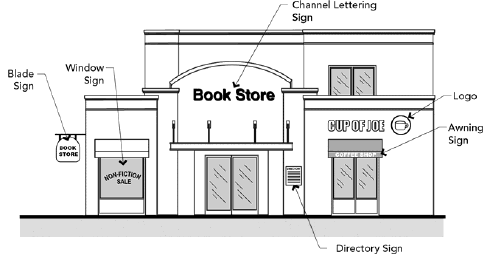
Figure 3-19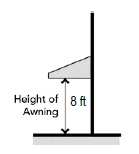
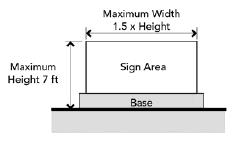
Figure 3-21
Appropriate Wall Sign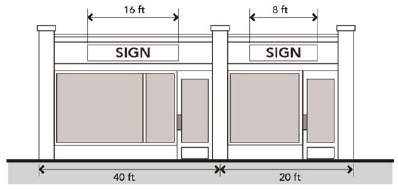
Figure 3-22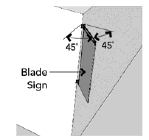
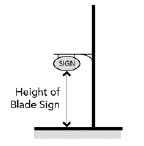
Figure 3-24
Sign Measurement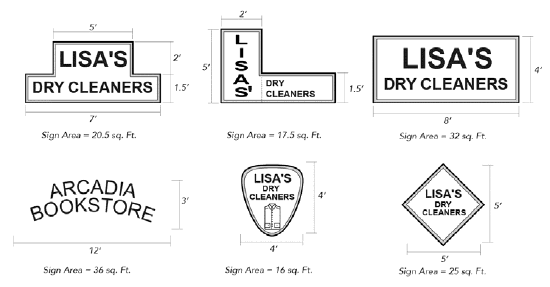
(Ord. No. 2222, § 3B, 1-10-07; Ord. No. 2375, § 4(Exh. A), 4-6-21)
Editor's note— Ord. No. 2222, adopted January 10, 2007, was mistakenly omitted from this Code when it was passed and has been reincorporated as subsection E of this section at the city's direction.
9103.11.080 - Regulations Specific to Types of Permanent Signs.
A.
Changeable Copy Sign - Electronic. Electronic changeable message signs shall only be allowed for institutional uses, gas station price signs, and Chamber of Commerce signs. All such signs shall be required to comply with the following regulations:
1.
Display.
a.
Sign images shall not change more often than as permitted by the permit or other entitlement issued for the sign.
b.
The images shall change instantaneously, with no special effects or video.
c.
Any form of moving, animated, scrolling, oscillating, or rotating images, or any other design intended to attract attention through movement or the semblance of movement on the whole or any part of the sign, or any other method or device that suggests movement, is prohibited.
2.
Design.
a.
Signs shall have a photometric sensor that will adjust the intensity of the sign for daytime and nighttime viewing. The nighttime intensity shall be limited to 0.3 foot candles (over ambient levels) as measured at a height of five feet above the ground and a distance of between 150 and 350 feet from the sign under consideration, depending on the size of the sign, and aimed at the sign.
b.
The City may modify or further restrict the intensity of any electronic changeable copy sign shall the lighting create a distraction to drivers.
c.
Each sign structure shall, at all times, include a facing of proper dimensions to conceal back bracing and framework of structural members and/or any electrical equipment. During periods of repair or alteration, such facing may be removed for a maximum period of 48 consecutive hours.
B.
Channel Letter Signs.
1.
Design.
a.
Only translucent faces, reverse lit channel letters, or push-through acrylic panels are allowed.
b.
Exposed raceways and wireways are prohibited unless necessitated by structural considerations, as determined by the Building Official.
2.
Lighting.
a.
Channel letter signs may only be internally illuminated. No open-face channel letters are allowed, whereas the method of illumination is exposed.
b.
The light source of illuminated channel letter signs shall not be visible from or cast into the right-of-way nor cause glare hazards to passersby or adjacent properties.
c.
Light sources shall not be mounted to any part of the sign.
C.
Murals. Murals may only be installed and maintained through approval by the Director. Murals may only be located in nonresidential zones.
9103.11.090 - Signs for Specific Uses.
A.
Drive-through Establishments. In addition to the signs allowed in Section 9103.11.070 (Permanent Signs by Zone - Locations and Allowed Sign Area), drive-through food service establishments shall be allowed the following signs:
1.
Up to two freestanding menu boards per allowed drive-through lane, with copy on a single face and total sign face not to exceed 50 square feet in sign area and seven feet in height, located immediately adjacent to the drive-through lane, and readable only on site.
2.
One wall-mounted board not to exceed 12 square feet, located in the immediate area of the drive-through lane only, and readable only on-site.
3.
Directional signs shall be the least number to provide adequate directional information and to ensure safe circulation, as determined through the Site Plan and Design Review process.
B.
Home Occupations. No signage shall be allowed or erected in association with any home occupation use.
C.
Multi-tenant Buildings. Multi-tenant buildings are allowed tenant directory signs, each with a maximum area of eight square feet. These business directory signs shall not count towards the maximum allowable sign area for a site.
D.
Places of Assembly. In addition to signs allowed in Section 9103.11.070 (Permanent Signs by Zone - Locations and Allowed Sign Area), facilities whose activities and events change on a regular basis (e.g., places of religious assembly, skate rinks, theaters, stadiums, etc.) shall be allowed the following additional signs:
1.
Canopy sign, one for each street frontage, either wall-mounted or freestanding, in which the area shall not exceed 50 percent of the allowable sign area for each sign type.
2.
Theaters with three or more screens shall be allowed an additional 10 square feet of sign area for each screen.
3.
Glass encasements for special advertisements shall be allowed to be affixed to the primary building. Encasements shall not exceed a width of three feet or a height of four feet, the number of which shall be approved by the Director.
E.
Service Stations. In addition to the signs allowed in Section 9103.11.070 (Permanent Signs by Zone - Locations and Allowed Sign Area), service stations shall be allowed the following signs:
1.
Service stations shall be allowed one wall or monument sign for each street frontage. A combination of wall and monument signs may be used, but no more than a total of four signs.
2.
Wall signs shall not exceed 10 percent of the building face, with a maximum size of 30 square feet, and not exceed past the roofline or 20 feet above finish grade, whichever is less. A maximum of two wall signs are allowed per service station.
3.
A maximum of two monument signs are allowed per service station. Monument signs shall be designed to include the identification of the station and gasoline prices. No other price signs are allowed.
4.
Additional special service signs are allowed up to a maximum of two per each service island, provided that the signs are located at the site of the service provided (e.g., air/water, lube, brakes, etc.) and that each sign does not exceed three square feet.
5.
Instructional and warning signs and signs required or authorized by State or Federal law shall be exempt from the provisions of this Subsection.
9103.11.100 - Temporary Signs.
The following types of temporary signs are allowed subject to the standards of this section. A Temporary Sign Permit shall be obtained from the Director prior to displaying temporary signs, unless specified in Section 9103.11.404 (Exempt Signs).
A.
Temporary Signs.
1.
General. The following signs described in this Section shall be allowed on a temporary basis in the zones indicated. If a wall or hedge prevents a sign from being located as provided in this Section, the sign may be placed immediately adjacent to the wall or hedge. No sign shall be placed in a location that interferes with the visibility of vehicular ingress or egress to the property or adjoining properties as per the standards provided in Subsection 9103.01.070 (Vehicular Visibility Standards) or where such signs may interfere with or be confused with any traffic signal or device.
2.
Restriction on Placement.
a.
Temporary signs shall not be placed on awnings or canopies.
b.
Temporary signs shall not be placed in public rights-of-way.
3.
Residential Zones.
a.
Table 3-14 identifies allowed temporary signs in residential zones.
b.
Within residential zones, allowable temporary signs shall be located at least 10 feet from adjoining premises and at least five feet from a paved roadway. Where any sidewalk exists, the location shall be at least three feet from the sidewalk in the direction of the residence.
4.
Nonresidential Zones.
5.
Additional Conditions. Temporary window signs that exceed the allowable maximum sign area shall be allowed to advertise special events, provided a business shall not use such temporary window signs for more than 60 cumulative days in any one calendar year. A Temporary Sign Permit shall be obtained from the Planning Division before the painting, posting, or affixing of any temporary sign. Exception: A Temporary Sign Permit is not required for temporary signs associated with Federal, State, and local government elections.
B.
Temporary Banners.
1.
Temporary banners shall only be allowed in C-O, C-G, C-M, CBD, DMU, MU, M-1, and SP zones. Exceptions shall be made for allowed institutional and public assembly uses within residential zones subject to Director approval.
2.
Aside from any other section of the Municipal Code, the owner or person who installs or displays a banner in violation of this Section shall remove the banner upon order of the Director or designee. For the purpose of this Section, any portion of any day in which a banner is or remains installed or displayed shall be counted as one full day.
3.
No banners shall be allowed other than temporary banners. The following regulations shall apply to temporary banners:
C.
Portable and A-Frame Signs. The use of small, pedestrian-oriented, portable signs is allowed in all non-residential zones on private properties subject to the approval of a Sign Permit and the following standards:
1.
Only businesses with street frontage are allowed to have portable signs. Businesses that are located along pedestrian arcades/walkways having access to the street may also use portable signs, but shall not locate such signs within the public right-of-way unless an Encroachment Permit has been issued by the Engineering Division. In addition, each group of businesses located along an arcade/walkway may use one portable directory sign listing all businesses along the arcade/walkway, which may be located within the public right-of-way.
2.
No business shall be allowed to have more than one portable sign.
3.
Portable signs shall be utilized only during regular business hours and shall be removed during non-business hours.
4.
Portable signs shall have a maximum sign area of six square feet per face. The maximum height from ground level shall be four feet and the maximum width shall be two feet.
5.
Portable signs may be located on private property, provided they do not interfere with pedestrian movement or wheelchair access to, through, and around the site. A minimum access width of five feet shall be maintained along all sidewalks and building entrances accessible to the public.
6.
Portable signs shall not encroach into required off-street parking areas, public roadways, or alleys, and may not be arranged so as to create site distance conflicts or other traffic hazards. Portable signs shall not be placed within the corner curb return areas of intersections.
7.
Portable signs shall have a weighted base or comparable feature capable of keeping the sign upright in a moderate wind.
8.
Materials for portable signs shall be of a permanent nature. Signs shall be constructed of durable, weather-resistant materials and not be subject to fading or damage from weather. The use of paper or cloth is not allowed unless located within a glass or plastic enclosure.
9.
No lighting shall be allowed on or for portable signs.
10.
Portable signs shall be professionally designed in an attractive manner meeting the approval of the Director or designee subject to a Sign Permit, and present an image of quality and creativity.
D.
Flags. Flags of the United States, the State of California, and other government entities shall be allowed in zones within subject to the following regulations:
1.
Flags mounted on a building shall allow for a minimum clearance of seven feet over a pedestrian right-of-way and 15 feet over a vehicular way.
2.
A maximum of three flags shall be allowed.
3.
A flag shall not exceed 15 square feet per flag for residential zones.
4.
The maximum height of a flagpole shall conform to Subsection 9103.01.050.C.1 (Exceptions to Height Limits in All Zones—Flagpoles).
E.
Developer-Contractor signs. A temporary sign that provides information about the project and the developer managing construction site.
1.
Only one (1) developer-contractor sign is permitted on a residential property and up to two (2) on a commercial site
2.
Each sign shall be a maximum of 16 square feet in area and six (6) feet in height.
3.
Signs shall be set back a minimum of 10 feet from adjoining properties, and shall be placed on private property and/or directly adjacent to approved construction fencing installed parallel to a public street. Signs shall not overhang or obstruct a public sidewalk, and shall be placed in a location that does not interfere with vehicular visibility at intersections or driveways per the standards on file with Planning Services.
(Ord. No. 2375, § 4(Exh. A), 4-6-21)
9103.11.110 - Iconic Signs.
A.
Purpose. The purpose of this Section is to:
1.
Preserve the City's unique character (including special places and features such as a vibrant Downtown, the urban forest, attractive streetscapes, diverse parks, historic buildings and places, and entertainment destinations), history, and identity, as it may be reflected in iconic signs;
2.
Preserve the historical sign vernacular existing as stand-alone features and in areas of the City with concentrations of surviving period signage; and
3.
Protect the community from inappropriate reuse of nonconforming and/or illegal signs.
B.
Applicability. This Section applies to legally established existing signs in the City that can be characterized as follows, as determined by the Director.
1.
Iconic signs shall conform to all of the following technical features:
a.
The sign uses materials and technology representative of its period of construction.
b.
The sign is detached, projecting, or roof mounted.
c.
The sign is structurally safe or can be made safe without substantially altering its original appearance.
2.
Iconic signs shall conform to two or more of the following cultural or vernacular design features:
a.
The sign exemplifies the cultural, economic, or period heritage of Arcadia.
b.
The sign exhibits extraordinary aesthetic quality, creativity, or innovation.
c.
The sign is unique; the sign is obsolete sign copy that is originally associated with a chain or franchise business that it either local or regional chain or franchise only found in Arcadia or the western United States; or there is scholarly documentation to support its preservation; or it is a rare surviving example of a once common type.
d.
The sign retains the majority of its character-defining features. If character-defining features have been altered or removed, the majority are potentially restorable to their original function and appearance.
e.
The sign is at least 50 years old.
C.
Where Allowed.
1.
Iconic signs are allowed in all non-residential zones when conforming to the requirements of this Section 9103.11.110.
2.
Relocation of an iconic sign shall be permitted through an approved Sign Permit, provided the following requirements are met:
a.
Relocation shall be to a location within the original premises or to a location within the specific district in which it is located.
b.
If relocated to another premise, the sign shall display a conspicuous text or a plaque, using a template provided by the City, that indicates that the sign has been relocated, the date of relocation, and the original location.
3.
Iconic signs are exempt from the provisions of Subsection 9103.11.170 B. (Removal of Abandoned Signs) and Section 9103.11.160 (Nonconforming Signs). Any alteration, modification, or relocation of an existing iconic sign shall be subject to the provisions of Section 9103.11.130 (Comprehensive Sign Program).
D.
Maintenance and Modifications. Iconic signs shall be structurally sound and comply with the requirements of Section 9103.11.140 (Sign Maintenance), or will be brought into conformance with such requirements within a reasonable and specified time.
E.
Change in Sign Copy.
1.
Text changes shall not result in changes to character-defining text, as determined by the Director.
2.
Text changes shall match or be compatible with existing text in material(s), letter size, font/typography, and color, as determined by the Director.
9103.11.120 - Procedures for Sign Permits, Exemptions, and Revocations.
A.
Sign Permits.
1.
Sign Permit Required (including Temporary Signs).
a.
To ensure compliance with the regulations contained in this Section, a Sign Permit shall be required to erect, move, alter, or reconstruct any permanent or temporary sign or sign structure, except for signs exempt from permits in compliance with Subsection B, below. Sign Permits are also required for signs approved through a Comprehensive Sign Program, as provided in Section 9103.11.130 (Comprehensive Sign Program).
b.
An application for a Sign Permit shall be made in writing on forms provided by the Planning Division.
2.
Approving Authority.
a.
The Director shall review all Sign Permit applications for conformance with the provisions of this Section. The Director shall approve or deny the permit application within 30 days from the receipt of a complete application and the applicable fees.
b.
If the application is denied, the Director shall notify the applicant with the reason(s) stated for denial. Notification shall be sent to the address provided on the application, which shall be considered the correct address. Each applicant has the burden to furnish any change of address to the Director.
c.
In the event an application is denied, the applicant may appeal the Director's decision in compliance with Section 9108.07 (Appeals).
B.
Exemptions from Sign Permit Requirements. Sign Permits shall not be required for the signs listed as exempt in this Subsection. Exempt signs shall not be included in the determination of the total allowable number of signs or total allowable sign area for a site or project. However, exempt signs shall be required to adhere to the regulations established for each sign type. Signs erected without complying with the applicable regulations are considered illegal and shall be removed in compliance with Section 9103.11.180 (Illegal Signs). An exempt sign may still require a Building Permit, subject to the provisions of Municipal Code Article VIII, Chapter 1 (Building Code).
1.
Routine Maintenance. The painting, repainting, or cleaning of a sign shall not be considered erecting or altering a sign and shall not require a Sign Permit unless structural changes are made.
2.
On-site, Non-illuminated Signs. The following on-site, non-illuminated signs shall not require issuance of a Sign Permit:
a.
Incidental Signs. Signs or notices that are incidental to an establishment (e.g., hours of operation, menu, credit card information, emergency contact information, etc.), provided that the signs do not exceed four square feet in area for all of the signs combined. Incidental window signs shall not be included in permanent window sign area calculations unless such signs are illuminated.
b.
Building and Civic Markers. Memorial signs, plaques, and associated displays installed by civic organizations recognized by the City.
c.
Bulletin Boards. Bulletin boards for any legal, noncommercial establishment when located on the premises of the establishment and not over 12 square feet in area.
d.
Change of Copy. Changing the copy in approved changeable copy signs in existence as of the date of adoption of this Section, or approved through a Comprehensive Sign Program (Section 9103.11.130).
e.
Flags. Flags of any nation, State, City, or other government entity when displayed in compliance with the Flag Code (36 USC, Section 173 et seq.).
f.
Garage Sale Signs. See Municipal Code Article VI, Chapter 4, Section 6437 (Patio, Garage, and/or Backyard Sales).
g.
Government Signs. A sign erected by a Federal, State, County, agency, or the City.
h.
Holiday Window Painting. Signs and decorations painted on or applied to windows pertaining to holidays and seasonal events. All signs and decorations shall be removed within 10 days following the applicable holiday.
i.
Interior Signs. Interior signs, as defined in Section 9103.11.190 (Definitions).
j.
Official Signs. Official and legal notices or signs issued or placed by a court or government agency.
k.
Noncommercial Message Signs. Subject to the provisions of Section 9103.11.100 (Temporary Signs).
l.
Portable Parking Lot and Valet Parking Signs. One freestanding portable sign at each parking lot entrance limited to 10 square feet (two feet by five feet) in area. A valet parking plan approved by the Director shall indicate the location of the sign to ensure that the sign does not interfere with driver visibility or pedestrian movement.
m.
Public Service Signs. Public service signs authorized by Federal, State, or municipal agencies.
n.
Site Address. Subject to the provisions of Article III (Public Safety) of the Municipal Code.
o.
Vehicle Signs. Signs attached to vehicles that do not meet the criteria of "vehicle sign," as defined in Section 9103.11.190 (Definitions). Signs that do meet the criteria of vehicle sign are prohibited as provided in Section 9103.11.050 (Prohibited Signs).
p.
Other Features. Other features that do not fall within the meaning of sign, as defined in Section 9103.11.190 (Definitions).
C.
Change of Copy for Identification Signs. No person shall construct, install, alter, or maintain any sign in violation of the regulations outlined in this Section. Copy changes to existing signs, or similar alterations, shall be preceded by a submittal of plans to be filed with the Director for review of the identification requirements outlined in this Section. If the Director determines that the proposed sign in Roman alphabet is inadequate for appropriate identification, consistent with the intent and purpose of the ordinance from which this Section derives, the City may require supplementary wording or identification on the sign.
D.
Expiration and Extension of Sign Permit.
1.
An approved Sign Permit shall expire 12 months from the date of approval unless the sign has been installed or a different expiration date is stipulated at the time of approval. Before the expiration of a Sign Permit, the applicant may apply to the Director for an extension of an additional 12 months from the original date of expiration. In response to an extension request, the review authority may make minor modifications, or deny further extensions.
2.
The expiration date of the Sign Permit shall be automatically extended to concur with the expiration date of the companion Building Permit or other applicable permits.
E.
Revisions to Sign Permit. The Director may approve minor changes to an approved Sign Permit if the intent of the original approval is not affected. Revisions that would substantially deviate from the original approval shall require the approval of a new/revised Sign Permit by the Director.
F.
Revocation of Sign Permit.
1.
The Director may, in writing, suspend or revoke a Sign Permit if the permit was issued on the basis of a material omission or misstatement of fact, or in violation of any ordinance or any of the provisions of this Chapter, or if the allowed sign violates any applicable law.
2.
Within 15 days after issuance of the written notice, any sign authorized by the revoked Sign Permit shall be removed.
3.
Failure to remove the sign display within the 15-day period shall be a violation of this Development Code, and the sign shall be deemed a public nuisance.
G.
Appeals. The applicant may appeal the denial of a Sign Permit application in compliance with Section 9108.07 (Appeals).
H.
Modifications. Modifications to the provisions of this Section require the granting of an Administrative Modification pursuant to the provisions of Section 9107.05 (Administrative Modifications).
9103.11.130 - Comprehensive Sign Program.
A.
Purpose. The purpose of a Comprehensive Sign Program is to provide for the integration of all signs of a development project with the overall site design and the development's design into a unified architectural statement. A Comprehensive Sign Program provides a means for the flexible application of sign regulations for projects that require multiple signs in order to provide latitude in the design and display of multiple signs and to achieve, not circumvent, the purpose of this Section.
B.
When Required. The approval of a Sign Permit for a Comprehensive Sign Program shall be required whenever any of the following circumstances exist:
1.
A project is located within the Commercial Regional (C-R) zone.
2.
Whenever three or more separate tenant spaces are present on the same parcel or on multiple parcels that are part of a unified shopping center or similar business center.
3.
Whenever a combination of residential and commercial uses is proposed for the same site or development proposal.
4.
Whenever five or more non-exempt signs are proposed for a single-tenant development.
5.
Whenever a project or parcel has more than 300 linear feet of frontage on a public street.
6.
Whenever an existing multi-tenant development of three or more tenants is being remodeled or rehabilitated to the extent that the value of the work will be greater than 20 percent of the replacement cost of the structure(s), as determined by the Director.
7.
A Comprehensive Sign Program for a theater or cinema use may be applied to authorize signs that deviate from the standards of this Section. The Comprehensive Sign Program may allow marquee signs, brighter lights, and design features not otherwise authorized by this Section if the sign(s) is/are generally consistent with the purposes of this Section.
8.
Whenever the Director determines that a Comprehensive Sign Program is needed because of special project characteristics (e.g., the size of proposed signs, limited site visibility, a business within a business, the location of the site relative to major transportation routes, etc.).
C.
Limitations. A Comprehensive Sign Program shall not be used to override the prohibition on new off-site commercial signs in Subsection 9103.11.050.C (Off-site Commercial Signs [Billboards]).
D.
Review Authority. The Director shall be the review authority for a Comprehensive Sign Program.
E.
Application Requirements. A Sign Permit application for a Comprehensive Sign Program shall include all of the information and materials required by the Director and the filing fee set by the City's Planning Fee Schedule. The following minimum information shall be included with the application:
1.
Sign details indicating sign area, dimensions, colors, materials, letter style, proposed copy letter height and method of illumination.
2.
Site plan indicating the location of all existing and proposed signs.
3.
Building elevation(s) with sign location depicted and dimensioned.
F.
Standards. A Comprehensive Sign Program shall comply with the following standards:
1.
The proposed sign program shall comply with the purpose and intent of this Section, any adopted sign design guidelines, and the overall purpose and intent of this Section.
2.
The proposed signs shall enhance the overall development, be in harmony with, and relate visually to other signs included in the Comprehensive Sign Program, to the structures and developments they identify, and to surrounding development when applicable.
3.
The sign program shall include all signs, including permanent, temporary, and exempt signs.
4.
The sign program shall accommodate future revisions that may be required because of changes in use or tenants.
5.
The sign program shall comply with the standards of this Section, except that deviations are allowed with regard to sign area, total number, location, and height of signs to the extent that the Comprehensive Sign Program will enhance the overall development and will more fully accomplish the purposes and intent of this Section.
6.
Approval of a Comprehensive Sign Program shall not authorize the use of signs listed as prohibited by this Section.
7.
Review and approval of a Comprehensive Sign Program shall not consider any signs' proposed message content.
9103.11.140 - Sign Maintenance.
A.
Maintenance Required. Signs shall be maintained in a safe, presentable, and structurally sound condition at all times, including the replacement of defective parts, painting, repainting, cleaning, and other maintenance activities. Failure to comply with these requirements may cause the sign to be declared a public nuisance, which shall be removed in compliance with this Section.
B.
Administrative Procedures for Improperly Maintained Signs. Improperly maintained signs shall be subject to the following administrative procedures:
1.
Notice of violation shall be sent to the last-known address of sign owner and property owner, informing the owner(s) of the time in which removal of sign or repair of condition shall be accomplished.
2.
If the owner(s) fail(s) to remove the sign or repair the condition, the City shall send final notice notifying the owner(s) that failure to remove or repair the sign within 30 days shall result in the issuance of a citation in compliance with the Municipal Code.
3.
If the owner(s) do(es) not remove the sign or repair the condition within the 30-day period, the City may apply the remedies identified in Municipal Code Article I, Chapter 2 (Penalty Provisions), in addition to any remedies otherwise available at law or in equity.
C.
Hazardous Signs. If a sign is damaged or not properly maintained to a degree that causes it to pose a physical danger to persons or property, the following provisions shall apply:
1.
Hazardous Signs Identified. A hazardous sign is a sign that poses a danger to the public or that could create a potential hazard. Hazardous signs are declared to be a public nuisance in compliance with Municipal Code Section 1201 (Abatement of Nuisance). The determination that a sign has become hazardous or unsafe shall consider only the physical condition and characteristics of the sign, and shall not consider the sign's message.
2.
Removal of Hazardous Signs. Upon discovering a hazardous condition, the City may cause the immediate removal of a sign(s) that is a danger to the public due to unsafe conditions. No hearing shall be required before the removal of any hazardous sign. The City is not required to give notice of intent to remove the sign(s) before removal, but shall endeavor to do so and shall inform the property, business, and sign owner(s) that the hazardous sign has been removed within three days following removal. See Municipal Code Section 1201 (Abatement of Nuisance).
9103.11.150 - Enforcement.
The City may withhold the issuance of Business Licenses, Building Permits, Grading Permits, Certificates of Occupancy, and other land use entitlements and may issue stop work orders for a development project failing to comply with the provisions of this Section. If any improvements or programs required by this Section are either rendered unusable or discontinued, the property owner, employer, and tenant may be subject to enforcement procedures in compliance with Municipal Code Article I, Chapter 2 (Penalty Provisions).
9103.11.160 - Nonconforming Signs.
A.
Continuance of Nonconforming Signs. Except as provided in Subsection 9103.11.160 D., below, a legal nonconforming sign may be continued and shall be maintained in good condition as required by Section 9103.11.140 (Sign Maintenance), but it shall not be:
1.
Structurally changed to another nonconforming sign, although its copy and pictorial content may be changed; or
2.
Structurally altered to prolong the life of the sign, except to meet safety requirements; or
3.
Expanded or altered in any manner that increases the degree of nonconformity.
B.
Repair and Maintenance. Nonconforming signs shall only be painted and repaired in place and shall not be removed from their existing location unless removal of the sign for painting or repair is part of the sign's customary maintenance and repair.
C.
Change of Business Type or Ownership. Upon a change of ownership or business type, the new owner of a nonconforming sign may change the name(s) on the sign so long as there is no change in the structure or configuration of the sign.
D.
Removal of Nonconforming Signs. Nonconforming signs shall be removed if:
1.
The nonconforming sign is more than 50 percent destroyed and the destruction is other than facial copy replacement. A nonconforming sign shall be deemed to be more than 50 percent destroyed if the estimated cost of reconstruction and repair exceeds 50 percent of the replacement cost, as determined by the Building Official.
2.
The nonconforming sign is remodeled, unless the sign is remodeled to comply with the provisions of this Section.
3.
Nonconforming signs shall be removed when a property is further developed in compliance with this Development Code.
4.
Nonconforming signs shall be removed before the installation of new signs advertising the same business or any new business on the site.
5.
Existing legal off-site signs (i.e., billboards) shall be removed when the property on which the sign is located is further developed.
6.
The nonconforming sign is located on a structure that is to be enlarged or expanded, if the nonconforming sign is affected by the construction, enlargement, remodel, or expansion. An enlargement, remodel, or expansion of the portion of the structure upon which the nonconforming sign is located or that is more than 50 percent of the structure area shall be deemed to affect the nonconforming sign.
7.
The nonconforming sign is temporary.
9103.11.170 - Abandoned Signs.
A.
Determination of Abandonment. Conforming and nonconforming signs shall be presumed abandoned under any of the following circumstances:
1.
The sign identifies or advertises a business that has ceased for more than 90 days;
2.
The sign is located upon a structure that has been abandoned by its owner for more than 90 days;
3.
The sign pertains to a bona fide business, lessor, service, owner, or product that has been unavailable upon the site for more than 90 days; or
4.
The sign has not been removed after the occurrence of a temporary event or activity with an approved Temporary Use Permit in compliance with Section 9107.23 (Temporary Use Permits).
5.
The sign is a hazardous sign that has been removed by the City and has not been recovered by the owner within the time period specified in Subsection 9103.11.140 (Sign Maintenance).
B.
Removal of Abandoned Signs.
1.
An abandoned sign or an abandoned nonconforming sign shall be immediately removed by the owner or lessee of the premises upon which the sign is located or by a person, organization, or other entity that directly or indirectly receives a benefit from the information contained on the sign.
2.
A sign frame or structure that has been abandoned shall be immediately removed by the owner or lessee of the premises upon which the sign frame or structure is located.
C.
Abandoned Signs for Closed Businesses. Abandoned signs shall be promptly removed by the property owner or person responsible for its installation and/or maintenance. The City may declare such signs to be a public nuisance and abate it pursuant to Business and Professions Code Sections 5499.2 et seq. or City law on abatement of nuisances.
9103.11.180 - Illegal Signs.
A.
Strict Liability. Violations of this Section shall be treated as a strict liability offense regardless of intent.
B.
Illegal Signs Identified. The following signs are illegal, declared to be a public nuisance, and shall be subject to the enforcement procedures, as well as the procedures and remedies in Municipal Code Section 1201 (Abatement of Nuisance).
1.
A sign erected, placed, posted, constructed, reconstructed, altered, maintained, or moved after the effective date of this Section that does not comply with all applicable provisions of this Section.
2.
A sign erected, placed, posted, constructed, reconstructed, altered, maintained, or moved before the effective date of this Section or before annexation to the City that failed to comply with all regulations in effect at the time the sign was erected, placed, posted, constructed, reconstructed, altered, maintained, or moved.
3.
A nonconforming sign that is required to be removed or altered by Subsection 9103.11.160.D (Removal of Nonconforming Signs) and that is not removed or altered as required.
4.
Signs with flashing elements that are not deactivated in compliance with Section 9103.11.160 (Nonconforming Signs).
5.
An abandoned nonconforming sign.
6.
An abandoned sign.
9103.11.190 - Definitions.
A-Frame Sign.
A portable freestanding sign that is hinged, folded, or otherwise angled at the top
and widens at the bottom to form a shape similar to the letter "A." They are also
referred to as portable signs.
Abandoned Nonconforming Sign.
A nonconforming sign that is advertising a use that has ceased, or is located upon
a structure that has been abandoned for more than 90 days. See "Abandoned Sign." For
the purposes of this definition, abandonment for the applicable 90-day period shall
be deemed conclusive evidence of abandonment irrespective of the property, sign, or
business owner's intent.
Abandoned Sign.
A sign that is advertising a use that has ceased; is located upon a structure that
has been abandoned by its owner; does not identify or advertise a current bona fide
business, lessor, service, owner, or product available upon the site; or that identifies
or advertises an event or activity that has previously occurred. See Subsection 9103.11.170 (Abandoned Signs) for timelines for determining abandonment.
Accessory Sign.
See "Incidental Sign."
Address Sign.
The numeric reference of a structure or use to a street included as part of a sign.
Advertising Area.
That portion of a sign structure on which a commercial message is placed consistent
with the standards of this Section.
Advertising Structure.
A structure of any kind or character erected or maintained for outdoor advertising
purposes, upon which any poster, bill, printing, painting, or other advertisement
of any kind whatsoever, including statuary, may be placed for advertising purposes.
"Advertising structure" does not include:
• A structure for official notices issued by any court or public body or officer;
• A structure upon which notices are posted by any public officer in performance of a public duty or by any person in giving legal notices;
• A structure for directional, warning, or informational signs and/or notices, required or authorized by law or by federal, State, county, or City authority;
• A structure erected near the City or within the City which contains the name City of Arcadia and the names of, or any other information regarding, civic, fraternal, or religious organizations located within the City.
Animated Sign.
A sign that uses movement, lighting, or special materials to depict action or create
a special effect or scene. This classification includes wind-actuated and other elements
(e.g., balloons, bunting, pennants, streamers, whirligigs) or other similar devices.
Awning.
A roof-like structure usually covered in fabric (e.g., canvas) that projects from
the wall of a structure for the purpose of shielding a doorway or window from the
elements.
Awning Sign.
A sign painted on, printed on, or attached to the surface of an awning. See also Canopy
Sign.
Figure 3-25
Awning Sign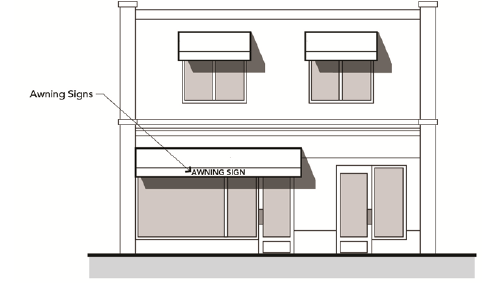
Backer Panel Sign.
A sign consisting of a flat panel onto which channel letters are mounted, whereby
the panel is used to provide a contrasting background color for the sign or to allow
for a more aesthetic treatment on a building façade.
Banner Sign.
A sign made of fabric or any non-rigid material with no enclosing framework and attached
to any structure, pole, rope, wire, or framing which is anchored on two or more edges
or at all four corners. Banners are temporary in nature and do not include flags.
Beacon Lighting.
Any source of electric light, whether portable or fixed, the primary purpose of which
is to cast a concentrated beam of light generally skyward as a means of attracting
attention to its location rather than illuminate any particular sign, structure, or
other object.
Billboard.
A permanent structure used for the display of off-site commercial messages (see "Off-Site
Signs").
Blade/Bracket Sign.
A small, pedestrian-oriented sign that projects perpendicular from a structure (blade
sign) or is hung beneath a canopy (bracket sign). See also Projecting Sign.
Building Marker.
A sign indicating the name of a building and date and incidental information about
its construction, which is cut into a masonry surface or made of bronze or other permanent
material.
Cabinet Sign.
A sign that has one or more plastic, acrylic, or similar material faces (panels) that
may or may not be internally illuminated. The sign panels may be either flat or shaped
("pan face") and are attached to a metal frame (cabinet).
Canopy.
A permanent roof-like structure of rigid or fabric materials extending from the main
entrance of a structure and typically supported by posts at the corners furthest from
where the canopy attaches to the structure. See also "Awning."
Canopy Sign.
A sign located on a permanent roof-like structure or canopy of rigid or fabric materials
extending from the main entrance of a structure, or posts affixed to the ground.
Figure 3-26
Canopy Sign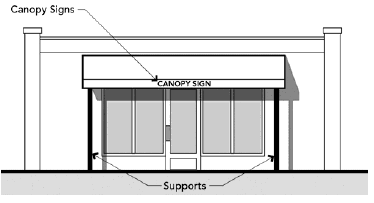
Changeable Copy Sign (electronic).
A sign with changeable copy that is changed by incorporating video display, flip-disks,
incandescent lamps, fluorescent lamps, fiber optics, light-emitting diodes (LED),
liquid crystal displays, plasma-displays, field emission displays, or any other mechanical
or light-emitting matrix to convey changing copy or images. Also considered an animated
sign.
Changeable Copy Sign (manual).
A sign with changeable copy that is manually changed, regardless of method of attachment
or materials of construction. This classification includes bulletin boards and changeable
copy signs on marquees. Does not include electronic message boards with lighted displays.
Figure 3-27
Changeable Copy Signs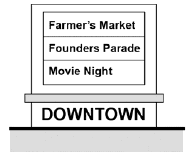
Channel Lettering.
Three-dimensional sign face lettering or logos such that the sign is on a different
plane than the sign backing or structure.
Clearance.
The distance above the walkway, or other surface if specified, to the bottom edge
of a sign. This term can also refer to a horizontal distance between two objects.
Combination Sign.
A sign that is a combination of any two or more types of signs.
Commercial Mascot.
Humans or animals used as advertising devices for commercial establishments, typically
by the holding or wearing of signs, insignia, masks, or costumes associated with or
advertising the commercial establishment. Includes sign twirlers, sign clowns, etc.,
including any mannequin intending to resemble a human or animal.
Commercial Message.
A message displayed on a sign that relates primarily to economic interests (e.g.,
the exchange or sale of goods or services). This definition shall automatically incorporate
court rulings defining the term "commercial speech."
Copy.
The graphic content of a sign surface in either permanent or removable letter, pictographic,
symbolic, or alphabetic form.
Department.
The Development Services Department of the City.
Digital Sign.
The portion of a sign message made up of internally illuminated components capable
of changing the message periodically. Digital displays may include but not limited
to LCD, LED, or plasma displays.
Directional Sign.
On-Site Directional Sign.
An on-site sign giving directions for traffic, instructions, or facility information
of an establishment but with no advertising copy (e.g., stop signs, parking, or exit
and entrance signs).
Off-Site Directional Sign.
An off-site sign giving directions to businesses, sales offices, model home complexes,
or points of interest, etc., but with no advertising copy. An off-site sign that is
proposed to be located 500 yards or more from the property at which the use or establishment
is located shall be presumed to not qualify as an "off-site directional sign."
Figure 3-28
Directional Signs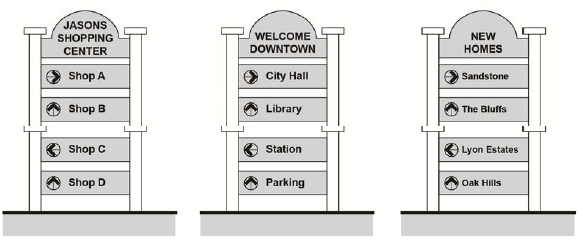
Director.
The Planning Director of the City's Development Services Department, or the Planning
Director's designee.
Directory Sign.
A sign listing the tenants or occupants of a building or building complex.
Display Surface.
The area made available by the sign structure for the purpose of displaying the advertising
message.
Double-Faced Sign.
A sign designed with the intent of providing copy on both sides.
Figure 3-29
Double-Faced Sign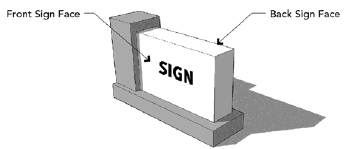
Embedded Plaque/Sign.
Commemorative or decorative plaques, dates of construction, and the like when carved
in stone, concrete, or similar material or made of bronze, aluminum, or other similar
permanent material.
Establishment.
A legal, nonresidential use of land to conduct a commercial or noncommercial activity.
By way of example and not limitation, "establishment" includes stores, offices, places
of worship, hospitals, manufacturing facilities, etc. Does not include home-based
occupations or hobbies.
Façade.
The entire building elevation, including the parapet.
Face of Sign.
The area of a sign on which the copy is placed.
Fascia.
Typically, the smooth wall surface between a window and the parapet.
Flag.
A rectangular or cylindrical piece of fabric of distinctive design that is used as
a symbol, as a sign device, or as a decoration and attached to a pole or anchored
along only one edge or supported or anchored at only two corners.
Flashing Sign.
A sign that displays an intermittent or sequential flashing light source.
Foot-candle.
A unit of incident light (on a surface) stated in lumens per square foot and measurable
with an illuminance meter, a.k.a. footcandle or light meter. One (1) footcandle is
equal to one (1) lumen per square foot.
Foot-lambet.
A unit of emitted light (from a surface) stated in lumens per square foot and measurable
with an illuminance meter, a.k.a. footcandle or light meter. One (1) foot-lambert
is equal to one (1) lumen per square foot.
Freestanding Sign.
A sign supported permanently upon the ground by a structure and not attached to a
building. This includes monument signs and pylon signs. See "Monument Sign" and "Pylon
Sign." The following are freestanding signs:
• Monument Sign - A sign permanently affixed to the ground at its base, supported entirely by a base structure, and not mounted on a pole or attached to any part of a building.
• Pole Sign - A freestanding sign that is permanently supported in a fixed location by a structure of a single pole and not supported by a building or a base of the structure.
• Pylon Sign - A freestanding sign that is permanently supported in a fixed location by a structure of one or more poles, posts, uprights, or braces from the ground and not supported by a building or a base of the structure, and for which the support components are well integrated into the overall design and materials on the sign.
Figure 3-30
Types of Freestanding Signs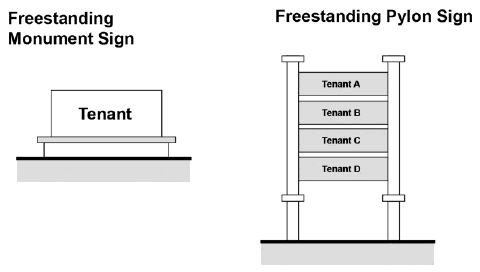
Frontage.
Building Frontage.
The structure elevation that fronts on a street, alley, driveway, parking area, pedestrian
plaza, walkway, courtyard, or arcade.
Building Frontage, Primary.
The side or façade of a structure that abuts the front setback of the parcel on which
the structure is located.
Building Frontage, Secondary.
The side or façade of a structure that abuts the street side setback of the parcel
on which the structure is located.
Street Frontage.
The length of the property line of a parcel along a right-of-way on which it borders.
Tenant Frontage.
That portion of a multi-tenant building façade that is devoted to a single tenant.
Figure 3-31
Signage Frontages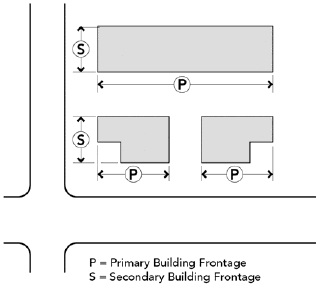
Gas Station Canopy Signs.
Any sign that is part of, or attached to, the vertical sides of the gas station canopy
roof structure. For the purposes of this ordinance, gas station canopy signs shall
be considered a canopy sign.
Governmental/Civic Sign.
Any temporary or permanent sign erected and maintained by or required by the City,
county, State, federal, or other government entity for traffic direction, entrance
or directions to a government facility, or for designation to any school, hospital,
historical site, or public service property or facility.
Halo-lit Letter Sign.
See "Reverse Channel Letters Sign."
Height.
The vertical dimension of a sign, as measured from the finished grade at the base
of the sign to the topmost portion of the sign.
Illegal Sign.
A sign installed without issuance of a Sign Permit, not in compliance with this Chapter,
and/or not a legal nonconforming sign.
Illuminated Sign.
A sign lighted with an artificial light source for the purpose of decorating, outlining,
accentuating, or brightening the sign area.
Externally Illuminated Sign.
A sign illuminated from an exterior light source.
Indirectly Illuminated Sign.
A sign whose illumination is derived entirely from an external artificial source that
is arranged to illuminate the sign area only.
Internally Illuminated Sign.
A sign illuminated from an interior light source contained within the sign cabinet.
Incidental Sign.
A small sign, emblem, or decal informing the public of the facilities, trade affiliation,
or services available on the premises (e.g., a credit card sign or a sign indicating
hours of business or presence of parking).
Inflated Display Sign.
A three-dimensional object filled or activated by moving or non-moving air or other
gas that is located, attached, or tethered to the ground, site, merchandise, structure,
or roof and used as a sign or to attract attention. This definition does not include
inflated gymnasium-type jumping or sliding devices used temporarily for a non-advertising
activity (e.g., children's parties, etc.).
LED (Light-emitting diode) Sign.
A sign consisting of a flat display panel which uses an array of light-emitting diodes
as pixels for a video display. Such signs are capable of having rapidly changing messages.
Legibility.
The physical attributes of a sign that allow for an observer's differentiation of
its letters, words, numbers, or graphics.
Logo.
An established trademark or symbol associated with a business or corporation.
Luminous Tube Signs.
A sign that consists of or is illuminated by exposed electrically charged gas-filled
tubing (e.g., neon and argon signs) or by fiber optics.
Marquee.
A permanent roofed structure attached to and supported by the building and projecting
from the building face and generally used to post or otherwise display copy associated
with the on-site business.
Marquee/Under Canopy Sign.
An accessory sign attached to a marquee or canopy.
Menu Board.
A permanently mounted sign displaying the bill of fare for a drive-through restaurant.
Menu Sign.
Menu displayed on the exterior premises of a restaurant and sometimes visible from
a public right-of-way.
Monument Sign.
A freestanding sign, the structure of which is supported from finished grade, giving
the appearance of having a solid base. See "Freestanding Sign."
Moving Sign.
A sign which has an actual or apparent moving, revolving, or rotating part, activated
by electrical, mechanical, or other devices or by wind movement. For the purposes
of this Section, time and temperature displays and traditional barber poles are not
considered moving signs.
Mural.
An artistic image or design painted or affixed to the exterior surface of a wall that
does not contain any commercial text or message nor relates to the business upon whose
premises it is painted.
Nonconforming Sign.
Legal Nonconforming Sign.
A legal sign that lawfully existed before the effective date of this Development Code
or amendment, and that does not comply with the minimum sign regulations of this Development
Code. This also includes legal signs lawfully located on sites annexed into the City
after the adoption of these Zoning Regulations.
Illegal Nonconforming Sign.
See Section 9103.11.180 (Illegal Signs).
Noncommercial Message.
A sign message that is not commercial in nature. This definition shall automatically
incorporate court rulings defining the term "noncommercial speech."
Off-Site Sign.
A sign erected on a parcel that is not the location of the business or use that the
sign is advertising.
Off-Site Message.
A message on a sign that advertises a business, accommodation, service, or activity
not provided on the premises on which the sign is located. This classification includes
billboards.
On-Site Message.
A message on a sign that advertises a business, accommodation, service, or activity
provided on the premises on which the sign is located.
Panel Sign.
A sign consisting of a flat panel, usually consisting of wood or aluminum, that can
be installed on walls, fences, or staked poles.
Parapet.
The extension of a false front or wall above a roofline.
Pedestrian-Oriented Sign.
A sign designed for and directed toward pedestrians so that the pedestrians can easily
and comfortably read the sign as they stand adjacent to it. A pedestrian-oriented
sign is usually read from a distance of 15 to 20 feet.
Permanent Sign.
A sign designed with durable materials and intended to be used in excess of 60 days
per calendar year.
Personal Expression Sign.
An on-premises sign that expresses an opinion, interest, position, or other non-commercial
message.
Pole Sign.
A sign supported by a single pole or similar support structure so that the bottom
edge of the sign is one foot or more above grade.
Political Sign.
A temporary sign directly associated with national, State, or local elections.
Portable Sign.
Any sign designed to be moved easily and not permanently affixed to the ground or
to a structure or building.
Projecting Sign.
A sign that projects from and is supported by a wall of a building. Also known as
a Blade Sign.
Public Service Sign.
Signs of utilities or other publicly regulated service providers indicating danger
and similar aids to service or safety, including official advisory and signal flags.
Push-through Letters Sign.
A sign whereby the letters or images are routed out of aluminum or other sign material
and then pushed through the routed area to provide depth.
Pylon Sign.
See "Freestanding Sign."
Raceway.
A channel for protecting and holding electrical wires and cables, typically a rectangular
metal box for the electrical components of an illuminated sign consisting of channel
letters. Pre-wired channel letters are mounted to the raceway, which in turn is mounted
to a building wall. One set of wiring is then connected to the main circuit. The rectangular
box (raceway) sets behind the attached letters and is not designed as an architectural
feature.
Reverse Channel Letters Sign.
A sign that utilizes back-lit letters mounted away from a wall to create a halo effect.
Roof Line.
The top edge of a roof or building parapet, whichever is higher, excluding any mansards,
cupolas, pylons, chimneys, and minor projections.
Roof Sign.
A sign erected, constructed, or placed on or over the roof of a structure, to include
a mansard roof, and that is partially or totally supported by the structure.
Security Sign.
An on-premises sign regulating the use of the premises, such as "no trespassing" or
"no soliciting" sign. Also known as warning signs.
Service Station.
For purposes of this Section, a commercial facility that sells gasoline, diesel, or
alternative fuel for the on-site fueling of individual vehicles.
Sign.
Any device, fixture, placard or structure, including its component parts, that draws
attention to an object, product, place, activity, opinion, person, establishment,
institution, organization, or place of business, or that identifies or promotes the
interests of any person and that is to be viewed from any public street, road, highway,
right-of-way or parking area. Does not include signs that are internal to a development
(e.g., within a mall, office building, or multifamily building, etc.) and not visible
from the public right-of-way.
The following are not within the definition of "sign" for regulatory purposes of this Section:
a.
Architectural features. Decorative or architectural features of buildings (not including lettering, logos, trademarks, or moving parts).
b.
Fireworks and other lights. The legal use of fireworks, spotlights, candles and artificial lighting not otherwise regulated by this Section.
c.
Interior signs. Signs or other visual communicative devices that are located entirely within a building or other enclosed structure and are not visible from the exterior or located at least five feet inward from the interior face of the window, provided the building or enclosed structure is otherwise legal.
d.
Legally required information (e.g., public notices, registration or licensing information, etc.).
e.
Manufacturers' marks. Marks on tangible products that identify the maker, seller, provider, or product, and that customarily remain attached to the product even after sale.
f.
Murals. A picture on an exterior surface of a structure. A mural is a sign only if it is related by language, logo, or pictorial depiction to the advertisement of any product or service or the identification of any business.
g.
Newsracks or newsstands.
h.
Symbols embedded in architecture. Symbols of noncommercial organizations or concepts including, but not limited to, religious or political symbols, when they are permanently integrated into the structure or a permanent building that is otherwise legal; also includes foundation stones, corner stones, and similar devices.
Sign Area.
See Section 9103.11.070 (Specific Types of Permanent Signs). The total dimensions of a sign surface used
to display information, messages, advertising, logos, or symbols. See Figure 3-24
(Sign Measurement) for measuring sign area.
Sign Face.
The part of the sign that is or can be used for the sign area. The sign area could
be smaller than the sign face.
Sign Program.
See Section 9103.11.130 (Comprehensive Sign Program).
Sign Structure.
The sign and the supports, uprights, braces, and framework of the sign.
Temporary Sign.
A sign, banner, pennant, valance, or advertising display constructed of cloth, canvas,
fabric, cardboard, wall board, or other light nondurable materials, with or without
frames, designed to be displayed for a limited period of time, generally fewer than
60 days in a calendar year.
Figure 3-32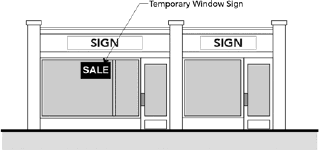
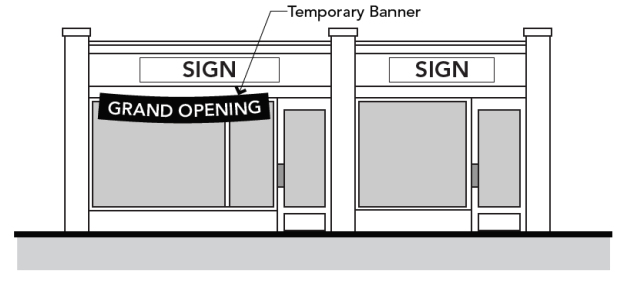
Time/Temperature Sign.
An electronic or mechanical device that shows time or temperature but contains no
business identification or advertising.
Trademark.
A word, name or symbol which, with a distinctive type or letter style is associated
with a business or business entity in the conduct of business.
Vehicle Sign.
A sign painted, affixed, or placed upon a vehicle or upon a trailer designed to be
towed behind a vehicle. On street legal vehicles, the following insignia are not considered
to be "Vehicle Signs," and are not regulated as Vehicle Signs:
a.
License plates.
b.
License plate frames.
c.
Registration insignia.
d.
Noncommercial messages painted on or otherwise attached in a manner so that the vehicle can be legally operated on public rights-of-way, or any noncommercial message that does not exceed a total of three square feet in size.
e.
Messages on a vehicle the primary purpose of which is to be used in the regular course of business to transport the personnel or products, or to provide the services (not including general advertising) that are advertised by the messages on the vehicle, provided that the messages are painted or otherwise attached in a manner so that the vehicle can be operated on public rights-of-way.
f.
Commercial messages that do not exceed a total of three square feet in size.
g.
Commercial messages on duly licensed mass transit vehicles that pass through the City.
Wall Sign.
A sign attached to, erected against, painted on, or fastened to a wall of a building
or structure, the face of which is in a single plane parallel to the plane of the
wall and that does not project more than 12 inches from the building or structure.
A wall sign shall be limited to channel or painted lettering, with a hidden raceway,
or a cabinet ("Cabinet Sign"). See Figure 3-34 (Wall Sign.)
Figure 3-34
Wall Sign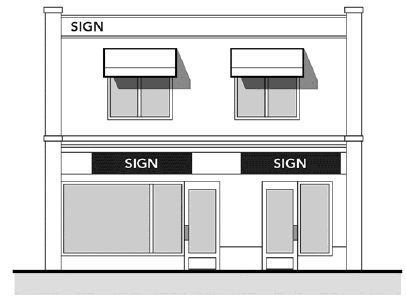
Window Sign.
Any sign, whether or not temporary in nature, which is applied or attached to a window,
or located within five feet of the inside of a window in a manner that it is visible
from the exterior of the structure.
9103.12.010 - Regulations for the C-G, C-R, C-M, CBD, DMU, and MU Zones.
A.
Restricted. In the C-G, C-R, C-M, CBD, DMU, and DU zones, all merchandise shall be displayed within a completely enclosed building except as otherwise provided in this Section.
B.
On Private Property. Outdoor displays of merchandise on private property is permitted during hours that a business is open subject to the following regulations:
1.
Outdoor displays are allowed only where they do not interfere with pedestrian movement or wheelchair access to, through, and around the site.
2.
Outdoor displays shall not include merchandise typically for sale on the premises, except for service stations, florist shops, and antique shops.
3.
Sales tags showing the cost of the merchandise shall be prohibited.
C.
On Public Property. Outdoor display of merchandise on public property shall be permitted only with approval of a Minor Use Permit pursuant to Section 9107.09 (Conditional Use Permits and Minor Use Permits) and subject to the following conditions:
1.
A minimum access width of five feet shall be maintained along all sidewalks and building entrances accessible to the public.
2.
Owners of the business shall provide public liability insurance in an amount approved by the City Attorney.
3.
The placement and arrangement of outdoor displays may be conditioned part of the Minor Use Permit.
D.
Temporary Outdoor Sales. Temporary outdoor sales/promotional events may be allowed on the public right-of-way through the approval of a Temporary Use Permit pursuant to permit as outlined in Section 9107.23 (Temporary Use Permits).
E.
Exception. Temporary outdoor sales/promotional events, including only merchandise typically for sale on the premises, may be allowed on the public right-of-way in conjunction with a farmers' market or other City or downtown business association sponsored event.
9103.13.010 - Purpose and Intent.
A.
This Section establishes performance standards to protect against the use of any property or structure in any zone in any manner which would create any dangerous, injurious, noxious, or otherwise objectionable challenge to local health, safety, and general welfare of the public and the surrounding area or adjoining premises. These performance standards shall apply to all uses in all zones, except for legal nonconforming uses, which, based on a written opinion of the City Attorney, have an established right not to comply with the provisions of this Chapter.
B.
Compliance with this Section may be waived by the Council if a condition created under prior ordinances physically precludes the reasonable application of the standards. Additional categorical exemptions from compliance with the performance standards are as follows:
1.
Temporary activity festivals and other special events with approved Temporary Use Permits or other required permits, where such activities otherwise comply with other applicable provisions of this Development Code.
2.
Any emergency activity on the part of the City or a private party.
3.
Temporary construction activity is exempted except where such activity is explicitly regulated by other regulations of the Municipal Code.
9103.13.020 - Dust and Dirt.
No existing or proposed use, activity, or process or portion thereof shall from any single or combined source of emission whatsoever discharge into the atmosphere dust, dirt, or ash, except as may be permitted by the South Coast Air Quality Management District.
9103.13.030 - Smoke.
No existing or proposed use, activity, or process or portion thereof shall from any source whatsoever discharge smoke or other particulate matter into the atmosphere, except as may be permitted by the South Coast Air Quality Management District.
9103.13.040 - Electromagnetic Disturbances and Radiation.
No existing or proposed use, activity, or process or portion thereof shall produce electromagnetic disturbances or radioactive emanations which interfere with normal radio or television reception in residential or commercial zones or which constitute a nuisance or hazard to adjacent properties.
9103.13.050 - Hazardous Materials.
No existing or proposed use, activity, or process or portion thereof shall discharge from any source whatsoever such quantities of odorous gases or other odorous matter which would cause injury to the public or endanger the comfort, repose, health, and safety of any persons, or would cause or have a natural tendency to cause injury or damage to business or property.
9103.13.060 - Heat and Humidity.
A.
Every existing or proposed use, activity, or process or portion thereof producing heat shall be carried on in such a manner that the heat caused is not perceptible at or beyond any property line. The presence of heat as in the form of heat waves within the boundaries of a property shall not in itself constitute a violation of this Section.
B.
Every existing or proposed use, activity, or process or portion thereof producing humidity in the form of steam or moist air shall be carried on in such a manner that the humidity caused is not perceptible at or beyond any property line. The presence of humidity in the form of steam or moist air within the boundaries of a property shall not in itself constitute a violation of this Section.
9103.13.070 - Light and Glare.
Every existing or proposed use, activity, or process or portion thereof producing glare shall be shielded in such a manner that the glare is not perceptible at or beyond any property line.
9103.13.080 - Vibration.
No existing or proposed use, activity, or process or portion thereof shall cause or create a steady state or impact vibration on or beyond any property line with a vibration displacement by frequency bands in excess of that indicated in the Table 3-17 (Vibration Limits).
9103.13.090 - Odors.
No existing or proposed use, activity, or process or portion thereof shall discharge from any source whatsoever such quantities of odorous gases or other odorous matter which would cause injury to the public or endanger the comfort, repose, health, and safety of any persons, or would cause or have a natural tendency to cause injury or damage to business or property.
9103.15.010 - Purpose and Applicability.
This Section is intended to implement the housing element of the general plan and the requirements of Government Code Sections 65915 through 65918, offering incentives for the development of affordable housing for low-income, moderate-income, and senior citizen households, as well as housing developments for foster youth, disabled veterans, homeless persons, and college students. Where regulations are not specifically addressed in this Section or where conflicts exist between these provisions and the provisions of Government Code Sections 65915 through 65918, the provisions of the Government Code, as they may be amended over time, shall apply.
(Ord. No. 2390, § 4(Exh. B), 9-6-22)
9103.15.020 - Density Bonus.
Density bonus refers to a density increase over the otherwise maximum allowable residential density established by this Development Code and in the Land Use and Community Design Element of the General Plan as of the date of application by the developer, and is in accordance with the affordability levels proposed in the project, consistent with density bonus law provisions contained in Government Code Sections 65915-65918.
In order to be eligible for a density bonus and other incentives as provided by this Section, a proposed housing development shall comply with the eligibility requirements specified in Government Code Sections 65915 through 65918. A density bonus and applicable incentives or concessions shall be granted if an applicant for a housing development seeks and agrees to construct a development that contains low-income, very low-income, moderate-income, and/or senior housing units, and it is consistent with one of the following as the required percentages of which are outlined set forth in Government Code Section 65915(b)(1):
•
At least 5% of the for-sale or rental housing units are restricted to very low-income residents.
•
At least 10% of the for-sale or rental housing units are restricted to lower income residents.
•
At least 10% of the housing units in a for-sale development are restricted to moderate income residents.
•
At least 33% of the housing units in a proposed condominium project (from an apartment conversion) are restricted to low or moderate income residents, or at least 15% of the housing units are restricted to lower income residents.
•
100% of the housing units (other than manager's units) are restricted to very low, lower and moderate-income residents (with a maximum of 20% moderate).
•
At least 10% of the housing units are for transitional foster youth, disabled veterans or homeless persons, with rents restricted at the very low-income level. The ten percent shall be subject to a recorded affordability restriction of 55 years and shall be provided at the same affordability level as very low income units.
•
At least 20% of the housing units are for low-income students in housing dedicated for full-time students at accredited colleges. "Lower-income students" is defined in Government Code Section 65915(o)(4).
•
The project donates at least one acre of land to the city or county for very low-income units, and the land has the appropriate general plan designation, zoning, permits and approvals, and access to public facilities needed for such housing.
•
The project is a senior citizen housing development of at least 35 units (no affordable units required).
•
The project is a mobile home park age-restricted to senior citizens (no affordable units required).
Replacement Housing. Developers obtaining a density bonus are required to replace existing units which are occupied by very low- or lower-income households, at the time of the density bonus application. Developers are also required to replace existing units which were occupied by very low- or lower-income households that have been demolished or vacated within a five-year period preceding the density bonus application. The housing development must also meet the applicable affordable housing standards, including the replacement units.
(Ord. No. 2390, § 4(Exh. B), 9-6-22; Ord. No. 2400, § 4(Exh. A), 2-20-24)
9103.15.030 - Incentives and Concessions.
A.
Determination of Density Bonus. The amount of a density bonus and the extent of other incentives allowed for a proposed housing development shall be determined by the Council in compliance with Government Code Section 65915. If a density bonus or other incentives cannot be accommodated on a site due to strict compliance with the provisions of this Development Code, the Council may modify or waive other development standards as necessary to accommodate all bonus units and other incentives to which the development is entitled.
B.
Calculating Density Bonus. The calculation of a density bonus in compliance with this subsection that results in fractional units shall be rounded up to the next whole number, as required by State law. For the purposes of calculating a bonus, the residential units do not have to be based upon individual subdivision maps or lots. A minimum density bonus of 20% and up to 80% above the maximum density will be calculated as follows:
* No affordable units are required for senior units.
** Applies when 100% of the total units (other than manager's units) are restricted to very low, lower and moderate income (maximum 20% moderate).
C.
Density Bonus for Childcare. Housing development that provide a child care facility on the premises of, as part of, or adjacent to the project and conforms with Government Code Section 65915(b)(1) are eligible for a separate density bonus equal to the size of the childcare facility. The childcare facility must remain in operation for at least the length of the affordability covenants. A percentage of the childcare spaces shall be made available to low and moderate income families.
D.
Density for Condominium Conversion. A condominium conversion is eligible for density bonus of up to 25% over the number of apartment units, where the additional dwellings are within the existing structure or structures, or other incentives of equivalent financial value, if the condominium conversion project provides at least 33% for the total units to low or moderate income households or 15% of the units to lower income households.
E.
Other Incentives.
1.
Applicant-specified Concessions or Incentives. An applicant may submit to the City a request for specific incentives or concessions in compliance with this Section.
2.
Required Incentives or Concessions. A qualifying project shall be entitled to one or more "incentives" or "concessions," depending on their proposed levels of affordability, as allowed by Government Code Section 65915, in addition to the density bonus allowed as follows:
3.
Types of Available Concessions or Incentives. A qualifying project may request available incentives or concessions in addition to the density bonus from the following categories:
a.
Expedited review process for developers applying for Federal and State Tax Credits if a percentage of the units are designated to extremely low income households as shown in the table above; or
b.
Expedited permit processing, fee waivers and deferrals for projects targeted for persons with developmental disabilities; or
c.
Expedited review process, fee waivers and deferrals, or other regulatory incentives or concessions proposed by the developers for the development of senior housing and services at the discretion of the Reviewing Authority; or
d.
A reduction in the site development standards of this Development Code (e.g. site coverage, off-street parking requirements, reduced lot dimensions, and/or setback requirements); or
e.
Other regulatory incentives or concessions proposed by the developer or the City that will result in identifiable and actual cost reductions.
4.
Additional Concessions or Incentives. The Council shall have the discretion to approve additional concessions or incentives to a qualifying project based on the superior merits of that particular project, as determined by the Council. If a development standard would physically prevent the project from being constructed at the permitted density even with approved concessions and incentives, a developer may propose to have that standard waived or reduced. A proposal for the waiver or reduction of development standards shall neither reduce nor increase the number of incentives or concessions to which the applicant is entitled to per Section 2 above, unless the concession is to the development standards.
5.
Required Findings to Reject Concession or Incentive. The Council shall grant the concession or incentive requested by the applicant unless the Council makes a written finding, based upon substantial evidence, of any of the following:
a.
The concession or incentive is not required in order to provide for affordable housing costs, as defined in Health and Safety Code Section 50052.5, or for rents for the targeted units to be set in compliance with Government Code Section 65915(c); or
b.
The concession or incentive would have a specific adverse impact, as defined by Government Code Section 65589.5(d)(2), upon public health and safety, or on any real property listed in the California Register of Historical Resources and for which there is no feasible method to satisfactorily mitigate or avoid the specific adverse impact without rendering the development unaffordable to low- and moderate-income households; or
c.
The concession or incentive would be contrary to state or federal law.
F.
Effect of Incentive or Concession. The granting of a concession or incentive shall not be interpreted, in and of itself, to require a General Plan amendment, Zoning Map amendment, or other discretionary approval.
G.
Maximum Parking Requirements. Affordable housing projects benefit from parking standards that require fewer parking spaces than typical market-rate housing projects. Upon the developer's request, the City shall not require a vehicular parking ratio, inclusive of accessible and guest parking, that exceed the following ratios:
1.
Studio to one-bedroom: 1 parking space per unit.
2.
Two to three bedrooms: 1.5 parking spaces per unit.
3.
Four or more bedrooms: 2.5 parking spaces per unit.
If total parking calculations result in a number other than a whole number, then parking calculations shall be rounded up to the nearest whole number. Requesting these parking standards does not count as an incentive or concession. An applicant may request additional parking incentives beyond those included in this section. A waiver of reduction of certain development fees, or modification of parking standards may be requested to promote the development of affordable housing. Onsite spaces may be provided through tandem or uncovered parking, but not on-street parking.
1.
Other Parking Requirements. Lower parking ratios apply to specified projects (although the City may require higher parking ratios if supported by a specified parking study):
H.
Housing Restrictions.
1.
Rental Units. Affordable rental units must be restricted by an agreement which sets maximum incomes and rents for that unit. The income and rent restrictions must remain in place for a 55 year term for very low or lower income units.
2.
For Sale Units. Affordable units for sale must be sold at an affordable housing cost to a person or family of very low, low or moderate income, as required, and is subject to an equity sharing agreement pursuant to Government Code Section 65915(c)(2).
(Ord. No. 2390, § 4(Exh. B), 9-6-22; Ord. No. 2400, § 4(Exh. A), 2-20-24)
9103.15.040 - Findings.
In addition to the findings required for the approval of Site Plan and Design Review and any discretionary permit required for the project, the approval of a density bonus shall require that the Planning Commission makes a recommendation to the City Council. The City Council will make all of the following findings and will decide all Density Bonus applications.
A.
The project will be consistent with the General Plan, except as provided by this Section with regard to maximum density, density bonuses, and other incentives and concessions;
B.
The approved number of dwellings can be accommodated by existing and planned infrastructure capacities;
C.
Adequate evidence exists to indicate that the project will provide affordable housing in a manner consistent with the purpose and intent of this Section;
D.
In the event that the City does not grant at least one financial concession or incentive as defined in Government Code Section 65915 in addition to the density bonus, that additional concessions or incentives are not necessary to ensure affordable housing costs as defined in Health and Safety Code Section 50052.5, or for rents for the targeted units to be set as specified in Government Code Section 65915(c); and
E.
There are sufficient provisions to guarantee that the units will remain affordable for the required time period.
(Ord. No. 2390, § 4(Exh. B), 9-6-22)
Editor's note— Ord. No. 2390, § 4(Exh. B), adopted September 6, 2022, renumbered former § 9103.15.060 as § 9103.15.040, as set out above and later amended, and also renumbered former §§ 9103.15.040 and 9103.15.050 as §§ 9103.15.050 and 9103.15.060.
9103.15.050 - Application Requirements.
A.
Site Plan and Design Review. An application for Site Plan and Design Review pursuant to Section 9107.19 (Site Plan and Design Review) of this Code shall be required for any density bonus request.
B.
Continued Availability. The application for the density bonus project shall include the procedures proposed by the developer to maintain the continued affordability of the designated lower-income units as follows. These provisions shall apply to both rental and for-sale ownership units.
1.
Development Projects with Public Funding. A project that receives a direct financial contribution or other financial incentives from a public source (including the City, the Department of Housing and Urban Development, or State tax credit program), and a density bonus in compliance with this Section, shall maintain the availability of the designated lower-income units for a minimum of 55 years, as required by Government Code Section 65915(c).
2.
Private Development Projects—Density Bonus Only. Privately financed projects that receive a density bonus from the City shall maintain the availability of the designated lower-income units for a minimum of 55 years. Privately financed projects that receive a density bonus from the City and include for-sale units shall maintain the availability of any lower-income or moderate-income units for a minimum of 45 years.
(Ord. No. 2390, § 4(Exh. B), 9-6-22)
Note— Formerly § 9103.15.040, see editor's note for § 9103.15.040.
9103.15.060 - Location and Type of Designated Uses.
A.
Location/Dispersal of Units. The designated units shall be reasonably dispersed throughout the project to the maximum extent feasible, shall contain on average the same number of bedrooms as the non-designated units in the project, and shall be compatible with the design or use of remaining units in terms of appearance, materials, and finished quality.
B.
Phasing. If a project is to be phased, the density bonus units shall be phased in the same proportion as the non-density bonus units, or phased in another sequence acceptable to the City.
(Ord. No. 2390, § 4(Exh. B), 9-6-22)
Note— Formerly § 9103.15.050, see editor's note for § 9103.15.040.
9103.16.010 - Purpose and Intent.
The purpose of this Chapter is to require and facilitate the construction of below market-rate housing to provide a variety of housing types and opportunities for extremely low, very low, low- and moderate-income households in Arcadia. The goal of this Chapter is to expand the affordable housing stock in proportion with the overall increase in residential units by establishing standards and procedures that encourage the development of extremely low to moderate-income housing and to assist in meeting the City's regional share of housing needs and implementing the goals and objectives of the general plan, including the Housing Element and any applicable specific plans.
(Ord. No. 2402, Exh. A, 4-15-25)
9103.16.020 - Applicability.
A.
The requirements of this Chapter shall apply to any new mixed-use or multi-family development project or condominium conversion projects comprised of ten or more dwelling units. All affordable units required by this Chapter shall be sold or rented in compliance with this Chapter.
B.
The total number of dwelling units shall be used to determine applicability for multi-phased residential projects and any development project that is comprised of less than ten dwelling units but appears to be a part of a larger residential project.
(Ord. No. 2402, Exh. A, 4-15-25)
9103.16.030 - Definitions.
Adjusted for Household Size Appropriate for Unit.
A household of one person in the case of a studio unit, two persons in the case of
a one-bedroom unit, three persons in the case of a two-bedroom unit, four persons
in the case of a three-bedroom unit, five persons in the case of a four-bedroom unit,
six persons in the case of a five-bedroom unit, and seven persons in the case of a
six-bedroom unit.
Affordable Housing Costs.
The maximum costs that can be paid by a qualifying household based on the requirements
imposed by California Health and Safety Code Section 50052.5 for owner-occupied housing,
and the affordable rent for rental units as defined by California Health and Safety
Code Section 50053, as applicable.
Affordable Housing Trust Fund.
Any in-lieu fees or equity share payment collected as a result of requirements of
this Chapter shall be deposited in the City's Affordable Housing Trust Fund to be
used exclusively to develop and retain the supply of housing affordable to extremely
low, very low, low, and moderate-income households.
Affordable Unit.
A dwelling unit that will be offered for sale or rent to an extremely low-income household,
a very low-income household, a low-income household, or a moderate-income household,
at an affordable housing cost, in compliance with this Chapter.
Area Median Income (AMI).
The annual median gross income adjusted for household size in Los Angeles County as
determined by the United States Department of Housing and Urban Development (HUD)
and published by the California Department of Housing & Community Development (HCD),
in the California Code of Regulations, Title 25, Section 6932.
Condominium Conversion.
Converting an existing market rate condominium and apartments into affordable housing.
Converted condominiums and apartments shall be offered for sale or rent to an extremely
low-income household, a very low-income household, a low-income household, moderate-income
household, or workforce household at an affordable housing cost, in compliance with
this Chapter.
Density Bonus.
As defined in California Government Code Section 65915 et seq.
Equity Share Agreement.
An agreement by which appreciation on the value of an inclusionary unit from the time
of the original purchase at an affordable price to the time of resale shall be shared
between the purchaser of the inclusionary unit and the City. Such an agreement shall
be a condition of sale of the inclusionary unit.
Low-Income Household.
As published and periodically updated by HCD pursuant to Health and Safety Code Section
50079.5.
Market Rate Unit.
Dwelling unit in a residential development that can be purchased or rented at market
rates. These units are not considered to be affordable units.
Moderate-Income Household.
As published and periodically updated by HCD pursuant to Health and Safety Code Section
50093.
Offsite Construction.
The development of required number of affordable units at a site different than the
site of the residential project.
Phasing Plan.
A detailed plan provided by a developer that outlines each segment or phase of construction
including housing units and site improvements to be developed in a new residential
project.
Rehabilitation.
Improvement of a unit in substandard condition to a decent, safe, and sanitary level.
Units are in substandard condition when, while they may be structurally sound, they
do not provide safe and adequate shelter, and in their present condition endanger
the health, safety, or well-being of the occupants.
Residential Project.
A subdivision, a development project, and/or a condominium conversion project resulting
in the creation of ten (10) or more residential lots or ten (10) or more residential
dwelling units.
Total Housing Costs.
The total monthly or annual recurring expenses required of a household to obtain shelter.
For a rental unit, total housing costs shall include the monthly rent payment and
utilities paid by the tenant (excluding telephone and television). For an ownership
unit, total housing costs shall include the mortgage payment (principal and interest),
insurance, homeowners' association dues (if applicable), private mortgage insurance
(if applicable), taxes, maintenance costs, and utilities.
Very Low-Income Household.
As published and periodically updated by HCD pursuant to Health and Safety Code Section
50105.
(Ord. No. 2402, Exh. A, 4-15-25)
9103.16.040 - Inclusionary Unit Requirement.
A.
The commonly used income categories are approximately as follows, as published and periodically updated by HCD pursuant to Health and Safety Code Sections 50105, 50079.5, and 50093, respectively. Income categories are subject to variations for household size and other factors:
• Very low income: 30% to 50% of AMI
• Low income: 50% to 80% of AMI
• Moderate income: 80% to 120% of AMI
B.
All residential projects subject to requirements of this Chapter shall provide affordable units as shown in Table 3-18.
Notes:
(1) of the total number of units in the residential project.
C.
An applicant may request to deviate from the number and affordability level provisions required by this Chapter if the proposed deviation provides the same or greater level of affordability required and the same or greater number of affordable units required by this Chapter. Such request requires an approval of the Director subject to the provisions of Section 9103.16.040 of this Chapter.
D.
When a residential development includes both ownership and rental units, the provisions of this Chapter that apply to ownership residential development shall apply to that portion of the development that consists of ownership dwelling units, while the provisions of this Chapter that apply to rental residential development shall apply to that portion of the development that consists of rental dwelling units.
E.
Affordable units required by this Chapter can be used to qualify for a density bonus under California Government Code Section 65915 (State Density Bonus).
F.
Notwithstanding any other provision of this Chapter, any residential project subject to this Chapter that results in the displacement of existing affordable unit(s) shall be required to replace each displaced affordable unit at the same or greater level of affordability of the existing unit, in addition to providing the number of affordable units required by this Chapter.
(Ord. No. 2402, Exh. A, 4-15-25)
9103.16.050 - Alternatives.
An applicant may also satisfy the requirements of this Chapter through one of the following alternatives:
A.
Offsite Construction. An applicant may satisfy the requirements of this Chapter by developing the required number of affordable units at a site different than the site of the residential project. An applicant may develop the affordable units required by this Chapter if they satisfy the following conditions:
1.
The number of units to be developed offsite shall be consistent with the requirements of this Chapter.
2.
Offsite affordable units shall contain the same number of bedrooms, square footage, overall unit mix, appearance, finished quality, materials, and distribution as the non-affordable units in the project.
3.
Offsite affordable units shall be developed concurrently with the main project and certificate of occupancy will be contingent on final approval and inspection of the affordable units.
4.
Offsite affordable units shall be located within the City.
5.
Offsite affordable units shall be subject to the same requirements, standards, and procedures as onsite affordable units.
B.
In-Lieu Fees.
1.
Ownership Units. Applicants with development proposals of ten (10) or more units may choose to comply with the requirements of this Chapter through payment of a fee, in-lieu of providing the required affordable units on site.
2.
Rental Units. Applicants with development proposals between ten (10) and thirty (30) units may choose to comply with the requirements of this Chapter through payment of a fee, in-lieu of providing the required affordable units on site. Applicants with development proposals greater than thirty (30) units must comply with the requirements of this Chapter by providing the required affordable units on- or off-site.
3.
The amount of the fee shall be calculated using the fee schedule established by resolution of the City Council.
4.
One-half of the in-lieu fees shall be paid prior to the issuance of a building permit for the project with the remaining fees due prior to the issuance of a certificate of occupancy.
5.
Any fractional unit resulting from the calculation of the inclusionary requirement referenced in this Chapter will be rounded up to the next whole number or the developer may elect to pay the appropriate in-lieu fee for the fractional unit.
6.
Fees collected in-lieu of developing affordable units pursuant to this Chapter shall be placed in the City's Affordable Housing Trust Fund.
(Ord. No. 2402, Exh. A, 4-15-25)
9103.16.060 - Incentives
A.
An applicant that meets the requirements of this Chapter may request the incentives identified in Table 3-19 below. The number of incentives provided shall be at the City's discretion.
B.
If the residential project subject to this Chapter is also utilizing State Density Bonus provisions, such project is eligible to request the number and types of incentives allowed in this Chapter and by State Density Bonus provisions.
C.
At the discretion of the City Council, the City may offer a financial incentive using funds from the Affordable Housing Trust Fund.
(Ord. No. 2402, Exh. A, 4-15-25)
9103.16.070 - Exemptions.
The provisions of this Chapter shall not apply to the following:
A.
Residential developments with nine (9) or fewer units.
B.
Residential projects that obtain entitlement approvals prior to the adoption of this Chapter.
C.
Reconstruction of structures which have been damaged by fire, flood, wind, earthquake, or other unforeseen force, as determined by the Director or designee.
D.
Residential projects that are exempt from this Chapter by State law.
E.
Units approved as accessory dwelling units or junior accessory dwelling units.
(Ord. No. 2402, Exh. A, 4-15-25)
9103.16.080 - Standards and Procedures.
The applicant of a project subject to the provisions of this Chapter must submit an Affordable Housing Plan which shall indicate the scheduling and phasing of construction of the required affordable units. The Affordable Housing Plan requirements can be found in Section 9103.16.090. Additionally, projects pursuant to this Chapter must comply with the following standards.
A.
All affordable units in a residential project or phases of a residential project shall be constructed prior to the issuance of a certificate of occupancy for the project or phase of the project.
B.
All affordable units shall be reasonably dispersed throughout the project site unless approval for an off-site location has been granted.
C.
The affordable units shall contain the same number of bedrooms and bedroom size as the market rate units in the project. The unit mix for bedroom count shall be proportional to the unit mix of market rate units in the project.
D.
The materials and finished quality of the affordable units shall be comparable with the market rate units.
E.
Affordable units shall have the same access to amenities as the market-rate units, including common spaces, parking, laundry rooms, fitness centers, and other facilities in the residential development.
F.
Affordable units required under this Chapter shall be retained as affordable units as follows:
1.
For sale units: Cumulative forty-five (45) years or until sold or transferred with an equity share, whichever occurs first.
2.
Rental units: Cumulative fifty-five (55) years.
G.
The affordability period begins upon the initial sale or rental of the unit.
H.
An equity share agreement for any inclusionary units that are for-sale shall be in a form approved by the Director and City Attorney in conformance with this chapter.
(Ord. No. 2402, Exh. A, 4-15-25)
9103.16.090 - Affordable Housing Plan and Agreement.
A.
Affordable Housing Plan.
1.
An application for a residential development shall include an Affordable Housing Plan describing how the development will comply with the provisions of this Chapter. The Director or their designee is the reviewing authority for reviewing and approving an Affordable Housing Plan. No application for a residential development may be deemed complete unless an Affordable Housing Plan is submitted in conformance with this Chapter. The City has the ability to attach conditions of approval to an Affordable Housing Plan, if determined necessary.
2.
An approved Affordable Housing Plan may be amended prior to issuance of any building permit for the residential development or project phase. A request for a minor modification may be granted by the Director or their designee if the modification is in substantial compliance with the original Affordable Housing Plan and conditions of approval. If significant modifications are requested, a new Affordable Housing Plan may be required.
3.
An Affordable Housing Plan shall include, but not be limited to, the following:
a.
The number of affordable units proposed, with calculations;
b.
The proposed location of the affordable units;
c.
Level of affordability for affordable units;
d.
The unit square footage, and number of bedrooms for market rate and affordable units and tenure (ownership or rental);
e.
Amenities and services provided, such as common spaces, parking, laundry rooms, fitness centers, and other facilities in the residential development;
f.
Construction schedule for all units;
g.
Alternatives requested, if applicable;
h.
Incentives requested, if applicable; and
i.
Evidence to justify any requested alternative or incentive, if applicable.
B.
Affordable Housing Agreement.
1.
An applicant shall enter into an Affordable Housing Agreement with the City. The Affordable Housing Agreement shall be approved by the City Attorney, and executed by the City Manager or their designee, to ensure that all the requirements of this Chapter are satisfied. The Affordable Housing Agreement shall be recorded against the residential development prior to final subdivision map approval, or, where a subdivision map is not being processed, prior to issuance of any building permits, with the exception of demolition permits for such parcels or units. The agreement shall be recorded with the office of the Los Angeles County Recorder. The Affordable Housing Agreement shall be binding on the applicant and all future owners and successors in interest thereof.
2.
The Affordable Housing Agreement shall include all information requested in the Affordable Housing Plan and any other provisions necessary to ensure that the requirements of this Chapter are satisfied.
3.
The Affordable Housing Agreement shall include the procedures for income verification of potential purchasers or renters.
(Ord. No. 2402, Exh. A, 4-15-25)
9103.16.100 - Enforcement.
A.
The Director, or their designee, may suspend, revoke, or deny any building permit or other approval upon finding a violation of any provision of this Chapter. The provisions of this Chapter shall apply to all owners, agents, and successors of an applicant proposing a project. No entitlement approval, grading permit, building permit or certificate of occupancy shall be issued if it is found in noncompliance with the provisions of this Chapter.
B.
Any individual or entity who sells or rents an affordable unit in violation of the provisions of this Chapter shall be required to forfeit all monetary gains obtained through noncompliance. Recovered funds shall be deposited into the Affordable Housing Trust Fund.
C.
The City may use any appropriate legal actions or proceedings necessary to ensure compliance with this Chapter, including but not limited to:
1.
Actions to revoke, suspend, or deny any grading permit, building permit, certificate of occupancy, or discretionary approval.
2.
Any other action, civil or criminal, authorized by law or by any regulatory document, restriction, or agreement in this Chapter.
D.
The City shall be entitled to recover its reasonable attorney's fees and costs.
(Ord. No. 2402, Exh. A, 4-15-25)
9103.16.110 - Affordable Housing Trust Fund.
Any in-lieu fees or equity share payment collected as a result of requirements of this Chapter shall be deposited in the City's Affordable Housing Trust Fund to be used exclusively to develop and retain the supply of housing affordable to extremely low, very low, low, and moderate-income households. The City shall provide ongoing implementation programs utilizing funds deposited in the Affordable Housing Trust Fund for the benefit of extremely low, very low, low, and moderate-income households.
(Ord. No. 2402, Exh. A, 4-15-25)
9103.17.010 - Title.
This Chapter shall be known as the Arcadia Historic Preservation Ordinance.
(Ord. No. 2359, § 3(Exh. A), 4-2-19)
9103.17.020 - Purpose.
The Arcadia City Council acknowledges that the recognition, preservation, protection, and reuse of historic resources are required in the interests of the health, prosperity, safety, social and cultural enrichment, general welfare, and economic well-being of the people of Arcadia. The designation and preservation of historic resources, and the regulation of alterations, additions, repairs, removal, demolition, or new construction to perpetuate the historic character of historic resources, is declared to be a public purpose of the city.
Therefore, the purposes of this Chapter include the following:
A.
Enabling informed planning decisions regarding the treatment of properties that contribute to the city's character or reflect its historical and architectural development;
B.
Establishing priorities for preservation, restoration, and rehabilitation efforts within the city;
C.
Providing City planners with baseline information about potential historic resources from which to manage new development;
D.
Safeguarding Arcadia's heritage by protecting resources that reflect elements of the city's cultural, social, economic, architectural, and archaeological history;
E.
Deterring demolition, misuse, or neglect of designated historic landmarks, designated historic districts (and their contributing resources), and potential historic landmarks, which represent important links to the past of Arcadia, California, or the nation;
F.
Providing the public with a better understanding of and appreciation for the built environment as a tangible link to Arcadia's history;
G.
Promoting the use of historic resources, especially for the education, appreciation, and general welfare of the people of Arcadia;
H.
Protecting and enhancing the city's attractiveness to residents and visitors, and supporting economic development.
(Ord. No. 2359, § 3(Exh. A), 4-2-19)
9103.17.030 - Applicability.
The provisions of this Chapter shall apply to all historic resources, including buildings, structures, objects, sites, and historic districts within the city.
(Ord. No. 2359, § 3(Exh. A), 4-2-19)
9103.17.040 - Historic Preservation Commission.
The Arcadia Planning Commission is responsible for providing City Council with recommendations regarding the designation of historic resources, adoption of preservation policies, and approval of Mills Act applications. The Planning Commission, herein referred to as the Commission, is also responsible for reviewing and approving Certificates of Appropriateness in accordance with Section 9103.17.080(B) of this Chapter. The Commission shall have and exercise the powers, perform the duties, and maintain the qualifications pursuant to Part 5 (Planning Commission), Chapter 2, Article II of the Arcadia Municipal Code.
(Ord. No. 2359, § 3(Exh. A), 4-2-19)
9103.17.060 - Local Eligibility and Designation Criteria.
A.
Criteria for Designation.
Historic Landmark. On the recommendation of the Commission, the City Council may designate an individual resource (building, structure, object, or site) if it meets one or more of the following local eligibility criteria:
1.
It is associated with events that have made a significant contribution to the broad patterns of Arcadia's or California's history;
2.
It is associated with the lives of persons important to local or California history;
3.
It embodies the distinctive characteristics of a type, period, region, or method of construction, or represents the work of master, or possesses high artistic values;
4.
It has yielded, or has the potential to yield, information important to the prehistory or history of the city or state.
In addition to the requirements listed as 1. through 4. above in this section, an individual resource must satisfy at least one of the following requirements:
5.
It is listed on the National and/or California Register of Historic Places; or
6.
It is an iconic property.
Historic District. On the recommendation of the Commission, the City Council may designate a historic district if it meets one or more of the four criteria in Section 9103.17.060(A) and:
1.
It possesses a significant concentration, linkage, or continuity of sites, buildings, structures, or objects united historically or aesthetically by plan or physical development.
2.
A minimum of 60 percent of the buildings within the proposed historic district contribute to the district's significance.
B.
Automatic Consideration. Any property individually listed in the National Register of Historic Places or California Register of Historical Resources shall be automatically considered designated historic resource by the City.
C.
Considerations for Evaluating Properties - Age. A resource considered for listing as a local historic landmark must be at least 45 years of age, unless it can be demonstrated that the resource has achieved exceptional importance within the last 45 years.
D.
Consideration for Evaluating Properties - Integrity. In order for a resource to be eligible for designation as a local landmark or historic district, the resource must retain sufficient integrity. Integrity is the authenticity of a historical resource's physical identity as evidenced by the survival of characteristics that existed during the time period within which the resource attained significance. Only after significance has been established should the issue of integrity be addressed. There are seven aspects of integrity, as defined by the National Register: location, design, setting, materials, workmanship, feeling, and association. Since significance thresholds associated with local listing are generally less rigid than those associated with listing at the state or national levels, a greater degree of flexibility shall be provided when evaluating the integrity of a locally eligible historic resource, as opposed to one eligible for listing in the National or California Registers. For this reason, it is possible that a historic resource may not retain sufficient integrity to be eligible for listing in the National or California Registers, but may still be eligible for listing at the local level. Integrity shall be determined with reference to the particular characteristics that support the resource's eligibility under the appropriate criteria of significance.
(Ord. No. 2359, § 3(Exh. A), 4-2-19; Ord. No. 2375, § 4(Exh. A), 4-6-21)
9103.17.070 - Designation Procedures.
A.
Application for Nomination.
1.
Any person, or group, including the City, may request the designation of a historical resource as a historic landmark or district by submitting an application to the City.
2.
All applications shall be completed using a form provided by the City and shall contain all required information, including the following:
a.
For individual resources, a historic resource evaluation report completed by a qualified historic preservation consultant;
b.
For historic districts, a historic resources survey report completed by a qualified historic preservation consultant;
c.
Required fees per City's Fee Resolution;
d.
The City may require the applicant to submit additional information regarding the historic significance of the resource, including but not limited to photographs, plans, deeds, permits, and any other materials that may provide pertinent information about the resource.
B.
Initial Application Review.
1.
Completeness Review. Within 30 days of filing, City staff shall review all applications for completeness and accuracy before they are accepted as complete. The applicant shall be notified by letter whether the application is either complete and being processed or is incomplete and additional information, including but not limited to the information listed in Section A.2, must be provided. If an applicant fails to provide the additional information within 30 days following the date of the letter, or shorter time frame as determined by the Director or designee, the application shall expire and be deemed withdrawn without any further action by the City, unless an extension is approved by the Director or designee for good cause shown.
C.
Owner Notification. City staff shall notify the owner(s) of record by letter that an application for designation has been submitted for their property within ten (10) days of deeming the application complete.
D.
Owner Consent to Designation. Prior to scheduling the matter for consideration by the Commission, a written statement by the property owner in the case of historic landmark designation, or written statements by 75 percent of property owners in the case of historic district designation, including 100% of property owners of contributing resources, shall consent to such designation. In the case of an individual property, if the owner does not consent to the designation, the application shall be automatically withdrawn.
E.
Moratorium on Permits. No alteration or demolition permits for an individually eligible historic resource or contributor to an eligible historic district shall be issued after an application for designation is submitted. The moratorium on permits shall continue through the process of historic landmark or district designation, until a final decision to adopt (or not adopt) the designation has been made by City Council.
F.
Commission Review. Applications for approval of historic landmark and district nominations shall be reviewed by the Commission. The Commission shall hold a public meeting to determine if the property meets one or more of the criteria established in Section 9103.17.060(A) of this Chapter. The public hearing shall be noticed in accordance with Section 9108.13 (Public Notices and Hearings), Article IX of the Arcadia Municipal Code. After a determination is made regarding the proposed designation, the Commission shall submit a report and recommendation to the City Council that the application be approved or denied. Within ten (10) days of the public hearing, the Commission shall notify the applicant(s) and owner(s) of record by letter of its determination.
G.
City Council. City Council has the sole authority to designate a historic resource as a historic landmark or district. Nominations recommended for approval by the Commission shall be reviewed by the Council at a public hearing. The hearing shall be noticed in accordance with Section 9108.13 (Public Notices and Hearings), Article IX of the Arcadia Municipal Code. At the hearing, the Council shall adopt or reject historic designation. Within ten (10) days of the hearing, the Council shall notify the applicant(s) and owner(s) of record by letter of the designation.
H.
Rescission of Designation. Once a historic landmark or district has been designated, it shall not be repealed by the City Council. unless it is found that the evidence used to establish designation was erroneous, or the designated resource no longer meets the criteria set forth in Section 9103.17.060(A). A resource cannot lose its designation status merely due to degradation by neglect. The process of rescission shall be considered a discretionary action under CEQA.
(Ord. No. 2359, § 3(Exh. A), 4-2-19)
9103.17.080 - Alterations to Historic Resources.
A.
General Requirements.
1.
A Certificate of Appropriateness (C of A) is required for major and minor alterations that may adversely affect the significance of a designated historic landmark or contributor to a designated historic district.
2.
Demolition of or a major addition to a non-contributing resource, or infill in a designated historic district outside of the City's designated Home Owners Associations will be subject to the design review process described in Section 9107.19 (Site Plan and Design Review), Article IX of the Arcadia Development Code. All other alterations to non-contributing resources are exempt from review and may be issued a waiver. Once a Certificate of Appropriateness has been issued, City staff may inspect the work being undertaken to ensure that it complies with the approved Certificate of Appropriateness.
3.
No permit shall be issued for alteration of an individual historic landmark or contributing resource in a designated historic district, or demolition of a non-contributing resource in a designated historic district until a Certificate of Appropriateness or waiver has been issued in accordance with this Section.
B.
Levels of Review. The type of alteration being proposed and the type of resource affected by the alteration will determine the level of review required. Unless the alteration is exempt from review and issued a waiver, a Certificate of Appropriateness (C of A) is required for review by City staff or the Commission. From time to time as circumstances warrant, the City may, by resolution, modify the list of actions deemed to qualify for review by City staff or the Commission.
1.
Designated Historic Landmarks. Major alterations affecting designated historic landmarks require a C of A and review by the Commission. The approval or denial of such major alterations shall be deemed a discretionary action under CEQA. Minor alterations affecting designated landmarks require a C of A and review by City staff.
2.
Designated Historic Districts. Major alterations affecting contributing resources in designated historic districts require a C of A and review by the Commission. The approval or denial of such major alterations shall be deemed a discretionary action under CEQA. Minor alterations affecting contributing resources in designated historic districts require a C of A and review by City staff. Demolition of or major additions to non-contributing resources, and infill in designated historic districts outside of the City's designated Home Owners Associations (HOAs) require design review pursuant to Section 9107.19 (Site Plan and Design Review), Article IX of the Arcadia Development Code. Alterations (with the exception of demolition and major additions) affecting non-contributing resources in designated historic districts outside of HOAs are exempt from review and may be issued a waiver.
a.
Note: Contributing and non-contributing properties within the City's designated HOAs are not subject to the City's design review process. However, the HOAs shall adhere to and apply the Design Guidelines as well as the HOAs' enabling resolution in their design review process and forward a recommendation to the Commission/City staff regarding the design of the alteration, addition, or new infill in the designated historic district. The City shall have final authority on the approval or denial of the design.
3.
Negligible alterations affecting all designated historic resources (designated and eligible individual resources and resources in designated historic districts) are exempt from review and may be issued a waiver.
C.
A "major alteration" is defined as:
1.
Any demolition, rebuild, or relocation of an individual historic landmark or contributing resource in a designated historic district. Certificate of Appropriateness applications for the demolition or relocation of designated historic resources shall comply with procedures set forth in Section 9103.17.080(J)(K).
2.
Any undertaking that significantly alters or changes a designated historic resource's street-facing façade or side façades visible from the public right-of-way, including major changes to or additions of fenestration openings; the application of new exterior wall cladding or coating which changes the appearance, design, or texture of a property; and the addition of any other architectural features.
3.
Any addition of square footage to a designated historic resource that is visible from the public right-of-way.
4.
Infill in a designated historic district. Infill in a designated historic district requires design review pursuant to Section 9107.19 (Site Plan and Design Review), Article IX of the Arcadia Development Code.
5.
Demolition of or a major addition to a non-contributing resource in a designated historic district. Demolition of and major additions to non-contributors requires design review pursuant to Section 9107.19 (Site Plan and Design Review), Article IX of the Arcadia Development Code.
6.
Any other undertaking determined major by the City.
D.
A "minor alteration" is defined as:
1.
Any removal of insignificant exterior features of a designated historic resource, including additions, doors, windows, and exterior siding material that are non-original or otherwise lack historic integrity.
2.
Any undertaking requiring a permit that does not change substantially the exterior character-defining features of a designated historic resource, including minor additions on secondary façades.
3.
Any undertaking not requiring a permit that materially alters significant features of a designated historic resource or that may adversely affect the significance of a historic resource, including replacement of windows and doors in existing openings or resurfacing exterior finishes (i.e. stucco in a noticeably different texture) on street-facing façades.
4.
Any undertaking to the environmental setting or landscape of a designated historic landmark or property within a designated historic district if the setting is significant to the historic resource and has been defined as significant in the nomination for the resource.
5.
In designated historic districts, demolition or alteration of garages and other ancillary structures built within the period of significance on both contributing and non-contributing properties, and new construction of such structures on any designated historic property (district contributors and individual properties).
6.
Any other undertaking determined minor by the City.
E.
A "negligible alteration" is defined as:
1.
All work that is entirely interior and does not affect the exterior of a designated historic resource, except for interior features that are specifically mentioned as character-defining features in a landmark nomination adopted by the City.
2.
Installation of rooftop equipment, including solar panels, not visible from the public right-of-way.
3.
Re-roofing in a different material that replicates the existing or original roofing.
4.
Window and door repair to correct deterioration, decay, or damage to existing original windows or doors.
5.
If original windows and doors are beyond repair, replacement windows and doors matching the appearance of the original windows and doors.
6.
Repair of existing historic ornament (including, but not limited to, porches, cornices, plaster work, and eaves).
7.
Any additional ordinary maintenance and repair to correct deterioration, decay, and/or damage to existing historic material.
8.
Replacement of a non-historic garage door with one that is compatible in terms of design and material, and minimizes its visual impacts on the character-defining features of the historic resource.
9.
Seismic upgrades that minimize the alteration of character-defining features of a historic resource.
10.
Any other undertaking determined negligible by the City.
F.
Application.
1.
If a Certificate of Appropriateness is required in accordance with this Section, a Certificate of Appropriateness application shall be filed with the City.
2.
All applications must include the following:
a.
A report by a qualified preservation consultant detailing the project's compliance with, and potential deviation from, the Secretary of the Interior's Standards (a Standards compliance report).
b.
For new construction, additions, and relocations, plans and specifications showing the existing and proposed exterior appearances;
c.
Photographs (including views of all façades) of the building affected by the proposed project. Photographs shall be in color and include close-up views of any specific elements under consideration (i.e. windows or doors if alterations are proposed) and views of surrounding properties;
d.
If in a designated historic district, relationship of the proposed work to the surrounding environment;
e.
For new construction in designated historic districts, relationship to the existing scale, massing, architectural style, site and streetscape, landscaping, and signage;
f.
Any other information the City reasonably determines to be necessary for review of the proposed work.
G.
City Staff Review. Certificate of Appropriateness applications requiring administrative approval will be reviewed by City staff. C of A applications requiring staff-level review are defined in Section 9103.17.80(B) of this Chapter. No public hearing shall be required for applications reviewed by City staff. City staff may approve or approve with conditions the application. Decisions of City staff regarding the application are subject to appeal per Section 9103.17.110 (Appeals) of this Chapter.
H.
Commission Review. Certificate of Appropriateness applications requiring approval by the Commission will be reviewed by the Commission at a public hearing. C of A applications requiring Commission review are defined in Section 9103.17.80(B) of this Chapter. The public hearing shall be noticed in accordance with Section 9108.13 (Public Notices and Hearings), Article IX of the Arcadia Municipal Code. At the hearing, the Commission shall adopt a resolution approving, conditionally approving, or denying the application. The Commission shall notify by letter the applicant within ten (10) days of the hearing. Decisions of the Commission regarding the application are subject to appeal per Section 9103.17.110 (Appeals) of this Chapter.
I.
Review Criteria. .....In evaluating Certificate of Appropriateness applications, City staff, the Commission, and/or the City Council upon appeal shall consider the architectural style, design, massing, arrangement, texture, materials, color, and any other relevant factors associated with the affected historic resource. Applications shall not be approved unless:
1.
With regard to designated historic landmarks, the proposed work will neither adversely affect the exterior architectural characteristics or other features of the resource nor adversely affect the character of historical, architectural, or aesthetic interest or value of the resource and its site;
2.
With regard to properties within designated historic districts, the proposed work will neither adversely affect its relationship, in terms of harmony and appropriateness, with its surroundings, including neighboring properties, nor adversely affect the historical or architectural character of the district;
3.
The proposed work complies with the Secretary of the Interior's Standards for the Treatment of Historic Properties and any other applicable design guidelines adopted by the City;
4.
Proposed work will not cause a substantial adverse change in the significance of a designated historic resource in accordance with CEQA.
5.
For proposed work that may adversely affect the significance of an eligible historic resource or district, the review body (City staff, the Commission, or the City Council upon appeal) may withhold approval of the project up to but not exceeding 180 days to identify project alternatives or to initiate the designation process.
J.
Demolition of Designated Historic Resources. A Certificate of Demolition is required for a designated historic landmark and a contributing resource in designated historic district. Applications for demolition shall be reviewed by the Commission following the procedures set forth in Section 9107.07 (Certificates of Demolition), Article IX of the Arcadia Development Code. Approval or denial of a demolition application shall be deemed a discretionary action under CEQA.
K.
Relocation of Designated Historic Resources. An application for relocation is required for a designated historic landmark and a contributing resource in designated historic district. Applications for relocation shall be reviewed by the Commission following the procedures set forth in Section 9103.17.080(H). Approval or denial of a relocation application shall be deemed a discretionary action under CEQA.
1.
Relocation plans shall include:
a.
Plans and specifications showing the current exterior appearance of the building to be moved;
b.
A site plan of the proposed receiver site;
c.
Photographs (including views of all façades) of the building to be moved and photographs of the proposed receiver site. Photographs shall be in color and include views of surrounding properties;
d.
Any other information the City reasonably determines to be necessary for review of the proposed work.
2.
Criteria for relocation. The following criteria may result in approval of an application for relocation of a designated historic resource:
a.
Relocation will not significantly change, destroy, or adversely affect the historic integrity of the designated historic resource;
b.
Relocation will not have a significant adverse effect on the character of the designated historic district or neighborhood, or surrounding properties where the historic resource is located or at the proposed receiver site;
c.
The relocation is necessary to correct an unsafe or dangerous condition on the site and no other measures for correcting the condition have been determined feasible, or the relocation is necessary to preserve the historic resource and all other feasible options for preservation on the original site have failed, as determined by the Commission.
(Ord. No. 2359, § 3(Exh. A), 4-2-19)
9103.17.090 - Certificates of Economic Hardship.
A Certificate of Economic Hardship process is established to allow a property owner to carry out work that may adversely affect the value or significance of a historic resource on the basis of extreme financial hardship or adversity.
A.
Income-Producing Properties. In order to establish economic hardship for an income-producing property, it must be demonstrated that a reasonable rate of return cannot be obtained from the property in its present condition or if rehabilitated.
B.
Non-Income Producing Properties. In order to establish economic hardship for a non-income-producing property, it must be demonstrated that, without approval of the proposed demolition or remodel, the property owner would be deprived of all reasonable use of or return from the property.
C.
Applications. Certificate of Economic Hardship applications shall be submitted on a form provided by the City and shall contain all required information. The City may require the owner to furnish additional material evidence supporting the request for exemption.
D.
City Staff Review. Applications for Certificates of Economic Hardship shall be reviewed by City staff following the same procedure for reviewing Certificates of Appropriateness applications set forth in Section 9103.17.080(H)(I) of this Chapter.
E.
Approval. The Commission, and the City Council if appealed, shall approve the Certificate of Economic Hardship only if the following findings are made:
1.
Denial of the application would decrease the value of the subject property so as to deprive the owner of any reasonable economic return on the property;
2.
Denial of the application would cause an immediate hardship because of conditions unique to the specific property involved;
3.
Sale or rental of the property is not financially feasible, when considering the cost of holding such property for uses permitted in the zone;
4.
Rental at a reasonable rate of return is not feasible;
5.
Denial of the application would damage the property owner unreasonably in comparison to the benefit conferred to the community.
(Ord. No. 2359, § 3(Exh. A), 4-2-19)
9103.17.100 - Incentives for Historic Preservation.
A.
Mills Act Property Tax Abatement Program. The Mills Act Property Tax Abatement Program (Mills Act) was enacted in 1972 by the State of California and grants participating local governments authority to enter into contracts with owners of qualified historic properties who actively participate in the repair, rehabilitation, restoration, and maintenance of their properties to receive property tax relief. The City shall determine on an annual basis how many contracts it will accept and may set a financial cap on the program.
1.
Qualified Historic Properties. All individually designated historic landmarks, contributing resources in designated historic districts, and properties that are individually listed in the National Register of Historic Places or the California Register of Historical Resources are eligible for Mills Act contracts, pursuant to the provisions of Article 12, Sections 50280 through 50289, Chapter 1, Part 1, Title 5, of the California Government Code.
2.
All Mills Act contracts shall comply with Section 50281 of the California Government Code, which include, but are not limited to, the following provisions:
a.
The term of the contract shall be for a minimum of ten (10) years.
b.
The applicant and property owner shall be required to comply during the term of the contract with the Secretary of the Interior's Standards for the Treatment of Historic Properties as well as the State Historic Building Code.
c.
The City shall be authorized to conduct periodic inspections to determine the applicant's and owner's compliance with the contract.
d.
The contract shall be binding upon all successors-in-interest of the owner.
3.
Application Requirements. All Mills Act applications shall be filed with the City and include the following:
a.
A description and photographs of the property;
b.
A copy of the latest grant deed, deed of trust, or title report for the property;
c.
A rehabilitation plan/maintenance list of the work to be completed within the ten-year contract period, including cost estimates and the year in which the work will be completed;
d.
A financial analysis form showing current property taxes and estimated taxes for the property under the contract;
e.
Required fees per the City's Fee Resolution.
4.
City Review and Commission Recommendation. Mills Act applications shall be submitted to the City by the end of June 30. Following the application submittal deadline, the Commission will review all applications. Within 30 days from the beginning of review, the Commission will make recommendations to the City Council on the merits of the proposed applications.
5.
City Council Action. City Council may in its sole and absolute discretion authorize the execution of all Mills Act contracts. Approval of contracts shall be procedural and shall not require a public hearing.
6.
Renewal. A Mills Act contract shall be a perpetual, ten-year contract that automatically renews annually unless and until the property owner/applicant or the City gives written notice to the other that the contract will not be renewed upon the expiration of its current term.
7.
Cancellation. A Mills Act contract may be cancelled or modified if the City Council finds, after written notice to the applicant and the property owner, either of the following conditions:
a.
The owner/applicant is responsible for noncompliance with any terms or conditions of the contract, or any provision in this Chapter; or misrepresentation or fraud was used in the process of obtaining the contract.
b.
The subject property has been destroyed by fire, earthquake, flooding, or other calamity, or it has been taken by eminent domain.
8.
Cancellation Fee. If a Mills Act contract is cancelled due to noncompliance, the property owner shall be liable to the City for a cancellation fee equal to 12.5 percent of the current fair market value of the property.
9.
Work Plan Amendments. The contract may provide that alterations to the approved work plan require review and approval by City staff.
10.
Mills Act Contract. The City Attorney shall prepare and maintain a current Mills Act contract with all required provisions specified by state law and this section.
B.
Other Incentives for Historic Preservation.
1.
Development Incentives. The following incentives may be applied to a project approved by the Commission, or subject to approval by the City Council:
a.
State Historic Building Code. The California State Historic Building Code (SBHC) provides alternative building regulations for the preservation, restoration, rehabilitation, or relocation of historic resources. The SHBC shall be used in evaluating any building permit for work affecting a historic resource.
b.
Parking Modifications
i.
The required number of parking spaces shall be the same as the number of spaces that existed on the site at the time the site was developed, and shall be maintained and not reduced. Adaptive reuse projects shall otherwise be exempt from the provisions set forth in Section 9103.07 (Off-Street Parking and Loading), Article IX of the Arcadia Development Code.
(Ord. No. 2359, § 3(Exh. A), 4-2-19)
9103.17.110 - Appeals.
A.
The owner of a property subject to review, or the applicant, if different than the owner, may appeal any decision by City staff or the Commission under this Chapter pursuant to Section 9108.07 (Appeals), Article IX of the Arcadia Municipal Code. Standard appeal fees shall apply.
B.
Certificates of Appropriateness for contributing resources in designated historic districts may be appealed by any property owner or resident within the boundaries of the district.
(Ord. No. 2359, § 3(Exh. A), 4-2-19)
9103.17.120 - Duty to Keep in Good Repair.
The owner of a designated historic landmark or contributor to a designated historic district has a duty to maintain in good repair all exterior features and to comply with all applicable codes, laws, and regulations governing the maintenance of the designated historic resource. It is the intent of this section to preserve from deliberate or inadvertent neglect the exterior features of designated historic resources.
A.
Designated historic resources shall be protected against such decay and be kept free from structural defects through the prompt repair of any of the following:
1.
Deteriorated exterior walls, foundations, or other vertical supports that age, split, or buckle;
2.
Deteriorated ceilings, roofs, roof supports, flooring, floor supports, or other horizontal members that age, split, or buckle;
3.
Fireplaces or chimneys which list, bulge, or settle due to defective material or deterioration;
4.
Deteriorated, crumbling, or loose exterior plaster;
5.
Defective or insufficient weather protection for exterior walls, including lack of paint or weathering due to lack of paint, or other protective coating;
6.
Any fault or defect in the building that renders it not watertight or otherwise structurally unsafe.
B.
It shall be the duty of the City Building Official to enforce this section.
(Ord. No. 2359, § 3(Exh. A), 4-2-19)
9103.17.130 - Ordinary Maintenance and Repair.
A.
Nothing in this Chapter shall be construed to prevent the ordinary maintenance or repair of any exterior architectural feature in or on any property covered by this Chapter that does not involve a change in design, material, or external appearance thereof.
(Ord. No. 2359, § 3(Exh. A), 4-2-19)
9103.17.140 - Unsafe or Dangerous Conditions.
A.
Nothing contained in this Chapter shall prohibit the construction, alteration, rehabilitation, restoration, demolition, or relocation of any historic resource, when such action is required for public safety due to an unsafe or dangerous condition which cannot be rectified through the use of the California State Historic Building Code.
B.
For declared public hazards that are not an immediate threat to public safety, the Commission may hold a public hearing in order to comment on the proposed demolition. The public hearing shall be noticed in accordance with Section 9108.13 (Public Notices and Hearings), Article IX of the Arcadia Municipal Code.
(Ord. No. 2359, § 3(Exh. A), 4-2-19)
9103.17.150 - Enforcement Penalties.
A.
Any person who violates a requirement of this Chapter or fails to obey an order issued by the City Council, Commission, or City staff, or fails to comply with a condition of approval of any certificate or permit issued under this Chapter, shall be subject to the provisions set forth in Chapter 2 (Penalty Provisions), Article I of the Arcadia Municipal Code.
B.
Alteration or demolition of a designated historic resource in violation of this Chapter is expressly declared to be a nuisance and shall be abated as deemed appropriate by the City.
C.
Alteration or demolition of a designated historic resource in violation of this Chapter shall authorize the City to issue a temporary moratorium on development of the subject property for a period of up to, but not exceeding 24 months from the date the City becomes aware of the alteration or demolition. The purpose of the moratorium is to provide the City with sufficient time to study and determine appropriate mitigation measures for the alteration or removal of the historic resource. Mitigation measures as determined by the City Council shall be imposed as conditions of any subsequent permit for development of the subject property.
D.
In addition to any other remedies available at law or in equity, the City Attorney may maintain an action for injunctive relief to restrain a violation, or cause, where possible, the complete or partial restoration, reconstruction, or replacement of any designated historic resource that has been demolished, partially demolished, altered, or partially altered in violation of this Chapter.
(Ord. No. 2359, § 3(Exh. A), 4-2-19)
9103.17.160 - Definitions.
"Arcadia Register of Historic Resources" means the official list of designated historic resources in the city.
"California Environmental Quality Act" (or "CEQA") refers to the statute and regulations applying to public agencies in California as codified in the California Public Resources Code Sections 21000 through 21178, and Title 14 CCR, Section 753, and Chapter 3, Sections 15000 through 15387. CEQA applies to all discretionary work proposed to be conducted or approved by a California public agency, including private projects requiring discretionary approval.
"Certificate of Appropriateness" shall refer to the required review prior to issuance of an alteration permit to ensure alterations to designated and individually eligible historic resources are in compliance with this Chapter and CEQA guidelines.
"Certificate of Demolition" shall refer to the required review prior to issuance of a demolition permit to ensure completion of a full historical evaluation of buildings, structures, and objects that are 50 years of age or older to determine historical significance. See Section 9107.07 (Certificates of Demolition), Article IX of the Arcadia Development Code.
"Character-Defining Features" refer to the visual and physical features that give a building its identity and distinctive character. They may include the overall building shape, its materials, craftsmanship, decorative details, interior spaces and features, and aspects of its site and environment.
"Commission" means the City of Arcadia Planning Commission established pursuant to the provisions of Part 5, Chapter 2, Article II of the Arcadia Municipal Code.
"Contributing Resource" (or "Contributor") means any building, structure, object, site, planning feature, sign, area, place, landscape, or natural feature within a designated historic district that contributes to the district's historic, cultural, or architectural significance.
"Designation" means the act of recognizing, labeling, and listing a historic resource in the Arcadia Register of Historic Resources by the City Council. A designation formally establishes that a historic resource has historic significance.
"Demolition" means any act or process that destroys, in whole or in part, a building, structure, object, or site or permanently impairs its structural integrity.
"Historic District" means a type of historic resource that is a geographic area comprising a significant concentration, linkage, or continuity of buildings, structures, objects, planning features, sites, natural/landscape features and any other features united historically or aesthetically by plan or physical development.
"Historic Integrity" is the authenticity of a property's historic identity evidenced by the presence of characteristics that existed during the time period in which the property attained historic significance. As defined by the National Park Service, and in accordance with the accepted standards of professional best practices, historic integrity is the conglomeration of seven aspects: location, design, setting, materials, workmanship, feeling, and association.
"Historic Landmark" is a type of historic resource that meets the eligibility criteria established in Section 9103.17.060 of this Chapter, retains sufficient integrity, and has been formally designated by the City.
"Historic Resource" means the broad category of all historic resource types that are significant in the history or prehistory of the city, region, state, or nation. Historic Resources include resources listed in or found eligible for listing in the National Register of Historic Places, California Register of Historical Resources, or Arcadia Register of Historic Resources. Historic resources can include buildings, structures, objects, sites, and historic districts.
"Historic Resource Evaluation/Assessment" means a detailed study of a property to determine its eligibility for national, state, or local historic landmark designation. A historic resource evaluation/assessment generally results in a report including in-depth, property-specific information about the resource. This information typically includes an ownership/occupant history; historic contexts and themes of significance; construction dates; a physical description of the resource, including its architectural style, materials, and setting; approximate dates of exterior alterations; character-defining features; and a historic integrity analysis.
"Historic Resources Survey" means a neighborhood or citywide survey to identify eligible historic resources, including buildings, structures, objects, sites, and historic districts. A historic resources survey generally results in a list of properties that are potentially eligible for national, state, or local landmark designation.
"Iconic" means a property that exhibits the City's unique character, history, or identity, and/or has been visited and photographed so often by residents and visitors to the city that it has become inextricably associated with Arcadia in the popular culture and forms part of the city's identity to the world at large.
"Major Additions" (or "Major Enlargements") refer to residential enlargements larger than 500 square feet or 25 percent of the existing gross floor area before the addition, and nonresidential enlargements equal to or exceeding 25 percent of the existing gross floor area before the addition. See Section 9107.19 (Site Plan and Design Review), Article IX of the Arcadia Development Code for more information regarding what constitutes a Residential/Nonresidential Enlargement.
"Major Alterations" (or "Major Modifications/Changes") are defined in Section 9103.17.080(C) of this Chapter.
"Mills Act Historic Property Contract" (or "Mills Act Contract") shall mean the historic property contract between the City and the property owner that provides the potential for reduced property taxes in return for the rehabilitation, restoration, and preservation of a historic resource, pursuant to California Government Code Sections 50280 through 50289, Chapter 1, Part 1, Title 5.
"Minor Alterations" (or "Minor Modifications/Changes") are defined in Section 9103.17.080(D) of this Chapter.
"Negligible Alterations" (or "Negligible Modifications/Changes") are defined in Section 9103.17.080(E) of this Chapter.
"Nomination" means a nomination of a historic resource for placement in the Arcadia Register of Historic Resources pursuant to this Chapter.
"Non-Contributing Resource" (or "Non-Contributor") means any building, structure, object, site, sign, area, place, or natural feature within a historic district that does not meet the criteria for eligibility, does not contribute to the district's historic, cultural, or architectural significance, and therefore is not a historic resource for the purposes of this Chapter.
"Qualified Professional(s)" shall mean any of the following professions/occupations:
• Archaeologist shall refer to an archaeologist who meets and/or exceeds the Secretary of the Interior's Professional Qualifications Standards in archaeology, as defined by the National Park Service (Code of Federal Regulations, 36 CFR Part 61).
• Architectural Historian shall refer to an architectural historian who meets and/or exceeds the Secretary of the Interior's Professional Qualifications Standards in architectural history, as defined by the National Park Service (36 CFR Part 61).
• Historian shall refer to a historian who meets and/or exceeds the Secretary of the Interior's Professional Qualifications Standards in history, as defined by the National Park Service (36 CFR Part 61).
• Historic Architect shall refer to a licensed architect who meets and/or exceeds the Secretary of the Interior's Professional Qualifications Standards in historic architecture, as defined by the National Park Service (36 CFR Part 61).
• Structural Engineer shall refer to any individual registered by the State of California to practice structural engineering and to use the title Structural Engineer pursuant to the State of California Business and Professions Code, Chapter 7, Section 6701.
"Rebuild" shall refer to any activity where more than 50 percent of the existing foundation/floor assembly or more than 50 percent of the exterior walls of a building are removed. See Section 9109.01 (Definitions), Article IX of the Arcadia Development Code.
"Relocation" shall refer to the process of physically transporting a building, structure, or object from one location to another.
"Secretary of the Interior's Standards for the Treatment of Historic Properties" (or "Secretary of the Interior's Standards") means the Standards and Guidelines developed by the United States Department of the Interior, National Park Service for the preservation, rehabilitation, restoration, and reconstruction of historic resources. In accordance with California Code of Regulations Title 14, Chapter 3, Section 15064.5, 15126.4(b)(1), and 15221, physical changes to historic resources that conform with the Secretary of the Interior's Standards are generally considered to be mitigated to a level of less than significant under CEQA and may be eligible for a Class 31 Categorical Exemption.
(Ord. No. 2359, § 3(Exh. A), 4-2-19; Ord. No. 2375, § 4(Exh. A), 4-6-21)

