
Arcadia City Zoning Code
ARTICLE 11
- DEVELOPMENT REVIEW PROCESS
Section 11.01.00.- Purpose and intent.
The purpose of this article is to provide a clear and comprehensive development review process that is fair and equitable to all interests including petitioners, citizens, city staff and other related agencies, the development review committee (DRC), the planning and zoning board, the board of adjustment (BOA), and the city council. The intent of this article is to identify the required procedures and requirements for processing and reviewing Comprehensive Plan, zoning, and land development actions within the City of Arcadia.
Section 11.02.00. - Development review.
Any development or use of land not exempted by this Code shall obtain approval through one or more of the development review procedures outlined in this article according to the type of use or development.
Section 11.02.01. - Development review process.
A.
Applications, including site plans and other project specific attachments for development review, shall be prepared in accord with article 10 and submitted to the city administrator, or his or her designee, for processing. Upon receipt of such materials, the city administrator, or his or her designee, shall distribute the application, site plan, and any attachments, to the DRC for site development plan review.
The DRC shall have ten working days, following receipt of an application, to review the development request and provide written comments to the city administrator, or his or her designee. The DRC shall review the development request in relation to the Comprehensive Plan, zoning and other applicable land development regulations, and shall identify matters of development policy concern to which the applicant shall address particular attention.
Upon completion of DRC review, the city administrator, or his or her designee, shall provide the DRC's written comments to the applicant detailing any issues identified during the review. The applicant shall respond to the DRC comments at this stage of review and shall submit any revised application and applicable exhibits to the city administrator, or his or her designee.
When the city administrator, or his or her designee, determines that all comments have been adequately addressed and the requirements of all applicable city, state and federal regulations have been met, the city administrator, or his or her designee may approve, approve with changes, or deny the site development plan, based on the written comments and recommendations of the DRC, and a development permit may be issued; or if planning and zoning board, city council and/or board of adjustment action is required, the city administrator, or his or her designee, shall place the request on the next scheduled meeting agenda of the appropriate hearing body. Upon a hearing, any party may appear in person, by agent, or by attorney.
Upon written notice to the city administrator, or his or her designee, any application/request may be withdrawn at any time at the discretion of the person or agency initiating such request.
B.
An approved site development plan shall be consistent with the provisions under section 10.02.05, effect of site plan approval.
C.
Upon approval of the site development plan, the applicant may proceed to submit construction drawings to the appropriate city staff for permitting in accordance with article 10 of this Code. Drawings shall include, but are not limited to, building plans, drainage and stormwater management facilities, road and driveway construction specifications, and landscape plans, as applicable.
D.
Any modification, variation or adjustment of a stamped approved site development plan shall be subject to section 10.02.04 of this Code. If the proposed change or amendment is determined to be other than a minor modification, the city administrator, or his or her designee, shall forward any revisions to appropriate members of city staff and outside consultants, as applicable, and schedule a hearing by the planning and zoning board to consider approval of the change. Changes requiring planning and zoning board review shall proceed under the same process as the initial request.
E.
Failure to comply with a stamped approved site development plan or any of the conditions upon which such approval was contingent is subject to the provisions of section 10.02.06 of this Code.
Section 11.02.02. - Planning and zoning board site plan review.
If during the review process the DRC or the city administrator, or his or her designee, determines that a site development plan merits additional review based on issues of land use compatibility, or adverse impact(s) on public services and facilities, the city administrator, or his or her designee, may refer the site development plan to the planning and zoning board for review. The city administrator, or his or her designee, shall determine the number of copies of plans and attachments required for review.
A.
The applicant shall submit a site development review application, site development plan, all necessary attachments, together with the application fee, as established by resolution of the city council, to the city administrator, or his or her designee, who shall place the plan on the agenda for the next regular meeting of the planning and zoning board.
B.
Notice of the review shall be provided consistent with section 11.04.00 B., C., and D.
C.
The city administrator, or designee, shall prepare and forward a staff report, which shall include a description of the project, identification of the issue(s) of concern, and a staff recommendation, along with the application, site plan, and any accompanying documents to the planning and zoning board members.
D.
The planning and zoning board shall review and evaluate the plan based on the goals, objectives and policies of the city's Comprehensive Plan, applicable city codes, and the advisory recommendations of city staff. The planning and zoning board shall approve, approve with conditions, or deny the site plan and all findings shall be provided in writing. In the event a site development plan is denied, the reason(s) for the denial shall be provided in sufficient detail to eliminate misunderstanding on the part of the applicant, any future applicant, and the officials of the City of Arcadia. In the alternative, the planning and zoning board may, for the purpose of allowing the applicant an opportunity to address unresolved issues, continue consideration of the site development plan.
Section 11.03.00. - Staff report.
The city administrator, or his or her designee, shall prepare written reports to the planning and zoning board, board of adjustment, and city council, which provide data and analysis specific to the request to be heard at a public meeting or hearing, in relation to city goals, objectives, policies, and zoning and land development requirements.
Section 11.04.00. - Public hearings/public notice.
Due public notice. No change in land use classification, zoning designation, variance, special approval, plan amendment, vacation of city-owned right-of-way or easement, or amendment to this Code, may be considered by the planning and zoning board, board of adjustment, or the city council until due public notice has been given of a public hearing; and all changes are made by ordinance, with the exception of special approvals, right-of-way vacations, and variances which are made by resolution in one public hearing. Public hearings for Comprehensive Plan amendments are regulated pursuant to F.S. §§ 163.3184, and 163.3187. An emergency ordinance or a resolution may not be used to make Comprehensive Plan amendment changes. Specific regulations for public hearing/public notice pursuant to F.S. § 166.041, are listed below:
A.
Ordinances.
1.
All ordinances acted on by the city must be read on two separate days.
2.
At least ten days before adoption, the ordinance shall be noticed once in a newspaper of general circulation in the municipality.
3.
The notice of proposed enactment shall state the date, time, and place of the meeting; the title or titles of proposed ordinances; and the place or places within the municipality where such proposed ordinances may be inspected by the public. The notice shall also advise that interested parties may appear at the meeting and be heard with respect to the proposed ordinance.
4.
All requests shall be submitted in writing to the city administrator, or his or her designee, together with applicable fees, which will have been established by resolution of the city council.
5.
Ordinances which require a planning and zoning board recommendation to the city council shall also meet the requirements of subsection 11.04.00.B. below.
B.
Notice of planning and zoning board and board of adjustment public hearings shall be given at least ten days in advance of the meeting and public hearing. Additionally, notice of the public hearings shall be posted at City Hall and on the city's website at least ten days prior to the public hearing.
C.
For each Comprehensive Plan amendment, zoning, special approval, or variance application to be considered at a public hearing, a notice shall be mailed to all property owners of record within a radius of 300 feet of the affected property, provided, however, that failure to receive such notice shall not invalidate any action or proceedings taken at the public hearing. A sign stating the date and location of the hearing, the type of request for zoning or variance being considered, and the name of the owner requesting the hearing shall be posted on the affected property seven days prior to the hearing in a conspicuous location.
D.
Other local government notification. When a proposed Comprehensive Plan amendment, zoning action, variance, or special approval lies within 300 feet of the jurisdiction of another local government, the local governing body of that local government shall be notified, so that it may have an opportunity to send a representative to the public hearing to speak on its behalf.
Section 11.04.01. - Advertisement of public hearings for zoning changes that are petitioner initiated - (F.S. § 166.041).
A.
In cases where a proposed ordinance changes the actual zoning map designation for a parcel(s) of land, public notice shall be enacted pursuant to section 11.04.00 paragraphs A., B., and C.
Section 11.04.02. - Advertisement of public hearings for zoning changes involving less than ten acres that are city initiated - (F.S. § 166.041).
A.
Notice by mail. In cases where a city initiated proposed ordinance changes the actual zoning map designation for a parcel(s) of land involving less than ten contiguous acres of the total land area of the municipality, the governing body shall direct the city clerk to notify by mail each real property owner whose land will be re-designated by enactment of the ordinance and whose address is known by reference to the latest ad valorem tax records. Notice shall be mailed to all property owners whose land will be affected at least 30 days prior to the date of the public hearing.
B.
Contents of the notice. The notice shall state the substance of the proposed ordinance as it affects that property owner and shall set a time and place for one or more public hearings on such ordinance. A copy of the notice shall be kept available for public inspection during the regular business hours of the office of the city clerk.
C.
Public notice. The public notice shall be enacted pursuant to section 11.04.00.
Section 11.04.03. - Advertisement of public hearings for zoning changes involving ten acres or more that are city initiated - (F.S. § 166.041).
A.
In cases where a city initiated proposed ordinance changes the actual zoning map designation for a parcel(s) of land involving ten contiguous acres or more of the total land area of the municipality: the governing body shall hold two advertised public hearings on the proposed ordinance.
B.
At least one hearing shall be held after 5:00 p.m. on a weekday, unless the local governing body, by a majority plus one vote, elects to conduct that hearing at another time of day, and the first hearing shall be held at least seven days after the day that the first advertisement is published. The second hearing shall be held at least ten days after the first hearing and shall be advertised at least five days prior to the public hearing. The day, time, and place at which the second public hearing will be held shall be announced at the first public hearing.
C.
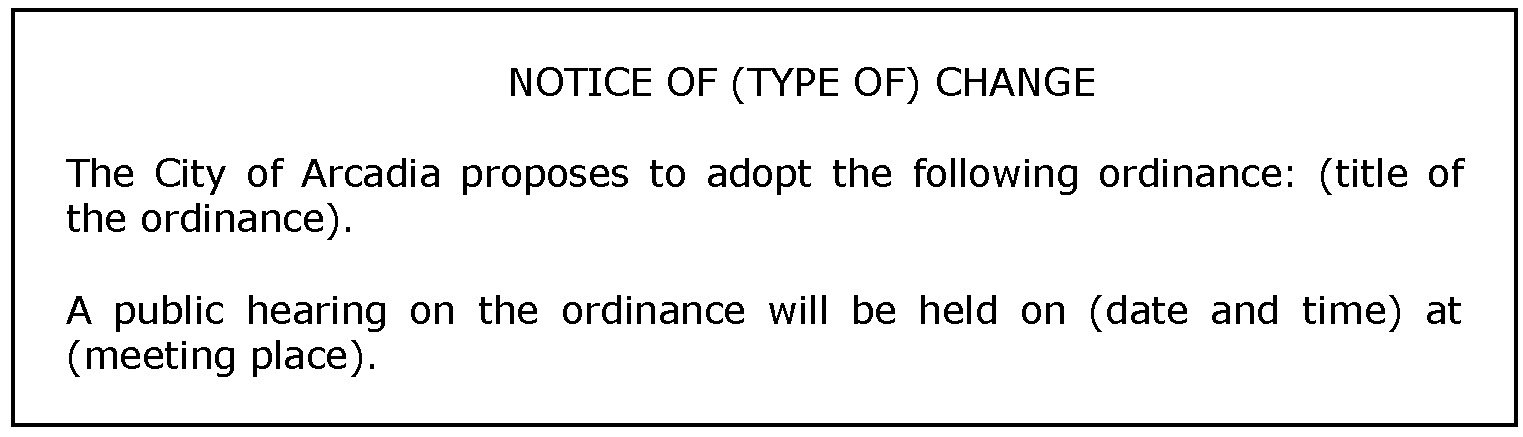
The required advertisements shall be no less than two columns wide by ten inches long in a standard size or a tabloid size newspaper, and the headline in the advertisement shall be in a type no smaller than 18 point. The advertisement shall not be placed in that portion of the newspaper where legal notices and classified advertisements appear. The advertisement shall be placed in a newspaper of general circulation in the city and of general interest and readership in the municipality.
D.
Advertisement Form.
E.
The advertisement shall contain a geographic location map that clearly indicates the area covered by the proposed ordinance. The map shall include major street names as a means of identification of the general area.
F.
Mail-out may be done. In lieu of publishing the advertisement as outlined above, the city may mail a notice to each person owning real property within the area covered by the ordinance. Such notice shall clearly explain the proposed ordinance and shall notify the person of the time, place, and location of both public hearings on the proposed ordinance. If mail-outs are completed, the ordinance must be advertised per the requirements of section 11.04.00A.
Section 11.04.04. - Advertisement of public hearings for changes to the actual list of permitted, special approval, or prohibited uses within a zoning category.
In cases where a proposed ordinance changes the actual list of permitted, special approval, or prohibited uses within a zoning category, public notice shall be enacted pursuant to section 11.04.03, except that a geographic location map is not required.
Section 11.04.05. - Advertisement of public hearings for Comprehensive Plan amendments.
There are three general types of Comprehensive Plan amendments: Expedited state review, state coordinated review, and small scale. The expedited state review process is utilized for the majority of Comprehensive Plan amendments adopted by local governments. The state coordinated review process is utilized for amendments that are in an area of critical state concern, amendments that propose a rural land stewardship area, amendments that propose a sector plan, or amendments that update a Comprehensive Plan based on an evaluation and appraisal report. The Small Scale process is utilized for amendments that qualify as small-scale development amendments.
All requests for Comprehensive Plan amendments shall be submitted in writing to the city administrator, or his or her designee, together with applicable fees, which will have been established by the city council. Specific regulations for Comprehensive Plan amendment applications are detailed in section 11.05.00. Procedures for advertising a public hearing to adopt an ordinance for a Comprehensive Plan amendment are set forth in F.S. Ch. 163 §§ 163.3184 and 163.3187 and in section 11.04.00 of this article.
Section 11.04.06. - Notice of public hearings for vacation of roads, alleys, streets and easements.
A.
Upon the filing of a petition pursuant to this article, the applicant shall also mail a copy of the petition to each abutting property owner or other owner of record of lots or parcels that may be affected by the vacation, or as directed from DRC review or from council action, by certified mail with return receipt requested. The return receipts shall be filed with the city clerk, prior to the setting of the public hearing to be held upon the petition.
B.
The city clerk, shall publish notice of the public hearing one time in a newspaper of general circulation in the county at least two weeks prior to the date of such public hearing, and the city clerk shall also mail notice of the public hearing to all affected property owners. (F.S. § 336.10)
C.
Notice of the adoption of such resolution of the city council shall be published one time within 30 days following its adoption in one issue of a newspaper of general circulation published in the county.
Section 11.04.07. - Notice of public hearings for vacation of subdivision plats.
The applicant shall comply with the requirements of F.S. § 177.101, and amendments thereto.
Section 11.04.08. - Hearings; time limits for approvals and recommendations.
A.
If a petition or recommendation for a change or amendment to this Code is not acted upon finally by the city council within six months of the date upon which the report of the city planning and zoning board is filed with the city council, the petition shall be deemed to have been denied.
B.
Where the planning and zoning board, board of adjustment or city council has given or granted an approval, pursuant to the provisions of this article, such approval or grant shall become null and void unless a permit and/or business tax receipt pursuant thereto is issued within 180 days of the date of such action by the planning and zoning board, board of adjustment or city council.
Section 11.05.00. - Comprehensive plan amendments.
An amendment to the Comprehensive Plan may either be a text amendment, which is a change to the goals, objectives and policies of the Comprehensive Plan, or a map amendment, which changes a land use classification shown on the future land use map. Amendments may be initiated by a property owner(s), or agent of a property owner, the local planning agency, or the city council.
Section 11.05.01. - Application for Comprehensive Plan amendments.
All requests for Comprehensive Plan amendments shall be submitted to the city administrator, or his or her designee, together with all required attachments and the applicable fee, as established by resolution of the city council.
The application shall contain, at a minimum, the following information, as applicable:
A.
Owner's name, address, phone number, email address if available; agent/applicants name, address and phone number, email address if available; proof of ownership;
B.
Whether the amendment is a map change or a text change with an explanation and/or description of the amendment;
C.
A location map, with the parcel marked, and the property appraiser's parcel identification number;
D.
If the proposed amendment is a map amendment, the applicant shall provide a map or drawing showing the site and the adopted land use designation; the proposed land use designation; the size of the site in acres; the current future land use maximum allowable density; and the maximum allowable density for the proposed future land use classification;
E.
The location of existing sewer and potable water facilities to the development site.
Section 11.05.02. - DRC review.
The city administrator, or his or her designee, shall distribute the application and attachments to the DRC for review. The DRC shall provide written comments to the city administrator, or his or her designee, who shall then forward such comments to the applicant. The applicant shall respond to the DRC comments and submit any revised application and applicable exhibits to the city administrator, or his or her designee. When the city administrator, or his or her designee, determines that the applicant has addressed all comments the request shall be placed on a regular meeting agenda of the planning and zoning board.
Section 11.05.03. - Planning and zoning board and city council review of Comprehensive Plan amendments.
A.
The city administrator, or his or her designee, shall forward the application, any attachments, and a staff report to the planning and zoning board members for their consideration. Public notice shall be provided consistent with section 11.04.00 of this article. The planning and zoning board shall hear the request and make a recommendation to the city council.
B.
The city administrator, or his or her designee, shall forward the application, any attachments, and a staff report, which shall include the planning and zoning board's recommendation, to the city council. The city council shall hold public hearings and provide notice of the meetings in compliance with section 11.04.05 of this article. No approval shall be granted unless the request is approved by a majority of the council members voting. Adoption of an amendment shall be in the form of an ordinance.
Section 11.05.04. - Basis for review.
The basis for review of a proposed Comprehensive Plan amendment is the same as the basis for the adoption of the Comprehensive Plan. This entails a review of data and an analysis of the amendment on public facility levels of service, the capital improvements budget of the city, and the need for the proposed amendment, in relation to the existing structure of the city and the future, as delineated in the goals, objectives and policies of the Comprehensive Plan.
Section 11.06.00. - Zoning amendments.
A zoning amendment may either be a text amendment, which is a change to the district regulations provided in the land development code, or a map amendment, which is a change to a zoning classification shown on the zoning map.
A.
A rezoning may be initiated by the city, or by a property owner or agent of a property owner of land in the city.
B.
A petition for a change of district regulations may be filed by any citizen or owner of land in the city.
C.
The city planning and zoning board shall investigate and study such petitions, hold public hearings thereon and promptly submit its report and recommendations to the city council.
D.
No recommendation for a change in this Code shall be made by the city planning and zoning board unless and until a public hearing has been held by the city planning and zoning board.
E.
Proposals for change in this Code originating with the city council or initiated by the city planning and zoning board shall be processed in the same manner as provided in this article for zoning amendment requests.
F.
No amendment shall be made until the proposal or request has first been considered by the planning and zoning board and the city council has received a recommendation thereon.
Section 11.06.01. - Application for zoning amendment.
All requests for zoning amendments shall be submitted to the city administrator, or his or her designee, together with all required attachments and the applicable fee, as established by resolution of the city council.
The application shall contain, at a minimum, the following information:
A.
The property owner's name, address, telephone number and email address if available;
B.
Proof of ownership;
C.
The designated project applicant or representative if other than the property owner, a contact address, telephone number and email address if available;
D.
A legal description of the property and the size of the area in acres;
E.
The Future Land Use classification of the property;
F.
The current zoning designation of the property;
G.
The proposed zoning designation of the property;
H.
A description of the proposed use of the property;
I.
A location map, with the parcel marked, and the parcel identification number;
J.
The location of existing sewer service and potable water facilities in relation to the development site.
K.
Identify whether the property is vacant, or if and for how long the use has been discontinued.
L.
If a text amendment, provide the text of the Land Development Code section to be amended.
Section 11.06.02. - DRC review.
The city administrator, or his or her designee, shall distribute the application and attachments to the DRC for review. The DRC shall provide written comments to the city administrator, or his or her designee, who shall then forward such comments to the applicant. The applicant shall respond to the DRC comments and submit any revised application and applicable exhibits to the city administrator, or his or her designee. When the city administrator, or his or her designee, determines that the applicant has addressed all comments the request shall be placed on a regular meeting agenda of the planning and zoning board.
Section 11.06.03. - Planning and zoning board and city council review of zoning amendments.
A.
The city administrator, or his or her designee, shall forward the application, any attachments, and a staff report to the Planning and Zoning Board members for their consideration. Public notice shall be provided consistent with section 11.04.00 of this article, and the planning and zoning board shall hear the request and make a recommendation to the city council.
B.
The city administrator, or his or her designee, shall forward the application, any attachments, and a staff report, which shall include the planning and zoning board's recommendation, to the city council. The city council shall hold public hearings and provide notice of the meetings in compliance with this article. No approval shall be granted unless the request is approved by a majority of the council members voting. Adoption of an amendment shall be in the form of an ordinance.
Section 11.06.04. - Basis for review.
An amendment shall be evaluated on the basis of the following criteria:
A.
The character of the district and its peculiar suitability for particular uses.
B.
Conservation of the value of buildings and encouraging the most appropriate use of land throughout the city.
C.
The applicable portions of any current city plans and programs such as land use, traffic ways, recreation, schools, neighborhoods, drainage and housing.
D.
The needs of the community for land areas for specific purposes to serve population and economic activities.
E.
Whether there have been substantial changes in the character or development of areas in or near an area under consideration for rezoning.
F.
The facts and opinions presented to the through hearings.
G.
For a land development code text amendment, provide justification for the proposal; why is the proposed change necessary and how does it conform to the Comprehensive Plan?
Section 11.06.05. - Further petitions for same property after denial of rezoning petition.
A.
Whenever the city planning and zoning board has taken action to recommend denial of a petition for rezoning of property, the board shall not consider any further petition for the same rezoning of any part of the same property for a period of one year from the date of such action.
B.
Whenever the city planning and zoning board has taken action to recommend denial of a petition for rezoning of property, the board shall not consider a petition for any kind of zoning on any part of the same property for a period of six months from the date of such action.
C.
The time limits for city planning and zoning board consideration set forth in this section may be waived by the city council by the affirmative vote of four council members, when the city council deems such action necessary to prevent an injustice or to facilitate the proper development of the city. The request shall be submitted to the city administrator, or his or her designee, who shall forward the request to the city council for their consideration at a regularly scheduled meeting or at any special meeting called for that purpose.
Section 11.07.00. - Special approval uses.
It is the intent of this section to provide for a process to review "special" uses that by their nature, may need to be more closely examined for compatibility at a particular location. These particular uses are generally considered to be appropriate for any zoning district that permits that particular use by special approval. Uses that require special approval are designated by an "S" in the table of uses found in article 4 of this Code. The following conditions apply to special approval uses:
A.
Unless otherwise provided in the approval of the request, a special approval shall remain valid if a building and/or development permit or business tax receipt, as applicable, is obtained within 180 days of city council approval.
B.
If a special approval use does not begin to serve the purpose for which it was granted permission within 180 days from the date of approval, it shall expire.
C.
Extensions for approved uses may be granted by the city administrator, or his or her designee, for a single period up to 180 days from the date when a special approval would otherwise expire.
1.
An extension may be granted if the city administrator, or his or her designee, concludes that the special approval has proceeded with due diligence and in good faith, and that conditions have not changed substantially so as to warrant a new application.
2.
All such requests for extensions must be submitted in writing, not less than 30 days before the expiration of the special approval stating the reason for the time extension request.
D.
Ownership may change, but so long as the character and conditions of the special approval do not change, the special approval use remains in effect.
E.
Should the use change to a use permitted in the zoning district that is not the use approved as the special approval, a new application shall be required to reestablish any special approval.
F.
Should the use be abandoned for 180 days, a new application shall be required to reestablish any special approval.
G.
The expansion or reconfiguration of any use or development that is subject to special approval shall require a new or amended special approval prior to the issuance of a building permit.
Section 11.07.01. - Application for special approval uses.
All requests for special approval shall be submitted to the city administrator, or his or her designee, together with all required attachments and the applicable fee, as established by resolution of the city council.
The application shall contain, at a minimum, the following information, as may be applicable to the request:
A.
When requesting special approval, the applicant shall furnish proof that the development site is unified by title, and not spatially divided by ownership;
B.
The property owner's name, address, telephone number and email address if available;
C.
The name of the designated project applicant or representative if other than the property owner, a contact address, telephone number and email address if available;
D.
A notarized authorization of the owner when the applicant is other than the owner, or is an attorney for the owner;
E.
The street address of the property;
F.
A legal description of the property;
G.
A location map of the property and the parcel identification number;
H.
The Future Land Use classification and zoning designation of the property;
I.
A site plan or sketch plan drawn to scale showing the dimensions of the property;
J.
The existing and proposed location of structures on the property including signage and building, structural setbacks and distances between buildings;
K.
Paved surfaces including sidewalks, vehicular access ways and circulation areas, off-street parking and loading areas, and refuse and service areas;
L.
The number of required and provided off-street parking and loading spaces;
M.
Required yards, and other open spaces, and landscape buffer yard areas;
N.
The measurements of existing and proposed adjacent rights-of-way, widths of access ways and driveways, and sidewalks;
O.
A description of the proposed use of the property including conditions of the use, such as hours of operation, numbers of residents, numbers of employees, and other pertinent information;
P.
Existing and proposed density;
Q.
Amount of existing and proposed commercial or industrial space;
R.
Location of all public and private streets, existing and proposed utilities, driveways and utility easements, within and adjacent to the site;
S.
Provisions for stormwater management and detention related to the proposed development;
T.
Where applicable, delineation of all watercourses, wetlands and flood-prone areas as delineated by the National Wetlands Inventory and the flood insurance rate maps (FIRM) published by the Federal Emergency Management Agency (FEMA);
U.
Where applicable, the identification of significant stands of mature trees and understory vegetation that may provide wildlife habitats or other environmentally unique areas.
Section 11.07.02. - DRC review.
The city administrator, or his or her designee, shall distribute the application and attachments to the DRC for review. The DRC shall provide written comments to the city administrator, or his or her designee, who shall then forward such comments to the applicant. The applicant shall respond to the DRC comments and submit any revised application and applicable exhibits to the city administrator, or his or her designee. When the city administrator, or his or her designee, determines that the applicant has addressed all comments the request shall be placed on a regular meeting agenda of the planning and zoning board.
Section 11.07.03. - Planning and zoning board and city council review of special approval uses.
A.
The city administrator, or his or her designee, shall forward the application, any attachments, and a staff report to the planning and zoning board members for their consideration. Public notice shall be provided consistent with section 11.04.00 of this article, and the planning and zoning board shall hear the request and make a recommendation to the city council.
B.
The city administrator, or his or her designee, shall forward the application, any attachments, and a staff report, which shall include the planning and zoning board's recommendation, to the city council. The city council shall hold public hearings and provide notice of the meetings in compliance with this article. No approval shall be granted unless the request is approved by a majority of the council members voting. Approval of a special approval request shall be in the form of a resolution. Any conditions adopted as a part of the approval shall be explicitly stated in the resolution, and shall be the basis for any development agreement or permit associated with the special approval.
Section 11.07.04. - Basis for review.
A special approval request may be approved, approved with conditions so as to ensure compatibility with surrounding properties or the community in general, modified, or denied. In the instance of a denial, the written finding shall state the reason, or reasons, for the denial, in sufficient detail to eliminate misunderstanding on the part of the applicant, any future applicant, and the officials of the City of Arcadia.
A special approval request shall be evaluated on the basis of the following criteria:
A.
Adequate provision is made to protect adjacent properties from possible adverse influences of the proposed use such as noise, dust, vibration, glare, odor, electrical disturbances and similar factors;
B.
Vehicular traffic and pedestrian movement on adjacent streets will not be hindered or endangered;
C.
Off-street parking and loading, and the entrances to and exits from such parking and loading areas, will be adequate in terms of location, amount, and design to serve the uses;
D.
Public facilities and utilities are capable of adequately serving the proposed use, and;
E.
Lot and building requirements shall comply with the lot and building requirements for the district in which the special use is to be located, or shall comply with such requirements as may be imposed by the city council in its approval of the special approval.
Section 11.07.05. - Non-compliance.
Failure to comply with a special approval resolution or any of the conditions upon which such approval was granted, including time limits for performance, shall be cause to deny issuance of a building permit, development permit or development approval certificate, or business tax receipt, or where a permit or business tax receipt has been issued, to render such permit or receipt invalid, or where action or construction has begun, to constitute issuance of a stop-work order.
Section 11.07.06. - Appeal of special approval decision.
Any person or persons aggrieved by a special approval decision made by the city council may, within 30 days after the date of the public hearing at which the decision was rendered but not thereafter, apply to the courts for relief in the manner provided by the laws of the State of Florida.
Section 11.08.00. - Vacation of roads, alleys, streets and easements.
The city council, with respect to property under its control within the territorial limits of the city, may, in its own discretion, and at its own motion, or upon the request of any agency of the state or of the federal government, or upon petition of any person:
A.
Vacate, abandon, discontinue and close any existing public or private street, alleyway, road, easement or other place used for travel, or any portion thereof, other than a state, county or federal highway, and renounce and disclaim any right of the city and the public in and to any land in connection therewith;
B.
Renounce and disclaim any right of the city and the public in and to any land or interest therein acquired by purchase, gift, devise, dedication or prescription for streets, alleyways, roads or easements other than lands acquired for state, county or federal highways; and
C.
Renounce and disclaim any right of the city and the public in and to any land, other than land constituting or required for state, county or federal highways, delineated on any recorded map or plat as a street, alleyway, road or easement.
Section 11.08.01. - Petition for vacation request.
All petitions to vacate roads, alleys, streets, and/or easements shall be submitted to the city administrator, or his or her designee, together with all required attachments and the applicable fee, as established by resolution of the city council.
A petition shall be signed by the applicant, or his or her attorney and shall include the following:
A.
A legal description of the street, road, alleyway or easement to be vacated, along with a map or plat indicating the street, road, alleyway or easement thereon.
B.
A list of the names and addresses of all property owners abutting upon the described lands and a statement of what effect, if any, the vacation of such street, alleyway, easement or road may have upon other property owners in the area.
C.
Letters from appropriate officials of each utility company and cable TV company operating in the general area, stating their objections, if any, to the vacation. If there are no objections, the letter shall so state.
D.
Upon the filing of a petition, the applicant shall comply with the notification requirements provided in section 11.04.06 of this article.
E.
Letters of objection or no objection from all owners of record of lots or parcels of land that would be affected by the vacation, including the legal description of the properties owned by such abutting property owners or other affected property owners.
F.
In addition to the filing fee, all costs and expenses of surveys and preparation of plats, costs of publication, mailing expenses, recording costs, legal expenses and other costs and expenses incurred in the processing of the petition to vacate by the applicant and/or the city shall be paid by applicant prior to setting the public hearing and placing the petition on the City Council agenda.
Section 11.08.02. - Determination of sufficiency of petition.
Upon the filing of a petition pursuant to this article, the city administrator, or his or her designee, shall furnish the petition to the city attorney, who shall examine it for completeness and notify the city administrator, or his or her designee, in writing as to his or her opinion thereon. if the petition is found incomplete by the city attorney, the city administrator, or his or her designee, shall notify the applicant in writing, and the applicant shall be given a reasonable time to make the petition complete.
Section 11.08.03. - DRC review.
Upon a determination of sufficiency, the city administrator, or his or her designee, shall distribute the petition and attachments to the DRC for review. The DRC shall provide written comments to the city administrator, or his or her designee, who shall then forward such comments to the applicant. The applicant shall respond to the DRC comments and submit any revised application and applicable exhibits to the city administrator, or his or her designee. When the city administrator, or his or her designee, determines that the applicant has addressed all comments the request shall be placed on a regular meeting agenda of the city council.
Section 11.08.04. - City council review of vacation request.
The city administrator, or his or her designee, shall forward the application, any attachments, and a staff report to the city council members for their consideration.
A.
Any action of the city council vacating any road, street, alleyway or easement shall be evidenced by a resolution duly adopted and entered upon the minutes of the city council.
B.
Notice of the adoption of such resolution of the city council shall be consistent with the requirements provided under section 11.04.06 of this article.
C.
The proof of publication of notice of the public hearing, the resolution as adopted, and the proof of publication of the notice of the adoption of such resolution shall be recorded in the deed records of the county by the city clerk.
Section 11.08.05. - Basis for review.
An applicant shall demonstrate and identify the following:
A.
There are no known city plans for the use of the subject right-of-way, street or alley;
B.
Abutting property owners will not be adversely affected by the proposed request;
C.
Any impacts, including relocation and relocation costs, the request will have on short-range and long-range public and private utilities;
D.
Any impacts the request will have on short-range and long-range ingress and egress by private and public vehicles.
Section 11.08.06. - Previous actions of council ratified.
The actions by the city council heretofore taken closing, vacating or abandoning any road, street, alleyway or easement as described in this article and appearing in the minutes of the city are hereby ratified, approved and confirmed in all respects, and such roads, alleyways, streets and easements are declared closed, vacated and abandoned, consistent with the provisions of the resolution or other action of such city council as shown by its minutes.
Section 11.08.07. - Title to vacated space.
The act of the city council in closing or abandoning any road, street, alleyway or easement or in renouncing or disclaiming any rights in any land delineated on any recorded map as a road, street, alleyway, or easement shall abrogate the easement, alleyway, street or road theretofore owned, held, claimed or used by or on behalf of the public and the title of the fee owner shall be freed and released therefrom; and if the fee or road, street, alleyway or easement space has been vested in the city, it will be thereby surrendered and will vest in the abutting fee owners in accordance with the laws of the state.
Section 11.09.00. - Development of regional impact (DRI) review.
The DRI process, procedures and notification requirements are provided in F.S. § 380.06, and any amendments thereto. Adoption of a DRI shall be by ordinance.
Section 11.10.00. - Adjustments to access and parking standards review process.
Applicants requesting an adjustment to access and/or parking standards, per section 6.04.00, shall file the request with the city administrator, or his or her designee, and shall pay the appropriate filing fee, as established by resolution of the city council.
Section 11.10.01. - DRC review.
The city administrator, or his or her designee, shall distribute the application and attachments to the DRC for review. The DRC shall provide written comments to the city administrator, or his or her designee, who shall then forward such comments to the applicant. The applicant shall respond to the DRC comments and submit any revised application and applicable exhibits to the city administrator, or his or her designee. When the city administrator, or his or her designee, determines that the applicant has addressed all comments the request shall be placed on a regular meeting agenda of the city council.
Section 11.10.02. - City council review of adjustments to access and parking standards.
The city administrator, or his or her designee, shall forward the application, any attachments, and a staff report to the city council members for their consideration.
Section 11.11.00. - Variances.
The board of adjustment shall have the power to hear and decide, variances from the development standards established by this Code, which will not be contrary to the public interest, where, owing to special conditions, a literal enforcement will result in unnecessary hardship, and so that the spirit and intent of this Code shall be observed and substantial justice done. Variances granted by the board of adjustment shall be the minimum necessary to provide a reasonable use of the property. A variance may only be granted for height, area, size of structure or size of yards and open spaces, or other dimensional requirements. Once granted, a variance runs with the land in perpetuity, even if the land changes ownership. The board of adjustment shall not be empowered to hear and decide requests for variances to permit a use of land, buildings, or structures which are not permitted by right in the zoning district involved.
Section 11.11.01. - Application for a variance.
The variance application, as provided by the city, shall be filed with the city administrator, or his or her designee, along with accompanying site plans and a review fee, as established by resolution by the city council.
The application shall contain, at a minimum, the following information:
A.
The property owner's name, address, telephone number and email address if available;
B.
The designated project applicant or representative if other than the property owner, a contact address, telephone number and email address if available;
C.
Property address;
D.
Property square footage or acreage;
E.
A location map, with the parcel marked, and the parcel identification number provided;
F.
The future land use classification of the property;
G.
The current zoning designation of the property;
H.
A description of the variance requested.
Section 11.11.02. - DRC review.
The city administrator, or his or her designee, shall distribute the application and attachments to the DRC for review. The DRC shall provide written comments to the city administrator, or his or her designee, who shall then forward such comments to the applicant. The applicant shall respond to the DRC comments and submit any revised application and applicable exhibits to the city administrator, or his or her designee. When the city administrator, or his or her designee, determines that the applicant has addressed all comments the request shall be placed on a regular meeting agenda of the board of adjustment.
Section 11.11.03. - BOA review of variance request.
The city administrator, or his or her designee, shall forward the application, any attachments, and a staff report to the board of adjustment members for their consideration at a regular scheduled meeting. Public notice shall be provided consistent with section 11.04.00 of this article.
Section 11.11.04. - Basis for granting a variance.
No variance from the terms of this Code shall be approved by the board of adjustment unless the board finds, beyond reasonable doubt, that all of the following facts and conditions exist:
A.
There are unique and special circumstances or conditions applying to the property in question that do not apply generally to other properties in the same district.
B.
Any alleged hardship is not self-created by any person having an interest in the property and is not the result of mere disregard for or ignorance of the provisions of this Code.
C.
Strict application of the provisions of this Code would deprive the applicant of reasonable use of the property for which the variance is proposed, and the variance proposed is the minimum variance which makes possible the reasonable use of the property.
Section 11.11.05. - Variance decisions.
The board of adjustment shall decide, by a majority vote of the members present at a meeting in which a quorum is present and voting, either in favor of or against the applicant. If approved, the board may impose any reasonable conditions or restrictions it deems necessary and desirable to protect adjacent properties in the surrounding neighborhood and to carry out the spirit and purpose of this Code. Variances shall be approved by resolution and filed in the records of the board.
Section 11.12.00. - Appeals of administrative decisions.
Appeals may be taken to the board of adjustment by any person aggrieved, within 30 days from the date of the entry of any decision by an administrative official under this Code adverse to his interest, or within 30 days from the enforcement official's refusal to issue any permit for nonconformity to zoning after application therefore has been duly made.
Section 11.12.01. - Application for appeal of administrative decision.
The application for an appeal of an administrative decision, as provided by the city, shall be filed with the city administrator, or his or her designee, along with any accompanying information and a review fee, as established by resolution by the city council.
The application shall contain, at a minimum, the following information:
A.
The property owner's name, address, telephone number and email address if available;
B.
The designated project applicant or representative if other than the property owner, a contact address, telephone number and email address if available;
C.
A description/reason for the appeal.
Section 11.12.02. - Effect of administrative appeal.
An appeal shall stay all proceedings in furtherance of the action appealed from unless the official from whom the appeal is taken shall certify to the board of adjustment, after the appeal has been filed, that, by reason of facts stated in the certificate, a stay, in his opinion, would cause imminent peril to life or property, in which case proceedings shall not be stayed otherwise than by order of the board or by a court of equity, after notice to the official from whom the appeal is taken and on due cause shown.
Section 11.12.03. - Board of adjustment review of an administrative appeal.
The board of adjustment shall hear all appeals promptly after giving to all parties at least ten days written notice of the time and place of a special hearing. Any party may appear in person or be represented by an agent or an attorney.
The board of adjustment shall decide, by a majority vote of the members present at a meeting in which a quorum is present and voting, either in favor of or against the applicant. Approval shall be in the form of a resolution. The resolution shall contain a full recital of the board in each case, and a copy shall be filed in the records of the board.
Section 11.13.00. - Appeals from board of adjustment decisions.
Any person aggrieved by any decision of the board of adjustment may appeal from the decision to a court of competent jurisdiction within 30 days after the Resolution in which such decision is set out is filed in the city records, by filing a notice with the city clerk.
Section 11.14.01. - Purpose and intent.
A.
It is hereby declared a matter of public policy that the protection, enhancement, perpetuation, and use of improvements, or sites of special character or special architectural, archeological, or historic interest or value, is a public necessity and is required in the interest of the health, prosperity, safety, and welfare of the people of the City or Arcadia.
B.
The purpose of this section is to:
1.
Effect and accomplish the protection, enhancement, and preservation of such improvements, sites, and districts which represent or reflect elements of the city's cultural, social, economic, political, and architectural history;
2.
Safeguard the city's historic, prehistoric, and cultural heritage, as embodied and reflected in such historic structures, sites, and districts;
3.
Stabilize and improve property values, and enhance the visual and aesthetic character of the city;
4.
Protect and enhance the city's historic, cultural, and architectural attractions to residents, tourists, and visitors, and serve as a support and stimulus to business and industry;
5.
Ensure the harmonious, orderly, and efficient growth, prosperity and development of the city through retention and reuse of its historic and cultural resources;
6.
Strengthen civic pride and cultural stability through neighborhood conservation;
7.
Promote the use of resources for the education, pleasure, and welfare of the people of the city;
8.
Provide a review process for the continued preservation and appropriate, compatible and sensitive development of new construction and additions within the city's historic districts and neighborhoods;
9.
Protect and enhance the scale, character and stability of existing neighborhoods. and protect against destruction of or encroachment upon areas which contribute to the character of the city;
10.
Facilitate the creation of a convenient, harmonious and attractive community, and protect the architectural beauty, special architectural features, and special landscape features of the city;
11.
Avoid demolition, or other adverse effect on historic properties (properties) and districts, which would cause an irreparable loss to the city;
12.
Assist neighborhoods to achieve a positive neighborhood identity and sense of place.
In addition, these provisions are designed to implement, be consistent with, and assist in the achievement of the goals, objectives and policies, as specifically required by the city's Comprehensive Plan, with respect to historic, conservation, and neighborhood Resources.
(Ord. No. 1014, § 2, 7-5-2016)
Section 11.14.02. - Historic structure, historic site, and historic district designation criteria.
For purposes of this Code, a historic structure, historic site, or historic district designation may be placed on any site, natural or improved, including any building, improvement or structure located thereon, or any area of particular historic, architectural, archeological, or cultural significance to the city such as historic structures, sites, or districts which:
A.
Exemplify or reflect the broad cultural, political, economic or social history of the nation, state or community; or
B.
Are identified with historic personages or with important events in national, state or local history; or
C.
Embody the distinguishing characteristics of an architectural type or specimen inherently valuable for a study of a period, style, method of construction, or of indigenous materials or craftsmanship; or
D.
Are representative of the notable work of a master builder, designer or architect who influenced his age; or
E.
Have yielded, or may be likely to yield, information important to prehistory or history.
(Ord. No. 1014, § 2, 7-5-2016)
Section 11.14.03. - Recognition of historic structures, sites and districts.
At such time as a historic structure, site, or district has been properly designated, the city, in cooperation with the property owner, may cause to be prepared and erected on such property a suitable plaque declaring that such property is a historic structure, site, or district. The failure to prepare and erect any such marker, or the subsequent removal thereof, shall in no way affect the designation of the historic structure, site, or district, and shall have no impact upon the implementation of the provisions of section 11.14.00 and its subsections.
(Ord. No. 1014, § 2, 7-5-2016)
Section 11.14.04. - Regulation of historic structures, sites and districts.
A.
Certificate of appropriateness. Unless and until a certificate of appropriateness has been granted by the commission, no owner or person in charge of a historic structure, a historic site, or a structure within a historic district shall (1) reconstruct, alter, or demolish, or cause or allow any reconstruction, alteration, or demolition to occur to, all or any part of the exterior of such property; or (2) construct, or cause or allow any construction of, any improvement upon such designated property or properties; or (3) relocate, or cause or allow the relocation of any such property or properties.
1.
Condition for issuance of permit. Further, unless and until a certificate of appropriateness has been granted by the commission, the building official shall not issue a permit for any such work.
2.
Applications. Requests for certificates of appropriateness shall be made only on application forms approved by the commission or city council. Submittal of the application must be made with the appropriate site plans, drawings, photographs, descriptions, and other documentation needed to provide staff and the commission with a clear understanding of the proposed action. Application fees and other applicable charges shall be established by resolution adopted by the city council.
3.
Historic preservation commission review criteria. Upon filing of a complete application for a certificate of appropriateness with the city, the commission, utilizing the Design Guidelines Handbook, shall review the application for conformity with the criteria set forth in this section, and shall issue or deny the certificate of appropriateness based on such criteria.
4.
Historic preservation commission decision-making period. The commission shall render its decision within 60 days of the filing of the application. If the commission fails to make a decision within that period, the application shall be deemed approved, and the city administrator shall issue the certificate of appropriateness.
5.
No exemption from required permits. The issuance of a certificate of appropriateness shall not relieve the applicant from obtaining other permits and approvals required by the city. A building permit or other municipal permit shall be invalid if it is obtained without the presentation of the certificate of appropriateness required for the proposed work.
6.
Ordinary maintenance and repairs. Ordinary maintenance and repairs may be undertaken without a certificate of appropriateness provided that the work involves repairs to existing features of a historic structure or site or the replacement of elements of a structure with pieces identical in appearance and provided that the work does not change the exterior appearance of the structure or site and does not require the issuance of a building permit.
7.
Affirmative maintenance required. The owner of a property designated pursuant to this section, either individually or as part of a district or zone, shall comply with all applicable codes, laws and regulations governing the maintenance of property. It is the intent of this section to preserve from deliberate or inadvertent neglect the exterior features of such properties and the interior portions thereof when maintenance is necessary to prevent deterioration and decay of the property. All such properties shall be preserved against decay and deterioration and shall be free from structural defects though prompt corrections of any of the following defects:
a.
Facades that fall and injure the subject property, adjoining property or members of the public;
b.
Deteriorated or inadequate foundations, defective or deteriorated flooring or floor supports, deteriorated walls or other vertical structural supports:
c.
Members of ceilings, roofs ceiling and roof supports or other structural members that may rot, sag, split or buckle due to defective material or deterioration;
d.
Deteriorated or ineffective waterproofing of exterior walls, roofs, foundations or floors, including broken, unsecured or missing windows or doors;
e.
Any fault or defect in the property that renders it structurally unsafe, insufficiently protected from weathering, or not properly watertight.
8.
Secretary of the Interior's Standards for Rehabilitation. In reviewing an application, the Secretary of the Interior's Standards for Rehabilitation (as may be amended from time to time) shall be applied.
9.
Additional criteria. The Secretary of the Interior's Standards for Rehabilitation shall be supplemented by the following criteria specific to certain types of requests:
a.
New Construction and Alterations. All new construction and alterations to existing buildings within a designated historic district or on an individually designated property shall be visually compatible, and meet the following guidelines:
i.
Setting, orientation and setbacks. The building should be situated approximately the same distance from the street as adjacent buildings, to create a continuous street edge. The orientation of the building should be visually compatible with that of the buildings in the historic district. The setting should be designed with the overall environment in mind. It should take into account the compatibility of landscaping, parking, service areas, walkways, and accessory structures.
ii.
Building height. The height of the building at street level should be visually compatible in comparison or relation to the height of the existing contributing buildings in the historic district.
iii.
Design styles. New buildings should take their design cues from the prevailing architectural styles within the historic district. Traditional or contemporary design standards and elements should relate to the existing styles.
iv.
Proportion of openings. The openings of any building within a historic district should be visually compatible with the openings in existing contributing buildings within the historic district. The relationship of the width of windows and doors to the height of windows and doors should be visually compatible with the existing contributing buildings within the historic district.
v.
Rhythm of solids to voids. The relationship between solids (walls) and voids (windows and doors) of a building should be visually compatible with the surrounding buildings.
vi.
Rhythm of spacing along the street. The relationship of buildings to the open space between them should be compatible with the other buildings on each side of the street in that block.
vii.
Relationship of materials and textures. The materials and textures of a building should be chosen with the predominant materials of the historic district in mind. Simplicity in such use is preferable.
viii.
Roof shapes. The roof shape of a building is a major distinguishing feature. The roof shape of a building should be compatible with the roof shape of existing contributing buildings within the historic district. The roof shape shall be consistent with the architectural style of the building.
ix.
Size, scale, bulk, mass and volume. The physical size, scale, bulk, mass and volume should be compatible with the existing contributing buildings within the historic district without overwhelming them.
b.
Additions. All additions to historic structures or structures within a historic district shall meet the following guidelines:
i.
Locate an addition to the rear or least visible sides of historic structures. Locating an addition on the front elevation should be avoided.
ii.
Minimize the loss of historic materials from the historic structure and protect character-defining features.
iii.
Design the addition to be compatible in terms of massing, size, scale, relationship of solids to voids, and architectural features. An addition should be subordinate to the historic building.
iv.
Differentiate the addition from the historic structure.
v.
If permitted, rooftop additions should generally be limited to one story in height, should be set back from the wall plane and should be as inconspicuous as possible.
vi.
Continue the design elements on all elevations of the new construction, not only those elevations that can be viewed from the street.
vii.
Design and construct the addition so that, if removed in the future, the essential form and integrity of the historic structure will be unimpaired.
viii.
Limit the size and number of openings between the old and new building by utilizing existing doors or by enlarging existing windows.
c.
Demolition. All demolitions of historic structures within a historic district shall comply with the following:
i.
Simultaneous certificates required. No building or structure on a property located within a district shall be demolished without first receiving a certificate of appropriateness for new construction. The applications for demolition and new construction shall be reviewed by the commission simultaneously. The requirement of a certificate of appropriateness for new construction may be waived by the commission upon a good cause showing that such requirement would be unduly harsh or would result in a substantial hardship to the property owner.
A showing of good cause may include, but is not limited to, evidence that the property owner is unable to comply with the requirement for simultaneous new construction due to advanced age, infirmity, physical or other debilitating handicap, or financial hardship.
If an application for certificate of appropriateness for demolition is approved, the owner shall, at his/her expense, fully record the building prior to demolition. At a minimum, the owner shall provide an architectural description, floor plan with interior and exterior dimensions, interior and exterior photographs, and any other information requested by the commission. Said record shall be deposited in the local archives, where it will be made available to the public.
Upon approval by the commission of a certificate of appropriateness for demolition, the demolition permit shall not be issued until all demolition and new construction plans for the property have received all other required governmental approvals.
The existence of one or more of the following conditions may be the basis for denial of a demolition application:
(A)
The resource contributes significantly to the historic character of a designated property or district.
(B)
The resource is listed on the National Register.
(C)
The resource is one of the last remaining examples of its kind in the neighborhood or city.
(D)
The resource is capable of being repaired and reused in a practical and feasible manner.
(E)
Retention of the resource would promote the general welfare of the city by providing an opportunity to study local history, architecture and design, or by developing an understanding of the importance and value of a particular culture or heritage.
(F)
Granting a certificate of appropriateness for the demolition would result in an irreparable loss to the city of a significant resource.
(G)
The plans for the simultaneous new construction (if the demolition is granted) are not compatible with the property or district.
ii.
Demolition delay period. The commission may grant a certificate of appropriateness for demolition which may contain a delayed effective date. The effective date will be determined by the commission based on the relative significance of the resource and the probable time required to arrange a possible alternative to demolition. The commission may delay demolition for up to three months. During the demolition delay period, the commission may take such steps as it deems necessary to preserve the resource. Such steps may include, but are not limited to: consultations with community groups, public agencies and interested citizens; recommendations for acquisition of the property by public or private bodies, or agencies: an exploration of the possibility of moving the resource.
iii.
Salvage and preservation of specific features. The commission may require the property owner to salvage and preserve specified classes of building materials, architectural details, ornaments, fixtures and the like.
iv.
Authority to initiate designation. If an undesignated property warrants it and it is otherwise authorized under this ordinance, the commission initiate the designation application and review process. The commission may require that the issuance of a demolition permit be stayed pending the commission's review of the application and the city council's decision to designate or deny designation of the property. However, the maximum period during which the issuance of a demolition permit may be staved pursuant to this paragraph is 120 days, unless extended by the city council. If for any reason the designation process is not completed and the demolition application is approved, the owner shall, at his/her expense, fully record the building prior to demolition and attempt to salvage and preserve specified classes of building materials, architectural details, ornaments, fixtures and the like.
d.
Relocation. The existence of one or more of the following conditions may be the basis for denial of a relocation application:
i.
The historic character or aesthetic interest of the resource contributes to its present setting in such a manner that relocation would result in a substantial loss to the setting or district.
ii.
There are no definite plans for the area to be vacated.
iii.
There are definite plans for the area to be vacated that may adversely affect the character of the district.
iv.
The resource cannot be moved without significant damage to its physical integrity.
v.
The proposed relocation area is not compatible with the historic, cultural, and architectural character of the resource.
vi.
Little or no effort has been made to consider relocation within the same district or within another district with compatible historic, aesthetic, cultural, or design qualities with the relocated resource.
10.
Decisions. Decisions regarding application for certificates of appropriateness shall be based on the application, the application's compliance with this ordinance, and the evidence and testimony presented in connection with the application.
In reviewing an application, staff and the commission shall be aware of the importance of finding a way to meet the current needs of the property owner. The staff and the commission shall also recognize the importance of recommending approval of plans that will be reasonable for the property owner to carry out. Any conditions or requirements imposed shall be reasonably related to the certificate of appropriateness sought by the applicant.
11.
Notice of decision on application. The commission or staff shall notify the applicant in writing of any decision on the application within five working days from the date of the decision.
12.
Changes in approved work. Any change in the proposed work following the issuance of a certificate of appropriateness shall be reviewed by staff. If the proposed change does not materially affect the historic character or the proposed change is in accordance with the commission's decision, staff may administratively approve the change. If the proposed change is not in accordance with the commission's decision, a new certificate of appropriateness application for such change must be submitted for review.
B.
Certificate of economic hardship. Prior to taking an appeal of a decision to the city council on an application for certificate of appropriateness, an applicant may file an application for a certificate of economic hardship.
1.
Application. A certificate of economic hardship application must be submitted within 30 days of the date of the hearing at which the commission's decision on the application is announced.
2.
Commission agenda and notice. The commission shall schedule a public hearing within 60 working days from the receipt of the application and shall provide notice of such hearing in the same manner as for the certificate of appropriateness application.
3.
Negotiations prior to certificate of economic hardship hearing. During the period between receipt of the certificate of economic hardship application and the commission's public hearing, the applicant shall discuss the proposed action with staff, other city officials and local preservation organizations to consider alternatives that will avoid an economic hardship and have the least adverse effect to the property and/or the district. Staff may request information from various city departments and other agencies in order to negotiate an alternative resolution that is in the best interest of the applicant and the city. If negotiations are successful, staff shall make written recommendations to the commission regarding such alternatives.
4.
Determination of economic hardship. The applicant has the burden of proving by competent substantial evidence that the commission's decision regarding the certificate of appropriateness application has caused or will cause an unreasonable economic hardship. To determine economic hardship, the commission may request the following:
a.
Proposed construction, alteration, demolition and removal costs;
b.
Structural and condition reports from a licensed professional with experience in assessing historic buildings;
c.
Estimates as to the economic feasibility of rehabilitation or reuse;
d.
Purchase price of the property, recent appraisals, assessments, and real estate taxes;
e.
Details of any income obtained from the property and cash flows;
f.
Status of any leases or rentals; and,
g.
All other information considered necessary by the commission to determine whether the property does or may yield a reasonable return to the owner.
5.
Effect of decision on economic hardship. The effect of denial of the application for certificate of economic hardship is that the decision regarding the certificate of appropriateness is upheld. If the application for certificate of economic hardship is granted, the commission may issue the certificate of economic hardship without conditions. Alternatively, the commission may issue the certificate with conditions that will avoid the economic hardship and have the least adverse effect to the property and the district.
C.
Appeal of certificate of appropriateness and certificate of economic hardship decisions. Any applicant may appeal a decision of the commission to the city council regarding an application for certificate of appropriateness and/or an application for certificate of economic hardship. The applicant shall file a written notice of the appeal with staff within 30 days of the date of the hearing at which the commission's decision on the application is announced. The city council shall place the matter on the commission's agenda within 45 working days from the date of the written notice of appeal. The meeting at which the appeal is placed on the agenda shall be no later than 60 working days from the date of the written notice of appeal.
Consideration of the appeal by the city council shall be de novo review. The city council shall be required to apply the applicable standards and criteria set forth in this Code.
A decision of the city council may be appealed to a court of competent jurisdiction within 30 days after the hearing at which the decision is announced.
D.
Miscellaneous.
1.
Certified local government review. The city council is a certified local government (CLG) approved by the Florida Department of State, Division of Historical Resources. The city council as a CLG is required to participate in the Florida National Register of Historic Places nomination process, be involved in the Section 106 process, and is eligible to receive grants from the certified local government section of the Florida Department of State, Historical Resources Grants-In-Aid program.
2.
Unsafe buildings and structures. Should the building official determine that a historic property or a property within a historic district is unsafe, the planning and zoning staff and historic resources preservation commission shall be notified of such findings. Within applicable laws and regulation, the building official shall endeavor to have the resource repaired rather than demolished and shall take into account any comments and recommendation by the commission. The commission may take appropriate actions to effect and accomplish the preservation of the resource, including, but not limited to, negotiations with the owner and other interested parties, provided that such actions do not interfere with the Florida Building Codes.
In the case where the building official determines that there are emergency conditions dangerous to the life, health or property affecting a historic property or a property within a historic district and timely demolition is the only course of action, the building official may order the demolition and notify the planning and zoning division of the impending action. In this instance, a certificate of appropriateness will not be required and the historic resources preservation commission will promptly be notified of the action being taken.
3.
Waiver of technical requirements. The provisions of the technical codes relating to the construction, alteration, repair, enlargement, restoration or moving of buildings may not be mandatory for those resources listed in the Arcadia Register of Historic Places and the National Register of Historic Places, when evaluated by a Florida registered architect or engineer and demonstrated to the building official to be safe and in the public interest of health, safety and welfare.
Resources or portions thereof that do not strictly comply with the Florida Building Code may be considered to be in compliance, if it can be shown to the satisfaction of the building official that equivalent protection has been provided or that no hazard will be created or continued through noncompliance. (Life safety and property conservation shall be provided in accordance with Chapter 11, Sections 1105 and 1106 of the 2007 Florida Building Code, or as subsequently amended).
Alterations to resources listed in the Arcadia Register of Historic Places and the National Register of Historic Places may receive exemption from accessibility requirements. (Pursuant to Chapter 11, Section 11-4.1.7 of the 2007 Florida Building Code, or as subsequently amended, the building official may determine that compliance for accessible routes (exterior and interior), ramps, entrances, or toilets would threaten or destroy the historic significance of the building, in which case the alternative requirements in chapter 11, section 11-4.1.7(3) may be utilized).
4.
Administrative and commission approval of zoning code variances. Alterations to resources listed in the Arcadia Register of Historic Places and the National Register of Historic Places may receive variances to zoning code regulations, if such regulations would adversely impact or threaten the historic significance of the resource. The responsibility for review and approval of an application for a variance in association for a certificate of appropriateness for alterations of resources listed in the Arcadia Register of Historic Places and the National Register of Historic Places will rest with staff, unless the corresponding certificate of appropriateness requires commission action, in which case the commission will have review and approval responsibility. Such requests for variance shall be made on a separate application, approved by the commission. Said application fee and other applicable charges shall be established by resolution adopted by the city council.
5.
Sustainable building practices. The application of sustainable, energy efficient and green building practices to improvements associated with historic properties is encouraged whenever they are compatible with best historic preservation practices. Whenever possible, equipment such as solar panels, wind generation devices, mechanical equipment etc., should not be affixed to the building, but sited in the rear or side yard locations and fully screened with landscaping, fence or wall. When placement upon the building is unavoidable, such equipment as well as skylights, shall be located on a non-character defining elevation or roof slope that is not visible from the street. In no instance, shall the equipment be allowed to be placed upon any character defining feature. Expedited review shall be afforded to those applicants who propose the placement of such equipment on other than the building facades or roof.
(Ord. No. 1014, § 2, 7-5-2016)
Section 11.14.05. - Procedures.
A.
Eligible applicants. Applications for historic designation may be initiated by only the following:
1.
Application for designation of any property as a historic structure or a historic site, or rescission of any such prior designation, may be made by the owner(s) of such property.
2.
Application for designation of any area as a historic district, or rescission of any such prior designation, may be made only by the owner(s) of at least 50 percent of the land area to be included in such historic district. Any application for designation as a historic district shall be accompanied by a draft historic preservation plan, which shall be reviewed concurrently with the application for designation.
3.
The city council may, upon its own motion, apply for any property to be designated as a historic structure or historic site, for any area to be designated as a historic district, or for the rescission of any previously made designations. Any city-initiated application for designation as a historic district may be accompanied by a draft historic preservation plan or such plan may be prepared by the city after final designation has been approved by the council.
4.
All applications shall be made to the city administrator, or his or her designee, who shall forward same to the commission for hearing.
5.
Only the commission or the city council may initiate designation of a property or district owned by the city, county, state or by an entity created by state law. For district designations, each property shall be allotted one vote. The identity of the property owners shall be determined by the most current DeSoto County Property Tax Rolls.
B.
Designation of historic structures, sites, and districts.
1.
First Public Hearing. Upon receipt of an application, the commission shall hold a public hearing to review the application and make its recommendation based upon a review of the criteria in section 11.14.02, above. At such public hearing, the commission shall hear all proffered testimony of interested persons and any expert witnesses and shall review any written records submitted to it. Within ten days after the close of the public hearing, the commission shall make its recommendation, which shall be reduced to writing for formal presentation to the city council.
2.
Second public hearing. The city council, upon receipt of a recommendation from the commission, shall hold a public hearing, shall hear all proffered testimony of interested persons and any expert witnesses, and shall review any written records submitted to it. Within ten days after the close of the public hearing, the council shall make the final determination regarding designation or rescission, as the case may be. The council's decision shall be in the form of a city resolution and shall include findings of fact related to the specific criteria contained in section 11.14.02.
3.
Public notice. At least ten days prior to both the commission and the council hearings, the city shall notify the owners of record, as listed in the office of the county property assessor, who are owners of property in whole or in part situated within 300 feet of the boundaries of the property or properties affected. Such notice shall include the address or general location (where no specific address is assigned) of, and a location map showing, the property(ies) or area(s) which will be discussed at the hearing. Such notice shall further include the time and place at which such public hearing shall occur.
4.
Arcadia Register of Historic Places. A resource designated by the city council as historic shall be listed in the Arcadia Register of Historic Places. The register shall be updated periodically and the inventory material will be open to the public. Inventory materials shall be compatible with the Florida Master Site File and duplicates of all inventory materials will be provided to the State Historic Preservation Office. Resources listed in, or eligible for listing in the National Register or on the Arcadia Register of Historic Places, either as a property or as a contributing property within a district, may be entitled to modified enforcement of the city's applicable building and zoning codes, if in accord with the Design Guidelines Handbook.
5.
Designation recorded. The city resolution making the historic designation shall be recorded in the Official Records of DeSoto County. Boundaries for historic districts and individual properties identified in the resolution shall be clearly established. The designation shall be noted in the official records of the city's planning and zoning and building departments to ensure that all city actions taken in connection with the subject property or district are taken subject to the designation.
6.
Removal of designation. A designation may be removed by the city council based upon the commission's recommendation. Such recommendation shall be based upon new and compelling evidence and evaluation of work or natural cause producing an adverse effect to a property or district. The same guidelines and the same procedures established for designation shall be considered for a removal of designation.
7.
Designation of county, state or other political subdivision properties. County, state or political subdivision entity-owned Properties may be designated as a property or district if such designation is not prohibited or preempted by law, or otherwise provided for in the Intergovernmental Coordination Element of the Comprehensive Plan. In the absence of prohibition, preemption, or other agreement, such other government may only avoid designation of its property by bearing the burden of proof that public interests, on balance, are best served by avoiding such designation. Such determination shall be established by the process as set forth in this Code. Once designated, unless reversed upon appeal, such designated property or district shall comply with and be regulated by all regulations contained in this Code.
8.
Nominations to the National Register of Historic Places. As part of the duties under the certified local government program, the historic preservation commission shall review all nominations of local property to the National Register of Historic Places following the regulations of the State Historic Preservation Office.
a.
Appropriate local officials, owners of record, and applicants shall be given a minimum of 30 calendar days and not more than 75 calendar days prior notice to historic preservation commission meetings in which to comment on or object to the listing of a property in the National Register.
b.
Objections to being listed in the National Register by property owners must be notarized and filed with the state historic preservation officer. Within 30 days after its meeting, the historic preservation commission shall forward to the state historic preservation officer its action on the nomination and the recommendations of the local officials. Appropriate local officials, the owner and the applicant shall be notified of the commission's action.
c.
The state historic preservation officer will take further steps on the nomination in accordance with federal and state regulations. If either the commission or the local officials or both support the nomination, the state historic preservation officer will schedule the nomination for consideration by the state review board for the National Register at its next regular meeting. If both the commission and the local officials recommend that a property not be nominated to the National Register, the state historic preservation officer will take no further action on the nomination unless an appeal is filed with the state historic preservation officer.
C.
Adoption of and revisions to historic preservation plans.
1.
Each historic preservation plan shall include a cultural and architectural analysis supporting the historic significance of the area, the specific guidelines for development within the area, and a statement of preservation objectives.
2.
Concurrent with the review of any private or city-initiated application for designation of a historic district, or subsequent to the approval of such any city-initiated application, the commission shall hold a public hearing to review and recommend action on a historic preservation plan for the area. At such public hearing, the commission shall hear all proffered testimony of interested persons and any expert witnesses and shall review any written records submitted to it. Within ten days after the close of the public hearing, the commission shall make its recommendation, which shall be reduced to writing for formal presentation to the city council.
3.
The city council, upon receipt of a recommendation from the commission, shall hold a public hearing, shall hear all proffered testimony of interested persons and any expert witnesses, and shall review any written records submitted to it. Within 30 days after the close of the public hearing, the council shall make the final determination regarding approval of the plan. The council's decision shall be in the form of a city resolution and shall include findings of fact related to the specific criteria contained in subparagraph 1., above.
4.
If a historic preservation plan is being reviewed concurrent with the application for designation, the notices for the public hearings for consideration of such application shall indicate as much. Otherwise, if a historic preservation plan is being reviewed separately, said notices shall be provided in the same manner as indicated in subparagraph B.2., above.
(Ord. No. 1014, § 2, 7-5-2016)
Section 11.14.06. - Interim control.
No building permit shall be issued by the building official for alteration, construction, demolition, or removal of a nominated historic structure, a nominated historic site, or any property or structure within a nominated historic district from the date of the meeting of the commission at which a nomination form is first presented until the final disposition of the nomination by the city council unless such alteration, removal, or demolition is authorized by formal resolution of the city council as necessary for public health, welfare, or safety. In no event shall the delay be for more than 180 days.
(Ord. No. 1014, § 2, 7-5-2016)
Section 11.14.07. - Penalties for violations.
A.
General penalties. It shall be unlawful for any person to violate or fail to comply with any provision of this Code or other ordinance of the city and where no specific penalty is provided therefore, the maximum penalty which may be imposed upon any person who shall be adjudged to have violated any provision of this regulation or other ordinance of the city shall be a fine not exceeding $500.00 or a term of imprisonment not in excess of 60 days, or by both such fine and imprisonment; provided, however, that this section shall not conflict with any penalties imposed for any offense under the laws of the State of Florida, and no penalty for violation of these regulations or any ordinance of the city shall exceed the maximum penalty provided for the violation of a comparable state law. Each day any violation of any provision of this Code or any other ordinance of the city shall constitute a separate offense. In addition to any penalty provided herein, the person or organization may be subject to any other penalty as provided in the city's Code of Ordinances, or as otherwise provided by Florida law.
B.
Time. Whenever the judgment of a court of appropriate jurisdiction shall, under any of the ordinances of the city, adjudge a person to pay a fine, or a fine and costs of prosecution, such judgment shall also provide a period of time for which such person shall be imprisoned in default of the payment of the same.
C.
Imprisonment. Whenever the sentence shall be one of both fine and imprisonment, it shall also provide for an additional period of imprisonment, for which such person shall be held in default of payment of the fine and/or costs of prosecution imposed. Such additional period shall commence to run from the expiration of the other period of imprisonment fixed by the sentence, provided that in no case shall the imprisonment for failure to pay a fine, or fine and costs, together with any other imprisonment in the same case, exceed the period of six months. Nothing in this section shall exempt a prisoner from being put to labor during the period of such additional imprisonment.
D.
Civil Enforcement. In case any building or structure is erected, constructed, reconstructed, altered, repaired, or maintained, or any building, structure, land, or water is used in violation of this Code or any ordinance or other regulation made under authority conferred hereby, the authorized city official, in addition to other remedies, may institute any appropriate action or proceedings in a civil action in the circuit court to prevent such unlawful erection, construction, reconstruction, alteration, repair, conversion, maintenance, or use and to restrain, correct, or abate such violation to prevent the occupancy of said building, structure, land or water, and to prevent any illegal act, conduct of business, or use in or about such premises.
E.
Stoppage of work. Failure to comply with any city approved development order or development permit, or any applicable city ordinance or land development code may result in an order to stop work from the authorized city official. Damage to public property resulting from work performed may result in a stop work order if a threat exists to the health and safety of the public.
(Ord. No. 1014, § 2, 7-5-2016)
Section 11.14.08. - Definitions.
Any definition set forth in 36 C.F.R. Part 60 (the then-current Code of Federal Regulation, as may be amended from time to time) shall be included in the definition for such term (and shall control to the extent there is a conflict of meaning), or as an additional definition, if such term is not otherwise defined:
Alteration: Any construction or change of a resource.
Arcadia Register of Historic Places: An official listing maintained by the city of all historic properties and historic districts so designated by these regulations.
Building(s): A construction designed to stand permanently and created principally to shelter any form of human activity.
Certificate of appropriateness: A document evidencing approval by the Arcadia Historic Preservation Commission for work proposed by an applicant.
Certificate of economic hardship: A document evidencing approval by the city council of an application for economic hardship as that term is defined in this Code.
Certified local government (CLG): A local government approved by the Florida Department of State, Division of Historical Resources, to perform certain historic preservation functions.
Commission: The Arcadia Historic Preservation Commission (HPC).
Contributing property: A property that contributes to the historic significance of a historic district by location, design, setting, materials, workmanship, feeling, and association and thus adds to the district's sense of time, place, and historical development.
Demolition: Any act or process that partially or totally destroys a resource.
Design Guidelines Handbook: Document utilized by the city which illustrates examples of design features, historic styles and treatment options which preserve the historical, cultural and architectural character of a historic district or property.
District: See "historic district" below.
Economic hardship: An onerous, extreme and exceptional economic burden that would be placed upon a property owner by the denial of an application for a certificate of appropriateness or by the imposition of conditions placed on the granting of such certificate.
Effect: A change in the quality of the historical, architectural, archeological or cultural significance of a property or district, or in the characteristics that qualify the property or district as historically important.
Florida Master Site File: An archive and database of all known archaeological and historical sites and districts recorded within the State of Florida that is maintained by the Florida Department of State Division of Historical Resources and is organized alphabetically by county and numerically, as recorded.
Historic district: A geographically definable area designated by the city council as possessing a significant concentration, linkage, or continuity of properties united historically or aesthetically by plan or physical development.
Historic properties: Those properties designated by the city council as being of historical, cultural, architectural or archaeological importance.
National Register of Historic Places: The official federal list of historic districts, sites, buildings, structures, and objects significant in American history, architecture, landscape architecture, engineering, archaeology, and culture. Authorized under the National Historic Preservation Act of 1966, and by 36 C.F.R. 60 as each may be amended from time to time, and maintained by the U.S. Department of the Interior.
HPC: See "commission" above.
Non-contributing property: A classification applied to a property within a historic district signifying that it does not contribute to the qualities that give the historic district cultural, historical, architectural, or archaeological significance as embodied in the criteria for designation of a district, but which because of its location within a district should follow the review procedures required by these regulations.
Object: A primarily artistic item closely linked to the history of the property. Said item is typically relatively small in scale and simply constructed, such as a statue, milepost, statuary, or fountain.
Property: Area of land containing a single historic resource or a group of resources, which may include any part of a building, site, structure, object, or district.
Reconstruction: The process of reproducing by new construction the exact form and detail of a demolished property as it appeared at a certain point in time.
Rehabilitation: The process of repairing or altering a property so that an efficient, sustainable and appropriate contemporary use is achieved, while preserving those significant historical, architectural, or cultural features which establish the character of the property.
Relocation: Any change of the location of a building, structure or object from its present setting to another setting.
Resource: A building, site, structure, object, or district that reflects historical, archaeological, or cultural significance.
Restoration: The process of accurately recovering the form and details of a property as it appeared at a particular period of time, which may involve the removal of later additions or alterations, or the replacement of missing features.
Secretary of the Interior's Standards for Rehabilitation: A federal document set forth in 36 C.F.R. 67, as amended from time to time, which provides guidance on the sensitive rehabilitation of a historic property.
Setting: The physical environment of a property, including all landscape elements.
Site: The location of an event, a prehistoric or historic occupation or activity, or a building or structure, whether standing, ruined, or vanished, where the location itself possesses historic, cultural, or archaeological value regardless of the value of any existing structure.
Structure(s): A combination of materials to form a construction, generally used to distinguish from buildings those functional constructions made for purposes other than creating human shelter. (For example, a bridge, wall, fence, pond.)
(Ord. No. 1014, § 2, 7-5-2016)
Section 11.14.09. - Ordinances not affected by regulation.
Nothing in this Code or the ordinance adopting this Code shall be construed to repeal or otherwise affect the validity of any of the following when not inconsistent with this Code:
A.
Any ordinance promising or guaranteeing the payment of money for the city, or authorizing the issuance of any bonds of the city or any evidence of the city's indebtedness;
B.
Any appropriation ordinance or ordinance providing for the levy of taxes or for a budget;
C.
Any ordinance annexing territory to the city or excluding territory as a part of the city;
D.
Any ordinance granting any franchise, permit or other right;
E.
Any ordinance approving, authorizing, or otherwise relating to any contract, agreement, easement, deed or other instrument;
F.
Any administrative ordinance not inconsistent with this regulation;
G.
Any ordinance dedicating, naming, establishing, locating, relocating, opening, paving, widening, vacating or repairing any street or public way or lawfully established bulkheads or bulkhead lines;
H.
Any ordinance regulating, restricting or prohibiting traffic on particular streets or in particular localities;
I.
Any ordinance prescribing the street grades of any street in the city;
J.
Any ordinance providing for local improvements or making assessments therefore;
K.
Any ordinance dedicating or accepting any plat or subdivision in the city;
L.
Any ordinance zoning or rezoning specific property;
M.
Any ordinance providing for the compensation of officers and employees; and
N.
Any temporary or special ordinance.
All such ordinances are hereby recognized as continuing in full force and effect to the same extent as if set out at length herein.
(Ord. No. 1014, § 2, 7-5-2016)
Section 11.14.10. - Recognition of vested rights.
Nothing in section 11.14.00, and its subsections, shall be deemed as an attempt to abrogate any vested right any property owner may have acquired prior to the effective date of the ordinance by which these provisions were adopted. Any property owner who believes these provisions infringe upon any vested right shall indicate same upon the first application for any permit or approval (including without implied limitation any building permit or certificate of appropriateness) for any construction, reconstruction, alteration, or demolition to occur on any property regulated hereunder.
(Ord. No. 1014, § 2, 7-5-2016)
Section 11.14.11. - Severability.
If any provision of section 11.14.00, and its subsections, or the application thereof, to any person or circumstances is held invalid, the remainder of this Code and the application of such provisions to other persons or circumstances shall not be affected thereby.
(Ord. No. 1014, § 2, 7-5-2016)

