
Arcadia City Zoning Code
ARTICLE 6
- DEVELOPMENT DESIGN AND IMPROVEMENT STANDARDS
Section 6.01.01. - Purpose.
The purpose of this article is to provide development design and improvement standards applicable to all development activity within the City of Arcadia.
Section 6.01.02. - Responsibility for improvements.
Unless otherwise specifically provided, all improvements required by this article shall be designed, installed, and paid for by the developer.
Section 6.01.03. - Principles of development design.
The provisions of this article are intended to ensure functional and attractive development. Development design shall first take into account the protection of natural resources as prescribed in article 9 of this Code. All development shall be designed to avoid unnecessary impervious surface cover; to provide adequate access to lots and sites; and to avoid adverse effects of shadow, glare, noise, odor, traffic, drainage, and utilities on surrounding properties.
Section 6.01.04. - Exemption considerations.
Properties in the B-2 zoning district may be considered for exemption from the requirements to provide landscaping and off-street parking and loading areas due to the unique and historic quality of this district, based on, but not limited to the specific use of a site, the unique arrangement of the buildings along the downtown streets, and the ability to meet required landscape and off-street parking and loading requirements on the site.
(Ord. No. 1015, § 1(Exh. A), 6-21-2016)
Section 6.02.01. - General provisions.
A.
Purpose. This section establishes minimum requirements applicable to the development transportation system, including public and private streets, bikeways, pedestrian ways, parking and loading areas, and access control to and from public streets. The standards in this section are intended to minimize the traffic impacts of development, and shall be construed and implemented to create an efficient, safe, and balanced system of traffic circulation accommodating vehicles, bicycles, and pedestrians consistent with good engineering and development design practices.
B.
Compliance with technical construction standards. All required elements of the transportation system shall be provided in compliance with engineering, design and construction standards adopted by the City of Arcadia.
Section 6.02.02. - Base building lines.
A.
Base building lines are hereby established from which all front and street side yards and setbacks required by this chapter are to be measured and determined, and beyond which no building, structure or part thereof shall be erected, structurally altered, enlarged or extended, except for certain encroachments as provided in this section.
B.
The general purposes and intent of the city in the establishment of base building lines are to ensure sufficient space between the street fronts of buildings and structures in order to provide an efficient and economical basis for street right-of-way improvements, and to provide a convenient and adequate thoroughfare network to meet the present and future needs of residential, commercial and industrial traffic through and around the city.
C.
The encroachments which may extend beyond a base building line shall be limited to those encroachments which are permitted to extend beyond a street line by the building code or other regulations of the city. Any such permissible encroachment shall be subject to all limits on character, size, extent, depth, height and clearance as may be specified in the building code or other regulations for each kind of encroachment.
D.
Base building lines shall be located as specified for the streets. For all other streets in the city, base building lines shall be located 25 feet from the centerline, except that where the existing street lines or right-of-way lines of streets other than those listed provide a street width equal to or greater than 50 feet, such existing street lines shall constitute and be the base building lines.
E.
For the purpose of this section, the centerline of a street shall be determined and established by the city administrator, or his or her designee.
F.
Base building lines as described in this section are hereby established as such lines are set forth upon the official zoning maps on file in the office of the city clerk.
Section 6.02.03. - Street design standards.
A.
General design standards.
1.
All streets in a new development shall be designed and constructed pursuant to all engineering design standards adopted by the City of Arcadia. Streets shall be dedicated to the city upon completion, inspection, and acceptance by the city.
2.
The street system of the proposed development shall, to the extent practicable, conform to the natural topography of the site, preserving existing hydrological and vegetative patterns, and minimizing erosion potential, runoff, and the need for site alteration. Particular effort should be directed toward securing the flattest possible grade near intersections.
3.
Streets shall be laid out to avoid environmentally sensitive areas.
4.
No public streets shall be dedicated within 40 feet of the high water elevation of any lake, except where public access to the lake is to be provided.
5.
Private streets may be allowed within any development, provided they are designed and constructed pursuant to all engineering standards applicable to public roads of the same functional classification.
6.
The street layout in all new development shall be coordinated with and interconnected to the street system of the surrounding area.
7.
Streets in proposed subdivisions shall be connected to rights-of-way in adjacent areas, as best as feasibly possible, to allow for proper inter-neighborhood traffic flow. If adjacent lands are unplatted, stub-outs in the new development shall be provided for future connection to the adjacent unplatted land.
8.
Residential streets shall be arranged to discourage, but not eliminate, through traffic.
9.
Streets shall intersect as nearly as possible at right angles and in no case shall be less than 75 degrees.
B.
Right-of-way requirements.
1.
Widths: Right-of-way requirements for road construction shall be as follows:
2.
Private road rights-of-way, when allowed within subdivisions, shall be the same width as public rights-of-way.
3.
Future right-of-way requirements, based on future functional classification are identified in the Traffic Circulation Element of the Arcadia Comprehensive Plan. Where roadway construction, improvement, or reconstruction is not required to serve the needs of the proposed development project, future rights-of-way shall nevertheless be reserved for future acquisition. No part of the reserved area shall be used to satisfy minimum requirements of these regulations. Building setbacks shall be based on future right-of-way lines.
4.
A proposed subdivision that encompasses an existing public street that does not conform to the minimum right-of-way requirements shall provide for the dedication of additional right-of-way along either one or both sides of said street so that the minimum right-of-way required by this section can be established. If the proposed subdivision abuts only on one side of said street, then a minimum of one-half the required right-of-way, shall be dedicated or reserved by the subdivision.
5.
Pavement width for road construction. All paving shall not be less than 24 feet in width for roads constructed with a curb and gutter and 30 feet in width for roads constructed with a shoulder and drainage swale.
6.
Dead-end streets. Dead-end streets shall be prohibited, except where appropriate as stubs to permit future street extension into adjoining un-subdivided tracts, or when designed as a culs-de-sac.
7.
Culs-de-sacs.
a.
Culs-de-sacs, permanently designed as such, shall not exceed 400 feet in length.
b.
Culs-de-sacs shall be provided at the closed end with a circular dedicated area not less than 100 feet in diameter for turnaround purposes.
8.
Easements.
a.
Dedicated easements across lots or centered on rear or side lot lines shall be provided for public utilities where necessary and shall be at least ten feet in width.
b.
Where a subdivision is traversed by a presently existing functional watercourse, drainageway, canal or stream, there shall be provided a stormwater easement or drainage right-of-way conforming substantially with the lines of such watercourse and of such further width as will be adequate for the purpose. A parallel roadway may be required in connection therewith where necessary for service or maintenance.
c.
Easements may be required for drainage purposes of such size and location as may be determined by the city council.
C.
Clear visibility triangle, general. In order to provide a clear view of intersecting streets to the motorist, there shall be a triangular area of clear visibility formed by the right-of-way lines of two intersecting streets or the intersection of a driveway and a street.
1.
Nothing shall be erected, placed, parked, planted, or allowed to grow in such a manner as to materially impede vision between a height of two feet and ten feet above the centerline grade, with the exception of publicly owned highway signs, utility poles and traffic control poles, as measured from the centerline of the intersection. Anything placed in this triangle shall be in accordance with the roadside recovery area provisions of the State of Florida Department of Transportation's Manual of Uniform Minimum Standards for Design, Construction, and Maintenance for Streets and Highways (Florida Greenbook), current edition where available.
2.
Clear visibility triangle at street intersections. The clear visibility triangle shall be formed at corner lots by extending the curb lines, or edges of pavement, so that the lines meet at a point of intersection (point A). From point A, measure away from the intersection along each street right-of-way, or leg of the triangle, for the prescribed minimum distance provided under subsection 6.02.03 C.3., below, to create two more end points (points B and C). The triangle is created by connecting the last two end points (points B and C). (See Figure 6.02.03(A))
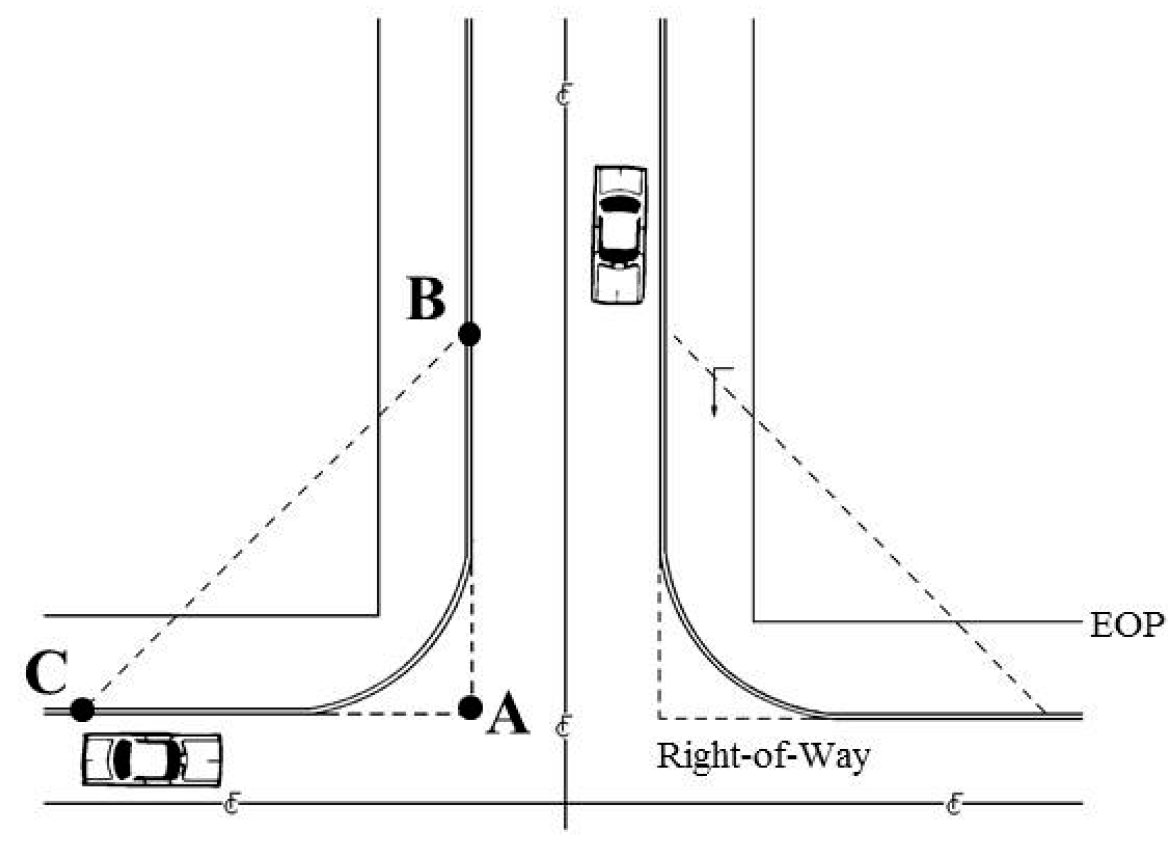
Figure 6.02.03(A)
Clear Visibility Triangle at Street Intersections
3.
Clear visibility triangle - minimum distances required.
The minimum distances required may be modified according to the State of Florida Department of Transportation's Manual of Uniform Minimum Standards for Design, Construction, and Maintenance for Streets and Highways (Florida Greenbook), current edition.
4.
Clear visibility triangle at driveways. The clear visibility triangle shall be formed by extending the edge of the driveway and the right-of-way line to a point where they intersect (point D); then from point (D), measuring a distance of fifteen feet (15') to points designated as (E) and (F). The triangle is created by connecting points E and F. (See Figure 6.02.03(B))
Where driveways are curved or intersect with the street at other than right angles, a visibility triangle shall be provided giving equivalent visibility to drivers of cars on and entering the street. The visibility triangle shall be provided on each side of a driveway.
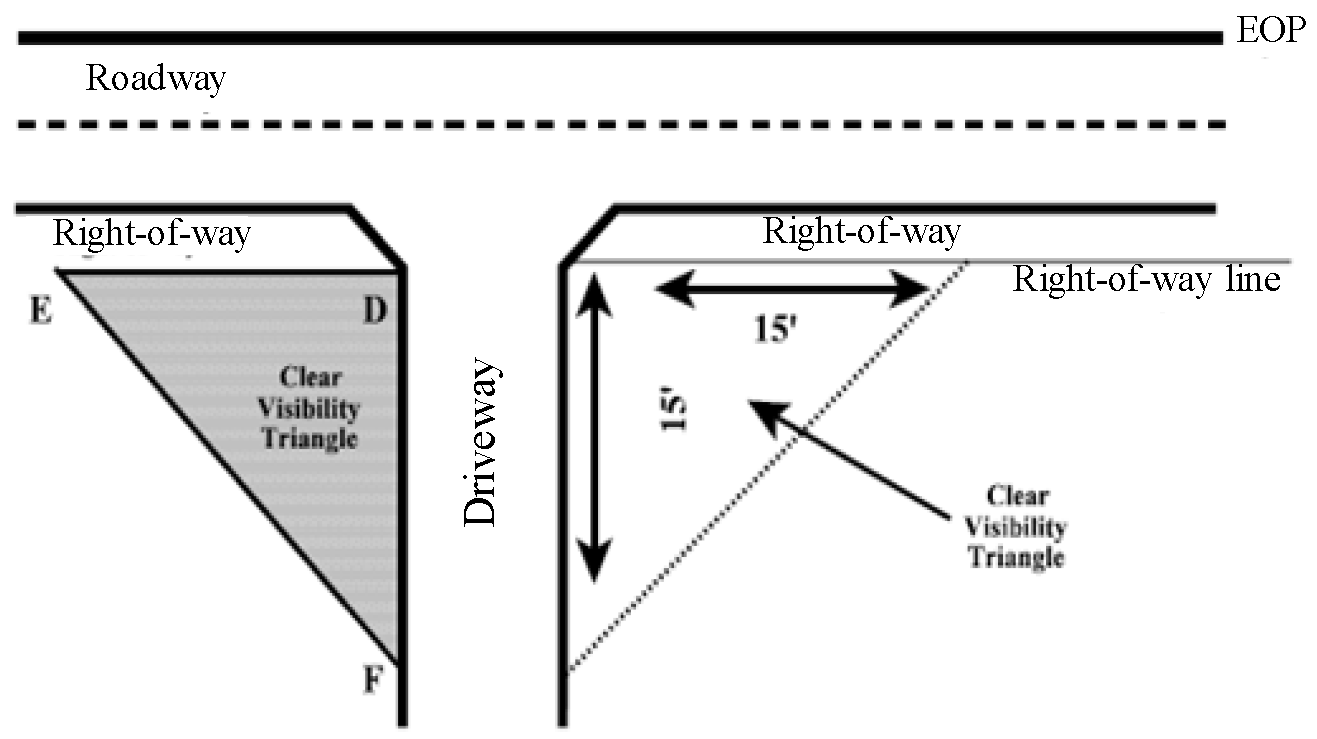
Figure 6.02.03(B)
Clear Visibility Triangle at Driveways
Section 6.02.04. - Sidewalks and bikeways.
A.
General requirements.
1.
Projects abutting arterial or collector facilities shall provide sidewalks adjacent to such roadways at locations consistent with planned roadway improvements.
2.
Sidewalks shall be provided on both sides of all streets zoned or intended for residential, business, commercial and/or industrial development.
3.
In one-family or two-family residential areas, sidewalks shall be at least five feet in width. In multiple-family residential areas, sidewalks shall be at least six feet in width. In business and professional office areas, sidewalks shall be at least ten feet in width. In commercial and industrial areas, sidewalks shall be at least five feet in width.
4.
Where a proposed development includes improvements or new construction of collector or arterial facilities, facility designs shall include provision for sidewalks and bikeways within the right-of-way.
5.
A minimum five-foot wide, sodded planting strip shall be provided between the sidewalk and the back of the curb, or between the sidewalk and the right-of-way pavement, whichever is applicable.
6.
Residential projects adjacent to commercial, office, service, or recreation activities shall provide pedestrian access from the development to the activity center.
7.
Pedestrian-ways or crosswalks, not less than ten feet wide with a sidewalk meeting the requirements of this section, may be required to be placed in the center of blocks more than 800 feet long where deemed necessary to provide circulation or access to schools, playgrounds, shopping centers, transportation and other community facilities.
8.
The city administrator or his or her designee, upon recommendation of the DRC, may waive the requirement of sidewalks on streets in those blocks where the average width of lots is 200 feet or more, or where a park, railroad, canal or other use on one side of a street makes a sidewalk on that side not essential for safety of pedestrians, or where the requirement and installation of sidewalks would cause a serious drainage impact in locations where the requirement of storm drainage has been found to be impracticable.
9.
Where it appears that a previously dedicated street forms a boundary of a subdivision, the subdivider must dedicate proper sidewalk areas on the side of the street abutting the land(s) being subdivided.
B.
Design and construction standards. Design and construction of sidewalks, bikeways, or other footpaths shall conform to all applicable engineering requirements adopted by the City of Arcadia, including provisions for access by physically handicapped persons. Standards shall be consistent with those adopted by the American Association of State Highway and Transportation Officials (AASHTO) and the Americans with Disabilities Act Accessibility Guidelines for Buildings and Facilities (ADAAG).
Section 6.02.05. - Access and circulation.
A.
General access and circulation standards. Every preliminary site plan and preliminary plat prepared and submitted for development approval pursuant to these regulations, every application for a residential driveway permit, and every application for a driveway or road connection permit, shall demonstrate compliance with the vehicular access and circulation standards of this section.
B.
Guaranteed access. Every project shall have access to either a public city, county or state right-of way (or all). Access to a state road is controlled and permitted by the Florida Department of Transportation in compliance with Chapter 14-97, F.A.C., State Highway System Access Management Classification System and Standards.
C.
Maximum allowable number of access points. The total maximum number of access points onto city or county roads shall be as provided in Table 6.02.05(A):
Table 6.02.05(A)
Maximum Allowable Number of Access Points
1.
Timing of access point construction. Where two or more access points are allowed for a development site, the first access point shall be constructed prior to the issuance of any building permits.
A bond or other form of surety guaranteeing construction of the improvements, as shown on the site development plan or plat, may be provided to the city in lieu of meeting the timing requirement above. However, in no case shall any certificate of occupancy be issued prior to the construction of all access improvements as approved on the final site development plan.
2.
Corner lot construction. Corner lots shall meet connection requirements as provided in Table 6.02.05(B).
Table 6.02.05(B)
Corner Lot Connection Requirements
a.
Where a corner lot meets the zoning requirements for road frontage and none of the design options as listed in Table 6.02.05(B) are possible, one full access driveway shall be permitted within the two-thirds of the lot frontage that is farthest from the intersection of the right-of-way lines of streets or a street and railroad.
b.
A gasoline service/filling station, located on a corner lot, may be allowed one access point on each street frontage. Where a street frontage exceeds 150 feet, one additional access point may be permitted upon review and approval of the City Council.
3.
Schools and/or uses requiring emergency vehicle access may have one additional access point, provided that the additional access driveway is limited to school bus or emergency vehicle use only.
4.
The city council may approve additional access points onto a development site where transportation circulation and/or safety conditions are merited.
D.
Size of required access points. For development sites providing only one access point, the access point shall not exceed 40 feet in width. For sites providing more than one access point, the total width of each access point shall not exceed 24 feet in width.
E.
Separation between access points. There shall be a minimum distance of 30 feet between any two openings onto the same street. Separation between access points on all arterial roadways shall be as required by Chapter 14-97, F.A.C.
F.
All roads proposed in a new development shall be designed and constructed pursuant to engineering, design and construction standards adopted by the City of Arcadia. Roads, dedicated to the public, by recorded subdivision or by deed, shall be accepted by the city for maintenance consistent with the provisions of section 12.08.00, prerequisites for construction.
G.
Private streets may be allowed within manufactured home parks, planned unit developments, cluster/zero lot line developments, and other types of subdivisions. Private streets shall be designed and constructed in compliance with public road standards as established by engineering design and construction standards adopted by the City of Arcadia, and a property owner's association must be established to provide maintenance of such roadways.
H.
For development proposed on principal arterials or major collectors, the city administrator or his or her designee may require frontage or service roads, requiring access from the frontage road rather than the arterial or collector. This requirement may be met through interconnecting parking lots which abut the arterial or major collector facility. Where natural or man-made features cause this requirement to be physically infeasible, alternate designs may be reviewed and approved by the city administrator or his or her designee.
I.
Common driveway: Two adjacent projects may share a common driveway provided that appropriate access easements are granted between or among property owners.
J.
Driveway connections onto state roads is controlled and permitted by the Florida Department of Transportation in compliance with Chapter 14-97, F.A.C.
K.
All proposed rights-of-way shall be located and sized in compliance with section 6.02.03 of these regulations.
L.
The street layout in all new development shall be coordinated with and interconnected to the street system of the surrounding area. Streets in proposed subdivisions shall be connected to rights-of-way in adjacent areas, as best as feasibly possible, to allow for proper inter-neighborhood traffic flow. If adjacent lands are unplatted, stub outs in the new development shall be provided for future connection to the adjacent unplatted land.
M.
All structures, not including accessory or temporary uses, hereafter erected or relocated shall be on a lot adjacent to or abutting on a public street, or with access to a public street by means of a private street or easement which has been recorded in the Official Records of Arcadia, Florida.
N.
Residential and commercial driveways shall have either concrete or asphalt aprons when connecting to paved roads. Aprons connecting unpaved roads may be constructed of the same material as the road. Driveways shall be constructed pursuant to engineering, design and construction standards adopted by the City of Arcadia.
O.
Driveways and road connections to commercial building structures, manufactured home parks, planned unit developments, cluster/zero lot line developments, and other types of subdivisions shall be constructed pursuant to engineering, design and construction standards adopted by the City of Arcadia.
P.
In residential developments, a driveway for a corner lot shall be located on the street having the lower functional classification, or in the case where roads have the same functional classification, on the roadway having the lesser annual average daily traffic.
Q.
Developers requesting authorization for the installation of signalization devices that would facilitate access to their development will be required to provide the city with documentation (i.e., studies, pedestrian counts, traffic counts, etc.) warranting the requested signalization device.
Section 6.02.06. - Standards for drive-in and drive-thru facilities.
All facilities providing drive-in or drive-thru service shall provide on-site stacking lanes in accordance with the following standards:
A.
The facilities and stacking lanes shall be located and designed to minimize turning movements in relation to driveway access to streets and intersections.
B.
The facilities and stacking lanes shall be located and designed to minimize or avoid conflicts between vehicular traffic and pedestrian facilities such as sidewalks, crosswalks, or other pedestrian access ways.
C.
A by-pass lane shall be provided at a minimum of 12 feet in width.
D.
Stacking lane distance shall be measured from the service window to the property line bordering the furthest street providing access to the facility, as measured along the centerline of the stacking lane.
E.
Minimum stacking lane distance shall be as follows:
1.
Financial institutions shall have a minimum distance of 200 feet. Two or more stacking lanes may be provided that together total 200 feet.
2.
All other uses shall have a minimum distance of 120 feet, unless otherwise noted in these regulations.
F.
Alleys or driveways in or abutting areas designed, approved, or developed for residential use shall not be used for circulation of traffic for drive-in or drive-thru facilities.
G.
Where turns are required in the exit lane, the minimum distance from any drive-in station to the beginning point of the curve shall be 35 feet. The minimum inside turning radius shall be 25 feet.
H.
Construction of stacking and by-pass lanes shall conform to all engineering, design and construction standards adopted by the City of Arcadia.
Section 6.03.01. - Applicability, purpose and intent.
It is the intent of the city to assure that every building, use, or structure erected or instituted, shall be provided with adequate off-street parking and loading facilities for the use of occupants, employees, visitors, vendors or patrons. It is also the intent of this paragraph that the public interest, welfare and safety require that certain uses provide adequate off-street loading facilities. Further, it is the intent of the city that such off-street parking and loading facilities shall be maintained and continued as an accessory use so long as the primary use is continued.
The provisions of this article shall apply to all development, redevelopment, or amendments to existing development approvals, as follows:
A.
Nonresidential development: A change in use of a nonresidential property, building, or structure, or conversion of an existing residential use to a nonresidential use, shall require that the total parking requirement for the new use be established concurrent with the change in use. Any increase in total floor area of any building or structure shall require that the total parking requirement, for the aggregate sum of the additional floor area and the base floor area be provided concurrent with the additional floor area.
B.
Residential development: Changes to approved development plans that result in an increase in dwelling units shall include provisions on site for the total parking requirement of all resulting dwelling units.
C.
Status of prior approvals: Site development plans approved prior to the effective date of these regulations shall comply with the parking requirements in effect at the time of the original site development plan approval. Any major modification of a previously approved site development plan which impacts the parking standards on the development site, shall be required to meet the parking standards provided in this article.
D.
Maintenance: All off-street parking areas shall be constructed of dust free surfaces, be well maintained; free of potholes, debris, weeds, and broken curbs; clearly striped; and with all required lighting in working condition. Off-street parking areas may utilize porous paver blocks over a compacted sub-base, with the approval of the city administrator or his or her designee, in lieu of asphaltic or concrete paving.
Section 6.03.02. - Required off-street parking spaces.
A.
Number of required off-street parking spaces. In all districts, off-street parking shall be provided for each criterion as set forth in Table 6.03.02(A) and as may be modified by the provisions following the table:
Table 6.03.02(A)
Number of Required Off-Street Parking Spaces
B.
Uses not specifically mentioned. Uses not specifically listed in Table 6.03.02(A) shall provide off street parking as provided for the use most similar to the one being proposed.
C.
Fractional measurements. Any fraction equal to or greater than one-half of the required parking space shall require a full off-street parking space.
D.
Mixed uses. The total requirement for off-street parking shall be the sum of the requirements of each use computed separately. An off-street parking space for one use shall not be considered as providing the required off-street parking for any other use. See section 6.03.03 C., for opportunities where shared-use parking is to be pursued.
E.
Computation of parking spaces measurement. Gross floor area (GFA) means the total floor area inside of the exterior walls. In hospitals, bassinets shall not count as beds. In stadiums, sports arenas, churches and other places of assembly in which occupants utilize benches, pews or other similar seating facilities, each 30 linear inches of such seating shall be counted as one seat for the purpose of computing the off-street parking requirement.
F.
Off-street parking for the physically disabled. All development covered by F.S. §§ 316.1955—316.1956, shall provide parking for the physically disabled pursuant to the requirements of those sections. In addition, all residential developments with greater than 25 required parking spaces shall comply with the requirements of F.S. § 316.1956.
G.
Parking in the B-2 zoning district.
1.
Parking spaces serving non-residential uses shall meet all location and parking lot requirements provided in section 6.03.03. Exemption considerations are provided in section 6.01.04.
2.
Parking spaces serving approved group dwellings and multi-family dwellings shall meet all location and parking lot requirements provided in section 6.03.03, except as expressly supplemented or modified below.
a.
Off-street parking spaces may be located off-site, no more than 400 feet distant, as measured along the nearest pedestrian walkway.
b.
On-street parking shall not be used to meet the number of required parking spaces.
(Ord. No. 1015, § 1(Exh. A), 6-21-2016)
Section 6.03.03. - Parking spaces: Location and parking lot requirements.
A.
Location of off-street vehicle parking spaces. Parking spaces, as required by this section shall be located as follows:
1.
Off-street parking spaces shall in no part exist upon, and no portion of any vehicle shall overhang, the right-of-way of any public road, street, alley, or walkway. There shall be no off-street parking in the front yards of single family residences, except as normally exists in driveways.
2.
Parking spaces for dwellings, other than single family residences and approved group dwellings and multi-family dwellings located in the B-2 zoning district, shall be located on the same development site as the principal building.
3.
Distances for residential uses serving approved group dwellings and multi-family dwellings located in the B-2 zoning district shall be measured from a dwelling unit's entry to the parking space. Where a stairway or elevator provides access to dwelling units, the stairway or elevator shall be considered to be the entrance to the dwelling unit. For purposes of measuring these distances, each required parking space shall be assigned to a specific unit on the site development plan, whether or not the developer will actually assign spaces for the exclusive use of the specific unit.
4.
Parking spaces for all other uses:
a.
Shall be located on the same development site as the principal building, or not more than 400 feet distant, as measured along the nearest pedestrian walkway.
b.
Such parking area may be located in an adjacent residential district provided that such parking area is screened so as to minimize vehicular noise and prevent headlights from shining on nearby residential properties.
c.
Additional requirements for the provision of off-site parking are provided in section 6.03.03 B.
5.
Parking requirements for two or more uses, of the same or different types, may be provided by the establishment of the required number of spaces for each use in a common parking area.
B.
Location of off-site vehicle parking spaces. The city administrator or his or her designee may approve off-site parking facilities as part of the parking required by this Code if:
1.
The location of the off-site parking spaces will adequately serve the use for which it is intended. The following factors shall be considered:
a.
Proximity of the off-site spaces to the use that they will serve.
b.
Ease of pedestrian access to the off-site parking spaces.
c.
Whether or not off-site parking spaces are compatible with the use intended to be served (for instance, off-site parking is not typically compatible with high turnover uses such as retail).
2.
The location of the off-site parking spaces will not adversely contribute to the following:
a.
Hazards to pedestrians.
b.
Hazards to vehicular traffic.
c.
Traffic congestion.
d.
Interference with access to other parking spaces in the vicinity.
e.
Detriment to any adjacent use.
3.
The developer submits in writing, an agreement, approved in form by the city attorney, assuring the continued availability of the off-site parking facilities for the use they are intended to serve.
C.
Shared-use of parking spaces. The city administrator or his or her designee may authorize a reduction in the total number of required parking spaces for two or more uses jointly providing off-street parking, when respective hours of need of maximum parking do not adversely overlap. Shared-use parking shall be approved, if the following conditions are met:
1.
The developer submits a parking study as provided in section 6.04.00 B., with sufficient data to demonstrate that the hours of maximum demand for parking for the respective uses do not adversely overlap.
2.
The developer submits a legal agreement, approved in form by the city attorney, guaranteeing the shared-use of the off-street parking spaces as long as the uses requiring parking are in existence or until the required parking is provided elsewhere, in accordance with the provisions of this section.
3.
A copy of the legal agreement shall be recorded with the DeSoto County Clerk of Courts prior to final approval of a site development plan.
(Ord. No. 1015, § 1(Exh. A), 6-21-2016)
Section 6.03.04. - Off-street loading requirements.
Off-street loading requirements are intended to provide minimum standards necessary for loading and unloading of goods for the uses permitted by these regulations, to protect the capacity of the city's street system, to avoid undue congestion resulting from loading and unloading activities, and to lessen unnecessary conflicts between trucks and other vehicles.
A.
These requirements shall apply to all commercial and industrial development, whether involving the construction of new structures or alterations to existing structures. Off-street loading spaces shall be provided prior to the issuance of any certificate of occupancy or occupational license. Maintenance and upkeep of off-street loading spaces shall be the responsibility of the property owner and occupant as long as the use requiring loading facilities continues. No off-street loading spaces shall be altered or discontinued except in accordance with these regulations.
B.
Required off-street loading spaces shall be properly depicted on all final site development plans, in accordance with this section.
C.
Off-street loading spaces shall not be used for storage of vehicles and/or materials, and shall not be used to meet off-street parking requirements.
D.
Each off-street loading space shall be directly accessible from a street or alley without crossing or entering any other required off-street loading space. Such loading space(s) shall be accessible from the interior of the building it serves and shall be arranged for convenient and safe ingress and egress by truck and/or trailer combination.
E.
All off-street loading spaces shall be located on the same development site as the use they serve. No off-street loading area shall encroach upon any existing or proposed public rights-of-way.
F.
Off-street loading spaces shall be clearly striped and marked to insure adequate reservation for all loading and unloading activities, unless otherwise stated in this section.
G.
All off-street loading spaces shall be constructed in accordance with the requirements of this section.
H.
Off-street loading spaces shall be provided as set forth in Table 6.03.04(A) Proposed uses not listed in the table below shall meet the loading space requirement which is most similar to a use established in this table.
Table 6.03.04(A)
Number of Required Off-Street Loading Spaces
I.
Retail, wholesale, and industrial operations, with a gross floor area of less than 5,000 square feet shall provide sufficient space for loading and unloading operations. This area may be co-located atop of required parking spaces within the development site, so long as the free movement of vehicles and pedestrians is not impeded.
J.
All off-street loading spaces shall meet the minimum size requirements as set forth in Table 6.03.04(B).
Table 6.03.04(B)
Minimum Size Requirements for Off-Street Loading Spaces
Section 6.03.05. - Design standards for off-street parking and loading areas.
A.
Location. Parking lots shall be designed such that vehicles shall not utilize any portion of any public rights-of-way for site circulation or for the maneuvering into or out of parking spaces. Parking spaces which would require backing into any public rights-of-way are strictly prohibited.
B.
Required vehicle parking lot improvements. Any off-street parking lot serving any use other than dwellings of four units per building or less shall meet the following requirements for off-street parking lot improvements:
1.
Buffer and canopy. The parking area will be buffered and canopy provided pursuant to section 6.07.00, and its subsections, as provided in this article.
2.
Surfacing. For all retail sales and services, business services, and professional services serving the general public and having access to and abutting a paved street, the off-street parking area shall be provided with a hard, stabilized surface, and shall be so graded and drained as to provide for the adequate runoff and disposal of surface water, and shall be constructed in accordance with engineering design standards adopted by the City of Arcadia.
3.
Lighting. Where lighting facilities are provided for the parking area, they shall be designed and installed so as to direct the light away from adjacent residential property.
C.
Size of standard parking spaces. Standard parking spaces shall be sized according to Table 6.03.05(A) and Figure 6.03.05(A).
Table 6.03.05(A)
Parking Space Dimensions
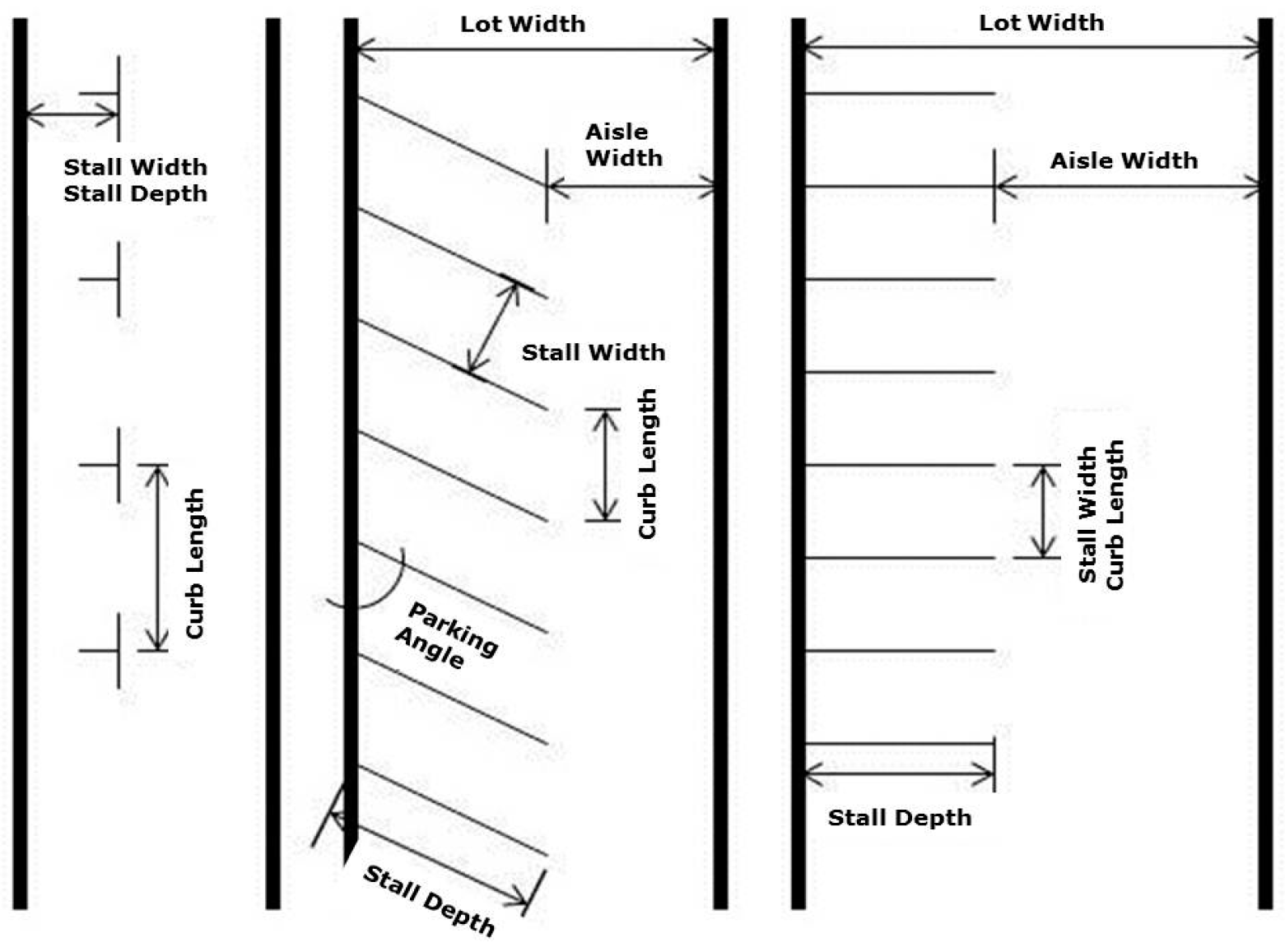
Figure 6.03.05(A)
Parking Space Illustration
1.
Parallel parking exception. If a parallel space abuts no more than one other parallel space, and adequate access room is available, the curb length may be reduced to 20 feet.
2.
Compact parking spaces. Up to 20 percent of required parking spaces may be designated as compact spaces, with minimum dimensions of eight feet by 16 feet. Compact spaces shall only be allowed for projects requiring 20 or more parking spaces. Compact spaces shall be clustered in one or more groups and dispersed throughout the development site, to provide drivers using either compact or full-sized spaces, equal access to the most convenient parking locations. Compact spaces shall be designated by signage on every third space, painted Compact on each pavement space and double striped to indicate their status. Spaces provided in excess of the required number of spaces may all be compact spaces, provided that the total number of compact spaces shall not exceed 33 percent of the total number of spaces provided.
3.
Motorcycle parking spaces. A standard motorcycle parking space shall be four and one-quarter feet wide and nine and one-quarter feet long.
D.
Layout and curb design.
1.
Pedestrian circulation facilities, roadways, driveways, and off-street parking and loading areas shall be designed to be safe and convenient.
2.
Parking and loading areas, aisles, pedestrian walks, landscaping, and open space shall be designed as integral parts of an overall site development plan and shall be properly related to existing and proposed buildings.
3.
Buildings, parking and loading areas, landscaping and open spaces shall be designed so that pedestrians moving from parking areas to buildings and between buildings are not adversely exposed to vehicular traffic.
4.
Landscaped, paved, and gradually inclined or flat pedestrian walkways shall be provided along the lines of the most intense use, particularly from building entrances to streets, parking areas, and adjacent buildings. Pedestrian walkways should be designed to discourage incursions into landscaped areas except at designated crossings.
5.
Each off-street parking space shall open directly onto an aisle or driveway that, except for single family and two-family residences, is not a public street.
6.
Aisles and driveways shall not be used for parking vehicles, except that the driveway of a single family or two-family residence shall be counted as a parking space for the dwelling unit, or as a number of parking spaces as determined by the city administrator or his or her designee based on the size and accessibility of the driveway.
7.
The design shall be based on a definite and logical system of drive lanes to serve the parking and loading spaces. A physical separation or barrier, such as vertical curbs, may be required to separate parking spaces from travel lanes.
a.
Parking spaces for all uses, except single family and two-family residences, shall be designed to permit entry and exit without moving any other motor vehicle.
b.
No parking space shall be located so as to block access by emergency vehicles.
E.
Parking lot construction standards. Parking lots shall be constructed as per AASHTO T-180, except as listed below:
1.
For churches where parking needs are limited to one or two days per week, parking spaces may be grass. Aisles and circulation areas shall be paved. This exemption may be approved upon a finding by the city administrator or his or her designee that there would be no detrimental effect due to erosion or other degrading of the natural environment.
2.
Parking lots that provide grass parking spaces shall not use such areas in the calculations needed to meet minimum requirements for buffers, landscaping, or stormwater retention. (Stormwater retention calculations shall be based on the assumption that all parking spaces are paved).
3.
Where grass parking spaces are allowed, all required handicap spaces shall be paved and meet the requirements of section 6.03.05(B).
F.
Handicapped access. All uses shall be required to provide off-street parking for physically handicapped persons in accordance with the standards provided in this section and the Florida Accessibility Code for Building Construction (FACBC). Where a conflict exists between these regulations and the FACBC, the Accessibility Code shall be enforced.
1.
Level parking spaces shall be reserved for physically handicapped persons as provided in Table 6.03.05(B).
Table 6.03.05(B)
Number of Required Handicap Parking Spaces
2.
Parking spaces reserved for physically handicapped persons shall meet the following design and location requirements:
a.
All handicap spaces shall be accessible to curb ramp or curb cut, to provide clear and unimpeded access to the building, facility, or use served, and shall be so located that users are not compelled to wheel behind parked vehicles.
b.
Handicap parking spaces shall be a minimum of 12 feet wide and shall be accompanied by an adjacent access aisle a minimum of 60 inches wide. Parking access aisles shall be immediately accessible to the building or facility entrance.
c.
Parallel handicap parking spaces shall be located either at the beginning or end of a block or adjacent to an alley entrance. Curbs adjacent to such premises shall be of a height that will not interfere with opening and closing of motor vehicle doors.
d.
Each handicap parking space shall be prominently outlined with blue paint and posted with a non-movable, above grade, fixed sign, of a color and design approved by the FDOT, bearing the internationally accepted wheelchair symbol and the caption "PARKING BY DISABLED PERMIT ONLY." The symbol and caption may be on two separate signs, or combined on one sign.
3.
Ramps and curb cuts shall meet the following design and location requirements:
a.
Ramps and curb cuts from parking areas to level pedestrian walkways shall be provided and spaced at intervals of no more than 100 feet. Ramps and curb cuts shall be located as close as possible to the main entrances and exits of buildings, facilities, and uses being served.
b.
The maximum slope of an access ramp for new construction shall be established at a ratio of 1:12. Ramps 30 feet in length or longer shall have a maximum slope of 1:20.
Exception: In lieu of a maximum slope of 1:20 for access ramps 30 feet in length or longer, a 1:12 slope ratio may be utilized, provided that a level platform at least 60 inches deep, in the direction of the access ramp, is provided at 30-foot intervals.
c.
The minimum width of an access ramp shall be 44 inches, exclusive of flared sides. Ramps shall be constructed of a skid-resistant surface.
Section 6.03.06. - Bicycle parking.
A.
Number of spaces required. Bicycle parking shall be installed, as provided in Table 6.03.06(A).
Table 6.03.06(A)
Number of Required Bicycle Parking Spaces
B.
Design standards. All bicycle parking facilities shall be approved by the city administrator or his or her designee. Bicycle racks and other bicycle parking facilities shall be designed and installed according to the following standards:
1.
Designed to allow each bicycle to be supported by its frame.
2.
Designed to allow the frame and wheels of each bicycle to be secured against theft.
3.
Designed to avoid damage to any bicycle.
4.
Designed to accommodate a range of bicycle shapes and sizes, providing ease for locking without interfering with adjacent bicycles.
5.
Anchored to resist removal of the rack or facility
6.
Constructed to resist damage by rust, corrosion, and vandalism.
7.
Located in convenient, highly-visible, active, well-lighted areas.
8.
Located so as to prevent damage to bicycles by motor vehicles.
9.
Located so as not to interfere with pedestrian movements.
10.
Located as near as possible to the main entrance of the building, facility, or use served.
11.
Provide consistency with surroundings, in terms of color and design, and be incorporated whenever possible into building or street furniture design.
12.
Provide safe accessibility from the rack or other facility to the right-of-way or bicycle lane.
Section 6.04.00. - Adjustments to access and parking standards.
A.
The city council may, by resolution, approve a waiver or reduction of the total number of required off-street parking spaces and/or adjustment of the number of allowable access points on a development site, provided that at least one of the following determinations is made.
1.
Construction of the required number of off-street parking spaces and/or adjustment of the allowable number of access points would:
a.
Substantially reduce traffic hazards or congestion on adjacent streets serving the property.
b.
Prevent the continuous development of a compact and coordinated row of commercial buildings fronting on an already established commercial block or shopping area.
c.
Detract from the overall shopping desirability of the adjoining buildings and premises and would result in the incompatible mixing of vehicles, buildings and pedestrian shoppers.
2.
The required number of off-street parking spaces cannot be reasonably provided off the premises in accordance with the parking requirements of this section.
B.
Traffic and parking study requirements.
1.
Applicability: A traffic and/or parking study, in addition to the application for site development approval, shall be submitted for proposed developments meeting one of the following criteria:
a.
A request for a parking waiver is proposed, where the applicant asserts that the off-street parking requirement, as listed in Table 6.03.02(A) is greater than that actually needed to serve the development site;
b.
A proposed reduction of the off-street parking requirement is being made based on a shared-use parking proposal; or
c.
A request for a waiver of the number of access points onto a development site is proposed.
2.
Contents of a traffic/parking study: A traffic/parking study shall be designed to provide evidence supporting the requested waiver of the required number of parking spaces and/or allowable number of access points. A study shall be prepared, signed, and sealed by a certified professional traffic engineer and shall consider the following:
a.
Estimates of parking requirements shall be based on recommendations in studies such as those from the Urban Land Institute (ULI) or the Institute of Transportation Engineers (ITE) based on data collected from uses or combinations of uses that are the same or comparable to the proposed use; comparability shall be determined by density, scale, area, type of activity and location; the study shall document the source of data used to develop recommendations;
b.
The extent to which a transportation system management program and use of alternative forms of transportation lessen the parking requirement; and
c.
Clear evidence supporting that any additional access points on a development site shall not create a safety or operational hazard.
Section 6.05.01. - Requirements for all developments.
The following basic utilities are required for all developments subject to the criteria listed herein:
A.
Water and sewer.
1.
Every principal use and every lot within a newly platted subdivision shall have central potable water and wastewater hookup whenever required by the Comprehensive Plan and where the topography permits the connection to a public water or sewer line by running a connecting line no more than 200 feet from the lot to such line.
2.
Water and sewer lines shall be placed in the street right-of-way. Under extreme and unusual circumstances, the planning and zoning board may consider modifications to this requirement at the time of preliminary plat approval.
3.
All development shall comply with applicable DEP rules and chapter 102 of the Arcadia Municipal Code.
B.
Fire hydrants. All developments served by a central water system shall include a system of fire hydrants consistent with design standards adopted by the City of Arcadia.
C.
Electricity. Every principal use and every lot within a subdivision shall have available to it a source of electric power adequate to accommodate the reasonable needs of such use and every lot within such subdivision.
D.
Telephone. Every principal use and every lot within a subdivision shall have available to it a telephone service cable adequate to accommodate the reasonable needs of such use and every lot within such subdivision.
E.
Illumination. All streets, driveways, sidewalks, bikeways, parking lots and other common areas and facilities in developments shall provide illumination meeting design standards adopted by the City of Arcadia.
Section 6.05.02. - Design standards.
A.
Compliance with technical construction standards. All utilities required by this article shall meet or exceed minimum design standards adopted by the City of Arcadia.
B.
Placement of utilities underground.
1.
All electric, telephone, cable television, and other communication lines (exclusive for transformers or enclosures containing electrical equipment, including but not limited to switches, meters, or capacitors that may be pad mounted), and gas distribution lines shall be placed underground within easements or dedicated public rights-of-way, installed in accordance with the city's adopted design standards.
2.
Lots abutting existing easements or public rights-of-way where overhead electric, telephone, or cable television distribution supply lines and service connections have previously been installed may be supplied with such services from the utility's overhead facilities, provided the service connection to the site or lot is placed underground.
3.
Screening of any utility apparatus placed above ground shall be required.
Section 6.05.03. - Utility easements.
When a developer installs or causes the installation of water, sewer, electrical power, telephone, or cable television facilities and intends that such facilities shall be owned, operated, or maintained by a public utility or any entity other than the developer, the developer shall transfer to such utility or entity the necessary ownership or easement rights to enable the utility or entity to operate and maintain such facilities.
Section 6.06.01. - Purpose and intent.
The purpose and intent of this section is to establish standards for the provision of stormwater management to prevent or minimize the damage to persons or property which may occur as a result of uncontrolled drainage and to protect the quantity and quality of the waters of the community.
Section 6.06.02. - Applicability.
Treatment of stormwater runoff shall be required for all development, redevelopment and, when expansion occurs, existing developed areas. The stormwater treatment system or systems can be project specific, or serve sub-areas within the County. The design and performance of all stormwater management systems shall comply with applicable State Regulations (Chapter 17-25 and Chapter 17-302, Florida Administrative Code) and the rules of the Southwest Florida Water Management District stated in Chapter 40D-4, F.A.C. Stormwater discharge facilities shall be designed so as to not lower the receiving water quality or degrade the receiving water body below the minimum conditions necessary to maintain their classifications as established in Chapter 17-302, F.A.C. Steps to control erosion and sedimentation shall be taken for all development.
Section 6.06.03. - Stormwater management requirements.
A.
Performance standards. All development must be designed, constructed and maintained to meet the following performance standards:
1.
While development activity is underway and after it is completed, the characteristics of stormwater runoff shall approximate the rate, volume, quality, and timing of stormwater runoff that occurred under the site's natural unimproved or existing state, except that the first one inch of stormwater runoff shall be treated in an off-line retention system or according to FDEP's Best Management Practices.
2.
The proposed development and development activity shall not violate water quality standards set forth in Chapter 17-3, Florida Administrative Code.
3.
Maintenance activity may be undertaken so long as it does not change or affect the quality, rate, volume or location of stormwater flows on the site or of stormwater runoff.
4.
Actions may be undertaken during emergency conditions that violate these regulations to prevent imminent harm or danger, or to protect property from fire, violent storms, hurricanes or other hazards. Upon cessation of the emergency, all activities shall conform to this section.
5.
Agriculture activity may be engaged in, provided farming activities are conducted in accordance with the requirements set forth in an approved soil conservation service conservation plan. If the conservation plan is not implemented accordingly, this exemption shall become void and a stormwater permit shall be required.
B.
Residential performance standards. It is intended that all of the standards in the citations from the Florida Administrative Code are to apply to all development and redevelopment and that exemptions based on project size thresholds and individual structures do not apply for concurrency determinations. All development must meet F.A.C. and subsequently meet the following performance standards.
1.
New construction. For the purposes of determining whether residential development of 1—4 units on an individual lot requires retention, all the following standards must be met:
a.
Structure and all impervious surface can be placed less than 100 feet from the receiving water body; and,
b.
The topography of the lot is greater than a six percent slope; and,
c.
The total of all impervious surface is ten percent or more of the total lot area.
2.
Infill development. Infill development within an existing subdivision or a developed residential area is exempt from a retention area, when each of the following condition has been met:
a.
Infill residential development shall be designed so as to not lower the receiving water quality or degrade the receiving water body below the minimum conditions necessary to maintain their classifications as established in Chapter 17-302, F.A.C.
Section 6.06.04. - Design standards.
To comply with the foregoing performance standards, the proposed stormwater management system shall conform to the following design standards:
A.
Detention and retention systems shall be designed to comply with the FDEP's Best Management Practices.
B.
To the maximum extent practicable, natural systems shall be used to accommodate stormwater.
C.
The proposed stormwater management system shall be designed to accommodate the stormwater that originates within the development and stormwater that flows onto or across the development from adjacent lands.
D.
The proposed stormwater management system shall be designed to function properly for a minimum 20-year life.
E.
The design and construction of the proposed stormwater management system shall be certified as meeting applicable requirements, by a professional engineer registered in the State of Florida.
F.
No surface water may be channeled or directed into a sanitary sewer.
G.
The proposed stormwater management system shall be compatible with the stormwater management facilities on surrounding properties or streets, taking into account the possibility that substandard systems may be improved in the future.
H.
The banks of detention and retention areas shall be sloped at no less than a 3:1 ratio and shall be planted with appropriate vegetation.
I.
Dredging, clearing of vegetation, deepening, widening, straightening, stabilizing or otherwise altering natural surface waters shall be minimized.
J.
Natural surface waters shall not be used as sediment traps during or after development.
K.
Water reuse and conservation shall, to the maximum extent practicable, be achieved by incorporating the stormwater management system into irrigation systems serving the development.
L.
Vegetated buffers of sufficient width to prevent erosion shall be retained or created along the shores, banks or edges of all natural or man-made surface waters.
M.
In phased developments, the stormwater management system for each integrated stage of completion shall be capable of functioning independently.
N.
All detention and retention basins, except natural water bodies used for this purpose, shall be accessible for maintenance from streets or public rights-of-way.
Section 6.06.05. - Dedication or maintenance of stormwater management systems.
If a stormwater management system approved under this Code will function as an integral part of a county-maintained drainage system, as determined by the county engineer, the facilities shall be dedicated to Desoto County. The applicant shall be an acceptable entity and shall be responsible for the operation and maintenance of the stormwater management system from the time construction begins until the stormwater management system is dedicated to and accepted by another acceptable entity. All stormwater management systems that are not dedicated to Desoto County, shall be operated and maintained by one of the following entities:
A.
The City of Arcadia.
B.
An active water control district created pursuant to F.S. ch. 298, or drainage district created by special act, or community development district created pursuant to F.S. ch. 190, or special assessment district created pursuant to F.S. ch. 170.
C.
A state or federal agency.
D.
An officially franchised, licensed or approved communication, water, sewer, electrical or other public utility.
E.
The property owner or developer if:
1.
Written proof is submitted in the appropriate form by either letter or resolution, that a governmental entity or such other acceptable entity as set forth in paragraphs A.—D. above, will accept the operation and maintenance of the stormwater management and discharge facility at a time certain in the future.
2.
A bond or other assurance of continued financial capacity to operate and maintain the system is submitted.
F.
For-profit or non-profit corporations including homeowners associations, property owners associations, condominium owners associations or master associations if:
1.
The owner or developer submits documents constituting legal capacity and a binding legal obligation between the entity and the city affirmatively taking responsibility for the operation and maintenance of the stormwater management facility.
2.
The association has sufficient powers reflected in its organizational or operational documents to operate and maintain the stormwater management system as permitted by the city, establish rules and regulations, assess members, contract for services and exist perpetually, with the articles of incorporation providing that if the association is dissolved, the stormwater management system will be maintained by an acceptable entity as described above.
If a project is to be constructed in phases, and subsequent phases will use the same stormwater management facilities as the initial phase or phases, the operation and maintenance entity shall have the ability to accept responsibility for the operation and maintenance of the stormwater management systems of future phases of the project.
In phased developments that have an integrated stormwater management system, but employ independent operation and maintenance entities for different phases, such entities, either separately or collectively, shall have the responsibility and authority to operate and maintain the stormwater management system for the entire project. That authority shall include cross easements for stormwater management and the authority and ability of each entity to enter and maintain all facilities, should any entity fail to maintain a portion of the stormwater management system within the project.
Section 6.07.01 - Purpose and intent.
The city council finds that landscaping makes important contributions to the public safety and the general welfare of the city. The purpose and intent of this section is to set forth requirements and standards for the provision of canopy trees and buffer yards, the conservation of native plants and trees, and the conservation of water resources in the city. Specifically, it is intended that buffer yards will aid in reducing the potential negative impacts caused by glare, noise, dust, dirt, litter, odors and view of various land uses on adjacent properties. It is further intended that the planting of canopy trees will aid in lowering the ambient temperature of the air through increased shading; in conserving water; in enhancing the appearance of properties; in improving property values; and generally in protecting the health, safety and welfare of the public through the improvement of the quality of the human environment. As part of the development approval process, the City of Arcadia shall ensure that all new development is properly buffered to prevent adverse impacts on surrounding land uses.
Section 6.07.02. - Applicability and exemptions.
A.
Applicability. Except as specifically excluded in the exemptions below, the requirements and regulations of this article shall apply to the following:
1.
The construction of any new building or improvements that require off-street parking and other impervious surfaces to be constructed on the site;
2.
The alteration of existing structures or improvements where the alteration adds usable floor area that requires additional off-street parking and other impervious surfaces to be constructed on the site;
3.
The construction or expansion of off-street parking and loading areas;
4.
The paving of any existing unpaved off-street parking and/or loading areas; and;
5.
Any change of use which results in the property becoming a higher impact/higher intensity use.
B.
Exemptions. The development, redevelopment, reconfiguration, expansion or change of use of any site requiring review by the city must comply with all elements of this article, unless any of the following exemptions apply:
1.
Enlargement or repair of a single family or duplex residence unless specifically stated otherwise.
2.
New single family and duplex development on individual residential lots are exempt from all provisions of this article, except the requirement of two large or medium sized trees per residential lot, or one tree per attached unit.
3.
Bona fide agriculture.
4.
Buildings and structures are not counted as impervious surface for the purpose of calculating the areas that must be shaded with canopy trees.
5.
Swimming pools and the area specifically designed to be the deck or pool apron abutting the pool are exempt from canopy requirements.
6.
Docks, piers, seawalls, boardwalks and other improvements designed to serve pedestrians near the water or in the use of boats are exempt from canopy requirements. Paved areas abutting a seawall, dock or pier are exempt to a maximum width of ten feet.
7.
Paved surfaces within the supporting cables of a radio, television or microwave tower or a cable television satellite receiver, are exempt from canopy requirements.
8.
Land developed in the Central Business District or other properties where existing buildings have reduced or no setbacks from property lines, and which are physically unable to comply with buffer yard and/or canopy requirements.
Section 6.07.03. - Landscape plans and permits.
Prior to issuance of a development permit, a landscape plan shall be submitted to the city administrator, or his or her designee, showing canopy tree and buffer yard information required by this article. The landscape plan shall be prepared consistent with the requirements provided in article 10 of this Code. The landscape plan may be submitted separately, but shall be a part of a site development plan submission, where site development plan submission is required.
When landscaping is required under this article, no building, grading or site preparation shall be allowed until the landscape plan has been approved by the city administrator, or his or her designee. The plan shall be dated and stamped approved by the city and only these plans and the requirements of this article shall govern the construction of the site landscaping and subsequent maintenance inspections. A permit shall be obtained for the project within 12 months of the approval date of the approved landscape plan or the plan shall become invalid, unless granted an extension.
Section 6.07.04. - Landscaping.
Landscaping shall include the conservation of native plants and trees; the selection and planting of trees to shade vehicular use areas, sidewalks and other paved surfaces; and the design, selection of trees and shrubbery, and the planting of landscape materials to establish buffer yards.
Section 6.07.04.01. - Selection of new trees and shrubs; site conditions.
All plants identified in this Article are "Florida Friendly" plants for Desoto County, and are well suited to the environment in the city. A Florida Friendly Landscape is designed to reduce impacts to the environment through the selection of the right plant for the right location, thereby reducing the need for greater landscape maintenance and irrigation.
All new living plant material to be installed shall be nursery grown and root pruned stock, free of insects, disease and defects, and shall satisfy the requirements of this article and be Florida Grade No. 1 or better as defined in the most current edition of Grades and Standards for Nursery Plants, Florida Department of Agriculture and Consumer Services, Florida Division of Plant Industry. All plants installed on the site shall be in accordance with the plans stamped approved by the city.
Section 6.07.04.02. - Preservation of existing trees and shrubs.
Existing trees and shrubs shall be preserved whenever possible provided the plants are all healthy species and are not listed as an exotic and/or nuisance plant in the most recent Invasive Plant List of the Florida Exotic Pest Plant Council. In these instances the plant material shall be acceptable to the city and may be maintained in its natural setting and incorporated into the required landscaping areas to fulfill the intent of this article. Landscape plans shall identify those existing plant materials credited toward the city landscape requirements.
Areas of existing vegetation to remain on site and as noted on landscape plans shall not be encroached upon or damaged during construction by any or all activities above or below ground. Visible barricades shall be placed around these areas and shall be kept clear of all construction materials, traffic and debris. Areas that have been damaged or removed shall be replanted and refurbished to restore the area as much as possible to its original condition.
The following methods and procedures shall be followed when preserving trees:
1.
The use of hand labor may be necessary to clear vegetation within the drip line of those trees to be preserved.
2.
The area within the drip line of any tree to be preserved shall remain undisturbed; no materials, machinery, and soil shall be placed within the drip line.
3.
Materials, wires, signs or nails shall not be attached to any tree unless such materials are used to preserve the tree.
4.
All felled material shall be promptly and carefully removed from the site in order to avoid potential damage to remaining trees and vegetation.
5.
Visible barricades shall be erected around those trees to be preserved. These barricades shall be at the drip line of the tree(s) and no closer than ten feet to the trunk of the tree.
6.
All trees to be preserved shall have their natural soil level maintained.
7.
All efforts shall be made through the grading and drainage plan to maintain the natural drainage to those trees to be preserved.
Section 6.07.04.03. - Exotic and nuisance plants.
The use of exotic and nuisance plants is prohibited and shall not be accepted as part of an approved landscape plan. For purposes of this section, exotic and nuisance plants shall be those provided in the most recent Invasive Plant List of the Florida Exotic Pest Plant Council.
Section 6.07.04.04. - Minimum tree planting height, planting area and distance from pavement.
(Source: University of Florida "Planting Area Guidelines," 2011; planting area and distance from pavement; based on minimum 3 feet soil depth.)
All newly planted trees shall be staked and guyed immediately after installation and shall remain supported until the root systems have established themselves to adequately support the tree.
Section 6.07.04.05. - Minimum shrub planting requirements.
Shrubs shall be a minimum of one foot tall at the time of planting, except where they are to act as required screening for residential uses and districts, in which case they shall be a minimum of three feet in height at the time of planting and maintained at a minimum height of five feet at maturity. One foot high shrubs shall be spaced no greater than 30 inches on center and three-foot high shrubs shall be spaced no greater than 36 inches on center. The city may authorize alternate spacing for species which have especially broad coverage.
Section 6.07.04.06. - Ground covers.
Ground covers shall be spaced no greater than 18 inches on center and may be planted in lieu of lawn grass. A list of recommended ground cover species is provided in Table 6.07.09.E. of this article.
Section 6.07.04.07. - Lawn grass.
Grass may be sodded, plugged, sprigged or seeded except that solid sod shall be used in swales or other areas subject to erosion (generally slopes steeper than 10:1). Grassed areas that are installed by methods other than sod shall attain a full grassed coverage within three months of the date of installation. A list of lawn grass species and their characteristics, including drought tolerance level, soil type, light requirements, wear tolerance and plant maintenance, are provided in Table 6.07.09.F. The selection of lawn grasses shall be based upon the species and characteristics which are most appropriate for the site.
Section 6.07.04.08. - Mulch.
Planting beds shall be mulched with standard accepted mulch materials to: 1) prevent the invasion of other plant species; 2) to absorb moisture for the benefit of the plants; and 3) to present a neat and orderly appearance of the landscaped area. The mulched bed shall have a uniform coverage and a minimum depth of two inches. Mulched areas around trees should be at least eight feet in diameter. The use of cypress mulch is discouraged.
Section 6.07.04.09. - Planting beds.
The planting bed for all landscaping materials shall be free of weeds, debris, and nuisance/invasive materials and shall consist of a healthy plant growth medium. The planting bed soil shall provide adequate support, drainage, and nutrients for the plants.
Section 6.07.04.10. - Landscaping for decorative and masonry walls.
Residential subdivisions and commercial and industrial developments may have decorative entrance and screening walls. Landscaping (a combination of trees and shrubbery) shall be installed within the property setback/buffer yard area. If there are no specific buffer yard requirements for the development, one (1) tree shall be planted for each 50 linear feet of wall. Buffer yard trees and shrubs required by this article shall be planted on the street side of the wall.
Section 6.07.04.11. - Tree requirements for residential properties.
Trees for new residential development shall be provided at a rate of two large or medium sized trees per residential lot or one tree per attached unit. Existing trees may be used to satisfy this requirement on individual development parcels provided they are not specifically listed as an invasive species in the most recent Invasive Plant List of the Florida Exotic Pest Plant Council.
Section 6.07.04.12. - Encroachments.
A.
Structures. Accessory uses, buildings, and dumpster pads shall not encroach upon or conflict with required landscaped areas.
B.
Parking stalls. No more than two feet of vehicular overhang shall be allowed into a landscape area and no trees and shrubs shall be planted within the area of encroachment.
Section 6.07.05. - Canopy coverage and tree species.
Trees providing canopy coverage shall be required for the purpose of shading vehicular use areas, sidewalks and other paved surfaces associated with all development in the city, thereby lowering the ambient temperature of the air through increased shading; conserving water; enhancing the appearance of properties; improving property values; and protecting the general health, safety and welfare of the public through the improvement of the quality of the human environment. Buildings and structures shall not be counted as impervious surface for the purpose of calculating the areas that must be shaded with canopy trees.
A.
Canopy trees shall be selected from Tables 6.07.09.A. and 6.07.09.B.
B.
Canopy coverage trees shall be interspersed throughout all vehicular use areas rather than restricted in any way to only a portion of the site. This allows for flexibility and creative design opportunities.
C.
Trees located in buffer yards may receive partial credit in meeting vehicular use areas interior landscaping canopy requirements.
D.
Planting areas under trees shall be planted with shrubs and/or ground covers which are compatible with site conditions.
Section 6.07.05.01. - Vehicular use areas interior landscaping and canopy requirements.
The standard for canopy is 50 percent coverage over all vehicular use areas associated with all land uses subject to these requirements.
"Vehicular use area" is defined as all paved areas, including impervious and hard surface, stabilized permeable pavement, which provide site access, traffic circulation and areas for vehicular parking, loading and unloading.
Section 6.07.05.02. - Tree canopy waivers.
Within the B-3, C-1, M-1 and M-2 zoning districts, the city administrator, or his or her designee, may grant a waiver or modification of tree canopy requirements for impervious surfaces, which are exclusively used for parking and/or maneuvering of large trucks and/or for storing products or materials.
A.
The applicant shall submit an application, site plan, and application fee to the city administrator, or his or her designee.
B.
The site plan shall detail the proposed exceptions to the strict application and enforcement of the tree canopy requirements contained in this article.
C.
The city administrator, or his or her designee, shall forward the application and site plan to the DRC, which shall review the request and provide comments to the applicant.
D.
Upon DRC review, the city administrator, or his or her designee, may approve the request based on consideration of the following findings:
1.
The particular characteristics of the use and/or the site, such as its size, configuration, topography or subsurface conditions, are such that strict application of the tree canopy requirements would result in unreasonable hardship to the developer.
2.
The effect of the waiver or modification does not nullify the purpose and intent of the city's landscape requirements.
3.
The approval of the waiver or modification upholds the public interest.
4.
The approval of the waiver or modification is not contrary to the city's Comprehensive Plan.
Section 6.07.06. - Buffer yards.
A buffer yard is an area containing plant material, fences, walls and/or berms which provide a visual screen and physical separation between incompatible land uses. Buffer yards are intended as landscaped open space therefore, they shall be free of pavement and permanent structures other than fences, walls, berms, unpaved pedestrian paths, and stormwater management and retention facilities. The purpose of this section is to establish minimum buffer yard widths and landscaping requirements, in order to ensure compatibility between adjacent properties and land uses. The minimum required width of the buffer yard is therefore based on the potential degree of incompatibility between two abutting land uses.
Section 6.07.06.01. - Buffer yards between proposed and abutting land uses and vacant property.
The city provides four different category types of buffer yards, identified as types A, B, C and D. Table 6.07.06.A, establishes the type of buffer yard required between proposed and existing land uses. When property adjacent to a proposed development is vacant, the need for a buffer yard is determined by the zoning classification of the vacant site as provided in Table 6.07.06.B.
Section 6.07.06.02. - Buffer yards along rights-of-way.
In addition to the standards set forth in this article regarding landscape requirements between proposed and abutting land uses and vacant property, provisions shall also be made to buffer land uses from adjacent public streets or rights-of-way as follows:
A.
Arterial roadways. Land uses, excluding agriculture, located along arterial roadways are required to provide a landscape strip at least ten feet wide with a minimum of five trees for each 100 linear feet of right-of-way frontage, or fraction thereof. In addition, seven shrubs per tree shall be planted within the landscape strip.
B.
Collector roadways. Land uses, excluding agriculture, located along collector roadways are required to provide a landscape strip at least ten feet wide with a minimum of one tree and seven shrubs for each 50 linear feet of right-of-way frontage, or fraction thereof.
C.
Railroad rights-of-way. Commercial and industrial land uses located along railroad rights-of-way shall not be required to provide buffering between the use and the right-of-way. New residential developments, excluding individual single-family home sites, individual duplex units and individual infill lot development shall meet the requirements of a "D" buffer yard as specified under section 6.07.06.04 of this article.
D.
Residential street. New residential developments, excluding individual single-family home sites, individual duplex units and individual infill lot development, located along a residential street, shall provide a landscape strip at least five feet wide with at least one tree per lot. Any trees within this buffer yard may count towards the two-tree requirement per section 6.07.04.11 of this article.
E.
Setbacks for vision clearance. Buffer yards shall comply with section 6.02.03.C., clear visibility triangle.
Section 6.07.06.03. - Buffer yards for free standing or satellite parking lots.
Buffer yards for free standing or satellite parking lots shall meet the following requirements:
A.
Residential zoning districts: Standing or satellite parking lots located in residential zoning districts, which serve adjacent zoned businesses, shall meet the following requirements:
1.
Approval of a site plan by the city administrator or his or her designee;
2.
Where the parking lot is contiguous to side lot lines of residentially zoned property, a side yard at least ten feet in width shall be provided;
3.
The parking area shall be provided with a continuous, un-pierced masonry wall six feet in height adjacent to all required yards. All such walls shall be smoothly finished and shall not be used for any sign;
4.
All yard spaces between the required wall and lot lines shall be landscaped with at least one hedgerow of hardy shrubs, not less than five feet in height, placed next to the walls. The remainder of such yard space shall be covered by lawn grass or other approved ground covers as provided in Tables 6.07.09.E. and 6.07.09.F. All such landscaping shall be maintained in a healthy, growing condition, neat and orderly in appearance. Yard spaces shall be kept free of refuse or debris;
5.
Where the parking lot is separated from residentially zoned property by a street, a buffer yard at least ten feet in width shall be provided along the street frontage;
6.
Where the parking is located upon a street upon which residentially zoned properties front and abut in the same block, a front yard shall be provided at least 25 feet in depth. Where one or both of the lots contiguous to and on each side of the parking lot are developed with residential structures having front yards greater than 25 feet in depth, the front yard on the parking lot shall be not less in depth than the deeper of these existing front yards.
B.
All other zoning districts: With the exception of subsection A. above, standing or satellite parking lots located in all other zoning districts shall be designed in accordance with the following requirements:
1.
The parking area shall be provided with a buffer yard at least ten feet in width along all property lines and streets on which the off-street parking area is located.
2.
See section 6.07.06.02, buffer yards along rights-of-way, for landscape buffer requirements adjacent to public rights-of-way.
3.
A waiver of buffer yard requirements may be granted by the city administrator or his or her designee along property lines where adjoining businesses propose to share a common parking lot. A site plan is required for review and approval.
C.
Site plan review: The city council may consider specific site plan requests under this section. The council may accept or reject the original request, or it may impose conditions or safeguards on the request which it finds necessary to uphold the public purpose and the intent of the City Code. Approval shall be in the form of a resolution.
Table 6.07.06.A.
Buffer Yard Requirements between Proposed and Abutting Land Uses
N = No buffer yard required.
A through D = Type of buffer yard required (See section 6.07.06.04 for illustrated examples buffer yard designs).
Table 6.07.06.B
Buffer Yard Requirements between Proposed Land Use and Vacant Property
N = No buffer required.
A through D = Type of buffer yard required (See section 6.07.06.04 for illustrated examples buffer yard designs).
Section 6.07.06.04. - Buffer yard diagrams.
Upon determining the type of buffer yard required for a property (type A, B, C, or D), the yard width and number of plantings shall be calculated. Three options are offered within each buffer yard type, allowing a buffer yard which best fits the constraints and features of the site. Any of the options within a particular buffer yard type will fulfill the buffer yard requirement. For example, if a Buffer Yard A is required, there are three options to choose from; a ten-foot wide buffer, a 15-foot wide buffer or a 20-foot wide buffer. The number of trees and shrubs to be planted within the buffer yard area is dependent upon the buffer yard width chosen; a wider buffer yard requires less plant material.
The diagrams specify the number of each type of plant required per 100 linear feet, excluding any driveway access. The plant material does not need to be equally spaced and may be placed in any configuration, or grouped to best display the plant material within the required buffer yard area. When natural plant material is present, it may be counted towards the total buffer yard requirement for trees and shrubs provided the existing material is generally consistent with the intent of this article.
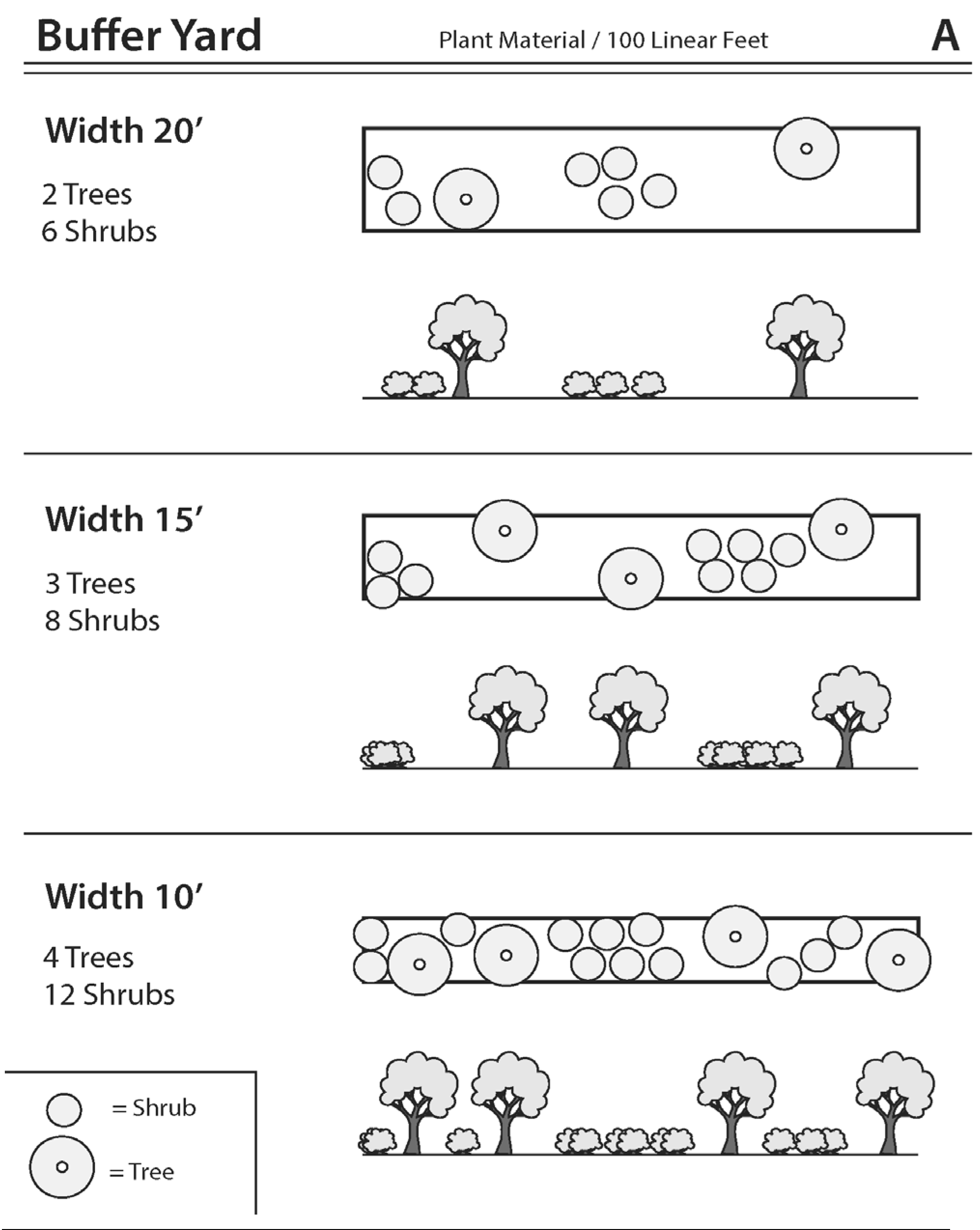
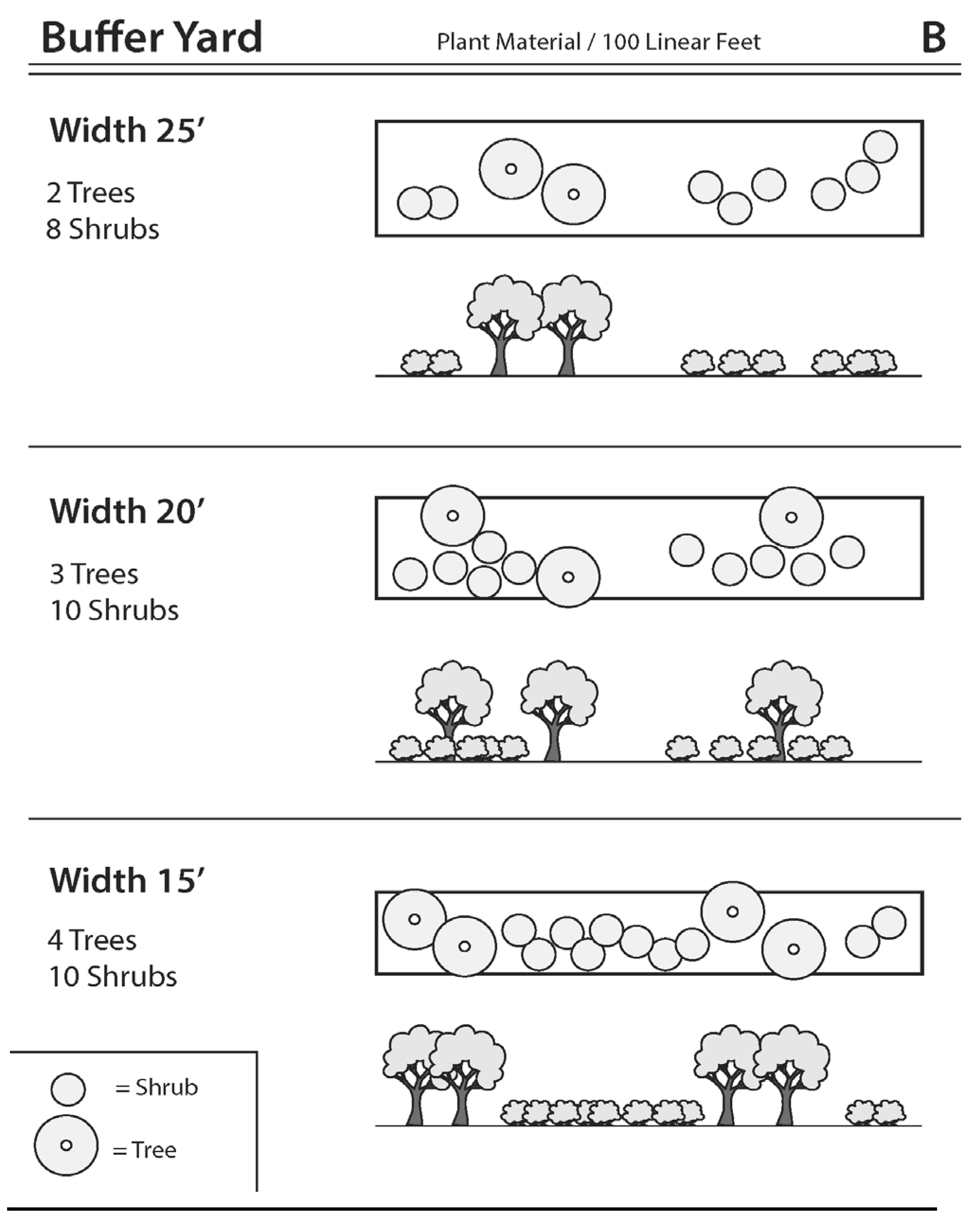
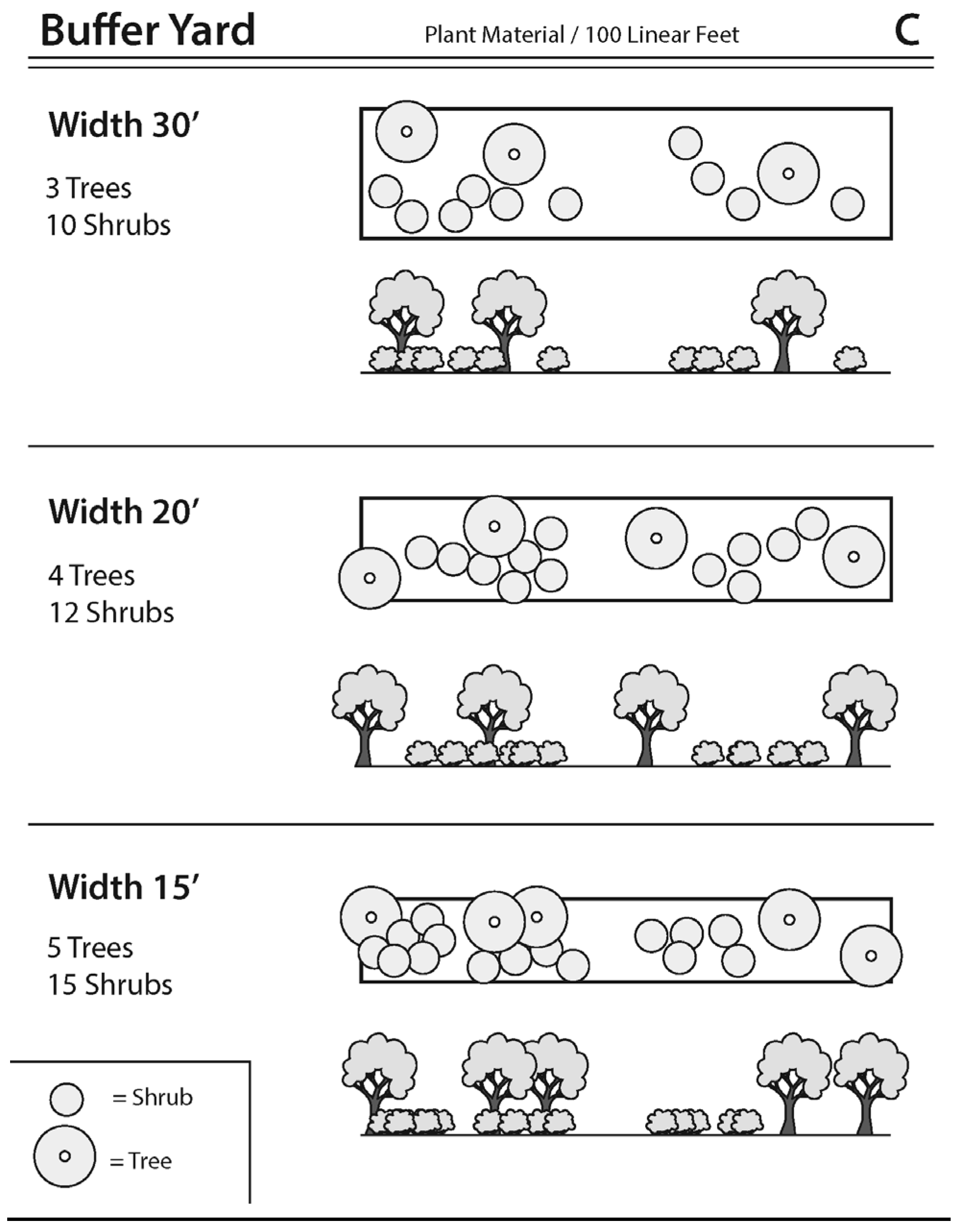
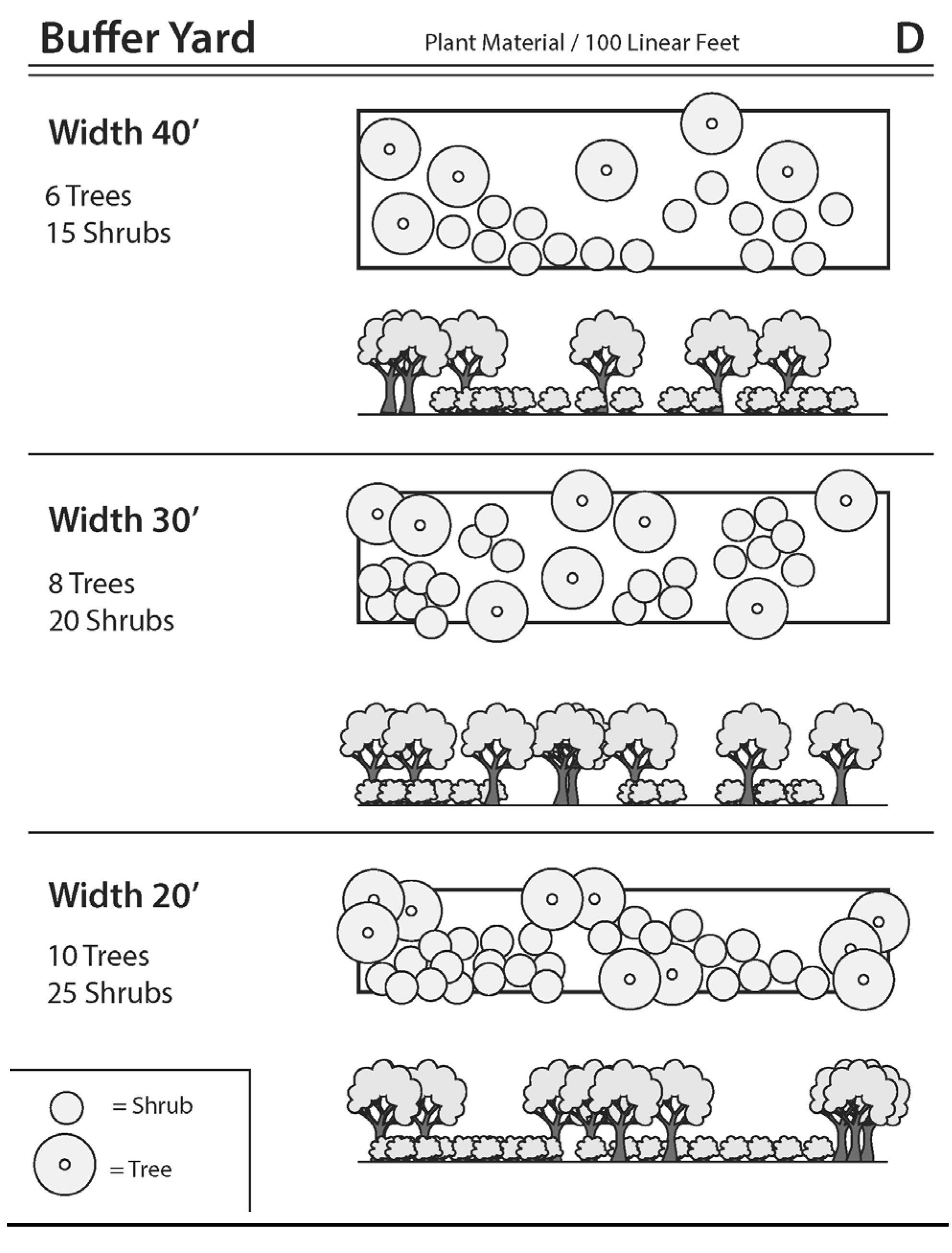
Section 6.07.06.05. - Buffer yards, utilities and utility easements.
Utility easements in a buffer yard do not prohibit the planting of shrubs in the area of the easement of an underground utility, but no tree shall be planted within 12 feet of a buried utility. Tree planting restrictions in relation to overhead power lines are identified in Tables 6.07.09.A and 6.07.09.B, of this article. Large and medium sized trees should not be planted closer than 15 feet to any light pole.
Section 6.07.07. - Installation, irrigation, inspection, certificate of occupancy/completion and maintenance.
All plants shall be "Florida Grade No. 1" or better, shall be healthy and free of diseases and pests, and shall be of nursery stock in two-gallon containers.
A.
Installation.
1.
The developer shall provide an appropriate planting soil medium for required plants and shall irrigate plant materials to sustain healthy growth of all plants to maturity.
2.
Areas on any development site not used for buildings, including single family and duplex development on individual lots, paved surfaces, or other landscape improvements shall be sodded or seeded prior to the issuance of a certificate of occupancy/completion.
3.
Areas within public rights-of-way, and areas off-site which have been disturbed by construction activity, shall be cleaned of all debris, re-graded to the proper elevations, and sodded so as to restore the area to a stabilized and planted state.
B.
Irrigation.
1.
No irrigation system shall be required where existing natural plant communities are maintained.
2.
All new landscaped areas shall be provided with an appropriate irrigation system, consistent with the needs of the plants contained therein and water conservation efficient.
3.
An irrigation system shall be designed to provide full coverage of all landscape areas without over spraying onto impervious surfaces including pavement, vehicular or pedestrian areas and/or adjacent properties.
4.
The irrigation system shall be operational prior to the issuance of any certificate of occupancy/completion for the property.
C.
Inspection and certificate of occupancy/completion. The city administrator, or building official, shall inspect the landscaping installation to ensure that it is in conformance with the requirements set forth in this article and with the approved landscape plan.
D.
Maintenance. Landscape areas shall be maintained in good condition so as to present a healthy, neat and orderly appearance and shall be kept free from refuse and debris.
Section 6.07.08. - Violations and penalties.
A.
All plant material which dies shall be replaced with plant material of required variety and size within 30 days from the date of official notification.
B.
Consistent with subsection A. above, if a restoration plan is presented and differs from the original approved plan, three copies of such restoration plan shall be submitted and approved by the city administrator, or his or her designee. The city administrator, or his or her designee, shall re-inspect the property for compliance after the restoration is complete.
C.
Each failure to comply with any of the provisions of this article shall constitute an individual violation. Failure to maintain viable landscaping consistent with the approved landscape plan shall constitute a violation subject to penalties and shall be subject to code enforcement action by the city.
Section 6.07.09. - Plant species list.
Plants species identified in this article include "Florida Friendly" native and non-native plants. Any new plant material, which will serve to meet the city's minimum landscape requirements, shall be selected from the following plant species tables.
In calculating canopy requirements, each existing tree to be preserved, and each new tree to be planted shall be credited with its mature canopy, as provided in this article. If an on-site preserved tree is not listed as an invasive plant in the most recent Invasive Plant List of the Florida Exotic Pest Plant Council, and its actual canopy exceeds the canopy area identified in this article, the greater canopy area may be used in calculating canopy coverage.
Table 6.07.09.A
Large Trees
Table 6.07.09.B
Medium and Small Trees
Table 6.07.09.C
Large Shrubs
Table 6.07.09.C
Large Shrubs
Table 6.07.09.D
Small Shrubs
Table 6.07.09.E
Ground Covers
Table 6.07.09.F
Lawn Grass Species
Source: "Selecting a Turf Grass for Florida Lawns," University of Florida IFAS Extension (ENHO4, 2007).
Section 6.08.00. - Fences, walls, berms and hedges.
A.
Permits. No walls or permanent fences shall be installed in any zoning district without the issuance of a permit from the city. Applications for a permit shall include a plan which details the proposed fence construction, including fence location in relation to property lines and easements, as well as any other information deemed necessary by the city for reviewing the application. Fences and walls shall be designed and constructed to withstand a maximum sustained wind speed and a maximum wind gust as regulated by applicable sections of the Florida State Building Code, as amended. A fee shall be charged for the issuance of a permit. A list of fees is on file with the city clerk.
B.
Placement and visibility at intersections. No fence, wall, berm or hedge shall be constructed or planted in any right-of-way, except as may be placed as part of a public highway safety or beautification project. Fences, walls, berms and hedges shall be located and constructed consistent with the city's visibility clearance standards as set forth in section 6.02.03.C.
C.
Maximum fence height.
1.
No fence or wall shall be erected or maintained along or adjacent to a lot line in a residential, RPB, P-1, B-1, or B-2 zoning district, to a height exceeding four feet in a front yard or street side yard, six feet in a rear yard, or six feet in a side yard, as measured from the rear property line to the front of the principal building, except that where the lot line is adjacent to non-residentially zoned property where there shall be an eight-foot limit on the height of a fence or wall along such lot line. The following uses shall be exempt from the above requirements:
a.
Utility and power substations;
b.
Water and wastewater facilities;
c.
Public swimming facilities; and
d.
Stormwater Retention ponds.
2.
Fences shall be a maximum of eight feet in height in front, rear, and side yards in B-3, C-1, M-1 and M-2 zoning districts. In such zoning districts, a fence or wall of not less than eight feet in height shall be provided around any and all machinery and storage facilities and junkyards.
D.
Materials.
1.
Except for fences in the C-1, M-1 and M-2 zoning districts, and security fencing as provided in subsection G. below, no fence shall contain any razor or barbed wire, glass or electrically charged wire, or similar devices.
2.
Fences must be constructed of new materials designed for that purpose or aged for proper architectural effect. Fences having a side with exposed or irregular structural components, and a more finished, uniform and aesthetically attractive side, shall be constructed and installed so that the more finished side faces outward from the fences' property toward the adjoining property.
E.
Swimming pools. Fencing requirements for swimming pools shall comply with city ordinances and/or applicable building code requirements related to fencing.
F.
Maintenance. The property owner shall maintain any fence to its original designed condition. Missing boards, pickets, posts, gates, etc. shall be replaced in a timely manner with material of the same type, quality, and finish as the existing fence.
G.
Security fencing. Notwithstanding the provisions of this section, the use of security fencing may be used at sites, such as electrical substations and communications facilities, and government facilities where such fencing is required by federal, state or local law, or other sections of this Code. Further, temporary security fencing may be utilized for construction sites while a permit for the work is active for the construction site. All temporary fences shall be removed prior to the issuance of a certificate of occupancy.
H.
Berms. Berms provide a natural, aesthetically pleasing form of screening between differing land uses. The following design criteria shall apply to all new berms constructed in the city:
1.
Berms shall not exceed five feet in height. Berms over two feet in height are required to remain outside of any visibility triangle as provided under section 6.02.03.C., clear visibility triangle.
2.
No berm shall have a slope greater than 25 percent.
3.
All berms shall be planted with grass or other approved ground covers to ensure stability and prevent erosion.
4.
No portion of a berm shall be permitted to encroach onto a public or private right-of-way. Berms shall not be located over underground utility facilities.
I.
Child care centers. Child care centers shall be provided with one or more completely and securely fenced play lots.
Section 6.09.00. - Performance standards governing waste and emissions.
All uses shall conform to the standards of performance described within section 6.09.01 below and shall be constructed, maintained and operated so as not to be injurious or offensive to the occupants of adjacent premises by reason of the emission or creation of noise, vibration, smoke, dust or other particulate matter, toxic or noxious waste materials, odors, fire and explosive hazard or glare. Within 100 feet of a residential district, all processes and storage, except for vehicle parking, shall be in completely closed buildings. Processes and storage located at a greater distance shall be effectively screened by a solid wall or fence at least six feet in height. Where other ordinances or regulations (whether federal, state, or local) may be adopted hereinafter impose greater restrictions than those specified herein, compliance with such other ordinances and regulations is mandatory.
Section 6.09.01. - Specific standards.
A.
Vibration. There shall be no perceptible earth vibration. All stamping machines, punch presses, press brakes, hot forgings, steam board hammers, or similar devices shall be placed on shock-absorbing mountings and on suitable reinforced concrete footings. No machine shall be loaded beyond the capacity prescribed by the manufacturer.
B.
Noise. Every use shall be so operated to comply with the noise standards as set forth in chapter 50, article III, noise, City of Arcadia Code of Ordinances, Municipal Code.
C.
Smoke. There shall be no emission of visible smoke, dust, dirt, fly ash or any particulate matter from any pipes, vents or other openings, or from any other sources, into the air. All fuel shall be either smokeless in nature or shall be used so as to prevent any emission of visible smoke, fly ash, or cinders into the air.
D.
Dust and dirt. Every use shall be so operated as to prevent the emission into the air of dust or other solid matter that may cause damage to property and health of persons or animals at or beyond the lot line of the property on which the use is located. Emissions must comply with applicable Florida Department of Environmental Protection (FDEP) rules.
E.
Industrial sewage and waste. Every use shall be so operated as to prevent the discharge of any waste into any stream, lake or into the ground, which will be dangerous or discomforting to persons or animals or which will damage plants or crops beyond the lot line of the property on which the use is located. Industries shall comply with Florida Department of Environmental Protection (FDEP) rules.
F.
Sewage. There shall be no discharge at any point of liquid or solid waste into any public sewage disposal system which will overload such system or create detrimental effects in the flow and treatment of public sewage. There shall be no discharge of industrial wastes into any private sewage disposal system, stream, or into the ground of a kind or nature which would contaminate any water supply or otherwise cause the emission of dangerous or objectionable elements or conditions. There shall be no accumulation of solid wastes conducive to the breeding of rodents or insects.
G.
Hazardous wastes. The handling and discharge of all hazardous waste shall follow all applicable standards established by the county health department, state legislature and the U.S. Congress. Appropriate city officials shall review all procedures involving the handling and discharge of all hazardous waste to ensure that it does not create any safety or health problems.
H.
Odor. There shall be no emission of odorous gases or other odorous matter in such quantities as to be offensive, obnoxious, or unpleasant at or beyond the property line of the lot on which the principal use is located. Any process, including the preparation of food, which may involve the creation and emission of such odors, shall be provided with both a primary and a secondary safeguard system so that odor control may be maintained in the event of failure of the primary safeguard system.
I.
Fumes, vapors and gases. There shall be no emission of any fumes, vapors, or gases of a noxious, toxic or corrosive nature which can cause any damage or irritation to health, animals, vegetation or to any form of property.
J.
Glare. Every use shall be so operated as to prevent the emission of glare of such intensity as to be readily perceptible at any point on the lot line of the property on which the use is located. Buffering may provide a means of meeting this standard.
K.
Fire and safety hazard. Each use shall be operated so as to minimize the danger from fire and explosion. The specific regulations to be met are set forth in the Florida Building Code and the Fire Prevention Code of the city.
L.
Heat, cold, dampness or movement of air. Activities which shall produce any adverse effects on the temperature, motion, or humidity of the atmosphere beyond the lot line shall not be permitted.
M.
Radioactive emission. There shall be no radiation emitted from radioactive materials or by-products that produce a dangerous level of radioactive emissions at any point. Radiation limitations shall not exceed quantities established as safe by the U.S. Bureau of Standards.
N.
Electromagnetic interference. For the purpose of this section, electromagnetic interference shall be defined as disturbances of an electromagnetic nature which are generated by the use of electrical equipment other than planned and intentional sources of electromagnetic energy, which would interfere with the proper operation of electromagnetic receptors of quality and proper design.
1.
Compliance with FCC Regulations. No person shall operate or cause to be operated, any planned or intentional source of electromagnetic radiation for such purposes as communication, experimentation, entertainment, broadcasting, heating, navigation, therapy, vehicle velocity measurement, weather survey, aircraft detection, topographical survey, personal pleasure, or any other use directly or indirectly associated with these purposes that does not comply with the current regulations of the Federal Communications Commission regarding such sources of electromagnetic radiation. Further, such operation in compliance with the Federal Communications Commission regulations shall be unlawful if such radiation causes an abnormal degradation in the performance of other electromagnetic receptors or radiators of quality and proper design because of proximity, primary field, blanketing, spurious re-radiation, conducted energy in power or telephone systems or harmonic content.
2.
Evaluation of performance. The determination of abnormal degradation in performance and of good quality and proper design shall be made in accordance with good engineering practices as defined in the principles and standards of the Institute of Electrical and Electronics Engineers and the Consumer Electronics Association. In case of any conflict between the latest standards and principles of the above groups, the most stringent shall apply.
Recognizing the special nature of many of the operations that may be conducted in connection with research and educational activities, it shall be unlawful for any person, firm, or corporation to operate or cause to be operated, to maintain or cause to be maintained, any planned or intentional source of electromagnetic energy, the radiated power from which exceeds 1,000 watts.
Section 6.10.00. - Carports and detached garages.
Carports and detached garages are accessory structures typically used for the parking of motor vehicles, boats, or trailers. As accessory structures, carports and detached garages are subordinate to the principal structure located on a parcel.
A.
Carports and garages may be constructed within a front yard, if attached to the principal structure. Structures attached to the principal building shall be considered part of the principal structure and subject to the principal structure front yard setbacks for the zoning district in which they are located. A deviation in these requirements may be allowed, e.g., through variance approval, however the front yard setback shall be no less than ten feet in residential districts.
B.
Carports and garages, whether attached or detached, may be constructed within a side or rear yard.
C.
All carports and detached garages shall have a minimum setback from the side and rear property lines of five feet. The minimum separation between the carport or detached garage from the principal structure shall be five feet.
D.
A carport shall at all times remain open on all four sides, if free-standing, and open on three sides if attached to the main building.
Section 6.11.00. - Swimming pools.
Swimming pools are permitted as an accessory use and shall meet the following requirements:
A.
Swimming pools shall be at least five feet from any lot line, as measured from the edge of the water, if no decking exists.
B.
Swimming pools, including all decking and screen enclosures, shall be located in the rear yard and shall conform to the setback requirements for accessory buildings; this shall include screened enclosures over and around swimming pools which are attached to the principal building.
C.
Swimming pools, surrounding decking, screen enclosures and vertical supports for screen enclosures shall not be located within public utility or stormwater management easements alongside and rear lot lines.
D.
All swimming pools shall be completely enclosed by a screen enclosure, or a fence or wall not less than four feet high, as required by State Statute.
E.
No pool in residential zoning districts may be used for commercial purposes.
Section 6.12.00. - Screen rooms/porches.
Screen rooms/porches are permitted in all residential districts and shall meet the following requirements:
A.
Screen rooms/porches may be constructed to within five feet of rear property lines.
B.
Screen rooms/porches located within the front yard shall be part of the principal structure and shall meet the front yard setback for a principal structure.
C.
Screen rooms/porches shall not encroach into side yard setbacks and shall not be located within public utility or stormwater management easements alongside and rear lot lines.
Section 6.13.00. - Dwelling units accessory to single-family detached uses (guest houses).
A.
A guest house dwelling unit shall be established only where a legally conforming single-family detached dwelling unit is the principal structure on, or under construction on, the same lot or parcel.
B.
Only one guest house dwelling unit shall be permitted per lot or parcel and the lot or parcel shall have a minimum area of 5,000 square feet.
C.
Either the principal dwelling unit or the guest house dwelling unit shall be the legal residence of the property owner.
D.
Guest house dwelling units shall not be sold separately from the principal dwelling.
E.
Where a lot or parcel is non-conforming by virtue of containing two legally established dwelling units in a single family zoning district, one of the two units may be converted to an accessory dwelling unit, provided that it meets all of the requirements of this section.
F.
Guest house dwelling units shall be detached from the principal dwelling and shall be located in the rear yard or interior side yard in accordance with the applicable setbacks for accessory structures of the underlying zoning district. Where located in an interior side yard, the accessory structure shall be set back a minimum of 5 feet behind the front building line of the principal structure.
G.
The minimum gross living area for accessory dwelling units shall be 400 square feet. In no case shall an accessory dwelling unit contain more than 40 percent of the total square footage of the principal dwelling.
H.
The maximum building height of an accessory dwelling unit shall be one story, or up to 24 feet if built over a detached garage, consistent with section 5.09.06, accessory structure development standards.
I.
Vehicle access to the accessory dwelling unit shall be from a platted alley, from the side street of a corner lot, or from a shared driveway connection to the street.
J.
A minimum of one off-street parking space shall be provided for the accessory dwelling unit in addition to off-street spaces required for the principal dwelling. Tandem parking in driveways is permitted.
K.
The design and exterior treatment of accessory dwelling units shall be architecturally compatible with the principal dwelling.
Section 6.14.00. - Residential infill development.
Infill development is the use of vacant land and property within a built-up area of the city for further construction or development. Residential infill development shall adhere to the following design requirements as defined by the predominant character of the existing residential block face. The block face shall consist of all residential properties along both sides of the public or private right-of-way on which the development fronts. While creativity and variation in architectural design is encouraged, the purpose of these requirements is to ensure compatibility of infill development with the character of nearby existing residential structures.
A.
Building orientation on infill lots shall match the predominant orientation of other buildings along the block face.
B.
Access and location of off-street parking on infill lots shall be similar to the predominant character for existing development along the block face.
C.
Front or street side setbacks may be reduced to conform to the average existing building lines or setbacks of adjoining structures.
Section 6.15.00. - Mobile home parks and recreational vehicle parks.
(Ord. No. 1036, § 1(Exh. A), 3-20-2018)
Section 6.15.01. - Mobile home parks.
A.
Location; size; minimum distance from residential buildings. Mobile home parks may be located in any mobile home park zoning district. Any such park shall not be less than ten acres in size. Each boundary of the park must be at least 200 feet from any permanent residential building located outside the park, unless separated therefrom by a natural or artificial barrier, or unless a majority of the property owners within 200 feet thereof consent in writing to the establishment of the park.
B.
General design requirements. The mobile home park shall conform to the following requirements:
1.
Compliance with health regulations. The park shall conform to all requirements for health, sanitation and waste disposal provided by applicable ordinances of the city and laws of the state.
2.
Size of mobile home spaces. Mobile home spaces shall be provided consisting of a minimum of 4,000 square feet for each space. Each space shall be at least 40 feet wide and 100 feet long.
3.
Separation of mobile homes. Mobile homes, together with appurtenant structures thereto, shall be so located as to retain air space on each of the long or side dimensions of 20 feet; and on each of the short or end dimensions of ten feet; and in no event shall any mobile home be placed closer than ten feet to any part of a building in the park.
4.
Access to spaces. All mobile home spaces shall abut a public way of not less than 20 feet in width, which way allows vehicular travel to a highway or public road off the premises of the park.
5.
Driveways and walkways. All driveways and walkways within the park shall be hard surfaced and lighted at night.
6.
Service buildings. Each park shall provide service buildings to house such toilet, bathing and other sanitation facilities and such laundry facilities as are prescribed in this section.
7.
Electrical outlets. An electrical outlet supplying at least 220 volts shall be provided for each mobile home space.
C.
Water supply. An adequate supply of pure water for drinking and domestic purposes shall be supplied by pipes to all buildings and mobile home spaces within a mobile home park to meet the requirements of the park. Each mobile home space shall be provided with a cold water tap at least eight inches above the ground. An adequate supply of hot water shall be provided at all times in the service buildings for all bathing, washing, cleansing and laundry facilities.
D.
Standards for service buildings; maintenance of buildings and grounds.
1.
Service buildings housing sanitation and laundry facilities, or any of such facilities, in mobile home parks shall be permanent structures complying with all applicable ordinances and statutes regulating buildings, electrical installations and plumbing and sanitation systems.
2.
All service buildings and the grounds of the park shall be maintained in a clean, sightly condition and kept free of any condition that will menace the health of any occupant or the public, or constitute a nuisance.
E.
Garbage receptacles. Garbage cans with tightfitting covers shall be provided in quantities adequate to permit disposal of all garbage and rubbish. Garbage cans shall be located not farther than 150 feet from any mobile home space. The cans shall be kept in sanitary condition at all times. Garbage and rubbish shall be collected and disposed of as frequently as may be necessary to ensure that the garbage cans will not overflow.
F.
Supervision. The licensee, or a duly authorized attendant or caretaker, shall be in charge at all times to keep the mobile home park and its facilities and equipment in a clean, orderly and sanitary condition. The attendant or caretaker shall be answerable, with the licensee, for the violation of any provision of this article to which the licensee is subject.
(Ord. No. 1036, § 1(Exh. A), 3-20-2018)
Cross reference— Solid waste, ch. 82, Municipal Code.
Section 6.15.02. - Recreational vehicle parks.
A.
Purpose. It is the purpose of this section to provide minimum development standards to accommodate the use for recreational vehicles (RVs) within RV parks.
B.
General provisions.
1.
RV parks are permitted only in the recreation and open space (ROS) and planned unit development (PUD) zoning districts.
2.
Vehicle sites within an RV park may be rented by the day, week or month and the occupant of an RV site shall remain at that site and within the RV park for a limited period of time consistent with the special seasonal, vacation and transient requirements of the RV user, but in no case exceeding 180 continuous calendar days.
3.
A combination RV/mobile home park development may be allowed within a single project. In such cases, the RV portion of the project shall comprise more than 50 percent of the total approved sites. The RV and mobile home portions of the project shall be clearly identified on the site development plan. Combination parks shall meet all of the standards for RV parks, except that the site area for mobile homes within combination parks shall meet the minimum site size requirements for mobile homes within a mobile home park (see section 6.15.01).
C.
RV park development standards.
1.
Size and density requirements.
a.
Minimum tract size: 10 acres.
b.
Minimum width of the tract: 150 feet at the front building setback line.
c.
Minimum depth of the tract: 200 feet.
d.
Maximum number of RVs per gross acre: 10.
2.
Minimum perimeter setbacks.
a.
Front: 25 feet, measured from property line to the most forward projection of any structure or vehicle.
b.
Side and rear: 20 feet.
c.
Side and rear abutting a public right-of-way: 25 feet.
D.
Uses and structures. No building or structure, or part thereof, shall be erected, altered or used, or land used, in whole or in part, for other than the following:
1.
Permitted uses and structures. The following are allowable without the need for any other use or structure on a designated site:
a.
RVs (as defined in article 2 and in F.S. § 320.01), limited to one per designated site.
b.
One single-family residential dwelling unit for use by a caretaker or resident manager. Such unit may be located within an accessory building.
2.
Accessory uses and structures. Accessory uses and structures, customarily associated with RV parks, including open patios and recreation facilities, administration buildings, central service buildings and utilities.
a.
Laundry facilities, sale of groceries and sundries, sale of LP (liquefied petroleum) gas, all of which are subject to the following:
i.
Such establishments and the associated parking areas related primarily to their operations shall not occupy more than two percent of the area of the RV park.
ii.
Such establishment shall not be located closer than 75 feet to any public roadway and shall be accessible only from a roadway within the RV park.
b.
Enclosed storage structures and garage facilities located within a designated common area with the use to be limited to the RV park management and the occupants.
c.
Concrete slabs, decks, and patios provided such structures are detached and structurally independent from the accompanying RV and in no way impede the immediate removal of an RV from its designated site.
d.
Detached and freestanding screen rooms, outdoor kitchens and other structure serving a living space, excluding bedrooms for sleeping purposes, provided that such structures are totally independent from the RV and shall be constructed and located in such a manner as not to impede the immediate removal of an RV from its designated site.
e.
Storage structures not exceeding 50 square feet may be allowed on an RV site provided that they are detached and located as an improvement on the site on which they are placed. The location, size and construction of the storage structures shall be uniform and the same on all sites.
f.
Open storage areas for recreational equipment and vehicles, the use of which is limited to RV Park occupants, provided that the area is designated on the approved site development plan and that no such area shall exceed five percent of the total area of the RV park.
g.
Keeping of pets, excluding animal breeding, boarding, and training.
3.
Prohibited uses and structures. Any use or structure not expressly or by reasonable implication permitted herein, including but not limited to:
a.
Any RV in excess of 8½ feet by 40 feet when factory-equipped for the road.
b.
Screen rooms, cabanas or other structures attached to an RV, including any form of rigid awnings which are not designed for transportation down the highway.
4.
Commercial facilities.
a.
Commercial facilities are limited to serve only occupants and guests of the RV park.
b.
Commercial facilities shall be located consistent with the standards established in section 6.15.02.D.2.a.ii.
c.
Commercial facilities shall present no visible evidence of the commercial character from any public roadway viewable from outside of the RV park.
E.
RV site design standards.
1.
Dimensional requirements. Each RV site shall meet the following dimensional standards:
a.
Minimum RV site area: 3,150 square feet.
b.
Minimum RV site width: 35 feet.
c.
Minimum RV site depth: 90 feet.
d.
Minimum distance between RVs: 10 feet.
e.
Minimum distance between an RV and a structure: 10 feet.
2.
Perimeter landscaped buffer. Buffer yard requirements for RV parks shall be the same as those required for mobile home parks. See section 6.07.06 for buffer yard requirements.
3.
Vehicular access. Internal roadways, and pedestrian access.
a.
All vehicle access into and out of an RV park shall be through designated entrances and exits along public roadways.
b.
All RV sites and parking areas shall abut an internal roadway of not less than 12 feet in width for one-way travel and 20 feet in width for two-way travel.
c.
Roadways within the RV park, including driveways accessing an RV site, shall be provided with a smooth, hard and stabilized surface that is well-drained and meets city engineering requirements.
4.
Off-street parking.
a.
At least one parking space shall be provided for each RV site.
b.
At least two parking spaces shall be provided for a dwelling unit occupied by a caretaker or resident manager. If the dwelling unit is located within an accessory building, the required parking for the dwelling unit shall be provided in addition to the required parking of any other use established within the accessory building.
c.
Sufficient maneuvering and off-street parking facilities shall be provided for each RV site. Parking, loading and maneuvering of vehicles incidental to parking spaces shall not necessitate the use of any public street, sidewalk, right-of-way or public grounds.
5.
Recreation and open space requirements.
a.
There shall be at least one area designed for recreational and open space within the RV park accessible from all RV sites.
b.
Designated recreational and open space area shall not be less than 15 percent of the RV park and not more than half of that requirement may be water surface area, excluding retention ponds.
6.
Utilities.
a.
All utilities distribution and collection systems, including water supply, sewage disposal, electricity, gas, telephone and cable television, shall be placed underground.
b.
Connection to public water and sewer facilities.
i.
Connection to a potable public supply of water is required. The provision of water supply, water storage and water distribution shall comply with this Code and the State of Florida.
ii.
Each RV site shall be provided with one or more accessible water supply outlets for filling RV water storage tanks in accordance with the design and construction requirements of the State of Florida.
iii.
The RV park sewerage system shall be connected to the city's public sewage system. The distribution system shall be designed, constructed and maintained in accordance with this Code and the State of Florida.
iv.
Each RV site shall be equipped with an individual sewer connection which is connected to the sewerage system of the RV park.
c.
Electrical and gas systems. Each RV site shall be equipped with an electrical or gas connection point that shall be installed and maintained in accordance with applicable codes and regulations.
d.
Central refuse collection requirements. All refuse shall be stored in pest proof containers and shall be collected and placed in one or more central containers not less than two times per week. Collection from central containers shall be in accordance with the refuse collection schedule of the city.
e.
Lighting. Lighting shall be provided for all roads, walkways, central service buildings, watering and sanitary stations and other facilities subject to nighttime use.
f.
Open fires and incinerator facilities.
i.
All open fires and incinerator facilities shall be located, constructed, maintained and used as to minimize fire hazard and smoke nuisance both on the property for which they are being used and on neighboring properties.
ii.
Where an incinerator facility is to be used within an RV park, its location shall be clearly identified on the site development plan. Construction and operation of an incinerator shall comply with requirements by the State of Florida.
7.
Maintenance of buildings and grounds and supervision.
a.
A central service building containing necessary sanitary facilities (i.e., restroom facilities) as specified by the State of Florida shall be provided to serve dependent occupants of the RV park. Central service buildings shall be located within a radius of approximately 300 feet of the RV sites to be served.
b.
When a central service building is operated in connection with another public or commercial establishment within the RV park, the number of sanitary facilities (i.e., restroom facilities) for such establishment shall be in addition to those required by the public health standards for the RV sites and shall be based upon the total number of persons using or expected to use such facilities.
c.
Central service buildings housing sanitation, laundry and other facilities, shall be constructed as permanent structures complying with all applicable local and State of Florida Building Codes and Health Department Regulations.
d.
All central service buildings, common areas and RV sites shall be kept and maintained in a clean and orderly manner, free of any condition that will menace the health of any occupant or the public, or constitute a nuisance.
e.
An authorized caretaker or resident manager shall be in charge at all times to keep facilities and equipment within the RV park in a clean, orderly and sanitary condition. The property owner of the RV park shall be answerable for the violation of any provision of this Code.
8.
Site development plan review. A site development plan shall be submitted to the city with application for the establishment of an RV park. The site development plan shall be submitted in accordance with section 10.02.00 of this Code and shall be in full compliance with all other applicable municipal ordinances and state requirements.
(Ord. No. 1036, § 1(Exh. A), 3-20-2018)
Section 6.16.00. - Service stations.
The regulations in this division shall apply to the location, design, construction, operation and maintenance of service stations.
A.
Size of Lot. A lot to be occupied by a service station shall be not less than 100 feet in width and 100 feet in depth.
B.
Location.
1.
Distance between service stations. There shall be a minimum distance of 750 feet, shortest air line measurement, between the nearest points on any two lots occupied, or to be occupied, for service station purposes; except at the intersection of any two designated primary state highways, or lots on opposite sides of four-lane streets where there is a median for control of traffic constituting, for all practical purposes, two separate one-way streets. The 750-foot regulation shall be construed to be an ideal to which exceptions may be made when conditions warrant or are found to be in the public interest.
2.
Distance from places of public assemblage. There shall be a minimum distance of 250 feet shortest airline measurement, between the nearest points on any lot to be occupied for service station purposes and any lot to be occupied for a church, hospital, elementary or high school, public library, theater, auditorium stadium arena assembly hall or other similar public or semipublic place where large numbers of people congregate.
C.
Setbacks for buildings and gas pumps.
1.
Gasoline pumps shall be located not less than 12 feet from any street line and not less than ten feet from any other property line. Where a gas pump is located within 25 feet of a street line, there shall be a curb not less than six inches high along the street line between driveways.
2.
No building or gasoline pump shall be located within 25 feet of any property which is residentially zoned.
D.
Protective wall and buffer yards. There shall be a masonry wall at least five feet in height along all lot lines, abutting residentially zoned property. Landscaping within required buffer yard spaces shall be located between the wall and the lot line.
E.
Driveways and access requirements. All driveway and access requirements shall be consistent with section 6.02.05, access and circulation.
F.
Lighting. All lights and lighting on a service station shall be so designed and arranged as to not cause a direct glare into residentially zoned property.
Section 6.17.00. - Solid waste and dumpster pads.
All commercial developments shall have adequate solid waste collection areas with adequate access and egress, independent of parking and loading facilities. Dumpster areas shall be screened to completely shield dumpsters from view of public roads, public rights-of-way, and residential areas. The screening material shall be 100 percent opaque and shall be of similar material or color as the principal structure. The entry doors to the dumpster area must be no more than 50 percent opaque. Screening shall include fencing, retaining walls, plant material, or a combination thereof. Vegetative planting shall provide a living visual screen of adequate height (no less than five feet at planting) and density to accomplish effective screening. The city may administratively grant a waiver from this section, if it is determined that screening is physically infeasible. Any change in use, change in business, or replacement of a dumpster shall require compliance with the Code.
Temporary construction dumpsters shall be exempt from the requirements of this section provided an active building permit is in effect for the property on which the construction dumpster is located.
Section 6.18.00. - Junkyards.
The following regulations shall apply to all junkyards:
(1)
Site area. The area of land to be so used shall be not less than 20,000 square feet and not more than 100,000 square feet.
(2)
Setbacks for storage and dismantling operations. No automobile or vehicle not in running condition, or machinery or other junk or scrap, shall be located either for storage or dismantling within 300 feet of any residential district, within 50 feet of the front street line or within 30 feet of any side street line or other property line of the lot to be so used.
(3)
Fencing. The entire area occupied by a junkyard shall be surrounded by a substantial, continuous masonry, wooden or metal fence or wall eight feet in height, without openings except for entrances and exits, which openings shall be equipped with unpierced gates.

