
Arcadia City Zoning Code
DEVELOPMENT STANDARDS
§ 156.120 INTRODUCTION.
All structures, buildings, land uses, land use changes, structural alterations, structural relocations, demolitions, structural additions and structural enlargements that are constructed, created, established or occur after the effective date of this chapter (except as may otherwise be provided within this chapter) shall be subject to all development standards and regulations for the applicable zoning district.
(Ord. 2002-05, passed 12-30-2002, § 7.1)
§ 156.121 DEVELOPMENT STANDARDS THAT APPLY.
Under the sections below are development standards which are arranged by category. To determine which development standards apply to the subject zoning district, refer to the “additional standards that apply” division. The four-digit codes noted in the “additional standards that apply” sections for each zoning district can be found in the sections below. Only the four digit codes noted in the “additional standards that apply” section apply to that zoning district.
(Ord. 2002-05, passed 12-30-2002, § 7.2)
§ 156.122 LOT/YARD STANDARDS (LY).
(A) LY-01: Except hereinafter provided, no building or structure shall be erected unless such building or structure conforms; and no building or structure shall be altered, enlarged or reconstructed unless such alteration, enlargement or reconstruction conforms with the lot/yard regulations of the district in which it is located, as follows.
(B) Buildings, structures, material for sale, storage, advertising or display to attract attention or parking lots are not permitted within any setback.
(Ord. 2002-05, passed 12-30-2002, § 7.3)
§ 156.123 HEIGHT STANDARDS (HT).
(A) HT-01: no structure may be erected or changed so as to make its height greater than specified in its applicable zoning district, except as noted below. Exceptions to height standards include:
(1) Church steeples; and
(2) Municipal water towers.
(B) These above specified height exceptions may exceed the permitted height regulations by twofold or 60 feet, whichever is less.
(C) Additional exceptions to height standards include:
(1) Necessary mechanical appurtenances; and
(2) Elevator bulkheads.
(D) These above specified height exceptions may exceed the permitted height standards by up to 15 feet, but must be shielded from view by design features of the building.
(Ord. 2002-05, passed 12-30-2002, § 7.4)
§ 156.124 ACCESSORY STRUCTURE STANDARDS (AS).
(A) AS-01:
(1) Accessory structures shall comply with all development standards for the subject zoning district. Also, no accessory structures shall encroach on any platted easement unless written consent is given by the agency the easement belongs to or is managed by.
(2) Accessory structures are not permitted on a lot prior to any primary structure being constructed, except where the accessory structure is being used for personal storage or agricultural purposes. Accessory structures also must relate to the primary structure and its uses.
(3) The following accessory structures are permitted, but must abide by all applicable standards:
(a) Antennas or satellite dishes;
(b) Bath houses or saunas;
(c) Decks;
(d) Detached garages;
(e) Gazebos;
(f) Greenhouses (personal);
(g) Hot tubs;
(h) Mini barns;
(i) Storage building;
(j) Pole barn;
(k) Agricultural buildings;
(l) Sheds;
(m) Boat docks;
(n) Sport courts; and
(o) Swimming pools (swimming pools must abide by 675 I.A.C. 20).
(B) AS-02: all permissible accessory structures shall abide by the following standards:
(1) Size of accessory structures:
(a) RR: may not exceed 100% of the finished floor area of the primary structure;
(b) R1: may not exceed 65% of the finished floor area of the primary structure;
(c) R2: may not exceed 65% of the finished floor area of the primary structure;
(d) R3: may not exceed 60% of the finished floor area of the primary structure;
(e) R4: may not exceed 60% of the finished floor area of the primary structure;
(f) R5: may not exceed 50% of the finished floor area of the primary structure;
(g) R6: may not exceed 50% of the finished floor area of the primary structure;
(h) MP: may not exceed 50% of the finished floor area of the primary structure; and
(i) AG: no size restriction.
(2) No more than two enclosed accessory structures are permitted on a lot, unless the property is in the AG Agriculture District and is used as a working farm; in that instance, there is no limit to the number of accessory structures.
(3) An accessory structure shall only be located to the rear or side of the primary structure.
(4) Swimming pools, hot tubs, mini barns, campers, bath houses or sauna shall only be located to the rear of the primary structure, except in the case of corner or through lots; in that instance, the structures may be placed on the side of the primary structure.
(5) No mobile home or manufactured home may be used as an accessory structure in any district.
(C) AS-03:
(1) Accessory structures shall comply with all development standards for the subject zoning district. Also, no accessory structures shall encroach on any platted easement unless written consent of the agency the easement belongs to or is managed by.
(2) Accessory structures are not allowed on a lot prior to any primary structure being constructed. Accessory structures also must relate to the primary structure and its uses.
(3) The following accessory structures are permitted, but must abide by all applicable standards:
(a) Antennas or satellite dishes;
(b) Decks;
(c) Gazebos;
(d) Storage buildings;
(e) Sheds; and
(f) Dumpsters.
(D) AS-04: all permitted accessory structures shall abide by the following standards.
(1) No more than two accessory structures are permitted on a lot.
(2) An accessory structure shall only be located to the rear or side of the primary structure.
(3) Antennas or satellite dishes shall only be permitted to the rear of the primary structure.
(4) Dumpsters shall be enclosed and screened on all four sides.
(E) AS-05: manufactured home park accessory structures standards are as follows.
(1) Management offices, sales offices, storage, mini-warehouses, laundry, dry cleaning facilities and other structures customarily incidental to manufactured home parks shall be permitted; provided that, the following criteria are met.
(a) They are subordinate to the residential component of the park and add aesthetic value to the park.
(b) They are located, designed and intended to serve only the needs of the park.
(c) The establishments shall present no visible evidence of their business nature to areas outside the park.
(2) Each manufactured home is entitled to one accessory structure in addition to a carport or garage. Attached or detached garages, and carports, are to be counted toward the total accessory building area. The total area of all accessory structures shall not exceed 20% of the dwelling site. Permitted accessory structures are as follows:
(a) Decks;
(b) Attached/detached garages;
(c) Gazebos;
(d) Greenhouses;
(e) Hot tubs;
(f) Mini barns;
(g) Patios;
(h) Sheds;
(i) Sport courts; and
(j) Boat houses.
(3) Model manufactured homes as sales units provided the number of model homes is limited to 5% of the authorized number of dwelling sites in the park. Model homes must comply with all standards set forth in the MP District. One unit may be used as a sales office.
(Ord. 2002-05, passed 12-30-2002, § 7.5)
§ 156.125 TEMPORARY USE/STRUCTURE STANDARDS (TU).
(A) TU-01: temporary uses or structures that abide by all applicable development standards for the subject zoning district are permitted. The following standards also pertain to temporary uses/structures.
(1) Transition to permanent or accessory uses/structures. Any temporary use or structure that is intended to transition into a permanent use/structure or accessory structure must meet all standards for a permanent use/structure or accessory structure. In the event the intent is not noted upon the application, the transition to a permanent use/structure or accessory structure will not be permitted for one year from the application date.
(2) Duration. All temporary uses/structures shall be permitted for the period of up to six months, unless otherwise noted in this chapter.
(3) Permit. All temporary uses/structures will be required to have a temporary improvement location permit and will be subject to fees as adopted, unless otherwise noted in this subchapter.
(4) Cessation of use. All temporary uses/structures must, upon cessation, remove all structures, elements and debris; and revert all alterations to the original site to its original state. All removal and alterations must take place within the permitted duration.
(5) Limit. A petitioner shall be limited to a total of one temporary uses/structures per year.
(B) TU-02: temporary uses permitted include:
(1) Garage sales (no permit necessary):
(a) Garage sales are permitted a maximum of three times per year, per property; and
(b) Maximum duration (time limit) for a sale shall be two days.
(2) Children’s roadside stand (no permit necessary); and
(3) Tents for a private party/event (no permit necessary).
(C) TU-03: temporary structures/uses permitted include:
(1) Construction trailers (permit may be renewed one time by the Zoning Administrator with reason;
(2) Roadside sales vehicles or structures; and
(3) Tents for sales and business events. Maximum duration (time limit) is 15 days with permit.
(Ord. 2002-05, passed 12-30-2002, § 7.6)
§ 156.126 LANDSCAPING STANDARDS (LS).
(A) LS-01:
(1) Landscaping is an essential part in the design and development of a site. Such plantings are a benefit to the environment, public health, safety, comfort, convenience and general welfare of the community. These standards will result in the reduction of storm water runoff, glare, heat buildup, may reduce energy costs in structures and will improve the aesthetics of the community.
(2) A detailed landscape plan including size, type and location of plant materials shall be submitted for review and approval to the Plan Commission or its designees for all multi-family, commercial, industrial or institutional new construction projects, additions or conversion from residential to commercial. For the purposes of this section, institutional is included, but is not limited to, governmental institutions, schools, churches and hospitals. The minimum requirements are as follows.
(a) All deciduous trees planted must be one and one-half inch caliper trees. All evergreen trees planted shall be a minimum of five feet in height. All shrubs planted shall be a minimum of 24 inches in height.
(b) Any trees planted to meet the landscaping standards must be replanted with a tree of like species if the tree dies or becomes diseased at any time regardless of property ownership.
(c) A minimum of 65% of all plantings, including foundation plantings, shall be located in the front yard(s).
(B) LS-02: minimum plantings required by use:
Use | Type | Num. | Per | Size |
Use | Type | Num. | Per | Size |
Single-family | Deciduous | 1 | 1 dwelling unit | 1-1/2” caliper |
Needled evergreen | 1 | 1 dwelling unit | 5 feet tall | |
Foundation plantings | 1 | 20’ of perimeter | 12” tall | |
Multiple- family | Deciduous | 1 | 2 dwelling units | 1-1/2” caliper |
Needled evergreen | 1 | 2 dwelling units | 5 feet tall | |
Ornamental | 1 | 4 dwelling units | 6 feet tall | |
Foundation plantings | 1 | 10’ of perimeter | 12” tall | |
Retail commercial (Not DC District) | Deciduous | 1 | 1,000 sq. ft. floor area | 1-1/2” caliper |
Needled evergreen | 1 | 1,000 sq. ft. floor area | 5 feet tall | |
Ornamental | 1 | 1,000 sq. ft. floor area | 6 feet tall | |
Foundation plantings | 1 | 20’ of perimeter | 18” tall | |
Office commercial (Not DC District) | Deciduous | 1 | 1,000 sq. ft. floor area | 1-1/2” caliper |
Needled evergreen | 1 | 1,000 sq. ft. floor area | 5 feet tall | |
Ornamental foundation | 1 | 1,000 sq. ft. floor area | 6 feet tall | |
Plantings | 1 | 10’ of perimeter | 18” tall | |
Institutional (Not DC District) | Deciduous | 1 | 1,000 sq. ft. floor area | 1-1/2” caliper |
Needled evergreen | 1 | 1,000 sq. ft. floor area | 5 feet tall | |
Ornamental | 1 | 1,000 sq. ft. floor area | 6 feet tall | |
Foundation plantings | 1 | 10’ of perimeter | 18” tall | |
Industrial (Not DC District) | Deciduous | 1 | 3,000 sq. ft. floor area | 1-1/2” caliper |
Needled evergreen | 1 | 3,000 sq. ft. floor area | 5 feet tall | |
Ornamental | 1 | 3,000 sq. ft. floor area | 6 feet tall | |
Foundation plantings | 1 | 30’ of perimeter | 24” tall | |
(1) The plantings required to meet buffer yard or parking lot standards shall not be counted toward this minimum landscaping requirement.
(2) Existing vegetation on site can be counted toward the minimum landscaping requirements.
(3) All foundation plantings must be within ten feet of the structures’ foundation and should be scrubs, ornamental bushes, ornamental plants or flowering plants.
(C) LS-03: general standards for landscaping:
(1) No landscaping materials, vegetation, plants, shrubs, trees, retaining walls, bedding, lighting or mounds may extend into any existing or proposed right-of-way or easement without the written permission from the agency that established the right-of-way or easement.
(2) No trees may be planted within five feet of sidewalks, streets, curbs, gutters, drainage tile or other infrastructure, unless approved otherwise by the Planning Commission.
(3) The species of trees and plants for proposed landscape plan may be subject to approval of Plan Commission or its designees.
(Ord. 2002-05, passed 12-30-2002, § 7.7)
§ 156.127 BUFFER YARD STANDARDS (BY).
BY-01:
(A) Purpose. The general purpose of a buffer yard is to soften the potential conflicts between potential uses in one zoning district from the potential uses in another adjacent district by using plantings, fences and mounds. The potential degree (or intensity) of conflict (or potential conflict) between two zoning districts will determine the extent of buffer yard required.
(B) Type. The following matrix determines the type of buffer yard which shall be installed by the subject development. First find the zoning district of the subject property (across the top). Second, find the zoning district of the adjacent property (in the left column). Where the two intersect on the matrix will be a letter (A, B or C) or a blank space. When there is a blank space no buffer yard is necessary. If an “A”, “B” or “C” is indicated in the matrix, a buffer yard is mandatory.
Adjacent District | Zoning District of the Subject Property | |||||||||||||
R1* | R2* | R3* | R4* | R5* | MP | SC | OC | DC | C1 | C2 | C3 | C4 | AG | |
Adjacent District | Zoning District of the Subject Property | |||||||||||||
R1* | R2* | R3* | R4* | R5* | MP | SC | OC | DC | C1 | C2 | C3 | C4 | AG | |
R1 | B | B | B | B | B | C | B | B | B | C | C | C | C | |
R2 | B | B | B | B | B | C | B | B | B | C | C | C | C | |
R3 | B | B | B | B | B | C | B | B | B | C | C | C | C | |
R4 | B | B | B | B | B | C | B | B | B | C | C | C | C | |
R5 | A | B | B | B | A | C | B | A | A | B | C | C | C | |
MP | B | B | A | A | B | B | C | C | ||||||
SC | A | A | A | C | C | |||||||||
OC | A | A | A | B | C | |||||||||
DC | A | A | A | A | B | A | B | C | ||||||
C1 | A | A | A | C | ||||||||||
C2 | A | B | ||||||||||||
C3 | A | |||||||||||||
AG | ||||||||||||||
NOTES TO TABLE: A = “A” Buffer Yard B = “B” Buffer Yard C = “C” Buffer Yard * Non-single-family residential use | ||||||||||||||
(C) General buffer yard standards. The following buffer yard standards will apply to all bufferyards.
(1) The buffer yard standards only apply along the property lines where the two conflicting zoning districts meet.
(2) The developer or owner of the subject property is responsible for installing the buffer yard.
(3) The adjacent property owner shall not have to participate in installing the buffer yard.
(4) An irregular row and spacing of trees is preferred. However, no two trees shall be placed within 20 feet from one another.
(5) All deciduous trees must have at least a two-inch caliper and all needled evergreen must be six feet in height when planted.
(6) All trees must be properly maintained, and be replaced if the tree dies, is diseased or is damaged from natural causes.
(D) Buffer Yard “A”.
(1) An additional ten feet of setback shall be required in addition to the normal setback.
(2) One deciduous canopy tree and one needled evergreen tree must be planted for every 30 feet of contiguous boundary with conflicting district.
(3) All trees must be planted within five to 15 feet from the property line which is contiguous to the conflicting property.
(E) Buffer Yard “B”.
(1) An additional 20 feet of setback shall be required in addition to the normal setback.
(2) One deciduous canopy tree and two needled evergreen trees must be planted for every 20 feet of contiguous boundary with conflicting district.
(3) All trees must be planted within five to 20 feet from the property line.
(F) Buffer Yard “C”.
(1) An additional 35 feet of setback shall be required in addition to the normal setback.
(2) A row of deciduous canopy trees must be planted 20 feet apart from one another.
(3) Additionally, a five-foot tall fence, or five-foot tall undulating berm, or a row of needled evergreen trees 12 feet apart will also need to be placed parallel to the property line and at least five feet from the deciduous canopy trees.
(4) All trees must be planted within ten to 30 feet from the property line and within the subject property.
(Ord. 2002-05, passed 12-30-2002, § 7.8)
§ 156.128 PERFORMANCE STANDARDS (PS).
PS-01: all uses established or placed into operation after the effective date of this chapter shall comply with the following performance standards in the interests of protecting public health, safety and general welfare and lessening damage to property. No use on a property shall exhibit obnoxious characteristics to the extent that it constitutes a public nuisance or interferes with reasonable enjoyment of neighboring properties. No use in existence on the effective date of this chapter shall be altered or modified to conflict with these standards:
(A) Air pollution. No use on a property shall release fly ash, dust, smoke, vapors, noxious, toxic or corrosive matter or other air pollutants in such concentration as to be detrimental to health, animals, vegetation or property, or conflict with public air quality standards.
(B) Electrical disturbance. No use on a property shall cause electrical disturbance adversely affecting radio, television or other equipment in the vicinity.
(C) Fire protection. Fire fighting equipment and prevention measures acceptable to the local fire departments shall be readily available and apparent when any activity involving the handling and storage of flammable or explosive materials is conducted.
(D) Noise. No use on a property shall produce noise in such a manner as to be objectionable because of volume, frequency, intermittence, beat, shrillness or vibration. Such noise shall be muffled or otherwise controlled so as not to become detrimental. Public safety sirens and related apparatus used solely for public purposes shall be exempt from this standard.
(E) Odor. No use on a property shall emit across lot lines any gas or matter with a bad odor in such quantity as to be readily detectable at any point along such lines.
(F) Vibration. No use on a property shall cause vibrations detectable beyond lot lines without the aid of instruments.
(G) Heat and glare. No use on a property shall produce heat and glare in such a manner as to create a hazard to neighboring property; nor shall any such heat or glare interfere with the reasonable enjoyment of neighboring property or transportation function.
(H) Waste matter. No use on a property shall accumulate within the lot or discharge waste matter beyond the lot lines.
(I) Water pollution. No use on a property shall produce erosion or other pollutants in such a quantity as to be detrimental to adjacent properties or to conflict with public water quality standards.
(Ord. 2002-05, passed 12-30-2002, § 7.9)
§ 156.129 ENVIRONMENTAL STANDARDS (EN).
EN-OI: no land shall be used or structure erected where the land is unsuitable for such use or structure due to slopes greater than 10%, adverse soil or rock formation, erosion susceptibility, low percolation rate or bearing strength or any other feature likely to be harmful to the health, safety, prosperity, aesthetics and general welfare of the community. In addition, the following standards must be met.
(A) Surface water. It shall be the responsibility of the owner of any lot or parcel of land developed for any use other than for agriculture to provide for adequate surface water drainage. Existing natural surface drainage should be utilized. Whenever the evidence available indicates that the natural surface drainage is inadequate, the owner shall provide the parcel with an adequate surface water drainage system which shall be integrated into the drainage pattern of surrounding properties. Swales are required to be placed in an easement to prohibit future filling or constructing. On-site detention for a 100 year storm event shall be required unless written statement by County Surveyor that it is not necessary to prevent harm to adjoining properties. All drainage plans shall be reviewed and approved by the Building Commissioner or the County Surveyor.
(B) Drainage. Drainage swales (ditches) along dedicated roadways and within the right-of-way or on dedicated drainage easements are not to be altered, except for maintenance as originally constructed and as approved by the Building Commissioner, County Highway Department, the County Drainage Board or state’s Department of Transportation. Driveways may be constructed over these or other approved structures as permitted by the appropriate agency.
(C) Permanent structures. No permanent structures other than a fence may be erected, and if erected in violation of this section, no such structure may be used if the location is within 75 feet of the centerline of any regulated tile ditch, or within 75 feet of the existing top edge of any regulated open ditch or tile, or platted regulated subdivision easement unless approved by the Building Commissioner, County Drainage Board and County Surveyor.
(D) Preservation of natural/historic features. Existing natural and historic features which would add value to development of natural or human-made assets of the county such as trees, streams, vistas, lakes, historical landmarks and similar irreplaceable assets, when possible shall be preserved through harmonious and careful design. Land to be developed shall be designed and improved as far as practical in conformity to existing topography in order to minimize storm water runoff and conserve the natural cover and soil.
(E) Landscaping. Any part or portion of a non-farm parcel which is not used for structures, loading or parking spaces, sidewalks and accessory uses shall be landscaped or left in a natural state. If landscaped, they shall be planted with an all season ground cover and shall be landscaped with trees and shrubs in accordance with the development plan and/or site plan and shall be in keeping with natural surroundings.
(F) Cut/fill grade. No cut or fill grade shall exceed a slope of 3:1 or 33-1/3%. This provision shall apply to all cuts and fills exceeding 100 square feet in exposed surface area, including cuts or fills on land naturally exceeding 3:1 in slope.
(G) Erosion prevention. All land, regardless of slope, from which structures or natural cover has been removed or otherwise destroyed, shall be appropriately graded and seeded within 30 days after the removal or destruction of said natural cover to prevent erosion.
(H) Alterations to shoreline. No alteration of the shoreline or bed of a river or public lake shall be made until written approval is obtained from the state’s Department of Natural Resources and Army Corp of Engineers, and the provisions of this chapter are complied with. Alterations include, among other things, filling of a river or wetlands, dredging of a riverbed and ditch excavation within one-half mile of a water body.
(I) Retention, detention and pond edges. All retention, detention and pond edges must be maintained with a buffer of natural plantings within 20 feet of the peak elevation. The use of “rip-rap” or any other engineered hard edges are not permitted, except around inlets arid outlets. However, the use of rip-rap or any other engineered hard edges shall not exceed 5% of lineal feet of the total edge of any retention facility, detention facility or pond.
(J) Code compliance/hazardous waste. All development must be in compliance with I.C. Title 13, as amended, as it relates to hazardous waste, low level nuclear waste, underground storage tanks, waste tires and other applicable chapters of said title.
(K) Code compliance/environmental quality. All development must be in compliance with I.C. Title 13, as amended, as it relates to air pollution control, water pollution control, solid waste management and other applicable chapters of said title.
(L) Waste disposal. No waste materials such as garbage, rubbish, trash, construction material, gasoline, oil, flammables, soils, tars, chemicals, greases, industrial or agricultural waste, or any other material of such nature, quantity, obnoxiousness, toxicity or temperature so as to contaminate, pollute or harm the waters shall be deposited, located, stored or discharged on any lot in a way that would be likely to runoff, seep or wash into surface or ground water.
(M) Fuel storage. No highly flammable or explosive liquids, solids or gasses specified by the state’s Fire Marshal shall be stored in bulk above ground, except tanks or drums of fuel connected directly with energy devises or heating appliances located and operated on the same lot as the tanks or drums of fuel.
(N) Debris/refuse. Debris, refuse, trash, construction material, garbage, litter, unfinished buildings and rotting wood shall not accumulate on any property, in any zoning district.
(O) Treatment of fill. Material used for fill where permitted by this chapter and/or by the IDEM, IDNR or other governmental agency shall be promptly covered and seeded.
(P) View requirements. Where a proposed structure will eliminate more than 50% of an adjacent structure’s view or exposure to the sun, an additional yard area setback may be required by the Zoning Administrator so that the 50% view or exposure may be maintained.
(Q) Improvement location permit requirements. The following activities are permitted with no improvement location permit required; provided, all other applicable standards are met.
(1) Normal plowing and preparing the land for farming, gardens and yards.
(2) Normal trimming and/or removal of trees and shrubs for maintenance and/or site preparation.
(3) Earth movements related to farming and other agricultural activity.
(4) Drain tile laying and ditch cleaning.
(R) Projects affecting regulated drains. Regulated drains are under the jurisdiction of the County Drainage Board. The County Drainage Board or County Surveyor shall review and approve all development or projects directly affecting a regulated open ditch or tile per I.C. 36-9-27-13 of the state’s Drainage Code.
(Ord. 2002-05, passed 12-30-2002, § 7.10)
§ 156.130 FLOODPLAIN STANDARDS (FP).
FP-01:
(A) Intent. The intent of floodplain standards are to protect from loss of property and maintain natural areas that help mitigate flooding downstream. The town’s Plan Commission and Board of Zoning appeals should strive to prevent any infilling of land in the floodplain, or constructing of any structures. The floodplain includes the channel, floodway and floodway fringe of a 100-year flood. Floodplain boundaries are to be determined by using the floodway-flood boundary maps of the Federal Insurance Administration/Federal Emergency Management Administration or best available information. The Zoning Administrator may require a petitioner to acquire a surveyor or engineer to determine the floodplain on a parcel of land.
(B) Statement of purpose.
(1) Under the authority granted to local units of government to control land use within their jurisdiction, which includes taking into account the effects of flooding, the Town Council adopts the following floodplain management regulations in order to accomplish the following: to prevent unwise developments from increasing flood or drainage hazards to others; to protect new buildings and major improvements to buildings from flood damage; to protect human life and health from the hazards of flooding; to lessen the burden on the taxpayer for flood control projects, repairs to flood-damaged public facilities and utilities, and flood rescue and relief operations; and to maintain property values and a stable tax base by minimizing the potential for creating flood-blighted areas.
(2) All development shall be prohibited within the floodplain, except as outlined below.
(a) The following uses shall be permitted; provided, they are permitted by the underlying district:
1. Agricultural uses such as crop production, pastures, orchards, tree farms, plant nurseries, vineyards and general farming;
2. Forestry, wildlife areas and nature preserves;
3. Parks and recreational uses, except golf course and driving range; and
4. Public streets, bridges and roadways.
(b) Uses permitted as a special exception are as follows:
1. Unenclosed riding stables or trails;
2. Telephone exchange;
3. Utility substation;
4. Public well;
5. Sewage treatment plant;
6. Water treatment plant;
7. Water management use facilities such as dams, docks, channel improvements, dikes, jetties, marinas, piers, wharves, levees, seawalls, floodwalls and irrigation facilities;
8. Public/private parking areas of any type (grass, gravel or paved);
9. Golf course;
10. Driving range; and
11. Artificial lake, one or more acres.
(c) An improvement location permit is required if any structure or use (except farming activities other than the construction of structures) is proposed to be erected, any excavation opened or any material deposited in the floodplain. The application for an improvement location permit shall be accompanied by the following:
1. A description of the proposed development;
2. Location of proposed development, sufficient to accurately pinpoint the property and structure in relation to existing roads and streams;
3. A legal description of the property site;
4. A site development plan showing existing and proposed structure locations and existing and proposed land grades;
5. Elevation of lowest floor (including basement) of all proposed structures; and
6. Base flood elevations. If the stream or waterway is located outside the FEMA detailed study areas, base flood elevations must be approved by IDNR,
(d) If the site is in the floodway the staff shall require the applicant to forward the application, along with all pertinent plans and specifications, to IDNR and apply for a permit for construction in a floodway. Under the provisions of I.C. 14-28-1-22 a permit from IDNR is required prior to any excavation, deposit, construction or obstruction activity located in the floodway. This includes land preparation such as filling, grading, clearing and paving and the like undertaken before the actual start of construction of the building. No action shall be taken by the staff until a permit has been granted by IDNR granting approval for construction in a floodway. The staff may issue an improvement location permit; provided that, the provisions contained in FP-01 of this chapter have been met.
(e) If the site is located in the floodway fringe, the staff may issue an improvement location permit; provided that, the provisions contained in FP-01 of this chapter have been met.
(f) Facilities (non-residential) may be constructed within the floodplain; provided that, the flood protection grade for all buildings shall be at least two feet above the regulatory flood profile. Flood-proofed non-residential may also be constructed; provided that, the plans and necessary specifications are certified by a professional engineer or registered architect licensed to practice in the state. A registered professional engineer or architect shall certify that below the flood protection grade the structure and attendant facilities are water-tight and capable of resisting the affects of regulatory flood. The building design shall take into account flood velocities, duration, rate of rise, hydrostatic pressures and impacts from debris or ice. Also, on-site waste disposal systems may be permitted only when in accordance with the policies of the County Health Department.
(g) The Zoning Administrator may require any or all of the following measures as conditions of approval of new construction:
1. Retention or detention of storm water runoff to minimize the increase in flood flows due to watershed urbanization;
2. Erosion and sedimentation control during construction projects to reduce siltation resulting in loss of channel carrying capacity; and
3. Additional fill to reduce flood danger.
(h) Under no circumstance shall there be a net loss of flood water capacity. No development shall be permitted which acting alone or in combination with existing or future similar works will cause any increase in the elevation of the regulatory flood.
(i) The Arcadia Board of Zoning Appeals when hearing variance requests from this section shall consider the following:
1. The potential damage to personal property belonging to private individuals other than the property or building owner;
2. The increased hazard the proposed structure may cause to other structures and properties;
3. The potential risk to stranded individuals and rescue workers;
4. Whether the site is subject to more frequent flooding than the 100-year flood;
5. Whether there are other options for locating the structure;
6. The applicant shall demonstrate the necessity of the particular use or structure within the floodplain; and
7. The applicant will demonstrate that there will be no net loss of flood storage capacity. All fill shall come from subject property in order to ensure flood water storage capacity.
(Ord. 2002-05, passed 12-30-2002, § 7.11)
§ 156.131 LIGHTING STANDARDS (LT).
LT-01:
(A) The intent of lighting standards are to provide a level of illumination for adequate, safe and efficient movement of vehicle and persons without affecting neighboring properties. Further, the level of illumination shall vary according to the type of use on a lot. The intensity of light created on any site shall not significantly go beyond the property line of the subject property.
(B) The following lighting standards apply.
(1) All lighting shall be shielded with opaque material to prevent direct lighting on streets, alleys and adjacent properties.
(2) All lighting elements used to cast light on building facades, features of buildings or signs shall have cutoff luminaires with less than a 90-degree angle (“downlighting”).
(3) Lighting for parking lots must all be consistent in their color, size, height and design. Further, all parking lot lights shall have cutoff luminaires with less than a 90-degree angle (downlighting) and shall be no more than 20 feet in height.
(4) All free standing lights and lights mounted on walls or facades must have cutoff luminaires with less than a 90-degree angle.
(5) All lights within a single development must uses consistent style, design, height, size and color throughout the development.
(6) All lighting from a property must not cause illumination beyond the property line of that property (at 0.5 foot candles). The only exception to this standard is as follows.
(a) When the subject property is business and the adjacent property is zoned for business or industrial, the allowable light at the property line is 1.0 foot candles (only on sides of the property that are adjacent to the similar zoning district).
(b) When the subject property is industrial and the adjacent property is zoned for industrial the allowable light at the property line is 2.5 foot candles (only on sides of the property that are adjacent to the similar zoning district).
(7) Measurements shall be taken along any property line of the subject property with a light meter facing the center of the property at a height of six feet.
(Ord. 2002-05, passed 12-30-2002, § 7.12)
§ 156.132 PARKING STANDARDS (PK).
(A) PK-01: two off-street parking spaces, paved or gravel, are required per dwelling unit. Neither of the off-street parking spaces required may include spaces within car ports or garages. Further, off-street parking spaces may not fully or partially be in a public right-of-way or utility easement. Each space must be at least nine feet wide and 18 feet long.
(B) PK-02: one and one-half paved off-street parking spaces are required per dwelling unit. In multi-family housing developments or manufactured home parks, at least one space per two units is required for visitor parking and shall be spread evenly throughout the development. Visitor parking spaces cannot include spaces in car ports or garages. Further, any off-street parking space may not fully or partially be in a public right-of-way or utility easement. Each space must be at least nine and one-half feet wide and 19 feet long.
(C) PK-03: all parking lots for commercial, industrial, business, public and private employee parking, offices, organizations and places of assembly must be paved with asphalt, concrete or other durable material. Gravel, stone, rock, dirt, sand or grass is not permitted as a parking surface. Expansion of existing gravel, stone, rock, dirt, sand or grass lots is not permitted. In addition, these parking lots must also conform to all the following requirements:
(1) All ingress/egress into parking areas must be paved with asphalt, concrete or other durable material;
(2) Be striped so as to show each parking space;
(3) Be constructed to allow proper drainage;
(4) Be designed as to prevent vehicles from having to maneuver in the public right-of-way; and
(5) The interior of all parking lots shall be landscaped with one deciduous shade tree per ten parking spaces (or any part of ten spaces).
(D) PK-04: to reduce traffic congestion and hazards along roadways, off-street parking shall be required for business and industrial uses. The minimum number of parking spaces shall be determined by adding up the spaces required for each applicable statement below. The numbers below do not guarantee the quantity needed per use, only minimums are expressed. The developer/builder must calculate additional parking spaces that may be necessary.
All uses | 1 parking space per employee that potentially can be working at any given time |
Convenience stores, gasoline stations, grocery stores, banks and department stores | 1 parking space per 300 sq. ft. of GFA |
Day-care facility | 1 parking space per every 10 children enrolled |
Fitness, health spa, entertainment facility, skating rink or similar facilities | 1 parking space per 200 sq. ft. of GFA |
Furniture stores and automobile sales | 1 parking space per 500 sq. ft. of GFA |
Golf course | 20 parking spaces per 9 holes |
Hardware stores, home improvement stores and community centers | 1 parking space per 400 sq. ft. of GFA |
Hotel, motel, bed and breakfast, and lodging or boarding home | 1 parking space per sleeping unit |
Restaurants, food services, movie theater, auditorium or church | 1 parking space per every 3 chairs |
NOTES TO TABLE: * Additional parking spaces may be required by the Planning Commission or Board of Zoning Appeals if deemed necessary. | |
(E) PK-05:
(1) Parking spaces shall be installed as follows:
(a) Maximum of 30% in front of the primary structure;
(b) Maximum of 70% to the side of the primary structure;
(c) Minimum of 10% to the rear of the in rear yard; and
(d) Under no circumstances shall parking be permitted within any required yard setback or buffer areas.
(2) Parking spaces prescribed in this rule must be located either on the premises or on a lot approved by the Plan Commission. All required off-street parking spaces, however, must be located within 600 feet of the respective lot.
(3) Parking spaces shall be a minimum of nine feet by 18 feet. Parking aisle widths shall be as follows:
(a) Ninety-degree angle space: 24 foot-wide parking aisle;
(b) Sixty-degree angle space: 18 foot-wide parking aisle; and
(c) Forty-five-degree angle space: 14 foot-wide parking aisle.
(4) A group of adjacent properties may provide a joint parking area if the number of spaces required for all properties is adequate, and at least 80% of the total spaces required for each use. A permanent documentation of the agreement must be recorded with both properties. A permanent written agreement signed by all property owners involved which shall include, but is not limited to, the following items: maintenance, snow removal, ownership and liability. The agreement shall be reviewed/approved by the Zoning Administrator and/or Town Attorney. The agreement shall be recorded in the office of the County Recorder. A copy of the recorded agreement shall be kept in the office of the Plan Commission. The Zoning Administrator shall approve aggregate parking lots such as mentioned above.
(5) A church or temple or like uses may request a variance to a down-size parking requirements if adequate parking is located near the use and which is available during the times of use by the church or temple.
(F) PK-06:
(1) Vehicles or trailers of any type without current license plates or in an inoperable condition shall be prohibited in residential zone districts other than in completely enclosed buildings, and shall not be parked or stored in any zone unless specifically authorized under the terms of this chapter.
(2) No vehicle or tractor/trailer of any type may be used predominantly for the purpose of personal storage.
(G) PK-07:
(1) The parking of a commercial vehicle in residential zone districts shall be prohibited; except that one commercial vehicle of not more than three-tons capacity may be parked on any lot where there is a principal building as along as it is:
(a) Used by a resident of the premises; and
(b) Parked in an enclosed garage or accessory building, or is located in the rear yard at least ten feet from the rear property line.
(2) This regulation shall not be interpreted to prohibit commercial vehicles from temporary loading and unloading in a residential district.
(Ord. 2002-05, passed 12-30-2002, § 7.13)
§ 156.133 LOADING STANDARDS (LD).
LD-01: there shall be provided off-street loading berths not less than the minimum requirements specified in this section in connection with any building or structure which is to be erected or substantially altered, and which requires the receipt or distribution of materials or merchandise by trucks or similar vehicles.
(A) Location. All required off-street loading berths shall be located on the same lot as the use to be served, and no portion of the vehicle shall project into a street right-of-way or alley easement. No permitted or required loading berth shall be located within 25 feet of the nearest point of intersection of any two streets, nor shall it be located in a front of the primary structure, or on the side of the primary structure adjoining a street.
(B) Size. Off-street loading berths for over-the-road tractor-trailers shall be at least 14 feet in width by at least 60 feet in length with a 60-foot maneuvering apron, and shall have a vertical clearance of at least 15 feet. For local pick-up and delivery trucks, off-street loading berths shall be at least 12 feet in width by at least 30 feet in length with a 30-foot maneuvering apron, and shall have a vertical clearance of at least 12 feet.
(C) Access. Each required off-street loading berth shall be designed with appropriate means of vehicular access to a street or alley in a manner which will least interfere with traffic movements. There shall be no maneuvering within the right-of-way.
(D) Surfacing. All open off-street loading berths shall be improved with a compacted base not less of asphalt, concrete or some comparable all-weather, dustless material.
(E) Space allowed. Space allowed to any off-street loading berth shall not, while so allocated, be used to satisfy the space requirements of any off-street parking areas or portions thereof.
(F) Off-street loading berth requirements.
Minimum Loading Berths Required
|
Gross Floor Area
|
1 | Up to 40,000 sq. ft. |
2 | 40,000 to 80,000 sq. ft. |
3 | 80,000 to 120,000 sq. ft. |
4 | 120,000 to 160,000 sq. ft. |
(1) One additional off-street loading space shall be required for each additional 80,000 square feet after 320,000 square feet.
(2) In situations where the structure clearly does not need and will not in the foreseeable future need loading docks, the Planning Commission may reduce the number required or eliminate the requirement.
(Ord. 2002-05, passed 12-30-2002, § 7.14)
§ 156.134 ENTRANCE/DRIVE STANDARDS (ED).
(A) ED-01: the intent of entrance and drive standards is to provide for a safe and efficient vehicular and pedestrian transportation system. The following standards apply to entrances and drives.
(1) All classification of roads shall be based on the Transportation Plan as found and maintained in the town’s Comprehensive Plan.
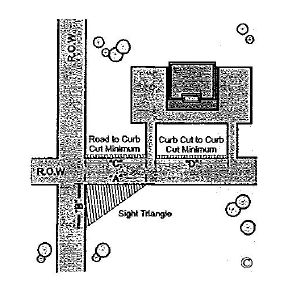
(2) (a) No entrance or drive shall be permitted to begin within:
1. Two hundred twenty feet of any intersecting road if along a primary arterial (see “C” below in the illustration);
2. One hundred seventy-five feet of any intersecting road if along a secondary arterial (see “C” below in the illustration);
3. One hundred seventy feet of any intersecting road is along a collector (see “C” below in the illustration); and
4. One hundred fifty feet of any intersecting road is along a local road (see “C” below in the illustration).
(b) The distances for the above standards shall be determined by measuring from ROW line to the curb or edge of pavement (whichever is less) of the entrance or drive.
(c) No two entrance or drive shall be within:
1. One hundred twenty feet of one another if along a primary arterial (see “D” below in the illustration);
2. On hundred feet of one another if along a secondary arterial (see “D” below in the illustration);
3. Seventy feet of one another if along a collector (see “D” below in the illustration); and
4. Fifty feet of one another if along a local street (see “D” below in the illustration).
(d) The distances for (he above standards shall be determined by measuring from the curb or edge of pavement to the curb or edge of pavement (whichever is less) of each entrance, or drive.
(4) (a) No entrance or drive shall be permitted within:
1. One hundred forty feet of the apex of a curve (30 degrees or greater) and where the roads is a primary arterial;
2. One hundred twenty feet of the apex of a curve (30 degrees or greater) and where the roads is a secondary arterial;
3. One hundred feet of the apex of a curve (30 degrees or greater) and where the roads is a collector; and
4. Seventy feet of the apex of a curve (30 degrees or greater) and where the roads is a local road.
(b) The location of drives on or near curves may be investigated individually by the Town Engineer or his or her designees and evaluated for their sight distance and design speed of the roadway or the posted speed limit, whichever is greater. In no case shall the Town Engineer or his or her designees be able to reduce the above stated distances by greater than 50%.
(5) (a) No entrance or drive shall exceed the following pavement widths for two-way traffic (if one-way, the measurements shall be one-half of the below measurements):
1. Thirty-two feet if from a commercial zoning district onto a primary arterial;
2. Thirty feet if from a commercial zoning district onto a secondary arterial;
3. Twenty-eight feet if from a commercial zoning district onto a collector;
4. Twenty-six feet if from a commercial zoning district onto a local street;
5. Thirty feet if from a multi-family residential zoning district onto a primary arterial, secondary arterial or collector;
6. Twenty-eight feet if from a multi-family residential zoning district onto a local street;
7. Twenty-eight feet if from a single-family residential zoning district onto any type of street; or
8. Twenty-two feet if from a single-family residential unit onto any type of street.
(b) The distances for the above standards shall be determined by measuring from the outside edges of the curb or pavement (whichever is more) of the entrance, or drive.
(6) The Planning Commission may determine if the following are necessary:
(a) An acceleration or deceleration lane; or
(b) A passing blister at a new entrance or drive.
(B) ED-02: in manufactured home parks with 40 or more manufactured homes:
(1) Two access points shall be required into and out of the manufactured home park; and
(2) Individual dwelling sites may only have driveways on interior roads.
(Ord. 2002-05, passed 12-30-2002, § 7.15)
§ 156.135 VISION CLEARANCE STANDARDS (VC).
VC-01:
(A) The intent of vision clearance standards are to provide for a safe vehicular and pedestrian transportation system. The visibility at intersections, driveways, curb cuts and entrances are particularly important for the safe movement of vehicles and pedestrians.
(B) The following vision clearance standards apply to all intersections, drive, curb cuts and entrances.
(1) No entrance, curb cut or drive shall be permitted if within:
(a) One hundred sixty feet of the crest of a hill where the slope on either side of the crest is 6% or greater, or the visibility is determined to be impaired by the Zoning Administrator, County or Town Engineer and the speed limit is 45 mph or greater;
(b) One hundred feet of the crest of a hill where the slope on either side of the crest is 6% or greater, or the visibility is determined to be impaired by the Zoning Administrator, County or Town Engineer and the speed limit is 30 mph or greater; and
(c) Eighty feet of the crest of a hill where the slope on either side of the crest is 6% or greater, or the visibility is determined to be impaired by the Zoning Administrator, County or Town Engineer and the speed limit is under 30 mph.
(2) All intersections must maintain a clear vision triangle where no primary or accessory structures, trees, vegetation or signs other that road signs are allowed to be placed or to project into. The clear vision triangle is illustrated below.
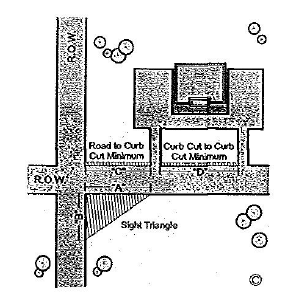
(C) The following triangle leg lengths will apply to the determination of a clear vision triangle.
(1) Along primary arterials: 45 feet;
(2) Along secondary arterials: 40 feet;
(3) Along collectors: 35 feet; and
(4) Along local roads: 20 feet.
(Ord. 2002-05, passed 12-30-2002, § 7.16)
§ 156.136 PUBLIC IMPROVEMENT STANDARDS (PI).
PI-01: the following public improvement standards shall apply as follows.
(A) Manufactured home parks and multi-family developments shall be permitted only if the public streets, drainage facilities and utilities are adequate to serve the proposed development. Any public streets which will carry the increased traffic the park or development shall be adequate to accommodate such traffic. Drainage facilities and public utilities shall have sufficient capacity to serve the development. The Town Engineer shall make a determination as to needed street and drainage improvements. The Town Engineer or his or her designee shall make a determination as to needed utility improvements. The decision of the Town Engineer or his or her designee may be appealed to the Board of Zoning Appeals. When public improvements are required, the developer or authorized representative shall be required to post performance and maintenance guarantees for such improvements in a manner specified in Ch. 155 of this code of ordinances.
(B) Attachment to public or semi-public water and sanitary facilities shall be mandatory in MP, Manufactured Home Parks.
(C) Manufactured home parks shall be in accordance with I.C. 16-11-27-1 et seq., Rule 410 I.A.C. 6-6 and their subsequent amendments, the state’s Board of Health Requirements and the requirements of this chapter.
(D) All private streets shall be constructed to the public streets standards set forth in the Public Improvement Design Standards Ordinance.
(Ord. 2002-05, passed 12-30-2002, § 7.17)
§ 156.137 OPEN SPACE STANDARDS (OS).
OS-01: the intent of the open space standards are to allow adequate open space in the MP, Manufactured Home Parks District.
(A) A minimum of400 square feet per dwelling site shall be dedicated to open space, a portion of which shall be an active recreational area, or one-quarter acre whichever is greater. Open space shall be configured for the activity for which it is designed.
(B) The minimum lot size may be reduced provided that the amount by which the lot is reduced is devoted to common open space and the lot size is not less than 3,200 square feet.
(Ord. 2002-05, passed 12-30-2002, § 7.18)
§ 156.138 HOME OCCUPATION STANDARDS (HO).
(A) HO-01 Home Occupation #1: the intent of the Home Occupation #1 provisions are to allow minimal business practices within certain residential zoning districts. Further, the intent is not to allow the loss of the residential district’s character or function as a residential area or neighborhood. To regulate reasonable business practices and residential character, the following development standards apply.
(1) The home occupation must not involve retail sales or manufacturing operations.
(2) The home occupation must not involve the employment of any person other than those residing at the location of the home occupation.
(3) At least one members residing on the premises must be the primary operator of the company.
(4) The equipment used for the business must be limited to computers, fax machines, telephones, copy machines and other small business office equipment.
(5) There must not be any interior or exterior storage or display of products, equipment or materials used in connection with the home occupation.
(6) No more than 10% of the total floor area of the primary structure shall be used for the home occupation.
(7) There shall not be any interior or exterior, structural or aesthetic alterations to the dwelling unit to accommodate for the home occupation.
(8) There shall not be any room additions or other structural/aesthetic alterations that change
the residential character of the dwelling unit.
(9) There shall not be an additional entrances to the dwelling unit for the purpose of conducting business or to accommodate the business.
(10) No use of accessory structure, including attached/detached garages, shall be allowed.
(11) No traffic generation due to the business will be permitted.
(12) No signage for the business shall be allowed on or off the property.
(13) No business practice, function, equipment or process shall create electrical interference, odors, noise, vibration, light, smoke, fumes or any thing offensive.
(14) No home occupation that demands increasing or enhancing the size, capacity or flow of the water, gas, septic, sewer or electrical system beyond what is standard for a residence will be allowed.
(15) No additional parking may be added to the lot(s) the residence is located to accommodate for the home occupation.
(16) Use of commercial vehicles for pickup and deliveries other than from the U.S. Postal Service, UPS and other express couriers is not permitted.
(17) The permitted uses in for Home Occupation #1 shall be limited to small offices or operations which have no clients, associates or persons visiting, shopping, meeting or otherwise doing
business at the home location.
(18) Home occupation uses that meet the above described standards are deemed permitted until the Town Council, Commission or BZA rule the use to be a nuisance, or until all adjacent neighbors petition to the Commission that the use is a nuisance.
(B) HO-02 Home Occupation #2: the intent of the Home Occupation #2 provisions are to allow reasonable business practices within certain residential zoning districts. Further, the intent is not to allow the loss of the residential district’s character or function as a residential area or neighborhood. To regulate reasonable business practices and residential character, the following development standards apply.
(1) The home occupation must not involve retail sales or manufacturing operations.
(2) The home occupation must not involve the employment of any more than one person who is not related and does not reside at the location of the home occupation.
(3) At least one member residing on the premises must be the primary operator of the business and be that person(s) primary work.
(4) There shall not be any use of mechanical equipment, other than what is usual for purely domestic or hobby purposes.
(5) There must not be any exterior storage or display of equipment or materials used in connection with the home occupation.
(6) No more than 25% of the total floor area of any level of the primary structure shall be used for the home occupation.
(7) There shall not be any exterior structural or aesthetic alterations to the dwelling unit to accommodate for the home occupation.
(8) There shall not be any room additions or other structural/aesthetic alterations that change the residential character of the dwelling unit.
(9) There shall not be an additional entrances to the dwelling unit for the purpose of conducting business or to accommodate the business.
(10) Business practice in all accessory structure is not permitted.
(11) Minimal traffic generation due to the business will be permitted.
(12) A small sign not exceeding two square feet will be allowed on the primary structure. No off-site signs or signs in the yard of the property shall be permitted.
(13) No business practice, function, equipment or process shall create electrical interference, odors, noise, vibration, light, smoke, fumes or any thing offensive beyond the property line for the dwelling unit.
(14) No home occupation that demands increasing or enhancing the size, capacity or flow of the water, gas, septic, sewer or electrical system beyond what is standard for a residence will be allowed.
(15) No additional parking may be added to the lot(s) the residence is located to accommodate for the home occupation.
(16) Use of commercial vehicles for pickup and deliveries other than from the U.S. Postal Service, UPS and other express couriers is not permitted.
(17) The permitted uses in for Home Occupation #2 shall be limited to domestic crafts, professional service, catalog businesses and internet businesses, including, but not limited to:
(a) Dressmaking;
(b) Sewing;
(c) Weaving;
(d) Tailoring;
(e) Ironing;
(f) Washing;
(g) Computer/internet based sales;
(h) Catalog order business;
(i) Furniture repair;
(j) Hair grooming - one chair;
(k) Home office for a lawyer, doctor, architect, engineer, accountant or planner;
(l) Home office for a real estate, insurance, notary public or manufacturer’s agent;
(m) Office for clergy;
(n) Art studio, writing studio, music studio, photography studio;
(o) Teaching art, writing or music for one student at one time; and
(p) Baking.
(18) The following types of business shall not be permitted as a Home Occupation #2:
(a) Medical clinics of any kind;
(b) Retail dress shops;
(c) Funeral homes;
(d) Tourist homes;
(e) Animal hospitals;
(f) Kennels;
(g) Trailer rentals;
(h) Automobile, motor vehicles, equipment repair of any kind;
(i) Painting of automobiles, motor vehicles or equipment of any kind;
(j) Photo developing;
(k) Television, radio or other electronics repair;
(l) Tooling, welding or machining of any kind;
(m) Retail or manufacturing of any kind;
(n) Tool or equipment rental of any kind;
(o) Restaurant or similar establishment;
(p) Salvage operations of any kind;
(q) Freight or trucking operations of any kind;
(r) Contractors business; and
(s) Landscaping/lawn care business.
(19) Permitted uses are deemed so until the Town Council, Commission or BZA rule the use to be a nuisance, or until all adjacent neighbors petition to the Town that the use is a nuisance.
(20) Uses not specifically mentioned will be interpreted by the Zoning Administrator or BZA as to whether the use is permitted or not.
(Ord. 2002-05, passed 12-30-2002, § 7.19)
§ 156.139 TELECOMMUNICATION FACILITIES STANDARDS (TF).
(A) TF-01:
(1) The purpose of this section is to provide for sensible and reasonable land uses to allow for the provision of adequate reliable public and private telecommunication service and to maximize the use of any transmission tower in order to reduce the total number of towers needed to serve the telecommunications needs of the area; to minimize adverse, undesirable visual effects of towers through careful design, siting and vegetative screening.
(2) All wireless telecommunication facilities shall meet the following provisions.
(a) The location of the tower and equipment buildings shall comply with all local, state and federal natural resource protection standards.
(b) The following buffer plantings shall be located around the perimeter of the outer most perimeter or security fence of a wireless telecommunications facility.
1. A live evergreen screen shall be planted around the entire facility including the guy wires and anchors, if used, that consist of a hedge, planted three feet on center maximum or a row of evergreen trees planted a maximum of ten feet on center, height of plants at time of planting shall be no less than five feet tall.
2. Existing vegetation (trees and shrubs) shall be preserved to the maximum extent possible.
(c) An antenna may be located on a building or structure that is listed on a historic registry only after obtaining all necessary and required approvals. Any antenna located in a historic district will require approval by the Board of Zoning Appeals for a special exception approval.
(d) Vehicular access to the tower and equipment building shall, whenever feasible, be provided along the existing driveways.
(e) The wireless telecommunications facility shall be fully automated and unattended on a daily basis, and shall he visited only for periodic maintenance and emergencies.
(f) Proposed or modified towers and antennas shall meet the following design requirements:
1. Tower and antennas shall be designed to blend into the surrounding environment through the use of color, camouflaging and architectural treatment, except in an instance where the color is dictated by federal or state authorities such as the Federal Aviation Administration.
2. Wireless telecommunication service towers less than 131 feet tall shall be of a monopole design and when located within or adjacent to an environmentally, aesthetically sensitive area or a residential district, designed in such a way as to architecturally camouflage the wireless telecommunication service tower as much as reasonably practical to blend into the surroundings.
3. The entire facility must be aesthetically and architecturally compatible with its environment. The use of residentially compatible materials such as wood, brick or stucco is required for associated support structures, which shall be designed to architecturally match the exterior of residential or commercial structures with in the neighborhood or area. Only if the facility will be 100% screened during all seasons will other materials be approved.
4. Only when lighting is for safety or security reasons or required by the Federal Aviation Administration or other federal or state authority will it be permitted. When approved the lighting shall be oriented inward so as not to project onto surrounding residential properties.
(7) Any request submitted to the office of the town’s Plan Commission to install an antenna to be located on an existing approved or “grandfathered” tower will only require a building permit and the contract between the applicant company and the owner of the tower.
(8) All towers at a minimum are to be constructed to support the initial user (wireless telecommunication antenna), plus handle the anticipated loading of a second user on a monopole and third user on all other towers equal to the antenna loading of the initial user.
(9) The size of the site of the initial tower and support facility shall be sufficient area to allow the location of one additional tower and associated support facility for future monopole tower and sufficient area to allow for the location of two additional towers and associated support facilities for non-monopole towers.
(10) A proposal for a new commercial wireless telecommunications service tower shall not be approved unless the applicant submits verification that the telecommunication equipment planned for the proposed tower cannot be accommodated on an existing or approved tower or buildings or other structure due to one or more of the following reasons:
(a) The planned equipment would exceed the structural capacity of the existing or approved tower, building or structure as documented by a qualified and licensed professional engineer, and the existing or approved tower, building or structure cannot be reinforced, modified or replaced to accommodate planned or equipment at a reasonable cost;
(b) The planned equipment would cause interference impacting the usability of other existing or planned equipment at the tower site. Supportive documentation by a qualified and licensed professional engineer indicating that the interference cannot be prevented at a reasonable cost;
(c) That existing or approved towers, buildings or structure within the search radius cannot accommodate the planned equipment at a height necessary to function reasonably as documented by a qualified and licensed professional engineer;
(d) Other unforeseen reasons that make it unfeasible or impossible to locate the planned telecommunications equipment upon an existing or approved tower, building or structure;
(e) Unable to enter a commonly reasonable lease term with the existing tower owner;
(f) If agreement cannot be reached between parties both parties shall agree to binding arbitration; and
(g) Additional land area is not available.
(11) Any proposed commercial wireless telecommunication service tower shall be designed, and engineered structurally, electrically and in all other respects to accommodate both the applicants height and at least one additional users for every 30 feet of tower above 60 feet in height. Towers must be designed to allow for future rearrangement of antennas upon the tower and accept antennas mounted at varying heights. Tower sites shall be large enough to accommodate all future accessory structures needed by future antenna users.
(12) All antennas, towers, accessory structure and wiring constructed within the town’s Plan Commission jurisdiction, shall comply with the following requirement:
(a) All applicable provisions of this Code and the Building Code of the State of Indiana and the Federal Communications Commission when applicable;
(b) Towers shall be certified by a qualified and licensed professional engineer to conform to the latest structural standards and wind loading requirements of the Uniform Building Code and the Electronics Industry Association;
(c) With the exception of necessary electric and telephone service and connection lines approved by the Board of Zoning Appeals no part of any antenna or tower nor any lines, cables, equipment or wires or braces in connection with either shall at any time extend across or over any part of the right-of-way, public street, highway, sidewalk, trails or property line without appropriate approval in writing;
(d) The tower and associated antennas shall be designed to conform with accepted electrical engineering methods and practices and to comply with the provisions of the National Electrical Code;
(e) All towers shall be constructed to conform with the requirements of Occupational Safety and Health Administration;
(f) An eight-foot high security fence shall completely surround the tower (and guy wires if used) and equipment building;
(g) All signal and remote control conductors of low energy extending substantially horizontally above the ground between a tower, antenna and a structure, or between towers, shall be at least ten feet above the ground at all points, unless buried underground;
(h) The tower shall be designed and constructed to all applicable standards of the American National Standards Institute manual, as amended;
(i) An engineers certification shall be submitted to document and verify the design specifications but not limited to, the foundation for the tower, and anchors for the guy wires if used, co-location, strength requirements, for natural forces; ice, wind, earth movements and the like; and
(j) Towers and antenna shall be designed and constructed, at a minimum, to withstand wind gusts of at least 80 mph with one-half inch of ice and to accommodate any co-location requirements.
(13) The following shall apply to existing antennas and towers:
(a) May continue in use for the purpose now used and, as now existing but may not be replaced or structurally altered without complying in ail respects to the requirements in this chapter;
(b) If such towers are hereafter damaged or destroyed due to any reason or cause whatsoever, the tower may be repaired and restored to its former location, and physical dimensions upon obtaining a building permit; provided, however, that, if the cost of repairing the tower to the former use, physical dimensions, and location would be 10% more of the cost of a new tower of like kind and quality, then the tower may not be repaired or restored, except in full compliance with all requirements in this chapter; and
(c) Existing antennas or towers cannot be used for anything other than their originally intended use.
(14) The following shall apply to the inspection of towers.
(a) All towers may be inspected at least once every one to five years by an official of the town’s Plan Commission and/or a qualified and licensed engineer to determine compliance with the original construction standards. Deviation from original construction for which a permit is obtained constitutes a violation of this chapter.
(b) Notice of violations will be sent by registered mail to the owner and the owner will have 30 days from the date the notification is issued to make repairs. The owner will notify the Building Inspector that the repairs have been made, and as soon as possible thereafter, another inspection will be made and the owner notified of the results.
(15) Any tower unused or left abandon for 12 months shall be removed by the tower owner at its expense.
(B) TF-02: roof/wall mounted antennas: the following chart shows where roof mounted antennas are permitted, and where and how they are restricted and necessary approvals.
BZA Approval | Directors Approval |
Unscreened 11 or more feet above the roof line | Unscreened 10 or less ** feet above the roof line |
Directors Approval | Directors Approval |
Screened 11 or more feet above the roof line | Screened 10 or less feet above the roof line |
NOTES TO TABLE: ** If within 200 feet of residential property lines BZA approval required | |
(C) TF-03:
(1) This section applies to residential districts, agriculture districts and the SC District.
(2) Wireless telecommunications facility shall require a special exception approval from the Board of Zoning Appeals and meet all the general and following requirements when located in a residential or agriculture district:
(a) The tower shall be set back from any property line a distance equal to at least 100% the height of the tower;
(b) Maximum height:
1. Tower: 125 feet; and
2. Accessory structure: 15 feet.
(c) Minimum number of antenna sites for a 125-foot tower is three; if tower is less than 125 feet, refer to TF-01; and
(d) The tower shall be a monopole design.
(D) TF-04:
(1) This section applies to the OC, DC and C1 Districts.
(2) Wireless telecommunications facility shall require approval as special exception by the Board of Zoning Appeals and meet the following and all other requirements within this chapter:
(a) Minimum side and rear property setbacks equal to 80% of the height of the tower. Towers are not permitted in the front yard;
(b) Maximum height:
1. Tower: 180 feet; and
2. Accessory structure: 15 feet.
(c) Minimum number of antenna sites for a 180 feet tower is four; if tower is less than 180 feet, refer to TF-01(A)(11); and
(d) Tower shall be placed no closer than 500 feet to any residential structure. If it is closer, it will require special exception approval by the Board of Zoning Appeals.
(E) TF-05:
(1) This section applies to the C2 and C3 Districts.
(2) A wireless telecommunications facility shall be permitted that meet the following and all other requirements within this chapter:
(a) Minimum setback from the side and rear property line: equal to 50% of the height of the tower. Towers not allowed in the front yards;
(b) Maximum height:
1. Tower: 250 feet; and
2. Accessory structure: 15 feet.
(c) Minimum number of antenna sites for a 250-foot tower is six; if tower is less than 250 feet, refer to TF-01(A)(11); and
(d) Tower shall be placed no closer than 500 feet to any residential structure, if closer will require special exception approval by the Board of Zoning Appeals.
(Ord. 2002-05, passed 12-30-2002, § 7.20)
§ 156.140 FENCES AND WALLS (FN).
(A) FN-01: all fences and walls shall:
(1) Present the non-structural face outward;
(2) Be permitted up to the property line;
(3) Not be greater than six feet in height in the side yard and rear yard or greater than three feet in height in the front yard;
(4) Not be closer than two feet to any public right-of-way;
(5) Not be placed within the clear vision triangle; and
(6) Not incorporate security wire or sharpened top spikes.
(B) FN-02: all fences and walls shall:
(1) Present the non-structural face outward;
(2) Be permitted up to the property line;
(3) Not be greater than eight feet in height in the side yard and rear yard;
(4) Not be closer than two feet to any public right-of-way; and
(5) Not be placed within the clear vision triangle.
(Ord. 2002-05, passed 12-30-2002, § 7.21)
§ 156.141 MISCELLANEOUS STANDARDS (MS).
(A) MS-01: each manufactured home in a manufactured home park must be tied down and have perimeter skirting.
(B) MS-02: storage or parking of recreational vehicles is subject to the following conditions.
(1) At no time shall a parked or stored recreational vehicle be occupied or used for living, sleeping or housekeeping purposes, except as outlined below.
(2) A recreational vehicle may be permitted to be parked for visitation for up to seven consecutive days, but not to exceed 14 total days in any one calendar year.
(3) No more than one recreational vehicle may be stored or parked outdoors on a residential parcel at any one time.
(4) Recreational vehicles may be stored or parked by the owner thereof behind or alongside the primary building in such a manner that no part of the vehicle shall project beyond the front of the primary structure, side yard setback or rear yard setback.
(5) Year-round storage of a recreational vehicle is permitted if it is either enclosed, screened with vegetation, or is not within 75 feet of all neighboring residential structures. If either of these conditions is not met, outdoor storing or parking shall not extend more than nine months of any single calendar year.
(6) A recreational vehicle shall not block a sidewalk.
(7) A recreational vehicle shall not be parked on a parcel without a primary structure.
(8) A recreational vehicle shall not be used solely for the purpose of personal storage.
(C) MS-03: all roof mounted heating, air conditioning, ventilation or other mechanical equipment shall be screened with materials that are complementary and aesthetically appealing to the structure on which they are affixed. From any location within 400 feet of the structure, the screening must hide or disguise the above listed equipment.
(D) MS-04: farm animals must have a minimum fenced area per animal to be permitted within the jurisdiction of this chapter. The minimum lot size to be able to have any farm animal on any lot or combination of lots is three acres. The zoning administrator shall have discretion to determine the minimum acreage for farm animals not listed. The following animals shall have:
(1) Large animals (horses, cows, buffalo, camels, donkeys): one and one-half-acres fenced pasture per animal;
(2) Medium animals (llamas, emu, ostrich, alpacas, sheep): one-acre fenced pasture per animal;
(3) Small animals (pigs, turkeys): five-acre fenced pasture per animal; and
(4) Very small animals (chickens): one-acre fenced pasture per animal
(E) MS-05:all side property lines must be within ten degrees of perpendicular to the street centerline or radial on curve.
(F) MS-06: all outdoor storage of materials, products for sale, construction materials, trash containers and the like shall be fenced with a six-foot privacy fence on all sides in all zoning districts.
(G) MS-07: street addresses must be posted on all primary structures and be visible from primary roadway and/or be posted on mailbox or other suitable structures visible from primary roadway.
(Ord. 2002-05, passed 12-30-2002, § 7.22)

