
Ardentown City Zoning Code
ARTICLE 16
- NEIGHBORHOOD PRESERVATION OVERLAY DISTRICT NPOD
Division 40.16.000.- Purpose.
The purpose of this Article is to establish a Neighborhood Preservation Overlay District (NPOD) for maintaining the distinctive physical qualities of existing neighborhoods. An NPOD designation is intended to provide a regulatory tool for communities concerned with issues of incompatible infill and structural alteration that could inappropriately change the appearance or character of residential neighborhoods or the streetscape. The purposes of this Article are to:
A.
Identify neighborhoods with distinctive and cohesive physical characteristics and establish a process and criteria for determining NPOD boundaries that will encompass those characteristics.
B.
Develop and adopt regulations for each NPOD that will maintain, strengthen, and enhance the neighborhood's distinctive qualities by requiring development, redevelopment, and infill projects to be compatible with the scale and character of the existing neighborhood.
C.
Provide the framework for establishing neighborhood regulations, focusing on broad characteristics that provide and protect neighborhood character including, but not limited to, building height, setbacks, massing, open space, and streetscape elements.
(Ord. No. 16-067, § 2, 1-10-2017)
Sec. 40.16.101. - Classification.
A.
The NPOD is an overlay zoning designation that provides additional standards to the underlying zoning district. The underlying zoning district specifies permitted land uses.
B.
An NPOD must include at least one (1) residential zoning district and may include all or part of any nonresidential zoning district.
C.
If there is a conflict between the NPOD regulations (including this Article and any NPOD Conservation Plan) and the underlying zoning district, the NPOD regulations shall apply.
D.
District classifications. For purposes of this Article, Neighborhood Conservation (NC), Suburban Reserve (SR), Suburban Estate (SE), Suburban (S), Suburban Transition (ST), and Traditional Neighborhood (TN) districts are considered residential districts. All other districts are considered nonresidential districts.
E.
Limit on designations. Applications for an NPOD during the first three (3) years after the effective date of this Article will be limited to the initial study areas identified in the New Castle County Department of Land Use Action Plan & Work Program, 2014/2015, dated October 7, 2014 (areas include: Pike Creek, Concord Pike, Route 9, Kirkwood Highway, Newark/Route 273 Corridor, and Claymont) and where a WILMAPCO study has been conducted.
F.
An NPOD only may be placed upon residential subdivisions approved prior to December 31, 1997.
(Ord. No. 16-067, § 2, 1-10-2017)
Sec. 40.16.102. - NPOD designation criteria.
To be designated as an NPOD, the area shall meet the following criteria:
A.
Required residential component.
1.
At least fifty (50) percent of the parcels within the proposed overlay district shall have a residential use; and
2.
At least fifty (50) percent of the land area within the proposed overlay district shall be located within:
a.
A residential zoning district; and
b.
A medium, low, or very low residential density future land use category in the Comprehensive Development Plan.
B.
Site area. Minimum site area shall include at least one (1) block and consist of at least ten (10) acres.
C.
Boundaries. All land within the district boundary shall be contiguous and shall not be separated by an interstate, freeway, or expressway as identified on the DelDOT New Castle County Functional Classification Map.
D.
Improvements. At least seventy-five (75) percent of the lots in the proposed district must be improved with principal buildings.
E.
Distinctive features. The area within the residential districts of the proposed NPOD shall create a cohesive identifiable neighborhood character that possesses the following distinctive features:
_____
F.
Nonresidential districts. The nonresidential districts within the proposed NPOD shall:
1.
Possess the features described in Subsection E. above; and
2.
Be contiguous to the residential districts.
G.
Exclusion. An NPOD shall not include properties in a designated historic or hometown overlay district or overlap another NPOD. This does not prohibit the establishment of an NPOD with an individually listed historic property that is not in an historic district.
H.
Applicability of other provisions. The NPOD shall not affect any of the following standards, all of which supersede the requirements of this section or any conditions of any NPOD conservation plan:
1.
Site capacity and concurrency calculations (Article 5) - site carrying capacity shall be based on the applicable bulk and area standards from Table 40.04.110.
2.
Environmental standards (Article 10).
3.
Transportation impact (Article 11).
4.
Sewer and water impact (Article 12).
5.
Impact fees (Article 14).
6.
Any other requirements of the UDC that are not specifically superseded by this Article or an NPOD conservation plan.
(Ord. No. 16-067, § 2, 1-10-2017)
Sec. 40.16.201. - Zoning authority.
A separate ordinance is required to designate each NPOD. Each overlay district ordinance shall include an NPOD conservation plan that identifies the designated boundaries, establishes regulations for the specific NPOD overlay district, and demonstrates consistency with the Comprehensive Development Plan.
(Ord. No. 16-067, § 2, 1-10-2017)
Sec. 40.16.202. - Initiation procedures.
The establishment of an NPOD may be initiated by:
A.
The Department; or
B.
By submission of an application to the Department. The application shall include:
1.
A petition executed by at least two-thirds (⅔) of the property owners within the proposed district and containing an acknowledgement of support from any official neighborhood, homeowner or maintenance association whose membership consists of persons owning property within the proposed district. The petition shall include the names, addresses, and tax parcel numbers of all property owners in the proposed district.
2.
Required filing fee.
3.
Applicants' names, contact information, and signatures.
4.
Precise boundaries indicated on a map.
5.
List of neighborhood, homeowner or maintenance associations whose membership consists of persons owning property within the boundaries of the proposed district including available contact information.
6.
Statement of justification including:
a.
Description of the neighborhood and property characteristics and features worthy of conservation, including any specimen trees and other landscape features; and
b.
Description of how the application meets NPOD criteria and why that designation would promote the best interest of the neighborhood and the County.
7.
Photographs, histories, and/or other supporting material documenting the neighborhood characteristics.
(Ord. No. 16-067, § 2, 1-10-2017)
Sec. 40.16.203. - Determination of eligibility.
A.
The Planning Board will determine the eligibility of an NPOD application pursuant to the standards and procedures in this Article. The Planning Board will, at a business meeting, review an application and the Department's initial analysis, and determine whether the application is eligible for NPOD designation based on the following criteria:
1.
Clear documentation of distinctive characteristics shared by properties within the proposed boundaries and why they are worthy of conservation; and
2.
Consistency with the Comprehensive Development Plan goals and policies; and
3.
The degree to which the proposed NPOD designation would promote the New Castle County Guiding Principles.
B.
The Planning Board must find all of the following in order to recommend designation of an NPOD:
1.
The proposed NPOD application meets the designation criteria of Division 40.16.101;
2.
The properties within the proposed boundaries are recognizable as a distinct area with shared characteristics; and
3.
The proposed NPOD possesses physical features that contribute towards a recognizable identity and therefore warrants further study.
C.
The Planning Board or Department may recommend the modifications of proposed NPOD boundaries if it finds that the modification meets the purpose of the proposed NPOD.
D.
If the Planning Board determines that an application does not meet the criteria, it will send its written determination to the applicant.
(Ord. No. 16-067, § 2, 1-10-2017)
Sec. 40.16.204. - NPOD planning process.
A.
Neighborhood information meeting.
1.
Upon determination of eligibility by the Planning Board, the Department shall notify, or require the applicant to notify, all property owners within the proposed NPOD boundaries informing them of the application and the review and approval process.
2.
The applicant shall arrange for a neighborhood-wide meeting to inform the community about the NPOD and the program requirements. This will occur prior to the Planning Board public hearing.
B.
Neighborhood/community meeting notice requirement.
1.
Written notices shall be sent by mail or email to all property owners of record within the proposed NPOD boundaries.
2.
At least ten (10) days before the neighborhood information meeting, the Department shall post, or require the applicant to post, a sign that provides a statement that an NPOD is proposed for the designated neighborhood, the Department's phone number and email contact, and the date, time, and location of any neighborhood information meeting. The Department shall update, or require the applicant to update, the sign to include the date, time, and location, at least ten (10) days before any Planning Board or County Council public hearing. The posted notice provisions of Subsection 40.31.340.B shall apply to this subsection.
3.
The notice of meetings also shall be available on the County website.
C.
Planning process.
1.
The Department shall work with the applicant to further define the neighborhood's unique character and identify conservation solutions, including appropriate regulations and incentives.
2.
The applicant shall prepare needed studies and reports and draft appropriate conservation criteria per Division 40.16.300.
(Ord. No. 16-067, § 2, 1-10-2017)
Sec. 40.16.205. - Adoption procedures.
A.
Procedure. Upon the Department's determination that the NPOD application is acceptable, the Department will prepare the draft NPOD ordinance and will schedule a public hearing before the Planning Board pursuant to Article 31.
B.
Rezoning. Adoption of the NPOD shall comply with Division 40.31.100 for rezonings. The Department shall prepare a draft zoning map for the NPOD.
C.
Findings. NPOD designation may be adopted by ordinance of the County Council only if it finds that the designation criteria of this Division are met.
D.
NPOD Conservation Plan. The adopted NPOD shall include an NPOD conservation plan.
(Ord. No. 16-067, § 2, 1-10-2017)
Sec. 40.16.206. - Development review.
A.
Land use applications for property within a designated NPOD shall comply with the adopted NPOD conservation plan. The application shall include a note indicating that the site is within the NPOD.
B.
The Department shall review all land use applications within the designated NPOD to determine compliance with the NPOD conservation plan.
C.
If the Department determines that the land use application does not conform with the NPOD conservation plan, the application shall be denied.
D.
The applicant may appeal the Department's determination to the Board of Adjustment for a final determination.
(Ord. No. 16-067, § 2, 1-10-2017)
Sec. 40.16.301. - NPOD conservation plan.
A.
Each NPOD shall contain standards that supplement, replace or modify the base zoning district standards in order to protect and preserve the features critical to the neighborhood.
B.
The applicant shall include an NPOD conservation plan which shall be approved as part of the zoning ordinance creating the NPOD.
C.
The NPOD conservation plan shall include:
1.
Design standards for new construction or placement of any building, structure, foundation, or signage; and
2.
Permitted additions, alterations, relocation or rehabilitation to the street facades of existing buildings, structures, foundations, signs, public art, or outdoor apparatus or equipment.
D.
The NPOD conservation plan shall not apply to ordinary repairs and maintenance.
E.
Required elements. The NPOD conservation plan shall include at a minimum the following elements governing the physical characteristics and features of all property (public or private) within the proposed district:
Building height in feet and number of stories
Building size, massing (frontage, entrance location/features)
Lot size, coverage
Setbacks
Building orientation
General site planning (primary, ancillary structures)
Density or floor area ratio standards for transitional areas between nonresidential and residential districts
Transitional features between nonresidential development in residential neighborhoods consistent with Section 40.16.302
Garage entrance location
Off-street parking and loading requirements
Ground level open space requirements
Roof line and pitch
F.
Optional standards. The design standards may include any of the following elements:
Signage
Architectural style and details
Building materials
Front window, dormer size and location
Landscaping
Fences and walls
Lighting
Driveways and sidewalks
Satellite dishes, utility boxes
Street trees
Paving patterns
Hardscape covering
Porch designs
Street furniture
Public art
Design standards in addition to those listed above
G.
The NPOD conservation plan may be amended or revised when an alternative design would better achieve the objective of a standard in the NPOD conservation plan. The amendment may be initiated by the applicant or the Department and be approved through the rezoning process.
H.
The NPOD ordinance may include incentives to encourage conservation within the NPOD, including changes, modification or reductions of:
1.
Parking requirements;
2.
Landscape surface ratio or the location, opacity, width, area or design of bufferyards;
3.
Open space ratios and the design or permissible uses of open space;
4.
Lot area required for zoning districts within the NPOD;
5.
Required yards; or
6.
Other UDC provisions unless specifically prohibited by this Article and that will not result in an increase the density, building height, or floor area ratio to an extent greater than permitted by the underlying zoning district.
(Ord. No. 16-067, § 2, 1-10-2017)
Sec. 40.16.302. - Transitional standards.
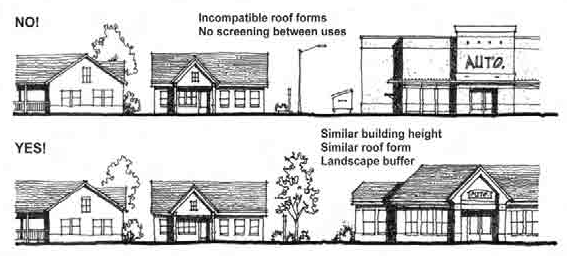
Unless any of these standards are modified by the NPOD conservation plan, all nonresidential or multi-family buildings or portions of buildings located within an NPOD and within one hundred (100) feet of a residential zoning district shall employ the following techniques to ensure compatibility with surrounding development, including adjacent residential development.
A.
Similar building setback.
B.
Similar roof form.
C.
Horizontal breaks in the street/building facade, as well as vertical breaks, shall be designed to occur as part of the building composition and shall not occur randomly.
D.
Front-to-front building orientations, especially with commercial uses that are pedestrian-intensive (e.g., restaurants, banks). Other building-to-building orientations may be used except that a back-to-front building orientation is not an acceptable transition tool.
_____
Figure 1.
Nonresidential development shall employ transition techniques to ensure compatibility
with surrounding development, including adjacent residential development
_____
E.
Green/open space transitions to ensure compatibility between the nonresidential development and surrounding development, such as:
1.
Small green spaces, courts, squares, parks, plazas, and similar spaces that function as community gathering places.
2.
Existing natural features as transitions, including natural differences in topography (not retaining walls), streams, existing stands of trees, and similar features.
F.
Compatible building height between residential and nonresidential and multifamily developments.
(Ord. No. 16-067, § 2, 1-10-2017)

