
Ardmore City Zoning Code
CHAPTER 7
- General Development Standards
Sec. 701 - Open Space
No open space or lot area required for a building or structure shall, during its life, be occupied by or counted as open space for any other building or structure.
Sec. 702 - Residential/Nonresidential Design Standards
A.
Residential Minimum Lot Width. No dwelling shall be erected on a lot that does not abut on at least one street for at least 35 feet and have a width of at least 35 feet at the building line.
B.
Ingress and Egress. A street shall form the direct and primary means of ingress and egress for all dwelling units. Alleys, where they exist, shall form only a secondary means of ingress and egress. Legal nonconforming lots that lack adequate street frontage shall have, at a minimum, an all weather access 20 feet wide. Unpaved alleys shall be paved when used to serve multi-family or non-residential uses.
C.
Residential Garages and Outdoor Parking.
1.
An attached or detached private garage which faces on a street shall not be located closer than 25 feet to the street right-of-way line. A detached garage must have a minimum interior side yard and rear yard setback of 5 feet except when abutting an alley. When abutting an alley, a zero feet rear yard setback may be used, however, if access to the garage is directly into the garage facing the alley, a minimum distance of 24 feet (backup space) to the opposite side of the alley shall be provided. This could affect the rear yard setback. Setbacks for open carports are found in Sec. 605.B.4.
2.
A private garage or any other parking area located in a residential district shall not be used for storage of more than one commercial vehicle per family living on the premises. The commercial vehicle shall not exceed 1½ tons rated capacity.
3.
No more than 2 parking spaces shall be rented to persons not residing on the premises for storage of noncommercial passenger vehicles only.
4.
Storage of driveable or trailerable recreational vehicles, trailers or other vehicles are permitted on any lot in accordance with Sec. 503.G.4 and Sec. 703.B.
5.
All on-site parking shall be on a paved surface; parking on the lawn or other unpaved areas is prohibited.
D.
Nonresidential Building Materials in the (CD) Downtown Commercial District. All new construction shall meet the following design standards, except where the Downtown Historic District Guidelines prevail:
1.
At least 40 per cent of the first floor of any non-residential building facade that faces a public street or sidewalk shall be windows, doors or display windows of clear or lightly tinted glass that allow views into the building or display window from outside. Where windows are impracticable, a 5-foot setback between the wall and the street shall be provided and landscaped with a continuous screen of shrubs, and 1 tree planted for every 25 feet or fraction thereof of street frontage. Upon written approval by the Director of Development Services, trees may be planted in the public right-of-way as street trees. Where windows are not feasible, other wall enhancements and embellishments may be approved by the Director of Development Services where it is determined that the enhancements substantially achieve the intent of this section.
2.
Exterior materials shall be compatible with those of surrounding buildings. Buildings shall use the same materials, or materials that are architecturally harmonious, on all walls and other exterior building components that are visible from public streets and any residential districts.
3.
Unfinished concrete block or any metal as an exterior surface material, except standing seam metal roofs, shall be prohibited.
4.
The Historic Preservation Board shall have the authority to determine appropriate building materials in any designated historic district.
(Ord. No. 2669, 1-2-01; Ord. No. 2723, 8-19-02; Ord. No. 2757, 12-15-03)
Sec. 703 - Landscaping and Buffering
Landscaping and buffering on a specific site may be comprised of a number of separate elements, as set forth below:
A.
Parking Lot Buffers and Landscaping.
1.
A parking lot for 3 or more vehicles abutting a residential district shall be screened with any of the following types of screen. Such fence, wall, hedge or berm shall be maintained in good condition by the parking lot property owner. Abutting shall include across an alley.
a.
An opaque ornamental fence or wall having a height of 6 feet along all property lines adjacent to the residential district, except required sight triangles.
b.
A dense evergreen hedge having a height of 6 feet along all property lines adjacent to the residential district, except required sight triangles.
c.
A landscaped earth berm, the top of which is at least 2½ feet higher than the elevation of the adjacent residential property. The slope of the berm shall not exceed 33 per cent (3:1). If the berm is less than 6 feet in height, it must be planted with a dense evergreen hedge, along with grass, sod or ground cover such that the combined height is 6 feet. The total combined height shall equal 6 feet along all property lines adjacent to the residential district, except required sight triangles.
d.
Any combination of landscaped earth berm as described above, and ornamental fence or wall, provided the total combined height equals 6 feet along all property lines adjacent to the residential district, except required sight triangles. A ground mounted sign shall not suffice as part of a fence/wall.
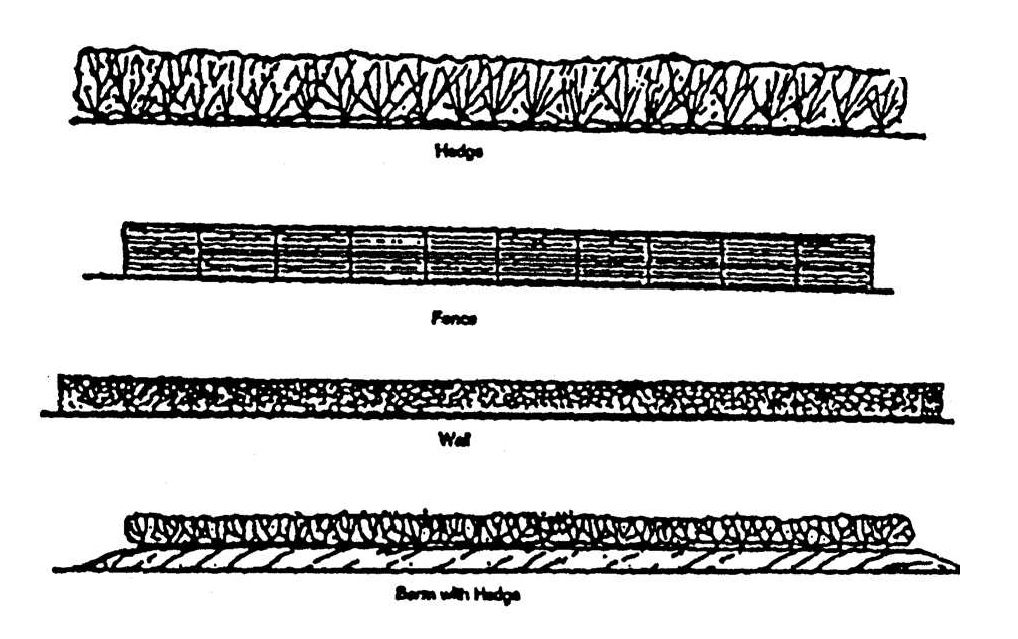
Parking Lot Buffers and Landscaping
2.
The front yard and exterior side yard areas of the lot in which a parking lot is located shall include a landscaped area adjacent to the parking area. Said landscaped area shall be maintained in good condition. Parking areas that are not visible from a public street shall be excluded these requirements.
3.
All existing parking lots paved with asphalt or concrete shall not be subject to these landscaping provisions. Any addition to an existing parking lot and all new parking lots which are constructed shall meet these landscaping requirements.
4.
For the purposes of this section, landscaping shall be defined as live vegetation and/or other features, such as decorative rock, bark and other items commonly used to improve the appearance of property. Nonliving materials shall not exceed 30 per cent of the required amount of landscaping on an area basis.
5.
The provisions of this subsection shall not be applicable to any property or lands owned by any school district.
6.
Areas designated on the site plan for new and used vehicle display and storage shall not be counted towards the minimum on-site landscape area requirement. There shall, however, be a minimum landscape area 4 feet wide along all streets abutting the site, excluding driveway areas. Required on-site landscaping may include landscaped interior side yards that extend as far as the building setback line.
B.
Clear Sight Triangle. At the intersection of 2 streets or the intersection of a driveway and street, no parking shall be permitted and no wall, fence, sign, structure or plant growth shall be permitted having a height between 3 feet and 8 feet in a triangle formed by measuring a distance of 15 feet along the intersecting property lines or driveway, and connecting the points so established to form a triangle on the area of the lot adjacent to the street intersection.
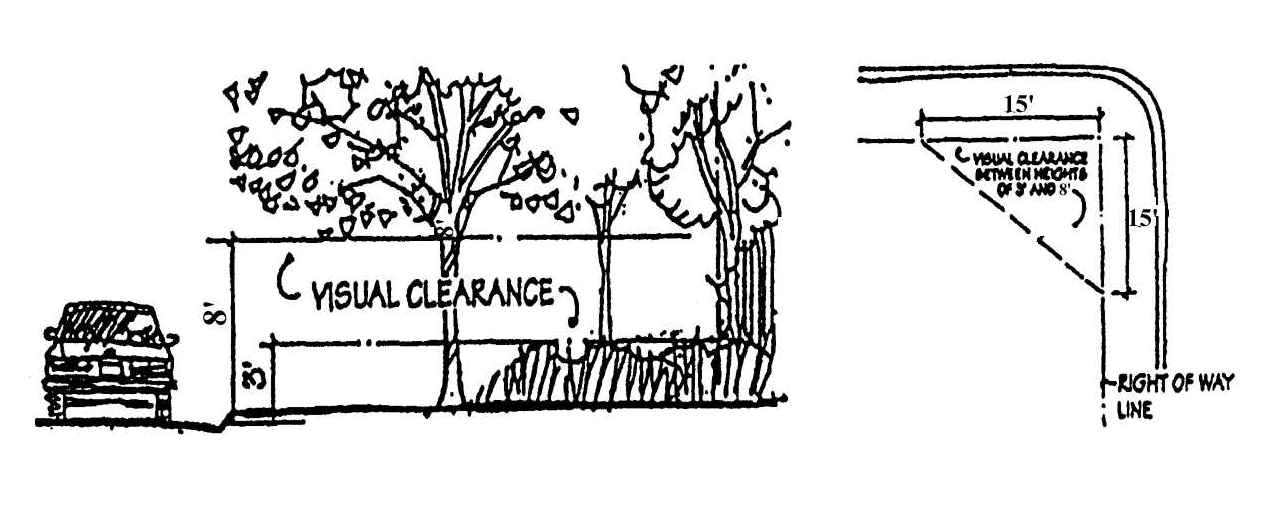
Clear Sight Triangle
C.
Screening Fence, Wall or Hedge. For the purpose of maintaining a compatible relationship between certain land uses, a screening requirement may be established in other sections of this UDC. When provisions require the construction of a screening wall or fence as a condition, the screening wall or fence:
1.
Shall be constructed, designed, and arranged to provide visual separation of such uses, irrespective of vegetation;
2.
Shall not be less than 6 feet in height, except in front yard setback areas.
3.
Shall be constructed with all braces and supports on the interior, except where both sides are of the same design and appearance;
4.
Shall be erected within 30 days following the occupancy of the building or initiation of the use required to screen; and
5.
Shall be maintained by the owner of the lot containing the use required to construct a screening.
D.
Landscaping for Single Family and Duplex Sites. Two trees shall be provided on all single family residential lots, one of which shall be in the front yard area. Duplex lots shall require one tree per unit; said trees shall be in the front yard area. The required trees may be deciduous or evergreen, in accordance with Ardmore Tree Board guidelines. Deciduous trees shall be a minimum of 1½-inch diameter, and evergreens shall be a minimum of 4 feet high above grade. Existing trees on the site meeting the standards above may be counted towards this requirement.
E.
Seasonal Planting Flexibility. At the discretion of the Planning Director, landscape planting may take place up to 180 days after completion of construction in order to avoid loss of plant material during the summer. The Planning Director shall specify the applicable time period and may require a performance bond to ensure appropriate landscaping is completed.
F.
Street Trees. On streets having a right-of-way of 50 feet or less, trees shall not be planted within the public right-of-way. On streets with wider rights-of-way, trees in the right-of-way may be installed upon approval of the Tree Board after consulting with the City Engineer about the type and location of underground and overhead utilities, consistent with Section 2-167 and 2-168 of the City Code below:
On streets having rights-of-way wider than 50 feet, the installation of street trees shall be in accordance with the following:
The distance trees may be planted from curbs or curblines and sidewalks will be in accordance with the 3 species sizes classes listed in Section 2-163.5 of the City Code and no trees may be planted closer to any curb or sidewalk than: Small trees, 2 feet; medium trees, 3 feet; and large trees, 4 feet.
(Ord. No. 2723, 8-19-02; Ord. No. 2757, 12-15-03; Ord. No. 2782, 4-4-05)
Sec. 704 - Soil Erosion and Sediment Control
Soil erosion and sediment control-related measures are required for any regulated land disturbance activity, in accordance with the standards of this subsection. All temporary measures and permanent erosion control and sediment control shall be maintained continuously in an effective, working condition.
A.
General.
1.
Soil disturbance shall be conducted in such a manner as to minimize erosion. Soil stabilization shall consider the time of year, site conditions, and the use of temporary and permanent measures.
2.
Properties and channels located downstream from development sites shall be protected from erosion and sedimentation. At points where concentrated flow leaves a site, stable downstream facilities are required.
3.
Soil erosion and sediment control features shall be constructed prior to the commencement of upland disturbance.
4.
If dewatering devices are used, adjacent properties shall be protected. Discharges shall enter an effective sediment and erosion control measure.
5.
For detached single family residential development occurring one lot at a time, alternatives to the standards of this section may be approved by the City Engineer.
B.
Soil Stabilization.
1.
Temporary soil stabilization shall be applied to disturbed areas within 14 days of the end of soil disturbance to all areas that will not be final graded and stabilized within 45 days.
2.
Permanent stabilization shall be done within 14 days of final grading of the soil. Permanent soil stabilization measures shall be applied to channels (including bed and banks) within 14 days of the end of primary disturbance of the channel.
3.
Permanent or temporary vegetation shall not be considered established until sufficient ground cover is mature enough to control erosion.
4.
Earthen embankments shall be constructed with side slopes with a vertical to horizontal ratio no steeper than 1:3.
C.
Disturbed Areas.
1.
Disturbed areas draining less than 1 acre shall be protected by a filter barrier (including filter fences, straw bales, or equivalent measures) to control all off-site runoff. Vegetated filter strips with a minimum width of 25 feet may be used as an alternative only where runoff in sheet flow is expected.
2.
Disturbed areas draining more than 1 but fewer than 5 acres shall be protected by a sediment trap or equivalent control measure at a point downslope of the disturbed area.
3.
Disturbed areas draining more than 5 acres shall be protected by a sediment basin or equivalent control measure at a point downslope of the disturbed area.
D.
Sediment Control.
1.
All storm sewer facilities that are or will be functioning during construction shall be protected, filtered or otherwise treated to remove sediment. Public streets and storm water systems shall be protected from sediment flows.
2.
A stabilized mat or aggregate underlain with filter cloth shall be located at any point where traffic will be entering or leaving a construction site to or from a public right-of-way, street, alley or parking area.
E.
Removal of Temporary Measures. All temporary erosion and sediment control measures shall be removed within 30 days after final site stabilization is achieved or after temporary measures are no longer needed. Trapped sediment and other disturbed soil areas shall be permanently stabilized.
(Ord. No. 2723, 8-19-02)
Sec. 705 - Single Family Residential Protection Standards
A.
Purpose. The Residential Protection Standards of this section are intended to protect residential properties and neighborhoods from the adverse impacts sometimes associated with adjacent multi-dwelling development and nonresidential development, whether public or private and including parking lots.
B.
Applicability—Protected Lot. The standards of this section apply to all multi-dwelling and nonresidential (principal use) development when such development occurs on a site located within 150 feet of any lot in an (RS-6), (RS-9), (RS-40), or (RR) district. Any lot so situated shall be considered a "protected lot" for the purposes of this section.
C.
Exemptions. Notwithstanding the applicability provisions of this section, the following are specifically exempt from compliance with Residential Protection Standards to the extent indicated:
1.
Structural alteration of an existing building when such alteration does not increase the building's square footage by more than 1,000 square feet;
2.
Structural alteration of an existing building when such alteration does not increase the building's height by more than 10 per cent; or
3.
A change in use that does not increase the number of required off-street parking spaces.
D.
Setbacks.
1.
When These Setbacks Apply. The following residential protection setbacks apply to multi-family and nonresidential property setbacks from a protected property's lot line.
2.
From Abutting Side and Rear Lot Lines. Development on lots adjacent to the side or rear lot lines of lots or across an alley from any protected lot must observe the following minimum setbacks from its lot line:
3.
Front Setbacks. When new multi-family or nonresidential development occurs on lots adjacent to the side lot line of any protected lot, the new development shall observe the same minimum front setback that applies to the protected lot for a distance of 50 feet from the protected lot. In all cases, no buildings, parking spaces, loading spaces or dumpsters may be located within the required setback.
E.
Visual Screening of Dumpsters. Dumpsters located on property subject to these residential protection standards must be completely screened from view from a public way or any protected lot by buildings, fences, walls, berms or landscape buffers that are at least as tall as the dumpster. This provision shall apply to all dumpsters, including those used for the collection and storage of recyclable materials, whether public or private. This provision shall also expressly apply to either the expansion of a use or a significant change in location of the dumpster. [See Sec. 708.A.8]
F.
Residential Protection Landscape Buffers.
1.
Residential Protection Landscape Buffers must be installed or preserved along lot lines adjacent to or across an alley from any protected lot.
2.
Any of the following types of landscape buffers may be used to satisfy the Residential Protection Buffer standards of this subsection. A 6-foot tall solid fence/wall, per Sec. 703.C., may be substituted.
a.
Type A. A "Type A" landscape buffer has a minimum width of 10 feet, with a minimum of 1 tree and 20 shrubs per 50 linear feet of buffer.
b.
Type B. A "Type B" landscape buffer requires the provision of a berm, the top of which is at least 2½ feet higher than the elevation of the "protected" property. The slope of the berm cannot exceed 33 per cent (3:1). The berm must be planted with a minimum of 10 shrubs per 50 linear feet of buffer, along with grass, sod or ground cover.
c.
Type C. A "Type C" landscape buffer has a minimum width of 20 feet. It requires a minimum of 1 tree and 10 shrubs per 50 linear feet of buffer.
3.
Use of Landscape Buffers. Required landscape buffers may be used solely for open space and landscaping. No proposed building addition, parking area or any other type of physical land improvement, (other than walls, walkways or other landscape features) may be located in a required landscape buffers.
4.
Waiver for Small Sites. The area of required Residential Protection Buffers shall not be required to exceed 10 per cent of the site area or 10 per cent of width of the site.
5.
Trees and Shrubs. Deciduous trees planted to satisfy the standards of this section must have a minimum diameter of 2 inches, measured at a point that is at least 4 feet above ground level. Evergreen trees must have a minimum height of 5 feet. Shrubs must be at least one gallon in size.
G.
Operating Hours. The following operating hour restrictions apply to all development that is subject to Residential Protection Standards:
1.
Collection of Garbage and Recyclables. No use subject to Residential Protection Standards may be served by garbage or recycling collection services between the hours of 10:00 p.m. and 6:00 a.m.
2.
Loading Operations. No use subject to Residential Protection Standards may conduct loading or unloading operations between the hours of 10:00 p.m. and 6:00 a.m.
H.
Waivers. The City Commission may reduce or waive one or more of the Residential Protection Standards imposed by this section if they find that reduction or waiver is appropriate and will not harm the surrounding area. Requests for waivers must be considered in a public hearing, with notice provided in accordance with the notice requirements for conditional use permits.
(Ord. No. 2723, 8-19-02; Ord. No. 2782, 4-4-05)
Sec. 706 - Driveways and Street Access
A.
Residential Uses. Curb openings for single family and duplex dwellings and apartment buildings shall conform with the standards below. Driveways shall be surfaced with concrete, asphalt or double bituminous asphalt except in the (AG) and (RR) Districts. All existing nonconforming driveways and curb openings that serve existing residences shall be excluded from the requirements of this section.
In all cases a paved approach extending from the street pavement to the property line shall be provided. In the (AG) and (RR) Districts, the approach and driveway shall be paved a minimum distance of ten feet inside the property line. When a curb section of publicly owned streets is removed for driveway purposes, a Portland cement driveway transition shall be constructed and shall extend from a minimum of 2 feet from the back of the curb toward the private property.
1.
Driveway width: 10 feet minimum; 20 feet maximum for garages that have a capacity of up to 2 vehicles; 30 feet maximum for garages that have a capacity of more than 2 vehicles, subject to the following conditions:
a.
That the driveway is onto a residential street other than a collector or arterial street as shown on the City's Street Classification Plan.
b.
That any driveway shall not cover more than 50 per cent of the required street yard setback.
c.
That any driveway shall not take up more than 50 per cent of the lot frontage along the street.
d.
An exception to b and c above may be administratively approved for lots on cul-de-sac and "eyebrow" locations where reduced street frontage exists.
e.
In the (AG) and (RR) Districts, the Fire Department requirements for a hard surfaced driveway with adequate width and construction capable of handling emergency vehicles' access will apply. Site conditions will be considered individually.
2.
Edge clearance: All portions of the driveway shall be within the frontage boundary line. For driveways with angles of about 90 degrees the edge clearance shall not be less than the radius of curvature for the junction of the driveway and pavement (shoulder) edges: 5 feet minimum.
3.
Number of driveways: No residential lot shall have more than 2 driveways on each street on which the lot has frontage.
B.
Multi-family and Nonresidential Development Driveways. Curb openings for nonresidential development shall conform with the standards below. Driveways shall be surfaced with concrete, asphalt or double bituminous asphalt except in the (AG) and (RR) Districts. All existing nonconforming driveways and curb openings that serve existing nonresidential development shall be excluded from the requirements of this Section.
In all cases a paved approach extending from the street pavement to the property line shall be provided. In the (AG) and (RR) Districts, the driveway shall be paved a minimum distance of 10 feet inside the property line. When a curb section of publicly owned streets is removed for driveway purposes, a Portland cement driveway transition shall be constructed and shall extend from a minimum of 2 feet from the back of the curb toward the private property.
1.
Driveway width: 25 feet maximum. Wider drives can be granted should design features justify the additional width.
2.
Edge clearance: All portions of the driveway shall be within the frontage boundary line. For driveways with angles of about 90 degrees the edge clearance shall not be less than the radius of curvature for the junction of the driveway and pavement (shoulder) edges: 15 feet minimum.
3.
Number of driveways: Not more than 2 driveways shall be used for each 100 feet or fraction thereof of street frontage on any street.
4.
Alleys: Alleys used for secondary access to a parking lot or unloading area shall be constructed to City standards and paved with concrete or asphalt.
C.
General Requirements.
1.
A clear sight triangle shall be maintained at the intersection of the driveway and any street.
2.
Driveway angle: Driveways for two-way operation: 90 degrees to minimum 60 degrees for maximum sight distance. Driveways for one-way operation: Driveways used by vehicles in both directions of travel on streets, same as for two-way operation. Driveways, used by vehicles in one direction of travel on streets (right turn only): 60 degrees maximum; 45 degrees minimum.
3.
Radius of curvature or junction of driveway and pavement: Residential—5 feet minimum and Commercial—25 feet minimum.
4.
Distance between double driveways; 15 feet minimum, or if parallel island is present, same as length of island—whichever is the longer.
5.
Corner clearance: The corner clearance for all driveways shall be a minimum of 15 feet as measured along the lot line intersecting the street right-of-way line.
D.
Secondary Access. Secondary vehicular access shall be paved to City standards.
(Ord. No. 2723, 8-19-02)
Sec. 707 - Fire and Life Safety Access
The following standards for fire prevention, suppression, and access shall be met:
A.
Hydrants. The Planning Commission and City Commission may require other spacing upon recommendation from the Fire Chief. All water line sizes and fire hydrant locations and placement shall meet the latest NFPA standards.
1.
Fire hydrants shall be placed where a portion of a facility or building is constructed, or moved into, is more that 400 feet from a hydrant on route around the exterior of the facility or building. On-site fire hydrants and water mains shall be provided where required by the Fire Official.
2.
Exceptions:
• For single family and two-family structures, the minimum distance requirement is 600 feet.
• For buildings equipped throughout with an approved automatic sprinkler system the minimum distance requirement is 600 feet, unless otherwise required by the Fire Official.
• For "Group U" occupancies (NFPA Language), which includes agricultural property development, the minimum distance requirement is 600 feet.
B.
Access.
1.
Means of access for fire department apparatus to residential lots shall consist of fire lanes, private streets, public streets, parking lot lanes, approved by the Fire Department in accordance with NFPA Standards.
2.
Means of access for fire department apparatus shall be provided to all structures in Planned Building Groups in accordance with this section.
3.
Turns in driveways shall maintain the minimum pavement width.
4.
Overhead clearance for fire vehicle along the entry route to a property shall be a minimum of 12 feet. This pertains in particular to overhanging tress, structures, and utility wires. Other large service vehicles may have greater minimum overhead clearance requirements.
5.
Parking along any means of access shall not be permitted within 20 feet of a fire hydrant, sprinkler, or standpipe connection or in any other manner that will obstruct or interfere with the fire department's use of the hydrant or connection.
6.
Fire lanes shall be provided and marked as required by the fire department having jurisdiction. Fire lanes connecting to public streets, roadways, or private streets shall be provided with curb cuts extending at least 2 feet beyond each edge of the fire lane.
7.
Parking lot lanes shall have a minimum width between rows of parked vehicles for vehicular access and movement as provided in Sec. 708.J.2.8. Structures exceeding 1,000 square feet gross floor area shall not be set back more than 50 feet from an approved fire lane or street.
C.
Related Fire Department standards for fire and life safety.
• Fire hydrants and alternative fire protection measures in an (AG) District shall be determined by the Fire Marshall in accordance with NFPA standards and site-specific considerations. This includes access-adequacy from a public or private street.
• In the (AG) and (RR) Districts a crushed stone pavement (all weather) driveway shall be capable of sustaining a 36,000 pound fire truck, and have an acceptable turn-around for the existing site. (Sec. 706.A.l.e)
• A dead-end 8-inch diameter pipe can extend up to 600 feet from its (City) Source; over 600 feet, a 12-inch diameter pipe is required. An engineer's analysis may be required to validate water pressure and gallons-per-minute to be available at the hydrant or point of collection to the sprinkler system.
(Ord. No. 2594, § 1, 11-16-98; Ord. No. 2723, 8-19-02; Ord. No. 2782, 4-4-05)
Sec. 708 - Off-Street Parking and Loading
A.
Applicability. Required and supplemental parking shall be on-site and on a paved surface or as otherwise provided herein. Parking of vehicles in the street right-of-way between the pavement and right-of-way lane is prohibited except as provided by City authorization and regulation for specific locations.
1.
New Development. The off-street parking and loading standards of this section apply to any new building constructed and to any new use established.
2.
Expansions and Alterations. The off-street parking and loading standards of this section apply when an existing structure or use is expanded or enlarged. Additional off-street parking and loading spaces will be required only to serve the enlarged or expanded area, not the entire building or use, provided that in all cases the number of off-street parking and loading spaces provided for the entire use (pre-existing plus expansion) must equal at least 75 per cent of minimum spaces required according to the tables below.
3.
Change of Use. Off-street parking and loading must be provided for any change of use or manner of operation what would, based on the tables below, result in a requirement for more parking or loading spaces than for the existing use. Additional parking or loading spaces will be required only in proportion to the extent of the change, not for the entire building or use.
4.
Independent Parking Lots. Parking areas that are not directly associated with a specific commercial, industrial or any other use, or any areas that are regularly used for parking of 3 or more vehicles shall meet all of the parking lot standards set out in this UDC except as provided in Sec. 708.J.3.a. A lot zoned for parking and adjacent to a directly associated use may be developed for parking as an accessory use although such lot is under separate ownership.
5.
Loading Space Required. Every building or structure hereafter constructed in any district for nonresidential purposes that requires the receipt of material or merchandise shall provide and maintain on the same lot an off-street loading space, except properties in the downtown business district.
6.
Loading Space. A loading space is an on-site horizontal space 12 feet wide and 40 feet long and a height clearance of 14 feet from which loading and unloading is made.
7.
Loading Zone. A loading zone is 1) an on-site area restricted to loading/unloading and vehicle maneuvering, or 2) a space within the public right-of-way where loading/unloading is permitted by City approval.
8.
Visual Screening of Dumpsters. Dumpsters located on property so as to be visable from a public way shall be screened from view by fencing, walls, berms, or dense landscape buffers that are at least as tall as the dumpster. This provision shall apply to all dumpsters, including those used for collection and storage of recyclable materials. This provision shall apply to the expansion of a use, or the relocation of a dumpster. [See Sec. 705.E.]
B.
Parking Plan Required. A parking plan shall be submitted to the Planning Director with any application for rezoning, conditional use permit, commercial subdivision or building permit and prior to making any parking lot improvements or curbcuts. Said plan shall be drawn to scale accurately depicting the property lines, easements, structures, sidewalks, parking and loading spaces, aisles, driveways, curbcuts, landscaping areas, drainage and a detail of the surface materials. The plan shall be approved by the Planning Director.
C.
Spaces Required. The following table describes the number of off-street parking spaces required for various uses.
D.
Rules for Computing Requirements. The following rules apply when computing off-street parking and loading requirements:
1.
Multiple Uses. Lots containing more than one use must provide parking and loading in an amount equal to the total of the requirements for all uses.
2.
Fractions. When measurements of the number of required spaces result in a fractional number, any fraction of ½ or less will be rounded down to the next lower whole number and any fraction of more than ½ will be rounded up to the next higher whole number.
3.
Area Measurements. Unless otherwise expressly stated, all square footage-based parking and loading standards must be computed on the basis of net floor area.
4.
Occupancy-Based Standards. For the purpose of computing parking requirements based on employees, students, residents or occupants, calculations shall be based on the largest number of persons working on any single shift, the maximum enrollment or the maximum fire-rated capacity, whichever is applicable and whichever results in the greater number of spaces.
5.
Business Vehicles. When parking spaces are used for the parking of vehicles for sale, in storage or used in the operation of a business, such parking spaces shall be provided in addition to those otherwise required by this Code. Parking spaces for business vehicles shall conform to all of the standards of this section.
6.
Unlisted Uses. Upon receiving a development application for a use not specifically listed in the table above, the Planning Director shall apply the off-street parking standard specified for the listed use that is deemed most similar to the proposed use or require a parking study in accordance with subsection D. above.
E.
Alternative Parking Study.
1.
Some uses have widely varying parking demand characteristics, making it impossible to specify a single off-street parking standard. A developer proposing to develop or expand such a use must submit a parking study that provides justification for the number of off-street parking spaces proposed.
2.
A parking study must include estimates of parking demand based on recommendations of the Institute of Traffic Engineers (ITE), or other acceptable estimates as approved by the City Engineer and should include other reliable data collected from uses or combinations of uses that are the same as or comparable with the proposed use. Comparability will be determined by density, scale, bulk, area, type of activity, and location. The study must document the source of data used to develop the recommendations.
3.
The City Engineer shall review the parking study and any other traffic engineering and planning data relevant to the establishment of an appropriate off-street parking standard for the proposed use. After reviewing the parking study, the City Engineer shall establish a minimum off-street parking standard for the proposed use.
F.
Shared Parking. Developments or uses with different operating hours or peak business periods may share off-street parking spaces if approved as part of a Parking Plan and if the shared parking complies with all of the following standards:
1.
Location. Shared parking spaces must be located within 300 feet of the primary entrance of all uses served, unless remote parking shuttle service is provided.
2.
Zoning District Classification. Shared parking areas require the same or a more intensive zoning classification than required for the use served.
3.
Shared Parking Study. Those wishing to use shared parking as a means of satisfying off-street parking requirements must submit a shared parking analysis to the Planning Director that clearly demonstrates the feasibility of shared parking. The study must address, at a minimum, the size and type of the proposed development, the composition of tenants, the anticipated rate of parking turnover and the anticipated peak parking and traffic loads for all uses that will be sharing off-street parking spaces.
4.
Agreement for Shared Parking. A shared parking plan will be enforced through written agreement among all owners of record. An attested copy of the agreement between the owners of record must be submitted to the Planning Director for recording and recording of the agreement must take place before issuance of a building permit for any use to be served by the off-site parking area. A shared parking agreement may be revoked only if all required off-street parking spaces will be provided in accordance with this section.
G.
Stacking Spaces for Drive-Thru Facilities. In addition to meeting the off-street parking requirements of this section, drive-thru facilities shall comply with the following minimum stacking space standards. Such stacking spaces shall not be considered part of any required spaces pertaining to other on-site activities.
1.
Stacking Space Schedule. The minimum number of stacking spaces required shall be as follows:
2.
Design and Layout. Stacking spaces shall be subject to the following design and layout standards:
a.
Stacking spaces shall be a minimum of 8 by 20 feet in size.
b.
Stacking spaces shall be designed so as not to impede on- and off-site traffic movements or movements into or out of parking spaces.
c.
Stacking spaces shall be separated from other internal driveways with raised medians, as deemed necessary by the City Engineer for traffic movement or safety.
H.
Exemption for Downtown Business District. No off-street parking or loading spaces shall be required in the CD District.
I.
Location and Ownership.
1.
Parking. Required off-street parking shall be located:
a.
On the same lot as the activity it serves, or
b.
On a properly zoned abutting lot as an accessory use, or
c.
On a properly zoned lot directly across an alley or street from the principal use.
d.
When off-site shared parking is proposed, the requirements of Sec. 708.F.4 shall be followed.
2.
Loading. Loading spaces may occupy all or any part of any required yard area, but no such space may be located closer than 25 feet to any residential lot line unless wholly located within a completely enclosed building. Furthermore, all commercial and industrial uses with a separate area or entry way designated primarily for deliveries must provide an adequate off-street loading area that does not interfere with any parking spaces, driveways or aisles.
J.
Parking Lot Design Standards.
1.
Surfacing. All off-street parking areas, including parking and loading spaces, driveways and aisles, shall be surfaced with concrete, asphalt or double bituminous asphalt in accordance with the Oklahoma State Department of Transportation specifications for materials and construction methods and approved by the City Engineer.
2.
Size of Spaces and Width of Aisles. The minimum width of all parking spaces in parking lots shall be 10 feet. The minimum perpendicular depth of the parking rows and the minimum width of aisles within parking lots shall be determined by the angle of the parking space as provided by the following table. Parallel parking spaces shall be 8 feet wide and 24 feet long, with a 12 foot wide access aisle.
MINIMUM PARKING LOT DIMENSIONS
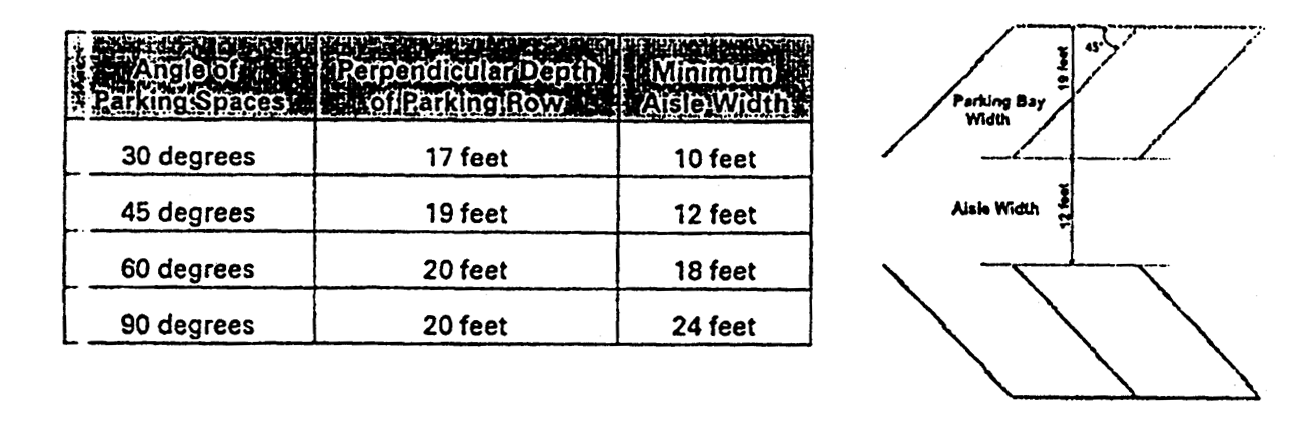
Size of Spaces and Width of Aisles
3.
Landscaped Area Required.
a.
All parking lots containing less than 5 spaces shall not be required to provide landscaping except as provided for in Secs. 703A and 705D.
b.
All parking lots containing 5 to 24 spaces shall be required to provide landscaping. A minimum 4 foot wide landscaped perimeter strip around the parking area shall be provided when adjacent to a street. A continuous bay of parking shall be no longer than 12 spaces without a separation by a landscaped island at least 10 feet in width.
c.
All parking lots containing 25 to 47 spaces shall provide landscaping as follows:
(i)
An area equal to 10 per cent of the area of the parking lot, which may include the required 4 foot wide landscape perimeter strip around the parking area when adjacent to a street.
d.
All parking lots containing 48 or more spaces shall provide landscaping as follows.
(i)
A minimum of 10 per cent of the interior portion of the parking area shall be landscaped. This landscaping shall be in the form of planted medians and islands. Perimeter plantings shall not count toward this requirement.
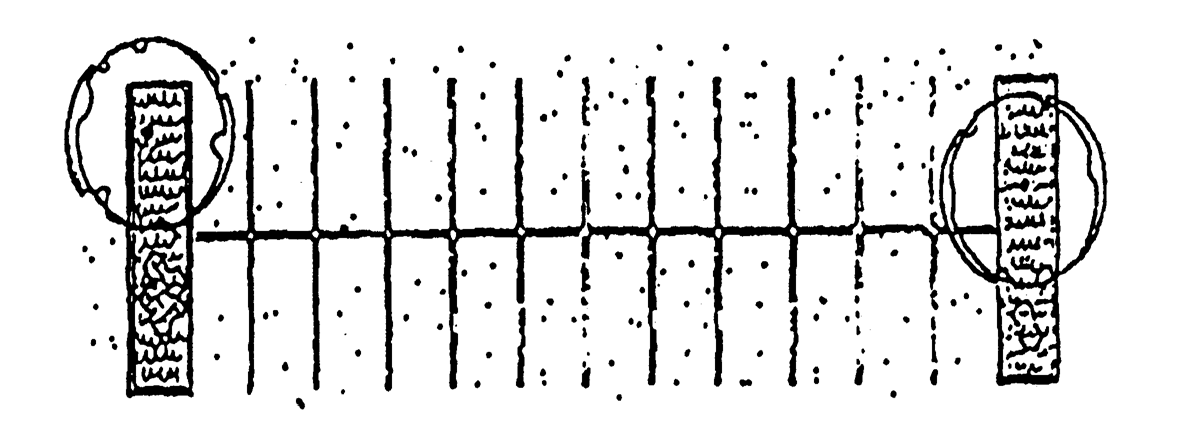
Landscaped Area Required
(ii)
A continuous bay of parking spaces shall be no longer than 12 spaces without separation by a landscaped island or median. An island at the end of a row or abutting a drive aisle shall be at least 12 feet in width.
(iii)
A minimum of one tree shall be planted in each parking lot island. Selection of trees shall take into account the need for clear sight triangles in the parking area.
(iv)
A median between rows of cars is optional, but may be required in order to meet the minimum landscape requirement. If such a median is provided, it shall be at least 8 feet in width.
(v)
Storage and display parking areas of a vehicle sales lot shall have a perimeter landscape area as noted in c.(i) above, but shall be exempted from the interior landscaping noted in (ii) above. This exemption shall not apply to required on-site parking.
4.
Handicapped Spaces. Off-street handicapped parking spaces shall be included within the total spaces otherwise required and be provided according to the following table. All handicapped parking spaces shall meet the standards of Federal ADA requirements and shall be marked by a standard handicapped parking sign displayed between 4 and 6 feet above the pavement and with a standard handicapped symbol on the pavement. All handicapped signs and markings shall be maintained in good condition. Handicapped ramps shall be provided where needed and shall comply with ANSI 117A standards.
5.
Markings. All parking and loading spaces shall be marked and maintained in accordance with the approved parking plan. Directional markings shall also be provided and maintained as needed.
6.
Fire Lanes. Fire lanes as may be needed shall be provided and marked in red as "Fire Lane—No Parking" for emergency vehicle access in accordance with Sec. 707.
7.
Lighting. Whenever lighting is provided, the lighting facilities shall be arranged so that illumination is directed downward and away from residential properties and will not interfere with traffic.
8.
Drainage. All parking areas shall be properly graded to provide for adequate storm drainage and onsite detention of stormwater as required by the City Engineer.
9.
Bumpers, Curbs or Wheel Stops. A permanent curb, bumper, wheel stop or similar device shall be installed in such a manner that parked vehicles do not encroach or overhang any street, alley, driveway, public sidewalk, or off-site landscaping, or adjacent properties.
10.
Curbcuts and Driveways. All curbcuts and driveways shall conform with the standards in Sec. 706 of this Code.
11.
Traffic Flow. All parking areas shall be designed to minimize traffic hazards, congestion and conflicts between pedestrians and vehicles.
12.
Paving Exemptions.
a.
Storage of mobile homes, manufactured homes, farm implements, equipment, containers or other similar products in the CC, IL and IH zones as an accessory use to their sales, service, or rental, shall not be required to pave that portion of the lot devoted to storage. Instead, such storage area shall be surfaced with a sealed, dust-free surface approved by the City Engineer.
b.
This exemption shall not apply to automobile sales and service uses, nor other uses where the vehicles are moved regularly.
c.
All parking lots in the (AG) and (RR) Districts shall be exempt from the requirement for concrete, asphalt or double bituminous asphalt paving, but shall have a paved approach extending from the street pavement to a point at least 10 feet inside the property. Instead, such parking lots, driveways, aisles and loading areas shall be surfaced with a sealed, dust-free surface approved by the City Engineer.
13.
Backing into Traffic. All required parking spaces, with the exception of spaces for 1 and 2 family dwellings, shall be so arranged as not to require the moving of any vehicle on the premises in order to enter or leave any other stall, or to require the backing of any vehicle across any sidewalk or onto any street when existing the stall.
K.
Vehicle, Boat, Trailer or Equipment Sales or Rental. All parking areas for sales or rental of new or used cars, trucks, trailers, boats, vans, heavy equipment and other vehicles shall be paved and enclosed by an iron pipe or similar fence at least 2 feet in height along all exterior property lines abutting public rights-of-way. In no case shall vehicles, trailers or equipment be parked in the public right-of-way.
(Ord. No. 2677, 3-19-01; Ord. No. 2723, 8-19-02; Ord. No. 2757, 12-15-03; Ord. No. 2782, 4-4-05)
Sec. 709 - Oil and Gas Wells
A.
Well Structure Location. The drilling of oil wells and placing of well structures may be permitted in the districts listed in Section 501, except where such well or well structure or pipeline connecting thereto would create hazardous conditions on the adjacent and abutting properties.
B.
Equipment on Site. All equipment except that required for production shall be removed from the premises.
C.
Storage Tanks. In the event production is obtained, and the oil storage tank battery is located within the city limits, the same shall be erected within the confines of a concrete or earthen retention wall designed in such a manner that the area inside the retention wall would retain the total volume of the tanks located therein, and the same shall be completely enclosed by a suitable all-metal wire fence of a sufficiently strong and close-mesh construction that it will not be penetrable by domestic animals or small children. In no event shall such tank battery be located nearer than 100 feet from any residence dwelling, or nearer than 100 feet from any combustible structure, provided that exception may be granted by the city manager or his authorized representative after approval by all property owners within 100 feet.
D.
Power for Pumping Unit. No pumping unit used for the purpose of lifting oil shall be powered with any power other than electricity.
E.
Well Jacks. Any well jacks or units operating within the corporate limits of the City of Ardmore shall be kept clean, painted, in good repair, and properly lubricated in order that they will operate quietly, and they shall be enclosed by an all metal fence of a height of not less than 8 feet topped by three-strand barb arms, and of a type suitable to prevent trespassing on the part of anyone unauthorized, particularly children.
F.
Underground Lines Required. All flow lines and/or water and/or oil or gas lines shall be buried at least one foot under the ground within such corporate limits, provided that exception may be granted by the city manager or his authorized representative.
G.
Easements to Follow Easements. Pipelines shall follow described easements in locations that facilitate the development of other land.
H.
Sanitation Facilities. All sanitation facilities will be approved by the office of the city engineer.
I.
Waste Oil. Any waste oil or waters in, on, or around any premises within the corporate limits of Ardmore, Oklahoma shall be immediately cleaned up and the ground shall be cleaned of any oil-bearing dirt.
J.
Salt Water Injection. Any salt water produced by an oil well within the City of Ardmore shall be injected into the earth in a sand not less than 300 feet below the surface of the ground, or below a depth which will protect all known fresh water sands, in the event such salt water production should exceed an amount which can be satisfactorily disposed of from the leasehold premises by hauling away in tanks, pits, or enclosures suitably designed to prevent salt water seepage into the adjacent property or salt water encroachment on any known fresh water sands. Salt water disposal shall be handled in such a manner that it will constitute neither a public nor a private nuisance, and the premises shall be enclosed by an all-metal fence of a height of not less than 8 feet topped by three-strand barb arms, and of a type suitable to prevent trespassing on the part of anyone unauthorized, particularly children.
K.
Routing of Trucks. The routing of all trucks to and from the drilling site will be approved by the office of the city engineer, and all damage to public streets and public property through negligence or failing to comply with this section will be the liability of the contractor.
L.
High Degree of Care Required. In the event that any permit is granted to drill or explore for oil or gas within the City of Ardmore, the drilling contractor and/or operator shall proceed with the drilling operations with the highest degree of care and prudence so as not to injure adjoining property or persons in any manner, and shall keep the premises suitably fenced or guarded 24 hours a day in such a manner as to avoid trespassing on the part of anyone during the drilling and exploratory operations, particularly children, and upon the completion of such drilling operations, all drilling mud shall be removed outside the corporate limits of Ardmore, and the grounds around the well and the slush pits shall be immediately cleared of all drilling mud and/or all oil or salt water or water and shall be made to conform in appearance to the lands in the neighborhood wherein such drilling operations are so conducted.
M.
Abandonment or Completion of Drilling.
1.
Derrick structures shall be removed upon completion of drilling operations.
2.
Upon abandonment of the well, all lines, pits and tanks shall be removed and the land left in as near natural state as is feasible.
(Ord. No. 2839, 12-4-06)
Sec. 710 - Signs
A.
General Intent and Purpose. It is the intent and purpose of this section to establish effective sign regulations that recognize the public as well as private interest and investment in the environment of our city; to promote economic and business development; to protect property values; to reduce distractions and obstructions that may contribute to traffic accidents; to regulate the number, size and location of signs; to prohibit unsafe signs; to cause removal of abandoned signs; and to promote and protect the health, safety, welfare, conveniences and enjoyment of the City for its residents and visitors. On-site signs help to "index" our business areas for safe and easy access amid the traffic flows.
An integrated sign system design shall be required for all nonresidential development. These systems shall be reviewed by the Planning Director for materials, colors, shapes, sizes, compatibility with architecture and unity of design for all development. New individual signs and changes to existing individual signs shall be reviewed for conformance with such sign systems. Signs in the Downtown Historic District are subject to approval by the Historic Preservation Board.
B.
Exempt Signs. The following signs are exempt from the provisions of Sec. 310 of this ordinance provided they do not pose a safety or health hazard and are not in the public right-of-way:
1.
Signs in the nature of cornerstones, commemorative tablets and historical signs which are attached to the building or carved into the building.
2.
Non-illuminated identification signs with noncommercial messages which indicate addresses, building entrances and exits, traffic and pedestrian directional signs and other similar signs for the convenience of the public, provided such signs do not exceed 4 square feet.
3.
Temporary signs, as follows:
a.
Non-illuminated real estate and construction signs pertaining to the site on which they are placed provided such signs do not exceed 32 square feet and are placed out of any public right-of-way.
b.
Non-illuminated political signs provided such signs do not exceed 32 square feet and provided such signs are removed within 5 days after the election for which they were intended, and provided such political signs are not located within and clear sight triangle, and provided they are located 6 feet back of the curb or edge of pavement or hard surfaced driving area. The candidate, or owner, of such political sign, prior to erection of said sign(s) shall furnish to the City a $200.00 cash bond to assure compliance with the above regulations.
c.
Civic event signs, other than a commercial sign, posted to advertise a civic event sponsored by a public agency, school, church, civic-fraternal organization, or similar non-commercial organization.
1)
Such signs shall require review by the Building Official prior to being installed, in order to assure proper placement and who to contact if necessary.
2)
Such signs shall not be displayed earlier than 10 days prior to the event, and shall be removed (along with any supporting structure) within 5 days of the end of the event.
4.
The flags, pennants or banners of a division of government or civic, religious, educational or philanthropic organizations, including the promotion of an event or special interest.
5.
Permanent signs on vending machines indicating the contents of such devices and permanent signs attached to telephone booths provided such signs do not exceed 12 square feet.
C.
Prohibited Signs. The following signs shall not be permitted, erected or maintained:
1.
Building mounted signs that extend beyond the silhouette of the building except projecting signs noted in Sec. 710.G.
2.
Signs that emit sound.
3.
Signs that are structurally unsafe or pose a safety or health hazard.
4.
Signs that mimic emergency vehicle lights, signs that rotate more than 6 times per minute, swinging signs, and electronic message boards that change copy more than 6 times per minute (excepting time and temperature messages).
5.
Signs that are located wholly or partially within the public right-of-way or any clear sight triangle (see Sec. 706.C).
6.
Any on-site sign attached to an off-site sign installation or any off-site sign attached to an on-site sign installation.
D.
Portable Signs. No new portable signs shall be permitted within the City limits. Existing portable signs shall be governed by the nonconforming provisions of Sec. 907. Chassis mounted signs pertaining to a non-profit community event are permitted on private non-residential property for a period of not more than 30 days prior to the event, and 3 days after the event. Chassis mounted signs pertaining to a for-profit event or business shall be considered as an off-site sign when the vehicle is parked on a site that does not pertain to the event or business.
E.
Temporary Signs. Temporary signs, other than those described in 710.B.3, shall require review for a sign permit subject to the following provisions.
1.
Non-illuminated on-site special event, special sale, special advertising or display signs which individually do not exceed 32 square feet in area. Additionally, the total area of such signs for any one business location shall not exceed 50 square feet. Such signs shall not be in a public right-of-way or clear-vision triangle as defined in Section 703.
2.
A permit for erecting temporary sign(s) must be obtained from the Building Official, and shall depict clearly the location(s) for such signs. A cash bond in the amount of $200.00 shall be furnished at the time of application.
3.
Such permit shall be valid for a period not to exceed 60 consecutive days. Successive permits shall not be issued sooner than 60 days from an initial permit's expiration date at the same business location. If an applicant fails to remove the signs, the cash bond shall be forfeited and the City is authorized to remove and dispose of the signs.
4.
The sign(s) shall not be displayed earlier than 10 days prior to the stated event, and shall be removed (along with any supporting structure) within 5 days after the event.
F.
Freestanding Signs. A freestanding sign shall not be attached to a building or other structure. A freestanding sign may be an on-premises or off-premises structure. An on-premises sign is one that pertains to an activity or product that is conducted or sold on the same site. No on-premises sign shall be attached to an off-premises sign, or vice-versa.
1.
Square Footage Allowed.
a.
Signs in Residential Districts.
(i)
Single Family Districts: A maximum of 2 square feet displaying the occupant's name and/or address.
(ii)
Multi-Family Districts: A maximum of 32 square feet displaying the address and name of the development.
b.
Signs in Non-Residential Districts.
(i)
The (O) Office District: One square foot per lineal foot of lot frontage up to 50 square feet. A conditional use permit is required to exceed this amount.
(ii)
The (CN) Neighborhood Commercial District and (PFI) Public Facilities and Institutions District: One square foot per lineal foot of lot frontage up to 100 square feet. A conditional use permit is required to exceed this amount.
(iii)
The (CC), (CD), (IL) (IH) and (AG) Districts: One square foot per lineal foot of lot frontage up to 600 square feet per sign installation, and 800 square feet for all sign installations. In the I-35 Overlay District, the maximum is 900 square feet per lot.
2.
Number of Freestanding Signs. For nonresidential properties, the number of permitted freestanding signs allowed shall be based on the following table:
The following signs shall be exempt from the provision relating to number of signs:
a.
Directional or warning.
b.
Real estate, construction and political signs of a temporary nature.
c.
Menu signs associated with drive-in restaurant windows.
3.
Maximum Sign Height. Freestanding signs shall not exceed the maximum height requirements below:
Monument signs, as defined in Sec. 1104, shall not be taller than 4 feet when located within 12 feet from a street yard lot line.
4.
Interstate Sign Overlay District Boundaries. The following overlay district applies only to regulations for freestanding signs in this subsection and is defined as follows:
a.
All property located within 700 feet of the center line of the interstate highway in office, commercial, and industrial districts, and
b.
All office, commercial and industrial properties within the following distances of the centerline of the following four roadways intersecting I-35:
(i)
Along U.S. Highway 70 East, a distance 1,500 feet east and west of I-35;
(ii)
Along West Broadway (U.S. 70 West), a distance 2,500 feet east and west of I-35;
(iii)
Along NW 12th Avenue, a distance of 2,000 feet east and west of I-35; and
(iv)
Along U.S. Highway 142, a distance 2,000 feet east and west of I-35.
5.
Off-Premises Signs and Billboards. Off-premises signs shall only be permitted within the I-35 Overlay District and adjacent to state and federal highways except as provided for in subsection c., below.
a.
All off-premises signs within the I-35 Overlay District shall conform with the rules and regulations established by the State of Oklahoma for outdoor advertising signs except that the distance between off-premises (billboard) signs along either side of I-35 shall not be less than 1,500 feet.
b.
All off-premises signs located adjacent to state and federal highways, other than I-35, shall conform with the following provisions:
(i)
The property on which an off-premises sign is located must be in a (CC/CN) Commercial or (IH/IL) Industrial District or the (AG) Agricultural District. No such sign shall be permitted in the (O) District except as provided for in Section 710.F.5.c. In keeping with the expressed intent of the (CN) Neighborhood Commercial District, no such sign shall exceed 72 square feet in area per sign structure which shall be located a minimum of 25 feet from an adjacent residentially zoned lot.
(ii)
The area of any given sign face shall not exceed 300 square feet, and no more than two parallel signs per sign structure.
(iii)
An off-premises sign shall not be located within 1,000 feet radius of another off-premises sign.
(iv)
All portions of the sign shall be located a minimum of 10 feet from all property lines, except when adjoining a residential district, where the setback from the property line shall be 25 feet.
(v)
No sign shall be located within the clear sight triangle or required landscape island in a parking lot.
(vi)
Off-premises signs shall be prohibited in the Downtown Historic District, and within 500 feet of that district boundary.
c.
Off-premises signs located adjacent to streets other than state and federal highways shall conform to the following provisions:
(i)
The message on the sign provides only directions to a location within the City for government, civic, religious, educational, philanthropic, public utilities and other similar service organizations.
(ii)
The property on which the sign is located must be in an (O) Office, (CN) Neighborhood Commercial, (CC) Commercial Corridor, (IL) Light Industrial, (IH) Heavy Industrial, or (AG) Agricultural District.
(iii)
The total area of such signage shall not exceed 12 square feet per lot.
(iv)
All portions of the sign shall be located a minimum of 5 feet from all property lines, except when adjoining a residential district, where the setback from the property line shall be 25 feet.
(v)
The maximum height of the sign shall be 10 feet.
(vi)
The sign shall not be located within a clear vision triangle.
(vii)
A sign shall not be located within 1,000 feet of another off-premises sign which advertises or provides directions for the same business or organization.
(viii)
Off-premises portable signs shall not be permitted.
6.
Additional Provisions.
a.
An on-premises sign structure may support more than one on-premises sign.
b.
The sign shall not be located within a clear vision triangle.
c.
Nonresidential double frontage lots may count both street frontages.
d.
For corner lots, only the street adjacent to the front yard shall be used to calculate the allowable sign area.
e.
Signs for a home occupation must conform to Section 503.
f.
A percentage bonus or penalty to the total square footage of sign area allowed shall be applied based on the total number of freestanding signs, as shown below. The use of bonus sign area shall not permit any sign to exceed the maximum square footage per site or per sign listed above.
;adv=1pi;G.
Building Mounted Signage. The total area of wall signs and projecting signage shall not exceed ten per cent of the area of the primary facade of the building to be allocated to one or more building facades. The maximum area of any one sign shall be 400 square feet. The primary building facade is the one to which the street address is assigned.
1.
When no freestanding on-site signs are utilized, an additional amount of signage for wall or projecting signs may be utilized as listed below. A site with a freestanding sign shall not be eligible for a projecting or hanging sign.
• Multifamily District: 1 square foot per 2 lineal feet of frontage up to a maximum of 32 square feet.
• Non-Residential District: 1 square foot per lineal foot of frontage up to a maximum of 100 square feet.
a.
Only 1 projecting sign or hanging sign shall be permitted per site, except when the building is a minimum of 25 feet from the lot line.
b.
Projecting signs may be no closer than 2 feet to a property line except that in the Central Business District such signs may project to within three feet of a street curb.
c.
The bottom of projecting signs or hanging signs shall be a minimum of 8 feet above any pedestrian walkway.
d.
Nonresidential double frontage lots may count both street frontages.
e.
For corner lots, only the street adjacent to the front yard shall be used to calculate the allowable sign area.
2.
Wall Signs.
a.
Wall signs shall not extend above the roofline, parapet wall, or silhouette of the building to which it is attached, or exceed 35 feet in height, whichever is less.
b.
A sign erected upon or against the side of a roof or the vertical face of a canopy having an angle of 30 degrees or less from the vertical shall be considered to be a wall sign.
c.
No more than 2 signs may be placed on any one facade of any one building except that multi-tenant buildings shall be permitted 2 signs per tenant space provided only one such tenant sign per tenant facade is visible from any street right-of-way.
d.
Wall signs must be contained within any single wall panel, window, door or other architectural component upon which they are placed.
e.
See Section G above for allowable sign area; building mounted signage.
H.
Lighting of Signs. Whenever external lighting is provided, the lighting facilities shall be arranged so that illumination is directed away from residential properties and will not interfere with traffic.
I.
Utilities and Drainage. Signs and their support structures shall not interfere with surface or underground utilities and related facilities, and they shall not interfere with natural or artificial drainage.
J.
Sign Contractors.
1.
All persons engaged in the erection, installation, construction, alteration or relocation of any sign requiring a permit under this section shall obtain an annual sign contractor license from the City or be a regular employee of a licensed contractor.
2.
Before obtaining a sign contractor license, a contractor must provide evidence of a current public liability insurance policy in an amount acceptable to the City.
K.
Maintenance. All signs shall be maintained in a safe, presentable and good structural condition at all times. The building official or his/her authorized representative shall inspect and shall have the authority to order the painting, repair, alteration or removal of a sign which shall constitute a hazard to safety, health or public welfare by reason of inadequate maintenance, dilapidation or obsolescence.
L.
Abandoned Signs.
1.
An abandoned sign is one that meets any of the following criteria:
a.
A sign that identifies an establishment, goods or services that are no longer provided on the premises where the sign is located.
b.
A sign that identifies a time, event or purpose that has passed or no longer applies.
c.
A changeable message sign on which the message is undecipherable due to missing letters.
d.
A changeable message sign on which the message does not change at least once every 30 days.
2.
Any sign that meets the criteria above for an abandoned sign, and where the condition of abandonment exists for a period of 180 days, and where the affected sign is also nonconforming, shall be removed by the property owner (or by the City as provided for in subsection P. below) within 5 days following the expiration of the 180-day period.
3.
Any sign that meets the criteria above for an abandoned sign and where the affected sign conforms with the regulations of this UDC, shall have its copy vacated within 30 days from when the stated circumstances commenced. If the copy remains vacant for a period of 180 days or more from the date when the stated circumstances commenced, the sign structure shall be removed by the property owner (or by the City as provided for in subsection P. below) within 5 days following the expiration of the 180-day period.
4.
All signs within designated Historic Districts shall be reviewed by the Historic Preservation Board prior to being designated as abandoned signs. Signs within the CD Districts outside of any designated Historic Districts shall be reviewed in this same regard by the Planning Director.
5.
Building mounted and painted wall signs, when removed, shall conform to surrounding building conditions. Such removal shall not result in a visual detriment.
M.
Removal of Signs.
1.
The City may cause the removal of any sign erected or maintained in violation of this ordinance except for legal nonconforming signs.
2.
At least 15 days notice shall be given to the owner of such a sign and/or of the building, structure or premises on which the sign is located to remove the sign or bring it into compliance with this UDC. The notice shall be in writing and sent by certified mail with return receipt requested.
3.
The owner of the sign or property may request a public hearing by the City Commission to determine if the sign is in violation of this UDC and should be removed.
4.
The cost of removing the sign shall be the full responsibility of the owner of the property on which the sign is located.
5.
If the City causes the sign to be removed, a statement of the actual cost of removal and request for payment shall be mailed to the property owner. If payment is not received within 30 days, the costs shall be levied as a lien against the property with the Carter County Clerk.
N.
Signs for Nonconforming Uses. A nonconforming use may have an on-site subject to the zoning district limitations, except that no new/additional freestanding sign shall be installed.
(Ord. No. 2634, 12-20-99; Ord. No. 2639, § I, 3-6-00; Ord. No. 2723, 8-19-02; Ord. No. 2757, 12-15-03; Ord. No. 2782, 4-4-05; Ord. No. 2816, 5-15-06; Ord. No. 2839, 12-4-06)
Sec. 711 - Fences and Walls
Fences, walls and hedges are allowed on private property within the City according to the following provisions and obtaining a permit from the Department of Development Services.
A.
Residential.
1.
On all interior lots, a fence not to exceed 6 feet in height may be erected along all side and rear property lines but not in a front yard setback area. A fence may be constructed to 8 feet in height provided:
a.
A consent petition signed by 100 per cent of all owners of property abutting said lot, excluding streets and alleys, is submitted to the Building Official; or
b.
The fence is a required condition of approval of the associated use or development plan.
c.
A side yard fence taller than 3 feet shall transition in height within the required front yard setback to a height of 3 feet at a point 4 feet from the front lot line.
d.
Owners of property abutting I-35 may apply to the Building Inspector to install a fence/wall taller than 8 feet based on the ground level within a 25 foot radius of the proposed fence location.
2.
In front yard setback areas, no fence shall exceed 3 feet in height. Fences that do not obstruct view (e.g. chain link fence) may be erected to a height of 4 feet in a front yard or exterior side yard.
3.
Barbed wire, razor wire or embedded glass fences, or other materials which may cause bodily harm, are prohibited in any (RS) or (RM) district unless specific approval is granted by the City Commission following a public hearing on the matter.
4.
On rear property lines, a chain link fence may be erected to a height of 12 feet for the purpose of enclosing a tennis court or other court game.
5.
Where a fence is located along an interior property line separating two lots and there is a difference in grade of the two properties, the fence may be erected or allowed to the maximum height permitted on either side of the property line.
6.
For safety purposes, all outdoor swimming pools, spas or other similar pools shall be enclosed by a fence not less than 4 feet in height or shall be within a yard surrounded by a fence not less than 4 feet in height.
7.
For safety purposes stormwater retention ponds may be required to have fencing approved by the City Engineer as part of the conditions of an approved use, site plan or building permit.
B.
Commercial and Industrial.
1.
On interior and rear lot lines a fence not to exceed 8 feet in height may be erected.
2.
Adjacent to a residentially zoned district, the Residential Protection Standards (Sec. 703) must be observed. Fencing in the front and street-side yards must comply with clear-vision triangle requirements at driveways and street intersections.
3.
Barbed wire, razor wire, and similar products may be utilized at a height not less than 6 feet above ground level.
4.
For safety purposes, stormwater retention ponds may be required to have fencing approved by the City Engineer.
(Ord. No. 2723, 8-19-02; Ord. No. 2757, 12-15-03; Ord. No. 2897, § 3), 4-5-10)
Sec. 712 - Flood Damage Prevention Standards
In all areas of special flood hazards, the following standards are required:
A.
Anchoring.
1.
All new construction and substantial improvements shall be anchored to prevent flotation, collapse or lateral movement of the structure.
2.
All mobile homes shall be anchored to resist flotation, collapse or lateral movement by providing over-the-top and frame ties to ground anchors. Special requirements shall be that:
a.
Over-the-top ties be provided at each of the four corners of the mobile home, with two additional ties per side at intermediate locations, with mobile homes less than 50 feet long requiring one additional tie per side;
b.
Frame ties be provided at each comer of the home with five additional ties per side at intermediate points with mobile homes less than 50 feet long requiring four 4 additional ties;
c.
All components of the anchoring system be capable of carrying a force of 4,800 pounds; and
d.
Any additions to the mobile home shall be similarly anchored.
B.
Construction Materials and Methods.
1.
All new construction and substantial improvements shall be constructed with materials and utility equipment resistant to flood damage.
2.
All new construction and substantial improvements shall be constructed using methods and practices that minimize flood damage.
C.
Utilities.
1.
All new and replacement water supply systems shall be designed to minimize or eliminate infiltration of flood waters into the system;
2.
New and replacement sanitary sewage systems shall be designed to minimize or eliminate infiltration of flood waters into the systems and discharge from the systems into flood waters; and
3.
On-site waste disposal systems shall be located to avoid impairment to them or contamination from them during flooding.
D.
Subdivision Proposals.
1.
All subdivision proposals shall be consistent with the need to minimize flood damage;
2.
All subdivision proposals shall have public utilities and facilities such as sewer, gas, electrical and water systems located and constructed to minimize flood damage;
3.
All subdivision proposals shall have adequate drainage provided to reduce exposure to flood damage; and
4.
Base flood elevation data shall be provided for subdivision proposals and other proposed developments which contain at least 50 lots or 5 acres (whichever is less).
E.
Specific Standards. In all areas of special flood hazards where base flood elevation data have been provided, the following standards are required:
1.
Residential construction. New construction and substantial improvement of any residential structure shall have the lowest floor (including basement) elevated 1 or more feet above the base flood elevation. A registered professional engineer, architect or land surveyor shall submit a certification to the administrator that the standard of this subsection is satisfied.
2.
Nonresidential construction. New construction and substantial improvement of any commercial, industrial or other nonresidential structure shall either have the lowest floor, including basement, elevated to 1 foot above the level of the base flood elevation; or, together with attendant utility and sanitary facilities, shall:
a.
Be floodproofed so that below the base flood level the structure is watertight with walls substantially impermeable to the passage of water;
b.
Have structural components capable of resisting hydrostatic and hydrodynamic loads and effects of buoyancy; and
c.
Be certified by a registered professional engineer or architect that the standards of this subsection are satisfied.
F.
Mobile Homes.
1.
Mobile homes shall be anchored in accordance with 712-A.
2.
For new mobile home parks and mobile home subdivisions; for expansions to existing mobile home parks and mobile home subdivisions; for existing mobile home parks and mobile home subdivisions where the repair, reconstruction or improvement of the streets, utilities and pads equals or exceeds 50 per cent of value of the streets, utilities and pads before the repair, reconstruction or improvement has commenced, and for mobile homes not placed in a mobile home park or mobile home subdivision, require that:
a.
Stands or lots are elevated on compacted fill or on pilings so that the lowest floor of the mobile home will be at or above the base flood level;
b.
Adequate surface drainage and access for a hauler are provided; and
c.
In the instance of elevation on pilings, that:
(i)
Lots are large enough to permit steps;
(ii)
Piling foundations are placed in stabled soil no more than 10 feet part; and
(iii)
Reinforcement is provided for pilings more than 6 feet above the ground level.
d.
No mobile home shall be placed in a floodway, except in an existing mobile home park or an existing mobile home subdivision.
G.
Floodways. Located within areas of special flood hazard are areas designated as floodways. Since the floodway is an extremely hazardous area due to the velocity of floodwaters which carry debris, potential projectiles, and erosion potential, the following provisions apply:
1.
Encroachments, including fill, new construction, substantial improvements and other development are prohibited unless a technical evaluation demonstrates that encroachments shall not result in any increase in flood levels during the occurrence of the base flood discharge.
2.
If subsection 1. above is satisfied, all new construction and substantial improvements shall comply with all applicable flood hazard reduction provisions of this section.
3.
The placement of any mobile homes, except in an existing mobile home park or existing mobile home subdivision shall be prohibited.
(Ord. No. 2723, 8-19-02)
Sec. 713 - Number of Principal Uses and Structures
A.
Single Family or Two-Family Lots. A single family or two-family lot may not be occupied by more than 1 principal use. Accessory uses and living quarters may be permitted in accordance with this UDC.
B.
Multifamily and Nonresidential Lots.
1.
A single lot may be occupied by more than 1 principal multifamily residential structure and its associated accessory structures as a building group development or Planned Unit Development.
2.
A single lot may be occupied by more than 1 principal residential use or more than one principal nonresidential structure and any associated accessory structures as a building group development, or a Planned Unit Development.
3.
In all cases, structures must be separated by a minimum distance of 30 feet and must comply with all applicable standards of this UDC.
(Ord. No. 2723, 8-19-02; Ord. No. 2757, 12-15-03)
Sec. 714 - Handicapped Accessibility Standards
A.
Standards. All development meeting the criteria outlined in subsection B below shall meet the Americans with Disabilities Act (ADA) standards.
B.
Applicability. These standards apply to all new and/or renovated municipal buildings and facilities used by the public. They apply to temporary or emergency conditions as well as permanent conditions. The standards do not apply to private residences.
C.
Application for Building Permit. A statement containing a schedule of the type, quantity and location of all special facilities as required under this section shall be submitted with the application for a building permit for any building or facility to be used by the public.
D.
Exceptions. In cases of practical difficulty, unnecessary hardship or extreme difference, the Building Official may grant exceptions from the literal requirements of this standards or permit the use of other methods or materials, but only when it is clearly evident that equivalent facilitation and protection are thereby secure.
(Ord. No. 2723, 8-19-02)

