
Arkadelphia City Zoning Code
CHAPTER 14
04 - LAND USE ORDINANCE
14.04.01 - Definitions.
Certain words and phrases shall for the purpose of this chapter have the following meaning:
Accessory structure. A subordinate building or a portion of the main building located on the same lot as the main building, the use of which is incidental to that of the dominant use of the building or premises.
Accessory use. A use customarily incidental, appropriate, and subordinate to the principal use of land or buildings and located upon the same lot therewith.
Advertising sign or structure. Any cloth, card, paper, metal, glass, wooden, plastic, plaster, stone sign or other sign, device, or structure of any character whatsoever, including a statuary, placed for outdoor advertising purposes on the ground or on any tree, wall, bush, rock, post, fence, building, or structure. The term "place" shall include erecting, constructing, posting, painting, printing, tacking, mailing, gluing, sticking, carving, or otherwise fastening, affixing, or making visible in any manner whatsoever. The area of an advertising structure shall be determined as the area of the largest cross section of the structure. Neither directional, warning, nor other signs posted by public officials in the course of their public duties nor merchandise or materials being offered for sale shall be construed as advertising signs for the purpose of this chapter.
Alley. A minor right-of-way, dedicated to public use, which affords a secondary means of vehicular access to the back or the side of properties otherwise abutting a street, and which may be used for public utility purposes.
Apartment house. See "multiple family dwelling".
Area. The amount of land surface in a lot or parcel of land.
Billboard. An outdoor advertising device as defined by the Highway Beautification Act of 1965 as may be amended and the State of Arkansas regulations.
Boarding house. A dwelling other than a hotel where, for compensation and by pre-arrangement for definite periods, meals or lodging and meals are provided for three (3) or more, but not exceeding twelve (12) persons on a weekly or monthly basis.
Building. Any structure having a roof supported by columns or walls for the housing or enclosure of persons, animals or property of any kind. When any portion thereof is completely separated from every other portion thereof by a division wall without openings, then each such portion shall be deemed to be a separate building.
Building height. The vertical distance from the average line of the highest to lowest point of that portion of the lot covered by the building to the highest point of coping of a flat roof, or the deck line of a mansard roof, or to the average height of the highest gable of a pitch or hip roof.
Child care center. Any place, home or institution which receives three (3) or more children under the age of sixteen (16) years, and not of common parentage, for care apart from their natural parents, legal guardians, or custodians, when received for regular periods of time for compensation, provided, however, this definition shall not include public and private schools organized, operated, or approved under the laws of this State, custody of children fixed by a court of competent jurisdiction, children related by blood or marriage within the third degree to the custodial parent person, or to churches or other religious or public institutions caring for children within the institutional building while their parents or legal guardians are attending services or meetings or classes or other church activities.
Coverage. The lot area covered by all buildings located thereon, including the area covered by all overhanging roofs.
Dwelling.
A.
Any building or portion thereof, which is designed or used as living quarters for one (1) or more families, but not a manufactured home. See "manufactured home".
B.
Any building that contains one (1) or two (2) dwelling units used, intended, or designed to be built, used, rented, leased, let or hired out to be occupied, or that are occupied for living purposes.
Dwelling, multiple-family. A detached dwelling designed to be occupied by three (3) or more families living independently of each other, exclusive of hotels or motels.
Dwelling, single-family. A detached dwelling designed to be occupied by one (1) family.
Dwelling, two-family. A detached dwelling designed to be occupied by two (2) families living independently of each other.
Dwelling unit. A single unit providing complete independent living facilities for one (1) or more persons, including permanent provisions for living, sleeping, eating, cooking and sanitation.
Family. One (1) or more persons related by blood or marriage or adoption or a group of not to exceed five (5) persons not all related by blood or marriage, occupying a boarding or lodging house, hotel, club, or a similar dwelling for group use.
Garage apartment. A dwelling unit for one (1) family erected above a private garage.
Gasoline service or filling station. Any area of land, including structures thereon, that is used for the retail sales of gasoline or oil fuel, or other automobile accessories, and incidental services including facilities for lubricating, hand washing and cleaning, or otherwise servicing automobiles, but not including painting, major repair or automobile washing or the sale of butane or propane fuels.
Guest house or servant's quarters. Any apartment or other separate building used for family members, non-permanent visitors, or servants for which no rent is charged.
Home occupation. Any occupation carried on solely by the inhabitants of a dwelling which is clearly incidental and secondary to the use of the dwelling for dwelling purposes, which does not change the character thereof, which is conducted entirely within the main or accessory buildings, provided that no trading in merchandise is carried on and in connection with which there is no display of merchandise or advertising signs other than one (1) non-illuminated name plate not more than four (4) square feet in area attached to the main or accessory building. Beauty and barber shops are specifically excluded as home occupation.
Hotel. A building or group of buildings under one (1) ownership containing six (6) or more sleeping rooms occupied or intended or designed to be occupied as the more or less temporary abiding place of persons who are lodged with or without meals for compensation, but not including trailer court or camp, sanatorium, hospital, asylum, orphanage or buildings where persons are housed under restraint.
Kennel. Any lot or premises on which are kept three (3) or more dogs, more than six (6) months.
Lot. Any parcel of land occupied or intended to be occupied by one (1) main building, or a group of main buildings, and accessory buildings and uses, including such open spaces as are required by this chapter and other laws or ordinances, and having its principal frontage on a street.
Manufactured home.
A.
A dwelling unit constructed in a factory in accordance with the Federal standards and meeting the definitions set forth in the Federal standards and under A.C.A. § 20-25-102.
B.
A structure, transportable in one (1) or more sections, which in the traveling mode is eight (8) body feet or more in width or forty (40) body feet or more in length, or when erected on site, is three hundred twenty (320) square feet or more and which is built on a permanent chassis and designed to be used as a dwelling with or without a permanent foundation when connected to the required utilities, and includes the plumbing, heating, air conditioned and electrical systems contained therein; except that such term shall include any structure that meets all the requirements of this paragraph except the size requirements and with respect to which the manufacturer voluntarily files a certification required by the Secretary (HUD) and complies with the standards established under this title. For mobile homes built prior to June 15, 1976, a label certifying compliance to the Standard for Mobile Homes, NFPA 501, in effect at the time of manufacture is required. For the purpose of these provisions, a mobile home shall be considered a manufactured home.
Medical facility.
A.
Convalescent, rest, or nursing home. A health facility where persons are housed and furnished with meals and continuing nursing care for compensation.
B.
Dental clinic or medical clinic. A facility for the examination and treatment of ill and afflicted human out-patients, provided that patients are not kept overnight except under emergency conditions.
C.
Offices for dentists, doctors, oculists, optometrists, osteopaths, and chiropractors. Same as dental or medical clinic.
D.
Hospital. An institution providing health services primarily for human in-patient medical or surgical care for the sick or injured and including related facilities such as laboratories, out-patient department, training facilities, central service facilities, and staff offices which are an integral part of the facility.
E.
Public health center. A facility primarily utilized by a health unit for providing public health services including related facilities such as laboratories, clinics, and administrative offices operating in connection therewith.
F.
Sanatorium. An institution providing health facilities for in-patient medical treatment or treatment and recuperation, making use of natural therapeutic agents.
Mobile food vendor court. A primary land use located on one (1) or more platted lots where two (2) or more spaces are available for mobile food vendor units to congregate to offer food or beverages for sale to the public, functioning as a single business and may provide restrooms, tables, play areas and other outdoor entertainment open to all customers of all vendors.
Mobile home park. A parcel of land which has been designed or improved or is intended to be utilized for occupancy by one (1) or more mobile homes, and which conforms to the provisions of this chapter.
Non-conforming structure. A lawfully constructed building or structure which does not conform to the regulations of the district in which it is located.
Non-conforming use. A structure or land lawfully occupied by a use that does not conform to the regulations of the district in which it is located.
Open space. Any unoccupied space on the lot that is open and unobstructed to the sky and occupied by no structure or portions of structures whatever.
Parking space. An area a minimum of two hundred forty (240) square feet of usable and accessible space which is designated for storage of an automotive vehicle.
Place of public assembly. A meeting place for more than thirty-five (35) persons to which the public or membership groups are assembled regularly or occasionally, including but not limited to schools, churches, theaters, auditoriums, funeral homes, stadiums and similar places of assembly.
Principal use. The chief or main recognized use of a structure or of land.
Property line. The line bounding a lot as defined herein.
Siding. Siding shall be defined as boarding, metal or composition forming the sides of a dwelling.
Sign. Any outdoor device, figure, painting, message, poster, or other structure which is designed or intended to advertise or inform the public of an establishment, goods, or service.
Sign, alteration. Change of height, size and/or location will be defined as an alteration. Updating or repair of signage is not alteration.
Sign, balloon. A type of temporary sign that floats and is designed to resemble a balloon, blimp, dirigible, hot air device or other flying object tethered to the ground.
Sign, billboard. An off-premises sign exceeding thirty-two (32) square feet in area.
Sign, canopy. A sign attached to the underside of a canopy.
Sign, construction. A temporary sign erected on the premises where construction is taking place, during the period of such construction, indicating the names of the architects, engineers, landscape architects, contractors, or similar artisans, and the owners, financial supporters, sponsors, and similar individuals or firms having a role or interest with respect to the structure or project.
Sign, directional. Signs directing or informing of public or quasi-public nature (church, school, library, hospital, tourist attraction, civic or service clubs).
Sign, directory. A sign, usually of ladder construction, listing the tenants or occupants of a building or group of buildings, name of the building or group or buildings, and that may also indicate their respective professions or business activities.
Sign, flashing. Any directly or indirectly illuminated sign that exhibits changing natural or artificial light or color effects by any means whatsoever.
Sign, freestanding. Any non-movable sign not affixed to a building, including pole signs or ground-mounted signs.
Sign, ghost. A sign of historic nature and character painted on the side of a building. These signs generally serve no current purpose with regards to commercial or noncommercial advertising.
Sign, ground-mounted. A freestanding sign, other than a pole sign, in which the entire bottom is in contact with the ground.
Sign, height. The vertical distance from the highest point of the sign or structure to the grade of adjacent street or surface grade beneath the sign, whichever grade is lower.
Sign, home occupation. A sign to identify the business, occupation or profession within a residential structure.
Sign, illuminated. A sign designed to give forth any artificial light or reflect such light from an artificial source.
Sign, ladder. See "sign, directory".
Sign, non-conforming. Any sign which is not permitted within the zone in which it is located or any sign that is defective, damaged, substantially deteriorated or presents a public hazard.
Sign, off-premise. A commercial sign, whether leased or owned by the advertising entity, that directs attention to a business, commodity, service or entertainment conducted, sold, or offered at a location other than the premises on which the sign is located.
Sign, pole. A type of freestanding sign that is mounted on a freestanding pole or other support so that the bottom edge of the sign face is six (6) feet or more above grade.
Sign, political. Temporary sign erected on private property within the City for the purpose of political campaigning regarding a designated election.
Sign, portable. Any sign which is movable, portable, or designed to be portable which is in the shape of an "A" frame, panel, or mounted on wheels or gels of any kind, whether or not permanently affixed to the ground or buildings. Portable signs include movable "reader board" signs which are signs in which the advertising is accomplished by digitally active electrical lettering.
Sign, projecting. A sign that projects from and is supported by a wall of a building and does not extend beyond, into, or over the street right-of-way.
Sign, real estate. Signs advertising a specific property for sale, rent, or lease.
Sign, roof. A sign that is mounted on the roof of a building or that is wholly dependent upon a building for support and that projects above the top edge or roof line of a building with a flat roof, the eave line of a building with a gambrel, gable, or hip roof, or the deck line of a building with a mansard roof.
Sign, special event. Temporary signs describing an event of public interest (fair, trade show, auctions, etc.).
Sign, temporary. A sign not constructed or intended for long-term use, and not permanently attached to the ground, a building, or structure. Temporary signs shall include all signs made of non-durable material, including but not limited to cloth, canvas, paper, cardboard, flexible vinyl, nylon, tarpaulin or like material, coated paper or canvas, or organic material. See also "balloon sign".
Sign, wall. A sign fastened to, or painted on, the wall of a building or structure in such a manner that the wall becomes the supporting structure for, or forms the background surface of, the sign and that does not project more than twelve (12) inches from such building or structure.
Story. That portion of a building, other than a basement, included between the surface of any floor and the surface of the floor next above it, or if there being no floor above it, then the space between the floor and the ceiling next above it.
Story, half. A space under a sloping roof which has a line of intersection of roof decking and wall face not more than three (3) feet above the top floor level, and in which space not more than two-thirds (⅔) of the floor area is finished off for use. A half story containing independent apartments or living quarters shall be counted as a full story.
Street. Any public or private thoroughfare which affords the principal means of access to abutting property.
Street intersection. Any street which joins another street at an angle, whether or not it crosses the other.
Structural alteration. Any change in the supporting members of a building, such as bearing walls or partitions, columns, beams or girders, or any substantial change in the roof or in the exterior walls.
Structure. Anything constructed or erected, the use of which requires location on the ground or which is attached to something having a location on the ground.
Tourist court. An area containing one (1) or more buildings designed or intended to be used as temporary sleeping facilities of one (1) or more transient persons or families and intended primarily for automobile transients.
Trailer court. See "mobile home park".
Trailer home, mobile home, or house trailer. A portable or movable living unit used or designed for human occupancy on a permanent basis.
Walls. Walls shall be defined as follows:
A.
Load-bearing wall. A wall supporting any vertical load in addition to its own weight.
B.
Nonbearing wall. A wall which does not support vertical loads other than its own weight.
Yard. An open space at grade between a building and the adjoining lot line, unoccupied and unobstructed by any portion of a structure from the ground upward, except where otherwise specifically provided in this chapter that the building or structure may be located in a portion of a yard required for main buildings. In measuring a yard for the purpose of determining the width of the side yard, the depth of the front yard, or the depth of the rear yard, the shortest horizontal distance between the lot line and the main building shall be used.
(Ord. No. B-425, ch. I; Ord. No. O-15-02, § 1; Ord. No. O-15-5, § 1; Ord. No. O-18-1, § 1, 6-5-2018; Ord. No. O-18-4, § 2, 8-21-2018)
14.04.02 - Establishment of districts.
Classification of districts. For the purpose of promoting the public health, safety, morals, and general welfare of the community, the City of Arkadelphia, Arkansas, is hereby divided into the following types of districts:
Boundary of districts.
A.
The boundaries of the zoning districts are hereby established as shown on the map entitled Zoning District Map of Arkadelphia, Arkansas, dated December 1972, which is part of this title and which is on file in the office of the City Engineer.
B.
Interpretation of district boundaries.
1.
Where district boundaries are indicated as approximately following the center lines of streets or highways, said center lines shall be construed to be the district boundaries.
2.
Where district boundaries are so indicated that they approximately follow the lot lines, such lot lines shall be construed to be said boundaries.
3.
Boundaries indicated as approximately following city limits shall be construed as following city limits.
4.
Boundaries indicated as following railroad lines shall be construed to be midway between the main tracks.
5.
Boundaries indicated as approximately following alleys shall be construed as following alleys.
6.
When the street or property layout existing on the ground is at variance with that shown on the zoning district map or with other requirements of this title, the Board of Adjustment shall interpret the boundaries.
7.
Where the application of the aforesaid rules leaves a reasonable doubt as to the boundaries between two (2) districts, the regulations of the more restrictive district shall govern the entire parcel in question, unless otherwise determined by the Board of Zoning Adjustment.
(Ord. B-425, arts. 2-1, 2-2)
14.04.03 - Use and area districts.
Residential use district (R-1). This district is intended to include the quiet residential neighborhoods characterized by single-family homes on large lots, plus certain areas where similar residential development is likely to occur.
A.
Permitted uses.
1.
Single-family dwellings, detached.
2.
Public parks and playgrounds and other municipal recreational uses.
3.
Public schools and private schools offering similar educational courses.
4.
A parking lot used to service uses permitted in the district.
5.
General purpose farm, garden or nursery, provided however, that no odor or dust-producing substance or use shall be permitted within one hundred (100) feet of any property line.
6.
Municipal water supply use.
7.
Customary accessory uses and buildings, provided such uses are incidental to the principal use and do not include any activity commonly conducted for gain. Any accessory building shall be located on the same lot with the principal building.
8.
Churches.
B.
Lot area.
1.
One-family dwelling: Minimum six thousand (6,000) square feet.
2.
Churches: Twenty-five thousand (25,000) square feet or two hundred twenty-five (225) square feet times maximum seating capacity, whichever is greater.
C.
Yard requirements. Each lot shall have front, side, and rear yards not less than the depth or widths following:
1.
Front yard depth: Twenty-five (25) feet from property line or fifty (50) feet from center line of existing right-of-way, whichever is greater. Where no additional right-of-way exists, front yard shall be twenty-five (25) feet from property line.
2.
Side yard width: Minimum of seven and one-half (7½) feet from each property line, except that churches shall provide fifty (50) feet from adjacent property lines.
3.
Yard on side street: Same as front yard.
4.
Rear yard depth: Minimum of ten (10) feet from property line, except that churches shall provide fifty (50) feet from the property line when not abutting a street right-of-way. Otherwise, rear yard requirements for churches shall be the same as for the front yard.
5.
Unattached accessory buildings: Shall be required to set back at least seven and one-half (7½) feet from an interior side lot line, and they shall not cover more than thirty (30) percent of the rear lot line, when set back less than ten (10) feet.
6.
All newly constructed buildings must be a minimum of fifteen (15) feet from any existing building.
D.
Width. Minimum width of a lot at the front yard line or building line shall be sixty (60) feet for one-family dwelling.
E.
Height.
1.
Maximum height shall be two and one-half (2½) stories and not to exceed thirty-five (35) feet.
2.
Churches may be built higher than thirty-five (35) feet with the permission of the Planning Commission.
F.
Dimensions.
1.
Each dwelling shall have a minimum dimension of twenty (20) feet of heated living space on each side, and the entire twenty (20) feet shall be finished on a permanent foundation.
2.
More than one (1) modular unit may be joined and considered one (1) dwelling providing that joints are completely sealed in such a manner that they are not discernible from the exterior of the structure.
G.
Structure coverage. On any lot, the area occupied by structures, including accessory structures, shall not exceed thirty-five (35) percent of the total area of such lot.
H.
Off-street parking. See Section 14.04.05.
I.
Sign requirements. All signs shall conform to the requirements of Section 14.04.05.
Residential use district (R-1A). This district is intended to include quiet residential neighborhoods characterized by single-family homes with reduced front yard depths.
A.
Permitted uses.
1.
Single-family dwellings, detached.
2.
Public parks and playgrounds and other municipal recreational uses.
3.
Public schools and private schools offering similar educational courses.
4.
Municipal water supply use.
5.
Churches.
6.
Customary accessory uses and buildings, provided such uses are incidental to the principal use and do not include any activity commonly conducted for gain. Any accessory building shall be located on the same lot with the principal building.
B.
Yard requirements. All buildings shall be set back from street right-of-way lines or lot lines to comply with the following yard requirements:
1.
Front yard depth.
a.
Single-family: Twenty (20) feet from property/lot line or forty-five (45) feet from centerline of existing right-of-way, whichever results in the greater setback distance. Where no additional right-of-way exists, the front yard shall be fifteen (15) feet from the property/lot line.
b.
Other uses: Twenty-five (25) feet from property/lot line or fifty (50) feet from centerline of existing right-of-way, whichever results in the greater setback distance. Where no additional right-of-way exists, the front yard shall be twenty-five (25) feet from the property/lot line.
2.
Side yard width. Minimum of seven and one-half (7½) feet from each property/lot line.
3.
Yard on side street. Same as front yard.
4.
Rear yard depth. Minimum of ten (10) feet from property/lot line.
5.
Unattached accessory buildings. Shall be required to be set back at least seven and one-half (7½) feet from an interior side lot line, and they shall not cover more than thirty (30) percent of the rear lot line, when set back less than ten (10) feet.
6.
All newly constructed buildings must be a minimum of fifteen (15) feet from any existing building.
C.
Area requirements.
1.
Lot area.
a.
Single-family: Minimum six thousand (6,000) square feet.
b.
Other uses: Minimum six thousand (6,000) square feet but sufficient to meet yard, structure coverage, parking, etc. requirements.
2.
Lot width.
a.
Single-family: Minimum sixty (60) feet.
b.
Other uses: Minimum sixty (60) feet but sufficient to meet yard, structure coverage, parking, etc. requirements.
D.
Height.
1.
Maximum height of a structure shall be three (3) stories and not to exceed thirty-five (35) feet.
2.
Churches may be built higher than thirty-five (35) feet with approval from the Board of Zoning Adjustment.
E.
Dimensions. Each single-family dwelling shall have a minimum dimension of twenty (20) feet of heated living space on each side, and the entire twenty (20) feet shall be finished on a permanent foundation.
F.
Structure coverage. On any lot, the area occupied by all structures shall not exceed thirty-five (35) percent of the total area of such lot.
G.
Off-street parking. Shall be in compliance with Section 14.04.05.
H.
Sign requirements. All signs shall conform to the requirements of Section 14.04.05.
Medium density residential district (R-2). This is a residential district to provide for medium population density. The principal use of land may be single-family or two-family residential. Certain uses which are more compatible functionally with intensive residential uses than with commercial uses are permitted. The recreational, religious, and education facilities normally required to provide an orderly and attractive residential area are permitted. Stability of the property value, attractiveness, order and efficiency are encouraged by providing for adequate light, air, and open space for dwellings and related facilities and through consideration of the proper functional relationship of each use permitted in the district.
A.
Permitted uses. Property and buildings in an R-2 residential district shall be used only for the following purposes:
1.
Single-family dwellings;
2.
Two-family dwelling;
3.
Churches;
4.
Parks and playgrounds;
5.
Public schools and private schools offering similar educational courses;
6.
Child care center, public or private;
7.
Public utilities such as water, storage, power substations, stations, sewer lift stations, to include easements as appropriate to the district;
8.
Reserved;
9.
Garage apartment;
10.
Home occupation;
11.
Temporary building of the construction industry which is incidental to the erection of buildings permitted in this district, and which shall be removed when construction work is completed;
12.
Parking lot provided to serve the uses permitted in this district;
13.
Accessory buildings and uses customarily incidental to the above uses when located on the same lot;
14.
Other uses deemed appropriate upon review by the Planning Commission.
B.
Yard requirements. All buildings shall set back from street right-of-way lines or lot lines to comply with the following yard requirements:
1.
Front yard: Twenty-five (25) feet from property line or fifty (50) feet from center line of existing right-of-way, whichever is greater. Where no additional right-of-way exists, front yard shall be twenty-five (25) feet from property line.
2.
Side yard: The main building shall be a minimum of seven and one-half (7½) feet from each property line.
3.
Side yard street: Fifteen (15) feet from property line when lot is back-to-back with another lot. Twenty (20) feet in all other instances.
4.
Rear yard: The main building shall be a minimum of ten (10) feet from property line or center of the alley, where one exists. Garage apartments may be located in the rear yard of a single-family dwelling, but shall not be closer than ten (10) feet to the rear lot line.
5.
Unattached accessory buildings: Shall be required to set back at least seven and one-half (7½) feet from an interior side lot line, and they shall not cover more than thirty (30) percent of the rear lot line.
6.
All newly constructed buildings must be a minimum of fifteen (15) feet from any existing building.
C.
Area regulations.
1.
Lot width: There shall be a minimum lot width of sixty (60) feet at the front building line for single-family dwellings and ten (10) feet additional width at the front building line for each family, more than one (1), occupying a dwelling.
2.
Lot area: For each single-family dwelling and building accessory thereto, there shall be a lot area of not less than six thousand (6,000) square feet. Two-family dwellings shall have a minimum lot area of seven thousand five hundred (7,500) square feet.
D.
Height. When the maximum height of a structure exceeds two and one-half (2½) stories, it shall be approved by the Board of Zoning Adjustment to ensure a safe, healthful environment.
E.
Dimensions.
1.
Each dwelling shall have a minimum dimension of twenty (20) feet of heated living space on each side, and the entire twenty (20) feet shall be finished on a permanent foundation.
2.
More than one (1) modular unit may be joined and considered one (1) dwelling providing that joints are completely sealed in such a manner that they are not discernible from the exterior of the structure.
F.
Structure coverage. On any lot, the area occupied by structures, including accessory structures, shall not exceed thirty-five (35) percent of the total area of such lot.
G.
Off-street parking. See Section 14.04.05.
H.
Sign requirements. All signs shall conform to the requirements of Section 14.04.05.
Multi-family residential use district (R-3). This district is established to permit suitable areas for medium to high density residential development delineated as follows:
Medium density. Not more than twelve (12) units per gross acre in density, unattached or attached.
High density. Not more than twenty (20) units per gross acre in density.
Multi-family units must be located in areas of the City where adequate public facilities existed prior to development or these facilities would be provided in conjunction with development. The multifamily residential use district may also be developed as a buffer or transitional zone between R-1 and R-2 districts and non-compatible uses.
Within the medium density developments, zero lot line units or single-family dwellings on lots without side yard setback requirements on one (1) side yard would be permitted. The townhouse concept which permits construction of single-family dwellings abutting one another without side yards between individual units would also be permitted. These types of development shall be permitted in accordance with new development only.
Commercial construction shall be permitted in conjunction with high density developments if such construction is planned as an integral part of the total residential development.
A.
Permitted uses.
1.
One-family dwellings;
2.
Two-family dwelling;
3.
Multi-family dwellings not to exceed twenty (20) units per acre;
4.
Churches or similar places of worship;
5.
Public schools and private schools offering similar educational courses;
6.
Kindergartens (public or private);
7.
Child care institutions;
8.
Public parks and playgrounds and other municipal recreational uses;
9.
Accessory structures and uses pertinent to the principal structure and use;
10.
Home occupation;
11.
Unoccupied utility substations;
12.
Temporary building of the construction industry which is incidental to the erection of buildings permitted in this district, and which shall be removed when construction work is completed;
13.
Parking lot provided to serve the uses permitted in this district;
14.
Commercial uses developed as an integral part of residential developments;
15.
Other uses deemed appropriate upon review by the Planning Commission.
B.
Uses permitted on review. The following uses may be permitted on review in accordance with provisions contained in Section 14.04.07:
Mobile home parks. A mobile home park shall consist of the following:
1.
The park shall be located on a well-drained site properly graded to ensure rapid drainage and freedom from stagnant pools of water.
2.
Mobile home spaces shall be provided consisting of a minimum of three thousand six hundred (3,600) square feet for each space which shall be at least forty (40) feet wide and clearly defined.
3.
Mobile homes shall be so harbored on each space that there shall be at least a fifteen (15) foot clearance between mobile homes.
4.
All mobile home spaces shall abut a hard-surfaced driveway of not less than twenty (20) feet in width, which shall have unobstructed access to a public street.
5.
All driveways and parking areas shall be paved in conformance with street standards specified by the City prior to construction and be provided with curb and gutter.
6.
Each trailer or mobile home space shall be provided with two (2) off-street parking spaces, each nine (9) feet by twenty (20) feet in dimension.
7.
Each trailer or mobile home park shall have a minimum of five (5) trailer or mobile home spaces.
8.
Each mobile home park shall provide service buildings to house such toilet, bathing and other sanitation facilities and such laundry facilities as the City may specify.
9.
An electrical outlet supplying at least 120/240 volts shall be provided each mobile home space.
C.
Yard requirements.
Single family. Each lot shall have front, side, and rear yards not less than the depths or widths following:
1.
Front yard: Twenty-five (25) feet from property line or fifty (50) feet from center line of existing right-of-way, whichever is greater.
2.
Side yard: Minimum of seven and one-half (7½) feet from each property line.
3.
Side yard street: Fifteen (15) feet setback.
4.
Rear yard: Minimum of ten (10) feet from property line.
5.
Unattached accessory buildings: Shall be required to set back at least seven and one-half (7½) feet from an interior side lot line, and they shall not cover more than thirty (30) percent of the rear lot line when set back less than ten (10) feet.
6.
All newly constructed buildings must be a minimum of fifteen (15) feet from any existing building.
Multi-family. Each lot shall have front, side and rear yards not less than the depths or widths following:
1.
Front yard:
a.
Medium density units. There shall be a front yard setback having a minimum of twenty-five (25) feet from the property line or fifty (50) feet from the centerline of the existing right-of-way, whichever is greater.
b.
High density units. See subsection a. above.
2.
Side yard:
a.
Medium density units. There shall be an exterior side yard setback having a minimum depth of twenty-five (25) feet.
b.
High density units. There shall be a minimum exterior side yard setback depth of twenty-five (25) feet with interior side yards having a depth equal to the height of adjacent buildings.
3.
Rear yard:
a.
Medium density units. Rear yard setbacks shall be a minimum depth of twenty-five (25) feet.
b.
High density units. See subsection a. above.
4.
Unattached accessory buildings: Shall be required to set back at least seven and one-half (7½) feet from an interior side lot line, and they shall not cover more than thirty (30) percent of the rear lot line, when set back less than ten (10) feet.
D.
Area regulations.
Single family.
1.
Lot area regulations: One-family—Minimum five thousand (5,000) square feet.
Two-family—Minimum seven thousand five hundred (7,500) square feet.
2.
Lot width: Minimum width of a lot shall be fifty (50) feet for one-family and seventy (70) feet for two-family dwellings or more.
Multi-family.
1.
Lot area regulations.
a.
Medium density units. All buildings for single family attached or multi-family use hereafter erected or altered shall provide a minimum lot area per family for townhouse and multi-family developments at three thousand six hundred (3,600) square feet.
b.
High density units. All buildings hereafter erected or altered structurally shall provide minimum lot area per family of two thousand four hundred (2,400) square feet.
2.
Platted lots. Where a multi-family development proposes to provide individual platted building sites, with each structure containing three (3) or more residential units, the following minimum area regulations shall be adhered to.
3.
Site area.
a.
Medium density units. Minimum site area for the medium density units developed within an R-3 district shall be one (1) acre.
b.
High density units. See subsection a. above.
E.
Height. Maximum height for a structure within the R-3 district shall be two and one-half (2½) stories and not to exceed thirty-five (35) feet.
F.
Off-street parking. See Section 14.04.05.
G.
Sign requirements. All signs shall conform to the requirements of Section 14.04.05.
Central business district (C-1). The district is intended to be applied to the downtown area of Arkadelphia. This district is located centrally to the surrounding area and is intended to provide space for retail services of all kinds: professional offices, banks, hotels, and places of amusement, plus limited wholesaling, manufacturing, warehousing, and storage of goods which do not unduly disturb the retail character of the area. Expansion of this district shall be based on the overall impact on the downtown and adjacent area, with respect to off-street parking, and other requirements of this zone.
A.
Permitted uses.
1.
Retail establishments providing goods and services such as clothing, furniture, groceries, drugs, hardware, variety stores and similar uses, and hotels, motor hotels, and restaurants.
2.
Office (public or private) and bank buildings and uses.
3.
Processing and manufacturing that by reason of operation are not a nuisance in respect to noise, odor, dust, vibration, etc.
4.
Wholesaling and warehousing.
5.
Bulk storage of non-combustible materials.
6.
Automotive sales, service, repair and storage.
7.
Theaters, places of public assembly, and any public recreational uses.
8.
Parking lots.
9.
Garages and gasoline service stations subject to the following provisions:
a.
No repair work is performed out of doors.
b.
Pumps, lubricating or other devices are located at least twenty (20) feet distance from any street right-of-way.
c.
All fuel, oil, or similar substances stored above ground are at least thirty-five (35) feet distance from any street or lot line.
d.
All automobile parts, dismantled vehicles, and similar articles are stored within a building.
10.
Accessory structures and uses that are incidental to the permitted uses and that are not detrimental to the adjacent properties or the character of the district.
11.
Apartment hotels.
12.
Studios.
13.
Bus station.
14.
Funeral home.
15.
Newspaper offices and print shops.
16.
Veterinarian; office only.
17.
Other uses deemed appropriate upon review of the Planning Commission including the accessory residential use of a manager or caretaker responsible for securing, maintaining or operating the commercial property.
B.
Lot area. No requirement.
C.
Yard requirements.
1.
Front yard: None required, except as may be required by a setback ordinance or as otherwise stated herein.
2.
Side yard: None required or as otherwise stated herein.
3.
Rear yard: None.
D.
Loading and unloading. Loading and unloading facilities shall be provided so as not to block any public way. All maneuvering of vehicles in the process of loading or unloading shall be off any street right-of-way.
E.
Structure coverage. No requirements except as may be necessary to provide off-street parking space.
F.
Screening requirement. Where property zoned C-1 abuts a residential district a planting screen or other visual barrier to be approved by the Board of Zoning Adjustment shall be constructed by the property owner or potential user of the property prior to the use of such property for other than residential purposes in a manner that it provides a continual visual buffer between the two (2) districts a minimum of six (6) feet in height, except that such buffer shall not be placed within fifteen (15) feet of the paved surface of a street or highway.
G.
Sign requirements. All signs shall conform to the requirements of Section 14.04.05.
Highway commercial district (C-2). This district is usually located along highways or arterial streets, and is used for the retailing of durable goods, convenience goods, and providing services and lodging for transients. Uses in this district characteristically generate large volumes of automotive traffic.
A.
Permitted uses.
1.
Retail establishments providing goods or services.
2.
Office buildings and uses.
3.
Garages and gasoline service stations subject to the following provisions:
a.
No repair work is performed out of doors unless screened from view of all streets and adjacent property.
b.
Pumps, lubricating or other devices are located at least twenty (20) feet distance from any street or highway right-of-way.
c.
All automobile parts, dismantled vehicles, and similar articles are stored within a building or screened from view of all streets and adjacent property.
4.
Motels, tourists' courts, and mobile home parks.
5.
Churches.
6.
Automobile salvage yards when they are screened in such a manner that all car parts and bodies are screened from view of all streets and adjacent property.
7.
Accessory uses that are incidental to the permitted uses and that are not detrimental to the adjacent properties or the character of the district.
8.
Studios.
9.
Automobile sales and service.
10.
Building material sales and lumber yards.
11.
Cemeteries.
12.
Clinics.
13.
Drive-in restaurants.
14.
Mobile home sales.
15.
Newspaper office and print shops.
16.
Other uses deemed appropriate upon review of the Planning Commission including the accessory residential use for a manager or caretaker responsible for securing, maintaining or operating the commercial property.
B.
Yard requirements.
1.
Front yard depth: Minimum of fifty (50) feet from all street property lines if off-street parking is in front of the building. Front yard may be reduced to twenty-five (25) feet if off-street parking is on the side or rear of the building.
2.
Side yard width: Seven and one-half (7½) feet or one (1) foot of setback for each foot of building height when abutting more restrictive use areas, whichever is greater.
3.
Side yard on street: Twenty-five (25) feet.
4.
Rear yard depth: Twenty (20) feet.
5.
All newly constructed buildings must be a minimum of fifteen (15) feet from any existing building.
C.
Area requirements.
1.
Lot area: Minimum ten thousand (10,000) square feet.
2.
Lot width: Minimum width one hundred (100) feet.
D.
Height. Maximum height of a structure shall be two (2) stories and not to exceed thirty-five (35) feet.
E.
Structure coverage. On any lot the area occupied by all structures shall not exceed forty-five (45) percent of the total area.
F.
Off-street parking. Off-street parking shall be provided in accordance with Section 14.04.05. In all cases the forward most twenty-five (25) feet of the front yard shall be maintained as unobstructed open space and shall not be used for parking unless proper control is provided through curb lines, entrances and exits, and, in any event, the forward most five (5) feet shall remain unobstructed open space for proper site distance. In no case, will parking be permitted in a manner so as to result in an automobile backing into any street or otherwise interfering with moving traffic.
G.
Loading and unloading. Loading and unloading facilities shall be provided so as not to block any public way.
H.
Screening requirement. Where property zoned C-2 abuts a residential district a planting screen or other visual barrier to be approved by the Board of Zoning Adjustment shall be constructed by the property owner or potential user of the property prior to the use of such property for other than residential purposes in a manner that it provides a continual visual buffer between the two (2) districts a minimum of six (6) feet in height, except that such buffer shall not be placed within fifteen (15) feet of the paved surface of a street or highway.
I.
Sign requirements. All signs shall conform to the requirements of Section 14.04.05.
General commercial zoning (C-3). This district is intended to provide space for the retailing of convenience goods such as groceries, drugs, and other goods purchased primarily by members of nearby household. The district is usually located along or at an intersection of major or collector streets adjacent or near to residential areas.
A.
Permitted uses.
1.
Retail business which is established for the sale of convenience goods, such as grocery, variety or drug stores.
2.
Professional offices.
3.
Accessory structures and uses that are incidental to the permitted uses and that are not detrimental to the adjacent properties or the character of the district.
4.
Other uses deemed appropriate upon review of the Planning Commission including the accessory residential use for a manager or caretaker responsible for securing, maintaining or operating the commercial property.
B.
Lot area.
1.
Minimum lot area for individual commercial uses are not required unless otherwise stated herein.
2.
Upon request for rezoning to neighborhood commercial, the following provisions apply:
a.
Minimum of one (1) acre, contiguous, shall be zoned as neighborhood commercial.
b.
Be located next to a major or collector street or at the intersection of two (2) major or collector streets.
c.
Have a trade area for zoned area, sufficient as proven by the developer initiating a rezoning proposal to support such a development and any similar uses.
d.
No two (2) neighborhood commercial zones shall be established closer than one-fourth (¼) mile apart.
e.
A complete plot plan showing the location and proposed use of structures and land, off-street parking, and ingress and egress shall be submitted with each application for rezoning to establish a neighborhood commercial zone. No rezoning proposals will be considered until such plot plan has been submitted to the City Planning Commission and approval by such Commission as meeting the requirements of this zone.
f.
No use within this zone shall be an all-night operation.
C.
Yard requirements.
1.
Front yard depth: Minimum of forty (40) feet from all street property lines.
2.
Side yard width: Ten (10) feet.
3.
Side yard on street: Twenty-five (25) feet.
4.
Rear yard depth: No requirement except ten (10) feet where property is contiguous to residential property and as otherwise stated herein.
D.
Width. Minimum width: None required unless otherwise stated herein.
E.
Height. Maximum height of a structure shall be one (1) story and not to exceed twenty (20) feet.
F.
Structure coverage. Structures shall not cover more than thirty-five (35) percent of the lot area.
G.
Off-street parking. Off-street parking shall be provided in accordance with Section 14.04.05. In all cases the forward most twenty-five (25) feet of the front yard shall be maintained as unobstructed open space and shall not be used for parking unless proper control is provided through curb lines, entrances and exits, and, in any event, the forward most five (5) feet shall remain unobstructed open space for proper site distance. In no case, will parking be permitted in a manner so as to result in an automobile backing into any street or otherwise interfering with moving traffic.
H.
Loading and unloading. Loading and unloading facilities shall be provided so as not to block any public way.
I.
Sign requirements. All signs shall conform to the requirements of Section 14.04.05.
Office commercial district (C-4).
A.
General description. This commercial district is intended to provide a quiet business environment and should be used to provide a buffer between major traffic ways or intense commercial districts and residential districts.
B.
Permitted uses.
1.
Single-family, two-family, and multi-family dwellings;
2.
Rooming or boarding houses;
3.
Garage apartments;
4.
Apartment hotels;
5.
Art gallery;
6.
Assembly buildings for non-profit corporation or institution;
7.
Business college;
8.
Barber shop;
9.
Beauty shop;
10.
Laboratory for research and testing;
11.
Library;
12.
Hospital, sanitarium, convalescent or nursing home and other medical facilities;
13.
Museum;
14.
Office buildings in which no activities carried on catering to retail trade for the general public, and no stock of goods is maintained for sale to customers. These shall include, but shall not necessarily be limited to, doctors, dentists, lawyers, architects, engineers, realtors, and insurers;
15.
Public buildings;
16.
Studio for professional work and including the teaching of any form of fine arts, such as music, drama, dance, or photography;
17.
Public and private schools;
18.
Recreational uses associated with and maintained primarily for the benefit and use of occupants and families of other permitted uses;
19.
Shops and stores associated with and incidental to permitted uses listed above;
20.
Buildings and structures and uses customarily incident and accessory to the above uses;
21.
Parking lots as required by permitted uses listed above;
22.
Other uses deemed appropriate by the Planning Commission including the accessory residential use for a manager or caretaker responsible for securing, maintaining or operating the commercial property.
C.
Yard requirements.
1.
Front yard: All buildings shall be set back from the street right-of-way line to provide a front yard having not less than twenty-five (25) feet in depth.
2.
Side yard: Side yard setback shall be ten (10) percent of the lot width or ten (10) feet, whichever is less. Side yards on a street shall be a minimum of twenty-five (25) feet.
3.
Rear yard: No building shall be located closer than twenty (20) feet to the rear lot line.
4.
Coverage: Main and accessory buildings shall not cover more than fifty (50) percent of the lot area and in no case shall the total gross floor area of the main building exceed the area of the lot.
5.
All newly constructed buildings must be a minimum of fifteen (15) feet from any existing building.
D.
Area regulations. The area requirements for dwellings and buildings accessory thereto shall be the same as requirements for uses in the R-2 residential zone districts.
E.
Height regulations.
1.
Height regulations for dwellings shall be the same as those of the R-2 residential district.
2.
No building or structure shall exceed three (3) stories or thirty-five (35) feet in height unless approved by the Board of Zoning Adjustment.
F.
Screening requirement. Where property zoned C-4 abuts a residential district, a planting screen or other visual barrier to be approved by the Board of Zoning Adjustment shall be constructed by the property owner or potential user of the property prior to the use of such property for other than residential purposes in a manner that it provides a continual visual buffer between the two (2) districts a minimum of six (6) feet in height, except that such buffer shall not be placed within fifteen (15) feet of the paved surface of a street or highway.
G.
Off-street parking. Off-street parking shall be provided in accordance with Section 14.04.05. In all cases the forward most twenty-five (25) feet of the front yard shall be maintained as unobstructed open space and shall not be used for parking unless proper control is provided through curb lines, entrances and exits, and, in any event, the forward most five (5) feet shall remain unobstructed open space for proper site distance. In no case, will parking be permitted in a manner so as to result in an automobile backing into any street or otherwise interfering with moving traffic.
H.
Sign requirements. All signs shall conform to the requirements of Section 14.04.05.
Central business redevelopment district (CBRD). This district is intended to be applied to the downtown area of Arkadelphia. This district will provide for the comprehensive development and redevelopment of the downtown business district and its surroundings. The area is shown on a map in Section 14.04.04 and a street description in Section 14.04.05. More specifically the purposes and intents include:
1.
To encourage development which is consistent with the long-range comprehensive plan of the City.
2.
To accommodate small and larger scale single or mixed use developments in a harmonious relationship.
3.
To encourage mixed use development which includes commercial, office and residential uses.
4.
To encourage orderly and systematic development in order to minimize adverse impact on surrounding areas and on the general flow of traffic.
5.
To encourage the development of the downtown ensuring maximum economic and residential viability.
A.
Permitted uses.
1.
Single-family, two-family and multi-family as define in zoning districts R-1, R-2 and R-3 of this Code;
2.
Rooming or boarding houses, bed and breakfasts, apartment hotels;
3.
Garages and garage apartments;
4.
Art gallery;
5.
Assembly buildings for nonprofit corporation or institution;
6.
Churches or places of worship;
7.
Public or private schools;
8.
Professional office (public or private);
9.
Parking lots;
10.
Library, museum or other public building;
11.
Barber or beauty shop;
12.
Retail sales uses;
13.
Eating establishments;
14.
Studios, art and photography;
15.
Funeral home;
16.
Newspaper offices and print shops;
17.
Theaters, places of public assembly and other public recreational uses;
18.
Veterinarian, (small animal)—office only;
19.
Banks and savings and loan (with or without drive-in service);
20.
Other uses permitted upon review by the Planning Commission that are consistent with the purposes and intents as set forth in Section 14.04.03 and the permitted uses enumerated above.
B.
Conditional uses. Conditional uses are those listed uses allowed only when the Planning Commission finds them appropriate. These uses are often appropriate only under certain conditions. These conditions may be existing in the area, such as proximity to other like uses, zoning or land use patterns or can be required by the Commission such as hours of operation, building orientation, landscaping and other site plan criteria and number of employees and size of the operation.
1.
Wholesaling and warehousing;
2.
Bulk storage of noncombustible materials;
3.
Manufacturing and processing which produce no noise, odor, dust or vibration;
4.
Gasoline service stations.
C.
Lot area. No requirement.
D.
Yard requirements. Front yard, side yard and rear yard setbacks shall be the same requirements based upon the properties' zoning classification prior to adoption of this chapter unless varied by the Board of Zoning Adjustments.
E.
Loading and unloading. Loading and unloading facilities shall be provided so as not to block any public way. Alley unloading permitted for actual loading and unloading time only. Parking in an alley without loading and unloading is not permitted.
F.
Structure coverage. No requirements except as may be necessary to provide off-street parking space and yard requirements.
G.
Screening requirement. Where property zoned CBRD abuts a residential district, a planting screen or other visual barrier to be approved by the Board of Zoning Adjustment shall be constructed by the property owner or potential user of the property prior to the use of such property for other than residential purposes in a manner that provides a continual visual buffer between the two (2) districts.
H.
Appeal of a conditional use. The action of the Planning Commission may be appealed to the City Board of Directors. Such appeals shall be written and filed with the City Clerk within thirty (30) days of the Planning Commission action. Appeals can be filed by the applicant or record objectors aggrieved by an action of the Planning Commission.
I.
Parking. Parking requirements should be in compliance with Ord. No. B-425 unless varied by the Board of Zoning Adjustment.
J.
Sign requirements. All signs shall conform to the requirements of Section 14.04.05.
Heavy industrial district (I-1).
A.
General description. This industrial district is intended to provide for heavy industrial uses and other uses not otherwise provided for in the districts established by this chapter. The intensity of uses permitted in this district makes it most desirable that they be located downwind and separated from residential and commercial uses.
B.
Permitted uses. Property and buildings in an I-1 heavy industrial district shall be used only for the following purposes:
1.
The manufacturing, compounding, processing, packaging, or assembling of such products as prohibited in the retail commercial use districts and light industrial district, when it is found by the enforcement officer that the specific location and the safeguards provided will so reduce the noise, dust, odor, or vibration so as not to be detrimental or dangerous to the health, safety, or general welfare of persons lawfully occupying adjacent properties or the citizens of Arkadelphia.
2.
Storage of bulk materials as is prohibited in the retail commercial use districts, or light industrial districts when it is found by the enforcement officer that the specific location and safeguards provided will so reduce the danger of fire or explosion so as not to be dangerous to the health, safety, or general welfare of persons lawfully occupying adjacent properties, or of citizens of the City of Arkadelphia.
3.
The following limitation on the external effects of permitted use will apply in all cases:
a.
Emission of noise, vibration, heat, glare, smoke, odor, and fumes.
(1)
Every use shall be so operated that it does not emit an obnoxious or dangerous amount of noise, vibration, heat, glare, radiation or fumes beyond any boundary line of the lot on which the use is located.
(2)
For the purposes of this chapter, the emission of any sound inherently and recurrently generated which exceeds seventy (70) decibels at any boundary line of the lot on which such sound is generated, is considered obnoxious. Vibration will be considered obnoxious when it is perceptible, without the use of instruments, beyond the boundary lines of the lot on which such vibration is generated. The emission of heat, glare, radiation, fumes, smoke, or dust will be considered obnoxious when such emission are dangerous, or constitute a nuisance to adjoining properties both within and beyond the boundaries of the I-2 industrial district.
b.
Outdoor storage and waste disposal.
(1)
No highly flammable or explosive liquids, solids, or gases, except liquefied petroleum gas shall be stored in bulk above ground. Tanks or drums of fuel directly connecting with energy devices, heating devices or appliances located on the same zone lot as the tanks or drums of fuel are excluded from this provision.
(2)
All outdoor storage facilities for fuel, raw materials and products shall be enclosed by a solid fence or wall adequate to conceal such facilities, fuel, raw materials and products from adjacent residential and business districts, provided however, that such fence or wall need not exceed ten (10) feet in height.
(3)
No materials or waste shall be deposited upon a lot in such form or manner that they may be transferred off the lot by natural causes.
(4)
All materials or waste which might cause fumes or dust or which constitute a fire hazard or which may be edible of or otherwise be attractive to rodents or insects, shall be stored outdoors only in closed containers.
4.
Other uses deemed appropriate upon review by the Planning Commission.
C.
Residential use prohibited. No structure may be constructed or altered for residential use within this district except that the Planning Commission may allow residential use for a manager or caretaker responsible for securing, maintaining or operating the industrial property.
D.
Area regulations.
1.
No structure may cover more than thirty-three and one-third (33⅓) percent of its total lot area.
2.
All structures shall be built at least twenty-five (25) feet from all property lines.
3.
Where property abuts a railroad where siding facilities are utilized, structures may be built up to the railroad property lines.
E.
Height regulations.
1.
When a structure is designed to exceed thirty-five (35) feet in height, the Board of Zoning Adjustment may approve the height requirement only if it is demonstrated that the equipment and the structure to house the operation justify such a height.
2.
In all other instances, the structure shall not exceed a height of thirty-five (35) feet.
F.
Off-street parking. Off-street parking shall be provided in accordance with Section 14.04.05. In all cases the forward most twenty-five (25) feet of the front yard shall be maintained as unobstructed open space and shall not be used for parking unless proper control is provided through curb lines, entrances and exits, and, in any event, the forward most five (5) feet shall remain unobstructed open space for proper site distance. In no case, will parking be permitted in a manner so as to result in an automobile backing into any street or otherwise interfering with moving traffic.
G.
On-lot loading and unloading facilities. Each structure or use shall provide on-lot loading and unloading facilities which will allow such activities to be carried on without blocking a street, alley, or public way.
H.
Sign requirements. All signs shall conform to the requirements of Section 14.04.05.
Light industrial district (I-2).
A.
General description. This district is intended for manufacturing and assembly plants and warehouses that are conducted in such a manner that noise, odor, dust, and glare of each operation are completely confined within an exposed building.
B.
Permitted uses on review. All uses in this district must be reviewed and approved by the Planning Commission and must conform to the descriptions below:
1.
The manufacturing, compounding, processing, packaging, or assembly of such products as prohibited in the commercial districts when found not to be detrimental to uses of adjacent areas or other uses within the I-2 district, and which noise, dust, odor, vibration, or congestion is entirely contained within buildings.
2.
Storage of bulk material as is prohibited in the commercial districts when the Planning Commission determines that the specific location and safeguards provided will also reduce the danger of fire or explosion so as not to be hazardous to the health, safety, or general welfare of the persons lawfully occupying adjacent properties or the citizens of the City of Arkadelphia.
3.
The following limitation on the external effects of permitted uses will apply in all cases:
a.
Every use shall be so operated that it does not emit a dangerous degree of heat, glare, radiation or fumes beyond any boundary line of the lot on which the use is located.
b.
No materials or wastes shall be deposited upon a lot in such form or manner that they may be transferred off the lot by natural causes or forces.
c.
All materials or wastes which might cause fumes or dust or which constitute a fire hazard or which may be edible or otherwise be attractive to rodents or insects shall be stored outdoors only in closed containers.
d.
Flammable liquids in bulk storage shall be stored no closer to any boundary line of a lot on which they are located than the following minimum distances:
e.
Explosives shall be stored no closer to any boundary line of the lot on which they are located than the following distances:
4.
Residential use for a manager or caretaker responsible for securing, maintaining or operating the industrial property.
C.
Area regulations.
1.
The area of the lot occupied by all structures shall not exceed sixty (60) percent of the total lot area.
2.
No building shall be altered and no new building constructed on any lot having a width of less than sixty (60) feet at the front building line.
3.
No building shall be altered and no new building shall be constructed on any lot having less than six thousand (6,000) square feet of area.
4.
Buildings shall provide a front yard of not less than thirty (30) feet, a rear yard of not less than twenty-five (25) feet, and two (2) side yards, each not less than fifteen (15) feet, provided, however, that where a railroad track is used jointly, the side yard on the track side may be reduced to conform to the track layout.
D.
Height regulations. Buildings may be erected to a height of thirty-five (35) feet provided however, that where it can be demonstrated that equipment and structures to house the operation will require a greater height than the height limitation, the limitation may be waived upon application to the Board of Zoning Adjustment. It is provided that elevator shafts, air-conditioning units, cooling towers, water tanks, and other appurtenances necessary and accessory to the permitted use may exceed the height limit up to sixty (60) feet total height, provided that for every five (5) feet of increment above the permitted height of thirty-five (35) feet, there shall be one (1) foot additionally required front, side, and rear yard, and further provided, that no illuminated sign, name plate, display or advertising device of any kind, shall be inscribed or attached to the portion of any structure exceeding the height limitation.
E.
Off-street parking. Off-street parking shall be provided in accordance with Section 14.04.05. In all cases the forward most twenty-five (25) feet of the front yard shall be maintained as unobstructed open space and shall not be used for parking unless proper control is provided through curb lines, entrances and exits, and, in any event, the forward most five (5) feet shall remain unobstructed open space for proper site distance. In no case, will parking be permitted in a manner so as to result in an automobile backing into any street or otherwise interfering with moving traffic.
F.
Off-street loading requirements. Off-street loading space shall be provided in the following ratio:
1.
For structures containing less than twenty-five thousand (25,000) square feet of gross floor area, one (1) foot for each twelve thousand five hundred (12,500) square feet of gross floor area or increment thereof. Each berth shall have a net area of not less than four hundred twenty (420) square feet.
2.
For structures containing twenty-five thousand (25,000) or more square feet of gross floor area, the number of berths are specified in the following tables. Each such berth shall be at least ten (10) feet wide, thirty-five (35) feet long and fifteen (15) feet high.
3.
Number of loading berths required.
In addition, there shall be area or means adequate for ingress or egress which shall be so arranged as to permit maneuvering of a truck to reach a loading space by a single backing movement, utilizing property on the lot only.
G.
Landscaped area requirements. Each lot shall provide and maintain a landscaped area in the front and side yard setback area. Such landscaped areas must cover at least thirty-five (35) percent of the total front and side yards and shall be designed to prevent automobiles from crossing or driving onto them. A landscaped strip at least ten (10) feet wide, exclusive of walks and driveways, shall be provided on each street property line. The area shall be suitably treated with ground cover, trees, and shrubs to present an attractive appearance to the industrial district.
H.
Sign requirements. All signs shall conform to the requirements of Section 14.04.05.
Non-urban district (NU).
A.
General description. This district is intended to encompass areas within which rough natural topography, geological conditions, or distances from urbanized areas cause practical difficulty or excessive cost in providing public services and facilities. This district is designed to restrain development which would require a burdensome or disproportionate expenditure of public funds for the provision of necessary supporting facilities.
B.
Permitted uses.
1.
Farming, including the cultivation and sale of any plant crop or domestic animals;
2.
Dairy farming;
3.
Hunting and fishing and the propagation of wildlife of any kind;
4.
Public or private parks;
5.
All public utility facilities;
6.
Single family dwellings;
7.
Commercial gardens, plant nurseries and green houses.
C.
Permitted uses on review.
1.
Logging operations, sawmills, and mill storage of lumber;
2.
Extraction of raw materials from the earth and the processing thereof, but not to include manufacturing of a product;
3.
Commercial or cooperative feed or grain storage;
4.
Radio, television, and communication transmitting or relay towers and facilities;
5.
Airports and landing strips;
6.
Non-profit private clubs and recreational land uses;
7.
Fairgrounds;
8.
Sanitary land fills;
9.
Riding stables and kennels;
10.
Cemeteries.
D.
Restrictions. All area regulations, height requirements, yard requirements off-street parking and loading requirements, screening requirements, sign requirements and other necessary restrictions will be determined by the Planning Commission on review.
Education district (E-1).
A.
General description. This district is intended to include all uses of the two (2) institutions of higher education in Arkadelphia because of their very specialized and unique needs and problems.
B.
Permitted uses. Institutions of higher education.
C.
Restrictions. All area regulations, height regulations, yard requirements, off-street parking and loading requirements, screening requirements, sign requirements, and other necessary restrictions will be determined by the Planning Commission on review.
Planned residential district.
A.
General description. The planned unit development districts are established to permit the combination of subdivision and zoning review for parcels of land into one (1) process in order that all aspects of a proposed development can be reviewed and acted upon simultaneously. It is also the intent of this chapter to permit the use of general guidelines rather than fixed zoning or subdivision regulations in the administrative review of specific development plans. Therefore, applicants may be granted relief from specific regulations and may be awarded certain premiums in return for assurances of overall planning and design quality or which will be of exceptional community benefit and which are not now required by other regulations. Signs in the PRD shall be approved as part of the approval process for the development.
B.
PRD planned residential district.
1.
Purpose and intent. The PRD district is intended to accommodate mixed or clustered residential developments. The legislative purpose, intent, and application of residential planned unit developments are as follows:
a.
To encourage a variety and flexibility in land development and land use for predominantly residential areas, consistent with the long-range comprehensive plan and the orderly development of Arkadelphia.
b.
To provide a framework within which an effective relationship of different land uses and activities can be planned on a total basis.
c.
To provide a harmonious relationship with the surrounding development, minimizing such influences as land use incompatibilities, heavy traffic and congestion, and excessive demands on planned and existing public facilities.
d.
To provide a means of developing areas with special physical features to enhance natural beauty and other attributes.
e.
To encourage the efficient use of those public facilities required in connection with new residential development.
2.
Permitted uses. Permitted uses in this district shall include:
a.
All residential uses permitted by the municipal plan and compatible with the density of the area.
b.
Parks, recreation facilities, and open space.
c.
Public and institutional uses such as schools, churches, and public utilities.
d.
Incidental neighborhood convenience commercial and quiet office/professional uses with gross leasable area not to exceed four (4) percent of total gross floor area in the development.
3.
Condition uses. Condition uses as defined in the ordinance for residential development and subject to special review, conditions, and approval.
More specifically, a conditional use of this category may contain, as an integral part of a residential development, shopping facilities for service to the residents if designed as a unit of limited size and controlled by more restrictive and specific regulations than would result from a reclassification of the area so used to a neighborhood retail-service use district. No other commercial use of a planned unit development in an R district shall be authorized except an office building or building to be occupied primarily by administrative, clerical, accounting or business research organizations where the principal use does not involve any of the following:
a.
The handling or display on the premises of any merchandise or the rendering of any merchandising services except as permitted as an accessory use for the accommodation of the occupants.
b.
Frequent personal visits of clients, members, customers or other persons not employed on the premises.
4.
Yard and area requirements. Building height and density requirements shall be the same as for the district in which the tract of land is located, provided, however, that for two-family dwellings and multiple dwellings in a proposed project located in districts R-1 and R-2, the density requirements shall be those designated for such uses in the R-3 district. However, for all dwellings in any proposed project the minimum lot area per dwelling otherwise required may be reduced by the Commission by not more than twenty (20) percent when in its opinion justified by superior design and other favorable characteristics or features of the proposed project.
Yards and courts shall be of such size as to be in concert with and appropriate relative to the requirements for the district in which the tract of land is located.
5.
Eligibility requirements and staging.
a.
Location. Eligible properties include those located within the Arkadelphia City limits and lands outside the corporate limits over which the City exercises zoning jurisdiction as permitted by Arkansas statutes.
b.
Ownership. Eligible applicants for preliminary plan review must be the landowners of record, holders of a lease for not less than fifty (50) years, or their authorized agent and beneficiaries of all properties in question. The approved final development plan shall be binding on all subsequent owners of the land until revised or repealed as authorized in the chapter.
c.
Minimum size. Eligible properties must normally be two (2) acres or larger in size (gross acreage). Slightly smaller parcels may be eligible, provided the applicant can show that the proposed planned unit development can meet the intent and regulations of this chapter without injury to the public health, safety, and welfare. Specifically, such a parcel should be bounded on all sides by streets, public open space or the boundary lines of less restrictive use districts. It must have a minimum of fifty (50) feet access to a public street.
d.
Staging. While this chapter encourages submission of comprehensively planned development proposals of entire ownerships, a preliminary development plan need not cover the entire property owned by the applicant.
Applicant may choose to submit a phased development program incorporating incremental final development plan/plats for subareas of the entire ownership. Although the entire ownership must be shown, a boundary survey or some type of device showing streets, drainage or other boundary feature must be provided in order to phase development. Where this is done, the applicant shall adhere to the approved development schedule for the phased submission of the final development plan/plat.
If the applicant cannot adhere to the time period approved, he may submit a written request for extension from the Planning Commission. A maximum of two (2) one-year extensions may be granted by the Planning Commission which, upon demonstration of good cause, shall not unnecessarily withhold approval. Additional extensions shall require approval of the Board of Directors.
e.
Project commencement. In accepting a planned unit development plan for review, the Planning Commission must be satisfied that project developers will start construction within one (1) year of final approval by the City Board.
6.
General project requirements.
a.
The proposed project must complement the comprehensive master plan of the community and properly provide for the implementation of those features of such plan affecting the tract of land in question.
b.
The proposed project must not adversely affect neighborhood properties.
c.
The proposed project must be at a location where traffic congestion does not exist at present on the streets to be used in conjunction therewith and where undue congestion will not likely be created as a result of the proposed project.
d.
The plan of the proposed project must provide for the integrated and harmonious design of buildings, for adequate and properly arranged facilities for internal traffic circulation and off-street parking, for appropriate and desirable landscaping, and for such other facilities and features as may be necessary to make the proposed project attractive and efficient from the standpoint of the developer as well as from the standpoint of the adjoining and surrounding existing and potential developments.
e.
The proposed project must conform to the requirements and standards set forth herein.
f.
The proposed project will be served by and all buildings for human occupancy shall be connected to both a public sanitary sewer and a public water supply.
g.
The plan shall include a proposed maximum average density per acre, not including streets, which shall not exceed twenty (20) families per acre. Provisions for maintenance off areas set aside for streets and common open space shall be included. This open space and streets shall not be sold or disposed of except to an organization established for the purpose of perpetuating and maintaining the open space, or by dedication to the City when such dedication is acceptable to the City.
h.
If the proposed project contains twenty (20) acres or more, at least five (5) percent of the acreage of the site shall be developed as one (1) or more neighborhood recreation areas. If the proposed project contains less than twenty (20) acres, the required area for recreation purposes shall be two thousand (2,000) square feet for the first fifty (50) dwelling units or fraction thereof, plus thirty (30) square feet for each additional dwelling unit in excess of fifty (50). Such recreational areas shall be maintained in good order by the owner of the development or if accepted by Council may be dedicated to the City for use as public neighborhood facilities.
i.
The design and construction of streets and places to be developed within the proposed project site shall conform in all respects to the requirements for such facilities contained in the regulations governing the subdividing of land in the City. There shall be provided at least one (1) off-street parking space for each dwelling unit and for all other permitted uses, off-street parking spaces shall meet the requirements for development and maintenance stipulated in this Code.
j.
The location, design and construction of all utility facilities shall conform in all respects to the requirements for such facilities contained in the regulations governing the subdividing of land in the City.
k.
Service drives and all service facilities shall be located entirely within the proposed project site.
l.
All areas not used for access, parking, building, circulation or service shall be landscaped as may be deemed appropriate by the Commission to make the proposed project effective and efficient and to protect neighboring property and development from adverse effects that may result from such project. The entire site area of the proposed project shall be maintained in good condition.
m.
If one (1) or more buildings are proposed to be located in a hillside area, the maximum building height for such buildings may be increased one (1) story over that otherwise permitted, provided, however, that there shall be provided at least one (1) entrance from an access street or drive for each two and one-half (2½) stories of building height. For this purpose a "hillside area" means a parcel of land within which fifty (50) percent or more of the area has a slope of fifteen (15) percent or greater.
n.
The Planning and Zoning Commission may impose such other conditions, requirements or limitations concerning the design, development and operation of the proposed project as it may deem necessary for the protection of adjacent properties and the public health, safety and general welfare.
7.
Submission requirements. The application for review of a preliminary plan for a PRD shall be submitted to the City in triplicate and include scaled drawings certified by a registered engineer. The preliminary plan shall include the following documents and information:
a.
Preliminary development plan submittal:
(1)
Quantitative data including the following information:
(a)
Parcel size;
(b)
Types and numbers of permitted uses and floor areas;
(c)
Proposed building coverage;
(d)
Total acreage of private and common usable and non-usable open space by type;
(e)
Conditional uses as defined in this zoning chapter.
(2)
A topographical cross section map of the site.
(3)
A site plan meeting the following requirements:
(a)
Submittal on a sheet not to exceed twenty-four (24) inches by thirty-six (36) inches, or less than twelve (12) inches by fourteen (14) inches and containing a small scale vicinity map;
(b)
To scale (scale indicated) and directionally oriented;
(c)
Proposed lot lines and plot designs;
(d)
Existing and proposed circulation system of all streets (arterial, collector, residential) including off-street, parking areas, service areas, loading areas, and major points of access to public rights-of-way (ingress and egress);
(e)
Existing and proposed pedestrian circulation systems;
(f)
Proposed treatment of the perimeter of the property, including materials and techniques used such as screens, fences, and walls as well as description of uses, setbacks and their relationship to surrounding uses;
(g)
General schematic landscape plan of the treatment of the area used for private and common open spaces (including open space buffers);
(h)
Location and size of all areas to be conveyed, dedicated, or reserved as common open spaces, public parks, recreational areas, school sites and similar public and semi-public use;
(i)
Location, dimensions, nature of all existing and proposed easements (utility, streets) and public improvements (drainage, sewers, water, etc.);
(j)
Indication of location of structures and structure dimensions, dimensioned distances between buildings, and distance from structures to property lines;
(k)
Description of the following existing conditions of the property.
Contours at two (2) feet intervals.
Watercourses.
Floodplains.
Unique natural features.
Forest cover.
(l)
A legal description of the total site proposed for development, including a statement of present and proposed zoning;
(m)
A development schedule indicating the approximate date when construction of the planned unit development or stages of the planned unit development can be expected to begin and be completed;
(n)
A statement of the applicant's intentions with regard to the future selling or leasing of all or portions of the planned unit development, including land areas, and dwelling units;
(o)
An approved preliminary plat in accordance with the subdivision ordinance for the City of Arkadelphia;
(p)
Submit a detailed schedule of events for final plat recording when associated with a condominium development.
The building permits may be issued upon request by the owner or developer based on the approved final development plan/plat and the approved preliminary subdivision plat.
Engineer of record shall provide the City Engineer with copies of the proposed condominium or final plat as proposed for recording. The City staff will ensure that all requirements have been met, and that the plat will be proper for recording, subject to an as-built survey of the site.
b.
Final development plan/plat submittal. The final development plan/plat shall contain or include all information required in a preliminary plan, plus the following:
(1)
A letter from the applicant requesting final development plan review;
(2)
A description of the maintenance provisions of the development;
(3)
Final subdivision plat;
(4)
Survey of the property;
(5)
The proposed development schedule including:
(a)
Starting date;
(b)
Dates when various phases are projected to be completed.
(6)
A site plan with the required preliminary plan information, plus the following:
(a)
Indication in feet of the interior curb radius for all vehicle turning movements within, into and off the site.
(b)
Illustration of proposed street improvements to be provided in relation to property lines including additional dedication, if required, and width of curb cuts and sidewalks, if required.
(c)
Illustration of existing and proposed water supply for fire protection, utility systems including sanitary sewers, storm sewers and water, electric, gas, and telephone lines, and evidence of approval from the responsible jurisdictions or companies.
(d)
Illustrations of location of structures and structure dimensions, dimensioned distances between buildings, and distance from structures to property lines indicating any changes from the preliminary plan.
(e)
A landscaping and screening plan showing the location, size, and specific types of landscaping materials, fencing and other buffers from other than single family developments.
(7)
All legal instruments as specified by the City Attorney;
(8)
Filing fee as required by subsection 8. below.
8.
Application fees. Filing fees for planned unit development applicants shall be those established from time to time by the Board of Directors.
In the event that a preliminary plan application is withdrawn prior to Planning Commission action, the applicant shall be entitled to a refund as established from time to time by the Planning Commission, provided, however, there shall be no refunds of any portion of fees paid on applications amended or denied in the review process. If a new application is filed on the same or portion of the same property after a prior petition has been acted upon or withdrawn, the subsequent application shall be considered a new application, and fees charged accordingly.
9.
Application review procedure. Three (3) steps must be completed by the developer prior to approval of the planned residential development:
a.
Step 1—Pre-application conference. Before submitting an application for any planned unit development, the landowner or his authorized agent shall confer with the City Engineer in order to become familiar with the planned unit development review process. The City Engineer will inform the applicant of any perceived potential problems that might arise. A further purpose of the pre-application conference is to make sure that the applicant has, or will be able to, submit the necessary information for filing the application. The intent of this conference is to provide guidance to the applicant prior to incurring substantial expense in the preparation of plans, surveys, and other data required in a preliminary development plan. Following the conference the preliminary plan may be submitted to the Planning Commission.
b.
Step 2—Preliminary plan review and approval. Upon receipt of the preliminary plan by the City, a public hearing date on the plan will be set no later than sixty (60) days after filing according to specifications set forth in the City's Land Use Ordinance. At the public hearing before the Planning Commission, the applicant and interested citizens will have the opportunity to discuss the merits of the planned unit development proposal. The Planning Commission will assess the proposal in light of ordinance and guidelines and will take action after weighing the recommendations of the City Engineer, the developer's presentation, and the community's response. The Commission shall approve, grant approval conditioned on specified modifications, or disapprove the planned unit development proposal. The applicant will receive written notification of the action taken by the Planning Commission within ten (10) days of the meeting date.
c.
Step 3—Final plat review and approval. Upon determination by the Planning and Zoning Commission that the proposed project as shown on the preliminary plan conforms to all of the applicable provisions of this chapter, the owner of the tract involved shall incorporate any changes or modifications required by the Commission. After receipt of such final plan and the finding that it meets all the stipulated requirements, the Commission shall submit such plan to the Board for final approval. Upon final approval of the planned unit development by the Planning Commission and City Board and the filing of the covenants, restrictions and dedications, a building permit may be issued provided other building ordinances of the City have been complied with.
d.
Changes to final development plan. Any change in the final development plan desired by the owner of the tract of land involved shall be submitted as part of a revised preliminary plan which shall be reviewed in the same manner as the original plan. Upon approval by the Board of a revised final development plan, the original final plan shall be considered void and the revised final plan shall have the same force and effect as if it were the original plan.
e.
Disapproval by the Planning Commission of the preliminary development plan. If a preliminary development plan is denied, the applicant may appeal to the Board of Directors, provided a written request is filed within thirty (30) days of the denial by the Planning Commission. The appeal process shall be consistent with the City Land Use Code.
Bed and breakfast.
A.
Subject to approval by the Planning Commission, bed and breakfast establishments will be allowed in all commercial zones, being C-1, C-2, C-3 and C-4; in residential districts, R-2 and R-3; in non-urban districts; and in educational districts.
B.
The owner or resident manager of the bed and breakfast shall occupy the facilities at all times if the facility is located in a residential zone. In all other zones, the owner or resident manager shall occupy the facility while it is occupied by guests.
C.
In residential districts, the breakfast meal only may be served, but in all other zones, breakfast, lunch, and dinner may be served. Meals may be served to overnight guests only.
D.
One (1) solid surface, concrete or asphalt, off-street parking space will be provided for each rental room and two (2) spaces for the resident. If the zone in which the facility is located requires additional off-street parking, the minimum shall be that required for the specific zone in which the facility is located.
E.
All City building and fire codes must be complied with prior to opening for business.
F.
All exterior signage must comply with the requirements for the zone in which the facility is located.
G.
Bed and breakfast operation is defined as a residential structure where short-term (maximum of seven (7) consecutive days) lodging rooms and meals are provided and complies with all other provisions of this chapter and all other laws and ordinances.
Residential redevelopment district (RRD). This district is intended to be applied to the "Sweet Hill" area of Arkadelphia. This district will provide for the comprehensive development and redevelopment of this residential district affected by the March 1, 1997, tornado and its surroundings. The area is shown on a map as Exhibit A and a street description in Exhibit B attached. More specifically the purposes and intents include:
1.
To encourage development which is consistent with the long-range comprehensive plan of the City.
2.
To accommodate small and larger scale single or mixed use developments in a harmonious relationship.
3.
To encourage mixed use development which includes single family, duplex, and multi-family housing units as well as compatible commercial concerns.
4.
To encourage orderly and systematic development in order to minimize adverse impact on surrounding areas and on the general flow of traffic.
5.
To encourage the redevelopment of a neighborhood ensuring maximum economic viability for the property owners.
A.
Permitted uses.
1.
One-family dwellings;
2.
Two-family dwellings;
3.
Multi-family dwellings not to exceed twenty (20) units per acre;
4.
Churches or similar places of worship;
5.
Public schools and private schools offering similar educational courses;
6.
Kindergartens (public and private);
7.
Child care institutions;
8.
Public parks and playgrounds and other municipal recreational uses;
9.
Accessory structures and uses pertinent to the principal structure and use;
10.
Home occupation;
11.
Unoccupied utility substations;
12.
Temporary building of the construction industry which is incidental to the erection of buildings permitted in this district, and which shall be removed when construction work is completed;
13.
Parking lot provided to serve the uses permitted in this district;
14.
Commercial uses developed as an integral part of residential developments;
15.
Other uses deemed appropriate upon review by the Planning Commission.
B.
Uses permitted on review. Mobile home parks may be permitted on review by the Planning Commission, subject to the conditions set forth in the underlying R-3 zoning ordinance.
C.
Multi-family units must be located in areas of the City where adequate public facilities existed prior to development or these facilities would be provided in conjunction with development. The multi-family residential use district may also be developed as a buffer or transitional zone between R-1 and R-2 districts and incompatible uses.
D.
Within the medium density developments, zero (0) lot line units or single-family dwellings on lots without side yard setback requirements on one (1) side yard would be permitted when approved, in writing, by adjoining side yard property owners only. The townhouse concept, which permits construction of single-family dwellings abutting one another without side yard between individual units would also be permitted when approved, in writing, by adjoining side yard property owners only. These types of development shall be permitted in accordance with new development only.
E.
Yard requirements—Single-family non-townhouse—Without written consent of adjoining property owner.
1.
Single-family. Each lot shall have front, side, and rear yards not less than the depths or widths following:
a.
Front yard: To be determined by the Building Official, but in no case less than ten (10) feet.
b.
Side yard: Minimum of six (6) feet from the property line.
c.
Yard on side street: Minimum of ten (10) feet from the property line.
d.
Rear yard: Minimum of ten (10) feet from the property line.
e.
Unattached accessory building: Shall be required to set back at least four (4) feet from a rear alley way and shall be allowed to abut the property line on lots without alley ways, and they shall not cover more than thirty (30) percent of the rear lot line, when set back less than ten (10) feet.
f.
All newly constructed buildings must be a minimum of twelve (12) feet from any existing building.
2.
Multi-family. Multi-family front, side and rear yards are subject to the conditions set forth in the underlying R-3 zoning ordinance.
F.
Area requirements.
1.
Single-family.
a.
Lot area regulations.
b.
Lot width regulations.
2.
Multi-family. Subject to the conditions set forth in the underlying R-3 zoning ordinance except for developments of four (4) or less units. These projects need comply with density requirements only.
G.
Height. Maximum height for a structure within the R-3 district shall be two and one-half (2½) stories and not to exceed thirty-five (35) feet.
H.
Off-street parking. One (1), two (2) and multi-family dwellings—two (2) spaces per dwelling unit.
I.
Sign requirements. All signs shall conform to the requirements of Section 14.04.05.
J.
In the RRD district driveways and parking spaces are required to be constructed with an impervious surface and paving is encouraged but not required.
(Ord. No. B-425, arts. 3-1, 3-4—3-12; Ord. No. 92-6, §§ 1—6; Ord. No. O-97-20, § 1; Ord. No. O-97-25, § 1; Ord. No. O-98-2, §§ 1—8; Ord. No. O-98-9, § 1; Ord. No. O-04-15, § 1; Ord. No. O-07-5; Ord. No. O-11-2, §§ 1—15; Ord. No. O-14-5, § 1; Ord. No. O-17-3, § 1, 7-7-2017)
14.04.04 - Zoning map.
The use zones described herein are designated on a map titled Zone Districts Map—City of Arkadelphia, and said map is part of this chapter. Lines indicating the boundaries of the use districts on Zone Districts Map—City of Arkadelphia are intended to follow City limit lines, center of street right-of-way, existing property lines, and center of main channel of creeks.
(Ord. No. B-425, ch. IV)
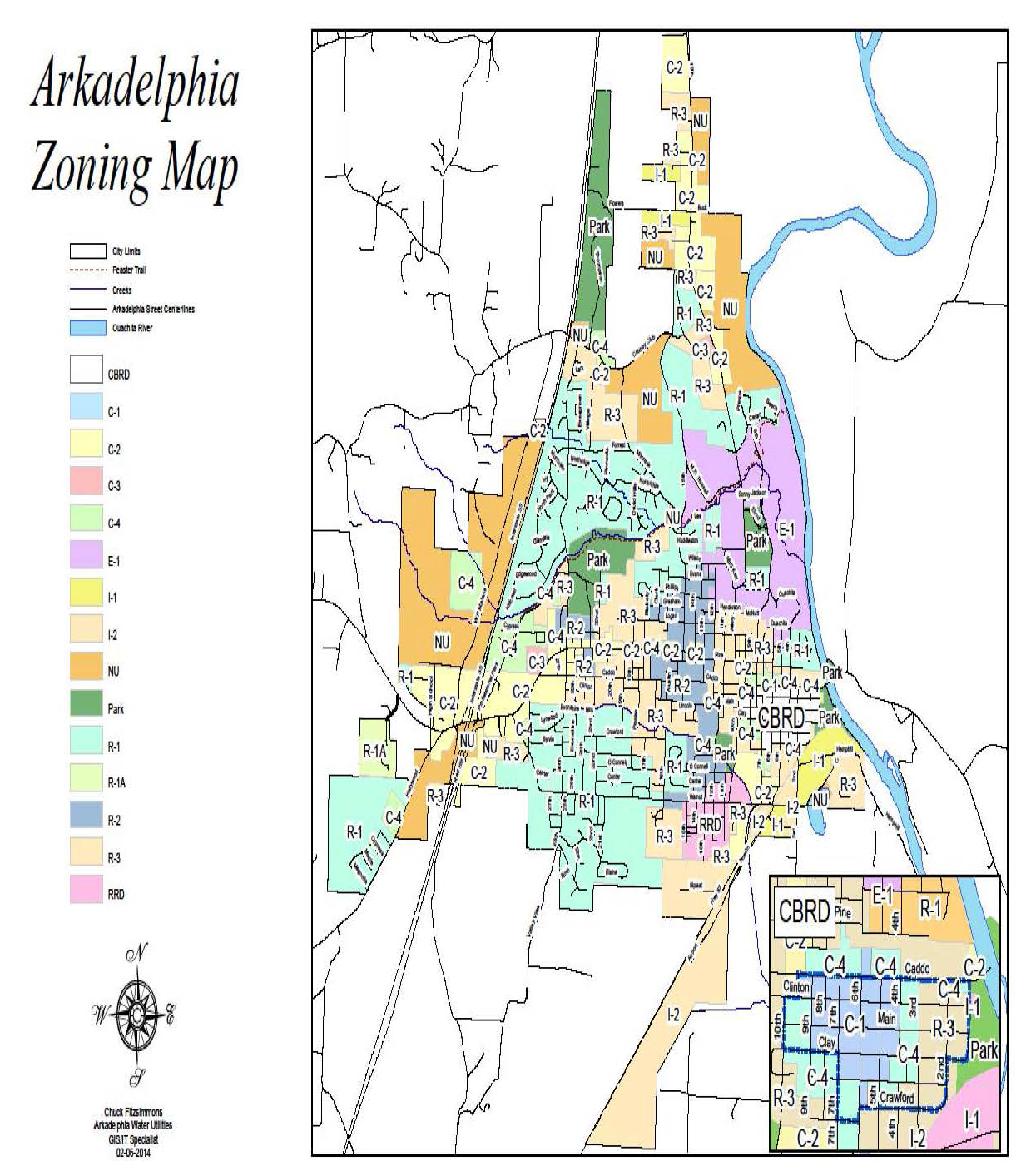
14.04.05 - General provisions applying to all or several districts.
14.04.05.01
Annexation.
A.
Territory annexed to the City of Arkadelphia after adopting of this chapter shall be given zone designations within one hundred twenty (120) days after the effective date of annexation in accordance with the amendment procedures of this chapter.
B.
Before official zone designation is made after annexation, all requests for building permits shall be referred to the City Planning Commission or a committee thereof. The Planning Commission or its designated committee may recommend issuance of the permit if said use conforms to the land use plan.
14.04.05.02
Uses permitted.
A.
Temporary. Mobile homes may be permitted on single lots in residential districts on a temporary basis by the Planning Commission for a period of not longer than one (1) year, provided the Commission makes a finding to the effect that the occupant or proposed occupant of the trailer would suffer a material hardship, other than a financial hardship, if the mobile home were not to be located on said lot. This temporary use may be renewed on an annual basis as long as the hardship exists. However, such use shall be permitted only subject to the following conditions.
1.
The mobile home shall be located not less than ten (10) feet from any lot line or fifteen (15) feet from a residential structure.
2.
No rent or other compensation shall be paid for the privilege of parking the trailer on said lot.
B.
Permits for temporary non-conforming uses. Upon application to the Board of Adjustment, permits may be issued for temporary uses such as: the sale of produce in season; bazaars and carnivals; and offices, signs or other uses necessary for the sale or construction of property or buildings. Permits so issued shall be subject to such limitations as the Board of Adjustment may impose to protect the character of the district or districts affected.
C.
Special use permit.
1.
Special use permit definition. A special use permit is the use of a permit that conforms to the intent of the comprehensive plan for a specific area and is generally allowable but not by right at any location. The use may represent potential problems with respect to its impact on neighboring property or to the City as a whole, or it may dominate the surrounding area by its size or intensity. For these reasons, special use permits require a careful review of their location, design, configuration, and spatial impact to determine the desirability of allowing them on a particular site.
The special use permit process must not allow an applicant to secure a use variance or as a means to circumvent the intent of the comprehensive plan or Zoning Code. Building configurations, footprints, and outlines should be compatible with other uses permitted for a district. Whether a proposed use is appropriate in a particular location depends upon a careful evaluation of the impacts to the neighborhood and the City by the Planning Commission and a weighing of conditions and methods proposed by the Commission or by the applicant to ameliorate those impacts.
2.
Uses restricted to specific districts. Uses which are listed in various districts as "special use permits" may be located only in the district or districts so designated and in accordance with the procedure described herein in subsection C.3.
3.
Standards for special use permits. The Planning Commission may approve, deny, defer, or modify a special use permit request based on findings of fact with regard to the standards set forth below. The appropriateness of these standards shall be determined at the discretion of the Planning Commission for each specific special use permit location.
In carrying out the purpose of this section, the Commission's consideration shall include, but not be limited to, the following development standards and design specifics.
The appropriateness of these standards shall be determined at the discretion of the Planning Commission for each specific special use permit location.
a.
The proposed use is so designed, located and proposed to be operated that the public health, safety and welfare will be protected.
b.
The proposed use is compatible with and will not adversely affect other property in the area where it is proposed to be located.
c.
The proposed use is within the provision of "special use permits" as set out in this Code.
d.
The proposed use conforms to all applicable provisions of this Code for the zoning district in which it is to be located, and the use facilitates public convenience at that location.
e.
The size and shape of the site, and the size, shape and arrangement of the proposed structures, are in keeping with the intent of the comprehensive plan and this Code.
f.
The internal street system, ingress or egress, off-street parking, loading and pedestrian ways will be efficient and safe.
g.
Safeguards, including, but not limited to, hours and methods of operation, landscaping and screening, controlling noxious or offensive emissions, including lighting, noise, glare, dust and odor, are satisfactory.
h.
Landscaping, fencing and open space will be properly maintained by the owner/developer.
i.
Proposed signs will be appropriate for the location and in accordance with the requirements of the existing City Code.
j.
Public utilities are, or will be, available and will not be overloaded.
4.
Conditions. The Planning Commission may impose conditions and restrictions upon the premises benefited by a special use permit as may be necessary to reduce or minimize the injurious effects of the special use permit, ensure compatibility with the surrounding property, and carry out the general intent of this Code.
Conditions imposed as part of the special use permit may be of two (2) types. Threshold conditions are those that must be met by all proposed developments before an application for a special use permit will be forwarded to the Planning Commission. Implicit conditions are those that the Planning Commission may apply during the review of an individual case.
In no case shall the Planning Commission authorize relief from the minimum requirements of the Code relating to height, area, parking, setbacks or screening. However, applicants may be directed to the Board of Adjustment for variances.
5.
Procedure for authorizing.
a.
Application. Application for a special use permit shall be made by the property owner or authorized agent for the owner. The application shall be submitted to the Building Department office which will process all applicable surveys, site plans and other supporting information pertinent to this review process and make recommendations to the Planning Commission.
Notice of the special use permit application shall be published at least one (1) time, not less than fifteen (15) days prior to the date of the public hearing, in a newspaper of general circulation. The applicant shall notify the adjacent property owners no less than fifteen (15) days prior to the public hearing.
b.
Development plan requirements. The development plan requirements for a special use permit application shall include a graphic representation of what is proposed and a general statement as to the intent of the use. The graphic representation shall include the following:
(1)
The location, size and use of buildings, signs, land and improvements;
(2)
The location, size and arrangement of parking space, loading space;
(3)
Driveways and street access;
(4)
The existing topography with proposed grading and drainage plans;
(5)
Proposed screening and landscaping;
(6)
The use of adjoining property;
(7)
Scale, north arrow and vicinity map;
(8)
Any additional information needed by the staff.
c.
Development plan review. The Building Department staff shall review the proposed special use permit and report to the Commission on its relation to and probable effect on the surrounding area as well as its compliance with the requirements of this Code and shall make recommendations to the Planning Commission.
d.
Planning Commission action. The Planning Commission shall review special use permit applications at its regularly scheduled monthly meeting, at which time interested persons may appear and offer information in support of, or against the proposed special use permit. The Planning Commission shall then make one (1) of the following determinations for recommendation to the Board of Directors: approve the special use permit as requested; approve the special use permit with modifications; defer the special use permit; or deny the special use permit.
The Planning Commission may impose conditions and restrictions upon the premises benefited by a special use permit as may be necessary to reduce or minimize the injurious effects of the special use permit, ensure compatibility with the surrounding property and carry out the general intent of the comprehensive plan, appropriate neighborhood plans and this Code.
In no case shall the Planning Commission authorize reduction from the minimum requirements of the Code relating to height, area, parking setbacks, or screening. However, the applicant may be directed to the Board of Adjustment for variances under the Zoning Code.
e.
Appeal. Any applicant or other affected party aggrieved by a decision of the Planning Commission as it relates to the special use permit process shall have the right to appeal to the City Board. Such appeal must be filed in writing with the City Clerk within thirty (30) days after the Planning Commission takes final action on such a request. The City Board may affirm, modify, or deny said appealed action of the Planning Commission.
f.
City Board action. The City Board may accept the Planning Commission's recommendation, may modify conditions and restrictions upon the premises benefited by a special use, may remand the case back to the Planning Commission or deny the recommendation.
A concurring vote of a majority of the members of the City Board of Directors shall be required to approve a special use permit.
g.
Denial. A petitioner may reapply after a period of one (1) year from the date of denial by the City Board.
h.
Status of conditions. Once any portion of the special use permit which has been authorized is utilized, all such conditions pertaining to such authorization shall become immediately operative. The violation of any condition so imposed shall constitute grounds for revocation of the special use permit. Such conditions may include time limits for exercise of such authorization and must commence within a reasonable time.
The Board of Adjustment is not authorized to grant a variance from conditions imposed by the Commission in connection with a special use permit. However, the Board of Adjustment may grant variances as provided by the Zoning Code.
Amendments or major changes to a special use permit authorization must follow the same process as the original special use permit; however, the Commission may delegate to the staff authority to approve minor modifications to the conditions approved, including modifications to an approved development plan. No building permit shall be issued except in conformance with the provisions of this section.
The special use permit will be granted to the business and not the land on which it resides.
Unless a time limit is specified for a special use permit, the same shall be for an indefinite period of time, except that if the use or activity should cease for any reason for a continuous period of six (6) months, the special use permit shall automatically terminate without notice and become null and void.
6.
Fees. Before any action shall be taken as provided in this section, the petitioner shall deposit with the City an application fee of one hundred dollars ($100.00) or a fee as may hereafter be adopted by resolution of the City Board. Under no condition shall said sum or any part thereof be refunded for failure of said permit to be approved by the Planning Commission or Board of Directors.
14.04.05.03
Completion of existing buildings.
A.
Nothing herein contained shall require any change in the plans, construction or designated use of a building actually under construction at the time of the adoption of this chapter.
B.
Nothing herein contained shall require any change in plans, construction, or designated use of a building for which a building permit has been issued within thirty (30) days prior to the adoption of this chapter, provided construction is started on said building within one hundred twenty (120) days after adoption of this chapter.
14.04.05.04
Application of regulation to the uses of more restrictive districts.
A.
Whenever the specific district regulations pertaining to one (1) district permit the uses of a more restrictive district, such uses shall be subject to conditions set forth in the regulations of the more restrictive district unless otherwise specified.
B.
It is intended that these regulations be interpreted as not permitting a dwelling unit to be located on the same lot with or within a structure used or intended to be used primarily for nonresidential purposes.
14.04.05.05
Relief from requirements for lot area or lot width in a residential zone. On any lot separately owned in a residential zone at the time of passage of this chapter and retained in continuous separate ownership, a single-family structure may be erected even though the lot be of less width and/or area than required by the regulations of the residential zone in which the lot is located, provided all other area requirements are met.
14.04.05.06
Areas not to be diminished. The lot or yard areas required by this chapter for a particular building or use at the time of passage of this chapter or later constructed or established shall not be diminished and shall not be included as a part of the required lot, open space, or yard area of any other building or use. If the lot, open space, or yard areas required by this chapter for a particular building or use are diminished below requirements, the continued existence of such building or use shall be deemed a violation and punished as provided in this chapter.
14.04.05.07
Group housing projects. In the case of a housing project consisting of a group of two (2) or more buildings to be constructed on a plot of ground of at least two (2) acres not subdivided into the customary streets and lots, and which will not be so subdivided where the existing or contemplated street and lot layout make it impracticable to apply the requirements of this chapter to individual buildings in such housing project, the application of such requirements to such housing projects may be changed by the Board of Adjustment, in a manner that will be in harmony with the character of the neighborhood, will ensure a density of land use no higher than the standard of open space at least as high as required by this chapter in the district in which the proposed project is to be located. In no case shall a use or building height or density of population be permitted which is less than the requirement of the district in which the housing project is to be located.
14.04.05.08
Off-street automobile and vehicle parking and loading.
A.
General intent and application. It is the intent of these requirements that adequate parking and loading facilities be provided off the street easement for each use of land within the City of Arkadelphia. The requirements are intended to be based on the demand created by each use. These requirements shall apply to all uses in all districts.
B.
Location. The off-street parking lot shall be located within two hundred (200) feet, exclusive of street and alley widths, of the principal use, and shall have direct access to a street or alley.
C.
Joint parking facilities. Whenever two (2) or more uses are located together in a common building, shopping center, or other integrated building complex, the parking requirements may be complied with by providing a permanent parking facility, cooperatively established and operated, which contains the requisite number of spaces for each use. The total number of spaces provided shall not be less than the sum of the individual requirement.
D.
Size of off-street parking space. The size of a parking space for one (1) vehicle shall consist of a rectangular area having dimensions of not less than nine (9) feet by twenty (20) feet plus adequate area for ingress and egress.
E.
Amount of off-street parking and loading required. Off-street parking and loading facilities shall be provided in all districts in accordance with the following schedule:
1.
Single family dwelling. Two (2) off-street parking spaces.
2.
Duplex and multi-family dwelling. Three (3) off-street parking spaces per dwelling unit.
3.
Boarding or rooming houses or hotel. One (1) parking space for each two (2) guests provided overnight accommodations.
4.
Hospitals. One (1) space for each four (4) patient beds, exclusive of bassinets, plus one (1) space for each three (3) employees including nurses, plus adequate area for the parking of emergency vehicles.
5.
Medical or dental clinics or offices. Six (6) spaces per doctor plus one (1) space for each two (2) employees.
6.
Sanatoriums, convalescent or nursing homes. One (1) space for each six (6) patient beds, plus one (1) space for each staff or visiting doctor plus one (1) space for each two (2) employees including nurses.
7.
Community center, theater, auditorium, church sanctuary. One (1) parking space for each three (3) seats, based on maximum seating capacity.
8.
Convention hall, lodge, club, library, museum, place of amusement or recreation. One (1) parking space for each fifty (50) square feet of floor area used for assembly or recreation in the building.
9.
Office building. One (1) parking space for each three hundred (300) square feet of gross floor area in the building, exclusive of the area used for storage, utilities, and building services.
10.
Commercial establishments not otherwise classified. One (1) parking space for each one hundred fifty (150) square feet of floor space used for retail trade in the building and including all areas used by the public.
11.
Industrial establishments. Adequate area to park all employees' and customers' vehicles at all times and adequate space for loading, unloading and storing all vehicles used incidental to or as a part of the primary operation of the establishment.
For all uses not covered in subsections E.1 through E.11 above, the Planning Commission shall make a determination of the parking demand to be created by the proposed use, and the amount of parking thus determined, shall be the off-street parking requirement for the permitted use.
12.
Mini-storage facilities, self-service storage facilities, commercial lease storage facilities. Entire site exclusive of buildings and required landscaping shall be paved with a sealed surface pavement and maintained in such a manner that no dust will result from the continued use. Site must comply with applicable parking lot construction regulations.
F.
Paved surface required. All parking spaces shall be paved with a sealed surface pavement and maintained in such a manner that no dust will result from the continued use.
14.04.05.09
Design overlay district (DOD). The design overlay districts are established to provide for enhanced design standards in addition to those already required in the zoning district.
A.
Purpose and intent. The purpose and intent of the DOD can vary from district to district to accomplish the goals and objectives of that district. Some of the purposes could:
1.
To give particular attention to the existing architectural style or to a style which is planned so as to create an easily identifiable corridor in those districts identified as architecturally significant.
2.
To encourage the redevelopment of an area consistent with a particular design theme.
3.
Reserved.
4.
To give special attention to signage, landscaping, parking, lighting, building setbacks and other design elements to create a uniform and functioning corridor.
5.
To promote the safe and efficient use of an arterial roadway by controlling access and other traffic measures.
B.
Districts established. The City Board of Directors may establish design overlay districts as the needs are identified in order to implement specific purpose, intent, and design standards based upon an adopted land use plan for the area being regulated, which shall be applied as additional standards to other ordinance regulations required by the City.
C.
Development criteria. The development criteria for a particular DOD will be those standards as set out in each design overlay district.
14.04.05.010
Sidewalks. Sidewalks shall be built by the landowner or developer at the time of any new building construction where property abuts any street or public square.
New building construction. A building for either residential or commercial use. It includes plumbing facilities for human beings and, in rare cases, does not include plumbing for human beings, such as parking lots, warehouses, etc. This chapter does not apply to such things as remodeling existing structures, accessory structures, garages, and other similar types of building construction.
Sidewalks shall be built as follows:
1.
Sidewalks shall be built on other principal arterial, minor arterial, and collector streets. (Refer to Master Street Plan, Figure 4, Urban Functional Classification, and Regulations to Control Development of Land for current street classifications.)
2.
Sidewalks shall be placed in the street easement and abut the property line of the landowner/developer or along the street curb line, or as determined by the Planning Commission.
3.
Sidewalks shall be a minimum of four (4) feet wide and on both sides of the street.
4.
Sidewalks shall be built in accordance with Arkadelphia Ord. No. B-313.
5.
Property owners are required to rebuild, maintain, and repair foot pavements or sidewalk improvements and curbing within ninety (90) days after notice has been served on them. Notice served on the agent in charge of the property shall be binding on the owner. Notice to be legal under this section must be approved by a vote of at least four (4) members of the Board of Directors.
14.04.05.011
Requirements for factory-built homes and structures.
Definitions:
Factory-built home. A residential dwelling that is wholly, or in substantial part, made, fabricated, formed or assembled in manufacturing facilities for installation or assembly on a building site. Factory-built homes shall include, but are not limited to, manufactured, mobile and modular homes.
Factory-built structure. Any structure or building that is wholly or in substantial part made, fabricated, formed, or assembled in manufacturing facilities for installation or assembly on a building site and for use other than as a home. All factory-built structures placed in the City of Arkadelphia after the date of passage of this chapter must comply with all requirements of factory-built homes concerning their placement in the City of Arkadelphia plus any other requirements applicable to the commercial, industrial, or residential zone.
Federal Manufactured Home Construction and Safety Standards. Promulgated by the United States Department of Housing and Urban Development under the authority of 42 U.S.C. 5401 et seq. as it existed on January 1, 1976.
Manufactured home. A dwelling unit constructed in a factory in accordance with the Federal standards and meeting the definitions set forth in the Federal standards and under A.C.A. § 20-25-102.
Mobile home. A dwelling unit constructed in a factory before the enactment of the Federal standards.
Modular home. A residential dwelling, constructed in a factory to a residential construction code other than the Federal Manufactured Home Construction and Safety Standards.
A.
All factory-built homes placed in the City of Arkadelphia after the date of passage of this chapter must conform to Federal standards and A.C.A. § 20-25-102. Installation must be consistent with Arkansas standards set forth under A.C.A. § 20-25-106 and manufacturer's design.
B.
Factory-built homes that were built before 1976 are specifically prohibited from placement in the City under any circumstances because they were constructed before the enactment of the Federal standards.
C.
The placement of factory-built homes shall be allowed only in R-3, multi-family residential use districts and mobile home parks.
D.
Arkadelphia may establish reasonable regulations or conditions for the placement of factory-built homes within its jurisdiction. Factory-built homes shall be subject to regulations or conditions that are applicable to other single-family dwellings in the same residential district or zone. All single-family dwellings in R-3, multi-family residential use districts must be underpinned (have perimeter foundation enclosed) with permanent masonry materials.
E.
Anyone failing to complete the underpinning within ninety (90) days of electrical inspection shall be guilty of a misdemeanor and be subject to a daily fine of one hundred dollars ($100.00) for each day in violation.
14.04.05.012
Sign regulations.
A.
General provisions. The following general provisions govern the permitting of signs in the City of Arkadelphia:
1.
A permit shall be required for the erection, alteration, or reconstruction of any sign unless otherwise noted in this section and shall be issued by the Planning and Zoning Official or authorized representative in accordance with these regulations.
2.
Signs must be constructed of durable materials, maintained in good condition, and not permitted to become dilapidated.
3.
All signs shall be erected, maintained, and abandoned in accordance with provisions of this and all other applicable City ordinances.
4.
No sign shall be placed in, or over, any public or private property without the consent of the owner of the property.
5.
Illumination devices shall be so placed and so shielded that rays from the devices or from the sign itself will not be directly cast into any residential zone, or sleeping room in any zone, or in the eyes of a vehicular driver.
6.
No sign shall be placed on any utility pole except for utility identification.
7.
Only signs installed or authorized by the State, County, or City may be placed on the public right-of-way.
8.
No advertising sign shall be erected within fifty (50) feet of any adjoining residential zone boundary line if the sign faces perpendicular to the street that the building faces. Further, no flashing sign of any type shall be erected within one hundred fifty (150) feet of an adjoining residential zone boundary line if the face of such sign is perpendicular to the street the building faces.
9.
No sign shall be permanently painted, pasted, or similarly posted directly on the surface of any wall, nor shall any sign be permitted to be placed on any wall, fence, or standard facing the side of any adjoining lot located in any residential zone.
10.
All signs shall be erected within the property lines of the premises upon which they are located. Sign and structure shall be set back a minimum of ten (10) feet from all property lines or projected right-of-way lines as shown on the master street plan, or other distance as specified within this section, whichever distance is greater. No portion of a freestanding sign shall extend, be erected, or be placed in any street right-of-way. All structural pylons and supports must be set back a distance of at least five (5) feet from any easement.
11.
Signs that, in the opinion of the Planning and Zoning Official or authorized representative, may be in conflict with public traffic signals shall not be permitted.
12.
No person shall place, maintain, or display any otherwise authorized sign, signal, marking, or device which imitates or resembles an official traffic control device, emergency light, or railroad sign or signal or which has the effect of disrupting the movement of traffic. No person shall place, maintain, or display any sign that hides from view or interferes with the movement of traffic or the effectiveness of any traffic control device or signal.
13.
Signs and sign structures attached to the wall of any building shall not extend more than six (6) feet above the roofline.
14.
No sign shall be constructed in such a way as to interfere or extend into contact with any overhead wires.
15.
The allowable display surface allowed shall be computed on the basis of one (1) side of a double-sided sign.
16.
No sign shall be abandoned without approval of the Planning and Zoning Official or authorized representative.
17.
No sign shall be placed on any tree.
B.
Exemptions. This section does not relate to building design, nor does it regulate the following:
1.
Official traffic or governmental signs;
2.
The copy and message of signs;
3.
Indoor window displays;
4.
Product dispensers;
5.
Scoreboards on athletic fields;
6.
Advertising at public athletic fields;
7.
Flags of any nation, government, or non-commercial organization;
8.
Gravestones;
9.
Barber poles;
10.
Religious symbols;
11.
Commemorative signs, tablets, or plaques approved by the Arkadelphia Board of Directors;
12.
Signs required to be maintained by law or governmental order, rule, or regulation;
13.
The display of street numbers;
14.
Any display or construction not defined as a sign;
15.
Off-premises open-house signs for the day on which the open house is conducted;
16.
Temporary athletic and other event announcement signage in E-1 districts;
17.
Residential decorative/ornamental signs excluding advertising.
C.
Prohibited signs. The following signs are prohibited within the City of Arkadelphia:
1.
Signs imitating warning signals: No sign shall display intermittent lights resembling the flashing lights customarily used in traffic signals or in police, fire, ambulance or rescue vehicles, nor shall any sign use the words "stop," "danger," or any other word, phrase, symbol, or character in a manner that might mislead or confuse a vehicular driver.
2.
Signs within street or highway right-of-way: No sign whatsoever, whether temporary or permanent, except traffic signs and signals and information signs erected by a public agency, are permitted within any street or highway right-of-way.
3.
Certain attached and painted signs: Signs painted on or attached to trees, fence posts, and telephone or other utility poles or signs painted on or attached to rocks or other natural features or painted on the roofs of buildings.
4.
Billboards are not permitted within the corporate limits of the City of Arkadelphia except for property abutting Interstate 30 (I-30) corridor extending seven hundred (700) feet from the I-30 right-of-way, excluding residential zoned districts.
5.
Hand-tacked signs.
6.
Off-premises signs except as permitted elsewhere in this chapter. This includes signs or banners attached to or painted on vehicles or trailers that are parked/stored at an off-premises location, when not conducting business at the immediate time, in such a manner as to become temporary off-premise advertising.
7.
Portable signs except as allowed under other specific provisions of this chapter. This includes signs or banners attached to or painted on vehicles or trailers that are parked/stored at an off-premises location, when not conducting business at the immediate time, in such a manner as to become temporary off-premise advertising.
8.
Roof-mounted signs.
D.
Temporary signs. Temporary signs are portable and intended for impermanent use for a limited or specified time period. A permit shall be obtained through the Building Department.
1.
Permit required.
a.
One (1) sign per fifty (50) feet of lot width for up to five (5) days for special purpose permits and no more than sixty (60) days annually.
b.
Sign must be less than sixteen (16) square feet.
c.
Permit fee: five dollars ($5.00) per temporary sign.
d.
Permit sticker shall be applied to each sign.
e.
Exempt from the fee and setback sections of these regulations.
E.
Requirements applying to specific signs. The following regulations apply to specific type signs as noted:
1.
Wall signs. Signs on the walls of a building (including signs attached flat against the wall, painted wall signs and projecting signs) shall meet the following requirements:
a.
The display surface area of such sign shall not exceed fifteen (15) percent of the square footage of the wall to which it is attached up to a maximum sign size of two hundred (200) square feet.
b.
Such sign shall be located on the front wall of the building that is oriented to the street from which access is derived. For uses with two (2) street frontages, wall signs may be located on a wall for each frontage. For uses not oriented to a public street, the wall considered to be the front of the use shall be used for location of such signage.
c.
Such sign shall not project outward from the building more than twenty-four (24) inches.
d.
Such sign placed in the horizontal space between windows of a two (2) story building shall not exceed in height more than two-thirds (⅔) of the distance between the top of the window below and the sill of the window above.
2.
Pole or ground signs. Signs on poles where permitted are subject to the following standards:
a.
A premises shall be permitted to have one (1) ground or pole sign for each street frontage.
b.
Such signs shall have a maximum display surface specifically allowed within subsection 12.04.05.012.M, Signs Permitted in Commercial Zones, or subsection 12.04.05.012.N, Signs Permitted in Industrial Zones.
c.
The maximum height of a pole sign shall be thirty (30) feet except that signs located within three hundred (300) feet of Interstate 30 may be fifty (50) feet.
3.
Ground-mounted signs. Ground-mounted signs are subject to the following standards:
a.
Ground-mounted signs may not exceed six (6) feet in height except as allowed in the following section.
b.
Ground-mounted signs which are integrated into an attractive brick, stone, or wood architectural feature or an earthen berm, all of which shall be permanently landscaped with a sprinkler system, may exceed six (6) feet in height to a maximum of ten (10) feet. Signs may not exceed eighty (80) square feet.
c.
Ground-mounted signs must be located so that they do not obstruct the view of traffic from any intersection, street, or driveway.
4.
Signs on work under construction. Non-illuminated signs not exceeding thirty-two (32) square feet in area displaying the name of the building, the contractors, the architects, the engineers, the owners, and the financial, selling and/or development agencies are permitted for construction, alteration, or removal work. They shall be set back not less than fifteen (15) feet from any property or right-of-way line, whichever distance is greater. Such sign shall be removed within seven (7) days after completion of the project.
5.
Temporary subdivision signs. Temporary signs not exceeding thirty-two (32) square feet in area announcing a land subdivision development are permitted on the premises of the land subdivision. They shall be set back not less than fifteen (15) feet from any property line or right-of-way line, whichever distance is greater. Such signs shall be spaced not less than five hundred (500) feet apart within a single subdivision. They shall be removed when seventy-five (75) percent of the lots are conveyed.
6.
Sign, directional. Signs indicating directions shall not exceed six (6) square feet.
7.
Neon signs. Signs which utilize neon lighting, either for the body of the sign or its border, shall comply with all relevant local, State and Federal electrical requirements.
8.
Temporary signs. The Planning and Zoning Commission may issue a temporary permit for the placement of a temporary sign on an individual site for a period not to exceed thirty (30) days in any twelve (12) month period. Electrical service for illuminated signs shall meet the provisions of the City Building and Electrical Codes.
9
Political signs. They are allowed without permit, in any zone. Signs over four (4) square feet in surface area and/or over four (4) feet in height are required to be set back at least ten (10) feet from the property line or right-of-way line, whichever distance is greater. All such signs must be removed within seven (7) days following the last election in which the specific candidate advertised in the sign will participate in the designated election cycle. Maximum size sign allowed in a residential zone is nine (9) square feet. Maximum size sign allowed in a commercial zone is thirty-two (32) square feet.
10.
Real estate signs. In any residential zone, real estate signs may not be larger than nine (9) square feet in size and only one (1) sign is allowed for each side of the structure that faces a public street. In all other zones, real estate signs may be no larger than thirty-two (32) square feet. Off-premises real estate signs are permitted with a required special use permit from the Planning Commission. Written permission of the landowner is also required. Off-premises open house signs are exempted per subsection B. above.
11.
Balloon signs. The height of a tethered balloon sign shall not exceed thirty-five (35) feet at maximum height or shall not possess a tether of such length that, during straight-line winds, the sign would extend beyond any property line of the property containing the sign or into a public sidewalk, whichever is less. One (1) balloon sign per site shall be permitted.
12.
Banners. They shall not be placed in such a manner as to obstruct the view of drivers or of pedestrians using public walkways. Banners that become frayed or tattered must be removed or replaced. One (1) banner per site shall be permitted.
F.
Permits. Unless otherwise provided by this section, all signs shall require permits and payment of fees as described in this section:
1.
Application for a permit for the erection, alteration, or relocation of a sign, when allowed by this section, shall be made to and approved by the Planning and Zoning Official or authorized representative.
2.
Form or forms may be required to provide the information necessary to administer the provisions of this section. As a minimum the following information is required:
a.
Height of sign;
b.
Sign face detail (both sides, if applicable);
c.
Structure and/or support details;
d.
Location of sign in relation to street(s), property line(s), easement(s), building, and private drives;
e.
Location of any property lines that may be affected by the sign;
f.
Copy of agreement with property owner if property is leased.
3.
All requests for sign permits must be approved by the Planning and Zoning Official or authorized representative.
4.
It shall be the contractor's or owner's responsibility to call for a final inspection when construction of the sign has been completed.
5.
All electrical work performed in conjunction with the installation of a sign shall require an electrical permit as described in the City Electrical Code.
6.
All signs must be designed and constructed to meet all the requirements pertaining to sign design and construction as stated in the City Building Code.
7.
Requests for billboard sign permits must be accompanied by proof of permit from the appropriate Arkansas State agency. Only those billboard signs regulated by the Highway Beautification Act of 1965 as may be amended and the State of Arkansas shall be permitted.
G.
Signs for which a permit is not required. A permit is not required for the following types of signs in any zone. All portions of signs must be set back a minimum of ten (10) feet from all property lines or as otherwise stated in this section, whichever distance is greater.
1.
Traffic, directional, warning, or information signs authorized by any governmental agency.
2.
Official notices issued or required by any court, government agency or officer.
3.
Church bulletin board sign located not less than fifteen (15) feet back from the street right-of-way line not exceeding thirty-two (32) square feet.
4.
One (1) non-illuminated "for sale," "for rent" or "for lease" on-premises sign located not less than fifteen (15) feet back from the street right-of-way line, unless attached to the front wall of a building, and not exceeding the square footage as set forth in subsection 12.04.05.012.E.10.
5.
Allowed home occupation signs.
6.
Maintenance of a sign or for a change of copy on painted, printed, or manual changeable copy signs.
7.
Political signs.
8.
Construction signs as set forth in subsection 12.04.05.012.E.4.
H.
Fees. Unless otherwise modified by ordinance, fees for a sign permit excluding billboards shall be as follows: A fifteen dollar ($15.00) permit fee and a ten dollar ($10.00) application fee. Fees for billboard sign permits shall be as follows: A two hundred fifty dollar ($250.00) permit fee and a ten dollar ($10.00) application fee. When applicable, non-residential permits will also require a State surcharge tax.
I.
Term and issuance of permit. Sign permits shall be approved subject to the following conditions:
1.
Issuance. Sign permits shall be either denied or issued within thirty (30) working days following submittal to the Building Department. If the Department has not acted upon a permit application within thirty (30) working days, the application shall be automatically approved.
2.
Term. Each permit shall be valid until the sign is removed, or the City requests removal due to unsatisfactory condition.
J.
Maintenance. All freestanding signs and the premises surrounding the same shall be maintained by the owner thereof in a clean, sanitary, and inoffensive condition, and free and clear of all obnoxious substances, rubbish, and natural growth of grass or weeds. All signs shall be properly maintained at all times. Exposed surfaces shall be clean and painted if paint is required. Defective parts shall be replaced. The Planning and Zoning Official or authorized representative is hereby authorized to order the repair or removal of any sign that is defective, damaged, substantially deteriorated, or presents a public hazard, as defined in the edition of the Building Code in force in the City. The permit holder will have thirty (30) days to bring signs into compliance.
K.
Signs permitted in all districts. The following signs are permitted in all districts:
1.
All signs not requiring a permit.
2.
One (1) construction sign for each street frontage of a construction project, subject to the requirements of subsection 12.04.05.012.E.4.
3.
Real estate signs as further restricted herein.
4.
One (1) attached nameplate per occupancy, not to exceed two (2) square feet in sign area. Such nameplate shall indicate nothing other than the name and/or address of the occupants, premises, announcement of boarder, or roomers.
5.
Political signs in accordance with subsection 12.04.05.012.E.9.
L.
Signs permitted in residential districts including the residential redevelopment district. The following signs may be permitted in all residential districts, all other signs being specifically prohibited:
1.
All signs permitted in subsection 12.04.05.012.K. Signs permitted in all districts of this section.
2.
Signs larger than two (2) square feet but not larger than thirty-two (32) square feet may be permitted by special permit from the Planning Commission for apartment buildings, schools, churches, hospitals, parks, farms, and other special uses approved for the zoning district. Such signs shall indicate nothing other than the name and/or address of the premises and name of the management except that church signs may include information concerning services and other information related to their ministry.
3.
One (1) subdivision identification sign per neighborhood, subdivision, or development.
4.
One (1) sign per street frontage, except that no advertisement for off-the-premises goods and services will be permitted.
5.
A sign identifying a home occupation may not exceed four (4) square feet solely to identify the business, occupation, or profession, and such sign must be physically attached to the structure, except within R-1 where home occupations are prohibited. The sign may be placed as freestanding sign, not higher than four (4) feet, upon documented proof of such requirement mandated by the Federal or State government.
6.
Temporary signs advertising garage or yard sales, provided that such signs shall be removed within twenty-four (24) hours after the end of the sale. The size of the sign will not exceed six (6) square feet. Signs must comply with prohibited signs as set forth in subsection 12.04.05.012.C.
M.
Signs permitted in commercial districts. Signs within the various commercial districts shall conform to the following regulations:
1.
Signs in commercial C-1 districts may be permitted subject to the following regulations:
a.
All those signs permitted in the residential "R" districts are allowed in commercial "C" districts.
b.
Wall signs are allowed subject to the provisions of subsection 12.04.05.012.E.1. However, advertising signs painted on the sides of buildings and signs that advertise products or goods unrelated to the use of the building on which the sign is painted or attached are prohibited except for the restoration of historic "ghost signs".
c.
Reserved.
d.
Projecting signs are allowed but shall not project into any roadway or driveway and shall be placed with the lowest part a minimum seven (7) feet above the surface of the sidewalk. Sign not to exceed eight (8) square feet.
2.
Signs in the C-2 districts may be permitted subject to the following regulations:
a.
All those signs that are permitted in the residential "R" districts are allowed in commercial C-2 districts.
b.
Freestanding signs for single-tenant structures. Each single-tenant structure is allowed freestanding signs provided that the display surface of such signs shall not exceed eighty (80) square feet except that the display surface may be increased two (2) square feet for each foot of street frontage beyond one hundred (100) feet to a maximum display area of one hundred twenty (120) square feet. The signs must have a setback of a least ten (10) feet from adjoining property lines and the front property line or street right-of-way line, whichever distance is greater.
c.
One (1) freestanding sign is allowed per lot or commercial street frontage. For buildings on corner lots, one (1) additional freestanding sign is allowed on the additional street frontage. For such corner lots, one (1) frontage must be designated as the main frontage, and one (1) must be designated as the minor frontage. Signs on the minor street frontage must not exceed seventy-five (75) percent of the size of the display area of the freestanding sign on the main frontage. Instead of having one (1) sign on each street frontage, the applicant may opt to have one (1) freestanding diagonal sign facing both street frontages, in which the size may be computed using the longest street frontage.
d.
Freestanding signs for multi-tenant structures and joint identification. Each multi-tenant structure or a group of structures may have one (1) incidental or freestanding identification sign for each street frontage, with a setback of at least ten (10) feet from adjoining property lines and the front property line or street right-of-way line, whichever distance is greater. The sign shall be a directory sign and serve for the purposes of the joint business identification of tenants within the structure or group of structures. Any business or structure identified on the joint identification directory sign shall be allowed no other freestanding signs.
e.
For structures or a group of structures with a street frontage of less than one hundred (100) feet, the sign display surface shall not exceed eighty (80) square feet.
f.
For structures or a group of structures with a street frontage of more than one hundred (100) feet and less than three hundred (300) feet, the sign display surface shall not exceed eighty (80) square feet except that the display surface may be increased two (2) square feet for each foot of street frontage beyond one hundred (100) feet to a maximum display area of one hundred twenty (120) square feet.
g.
For structures or a group of structures with a street frontage of more than three hundred (300) feet, the sign display surface shall not exceed one hundred twenty (120) square feet except that the display surface may be increased one (1) square foot for each foot of street frontage beyond three hundred (300) feet to a maximum of two hundred (200) square feet.
h.
Commercial cul-de-sac. A commercial subdivision forming a cul-de-sac for individual commercial lots may have a directory sign located at the entrance to the cul-de-sac, not exceeding thirty (30) feet in height and located in such a manner that it does not restrict the view of traffic entering or existing the subdivision.
i.
Wall signs are allowed subject to the provisions of subsection 12.04.05.012.E.1.
j.
Projecting signs are allowed but shall not project into any roadway or driveway and shall be placed with the lowest part a minimum of seven (7) feet above the surface of the sidewalk. Sign not to exceed eight (8) square feet.
3.
Signs in the C-3 districts may be permitted subject to the following regulations:
a.
All those signs that are permitted in the residential "R" districts are allowed in commercial C-3 districts.
b.
Wall signs are allowed subject to the provisions of subsection 12.04.05.012.E.1.
c.
Freestanding signs for multi-tenant structures and joint identification. Each multi-tenant structure or a group of structures may have one (1) incidental or freestanding identification sign for each street frontage, with a setback of at least ten (10) feet from adjoining property lines and the front property line or street right-of-way line, whichever distance is greater. The sign shall be a directory sign and serve for the purpose of the joint business identification of tenants within the structure or group of structures. The maximum height of the sign shall be twenty-five (25) feet. Any business or structure identified on the joint identification directory sign shall be allowed no other freestanding signs.
d.
Freestanding signs for individual tenants in the C-3 district shall be ground-mounted and meet the provisions of subsection 12.04.05.012.E.3. For buildings with frontage on two (2) streets, a second sign shall be permitted on the side designated by the applicant as the secondary frontage and its maximum size shall be seventy-five (75) percent of that on the primary frontage.
4.
Signs in the C-4 districts may be permitted subject to the following regulations:
a.
All those signs that are permitted in the residential "R" districts are allowed in commercial C-4 districts.
b.
All signs allowed in the C-3 districts are allowed in the C-4 districts.
N.
Signs permitted in industrial districts. Signs in the industrial districts are permitted, subject to the following conditions:
1.
Area. The gross area in square feet of all signs on a zoning lot shall not exceed one-half (½) the lineal feet of the frontage of such lot. Where more than four (4) signs are located on any lot, the fifth sign and each succeeding sign shall reduce the total allowable surface area by twenty (20) percent.
2.
Location. No sign shall be located closer than fifteen (15) feet from any property line.
3.
Height. No sign shall project higher than fifty (50) feet above the curb line.
4.
Illumination. All signs located in industrial districts shall be illuminated with non-flashing indirect lighting.
Industrial parks. Signs located in industrial parks shall be subject to the following regulations:
1.
Area. The gross area in square feet of industrial park signs shall not exceed one-half (½) the lineal feet of the frontage of such industrial park.
2.
Signage. Such signs shall advertise only the name and location of said industrial park and the name and type of each occupant of the park.
3.
Setback. Such signs shall be setback a minimum of fifteen (15) feet from all property lines or projected right-of-way, as shown on the master street plan, whichever is greater.
4.
Height. No sign shall project higher than fifty (50) feet above the curb line.
5.
Illumination. Signs may be illuminated with indirect lighting, but no moving or flashing lights will be permitted.
O.
Signs permitted in the planned residential district. Signs in the PRD shall be approved as part of the approval process for the development.
P.
Signs permitted in the central business redevelopment district (CBRD). Signs in the CBRD shall be reviewed and approved or denied by the Planning Commission on a case-by-case basis or through the approval process for the development site plan.
Q.
Creative sign permit.
1.
Purpose. This section establishes standards and procedures for the review and approval of creative sign permits. The purposes of the creative sign permit are to:
a.
Encourage signs of unique design that exhibit a high degree of imagination, inventiveness, spirit, and thoughtfulness; and
b.
Provide a process for the application of sign regulations in ways that will allow creatively designed signs that make a positive visual contribution to the overall image of the City, while mitigating the impacts of large or unusually designed signs.
2.
Applicability. An applicant may request approval of a creative sign permit in order to allow standards that differ from the provisions of this chapter but comply with the purpose and findings of this section.
3.
Application requirements. A creative sign permit application shall include all information and materials required by the Department.
4.
Approval authority. An application for a creative sign permit shall be subject to review and approval by the Planning Commission.
5.
Findings. In approving an application for a creative sign permit, the Planning Commission shall ensure that the proposed sign meets the following design criteria.
a.
Design quality. The sign shall:
i.
Constitute a substantial aesthetic improvement to the site and shall have a positive visual impact on the surrounding area;
ii.
Be of unique design, and exhibit a high degree of imagination, inventiveness, spirit, and thoughtfulness; and
iii.
Provide strong graphic character through the imaginative use of color, graphics, proportion, quality materials, scale, and texture.
b.
Impacts on surrounding uses. The sign shall be located and designed not to cause light and glare impacts on surrounding uses, especially residential uses.
R.
Violations. The following regulations govern violations of this section:
1.
When in the judgment of the Planning and Zoning Official or authorized representative, a violation of this section exists, the enforcement officer shall issue a written notice to the alleged violator. The notice shall specify those sections of this section of which the person may be in violation and shall state that the person has thirty (30) days from the date of the order in which to abate the alleged violation or to appeal to the Planning and Zoning Commission. If the violator fails to appeal or to correct the violation within the time allowed by this section, the sign shall be deemed illegal and removed by the sign owner.
2.
If, upon inspection, the Planning and Zoning Official or authorized representative finds that a sign is abandoned or structurally, materially, or electrically defective, or in any way endangers the public, or is not maintained, such sign or signs shall be deemed illegal and the enforcement officer shall issue a written notice to the owner of the sign and/or the occupant of the premises stating the nature of the violation and requiring the sign to be repaired in conformance with this section or removed within thirty (30) days of the date of the notice.
3.
The City reserves the right to remove the sign for failure to cure the violation within the set period of time. The owner will be responsible for any costs incurred by the City in removing a sign for non-compliance or failure to cure a violation.
14.04.05.013
Mobile food vendor courts.
Generally. Mobile food vendor courts may be permitted by the Planning Commission subject to the following standards. The burden of proving compliance with these standards shall be on the applicant.
A.
Mobile food vendor courts shall only be located in the central business redevelopment district (CBRD), C-1, C-2 and C-3 districts.
B.
Health and sanitation. Each individual mobile food vendor court shall comply with all applicable State and local requirements and regulations.
C.
Zoning and Code compliance. Each individual mobile food vendor court shall comply with all applicable City zoning, subdivision and other regulations.
D.
Restroom(s) may be provided within the boundaries of the mobile food vendor court.
E.
Electrical requirements. Each site is required to provide electrical access for each individual mobile food vendor unit that operates at the site. Each mobile food vendor unit is not allowed to operate a generator at the site unless emergency circumstances necessitate the need for a generator.
F.
Screening requirements. Where property zoned C-1, C-2 and C-3 abuts a residential district, a planting screen or other visual barrier to be approved by the Board of Zoning Adjustment shall be constructed by the property owner or potential user of the property prior to the use of such property in a manner that it provides a continual visual buffer between the two (2) districts a minimum of six (6) feet in height; except that such buffer shall not be placed within fifteen (15) feet of the paved surface of a street or highway.
G.
Site plan required. A site plan shall be submitted for review prior to a building permit being issued and shall include the following, if applicable:
1.
The land area included within the site;
2.
A legal description of the platted lots of the proposed site and the boundaries thereof;
3.
The location of each proposed structure on the site including mobile food vendor units, restrooms and outdoor entertainment locations;
4.
Setbacks, height and separation distance between structures (fifteen (15) feet minimum is required);
5.
The location of fire hydrants. Fire hydrants shall be located so that every structure is within five hundred (500) feet;
6.
The dimensions and capacities of parking areas and loading areas:
i.
The number of parking spaces for mobile food vendor courts shall be two (2) spaces per mobile vending unit. The size of a parking space for one (1) vehicle shall consist of a rectangular area having dimensions of not less than nine (9) feet by twenty (20) feet plus adequate area for ingress and egress. All parking spaces and loading areas shall be paved with a sealed surface pavement and maintained in such a manner that no dust will result from the continued use. (Per Land Use Ordinance B-425, in C-2 and C-3 districts, in no case will parking be permitted in a manner so as to result in an automobile backing into any street or otherwise interfering with moving traffic.)
7.
All landscaping and lighting;
8.
All pedestrian walks, patios, and open areas for use by tenants or the public;
9.
The location, size, height and orientation of all signs. Sign installations shall comply with Ordinance B-425, subsection 14.04.05.012. One (1) temporary sandwich board sign is permitted per mobile food vendor unit to be displayed within ten (10) feet of the unit and within the boundaries of the mobile food vendor court;
10.
Location and screening of refuse containers and outside storage;
11.
Location and number of provided seating and eating areas.
Exemptions. Mobile food vendors shall be exempt from:
A.
Regulations regarding the placement of factory built structures, Ordinance No. O-97-22, amending Ordinance No. B-425.
B.
Regulations pertaining to transient merchants, Ordinance No. O-11-10, Section 1.g) Prohibited Area.
14.04.05.014
Wireless telecommunications towers and antennas.
1.
Generally.
Zoning Administrator. The City Engineer shall also be known as the Zoning Administrator and perform the duties of each position.
Fee. The fee for reviewing an application to build a wireless telecommunication tower or antenna shall be the sum of two hundred fifty dollars ($250.00) for each application for administratively approved uses in subsection 6.A.2. and for special use permits in subsection 7.A.5. In addition, if the City is required to employ experts to review said applications the cost of such expert assistance and review shall be borne by the applicant and payment for such costs and fee may be required in advance.
Purpose. The purpose of this section is to establish general guidelines for the siting of wireless communications towers and antennas. The goals of this section are to:
A.
Protect residential areas and land uses from potential adverse impacts of towers and antennas;
B.
Encourage the location of towers in non-residential areas;
C.
Minimize the total number of towers throughout the community;
D.
Strongly encourage the joint use of new and existing tower sites as a primary option rather than construction of additional single-use towers;
E.
Encourage users of towers and antennas to locate them, to the extent possible, in areas where the adverse impact on the community is minimal;
F.
Encourage users of towers and antennas to configure them in a way that minimizes the adverse visual impact of the towers and antennas through careful design, siting, landscape screening, and innovative camouflaging techniques;
G.
Enhance the ability of the providers of telecommunications services to provide such services to the community quickly, effectively, and efficiently;
H.
Consider the public health and safety of communication towers; and
I.
Avoid potential damage to adjacent properties from tower failure through engineering and careful siting of tower structures. In furtherance of these goals, the City of Arkadelphia shall give due consideration to the City of Arkadelphia master plan, zoning map, existing land uses, and environmentally sensitive areas in approving sites for the location of towers and antennas.
2.
Definitions. As used in this section, the following terms shall have the meanings set forth below:
Alternative tower structure means man-made trees, clock towers, bell steeples, light poles and similar alternative-design mounting structures that camouflage or conceal the presence of antennas or towers.
Antenna means any exterior transmitting or receiving device mounted on a tower, building or structure and used in communications that radiate or capture electromagnetic waves, digital signals, analog signals, radio frequencies (excluding radar signals), wireless telecommunications signal or other communication signals.
Backhaul network means the lines that connect a provider's towers/cell sites to one (1) or more cellular telephone switching offices, and/or long distance providers, or the public switched telephone network.
FAA means the Federal Aviation Administration.
FCC means the Federal Communications Commission.
Height means, when referring to a tower or other structure, the distance measured from the finished grade of the parcel to the highest point on the tower or other structure, including the base pad and any antenna.
Pre-existing towers and pre-existing antennas means any tower or antenna for which a building permit or special use permit has been properly issued prior to the effective date of this section, including permitted towers or antennas that have not yet been constructed so long as such approval is current and not expired.
Tower means any structure that is designed and constructed primarily for the purpose of supporting one (1) or more antennas for telephone, radio and similar communication purposes, including self-supporting lattice towers, guyed towers, or monopole towers. The term includes radio and television transmission towers, microwave towers, common-carrier towers, cellular telephone towers, alternative tower structures, and the like. The term includes the structure and any support thereto.
3.
Applicability.
A.
New towers and antennas. All new towers or antennas in the City of Arkadelphia shall be subject to these regulations, except as provided in sections 3.B. through 3.D., inclusive.
B.
Amateur radio station operators/receive only antennas. This section shall not govern any tower, or the installation of any antenna, that is under seventy (70) feet in height and is owned and operated by a federally-licensed amateur radio station operator or is used exclusively for receive only antennas.
C.
Pre-existing towers or antennas. Pre-existing towers and pre-existing antennas shall not be required to meet the requirements of this section, other than the requirements of subsection 4.F. and 4.G.
D.
AM array. For purposes of implementing this section, an AM array, consisting of one (1) or more tower units and supporting ground system which functions as one (1) AM broadcasting antenna, shall be considered one (1) tower. Measurements for setbacks and separation distances shall be measured from the outer perimeter of the towers included in the AM array. Additional tower units may be added within the perimeter of the AM array by right.
4.
General requirements.
A.
Principal or accessory. Antennas and towers may be considered either principal or accessory uses. A different existing use of an existing structure on the same lot shall not preclude the installation of an antenna or tower on such lot.
B.
Lot size. For purposes of determining whether the installation of a tower or antenna complies with district development regulations, including but not limited to setback requirements, lot-coverage requirements, and other such requirement, the dimensions of the entire lot shall control, even though the antennas or towers may be located on leased parcels within such lot.
C.
Inventory of existing sites. Each applicant for an antenna and/or tower shall provide to the Zoning Administrator an inventory of its existing towers, antennas, or sites approved for towers or antennas, that are either within the jurisdiction of the City of Arkadelphia or within one (1) mile of the border thereof, including specific information about the location, height, and design of each tower. The Zoning Administrator may share such information with other applicants applying for administrative approvals or special use permits under this section or other organizations seeking to locate antennas within the jurisdiction of the City of Arkadelphia, provided, however that the Zoning Administrator is not, by sharing such information, in any way representing or warranting that such sites are available or suitable.
D.
Aesthetics. Towers and antennas shall meet the following requirements:
1.
Towers shall either maintain a galvanized steel finish or, subject to any applicable standards of the FAA, be painted a neutral color so as to reduce visual obtrusiveness.
2.
At a tower site, the design of the buildings and related structures shall, to the extent possible, use materials, colors, textures, screening, and landscaping that will blend them into the natural setting and surrounding buildings.
3.
If an antenna is installed on a structure other than a tower, the antenna and supporting electrical and mechanical equipment must be of a neutral color that is identical to, or closely compatible with, the color of the supporting structure so as to make the antenna and related equipment as visually unobtrusive as possible.
E.
Lighting. Towers shall not be artificially lighted, unless required by the FAA or other applicable authority. If lighting is required, the lighting alternatives and design chosen must cause the least disturbance to the surrounding views.
F.
State or Federal requirements. All towers must meet or exceed current standards and regulations of the FAA, the FCC, and any other agency of the State or Federal government with the authority to regulate towers and antennas. If such standards and regulations are changed, then the owners of the towers and antennas governed by this section shall bring such towers and antennas into compliance with such revised standards and regulations within six (6) months of the effective date of such standards and regulations, unless a different compliance schedule is mandated by the controlling State or Federal agency. Failure to bring towers and antennas into compliance with such revised standards and regulations shall constitute grounds for the removal of the tower or antenna at the owner's expense.
G.
Building codes; safety standards. To ensure the structural integrity of towers, the owner of a tower shall ensure that it is maintained in compliance with standards contained in applicable State or local building codes and the applicable standards for towers that are published by the Electronic Industries Association, as amended from time to time. If, upon inspection, the City of Arkadelphia concludes that a tower fails to comply with such codes and standards and constitutes a danger to persons or property, then upon notice being provided to the owner of the tower, the owner shall have thirty (30) days to bring such tower into compliance with such standards. Failure to bring such tower into compliance within said thirty (30) days shall constitute grounds for the removal of the tower or antenna at the owner's expense.
H.
Measurement. For purposes of measurement, tower setbacks and separation distances shall be calculated and applied to facilities located in the City of Arkadelphia irrespective of municipal and county jurisdictional boundaries.
I.
Not essential services. Towers and antennas shall be regulated and permitted pursuant to this section and shall not be regulated or permitted as essential services, public utilities, or private utilities.
J.
Franchises. Owners and/or operator of towers or antennas shall certify that all franchises required by law for the construction and/or operation of a wireless communication system in the City of Arkadelphia have been obtained and shall file a copy of all required franchises with the Zoning Administrator.
K.
Public notice. For purposes of this section, any special use request, variance request, or appeal of an administratively approved use or special use shall require public notice to all abutting property owners and all property owners of properties that are located within the corresponding separation distance listed in subsection 14.04.05.014, Table 2, in addition to any notice otherwise required by the Zoning Ordinance.
L.
Signs. No signs shall be allowed on an antenna or tower.
M.
Buildings and support equipment. Buildings and support equipment associated with antennas or towers shall comply with the requirements of subsection 8.
N.
Multiple antenna/tower plan. The City of Arkadelphia encourages the users of towers and antennas to submit a single application for approval of multiple towers and/or antenna sites. Applications for approval of multiple sites shall be given priority in the review process.
5.
Permitted uses.
A.
General. The uses listed in this section are deemed to be permitted uses and shall not require administrative approval or a special use permit.
B.
Permitted uses. The following uses are specifically permitted: antennas or towers located on property owned, leased, or otherwise controlled by the City of Arkadelphia provided a license or lease authorizing such antenna or tower has been approved by the City of Arkadelphia.
6.
Administratively approved uses.
A.
General. The following provisions shall govern the issuance of administrative approvals for towers and antennas.
1.
The Zoning Administrator may administratively approve the uses listed in this section.
2.
Each applicant for administrative approval shall apply to the Zoning Administrator providing the information set forth in subections 7.B.1. and 7.B.3. of this section, and a non-refundable fee as established by ordinance of the City Board of Directors of the City of Arkadelphia to reimburse the City of Arkadelphia for the costs of reviewing the application.
3.
The Zoning Administrator shall review the application for administrative approval and determine if the proposed use complies with subsections 4., 7.B.4., and 7.B.5. of this section.
4.
The Zoning Administrator shall respond to each such application within sixty (60) days after receiving it by either approving or denying the application. If the Zoning Administrator fails to respond to the applicant within said sixty (60) days, then the application shall be deemed to be approved.
5.
In connection with any such administrative approval, the Zoning Administrator may, in order to encourage shared use, administratively waive any zoning district setback requirements in subsection 7.B.4. or separation distances between towers in subsection 7.B.5. by up to fifty (50) percent.
6.
In connection with any such administrative approval, the Zoning Administrator may, in order to encourage the use of monopoles, administratively allow the reconstruction of an existing tower to monopole construction.
7.
If an administrative approval is denied, the applicant shall file an application for a special use permit pursuant to subsection 7. prior to filing any appeal that may be available under the Zoning Ordinance.
B.
List of administratively approved uses. The following uses may be approved by the Zoning Administrator after conducting an administrative review:
1.
Locating a tower or antenna, including the placement of additional buildings or other supporting equipment used in connection with said tower or antenna, in any industrial or heavy commercial zoning district.
2.
Locating antennas on existing structures or towers consistent with the terms of subsections a. and b. below.
a.
Antennas on existing structures. Any antenna which is not attached to a tower may be approved by the Zoning Administrator as an accessory use to any commercial, industrial, professional, institutional, or multi-family structure of eight (8) or more dwelling units, provided:
(1)
The antenna does not extend more than thirty (30) feet above the highest point of the structure;
(2)
The antenna complies with all applicable FCC and FAA regulations; and
(3)
The antenna complies with all applicable building codes.
b.
Antennas on existing towers. An antenna which is attached to an existing tower may be approved by the Zoning Administrator and, to minimize adverse visual impacts associated with the proliferation and clustering of towers, collocation of antennas by more than one (1) carrier on existing towers shall take precedence over the construction of new towers, provided such collocation is accomplished in a manner consistent with the following:
(1)
A tower which is modified or reconstructed to accommodate the collocation of an additional antenna shall be of the same tower type as the existing tower, unless the Zoning Administrator allows reconstruction as a monopole.
(2)
Height.
(a)
An existing tower may be modified or rebuilt to a taller height, not to exceed thirty (30) feet over the tower's existing height, to accommodate the collocation of an additional antenna.
(b)
The height change referred to in subsection (3)(a) may only occur one (1) time per communication tower.
(c)
The additional height referred to in subsection (3)(a) shall not require an additional distance separation as set forth in subsection 7. The tower's pre-modification height shall be used to calculate such distance separations.
(3)
Onsite location.
(a)
A tower which is being rebuilt to accommodate the collocation of an additional antenna may be moved onsite within fifty (50) feet of its existing location.
(b)
After the tower is rebuilt to accommodate collocation, only one (1) tower may remain on the site.
(c)
A relocated onsite tower shall continue to be measured from the original tower location for purposes of calculating separation distances between towers pursuant to subsection 7.B.5. The relocation of a tower hereunder shall in no way be deemed to cause a violation of subsection 7.B.5.
(d)
The onsite relocation of a tower which comes within the separation distances to residential units or residentially zoned lands as established in subsection 7.B.5. shall only be permitted when approved by the Zoning Administrator.
3.
New towers in non-residential zoning districts. Locating any new tower in a non-residential zoning district other than industrial or heavy commercial, provided a licensed professional engineer certifies the tower can structurally accommodate the number of shared users proposed by the applicant; the Zoning Administrator concludes the tower is in conformity with the goals set forth in subsection 1. and the requirements of subsection 4.; the tower meets the setback requirements in subsection 7.B.4. and separation distances in subsection 7.B.5.; and the tower meets the following height and usage criteria:
a.
For a single user, up to ninety (90) feet in height;
b.
For two (2) users, up to one hundred twenty (120) feet in height; and
c.
For three (3) or more users, up to one hundred fifty (150) feet in height.
4.
Locating any alternative tower structure in a zoning district other than industrial or heavy commercial that in the judgment of the Zoning Administrator is in conformity with the goals set forth in subsection 1. of this section.
5.
Installing a cable microcell network through the use of multiple low-powered transmitters/receivers attached to existing wireline systems, such as conventional cable or telephone wires, or similar technology that does not require the use of towers.
7.
Special use permits.
A.
General. The following provisions shall govern the issuance of special use permits for towers or antennas by the Planning Commission:
1.
If the tower or antenna is not a permitted use under subsection 3. of this section or permitted to be approved administratively pursuant to subsection 4. of this section, then a special use permit shall be required for the construction of a tower or the placement of an antenna in all zoning districts.
2.
Applications for special use permits under this section shall be subject to the procedures and requirements of subsection 14.04.05.02 of the Zoning Ordinance, except as modified in this section.
3.
In granting a special use permit, the Planning Commission may impose conditions to the extent the Planning Commission concludes such conditions are necessary to minimize any adverse effect of the proposed tower on adjoining properties.
4.
Any information of an engineering nature that the applicant submits, whether civil, mechanical, or electrical, shall be certified by a licensed professional engineer.
5.
An applicant for a special use permit shall submit the information described in this section and a non-refundable fee as established by resolution of the City of Arkadelphia Board of Directors to reimburse the City of Arkadelphia for the costs of reviewing the application.
B.
Towers.
1.
Information required. In addition to any information required for applications for permits pursuant to Section 14.04.05 of the Zoning Ordinance, applicants for a special use permit for a tower shall submit the following information:
a.
A scaled site plan clearly indicating the location, type and height of the proposed tower, on-site land uses and zoning, adjacent land uses and zoning (including when adjacent to other municipalities), master plan classification of the site and all properties within the applicable separation distances set forth in subsection 5., adjacent roadways, proposed means of access, setbacks from property lines, elevation drawings of the proposed tower and any other structures, topography, parking, and other information deemed by the Zoning Administrator to be necessary to assess compliance with this chapter.
b.
Legal description of the parent tract and leased parcel (if applicable).
c.
The setback distance between the proposed tower and the nearest residential unit, platted residentially zoned properties, and unplatted residentially zoned properties.
d.
The separation distance from other towers described in the inventory of existing sites submitted pursuant to subsection 7.B.5. shall be shown on an updated site plan or map. The applicant shall also identify the type of construction of the existing tower(s) and the owner/operator of the existing tower(s), if known.
e.
A landscape plan showing specific landscape materials.
f.
Method of fencing, and finished color and, if applicable, the method of camouflage and illumination.
g.
A description of compliance with subsections 4.C. through 4 .M., and 7.B.4., and 7.B.5. and all applicable Federal, State or local laws.
h.
A notarized statement by the applicant as to whether construction of the tower will accommodate collocation of additional antennas for future users.
i.
Identification of the entities providing the backhaul network for the tower(s) described in the application and other cellular sites owned or operated by the applicant in the City of Arkadelphia.
j.
A description of the suitability of the use of existing towers, other structures or alternative technology not requiring the use of towers or structures to provide the services to be provided through the use of the proposed new tower.
k.
A description of the feasible location(s) of future towers or antennas within the City of Arkadelphia based upon existing physical, engineering, technological or geographical limitations in the event the proposed tower is erected.
2.
Factors considered in granting special use permits for towers. In addition to any standards for consideration of special use permit applications, the Planning Commission shall consider the following factors in determining whether to issue a special use permit, although the Planning Commission may waive or reduce the burden on the applicant of one (1) or more of these criteria if the Planning Commission concludes that the goals of this chapter are better served thereby:
a.
Height of the proposed tower;
b.
Proximity of the tower to residential structures and residential district boundaries;
c.
Nature of uses on adjacent and nearby properties;
d.
Surrounding topography;
e.
Surrounding tree coverage and foliage;
f.
Design of the tower, with particular reference to design characteristics that have the effect of reducing or eliminating visual obtrusiveness;
g.
Proposed ingress and egress; and
h.
Availability of suitable existing towers, other structures, or alternative technologies not requiring the use of towers or structures, as discussed in subsection 7.B.3. of this section.
3.
Availability of suitable existing towers, other structures, or alternative technology. No new tower shall be permitted unless the applicant demonstrates to the reasonable satisfaction of the Planning Commission that no existing tower, structure or alternative technology that does not require the use of towers or structures can accommodate the applicant's proposed antenna. An applicant shall submit information requested by the Planning Commission related to the availability of suitable existing towers, other structures or alternative technology. Evidence submitted to demonstrate that no existing tower, structure or alternative technology can accommodate the applicant's proposed antenna may consist of any of the following:
a.
No existing towers or structures are located within the geographic area which meet applicant's engineering requirements.
b.
Existing towers or structures are not of sufficient height to meet applicant's engineering requirements.
c.
Existing towers or structures do not have sufficient structural strength to support applicant's proposed antenna and related equipment.
d.
The applicant's proposed antenna would cause electromagnetic interference with the antenna on the existing towers or structures, or the antenna on the existing towers or structures would cause interference with the applicant's proposed antenna.
e.
The fees, costs, or contractual provisions required by the owner in order to share an existing tower or structure or to adapt an existing tower or structure for sharing are unreasonable. Costs exceeding new tower development are presumed to be unreasonable.
f.
The applicant demonstrates that there are other limiting factors that render existing towers and structures unsuitable.
g.
The applicant demonstrates that an alternative technology that does not require the use of towers or structures, such as a cable microcell network using multiple low-powered transmitters/receivers attached to a wireline system, is unsuitable. Costs of alternative technology that exceed new tower or antenna development shall not be presumed to render the technology unsuitable.
4.
Setbacks. The following setback requirements shall apply to all towers for which a special use permit is required; provided, however, that the Planning Commission may reduce the standard setback requirements if the goals of this chapter would be better served thereby:
a.
Towers must be set back a distance equal to at least seventy-five (75) percent of the height of the tower from any adjoining lot line.
b.
Guys and accessory buildings must satisfy the minimum zoning district setback requirements.
5.
Separation. The following separation requirements shall apply to all towers and antennas for which a special use permit is required; provided, however, that the Planning Commission may reduce the standard separation requirements if the goals of this chapter would be better served thereby.
a.
Separation from off-site uses/designated areas.
(1)
Tower separation shall be measured from the base of the tower to the lot line of the off-site uses and/or designated areas as specified in Table 1, except as otherwise provided in Table 1.
(2)
Separation requirements for towers shall comply with the minimum standards established in Table 1.
Table 1
b.
Separation distances between towers.
(1)
Separation distances between towers shall be applicable for and measured between the proposed tower and pre-existing towers. The separation distances shall be measured by drawing or following a straight line between the base of the existing tower and the proposed base, pursuant to a site plan, of the proposed tower. The separation distances (listed in linear feet) shall be as shown in Table 2.
Table 2
6.
Security fencing. Towers shall be enclosed by security fencing not less than six (6) feet in height and shall also be equipped with an appropriate anti-climbing device; provided however, that the Planning Commission may waive such requirements, as it deems appropriate.
7.
Landscaping. The following requirements shall govern the landscaping surrounding towers for which a special use permit is required; provided, however, that the Planning Commission may waive such requirements if the goals of this chapter would be better served thereby.
a.
Tower facilities shall be landscaped with a buffer of plant materials that effectively screen the view of the tower compound from property used for residences. The standard buffer shall consist of a landscaped strip at least four (4) feet wide outside the perimeter of the compound.
b.
In locations where the visual impact of the tower would be minimal, the landscaping requirement may be reduced or waived.
c.
Existing mature tree growth and natural land forms on the site shall be preserved to the maximum extent possible. In some cases, such as towers sited on large, wooded lots, natural growth around the property perimeter may be sufficient buffer.
8.
Buildings or other equipment storage.
A.
Antennas mounted on structures or rooftops. The equipment cabinet or structure used in association with antennas shall comply with the following:
1.
The cabinet or structure shall not contain more than sixty-four (64) square feet of gross floor area or be more than eight (8) feet in height. In addition, for buildings and structures which are less than sixty-five (65) feet in height, the related unmanned equipment structure, if over sixty-four (64) square feet of gross floor area or eight (8) feet in height, shall be located on the ground and shall not be located on the roof of the structure.
2.
If the equipment structure is located on the roof of a building, the area of the equipment structure and other equipment and structures shall not occupy more than ten (10) percent of the roof area.
3.
Equipment storage buildings or cabinets shall comply with all applicable building codes.
B.
Antennas mounted on utility poles or light poles. The equipment cabinet or structure used in association with antennas shall be located in accordance with the following:
1.
In residential districts, the equipment cabinet or structure may be located:
a.
In a front or side yard provided the cabinet or structure is not greater than four (4) feet in height of sixty-four (64) square feet of gross floor area and the cabinet/structure is located a minimum of twenty-five (25) feet from all lot lines. The cabinet/structure shall be screened by an evergreen hedge with an ultimate height of at least forty-two (42) to forty-eight (48) inches and a planted height of at least thirty-six (36) inches.
b.
In a rear yard, provided the cabinet or structure is no greater than twelve (12) feet in height or two hundred (200) square feet in gross floor area, the cabinet/structure shall be screened by an evergreen hedge with an ultimate height of eight (8) feet and a planted height of at least thirty-six (36) inches.
2.
In commercial or industrial districts the equipment cabinet or structure shall be no greater than twelve (12) feet in height or two hundred forty (240) square feet in gross floor area. The structure or cabinet shall be screened by an evergreen hedge with an ultimate height of eight (8) feet and a planted height of at least thirty-six (36) inches. In all other instances, structures or cabinets shall be screened from view of all residential properties which abut or are directly across the street from the structure or cabinet by a solid fence eight (8) feet in height or an evergreen hedge with an ultimate height of eight (8) feet and a planted height of at least thirty-six (36) inches.
C.
Antennas located on towers. The related unmanned equipment structure shall not contain more than sixty-four (64) square feet of gross floor area or be more than twelve (12) feet in height, and shall be located in accordance with the minimum yard requirements of the zoning district in which located.
D.
Modification of building size requirements. The requirements of building or other equipment storage may be modified by the Zoning Administrator in the case of administratively approved uses or by the Planning Commission in the case of uses permitted by special use to encourage collocation.
9.
Removal of abandoned antennas and towers. Any antenna or tower that is not operated for a continuous period of twelve (12) months shall be considered abandoned, and the owner of such antenna or tower shall remove the same within ninety (90) days of receipt of notice from the City of Arkadelphia notifying the owner of such abandonment. Failure to remove an abandoned antenna or tower within said ninety (90) days shall be grounds to remove the tower or antenna at the owner's expense. If there are two (2) or more users of a single tower, then this provision shall not become effective until all users cease using the tower.
10.
Non-conforming uses.
A
Not expansion of non-conforming use. Towers that are constructed, and antennas that are installed, in accordance with the provisions of this chapter shall not be deemed to constitute the expansion of a non-conforming use or structure.
B.
Pre-existing towers. Pre-existing towers shall be allowed to continue their usage as the presently exist. Routine maintenance (including replacement with a new tower of like construction and height) shall be permitted on such pre-existing towers. New construction other than routine maintenance on a pre-existing tower shall comply with the requirements of this chapter.
C.
Rebuilding damaged or destroyed non-conforming towers or antennas. Notwithstanding subsection 9., bona fide non-conforming towers or antennas that are damaged or destroyed may be rebuilt without having to first obtain administrative approval or a special use permit and without having to meet the separation requirements specified in subsection 7. The type, height, and location of the tower onsite shall be of the same type and intensity as the original facility approval. Building permits to rebuild the facility shall comply with the then applicable building codes and shall be obtained within one hundred eighty (180) days from the date the facility is damaged or destroyed. If no permit is obtained or if said permit expires, the tower or antenna shall be deemed abandoned as specified in subsection 9.
14.04.05.015
Permitted materials for the exterior walls of single, two and multi-family dwellings.
A.
The exterior walls of all single-family, two-family and multi-family residence shall be similar in appearance to normal wood or masonry construction. Any metal siding upon single-family, two-family and multi-family residence structures shall have a vertical dimension no greater than twelve (12) inches. Sheet metal siding shall not be permitted on single-family, two-family and multi-family dwellings. Metal may be used for trim or accent up to fifteen (15) percent of any facade.
B.
Metal shall be treated with a factory applied color coating system.
C.
Prohibited construction materials for exterior wall siding.
1.
Exterior wall siding shall not be finished with or composed of metal material for the following residential occupancies within the corporate limits of the City of Arkadelphia, Arkansas:
A.
Single-family dwellings;
B.
Two-family dwellings;
C.
Multiple-family dwellings;
D.
Manufactured homes.
(Ord. No B-425, arts. 5-1—5-8; Ord. No. O-97-8, § 1; Ord. No. O-97-11, art. 5-9; Ord. No. O-97-22, § 1-2; Ord. No. O-01-1, §§ 1—10; Ord. No. O-01-2, §§ 1, 2; Ord. No. O-03-7, § 1-6; Ord. No. O-04-11, § 1; Ord. No. O-13-10, § 1; Ord. No. O-15-1, § 2; Ord. No. O-15-02, §§ 2, 3; Ord. No. O-18-1, §§ 2—4, 6-5-2018; Ord. No. O-18-4, § 3, 8-21-2018; Ord. No. O-19-01, § 1, 2-5-2019; Ord. No. O-20-05, §§ 1—3, 7-7-2020; Ord. No. O-20-06, §§ 1—6, 8-4-2020)
14.04.06 - Non-conforming buildings, structures and uses of land.
Non-conforming buildings and structures. A non-conforming building or structure existing at the time of adoption of this chapter may be continued, maintained and repaired, except as otherwise provided in this section.
A.
Alteration or enlargement of buildings and structures. A non-conforming building or structure shall not be added to or enlarged in any manner unless said building or structure, including additions and enlargements, is made to conform to all of the regulations of the district in which it is located, provided, however, that if a building or structure is conforming as to use, but non-conforming as to yards or height, or off-street parking space, said building or structure may be enlarged or added to provided that the enlargement or addition complies with yard and height and off-street parking requirements of the district in which said building or structure is located. No non-conforming building or structure shall be moved in whole or in part to another location on the lot unless every portion of said building or structure is made to conform to all of the regulations of the district in which it is located.
B.
Outdoor advertising signs and structures. Any advertising sign, billboard, commercial advertising structure, or statuary, which is lawfully existing and maintained at the time this chapter becomes effective, which does not conform to the provisions hereof, shall not be structurally altered.
C.
Building vacancy. A building or structure or portion thereof, which is non-conforming as to use, which hereafter becomes vacant and remains unoccupied for a continuous period of one (1) year shall not thereafter be occupied except by a use which conforms to the use regulations of the district in which it is located. The presence of remaining equipment does not constitute occupancy.
D.
Change in use. A non-conforming use of a conforming building or structure shall not be expanded or extended into any other portion of such conforming building or structure, or changed except to a conforming use. If such a non-conforming use, or portion thereof, is discontinued or changed to a conforming use, any future use of such buildings, structure, or portion thereof, shall be in conformity with regulations of the district in which such building or structure is located. A vacant or partially vacant non-conforming building or structure may be occupied by a use for which the building or structure was designed or intended if occupied within a period of one (1) year after the effective date of this chapter. Otherwise, it shall be used in conformity with the regulations of the district in which it is located.
The use of a non-conforming building or structure may be changed to a use of the same or a more restrictive district's classification, but where the use of non-conforming buildings or structures is changed to a use of more restrictive district's classification, it thereafter shall not be changed to a use of a less restricted district's classifications.
E.
A single family detached dwelling legally existing within a district at the time commercial zoning is adopted or the district is rezoned to commercial use may continue and maintain the single family residential use, may expand the use through remodelings or additions to the residence or through building or adding onto accessory buildings, and may replace the single family detached dwellings if unintentionally destroyed, or accessory buildings if removed or destroyed. All such changes shall meet the same accessory use permitted, height regulations, area regulations, and lot coverage as are required in the R-2 district.
Non-conforming uses of land. A non-conforming use of land where the aggregate value of all permanent buildings or structures is less than one thousand dollars ($1,000.00) existing at the time of the adoption of this chapter, may be continued for a period of not more than three (3) years therefrom, provided that:
A.
Said non-conforming use may not be extended or expanded, nor shall it occupy more area than was in use on the effective date of this chapter.
B.
If said non-conforming use or any portion thereof is discontinued for a period of six (6) months, or changed, any future use of such land, or change in use, shall be in conformity with the provisions of the district in which said land is located.
Uses permitted on review. Several uses not normally permitted in a given zone may be permitted upon review and approval of the Planning Commission. Such uses have been specified in each zone. The petitioners must submit plot plans showing the proposed layout of such use, its effect on adjacent property, and the nature of activity contemplated. He shall also provide a petition signed by each property owner within two hundred (200) feet of his property approving such use. The Commission must approve the use by a majority vote with a quorum present.
(Ord. No. B-425, arts. 6-1—6-3; Ord. No. 92-6, § 7; Ord. No. O-11-2, § 16)
14.04.07 - Board of Zoning Adjustment.
Organization of Zoning Adjustment. The Arkadelphia Planning Commission, as a whole, shall sit as the Board of Zoning Adjustment. Terms of members of the Board of Zoning Adjustment shall be the same terms as established by the City Board for the Planning Commission members and vacancies shall be filled as established by the City Board of Directors for the Planning Commission. The Chairman and Secretary of the Board of Zoning Adjustment shall be the same individuals as the Chairman and Secretary of the Planning Commission.
Meetings.
A.
Meetings of the Board shall be held at such time and at such place within the City of Arkadelphia as the Board may designate, and may meet at any time on call of the Chairman.
B.
The Board shall keep minutes of its proceedings which shall contain as a minimum:
1.
Time, date, and place of meeting;
2.
Names of members present;
3.
Citation, by number, and description of appeal or application;
4.
Pertinent facts of the case;
5.
Names of persons appearing and their interest in the case;
6.
Record of vote by name;
7.
Authority for decision (cite ordinance or statute) and reason for conditions imposed.
The minutes of the meeting shall be filed by the Secretary of the Board in the offices of the City Clerk and shall be public record.
C.
Any member of the Board who fails to be in attendance at two (2) consecutive scheduled meetings shall have his appointment declared vacated, and a new member shall be selected as provided in paragraph 1.
Appeals from decision of enforcement officer. The Board shall hear appeals from an administrative decision of the enforcement officer, who shall be designated by the City Board of Directors, concerning interpretation of the Zoning Ordinance and shall decide whether such interpretation was in error or not.
Variance.
A.
The Board shall hear requests for variance from the literal provisions of the Zoning Ordinance in instances where strict compliance to the provision of the chapter would cause undue hardship due to the circumstances unique to the individual property under consideration.
B.
The Board may grant variances only when it is demonstrated that such action will be in keeping with the spirit and intent of the Zoning Ordinance.
C.
The Board shall not permit as a variance any use in a zone that is not permitted under this chapter.
D.
The Board may impose conditions in the granting of the variance to ensure compliance and to protect adjacent property.
Other functions of the Board. The Board may hear applications and take such action as permitted on matters specifically referred to it under this chapter.
Appeal from decision of the Board. Appeal from the decision of the Board shall be to a court of record within thirty (30) days from the decision of the Board.
Notices and fees.
A.
Whenever an appeal or application for a variance is made to the Board, the Board shall cause to have published at the expense of the appellant or applicant, a notice of the time and place of the public hearing. Upon such appeal or application, the notice shall be published not less than seven (7) days preceding the date of such hearing in an official paper or a paper of general circulation in Arkadelphia. The notice shall designate the particular location with which the appeal or application is concerned, and shall include a brief statement explaining the factors to which the appeal or application consist. The Board shall also give or cause to be given, any additional notice of the hearing mentioned above, to those interested persons and organizations that it deems feasible and practicable.
B.
The appellant or applicant shall be required to pay to the City Clerk a filing fee of five dollars ($5.00) to cover such other costs as may be incurred in connection with such appeal or application.
(Ord. No. B-425, arts. 7-2—7-7; Ord. No. B-479, § 1)
14.04.08 - Amendments.
Amendment to text. The City Board of Directors may suggest that the Planning Commission amend the text of this chapter or the Planning Commission itself may desire to initiate an amendment. Should the Planning Commission after study request a change in the text, it shall conduct a public hearing on the proposed amendment. Following the public hearing, such recommendations shall be submitted to the City Board for adoption.
Change in classifications.
A.
A petition giving the legal description of the property involved and the zoning classification requested for the property, shall be submitted to the Planning Commission by the property owner or his legally designated agent. The petition shall also include a statement and diagram explaining why the proposed changes will not conflict with surrounding land uses.
B.
Upon receipt of the petition for an amendment, the Planning Commission, in accordance with Act 186 of the 1957 General Assembly as subsequently amended, shall proceed as follows:
1.
The Planning Commission shall hold a public hearing on a proposed amendment. Notice of the public hearing shall be published in a newspaper of general circulation in the City at least one (1) time fifteen (15) days prior to the hearing.
2.
Following the public hearing, the proposed amendment may be approved as presented or in modified form, by a majority vote of the Planning Commission and recommended for adoption by the City Board, with reasons for such recommendation stated in writing.
3.
If the Planning Commission disapproves a proposed amendment, the reason for such disapproval shall be given in writing to the petitioner within thirty (30) days from the date of the hearing.
4.
The City Board, by majority vote, may by ordinance, adopt the recommended amendment submitted by the Planning Commission or may return the proposed amendment to the Planning Commission for further study and recommendation. If the City Board does not concur with the recommendation of the Planning Commission, either as first submitted or as submitted after re-study, the City Board may, by majority vote, amend this chapter by granting the request for amendment in full or in modified form.
5.
Following disapproval of a proposed amendment by the Planning Commission, the petitioner may appeal such disapproval to the City Board, provided that the petitioner states specifically in writing to the City Clerk why he considers the Planning Commission's finding and decision are in error. Such appeal shall be filed with the City Clerk within fifteen (15) days of the date he receives reasons for disapproval from the Planning Commission.
C.
No application for a zoning amendment will be considered by the Planning Commission within twelve (12) months from date of final disapproval of a proposed amendment unless the Commission finds that a substantial reason exists for waiving this limitation.
D.
Before any action shall be taken as provided in this section, any person or persons proposing a change in the zoning regulations or district boundaries shall deposit with the City Clerk the sum of one hundred dollars ($100.00) to cover the approximate cost of this procedure, with the exception of postage, which cost shall be borne by the petitioner. Under no condition shall said sum or any part thereof, be refunded for failure of said change to be adopted by the City Board. In addition, the petitioner will be required to notify by certified U.S. mail with return receipt restricted delivery, all property owners within two hundred (200) feet of his/her property of his/her intentions to rezone, and the return receipts for the letters shall be entered in the minutes of the public hearing.
E.
If the City Board of Directors wants to consider the rezoning of any property on its own motion, the City Clerk shall first give notice by a one-time publication in a newspaper of general circulation in the City of the time and place and date of the hearing fifteen (15) days prior to the meeting. There shall be published with the legal notice a legible rezoning map accompanied by an entitlement describing the general area under consideration and giving street boundaries or otherwise describing the boundaries so as to be readily identifiable. The map shall be accompanied by a legal description delineating the property to be rezoned.
(Ord. No. B-425, arts. 8-1, 8-2; Ord. No. O-97-12, § 1; Ord. No. O-97-14, § 1)
14.04.09 - Enforcement officer, building permit.
Enforcement officer. The provisions of this part of the chapter shall be administered by an enforcement officer designated by the City of Arkadelphia.
Building permit. A building permit will be issued only when the application has been approved by the enforcement officer as meeting requirements of this part of the chapter. All applications for building permits shall be accompanied by a plan in duplicate, drawn to scale, showing the actual dimensions of the lot to be built upon, the size of the building to be erected and its location on the lot, and such other information as may be necessary to provide for the enforcement of this chapter. A record of such application and plats shall be kept by the enforcement officer, and is subject to review by the Planning Commission.
(Ord. No. B-425, ch. IX)

