
Arlington City Zoning Code
18.24 SUPPLEMENTAL
REGULATIONS
18.24.010 OFF-STREET AUTOMOBILE STORAGE
- Off-street automobile storage or standing space shall be provided on any lot on which any of the following uses are hereafter established; such space shall be provided with vehicular access to a street or an alley. For purposes of computing the number of parking spaces available in a given area, the ratio of two hundred (200) square feet per parking space shall be used.
- If vehicle storage space or standing space required in AMC 18.24.020 cannot be reasonably provided on the same lot on which the principal use is conducted, the Planning Commission may recommend to the Village Board that a permit issue for the property so that such space may be provided on other off-street property, provided such space lies within four hundred (400) feet of an entrance to such principal use. Such vehicle standing space shall be deemed to be required open space associated with the permitted use and shall not thereafter be reduced or encroached upon in any manner.
- All parking spaces for Single-family, Rooming houses, convalescent homes, Apartments, Townhouses, and two or more unit multi-family dwellings, and Mobile Homes shall be paved with crushed rock, asphalt or concrete.
- Where calculations in accordance with the foregoing list results in requiring a fractional space, any fraction less than one-half shall be disregarded and any fraction of one-half or more shall require one space.
- In Districts R-1, R-2, and R-M, required off-street parking shall be provided on the lot on where the use to which the parking pe1tains. In other Districts, such parking may be provided either on the same lot or an adjacent or other lot provided the lot on which the use requiring them is located are not separated by more than 300 feet at closest points, measured along a street or streets.
- Where off-street parking is located on a lot other than the lot occupied by the use, which requires it, site plan approval for both lots is required.
- Some uses may require two different use types to be calculated together in order to determine the total parking requirement (Example: Primary schools may require a tabulation for classrooms and assembly areas).
18.24.020 REQUIRED PARKING SCHEDULE OF MINIMUM PARKING AND LOADING REQUIREMENTS
| Uses | Parking Requirements | Loading Requirements |
| Adult entertainment establishments | One (1) space per 2 persons of licensed capacity | None required |
| Bowling Alleys | Four (4) spaces per alley | One (1) space per establishment |
| Churches, Synagogues, and Temples | One (1) space per 4 seats in main worship area | None required |
| Clubs, including fraternal organizations | One (1) space per 500 s.f. of gross floor area | None required |
| College/University | Eight (8) spaces per classroom plus 1 space per employee | Two (2) spaces per structure |
| Commercial Uses | ||
| Agricultural Sales/Service | One (1) space per 500 s.f. of gross floor area | One (1) per establishment |
| Automotive Rental/Sales | One (1) space per 500 s.f. of gross floor area | One (1) per establishment |
| Automotive Servicing | Three (3) spaces per repair stall | None required |
| Bars, Taverns, Nightclubs | Parking equal to 30% of licensed capacity | Two (2) spaces per establishment |
| Body Repair | Four (4) spaces per repair stall | None required |
| Equipment Rental/Sales | One (1) space per 500 s.f. of gross floor area | One (1) space |
| Campground | One (1) space per camping unit | None required |
| Commercial Recreation | One (1) space per 4 persons of licensed capacity | One (1) per establishment |
| Communication Services | One (1) space per 500 s.f. of gross floor area | One (1) per establishment |
| Construction Sales/Service | One (1) space per 500 s.f. of gross floor area | One (1) per establishment |
| Food Sales (limited) | One (1) space per 500 s.f. of gross floor area | One (1) per establishment |
| Food Sales (general) | One (1) space per 500 s.f. of gross floor area | Two (2) per establishment |
| General Retail Sales establishments | One (1) space per 500 s.f. of gross floor area | One (1) per establishment |
| Laundry Services | One (1) space per 500 s.f. of gross floor area | None required |
| Restaurants w/ drive-thru | Greater of the two: | One (1) per establishment |
| One (1) space per 40 s.f. of dining area, or | ||
| One (1) space per 150 s.f. of gross floor area | ||
| Restaurants (general) | Parking equal to 30% of licensed capacity | Two (2) spaces per establishment |
| Convalescent and Nursing Homes | One (1) space per 3 beds plus 1 per employee on the largest shift | Two (2) spaces per structure |
| Day Care | One (1) space per employee plus 1 space or loading stall per each 10 persons of licensed capacity | None required |
| Educational Uses, Primary Facilities | Two (2) spaces per classroom | Two (2) spaces per structure |
| Educational Uses, Secondary Facilities | Eight (8) spaces per classroom plus 1 space per classroom plus 1 space per employee on the largest shift | Two (2) spaces per structure |
| Funeral Homes and Chapels | Eight (8) spaces per reposing room | Two (2) spaces per establishment |
| Group Care Facility | One (1) space per 4 persons of licensed capacity | Two (2) spaces per structure |
| Group Home | One (1) space per 4 persons of licensed capacity | Two (2) spaces per structure |
| Guidance Services | One (1) space per 300 s.f. of gross floor area | None required |
| Hospitals | One (1) space per two (2) licensed beds | Three (3) spaces per structure |
| Hotels and Motels | One (1) space per rental unit | One (1) space per establishment |
| Housing (Congregate) | ||
| Assisted-Living Facilities | One (1) space per dwelling unit plus 1 space per employee on the largest shift | One (1) per structure |
| Duplex | Two (2) spaces per dwelling unit | None required |
| Multi-family/ Apartments | One (1) space per sleeping unit-spaces to be sited in the general proximity of where the sleeping units are located | None required |
| Industrial Uses | .75 times the maximum number of employees during the largest shift | Two (2) spaces per establishment |
| Libraries | One (1) space per 500 s.f. of gross floor area | None required |
| Boarding Houses/Bed and Breakfasts | One (1) space per rental units | None required |
| Medical Clinics | Five (5) spaces per staff doctor, dentist, chiropractor | None required |
| Mobile Home Park | Two (2) per dwelling unit | None required |
| Offices and Office Buildings | One (1) space per 200 s.f. of gross floor area | None required |
| Residential (single-family, attached and detached) | Two (2) spaces per dwelling unit with 1 required to be enclosed | None required |
| Roadside Stands | Four (4) spaces per establishment | None required |
| Service Oriented Establishments | One (1) space per 200 s.f. of gross floor area | One (1) per establishment |
| Theaters, Auditoriums, and Places of Assembly | One (1) space per 5 persons of licensed capacity | One (1) space per establishment |
| Veterinary Establishments | Three (3) spaces per staff doctor | None required |
| Wholesaling/Distribution Operations | One (1) space per 2 employees on the largest shift | Two (2) spaces per establishment |
18.24.030 OFF-STREET PARKING; SHARED PARKING REQUIREMENTS
Notwithstanding the provisions of AMC 18.24.020, in cases where parking and building patterns are such that overlapping uses of a majority of the total number of parking spaces in the center is likely to occur, compliance with the standard retail parking ratios may be decreased by the Planning Commission and Village Board. Said request for a decrease in parking spaces shall be accompanies by a rezoning to a Planned Unit Development (PUD-1) and the request is made during the Preliminary PUD application process. All regulations of the PUD-1 District shall be adhered to within the development.
18.24.040 OFF-STREET PARKING; PARKING FOR INDIVIDUALS WITH DISABILITIES
- In conformance with the Americans with Disabilities Act (ADA) and the Nebraska Accessibility Guidelines, if parking spaces are provided for self-parking by employees or visitors, or both, then accessible spaces shall also be provided in each parking area in conformance with the table in this section. Spaces required by the table need not be provided in the particular lot. These spaces may be provided in a different, if equivalent or greater accessibility, in terms of distance from an accessible entrance, cost and convenience, is ensured.
Total Parking Spaces Required Number of Accessible Spaces 1 to 25 1 26 to 50 2 51 to 75 3 76 to 100 4 101 to 150 5 151 to 200 6 201 to 300 7 301 to 400 8 401 to 500 9 501 to 1,000 2 percent of the total 1,001 and over 20 plus 1 for each 100 over 1,000 - Except as provided in paragraph A, access aisles adjacent to accessible spaces shall be 60 inches (1525 mm) wide minimum.
- One in every eight accessible spaces, but not less than one, shall be served by an access aisle 96 inches (2440 mm) wide minimum and shall be designated as "van accessible" as required by paragraph D. The vertical clearance at such spaces shall comply with paragraph E. All such spaces may be grouped on one level of a parking structure.
Parking access aisles shall be part of an accessible route to the building or facility entrance. Two (2) accessible parking spaces may share a common access aisle.
Parked vehicle overhangs shall not reduce the clear width of an accessible route. Parking spaces and access aisles shall be level with slopes not exceeding 1:50 (2%) in all directions. - If Passenger-loading zones are provided, then at least one passenger loading zone shall comply with paragraph F.
- At facilities providing medical care and other services for persons with mobility impairments, paragraph A; except as follows:
- Outpatient units and facilities: 10 percent of total number of parking spaces provided serving each such outpatient unit or facility;
- Units and facilities that specialize in treatment or services for persons with mobility impairments: 20 percent of the total number of parking spaces provided serving each such unit or facility.
- One in every eight accessible spaces, but not less than one, shall be served by an access aisle 96 inches (2440 mm) wide minimum and shall be designated as "van accessible" as required by paragraph D. The vertical clearance at such spaces shall comply with paragraph E. All such spaces may be grouped on one level of a parking structure.
- Location of accessible parking spaces serving a particular building shall be located on the shortest accessible route of travel from adjacent parking to an accessible entrance.
- In parking facilities that do not serve a particular building, accessible parking shall be located on the shortest accessible route of travel to an accessible pedestrian entrance of the parking facility.
- In buildings with multiple accessible entrances with adjacent parking, accessible parking spaces shall be dispersed and located closest to the accessible entrances.
- Signage of accessible parking spaces shall be designated as reserved by a sign showing the symbol of accessibility. Spaces complying with paragraph B,1 shall have an additional sign "Van Accessible" mounted below the symbol of accessibility. Such signs shall be located so they cannot be obscured by a vehicle parked in the space.
- Minimum vertical clearance of 114 inches (2,895 mm) at accessible passenger loading zones and along at least one vehicle access route to such areas from site entrance(s) and exit(s). At parking spaces complying with paragraph B,1, provide minimum vertical clearance of 98 inches (2,490 mm) at the parking space and along at least one vehicle access route to such spaces from entrance(s) and exit(s).
- Passenger Loading Zones shall provide an access aisle at least 60 inches (1,525 mm) wide and 20 feet (204 inches/6,100 mm) long adjacent and parallel to the vehicle pull-up space. If there are curbs between the access aisles and the vehicle pull-up space, then a curb ramp complying with accessibility standards (slopes not exceeding 1:50 (2%) in all directions) shall be provided.
18.24.050 OFF-STREET PARKING DESIGN CRITERIA
- Standard parking stall dimensions shall not be less than 9 feet by 18 feet, plus the necessary space for maneuvering into and out of the space. Where the end of the parking space abuts a curbed area at least 5 feet in width (with landscaping or sidewalk), an overhang may be permitted which would reduce the length of the parking space by 2 feet. Such overhang shall be measured from the face of the curb. For standard parking lots, minimum dimensions shall be as follows:
Parking Configuration 90-degree 60-degree 45-degree Aisle Width (A) One-way traffic ----- 18 feet 14 feet Two-way traffic 24 feet 20 feet 20 feet End Parking Bay Width (B) Without overhang 18 feet 20 feet 19 feet With overhang 16 feet 18 feet 17 feet Center Parking Bay Width (C) 18 feet 18 feet 16 feet 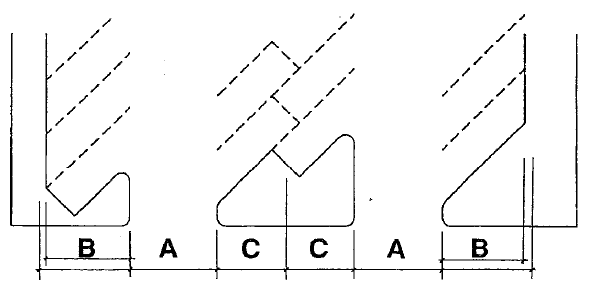
- Minimum dimensions for a parallel parking space shall be 9 feet by 23 feet.
- Minimum parking dimensions for other configurations or for parking lots with compact car spaces shall be determined by the Planning Commission and Village Board upon recommendation of the Village Engineer.
18.24.060 SIGN REGULATIONS
- Purpose: The purpose of these sign regulations is to encourage the effective use of signs as a means of communication in the Village; to maintain and enhance the aesthetic environment and the Village's ability to attract sources of economic development and growth; to improve pedestrian and traffic safety; to minimize the possible adverse effect of signs on nearby public and private property; and to enable the fair and consistent enforcement of these sign regulations.
- Applicability: A sign may be erected, placed, established, painted, created, or maintained within the Village zoning jurisdiction only in conformance with the standards, procedures, exemptions and other requirements of these sign regulations.
- Definitions and Interpretation: Principles for computing sign area and sign height are contained in the Definition of Terms Section of this Regulation.
- Computations:
- Computation of Area of Signs: The area of a sign is calculated by including the entire face of a sign, including the advertising surface and any framing, trim or molding, but not including the supporting structure. In the event a sign has more than one face or advertising surface, the combined area of each face or advertising surface shall be less than or equal to the total allowable area of the sign
- Computation of Height: The height of a sign shall be computed as the distance from the grade at the base of the sign at normal grade to the top of the highest attached component of the sign. Normal grade shall be construed to be from finished grade. Any berms shall be construed to be a part of the sign base and added to the overall height of the sign.
18.24.070 PERMITTED SIGNS AND LIMITATIONS
- Wall Signs:
- All wall signs shall be mounted to the primary face of the use.
- The following criteria apply to wall signs:
District Design Limitations for Wall Signs Max. Size Max. Height Max. Number C-1,
C-2,
I1.5 square feet per lineal foot of building/storefront to a maximum of 400 sq. ft. plus the sign area shall not exceed 30% of the wall face. 25 feet above grade One (1) per storefront
Dual Frontage = one (1) additional Wall Sign may be used provided the combined total area does not exceed 150% of the initial allowable area.
- Other Permitted Signs:
- Business Sign
- Ground Sign
- Inflatable Sign
- Projecting Sign
- Real Estate
- Subdivision Sign
- Wall Sign
- Window Sign
- Pole Sign
- Temporary Signs
- Sign Type, District Permitted: Signs shall be permitted in the various districts at the listed square footage and heights according to the following schedule: +: permitted C: Conditional Use -: not permitted
Zoning District TA R-1,
R-2,
RMC-1,
C-2I Sign Type Business C - + + Subdivision + + C C Projecting - - + + Window - - + + Wall - - + + Ground - - + + Inflatable - - C C Real Estate + + + + Pole - - + + - Signs shall be permitted in the various districts at the listed square footage and heights according to the following schedule: NA: Not Applicable/Not Permitted
Zoning District TA R-1,
R-2,
RMC-1,
C-2I Sign Type Pole NA NA Max. Size (Square Ft.) 50 50 Max. Height (Ft.) 20 20 Number Allowed per lot 1 1 Real Estate Max. Size (Square Ft.) 32 32 32 32 Max. Height (Ft.) 8 8 8 8 Number Allowed/Subdivision 1 1 1 1 Subdivision Max. Size (Square Ft.) Max. Height (Ft.) Number Allowed/Subdivision Ground NA NA Max. Size (Square Ft.) 50 50 Max. Height (Ft.) 8 8 Number Allowed per lot 1 1 Window NA NA Max. Size 5%1 5%1 Max. Height (Ft.) NA NA Number Allowed per building/
storefront2 2 Projecting NA NA Max. Size (Square Ft.) 12 12 Max. Height (Ft.) NA NA Number Allowed per building 1 1
1: percentage of total window area
2: no more than 2 signs at each entrance to the subdivision; may be monument style signs; to be of such size and construction that if it should topple, it would not land on a road surface
Note: All signs shall have a Vertical Clearance of nine feet above any sidewalk, private drive, or parking. All signs shall have a Vertical Clearance of 12 feet above any public street.
18.24.080 SPECIAL SIGNAGE CONDITIONS
The following special conditions apply to stand-alone ATM's, coffee kiosks and other kiosks.
- Stand-alone ATM's may have the following:
- One wall sign on each exterior wall provided each wall sign does not exceed 10 percent of the applicable exterior wall and the total shall not exceed 20 square feet in size.
- Where a canopy is integrated into the ATM, a canopy sign may be placed on each face of the ATM provided the overall height of the canopy and sign do not exceed 24 inches. In addition, the overall size of all canopy signs shall not exceed 20 square feet.
- Directional signage shall be contained on the ATM, painted within a drive lane or in any curbing defining a drive lane.
- All signs are subject to the required permitting process of this Regulation.
- Said signage may be incorporated with a lighting plan and backlit in order to provide for greater security on the premises.
- Coffee kiosks and other kiosks may have the following:
- One wall sign on each exterior wall not used for drive-up service provided each wall sign does not exceed 10 percent of the applicable exterior wall and the total shall not exceed 20 square feet in size.
- Where a canopy is integrated into the coffee kiosks/kiosks, a canopy sign may be placed on each face of the coffee kiosk/kiosks, provided the overall height of the canopy and sign do not exceed 24 inches. In addition, the overall size of all canopy signs shall not exceed 20 square feet.
- Directional signage shall be contained on the coffee kiosk/kiosk, painted within a drive lane or in any curbing defining a drive lane
- Window signs limited to menu boards and daily specials shall not require a sign permit.
- All signs are subject to the required permitting process of this Resolution, unless otherwise noted.
- Permits Required: If a sign requiring a permit under the provision of the Regulation is to be placed, constructed, erected, or modified, a sign permit shall be approved by the Village, through the building permit process unless otherwise stated in this Section, prior to the construction, placement, erection, or modification of such a sign in accordance with the requirements of this Regulation.
- Design, Construction, Maintenance: All signs shall be designed, constructed and maintained in accordance with the following standards:
- All signs shall comply with applicable provisions of the Village's adopted building and electrical codes.
- Except for flags, real estate signs, political signs, and window signs conforming in all respects with the requirements of this Regulation, all signs shall be constructed of permanent materials and shall be permanently attached to the ground, a building or another structure by direct attachment to a rigid wall, frame or structure.
18.24.090 OTHER SIGNAGE PROVISIONS
- Signs in the Public Right-of-Way: No signs shall be allowed in the public right-of-way, except for the following:
- Permanent Signs, including:
- Public signs erected by or on behalf of a governmental body to post legal notices, identify public property, convey public information, advertise community events, and direct or regulate pedestrian or vehicular traffic;
- Informational signs of a public utility regarding its poles, lines, pipes, or facilities.
- Home Occupation Signs: For any Village approved home occupation, one unlighted wall sign, placed on the residence with a maximum area of 6 square feet in size is permitted (with a permit)
- Permanent Signs, including:
- Emergency Signs (Permitted): Emergency warning signs erected by a governmental agency, public utility company, or a contractor doing authorized or permitted work within the public right-of-way.
- Other Signs Forfeited: Any sign installed or placed on public property, except in conformance with the requirements of this Section, shall be forfeited to the public and subject to confiscation. In addition to other remedies hereunder, the Village shall have the right to recover from the owner or person placing such a sign the full costs of removal and disposal of such sign.
- Signs Exempt from Regulation: The following signs shall be exempt from regulation, except no sign in this provision shall create an obstruction to vision, as per this Regulation and/ or a collision hazard to the public:
- Any public notice or warning required by a valid and applicable federal, state, or local law, regulation or Resolution;
- Construction signs when equal to six square feet or less;
- Any sign inside a building, not attached to a window or door, that is not legible from a distance of more than three feet beyond the lot line of the zone lot or parcel on which such sign is located
- Holiday lights and decorations with no commercial message;
- Traffic control signs on private property, such as Stop, Yield, and similar signs, the face of which meets the Manual on Uniform Traffic Control Devices standards and which contain no commercial message of any sort; and
- A political sign exhibited in conjunction with the election of political candidates. All such political signs shall not be erected more than 30 days before the election and shall be removed no later than 10 days after the election. Political signs shall not be placed in the public right-of-way.
- Signs Prohibited Under These Regulations: All signs not expressly permitted in these regulations or exempt from regulation hereunder in accordance with the previous Section are prohibited in the Village. Such signs include, but are not limited to:
- Beacons;
- Marquee signs;
- Roof signs;
- Suspended signs;
- Strings of lights not permanently mounted to a rigid background, except those exempt under the previous section;
- Permanent off-premises signs (billboard);
- Animated signs;
- Audible signs.
- Violations:
- Any of the following shall be a violation of these regulations and shall be subject to the enforcement remedies and penalties provided in the Village's Zoning Regulation, and by state law;
- To install, create, erect, or maintain any sign in a way that is inconsistent with any plan or permit governing such sign, or the lot on which the sign is located;
- To install, create, erect, or maintain any sign requiring a permit without such permit;
- To fail to remove any sign that is installed, created, erected, or maintained in violation of this Regulation, or for which the sign permit has lapsed;
- To continue any such violation. Each day of a continued violation shall be considered a separate violation when applying the penalty portions of this Regulation;
- Each sign installed, created, erected, or maintained in violation of this Regulation shall be considered a separate violation when applying the penalty portions of this Regulation.
18.24.100 HOME OCCUPATIONS
Home Occupations shall be considered conditional uses permitted in the "TA", "R-1", "R-2", and "R-M" Districts, subject to the following:
- Intent: A home occupation shall be permitted when said occupation conducted on residentially used premises is considered customary or traditional, incidental to the primary use of the premises as a residence, and not construed as a business. An application for a home occupation shall be made to the City Clerk on a form provided. Said application will be presented to the Planning Commission for recommendation to the Village Board.
- Purpose: Permitted home occupations shall be of a personal service nature limited to domestic crafts and professional service, including, but not limited to:
- Such domestic crafts as dressmaking, millinery, sewing, weaving, tailoring, ironing, washing, custom home furnishings work, carpentry work, and furniture repair.
- Such professions as law, medicine, architecture, engineering, planning, real estate, insurance, notary public, manufacturer's agent, clergy, writing, painting, photography, and tutoring, provided, however, the service is limited to advice and consultation and the premises are not used for the general practice of the profession.
- Child Nurseries or Child Care Homes in accordance with Neb. Rev. Stat. § 71-1902.
- Barber and Beauty Shops, limited to one (1) chair.
- Therapeutic Massage Parlors, not including adult entertainment establishments, limited to serving one (1) client at any given time.
- Distribution and sales of products such as cosmetics, home/health care products, mail order, and other similar uses.
- Services provided outside the home such as lawn care, snow removal. and other similar uses.
- Permitted home occupations shall be subject to all the regulations of the applicable zone district.
- Permitted home occupations shall not affect adversely the residential character of the zone district or interfere with the reasonable enjoyment of adjoining properties.
- Prohibited uses are those uses that are deemed to be in violation of the Performance Standards of this Ordinance.
- Performance Standards:
- The primary use of the structure or dwelling unit shall remain residential and the operator of the home occupation shall remain a resident in the dwelling unit.
- The operator conducting the home occupation shall be the sole entrepreneur, and he shall not employ any other person other than a member of the immediate family residing on the premises. This standard applies only when the primary service is conducted within the confines of the residence.
- No structural additions, enlargements, or exterior alterations changing the residential appearance to a business appearance shall be permitted.
- No more than twenty-five percent (25%) of the floor area of any one story of the dwelling unit shall be devoted to such home occupation.
- Such home occupations shall be conducted entirely within the primary building or dwelling unit used as a residence.
- Home occupations conducted within an Accessory Building shall be confined to the structure of the said Accessory Building.
- No additional and separate entrance incongruent with the residential structural design shall be constructed for the purpose of conducting the home occupation.
- No provision for extra off-street parking or loading facilities, other than the requirements and permitted facilities, and no additional driveway to serve such home occupations shall be permitted.
- No display of goods or external evidence of the home occupation shall be permitted, except for on non-animated, non-illuminated, non-flashing announcement plate, indicating not more than the name and address of the resident. Said plate shall be attached flat against the wall of the residence and shall not exceed two (2) sq. ft. in total surface area.
- No electrical or mechanical equipment shall interfere with local radio communications and television reception, or cause fluctuation in line voltage off the premises.
- Revocation:
- Conditions: A home occupation permit granted in accordance with the provisions of this section may be terminated if the Village Board makes any of the following findings:
- That any condition of the home occupation permit has been violated;
- That the use has become detrimental to the public health or safety or is deemed to constitute a nuisance;
- That the permit was obtained by misrepresentation or fraud;
- That the use for which the permit was granted has ceased or has been suspended for six consecutive months or morel and
- That the condition of the premises, or the district of which it is a part, has changed so that the use may no longer be justified under the purpose and intent of this section.
- Appeal: Within five working days of a revocation, an appeal may be made to the Village Board, through the Board of Adjustment. The Board of Adjustment within ten working days of the receipt of an appeal of his or her revocation action, shall report his or her findings of fact and decision to the Village Board. The Village Board shall determine the facts and may revoke, modify or allow to remain unchanged the home occupation permit in accordance with the Board's final determination.
- Nontransferable: A home occupation permit granted in accordance with the provisions of this article shall not be transferred, assigned, nor used by any person other than the permittee, nor shall such permit authorize such home occupation at any location other than the one for which the permit is granted.
- Conditions: A home occupation permit granted in accordance with the provisions of this section may be terminated if the Village Board makes any of the following findings:
18.24.110 WIRELESS COMMUNICATION TOWERS
- Intent: The Communications Act of 1934, as amended by the Telecommunications Act of 1996 (the Act), grants the Federal Communications Commission (FCC) exclusive jurisdiction over certain aspects of telecommunication services. This section is intended to regulate towers, telecommunications facilities and antennas in the Village in conformance with the Act without prohibiting or tending to prohibit any person from providing wireless telecommunication service. Telecommunication facilities, towers. and antennas in the Village, to protect residential areas and land uses from potential adverse impact of installation of towers and the antennas through careful design, siting, and camouflaging, to promote and encourage shared use/collection of towers and other antenna support structures rather than the construction of additional single use towers, to avoid potential damage to property caused by towers, telecommunications facilities and antennas by ensuring such structures are soundly and carefully designed, constructed, modified, maintained, repaired and removed when no longer used or are determined to be structurally unsound and to ensure that towers and antennas are compatible with the surrounding land uses.
- Definitions: All terms in this Section which are not specifically defined herein shall be construed in accordance with the Communications Act of 1934, the Telecommunications Act of 1996 and the Rules and Regulations of the Federal Communications Commission (FCC). As used in this Section, the following terms shall have the following meanings:
ANTENNA shall mean a device, designed and intended for transmitting or receiving television, radio, or microwave signals, direct satellite service (including direct-to-home satellite service), and/or video programming services via multi-point distribution services.
ANTENNA SUPPORT STRUCTURE shall mean any building or structure other than a tower which can be used for location of telecommunications facilities.
APPLICANT shall mean any person that applies for a Tower Development Permit.
APPLICATION shall mean a process by which the owner of a tract of land within the zoning jurisdiction of the Village submits a request to develop, construct, modify, or operate a tower upon such tract of land. The term application includes all written documentation, verbal statements, and representations, in whatever, formal forum, made by an applicant to the village concerning such request.
CONFORMING COMMERCIAL EARTH STATION shall mean a satellite dish which is two meters or less in diameter and is located in an area where commercial or industrial uses are generally permitted under this regulation.
ENGINEER shall mean any engineer qualified and licensed by any state or territory of the United States of America.
OWNER shall mean any person with a fee simple title or a leasehold exceeding ten (10) years in duration to any tract of land within the zoning jurisdiction of the Village who desires to develop, construct, modify, or operate a tower upon such tract of land.
PERSON shall mean any person, firm, partnership, association, corporation, company, or other legal entity, private or public, whether for profit or not for profit.
SATELLITE DIST ANTENNA shall mean an antenna consisting of a radiation element intended for transmitting or receiving television, radio, microwave, or radiation signals and supported by a structure with or without a reflective component to the radiating dish, usually circular in shape.
STEALTH shall mean any telecommunications facility, tower, or antenna which is designed to enhance compatibility with adjacent land uses, including, but not limited to, architecturally screened roof-mounted antennas, antennas integrated into architectural elements, and towers designed to look other than a tower, such as light poles, power poles, and trees.
TELECOMMUNICATIONS FACILITIES shall mean any cables, wires, lines, waive, guides, antennas, or any other equipment or facilities associated with the transmission or reception of communications which a person seeks to locate or has installed upon or near a tower or antenna support structure. However, telecommunications facilities shall not include:- Any Conforming Commercial Earth Station antenna two (2) meters or less in diameter which is located on real estate zoned TA, R-1, R-2, R-M, C-1, or I.
- Any earth station antenna or satellite dish antenna of one (1) meter or less in diameter, regardless of zoning applicable to the location of the antenna.
TOWER DEVELOPMENT PERMIT shall mean a permit issued by the Village upon approval by the Village Board of an application to develop a tower within the zoning jurisdiction of the Village; which permit shall continue in full force and effect for so long as the tower to which it applies conforms to this Section. Upon issuance, a Tower Development Permit shall be deemed to run with the land during the permits duration and may be transferred, conveyed, and assigned by the applicant to assigns and successors-in-interest.
TOWER OWNER shall mean any person with an ownership interest of any nature in a proposed or existing tower following the issuance of a Tower Development Permit. - Location of Towers and Construction Standards:
- Towers shall be permitted conditional uses of land in only those zoning districts where specifically listed and authorized in the regulation.
- No person shall develop, construct, modify, or operate a tower upon any tract of land within the zoning jurisdiction of the village prior to approval of its application for a Tower Development Permit by the Village Board and issuance of the permit by the Village. Applications shall submit their application for a Tower Development Permit to the Village Office and shall pay a filing fee in accordance with AMC 18.12.210.
- All towers, telecommunications facilities and antennas on which construction has commenced within the zoning jurisdiction of the Village after the effective date of this regulation shall conform to the Building Codes and all other construction standards set forth by the Village, County, federal, and state law and applicable American National Standards Institute (ANSI). Upon completion of the construction of a tower and prior to the commencement of use, an engineer's certification of a tower and prior to the commencement of use, an engineer's certification that the tower is structurally sound and in conformance with all of the aforementioned applicable regulatory standards shall be filed in the Village Office.
- Application to Develop a Tower: Prior to the commencement of development or construction of a tower, an application shall be submitted to the Village Office for a Tower Development Permit and shall include the following:
- Name, address, and telephone number of the owner and if applicable, the lessee of the tract of land upon which the tower is to be located. Applications shall include the owner of the tract of land and all persons having an ownership interest in the proposed tower. The application shall be executed by all applicant's.
- The legal description and address of the tract of land on which the tower is to be located.
- The names, addresses and telephone numbers of all owners of the towers or usable antenna support structures within a one (1) mile radius of the proposed tower, including publicly and privately owned towers and structure.
- An affidavit attesting to the fact that the applicant has made diligent but unsuccessful efforts to obtain permission to install or collocate the applicant's telecommunications facilities on a tower or useable antenna support or written technical evidence from an engineer that the applicant's telecommunications facilities cannot be installed or collocated on another tower or useable antenna support structure.
- Written technical evidence from an engineer that the proposed tower will meet the established Building Code, and all other applicable construction standards set forth by the Village Board and federal and state ANSI standards.
- Color photo simulations showing the proposed location of the tower with a photo-realistic representation of the proposed tower as it would appear viewed from the nearest residentially used and/or zoned property and the nearest roadway, street or highway.
- Descriptions and diagrams of the proposed tower, telecommunications facilities and/or antenna, manufactures literature, appurtenances such as buildings, driveways, parking areas, and fences or the other security enclosure with significant detail to allow persons reviewing the application to understand the kind and nature of the proposed facility.
- Tower Development Permit: Procedure After receipt of an application for a Tower Development Permit, there will be a public hearing before the Planning Commission, following all Statutory requirements for publication and notice, to consider such application. The Planning Commission shall receive testimony on the Tower Development Permit and shall make a recommendation to the Village Board. Upon the completion of the Planning Commission Public Hearing a public hearing shall be scheduled before the Village Board, following all Statutory requirements for publication and notice, to consider such application and the recommendation of the Village Planning Commission. Notice, for each Public hearing shall be made at least one (1) time and at least ten (10) days prior to such hearing, In addition, a notice shall be posted in a conspicuous place on the property on which action is pending. Such notice shall conform to AMC 18.20.030. The Planning Commission and Village Board may approve the Tower Development Permit as requested in the pending application with any conditions or safeguards it deems reasonable and appropriate based upon the application and/or input received at the public hearings or deny the application. In all zoning districts in which towers are a permitted conditional use of land, the Tower Development Permit shall be deemed a conditional use permit for said tract of land.
- Setbacks and Separation or Buffer Requirements:
- All towers up to fifty (50) feet in height shall be setback on all sides a distance equal to the underlying setback requirement in the applicable zoning district. Towers in excess of fifty (50) feet in height shall be set back one (1) additional foot for each foot of tower height in excess of fifty (50) feet. The height of the tower shall be measured from the grade at the foot of the base pad to the top of any telecommunications facilities or antennas attached thereto. Setback requirements shall be measured from the base of the tower to the property line of the tract of land on which it is located.
- Towers exceeding one-hundred (100) feet in height may not be located in any residentially zoned district and must be separated from all residentially zoned districts and occupied structures other than those utilized by the tower owner, by a minimum of two-hundred (200) feet or one-hundred percent (100%) of the height of the proposed tower, whichever is greater.
- Towers of one-hundred (100) feet or less in height may be located in residentially zoned districts provided said tower is separated from any residential structure, school, church, and/or occupied structures other than those utilized by the tower owner, by a minimum of one-hundred percent (100%) of the height of the tower.
- Towers must meet the following minimum separation requirements from other towers:
- Monopole tower structures shall be separated from all other towers, whether monopole, self-supporting lattice, or guyed by a minimum of seven-hundred fifty (750) feet
- Self-supporting lattice or guyed towers shall be separated from all other self supporting lattice or guyed towers by a minimum of one-thousand five-hundred (1,500) feet
- Structural Standards for Towers Adopted: The Structural Standards for Steel Antenna Towers and Antenna Supporting Structures, 1991 Edition (ANSI/EIA/TIA 222-E-1991) is hereby adopted, together with any amendments thereto as may be made from time to time, except such portions as are hereinafter deleted, modified, or amended by regulations and set forth in this Article of the Zoning Regulation.
- Illumination and Security Fences:
- Towers shall not be artificially lighted except as required by the Federal Aviation Administration (FAA). In cases where there are residential uses/zoned properties within a distance of 300% of the height of the tower. any tower subject to the Section shall be equipped with dual mode lighting.
- All self-supporting lattice or guyed towers shall be enclosed within a security fence or other structure designed to preclude unauthorized access. Monopole towers shall be designed and constructed in a manner which will preclude to the extend practical, unauthorized climbing of said structure.
- Exterior Finish: Towers not requiring FAA painting or marking shall have an exterior finish which enhances compatibility with adjacent land uses. subject to review and approval by the Planning Commission and Village Board as part of the application approval process. All towers which must be approved as a conditional use shall be stealth design unless stealth features are impractical or the cost of such features represents an undue burden on the applicant.
- Landscaping: All tracts of land on which towers, antenna support structures, telecommunications facilities, and/or antennas are located shall be subject to the landscaping requirements of the Village.
- Maintenance, Repair or Modification of Existing Towers: All towers constructed or under construction on the date of approval of this regulation may continue in existence as non-conforming structure and may be maintained or repaired without complying with any of the requirements of this Section. Nonconforming structures or uses may not be enlarged or the degree of nonconformance increased without complying with this Section, including applying for and obtaining a Tower Development Permit. Any modification or reconstruction of a tower constructed or under construction on the date of approval of this regulation shall be required to comply with the requirements of this Section including applying for and obtaining a Tower Development Permit. Said application shall describe and specify all items which do not comply with this Section and may request, subject to final review and approval of the Village Board, and exemption from compliance as a condition of the Tower Development Permit.
- Inspections: The Village reserves the right to conduct inspection of towers, antenna support structures, telecommunications facilities and antenna upon reasonable notice to the tower owner or operator to determine compliance with this Section and to prevent structural and equipment failures and accidents which may cause damage, injuries or nuisances to the public. Inspections may be made to determine compliance with the Village's Building Codes and any other construction standards set forth by the Village, County, federal and state law or applicable ANSI standards. Inspection shall be made by either an employee of the Village's Zoning Office, Building Inspector, or a duly appointed independent representative of the Village.
- Maintenance: The towers, antenna support structures, telecommunication facilities and antennas shall at all times be kept and maintained in good condition, order and repair so that the same does not constitute a nuisance to or a danger to the life or property of any person or the public.
- Abandonment: If any tower shall cease to be used for a period of one (l) year, the Zoning Office shall notify the tower owner that the site will be subject to determination by the Village Board that the site has been abandoned. Upon issuance of written notice to show cause, the tower owner shall have thirty (30) days to show preponderance of evidence that the tower has be in use or under repair during the period of apparent abandonment. In the event the tower owner fails to show that the tower has been in use or under repair during the relevant period, the Village Board shall issue a final determination of abandonment of the site and the tower owner shall have seventy-five (75) days thereafter to dismantle and move the tower. In the event the tower is not dismantled and removed, the tower shall be declared a public nuisance by the Village Board, or his/her designee and a written request shall be directed to the Village Attorney to proceed to abate said public nuisance pursuant to authority of the Revised Nebraska State Statutes and Village of Arlington Codes, and charge the costs thereof against the real estate on which the tower is located or the owner of the said real estate.
- Satellite dish Antennas, Regulation: Upon adoption of this regulation, installment of satellite dish antennas shall be permitted within the zoning jurisdiction of Arlington only upon compliance with the following criteria:
- In residentially zoned districts, satellite dish antennas may not exceed a diameter of ten (10) feet.
- Single family residences may not have more than one (1) satellite dish antenna over three (3) feet in diameter.
- Multiple family residences with ten (10) or less dwelling units may have no more than one (1) satellite dish antenna over three (3) feet in diameter. Multiple family residences with more than ten (10) dwelling units may have no more than two (2) satellite dish antennas over three (3) feet in diameter.
- In residential zoning districts. satellite dish antennas shall not be installed in the required front yard setback or side yard setback area.
- All satellite dish antennas installed within the zoning jurisdiction of Arlington, upon adoption of this regulation, shall be of a neutral color such as black, grey, brown, or such a color as will blend with the surrounding dominant color in order to camouflage the antenna.
- Severability: If any clause, subsection, or any other part of this Section shall be held invalid or unconstitutional by any court of competent jurisdiction, the remainder of this Section shall not be affected thereby, but shall remain in full force and effect.
18.24.120 FENCES
No fence shall be constructed within the zoning jurisdiction of the Village of Arlington unless a permit therefore is approved and issued by the Board and is erected as follows:
- Rear Lot Line: Maximum height, 8 feet; may be all solid.
- Side Lot Line:
- Maximum height between rear lot line and front building line projected to side lot line, 8 feet; may be solid construction. Exception: see paragraph A,4 regarding corner lots.
- Maximum height between street right of way and front building line projected to side lot, 4 feet; may be all solid construction. Exception: see paragraph A,4 regarding corner lots.
- Front Lot Line: Maximum height, 42 inches; no solid construction. Exception: see paragraph A,4 regarding corner lots.
- Corner Lot: No fence shall be erected that is more than 3 feet in height above the established curb grade in the triangular area at the intersection of the street right of way lines of the corner lot, said triangular area being bounded by a diagonal line extended between points 30 feet each way from the intersection of said street right-of-way lines; may be all solid construction.
- Patio fences which are not constructed on the property lines may have a maximum height of 8 feet; may be all solid construction.
- Fences may be erected only with the permission of the Village Board. In the R-1, R-2, C-1, C-2 and I-1 Districts, fences may be erected upon approval of a building inspector. In the TA District, no permit shall be required for fences for open space agricultural purposes.
- It shall be unlawful for any person to erect or cause to be erected and maintained any barbed wire or electric fence except in District TA. Snow fencing may be permitted during the winter months to control snow drifting.
- This Section shall not apply to property owned by the Village.
- When solid fences are constructed, the finished side should be toward the neighbor, alley or street.
- Wooden fences shall be only solid construction and no closer to the front line than the front corner of the dwelling.
- All pools shall have a fence around the entire pool area. Exception: see paragraph A,4 regarding corner lots.
(Ord. 391, 6/2/1986)
18.24.130 STORAGE OR PARKING OF VEHICLES, BOATS, CAMPERS AND TRAILERS
No lot, parcel, or tract of land or part thereof, situated within the zoning jurisdiction of the Village of Arlington shall be used for any of the following:
- The storage or keeping of motor vehicles not having properly issued current motor vehicle registration and current motor vehicle license plate properly displayed; provided, however, that the following shall not constitute a violation of this paragraph.
- The storage of unlicensed and/or unregistered motor vehicles in a fully enclosed garage.
- The storage or keeping of operable off-highway farm or industrial vehicles on tracts zoned Transitional Agricultural Residence (TA) or any Industrial District and used in agricultural or industrial activity not conducted on any said premises.
- The storage of no more than one (1) passenger type motor vehicle in good or operable condition located on a hard surfaced driveway pursuant to a permit to store obtained from the Village Clerk. Permit shall be issued for a $10.00 fee to the applicant and shall:
- Be issued for a period not to exceed six (6) months and shall be renewable upon application for like periods as long as such storage is in all respects in compliance herewith.
- Identify the vehicle by make, year of manufacture, model and manufacturer's identification number.
- State the reason the vehicle does not bear a current registration and license;
- Require owner to prove continued operability of the vehicle upon request of the Village Board; and
- Contain the property owner's and vehicle owner's consent for the Village and its agents to enter upon the premises and vehicle for the purpose of determining continued operability of the vehicle; and shall be revocable upon owner's failure to comply with any of the terms thereof.
- The storage, keeping or abandonment of parts, including scrap metals, from motor vehicles or machinery, or parts thereof, except in enclosed buildings or garages or where otherwise authorized by the Arlington zoning regulations.
- Parking, storage, or keeping, other than in a fully enclosed garage, of any non-operable motor vehicle on any lot zoned residential, provided, however, that automobiles that are non-operable solely by reasons of repair work being done thereon may be parked on residential lots within the Arlington zoning jurisdiction occupied by the owner of said automobile, under the following conditions.
- The automobile is owned by the occupier of the premises and registered to him/her at that address.
- The period of said repair work does not exceed one-hundred eighty (180) days in duration;
- Said repair work is at al1 times conducted on a hard surface driveway; and
- No more than one (1) automobile in need of repair is situated on the premises at the same time.
- No motor vehicle as defined by Neb. Rev. Stat. § 60-301 (or boat, camper or trailer in excess of 15 feet in length or 10 feet in height) shall be parked in the front, side, or rear yard of any lot zoned residential except on paved driveways or other hard surfaced areas as designed and provided for in AMC 18.04; provided that:
- Said boats, campers and trailers together with accessory structures shall not occupy more than thirty-five percent of the required rear yard.
- Notwithstanding the foregoing, it shall be permissible to park motor vehicles in the yards of residential lots on areas which are not paved as driveways or otherwise hard surfaced for a period not to exceed seventy-two (72) hours, and as allowed by conditional permit to accommodate temporary guests or visitors for no more than 14 days. Any motor vehicle, boat, camper, or trailer parked, stored, or kept in violation of the provisions hereof may be removed by the Village. All towing, storage and other costs of removal pursuant to this section shall be solely at the expense of the owner of the premises from which the vehicle, boat, camper or other trailer is situated, and if the owner is different than the occupier of the premises, then both owner and occupier shall be jointly and severally liable. In addition, the Village, upon certifying the same to the county treasurer, shall have a lien against the premises on the full amount of such removal costs, together with interest at the highest legal rate that the Village is authorized by law to collect on special assessments.
18.24.140 KEEPING OF ANIMALS
Animals may be kept within the zoning jurisdiction of the Village of Arlington subject to the following restrictions:
- It shall be unlawful for any person to keep or maintain within the corporate limits any horse, mule, sheep, cow, goat or swine, including Chinese pot-bellied pigs, chicken, ducks, turkeys, geese or any other fowls other than household birds in cages. (Neb. Rev. Stat. § 17-121)
- The keeping of dogs, cats, rabbits, and household pets shall be permitted accessory use in residential and commercial districts subject to the regulations for kennels as defined in AMC 18.04. For the purposes of this section, a "household pet" is any animal or creature kept inside a residential dwelling not outside, and in no event shall include any of the following: any live monkey (non-human primate), pigeons, raccoon, skunk, fox, poisonous or dangerous insect or reptile, leopard, panther, tiger, lion, lynx, or any other warm-blooded animal which can normally be found in the wild state. No more than 3 animals over the age of four months, per family or residence.
- The restrictions contained in this section shall not apply to any pet store.
18.24.150 PERFORMANCE STANDARDS FOR INDUSTRIAL USES
- Physical Appearance: All operations shall be carried on within an enclosed building except that new materials or equipment in operable condition may be stored in the open. Normal daily wastes of an inorganic nature may be stored in containers not in a building when such containers are not readily visible from a street. The provisions of this paragraph shall not be construes to prohibit the display of merchandise or vehicles for sale of the storage of vehicles, boats, farm machinery, trailers, mobile homes, or similar equipment when in operable condition.
- Fire Hazard: No operation shall involve the use of highly flammable gasses, acid, liquids, grinding processes, or other inherent fire hazards. This provision shall not be construed to prohibit the use of normal heating fuels, motor fuels, and welding gasses when handled in accordance with other regulations of the Village of Arlington.
- Noise: No operation shall be carried on which involves noise in excess of the normal traffic noise of adjacent street at the time of daily peak hour of traffic volume. Noise shall be measured at the property line and when the level of such noise cannot be determined by observation with the natural senses, a suitable instrument may be used and measurement may include breakdowns into a reasonable number of frequency ranges.
- Sewage and Liquid Wastes: No operation shall be carried on which involves the discharge into a sewer, water course, or the ground, liquid waste of any radioactive or poisonous nature or chemical waste which are detrimental to normal sewage plant operation or corrosive and damaging to sewer pipes and installations.
- Air Contaminants:
- Air contaminants and smoke shall be less dark then designated Number One on the Ringleman Chart as published by the United States Bureau of Mines, except that smoke of a density designated as Number One shall be permitted for one four minute period in each one-half hour. Light colored contaminants of such a capacity as to obscure an observer's view to a degree or greater than the aforesaid shall not be permitted.
- Particulate matter of dust as measured at the point of emission by any generally accepted method shall not be emitted in excess of two tenths (.02) grains per cubic foot as corrected to a temperature of 500 degrees. Fahrenheit, except for a period of minutes in any one-half hour, at which time it may equal but not exceed six tenths (0.6) grains per cubic foot as connected to a temperature of 500 degrees Fahrenheit.
- Due to the fact that the possibilities of air contamination cannot reasonably be comprehensively covered in this section, there shall be applied to the general rule that there shall not be discharged from any sources whatsoever such quantities of air contaminants or other material in such quality as to cause injury, detriment, nuisance, or annoyance to any considerable number of persons or to the public in general; or to endanger the comfort, repose, health, or safety of any such considerable number of persons or to the public in general, or to cause, or to have a natural tendency to cause injury or damage to business, vegetation, or property.
- Odor: The emission of odors that are generally agreed to be obnoxious to any considerable numbers of persons shall be prohibited. Observations of odor shall be made at the property line of establishment causing the odor. As a guide to classification of odor it shall be deemed that strong odors of putrefaction and fermentation tend to be obnoxious and that such odors as associated with baking or the roasting of nuts and coffee shall not normally be considered obnoxious within the meaning of this Regulation.
- Gasses: The gasses sulfur dioxide and hydrogen sulfide shall not exceed five (5) parts per million, carbon monoxide shall not exceed five (5) parts per million. All measurements shall be taken at the zoning lot line.
- Vibration: All machines including punch presses and stamping machines shall be so mounted as to minimize vibration and in no case shall such vibration exceed a displacement of three thousandths (0.003) of an inch measured at the zoning lot line. The use of steam or broad hammers shall not be permitted in this zone.
- Glare and heat: All glare, such as welding arcs and open furnaces shall be shielded so that they shall not be visible from the zoning lot line. No heat from furnaces or processing equipment shall be sensed at the zoning lot line to the extent of raising the temperature of air or materials more than five (5) degrees Fahrenheit.
18.24.160 LANDSCAPING REQUIREMENTS
- Intent: The intent of the landscaping requirements are to improve the appearance of lot areas and soften paved areas and buildings; to provide a buffer between differing land uses; to minimize the adverse effect of uses from one another; to minimize the effect of heat, noise and glare; to conserve the value of property and neighborhoods within the community; and to enhance the physical environment within the Village of Arlington by ensuring that yards. open spaces, parking lots and those areas abutting public rights-of-way are designed, installed and maintained in accordance with then provisions of this section. Property development shall consider and respect land capabilities and constraints, minimize erosion and destruction of natural amenities and provide a buffer between differing ]and uses.
- Application and Scope: The provisions of the section shall apply to all new construction and development including, but not limited to, structures, dwellings, buildings, parking lots, residential subdivisions, office parks, shopping centers, and redevelopment for which either a building or zoning permit approval is required, except the following:
- Agricultural buildings, structures and uses.
- Replacement of lawfully existing structures or uses.
- Additions, remodeling or enlargements of existing uses or structures provided that the enlargement of surface parking of less than 4,000 square feet shall not be expected. Where such enlargement is less than 4,000 square feet, the provisions of this section shall apply only to that portion of the lot or site where the enlargement occurs.
- Where there is more than one lot or site being developed together as one unit with common property lines, the entire site shall be treated as one lot or site for the purpose of conforming to the requirements of this section.
- When a lot or site with more than one owner has been partially developed at the time of adoption of this section. The application of the requirements of this section shall be determined by the Village Board with the recommendation of the Village Planning Commission.
- Screening Requirements:
- All parking areas or vehicular use areas abutting a residential district or public right-of-way shall be screened from grade level to a height not less than 3 feet.
- All commercial and industrial uses that abut residential or office districts shall provide screening not less than 6 feet in height along the abutting property line(s).
- Screening required by this section shall be equivalent to the following:
- Solid fences or walls as approved by the Planning Commission on the final development plan.
- Hedges, shrubs, or evergreen trees of 36 inches in height at planting spaced appropriately to provide a solid screen within 3 years after planting.
- Berms of not less than 3 feet in height and that provide a maximum slope of 3:l for easy maintenance. Such berms may be used in conjunction with plantings to achieve the solid visual screen.
- All projects except one-and-two family dwellings shall include a detailed drawing on the landscape plan indicating the method of enclosure and screening to be used on trash dumpsters. All dumpsters or trash bins shall maintain a solid 6-foot enclosure around each unit. Said enclosure shall be of complementary materials suitable to the Planning Commission. All plant material used for screening shall meet the standards in paragraph D.
- Installation and Maintenance of Landscaping and Screening:
- Installation: All Landscaping shall be installed in a sound workmanship like manner and according to accepted good planting procedures. Landscaped areas shall require protection from vehicular encroachment. A qualified code enforcement officer or other planning official shall inspect all landscaping and no certificates of occupancy or similar authorization will be issued unless the landscaping meets the requirements herein provided. Temporary occupancy permits may be issued due to weather related conditions upon approval by the Deputy Building Official.
- Maintenance: The owner, developer, tenant and/or their agent, if any, shall be jointly and severally responsible for the maintenance of all landscaping. All required landscaping shall be maintained in proper condition. When replacement is necessary all plants and other nonliving landscape materials shall be equal in size, density, and appearance to those items requiring replacement. Underground sprinkler systems shall be provided to serve all landscaped areas except individual one and two family dwellings unless an equivalent watering system is approved by the Planning Commission.
All required screening and fencing shall be maintained and, wherever necessary, replaced with materials that provide equivalent size, density, and appearance. All landscaping and screening shall be kept free from refuse and debris so as to present a healthy, neat and orderly appearance. Lawn grass or other approved ground cover shall be maintained on all areas not covered by other landscaping, parking, drives, buildings, or similar structures.
- Preliminary Plan Approval: A landscape plan indicating both proposed and existing landscaping and screening shall be submitted, with the preliminary plat, preliminary PUD, or preliminary site plan for development, for review and recommendation by the Planning Commission and approval by the Village Board. Said Plan shall be in sufficient detail to provide the Commission and Village Board with a reasonable understanding of what is being proposed. Site calculations used in computing quantities shall not be submitted which are proposed to be used to satisfy the required amounts of landscaping.
- Final Plan Approval: A detailed listing of all plant materials to be used, quantities, size and spacing shall be submitted to the Planning Commission on separate sheets for review and recommendation and approval by the Village Board along with a planting schedule at final development plan submission.
- Parking Lot Plan Approval: A final site development plan shall be submitted to the Planning Commission with the requisite landscaping and screening required herein for each of the following types of parking lot improvements:
- New construction.
- Expansion of existing facilities.
- Maintenance of existing facilities where an overlay is proposed at which time the landscaping and screening shall be required. Modification to the required parking lot landscaping and screening may be granted by the Planning Commission after review of submitted plans and in consideration of surrounding uses.
- No parking lot shall be exempted from these regulations; unless previously exempted.
18.24.170 PLACEMENT OF A SMALL WIND ENERGY SYSTEM
- The placement of a small wind energy system shall comply with the following:
- Shall not cause interference to the radio and TV reception on adjoining property. In the event of such interference the owner of the system shall remedy such interference.
- Shall not be located closer than a distance equal to the total height of the system to an occupied dwelling.
- Setback requirements for the wind tower shall be measured from the base of the wind tower.
- Shall be located not less than its total height from any road right-of-way line (public, private, easement, etc.), any overhead utility lines and all property lines, or the zoning district setbacks, whichever is greater. In no case shall any part of a small wind energy system, including any guy wires, be nearer than 90' to the center line of a U.S. or State designated highway or major County collector road, and not nearer than 90' to the center line of any other County Highway Department maintained road.
- Guy wire anchors shall meet all zoning district setbacks.
- No system shall be constructed in a manner which will interfere with emergency communication transmissions of the County or Village. In the event of such interference the owner of the system shall remedy such interference.
- All systems shall have performed, and provided to the Village Clerk (which may be passed on to the County Planning Department and County Sheriff's Office) as part of the permit process, a microwave path study, at the applicant's expense, showing the system will not interfere with the county's E-911 communication system.
- There is no County limitation on tower height, except as may be imposed by local, State or Federal regulations (FAA, FCC, Joint Airport Zoning Board, etc.).
- Shall not exceed 55 dBA, as measured at the property line. Proof of such shall be provided at the time of application by the applicant. This level may be exceeded during short term events such as severe wind storms
- Must have been approved under the Emerging Technologies program of the California Energy Commission or any other small wind certification program recognized by the American Wind energy Association.
- Shall be installed per adopted County codes (building, electrical, etc.). Applications for systems larger than 50kW shall have installation drawings prepared and stamped by a Nebraska licensed professional engineer.
- No system shall be installed until evidence has been given that the electric utility has been informed of the customer's intent to install an interconnected customer-owned generator. Off-grid systems shall be exempt from this requirement.
- The visual appearance of the system shall at a minimum:
- be a non-obtrusive color such as white, off-white or gray;
- not be artificially lighted, except to the extent required by the FAA or other applicable authority that regulated air safety;
- not display advertising (including flags, streamers or decorative items) except for identification of the turbine manufacturer, facility owner and operator and no larger than one square foot in area.
- Any system that is not operated for a continuous period of 12 months shall be considered abandoned, and the owners of such system shall remove all structures within 90 days of receipt of notice from the County notifying the owner of such abandonment. If such facility is not removed within said 90 days, the matter will be turned over to the Village Attorney for further action.
- Permits: A small wind energy system is a permitted principal use in any zoning district provided the property is 2 acres or larger in size. To place a small wind energy system on a property of less than 2 acres in size requires a conditional use permit (process as per the Zoning Regulations).

