
Arvin City Zoning Code
CHAPTER 17
62 - SIGN REGULATIONS PRIVATE PROPERTY17
Editor's note— Ord. No. 408, adopted Aug. 6, 2013, amended Ch. 17.62 in its entirety to read as herein set out. Former Ch. 17.62, §§ 17.62.010—17.62.150, pertained to the same subject matter. See the Code Comparative Table for complete derivation.
17.62.010 - Title.
The ordinance codified in this chapter shall be known as the "Sign Regulations." This chapter supersedes all other sign regulations contained in the Municipal Code, except Chapter 17.52, Nonconforming Buildings and Uses.
(Ord. No. 408, 8-6-2013)
17.62.020 - Purpose.
The purpose and intent of these sign regulations is to:
A.
Regulate signs located on private property within the city and on property owned by public agencies other than the city and over which the city has zoning and land use regulatory power.
B.
Implement the city's general plan policies as set forth in the city's general plan, specific plans, special districts, design guidelines, and municipal code.
C.
Maintain and enhance the city's appearance by regulating the design, character, location, number, type, quality of materials, size, illumination and maintenance of signs.
D.
Serve the city's interests in maintaining and enhancing its visual appeal for residents, tourists and other visitors, by preventing the degradation of visual quality which can result from excessive and poorly designed located or maintained signage.
E.
Generally limit commercial signage to on-site locations in order to protect the aesthetic environment from the visual clutter associated with the unrestricted proliferation of signs, while providing channels of communication to the public.
F.
Limit the size and number of signs to levels that reasonably allow for the identification of a residential, public or commercial location and the nature of any such commercial business.
G.
Encourage signs that are appropriate to the zoning district in which they are located and consistent with the permitted uses of the subject property.
H.
Establish sign sizes in relationship to the scale of the parcel and building on which the sign is to be placed or to which it pertains.
I.
Minimize the possible adverse effects of signs on nearby public and private property, including streets, roads and highways.
J.
Protect the investments in property and lifestyle quality made by persons who choose to live, work or do business in the city.
K.
Protect and improve pedestrian and vehicular traffic safety by balancing the need for signs that facilitate the safe and smooth flow of traffic (e.g., directional signs and on-site signs) without an excess of signage which may distract drivers or overload their capacity to quickly receive information.
L.
Reduce hazardous situations, confusion and visual clutter caused by the proliferation, placement, illumination, animation and excessive height, area and bulk of signs which compete for the attention of pedestrian and vehicular traffic.
M.
Regulate signs in a manner so as not to physically interfere with or obstruct the vision of pedestrian or vehicular traffic.
N.
Avoid unnecessary and time consuming approval requirements for certain minor or temporary signs that do not require review for compliance with the city's building and electrical codes while limiting the size and number of such signs so as to minimize visual clutter.
O.
Respect and protect the right of free speech by sign display, while reasonably regulating the structural, locational and other non-communicative aspects of signs, generally for the public health, safety, welfare and specifically to serve the public interests in community aesthetics and traffic and pedestrian safety.
P.
Enable the fair, consistent and efficient enforcement of the sign regulations of the city.
Q.
Regulate signs in a constitutional manner, which is content neutral as to noncommercial signs and viewpoint neutral as to commercial signs. All administrative interpretations and discretion is to be exercised in light of this policy and consistent with the purposes and intent stated in this section.
R.
The primary purpose of a sign is to identify the business. Advertising signs alone are prohibited. However, in conjunction with an identification of the business, signs information on not more than five (5) products may be allowed. For example, information on products such as bakery or photography or hardware may be allowed.
(Ord. No. 408, 8-6-2013)
17.62.030 - Definitions.
The words, phrases and terms used in this chapter will have the meaning set forth in this section unless another meaning is clearly apparent from the context.
"Sign" means any device, fixture, placard or structure, including its component parts, which draws attention to an object, product, place, activity, opinion, person, institution, organization, or place of business, or which identifies or promotes the interests of any person and which is to be viewed from any public street, road, highway, right-of-way or parking area. The following are not within the definition of "sign" for the regulatory purposes of this chapter:
a.
Any public or legal notice required by a court or public agency;
b.
Decorative or architectural features of buildings, except letters, trademarks or moving parts;
c.
Symbols of noncommercial organizations or concepts including, but not limited to, religious or political symbols, when such are permanently integrated into the structure of a permanent building which is otherwise legal;
d.
Signs on street legal vehicles, license plates, license plate frames, registration insignia, including noncommercial messages, messages relating to the business or service of which the vehicle is an instrument or tool (not including general advertising) and messages relating to the proposed sale, lease or exchange of the vehicle;
e.
Traffic, directional, emergency, warning or informational signs required or authorized by a government agency having jurisdiction;
f.
Permanent memorial or historical signs, plaques or markers;
g.
Public utility signs; and
h.
News racks that are otherwise subject to regulation under this Code.
"Alley-side signs" means a sign affixed to the wall of a building adjacent to an alley.
"Awning sign" (also known as a "canopy sign") means a sign affixed to an awning or canopy that is affixed to a building.
"Banner sign" means a temporary sign publicizing a unique happening, action, purpose or occasion and constructed of lightweight cloth, canvas, paper or similar material.
"Business associates sign" means lettering on the building or windows of a building indicating the owners, operators or associates of the business or occupancy.
"Changeable copy sign" means a sign that is characterized by changeable copy, letters symbols, or numerals.
"Cabinet-style sign" means a sign that is affixed to the wall of a buiding and is typically comprised of a metal cabinet or box, generally illuminated from within, and into which a sign is inserted for display.
"Campaign sign" means a sign that is designed to influence the passage or defeat of any measure on a ballot or to influence voters with respect to the nomination, election, defeat, or removal of a candidate from public office at any national, state, or local election.
"Changeable copy sign" means a sign that is characterized by changeable copy, letters symbols, or numerals.
"Commercial message" means any wording, logo or other representation that, directly or indirectly, names, advertises or calls attention to a commercial or industrial business, product, good, service or other commercial or industrial activity.
"Commercial sign" means any sign that is intended to attract attention to a commercial or industrial business, occupancy, product, good, service, or other commercial or industrial activity for a commercial or industrial purpose.
"Construction sign" means a temporary sign denoting the architects, engineers, owners, lenders, contractors, future tenants and others associated with a construction project, but which contains no other advertising matter.
"Department" means the Department of Planning and Building of the City of Arvin.
"Direct lighting" means a light source used which is detached from the sign to illuminate the sign surface.
"Director" means the Director of the Planning and Building Department of the City of Arvin or the director's designee.
"Directional sign" means a freestanding sign placed near a driveway that directs motorists to parking facilities.
"Directory sign" means a sign illustrating the general site plan and listing the businesses or establishments within an office complex, shopping center or industrial complex showing the locations of various buildings, uses or occupancies on a single display surface.
"Display surface" means that area of a sign or area structure utilized for displaying copy, messages or display.
"Double-face sign" means a sign that has two (2) display surfaces; backed against each other or against the same supporting structure in such a manner that each display surface is designed to be viewed from a different direction.
"Drive-through menu board" means a wall or monument sign displaying a list of items available with prices at a drive-through business for the purpose of taking drive-through orders.
"Erect" means to build, construct, attach, hang, place, suspend or affix to or upon any surface.
"Face or wall of a building" means the outer surface of any main exterior wall or foundation of a building, including windows and store fronts.
"Feather sign" means a sign typically composed of a vertical pole with a fabric banner attached to the pole, which is designed to flap or move in the wind.
"Flashing sign" means any sign which, by method or manner of illumination, flashes, winks or blinks with varying light intensity, shows motion, or creates the illusion of motion; or revolves in a manner to create the illusion of being on or off.
"Freestanding sign" means any sign mounted on the ground and not attached to any other structure. Freestanding signs are by definition monument signs no higher than ten (10) feet, where the base is a solid structure that is aesthetically part of the sign and is at least fifty percent (50%) of the width of the sign face. Pole signs are not allowed under this title.
"Fuel pricing sign" means a sign indicating, and limited to, the brand or trade name, method of sale, grade designation and price per gallon of gasoline or other motor vehicle fuel offered for sale on the premises, and such other information as may be required by law.
"Future construction sign" means a sign indicating the future location of a building and the developer of such building.
"Hand-held sign" means a sign that is held by or otherwise mounted on a person. For the purposes of this title, hand held sign does not include a noncommercial sign.
"Identification sign" means a sign that contains only the name, trademark or symbol, or address, of the building or occupant of the property.
"Illegal sign" means: (a) any sign originally erected or installed without first complying with all structural, locational, design, building, and electrical regulations in effect at the time of its construction or installation; (b) any commercial sign that is not maintained, or is not used to identify or advertise an ongoing business, occupancy, product, good or service available on the site of the sign for more than ninety (90) days; (c) any unsafe sign.
"Incidental sign" means a sign indicating credit cards accepted, trade affiliations, no solicitation, no trespassing and similar property-related matters.
"Incidental traffic control signage" means signs placed within on-site parking facilities that provide directional and traffic safety information for motorists.
"Industrial park" means a group of four (4) or more industries developed as an independent entity under a common plan and design with common off-street parking as an integral part thereof, the single units of which entity do not have direct access to a public street but with the entity as a whole having such direct access.
"Inflatable sign" means a sign that is inflated by air or other gaseous matter.
"Interior illumination" means the placement of lights on the interior of a sign panel designed to evenly distribute the source of light upon the translucent sign surface.
"Legal nonconforming sign" means a sign that was originally erected or installed in compliance with all structural, locational, design, building, and electrical regulations at the time of its erection or installation, but which no longer conforms to the provisions of this chapter.
"Lighted sign" means a sign that is illuminated by any source, whether internal, external or indirect.
"Marquee sign" means a sign affixed to a building that projects into a public or private right-of-way and which is typically used to identify movie or live performance or event attractions.
"Master sign program" means a plan showing the location, dimensions, area, color, lighting and materials of all signs located on a single parcel or parcels, either under the same ownership or under the same planned development permit.
"Menu board sign" means a wall or monument sign displaying a list of items available with prices at a drive-through business for the purpose of taking drive-through orders.
"Mobile sign" means the use of a moving trailer, automobile, truck, or any other vehicle to display commercial or noncommercial messages primarily for advertising purposes unrelated to the principal use of such vehicle.
"Monument sign" means a sign supported by a base constructed of concrete, block or rock material placed in or upon the ground that has no air space, columns or supports visible between the ground and the bottom of the sign.
"Moving, rotating or animated sign" means a sign which rotates, moves, flashes, blinks, or directs attention to or advertises with human or animal figures, or products sold, has animated movement by digital or electronic devices, or a sequence or series of flashing, flickering, rotating, moving, or blinking lights, excepting therefrom any sign as may show date, time, temperature or barometric information only.
"Multi-tenant sign" means a sign listing the names of the various tenants, which do not have direct access or visibility to a public street, occupying a building or buildings on a parcel of land or multiple parcels of land approved under a common plan with common off-street parking and access.
"Noncommercial message" means any wording, logo or other representation that does not directly or indirectly, name, advertise or call attention to a commercial or industrial business, product, good, service or other commercial or industrial activity.
"Noncommercial sign" means a sign that does not name, advertise or call attention to a commercial or industrial business, commodity, product, good, service or other commercial or industrial activity for a commercial or industrial purpose.
"Occupancy frontage" means a single lineal dimension measured horizontally along the front of a building which defines the limits of a particular occupancy at that location.
"Office complex" means a group of four (4) or more separate offices, developed as an independent functioning entity under a common plan and design with common off-street parking as an integral part of the plan and where the separate offices do not have direct access to a public street but the complex as a whole has such direct access.
"Off-site sign" means a commercial sign not located on the site of the business or entity indicated or advertised by the sign, or a commercial sign advertising a commodity, good, product, service or other commercial or industrial activity which originates on a site other than where the sign is maintained. "Off-site sign" includes outdoor advertising structures.
"On-site sign" means any sign which directs attention to occupancy, business, commodity, good, product, service or other activity conducted, sold or offered upon the site where the sign is maintained. For the purposes of this title, all signs with noncommercial messages are deemed to be "on-site," regardless of location.
"Outdoor advertising structure" means a sign erected for the purpose of advertising a product, event, person or subject not related to the premises on which the sign is located (i.e., a billboard).
"Pedestrian sign" generally means a sign mounted under an arcade intended to provide information for pedestrians.
"Permanent sign" means any sign which is intended to be and is so constructed as to be of lasting and enduring condition, remaining unchanged in character, condition (beyond normal wear and tear) and position and in a permanent manner affixed to the ground, wall or building.
"Portable sign" also referred to as an "A-frame sign" or a "sandwich board sign" means a freestanding sign that is not permanently affixed, anchored or secured to either the ground or a structure on the premises it is intended to occupy, but does not include hand-held signs. For the purposes of this title, a portable sign does not include a noncommercial sign.
"Projecting sign" means a sign that projects from and is supported by a wall or a façade of a building. Projecting signs are also referred to as marquee signs.
"Public convenience sign" means a sign that serves the public safety or convenience, such as a sign that indicates the entrance or exit to a property, identifies parking areas, or provides regulatory or service information of a noncommercial character.
"Real estate sign" means any temporary sign that relates to the sale, lease or exchange of all or a portion of the premises upon which it is located.
"Roof sign" means a sign erected upon or wholly supported by the roof of a structure.
"Sandwich board sign" means a "portable sign" as defined herein.
"Service station canopy sign" means a sign that is mounted on a canopy that provides shelter for gasoline pumps at a gasoline service station.
"Shopping center" means a group of four (4) or more separate stores developed as an independent functioning entity under a common plan and design with common off-street parking as an integral part of the design, and the single units of the entity do not have direct access to a public street but the entity as a whole does have such direct access.
"Sign face" means that portion of a sign intended to be viewed from one (1) direction at a time.
"Subdivision directional sign" means a sign utilized for the purpose of indicating the flow of traffic or travel to reach a specific subdivision, and the copy of which is limited to identifying the subdivision together with specific directions to enable the traveler to locate the location of the subdivision.
"Subdivision identification sign" means an on-site sign that identifies a subdivision, but contains no other advertising copy.
"Subdivision sale sign" means a temporary sign that contains the name of, and information relating to, a subdivision being offered for sale or lease for the first time, but contains no other advertising copy.
"Temporary sign" means any sign constructed of cloth, canvas, light fabric, cardboard, wallboard, wood or other light materials, with or without frames, intended to be displayed for a limited period of time.
"Unsafe sign" means a sign posing an immediate peril or reasonably foreseeable threat of injury or damage to persons or property on account of the condition of the sign structure or its mounting mechanism.
"Wall sign" means a sign applied to or mounted on or painted on the surface of a building and the display surface of which is parallel to or on the wall surface and which has no portion that projects more than twelve (12) inches from the wall surface.
"Waving man sign" means a type of sign or attention-getting device that is typically constructed of fabric (often in the shape of a human) that is attached to a motorized fan, resulting in continuous motion of the fabric portion of the device.
"Window sign" means a temporary sign placed in or attached to the interior side of a window.
"Zone" means the zone district designation, definition or classification designated in Title 17 of this Code.
The following definitions contained in Title 17.02 of this Code (as they may be amended) apply to the provisions of this title:
a.
Yard, front;
b.
Yard, Rear;
c.
Yard, side;
d.
Street.
(Ord. No. 408, 8-6-2013)
17.62.040 - Applicability.
This chapter regulates signs located on private property within all zoning districts of the city. This chapter also applies to signs within public rights-of-way, and to property owned by public agencies other than the city and over which the city has zoning and land use regulatory power. Except where otherwise expressly provided in this chapter, all signs located in such areas of the city must be erected and maintained in conformity with this chapter.
(Ord. No. 408, 8-6-2013)
17.62.050 - General provisions.
A.
Sign permit required. Except as otherwise expressly provided in this chapter, it is unlawful for any person to place, erect, structurally or electrically alter, change commercial message copy (except for changeable copy signs), move, or display any temporary or permanent sign without first obtaining a sign permit from the department in accordance with the provisions of this chapter. No additional sign permit is required for cleaning or other normal maintenance of a previously approved sign, unless a structural or electrical change is made.
B.
Owner's consent required. The consent of the property owner or person in control or possession of the property is required before any sign may be erected on any private property within the city.
C.
Noncommercial signs. Noncommercial signs are allowed wherever commercial signage is permitted and are subject to the same standards and total maximum allowances per site or building of each sign type specified in this chapter. A permit is required for a permanent noncommercial sign only when a permanent commercial sign has not been previously approved. For purposes of this chapter, all noncommercial messages are deemed to be "on-site," regardless of location.
D.
Substitution of noncommercial messages. Subject to the consent of the property owner or person in control or possession of the property, a noncommercial message of any type may be substituted for all or part of the commercial or noncommercial message on any sign allowed under this chapter. No special or additional approval is required to substitute a noncommercial message for any other message on a permitted sign, provided the sign structure is already approved or exempt from the sign permit requirement and no structural or electrical change is made. When a noncommercial message is substituted for any other message, however, the sign is still subject to the same design, locational and structural regulations (e.g., color, materials, size, height, illumination, maintenance, duration of display, etc.) as well as all building and electrical code requirements, as would apply if the sign were used to display a commercial message. In the event of any perceived or actual conflict between the general provisions of this subsection and any other specific provisions in this chapter, the provisions of this subsection will prevail.
E.
Legal nature of sign rights and duties. All rights, duties and responsibilities related to permanent signs attached to the land on which the sign is erected or displayed and run with the land or personal property. The city may demand compliance with this chapter and with the terms of any sign permit from the permit holder, the owner of the sign, the property owner or person in control or possession of the property, or the person erecting the sign.
(Ord. No. 408, 8-6-2013)
17.62.060 - Signs not requiring a sign permit.
The following signs do not require a sign permit under Section 17.62.070[Administration], nor will the area of such signs be included in the maximum area of signs permitted; provided, however, that each such sign must comply with all applicable requirements of this chapter. The intent of this section is to avoid unnecessary or time consuming review procedures where certain permitted signs are minor or temporary or the erection of such sign does not require review for compliance with the city's building or electrical codes.
A.
Campaign signs.
B.
Construction signs.
C.
Hand-held noncommercial signs.
D.
Real estate signs.
E.
Temporary freestanding noncommercial signs permitted by Section 17.62.090 (K).
(Ord. No. 408, 8-6-2013)
17.62.070 - Administration.
A.
Purpose. The purpose of a sign permit is to help ensure compliance with the provisions of this chapter, in particular, the provisions regulating the design, illumination, location, materials, number, size and type of sign.
B.
Sign permit application process.
1.
Where specifically required by this chapter, an application for a sign permit must be made in writing on the form provided by the department and accompanied by any required materials, plans and exhibits, and the required fee established by city council resolution.
2.
The director shall initially determine whether the application contains all the information and items required by the provisions of this chapter and may be deemed complete.
3.
All notices required by this chapter are deemed given upon the date any such notice is either deposited in the United States Mail or the date upon which personal service of such notice is provided.
4.
No sign permit application will be accepted if:
(a)
The applicant has installed a sign in violation of the provisions of this chapter and, at the time of submission of the application, each illegal sign has not been legalized, removed or included in the application.
(b)
There is any other existing sign code violation located on the site of the proposed sign(s) (other than an illegal sign that is not owned or controlled by the applicant and is located at a different business location on the site from that for which the approval is sought) that has not been cured at the time of the application.
(c)
The sign permit application is substantially the same as an application previously denied, unless: (i) twelve (12) months have elapsed since the date of the last application, or (ii) new evidence or proof of changed conditions is furnished in the new application.
(d)
The applicant has not submitted for processing or obtained any applicable use permit.
C.
Standard sign permit review process.
1.
After receiving a complete sign permit application, the director shall cause the application to be reviewed and render a written decision to approve or deny the application within thirty (30) business days.
2.
Determinations on sign permit applications are to be guided by the standards and criteria set forth in this chapter. An application shall be approved whenever the proposed sign conforms to all design, size, height and other standards for signs subject to a permit requirement, as such requirements are set forth in this chapter.
3.
An application may be granted either in whole or in part when more than one (1) sign or location is proposed by an applicant. When an application is denied in whole or in part, the determination of the director, his designee, or planning commission must be in writing and must specify the grounds for such denial.
D.
Sign permit review: master sign programs, modifications, and variances.
1.
Master sign programs. The director has the authority to authorize master sign programs with specific design standards to enable reasonable flexibility for unique circumstances and special design themes.
2.
Modifications. The director may grant slight modifications in or approve signs deviating from the provisions of this chapter or any limitations imposed upon the use or general design of the sign and may authorize modifications from the permitted sign area, height or setback requirements not to exceed ten percent (10%). Before granting any such minor modification, the director must make the applicable variance findings set forth in Chapter 17.54 of this Code.
3.
Variances. The planning commission may grant variances from the provisions of this chapter for the erection and maintenance of signs when difficulties, unnecessary hardship or results inconsistent with the general purpose of this chapter would otherwise occur and would deprive the owner of rights enjoyed by others. The application and review process for a sign variance will follow the applicable procedures set forth in Chapter 17.54 of this Code.
E.
Time limit. Signs authorized by a permit issued pursuant to this chapter must be erected within one (1) year of the issuance of the permit, otherwise the approval will be null and void.
F.
Revocation of a sign permit. Subject to Section 17.62.150 [Appeals], the director may revoke any permit approval upon refusal of the permit holder to comply with the provisions of this chapter after written notice of noncompliance and at least 15 days opportunity to cure.
(Ord. No. 408, 8-6-2013)
17.62.080 - General location, height and area measurement standards.
A.
Location standards.
1.
Except as specifically provided in this chapter, no sign may be located upon or project over a public right-of-way.
2.
Except as specifically provided in this chapter, no sign may extend above the eave line or parapet or the lowest point on the sloping roof of the building on which it is located.
3.
Signs must be designed and located so as not to interfere with the unobstructed clear view of the public right-of-way and nearby traffic regulatory signs or any pedestrian, bicyclist or motor vehicle driver.
4.
All signs authorized under this chapter must be placed on the side of the property facing on a public or private right-of-way.
B.
Sign height. Sign height will be measured using the greatest vertical measurement from grade level along the base of the sign structure to the highest point of the sign.
C.
Sign area. The surface area of any sign face will be computed from the smallest rectangles, circles or triangles which will enclose all words, letters, figures, symbols, designs and pictures, together with all framing, background material, colored or illuminated areas, and attention-attracting devices forming an integral part of the overall display, but excluding all support structures, except that:
1.
Superficial ornamentation or symbol-type appendages of a non-message-bearing character which do not exceed five percent (5%) of the surface area will be exempted from computation.
2.
Wall signs painted on or affixed directly to a building wall, facade or roof, and having no discernible boundary, will have the areas between letters, words intended to be read together, and any device intended to draw attention to the sign message included in any computation of surface area.
3.
Signs placed in such a manner, or bearing a text, as to require dependence upon each other in order to convey meaning will be considered one (1) sign and the intervening areas between signs included in any computation of surface area.
4.
Spherical, cylindrical or other three-dimensional signs not having conventional sign faces will be computed from the smallest three-dimensional geometrical shape or shapes which will best approximate the actual surface area of such faces up to an eight-sided shape.
5.
Logos and graphics will be included as part of the calculation of sign area.
(Ord. No. 408, 8-6-2013)
17.62.090 - Signs permitted in all zones.
The following signs are permitted in all zones subject to the applicable regulations:
A.
Campaign signs.
1.
Number. Each parcel may have one (1) temporary freestanding campaign sign for each political candidate or issue on each street frontage.
2.
Area. In agricultural, commercial, and industrial zones, no campaign sign may exceed thirty-two (32) square feet in area per face. A campaign sign may be double-faced if it is placed perpendicular to the right-of-way. In residential areas, no campaign sign may exceed six (6) square feet in total area per face and may be double-faced.
3.
Height. No freestanding campaign sign may exceed four (4) feet in height.
4.
Location. Campaign signs may be placed in the front, side or rear yard of any parcel that fronts, sides or rears on a public street. No campaign sign may encroach into the public right-of-way.
5.
Time limit. All campaign signs must be removed within 7 days following the election for which they are intended. If not timely removed, the sign will be deemed to be abandoned and may be removed by the city without notice.
6.
Lighting. Campaign signs may not be illuminated.
B.
Construction signs.
1.
Number. Any parcel with construction activity under a valid building permit is permitted one (1) construction sign.
2.
Area. A construction sign may not exceed thirty-two (32) square feet in area.
3.
Height. A freestanding construction sign may not exceed eight (8) feet in height.
4.
Location. Construction signs must be parallel to a public right-of-way but may not encroach into the right-of-way.
5.
Time limit. A construction sign may not be erected until after the issuance of the applicable building permit. The sign must be removed before issuance of a certificate of occupancy is issued.
6.
Lighting. Construction signs may not be illuminated.
C.
Flags.
1.
Number. Flag poles may be erected on any parcel with a limit of three (3) flags per flag pole, which may include a flag of the United States, California, the city, or a corporate or philanthropic or charitable use.
2.
Area. The size of any flag must be compatible with the size and design of the flag pole. All flags must be contained within the property boundaries where they are displayed.
3.
Height. An applicant must obtain a building permit for all poles that are six (6) feet or higher, and the height of the flag pole may not exceed that permitted for structures in the zone in which it is intended to be erected.
4.
Lighting. Flags may be illuminated.
D.
Future construction signs.
1.
Number. Any parcel approved for future construction is permitted one (1) future construction sign.
2.
Area. A future construction sign may not exceed thirty-two (32) square feet in area.
3.
Height. A future construction sign may not exceed eight (8) feet in height.
4.
Location. Future construction signs must be erected parallel to a public right-of-way but may not encroach into the right-of-way.
5.
Time limit. A future construction sign may be erected following approval of a planned development permit, conditional use permit or similar entitlement. In the event construction does not start within this one (1) year following the date of the applicable approval, the sign must be removed unless an extension of time is approved by the director. The sign must be removed if a construction sign is erected and must be removed in any event before a certificate of occupancy is issued.
6.
Lighting. Future construction signs may not be illuminated.
E.
Public convenience signs. Public convenience signs may be authorized and approved by the director when the director finds such signs are necessary. No sign may exceed five (5) square feet in area.
F.
Real estate signs.
1.
Number and area.
(a)
In agricultural, residential, and open space zones, one (1) wall-mounted or freestanding real estate sign is permitted for a parcel on each street frontage, provided the sign does not exceed six (6) square feet in area for each sign face. Mobile home parks may have a real estate sign that does not exceed sixteen (16) square feet in area for each face.
(b)
In the commercial and industrial zones, one (1) wall-mounted or freestanding real estate sign is permitted for a parcel on each street frontage, provided the sign does not exceed twenty-four (24) square feet in area for each sign face.
2.
Height. Freestanding real estate signs may not exceed the following heights:
(a)
In the agricultural, residential, and open space zones, signs may not exceed six (6) feet (eight (8) feet for mobile home parks).
(b)
In the commercial and industrial zones, signs may not exceed eight (8) feet.
3.
Location. Freestanding real estate signs may be placed in front yard set back areas, provided such signs are located at least ten (10) feet away from any adjacent street.
4.
Time limit. All real estate signs must be removed within fifteen (15) days after the applicable property has been rented, leased or sold.
5.
Lighting. Real estate signs may not be illuminated.
G.
Subdivision directional signs.
1.
Number. An applicant may request up to four (4) directional signs for any one (1) subdivision project. The director shall review the general arterial streets serving the development and the necessity for various turning movements in order to determine the actual number of directional signs that will provide proper access to the subject subdivision.
2.
Area. Subdivision directional signs may not exceed thirty-two (32) square feet in area per face.
3.
Height and location. Subdivision directional signs may not be placed in a thirty-foot corner cutoff area, or within two hundred (200) feet of any other subdivision directional sign. The height and location of each subdivision directional sign will be determined by the director.
4.
Security. A bond or similar security in an amount and form satisfactory to the city is required to be posted to guarantee removal of any approved subdivision directional signs.
5.
Time limits. A subdivision directional sign must be removed after it has been erected for two (2) years or when all of the subdivision has been sold, whichever occurs first. This time limit may be extended by the director.
6.
Lighting. Subdivision directional signs may not be illuminated.
H.
Subdivision sale signs.
1.
Number. Each subdivision is permitted one (1) subdivision sale sign.
2.
Area. Subdivision sale signs may not exceed one hundred (100) square feet in area per face.
3.
Height. Subdivision sale signs may not exceed twenty-five (25) feet in height.
4.
Lighting. Subdivision sale signs may not be illuminated.
5.
Time limits. A subdivision sale sign must be removed after it has been erected for two (2) years or when all of the subdivision has been sold, whichever occurs first. This time limit may be extended by the director.
I.
Subdivision identification sign.
1.
Number. A subdivision identification sign is permitted at any direct entrance (not to exceed two (2)) from a limited access road that borders the development. The sign may be either a monument sign or a wall sign.
2.
Area. Subdivision identification signs may not exceed twenty-five (25) square feet in area per face.
3.
Height. If a monument sign is used, the height may not exceed eight (8) feet.
4.
Lighting. Subdivision identification signs may not be illuminated unless the maintenance is assumed by a property owners' association as part of the recorded conditions, covenant and restrictions for the project.
J.
Temporary agricultural stand signs. Temporary agricultural stands are permitted thirty (30) square feet of wall sign area on the building frontage on a public street. No sign may be illuminated.
K.
Temporary freestanding noncommercial signs.
1.
Number. In residential zones only, each parcel is permitted two (2) temporary freestanding noncommercial signs at all times. Such signs are in addition to all other signage allowed in this chapter.
2.
Area. A temporary freestanding noncommercial sign may not exceed six (6) square feet in area.
3.
Height. A temporary freestanding noncommercial sign may not exceed four (4) feet in height.
4.
Location. Temporary freestanding noncommercial signs may be placed in the front yard or side yard of any property, provided that the signs do not encroach into any public right-of-way.
5.
Lighting. Temporary freestanding noncommercial signs may not be illuminated.
L.
Window signs. Maximum area: Up to twenty-five percent (25%) of the area of each individual window may be covered with a window sign or graphic. No permit is required for window signs.
(Ord. No. 408, 8-6-2013)
17.62.100 - Signs permitted in residential zones.
In addition to any other applicable signage allowed under this chapter, the following signage is permitted in residential zones:
A.
Multi-family housing. Apartment, condominium and townhouse projects are permitted one (1) identification sign, which may be a monument sign or a wall sign, not exceeding twenty (20) square feet in area per face, eight (8) feet in height if a monument sign, and may be shadow lighted.
B.
Mobile home parks. Each mobile home park is permitted one (1) lighted or unlighted identification sign. The sign area may not exceed thirty (30) square feet if single faced or twenty (20) square feet if double-faced, and the sign height may not exceed six (6) feet.
C.
Public facilities. In all residential zones, churches, schools, hospitals, public facilities, institutional, conditional and special uses are permitted:
1.
One (1) lighted or unlighted double-faced monument or single-faced wall identification sign, not to exceed forty (40) square feet in area, with the size and location to be determined by the planning commission. A monument sign may not exceed eight (8) feet in height, and a freestanding sign may not exceed twelve (12) feet in height.
2.
One (1) temporary banner sign, not to exceed thirty-six (36) square feet in area. A banner sign may be erected up to four (4) times a year for a period not to exceed thirty (30) days. The banner sign must be removed within five (5) days of the conclusion of any event or activity which it advertises.
(Ord. No. 408, 8-6-2013)
17.62.110 - Signs permitted in Commercial and Manufacturing Zones.
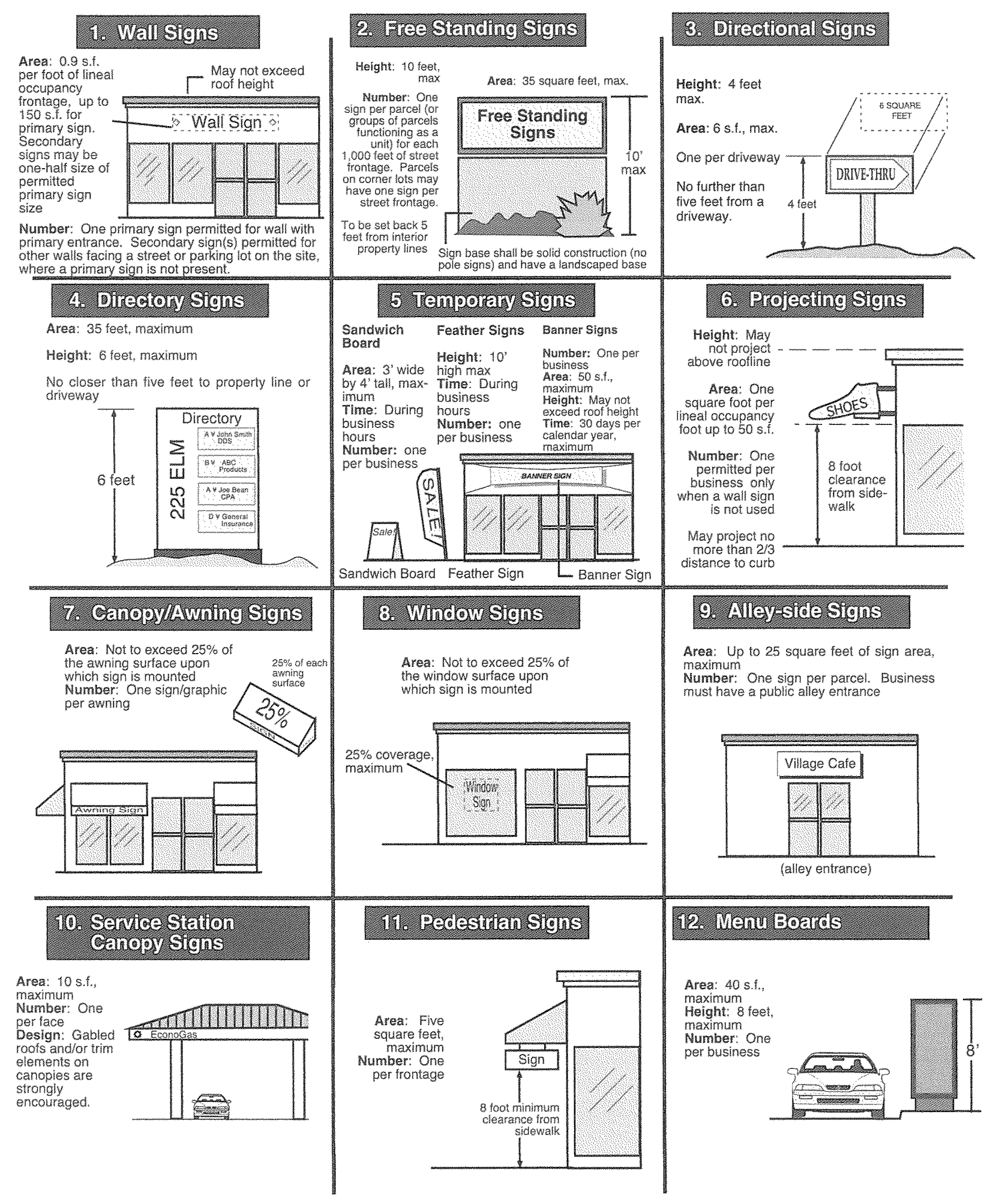
The following regulations shall apply in commercial and manufacturing zones (see also Exhibit 2 for graphic illustration of key sign types and standards).
A.
All new signs, renovated signs, or commercial copy changes to existing signs, shall go through the design review process to ensure that they conform to the design guidelines set forth in subsection 17.62.120. The design review process may result in the director requiring that the dimensions or other specifications of the signs to be less than the maximums set forth in this subsection.
1.
Wall signs
a.
Number of signs per business. The number of wall signs permitted per business or parcel is as follows:
i.
One (1) primary wall sign is permitted on the wall with the primary public entrance to the business. For businesses with more than one (1) entrance, only one (1) entrance shall be counted as the primary entrance. Alternatively, the applicant may choose a wall, other than the wall with the primary public entrance, as the location for the primary wall sign.
ii.
Where the site abuts a public street and the primary entrance is on a wall not facing the street, a secondary wall sign is permitted on the wall facing the street.
iii.
If the site has a parking lot and a building wall faces the parking lot and that wall does not have a wall sign permitted under i. or ii, above, a secondary wall sign is permitted on the wall facing the parking lot. Not more than one (1) such parking lot sign is permitted.
iv.
For businesses fronting onto a public alley, one (1) alley wall sign is permitted for the wall that faces onto the alley.
b.
Calculation of Wall Sign Area:
i.
For a primary wall sign, 0.9 square foot of sign area is permitted for each foot of linear occupancy frontage, as shown in Exhibit 1, up to a maximum of one hundred fifty (150) square feet of sign area, whichever is less. Notwithstanding this regulation, all businesses shall be permitted a minimum of twenty-five (25) square feet of primary wall sign.
ii.
Where a secondary wall sign is permitted, the maximum sign area shall be one-half (½) the permitted sign area of a primary sign.
iii.
For an alley wall sign, the maximum sign area shall be twenty-five (25) square feet.
iv.
For multi-tenant buildings, each tenant shall be permitted one (1) sign mounted on the wall with the primary entrance, except for corner units which may be permitted a primary wall sign and a secondary wall sign.
c.
Maximum Height: Wall signs shall be placed so as not to exceed the top of the vertical wall surface on which the sign is mounted. Signs mounted on a pitched roof may not extend the peak of the ridge line of the roof. No sign is permitted on the top of a flat-roofed structure.
Exhibit 1: Calculation of Permitted Wall Sign Area Example
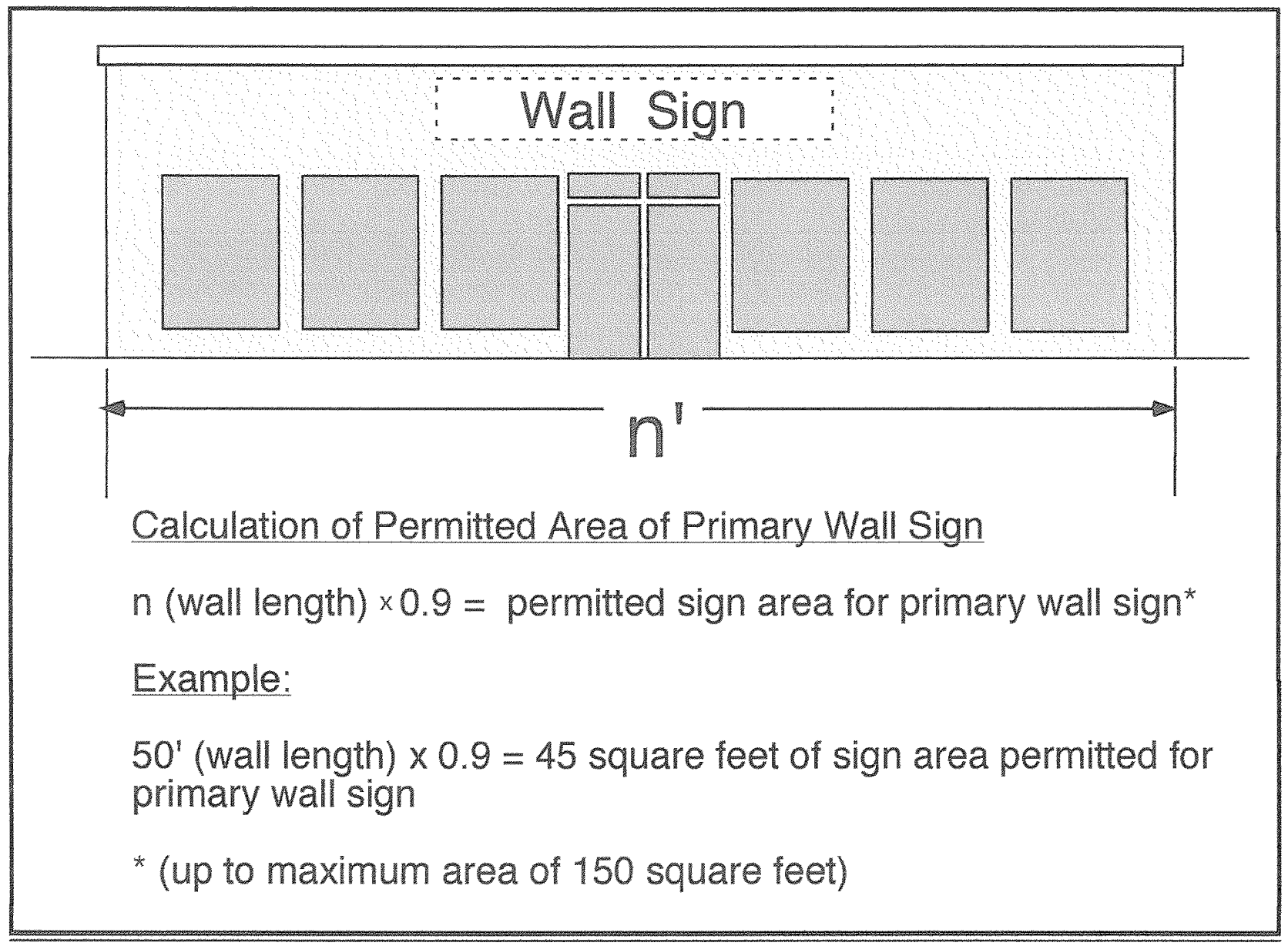
Exhibit 2: Selected Commercial Sign Standards
2.
Freestanding Signs.
a.
Maximum Height: Ten (10) feet.
b.
Maximum Area: Thirty-five (35) square feet per sign face.
c.
Sign Design: Freestanding signs shall be designed as a monument sign and shall be either housed in a frame, or set onto a base, presenting a solid, attractive, and well-proportioned appearance. The width of the base of the sign shall not be less than fifty percent (50%) of the width of the face of the sign. Pole signs are not permitted under this chapter.
d.
Number per parcel: One (1) freestanding sign is permitted per parcel (or collection of parcels functioning as a single integrated development) for each one thousand (1,000) lineal feet of street frontage, or fraction thereof, except that parcels with frontage on more than one (1) public street shall be permitted one (1) free-standing sign for each one thousand (1,000) lineal feet of frontage (or fraction thereof) on each street.
e.
Setbacks: A freestanding sign shall be set back a minimum of five (5) feet from any interior side property line. Encroachment into a setback may be permitted by the director where the location of existing improvements presents a functional hardship in compliance with the required setback.
f.
Landscaping. All freestanding signs shall be placed in a landscape planter of an area at least twice the size of one (1) side of the sign structure.
3.
Directional Signs.
a.
Maximum height: Four (4) feet.
b.
Maximum Area: Six (6) square feet.
c.
Number per site: One (1) per driveway from a public street.
d.
Location: Directional signs shall be placed within five (5) feet of a driveway that accesses the site from a public street. Placement of directional signs shall ensure the sight safety of vehicles entering/leaving a site is not compromised.
4.
Directory Signs.
a.
Number per site: One (1) per public vehicle and/or pedestrian entrance to the site.
b.
Maximum Area: Thirty-five (35) square feet.
c.
Maximum Height (if freestanding): Six (6) feet. Directory signs mounted on a building wall shall not project above the top of the wall.
d.
Location: No directory sign which is a freestanding sign may locate closer than five (5) feet to any neighboring property line or closer than three (3) feet to any point of ingress/egress.
5.
Temporary/Portable Signs.
a.
Banners
i.
Number of signs: One (1) banner sign is permitted per business.
ii.
Maximum Height: Not to exceed roof line of nearest building or building affixed to but in no case higher than thirty (30) feet. Banner signs shall not be attached to existing freestanding signs.
iii.
Maximum Area: Fifty (50) square feet.
iv.
Permitted Time: Banner signs may be utilized for no more than thirty (30) days per calendar year. The banner shall include a date visibly noted on the sign and be removed within thirty (30) days of the posted date.
v.
Temporary signs used as the primary identification for a business shall be removed within thirty (30) days and replaced with a permanent sign.
b.
Sandwich board signs
i.
Maximum Height and Width: Three (3) feet wide and four (4) feet tall, maximum.
ii.
Maximum Area: Twelve (12) square feet.
iii.
Number per business: One (1).
iv.
Location: May be placed on the business site as long as no conflicts with vehicle safety result. May also be placed on the public sidewalk adjacent to the business, but must permit a minimum of four (4) feet of passage area on sidewalk.
v.
Permitted Display Time: Sandwich board signs may be used only during business hours for the business being advertised.
c.
Feather signs
i.
Number per business: One (1).
ii.
Maximum Height: Ten (10) feet tall, maximum.
iii.
Location: May be placed on the business site as long as no conflicts with vehicle safety result.
iv.
Permitted Display Time: Feather signs may be used only during business hours for the business being advertised.
d.
Changeable Message Copy Signs. A business that enters into an agreement with the city to not use temporary signs (banner signs and sandwich board signs) may be permitted a changeable message copy sign to be incorporated into its freestanding monument sign, or as a building wall sign. The area of the changeable message copy sign shall not exceed thirty-five (35) square feet.
6.
Projecting Signs.
a.
Maximum Height and Projection: Not to exceed roof line of wall or structure to which projecting sign is attached. (Note: Bottom of sign shall be a minimum of eight (8) feet from ground to provide proper clearance.)
b.
Number per business: One (1), but a projecting sign is permitted only where a wall sign is not used on the same wall.
c.
Calculation of Area: 0.5 square foot of sign area for each lineal foot of building frontage of the business to which sign is attached, up to a maximum area of fifty (50) square feet.
d.
Location: Projecting signs may extend over public rights-of-ways including public sidewalks not to exceed two-thirds (⅔) of the distance from the building face to which the sign is attached to the curb face of said sidewalk.
7.
Awning/Canopy Signs.
a.
Number of signs: Where an awning is present, a sign may be affixed to the awning.
b.
Maximum Area: The area of signage on each surface of an awning shall not exceed twenty-five percent (25%) of the area of the individual surface.
c.
Location: Awning signs shall be made of removable materials such as individual cut-out letters and/or symbols attached, stenciled or otherwise placed on the canopy surface, and may be located on exterior surfaces of a canopy. Canopy signs shall be of color, size and design consistent with the color, size and design of the canopy on which they are placed.
8.
Window Signs. Maximum Area: Up to twenty-five percent (25%) of the area of each individual window may be covered with a window sign or graphic. No permit is required for window signs.
9.
Alley-Side Signs
a.
Number of Signs/Sign Area: Any building facing a public alley shall be permitted one (1) alley-side sign with a maximum of twenty-five (25) square feet of sign area. An alley-side sign may be in the form of either a wall-sign, awning sign, or projecting sign. Projecting signs shall be placed at a height to avoid truck traffic, but may not project above the wall on which they are mounted.
10.
Service Station Canopy Signs
a.
Number of signs: One (1) sign is permitted on each canopy face.
b.
Size: Ten (10) square feet, maximum per canopy face.
11.
Pedestrian Signs
a.
Number of signs: One (1) pedestrian oriented sign that projects or hangs above a sidewalk on each side of a building with a public entrance.
b.
Size: Each sign may be a maximum of five (5) square feet in size and may hang or be suspended no lower than eight (8) feet above grade level.
12.
Drive-Through Menu Boards. No more than two (2) drive-through menu/order boards are permitted for each food and/or beverage establishment featuring a drive-through. Each sign shall not exceed forty (40) square feet and be no taller than eight (8) feet.
13.
Incidental traffic control signage in parking lots within private developments.
a.
Number of signs and size: As determined to be necessary by the city engineer.
(Ord. No. 408, 8-6-2013)
17.62.120 - Sign Design Guidelines.
A.
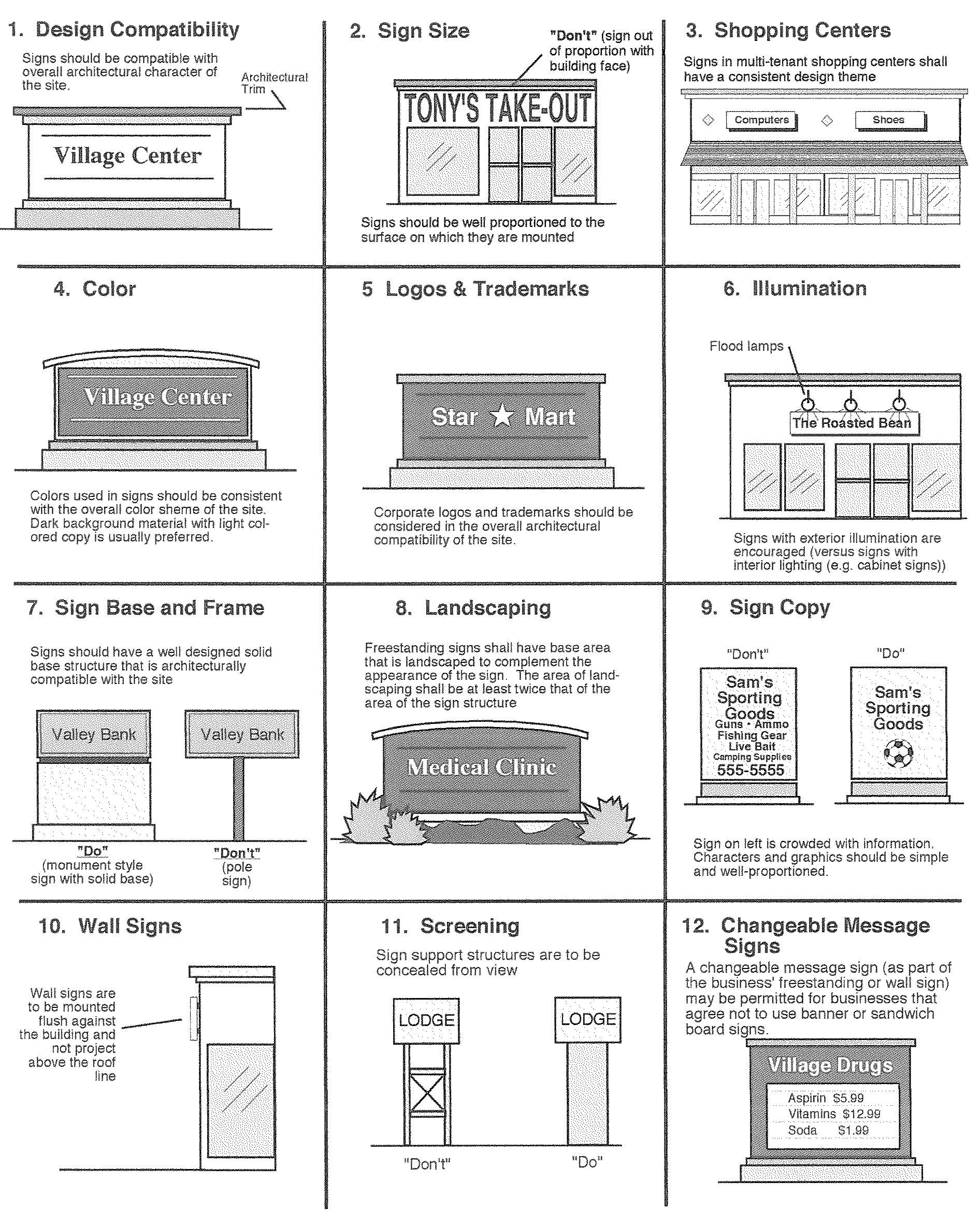
Design Compatibility: The design of all signs shall be compatible and harmonious with the colors, materials and architecture of the building and the immediate vicinity. Freestanding signs shall be finished with the same or compatible materials as the building on the site. For purposes of this chapter, compatibility will be determined by the relationships of the elements of form, proportion, scale, color, materials, surface treatment, overall sign size and the size and style of lettering. In applying the design guidelines set forth below, the final decision as to whether the proposed sign complies with said guidelines shall rest with the director, after appropriate consultation with the applicant and/or applicant's representatives and subject to any right of appeal set forth in this section.
Exhibit 3: Selected Sign Design Criteria
B.
Size: Notwithstanding applicable sign standards elsewhere in this chapter, sign size shall be proportionate to the size and scale of the site and building upon which the sign is proposed. Sign dimensions as specified in this chapter are maximum allowable dimensions; it may be necessary that signs be smaller than the maximum allowed in order to be proportionate in size and scale to achieve the design objectives of this section.
C.
Commercial and Industrial Center Signs: Individual tenant signs within multi-tenant centers shall be coordinated in size, location, materials and illumination, to ensure consistent design.
D.
Color: Colors shall be used in coordinated groupings, and shall be consistent with those colors used in the building or project design. For cabinet-style signs, a dark sign background is preferred with light colored copy (characters/graphics).
E.
Logos and Trademarks: The use of established corporate colors or logos shall not be prohibited by this section. When established corporate colors are incompatible with building colors, compatibility in design with the surrounding development should be accomplished through the use of appropriate background colors or other design features, such as materials, surface treatment, and the size and style of lettering.
F.
Lighting Intensity: The light emitted or reflected by a sign, or emitted by a light source, shall be of intensity levels that do not cause undue glare and shall be compatible with the architecture of the building and the immediate vicinity. Artificial light sources shall be shielded to prevent light spillage, glare or annoyance to persons on or inside adjoining properties or to public or private rights-of-way.
G.
Sign Bases and Frames: Freestanding signs shall be either housed in a frame, or set onto a base, presenting a solid, attractive, and well-proportioned appearance. The size and shape of the frame or base shall be proportionate to the size and mass of the sign and should be low-profile in design. Pole type signs are not permitted. Guy wires, angle irons, braces and other support or construction elements shall be screened or hidden from view.
H.
Landscaping: Freestanding signs shall be located in a landscaped area proportionate to the size of the sign, but not less than twice the size of one (1) side of the sign face. Appropriate accent landscaping should be placed at the base of the sign.
I.
Sign Copy: Sign copy should be simple and concise without excessive description of services or products. On freestanding signs, sign copy should be designed to contribute to the design of the structure on which it is displayed. In all cases, freestanding sign design and sign copy should be coordinated to provide an attractively designed freestanding element which identities the development or project.
J.
Wall Signs: Building signs should be mounted flush against the building, and shall not project above the roof ridge or the top of the parapet.
K.
Maintenance: All signs and their supporting members shall be kept in good repair and maintained in good structural condition at all times.
L.
Design Quality. All signs shall be professionally designed and manufactured. Signs that utilize hand-made lettering or elements must be avoided.
(Ord. No. 408, 8-6-2013)
17.62.130 - Prohibited signs.
The following signs are prohibited in all zones:
A.
Bunting, streamers, and pennants, except banner and flag signs permitted pursuant to this chapter.
B.
Devices projecting or otherwise reproducing the image of a sign or message on any surface or object.
C.
Flashing signs.
D.
Hand-held commercial signs.
E.
Inflatable signs.
F.
Mobile signs.
G.
Moving, rotating or animated signs, including fan-powered "waving man" signs.
H.
Off-site signs.
I.
Outdoor advertising structures.
J.
Portable commercial signs.
K.
Sign message containing advertisement only, except those permitted pursuant to this chapter.
L.
Roof signs.
M.
Signs located in such a manner to constitute a potential traffic hazard or obstruct the view of any authorized traffic sign or signal device, or designed to resemble or conflict with any authorized traffic control sign.
N.
Signs emitting audible sounds, odors or particulate matter.
(Ord. No. 408, 8-6-2013)
17.62.140 - Removal of signs.
A.
Unsafe signs. Any unsafe sign may be removed by the city without prior notice. Alternatively, the director may issue a notice of violation and give the permit holder, property owner or person in possession and control of the property fifteen (15) days to cure the violation. In the case of an unsafe sign removed by the city, the costs of such removal and storage shall be borne by the permit holder, property owner, or person in possession and control of the property, as applicable, and may be collected by the city in the same manner as it collects any other debt or obligation. No unsafe sign that has been removed and stored by the city may be released until the costs of removal and storage have been paid. If an unsafe sign remains unclaimed for a period of thirty (30) days after notice of removal is sent to the permit holder, property owner, or person in possession and control of the property, it will be deemed to be unclaimed personal property and may be disposed of in accordance with the law.
B.
Illegal signs. Any illegal sign must be removed or brought into conformity by the permit holder, property owner, or person in possession and control of the property following written notice from the director. Such notice must specify the nature of the violation, order the cessation thereof and require either the removal of the sign or the execution of remedial work in the time and in the manner specified by the notice. The time for removal or repair may not be less than fifteen (15) days from the date of mailing the notice. The director's order may be appealed to the planning commission in the manner provided in Section 17.62.150[Appeals].
C.
Legal nonconforming signs - special circumstances. In accordance with California Business & Profession Code section 5499, no legal nonconforming sign will be required to be removed on the sole basis of its height or size if special topographic circumstances would result in a material impairment of visibility of the sign or the owner's or user's ability to adequately and effectively continue to communicate to the public through the use of the sign. The owner or user may maintain the sign at the premises and at a location necessary for continued public visibility at the height or size at which the sign was previously lawfully erected pursuant to all applicable codes, regulations and permits. Any such sign will be deemed to be in conformance with this chapter.
D.
Abatement of signs. Whenever the permit holder, property owner, or person in possession or control of the property fails to comply with an order of the director requiring compliance with this chapter, the city may abate any such sign in the manner set forth in Chapter 17.58 of this Code.
(Ord. No. 408, 8-6-2013)
17.62.150 - Appeals.
A.
General procedure. Any person seeking to appeal a decision of the director or planning commission granting or denying an application for issuance of a sign permit, revoking a permit or ordering the remediation or removal of a sign, may appeal such action, first to the planning commission if pertaining to a decision of the director, and if dissatisfied with the decision of the planning commission, then to the city council in the manner provided by this section.
B.
Effective date of decision. Decisions of the director or planning commission under this chapter will be final and conclusive on the tenth consecutive calendar day following the date of the director's or planning commission's decision, unless an effective timely and complete appeal is filed as provided in this section.
C.
Form of appeal. An appeal must:
1.
Be in writing on a form provided by the department of community development;
2.
Identify the director's or planning commission's action to which the appeal relates;
3.
Be filed with the department prior to the decision to which the appeal relates becomes final; and
4.
Be accompanied by a processing fee in an amount set by the city council.
D.
Stay of proceedings. The timely filing of an effective appeal will stay the decision of the director or planning commission to which the appeal relates pending final action by the planning commission or city council on the matter.
E.
Hearing. The department shall expeditiously schedule a hearing before the planning commission or city council, as applicable, not later than thirty (30) days after the notice of appeal is received by the city and give written notice of the time and place of the hearing to the appellant; provided, however, the hearing may be held after such thirty-day period upon the request or concurrence of the appellant. Action on the appeal shall be taken at the time of the hearing by the planning commission or city council, as applicable, unless the appellant requests a continuance.
F.
Judicial review. Any person dissatisfied with the final action taken by the city council may seek prompt judicial review of such decision pursuant to California Code of Civil Procedure section 1094.8.
(Ord. No. 408, 8-6-2013)

