
Atwater City Zoning Code
CHAPTER 17
63 - PARKING REQUIREMENTS4
Editor's note—Ord. CS 1071, § 4(Exh. C), adopted July 14, 2025, amended Ch. 17.63 in its entirety to read as herein set out. Former Ch. 17.63, §§ 17.63.010—17.63.110, pertained to similar subject matter, and derived from prior Code §§ 10-3.1801—10-3.1809; Ord. CS 407, § 1, 1979; Ord. CS 598, 1985; Ord. CS 1059, § 1, adopted March 27, 2023; Ord. CS 1065, § 1(Exh. A), adopted August 14, 2023.
Cross reference— Parking requirements for commercial uses, § 17.43.060.
17.63.010 - Purpose.
This chapter establishes off-street parking requirements in order to:
A.
Provide a sufficient number of off-street parking spaces for all land uses;
B.
Provide for functional off-street parking areas that are safe for vehicles and pedestrians;
C.
Ensure that parking areas are well-designed and contribute to high-quality design environment within Atwater;
D.
Allow for flexibility in off-street parking requirements to support a multi-modal transportation system and sustainable development pattern; and,
E.
Ensure that off-street parking areas do not adversely impact land uses on neighboring properties.
(Ord. CS 1071, § 4(Exh. C), 7-14-2025)
17.63.020 - Applicability.
A.
New Structures and Uses. All new structures and uses shall comply with the standards in this chapter, including the amount of required off-street parking as specified in Table 17.63-1 (Off-Street Parking Requirements).
B.
Changes in Existing Structures and Uses.
1.
Additional parking shall be required for a change in use or any modification to an existing structure that results in an increase in the unit of measurement used to determine the amount of required off-street parking as specified in Table 17.63-1 (Off-Street Parking Requirements).
2.
Additional off-street parking shall be required only to accommodate the incremental change or expansion of the structure or use. Additional parking shall not be required to remedy parking deficiencies existing prior to the change to an existing structure or use.
3.
Additional parking for nonresidential uses is not required if the parking needed to accommodate the change is either:
a.
Two or fewer parking spaces; or,
b.
Ten percent or less of the total required off-street parking spaces for the use.
Note 1: For duplexes, no parking may be required if either of the following is true:
a.
The parcel is located within one-half mile walking distance of either a high-quality transit corridor as defined in Subsection (b) of Section 21155 of the Public Resources Code, or a major transit stop as defined in Section 21064.3 of the Public Resources Code; or
b.
There is a car share vehicle located within one block of the parcel.
(Ord. CS 1071, § 4(Exh. C), 7-14-2025)
17.63.030 - Required parking spaces.
A.
Number of Spaces. All land uses shall provide a minimum number of off-street parking spaces as specified in Table 17.63-1 (Off-Street Parking Requirements), except as provided in Section 17.63.050 (Parking Reductions).
B.
Unlisted Uses.
1.
The Community Development Director shall determine the minimum number of required off-street parking spaces for land uses not listed in Table 17.63-1 based on the requirements for the most comparable use in this chapter or an analysis of parking requirements for similar uses in other jurisdictions or state or national standards.
2.
Off-street parking requirements for unlisted land uses shall be based on the parking requirements of similar uses in Table 17.63-1.
3.
The Community Development Director may require the preparation of a parking demand study at the expense of the applicant to determine the parking requirement for unlisted uses.
C.
Mixed or Multiple Uses. When more than one land use is conducted on a parcel, the minimum number of required off-street parking spaces shall be the sum of the number of parking spaces required for each individual use.
D.
Unknown Uses.
1.
The Community Development Director shall determine the minimum number of required off-street parking spaces for nonresidential "shell" structures with no identified tenants.
2.
Off-street parking requirements for nonresidential "shell" structures shall be based on anticipated tenants for the structures, as determined by the Community Development Director.
E.
Units of Measurement.
1.
For the purpose of this chapter, "floor area," in the case of offices, merchandising or service types of uses, means the gross floor area used or intended to be used by tenants, or for service to the public as customers, patrons, clients, or patients, including areas occupied by fixtures and equipment used for display or sale or merchandise. It shall not include areas used principally for nonpublic purposes such as incidental repair, processing or packaging of merchandise, for show windows, for restrooms, for utilities, or for dressing rooms, fitting rooms, or alteration rooms. Unless additional information is provided by the applicant, these "non-public areas" will be assumed to be 15 percent of the total gross floor area and will not be used in calculating floor area for parking purposes.
2.
In indoor or outdoor places of assembly in which spectators or patrons occupy benches, pews, or other similar seating facilities, each 20 inches of such seating facilities shall be counted as one seat for the purpose of determining off-street parking facilities.
3.
When units of measurements determining the number of required parking spaces result in requirements of a fractional space, fractions of spaces over one-half shall be rounded up to the next whole number.
F.
Conforming Status. Structures or uses established prior to the effective date of the zoning ordinance shall not be deemed nonconforming by reason of providing fewer off-street parking spaces than required by Table 17.63-1. However, no such structure or use may further reduce the number of provided off-street parking spaces below the requirements of this chapter.
G.
Additional Required Parking. The planning commission may require more off-street parking than required by Table 17.63-1 if the commission determines that additional parking is needed to serve the proposed use and to minimize adverse impacts on neighboring properties.
(Ord. CS 1071, § 4(Exh. C), 7-14-2025)
17.63.040 - General requirements.
A.
Availability and Use of Spaces.
1.
Required parking spaces shall be permanently available and maintained for parking purposes for the use they are intended to serve.
2.
Owners, lessees, tenants, or persons having control of the operation of a use for which parking spaces are required shall not prevent or restrict authorized persons from using these spaces.
3.
Required parking spaces shall be used exclusively for the temporary parking of vehicles and shall not be used for the sale, lease, display, repair, advertising, or storage of vehicles, trailers, boats, campers, mobile homes, merchandise, or equipment, or for any other use not authorized by the zoning ordinance.
B.
Location of Parking.
1.
Required parking spaces shall be located on the same lot as the use they are intended to serve, except as allowed by subsection C below.
2.
When the required off-street parking for a one-family or two-family structure in any residential zone is not to be provided in a covered garage or carport, each required car space shall be so located that it may later be covered by a garage or carport structure in accordance with the provisions of this chapter.
C.
Off-Site Parking.
1.
For multi-family housing and nonresidential uses, the review authority may approve off-site parking if it finds that practical difficulties prevent the parking from being located on the same lot it is intended to serve.
2.
Off-site parking shall be located within 400 feet of the use it is intended to serve or another reasonable distance as determined by the review authority.
3.
If off-site parking is approved, a covenant record, approved by the City Attorney, shall be filed with the county recorder. The covenant record shall require the owner of the property where the off-site parking is located to continue to maintain the parking space so long as the building, structure, or improvement is maintained within the City. This covenant shall stipulate that the title and right to use the spaces shall not be subject to multiple covenants or contracts for use, or termination, without prior written consent of the City.
D.
Parking for Persons with Disabilities.
1.
Parking spaces for persons with disabilities shall be provided in compliance with California Code of Regulations Title 24.
2.
Parking spaces required for the disabled shall count toward compliance with the number of parking spaces required by Table 17.63-1.
(Ord. CS 1071, § 4(Exh. C), 7-14-2025)
17.63.050 - Parking reductions.
The minimum number of required off-street parking spaces as specified in Table 17.63-1 may be reduced as described below. The various reductions in this Section 17.63.050 are mutually exclusive and may not be combined. Projects eligible for multiple reduction types may only apply the single, greater reduction.
A.
Shared Parking. Multiple land uses on a single parcel or development site may use shared parking facilities when operations for the land uses are not normally conducted during the same hours, or when hours of peak use differ. Requests for the use of shared parking may be approved if:
1.
A parking demand study approved by the Community Development Director demonstrates that there will be no substantial conflicts between the land uses' principal hours of operation and periods of peak parking demand;
2.
The total number of parking spaces required for the land uses does not exceed the number of parking spaces anticipated at periods of maximum use;
3.
The proposed shared parking facility is located no further than 400 feet from the primary entrance of the land use which it serves; and,
4.
A covenant record as described in Section 17.63.040.C.3 shall be recorded.
B.
Common Parking Facilities. Common parking facilities, public or private, may be provided in lieu of the individual requirements contained in this chapter, provided, the total of such off-street parking facilities, when used together, shall not be less than the sum of the various uses computed separately. Such common facilities shall be approved by the planning commission with a conditional use permit, and the planning commission may grant a reduction in the total required parking for the uses by no more than 15 percent.
C.
Low Demand. The number of parking spaces may be reduced if the land use will not utilize the required number of spaces due to the nature of the specific use, as demonstrated by a parking demand study approved by the Community Development Director.
D.
Transportation Demand Management Plan. The number of parking spaces may be reduced by the Community Development Director up to 20 percent if the project applicant prepares a transportation demand management plan which demonstrates a reduction in the demand for off-street parking spaces by encouraging the use of transit, ridesharing, biking, walking, or travel outside of peak hours.
E.
Bus Stop/Transportation Facility Credit. The number of parking spaces may be reduced by up to five percent for commercial or multiple-family development projects within 400 feet of a City-approved bus stop. Alternatively, if a commercial or multiple-family development project is located within 400 feet of a transit center, the project may reduce parking spaces by up to ten percent.
F.
Mixed-Use Projects. A mixed-use project with commercial and residential units may reduce parking requirements by up to 30 percent as demonstrated by a parking demand analysis approved by the Community Development Director.
(Ord. CS 1071, § 4(Exh. C), 7-14-2025)
17.63.060 - Parking assessment districts.
If a parking assessment district has been established, a fee may be paid to the City in lieu of providing required off-street parking within the district.
A.
Exception for Parking Districts. Property located within a district in which special assessments have been or are to be levied for providing public off-street parking shall not be required to provide off-street parking facilities for the ground floor of any such structure.
B.
Special Assessment Financing.
1.
In any special assessment proceedings for financing the cost of public off-street parking facilities, any improved property shall be granted a credit against the assessment to be levied, in such ratio as the City Council shall determine, for any improved customer, owner, tenant or employee parking spaces or reasonable access areas.
2.
In determining the amount of assessment credit, the area of credit shall be improved in accordance with this code. If not so improved at the time of granting the credit, the owner shall cause the area to be so improved within 60 days thereafter, or otherwise the credit shall be removed. A parking space is defined as an area of eight and one-half by 20 feet in dimension. The determination of the City Council as to the amount of "reasonable access" shall be final.
3.
Areas used for parking of delivery vehicles or other commercial or industrial vehicles, and open areas used for storage or otherwise in the operation of the business, shall not be included in any area of credit. Any area for which a credit for parking is granted shall remain subject to the requirements of this chapter for providing off-street parking.
C.
In-lieu Parking Fee. In lieu of providing off-street parking within a special assessment parking district, an owner may pay to the City a sum equal to $1,200.00 per parking space, which money shall be deposited in a special fund and used for providing, improving or maintaining off-street parking facilities in said district.
D.
Additions to Parking Districts.
1.
Each owner of a property not included within a district in which special assessments are levied for providing public off-street parking, but within 400 feet of a public parking lot located within such a district, may pay a participation fee to defray the cost of providing required off-street public parking facilities, in exchange for the benefits and the responsibilities of inclusion in said district. Upon payment of the participation fee as provided in Section 17.63.060.D.2 and continuing payment of assessments imposed by the district, the owner of the subject property shall not be required to provide off-street parking facilities for the ground floor of any structure on the property, and may also pay in-lieu parking fees as provided in Section 17.63.060.C.
2.
The participation fee shall be deposited in a special fund and used for providing, improving, or maintaining off-street parking facilities in said district. The amount of participation fee shall be computed as follows:
a.
Participation fee = (Basic Charge + Cost Index)
b.
"Basic charge" is $0.90 per square foot of the subject property, and $245.00 per front foot of the subject property, measured as the subject property's frontage along the public right-of-way with the highest traffic volume.
c.
"Cost index" is the most current cost index (calculated on an annual basis based on the previous year's Consumer Price Index, All Urban Consumers, published by the U.S. Department of Labor), multiplied by the total square foot and front foot of the subject property. In the event of discontinuation of such index, the index most closely resembling said index.
(Ord. CS 1071, § 4(Exh. C), 7-14-2025)
17.63.070 - Parking design and development standards.
A.
Dimensions. The minimum required dimensions for off-street parking spaces shall conform to the latest edition of the City's Standard Designs of Common Engineering Structures.
B.
Compact Spaces.
1.
A maximum of 25 percent of required off-street parking spaces may be compact spaces.
2.
All parking spaces for compact cars shall be clearly marked with the word "Compact" either on the wheel stop or curb, or on the pavement at the opening of the space.
C.
Parking Access. The required dimensions for driveways providing access to off-street parking spaces shall conform to the latest edition of the City's Standard Designs of Common Engineering Structures.
Figure 17.63-1. Example of 90-Degree Parking Space Dimensions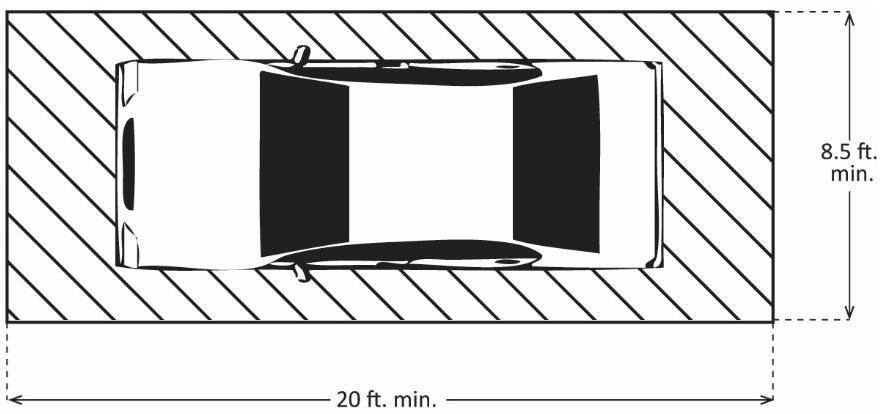
D.
Surfacing.
1.
All permanent parking spaces and drive aisles shall be paved with asphalt, concrete or other all-weather surface per the latest edition of the City's Standard Designs of Common Engineering Structures.
2.
Permeable paving materials, such as porous concrete/asphalt, open-jointed pavers, and turf grids, are a permitted surface material, subject to approval by the City Engineer.
E.
Tandem Parking Spaces. Tandem parking spaces may be permitted for all residential land uses, provided that they comply with the following standards:
1.
Parking spaces in a tandem configuration shall be reserved for and assigned to a single dwelling unit.
2.
All required guest parking shall be provided as single, non-tandem parking spaces.
3.
Tandem parking spaces shall not block the use of the drive aisle to access other parking spaces located within the parking area.
4.
Tandem parking spaces shall be used to accommodate passenger vehicles only.
F.
Landscaping.
1.
General Standards. All landscaping within parking areas shall comply with the requirements of Chapter 8.34 (Landscape Maintenance) in addition to the standards within this section.
2.
Landscaping Defined. Except as otherwise specified in this section, landscaping and landscaped areas shall consist of drought-tolerant plant materials, including any combination of trees, shrubs, and ground cover.
3.
Parking Lot Standards. As illustrated in Figure 17.63-2 (Parking Lot Landscaping Standards), the following landscaping standards, as well as the standards in the City's Standard Designs of Common Engineering Structures, shall apply to parking lots containing six or more parking spaces. All landscape areas shall have an irrigation system.
Figure 17.63-2. Parking Lot Landscaping Standards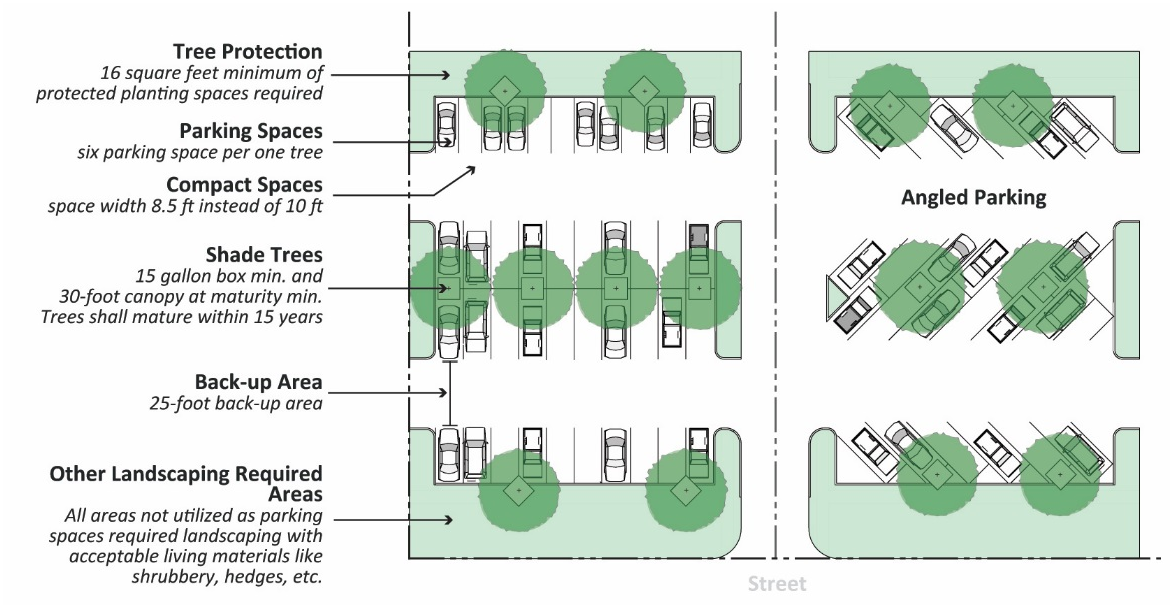
a.
Interior Landscaping. All areas within a parking lot not utilized for parking spaces or access/circulation shall be landscaped with plantings with drought-tolerant, non-invasive species.
b.
Shade Trees.
(1)
One shade tree shall be provided for every six parking spaces, or portion thereof, in a parking lot in addition to street trees.
(2)
Shade trees shall be a minimum 15 gallon box in size and shall provide a minimum 30-foot canopy at maturity.
(3)
Shade trees shall be of a type that can reach maturity within 15 years of planting and shall be selected from a city-approved list of canopy tree species suitable for the valley climate.
(4)
Shade trees shall be arranged in a parking lot to provide maximum shade coverage (based on a 30-foot canopy) on August 21. The arrangement should approximate nearly 50 percent shade coverage at noon on August 21 within 15 years of planting.
(5)
The above standards may be modified at the discretion of the review authority if alternative shade structures (including solar carports) are provided. Design standards for such shade structures shall be subject to approval by the review authority.
4.
Concrete Curbs.
a.
All landscape areas shall be separated from parking spaces, drive aisles and driveways by a raised concrete curb. Raised concrete curbs shall be a minimum of six inches high by six inches deep.
b.
The City may approve alternatives to raised concrete curbs as needed to comply with any mandatory storm water drainage standards.
5.
Parking Space Landscaping. A maximum of two feet at the front end of a parking space may be landscaped in lieu of paving surface.
6.
Timing. Landscaping shall be installed prior to the City's authorization to occupy any buildings served by the parking area, or prior to the final inspection for the parking lot, unless otherwise approved by the Community Development Director.
G.
Lighting.
1.
A parking area with six or more parking spaces shall include outdoor lighting that provides a minimum illumination of 1.0 foot candles over the entire parking area or as otherwise required by the building code.
2.
Outdoor lighting as required by Subsection G.1 above shall be provided during nighttime business hours.
3.
All parking space area lighting shall be energy efficient and designed so that any glare or spillage is directed away from residential properties.
4.
All fixtures shall be hooded.
H.
Pedestrian Access. Parking lots shall include pedestrian walkways in compliance with American with Disabilities Act (ADA) requirements and the California Building Code.
I.
Screening. Parking lots of six spaces or more shall comply with the following screening standards, unless otherwise approved by the review authority.
1.
Location. Screening with a minimum width of five feet shall be provided along the perimeter of parking lots fronting a public or private street or abutting a residential zone.
2.
Height.
a.
Screening adjacent to streets shall have a minimum height of two and one-half feet.
b.
Screening abutting a residential zoning district shall have a minimum height of six feet, except in required setback areas, where the minimum height shall be four feet.
c.
Commercial parking lots abutting residential zoning districts shall have a solid wall with a minimum height of six feet.
3.
Materials. Required screening may consist of one or more of the following materials:
a.
Low-profile walls constructed of brick, stone, stucco or other durable material with graffiti-proof coating materials or landscaping/vines.
b.
Evergreen plants that form an opaque screen.
c.
An open fence combined with landscaping to form an opaque screen.
d.
A berm landscaped with ground cover, shrubs, or trees.
(Ord. CS 1071, § 4(Exh. C), 7-14-2025)
17.63.080 - Bicycle parking.
A.
Applicability. All multi-family and nonresidential land uses shall provide bicycle parking as specified in this section and in accordance with Sections 17.63.020 (Applicability) and 17.63.030 (Required Parking Spaces), except for the following uses:
1.
Gas and service stations
2.
Maintenance and repair services
3.
Vehicle repair
4.
Vehicle sales and rental
5.
Wholesaling
6.
Construction and material yards
7.
Warehousing and distribution
8.
Other similar uses as determined by the Community Development Director.
B.
Types of Bicycle Parking.
1.
Short-Term/Class II Bicycle Parking. Short-term/Class II bicycle parking provides shoppers, customers, and other visitors who generally park for two hours or less a convenient and readily accessible place to park bicycles.
2.
Long-Term/Class I Bicycle Parking. Long-term/Class I bicycle parking provides employees, residents, visitors and others who generally stay at a site for several hours a secure and weather-protected place to park bicycles.
C.
Bicycle Parking Spaces Required. The number of required bicycle parking spaces shall be as specified in Table 17.63-4 (Required Bicycle Parking Spaces).
D.
Short-Term/Class II Bicycle Parking Standards. Short-term bicycle parking shall be located within 100 feet of the primary entrance of the structure or use it is intended to serve and be readily visible to passers-by.
E.
Long-Term Bicycle Parking Standards. The following standards shall be recommended, but not required, for long-term bicycle parking:
1.
Location. Long-term bicycle parking shall be located in highly visible, well-lighted areas that are convenient to the street and users.
2.
Cover. A minimum of 75 percent of required long-term bicycle parking spaces shall be covered.
3.
Parking Facilities. Long-term bicycle parking spaces must be secure and may include:
a.
Covered, lockable enclosures with permanently anchored racks for bicycles; or,
b.
Lockable bicycle rooms or areas with permanently anchored racks; or,
c.
Lockable, permanently anchored bicycle lockers.
F.
Parking Space Dimensions.
1.
Minimum dimensions of two feet by six feet shall be provided for each bicycle parking space (illustrated in Figure 17.63-3).
2.
An aisle of at least five feet shall be provided behind all bicycle parking to allow room for maneuvering.
3.
Two feet of clearance shall be provided between bicycle parking spaces and adjacent walls, polls, landscaping, pedestrian paths, and other similar features.
4.
Four feet of clearance shall be provided between bicycle parking spaces and adjacent automobile parking spaces and drive aisles.
G.
Rack Design. Bicycle racks must be capable of locking both the wheels (one wheel with a U-type lock), providing at least two points of contact with the frame of the bicycle, and supporting bicycles in an upright position. "Inverted U" bicycle racks are highly recommended.
H.
Cover. Required cover for bicycle parking spaces shall be permanent, designed to protect the bicycle from sun and rainfall, and be at least seven feet above the floor or ground.
Figure 17.63-3. Short-Term/Class II Bicycle Parking Dimensions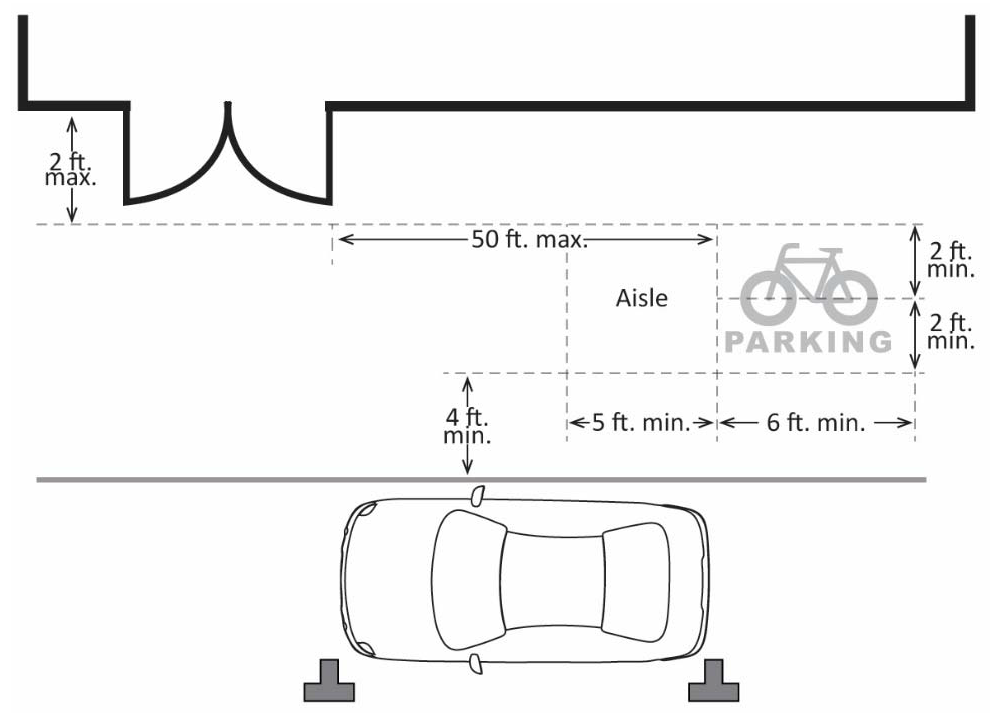
(Ord. CS 1071, § 4(Exh. C), 7-14-2025)
17.63.090 - Off-street loading.
A.
Applicability. All retail, restaurant, hotel, warehousing, manufacturing, hospitals, laundry, and similar uses that involve the frequent receipt or delivery of materials or merchandise shall provide off-street loading spaces consistent with the requirements of this section.
B.
Number of Loading Spaces. The minimum number of required loading spaces shall be as specified in Table 17.63-5 (Required Loading Spaces).
Figure 17.63-4. Off-Street Loading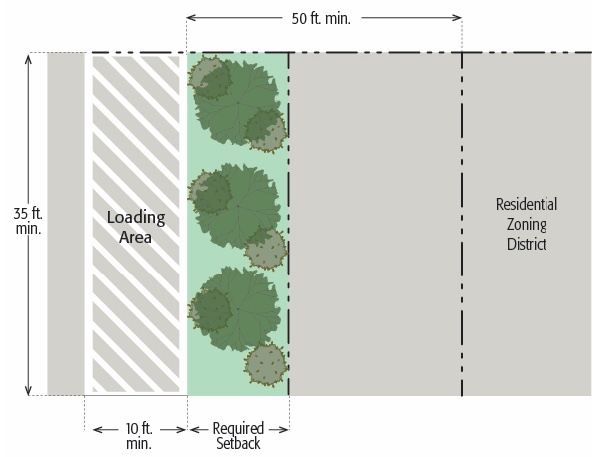
C.
Location.
1.
Required loading spaces shall be located on the same lot as the use they are intended to serve.
2.
A formal agreement among property owners shall be required and recorded if an immediately adjacent lot is used as required loading spaces.
3.
No loading space shall be located closer than 50 feet to a residential zone, unless the loading space is wholly enclosed within a building or screened by a solid wall not less than eight feet in height.
D.
Dimensions.
1.
Each loading space shall have minimum dimensions of ten feet wide, 35 feet long, and 14 feet in vertical clearance.
2.
Deviations from the minimum dimensions standards may be approved by the Community Development Director if the spatial needs are less than the minimum required due to the truck size and type that will be utilized in the operation of a specific business.
E.
Design and Configuration.
1.
Loading spaces shall be configured to ensure that loading and unloading takes place on-site and not within adjacent public rights-of-way.
2.
Sufficient maneuvering area shall be provided for loading spaces so that vehicles may enter and exit an abutting street in a forward direction.
3.
Loading spaces and their associated maneuvering areas shall not encroach into required employee or visitor parking areas or other on-site areas required for vehicle circulation.
4.
Loading spaces shall be striped and clearly identified as for loading purposes only.
(Ord. CS 1071, § 4(Exh. C), 7-14-2025)

