
Auburn City Zoning Code
159 Signs
Sections 159.185-159.198
159.185 Purpose
The purpose of this subchapter is to provide minimum standards to safeguard life, health, property and the public welfare, and to preserve the unique character of the City of Auburn by establishing minimum standards and regulations for the size, height, design, quality of materials, construction, location, electrification and maintenance of all signs and sign structures in order to accomplish the following results:
- To promote and maintain healthy commercial centers and property values for effective communication as to the nature of goods and services available while avoiding wasteful, ugly and unsightly competition in signs;
- To protect and enhance the character of residential neighborhoods, open views and vistas and property values by prohibiting any incompatible sign;
- To encourage signs which are well designed and pleasing in appearance and to provide incentives and latitude for variety, appropriate design in accordance with civic design controls, including proper spacing and location, and to provide a reasonable and comprehensive system of control over signs, integrated within a part of the general planning program and zoning provisions;
- To recognize and promote signs which reflect the character of the different districts and communities throughout the community;
- To attract and direct persons to various activities and enterprises in order to provide for the maximum public convenience;
- To enhance the economic value of the entire community through the regulation of the size, location, design and illumination of all signs; and,
- To effectuate the paramount intent of the city, as reflected by the following statement: "The city acknowledges the need for business signs, and they can be attractive and add to the city setting. The goal of the city is to have signs which are reasonable in size, height and number and signs which have attractive design, with a blend of colors and materials and location on the building or site which compliments the business and the community."
(Ord. 12-05, eff. 12-19-2012)
159.186 Definitions
For the purpose of this subchapter, the following definitions shall apply unless the context clearly indicates or requires a different meaning.
A-FRAME SIGN. A sign with 2 or more pieces of any rigid material, joined at the top so as to form an "A" when viewed in profile, which is not permanently affixed to the ground or a building, and which is otherwise consistent with the definition of a sign.
ABANDONED SIGN. A sign that advertises or otherwise identifies a business or activity which has been discontinued on the premises for a period of 60 days or more.
ANIMATED SIGN. A sign employing actual motion or the illusion of motion. Animated signs include the following:
- Electrically activated. Animated signs producing the illusion of movement by means of electronic, electrical or electro-mechanical input and/or illumination capable of simulating movement through employment of the characteristics of 1 or both of the classifications noted below:
- Flashing. Animated signs or animated portions of signs whose illumination is characterized by a repetitive cycle in which the period of illumination is either the same as or less than the period of non-illumination.
- Patterned illusionary movement. Animated signs or animated portions of signs whose illumination is characterized by simulated movement through alternate or sequential activation of various illuminated elements for the purpose of producing repetitive light patterns designed to appear in some form of constant motion.
- Environmentally activated. Animated signs or devices motivated by wind, thermal changes or other natural environmental input. Includes spinners, pinwheels, pennant strings, and/or other devices or displays that respond to naturally occurring external motivation.
- Mechanically activated. Animated signs characterized by repetitive motion and/or rotation activated by a mechanical system powered by electric motors or other mechanically induced means.
AWNING. Any movable or fixed structure attached to a building and projecting over a thoroughfare or sidewalk.
AWNING SIGN. A sign displayed on or attached flat against the surface or surfaces of an awning.
BALLOON. A bag that is filled with heated air or a gas lighter than air so as to rise and float in the atmosphere.
BANNER. A temporary sign constructed of a strip of cloth, paper, plastic, or other flexible material upon which copy is written and which is supported between poles or sticks or fastened to buildings or other structures.
BILLBOARD. A permanent sign in a fixed location which meets any one or more of the following criteria:
- An off-site outdoor advertising sign on which space is leased or rented.
- It is used, in whole or in part, for the display of off-site commercial messages.
- It constitutes principal, separate or secondary use, as opposed to an accessory, ancillary or appurtenant use, of the parcel on which it is located.
- An outdoor sign used as advertising for hire or general advertising, which display space is made available to parties other than the owner of the sign or the property on which it is placed.
BUILDING COMPLEX. A development of 2 or more commercial buildings, tenants, or uses, intended to function in a joint manner, regardless of sequence of build-out. Characteristics of a building complex may include, but are not limited to, shared parking facilities, reciprocal access, and common building design. A building complex may include multiple tenants or owners, freestanding pad buildings, and may be situated on 1 or more lots or parcels.
BUILDING FRONTAGE. The building façade that abuts a public street, private street, parking lot driveway or parking spaces in which main public access is provided to the establishment.
BUILDING OFFICIAL. The City of Auburn Building Official.
BUILDING WALL. The vertical face of the building.
CABINET SIGN. A permanent sign that is mounted on the face of a building that is roughly rectangular in shape and provides for internal illumination and changing the message of the sign by replacing a single transparent or translucent material such as a Plexiglas/lexan face. Also known as a can sign or boxed cabinet sign.
CALIFORNIA BUILDING CODE. The latest edition of the California Building Code.
CANOPY. An ornamental roof-like structure.
CAN SIGN. See Cabinet Sign.
CHANGEABLE COPY SIGN. A sign with characters, letters, or illustrations that can be changed or rearranged without altering the face or the surface of the sign. A sign on which the message changes more than once per day shall be considered an animated sign and not a changeable copy sign for the purposes of this subchapter.
CITY COUNCIL. The City Council of the City of Auburn.
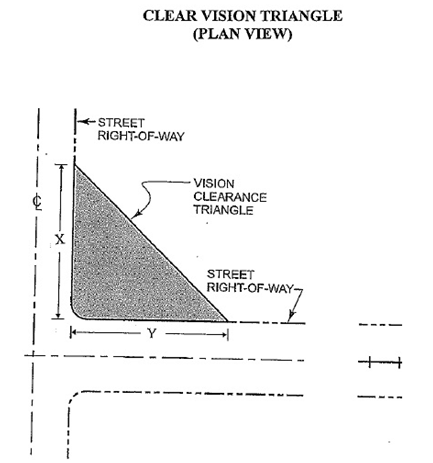
CLEAR VISION TRIANGLE. The required clear cross-visibility area unobstructed by any sign structure between 36 inches and 7 feet above the surface of the public sidewalk as follows:
- At any corner formed by the intersection of a driveway/alley, the cross-visibility area shall be a triangle having 2 sides 15 feet long and running along the driveway/alley edge and curb line of street, said length beginning at their intersection and the third side formed by a line connecting the 2 ends.
- At any corner formed by the intersecting streets, the cross-visibility area shall be a triangle having 2 sides 35-feet long and running along each curb line, said length beginning at their intersection and the third side formed by a line connecting the 2 ends.
COMMERCIAL MESSAGE. Any sign wording, logo or other representation that names or advertises a business, product, service or other commercial activity.
COMMISSION. The City of Auburn Planning Commission or City of Auburn Historic Design Review Commission as the reference may dictate.
COMMUNITY DIRECTIONAL SIGN. An off-site sign on private property informing of the location of a community service organization, public facility or church.
DEPARTMENT. See Community Development Department above.
DIRECTIONAL SIGN. An on-site sign designed to guide vehicular or pedestrian traffic that does not promote or advertise a business, property or product.
DIRECTOR. The Planning Director or designee.
DIRECTORY SIGN. A sign which provides sign area for more than 1 occupant and which may be freestanding or attached to a building wall.
DISPLAY SURFACE. The surface of the sign upon or against which the message is displayed or illustrated on the sign.
DOUBLE-FACED SIGN. A sign designed to be viewed from 2 directions, and the faces are either parallel or at an angle not to exceed 45 degrees. Signs greater than 45 degrees shall be considered separate signs.
FLAG. The term "sign" shall not include the flag of the United States of America or the state, nor any support frame or standard which is used exclusively for the display of any such flag.
FLASHING SIGN. An illuminated sign in which the artificial light is not maintained in a stationary or constant intensity and which is visible from the outside.
FREESTANDING SIGN. A sign which is supported by 1 or more uprights, poles or braces or attached to a fence, planter, wall, retaining wall or other structure not an integral part of any building upon the premises.
FREEWAY. A highway to which the owners of abutting lands have no right of easement or access or to which owners have only limited or restricted rights of easement or access and which is declared to be in compliance with the Streets and Highways Code of the state.
GRAPHIC. A representation of an object drawn upon a 2-dimensional surface.
HISTORIC DESIGN REVIEW COMMISSION. The approving authority for projects located within the Historic Design Review District.
HOME OCCUPATION SIGN. A sign located at a residence advertising a business, profession, or occupation conducted in the residence or by persons residing in the residence.
ILLUMINATED SIGN. A sign characterized by the use of artificial light, either projecting through its surface(s) (internally illuminated); or reflecting off its surface(s) (externally illuminated).
MANSARD SIGN. A sign which is attached to a mansard style roof with the face parallel to the structure to which it is attached. A mansard sign shall be considered a wall sign.
MENU BOARD. A free-standing sign oriented to the drive-through lane for a restaurant that advertises the menu items available from the drive-through window, and which has not more than 20% of the total area for such a sign utilized for business identification.
MONUMENT SIGN. A freestanding sign with a solid or decorative base.
MULTI-FAMILY RESIDENTIAL SIGNS. Signs intended to identify a multi-family residential development (e.g., apartments).
MURAL. A scene painted or otherwise affixed on and made an integral part of a wall surface.
NEON SIGN. A sign using neon gas for illumination and composed of numerous letters or parts.
NONCOMMERCIAL MESSAGE. A message which is not commercial in nature. Such messages typically relate to debatable matters of public concern, such as, by way of example and not limitation, advocacy on politics, religion, arts, science, philosophy, commentary on governmental policy, etc.
OFF-PREMISE SIGN. Any sign which advertises goods sold, manufactured or produced or services or uses rendered not at the location where the sign is placed.
ON-PREMISE SIGN. Any sign which advertises goods sold, manufactured or produced or services or uses rendered at the location where the sign is placed.
PENNANT. Any lightweight plastic, fabric or other material, whether or not containing a message of any kind, attached to a rope, wire or string, usually in series, designed to move in the wind and attract attention.
PLANNED SIGN PROGRAM. Coordinated sign criteria established for a building complex.
PLANNING COMMISSION. The Planning Commission of the city.
PLANNING DEPARTMENT. City of Auburn Planning Department, which for the purposes of this subchapter shall be synonymous with the Director as defined below.
PORTABLE SIGN. Any sign not permanently attached to the ground or to a building or building surface.
PROGRAMMABLE WINDOW SIGN. An electronic visual display, such as a computer monitor, television screen, or digital photo frame, which displays a static image or message for at least 30 seconds without changing, located within 24 inches of the surface of a window with the message intended to be visible to and readable from the public way or from adjoining property. A programmable window sign with a message more than once every 30 seconds shall be considered an "animated sign".
PROJECTING SIGN. A sign other than a wall sign which projects from and is supported by a wall or roof of a building, structure or sign structure.
RACEWAY. A channel box that holds sign letters in place and houses the electrical wiring of a sign.
REAL ESTATE SIGN. A sign placed upon real property to advertise that the property upon which the sign is placed, or any piece or parcel thereof, or any interest therein, is for sale, exchange, lease or rent.
ROOF SIGN. A sign and/or structure erected upon a roof, canopy or parapet of a building or structure.
SANDWICH SIGN. See "A-Frame" sign.
SEASONAL SIGN. Signs which are displayed on-site in conjunction with an approval of a seasonal event such as pumpkin patches, Christmas tree lots and firework displays.
SIGN. Every sign, billboard, freestanding sign, portable freestanding sign, wall sign, roof sign, illuminated sign, painted sign, mural, projecting sign, temporary sign and street clock and shall include any announcement, declaration, demonstration, display, illustration or insignia used to advertise or promote the interest of any person when the same is placed so that it is clearly visible to the general public from an out-of-doors position.
SIGN AREA. The area of a sign determined by circumscribing the exterior limits of the perimeter of 1 side of the sign.
SIGN COPY. The particular lettering or graphics used to identify the business.
SIGN STRUCTURE. The supports, uprights, braces and framework of a sign.
STREET. Any street, alleyway, place or thoroughfare.
STRUCTURE. That which is built or constructed, any edifice or building or any kind or any piece of work artificially built up or composed or parts joined together with some definite manner.
TEMPORARY SIGN. A sign intended to display either commercial or noncommercial messages of a transitory or temporary nature. Portable signs or any sign not permanently embedded in the ground, or not permanently affixed to a building sign structure that is permanently embedded in the ground, are considered temporary.
TENANT INFORMATION SIGN. A sign used to identify the occupant's name and address.
TRADE CONSTRUCTION SIGN. A sign adverting various construction trades on any construction site. The sign shall not be installed prior to construction and shall be removed before a certificate of occupancy is issued.
UNDER CANOPY SIGN. A sign attached to the underside of a canopy or marquee.
USE. A purpose or activity for which the land or building is designed, arranged or intended or for which is occupied or maintained to function as a separate unit.
VEHICLE/TRAILER MOUNTED SIGN. A sign mounted on a vehicle or trailer that is used for general advertising or advertising for hire. A vehicle which advertises the company of its primary use is not considered a vehicle mounted sign.
WALL SIGN. A sign that is in any manner affixed to any exterior wall of a building or structure and that projects not more than one foot from the building or structure wall, including signs affixed to architectural projections from a building.
WINDOW SIGN. A sign or device affixed or applied to, or located within 24 inches of, the surface of a window with its message intended to be visible to and readable from the public way or from adjoining property.
(Ord. 12-05, eff. 12-19-2012)
Amended by Ord. 25-05 on 10/27/2025
159.187 General Provisions
- Signs shall only be erected or maintained in compliance with this subchapter. The number and area of signs as outlined in this subchapter are intended to be maximum standards, which do not necessarily ensure architectural compatibility. The review authority shall consider a sign's relationship to the overall appearance and scale of the site, buildings and the surrounding community, in addition to the standards of this subchapter.
- It is unlawful for any person to construct, maintain, display or alter or cause to be constructed, maintained, displayed or altered, a sign within the City of Auburn except in conformance with this subchapter.
- The city's sign design criteria (§ 159.194) will be used in the evaluation of sign permit applications to ensure that signs meet the standards set forth in this subchapter and as much as possible accomplish the purposes described above (§ 159.185).
- Noncommercial sign. Noncommercial sign copy is allowed wherever commercial signage is permitted and such signs are subject to the same standards and total maximum allowances per site, building, or each design type specified in this subchapter. An approval is required for a permanent noncommercial sign only when a permanent commercial sign has not been previously approved. For purposes of this subchapter, all noncommercial speech messages shall be deemed to be "on-site" regardless of location.
- Substitution of noncommercial message. Subject to the consent of the property owner, a noncommercial message of any type may be substituted for all or part of the commercial or noncommercial message on any sign allowed pursuant to this subchapter. Design criteria which may apply to commercial signs shall not apply to noncommercial signs, including the following: color, lettering style, and compatibility with other signs on the same parcel or other signs subject to a sign program. No special or additional approval is required to substitute a noncommercial message for any other message on an allowable sign, provided the sign structure is already approved or exempt from the approval requirement. When a noncommercial message is substituted for any other message, the sign is still subject to the same locational and structural regulations, such as size, height, illumination, maintenance, duration of display, building and electrical code requirements, as would apply if the sign were used to display a commercial message or some other noncommercial message. In the event of any perceived or actual conflict between the general provisions of this section and other specific provisions in this subchapter, the provisions of this section shall prevail.
- Substitution of commercial messages. The substitution of 1 commercial message for another commercial message shall be subject to all applicable standards contained in this subchapter. The substitution of a commercial message for a noncommercial message shall also be subject to the regulations in this subchapter. In addition, no off-site commercial messages may be substituted for on-site commercial messages.
- Severability clause. Should any provision of this subchapter or a subsequent amendment thereto be held by a court of competent jurisdiction to be either invalid, void or unenforceable, the remaining provisions of this title shall remain in full force and effect.
(Ord. 12-05, eff. 12-19-2012)
159.188 Sign Permits Required
- Signs shall only be constructed, displayed or altered after sign permit approval by the review authority.
- It shall be unlawful for any person to post a sign or notice of any kind upon any property without the consent of the owner, excepting there from public officers or employees in the performance of a public duty, or a private person giving legal notice.
- A planned sign program as identified in § 159.195 must have sign permit approval by the review authority.
- Signs in the Historic Design Review District shall be approved subject to the provisions of §§ 159.490et seq. and § 159.114(B) of the Auburn Municipal Code.
- Application filing. Sign permit applications shall be filed on the forms provided by the department and shall include all information required therein.
- Fee. Sign permit applications shall also be accompanied by the required filing fee. Fees shall be established pursuant to a resolution of the Council.
- Review and decision.
- The Director shall have the authority to approve, modify, or disapprove sign permit applications and planned sign programs.
- Sign exception. The Director may approve a sign exception to deviate from the sign standards specified in this subchapter if there are unique circumstances or conditions which apply to the buildings, land, signs, or uses. Examples of potential circumstances include:
- Wall sign area may be transferred from one wall façade to another in unique circumstances provided the total square footage of the wall signage complies with this subchapter.
- The new sign is more conforming in area and/or height than the existing sign.
- The new sign is in keeping with the historic value of the original sign.
- Increase the total allowable area of a banner sign consistent with § 159.194(B).
- Appeals.
- Appeal of the Director's determination. Any person may appeal a decision of the Director pursuant to Chapter 162 of this Municipal Code. Projects located within the Historic Design Review District shall be appealed to the Historic Design Review Commission. All other actions shall be appealed to the Planning Commission.
- Appeal of Commission decision. Any person may appeal a decision of the Planning Commission or the Historic Design Review Commission to the City Council pursuant to Chapter 162 of this Municipal Code.
- Business license requirements.
- A sign permit shall be submitted and approved prior to the issuance of a business license if a sign is proposed for the business.
- Notification of the permit requirements shall be included in the business license application.
(Ord. 12-05, eff. 12-19-2012)
159.189 Permitted Signs
- The following sign types shall be allowed subject to approval of a permit in accordance with § 159.188 and the standards identified in § 159.194.
- "A" frame or sandwich signs
- Automobile sales signs
- Banner/pennant signs
- Building complex signs
- Community directional signs
- Directional signs
- Directory signs
- Freestanding signs
- Menu/order board signs
- Motor vehicle fuel signs
- Multi-family residential signs
- Programmable window signs
- Projecting, overhead, and suspended signs
- Subdivision signs
- Undercanopy signs
- Wall signs
- Window signs
- Murals, graphics, time and temperature, and barber poles, as reviewed on an individual basis
(Ord. 12-05, eff. 12-19-2012)
159.190 Exempt From Sign Permit Requirements
- The following signs are allowed without a sign permit provided that they comply with §§ 159.192 and 159.194 of this subchapter, and obtain any required building permit.
- Government signs. Signs for traffic, safety, street identification, government services, emergency services, historical locations, interpretive and wayfinding signs, city-sponsored events, or as authorized by City Council.
- Required signs. Official notices required by law, a court, or other government agency.
- Temporary non-commercial signs.
- Signs for utility facilities and buildings.
- Signs for public telephones.
- Real estate signs.
- Signs advertising a garage or yard sale.
- Seasonal signs.
- Signs on public transportation vehicles.
- Signs on company vehicles.
- Tenant information sign.
- Trade construction signs.
- Address numbers not exceeding 12 inches in height.
- Official flags of national, state, or local governments, or nationally recognized fraternal, public service, or religious organizations.
- Illumination, patterns, pictures, and/or symbols approved as architectural ornamentation or decoration by the appropriate review authority.
- Historical plaques, memorials, building cornerstones, and date-constructed stones; provided, that none of these exceed 4 square feet in area.
- Signs created by landscaping (e.g., all of the letters and/or symbols are composed entirely of approved landscape elements).
- Small, temporary signs, otherwise in compliance with the duration, number, and size requirements of this subchapter, that address non-commercial issues.
- Signs and structures located within the right-of-way which, by tradition or designation, are used for the purpose of communication by the general public. Such structures shall include kiosks, bulletin boards, benches upon which advertisement is authorized, and newspaper racks, provided that such structures shall have either been placed in the right-of-way by the city or received approval from the city.
(Ord. 12-05, eff. 12-19-2012)
159.191 Prohibited Signs
- All signs not expressly allowed by this subchapter shall be prohibited. Examples of prohibited signs include the following:
- Abandoned signs.
- Banner signs used as permanent signs.
- Animated, moving, flashing, blinking, reflecting, revolving or any other similar moving or simulated moving signs.
- Flying, inflatable, or tethered signs or devices, such as blimps, balloons, kites, pennants, streamers and flags, designed to be kept aloft by mechanical, wind, chemical, or hot air means; except in conjunction with an athletic event, carnival, circus, or fair, or as otherwise authorized by this subchapter.
- Home occupation signs.
- Off-premise signs (except as permitted by § 159.195(K)).
- Roof signs, including signs painted on the roof.
- Signs that simulate in color, size, or design, any traffic control sign or signal, or that make use of characters, symbols, or words in a manner that interferes with, misleads, or confuses pedestrian or vehicular traffic.
- Signs with reflective materials.
- Signs on public property or in a public right-of-way, except as otherwise authorized by this subchapter.
- Signs tacked, nailed, posted, pasted, glued or otherwise attached to trees, poles (including utility and street name), stakes, electrical transformers or other accessory structures.
- Temporary vehicle mounted or trailer-mounted signs. Vehicles displaying signs may not be parked for the primary purpose of commercial advertising. Vehicles may not be used as mounting or holding devices for commercial signs. Signs on vehicles are allowed, without sign permits, only when the copy or message (i) relates only to the business or establishment of which the vehicle itself is a part; (ii) pertains to the sale, rent, lease or hire of such vehicle; or (iii) is a noncommercial message.
(Ord. 12-05, eff. 12-19-2012) Penalty, see § 159.999
159.192 Temporary Special Permits
- The Director may grant a temporary special permit, with conditions as deemed necessary, for signs advertising or pertaining to any civic, patriotic or special event of general public interest taking place within the city when the Director determines that the signs will not be materially detrimental to the public welfare, interest or safety, nor injurious to adjacent property or improvements.
- The City Council may also establish temporary interim sign criteria from time to time in response to unique and/or special circumstances that may arise in the city, or portions thereof. The interim criteria must be adopted by resolution of the Council and only after determining that the interim sign regulations are necessary and will not be materially detrimental to the public welfare, interest or safety, or injurious to the adjacent property or improvements. Temporary special sign permits must be obtained from the Director prior to the erection and/or installation of any permitted temporary signs which may only be granted in strict compliance with any specific conditions and time limitations contained therein.
(Ord. 12-05, eff. 12-19-2012)
159.193 Sign Standards
- Sign area, height, size, location, setback. Sign standards such as area, height, size, location, and setback requirements for each type of sign shall comply with the standards of this section.
- Method of measuring of sign area and height. The area and height of signs shall be measured as provided by this section.
- Sign area - freestanding sign. The sign area includes the display face and other communicative elements of the sign. It does not include embellishments such as a monument base, pole covers, framing or decorative roofing, provided that there is no advertising copy on or attached to such embellishments. If the freestanding sign is double faced, only 1 face is used to calculate sign area. If the freestanding sign has more than 2 faces, only one side of each face is used to calculate the sign area.
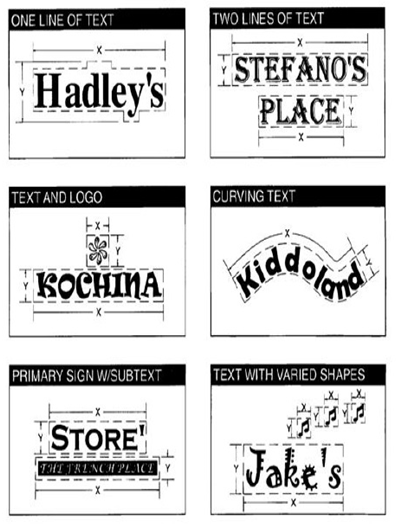
- Sign area - wall sign. The sign area includes the total area of the sign, including all structures framing the sign, such as background embellishments or the area contained within a rectangle or square drawn completely around the display surface, or drawn completely around the individual letters or logos.
- Sign height - freestanding sign. Sign height shall be measured as the vertical distance from grade adjacent to the base of the sign footing, to the top of the sign, including the support structure and any design elements. An artificial grade shall not be used to calculate sign height if the artificial grade was established for the sole purpose of elevating the grade adjacent to the base of the sign footing for purposes of sign measurement.
(Ord. 12-05, eff. 12-19-2012)
159.194 Sign Design Criteria
Each sign in the city shall comply with the following requirements as well as the applicable provisions of any adopted Planned Sign Program. Signs located in the Auburn Historic District(s) are also subject to the City of Auburn Historic Preservation Architectural Design Guidelines.
- Relationship to structures. Building wall and fascia signs shall be compatible with the predominant visual elements of the structure(s), including construction materials, color, or other design features consistent with § 159.194. Building complexes and other similar facilities shall be required to develop a sign program in compliance with the provisions of this subchapter, and shall provide a compatible visual design common in theme to all applicable structures and uses.
- Relationship to other signs. Where there is more than 1 sign on a site or building, all permanent signs displaying a commercial message shall have designs that similarly treat or incorporate the following design elements:
- Letter size and style of copy;
- Shape of total sign and related components:
- Type of construction materials,
- Sign/letter color and style of copy,
- Method used for supporting sign (i.e., wall or ground base),
- Type of illumination, and
- Location.
- Sign illumination. Illumination from or upon any sign shall be shaded, shielded, directed or reduced so as to minimize light spillage onto the public right-of-way or adjacent properties. Externally illuminated signs shall be lighted by screened or hidden light sources.
- Materials and colors. All permanent signs shall be constructed of durable materials, which are compatible in kind or appearance to the building supporting or identified by the sign. Such materials may include, but are not limited to ceramic tile, sand blasted, hand carved or routed wood, channel lettering, concrete, stucco or stone monument signs with recessed or raised lettering. Sign colors and materials should be selected to be compatible with the existing building designs and should contribute to legibility and design integrity.
- Construction and maintenance. Every sign including all parts, portions and materials thereof, shall be manufactured, assembled and erected in compliance with all applicable state, federal and city regulations, and shall be maintained and kept in good repair. The display surface of all signs shall be kept clean, neatly painted and free from rust, cracking, peeling, corrosion or other states of disrepair. The premises around the sign shall be maintained by the owner and kept clear of all obnoxious substances, rubbish and weeds. All temporary signs, banners and balloons shall be constructed and mounted in such a manner that they shall not rip, shred, tear or blow away by exposure to normal weather conditions.
- Relationship to streets/public rights-of- way. Signs shall be designed and located to not obstruct any pedestrian, bicyclist, or driver's view of the public right-of-way.
- No sign shall be located in or project into the present or future right-of-way of any public street unless specifically authorized by other provisions of this section.
- No sign shall interfere with the sight distance of motorists and cyclists proceeding on or approaching adjacent streets, alleys, driveways, or parking area(s), or of pedestrians proceeding on or approaching adjacent sidewalks or pedestrian ways as determined by the City Engineer.
- No sign suspended over or projecting into the area above a driveway located on private property shall be situated at a height of less than 15 feet above the surface of the driveway.
- Signs suspended over, or projecting into, the area above a pedestrian way shall be situated at a height above ground level consistent with the requirements of the California Building Code.
- Screening. To minimize the visual mass and projection of the sign, all electrical transformer boxes and raceways shall be concealed from the public right-of-way and adjacent properties. If a raceway cannot be mounted internally behind a finished exterior wall, the exposed metal surfaces of the raceway shall be finished to match the background wall, or integrated into the overall design of the sign. All exposed conduit shall be concealed from public view.
(Ord. 12-05, eff. 12-19-2012) Penalty, see § 159.999
159.195 Sign Types
- Automobile sales promotional signage. Special promotional signage consisting of bunting, banners, flags, posters, pennants, ribbons, streamers and similar articles shall be permitted in association with commercial automobile sales only, subject to the following conditions:
- The signage shall only be permitted on commercially zoned properties.
- The signage shall be installed totally on the property at which the event is being conducted.
- Balloons over 14 inches in diameter and other inflatable devices shall be prohibited.
- Balloons under 14 inches in diameter may be used on weekends and holidays only.
- No part of the promotional signage (banners, flags, balloons and the like) shall exceed the maximum height of the building on the site.
- The requirements of all concerned governmental agencies having jurisdiction by law shall be met, including, but not limited to the Building Department, Fire Department, and Cal Trans.
- No sign shall be erected or maintained within the clear vision triangle.
- Banner/pennants signs.
- Number. Any number, but not exceeding size limit per this section.
- Location. Banners shall be located on the site of the tenant or use and shall not be erected or maintained within the clear vision triangle.
- Size/area. The maximum size of all banners shall be 50 square feet in total. The Director shall have discretion to approve a sign exception to increase the total allowable area when, due to unique circumstances (e.g., the length of a building frontage; the percentage of a building frontage covered; the facing or orientation of a building), a larger banner(s) would be appropriate.
- Duration. A banner may be allowed for a period of time not to exceed 40 calendar days per year.
- The sign permit application shall include the dates proposed by the applicant for scheduled banner use.
- Building complex signs. A building complex shall be considered as a single entity, without regard to whether it consists of more than 1 lot or parcel. Each building complex may erect and maintain signage pursuant to the following:
- All signs shall comply with the provisions of this subchapter except as provided below.
- Sign criteria for the building complex shall be established through a planned sign permit program pursuant to § 159.196 of this subchapter.
- Freestanding signs.
- Number. Each building complex may erect and maintain 1 freestanding sign. Additional freestanding signs may be permitted upon approval of a use permit by the Planning Commission if the building complex has more than 1 street frontage and/or has an individual street frontage that is greater than 300 feet long with more than 1 project entrance.
- Location. No more than 1 sign shall be placed on each street, unless additional signs are approved pursuant to division (C)(3)(a) above. All signs are subject to the requirements of the clear vision triangle.
- Area. The maximum allowable sign area shall be 40 square feet. The maximum sign area may be increased to 60 square feet for a lot with a street frontage of at least 200 feet. The maximum sign area may be increased to 80 square feet for a lot with a street frontage of at least 300 feet. The area of each sign is determined based on the length of the frontage on which the sign is placed.
- Each sign shall utilize a consistent design.
- The colors and materials of the sign(s) base and or casing/housing shall be compatible with the colors and materials of the building complex.
- Landscaping. Landscaping shall be provided at the base of the sign pursuant to § 159.195(G)(5).
- Wall signs.
- The size of the letters and the spacing shall be balanced for the tenants within the building complex providing minimum and maximum letter heights.
- Signs throughout the building complex shall be consistent in appearance.
- Directory signs. As permitted by § 159.195(F).
- Community directional signs.
- Number. As determined by the Director.
- Area. Each community directional sign shall not exceed 4 square feet in sign area.
- Location. Off-site community directional signs may only be situated on private property and shall not be located within the clear vision triangle.
- The signs shall be crafted, generally made of wood, metal or other natural hard materials.
- Directional signs.
- Number.
- One directional sign is permitted for each 1-way driveway;
- One directional sign is permitted for each drive through aisle;
- One directional sign is permitted for each service or delivery entrance; and
- Additional directional signs are permitted to satisfy a health and safety need.
- Area. The area of each sign shall not exceed 4 square feet.
- Height. The height of the sign, including the base, shall not exceed 4 feet from grade to the top of the sign.
- Corporate colors may be utilized; however, corporate logos shall not be applied to the sign.
- Location. Directional signs shall not be located within the clear vision triangle.
- Number.
- Directory signs.
- Number. Each building with more than 2 tenants is permitted 1 directory sign. Sign may be freestanding or wall mounted.
- Area. The area of each sign shall not exceed 16 square feet.
- Height. The height of the sign, including the base, shall not exceed 6 feet from grade to the top of the sign.
- Location. Directory signs shall not be located within the clear vision triangle.
- Freestanding signs for individual uses.
- Number. Each individual use may erect and maintain 1 freestanding sign, regardless of whether a use is conducted on more than 1 contiguous parcel. Additional freestanding signs may be permitted upon approval of a use permit by the Planning Commission if the use has more than 1 street frontage and/or has an individual street frontage that is greater than 300 feet long with more than 1 project entrance.
- Location. No more than 1 sign shall be placed on each street, unless additional signs are approved pursuant to division (G)(1) above. All signs are subject to the requirements of the clear vision triangle.
- Height.
- Citywide. The maximum height shall be 15 feet, except as otherwise provided by this subchapter.
- Oldtown and Downtown Historic Design Review Districts. The maximum height shall be 10 feet.
- Highway 49/Elm Commercial area. The maximum height shall be 25 feet for properties located within the areas delineated on a map maintained by the Planning Department. The map may be amended by resolution of the City Council.
- Airport Industrial Design Control (AI-DC) Zone. The maximum height shall be 10 feet.
- Area.
- The maximum allowable sign area shall be 40 square feet. The maximum sign area may be increased to 60 square feet for a lot with a street frontage of at least 200 feet. The maximum sign area may be increased to 80 square feet for a lot with a street frontage of at least 300 feet. The area of the sign is determined based on the length of the frontage on which the sign is placed.
- Airport Industrial Design Control (AI-DC) Zone. A maximum of 60 square feet (each side if double sided) shall be permitted.
- Landscaping. Landscaping with automatic irrigation shall be provided at the base of the supporting structure equal to twice the area of 1 face of the monument sign. The review authority may waive or modify this requirement on a case-by- case basis for small monument signs or where existing site conditions preclude this requirement.
- Menu/order board signs for individual uses.
- Number. Each establishment with a drive through facility is permitted a maximum of 2 menu/order board signs.
- Location.
- The sign shall be located adjacent to the drive through aisle.
- The sign shall not be located as to impair the vision of the driver of a vehicle traveling either into, out of, or through the drive aisle.
- Area. The area of each sign shall not exceed 32 square feet.
- Height. The height of the sign including the pole or base shall not exceed 6 feet from grade to the top of the sign.
- Motor vehicle fuel and service station signs.
- Freestanding signs. Each motor vehicle fuel or service station may erect and maintain 1 freestanding sign as permitted by this subchapter.
- Motor vehicle fuel price signs.
- Number. Each use dispensing any motor vehicle fuel at retail to the general public shall be permitted to erect and maintain 1 freestanding fuel price sign for the primary purpose of advertising motor vehicle fuel prices.
- The sign shall comply with § 159.195(G) of this code as well as the provisions of California Business and Professions Code regarding display requirements.
- Area. The maximum area of the fuel price sign, excluding the base or embellishments, shall be 75 square feet.
- Electronic changeable signs may be used to display motor vehicle fuel price information, except in the Old Town and Downtown design review district. Electronic changeable display shall be limited to the portion of any sign structure devoted exclusively to display of motor vehicle fuel price information required or permitted by the California Business and Professions Code. Sign displays shall remain static and may not change more than once per 12-hour period.
- Location. No freestanding sign over 3 feet high shall be erected or maintained within the clear vision triangle.
- Wall signs. Wall signs on the motor vehicle fuel and service station building shall comply with § 159.195(Q) (wall sign criteria for individual businesses).
- Canopy signs.
- Wall signs are permitted on the fuel canopy. Such signs shall comply with § 159.195(Q) of this code and shall be considered separately from the main building.
- Area. The maximum allowable area shall be 1 square foot of sign area for each 10 lineal feet of the canopy.
- Spandrel signs. Spandrel signs are permitted between the canopy supports. The maximum allowable area shall be 1 square foot of sign area for each 10 lineal feet of the spandrel. The allowable sign area for spandrel signs shall be determined separate from the area for wall signs.
- Signs advertising the price of each grade of gasoline may be placed on each gasoline pump.
- Multi-family residential signs.
- Number.
- One freestanding identification sign per project entry.
- One wall sign.
- One directory sign per building.
- Area.
- The maximum area of each freestanding sign or sign mounted on a fence or wall shall be 32 square feet.
- The maximum total area for the wall sign shall be 1 square foot per 10 lineal feet up to a maximum of 32 square feet.
- Height.
- The maximum height of a freestanding sign shall be 4 feet.
- The maximum height of a sign mounted on a fence or wall shall be 6 feet, including the height of the fence or sound wall.
- Location. Freestanding signs shall be located outside the clear vision triangle.
- Number.
- Off-premise signs. Except as otherwise provided by this subchapter, all off-premise signs shall comply with the following, in addition to any other permit requirements under this subchapter or any other provision of the code:
- A use permit shall be approved by the Commission.
- The applicant must demonstrate that the sign is necessary because of unusual access to the commercial business establishment.
- No sign shall be erected or maintained on premises used for residential purposes.
- No sign shall overhang public property, nor shall it violate the terms of height restrictions.
- No sign shall be located within 660 feet of Interstate 80 (I-80) right-of-way.
- There shall be no more than 1 off- premise sign on any 1 parcel.
- Visual access to an existing sign shall not be blocked or impaired.
- All such signs shall comply with the provisions for setbacks in the district located therein.
- The maximum size shall be 100 square feet.
- Scenic route viewsheds identified in the General Plan shall be protected.
- Location. No sign shall be located within the clear vision triangle.
- Projecting, overhead, and suspended signs. The following standards shall apply to all projecting, overhead, or suspended signs (other than undercanopy signs) in all zones where allowed by this subchapter:
- Projecting signs.
- Projecting signs shall only be allowed in the Old Town and Downtown design review districts.
- The sign and the copy shall be perpendicular to the wall of the building to which it is attached.
- Overhead and suspended signs. Signs may be placed parallel to the street.
- The following standards shall apply to all projecting, overhead, and/or suspended signs:
- The sign area shall apply to a tenant's allowable wall sign area.
- The minimum horizontal clearance between a sign and the curb line shall be as specified by the California Building Code.
- The top of a projecting sign shall not exceed the lesser of 14 feet, eave height, parapet height, or sill height of a second floor window.
- The minimum clearance from the bottom of the sign to the finished grade shall be as specified by the California Building Code.
- Icon using shapes or symbols uniquely suited for the business, creative shapes, and 3 dimensions signs are encouraged.
- Each sign shall be graphically designed for pedestrians.
- Sign supports shall be well- designed and compatible with the design of the sign.
- Projecting signs.
- Real estate signs. Real estate signs shall be placed upon the property to which it pertains only in accordance with the following regulations.
- The signs shall not be affixed to trees or shrubs.
- No sign shall be placed so that any portion is more than 7 feet above the average ground level.
- The signs shall not be illuminated, directly or indirectly.
- Not more than 1 real estate sign may be placed on any 1 parcel of real property. However, when a parcel of real property is larger than 3 acres in size, 2 real estate signs may be placed thereon at least 500 feet apart. For the purposes of this section, all contiguous parcels of real property owned by the same owner shall be deemed to be 1 single parcel of real property.
- Location. Signs shall not be placed within 5 feet of any boundary line of the real property. No sign shall be located within the clear vision triangle.
- Subdivision signs.
- Off-site subdivision signs. New residential subdivisions are generally located some distance away from the major vehicular entrances to the city, and the public requires additional off-site direction to the subdivisions. Notwithstanding the general billboard prohibition, it is the intent of this subchapter to provide such directional signage.
- Number. The minimum separation between off-site subdivision signs shall be 1,000 feet.
- Location.
- Standard setback. Off-site freestanding signs shall maintain a minimum setback of 5 feet to the nearest property line.
- Freestanding signs shall be located outside the clear vision triangle.
- Off-site subdivision signs may be located on vacant property in accordance with this section. A sign located on occupied property may be considered by the Director on a case-by-case basis.
- Overall sign size.
- Height: Maximum sign height of 10 feet.
- Width: Maximum sign width of 10 feet.
- Display area.
- Multiple display areas shall be provided on each off-site sign for individual subdivisions.
- Panel size for individual subdivisions shall be a maximum of 2 feet by 7 feet.
- Design.
- The design of all off-site subdivision signs shall be consistent citywide.
- Off-site subdivision signs shall be freestanding and contain not more than 2 sides.
- Placement and removal.
- Upon approval of a sign permit, no off-site subdivision sign shall be erected until application for plan check has been filed for a house or model home within the subdivision.
- A subdivision name shall be removed from the sign within 30 days of the sale of the final lot in the subdivision.
- Off-site subdivision signs shall be removed if no subdivision has been advertised on it for a period of 60 days.
- On-site subdivision signs.
- Number.
- No more than 2 freestanding signs shall be permitted at each subdivision entrance.
- No more than 2 wall signs shall be permitted at each subdivision entrance.
- Location.
- On-site signs may be located on either 1 or both sides of the subdivision entrance or within a landscaped entry median.
- Signs shall be located outside of the clear vision triangle.
- Wall signs may be mounted on an entry wall or sound wall on 1 or both sides of the subdivision entrance road.
- Area.
- The maximum area of a single sign shall be 32 square feet.
- The maximum sign area for all signs at 1 subdivision entry shall be 64 square feet.
- Height. The maximum height of a freestanding sign shall be 4 feet.
- Number.
- Off-site subdivision signs. New residential subdivisions are generally located some distance away from the major vehicular entrances to the city, and the public requires additional off-site direction to the subdivisions. Notwithstanding the general billboard prohibition, it is the intent of this subchapter to provide such directional signage.
- Temporary non-commercial signs. Temporary signs and banners are permitted in all zones subject to the following regulations.
- Location. Signs shall not be posted on trees, fence posts, public utility poles, on any roof, or located within any public right-of-way or on any publicly owned property. No sign shall be located within the clear vision triangle. Off-site signs shall only be allowed on private property with the owner's permission.
- No sign shall be placed on private property without permission of the property owner or tenant.
- Signs shall not be illuminated.
- Height. The maximum sign height shall not exceed 7 feet.
- Area. The maximum sign area shall not exceed 32 square feet.
- Number. Each lot shall be permitted 2 temporary freestanding signs containing only noncommercial messages. In addition, one temporary freestanding campaign sign shall be allowed for each political candidate or proposed ballot measure on each street frontage.
- Duration. A temporary non- commercial sign may be allowed for a period of time not to exceed 60 days prior to the date of an event or election referenced in the sign or to which the sign otherwise relates and shall be removed within 10 days after that date.
- Under canopy signs.
- Number. Each use shall be permitted 1 under canopy sign.
- Location.
- The sign shall be perpendicular to the wall of the building to which it is attached.
- The minimum vertical clearance of an under canopy sign shall be as specified by the California Building Code.
- Area.
- The area of an under canopy sign shall not exceed 6 square feet.
- The area of an under canopy sign shall not reduce the allowable sign area for wall signs associated with the same tenant/use.
- Wall signs for individual uses.
- Number. Each individual use or tenant space may erect and maintain 1 or more wall signs on each building façade.
- Location.
- Wall signs may be:
- Attached flat against or pinned away (peg mounted or similar; no more than 1 foot) from a wall or facade.
- Attached as a projecting, overhead, or suspended sign as provided in § 159.195(N).
- Attached to, or incorporated into, the mansard façade of a sloping roof, but shall not extend above the upper edge of the roof.
- Painted on or attached to a canopy or awning.
- Signs should not cover or interrupt major architectural features, including such features as doors, windows, tile embellishments and reveal lines.
- Wall signs may be:
- Area.
- The total allowable area for all wall signs on a building facade shall not exceed 6 square feet per 10 lineal feet of tenant frontage for each tenant.
- Window signs shall not count towards the total square footage calculated for wall signs.
- Can signs prohibited. Can signs shall be prohibited in the Old Town Design Review District and the Downtown Design Review District.
- Window signs.
- Number. Each window may have window signs.
- Location. Affixed or applied to, or located within 24" of, the surface of a window with its message intended to be visible to and readable from the public way or from adjoining property.
- Area. Window sign area shall not be counted against the allowed wall sign area.
(Ord. 12-05, eff. 12-19-2012; Am. Ord. 14-03, eff. 9-10-2014) Penalty, see § 159.999
Amended by Ord. 25-05 on 10/27/2025
159.196 Planned Sign Program
- The purpose of a sign program is to integrate a project's signs into the architectural design of a subject site and to ensure visibility of all signs. A sign program also enables the city to ensure high quality in the design and display of multiple permanent signs and to encourage creativity and excellence in sign design.
- Required. A planned sign program shall be provided as follows:
- A sign program shall be provided for any building complex established after the date of adoption of this code.
- A sign program for an existing building complex may be required at the discretion of the Director when:
- A new building is added to the building complex.
- There is substantial exterior remodeling of the existing complex (i.e., at least 50% of the complex).
- A sign program shall be provided for the replacement of, or significant modification to, an existing planned sign program.
- A planned sign program is optional for all other signs.
- If the provisions of an approved planned sign program conflict with other provisions of this subchapter, whichever provision is more restrictive shall control.
- A sign program shall consist of a description, including dimensions, materials, locations, and illustration of all signs proposed on the site. The sign program shall have a unifying design theme or style. A separate sign permit shall be required for all signs constructed pursuant to an approved sign program.
(Ord. 12-05, eff. 12-19-2012)
159.197 Non-Conforming Signs
This section recognizes that the eventual elimination of existing signs (on-site and off-site) that are not in conformity with the provisions of this subchapter is as important as the prohibition of new signs that would violate these regulations.
- Continuation of legal non-conforming sign. A legally established sign that does not conform to the provisions of this subchapter may continue to be used in compliance with § 159.187, unless the sign is:
- Structurally altered to extend its useful life.
- Expanded, moved, or relocated.
- Re-established after a business has been discontinued for 60 days or more.
- Re-established after damage or destruction of more than 50% of the value of the physical structure of the sign, as determined by the Director.
- Sign copy changes. The sign copy and sign faces of a legally established non-conforming sign may be changed provided that the change does not include a structural change in the display and otherwise complies with the requirements of this subchapter.
- Correction of non-conformities required. Approval of any structures on a site or a change in the land use on a site shall require that all non-conforming signs on the site be brought into conformity with this subchapter.
- Future non-conformity. Any legal sign, which later becomes non-conforming as to size or location either by reason of amendment of this section or its operation, may be maintained indefinitely, provided that it shall not be enlarged or moved without full compliance with this subchapter. All existing signs in newly annexed areas shall be treated legally established non-conforming signs in accordance with § 159.197(A).
(Ord. 12-05, eff. 12-19-2012)
159.198 Removal Of Unsafe Or Illegally Installed Signs
- Unsafe signs. Any sign that presents an immediate danger to the public health or safety may be removed by the city without prior notice. Alternatively, the Director may issue a notice of violation and give the permit holder, owner of the property on which the sign was located, or person in possession and control of that property 15 days to cure the violation. The date of service shall be the date the Director places the notice in a U.S. Postal Service mail receptacle. In the case of an unsafe sign removed by the city, the costs of such removal and storage shall be borne by the permit holder, owner of the property on which the sign was located, or person in possession and control of that property, as applicable and may be collected by the city in the same manner as it collects any other debt or obligation. No unsafe sign that has been removed and stored by the city shall be released until the costs of removal and storage have been paid. If an unsafe sign remains uncured for a period of 30 days after service of the notice, the city may remove the sign and dispose of it.
- Illegal signs. Any illegal sign shall be removed or brought into conformity by the permit holder, owner of the property on which the sign was located, or person in possession and control of that property following written notice from the Director as specified in § 159.197(C). The Director's order may be appealed to the Council in the manner provided in § 159.188(H)(1).
- Abandoned signs. A sign that advertises or otherwise identifies a business or activity which has been discontinued on the premises, or any sign or sign structure that has no copy, for a period of 60 days shall be considered abandoned and shall be removed by the owner or lessee of the premise. Signs determined to be historic by the Historic Design Review Commission shall be allowed to remain.
- Penalties. Illegal signs shall be subject to the remedies established in § 159.999(C).
- Removal of illegal signs in the public right-of-way. The Director may cause the immediate removal of any sign within the public right-of-way or on property that is otherwise abandoned that has been placed there without first complying with the requirements of this subchapter.
(Ord. 12-05, eff. 12-19-2012)

