
Aurora City Zoning Code
ARTICLE 49
I USE AND STRUCTURE REGULATIONS
O22-107
O23-087
49-101.1 Zoning Ordinance
- The regulations of this Chapter 49 of this code may be officially known, and cited as the "Zoning Ordinance." References in this code or in other official enactments by the city to the “AZO,” or the “Aurora Zoning Ordinance” shall be construed to refer to this chapter.
- This ordinance is enacted under the home rule powers granted to the city by Article VII, Section 6 of the Illinois Constitution of 1970 and powers further granted by the U.S. and Illinois Constitutions and the laws of the State of Illinois, including without limitation the extraterritorial zoning jurisdiction conveyed by Section 11-13-1, et. seq. of the Illinois Municipal Code.
49-102.1 Intent And Purpose
- To divide the city into zones or districts restricting and regulating therein the location, erection, construction, reconstruction, alteration and use of buildings, structures and land for residence, business and manufacturing and other specified uses with the general purpose of promoting and protecting the public health, safety and general welfare of the people of this city and of implementing the comprehensive plan;
- To protect the character and the stability of the residential, business and manufacturing areas within the city and to promote the orderly and beneficial development of such areas;
- To prevent the overcrowding of land and undue concentration of structures, so far as possible and appropriate in each district, and to provide adequate light, air, privacy and convenience of access to property;
- To regulate the intensity of use of lot areas, and to determine the area of open spaces surrounding buildings, necessary to provide adequate light and air, and to protect the public health;
- To fix reasonable standards to which buildings or structures shall conform therein;
- To prohibit uses, buildings or structures incompatible with the character of development or intended uses within specified zoning districts;
- To limit congestion in the public streets and protect the public health, safety, convenience and general welfare by providing for the off-street parking of motor vehicles and the loading and unloading of commercial vehicles;
- To conserve the taxable value of land and buildings throughout the city;
- To provide for the elimination of nonconforming uses of land, buildings and structures;
- To conserve and enhance the Downtown’s architecture, history and pedestrian-orientation, mix of land uses and access to the Fox River; support and promote the Downtown as the city’s center for civic, cultural, entertainment and specialty retail uses; encourage continued revitalization through establishment of new residential uses;
- To conserve and enhance the character of the city’s older, established residential neighborhoods through mitigation of adverse factors, promotion of a balanced mix of housing types, and through appropriately scaled and planned infill development;
- To encourage innovative and quality new residential development so that growing demand for housing may be met by greater variety in type, design and layout of dwellings and by conservation and more efficient use of open space ancillary to such dwellings;
- Encourage pedestrian and vehicular connections between residential neighborhoods and between residential neighborhoods and nearby employment centers, shopping and community services such as parks and schools;
- To encourage quality, nonresidential development that preserves and protects the character of the community, including its natural landscape and that minimizes objectionable noise, glare, odor, traffic and other impacts of such development especially when adjacent to residential uses; and
- To define and limit the powers and duties of the administrative officers and bodies as provided herein.
49-103.1 Construction Of Terms
In the construction of this ordinance, the rules and definitions contained in this section shall be observed and applied, except when the context clearly indicates otherwise.
49-103.2 Rules
- Words used in the present tense shall include the future; and words used in the singular number shall include the plural number, and the plural, the singular.
- The word "shall" is mandatory and not discretionary.
- The word "may" is permissive.
- The word "lot" shall include the words "plot," "piece" and "parcel"; the word "building" includes all other structures of every kind regardless of similarity to buildings; and the phrase "used for" shall include the phrases "arranged for," "designed for," "intended for," "maintained for," and "occupied for."
- Scope of Regulations.
- No buildings or structures shall be erected, converted, enlarged, reconstructed or structurally altered, nor shall any building or land be used for any purpose other than is permitted in the district in which the building or land is located.
- If located in a Historic District or designated as a Historic Landmark, no buildings or structures shall be erected, converted, enlarged, reconstructed or structurally altered, nor shall any building or land be used for any purpose other than is permitted in the city’s Historic Districts and Landmarks Guidelines, as approved by Resolution Number 01-152, dated April 10, 2001, and is from time to time amended.
- Permits.
- No application for a building permit or other permit or license, or for a certificate of occupancy, shall be approved by the zoning administrator, and no permit or license shall be issued by any other city department, which would authorize the use or change in use of any land or building contrary to the provisions of this ordinance, or the erection, moving, alteration, enlargement or occupancy of any building designed or intended to be used for a purpose or in a manner contrary to the provisions of this ordinance.
- Zoning Maps.
- The locations and boundaries of the districts established herein are shown upon the zoning map that is hereby incorporated into this ordinance. The zoning map, together with all notations, references and other information shown thereon, and all amendments thereto, shall be a part of this ordinance and shall have the same force and effect as if the zoning map, together with all notations, references and other information shown thereon, were fully set forth and described herein.
- New or Annexed Land.
- Submerged land heretofore reclaimed or which may be reclaimed hereafter, and land heretofore annexed or which may be annexed to the city hereafter, and which is not shown on the zoning map made a part of this ordinance, shall be classified in the R-1 one-family dwelling district until such time as the city council designates the permitted use of the land in accordance with the provisions of this ordinance; provided, however, that the city council may, in the annexation ordinance, specifically determine the zoning district or districts into which such annexed land shall be classified. Where the land heretofore referred to abuts an existing or contemplated highway or street, which contemplated highway or street, in the opinion of the commission and the city council, may at some time in the future become a four-lane highway or street, then the city council in the case of vacant land shall require the dedication of sufficient land to provide for a future one-hundred foot right-of-way.
- Zoning of Streets, Alleys, Public Ways, and Railroad Rights-of-way.
- All streets, alleys, public ways, and railroad rights-of-way, if not otherwise specifically designated, shall be deemed to be in the same use district as the property immediately abutting upon such alleys, streets, public ways, and railroad rights-of-way. Where the centerline of a street, alley, public way, or railroad right-of-way serves as a district boundary, the zoning of such areas, unless otherwise specifically designated, shall be deemed to be the same as that of the abutting property up to such centerline.
- Boundary Lines.
- Wherever any uncertainty exists as to the boundary of any use district as shown on the zoning map incorporated herein, the following rules shall apply:
- Where district boundary lines are indicated as following streets, alleys or similar rights-of-way, they shall be construed as following the centerlines thereof.
- Where district boundary lines are indicated as approximately following lot lines, such lot lines shall be construed to be such boundaries.
- Where a lot held in one (1) ownership and of record at the effective date of this ordinance is divided by a district boundary line, the entire lot shall be construed to be within the less restricted district; provided that this construction shall not apply if it increases the area of the less restricted portion of the lot by more than twenty (20) percent.
- Wherever any uncertainty exists as to the boundary of any use district as shown on the zoning map incorporated herein, the following rules shall apply:
- General Provisions.
- Location of Buildings.
- Except as otherwise provided for in this ordinance, every building shall be constructed or erected upon a lot, or parcel of land, which abuts upon a public street or permanent easement of access to a public street, which easement shall have a minimum width of twenty-five (25) feet, unless an easement of lesser width was on record prior to the adoption of this ordinance.
- Buildings on a Zoning Lot.
- Every building hereafter erected or structurally altered to provide dwelling units, shall be located on a zoning lot as herein defined and in no case, shall there be more than one (1) such building on one (1) zoning lot, except that in a two-story garage with living quarters upon the second floor such quarters may be occupied by a domestic employee (and his family) of the family occupying the main structure. There may also be constructed a guest house (without kitchen) or rooms for guests within an accessory building, provided such facilities are used for the occasional housing of guests of the occupants of the main structure and not for permanent occupancy by others as a housekeeping unit.
- Rezoning of Public and Semipublic Areas.
- An area indicated on the zoning map as a public park, recreation area, public school site, cemetery, or other similar open space, shall not be used for any other purpose than that designated; and when the use of the area is discontinued, it shall automatically be zoned to the most restricted adjoining district until appropriate zoning is authorized by the city council within three (3) months after the date of application filed for rezoning.
- Conditional Uses.
- Whenever any provision of law, or this code classifies a use of property in any zoning district as a conditional use or requires the issuance of a special or conditional use permit as a mechanism to reduce any requirement imposed by this ordinance, the procedures for the issuance of a conditional use permit set forth in chapter 34 of this code shall apply to the application, review, and approval process of the conditional use.
- Whenever any provision of this code defines a use authorized in a planned development district to be conditional use, the procedures for the authorization of the conditional use within such district set forth in chapter 34 of this code shall apply to the application, review, and approval process of the conditional use.
- Rules Generally Applicable to All Zoning Districts.
- Unless specifically provided, these rules shall be construed to be a part of the regulations of every zoning district established pursuant to this ordinance.
- Unless specifically provided, these rules shall be construed to be a part of the regulations of every planned development district and overlay district established pursuant to chapter 34 of this code.
- Organization of Ordinance.
- Consistent with the organization of the remainder of this code, the catch lines previously designed as “Chapters” in prior versions of this ordinance are designated as “Parts.”
- Consistent with the organization of the remainder of this code, sections appearing in previous versions of this ordinance have been renumbered to be preceded by “49-10” such that former Section 2 of this ordinance is now Sec. 49-102.”
- The re-designation of the catch lines and renumbering of the sections of this ordinance as described in this paragraph shall not be construed as a repeal or amendment of any existing provision of the code.
- Location of Buildings.
49-103.3 Definitions
1300 Hotel, Motel, Or Other Accommodation Services: This category is comprised of establishments which serve lodging accommodations for travelers and must be staffed with twenty-four-hour clerk service, maid and janitor services. They may offer a wide range of services, from overnight sleeping space to full-service hotel suites. They may offer these services in conjunction with other activities, such as entertainment or recreation.
1310 Bed And Breakfast Inn: This is a 1300 use category which is comprised of establishments which operate primarily in private homes and small buildings.
1320 Rooming And Boarding/Single Room Occupancy: This is a 1300 use category which is comprised of accommodation services such as rooming and boarding and single room occupancy establishments, rooming and boarding establishments serve a specific group or membership, such as a dormitory, fraternity or sorority house, or workers' camp, they provide accommodations and may offer housekeeping, meals, and laundry services. Single Room Occupancy are establishments where a room is provided, for compensation pursuant to previous arrangement, as sleeping and living quarters, but without cooking facilities and with or without an individual bathroom. Including but not limited to Lodging house; Rooming house; Dormitory
1330 Hotel, Minor: This is a 1300 use category which is comprised of establishments with fewer than fifty (50) guest rooms established prior to December 01, 1992.
1340 Motel: This is a 1300 use category which is comprised of establishments with no common corridor to access guest rooms, the rooms are individually accessible from the outside. Including but not limited to Tourist Courts; Motor Lodges; and Motels.
1350 Hotel, Limited Service: This is a 1300 use category which is comprised of establishments that have more than fifty (50) guest rooms, and has meeting space/banquet facilities for less than 100 persons, no food service and none or one of the following amenities: swimming pool, exercise facility, gift shop or hotel restaurant within the physical confines of the hotel.
1360 Hotel, Select Service: This is a 1300 use category which is comprised of establishments that have more than fifty (50) guest rooms, and has meeting space/banquet facilities for between 100 and 200 persons, limited food service (i.e. continental breakfast) and two or more of the following amenities: swimming pool, exercise facility, gift shop or hotel restaurant within the physical confines of the hotel. In addition to these required amenities others may also be provided for guests including but not limited to: spa facilities, dry cleaning service, recreational activities, or entertainment.
1370 Hotel, Full Service: This is a 1300 use category which is comprised of establishments that have more than one hundred and twenty (120) guest rooms, and has meeting space/banquet facilities for between 200 and 1,000 persons, a hotel restaurant within the physical confines of the hotel and room service that is accessory to the restaurant use and all three of the following amenities: swimming pool, exercise facility, and gift shop. In addition to these required amenities others may also be provided for guests including but not limited to: spa facilities, dry cleaning service, recreational activities, or entertainment.
1380 Hotel, Convention: This is a 1300 use category which is comprised of establishments that have at least 200,000 square feet of floor area of which a minimum of 50% must be occupied by meeting space/banquet facilities, and has meeting space/banquet facilities for at least 1,000 persons, a minimum of one hotel restaurant within the physical confines of the hotel and room service that is accessory to the restaurant use and all three of the following amenities: swimming pool, exercise facility, and gift shop. In addition to these required amenities others may also be provided for guests including but not limited to: spa facilities, dry cleaning service, recreational activities, or entertainment.
1510 Community Residence, Minor: This 1500 use category is comprised of establishments where a dwelling structure is occupied by a group of four (4) to six (6) unrelated persons with disabilities with onsite support staff provided by a sponsoring agency.
1520 Community Residence, Major: This 1500 use category is comprised of establishments where a dwelling structure is occupied by a group of seven (7) or more unrelated persons with disabilities with onsite support staff provided by a sponsoring agency.
1530 Community Residence, Transitional: This 1500 use category is comprised of establishments where a dwelling structure is occupied by a group of unrelated persons who have been paroled for criminal offenses, or a dwelling structure which serves as an alternative to incarceration for persons with criminal offenses. Including but not limited to, work release center, halfway house (correctional), transitional living quarters or comparable facilities.
2115 Cannabis Dispensing Facility: A facility operated by an organization or business that is licensed by the Department of Financial and Professional Regulation to acquire cannabis from a registered cannabis cultivation facility for the purpose of dispensing cannabis, cannabis infused products, cannabis seeds, paraphernalia, or related supplies and educational materials to purchasers or registered qualifying patients and caregivers.
2160 Pawnshop: A Business establishment that provides loans on the security of pledged goods left in pawn, or in the business of purchasing tangible personal property to be left in pawn on the condition that it may be redeemed or repurchased by the seller for a fixed price within a fixed period of time
2195 Automated/Unstaffed Business Devices: This 2100 use category consists of any automated device which dispenses, sells, vends, or collects goods or services with no attendant required. Including but not limited to vending machines, “atm” banking machines, newspaper stands, and other coin/card operated devices.
2195.1 Donation Collection Bin: This 2100 use category consists of containers intended to accept and store donated items for collection.
2198 Garage Sale: This 2100 use category consists of general sales conducted from a residential property which is open to the public for the purpose of disposing personal property.
2199 Farmers Market: This 2100 use category consists of a public market at which farmers and often other vendors sell produce directly to the consumer.
2220 Alternative Financial Services Businesses: This category is the use of a site for a check cashing business, payday advance or loan business, money transfer business, motor vehicle title loan business, cash-for-gold establishments or a credit access business as defined in this section. This use excludes: (1) a state or federally chartered bank, savings and loan association or credit union, or a pawnshop; and (2) a convenience store, supermarket, or other retail establishment where consumer retail sales constitute at least 75% of the total gross revenue generated on site.
2520 Drive–In Restaurant: An eating establishment whose principal business is the sale of food and beverages served directly to the customer in a motor vehicle by an employee outside the confines of the building.
2831 Gasoline Station: A place where gasoline or any other automotive engine fuel stored only in underground tanks, kerosene, or lubricating oil or grease for the operation of motor vehicles or boats are offered for sale directly to the public on the premises. Minor automotive repairs, accessories and servicing is permitted. Major automotive or boat repairs; tire recapping; and the washing of motor vehicles where no production-line methods, mechanized devices, or combination thereof is employed are not permitted. When the dispensing, sale or offering for sale of motor fuels or oil is incidental to the conduct of a public garage, the premises shall be classified as a public garage.
2832 Car Wash, Multiple Bay: A structure, or portion thereof, containing two (2) or more bays for the washing of motor vehicles by manual means, by self-serve means, by mechanized means, by means of a production line, or any combination thereof; or which has an operating capacity of two (2) or more vehicles at any one (1) time.
2833 Car Wash, Single Bay: A structure, or portion thereof, containing one (1) bay where motor vehicles are washed by means of a fully automated mechanized process, and which has an operating capacity of only one (1) vehicle at any one (1) time.
2834 Vehicle Repair, Minor: Incidental repairs, replacement of parts, and motor service to motor vehicles, but not including any operation specified under "Vehicle repair, major" or the servicing of small automotive engines.
2835 Hand Wash, Detail Shop: A building where motor vehicles are washed, waxed, polished or cleaned by hand; but not including any operation specified under "Car Wash, multiple or single bay".
2836 Vehicle Repair, Major: Engine rebuilding or major reconditioning of worn or damaged motor vehicles, trailers, boats, industrial equipment, automotive or industrial engineering; collision service, including body, frame or fender straightening or repair; and overall painting of vehicles but not including the recapping of tires, or the processing of other rubber or synthetic materials that may be used in the repair of the vehicles only.
2841 Truck Stop Establishments: A place where gasoline or any other automotive engine fuel stored only in underground tanks, kerosene, or lubricating oil or grease for the operation of motor vehicles or boats are offered for sale directly to the public on the premises. These establishments have one or more diesel fuel stations with bays that are designed to accommodate semi-trucks or other commercial vehicles. Minor automotive repairs, accessories and servicing is permitted. Major automotive or boat repairs; tire recapping; and the washing of motor vehicles where no production-line methods, mechanized devices, or combination thereof is employed are not permitted. When the dispensing, sale or offering for sale of motor fuels or oil is incidental to the conduct of a public garage, the premises shall be classified as a public garage.
3110 Food, Textiles, And Related Products: This is a 3100 use category which is comprised of establishments which produce food products for intermediate or final consumption in a process that primarily uses raw materials from agricultural products. Including but not limited to establishments that produce tobacco, textiles, and leather products, beverage bottling and distributing; canning and preserving; food manufacture, packaging and processing; ice cream and ice manufacture.
3112 Cannabis Processing Facility: A facility operated by an organization or business that is licensed by the Illinois Department of Agriculture to either extract constituent chemicals or compounds to produce cannabis concentrate or incorporate cannabis or cannabis concentrate into a product formulation to produce a cannabis product.
3113 Cannabis Infuser Facility: A facility operated by an organization or business that is licensed by the Illinois Department of Agriculture to directly incorporate cannabis or cannabis concentrate into a product formulation to produce a cannabis-infused product.
3150 Recycling Centers: This 3100 use category is comprised of establishments which are entirely within a completely enclosed building where scrap metal, paper, rags or other recyclable materials are bought, sold, exchanged, stored, baled, packed, disassembled or handled, but excluding recycling yards/junk shops.
3300 Warehouse, Distribution & Storage Services: This 3300 Use Category is comprised of establishments which primarily provide storage for general merchandise, refrigerated goods, other warehouse products or computer systems and associated components. Uses in this category provide the facilities to store goods but do not sell the goods they handle. They may also provide a range of services related to the distribution of goods, such as labeling, breaking bulk, inventory control and management, light assembly, order entry and fulfillment, packaging, pick and pack, price marking and ticketing, transportation arrangement or processing and distribution of large amounts of data. This includes but is not limited to the following: Cartage (local), express hauling, Electronic Storage Data Centers, cryptocurrency facilities, and warehousing and distribution facilities, but excluding motor freight terminals. Motor Freight Terminals are categorized under 3310 Vehicle Terminals and Storage.
3410 Recycling Yards/Junk Shops: This 3400 use category is comprised of establishments which consist of an open area where scrap metal, paper, rags or other recyclable materials are bought, sold, exchanged, stored, baled, packed, disassembled or handled, including auto and building wrecking yards, but excluding recycling centers. This use shall be wholly enclosed by a solid wall or fence, not less than 7 feet in height, and no material shall be piled or stacked to a height of fifteen (15) feet above the ground level.
4142 Cannabis Transporting Facility: An facility operated by an organization or business that is licensed by the Illinois Department of Agriculture to transport cannabis on behalf of a cannabis business establishments or a community college licensed under the Community College Cannabis Vocational Training Pilot Program.
4210 Above Ground Communication And Electric Utility Facility: An above ground structure used by a wire utility, such as telephone, cable, cell towers, or electric service, to provide services to the public where the structure is sized greater than 4’ x 3’ x 2’
4310 Alternative Energy System: For the purposes of Section 49-104.4(i), alternative energy system refers to a system that converts sunlight or wind into usable energy.
5200 Special Purpose Recreational Institutions: This 5000 use category is comprised of establishments which, as a primary use, provide facilities for amusement, entertainment or recreational activities. Including but not limited to the following: arcade, auditorium, stadium, arena, armory, gymnasium, or other similar places for public events; health club, bowling alley, dance hall, skating rink, archery range, golf practice range, miniature golf course, swim club, tennis, handball and racquetball club and similar activities.
5210 Community Center: This 5200 use category is comprised of establishments which as a primary use provide multi-use facilities for public events, recreation and community services. Establishments in this category are public locations where members of a community may gather for group activities, social support, public information and other purposes. They may sometimes be open for the whole community or for a specialized group within the greater community.
5230 Golf Courses, Public Or Private: This 5200 use category is comprised of establishments which, as a primary or accessory use, allow for playing of golf on a tract of land laid out for at least nine holes and improved with trees, greens fairways, and hazards and that may include a clubhouse and shelter.
5270 Juice Bars, Dry Cabarets, Teenage Cabarets, And Other Non-Alcoholic Bars: This 5200 use category is comprised of establishments which are designed, used or intended to be used primarily for participation by the public assembling for entertainment or amusement purposes, including but not limited to music, music videos and dancing but excludes any establishment which serves alcoholic beverages.
5400 Natural And Other Recreational Parks: This 5000 use category is comprised of establishments, the primary use of which is recreational and open space without special economic functions. Including but not limited to the following: Community parks; Communitywide special parks; Conservation/protection parks; Linear parks; Neighborhood parks; Public and private parks or playgrounds.
5410 Amusement Or Theme Park Or Fair: This 5400 use category is comprised of indoor or outdoor establishments, which may include buildings, where there are various devices for entertainment, including but not limited to rides, games, sale of items, shows and entertainment, food services, and souvenir sales. This use excludes carnivals and circuses which comply with the requirements in Chapters 8 and 9 of the Aurora Municipal Code.
6310 Day Care: Any child care facility which regularly provides day care for less than twenty-four-hour days (1) for more than eight (8) children in a family home, or (2) more than three (3) children in a facility other than a family home, which complies with all the licensing requirements for the State of Illinois, Department of Children and Family Services (refer to Illinois Revised Statutes). The child care facilities provide supplemental parental care and supervision and/or educational instruction.
6400 Religious Institutions: Establishments that operate religious organizations, such as churches, temples, monasteries, synagogues, etc.
7110 Cannabis Cultivation Facility: A facility operated by an organization or business that is licensed by the Department of Agriculture to cultivate, process, transport and perform necessary activities to provide cannabis and cannabis infused products to cannabis business establishments.
7115 Cannabis Craft Grower Facility: A facility operated by an organization or business that is licensed by the Illinois Department of Agriculture to cultivate, dry, cure and package cannabis and perform other necessary activities to make cannabis available for sale at a dispensing facilities or use at a processing organization.
7200 Community Gardening: This 7000 use category is comprised of establishments where the primary us of the land is for gardening and other horticultural uses where no building is involved and when no sale of product is conducted on the premises. This use typical includes rented or leased small plots of land where produce is grown for individual consumption.
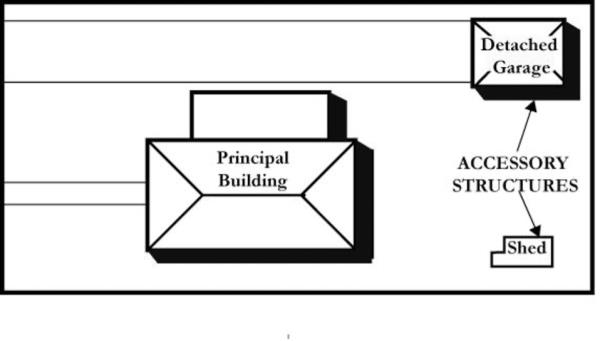
Accessory Structures And Uses: Is one which: is subordinate to and serves a principal building or principal use; and is subordinate in area, extent, or purpose to the principal building or principal use served; and contributes to the comfort, convenience, or necessity of occupants of the principal building or principal use served; and is located on the same zoning lot as the principal building or principal use served with the single exception of such accessory off-street parking facilities as are permitted to locate elsewhere than on the same zoning lot with the building or use served.
Acre: A measure of land containing 43,560 square feet.
Adult Business Uses: Any use described as an adult use in the License, Permits and Miscellaneous Business Regulations Chapter of the Aurora Municipal Code of Ordinances.
Alley: A public way, not more than thirty (30) feet wide, which affords only a secondary means of access to abutting property.
Apartment: A room or suite of rooms in a multiple-family structure, which is arranged, designed, used or intended to be used as a single housekeeping unit. Complete kitchen facilities, permanently installed, must always be included for each apartment.
Automobile Intensive Uses: A use that caters to automobile owners by offering services for automobiles or other non-automobile related services, which can be accessed without the owner leaving the automobile. These uses include but are not limited to Automotive Service Station, Automobile Laundry, Drive-Through Restaurant, and Drive-In Establishment.
Automobile Service Bay: Any area within a building in which a business or service involving the maintenance, servicing, repairing, painting, washing, or detailing, as defined herein, of vehicles is conducted or rendered.
Automobile Uses: Any uses engaged in furnishing to the general public vehicular maintenance, service, repair, painting, washing, detailing, leasing or parking, excluding automotive service stations as defined herein.
Automobile Wrecking Yard: Any place where two (2) or more motor vehicles not in running condition, or parts thereof, are stored in the open and are not being restored to operation, or any land, building or structure used for wrecking or storing of such motor vehicles or parts thereof, and including any used farm vehicles or farm machinery, or parts thereof, stored in the open and not being restored to operating condition; and including the commercial salvaging of any other goods, articles or merchandise.
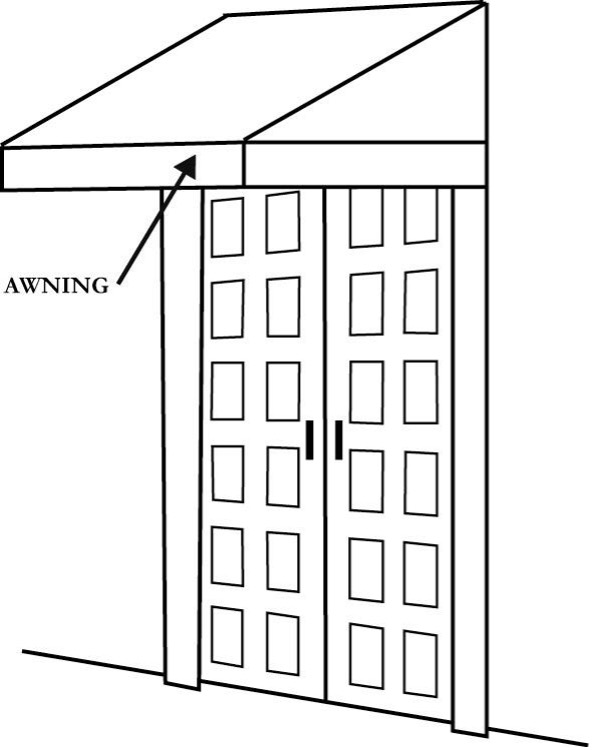
Awning: A roof like cover, temporary in nature, which projects from the wall of a building and overhangs the public way.
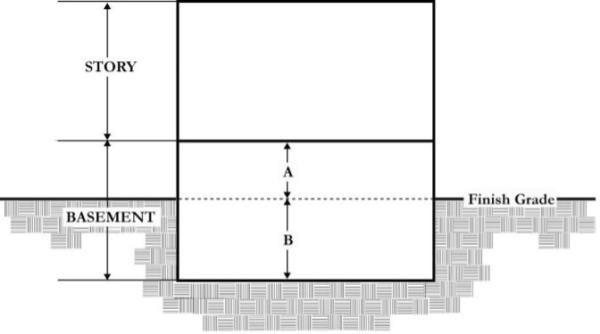
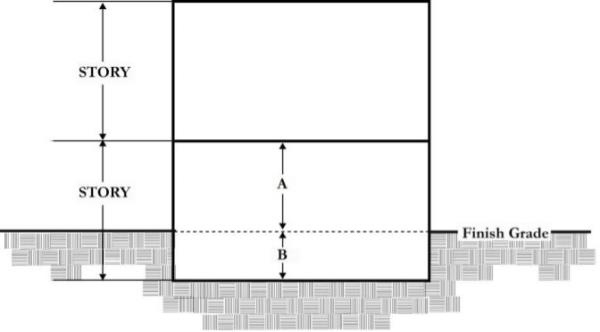
 Basement: That portion of a building which is partly or wholly below grade. A basement shall not be counted as a story for purposes of height measurement when the vertical distance from the average finish grade to the floor is greater than the vertical distance from the average finish grade to the ceiling.
If the average of "A" is less than or equal to 1/2 of "B", this is not counted as a story for height measurements.
If the average of "A" is greater than 1/2 of "B", this is counted as a story for height measurements.
Block: A tract of land bounded by streets or, in lieu of a street or streets, by public parks, cemeteries, railroad rights-of-way, bulkhead lines or shorelines of waterways or a corporate boundary line of the city.
Boardinghouse: A building other than a hotel or restaurant where meals are provided for compensation to four (4) or more persons, but not more than twelve (12), who are not members of the keeper's family.
Boat: Any vessel used for water travel. A boat mounted on a trailer shall be considered one vehicle.
Boathouse: A building designed to serve as a private or public boathouse for the storage of boats and for the servicing of boats, boat engines and equipment.
Buildable Area: The space remaining on a zoning lot after the minimum setback and open space requirements of this ordinance have been compiled with.
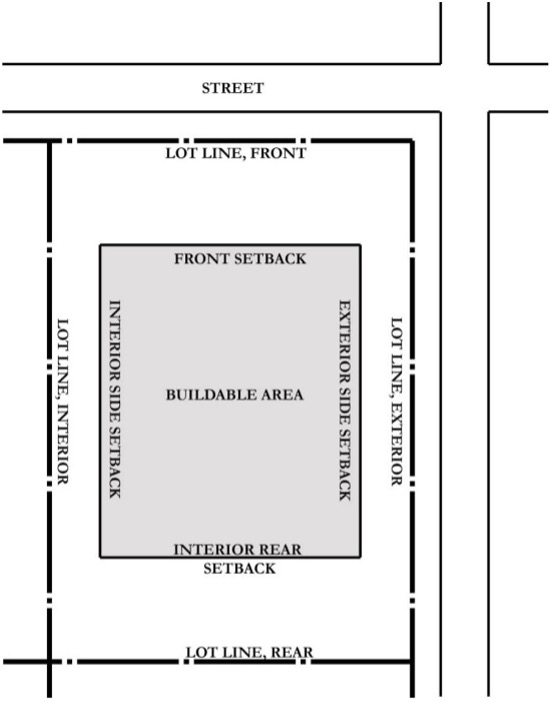
Building: Any structure with substantial walls and roof securely affixed to the land and entirely separated on all sides from any other structure by space or by walls in which there are no communicating doors, windows or openings; and which is designed or intended for the shelter, enclosure or protection of persons, animals or chattels. Any structure with interior areas not normally accessible for human use, such as gasholders, oil tanks, water tanks, grain elevators, coalbunkers, oil cracking towers and other similar structures are not considered as buildings.
Building, Completely Enclosed: A completely enclosed building is a building separated on all sides from the adjacent open space, or from other buildings or other structures, by a permanent roof and by exterior walls or party walls pierced only by windows and normal entrance or exit doors.
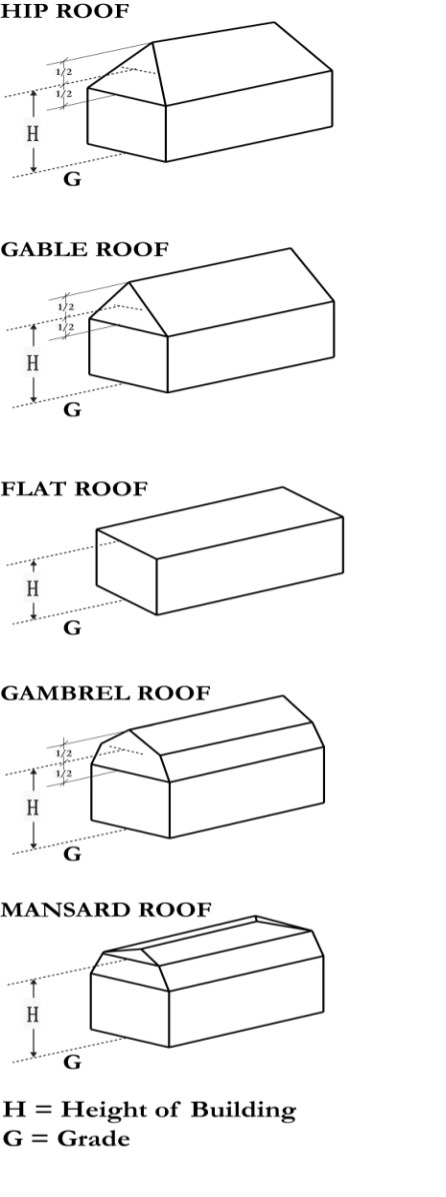
Building Height: The vertical distance measured from the sidewalk level or its equivalent established grade opposite the middle of the front of the building to the highest point of the roof in the case of a flat roof; to the deck line of a mansard roof; and to the mean height level between eaves and ridge of a gable, hip or gambrel roof; provided, that where buildings are set back from the street line, the height of the building may be measured from the average elevation of the finished lot grade at the front of the building.
Building Line: See setback line, building
Building Mounted System: An alternative energy system that is mounted on either the principal or accessory structure or both.
Building, Nonconforming: Any building which does not conform to the regulations of this ordinance prescribing the maximum floor area ratio, required yards, coverage, height and setbacks, minimum required spacing between buildings on a single lot, and minimum required usable open space for the district in which such building is located.
Building, Principal: A building in which is conducted the main use of the zoning lot on which it is situated.
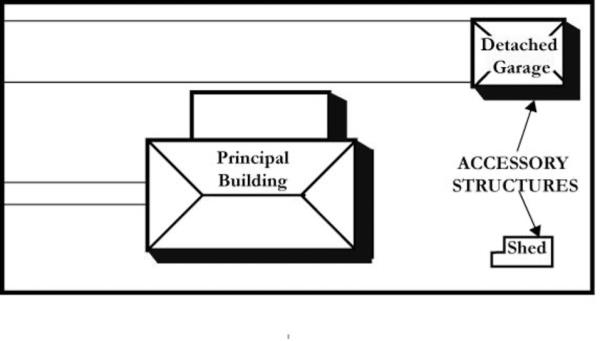
Bulk: The term used to describe the size and mutual relationships of buildings and other structures, as to size; height; coverage; shape; location of exterior walls in relation to lot lines, to the centerline of streets, to other walls of the same building, and to other buildings or structures; and to all open spaces relating to the building or structure.
Bus Lot: Any lot or land area for the storage or layover of passenger buses or motor coaches.
Business: An occupation, employment or enterprise that occupies time, attention, labor, and materials, or wherein merchandise is exhibited or sold, or where services are offered.
Business Area: A zoning lot or portion of a zoning lot designed or used for purposes other than residential.
Business Establishment: A structure, or lot, used in whole or in part as a place of business, the ownership or management of which is separate and distinct from the ownership or management of any other place of business located on the same or other lot.
Caliper: The diameter of a tree trunk. For purposes of the Aurora Zoning Ordinance, the caliper of a tree drunk is measured 12” from ground level or grade.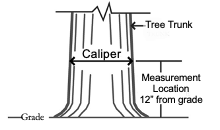
Carport: A structure intended for shelter of an automotive vehicle on residential property, which is formed by a roof projecting from the wall of the principal structure and has at least one side permanently open to the weather, and which, for the purposes of the Zoning Ordinance, is an integral part of an architectural design for an existing or proposed principal building.
Carryout Or Delivery Food Establishments: A retail food establishment whose principal business is the sale of food or beverage primarily for consumption off the premises. The establishment may deliver food to the customer or the customer may pick the food up by using a drive-up window or by entering the establishment. Limited seating (up to 8 seating spaces) may be provided for customers to use while waiting for their orders. A carry out or delivery establishment that has more than limited seating shall be deemed a dine-in food and beverage establishment for zoning purposes.
Cartage, Local: Pickup and delivery of parcels, packages and freight by motor truck within and not exceeding twenty-five (25) miles of the city.
Cash-For-Gold Store: A business establishment whose primary business activity is the purchase of gold or other precious metals. A cash for gold store as defined herein does not include the purchase of gold or other precious metals when located in a facility whose principal business activity is the retail sales of jewelry.
Category Line: The line parallel to a major street and which serves as a boundary between different residential categories on a single parcel.
Category Yard: An open space, unoccupied and unobstructed from its lowest level upward, and which extends along a category line to a depth or width specified in the yard regulations of the residential (housing) standards of the B-B district.
Cellar: A "cellar" is a story having more than one-half of its height below the curb level or below the highest level of the adjoining ground. A cellar shall not be counted as a story for the purpose of height measurements.
Clinic, Medical Or Dental: A building containing an individual practitioner or an association or group of licensed physicians; surgeons, dentists, clinical psychologists, or similar professional health care practitioners, including assistants. The clinic may include apothecary, dental and medical laboratories, and/or X-ray facilities, but shall not include in-patient care or operating rooms for major surgery.
Clinic Or Medical Center: A "medical center" or "medical clinic" is an establishment where three (3) or more licensed physicians, surgeons or dentists engage in the practice of medicine or dentistry, operating on a group or individual basis with pooled facilities, which need not, but may, include coordinated laboratory, X-ray and allied departments, and the diagnosis and treatment of humans, a drug prescription counter (not a drugstore) for the dispensing of drugs and pharmaceutical products, orthopedic or optical devices to the patients of said physicians, surgeons and dentists; but not including any exterior display or advertising sign.
Club Or Lodge, Private: A structure or part thereof used by a not-for-profit association of persons who are bona fide members paying dues and where facilities are restricted to members and their guests. Food and alcoholic beverages may be served on its premises provided they are secondary and incidental to the principal use, and further providing that adequate dining room space and kitchen facilities are available and that the sale of alcoholic beverages is in compliance with applicable federal, state, and City of Aurora laws.
Commercial Vehicle: A vehicle that does not exceed the standards of a State of Illinois licensure classification of "B," (including, but not limited to, contractor's vans, mini-school buses, pick-up trucks, and smaller stake trucks).
Committee: The standing committee of the city council authorized by chapter 34 of this code to review matters referred from the planning and zoning commission.
Commission: The planning and zoning commission of the city.
Comprehensive Plan: The comprehensive plan adopted by the city council for the city or portion thereof pursuant to law.
Conditional Use: Any use of land or buildings, or both, described and permitted herein, subject to the provisions of the Use Regulations Section and the requirements of chapter 34.
Corner Lot: See lot, corner.
Corner Lot, Reversed: See lot, reversed corner.
Coverage, Lot: See lot coverage.
Curb Level: The level of the established curb in front of the building measured at the center of such front. Where a building faces on more than one (1) street, the "curb level" shall be the average of the levels of the curbs at the center of the front of each street. Where no curb elevation has been established, the mean level of the land immediately adjacent to the building shall be considered the "curb level."
Currency Exchange: An establishment, except a bank, a post office, trust company, savings bank, savings and loan association, credit union, industrial loan and thrift company, engaged in the business of cashing checks, drafts, money orders or traveler's checks, exchanging currency or transmitting money within the United States or overseas by any means for a fee. Check cashing shall not include stand-alone services located inside buildings so long as service incorporates no signage in the windows of the building visible from public view. For purposes of zoning, a currency exchange is considered an Alternative Financial Service.
Dog Run: An enclosed outdoor area intended for the exercising and/or containment of dogs.
Downtown Core: The downtown core shall be as described in the Downtown Core Section hereof.
Downtown Fringe: The downtown fringe shall be as described in the Downtown Fringe Section hereof.
Dish Antenna: A parabolic-shaped receiver and/or transmitter for entertainment and communication transmissions.
Drive-In Establishment: A business establishment, other than a drive-in or drive-through restaurant, so developed and used that its retail or service character is dependent, in whole or in part, on providing a driveway approach for motor vehicles to serve patrons while in the motor vehicle rather than within a building or structure.
Drive-Through Restaurant: An eating establishment that provides a driveway approach for the serving of food and beverages to customers in a motor vehicle and which may also provide an indoor seating area with a minimum of two (2) tables and four (4) chairs. Accessory outdoor seating may be provided. Carryout and delivery service must be an accessory use.
Dwelling: A building or portion thereof, but not including a house trailer or mobile home, designed or used exclusively for residential occupancy, including one-family dwelling units, two-family dwelling units and multiple-family dwelling units, but not including hotels, boardinghouses or lodging houses.
Dwelling, Group: Two (2) or more one-family, two-family or multiple-family dwellings, or boardinghouses or lodging houses, located on one (1) zoning lot, but not including tourist courts or motels.
Dwelling, Multiple-Family: A building or portion thereof designed or altered for occupancy by three (3) or more families living independently of each other.
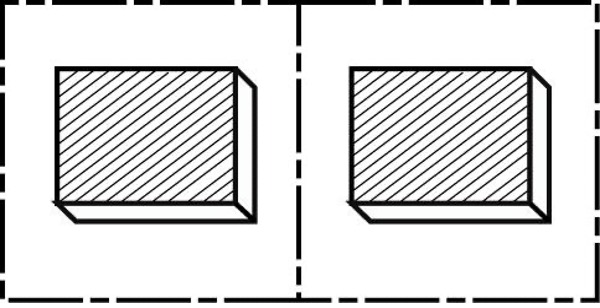
Dwelling, One-Family: A building designed exclusively for use and occupancy by one (1) family, and entirely separated from any other dwelling by space.
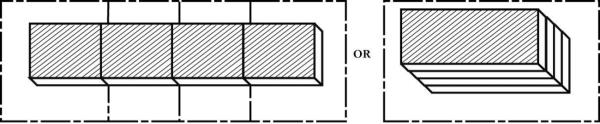
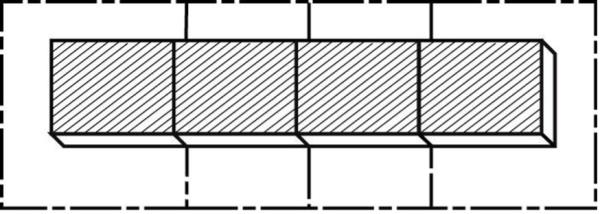
Dwelling, Row (Party Wall): A row of two (2) to six (6) attached, one-family, party wall dwellings, not more than two (2) rooms in depth measured from the building line.
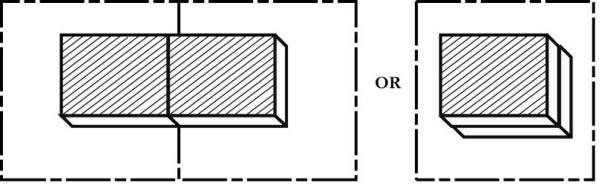
Dwelling, Two-Family: A building designed or altered to provide dwelling units for occupancy by two (2) families.
 Dwelling Unit: One (1) or more rooms in a residential structure or apartment hotel, designed for occupancy by one (1) family, for living and sleeping purposes.
Educational Institution: Public, parochial, charitable or nonprofit junior college, college or university, other than trade or business schools, including instructional and recreational uses, with or without living quarters, dining rooms, restaurants, heating plants and other incidental facilities for students, teachers and employees.
Electric Vehicle: A vehicle that can be powered by an electric motor that draws electricity from a battery and is capable of being charged from an external source.
Electric Vehicle Charging Station: Equipment that connects to an electric vehicle to a source of electricity to recharge the battery of the electric vehicle.
Electronic Data Storage Center: An establishment classified in use category 3300, principally used for the storage and operation of computer systems, associated components and related equipment for the maintaining, storing, processing and routing of data and related activities. An Electronic Data Storage Center shall be at least 150,000 square feet with no more than five percent (5%) of the square footage being office use.
Essential Commercial Vehicle: A Commercial vehicle, excluding a tow truck or a panel truck, that is used for essential emergency twenty-four (24) hour service such as electrical, mechanical and plumbing contracting, and does not exceed a State of Illinois licensure classification of "D" when the vehicle is also the owner's principal means of transportation to and from their place of employment
Estate Sale: A type of garage sale where any person, or family member who finds themselves needing to sell or liquidate inherited personal property, or those who are in a position of having to liquidate their own property.
Facade: Any side of a building that faces a public street or a main parking area on the site.
Family: One (1) or more persons related by blood, marriage, or adoption, or a group of not more than three (3) persons (excluding servants) who need not be related by blood, marriage or adoption, living together and maintaining a common household, but not including sororities, fraternities or similar organizations.
Financial Institutions: Banks, currency exchanges, credit unions, finance companies, brokerage offices, pay day loan stores, and other similar establishments.
Flea Market: A retail facility that is divided into booths, which can be individually rented or leased to multiple vendors.
Flood-Crest Elevation: The elevation equal to the flood-crest level of record designated by the city engineer or another governmental official or body having jurisdiction applicable to the property.
Floodplain Area: That continuous area adjacent to a stream, stream bed or any stormwater retention area and its tributaries, with an elevation equal to or lower than the flood crest elevation, including also land subject to the risk of overflow which is less than ten (10) acres in area and has an elevation higher than flood-crest elevation and which is surrounded by land with an elevation equal to or lower than the flood-crest elevation, and land subject to the risk of overflow which is less than five (5) acres in area, has an elevation equal to or higher than flood-crest elevation and is bordered on three (3) sides by land with an elevation equal to or lower than the flood-crest elevation.
Floodplain Fringe Area: An area lying outside of a floodplain area and is immediately adjacent to and adjoining the floodplain area but not extending more than one hundred (100) feet therefrom.
Floor Area: The sum of horizontal areas of each floor measured from the exterior faces of the exterior walls, including utility rooms, but excluding cellars, basements, open porches, breezeways, garages and other spaces that are not used frequently or during extended periods for living, eating, or sleeping purposes, except that enclosed space intended for habitable rooms which are to be completed within a reasonable time may be considered in computing such floor areas.
Freestanding System: An alternative energy system that is not attached to another structure and is mounted to the ground.
Garage, Bus: Any building used or intended to be used for the storage of three (3) or more passenger motorbuses, or motor coaches used in public transportation, including school buses.
Garage, Bus Or Truck: A building which is used or intended to be used for the storage of motor trucks, truck trailers, tractors and commercial vehicles exceeding one and one-half (1 1/2) tons in capacity.
Garage, Private: A detached accessory structure or portion of the principal building, fully enclosed, and designed, arranged, used or intended to be used for the storage of automobiles of the occupants of the premises.
Garage, Public: A building other than a private garage, used for the care, incidental servicing and sale of automobile supplies, or where motor vehicles are parked or stored for remuneration, hired or sale within the structure, but not including trucks, tractors, truck trailers and commercial vehicles extending one and one-half (1 1/2) tons in capacity.
Grade: For the purposes of Section 4.4-9, grade is the average ground level at the front property line of a zoning lot.
Green Businesses: A business which adopts principles, policies, and practices to minimize negative impacts of the business on the global or local environment, community, society, or economy. These businesses strive to improve the quality of life for their customers, their employees, communities, and the environment.
Gross Leasable Area (Gla): All area within the outside walls of a building less stairs, elevators, flues, pipe shafts, vertical ducts and balconies.
Ground Floor Area: The sum of horizontal areas of the ground floor measured from the exterior faces of the exterior walls, including utility rooms, but excluding cellars, basements, open porches, breezeways, garages and other spaces that are not used frequently or during extended periods for living, eating, or sleeping purposes, except that enclosed space intended for habitable rooms which are to be completed within a reasonable time may be considered in computing such floor areas.
Guesthouse: Living quarters within a detached accessory building located on the same premises with the principal building for use by contemporary guests of the occupants of the premises. Such quarters shall have no kitchen facilities nor be rented or otherwise used as a separate dwelling.
Health Club: The meeting place of a group of persons organized for the purpose of improving the general condition of their health through exercise.
Helicopter: Any rotary wing aircraft which depends principally for its support and motion in the air upon the lift generated by one (1) or more power-driven rotors rotating on a substantially vertical axis. All helicopters using heliports/helistops shall comply with Federal Aviation Regulation (FAR) part 336.
Heliport: Any area of land, water or structural surface which is designed, used or intended to be used for the landing and takeoff of helicopters and any pertinent areas which are designed, used or intended to be used for a helicopter building or other facilities which have received a certificate of approval from the Division of Aeronautics, State of Illinois, Department of Transportation and a conditional use permit from the city to operate said heliport.
Helistop: An aeronautic facility used for periodic on and off loading of passengers and/or cargo as carried by helicopters with little or no ground support capability.
Home Occupation: A Home Occupation is defined as any use that may be conducted entirely within a dwelling and carried on by the inhabitants and up to one employee who is not a resident thereof and clearly incidental or secondary to the use of the dwelling for dwelling purposes and does not change the character thereof.
Hospital: An institution open to the public in which patients or injured persons are given medical or surgical care; or for the care of contagious diseases or incurable patients.
Householder: The occupant of a dwelling unit who is either the owner or lessee thereof.
Impact Area: The impact area consists of all zoning lots within 250 feet of a subject zoning lot and fronting on the public street that the infill lot fronts on.
Infill Lot: A zoning lot within an existing developed urban area where no more than four (4) zoning lots within the “impact area” have had new housing built upon them within the five (5) year period preceding the application date of a building permit for a zoning lot.
Individually Accessible Parking Space: A required parking space that is designed so that access to said space shall not be obstructed by use of another required parking space.
Junkyard: Open area where waste, scrap metal, paper, rags or similar materials are bought, sold, exchanged, stored, baled, packed, disassembled or handled, including auto and building wrecking yards, but excluding similar uses taking place entirely within a completely enclosed building.
Kennel, Commercial: Any lot or premises on which two (2) or more domestic animals, at least four (4) months of age, are kept, boarded for compensation, or kept or bred for sale.
Kiosk: An area within a structure, which is not wholly enclosed within its own unit is staffed by an attendant, and maybe used as a subordinate business to the primary business. A Kiosk is typically, but not required to be, delineated by a booth(s), counter(s) or table(s).
Laboratory, Commercial: Laboratory is a building, structure, or portion thereof which is devoted to experimental study such as testing and analyzing but not including the manufacturing, assembly, or packaging of products for sale either directly or indirectly.
Laboratory, Research: A building or group of buildings in which are located facilities for scientific research, investigation, testing and experimentation, but not primarily facilities for the manufacture or sale of products, except as incidental to the main purpose of the laboratory.
Land Use Division Line: The line, parallel to a major street and which serves as a boundary between commercial and residential developments on a single parcel.
Large Scale Development: A development or redevelopment project having gross leasable area of thirty thousand (30,000) square feet or greater, which is developed as a unit under unified or coordinated control of its planning and development.
Limited-Access Highway: A public highway or street, including a toll highway, designed for through traffic and to, from or over which owner of, or persons having interest in, abutting property or other persons having no right or easement, or only limited right or easement, of access, crossing, light, air or view by reason of the fact that said property abuts upon such highway or street, or for any other reason.
Line Of A Building (For Measuring Yards): A line parallel to the nearest lot line drawn through the point of a building or group of buildings nearest to such lot line, exclusive of such features specified as being permitted to extend into a yard.
Livestock: Animals, including but not limited to cattle, pigs, and poultry, raised for food or other products.
Loading And Unloading Space, Off-Street: An open hard-surfaced area of land other than a street or a public way, the principal use of which is for the standing, loading and unloading of motor trucks, tractors and trailers, to avoid undue interference with the public use of streets and alleys. Such space shall be not less than ten (10) feet in width, forty-five (45) feet in length and fourteen (14) feet in height, exclusive of access aisles and maneuvering space.
Lodging House Or Rooming House: A building with not more than five (5) guestrooms where lodging is provided for compensation pursuant to previous arrangement, but not open to the public or to overnight guests.
Lodging Room: A room rented as sleeping and living quarters, but without cooking facilities and with or without an individual bathroom. In a suite of rooms without cooking facilities, each room that provides sleeping accommodations shall be counted as one (1) lodging room for the purposes of this ordinance.
Lot: The word "lot" when used alone shall mean a "zoning lot" unless the context of this ordinance clearly indicates otherwise.
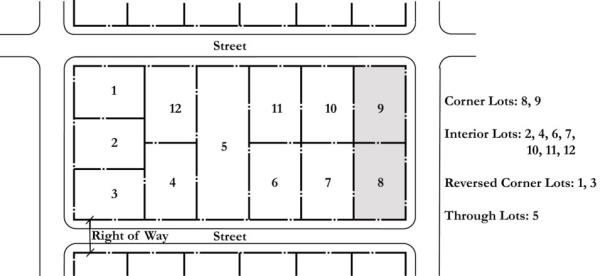
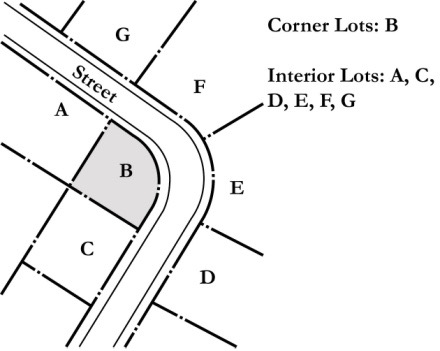
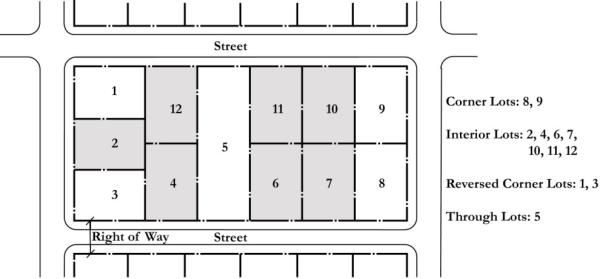
Lot, Corner: A parcel of land situated at the intersection of two (2) or more public and/or private streets or adjoining a curved street at the end of a block.
Lot Coverage: The maximum area of a zoning lot, expressed as a percentage of a lot’s total area, which can be covered. This includes, but is not limited to the principal building or buildings, accessory structures, hardscape (driveways, sidewalks, pavement or any area of concrete asphalt, permeable pavement, gravel) and in-ground pools. Free-standing hot tubs, vehicles, above-ground pools, and decks do not count toward lot coverage calculations.
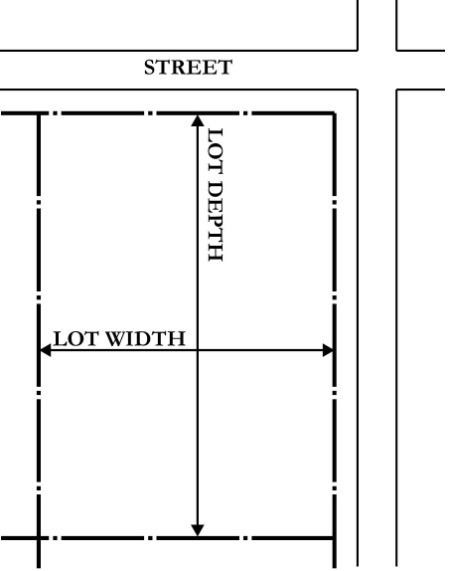
Lot Depth: The horizontal distance between the front and rear lot lines measured in the mean direction of the side lot lines.
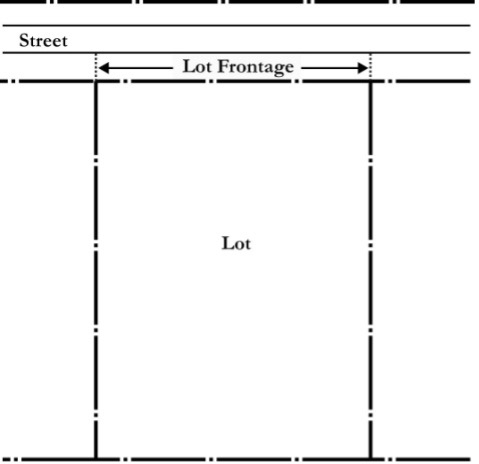
Lot, Frontage: The front of a lot shall be that boundary of a lot along a public street; for a corner lot, the owner may elect either street line as the front lot line.
Lot, Interior: A lot other than a corner, reversed corner, or through lot.
Lot Line, Exterior: A side lot line of a corner lot, said line being common with a public street property line. This definition includes front lot lines, exterior rear lot lines and exterior side lot lines.
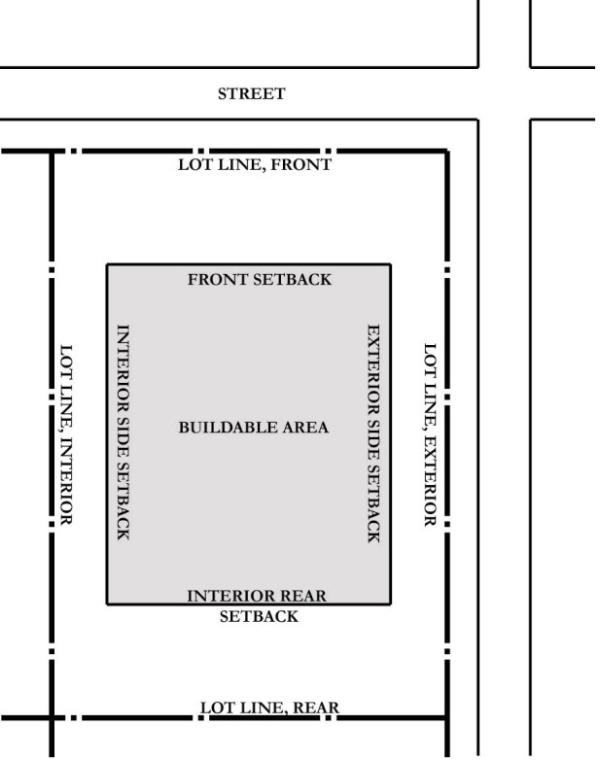
Lot Line, Exterior Rear: A rear lot line on a zoning lot that abuts a right-of-way.
Lot Line, Exterior Side: A side lot line on a zoning lot that abuts a right-of-way.
Lot Line, Front: The front property line of a zoning lot. (see figure in definition of lot line, exterior)
Lot Line, Interior: A side lot line common with another lot and which does not abut a right-of-way. This definition includes interior side lot lines and interior rear lot lines. (see figure in definition of lot line, exterior)
Lot Line, Interior Rear: A rear lot line that does not abut a right-of-way.
Lot Line, Interior Side: A side lot line that does not abut right-of-way.
Lot Line, Rear: The "rear lot line" is the lot line or lot lines most parallel to and most remote from the front lot line. Lot lines other than front or rear lot lines are side lot lines. (see figure in definition of lot line, exterior)
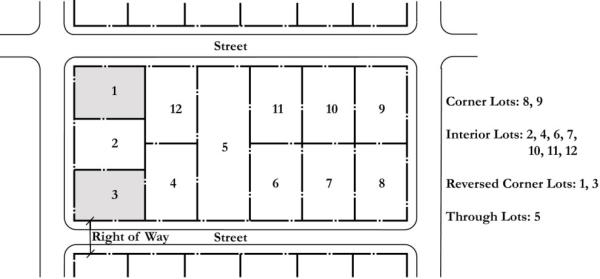
Lot, Reversed Corner: A corner lot, the rear of which abuts upon the side of another lot, whether across an alley or not.
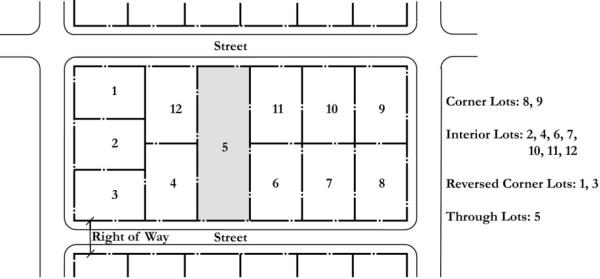
Lot, Through (Also referred To As A Double Frontage Lot): A lot having frontage on two (2) parallel or approximately parallel streets, and which is not a corner lot.
Lot, Width: The horizontal distance between the side lot lines measured at right angles to the lot depth at the established front building line.
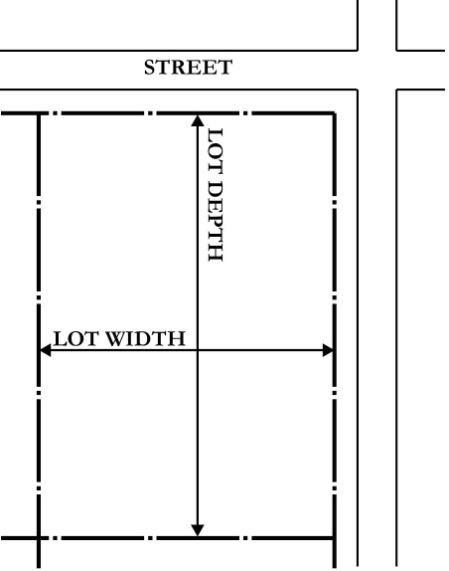
Lot, Zoning: See zoning lot.
Manufacture: The making of anything by any agency or process.
Manufacturing Establishment: A lot and structure, the principal use of which is manufacturing, fabricating, processing, assembling, repairing, storing, cleaning, servicing, or testing of materials, goods or products.
Marquee Or Canopy: A roof like structure of a permanent nature, which projects from the wall of a building and overhangs the public way.
Motor Freight Terminal, Private: A building in which freight, brought to said building by motor truck, is assembled and sorted for routing in intrastate and interstate shipment by motor truck.
Motor Truck Repair Shop: A premise where motor trucks, tractors, truck trailers and industrial and commercial vehicles in excess of one and one-half (1 1/2) tons in capacity, or their bodies, are overhauled, rebuilt or repaired.
Nightclub: A place of entertainment open at night, for eating, drinking, dancing, etc., and usually having a floorshow.
Nonconforming Use: Any building, structure or land lawfully occupied by a use or lawfully established at the time of the adoption of this ordinance or amendments hereto, which does not conform after the adoption of this ordinance or amendment hereto with the use regulations of this ordinance.
Noxious Matter: Noxious matter is material that is capable of causing injury to living organisms by chemical reaction or is capable of causing detrimental effects upon the psychological, social or economic well being of individuals.
Nursery, Day: An institution providing care for three (3) or more children under the age of four (4) years for periods of more than four (4) hours, but not exceeding twenty-four (24) hours.
Nursery School: An institution providing day care service for children from four (4) to six (6) years of age.
Nursing Home Or Rest Home: A private home for the care of children or the aged or infirm, or a place of rest for those suffering bodily disorders, but not including facilities for the treatment of sickness or injuries or for surgical care, and which is licensed by the state and city if required by ordinance.
Octave Band: An "octave band" is a means of dividing the range of sound frequencies into octaves in order to classify sound according to pitch.
Operating Hours: Those hours that a business is functioning, open, and accessible to the general public for the purposes of conducting business.
Panel Truck Or Step Van: A motor vehicle designed, used or maintained primarily for transportation of property which does not exceed the standards of a State of Illinois licensure classification of "B" and which is at least eight and one-half (8 1/2) feet in height and eighteen (18) feet in length.
Parcel Delivery Station: A building in which commodities, sold at retail within the area and packaged by the retailer, are assembled and routed for delivery to retail customers located within the area.
Park, Community: An active or passive recreational facility for all age groups within driving distance of its location (typically a thirty-minute driving time), which has an emphasis on family and group programmed activities available on a year-around basis.
Park, Communitywide Special: An active or passive recreational facility for all age groups, which has an emphasis on one or more singular purpose activities outside the normal park setting.
Park, Conservation/Protection: A passive recreational facility for all age groups, which has an emphasis on preserving environmentally sensitive areas and natural resource features.
Park, Linear: A recreational facility for all age groups, which has an emphasis on providing non-motorized recreational trail opportunity and regional linkages with other the open space system.
Park, Neighborhood: A passive recreational facility with limited active capability for all age groups within walking distance of its location (typically one-half-mile radius), which has an emphasis on informal play activities rather than intensely scheduled activities
Parking Area, Private: An open, hard-surfaced area of land, other than a street or public way, designed, arranged and made available for the storage of private passenger automobiles only, of occupants of the building or buildings for which the parking area is developed and is accessory. All parking spaces must be individually accessible, and meet the requirements set forth in the Off-Street Parking and Loading/Design and Maintenance/Size section of this ordinance; if not the parking area shall be considered a Vehicle Storage Yard.
Parking Area, Public: An open, hard-surfaced area, other than a street or public way, intended to be used for the storage of passenger automobiles and commercial vehicles under one-and-one-half-ton capacity, and available to the public, whether for compensation, free or as an accommodation to clients or customers. All parking spaces must be individually accessible, and meet the requirements set forth in the Off-Street Parking and Loading/Design and Maintenance/Size section of this ordinance; if not the parking area shall be considered a Vehicle Storage Yard.
Parking Space, Automobile: Space within a public or private parking area of not less than one hundred and seventy (170) square feet (eight and one-half (8 1/2) feet by twenty (20) feet), exclusive of access drives or aisles, ramps, columns or office and work areas, for the storage of one (1) passenger automobile or commercial vehicle under a one-and-one-half-ton capacity.
Parsonage: The dwelling provided by a religious institution for the use of its minister or priest, in which no regular worship assemblies are held.
Particulate Matter: Particulate matter is material that is suspended in or discharged into the atmosphere in finely divided form as a liquid or solid at atmospheric pressure and temperature.
Passenger Vehicle: A motor vehicle which is self-propelled and designed for not more than twelve (12) persons.
Payday Loan Store: A business establishment that provides loans to individuals in exchange for one or more of the following forms of collateral, which are held for an agreed upon period of time prior to presentment for payment or deposit: personal checks, authorization to debit consumers' bank accounts, or interest in consumers' wages, including, but not limited to, wage assignments. For purposes of zoning a payday loan store is considered an Alternative Financial Service.
Performance Standards: Performance standards are criteria established to control noise, odor, glare and heat, exterior lighting, vibration, smoke, toxic or noxious matter, gases, particulate matter, fire and explosion hazards, wastes, and radiation hazards generated by or inherent in uses of buildings, structures, or land. Some of the terms most used in performance standards include but are not limited to the following:
- Frequency signifies the number of oscillations per second in a sound wave and an index of the pitch of the resulting sound.
- Noise pollution. The emission of sound that unreasonably interferes with the enjoyment of life or with any lawful business or activity.
- Noxious matter. Is a material that is capable of causing injury to living organisms by chemical reaction or is capable of causing detrimental effects upon the psychological, social or economic well being of individuals.
- Octave band. A means of dividing the range of sound frequencies into octaves in order to classify sound according to pitch. Odor. The minimum concentration of odorous matter in the air that can be detected as an odor.
- Odorous matter. Material that is gas, liquid or solid that causes an odor sensation to a human being.
- Odor threshold. The minimum concentration of odorous matter in the air that can be detected as an odor. Odor thresholds for many materials and compounds can be found in Table III, Chapter 5, of Air Pollution Abatement Manual, copyright 1951 by the Manufacturing Chemists Association, Inc., Washington, D.C.
- Opacity means the quality of state of an object that renders it impervious to the rays of light; the degree of nontransparency.
- Particulate matter. The material, other than water, which is suspended in or discharged into the atmosphere in finely divided form as a liquid or solid such as dust, at atmospheric pressure and temperature.
- Radiation hazards. The deleterious and harmful effects of all ionizing radiation, which shall include all radiation capable of producing ions in its passage through other matter. Such radiations shall include, but not limited to, electromagnetic radiations such as X-rays and gamma rays and particulate radiations such as electrons or beta particles, protons, neutrons, and alpha particles. Ringelmann Chart. The chart published and described in the Bureau of Mines, U.S. Department of the Interior, Information Circular 8333 (Revision of IC 7718), May 1, 1967, or any adaptation thereof. The chart illustrates graduated shades of gray for use in estimating the light-obscuring capacity of smoke and smoke density.
- Ringelmann Number. The number of the area on the Ringelmann Chart that coincides most nearly with the visual density of emission or the light-obscuring capacity of smoke.
- Sound level. The intensity of sound of an operation or use as measured in decibels.
- Sound level meter. An instrument standardized by the American Standards Association for the measurement of the intensity of sound.
- Smoke. Small gas-borne particles resulting from incomplete combustion, consisting predominantly but not exclusively of carbon, ash and other combustible material, which form a visible plume in the air.
- Smoke units. "Smoke units" represent the number obtained by multiplying the smoke density in Ringelmann Numbers by the time of emission in minutes. For the purpose of this calculation, a Ringelmann density reading is made at least once every minute during the period of observation. Each reading is then multiplied by the time in minutes during which it is observed, and the various products are added together to give the total number of smoke units observed during the total period under observation.
- Toxic material or matter. A substance (liquid, solid, or gaseous) that by reason of an inherent deleterious property tends to destroy life or impair health.
- Toxic substances. Any gas, liquid, solid, semisolid substance or mixture of substance, which if discharged into the environment could, along or in combination with other substances likely to be present in the environment, cause or threaten to cause bodily injury, illness, or death to members of the general public through ingestion, inhalation, or absorption through any body surface. In addition, substances that are corrosives, irritants, strong sensitizers, or radioactive substances shall be considered toxic substances for the purposes of this ordinance.
- Vibration. The motion that repeatedly reverses itself. A continuously reversing motion, such as is produced by a machine (for example, a compressor or a fan) is known as steady-state vibration. Vibration may also result from suddenly applied force, which produces a reversing motion of decreasing intensity. Such vibrations are known as impact vibrations, and are produced by forge hammers, punch presses, and other impact machinery.
Person(S) With Disabilities: For the purposes of this ordinance, persons with disabilities shall refer to those persons covered under the Americans with Disabilities Act.
Pilot Plant: A building or structure used for the testing of commercial or industrial processes and products and for the manufacturing of products for testing purposes.
Planned Development: A "planned development" is a tract of land which includes two (2) or more principal buildings and one (1) or more principal uses and which is developed as a unit under single ownership or under single, unified or coordinated control of its planning and development.
Police Incident: A documented service call chronicled by the City's Police Department Records Division, which call occurs with regard to a given property, concerning quality of life issues for the residents of said property and the surrounding neighborhood, and involving crimes against people, crimes against property, drug/alcohol violations, and related matters.
Poolrooms: As defined Chapter 8 AMUSEMENTS of the Aurora Code of Ordinances.
Porch: A roofed-over structure, projecting out from the wall or walls of a main structure and commonly open to the weather in part.
Property Maintenance Ordinance: Article IV of Chapter 12, et. seq. of the Code of Ordinances, City of Aurora, Illinois
Property User: The owner, lessee, licensee or other party occupying each lot or similarly defined property for the purpose of operating a business.
Public Street Elevation: See Street Elevation, Public
Public Utility: Any person, firm, corporation or municipal department, duly authorized to furnish under public regulation to the public, electricity, gas, steam, telephone, telegraph, transportation or water.
Railroad Right-Of-Way: A strip of land with tracks and auxiliary facilities for track operations, but not including depots, loading platforms, stations, train sheds, warehouses, car shops, car yards, locomotive shops or water towers.
Recreational Vehicle: A vehicle originally designed or modified for living quarters, human habitation, or recreation and not used as a commercial vehicle, including, but not limited to, the following:
- Camper Trailer. A folding or collapsible vehicle without its own motive power, designed as temporary living quarters for travel, camping, recreation, or vacation use.
- Motorized Home. A vehicular unit on a self-propelled motor vehicle chassis, primarily designed as temporary living quarters for travel, camping, recreation, or vacation use.
- Off-the-road-vehicle. A vehicle intended primarily for recreational use off of roads where state vehicle licenses are required, such as a dune buggy, go-cart or snowmobile.
- Racing car or cycle. A vehicle intended to be used in racing competition, such as a race car, stock car, or racing cycle.
- Travel Trailer. A vehicle without its own motive power, designed to be used as a temporary dwelling for travel, camping, recreational or vacation use.
- Truck Camper. A structure designed primarily to be mounted on a pick-up or truck chassis and designed to be used as a temporary dwelling for travel, camping, recreational or vacation use. When mounted on a truck, such a structure and the truck shall together be considered one vehicle.
Residential Area: A zoning lot or portion of a zoning lot designed or used exclusively for residential purposes.
Restaurant: An establishment where food and beverages can be purchased and eaten on the premises. Must provide an indoor seating area with a minimum of two (2) tables and four (4) chairs. Accessory outdoor seating may be provided. Carryout and delivery service may only be an accessory use. Establishments with drive-in or drive-through services are not permitted.
Restaurant, Hotel: An establishment where food and beverages can be purchased and eaten on the premises. Must provide an indoor seating area with a minimum of seventy five (75) seats, room service, and must have outside signage. Accessory outdoor seating may be provided.
Ringelmann Number: The "Ringelmann Number" is the number of the area on the Ringelmann Chart that coincides most nearly with the visual density of emission.
Roof Line: The part of the roof or parapet that covers the major area of the building.
Roof Types: The following roof types are illustrative examples of roofs types referenced to in the zoning ordinance. 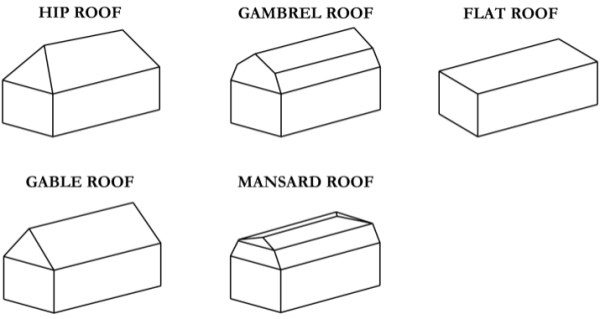 Semi-Trucks: A truck that consist of a tractor and a trailer.
Setback: The minimum distance by which any building or structure must be separated from any existing or proposed lot lines.
Setback Line: A line designating the minimum distance a building or structure must be setback from any existing or proposed lot line.
Setback Line, Building: The line nearest the front of and across a lot establishing the minimum open space to be provided between the front line of a building or structure and the street right-of-way line.
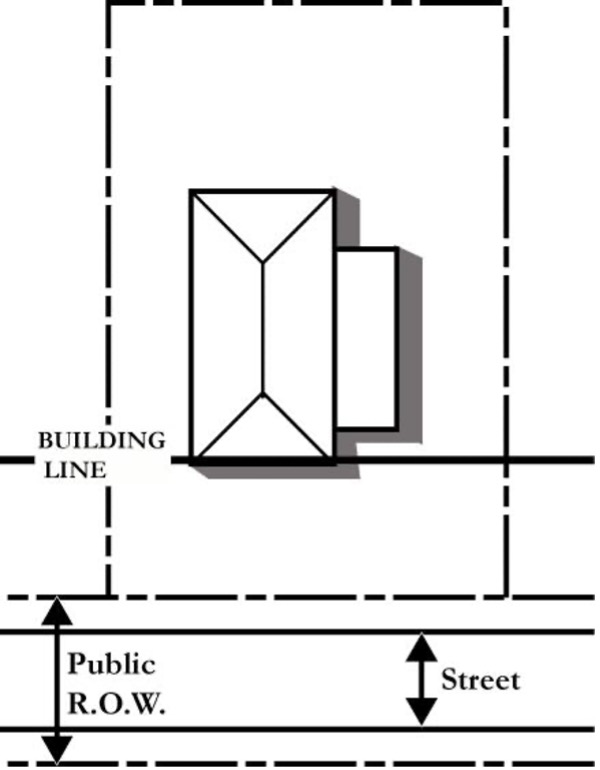
Setback Line, Exterior: A line parallel to and at a distance from the exterior lot line that establishes the minimum distance between the exterior lot line and a structure on a lot.
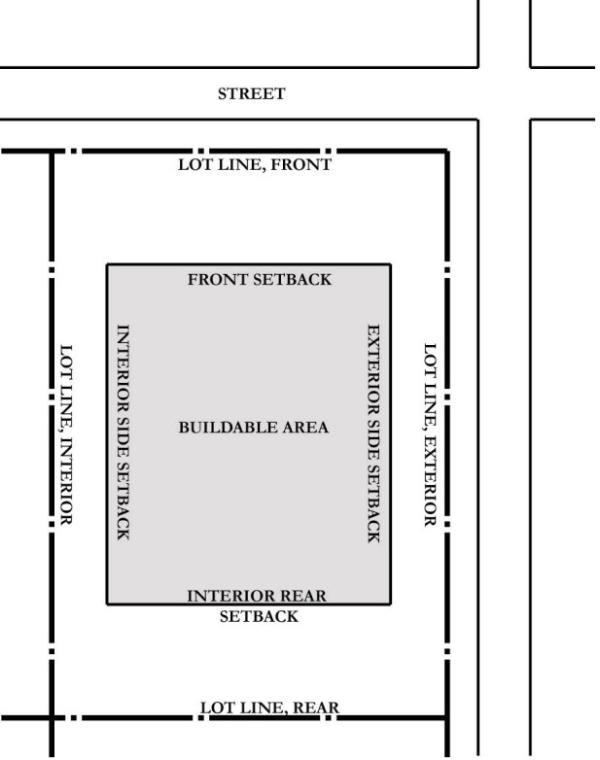
Setback Line, Interior: A line parallel to and at a distance from the interior lot line that establishes the minimum distance between the interior lot line and a structure on a lot (see figure in definition of setback line, exterior).
Setback Line, Front: A line parallel to and at a distance from the front lot line that establishes the minimum distance between said lot line and a structure on a lot (see figure in definition of setback line, exterior).
Setback Line, Exterior Front: A line parallel to and at a distance from the front lot line that establishes the minimum distance between said lot line and a structure on a lot (see figure in definition of setback line, exterior).
Setback Line, Exterior Rear: A line parallel to and at a distance from the exterior rear lot line that establishes the minimum distance between said lot line and a structure on a lot (see figure in definition of setback line, exterior).
Setback Line, Exterior Side: A line parallel to and at a distance from the exterior rear lot line that establishes the minimum distance between said lot line and a structure on a lot (see figure in definition of setback line, exterior).
Setback Line, Interior Rear: A line parallel to and at a distance from the interior rear lot line that establishes the minimum distance between said lot line and a structure on a lot (see figure in definition of setback line, exterior).
Setback Line, Interior Side: A line parallel to and at a distance from an interior side lot line that establishes the minimum distance between said lot line and a structure on a lot. (see figure in definition of setback line, exterior).
Sign: A "sign" is a name, identification, description, display or illustration which is affixed to, or painted, or represented directly or indirectly upon a building, structure or piece of land, and which directs attention to an object, product, place, activity, person, institution, organization or business; however, a sign shall not include any display of official court or public office notices nor shall it include the flag, emblem or insignia of a nation, political unit, school or religious group. It shall not include a sign located completely within an enclosed building unless the context shall so indicate. Each display of a sign shall be considered to be a sign.
Sign, Advertising: An "advertising sign" is a sign that directs attention to a business, commodity, service or entertainment conducted, solid or offered elsewhere than upon the premises where such sign is located, or to which it is affixed.
Signs, Business: A "business sign" is a sign that directs attention to a business or profession conducted or to a commodity, service or entertainment sold or offered upon the premises where such sign is located, or to which it is affixed.
Sign, Flashing: A "flashing sign" is any illuminated sign on which the artificial light is not maintained stationary and/or constant in intensity and color at all times when such sign is in use. For the purpose of this ordinance, any revolving, illuminated sign shall be considered a flashing sign.
Sign, Gross Surface Area Of: The gross surface area of a sign shall be the entire area within a single continuous perimeter enclosing the extreme limits of such sign and in no case, passing through or between any adjacent elements of same; however, such perimeter shall not include any structural or framing elements lying outside the limits of such sign and not forming an integral part of the display.
Sign Ordinance: Chapter 41 of the Code of Ordinances, City of Aurora, Illinois.
Shed: A detached accessory structure, fully enclosed, which serves as a place of storage or shelter of household items incidental to the principal use of the main building or premises.
Slaughterhouse: An establishment where livestock are killed/slaughtered on premises. This use shall be considered as a heavy industrial use for the purpose of this ordinance.
Smoke Units: Smoke units represent the number obtained by multiplying the smoke density in Ringelmann Numbers by the time of emission in minutes. For the purpose of this calculation, a Ringelmann density reading is made at least once every minute during the period of observation; each reading is then multiplied by the time in minutes during which it is observed, and the various products are added together to give the total number of smoke units observed during the total period under observation.
Solar Energy System: A system that converts solar energy into electricity or heat through the use of photovoltaic panels or film, solar thermal panels, and associated control or conversion electronics.
Special Use: See Conditional Use.
Stable, Livery: Any building, other than a private stable, designed, arranged, used or intended to be used for the storage of horses and horse-drawn vehicles, or both.
Stockyard: An enclosed or open area, in which livestock, are housed. This use shall be considered heavy industrial use for the purpose of this ordinance.
Story: That portion of a building included between the surface of any floor and the surface of the floor next above it, or if there be no floor above it, then the space between the floor and the ceiling next above it. Any portion of a story exceeding fourteen (14) feet in height shall be considered as an additional story for each fourteen (14) feet or fraction thereof.
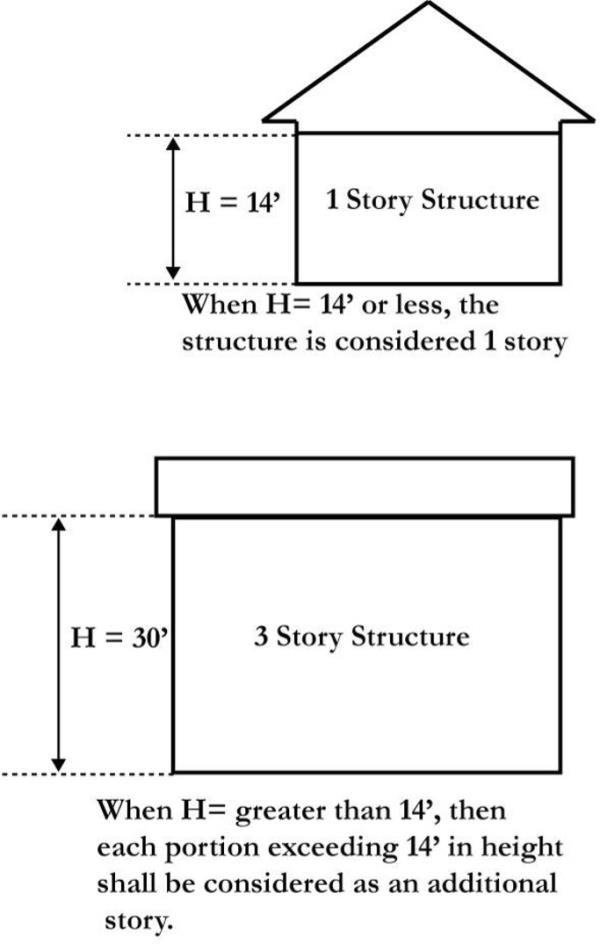
Story, Half: A half story is that portion of a building under a gable, hip or mansard roof, the wall plates of which, on at least two (2) opposite exterior walls, are not more than four and one-half (4 1/2) feet above the finished floor of such story. In the case of one-family dwellings, two-family dwellings, and multiple-family dwellings less than three (3) stories in height, a half story in a sloping roof shall not be counted as a story for the purpose of this ordinance. In the case of multiple-family dwellings, three (3) or more stories in height, a half story shall be counted as a story.
Street: A public way other than an alley, including the following types: arterial, major collector, minor collector, local, and limited-access highway.
Street, Arterial: A major or minor street of greater continuity intended to serve as a large volume traffic way within the City of Aurora and region beyond, and so designated on the Aurora Comprehensive Plan, Land Use and Circulation. Access to abutting property is subject to control of entrance, exits, and curb use. Parking may be restricted.
Street Elevation, Public: The portion of a structures architectural elevation facing a publicly dedicated street.
Street, Major Collector: A street distributing vehicular traffic between minor collectors and arterial streets, and so designated on the Aurora Comprehensive Plan, Land Use and Circulation. A major collector street will have moderate continuity and may serve intercommunity travel.
Street, Minor Collector: A street that collects and distributes local subdivision traffic to major collectors and arterial streets, and so designated in the Aurora Comprehensive Plan, Land Use and Circulation. Although these streets have a land access function, direct residential driveway access to these streets shall be minimized.
Street, Local: A street that its primary function is a land access to abutting land and which serves local traffic carrying it to collector streets.
Street, Limited-Access Highway: A traffic way including expressways and tollroads for through traffic, in respect to which owners or occupants of abutting property or land and other persons have no legal right of access to or from the same, except at such points only and in a manner as may be determined by the public authority having jurisdiction over such traffic way. A limited-access highway provides for expeditious movement of large volumes of traffic and is not intended to give land-access service.
Street Line: A line separating an abutting lot, piece or parcel from a street.
Street, Private: An undedicated street privately owned and maintained, or an easement of access benefiting a dominant tenant.
Street, Roadway: Roadway is the paved area intended for vehicular traffic, including curb and gutter, if any.
Structural Alterations: Any change other than incidental repairs which would prolong the life of the supporting members of a building or structure, such as bearing walls, columns, beams or girders.
Structure: Anything constructed or erected which requires location on the ground or is attached to something having location on the ground.
Tavern: A building where liquors are sold to be consumed on the premises.
Tearoom: A restaurant, which is located in conjunction with and on the same premises as a retail use.
Terrace, Open: An unroofed, paved area, or a raised flat mound of earth with sloping sides not more than four (4) feet in height above the average level of the adjoining ground and immediately adjacent to a house or structure.
Title Loan Store: A business establishment that provides loans to individuals in exchange for receiving titles to the borrower's motor vehicles as collateral. For purposes of zoning a title loan store is considered an Alternative Financial Service.
Tollway: Any route so designated by the Illinois Tollway Authority, including all land within the right-of-way.
Tourist Courts, Motor Lodges, Motels: An establishment consisting of a group of attached or detached living or sleeping accommodations with bathroom and closet space, located on a single zoning lot and designed for the use by transient automobile tourists. A motel furnishes customary hotel services such as maid service and laundering of linen, telephone and secretarial or desk service and the use and upkeep of furniture. In a motel less than twenty (20) percent of the living and sleeping accommodations are occupied or designed for occupancy by persons other than transient automobile tourists.
Tourist Home: A dwelling in which accommodations are provided or offered for transient guests.
Trailer: A vehicle without its own motive power that is designed to transport belongings or another vehicle, such as a boat, motorcycle or snowmobile for recreational or vacation use and that is eligible to be licensed or registered and insured for highway use. A vehicle trailer with another vehicle mounted on it shall be considered one vehicle.
Trailer Camp, House: Any premises occupied or designed to accommodate more than one (1) family living in an automobile house trailer or mobile home.
Trailer, House Or Mobile Home: A vehicle without motive power, designed to be drawn by a motor vehicle and to be used for human habitation or for carrying persons and property, including a trailer coach or house trailer.
Transitional Use: The use of a building or lot for permitted purposes in an area adjoining, adjacent or opposite to, but separated by a street or alley from an area of a lower classification.
Truck Parking Area Or Yard: Any land used or intended to be used for the storage or parking of trucks, tractors, truck trailers, and including commercial vehicles, while not loading or unloading, and which exceed one and one-half (1 1/2) tons' capacity.
Use: The purpose for which land or a building thereon is designed, arranged or intended, or for which it is occupied or maintained, let or leased.
Used Car And Boat Lot: A zoning lot on which used cars, trailer or trucks, or boats are displayed for sale or trade.
Wind Energy System: A system that converts wind energy into electricity through the use of wind turbines, a tower or post, mounting hardware, and associated control or conversion electronics.
Wholesale Establishment: Any building wherein the primary occupation is the sale of merchandise in gross for resale, and any such building wherein the primary occupation is the sale of merchandise to institutional, commercial and industrial consumers.
Yard: An open space on the same zoning lot with a principal building or group of buildings, which is unoccupied and unobstructed from any portion of the building from the ground upward, except as otherwise permitted in this ordinance, and which extends along a lot line and at right angles thereto to a depth or width extending to the specified line or lines of the principal building.
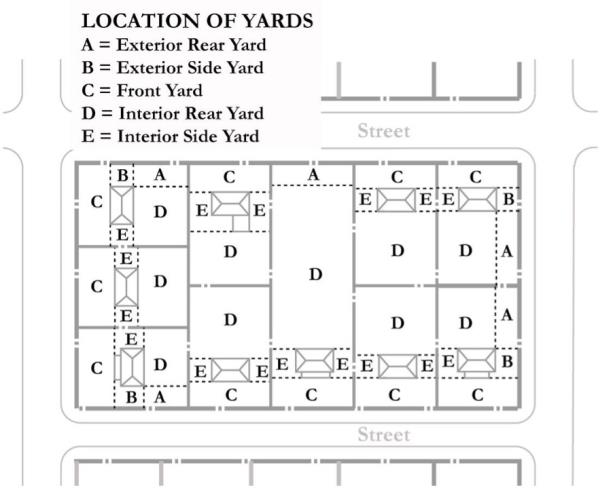
Yard, Corner: See yard, exterior side.
Yard, Exterior: A front, exterior side or exterior rear yard. (see figure in definition of yard)
Yard, Exterior Rear: Portions of a rear yard that are adjacent to a public street right-of-way. (see figure in definition of yard)
Yard, Exterior Side: The area lying between the exterior lot line and the nearest line or lines of the principal building, and extending from the front yard (or from the front lot line, if there is no front yard) to the rear yard. (see figure in definition of yard)
Yard, Front: A yard extending across the full width of the zoning lot and lying between the front line of the lot and the line or lines of the principal building. (see figure in definition of yard)
Yard, Interior: An interior side or interior rear yard. (see figure in definition of yard)
Yard, Interior Rear: A rear yard abutting any use except a public street right-of-way. (see figure in definition of yard)
Yard, Interior Side: The area lying between the interior lot line and the line or lines of the principal building, and extending from the front yard (or from the front lot line, if there is no front yard) to the rear yard. (see figure in definition of yard)
Yard, Rear: A yard extending across the full width of the zoning lot and lying between the rear line of the lot and the line or lines of the principal building.
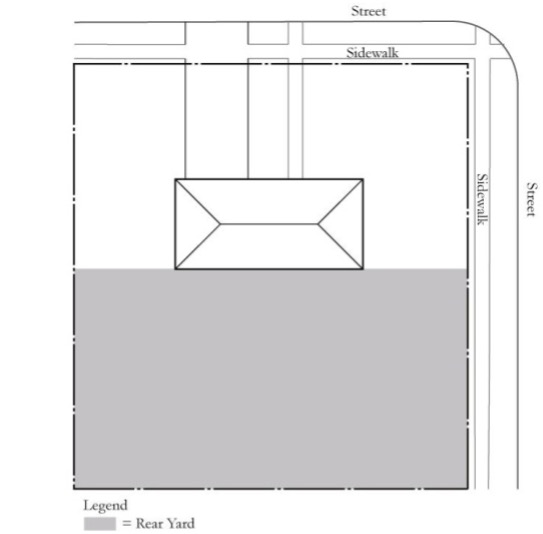
Yard, River: The area lying between the setback line and the Fox River retaining wall, if such exists, or the mean watermark, as determined by the city engineer. The setback shall be measured horizontally. The purpose of such yard shall be to beautify the riverbank, to provide for pedestrian enjoyment, circulation and access among various businesses and activities. Within such yards pedestrian walkways, bicycle paths, pedestrian plazas and landscaping are permitted. Buildings, storage of materials or equipment, or vehicular parking, accessways or maneuvering areas shall not be permitted in the river yard.
Yard, Side: That part of the yard lying between the line or lines of the principal building and a side lot line, and extending from the front yard (or from the front lot line, if there is no front yard) to the rear yard. (see figure in definition of yard)
Zoning Administrator: The zoning administrator of the city.
Zoning Lot: A plot of ground, made up of one (1) or more parcels that is or may be occupied by a use, building or buildings including the open spaces required by this ordinance.
Zoning Maps: The map or maps incorporated into this ordinance as a part hereof.
Amended by Ord. O22-107 on 12/20/2022
Amended by Ord. O23-087 on 12/5/2023
49-104.1 Use Districts
ESTABLISHMENT OF ZONE DISTRICTS
In order to carry out the purposes and provisions of this ordinance, the city council hereby divides the city into the following use districts:
| ABBREVIATION | DISTRICT NAME |
| OPEN SPACE, PARK, RECREATION DISTRICT | |
| OS-1 | Conservation, Open Space, and Drainage District |
| OS-2 | Open Space and Recreation District |
| P | Park and Recreation District |
| RESIDENTIAL DISTRICTS | |
| E | One-Family Dwelling District |
| R-1 | One-Family Dwelling District |
| R-2 | One-Family Dwelling District |
| R-3 | One-Family Dwelling District |
| R-4 | Two-Family Dwelling District |
| R-4A | Two-Family Dwelling District |
| R-5 | Multiple-Family Dwelling District |
| R-5A | Midrise Multiple-Family Dwelling District |
| BUSINESS DISTRICTS | |
| B-1 | Business District Local Retail |
| B-2 | Business District General Retail |
| B-3 | Services and Wholesale District |
| B-B | Business-Boulevard District |
| MANUFACTURING DISTRICTS | |
| M-1 | Manufacturing District Limited |
| M-2 | Manufacturing District General |
| OTHER DISTRICTS | |
| ORI | Office, Research and Industrial |
| R-D | Research & Development District |
| DC | Downtown Core |
| F | Downtown Fringe |
| O | Office |
| PDD | Planned Development District |
49-104.2 Permitted Uses And Structures
- Religious Institutions.
- All religious institutions shall comply with all applicable building and fire codes, and Aurora comprehensive plan.
- Religious institutions built or buildings newly occupied and used as religious institutions on or after July 28, 1986, shall be regulated as follows:
- Zoning districts. Religious institutions shall be permitted in all districts.
- Setbacks. All religious institutions shall comply with the setback requirements of their applicable zoning classification.
- Green space. At least twenty-five (25) percent of that portion of the lot shall be landscaped and maintained with grass or other living ground cover, and shall be landscaped pursuant to this ordinance.
- Lighting. The Performance Standards in the Bulk Restrictions Section of this ordinance shall be applicable.
- Location. Religious institutions shall abut an arterial or major collector street, as shown on the comprehensive plan.
- Parking requirements. Religious institutions shall provide parking spaces as required in this ordinance. Parking areas shall be landscaped pursuant to this ordinance.
- Combining uses. If a religious institution wishes to combine one (1) or more other uses permitted under this ordinance, including, but not limited to day schools, such uses shall be regulated by the conditional use procedures set forth under chapter 34 of this code.
- (Reserved)
- Shared facilities:
- More than one (1) congregation may use a religious institution building.
- For congregations that use schools, community centers and other public buildings, such building shall be located on a major collector or arterial street, and shall have at least one (1) paved parking space for each six (6) users of the building at the peak usage time.
- Conditional Use. A proposed religious use that does not satisfy the requirements of subsection (a)(2) paragraphs a–h shall constitute a conditional use requiring approval under chapter 34.
- Uses for temporary religious institution structures, meetings or revivals shall be regulated as follows:
- Uses for such activities shall require a permit.
- Such permits shall be granted for no more than thirty (30) days for any one (1) location during any one (1) calendar year.
- Uses for such activities shall be located on existing religious institution-owned property or at locations that are on arterial or major collector streets.
- Uses for such activities shall provide adequate off-street parking space for expected peak usage.
- Community Residence, Minor and Major.
- A community residence, minor shall be a permitted use in all residentially zoned districts and all residential portions of planned development districts. However, prior to occupancy, the community residence, minor operator shall first obtain an administrative occupancy permit as set forth in the administrative occupancy permit provision within this section of the zoning ordinance.
- A community residence, major shall be allowed in any residentially zoned district, and any residential portion of a planned development district, only upon issuance of a conditional use permit.
- Spacing requirements:
- No community residence, minor shall be located within a radius of one thousand three hundred twenty (1,320) feet from any other structure containing a community residence, minor or a community residence, major.
- The distance set forth above shall be measured from the property line nearest the structure containing the existing residence to the property line nearest the structure to contain the proposed residence.
- Occupancy Permit. Community residences, minor shall become occupied only after the residence operator has first obtained an occupancy permit from the zoning administrator authorizing the use of the dwelling unit as a community residence, minor.
- No occupancy permit shall be issued without reliable evidence that
- The operator is licensed or similarly authorized by the State of Illinois to operate the proposed community residence, major or minor in the proposed location; and
- The proposed residence complies with all applicable State of Illinois regulations.
- No occupancy permit shall be issued for a residence that fails to meet the distance requirement set forth in the spacing requirements provision within this section of the zoning ordinance.
- No occupancy permit shall be issued for a residence that fails to meet the square footage spacing requirements in article IV of chapter 12 of this code.
- Upon receiving an application for an administrative occupancy permit, the zoning administrator shall process the application to determine if the proposed use complies with the standards set forth in Section 5.
- The holder of an administrative occupancy permit shall file with the zoning administrator a copy of each State of Illinois inspection report for the residence covered by the permit. Upon renewal of its license or authorization from the State of Illinois, the permittee shall submit to the zoning administrator reliable evidence of such renewal.
- The zoning administrator may revoke an administrative occupancy permit upon giving the permittee at least ten (10) days' written notice of the grounds for revocation and the opportunity for a public hearing before the zoning administrator at which time the operator may present evidence bearing on the question and cross-examine witnesses. The grounds for which an administrative occupancy permit may be revoked are:
- The permit was obtained by fraudulent means, material misrepresentation or by submitting false information;
- The permittee is no longer licensed or authorized by the State of Illinois to operate a residence at the location specified in the permit;
- The permittee has unlawfully refused to permit an inspection of the home by an authorized official of the city;
- The structure has been determined by an authorized official of the city to be unsafe for human habitation;
- The permittee has failed to file the necessary State of Illinois inspection reports.
- Appeals from the decision of the zoning administrator concerning the revocation of an occupancy permit shall be in accordance with chapter.
- An occupancy permit is not transferable to any other person.
- No occupancy permit shall be issued without reliable evidence that
- Community residences, minor that fail to meet all the requirements for an occupancy permit, excepting said residences denied a required state license, shall require a conditional use permit prior to occupancy.
- Telecommunications Facilities.
- Telecommunication Facilities Regulations.
- All telecommunications facilities, towers and antennas shall be subject to the regulations contained in Chapter 19 of this code, except as specifically excluded therein.
- Telecommunication Facilities Regulations.
- Fences and Walls.
- Permit.
- No fence shall be constructed, reconstructed, enlarged, or structurally altered in any zoning district unless a fence permit has first been issued in accordance with the requirements of this and other relevant Sections.
- Fence permits issued for storage areas are subject to the standards of the Landscaping Section of the Bulk Restrictions and any district specific regulations.
- Fence Classifications.
- Open. A fence that is greater than fifty percent (50%) open as viewed from outside the fence. Examples of fences classified as open are shown below.
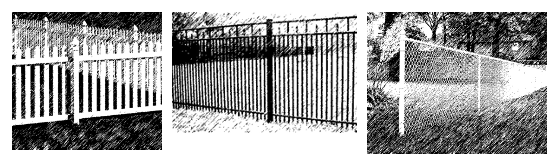
- Solid. A fence that is less than fifty percent (50%) open as viewed from outside the fence. Examples of fences classified as solid are shown below.
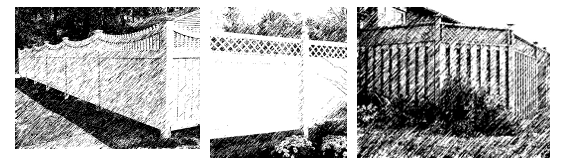
- Masonry. Any fence or wall composed entirely of either stone, brick, concrete, gypsum, hollow clay tile, concrete block or tile or similar uniform building units or materials laid up unit by unit and set in mortar. Examples of masonry fences are shown below.
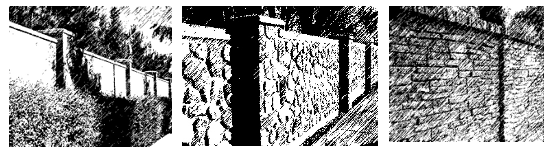
- Ornamental Iron. Any wrought iron, metal, or composite fence, of primarily open design, consisting of straight or curved bars or pieces, including metal vertical picket fences. Examples of ornamental iron fences are shown below.
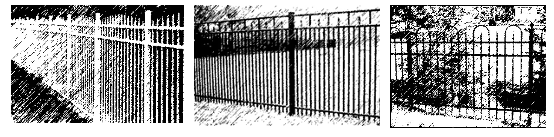
- Chain Link. A fence of primarily open design consisting of an interlocking pattern of wire, metal or coated metal of at least 1/8” in diameter supported by vertical and/or horizontal bars or posts of at least one and one-half inches (1 1/2”) in diameter. Examples of chain link fences are shown below.
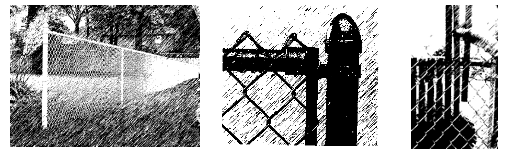
- Lattice. A framework or structure of crossed wood, metal, or composite material. Examples of lattice fences are shown below.
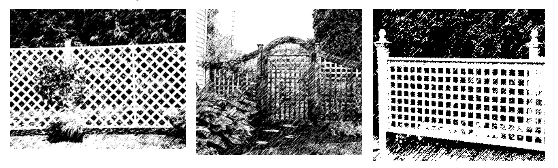
- Wire Mesh. A fence of primarily open design consisting of an interlocking pattern of wire less than 1/8” in diameter supported by vertical or horizontal bars or posts less than one and one-half (1 1/2”) in diameter.
- Wood Picket. A fence that is more than fifty percent (50%) open, and is constructed with wooden or composite supports and fence materials. This type of fence includes fences with vertical pieces of material (i.e., “picket fences”), as well as fences with horizontal materials (i.e., “split rail” fences). Examples of fences classified as wood picket are shown below.
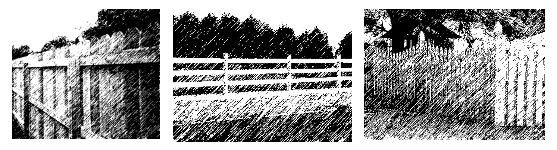
- Open. A fence that is greater than fifty percent (50%) open as viewed from outside the fence. Examples of fences classified as open are shown below.
- Location. No portion of a fence, including posts and post footings, shall extend past the property line. When fences are adjacent to a public sidewalk they must be setback a minimum of one (1) foot from said sidewalk.
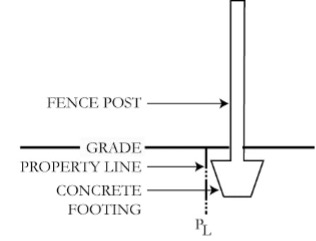
- Posts. All fence posts shall be located on the side of the fence facing the fence owner’s property, and the fence’s finished side shall face the adjacent lots.
- Measurement of Fence Height. Height of fences are exclusive of any posts or ornamental post caps or caps that do not exceed six (6) inches For sloping grades, effort shall be made to follow the contour of the grades.
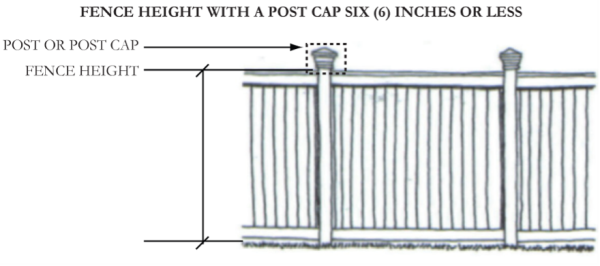
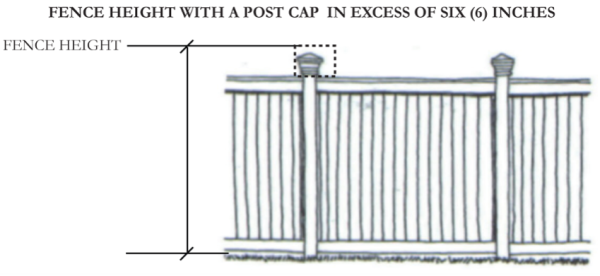
- Sight Triangle. Within fifteen horizontal feet (15’) of intersecting property lines at public streets, walks, driveways, bike paths, or walking paths, fences shall not exceed three (3’) feet in height, whether solid or open fencing is used.
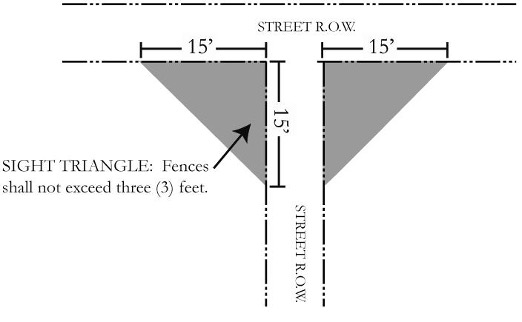
- Maintenance. The International Property Maintenance Code shall regulate fence maintenance.
- Construction. The International Property Maintenance Code shall regulate proper construction standards for fences including but not limited to post materials and installation.
- Materials and Uniformity.
- Fences shall be constructed of materials customarily used and manufactured as common fence materials. Examples of common fence materials are described and illustrated in the fence classifications portion of this section.
- Fences shall be of uniform height, material, type, color and design, and shall be so for the extent of the entire length of fence, except where a fence transitions from one yard to another or from one height to another per the requirements of this article.
- Wire mesh shall not be considered a common fence material and is prohibited, however, wire mesh may be used for functional purposes such as a border for gardens when the height does not exceed three (3) feet.
- Wood fences shall be made of a species either pressure treated or having natural resistance to decay.
- Lattice used as fences shall be completely framed using uniform framing materials.
- Chain link fences shall include a top rail.
- Fences with tarps and other similar coverings secured to fence are prohibited.
- Removal/Replacement. If a new fence on a property is meant to replace all or part of an existing fence, the existing fence shall be completely removed prior to the installation of the new fence.
- Fences in Easements. The construction of fences in utility easements are subject to the conditions of the easement. It is recommended that fences should not be located in utility easements. However, when it is necessary to locate a fence in a utility easement, the property owner will be responsible for any repairs to the fence should the City or utility companies need to access or repair utilities located within that easement. Any utility boxes or enclosures shall not be enclosed within a fence.
- Fences in Drainage Swales. No permit for any fence shall be issued if the construction or location of said fence would create an unreasonable obstruction to the natural flow of water within any drainage easement. Fences located across drainage swales shall be a minimum of six inches (6”) above grade, with the exception of upright posts or bars.
- Fences shall not be permitted in floodway areas as designated on FEMA’s flood boundary and floodway map.
- Grade Alterations. Grades at property lines shall not be altered due to fence construction unless a grading plan is submitted to and approved by the City Engineer.
- Fences for Excavations. Pursuant to Building Code.
- Fences Surrounding Swimming Pools. Pursuant to Building Code.
- Vacant Lots. No fence shall be permitted to be constructed on a vacant lot unless said lot is immediately adjacent to a property occupied by a building or buildings and under common ownership (contiguous lot under single ownership).
- Fences for Trash Enclosures. Fences for trash enclosures are subject to the standards in the Landscaping Section of the Bulk Restrictions.
- Fences in the Right-of-Way. No fence, wall or other similar screening material shall be erected or maintained in any public right-of-way except those fences, walls and other screening material erected for the purpose of insuring the public safety by a public body having proper authority.
- These provisions shall not prohibit the erection of a chain link or open mesh type fence over six (6) feet in height enclosing park and recreational areas, elementary or high school sites
- Arbors and trellises which are detached from the building are allowable encroachments in a required front yard, a required side yard, a required side yard which abuts a street, or in any required rear yard of a double frontage lot, provided that they comply with each of the following standards.
- Maximum height is nine feet.
- Maximum width is six feet,
- Maximum depth is three feet
- Sum of depth in feet and width in feet is not to exceed eight feet.
- Each surface of the arbor or trellis shall be at least fifty percent open.
- Any gate shall meet all existing fence regulations, except that, if, on each side of a trellis or arbor with a gate there is a hedge higher than three and a half feet, the gate is permitted to be as high as the adjoining hedge, but in no event to exceed a height of four feet.
- Residential Districts. Additional fence regulations applicable to residential districts are set forth in section 49-107.3 of this ordinance under Residential District Specific Regulations.
- Non-residential Districts.
- Fence height. The maximum permitted fence height is six (6) feet. Fence height when used for the purposes of screening is increased to eight (8) feet pursuant to the Landscaping and Screening provisions contained in the Landscaping section of the Bulk Restriction.
- Permitted Yards. The Obstructions section of the Bulk Restrictions shall regulate which yards fences and walls are permitted in.
- Fences shall be constructed so that the side facing an abutting lot is smooth finished.
- It shall be unlawful to construct or maintain anywhere within the City a fence equipped with barbed wire, spikes or any similar device, or any electric charge sufficient to cause shock. When approved by the Zoning Administrator, barbed wire used for maximum security may be allowed in M1, M2, and ORI zoning districts. When visible from the public right-of-way a security fence should be ornamental.
- Fences used for the purpose of screening shall be pursuant to the Landscaping Section of the Bulk Restrictions. When adjacent to property zoned for residential use common fence materials may be used with the exception of chain link and wire mesh.
- Landscaping. The city may require that fence areas be landscaped with low height plantings or other material pursuant to this ordinance.
- Permit.
Amended by Ord. O23-087 on 12/5/2023
49-104.3 Conditional Uses And Structures
- In General.
- In the exercise of its home rule authority and the powers conferred by the Illinois Municipal Code and this ordinance, the city council may, from time-to-time permit by specific ordinance the following conditional uses of land or structures in accordance with the procedures set forth in chapter 34 of this code.
- The term “conditional use” as used throughout this ordinance shall be construed as having the same meaning and construction as the term “special use” as used in Illinois law and provisions of this code enacted prior to the effective date of this amendatory ordinance of 2020.
- Whenever the city council has previously approved a special use upon any real property or as part of any planned development, such special use shall be regarded as a conditional use for the purposes of this code.
- Conditional Uses. The Conditional Uses as identified in Table One: Use Categories shall apply.
- Specific Regulations.
- Car Wash, Single Bay, when such use is in conjunction to a Gasoline Station as an accessory use to and operated only during the regular business hours of the Gasoline Station.
- Financial institutions with a drive-through facility, when located at the intersection of two publicly dedicated streets (corner) under the following conditions:
- When said intersection is designated as non-residential on only two of the four corners of the intersection of said two publicly dedicated streets (corner).
- When said intersection is designated as non residential on all four corners and contains one or more existing financial institutions with drive-through facilities located at the intersection of said two publicly dedicated streets (corner).
- Financial institutions with a drive-through facility, when located within 1000’ of an intersection of two publicly dedicated streets and
- When said intersection is designated as non-residential on only two of the four corners of the intersection of said two publicly dedicated streets (corner) and contains one or more existing Financial institutions with a drive-through facilities located within 1000’ of said intersection, as measured property line to property line.
- When said intersection is designated as non residential on all four corners and contains two or more existing Financial institutions with a drive-through facilities located within 1000’ of said intersection, as measured property line to property line.
- Drive Through/ Drive In establishment, when located at the intersection of two publicly dedicated streets (corner), under the following conditions:
- When said intersection is designated as non-residential on only two of the four corners of the intersection of said two publicly dedicated streets (corner).
- When said intersection is designated as non-residential on all four corners and contains one or more existing Drive Through/ Drive In establishments located at the intersection of said two publicly dedicated streets (corner).
- Drive Through/ Drive In establishment, when located within 1000’ of an intersection of two publicly dedicated streets and
- When said intersection is designated as non-residential on only two of the four corners of the intersection of said two publicly dedicated streets (corner) and contains one or more existing Drive Through/Drive In establishments located within 1000’ of said intersection, as measured property line to property line.
- When said intersection is designated as non residential on all four corners and contains two or more existing Drive Through/Drive In establishments located within 1000’ of said intersection, as measured property line to property line.
- Institutions for the care of the insane or feeble minded, shall be established above the first floor when located in a building constructed for a business use. A building originally constructed for residential use may be used in whole or in part.
- Intertrack wagering facilities when not located within eight hundred (800) feet of a religious institution, grade school, high school, hospital, nursing home property or any single-family detached residential zoning district.
- Off-street parking areas within the downtown core constructed after the establishment date of the Downtown Core District, located within front or side yards, or as the sole use of a property.
- Rest homes and nursing homes, in any R-4, R-5 or B districts, provided that when located in a business district, such uses shall be established above the first floor when located in a building constructed for a business use. A building originally constructed for residential use may be used in whole or part.
- Transportation uses, such as taxicab and bus waiting rooms, auto rental agencies wholly within a building, and public parking garages for storage of private passenger autos and commercial vehicles under one-and-one-half-ton capacity, in the downtown fringe district.
- One (1) or more buildings to be redeveloped for use or uses not permitted within the underlying zoning district; provided the proposed use is of a nature that may give rise to problems with respect to impact upon neighboring property and public facilities in any use district. Buildings constructed originally as single-family and two-family dwellings shall not be considered for development under this provision.
- Hotel, conference, in any ORI, M-1, and M-2 districts when not within one-half (1/2) mile from the centerline of the East West Tollway I-88.
- Vehicle Repair, Major, in M-1 and M-2 district when confined within an enclosed structure (including autos needing work), and when such lot is located within two hundred fifty (250) feet away from any residential district or lot with residential use.
- Cannabis Dispensing Facilities (2115) as shown in Table One: Use Categories and in PDD Planned Development Districts within the business and industrial areas under the following conditions:
- Facilities shall at all times comply with all requirements, rules and restrictions, including without limitation, geographic location restrictions, as set forth in the Compassionate Use of Medical Cannabis Pilot Program Act (IL Public Act 098-0122) and the Cannabis Regulation and Tax (IL Public Act 101-0027) or as modified by applicable law, and shall at all times comply with the terms and conditions of any conditional use permit that may be granted in the future.
- On or after January 1, 2020, no more than four (4) adult use cannabis dispensary conditional uses, may be established within the corporate limits. Notwithstanding this limitation, the city council may evaluate and by resolution implement adjustments to the number of adult use cannabis dispensary conditional uses within the city in order to maintain public health, safety, and welfare as well as promote economic development. Any proposed changes shall start at the committee.
Of the four cannabis dispensary conditional uses within the City, two (2) shall be reserved and issued for social equity candidates, in order to maximize the state legislature’s intent of section 7-1, article h of the Cannabis Regulation and Tax Act. 410 ILCS 705/7.
Non-social equity candidates are required to meet the following requirements for adult use cannabis dispensary conditional use in order to promote public health, safety and welfare:- Applicants must establish a minimum of two years of cannabis sales experience (either as a medical dispensary in Illinois, or as a recreational dispensary in another state).
- Facilities shall abut an arterial street as depicted in the comprehensive plan. No more than one (1) dispensary shall be located on a single arterial. A dispensing facility may not be located within a mile and a half (1 ½) of a preexisting dispensing facility located within the corporate limits of the city.
- Facilities shall not be located within seven hundred and fifty feet (750’), measured from property line to property line, of a grade school, middle school, alternative school, or high school. The authorization of a conditional for this purpose should not be affected by subsequent establishment of a school within the restricted area.
- A facility shall not be located adjacent to a licensed day care facility. For the purpose of this limitation, in the case of a standalone building “adjacent” means physically abutting the lot, or in the case of a single structure containing multiple units comprising a shopping center or similar facility, in the unit directly adjoining a unit containing the licensed day care facility.
- No cannabis or paraphernalia shall be displayed or kept at the facility so as to be visible from outside the premises including but not limited to depiction on signage.
- Onsite Use Is Prohibited. No cannabis shall be smoked, eaten or otherwise consumed or ingested on the premises.
- Facilities shall have operating hours not earlier than 8 a.m. and not later than 10 p.m.
- Co-locations: The City may approve the co-location of a Cannabis Dispensing Facility, a Cannabis Craft Grower Facility or a Cannabis Infuser Facility subject to the requirements of State law, zoning requirements and the conditional use criteria within this ordinance.
- Additional conditions may be imposed as part of the conditional use approval to provide for compatibility with adjacent uses and mitigate potential impacts from the dispensing operation.
- The following items shall be submitted as part of the conditional use request:
- A plan for disposal of any cannabis or byproducts that are not sold to a purchaser or registered qualifying patient or caregiver in a manner that protects any portion thereof from being possessed or ingested by any person or animal and shall abide by applicable state or local regulations.
- A security plan that includes facility access controls, surveillance systems, on-site security personnel, and other security measures required by state or local regulations.
- A copy of the operating procedures adopted in compliance with state statutes. Said operations procedures should include provisions with minimum requirements for facility employees or volunteers (paid or unpaid) including individuals must be at least 21 years of age and must pass a criminal background having not been convicted of a felony under any federal or state law or having been convicted of a violation of any federal, state or city law concerning the manufacture, possession or sale of controlled substances or alcoholic liquor.
- A plan for ventilation of the facility that describes the ventilation systems that will be used to prevent any odor of cannabis off the premises of the business. For cannabis dispensing facilities, such plan shall also include all ventilation systems used to control the environment for the plants and describe how such systems operate with the systems preventing any odor leaving the premises.
- The name(s) and location(s) of the offsite cultivation facilities associated with the cannabis dispensary.
- For the purposes of the setbacks described in this paragraph, distances shall be measured from property line to property line.
- Cannabis Processing Facilities (3112) as shown in Table One: Use Categories and in PDD Planned Development Districts within the industrial areas under the following conditions:
- Facilities shall at all times comply with all requirements, rules and restrictions, including without limitation, geographic location restrictions, as set forth in the Compassionate Use of Medical Cannabis Pilot Program Act (IL Public Act 098-0122) and the Cannabis Regulation and Tax (IL Public Act 101-0027) or as modified by applicable law, and shall at all times comply with the terms and conditions of any conditional use permit that may be granted in the future.
- Facilities shall not be located within five hundred feet (500’), measured from property line to property line, of a grade school, middle school, alternative school, or high school. The authorization of a conditional special use for this purpose should not be affected by subsequent establishment of a school within the restricted area.
- No cannabis or paraphernalia shall be displayed or kept at the facility so as to be visible from outside the premises including but not limited to depiction on signage.
- Onsite Use Is Prohibited. No cannabis shall be smoked, eaten or otherwise consumed or ingested on the premises.
- Facilities shall have operating hours not earlier than 8 a.m. and not later than 10 p.m.
- Facilities shall provide evidence upon request of conformity to the performance standards for noise, vibration, smoke, dust, odor, heat, glare, fire hazard and other objectionable influences established by the State of Illinois and administered by the Illinois Environmental Protection Agency, the United States of America and administered by the federal environmental agency, and any applicable County or City ordinance.
- Additional conditions may be imposed as part of the conditional use approval to provide for compatibility with adjacent uses and mitigate potential impacts from the dispensing operation.
- The following items shall be submitted as part of the conditional use request:
- A plan for disposal of any cannabis or byproducts that are not sold to a purchaser or registered qualifying patient or primary caregiver in a manner that protects any portion thereof from being possessed or ingested by any person or animal and shall abide by applicable state or local regulations.
- A security plan that includes facility access controls, surveillance systems, on-site security personnel, and other security measures required by state or local regulations.
- A copy of the operating procedures adopted in compliance with state statutes. Said operations procedures should include provisions with minimum requirements for facility employees or volunteers (paid or unpaid) including individuals must be at least 21 years of age and must pass a criminal background having not been convicted of a felony under any federal or state law or having been convicted of a violation of any federal, state or city law concerning the manufacture, possession or sale of controlled substances or alcoholic liquor.
- A plan for ventilation of the facility that describes the ventilation systems that will be used to prevent any odor of cannabis off the premises of the business. For cannabis processing facilities, such plan shall also include all ventilation systems used to control the environment for the plants and describe how such systems operate with the systems preventing any odor leaving the premises.
- Cannabis Infuser Facilities (3113) as shown in Table One: Use Categories and in PDD Planned Development Districts within the industrial areas under the following conditions:
- Facilities shall at all times comply with all requirements, rules and restrictions, including without limitation, geographic location restrictions, as set forth in the Compassionate Use of Medical Cannabis Pilot Program Act (IL Public Act 098-0122) and the Cannabis Regulation and Tax (IL Public Act 101-0027) or as modified by applicable law, and shall at all times comply with the terms and conditions of any conditional use permit that may be granted in the future.
- Facilities shall not be located within five hundred feet (500’), measured from property line to property line, of a grade school, middle school, alternative school, or high school. The authorization of a conditional use for this purpose should not be affected by subsequent establishment of a school within the restricted area.
- No cannabis or paraphernalia shall be displayed or kept at the facility so as to be visible from outside the premises including but not limited to depiction on signage.
- Onsite Use Is Prohibited. No marijuana shall be smoked, eaten or otherwise consumed or ingested on the premises.
- Facilities shall have operating hours not earlier than 8 a.m. and not later than 10 p.m.
- Facilities shall provide evidence upon request of conformity to the performance standards for noise, vibration, smoke, dust, odor, heat, glare, fire hazard and other objectionable influences established by the State of Illinois and administered by the Illinois Environmental Protection Agency, the United States of America and administered by the federal environmental agency, and any applicable County or City ordinance.
- Co-locations: The City may approve the co-location of a Cannabis Dispensing Facility, a Cannabis Craft Grower Facility or a Cannabis Infuser Facility, subject to the requirements of State law, zoning requirements and the conditional use criteria within this ordinance.
- Additional conditions may be imposed as part of the conditional use approval to provide for compatibility with adjacent uses and mitigate potential impacts from the dispensing operation.
- The following items shall be submitted as part of the conditional use request:
- A plan for disposal of any cannabis or byproducts that are not sold to a purchaser or registered qualifying patient or primary caregiver in a manner that protects any portion thereof from being possessed or ingested by any person or animal and shall abide by applicable state or local regulations.
- A security plan that includes facility access controls, surveillance systems, on-site security personnel, and other security measures required by state or local regulations.
- A copy of the operating procedures adopted in compliance with state statutes. Said operations procedures should include provisions with minimum requirements for facility employees or volunteers (paid or unpaid) including individuals must be at least 21 years of age and must pass a criminal background having not been convicted of a felony under any federal or state law or having been convicted of a violation of any federal, state or city law concerning the manufacture, possession or sale of controlled substances or alcoholic liquor.
- A plan for ventilation of the facility that describes the ventilation systems that will be used to prevent any odor of cannabis off the premises of the business. For cannabis infuser facilities, such plan shall also include all ventilation systems used to control the environment for the plants and describe how such systems operate with the systems preventing any odor leaving the premises.
- Cannabis Transporting Facilities (4112) as shown in Table One: Use Categories and in PDD Planned Development Districts within the industrial areas under the following conditions:
- Facilities shall at all times comply with all requirements, rules and restrictions, including without limitation, geographic location restrictions, as set forth in the Compassionate Use of Medical Cannabis Pilot Program Act (IL Public Act 098-0122) and the Cannabis Regulation and Tax (IL Public Act 101-0027) or as modified by applicable law, and shall at all times comply with the terms and conditions of any conditional use permit that may be granted in the future.
- Facilities shall not be located within five hundred feet (500’), measured from property line to property line, of a grade school, middle school, alternative school, or high school. The authorization of a conditional use for this purpose should not be affected by subsequent establishment of a school within the restricted area.
- No cannabis or paraphernalia shall be displayed or kept at the facility so as to be visible from outside the premises including but not limited to depiction on signage.
- Onsite Use Is Prohibited. No cannabis shall be smoked, eaten or otherwise consumed or ingested on the premises.
- Facilities shall have operating hours not earlier than 8 a.m. and not later than 10 p.m.
- Facilities shall be the sole use of the tenant space in which it is located.
- The following items shall be submitted as part of the conditional use request:
- A security plan that includes facility access controls, surveillance systems, on-site security personnel, and other security measures required by state or local regulations.
- A copy of the operating procedures adopted in compliance with state statutes. Said operations procedures should include provisions with minimum requirements for facility employees or volunteers (paid or unpaid) including individuals must be at least 21 years of age and must pass a criminal background having not been convicted of a felony under any federal or state law or having been convicted of a violation of any federal, state or city law concerning the manufacture, possession or sale of controlled substances or alcoholic liquor.
- Cannabis Cultivation Facilities (7110) as shown in Table One: Use Categories and in PDD Planned Development Districts within the industrial areas under the following conditions:
- Facilities shall at all times comply with all requirements, rules and restrictions, including without limitation, geographic location restrictions, as set forth in the Compassionate Use of Medical Cannabis Pilot Program Act (IL Public Act 098-0122) and the Cannabis Regulation and Tax (IL Public Act 101-0027) or as modified by applicable law, and shall at all times comply with the terms and conditions of any conditional use permit that may be granted in the future.
- Facilities shall not be located within five hundred feet (500’), measured from property line to property line, of a grade school, middle school, alternative school, or high school. The authorization of a conditional use for this purpose should not be affected by subsequent establishment of a school within the restricted area.
- No cannabis or paraphernalia shall be displayed or kept at the facility so as to be visible from outside the premises including but not limited to depiction on signage.
- Onsite Use Is Prohibited. No cannabis shall be smoked, eaten or otherwise consumed or ingested on the premises.
- Facilities shall have operating hours not earlier than 8 a.m. and not later than 10 p.m.
- Facilities shall provide evidence upon request of conformity to the performance standards for noise, vibration, smoke, dust, odor, heat, glare, fire hazard and other objectionable influences established by the State of Illinois and administered by the Illinois Environmental Protection Agency, the United States of America and administered by the federal environmental agency, and any applicable County or City ordinance.
- Additional conditions may be imposed as part of the conditional use approval to provide for compatibility with adjacent uses and mitigate potential impacts from the dispensing operation.
- The following items shall be submitted as part of the conditional use request:
- A plan for disposal of any cannabis or byproducts that are not sold to a purchaser or registered qualifying patient or primary caregiver in a manner that protects any portion thereof from being possessed or ingested by any person or animal and shall abide by applicable state or local regulations.
- A security plan that includes facility access controls, surveillance systems, on-site security personnel, and other security measures required by state or local regulations.
- A copy of the operating procedures adopted in compliance with state statutes. Said operations procedures should include provisions with minimum requirements for facility employees or volunteers (paid or unpaid) including individuals must be at least 21 years of age and must pass a criminal background having not been convicted of a felony under any federal or state law or having been convicted of a violation of any federal, state or city law concerning the manufacture, possession or sale of controlled substances or alcoholic liquor.
- A water consumption capacity report for the facility and an infrastructure capacity report for the subject property.
- A plan for ventilation of the facility that describes the ventilation systems that will be used to prevent any odor of cannabis off the premises of the business. For cultivation facilities, such plan shall also include all ventilation systems used to control the environment for the plants and describe how such systems operate with the systems preventing any odor leaving the premises.
- Cannabis Craft Grower Facilities (7115) as shown in Table One: Use Categories and in PDD Planned Development Districts within the industrial areas under the following conditions:
- Facilities shall at all times comply with all requirements, rules and restrictions, including without limitation, geographic location restrictions, as set forth in the Compassionate Use of Medical Cannabis Pilot Program Act (IL Public Act 098-0122) and the Cannabis Regulation and Tax Act (IL Public Act 101-0027) or as modified by applicable law, and shall at all times comply with the terms and conditions of any conditional use permit that may be granted in the future.
- Facilities shall not be located within five hundred feet (500’), measured from property line to property line, of a grade school, middle school, alternative school, or high school. The authorization of a conditional use for this purpose should not be affected by subsequent establishment of a school within the restricted area.
- No cannabis or paraphernalia shall be displayed or kept at the facility so as to be visible from outside the premises including but not limited to depiction on signage.
- Onsite Use Is Prohibited. No cannabis shall be smoked, eaten or otherwise consumed or ingested on the premises.
- Facilities shall have operating hours not earlier than 8 a.m. and not later than 10 p.m.
- Facilities shall provide evidence upon request of conformity to the performance standards for noise, vibration, smoke, dust, odor, heat, glare, fire hazard and other objectionable influences established by the State of Illinois and administered by the Illinois Environmental Protection Agency, the United States of America and administered by the federal environmental agency, and any applicable County or City ordinance.
- Co-locations: The City may approve the co-location of a Cannabis Dispensing Facility, a Cannabis Craft Grower Facility, or a Cannabis Infuser Facility, subject to the requirements of State law, zoning requirements and the conditional use criteria within this ordinance.
- Additional conditions may be imposed as part of the conditional use approval to provide for compatibility with adjacent uses and mitigate potential impacts from the dispensing operation.
- The following items shall be submitted as part of the conditional use request:
- A plan for disposal of any cannabis or byproducts that are not sold to a purchaser or registered qualifying patient or primary caregiver in a manner that protects any portion thereof from being possessed or ingested by any person or animal and shall abide by applicable state or local regulations.
- A security plan that includes facility access controls, surveillance systems, on-site security personnel, and other security measures required by state or local regulations.
- A copy of the operating procedures adopted in compliance with state statutes. Said operations procedures should include provisions with minimum requirements for facility employees or volunteers (paid or unpaid) including individuals must be at least 21 years of age and must pass a criminal background having not been convicted of a felony under any federal or state law or having been convicted of a violation of any federal, state or city law concerning the manufacture, possession or sale of controlled substances or alcoholic liquor.
- A water consumption capacity report for the facility and an infrastructure capacity report for the subject property.
- A plan for ventilation of the facility that describes the ventilation systems that will be used to prevent any odor of cannabis off the premises of the business. For craft grower facilities, such plan shall also include all ventilation systems used to control the environment for the plants and describe how such systems operate with the systems preventing any odor leaving the premises.
- Alternative Financial Institutions in B-2, B-3, DC and DF Districts, with a minimum spatial separation of 2,640 feet from property line to property line of any other Alternative Financial Institution and/or Pawnshop.
- Pawnshop in B-2, B-3, DC, DF, M-1 and M-2 Districts, with a minimum spatial separation of 2,640 feet from property line to property line of any other Pawnshop and/or Alternative Financial Institution.
- Off-street parking areas within the downtown fringe district constructed after the effective date of this amendatory ordinance of 2020, located within front or side yards, or as the sole use of a property.
- Automobile parking areas developed for transient trade, and not accessory to specific principal uses or groups of uses for which parking is required by this ordinance, in all zoning districts and planned development districts
- Accessory off-street parking facilities serving nonresidential uses of property, in any residential district.
- Conditional Use Planned Developments.
- Generally. Planned developments are conditional uses of a substantially different character from other conditional uses so as to be subject separate standards, exceptions, and procedures as set forth in chapter 34.
- Required Findings. In conducting a hearing pursuant to chapter 34, the commission shall make a recommendation to the city council as to whether for the duration of a development, specified uses not permitted by the use regulations of the district in which said development is located, the following conditions are satisfied:
- The uses permitted by such exceptions are necessary or desirable and are appropriate with respect to the primary purpose of the development;
- The uses permitted by such exception are not of such a nature or so located as to exercise an undue detrimental influence on the surrounding neighborhood;
- Reserved;
- In an industrial planned development, such additional uses allowed by exceptions shall conform with the performance standards of the district in which the development is located;
- The use exceptions so allowed are reflected by the appropriate zoning district symbols and so recorded on the zoning district map.
- Regulations. A planned development may embrace exceptions to the bulk regulations generally applicable in the underlying zoning district in which the planned development is located upon a finding by the commission that such exception shall be solely for the purpose of promoting a unified site plan that is as or more beneficial to the residents or occupants of such development as well as the neighboring property than would be obtained by a strict interpretation of the bulk regulations required by the underlying zoning district.
Amended by Ord. O22-107 on 12/20/2022
49-104.4 Accessory Uses And Structures
- Applicability of Principal Structure Regulations.
- Where an accessory structure is structurally attached to a principal building, it shall be subject to, and must conform to, all regulations of this ordinance applicable to the principal building.
- Placement on a Zoning Lot. Unless otherwise specified, accessory buildings and structures are restricted to the following locations:
- Front Yard: Accessory structures are not permitted in the front yard or required front setback.
- Exterior Side Yard: Setbacks apply, except on reverse corner lots accessory structures must be setback to the building setback line of the adjacent property to the rear. In no case shall this exception apply to more than thirty (30) feet from the street property line.
- Interior Side Yard: Setbacks apply.
- Rear Yard: Accessory structures must be setback a minimum of
- Three (3) feet from interior side lot lines;
- Five (5) feet from rear lot lines; and
- Setbacks apply on exterior lot lines, except on reverse corner or through lots accessory structures must be setback to the building setback line of the adjacent property. In no case shall this exception apply to more than thirty (30) feet from the street property line.
Illustration:
Accessory Structures - Placement on a Zoning Lot
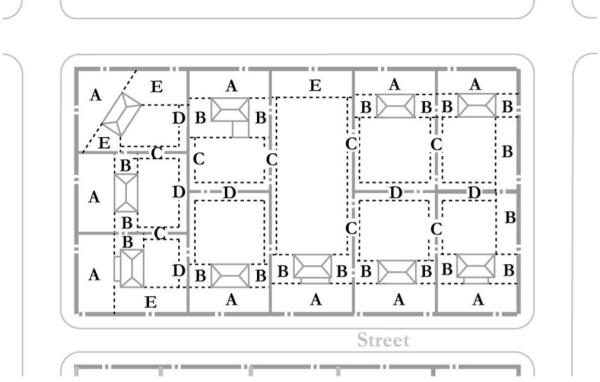 A = Not permitted in front yard or required front setback.
B = Not permitted in required setback.
C = Must be setback three (3) feet from interior property line.
D = Must be setback five (5) feet from rear property line.
E = Must be setback to the building setback line of the adjacent property.
- When an accessory structure has been constructed on a slab or foundation, and demolition occurs for whatever reason, the accessory structure may be re-established at its previous location without the necessity of a variation provided that an application for building permit is made no later than six (6) months after demolition.
- Erection Prior to that of Principal Building.
- An accessory structure may be erected prior to the establishment or construction of the principal building to which it is accessory, or to which it is intended to be accessory, providing the principal building shall be fully completed within two (2) years after the erection of the accessory structure, and providing further, that the accessory structure shall not be used for residential purposes, except for the housing (after the completion of the principal building) of domestic help, or temporary housing of guests, per the Rules Section of Specific Regulations and as permitted in the provisions listed below under permitted accessory structures and uses.
- Permitted Accessory Structures and Uses in Residential Districts. The Permitted Structures and Obstructions for E, R1, R2, and R3 Residential Districts are identified in Table Four: Permitted Structures and Obstructions.
- Permitted accessory structures and uses in districts other than E, R1, R2, and R3 include but are not limited to:
- A children's playhouse;
- A garden house;
- A private greenhouse;
- A garage, shed or building for domestic storage;
- Storage of merchandise normally carried in stock on the same lot with any retail service or business use, unless such storage is excluded by the district regulations;
- Storage of goods used in or produced by manufacturing activities, on the same lot or parcel of ground with such activities, unless such storage is excluded by the district regulations;
- A nonpaying guesthouse or rooms for guests within an "accessory structure," provided such facilities are used for the occasional housing of guests of the occupants of the principal building and not for permanent occupancy by others as housekeeping units;
- Quarters comprising part of an accessory garage and solely for occupancy of a full-time employee hired to perform routine household duties (and his or her family) for occupants of the principal dwelling, while receiving compensation for their work;
- Off-street motor vehicle parking areas, and loading and unloading facilities;
- Signs as permitted in Chapter 41 of this code;
- Boathouse. A building adjacent to a body of water designed to serve as a boathouse for private use in the case of an R district and for public or private use in the case of a B-district;
- Public utility communication, electric, gas, water and sewer lines, their supports and incidental equipment;
- Federally-licensed amateur radio station and citizens band radio operator and receive-only antennas;
- Automated/unstaffed business devices, except in the O and DC district. All automated/unstaffed business devices shall be within an enclosed structure, with the following exception: one (1) automated/unstaffed business device shall be permitted, within the B – Business zoning districts, within twenty-five (25) feet of the public entrance and adjacent to the primary structure. Furthermore, one additional device shall be permitted for every five hundred (500) linear feet of the structure measured adjacent to the front and exterior side yard;
- Patio, porches, and decks or terraces, unroofed;
- Electric vehicle charging stations.
- Garages, Sheds and Other Accessory Storage Structures.
- Number. Each zoning lot of record shall be permitted a maximum of one shed and one garage per residential dwelling. No garage or shed shall be constructed on a vacant lot unless said lot is immediately adjacent to a property occupied by a building or buildings under common ownership (Zoning Lot).
- Materials and Construction.
- Garages and sheds shall be constructed of an approved, uniform material, type, color and design. Approved materials shall be materials customarily used when constructing a garage or shed and may consist of, but is not limited to wood, metal, brick, and block. Resin storage sheds when purchased for the purposes of outdoor storage is an acceptable material. See image below for an example of an acceptable resin shed.
- No fabric or other coverings such as those made of vinyl, nylon, or canvas; untreated or unpainted wood; or other non-traditional building materials shall be used in the construction of garages and sheds.
- Garages and sheds shall be constructed of an approved, uniform material, type, color and design. Approved materials shall be materials customarily used when constructing a garage or shed and may consist of, but is not limited to wood, metal, brick, and block. Resin storage sheds when purchased for the purposes of outdoor storage is an acceptable material. See image below for an example of an acceptable resin shed.
- Location and Setbacks. Garages shall be permitted in side and rear yards, while sheds shall be permitted in rear yards only. No garage or shed shall be located within any public utility easement, whether platted or implied.
- Distance from Principal Structures. Detached garages and sheds shall not be closer than six (6) feet from the nearest principal building wall, however if the accessory structure is properly fire rated it may be located closer to the principal building per building code requirements.
- Garage Regulations.
- Conversions. When constructing a new detached garage on a residential lot currently containing an attached garage, any pavement leading to the existing garage not being used for the sole purpose if ingress and egress to the new garage shall be removed and landscaped, and any overhead garage door must be removed upon completion of the new garage. Upon completion of the conversion, the formerly attached garage shall be considered a habitable space subject to a certificate of occupancy.
- Size and Footprint.
- Size. No private detached garage structure shall exceed seven hundred sixty eight (768) square feet. The maximum length of any one wall shall not exceed 36’.
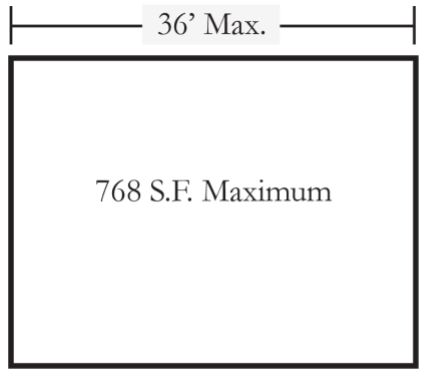
- Footprint. A private detached garage shall not exceed seventy-five percent (75%) of the foundation area of the principal building. Footprint Calculation: Accessory Garage Foundation Area = (Principal building foundation area) * (0.75)
Example: 1,000 SF x 0.75 = 750 SF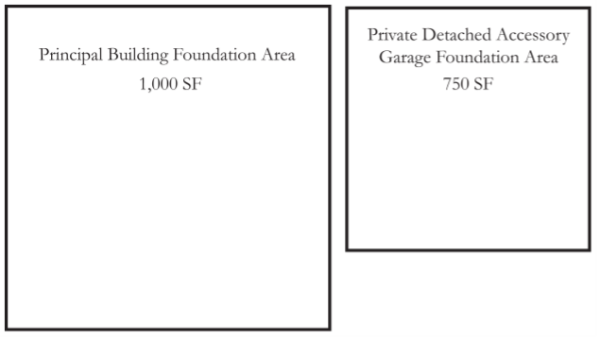
- Size. No private detached garage structure shall exceed seven hundred sixty eight (768) square feet. The maximum length of any one wall shall not exceed 36’.
- Height and Bulk. Height shall be measured to the top (peak) of the structure. A private detached garage shall not exceed the height of the principal building or 21’, whichever is less, and shall not contain vertical sidewalls exceeding 9 feet in height. The storage space above the main or first story shall not contain more than 50% of the cubic volume of the first floor.
- Garage Door Height. The height of a garage door shall not exceed eight (8’) feet.
- Roof Type. Only flat, hip or gable roofs shall be permitted on detached garage structures, provided that gambrel or mansard roofs may be permitted if the principle structure has a gambrel or mansard roof. A maximum 4/12-roof pitch shall be permitted on a garage structure if the principal building contains a flat or low-slope roof. (Illustrations of roof types can be found in the definitions section 49-103.3, under roof types.)
- Garage in Multi-Family Districts. For buildings containing two or more units, not more than two (2) cars per dwelling unit shall be housed in a detached garage with a maximum area of five-hundred twenty eight (528) square feet per dwelling unit.
- Sheds.
- Height. A private shed shall not exceed fourteen (14) feet in height. Height shall be measured to the top (peak) of the structure.
- Size. Sheds shall not exceed one hundred sixty (160) square feet in area, nor shall they exceed eight (8) feet in vertical wall height. The maximum length of any one wall shall not exceed sixteen (16) feet.
- Sheds shall not contain a driveway separate from that of the residential garage.
- Carports. Carports shall be prohibited in residential districts except if a carport is an integral part of the architectural design for an existing or proposed principal structure, including but not limited to design, trim, siding and roof materials of the said building. A carport shall meet all applicable regulations applicable to the principal building.
- On Site Mobile Storage Containers. On site mobile storage containers, intended for loading or unloading of household or business items may not be stored on any public street. Said mobile storage containers are temporary in nature and may not be used for long-term storage of goods, therefore may remain at a residence for a time frame not to exceed fifteen (15) consecutive days. This time frame may reasonably be extended by the zoning administrator to accommodate additional loading or unloading needs.
- Federally licensed amateur radio station, citizens band radio operator and receive-only antenna structures in residential districts.
- The provisions of the R-1 One Family Dwelling District shall apply in determining height, yard areas and setbacks hereunder. Such structures shall require a permit and be erected in accordance with the provisions of the Aurora Building Code.
- Emission Levels. Emission levels should comply with the Federal Communication Commission’s (FCC) Office of Engineering and Technology (OET) recommendations. Refer to OET Bulletin 65, Edition 97-01 entitled “Evaluating Compliance with FCC Guidelines for Human Exposure to Radiofrequency Electromagnetic Fields” for information on emission levels. Future revisions and supplements may be issued and shall apply.
- (Reserved)
- Exterior pay telephone structures in office, business, manufacturing, research and development and office, research and light industrial districts.
- General Provisions. The provisions of the Bulk Restrictions Section and the setback requirements of each district shall apply in determining location. Such structures shall not be located within required exterior yards. Such structures shall require a building permit and be established in accordance with the provisions of the Aurora Building Code.
- (Reserved)
- Alternative Energy Systems. The intent and purpose of this section of the zoning ordinance is to promote the effective and efficient use of Alternative Energy Systems, while protecting the public health, safety and general welfare of the city.
- General Requirements. The following general requirements apply to all Alternative Energy Systems:
- Accessory Use & Structure. Alternative energy systems are limited with additional regulations but permitted as accessory uses and structures as detailed herein and in Table One: Use Categories. Refer to subsection (i) for limitations.
- Approval Process. Alternative energy systems require plan approval and a building permit.
- Continuous Inspection. A structural inspection shall be completed every five (5) years or upon request of the Zoning Administrator by a certified installer or technician, and submitted in writing to the Zoning Administrator. Failure to comply with this provision will cause the system to be deemed abandoned (refer to subsection (i)(1)c).
- Abandoned Systems. All systems inactive or inoperable for twelve (12) continuous months shall be deemed abandoned. If the system is deemed abandoned, the owner is required to repair or remove the system from the property at the owner’s expense within ninety (90) days after notice from the City. If the owner fails to remove the alternative energy system, the Zoning Administrator shall enforce this as a violation of this ordinance.
- Federal Aviation Administration Regulations. All Federal Aviation Administration (FAA) regulations shall be adhered.
- On-Site Use. Energy produced through any alternative energy system shall be sued on-site, however, any excess energy may be resold to a utility provider only.
- Utility Provider Notification. Written evidence must be provided at the time a building permit is requested that a utility company has been notified of the customer’s intent to install an alternative energy system.
- Lighting. The system shall not be illuminated, except as required by the FAA.
- Signage. Signs associated with the manufacturer or operation of the system shall be allowed, with the following limitations:
- One (1) sign is permitted per installation of alternative energy (per turbine, per array of photovoltaic panels, or per array of solar thermal panels).
- Signage may include emergency contact information only, including the manufacturer’s name, address, and phone number. No advertising is permitted.
- Signage shall be limited to the structure of the system, with no members, bases, or surfaces added to accommodate the signage.
- Signage shall be of a size so as not to be readable from a thirty foot distance from the sign in any direction.
- Noise. Except during such short-term events such as utility outage or a severe windstorm, a wind energy system shall not exceed the following:
- Fifty-five (55) dBA when in or adjacent to all residential districts, and
- Sixty (60) dBA when in or adjacent to all non-residential districts.
- Safety. Every wind energy system shall have an internal automatic braking device to prevent uncontrolled rotation of over speeding.
- Mounting Hardware. All systems shall be fastened in accordance with the manufacturer’s specifications and constructed in order to withstand severe wind events.
- Freestanding Wind Energy System Requirements. Refer to Figure 4.4-9.2.
- Location, Quantity, Rated Capacity, and Total System Height. Freestanding systems are not allowed on zoning lots less than 10,000 sq. ft. For information on all other zoning lot sizes, refer to Table 4.4-9.2.
Table 4.4-9.2. Freestanding Wind Energy System Permitted Location, Rated Capacity, and Height.● = permittedMaximum Quantity Allowed by Rated Capacity Maximum Total System Height Zoning Lot Size (in sq ft) less than/ equal to 5kW less than/ equal to 20kW less than/ equal to 40kW 60 feet 80 feet 100 feet 11,000 - 29,999 1 none none ● none none 30,000 - 129,999 unlimited unlimited none ● ● none greater than/equal to 130,000 unlimited unlimited unlimited ● ● ●
Figure 4.4-9.2. Freestanding Wind Energy System.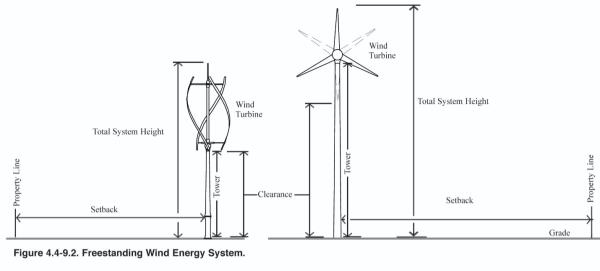
- Clearance. Minimum clearance between the lowest tip of the rotor or blade and the ground is ten (10) feet.
- Permitted Yard Location. Allowed only in the interior side and interior rear yards.
- Front, exterior side, and exterior rear yards may be allowed in nonresidential districts with a conditional use permit provided there are no residential districts within 120 (one hundred twenty) feet of any property line of the zoning lot where the turbine will be located.
- Setbacks. The base of the system shall be setback 1.1 times the height of the highest edge of the system from all property lines, overhead utility line poles, public sidewalks or trails, and public rights-of-way. Any system or any ancillary equipment shall not be located within any required setbacks of the respective zoning district.
Figure 4.4-2.2(D). Setbacks.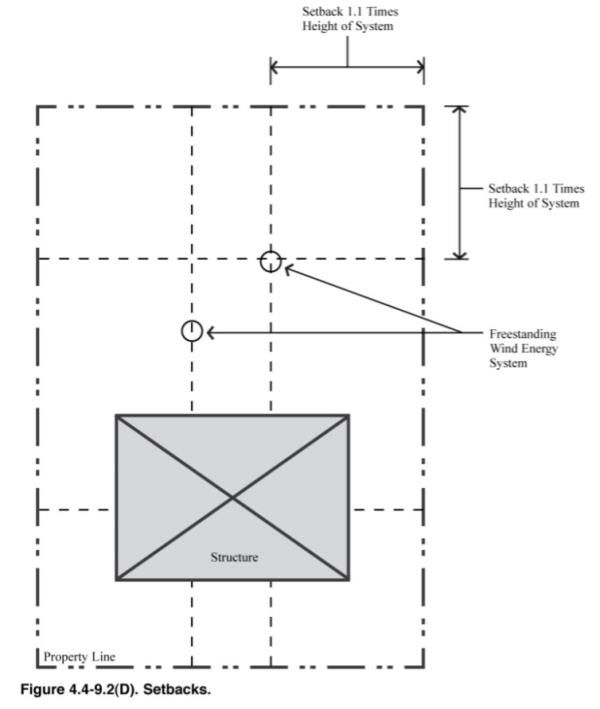
- Access. Climbing access (rungs or foot pegs) to the tower shall not start until twelve (12) feet above grade to prevent unauthorized access.
- Location, Quantity, Rated Capacity, and Total System Height. Freestanding systems are not allowed on zoning lots less than 10,000 sq. ft. For information on all other zoning lot sizes, refer to Table 4.4-9.2.
- Building Mounted Wind Energy System Requirements. Refer to Figure 4.4-9.3 and Table 4.4-9.2.
- Quantity. One (1) turbine is allowed for every 750 sq. ft. of the combined roof area of all structures on a zoning lot. For a pitched roof, each surface of the roof shall be included in the roof area calculation.
- Rated Capacity. A maximum rated capacity of 3kW per turbine is allowed.
- Height.
- Maximum Height. The maximum height of fifteen (15) feet is measured from the roof surface on which the system is mounted to the highest edge of the system with the exception of any pitches 10:12 or greater.
- Extension above Highest Roof Peak. The system shall not extend more than five (5) feet above the highest peak of a pitched roof.
Figure 4.4-9.3. Building Mounted Wind Energy System.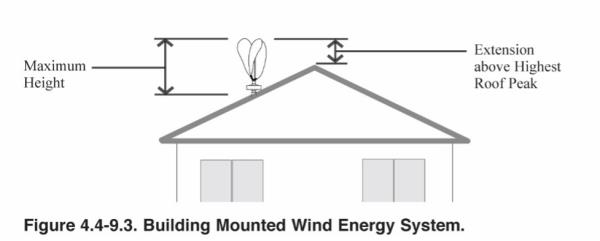
- Location. Allowed on all principal and accessory structures.
- Freestanding Solar Energy System Requirements. Refer to Figure 4.4-9.4.
- Quantity. An unlimited quantity is allowed on all zoning lots with the exception of single family residential zoning lots thirty thousand (30,000) square feet or less in size, which are limited to a total of one hundred (100) square feet in area of panels.
- Maximum Height. Maximum height shall be fifteen (15) feet in height, measured from the grade at the base of the pole to the highest edge of the system.
- Reserved.
Figure 4.4-9.4. Freestanding Solar Energy System.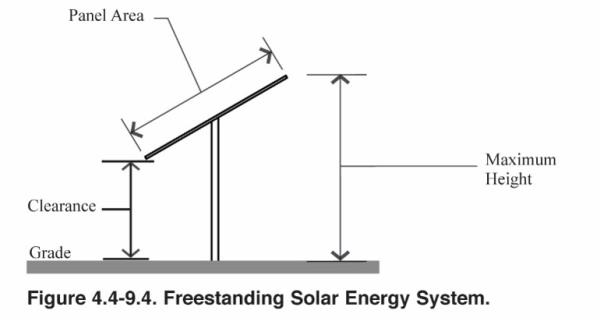
- Location. Allowed in the interior side yard and interior rear yard only.
- Setbacks. All parts of the freestanding system shall be set back ten (10) feet from the interior side and interior rear property lines and shall not be located in a public utility easement.
Figure 4.4-9.4(E). Setbacks.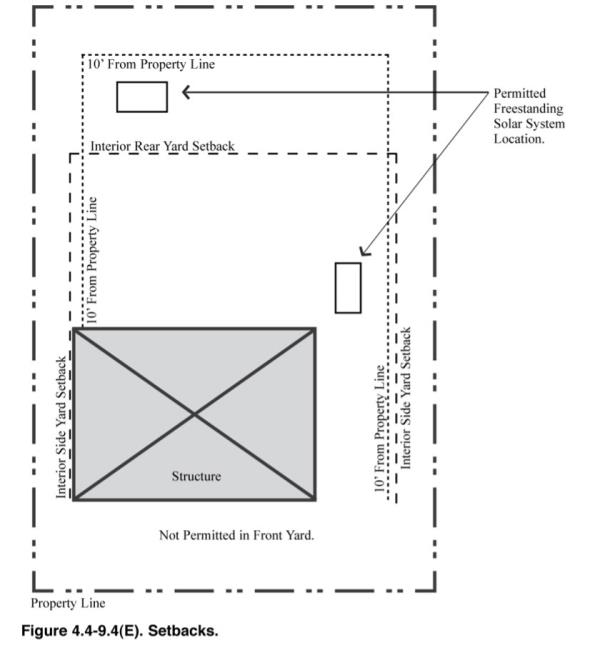
- Building Mounted Solar Energy System Requirements. Refer to Figure 4.4-9.5.
- Location. Allowed on all zoning lots.
- Quantity. The total square footage may not exceed the total area of roof surface of the structure to which the system is attached.
- Flush Mounted System. Systems should be less than 4 (four) inches from the roof surface whenever possible.
- Maximum Height.
- Systems shall not extend beyond 3 (three) feet parallel to the roof surface of a pitched roof.
- Systems shall not extend beyond four (4) feet parallel to the roof surface of a flat roof.
- Systems shall not extend more than five (5) feet above the highest peak of a pitched roof.
Figure 4.4-9.5. Building Mounted Solar Energy System.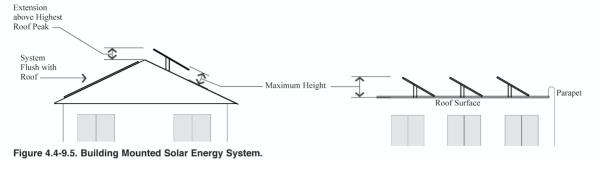
- Projection. The system may project off a roof edge or building facade as follows. Refer to Figure 4.4-9.5(E) on how to measure projection.
- May project up to three feet (3) six (6) inches from a building facade or roof edge.
- May project into an interior side or interior rear setback, but shall be no closer than five (5) feet to the interior side or interior rear property line.
Figure 4.4-9.5(E). Permitted Projection of a Building Mounted Solar Energy System.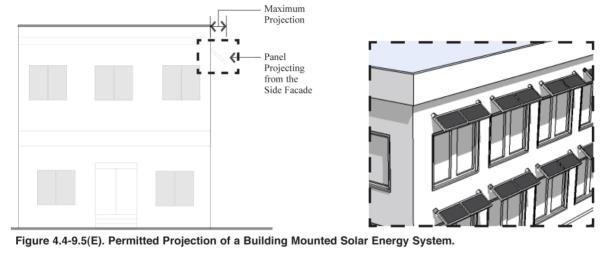
- Location on Structure. Allowed on the following:
- Principal and accessory structures.
- Any roof face.
- Side and rear building facades.
- Front or exterior side building facades, if the following conditions are met:
- Solar access is optimized on the front and exterior side facades.
- Systems are simultaneously used to shade the structure’s doors or windows. Refer to Figure 4.4-9.5(C).
- General Requirements. The following general requirements apply to all Alternative Energy Systems:
- Garage Sale.
- Garage Sale Regulations.
- Garage sales shall take place only on property solely used for residential purposes.
- No more than two (2) garage sales shall be conducted from a property within a calendar year. Any additional sale(s) may be granted for an estate sale upon written request and approval by the Zoning Administrator.
- Each garage sale shall be no longer than three (3) consecutive days.
- Merchandise shall not be placed within the sidewalk or public parkway (the area between the street and the sidewalk).
- (Reserved)
- Garage Sale Regulations.
- Electric Vehicle Charging Stations.
- General Regulations. The following general requirements apply to electric vehicle charging stations:
- Electric vehicle charging stations shall require a building permit approval.
- Parking spaces for an electric vehicle charging station shall be counted towards the minimum number of off-street parking space requirements.
- A parking space shall be clearly identified to be used exclusively for the parking of an electric vehicle.
- The placement of an electric vehicle charging station is pursuant to Sec 49-104.4(b) except that an electric vehicle charging station shall be setback a minimum of ten (10) feet within the front yard or exterior side yard.
- Electric vehicle charging station equipment must be maintained in good condition and all equipment must be functional. A phone number or other contact information shall be provided on the charging station equipment for reporting purposes when the equipment is not functioning, or other equipment problems are encountered. If an electric vehicle charging station is no longer in use, then it shall be immediately removed.
- An owner of an electric vehicle charging station is permitted to collect a fee for the use of a charging station, in accordance with the state and federal regulations. Fees shall be prominently displayed on the charging stations.
- Electric vehicle charging stations shall require a building permit approval.
- General Regulations. The following general requirements apply to electric vehicle charging stations:
Amended by Ord. O23-087 on 12/5/2023
49-105.1 Building, Dwelling And Structure Standards
- Shall be pursuant to district specific regulations, if any.
- Multi-Family residential structures of any height with common corridors, or with 4 stories more without common corridors, either one being constructed subsequent to January 1, 2012, shall be constructed with the following design elements:
- Individually accessible balcony, deck and/or patio for each dwelling unit.
- Residential dwelling units shall not be permitted on the first at grade level.
- Parking facilities shall be located within the primary structure, be fully enclosed with masonry, partially enclosed masonry exterior walls may only be allowed for those parking levels located three stories or more above grade and contain a minimum of 1.25 parking spaces per residential dwelling unit within said primary structure.
49-105.2 Floor Area Ratio
Shall be pursuant to district specific regulations, if any.
49-105.3 Height, Bulk And Lot Coverage
- No building shall be erected, reconstructed, relocated or structurally altered so as to have a greater height or bulk, a higher percentage of lot coverage or smaller open space about it than permissible under the limitations set forth herein for the district in which such building is located, except that parapet walls, chimneys, cooling towers, elevators, bulkheads, fire towers, stacks, stage towers or scenery lofts, and necessary mechanical appurtenances shall be permitted to exceed the maximum height provision when erected in accordance with all other city ordinances.
- No space allocated to a building or dwelling group for the purpose of complying with the side, rear or front yard, or court, or other open space, or lot area requirements of this ordinance shall thereafter, by reason of a change in ownership or for any other reason, be used to satisfy the yard, court, open space or lot area requirements of any other building or dwelling group.
- No usable open space or off-street parking space or loading space existing or provided hereafter for any building shall be reduced below the minimum requirements hereinafter set forth for such usable open space, parking space or loading space, nor further reduced if already less than said minimum requirements.
- The bulk regulations set forth in this section shall apply in all districts unless otherwise specifically provided.
49-105.4 Landscaping
- Purpose and Intent.
- These landscape standards are hereby established to create and maintain an aesthetically appealing community character that minimizes the negative impacts of vehicular traffic, parking lots, etc., and which incorporates human scale into the visual perception of the city. Specifically, these requirements are intended to beautify the public way; to increase the compatibility of adjacent uses by requiring a buffer or screening between uses; to minimize the adverse impact of noise, dust and headlight glare; to reduce topsoil erosion and storm water runoff; and to re-establish a canopy cover over the built environment to mitigate the effects of sun and wind so as to moderate extremes of temperature, provide shade, reduce wind velocity and conserve energy resources.
- Applicability.
- The landscape standards set forth herein shall be applied to all approved landscape plans; conditional use planned developments and Planned Development Districts through the final plan review procedures; conditional use petitions; rezoning petitions; conditional use petitions; all variation petitions; final plat of subdivision petitions; and each use district as specifically required through the site plan review process unless otherwise specifically provided.
- Required Landscape Plan.
- The landscape plan shall be drawn to an accurate engineering scale, and include a scale, north arrow, location map, original and revision dates, name and address of owner and site plan designer. Plans shall show all landscape areas and their uses, the number of plantings by type, the size of plantings at installation, the on-center spacing for hedges, the caliper size of all trees at installation, existing vegetation and plantings, and proposed berming and fencing. Also included shall be all proposed/existing structures and other improvements, including but not limited to paved areas, berms, lighting, retention/detention areas and planting material. The landscape plan shall be sealed by a state registered Landscape Architect unless waived by the Zoning Administrator.
- Landscape and Screening Provisions.
- The following provisions shall be deemed as the minimum requirements for the landscape plan. Additionally, a variety of planting material is desired and must be reflected in the landscape plan.
- Requirements for All parcels. The following requirements shall apply to all parcels and are cumulative:
- Stormwater facility requirement. Whenever possible such facilities should be designed as natural features, implementing native deep-rooted shoreline plantings that stabilize the soil, slow runoff, facilitate infiltration and decrease erosion, subject to specific approval by the city council. The criteria for approval will be whether the proposed natural treatment provides and aesthetic and screening benefit to surrounding properties.
- Lake facilities. Provide three canopy tree equivalents per each 100 feet of high water line.
- Detention facilities. Provide five canopy tree equivalents per 100 feet of high water line. A minimum of 25% of the required canopy tree equivalent shall be non-canopy tree planting material.
- Street tree requirement. Provide three canopy trees per 100 feet of right-of-way frontage, in the parkway on each side of each public street, pursuant to Section 6 of the City of Aurora Arboricultural Specifications Manual. If it is not possible to locate these trees in the parkway, place them within the exterior yards next to the parkway pursuant to the required count. When located below power lines, however, street trees must be understory trees pursuant to Section 6 of Arboricultural Specifications Manual.
- Setback area requirement. All required setback areas excluding driveways, access lanes, sidewalks, walkways shall be planted in turf or other acceptable living groundcover.
- Stormwater facility requirement. Whenever possible such facilities should be designed as natural features, implementing native deep-rooted shoreline plantings that stabilize the soil, slow runoff, facilitate infiltration and decrease erosion, subject to specific approval by the city council. The criteria for approval will be whether the proposed natural treatment provides and aesthetic and screening benefit to surrounding properties.
- Requirements for non-single family detached parcels. The following requirements shall apply to all non-single family detached parcels and are cumulative in addition to the requirements listed under Requirements for All Parcels in the Landscaping and Screening Provisions:
- Perimeter Yard Requirement. Provide three canopy tree equivalents per 100 feet of lot perimeter, which may be clustered.
- Buffer Yard Requirement. Enhance the boundaries between adjacent non-residential uses and residential uses, and between adjacent single family detached residential uses and non-single family detached residential uses to provide an aesthetic screening treatment by planting two canopy tree equivalents per one hundred feet of lot line, of which fifty percent (50%) shall be non-canopy tree planting material. Alternatively, a wall or fence may satisfy the requirement as determined by the City.
- Parking Lot Internal Requirement. A 9’ by 19’ landscaped island protected by a six inch raised concrete curb shall be established for every 20 parking spaces. Said islands shall be planted with 1.5 canopy tree equivalents with the preferred planting material mix including one canopy tree. Said islands shall be located to organize and direct traffic flow within the parking lot, and may be clustered.
- Foundation planting requirement. Provide one canopy tree equivalent per 100 lineal feet of building foundation to effectively relate the structure to the landscape, of which 100% of the requirement shall be non canopy tree planting material.
- Dwelling unit requirement. Provide 1 canopy tree equivalent per dwelling unit located around and/or adjacent to the structure.
- Provisions applicable to all non-single family detached parcels. The following provisions shall apply to all non-single family detached parcels and any planting material utilized shall be credited toward the Requirements for All Parcels and Requirements for Non-Single Family Detached Parcels:
- Parking Lot Screening Provisions. Screen parking lots within 50 feet of public rights-of-way with compact hedging, berming, decorative fencing, decorative masonry, or a combination of these techniques, to a height of two and a half feet (2.5’).
- Miscellaneous Screening Provisions. Screen to 100 percent opacity dumpsters, trash enclosures, HVAC and utility facilities with a combination of plant material and decorative fencing, decorative masonry, building structural extensions, or other similar elements.
- Storage Area Screening Provisions. All exterior storage for business, wholesale and manu¬facturing uses shall be screened as provided herein. Screening shall be to an opacity of not less than seventy-five (75) percent, be a minimum of six (6) feet above grade, and not exceed eight (8) feet in height. Screening may be accomplished by berming, landscaping at seven canopy tree equivalents per 100 feet of storage perimeter, neutral colored fencing with triple slatting, or wall construction. Lighting of the facility shall be directed away from surrounding properties.
Such screening shall be required when one or more of the following conditions are present:- When any exterior yard of the property is located along a public right-of-way and storage is two hundred (200) feet or less from the right-of-way.
- When any exterior yard of the property is located across a street from property that is zoned or developed solely for residential or public park purposes regardless of the distance from the residential or park property, and the comprehensive plan designates the residential property for residential purposes or the park property for open space purposes.
- When any exterior yard of the property is located across an alley from property that is zoned or developed solely for residential or public park purposes and the storage is two hundred (200) feet or less from the residential property, and the comprehensive plan designates the residential property for residential purposes or the park property for open space purposes.
- When the property is located contiguous to the yard of property that is zoned or developed solely for residential or public park purposes and the storage is two hundred (200) feet or less from the residential property, and the comprehensive plan designates the residential property for residential purposes or the park property for open space purposes.
- When such storage areas were in existence as of July 9, 1996, screening shall be in conformance with the above requirements no later than one (1) year from the date of notification, but within five (5) years following said date.
- This provision is not intended to allow outdoor storage where it is prohibited by the provisions of the underlying zoning district.
- Requirements for newly established single family developments. The following requirements shall apply to all newly established single family detached developments and are cumulative in addition to the requirements listed under the section Requirements for All Parcels in the Landscaping and Screening Provisions:
- Neighborhood border requirement. Provide subdivision neighborhoods with landscape borders, in which planting material, entry monuments and features, grade changes and the like are located. These borders shall be a minimum of 20 feet wide and shall be located along all public streets where single family detached lots do not front on such streets. Said border areas shall be planted at four (4) canopy tree equivalents per one hundred (100) feet of right of way frontage, of which fifty percent (50%) shall be non canopy tree planting material.
- Dwelling unit requirement. One canopy tree or equivalent shall be planted for each interior lot, and two trees for each corner lot. Said trees shall be planted in the required exterior yards of each street frontage.
- Requirements for All parcels. The following requirements shall apply to all parcels and are cumulative:
- Credit for existing trees. In addition to new planting material, the city may recognize and give one canopy tree equivalent credit for each twelve (12) inches of caliper of healthy existing material that is in desirable condition and properly located as determined by the city.
- Credit for trees installed larger than required minimums. The city may give credit for canopy tree equivalents that are planted at a size greater than the required minimum size. Such credit may satisfy up to 10 percent of the total canopy tree equivalent requirement, exclusive of the street tree requirement. The following shall be a basis for the credit:
- Canopy tree or understory tree. For each inch of caliper greater than the minimum required, an inch of credit shall be applied.
- Evergreen tree or multi-stemmed tree. For each foot in height greater than the minimum required, a foot of credit shall be applied.
- Deciduous or evergreen shrubs. For each two feet in height greater than the minimum required, a foot of credit shall be applied.
- Planting material specifications. The specifications for all required planting material shall be pursuant to Section 6 of the City of Aurora Arboricultural Specifications Manual.
- Size requirements. The minimum size of the material at time of planting shall be as follows:
- Canopy tree at 2.5 inch caliper. Note: caliper shall be measured 12 inches from the base of the tree.
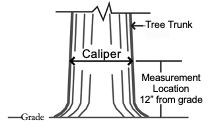
- Evergreen tree at 6 foot in height, or understory tree at 2.5 inch caliper, or multi-stemmed tree at 8 foot in height.
- Deciduous or evergreen shrubs at 18 inches in height.
- Canopy tree at 2.5 inch caliper. Note: caliper shall be measured 12 inches from the base of the tree.
- Planting Material Variety. In order to allow for flexibility while maintaining minimum planting levels, many of the above provisions specify “canopy equivalents” instead of canopy trees. A canopy equivalent is one canopy tree, or three evergreen/ understory/ multi-stemmed trees, or twenty shrubs. These equivalent amounts are allowed to substitute for a canopy tree since the approximate coverage area at maturity of each of the equivalent amounts is comparable to the approximate coverage area at maturity of one canopy tree.
- Acceptable and unacceptable tree species. Acceptable and unacceptable tree species shall be pursuant to Section 4 of the Arboricultural Specifications Manual.
- Prohibited Plant Species. The following plant species are prohibited.
- Noxious Weeds, as defined by the Illinois Noxious Weed Law, 505 ILCS 100/ et. seq.
- Exotic Weeds, as defined by the Illinois Exotic Weed Act, 525 ILCS 10/ et. seq., unless specifically exempted in accordance with the Act.
- Size requirements. The minimum size of the material at time of planting shall be as follows:
- Naturalized Planting Areas. The use of naturalized prairie style landscaping shall be encouraged adjacent to and within stormwater detention facilities, wetland, low-lying and inactive open space areas. These areas must meet the following criteria in addition to the City of Aurora’s Wetland and Naturalized Planting Standards in order to remove said areas from the above stated requirements.
- A detailed species list and management plan shall be prepared by a reputable consultant to be submitted by the Developer with the proposed Landscape Plan. This report shall include specifications on seed mix and amounts of seeds per square foot to be planted.
- These areas shall not be subject to Section PM-302.4 of the Property Standard Ordinance if maintained pursuant to said management plan.
- Installation and maintenance. The planting and maintenance of prairie style landscaping shall be subject to any additional standards as the city may from time-to-time promulgate.
- Minor amendments and deviations. Subsequent to the review of said landscape plan, and issuance of the building permit, the City may allow through a staff review of said plan, minor deviations which do not substantially alter the plan, and which do not substantially diminish the intended benefits of said plan.
- Cost limitations. The cost of planting material required by this ordinance shall be proportionate to the cost of the balance of work being proposed, and shall not exceed 20% of the total project costs, exclusive of sod and seeding costs, as supported by two written bids by recognized contractors.
- Planting Material Installation and Maintenance. Planting material shall be installed prior to the end of the first available planting season prior to the issuance of an Occupancy Permit. Said planting materials shall be maintained and kept in a healthy condition, and any required planting material that dies shall be replaced prior to the end of the next available planting season. An irrevocable Letter of Credit shall be required as deemed necessary by the Zoning Administrator to guarantee installation of improvements required by the approved landscape plan prior to the issuance of a permit. The amount of said Letter of Credit shall be based on written bids from contractors covering the installation of all elements of the landscape plan including but not limited to all planting material, fencing, screen walls and pavers. Said Letter of Credit may be required where there are extensive elements required by the approved landscape plan as determined by the Zoning Administrator.
- Timing Extension for Installation. If construction work is completed during the off-planting season, with the City agreeing that plantings installed at that time would likely die, then a temporary certificate of occupancy shall be issued for the property which shall specify that all planting material as required by this Section be installed prior to the end of the next planting season.
- The following provisions shall be deemed as the minimum requirements for the landscape plan. Additionally, a variety of planting material is desired and must be reflected in the landscape plan.
49-105.5 Lot Size
Shall be pursuant to district specific regulations, if any.
49-105.6 Lot Coverage
Shall be pursuant to district specific regulations, if any.
49-105.7 Monotony Standards
A newly-constructed single family detached home may not be located next to, across the street from, or cater-corner from another such newly-constructed or existing residential structure which has the same front elevation or the same configuration of building materials or the same colors facing the public street.
49-105.8 Nonconformity
- Purpose and Intent.
- This ordinance establishes separate districts, each of which is an appropriate area for the location of the zoning lot configurations, structures, and uses that are permitted in that district. Nonconforming zoning lots, structures, and uses may be created when the application of a specific zoning district to a property changes, or when a zoning regulation otherwise changes. As a result of such changes, then-existing zoning lot configurations, structures, or uses may no longer be allowed or are otherwise limited. It is necessary and consistent with the establishment of those zoning districts that all zoning lot configurations, structures, and uses that are nonconforming therewith be strictly regulated and properly controlled. It is the purpose of this section to provide for the regulation of nonconforming zoning lots, structures, and uses in the various zoning districts, recognizing that a zoning ordinance change is not enacted to require all nonconforming situations to be immediately brought into conformance, but rather to guide them and future zoning lot configurations, structures, and uses in a new direction consistent with current city policy. It is the intent of this section is to protect the character of each zoning district by reducing the negative impacts from nonconforming situations, to assure that revised zoning regulations will not cause inappropriate or unnecessary burdens on individual property, and to permit under limited conditions, but not encourage the survival of these nonconformities by specifying those circumstances under which they shall be allowed to continue.
- Applicability.
- The provisions of this section shall apply to all zoning districts when any of the following circumstances exist:
- Nonconforming zoning lot. A zoning lot, as defined in this ordinance, comprised of one (1) or more parcels configured such that it does not comply with the minimum required lot width or area of the zoning district for the zoning lot.
- Nonconforming structure. A structure that does not comply with the zoning provisions then currently applicable to the zoning lot on which said structure is located, or a structure originally designed for a use not permitted within the zoning district for the zoning lot, with such determination being made by the zoning administrator.
- Nonconforming use. A use on a zoning lot that does not comply with the zoning district provisions then currently applicable to the zoning lot on which said use is located, including a use not allowed in the zoning district for such zoning lot.
- The provisions of this section shall apply to all zoning districts when any of the following circumstances exist:
- Continuance of a Nonconforming Zoning Lot, Structure, or Use.
- Any lawfully established zoning lot, structure, or use that existed prior to the effective date of this ordinance, or of applicable amendments hereto and currently subject to one (1) or more of the circumstances described in the Applicability subsection of this Nonconformity Section, shall be deemed legal nonconforming and may be continued subject to the provisions of this section.
- Permitted Changes to Legal Nonconforming Zoning Lots, Structures and Uses.
- Changes to legal nonconforming zoning lots, structures, and uses permitted to continue pursuant to this section shall be permitted in accordance with the following sections, with the most restrictive subsection being enforced in case of multiple applicability. (Legal nonconforming zoning lot and the structures thereon section contains the least restrictive provisions, Legal nonconforming structure section contains more restrictive provisions, and Legal nonconforming uses and the structures related thereto section contains the most restrictive provisions.)
- Legal nonconforming zoning lot and the structures thereon.
- Conformance. Any legal nonconforming zoning lot may obtain conforming status pursuant to the following:
- A zoning lot may be modified, altered or otherwise changed to be brought into conformance with the provisions of this ordinance
- A zoning lot within the R-5 district may be issued a Mitigation Certificate pursuant to the Bulk Restrictions Section hereof.
- Repair and maintenance. Normal and customary repair and maintenance of a structure located on a legal nonconforming zoning lot is permitted.
- Alterations. The following shall be the only circumstances where an alteration is allowed for a structure on a legal nonconforming zoning lot:
- When the alteration is otherwise required by law.
- When the alteration provides an exterior improvement to the appearance of the structure such as but not limited to a new storefront.
- When a structure containing residential uses is internally altered in a way to improve livability, provided it does not increase the number of dwelling units.
- When a structure containing a religious use is internally altered in a way to improve its function.
- When such a structure containing a use that complies with the zoning district provisions then currently applicable to that zoning lot is internally altered in a way that accommodates said use.
- Additions and enlargements. A structure located on a legal nonconforming zoning lot may be added onto, enlarged or extended only if the entire structure is thereafter devoted to a conforming use and said addition, enlargement or extension conforms to all of the then current regulations of the zoning district in which it is located.
- Use of a vacant legal nonconforming zoning lot. Any vacant zoning lot made up of one (1) or more parcels that does not meet the minimum lot width or area according to the then current Aurora Zoning Ordinance, may be utilized for an otherwise permitted use, provided that both the lot width and area are not less than eighty (80) percent of the minimum width and area required.
- Reconstruction of a damaged or destroyed structure.
- A structure located on a legal nonconforming zoning lot which is damaged or destroyed by any means to the extent of less than fifty (50) percent of its replacement value pursuant to this ordinance, may be reconstructed and the use of said structure which existed at the time of such partial destruction may be continued, provided that the restoration or repair of the structure is started within six (6) months of the destruction date and diligently pursued to completion within two (2) years of the destruction date. A written extension of these time limits may be granted by the Zoning Administrator for up to one (1) year to allow for pending insurance settlements, or other lawful considerations. The city council may grant further written extensions in addition to the one (1) year granted by the Zoning Administrator.
- A structure located on a legal nonconforming zoning lot which is damaged or destroyed by any means to the extent of fifty (50) percent or more of its replacement value pursuant to this ordinance, may be reconstructed and the use of said structure which existed at the time of such destruction may be continued, provided that the width and area of said zoning lot are each not less than eighty (80) percent of the minimum required width and area.
- A structure in the form of a single-family detached dwelling upon a legal nonconforming zoning lot located within a residential zoning district, that is damaged or destroyed partially or in totality, may only be rebuilt in conformance with the structure's dimensions and height as existed prior to such damage or destruction.
- (Reserved)
- Conformance. Any legal nonconforming zoning lot may obtain conforming status pursuant to the following:
- Legal Nonconforming Structure.
- Conformance. Any legal nonconforming structure may be modified, altered, rebuilt or otherwise changed to be brought into conformance with the provisions of this ordinance either partially or in totality.
- Repair and maintenance. Normal and customary repair and maintenance of a legal nonconforming structure is permitted.
- Alterations. The following shall be the only conditions where an alteration is allowed for a legal nonconforming structure:
- When the alteration is otherwise required by law.
- When the alteration provides an exterior improvement to the appearance of a legal nonconforming structure such as but not limited to a new storefront.
- When a legal nonconforming structure containing residential uses is internally altered in a way to improve livability, provided it does not increase the number of dwelling units.
- When a legal nonconforming structure containing a religious use is internally altered in a way to improve its function.
- When such a legal nonconforming structure containing a use that complies with the zoning district provisions then currently applicable to that zoning lot is internally altered in a way that accommodates said use.
- When the alteration does not involve in any way the exterior portion of the structure that is the cause for such structure having legal nonconforming status.
- Additions and enlargements. A legal nonconforming structure may be added onto, enlarged or extended only if the entire structure is thereafter devoted to a conforming use and said addition, enlargement or extension conforms to all the then current regulations of the zoning district in which it is located.
- Use of a legal nonconforming structure. A legal nonconforming structure shall only be occupied by a use that conforms to all then current regulations of the zoning district in which it is located, or by a legal nonconforming use.
- Reconstruction of a damaged or destroyed legal nonconforming structure.
- A legal nonconforming structure damaged or destroyed by any means to the extent of less than fifty (50) percent of its replacement value pursuant to the Evaluation of a damaged or destroyed structure subsection of this Nonconformity Section 49-105.8(g), may be reconstructed and the use of said structure which existed at the time of such partial destruction may be continued, provided that the restoration or repair of the legal nonconforming structure is started within six (6) months of the destruction date and diligently pursued to completion within two (2) years of the destruction date. A written extension of these time limits may be granted by the Zoning Administrator for up to one (1) year to allow for pending insurance settlements, or other lawful considerations. The city council may grant further written extensions in addition to the one (1) year granted by the Zoning Administrator.
- Notwithstanding the previous regulation, a legal nonconforming structure in the form of a single-family detached dwelling, located within a residential zoning district, that is damaged or destroyed partially or in totality, may only be rebuilt in conformance with the structure's dimensions and height as it existed prior to such damage or destruction, provided that the restoration or repair of the legal nonconforming structure is started within six (6) months of the destruction date and diligently pursued to completion within two (2) years of the destruction date. A written extension of these time limits may be granted by the Zoning Administrator for up to one (1) year to allow for pending insurance settlements, or other lawful considerations. The city council may grant further written extensions in addition to the one (1) year granted by the Zoning Administrator.
- Legal nonconforming uses and the structures related thereto.
- Conformance. Any legal nonconforming use may be modified, altered or otherwise changed to be brought into conformance with the provisions of this ordinance. A legal nonconforming use may be changed to a use of the same, or of a more restricted character, but may not thereafter be changed to any less restricted use.
- Repair and maintenance. Normal and customary repair and maintenance of a structure is permitted.
- Alterations. The following shall be the only conditions where an alteration is allowed for a structure:
- When the alteration is otherwise required by law.
- When the alteration provides an exterior improvement to the appearance of a structure such as but not limited to a new storefront.
- When a structure containing residential uses is internally altered in a way to improve livability, provided it does not increase the number of dwelling units.
- When a structure containing a religious use is internally altered in a way to improve its function.
- Additions and enlargements. A structure wholly or partially occupied by a legal nonconforming use is not allowed to be expanded and/or enlarged in any way.
- Reconstruction of a damaged or destroyed structure involving a legal nonconforming use. A structure damaged or destroyed by any means to the extent of fifty (50) percent or more of its replacement value pursuant to the Evaluation of a damaged or destroyed structure subsection of this Nonconformity Section 49-105.8(g) may only be rebuilt in conformance with applicable, then current zoning district provisions.
- Previously Issued Permits.
- Any structure for which a permit has been lawfully issued prior to the effective date of this ordinance or of subsequent amendments hereto, may be completed in accordance with the approved plans for which said permit was issued provided construction is started within six (6) months after the date of the permit issuance and diligently pursued to completion within two (2) years from such date. Such structure shall thereafter be deemed a legal nonconforming structure, if it is then subject to one (1) or more of the following circumstances described in the Applicability subsection of the Nonconformity Section.
- Discontinuance of Legal Nonconforming Status for Zoning Lots, Structures, or Uses.
- Any legal nonconforming zoning lot, structure, or use that has been brought into conformance with the zoning district provisions then currently applicable to the zoning lot, shall not thereafter be classified as legal nonconforming. Said legal nonconforming status shall also be terminated in the following circumstances, and such properties shall thereafter fully comply with the zoning district provisions then currently applicable to the zoning lot:
- Legal Nonconforming Zoning Lot.
- When any zoning lot made up of one (1) or more parcels owned or controlled by the same individual or group of individuals and taxed as one (1) tax parcel, conforms to either the minimum lot width or area required for that zoning lot, or both, said parcels that make up the zoning lot shall not qualify separately as legal nonconforming zoning lots.
- When a structure on a legal nonconforming zoning lot is damaged or destroyed by any means to the extent of fifty (50) percent or more of its replacement value pursuant to the Evaluation of a damaged or destroyed structure subsection of this Nonconformity Section 49-105.8(g), and either the width or area of said zoning lot is less than eighty (80) percent of the minimum width and area required, except as provided in the Reconstruction of a damaged or destroyed structure subsection provision 49-105.8(d)(2)f,2 of this Nonconformity Section.
- Legal Nonconforming Structure.
- When a structure is damaged or destroyed by any means to the extent of fifty (50) percent or more of its replacement value pursuant to the Evaluation of a damaged or destroyed structure subsection of this Nonconformity Section 49-105.8(g), except as provided in Reconstruction of a damaged or destroyed structure subsection provision 49-105.8(d)(2)f,2 of this Nonconformity Section.
- When a structure is damaged or destroyed by any means to the extent of less than fifty (50) percent of its replacement value pursuant to the Evaluation of a damaged or destroyed structure subsection of this Nonconformity Section 49-105.8(g), but has not met the timing requirements of the Reconstruction of a damaged or destroyed structure subsection provision 49-105.8(d)(2)f,1 of this Nonconformity Section.
- When a legal nonconforming structure in the form of a single-family detached dwelling, located within a residential zoning district, is damaged or destroyed partially or in totality, and has not met the timing requirements of the Reconstruction of a damaged or destroyed structure subsection provision 49-105.8(d)(2)f,3 of this Nonconformity Section.
- Legal Nonconforming Use.
- When a legal nonconforming use has been discontinued for a period of six (6) consecutive months, and said use occupied a structure originally built in such a way as to be specifically designed for a residential use, with such determination being made by the zoning administrator.
- When a legal nonconforming use has been discontinued for a period of fifteen (15) consecutive months, where said use occupies a structure originally built in such a way as to be specifically designed for a nonresidential use, with such determination being made by the zoning administrator.
- When a legal nonconforming use has been discontinued for a period of three (3) consecutive months, where said use does not primarily involve an on-site enclosed structure, with such determination being made by the zoning administrator.
- When there is evident to the city a clear intent on the part of the property or business owner to abandon a legal nonconforming use, with such determination being made by the zoning administrator.
- Evaluation of a Damaged or Destroyed Structure.
- In the event that a structure is damaged or destroyed by any means, said structure shall be evaluated by the Zoning Administrator for purposes of estimating the extent of said damage or destruction. Said evaluation shall estimate the replacement value of said structure and compare it to the estimated value of the structure just prior to its damage or destruction. The Zoning Administrator shall set forth in written form the percentage of damage within the evaluation, which shall be made available to the owner of said structure or representative thereof. Said evaluation may be appealed by the owner of said structure to the commission as set forth in chapter 34 of this code.
- Unauthorized Zoning Lot, Structure, or Use.
- Any zoning lot, structure, or use not authorized by the provisions of this ordinance and which does not qualify as legal nonconforming pursuant to the Continuance of a nonconforming zoning lot, structure, or use subsection of this Nonconformity Section, shall be discontinued and not reestablished.
- Mitigation Certificate.
- A property owner may obtain conforming status for their property through the issuance of a Mitigation Certificate pursuant to the following:
- Qualifications. A property shall be eligible for a Mitigation Certificate if all of the following conditions are met or exist:
- The zoning lot is zoned R-5.
- The zoning lot is legal nonconforming.
- The owner/manager of said zoning lot has maintained a Waiver of License as defined by the property maintenance ordinance for a minimum period of four (4) consecutive years just prior to the application for a Mitigation Certificate, and said owner/manager agrees to maintain said waiver as a condition of the granting of a Mitigation Certificate.
- The owner/manager of said zoning lot has maintained a level of Police Incidents for the subject property no higher than an amount which is ten (10) percent of the number of units, for a minimum period of four (4) consecutive years just prior to the application for a Mitigation Certificate, and said owner/manager agrees to maintain said level as a condition of the granting of a Mitigation Certificate.
- The owner of said zoning lot has entered into an Enforcement Agreement with the city for the subject property in lieu of a Property Management Agreement as defined within the R-5 Multiple Family Dwelling District Section of this ordinance, which Enforcement Agreement states that Owner agrees to perform at then current standards with regard to inspections and police incidents under the Bulk Restrictions Section of this ordinance. In the event that the performance of Owner falls below current standards for police incidents and inspection waivers as provided by this ordinance , Owner agrees to enter into and to abide by a Property Management Agreement with the City for the purpose of correcting the out-of-compliance status. The Property Management Agreement may specify management standards and practices as well as the criteria by which these standards shall apply to the subject property, including qualification criteria, occupancy standards, causes for eviction, property maintenance and police activity, all as provided under the R-5 Multiple Family Dwelling District Section.
- Certificate Issuance. A property owner shall apply to the Zoning Administrator for a Mitigation Certificate, providing evidence indicating compliance with the Qualifications subsection of this Mitigation Certificate Section hereof, along with an accurate survey and legal description of the subject property. The Zoning Administrator shall determine if the subject property is eligible for a Mitigation Certificate, and shall issue it with all supportive documentation attached thereto. Said certificate shall be executed by the Zoning Administrator and subject property owner, and shall be recorded on the subject property by the Zoning Administrator.
- Zoning Violation. All executed and recorded Mitigation Certificates shall be binding on the subject property owner, and said owner is required to abide by all conditions under which said certificate was issued. In the event that the Zoning Administrator determines that any provision of said certificate, or the subject properties eligibility, is no longer being complied with, said property owner shall be subject to enforcement thereof.
49-105.9 Obstructions
- Permitted obstructions for E, R1, R2 and R3 single-family residential districts are identified in Table Four: Permitted Structures and Obstructions.
- Permitted obstructions in districts other than E, R1, R2 and R3.
- The following shall not be considered to be obstructions when located in the required yards specified:
- In all yards.
- Open terraces not over four (4) feet above the average level of the adjoining ground but not including a permanently roofed-over terrace or porch;
- Awnings and canopies;
- Steps, four (4) feet or less above grade, which are necessary for access to a permitted building, or for access to a zoning lot from a street or alley;
- Chimneys projecting twenty-four (24) inches or less into the yard;
- Recreational and laundry-drying equipment;
- Arbors and trellises;
- Flag poles.
- In front yards.
- One-story bay windows projecting three (3) feet or less into the yard;
- Overhanging eaves and gutters projecting three (3) feet or less into the yard;
- Fences and walls, with the following exception:
- When located in O, B1, B2, B3, M1 and M2 zoning districts fences and walls are not permitted between the lot line bordering any public right-of-way, and the required setback line.
- In rear yards.
- Enclosed, attached, or detached off-street parking spaces
- Open off-street parking spaces
- Accessory sheds, tool rooms, and similar buildings or structures for domestic or agricultural storage
- Balconies
- Breezeways and open porches
- One-story bay windows projecting three (3) feet or less into the yard;
- Overhanging eaves and gutters projecting three (3) feet or less into the yard;
- Fences and walls.
- In side yards.
- Overhanging eaves and gutters projecting into the yard for a distance not exceeding ten (10) percent of the required yard width but in no case, exceeding eighteen (18) inches;
- Fences and walls.
- In all yards.
- The following shall not be considered to be obstructions when located in the required yards specified:
- Use of Exterior Yards.
- In the O, BI, B2, B3, M1 and M2 districts there shall be no structure of any kind (except for lights and permitted signs), open storage of materials or equipment, or the parking of vehicles in the area between the lot line bordering any public right-of-way, and the required setback line. Lights for the purpose of illuminating parking areas are not permitted in such exterior yards. Such yards shall contain no paving except for accessways perpendicular to the street or sidewalks across the lot. Accessways shall not exceed twenty-five (25) feet in width per approved access point. No other drives or auto maneuvering areas are permitted in the exterior yards.
- Screening of storage areas. Storage areas shall be screened according to the provisions of the Landscaping Section in the Bulk Restrictions.
49-105.10 Performance Standards
All outdoor lighting fixtures shall be designed, shielded, aimed, located and maintained to shield adjacent properties and not to produce glare onto adjacent properties or roadways.
49-105.11 Setbacks
- Setbacks for all buildings, structures and uses of land shall be set forth under each zoning district.
- Front yard, side yard and building line setbacks on existing or anticipated four-lane highways or streets.
- Provisions as to front or side yards abutting upon existing four-lane or anticipated four-lane highways or streets, and front setback lines on such property, shall, notwithstanding other provisions in this ordinance, be changed by a two-thirds vote of all the members voting of the city council to provide for a future eighty (80) feet to one hundred (100) feet right-of-way.
49-105.12 Signs
- Sign Regulations.
- All sign regulations shall be subject to chapter 41 of this code, except that all signage erected in the BB district shall be governed by the applicable provisions of the BB Business-Boulevard District.
49-105.13 Off-Street Parking And Loading
- Intent and Purpose.
- The intent and purpose of this section of the zoning ordinance is to alleviate or prevent congestion of the public streets, and so promote the safety and welfare of the public, by establishing minimum requirements for the off-street parking and loading and unloading of motor vehicles in accordance with the use to which property is put.
- General Provisions.
- Procedure. An application to be filed by the owner, lessee or designated agent thereof for a building permit for a new or enlarged building, structure, or use, shall include therewith a plot plan, drawn to scale, and fully dimensioned showing any parking or loading facilities to be provided in compliance with the requirements of this ordinance.
- Extent of Control. The off-street parking, driveway and loading requirements of this ordinance shall apply as follows:
- All buildings and structures erected or enlarged and land uses initiated after the effective date of this ordinance shall provide accessory off-street parking or loading facilities as required hereinafter for the use thereof, except that a building or structure for which a building permit has been issued prior to the effective date of this ordinance shall not be required to furnish parking or loading facilities if construction is begun thereon within six (6) months of the effective date of the building permit and diligently prosecuted to completion.
- When a building or structure erected or enlarged prior to or after the effective date of this ordinance shall undergo a decrease in number of dwelling units, gross floor area, seating capacity, number of employees, or other unit of measurement specified hereinafter for required parking or loading facilities, and further, when said decrease would result in a requirement for a fewer total parking or loading spaces through application of the provisions of this ordinance thereto, parking and loading facilities may be reduced accordingly provided that existing parking or loading facilities shall be so decreased only when the facilities remaining would at least equal or exceed the parking or loading requirements resulting from application of the provisions of this ordinance to the entire building or structure as modified.
- When a building or structure shall undergo any increase in number of dwelling units, gross floor area, seating capacity, or other unit of measurement specified hereinafter for required parking or loading facilities, and further, when said increase would result in a requirement for additional total parking or loading spaces through application of the provisions of this ordinance thereto, parking and loading facilities may be increased accordingly, provided that existing parking or loading facilities shall be so increased so that the facilities would at least equal or exceed the parking or loading requirements resulting from application of the provisions of this ordinance to the entire building or structure as modified.
- The parking, driveway and loading facilities for a building, structure or use shall be increased and properly surfaced whenever the following occurs:
- Any increase in number of dwelling units.
- Any increase in gross floor area resulting in a requirement for additional parking or loading spaces.
- Any increase in seating capacity resulting in a requirement for additional parking or loading spaces.
- An increase in any unit of measurement specified hereinafter resulting in a requirement for additional parking or loading spaces.
- Rebuilding or reconstruction after damage exceeding fifty (50) percent of principal building.
- Rezoning of the property to a classification other than R-1 single-family, R-2 single-family, R-3 single-family or R-4 two-family dwelling district.
- When an accessory garage building is newly constructed or new garage construction results in an increase in the number of parking spaces on a zoning lot, previously provided.
- The parking, driveway, and loading facilities for a building structure or use shall be properly surfaced whenever the following occurs:
- A gravel surface which has deteriorated or been damaged by determination of the Zoning Administrator. Said deterioration or damage may include, without limitation, any or all of the following: loss of gravel, dirt surface, sinking and dips, pooling of water, lack of any border, and/or encroachment or growth of vegetation. Repair of the gravel surface may not occur once the property has been cited or noticed, except by properly surfacing the driveway with either asphalt, concrete or brick pavers.
- FoxWalk Overlay District Exception. Within the FoxWalk Overlay District, the off-street parking regulations set forth in this section, with the exception of the loading requirements, shall not apply to any uses of new buildings or structures, or any existing principal building or structure which is enlarged or increased in capacity.
- Existing Parking and Loading Spaces. Accessory off-street parking and loading spaces in existence on the effective date of this ordinance may not be reduced in number unless already exceeding the requirements of this section for equivalent new construction; in which event, said spaces shall not be reduced below the number required herein for such equivalent new construction.
- Permissive Parking and Loading Spaces. Nothing in this section shall prevent the establishment of off-street automobile parking or loading facilities to serve any existing use of land or buildings, subject to full compliance with the provisions of this section. Except when located on a lot adjacent to the premises containing the principal use, no off-street parking areas accessory to existing multiple-family structures may be located off the premises containing the principal use without express authorization by the city council.
- Measurements.
- Tables for required parking and loading. Requirements governing the number and location of off-street parking and off-street loading facilities in relation to the use of property are established hereinafter in subsections of this ordinance. The parking and loading requirements for any use not specified herein shall be the same as for a similar specified use.
- Floor area. The term "floor area" as employed in this parking and loading section in the case of office, merchandising or service types of use shall mean the gross floor area of a building or structure used or intended to be used for service to the public as customers, patrons, clients, patients or tenants, including areas occupied by fixtures and equipment used for display or sale of merchandise. "Floor area" for the purposes of this section shall not include any area used for:
- Storage accessory to the principal use of a building;
- Incidental repairs;
- Processing or packaging of merchandise;
- Show windows, or offices incidental to the management or maintenance of a store or building;
- Rest rooms;
- Utilities, including HVAC systems, or
- Dressing, fitting or alteration rooms.
- Extent of control. Off-street parking facilities shall be located as hereinafter specified; where a distance is specified, such a distance shall be measured from the nearest point of the parking area to the nearest entrance of the building that said parking area is required to serve.
- Measurement of space. Minimum parking stall dimensions in this section are exclusive of access drives or aisles, ramps, columns, office and work areas individually accessible from streets or alleys, or from private driveways or aisles leading to streets or alleys.
- Number of spaces. When determination of the number of required off-street parking spaces results in a requirement of a fractional space, any fraction up to and including one-half shall be disregarded, and fractions over one-half shall be interpreted as one (1) parking space.
- Measurement of dock. When determination of the number of required off-street loading docks results in a requirement of a fractional dock, any fraction up to and including one-half shall be disregarded, and fractions over one-half shall be interpreted as one (1) loading dock.
- General Regulations.
- Schedule of Parking Requirements. The schedules of parking requirements are as identified in Table Two: Schedule of Parking Requirements.
- Parking Facilities.
- Purpose. Parking facilities are to be used for the storage or parking of passenger automobiles and commercial vehicles under one and one-half-ton capacity where permitted under this ordinance. The parking, standing, loading or unloading of motor trucks, tractors and trailers are only permitted in designated loading dock areas as described in the Loading Docks portion of this section.
- Location of parking facilities. Off-street parking facilities shall be provided on the same lot or parcel of land as the principal building being served, or on a separate lot or parcel of land not over four hundred (400) feet from the entrance of the principal building, measured from the nearest point of the parking area, provided the separate lot or parcel of land intended for the parking facilities is located in the same district as the principal permitted use or in a less restricted district.
- Safety. Vehicles shall not be parked or stored in such a manner as to create a dangerous or unsafe condition. Dangerous and unsafe conditions shall be determined by the zoning administrator and are as follows, but not limited to, parking or storing the vehicle in a manner such that it may tip or roll, or having pointed objects, such as propellers or motors, without being covered or protected and are within two feet of a sidewalk, bike path, roadway pavement, or other pedestrian or vehicular ways.
- Open and enclosed spaces. Parking facilities may be open or enclosed.
- Access. Parking facilities shall be designed with appropriate means of vehicular access to a street or alley in such a manner as will least interfere with the movement of traffic, and shall comply with all provisions of other ordinances regulating the location and construction of driveways.
- Signs. No sign shall be displayed in any parking area within any residential district, except such as may be necessary for the orderly use of the parking facilities.
- Required setbacks. No parking area or facility established on the same zoning lot with a building shall be located within any yard setback required for the district in which the parking facility is located. No parking area or facility established on a zoning lot without a building shall be located closer to any street line that the established building line on adjacent properties.
- Surfacing. All open off-street parking facilities shall be improved with a gravel compacted macadam base, not less than four (4) inches thick, and surfaced with asphalt, asphaltic concrete or constructed to a comparable specification.
- Parking Stalls. The following diagram indicates the minimum standard for parking stalls:
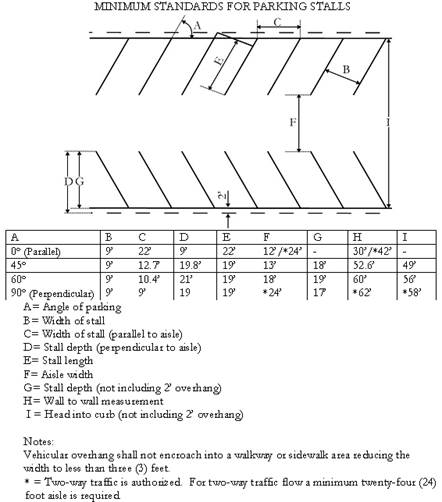
- Striping. All spaces within parking facilities shall be striped.
- Lighting. As otherwise required by this ordinance.
- Joint Parking Facilities. Off-street parking facilities for different buildings, structures or uses or for mixed uses, may be provided collectively in any zoning district in which separate parking facilities for each constituent uses would be permitted, provided that the total number of spaces so located together shall not be less than the sum of the separate requirements for each use.
- Control of the Off-site Facilities. When required accessory off-street facilities are provided elsewhere than on the lot on which the principal use served is located, the ownership of land wherein the principal use and the parking area shall be the same, and if not, the owner of the lot wherein the principal use is located shall supply the city with evidence, to the reasonable satisfaction of the corporation counsel, either through a long-term lease (no less than 20 years) recorded easements or documentation that would allow the parties use of the lot wherein the parking area is to be maintained.
- Permitted Districts for Accessory Parking. Accessory parking facilities provided elsewhere than on the same zoning lot with the principal use served in accordance with the parking requirements for hotels and motels, may be located in any zoning district except as follows:
- No parking facilities accessory to an apartment use shall be located in an R-1, R-2, or R-3 district.
- No parking facilities accessory to a business or manufacturing use shall be located in a residential district, except when authorized by the city council as prescribed hereinafter.
- (Reserved)
- Loading Docks.
- Purpose. An off-street loading dock shall be a hard-surfaced area of land, open or enclosed, other than a street or a public way, used principally for the standing, loading or unloading of motor trucks, tractors and trailers so as to avoid undue interference with the public use of streets and alleys.
- Size. A required loading space shall not be less than ten (10) feet in width, forty-five (45) feet in length, and fourteen (14) feet in height, exclusive of access aisles and maneuvering space, except as otherwise specifically dimensioned hereafter.
- Location.
- No permitted or required loading dock shall be closer than fifty (50) feet to any property in a residential district unless completely enclosed by building walls, or a uniformly painted solid fence or wall, or any combination thereof not less than six (6) feet in height.
- No permitted or required loading dock shall be located within twenty-five (25) feet of the nearest point of intersection of any two (2) streets.
- Loading docks open to the sky may be located in any required yards.
- Surfacing. All open off-street loading docks shall be improved with a compacted macadam base not less than seven (7) inches thick, surfaced with not less than two (2) inches of asphaltic concrete or some comparable construction material.
- Residential Specific Regulations.
- Off-street parking accessory to a residential use when not one hundred percent (100%) enclosed in a garage or shed, shall be limited by the following provisions; all regulations are listed per zoning lot.
- Types of Vehicles allowed. The owner of any vehicle shall also be the legal or beneficial owner or lessee of the real estate upon which said vehicle is stored, standing or parked. Upon request by an authorized agent of the City, proof of ownership shall be provided. The following types of vehicles are allowed:
- Passenger vehicles
- Recreational vehicle
- Boat
- Trailer
- Commercial vehicle – excluding tow trucks and panel trucks, which shall be prohibited.
- Essential Emergency Commercial Vehicle.
- Quantity of vehicles allowed.
- Passenger vehicles – A zoning lot shall be limited to five (5) in total.
- Recreational vehicle, boat, trailer, commercial vehicle, or emergency commercial vehicle - A zoning lot shall be limited to one (1) in total.
- Size of vehicles allowed.
- Passenger vehicles – shall not exceed twelve (12) person capacity.
- Recreational vehicle – shall not exceed twenty-five (25) feet in length, eight (8) feet in width, or greater than eleven (11) feet in height excluding the antennae, unless the said vehicle is stored in an enclosed garage or other structure.
- Boat – shall not exceed twenty-five (25) feet in length
- Trailer – shall not exceed the twenty feet (20’) in length.
- Commercial vehicle – shall not exceed the standards of a State of Illinois licensure classification of "B,"
- Essential Emergency Commercial Vehicle – shall not exceed a State of Illinois licensure classification of "D"
- Required setbacks. The above stated General regulations shall apply with the following exceptions:
- Parking of vehicles may occur upon all driveways pursuant to subsection (c)(8)a,5 below.
- Vehicles, with the exception of Passenger vehicles, must conform to the following minimum distances from the zoning lot lines:
- Front Lot Line – prohibited between the primary structure and this lot line except as stated in the “Additional Regulations for Outdoor storage, parking or standing of recreational vehicles, boats or trailers” section below.
- Rear Lot Line – 5 feet
- Exterior Side Lot Line – prohibited between the primary structure and this lot line.
- Interior Side Lot Line – 3 feet
- Driveways. Parking and driveways for residential uses shall conform to the following regulations:
- Number. One driveway and one curb cut or vehicular entrance into a street or alley shall be permitted per lot, with the following exceptions:
- Through Lots. A through lot may have one curb cut on each frontage.
- Lots Abutting Alleys. A lot abutting an alley that has a detached garage: may have a vehicular entrance from the alley only if the garage is located at least 5 feet from the alley, and may have a curb cut on a street only if such garage is located less than 20 feet from the alley.
- Circular Drives in Front Yards. An interior or corner lot having a lot width of 75 feet or more may have a circular driveway with two curb cuts located in the actual front yard.
- Circular Drives in Corner Side Yards. A corner lot with a lot width of less than 100 feet may have a circular driveway with two curb cuts located in the actual corner side yard in lieu of a driveway in the actual front yard. An entrance or exit from an alley may substitute for one of the curb cuts.
- Vacant Lots. A vacant lot or parcel shall not have a driveway, curb cut, or other vehicular access. In the event of a building demolition, the Zoning Administrator in collaboration with the City Engineer will have the discretion to allow a driveway, curb cut, or other vehicular access to remain for a limited amount of time.
- Driveway Turnarounds. No driveway turnaround shall be more than 12 feet long, or over 10 feet wide, excluding flairs. No driveway turnaround shall be permitted in a required front yard located between the dwelling structures and the street except where:
- The garage on the premises accommodates only one car, and
- The regulations herein together with the characteristics of the property prevent establishment of more than 2 spaces on the lot, and
- The lot has frontage on an arterial street designated in the City Comprehensive Plan.
- Configuration. A driveway within a required front yard shall be essentially perpendicular to the street pavement and shall not extend in front of the dwelling structure.
- Dimensions. Dimensions of residential driveways shall be as provided in Table Three: Residential Driveways.
- Additional Vehicle Flare. One (1) flare to the leading driveway is allowed with the following additional provisions:
- The flare shall not be permitted within the first five (5) feet of the front setback.
- The flare may have a maximum dimension of 18 feet in length and 6 feet in width.
- A maximum of one (1) vehicle may be parked/stored on the flare section.
- The flare shall not be allowed in front of a habitable portion of the primary structure.
- The flare shall be reasonably screened from adjacent properties as provided herein. Screening shall be to an opacity of not less than seventy-five (75) percent, be a minimum of six (6) feet above grade, and not exceed eight (8) feet in height. Screening may be accomplished by berming, landscaping at seven canopy tree equivalents per 100 feet of storage perimeter, solid fencing, or wall construction. For fencing limitations in residential districts refer to the Fencing and Wall Section under Residential Specific Regulations of Part B. Lot Coverage. No driveway shall together with all Principal and Accessory Structures cover more than the allowed lot coverage for the specific zoning district.
- Number. One driveway and one curb cut or vehicular entrance into a street or alley shall be permitted per lot, with the following exceptions:
- (Reserved)
- Additional Regulations for outdoor storage, parking or standing of personal or commercial recreational vehicles, boats or trailers.
- Purpose. The presence of recreational vehicles, boats or trailers, and other certain motor vehicles that, by virtue of their design, type, or characteristics, are not customary and incidental to the use or occupancy in a residential district may be detrimental to the surrounding area. These said vehicles intrude upon the visual aesthetics, may create excessive noise, and can impair the free flow of traffic within a residential neighborhood. The purpose of this section is to provide regulations that would prohibit or restrict the ways in which recreational vehicles are parked or stored, thereby reducing such negative impacts upon the adjacent property owners or the neighborhood as a whole.
- Location and Storage. No recreational vehicles, boats or trailers may be parked on public right of way. As such, vehicles, boats or trailers shall be in an unused, unoccupied fully stored state and at no time shall a parked or stored recreational vehicle be used for living, sleeping, or other purposes while on the zoning lot. In addition, no recreational vehicle shall be connected to electric, gas, water, or sanitary sewer service.
- Surfacing. Any recreational vehicles, boats or trailers parked or stored outside shall be accessible only from a residential driveway and on an approved all-weather surface no more than 30 feet in length and consisting of either asphalt, brick, or concrete in the form of continuous ribbon strips a maximum of 2 feet in width or grass pavers, either for the full width of the vehicle or in the form of continuous ribbon strips a minimum of 2 feet in width. Surfacing requirements shall also meet the lot coverage requirements contained in specific zoning district.
- Screening. Any recreational vehicles, boats or trailers parked or stored outside shall be reasonably screened from adjoining properties as provided herein. Screening shall be to an opacity of not less than seventy-five (75) percent, be a minimum of six (6) feet above grade, and not exceed eight (8) feet in height. Screening may be accomplished by berming, landscaping at seven canopy tree equivalents per 100 feet of storage perimeter, solid fencing, or wall construction. Fencing in residential districts shall further be subject to the limitations set forth in this ordinance.
- Required Setbacks. The above stated required setback regulations shall apply with the exception that recreational vehicles may be parked in required front and exterior side yards only if the following conditions are satisfied:
- The vehicle is used daily and is the owner's principal means of transportation to and from their place of employment.
- The length of the vehicle shall not exceed twenty-five (25) feet.
- Loading and Unloading. For a period not to exceed 48 hours prior and subsequent to a trip, a recreational vehicles, boats or trailers may be parked in the driveway in the required front yard or exterior side yard for the purposes of loading and unloading. Parking of a recreational vehicles, boats or trailers for a five-day time frame per each calendar month for loading and unloading purposes may take place in the required front yard without the necessity of complying with the above stated Surfacing, Screening or Required Setbacks provision. This time frame may be reasonably extended by the zoning administrator to accommodate additional loading and unloading.
- Types of Vehicles allowed. The owner of any vehicle shall also be the legal or beneficial owner or lessee of the real estate upon which said vehicle is stored, standing or parked. Upon request by an authorized agent of the City, proof of ownership shall be provided. The following types of vehicles are allowed:
- Off-street parking accessory to Multi-Family residential structures when one hundred percent (100%) enclosed, shall be limited by the following additional provisions when constructed subsequent to January 1, 2012; all regulations are listed per zoning lot.
- Location of parking facilities.
- Multi-Family residential structures of any height with common corridors or with 4 stories more without common corridors: Parking spaces shall be located within the primary structure.
- Parking facilities standards when located within and/or beneath the primary structure and when regulated pursuant to the above-mentioned subsection (c)(8)b,1.
- Brick, decorative precast or masonry surface for exterior walls.
- Location of parking facilities.
- Off-street parking accessory to a residential use when not one hundred percent (100%) enclosed in a garage or shed, shall be limited by the following provisions; all regulations are listed per zoning lot.
49-105.14 Applicability Of Bulk Regulations To Zone Districts
- The bulk regulations set forth in this Sec. 49-105 shall apply in all zoning districts in the manner and to the extent described herein, except as Article II of this ordinance may establish zone-specific regulations.
- In construing the term “bulk regulations” as used throughout Article II of this chapter, unless the context otherwise requires, “bulk regulations” include the bulk restrictions set forth in sec. 49-105.1, the floor area ratios set forth in sec. 49-105.2, the high, bulk, and lot coverage regulations set forth in Sec. 49-105.3, the landscaping regulations set forth in sec. 49-105.4, the restrictions on obstructions set forth in sec. 49-105.9, the performance standards set forth in Sec. 49-104.10, the standards for setbacks set forth in sec. 49-105.11, and the requirements for off-street parking and loading set forth in sec. 49-105.13.

