
Aurora City Zoning Code
ARTICLE 49
II ZONE DISTRICTS
O23-087
O22-107
49-106.1 Purpose
These districts shall establish land use regulations for publicly held open space, recreational areas, and parks within the city with the intent:
- To provide a zoning district that shall allow public open space, recreational areas and parks consistent with the city’s comprehensive plan and those of the park districts serving the city; and
- To provide a zoning district that shall allow public open space, recreational areas and parks to be developed according to said planning efforts; and
- To provide facilities that are accessible for all socioeconomic groups; and
- To establish safe and secure facilities; and
- To cooperate with all interrelated governmental agencies in utilizing common resources in establishing facilities; and
- To allow active and passive recreational activities; and
- To encourage preservation of natural areas that have maintained features of the physiographic region; and
- To encourage conservation of wildlife sanctuaries and habitats; and
- To encourage preservation of scenic areas; and
- To provide for the interconnection of open space, recreational areas and parks with parkways, rural drives and parkways; and
- To maximize the benefit of the public parks within the city while minimizing the impacts on surrounding land uses; and
- To buffer any active recreational uses from residential land uses.
49-106.4 "OS-1" Conservation, Open Space And Drainage District
- Title.
- The Conservation, Open Space and Drainage District shall be designated as “OS-1” on the zoning map.
- Intent & Purpose.
- The “OS-1” Conservation, Open Space and Drainage District is intended to regulate and protect public and private drainage area, stormwater management facilities and passive open space.
- District Specific Regulations.
- Rules. In addition to the rules set forth in sec. 49-103.2, the following district specific provisions shall apply:
- No buildings or structures shall be permitted except as provided in this Section.
- No parking facilities shall be permitted.
- Definitions. (Reserved)
- Rules. In addition to the rules set forth in sec. 49-103.2, the following district specific provisions shall apply:
- Use Regulations.
- Permitted Uses. The following uses shall be allowed in this district:
- 7300 Stormwater management facilities, drainage area, and common and landscape areas
- Any other use determined to be compatible with the above-stated uses and those uses adjoining.
- Conditional Uses. The following uses shall be the only conditional uses authorized in this district:
- 8000 Planned development
- Accessory Uses and Structures. The following accessory uses and structures shall be permitted herein, when not affecting the drainage:
- Public utility communication, electric, gas, water and sewer lines, their supports and incidental equipment.
- Fences and walls
- Temporary recreational equipment
- Bike paths and sidewalks
- Limited but Permitted.
- 5400 Natural and other recreational parks, when limited to conservation/ protection parks.
- Alternative Energy Systems when in accordance with the provisions of this ordinance.
- Permitted Uses. The following uses shall be allowed in this district:
- Bulk Restrictions.
- Building, Dwelling & Structure Standards.
- (Reserved)
- Floor Area Ratio.
- (Reserved)
- Height.
- The maximum height of buildings and structures shall be thirty-five (35) feet.
- Landscaping.
- (Reserved)
- Lot Size.
- (Reserved)
- Lot Coverage.
- Lot coverage shall not exceed five (5) percent.
- Monotony Standards.
- (Reserved)
- Nonconformity
- (Reserved)
- Obstructions.
- The following obstructions shall be permitted in all yards:
- Public utility communication, electric, gas, water and sewer lines, their supports and incidental equipment.
- Fences and walls
- Temporary recreational equipment
- Bike paths and sidewalks
- The following obstructions shall be permitted in all yards:
- Performance Standards.
- (Reserved)
- Setbacks.
- The same regulations as required in the R-1 One-family dwelling district shall apply.
- Signs.
- The same regulations as required in the R-1 One-family dwelling district shall apply.
- Parking And Loading.
- (Reserved)
- Building, Dwelling & Structure Standards.
49-106.5 "OS-2" Open Space And Recreation District
- Title.
- The Open Space and Recreation District shall be designated as “OS-2” on the zoning map.
- Intent & Purpose.
- The “OS-2” Open Space and Recreation District is intended to regulate private and municipal recreational areas. These facilities may have passive play activities or may have programmed events with emphasis on a singular purpose activity.
- District Specific Regulations.
- Rules. In addition to the rules set forth in sec. 49-103.2, the following district specific provisions shall apply: shall district specific provisions shall apply:
- No buildings or structures shall be permitted except as provided in this Section.
- Definitions. (Reserved)
- Rules. In addition to the rules set forth in sec. 49-103.2, the following district specific provisions shall apply: shall district specific provisions shall apply:
- Use Regulations.
- Permitted Uses. The following uses shall be allowed in this district:
- 5400 Natural and other recreational parks
- 5230 Golf Courses, public or private
- 7200 Community garden
- 7300 Stormwater management facilities, drainage area, and common and landscape areas
- Any other use determined to be compatible with the above-stated uses and those uses adjoining.
- Conditional Uses. The following conditional uses shall be the only additional uses in this district:
- 8000 Planned development
- Accessory Uses and Structures. The following accessory uses and structures shall be permitted herein:
- All accessory uses permitted in the OS-1 Conservation, Open Space and Drainage District.
- Recreational equipment
- Restroom facilities
- Gazebos
- Picnic shelters
- Clubhouse
- Pools
- 2199 Farmers market
- 4170 Parking facility, non-residential
- Any other accessory use determined to be compatible with the above-stated uses and those uses adjoining.
- Limited but Permitted.
- Alternative Energy Systems pursuant to this ordinance.
- Permitted Uses. The following uses shall be allowed in this district:
- Bulk Restrictions.
- Building, Dwelling & Structure Standards
- (Reserved)
- Floor Area Ratio.
- (Reserved)
- Height.
- The maximum height of buildings and structures shall be thirty-five (35) feet.
- Landscaping
- (Reserved)
- Lot Size.
- (Reserved)
- Lot Coverage.
- Lot coverage shall not exceed ten (10) percent.
- Monotony Standards.
- (Reserved)
- Nonconformity.
- (Reserved)
- Obstructions.
- (Reserved)
- Performance Standards.
- (Reserved)
- Setbacks.
- The same regulations as required in the R-1 One-family dwelling district shall apply.
- Signs.
- The same regulations as required in the R-1 One-family dwelling district shall apply.
- Parking And Loading.
- Parking facilities may be developed as appropriate to park use.
- Building, Dwelling & Structure Standards
49-106.6 "P" Park And Recreation District
- Title.
- The Park and Recreation District shall be designated as “P” on the zoning map.
- Intent & Purpose.
- The “P” Park and Recreation District is intended to regulate public recreational areas which provide active recreational. These facilities offer multiple programmed activities including festivals, concerts, and other recreational and non-recreational events.
- District Specific Regulations.
- Rules.
- (Reserved)
- Definitions.
- (Reserved)
- Rules.
- Use Regulations.
- Permitted Uses. The Permitted Uses for this district as identified in Table One: Use Categories shall apply in addition to the following permitted uses:
- Any other use determined to be compatible with the above-stated uses and those uses adjoining and those uses consistent with the Park District’s Master Plan including but not limited to golf courses, aquatic parks, and community centers.
- Conditional Uses. The Conditional Uses for this district as identified in Table One: Use Categories shall apply.
- Accessory Uses and Structures. In addition to the accessory uses and structures regulations set forth in sec. 49-104.4, the following district specific provisions shall apply:
- All accessory uses permitted in OS-2 Open Space and Recreation District.
- Outside storage of park related materials.
- Gas pump with storage tanks.
- Any other accessory use determined to be compatible with the above-stated uses, those uses adjoining and those accessory uses consistent with the Park District’s Master Plan including but not limited to restaurant/food and beverage services, farmers markets, and festivals.
- Limited but Permitted. The Limited but Permitted Uses for this district as identified in Table One: Use Categories and sec. 49-104 in this ordinance shall apply.
- Permitted Uses. The Permitted Uses for this district as identified in Table One: Use Categories shall apply in addition to the following permitted uses:
- Bulk Restrictions.
- Building, Dwelling & Structure Standards.
- (Reserved)
- Floor Area Ratio.
- (Reserved)
- Height.
- The maximum height of buildings shall be forty (40) feet.
- Flagpoles, sports lighting and security lighting may exceed the bulk restriction.
- Landscaping.
- (Reserved)
- Lot Area.
- (Reserved)
- Lot Coverage.
- (Reserved)
- Monotony Standards.
- (Reserved)
- Nonconforming uses and buildings.
- (Reserved)
- Obstructions.
- (Reserved)
- Performance Standards.
- (Reserved)
- Setbacks.
- (Reserved)
- Signs.
- The same regulations as required in the R-1 One-family dwelling District shall apply in addition to the following District specific provisions:
- Informational and way-finding signs. Such signs shall not be larger than six (6) square feet in area and no more than five (5) feet high
- Wall Signs. The maximum area of all wall signs on a façade shall be ten (10) percent of the building façade.
- The same regulations as required in the R-1 One-family dwelling District shall apply in addition to the following District specific provisions:
- Parking And Loading.
- Parking facilities may be developed as appropriate to park use.
- Building, Dwelling & Structure Standards.
49-107.1 Purpose
- The residential districts set forth herein are established in order to protect public health, and promote public safety, convenience, comfort, morals, prosperity and welfare. These general goals include, among others, the following specific purposes:
- To protect residential areas against fire, explosion, noxious fumes, offensive noise, smoke, vibrations, dust, odors, heat, glare and other objectionable factors.
- To protect residential areas to the extent possible and appropriate in each area against unduly heavy motor vehicle traffic, especially through traffic, and to alleviate congestion by promoting off-street parking.
- To protect residential areas against undue congestion of public streets and other public facilities by controlling the density of population through regulation of the bulk of buildings.
- To protect and promote the public health and comfort by providing for ample light and air to buildings and the windows thereof.
- To promote public comfort and welfare by providing for usable open space on the same zoning lot with residential development.
- To provide sufficient space in appropriate locations to meet the probable need for future residential expansion and to meet the need for necessary and desirable services in the vicinity of residences, which increase safety and amenity for residents and which do not exert objectionable influences.
- To promote the best use and development of residential land in accordance with a comprehensive land use plan, to promote stability of residential development and protect the character and desirable development and to protect the value of land and improvements and so strengthen the economic base of the city.
49-107.2 Rules
- Plat Approval. The subdivision of all zoning lots shall be subject to final plat approval pursuant to the Subdivision Control Ordinance.
- Plan Approval. The final plan provisions of this ordinance shall apply when a property is being subdivided pursuant to the regulations listed above and/or when stormwater detention is required.
49-107.3 Residential District Specific Regulations
- Intent and Purpose.
- Home Occupation Regulations.
- Intent & Purpose.
- To allow home occupations in residential districts only those uses that conform to the standards of this Section.
- To regulate home occupations, generally accessory uses, to be located or conducted that the neighboring properties, under normal circumstances, are not aware of its existence and except where indicated in this section, no visible evidence of the home occupation shall be apparent from either the street or surrounding area.
- To ensure that home occupations shall be incidental to the principal use of the dwelling unit as a residence.
- To ensure the standards contained in this Section shall be measured against each proposed home occupation in order to protect residential areas from possible negative effects of home occupation uses and to ensure that a home occupation is not to be a substitute for activities customarily conducted in commercial districts.
- Nothing contained herein shall prohibit occupants of a residential unit from enjoying or partaking in hobbies or other activities not for gain.
- Specific Regulations.
- Employees. One person may be employed on the site in connection with the home occupation that is not an inhabitant of the dwelling unit.
- No home occupation and/or equipment used in conjunction with the home occupation shall cause or produce unreasonable or objectionable noise, vibration, heat, glare, fumes, odors, dust, emissions or electrical or radio interference detectable beyond the boundaries of the lot in a single family residence district (or outside the dwelling unit in other than a single family residence) that is more than that customarily associated with the uses allowed in the district.
- Structural limitations. No alteration of any kind shall be made to the dwelling unit or premises where the home occupation is conducted that would change its residential character. No separate entrance shall be provided solely in connection with the conduct of any home occupation and no structural alterations shall be made which physically separates the dwelling unit from the area in which the home occupation is conducted.
- Percentage of home devoted to the home occupation. No more than twenty-five (25) percent of the area of a dwelling unit shall be devoted to the home occupation, except for babysitting services, day care homes and part day child care facilities/services or for meetings which shall not occur more frequently than once per month.
- The home occupation shall be conducted entirely within the principal residential building and there shall be no outside storage permitted on the premises of equipment or materials used in the home occupation. However, recreational activities incidental to the home occupation shall not be prohibited from taking place outside the dwelling unit.
- Vehicles. A vehicle used in conjunction with a home occupation is subject to the requirements of this ordinance. In addition, the home occupation vehicle must be of a type ordinarily used for conventional private passenger transportation, i.e., passenger automobile, van, limousine, and pick-up trucks not exceeding the payload capacity of one ton. Further, the home occupation vehicle shall not be a vehicle designed for carrying more than twelve (12) persons. Vehicles designed or used for living quarters shall not be used in conjunction with a home occupation.
- Signage and display of items. There shall be no display of items or activity that will indicate from the exterior of the dwelling unit that it is being used in part as a home occupation.
- Display of items. Only articles produced by the members engaged in the home occupation shall be displayed within the dwelling unit. Direct sales and/or rentals of products off display shelves or racks is prohibited, however, a person may pickup an order previously made by telephone or other business means.
- Hours of operation. No visitor in conjunction with the home occupation (clients, patrons, pupils, sales, persons, ect.) shall be permitted between the hours of 9:00 p.m. and 7:00 a.m.
- Delivery vehicles. Deliveries from commercial suppliers shall be made by passenger vehicles, vans, parcel delivery vehicles, and other vehicles typically making deliveries within residential districts, however, deliveries shall not be made by semi-trailers. Deliveries shall be made between 9:00 a.m. and 6:00 p.m. Monday through Friday.
- Parking generated from the home occupations. Parking shall not occur in a manner or frequency causing disturbance to the normal traffic flow for the residential neighborhood. Parking for group meetings shall not occur more frequently than one (1) meeting per month.
- No home occupation shall involve construction features or the use of electrical or mechanical equipment that would change the fire rating of the structures of the fire district in which the structure is located. No mechanical or electrical equipment may be used except for such types that are customarily used for purely domestic, household, or hobby purposes.
- Licensing. Any home occupation required to be licensed by the State or any other governmental body shall not be permitted until and unless a current license from such body is obtained. A home occupation shall also meet any or all local, state or federal regulations, where applicable.
- Babysitting services, day care homes, and part-day care facilities/services, as defined by the Illinois Revised Statutes, shall comply with the standards of the State, take a maximum number of eight (8) children under the age of twelve (12), which includes the natural or adopted children of the persons operating the babysitting service or day care home. Said services shall be allowed to operate within the home and have limited supervised outdoor activity within the compliance of the State statute on child care. This subsection shall not be construed to permit a day care center, child care institution, day care agency, group home, or child welfare agency, as defined in the Illinois Revised Statutes.
- Permitted Home Occupations. Permitted home occupations include, but are not limited to the uses identified in the Table of Permitted Home Occupations shown below.
Table of Permitted Home Occupations P = Permitted Use E R-1 R-2 R-3 R-4 R-4A R-5 R-5A Artists or sculptors P P P P P P P P Athletic/Health training – limited to (4) people at one time P P P P P P P P Author P P P P P P P P Baby-sitting, day care homes and part day child care facilities/services as defined in Standards for Home Occupations P P P P P P P P Barber and beauty shops – limited to one (1) chair P P P P P P P P Ceramics – with kilns up to six (6) cubic feet P P P P P P P P Consulting services P P P P P P P P Contracting offices P P P P P P P P Direct sales production distribution -Amway, Avon, Tupperware, etc. P P P P P P P P Dressmakers, seamstresses and tailors P P P P P P P P Small electronics repair –computer, television, video recorder, camera, typewriter and other small items P P P P P P P P Flower arranging P P P P P P P P Home crafts P P P P P P P P Jewelry maker, jeweler P P P P P P P P Offices for professionals - for consultation services that are incidental to a main office or place of business located elsewhere. Includes but is not limited to lawyers, architects, engineers, realtors, insurance agents, brokerage offices or offices of similar professions P P P P P P P P Locksmith P P P P P P P P Mail order - not including retail sales from site P P P P P P P P Ministers, rabbis, priests, or members of religious orders P P P P P P P P Music or dance teaching limited to four (4) pupils at a time P P P P P P P P Sales representative (office only) P P P P P P P P Secretarial, clerical, typing services, computer programming P P P P P P P P Telephone answering service P P P P P P P P Tutoring limited to four (4) students at a time P P P P P P P P - Presumptions. Any of the following facts shall give rise to a refutable presumption that a home occupation is being conducted at or from any residential premises:
- Advertising or notices of any type whatsoever which indicate that the address of any business or occupation is located at a premises in any residential district.
- Advertising or notices of any type whatsoever which indicate that a telephone number of any business or occupation is located at a premises in any residential district.
- Utility bills for any business or occupation which indicate that the service address for any such business or occupation is located at a premise in any residential district.
- Reports, returns, or other documents required to be filed with any governmental body which indicate that the address of any business or occupation is located at a premise in any residential district.
- Letterhead, invoices, statement of account, estimates or any other documentation which indicate that a business or occupation is located at a premise in any residential district.
- That any U.S. mail, U.P.S. or other carrier, deliveries or pick-ups for any business or occupation are being made at or from a premise located in any residential district.
- Intent & Purpose.
- Fence and Wall Regulations.
- Applicability. The regulations herein are in addition to the fence and wall regulations listed in sec. 49-104.2(d) of this ordinance.
- Prohibited Materials.
- Temporary fences, including snow fences shall be prohibited in residential districts, except when required by City regulations or by the Building Code for construction or excavations.
- Chain link is prohibited when adjacent to and viewed from a public right-of way. For purposes of the fence regulations an alley is not considered a public right-of-way.
- Slatted Chain Link. Slatted chain link fences shall be prohibited in residential districts.
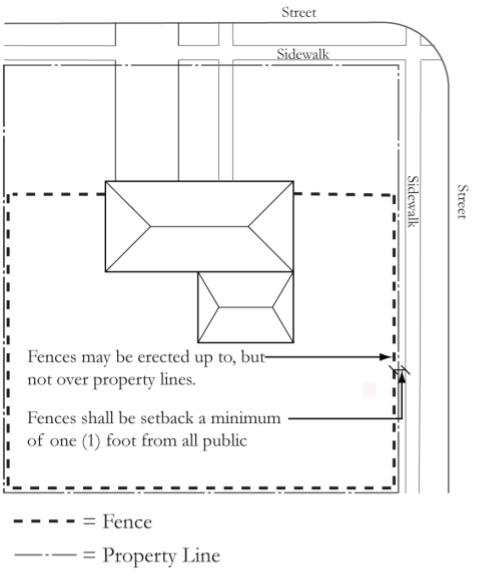
- Placement on a Lot. Fences may be erected up to, but not over property lines, and shall also be setback a minimum of one (1) foot from all public sidewalks.
- Gates Required. All fences that completely enclose a residential lot shall have at least one gate access as a means of ingress and egress to the principal building.
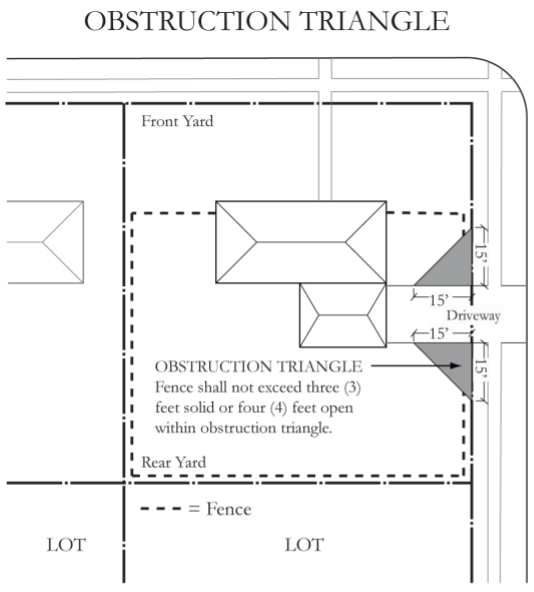
- Fences Adjacent to Driveways (Obstruction Triangles). Where a fence abuts any driveway, an obstruction triangle measured fifteen (15) feet along the property line and fifteen (15) feet up the driveway shall be maintained for any fences over three (3) feet solid or four (4) feet open.
- Uniformity for Townhouse Fences. Where a common wall of a structure connects two or more dwelling units, fences for such separate dwelling units shall be of uniform height, material, type, color and design.
- Location. A fence is a permitted obstruction in any yard with the following limitations:
- Front Yards.
- The following rules shall apply to front yards on all lots types.
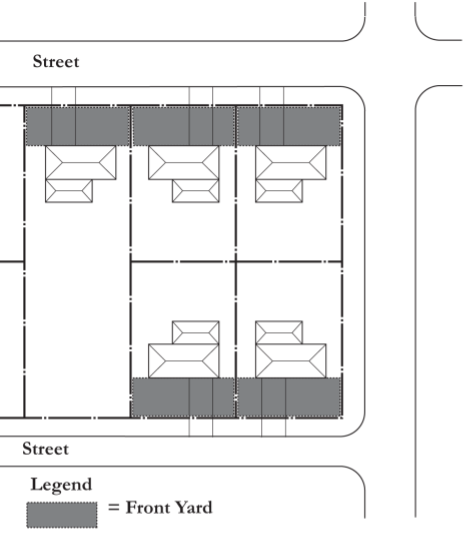
1. Fences shall not exceed a height of three (3) feet when less than fifty-percent (50%) open (i.e., solid fencing and masonry) and shall not exceed four (4) feet when greater than fifty-percent (50%) open (i.e., wood picket, ornamental iron).
2. The installation of chain link fences or wire mesh shall be prohibited in front yards.
3. Fences with gates crossing driveways located in front yards shall be permitted when such gate is similar in height, material, color and design to the adjacent portions of the gate.
- The following rules shall apply to front yards on all lots types.
- Interior Side Yards.
- The following rules shall apply to interior side yards on all lot types that are less than fifty (50) feet in width.
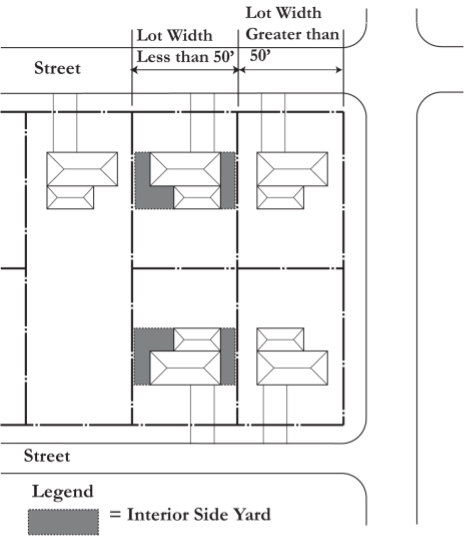 1. Fences may be solid or open construction and shall not exceed a height of four (4) feet.
 - The following rules shall apply to interior side yards on all lots that are fifty (50) feet or greater in width.
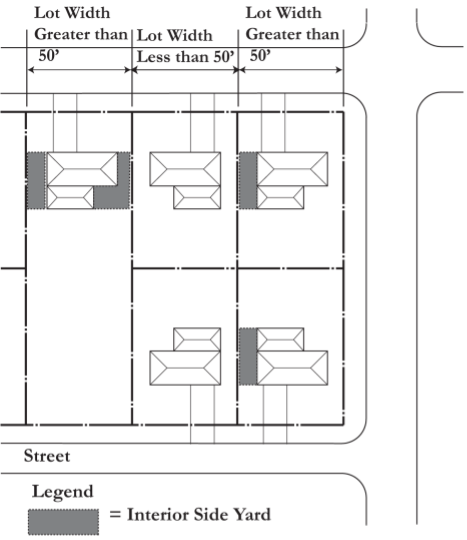 1. Fences may be solid or open construction and shall not exceed a height of six (6) feet.
- The following rules shall apply to interior side yards on all lot types that are less than fifty (50) feet in width.
- Exterior Side Yards.
- Corner Lots. The following rules shall apply to exterior side yards of corner lots (non-reverse corner) or to exterior side yards of through lots.
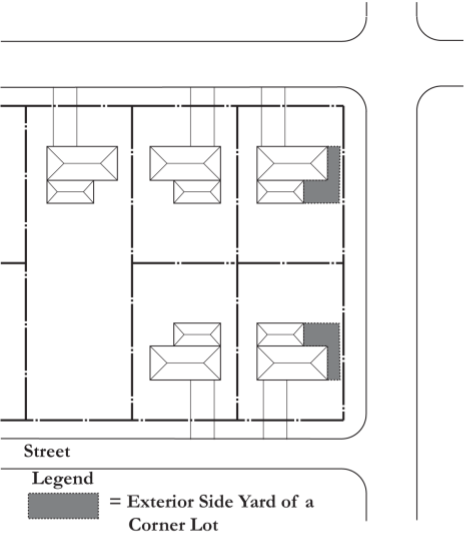 1. Fences shall not exceed three (3) feet solid or six (6) feet open. Solid fence height may be increased up to a maximum height of six (6) feet, provided any solid fence exceeding three (3) feet shall be set back a minimum of five (5) feet from property lines or public sidewalks, whichever is greater.
2. The installation of chain link fences or wire mesh shall be prohibited, unless said yard abuts an alley then chain link fences are permitted. - Reverse Corner Lots. The following rules shall apply to the exterior side yard of reverse corner lots.
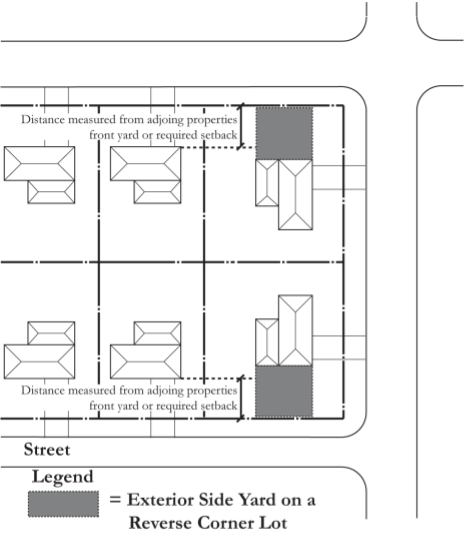 1. Fences shall not exceed three (3) feet solid or four (4) feet open measured from a line of adjoining front yards or required setback. In no case shall this requirement apply to more than thirty (30) feet from the street property line.
2. The installation of chain link fences or wire mesh shall be prohibited.
- Corner Lots. The following rules shall apply to exterior side yards of corner lots (non-reverse corner) or to exterior side yards of through lots.
- Rear Yards.
- Interior Lots. The following rules shall apply to rear yards of interior lots.
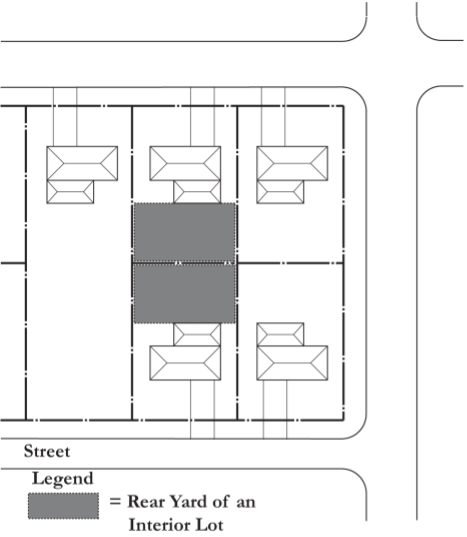 1. Fences may be solid or open construction and shall not exceed a height of six (6) feet.
 - Corner Lots (Non-reverse Corner). The following rules shall apply to rear yards of corner lots where said rear yard abuts the rear yard of the adjacent property.
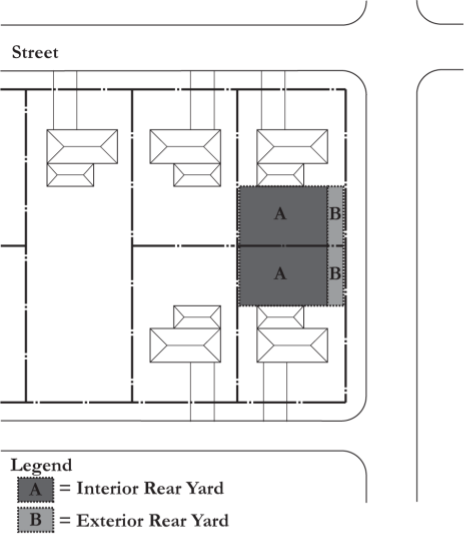
Interior Rear Yard - (A on illustration)
1. Fences in interior rear yards may be solid or open construction and shall not exceed a height of six (6) feet.
Exterior Rear Yard - (B on illustration)
1. Fences shall not exceed three (3) feet solid or six (6) feet open. Solid fence height may be increased up to a maximum height of six (6) feet, provided any solid fence exceeding three (3) feet shall be set back a minimum of five (5) feet from property lines or public sidewalks, whichever is greater.
2. The installation of chain link fences or wire mesh shall be prohibited in exterior rear yards, unless said yard abuts an alley then chain link fences are permitted. Exterior rear yard refers to portions of the yard that have road frontages. - Reverse Corner Lots. The following rules shall apply to rear yards of reverse corner lots.
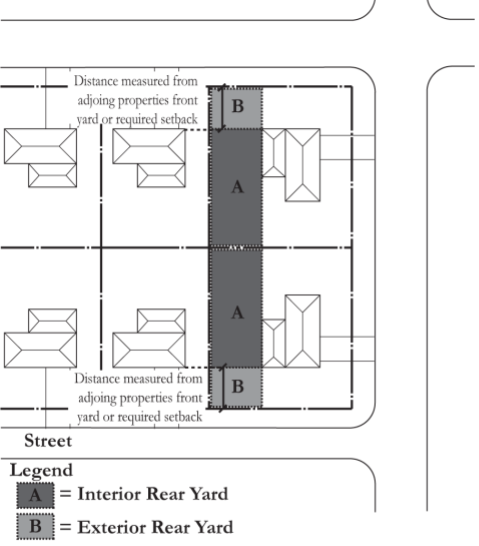
Interior Rear Yard - (A on illustration)
1. Fences in interior rear yards may be solid or open construction and shall not exceed a height of six (6) feet.
Exterior Rear Yard - (B on illustration)
1. Fences located between the street property line and the building setback of the adjacent lot shall not exceed four (4) feet open or three (3) feet solid. In no case shall this requirement apply to more than thirty (30) feet from the street property line.
2. The installation of chain link fences or wire mesh shall be prohibited in exterior rear yards, unless said yard abuts an alley then chain link fences are permitted. - Blocks Containing All Through Lots. The following rules shall apply to rear yards of through lots that are on blocks containing only through lots.
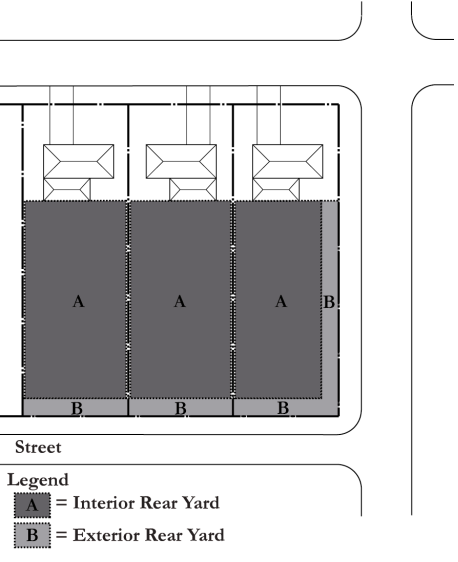
Interior Rear Yard – (A on illustration)
1. Fences in interior rear yards may be solid or open construction and shall not exceed a height of six (6) feet.
Exterior Rear Yard – (B on illustration)
1. Fences shall not exceed three (3) feet solid or six (6) feet open. Solid fence height may be increased up to a maximum height of six (6) feet, provided any solid fence exceeding three (3) feet shall be set back a minimum of five (5) feet from property lines or public sidewalks, whichever is greater.
2. The installation of chain link fences or wire mesh shall be prohibited in exterior rear yards, unless said yard abuts an alley then chain link fences are permitted. - Interior Through (also called Double Frontage) Lots. The following rules shall apply to rear yards of interior through lots that are adjacent to or on the same block as non-through lots.
Interior Rear Yard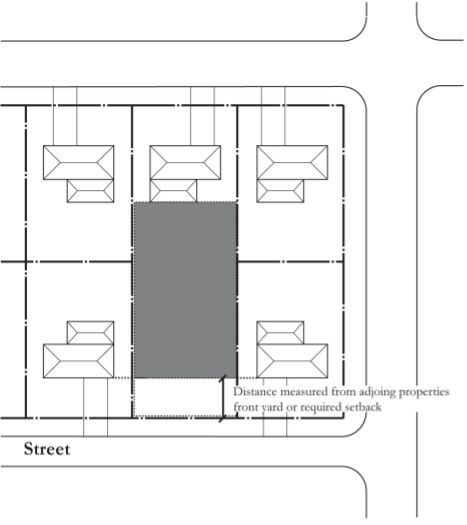 1. Fences in interior rear yards may be solid or open construction and shall not exceed a height of six (6) feet.
Exterior Rear Yard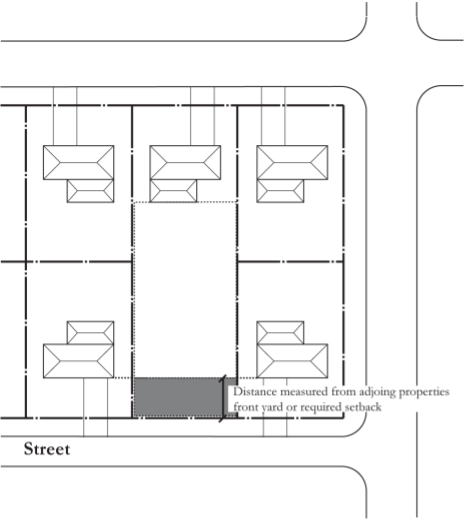 1. Fences in exterior rear yards shall not exceed three (3) feet solid or four (4) feet open as measured from a line of adjoining front yards or required setback. In no case shall this requirement apply to more than thirty (30) feet from the street property line.
2. The installation of chain link fences or wire mesh shall be prohibited, unless said yard abuts an alley then chain link fences are permitted. - Corner Through Lots. The following rules shall apply to rear yards of through lots when located on a corner and are adjacent to or on the same block as non-through lots.
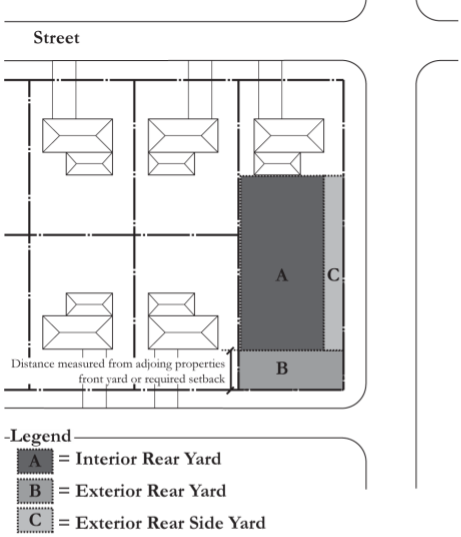 Interior Rear Yard - (A on illustration)
1. Fences in interior rear yards may be solid or open construction and shall not exceed a height of six (6) feet.
Exterior Rear Yard - (B on illustration)
1. Fences in exterior rear yards shall not exceed three (3) feet solid or four (4) feet open as measured from a line of adjoining front yards or required setback. In no case shall this requirement apply to more than thirty (30) feet from the street property line.
2. The installation of chain link fences or wire mesh shall be prohibited in exterior rear yards, unless said yard abuts an alley then chain link fences are permitted.
Exterior Rear Side Yard - (C on illustration)
1. Fences shall not exceed three (3) feet solid or six (6) feet open. Solid fence height may be increased up to a maximum height of six (6) feet, provided any solid fence exceeding three (3) feet shall be set back a minimum of five (5) feet from property lines or public sidewalks, whichever is greater.
2. The installation of chain link fences or wire mesh shall be prohibited in exterior rear yards, unless said yard abuts an alley then chain link fences are permitted.
- Interior Lots. The following rules shall apply to rear yards of interior lots.
- Front Yards.
- Infill Housing Standards.
- Purpose and Intent. The city has determined that the construction of housing units on existing zoning lots within an otherwise fully developed neighborhood has a direct impact on the established character of said neighborhood. The regulation of such construction can positively affect that impact by encouraging neighborhood compatibility of said housing unit’s design and placement/configuration on the zoning lot. Therefore, these Infill Housing Standards are intended to assist in the process of directing such infill housing construction toward neighborhood compatibility so that it will have a positive impact on the character of the City’s established neighborhood.
- Rules and Definitions.
- Rules.
- Definitions.
- Cape Cod. The cape cod architectural style shall be defined for the purposes of these regulations as a dwelling that is typically rectangular or square in shape, has no projecting eaves, is one or one-and-a-half stories and will usually have a central chimney and steep gable roof.
- Applicability. Residential lots being developed on an infill lot, as defined in the zoning ordinance, are subject to the regulations set forth herein in addition to any Residential District Specific Regulation required by the use district. No building permit shall be issued for lots which do not comply.
- Required Design Elements. The following design elements are required for all housing units constructed on an Infill Lot.
- Public street elevation.
- Setback line. The public street elevation of the structure shall be located at the average established setback line of the Impact Area.
- Width. The width of the structure’s public street elevation shall be established at a measurement that is within ten (10) feet of the average of those housing units within the Impact Area.
- Primary pedestrian access to house.
- Location. The primary pedestrian access entryway to the housing unit shall be located on the public street elevation to which the subject zoning lot fronts, and shall be the only such entryway so located.
- Lighting. The primary pedestrian access entryway located on the public street elevation shall be lighted with a fixture that is similar in style and design to the balance of the structure’s public street elevation.
- The relationship of width to height of windows and doors, and the rhythm of solids to voids shall be consistent with the vernacular of the architectural style and design of the structure’s public street elevation.
- Windows. The window placement, pattern, rhythm, proportion, size and material shall be consistent with the vernacular of the architectural style and design of the structure’s public street elevation.
- Garage material and style. The garage structure shall be constructed with finish material compatible in style and design with the architectural design and finish material utilized by the primary building on the zoning lot.
- Driveway width. The driveway width within the exterior setback area shall not exceed eighteen (18) feet in width.
- Sidewalk. There shall be a three (3) foot wide concrete/masonry sidewalk leading from a driveway established within the exterior setback to the primary access door located on the public street elevation of the structure.
- Roof pitch. The roof shall have a minimum pitch of 4/12.
- Eve overhang. The overhang of the eve shall be a minimum of one (1) foot from face of building to front face of fascia, unless said structure’s architectural design is classified as a Cape Cod.
- Front porch. The front porch shall be constructed with finish material compatible in style and design with the architectural design and finish material utilized on the balance of the structure’s public street elevation.
- Landscaping.
- One (1) shrub shall be planted per three (3) lineal feet along the front foundation line of the structure, each being a minimum of eighteen (18) inches tall after planting.
- The front and exterior side yard of the zoning lot shall be planted with turf in the form of sod.
- A minimum two and a half (2.5) inch caliper canopy tree shall be planted within the front yard.
- A minimum two and a half (2.5) inch caliper canopy tree shall be planted within the public parkway.
- Public street elevation.
- Impact Area Design Standards. Each of the following design elements shall be required when sixty five percent (65%) or more of the single family detached housing units within the Impact Area incorporate each such design element.
- Stories. The number of stories to the housing unit shall be limited to one level or two levels above existing grade as determined by the Impact Area.
- Entry porch with roof. The front entry shall be protected by a structural roof over the entry porch.
- Sidewalk. There shall be a three (3) foot wide concrete / masonry sidewalk leading from the public sidewalk to the front entrance door of the proposed structure.
- Garage location. The garage structure shall be located to the rear of the primary structure.
- Garage door. The garage door shall face a direction other than that of the exterior of the public street elevation of the housing unit when the garage is not located to the rear of the primary structure.
- The driveway access to required parking shall be from the public right-of-way alley to which the subject zoning lot is adjacent.
- Driveway width.
- The driveway within the exterior setback area shall not exceed twelve (12) feet in width.
- The driveway width within the exterior setback area may exceed the maximum width allowed under the Required Design Elements Section of Infill Housing Standards up to a maximum of twenty-seven (27) feet when the following conditions are met:
- Sixty-five percent (65%) or more of the homes within the impact area have a 3-car garage and
- The driveway is constructed for a 3-car garage.
- Roof pitch. The primary roof of the housing unit shall be pitched to the degree that generally matches the average of those housing units within the Impact Area when said pitch exceeds the minimum established by the Required Design Elements Section of Infill Standards.
- Roof style.
- The roof style shall generally incorporate hips to the degree utilized by the housing units within the Impact Area.
- The roof style shall generally incorporate gables to the degree utilized by the housing units within the Impact Area.
- Materials at public street elevation. The public street elevation of the housing unit shall generally incorporate wood, brick, and/or stone architectural finish material to the degree utilized by the housing units within the Impact Area.
- Minor Variance for Building Width and Height.
- Purpose. The purpose of this section is to allow for an administrative variance process for residential infill development with a larger scale than allowed per the Impact Area provisions. Understanding that a home of a larger scale than the surrounding homes may be a sign of vitality and desirability and augment the housing quality of a neighborhood, an administrative variance process will allow for the construction of residential properties which may differ in scale, yet meet or exceed the same design quality as determined by the Impact Area. By virtue of a home being of a larger scale and magnitude than the surrounding homes, these homes may have adverse effects of restricting sunlight access, creating a sense of isolation from neighborhood with a loss of backyard space and experiencing a loss of open space, views and natural landscaping. The following standards are in place to address the above stated adverse effects.
- Variance requirements. An infill lot may be exempt from following requirements of the Infill Housing Standards; (1) building width at the structure’s public street elevation found under required design elements, (2) garage material and style also found under required design elements, and (3) stories section under Impact Area Design standards; when the below stated requirements are met:
- Lot requirements. The property on which the home is constructed consists of two or more platted lots with right of way frontage which shall be consolidated prior to construction. The consolidated lot must have a minimum width of seventy-five (75) feet, a minimum area of 10,000 square feet, and form a four square lot. Said lot cannot be consolidated to leave less than two non-consolidated lots on the block face between a public right of way and the subject lots.
- Exterior architecture. Primary and accessory dwelling units are to be constructed of a minimum seventy-five percent (75%) brick or stone masonry.
- Garage. All garages are to have a minimum three car capacity. The style of the garage must be either side loading or detached. A front loading attached garage is only permitted when over seventy-five percent (75%) of the Impact Area is determined to have a front loading garage style.
- Design for front loading attached three car garage. If permitted to have an attached front loading three car garage per the above stated requirements, at least one of the garage entrances must be set back five (5) feet from the remaining garage entrances.
- Setbacks. Minimum rear setbacks shall be ten (10) feet greater than required by the zoning districts.
- Stories. Additional stories above the predominance of the Impact Area is allowed, however, each additional story, not including roof pitch, must be constructed at a minimum ten (10) foot setback from the building story below. The ten (10) foot setback must be measured from the front elevation of habitable portion of the structure.
- Lot coverage. Lot coverage for the principal structure shall not exceed thirty (30) percent.
- Application for Minor Variances. Applications for minor variances shall be made to the zoning administrator in accordance with chapter 34.
- Federally licensed amateur radio stations and citizen band radio operator and receive only antennae structures.
- Applicability. The following provisions apply in all residential districts.
- Specific Regulations.
- Height. The maximum permitted height shall be sixty-five (65) feet.
- Permitted locations on a lot.
- Such structures shall only be located within rear yards generally, and shall not be located within any required setback.
- When located on a roof, the structure shall not be erected nearer to any lot line than the total height of the structure as measured from above the roof line.
49-107.4 "E" Estate Single Family Detached Dwelling District
- Title.
- The Estate single-family detached dwelling District (hereinafter referenced as the "Estate District") shall be designated as "E" on the zoning map.
- Intent & Purpose.
- The Estate District set forth herein is established in order to develop a wide range of quality housing opportunities throughout the City. Specifically, it is intended to relate to the outer fringe areas of the City where unincorporated development has taken place pursuant to similar standards of the applicable county jurisdiction. The Estate District shall be a very low intensity land use, replicating the rural character of the counties.
- District Specific Regulations.
- Rules. In addition to the rules set forth in sec. 49-103.2, the following district specific provisions shall apply:
- Only one (1) principal building shall be allowed on a zoning lot.
- All single family detached dwelling units shall be constructed on a single recorded lot.
- Definitions.
- Rules. In addition to the rules set forth in sec. 49-103.2, the following district specific provisions shall apply:
- Use Regulations.
- Permitted Uses. The Permitted Uses for this district as identified in Table One: Use Categories shall apply.
- Conditional Uses. The Conditional Uses for this district as identified in Table One: Use Categories shall apply.
- Accessory Uses. In addition to the accessory uses and structures regulations set forth in sec. 49-104.4, the following district specific provisions shall apply:
- The Permitted Structures and Obstructions for this district are identified in Table Four: Permitted Structures and Obstructions shall apply.
- Bulk Restrictions.
- Building, Dwelling and Structure Standards.
- All single family detached dwelling units shall have a floor area of not less than thirty-five hundred (3,500) square feet.
- Floor Area Ratio.
- The floor area ratio shall not exceed one-quarter (0.25) for all buildings including accessory.
- Height. In addition to height regulations set forth in sec. 49-105.3, the following district specific provisions shall apply:
- Height of buildings. The maximum height of buildings permitted shall be as follows:
- Buildings including accessory: Thirty-five (35) feet.
- Religious Institutions: Seventy-five (75) feet for towers or steeples, but not more than forty-five (45) feet for the main structure.
- Height of structures. The maximum height of structures shall be seventy-five (75) feet.
- Height of buildings. The maximum height of buildings permitted shall be as follows:
- Landscaping.
- (Reserved)
- Lot Size.
- Area. All single-family detached dwelling units shall be established on a lot having an area of not less than fifty-five thousand (55,000) square feet and
- Width. All single-family detached dwelling units shall be established on a lot having a width at the required exterior front setback line of not less than one hundred thirty-five (135) feet.
- Lot Coverage.
- Lot coverage shall not exceed forty (40) percent.
- Monotony Standards.
- (Reserved)
- Nonconformity.
- (Reserved)
- Obstructions.
- The Permitted Structures and Obstructions for this district are identified in Table Four: Permitted Structures and Obstructions.
- Performance Standards.
- (Reserved)
- Setbacks.
- In addition to setbacks regulations set forth in sec. 49-105.11, the following district specific provisions shall apply:
- All structures and uses shall be established outside of the required setback areas as defined by the following required setback lines:* See subsection (e)(11)b below for exceptions to setback lines.
E Setback Lines *Front Side, exterior Side, interior Rear 75' 30' 20' 30'
- All structures and uses shall be established outside of the required setback areas as defined by the following required setback lines:
- * Front setback exception for an infill lot. On infill lots the public street elevation of the structure shall be located at the average established setback line of the Impact Area. For additional regulations on infill lots refer to Infill Housing Standards located in the Residential District Specific Regulations of the zoning ordinance.
- In addition to setbacks regulations set forth in sec. 49-105.11, the following district specific provisions shall apply:
- Signs. (Reserved)
- Parking and Loading.
- Building, Dwelling and Structure Standards.
49-107.5 "R-1" One-Family Dwelling District
- Title.
- The One-Family Dwelling District shall be designated as “R-1” on the zoning map.
- Intent & Purpose.
- The “R-1” One-Family Dwelling District is intended to provide a wide range of quality housing opportunities by providing single-family areas of a low-density character containing a minimum lot area of ten thousand (10,000) square feet.
- 107.5-3. District Specific Regulations.
- Rules. In addition to the rules set forth in sec. 49-103.2, the following district specific provisions shall apply: :
- Only one (1) principal building shall be allowed on a zoning lot.
- All single family detached dwelling units shall be constructed on a single recorded lot.
- Definitions.
- Rules. In addition to the rules set forth in sec. 49-103.2, the following district specific provisions shall apply: :
- Use Regulations.
- Permitted Uses. The Permitted Uses for this district as identified in Table One: Use Categories shall apply.
- Conditional Uses. The Conditional Uses for this district as identified in Table One: Use Categories shall apply.
- Accessory Uses. In addition to the accessory uses and structures regulations set forth in sec. 49-104.4, the following district specific provisions shall apply:
- The Permitted Structures and Obstructions for this district are identified in Table Four: Permitted Structures and Obstructions.
- Bulk Restrictions.
- Building, Dwelling and Structure Standards.
- One-Story Dwelling. Every one-story dwelling unit shall have a total ground floor area of not less than eleven hundred and fifty (1150) square feet.
- Dwellings more than one-story. Every dwelling of more than one story shall have a total floor area of not less than fourteen hundred fifty (1450) square feet.
- Floor Area Ratio.
- There are no floor area ratio regulations for this district.
- Height. In addition to height regulations set forth in sec. 49-105.3, the following district specific provisions shall apply: :
- Height of buildings. The maximum height of buildings permitted shall be as follows:
- Buildings including accessory: Thirty-five (35) feet and not over two and one-half (2 1/2) stories.
- Religious Institutions: Seventy-five (75) feet for towers or steeples, but not more than forty-five (45) feet for the main structure.
- Height of structures. The maximum permitted height of structures shall be thirty-five (35) feet.
- Height of buildings. The maximum height of buildings permitted shall be as follows:
- Landscaping.
- (Reserved)
- Lot Size.
- Area.
- One-family detached dwelling. Every one-family detached dwelling hereafter erected or structurally altered shall be on a lot having an area of not less than ten thousand (10,000) square feet.
- Religious institutions. Religious institutions hereafter erected or structurally altered shall be on a lot having an area of not less than ten thousand (10,000) square feet.
- Width.
- One-family detached dwelling. Every one-family detached dwelling hereafter erected or structurally altered shall be on a lot having a width at the established building line of not less than seventy-five (75) feet.
- Religious institutions. Religious institutions hereafter erected or structurally altered shall be on a lot having a width at the building line of not less than seventy-five (75) feet.
- Area.
- Lot Coverage.
- Lot coverage shall not exceed forty (40) percent.
- Monotony Standards.
- (Reserved)
- Nonconformity.
- (Reserved)
- Obstructions.
- The Permitted Structures and Obstructions for this district are identified in Table Four: Permitted Structures and Obstructions.
- Performance Standards.
- (Reserved)
- Setbacks. In addition to the setback regulations set forth in sec. 49-105.11, the following district specific provisions shall apply:
- All structures and uses shall be established outside of the required setback areas as defined by the following required setback lines:
* See subsections (e)(11)b and c below for exceptions to setback lines.
R1 Setback Lines *Front *Side, exterior (corner lot) *Side, exterior (reverse corner lot) *Side, interior Rear 30' 10' 15' 6’ on lots less than 60’ wide or less / 8’ on lots greater than 60’ 30' - * Front setback exception for an infill lot. On infill lots the public street elevation of the structure shall be located at the average established setback line of the Impact Area and as required in by the sec. 49-107.3(d) in Residential Districts.
- * Side setback exception for religious institutions: On lots upon which a religious institution is constructed or extensions made to an existing religious institution, there shall be a side setback line of not less than ten (10) feet on each side of the main structure and a combined total of side setback of not less than twenty-five (25) feet.
- All structures and uses shall be established outside of the required setback areas as defined by the following required setback lines:
- Signs.
- Parking and Loading.
- (Reserved)
- Building, Dwelling and Structure Standards.
49-107.6 "R-2" One-Family Dwelling District
- Title.
- The One-Family Dwelling District shall be designated as “R-2” on the zoning map.
- Intent & Purpose.
- The “R-2” One-Family Dwelling District is intended to provide the city with a wide range of quality housing opportunities by providing single-family areas of a medium-density character with lots containing a minimum of eight thousand (8,000) square feet and requiring a larger minimum dwelling size than is required in the R-3 One Family Dwelling District.
- District Specific Regulations.
- Rules. In addition to the rules set forth in sec. 49-103.2, the following district specific provisions shall apply:
- Only one (1) principal building shall be allowed on a zoning lot.
- All single family detached dwelling units shall be constructed on a single recorded lot.
- Definitions.
- Rules. In addition to the rules set forth in sec. 49-103.2, the following district specific provisions shall apply:
- Use Regulations.
- Permitted Uses. The Permitted Uses for this district as identified in Table One: Use Categories shall apply.
- Conditional Uses. The Conditional Uses for this district as identified in Table One: Use Categories shall apply.
- Accessory Uses. The Permitted Structures and Obstructions for this district are identified in Table Four: Permitted Structures and Obstructions shall apply.
- Limited but Permitted Uses.
- Bulk Restrictions.
- Building, Dwelling & Structure Standards.
- One-story dwelling. Every one-story dwelling hereafter erected shall have a total ground floor area of not less than nine hundred and fifty (950) square feet.
- Dwellings more than one-story. Every dwelling hereafter erected of more than one story, shall have a total floor area of not less than thirteen hundred (1300) square feet.
- Floor Area Ratio.
- There are no floor area ratio regulations for this district.
- Height.
- The same regulations shall apply as required or permitted in the R-1 one-family dwelling district.
- Landscaping.
- (Reserved)
- Lot Size.
- Area.
- One-family dwelling. Every one-family detached dwelling hereafter erected or structurally altered shall be on a lot having an area of not less than eight thousand (8,000) square feet
- Religious Institutions. The same regulations shall apply as required or permitted in the R-1 one-family dwelling district.
- Width.
- One-family dwelling. Every one-family detached dwelling hereafter erected or structurally altered shall be on a lot having a width at the established building line of not less than sixty (60) feet..
- Religious Institutions. The same regulations shall apply as required or permitted in the R-1 one-family dwelling district.
- Area.
- Lot Coverage.
- Lot coverage shall not exceed forty (40) percent.
- Monotony Standards.
- (Reserved)
- Nonconformity.
- (Reserved)
- Obstructions.
- The Permitted Structures and Obstructions for this district are identified in Table Four: Permitted Structures and Obstructions.
- Performance Standards.
- (Reserved)
- Setbacks.
- The same regulations shall apply as required or permitted in the R-1 one-family dwelling district.
- Signs.
- Parking and Loading.
- (Reserved)
- Building, Dwelling & Structure Standards.
49-107.7 "R-3" One-Family Dwelling District
- Title.
- The One-Family Dwelling District shall be designated as “R-3” on the zoning map.
- Intent & Purpose.
- The “R-3” One-Family Dwelling District is intended to provide the city with a wide range of quality housing opportunities by providing single-family areas of a medium-density character with lots containing a minimum of eight thousand (8,000) square feet and requiring a minimum dwelling size less than is required in the R-2 One Family Dwelling District.
- District Specific Regulations.
- Rules. In addition to the rules set forth in sec. 49-103.2, the following district specific provisions shall apply:
- Only one (1) principal building shall be allowed on a zoning lot.
- All single family detached dwelling units shall be constructed on a single recorded lot.
- Definitions.
- Rules. In addition to the rules set forth in sec. 49-103.2, the following district specific provisions shall apply:
- Use Regulations.
- Permitted Uses. The Permitted Uses for this district as identified in Table One: Use Categories shall apply.
- Conditional Uses. The Conditional Uses for this district as identified in Table One: Use Categories shall apply.
- Accessory Uses. The Permitted Structures and Obstructions for this district are identified in Table Four: Permitted Structures and Obstructions shall apply
- Limited but Permitted Uses.
- Bulk Restrictions.
- Building, Dwelling And Structure Standards.
- One-story dwellings. Every one-story dwelling hereafter erected shall have a total ground floor area of not less than seven hundred and fifty (750) square feet
- Dwellings more than one-story. Every dwelling of more than one story hereafter shall have a total floor area of not less than nine hundred and fifty (950) square feet.
- Floor Area Ratio.
- There are no floor area ratio regulations for this district.
- Height.
- The same regulations shall apply as required or permitted in the R-1 one-family dwelling district.
- Landscaping.
- (Reserved)
- Lot Size.
- Area.
- One-family dwelling. Every one-family detached dwelling hereafter erected or structurally altered shall be on a lot having an area of not less than eight thousand (8,000) square feet.
- Religious Institutions. The same regulations shall apply as required or permitted in the R-1 one-family dwelling district.
- Width.
- One-family dwelling. Every one-family detached dwelling hereafter erected or structurally altered shall be on a lot having a width at the established building line of not less than sixty (60) feet, except as provided in the Bulk Restrictions Section.
- Religious Institutions. The same regulations shall apply as required or permitted in the R-1 one-family dwelling district.
- Area.
- Lot Coverage.
- Lot coverage shall not exceed forty (40) percent.
- Monotony Standards.
- (Reserved)
- Nonconformity.
- (Reserved)
- Obstructions.
- The Permitted Structures and Obstructions for this district are identified in Table Four: Permitted Structures and Obstructions.
- Performance Standards.
- (Reserved)
- Setbacks.
- The same regulations shall apply as required or permitted in the R-1 one-family dwelling district.
- Signs.
- Parking and Loading.
- (Reserved)
- Building, Dwelling And Structure Standards.
49-107.8 "R-4" Two-Family Dwelling District
- Title.
- Intent & Purpose.
- Intent. The R-4 two-family dwelling district is intended to permit two-family dwellings on lots of record prior to October 6, 1987, and for two-family dwellings constructed after October 6, 1987, to ensure consistency and compatibility in character with single-family neighborhoods.
- District Specific Regulations.
- Rules.
- Definitions.
- Use Regulations.
- Permitted Uses. The Permitted Uses for this district as identified in Table One: Use Categories shall apply.
- Conditional Uses. The Conditional Uses for this district as identified in Table One: Use Categories shall apply.
- Accessory Uses.
- Limited but Permitted Uses.
- Bulk Restrictions.
- Building, Dwelling And Structure Standards.
- Each dwelling unit hereafter erected, converted or reconstructed in any R-4 district shall contain floor area in compliance with the following:
- One-family one-story detached dwellings shall have a total ground floor area of not less than seven hundred and fifty (750) square feet measured from the outside of the exterior walls including utility rooms, but excluding cellars, basements, open porches, breezeways, garages, and other spaces that are not used frequently or during extended periods for living, eating or sleeping purposes. Every one-family dwelling of more than one (1) story hereafter erected in any R-4 two-family district shall have a total floor area measured from the outside of the exterior walls, of not less than nine hundred and fifty (950) square feet, including utility rooms but excluding cellars, basements, open porches, breezeways, garages, and other spaces that are not used frequently or during extended periods for living, eating or sleeping purposes, except that enclosed space intended for habitable rooms which are to be completed within a reasonable time may be considered in computing such floor areas.
- Two-family dwelling converted prior to October 6, 1987 shall have a total floor area per dwelling unit of not less than six hundred twenty (620) square feet measured from the outside walls, including utility rooms, but excluding all other areas not used for living, eating or sleeping purposes. Two-family dwellings constructed prior to October 6, 1987 shall have a total floor area per dwelling unit of not less than seven hundred fifty (750) square feet measured from the outside wall, including utility rooms, but excluding all other areas not used for living, eating, or sleeping purposes.
- Two-family dwellings, constructed or converted after October 7, 1987 shall have, for a two-story or combination one- and two-story building, a combined floor area of two thousand four hundred (2,400) square feet, with no dwelling unit less than one thousand (1,000) square feet. A one-story building shall have a combined floor area of two thousand (2,000) square feet, with no dwelling unit less than nine hundred (900) square feet, measured from the outside wall, including utility rooms, but excluding all other areas not used for living, eating, or sleeping purposes.
- Each dwelling unit hereafter erected, converted or reconstructed in any R-4 district shall contain floor area in compliance with the following:
- Floor Area Ratio.
- Height.
- The same regulations shall apply as permitted in the R-1 one-family dwelling district.
- Landscaping.
- (Reserved)
- Lot Size.
- One-family dwellings. The same regulations shall apply as required or permitted in the R-1 one-family dwelling district.
- Two-family dwellings. Every two-family dwelling hereafter erected or structurally altered shall be on a lot having an area of not less than eight thousand (8,000) square feet, and a width at the building line of not less than sixty (60) feet, except as provided in the Bulk Restrictions Section.
- Converted dwellings. An existing one-family dwelling located on a lot of less area than required in this section may be converted to a two-family dwelling without increasing the lot size; provided that the building is not enlarged beyond its present outside dimensions and that all other regulations of this ordinance are complied with. Additions may be made to an existing building only when lot size and yard requirements of this section can be complied with.
- Religious institutions, convents and monasteries. The same regulations shall apply as required in the R-1 one-family dwelling district.
- Lot Coverage.
- (Maximum area): Not more than forty (40) percent of the area of the zoning lot may be occupied by buildings or structures including accessory buildings.
- Monotony Standards.
- Nonconformity.
- (Reserved)
- Obstructions.
- The same regulations shall apply as required in the R-1 one-family dwelling district.
- Parking & Loading.
- (Reserved)
- Performance Standards.
- (Reserved)
- Setbacks.
- No buildings shall be erected or enlarged unless the following yards are provided and maintained in connection with such building, structure, or enlargement.
- Front yards. The same regulations shall apply as required in the R-1 one-family dwelling district.
- Side yards:
- One-family detached dwellings–The same regulations shall apply as required in the R-1 district.
- Two-family dwellings–The same regulations shall apply as required for one-family detached dwellings.
- Converted dwellings–An existing one-family dwelling located on a lot having side yards of less width than required herein may be converted to a two-family dwelling; provided that the building is not enlarged beyond its present dimensions.
- Rear yards: Every lot or parcel of land upon which a building is constructed shall have a rear yard of not less than twenty (20) feet.
- No buildings shall be erected or enlarged unless the following yards are provided and maintained in connection with such building, structure, or enlargement.
- Signs.
- Building, Dwelling And Structure Standards.
49-107.9 "R-4A" Two-Family Dwelling District
- Title.
- The Two-Family Dwelling District shall be designated as “R-4A” on the zoning map.
- Intent & Purpose.
- Intent. The R-4A two-family dwelling district is intended to update development standards for all newly constructed two-family dwelling developments to ensure consistency and compatibility in character with single-family districts. This district shall apply to all two-family zoning created after December 15, 1987.
- District Specific Regulations.
- Rules. (Reserved).
- Definitions. (Reserved).
- Use Regulations.
- Permitted Uses. The Permitted Uses for this district as identified in Table One: Use Categories shall apply.
- Conditional Uses. The Conditional Uses for this district as identified in Table One: Use Categories shall apply.
- Accessory Uses.
- Limited but Permitted Uses.
- Bulk Restrictions.
- Building, Dwelling And Structure Standards.
- The minimum dwelling standards required in the R-4A shall be as follows:
- One-family dwellings. The same regulations shall apply as in the R-1 single-family dwelling district.
- Two-family dwellings. Two-family dwellings, constructed or converted after December 15, 1987, shall have for a two-story or combination one- and two-story building, a combined floor area of two thousand four hundred (2,400) square feet, with no dwelling unit less than one thousand (1,000) square feet. A one-story building shall have a combined floor area of two thousand (2,000) square feet, with no dwelling unit less than nine hundred (900) square feet, measured from the outside wall, including utility rooms, but excluding all other areas not used for living, eating, or sleeping purposes.
- The minimum dwelling standards required in the R-4A shall be as follows:
- Floor Area Ratio.
- Height.
- The maximum height of buildings shall be thirty-five (35) feet and not to exceed two and one-half (2 1/2) stories.
- Landscaping.
- (Reserved)
- Lot Size.
- Every one-family or two-family dwelling hereafter erected shall be on a lot having an area of not less than ten thousand (10,000) square feet and a width at the established building line of not less than seventy-five (75) feet.
- Lot Coverage.
- (Maximum area): Not more than forty (40) percent of the area of the zoning lot may be occupied by buildings or structures including accessory buildings.
- Monotony Standards.
- A newly-constructed single family detached home may not be located next to, across the street from, or cater-corner from another such newly-constructed or existing residential structure which has the same front elevation or the same configuration of building materials or the same colors facing the public street.
- Nonconformity.
- (Reserved)
- Obstructions.
- The same regulations shall apply as in the R-1 one-family dwelling district.
- Parking & Loading.
- (Reserved)
- Performance Standards.
- (Reserved)
- Setbacks.
- The minimum yard areas required in the R-4A shall be as follows:
- Front. Thirty (30) feet.
- Interior side. Eight (8) feet.
- Exterior side. Fifteen (15) feet.
- Rear. Twenty (20) feet.
- The minimum yard areas required in the R-4A shall be as follows:
- Signs.
- Building, Dwelling And Structure Standards.
49-107.10 "R-5" Multiple-Family Dwelling District
- Title.
- The Multiple-family Dwelling District (hereinafter referenced as the "Multi-family District") shall be designated as "R-5" on the zoning.
- Intent & Purpose.
- The Multiple-family District set forth herein is established in order to develop a wide range of quality housing opportunities throughout the City. Specifically, it is intended to allow for quality rental type dwelling units within developments that establish and maintain a safe and secure living environment. The Multi-family District shall be a high intensity land use, generally relating to other high intensity land uses.
- District Specific Regulations.
- Reserved.
- Rules.
- General provisions. The bulk restrictions that collectively comprise sec. 49-105 of this code shall apply in addition to the following district specific provisions:
- Plat approval. All zoning lots shall be subject to final plat approval pursuant to the subdivision control ordinance.
- Only one principal building shall be allowed on a zoning lot, except where the owner of any such development enters into a property management agreement with the city
- All principal buildings shall be constructed on a single recorded lot as provided for within this section hereof, including given exceptions.
- All surfaces upon which vehicles are driven or parked shall be paved with a solid structurally sound finishing material.
- A Property Management Agreement shall be defined for this district as a written document recorded on the subject property after having been approved and executed by the City and subject property owner, which sets forth certain minimum improvements and management practices for the subject property, which may include but is not limited to uniform ownership or management; age restrictions as limited by the Federal Fair Housing Act; building design; bedroom count; site development and maintenance; and other such provisions.
- An Onsite Recreational Facility shall be defined for this district as any such facility of a substantial nature established on the subject property for the use and enjoyment of the development's residents, which may include but is not limited to an in-ground swimming pool; tennis courts; club house; and other such facilities.
- General provisions. The bulk restrictions that collectively comprise sec. 49-105 of this code shall apply in addition to the following district specific provisions:
- Definitions.
- Use Regulations.
- Permitted Uses. The Permitted Uses for this district as identified in Table One: Use Categories shall apply.
- Conditional Uses. The Conditional Uses for this district as identified in Table One: Use Categories shall apply.
- Accessory Uses. In addition to the accessory uses and structures regulations set forth in sec. 49-104.4, the following district specific provisions shall apply::
- No more than one accessory building shall be allowed on a zoning lot.
- An accessory building shall be located no closer than twenty (20) feet to the principal building.
- Limited but Permitted Uses.
- Bulk Restrictions.
- Building, Dwelling and Structure Standards. In addition to the building, dwelling, & structure standards regulations set forth in sec. 49.105.1, the following district specific provisions shall apply:
- All dwelling units shall have a floor area of not less than four hundred eighty (480) square feet.
- Floor Area Ratio.
- The floor area ratio shall not exceed one (1.0) for all buildings including accessory.
- Height. In addition to the height, bulk and lot coverage regulations set forth in sec. 49.105.3, the following district specific provisions shall apply:
- No structure or building shall exceed the following height limitations:
- Principal building: Forty-five (45) feet.
- Accessory building: Twenty-five (25) feet.
- Structures: Seventy-five (75) feet.
- No structure or building shall exceed the following height limitations:
- Landscaping.
- (Reserved)
- Lot Size.
- All principal buildings shall be established on a lot having an area of not less than ten thousand (10,000) square feet and a width at the required exterior front setback line of not less than seventy-five (75) feet. The following minimum lot area shall be required per dwelling unit as indicated in addition to the above described area:
- Units with 1 bedroom and efficiency units: 2,000 sf
- Units with 2 bedrooms: 2,500 sf
- Units with 3 bedrooms: 4,000 sf
- Units with 4 bedrooms: 5,500 sf
- A waiver of 200 sf from the above stated area requirements shall be allowed per dwelling unit if a Property Management Agreement is entered into by the property owner, and Onsite Recreational Facilities are provided as defined within the R-5 Multiple Family Dwelling District hereof.
- All non-residential uses shall be established on a zoning lot of not less than twenty-five thousand (25,000) square feet, and a width at the required exterior front setback line of not less than one hundred (100) feet.
- All principal buildings shall be established on a lot having an area of not less than ten thousand (10,000) square feet and a width at the required exterior front setback line of not less than seventy-five (75) feet. The following minimum lot area shall be required per dwelling unit as indicated in addition to the above described area:
- Lot Coverage.
- (Maximum area): Not more than forty (40) percent of the area of the zoning lot may be occupied by buildings or structures including accessory buildings.
- Monotony Standards.
- Nonconformity.
- (Reserved)
- Obstructions.
- In addition to the obstructions regulations set forth in sec. 49-105.9, the following district specific provisions shall apply:
- Permitted obstructions in all setback areas: Bay windows, overhanging eaves, chimneys, and other such architectural elements, that project three (3) feet or less into the required setback area.
- Permitted obstructions in all exterior setback areas: Driveway access from the public street, which shall be generally perpendicular thereto.
- Permitted obstructions in all interior rear setback areas: Parking places located no closer than five (5) feet to the rear property line.
- In addition to the obstructions regulations set forth in sec. 49-105.9, the following district specific provisions shall apply:
- Parking And Loading.
- In addition to the parking and loading regulations set forth in sec. 49-105.13 the following district specific provisions shall apply:
- All dwelling units shall be provided parking spaces, which shall be located on the same zoning lot as the principal building.
- All unenclosed parking spaces established on the zoning lot shall be located no closer than ten (10) feet to the principal building.
- In addition to the parking and loading regulations set forth in sec. 49-105.13 the following district specific provisions shall apply:
- Performance Standards.
- (Reserved)
- Setback.
- All structures and uses shall be established outside of the required setback areas as defined by the following required setback lines:
- Exterior Front. Twenty-five (25) feet. The setback for structures exceeding twenty-five (25) feet in height shall be increased one (1) foot for each two (2) feet or fraction thereof by which the structure's height exceeds twenty-five (25) feet. In no case shall an exterior front setback of more than forty (40) feet be required.
- Exterior Side. Ten (10) feet, or fifty (50) percent of the exterior front setback required on the adjacent lots to the exterior side, whichever is greater.
- Exterior Rear. Thirty (30) feet.
- Interior Side. Ten (10) feet. The setback for structures exceeding twenty-five (25) feet in height shall be increased one (1) foot for each two (2) feet or fraction thereof by which the structure's height exceeds twenty-five (25) feet. In no case shall an interior side setback of more than thirty (30) feet be required.
- Interior Rear. Thirty (30) feet.
- All structures and uses shall be established outside of the required setback areas as defined by the following required setback lines:
- Signs.
- (Reserved)
- Building, Dwelling and Structure Standards. In addition to the building, dwelling, & structure standards regulations set forth in sec. 49.105.1, the following district specific provisions shall apply:
49-107.11 "R-5A" Midrise Multiple-Family Dwelling District
- Title.
- The Midrise Multiple-family Dwelling District (hereinafter referenced as the "Midrise Multi-family District") shall be designated as "R-5A" on the zoning map.
- Intent & Purpose.
- The Midrise Multiple-family District set forth herein is established in order to develop a wide range of quality housing opportunities throughout the City. Specifically, it is intended to allow for quality rental type dwelling units within developments that establish and maintain a safe and secure living environment. The Midrise Multi-family District shall be a high intensity land use, generally relating to other high intensity land uses, specifically around major retail centers and the City's downtown.
- District Specific Regulations.
- (Reserved)
- Rules.
- General provisions. In addition to the rules set forth in sec. 49-103.2, the following district specific provisions shall apply:
- Plat approval. All zoning lots shall be subject to final plat approval pursuant to the subdivision control.
- Only one principal building shall be allowed on a zoning lot, except where the owner of any such development enters into a property management agreement with the city.
- All principal buildings shall be constructed on a single recorded lot as provided for within this section hereof, including given exceptions.
- All surfaces upon which vehicles are driven or parked shall be paved with a solid structurally sound finishing material.
- A Property Management Agreement shall be defined for this district as a written document recorded on the subject property after having been approved and executed by the City and subject property owner, which sets forth certain minimum improvements and management practices for the subject property, which may include but is not limited to uniform ownership or management; age restrictions as limited by the Federal Fair Housing Act; building design; bedroom count; site development and maintenance; and other such provisions.
- An Onsite Recreational Facility shall be defined for this district as any such facility of a substantial nature established on the subject property for the use and enjoyment of the development's residents, which may include but is not limited to an in-ground swimming pool; tennis courts; club house; and other such facilities.
- General provisions. In addition to the rules set forth in sec. 49-103.2, the following district specific provisions shall apply:
- Definitions.
- Use Regulations.
- Permitted Uses. The Permitted Uses for this district as identified in Table One: Use Categories shall apply.
- Conditional Uses. The Conditional Uses for this district as identified in Table One: Use Categories shall apply.
- Accessory Uses and Structures. In addition to the accessory uses and structures regulations set forth in sec. 49-104.4, the following district specific provisions shall apply:
- No more than one accessory building shall be allowed on a zoning lot.
- An accessory building shall be located no closer than twenty (20) feet to the principal building.
- Limited but Permitted Uses.
- Bulk Restrictions.
- Building, Dwelling & Structure Standards.
- All dwelling units shall have a floor area of not less than four hundred eighty (480) square feet.
- Floor Area Ratio.
- The floor area ratio shall not exceed two (2.0) for all buildings including accessory.
- Height. In addition to the height, bulk and lot coverage regulations set forth in sec. 49.105.3, the following district specific provisions shall apply:
- No structure or building shall exceed the following height limitations:
- Principal building: Seventy-five (75) feet.
- Accessory building: Twenty-five (25) feet.
- Structures: Seventy-five (75) feet.
- No structure or building shall exceed the following height limitations:
- Landscaping.
- (Reserved)
- Lot Size.
- All principal buildings shall be established on a lot having an area of not less than ten thousand (10,000) square feet and a width at the required exterior front setback line of not less than seventy-five (75) feet. The following minimum lot area shall be required per dwelling unit as indicated in addition to the above described area:
- Efficiency: 600 sf
- Units with 1 bedroom and efficiency units: 750 sf
- Units with 2 bedrooms: 900 sf
- Units with 3 bedrooms: 2,000 sf
- Units with 4 bedrooms: 3,500 sf
- A waiver of two hundred (200) sf from the above stated area requirements shall be allowed per dwelling unit if a Property Management Agreement is entered into by the property owner, and Onsite Recreational Facilities are provided as defined within the R-5 Multiple Family Dwelling District hereof.
- All non-residential uses shall be established on a zoning lot of not less than twenty-five thousand (25,000) square feet, and a width at the required exterior front setback line of not less than one hundred (100) feet.
- All principal buildings shall be established on a lot having an area of not less than ten thousand (10,000) square feet and a width at the required exterior front setback line of not less than seventy-five (75) feet. The following minimum lot area shall be required per dwelling unit as indicated in addition to the above described area:
- Lot Coverage.
- (Maximum area): Not more than forty (40) percent of the area of the zoning lot may be occupied by buildings or structures including accessory buildings.
- Monotony Standards.
- Nonconformity.
- (Reserved)
- Permitted Obstructions.
- In addition to the obstructions regulations set forth in sec. 49.105.9, the following district specific provisions shall apply:
- All areas defined by the required setback lines shall be maintained as landscaped areas and generally be unobstructed from the ground level to the sky.
- Permitted obstructions in all setback areas: Bay windows, overhanging eaves, chimneys, and other such architectural elements, that project three (3) feet or less into the required setback area.
- Permitted obstructions in all exterior setback areas: Driveway access from the public street, which shall be generally perpendicular thereto.
- Permitted obstructions in all interior rear setback areas: Parking places located no closer than five (5) feet to the rear property line.
- In addition to the obstructions regulations set forth in sec. 49.105.9, the following district specific provisions shall apply:
- Parking and Loading.
- In addition to off-street parking and loading regulations set forth in sec. 49-105.13, the following district specific provisions shall apply:
- All dwelling units shall be provided parking spaces, which shall be located on the same zoning lot as the principal building.
- All unenclosed parking spaces established on the zoning lot shall be located no closer than ten (10) feet to the principal building.
- In addition to off-street parking and loading regulations set forth in sec. 49-105.13, the following district specific provisions shall apply:
- Performance Standards.
- (Reserved)
- Setback.
- All structures and uses shall be established outside of the required setback areas as defined by the following required setback lines:
- Exterior Front. Twenty-five (25) feet. The setback for structures exceeding twenty-five (25) feet in height shall be increased one (1) foot for each two (2) feet or fraction thereof by which the structure's height exceeds twenty-five (25) feet. In no case shall an exterior front setback of more than forty (40) feet be required.
- Exterior Side. Ten (10) feet, or fifty (50) percent of the exterior front setback required on the adjacent lots to the exterior side, whichever is greater.
- Exterior Rear. Thirty (30) feet.
- Interior Side. Ten (10) feet. The setback for structures exceeding twenty-five (25) feet in height shall be increased one (1) foot for each two (2) feet or fraction thereof by which the structure's height exceeds twenty-five (25) feet. In no case shall an interior side setback of more than thirty (30) feet be required.
- Interior Rear: Thirty (30) feet.
- All structures and uses shall be established outside of the required setback areas as defined by the following required setback lines:
- Signs.
- Building, Dwelling & Structure Standards.
49-108.1 Purpose
- The business districts set forth herein are established to protect public health, to promote public safety, comfort, convenience and the general welfare, and to protect the economic base of the city and the value of property. These general purposes include, among other, the following specific objectives:
- To promote the most desirable use of land in accordance with a well considered plan so that adequate space is provided in appropriate locations for the various types of business uses, thereby protecting and strengthening the economic base of the city.
- To place in separate districts those businesses which my create noise, odors, hazards, unsightliness, or which may generate excessive traffic.
- To permit selected business uses in districts where adjacency to or inclusion in residential areas has sufficient elements of service or convenience to such areas to offset the disadvantage.
- To encourage the grouping in appropriate locations of compatible business uses which will tend to draw trade that is mutually interchangeable and so promote public convenience and business prosperity and contribute to the alleviation of traffic and pedestrian congestion.
- To provide for establishment of off-street parking facilities, permitted and required, so as to alleviate traffic congestions and so promote shopping convenience and business prosperity.
49-108.2 "B-1" Business District--Local Retail
- Title.
- Intent & Purpose.
- District Specific Regulations.
- Rules.
- All activities, except for off-street parking facilities as permitted or required in this district, shall be conducted wholly within an enclosed building.
- Definitions.
- Rules.
- Use Regulations.
- Permitted Uses. The Permitted Uses for this district as identified in Table One: Use Categories shall apply.
- Conditional Uses. The Conditional Uses for this district as identified in Table One: Use Categories shall apply.
- Accessory Uses.
- Limited but Permitted Uses.
- Dwelling units, provided they are located above the first floor and above a permitted use and that all lot area, side and rear yards as required for dwelling units in The R-5 Multiple-Family Dwelling District of this ordinance are complied with. All yard requirements shall begin fifteen (15) feet above the first floor elevation. Further, the total square footage permitted for the residential use shall not exceed the total first floor square footage that is utilized for the office or business use.
- Bulk Restrictions.
- Building, Dwelling and Structure Standards.
- Floor Area Ratio.
- Height.
- In addition to the height, bulk and lot coverage regulations set forth in sec. 49.105.3, the following district specific provisions shall apply:
- No building or structure shall be erected or structurally altered to exceed a height of three (3) stories, nor shall it exceed fifty (50) feet in height, except in the area designated by the city as a Number 1 Fire Limit Zone, wherein buildings may be erected or structurally altered without any height limitation.
- In addition to the height, bulk and lot coverage regulations set forth in sec. 49.105.3, the following district specific provisions shall apply:
- Landscaping.
- (Reserved)
- Lot Size.
- Lot Coverage.
- Monotony Standards.
- Nonconformity.
- (Reserved)
- Obstructions.
- (Reserved)
- Parking & Loading.
- (Reserved)
- Performance Standards.
- (Reserved)
- Setbacks.
- The following minimum setbacks shall be provided and maintained in connection with any building or parking lot. Front yard parking shall be regulated by this subsection or by the sec. 49-105.11, whichever is more restrictive. The parking setback provisions of this subsection shall supersede the provisions of sec. 49-105.11.
- Front, exterior side or exterior rear setback requirements:
BUILDING HEIGHT ABUTTING SETBACK (in feet) Any Height Tollway 75 35 Feet or Less Arterial Street 30 Collector or Local Street 15 More than 35 Feet Arterial Street 30 Collector or Local Street 20 Setback exceptions. When exterior yards abut a collector or local street, which includes residentially zoned lots on the same block, if fifty (50) percent or more of the existing buildings are developed at an established setback of less than the required setback, any new B2 building may conform to the average established setback. If such average established setback is between fifteen (15) feet and thirty (30) feet, any new B2 building shall be set back at least an equivalent distance. In no case shall a setback of more than thirty (30) feet be required. - The setback requirement for front exterior side or exterior rear yards may be reduced to ten (10) feet if the following conditions are met:
- The property was a lot of record on or before November 1957.
- A landscape plan is submitted by the owner and approved by the planning director and zoning administrator.
- The owner commits in writing to have the approved landscaping established no later than June 30th or October 30th following the approval of the landscape plan, whichever shall occur first.
- The owner demonstrates that the required setbacks cannot be met due to physical or practical difficulties.
- Interior side or rear setback requirements:
BUILDING HEIGHT ABUTTING SETBACK (in feet) Any Height Fox River 30 35 Feet or Less Residential 20 More than 35 Feet Residential 30 Additional Rear Yard Requirements: When an interior rear lot lines does not abut a residentially zoned district, or the Fox River, a rear yard of not less that eight (8) feet shall be required.
- Front, exterior side or exterior rear setback requirements:
- The following minimum setbacks shall be provided and maintained in connection with any building or parking lot. Front yard parking shall be regulated by this subsection or by the sec. 49-105.11, whichever is more restrictive. The parking setback provisions of this subsection shall supersede the provisions of sec. 49-105.11.
- Signs.
- (Reserved)
49-108.3 "B-2" Business District--General Retail
- Title.
- The General Retail Business District shall be designated as “B-2” on the zoning map.
- Intent & Purpose.
- District Specific Regulations.
- Rules.
- All activities, except for off-street parking facilities as permitted or required in this district, shall be conducted wholly within an enclosed building.
- Definitions.
- Rules.
- Use Regulations.
- Permitted Uses. The Permitted Uses for this district as identified in Table One: Use Categories shall apply.
- Conditional Uses. The Conditional Uses for this district as identified in Table One: Use Categories shall apply.
- Accessory Uses. In addition to the accessory uses and structures regulations set forth in sec. 49-104.4, the following district specific provisions shall apply:
- Upholstery and making of draperies, slipcovers, and other similar articles.
- Limited but Permitted Uses.
- Dry-cleaning and pressing establishments, when employing facilities for the cleaning and pressing of not more than seven hundred and fifty (750) pounds of dry goods per day, and when using carbon tetrachloride or other similar inflammable solvents approved by the fire department.
- Dwelling units, provided they are located above the first floor and above a permitted use and that all lot area, side and rear yards as required for dwelling units in The R-5 Multiple-Family Dwelling District of this ordinance are complied with. All yard requirements shall begin fifteen (15) feet above the first floor elevation. Further, the total square footage permitted for the residential use shall not exceed the total first floor square footage that is utilized for the office or business use.
- Bulk Restrictions.
- Building, Dwelling and Structure Standards.
- Floor Area Ratio.
- Height.
- There shall be no restrictions as to the height of buildings in the B-2 business district.
- Landscaping.
- (Reserved)
- Lot Size.
- Lot Coverage.
- Monotony Standards.
- Nonconformity.
- (Reserved)
- Obstructions.
- (Reserved)
- Parking & Loading.
- (Reserved)
- Performance Standards.
- (Reserved)
- Setbacks.
- The following minimum setbacks shall be provided and maintained in connection with any building or parking lot. Front yard parking shall be regulated by this subsection or sec. 49-105.11, whichever is more restrictive. The parking setback provisions of this subsection shall supersede the provisions of sec. 49-105.
- Front, exterior side or exterior rear setback requirements:
BUILDING HEIGHT ABUTTING SETBACK (in feet) Any Height Tollway 75 35 Feet or Less Arterial Street 30 Collector or Local Street 15 More than 35 Feet Arterial Street 30 Collector or Local Street 20 Setback exceptions. When exterior yards abut a collector or local street, which includes residentially zoned lots on the same block, if fifty (50) percent or more of the existing buildings are developed at an established setback of less than the required setback, any new B2 building may conform to the average established setback. If such average established setback is between fifteen (15) feet and thirty (30) feet, any new B2 building shall be set back at least an equivalent distance. In no case shall a setback of more than thirty (30) feet be required. - The setback requirement for front exterior side or exterior rear yards may be reduced to ten (10) feet if the following conditions are met:
- The property was a lot of record on or before November, 1957.
- A landscape plan is submitted by the owner and approved by the planning director and zoning administrator.
- The owner commits in writing to have the approved landscaping established no later than June 30th or October 30th following the approval of the landscape plan, whichever shall occur first.
- The owner demonstrates that the required setbacks cannot be met due to physical or practical difficulties.
- Front, exterior side or exterior rear setback requirements:
- Interior side or rear setback requirements:
BUILDING HEIGHT ABUTTING SETBACK (in feet) Any Height Fox River 30 35 Feet or Less Residential 20 More than 35 Feet Residential 30 Additional Rear Yard Requirements: When an interior rear lot lines does not abut a residentially zoned district, or the Fox River, a rear yard of not less that eight (8) feet shall be required.
- The following minimum setbacks shall be provided and maintained in connection with any building or parking lot. Front yard parking shall be regulated by this subsection or sec. 49-105.11, whichever is more restrictive. The parking setback provisions of this subsection shall supersede the provisions of sec. 49-105.
- Signs.
- (Reserved)
49-108.4 "B-3" Business And Wholesale District
- Title.
- The Business and Wholesale District shall be designated as “B-3” on the zoning map
- Intent & Purpose.
- District Specific Regulations.
- Rules.
- All activities, except for off-street parking facilities as permitted or required in this district, shall be conducted wholly within an enclosed building.
- Definitions.
- Rules.
- Use Regulations.
- Permitted Uses. The Permitted Uses for this district as identified in Table One: Use Categories shall apply.
- Conditional Uses. The Conditional Uses for this district as identified in Table One: Use Categories shall apply.
- Accessory Uses.
- Limited but Permitted Uses.
- Processing, finishing and assembly facilities, provided that space occupied in a building does not exceed six thousand (6,000) square feet of total floor and basement space, not including stairwells, or elevator shafts; and provided such processing or assembly can be conducted without noise, vibration, odor, dust or any other condition which might be disturbing to occupants of adjacent buildings.
- Bulk Restrictions.
- Building, Dwelling and Structure Standards.
- Floor Area Ratio.
- Height.
- There shall be no restrictions as to the height of buildings in the B-3 business district.
- Landscaping.
- (Reserved)
- Lot Size.
- Lot Coverage.
- Monotony Standards.
- Nonconformity.
- (Reserved)
- Obstructions.
- (Reserved)
- Parking & Loading.
- (Reserved)
- Performance Standards.
- (Reserved)
- Setbacks.
- The following minimum setbacks shall be provided and maintained in connection with any building or parking lot. Front yard parking shall be regulated by this subsection or sec. 49-105.11, whichever is more restrictive. The parking setback provisions of this subsection shall supersede the provisions of sec 49-105.11.
- Front, exterior side or exterior rear setback requirements:
ABUTTING SETBACK (in feet) Tollway 75 Arterial Street 30 Collector 15 Setback exceptions. When exterior yards abut a collector or local street, which includes residentially zoned lots on the same block, if fifty (50) percent or more of the existing buildings are developed at an established setback of less than the required setback, any new B2 building may conform to the average established setback. If such average established setback is between fifteen (15) feet and thirty (30) feet, any new B2 building shall be set back at least an equivalent distance. In no case shall a setback of more than thirty (30) feet be required. - The setback requirement for front exterior side or exterior rear yards may be reduced to ten (10) feet if the following conditions are met:
- The property was a lot of record on or before November, 1957.
- A landscape plan is submitted by the owner and approved by the planning director and zoning administrator.
- The owner commits in writing to have the approved landscaping established no later than June 30th or October 30th following the approval of the landscape plan, whichever shall occur first.
- The owner demonstrates that the required setbacks cannot be met due to physical or practical difficulties.
- Interior side or rear setback requirements:
ABUTTING SETBACK (in feet) Fox River 30 Residential 20 B-1, B-2 or O 10 Additional rear yard requirements. When an interior rear lot line abuts a manufacturing district, a rear yard of not less than eight (8) feet shall be required.
- Front, exterior side or exterior rear setback requirements:
- The following minimum setbacks shall be provided and maintained in connection with any building or parking lot. Front yard parking shall be regulated by this subsection or sec. 49-105.11, whichever is more restrictive. The parking setback provisions of this subsection shall supersede the provisions of sec 49-105.11.
- Signs.
- (Reserved)
49-108.5 "O" Office District
- Title.
- Intent & Purpose.
- District Specific Regulations.
- Rules.
- All activities, except for off-street parking facilities as permitted or required in this district, shall be conducted wholly within an enclosed building.
- Condition of use. In the O district, there shall be no storage, wholesale, retail, shipping or display of goods or merchandise on the premises except for: (1) incidental and minor storage and retail which is clearly accessory to and customarily associated with the operation of a professional office--such as the dispensing of medicines by physicians on an individual patient basis; (2) displays limited to floor samples in a business office; (3) the exhibition of individual art or craft products in an art gallery; and (4) displays of materials or work normally connected with the operation of a library, school, religious institution, photography studio, or other similar use. However, in the O district there shall be neither window display of goods or merchandise nor any other display, including floor samples, which is readily visible from the public way or from adjoining properties. All business and professional activities shall take place within enclosed buildings.
- Definitions.
- Rules.
- Use Regulations.
- Permitted uses. The Permitted Uses for this district as identified in Table One: Use Categories shall apply.
- Conditional Use. The Conditional Uses for this district as identified in Table One: Use Categories shall apply.
- Accessory Uses.
- Limited but Permitted Uses.
- Dwelling units, provided they are located above the first floor and above a permitted use and that lot area, side and rear yards as required for dwelling units in the R-5 Multiple-Family Dwelling District of this ordinance are complied with. All yard requirements shall begin fifteen (15) feet above the first floor elevation. Further, the total square footage permitted for the residential use shall not exceed the total first floor square footage that is utilized for the office use.
- Bulk Restrictions.
- Building, Dwelling and Structure Standards.
- Floor Area Ratio.
- The floor area ratio of buildings and structures on a zoning lot shall not exceed 1.6.
- Height.
- (Reserved)
- Landscaping.
- (Reserved)
- Lot Size.
- For each dwelling unit established above the ground floor, at least two thousand (2,000) square feet of lot area shall be provided.
- Lot Coverage.
- Monotony Standards.
- Nonconformity.
- (Reserved)
- Obstruction.
- (Reserved)
- Parking and Loading.
- (Reserved)
- Performance Standards.
- (Reserved)
- Setbacks.
- The following minimum setbacks shall be provided and maintained in connection with any building or parking lot. Front yard parking shall be regulated by this subsection or the sec. 49-105, whichever is more restrictive. The parking setback provisions of this subsection shall supersede the provisions of sec. 49-105.11.
- Front, exterior side or exterior rear setback requirements:The setback requirement for front exterior side or exterior rear yards may be reduced to ten (10) feet if the following conditions are met:
BUILDING HEIGHT ABUTTING SETBACK (in feet) Any Height Tollway 75 35 Feet or Less Arterial Street 30 Collector or Local Street 15 More than 35 Feet Arterial Street 30 Collector or Local Street 20 - The property was a lot of record on or before November, 1957.
- A landscape plan is submitted by the owner and approved by the planning director and zoning administrator.
- The owner commits in writing to have the approved landscaping established no later than June 30th or October 30th following the approval of the landscape plan, whichever shall occur first.
- The owner demonstrates that the required setbacks cannot be met due to physical or practical difficulties.
- Interior side or rear setback requirements:
BUILDING HEIGHT ABUTTING SETBACK (in feet) Any Height Fox River 30 35 Feet or Less Residential 20 More than 35 Feet Residential 30 Additional Rear Yard Requirements: When an interior rear lot lines does not abut a residential district, or the Fox River, a rear yard of at least twenty (20) feet shall be required.
- Front, exterior side or exterior rear setback requirements:
- The following minimum setbacks shall be provided and maintained in connection with any building or parking lot. Front yard parking shall be regulated by this subsection or the sec. 49-105, whichever is more restrictive. The parking setback provisions of this subsection shall supersede the provisions of sec. 49-105.11.
- Signs.
- (Reserved)
49-108.6 "B-B" Business-Boulevard District
- Title.
- The Business-Boulevard District shall be designated as “B-B” on the zoning map.
- Intent & Purpose.
- The intent of the B-B business boulevard district is to combine residential, commercial, office and industrial development in an orderly arrangement along a major street so as to maximize the commercial service benefit it offers and to minimize its harmful affects on (1) traffic movement and flow; (2) traffic safety; (3) the various land uses within and in close proximity to the B-B district; and (4) the beauty of the community.
- District Specific Regulations.
- Rules.
- Definitions.
- Definitions. As provided for in the Rules and Definitions Section.
- Use Regulations.
- Permitted Uses. The use of land or buildings in the B-B district shall be limited to the following:
- Agricultural implement sales and service.
- Antique shops.
- Air conditioning and heating sales and service.
- Art galleries and studios.
- Art and school supply stores.
- Auto accessory store.
- Automobile sales and service establishments for new passenger automobiles and trucks, including sale of used cars and trucks when operated in conjunction with the principal use. Mechanical repairs, body repairs and repainting may be included. All facilities shall be contained in an enclosed building, except the storage of automobiles and trucks displayed in the open.
- Automotive service stations, except that no outdoor display of any merchandise except gas pumps, lubricating oil and new tires. Auto, trailer and truck rental agencies.
- Auto, truck construction equipment and farm equipment sales and storage are permitted in open yards within the district. Auto, truck construction equipment and farm equipment repairs shall be limited to entirely enclosed buildings except that dismantling and wrecking of said vehicles are specifically forbidden within the district.
- Bakery shop, including the baking and processing of food products, when prepared for retail use on the premises only.
- Bank and financial institutions.
- Barbershop, chiropody, massage or similar personal service shop.
- Battery and tire service stations, but not including recapping of tires.
- Bicycle sales and repair.
- Blueprinting and Photostatting establishments.
- Boat, motorcycle and truck sales, service and major automotive repair, but only when confined within an enclosed structure.
- Book and stationery store.
- Beauty parlor.
- Building material sales, when conducted wholly within a building.
- Candy and ice cream shops.
- Camera and photographic supply shops.
- Catering establishments.
- Religious institutions, provided that the requirements of The Bulk Restrictions Section are complied with.
- Clubs and fraternal organizations.
- Costume rental shop.
- Coin and philatelic stores.
- Contractors' offices and shops, where no fabricating is done on the premises and where all storage of material is within a building.
- Custom dressmaking, millinery, tailoring or shoe repair when conducted for retail sales on the premises only.
- Delicatessens.
- Department stores.
- Dress shops.
- Drugstores.
- Dry-cleaning and pressing establishments, when employing facilities for the cleaning and pressing of not more than seven hundred fifty (750) pounds of dry goods per day, and when using carbon tetrachloride or other similar noninflammable solvents approved by the fire department.
- Dry goods store.
- Electrical appliance store and repair, but not including appliance assembly or manufacturing.
- Employment agency.
- Florist shop and conservatory for retail trade on the premises.
- Food and fruit stores.
- Frozen food stores.
- Furniture store and upholstery when conducted as part of the retail operations and secondary to the main use.
- Garden supplies and seed stores.
- Garages, public, for storage of private passenger automobiles and commercial vehicles.
- Gift shops.
- Grocery stores.
- Hardware stores.
- Haberdashery.
- Hand laundries.
- Hobby stores.
- Household appliance stores.
- Hotels with fifty (50) guest rooms or more, and those with fewer than fifty (50) rooms that were established prior to the date of this ordinance, which must be staffed with twenty-four-hour clerk service, maid and janitor service.
- Interior decorating shops, including upholstery and making of draperies, slip covers, and other similar articles, when conducted as part of the retail operations and secondary to the main use.
- Jewelry store and watch repair.
- Laboratories, commercial (medical, dental, research, experimental and testing).
- Launderette and Laundromat, when operated with supervisory personnel.
- Leather goods and luggage store.
- Libraries.
- Liquor store, package goods only when compatible with Chapter 6, Alcoholic Beverages, Code of Ordinances, City of Aurora, Illinois.
- Locksmith.
- Meat markets.
- Mirror and glazing shop.
- Musical instrument sales and repair.
- Newsstand.
- Notions store.
- Offices, business and professional, including medical clinics.
- Optician, optometrist.
- Orthopedic and medical appliance store.
- Parcel delivery station.
- Pet shops, kennel or animal hospital when conducted wholly within an enclosed building.
- Photograph developing and processing.
- Photography studio, including the developing of film and pictures.
- Physical culture and health service.
- Picture framing.
- Plumbing, heating and roofing supply shops and offices where no fabricating is done on the premises and where all storage of material is within a building.
- Post offices and postal substations.
- Public utility collection offices.
- Radio and television sales and services, including major repairs.
- Reading rooms.
- Restaurant, tavern, drive-in.
- Residential development:
- Single-family residential units and accessory uses when developed in accordance with standards set out in the R-3 One-Family Dwelling District and the subdivision ordinance.
- Multiple-family residential units, including building types such as apartments, row houses with not more than six (6) dwellings in a row and cluster housing with accessory uses, when developed in accordance with the Standards for Residential Development and the Standards for Combined Commercial and Multiple-Family Development.
- Shoe stores.
- Schools: music, dance, business, commercial or trade.
- Sewing machine sales and service.
- Signs, as defined and regulated this section.
- Sporting goods store.
- Taverns.
- Taxidermist.
- Taxicab and bus waiting rooms and dispatchers' offices.
- Telegraph office.
- Theater: indoor, drive-in.
- Tobacco shop.
- Toy store.
- Travel bureau and transportation ticket office.
- Trailer sales and rental on an open lot. Trailer repair only in an enclosed building.
- Typewriter and adding machine sales and service.
- Undertaking establishments.
- Utilities, limited to lines and facilities that serve the immediate area.
- Variety store.
- Wearing apparel shop.
- All activities, except for garden shops, nurseries, farm equipment sales, hardware stores, automobile off-street parking facilities as permitted or required in this B-B district, and except as otherwise noted in this section, shall be conducted wholly within an enclosed building; provided, however, outdoor storage and sales may be authorized by conditional use permit.
- Conditional uses requiring permit. The following conditional uses are prohibited within the B-B district unless the city council finds:
- That any such use is designed so as to be compatible with its neighborhood; and
- Not in conflict with the intent of the B-B district and subject to the issuance of a conditional use permit by the city council following a hearing by the commission in accordance with chapter 34:
- Educational institutions limited to the following:
- Nonboarding schools such as nursery, elementary, high, public, private, parochial and boarding schools.
- Public, quasi-public and governmental buildings and facilities and institutions limited to the following:
- Amusement and recreational uses including archery range, golf practicing range, miniature golf course, swimming pools, swim clubs, roller skating rinks, dance halls, tennis courts, tennis buildings, bowling alleys or other similar places of entertainment when operated for profit.
- Utility facilities such as gas regulator stations, telephone exchanges, power substations, transformer stations, etc.
- Public parks and playgrounds, community centers and athletic fields, including stadiums and grandstands.
- Institutions for the care or treatment of insane, feebleminded, retarded, alcoholic or drug addict patrons, including halfway houses caring for partially affected or recovering persons.
- Educational institutions limited to the following:
- Planned unit development in accordance with the Residential Planned Unit Development Subsection.
- Automobile laundry.
- Accessory Uses.
- Prohibited Uses. All uses other than those expressly permitted in the B-B Business-Boulevard District are expressly prohibited within the B-B district, including the following:
- Auto, horse and dog racing.
- Gun clubs and skeet- and trap-shooting ranges.
- Mobile home parks.
- Limited but Permitted Uses.
- Cannabis Dispensing Facilities (2115) shall be permitted in Districts designated with Business-Boulevard (BB) zoning subject to the all of the conditions set forth in this subsection (d)(5)a. Cannabis Dispensing Facilities are not permitted in any Planned Development District (PDD) notwithstanding a district’s underlying BB zoning classification.
- The Cannabis Dispensing Facility operates in compliance with all requirements, rules and restrictions, including without limitation, geographic location restrictions, as set forth in or adopted pursuant to the Compassionate Use of Medical Cannabis Pilot Program and the Cannabis Regulation and Tax Act or any other applicable provision of State law;
- The Cannabis Dispensing Facility is located on real property which directly abuts a United States Numbered Highway or an Illinois route designated as part of the Illinois State Highway System;
- The Cannabis Dispensing Facility is not located within one and one half (1 1/2) miles of a pre-existing cannabis dispensing facility within the City’s corporate limits. For the purposes of measurement, the setback requirement shall be determined property line to property line;
- The Cannabis Dispensing Facility is not located within seven hundred and fifty (750) feet of a grade school, middle school, alternative school or high school existing at the time the permitted use authorized by this subsection (d)(5)a is first established. For the purposes of measurement, the setback requirement shall be determined property line to property line;
- The Cannabis Dispensing Facility is not located adjacent to a licensed day care facility. For the purpose of this limitation, in the case of a standalone building “adjacent” means physically abutting the lot, or in the case of a single structure containing multiple units comprising a shopping center or similar facility, in the unit directly adjoining a unit containing the licensed day care facility;
- The Cannabis Dispensing Facility does not display or keep for sale any cannabis or cannabis paraphernalia visible from outside of the premises.
- The Cannabis Dispensing Facility does not display signage depicting cannabis or cannabis paraphernalia on the premises;
- The Cannabis Dispensing Facility prohibits the smoking or consumption of cannabis by any means and in any form on the premises;
- The Cannabis Dispensing Facility is open for business not earlier than 8 a.m. and not later than 10 p.m.; and
- The Cannabis Dispensing Facility operates in accordance with the rules and regulations applicable to all other Cannabis Dispensing Facilities located in the City, and from time-to-time provides the Zoning Administrator with any information required of similar facilities as to its business, security, maintenance, ventilation, and other procedures and state licensure.
- Cannabis Dispensing Facilities (2115) shall be permitted in Districts designated with Business-Boulevard (BB) zoning subject to the all of the conditions set forth in this subsection (d)(5)a. Cannabis Dispensing Facilities are not permitted in any Planned Development District (PDD) notwithstanding a district’s underlying BB zoning classification.
- Permitted Uses. The use of land or buildings in the B-B district shall be limited to the following:
- Bulk Restrictions.
- Standards, General.
- Lot Area.
- Buildings and structures hereafter erected or structurally altered shall be on a lot having a width at the building line of not less than one hundred fifty (150) feet, and a depth of not less than two hundred fifty (250) feet except that any single lot or parcel of land, which was of record at the time of the adoption of the B-B business-boulevard district, that does not meet the minimum lot width or depth may be utilized for a permitted use.
- Setbacks.
- Front yard:
- There shall be a front yard having a depth of not less than thirty-five (35) feet.
- The front yard shall be free of all buildings and structures requiring a building permit except that certain signs may be placed in the front yard in accordance with all B-B Business-Boulevard District regulations.
- No parking or loading shall be permitted in the front yard.
- The front yard may contain access drives leading from the public street directly to the rear of the front yard. No other drives or auto maneuvering areas are permitted in the front yard.
- Additional yard requirements appear in the Standards for Business Development and Standards for Multiple Family Development Subsections.
- Front yard:
- Number of buildings permitted on each zoning lot: More than one (1) building is permitted on each zoning lot except one- and two-family dwellings.
- Court area:
- A court area shall be established for each lot. The court area shall be an open space located abutting and behind the building setback line and shall be fifty (50) percent the width of the lot wide and twenty-five (25) feet deep. The court area shall be maintained free of all buildings and structures that require a building permit except signs and may be used for parking, drives and landscaping.
- Landscaping:
- Except as required in Standards for Green Space Areas in Multiple-Family Development Subsection at least five (5) percent of the lot exclusive of required setback and yard areas shall be planted and permanently maintained.
- Landscaping of parking areas:
- Those parts of a parking area that are not used for either a parking space or access to a parking space shall be maintained free of paving and shall be planted and landscaped and permanently maintained as landscaped areas.
- No landscaped area within or adjacent to a parking area shall have an average width of less than three (3) feet.
- All landscaped areas shall be surrounded by a continuous raised concrete curb or similar construction.
- A landscape plan for the entire site shall be a requirement for approval of the development. In addition to meeting the requirements set forth in this section, the plan shall show the type of plantings by both common and botanical name, location and spacing of plants required in yard areas herein.
- General sign regulations applicable to signage in both residential and business areas:
- In addition to those required by other provisions of this code, the following regulations and standards are applicable to all signage
- No sign shall, by reason of its position, size, shape or color, obstruct the view of any motorist on a public street, or be confused with a traffic-control sign or device or otherwise interfere with or confuse traffic. Signs and the flood-lighting of signs shall be designed and arranged so as to prevent glare into any neighboring property, land use or public way.
- Roof signs are prohibited.
- Signs painted on fences or walls are prohibited.
- Flashing or blinking signs and signs with moving parts are prohibited.
- All permanent signs shall be confined to the trade name and logotype of the property user. Slogans are prohibited; however, identification of a single principal product or service may be included in the permissible dimensions of a sign if such product or service is not customarily associated with the property user's business operations.
- Structural framing, angles and large fastenings must be fully concealed. Small fastenings such as screw heads may be exposed if finished to match the approved sign.
- Unfinished metals, plywood and paper are prohibited materials.
- The area of a sign shall be the area of the smallest circle, square or rectangle that can be drawn on a scaled elevation of the sign that could enclose all advertising or attention attracting parts of the sign.
- The reverse face of a freestanding sign shall not be counted when computing its area.
- Any freestanding sign shall be flat and shall be limited to a face and reverse face.
- Traffic directional signs. Traffic directional signs having a maximum area of eight (8) square feet each and whose message is limited to the designation of parking entrances, exits and conditions of use of parking facilities accessory to the main use of the premises may be maintained provided they are within the property line of the subject lot.
- Alterations. No sign shall be altered, rebuilt, enlarged, extended or relocated except in conformity with the provisions of this ordinance. Maintenance of signs shall not be deemed to be alterations.
- No permanent sign may be put in place until a permit has been issued. The zoning administrator may approve, disapprove or conditionally approve any sign design application. The applicant may appeal any such zoning administrator decision to the zoning board of appeals.
- The final submission for all signs shall include, but not be limited, to the following:
- Dimensional plot plan showing proposed location related to surrounding buildings and roadways.
- Building elevations with main identification sign, one-fourth inch scale.
- Elevation drawings of the signage at one (1) foot equal one-half inch scale.
- Construction and material details, electrical details and lighting schedule.
- In addition to those required by other provisions of this code, the following regulations and standards are applicable to all signage
- Parking and Loading.
- All parking areas, loading areas, driveways and maneuvering areas for passenger automobiles and commercial vehicles under one and one-half (1 1/2) ton capacity shall be improved with six (6) inches thick gravel and two (2) inches thick asphalt or equivalent material of the same thickness. All parking areas, loading areas, driveways and maneuvering areas for larger motor vehicles than passenger cars and commercial vehicles under one and one-half (1 1/2) ton capacity shall be improved according to standards and specifications of the Illinois Department of Transportation, and a plan showing the required improvements shall be submitted to the city engineer of Aurora for his approval.
- An off-street parking space shall be a usable area of not less than one hundred ninety (190) square feet no less than ten (10) feet wide by nineteen (19) feet long, exclusive of access drives or aisles, ramps, columns or office and work areas, accessible from public streets or alleys, or from private driveways or aisles leading to public street or alleys, and to be used for the storage or parking of passenger automobiles and commercial vehicles under one and one-half (1 1/2) ton capacity where permitted under this ordinance. Maneuvering space shall not be less than twelve (12) feet in width when serving automobiles in parallel parking. Backup space shall not be less than twelve (12) feet in width when serving automobiles parked at thirty-degree angles in one direction, not less than fifteen (15) feet in width when serving automobiles parked at forty-five-degree angles in one (1) direction, not less than eighteen (18) feet in width when serving automobiles parked at sixty-degree angles in one direction, and not less than twenty-five (25) feet in width when serving automobiles parked perpendicular to the aisles.
- Visibility clearance zone:
- A visibility clearance zone is established at every intersection of the major street with any driveway.
- A visibility clearance zone shall be a triangular area located at the intersection of each private driveway and a public street. The base of the triangle shall be measured along the edge of the paving of the major street an equal distance in both directions from the centerline of the driveway. This distance shall be one-half for driveway width plus forty (40) feet. The height of the triangle shall be forty (40) feet.
- The visibility clearance zone shall be maintained free of all walls, signs (except up to ten (10) inches in diameter poles, supporting signs and traffic devices), plantings (except tree trunks), structures and all obstacles to vision in a space between eighteen (18) inches above curb grade.
- The requirements of this section are in addition to those requirements which may be set forth elsewhere in this ordinance.
- Off-street parking spaces shall be constructed in accordance with the provisions of sec. 49-105.
- Lot Area.
- Standards for Business Development.
- Height.
- (of buildings in business areas) The maximum height of any building or structure in a business area shall be fifty (50) feet to roof line except as noted in below.
- The height of any building or structure in a business area on the rear portion of a lot adjacent to a residential or farming district shall be in accordance with the table set out below:
DISTANCE FROM REAR PROPERTY LINE (FEET) MAXIMUM HEIGHT OF BUILDING OR STRUCTURE (FEET) 25 to 40 15 Over 40 to 60 25 Over 60 50 - The commission may recommend and the city council may approve a final plan for business development showing buildings with heights greater than set out as above in accordance with all applicable provisions of this code.
- Setbacks (business development).
- Front yard: See the Bulk Restrictions Section of the B-B Business-Boulevard District.
- Side yard, business structures:
- Interior side yard requirement for business structures adjacent to a business, office or manufacturing district:
- The minimum interior side yard requirement for business structures adjacent to property zoned business, office or manufacturing district shall be fifteen (15) feet except that the minimum interior side yard requirement for any part of a business structure above forty (40) feet in height shall be twenty-five (25) feet.
- The minimum side yard requirements on one (1) side of the lot may be reduced to zero (0) for a maximum of fifty (50) percent of the depth of the lot measured from the front setback line to the rear setback line, provided that the sidewall of the structure is made of masonry or concrete.
- Interior side yard requirement for business structures adjacent to a residential or farming district:
- The minimum interior side yard requirement for business structures adjacent to property zoned residential or farming district shall be twenty (20) feet plus one and one-half (1 1/2) feet for each one (1) foot above thirty (30) feet in height; except that the minimum interior side yard requirement for business structures shall be fifteen (15) feet when the adjacent parcel fronts on a major street and is zoned farming or residential under the jurisdiction of the county.
- The minimum interior side yard requirement for business structures immediately adjacent to property zoned residential or farming district may be reduced to zero (0) for a maximum of fifty (50) percent of the depth of the lot measured from the front setback line to the rear setback line when the structure meets the following conditions:
- The sidewall of the structure is completely masonry or concrete construction;
- The sidewall of the structure is free of all windows, doors, openings, vents, appurtenances and signs;
- The roof of the structure within twenty-five (25) feet of the side property line is free of all appurtenances, such as chimneys, vents, pipes, mechanical equipment, and other appurtenances except when screened behind a parapet wall of at least the same height of the highest appurtenance built on all outside walls of the structure located within twenty-five (25) feet of the property line; and
- The part of the structure within twenty-five (25) feet of the side property line including any parapet wall line is limited to twenty (20) feet in height.
- The side lot line between the front setback line and the rear property line shall be screened and properly maintained with dense planting of shrubs and trees or by a decorative five-foot-high masonry wall, except in the instance where a building is built on the side property line. This planting and screening area shall have a maturity height of not less than five (5) feet.
- Side yard on corner lots: Exterior side setback shall be twenty (20) feet. The exterior side setback area shall be landscaped and properly maintained. There shall be no structure of any kind, open storage of materials or equipment, or the parking of vehicles in the exterior side yard. Lights for the purpose of illuminating parking areas are not permitted in such exterior side yards. Such yards shall contain no paving except for accessways perpendicular to the street or sidewalks across the lot. Unless an additional lane for egress is approved by the city, accessways shall not exceed twenty-five (25) feet in width per approved access point, with an ingress and egress radius of thirty-five (35) feet to the street curbline. Additional width will be allowed for a center landscaped median of six (6) feet minimum.
- Interior side yard requirement for business structures adjacent to a business, office or manufacturing district:
- Rear yard:
- Rear yard adjacent to an office, business or manufacturing district:
- There shall be a minimum rear yard requirement of twenty (20) feet.
- Rear yards adjacent to a residential or farming district:
- The rear yard for any part of a lot adjacent to property zoned residential or farming shall be twenty-five (25) feet except in the case wherein the adjoining property has frontage on the major street and is zoned farming or residential under the jurisdiction of the county in which case the rear yard shall be twenty (20) feet.
- The rear yard shall be planted so as to beautify and screen activities of the site. Such plantings shall be properly maintained.
- Screening at the rear property line may not be required when both the lot facing the major street and the lot adjacent to its rear lot line are designed and developed as a single planned unit and such plan is approved by the planning commission.
- Rear yard adjacent to an office, business or manufacturing district:
- Building, Dwelling and Structure Standards.
- Distance between buildings; standards for buildings in business areas: Where more than one (1) nonresidential building is placed in a business area, the minimum distance between buildings shall be as follows:
- The distance between a nonresidential building having a height above forty (40) feet but not over fifty (50) feet and any other nonresidential building shall be at least forty (40) feet.
- The distance between a nonresidential building having a height above thirty (30) feet but not over forty (40) feet and any other nonresidential building shall be at least thirty (30) feet.
- The distance between a nonresidential building having a height above twenty (20) feet but not over thirty (30) feet and any other nonresidential building shall be at least twenty-five (25) feet.
- The distance between a nonresidential building having a height up to twenty (20) feet and any other nonresidential building shall be at least twenty (20) feet.
- The commission may recommend and the city council may approve a final plan for business development depicting buildings closer together than set out as above.
- Signs (Business area).
- The following regulations and standards are applicable to all signage in business areas
- Freestanding signs:
- No more than one (1) freestanding sign not exceeding areas set out below shall be permitted on each lot:
MAJOR STREET FRONTAGE SQUARE FEET Up To 100 Feet 30 100 Feet - 500 Feet 40 Over 500 Feet 50 - Freestanding signs may be erected in the front yard but their maximum height shall be related to the distance from the front property line as set out below:
DISTANCE FROM THE FRONT PROPERTY LINE OF THE CLOSEST EDGE OF THE SIGN (FEET) MAXIMUM HEIGHT OF SIGN FROM EXISTING CURB LEVEL (FEET) 0-15 6 15-20 8 25-25 10 25-30 12 30-35 14 35 and behind the front yard 16
- No more than one (1) freestanding sign not exceeding areas set out below shall be permitted on each lot:
- Wall signs:
- A wall sign may be placed on any face of a building oriented to either the major street or the main parking lot of the parcel except as indicated below:
- Wall signs shall not be oriented to a rear lot line except where building on the side intervenes.
- Wall signs shall not be oriented to a side lot line except where building on the site intervenes and the wall sign is primarily oriented to a major street or a main parking area on the site.
- A wall sign may not project above the roof line or beyond the building on which it is mounted.
- The height limit for any wall sign shall be twenty (20) feet.
- Wall signs shall be mounted flat against the surface of the building and shall not project more than twelve (12) inches therefrom.
- A wall sign may be a bar wall sign or a nonbar wall sign.
- Each building shall be limited to either one (1) nonbar wall sign or to one (1) bar wall sign limited to a square footage as set out in subsections (e)(2)d,3,vii and viii below.
- Bar wall sign standards:
- Bar wall signs shall be limited to a square footage equal to the total length of the wall of the building (buildings) on which wall signs are permitted.
- Bar wall signs shall be limited to a vertical dimension of two (2) feet.
- Nonbar wall sign standards:
- Nonbar wall signs shall be limited to an area equal to five (5) percent of the area of the wall on which it is placed except that the vertical dimension used in computing the area of the wall shall not exceed thirty (30) feet.
- Nonbar wall signs are limited to a maximum of one (1) per zoning lot.
- A wall sign may be placed on any face of a building oriented to either the major street or the main parking lot of the parcel except as indicated below:
- Parking and Loading (Business Area).
- Parking facilities shall be provided on the same lot where the uses permitted in this ordinance are developed in accordance with the following standards:
- For mixed uses–The parking facilities required shall be the sum of the requirements for the various individual uses, computed separately in accordance with this section; parking facilities for one (1) use shall not be considered as providing the required parking facilities for any other use in the same building or on the same lot.
- For hotels and motels–One and five-hundredths (1.05) parking spaces for each guestroom.
- For private clubs or lodges (without sleeping rooms)–One (1) parking space for each three hundred (300) square feet of floor area.
- For private clubs or lodges with sleeping room area–One (1) parking space for each three (3) guest accommodations.
- For dormitories–One (1) space for each two (2) living accommodations.
- For hospitals–One (1) parking space for each two (2) hospital beds, plus one (1) space for each staff and/or visiting doctor.
- For sanitariums, convalescent homes, nursing homes or homes for the aged–One (1) space for each four (4) patient beds, plus one (1) space for staff and/or visiting doctor.
- For medical or dental clinics–Six (6) parking spaces per doctor engaged at clinic.
- For mortuaries or funeral parlors–Ten (10) parking spaces for each room used as a chapel or parlor.
- For bowling alleys–Four (4) parking spaces for each alley.
- For convention halls, dance halls, skating rinks, assembly halls, exhibition halls or other places of assembly–One (1) parking space for each seventy-five (75) square feet of floor area used for assembly.
- Stadium, sports arena, auditorium and gymnasium (other than incidental to a school)–One (1) parking space for each four (4) seats.
- For theatres:
- Indoor–One (1) parking space for each five (5) seats.
- Outdoor–Employee parking equal to ten (10) percent of the capacity.
- For bus terminals, railroad passenger stations or other passenger terminal facilities (conditional uses)–Such parking space as the city council, subject to the recommendations of the zoning board of appeals, shall deem to be adequate for employees, passengers, spectators, visitors and others.
- For banks, business or professional offices or public administration buildings–One (1) parking space for each three hundred (300) square feet of floor area.
- For establishments handling the sale and consumption on the premises of alcoholic beverages, food or refreshment–One (1) parking space for each one hundred (100) square feet of floor area.
- For retail stores and service shops (individual or in groups)–One (1) parking space for each two hundred (200) square feet of floor area.
- For furniture and appliance stores, motor vehicle sales, wholesale stores, household equipment or furniture repair shops, or machinery sales (individual stores or groups of stores in one building)–One (1) parking space for each four hundred (400) square feet of floor area.
- For manufacturing and industrial uses, research and testing laboratories, laundry and dry-cleaning plants, printing, binding, publishing and issuing of newspapers, periodicals, books and other reading matter, telephone exchanges, warehouses and storage buildings, engraving shops, assembly of materials and products, and other similar uses–One (1) parking space for each three (3) employees, based upon the maximum number of persons to be employed at any one work period during the day or night, plus such additional parking facilities as shall be required for all vehicles used in the conduct of enterprise.
- Business area off-street loading: Off-street loading and unloading facilities shall be provided and constructed in accordance with sec. 49-105.13.
- Height.
- Standards for residential development.
- Standards for single-family conventional development:
- Standards for single-family development shall be in accordance with the R-3 One-Family Dwelling District and those provisions of the subdivision control ordinance regulating single-family residential development.
- Standards for multiple-family development:
- Height and density standards for multiple-family development: Multiple-family residential units shall not be permitted except as set out below. Height and density standards for Categories I, II and III shall be as follows:
- Category I: For the first two hundred (200) feet distance from the major street, buildings of fifty (50) feet maximum may be erected and a maximum of eight (8) dwelling units per acre shall be permitted.
- Category II: For the area between two hundred (200) feet and four hundred (400) feet distance from the major street, buildings of thirty (30) feet maximum may be erected and a maximum of six and one-half (6 1/2) dwelling units per acre shall be permitted.
- Category III: For the area between four hundred (400) feet and greater distance from the major street, buildings of twenty (20) feet maximum may be erected and a maximum of five and one-half (5 1/2) dwelling units per acre shall be permitted.
- Off-street parking, required by the total number of dwelling units within each category shall be located completely within the confines of the same said category.
- There shall be a minimum category yard requirement of fifteen (15) feet on each side of the category line.
- The planning commission may recommend and the city council may approve a planned unit development site plan for residential development without regard to the standards and categories in this subsection in accordance with the Residential Planned Unit Development Subsection of the B-B Business-Boulevard District.
- Height and density standards for multiple-family development: Multiple-family residential units shall not be permitted except as set out below. Height and density standards for Categories I, II and III shall be as follows:
- Setbacks (Multiple-Family Development).
- Front yard: There shall be a front yard having a depth of not less than thirty-five (35) feet.
- Interior side yard: There shall be a minimum interior side yard requirement of twenty-five (25) feet.
- Rear yard: There shall be a minimum rear yard requirement of thirty-five (35) feet.
- Corner: A minimum of thirty-five (35) feet corner side yard shall be provided along the side street of a corner lot.
- The planning commission may recommend and the city council may approve a site plan for multiple-residential development in accordance with the Residential Planned Unit Development Subsection of the B-B Business-Boulevard District having lesser yard requirements.
- Building, Dwelling And Structure Standards (Multiple-Family Development).
- Where more than one (1) building containing dwelling units is placed in a residential area, the minimum distance between buildings shall be as follows:
- The distance between a residential building having a height above forty (40) feet but not over fifty (50) feet and any other residential building shall be at least seventy-five (75) feet.
- The distance between a residential building having a height above thirty (30) feet but not over forty (40) feet and any other residential building shall be at least sixty (60) feet.
- The distance between a residential building having a height above twenty (20) feet but not over thirty (30) feet and any other residential building shall be at least forty-five (45) feet.
- The distance between a residential building having a height up to twenty (20) feet and any other residential building shall be at least thirty (30) feet.
- The planning commission may recommend and the city council may approve a final plan for residential development depicting buildings closer together than set out above in accordance with the Residential Planned Unit Development Subsection of the B-B Business-Boulevard District.
- Standards for green space areas in multiple-family development:
- A minimum green space area shall be required as part of each multiple-family unit development. Said minimum green space area shall be provided as set out below:
CATEGORY PERCENT OF AREA IN GREEN SPACE USE l 30 ll 40 lll 50 - Green space areas are defined as being lands devoted one hundred (100) percent to living ornamental plants and other uses set out below:
- Green space uses shall consist of planted areas, formal gardens, trees and woods, lawns, parks, ponds (except required retention and detention unless specifically accepted as open space by the city council), natural areas and outdoor recreational activity areas of noncommercial nature or noncommercial recreation buildings associated with group housing development.
- All open spaces in the project area, except walks, driveways and parking spaces shall be planted and shall be maintained at all times.
- The planning commission may recommend and the city council may approve a final plan for residential development showing different arrangements of green space percentages than set out above in accordance with the Residential Planned Unit Development Subsection of the B-B Business-Boulevard District.
- A minimum green space area shall be required as part of each multiple-family unit development. Said minimum green space area shall be provided as set out below:
- Signs (Residential Development).
- The following regulations and standards are applicable to all signage in residential areas (Note: Additional general regulations and standards that are applicable to residential areas are set out in the Bulk Restrictions Subsection of the B-B Business-Boulevard District).
- Signs shall be permitted and limited as set out below:
- Only freestanding signs and traffic directional signs shall be permitted in a residential development.
- No more than one freestanding sign stating only the name of the residential development, its address and a telephone number and a statement relating to rental or sales of the dwelling units on the site expressed in letters no taller than five (5) inches.
- he maximum area of a freestanding sign shall be related to the frontage on the major street of the parcel on which the housing it advertises is located and shall be limited in accordance with the following chart:
MAJOR STREET FRONTAGE SQUARE FEET Up To 100 Feet 15 100 Feet - 500 Feet 20 Over 500 Feet 25
- Signs in accordance with area requirements and restrictions set out in above, may be erected in the front yard but their height shall be related to the distance from the front property line as set out below:
DISTANCE FROM THE FRONT PROPERTY LINE TO THE CLOSEST EDGE OF THE SIGN (FEET) MAXIMUM HEIGHT OF THE SIGN FROM EXISTING CURB LEVEL (FEET) 0-15 6 15-20 8 20-25 10 25-30 12 30-35 14 35 and behind the front yard 16
- Signs shall be permitted and limited as set out below:
- The following regulations and standards are applicable to all signage in residential areas (Note: Additional general regulations and standards that are applicable to residential areas are set out in the Bulk Restrictions Subsection of the B-B Business-Boulevard District).
- Parking and Loading (Dwelling Units).
- Parking facilities shall be provided on the same zoning lot where the uses permitted in this ordinance are developed in close proximity to the dwelling units the parking spaces serve in accordance with the following standards:
- In a residential development containing two (2) or more dwelling units off-street parking shall be provided in the amount of two (2) car spaces for each dwelling unit.
- In a residential development:
- No required open off-street parking space shall be permitted nearer than twenty-five (25) feet to any residential building.
- All parking spaces shall be separated from the rear lot line by a buffer strip not less than six (6) feet in width. This buffer strip shall be screened and properly maintained with dense planting of shrubs and trees of not less than five (5) feet in height.
- No parking may be permitted in a required front yard, a side yard or category yard.
- Building, Dwelling and Structure Standards.
- Exterior construction standards for multiple-family construction. All Use Group R-2 structures, except for multiple-single family dwelling units, as defined in the building code, shall have exterior walls of brick, decorative precast or a decorative masonry surface.
- Standards for single-family conventional development:
- Standards for combined commercial and multiple-family development.
- Commercial and residential land uses may not be developed on a single zoning lot except under the following conditions:
- In the event that residential and commercial land uses are developed on a single zoning lot a land use division line shall be established. The location of the land use division line shall be determined by the location of the commercial structure or parking place or facility that serves said commercial structure that is most distant from the major street. The land use division line shall be at least twenty-five (25) feet farther from the major street than said commercial structure or parking place or facility that serves said commercial structure.
- No commercial development shall be permitted farther from the major street than the land use division line and no residential development shall be permitted closer to the major street than the land use division line.
- No parcel may be used or created for commercial development if it is placed so that any residential development exists directly between it and the major street.
- No parcel may be used or created for residential development if it is situated so that commercial development exists farther from the major street.
- No structure may be built within twenty-five (25) feet of the land use division line.
- The planning commission may recommend and the city council may approve a site plan in accordance with the Residential Planned Unit Development Section of the B-B Business-Boulevard District that mixes business and multiple-family land uses.
- Commercial and residential land uses may not be developed on a single zoning lot except under the following conditions:
- Residential Planned Unit Development.
- Findings: the commission the may recommend and the city council may approve any residential planned unit development in the B-B District in accordance with the Use Regulations Subsection is the residential density conforms with the following density standards and the planning commission and the city council find the following:
- The planned unit site plan exhibits unusual excellence in design that will result in near ideal environmental qualities.
- The proposed planned unit development is in accordance with the physical development policies of the city council.
- The planned unit design exhibits more efficient, creative and imaginative use of the site than could be expected to be accomplished with conventional standards.
- The variances from the regular standards in the ordinance will not be detrimental to or endanger the public health, safety, morals, comfort or general welfare.
- The planned unit design will make the site more compatible with surrounding properties.
- The planned unit design incorporates into the development generous open spaces and recreational and aesthetic amenities.
- The planned unit design preserves worthwhile existing natural site qualities and features.
- The planned unit design maximizes pedestrian and vehicular circulation ease.
- The planned unit design maximizes safety on and near the site.
- Procedures: Procedure for approval of a residential planned unit development shall follow the procedures and requirements for approval of planned development set forth in the zoning ordinance, and applicable ordinances and resolutions of the City of Aurora.
- Findings: the commission the may recommend and the city council may approve any residential planned unit development in the B-B District in accordance with the Use Regulations Subsection is the residential density conforms with the following density standards and the planning commission and the city council find the following:
- Standards, General.
Density standards: The net lot area required for dwelling units shall be provided in accordance with the following table:
| UNITS | NET SQ. FT. PER PARCEL | ACRES | UNITS | NET SQ. FT. PER PARCEL | ACRES | UNITS | NET SQ. FT. PER PARCEL | ACRES | ||
| 1 | 8,000 | 56 | 284,590 | 111 | 425,575 | |||||
| 2 | 15,500 | 57 | 288,378 | 112 | 426,868 | |||||
| 3 | 23,000 | 58 | 292,122 | 113 | 428,115 | |||||
| 4 | 29,983 | 59 | 295,820 | 114 | 429,317 | |||||
| 5 | 36,624 | 60 | 299,472 | 115 | 420,474 | |||||
| 6 | 42,924 | 61 | 303,079 | 116 | 431,585 | |||||
| 7 | 48,881 | 62 | 306,640 | 117 | 432,650 | |||||
| 8 | 54,497 | 63 | 310,157 | 118 | 422,671 | |||||
| 9 | 59,771 | 64 | 310,628 | 119 | 434,646 | |||||
| 10 | 64,073 | 65 | 317,009 | 120 | 435,600 | 10 acres | ||||
| 11 | 69,294 | 66 | 320,434 | 121 | 440,602 | |||||
| 12 | 73,543 | 67 | 323,769 | 122 | 445,627 | |||||
| 13 | 77,450 | 68 | 327,058 | 123 | 450,676 | |||||
| 14 | 81,015 | 69 | 330,302 | 124 | 455,746 | |||||
| 15 | 84,328 | 70 | 333,501 | 125 | 460,839 | |||||
| 16 | 87,120 | 2 acres | 71 | 336,632 | 126 | 465,955 | ||||
| 17 | 92,565 | 72 | 339,762 | 127 | 471,094 | |||||
| 18 | 98,010 | 73 | 342,925 | 128 | 476,255 | |||||
| 19 | 103,455 | 74 | 345,841 | 129 | 481,440 | |||||
| 20 | 108,900 | 75 | 348,814 | 130 | 486,646 | |||||
| 21 | 114,345 | 76 | 351,740 | 131 | 491,876 | |||||
| 22 | 199,790 | 77 | 354,621 | 132 | 497,128 | |||||
| 23 | 125,235 | 78 | 357,457 | 133 | 502,402 | |||||
| 24 | 130,680 | 79 | 360,247 | 134 | 502,700 | |||||
| 25 | 136,125 | 80 | 362,992 | 135 | 513,020 | |||||
| 26 | 141,570 | 81 | 365,692 | 136 | 518,363 | |||||
| 27 | 147,015 | 82 | 368,346 | 137 | 523,729 | |||||
| 28 | 152,460 | 83 | 370,954 | 138 | 529,116 | |||||
| 29 | 157,905 | 84 | 373,518 | 139 | 534,529 | |||||
| 30 | 163,350 | 85 | 376,036 | 140 | 539,962 | |||||
| 31 | 168,795 | 86 | 378,508 | 141 | 545,418 | |||||
| 32 | 174,420 | 87 | 380,936 | 142 | 550,897 | |||||
| 33 | 179,685 | 88 | 383,317 | 143 | 556,399 | |||||
| 34 | 185,130 | 89 | 385,654 | 144 | 561,923 | |||||
| 35 | 190,525 | 90 | 387,945 | 145 | 567,470 | |||||
| 36 | 196,020 | 91 | 390,191 | 146 | 570,040 | |||||
| 37 | 201,465 | 92 | 392,391 | 147 | 578,631 | |||||
| 38 | 206,910 | 93 | 394,546 | 148 | 584,246 | |||||
| 39 | 212,355 | 94 | 396,656 | 149 | 589,883 | |||||
| 40 | 217,800 | 5 acres | 95 | 398,718 | 150 | 595,545 | ||||
| 41 | 222,318 | 96 | 400,739 | 151 | 601,228 | |||||
| 42 | 266,784 | 97 | 402,712 | 152 | 606,933 | |||||
| 43 | 231,028 | 98 | 404,640 | 153 | 612,662 | |||||
| 44 | 235,586 | 99 | 406,523 | 154 | 618,413 | |||||
| 45 | 239,920 | 100 | 408,360 | 155 | 624,186 | |||||
| 46 | 244,421 | 101 | 410,152 | 156 | 629,984 | |||||
| 47 | 248,450 | 102 | 411,898 | 157 | 635,803 | |||||
| 48 | 252,647 | 103 | 413,600 | 158 | 641,646 | |||||
| 49 | 256,799 | 104 | 415,255 | 159 | 647,512 | |||||
| 50 | 260,905 | 105 | 416,866 | 160 | 653,400 | 15 acres | ||||
| 51 | 264,966 | 106 | 418,430 | For each dwelling unit over 160 on a parcel an additional 5,445 square feet shall be required. | ||||||
| 52 | 268,981 | 107 | 419,950 | |||||||
| 53 | 272,952 | 108 | 421,425 | |||||||
| 54 | 276,876 | 109 | 418,430 | |||||||
| 55 | 280,756 | 110 | 419,950 | |||||||
49-108.7 "DC" Downtown Core District
- Title.
- The Downtown Core District shall be designated as “DC” on the zoning map.
- Intent and Purpose.
- Purpose. The downtown core district, bounded as described herein, is meant to preserve, enhance and promote the pedestrian character of the city's central business district. The downtown core is the center of government, culture, transportation, finance, specialized retail, and professional offices.
The downtown core offers an accessible market and diverse spaces necessary for small scale, independent businesses. It permits office, retail and service uses as well as light industry, and has the support services necessary for these firms.
The downtown core is uniquely suited to entertainment and recreation. It encompasses numerous historic buildings. Pedestrian access to the Fox River, and the appropriate building facades, street furniture, signage and landscaping are encouraged.
The downtown core encourages both daytime and nighttime activities by permitting a mixture of uses. It permits retail and service sidewalk activities in order to attract pedestrians. It also promotes pedestrian safety, convenience and comfort by regulating ground floor land uses, certain heavy auto traffic uses, and additional parking. Nuisances are prevented through standards for downtown light industries and prohibition of inappropriate land uses.
- Purpose. The downtown core district, bounded as described herein, is meant to preserve, enhance and promote the pedestrian character of the city's central business district. The downtown core is the center of government, culture, transportation, finance, specialized retail, and professional offices.
- District Specific Regulations.
- Rules.
- All activities shall be conducted wholly within an enclosed building with the exception of the following:
- Sidewalk activities.
- Density and intensity. There shall be no restrictions or regulations regarding a minimum lot area, minimum lot width, maximum ground coverage, minimum ground floor area per building, maximum floor area ratio, or maximum height (except as provided by the building code). Dwelling standards are provided by the applicable codes and ordinances of the city.
- Existing buildings. As provided by this the DC Downtown Core District and sec. 49-105, where applicable.
- Certain storage prohibited. Outside storage of vehicles, equipment or materials is prohibited.
- Large scale developments: Downtown.
- Requirements.
- Definition and size limitation: A development or redevelopment having gross leasable area of thirty thousand (30,000) square feet or greater, which is developed as a unit under unified or coordinated control of its planning and development.
- Permitted uses: Those uses permitted in the downtown core.
- Landscaping. As specified in applicable ordinance; specifications may be increased in accordance with the DC Downtown Core District hereof.
- Standards. The commission may recommend that the application for a large-scale development be approved if the commission finds that such development is in substantial conformance to the standards below. The commission may recommend that the application for such development be denied if any of the following standards are not met.
- The development is in accordance with the comprehensive plan and the physical development policies of the city.
- The proposed development will not be detrimental to or endanger the public health, safety, morals, comfort or general welfare.
- The proposed development maximizes pedestrian and vehicular circulation ease and safety.
- The proposed development will be compatible with surrounding properties and help to maintain and advance property values. The development's physical design shall take into consideration the scale, exterior materials, and rhythm of the historic buildings on the block. (The purpose of this section is not to require that buildings should recreate an earlier style, but rather that they be compatible with the existing character of the block.)
- Such developments abutting the Fox River or parkland along the river, shall provide pedestrian and visual access to the river.
- When a development has potential visual access to the river, the building design shall incorporate views of the river.
- Procedure: The application procedure for a large-scale development, as provided by chapter 34 shall apply except were superseded by the provisions set forth herein.
- Requirements.
- Boundaries. The downtown core shall be the area bounded by the following: That portion of Middle Avenue from West New York Street to West Benton Street; that portion of Benton Street from Middle Avenue to the Burlington Northern Main Line; that portion of the Burlington Northern Main Line from East Benton Street to East New York Street; that portion of both sides of East New York Street from the Burlington Northern Main Line to North River Street (including the Old Fire Station Complex parcels at the northeasterly corner of North Broadway and East New York Streets and the three (3) most southerly parcels commencing at the northwesterly corner of said streets); that portion of North River Street from Pinney Street (bordering the property adjoining the north side of New York Street thereat) to West New York Street; and that portion of West New York Street from North River Street to Middle Avenue, and all of Stolp Island.
- Uses to Preclude Nuisance. Uses visible to the public through first floor windows shall not display storage areas. The above uses shall be conducted so as to preclude any nuisance, hazard or offensive conditions including creation or emission of dust, gas, smoke, noise, fumes, odors, vibrations, particulate matter, chemical compounds, electrical disturbances, humidity, heat, cold, glare or night illumination. The uses must be compatible with the downtown core uses, including dwelling units and retail. Prior to the issuance of a building or occupancy permit, or at any other time, the building official may require evidence that adequate controls, measures, or devices have been provided to ensure and protect the public interest, health, comfort, convenience, safety and general welfare from such nuisance, hazard or offensive condition.
- All activities shall be conducted wholly within an enclosed building with the exception of the following:
- Definitions.
- Rules.
- Use Regulations.
- Permitted uses. The Permitted Uses for this district as identified in Table One: Use Categories shall apply.
- Conditional Uses. The Conditional Uses for this district as identified in Table One: Use Categories shall apply. In addition, the following conditional uses are authorized:
- First Floor Residential Dwellings. Subject to the following limitations, a first floor or ground level residential dwelling may be permitted as a conditional use in a new building constructed adjacent to the Fox River if the residential units are separated entirely from street frontage by a permitted use, excluding accessways, and the dwelling unit or units have visual access to the river.
- Accessory Uses. In addition to the accessory uses and structures regulations set forth in sec. 49-104.4, the following district specific provisions shall apply:
- Sidewalk activities.
- Sidewalk activities may include the following: The use of tables, boxes, bins, racks, showcases, platforms or any other arrangement or structure for the display or sale of food, goods, wares or merchandise; push or vending carts, flower/art/craft and other exhibits; restaurant tables; shoe-shine stands; street musicians; other pedestrian services.
- The following conditions shall be placed on these permitted uses:
- Normal public movement in the public right-of-way shall not be impeded by any sidewalk activity, nor shall any display obstruct the vision of pedestrians or motorists near any intersection. Such uses shall be set back at least five (5) feet from the curb, or from any street tree or furniture.
- Any merchandise shall be firmly secured so that it cannot be accidentally jarred loose or blown away.
- Operators of such activities shall be responsible for keeping the applicable public right-of-way free from any litter generated as a result of such activity.
- Sponsors of such activities shall be responsible for all liabilities resulting from the operation of said activities and shall hold the city harmless for any and all such liabilities.
- No such activity that is determined by the city to be detrimental to the public health, safety and welfare shall be permitted.
- Permits are not required for such activities conducted by businesses directly in front of their establishments..
- Reserved Procedure..
- Sidewalk activities.
- Limited but Permitted Uses.
- Residential Dwellings (above the first floor). Dwelling units shall be permitted in the downtown core when such units each contain a separate bathroom and a full service, ventilated kitchen. Inspection and licensing of all downtown core dwelling units shall be in accordance with appropriate city codes. Dwelling units shall not be mixed with other uses on a single floor unless separated from such other uses by a continuous wall.
- Bulk Restrictions.
- Building, Dwelling and Structure Standards.
- Floor Area Ratio.
- Height.
- Landscaping.
- (Reserved)
- Lot Size.
- Lot Coverage.
- Monotony Standards.
- Nonconformity.
- Obstructions.
- Parking and Loading.
- Off-street parking shall be in accordance with the provisions of sec. 49-105.13 except that surface parking constructed after the effective date of this the DC Downtown Core District shall be allowed only in the rear yard of a zoning lot. Parking constructed after the effective date of this the DC Downtown Core District in a front or side yard or as the sole use of a property, shall be permitted only a conditional use.
- Performance Standards.
- (Reserved)
- Setbacks. No exterior or interior yard setbacks shall be required except for the following:
ITEM SETBACK (in feet) PARKING LOTS Exterior Yard 5 EXTERIOR LOTS (any size) River Yard 15 BUILDINGS River Yard 15 PUBLICLY MAINTAINED RIVER WALKWAY Between Parking Lot and River 15 Between Building and River 15 - Signs.
- (Reserved)
HISTORY
Amended by Ord. O23-087 on 12/5/2023
Amended by Ord. O23-087 on 12/5/2023
49-108.8 "DF" Downtown Fringe District
- Title.
- The Downtown Fringe District shall be designated as “DF” on the zoning map.
- Intent & Purpose.
- Purpose. The purpose of the downtown fringe district is to promote economic development by allowing a maximum of uses to be permitted near the center of the city consistent with protection of residential uses, enhancement of the area's image and physical appearance, maintenance of circulation safety, and the assurance of compatibility with surroundings.
- Intent. The downtown fringe district is intended to permit a large number of land uses, while requiring municipal review of traffic-related and large-scale uses, performance standards for industrial uses, and the maintenance of certain land use functions within enclosed buildings or otherwise totally screened from public view.
- District Specific Regulations.
- Rules.
- Density and intensity. There shall be no restrictions or regulations regarding a minimum lot area, minimum lot width, maximum ground coverage, minimum ground floor area per building, maximum floor area ratio, or maximum height (except as provided by the building code). Dwelling standards are provided by the applicable codes and ordinances.
- Existing buildings. As provided by this the F Downtown Fringe District, and sec. 49-105, where applicable.
- Reserved Definitions.
- Rules.
- Use Regulations.
- Permitted uses.
- The following uses shall be permitted as specified in this section excepting related outside storage of vehicles, boats, equipment, or materials, as either a principal or accessory use.
- Retail.
- Agricultural implement sales and service when conducted wholly within an enclosed building.
- Air conditioning sales and service.
- Auto and vehicle sales, new.
- Boat showroom and repairs, including outboard engine service.
- Building material sales, wholly within a building, where all delivery vehicles have no more than two (2) axles, and where off-street, on-site parking is provided as specified in the Bulk Restrictions Section, but only at the locations where such uses presently exist: 223 Spring Street, and 58 S. Lake Street.
- Clothing-related uses (new), such as wearing apparel, shoes, hats, dresses, furriers, department stores, sewing supplies, and fabric stores.
- Craft sales and manufacture, such as decorative metal, pottery, woodworking, art studios, similar fine art uses.
- Food and consumables, such as groceries, meat and fish markets, delicatessens, food stores, fruit stores, farmers' markets, candy, ice cream, tobacco and bakery shops.
- Garden supply and feed stores, wholly within a building.
- General, such as drugstores.
- Gift uses, such as gift, greeting card, pet and frame shops, and florists.
- Hobby uses, such as coin and stamp, camera and photo supply, hobby, antique, art galleries, sporting goods, toys, leather and luggage, musical instrument sales and repair, costume rental, record and video shops.
- Household uses, such as hardware, household, locksmiths and variety stores.
- Information-related uses, such as art and school-supply stores, office supply stores, bookstores, stationery stores, newsstands and reading rooms.
- Light durable sales and repair, such as bicycles, furniture and upholstery, carpet, sewing machine, typewriter and adding machine, computer, stereo and electronics, radio and television, jewelry, watches and electrical appliances.
- Other uses compatible to the above uses, in keeping with the intent of this section.
- Office/professional.
- General uses, such as public office buildings, utility offices, telecommunication exchanges, and civic organizations.
- Headquarters of organizations, businesses, wholesale operations, and corporations.
- Health practitioners, such as physicians, dentists, opticians/optometrists, medical and dental clinics, ortho and medical appliances, chiropractors and naprapaths.
- Laboratories/precision manufacturing, such as medical, dental, photography, research, testing and experimental laboratories, and jewelry, optical and instrument manufacturing concerns.
- Media uses, including radio and TV stations and studios (but not transmission towers, which are regulated by the Use Regulations Section hereof and the Telecommunications and Cable Television Chapter of the City of Aurora Code of Ordinances).
- Art uses, including photographer and artist studios, interior decorators, and advertising agencies.
- Professionals, such as attorneys, architects, engineers and consultants.
- Other uses compatible to the above uses, in keeping with the intent of this the F Downtown Fringe District.
- Public and semipublic uses.
- Organizations, such as clubs and lodges.
- Schools, such as colleges and universities, music, dance, business, commercial, trade, art, vocational and professional.
- Other uses compatible to the above uses, in keeping with the intent of this the F Downtown Fringe District.
- Reserved.
- Services.
- Clothing services, such as dressmaking, millinery, tailoring, shoe and hat repair, and laundries and drycleaners.
- Contractors offices and shops of ten thousand (10,000) square feet or less, where all fabrication and storage of material is within an enclosed building, where all delivery vehicles have no more than two (2) axles, and where off-street, on-site parking is provided for all delivery vehicles.
- Drive-in financial uses, provided the provisions of Site Plan Review within the F Downtown Fringe District are complied with.
- Duplicating services, such as blueprinting, photostatting, quick print shops, and publishers’ editorial offices and printing operations (providing noise, vibrations and emissions are not detectable at the property lines).
- Financial uses (non-drive-in), such as banks and savings institutions, finance, insurance, stock brokers, real estate and employment agencies, and currency exchanges.
- Garden equipment repair, when conducted wholly within an enclosed building.
- Health and beauty uses, such as barber and beauty shops, health clubs, racquetball clubs, self-defense schools and personal service shops.
- Household services, such as interior decorator shops, upholstery, drapery and slipcover manufacture, glass cutting, glazing and mirror shops.
- Plumbing and heating supply shops.
- Undertaking establishments, providing off-street parking is provided, as specified in the Bulk Restrictions Section.
- Wholesale storage and/or sales, when conducted wholly within an enclosed building.
- Other uses compatible to the above uses, in keeping with the intent of this the F Downtown Fringe District.
- Amusements.
- Dining uses (not drive-in), such as restaurants, caterers, and establishments where alcoholic beverages are served.
- Entertainment uses, such as indoor theaters, cultural centers, and nightclubs.
- Indoor recreation places, such as arcades, bowling alleys, gymnasiums, skating rinks, archery ranges or golf practicing ranges.
- Poolrooms.
- Other uses compatible to the above uses, in keeping with the intent of this the F Downtown Fringe District.
- Other permitted uses.
- Accessory buildings, as regulated in the Use Regulations Section hereof, except that such buildings shall be of the same construction as the primary building.
- Dish antennae (on the roof).
- Signs, in accordance with the Bulk Restrictions Section.
- Solar collection apparatus (on the roof).
- Temporary buildings and uses for construction purposes are permitted for a period not to exceed one (1) year.
- Other uses compatible with the above uses, in keeping with the intent of this the F Downtown Fringe District.
- Conditional Uses.
- Financial institutions with drive thru facilities
- Residential and non-residential parking facilities when located in the front or side yards or when the sole use of use of a property
- Accessory Uses.
- Limited but Permitted Uses.
- Hotel, conference, provided that it is included as part of a planned development.
- Alternative Energy Systems pursuant to the Use Regulations Section of the Aurora Zoning Ordinance.
- Residential. Dwelling units above the first floor, or in buildings constructed as residential structures, shall be permitted in the downtown fringe when such units each contain a separate bathroom and a full service, ventilated kitchen. Inspection and licensing of all downtown fringe dwelling units shall be in accordance with appropriate city codes. Dwelling units shall not be mixed with other uses on a single floor unless separated from such other uses by a continuous wall, and unless such other uses are provided with a separate entrance.
- Permitted uses.
- Bulk Restrictions.
- Building, Dwelling and Structure Standards.
- Floor Area Ratio.
- Height.
- Landscaping.
- Such requirements shall be as specified in sec. 49-105.4. In addition, all parking lots in the downtown fringe district shall be landscaped as follows: The view of any parking lot or area shall be screened from any street or public way by means of a building, a compact hedge two (2) feet high at time of planting, or a decorative masonry wall three (3) feet high. In addition, one (1) tree shall be planted in the parking lot for each ten (10) parking spaces or major fraction thereof. Landscape materials shall be maintained in a healthy condition and any such materials that die shall be replaced by the end of the next planting season.
- Lot Size.
- Lot Coverage.
- Monotony Standards.
- Nonconformity.
- Obstructions.
- Parking and Loading.
- Off-street parking shall be in accordance with sec. 49-105.13 except that surface parking constructed after the effective date of this the F Downtown Fringe District shall be allowed only in the rear yard of a zoning lot. Parking constructed after the effective date of this the F Downtown Fringe District in a front or side yard or as the sole use of a property shall be permitted only as a conditional use.
- Performance Standards.
- Uses in the downtown fringe district shall be conducted so as to preclude any nuisance, hazard or offensive condition including creation or emission of dust, gas, smoke, noise, fumes, odors, vibrations, particulate matter, chemical compounds, electrical disturbances, humidity, heat, cold, glare or night illumination. Said uses must be compatible with the downtown core uses, including dwelling units and retail. Prior to the issuance of a building or occupancy permit, or at any other time, the building official may require evidence that adequate controls, measures, or devices have been provided to ensure and protect the public interest, health, comfort, convenience, safety and general welfare from any nuisance, hazard or offensive condition.
- Setbacks.
- No exterior or interior yard setbacks shall be required except for the following. River yards shall be measured from the retaining wall or the mean water level, as determined by the city engineer.
ITEM SETBACK (in feet) PARKING LOTS Exterior Yard 5 River Yard (with or without walkway) 15 BUILDINGS River Yard (with or without walkway) 15
- No exterior or interior yard setbacks shall be required except for the following. River yards shall be measured from the retaining wall or the mean water level, as determined by the city engineer.
- Signs.
- Such requirements as are specified in article 19 of the Aurora Building Code.
HISTORY
Amended by Ord. O23-087 on 12/5/2023
Amended by Ord. O23-087 on 12/5/2023
49-108.9 "RD" Research And Development District
- Title.
- The Research and Development District shall be designated as “RD” on the zoning map
- Intent and Purpose.
- General Requirements; Purpose. The RD research and development district is provided to support and complement the city’s comprehensive plan, including (a) the land use and circulation plan, and (b) the physical development policies, which guides the compatible shaping of the present and future land use needs of the city.
The regulations for the RD district are designed to provide protection for existing developments while allowing new construction in accordance with current design standards.
The RD district is designed to create a landscaped transition between it and residential, office, commercial and manufacturing uses, to provide separation and to enhance the visual image of the city. Smoke and particulate matter, vibration, glare, odor, waste and noise are controlled by performance standards. - Specific district requirements; intent. The RD research and development district is intended to provide and maintain in a park-like setting, an environment suitable for and limited to research and development activities, engineering and testing activities, and office uses. The production of plans, products, or designs is permitted when the primary purpose of such production is research development or evaluation.
- General Requirements; Purpose. The RD research and development district is provided to support and complement the city’s comprehensive plan, including (a) the land use and circulation plan, and (b) the physical development policies, which guides the compatible shaping of the present and future land use needs of the city.
- District Specific Regulations.
- Rules.
- Required conditions. Permitted and/or conditional uses established in the RD district shall comply with all required conditions:
- Not more than one (1) principal building shall be located on a zoning lot within the RD district. Lot area or other criteria used to satisfy one use cannot be counted again or be used to satisfy an additional use, except by a subdivision of land or by a planned development.
- Every use, unless expressly exempted by this ordinance, shall be operated in its entirety within a completely enclosed structure.
- All outdoor storage areas of goods, products, materials, supplies, machinery, equipment, or commercial vehicles, shall be enclosed to a height of eight (8) feet above grade and screened to an opacity of not less than seventy-five (75) percent, as follows:
- A fence eight (8) feet above grade, or
- Berming and/or landscaping screen, or
- A combination of fencing, berming, and/or landscaping.
- Except or [as] otherwise provided by conditional use herein, establishments of the drive-in or drive-through type are prohibited.
- Buildings existing on the date of this the RD Research and Development District may be converted to permitted or conditional uses if in compliance with all applicable ordinances
- All processes and equipment in the RD district shall comply with the provisions of performance standards as set forth in ORI Office, Research and Industrial District of this ordinance.
- Required conditions. The following conditions shall be required:
- No product shall be produced in the RD district primarily for sale either directly or indirectly, except such products that, by their character, require production within a research and development environment.
- All business, servicing, or processing, except for off-street parking and loading, shall be conducted within completely enclosed buildings.
- The business uses in the RD district shall be located within a building or structure containing a permitted use and shall not contain advertising visible from the outside of the building or structure. Such business uses shall be primarily for the service and convenience of the tenants and employees of the RD district in which located.
- Required conditions. Permitted and/or conditional uses established in the RD district shall comply with all required conditions:
- Reserved Definitions.
- Rules.
- Use Regulations.
- Permitted Uses. In the RD district, permitted buildings, structures, or uses of land as hereinafter listed, shall only be permitted under the conditions specified. Buildings, structures, lots or tracts of land shall be used only for a permitted use or conditional use as provided in the RD district, except for the following:
- Use lawfully established on the effective date of this the RD Research and Development District RD but not in conformance with the provisions of the RD district, shall be rendered as a legal nonconforming use subject to the regulations of the Use Regulations Section Nonconforming buildings and uses of the Aurora zoning ordinance.
- A conditional use in existence on the effective date of this the RD Research and Development District RD, shall be allowed to continue, subject to the provisions set forth in the ordinance authorizing such usespecial.
- Buildings, structures or uses already established as nonconforming on the effective date of this the RD Research and Development District and rendered nonconforming by the provisions hereof, shall be subject to the regulations of the Use Regulations Section Nonconforming buildings and uses of the Aurora zoning ordinance.
- Permitted uses. The following uses are permitted:
- Laboratories, offices, and ancillary uses for research and development.
- Production of prototype products when limited to the scale reasonably necessary for full investigation of the merits of a product, including commercial viability.
- Pilot plants in which processes planned for use in production elsewhere can be treated to the extent reasonably necessary for full investigation of the merits of a product or process including commercial viability.
- Engineering and testing laboratories and offices.
- Offices--business or professional; medical or dental.
- Clinics--medical or dental.
- Banks and financial institutions.
- Conditional Uses. Conditional uses, as listed in the RD district may be allowed subject to the issuance of a conditional use permit in accordance with the provisions of chapter 34 of this code.
- Conditional uses uses. The following conditional uses may be permitted :
- Planned unit development. The primary use within a planned unit development shall be one or more of the principal uses, and may include any of the following uses:
- Public and private schools.
- Cultural and recreational facilities, auditoriums, public gathering places, chapels, and religious institutions along with their related indoors and recreational facilities.
- General retail and services located within one of the permitted uses, including but not limited to drugstores, barbershops, beauty shops, dry-cleaning establishments and laundries, shoe repair, and tailor shop.
- Height limit increase as specified in the RD Research and Development District, the Bulk Restrictions Section of this ordinance.
- Heliports and helistops (need not be enclosed).
- Public and private utility facilities.
- Buildings and structures exceeding one hundred (100) feet in height, but not exceeding two hundred fifty (250) feet in height when the height of the structure is reasonably required for the research or development use to which the property in question is to be put.
- Planned unit development. The primary use within a planned unit development shall be one or more of the principal uses, and may include any of the following uses:
- Conditional uses uses. The following conditional uses may be permitted :
- Accessory Uses.
- Permitted Uses. In the RD district, permitted buildings, structures, or uses of land as hereinafter listed, shall only be permitted under the conditions specified. Buildings, structures, lots or tracts of land shall be used only for a permitted use or conditional use as provided in the RD district, except for the following:
- Bulk Restrictions.
- Building, Dwelling and Structure Standards.
- Floor Area Ratio.
- Height.
- The maximum height for all buildings and structures in the RD district shall be one hundred (100) feet, except when authorized a conditional use
- Landscaping.
- All required setback areas shall be extensively landscaped with a variety of trees and shrubs. Nonliving material may be used to complement a small percentage of the area to be landscaped.
- All off-street parking and off-street loading areas shall be landscaped and maintained. Landscaping shall be arranged in such a way as to break up the mass of the parking area.
- Lot Size.
- Lot requirements. Lot size requirements shall be as specified under the RD district, the Bulk Restrictions Section Specific RD district requirements.
- Lot requirements.
- The minimum area in the RD district shall be three (3) acres.
- The minimum lot width, at the front yard line, shall be two hundred (200) feet.
- Lot Coverage.
- All principal and accessory buildings and structures shall not cover more than twenty-five (25) percent of the gross lot area.
- Monotony Standards.
- Nonconformity.
- (Reserved)
- Obstructions.
- Parking & Loading.
- In the RD district, parking lots shall comply with the following requirements:
- Parking facilities shall not be located in any required front yard, exterior side yard, or rear yard except that a maximum of eight (8) parking spaces may be permitted in the front yard for the purposes of convenience or short term parking.
- Parking facilities where permitted shall not be located within twenty (20) feet of any interior property line. Where an interior yard adjoins the Interstate 88 right-of-way, the RD Research and Development District shall apply.
- Off-street parking and loading requirements. Off-street parking and loading facilities accessory to uses allowed in the RD district, shall be provided in accordance with the regulations established in the Bulk Restrictions Section Off-street parking and loading, and in the RD Research and Development District and the Use Regulations Section of this ordinance.
- Performance Standards.
- Noise standards shall be those measurement and administrative procedures most recently adopted by the State of Illinois and enforced by the Illinois Environmental Protection Agency, Division of Land/Noise Pollution Control. All uses within this district shall not exceed the sound pressure levels as provided therein. Complaints regarding noise shall be forwarded by a complainant to the State of Illinois Noise Pollution Control Board for hearing and decision in accordance with the rules and regulations of said board. Nothing contained herein shall prevent any official or officer of the city from filing a complaint independently or on behalf of a private citizen with said board and in that regard may make arrangements to conduct an independent measurement for noise compliance forwarding the results of such measurement to the board. All decisions and findings of said board shall, in all instances, be final administrative determinations and shall be subject to review by court as by law may be provided. In the event that the state does not investigate a complaint by measuring for noise compliance within ninety (90) days of registration, the city may proceed on its own to investigate the complaint using the State of Illinois Standards described above.
- Setbacks.
- Yard requirements.
- Except as provided in sec. 49-105.9, and except as provided in the following part, all yards shall be open and unobstructed from the ground level to the sky.
- Where a lot has frontage abutting both an arterial street and a lower classification street, the arterial street line shall be the front lot line.
- Where a lot has frontage abutting both a major collector street and a lower classification street, the major collector street line shall be the front lot line.
- Where a lot has frontage abutting two (2) streets having identical classification, the zoning administrator shall determine the location of the front line of the zoning lot.
- Yard requirements. Notwithstanding subsection the RD Research and Development District, the minimum yards required in the RD district shall be as follows:
- Yards facing existing or proposed streets (not including interior circulation roads or drives within an individual tract): There shall be a required yard adjacent to each existing or proposed street that bounds an individual tract. Such required yard shall have not less than one hundred (100) feet in depth.
- Yards adjacent to interior property lines: There shall be a required yard adjacent to each interior side or rear lot line of not less than fifty (50) feet in width or depth respectively, except as provided in paragraph (e)(12)b,6 below.
- Yards facing interior private circulation streets: The required yard shall not be less than forty (40) feet, measured from the centerline of the roadway.
- Interstate 88: There shall be a seventy-five-foot building setback and a fifty-foot setback for any parking area for any property adjoining Interstate 88. Said setbacks shall be measured from the adjacent right-of-way line of Interstate 88.
- Limited-access highway: There shall be fifty-foot setback for any building or structure or parking area for any property adjoining a limited access highway. Said setback shall be measured from the adjacent right-of-way line of said limited access highway.
- Yards adjacent to railroads: Requirements for yards adjacent to interior property lines shall not be applicable to buildings or structures erected adjacent to a railroad or railroad siding.
- Landscaping of required setback areas: As per the RD Research and Development District of this ordinance.
- Yard requirements.
- Signs.
- Signs shall be permitted in the RD district in accordance with the provisions of the B-B Business-Boulevard District except that, for lots abutting Interstate 88, two (2) freestanding signs shall be permitted on each lot: one (1) along Interstate 88 and the other along other street.
49-108.10 "ORI" Office, Research And Light Industry District
- Title.
- The Office, Research and Light Industry District shall be designated as “ORI” on the zoning map.
- Intent & Purpose.
- Purpose.
- The ORI office, research and light industry district is provided to support and complement the city’s comprehensive plan, including (a) the land use and circulation plan, and (b) the physical development policies, which guides the compatible shaping of the present and future land use needs of the city. The ORI district requirements are further designed to govern the location, intensity and methods for development of industrial areas in the city. The regulations for the ORI district are designed to provide protection for existing developments while allowing new construction in accordance with current design standards.
- The regulations further provide for grouping office, research and light industrial uses compatible in scope of services and methods of operation. The ORI is designed to create a landscaped transition between it and adjacent residential, office, commercial, and manufacturing uses and to provide separation and to enhance the visual image of the city. Smoke and particulate matter, vibration, glare, odor, waste and noise are controlled by performance standards.
- Intent.
- The ORI office, research and light industry district is intended to provide and maintain in a park-like setting, an environment suitable for and limited to research and development activities, engineering and testing activities, office uses, warehousing, and limited manufacturing that will not have adverse effects upon the environmental quality of the community. It groups compatible uses and promotes the economic development potential of the city.
- Purpose.
- District Specific Regulations.
- Rules.
- All activities, except for off-street parking and loading facilities as permitted or required in this district, shall be conducted wholly within an enclosed building.
- Building bulk requirements. Building bulk requirements shall be expressed in terms of minimum yard requirements and maximum heights, or in terms of floor area ratio (F.A.R.).
- (Reserved)
- (Reserved)
- The business in the ORI district shall be located within a building or structure containing a permitted use and shall not contain advertising visible from the outside of the building or structure. Such business uses shall be primarily for the service and convenience of the tenants and employees of the ORI district in which located.
- Permitted or conditional uses established in the ORI district shall comply with all required conditions:
- Not more than one (1) principal building shall be located on a zoning lot within the ORI district. Lot area or other criteria used to satisfy one (1) use cannot be counted again or be used to satisfy an additional use, except by a subdivision of land or by a planned development.
- Every use, unless expressly exempted by this ordinance shall be operated in its entirety within a completely enclosed structure.
- Definitions.
- Rules.
- Use Regulations.
- Permitted uses. The Permitted Uses for this district as identified in Table One: Use Categories shall apply.
- Conditional uses. The Conditional Uses for this district as identified in Table One: Use Categories shall apply as well as the following:
- Buildings and structures that exceed one hundred (100) feet in height but not more than two hundred fifty (250) feet in height when the height of the structure is reasonably required for the particular research or development use to which the property is to be put.
- Structures with a floor-area ratio exceeding 0.70, when a higher floor ratio (premium) does not exceed the following limitations:
- Not more than 0.20 when seventy-five (75) percent or more of the required parking is provided underground or within the building.
- Not more than 0.02 for each additional acre in lot size above two (2) acres to a maximum of ten (10) acres.
- Accessory Uses.
- Retail Upon application to an issuance by the division of inspection and permits for a permit thereof, and incidental or secondary only to a principal building containing forty thousand (40,000) or more square feet of gross floor area, one (1) or more uses hereinafter set forth may be operated as accessory uses if each such use meets the following conditions: (1) is provided for the convenience of the owner and/or tenants, (2) does not have exterior signs of any type, (3) does not have separate outside entrance facing any street and (4) is not evident from any street:
- Book and stationery store.
- Barbershop, or beauty parlor.
- Candy and ice cream shops, retail only.
- Drugstores.
- Camera and photographic supply shops for retail.
- Gift shop. Notions store. Tobacco store. Newsstand.
- Office supply store.
- Optician, optometrist.
- Postal substations. Telegraph office.
- Travel bureau and transportation ticket office.
- Blueprinting and photo static establishments.
- Photographic development and processing drop-off service only, no physical processing on premises.
- Parcel delivery station of not more than two hundred fifty (250) square feet.
- Typewriter, computer, adding machine and office machine sales and drop-off repair service.
- Valet shop--cleaning pick-up and drop-off only--no plant on premises.
- Retail Upon application to an issuance by the division of inspection and permits for a permit thereof, and incidental or secondary only to a principal building containing forty thousand (40,000) or more square feet of gross floor area, one (1) or more uses hereinafter set forth may be operated as accessory uses if each such use meets the following conditions: (1) is provided for the convenience of the owner and/or tenants, (2) does not have exterior signs of any type, (3) does not have separate outside entrance facing any street and (4) is not evident from any street:
- Bulk Restrictions.
- Building, Dwelling and Structure Standards.
- Floor Area Ratio.
- Height.
- The maximum height and floor area ratio for all buildings and structures in the ORI district shall be as follows:
- The maximum height for all buildings and structures in the ORI district shall be one hundred (100) feet, except when authorized as a conditional use
- The basic floor area ratio in the ORI district shall be 0.70, except when permitted as a conditional use.
- Landscaping.
- (Reserved)
- Lot Size.
- Lot requirements.
- The minimum area in the ORI district shall be two (2) acres, except for a planned unit development that shall have more than two (2) acres.
- The minimum lot width, at the front yard line, in the ORI district shall be one hundred fifty (150) feet.
- Lot requirements.
- Lot Coverage.
- Monotony Standards.
- Nonconformity.
- Buildings, structures, lots or tracts of land shall be used only for a permitted use or conditional use as provided in the ORI district, except for the following:
- Use lawfully established on the effective date of this the ORI Office, Research and Light Industry District ORI but not in conformance with the provisions of the ORI district, shall be rendered as a legal nonconforming use subject to the regulations of sec. 49-105.9.
- A conditional use in existence on the effective date of this the ORI Office, Research and Light Industry District ORI, shall be allowed to continue, subject to the provisions the ordinance which authorized it.
- Buildings, structures or uses already established as nonconforming on the effective date of this the ORI Office, Research and Light Industry District ORI and rendered nonconforming by the provisions hereof, shall be subject to the regulations sec. 49-105.9.
- Buildings, structures, lots or tracts of land shall be used only for a permitted use or conditional use as provided in the ORI district, except for the following:
- Obstructions.
- (Reserved)
- Parking And Loading.
- Off-street parking and loading facilities accessory to uses allowed in the ORI district, shall be provided in accordance with the regulations established in sec. 49-105.13, and in this subsection.
- Parking lots. In the ORI district, parking lots shall comply with the following requirements:
- Parking facilities shall not be located in any required front yard, exterior side yard, or rear yard.
- Parking facilities where permitted shall not be located within ten (10) feet of any property line. Where an interior yard adjoins the Interstate 88 right-of-way, the yard requirements pertaining to Interstate 88 shall apply.
- These requirements shall apply only to the minimum yards (thirty (30) feet along roadways and twenty (20) feet along interior side property lines) and the transitional area setbacks. Off-street facilities shall be allowed in the additional setback required for additional height.
- Performance Standards.
- Standards Processes and equipment employed in the ORI district shall comply with the provisions of performance standards as set forth in this section of this ordinance and those set forth in sec. 49-105.10.
- It is the intent of this section to provide that business utilities, light industry, research and related activities shall be established and maintained with proper appearance from the streets and adjoining properties and to provide that each such permitted uses shall be a good neighbor to adjoining properties by the control of emission of noise, odor, glare, light, vibration, smoke, particulate matter, gases, and waste.
- It is further the intent of this section to state the conditions of construction and operation with which uses will be expected to comply. In many cases the relation of a prospective use to all these performance standards cannot be judged properly at the time of building permit issuance. In such cases, the recipient of the building permit should note that these standards, like any other provisions of this ordinance, are continuing obligations and that all uses shall be expected to operate in compliance with these standards. The building plans shall bear the signature of a qualified professional stating that all performance standards will be complied with based upon the submitted building plans. The city retains the option to conduct its own investigation to determine compliance with the performance standards.
- Compliance. Any use established as hereinafter identified in the RD research and development and ORI office, research and light industry districts, shall be so constructed and operated as to comply with the performance standards hereinafter set forth governing noise, odors, glare, exterior lighting, vibration, smoke, particulate matter, gases, hazards, waste, and others. No use already established on the effective date of this ordinance shall be so altered or modified as to conflict with or further conflict with the performance standards applicable to such cases. The performance standards set forth in this subsection of this ordinance shall be complied with and any use that fails to comply with these standards shall be in violation of this ordinance and shall be subject to penalties provided for such violation.
- Measurement. Each measurable standard shall be measured at the appropriate indicated location in accordance with the provisions of this subsection of this ordinance.
- Enclosures. In the RD research and development and ORI office, research and light industry districts, all activities involving manufacturing, fabricating, processing, assembly, disassembly, repairing, cleaning, servicing, and testing shall be conducted in completely enclosed buildings. The storage of materials, products and goods may be outdoors, in interior side or rear yards only, if completely screened from public view. Outdoor storage or uncontained bulk materials subject to dusting such as powder, grain, sand and coal is prohibited.
- Administration. Applications pertaining to the use or change of use of land, building, or structures in the RD research and development or ORI office, research and light industry districts shall be accompanied by a certificate from a scientific laboratory or consultant approved by the city certifying compliance with the performance standards set forth in this subsection of this ordinance. In the event that a building or structure is erected in an RD research and development or ORI office, research and light industry districts, but the particular use is not known (for example, speculative buildings), then no such certification will be required until such time as the specific use can be designated.
- Standards.
- Noise standards shall be those measurement and administrative procedures most-recently adopted by the State of Illinois and enforced by the Illinois Environmental Protection Agency, Division of Land/Noise Pollution Control. All uses within this district shall not exceed the sound pressure levels as provided therein. Complaints regarding noise shall be forwarded by a complainant to the State of Illinois Noise Pollution Control Board for hearing and decision in accordance with the rules and regulations of said board. Nothing contained herein shall prevent any official or officer of the city from filing a complaint independently or on behalf of a private citizen with said board and in that regard may make arrangements to conduct an independent measurement for noise compliance forwarding the result of such measurement to the board. All decisions and findings of said board shall, in all instances, be final administrative determinations and shall be subject to review by court as by law may be provided. In the event that the state does not investigate a complaint by measuring for noise compliance within ninety (90) days of registration, the city may proceed on its own to investigate the complaint using the State of Illinois Standards described above.
- Odors. Odors from any use hereafter begun shall not be discernible at the property line and shall not exceed the odor threshold concentration. The measurement of the threshold odor shall be in accordance with the American Society for Testing Materials Method D1391-57 "Standards Method for Measurement of Odor in Atmosphere (Dilution Method)" (Philadelphia: American Society of Testing Materials, 1957). Detailed plans for the prevention of odors crossing property lines may be required before the issuance of a building permit.
- Glare. Glare, whether direct or reflected, such as from floodlights or high temperature processes, and as differentiated from general illumination, shall not be visible at any property line.
- Exterior lighting. Any lights used for exterior illumination shall direct light away from adjoining properties.
- Vibration. Vibration shall not be discernible at any property line to the human sense of feeling for three (3) minutes or more duration in any one (1) hour. No vibration at any time shall produce an acceleration of more than 0.1 gravities or shall result in any combination of amplitudes and frequencies beyond the "safe" range of Table 7 United States Bureau of Mines Bulletin No. 442 "Seismic Effects of Quarry Blasting", on any structure. The methods and equations of said Bulletin No. 442 shall be used to compute all values for the enforcement of this provision.
- Smoke. Measurement shall be at the point of emission. The Ringelmann Smoke Chart published by the United States Bureau of Mines shall be used for the measurement of smoke. Smoke not darker or more opaque than No. 0 on said chart may be emitted except that smoke not darker or more opaque than No. 1 on said chart may be emitted for periods not longer than four (4) minutes in any thirty (30) minutes. These provisions, applicable to visible smoke, shall also apply to visible smoke of a different color but with an equivalent apparent opacity.
- Particulate matter. Solid or liquid particles shall not be emitted at any point in concentration exceeding 0.1 grains per cubic foot of the conveying gas or air. For measurement of the amount of particles in gases resulting from combustion, standard corrections shall be applied to a stack temperature of five hundred (500) degrees Fahrenheit and fifty (50) percent excess air.
- Hazard. Any operation allowed in the RD Research and Development district and the ORI Office, Research and Light Industry District shall be carried on with reasonable precautions against fire and explosion hazards.
- Gases. Fumes or gases shall not be emitted at any point in concentrations or amounts that are noxious, toxic, or corrosive. The values given in Table 1 (Industrial Hygiene Standards--Maximum Allowable Concentration for an eight-hour day, five (5) days per week), Table III (Odor Thresholds), Table IV (Concentrations of Substances Causing Pain in the Eyes), and Table V (Exposures to Substances Causing Injury to Vegetation) in the latest revision of Chapter 5, "Physiological Effect", that contains such tables, in the "Air Pollution Abatement Manual", by the Manufacturing Chemists' Association, Inc., Washington, D.C., are hereby established as guides for the determination of permissible concentration or amounts. Detailed plans for the elimination of fumes or gases may be required before the issuance of a building permit.
- Waste. All sewage and industrial wastes shall be treated and disposed of in such a manner as to comply with the water quality standards applicable to the classification assigned to the receiving water by the city, the State of Illinois, and the U.S.E.P.A. Approval of the Illinois Environmental Protection Agency of all plans for waste disposal facilities shall be required before issuance of any building permit.
- Except or [as] otherwise provided by conditional use herein, establishments of the drive-in or drive-through type are prohibited.
- Buildings existing on the date of this the ORI Office, Research and Light Industry District ORI district may be converted to a permitted or conditional use if in compliance with all applicable ordinances.
- All processes and equipment in the ORI district shall comply with the provisions of performance standards as set forth in the ORI Office, Research and Light Industry District of this ordinance.
- Corrugated metal panels shall not comprise more than fifty (50) percent of a building facade.
- Setbacks.
- Setback Locations.
- Except permitted obstructions as provided in the sec 49-105.11 and except as provided in the following section, all yards shall be open and unobstructed from the ground level to the sky.
- Where a lot has frontage abutting both an arterial street and a lower classification street, the arterial street line shall be the front lot line.
- Where a lot has frontage abutting both a major collector street and a lower classification street, the major collector street line shall be the front lot line.
- Where a lot has frontage abutting two (2) streets having identical classification, the zoning administrator shall determine the location of the front line of the zoning lot.
- Setback Requirements.
- Yards facing existing or proposed streets (not including interior circulation roads or drives within an individual tract): There shall be a required yard adjacent to each existing or proposed street that bounds an individual tract. Such required yard shall not be less than thirty (30) feet in depth, provided, however, that such yard shall be increased in depth by one (1) foot for each three (3) feet in height by which any building or structure on the lot exceeds a height of thirty (30) feet, and also provided, however, that such a yard located across a street from a residential district shall equal one (1) foot in depth for each foot of building height but in no event shall the yard be less than one hundred (100) feet in depth.
- Yards adjacent to interior property lines: There shall be a required yard adjacent to each interior side/rear lot line of not less than twenty (20) feet in depth except that such yard shall be increased by one (1) foot for each three (3) feet in height that any building or structure on the lot exceeds a height of thirty (30) feet, and except that requirements for side/rear yards adjacent to interior side/rear property lines shall not be applicable to buildings or structures erected adjacent to a railroad or a railroad siding. Where any interior side/rear property line abuts upon a residential district, there shall be provided a required yard of one (1) foot in depth for each foot of building height but in no event shall this yard be less than one hundred (100) feet in depth.
- Yards facing interior private circulation streets: The required yard shall not be less than forty (40) feet, measured from the centerline of the roadway.
- Interstate 88: There shall be a seventy-five-foot building setback and a fifty-foot setback for any parking area for any property adjoining Interstate 88. Said setbacks shall be measured from the adjacent right-of-way line of Interstate 88.
- Limited access highway: There shall be fifty (50) feet setback for any building or structure or parking area for any property adjoining a limited access highway. Said setback shall be measured from the adjacent right-of-way line of said limited access highway.
- Yards adjacent to railroads: Requirements for yards adjacent to interior property lines shall not be applicable to buildings or structures erected adjacent to a railroad or railroad siding.
- Landscaping of required setback areas: As per the ORI Office, Research and Light Industry District of this ordinance.
- Setback Locations.
- Signs.
- The Bulk Restrictions Section of the Aurora Zoning Ordinance shall apply.
49-108.11 "NC" Neighborhood Commercial District
- Title.
- The Neighborhood Commercial District shall be designated as “NC” on the zoning map.
- Intent & Purpose.
- Purpose. The purpose of the Neighborhood Commercial District is to promote economic development by allowing basic convenience retail and services that serve the needs of the immediate neighborhood, consistent with protection of residential uses, enhancement of the area's image and physical appearance, maintenance of circulation safety, and the assurance of compatibility with surroundings.
- Intent. The Neighborhood Commercial District is intended to allow existing commercial uses at a small scale and limited intensity of use compatible with adjacent residential areas. The allowed uses in the district are intended to accommodate basic convenience retail and service needs of the immediate neighborhood, while limiting commercial activities to those that have the least impact on nearby residences. The district limits adverse effects on residential areas by excluding commercial activities that generate heavy traffic or that involve heavy loading needs, by controlling hours of operation, and by the application of standards to accessory uses and other site features to mitigate adverse effects to the maximum practical extent. The Neighborhood Commercial District is intended to allow existing non-conforming land uses to come into compliance under this District. These properties will require review of site plans, traffic impact, parking, landscaping, and the maintenance of certain land use functions whose operation are wholly within enclosed buildings or which are otherwise totally screened from public view, and comply with all the other provisions of this District.
- District Specific Regulations.
- Rules.
- All activities, except for off-street parking facilities as permitted or required in this district, shall be conducted wholly within an enclosed building.
- Site Plan Review.
- Applicability. Prior to being zoned Neighborhood Commercial all properties are subject to a site plan review pursuant to the Standards set forth in subsection (c)(1)b,2,i–vi below, the Use Regulations set forth in subsection (d) et. seq. below, and the Bulk Restrictions set forth in subsection (e) et. seq. below. All building permits must be in conformance with said site plan, as determined by the Zoning Administrator. If the building permit is not in conformance, a revised site plan review pursuant to the following provisions shall be required prior to the building permit being issued.
- Standards. The city may approve a site plan if it is found that such plan is in substantial conformance to the standards below. The city may reject a plan if any of the following standards are not met:
- The development is in accordance with the comprehensive plan and the physical development policies of the city.
- The proposed development will not be detrimental to or endanger the public health, safety, morals, comfort or general welfare.
- The proposed development maximizes pedestrian and vehicular circulation ease and safety.
- The proposed development will be compatible with surrounding properties and help to maintain and advance property values.
- The proposed development beautifies parking lots through the provision of landscape screens and islands.
- The proposed development has taken measures to screen and buffer the use from adjacent properties.
- Procedure. Site plans for all or specified phases shall be submitted by the petitioner to the zoning administrator who shall review the site plan for conformance with the above stated standards and all applicable City codes and ordinances. An approval may be conditional and if so, shall specifically state what additions or deletions from the site plan as submitted shall be made in the site plan as approved. Such additions or deletions shall be shown on or attached to such approved site plan. Upon the completion of the review by the zoning administrator the Site Plan Review shall be forwarded to the commission for informational purposes. Upon presentation to the commission, the applicant may appeal the decision by the zoning administrator. If an appeal is voiced, the commission shall make a recommendation to the committee for approval. The City reserves the right to rezone said property for failure to comply with the approved site plan or other conditions of approval.
- (Reserved)
- Rules.
- Use Regulations.
- Permitted Uses. The following uses shall be permitted in the neighborhood commercial district pursuant to the site plan review procedure outlined in subsection 8(c)(1)b herein:
- Retail sales or service (2100), however the following uses shall be prohibited:
- Used clothing stores (2120)
- Pawnshop (2160)
- Pay loan store (2200)
- Currency exchange (2200)
- Meat Market (2105)
- Business and professional, office (2400)
- Personal services (2600), however the following uses shall be prohibited:
- Laundromat (2610)
- Tattoo Parlors (2630)
- Performing arts or supporting establishment (5100)
- Retail sales or service (2100), however the following uses shall be prohibited:
- Conditional Uses. The Conditional Uses for this district as identified below shall apply:
- Housing Services for the elderly (1200)
- Community Center (5210)
- Educational Services (6100)
- Technical, Trade and other specialty schools (6110)
- Accessory Uses. The following accessory uses shall be permitted in the Neighborhood Commercial District pursuant to the site plan review procedure outlined in subsection (c)(1)b herein:
- Parking Facilities, Residential (4160)
- Parking Facilities, Non-residential (4170)
- Limited but Permitted Uses.
- Dwelling units (1100), pursuant to the site plan review procedure outlined in subsection (c)(1)b herein, provided they are located above the first floor.
- Permitted Uses. The following uses shall be permitted in the neighborhood commercial district pursuant to the site plan review procedure outlined in subsection 8(c)(1)b herein:
- Bulk Restrictions. The provisions of sec. 49-105 shall apply except as modified pursuant to the site plan review procedure outlined in subsection (c)(1)b herein.
- Building, Dwelling and Structure Standards.
- Building, dwelling and structure standards shall be established pursuant to the site plan review procedure outlined in subsection (c)(1)b herein.
- Floor Area Ratio.
- Floor area ratio shall be established pursuant to the site plan review procedure outlined in subsection (c)(1)b herein.
- Height.
- Height shall be established pursuant to the site plan review procedure outlined in subsection (c)(1)b herein.
- Landscaping.
- Landscaping shall be established pursuant to the site plan review procedure outlined in subsection (c)(1)b herein.
- Lot Size.
- Maximum lot size shall be 10,000 square feet; minimum lot size shall be established pursuant to the site plan review procedure outlined in subsection (c)(1)b herein.
- Lot Coverage.
- Maximum lot coverage shall be established pursuant to the site plan review procedure outlined in subsection (c)(1)b herein.
- Monotony Standards.
- Monotony standards shall not apply.
- Nonconformity.
- The conforming status of the zoning lot shall be established pursuant to the site plan review procedure outlined in subsection (c)(1)b herein.
- Obstructions.
- The permitted obstructions shall be established pursuant to the site plan review procedure outlined in subsection (c)(1)b herein.
- Performance Standards.
- The performance standards shall be established pursuant to the site plan review procedure outlined in subsection (c)(1)b herein.
- Setbacks.
- The minimum setbacks for all yards shall be established pursuant to the site plan review procedure outlined in subsection (c)(1)b herein.
- Signs.
- The signage shall be established pursuant to the site plan review procedure outlined in subsection (c)(1)b herein, however no free standing signage shall be allowed and the square footage of wall signage shall not exceed five percent (5%) of the first floor building façade on which the sign is located.
- Parking and Loading.
- The parking and loading requirement shall be established pursuant to the site plan review procedure outlined in subsection (c)(1)b herein.
- Building, Dwelling and Structure Standards.
49-109.1 Purpose
- The manufacturing districts set forth herein are established to protect public health, safety, comfort, convenience and the general welfare, and to protect the economic base of the city, as well as the value of real estate by regulating manufacturing development in appropriate locations. These general objectives include, among others, the following specific objectives:
- To protect established residential areas, and the health of families living therein, by restricting those nearby manufacturing activities which may create offensive noise, vibrations, smoke, dust, odors, heat, glare, fire hazards and other objectionable influences, to those areas which are appropriate therefore.
- To provide adequate space in appropriate locations for all types of manufacturing and related activities so that economic structure of the community may be strengthened, and that employment opportunities may be found in the interest of public prosperity and welfare.
- To provide more space for manufacturing activities in locations accessible to rail and highways, so that the movement of raw materials, finished products and employees can be carried on efficiently and with a minimum of danger to public life and property.
- To establish proper standards of performance, which will restrict obnoxious manufacturing activities, while at the same time encourage and permit the manufacturing activities which have adopted facilities for the processing of finished products without adversely affecting the health, happiness, safety, convenience and welfare of the people living and working in nearby areas.
- To protect manufacturing districts from incompatible uses of land by prohibiting the use of such space for new residential development, thereby preserving the land for a more appropriate use in accordance with the plans for city improvement and development.
- To promote the most desirable use of land in accordance with a well considered plan of land use for all of the city, to conserve the use of property, to promote stability of manufacturing activities and related development, and to protect the character and established development in each area of the community, to enhance and stabilize the value of land and to protect the tax base of the city.
49-109.2 "M-1" Manufacturing District, Limited
- Title.
- The Limited Manufacturing District shall be designated as “M-1” on the zoning map.
- Intent & Purpose.
- District Specific Regulations.
- Rules.
- All activities, except for off-street parking and loading facilities, as permitted or required in this district, shall be conducted wholly within an enclosed building or within a fully screened outside storage area where specifically allowed pursuant to the Permitted Use section below.
- Since most uses permitted in this district will be in close proximity to residential districts, it is hereby declared that performance standards shall be high, and that all manufacturing, processing or assembly of materials and products must be carried on in a manner not injurious or offensive to the occupants of adjacent premises by reason of the emission of odors, fumes or gases, dust, smoke, noise, vibrations or fire hazards.
- Definitions.
- Rules.
- Use Regulations.
- Permitted uses. The Permitted Uses for this district as identified in Table One: Use Categories shall apply.
- Conditional Uses. The Conditional Uses for this district as identified in Table One: Use Categories shall apply.
- Accessory Uses. The Use Regulations Section of this ordinance shall apply.
- Limited but Permitted Uses.
- Dwelling Unit. Dwelling accommodations as may be needed to house a caretaker or watchman employed on the premises, and their families.
- Vehicle Repair, Major. When confined within an enclosed structure (including autos needing work), and only when such lot is located at least two hundred fifty (250) feet away from any residential district or lot with residential use.
- Bulk Restrictions.
- Building, Dwelling and Structure Standards.
- Floor Area Ratio.
- Height.
- The provisions of sec. 49-105.3 shall apply in addition to the following District specific regulations:
- No building or structure shall be erected or structurally altered to exceed a height of four (4) stories nor shall it exceed forty-five (45) feet in height except as provided in sec. 49-105.3.
- Landscaping.
- (Reserved)
- Lot Size.
- The maximum ground area occupied by all buildings shall be not more than sixty (60) percent of the area of the lot or tract on which a building permit has been issued.
- Lot Coverage.
- Monotony Standards.
- Nonconformity.
- (Reserved)
- Obstructions.
- (Reserved)
- Parking and Loading.
- (Reserved)
- Performance Standards.
- In addition to the accessory uses and structures regulations set forth in sec. 49-104.4, the following district specific provisions shall apply: :
- Noise: Noise standards shall be those measurement and administrative procedures most recently adopted by the State of Illinois and enforced by the Illinois Environmental Protection Agency, Division of Land/Noise Pollution Control. All uses within this district shall not exceed the sound pressure levels as provided therein. Complaints regarding noise shall be forwarded by a complainant to the State of Illinois Noise Pollution Control Board for hearing and decision in accordance with the rules and regulations of said board. Nothing contained herein shall prevent any official or officer of the city from filing a complaint independently or on behalf of a private citizen with said board and in that regard may make arrangements to conduct an independent measurement for noise compliance forwarding the results of such measurement to the board. All decisions and findings of said board shall, in all instances, be final administrative determinations and shall be subject to review by court as by law may be provided. In the event that the state does not investigate a complaint by measuring for noise compliance within ninety (90) days of registration, the city may proceed on its own to investigate the complaint using the State of Illinois Standards described above.
- Smoke and particulate matter: The emission of smoke and dusts by manufacturing plants in an amount sufficient to create a general nuisance to adjoining properties shall be prohibited. Total emission of smoke and particulate matter shall be limited to the following:
- Ringelmann requirements: All smoke and the emission of all other particulate matter in quantities sufficient to produce an opacity at any point greater than Ringelmann 3 is prohibited. The only exception shall be a plume consisting entirely of condensed steam. A Ringelmann 1 unit is defined as twenty-percent density for one (1) minute. No more than fifteen (15) units of Ringelmann smoke shall be permitted per hour and no smoke more intense than Ringelmann 2, except that during one (1) hour of a twenty-four-hour day, thirty (30) units of smoke may be emitted but with no smoke more intense than Ringelmann 3. The total quantity of emitted solids shall not exceed one (1) pound per hour, per acre of lot area.
- Odors: No odor shall be emitted by any use permitted in this district in such quantities as to be readily detectable by an average observer at any point on the boundary line of the premises or beyond.
- Noxious gases: Processes and operations of permitted uses capable of dispersing gases or toxic particulates into the atmosphere must be hooded or otherwise suitably enclosed. The emission of such toxic gases or particulate matter shall be from a stack.
- Glare and heat: Operations producing intense light or heat shall be performed within an enclosed building and not be visible beyond any lot line bounding the property whereon the use is conducted.
- Vibrations: There shall be no uses that create heavy earth-shaking vibrations that are noticeable at the property line of the subject premises.
- Screening. Screening of exterior storage areas shall be required per the Bulk Restrictions Section.
- Setbacks.
- The following minimum setbacks shall be provided and maintained in connection with any building or parking lot. Front yard parking shall be regulated by this subsection or sec. 49-105.13, whichever is more restrictive. The parking setback provisions of this subsection shall supersede the provisions of sec 49-105.13.
- Front, exterior side or exterior rear setback requirements:
ABUTTING SETBACK (in feet) Tollway 75 Arterial Street 30 Collector or Local Street Front or Exterior Rear
Exterior Side25
15Setback exceptions. When exterior yards abut a collector or local street that includes residentially zoned lots on the same block, if fifty (50) percent or more of the existing buildings are developed at an established setback of less than the required setback, any new M1 building may conform to the average established setback. If such average established setback is between fifteen (15) feet and thirty (30) feet, any new M1 building shall be set back at least an equivalent distance. In no case shall a setback of more than thirty (30) feet be required. - The property was a lot of record on or before November, 1957.
- A landscape plan is submitted by the owner and approved by the zoning administrator.
- The owner commits in writing to have the approved landscaping established no later than June 30th or October 30th following the approval of the landscape plan, whichever shall occur first.
- The owner demonstrates that the required setbacks cannot be met due to physical or practical difficulties.
- Interior side or rear setback requirements:
ABUTTING SETBACK (in feet) Fox River 30 Residential 25 All other Zoning Districts 15 Interior yards abutting residential district. There shall be no structure, open storage of materials or equipment, or the parking of vehicles in a required interior yard abutting a residential district. There shall be no paving in such required setbacks except for accessways perpendicular to the street or sidewalks across the lot. Accessways shall not exceed twenty-five (25) feet in width per approved access point. No other driveways or auto maneuvering areas are permitted in the interior yards.
- Signs.
- (Reserved)
49-109.3 "M-2" Manufacturing District, General
- Title.
- The General Manufacturing District shall be designated as “M-2” on the zoning map.
- Intent & Purpose.
- District Specific Regulations.
- Rules.
- All activities, except for off-street parking and loading facilities, as permitted or required in this district, shall be conducted wholly within an enclosed building or within a fully screened outside storage area where specifically allowed pursuant to the Permitted Use section below.
- The uses in this district generally include those manufacturing and industrial activities which cannot be operated economically without creating some conditions which may be obnoxious or objectionable to the occupants of adjoining properties and for that reason, must be grouped in areas where similar industrial uses are now located or where the permitted uses will be best located in accordance with the comprehensive land use plan of the city, which is designed to protect the welfare of the community
- When the boundaries of an M-2 district are adjacent to R residential or B residential districts, the regulations governing noise shall conform to the regulations provided for in the B-3 Business Wholesale District.
- Definitions.
- Rules.
- Use Regulations.
- Permitted uses. The Permitted Uses for this district as identified in Table One: Use Categories shall apply.
- Conditional Uses. The Conditional Uses for this district as identified in Table One: Use Categories shall apply. In addition:
- Heavy Industrial. When located more than five hundred (500) feet from any part of an R district and upon a finding that the proposed use will not be injurious to the public welfare and the surrounding neighborhood, and consistent with the spirit and purpose of this ordinance. A heavy industrial use include in general, those uses which have been declared a nuisance in any court of record or which are or may be unreasonably obnoxious or offensive in the opinion of the zoning administrator by reason of the emission of odor, vapor, smoke, or gas.
- Accessory Uses.
- Limited but Permitted Uses.
- (Reserved)
- Bulk Restrictions.
- Building, Dwelling and Structure Standards.
- Floor Area Ratio.
- Height. In addition to the height, bulk and lot coverage regulations set forth in sec. 49.105.3, the following district specific provisions shall apply:
- No building or structure shall hereafter be erected or structurally altered to exceed a height of six (6) stories or seventy-five (75) feet, except as provided in sec. 49-105.3
- Landscaping.
- (Reserved)
- Lot Size.
- Lot Coverage.
- Monotony Standards.
- Nonconformity.
- (Reserved)
- Obstructions.
- (Reserved)
- Parking and Loading.
- (Reserved)
- Performance Standards.
- In addition to the performance standards regulations set forth in sec. 49.105.10, the following district specific provisions shall apply:
- Noise: Noise standards shall be those measurement and administrative procedures most-recently adopted by the State of Illinois and enforced by the Illinois Environmental Protection Agency, Division of Land/Noise Pollution Control. All uses within this district shall not exceed the sound pressure levels as provided therein. Complaints regarding noise shall be forwarded by a complainant to the State of Illinois Noise Pollution Control Board for hearing and decision in accordance with the rules and regulations of said board. Nothing contained herein shall prevent any official or officer of the city from filing a complaint independently or on behalf of a private citizen with said board and in that regard may make arrangements to conduct an independent measurement for noise compliance forwarding the results of such measurement to the board. All decisions and findings of said board shall, in all instances, be final administrative determinations and shall be subject to review by court as by law may be provided. In the event that the state does not investigate a complaint by measuring for noise compliance within ninety (90) days of registration, the city may proceed on its own to investigate the complaint using the State of Illinois Standards described above.
- Smoke and particulate matter. The emission of smoke or dusts in an amount sufficient to create a general nuisance to occupants of adjoining properties or to the occupants in the general area wherein the use is located shall be prohibited.
- Odors. No odors shall be emitted by any use permitted in this district in such quantities as to be readily detectable by an average observer at any point on the boundary line of the nearest residential or business district.
- Noxious gases. Processes and operations of permitted uses capable of dispersing gases or toxic particulates into the atmosphere must be hooded or otherwise suitably enclosed. The emission of such toxic gases of particulate matters shall be from a stack not less than twenty-five (25) feet in height.
- Glare and heat. Operations producing intense light or heat, when adjacent to a residential or business district, shall be performed within an enclosed building and not be visible beyond the boundary separating the subject premises from any adjoining residential or business district.
- Vibrations. There shall be no use that creates heavy earth-shaking vibrations that are noticeable at any district boundaries separating residential and business uses from an M-2 manufacturing district.
- Setbacks.
- The following minimum setbacks shall be provided and maintained in connection with any building or parking lot. Front yard parking shall be regulated by this subsection and sec. 49-105.11. The parking setback provisions of this subsection shall supersede the provisions of sec. 49-105.11.
- Front, exterior side or exterior rear setback requirements:
ABUTTING SETBACK (in feet) Tollway 75 Arterial Street 30 Collector or Local Street 25 Setback exceptions. When exterior yards abut a collector or local street that includes residentially zoned lots on the same block, if fifty (50) percent or more of the existing buildings are developed at an established setback of less than the required setback, any new M2 building may conform to the average established setback. If such average established setback is between fifteen (15) feet and thirty (30) feet, any new M2 building shall be set back at least an equivalent distance. In no case shall a setback of more than thirty (30) feet be required. - The property was a lot of record on or before November, 1957.
- A landscape plan is submitted by the owner and approved by the zoning administrator.
- The owner commits in writing to have the approved landscaping established no later than June 30th or October 30th following the approval of the landscape plan, whichever shall occur first.
- The owner demonstrates that the required setbacks cannot be met due to physical or practical difficulties.
- Interior side or rear setback requirements:
ABUTTING SETBACK (in feet) Fox River 30 Residential 60 All other Zoning Districts 15 Interior yards abutting residential district. There shall be no structure, open storage of materials or equipment, or the parking of vehicles in a required interior yard abutting a residential district. There shall be no paving in such required setbacks except for accessways perpendicular to the street or sidewalks across the lot. Accessways shall not exceed twenty-five (25) feet in width per approved access point. No other driveways or auto maneuvering areas are permitted in the interior yards.
- Signs.
- (Reserved)
49-110.1 Purpose And Establishment
- The city council find that the establishment of overlay districts promotes specific goals and objectives articulated through its specific enactments for certain definable areas within its jurisdiction by imposing special regulations over, and providing flexibility within, existing zoning classifications for those areas of the city with unique land use and environmental characteristics that may not be adequately addressed under any of the zoning district classifications having theretofore been adopted by the city. Further, in establishing overlay districts, the city council does so with the specific intention, and in order:
- To provide specific zoning protection, which includes development standards and design guidelines, for areas which are nonconforming due to their having been constructed prior to the establishment of the current zoning district classification, yet are in accordance with the City's Comprehensive Plan and Physical Development Policies; and
- To provide zoning protection, which includes development standards and design guidelines, for parcels of land with various zoning district classifications which may be developed as one unified development; and
- To provide zoning protection, which includes development standards and design guidelines, for contiguous parcels of land having similar uses which require special planning considerations due to their location adjacent to a unique geographic feature, major arterial roadway, incompatible land use and/or other external influencing factors; and
- To provide zoning protection, which includes development standards and design guidelines, for areas with unique architectural features and/or site planning considerations; and
- To provide zoning protection, which includes development standards and design guidelines, for areas where there is potential for major public/private financial investment requiring clear policy and planning direction to maximize public benefit and private return from such investment.
- The city council may from time-to-time establish overlay districts in accordance with the provisions of chapter 34 of this code. The establishment of an overlay district shall constitute and be construed as an amendment to the zoning map.
HISTORY
Amended by Ord. O22-107 on 12/20/2022
Amended by Ord. O22-107 on 12/20/2022
49-111.1 Generally
- A planned development district is intended to facilitate a large development which
- will include multiple principal uses that would require classification of the property within the planned development into two (2) or more standard zoning districts; and
- presents to both the city and the owner or developer difficult planning problems if it may be approved only as a conditional use.
- The purpose of this section is to provide for the approval and classification of such planned developments as separate zoning districts.
- Planned development districts constitute separate and distinct zoning classifications from the other zoning classifications set forth in this ordinance.
49-111.2 Definition And Size Limitation
- A planned development district shall embrace a tract of land which includes two (2) or more principal uses that would require classification of the tract into two (2) or more standard zoning districts and which is developed as a unit under single ownership or under single, unified or coordinated control of its planning and development.
- A planned development district must include at least two hundred (200) acres of contiguous property; provided that after establishment of a planned development district in accordance with the procedures set forth in this section, contiguous property of any size may be added to such district; and, provided further, that properties separated by highways, streets, public ways or railroads or other public utility rights-of-way may be deemed contiguous for the purpose of qualifying as a planned development district.
- All procedures required by chapter 34 for the establishment of a planned development district shall be applicable to the addition of property to an existing planned development district, and any provision of this code or other enactment which refers to the establishment of a planned development district shall, with respect to such added property, be deemed to refer to the adoption by the city council of the zoning amendment adding such property to a planned development district.

