
Aurora City Zoning Code
OFF-STREET LOADING
AND PARKING REGULATIONS
§ 152.105 OFF-STREET LOADING SPACES.
(A) Off-street loading space.
(1) When required. In any district in connection with any building or part thereof hereafter erected or altered, which is to be occupied by industrial, warehousing, wholesale commercial, retail commercial, service or other uses requiring the receipt or distribution by truck of materials or merchandise, there shall be provided and maintained off-street loading spaces in accordance with the following schedule:
Required Floor Area of Building Square Feet | Number of Off-Street Loading Spaces |
Required Floor Area of Building Square Feet | Number of Off-Street Loading Spaces |
Less than 10,000 | 0 |
10,000 to 19,999 | 1 |
20,000 to 39,999 | 2 |
40,000 to 59,999 | 3 |
60,000 to 79,999 | 4 |
80,000 to 99,999 | 5 |
Where the floor area of the building is 100,000 square feet or more, the number of off-street loading spaces shall be determined by the Board.
(2) Minimum size of space. Each loading space shall be not less than ten feet in width, 50 feet in length and 14 feet in height.
(3) Location of space. Loading spaces shall be located on the same lot with the building they are intended to serve and may occupy all or any part of any required yard, provided no such space shall be closer than 50 feet from any other lot located in any R District unless wholly within a completely enclosed building or enclosed on all sides by a well-maintained wall or uniformly painted solid board fence not less than six feet in height.
(4) Access to space. There shall be adequate provision for ingress and egress. Where a lot does not abut on a public or private street, alley or easement of access, there shall be provided an access drive leading to the loading spaces required hereunder; such access drive shall not be less than 18 feet in width, and shall not be located in any R District except where provided in connection with a use permitted in the particular R District.
(5) Community Business District exempt. The loading space requirements of this section shall not apply to the B-2 Community Business District as shown on the Zoning Map, provided that loading facilities, if voluntarily established, shall comply with the above standards and specifications regarding size and location.
(B) Accessory off-street parking space.
(1) When required. In all districts, in connection with every residential, office, retail commercial, service, wholesale commercial, industrial, institutional, recreational, or other use, there shall be provided, at the time any use and/or building or structure is erected or enlarged or increased in capacity, off-street parking spaces for automobiles in accordance with the requirements herein. Such spaces may be provided either in garages or parking areas conforming with the provisions of this chapter.
(2) Location. Accessory off-street parking spaces shall be located in the same or a less restricted district as those in which the principal use is permitted; provided, however, that the Board may authorize, as a conditional use subject to the provisions of §§ 152.235 through 152.244, the establishment and operation of accessory off-street parking facilities in such sections of any R District which abut either directly or across an alley any B or M District subject to the following requirements:
(a) Such parking area shall be accessory to one or more business or industrial establishments located in said adjoining B or M District.
(b) Each entrance and exit of such parking area shall be distant at least 20 feet from any adjacent lot in any R District.
(c) No sign of any kind shall be established and maintained on such parking area except signs used for the direction of traffic.
(d) No motor vehicle repair work or other services shall be conducted on such parking area.
(e) Such parking area shall be subject to all applicable requirements of this subchapter and to any additional requirements or conditions which may be determined necessary by the Board for the protection of adjacent property.
(Ord., passed - -79; Am. Ord. 1980-5, passed 7-7-80) Penalty, see § 152.999
§ 152.106 NUMBER OF PARKING SPACES REQUIRED.
(A) The number of off-street parking spaces required shall be as set forth in the following:
Use | Parking Spaces Required |
Bowling alleys
|
5 for each alley
|
Churches, auditoriums, theaters, arenas, dance and assembly halls
|
1 for each eight seats or 100 square feet of floor space; whichever is greater
|
Dwellings
|
2 for each family or dwelling unit
|
Funeral homes
|
4 for each parlor or 1 for each 50 square feet of floor area; whichever is greater
|
Hospitals
|
1 for each four beds
|
Hotels
|
1 for each unit
|
Libraries, museums, art galleries and similar cultural facilities
|
1 for each 500 square feet of floor area
|
Medical or dental clinics
|
1 for each 200 square feet of floor area
|
Motels
|
1 for each unit
|
Restaurants, beer parlors and nightclubs
|
1 for each 50 square feet of floor area
|
Retail businesses, service establishments and offices under 2,000 square feet in floor area
|
1 for each 400 square feet of floor area
|
Retail businesses, service establishments and offices 2,000 square feet or over in floor area
|
1 for each 200 square square feet of floor area
|
Schools
|
1 for each three faculty and staff members plus 1 for each ten students at the high school or college level
|
Trailer parks
|
2 for each trailer space plus 1 additional for each four such spaces
|
Wholesale commercial, ware-housing, manufacturing and industrial uses
|
1 for each three employees on the maximum shift or for each 3,000 square feet of floor area; whichever is greater
|
(B) Uses not listed. In the case of any building, structure, or premises, the use of which is not specifically mentioned herein, the provisions for a use which is so mentioned and to which said use is similar shall apply.
(C) Units of measurement. For the purposes of this section, the following units of measurement shall apply:
(1) In the case of offices, merchandising or service types of uses, "floor area" shall mean the gross floor area used or intended to be used by tenants or for service to the public as customers, patrons, clients or patients, including areas occupied by fixtures and equipment used for the display or sale of merchandise. It shall not include areas used principally for nonpublic purposes, such as storage, incidental repair, processing or packing of merchandise, for show windows, for offices incidental to the management or maintenance of stores or buildings, for toilet or rest rooms, for utilities, or for dressing rooms, fitting or alteration rooms.
(2) In hospitals, bassinets shall not be counted as beds.
(3) In places of public assembly in which patrons or spectators occupy benches, pews, or other such seating facilities, each 20 inches of such seating facilities shall be counted as one seat.
(Ord., passed - -79; Am. Ord. 1993-3, passed 5-3-93)
§ 152.107 CHANGE IN USE; ADDITION AND ENLARGEMENTS.
Whenever on any lot or in any building there is a change in use or an increase in floor area or in the number of employees or other unit of measurement hereinbefore specified for the determination of required off-street parking spaces, additional off-street parking facilities shall be provided on the basis of the increased requirements of the new use or other unit of measurement; provided, however, that in case such change in use creates a need for increase in off-street parking spaces of less than 10% of the parking facilities previously required, no additional parking facilities shall be required.
(Ord., passed - -79)
§ 152.108 COLLECTIVE PROVISION.
Nothing in this subchapter shall be construed to prevent collective provision of accessory off-street parking facilities for two or more buildings or uses, provided that the total of such off-street parking spaces supplied collectively shall not be less than the sum of the requirements for the various uses computed separately.
(Ord., passed - -79)
§ 152.109 COMMUNITY BUSINESS DISTRICT; REQUIREMENTS AND EXEMPTIONS; PUBLIC PARKING FEES.
(A) The parking space requirements in § 152.106 shall not apply to the B-2 Community Business District as shown on the Zoning Map, provided that parking facilities, if voluntarily established, shall comply with all standards and specifications set forth in § 152.110 (A) and (B). Notwithstanding this provision, all parking space requirements in § 152.106 related to dwelling, hotels or motels, shall apply to the B-2 Community Business District, unless otherwise approved and authorized by the Board.
(B) Within the B-2 Community Business District as shown on the Zoning Map, public off-street parking lots or spaces owned and maintained by the city shall not be used to meet the dwelling, hotel, or motel parking space requirements in § 152.106. Within the B-2 Community Business District, off-street parking space requirements in § 152.106 for dwellings, hotels, or motels, must be established on lots, or in garages, owned or leased by the owner of the dwelling, hotel, or motel structure, unless otherwise approved and authorized by the Board.
(C) If the Board approves or authorizes use of public, off-street, parking spaces to meet the parking space requirements in § 152.106 within the B-2 Community Business District as shown on the zoning map, the owner of each dwelling, hotel, or motel unit requiring off-street parking shall pay an annual public, off-street, parking fee of $250 per required parking space. This annual parking fee shall be paid each year by January 1 to the Clerk Treasurer of the city, and shall be prorated if paid after January 1 in the first year of payment. Use of the unit shall immediately become nonconforming if the fee is not paid by January 1 of each calendar year.
(Ord., passed - -79; Am. Ord. 1980-5, passed 7-7-80; Am. Ord. 2013-012, passed 12-16-13)
§ 152.110 STANDARDS FOR ACCESSORY OFF-STREET PARKING.
(A) Minimum size of space. Each off-street parking space shall be at least nine feet in width and at least 20 feet in length exclusive of access drives, aisles or columns. Except in the case of dwellings, no parking area provided hereunder shall be less than 1,000 square feet in area.
(B) Access to space. There shall be adequate provision for ingress and egress. Where a lot does not abut on a public or private street, alley or easement of access, there shall be provided an access drive leading to the parking areas or spaces required hereunder; such access drive shall not be less than eight feet in width in the case of a dwelling and not less than 18 feet in width in all other cases; provided, however, that one-way aisles for either ingress or egress for uses other than dwellings may be reduced to not less than ten feet in width. Such access drives shall not be located in any R District except where provided in connection with a use permitted in the particular R District.
(Ord., passed - -79) Penalty, see § 152.999
§ 152.111 DEVELOPMENT AND MAINTENANCE OF OFF-STREET PARKING AREAS.
Every lot hereinafter used as a public or private parking area, including a public parking lot as well as motor vehicle and trailer sales lots, shall be developed and maintained in accordance with the following requirements:
(A) Screening and landscaping. Off-street parking areas for more than five vehicles shall be effectively screened on each side which adjoins or faces institutional premises or premises situated in any R District by a masonry wall or solid fence. Such wall or fence shall not be less than four feet in height and shall be maintained in good condition.
(B) Minimum distance. Parking areas for 25 or more automobiles or for trucks and buses shall not have an entrance or exit for vehicles within 200 feet along the same side of the street of any school, public playground, church, hospital, public library or institution for dependents or for children, except where such property is in another block or on another street which the lot in question does not abut.
(C) Any off-street parking area for more than five vehicles shall be surfaced with an asphaltic or Portland cement binder pavement so as to provide a durable, dustless surface; shall be so graded and drained as to dispose of all surface water accumulated within the area; and shall be so arranged and marked as to provide for orderly and safe loading or unloading and parking and storage of self-propelled vehicles.
(D) Lighting. Any lighting used to illuminate any off-street parking area shall be so arranged as to reflect the light away from adjoining premises.
(Ord., passed - -79) Penalty, see § 152.999
§ 152.112 MODIFICATIONS.
The Board may, on appeal, authorize a modification, reduction or waiver of the foregoing requirements if it should find that, in the particular case appealed, the peculiar nature of the residential, office, retail commercial, service, wholesale commercial, industrial, institutional, recreational, or other use, or the exceptional shape or size of the lot, or other exceptional situation and condition would justify such an action.
(Ord., passed - -79)
§ 152.113 PARKING AND STORAGE OF CERTAIN VEHICLES.
(A) (1) Unlicensed or non-operable vehicles shall be stored inside an enclosed building or structure or may be fenced if determined by the Planning Director or designee.
(2) Operational automotive vehicles larger than a full size pick-up or van, boats, trailers, campers and the like shall be stored inside a structure or parked or stored on a paved or gravel surface either behind the required minimum front yard building setback or in the side or rear of the property and located at least five feet from the property line. In situations where the vehicles are not visible from an adjoining property or public roadway they can be located within the front yard.
(3) One vehicle larger than a full size pickup or van, which is used for business or employment by the resident of the property may be permitted as per division (2) above.
(4) In no situation shall vehicles not driven or owned by the residents of the property be permitted to be stored on the property unless permitted by the Zoning District or be a conditional use from the Board of Zoning Appeals.
(B) In multi-family manufactured home parks, or townhouse developments, the storage of recreational vehicles or boats shall be in designated areas only. The designated areas shall be illustrated on the appropriate zoning permit or site plan. In business districts, recreational vehicles or boats shall be placed in designated storage areas only, which are indicated on the approved site plan and not in any designated parking area.
(Ord. 2016-003, passed 5-2-16)
§ 152.114 APPROVAL OF ACCESS POINTS.
All new access points to roadways and/or any access points involving a change in use or an increased intensity of an existing use shall require a permit from the state or city, depending on the responsible authority for maintenance and issuance of permits. Projects involving either three or more residential units or 30 vehicle trips per day (or more, regardless of the proposed use) shall not be permitted access to Arterial roadways or to an existing or proposed Collector roadway that exceeds 1,000 vehicle trips per day without approval of the Commission. Projects involving access either to a Category I Collector roadway or to a proposed use that generates more than ten but less than 30 vehicle trips per day—on all other types of Arterial and Collector roadways—shall require approval of the Technical Review Committee. Direct access to an arterial or collector roadway shall only be permitted if the other access scenarios such as local street access, frontage roads, shared driveways and other forms of access control are unacceptable, unsafe or inappropriate as determined by the Commission.
(Ord. 2019-010, passed 5-13-19)
§ 152.115 EXISTING ACCESS.
Existing access points even if not in use, may not be relocated, altered, or developed without approval of the Plan Commission.
(Ord. 2019-010, passed 5-13-19)
152.116 MINIMUM SIGHT DISTANCES.
(A) All driveways for residential uses shall be designed and located so that the minimum sight distances are provided. The sight distance for speeds not located on the table below should be computed by dividing the speed limit by five and multiplying that number by 35 feet [(speed limit/5) 35].
(B) All driveways for commercial uses shall be designed and located so that the minimum sight distances are provided. The sight distance for speeds not located on the chart should be computed by dividing the speed limit by five and multiplying that number by 50 feet [(speed limit/5) 50].
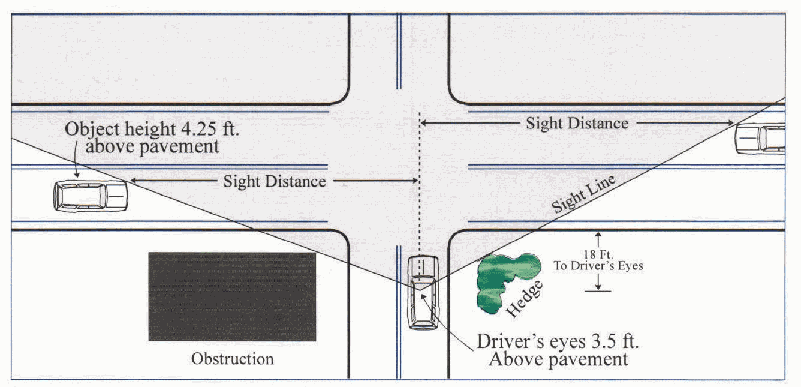
(C) All street intersections shall be designed and located so that the minimum sight distances as shown in the table below are provided. The sight distance for speeds not located on the chart should be determined by referencing Intersection Safety: A Manual for Local Rural Road Owners, as prepared and distributed by the U.S. Department of Transportation, Federal Highway Administration.
Minimum Sight Distance Requirements
Operating Speed | 25 | 30 | 35 | 40 | 45 | 50 | 55 | 60 | 65 |
New Residential Driveway Access | 175 | 210 | 245 | 280 | 315 | 350 | 385 | 420 | 455 |
New Commercial Driveway Access | 250 | 300 | 350 | 400 | 450 | 500 | 550 | 600 | 650 |
New Street Intersection | 280 | 335 | 390 | 445 | 500 | 555 | 610 | 665 | 720 |
(D) All driveways and street intersections proposed to access state roads require an access permit from the Indiana Department of Transportation (INDOT).
(E) Any road or street that does not have a posted speed limit should refer to the Dearborn County, Indiana Code of Ordinances for its appropriate speed. The sight distances shall be applied as demonstrated.
(F) The Technical Review Committee can grant a 20% reduction of the required sight distance for proposed driveway accesses in certain situations, such as where the street is: minimally traveled, located on a dead-end street, contains little or no development, or is a gravel road.
(Ord. 2019-010, passed 5-13-19)
§ 152.117 SIGHT TRIANGLE.
In addition to the design and location of new access points with adequate sight distance, an adequate sight triangle shall also be maintained. Sight triangles are areas clear of visual obstruction to allow for the safe egress of vehicles from an access point, including an intersecting street onto a roadway. Sight triangles shall conform to the distances detailed in § 152.116.
(Ord. 2019-010, passed 5-13-19)

