
Aurora City Zoning Code
SIGNS
§ 152.140 INTENT.
The intent of this subchapter is to allow adequate communication through signage while encouraging aesthetic quality in the design, location, size and purpose of all signs to ensure the protection of property values, the character of various neighborhoods, the creation of a convenient, attractive and harmonious community, and encouraging economic development. Signs obstruct views, distract motorists, and pose other problems that call for regulation. This subchapter must be interpreted in a manner consistent with the First Amendment guarantee of free speech.
(Ord. 2017-13, passed 12-4-17)
§ 152.141 GENERAL PROVISIONS.
(A) No sign shall be permitted or placed in any district except as described in this subchapter.
(B) No sign shall obstruct vehicular driver viewing for safe passage or ingress and egress of vehicular traffic on public roadways.
(C) All signs shall comply with applicable provisions of the Uniform Building Code and the Electrical Code of the city at all times.
(D) Sign content shall not contain language or symbols that can reasonably been seen as potentially harming the community image, and or would impair future economic development efforts.
(E) Sign illumination or lighting device, when permitted, shall only employ light which emits illumination of constant intensity changing no more than one time per eight seconds, nor shall any sign be illuminated by or contain flashing, intermittent, rotating, or moving lights. In no event, shall such devices be placed or directed so as to directly beam upon a public road, highway, street, sidewalk, other vehicular or pedestrian system, or adjacent premises so as to cause glare or reflection that may constitute a hazard or nuisance nor have a night-time brightness level greater than 0.3 footcandles above ambient lighting.
(F) Freestanding signs shall be five feet outside the public right-of-way and public easement, unless otherwise stated. In cases where a road may not have a dedicated right-of-way the sign must be placed a minimum of 30 feet from the centerline of the road.
(G) Signs shall not be placed in any public right-of-way, except publicly owned signs, without obtaining an encroachment permit.
(H) Sign types not specifically recognized in this chapter that are similar in type to another type specifically described may be allowed in accordance with such like type with approval from the planning director or designee.
(I) Signs shall be maintained in a safe, legible condition, nor be in a state of disrepair.
(1) Disrepair shall include, but not be limited to, burned out lights, broken sign faces or sign structures, peeling paint, and weathered or discolored sign faces or structures.
(2) Sign face messages must be removed from an abandoned sign if a location has been out of business or abandoned for six months or more; however, the sign structure may remain for an additional six months if the property owner is actively pursuing a new tenant or buyer.
(3) Landscaping around ground signs shall be maintained.
(J) Signs not installed in accordance with this subchapter shall be forfeited to the public and subject to confiscation. In addition to other remedies hereunder, the city shall have the right to recover from the owner or person placing such a sign the full costs of removal and disposal of such sign.
(Ord. 2017-13, passed 12-4-17)
§ 152.142 EXEMPT SIGNS.
The following signs are exempted from obtaining a sign permit as described in § 151.146, but must be established and maintained in accordance with this subchapter as to not cause safety hazards.
(A) The replacement of a panel or display message on an approved sign, involving no changes to approved size, location, or lighting.
(B) Painting, repainting, cleaning, or other normal maintenance and repair of an existing sign or sign structure, unless a structural change is involved;
(1) General maintenance does not include redesigning such sign.
(C) Window signs covering not more than 30% of the window area.
(1) Only neon or external illumination shall be permitted.
(D) Non-illuminated temporary noncommercial signage per tenant for a period not to exceed 45 consecutive days. A 90-day period must expire before such sign can be reestablished.
(1) Sign shall be limited to either one sign that is 16 square feet in area or two signs not exceeding 16 square feet in combined area.
(2) Sign shall not be greater than five feet above the grade level of the adjacent street to which the sign is located or four feet above ground level, whichever is greater.
(E) Property actively for sale or for lease is permitted one sign per road frontage. Such property must be offered for sale or lease through a licensed real estate agent or through advertising in a local newspaper of general circulation.
(1) Residential zoning districts shall be permitted 6 square feet for contiguous parcels on less than 100 feet of road frontage and 20 square feet on contiguous parcels with greater than 100 feet of road frontage.
(2) Business and manufacture zoning districts shall be permitted 20 square feet of sign area when not adjoining a highway and 32 square feet when adjoining a highway, but at no time exceed two signs.
(3) Signs shall not exceed a maximum height of 5 feet for contiguous parcels containing less than 100 feet of road frontage and a height of eight feet for contiguous parcels containing more than 100 feet of road frontage.
(4) No more than one sign shall be permitted per street frontage and shall be at least 15 feet from the intersection corner.
(5) For through lots (fronting on two parallel streets), two signs may not face the same street.
(6) Illumination is not permitted.
(7) Sign must be removed 15 days after the date of on which a contract of sale has been executed.
(F) On-premise incidental signs not exceeding six square feet of area, or four feet in height. Such sign shall not contain any logos, and only give information or direction for the convenience and necessity of the public such as "entrance," "exit," "no admittance," "parking," and "123 Main St.".
(1) Each property must be marked using numerals that identify the address of the property so that public safety departments can easily identify the address from the public street.
(2) A directional sign shall be permitted near each entrance of a business or manufacture zoned property.
(3) Standard traffic directional signs, such as STOP and Yield signs, shall comply with the "Manual for Uniform Traffic Control Devices".
(G) Government signs.
(H) Flags which are fastened to poles and setback a minimum of ten feet from the public right-of-way and property lines.
(1) Up to three flag poles containing no more than two flags per pole.
(a) Residential zoned properties are permitted a flagpole height of 25 feet and 40 square feet of total flag area.
(b) Nonresidential zoned properties are permitted a flagpole height of 70 feet and 216 square feet of total flag area.
(I) Election signs that are not detrimental to public safety are permitted beginning 60 days before an election and ending the sixth day after the election if the surface area of the sign is not greater than 32 square feet, pursuant to IC 36-1 -3-11.
(1) Only the surface area of one of the faces is considered for signs consisting of two faces, if both of the following apply:
(a) The faces are mounted back to back.
(b) The measure of the angle between the faces is not more than 15 degrees.
(J) Umbrella signs of three square feet or less.
(K) Interior signs located in a building, not attached to a window or door, that is not legible from a distance of more than three feet beyond the lot line on which such sign is located.
(L) Miniscule messages displayed on or near a primary entrance.
(1) Sign shall not exceed 30 square inches nor shall the cumulative area of all miniscule messages exceed 288 square inches per primary entrance. Examples include "Visa", "ATM", and corporate logos.
(M) A work of art for the expression of a message which is political, religious, or pertaining to a view, expression, opinion, or idea that contains no reference to the endorsement, advertising of, or promotion of patronage of a business, commodity, service, entertainment, or attraction that is sold, offered, or existing.
(1) Murals that contain a commercial message shall be regulated as a wall sign. Only areas of the mural that provide a commercial message will be subject to wall sign square footage standards, and shall be computed by means of the smallest rectangle that will encompass the extreme limits of the commercial message.
(N) Holiday lights and decorations containing no commercial message.
(Ord. 2017-13, passed 12-4-17)
§ 152.143 PROHIBITED SIGNS.
The following types of signs are prohibited.
(A) Signs imitating, resembling or conflicting with official traffic signs or signals.
(B) Signs of the flashing, blinking, animated, or audible type, except those giving public service information placed by the City of Aurora and/or the State of Indiana.
(C) Skyward lights, search lights, beacons, or any light or lights that project light in visible beams skyward, or project light horizontally or vertically in a circle or other pattern regardless if the light is part of or independent of a sign.
(D) Signs which rotate, swing, inflate or move, pennants, ribbons, streamers, spinners, strings of lights, other similar devices or any sign that is temporary in nature due to its design or construction except as permitted in § 152.147.
(E) Signs established on trees, utility poles and fences.
(F) Roof signs.
(G) Signs that promote illegal activity, profanity, or obscene or pornographic content.
(H) Vehicle signs with a sign area greater than 50 square feet in cumulative area. Prohibited vehicle signs shall not be construed to include vehicles with signs on them that:
(1) Are lawfully parked overnight during non-business hours on a paved surface in a discreet location, or in an enclosed location; or
(2) Are making deliveries, sales calls, transporting persons or property, or customary practices relating to operating the business; or
(3) Are used in conjunction with customary construction operations on a construction site.
(Ord. 2017-13, passed 12-4-17)
§ 152.144 COMPUTATION.
(A) Computation of sign area.
(1) The area of a sign face shall be computed by means of the smallest rectangle that will encompass the extreme limits of the sign, but not including any supporting framework, bracing, or decorative fence or wall when such fence or wall otherwise meets the regulations and is clearly incidental to the display itself.
(2) Computation of area of multi-faceted sign. Double sided signs with parallel faces shall be computed as the greater square footage of the two sides. If a sign has faces that are not parallel then the sign area shall be computed by adding together the area of all sign faces.
(B) Computation of height.
(1) The height of a sign shall be computed as the distance from the base of the sign at normal grade to the top of the highest attached component of the sign or structure supporting the sign.
(a) Normal grade shall be construed to be the lower of existing grade prior to construction or the newly established grade after construction, exclusive of any filling, berm, mounding, or excavating solely for the purpose of locating the sign. In cases in which the normal grade cannot reasonably be determined, sign height shall be computed on the assumption that the elevation of the normal grade at the base of the sign is equal to the elevation of the nearest point of the crown of a public street or the grade of the land at the primary entrance to the primary structure on the lot, whichever is lower.
(C) Computation of maximum total permitted sign area for a lot.
(1) The permitted sum of the area of all individual signs, excluding incidental signs, shall be computed by totaling the sign area of each sign, as described above. In cases where multiple regulations cover one lot, the most restrictive regulation shall be used.
(D) Sign setback and spacing.
(1) Setbacks shall be measured from the sign's leading edge, including associated ornamental and structural components.
(Ord. 2017-13, passed 12-4-17)
§ 152.145 NONCONFORMING SIGNS.
(A) Any sign located within the city limits on the date of adoption of this subchapter that does not conform to the provisions of this subchapter is eligible for characterization as a legal nonconforming sign and is permitted, provided it also meets the following requirements:
(1) The sign was approved by a sign permit or variance on or before the date of adoption of this subchapter if one was required under applicable law, or, if no sign permit was required under applicable law for the sign in question, the sign was in all respects in conformity with the applicable law immediately prior to the adoption of this subchapter or had legal nonconforming status at such time; and
(2) The sign is a permanent sign.
(B) If land is annexed to the city after the effective date of this subchapter, any sign not conforming to the provisions of this subchapter at such time shall have legal nonconforming status if:
(1) Under applicable federal, state, and county regulations, the sign was legal in all respects immediately prior to annexation;
(2) The sign is a permanent sign; and
(3) The annexation was not conditioned upon the removal or modification of the sign.
(C) Any nonconforming sign that does not fit the definition of a legal nonconforming sign is an unlawful sign.
(D) A legal nonconforming sign shall immediately lose its legal nonconforming status if:
(1) The sign or sign structure, because of improper installation or maintenance, constitutes a threat to public health or safety and remains in such condition after a reasonable time is given to remedy the problem; or
(2) The sign is demolished or damaged to the extent of 50% or more of its value; or
(3) The permit, variance, or condition under which the sign was permitted expires; or
(4) The sign or sign structure is substantially structurally altered so as to prolong its expected life.
(E) On the happening of any one of the above-listed items, the sign shall be immediately brought into conformance with this subchapter or shall be removed. The following shall not result in loss of legal nonconforming status:
(1) Any changes of color, design, or message on the sign's face; and
(2) Any modification to the sign or sign structure which does not constitute a substantial structural modification.
(F) Safety, maintenance and repair.
(1) Nothing in this subchapter shall relieve the owner or user of a legal nonconforming sign or owner of the property on which the legal nonconforming sign is located from any provisions regarding safety, maintenance and repair of signs.
(Ord. 2017-13, passed 12-4-17)
§ 152.146 SIGN PERMITS.
(A) Sign permits are required for all signs unless stated otherwise in this section. An application must be submitted for all proposed signs and must be filed with the Plan Commission. A sign permit shall only be issued if the proposed sign meets the requirements of this subchapter. The sign permit application shall include, at a minimum, the following information:
(1) Name and address of the applicant;
(2) Name and address of the owner of the property on which the sign is to be located, and the owners signature that will authorize the use of the land for the purposes of locating a sign;
(3) A description of the proposed sign including type of sign, supporting structure, method of illumination (if any), and construction materials to be used in the sign;
(4) A scaled site plan of the property on which the sign is to be erected showing existing structures and signs, right-of-way lines and the proposed location of the sign(s);
(5) A scaled drawing of existing signage and the proposed sign showing display area dimensions, height of sign from grade to bottom and top of the sign and the information to be conveyed on sign.
(6) In situations where allowable sign area is contingent upon store frontage, such frontage elevation must be provided to scale.
(7) Additional information may be required to verify conformance with this subchapter.
(8) In situations where a certificate of appropriateness, an encroachment permit, a variance, or similar additional approval is necessary, such documentation must be provided.
(B) Upon receipt of a full and complete application and applicable fees as approved by Council for a sign permit, the Planning Director or designee shall issue a permit or notify the applicant of any nonconformance with the provisions of this subchapter within ten working days. Failure to issue a permit or notify the applicant of any nonconformance does not constitute approval of the proposed sign. If the sign described in any sign permit has not been erected or installed within one year from the date of issuance, the permit shall expire without further notice. The permit may be extended upon request of the applicant prior the date of expiration for a period not to exceed six months. The Planning Director or designee shall maintain a file of all applications for sign permits.
(Ord. 2017-13, passed 12-4-17)
§ 152.147 TEMPORARY SIGNS.
(A) General standards.
(1) A temporary advertising permit shall be obtained prior to the placement of any such signage.
(2) The procedure for acquiring a temporary advertising permit shall be as described in § 152.146, except that all temporary advertising permits must contain the dates that the display will be utilized.
(3) No temporary sign shall be maintained, displayed or placed on a property for a period longer than 45 days after the issuance of the permit and 90 days must expire before the applicant can reapply for a new permit for said sign on the property. A new permit is to be obtained for each period.
(B) Temporary signage standards.
(1) Freestanding signs are permitted in accordance with § 152.142. Signage larger than described can be permitted with a temporary sign permit and be subject to regulations of a freestanding sign, pole sign, or monument sign as described for each zoning district.
(2) Banner signs are intended to be attached to the wall and be regulated in accordance with wall signs by each zoning district.
(3) Portable message center sign.
(a) Sign shall be no more than 32 square feet and no greater than eight feet above the grade level of the adjacent street to which the sign is located or four feet above ground level, whichever is greater.
(b) Sign shall have an eight second hold time between messages.
(4) Blade signs are permitted once every 50 feet of street frontage up to three per frontage.
(a) Signs must be no higher than 18 feet and no wider than three and one-half feet at its widest point.
(b) Illumination is not permitted.
(5) Sidewalk signs, such as A-frame and T-frame signs are permitted during regular business hours if they are temporarily placed and the following conditions are met:
(a) A sign is permitted per tenant up to eight square feet per sign face nor exceeding three feet in width.
(b) No such sign shall exceed a height of four feet above the ground.
(c) The sign is placed on the sidewalk pavement and there remains sufficient clearance, of at least five feet.
(d) Sign must be located within ten feet of the entrance.
(C) Temporary special event signage.
(1) Only four temporary special event sign permits shall be issued to any one property in any calendar year.
(2) Permit shall be valid for a maximum of 30 days.
(3) A banner shall be permitted per business, which shall not exceed 32 square feet in size nor 15 feet in height.
(4) No more than two temporary free-standing ground signs for each roadway frontage not exceeding four square feet each shall be permitted per lot.
(a) For lots with buildings containing multiple tenants and that have applied for simultaneous special event signs, no more than three temporary ground signs may be permitted per roadway frontage at any one time.
(b) Sign shall not be greater than five feet above the grade level of the adjacent street to which the sign is located or four feet above ground level, whichever is greater.
(5) In lieu of a banner or temporary ground signs, one gas or air-filled advertising device may be permitted per lot, not to exceed a height of 15 feet.
(6) Pennants, streamers, and other wind-blown devices shall not be permitted as part of a temporary special event sign permit.
(Ord. 2017-13, passed 12-4-17)
§ 152.148 RESIDENTIAL AND AGRICULTURAL DISTRICTS (ZONES A, R-1, R-2 AND R-3).
Signs for residential and agriculture zoned districts are permitted only when in compliance with the following:
(A) Each of the following is permitted per parcel.
(1) Monument signs.
(a) Sign shall be free-standing or ground-mounted and be part of a decorative structure made of wood, brick, stone or masonry with an overall design compatible with the character of the neighborhood.
(b) Sign shall be no larger than 32 square feet and no greater than eight feet above the grade level of the adjacent street to which the sign is located or four feet above ground level, whichever is greater.
(c) Sign may be externally illuminated.
(2) Wall-mounted signs.
(a) Sign must fit within the horizontal and vertical elements of the building nor obscure architectural details of the Building nor exceed 10% of wall surface up to 40 square feet.
(b) No wall sign shall be allowed to extend above the cornice line of a building, beyond the edges of the wall upon which it is mounted, nor above the roofline.
(c) Sign shall be designed to relate to the architectural style of the main building or buildings upon the site.
(d) Sign shall not project more than 18 inches perpendicular from the wall face.
(e) Sign may be externally illuminated.
(3) Projecting signs.
(a) Sign shall be no more than four feet in height, and shall not extend more than four feet from the face of the building.
(b) Sign shall not exceed a maximum width of three feet.
(c) Sign shall be a minimum of eight feet above the adjacent grade nor extend above the cornice line of a building.
(d) Sign shall be perpendicular to the building face that the sign is mounted to.
(e) Sign may be externally illuminated.
(4) Awning or canopy signs.
(a) Canopy signs shall have a ground clearance of no less than eight feet above the lowest ground elevation.
(b) Canopy signs shall cover no more than 65% of the area of the side faces (awning flaps) of the canopy and no more than 40% of the front (or front-angled or sloped) face of the canopy.
(c) Illumination is prohibited.
(Ord. 2017-13, passed 12-4-17)
§ 152.149 BUSINESS AND MANUFACTURING DISTRICTS (ZONES B-1, B-2, B-3 AND M-1).
Signs for B-l, B-2 and manufacturing zoned districts are permitted only when in compliance with the following:
(A) Each of the following is permitted per parcel.
(1) Monument/freestanding signs.
(a) Sign shall be no larger than 80 square feet and located no higher than the gutter line of the building or 15 feet whichever is less and no closer than five feet to any right-of-way or property line.
(b) Such signs may be illuminated provided the light source is designed, located and installed in such a way that there is no glare on public streets or neighboring premises.
(c) Planned developments shall be permitted 1 monument sign for each entrance up to two signs. The permitted sign shall be no more than one square foot of sign area per linear foot of the contiguous parcels width at the point of the sign location up to 100 square feet in area nor shall exceed 20 feet in height.
(2) Wall-mounted signs.
(a) Sign must fit within the horizontal and vertical elements of the building not obstructing architectural details of the building nor exceed 25% of wall surface or 64 square feet. For multiple-tenant buildings, each business shall be permitted a wall-mounted sign, not exceeding 10% of wall surface or one and one- half square feet of sign area per linear foot of store frontage per unit, to a maximum of 64 square feet.
(b) No wall sign shall be allowed to extend above the cornice line of a building, beyond the edges of the wall upon which it is mounted, nor above the roofline.
(c) Sign shall be designed to relate to the architectural style of the main building or buildings upon the site.
(d) Sign shall not project more than 18 inches perpendicular from the wall face.
(3) Projecting signs.
(a) Sign shall not to exceed 32 square feet.
(b) Sign shall not exceed 8 feet in height, nor extend more than six feet from the face of the building.
(c) Sign shall not exceed four feet in width.
(d) Sign shall be a minimum of eight feet above the adjacent grade nor extend above the cornice line of a building.
(e) Sign shall be perpendicular to the building face that the sign is mounted to.
(4) Awning or canopy signs.
(a) Canopy signs shall have a ground clearance of no less than eight feet above the lowest ground elevation.
(b) Canopy signs shall cover no more than 65% of the area of the side faces (awning flaps) of the canopy and no more than 40% of the front (or front-angled or sloped) face of the canopy.
(c) Illumination is prohibited.
(Ord. 2017-13, passed 12-4-17; Am. Ord. 2018-014, passed 10-8-18)
§ 152.150 BILLBOARDS/OFF PREMISE SIGNS.
A sign containing a message not related to the business or activity conducted on site. The Board of Zoning Appeals may permit such sign as a conditional use provided they meet any applicable federal or state law and the following minimum regulations and requirements:
(A) General requirements.
(1) Such signage must meet general requirements of § 152.141.
(2) No more than one off-premises sign may be permitted per property.
(3) Sign illumination shall be regulated by sign type pursuant to the zoning district.
(B) A small scale off-premise sign shall be no larger than 32 square feet in area and no more than eight feet in height.
(1) Sign standards shall be regulated pursuant to the zoning district.
(C) Large scale off-premise signs shall be no larger than 100 square feet in total sign area, nor exceed 25 feet in height and shall conform, at minimum, to the following requirements:
(1) Sign shall only be permitted along US 50 and be prohibited in residential zoned districts and the Historic District.
(2) Sign may be no closer than 1,000 feet to another large scale off-premise sign.
(3) Sign shall have no more than two sides, back to back.
(4) Sign shall not have a face height nor width of more than ten feet.
(5) Sign shall be set back from any street right-of-way a distance equal to the greatest front yard setback for principally permitted uses in the zoned district in which the sign is proposed or 50 feet, whichever is greater.
(D) The application for off premise signage shall be accompanied by the information below:
(1) All of the information required by § 152.146;
(2) Identification of all highways or other thoroughfares from which the sign will be visible;
(3) The location of the proposed sign as well as the location of all existing off-premise signs within one-half mile radius of the proposed location, on a scaled map;
(4) A picture or photograph, not less than eight inches by ten inches in size, of the proposed location of the sign taken from each thoroughfare from which the sign will be visible. The proposed location of the sign shall be clearly marked to scale on each photograph.
(Ord. 2017-13, passed 12-4-17)
§ 152.151 OVERLAY SIGNS FOR DOWNTOWN HISTORIC DISTRICT.
(A) This section supplements existing sign regulations with regulations specifically designed to ensure compatibility and pedestrian scale of all signage in the Downtown Historic District. No sign shall be permitted, erected, established, or allowed to be erected or established, within the area governed by this subchapter, unless it is in conformity with this subchapter. It shall be unlawful to erect any sign in the area governed by this subchapter unless a certificate of appropriateness is granted by the Historic Preservation Commission (HPC).
(B) The boundaries of the Downtown Historic District are established as the Downtown Historic District overlay zone and generally includes the area between the Ohio River on the east, Hogan Creek on the north, US 50 and Exporting Street to the west, and 5th Street on the south.
(C) The following procedures shall govern the application for, and issuance of, all sign permits within the Downtown Historic District.
(1) If a sign requires a permit under the provision of this section, a sign permit shall be obtained prior to the construction, placement, erection, or modification of such a sign in accordance with the requirements of this division.
(2) All requirements of § 152.146 must be submitted to the Planning Director or designee and be accompanied by a certificate of appropriateness.
(3) Proposals must be submitted to the Historic Preservation Commission (HPC) to obtain a certificate of appropriateness.
(4) Each permit/application for a sign or for approval shall be accompanied by the applicable fees as calculated from the current adopted fee schedule.
(5) At each monthly HPC meeting all proposals for a certificate of appropriateness shall be reviewed. The actions taken shall be one of the following.
(a) HPC will approve the certificate of appropriateness if the sign(s) conforms with all requirements of this section.
(b) The HPC rejects the certificate of appropriateness if the sign(s) fails in any way to conform with the requirements of this section. In case of a rejection, the HPC shall specify the division or divisions of the section or applicable plan with which the sign(s) is inconsistent and counsel the applicant to return at the next monthly meeting.
(6) Within six months of the issuance of a permit, the local building official shall cause an inspection of the new sign or for the modification of an existing sign. If the construction is not substantially completed at the time of inspection, the permit shall lapse and the local building official shall issue a letter regarding the lapse of the permit. If the construction is substantially complete but not in full compliance with this section and applicable codes, the local building official shall give the owner or applicant notice of the deficiencies and shall allow an additional 30 days from the date of inspection for the deficiencies to be corrected. If the deficiencies are not corrected by such date, the permit/application shall lapse. If the deficiencies have been corrected, the local building official shall reinstate the sign permit/application.
(D) All signs shall be designed, constructed and maintained in accordance with the following standards.
(1) All signs shall conform to the general requirements of § 152.141.
(2) Signs shall be sized in proportion to the building. A certificate of appropriateness may be disapproved if the proposal is found to be excessive or non-proportional in relation to the building on which it is place or which it serves.
(3) Exposed surfaces of signs must be constructed of or appear to be constructed of metal, glass, stone, concrete, brick, cloth, or wood, or similar approved material. If synthetic materials are authorized, they shall have the same finished appearance as materials specified here.
(a) Plastic substrate, plywood or unfinished wood are not appropriate materials for signs and shall not be permitted.
(4) If signs are illuminated they shall be externally lit. Lighting directed toward a sign shall be shielded or recessed so that only the face of the sign is illuminated and does not shine directly into a public right-of-way or sidewalk.
(a) No colored lights shall be used.
(E) Sign types and standards.
(1) Monument sign.
(a) Ground signs shall only be permitted in the front yard of properties containing an appropriate landscaped front yard area.
(b) The maximum height of any ground sign shall be eight feet.
(c) Except for temporary signs permitted by the Zoning Administrator or designee, any permanent ground sign permitted pursuant to this subchapter shall be supported by at least two wooden posts, no less than four inches by four inches. However, the Historic Preservation Commission may allow single post signs and metal posts, if deemed more compatible with the building, property, and/or surroundings.
(d) A ground sign shall be permitted per property frontage.
(e) Sign shall not exceed an area of 32 square feet.
(2) Wall signs.
(a) Wall signs shall be mounted flush against the facade of the building adjacent to the front entryway of the unit.
(b) Appropriate locations for wall signage on buildings with more than one story shall be in the lintel space which separates the storefront from the upper floor, and the space above the transom in the storefront, where one exists (see figure on following page). Wall signs should be located on flat, unadorned parts of the building facade, somewhere above storefront display windows (where they exist) and below second-story windows (where they exist). If the building facade or storefront has a lintel strip or sign board, the wall sign should be placed directly on it. Wall signs should be located centrally on the facade. Sign boards should not exceed two and one-half feet in height.
(c) Sign should be attached through joints in the masonry rather than the brick itself.
(d) Sign shall not protrude more than six inches from the facade, when mounted flush against the facade of the building.
(e) No more than two wall signs shall be permitted per building facade of the leasable space.
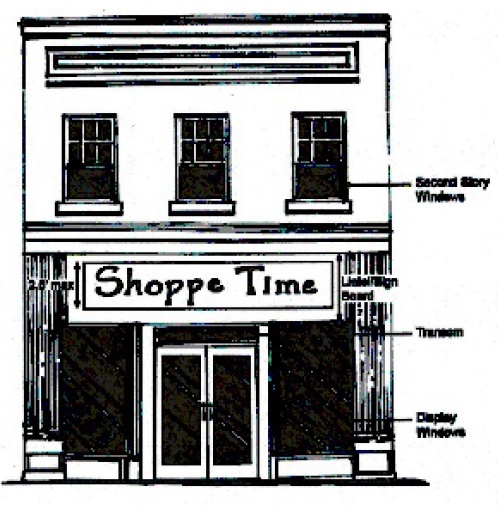
(f) Wall signs, individually or in total allowed, shall not exceed more than 30% of the wall area on which they are displayed, or 1.5 square feet per linear feet of leased building frontage of the business or establishment, whichever is greater.
(3) Canopy and awning signs.
(a) Storefront awnings should be positioned either above the display window and below the transom window(s), or above both the display and transom windows but below the sign board area, cornice, or spandrel, where these architectural features exist. Such signs should be silk-screened or sewn onto the awning fabric, and they should be placed on the valance of the awning. Signs on canopies should be located on the primary face or top edge (or front-angled or sloped part) of canopies.
(b) Canopy signs shall have a ground clearance of no less than eight feet above the lowest ground elevation.
(c) Canopy signs shall cover no more than 65% of the area of the side faces (awning flaps) of the canopy and no more than 40% of the front (or front-angled or sloped) face of the canopy.
(4) Projecting signs.
(a) Projecting signs are permissible, but the Historic Preservation Commission may restrict them if other alternatives (wall, window, door, and awning) signs are also present or proposed.
(b) Sign should be placed near the entry door.
(c) Sign shall project perpendicular from the building.
(d) Sign shall be secured in place with a frame mount assembly.
(e) Sign may be suspended from an awning or similar type structure or affixed to a bracket-mount to the building or structure in a manner where the sign face sways; such motion shall not make a swinging sign a prohibited animated sign.
(f) Any sign that is suspended from the underside of a canopy (including awnings), shall be located perpendicular to the wall surface of a building.
(g) Sign shall have a ground clearance of no less than eight feet above the lowest ground elevation.
(h)
Sign shall project no more than 60 inches from the building face.
(i) Signs shall be limited to one per business or establishment.
(j) No projecting sign shall exceed an area of nine square feet per sign face.
(k) When applicable, projecting signs that encroach on city property shall obtain an encroachment permit.
(5) Window signs.
(a) Window signs may be displayed on or in display windows on the ground floor. Window signs in upper facade windows are generally not encouraged and should be justified by the applicant.
(b) Window signage should be painted. Applied vinyl letters are discouraged but may be approved by the Historic Preservation Commission.
(c) No window advertising sign shall extend from one window to another.
(d) No window sign shall be installed above the level of second floor windows.
(e) Window signs shall not exceed 25% of the total window area of the business or establishment, or 32 square feet total of window signage for any single business or establishment, whichever is less.
(f) The number of window signs for any individual business or establishment is not limited by this subchapter but limitations may be imposed via the certificate of appropriateness.
(g) Window signs should be placed approximately three and one-half feet above the sidewalk.
(h) Window signs should not extend within 18 inches from the top or bottom of the display window glass.
(6) Door signs.
(a) Signs on doors should be located on or in the glazing of the doors. Painting of letters is preferred. Vinyl letters are discouraged but permitted.
(b) There shall be no more than two door signs for any individual business or establishment.
(c) The maximum area for any individual door sign shall be one and one-half square feet.
(d) There shall be a maximum of three square feet total area of door signs allowed for any single business or establishment.
(7) Sidewalk signs.
(a) Movable sandwich signs, also called A-frame and T-frame signs, may be used in the historic district, limited to one per business or establishment and be subject to standards as set in § 152.147.
(8) Temporary special event signage.
(a) Property owners in the historic district may apply for permits for special events and associated signage, as provided in § 152.147, except that gas or air-filled advertising devices shall not be allowed.
(F) The following sign types are prohibited in the Downtown Historic District:
(1) Signs prohibited under § 152.143;
(2) Internally illuminated signs;
(3) Bus shelter signs;
(4) Strings of lights not permanently mounted to a rigid background, except those exempt under § 152.142;
(5) Street bench signs;
(6) Temporary signs on street lights or utility poles;
(7) Animated signs.
(G) Exceptions.
(1) Variances. Variances to the requirements of this section may be approved as provided in § 152.243. A variance to the requirement for area, height, location, number of signs, or sign form may be approved if necessary to make the sign or a use reasonably visible from the abutting street to which the sign or use is oriented if without the variance such visibility would be impaired by topography, landscaping, or existing development.
(2) Design exceptions. The HPC may approve a special exception to one or more requirements of this section when it makes its review of the sign certificate of appropriateness that literal conformance to such requirements would be detrimental to the creation of a sign display of unusual or outstanding design quality, or would not take into consideration the unique characteristics of a property.
(H) Appeals.
(1) If HPC rejects a sign application, the applicant may then seek a hearing with the Board of Zoning Appeals.
(Ord. 2017-13, passed 12-4-17; Am. Ord. 2018-015, passed 10-8-18)
TABLE A: PERMITTED SIGNS BY DISTRICT AND SIGN TYPE
Sign Type | Maximum Area | Maximum Height | Setback As measured from property line/pub lic rights- of-way | Illumination | Maximum Projection | Other Restrictions |
Sign Type | Maximum Area | Maximum Height | Setback As measured from property line/pub lic rights- of-way | Illumination | Maximum Projection | Other Restrictions |
RESIDENTIAL AND AGRICULTURAL DISTRICTS | ||||||
Monument sign | 32 square feet | 8 feet above the grade level of the adjacent street to which the sign is located or 4 feet above ground level, whichever is greater | 5 feet | External only | N/A | Such signs shall be part of a decorative structure made of wood, brick, stone or masonry with an overall design compatible with the character of the neighborhood. |
Wall-mounted sign | 10% of wall surface up to 40 square feet | Sign shall not extend above the cornice line of a building , beyond the edges of the wall upon which it is mounted, nor above the roofline | N/A | External only | 18 inche s | Sign shall be designed to relate to the architectural style of the main building or buildings upon the site. |
Projecting sign | 12 square feet | 4 feet | Projecting signs that encroach on city property shall obtain an encroachment permit | External only | 4 feet | Sign shall be a maximum of 8 feet above the adjacent grade and not extend above the cornice line of a building, and be perpendicular to the building face that the sign is mounted to. |
Awning/canopy | 65% of the area of the side faces (awning flaps) of the canopy and no more than 40% of the front (or front- angled or sloped) face of the canopy | See area restrictions | Signs that encroach on city property shall obtain an encroach ment permit | Prohibited | N/A | N/A |
BUSINESS AND MANUFACTURING DISTRICTS | ||||||
For single occupancy buildings, the lot shall be permitted one of the following signs. For multiple occupancy buildings, the lot or parcel shall be permitted each of the following. | ||||||
Monument sign Single occupancy building Planned development | 80 square feet 1 square foot of sign area per linear foot of the lot's width up to 100 square feet | Gutter line of building or 15 feet 20 feet | 5 feet 5 feet | Allowed Allowed | N/A N/A | Planned developments shall be permitted 1 monument sign for each entrance up to 2 signs. |
Wall- mounted sign Single occupancy building Multi-occupancy building | 10% of wall surface or 64 square feet 10% of wall surface or 1.5 square feet of sign area per linear foot of store frontage per unit, up to a maximum of 64 square feet | Cornice line of a building or the roofline Cornice line of a building or the roofline | N/A N/A | Allowed Allowed | 18 inches 18 inches | N/A N/A |
Projecting sign | 32 square feet | 8 feet and not extend above the cornice line of a building | Projecting signs that encroach on city property shall obtain an encroachment permit | Allowed | 6 feet | Sign shall be perpendicular to the building face that the sign is mounted, shall be a minimum of 8 feet above the adjacent grade and not exceed a width of 4 feet. |
Awning/canopy | 65% of the area of the side faces (awning flaps) of the canopy and no more than 40% of the front (or front-angled or sloped) face of the canopy | See area restrictions | Signs that encroach on city property shall obtain an encroachment permit | Prohibited | N/A | N/A |
BILLBOARD/OFF PREMISE SIGNS | ||||||
The Board of Zoning Appeals may permit such sign as a conditional use | ||||||
Small scale off premise | The allowable square footage by sign type per district up to 32 square feet | The allowable height per sign type per district up to 8 feet | 5 feet | External only | No larger than what is principally permitted by sign type per the zoning district | A maximum of 1 off premises sign can be permitted per property, and illuminated only from below the sign |
Large scale off premise | 100 square feet | 25 feet | Equal to the greatest front yard setback for principally permitted uses in the zoned district in which the sign is proposed, or 50 feet, whichever is greater | External only | N/A | Sign shall not have a face height or width of more than 10 feet, shall be no closer than 1,000 feet to another such sign, shall be a pole or monument sign and shall only be permitted along US 50 and prohibited in R-1, R-2, R-3, B-1 and M zoned districts and the Historic District. |
TEMPORARY SIGNS | ||||||
Maximum of 90-day periods and a 90-day period must expire before the permit can be reestablished | ||||||
Noncommercial freestanding | 1 sign that is 16 square feet in area or up to 2 signs not exceeding a combined 16 square feet in area | 5 feet above the grade level of the adjacent street to which the sign is located or 4 feet above ground level, whichever is greater | 5 feet | Prohibited | N/A | Shall conform to the general requirements defined by § 152.141. NO PERMIT REQUIRED |
Nonspecified freestanding | See other restrictions | See other restrictions | 5 feet | See other restrictions | See other restrictions | Subject to regulations of a freestanding sign, pole sign or monument sign as described for each zoning district. |
Noncommercial freestanding | 1 sign that is 16 square feet in area or up to 2 signs not exceeding a combined 16 square feet in area | 5 feet above the grade level of the adjacent street to which the sign is located or 4 feet above ground level, whichever is greater | 5 feet | Prohibited | N/A | Shall conform to the general requirements defined by § 152.141. NO PERMIT REQUIRED |
Nonspecified freestanding | See other restrictions | See other restrictions | 5 feet | See other restrictions | See other restrictions | Subject to regulations of a freestanding sign, pole sign or monument sign as described for each zoning district. |
Portable message center sign | 32 square feet | 8 feet above the grade level of the adjacent street to which the sign is located or 4 feet above ground level, whichever is greater | 5 feet | Allowed | N/A | Sign shall have a night-time brightness level no more than 0.3 footcandles above ambient lighting and an 8 second hold time between messages. |
Banner | See other restrictions | See other restrictions | N/A | See other restrictions | See other restrictions | Banner signs are intended to be attached to the wall and be regulated in accordance with wall signs by each zoning district. |
Blade sign | No wider than 3.5 feet at its widest point | 18 feet | 5 feet | Prohibited | N/A | Permitted once every 50 feet of street frontage up to 3 per frontage. |
Sidewalk sign | 1 sign is permitted per tenant up to 8 square feet per sign face and not exceeding 3 feet in width | No such sign shall exceed a height of 4 feet above the ground | N/A | N/A | N/A | Signs must be placed on the sidewalk pavement and there must remain sufficient clearance, of at least 5 feet. Sign must be located within 10 feet of the entrance. Sign shall only be used during hours the business is open and shall be removed when the business or establishment is not open to the public. |
TEMPORARY SPECIAL EVENT SIGNAGE | ||||||
Ground sign | 2 signs for each roadway not exceeding 4 square feet each | Signs shall not be greater than 5 feet above the grade level of the adjacent street to which the sign is located or 4 feet above ground level, whichever is greater | 5 feet | N/A | N/A | For lots with buildings containing multiple tenants and that have applied for simultaneous special event signs, no more than 3 temporary ground signs may be permitted per roadway frontage at any one time. |
Banner | 32 square feet | 15 feet | N/A | N/A | N/A | Such signs are intended to be attached to the wall and be regulated in accordance with wall signs by each zoning district. |
Gas or air-filled advertising device | N/A | 15 feet | N/A | N/A | N/A | In lieu of a banner or temporary ground sign, 1 gas or air-filled advertising device may be permitted per lot. |
DOWNTOWN HISTORIC DISTRICT OVERLAY | ||||||
To obtain approval of a sign, in addition to § 152.146, a complete permit application(s) must be submitted and approved by the Historic Preservation Commission | ||||||
Monument sign | No ground sign shall exceed an area of 32 square feet per sign face | 8 feet | Shall not encroach on public property | External only | N/A | Ground signs shall only be permitted in the front yard of properties containing an appropriate landscaped front yard area. |
Wall-mounted sign | 30% of the wall area on which they are displayed or 1.5 square feet per linear foot of leased building frontage of the business or establishment, whichever is greater | 2.5 feet | N/A | External only | 6 inches | Appropriate locations for wall signage on buildings with more than 1 story shall be in the lintel space which separates the storefront from the upper floor, and the space above the transom in the storefront (where one exists). Wall signs should be located on flat, unadorned parts of the building facade, somewhere above storefront display windows (where they exist) and below second story windows (where they exist). If the building facade or storefront has a lintel strip or sign board, the wall sign should be placed directly on it. Wall signs should be located centrally on the facade. No more than 2 wall signs per building facade of the leasable space. |
Projecting sign | 9 square feet per sign face | All projecting signs shall have a ground clearance of no less than 8 feet above the lowest ground elevation | Projecting signs that encroach on city property shall obtain an encroachment permit | External only | 36 inches | The HPC may restrict such signs if other alternatives (wall, window, door and awning) are also present or proposed. Projecting signs shall project perpendicularly from the building, limited to 1 per business or establishment. |
Canopy and awning sign | 65% of the area of the side faces (awning flaps) of the canopy and no more than 40% of the front (or front-angled or sloped) face of the canopy | See area restrictions | Sign that encroaches on city property shall obtain an encroachment permit | Prohibited | N/A | N/A |
Window sign | 25% of the total window area of the business or establishment or 32 square feet total of window signage for any single business or establishment, whichever is less | Window signs should not extend within 18 inches from the top or bottom of the display window glass and be placed approximately 3.5 feet above the sidewalk | N/A | N/A | N/A | Window signs may be displayed on or in display windows on ground floor. Window signs in upper facade windows are generally not encouraged and must be justified by the applicant. When window signage is provided, painting is recommended. Applied vinyl letters are discouraged but may be approved by the HPC. No window advertising sign shall extend from one window to another. In no case shall any window sign be installed above the level of second floor windows. |
Door sign | The maximum area for any individual door sign shall be 1.5 square feet | N/A | N/A | N/A | N/A | Signs on doors should be located on or in the glazing of the doors. Painting of letters is preferred. Vinyl letters are discouraged but permitted. There shall be no more than 2 door signs for any individual business or establishment. There shall be a maximum of 3 square feet total area of door signs allowed for any single business or establishment. |
Sidewalk sign | 1 sign is permitt ed per tenant up to 8 square feet per sign and not exceeding 3 feet in width | No such sign shall exceed a height of 4 feet above the ground | N/A | N/A | N/A | Sign must be placed on the sidewalk pavement and there must remain sufficient clearance of at least 5 feet. Sign must be located within 10 feet of the entrance. Sign shall only be used during hours the business is open and shall be removed when the business or establishment is not open to the public. |
Temporary special event signs | See other restrictions | See other restrictions | See other restrictions | See other restrictions | See other restrictions | Property owners in the Historic District may apply for permits for special events and associated signage, as provided in § 152.147, except that gas or air-filled advertising devices shall not be allowed. |
(Ord. 2017-13, passed 12-4-17)

