
Avon City Zoning Code
CHAPTER 7
34 - Sign Code1
Editor's note— Ord. 18-19, § 19, adopted January 22, 2019, repealed ch. 15.28 § X 15.28.010—15.28.120, which pertained to sign code and derived from Ord. 07-03 §18; Ord. 04-07 §9; Ord. 02-08 §8; Ord. 98-3 §IV; Ord. 88-6 §§1, 2, 3; Ord. 86-3 §1(part). Ord. 18-19, § 14, adopted the sign code in Title 15, Building and Construction, §7.34.010 as herein set out.
7.34.010 - Sign Code.
(a)
Statement of Purpose. The purpose of this Sign Code is to:
(1)
Coordinate the type, placement, and physical dimensions of signs.
(2)
Preserve the right of constitutionally protected free expression, which may be displayed on signs.
(3)
Encourage the innovative use of design.
(4)
Promote high quality and weather-resistant signs that are properly maintained over time and renovated when necessary.
(5)
Maintain the mountain town character of the community through the use of signs that are aesthetically pleasing, of appropriate scale, and harmonious with the built scale.
(6)
Guarantee equal treatment through accurate record keeping and fair and consistent enforcement.
(7)
Provide a reasonable balance between the right of an individual to identify a business or express a message, and the right of the public to be protected against the visual discord resulting from the unrestricted proliferation of signs and similar devices.
(8)
Permit signage that advances and conforms with the policies of the Comprehensive Plan.
(b)
Definitions. As used in this Chapter, the following terms shall have the meanings indicated:
Advertised sale means a business has run an online, print, and or radio promotion to the public for a limited-sale event.
Aggregate sign area means the total sum of the area of all signs on the building or property, except those signs that are exempt from the review requirements of this Chapter.
Animated sign means signs that use movement or change of lighting to depict action or create a special effect or scene.
Awning sign means a sign painted on, printed on, or attached flat against the surface of a shelter, which projects from and is supported by the exterior wall of a building, and which is constructed of non-rigid materials.
Banner means a sign made of fabric or any non-rigid material, typically having no enclosing or supporting framework. See also Temporary Sign
Building Facade means the entire outer surface of an exterior wall of a building, including windows and parapets.
Building front means the horizontal, linear dimension of that side of a building, which abuts a street, a parking area, a mall or other circulation area open to the public and has either a main window display or a primary entrance to the building. For the purposes of this Chapter, a building shall be considered to have up to two (2) building fronts as the property upon which it is situated has lot fronts.
Cabinet sign means a sign that contains all the text and/or logo symbols on the display face of an enclosed cabinet.
Canopy sign means a sign that is mounted on a permanently roofed shelter covering a sidewalk, building entrance or other similar area, which shelter may be wholly or partially supported by a building, columns, poles, or braces extended from the ground.
Changeable copy sign means a sign on which the copy can be changed manually, or by electronic or mechanical devices, such as electrical or electronic time and temperature units, or digital displays. Changeable copy signs shall be classified as permanent signs.
Clearance (of a sign) means the smallest vertical distance between the grade of the adjacent street or sidewalk, and the lowest point of any sign, including framework and embellishments, extending over the grade.
Community Development Department means that department designated by the Town Council responsible for approving applications for sign installations and who is responsible for enforcement of the provisions of this Chapter.
Construction sign means a temporary sign located on a parcel of property, on which construction activities of any type are being actively performed.
Copy means the wording on a sign surface in either permanent or removable letter form.
Digital Display or Electronic Message Center means a sign that contains changing messages or images composed of electronically illuminated segments and/or a series of grid lights, including cathode ray, LED, plasma, LCD, fiber optic, or other electronic media or technology.
Directional/informational sign means a sign located within five (5) feet of an entrance or exit to a lot, for any building on the lot, or for parking for the lot.
Double-faced sign means a sign with two (2) faces, if not parallel then with an interior angle of not greater than ninety degrees (90º).
Drive-through sign means a permanent sign located along a drive-through lane.
Electronic sign means a sign utilizing video screens, variable message, digital display and similar features. Illumination sources may include, but are not limited to, LCD, LED, incandescent, and other similar light sources. Messages may roll, scroll, dissolve and alternate periodically.
Event sign means a temporary sign allowed as part of an approved event permit, on a parcel subject to the terms of such event permit.
Exempt sign means a sign expressly designated as exempt from the sign approval requirements under this Chapter.
Feather sign is a type of advertising signage that is shaped like a feather or flag and is used to promote a business, event, or product. Also known as feather flags, teardrop flags, flag banners, beach-wings, and promotional flags.
Finished grade means the existing level of a property after any development or construction activity and prior to the erection of a sign.
Flag means any fabric or similar lightweight material typically attached to a staff or pole, which is intended to be permanently affixed to the ground or attached to a building.
Flashing sign means a sign that contains an intermittent or sequential flashing light source used primarily to attract attention. Does not include changeable copy signs, animated signs or signs that, through reflection or other means, create an illusion of flashing or intermittent light.
Foot-candle means a unit of incident light (on a surface) stated in lumens per square foot and measurable with an illuminance meter, a.k.a. footcandle or light meter. One (1) footcandle is equal to one (1) lumen per square foot.
Freestanding sign means a sign affixed to a supporting structure, embedded in and extending from the ground and detached from a building. The term includes pole sign, pedestal sign, monument sign, and ground sign.
Government sign means a sign erected, installed, or maintained by the Federal, State, County, or local government for any purpose, including without limitation traffic direction, or a sign located on a building owned by the Federal, State, County, or local government.
Height (of a sign) means the vertical distance measured from the existing grade (at the time of sign application) below the sign to the uppermost point of the sign or sign structure, whichever is higher.
Illegal sign means a sign which does not meet the requirements of this Code, and which has not been designated as "legally nonconforming".
Illuminated sign means a sign with an artificial light source incorporated internally or externally for the purpose of illuminating the sign.
Interactive storefront sign means a digital sign oriented and designed to interact with pedestrians passing along the adjacent sidewalk.
Legal Nonconforming sign means a nonconforming sign designated as "legally nonconforming" under Section (K) of this Chapter.
Maintenance means the cleaning, painting, repair, or replacement of defective parts of a sign in a manner that does not alter the basic design, location, or structure of the sign.
Marquee means a permanent roof-like structure or canopy of rigid materials supported by, and extending from, the facade of a building.
Marquee sign means any sign attached to a building or supported by a marquee structure.
Masonry inscription means any text or numeral etched into masonry.
Multi-faced means any sign having more than two (2) faces.
Multiple business building means a building designed for occupation by two (2) or more businesses, where each business is structurally separated from the others and has its own entrance, either exterior or interior.
Mural means a work of art or a painting that is applied to, and made an integral part of, an exterior wall.
Nonconforming sign means any sign that was approved by the Town of Avon, erected and maintained prior to the enactment of this title and any amendments thereto, but that fails to conform to all applicable regulations and restrictions of this title.
Off-premises sign means a commercial sign that does not pertain to the use of the premises on which it is located.
On-premises sign means a sign that pertains to the use of the premises on which it is located.
Owner means the owner of the property on which a sign is located. The property owner is presumed to be the owner of the sign unless facts to the contrary are officially recorded or otherwise brought to the attention of the Community Development Department.
Painted wall sign means any sign that is applied with paint or similar substance on the face of a wall.
Permanent sign means any sign that is permanently affixed or attached to the ground or to any structure.
Portable sign means any sign designed to be moved easily, and not permanently affixed to the ground or to a structure or building.
Private warning sign means an owner-erected sign designed to warn others of specific dangers or prohibitions on the property.
Project development sign means a temporary sign located at the site of a development project that has received Development Plan approval from the Town.
Projecting sign means a sign, other than a wall sign, which is attached to and projects perpendicularly from a building wall a distance of twelve (12) inches or more, or is attached to any other structure in like manner, which structure was not designed for the sole support of the sign.
Real estate sign means a temporary sign that advertises a building, property, premises, or a portion thereof, offered for sale, rent or lease, or open house being offered, and may provide information such as the agent's name, the location of the sales office, or status of a pending transaction.
Reflective surface means any material or device that has the effect of intensifying reflected light, such as Scotchlight, Day-Glo, glass beads and luminous paint.
Roof sign means a sign that is erected upon, over, or on top of any portion of the roof of a building.
Rotating sign means a sign in which the sign itself, or any portion of the sign, moves in a revolving manner. Such motion does not refer to methods of changing copy.
Sandwich board sign means a sign with two (2) faces attached at the top and open at the bottom so that the structure forms a wedge and is self-supporting; also knows as 'A-frame sign'.
Sign means any object, device, display, structure, or fixture involving graphics, colors, symbols, written copy, or illumination designed for the purpose of advertising, identifying, or providing information about an establishment, a business, a service, an activity, or an organization.
Sign, area of means the entire surface area of a sign, as determined by the Town, including its facing, copy, symbols, electronic displays, background, and borders, but not including the supporting structure or decorative roofing, provided that there is no written copy on such structures.
Sign backing means any sign that is displayed upon, against, or through any material, color surface, or backing that forms an integral part of such display and differentiates the total display from the background against which it is placed. Conversely, a sign without backing is any word, letter, emblem, insignia, figure, or similar character, or group thereof, that is neither backed by, incorporated in, nor otherwise made a part of any larger display area.
Sign program means a comprehensive, narrative description of allowed sign types, and scaled drawings of any building, lot, parcel, collection of parcels or other premises, showing the number, size, description, color, materials and location of all signs thereon. It is used to create standard sign design guidelines for projects with multiple buildings or tenants.
Sign structure means any structure that supports, has supported, or is capable of supporting a sign.
Single business building means a structure or lot containing one (1) business or several related businesses under any form of ownership. If two (2) or more businesses are located in a structure or on a lot, use the same entrance and are not physically separated by walls, they shall constitute one (1) business for the purposes of this Article.
Snipe sign means a sign or poster affixed to a tree, fence or any object within a public street or right-of-way.
Statuary sign means any sign that is a three-dimensional, sculptured, or molded representation of an animate or inanimate object.
Temporary sign means a sign or display that is designed for short-term use, and that is not intended to be permanently attached to a building wall or permanently installed in the ground. Temporary Signs are signs allowed for a limited time under this Article.
Town of Avon sign means a sign erected, installed, or maintained by the Town of Avon for any public purpose, or a sign located on a building owned by the Town.
Under canopy sign means a sign suspended beneath a canopy, ceiling, roof, or marquee.
Vehicular sign means a sign directly placed, affixed, or painted on a motor vehicle or trailer.
Walking sign means a commercial sign that is, or is intended to be, held by, attached, or affixed on a person.
Wall sign means a sign attached parallel to and extending not more than twelve (12) inches from the wall of a building. This definition includes painted, individual letter, cabinet signs, and signs on a marquee or canopy.
Wind-driven sign means a sign consisting of one (1) or a series of two (2) or more banners, flags, pennants, ribbons, spinners, streamers, captive balloons, or other objects or material fastened in such a manner as to move, upon being subjected to pressure by wind or breeze.
Window sign means a sign applied, attached to a window or door, or located within thirty-six (36) inches of the interior surface of a window that is visible and/or legible from the outside.
(c)
Permitted Signs Generally. The following signs are permitted subject to obtaining the required sign plan approvals, unless it is specifically stated below that the sign is exempt from review requirements:
(1)
Business signs.
(2)
Area signs indicating a specific identified district within the Town of Avon.
(3)
Joint directory signs.
(4)
Event signs, as part of an approved event permit.
(5)
Flags, not exceeding fifty (50) square feet in area, and no flagpole may be higher than thirty-five (35) feet in all zone districts except residential zones, in which the maximum height shall be twenty-five (25) feet (exempt). A maximum of two (2) flags per property.
(6)
Freestanding signs.
(7)
Wall Signs.
(8)
Required street address signs. Address signs of six (6) square feet and smaller are exempt from the aggregate sign area.
(9)
Project development signs: The Sign Administrator may issue approval for a development sign meeting these criteria:
i.
Not exceed an aggregate of sixteen (16) square feet and eight (8) feet in height.
ii.
Not exceed two (2) signs per development project.
iii.
Shall be removed if a construction sign is erected or if the project is no longer in the planning approval process.
iv.
In no case shall a sign be retained for more than two (2) years.
(10)
Public parking and loading signs for private property.
(d)
Exempt signs.
(1)
All signs implemented by the Town of Avon, including electronic signs.
(2)
Commemorative signs, cornerstones, and plaques not exceeding two (2) square feet.
(3)
Holiday displays and decorations.
(4)
Window signs.
(5)
Private warning signs
(6)
Signs showing underground or public utilities.
(7)
Real estate signs.
(8)
Construction Signs, which must be removed on or before the date of issuance of a certificate of occupancy for the project.
(9)
Directional/informational signs of six (6) square feet or less each or as indicated on an approved Sign Program.
(10)
Election signs.
(e)
Temporary banners, product advertising or sale signs, or similar.
(1)
Temporary banners allowed under the following procedure:
i.
The owner or operator of a business or organization may apply to the Town for a Sign Permit for the temporary banner, unless banner is permitted in conjunction with an event permit, building permit, or part of a Sign Plan.
ii.
A temporary banner may be displayed up to fourteen (14) consecutive weeks. per calendar year, or for fourteen (14) weeks total during a calendar year, posted in two (2) week intervals.
iii.
Maximum banner size is thirty-two (32) square feet. Banners shall be in good condition, without rips or tears, and all corners shall be attached to a building or a projection of a building.
iv.
A business or organization may hang no more than one (1) banner at a time.
(2)
Banners allowed as part of an approved event permit. Banner may be posted two (2) weeks prior to the event and shall be removed within twenty-four (24) hours after the event concludes.
(3)
Banner as a temporary sign. Banners may be posted in anticipation of a new business under construction until permanent sign is achieved. A permanent sign is required to be obtained within fourteen (14) weeks of initial banner posting.
(4)
Primary contractor banner on construction site fencing or on access gate. Banner may remain for duration of construction, until site fencing or gate is removed. Banner to be permitted through building permit process for that location.
(5)
Product advertising or sale signs.
i.
Interior product signs placed in windows shall be incidental to the business and shall be limited to twenty-five percent (25%) of the window where it is placed.
ii.
Interior or exterior sales signs may be used for the duration of an advertised sale only and may not be used on an ongoing basis. Signs shall not proliferate either interior windows or exterior areas so that the property becomes unsightly or conflicts with the compatibility of neighboring businesses.
iii.
Sandwich boards may be used during business hours advertising daily promotions with placement limited to private property. Signs may not be placed on sidewalks or within road right-of-way and may not impede pedestrian movements or the accessibility dimensions of the entrance.
(f)
General requirements.
(1)
No person may engage in the business of erecting, altering, relocating, constructing, or maintaining signs without a valid contractor license issued by the Town.
(2)
Maintenance, installation, and placement standards.
i.
All persons involved in the maintenance, installation, alteration, or relocation of signs near or upon any public right-of-way or property shall agree to hold harmless and indemnify the Town, its officers, agents, and employees against any and all claims of negligence resulting from such work insofar as the Chapter has not specifically directed the placement of a sign.
a.
All signs to be placed on light poles or similar objects dedicated to the Town, or, upon objects located within the public right-of-way require License Agreements prior to installation.
ii.
Unless this Chapter imposes a greater restriction, the requirements for clearances and placement of signs on a building shall comply with adopted Building Code and local amendments.
iii.
Wall signs, marquee signs, and canopy signs may be placed on any wall as appropriate. In no case, other than as part of an approved Sign Program, shall any more than two (2) wall-mounted signs be placed on anyone (1) building facade. Wall signs may not interrupt any architectural feature.
iv.
Signs are not subject to the setback requirements of the zone district where they are located, provided that no sign, or part of the sign, shall project beyond a property line. No freestanding sign may be located where it impairs the visibility for motor vehicles. A sight triangle shall be established in which no sign is erected in a manner that limits or obstructs the sight distance of motorists. Adjacent parcel owners may request to erect a common sign structure on their common lot lines if written agreement is presented as evidence to the Town, and the Town further agrees to such plan. No sign shall interfere with or obstruct sidewalks, multi-use trails, utilities, snow storage areas, or drainage facilities.
v.
Projecting signs shall not project over six (6) feet from the face of the building.
vi.
All signs shall be properly maintained. Exposed surfaces shall be clean and painted as paint is required. Defective parts shall be replaced. Faded plastics shall be replaced. The Sign Code Administrator shall have the authority to order repairs or repainting as necessary.
vii.
Permanent signs and sign structures shall be constructed by a professional sign manufacturer or be of similar professional quality. Metal sign components shall be noncorrosive or coated with suitable paint to prevent corrosion. Permanent signs shall be fabricated on materials that are of good quality, durable, and weather-resistant.
viii.
Temporary signs shall be durable, weather-resistant, and fastened or anchored adequately. Temporary signs employing plywood as a substrate shall be of medium density overlay plywood and shall show no signs of cracking or peeling on the painted surfaces. Lightweight fabrics or similar materials shall be mounted securely to a rigid surface.
ix.
A freestanding sign erected at the edge of a parking area or adjacent to a traffic lane shall have a barrier at the base to prevent collision between motor vehicles and the sign.
x.
No wall-mounted, projecting, marquee, awning, or canopy sign shall be located above the ceiling of the second story of a building.
xi.
Signs shall be readable, with letters large enough to be legible, and with adequate contrast
(3)
Sign Materials. Signs shall use quality materials intended for long-term exposure or exterior use including but not limited to natural stone, anodized metal, routed or sandblasted wood, such as rough cedar or redwood; interior-lit, individual plexiglass-faced letters; or three-dimensional individual letters with or without indirect lighting. Signs shall be preserved using high grade paint or stains, when applicable.
(4)
Landscaping. Low-water landscaping is required for all freestanding signs, and should be designed to enhance the signage of the surrounding building.
(5)
Lighting. Lighting shall be of no greater wattage than is necessary to make the sign visible at night and should not reflect unnecessarily onto adjacent properties. Lighting sources, except neon tubing, should not be directly visible to passing pedestrians or vehicles, and should be concealed in such a manner that direct light does not shine in a disturbing manner. Lit signs shall not be illuminated when the business is closed.
(6)
Location. On multi-story buildings, individual business signs shall be limited to the ground level.
(7)
Vehicular signs. Vehicular signs are exempt from review and are allowed if all of the following criteria are satisfied:
i.
The vehicle is operable and has a current valid registration;
ii.
The sign is permanently or directly applied to the vehicle itself;
iii.
Vehicles with signs permanently or directly applied must be normally and regularly used for the transport of persons, goods or services, or be in the service of a municipal, county, state, or federal agency; and
iv.
Vehicles with signs must be parked or stored in areas designated for parking or vehicle storage and must not obstruct site circulation.
(8)
Digital Displays, Electronic Message Centers, and electronic changeable copy signs. Auto-oriented electronic messages, images, and/or changeable copy signs are permitted only for gasoline pricing, parking garage stall counter displays, drive-thru menu boards, drive-thru lane informational signage, provided that they meet the following criteria:
i.
Such signs shall be equipped with automatic dimmers, which shall be programmed to not exceed three tenths (0.3) footcandles over ambient light levels.
ii.
Signs shall not cause distractions to drivers with moving images or similar effects.
iii.
Individual letters are limited to seventeen (17) inches in height.
iv.
Digital signs are included in sign area calculations.
v.
Drive-thru signs shall be oriented to face the interior of the lot and include adequate screening to not impact the view of neighboring properties or the adjacent street.
(9)
Interactive storefront sign are allowed for ground floor commercial uses in the Town Center zone district, subject to the following regulations:
i.
Interactive storefronts must be designed, installed, and maintained to function as a computer-generated interactive display that responds to the physical activity of engaged pedestrians passing along the adjacent sidewalk.
ii.
Signs shall be placed on the interior of a pedestrian oriented display window.
iii.
Messages displayed on interactive storefronts must be oriented towards pedestrians, and not passing motorists.
iv.
Interactive storefront signs count towards the calculation of maximum allowable window display area, Section (g)(3)(iii).
v.
The dimensional maximum of an interactive sign is three (3) square feet or a 28-inch monitor.
(g)
Sign Area Calculation.
(1)
Measuring Sign Area. When the surface area of a sign consists of a conventional geometric shape, such as a rectangle or an oval, the accepted mathematical formula for calculating area shall be used in determining the sign area.
(2)
Irregular Geometric Shapes. If a sign consists of a geometric shape without an accepted mathematical formula for calculating area, the sign area shall be calculated by enclosing the sign within a rectangle or the closest conventional geometric shape, with a maximum of three (3) enclosing shapes.
(3)
Projecting and Freestanding signs. The area of such signs shall have only one (1) face (the larger one) counted of each double-faced sign in calculating the area, provided that any one (1) interior angle formed by the planes of the sign faces does not exceed ninety degrees (90º). The sign area of a multi-faced sign shall be calculated by adding the area of all sign faces excepting one (1). If the area of the sign faces differs, the smallest sign face will be the one excluded from the calculation. The area shall be the sum of the areas of each module or cabinet, including any framing, trim, or molding.
(4)
Individual Letters or Symbols. If a sign is composed of individual letters or symbols using the wall as the background (signs without backing), the sign area shall be calculated by enclosing each word and/or symbol within a rectangle, or the closest conventional geometric shape, with a maximum of three (3) enclosing shapes. The combined area of the shapes shall be considered the total sign area.
(h)
Regulations in Residential Zoned Districts.
(1)
Residential project entrance signs. Residential project entrance signs are permitted as follows:
i.
One (1) sign, located adjacent to the primary entrance, not to exceed thirty-two (32) square feet in area and eight (8) feet in height;
ii.
One (1) sign per secondary entrance, not to exceed sixteen (16) square feet in area and eight (8) feet in height.
iii.
One (1) wall sign is permitted per street frontage in the RH district. Total aggregate sign area of wall signs for shall not exceed twelve (12) square feet per front, or twenty-four (24) square feet per development.
(2)
One (1) construction sign shall be permitted for single family and duplex residences not to exceed six (6) square feet. Multi-family developments shall be permitted a maximum of two (2) construction signs per development site, not to exceed an aggregate sign area of twelve (12) square feet.
(3)
Each property shall be allowed an additional aggregate sign area of twelve (12) square feet of temporary freestanding signage. Such signage is limited to four (4) feet in height, and a time period not to exceed forty-five (45) days per year. The time period set forth in this Section shall not apply to any sign placed on a parcel of real property, which is actively listed for sale, as evidenced by such parcel's listing in a multiple listing service or other real estate listing service.
(i)
Regulations in Mixed-use and Commercial Lots.
(1)
Individual business lot sign. Sign or signs shall not exceed one (1) square foot of sign area per lineal foot of building front.
(2)
Multiple business lot signs. Total sign area shall not exceed one (1) square foot per lineal foot of building front for the first thirty-two (32) feet and one-third (1/3) square foot per lineal foot of building front in excess of thirty-two (32) square feet. Total building or project identification sign area shall not exceed a maximum of sixty-four (64) square feet per lot front.
(3)
Generally applicable sign requirements.
i.
Multiple signs. More than one (1) sign is be permitted, provided the total sign area does not exceed the total allowed for the lot or building.
ii.
Each property shall be allowed an additional aggregate sign area of twelve (12) square feet of temporary freestanding signage. Such signage is limited to four (4) feet in height, a maximum of four (4) signs per property at any one time, and a time period not to exceed forty-five (45) days per year. The time period set forth in this Section shall not apply to any sign placed on a parcel of real property, which is actively listed for sale, as evidenced by such parcel's listing in a multiple listing service or other real estate listing service.
iii.
Window Signs shall not exceed twenty-five (25%) of the area of the window onto which they are attached. All window signs must be on the interior surface of the window. Window signs are exempt from the approval requirements, and do not count towards the aggregate sign area.
iv.
A maximum of two (2) construction signs shall be permitted for each construction project not to exceed an aggregate sign area of sixteen (16) square feet.
v.
Portable sandwich board signs are permitted only in the Town Core, provided that all of the following criteria are met:
(A)
Sandwich board signs must have a well-maintained appearance and shall not exceed three (3) feet in width or three (3) feet in height.
(B)
Only one (1) sandwich board sign is permitted per business or organization.
(C)
Sandwich board signs must be located within five (5) feet of the building entrance, or the building area occupied by the entity posting the sandwich board sign.
(D)
Sandwich board signs shall only be posted during business hours, or the operating hours of the entity posting the sign.
(E)
Sandwich board signs shall not obstruct pedestrian walkways or parking areas and shall not result in non-compliance with the Americans with Disabilities Act (ADA).
(j)
Sign Programs.
(1)
The purpose of a Sign Program is to establish a common theme amongst signs on a building or development project to create visual harmony between the signs, and other design elements on the property.
(2)
Sign Programs are encouraged for all properties and are required as a part of the development plan process for all proposed projects.
i.
The owner, builder, or developer of a building designed for single use shall present to the Community Development Department a Sign Program showing proposed locations of all signs.
ii.
Multi-business buildings. The owner, builder, or developer of a building designed for occupation by two (2) or more businesses under separate ownership shall present to the Community Development Department a Sign Program showing proposed sign locations, types, and methods of allocating sign area allowances to tenants' use.
(3)
Sign Programs shall be in accordance with:
i.
The Sign Program will demonstrate coordinated signage by maintaining a certain uniformity of appearance through the consistent application of three (3) out of the six (6) following elements: color, size, shape, materials, mounting, or lighting. All proposed locations of freestanding signs and building directories shall be shown.
ii.
Sign Program changes or proposals may not be made without Owner's Association or building owner approval.
iii.
All Sign Programs shall be in written and plan form.
(A)
Program Statement shall include: height off the ground, the locations, types, (freestanding, projecting, etc.) illumination, sizes (square footage) of each sign according to the corresponding building face, and any additional information as determined by the Sign Administrator.
(B)
Drawn plans shall include:
1.
Site plan showing dimensions, colors, materials, copy, illumination, and required landscaping for all freestanding signs.
2.
Program elevation showing locations, overall and letter/figure dimensions, colors, materials, proposed copy, illumination, and anchoring of each sign on the building.
3.
Perspective, Sketch-up, or other type of rendering.
4.
Any additional information as determined by the Sign Code Administrator.
iv.
Sign Programs may include sign examples with wording, colors, materials, etc. to further define the program requirements.
v.
Sign Programs may include limitations on wording, colors, design, lighting, materials, and other restrictions.
vi.
Proposed signs, not in accordance with the property’s approved Sign Program, will only be considered by the Planning and Zoning Commission upon receipt of written evidence that the proposed sign is acceptable to the owners of the building or the owners' association. Non-complying signs must:
(A)
Demonstrate compliance with purpose statements of this Chapter; and
(B)
Be found to enhance and generally modernize the site.
vii.
Relevancy of a Sign Program. Sign Programs are expected to be updated to maintain relevancy with redevelopment occurring within Avon, changes in architectural design, improvements or updates, or changes to general design trends including materials, colors, technology, and uses.
(A)
Noticeably outdated signage shall be replaced as redevelopment within Avon occurs. Sign programs should be examined and updated every ten (10) years to ensure plans are reflective of any changes coinciding with redevelopment or new development within the town.
1.
Outdated signage is signage that is no longer current or relevant to modern life. Some signs might be considered outdated if they are:
(i) Signs that are more than ten (10) years old, even if they are not damaged or have other issues.
(ii) Signs that are faded or deteriorating.
(iii) Signs that no longer blend in with the surrounding area or the building's exterior design.
(B)
Branding associated with businesses subject to a Sign Program are permitted to switch out signs where logos have been modernized without an amendment to the Sign Program. If the backing of the signs as part of the exchange requires replacement, sign permits may be necessary to satisfy Building Codes. Signs may not increase in numbers, nor size with this exchange.
(k)
Prohibited signs. The following signs, unless otherwise stated herein, are prohibited:
(1)
A sign that is structurally unsafe, unsanitary, or hazardous to the safety or health of any person.
(2)
Signs imitating or resembling official traffic or government signs or signals, or signs creating an unsafe distraction for motor vehicle operators.
(3)
Signs that are in disrepair, damaged, dilapidated, inadequately maintained, or components of signs which do not function as intended - as determined by the Sign Code Administrator.
(4)
Moving, animated, revolving, rotating, or reflective signs.
(5)
Signs that obstruct the view of motor vehicle operators entering a public roadway from any parking area, service drive, private driveway, alley, or other thoroughfare; or which obstruct free ingress to or egress from a required entrance or exit way.
(6)
Nonconforming Signs, except legal nonconforming signs.
(7)
Neon, other gas-filled, or LED light tubes, with the exception of open and closed signs or product branding (e.g., liquor stores).
(8)
Signs erected on public rights-of-way, except Town of Avon.
(9)
Wind-driven signs, air-activated graphics, or inflatable signs.
(10)
Signs that utilize or incorporate searchlights.
(11)
Signs mounted on the roof of a building, above canopies or eaves, or extending above the uppermost edge of a parapet wall.
(12)
Walking signs, human signs, signs incorporating live animals, or sign spinners.
(13)
Signs with auditory messages or sounds, unless provided for public safety purposes.
(14)
Snipe or poster signs, including signs fastened to trees, fences, utility poles, public benches, streetlights, or placed on any public property or public right-of-way.
(15)
Portable wheeled signs and portable message center signs, unless provided for public safety purposes.
(16)
Billboards or Off-Premises signs. between the letters and the background.
(17)
Festoons, freestanding blade signs, inflatable signs, or teardrop flags of any shape.
(18)
Statuary signs, except those proposed as part of a building sign, and whose area does not exceed fifty percent (50%) of the area of the sign.
(19)
Projected image signs or signs with projected copy.
(20)
Signs with lights or illuminations that flash, scintillate, blink, flicker, vary in intensity, or vary in color.
(21)
Freestanding signs supported by a singular pole or post.
(22)
Under-canopy or hanging signs that extend beyond the edge of the canopy or roof from which they are suspended.
(23)
Back-lit awning signs.
(24)
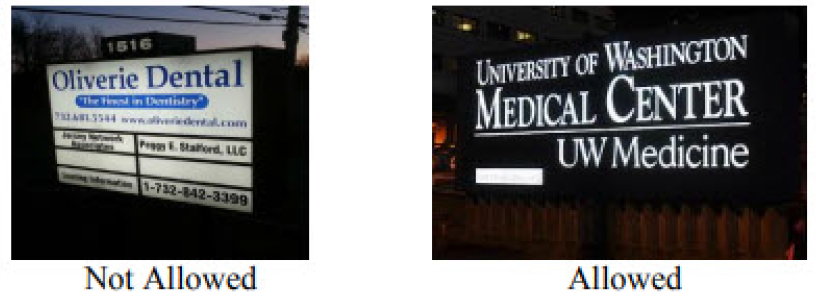
Internally illuminated cabinet signs are prohibited except for those which use a non-opaque material and punch-through letters so only the letters are illuminated.
(25)
Signs advertising websites, events, products, or services of or for businesses not located on the subject property are prohibited.
(l)
Safety standards.
(1)
Freestanding or projecting signs and sign structures shall be engineered to withstand the minimum wind and snow load requirements of the adopted Building Codes. A building permit and associated engineering data sufficient to prove the reliability of the structure and the foundation shall be submitted for signs over ten (10) feet in height and/or forty (40) square feet in area.
(2)
Signs in danger of falling down, or which become insecure, or otherwise represent an unsafe condition shall constitute a violation under the provisions of this Chapter, and shall be removed or corrected by the sign owner.
(3)
Electrical wiring for energizing an electrical sign shall be underground in the case of freestanding and behind the sign cabinet in the case of wall or projecting signs.
(4)
All freestanding signs shall be self-supporting, erected on or permanently attached to a concrete foundation. Signs mounted on marquees or projecting signs shall be engineered such that no guy wires are needed for support, other than the sign structure itself. Wall signs shall be mounted on the wall of the building.
(5)
Anchors and supports shall be guarded and protected when near driveways, parking lots, or similar locations where they could be damaged by moving vehicles. Signs attached to masonry, concrete, or steel shall be safely and securely fastened thereto by means of metal anchors, bolts, or approved expansion screws of sufficient size and anchorage to safely support the loads applied. No anchor or support of any sign, except flat wall signs, shall be connected to or supported by an unbraced parapet wall.
(m)
Legal nonconforming signs.
(1)
An existing sign which does not conform to the provisions of this Chapter may be eligible for the designation of legal nonconforming, provided that the Sign Code Administrator determines that such sign is properly maintained according to all applicable legal requirements, does not in any way endanger the public, and was covered by a valid permit or variance or complied with all previously applicable laws.
(2)
A sign may lose this designation if the sign is relocated or replaced, or the structure or size of the sign is altered in any way, other than normal maintenance. If the sign suffers more than fifty percent (50%) appraised damage or deterioration from fire, wind or other cause except vandalism, it must be brought into compliance with this Chapter. If the sign is remodeled, moved, or copy or text is changed under new ownership, or was never erected in accordance with any code in force at the time, the sign shall be removed or brought into compliance with this Chapter.
(3)
The Town Council may condemn a nonconforming sign. Recommendations for condemnation may be made by the Planning and Zoning Commission;
(4)
By amortization. The right to continue to use or operate a nonconforming sign shall terminate five (5) years after the effective date of the ordinance codified in this Chapter or the annexation of the area in which the sign is located to the Town.
(n)
Sign Variations.
(1)
The Town recognizes that not all buildings are sized or scaled appropriately to adhere to these code requirements. If certain circumstances exist where the sign limitations results in a sign that is undersized or not proportional in scale to the structure, the applicant shall apply for either a revised Sign Plan (if two (2) or more units or buildings are affected), or, by the PZC through the application of Alternative Design, pursuant to Section 7.16.120 for signs concerning only one (1) unit or building.
(Ord. No. 25-06, § 2(Exh. A); Ord. 21-09 §§18—22; Ord. 18-19, §14)

