
Azusa City Zoning Code
ARTICLE 4
- STANDARDS FOR SPECIFIC LAND USES
This article provides standards for the location, design, and operation of certain specific land use types that may prove problematic for neighboring uses and/or the community unless their particular characteristics are effectively addressed.
88.40.010. - Findings.
It is the purpose and intent of this chapter to provide for the reasonable and uniform regulation of adult businesses in the city. It is recognized that adult businesses have a serious deleterious effect upon adjacent areas, as well as the areas in which they are located. It is therefore the purpose of this article to establish criteria and standards for the establishment and conduct of adult businesses which will protect the public health, safety and welfare, preserve locally recognized values of community appearance, minimize the potential for nuisances related to the operation of adult businesses, and maintain local property values.
It is the purpose and intent of this chapter to establish proper regulations and to provide for a reasonable number of approximately located sites for adult businesses within the city, based upon the following findings:
A.
The council has reviewed the detailed studies, reports and letters prepared by other jurisdictions and its own staff with respect to the detrimental social, health and economic effects on persons and properties surrounding adult businesses. These studies included Upland, California (1992); Garden Grove, California (1991); Tucson, Arizona (1990); Seattle, Washington (1989); Austin, Texas (1986); Oklahoma City, Oklahoma (1986); Indianapolis, Indiana (1984); Houston, Texas (1983); Beaumont, Texas (1982); Minneapolis, Minnesota (1980); Phoenix, Arizona (1979); Whittier, California (1978); Amarillo, Texas (1977); Cleveland, Ohio (1977); Los Angeles, California (1977); State of Minnesota, Attorney General Report (1989); Newport news, Virginia (1996); St. Paul, Minnesota (1987); Corpus Christi, Texas (1995); National Law Center (1995); and Azusa (2003) (collectively "Studies"). The Studies, a summary of which is attached hereto as Exhibit "A," substantiate the adverse, secondary effects of adult businesses.
B.
Based on the foregoing studies and the other evidence presented, the council finds that:
1.
Adult businesses are linked to increases in the crime rates of the areas in which they are located and that surround them; and
2.
Both the proximity of adult businesses to sensitive land uses and the concentration of adult businesses tend to result in the blighting and downgrading of the areas in which they are located.
C.
The studies conducted in various communities in other jurisdictions have demonstrated that the proximity and concentration of adult businesses adjacent to residential, recreational, religious, educational or other adult businesses can cause other businesses and residents to move elsewhere.
D.
The studies conducted in various communities in other jurisdictions have demonstrated that adult businesses are linked to increases in the crime rates and blighting of those areas in which they are located and that surround them.
E.
The special regulation of adult businesses is necessary to ensure that their adverse secondary effects will not contribute to an increase in the crime rates or the blighting or downgrading of the areas in which they are located or surrounding areas. The need for the special regulation is based on the recognition that adult businesses have serious objectionable operational characteristics, particularly when several of them are concentrated under certain circumstances or located in direct proximity with sensitive uses such as residential zones and uses, parks, schools, churches or day care centers, thereby having a deleterious effect upon the adjacent areas.
F.
It is the purpose and intent of these special regulations to prevent the concentration or location of adult businesses in a manner that would create such adverse secondary effects. Thus, in order to protect and preserve the public health, safety, and welfare of the citizenry, especially including minors, the special regulation of the time, place and manner of the location and operation of adult businesses is necessary.
G.
The need to regulate the proximity of adult businesses to sensitive land uses such as residential, religious, educational, recreational and other adult businesses are documented in studies conducted by other jurisdictions as listed elsewhere in this section.
H.
The need to regulate the proximity of adult businesses to sensitive land uses such as residential, religious, educational, recreational and other adult businesses are documented in studies conducted by other jurisdictions as listed elsewhere in this section.
I.
The report of the state of Minnesota Attorney General's Working Group on the regulation of sexually oriented businesses dated June 6, 1986, indicated that:
1.
Community impacts of sexually oriented businesses are primarily a function of two variables, proximity to residential areas and concentration. Property values are directly affected within a small radius, typically one block, of the location of a sexually oriented business. Concentration may compound depression of property values and may lead to an increase of crime sufficient to change the quality of life and perceived desirability of property in a neighborhood; and
2.
The impacts of sexually oriented businesses are exacerbated when they are located near each other. When sexually oriented businesses have multiple uses (i.e. theater, bookstore, nude dancing, peep booths), one building can have the impact of several separate businesses.
J.
In consideration of the findings of the report of the state of Minnesota Attorney General's Working Group on the regulation of sexually oriented businesses dated June 6, 1986, it is appropriate to prohibit the concentration of multiple adult businesses within one building in order to mitigate the compounded adverse secondary effects associated with such concentrations as described above.
K.
The provisions of this chapter have neither the purpose nor effect of imposing a limitation or restriction on the content of any communicative materials, including sexually-oriented materials, that are protected by the First Amendment of the United States Constitution and the relevant provisions of the California State Constitution.
L.
The proposed parking standards are necessary in the interests of the public health, safety, and welfare to provide for an appropriate amount of off-street parking.
M.
The Council takes legislative notice of the Penal Code provisions authorizing local governments to regulate matter that is harmful to minors (e.g. Penal Code Section 313 et. seq.) The council further takes legislative notice of cases that recognize that protection of minors from sexually explicit materials is a compelling government interest, including, but not limited to, Crawfore v. Lungren (9th Cir., 1996) 96 F.3d 380, cert. denied 520 U.S. 1117 (1997) and Berry v. City of Santa Barbara (1995) 40 Cal.App.4th 1075.
N.
In adopting these regulations, the council is mindful of legal principles relating to regulation of adult businesses and does not intend to suppress or infringe upon any expressive activities protected by the First Amendments of the United States and California Constitutions, but instead desires to enact reasonable time, place, and manner regulations that address the adverse secondary effects of adult businesses. The council has considered decisions of the United States Supreme Court regarding adverse secondary effects and the local regulation of adult businesses, including but not limited to: Young v. American Mini Theaters. Inc., 427 U.S. 50 (1976) (Reh. denied 429 U.S. 873); Renton v. Playtime Theaters, 475 U.S. 41 (1986) (Reh. denied 475 U.S. 1132); FW/PBS. Inc. v. Dallas, 493 U.S. 215 (1990); Barnes v. Glenn Theater, 501 U.S. 560 (1991), and City of Erie v. Paps A.M. (2000) 529 U.S. (2000 Daily Journal DAR 3255), United States Court of Appeals 9th Circuit decisions, including but not limited to: Topanga Press, et al. v. City of Los Angeles, 989 F.2d 1524 (1993); Kev. Inc. v. Kitsap County, 793 F.2d 1053 (9th Cir. 1986); Colacurcio v. City of Kent, 163 F.3d 545 (9th Cir. 1998), pet. For cert. Filed (1999); several California cases including but not limited to: Tily B. v. City of Newport Beach, 69 Cal.App.4th 1 (1998); City of National City v. Wiener, 3 Cal.4th 832 (1993); People v. Superior Court (Lucero) 49 Cal.3d 14 (1989); and City of Vallejo v. Adult Books, et al., 167 Cal.App.3d 1169 (1985); and other federal cases including Lakeland Lounge v. City of Jacksonville (5th Cir. 1992) 973 F.2d 1255, Hang On, Inc. v. Arlington (5th Cir. 1995) 65 F.3d 1248, Mitchell v. Commission on Adult Entertainment (3rd Cir. 1993) 10 F.3d 123, International Eateries v. Broward County (11th Cir. 1991) 941 F.2d 1157, and Star Satellite v. City of Biloxi (5th Cir. 1986) 779 F.2d 1074.
O.
The city has conducted its own study of its land use districts and planning areas and has determined that the establishment of adult business in the DW district designation is appropriate, subject to locational and distance requirements that promote the health, safety and general welfare of the public. The city also evaluated the locational and distance regulations in this chapter for separating adult businesses from sensitive land uses, and other adult businesses, and determined the location and distance requirements are appropriate to promote the health, safety and general welfare of the public.
P.
The locational requirements do not unreasonably restrict the establishment or operation of constitutionally protected speech in the city and a sufficient reasonable number of appropriate locations for adult businesses are provided.
Q.
The council recognizes that the standards and regulations in this article do not preclude reasonable alternative avenues of communication. The council takes note of the proximity of at least 15 adult businesses within 30 minutes (drive time) of the city in determining that the proposed standards do not preclude reasonable alternative avenues of communication.
R.
The council recognizes that a sufficient number of appropriate locations for establishing an adult business in the city are provided considering the city's predominant residential character (approximately 69 percent is zoned for residential land use), the fact that there is already one adult business sited in the city ("The Red Panty") and the fact that no formal requests to establish an adult business have been received by planning department staff.
S.
Finally, the council also takes note of the proliferation of adult material on the Internet and its availability as an alternative avenue of communication. The council also considers and relies on published decisions examining the proliferation of communications on the Internet. Reno v. American Civil Liberties Union (1997) 521 U.S. 844 (the principal channel through which many Americans now transmit and receive sexually explicit communication is the Internet); see also: Anheuser-Busch v. Schmoke, 101 F.3d 325, 329 (4th. Cir. 1996)(rejecting First Amendment challenge to Baltimore ordinance restricting alcohol advertisements on billboards and acknowledging that the Internet is an available channel of communication); U.S. v. Hockings, 129 F.3d 1069 (9th Cir. 1997); and U.S. v. Thomas, 74 F.3d 701 (6th Cir. 1996)(cert denied 519 U.S. 820). The emergence of the Internet provides a virtually unlimited additional source of adult oriented sexual material available to persons without regard to geographic boundaries. An adult business no longer needs to be actually physically located within a city to be available to the community.
88.40.020. - Definitions - Adult Business.
An "adult business" is any business where employees or patrons expose specified anatomical areas or engage in specified sexual activities, or any business which offers to its patrons services or entertainment characterized by an emphasis on matter depicting, exposing, describing, discussing or relating to specified sexual activities or specified anatomical areas.
Adult businesses do not include bona fide medical establishments operated by properly licensed and registered medical personnel with appropriate medical credentials for the treatment of patients.
In determining whether a use is an adult business, only conduct or activities that constitute a regular and substantial course of conduct or a use which has a majority of its floor area, stock-in-trade or revenue derived from material characterized by an emphasis on matters depicting, exposing, describing, discussing or relating to specified sexual activities or specified anatomical I areas shall be considered. Isolated instances of conduct or activities described in this section as characterizing an adult business shall not be considered except where such activities, taken together, constitute a regular and substantial course of conduct. Adult businesses include, but are not limited to, the following:
A.
Adult Arcade. Any place to which the public is permitted or invited wherein coin-operated or slug-operated, or electronically, electrically or mechanically controlled still or motion picture machines, projections or other image-producing devices are maintained to show images to five or fewer persons per machine at any one time, and where the images so displayed are distinguished or characterized by the depicting or describing of specified sexual activities or specified anatomical areas.
B.
Adult Bookstore, Novelty Store, Video/DVD Store. An establishment which has as a substantial portion of its stock-in-trade, a majority of its floor area or revenue derived from and offering for sale for any form of consideration, any one or more of the following:
1.
Books, magazines, periodicals or other printed matter, photographs, films, motion pictures, video cassettes, slides or other visual representations which are characterized by an emphasis upon the depiction or description of "specified anatomical areas;"
2.
Instruments, devices or paraphernalia which are designed for use in connection with specified sexual activities; or
3.
Goods which are replicas of or which simulate, specified anatomical areas, or goods which are designed to be placed on or in specified anatomical areas, or to be used in conjunction with specified sexual activities to cause sexual excitement.
A commercial establishment may have other principal business purposes that do not involve the offering for sale or rental of material depicting or describing "specified sexual activities" or "specified anatomical areas" and still be categorized as an adult bookstore, adult novelty store or adult video/DVD store. Such other business purposes will not serve to exempt such commercial establishments from being categorized as an adult bookstore, adult novelty store or adult video/DVD store so long as one of its principal business purposes is the offering for sale or rental for consideration the specified materials which are characterized by the depiction or description of specified sexual activities or specified anatomical areas.
C.
Adult Cabaret. A bar, nightclub or similar establishment which features dancers, strippers or similar entertainers who expose specified anatomical areas of their bodies.
D.
Adult Motel. A hotel, motel or similar commercial establishment which:
1.
Offer accommodations to the public for any form of consideration; provides patrons with closed circuit television transmissions, films, motion pictures, video cassettes, slides or other photographic reproductions which are characterized by the depiction or description of specified sexual activities or specified anatomical areas and has a sign visible from the public right-of-way which advertises the availability of this adult type of photographic reproductions; or
2.
Offers a sleeping room for rent for a period of time that is less than ten hours; or
3.
Allows a tenant or occupant of a sleeping room to subrent the room for a period of time that is less than ten hours.
E.
Adult Motion Picture Theater. A commercial establishment where, for any form of consideration, films, motion pictures, video cassettes, slides or similar photographic reproductions are regularly shown which are characterized by the depictions or description of specified sexual activities or specified anatomical areas.
F.
Adult Tanning Salon. A business establishment where patrons receive tanning services in groups of two or more and where patrons or employees of the establishment expose specified anatomical areas. Adult tanning salon or parlor also includes a business establishment where a patron and an employee of the establishment are nude or expose specified anatomical areas. An adult tanning salon or parlor also includes a business establishment where the employees thereof are nude or expose specified anatomical areas.
G.
Adult Theater. Any place, building, enclosure, theater, concert hall, auditorium or structure, partially or entirely used for live performances or presentations, which place, building, enclosure, theater, concert hall, auditorium or structure is used for presenting matter characterized by an emphasis on depicting, exposing, describing or relating to specified sexual activities or specified anatomical areas for observation by patrons therein. Such place shall also include an adult theater wherein persons are regularly featured appearing in a state of nudity or giving live performances which are characterized by the exposure of specified sexual activities or by specified anatomical areas.
H.
Employee. A person who performs any service on the premises of an adult business on a full-time, part-time or contract basis, whether or not the person is denominated as an employee, independent contractor, agent or otherwise and whether or not said person is paid a salary, wage or other compensation by the operator of the adult business. Employee does not include a person exclusively on the premises to conduct repair or maintenance for the premises or equipment on the premises or for the delivery of goods to the premises.
I.
Nude Model Studio. Any place where a person who appears in a state of nudity or displays specified anatomical areas is provided to be conversed with or be observed, sketched, drawn, painted, sculptured, photographed or similarly depicted by other persons, for any form of consideration. Nude model studio shall not include any classroom of any school licensed under state law to provide art education, while such classroom is being used in a manner consistent with such state license.
J.
Sex Supermarket/Sex Mini-Mall. The establishment or operation of more than one type of adult business or use as defined in this Development Code within the same building.
K.
Sexual Encounter Center. A business or commercial enterprise that, as one of its primary business purposes, offers for any form of consideration:
1.
Physical contact in the form of wrestling or tumbling between persons of the opposite sex; or
2.
Activities between male and female persons and/or persons of the same sex when one or more of the persons is in a state of nudity or is semi-nude.
L.
Sexually Oriented Business. Any business where employees or patrons expose specified anatomical areas or engage in or simulate specified sexual activities, or any business which offers to its patrons services or entertainment characterized by an emphasis on matter depicting, exposing, describing, discussing or relating to specified sexual activities or specified anatomical areas.
88.40.030. - Additional Definitions.
In addition to the terms defined in Section 88.40.020, the following words and phrases shall have the meaning set forth below:
A.
Appeal. Wherever reference to an appeal being filed or available to be filed, such right of appeal shall also include the right to appeal administrative determinations concerning the interpretation of this article made by the city manager/designee to the commission and council.
B.
Establishment. An "establishment" means and includes any of the following:
1.
The opening or commencement of any adult business as a new business;
2.
The conversion of an existing business, whether or not an adult business, to any adult business;
3.
The addition of any adult business to any other existing adult business; or to another existing non-adult business, with or without expansion of floor area;
4.
The relocation of any adult business; or
5.
The expansion or enlargement of the premises by ten percent or more of the existing floor area.
C.
Nudity or a State of Nudity. The showing of the human male or female genitals, buttocks, pubic area, vulva, anus, anal cleft or the female breast with less than a fully opaque covering of any part of the areola.
D.
Private Viewing Area. An area or areas in an adult business designed to accommodate no more than five or less patrons or customers for purposes of viewing or watching a performance, picture, show, film, videotape, slide, movie or other presentation. No private viewing areas shall be established, maintained or authorized, and there shall be no doors, curtains, stalls or other enclosures creating a private viewing area.
E.
School. Any public or private educational institution which is run by the state or a subdivision thereof or which is licensed by the state to offer pre-school, elementary or secondary academic instruction—including kindergartens, elementary schools, middle or junior high schools, and high schools.
F.
Semi-Nude. The showing of the male genitals or female breast below a horizontal line across the top of the areola at its highest point or the showing of a substantial portion of the male or female buttocks. This definition shall not include any portion of the cleavage of the human female breast, exhibited by a dress, blouse, skirt, leotard, bathing suit or other wearing apparel provided the areola is not exposed in whole or in part.
G.
Specified Criminal Act or Acts. Includes sexual crimes against children; sexual abuse; rape; or crimes connected with another adult business including, but not limited to, the distribution of obscenity; violations involving the distribution, display or sale of material harmful to minors; prostitution; or pandering. Specified criminal acts shall exclude those acts which are authorized or required to be kept confidential pursuant to Welfare and Institutions Code Sections 600—900.
88.40.040. - Definitions - Specified Anatomical Areas and Sexual Activities.
The following words and phrases when used in this Development Code shall have the meaning set forth below:
A.
Specified Anatomical Areas. Includes any of the following human anatomical areas:
1.
Less than completely and opaquely covered genitals, pubic regions, buttocks, anuses or female breasts below a point immediately above the top of the areola; or
2.
Human male genitals in a discernibly turgid state, even if completely and opaquely covered.
B.
Specified Sexual Activities. Includes all of the following:
1.
The fondling or other erotic touching of the following human anatomical areas: genitals, pubic regions, buttocks, anuses or female breasts;
2.
Human sex acts, normal or perverted, actual or simulated, including intercourse, oral copulation or sodomy;
3.
Human masturbation, actual or simulated;
4.
The actual or simulated infliction of pain by one human upon another, or by an individual upon himself or herself, for the purpose of the sexual gratification or release of either individual, as a result of flagellation, beating, striking or touching of an erogenous zone, including without limitation, the thigh, genitals, buttock, pubic region or, if such person is a female, a breast;
5.
Sexual intercourse, actual or simulated, between a human being and an animal; or
6.
Excretory functions as part of or in connection with any of the activities set forth in subsections B.1 through B.5, above.
88.40.050. - Adult Use Planning Permit - Adult Business - Application.
In order to operate an adult business within this city, the applicant or proprietor of the business must obtain the license required by Article XXI of Title 18, and any other license required by the Municipal Code and an adult use planning permit as required herein. It shall be unlawful and a misdemeanor, subject to punishment in accordance with section 1-10 of the Municipal Code, for an owner, operator, manager or employee to operate an adult business without processing an adult use planning permit—including an interim adult use planning permit required by this chapter and any license required by Article XXI of Title 18 of the Municipal Code. All applicants for such a permit, in addition to any application or documents required to be filed pursuant to the provisions of this Development Code, shall file a written, signed and verified application on a form provided by the director evidencing the following:
A.
The name and permanent address of the applicant;
B.
The name and business address of the applicant. If the applicant is a corporation, the applicant shall provide the name of the state of incorporation, the name shall be exactly as set forth in its articles of incorporation and the applicant shall show the name and address each of the officers, directors, and controlling stockholders owning at least 50 percent of the stock of the corporation and/or each officer, director, and controlling stockholder with day-to-day management of the business. If the applicant is a partnership, the application shall show the name and address of each of the partners, including limited partners with at least a 50 percent ownership in the business or having day-to-day management responsibilities in the business;
C.
Location and address of the proposed adult business;
D.
Legal description of the subject property;
E.
A detailed description of the manner of providing proposed entertainment, including type of entertainment and the number of persons engaged in the entertainment;
F.
Proposed hours of operation;
G.
A floor plan showing where the specific entertainment uses are proposed to be conducted within the building;
H.
A site plan;
I.
The name or names of the person or persons having responsibility for the management or supervision of the applicant's business and of any entertainment; and
J.
Statement of the nature and character of the applicant's business if any, to be carried on in conjunction with such entertainment.
Within two business days of the receipt of the application, the community development director, or his designee, shall determine whether it is complete and contains all information required by this section. If the application is incomplete, the director shall deny the application and immediately inform the applicant in writing of the items needed to complete the application.
Notwithstanding the fact that an application filed hereunder may be a "public record" under Government Code Section 6250 et seq., certain portions of such application contain information vital to the effective administration and enforcement of the licensing and/or permit scheme established herein which is personal, private, confidential or the disclosure of which could expose the applicant to a risk of harm. Such information includes, but is not limited to, the applicant's residence address and telephone number, the applicant's date of birth and/or age, the applicant's driver's license and/or Social Security Number, and/or personal financial data. The council in adopting the application and licensing and/or permit system set forth herein has determined in accordance with Government Code Section 6255 that the public interest in disclosure of the information set forth above is outweighed by the public interest in achieving compliance with this chapter by ensuring that the applicant's privacy, confidentiality or security interests are protected. The city clerk shall cause to be obliterated from any copy of a completed license application made available to any member of the public, the information set forth above.
88.40.060. - Referral of Application for Investigation.
The director shall refer the completed permit application to the chief of police to investigate and verify the information contained in the application. The chief of police may refer the application to any law enforcement body or authorized law enforcement contractor to assist in this determination.
A.
After the investigation, including obtaining the information contained in the application, the chief of police shall issue a report to the director, the commission or council as appropriate, and the director, the commission or council as appropriate, shall approve the adult use planning permit unless one or more of the following findings are true:
1.
That the applicant, his or her employee, agent, partner, director, officer, controlling stock holder or manager has knowingly made any false, misleading or fraudulent statement of material fact in the application for a permit or in any report or record required to be filed with any city or county agency or department;
2.
That on the date that the business for which a permit is required herein commences or thereafter, there will be no responsible person on the premises to act as manager at all times during which the adult business is open;
3.
That an applicant is less than 18 years of age;
4.
That an applicant has been convicted of a specific criminal act for which:
a.
Less than five years have elapsed since the date of conviction or the date of release from confinement, whichever is the later date, if the conviction is of a misdemeanor offense for the specified criminal acts which are sexual crimes against children; sexual abuse; rape; or crimes connected with another adult business including, but not limited to, distribution of obscenity; distribution, display or sale of material harmful to minors; prostitution; or pandering;
b.
Less than five years have elapsed since the date of conviction or the date of release from confinement, whichever is the later date, if the conviction is of a felony offense; for the specified criminal acts which are sexual crimes against children; sexual abuse; rape; or crimes connected with another adult business including, but not limited to, distribution of obscenity; distribution, display or sale of material harmful to minors; prostitution; or pandering; or
c.
Less than five years have elapsed since the date of conviction or the date of release from confinement, whichever is the later date, if the convictions are of two or more misdemeanors for the specified criminal acts which are sexual crimes against children; sexual abuse; rape; or crimes connected with another adult business including, but not limited to, distribution of obscenity; distribution, display or sale of material harmful to minors; prostitution; or pandering; conviction of any such offense occurring within 24 months prior to application.
The fact that a conviction is being appealed shall have no effect on disqualification of the applicant. An applicant who has been convicted of any of the above described specified criminal acts may qualify to own, operate or manage an adult business only when the required time period has elapsed.
5.
That the application is incomplete.
B.
In the event the information requested pursuant to this section is not immediately available, the chief of police shall—if the application otherwise meets the requirements of the Municipal Code and the investigation conducted reveals none of the factors set forth in subsection A. of this section—report thereon. Whereupon, the city manager, or designee thereof, shall issue an interim adult use planning permit within ten days of the receipt of the application. Should the background information obtained by the chief of police materially vary from that on the application, such variance shall be cause to revoke the interim adult use permit and any other permit or licenses upon which such information is necessary. Any permit issued prior to the city receiving the background information required shall state clearly on its face that the permit is subject to suspension or revocation pursuant to the Municipal Code.
C.
The city's decision to grant or deny the permit shall not include information authorized or required to be kept confidential pursuant to Welfare and Institutions Code Sections 600 to 900.
88.40.070. - Right to Review Adult Use Planning Permit - Changed Conditions.
Any adult use planning permit granted or approved hereunder shall be granted or approved with the city and its council and commission retaining and reserving the right and jurisdiction to review and modify the adult use planning permit—including the conditions of approval—based on changed circumstances. Changed circumstances include, but are not limited to, the modification of the business, the change in scope, emphasis, size or nature of the business, and the expansion, alteration, of change of use. The reservation of the right to review any permit granted or approval hereunder by the city, council, and commission is in addition to, and not in lieu of, the right of the city, council, and commission to review and revoke or modify any permit granted or approved hereunder for any violations of the conditions imposed on such permit.
88.40.080. - Time Limit for Review and Decisions - Adult Use Planning Permits.
A.
Interim Adult Use Planning Permit. In order to avoid undue delay or suppression of any protected expression, the director shall make an initial determination of the required information contained in the application to process an adult use planning permit within five days of the date of filing the complete application. If the application is sufficient to issue an interim adult use planning permit, such shall be issued by the director within ten days of the date the application was deemed complete. A sufficient application shall include, but not be limited to, the applicant's meeting the requirements to be issued an adult business license required by Article XXI of Title 18 of the Municipal Code, and the proposed business shall be located in the DW zoning district and subject to the building placement and setback requirements of this Development Code. The granting of the interim adult use planning permit by the director is without prejudice to and does not preclude the denial of the final adult use planning permit application filed by the applicant. The interim adult use planning permit shall terminate upon the commission taking action on the final adult use planning permit. No right to operate beyond the termination of the interim adult use planning permit shall vest in the applicant if the applicant is unable or unwilling to obtain the adult business license required by Article XXI of Title 18 of the Municipal Code and the final adult use planning permit required by this chapter.
B.
Final Adult Use Planning Permit. The commission shall approve or disapprove the completed adult use planning permit application within 90 days of its acceptance as complete by the director. The time limit established by this section may be extended once for a period not to exceed 90 days upon consent of the director and the applicant. The application shall be processed and noticed in the same manner as conditional use permits are processed and noticed under state law.
1.
To approve the final adult use planning permit, the commission, or council on appeal, must first make the following findings:
a.
That all applicable filing fees have been paid;
b.
That the applicant is not overdue in payment to the city of any taxes, fees, fines or penalties assessed against or imposed in relation to an existing or former adult business;
c.
That the building, structure, equipment, and location used by the business for which an adult business license is required complies with the requirements and standards of the health, building, zoning, fire and safety laws of the State of California, the Los Angeles County Fire Department, Los Angeles County Health Services Department and the city;
d.
That the conduct of the adult business as proposed by the applicant, if permitted, will comply with all applicable laws; including but not limited to, the city's building, zoning, fire, and health and safety regulations;
e.
That the city currently has no evidence demonstrating that the applicant has knowingly made any false, misleading or fraudulent statement of material facts in the adult use planning permit application or any other document required by the city in conjunction therewith;
f.
That the use is permitted in the zone, district or area in which it is proposed to be located and is in conformity with the applicable development standards of that zone, district or area—including the provision of required parking;
g.
That the use is in conformity with the locational criteria set forth in this Development Code;
h.
That the design of the site and the proposed improvements are in compliance with any applicable precise plan of design approved for the site;
i.
That the proposed conduct of the adult business is in compliance with all applicable performance standards of this Development Code.
2.
In the event the commission, or the council on appeal, denies the final adult use planning permit application, the business shall cease its operations as an adult business and no further activities regulated by this Development Code or Article XXI of Title 18 of the Municipal Code shall be conducted on the premises unless and until an adult use planning permit and all licenses required by the Municipal Code are obtained. The interim adult use planning permit shall also terminate on the date the adult use planning permit application is denied.
3.
If the permit requested is for a development project for construction or reconstruction subject to the Permit Streamlining Act (Government Code Section 65920 et seq.), the time limits provided in the Permit Streamlining Act shall apply to the development project for construction. The adult use planning permit's approval or denial shall be conditioned upon operation within the building to be constructed or reconstructed.
4.
Upon the filing of an appeal, in accordance with Municipal Code Section 18-1253, the council or a designated hearing officer shall render its decision on the appeal within 60 days.
C.
The decision of the council or hearing officer concerning the appeal of a denial, denial of renewal, suspension or revocation of a permit shall be final. The applicant or permittee may seek prompt judicial review of such administrative action in a court of competent jurisdiction as provided by law, pursuant to California Code of Civil Procedure Section 1094.5 et seq. The city shall make all reasonable efforts to expedite judicial review in accordance with Code of Civil Procedure Section 1094.8.
88.40.090. - Applicability and Nonconforming Period.
A.
All design and performance standards set forth in this Development Code are deemed to be necessary for the protection of the public health, safety, and welfare and shall be applicable and govern all existing and proposed adult businesses immediately upon adoption and passage of this chapter.
B.
In the event that there is any adult business lawfully in existence prior to the adoption of this chapter and is not in compliance with the design and performance standards of this Development Code, any such adult business shall conform to all design and performance standards within six months of the effective date of this chapter.
C.
Notwithstanding anything to the contrary contained in this section, the amortization period for a nonconforming use that is governed by consent decree or other court action shall have the amortization period established by such consent decree or court action.
88.40.100. - Extension of Nonconforming Amortization Period Adult Businesses.
A.
Application for Extension. An application for extension of the amortization period for an adult business which is a nonconforming use shall be made as provided by Section 88.54.100 (Required Termination of a Nonconforming Use).
B.
Timing of Application. The owner of the property on which an adult business is located or the owner of the adult business who desires to extend the amortization period must apply for approval of an extension not later than six months prior to expiration of the amortization period, unless the director determines that good cause is shown for late filing of the application. The application shall be made in writing on a form as prescribed by the director and shall be accompanied by the required fee as established by resolution of the council. The party requesting the extension of the amortization period shall bear the burden of proof in establishing that the amortization period established by Section 88.54.100 (Required Termination of a Nonconforming Use) is unreasonable and that the requested extension is a reasonable amortization period for the owner to receive a fair rate of return on the investment in the business. The party applying for the extension shall furthermore be required in order to meet its burden of proof to submit the documentation set forth in this section.
C.
Review for Completeness, Application Contents. Not later than 30 days after submittal of an application to extend the amortization period, the director shall notify the applicant, in writing, if the application is not complete. A complete application shall include:
1.
The applicant's signature;
2.
A written request for an extension of the amortization period which shall include information relevant to the factors listed in subsection F. below and shall identify the term of the requested extension;
3.
The required fees;
4.
A mailing list and a set of gummed labels with the names, addresses and tax assessor parcel numbers of all owners of real property within a radius of 300 feet from the external boundaries of the property on which the adult business is located; and
5.
A tax assessor's parcel map identifying the properties to be notified within the 300-foot radius.
If the application is not complete, the director shall specify in writing those parts which are incomplete and shall identify the manner by which the application can be made complete. If a written determination is not provided to the applicant within 30 calendar days after it is submitted, the application shall be deemed complete.
D.
Public Hearing. The commission shall hold a noticed public hearing on the request for an extension.
E.
Factors to be Considered. In determining whether to grant an extension of the amortization period for an adult business which is a nonconforming use, and in determining the appropriate length of such an extension, the commission shall consider the amount of investment in the business, the opportunities for relocation to a legally permissible site, the costs of relocation, the effects of the business on the surrounding area, and the following additional factors:
1.
The present actual and depreciated value of business improvements;
2.
The applicable Internal Revenue Service depreciation schedule or functional nonconfidential equivalents;
3.
The remaining useful life of the business improvements;
4.
The remaining lease term;
5.
The ability of the business and/or land owner to change the use to a conforming use; and
6.
The date upon which the property owner and/or business operator received notice of the nonconforming status of the adult business and the amortization requirements.
F.
[Reserved.]
G.
Findings and Decision. The commission, or council on appeal, shall receive and consider evidence presented by the applicant and any other persons, and shall make findings that the amortization period it establishes is reasonable in view of the evidence and the criteria set forth above.
88.40.110. - Continuation of Nonconforming Buildings and Uses.
A.
Any nonconforming building may be continued and maintained, except as provided in this article, provided there are no structural alterations, except as provided in this article.
B.
Any nonconforming use may be continued, except as provided in this article, provided that the use shall not be increased, enlarged, extended or altered, except as provided in this article.
88.40.120. - Removal or Alterations of Nonconforming Uses.
The following provisions shall apply to nonconforming adult businesses:
A.
The owner of any adult business which is a nonconforming use may apply for extension of the amortization period, pursuant to Section 88-100 of this article. Such application shall be made prior to the expiration of the amortization period unless the reviewing authority determines that good cause is shown for late filing of the application.
B.
Upon the conclusion of the amortization period, any adult business which is a nonconforming use shall cease all business operations and all signs, advertising, and displays relating to said business shall be removed within 30 days.
88.40.130. - General Provisions.
Adult businesses shall only be permitted to be established in the DW zone, and shall be subject to the location and design standards specified by this Chapter and the requirement of an adult use planning permit as otherwise provided in this chapter and the Municipal Code.
88.40.140. - Location, Design, and Performance Standards.
A.
An adult business shall not be established or located within 500 feet of:
1.
Any residential zone, residential land use district or property used for residential purposes, including mobile home parks and trailer parks, within the city;
2.
Any church, chapel or similar place of worship or property zoned, planned or otherwise designated for such use by city action;
3.
Any funeral parlor, mortuary, cemetery or similar facility, or property zoned, planned or otherwise designated for such use by city action;
4.
Any school, nursery, day care center, park or playground or property zoned, planned or otherwise designated for such use by city action;
5.
Azusa Pacific University;
6.
Any other recreational facility where minors congregate or property zoned, planned or otherwise designated for such use by city action; or
7.
The right-of-way boundaries of Foothill Boulevard.
B.
An adult business shall not be established or located within 500 feet of an existing adult business. If two or more existing adult businesses are located in closer proximity to each other than 500 feet, then in determining which of the businesses is or are nonconforming, preference shall be given in the order of the respective lengths of continuous uninterrupted operation of the businesses.
C.
For the purposes of this section, all distances shall be measured in a straight line, without regard to intervening structures, from the nearest point of the building or structure in which the adult business is or will be located to the nearest property line of any land use, land use district or zone described in subsection A. of this section, or to the nearest point of the building or structure in which an existing adult business described in subsection B. of this section, is located.
D.
No advertising sign or structure, advertisement, display or other promotional material depicting specified anatomical areas or specified sexual activities or displaying instruments, devices or paraphernalia designed for use in connection with specific sexual activities, shall be shown or exhibited so as to be visible from any exterior area.
E.
All building openings, entries and windows shall be located, covered or screened to prevent viewing the interior from any exterior area.
F.
No loudspeaker or sound equipment audible to persons in any public exterior area shall be used in connection with an adult business, and the business shall be so conducted that sounds associated with the business are not emitted into any public exterior area.
G.
The establishment of an adult business shall comply with the applicable site development standards—including parking—of the zone, district or area in which the adult business is located, the building code, fire code, and the health and safety code of the city. An adult business shall comply with the applicable city permit and inspection procedures. In addition, adult businesses shall comply with the following performance standards:
1.
Each adult business shall have a business entrance separate from any other non-adult business located in the same building.
2.
No adult business shall be operated in any manner that permits the observation by the public of any material depicting, describing or relating to specified sexual activities or specified anatomical areas from any public way or from any location beyond the walls of the building or portion thereof in which the adult business is conducted.
3.
The building entrance to the adult business shall be clearly and legibly posted with a notice indicating that minors are precluded from entering the premises.
4.
Each adult business shall be provided with a manager's station for the purpose of supervising activities within the business. A manager shall be on duty on the premises during all times that the adult business is open to the public.
5.
Any viewing room shall be visible from the manager's station of the adult business, and visibility of the entire viewing room from the manager's station shall be neither obscured nor obstructed by any curtain, door, wall or other structure.
6.
All exterior areas of adult businesses, including buildings, landscaping and parking areas, shall be maintained in a clean and orderly manner free of trash, weeds and debris.
7.
The maximum occupancy load, fire exits, fire lanes and fire suppression equipment shall be regulated, designed and provided in accordance with the regulations and standards of the county fire department and the city's building department.
8.
No adult business shall operate between the hours of 12:00 a.m. and 9:00 a.m. of any particular day. No owner, operator, manager or employee of an adult business, regardless of whether or not a permit has been issued for said business under the provisions of the Municipal Code, shall allow such business to remain open for business or to permit any employee to engage in a performance, solicit a performance, make a sale, solicit a sale, provide a service or solicit a service between the hours of 12:00 a.m. and 9:00 a.m. of any particular day or in violation of the actual permitted hours of operation established in the conditions of approval for the permit.
9.
Off-street parking shall be provided for the adult business as specified for the zone, district or area in which the business is located in accordance with the parking provisions of the Municipal Code and as follows:
Adult theater, adult cabaret or adult motion picture arcade. One parking space shall be provided for every two seats in the viewing room, or one parking space shall be provided for every two occupants per the allowable occupant load as established by the chief building official and/or the fire marshal, whichever standard is greater. In addition, one parking space shall be provided for each employee on the maximum shift.
10.
Any person who operates or causes to be operated an adult business, other than an adult motel and regardless of whether or not an adult business license has been issued to said business under the Municipal Code, which exhibits on the premises in a viewing room or viewing booth of less than 150 square feet of floor area, a film, video cassette or other video reproduction which depicts specified sexual activities or specified anatomical areas, shall comply with the following requirements:
a.
Upon application for an adult business license, the application shall be accompanied by a diagram of the premises showing a plan thereof specifying the location of one or more manager's stations, the location of all overhead lighting fixtures, and designating any portion of the premises in which patrons shall not be permitted. A manager's station(s) shall not exceed 32 square feet of floor area.
b.
No alteration in the configuration or location of a manager's station shall be made without the prior written approval of the director.
c.
It is the duty of the permit-holder to ensure that at least one employee is on duty and situated at each manager's station at all times that any patron is present inside the premises.
d.
The interior of the premises shall be configured in such a manner that there is an unobstructed view from a manager's station of every area of the premises to which any patron is permitted access for any purpose, excluding restrooms. Restrooms shall not contain video reproduction equipment. If the premises have two or more manager's stations designed, then the interior of the premises shall be configured in such a manner that there is an unobstructed view of each area of the premises to which any patron is permitted access for any purpose from at least one of the manager's stations. The view required in this subsection shall be by direct line of sight from the manager's station.
e.
It shall be the duty of the permit-holder and any employees present on the premises to insure that the view area specified in subdivision d of this subsection remains unobstructed by any doors, walls, merchandise, display racks or other materials at all times and to insure that no patron is permitted access to any area of the premises which has been designed as an area in which patrons shall not be permitted in the application filed pursuant to this chapter.
11.
An on-site security program shall be prepared and implemented including the following items:
a.
All off-street parking areas and building entries serving the adult business shall be illuminated during all hours of operation with a lighting system designed to provide an average maintained horizontal illumination of one foot candle of light on the parking surface and/or walkway. This required lighting level is established in order to provide sufficient illumination of the parking areas and walkways serving the adult business for the personal safety of patrons and employees and to reduce the incidence of vandalism and theft. The lighting shall be shown on the required site or plot plan and shall be subject to review for compliance through the design review process by the director and the chief of police.
b.
All interior portions of the adult business, except those areas devoted to mini-motion or motion pictures, shall be illuminated during all hours of operation with a lighting system designed to provide a minimum maintained horizontal illumination of not less than two foot candles of light.
c.
For adult businesses which exceed an occupant load of 125 persons, the provision of on-site security personnel shall be required during all business hours pursuant to a plan to be reviewed and approved for adequacy by the chief of police. Security personnel shall be licensed in accordance with the California Business and Professions Code, to the satisfaction of the chief of police.
12.
Adult motion picture theater.
a.
A manager's station shall be located near the main entrance and the station shall be provided with an unobstructed view of all motion picture private viewing areas.
b.
No adult motion picture arcade shall be maintained or operated unless the complete interior of the adult motion picture theater is visible upon entrance to such adult motion picture theater. No partially or fully enclosed booths or partially or fully concealed booths shall be maintained.
c.
Maximum number of devices. No person shall operate an adult motion picture theater in which the number of image producing devices exceeds the maximum occupancy load permitted in any room or partitioned portion of a room in which an image producing device is located.
13.
Adult hotel/motel.
a.
Evidence that a sleeping room in a hotel, motel or a similar commercial establishment has been rented or subrented and vacated two or more times in a period of time that is less than ten hours on a recurring basis creates a rebuttable presumption that the establishment is an adult hotel/motel as that term is defined in this article.
b.
A person is in violation of the provisions of this Development Code if such person rents or sub-rents a sleeping room at a location without an adult business license and an adult use planning permit to a person or persons and within ten hours thereafter rents or sub-rents the same room to another person(s) or sub-rents the same room to the prior renter.
88.40.150. - Couch/Straddle Dancing and Other Sexual Activities Prohibited.
For purposes of this section, "couch dancing" or "straddle dancing" shall be defined as an employee of the adult business intentionally touching any patron while engaged in the display or exposure of any specified anatomical area, or while simulating any specified sexual activity.
A.
No person shall operate or cause to be operated an adult business, regardless of whether or not a permit has been issued under the Municipal Code, knowingly or with reason to know, permitting, suffering, or allowing any employee:
1.
To engage in a couch dance or straddle dance with a patron at the business;
2.
To contract or otherwise agree with a patron to engage in a couch dance or straddle dance with a person at the business;
3.
To intentionally touch any patron at an adult business while engaged in the display or exposure of a specified anatomical area or engaged in or simulating a specified sexual activity;
4.
To voluntarily be within six feet of any patron while engaged in the display or exposure of any specified anatomical area or engaged in or simulating a specified sexual activity.
B.
No employee of an adult business shall:
1.
Engage in a couch dance or straddle dance with a patron at the business;
2.
Contract or otherwise agree to engage in a couch dance or straddle dance with a patron at the business;
3.
Engage in the display or exposure of any specified anatomical area or engage in or simulate a specified sexual activity while intentionally touching a patron at the adult business;
4.
Engage in the display or exposure of any specified anatomical area or engage in or simulate a specified sexual activity closer than six feet from any patron.
C.
No person at any adult business, regardless of whether or not said business is permitted under the Municipal Code, shall intentionally touch an employee who is displaying or exposing any specified anatomical area or engaging in or simulating a specified sexual activity at the adult business.
D.
No person at any adult business, regardless of whether or not said business is permitted under the Municipal Code, shall engage in a couch dance or straddle dance with an employee at the business who is displaying or exposing any specified anatomical area or engaging in or simulating a specified sexual activity.
E.
No employee of an adult business, regardless of whether or not a permit has been issued for said business under this chapter, shall engage in a performance, solicit a performance, make a sale, solicit a sale, provide a service or solicit a service between the hours of 2:00 a.m. and 9:00 a.m. of any particular day.
88.40.160. - Establishment of an Adult Business.
The establishment of an adult business shall include any of the following:
A.
The opening or commencement of operation of any such business as a new business;
B.
The conversion of any existing business, (whether or not an adult business), to any adult business;
C.
The addition of any adult business to any existing adult businesses if the addition results in enlargement of the place of business. For the purposes of this subsection, "enlargement" means an increase in the size of the building within which the business is conducted by either construction or use of an adjacent building or any portion thereof, whether located on the same or an adjacent lot or parcel of land."
88.42.010. - Purpose and Applicability.
A.
Purpose. This chapter provides site planning, development, and/or operating standards for certain land uses that are allowed by Article 2 (Urban Standards) within individual or multiple zones, and for activities that require special standards to mitigate their potential adverse impacts.
B.
Applicability. The land uses and activities covered by this chapter shall comply with the provisions of the sections applicable to the specific use, in addition to all other applicable provisions of this Development Code.
1.
Where Allowed. The uses that are subject to the standards in this chapter shall be located only where allowed by Article 2 (Urban Standards).
2.
Planning Permit Requirements. The uses that are subject to the standards in this chapter shall be authorized by the planning permit required by Article 2, except where a planning permit requirement is established by this chapter for a specific use.
3.
Development Standards. The standards for specific uses in this chapter supplement and are required in addition to those in Articles 2, and 3 (Site, Development, and Operational Standards).
a.
The applicability of the standards in this chapter to the specific land uses listed is determined by Article 2 (Urban Standards)
b.
In the event of any conflict between the requirements of this chapter and those of Articles 2 or 3, the requirements of this chapter shall control.
88.42.020. - Accessory Structures.
Where allowed by Article 2 (Urban Standards), accessory structures shall comply with the regulations of this section. Telecommunications facilities are instead subject to the requirements of Chapter 88.46 (Telecommunications Facilities).
A.
Limitation on Location. An accessory structure shall not be permitted in a front yard.
B.
Height Limit. An accessory structure shall be not exceed a height of one story or 20 feet, whichever is less.
C.
Setbacks. An accessory structure shall comply with the following setback requirements.
1.
Rear Yard Setback.
a.
Lots without rear alley access. A detached accessory structure shall not cover more than 35 percent of a required rear setback area and shall be set back a minimum of three feet from the rear lot line. The wall facing the rear lot line shall have no openings, unless the rear lot line abuts an alley.
b.
Lots with rear alley access. For lots with rear alley access, a detached garage which provides vehicular access to the alley only shall not cover more than 80 percent of the rear setback area and shall be set back a minimum of three feet from the rear lot line.
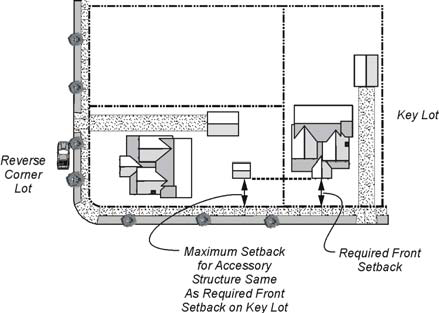
88.42.020 Figure 4-1
2.
Side Yard Setbacks. In interior side yards, detached accessory structures may be set back three feet from the side property line, if the structure is set back a minimum distance of 75 feet from the front lot line. If the structure is set back less than 75 feet from the front lot line, the structure shall be set back five feet from the side yard set back. On a reverse corner lot, accessory structures shall be set back from the street at the same or greater distance as the setback line for the adjacent key lot (see Figure 4-1). No accessory structure shall be permitted within a street side yard of a corner lot.
3.
Separation Between Structures. Each accessory structure shall be set back from any other structure on the site by a minimum of ten feet unless the accessory structure is an existing garage connected to the main house by a breezeway.
D.
Reserved.
E.
Tents and Portable Shelter Structures. The use of tents and other temporary and portable shelter structures may not be allowed in the front setback of residential districts but may be allowed in rear yard areas not visible from the street or public right-of-way.
F.
Bathrooms in Detached Garages. Bathrooms shall not be permitted within detached garages unless the garage is located adjacent to a permanent swimming pool.
(Ord. No. 06-O6, § 1B, 8-7-06; Ord. No. 08-O7, § 10, 6-16-08; Ord. No. 10-O1, § 13, 3-1-10; Ord. No. 2017-14, § 7, 12-18-17; Ord. No. 2020-02, § 3, 2-3-20)
88.42.030. - Alcoholic Beverage Sales.
Where allowed by Article 2 (Urban Standards), alcoholic beverage sales shall comply with the regulations of this section.
A.
Criteria to be Considered. In determining whether to approve a use permit for alcoholic beverage sales and the conditions to impose on the use, the commission shall consider the following, and make findings regarding each of these issues:
1.
The nature and use of real property within 500 feet of the use, and in particular, the location of similar nearby uses and the location of residences, parks, schools, and religious facilities;
2.
Appropriate measures to provide proper maintenance of the building exterior, including keeping the premises free of junk, litter, and debris;
3.
Lighting of exterior areas, including parking lots, to discourage loitering activities outside of the buildings;
4.
Protection of persons residing on or using adjacent properties from noise, illegal activity, odors, and undue light and glare;
5.
Provision of onsite security, both inside and outside the building, to satisfy any concerns raised by the police department;
6.
Adequacy of off-street parking provided for the use;
7.
Hours of operation;
8.
Controls on occupancy limits inside the building and loitering outside of the building;
9.
Prevention of adverse effect of the use on value of adjacent properties; and
10.
Whether approval would result in an undue concentration of these uses, and whether public convenience or necessity would mitigate the issue of undue concentration.
B.
Conditions of Approval. In approving a use permit to establish a use selling alcoholic beverages, the commission may impose conditions on the use to ensure that the use operates in a manner that provides adequate protection of the general health, safety, and community welfare.
C.
Sale of Alcoholic Beverages at Service Stations. The following regulations shall apply to all service stations selling alcoholic beverages:
1.
The sale of alcoholic beverages shall not be permitted at any service station located within a corridor designated by Article 2 (Urban Standards).
2.
No beer or wine shall be displayed within five feet of the cash register or the front door, unless such beverages are contained within a permanently affixed cooler in existence on or before January 1, 1988.
3.
The advertisement of alcoholic beverages shall not be permitted at motor fuel islands nor a drive-up window.
4.
The display of beer or wine in an ice tub shall not be permitted.
5.
Self-illuminated advertising for beer or wine shall not be permitted on buildings or in windows.
6.
Employees on duty between the hours of 10:00 p.m. and 2:00 a.m. shall be at least 21 years of age to sell beer and wine.
7.
Single container sales of multiple-pack alcoholic beverages are prohibited.
D.
Food Service Requirement for Bars, Taverns, Nightclubs.
1.
Purpose. The city intends that bars, taverns, and nightclubs be high quality, socially diverse establishments where all patrons will feel safe. The requirements in this subsection are intended to provide for services beyond alcoholic beverage service and/or entertainment, to attract a wider range of patrons than may be the case in an establishment limited to alcoholic beverage service.
2.
Food Service Required. Each bar, tavern, and nightclub shall be designed and operated to provide food prepared to order on the premises, throughout the hours when the business is open to the public. Menus shall include, at minimum, lunch and dinner options.
3.
Conditions of Approval. The review authority for the use permit required for each establishment by Article 2 (Urban Standards) shall apply conditions of approval to ensure that:
a.
The food service requirement in subsection D.2 is implemented through the provision of an on-site commercial kitchen including food storage, preparation, cooking, and cleanup facilities in compliance with applicable health department regulations; and
b.
Food service is marketed, provided, and maintained so that food service revenue constitutes a minimum of 25 percent of the establishment's annual gross receipts, as determined by an annual review of the establishment's accounting records by city staff.
The conditions of approval applied by the review authority shall also provide that the use permit approval and business license for the establishment shall be subject to revocation by the city if the establishment fails to comply with the requirements of this section and all applicable conditions of approval.
88.42.035. - Marijuana Uses.
A.
PURPOSE.
The purpose of this section is to regulate personal, medical, and commercial marijuana uses. Nothing in this section shall preempt or make inapplicable any provision of state or federal law.
B.
DEFINITIONS.
For purposes of this section, the following definitions shall apply:
1.
Commercial marijuana activity includes the cultivation, possession, manufacture, distribution, processing, storing, laboratory testing, labeling, transportation, distribution, delivery or sale of marijuana and marijuana products.
2.
Cultivation means any activity involving the planting, growing, harvesting, drying, curing, grading, or trimming of marijuana.
3.
Cultivation area includes the area where marijuana plants are cultivated, cultivation-related materials and supplies are stored, and any marijuana processed from the cultivation in excess of 28.5 grams.
4.
Day care means a facility, center, or home requiring a license that is issued by the State of California which provides for the care, health, safety, supervision, or guidance of a child's social, emotional, and educational growth on a regular basis, in a place other than the child's own home, or any facility meeting the definition of California Health and Safety Code Section 1596.76
5.
Delivery means the commercial transfer of marijuana or marijuana products to a customer. "Delivery" also includes the use by a retailer of any technology platform owned and controlled by the retailer, or independently licensed under California law, that enables customers to arrange for or facilitate the commercial transfer by a licensed retailer of marijuana or marijuana products.
6.
Directly engage in cultivation means to handle the marijuana plants in the cultivation process.
7.
Distribution means the procurement, sale, and transport of marijuana and marijuana products between entities for commercial use purposes.
8.
Group Home means any community care facility regulated and licensed by a Federal and/or State agency. Unlicensed community care facilities or those community care facilities the regulation of which is not otherwise preempted by State or Federal law shall not constitute group homes.
9.
Indirectly engage in cultivation means to assist, even if not handling marijuana plants, in the cultivation process.
10.
Licensee means the holder of any state issued license related to marijuana activities, including but not limited to licenses issued under Division 10 of the Business & Professions Code.
11.
Manufacture means to compound, blend, extract, infuse, or otherwise make or prepare a marijuana product.
12.
Marijuana means all parts of the plant Cannabis sativa L., whether growing or not; the seeds thereof; the resin extracted from any part of the plant; and every compound, manufacture, salt, derivative, mixture, or preparation of the plant, its seeds or resin. It does not include:
(a)
Industrial hemp, as defined in Section 11018.5 of the California Health & Safety Code; or
(b)
The weight of any other ingredient combined with marijuana to prepare topical or oral administrations, food, drink, or other product.
13.
Marijuana accessories means any equipment, products or materials of any kind which are used, intended for use, or designed for use in planting, propagating, cultivating, growing, harvesting, manufacturing, compounding, converting, producing, processing, preparing, testing, analyzing, packaging, repackaging, storing, smoking, vaporizing, or containing marijuana, or for ingesting, inhaling, or otherwise introducing marijuana or marijuana products into the human body.
14.
Marijuana products means marijuana that has undergone a process whereby the plant material has been transformed into a concentrate, including, but not limited to, concentrated cannabis, or an edible or topical product containing marijuana or concentrated cannabis and other ingredients.
15.
Person includes any individual, firm, co-partnership, joint venture, association, corporation, limited liability company, estate, trust, business trust, receiver, syndicate, or any other group or combination acting as a unit, and the plural as well as the singular.
16.
Personal Use means to possess, use, or give away to persons 21 years of age or older without any compensation whatsoever.
17.
Residence means a private residence such as a house, apartment unit, mobile home, or similar dwelling.
18.
Sale includes any transaction whereby, for any consideration, title to marijuana is transferred from one person to another, and includes the delivery of marijuana or marijuana products pursuant to an order placed for the purchase of the same and soliciting or receiving an order for the same, but does not include the return of marijuana or marijuana products by a licensee to the licensee from whom such marijuana or marijuana product was purchased.
19.
Youth Center means any public or private facility that is primarily used to host recreational or social activities for minors, including, but not limited to, private youth membership organizations or clubs, social service teenage club facilities, video arcades, or similar amusement park facilities.
20.
Any term defined in this Section also means the very term as defined in the California Business & Professions Code or the California Health & Safety Code, unless otherwise specified.
C.
PERSONAL USE.
1.
For purposes of this subsection, personal recreational use, possession, purchase, transport, or dissemination of marijuana shall be considered unlawful in all areas of the City to the extent it is unlawful under California law.
2.
Outdoor Cultivation. A person may not plant, cultivate, harvest, dry, or process marijuana plants outdoors in any zoning district of the City. No use permit, building permit, variance, or any other permit or entitlement, whether administrative or discretionary, shall be approved or issued for any such use or activity.
3.
Indoor Cultivation.
(a)
A person may not plant, cultivate, harvest, dry, or process marijuana plants inside a private residence, or inside an accessory structure to a private residence located upon the grounds of a private residence, or inside any other enclosed structure within any zoning district of the City. No use permit, building permit, variance, or any other permit or entitlement, whether administrative or discretionary, shall be approved or issued for any such use or activity.
(b)
To the extent a complete prohibition on indoor cultivation is not permitted under California law, a person may not plant, cultivate, harvest, dry, or process marijuana plants inside a private residence, or inside an accessory structure to a private residence located upon the grounds of a private residence, unless the person is issued a residential indoor cultivation permit by the Economic and Community Department as detailed in section D (Residential Indoor Marijuana Cultivation (RIMC) Permit) below. A person may not plant, cultivate, harvest, dry, or process marijuana plants inside any enclosed structure within any zoning district of the City which is not either a private residence or an accessory structure to a private residence located upon the grounds of a private residence.
D.
RESIDENTIAL INDOOR MARIJUANA CULTIVATION (RIMC) PERMIT.
1.
Applicability.
(a)
The RIMC Permit is intended to serve as an instrument of the City's reasonable regulation of residential indoor marijuana cultivation as provided by California Health and Safety Code, Section 11362.2(b)(1). A person may directly or indirectly engage in residential indoor marijuana cultivation only after obtaining and maintaining a valid RIMC Permit.
(b)
A RIMC Permit authorizes:
1.
Only one person,
2.
To directly or indirectly engage in residential indoor marijuana cultivation for personal use,
3.
At only one residence, and
4.
Within only the authorized cultivation area at the residence.
(c)
A RIMC Permit does not authorize:
1.
Construction or improvements of any structure,
2.
A property-at-large for marijuana cultivation,
3.
The permit holder or any others to engage in any activity licensed by the State of California under Division 10 of the Business and Professions Code, or
4.
The following people to directly or in directly engage in residential indoor marijuana cultivation:
A.
The permit holder's family members,
B.
Cohabitants,
C.
Guests,
D.
Future residents, or
E.
Any other person other than the permit holder.
(d)
A person may not hold more than one RIMC Permit at a time. Multiple permit holders may be authorized to engage in residential indoor marijuana cultivation at the same residence, but a residence must include no more than one cultivation area and no more than six marijuana plants in total.
2.
Review and Appellate Authority.
(a)
Applications for a RIMC Permit will be processed and reviewed by the Economic and Community Development Director or his/her designee(s). The Economic and Community Development Director or his/her designee(s) or his designee(s) may approve or deny an application based on the findings provided in section D4 (Findings) below.
(b)
A decision by the Economic and Community Development Director or his/her designee(s) may be appealed to the City Hearing Officer by the following parties:
1.
The applicant; or
2.
Owners or residents of the property.
(c)
A decision of the City Hearing Officer may be appealed to the City Council by the following parties:
1.
The applicant; or
2.
Owners or residents of the property.
3.
Application and Notice.
(a)
The Economic and Community Development Director or his/her designee(s) may adopt the forms and submittal materials required for a complete application.
(b)
The City Council may by resolution require an application fee.
(c)
The City will provide notification of the complete application to the following:
1.
The applicant; and
2.
Owners and residents of the property.
4.
Findings. The Economic and Community Development Director or his/her designee(s) may approve an application for an RIMC Permit if the following findings are made:
(a)
Applicant. The applicant must:
1.
Be 21 years of age or older,
2.
Complete a Live Scan with the California Department of Justice,
3.
Have no felony convictions for the illegal possession for sale, manufacture, transportation, or cultivation of a controlled substance within the last five years,
4.
Have no pending code enforcement actions with the City,
5.
Have no past due payments due to the City, and
6.
Have no City liens on the property.
(b)
Residence.
1.
The residence must be the primary dwelling of the applicant.
2.
The residence must not include more than one cultivation area.
3.
The residence must not be used for any of the following activities:
A.
Day care,
B.
Youth center, and
C.
Residential health care facility.
(c)
Cultivation Area.
1.
Location and Use.
A.
The cultivation area must be located within the residence or within an auxiliary structure. The residence, auxiliary structure, and all plumbing, electrical, and other utilities must be properly permitted by the City or appropriate regulatory agency.
B.
The cultivation area must be used exclusively for residential indoor marijuana. The cultivation area may not be shared with any space used for sleeping, cooking, eating, bathing, or other residential activities.
C.
The cultivation area must not be used or prepared in a manner to cultivate more than six marijuana plants.
D.
The following chemicals may not be used or stored in the cultivation area:
(i)
Explosive gases, including, but not limited to: Butane, Propane, Xylene, Styrene, Gasoline, Kerosene, Oxygen (O2), or Hydrogen (H2).
(ii)
Dangerous poisons, toxins, or carcinogens, including, but not limited to: Methanol, Iso-propul Alcohol, Methylene Chloride, Acetone, Benzene, Toluene, or Tri-chloro-ethylene.
2.
Inspection of Cultivation Site.
A.
The Economic and Community Development Director or his/her designee(s) may inspect the premises, with the applicants approval, prior to the issuance or renewal of a RIMC Permit to ensure compliance with all applicable state and local laws, codes and regulations, including without limitation, the California Building Code, Electrical and Fire Codes as adopted by the City of Azusa.
B.
The site inspection may include personnel from the following divisions: Planning, Building, Community Improvement and the Police Department.
C.
Should the applicant deny access to the property for the inspection of the cultivation site, the application process will terminate and a permit will not be issued.
3.
Access and Security.
A.
The structure, or room in which the cultivation occurs, shall have locking doors and shall be secured to prevent access by minors and/or unauthorized persons. Any windows, skylight, ventilation, or other opening must be lockable.
B.
Access to the cultivation area must be restricted to the applicant or other permit holders authorized for the cultivation area.
C.
The cultivation area must not be visible from anywhere outside the residence. Any windows, skylight, ventilation, or other opening must be sufficiently covered or opaque as to obscure visibility of the cultivation area from any adjacent property. Such window coverings shall not restrict emergency egress from the structure.
D.
The cultivation area must not produce odors, sounds, or other emissions that are detectible from adjacent properties and may indicate marijuana cultivation.
5.
Expiration and Renewal.
(a)
A RIMC Permit expires, if not renewed, one year from the date of approval and in two (2) year increments thereafter.
(b)
A RIMC Permit may be renewed, if prior to the expiration, the permit holder:
1.
Completes forms and submittal materials for renewal as required by the Economic and Community Development Director or his/her designee(s).
2.
The permit holder passes an inspection approved by the Economic and Community Development Director or his/her designee(s), as provided in section 4.(c).2 (Inspection of Cultivation Site), above.
3.
Pays a renewal fee as approved by resolution by City Council.
(c)
A RIMC Permit renewal may be streamlined if the following conditions are met:
1.
No code violations on the property.
2.
No suspension or revocation of the existing RIMC permit on the property.
3.
All RIMC permit fees are paid.
6.
Suspension and Termination.
(a)
The Economic and Community Development Director or his/her designee(s) may suspend or terminate a RIMC Permit at any time for failure to comply with applicable governing regulations.
(b)
If a RIMC Permit is suspended, the suspension will be effective and the permit holder's marijuana crop may be impounded until the permit holder:
1.
Demonstrates compliance with the applicable governing regulations, and
2.
Pays a fine as set forth in section 6(d) (Suspension and Termination) below.
(c)
If a RIMC Permit is terminated, the permit holder's marijuana crop may be impounded. The permit holder may not apply for another RIMC Permit until the permit holder pays a fine as set forth in section 6(d) (Suspension and Termination) below. The Economic and Community Development Director or his/her designee(s) may permanently terminate a RIMC should criminal activity occur or repeated violations.
(d)
The City Council may by ordinance adopt a fine schedule for violations that may escalate with successive violations.
(e)
A suspension or termination of a RIMC Permit may be appealed to the City Hearing Officer by the permit holder.
7.
Subsequent Applications.
(a)
Application for a Different Residence.
1.
If a permit holder applies for a RIMC Permit for a residence other than specified on the existing permit, the existing RIMC Permit will remain valid during the application process.
2.
If the application is approved, the existing RIMC Permit is rescinded.
3.
If the application is denied, the existing RIMC Permit is reinstated.
4.
If the applicant appeals a denial of the application, the existing RIMC Permit remains valid until a final decision is reached.
(b)
Application for a Different Cultivation Area in the Same Residence.
If a permit holder applies for an RIMC Permit for the residence on the existing permit, but for cultivation area other than specified on the existing permit, the existing permit will terminate upon approval of the application.
8.
No Sale or Transfer. A RIMC Permit may not be transferred, sold, conveyed, hypothecated or encumbered.
E.
MEDICAL USE.
1.
Cultivation of medical marijuana pursuant to Section 11362.77 of the California Health & Safety Code is subject to the cultivation requirements laid out in subsection (c) of this Section.
2.
The establishment or operation of any medical marijuana collective, cooperative, dispensary, delivery service, operator, establishment, or provider shall be considered a prohibited use in all zoning districts of the City. No use permit, variance, building permit, or any other entitlement or permit, whether administrative or discretionary, shall be approved or issued for the establishment of any collective, cooperative, dispensary, delivery service, operator, establishment, or provider in any zoning district, and no person shall otherwise establish such businesses or operations in any zoning district.
F.
COMMERCIAL USE.
1.
The establishment or operation of any business of commercial marijuana activity is prohibited. No use permit, variance, building permit, or any other entitlement or permit, whether administrative or discretionary, shall be approved or issued for the establishment or operation of any such business or operation. Such prohibited businesses or operations may include, but are not limited to:
(a)
The transportation, delivery, storage, distribution, or sale of marijuana, marijuana products, or marijuana accessories;
(b)
The cultivation of marijuana;
(c)
The manufacturing or testing or marijuana, marijuana products, or marijuana accessories; or
(d)
Any other business licensed by the state or other government entity under Division 10 of the California Business & Professions Code, as it may be amended from time to time.
G.
VIOLATION.
No person, whether as principal, agent, employee or otherwise, shall violate, cause the violation of, or otherwise fail to comply with any of the requirements of this section. Every act prohibited or declared unlawful, and every failure to perform an act made mandatory by this section, shall be a misdemeanor or an infraction, at the discretion of the City Attorney or the District Attorney. In addition to the penalties provided in this section, any condition caused or permitted to exist in violation of any of the provisions of this section is declared a public nuisance and may be abated as provided in section 14-413 (Abatement) and/or under state law.
H.
NO DUTY TO ENFORCE.
Nothing in this section shall be construed as imposing on the Economic and Community Development Director or his/her designee(s) or the City any duty to issue an notice to abate unlawful marijuana cultivation, nor to abate any unlawful marijuana cultivation, nor to take any other action with regard to any unlawful marijuana cultivation, and neither the Economic and Community Development Director or his/her designee(s) nor the City shall be held liable for failure to issue an order to abate any unlawful marijuana cultivation, nor for failure to abate any unlawful marijuana cultivation, nor for failure to take any other action with regard to any unlawful marijuana cultivation.
(Ord. No. 2016-O1, Exh. A, 1-19-16; Ord. No. 2017-02, § 2, 6-19-17)
Editor's note— Ord. No. 2017-02, § 2, adopted June 19, 2017, changed the title of § 88.42.035 from "Medical Marijuana Uses" to read as herein set out.
88.42.040. - Animal Keeping.
Where allowed by Article 2 (Urban Standards), animal keeping shall comply with the regulations of this section.
A.
Type and Number of Animals Allowed. The keeping of animals and poultry for non-commercial purposes shall be limited to the following number of animals. Any animal or number of animals other than the following shall be prohibited.
1.
Three weaned dogs;
2.
Three weaned cats;
3.
Six parakeets, parrots, canaries, or similar birds kept indoors;
4.
Five female chickens, ducks, geese, or other poultry over 12 weeks of age, or 15 chicks under 12 weeks of age;
5.
Six homing pigeons;
6.
Four rabbits over 12 weeks of age;
7.
Six reptiles (turtles, lizards or snakes and the like);
8.
One pot bellied pig;
9.
One horse, one cow, or one goat, provided the lot has a minimum area of one acre. Additional animals may be permitted subject to the issuance of a use permit in compliance with the provisions of Chapter 88.51.050.
B.
Location Requirements.
1.
Poultry or rabbits maintained on a property out of doors shall be kept in a fully enclosed structure located a minimum distance of 20 feet from any lot line, 50 feet from any dwelling unit, and 100 feet from any school, hospital, or similar institution.
2.
A pasture or stable housing a horse, cow, or goat shall be located a minimum distance of 50 feet from any lot line and 100 feet from any dwelling unit.
(Ord. No. 06-O6, § 1B, 8-7-06)
88.42.050. - Auto Wrecking and Junk Yards.
Each existing, nonconforming automobile wrecking yard, recycling and/or scrap yard shall comply with following requirements.
A.
No New Uses Permitted. Only an automobile wrecking yard, scrap, and/or junk yard that existed prior to December 4, 1996 shall be permitted. These automobile wrecking and junkyards are allowed only in the West End District, subject to specific site development and operational requirements established in this section.
B.
Fences and Walls. Each existing automobile wrecking yard, scrap and junk yard shall comply with the following fence and wall requirements instead of those in Section 88.30.020 (Fences, Walls, and Screening).
1.
Enclosure and Screening Required. Each outdoor storage area and outdoor wrecking equipment used in conducting the business shall be enclosed by a solid wall or fence.
a.
When two or more wrecking yards or junk yards share a common boundary line, the solid wall or fence shall not be required on the common boundary line, provided a solid wall or fence encloses the entire combined area devoted to the uses.
b.
Wherever any side of the property is open to view from a public street or highway, or from any area zoned for an agricultural, residential, or commercial use, a solid masonry wall shall be constructed along that side of the property, unless the Commission approves other fencing or wall materials;
2.
Height Requirements. Each fence and wall shall be of a uniform height relative to the ground level at their base. They shall have a minimum height of eight feet and a maximum height of 16 feet;
3.
Setback Requirements. Each fence and wall shall be set back five feet from the property line along the frontages abutting a public street or highway, or facing a more restrictive zone. The setback area shall be landscaped and irrigated and maintained in an attractive and healthy condition in compliance with subsection F. (Landscaping).
4.
Color and Materials. Each fence and wall shall be of uniform color, shall be constructed with good quality workmanship, shall be uniformly maintained, and shall consist solely of new materials.
a.
The commission may approve substitution of used materials where it determines such used materials will provide the equivalent in service, appearance, and useful life.
b.
The use of razor wire and barbed wire as a fencing material is permitted.
5.
Gates. All yard gates shall be solid and no less than eight feet in height. Gates shall be kept closed when not in use and shall provide a pedestrian access opening, unless other pedestrian access is provided.
C.
Grading and Pavement.
1.
All aisles and drives shall be paved with a minimum three-inch-thick asphalt surface to prevent emission of dust or tracking of mud onto public rights-of-way. All areas used for dismantling or storage shall be covered with a minimum three inch thick rock base.
2.
The director may approve other paving materials that the director determines will provide the equivalent in service and useful life. The director may also modify the requirements in subsection A. within existing yards in areas where materials are stored and he or she finds no dust or mud problems would result.
D.
Drainage. All yards shall be graded to drain to the public street or as may otherwise be approved by the city engineer. Any drainage discharged onto public rights-of-way shall meet applicable National Pollution Discharge Elimination System (NPDES) program requirements.
E.
Loading Area. One off-street loading area shall be provided for each acre or partial acre of yard area. All loading areas shall be located within the walls or fences required by this section.
F.
Landscaping. Each existing automobile wrecking yard and junk yard shall comply with the following landscaping requirements, in addition to those in Chapter 88.34 (Landscaping Standards) for parking lots.
1.
All setback areas required between the public right-of-way and required fences/walls shall be fully landscaped and irrigated;
2.
Tall-growing trees, a minimum size of 15 gallons, shall be planted and maintained along side and rear yard fences/walls which abut a residential area; and
3.
All landscaped areas required by this section shall include a fully functional irrigation system, and all landscaping shall be maintained in a neat and healthy condition.
G.
Off-Site Improvements. All public street frontages shall be fully improved with curb, gutter, sidewalk, and pavement, as directed by the city engineer.
H.
Compliance with Performance Standards. All automobile wrecking yards and junkyards shall comply with the performance standards in Section 88.31.040 (Performance Standards).
88.42.060. - Child Day Care Facilities.
A.
Applicability. Where allowed by Article 2 (Urban Standards), child day care facilities shall comply with the regulations of this Section. These standards apply in addition to the other provisions of this Development Code and requirements imposed by the California Department of Social Services (DSS). DSS Licensing is required for all facilities.
B.
Definitions. Definitions of the child day care facilities regulated by this section are in Article 6 (Glossary) under "day care."
C.
Standards for Large Family Day Care Homes. As required by state law, a use permit for a large family day care home shall be approved if it complies with the following standards.
1.
Location Requirements. In order to avoid the concentration of intensive, non-residential land uses in residential neighborhoods, maintain residential character, and compatibility with adjacent residential uses, no large family day care home shall be located within 500 feet of an existing large family day care home, or child day care center. In no case shall a residential property be directly abutted by a large family day care center on two or more sides.
2.
Parking, Drop-Off Area.
a.
At least two off-street parking spaces shall be provided exclusively for dropping off and picking up children. The driveway may be used to provide the off-street parking required by Section 88.34 (Parking), if the parking will not obstruct any required drop-off and pick up areas nor block any sidewalks or other public access. Alternative parking and drop-off arrangements may be required by the review authority based on traffic and pedestrian safety considerations.
b.
A home located on a street with a speed limit of 30 miles per hour or greater shall provide a drop-off/pick-up area designed to prevent vehicles from backing onto the street (e.g., circular driveway, or, where approved by the city, a green curb with a 20-minute parking limitation).
c.
A 60-inch high wall or fence shall be provided to separate each area used or occupied by children from a parking lot, driveway, or other area that would be used by motor vehicles, except within a front setback.
3.
Outdoor Activity Areas.
a.
Any side or rear setback areas intended for day care use shall be enclosed with a fence or wall to separate the children from neighboring properties.
b.
Outdoor recreation equipment over eight feet in height shall not be located within a required side setback, and be set back a minimum of five feet from a rear property line.
4.
Noise. Noise generated from the large family day care home shall not exceed the standards in Section 88.31.020 (Noise).
5.
Additional Standards. Each large family day care home shall comply with applicable building and fire codes, and standards adopted by the state, and social services department licensing requirements (California Code of Regulations, Title 22, Division 2).
D.
Standards for Child Day Care Centers.
1.
Parking and Loading.
a.
Off-street parking shall be provided as required through the use permit process, but shall be a minimum of one space per employee on the largest shift.
b.
Parking and loading areas shall be designed to ensure that picking up and dropping off children will not create unsafe conditions. Loading and unloading of children from vehicles shall only be allowed in the driveway or in an approved parking area.
c.
A 60-inch high wall or fence shall be provided to separate each area used or occupied by children from a parking lot, driveway, or other area that would be used by motor vehicles, except within a front setback.
2.
Noise. Potential noise sources shall be identified during the use permit process, and noise attenuation and sound dampening shall be addressed.
88.42.080. - Condominium Conversions.
Where multi-family structures are allowed by Article 2 (Urban Standards), their conversion to condominiums shall comply with the regulations of this section.
A.
Purpose. The requirements of this section for the conversion of existing nonresidential rental units or buildings and multi-family rental housing to condominiums are intended to:
1.
Reduce the impact of conversions on residents in rental housing who may be required to relocate due to the conversion of apartments to condominiums;
2.
Ensure that the purchasers of converted nonresidential units or buildings and housing have been properly informed of the physical condition of the structure offered for purchase;
3.
Ensure that converted housing and nonresidential uses achieves high quality appearance and safety, is consistent with the goals of the general plan, and complies or is legally nonconforming with the residential density and building intensity requirements of the general plan;
4.
Attempt to provide an opportunity for housing ownership of all types, for all levels of income and in a variety of locations, and a variety of business ownership types; and
5.
Attempt to maintain a supply of rental housing for low and moderate income persons and families.
B.
Date of Conversion. As used in this section, the date of conversion for condominium conversions shall mean the date that the final map for the project is approved by the council.
C.
Permit Requirement. Use permit approval (Section 88.51.050) shall be required to convert existing dwelling units or nonresidential units or buildings to a condominium subdivision.
D.
Application Requirements. In addition to the application requirements in Section 88.50 (Planning Permit Filing and Processing), the application for a condominium conversion shall include the following.
1.
Physical Elements Report. The applicant shall provide a physical elements report, which shall include the following.
a.
Property Condition. A report detailing the condition and estimating the remaining useful life of each element of the project proposed for conversion: roofs, foundations, exterior paint, paved surfaces, mechanical systems, electrical systems, plumbing systems, including sewage systems, swimming pools, sprinkler systems for landscaping, utility delivery systems, central or community heating and air conditioning systems, fire protection systems including automatic sprinkler systems, alarm systems or standpipe systems and structural elements. The report shall be prepared by a licensed architect or by a registered civil or structural engineer other than the owner. A replacement cost shall be provided for any element with a useful life of less than five years.
b.
Structural Pest Control Report. A structural pest control report prepared by a licensed structural pest control operator in compliance with Business and Professions Code 8516; and
c.
Building History. A building history report including the following information.
(1)
The date of construction of all elements of the project.
(2)
A statement of the major uses of the project since construction.
(3)
The date and description of each major repair or renovation of any structure or structural element since the date of construction. For the purposes of this subsection, the term "major repair" means any repair for which an expenditure of more than $1,000.00 was made.
Failure to provide information required by subsections D.1.c(1) through D.1.c(3) shall be accompanied by a declaration, given under penalty of perjury, setting forth reasonable efforts undertaken to discover the information and reasons why the information cannot be obtained.
2.
Additional Information Required. The application shall also include the following information.
a.
Rental rate history for each type of unit for the previous five years;
b.
Makeup of existing tenant households, including family size, length of residence, age of tenants, and whether any tenants are receiving federal or state subsidies;
c.
Proposed sale price of unit;
d.
Proposed homeowner's association fees;
e.
Names and addresses of all tenants; and
f.
Evidence that a certified letter of notification of intent to convert was sent to each tenant for whom a signed copy of the notice is not submitted.
Failure to provide the above information shall be accompanied by declaration given under penalty of perjury setting forth reasonable efforts undertaken to discover the information and reasons why the information cannot be obtained.
3.
Fees. In addition to the application filing fees required by Section 88.50.040, a per dwelling unit filing fee, as established by council resolution, shall be required with each request for a condominium conversion.
E.
Public Hearing Notice. In addition to the public hearing notice requirements in Chapter 88.58 (Public Hearings), notice of the hearing shall be mailed to each tenant at least ten days prior to the public hearing on the use permit application. Notice of the hearing shall also be posted on the property at least ten days prior to the hearing.
F.
Physical Development Standards. The conversion of an existing condominium shall require compliance with the following standards prior to a unit being offered for sale.
1.
Compliance with Other Codes, Standards and Policies.
a.
Each residential building shall comply with the minimum standards of city and state housing codes as of the date of conversion.
b.
Each buildings shall on the date of conversion comply with the exit and occupancy requirements and the height and area requirements for the type of construction and occupancy involved as outlined in the California Building Standards Code.
c.
Each building as of the date of conversion shall comply with all applicable requirements of this Development Code, the Municipal Code, and the goals and policies of the general plan, except where the building is nonconforming in compliance with Chapter 88.54 (Nonconforming Uses, Structures, and Parcels).
d.
Each condominium project shall comply with all applicable provisions of the Subdivision Map Act (Government Code 66410 et seq.).
2.
Utility Metering.
a.
The consumption of water, gas, and electricity within each unit shall be separately metered so that the unit owner can be separately billed for each utility. A water shutoff valve shall be provided for each unit and plumbing fixture. Each unit shall have access which shall not require entry through another unit to its own meter and heater.
b.
Each unit shall have its own panel or access thereto for all electrical circuits which serve the unit.
3.
Condition of Equipment and Appliances. The applicant shall provide written certification to the buyer of each unit on the initial sale after conversion that any dishwashers, garbage disposals, stoves, refrigerators, hot water tanks, and air conditioners that are provided are in proper working condition as of the close of escrow. At such time as the homeowner's association takes over management of the development, the applicant shall provide written certification to the association that any pool and pool equipment and any appliances and mechanical equipment to be owned in common by the association are in proper working condition.
4.
Refurbishing and Restoration. All main buildings, structures, fences, patio enclosures, carports, accessory buildings, sidewalks, driveways, landscaped areas, irrigation systems, and additional elements as required by the use permit shall be refurbished and restored as necessary to achieve high quality appearance and safety.
5.
Common Attic Area. All common attic areas over individual dwelling units shall be separated by sound-rated assemblies from the top of wall to bottom of roof sheathing over all common or party walls, and the appropriate access to each attic space shall be provided in compliance with the California Building Standards Code.
G.
Tenant Rights.
1.
Notice of Intent. A notice of intent to convert shall be delivered to each tenant's dwelling unit. Evidence of delivery shall be submitted with the application for conversion. The form of notice shall be as approved by the director and shall contain not less than the following:
a.
Name and address of current owner;
b.
Name and address of the proposed subdivider;
c.
Approximate date on which the use permit application is to be filed;
d.
Approximate date on which the tentative map is proposed to be filed;
e.
Approximate date on which the final map or parcel map is to be filed;
f.
Approximate date on which the use is to be vacated by non-purchasing tenants;
g.
Tenant's right to purchase;
h.
Tenant's right of notification to vacate;
i.
Tenant's right of termination of lease;
j.
Statement of limitations on rent increase;
k.
Provision for special cases; and
l.
Provision of moving expenses.
2.
Tenant's Right to Purchase. As provided in Government Code 66427.1D., any present tenant of any unit shall be given a nontransferable right of first refusal to purchase the unit occupied at a price no greater than the price offered to the general public. The right of first refusal shall extend for at least 90 days from the date of issuance of the subdivision public report or commencement of sales, whichever date is later.
H.
Vacation of Units. Each non-purchasing tenant not in default under the obligations of the rental agreement or lease under which he occupies his unit shall have not less than 180 days from the date of receipt of notification from the owner of his intent to convert, or from the filing date of the final subdivision map, whichever date is later, to find substitute housing and to relocate. Once notice of intent to convert is served to a tenant, any existing long-term lease agreement may be rescinded by the tenant without penalty. Notification of such termination shall be submitted in writing to the landlord 30 days prior to the termination of the lease.
I.
Increase in Rents. From the date of approval of the tentative map until the date of conversion, no tenant's rent shall be increased more frequently than once every six months, and at a rate not greater than 50 percent of the rate of increase in the Consumer Price Index (all items, Los Angeles—Long Beach), on an annualized basis, for the same period. This limitation shall not apply if rent increases are provided for in leases or contracts in existence prior to the filing date of the tentative map.
J.
Moving Expenses. The subdivider shall provide moving expenses of one and one-half times the monthly rent, but in no case less than $500.00, to any tenant who relocates from the building to be converted after approval of the condominium conversion by the city, except when the tenant has given notice of his intent to move prior to receipt of notification from the subdivider of his intent to convert.
K.
Notice to New Tenants. After submittal of the application to convert, any prospective tenants shall be notified in writing of the intent to convert prior to leasing or renting any unit and shall not be subject to subsections D. and E. of this section.
L.
Copy to Buyers. For a condominium conversion, the original owner shall provide each purchaser with a copy of all reports, in their final, acceptable form, along with the department of real estate white report, prior to the purchaser's completing an escrow agreement or other contract to purchase a unit in the project, and the developer shall give the purchaser sufficient time to review the reports. Copies of the reports shall be made available at all times at the sales office and shall be posted at various locations, as approved by the city, at the project site.
(Ord. No. 06-O6, § 1B, 8-7-06)
88.42.082. - Emergency Shelters.
A.
Purpose. Consistent with Government Code § 65582, 65583(a) and 65589.5, all California cities are required identify a zone in which to permit emergency shelters as a matter of right. The purpose of regulating the siting of emergency shelters is to ensure the development of emergency shelters do not adversely impact adjacent parcels or the surrounding neighborhood, and shall be developed in a manner which protects the health, safety, and general welfare of nearby residents and businesses while providing for the housing needs of the homeless.
B.
Use Standards.
1.
The emergency shelter shall contain a maximum of 30 beds and shall serve no more than 30 homeless persons at any one time.
2.
Occupancy by an individual or family may not exceed 180 consecutive days unless the management plan provides for longer residency by those enrolled and regularly participating in a training or rehabilitation program. Services shall be provided to assist residents to obtain permanent shelter, income, and services. No individual or household may be denied emergency shelter because of an inability to pay.
3.
Adequate external lighting shall be provided for security purposes. The lighting shall be stationary and directed away from adjacent properties and public rights-of-way. The intensity shall comply with standard city performance standards for outdoor lighting.
4.
Onsite management of the facility shall be required during all open hours of operation.
5.
The emergency shelter provider/operator shall have a written management plan including, as applicable, provisions for staff training, neighborhood outreach, transportation issues, security, screening to ensure compatibility with services provided at the facility, and for training, counseling, and treatment programs for residents.
6.
The emergency shelter facility shall demonstrate that it is in and maintains in good standing with County and/or State licenses, if required by these agencies for the owner(s), operator(s), and/or staff on the proposed facility.
C.
Development Standards. The development standards set forth Article 3 for the zone in which the emergency shelter is located shall apply, unless otherwise specified here.
1.
No more than one emergency shelter shall be permitted within a radius of 300 feet of another such facility.
2.
Interior on-site waiting and client intake areas must be at least 200 square feet. Outdoor onsite waiting areas may be a maximum of 100 square feet, and must be located within 50 feet of the public right-of-way.
3.
Parking and outdoor facilities shall be designed to provide security for residents, visitors, and employees.
4.
The development may provide one or more of the following specific common facilities for the exclusive use of the residents:
a.
Central cooking and dining room(s)
b.
Recreation room
c.
Counseling center
d.
Child care facilities
e.
Other support services
5.
On-site parking for emergency shelters shall be provided as set forth in Chapter 88.36.
(Ord. No. 11-O4, § 2, 4-18-11)
88.42.090. - Funeral Merchandise.
Where allowed by Article 2 (Urban Standards), the sale of funeral merchandise shall comply with the regulations of this section. For purposes of this section, funeral merchandise shall include all retail and wholesale sales of caskets, cremation urns, headstones, grave markers, and burial vaults.
A.
Criteria to be Considered. In determining whether to approve a use permit application for funeral merchandise sales and the conditions to impose on the use, the commission shall consider the nature and use of property within 500 feet of the use, and in particular, the location of similar nearby uses and the location and potential impact on residences, parks, schools, churches, and other businesses and sites that may be adversely effected by the use.
B.
Display. The public display of funeral merchandise so as to be visible from outside the building shall be prohibited.
C.
Conditions of Approval. In the absence of state standards for consumer protection, the commission may impose any additional conditions deemed necessary to protect the public from fraud or misrepresentation including the requirement that preened sales funds be place in a trust account, or that some other form of financial assurance to the consumer be provided.
(Ord. No. 06-O6, § 1B, 8-7-06)
88.42.100. - Home Occupations.
Where allowed by Article 2 (Urban Standards), home occupations shall comply with the regulations of this section. The operation of a large family day care home in a single-family dwelling is instead subject to the requirements of Section 88.42.060 (Child Day Care Facilities).
A.
Purpose. The requirements of this section are intended to:
1.
Recognize that a residential property owner or resident has a limited right to conduct a non-obtrusive business from his residence, and that the average neighbor will generally prefer to have that business conducted in such a fashion that he is unaware of its existence;
2.
Maintain the residential character of residential neighborhoods;
3.
Prevent the use of home occupations from transforming a residential neighborhood into a commercial one; and
4.
Encourage and promote efforts to reduce traffic congestion and generation of pollutants by allowing and recognizing changing work environments including telecommuting and work-at-home options.
B.
Performance Standards. A home occupation is a use that generally does not interrupt or interfere with the general nature or residential character of the residential neighborhood. Any low-intensity use is permitted as a home occupation, provided that the use complies with all of the following performance standards:
1.
A business license shall be obtained for the home occupation;
2.
The primary use of the unit shall be as a dwelling;
3.
No person, other than a resident of the dwelling unit, shall be engaged in commercial use or employed in the home occupation;
4.
No sign shall be displayed on the premises advertising the business conducted in the dwelling;
5.
No mechanical equipment shall be used other than that necessarily, ordinarily, and customarily used for household or leisure purposes;
6.
No commodities or products shall be sold on the premises;
7.
No outside storage, display of materials or products, or operations shall occur on the premises;
8.
No alteration of the residential appearance of the premises shall be allowed;
9.
No processes shall be used which pose potential hazards to public health, safety, or general welfare;
10.
Visitors, customers, or deliveries shall not exceed that normally and reasonably occurring for a residence;
11.
The home occupation shall not displace nor impede use of parking spaces required by this Chapter for the residential use;
12.
Activities conducted and equipment and materials use shall not change the fire safety or occupancy classification of the premises;
13.
No offensive odors shall be emitted;
14.
The home occupation shall comply with the city noise standards in Section 88.31.020; and
15.
Any required garage parking area shall not be converted into a work area or storage area for the home occupation.
C.
Nonconforming Uses. A home occupation shall not be considered a nonconforming use if the occupant revises the home occupation to comply with all applicable provisions of this section.
(Ord. No. 06-O6, § 1B, 8-7-06)
88.42.105. - Cottage Food Home Occupations.
Where allowed by Article 2 (Urban Standards) of Chapter 88, cottage food home occupation businesses shall comply with the regulations of this section in addition to those regulations set forth and enforced by the County of Los Angeles Department of Public Health.
A.
PURPOSE. The requirements of this section are intended to:
1.
Implement the California Homemade Food Act (AB 1616).
2.
Recognize that a residential property owner or resident has a limited right to conduct an un-obtrusive cottage food home occupation business from his or her residence, and recognize that the business should be conducted in such a manner that has little- to no impact on surrounding residents.
3.
Preserve the residential character of residential neighborhoods, where cottage food home occupations operate.
4.
Prevent the operation of a cottage food home occupation business from transforming a residential neighborhood into a commercial one; and
5.
Administer well-articulated operating standards and minimum site standards to implement a predictable permitting process for the establishment of cottage food home occupation businesses.
6.
Institute the Zoning Clearance Planning approval process for the approval of all cottage food home occupation businesses in addition to the required business license application.
B.
APPROVAL PROCESS.
1.
A cottage food home occupation business license application and a zoning clearance application shall be submitted on forms provided by the City of Azusa Planning and Business License Divisions. Upon submittal, the Community Development Director or his/her designee will review the applications at the public counter and may require additional information to confirm full compliance with this Chapter. A site plan/floor plan of the residence shall be provided to the Planning Division to demonstrate an adequate parking space is provided and that the rooms dedicated to the cottage food home occupation are limited to the kitchen plus one additional room (including storage).
2.
Applicant shall supply written proof that the cottage food home occupation business has been registered with the Los Angeles County Department of Public Health.
3.
Applicant shall pay zoning clearance and cottage food home occupation business license fees associated with the City's review and processing of the applications. Said fees shall not exceed the City's cost of administering the review and permitting processes.
4.
If the applications do not comply with the provisions set forth in this Chapter, the Community Development Director may deny the applications, or a revision may be required in order to meet the provisions of this chapter prior to approval of the application.
5.
Approval granted by the City for the operation of a cottage food home occupation business may be revoked by the City if at any time the use is found to be out of compliance with the provisions of this Chapter or County of Los Angeles Department of Public Health requirements.
6.
Cottage food home occupation business licenses are nontransferable.
C.
PERFORMANCE STANDARDS. A cottage food home occupation shall be allowed to operate from a legally established residential dwelling unit as an accessory use to the primary residential use of the dwelling, provided that the use complies with all of the following performance standards:
1.
Location Requirements:
a.
A cottage food home occupation business shall be allowed to operate from a legally established single-family or multi-family residential dwelling unit located in the applicable zones identified in Article 2 (Urban Standards) of Chapter 88.
b.
If the cottage food home occupation business operator is not the owner of the residence where the business will be conducted, the property owner's or apartment manager's written authorization shall be submitted with the application for a cottage food home occupation.
c.
If the cottage food home occupation business will be conducted in a residential dwelling located within a development subject to Homeowners Association CC&R's, the applicant shall provide written authorization from the HOA.
d.
Each cottage food home occupation business license applicant shall demonstrate on a site plan, at least one adequate parking space is available to accommodate customers and deliveries. This required parking space shall not impede vehicular traffic or circulation, and shall not block a driveway or sidewalk. A residential driveway space of an appropriate size and/or a designated guest parking space within a multi-family development may satisfy this requirement.
2.
Operating Standards:
a.
Cottage food home operations existing prior to this ordinance must obtain zoning clearance approval and a business license within thirty (30) days of the effective date of the ordinance.
b.
Cottage food home occupation businesses shall not operate before securing all required permits and approvals from the County of Los Angeles Department of Public Health.
c.
The cottage food home occupation use shall utilize only the kitchen and one additional room inside the residence (including storage areas), which have been permitted and inspected by the County of Los Angeles Department of Public Health.
d.
A cottage food home occupation business is permitted to produce foods that are defined as "non-potentially hazardous" by the State of California Department of Public health. A current list of approved cottage food products is maintained on the California Department of Public Health's website and may be updated from time to time.
e.
The cottage food operator must be a primary resident of the home where the cottage food home occupation business operates. A maximum of one (1) full-time employee, exclusive of family/household members, may be employed by the cottage food home occupation business at the residence.
f.
A cottage food home occupation business is permitted to conduct direct sales (as defined by Health & Safety Code Section 113758) from the home between the hours of 9:00 a.m. and 6:00 p.m. daily.
g.
Direct sales from the home shall not be conducted from an attached garage, accessory residential structure, or any place outside of the residential dwelling.
h.
On-site dining and customer loitering is prohibited. No more than one customer may be allowed at the site at any given time.
i.
At least one (1) parking space is required to accommodate customers and deliveries. This required parking space shall not impede vehicular traffic or circulation, and shall not block a driveway or sidewalk. A residential driveway space of an appropriate size and/or a designated guest parking space within a multi-family development may satisfy this requirement.
j.
Operation of the cottage food home occupation business shall not occupy any required parking for the residential dwelling i.e., required garage parking.
k.
Delivery and loading vehicles shall not illegally park or sit idling, and shall not impede vehicular traffic or circulation at any time.
l.
The cottage food home occupation business shall not generate obnoxious odors, fumes or emissions that are perceptible without instruments by a reasonable person at or beyond the property line of the site.
m.
The cottage food home occupation business shall comply with the noise standards for residential zones as identified in Chapter 88.31.020 of the Azusa Development Code.
(Ord. No. 14-O4, § 3, 7-21-14)
88.42.110. - Live/Work Units.
A.
Purpose. This section provides standards for the development of new live/work units and for the reuse of existing commercial and industrial structures to accommodate live/work opportunities where allowed by Article 2 (Urban Standards). A live/work unit shall function predominantly as work space with incidental residential accommodations that meet basic habitability requirements. The standards of this section do not apply to mixed use projects, which are instead subject to Section 88.42.100 (Mixed Use Projects).
B.
Application Requirements. An application for city approval of a live/work unit shall include a Phase I environmental assessment for the site, including an expanded site investigation to determine whether lead based paint and asbestos hazards are present in an existing structure proposed for conversion to live/work. The purpose of this requirement is to assess whether there are any hazardous or toxic materials on the site that could pose a health risk to the residents. If the Phase I assessment shows potential health risks, a Phase 2 environmental assessment shall be prepared and submitted to the department in order to determine if remediation may be required.
C.
Limitations on Use. The nonresidential component of a live/work project shall only be a use allowed within the applicable zoning district. A live/work unit shall not be established or used in conjunction with any of the following activities:
1.
Adult businesses;
2.
Vehicle sales, maintenance or repair (e.g., body or mechanical work, including boats and recreational vehicles), vehicle detailing and painting, upholstery, etc.);
3.
Storage and use of flammable liquids or hazardous materials beyond that normally associated with a residential use;
4.
Welding, machining, or any open flame work; and
5.
Any other activity or use, as determined by the director to not be compatible with residential activities and/or to have the possibility of affecting the health or safety of live/work unit residents, because of the likelihood that the use will create dust, glare, heat, noise, noxious gasses, odor, smoke, traffic, vibration, or other impacts, or would be hazardous because of materials, processes, products, or wastes.
D.
Residential Density. Live/work units shall not exceed the residential density allowed within the applicable zone by Article 2 (Urban Standards).
E.
Occupancy Requirement. The residential space within a live/work unit shall be occupied by at least one individual employed in the business conducted within the live/work unit.
F.
Design Standards.
1.
Floor Area Requirements. The minimum net total floor area of a live/work unit shall be 1,000 square feet. No more than 30 percent or 400 square feet, whichever is greater, shall be reserved for living space as defined under "live/work unit" in Article 6 (Glossary). All floor area other than that reserved for living space shall be reserved and regularly used for working space.
2.
Access. Access to each live/work unit shall be provided from a public street, or common access areas, corridors, or halls. The access to each unit shall be clearly separate from other live/work units or other uses within the structure.
3.
Facilities for Commercial Activities, Location. A live/work unit shall be designed to accommodate commercial uses as evidenced by the provision of flooring, interior storage, ventilation, and other physical improvements of the type commonly found in exclusively commercial facilities used for the same work activity. The ground floor frontage of a live/work unit shall be used only for non-residential purposes.
4.
Integration of Living and Working Space. Areas within a live/work unit that are designated as living space shall be an integral part of the live/work unit and not separated from the work space. The living space of a live/work unit shall be accessed only by means of an interior connection from the work space, and shall have no exterior access except as required by the California Building Standards Code. See Figure 4-2.
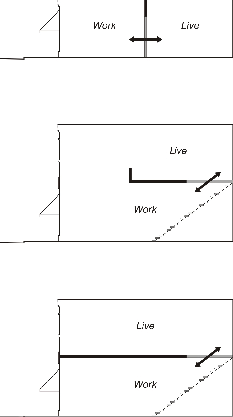
Figure 4-2 - Examples of Live/Work Space Arrangements
5.
Mixed Occupancy Structures. If a structure contains mixed occupancies of live/work units and other nonresidential uses, occupancies other than live/work shall meet all applicable requirements for those uses, and proper occupancy separations shall be provided between the live/work units and other occupancies, as determined by the building official.
6.
Parking. Each live/work unit shall be provided with at least two off-street parking spaces. The review authority may modify this requirement for the use of existing structures with limited parking.
G.
Operating Requirements.
1.
Sale or Rental of Portions of Unit. No portion of a live/work unit may be separately rented or sold as a commercial or industrial space for any person not living in the premises or as a residential space for any person not working in the same unit.
2.
Notice to Occupants. The owner or developer of any structure containing live/work units shall provide written notice to all live/work occupants and users that the surrounding area may be subject to levels of dust, fumes, noise, or other effects associated with commercial and industrial uses at higher levels than would be expected in more typical residential areas. State and federal health regulations notwithstanding, noise and other standards shall be those applicable to commercial or industrial properties in the applicable zoning district.
3.
On-Premises Sales. On-premises sales of goods is limited to those produced within the live/work unit; provided, the retail sales activity shall be incidental to the primary production work within the unit. These provisions shall allow occasional open studio programs and gallery shows.
4.
Nonresident Employees. Up to two persons who do not reside in the live/work unit may work in the unit, unless this employment is prohibited or limited by the use permit. The employment of three or more persons who do not reside in the live/work unit may be allowed, subject to use permit approval, based on an additional finding that the employment will not adversely affect parking and traffic conditions in the immediate vicinity of the unit.
5.
Hours of Operation, Client and Customer Visits. Hours of business operation and client and customer visits to a live/work unit are allowed without limitation, except where conditions of use permit approval restrict hours of operation and/or client/customer visits to ensure compatibility with adjacent commercial or industrial uses, or adjacent residentially-zoned areas.
H.
Changes in Use. After approval, a live/work unit shall not be converted to either entirely residential use or entirely business use unless authorized through use permit approval. No live/work unit shall be changed to exclusively residential use in any structure where residential use is not allowed, where two or more residential units already exist, or where the conversion would produce more than two attached residential units.
I.
Required Findings. The approval of a use permit for a live/work unit shall require that the review authority first make all of the following findings, in addition to those findings required for use permit approval by Section 88.50.050 (Use Permit and Minor Use Permit):
1.
The proposed use of each live/work unit is a bona fide commercial or industrial activity consistent with subsection C. (Limitations on use);
2.
The establishment of live/work units will not conflict with nor inhibit commercial or industrial uses in the area where the project is proposed;
3.
The structure containing live/work units and each live/work unit within the structure has been designed to ensure that they will function predominantly as work spaces with incidental residential accommodations meeting basic habitability requirements in compliance with applicable regulations; and
4.
Any changes proposed to the exterior appearance of the structure will be compatible with adjacent commercial or industrial uses where all adjacent land is zoned for commercial or industrial uses.
88.42.112. - Meeting Facilities, Schools, and Similar Institutional Uses.
Where allowed by Article 2 (Urban Standards), public and private meeting facilities, schools, and similar institutional uses shall comply with the regulations of this section.
A.
Allowable Accessory Uses. Only the uses specifically identified in and authorized by an approved use permit shall operate on the same site as the principal use. For example, a day care center or private school located on the site of a meeting facility used for other purposes must be identified as an authorized use in the use permit for the facility. Otherwise, any additional use shall require an amendment to the original use permit.
B.
Parking Restrictions in Neighborhoods. When a new meeting facility is established in a new building in an NC, NG1 or NG2 zone, the required front yard setback shall not be used for parking purposes.
C.
Compatibility with Surrounding Uses. Use permit approval shall require that the commission first make the following findings in addition to those required by Section 88.51.050:
1.
That all buildings, structures, and landscaping will be developed in a manner compatible with the desired character of the surrounding neighborhood; and
2.
That exterior parking areas will be screened with landscaping in a manner that ensures compatibility with and an enhancement to surrounding land uses; and
3.
That all exterior lighting will be designed, oriented, and constructed to shield adjacent properties from adverse glare effects.
D.
Landscaping Requirements.
1.
Landscaping and permanent, automatic irrigation systems shall be provided as established by the use permit conditions of approval.
2.
All landscaping shall be maintained in a neat and healthy condition.
88.42.120. - Mixed Use Projects.
This section provides standards for the design of new mixed use projects, where allowed by Article 2 (Urban Standards). These standards also apply to existing mixed use developments if any change in construction or use is applied for.
A.
Application Requirements. An application for city approval of a mixed use project that is a conversion of an existing structure without residential units to a mixed use project, shall include a Phase I environmental assessment for the site, including an expanded site investigation to determine whether lead based paint and asbestos hazards are present in an existing structure proposed for conversion to live/work. The purpose of this requirement is to assess whether there are any hazardous or toxic materials on the site that could pose a health risk to the residents. If the Phase I assessment shows potential health risks, a Phase 2 environmental assessment shall be prepared and submitted to the department in order to determine if remediation may be required.
B.
Design Considerations. A mixed use project shall be designed to achieve the following objectives.
1.
The design shall provide for internal compatibility between the residential and non-residential uses on the site.
2.
Potential glare, noise, odors, traffic, and other potentially significant impacts on residents shall be limited to the maximum extent feasible, to allow a compatible mix of residential and nonresidential uses on the same site.
3.
The design shall take into consideration potential impacts on adjacent properties and shall include specific design features to avoid or mitigate potential impacts.
4.
The design shall ensure that the residential units are of a residential character, and that appropriate privacy between residential units and other uses on the site is provided.
5.
Site planning and building design shall provide for convenient pedestrian access from the public street into the nonresidential portions of the project, through such means as courtyards, plazas, walkways, and street furniture.
6.
Site planning and building design shall be compatible with and enhance the adjacent and surrounding residential neighborhood in terms of building design, color, exterior materials, landscaping, lighting, roof styles, scale, and signs.
C.
Maximum Density. The residential component of a mixed use project shall comply with the density requirements of the applicable General Plan designation and zoning district. The number of units allowed on a site shall be calculated by applying the applicable density requirement to the entire area of the site for a vertical mixed use project, but only to the portion of the site to be occupied by the footprint of residential units in a horizontal mixed use project.
1.
Lot consolidation and calculating allowable density. Where two or more legal parcels are combined to create a site for a development plan for a mixed-use project, calculations for maximum allowable density which result in a fraction that is 0.50 or greater shall be rounded up to the nearest whole number. Those density calculations resulting in a fraction that is less than 0.50 shall be rounded down to the nearest whole number.
D.
Site Layout and Project Design Standards. Each proposed mixed use project shall comply with the property development standards of the applicable zoning district, and the following requirements.
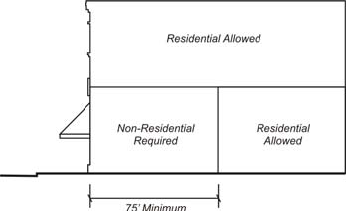
1.
Location of Units. A mixed use project may be either vertical mixed use, or horizontal mixed use; provided that residential units shall not occupy ground floor space within the first 50 feet of floor area measured from each building face adjacent to a public or private street.
2.
Parking. In order to encourage the development of residential uses in existing and new commercial areas, the use of shared parking provisions shall be incorporated into mixed use projects in compliance with Section 88.36.080 (Reduction of Parking Requirements).
3.
Loading Areas. Commercial loading areas shall be located away from residential units and shall be screened from view from the residential portion of the project to the maximum extent feasible.
4.
Refuse and Recycling Areas. Areas for the collection and storage of refuse and recyclable materials shall be located on the site in locations that are convenient for both the residential and nonresidential uses.
E.
Performance Standards.
1.
Lighting. Lighting for commercial uses shall comply with the requirements of Section 88.31.030 (Outdoor Lighting).
2.
Noise. Each residential unit shall be designed and constructed to comply with Section 88.31.020 (Noise Standards).
3.
Hours of Operation. A mixed use project proposing a commercial component that will operate outside of the hours from 8:00 a.m. to 6:00 p.m. shall require Use Permit approval to ensure that the commercial uses will not negatively impact the residential uses within the project, or any adjacent residential uses.
F.
Requirements for Phased Projects. A mixed use project that proposes compliance with all applicable standards of this Development Code through phased construction may be authorized only through the approval of a development agreement in compliance with Chapter 88.53 (Development Agreements).
G.
Mixed-Use Development Standards within the TOD Specific Plan. For mixed-use development located within the TOD Specific Plan, refer to the Specific Plan for development standards.
(Ord. No. 06-O6, § 1B, 8-7-06; Ord. No. 10-O1, § 14, 3-1-10; Ord. No. 11-O4, § 2, 4-18-11; Ord. No. 2017-05, § 4, 7-17-17; Ord. No. 2020-02, § 3, 2-3-20)
88.42.128. - Mobile/Manufactured Homes Outside of Mobile Home Parks.
Where allowed by Article 2 (Urban Standards), an individual residential mobile home or manufactured home placed outside of a mobile home park shall comply with the regulations of this section.
A.
Site Requirements. The site, and the placement of the unit on the site shall comply with all zoning, subdivision, and development standards applicable to a conventional single-family dwelling on the same parcel.
B.
Mobile Home Design and Construction Standards. A mobile home or manufactured home outside of a mobile home park shall comply with the following design and construction standards. A mobile or manufactured home that does not comply with these standards shall be allowed only within a mobile home park.
1.
The exterior siding, trim, and roof shall be of the same materials and treatment found in conventionally built residential structures in the surrounding area, and shall appear the same as the exterior materials on any garage or other accessory structure on the same site.
2.
The roof shall have eave and gable overhangs of not less than 12 inches measured from the vertical side of the mobile home, and the roof pitch shall be no less than 5:12.
3.
The mobile home or manufactured home shall be placed on a foundation system, subject to the approval of the building official; and
4.
The mobile home or manufactured home shall be certified under the National Mobile Home Construction and Safety Standards Act of 1974 (42 USC Section 4401 et seq.), and has been constructed after January 1, 1989.
88.42.130. - Mobile Home Parks.
Where allowed by Article 2 (Urban Standards), mobile home parks shall comply with the regulations of this section.
A.
Use Regulations.
1.
Use Permit approval in compliance with Section 88.51.050 shall be required to establish a mobilehome park or subdivision.
2.
Accessory buildings and uses customarily incident to the primary permitted uses shall be allowed unless specifically prohibited by this chapter.
3.
A guest house is a specifically prohibited use. However, any guest house legally existing prior to February 19, 1992 shall be allowed as a permitted use.
B.
Development Standards. The following minimum development standards shall apply to the development of mobilehome parks and individual mobilehome sites within a mobilehome park or mobile home subdivision:
1.
Each individual mobilehome space or lot shall have a minimum area of 2,500 square feet with a minimum width of 30 feet;
2.
The following minimum setbacks from individual space or lot lines shall be provided:
a.
Front—Ten feet;
b.
Side—Five feet on each side, or ten feet on one side where zero-lot line development is proposed; and
c.
Rear—Ten feet;
3.
Each individual space or lot shall provide parking as required by Chapter 88.36 (Parking);
4.
The maximum coverage of any individual mobilehome space or lot shall be 75 percent, including all accessory structures;
5.
The exterior boundaries of a mobilehome park or subdivision shall be provided with a landscaped setback to ensure compatibility with surrounding uses; and
6.
All other relevant provisions contained in California Health and Safety Code Title 25 shall apply.
D.
Amenities. Through the use permit review process required for a mobilehome park, the commission may impose conditions requiring provision of certain amenities. These amenities may include recreational buildings and facilities, laundry facilities, privacy walls, landscaping, and greenbelts.
88.42.140. - Multi-Family and Small Lot Single-Family Projects.
New or remodeled multi-family projects, and subdivisions of detached single-family homes on parcels smaller than 6,000 square feet, shall comply with the standards of this section, where allowed by Article 2 (Urban Standards). For the purposes of this section, the term "remodeled" means the reconstruction or remodeling of at least 50 percent of the gross floor area of the original structure.
A.
Allowable Multi-Family Building Types. New multi-family projects shall consist of "walk-up" units such as row houses, where each unit has a ground floor entrance, or "stacked flats". Courtyard housing projects are encouraged, and shall comply with the standards in Section 88.42.140 (Multi-Family Courtyard Housing Projects).
B.
Accessory Structures. Accessory structures and uses (e.g., bicycle storage, garages, laundry rooms, recreation facilities, etc.) shall be designed and constructed with an architectural style, exterior colors and materials similar to the structures in the project containing dwelling units. See also Section 88.42.020 (Accessory Structures).
C.
Building Design Standards. Multi-family projects shall be designed to convey the visual character of individual units rather than a singular building mass and volume, and as follows.
1.
Building Facades Adjacent to Streets. A new multi-family project of three or more dwelling units shall be designed so that at least 75 percent of the facade of each building adjacent to a public street is occupied by habitable space with windows. Each facade adjacent to a street shall have at least one pedestrian entry into the structure.
2.
Window Orientation. Where one or more windows are proposed ten feet or less from a side lot line, or ten feet from another residential structure on the same site, design review shall ensure, to the extent feasible, that the windows are located and/or screened to provide privacy for residents of both structures.
3.
Upper Floor Balconies, Hallways, or Other Unit Access. No upper floor open balcony, hallway or unit access area shall be located so as to overlook a side or rear yard of an adjacent residential unit.
4.
Individual Unit Access. A multi-family project shall be designed to provide a separate ground floor entrance for each dwelling unit, except in a mixed use project.
5.
Exterior Stairways. No more than one dwelling unit shall be served by any exterior stairway.
6.
First Floor Level. The elevation of the first habitable floor shall be located at or in proximity to the predominate grade elevation, precluding the visibility of subterranean parking facilities from the street frontage. Rowhouse/townhouse building types in proximity to the public sidewalk may elevate the first floor to preclude sidewalk pedestrian views into the unit from street facing windows.
7.
Roof Design. The roof of a multi-family structure shall be articulated and well-defined, hipped roofs are encouraged, mansard roofs are discouraged.
8.
Separation Between Structures. Each detached structure on the site shall be separated by a minimum of ten feet, except where Section 88.42.142 establishes a greater requirement for courtyard housing.
D.
Front Setback Pavement. No more than 40 percent of the front setback area shall be paved for walkways, driveways, and/or other hardcover pavement; the remainder shall be landscaped.
E.
Parking Location and Design. All off-street parking for a multi-family project other than guest parking shall be within garages, and located to not be visible from the street fronting the parcel. A garage providing parking for a duplex or small-lot detached unit may be located in compliance with the following standards, in addition to the requirements of Chapter 88.36 (Parking and Loading).
1.
Front Setback. An attached or detached garage facade shall be set back from the front property line at least 10 feet further than the facade of the dwelling, to reduce visual impact from the street.
2.
Side Setback. When a maintenance easement is granted by the owner of the adjacent parcel to the approval of the director, a garage may be built to the side property line on that side, but shall be located at least eight feet from the other side property line. Otherwise, a garage shall be set back a minimum of five feet from each side property line.
3.
Rear Setback. A detached garage shall be set back a minimum of five feet from a rear property line.
4.
Garage Facade Width, Door Orientation. The front facade of a garage shall not exceed a width of 25 feet. No garage door for multi-family parking shall directly face a street.
F.
Open Space. Each multi-family residential project shall provide permanently maintained outdoor open space for each dwelling unit (private space), and for all residents (common space), in addition to required setback areas, except where the review authority determines that existing public park or other usable open space is within convenient and safe walking distance.
1.
Area Required. Private and common open space shall be provided as required by Table 4-3.
Table 4-3. MULTI-FAMILY PROJECT OPEN SPACE REQUIREMENTS
2.
Configuration of Open Space. Required open space areas shall be designed and located as follows. Landscaping shall comply with the requirements of Chapter 88.34 (Landscape).
a.
Common Open Space. All required open space shall be: easily accessible; continuous, usable site elements; separated from parking areas; safe and secure. Each common open space area shall have a minimum dimension of 20 feet.
b.
Private Open Space. Private open space shall be at the same elevation as, and immediately accessible from within the unit. Each private open space area shall have a minimum dimension of ten feet.
The review authority may allow required open space to be in different locations and/or with different dimensions where it determines that the alternative approach will provide open space of equivalent utility and aesthetic quality.
3.
Maintenance and Control of Common Open Space. Required common open space shall be controlled and permanently maintained. Provisions for continual control and maintenance shall described in the project application, and in the case of common interest developments, be included in property covenants and made the responsibility of a homeowners association (HOA).
G.
Outdoor Lighting. Outdoor lighting shall be installed and maintained along all vehicular access ways and major walkways, in compliance with 88.31.030 (Outdoor Lighting). The lighting shall be directed onto the driveways and walkways within the development and away from adjacent properties. Lighting of at least one foot candle shall also be installed and maintained within all covered and enclosed parking areas and shall be screened to minimize glare onto public sidewalks. Lighting fixtures/lamps shall be the most energy efficient available, including fluorescent, compact fluorescent, low pressure sodium, high pressure sodium, or other lighting technology that is of equal or greater energy efficiency. All proposed lighting shall be shown on the required landscape plan.
H.
Storage. A minimum of 100 cubic feet of lockable storage area shall be provided for each dwelling outside of the unit, with no dimension less than 30 inches.
I.
Television Antennas. Exterior television antennas, other than satellite dishes less than one meter (39 inches) in diameter, are not allowed, except for a single common, central antenna, with underground cable service to each dwelling unit. This restriction shall be included in any property covenants of a common interest development.
(Ord. No. 2015-O1, § 1, 1-20-15; Ord. No. 2023-04, § 3(Exh. A), 10-2-23)
88.42.142. - Multi-Family Courtyard Housing Projects.
The provisions of this section are intended to encourage the construction of courtyard housing as an attractive and livable alternative to other forms of multi-family housing, by providing alternatives to certain development standards of this Development Code as incentives.
A.
Procedure for Incentives. A multi-family housing project that is proposed as courtyard housing in compliance with this section may be granted incentives as follows.
1.
Allowable Incentives. The review authority may grant any combination of the following incentives at the request of an applicant, provided that the review authority shall have the discretion to offer none of the incentives, and may choose to require compliance with all otherwise applicable residential development regulations.
a.
The first floor of a building, up to a maximum height of 12 feet, may extend ten feet into the required rear yard setback. The second floor up to a maximum height of 24 feet, may extend five feet into the required rear setback. An area equal to the area of the required rear setback that is occupied by the building shall be provided as common open space at grade level in the courtyard area, in addition to all required front and side setbacks.
b.
The first floor of a structure with a maximum height of 15 feet, may extend a maximum of 12 feet into, and cover a maximum of 50 percent of the required front yard, but shall contain only habitable or porch space. An extension into the front yard that exceeds seven and one-half feet shall not be wider than 20 feet, and shall be separated from an adjacent extension into the front yard by a minimum of ten feet.
c.
A semi-subterranean parking garage that does not extend more than 30 inches above grade may be built to a side property line but shall not project into the required rear setback. An area equal to the area of the required side setback that is occupied by the garage shall be provided as common open space at grade level in the courtyard area.
2.
Criteria for Approval. The review authority may approve courtyard housing project with incentives in compliance with this section if it first finds that the project:
a.
Complies with all applicable provisions of this section; and
b.
Provides a higher quality design than would have been provided under the otherwise applicable standards.
3.
Alternatives to Courtyard Design Standards. Project approval shall require that the review authority first make a finding of compliance for each of the design and development standards of this section. The review authority may approve alternative courtyard design standards, provided that the review authority first finds that each alternative:
a.
Achieves a better design solution for the courtyard and development than would result from application of the basic courtyard regulations; and
b.
Would not materially affect adjoining properties.
B.
Courtyard and Common Open Space Requirements. The project shall provide common open space as required for multi-family projects by Section 88.42.140. The open space shall be located on the site as follows.
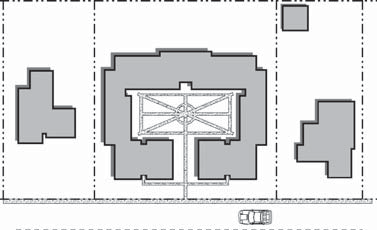
Figure 4-4 - Courtyard Example
1.
Courtyard Required. A courtyard housing project shall include a clearly defined courtyard space. The structure may, for example, be "O," "L," or "U" shaped. See Figure 4-4. A distinct outdoor communal space (or series of spaces) shall be provided to serve as a focus for the housing units, with individual entries to the living units provided from the spaces.
2.
Courtyard Area. The courtyard shall be designed to incorporate at least 60 percent of the common open space area required for the project by Section 88.42.140 (Multi-Family and Small Lot Single-Family Projects).
3.
Rear Yard Open Space. If any of the rear setback is proposed as common open space in addition to the courtyard, a clear connection between the rear yard and the courtyard space shall be provided and at least a portion of the rear yard shall be visible from the courtyard, as follows:
a.
If more than 30 percent of the common open space requirement is proposed in the rear yard, an opening of at least ten feet wide and ten feet high shall provide a view to the rear yard from the courtyard;
b.
For an opening less than ten feet wide, the length shall not exceed twice the width. The height of the opening shall be no less than its width; and
c.
An opening 15 feet wide or more shall be open to the sky.
4.
Open Space in Balconies, Decks, and Terraces. A portion of the common open space requirement for the project may be provided in balconies, decks, and terraces that are open and unrestricted for use by all residents, in compliance with the following standards:
a.
75 percent of balconies, roof decks, or terraces that are counted as common open space in a courtyard project shall be directly adjacent to and overlook the courtyard, and should be seen as an extension of the courtyard;
b.
The space shall not be more than two floors above the courtyard and shall be connected directly to the courtyard with a grand stairway or other appropriate connection if it represents more than ten percent of the common open space; and
c.
The space shall have no dimension less than ten feet, if one level or less above the courtyard, and no dimension less than 15 feet, if two or more levels above the courtyard.
5.
Secondary Courtyards. Secondary courtyards shall be allowed in compliance with the following standards:
a.
If 30 percent or more of the common open space required is provided in additional courtyards, the additional courtyards shall meet all of the requirements for the main courtyard except for visual access to the street; and
b.
If less than 30 percent of the common open space required is provided in additional courtyards the additional courtyards shall comply with the same visibility, access, and dimensional standards as common open space in the rear setback.
C.
Courtyard Design Standards.
1.
Entrance from Street. The courtyard shall address the street, and be easily accessible from the street, with a spacious, clearly defined grand entry, grand stairs if appropriate, or other similar treatment. At least a portion of the courtyard should be visible from the street. The courtyard is best located on the level of the street or 30 inches above or below the street.
a.
On parcels with a slope greater than four percent between the street elevation and the rear elevation of the site, the courtyard may be located more than two and one-half feet above or below street level, but no more than five feet.
b.
On parcels with a slope less than four percent between the street elevation and the rear elevation of the site, the courtyard may be at the level of natural grade or up to three feet above or below natural grade. Natural grade shall be measured at the sidewalk (front) property line at the location of the entrance to the courtyard.
c.
On parcels with more than 60 feet of street frontage, an opening in the structure at least ten feet wide and ten feet high shall be provided. The opening may be designed with security enclosures which are treated in the same design style as the structure itself.
d.
Passageways from the front yard to the courtyard which are less than 15 feet wide shall have a length no greater than twice the width. The height of the opening shall be no less than the width.
e.
Openings that are ten feet or more in width and 20 feet more in length shall be open to the sky.
f.
Glazing shall not be allowed in the opening. Any gates shall be of a highly ornamental nature (preferably designed by an artist and executed by a skilled craftsperson). The gate shall allow a minimum of 70 percent visibility into the courtyard.
2.
Dimensions. The minimum length and width of a courtyard shall be 15 feet on parcels of 50 feet or less in width, 20 feet on all other parcels, and shall comply with the minimum area requirements of subsection B.1 (Courtyard required).
3.
Encroachments.
a.
Structural Elements. Exterior, unenclosed structural elements (e.g., balconies, open stairs, and stoops) may encroach into the courtyard and may reduce the minimum clear dimension of the courtyard a maximum of five feet from 20 feet subject to the following limitations:
(1)
Encroaching balconies shall have design features such as brackets or braces, and not be simple, featureless cantilevers;
(2)
Encroaching stairs shall be either wood or masonry and have closed risers;
(3)
Unenclosed encroachments shall have a maximum depth of four feet; and
(4)
The total area of unenclosed encroachments shall not exceed ten percent of the area of the court-yard.
b.
Private Open Space. Private open space for individual units is not considered an encroachment and may be included as part of the courtyard subject to the following limitations:
(1)
The maximum height of hedges, walls, or other elements separating the space from the rest of the main garden shall be 24 inches or less in height if opaque, and 42 inches maximum in height if it allows at least 50 percent visibility. Height shall be measured from the finished grade of walkways or patios in the common portion of the main garden;
(2)
The total area of private open space within the main garden shall not exceed 25 percent of the area of the courtyard; and
(3)
The main garden, as a whole, shall comply with the planting and paving standards of following subsection D.
4.
Individual Unit Access. See subsection E. (Building design).
D.
Courtyard Landscaping and Surfacing Standards.
1.
General Landscape Standards. Courtyard landscaping shall comply with Chapter 88.34 (Landscaping Standards), and the following standards.
a.
All courtyard landscaping shall be permanently maintained and irrigated with an automatic system.
b.
Preferred courtyard and front yard ground covers are ones that may be walked on, and are water-conserving.
c.
The incorporation of fountains, pools, and other water features into the courtyard is required. The incorporation of other decorative elements (e.g., iron work and tile) is encouraged. Water elements shall recycle to conserve water. If the courtyard is over fully subterranean parking, tree wells with an inside diameter of at least six feet shall be provided. The minimum tree size at planting shall be 15 gallons.
d.
Benches, retaining walls, steps, and bench-type edges for planters shall be provided.
2.
Courtyard Landscaping and Surfacing. All courtyards shall comply with at least one of the following subsections (D.2.a, D.2.b, and/or D.2.c).
a.
Courtyard on Grade. The courtyard may be at natural grade with no structure below. For gardens or parts of gardens at natural grade, the following requirements shall apply:
(1)
At least 35 percent of the total courtyard area shall be planted;
(2)
A courtyard with a minimum area of 1,500 square feet shall have at least one canopy tree with a minimum mature height of 35 feet. An additional canopy tree of the same size shall be included for each additional 1,000 square feet of courtyard area. The minimum tree size at planting shall be 15 gallons; and
(3)
Poured surfaces (e.g., asphalt or concrete) may be used for walkways up to five feet in width but are not acceptable for area paving. Unplanted areas with a minimum dimension of five feet or more shall be paved with unit pavers (e.g., brick, concrete, or tile) set or covered with decomposed granite or garden gravel.
b.
Courtyard Over Subterranean parking. The courtyard may be at natural grade over a fully subterranean parking structure, or up to three feet above street level at the entry over a semi-subterranean parking structure. Where possible, planted areas should be installed at the same grade as adjacent walkways. Courtyards or parts of courtyards over subterranean parking shall comply with the following requirements in addition to the requirements of subsection D.2.a, above for gardens on grade.
(1)
Planting beds shall be on two feet of soil. If above the grade level of the courtyard, the walls of the planters may be no more than two feet above finished grade.
(2)
For each canopy tree required, a well extending down through the parking structure shall be provided. Tree wells shall have a minimum inside diameter of six feet. Tree well areas shall be counted as part of the required landscaped area. See Figure 4-5.
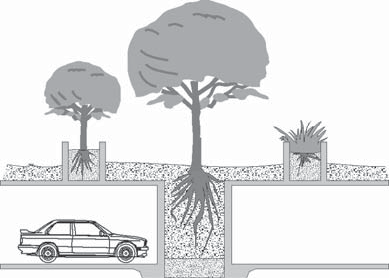
88.42.142 Figure 4-5 - Plantings over Garage
(3)
Appropriate drainage and irrigation shall be provided for planters, tree wells, and the soil covering the parking structure.
c.
Courtyard Over Partially Subterranean Parking. The courtyard may be no more than three feet above natural grade over a partially subterranean parking structure. For gardens or parts of gardens over partially subterranean parking the following requirements shall be met in addition to the requirements identified above for gardens at natural grade and over fully subterranean parking.
(1)
Except for tree wells, planters, and decorative garden elements (e.g., fountains, etc.) the entire surface of the courtyard shall be covered with a minimum of eight inches of soil or unit pavers set in sand or soil with a total minimum depth of eight inches.
(2)
Finished grade at the courtyard and existing grade at the sidewalk entrance to the courtyard shall be used in determining the height of the main garden above the natural grade.
E.
Building Design.
1.
Upper Floor Setbacks. A courtyard structure of more than two stories shall set back each floor above the second a distance from the courtyard of at least one foot for each foot in height above the second floor, on at least 65 percent of the courtyard perimeter.
2.
Unit Orientation. All units in a courtyard structure shall be "through" units and shall have an exposure off the courtyard as well as an exposure on at least one other side of the structure.
3.
Access to Individual Units. Each dwelling unit shall have access from the courtyard or street level by means of a doorway from that level.
a.
Interior corridors are prohibited. The majority of units shall have their primary entrances directly from the courtyard space. Additional entrances may serve units from the street front or from subsidiary common open spaces. No common access balcony above the level of the courtyard floor shall be allowed.
b.
Shared entrances from the courtyard in the form of porches, recesses in the structure, or stoops may serve no more than one unit.
c.
Transitional spaces in the form of overhangs, porches, and stoops, between public areas or common spaces and entrances to the units shall be provided for each unit or group of units.
4.
Architectural Standards. The following provisions address the quality of the structures that surround and define a courtyard, and make a crucial contribution to the life and quality of these spaces. These provisions are intended to encourage courtyard housing design features that are appropriate to the city, and prohibit inappropriate ones.
a.
Objectives. Architectural elements (e.g., balconies, bay windows, entrances, and porches) are an essential aspect of a successful courtyard structure. This Development Code is not prescriptive with respect to the style or the architectural character of structures, but encourages structures that are designed, detailed, and constructed with care and consistency.
b.
Required Elements. Each new courtyard structure shall incorporate as least one feature as a conspicuous component of its architecture which demonstrates skilled craftwork. Examples of these features include cast terra cotta, iron gates, stenciled ornament, tile fountains, wood work, or other devices.
c.
Special Features. Each courtyard structure shall incorporate at least two of the following elements. The substitution of elements not on the list may be approved by the review authority. See Figure 3-26.
(1)
Upper floor loggias or pergolas recessed within a structure.
(2)
Roofed balconies supported by brackets or by columns at the ground floor.
(3)
Exterior wooden or masonry stairs with closed risers.
(4)
Tile or masonry fountains.
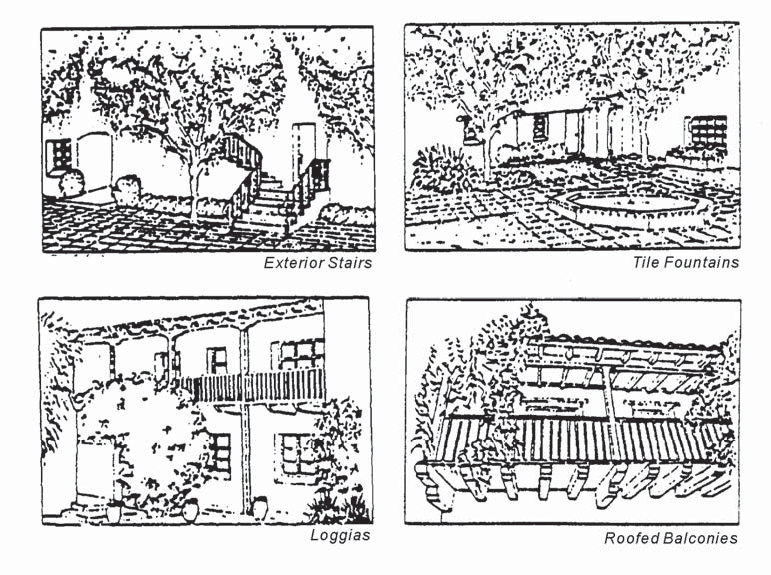
88.42.12 Figure 4-6 - Courtyard Housing Special Features
d.
Materials.
(1)
In order to ensure that new structures appear substantial and integral, changes of exterior color, texture, or material shall be accompanied by changes in plane. An exception is the articulation of the base of a structure.
(2)
Material or color changes at the outside corners of structures give an impression of thinness and artificiality and are not allowed.
(3)
Structures should have consistent materials and details throughout. Detailing of doors, windows, and eaves and the type and quality of materials should be similar on all sides of structures.
(4)
New courtyard structures should reflect regional architectural traditions. This means that careful decisions shall be made concerning the choice, application, and detailing of materials so that new construction reflects the best examples of the type in the city or region. Windows and doors shall be outlined by projecting surrounds that completely enclose these openings, or be deeply recessed.
F.
Parking.
1.
Parking Location and Design. Parking for a courtyard housing project shall comply with the location and design requirements for multi-family projects in Section 88.42.140.E, and the requirements of Chapter 88.36 (Parking and Loading).
2.
Parking Entry. The visibility of the parking entry from the street shall be minimized and designed to be architecturally sensitive to, and treated as, an integral part of the street facade.
(Ord. No. 06-O6, § 1B, 8-7-06)
88.42.150. - Outdoor Displays and Sales.
A.
Applicability. The provisions of this section apply to temporary and permanent facilities for outdoor display, sales (e.g., garden nurseries, lumber yards, news and flower stands, and similar uses where merchandise is displayed for sale), and outdoor eating areas, where allowed by Article 2 (Urban Standards).
B.
Temporary Outdoor Displays and Sales. See Section 88.51.030 (Temporary Use Permits).
C.
Permanent Outdoor Displays and Sales. The permanent outdoor display and sale of merchandise is allowed subject to the following standards, and any conditions required by minor use permit approval.
1.
The outdoor display of merchandise shall not exceed a height of six feet above finished grade, unless a greater height is allowed through minor use permit approval.
2.
Outdoor display and sales areas shall not encroach into required setback areas or the public right-of-way. In zoning districts where no setback area is required, the outdoor sales area shall be set back a minimum of ten feet from adjoining property lines unless otherwise allowed through minor use permit approval.
3.
Displayed merchandise shall occupy a fixed, specifically approved, location that does not disrupt the normal function of the site or its circulation, and does not encroach upon driveways, landscaped areas, parking spaces, or pedestrian walkways. A display shall not obstruct intersection visibility or otherwise create hazards for pedestrian or vehicle traffic.
4.
The outdoor display and sales area shall be directly related to a business occupying a permanent structure on the subject parcel.
5.
The director may require that outdoor sales and activity areas other than vehicle sales lots, produce stands, and nursery product sales be screened from the view of adjoining public rights-of-way by decorative walls, fences, or landscaping.
6.
Additional signs, beyond those normally allowed for the subject use, shall not be provided as a result of the outdoor display and sales area.
D.
News and Flower Stands.
1.
Location Requirements. A news or flower stand shall:
a.
Be located parallel and adjacent to the wall of a structure. A freestanding news or flower stand is allowed only as a roofed kiosk;
b.
In the case of a privately owned stand, not be located within the public right-of-way, within three feet of a display window of any structure abutting the sidewalk, or so as to interfere with or restrict the reasonable use of the window for display purposes.
2.
Design and Construction Requirements.
a.
A stand shall be soundly constructed of wood, metal, or other suitable permanent material, and designed in a manner and color to be compatible with the adjacent structures whether the stand is opened or closed. Security doors shall be designed as an integral part of the structure.
b.
Shelving shall not exceed eight feet in height nor two feet in depth.
3.
Maintenance. The news and flower stand shall be maintained in a clean and neat condition and in good repair, at all times.
4.
Signs. Signs shall be designed as an integrated part of the stand, and shall comply with the following requirements.
a.
A stand shall not be used for advertising or publicity purposes. Signs shall be for identification only, with size and design in compliance with Chapter 88.34 (Signs).
b.
The owner or operator of an outdoor news or flower stand shall display, in a place readily visible to the public, a telephone number and address where the owners may be reached.
5.
Additional Product Sales. In addition to the sale of newspapers, magazines, and other periodicals, for newsstands, and flowers and plants, for flower stands, the owners or operators may sell other related accessory products, not to exceed ten percent of the total merchandise displayed.
6.
Hours of Operation. The allowable hours of operation of a news or flower stand shall be established by minor use permit approval.
E.
Outdoor Dining Areas.
1.
An outdoor dining area may be allowed accessory and incidental to a restaurant.
2.
An outdoor eating area within the public right-of-way shall require an encroachment permit, and shall use only city approved furniture and enclosures.
3.
Signs shall comply with Chapter 88.38 (Signs).
88.42.160. - Outdoor Storage.
Where allowed by Article 2 (Urban Standards), outdoor storage shall comply with the regulations of this section.
A.
Enclosure and Screening Required. Outdoor storage areas shall be entirely enclosed by a solid wall or fence as approved by the review authority with a minimum height of six feet and a maximum height of eight feet. Storage containers may be allowed with a minor use permit in the DW and DWL zones only, located so as not to be visible from the street.
B.
Maximum Height of Stored Materials. The materials within the storage area shall not be higher than the fence, except where authorized by the minor use permit for the storage area.
C.
Landscaped Setback. In any case where an outdoor storage area abuts a street right-of-way, the required screening wall or fence shall be set back from the right-of-way as required by the applicable zoning district, and the set back area shall be landscaped to the approval of the director, and in compliance with Chapter 88.32 (Landscape).
(Ord. No. 10-O1, § 15, 3-1-10; Ord. No. 2020-02, § 3, 2-3-20)
88.42.170. - Recycling Facilities.
Where allowed by Article 2 (Urban Standards), recycling facilities shall comply with the regulations of this section, except that scrap, junk, and automobile wrecking yards shall instead comply with Section 88.42.050.
A.
Reverse Vending Machines. Reverse vending machines shall comply with the following standards.
1.
Accessory Use Only. Each machine shall be installed only as an accessory use to an allowed primary use.
2.
Location Requirements. If located outside of a structure, a machine shall not occupy parking spaces required by the primary use.
3.
Signs. Sign area shall not exceed four square feet for each machine, exclusive of operating instructions. Total sign area shall comply with Chapter 88.38 (Signs).
4.
Lighting. Each machine shall be illuminated to ensure comfortable and safe operation if the machine is accessible between dusk and dawn. The light source shall be shielded so that glare and reflections are confined to the site.
B.
Small and Large Collection Facilities. A small or large collection facility shall comply with the following standards.
1.
Location Requirements.
a.
A small collection facility shall not be located within 50 feet, and a large collection facility shall not be located within 200 feet, of a parcel zoned for or occupied by a residential use.
b.
Each facility shall be set back at least ten feet from any public right-of-way, and not obstruct pedestrian or vehicle circulation.
2.
Maximum Size. A facility shall comply with the following maximum size requirements, not including space periodically needed for the removal of materials or exchange of containers:
a.
A small collection facility shall not occupy more than 600 square feet nor three parking spaces.
b.
A large collection facility shall not occupy more than 45,000 square feet.
3.
Appearance. Collection containers and site fencing shall be of a color and design that is compatible and harmonious with the surrounding uses and neighborhoods.
4.
Operating Standards.
a.
Small collection facilities shall not use power-driven processing equipment, except for reverse vending machines;
b.
Large collection facilities allowed activities are limited to baling, compacting, crushing, and sorting of source-separated recyclable materials.
c.
Outbound truck shipments from the site shall not exceed an average of two each day.
d.
Small and Large Collection facilities shall accept only glass, metal, or plastic containers, paper, and reusable items;
e.
Small and Large Collection facilities shall use containers that are constructed with durable waterproof and rustproof materials, secured from unauthorized removal of material, and shall be of a capacity sufficient to accommodate materials collected and the collection schedule; and
f.
Small and Large Collection facilities shall be screened where determined by the review authority to be necessary because of visibility;
g.
Small and Large Collection facilities shall be continuously maintained so that the site is free from trash and litter at all times.
h.
Large collection facilities sorting, processing and storage shall be conducted entirely indoors.
5.
Signs. Non-illuminated signs may be provided as follows:
a.
Identification signs are allowed with a maximum area of 15 percent for each side of the structure or 12 square feet, whichever is greater. In the case of a wheeled facility, the side shall be measured from the ground to the top of the container;
b.
Additional directional signs, consistent with Chapter 88.38 (Signs), may be approved by the director if found necessary to facilitate traffic circulation, or if the facility is not visible from the public right-of-way.
6.
Parking Requirements.
a.
No additional parking space shall be required for customers of a small or medium collection facility located in the established parking lot of the primary use. One additional space shall be provided for the attendant, if needed.
b.
Use of parking spaces by the patrons and the attendant shall not reduce available parking spaces below the minimum number required for the primary use unless a parking reduction is approved in compliance with Section 88.36.080 (Reduction of Parking Requirements).
C.
Processing Facilities. Processing facilities shall comply with the following standards.
1.
Location Requirements. A processing facility shall not be located on a parcel that abuts a parcel zoned or occupied for residential use.
2.
Limitation on Activities. Allowed activities are limited to baling, briquetting, compacting, crushing, grinding, shredding, and sorting of source-separated recyclable materials and repairing of reusable materials. The facility shall not bale, compact, or shred ferrous metals, other than beverage and food containers.
3.
Outdoor Storage or Activities. All sorting and processing shall be conducted entirely indoors.
4.
Operating Standards. Any dust, fumes, odor, smoke, or vibration, produced by the facility above ambient levels, shall not be detectable on adjoining parcels.
(Ord. No. 11-O16, § 6, 10-24-11)
88.42.180. - Secondhand Stores, Swap Meets, Flea Markets, and Similar Uses.
Where the sale of used merchandise is allowed by Article 2 (Urban Standards), secondhand stores, swap meets, flea markets, and similar uses shall comply with the regulations of this section.
A.
Purpose. This section establishes a comprehensive set of requirements applicable to secondhand stores, swap meets, flea markets, and similar uses of property. The council finds and determines that these uses pose special concerns due to the small areas occupied by the uses and the increased intensity of commercial use where many different retail establishments operate out of a central location.
B.
Permit Requirement. Only the uses specifically identified in and authorized by an approved use permit shall be permitted to operate in association with the primary use. Any additional use shall be subject to the requirements of the applicable zoning district.
C.
Location Requirements.
1.
No secondhand store, swap meet, flea market, or similar use shall be located within 100 feet of any residential zone, either within the city limits or in an adjacent jurisdiction.
2.
No secondhand store, swap meet, flea market, or similar use shall be located within 500 feet of any other existing secondhand store, swap meet, flea market, or similar use.
D.
Development and Operational Standards. The following development standards shall apply to all swap meets, flea markets, and similar uses, but not to secondhand stores:
1.
A minimum of 500 square feet of floor or ground floor area shall be provided per vendor;
2.
Restroom facilities and fixtures shall be provided in compliance with the standards in the Plumbing Code (Municipal Code Section 14-131) and based upon the building occupancy load for assembly purposes. Open air businesses shall provide permanent separate restroom facilities for men and women as required by the Director;
3.
Hours of operation shall be as established by use permit conditions of approval;
4.
Refuse facilities shall be provided for the disposal of rubbish as determined by the Director;
5.
All aisles within a building shall provide a minimum of 25 feet of unobstructed clearance for public movement;
6.
All open air facilities shall provide access and turning areas as required by the fire department for fire and rescue purposes;
7.
Onsite private security shall be provided as determined by the police chief;
8.
All parking and open air vendor areas shall be maintained free of trash, debris, and cast-off items, and shall be swept or vacuumed at the close of each business day;
9.
The owner of the business and the owner of the property on which the business is located shall submit an emergency evacuation plan with the use permit application. The plan shall be approved by the police and fire departments; and
10.
The review authority may impose other development conditions as deemed appropriate to provide for public peace, health, and safety.
E.
Findings and Considerations for Approval.
1.
The review authority shall not grant a permit for any use subject to this section unless it finds that the use at the proposed location will be consistent with the general plan and that its operation will not adversely affect the public peace, health, safety, general welfare, or surrounding property values. In granting the permit, the review authority may impose conditions as are necessary and proper to prevent any adverse effect.
2.
In determining whether approval will be granted, the review authority shall consider the following:
a.
Nature and use of real property within 500 feet of the use;
b.
Appropriate measures to provide proper maintenance of the site, including keeping of the premises and surrounding areas free of junk, litter, and debris;
c.
Off-street parking to be provided for the use, including lease arrangements if parking is not provided on the site;
d.
Layout of the operation, whether indoors or outdoors, including all structures, whether permanent or temporary, use for the operation of the business(es);
e.
Provisions for onsite security and traffic controls to satisfy the concerns of the police department;
f.
The types of merchandise to be sold, with restrictions on the sale of alcoholic beverages or other items deemed inappropriate for the use;
g.
Hours and days of operation;
h.
Controls on the occupancy limits on the premises and loitering outside the premises; and
i.
Prevention of adverse effect of the use on adjacent properties.
F.
Compliance with Conditions of Approval.
1.
The applicant shall have 90 days in which to comply with any conditions of approval imposed on the permit.
2.
The review authority may modify the compliance period as appropriate, depending upon the nature and extent of the conditions imposed. In determining whether the compliance period should be modified, the review authority shall consider the following, as applicable.
a.
The severity of any maintenance problems and the time required to implement appropriate measures to rectify the problems;
b.
The nature of the security needs and traffic control concerns and any special concerns of the police department which must be met; and
c.
The time required to secure all necessary permits, licenses, or approvals require by law, resolution, or ordinance.
G.
Exceptions.
1.
Nothing in this section shall apply to homeowners or residents conducting permitted yard and garage sales as defined and regulated by Municipal Code Chapter 18, Article VIII.
2.
Nothing in this section shall apply to city-sponsored events, school-related events, or temporary use permits approved by the director.
88.42.190. - Accessory Dwelling Units.
A.
PURPOSE. The purpose of this section is to allow and regulate accessory dwelling units (ADUs) and junior accessory dwelling units (JADUs) in compliance with California Government Code §§ 65852.2 and 65852.22.
B.
EFFECT OF CONFORMING. An ADU or JADU that conforms to the standards in this section will not be:
1.
Deemed to be inconsistent with the city's general plan and zoning designation for the lot on which the ADU or JADU is located.
2.
Deemed to exceed the allowable density for the lot on which the ADU or JADU is located.
3.
Considered in the application of any local ordinance, policy, or program to limit residential growth.
4.
Required to correct a nonconforming zoning condition, as defined in subsection C.7 below. This does not prevent the City from enforcing compliance with applicable building standards in accordance with Health and Safety Code section 17980.12.
C.
DEFINITIONS. As used in this section, terms are defined as follows:
1.
"Accessory dwelling unit" or "ADU" means an attached or a detached residential dwelling unit that provides complete independent living facilities for one or more persons and is located on a lot with a proposed or existing primary residence. An accessory dwelling unit also includes the following:
a.
An efficiency unit, as defined by California Health and Safety Code § 17958.1; and
b.
A manufactured home, as defined by California Health and Safety Code § 18007.
2.
"Accessory structure" means a structure that is accessory and incidental to a dwelling located on the same lot.
3.
"Complete independent living facilities" means permanent provisions for living, sleeping, eating, cooking, and sanitation on the same parcel as the single-family or multifamily dwelling is or will be situated.
4.
"Efficiency kitchen" means a kitchen that includes each of the following:
a.
A cooking facility with appliances.
b.
A food preparation counter.
5.
"Junior accessory dwelling unit" or "JADU" means a residential unit that satisfies all of the following:
a.
It is no more than 500 square feet in size,.
b.
It is contained entirely within an existing or proposed single-family structure. An enclosed use within the residence, such as an attached garage, is considered to be a part of and contained within the single-family structure.
c.
It includes its own separate sanitation facilities or shares sanitation facilities with the existing or proposed single-family structure.
d.
If the unit does not include its own separate bathroom, then it contains an interior entrance to the main living area of the existing or proposed single-family structure in addition to an exterior entrance that is separate from the main entrance to the primary dwelling.
e.
It includes an efficiency kitchen, as defined in subsection C.4 above.
6.
"Livable space" means a space in a dwelling intended for human habitation, including living, sleeping, eating, cooking, or sanitation.
7.
"Living area" means the interior habitable area of a dwelling unit, including basements and attics, but does not include a garage or any accessory structure.
8.
"Nonconforming zoning condition" means a physical improvement on a property that does not conform with current zoning standards.
9.
"Passageway" means a pathway that is unobstructed clear to the sky and extends from a street to one entrance of the ADU or JADU.
10.
"Proposed dwelling" means a dwelling that is the subject of a permit application and that meets the requirements for permitting.
11.
"Public transit" means a location, including, but not limited to, a bus stop or train station, where the public may access buses, trains, subways, and other forms of transportation that charge set fares, run on fixed routes, and are available to the public.
12.
"Tandem parking" means that two or more automobiles are parked on a driveway or in any other location on a lot, lined up behind one another.
D.
APPROVALS. The following approvals apply to ADUs and JADUs under this section:
1.
Building-permit Only. If an ADU or JADU complies with each of the general requirements in subsection E below, it is allowed with only a building permit in the following scenarios:
a.
Converted on a Lot with Proposed or Existing Single-Family Dwelling: Only one ADU or JADU on a lot with a proposed or existing single-family dwelling on it, where the ADU or JADU:
i.
Is either: within the space of a proposed single-family dwelling; within the existing space of an existing single-family dwelling; or (in the case of an ADU only) within the existing space of an accessory structure, plus up to 150 additional square feet if the expansion is limited to accommodating ingress and egress.
ii.
Has exterior access that is independent of that for the single-family dwelling.
iii.
Has side and rear setbacks sufficient for fire and safety, as dictated by applicable building and fire codes.
iv.
The JADU complies with the requirements of Government Code §§ 66333 through 66339.
b.
Limited Detached on a Lot with Proposed or Existing Single-Family Dwelling: One detached, new-construction ADU on a lot with a proposed or existing single-family dwelling (in addition to any JADU that might otherwise be established on the lot under subsection D.1.a above), if the detached ADU satisfies the following limitations:
i.
The side- and rear-yard setbacks are at least four feet.
ii.
The total floor area is 800 square feet or smaller.
iii.
The peak height above grade does not exceed the applicable height limit in subsection E.2 below.
c.
Converted on a Lot with Existing Multi-Family Dwelling: Multiple ADUs within portions of existing multifamily dwelling structures that are not used as livable space, including but not limited to storage rooms, boiler rooms, passageways, attics, basements, or garages, if each converted ADU complies with state building standards for dwellings. At least one converted ADU is allowed within an existing multifamily dwelling structure, up to a quantity equal to 25 percent of the existing multifamily dwelling units, under this paragraph.
d.
Limited Detached on a Lot with Existing Multi-Family Dwelling: No more than two detached ADUs on a lot with a proposed multifamily dwelling, or up to eight detached ADUs on a lot with an existing multifamily dwelling, if each detached ADU satisfies all of the following:
i.
The side- and rear-yard setbacks are at least four feet. If the existing multifamily dwelling has a rear or side yard setback of less than four feet, the city will not require any modification to the multifamily dwelling as a condition of approving the ADU.
ii.
The peak height above grade does not exceed the applicable height limit provided in subsection E.2 below.
iii.
If the lot has an existing multifamily dwelling, the quantity of detached ADUs does not exceed the number of primary dwelling units on the lot.
2.
ADU Over-the-Counter Permit.
a.
Except as allowed under subsection D.1 above, no ADU may be created without a building permit and an ADU Over-the-Counter (OTC) permit in compliance with the standards set forth in subsections E and F below.
b.
The City may charge a fee to reimburse it for costs incurred in processing ADU OTC permits, including the costs of adopting or amending the City's ADU ordinance. The ADU OTC-permit processing fee is approved by the City Council by resolution.
3.
Process and Timing.
a.
An ADU permit is considered and approved ministerially, without discretionary review or a hearing.
b.
The City must approve or deny an application to create an ADU or JADU within 60 days from the date that the City receives a completed application. If the City has not approved or denied the completed application within 60 days, the application is deemed approved, unless either:
i.
The applicant requests a delay, in which case the 60-day time period is tolled for the period of the requested delay, or
ii.
In the case of a JADU and the application to create a junior accessory dwelling unit is submitted with a permit application to create a new single-family or multifamily dwelling on the lot, the City may delay acting on the permit application for the JADU until the City acts on the permit application to create the new single-family dwelling or multifamily, but the application to create the JADU will still be considered ministerially without discretionary review or a hearing.
c.
If the city denies an application to create an ADU or JADU, the city must provide the applicant with comments that include, among other things, a list of all the defective or deficient items and a description of how the application may be remedied by the applicant. Notice of the denial and corresponding comments must be provided to the applicant within the 60-day time period established by subsection D.3.b above.
d.
A demolition permit for a detached garage that is to replaced with an ADU is reviewed with the application for the ADU and issued at the same time.
E.
GENERAL ADU AND JADU REQUIREMENTS. The following requirements apply to all ADUs and JADUs that are approved under subsections D.1 or D.2 above:
1.
Zoning.
a.
An ADU subject only to a building permit under subsection D.1 above may be created on a lot in a residential zone or mixed-use zone as shown in the table below:.
b.
An ADU subject to an ADU permit under subsection D.2 above may be created on a lot that is zoned to allow single-family dwelling residential use or multifamily dwelling residential use.
c.
In accordance with Government Code § 66333(a), a JADU may only be created on a lot zoned for single-family residences.
2.
Height.
a.
Except as otherwise provided by subsections E.2.b and E.2.c below, a detached ADU created on a lot with an existing or proposed single family or multifamily dwelling unit may not exceed 16 feet in height.
b.
A detached ADU may be up to 18 feet in height if it is created on a lot with an existing or proposed single family or multifamily dwelling unit that is located within one-half mile walking distance of a major transit stop or a high quality transit corridor, as those terms are defined in Section 21155 of the Public Resources Code, and the ADU may be up to two additional feet in height (for a maximum of 20 feet) if necessary to accommodate a roof pitch on the ADU that is aligned with the roof pitch of the primary dwelling unit.
c.
A detached ADU created on a lot with an existing or proposed multifamily dwelling that has more than one story above grade may not exceed 18 feet in height.
d.
An ADU that is attached to the primary dwelling may not exceed 25 feet in height or the height limitation imposed by the underlying zone that applies to the primary dwelling, whichever is lower. Notwithstanding the foregoing, ADUs subject to this subsection E.2.d may not exceed two stories.
e.
For purposes of this subsection E.2, height is measured above existing legal grade or the level of the lowest floor, whichever is lower, to the peak of the structure.
3.
Fire Sprinklers.
a.
Fire sprinklers are required in an ADU if sprinklers are required in the primary residence.
b.
The construction of an ADU does not trigger a requirement for fire sprinklers to be installed in the existing primary dwelling.
4.
Rental Term. An ADU or JADU may be rented but no ADU or JADU may be rented for a term that is shorter than 30 days. This prohibition applies regardless of when the ADU or JADU was created. The property owner must obtain a business license and rental registration from the Community Improvement Division and renew them annually.
5.
No Separate Conveyance. An ADU or JADU may be rented, but, except as otherwise provided in Government Code § 66341, but no ADU or JADU may be sold or otherwise conveyed separately from the lot and the primary dwelling (in the case of a single-family lot) or from the lot and all of the dwellings (in the case of a multifamily lot).
6.
Septic System. If the ADU or JADU will connect to an onsite water-treatment system, the owner must include with the application a percolation test completed within the last five years or, if the percolation test has been recertified, within the last 10 years.
7.
Owner Occupancy.
a.
An ADU that is permitted after January 1, 2020, but before January 1, 2025, is not subject to any owner-occupancy requirement.
b.
As required by state law, all JADUs are subject to an owner-occupancy requirement. A natural person with legal or equitable title to the property must reside on the property, in either the primary dwelling or JADU, as the person's legal domicile and permanent residence. However, the owner-occupancy requirement in this subsection (e)(7)(B) does not apply if the property is entirely owned by another governmental agency, land trust, or housing organization.
8.
Income Reporting. In order to facilitate the city's obligation to identify adequate sites for housing in accordance with Government Code §§ 65583.1 and 65852.2, the following requirements must be satisfied:
a.
With the building-permit application, the applicant must provide the city with an estimate of the projected annualized rent that will be charged for the ADU or JADU.
b.
Within 90 days after each yearly anniversary of the issuance of the building permit, the owner must report the actual rent charged for the ADU or JADU during the prior year. If the city does not receive the report within the 90-day period, the owner is in violation of this Code, and the city may send the owner a notice of violation and allow the owner another 30 days to submit the report. If the owner fails to submit the report within the 30-day period, the city may enforce this provision in accordance with applicable law.
9.
Building and Safety.
a.
Must comply with building code. Subject to subsection E.10.b below, all ADUs and JADUs must comply with all local building code requirements.
b.
No change of occupancy. Construction of an ADU does not constitute a Group R occupancy change under the local building code, as described in Section 310 of the California Building Code, unless the building official or Code Enforcement Division officer makes a written finding based on substantial evidence in the record that the construction of the ADU could have a specific, adverse impact on public health and safety. Nothing in this subsection E.10.b prevents the city from changing the occupancy code of a space that was uninhabitable space or that was only permitted for nonresidential use and was subsequently converted for residential use in accordance with this section.
F.
SPECIFIC ADU REQUIREMENTS. The following requirements apply only to ADUs that require an ADU permit under subsection D.2 above.
1.
Maximum Size.
a.
The maximum size of a detached or attached ADU subject to this subsection F is 850 square feet for a studio or one bedroom unit and 1,000 square feet for a unit with two bedrooms. No more than two bedrooms are allowed.
b.
An attached ADU that is created on a lot with an existing primary dwelling is further limited to 50 percent of the floor area of the existing primary dwelling.
c.
Application of other development standards in this subsection F, such as FAR or lot coverage, might further limit the size of the ADU, but no application of a percentage-based maximum floor area (i.e., under subsection F.1.b above), or of an FAR, front setback, lot coverage, or open-space requirement may require the ADU to be less than 800 square feet.
2.
Lot Coverage. No ADU subject to this subsection F may cause the total lot coverage of the lot to exceed 50 percent, subject to subsection F.1.c above.
3.
Setbacks.
a.
Each ADU that is subject to this subsection F is subject to a 40-foot front setback, (subject to subsection F.1.c. above.
b.
Each ADU that is subject to this subsection F is subject to four-foot side and rear setbacks.
c.
No setback is required for an ADU that is subject to this subsection F if the ADU is constructed in the same location and to the same dimensions as an existing structure.
4.
Building Separation. A newly constructed detached ADU shall be set back from any other permanent structure on the site by a minimum of ten feet.
5.
Stories. No ADU subject to this subsection F may exceed one story.
6.
Passageway. No passageway, as defined by subsection C.8 above, is required for an ADU.
7.
Parking.
a.
Generally. One off-street parking space is required for each ADU. The parking space may be provided in setback areas or as tandem parking, as defined by subsection C.11 above.
b.
Exceptions. No parking under subsection F.6.a is required in the following situations:
i.
The ADU is located within one-half mile walking distance of public transit, as defined in subsection C.10 above.
ii.
The ADU is located within an architecturally and historically significant historic district.
iii.
The ADU is part of the proposed or existing primary residence or an accessory structure under subsection D.1.a above.
iv.
When on-street parking permits are required but not offered to the occupant of the ADU.
v.
When there is an established car share vehicle stop located within one block of the ADU.
vi.
When the permit application to create an ADU is submitted with an application to create a new single-family or new multi-family dwelling on the same lot, provided the ADU or the lot satisfies and other criteria listed in subsections F.6.b.i. through v. above.
c.
No Replacement. When a garage, carport, or covered parking structure is demolished in conjunction with the construction of an ADU or converted to an ADU, those off-street parking spaces are not required to be replaced.
8.
Objective Site Design and Architectural Requirements.
a.
Same in Appearance. To ensure that site design and architectural character of the ADU are compatible with those of the primary dwelling through the use of purely objective standards, the materials and colors of the exterior walls, roof, and windows and doors must match the appearance and architectural design of those of the primary dwelling, and the roof slope must match that of the dominant roof slope of the primary dwelling. The dominant roof slope is the slope shared by the largest portion of the roof.
b.
Separate Entrance. The ADU must have an independent exterior entrance, apart from that of the primary dwelling. The ADU entrance must be located on the side or rear building façade, not facing a public right-of-way.
c.
Minimum Dimensions. The interior horizontal dimensions of an ADU must be at least ten feet wide in every direction, with a minimum interior wall height of seven feet.
d.
Privacy. An ADU within 15 feet of a residential unit on the same parcel or on an adjacent parcel may not have windows that directly face windows in other unit at a 90-degree angle.
e.
Fire and Public Safety. The ADU or JADU address and location must be identified by either an address plaque or by other signage that is clearly legible from the public right-of-way. The plaque or other signage must be clearly indicated on a site plan submitted with the building-permit application. The site plan must also show how the ADU or JADU will be accessed by fire and safety personnel. Alternatively, instead of an address plaque or signage, the applicant may elect to provide a paved walkway visible from the public right-of-way that leads to the ADU or JADU.
f.
Main Entrance Architectural Enhancements. Architectural enhancements are required for main entrances of attached and detached ADUs. "Architectural enhancements" means the inclusion of at least two of the following elements: architectural lighting, a covered patio or porch, an overhang, architectural projections, and enhanced building materials such as stone veneer, brick veneer, wood siding, PVC siding, decorative trim work, and window shutters.
9.
Landscape Requirements.
a.
Evergreen landscape screening must be planted and maintained between the ADU and adjacent parcels as follows:
i.
At least one 15-gallon size tree shall be provided at a ratio of one tree for every proposed dwelling unit.
ii.
Plant specimens must be at least six feet tall when installed. As an alternative, a solid fence of at least six feet in height may be installed.
b.
All landscaping must be drought-tolerant.
10.
Historical Protections. The architectural treatment of an ADU to be constructed on a lot that has an identified historical resource listed on the federal, state, or local register of historic places must comply with all applicable ministerial requirements imposed by the Secretary of Interior. Must be located so as to not be visible from any public right-of-way.
G.
FEES.
1.
Impact Fees.
a.
No impact fee is required for an ADU or JADU that is less than 750 square feet in size.
b.
Any impact fee that is required for an ADU that is 750 square feet or larger in size must be charged proportionately in relation to the square footage of the primary dwelling unit. (E.g., the floor area of the ADU, divided by the floor area of the primary dwelling unit, times the typical fee amount charged for a new dwelling.) "Impact fee" here does not include any connection fee or capacity charge for water or sewer service.
2.
Utility Connection and Connection Fees.
a.
If an ADU or JADU is constructed with a new single-family home, a separate utility connection directly between the ADU or JADU and the utility and payment of the normal connection fee and capacity charge for a new dwelling are required.
b.
Except as set forth in subsection G.2.a above, a converted ADU or JADU on a lot with a single- family home, created under subsection D.1.a above, is not required to have a new or separate utility connection directly between the ADU or JADU and the utility. Nor is a connection fee or capacity charge required.
c.
Except as set forth in subsections G.2.a and G.2.b above, an ADU or JADU requires a new, separate utility connection directly between the ADU or JADU and the public utility. For water service, this includes separate water service and meter directly from the public water system in compliance with Azusa Light and Water specifications and requirements. The property owner must size the separate service and meter to meet the water needs of the proposed ADU or JADU. The connection is subject to a connection fee or capacity charge that is proportionate to the burden created by the ADU or JADU, based on either the relative floor areas or drainage fixture unit (DFU) values, as defined by the Uniform Plumbing Code, of the ADU or JADU and the primary dwelling.
H.
Nonconforming Zoning Code Conditions, Building Code Violations, and Unpermitted Structures.
1.
Generally. The city will not deny an ADU or JADU application due to a nonconforming zoning condition, building code violation, or unpermitted structure on the lot that does not present a threat to the public health and safety and that is not affected by the construction of the ADU or JADU.
2.
Unpermitted ADUs constructed before 2020.
a.
Permit to Legalize. As required by state law, the city may not deny a permit to legalize an existing but unpermitted ADU that was constructed before January 1, 2020, if denial is based on either of the following grounds:
i.
The ADU violates applicable building standards, or
ii.
The ADU does not comply with the state ADU law (Government Code § 65852.2) or this ADU ordinance (section 88.42.190).
b.
Exceptions:
i.
Notwithstanding subsection H.2.a above, the city may deny a permit to legalize an existing but unpermitted ADU that was constructed before January 1, 2020, if the city makes a finding that correcting a violation is necessary to protect the health and safety of the public or of occupants of the structure.
ii.
Subsection H.2.a above does not apply to a building that is deemed to be substandard in accordance with California Health and Safety Code § 17920.3.
I.
Nonconforming ADUs and Discretionary Approval. Any proposed ADU or JADU that would otherwise be allowed under this section but that does not conform to the objective design or development standards set forth in subsections (a) through (h) of this section may be allowed by the city with a conditional use permit, in accordance with the other provisions of this title.
(Ord. No. 2017-14, § 9, 12-18-17; Ord. No. 2020-05, § 3, 8-17-20; Ord. No. 2023-01, § 3(Exh. A), 2-6-23; Ord. No. 2023-02, § 3(Exh. A), 3-20-23; Ord. No. 2024-08, § 5(Exh. A), 12-2-24)
Editor's note— Ord. No. 2017-14, § 8, adopted Dec. 18, 2017, repealed the former § 88.42.190, and enacted a new § 88.42.190 as set out herein. The former § 88.42.190 pertained to second units and carriage houses and derived from Ord. No. 11-O16, § 7, adopted Oct. 24, 2011.
88.42.200. - Senior Citizen Apartments.
Where allowed by Article 2 (Urban Standards), senior citizen apartments shall comply with the regulations of this section.
A.
Purpose. The city recognizes that the housing needs of older residents may differ from those of the general population in terms of dwelling unit size, unit accessibility, parking requirements, and housing affordability, among other considerations. Therefore, this section establishes special requirements for senior citizen apartments.
B.
Minimum Qualifying Age. The primary resident of each dwelling unit shall be of minimum age 55 years, provided that physically handicapped residents shall not be required to meet the minimum age requirement. Other household members may be younger. The development must be deed restricted for senior citizens and/or physically handicapped residents for the life of the structure.
C.
Reserved.
E.
Development Standards. Each senior citizen apartment project shall comply with the following requirements.
F.
Open Space/Landscaping Requirements.
1.
A minimum of 60 square feet of private usable open space and 125 square feet of common usable open space shall be provided for each dwelling unit.
2.
Landscaping is required in the front yard setback prior to issuance of a certificate of occupancy. Landscaping shall consist of a combination of trees, ground cover and shrubbery to adequately cover all designated landscaped areas when installed. Plant materials shall cover the designated planting area from the outset. Up to 35 percent of the required landscape area may be installed with hardscape materials, at the discretion of the director or his designee.
G.
Additional Amenities. Each dwelling unit shall be provided with an oven and stove; a garbage disposal; at least 150 square feet of indoor storage, including closets; and central heating and air conditioning.
H.
Security Requirements. Each senior citizen apartment development shall include the following security provisions to safeguard residents:
1.
Electrically-monitored entry gates accessed at a central location;
2.
24-hour medical alarm security system connected to the manager's unit;
3.
Smoke detectors in all units, corridors, and common areas; and
4.
Any other security measures deemed necessary by the chief of police and the Commission.
(Ord. No. 2023-04, § 3(Exh. A), 10-2-23)
88.42.210. - Service Stations.
A service station shall be located only on a site of 20,000 square feet or larger.
88.42.220. - Tattoo/Body Piercing.
A minimum separation distance of 500 feet is required between each industrial zoned parcel containing a tattoo/body piercing establishment and no more than one tattoo/body piercing establishment is allowed per parcel.
(Ord. No. 11-O16, § 7, 10-24-11)
88.42.230. - Shopping Centers Providing Additional Public Benefits.
Notwithstanding the limitations contained in the definition of "shopping center" limiting the non-retail square footage of a shopping center to no more than 15 percent of allowed uses, a shopping center owner may negotiate a development agreement that provides additional public benefits to authorize an increase in the percentage of non-retail uses. Any such development agreement shall be subject to negotiation and approval pursuant to Chapter 88.53.
(Ord. No. 2015-O1, § 1, 1-20-15)
88.42.240. - Tobacco and Vaping Shops.
A.
Where allowed by Article 2 (Urban Standards), a tobacco/vaping shop shall comply with the regulations of this section.
B.
PURPOSE. The purpose and intent of this Section is encourage responsible tobacco retailing and to discourage violations of tobacco-related laws, especially those which prohibit or discourage the sale or distribution of tobacco and nicotine products to youth in a manner consistent with regulations imposed by federal or state law. As a result, this Section provides concentration, separation, spacing and distance, and operational standards for tobacco and vaping shops in the City of Azusa in order to maintain the City's character, the diversity and vitality of the community's commercial areas, and protect the health, safety and welfare of Azusa's youth, its residents and visitors.
C.
DEFINITIONS. For the purposes of this section, the definitions contained herein shall govern the meanings of the following terms, words, phrases, and their derivations:
1.
"Drug Paraphernalia" has the meaning set forth in California Health and Safety Code section 11014.5, as that section may be amended from time to time.
2.
"Electronic smoking device" means an electronic device that can be used to deliver an inhaled dose of nicotine, or other substances, including any component, part or accessory of such device whether or not sold separately. This definition includes any such device, whether manufactured, distributed, marketed, or sold as an electronic cigarette (E-Cigarette), an electronic cigar, an electronic cigarillo, an electronic pipe, an electronic hookah, or any other product name or descript including any component, part or accessory of such device, whether or not sold separately. "Electronic smoking device" does not include any product specifically approved by the United States Food and Drug Administration for use in the mitigation, treatment, or prevention of disease, where such product is marketed and sold separately for such an approved purpose.
3.
Flavored tobacco product" means any tobacco product that imparts a characterizing flavor.
4.
"Hookah Tobacco Lounge" shall mean a restaurant that operates within the City pursuant to a valid City business license that also engages, as an accessory use, in the retail sale of shisha tobacco products, Hookah, and Hookah smoking accessories. "Hookah" is defined as type of water pipe, used to smoke shisha or other Tobacco Products, with a long flexible tube for drawing aerosol through water. Components of a Hookah may include heads, stems, bowls, and hoses.
5.
"Hookah Tobacco Retailer" shall mean a tobacco retailer that is engaged in the retail sale of shisha tobacco products, hookah, and hookah smoking accessories.
6.
"Marijuana Paraphernalia" shall mean any instrument or object intended for use or designed for use in ingesting, inhaling, or otherwise introducing cannabis, marijuana, hashish, or hashish oil into the human body, such as the following:
a.
Metal, wooden, acrylic, glass, stone, plastic, or ceramic pipes with or without screens, permanent screens, hashish heads, or punctured metal bowls.
b.
Water pipes.
c.
Carburetion tubes and devices.
d.
Smoking and carburetion masks.
e.
Roach clips, meaning objects used to hold burning material, such as a cannabis cigarette that has become too small or too short to be held in the hand.
f.
Miniature cocaine spoons, and cocaine vials.
g.
Chamber pipes.
h.
Carburetor pipes.
i.
Electric pipes.
j.
Air-driven pipes.
k.
Chillums.
l.
Bongs.
m.
Ice pipes or chillers.
7.
"Tobacco" shall mean any preparation of the nicotine-rich leaves of the tobacco plant, which are cured by a process of drying and fermentation for use in smoking, chewing, absorbing, dissolving, inhaling, snorting, sniffing, or ingesting by any other means into the body.
8.
"Tobacco Paraphernalia" shall mean any instrument or object that is designed for the smoking or ingestion of lawful tobacco products including without limitation cigarette papers, cigarette wrappers, cigar wrappers, blunt wraps, tobacco pipes, holders, clips, and cigarette rolling machines. "Tobacco paraphernalia" excludes "drug paraphernalia" as that term is defined in Health and Safety Code Section 11364.5(d), as amended from time to time.
9.
"Tobacco Product" shall mean any product in leaf, flake, plug, liquid, or any other form, containing nicotine derived from the tobacco plant, or otherwise derived, which is intended to enable human consumption of the tobacco or nicotine in the product, whether smoked, chewed, absorbed, dissolved, inhaled, snorted, sniffed, or ingested by any other means. For the purposes of this chapter, the term "tobacco product" excludes any product that has been specifically approved by the United States Food and Drug Administration (FDA) for sale as a tobacco/smoking cessation product or for other medical purposes, where such product is marketed and sold solely for such an approved purpose.
10.
"Tobacco or Vaping Shop" means any place where a person sells, offers for sale, or does or offers to exchange for any form of consideration, tobacco, tobacco products, or tobacco paraphernalia, or who distributes free or low-cost samples of tobacco products or tobacco paraphernalia.
D.
PERMIT REQUIREMENT. No person shall cause or permit the creation, operation, or intensification of any tobacco or vaping shop use without first obtaining and maintaining a minor use permit pursuant to Chapter 88.51.040 (Use Permit and Minor Use Permit). The requirements of this section do not apply to the sale of flavored shisha tobacco products by a hookah tobacco retailer if all of the following conditions are met:
1.
The hookah tobacco retailer has a valid license to sell tobacco products issued pursuant to Chapter 2 (commencing with Section 22971.7) of Division 8.6 of the Business and Professions Code.
2.
The hookah tobacco retailer does not permit any person under 21 years of age to be present or enter the premises at any time.
3.
The hookah tobacco retailer shall operate in accordance with all relevant state and local laws relating to the sale of tobacco products.
4.
If consumption of tobacco products is allowed on the premises of the hookah tobacco retailer, the hookah tobacco retailer shall operate in accordance with all state and local laws relating to the consumption of tobacco products on the premises of a tobacco retailer, including, but not limited to, Section 6404.5 of the Labor Code.
E.
LOCATION REQUIREMENTS.
1.
No tobacco or vaping shop shall be established within 1,000 feet of a Youth-Populated Area as measured by a straight line from the nearest point of the property line of the parcel on which the Youth-Populated Area is located to the nearest point of the property line of the parcel on which the applicant's business is located. For the purpose of this subsection, a "Youth-Populated Area" means a parcel in the City that is occupied by any of the following:
a.
A private or public preschool, kindergarten, elementary, middle, or high school,
b.
A library open to the public,
c.
A playground open to the public,
d.
A youth center, defined as a facility where children, ages six to 17, inclusive, come together for programs and activities,
e.
A recreation facility open to the public, defined as an area, place, structure, or other facility that is used either permanently or temporarily for community recreation, even though it may be used for other purposes. "Recreation facility" includes, but is not limited to, a gymnasium, playing court, playing field, and swimming pool,
f.
An arcade open to the public,
g.
A park open to the public or to all the residents of a private community, or
h.
A licensed child-care facility or preschool as defined in California Health & Safety Code § 1596.78
2.
No tobacco or vaping shop shall be located within 1,000 feet of another tobacco or vaping shop as measured by a straight line from the nearest point of the property line to the nearest point of the property line on which the applicant's business is located.
3.
No tobacco or vaping shop shall be located on the same parcel.
4.
The City shall have no more than one tobacco/vaping shops for every 8,000 residents, to a maximum of seven tobacco/vaping shops, within the City's boundaries including existing and proposed new tobacco/vaping shops.
F.
DEVELOPMENT AND OPERATIONAL STANDARDS.
1.
Tobacco shops and vaping shops shall comply with all applicable local, State, and Federal laws regarding the advertising, display, or sales of tobacco and electronic cigarette/vaping products.
2.
No smoking shall be permitted on the premises at any time.
3.
All electronic cigarettes/vaping products, tobacco products and tobacco paraphernalia shall be kept and displayed in a secure and locked enclosure, which can only be accessed with the assistance of a clerk. Self-service displays of such products is prohibited.
4.
It is unlawful for a tobacco shop or vaping shop to knowingly allow or permit a minor, not accompanied by his or her parent or legal guardian, to enter or remain within the tobacco/vaping shop.
5.
Sampling of electronic cigarettes/vaping products and tobacco products by individuals less than 21 years of age is prohibited.
6.
All tobacco shops and vaping shops shall post clear signage stating that minors may not enter the premises unless accompanied by a parent or legal guardian. At least one such sign shall be placed in a conspicuous location near each public entrance to the shop. It shall be unlawful for a tobacco shop/vaping shop to fail to display and maintain, or fail to cause to be displayed or maintained, such signage.
7.
It is unlawful for a tobacco shop or vaping shop to offer for sale or sell any cannabis products or any drug/marijuana paraphernalia.
G.
REVOCATION OF A BUSINESS LICENSE AND/OR MINOR USE PERMIT. In addition to any other penalty authorized by law or the Azusa Municipal Code, the business license and minor use permit of any business that violates any provision of this Section, the California Uniform Controlled Substances Act (including without limitation Health and Safety Code Sections 11364 to 11376.5), as amended from time to time, or any other local, State or Federal law or regulation may be revoked pursuant to the procedure set forth in Chapter 88.56 (Appeals and Revocations).
H.
NONCONFORMING TOBACCO/VAPING SHOPS. Tobacco shops and vaping shops that are located in the DW and DWL zones and are legally existing on the effective date of the ordinance codified in this chapter may continue to operate as legal nonconforming uses in accordance with Chapter 88.54 (Nonconforming Uses, Structures, and Parcels) and shall not be required to obtain a minor use permit.
I.
AMORTIZATION OF EXISTING NONCONFORMING TOBACCO SHOPS AND VAPING SHOPS NOT LOCATED IN THE DW AND DWL ZONES.
1.
All requirements set forth in this Chapter are deemed to be necessary for the protection of the public health, safety, and welfare and shall be applicable to and govern all existing and proposed tobacco shops and vaping shops immediately upon the date the ordinance codified in this Chapter becomes effective.
2.
Any existing tobacco shops and vaping shops which are located within a zone in which tobacco shops and vaping shops are not permitted which is a nonconforming use as of the effective date of the ordinance codified in this Section shall be subject to an amortization period of three years. An extension of time request for one year may be permitted if written documentation is provided by the business owner that:
a.
The applicant/owner has made a substantial investment (including but not limited to lease obligations) in the property or structure on or in which the nonconforming use is conducted; such property or structure cannot be readily converted into another use; and such investment was made prior to the date this ordinance is adopted; and
b.
The applicant/owner will be unable to recoup said investment as of the date established for termination of the use; and
c.
The applicant has made good faith efforts to recoup investment and to relocate the use to a location in conformance with this Section.
3.
No more than two, one-year time extensions may be granted. The total amortization period shall not exceed five years.
4.
For existing tobacco or vaping shops that seek to relocate within the DW or DWL zone, their MUP applications will be reviewed on a first-come, first-serve basis until the maximum of seven tobacco/vaping shops has been reached.
5.
Upon the conclusion of the amortization period, any tobacco shop or vaping shop which is a nonconforming use shall cease all business operations, and all signs, advertising and displays relating to such business shall be removed within 30 days thereafter.
(Ord. No. 2021-01, § 4, 2-1-21)
88.42.250 - Two-unit Projects.
A.
PURPOSE. The purpose of this section is to allow and appropriately regulate two-unit projects in accordance with Government Code section 65852.21.
B.
DEFINITION. A "two-unit project" means the development of two primary dwelling units or, if there is already a primary dwelling unit on the lot, the development of a second primary dwelling unit on a legally subdivided lot in accordance with the requirements of this section.
C.
APPLICATION.
(1)
Only individual property owners may apply for a two-unit project. "Individual property owner" means a natural person holding fee title individually or jointly in the person's own name or a beneficiary of a trust that holds fee title. "Individual property owner" does not include any corporation or corporate person of any kind (partnership, LP, LLC, C corp, S corp, etc.) except for a community land trust (as defined by Rev. & Tax Code § 402.1(a)(11)(C)(ii)) or a qualified nonprofit corporation (as defined by Rev. & Tax Code § 214.15). Any person with a mortgage interest in the lot to be split under this section must sign the application and the parcel map indicating the person's consent to the project.
(2)
An application for a two-unit project must be submitted on the city's approved form.
(3)
The applicant must obtain a certificate of compliance with the Subdivision Map Act and the implementing regulations in this code for the lot and provide the certificate with the application.
(4)
Only a complete application will be considered. The city will inform the applicant in writing of any incompleteness within 30 days after the application is submitted.
(5)
The city may establish a fee to recover its costs for adopting, implementing, and enforcing this section of the code, in accordance with applicable law. The city council may establish and change the fee by resolution. The fee must be paid with the application.
D.
APPROVAL.
(1)
An application for a two-unit project is approved or denied ministerially, by the planning director, without discretionary review.
(2)
The ministerial approval of a two-unit project does not take effect until the city has confirmed that the required documents have been recorded, such as the deed restriction and easements.
(3)
The approval must require the owner and applicant to hold the city harmless from all claims and damages related to the approval and its subject matter.
(4)
The approval must require the owner and applicant to reimburse the city for all costs of enforcement, including attorneys' fees and costs associated with enforcing the requirements of this code.
E.
REQUIREMENTS. A two-unit project must satisfy each of the following requirements:
(1)
Map Act Compliance. The lot must have been legally subdivided.
(2)
Zone. The lot is in a single-family residential zone. For purposes of this section, a single-family residential zone is a zone where the only residential use that is allowed as a primary use is a single residential dwelling on a lot.
(3)
Lot Location.
(A)
The lot is not located on a site that is any of the following:
(i)
Prime farmland, farmland of statewide importance, or land that is zoned or designated for agricultural protection or preservation by the voters.
(ii)
A wetland.
(iii)
Within a very high fire hazard severity zone, unless the site complies with all fire-hazard mitigation measures required by existing building standards.
(iv)
A hazardous waste site that has not been cleared for residential use.
(v)
Within a delineated earthquake fault zone, unless all development on the site complies with applicable seismic protection building code standards.
(vi)
Within a 100-year flood hazard area, unless the site has either:
(I)
been subject to a Letter of Map Revision prepared by the Federal Emergency Management Agency and issued to the local jurisdiction, or
(II)
meets Federal Emergency Management Agency requirements necessary to meet minimum flood plain management criteria of the National Flood Insurance Program.
(vii)
Within a regulatory floodway, unless all development on the site has received a no-rise certification.
(viii)
Land identified for conservation in an adopted natural community conservation plan, habitat conservation plan, or other adopted natural resource protection plan.
(ix)
Habitat for protected species.
(x)
Land under conservation easement.
(B)
The purpose of subpart (e)(3)(A) above is merely to summarize the requirements of Government Code section 65913.4(a)(6)(B)-(K). (See Gov. Code § 66411.7(a)(3)(C).)
(C)
The applicant must provide evidence that the requirements of Government Code section 65913.4(a)(6)(B)-(K) are satisfied.
(4)
Not Historic. The lot must not be a historic property or within a historic district that is included on the State Historic Resources Inventory. Nor may the lot be or be within a site that is designated by ordinance as a city or county landmark or as a historic property or district.
(5)
No Impact on Protected Housing.
The two-unit project must not require or include the demolition or alteration of any of the following types of housing:
(A)
Housing that is income-restricted for households of moderate, low, or very low income.
(B)
Housing that is subject to any form of rent or price control through a public entity's valid exercise of its policy power.
(C)
Housing, or a lot that used to have housing, that has been withdrawn from rental or lease under the Ellis Act (Gov. Code §§ 7060-7060.7) at any time in the 15 years prior to submission of the urban lot split application.
(D)
Housing that has been occupied by a tenant in the last three years.
As part of the two-unit project application, the applicant and the owner of a property for which a two-unit project is sought must provide a sworn statement by affidavit representing and warranting that subpart (e)(5)(A) above is satisfied.
The city may conduct its own inquiries and investigation to ascertain the veracity of the sworn statement, including but not limited to, surveying owners of nearby properties; and the city may require additional evidence of the applicant and owner as necessary to determine compliance with this requirement.
(6)
Unit Standards.
(A)
Quantity.
(i)
No more than two dwelling units of any kind may be built on a lot that results from an urban lot split. For purposes of this paragraph, "unit" means any dwelling unit, including, but not limited to, a primary dwelling unit, a unit created under this section of this code, an ADU, or a JADU.
(ii)
A lot that is not created by an urban lot split may have a two-unit project under this section, plus any ADU or JADU that must be allowed under Section 88.42.190 - Accessory Dwelling Units.
(B)
Unit Size.
(i)
The total floor area of each primary dwelling built that is developed under this section must be
(I)
less than or equal to 800 square feet and
(II)
more than 500 square feet.
(ii)
A primary dwelling that was legally established on the lot prior to the two-unit project and that is larger than 800 square feet is limited to the lawful floor area at the time of the two-unit project. The unit may not be expanded.
(iii)
A primary dwelling that was legally established prior to the two-unit project and that is smaller than 800 square feet may be expanded to 800 square feet after or as part of the two-unit project.
(C)
Height Restrictions.
(i)
On a lot that is larger than 2,000 square feet, no new primary dwelling unit may exceed a single story or 16 feet in height, measured from grade to peak of the structure.
(ii)
On a lot that is smaller than 2,000 square feet, no new primary dwelling unit may exceed two stories or 22 feet in height, measured from grade to peak of the structure. Any portion of a new primary dwelling that exceeds one story must be stepped back by an additional five feet from the ground floor; no balcony deck or other portion of the second story may project into the stepback.
(iii)
No rooftop deck is permitted on any new or remodeled dwelling or structure on a lot with a two-unit project.
(D)
Demo Cap. The two-unit project may not involve the demolition of more than 25 percent of the existing exterior walls of an existing dwelling unless the site has not been occupied by a tenant in the last three years.
(E)
Setbacks.
(i)
Generally. All setbacks must conform to those objective setbacks that are imposed through the underlying zone.
(ii)
Exceptions. Notwithstanding subpart (e)(6)(G) above:
(I)
Existing Structures. No setback is required for an existing legally established structure or for a new structure that is constructed in the same location and to the same dimensions as an existing legally established structure.
(II)
800 sf; four-foot side and rear. The setbacks imposed by the underlying zone must yield to the degree necessary to avoid physically precluding the construction of up to two units on the lot or either of the two units from being at least 800 square feet in floor area; but in no event may any structure be less than four feet from a side or rear property line.
(iii)
Front Setback Area. Notwithstanding any other part of this code, dwellings that are constructed under this section must be at least 25 feet from the front property lines. The front setback area must:
(I)
be kept free from all structures greater than three feet high;
(II)
be at least 50 percent landscaped with drought-tolerant plants, with vegetation and irrigation plans approved by a licensed landscape architect;
(III)
allow for vehicular and fire-safety access to the front structure.
(F)
Parking. Each new primary dwelling unit must have at least one off-street parking space per unit unless one of the following applies:
(i)
The lot is located within one-half mile walking distance of either
(I)
a corridor with fixed route bus service with service intervals no longer than 15 minutes during peak commute hours or
(II)
a site that contains
(ia)
an existing rail or bus rapid transit station,
(ib)
a ferry terminal served by either a bus or rail transit service, or
(ic)
the intersection of two or more major bus routes with a frequency of service interval of 15 minutes or less during the morning and afternoon peak commute periods.
(ii)
The site is located within one block of a car-share vehicle location.
(G)
Architecture.
(i)
If there is a legal primary dwelling on the lot that was established before the two-unit project, any new primary dwelling unit must match the existing primary dwelling unit in exterior materials, color, and dominant roof pitch. The dominant roof slope is the slope shared by the largest portion of the roof.
(ii)
If there is no legal primary dwelling on the lot before the two-unit project, and if two primary dwellings are developed on the lot, the dwellings must match each other in exterior materials, color, and dominant roof pitch. The dominant roof slope is the slope shared by the largest portion of the roof.
(iii)
At least 50 percent of a structure's walls fronting any street shall incorporate at least two of the following surface materials:
1)
Brick,
2)
Natural Stone,
3)
Terracotta,
4)
Stucco, cement plaster, or other similar troweled finish,
5)
Wood or other similar faux wood siding such as PVC or cement fiber.
(iv)
Dwellings shall incorporate at least three of the following elements along the side of any wall fronting a street:
1)
Arches,
2)
Awnings,
3)
Balconies,
4)
Bay windows,
5)
Brick, rock, or stone veneer
6)
Columns,
7)
Decorative iron railing,
8)
Plazas or courtyards,
9)
Porches, covered and open on at least three sides,
10)
Window shutters,
11)
Window trim
(v)
Balconies are only allowed along the front elevation or corner side elevation of a dwelling facing a public street.
(vi)
Any faux shutters should be proportionate to the adjacent window so as to create the appearance of a real and functional shutter.
(vii)
Upper and lower windows should align vertically whenever possible.
(viii)
No linear wall of a second story may extend more than twenty-four feet (24') without architectural articulation or an offset of at least two feet (2') for not less than eight feet (8').
(ix)
All vents, gutters, downspouts, flashing, and electrical panels must be painted to match the surface to which they are attached, unless concealed or used as a major design element, in which case the color is to be consistent with the overall color scheme of the building.
(x)
All roof, ground, and wall-mounted equipment must be screened from public view in compliance with Section 88.30.020.G.2 of the Development Code.
(xi)
All exterior lighting must be limited to down-lights.
(xii)
No window or door of a dwelling that is constructed on the lot after the urban lot split may have a direct line of sight to an adjoining residential property. Fencing, landscaping, or privacy glass may be used to provide screening and prevent a direct line of sight.
(xiii)
If a dwelling is constructed on a lot after an urban lot split and any portion of the dwelling is less than 30 feet from a property line that is not a public right-of-way line, then all windows and doors in that portion must either be (for windows) clerestory with the bottom of the glass at least six feet above the finished floor, or (for windows and for doors) utilize frosted or obscure glass.
(H)
Landscaping. Evergreen landscape screening must be planted and maintained between each dwelling and adjacent lots (but not rights of way) as follows:
(i)
At least one 15-gallon size plant shall be provided for every five linear feet of exterior wall. Alternatively, at least one 24" box size plant shall be provided for every ten linear feet of exterior wall.
(ii)
Plant specimens must be at least six feet tall when installed. As an alternative, a solid fence of at least 6 feet in height may be installed.
(iii)
All landscaping must be drought-tolerant.
(iv)
All landscaping must be from the city's approved plant list.
(I)
Nonconforming Conditions. A two-unit project may only be approved if all nonconforming zoning conditions are corrected.
(J)
Utilities.
(i)
Each primary dwelling unit on the lot must have its own direct utility connection to the utility service provider.
(ii)
Notwithstanding paragraph (e)(6)(L)(i) above, a primary dwelling unit may have a direct utility connection to an onsite wastewater treatment system in accordance with this paragraph and the city's code. Each primary dwelling unit on the lot that is or that is proposed to be connected to an onsite wastewater treatment system must first have a percolation test completed within the last five years or, if the percolation test has been recertified, within the last 10 years.
(iii)
All utilities must be underground.
(K)
Building & Safety. All structures built on the lot must comply with all current local building standards. A project under this section is a change of use and subjects the whole of the lot, and all structures, to the city's current code.
(7)
Fire-Hazard Mitigation Measures. A lot in a very high fire hazard severity zone must comply with each of the following fire-hazard mitigation measures:
(A)
It must have direct access to a public right-of way with a paved street with a width of at least 40 feet. The public street right of way must have at least two independent points of access for fire and life safety to access and for residents to evacuate.
(B)
All dwellings on the site must comply with current fire code requirements for dwellings in a very high fire hazard severity zone.
(C)
All enclosed structures on the site must have fire sprinklers.
(D)
All sides of all dwellings on the site must be within a 150-foot hose-pull distance from either the public street right-of-way or of an onsite fire hydrant or standpipe.
(E)
If the lot does not have a swimming pool, the lot must have a water reservoir of at least 5,000 gallons per dwelling, with fire-authority approved hookups compatible with fire-authority standard pump and hose equipment.
(8)
Separate Conveyance.
(A)
Primary dwelling units on the lot may not be owned or conveyed separately from each other.
(B)
Condominium airspace divisions and common interest developments are not permitted within the lot.
(C)
All fee interest in the lot and all the dwellings must be held equally and undivided by all individual property owners.
(i)
No timeshare, as defined by state law or this code, is permitted. This includes any co-ownership arrangement that gives an owner the right to exclusive use of the property for a defined period or periods of time.
(9)
Regulation of Uses.
(A)
Residential-only. No non-residential use is permitted on the lot.
(B)
No Short-Term Rentals. No dwelling unit on the lot may be rented for a period of less than 30 days.
(C)
Owner Occupancy. Unless the lot was formed by an urban lot split, the individual property owners of a lot with a two-unit project must occupy one of the dwellings on the lot as the owners' principal residence and legal domicile.
(10)
Notice of Construction.
(A)
At least 30 business days before starting any construction of a two-unit project, the property owner must give written notice to all the owners of record of each of the adjacent residential parcels, which notice must include the following information:
(i)
Notice that construction has been authorized,
(ii)
The anticipated start and end dates for construction,
(iii)
The hours of construction,
(iv)
Contact information for the project manager (for construction-related complaints), and
(v)
Contact information for the Building & Safety Department.
(B)
This notice requirement does not confer a right on the noticed persons or on anyone else to comment on the project before permits are issued. Approval is ministerial. Under state law, the City has no discretion in approving or denying a particular project under this section. This notice requirement is purely to promote neighborhood awareness and expectation.
(11)
Deed Restriction. The owner must record a deed restriction, on a form approved by acceptable to the city, that does each of the following:
(A)
Expressly prohibits any rental of any dwelling on the property for a period of less than 30 days.
(B)
Expressly prohibits any non-residential use of the lot.
(C)
Expressly prohibits any separate conveyance of a primary dwelling on the property, any separate fee interest, and any common interest development within the lot.
(D)
If the lot is not created by an urban lot split: Expressly requires the individual property owners to live in one of the dwelling units on the lot as the owners' primary residence and legal domicile.
(E)
States that the property is formed by an urban lot split and is therefore subject to the city's urban lot split regulations, including all applicable limits on dwelling size and development.
F.
SPECIFIC ADVERSE IMPACTS.
(1)
Notwithstanding anything else in this section, the city may deny an application for a two-unit project if the building official makes a written finding, based on a preponderance of the evidence, that the project would have a "specific, adverse impact" on either public health and safety or on the physical environment and for which there is no feasible method to satisfactorily mitigate or avoid the specific adverse impact.
(2)
"Specific adverse impact" has the same meaning as in Gov. Code § 65589.5(d)(2): "a significant, quantifiable, direct, and unavoidable impact, based on objective, identified written public health or safety standards, policies, or conditions as they existed on the date the application was deemed complete" and does not include (1) inconsistency with the zoning ordinance or general plan land use designation or (2) the eligibility to claim a welfare exemption under Revenue and Taxation Code section 214(g).
(3)
The building official may consult with and be assisted by planning staff and others as necessary in making a finding of specific, adverse impact.
G.
COASTAL REGULATIONS APPLY IN FULL. Nothing in this section alters or lessens the effect or application of the California Coastal Act.
H.
REMEDIES. If a two-unit project violates any part of this code or any other legal requirement:
(1)
The buyer, grantee, or lessee of any part of the property has an action for damages or to void the deed, sale, or contract.
(2)
The city may:
(A)
Bring an action to enjoin any attempt to sell, lease, or finance the property.
(B)
Bring an action for other legal, equitable, or summary remedy, such as declaratory and injunctive relief.
(C)
Pursue criminal prosecution, punishable by imprisonment in county jail or state prison for up to one year, by a fine of up to $10,000, or both; or a misdemeanor.
(D)
Record a notice of violation.
(E)
Withhold any or all future permits and approvals.
(F)
Pursue all other administrative, legal, or equitable remedies that are allowed by law or the city's code.
(Ord. No. 2021-10, § 3(Exh. A), 12-13-21)
88.44.010. - Purpose.
This Chapter is adopted in compliance with the California Surface Mining and Reclamation Act of 1975 (Public Resources Code 2710 et seq.). The Council finds and determines that:
A.
The extraction of minerals is essential to the continued economic well-being of the state and to the needs of the society, and that the reclamation of mined lands is necessary to prevent or minimize adverse effects on the environment and to protect the public health and safety;
B.
The reclamation of mined lands as provided in this chapter will permit the continued mining of minerals and will provide for the protection and subsequent beneficial use of the mined and reclaimed land; and
C.
Surface mining takes place in diverse areas where the geologic, topographic, climatic, biological, and social conditions are significantly different, and that reclamation operations and the specifications for the reclamation may vary accordingly.
88.44.020. - Definitions.
Definitions of the technical terms and phrases used in this chapter may be found under "surface mining" in Article 7 (Glossary).
(Ord. No. 2020-02, § 3, 2-3-20)
88.44.030. - Applicability.
The requirements of this chapter apply to all surface mining activities within the city, except the following:
A.
Excavations or grading conducted for farming or onsite construction or for the purpose of restoring land following a flood or natural disaster;
B.
Prospecting and exploration for minerals of commercial value where less than 1,000 cubic yards of overburden is removed in any one location of one acre or less;
C.
Any surface mining operation that does not involve either the removal of a total of more than 1,000 cubic yards of minerals, ores, and overburden or involve more than one acre in any one location;
D.
Surface mining operations that are required by federal law in order to protect a mining claim, if such operations are conducted solely for that purpose; and
E.
Other mining operations that the city determines to be of an infrequent nature and which involve only minor surface disturbances and are categorically identified by the state board in compliance with Public Resources Code 2714D. and 2758C.
88.44.040. - Permit and Reporting Requirements.
A.
Any person, except as provided in Public Resources Code 2776, who proposes to engage in surface mining operations shall, prior to the commencement of operations, obtain:
1.
A use permit to mine in compliance with Section 88.50.050 (Use Permits); and
2.
Approval of a reclamation plan in compliance with this chapter and as further provided in Public Resources Code 2770 et seq.
B.
No person who has obtained a vested right to conduct a surface mining operation prior to January 1, 1975 shall be required to secure a use permit as long as the vested right continues, provided that no substantial change is made in that operation except in compliance with the provisions of this chapter. A person shall be deemed to have such vested rights if, prior to January 1, 1976, he has in good faith and in reliance upon a use permit, if such a permit was required, diligently commenced surface mining operations and incurred substantial liabilities for work and materials necessary for the operation.
C.
A person who has obtained a vested right to conduct surface mining operations prior to January 1, 1976 shall submit to the director a reclamation plan for operations to be conducted after January 1, 1976, unless a reclamation plan was approved by the city prior to January 1, 1976, and the person submitting the plan has accepted responsibility for reclaiming the mined lands in compliance with that plan. The reclamation plan shall be approved within three months of the date the director deems the plan complete.
D.
Nothing in this chapter shall be construed as requiring the filing of a reclamation plan or the reclamation of mined lands on which surface mining operations were conducted prior to but not after January 1, 1976.
E.
The owner, lessor, lessee, agent, manager, or other person in charge of any mining operation of whatever kind or character within the state shall forward to the Director of the State Division of Mines and Geology and the City of Azusa not later than July 1, 1991, and every year thereafter not later than an anniversary date established by the director, upon forms which shall be supplied by the state, a report which contains all the required information as specified in Section 2207 et seq.
88.44.050. - Compliance with Surface Mining and Reclamation Act.
The city will ensure compliance with the California Surface Mining and Reclamation Act as follows.
A.
The state geologist shall be notified of the filing of all applications.
B.
Required reclamation plans shall consist of at least those items as outlined in Public Resources Code Section 2770 et seq.
C.
This chapter shall automatically be updated from time-to-time as the state legislature adopts or amends the Surface Mining and Reclamation Act. Those changes shall be incorporated into this chapter by reference.
88.44.060. - Performance Bond.
Upon a finding by the commission that a supplemental guarantee for the reclamation of the mined land is necessary, and upon the determination by the director of the cost of the reclamation of the mined land according to the reclamation plan, a surety bond, lien, or other security guarantee conditioned upon the faithful performance of the reclamation plan shall be filed with the department. The surety shall be executed in favor of the city and shall be reviewed and revised, as necessary, bi-annually. The surety shall be maintained in an amount equal to the cost of completing the remaining reclamation of the site, as prescribed in the approved or amended reclamation plan, during the succeeding two-year period or other reasonable term.
88.44.070. - Periodic Review.
As a condition of approval for the use permit or the reclamation plan or both, a schedule for periodic inspections of the site shall be established to evaluate continuing compliance with the permit and the reclamation plan.
88.46.010. - Purpose.
This chapter establishes development standards consistent with federal law to: regulate the placement and design of communication facilities so as to preserve the unique visual character of the city, promote the aesthetic appearance of the city, and to ensure public safety and welfare; pursue additional benefits from the facilities to the public by encouraging the leasing of publicly owned properties where feasible for the development of communication facilities; and to acknowledge and provide the community benefit associated with the provision of advanced communication services within the city.
88.46.020. - Definitions.
The technical terms and phrases used in this chapter are defined in Article 7 (Glossary) under "telecommunications facility.
(Ord. No. 2020-02, § 3, 2-3-20)
88.46.030. - Applicability.
The location, permit requirements, and other provisions of this chapter shall apply to all communications facilities within the city, except the following, which are exempt from this chapter. All communication facilities shall also comply with all applicable requirements of state and federal law.
A.
Replacement or modification of previously permitted facilities or equipment determined by the director to be of minor nature that does not increase the number or height of antennas or significantly change or enlarge the ancillary related equipment at the site. This would include additional auxiliary generators as deemed necessary by the zoning administrator or his designee.
B.
An antenna that is one meter (39.37 inches) or less in diameter or diagonal measurement, that is designed:
1.
To receive direct broadcast satellite service, including direct-to-home satellite service, as defined by Section 207 of the Telecommunications Act of 1996, Code of Federal Regulations Title 47, and any interpretive decisions thereof issued by the Federal Communications Commission; or
2.
For subscribing to a multipoint distribution service.
C.
A satellite earth station (SES) antenna of two meters (78.74 inches) or less in diameter or diagonal measurement, located in a commercial or industrial zoning district, that is designed to transmit or receive radio communications by satellite or terrestrial communications antenna. These antennas may require a building permit and approval of the placement by the director to ensure maximum safety is maintained. In order to avoid tripping hazards and the creation of an attractive nuisance, these antennas shall be placed whenever possible, on the top of buildings as far from the edge of rooftops as possible.
(Ord. No. 10-O1, § 17, 3-1-10)
88.46.040. - Permit Requirements.
A.
Use Permit or Minor Use Permit. Use permit approval is required for all communication facilities subject to this chapter except for the facilities listed in subsections A.1, A.2, and A.3, which shall require minor use permit approval. The director shall ensure through the minor use permit approval that each facility complies with all applicable requirements of this chapter, with the height and location of the antenna to be a component of the minor use permit process and subject to the discretion of the zoning administrator or his designee.
1.
An antenna that is installed, placed, and maintained under the roofline of an existing structure, or above, behind, and below an existing approved roof screen and does not extend above the highest point of the structure, or is camouflaged within an existing structure so as not to be visible from a public right-of-way or other property.
2.
A communication facility in which the antenna is mounted on a mast less than ten feet high, is not located on an historic structure, and is not visible from a public right-of-way.
3.
An amateur and/or citizens band antenna operated by a person holding a license issued by the FCC in compliance with 47 C.F.R. Part 97, and used solely in connection with that license, and which shall be subject to the "minimum practicable regulation to accomplish the local authority's legitimate purpose," in keeping with the order of the FCC known as "PRB-1," FCC 85-506, released September 19, 1985.
B.
Application Requirements. In addition to the information required for use permit or minor use permit application by Chapter 88.50 (Planning Permit Filing and Processing) the application for a communication facility shall include a report, as required by the police department, to evaluate the potential for interference (e.g., HF, UHF, VHF, 800 mHz). The applicant shall be responsible for paying any costs incurred by the city, including the costs of retaining consultants, to review and analyze the report.
C.
Master Use Permit. A service provider who intends to establish multiple wireless telecommunications facilities within the city is encouraged to apply for the approval of all facilities under a master use permit. Under this approach, all proposed facilities may be acted upon by the city as a single application, ensuring feasibility of long range company projections.
D.
Communications Consultant May Be Required. In the event that the city needs assistance in understanding the technical aspects of a particular proposal, the services of a communications consultant may be requested to determine the engineering or screening requirements of establishing a specific wireless communications facility. This service will be provided at the applicant's expense.
E.
Required Findings for Approval. The approval of a use permit for a communication facility shall require that the review authority first make the following findings, in addition to those required for use permit approval by Section 88.51.040 (Use Permits and Minor Use Permits):
1.
The communication facility complies with all applicable requirements of this chapter; and
2.
The communication facility will not adversely impact the character and aesthetics of any public right-of-way.
(Ord. No. 10-O1, § 18, 3-1-10; Ord. No. 2020-02, § 3, 2-3-20)
88.46.050. - Limitations on Location.
A.
Location Priorities. A communication facility shall not be approved or located on other than a publicly owned site; except that the review authority may approve a facility elsewhere within a District, Corridor, or Neighborhood established by Article 2 (Urban Standards), in the order of priority of district sites first, corridor sites second, and neighborhood sites third, if it first determines for each location in the above priority order that:
1.
The applicant has demonstrated that all publicly owned sites are infeasible; and/or
2.
There is no publicly owned site where a facility would provide adequate coverage; and
3.
A facility in other than the DW district will be effectively integrated with institutional and/or public utility architecture so as to not be apparent to casual observation.
B.
Co-Location Required. A new communication facility shall be co-located with existing facilities and with other planned new facilities whenever feasible, and whenever determined by the review authority to be aesthetically desirable. A service provider shall co-locate a new communication facility with non-communications facilities (e.g., light standards, water tanks, and other utility structures) where the review authority determines that this collocation will minimize the overall visual impact.
1.
A service provider shall exhaust all reasonable measures to co-locate their communications facilities on existing towers or with or within existing ancillary support equipment facilities before applying for a new communication facility site.
2.
Each service provider shall provide the city with evidence that they have contacted all other potential providers who have, or who are reasonably likely to be installing facilities within the vicinity of the proposed facility and have offered to participate in a joint installation project on reasonable terms.
3.
In order to facilitate co-location, use permit conditions of approval for a new facility shall require each service provider to cooperate in the siting of equipment and antennas to accommodate the maximum number of operators at a given site where determined by the review authority to be feasible and aesthetically desirable.
C.
Siting on Historically Significant Structures Prohibited. No communication facility shall be sited on a structure that is listed on the National Register of Historic Places or the California Register, identified as an historic structure in a local historic survey or registry or as determined by a qualified architectural historian as having significant historic contribution to the area.
D.
City-Owned Property. A communication facility shall not adversely affect the public health, peace, safety or welfare. In order to best benefit the citizens of Azusa from this necessary community impact, the commission shall always consider city-owned sites as the highest priority for the location of communication facilities.
88.46.060. - Facility Design and Development Standards.
Each proposed communication facility shall comply with all of the following standards.
A.
Facility Placement.
1.
Standards for All Facilities.
a.
A communication facility other than a stealth facility, located on the roof of a structure that complies with applicable height limits shall be set back from the nearest roof edge the equivalent of the height of the tower or a minimum of ten feet, whichever is greater.
b.
A ground-mounted communication facility (including towers and antennas) shall be setback from the property line at a ratio of one horizontal foot for every one foot in height. Except that the review authority may reduce a rear or non-street side setback for a stealth designed facility if the adjoining property is zoned OS or REC and is currently undeveloped, and unlikely to be developed because of natural development constraints such as the presence of steep hillsides, utilities, or water features.
c.
A tower or antenna shall be set back from any site boundary or public right-of-way by a minimum of 25 feet, and shall be located so as to not be readily visible from the nearest NG-zoned property. No part of any tower shall extend into a required front setback or beyond a property line of the site.
d.
Communication facilities other than towers and antennas shall be located either within a structure, underground, in a rear yard (not visible from a public right-of-way) or on a screened roof top area. A ground-mounted facility that is located within a front or side setback or within a public right-of-way shall be underground so that the facility will not detract from the image or appearance of the city.
2.
Facilities within DW District. A minimum distance of 500 feet shall be provided between towers, and there shall be no more than two towers on a single assessor's parcel or developed site, unless the towers are located on a public facility as described in subsection A.1, above.
3.
Facilities within Other Districts, Neighborhoods, or Corridors. Each shall be effectively integrated with institutional and/or public utility architecture so as to not be apparent to casual observation.
B.
Height Limitations.
1.
All ground mounted communication equipment, antennas, poles, or towers shall be of a minimum functional height, but shall not exceed 40 feet unless so authorized by the review authority. Up to 50 feet may be approved where the review authority determines that co-location requirements or effective transmission requires a higher facility.
2.
The height of a non-stealth communications facility located on a structure other than a dedicated support tower shall not exceed 15 feet above the highest point of the structure and shall at no time exceed the height allowed by the subject zoning district.
3.
An antenna mounted on the side of a structure shall not extend above the structure's parapet so that it is visible against the sky from below.
C.
Colors and Materials. All antennas, poles, towers, or equipment, including ancillary support equipment, shall have a non-reflective finish and shall be painted or otherwise treated to match or blend with the primary background and minimize visual impacts. Antennas attached to a structure shall be painted or otherwise treated to match the exterior of the structure or the antenna's background color. All ground-mounted equipment shall be covered with a clear anti-graffiti type material of a type approved by the director or shall be adequately secured to prevent graffiti.
D.
Screening, Landscaping. All ground mounted equipment, antennas, poles, or towers shall be sited to be screened by existing development, topography, or vegetation, or integrated into building architecture or a structure other than a communications tower, or designed to appear as a different object (e.g., tree, etc.)
1.
Ground mounted facilities shall be located within structures, underground, or in areas where substantial screening by existing structures or vegetation can be achieved.
2.
The applicant shall use the smallest and least visible antennas possible to accomplish the owner/operator's coverage objectives.
3.
As part of project review, the director, the commission, or the council (on appeal) may require additional screening and/or landscaping, undergrounding, an alternative color scheme, or relocation of a tower or ancillary equipment to a less obtrusive area of the site where it would have a less prominent visual presence due to slope, topography, size, or relationship to public rights-of-way.
E.
[Reserved.]
F.
Power Lines. All power lines to and within a communication facility site shall be underground.
G.
Backup Power Supplies. A backup power supply (i.e., generator) located in an industrial zoning district shall be enclosed within a structure and operated in compliance with Section 88.46.060.D (Screening). In any zoning district, ancillary power supplies and fuel storage tanks to support backup power supplies shall require use permit approval.
(Ord. No. 06-O6, § 1B, 8-7-06; Ord. No. 10-O1, § 19, 3-1-10)
88.46.070. - Operation and Maintenance Standards.
A.
Contact and Site Information. The owner or operator of any facility shall submit and maintain current at all times basic contact and site information. The applicant shall notify the city of any changes to the information submitted within 30 days of any change, including change of the name or legal status of the owner or operator. This information shall include the following:
1.
Identity, including name, address, and telephone number, and legal status of the owner of the facility including official identification numbers and FCC certification, and if different from the owner, the identity and legal status of the person or entity responsible for operating the facility;
2.
Name, address, and telephone number of a local contact person for emergencies;
3.
Type of service provided; and
4.
Identification signs, including emergency phone numbers of the utility provider, shall be posted at all communication facility sites.
B.
Facility Maintenance. All communication facilities and related equipment, including lighting, fences, shields, cabinets, and poles shall be maintained in good repair, free from trash, debris, litter, graffiti, and other forms of vandalism, and any damage from any cause shall be repaired as soon as reasonably possible so as to minimize occurrences of dangerous conditions or visual blight. Graffiti shall be removed by the service provider from any facility or equipment as soon as practicable, and in no instances more than 48 hours from the time of notification by the city.
C.
Landscaping Maintenance. All trees, foliage, and other landscaping elements on a communication facility site, whether or not used as screening, shall be maintained in good condition at all times in compliance with the approved landscape plan. The facility owner or operator shall be responsible for replacing any damaged, dead, or decayed landscaping as promptly as reasonably possible. Amendments or modifications to the landscape plan shall be submitted for approval to the director. The review authority may also require a landscape maintenance agreement.
D.
Noise. Each communication facility shall be operated so as to minimize the generation of noise that is audible from off the site. Backup generators shall only be operated during periods of power outages, and shall not be tested on weekends or holidays, or between the hours of 10:00 p.m. and 7:00 a.m. on weekday nights. At no time shall equipment noise from any source exceed an exterior noise level of 60 dB at the property line.
E.
Site Inspection Required. Each owner or operator of a facility shall routinely and regularly inspect each site to ensure compliance with the standards identified in this chapter.
F.
Exterior Lighting. Any exterior lighting shall be manually operated and used only during night maintenance or emergencies, unless otherwise required by applicable Federal law or FCC rules. The lighting shall be constructed or located so that only the intended area is illuminated and off-site glare is fully controlled. Light fixtures shall be low wattage, hooded, and downward directed.
88.46.080. - Discontinuance and Site Restoration.
All equipment associated with a communication facility shall be removed within 30 days of the discontinuance of the use and the site shall be restored to its original pre-construction condition, to the approval of the director. The service provider shall provide the city with a notice of intent to vacate a site a minimum of 30 days before site vacation. This removal requirement, and appropriate bonding requirements, shall be included in the terms of a lease for a facility on public property. A private lease for a facility located on private property is encouraged to include terms for equipment removal, since the property owner shall be ultimately responsible for removal of the equipment.
88.48.010. - Definitions.
The following words as used in this Chapter shall have the signification attached to them in this Chapter unless otherwise clearly apparent from the context:
CAMTC Certificate means a certificate issued by the California Massage Therapy Council to a Person who has obtained the right to use the title Certified Massage Therapist or Certified Massage Practitioner.
Cosmetology Establishment means an establishment which is licensed pursuant to all applicable Federal, State and Local Laws, rules and regulations to provide primarily the following types of services: (1) shaving or trimming the beard or cutting the hair of a Person; (2) giving facial and scalp Massages or treatments to a Person; (3) shampooing, arranging, dressing, curling, waving, relaxing, permanent waving, coloring or straightening the hair of a Person; (4) removing superfluous hair from the body of any Person by the Use of depilatories, tweezers or chemicals; and (5) cutting, trimming, polishing, tinting, coloring, cleansing, or manicuring the nails of any Person.
Licensed Massage Technician means any Person who administers Massage upon another human being in exchange for anything of value whatsoever while in the possession of a valid CAMTC Certificate.
Massage means and includes any method of treating or manipulating the external parts of the human body for remedial, hygienic, relaxation or any other purpose, whether by means of pressure on, friction against or rubbing, touching, stroking, tapping, kneading, pounding, vibrating or other manner of touching external parts of the human body with the hands or by means of an instrument, such as any mechanical or electrical apparatus or appliance, with or without supplementary aids such as rubbing alcohol, liniment, antiseptic, oil, powders, creams, ointment or other similar preparations commonly used in this practice.
Massage Parlor means any business wherein any Person, firm, association, partnership, corporation, or combination of the same engages in, conducts, carries on or permits to be engaged in, conducted or carried on, for money or any other consideration whatsoever, the administration to another Person of a Massage or a bath or health treatment involving a Massage. "Massage Parlor" shall not include Cosmetology Establishments. The fact that a business utilizes independent contractors rather than employees shall not remove it from the definition of "Massage Parlor."
Operator means all Persons who have an ownership interest in a Massage Parlor or a Cosmetology Establishment and who are responsible for the Day to Day operations of the establishment.
Person means any individual, corporation, partnership, association or other group or combination of the same acting as an entity.
Unlicensed Massage Technician means any Person who administers Massage upon another human being in exchange for anything of value whatsoever without a valid CAMTC Certificate.
(Ord. No. 2017-03, § 3, 6-19-17)
88.48.020. - Business License—Required/Fee.
Each Massage Parlor shall obtain a business license and pay the required fees in accordance with Article I of Chapter 18. Each Licensed Massage Technician operating as an independent contractor shall obtain a business license and pay the required fees in accordance with Article I of Chapter 18. At the time of application for said business license, Licensed Massage Technicians performing off-premises massages shall provide a copy of a valid CAMTC Certificate to the Economic & Community Development Department.
(Ord. No. 2017-03, § 3, 6-19-17)
88.48.030. - Massage Parlor Permit.
A.
It is unlawful for any Person to own or operate, in or upon any fixed premises within the City, a Massage Parlor in the absence of a Permit issued pursuant to the provisions hereinafter set forth.
B.
Notwithstanding anything to the contrary in subsection A of this Section, Persons who own or operate licensed Cosmetology Establishments and who wish to provide incidental Massage services pursuant to Section 88.48.180, need not obtain a Permit pursuant to this Section.
C.
Each applicant shall pay a nonrefundable fee, in an amount determined by Resolution of the City Council, at the time they submit a Permit application or renewal application under this section. The application fee is for the purpose of defraying the expense of investigation, administration and issuance of said Permit.
(Ord. No. 2017-03, § 3, 6-19-17)
88.48.040. - Unlicensed Massage Technicians.
A.
It is unlawful for any Person to engage in, conduct or carry on, attempt to engage in, conduct or carry on, or to permit to be engaged in, conducted or carried on the business of an Unlicensed Massage Technician at any location within the City, including a Massage Parlor and a Cosmetology Establishment.
B.
The requirements of this Section shall have no Application and no effect upon, and Shall not be construed as applying to, any physician, surgeon, chiropractor, osteopath, or physical therapist fully licensed by the State, or any nurse, assistant, trainee or other Person administering under the immediate direction, supervision and control of any physician, surgeon, chiropractor, osteopath, or physical therapist duly licensed by the State. This section does not apply to any treatment administered in good faith in the course of the practice of any healing art or professions by any Person licensed to practice any such art or professions under the Business and Professions Code of the State or any other Law of this State.
(Ord. No. 2017-03, § 3, 6-19-17)
88.48.050. - Permit Application Contents.
An applicant for a Massage Parlor Permit shall submit the following information:
A.
Full name and any aliases heretofore used or currently used, and current addresses of the Operator(s), and applicant if different;
B.
Written proof that the Operator(s), and applicant if different, is over the age of eighteen years;
C.
The business, occupation, or employment of the Operator(s), and applicant if different, for three years immediately preceding the date of the application;
D.
Any Massage or similar Business License history of the Operator(s), and applicant if different, including whether such Person, in previous operation, in this or another area, has had his or her license revoked or suspended, the reason therefor, and any business activity or occupation subsequent to the action of suspension or revocation;
E.
A full list of all Licensed Massage Technicians who will practice at the premises. For each Licensed Massage Technician listed, applicant shall provide the current CAMTC Certificate number and a copy of the CAMTC Certificate;
F.
A list of each person permitted to act as the on-duty manager of the Massage Parlor and a statement, signed and dated by each such designated manager, certifying under penalty of perjury that they: (1) Have received a copy of this Chapter; (2) Understand its contents; and (3) Understand the duties of a manager as provided in this Chapter;
G.
Evidence that the Operator(s) has obtained insurance issued by an insurance company authorized to do business in the State of California under a liability insurance policy providing minimum coverage of $500,000.00 for injury or death to one person arising out of the operation of any massage business and the administration of a massage;
H.
A list of employees who are not Licensed Massage Technicians for purposes of performing a Live Scan with the California Department of Justice;
I.
The signature of all Operator(s) on the completed application;
J.
Floor Plan;
K.
Operation Statement; and
L.
Menu of Services.
(Ord. No. 2017-03, § 3, 6-19-17)
88.48.060. - Permit—Procedure.
Upon payment of all fees, the accurate submission of all information required by the application, and upon proper inspection, the appropriate Permit shall be granted by the Economic & Community Development Director. The Permit may be denied if the applicant fails to meet any of the requirements of this Chapter or if the applicant or owner has had a similar permit revoked in the prior five years. Any Person denied a Permit pursuant to these provisions may appeal to the City Council in writing, stating reasons why the Permit should be granted. The City Council may grant or deny the Permit. All Permits issued hereunder are nontransferable.
(Ord. No. 2017-03, § 3, 6-19-17)
88.48.070. - Display of Permit and Certificates.
Every Person to whom a Massage Parlor Permit has been granted shall display the Permit and the current CAMTC Certificate held by each Licensed Massage Technician employed therein in a conspicuous place at the premises. Every Operator shall report in writing to the City any change in the Licensed Massage Technicians permitted to provide services at the Massage Parlor. The report shall contain the name of the employee and the date of hire or termination. The report shall be made within five days of the date of hire or termination. All employees, independent contractors, and Licensed Massage Technicians at the Massage Parlor premises shall be required to wear name tags identifying the individual's name and indicating clearly whether such person is a Licensed Massage Technician. If the person is a Licensed Massage Technician, the name on the name tag shall match the name on the CAMTC Certificate.
(Ord. No. 2017-03, § 3, 6-19-17)
88.48.080. - Change of Location.
A Massage Parlor Permit shall be specific to the Premises referenced on the application. A change of location of Massage Parlor premises shall not be approved by the Economic & Community Development Department. The relocation of an existing business will be subject to a new application.
(Ord. No. 2017-03, § 3, 6-19-17)
88.48.090. - Permit—Expiration and Renewal.
All Permits issued under provisions hereof shall run concurrently with the business license renewal period. A renewal Permit may be issued upon application to the City and the payment of a renewal fee set by Resolution of the City Council. Any application for renewal must be made on or before the fifteenth day prior to the business license expiration date. In the event of failure to so apply for renewal of a Permit on or before the fifteenth day prior to the business license expiration date, a Person whose Permit has expired shall be deemed a new applicant and shall have to requalify under the provisions herein. With each renewal application, Persons holding a Massage Parlor Permit must submit a list of all Licensed Massage Technicians who will practice at the premises. For each Licensed Massage Technician listed, applicant shall provide the current CAMTC Certificate number and shall provide copies of CAMTC Certificates of Licensed Massage Technicians who have been employed by the Massage Parlor during the prior year and the upcoming renewal year. The applicant shall also update the operation statement, floor plan, and menu of services. In addition, the applicant shall provide proof of insurance and a revised list of on-duty managers required by Section 88.48.050.
(Ord. No. 2017-03, § 3, 6-19-17)
88.48.100. - Facilities and Operational Standards.
No Massage Parlor Permit shall be issued or renewed unless an inspection discloses that the Massage Parlor complies with each of the following minimum requirements. Further, following issuance of a Permit, each Massage Parlor shall be maintained in accordance with the foregoing requirements:
A.
A readable sign in compliance with this Code shall be posted at the main entrance identifying the business as a Massage Parlor. Said sign shall be readable and shall identify the premises as a massage business. The sign and the front of the business shall not be illuminated by strobe or flashing lights.
B.
The hours of operation must be posted in the front window, clearly visible from the outside. The maximum hours of operation for any Massage Parlor shall be from 7:00 a.m. until 10:00 p.m. daily. In no event shall a massage begun before 10:00 p.m. continue beyond 10:00 p.m. Patrons of the Massage Parlor may not be permitted to remain on the premises outside these hours of operation.
C.
A list of services available and the cost of such services font size 12 or larger letters shall be posted in a conspicuous public place within the premises. Only those services listed may be performed. Nothing in this subsection shall preclude the Operator from posting additional signs in other languages as long as at least one sign in English is posted pursuant to this subsection.
D.
Minimum lighting shall be provided in accordance with the Uniform Building Code, and additionally, at least one artificial light of not less than forty watts shall be provided in each enclosed room or booth where Massage services are being rendered.
E.
Minimum ventilation shall be provided in accordance with the Uniform Building Code.
F.
Adequate equipment for disinfecting and sterilizing any instruments used for Massage shall be provided. Said equipment shall be available to Licensed Massage Technicians at the locations where Massage is performed. All instruments and equipment shall be appropriately disinfected and sterilized prior to use.
G.
Hot and cold running water shall be available at all times.
H.
Closed cabinets shall be utilized and adequately identified for the storage of clean linen. Soiled linen shall not be stored in the same location as clean linen. Soiled linen shall be stored separately and clearly identified as such.
I.
Adequate dressing and toilet facilities shall be provided for the patrons. Such facilities shall be equipped with adequate locking devices. Such equipment shall include at least one toilet and a separate washbasin, which washbasin shall provide soap or detergent and hot running water at all times and shall be located within close proximity to the area devoted to the performing of massage services. A permanently installed soap dispenser, filled with soap, and a single service towel dispenser shall be provided at the restroom hand wash sink. No bar soap may be used. A trash receptacle shall be provided in each toilet room.
J.
All walls, ceilings, floors, steam or vapor rooms, and all other physical facilities for the Massage Parlor shall be kept in good repair. All physical facilities shall be cleaned and sanitized daily and maintained in a clean and sanitary condition at all times.
K.
Clean and sanitary towels and linens shall be provided for patrons receiving Massage services. No common use of towels or linens shall be permitted. Towels and linen shall be laundered or changed promptly after each use.
L.
Beds, floor mattresses, and waterbeds shall not be located at the premises.
M.
A separate locker, capable of being locked, shall be provided at no extra charge for each patron served.
N.
No person or persons shall be allowed to live inside the Massage Parlor at any time. No food of any kind shall be prepared for sale or sold in the business unless an appropriate public health permit is granted by the County of Los Angeles.
O.
No person shall enter, be in or remain in any part of the Massage Parlor while in possession of, consuming, using, or under the influence of any alcoholic beverage or controlled substance. The Operator(s) and on-duty manager shall be responsible to ensure that no such person shall enter or remain upon the premises. Service of alcoholic beverages shall not be permitted.
P.
All patrons shall be provided clean, sanitary and opaque coverings capable of covering the patrons' specified anatomical areas, including the genital area, anus and female breast(s). No common use of such coverings shall be permitted, and re-use is prohibited unless adequately cleaned.
Q.
No Massage Parlor shall place, publish or distribute, or cause to be placed, published or distributed, any advertising matter that depicts any portion of the human body that would reasonably suggest to prospective patrons that any service is available other than those services described in this Chapter (including those massage techniques recognized by the California Massage Therapy Council as legitimate). Nor shall any massage business employ language in the text of such advertising that would reasonably suggest to a prospective patron that any service is available other than those services authorized by this Chapter and applicable law.
R.
Massage Parlor shall comply with all state and federal laws and regulations for handicapped customers. No Operator or Licensed Massage Technician may discriminate or exclude patrons on the basis of their race, sex, religion, age, handicap or any other classification protected under federal or state laws, rules or regulations.
S.
All front, reception, hallway or front exterior doors (except back or exterior doors used solely for employee entrance to and exit from the massage business) shall be unlocked during business hours, except as may be permitted by applicable law (such as the Uniform Fire Code or Government Code Section 51034) which allows for safety doors which may be opened from the inside when locked. Whenever the business is open, staff shall be available to assure security for clients and massage staff who are behind closed/unlocked doors. No massage may be given within any cubicle, room, booth or any area within a massage business which is fitted with a lock of any kind (such as a locking door knob, padlock, dead bolt, sliding bar or similar device), unless the only door is an exterior door. Entry doors to any room shall not be obstructed by any means.
T.
No persons other than Operator(s), Licensed Massage Technicians, and customers shall be permitted anywhere in the Massage Parlor other than the lobby/reception area during the hours of operation.
U.
No Licensed Massage Technician or other person on the premises may engage in any massage technique not recognized by the California Massage Therapy Council as legitimate. No Licensed Massage Technician or other person on the premises may engage in unprofessional conduct, as that term is described in Business and Professions Code Section 4609 (a)(1), which includes sexually suggestive advertising related to massage services, engaging in any form of sexual activity on the premises, providing massage of the genitals or anal region, and providing massage of female breasts without the written consent of the person receiving the massage and a referral from a licensed California health care provider.
V.
Licensed Massage Technicians and all other employees of the Massage Parlor shall comply with the dress code requirements imposed on Licensed Massage Technicians under Business and Professions Code Section 4609 (a)(10), which prohibits: (1) attire that is transparent, see-through, or substantially exposes the certificate holder's undergarments; (2) swim attire, if not providing a water-based massage modality approved by the council; (3) dressing in a manner that exposes the certificate holder's breasts, buttocks, or genitals; (4) dressing in a manner that constitutes a violation of Section 314 of the Penal Code; and (5) dressing in a manner that is otherwise deemed by the council to constitute unprofessional attire based on the custom and practice of the profession in California.
W.
The Operator or on-duty manager shall post, on a daily basis, the name of each on-duty manager in a conspicuous public place in the lobby of the massage business. The operator, and the on-duty manager in the operator's absence, shall be responsible for ensuring compliance with this Chapter. The Operator and any on-duty manager shall be responsible for the conduct of all employees while the employees are on the premises.
X.
At least one Licensed Massage Technician shall be on the premises and on duty at all times when the business is open.
Y.
No Massage Parlor shall employ, or permit to be employed at the Premises, any person who is not a Licensed Massage Technician unless the City has been provided with sufficient information to perform a Live Scan with the California Department of Justice and the person has successfully completed that process, including the payment of fees to reimburse the City in connection with the cost of performing the Live Scan.
Z.
Each Massage Parlor shall post CAMTC Certificates of Licensed Massage Technicians and require all persons working at the Premises to wear name tags in accordance with Section 88.48.070.
(Ord. No. 2017-03, § 3, 6-19-17)
88.48.110. - Employee—Restrictions.
No Person holding a Massage Parlor permit may hire any Unlicensed Massage Technician or permit any Unlicensed Massage Technician to perform Massages at the premises.
(Ord. No. 2017-03, § 3, 6-19-17)
88.48.120. - Inspection.
A.
Each Person holding a Massage Parlor permit consents to the inspection of the Massage Parlor by the City's Building Division, Community Improvement Division, Planning Division, Fire Department and Police Department and the County Health Department for the purpose of determining that the provisions of this Chapter or other applicable laws or regulations are met.
1.
The City's Building Division, Community Improvement Division, Planning Division, Fire Department and Police Department and the County Health Department may, from time to time, make an inspection of each massage business for the purpose of determining that the provisions of this Chapter, state law, or other applicable laws or regulations are met. Routine inspections shall occur once per calendar year, except where violations have occurred in the last calendar year or where complaints have been received. Costs associated with annual inspections, or re-inspections required as a result of a violation, will be set by Resolution of the City Council and may be included as part of the initial application fee and the annual renewal fee referenced in Sections 88.148.030 and 88.148.090.
2.
Inspections of the massage business shall be conducted during business hours.
3.
An operator or his or her agent, servant or employee commits an offense if he or she refuses to permit a lawful inspection of the premises by a representative of Building Division, Community Improvement Division, Planning Division, Fire Department and Police Department and the County Health Department at any time it is occupied or open for business.
B.
In the event a Person at the Massage Parlor is found, following the expiration of appeal rights or a determination in an administrative provision, to have violated any of the requirements of 88.48.100, the Chief of Police (or designee) may require the posting of the following notice:
"NOTICE TO ALL PATRONS
THIS MASSAGE BUSINESS AND THE MASSAGE ROOMS DO NOT PROVIDE COMPLETE PRIVACY AND ARE SUBJECT TO INSPECTION BY THE AZUSA POLICE DEPARTMENT WITHOUT PRIOR NOTICE."
The notice set forth above shall be prepared by the Azusa Police Department and shall be conspicuously posted in a location within the massage business that are easily visible to any person entering the premises and in each massage room. The notice shall be so posted for 12 months following the violation of any of the offenses set forth in Section 88.48.100. The requirement for posting the notice described in this section is cumulative and in addition to all other remedies, violations and penalties set forth in this chapter or in the ordinances, laws, rules or regulations of the City of Azusa, the County of Los Angeles, and the State of California.
(Ord. No. 2017-03, § 3, 6-19-17)
88.48.130. - Records of Treatment.
Every Person owning or operating a Massage Parlor under a Permit as herein provided, and any Person owning or operating a Cosmetology Establishment in which Incidental Massage services are performed pursuant to this Chapter, shall keep a record of the date and hour of each treatment, the name and address of the patron, and the name of the technician administering such treatment. Identical records shall be kept of treatment rendered off the premises, and, in addition, shall describe the address where the treatment was rendered. Such records shall be maintained for a period of two years. Such records shall be open to inspection upon one week's written notice or immediately with a search warrant by officials charged with the enforcement of these provisions for the purposes of Law enforcement and for other purposes related to this Chapter.
(Ord. No. 2017-03, § 3, 6-19-17)
88.48.140. - Violations and Grounds for Revocation.
A Massage Parlor Permit may be revoked as set forth in Section 88.48.150 on one or more of the following grounds:
A.
That the holder is guilty of fraud or deceit in her or his application for a Permit;
B.
That the holder is permitting the practice of Massage in a manner intended to arouse, appeal to, or gratify the lust or passions or sexual desires of another, or that the holder is permitting the practice of medicine without a license or engaging in other similar unauthorized practices;
C.
That the holder has been convicted in a court of competent jurisdiction of a felony or a crime of moral turpitude. The conviction of a felony shall include the conviction of an offense which, if committed within the State, would constitute a felony under the laws thereof;
D.
That the holder has employed, allowed or permitted an Unlicensed Massage Technician to perform Massage at the premises; or
E.
That the holder has failed to maintain the premises in accordance with the requirements set forth in Section 88.48.100.
Notwithstanding the foregoing, the violation of any provision of this Chapter may be subject to enforcement in accordance with Chapter 1 or Article 6 of Chapter 88 of this Municipal Code. City Code Enforcement Officers may require that Operators of Massage Parlors and Licensed Massage Technicians comply with provisions of this Code by abating certain conditions on an immediate basis to protect the public health, safety, and welfare.
(Ord. No. 2017-03, § 3, 6-19-17)
88.48.150. - Revocation and Appeal.
If any Person holding a Permit to carry on the business of a Massage Parlor, as provided in this Chapter, shall conduct or carry on such business contrary to the provisions of this Chapter or any other law relating to or regulating such business, including Article I of Chapter 18 of this Code, it shall be subject to suspension, revocation, and any other penalty permitted under this Code.
No Permit shall be suspended or revoked until after a hearing has been conducted before the City Council relating to such suspension or revocation. Notice of such hearing shall be given in writing and shall be served at least ten days prior to the date of the hearing thereon, which notice shall state the grounds of complaint against the holder of such Permit, or against the business carried on by her or him and shall also state the time when and the place where such hearing will be held. Such notice shall be served upon the holder of such Permit by delivering the same to such Person, his manager or agent, or to any Person in charge of, or employed in the place of business of such licensee or by leaving such notice at the place of business or residence of such Person with some Person of suitable age and discretion. In the event the holder of such license cannot be found, and a service of such Notice cannot be made upon him or her in the manner herein provided, then a copy of such notice shall be mailed, postage fully prepaid, addressed to such holder or such licensee at his place of business or residence at least ten days prior to the date of such hearing.
(Ord. No. 2017-03, § 3, 6-19-17)
88.48.160. - Abatement.
Any Massage Parlor, or Cosmetology Establishment in which Incidental Massage services are performed pursuant to this Chapter, that is operated, conducted, or maintained contrary to the provisions of this Chapter shall be and the same is declared to be unlawful and a Public Nuisance. The City Attorney or the District Attorney may, in addition to or in lieu of prosecution in a criminal action hereunder, commence an action or actions, proceeding or proceedings for the abatement, removal, and enjoinment thereof, in the manner provided by law. They shall also take such other steps, and shall apply to such courts or court as may have jurisdiction to grant such relief, as will abate or remove such Massage Parlor or Cosmetology Establishment and restrain and enjoin any Person from operating, conducting, or maintaining a Massage Parlor or Cosmetology Establishment contrary to the provisions of this Chapter.
(Ord. No. 2017-03, § 3, 6-19-17)
88.48.170. - Severability.
This Chapter and the various parts, sections and clauses thereof are declared severable. If any part, sentence, paragraph, section or clause is adjudged unconstitutional or invalid, the remainder of this Chapter shall not be affected thereby. The City Council of the City of Azusa declares that it would have passed this Chapter and each part thereof, regardless of the fact that one or more parts thereof be declared unconstitutional or invalid.
(Ord. No. 2017-03, § 3, 6-19-17)
88.48.180. - Cosmetology Establishments Providing Incidental Massage Services.
A.
Every Cosmetology Establishment providing Massages pursuant to this Chapter shall be duly and adequately licensed at all times pursuant to all State and Local Laws, rules and regulations, including but not limited to, Article I of Chapter 18 of this Code.
B.
Massage services shall be performed only by Licensed Massage Technicians.
C.
Massages shall be provided only in clearly designated, lighted and accessible locations within the Cosmetology Establishment. The provision of Massages, as well as the location in which the all Licensed Massage Technicians operate, shall comply with the Federal, State and Local health, safety and building standards applicable to Cosmetology Establishments, including those statutory and regulatory standards applicable to the operation of Cosmetology Establishments.
D.
Massage services shall be Incidental to the primary cosmetology services of the Cosmetology Establishment. No more than one Licensed Massage Technician shall be Permitted to operate in a Cosmetology Establishment for every three cosmetologists operating in the same Establishment at any one time. If less than three cosmetologists are operating in the Establishment at any one time, there shall be no more than one Licensed Massage Technician operating in the same Establishment at that time.
E.
It is unlawful for any Person to own or operate a Cosmetology Establishment in which Licensed Massage Technicians operate if the establishment does not comply with all applicable Federal, State and Local health, safety and building standards, including those statutory and regulatory standards applicable to the operation of Cosmetology Establishments.
(Ord. No. 2017-03, § 3, 6-19-17)
88.48.190. - Massage Schools.
No Massage Parlor shall operate as a school of massage or operate in the same premises or use the same facilities as a school of massage, except as otherwise may be permitted by law. It shall be unlawful for any person to perform any massage upon a member of the general public while on the premises of a school of massage. Instructors and students of such schools may practice massage only upon a bona fide employee or student of the school.
(Ord. No. 2017-03, § 3, 6-19-17)
88.48.200. - Off-Premises Massage Businesses.
A.
No person shall engage in, conduct, carry on or advertise or permit to be engaged in, conducted or carried on any off-premises Massage business in the City unless that person is a Licensed Massage Technician and has obtained a business license and paid the required fees in accordance with Article I of Chapter 18. At the time of application for said business license, Licensed Massage Technicians performing off-premises massages shall provide a copy of a valid CAMTC Certificate to the Community Development Department.
B.
Each off-premises massage business must comply with the following:
1.
The owner, operator, responsible managing officer, manager or permittee shall display the CAMTC Certificate of the Licensed Massage Technician to every customer who so requests. The CAMTC Certificate must be available for review at the time any Massage is conducted.
2.
No person operating an off-premises massage business shall assist, allow or permit any Licensed Massage Technician to perform any Massage in a hotel, motel, or other commercial establishment that does not have a Massage Parlor Permit, unless the commercial establishment is the business premises of the customer.
3.
Licensed Massage Technicians performing off-premises Massage services shall comply with those requirements in Section 88.48.100 not related to facilities, including but not limited to subsections F, R, U, V, and Y of that Section.
(Ord. No. 2017-03, § 3, 6-19-17)
88.48.210. - Amortization of Existing Massage Parlors.
A.
All requirements set forth in this Chapter are deemed to be necessary for the protection of the public health, safety, and welfare and shall be applicable to and govern all existing and proposed massage parlor immediately upon the date the ordinance codified in this Chapter becomes effective.
B.
In the event a massage parlor which is located within a zone in which massage parlors are permitted and which is lawfully in existence prior to the adoption of this Section is not in compliance with the requirements of this title, such massage parlor shall conform to all requirements and obtain all necessary permits required for the operation of a massage parlor identified in this Chapter and Article I of Chapter 18 of this Code within six months following the effective date of the ordinance codified in this Section.
C.
Any existing massage establishment parlor which is located within a zone in which massage parlors are not permitted which is a nonconforming use as of the effective date of the ordinance codified in this Section shall be subject to an amortization period of five years. Notwithstanding the foregoing, Massage Parlors in existence as of the effective date of the ordinance codified in this Section and located within a zone in which Massage Parlors are permitted shall not be subject to amortization based solely on the failure to comply with the overconcentration provisions of Section 88.48.220.
D.
Upon the conclusion of the amortization period, any massage establishment which is a nonconforming use shall cease all business operations, and all signs, advertising and displays relating to such business shall be removed within 30 days thereafter.
E.
Notwithstanding the foregoing, requirements regarding facilities as set forth in Section 88.48.100 shall become immediately effective and must be observed in full force by existing massage parlors as of the effective date of the ordinance.
(Ord. No. 2017-03, § 3, 6-19-17)
88.48.220. - Overconcentration of Massage Parlors.
In order to avoid an overconcentration of Massage Parlors in the City and to protect the public health, safety, and welfare, in those zones where Massage Parlors are permitted, no Massage Parlor shall be permitted to locate within 500 feet of an existing Massage Parlor. For the purposes of this Section, distances shall be measured from the edge of the parcel where the existing and proposed Massage Parlors are located.
(Ord. No. 2017-03, § 3, 6-19-17)

