
Bal Harbour City Zoning Code
ARTICLE V
- OFF-STREET PARKING FACILITIES8
Cross reference— Traffic and motor vehicles, ch. 19; Parking in P Off-Street Parking District, § 19-4.
Sec. 21-381.- Generally.
(a)
Except as otherwise provided in this chapter, when any Building or Structure is erected or structurally altered, off-street parking spaces shall be provided in accordance with the regulations set out in this article.
(b)
In the Ocean Front (OF) District, 100 percent of required parking spaces shall be contained in a fully enclosed Parking Structure.
(c)
In all other zoning districts, off-street parking spaces may be located in surface parking facilities open to the sky, or within enclosed parking garages.
(d)
For development pursuant to the Live Local Act in the B Business District, 100% of required parking spaces for residential uses shall be fully enclosed, designated for residential use only, and integrated into the Building containing the residential units served by that parking. Parking spaces serving any nonresidential uses in the Building open to the public shall be in accordance with the requirements of the B Business District. The Village Manager may, after consideration of the LLA Development application, reduce parking requirements for the proposed development if the development is located within one-quarter mile of and accessible to a transit stop.
(Ord. No. 169, § 7-1, 6-29-74; Ord. No. 2024-659, § 3, 4-9-24)
Sec. 21-382. - Interpretation of requirements.
(a)
Alterations and change in use. Whenever a Building, Structure or use is enlarged by the addition of floor area, number of units, employees, seating capacity or otherwise, which creates a requirement for increased off-street parking spaces, such spaces shall be provided on the basis of the enlargement or change.
(b)
Change in use. When the use of any Structure or premises is changed, in total or part, to a different use, parking spaces shall be provided on the basis of the change in use.
(c)
Mixed uses. In the case of mixed uses within a Building or Structure, the parking spaces required shall equal the sum of the requirements of the various uses computed separately, unless otherwise approved by the Village Council, based on a traffic study, or parking study or both submitted by the applicant meeting the technical specifications required by the Village Manager. For development pursuant to the Live Local Act in the B Business District, the Village Manager shall require the same studies and may approve any parking variations based on the internalization of uses or sharing of parking based on his reasonable determination of whether the study findings are professionally acceptable.
(d)
Fractional remainders. When the unit of measurement determining the number of required parking spaces results in the requirement of a fractional space, any fraction shall be counted as an additional parking space.
(e)
Gross floor area. When the unit of measurement determining the number of required parking stalls is based upon gross floor area, such area shall be calculated by measuring the total floor area from within the exterior surface of the walls of the Structure.
(f)
Employees. When the unit of measurement determining the number of required parking stalls is based on number of employees, the maximum shift or employment period during which the greater number of employees are present at the Structure or use shall be used in the computation.
(g)
Plot plan. Any application for a building permit or certificate of occupancy shall be accompanied by a plot plan, drawn to scale and fully dimensioned, showing the development of the Property, including the layout and development of any off-street parking facilities to be provided. All parking spaces shall be designated, as well as the access drives, screening, Landscaping and other improvements to be provided.
(Ord. No. 169, § 7-2, 6-29-74; Ord. No. 595, § 5, 5-16-17; Ord. No. 2024-659, § 3, 4-9-24)
Sec. 21-383. - Location.
(a)
On-site location. All parking facilities shall be provided on the same Lot as the Structure or use served, except where specifically permitted to be located on a different Lot by other provisions of this section.
(b)
Off-site location. Off-street parking facilities for Hotels may be provided on a Lot other than the Lot on which the Structure or use served is located, provided that:
(1)
No more than 25 percent of the total required spaces are located in off-site facilities.
(2)
The off-site facilities are located in the same zoning district as the Structure or use served.
(3)
Valet parking service is provided.
(4)
The Owners of the land on which the facilities are to be provided shall record an agreement, approved by the Village Attorney as to form and content, in the office of the County Clerk, as a covenant running with the land for the benefit of the Village. The agreement shall provide that the facilities shall be continued so long as the Structure or use they are intended to serve is continued.
(Ord. No. 169, § 7-3, 6-29-74)
Sec. 21-384. - Number of spaces.
The schedule of off-street parking requirements shall be as follows:
(1)
Single-family detached dwellings: Two parking spaces for each dwelling unit, with not less than one space provided within a garage or Carport.
(2)
Multiple-Family Dwellings:
a.
Per unit: One parking space for each studio dwelling unit. One and one-half parking spaces for each dwelling unit with one or two bedrooms. For each additional bedroom, one additional parking space is required, plus one additional space for each ten dwelling units in the total multifamily complex, plus the required spaces for any business establishments contained within the complex.
b.
Per employee: For each employee of the Multiple-Family complex, one additional parking space shall be provided.
c.
Guest, Deliveries and Loading: Each Multiple-Family residential complex, including any residential developments located in mixed-use complexes, shall provide at least one parking space for guests, deliveries and temporary loading, and overall shall provide at least one parking space for each 15 dwelling units in the complex for these purposes. All such parking spaces shall be located in the front yard areas of a site near the lobby entrance, unless otherwise approved by the Village Manager. All such parking spaces and drop off areas shall be noted by the use of signage and pavement markings, and shall not be located on remote public or private parking lots or garages without prior approval of the Village Manager.
d.
Maintenance/Service Workers and Construction Contractors. Each Multiple-Family residential complex, including any residential developments located in mixed-use complexes, shall provide at least one parking space for Maintenance/Service Workers and Construction Contractors, and overall shall provide at least one parking space for each 15 dwelling units in the complex for these purposes. All such parking spaces shall be accessible for oversized vehicles. All such parking spaces and drop off areas shall be noted by the use of signage and pavement markings, and shall not be located on remote public or private parking lots or garages without prior approval of the Village Manager.
(3)
Hotels: One parking space for each Guest Room capable of separate occupancy, plus one space for each 400 square feet of public assembly area, plus the required spaces for any business establishments contained within the complex.
(4)
Grandfathered apartment-hotels in the RM-5 Multiple Family Residential Zoning District:
a.
Hotel units: 0.75 parking spaces per each guest room capable of separate occupancy; and
b.
Public assembly area: 1 space for each 400 square feet of public assembly area; and
c.
Multi-family dwelling units: 1.5 parking spaces for each dwelling unit, plus one additional space for each ten dwelling units.
(5)
Business establishments: 3.1 permanent parking spaces for each 1,000 square feet of 90 percent of gross floor area, except for the following uses:
a.
Municipal Buildings.
b.
Religious Institutions.
(6)
Private Clubs: One parking space for each five members, plus one space for each three employees.
(7)
Private Recreational Facilities: One parking space for each 400 square feet of gross floor area. Notwithstanding the provisions of section 21-385(a), at the discretion of the Village Council up to 50 percent of the required number of parking spaces may be provided by the utilization of a stabilized sodded grass alterative surface. Such sodded grass alternative surface shall conform to Village specifications for base material, drainage and species of grass.
(Ord. No. 169, § 7-4, 6-29-74; Ord. No. 171, § 1, 11-30-74; Ord. No. 404, § 3, 10-24-95; Ord. No. 595, § 5, 5-16-17; Ord. No. 600, § 5, 11-21-17; Ord. No. 2024-657, § 4, 3-5-24)
Sec. 21-385. - Design and maintenance.
(a)
Paving. All areas used for parking and maneuvering of vehicles, including all access driveways, shall be paved with a dustless, all-weather surfacing material capable of carrying a wheel load of 4,000 pounds.
(b)
Maintenance. All areas shall be maintained in a clean, orderly and dustfree condition at the expense of the Owner or lessee.
(c)
Drainage. All Parking Areas and access driveways shall be graded and drained so as to provide for the disposal of all surface water.
(d)
Marking. Individual stalls shall be marked with permanent lines, four to six inches wide.
(e)
Bumper guards and wheel stops. Every parking facility shall have bumper guards located adjacent to any Building or Structure, wall, fence, hedge, walkway, landscaped area, property line or parking stall, to protect Persons, Property, and other vehicles. Bumper guards and wheel stops may be removable.
(f)
Lighting. Adequate lighting shall be provided if off-street parking facilities are to be operated during hours of darkness after 6:00 p.m. The lighting shall be arranged and installed so as to reflect light away from adjacent Structures, premises, or Streets.
(g)
Separation between parking spaces and dwelling served. All parking spaces shall be separated from any exterior dwelling unit wall. In the Ocean Front (OF) and Business (B) Districts, the separation shall be at least six feet in width and shall be unpaved and landscaped.
(h)
Driveway location. Each access driveway shall be located on the Lot which it serves and designed so as to cause the least practical interference with the use of adjacent Property and with the movement of pedestrian or vehicular traffic.
(i)
Driveway width. In all Districts, access driveway widths shall have the following minimum dimensions:
(1)
A minimum of 12 feet for all one-way driveways; one-way driveways shall not exceed 15 feet in width.
(2)
A minimum of 20 feet for all two-way driveways; two-way driveways shall not exceed 30 feet in width.
(j)
Number of driveways. In the Ocean Front (OF) District, there shall be no more than three driveways for each 200 feet of street frontage on any lot, and no driveway shall be located closer than 20 feet to any side Lot Line.
(k)
Turnaround areas. All parking areas shall be arranged so that a vehicle shall not be required to enter a Street to move from one location to any other location within the parking facility.
(l)
Maneuvering and parking stall accessibility.
(1)
All parking facilities shall be arranged so that parking maneuvers can be accomplished without driving, maneuvering or encroaching into or upon any public right-of-way, walkway, or unpaved landscaped area within or adjoining the parking facility.
(2)
All parking stalls shall open directly upon a maneuvering or turnaround area, an access driveway, or an aisle leading to an access driveway, and shall be individually and continuously accessible, except as permitted in tandem parking.
(m)
Tandem parking. Tandem parking is a parking layout in which one or more automobiles must be moved in order to retrieve another automobile. Where tandem parking is employed, full-time parking attendants are required, and no self-parking shall be permitted, and tandem parking must not be more than two stalls in depth. The restrictions of this paragraph, requiring parking attendants and prohibiting self-parking, shall not apply if the tandem parking spaces which restrict access to one another are assigned to the same occupancy or dwelling unit, in accordance with a restrictive covenant filed in the official records of Miami-Dade County, Florida, and approved as to legal form and sufficiency by the Village Attorney. Where tandem parking is employed in a Special Business Improvement District, spaces shall not be limited to a two-stall depth but shall meet all other requirements for the Special Business Improvement Area. However, if residential uses are provided pursuant to the Live Local Act, tandem stalls shall not be used for the parking constructed to serve the residential components since tandem parking is not allowed for any residential uses.
(n)
Ramps. A maximum grade of five percent shall be permitted for sloped portions of sloping floor garages where ramps provide direct access to stalls. Interfloor ramps and ramps to and from the established Grade of any Street shall not exceed 12 percent, and no parking shall be permitted directly off these ramps.
(o)
Minimum dimensions. The following table provides the required minimum dimensions of parking facilities based on the explanatory diagram:
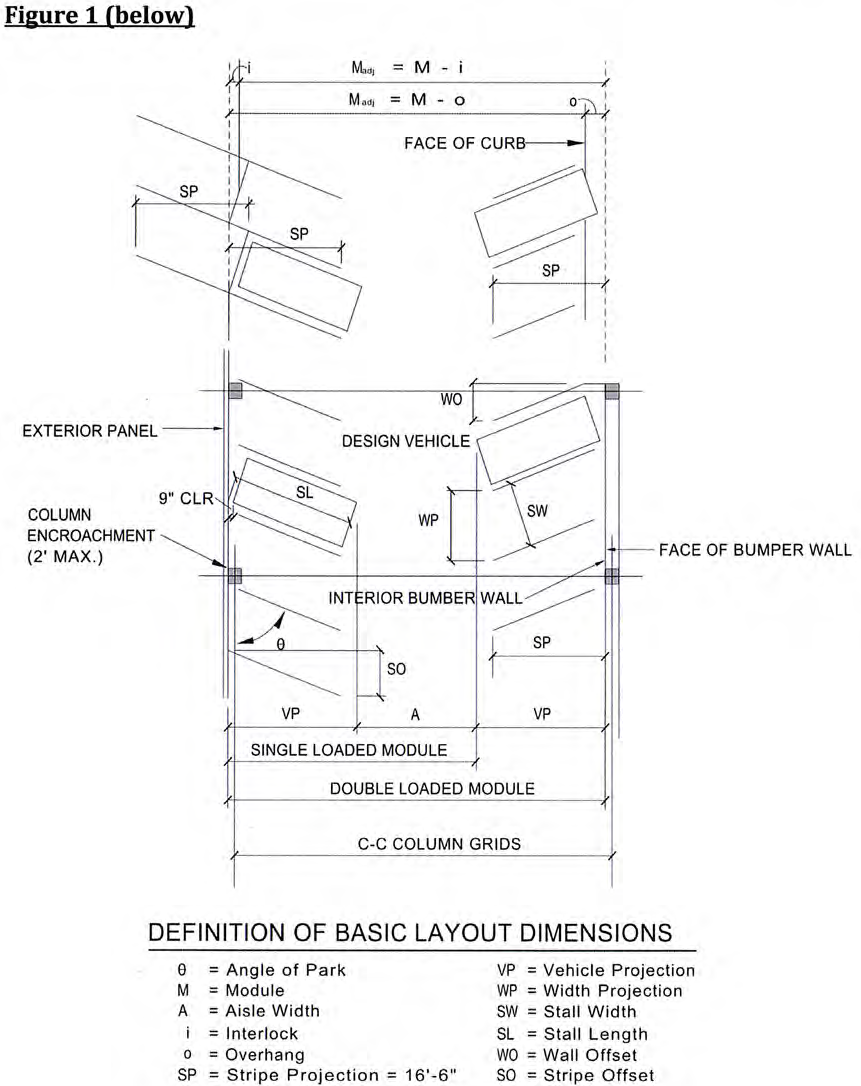
TABLE OF DIMENSIONS (IN FEET)
(p)
Pedestrian access.
(1)
Each principal Structure shall be provided with not less than one pedestrian accessway between the Principal Building and Collins Avenue for each 200 feet of Lot frontage or portion thereof.
(2)
Accessways shall be a minimum of four feet in width, clearly marked, and physically designed to protect pedestrians from traffic circulation in off-street parking areas and driveways.
(q)
Special Business Improvement Area. These provisions shall supersede any other provisions in this section which may be in conflict, except as provided for herein.
(1)
Number of spaces.
a.
Permanent Parking Ratio. 2.1 permanent parking spaces for each 1,000 square feet of 90 percent of gross floor area. For residential development proposed under the Live Local Act, the off-street parking requirements for Multiple-Family residential uses in Section 21-384(2) of the OF Oceanfront District shall apply to the parking constructed to serve the residential components. The flex parking ratio and the potential reductions in parking ratios in b. and c. below shall not apply to such residential development, but will apply to the nonresidential uses.
b.
Flex Parking Ratio. Recognizing the seasonal nature of population, tourism, business activity and parking demand in the Village of Bal Harbour, parking plans whereby spaces designed and normally used for self-parking may be converted to valet parking layout and operations to increase the parking ratio to 2.9 parking spaces for each 1,000 square feet of 90 percent of the gross floor area and higher. The capacity of the parking facility in the valet parking layout shall be used in determining the adequacy of the parking supply. The valet layout need not be striped or have bumper guards or wheel stops. In the event the property owner intends to utilize flex parking for more than six continuous months, the property owner shall provide written notice to the Village Manager of the scope of its intended use.
c.
Reductions in Permanent and Flex Parking Ratios. The permanent parking ratio may be reduced below 2.1 but no lower than 1.8 permanent parking spaces, and the flex parking ratio may be reduced below 2.9 but no lower than 2.3 flex parking spaces, upon presentation of a professionally acceptable parking report by a parking expert demonstrating that over the immediate prior twenty-four consecutive months, parking utilization in the facility remained below the proposed reductions in the permanent and flex parking ratios 85 percent of the time. The analysis of the permanent parking ratio shall exclude peak season (peak season is defined as November 1 to April 1, excluding the week of Thanksgiving, December 16 to January 2, and the week of Art Basel).
(2)
Off-site location. Within the Special Business Improvement Area, during periods of construction that will increase gross floor area or alter traffic circulation, and which temporarily reduce the availability of on-site parking, required parking may be provided on a Lot other than the Lot on which the Structure or use served is located, provided that:
a.
The number of required parking spaces located off-site shall not exceed 50 percent of the required parking.
b.
The off-site parking shall be located within a reasonable walking distance (1,320 feet) of the land use served, or if outside a reasonable walking distance:
1.
A dedicated shuttle service appropriate to the needs of the parkers at the off-site facility shall be provided, or
2.
Valet parking service shall be provided on-site.
An agreement assuring that the spaces will be available to the land use must be executed if the spaces are owned or controlled by a party other than the property owner of the land use served. Such agreement shall be terminable only upon approval of the Village Manager, which shall be granted upon a showing that sufficient on-site or alternate off-site parking is available to meet the parking requirements of the primary use, and shall be approved as to form and content by the Village Attorney and Village Manager.
(3)
Ramps. A maximum grade of six percent shall be permitted for sloped portions of sloping floor garages where ramps provide direct access to stalls. Interfloor ramps and ramps to and from the established Grade of any Street shall not exceed 14 percent, and no parking shall be permitted directly off these ramps. For any ramp over ten percent, a transition ramp at least ten feet long and at least half the slope of the main ramp shall be provided.
(4)
Marking. Individual stalls shall be marked with permanent lines, four to six inches wide. Plaza areas which are used for parking part-time need not be so marked and are not required to have bumper guards or wheel stops.
(5)
Bumper guards and wheel stops. Every surface parking facility shall have bumper guards located adjacent to any Building or Structure, wall, fence, hedge, walkway, landscaped area, property line or parking stall, to protect Persons, Property, and other vehicles. Bumper guards and wheel stops may be removable and are not required in Plaza areas.
(6)
Minimum dimensions. Parking layouts shall conform to the minimum requirements of this section. For any residential development proposed under the Live Local Act, the minimum parking lot design criteria listed in Section 21-385(a)—(p) for Multiple-Family residential uses shall apply to the parking constructed to serve the residential components.
Definitions (see also Figure 1):
• Angle (θ): The angle of rotation of the stall from a position parallel to the wall or edge of the module to the desired angle of parking, in degrees.
• Stall Width Projection (WP): The running dimension parallel to the wall or module edge of a stall rotated to the associated angle. (WP = stall width/sin θ).
• Module (M): The out-to-out dimension of two rows of parked vehicles and the drive aisle between. M= VP+A+VP. Where single-loaded parking aisles (i.e., parking stalls on only one side of the drive aisle) are provided, then Madj = M-VP.
• Vehicle Projection (VP): The rotation of a design vehicle six feet seven inches wide by 17 feet three inches to the desired angle plus an allowance of nine inches clear distance between the parked vehicle and the wall or module edge, measured perpendicular to the wall or module edge.
• Aisle (A): The drive aisle serving rows of parked vehicles. (A = M-2*VP).
• Interlock (i): An adjustment of the module for a parking design which has overlapping stalls. (i = SW/(2*cos θ)). Where stalls on only one side of the aisle are interlocked, then Madj = M-i. Where stalls on both sides of the module are interlocked, then Madj = M-2*i.
• Overhang (o): A dimension for the maximum permissible distance of a curb or wheel stop from the edge of the module so as to not reduce the effective dimensions below the minimum required. (o = 2'6"/sin θ).
• Wall offset (WO): The appropriate dimension to start the back end of a stall stripe from a wall, face of column or other delineation, in order to maintain the specified stall width.
• Stripe Projections (SP): The recommended maximum projection of a stripe, perpendicular to the wall or edge of module. It is not necessary or desirable to extend the stripe either to the VP or the full length of a stall rotated to the desired angle.
• Stripe offset (SO): The projection parallel to the wall or module edge of a stall stripe extending to the stripe projection; used in laying out parking stalls to be sure that parked vehicles do not encroach on adjacent spaces, such as turning bays or aisles.
Table 1: Minimum Required Parking Dimensions
Notes to Table 1:
1.
Nine-foot stalls shall be used except that eight-foot six-inch stalls may be used for the following uses: residential, general business offices, data processing/telemarketing/operations offices, industrial, storage/wholesale, utility, and educational (except for spaces serving cultural/recreational/entertainment uses at educational campuses.)
2.
Dimensions may be interpolated for angles between 45 and 75 degrees.
3.
All dimensions based on Design Vehicle of six feet seven inches by 17 feet three inches, parked nine inches from front of stall.
4.
Light poles and columns may protrude into a parking module a maximum of two feet combined as long as they do not impact more than 25 percent of the stalls. For example, either a one-foot encroachment on both sides of the aisle, or a two-foot encroachment on one side only, is acceptable.
5.
Interlock reductions cannot be taken where there is encroachment by columns, light poles or other obstructions for more than 25 percent of the stalls in the bay.
6.
All dimensions rounded to the nearest inch.
7.
Aisles and corresponding modules are for two way traffic flow for 90-degree parking and one-way traffic flow for angled parking between 45 and 75 degrees.
8.
For two-way traffic flow and angled parking, a minimum 24-foot aisle is required.
9.
Parallel parking stalls to be eight feet by 22 feet, with 12-foot travel lane. For parallel parking along a two-way drive, a minimum aisle of 24 feet is required.
(7)
Valet Parking Layouts: When parking spaces are employed in a permanent valet parking operation, or in a Flex Parking operation as defined in this article, they shall be not less than eight feet three inches wide and the stall length shall be not less than 17 feet six inches. The aisle widths for valet parking must provide reasonable maneuvering space for the valet operation, but need not conform to the requirements for self-parking contained in Table 1.
At least 80 percent of obstructed stalls must be arranged so that no more than one vehicle needs to be moved in order to retrieve another vehicle. In no case shall more than two vehicles need to be moved in order to retrieve another vehicle.
(8)
Mechanical Parking: Mechanical parking, including mechanical lifts and stackers, shall be permitted and shall count towards permanent or flex parking ratios. Mechanical parking may not be placed in surface parking lots located along Collins Avenue or 96th Street. Mechanical parking structures shall not be interpreted to be structures as defined by this Chapter, and shall be subject to the screening requirements of Section 21-386. For any residential development proposed under the Live Local Act, mechanical parking facilities are prohibited for the parking constructed to serve the residential components to assist in reduced construction costs, living costs, and safety concerns for those residents.
(Ord. No. 169, § 7-5, 6-29-74; Ord. No. 448, § 1, 4-18-00; Ord. No. 595, § 5, 5-16-17; Ord. No. 613, § 2, 12-18-18; Ord. No. 2024-657, § 4, 3-5-24; Ord. No. 2024-659, § 3, 4-9-24)
Sec. 21-386. - Screening.
(a)
Required on certain Lots. On any Lot in the Ocean Front (OF) District and the Business (B) District where surface parking facilities are provided, all parking facilities, including any rooftop parking facilities, shall be effectively screened from any adjoining Lot and from any adjoining Street.
(b)
Location. Screening provided in compliance with this section shall be located on the perimeter of the parking facility, within the required Setback areas.
(c)
Type. Required screening shall consist of a fence, wall, trellis, pergola, or other similar screening device or appropriate Landscaping and hedges, and shall be continuous, broken only for driveways and walkways. Screening devices shall not be interpreted to be structures as defined by this Chapter.
(d)
Screening plan required. A plot plan, drawn to scale, which accurately shows the type, location and amount of screening, shall be submitted to the Building Department for approval.
(e)
Minimum height.
a.
In the Ocean Front (OF) District, required parking facility screening shall be from three and one-half feet to six feet in height; provided, however, that in no case shall screening required by this section exceed three and one-half feet in height within fifteen feet of the nearest point of intersection of any access driveway, Street, or alley, measured at the Property line.
b.
In the Business (B) District, required parking facility screening shall be from three and one-half feet to 12 feet in height; provided, however, that in no case shall screening required by this section exceed three and one-half feet in height within 15 feet of the nearest point of intersection of any access driveway, Street, or alley, measured at the Property line.
(f)
Exceptions to height requirements.
(1)
Parking facility above Grade.
a.
Where the surface of the parking facility is raised more than four feet above the center of the adjoining Street, the required screening shall not be less than three feet in height nor more than six feet in height, measured from the finished Grade of the parking facility.
b.
In the Business (B) District, where the surface of the parking facility is raised more than four feet above the center of the adjoining Street, the required screening shall not be less than three feet in height nor more than 12 feet in height, measured from the finished Grade of the parking facility.
(2)
Parking facility below Grade. Where the surface of the parking facility is below the ground level of the adjoining Property, the required screening shall be not less than four and one-half feet in height above the ground level of the adjoining Property.
(g)
Visibility. All screening shall be at least 80 percent opaque when viewed horizontally.
(Ord. No. 169, § 7-6, 6-29-74; Ord. No. 207, § 2, 2-27-79; Ord. No. 613, § 2, 12-18-18)
Sec. 21-387. - Landscaping.
(a)
Applicability of section. For parking facilities with more than ten parking spaces, the Landscaping requirements set out in this section shall apply.
(b)
Interior Landscaping. For surface parking facilities, at least ten percent of the parking facility shall be permanently landscaped. The interior Landscaping requirement shall be computed on the basis of the Net Parking Facility. For the purposes of this section, "Net Parking Facility" shall include parking stalls, access drives, aisles, walkways, dead spaces, and required separations from Structures, but shall not include required Street Setbacks or access driveways for walkways within such Setbacks.
(c)
Planting beds. All Landscaping shall be contained in planting beds. Each planting bed shall have a minimum width of four feet and a minimum area of 25 square feet and shall be enclosed by concrete or masonry curbing at least four inches wide and six inches in height above the paving surface. Planting beds within the Special Business Improvement Area are not required to be enclosed by concrete or masonry curbing.
(d)
Plant material.
(1)
Surface parking facilities shall contain at least one tree for each 1,000 square feet of required parking area. In addition to required trees, each planting bed shall contain appropriate ground cover or shrubbery.
(2)
Nonplant material such as statuary or fountains may be used in landscaped areas provided it does not dominate the planting bed.
(e)
Sprinkler system; maintenance. Landscaping installed shall be provided with complete sprinkler systems, and continuously maintained.
(f)
Plot plan.
(1)
All required plot plans for parking facilities shall contain detailed Landscaping plans. Landscaping plans shall be prepared by Persons authorized under F.S. ch. 481, part II, to prepare Landscaping plans.
(2)
The Landscaping plan shall be drawn to an accurate scale and shall include:
a.
The location and size of planting beds.
b.
The location and variety of all plant material to be used.
c.
The location and type of sprinkler system to be provided.
(Ord. No. 169, § 7-7, 6-29-74; Ord. No. 297, § 7, 10-28-86; Ord. No. 595, § 5, 5-16-17)

