
Ballard City Zoning Code
15.02 Definitions
15.02.010 Generally
- Definitions outlined in Title 14, Subdivision Regulations, of the City’s Code (as amended) are hereby adopted by reference and shall be construed to apply herein.
- The words “shall”, “must”, or “will” are mandatory.The words “should” and “may” are permissive.
- Words used or defined in one (1) tense or form shall include other tenses or derivative forms.
- Words used in the singular shall include the plural and words used in the plural shall include the singular.
- Words referencing a gender shall extend and be applied to the other gender and shall be considered gender neutral.
- The word “includes” shall not limit a term to the specified examples, but is intended to provide guidance to be illustrative only.
- The word “and” indicates that all connected items, conditions, provisions, or events shall apply.
- The word “or” indicates that one (1) or more of the connected items, conditions, provisions or events shall apply.
- The words “either or” indicates that the connected terms, conditions, provisions or events shall apply singly but not in combination.
Adopted by Ord. 202403-001 on 3/7/2024
15.02.020 Definitions
The following terms used in this title shall have the respective meanings set forth in this section:
Accessory Dwelling Unit: A habitable living unit added to, created within, or detached from a primary single family dwelling and constrained on one (1) lot.
- Accessory Dwelling Unit, Detached: An accessory dwelling unit that is not attached to or within a primary detached single-family dwelling and located on the same lot or parcel as the primary detached single-family dwelling.
- Accessory Dwelling Unit, Internal: An accessory dwelling unit created within a primary dwelling, within the footprint of the primary dwelling at the time the internal accessory dwelling unit is created, and for the purpose of offering a long-term rental of thirty (30) consecutive days or longer.
Accessory Structure: A detached structure located on the same lot or parcel as a principal structure and is incidental and subordinate to the size and use of the principal structure.
Adjacent: Meeting or touching at some point, or across a street, alley or other public or private right-of-way.
Agricultural: Includes the tilling of soil, raising of crops, or the keeping and raising of domestic animals (i.e., small farms and agricultural developments).
Agricultural Business: A commercial activity providing retail or wholesale sales of supplies, services and equipment generally used or required for horticultural or livestock production. Includes indoor/outdoor-riding arenas for horses.
Applicant: The owner of land or such owner's duly authorized agent. Any agent must have written authorization from the owner.
Appurtenances: The visible, functional, or ornamental objects accessory to and part of a building.
As-built Profile: A map or drawing which depicts a vertical section of a road, street, curb, conduit or other physical feature as it has been actually constructed.
Average Daily Traffic (ADT): The average of one-way vehicular trips that use a road or driveway during a 24-hour period.
Basement: A story partly underground and having at least one-half its height above the average level of the adjoining ground. A basement will be counted as a story for purpose of height measurement.
Bed and Breakfast Inn: A building of residential design in which not fewer than three (3) but not more than nine (9) rooms are rented out by the day, offering overnight lodging to tourists, and where one (1) or more meals may be provided to overnight guests.
Billboard: A freestanding ground sign located on industrial, commercial or residential property if the sign is designed or intended to direct attention to a business, product or service that is not sold, offered or existing on the property where the sign is located.
Blanketing: The term blanketing or blanket when applied to signs or sign structure will mean the partial or complete shutting off of the face of one sign by another sign.
Boarding House: A building with not more than five (5) guest rooms where, for compensation, meals are provided for at least five (5) but not more than fifteen (15) persons.
Buildable Area: The portion of a lot, which is within the envelope formed by the required yards.
Building: A structure having a roof supported by columns or walls for housing, shelter or enclosure of persons, animals or property of any kind.
Building, Accessory: A subordinate building or a portion of the main building on a lot, the use of which is customarily incidental to that of a main or principal building.
Building, Agricultural: A structure designed and constructed to house farm implements, hay, grain, poultry, livestock and other horticultural products. This structure will not be a place of human habitation or a place of employment where agricultural products are processed, treated or packaged; neither will it be a place used by the public.
Business Services: Any activities conducted for gain which render service primarily to other commercial and industrial enterprises, or which service and repair appliances and machines used in a home or business.
Building, Detached: A building surrounded by open space on the same lot.
Building, Facade: That portion of an exterior elevation of a building extending from grade to the top of the parapet wall or eaves and the entire width of the building elevation.
Building, Facade Facing: A rebuilding of an existing facade with approved material illuminated or non-illuminated.
Building Height: The vertical distance from grade to the highest point of the coping of a flat roof; to the deck line of a mansard roof; or the average height of the highest gable, hip or gambrel roof.
Building Inspector or Building Official: The official or other person charged with the administration and enforcement of this ordinance or their duly authorized deputy when it comes to the building code and structures. These services may be provided by Uintah County as outlined in an interlocal agreement or other qualified third party(ies) as outlined in agreements with the City.
Building, Principal: A building in which is conducted the principal use of the lot on which it is located. In a residential zoning district, any dwelling is deemed to be the principal building on the lot on which it is situated.
Building, Public: A building owned and operated or owned and intended to be operated by a public agency of the United States of America, of the State of Utah, or any of its political subdivisions.
Bulk: The total volume of the structure, found by multiplying the square footage by the height.
Campground: A privately owned area of land with accommodations for temporary or transient occupancy are located or may be placed, including tents and recreational vehicles with customary accessory uses.
Carport: A private garage not completely enclosed by walls or doors. For the purpose of this Ordinance, a carport will be subject to all regulations prescribed for a private garage.
Car Wash: A structure with machine- or hand-operated facilities used principally for the cleaning, washing, polishing or waxing of motor vehicles. A facility of this type may be able to accommodate more than one vehicle at the same time.
Cellar: A story having more than one-half its height below the average level of the adjoining ground. A cellar will not be counted as a story for the purpose of height measurement.
Certificate of Occupancy: A certificate issued by the City after final inspection and upon a finding that the building, structure, or development complies with all provisions of the applicable requirements of the Ballard City Municipal Code, permits, and approved plans.
Charter School: An operating charter school; a charter school applicant that a charter school authorizer approves in accordance with §5G-5-3, Charter School Authorization, of Utah State Code (as amended); or an entity that is working on behalf of a charter school or approved charter applicant to develop or construct a charter school building. Charter school does not include a therapeutic school.
Church: A facility principally used for people to gather together for public worship, religious training, or other religious activities. One (1) accessory dwelling for the housing of the pastor or similar leader of the church and their family will be considered customary and incidental as a part of this use.
Cluster Subdivision: A subdivision of land in which the areas and widths of residential lots are reduced below the minimum lot areas and lot width requirements of the zoning district in which the subdivision is located and where equivalent common open space areas are provided to compensate for lot reductions. Given that the smallest lot size in any cluster development will be eight thousand square feet (8,000 sq. ft.) Additionally street widths will not be compromised and will be held to City standards.
Commercial Plant Nursery: A use, wholly or partially contained within one (1) or more greenhouses, where trees, shrubs, flower, or vegetable plants are grown and sold either wholesale or retail.
Community Location: A public or private kindergarten, elementary, middle, junior high, or high school; a licensed child-care facility or preschool; a trade or technical school; a church; a public library; a public playground; a public park; a youth center or other space used primarily for youth oriented activities; a public recreational facility; a public arcade; or a homeless shelter.
Common Open Space: The land area in a Planned Unit Development (PUD) reserved and set aside for recreational uses, landscaping, open green areas, parking and driveway areas for the common use and enjoyment of the residents of the PUD.
Common Open Space Easement: A required right-of-way granted to the City by the owner(s) of a PUD, on and over land in a PUD designated as common open space, which easement guarantees to the City that the designated common open space and recreation land is permanently reserved for access, parking and recreation and open space purposes in accordance with the plans and specifications approved by the Planning Commission and City Council at the time of approval of the PUD or as such plans are amended from time to time.
Concentrated Animal Feeding Operation: A lot or facility, as defined by the Administrative Rules of the State of Utah, R317-8-3.5 (5)(a) and (b) as amended, and subject to the Utah Pollutant Discharge Elimination System (UPDES).
Conditional Use: A land use that, because of its unique characteristics or potential impact on the City, surrounding neighbors, or adjacent land uses, may not be compatible in some areas or may be compatible only if certain conditions are required that mitigate or eliminate the detrimental impacts.
Condominium Projects: A real estate condominium project where ownership of a single unit in a multi-unit project, together with an undivided interest in common areas and facilities of the property, is transferred, a plan or project where four (4) or more apartments, rooms, office spaces or other existing and proposed apartments or commercial or industrial buildings or structures are separately offered or proposed to be offered for sale and meeting all requirements or the Condominium Ownership Act of the State of Utah.
Constitutional Taking: A governmental action that results in a taking of private property so that compensation to the owner of the property is required by the Fifth or Fourteenth Amendment of the Constitution of the United States; or Utah Constitution, Article I, Section 22.
Construction Standard Specifications and Plans: The Manual of Standard Specifications and Plans as adopted by the City or the Utah Chapter of the American Public Works Association (APWA), latest addition in the instance no such Manual of Standard Specifications and Plans has been specifically adopted by the City.
Construction Plan: The maps or drawings accompanying an application which show the specific location and design specifications of improvements to be installed in accordance with the requirements of approval by the Land Use Authority.
Contractor's Shop/Office: A separate facility providing for general building repair, service, and maintenance such as, and including installation of plumbing, roofing, signs, electrical, air conditioning and heating including storage of materials and supplies.
Contiguous: The touching or overlap of two (2) or more use district boundaries or property lines.
Convenience Store: Any retail establishment selling consumer products including prepackaged food and household items, having a gross floor area of less than five thousand square feet (5,000 sq. ft.) A convenience store may also have associated retail sale of gasoline and other petroleum products.
Corral: A space other than a building less than ten thousand square feet (10,000 sq. ft.)t in area and less than one hundred feet (100') in width used for the confinement of animals.
County: The unincorporated areas of Uintah County, Utah.
Court: A space open and unobstructed to the sky, located at or above grade level on a lot and bounded on three (3) sides by walls of a building. Coverage, Lot:
Coverage, Lot: The percent of the lot area covered by the main and accessory buildings.
Critical Slope, 30% Slope: An area where the rise or fall is equal to or exceeds thirty (30%) percent (1:3) over a horizontal distance of one hundred feet (100') or greater.
Culinary Water Authority: Means the department, agency, or public entity with responsibility to review and approve the feasibility of the culinary water system and sources for the subject property.
Disabled Person: A person who has a severe, chronic disability attributable to a mental or physical impairment or to a combination of mental and physical impairments that is likely to continue indefinitely and that results in a substantial functional limitation in one (1) or more of the following areas of major life activity: self-care, receptive and expressive language, learning, mobility, self-direction, capacity for independent living and economic self-sufficiency; and requires a combination or sequence of special interdisciplinary or generic care, treatment or other services that are individually planned and coordinated to allow the person to function in, and contribute to, a residential neighborhood.
Disability: A physical or mental impairment that substantially limits one or more of a person's major life activities, including a person having a record of such an impairment or being regarded as having such an impairment. Disability does not include current illegal use of, or addiction to, any federally controlled substance as defined in Section 102 of the Controlled Substances Act, 21 USC. 802.
Dry Cleaner: An establishment, which has, as its sole purpose, the cleaning off fabrics with substantially no aqueous organic solvents. Laundry establishments with self-service, coin operated cleaning machines will not be classified as a dry cleaner.
Duplex: See Dwelling, Two-Family,
Dwelling: Any building, or portion thereof, having one (1) or more dwelling units occupied as, or designed or intended for occupancy as, a residence by one (1) or more families as permitted by this title, but not including hotels, motels, boarding houses, or other facilities offering transient lodging facilities.
Dwelling, Primary: A single-family dwelling that is detached and is occupied as the primary residence of the owner of record.
Dwelling, Single-Family: A building arranged or designed to be occupied by one (1) family, and having one (1) dwelling unit.
Dwelling, Two-Family: A building arranged or designed to be occupied by two (2) families and having only two (2) dwelling units,
Dwelling, Multiple-Family: A dwelling having three (3) or more dwelling units.
Dwelling Unit: One (1) or more rooms in a dwelling designed for or occupied as separate living quarters which provide sleeping, sanitary, and kitchen facilities, all for exclusive use by a single family maintaining a household.
Educational Facility: A school district’s building at which pupils assemble to receive instruction in a program from any combination of grades from preschool through grade 12, including kindergarten and a program for children with disabilities; a structure or facility located on the same property as a building described above and used in support of the use of that building; and a building to provide office and related space to a school district’s administrative personnel. An educational facility does not include land or a structure, including land or a structure for inventory storage, equipment storage, food processing or preparing, vehicle storage or maintenance, or similar use that is not located on the same property as a building described above or used in support of the purposes of a building described above. An educational facility does not include a therapeutic school.
Educational Institution: A public elementary or secondary school or a private educational institution having a curriculum similar to that ordinarily given in public schools.
Elderly Person: A person who is sixty (60) years old or older, who desires or needs to live with other elderly persons in a group setting, but who is capable of living independently.
Facility: A structure or place, which is built, installed, or established to serve a particular purpose.
Factory Built Housing: A manufactured home or mobile home.
Family: One (1) or more persons occupying a dwelling unit and living as a single housekeeping unit, as distinguished from a group occupying a boarding house, lodging house or hotel as defined in this document.
Family Food: The keeping of domestic animals and fowl for the production of food for a single family dwelling.
Farm: An area of not less than five (5) contiguous acres or larger which is used for commercial production of farm crops such as vegetables, fruit trees, hay, grain and other products and their storage, the raising thereon of farm poultry and farm animals, such as horses, cattle, sheep, swine and fur bearing animals for commercial purposes and dairy farms. The term "farm" includes the operation of such an area for one (I) or more of the above uses with the necessary accessory uses for treating or storing the produce, and including accessory farm employees housing which must be located on the farm and will not be divided or sold separately from the farm parcel. Farm does not include Concentrated Animal Feeding Operations.
Fence: A barrier intended to limit visibility, provide privacy, define a property line, and/or to prevent ingress or egress, made out of materials such as concrete or masonry block, wood, metal, stone, chain-link or vegetation such as shrubs or hedges. For the purpose of this section, a block wall is included in the term "fence". A retaining wall is not considered a fence.
Frontage: All the property fronting on one side of the street between intersection or intersecting streets or between a street and a right-of-way, waterway, end of dead-end street or political subdivision boundary, measured along the street line. An intercepting street will determine only the boundary of the frontage of the side of the street, which it intercepts.
General Industrial Activity: A manufacturing operation or processing and assembly of goods including personal hygiene products and cosmetics, drugs and pharmaceuticals, tools, equipment and products and which are not likely to be obnoxious or offensive by reason of emission of odor, dust, smoke, noxious gasses, noise, vibration, glare, heat or other impacts, nor hazardous by way of materials, process, product or waste. One (1) caretaker home allowed by conditional use permit.
Garage, Private: An accessory building designed or used for the storage of automobiles owned and used by the occupants of the building to which it is accessory, provided that on a lot occupied by a multiple dwelling, the private garage may be designed and used for the storage of one and one-half (1 1/2) times as many automobiles as there are dwelling units in the multiple dwelling. A garage will be considered part of a dwelling if the garage and the dwelling have a roof or wall in common.
General Commercial: To provide appropriate locations for commercial, wholesale, and service activities . The regulations are intended to establish recognized location requirements and other needs of commercial, wholesale, and services uses. Oil field services, other than hazard materials storage, may be permitted in this area.
Grade: The lowest point of elevation of the finished surface of the ground, paving or sidewalk within the area between the building and the property line, or when the property line is more than five feet (5') from the building, between the building and a line five feet (5) from the building.
Grading: Any excavating, filling or combination . Grading is regulated by the appendix Chapter titled "Excavation And Grading" of the most current edition of the City of Ballard's adopted Building Codes.
Guest: Means any person or persons staying, for a short period of time, within a dwelling unit.
Guest Home: A separate dwelling structure located on a lot with one (1) or more main dwelling structures and used for a housing of guests or servants and not rented, leased or sold separate from the rental, lease or sale of the main building.
Home-based Microschool: Shall mean the same as the term is defined in §53G-6-201 of Utah State Code (as amended).
Home Occupation: A home occupation will mean an accessory use consisting of a vocational activity conducted inside a dwelling unit and conducted only by the individuals who reside in the home.
Hotel: A building or group of buildings, other than a motel, boarding house or lodging house, containing individual guest rooms, suites of guest rooms and dwelling units, and which furnishes services customarily provided by hotels which may include reception and convention facilities.
Household Pets: Animals or fowl ordinarily permitted in the house and kept for company or pleasure, such as dogs, cats and canaries, but not including a sufficient number of dogs to constitute a kennel.
HUD Code: The National Manufactured Housing Construction and Safety Standards Act, 42 U.S.C. Sec. 5401 et seq.
Improvements: Street grading, street surfacing and paving, curb and gutters, street lights, street signs, sidewalks, crosswalks, water mains and lines, water meters, fire hydrants, sanitary sewers, storm drainage facilities, culverts, bridges, public utilities or other such installations designated by the Planning Commission or City Council. See also Infrastructure Improvement as the term is defined in Title 14, Subdivision Ordinance, of the City’s Code.
Incombustible Material: Any material which will not ignite at or below a temperature of 1200 degrees during an exposure of five (5) minutes, and will not continue to bum or glow at that temperature. Tests will be made as specified in the adopted construction codes outlines in §15A of Utah State Code (as amended)).
Indoor Recreation: An entirely enclosed building or facility, which offers commercial indoor sports activities including but not limited to tennis, bowling, skating, but not including video game arcades. This use may include associated eating and drinking areas, retail sales areas and staff offices.
Industrial: To provide appropriate locations for manufacturing, industrial, warehousing, oil field services, and other uses requiring outside storage. Outside storage may be allowed while not creating objectionable effects or impacts, or where any possible objectionable effects or impacts can be mitigated so as to protect the health, safety and welfare of the City's residents, and the rights of surrounding property owners.
Intensity: The concentration of activity, such as the combination of the number of people, cars, visitors, customers, hours of operation, outdoor advertising, numbers of buildings, numbers of livestock, etc.
Junk: Means old or scrap copper, brass, rope, rags, batteries, plastic, paper, trash, rubber, waste, junked, dismantled, or wrecked automobiles or their parts, and iron, steel, and other old or scrap ferrous or nonferrous material. See also §72-7-202 (2) of Utah State Code (as amended).
Junk Yard: The use of any parcel, portion of a parcel, or tract of land for the storage, keeping or abandonment of junk, including scrap metals or other scrap material, or for the dismantling, demolition or abandonment of automobiles, or other vehicles, or machinery or parts ; provided that this definition will be deemed not to include such uses which are clearly accessory and incidental to any agricultural use permitted in the district
Kennel: The land or buildings used in the keeping of four (4) or more dogs or cats over four (4) months old.
Landscaping: Some combination of planted trees, shrubs, vines, ground cover, flowers or lawns. In addition, landscaping may include rocks, gravel, and screens, walls, fences, or benches. The selected combination of objects for landscaping purposes will be arranged in a harmonious manner in conformance with this Title. All required landscaped areas shall be provided with a permanent and adequate means of irrigation and shall be maintained in a neat, clean and orderly fashion. Maintenance includes proper pruning, mowing lawns, weeding, removal of litter, fertilizing, replacement of dead plants, and the regular watering of all plantings. If gravel is used an industrial grade weed fabric barrier must be placed under the gravel to control weed growth.
Land Use Ordinance: A planning, zoning, development, or subdivision ordinance of the municipality, but does not include the General Plan.
Large Trucks: These regulations will apply to all trucks licensed or actually used for gross lien weight in excess of twenty six thousand pounds (26,000 lbs) or exceeding a total length of forty feet (40') under standard practices of the State of Utah, and for all explosive, corrosive, hazardous materials, and flammable liquid and gas carriers and any vehicles required to display placards.
Light Industrial: Places for the conduct of any light manufacturing and assembly activities which are compatible with existing and other uses allowed in the Zoning District and which will not be offensive by reason of emission of odor, dust, smoke, noxious gasses, noise, vibration, glare, heat or other impacts, nor hazardous by way of materials, process, product or waste, and where all equipment, compressors, generators and other ancillary equipment is located within a building or structure and any outside storage areas are screened from view from all adjoining properties and streets.
Living Quarters: A structure, room, or space designed for human habitation that has at a minimum of a bedroom, bathroom, and kitchen.
Loading and Unloading Space: A permanently maintained space on the same lot as the principal building accessible to a street or alley and not less than ten (10) feet in width, twenty feet (20) in length, and fourteen (14) feet in height.
Lot, Area: The area of a horizontal plane within the lot lines of a lot.
Lot, Coverage: The percentage of the area of a lot, which is occupied by all buildings, other impervious surfaces or other, covered structures.
Lot, Line: Any line bounding a lot.
Lot Line, Front: The boundary of a lot which separates the lot from the street; and in the case of the corner lot, the front lot line is the shorter of the two lot lines separating the lot from the street, except that where these lot lines are equal or within fifteen feet (15') of being equal, either lot line may be designated the front lot line, but not both.
Lot Line, Rear: The boundary of a lot which is most distant from, and is, or is most nearly, parallel with the front lot line; except that in the absence of a rear lot line, as is the case of the triangular-shaped lot, the rear lot line may be considered as a line within the lot parallel with and at a maximum distance from the front lot line having a length of not less than ten (10) feet.
Lot Line, Side: The boundary of a lot, which is not, a front lot line or a rear lot line.
Lot of Record: A lot which is part of a legally created subdivision, the plat of which has been recorded in the office of the County Recorder of Uintah County; or a lot, parcel or tract of land, the deed of which has been recorded in the office of the County Recorder of Uintah County prior to the enactment of this Ordinance.
Lot Size, Minimum: Lots can be various shapes and sizes and can have the same minimum lot size. As long as the minimum width, yard, and lot size requirements have been met a legal lot can be any shape or size.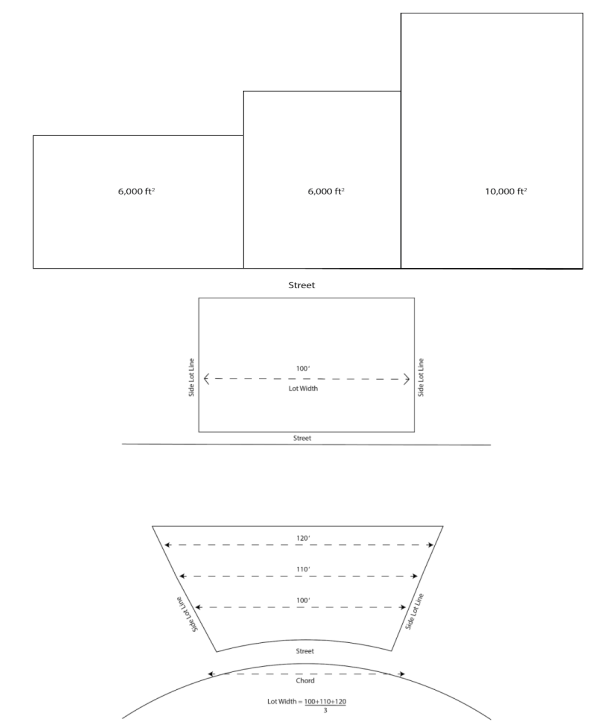 Manufactured Home: A transportable factory built housing unit constructed on or after June 15, 1976, according to the HUD Code, in one or more sections that:
- In the traveling mode, is eight feet (8') or more in width or fortyfeet (40') or more in length, or when erected on site is four hundred or more square feet; and
- Is built on a permanent chassis and designed to be used as a dwelling with or without a permanent foundation when connected to the required utilities, and includes the plumbing, heating, air-conditioning, and electrical systems.
Membership Club: A facility owned or operated by a group of people organized for a common educational, service or recreational purpose. These clubs may be characterized by certain membership qualifications, payment of fees or dues and regular meetings and activities. This use may include hunting and gun clubs but does not include Private Clubs.
Micro-education Entity: Shall mean the same as the term is defined in §53G-6-201 of Utah State Code (as amended).
Mobile Home: A transportable factory built housing unit built before June 15, 1976, in accordance with a state mobile home code which existed prior to the HUD Code.
Mobile Home Park: Any plot of ground upon which three or more mobile homes occupied for dwelling or sleeping purposes are located, regardless of whether or not a charge is made for such accommodation.
Mobile Home Space: A plot of ground within a mobile home park or travel trailer park designed for the accommodation of one mobile home or travel trailer together with its accessory structures including carports or other off-street parking areas, storage lockers, patios, patio covers, awnings and similar appurtenances.
Mobile/Movable Structure: A mobile/movable structure refers to any structure designed and constructed to be mobile/movable rather than permanently located. Key characteristics of mobile/movable structures include the ability to be transported on wheels directly or via a trailer chassis from on location to another and not being affixed to a permanent foundation. Mobile/movable structures may include, but are not limited to: mobile homes, travel trailers, recreational vehicles (RVs), and other prefabricated or modular structures designed for temporary or semi-permanent residential, commercial, or recreational use.
Model Home: A single-family home that the homebuilder uses to promote the sale or lease of another single-family home or a unit within a multi-family residential structure that the owner uses to promote the sale or lease of another unit within the multi-family residential structure.
Moderate Income Housing: Housing occupied or reserved for occupancy by households with a gross household income equal to or less than eighty percent (80%) of the median gross income for households of the same size within the County.
Modular Unit: A structure built from sections that are manufactured in accordance with the State Construction Code and transported to a building site; and the purpose of which is for human habitation, occupancy, or use.
Motel: A building or group of buildings containing guest rooms or dwelling units, some or all of which have a separate entrance leading directly from the outside of the building with a garage or parking space located on the lot and designed, used or intended wholly or in part for the accommodation of automobile transients. Motel includes motor courts, motor lodges and tourist courts, but not mobile home parks or travel trailer parks.
Multiple-Family Residential: To provide appropriate locations for- a variety of multiple-family dwellings and necessary public services and activities.
Name Plates and Signs: "Name plates and signs" will include:
- One nameplate for each dwelling unit, not exceeding two square feet (2 sq. ft.) in area, indicating the name of the occupant or a permitted home occupation.
- One signboard not exceeding eight square feet (8 sq. ft.) in area appertaining to the lease or sale of the property or the sale of products produced on the property or warning against trespassing.
- One bulletin board not exceeding eight (8) square feet in area for a church or other institution for the purpose of displaying the name and character of services or other activities conducted there.
- One identification sign not exceeding eight (8) square feet in area for buildings other than dwellings.
- All such bulletin boards and identification signs will be attached to and parallel with the front wall of the building. If any name plate, bulletin board or sign is illuminated, indirect lighting only will be used; no flashing or intermittent illumination will be employed.
Natural Waterways: Those areas varying in width along streams, creeks, gullies, springs, faults or washes which are natural drainage channels.
Neighborhood Commercial: This commercial zoning district is intended to provide an area where intense commercial activities particularly retail stores, offices, and professional businesses may be located.
Non-Complying Structure: A structure that legally existed before its current land use designation, and because of one or more subsequent land use ordinance changes, does not conform to the setback, height restrictions, or other regulations excluding those regulations which govern the use of land.
Non-Conforming Use: A use of land that legally existed before its current land use designation and has been maintained continuously since the time the land use ordinance governing the land changed, and because of one or more subsequent land use ordinance changes, does not conform to the regulations that now govern the use of the land.
Nuisance: Any use or activity which emits noise, smoke, dust, odor or vibration in amounts sufficient to substantially depreciate values of surrounding buildings or lands, or a use or activity which substantially deprives the owners of adjoining property of a property right.
Off-street Parking: An area adjoining a building providing for the parking of automobiles which does not include a public street but has convenient access to it.
Oil Field Services: Means storage or warehousing chemicals, work-over rigs, fluids, bits, hot oil trucks, casing, drill pipe, service fleet business etc.
Open House: An event held by a homeowner, including an event in association with a real estate agent, architect, builder, or developer, to showcase a home, including the outdoor landscaping around the home.
Outdoor Recreation: An area or facility, which offers commercial entertainment or recreation where any portion of the activity takes place outside. This includes but is not limited to a golf driving range, rifle range, riding arena and corrals, outfitters and guide services, tennis facility or similar activities.
Park Model Recreational Vehicle: A unit that:
- Is designed and marketed as temporary living quarters for recreational, camping, travel, or seasonal use;
- Is not permanently affixed to real property for use as a permanent dwelling;
- Requires a special highway movement permit for transit; and
- Is built on a single chassis mounted on wheels with a gross trailer area not exceeding four hundred square feet (400 sq. ft) in the setup mode.
- A park model recreational vehicle shall not be permitted as an accessory dwelling unit, and may only be allowed in a recreational vehicle park.
A park model recreational vehicle shall not be permitted as an accessory dwelling unit, and may only be allowed in a recreational vehicle park.
Parking Lot: An open area, other than a street, used for parking of more than four (4) automobiles and available for public use, whether free, for compensation or as an accommodation for clients or customers.
Parking Space: A permanently surfaced area, enclosed or unenclosed, of not less than eight feet six inches (8'6") in width and having an area of not less than one hundred eighty square feet (180 sq. ft.), together with a driveway connecting the parking space with a street or alley and permitting ingress and egress of an automobile.
Permitted Use: A use of land for which no Conditional Use permit is required.
Personal Service Facility: An establishment for the provision of personal services, including drive-through service. A retail facility including but not limited to barber or beauty shop, dry cleaners, optometrist shop, tanning salon, fitness center, reception center, photographic studio or travel bureau.
Personal Storage Facility (Mini Storage): A structure or group of structures containing generally small, individual, compartmentalized stalls or lockers rented as individual storage spaces and characterized by low parking demand.
Planned Development: To provide a flexible approach to zoning with the opportunity to shift density to developable portions of a property or to mix residential and commercial uses.
Portable Storage Container: Any on-site storage container described as a steel portable container, dry van container, warehouse storage unit, semi-tractor cargo container, cargo trailer or any other similarly described unit.
Principal Use: The primary purpose or function for which a parcel is used.
Produced Water Disposal Facility: A commercial disposal facility consisting of a lined pit or treatment facility whose owner(s) receives compensation from others for the temporary storage, and disposal of produced water, drilling fluids, drill cuttings, completion fluids, and any other exempt exploration and production wastes.
Professional Office: A building for the professions including but not limited to government, physicians, dentists, lawyers, realtors, architects, engineers, artists, musicians, designers, teachers, accountants and others who, through training, are qualified to perform services of a professional nature, and where no storage or sale of merchandise exists. This use includes medical and dental clinics.
Property Owner: A person that holds legal title in real property.
Public Educational Facility: Buildings and uses for educational or research activities which are operated by a public entity and have curriculum for technical or vocational training, kindergarten, elementary, secondary or higher education, including facilities for faculty, staff and students.
Public Use: A use operated exclusively by a public body or quasi-public body, such use having the purpose of serving the public health, safety or general welfare, and including recreational facilities, administrative and service facilities, and public utilities, including water and sewer lines and facilities, gas and electricity lines and facilities, cable television lines and facilities and telecommunications facilities, but excluding prisons and animal control facilities.
Reception Hall/Reception Center: A facility for the holding of events including but not limited to weddings, wedding receptions, community meetings and group gatherings.
Recreational Vehicle: A vehicular unit other than a mobile home, primarily designed as temporary dwelling for travel, recreational, or vacation use, that is either self-propelled or pulled by another vehicle. Recreational vehicles include a travel trailer, a camping trailer, a motor home, a fifth wheel trailer and a van as those terms are defined in §13-14-102 of Utah State Code (as amended).
Recycling Collection Center: A center for the acceptance and temporary storage of recyclable materials to be transferred to a processing facility. Recycling Collection Centers involve no more than three (3) collection containers up to forty 40 cubic yards in total size. Collection centers located in parking lots may not occupy required parking spaces. A collection center must be arranged so as to not impede traffic flow. The operator of the collection center will remove products stored at the site at least once a week. The operator of the collection center will keep the collection center in proper repair and the exterior must have a neat and clean appearance. Automated can recycling machines are limited to two (2) per site.
Residential Agricultural: To provide appropriate locations for hobby farms, home gardens and fruit trees, keeping of household pets, raising of domestic animals and fowl to animals primarily for home use. The regulations also permit the establishment of, with proper controls, the public and semi-public uses
Residential Facility For Persons With A Disability: Means a residence in which more than one person with a disability resides; and is licensed or certified by the Department of Human Services under §26B-2-1, Human Services Programs and Facilities or §26B-2-2, Health Care Facility Licensing and Inspections, of Utah State Code (as amended)
Residential Facility for Elderly Persons: Means a single-family, multiple-family dwelling unit that meets the requirements of Part 4, General Plan, but does not include a health care facility as defined by Utah Code Section 26-21-2.
Residential Treatment and/or Secure Center: A twenty four (24) hour group living environment for two or more individuals unrelated to the owner or provider that offers room or board and specialized treatment, rehabilitation or habilitation services for persons with emotional, psychological, developmental, or behavioral dysfunctions, impairments, or chemical dependencies.
Restaurant: A place of business where a variety of food and drink is prepared and served to the public for consumption on and off the premises.
Retail Store: An establishment for the retail sale of merchandise. A retail store includes but is not limited to antique or art shops, clothing, department, drug, dry goods, florist, furniture, gift, grocery, hardware, hobby, office supply, paint, pet, shoe, sporting or toy stores.
Retail Tobacco Specialty Business: A commercial establishment in which:
- Sales of tobacco products, electronic cigarette products, and nicotine products account for more than thirty-five percent (35%) of the total quarterly gross receipts for the establishment;
- Twenty percent (20%) or more of the public retail floor space is allocated to the offer, display, or storage of tobacco products, electronic cigarette products, or nicotine products;
- Twenty percent (20%) or more of the total shelf space is allocated to the offer, display, or storage of tobacco products, electronic cigarette products, or nicotine products;
- The commercial establishment holds itself out as a retail tobacco specialty business and causes a reasonable person to believe the commercial establishment is a retail tobacco specialty business;
- Any flavored electronic cigarette product is sold; or
- The retail space features a self-service display for tobacco products, electronic cigarette products, or nicotine products.
Retaining Wall: Will include any structure designed to resist the lateral displacement of soil or other materials, not including rockery walls. An example includes block walls, concrete walls, or a segmented wall designed and approved as a retaining wall.
Right-of-Way: Land occupied or intended to be occupied by a public or private trail, road or other public transportation use or railroad, electric transmission line or other utility uses.
Road: A public or private thoroughfare, which affords a means of access to abutting property.
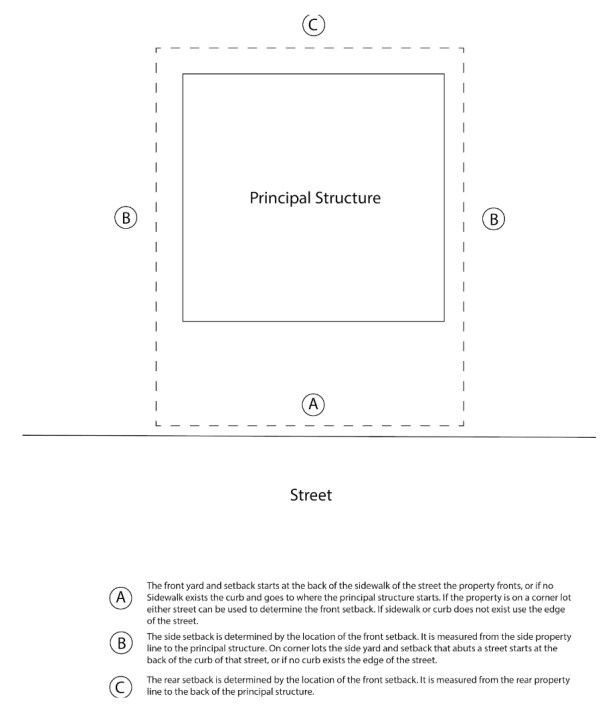
Setback: The required minimum distance between the building and the related side or rear lot line, or in the case of front setbacks and corner lot side setbacks the required minimum distance between the building and the back of the sidewalk, or if there is no sidewalk the curb, of the street the property fronts or abuts, or if no curb exists the edge of the street.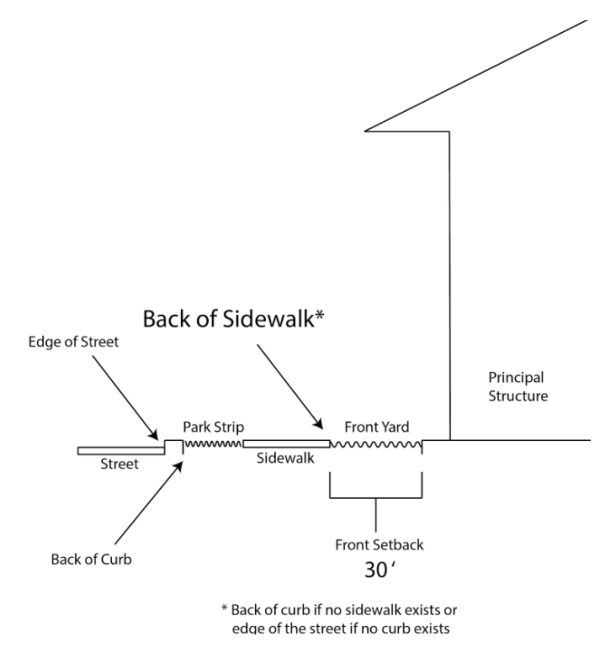
Sexually Oriented Business: A business at which any nude or partially denuded individual, regardless of whether the nude or partially denuded individual is an employee of the sexually oriented business or an independent contractor, performs any service for compensation. Sexually oriented business includes an escort service or an adult service as those terms are defined in §10-8-41.5 of Utah State Code (as amended).
Short Term Rental: A residential unit or any portion of a residential unit that the owner of record or the lessee of the residential unit offers for occupancy for fewer than thirty (30) consecutive days.
Sign: Any device for visual communication, including any structure or natural object or part that is used for the purpose of bringing the subject to the attention of the public, but not including any flag, badge or insignia of any government or governmental agency or any civic, charitable, religious, patriotic, fraternal or similar organization.
Single Family and Two Family Residential: To provide family housing choices to meet the needs of the City, to offer a balance of housing types and densities, and to preserve and provide safe and convenient places to live. Representative uses include but are not limited to: family dwellings, minor agriculture uses and public facilities necessary to meet the needs of residents.
Site Built Home: A housing unit constructed at a site in accordance with the Building Codes of Ballard City.
Solar Energy Device: A device which converts the sun's radiant energy into thermal, chemical, mechanical or electric energy.
Solar Access: The ability to receive sunlight across real property for any solar energy device.
Solid Waste: (As defined in§ 19-6-102(16)) of Utah State Codes (as amended) means any garbage, refuse, sludge, including sludge from a waste treatment plant, water supply treatment plant or air pollution control facility, or other discarded material, including solid, liquid, semi-solid or contained gaseous material resulting from industrial, commercial, mining or agricultural operations and from community activities but does not include solid or dissolved materials in domestic sewage or in irrigation return flows or discharges for which a permit is required under Title 19, Chapter 5, Water Quality Act, or under the Water Pollution Control Act, 33 U.S.C., Section 1251, et seq.
"Solid waste" does not include any of the following wastes unless the waste causes a public nuisance or public health hazard or is otherwise determined to be a hazardous waste:
- Certain large volume wastes, such as inert construction debris used as fill material;
- Drilling muds, produced waters and other wastes associated with the exploration, development or production of oil, gas or geothermal energy;
- Fly ash waste, bottom ash waste, slag waste and flue gas emission control waste generated primarily from the combustion of coal or other fossil fuels;
- Solid wastes from the extraction, beneficiation and processing of ores and minerals; or cement kiln dust.
A solid waste is considered a hazardous waste if it is listed as hazardous or if it exhibits any of the hazardous characteristics set forth in this document. "Hazardous waste" (as defined in§ 19-6-102(9) of Utah State Code (as amended) means a solid waste or combination of solid wastes which, because of its quantity, concentration, or physical, chemical or infectious characteristics, may cause or significantly contribute to an increase in mortality or an increase in serious irreversible or incapacitating reversible illness or may pose a substantial present or potential hazard to human health or the environment when improperly treated, stored, transported, disposed of, or otherwise managed.
Storage: The actual or intended containment of solid or hazardous waste either on a temporary basis or for a period of years in such a manner as not to constitute disposal of such waste.
Story: That portion of a building, other than a cellar, included between the surface of any floor and the surface of the floor next above it, or if there be no floor above it, then the space between the surface of such floor and the ceiling or roof above it.
Street Line: The boundary, which separates the right-of-way of a street from the abutting property.
Structural Alteration: Any change in the supporting members of a building, such as bearing walls or partitions, columns, beams or girders, or any rebuilding of the roof or exterior walls.
Structure: Anything constructed or erected, which requires location on the ground or attached to something having location on the ground, but not including tents, vehicles, travel trailers or mobile homes.
Substantial Modification: A change, which significantly alters the impacts and/or character of a structure, development or use.
Telecommunications Site Facility: A facility used for the transmission or reception of electromagnetic or electro-optic information, which is placed on a structure. This use does not include radio frequency equipment, which has an effective radiated power of one hundred (100) watts or less. This use is not required to be located on a building lot or to comply with the minimum lot size requirement for the district in which it is located.
Temporary Use: Fireworks stands, Christmas tree sale lots and similar activities that are open to the public and scheduled to occur over a period not to exceed forty (40) days in any calendar year and including uses incidental to construction.
Therapeutic School: A residential group living facility:
- For four (4) or more individuals who are not related to the owner of the facility or the primary service provider of the facility;
- That serves students who have a history of failing to function at home, in a public school, or in a nonresidential private school; and
- That offers room and board and an academic education integrated with specialized structure and supervision or services or treatment related to a disability, an emotional development, a behavioral development, a familial development, or a social development.
Tiny House/Home: A dwelling that is typically four hundred square feet (400 sq. ft.) or less in floor area excluding lofts, installed on a permanent foundation, designed and intended as a permanent, year-round residence for one (1) single family. For the purpose of this definition “lofts” shall be defined as a floor level located more than thirty inches above the main floor, open to the main floor on one or more sides with a ceiling height of less than six feet eight inches (6’ 8”) and used as a living or sleeping space. For the purposes of this Title:
A A a tiny home constructed on a single chassis, mounted on axel(s) and wheels shall be considered a park model recreational vehicle.
B. May be constructed within the Medium High (MH) Residential Zone to mean structures up to seven hundred square feet (700 sq. ft.) in floor area or less when certain conditions are met.
Use: The purpose or purposes, for which land or a building is occupied, maintained, arranged, designed or intended
Utility Service Facility: Any electrical distribution lines, natural gas distribution lines, minor gas regulator stations, cable television lines, telegraph and telephone lines, and gathering lines or other minor service facilities. This use is not required to be located on a building lot or to comply with the minimum lot size requirement for the district in which it is located.
Vehicle Service Center/Service Station: A building or use devoted to the retail sale of fuels, lubricants and other supplies for motor vehicles including minor repair activities which are subordinate to the sale of petroleum products and where all repairs are conducted wholly within a building.
Warehouse: A building used primarily for the inside storage of non hazardous goods and materials and including accessory office facilities.
Yard: The open space at grade level between a building and the adjoining lot lines, unoccupied and unobstructed by any portion of a structure from the ground upward except as otherwise provided in this Ordinance.
Yard, Front: A yard extending across the front width of a lot and being the minimum horizontal distance between the back of the sidewalk, or if there is no sidewalk the curb, or if no curb exists the edge of the street and the principal building or any projection other than steps, unenclosed balconies and unenclosed porches. The front yard of a corner lot is the yard adjacent to the designated front lot line.
Yard, Rear: A yard extending between the side yards of a lot, or between the side lot lines in the absence of side yards, and being the minimum horizontal distance between the rear lot line and the rear of the principal building or any projection , other than steps, unenclosed balconies or unenclosed porches. On comer lots and interior lots, the rear yard is in all cases at the opposite end of the lot from the front yard.
Yard, Required: The minimum open space as specified by the regulations of this Ordinance for front, rear and side yards as distinguished from any yard area in excess of the minimum required.
Yard, Side: A yard between the building and the side lot line and extending from the front yard to the rear lot line as defined or along the full depth in absence of front and rear yards and being the minimum horizontal distance between a side lot line and the side of the principal building or any projection other than steps, unenclosed balconies or unenclosed porches. An interior side yard is defined as the side yard adjacent to a common lot line. On corner lots the side yard is measured from the back of the sidewalk, or if there is no sidewalk the curb, or if no curb exists the edge of the street to the principal building or any projection other than steps, unenclosed balconies or unenclosed porches.
Zoning Map: A map adopted as part of a land use ordinance, that depicts land use zones, overlays, or districts.
Zoning Map Amendment: A land use request that seeks to change the zoning designation of land with the City Council is the Land Use Authority for zoning map amendments, which involve a discretionary legislative decision after a recommendation by the Planning Commission.
Zoning Text Amendment: A land use request that seeks to change the text within the City's land use ordinances. The City Council is the Land Use Authority for zoning text amendments, which is a legislative decision after a recommendation by the Planning Commission.
Zoning Administrator: The official or other person charged with the administration and enforcement of this ordinance or their duly authorized deputy when it comes to the zoning ordinance and the use of land. When no Zoning Admistrator has been designated by the City Council shall mean City Staff as the term is defines in Title 14, Subdivision Ordinance, of the City's Code.
Adopted by Ord. 07022019-002 on 7/2/2019
Amended by Ord. 202003-001 on 7/21/2020
Amended by Ord. 202403-001 on 3/7/2024
Amended by Ord. 202411-002 on 11/5/2024
Amended by Res. R202504-005 on 5/8/2025
Amended by Ord. 202605-002 on 5/5/2026

