
Ballard City Zoning Code
15.06 Zoning
Districts Established
15.06.010 Zoning By Districts
The following basic zoning districts are created to be applied as necessary to regulate the development of Ballard City:
| Zoning District Name | Abbreviation |
| Agricultural | A |
| Residential Agricultural | RA |
| Single Family Residential | R |
| Residential Multi-Family | RM |
| Medium High Residential | MH |
| Planned Development | PD |
| Commercial | C |
| Industrial | I |
| Open Space | OS |
| Wildland Urban Interface Overlay Zone | WUI |
Adopted by Ord. 07022019-002 on 7/2/2019
Amended by Ord. 202302-002 on 2/7/2023
Amended by Ord. 202403-001 on 3/7/2024
Amended by Ord. 202605-002 on 5/5/2026
15.06.020 Zoning District Map
The boundaries of these zoning districts are now and will be established as shown on maps entitled “Zoning District Map of Ballard City”, which maps and all future official amendments will be part of this Title.Unless otherwise defined on the zoning district maps, district boundary lines are lot lines; the centerline of streets, alleys or lines extended; section lines; municipal corporate lines; the centerline of streambeds; or other lines drawn to scale on the zoning district map.Any land not inside a zoning district for any reason will not have permits issued for the use of land or erection or alteration of structures. This will hold until a zone is assigned to the land. If this is not accomplished in (120) days then any use in the RA-1 zone is allowed.
Adopted by Ord. 07022019-002 on 7/2/2019
Amended by Ord. 202605-002 on 5/5/2026
15.06.030 Uniform District Regulations
The regulations of this Title will apply uniformly to all geographical areas bearing the same zoning district.
- Split Zoned Properties
- A property or parcel of single ownership that has multiple zoning designations at the time of passage of this ordinance may develop and be used according to the regulations of each zone dividing the property, provided that development projects and uses stay within approved zoning district boundaries and meet all applicable provisions of the zone.
- It is recommended that property owners subdivide the property so that lot lines follow zoning districts as mapped at the time of development or request a zone change to match current property lines.
- A development or use may cross zoning boundaries on split zone parcels, if the proposed use is a permitted use in all zoning districts being crossed. Projects that are both on a split zoned property and cross a zoning district will be required to obtain a conditional use permit as outlined in BMC 15.08 Conditional Use Permits.
Adopted by Ord. 07022019-002 on 7/2/2019
Amended by Ord. 202403-001 on 3/7/2024
Amended by Ord. 202605-002 on 5/5/2026
15.06.040 Zone Lot For Structures And Uses
The land area occupied by a use and/or the building site designated for a structure will be the zone lot for the purpose of this Title, and will be provided and maintained for each use and/or structure in accordance with the regulations of the district in which the structure is located. The boundaries of a designated zone lot may be amended if all of the requirements of this Title can be maintained. Where more than one (1) structure or use is to be placed on a designated zone lot, the provisions of this Chapter will apply.
Adopted by Ord. 07022019-002 on 7/2/2019
Amended by Ord. 202605-002 on 5/5/2026
15.06.050 Zoning Districts Purpose
- As provided by §10-20 of Utah State Code (as amended), the City Council may divide the lands within the City into zoning districts of a number, shape, and area that it considers necessary and appropriate to carry out the purposes of this title and the City’s General Plan.
- Within those zoning districts, the City Council may regulate and restrict the erection, construction, reconstruction, alteration, repair, or use of buildings and structures, and the use of land.
- All uses, activities, and all approvals, permits, and licenses shall be found to conform to the standards and requirements of the zoning district as applicable.
Adopted by Ord. 07022019-002 on 7/2/2019
Amended by Ord. 202605-002 on 5/5/2026
15.06.070 Home Occupation
A home occupation will mean an accessory use consisting of a vocational activity conducted inside a dwelling unit and conducted only by the individuals who reside there and provided that the home occupation follow the guidelines in each zone and abide by state regulations.
Adopted by Ord. 07022019-002 on 7/2/2019
15.06.080 Agricultural Zones (A-20, A-10, A-5)
- Purpose. The establishment of an agricultural zone is intended to allow and protect agricultural uses within the City by controlling density and land coverage, and providing for compatible land uses. Its formulation is further intended to protect nearby residential uses from objectionable effects of certain agricultural operations.
- Permitted Uses. The following uses are permitted:
- Accessory buildings clearly incidental to and commonly associated with the operation of permitted uses.
- Accessory dwelling unit.
- Church; will be new construction and shown on a recorded subdivision plat, or be outside of a recorded subdivision plat.
- Commercial kennels for the raising, boarding and training of small animals; given, that no portion of any structure or outdoor run or pen will be located closer than one hundred feet (100') to any dwelling.
- Commercial or noncommercial agriculture, dairying, poultry, feeder pigs, not to exceed six (6) feeder pigs per acre, and livestock raising and feeding; given, that buildings and corrals used for housing fowl or animals, storing grain, feed or processing products will not be located closer than one hundred feet (100') to any dwelling (except for RA-5 districts where the distance is 50 feet).
- Greenhouses or plant nurseries for growing purposes, but not including retail sales.
- Home-based microschool.
- Home occupations
- Household pets
- Micro-education entity.
- Neighborhood / City park
- Private country clubs, golf courses and parks.
- Riding stables; provided, that any structure or corral housing animals will not be closer than one hundred feet (100') to any dwelling.
- School, public or charter.
- Second residences for hired help (A-20 only).
- Signs
- Single-family dwellings.
- Small animals, more than otherwise allowed in the RA-5 zone, given that they are kept constantly indoors in a fully enclosed building constructed with soundproofing measures and containing adequate sanitary measures, and are raised for live resale or reproduction purposes and not for food purposes.
- Veterinary clinics, including observation or holding pens (including large animal hospitals); provided that no part of any structure will be closer than one hundred feet (100') to any dwelling.
- Other uses determined by the Land Use Authority to be in harmony with the intent and purpose of the zone.
- Conditional Uses. The following uses are conditional and subject to the requirements of Chapter 15.08:
- Businesses directly related to some form of commercial agriculture.
- Child nursery
- Public utilities and facilities.
- Radio and TV transmission lines and/or substations.
- Residential treatment facility in the A-5, A-10, A-20 zones only
- Utility transmission lines and/or substations.
- Cluster subdivision
- Other uses determined by the Land Use Authority to be in harmony with the intent and purpose of the zone.
- Height Regulations. Building: No building will be erected to a height greater than two and one-half (21/2) stories or thirty five feet (35').
- Area, Width and Yard Requirements
District
Area Minimum Minimum Lot Width Minimum Yard Setbacks Front Minimum Yard Setbacks Side Minimum Yard Setbacks Rear Minimum Accessory Building Setbacks Side Minimum Accessory Building Setbacks Rear A-5 5 acres 100 feet 40 feet 25 feet 25 feet 10 feet 10 feet A-10 10 acres 500 feet 40 feet 25 feet 25 feet 10 feet 10 feet A-20 20 acres 500 feet 40 feet 25 feet 25 feet 10 feet 10 feet - Walls and Fencing. Properties within agricultural zones will comply with Section 15.06.160, "Walls and Fences".
- Off Street Parking. Properties within agricultural zones will comply with Section 15.06.170, "Off Street Parking Requirements".
- Modifying Regulations
- Other Requirements Applicable. Requirements of all other Chapters of this Title will apply as applicable.
- Conditional Uses on Smaller Parcels. Conditional uses may be approved on parcels of property less than the size required by the zone, but meeting all other requirements of this chapter and all other applicable requirements of this title.
- Livestock. In the agricultural district, the number of animals permitted for each forty thousand (40,000) square feet or proportionate number of animals for a lot more than forty thousand square feet (40,000 sq. ft.) will be as follows:
- Twelve (12) large animals which may include horses, cattle, goats, sheep, feeder pigs or other animals judged by the Planning Commission to be compatible with this category of livestock animals.
- Not more than thirty (30) poultry or rabbits or other small animals on any lot (30 total small animals).
- No enclosure, pen or structure for raising of poultry, rabbits or livestock will be located within fifty feet (50') of any dwelling on the same or an adjacent lot.
Adopted by Ord. 07022019-002 on 7/2/2019
Amended by Ord. 202110-001 on 11/2/2021
Amended by Ord. 202403-001 on 3/7/2024
Amended by Ord. 202605-002 on 5/5/2026
15.06.090 Residential Agricultural Zones (RA-1/2, RA-1, RA-2, RA-5)
- Purpose. The purpose of these zones is to provide permanent area for small farms, hobby farms and limited agricultural development for personal use in connection with a residential dwelling. Agricultural development and keeping of animals will be for the exclusive use and benefit of the family residing on the subject property. The RA-5 zoning district and cluster housing provisions can be used to protect environmentally sensitive areas such as steep hillsides and floodplain areas while still allowing for residential development on the least sensitive land.
- Permitted Uses. The following uses are permitted:
- Accessory uses buildings.
- Accessory dwelling unit.
- Church; will be new construction and shown on a recorded subdivision plat, or be outside of a recorded subdivision plat.
- Guesthouses.
- Home-based microschool.
- Home occupations
- Household pets; provided that they are not kept, bred or maintained for any commercial purpose.
- Keeping of animals and fowl, as an accessory use to a single-family dwelling, to produce food for the family residing on the subject property, but limited in any event to the following:
- One large animal for a minimum lot area of twelve thousand five hundred square feet (12,500 sq. ft.); two (2) large animals for a minimum lot area of twenty thousand square feet (20,000 sq. ft.) ; and one additional large animal for each ten thousand square feet (10,000 sq. ft.) of lot area over twenty thousand square feet (20,000 sq. ft.). Large animals may include horses, cattle, goats, sheep or other animals judged by the Planning Commission to be compatible with this category of livestock.
- Not more than eight (8) poultry or rabbits or other small animals for every twelve thousand five hundred square feet (12,500 sq. ft.) of area, not to exceed thirty (30) poultry or rabbits on any lot.
- No pigs will be kept on any lot within the RA zones.
- Micro-education entity.
- Neighborhood / City Park.
- Raising of crops, gardens and horticulture. Schools, public or charter.
- Single-family dwellings.
- Accessory uses buildings.
- Conditional Uses. The following uses are conditional and subject to the requirements of Chapter 15.08
- Caretaker dwelling, provided the unit is not rented out and is used solely for full time paid employees who work at the premises.
- Child nursery
- Cluster development
- Community park
- Public utilities and facilities.
- Any use similar to the above and judged by the Land Use Authority to be in harmony with the character and intent of this zone.
- Height Regulations. No building will be erected to a height greater than two and one-half (2 1/2) stories or thirty five feet (35'), whichever is less, unless reviewed by the Planning Commission and approved by the City Council as a conditional use permit.
No accessory building will be erected to a height greater than fifteen feet (15') unless reviewed by the Planning Commission and approved by the City Council as a conditional use permit. - Area, Width and Yard Requirements
District Area Minimum Minimum Lot Width Minimum yard Setbacks Front Minimum yard Setbacks Side Minimum yard Setbacks Rear Minimum Accessory Building Setbacks Side Minimum Accessory Building Setbacks Rear RA-5 5 acres 120 feet 40 feet 15 feet 30 feet 10 feet 10 feet RA-2 2 acres 110 feet 35 feet 12 feet 30 feet 5 feet 5 feet RA-1 40,000 square feet 100 feet 35 feet 12 feet 20 feet 5 feet 5 feet RA-1/2 20,000 square feet 100 feet 30 feet 10 feet 10 feet 5 feet 5 feet - Walls and Fencing. Properties within residential agricultural zones will comply with Section 15.06.160, "Walls and Fences".
- Off Street Parking. Properties within residential agricultural zones will comply with Section 15.06.170, "Off Street Parking Requirements".
- Modifying Regulations
- Side Yards. The side yard setback on a "street side" yard will be the same as a front yard setback. Accessory buildings located at least ten feet (10') away from a main building may have two foot (2') side or rear property setback on interior lot lines, but no less.
- Distance between Buildings. No two (2) accessory buildings on adjacent properties will be located closer together than ten feet (10'). No building, structure or run housing animals or fowl will be constructed closer than fifty feet (50') to a dwelling unit on the same or an adjacent lot.
Adopted by Ord. 07022019-002 on 7/2/2019
Amended by Ord. 202110-001 on 11/2/2021
Amended by Ord. 202403-001 on 3/7/2024
Amended by Ord. 202605-002 on 5/5/2026
15.06.100 Single Family Residential Zones (R-1-6, R-1-8, R-1-12, R-1-15, R-1-30, R-1-40)
- Purpose. The purpose of these zones is to provide appropriate locations where low density residential neighborhoods may be established, maintained and protected. The regulations also permit the establishment, with proper controls, of public and semi-public uses such as churches, schools, libraries, parks and playgrounds which serve the requirements of families. The regulations are intended to prohibit those uses that would be harmful to a single-family neighborhood.
- Permitted Uses. The following uses are permitted:
- Accessory uses and buildings.
- Accessory dwelling unit.
- Church; will be new construction and shown on a recorded subdivision plat, or be outside of a recorded subdivision plat.
- Guesthouses.
- Home-based microschool.
- Home gardens and fruit trees, keeping of household pets, etc.
- Home occupations.
- Micro-education entity.
- Neighborhood / City park.
- School, public or charter.
- Single-family dwellings.
- Conditional Uses. The following uses are conditional and subject to the requirements of Chapter 15.08:
- Child nursery
- Community park
- Public buildings.
- Public utilities.
- Residential facility for the elderly / persons with disabilities
- Cluster Development
- Other uses recommended by the Land Use Authority as being in harmony with the intent of the zone and similar in nature to the nature of the above listed uses.
- Height Regulations. No building will be erected to a height greater than two and one-half (2 1/2) stories or thirty five feet (35'), whichever is less, unless recommended by the Planning Commission and approved by the City Council as a conditional use permit. No accessory building will be erected to a height greater than fifteen feet (15').
- Area, Width and Yard Requirements* R-1-6 side yard setback at 16 & 0 feet eligible only for developments which will build all homes.
District Area Minimum In Square Feet Minimum Lot Width Minimum Yard Setbacks Front Minimum Yard Setbacks Side Minimum Yard Setbacks Rear R-1-6 6,000 70 ft. 30 ft. 16 ft. & 0 ft.* 10 ft. R-1-6 6,000 70 ft. 30 ft. 8 ft. & 8 ft. 10 ft. R-1-8 8,000 70 ft. 30 ft. 8 ft. & 10 ft. 10 ft. R-1-10 10,000 80 ft 30 ft. 8 ft. & 10 ft. 10 ft. R-1-12 12,000 90 ft. 30 ft. 8 ft. & 10 ft. 10 ft. R-1-15 15,000 90 ft. 35 ft. 8 ft. & 10 ft. 10 ft. R-1-30 30,000 100 ft. 35 ft. 8 ft. & 10 ft. 10 ft. R-1-40 40,000 200 ft. 35 ft. 8 ft. & 10 ft. 10 ft. - Walls and Fencing. Properties within residential zones will comply with Section 15.06.160, "Walls and Fences".
- Off Street Parking. Properties within residential zones will comply with Section 15.06.170, "Off Street Parking Requirements".
- Modifying Regulations
- Side and Rear Yards. The side and rear yard setback on a "street side" yard will be the same as a front yard setback. A "zero" side yard may be used for all lots in a planned subdivision or development. In such cases the opposite side yard will not be less than a combination of the two (2) side yards otherwise required.
- Detached Private Garages And Accessory Buildings: Private garages and accessory buildings located to the rear and at least ten feet (10') away from the main dwelling may be built to the property line and may also be built in the side yard; provided that:
- The roof will not project across the property line;
- Storm water runoff from the building will not run onto adjacent property;
- All corner lots will maintain thirty foot (30') setbacks on all street sides;
- Any no portable structure placed over a utility easement will require written approval from the City water and power department prior to obtaining a building permit;
- Accessory buildings will not cover more than twenty five percent (25%) of the rear yard area unless a conditional use permit is granted for a larger building;
- Building setbacks from rear and side property lines vary depending on the height of the vertical wall nearest the side or rear property line according to the following table (unless a conditional use permit is granted for a higher wall):
Setback From Property Line Height Of Building Wall 0 feet - 5 feet 8 feet 5 feet - 10 feet 10 feet - Detached garages and accessory buildings will be limited to an overall height of fifteen feet (15') for pitched roofs (i.e., gable end roof) and twelve feet (12') for flat roofs (shed style), as measured from adjacent grade to highest point of roof, unless a conditional use permit is granted for a greater height.
- Detached garages and accessory buildings in a side yard. Detached garages and accessory buildings may be located in a side yard, provided that it meets all required side and front yard setbacks for the zone and is at least six feet (6') from the main dwelling. The exterior will look similar to the main structure by using the same building materials, colors, and design.
- Front Yard Setback Less Than Required. If adjacent properties have smaller setbacks than required, new buildings can use that same smaller setback. If there are small setbacks of varying size on multiple adjacent properties the setback will be halfway between the two smaller setbacks. In no case will the setback be less than thirty feet (30').
- Trash, Junk, Inoperable Vehicles, Vessels, and Similar Materials. No trash, rubbish, weeds or other combustible material will be allowed to remain on any lot outside of approved containers in any residential zone. No junk, debris, abandoned, inoperable or dismantled vehicles or vessels or vehicle or vessel parts or similar materials will be stored or allowed to remain on any lot in any residential zone.
- R-1-6 Zone Requirements. The purpose of the R-1-6 zone is to allow for smaller individual homes with front yards fully completed at the time of occupancy. So, the R-1-6 zone will only be allowed under the following criteria:
- Drawings showing subdivision layout, landscaping and fencing will be submitted to the Planning Commission for its recommendation to the City Council.
- In order to achieve a harmonious subdivision appearance and assure compliance, no certificate of occupancy will be issued in this zone for any structure until it has been completely finished on the exterior with all required front yard landscaping, driveways and fencing.
- Curb and Gutter on Streets. Whenever a structure is erected, or the use of a structure is changed in any single family residential zone curb, gutter, and sidewalk will be required as per Title 14, Subdivision Ordinance, of BMC along streets the property abuts and fronts and along all roads being created by development. Notwithstanding any other provision of this Ordinance, all buildings abutting a highway having a state or federal designation will not be required to provide curb and gutter along that highway unless required by the owning jurisdiction.
Adopted by Ord. 07022019-002 on 7/2/2019
Amended by Ord. 202403-001 on 3/7/2024
Amended by Ord. 202605-002 on 5/5/2026
15.06.105 Accessory Dwelling Units
- Purpose
- To establish regulations that govern the construction and use of accessory dwelling units (ADU's).
- Allow opportunities for property owners to provide social or personal support for family members where independent living is desirable;
- Provide for affordable housing opportunities.
- Make housing units available to moderate income households who might otherwise have difficulty finding homes within the city.
- Provide opportunities to homeowners for additional income to offset rising housing costs.
- Develop additional housing units in single-family neighborhoods that are appropriate for people at a variety of stages in their life cycle.
- Preserve the character of single-family neighborhoods by providing standards governing development of ADUs.
- Internal Accessory Dwelling Development Standards: (the following requirements shall apply to all Internal Accessory Dwelling Units)
- Abuilding permit and inspection of the internal ADU will be required prior to construction and/or occupancy.
- The property owner, which shall include titleholders and contract purchasers, shall occupy either the primary dwelling or the internal ADU as their permanent residence and at no time shall receive rent for the owner occupied unit. Application for an internal ADU shall include evidence of owner occupancy.
- Single-family dwellings with an internal ADU shall retain the appearance of a single-family home. A secondary entrance shall be secondary in character/placement to the primary entrance with all materials used to match the existing dwelling.
- Only one (1) internal ADU may be created per residential lot or property. An internal ADU shall not be permitted on a lot or property which already contains a detached ADU.
- An internal ADU shall be allowed as a permitted use on properties zoned to allow single-family dwellings as a permitted use.
- The internal ADU shall conform to all applicable standards i.e. building, plumbing, electrical, mechanical, fire, health, and any other applicable federal, state, or local codes.
- Installing separate utility meters for the internal ADU is prohibited.
- A separate entrance to the internal ADU:
- Shall not be allowed on the front or corner lot side yard
- Shall be located to the side or rear of the primary dwelling.
- The primary dwelling and internal ADU shall share the same physical address of the primary dwelling with different units specified.
- Unless otherwise prohibited by Utah State Code (as amended), in addition to the parking required for the primary dwelling, one (1) additional off street parking space shall be provided for the internal ADU as per Section 15.06.170. Any additional occupant vehicles shall be parked on site. On street parking shall be reserved for visitors only.
- Any additions to an existing building shall not exceed the allowable lot coverage standard for the zoning district or encroach into the required setbacks.
- Mobile homes, recreational vehicles including park model recreational vehicles, portable structures and shipping containers shall not be considered or approved for use as an internal ADU
- Abuilding permit and inspection of the internal ADU will be required prior to construction and/or occupancy.
- Detached Accessory Dwelling Development Standards:
The property owner, which shall include titleholders and contract purchasers, shall occupy either the primary dwelling or the detached ADU as their permanent residence and at no time shall receive rental income for the owner occupied unit. Application for a detached ADU shall include evidence of owner occupancy. Only one (1) detached ADU may be created per lot or property and must be built on a permanent foundation. A detached ADU shall not be permitted on a lot or property which already contains an internal ADU. - Recreational vehicles including park model recreational vehicles, portable structures and shipping containers shall not be considered or approved for use as an detached ADU.
Detached ADUs are allowed on properties as a permitted use that are zoned to allow single-family dwellings as a permitted use. The detached ADU shall conform to all applicable standards (i.e. building, plumbing, electrical, mechanical, fire, health, and any other applicable federal, state, or local codes.) The total floor area of the detached ADU shall be less than sixty six percent (66%) of the square footage of the primary residence and in no case shall exceed one thousand (1,200) square feet. Detached ADUs shall not contain more than two (2) bedrooms. In addition to the parking required for the primary dwelling, two (2) additional off street parking spaces shall be provided as outlined in Section 15.06.170 of the BMC.
Any additional occupant vehicles shall be parked on site. On street parking shall be reserved for visitors only.The minimum lot size required for construction of a detached ADU in all single-family residential zones shall be eleven thousand (11,000 sq. ft.). Detached ADUs shall not be located in a front yard or corner lot side yard and shall meet the same setbacks as required for the primary dwelling in the zone and shall have adequate facilities for all discharge from roof and other drainage. Construction of a detached ADU shall not exceed the allowable lot or rear yard coverage standard for the underlying zone or encroach into the required setbacks. Detached ADUs shall be compatible with the exterior color and materials of the principal dwelling. The maximum height for detached ADUs is limited to two (2) stories. Conversion of existing accessory buildings or structures (such as detached garages) may only occur where the existing accessory building meets the setback requirements for a primary dwelling in the zone and meets the applicable building code. - If residence is a multifamily dwelling, no detached ADU will be allowed.
- Short Term Rentals (anything less than 30 days) Not Allowed:
- By applying for either a detached or internal ADU permit, the property owner shall agree that the primary dwelling and the proposed ADU will not be used as a short-term rental.
- By applying for either a detached or internal ADU permit, the property owner shall agree that the primary dwelling and the proposed ADU will not be used as a short-term rental.
- Affidavit:
- Applicants for all ADUs (detached or internal) shall complete an affidavit stating that the owner of the property has obtained a permit for the ADU and will live in either the primary or accessory dwelling unit as their permanent residence. Upon approval of the ADU by the City, the affidavit shall be recorded against the property (in the event the property owner decides to sell the home) to alert the future owner of the regulations for the ADU.
- Applicants for all ADUs (detached or internal) shall complete an affidavit stating that the owner of the property has obtained a permit for the ADU and will live in either the primary or accessory dwelling unit as their permanent residence. Upon approval of the ADU by the City, the affidavit shall be recorded against the property (in the event the property owner decides to sell the home) to alert the future owner of the regulations for the ADU.
- Inspection:
- Following the issuance of an ADU permit, the City may approve an application for a building permit upon compliance of construction plans meeting such conditions and requirements as established by the Building Official. Inspection of the project will be done to ensure that all required improvements meet the conditions of the permit and this Chapter before a certificate of occupancy is issued.
- Enforcement and Termination:
- Termination of ADU and Reversion to Non-ADU Single Family Residence: In the event that the property owner no longer resides in either the primary or accessory dwelling unit, the ADU must be immediately vacated.
- Violations:
- If a property owner violates any of the regulations in this Chapter, the City may file a lien with the Uintah County Recorder for up to one hundred ($100.00) per day per violation.
- The City will follow the process stated in §10-20 of the Utah State Code as amended.
Adopted by Ord. xxx on 9/6/2022
Amended by Ord. 202403-001 on 3/7/2024
Amended by Ord. 202605-002 on 5/5/2026
15.06.107 Residential Multi-Family Zones (RM-1, RM-2)
- Purpose: The purpose of these zones is to provide well designed two-family dwellings (i.e. duplexes, twin homes) and multi-family dwellings (i.e. townhouses, apartments, etc.) at medium to high densities. Ancillary uses include churches, schools, and parks to serve neighborhood areas.
- Permitted Uses: The following uses are permitted:
- Accessory uses and buildings. Note: Accessory dwelling units (ADUs) are not permitted.
- Churches: will be new construction and show on a recorded subdivision plat; or be outside of a recorded subdivision plat.
- Dwelling, Two-Family.
- Dwelling, Multi-Family.
- Home-based microschool.
- Home gardens and fruit trees, keeping of household pets, etc.
- Home occupations.
- Micro-education entity.
- Neighborhood / City park.
- School, public or charter.
- Conditional Uses: The following uses are conditional and subject to the requirements of Chapter 15.08:
- Community Park.
- Public Utilities.
- Residential facility for the elderly / persons with disabilities.
- Other uses recommended by the planning commission as being in harmony with the intent of the zone and similar in nature to the nature of the above listed uses.
- Height Regulations: No building will be erected to a height greater than two and one-half (2 1/2) stories or thirty five feet (35'), whichever is less, unless recommended by the Planning Commission and approved by the City Council as a conditional use permit. No accessory building will be erected to a height greater than fifteen feet (15').
- Area, Width and Yard Requirements
District Area Minimum in Square Feet for First Two (2) Dwelling Units Area Minimum in Square Feet for Additional Dwelling Units Minimum Lot Width Minimum Yard Setbacks Front Minimum Yard Setbacks Side Minimum Yard Setbacks Rear RM-1 8,000 2,500 80 ft. 30 ft. 10 ft & 12 ft. 10 ft. RM-2 10,000 1,750 80 ft. 30 ft. 10 ft. & 12 ft. 10 ft. - Walls and Fencing: Properties within residential zones shall comply with BMC 15.06.160, "Walls and Fences".
- Off Street Parking: Properties within residential zones will comply with BMC 15.06.170, "Off Street Parking Requirements".
- Modifying Regulations:
- Side and Rear Yards: The side and rear yard setback on a "street side" yard will be the same as the front yard setback.
- Minimum Separation Between Principal Structures on same Lot:
District RM-1 RM-2 Minimum Separation Front to Front 50' 50' Minimum Separation Side to Side 15' 15' Minimum Separation Side to Front, Side to Rear, and Rear to Rear 25' 25' - Maximum Lot Coverage: Maximum lot coverage shall be sixty percent (60%).
- Detached Private Garages and Accessory Buildings: Shall be the same required for single family residential zones. See Section 15.06.100 (H)(2).
- Detached Garages and Accessory Buildings in a Side Yard: Shall be the same required for single family residential zones. See Section 15.06.100 (H)(3).
- Trash, Junk, Inoperable Vehicles, Vessels, and Similar Materials: Shall be the same required for single residential zones. See Section 15.06.100 (H)(5).
- Curb and Gutter on Streets: Whenever a structure is erected in the residential multi-family zones, curb, gutter, and sidewalk will be required as per the city's subdivision ordinance, ChapterBMC 14.18 along streets the property abuts and fronts and along all roads being created by development. Notwithstanding any other provisions of this ordinance, all buildings abutting a highway having a state or federal designation will not be required to provide curb and gutter along that highway unless required by the owning jurisdiction.
Adopted by Ord. 202302-002 on 2/7/2023
Amended by Ord. 202403-001 on 3/7/2024
Amended by Ord. 202605-002 on 5/5/2026
15.06.110 Medium High Residential Zone (MH)
- Purpose. The purpose of this zone is to provide areas within the City which can support medium to medium-high residential densities providing areas suitable for the development of tiny home subdivisions, recreational vehicle parks .
- Permitted Uses. The following uses are permitted:
- Accessory buildings and uses.
- Church; will be new construction and shown on a recorded subdivision plat, or be outside of a recorded subdivision plat.
- Community park.
- Home occupations.
- Home-based microschool.
- Household pets.
- Tiny homes / tiny home subdivisions. Note: Accessory dwelling units (ADUs) are not permitted.
- Micro-education entity.
- Neighborhood / City park.
- Public utilities and facilities.
- Recreational vehicle parks.
- School, public or charter.
- Tiny home communities.
- Other uses similar to the above and judged by the Land Use Authority to be in harmony with the intent and character of this zone.
- Conditional Uses. The following uses are conditional and subject to the requirements of Chapter 15.08:
- Community park
- Public utilities and facilities.
- Recreational vehicle parks/subdivisions.
- Other uses approved by the Land Use Authority as being in harmony with the intent of the zone and similar in nature to the above listed uses.
- Height Regulations. No building will be erected to a height greater than thirty five feet (35') or two and one-half (2 1/2) stories, whichever is lesser and no accessory building will be erected to a height greater than fifteen feet (15'). Accessory buildings are limited to one story.
- Area, Width and Yard Requirements
District Area Minimum In Square Feet Minimum Lot Width Minimum yard Setbacks Front Minimum yard Setbacks Side Minimum yard Setbacks Rear Medium High Residential Zone (MH) Subdivisions 3,500 50 ft. 30 ft. 10 ft. 10 ft. Recreational Vehicle Parks 5 Acres N/A 25 ft. 10 ft. 10 ft. Tiny Home Communities 3 Acres N/A 25 ft. 10 ft. 10 ft. - Modifying Regulations for Medium High Residential Zone (MH) Subdivisions
- Side and Rear Yards. The side and rear yard setback on a "street side" yard will be the same as the front yard setback. A "zero" side yard may be used for all lots in a planned subdivision or development. In such cases the opposite side yard will not be less than a combination of the two (2) side yards otherwise required.
- Detached Private Garages And Accessory Buildings. Private garages and accessory buildings located to the rear and at least ten feet (10') away from the main dwelling may be built to the property line and may also be built in the side yard; provided, that:
- The roof will not project across the property line;
- Storm water runoff from the building will not run onto adjacent property; and
- All corner lots will maintain thirty foot (30') setbacks on all street sides;
- Any portable structure placed over a utility easement will require written approval from the City water and power department prior to obtaining a building permit.
- Accessory buildings will not cover more than twenty five percent (25%) of the rear yard area unless a conditional use permit is granted for a larger building.
- Building setbacks from rear and side property lines vary depending on the height of the vertical wall nearest the side or rear property line according to the following table (unless a conditional use permit is granted for a higher wall;
Setback From Property Line Height Of Building Wall 0 feet - 5 feet 8 feet 5 feet - 10 feet 10 feet - Detached garages and accessory buildings will be limited to an overall height of fifteen feet (15') for pitched roofs (i.e., gable end roof) and twelve feet (12') for flat roofs (shed style), as measured from adjacent grade to highest point of roof, unless a conditional use permit is granted for a greater height.
- Detached Garages and Accessory Buildings in a Side Yard. Detached garages and accessory buildings may be located in a side yard, provided that it meets all required side and front yard setbacks for the zone and is at least six feet (6') from the main dwelling. The exterior will look similar to the main structure by using the same building materials, colors, and design.
- Front Yard Setback Less Than Required. If adjacent properties have smaller setbacks than required, new buildings can use that same smaller setback. If there are small setbacks of varying size on multiple adjacent properties the setback will be halfway between the two smaller setbacks. In no case will the setback be less than thirty feet (30').
- Trash, Junk, Inoperable Vehicles, Vessels, and Similar Materials. No trash, rubbish, weeds or other combustible material will be allowed to remain on any lot outside of approved containers in any residential zone. No junk, debris, abandoned, inoperable or dismantled vehicles or vessels or vehicle or vessel parts or similar materials will be stored or allowed to remain on any lot in any residential zone.
- Curb and Gutter on Streets. Whenever a structure is erected, or the use of a structure is changed in any Medium High Residential Zone (MH) curb, gutter, and sidewalk will be required as per Title 14 Subdivision Ordinance and Section 15.04.160 BMC along streets the property abuts and fronts and along all roads being created by development. Notwithstanding any other provision of this Ordinance, all buildings abutting a highway having a state or federal designation will not be required to provide curb and gutter along that highway unless required by the owning jurisdiction.
- Tiny Homes/Tiny Home Subdivision. When proposed as the primary or principal use of a lot within a tiny home subdivision, a tiny home may not exceed twenty percent (20%) of the lot size, or seven hundred square feet (700 sq. ft.) in floor area excluding lofts.
- Recreational Vehicle Park/Subdivision Development Standards
- Minimum Size. Each recreational vehicle park/subdivision with in the Medium High Residential Zone (MH) shall have a minimum size of five (5) acres.
- Access Roads. Each recreational vehicle park shall be provided with a hard surface (concrete or hot bituminous asphalt) roadway of at least twenty five feet (25') in width (12') wide for one-way streets). to serve each recreational vehicle within the park including parking areas. The paved access road material shall be a minimum of four inches (4") for concrete and two inches (2") for bituminous asphalt but in no case shall be less than required by the Geotechnical study for the site or by the Standard Specifications and Plans as adopted by the City. Said pavement will be bounded by a concrete curb constructed to City specifications. All roadways throughout the recreational vehicle park will be a minimum of thirty feet (30') in width with curb and gutter, along with proper drainage for storm or casual water.
- Access. Access to all recreational, vehicle park shall be from a dedicated and approved public street at an approved point or points. No Recreational Vehicle space shall have direct access from a public street.
- Off Street Parking. All parking spaces within a recreational vehicle park shall have a paved hard surface which meets the adopted standard specifications for the City, One (1) parking space shall be provided for the parking of each recreational vehicle located in the park and at least one (1) parking space shall be provided for an associated automobile for each recreational vehicle space or lot.
- Recreation Space. Recreation space shall be provided for each recreational vehicle park having ten (10) or more units and shall be maintained for such use. A minimum usable area of four thousand square feet (4,000 sq. ft.) shall be set aside and developed for recreation in each recreational vehicle park with an additional one hundred square feet (100 sq. ft.) provided for each unit in excess of ten (10) units.
- Density. The maximum density for a recreational vehicle park within the Medium High Residential Zone (MH) zone shall not exceed sixteen (16) units per gross acre.
- Spaces. Each recreational vehicle parking space shall have a minimum width of twenty feet (20') and a minimum length of forty feet (40'). All spaces will have a minimum of six inches (6") thick compacted road base with applicable markings. All recreational vehicles shall be able to park in designated spaces, and no portion of a recreational vehicle shall over hang into a required driveway or roadway.
- Permitted Vehicles. Only recreational vehicles, travel trailers, motor homes and park model units, may be located in a recreational vehicle park.
- Minimum Yard Clearances for Recreational Vehicle Park Subdivision
- Front or side yard on a public street: Twenty five feet (25');
- Side yard bordering adjacent property: Ten feet (10);
- Rear yard bordering adjacent property: Ten feet (10');
- All recreational vehicle parking spaces shall be sited so as to maintain a minimum ten foot (10') spacing between units when recreational vehicles are fully expanded.
- Utilities Required. Each recreational vehicle parking space shall have connections available for water, sewer and electricity. All utility connections shall be located underground. All recreational vehicle parks shall be required to connect to public sewer facilities including all individual sewer connections or dump stations. No recreational vehicle park shall be permitted when connected to a septic system. All park owned buildings, electrical, pluming, and fire protection construction shall comply with all adopted construction standards and codes.
- Outdoor Living Space. Each recreational vehicle parking space shall be provided with a minimum of three hundred square feet (300 sq. ft.) of "outdoor living" space located adjacent to the recreational vehicle parking space. Said outdoor living space shall be maintained in a clean and weed free manner and shall be kept free from the accumulation of garbage or debris of any kind.
- The outdoor living spaces in each recreational vehicle park will consist of a twelve foot (12') by twenty five foot (25') concrete slab placed on top of four inch (4") compacted road base to extend to the roadway just to the side of the compacted road base, for the purpose of parking vehicles and or for the personal use of the recreational vehicle owner.
- The outdoor living spaces in each recreational vehicle park will be arranged in rows so that each recreational vehicle faces and abuts on a driveway or clear unobstructed space not less than twenty four feet (24') in width, which shall have an unobstructed access to a public street or private way.
- No recreational vehicle will be permitted to park closer than four feet (4') to the side lines which define its outdoor living space, nor will it be parked closer than ten feet (10') to any other recreational vehicle or building in the recreational vehicle park.
- Every recreational vehicle park established will be located on a well drained area and be properly graded so as to prevent the accumulation of storm or casual water.
- Walls and Fencing. Recreational vehicle parks developed within the Medium High Residential Zone (MH) shall comply with Section 15.06.160, "Walls and Fences".
- Lighting. The grounds of every recreational vehicle park will be adequately lighted at night by electric lights, properly spaced to enable patrons of the recreational vehicle park to easily find their way around and to facilities inspection by the police.
- Garbage. Tightly covered garbage receptacles of non-absorbent material must be provided by the recreational vehicle park owner or lessee to take care of garbage in a sanitary manner.
- Landscaping. The recreational vehicle park will be landscaped with paved streets to accommodate all patrons. Landscaping will consist of some combination of planted trees, shrubs, vines, ground cover, flowers or lawns. In addition, landscaping may include rocks and screens, walls, fences, or benches, but these objects alone will not exceed seventy-five (75%) of landscaping requirements. The selected combination of objects for landscaping purposes will be arranged in conformance with this Title.
- Tiny Home Community Development Standards
- Minimum Size. When proposed as the primary or principal use of a lot within a tiny home community, a tiny home may not exceed twenty percent (20%) of the lot size, or seven hundred square feet (700 sq. ft.) in floor area excluding lofts.
- Density. The maximum density for a tiny home community within the Medium High Residential Zone (MH) shall not exceed sixteen (16) dwelling units per acre.
- Minimum Yard Clearances For Tiny Homes In Tiny Home Communities
- Front or side yard on a public street: Twenty five feet (25’);
- Side yard bordering adjacent property: Ten feet (10’);
- Rear yard bordering adjacent property: Ten feet (10’);
- All tiny homes within a tiny home community shall be sited so as to maintain a minimum ten foot (10’) spacing between homes including non-habitable spaces such as decks/porches, garages, etc.
- A noncombustible awning may be installed in the side yard areas to within two feet (2’) of another portion of another tiny home within the community.
- Access Roads. Each tiny home community shall be provided with a hard surface (concrete or hot bituminous asphalt) roadway of at least twenty five feet (25’) in width (twelve feet (12’) wide for one-way streets) to serve each tiny home within the community or property line including parking areas. The paved access road material shall be a minimum of four inch (4”) for concrete and two inch (2”) for bituminous asphalt but in no case shall be less than required by the Geotechnical study for the site or by the Standard Specifications and Plans as adopted by Ballard City. Said pavement shall be bounded by a concrete curb constructed to City specifications.
- Access. Access to all tiny home communities shall be from a dedicated and approved public street at an approved point or points. No tiny home within the community shall have direct access from a public street. Tiny home communities shall provide for a system of pedestrian circulation within the community. The system shall connect with existing sidewalks, if any are adjacent to the property, and shall be designed to link residents within recreation facilities, school bus stops, etc. Pedestrian ways may take the form of sidewalks or walking paths with a minimum width of five feet (5’), and shall be constructed to the standard specifications and plans adopted by Ballard City.
- Off Street Parking. All parking spaces with a tiny home community shall have a paved hard surface which meets the adopted standard specifications for Ballard City. Two (2) nine feet by twenty feet (9’x20’) parking spaces shall be required for each tiny house located within the tiny home community. One (1) nine foot by twenty foot (9’x20’) visitor parking space shall be required for every five (5) tiny homes located within the tiny home community. Attached garages or carports shall not be required.
- Designated Areas For Storage. Designated areas for storage (i.e. boats, recreational vehicles, trailers, vehicles, etc.) within the tiny home community shall be provided for the sole use of the residents of the tiny home community. Storage areas shall be completely screened by a six foot (6’) decorative fence.
- Recreation Space. Recreation space shall be provided for each tiny home within the community having ten (10) or more homes and shall be maintained for such use. A minimum usable area of four thousand square feet (4,000 sq. ft.) shall be set aside and developed for recreation in each tiny home community with an additional one hundred square feet (100 sq. ft.) provided for each home in excess of ten (10) homes.
- Outdoor Living Space. Each tiny home within a tiny home community shall be provided with a minimum of three hundred square feet (300 sq. ft.) of “outdoor living” space located adjacent to the home. Said outdoor living space shall be maintained in a clean and weed free manner and shall be kept free from the accumulation of garbage or debris of any kind.
- Utilities Required. Each tiny home within a tiny home community shall have connections for water, sewer, and electricity. All utility connections shall be located underground. All tiny homes within a tiny home community shall be required to connect to public sewer facilities. No tiny home within a tiny home community, or tiny home community shall be permitted when connected to a septic system. All community owned buildings, electrical, plumbing, and fire protection construction shall comply with all adopted construction standards and codes.
- Walls And Fencing. Tiny home communities developed within the Medium High Residential Zone (MH) shall comply with Section BMC 15.06.160, “Walls and Fences".
- Refuse Collection Areas. All refuse collection areas shall be completely enclosed via a solid six-foot (6’) wall and view obstructing gate and located on a paved surface. If the refuse collection area can be viewed directly for the exterior of the tiny home community, the enclosure shall also be screened with landscaping and plantings on its viewable sides. Refuse collection areas shall be readily accessible to refuse collection vehicles without substantial encumbering of adjacent parking and vehicular access.
- Mechanical Equipment. Mechanical equipment on tiny homes within a tiny home community shall be incorporated into the structure of the tiny home, or if placed on the ground, shall be screened from view by solid fencing and/or decorative plantings. Mechanical equipment shall not be located on the roof.
- Responsible Agent Required. Parcels or lots within each tiny home community shall be in single/common ownership. Each owner of a tiny home community shall designate a person or company to serve as the responsible agent. The responsible agent shall:
- Have access and authority to assume management of the community and take remedial measures.
- Always be available to respond to potential issues and violations to these regulations in a timely manner. For the purposes of this section, a “timely manner” shall mean within twenty four (24) hours of notification by the City.
- The owner shall notify the City in writing of any modification to the responsible agent within five (5) days of any such notification.
Adopted by Ord. 07022019-002 on 7/2/2019
Amended by Ord. 202403-001 on 3/7/2024
Amended by Ord. 202411-002 on 11/5/2024
Amended by Ord. 202605-002 on 5/5/2026
15.06.120 Planned Development Zone (PD)
Adopted by Ord. 07022019-002 on 7/2/2019
Amended by Ord. 202403-001 on 3/7/2024
15.06.130 Commercial Zones (C-1, C-2, C-3)
- Purpose
- C-1 Neighborhood Convenience Commercial Zone. The C-1 neighborhood convenience commercial zone has been established for the purpose of providing shopping facilities within the various neighborhoods of the City, primarily for the convenience of people living in the neighborhood. The types of goods and services which may be offered for sale have been limited to "convenience goods", such as groceries, drugs, personal services such as haircutting and hairdressing, distinguished by the fact that the principal patronage of the establishments originates within the surrounding neighborhood. Consequently, automobiles, furniture, appliances and other stores, the principal patronage of which originates outside the surrounding neighborhood, have been excluded from the C-1 zone. The maximum size of a C-1 zone will not exceed five (5) acres.
Inasmuch as this zone is usually surrounded by dwellings, it is intended that residential amenities be maintained insofar as possible. Stores, shops or businesses will be retail establishments only and will be permitted only under the following conditions:- Such businesses will be conducted wholly within an enclosed building except for the parking of automobiles and service to persons in automobiles, unless otherwise permitted.
- No entertainment except music will be permitted in any C-1 zone.
- All uses will be free from objections because of odor, dust, smoke, noise, vibration or other similar offensive nuisances to adjacent neighborhood areas.
- C-2 Highway Commercial Zone. The principal objective in establishing the C-2 highway commercial zone is to provide space within the City where facilities that serve the traveling public can be most appropriately located. Other purposes for establishing the C-2 highway commercial zone are to promote safety on the highways, to promote the convenience of the traveling public, to promote beauty in the appearance of roadsides and interchanges leading into the City and to prohibit uses which will tend to be contrary to the use of the land for its primary purposes or which would be unsightly to the traveling public.In general, this zone is located close to intersections of important transportation routes.
- C-3 General Commercial Zone. The objective of the general commercial zone is to provide space within the City where nearly all types of commercial goods and services may be provided. Since the zone permits such a wide variety of uses, the protective features which zoning normally affords to adjacent properties are mostly nonexistent. Owners should develop and maintain their property in recognition of this.
The C-3 general commercial zone is located principally along major highways for maximum visibility to the public. To maximize traffic safety, property owners should work together to provide access, parking, etc., to adjacent parcels and access should be provided in a manner that will minimize the hazard of traffic leaving and entering major highways.
- C-1 Neighborhood Convenience Commercial Zone. The C-1 neighborhood convenience commercial zone has been established for the purpose of providing shopping facilities within the various neighborhoods of the City, primarily for the convenience of people living in the neighborhood. The types of goods and services which may be offered for sale have been limited to "convenience goods", such as groceries, drugs, personal services such as haircutting and hairdressing, distinguished by the fact that the principal patronage of the establishments originates within the surrounding neighborhood. Consequently, automobiles, furniture, appliances and other stores, the principal patronage of which originates outside the surrounding neighborhood, have been excluded from the C-1 zone. The maximum size of a C-1 zone will not exceed five (5) acres.
- Permitted Uses. In the following list of possible uses, those designated as being permitted in a zone will be identified with the letter "P". Uses designated with the letter "C" are allowed on a conditional use basis. Uses designated with the letter "N" will not be allowed in that zone. The following listing is not intended to be all inclusive, but rather, indicative of uses permitted in the zone:
Table of Uses C-1 C-2 C-3 Alcohol establishments and similar uses Bar, beer parlor, tavern, lounge, sale of draft beer N C C Liquor store N P P Microbrewery with restaurant N P P Nightclub, dance hall (with alcohol) N P P Amusement centers, recreation and entertainment facilities and similar uses Ball fields, lighted N C C Ball fields, unlighted N P P Billiard hall, pool hall N N P Bowling alley N P P Circus, carnival, or other transient amusement N P P Dance studio, martial arts studio P P P Golf course (miniature) N P P Health club/spa, fitness center P P P Indoor entertainment activities such as paintball, miniature golf, arcade N P P Nightclub, dance hall (without alcohol) N P P Outdoor entertainment activities such as miniature golf, go-carts, skating, bowling N C C Park, playground, public open space, visitor center P P P Recreation center, gymnasium N P P Roller Skating rink N P P Skateboard park N C C Stadium, amphitheater, indoor arena, sports complex N C C Swimming pool, commercial indoor or outdoor N P P Theater, motion picture or live performance N P P Water park (water slides, etc.) N P P Animal services and similar uses Animal boarding for large animals N N N Animal boarding for small animals only and boarded for less than 30 days a year, provided conducted completely within enclosed building N P P Animal hospital and veterinary clinic, including overnight care of large animals N C C Animal hospital and veterinary clinic, including overnight care for small animals, provided conducted completely within enclosed building N P P Animal shelter (non government) for small animals only, provided conducted completely within enclosed building and houses no more than 30 animals N P P Animal shelter (non government) for small animals only, provided conducted completely within enclosed building and houses more than 30 animals N C C Kennels for commercial breeders N N N Automobile and vehicle services and similar uses Automobile, new or used sales and service N P P Automobile parts sales (new parts only) N P Automobile parts sales (used parts) N C Automobile rental N P Automobile repair, storage, including paint, body and fender, brake, muffler, upholstery or transmission work, provided conducted within completely enclosed building N P P Car wash, manual or automatic spray (without recirculation) C C C Car wash, recirculating water system manual or auto spray C P P Tire recapping or retreading N N C Tire sales and service N P P Business and financial services, including the following and similar uses: Bank or financial institution P P P Professional or business office only, no merchandise on premises (employment, real estate, travel, accounting, attorney, etc.) N P P Telemarketing or call centers N P P Food service establishments and similar uses Bakery P P P Catering establishment N P P Delicatessen P P P Ice cream parlor P P P Restaurant, drive-in N P P Restaurant, sit down N P P Lodging, temporary and similar uses Bed and breakfast N P P Boarding house N N N Hotel/motel N P P RV parks, long and short term N N N Timeshare units N C C Manufacturing, fabrication, storage, and distribution of goods and similar products Candy manufacture N N P Sign manufacture or sign painting (indoor only) N P P Sign manufacture or sign painting (outdoor only) N C C Medical, dental, counseling services and similar uses Ambulance service N P P Counseling center, mental health, alcohol, drugs N P P Hospitals N N P Laboratory, dental or medical N P P Medical/dental office or clinic N P P Mental health treatment center, with overnight stay N C C Nursing home N P P Optometrist, optician N P P Meeting and assembly uses, including the following and similar uses Church P P P Lodge, fraternal organization, senior center, meeting room, or social hall N P P Reception center, conference center or wedding chapel N P P Residential and similar uses Living quarters for manager or security personnel for business which requires 24 hour assistance or security N C C Residential units - college student housing N N N Retail sale of goods with all operations conducted in an enclosed building and similar uses Athletic and sporting goods store N N P Bookstore N P P Department store N P P Drive-through sales (pharmacy, dairy products, etc.) N P P Florist shop P P P Furniture sales and repair N P P Household appliance sales and service N P P Office supply, office machines sales and service N P P Paint or wallpaper store N P P Pawn Shop/second hand stores N P P Pet and pet supply store, groomer P P P Pharmacy P P P Retail goods establishments (predominantly indoor sales) N P P Seed and feed store, retail N N P Supermarket/grocery store P P P Vegetable stand N P P Wholesale business N P P Retail sale of goods with some operations outdoors and similar uses Auction establishment (retail goods only), swap meets N C C Building materials sales N P P Cabinet shop N P P Christmas tree sales P P P Convenience markets with gas pumps P P P Farm implement sales N P P Fence, sales and service N P P Garden supplies and plant material sales N P P Gas station N P P Greenhouse and nursery; soil and lawn service N N P Junk dealers and junkyards N N N Landscape rock sales yard N N C Lumberyard N N P Mobile home sales lot and service N N Mobile home Parks or Subdivisions N N N Monument works and sales N N P Motorcycle or boat sales and service N P P Nursery, plants N P P Rental agency for home and garden equipment N P P Trailer sales and service N P P Service businesses and similar uses Barbershop/beauty shop P P P Body piercing, incidental to a permitted use N P P Carpet and rug cleaning N P P Child nursery, daycare, preschool P P P Construction trade services, plumbing shop, electrical shop, etc. N N P Crematorium, independent human N N C Educational institutions, schools, college, learning centers, trade schools (no residential or 24 hour facilities) N P P Gunsmith N P P Janitor service and supply N P P Laundry or dry cleaners, Laundromat P P P Locksmith N P P Mail service P P P Massage establishment P P P Mortuary N P P Moving and storage company N N P Newsstand P P P Permanent cosmetics, a secondary use to an establishment employing cosmetologist/barber(s), aesthetician(s), electrologist(s), or nail technician(s) licensed by the state under 58-11a-101 et seq., Utah Code Annotated, 1953, as amended, excluding tattoo establishments and home occupations P P P Pest control and extermination N P P Pet grooming N P P Printing, lithographing, publishing or reproduction sales and service N N P Psychic, tarot card reader, fortune teller, occult art practitioners, hypnotist N P P RV storage N C C Retail services establishments N P P Septic tank pumper N N N Sexually oriented businesses N N N Sign sales N P P Storage rental units N C C Tattoo establishment N N C Taxidermist N C C Towing N P P Welding shop N N C Transportation and similar uses Bus terminal N P P Taxi N P P Truck terminal N N N Utility, government, public services and facilities and similar uses Cable television and satellite dish provider N P P Electrical substation, power stations N C C Government buildings or uses, nonindustrial N P P Library N P P Materials recycling facility N N N Museum N P P Post office P P P Television or radio station N P P Water disposal N N N - Conditional Uses. A more detailed explanation of these requirements is outlined in Chapter 15.08.
- Area, Setback and Height Requirements
Lot Areas and Setbacks
| C-1 | C-2 | C-3 | |
| Minimum lot area | None | None | None |
| Maximum zoned area | 5 acres | None | None |
| Front* | 20* feet | 20* feet | 20* feet |
| Side** | 10 feet | 10 feet | 10 feet |
| Side facing a street on corner lot | 20 feet | 20 feet | 20 feet |
| Rear | 10 feet | 10 feet | 10 feet |
- Notes:
- Notwithstanding any other provision of this Ordinance, all buildings abutting a highway having a state or federal designation (except non-access highways), will be set back at least fifty feet (50') from the highway right-of-way line.
- Side and rear yard setbacks in the C-2 and C-3 zones may be reduced or eliminated where the Planning Commission determines such setback is unnecessary.
- Storage rental units in C-2 and C-3 zones shall reduce side setbacks to three feet (3").
- Additional Setbacks Abutting Residential Zones. When abutting a residential zone there will be a minimum setback of ten feet (10') with an additional setback for buildings or structures over fifteen feet (15') in height based on a one to one (1:1) ratio. So each additional foot in height requires an additional setback foot from the property line.
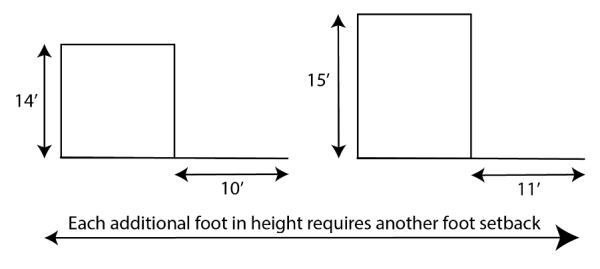
- HeightUnless a greater height is approved by the City Council after recommendation by the Planning Commission.
C-1 C-1 C-2 Minimum 10 feet 10 feet 10 feet Maximum 35 feet 35 feet 35 feet - Lot Coverage
C-1 C-2 C-3 Maximum lot coverage 40 percent None None Maximum building size (single use building) 10,000 square feet (up to 15,000 square feet with a conditional use permit) None None
- Special Provisions
- Trash, Junk, Inoperable Vehicles, Vessels and Similar Items. No trash, rubbish, weeds or other combustible material will be allowed to remain on any lot outside of approved containers in any commercial zone. No junk, debris, abandoned, inoperable or dismantled vehicles or vessels or vehicle or vessel parts or similar material will be stored or allowed to remain on any lot in any commercial zone.
- Solid Waste Storage Facilities. All solid waste storage facilities will be located at the rear of the main building or else behind a sight obscuring fence or wall which will prevent the facility from being seen from a public street.
- Sales Lots for Automobiles and Similar Vehicles. Sales lots for automobiles, RVs, boats, trailers and similar vehicles will be fully improved to comply with current City standards, including fully paved display area, permanent sales office built to the current building code, landscaping, streetlights and permanent signage. Display vehicles will not be located within the public right of way or on the required landscape area, unless part of the landscape and site plan.
- Buildings with A Large Ground Floor Area. Buildings with a ground floor (footprint) area of twenty thousand square feet (20,000 sq. ft.) or more or a site with an aggregate ground floor (footprint) square footage of twenty thousand square feet (20,000 sq. ft.) or more will be subject to design review and approval by the City Council. A site plan along with colored building elevations of all sides of the building and a three-dimensional rendering will be submitted for review by the Planning Commission which will make a recommendation to the City Council. The City Council will review the building design and conceptual site plan in order to achieve the following desired objectives:
- Vehicle access and parking lots properly designed for safety, efficiency and beauty. Parking lots should be landscaped with shade trees throughout the lot to avoid major heat islands, and to break up large asphalt areas.
- Landscaping of the project site to promote community appearance.
- Building facade articulation will include a variation in base, middle, and top of a building created by variations in color and materials. Articulated tops should consist of pitch dormers, gable ends, cornice detailing, or similar details. The base of a building will include elements that relate to human scale such as doors, windows, texture, projections, awnings and canopies, ornament, etc. Buildings will provide visual interest through articulation of the facade. This can be achieved through
- combinations of stepping back or extending a portion of the facade (pop outs),
- vertical divisions using different textures and materials,
- divisions into storefronts, with separate display windows and entrances, variation in rooflines by alternating dormers, stepped roofs, gables, or other roof elements, and arcades, awnings, window bays, arched windows, and balconies at intervals.
- Building colors will be earth tones that blend with the predominant colors of the natural surrounding area and will not be of high contrast. Bright, white or contrasting colors will be limited to trim. A materials and color sample board will be provided.
- Access and Paved Areas. All commercial establishments must provide paved ingress, egress, parking and pedestrian access facilities for both the general public and the employees of the business. All paved areas will comply with the Standard Specifications and Plans as adopted by the City.
- Curb and Gutter on Streets. Whenever a structure is improved, erected, or the use of the structure is changed in any commercial zone curb, gutter, and sidewalk will be required as per he subdivision ordinance (Title 14 of BMC) along streets the property abuts and fronts and along all roads being created by the development. Notwithstanding any other provision of this Ordinance, all buildings abutting a highway having a state or federal designation will not be required to provide curb and gutter along that highway unless required by the owning jurisdiction.
- Landscaping. Properties within commercial zones will comply with Section 15.06.180, "Landscape Standards".
- Off Street Parking Requirements. All sites will meet the requirements as outlined in Section 15.06.170.
- Walls and Fencing. Properties within commercial zones will comply with Section 15.06.160, "Walls and Fences".
Adopted by Ord. 07022019-002 on 7/2/2019
Amended by Ord. 202403-001 on 3/7/2024
Amended by Res. R202507-002 on 7/2/2025
Amended by Ord. 202605-002 on 5/5/2026
15.06.140 Industrial Zones (I-1, I-2, I-3)
- Purpose
- I-1 Zone. The objective in establishing the light industrial zone (I-1) is to provide appropriate space for the development and operation of research and development, light manufacturing, and the fabrication of goods in a controlled and aesthetically desirable environment. The intent is that these activities may be established and operate without creating smoke, gas, odor, dust, sound, vibration or lighting to any degree which would be offensive to residents of the City or surrounding areas. The zone is characterized by attractively designed buildings, landscape areas and parking lots in a campus like setting.
- I-2 Zone. The objective in establishing the medium industrial (I-2) zone is to provide appropriate space for the development and operation of warehousing, wholesaling, other services permitted in the I-1 zone and other similar commercial establishments, which are necessary and beneficial to the area economy, in locations where uses are compatible with one another. The intent is that these activities may be established and operate without creating smoke, gas, odor, dust, sound, vibration or lighting to any degree which would be offensive to residents of the City or surrounding areas.
- I-3 Zone. The objective in establishing the I-3 manufacturing zone is for the purpose of providing space for light manufacturing and fabrication of goods in a controlled and aesthetically desirable environment, and to provide areas for the promotion of new industry for the City and to protect property values. The emphasis of this zone is to accommodate basic industries which tend to increase the employment and economic base of the City and which market their products on a wholesale basis, primarily outside of the local economy. The zone is characterized by attractively designed buildings, landscaping and off street parking. Developments in these areas will have a park like appearance which blends the buildings and manufacturing areas into the landscaped area.
- Use Regulations
- Permitted Uses. Principal uses that are designated as permitted uses may be allowed in new or existing structures and associated outside areas which have received site development plan approval and have obtained occupancy approval from the Zoning Administrator.
- Conditional Uses. Uses that are designated as conditional uses are subject to the conditional use approval process outlined in Chapter 15.08 governing conditional uses.
- Prohibited Uses. The following uses will be excluded from the City: animal byproduct plants; blast furnaces; garbage; offal and animal reduction; incineration or processing refuse dumps; commercial hog farms; manufacturing, compounding or processing of chlorine gas, acid, cement, lime, gypsum, plaster of Paris, creosote, fertilizer from animal byproducts, pyroxylin products; rubber reduction; processing or treatment of fish; smelters and ore reduction; and similar uses which give rise to excessive or offensive odor, noise, fumes, dust, radiation or danger of explosion.
- List of Uses. In the following list of possible uses, those designated in any zone as "P" will be a permitted use. Uses designated with the letter "C" are allowed on a conditional use basis. Uses designated as "N" will not be permitted in that zone.
Tables of Uses I-1 I-2 I-3 Accessory uses and buildings, customarily incidental and subordinate to an approved conditional use C C C Accessory uses and buildings, customarily incidental and subordinate to an approved permitted use P P P Appliance, electric and electronic equipment maintenance and repair N P P Assembly and fabrication of goods (bookbinding, electric appliance and/or electronic instrument assembly, printing, engraving and similar type uses) P P P Automobile fuel stations with or without convenience stores and/or automobile wash facilities (fully automatic only) C N N Batching and mixing plants N N C Building material sales N P N Bulk plants (class 1 and 2 flammable liquids and gases) N C C Cabinet, laminating and woodworking shops N C P Caretakers' quarters, incidental to the use of the land C C C Child daycare or preschool facilities which meet all state and local regulations pertaining to such facilities C C N Construction and farm equipment rental yards N C P Construction and farm equipment repair N C P Construction and farm equipment sales N P N Contractors' shops and storage yards N C P Crematoriums, independent animal or human, which meet all state and local regulations pertaining to crematoriums N C C Dry cleaning plants N C P Farm supply sales N P N Fertilizer and soil conditioner manufacturing, processing and sales (non animal products) N C C Food processing, wholesale (excluding mills, the processing of fat, vinegar and yeast, and the slaughter of animals) N P P Foundries, light weight casting and nonferrous without causing noxious fumes or odors N C C Furniture upholstery N C P Government/public buildings and offices (not otherwise listed) P P P Government/public maintenance and service facilities N C P Honey extraction and processing N P P Hospitals, animal N C N Hospitals, human C N N Ice manufacturing and storage N P P Insulation sales and service N C P Laboratories P P P Laundry and linen service facilities N C P Livestock feed processing and storage without causing odors N N C Machine shops and storage yards N C P Maintenance and repair of goods not otherwise listed N C P Manufacturing of abrasives, acids, aluminum, batteries, asphalt products, bone products, cellophane products, cement products, cloth products excluding mills, concrete products, electronic instrument products, food processing excluding mills and the slaughter of animals, furniture products, glass products, ironworks, leather products, metal finishing or plating products, optical goods, plastics, sheet metal products, tools and wood products excluding mills N N C Micro-education entities P P P Mills (cereal, feed, flour, knitting, planting, etc.) N N C Motor vehicle (automobile, recreational and truck) impound yards which meet all state and local regulations pertaining to impound yards N N C Motor vehicle (automobile, recreational and truck) storage facilities (indoor or outdoor) for operable vehicles N C P Motor vehicle (automobile, recreational and truck) repair (body, maintenance, paint, rebuild, tire, upholstery, etc.) N C P Motor vehicle (automobile, recreational and truck) salvage and storage yards for dismantled (completely or partially) or wrecked vehicles which meet all state and local regulations pertaining to such yards N N C Motor vehicle (automobile, recreational and truck) wash facilities N C P Other uses not listed as permitted or conditional uses in other zones, determined by the planning commission to be compatible and in harmony with the character and intent of these zones, according to their designated and approved development plans C C C Packaging, processing and treating of goods not otherwise listed C C C Pest control and extermination establishments N C P Portable restroom rental establishments N N C Public parks P P N Public utility maintenance and service facilities N C P Research and development facilities, excluding manufacturing processes P P P Research and development facilities, including manufacturing processes C C C Restaurants C N N Sandblasting facilities N C P Schools, business P N N Schools, colleges and universities C N N Schools, medical C N N Schools, technical C C C Septic tank cleaning/pumping establishments N N C Sexually oriented businesses which meet all state and local regulations pertaining to such businesses N P P Sheet metal shops (including retinning) N C P Sign shops (manufacture, maintenance, paint, etc.) N C P Solid waste service providers (including dumpster rentals) N N C Storage units N C P Telemarketing centers C N N Tire recapping or retreading facilities N C P Truck fuel stations without convenience stores N C C Truck terminals N C P Welding shops N C P Wholesale distributing and warehousing N C P
- Site Design Regulations. All uses are subject to the following site design regulations and the chapters of this code governing land use supplementary and qualifying regulations, off street parking requirements, and any affected overlay zone.
- Distance to Specific Zone Boundary. No building or buildings which house processing or assembly activities that are fully contained within buildings will be located less than fifty feet (50') from any residential or agricultural zone boundary.
- Outdoor Activities. In the I-2 and I-3 zones, no outdoor assembly, construction, repair or manufacturing activities will be located within fifty feet (50') from any agricultural or residential zone boundary.
- Storage and Activities in I-1 Zone. In the I-1 zone, storage, assembly, construction, repair or manufacturing activities must take place within an enclosed building. Outdoor storage and activities are prohibited.
- Parking Area Lighting. All outside parking areas will be lighted during evening business hours. All lights will be designed to direct light away from adjacent properties.
- Access and Paved Areas. All Industrial establishments must provide paved ingress, egress, parking and pedestrian access facilities for both the general public and the employee's of the business. All paved areas will comply with the Standard Specifications and Plans as adopted by the City. Industrial sites may request non-paved storage areas, however these areas cannot access onto any public street or private lane not owned by the party requesting the non-paved area. The request to waive the paving of a site would constitute a Conditional Use Permit and all requirements of Chapter 15.08 would apply.
- Height Regulations. No building or structure will be erected to a height greater than thirty five feet (35') unless otherwise approved with a conditional use permit.
Height I-1 I-2 I-3 Minimum 10 feet 10 feet 10 feet Maximum 35 feet 35 feet 35 feet - Area and Setback RequirementsNotes:
Lot Areas & Setbacks I-1 I-2 I-3 Minimum lot area None None None Minimum setbacks Front* 30 feet* 20 feet* 20 feet* Side** 10 feet 10 feet 10 feet Street side* 30 feet 20 feet 20 feet Rear** 10 feet 10 feet 10 feet Minimum zone area 5 acres 3 acres 3 acres
* Notwithstanding any other provision of this Ordinance, all buildings abutting a highway having a state or federal designation (except non-access highways), will be set back at least fifty feet (50") from the highway right-of-way line.
** When not adjacent to an agricultural or residential zone boundary, and if approved by the City with a conditional use permit, the interior side yard and rear yard setbacks may be reduced or eliminated.- Additional Setbacks Abutting Residential or Agricultural Zones. When abutting a residential zone there will be a minimum setback of ten feet (10') with an additional setback for buildings or structures over fifteen feet (15') in height based on a one to one (1:1) ratio; whereas, for each additional foot in height requires an additional setback foot from the property line.
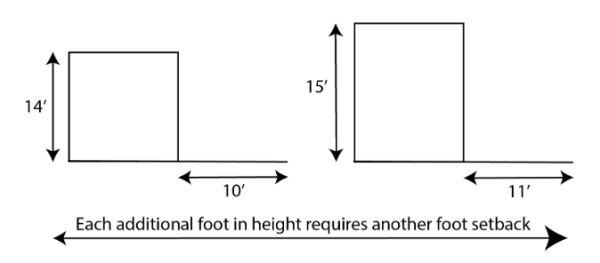
- Additional Setbacks Abutting Residential or Agricultural Zones. When abutting a residential zone there will be a minimum setback of ten feet (10') with an additional setback for buildings or structures over fifteen feet (15') in height based on a one to one (1:1) ratio; whereas, for each additional foot in height requires an additional setback foot from the property line.
- Landscaping. Properties within Industrial zones will comply with Section 15.06.180, "Landscape Standards".
- Off Street Parking Requirements. All sites will meet the requirements as outlined in Section 15.06.170.
- Walls and Fencing. Properties within Industrial zones will comply with Section 15.06.160, "Walls and Fences".
- Building Elevation Regulations. Roof mounted mechanical equipment will be screened on all sides. The materials and colors of the screening surfaces will be compatible with their associated buildings.
When visible from an adjacent public street, the building elevations will include recessed or articulated surfaces (beyond the wall material itself), columns and beams to help visually segment the walls. A variation in materials, colors, textures and rooflines that convey a sense of order is encouraged. Narrow parapet sections that extend beyond the main roofline and the adjoining parapet sections for the purpose of focusing on an entrance or other portion of a building will be topped with a roof section that extends back over the main roof of the building.
Adopted by Ord. 07022019-002 on 7/2/2019
Amended by Ord. 202403-001 on 3/7/2024
Amended by Ord. 202605-002 on 5/5/2026
15.06.150 Open Space Zone (OS)
- Purpose. The purpose of this zone is to permit the use of open space land within the City for uses compatible with the protection of the natural and scenic resources of the City for the benefit of present and future generations.
- Permitted Uses
- Livestock grazing, including incidental corrals, barns or pens.
- Public and private recreation grounds and facilities, including public and private park site development.
- Raising of crops, horticulture and gardening.
- Undeveloped land.
- Conditional Uses. The following uses are conditional and subject to the requirements of Chapter 15.08:
- Airports.
- Animals, more than the limits prescribed herein.
- Cemeteries.
- Golf courses.
- Micro-education entities.
- Mineral and fill dirt extraction (no hot mix operations).
- Public utilities and transmission lines.
- Schools, churches and public buildings.
- Other uses similar to the above and judged by the Land Use Authority to be in harmony with the character and intent of this zone.
- Height Regulations. No building will be erected to a height greater than two and one-half (21/2) stories or thirty five feet (35'), whichever is less, unless otherwise recommended by the planning commission and approved by the City Council as a conditional use permit.
- Area, Width and Yard Requirements
District Area Minimum Lot Width Minimum Minimum Yard Setbacks Front Minimum Yard Setbacks Sides Minimum Yard Setbacks Rear OS None None 30 ft. 10 ft. (25 ft. on corner) 10 ft. - Off Street Parking Requirements. All sites will meet the requirements as outlined in Section 15.06.170.
- Walls and Fencing. Properties within open space zones will comply with Section 15.06.160, "Walls and Fences".
- Modifying Regulations
- Distance of Livestock to Residential Zone. Livestock kept in a corral, barn or pen within the open space zone must be at least one hundred feet (100') from any residential zone which prohibits the keeping of livestock.
- Grazing; Density; Feedlots; Exception
- Livestock grazing (i.e., horses, cattle, goats or sheep) will be limited to four (4) animals per acre, except that for a maximum period of thirty (30) days per year, the limit will be eight (8) animals per acre. In addition, offspring may remain with their mothers until weaned and both the mother and offspring will be counted as one animal during the weaning period.
- Commercial feedlot operations are not permitted within the open space zone.
- Upon request, the City Council after considering the recommendation of the Planning Commission, may allow more animals than the limits prescribed above through approval of a conditional use permit.
- Livestock grazing (i.e., horses, cattle, goats or sheep) will be limited to four (4) animals per acre, except that for a maximum period of thirty (30) days per year, the limit will be eight (8) animals per acre. In addition, offspring may remain with their mothers until weaned and both the mother and offspring will be counted as one animal during the weaning period.
Adopted by Ord. 07022019-002 on 7/2/2019
Amended by Ord. 202403-001 on 3/7/2024
Amended by Ord. 202605-002 on 5/5/2026
15.06.155 Wildland Urban Interface Overlay Zone
- Purpose. The purpose of this zone is to establish minimum regulations consistent with nationally recognized good practice for the safeguarding of life and property. Regulations in this zone are intended to mitigate the risk to life and structures from intrusion of fire from wildland fire exposures and fire exposures from adjacent structures and to mitigate structure fires from spreading to wildland fuels. The development and use of property in wildland-urban interface areas is a potential threat to life and property from fire and resulting effects. Safeguards to prevent the occurrence of fires and to provide adequate fire-protection facilities to control the spread of fire in wildland-urban interface areas shall be in accordance with this zone.
- General Regulations. The supplementary regulations of this zone will be as outlined in the 2006 Wildland Urban Interface Code as adopted in Chapter 11.02. The provisions of this zone shall apply to the construction, alteration, movement, repair, maintenance and use of any building, structure or premises within the Urban-Wildland Interface Overlay Zone.
- Buildings or Conditions in Existence at the Time of Adoption. Buildings or conditions in existence at the time of the adoption of this zone are allowed to have their use or occupancy continued, if the condition, use or occupancy was legal at the time of the adoption of this zone, provided that continued uses do not constitute a distinct danger to life or property.
- Location of Overlay. This zone will only be overlayed and shown on existing zoning districts on the Ballard City Wildland Urban Interface Map. The requirements of this zone will be additional to the requirements of the base zone on which the overlay has been placed.
- Conflict. In cases where the standards of the base zone and the overlay zone conflict, the stricter of the two requirements will stand and be upheld.
- Administration and Enforcement. It will be the responsibility of the Building Official and the Ballard Zoning Administrator to ensure that the standards of this zone are met.
Adopted by Ord. 07022019-002 on 7/2/2019
Amended by Ord. 202403-001 on 3/7/2024
Amended by Ord. 202605-002 on 5/5/2026
15.06.156 Portable Storage Containers
- Portable Storage Container Regulations. Except as stated in this ordinance, a portable storage container will be considered as an allowed use in the A-l, RA-l, C-2 and I-1 zones with the following limitations:
- Permitting for all portable storage containers will be processed and approved through the City's building official unless the combined number of containers on any parcel exceeds one thousand square feet (1000 sq. ft.). In such case, the use of storage containers will be approved by the City's Planning Commission with a submitted site plan and with applicable development standards of the City.
- The use of portable storage containers will be considered only as a secondary use, requiring that a primary, permanent structure be located on the same parcel of property where business is transacted. The total square footage of portable storage containers on any one parcel of property will not exceed twenty five percent (25%) of the total square footage.
- A portable storage container will be used for storage or uses incidental to storage purposes only. No occupancy or other use of the storage container will be allowed. The sale of portable storage containers will only be allowed in an industrial zone.
- A portable storage container may be temporarily used in any zone for no more than seven (7) consecutive calendar days for the purpose of storing items to be moved from that specific premise. The storage container may not be placed on any public street.
- A portable storage container on any property will not utilize any parking spaces that are required.
- All portable storage containers will be set back from the front property line a minimum of thirty (30") unless set back requirements for the particular zone in which the storage container is placed requires a deeper set back. Any side or rear set back requirements for the particular zone in which the storage container is placed will be enforced.
- No stacking of portable storage containers will be allowed unless in an industrial zone. Stacking of portable storage containers in an industrial zone will be limited to two (2) high.
- All portable storage containers will be painted in a neutral color in such a way as to match the primary building or structure, or will be behind a six foot (6") high, sight-obscuring fence, maintained by the property owner.
- There can only be one portable storage container per building lot, unless the property is in an industrial zone.
- Violation—Penalty. Any person, firm or corporation, whether as principal, agent, employee or otherwise, violating or causing the violation of any of the provisions of this title will be guilty of a Class B misdemeanor. Such person, firm or corporation will be deemed guilty of a separate offense for each and every day during any portion of which any violation of this Title is committed.
Adopted by Ord. 07022019-002 on 7/2/2019
Amended by Ord. 202605-002 on 5/5/2026
15.06.160 Walls And Fences
- Interior Lot Requirements. On all interior lot lines, a fence, not to exceed six feet (6') in height, may be erected along all side and rear property lines, but not in the front setback area. In any front setback area, no rock wall, retaining wall, or fence will exceed four feet (4') in height. Within the front ten feet (10') behind the sidewalk, or property line where no sidewalk exists, only decorative fences such as picket fences or wrought iron fences with at least fifty percent (50%) of the fence open (up to fifty percent (50%) may be solid, or non see through) will be allowed with a maximum height of four feet (4'). Where a fence is located along an interior property line separating two (2) properties; the maximum height of the fence will not exceed six feet (6') above grade, at any single point, measured from finish grade on the shortest side of the fence. Fences may not have a berm for the purpose of increasing the allowable height.
- Corner Lot Requirements
- Height Of Fencing Permitted. On all corner lots, a fence not to exceed six feet (6') in height may be erected along the rear and interior side lot line, but a fence will not be erected in the front or street side setback areas to a height in excess of four feet (4'), except when a side setback fronts on a public street a height up to six feet (6') is allowed provided the fence is a minimum of ten feet (10') behind the front line of the dwelling and provided that the fence is set back at least ten feet (10') from the sidewalk.
- Obstructions In Front Setback. In all zones requiring a front setback, no obstruction to view in excess of three feet (3') in height will be placed on any corner lot within a triangular area formed by the street property lines and a line connecting them at points thirty feet (30') from the intersection of the property lines.
- Retaining Walls. The height of any single retaining wall will not exceed eight feet (8'). Industrial zones may exceed eight feet (8') in height with a maximum height of twelve feet (12'), subject to approval by the City. Terraced retaining walls will be constructed out of one type of material. If a different type of material is used for additional terraced walls, those walls will be constructed out of material that is similar in look, color, and texture and be separated a minimum of the height of the lower wall. Retaining walls will be measured from the top of the exposed face to finish grade. Where a solid fence is placed on top of a retaining wall or rock wall, the combined exposed face will not exceed eight feet (8') in height at any point, measured from the finished grade of the adjacent retaining wall to the top of the solid fence. Fences at least fifty percent (50%) open (up to 50 percent may be solid, or non see through) may be placed on top of a retaining wall with a combined maximum height of thirteen feet (13') Retaining walls over eight feet (8') in height, including combinations of solid fences on retaining walls that exceed eight feet (8'), will be stepped to form benches which will be a minimum distance of one-half (1/2) the height of the lower retaining wall and be landscaped. Benches will be measured from the top back of the lower retaining wall to bottom face of the terraced retaining wall.
- Fences and Decorative/Masonry Walls
- Public Right Of Way. No fence approved under this chapter will be erected beyond a property line or on the public right of way.
- No fence will be erected within one foot (1') of an existing or future sidewalk or within a three foot (3') radius of a fire hydrant.
- Maintenance of the landscape area between the curb and the property line will be the responsibility of the property owner or homeowners' association as applicable.
- Controlled Access Streets. On streets designated by the City Engineer as controlled access streets, fences or retaining walls may be erected to a height of six feet (6') in the front setback area with permission from the Planning Commission.
- Fences and Retaining Walls Adjacent to a Public Street. Where a fence or retaining wall is adjacent to a public street, the fence, or retaining wall, or combination of a fence on top of a retaining wall, will not exceed six feet (6') above the curb or sidewalk grade. Retaining walls may be terraced to achieve greater overall height; provided, that no one vertical plane exceeds six feet (6') in height, and walls are offset a minimum of three feet (3'). The retaining wall will be set back from the sidewalk a minimum of ten feet (10') as required.
- Recreation Use. On interior side and rear property lines, a chain-link fence may be erected to a height of twelve feet (12') for the purpose of enclosing a tennis court, or other court game area. The fence may not be located within the setback area of yards abutting a front or street side yard.
A fence, not less than five feet (5') in height, will be erected around all swimming pools, jacuzzis or other similar pools not otherwise enclosed (or covered for jacuzzis) and in accordance with the provisions of the current international residential code and international building code.
Safety nets are permitted along side and rear property lines, where a property is adjacent to a golf course. Safety nets that exceed twelve feet (12') in height require a permit issued by the building department. - Requirements In Certain Areas. In all commercial and industrial zones having a common lot line with a residential zone of any type, or planned development zones having a common lot line with a single-family residential zone, a six foot (6') high solid fence will be required, but will be reduced to four feet (4') in height inside the front setback area (chain-link with slats will not be considered a solid fence for the purpose of this section).
- Surrounding Developments. Fences surrounding developments having no individual residential lots that front on a public street, such as RV parks, subdivisions on limited access streets, planned developments, and also commercial and industrial developments, may have a solid fence in the front setback area to a height of six feet (6') except that such fence will be reduced to three feet (3') at driveway entrances in the same manner as required for intersections in BMC 15.06.160. The fence will be set back from the sidewalk a minimum of ten feet (10') as required. Landscaping required for commercial and manufacturing developments will be located on the street side of the fence.
- Tiny Home Communities and Recreational Vehicle Park/Subdivision; Fences. A six foot (6') high solid fence will be erected along all side and rear yard property lines when a tiny home community or a recreational vehicle park/subdivision is adjacent to any use or zone, except tiny homes and recreational vehicles.
- Enclosure Of Merchandise And Materials. All materials and merchandise, except vehicles in running order, will be stored in an enclosed building or within an enclosure surrounded by a solid, sight obscuring fence or wall of not less than six feet (6') in height, and no material or merchandise will be stored to a height of more than the height of the fence or wall (chain link fencing with slats is not be considered a solid fence for purposes of this section).
- Protection Of Residential Property. Where a commercial development is next to any lot or parcel of ground in any residential zone, there will be provided along the abutting property line a solid masonry wall and a minimum ten foot (10') wide planting strip. The landscape requirements will be determined by the City planning department to make sure the buffer area adequately protects the adjoining residential property. This requirement shall also apply to two-family and multi-family dwelling developments adjacent to single family residential zoning districts.
- Industrial Zones; Fence Required. Where any I-1, I-2 or I-3 zone adjoins any agricultural or residential zone boundary, there will be along the property line a sight obscuring fence or wall (not chain link with slats) not less than six feet (6') in height. Fence or wall materials will be compatible with the building.
- Industrial Zones; Screening. Except for the I-3 zone, loading dock areas will be screened from public view with a sight obscuring fence or wall (not chain link with slats) of sufficient height to provide the required screening. In the I-1, I-2 and I-3 zones garbage collection areas will be screened from public view with a sight obscuring fence or wall (not chain link with slats) of sufficient height to provide the required screening. Fence or wall materials will be compatible with the building.
- Storage; Fencing. In the I-1 and I-2 zones all storage will be located in an enclosed building or behind a sight obscuring fence or wall (not chain link with slats) at least six feet (6') in height. Fence or wall materials will be compatible with the building. Additionally, no material may be stored higher than eighteen feet (18') without a conditional use permit. Materials cannot go above a fence or wall according to the following graphic:
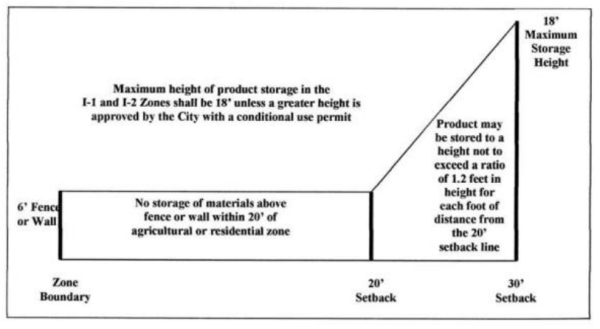
- Barbed Wire. Barbed wire, razor ribbon and similar fencing material will be prohibited in all zones except agricultural, industrial and certain commercial zones. In agricultural, industrial and commercial zones where permitted and for agricultural uses in the residential estates zone, the use of barbed wire, razor ribbon and similar material will conform to the following restrictions:
- Barbed wire, razor ribbon or similar material will be pulled straight and not rolled or coiled.
- Straight strands of barbed wire and similar material on top of fences or walls will not exceed a combined fence and barbed wire height of seven feet (7').
- In commercial zones, barbed wire or similar material will not be used within the twenty foot (20') front setback area, nor along any common lot line with a residential zone or residential development.
- Barbed wire and similar material is prohibited in C-1 commercial zones.
- Public Right Of Way. No fence approved under this chapter will be erected beyond a property line or on the public right of way.
Adopted by Ord. 07022019-002 on 7/2/2019
Amended by Ord. 202302-002 on 2/7/2023
Amended by Ord. 202403-001 on 3/7/2024
Amended by Ord. 202605-002 on 5/5/2026
15.06.170 Off Street Parking Requirements
- Off Street Parking Required. At the time any building or structure is erected, enlarged or increased in capacity, or the use is changed to a more parking intensive use, there will be provided off street parking spaces on private property for automobiles in accordance with the following requirements. Subject to approval of a conditional use permit, an existing building within the historic district may be changed to a restaurant use even though the number of off street parking spaces is nonconforming. Buildings will not be enlarged unless current parking requirements are met.
- Dimensions. The dimensions of each off street parking space or stall will be at least nine feet by eighteen feet (9' x 18') for diagonal or ninety degree (90°) spaces; or nine feet by twenty two feet (9' x 22') for parallel spaces, exclusive of access drives or aisles.
- Reduction. A parking stall may be reduced by two feet (2') lengthwise if landscaping separated from the paved area of the parking stall by a curb or tire bumper guard is provided in the remaining two feet (2') of the parking stall. All areas within the parking area not paved will be landscaped.
- Access to Individual Parking Spaces. Except for single-family and two-family dwellings, access to each parking space will be from a private driveway and not from a public street.
- One-Way Driveway Width. One-way driveways will be a minimum of twelve feet (12') in width.
- Two-Way Driveway Width. Two-way driveways will be of a minimum width as follows:
- Twelve feet (12') for a single-family dwelling, providing access to parking spaces directly off of a street without having to go past another building.
- Sixteen feet (16') for a single-family or a two-family dwelling that must go past another building to access parking spaces, with a minimum unobstructed two foot (2') width on both sides of the driveway; or a two-family dwelling, providing access to parking spaces directly off of a street without having to go past another building. The driveway width may be reduced for a single-family dwelling if the City Engineer determines that a lesser width is adequate.
- Eighteen feet (18') for a single-family or a two-family dwelling that must go past another building to access parking spaces where there are obstructions (i.e., walls, trees, etc.) adjacent to one or both sides of the driveway. The driveway width may be reduced for a single-family dwelling if the City Engineer determines that a lesser width is adequate.
- Twenty five feet (25') for commercial, manufacturing and all other residential developments.
- Additionally, a minimum of twenty feet (20') is required for any dwelling or building when any portion of an exterior wall of the first story is located more than one hundred fifty feet (150') from fire department vehicle access. Vertical clearance, surface, turnarounds and other requirements contained in the international fire code will apply. Exceptions and modifications may apply as approved by the fire chief responsible for the City.
- Garages accessed by a twenty foot (20') wide paved rear alley will have a minimum five foot (5') setback from the alley, provided the dwelling fronts on a public street. A twenty foot (20') garage setback will be required when the dwelling fronts on a private street, unless the private street is built to City standards for public street pavement width, in which case a garage may have a five foot (5') setback from the alley.
- Garage and Carport Spaces. All garage and carport spaces will be set back a minimum of eighteen feet (18') from the private access drive serving them. Garage and carport spaces will be counted as one parking space unless the garage or carport is a minimum of four hundred eighty (480) square feet with a minimum width of twenty feet (20'); or the individual driveway to the garage or carport is at least twenty feet (20') in length, in which case the parking areas will count as two (2) spaces.
- Residential Area Requirements
- Single-Family Dwelling. Two (2) parking spaces per single-family dwelling. Tandem parking will be allowed in single-family subdivisions only.
- All Other Dwellings. All other dwellings, including two-family and multi-family dwellings, will have two (2) parking spaces per dwelling unit Covered parking may be located within the side and rear setback areas. For projects with more than fifty (50) dwelling units, the Planning Commission may reduce the requirement to one and one-half (1.5) spaces per unit where it can be shown that two (2) spaces per unit is an excessive amount of parking. No street parking will be counted toward meeting the parking requirement. Tandem parking will not count toward the parking requirement. No parking area will be located within the required front setback facing a public street, and it will in no case be more than four hundred feet (400') away from the premises it is intended to serve. All parking will be on site.
- Front Yard Setback. Front yard setback from private streets will be ten feet (10') minimum from back of curb for all buildings, and there will be twenty feet (20') minimum from back of sidewalk (curb where there is no sidewalk and street where there is no curb) for garages or carports. The Planning Commission may allow a ten foot (10') front setback on hillside developments where it is determined that adequate off street parking is provided and the reduced setback will reduce the overall amount of hillside excavation.
- Recreational Vehicles. In residential zones, no motor home, travel trailer, boat or similar recreational vehicle will be parked within the required front yard setback area adjacent to a public street for a period longer than two (2) weeks. (Corner lots are considered to have 2 front yard areas.)
- Parking Vehicles On Front Lawns Or Setback Areas. Parking vehicles on front lawns or in the front setback or street side setback areas is prohibited, except on approved paved (concrete or asphalt) driveways.
- Nonresidential Area Requirements. The number of off street parking spaces required for all nonresidential developments will be as follows:
Automotive repair and supply 1 space for each 400 square feet of gross floor area. Bowling alleys and billiard halls 5 spaces for each alley, plus 2 spaces for each billiard table contained therein. Business or professional offices 1 space for each 250 square feet of gross floor area. Call centers or telemarketing business 1 space per employee on the highest shift, or 1 space per 100 square feet of gross floor area, whichever is greater; except that call centers occupying no more than 15 percent of a building's total floor area (or 15 percent of an office park's cumulative floor area), up to 3,000 square feet maximum, will provide at least 1 space per 250 square feet of gross floor area. Churches, sports arenas, auditoriums, theaters, assembly halls, lodge halls or other meeting rooms 1 space for each 3.5 fixed seats of maximum seating capacity, or 1 space for each 35 square feet of seating area within the main auditorium where there are no fixed seats. 18 linear inches of bench will be considered a fixed seat. Dance facilities 1 space for every 3.5 people of maximum capacity allowed in the facility. Day nurseries in commercial zones, including preschools and nursery schools 1 space for each staff member, plus 1 space for each 10 children for which said establishment is licensed. Educational uses including micro-education entities: Elementary 2.5 spaces per classroom/teaching station. Intermediate (6th and 7th) and middle (8th and 9th) 4.5 spaces per classroom/teaching station. High school (10th through 12th) 12 spaces per classroom/teaching station. College, universities, trade schools, etc. 1 space for each faculty member, plus 1 space for each 3 students. Furniture stores, appliance stores and 1 space for each 600 square feet of floor area. Lumberyards Golf courses 6 spaces per hole. Golf driving ranges 1 space per tee. Health studios and spas 1 space for each 250 square feet of gross floor area or 10 spaces minimum, whichever is greater. Hospitals 2 parking spaces for each bed. Hotels, motels, motor hotels 1 space for each living or sleeping unit, plus 2 spaces for resident manager or owner. Libraries 1 space for each 300 square feet of gross floor area. Manufacturing plants, warehouses, storage buildings or structures especially for storage purposes 1 space for each 1,000 square feet of gross floor area and 1 space for each 250 square feet of office or sales area. Mortuaries and funeral homes 5 spaces, plus 1 space for each 35 square feet of assembly room floor area. Nursing homes, care centers and assisted living 1 parking space for each 3 beds, except where skilled care (long term care) is provided, the requirement is 1 parking space for each 2 beds. Outdoor sales lots for autos, and RVs 1 space for each 7 vehicles or items of equipment to be displayed, plus 2 spaces for manager and employee parking. Restaurants and other establishments where food or beverages are consumed 10 spaces minimum or 1 space for each 100 square feet of gross floor area, whichever is greater, plus 1 space for each 100 square feet of outdoor seating or 1 space per 4 chairs of outdoor seating. Retail stores and shops, commercial banks, savings and loan offices, and other financial institutions, general retail stores, food stores, supermarkets, drugstores and other similar commercial businesses 1 space for each 250 square feet of gross floor area. For commercial centers containing 500 or more spaces, spaces in excess of 500 will be calculated on the basis of 1 space for each 500 square feet of gross floor area. Service commercial businesses; businesses such as electrical, plumbing, cabinets, printing and other similar shops 1 space for each 250 square feet of retail or office area and 1 space for each 500 square feet of additional building area. Skating rinks, ice or roller 1 space for each 300 square feet of gross floor area. Swimming pools (commercial) 1 space for each 100 square feet of water surface or 10 stalls, whichever is greater. Tennis, handball and racquetball courts (commercial) 6 spaces minimum or 3 spaces per court, whichever is greater. Veterinary hospitals 5 spaces for each doctor.
Notwithstanding all provisions of this section, the planning commission will take into account in each instance of nonresidential parking the type of development, use, location, adjoining uses and possible future uses in setting parking requirements, and it will recommend to the City Council a requirement of that number of spaces that it deems reasonably necessary in each instance for all employees, business vehicles and equipment, customers, clients and patients of such nonresidential property. - Lighting. Parking lots used during hours of darkness will be lighted by standards using hooded light sources which direct the light downward and away from residential property.
- Development Standards. Every parcel of land used as a parking lot will be paved with an approved surfacing material of asphalt or concrete composition or some other all weather surfacing material approved by the planning commission and will have appropriate bumper guards where needed as determined by the building inspector. Lights used to illuminate the lot will be so arranged as to reflect the light away from the adjoining premises wherever those premises are used for residence or sleeping purposes.
- Optional Provisions
- Shared Facilities. Shared parking facilities may be used jointly with parking facilities for other uses when operations are not normally conducted during the same hours, or when peak uses vary.
- Requests; Guidelines. Requests for shared parking and counting on street parking as required parking is subject to the approval of the planning commission. Requests for shared parking will be subject to the following guidelines:
- Sufficient evidence will be presented to show that there will be no substantial conflict in the periods of peak demand of uses for which the joint use is proposed.
- shared parking stalls will not be more than what is required for either of the uses.
- Parking facilities should not be located farther than two hundred fifty feet (250') from any use proposing to use such parking and should be contiguous to the businesses sharing the lot.
- A written agreement will be executed by all parties concerned assuring the continued availability of shared parking facilities in the event that one of the uses will be sold or otherwise change ownership or management.
- Parking for Disabled
- Required; Number. Any parking area to be used by the general public will provide parking spaces designated and located to adequately accommodate the disabled, and these will be clearly marked. Parking spaces for the disabled will be located in close proximity to the principal building. The designation of parking spaces for the disabled will constitute consent by the property owner to enforce the restricted use of the spaces to disabled motorists by the City. Parking spaces for the disabled will conform to the standards of the Americans with disabilities act. The number of required parking spaces accessible to the disabled will be as follows:
Total In Parking Lot Spaces Required Minimum Number Of Accessible Spaces 1 to 25 1 26 to 50 2 51 to 75 3 76 to 100 4 101 to 150 5 151 to 200 6 201 to 300 7 301 to 400 8 401 to 500 9 401 to 500 10 501 to 1,000 20, plus 1 for each 100 spaces over 1,000 - Dimensions; Van Space, Access Isle. In addition, for every eight (8) accessible parking spaces, one accessible van space must be provided. The dimensions of a standard accessible parking space will be at least nine feet by eighteen feet (9' x 18') with a five foot (5') wide access aisle (total of fourteen feet by eighteen feet (14' x 18'). The dimensions of an accessible van space will be at least nine feet by eighteen feet (9' x 18') with an eight foot (8') wide access aisle (total of seventeen feet by eighteen feet (17' x 18')). The following graphic shows and example:
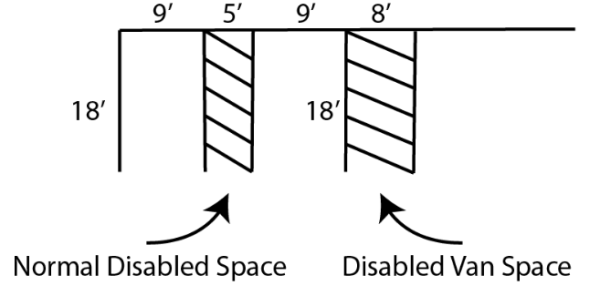
- Required; Number. Any parking area to be used by the general public will provide parking spaces designated and located to adequately accommodate the disabled, and these will be clearly marked. Parking spaces for the disabled will be located in close proximity to the principal building. The designation of parking spaces for the disabled will constitute consent by the property owner to enforce the restricted use of the spaces to disabled motorists by the City. Parking spaces for the disabled will conform to the standards of the Americans with disabilities act. The number of required parking spaces accessible to the disabled will be as follows:
- Uses Not Specifically Identified. For all parking uses not listed above, the Planning Commission will determine the number of spaces required based upon the nearest comparable use standard available.
Adopted by Ord. 07022019-002 on 7/2/2019
Amended by Ord. 202302-002 on 2/7/2023
Amended by Ord. 202403-001 on 3/7/2024
Amended by Ord. 202605-002 on 5/5/2026
15.06.180 Landscape Standards
- Minimum landscaping standards for the following zones: PD, C-1, C-2, C-3, I-1 and I-2
- Design. Landscape plans will make provisions for erosion control on all graded sites. It shall be the responsibility of the developer to grade, place topsoil, seed or sod, install automatic sprinkler irrigation systems, and properly plant trees, shrubs, and other approved plant materials in accordance with the site plan approved by the Zoning Board. All landscaped areas shall have sprinkling or irrigation systems. A landscape and irrigation plan will be submitted to the City for review at the same time as the drawings and plans are submitted for development of the site. Plants that are well adapted to the City area climate zone will be used. Stormwater detention and retention basins will be landscaped.
- Installation. Landscaping and irrigation installation will be completed prior to the issuance of a certificate of occupancy. Landscape and irrigation installers will follow the plans that have been signed and approved by the City. The Planning Board may grant an extension in the event a situation arises that prevents the completion of the required landscaping, provided that a suitable guarantee is filed with the City ensuring the completion of such improvements.
- Maintenance. It shall be the responsibility of the property owner to properly maintain all landscaped areas in accordance with the approved site plan and associated landscape plan. Such landscaping shall be maintained and kept alive and free from weeds and debris. Removed vegetation shall be replaced with equal or better-quality plant materials. Trees that are necessarily removed shall be replaced in accordance with the approved site plan. Owners are required to maintain all common areas including park strips between the street and any privacy walls. If a homeowners' association is dissolved maintenance shall become the individual property owner's responsibility.
- Additional Requirements for Commercial Developments. The front yard areas and side yard areas adjacent to a public street, except those portions devoted to driveways and parking, shall be maintained with suitable landscaping of plants, shrubs, trees, grass and similar landscaping materials. Landscaping within all commercial parking and driveway areas will comprise a minimum of five percent (5%) of the total square footage of those areas, in addition to the required front, side and rear landscaping. Landscaped areas shall generally not be less than five feet wide. A reduction in landscaped area width may be granted by the planning and zoning commission if the applicant provides acceptable mitigation to vegetate the development area. Parking areas will be defined to include all asphalt areas with parking spaces and driveways. All traffic channelization islands will be fully landscaped and will be considered as a portion of the required five percent (5%) parking lot landscaping. All landscaped areas abutting any paved area will be curbed with a six (6") high continuous concrete curb. When necessary a rolled back curb can be substituted if approved by the Land Use Authority. At intersections of streets, driveways, sidewalks, etc., landscaping will be limited to a height of not more than four (4') above street level within the area required for minimum site distance.
- Additional Requirements for Industrial Developments. In the I-2 and I-3 zones, a minimum ten foot (10') wide landscape strip will be installed along all street frontages. Where a wall is installed along a street frontage, the landscape strip will be increased to a minimum of thirty feet (30'). In the I-1 zone, a minimum thirty foot (30') wide landscape strip will be installed along all street frontages. Additional landscaping will be required, in types and quantities to be determined by the City, if landscaping is determined necessary to adequately screen and protect adjoining residential property from industrial uses identified in the development plan.
- Minimum requirement for tree planting in Commercial and Industrial Zones.
- A minimum ration of two (2) trees or shrubbery per every five hundred square feet (500 sq. ft.)of landscaping shall be provided on the overall site plan. For example: Commercial C2 one (1) acre site shows 10% greenspace; 10% = 8 trees or shrubbery for the 1-acre site.
- A minimum ration of two (2) trees or shrubbery per every five hundred square feet (500 sq. ft.)of landscaping shall be provided on the overall site plan. For example: Commercial C2 one (1) acre site shows 10% greenspace; 10% = 8 trees or shrubbery for the 1-acre site.
- Locations of Trees.
- Trees shall be located and maintained within the landscaping so as not to impact public sidewalks or rights-of-way with roots, branches, or other debris. The retention of existing healthy, desirable tree species on-site is preferred. Buildings and parking areas should be designed around existing trees wherever possible.
- Trees shall be located and maintained within the landscaping so as not to impact public sidewalks or rights-of-way with roots, branches, or other debris. The retention of existing healthy, desirable tree species on-site is preferred. Buildings and parking areas should be designed around existing trees wherever possible.
Adopted by Ord. 07022019-002 on 7/2/2019
Amended by Ord. 202003-001 on 7/21/2020
Amended by Ord. 202403-001 on 3/7/2024
Amended by Ord. 202605-002 on 5/5/2026
15.06.190 (Reserved)
Adopted by Ord. 07022019-002 on 7/2/2019
Amended by Ord. 202403-001 on 3/7/2024
Amended by Ord. 202605-002 on 5/5/2026

