
Barrow County Unincorporated
City Zoning Code
City Zoning Code
ARTICLE VII
SIGN REGULATIONS
Sec. 89-781.- Purpose of article.
This article regulates the number, location, size, placement, sign type, type of illumination and other features related to the appropriate time, place and manner for signs and sign structures to be displayed and constructed in the county.
(Ord. of 10-13-2020)
Sec. 89-782. - Sign regulations; purpose and findings.
(a)
Basis for restrictions imposed.
(1)
The commission has considered the aesthetic and safety reasons for limiting signage in the unincorporated areas of the county. The commission has determined that signs can detract from the aesthetic beauty of the county. Further, unregulated sign proliferation may contribute to a lowering of commercial and residential property values. Lastly, signs can be detrimental to the safety of motorists in the county. It is found by the commission that limiting the number, type, and dimension of signs in accordance with the following regulations will serve these substantial governmental and community interests.
(2)
The commission is well aware that signs are a means by which the county's residents, organizations, institutions, and businesses may convey constitutionally protected commercial and noncommercial messages. The following regulations provide an appropriate balance between the right to communicate via signs and the protection of the community interests stated above.
(b)
Regulation of signs. No sign shall be placed or maintained on any property, building or other structure within Barrow County except in conformity with these Sign Regulations.
(c)
Intent of sign regulations; free speech. Notwithstanding any other restrictions in this article, any sign authorized under this article can contain any commercial or non-commercial message, other than messages containing nudity or obscenity as defined herein, or other than a sign that advertises an activity that is illegal under Georgia or federal laws.
(Ord. of 10-13-2020)
Sec. 89-783. - Applicability.
(a)
Signs that are regulated. The regulations and requirements of this article apply to all signs that are or are intended to be viewed from a public right-of-way or adjacent property, or that are intended to be viewed from outdoor areas of public property, except as otherwise exempt under this section.
(b)
Displays not considered to be a sign and exempt signs.
(1)
Displays not considered to be a sign. The following are exempt from all restrictions and regulations imposed by this article:
a.
Window displays of goods available on a site are not considered to be signs and re exempt from these sign regulations.
b.
Brand names or logos on products, product containers, or product dispensers (such as but not limited to a soft drink machine or gasoline pump) that are an integral part of the product or the product's packaging are not considered to be signs and are exempt from these sign regulations.
c.
A building design, color, or motif that is associated with a particular establishment or organization but which conveys no message is not considered to be a sign and is exempt from these sign regulations.
(2)
Signs that are exempt from regulation. The following signs are exempt from all provisions of this article except those provisions addressing structural requirements:
a.
Official signs. Signs placed by or at the direction of a governmental body, governmental agency or public authority. Such signs are authorized within all rights-of-way or other properties controlled by such governmental body, agency, or authority; and at such other locations as a governmental body, governmental agency or public authority may direct.
b.
Property address signs. Property addresses (including multi-family building or unit numbers) when displayed on a building or mailbox, for the purpose of identifying addresses for public safety responders and the general public. Such property address shall consist of lettering no larger than five inches in height on a building or three inches in height on a mailbox.
c.
Standard informational signs. Standard informational signs as defined in section 89-10 of this Development Code and subject to the restrictions set forth in section 89-793 of this article.
(Ord. of 10-13-2020)
Sec. 89-784. - Signs that are prohibited.
The following signs are prohibited entirely or to the extent noted:
(a)
Private signs placed on public property. Any sign posted or erected within a street right-of-way, including signs planed on street medians, sidewalks, curbs, utility poles and traffic signs, or posted or erected on any other public property, is not allowed, except for official governmental signs and property address signs on mailboxes (see exempt signs under section 89-783(b)).
(b)
Animated sign.
(1)
Any sign (excluding an electronic changeable copy sign) that flashes, blinks, rotates, swings, or is animated in any way is not allowed. Signs containing reflective elements that sparkle in the sunlight or otherwise simulate illumination during daylight hours are not allowed.
(2)
Electronic changeable copy signs are allowed only under the provisions of section 89-787.
(c)
Attached and painted signs.
(1)
Signs that are painted on or attached to trees, fence posts, courtesy benches, trash cans, or rocks or other natural features, are not allowed.
(2)
Signs that are directly painted on a wall or canopy are not allowed.
(d)
Banners. Banners are not allowed except to the extent they are used and qualify as standard informational signs pursuant to section 89-783 of this article. When allowed as standard informational signs, banners shall be allowed only as wall or window signage and shall be placed flush upon the wall or window to which it is attached. Banners shall not be hung as under-canopy signs, flown as flags or used as any other form of sign.
(e)
Changeable copy signs.
(1)
Manual changeable copy signs are not allowed, except for:
(2)
A changeable copy sign element incorporated into a principal freestanding sign located on property zoned to allow commercial and institutional uses; provided that the total sign face area of the changeable copy sign element shall not exceed 50 percent of the total sign face area allowed for the sign, per sign face.
(3)
Electronic changeable copy signs are allowed under the provisions of section 78-787.
(f)
Dilapidated signs. Signs that are dilapidated or in such condition as to create a hazard, nuisance or to be unsafe or fail to comply with any provision of the building code of the county are not allowed.
(g)
Display of nudity. Signs displaying nudity, as defined by the State of Georgia at O.C.G.A. § 32-6-75(b)(1), are not allowed.
(h)
Festoons. Strings of ribbons, tinsel, small flags, pennants, streamers, pinwheels, or other devices or long narrow strips of fabric, plastic, or other pliable material designed to move in the wind, are not allowed, except as provided for temporary signage under this article.
(i)
Human directional sign. A promotional sign held or worn by a human standing outside of a business to attract customers.
(j)
Inflatable signs. A sign that is intended to be expanded by air or other gas for its proper display or support is not allowed.
(k)
Obscene signs. Obscene signs, as defined by the State of Georgia at O.C.G.A. § 16-12-80(b), are not allowed.
(l)
(Obstructions. Signs that obstruct a fire escape, required exit or window or door opening used as a means of ingress or egress or which interfere with any opening required for ventilation or which violate any Code of the county, are not allowed.
(m)
Portable signs. A sign designed to be transported or easily relocated and not attached to the ground, such as but not limited to the following, is not allowed:
(1)
A sign designed to be temporarily placed upon the ground and not otherwise affixed to it;
(2)
A sign mounted on a trailer, with or without wheels;
(3)
An A-frame sign, sandwich board, sidewalk or curb sign; or
(4)
A vehicular sign.
(n)
Roof signs. Roof signs, including signs painted or adhered on roofs, are not allowed. This prohibition does not apply to the fascia portion of a mansard roof, or to the face of a parapet wall, provided that the sign must not extend above the top of the mansard roof or parapet wall.
(o)
Signs imitating public warning or traffic devices. Any sign that displays intermittent lights resembling the flashing lights customarily used in traffic signals or in police, fire, ambulance, or rescue vehicles, and any sign that uses the words "stop," "danger," or other message or content in a manner that might mislead or confuse a driver, is not allowed. No red, green, or yellow illuminated sign shall be permitted within 300 feet of any traffic light.
(p)
Sound or smoke emitting signs. A sign that emits or utilizes in any manner any sound capable of being detected on any traveled road or highway by a person with normal hearing, or a sign that emits smoke, vapor or odors, is not allowed.
(q)
Signs advertising illegal activity. Signs that advertise an activity illegal under Georgia or federal law are not allowed.
(Ord. of 10-13-2020)
Sec. 89-785. - General requirements applying to all signs.
(a)
Conformance to Building Codes.
(1)
In addition to any sign permit required under this article, a building permit shall be obtained prior to installation or placement of any freestanding sign having a sign structure area greater than 15 square feet or any building sign having a sign face area greater than six square feet. All signs for which a building permit is required shall be constructed and maintained in conformance with all Building Code and Electrical Code requirements.
(2)
Plans required for issuance of a building permit for a sign shall be certified as to conformance with all structural and wind-load resistive standards of the Building Code by a qualified structural engineer or be prepared using standard drawings prepared by a structural engineer or other qualified professional meeting or exceeding all requirements of the Building Code.
(3)
All signs involving internal lights or other electrical devices or circuits shall display a label certifying it as being approved by the Underwriter's Laboratories, Inc.
(4)
All electrical service to a sign shall be in compliance with the Electrical Code.
(5)
Clearance from all electrical power lines shall be in conformance with the requirements of the Electrical Code.
(b)
Conformance to state law. The following applies to any sign located or to be located within 660 feet of the nearest edge of the right-of-way of an interstate, U.S. or State numbered highway (or any other road designated as a "primary highway" by the State of Georgia and approved by the U.S. Department of Transportation), or located or to be located beyond 660 feet of such highway but visible and intended to be read from such highway:
(1)
Such sign shall comply with all requirements of the Georgia Outdoor Advertising Act, O.C.G.A. § 32-6-70 et seq.
(2)
Such sign shall comply with all requirements of this article. Between the Georgia and Barrow County regulations, such sign must comply with the most restrictive requirements with respect to each and every item of regulation.
(c)
Sign maintenance.
(1)
All signs, together with all their supports, braces, guys, and anchors shall be kept in good repair and, unless constructed of galvanized or noncorroding metal, shall be given a protective coating as necessary to maintain a clean appearance and safe condition.
(2)
All signs shall be maintained in accordance with all county regulations, including any regulations concerning nuisances and vegetation.
(d)
Ground clearance under signs.
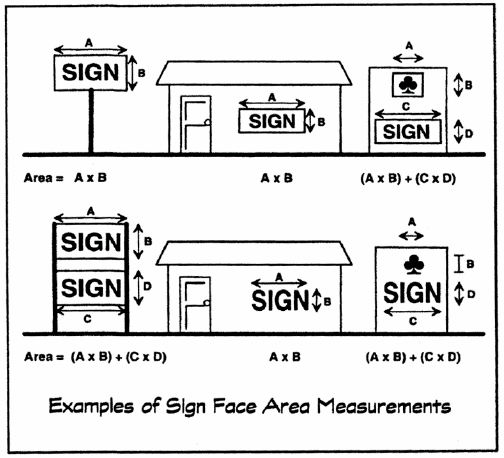
Figure 7.1. Examples of Sign Face Area Measurements
(1)
Projecting signs shall not project more than three feet beyond the face of the building. Projecting signs shall provide a minimum of eight feet of clearance from ground level to the bottom of the sign.
(2)
Under-canopy signs of greater than four square feet shall be rigidly mounted, and there shall be eight feet of clearance below the base of any rigidly mounted under-canopy sign. There shall be a minimum clearance of seven feet below the base of any non-rigidly mounted under-canopy sign.
(3)
Awning, mansard and marquee signs shall be no less than eight feet above the ground when erected over pedestrian walkways at the lowest extremity of the sign.
(e)
Visibility clearance area.
(1)
No portion of a sign face, and no portion of a sign structure wider than 12 inches, between the heights of 2½ feet and 12 feet shall be located within 20 feet of the intersection of the right-of-way lines of streets, roads, highways or railroads, or within 20 feet of the intersection of a street right-of-way and either edge of a driveway.
(2)
No sign shall be erected or maintained where, by reason of its position, wording, illumination, size, shape or color, it may obstruct the view of oncoming vehicles or impair, obscure, interfere with the view of, or be confused with any authorized traffic control sign, signal or device.
(Ord. of 10-13-2020)
Sec. 89-786. - Measurement of sign area and height.
(a)
Computation of sign area. In order to determine compliance with the maximum allowable sign areas permitted under this article, the following shall establish how sign areas are measured. The terms "sign area" and "sign face area" are interchangeable and have the same meaning for the purpose of regulating maximum sign sizes.
(1)
Sign face area.
a.
The area of a sign face shall be computed as the area within the smallest rectangle enclosing the limits of a sign face, or the combination of the areas of all such rectangles delimiting each sign module, together with any frame or material, texture, or color forming an integral part of the sign face or used to differentiate the sign face from the structure upon which it is placed.
b.
For signs that have no identifiable frame or border, the smallest rectangle that includes all of the sign's words, letters, figures, symbols, logos, fixtures, colors, or other design elements intended to convey the sign's message shall establish the area of the sign's face.
c.
For signs applied to a kiosk or other cylindrical sign structure, the area of the sign face shall be computed as the largest rectangular area achieved from any one view of the sign. Measurements shall be made as a flat plane rectangle projected on the sign.
d.
The computation of the area of a sign face shall not include the structure, supports, or uprights on which the sign face is placed or any portions of a sign structure that are not intended to contain any message or idea and are purely structural or decorative in nature, other than those portions contained within the rectangle that delimits the sign face or a sign module.
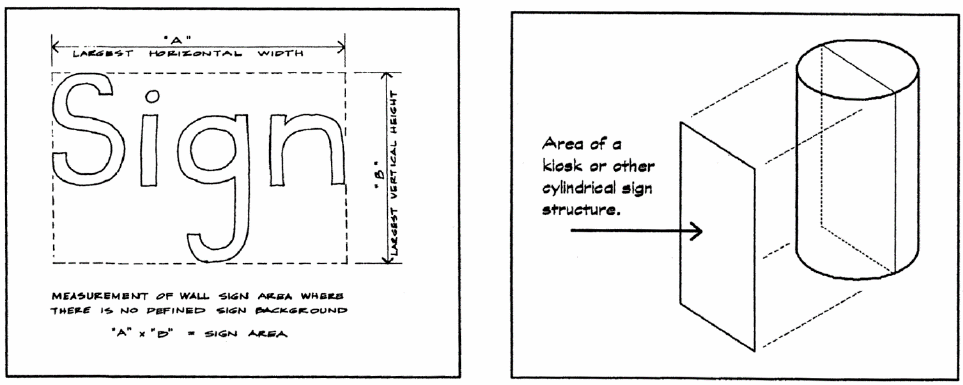
Figure 7.2. Sign Face Area Calculations
e.
Manual changeable copy signs. For any sign on which any of the words, letters, figures, symbols, logos, fixtures, colors, or other design elements are routinely changed or are intended to be changed from time to time the sign face area shall include the entire area within which any words, letters, figures, symbols, logos, fixtures, colors, or other design elements may be placed, together with any frame or material, texture, or color forming an integral part of the sign face or used to differentiate the sign face from the structure upon which it is placed.
(2)
Sign structure area.
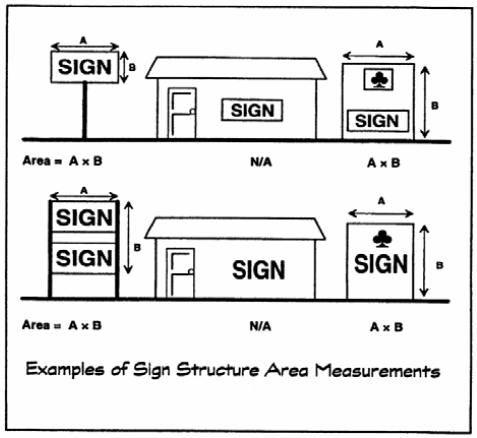
Figure 7.3. Examples of Sign Structure Area Measurements (2)
a.
The area of a sign structure shall be computed as the area within the smallest rectangle enclosing the limits of the surface of a sign whereon the sign face or sign modules may be placed, including all portions of a sign structure that provide a background for the sign face but are not intended to contain any message or idea and are purely structural or decorative in nature.
b.
For a kiosk or other cylindrical sign structure, the area of the sign structure shall be the largest measurement achieved from any view of the sign structure. Measurements shall be made as a flat plane rectangle projected on or bisecting the sign structure.
c.
Project entrance signs. For project entrance signs or other signs that are imposed, mounted or painted on a wall or other decorative structure, the sign structure area shall be computed as that portion of such wall or other decorative structure that is discernibly devoted to the support of the sign or, by its design or architectural treatment, intended to provide a background or frame for the sign.
(3)
Treatment of open spaces. Any open space contained within the limits of the rectangle delimiting the sign face, sign module, or sign structure shall be included in the computation of the area of such sign face, sign module, or sign structure.
(4)
Multi-faced signs.
a.
Double-faced signs. For double-faced signs, when the sign face surfaces are parallel (back-to-back), or where the smallest angle formed between the two faces is 60 degrees or less, the area of the sign shall be taken as the area on the largest side. For double-faced signs where the interior angle formed by the faces is more than 60 degrees, the area of the sign shall be the total area of all sides.
b.
Signs with three or more faces. For sign structures having only three faces and the interior angle formed between all of the faces is 60 degrees, the area of the sign shall be taken as the area on the largest side. For all other multi-faced signs with three or more sides, the area of the sign shall be the largest total of all faces that are joined by an interior angle of more than 60 degrees that can be viewed from any one direction.
(b)
Measurement of sign height. The height of a sign shall be equal to the vertical distance from the average grade at the base of the sign, or from the crown of the roadway of the nearest street within 50 feet of any portion of the sign, to the highest point of any portion of the sign, whichever results in the greater sign height. Any earthen berm or elevated foundation constructed to support a sign, its signposts or other sign supports, shall be included in the height of the sign.
(Ord. of 10-13-2020)
Sec. 89-787. - Electronic changeable copy signs.
Electronic changeable copy signs (previously referred to as automatic changeable copy signs, as defined in this Development Code, regardless of the technology employed, must conform to the following standards:
(a)
Electronic changeable copy signs are permitted only on commercial and industrial properties.
(b)
All electronic changeable copy signs viewable from a public street or sidewalk shall present only static displays (still pictures and printing). Such signs not viewable from a public street or sidewalk may display movies, animation or video containing motion.
(c)
Each static image shall be maintained for a duration of at least eight seconds. The change time between each static image shall be perceived as Instantaneous within the capability of the technology employed (generally about 1/10th of a second).
(d)
For signs viewable from a public street or sidewalk, no flashing, scrolling, or other variation in the static image that gives an illusion of movement or variation in light intensity during the display of a single image is allowed.
(e)
LED signs. In addition to all other requirements of this Section Article, LED signs (as defined in this Development Code must comply with the following:
(1)
All such signs shall be "tri-color" signs or better, in which each pixel consists of a group of at least one red, green and blue LED or similar light emitting device.
(2)
Maximum distances between pixels shall be as follows:
a.
For building signs, no more than ten mm between pixels, measured center-to-center both horizontally and vertically.
b.
For freestanding signs (including billboards as defined in this Development Code), no more than 16 mm between pixels, measured center-to-center both horizontally and vertically.
(3)
All such signs shall be certified by a Nationally Recognized Testing Laboratory (NRTL) recognized by the US Occupational Safety & Health Administration (OSHA) in accordance with 29 C.F.R. 1910.7.
(4)
Maximum brightness:
a.
The sign must employ a light sensing device that adjusts the brightness as ambient light conditions change.
b.
The sign shall not operate at a brightness level of more than 0.30 foot candles above ambient light levels measured at 100 feet from the sign (150 feet for sign faces greater than 100 square feet in area), as certified under paragraph (f) below.
(5)
A fail safe device shall be installed that, in the event of a failure of the light sensing device, drops the brightness level to the lowest night-time level allowed, regardless of the time of day.
(f)
Other electronic changeable copy signs.
(1)
Electronic changeable copy signs utilizing TV-type displays (LCD or Plasma, for instance) must comply with the following in addition to all other applicable requirements of this Section and Article:
a.
Such signs shall be installed only as building signs.
b.
Such signs shall have a minimum resolution of 1080p (High Definition) or equivalent.
c.
At any time of the day or night, such signs shall not operate at a brightness level of more than 0.30 foot candles above ambient light levels measured at 100 feet from the sign (150 feet for sign faces greater than 100 square feet in area).
(2)
Electronic changeable copy signs utilizing incandescent bulbs are not allowed.
(g)
As part of an application for a sign permit, the sign owner must provide the county with a written statement from the installer that the sign will comply with the county's brightness requirements and all other requirements of this section, and shall certify to such compliance within 30 days after installation of the sign.
(h)
Operation of an electronic changeable copy sign in violation of any provision of this section, including overriding the sign's light-sensing or fail-safe devices, may result in the disconnection of the electrical power supply to the sign at the owner's expense, under the procedures of this Development Code.
(Ord. of 10-13-2020)
Sec. 89-788. - Permanent signs allowed by land use category.
The following Table 7.1 and Table 7.2 present the maximum number, size, height, and other restrictions relating to specific signage that are permitted by right in each land use category. Additional signage is permitted under section 89-789, section 89-790, section 89-791, section 89-792 and section 89-793 of this article.
(a)
Principal freestanding sign—One use on property. "Principal freestanding sign—One use on property" on Table 7.1 applies to a lot where there is only one use being made of the property, such as but not limited to one single-family or two-family dwelling, one multi-family development, or one business occupant. A predominantly agricultural property, with or without a residence on the property, is considered a single agricultural use. Properties that are vacant but zoned for a particular land use also fall under this category (see section 89-783(a) for specific definitions of land use categories).
(b)
Principal freestanding sign—Planned center. "Principal freestanding sign—Planned center" on Table 7.1 applies to a single commercial or industrial property that is designed or intended for occupancy by two or more principal businesses that are separately-owned and have no corporate relationship. A planned center may consist of several businesses in a single building or individual businesses in several buildings on the same lot. In contrast, see "shopping centers" under section 89-789 and "office parks" under section 89-790, below.
(c)
Building signs. For building signs permitted on Table 7.2, the following shall apply:
(1)
For a single-occupant building, the maximum allowed area for a building sign on a wall shall be calculated on the basis of the length of said wall (or as a percentage of the wall area), including all windows and doors, as shown on Table 7.2.
(2)
For multi-tenant buildings, the maximum allowed area for each building sign for each tenant shall be calculated on the basis of the length of the wall (or as a percentage of the wall area), including all windows and doors, of that portion of the structure occupied by the tenant.
(3)
No wall sign, projecting sign, canopy sign or other building sign shall be located so that any part of the sign or its support extends above the top of the wall or canopy and no sign copy shall be located within five inches of the top of the sign.
(4)
Under canopy signs shall extend perpendicular to the wall and shall be attached at a uniform height.
(5)
Projecting and under-canopy signs shall be limited to no more than one per tenant on a property, and each tenant shall have no more than one projecting sign or under-canopy sign, for each street that the tenant faces.
(6)
In no case shall a window sign obscure more than 25 percent of a window. Any neon window sign that is allowed shall be constant in its light emission, shall not be animated and shall not be so large or of a character to obscure vision into the premises from the outside.
(d)
Planned developments. For signs in a mixed use master planned development, traditional neighborhood development, or senior housing development, each property or individual development within the planned development shall conform to the sign regulations established as part of the zoning approval for the development. If no such regulations exist, each property or individual development within a master planned development shall conform to the provisions of this article in accordance with the land use category of said property or individual development.
Table 7.1: Permitted Freestanding Signs by Land Use Category
* See also provisions relating to a shopping center or office park under section 89-790 or section 89-0791,respectively
** (a) Whichever is greater, except as otherwise provided for a shopping center or office park under section 89-790 or section 89-791, respectively.
(b) In a planned center, the area of a sign may be increased for the primary tenant and for up to two other tenants, provided that the total sign area for all tenants collectively does not exceed one square foot per lineal foot of total wall length.
Table 7.2: Permitted Building Signage by Land Use Category
* In a shopping center, the permitted window sign may be a neon sign, provided such sign does not exceed a maximum of 15 percent of the total window area or one square foot of sign area for each one foot of wall length of the premises, whichever is the lesser.
(Ord. of 10-13-2020)
Sec. 89-789. - Shopping centers.
(a)
Freestanding signs in shopping centers.
(1)
Principal freestanding signs are permitted in shopping centers in lieu of the restrictions on planned centers shown on Table 7.1, in accordance with the provisions of this section.
(2)
The maximum number of principal freestanding signs permitted in a shopping center is as follows:
Table 7.3. Number of Principal Freestanding Signs Allowed in a Shopping Center
* One additional sign is allowed if a multi-screen cinema complex is located in the shopping center. See section 89-781(a).
a.
A freestanding sign meeting the specifications of this section is permitted for each out-parcel developed as an integral part of the shopping center.
b.
Each freestanding sign in a shopping center shall identify the street number of the shopping center. The identification of the street number shall not be included within the square footage allotted for the copy area of the freestanding sign. Such numbers shall be a minimum of eight inches in height or such greater size as to be readable from the public street which affords the principal means of access to the shopping center. Street numbers shall be illuminated so as to be legible, readable and visible at night from the street, which affords the principal means of access to the shopping center. The street numbers shall be situated on the sign so as to be unobstructed by landscaping or other objects.
c.
A changeable copy board as defined in this article shall not be permitted on a shopping center freestanding sign, except in conformance with section 89-785(e).
d.
No shopping center freestanding sign shall be located within 20 feet of the public right-of-way of the street which affords the principal means of access to the shopping center. The sight distance of such sign shall conform to AASHTO standards, and evidence of such conformity shall be provided to the director of public works.
e.
The height of a freestanding sign shall not exceed 20 feet.
f.
The width of the sign face or its support shall not exceed the width of the freestanding sign structure.
(3)
The permitted area for each freestanding sign within a shopping center is as follows:
Table 7.4. Maximum Area of a Principal Freestanding Sign
in a Shopping Center
* The copy area of a freestanding sign shall not include the shopping center identification and the street number.
(4)
The owner or developer of a shopping center that exceeds 150,000 square feet may elect to forego one or more freestanding signs otherwise permitted under subsection 89-789(a)(2). For each sign that is foregone, the owner or developer may elect to increase the sign face area of one remaining sign up to 100 percent of the square footage that is otherwise permitted under subsection 89-789(a)(3). If there is more than one remaining sign, this percentage may be allocated among the remaining signs. In no event shall the sign face area of any remaining sign be increased by more than 100 percent. By way of illustration, if an owner of a shopping center exceeding 200,000 square feet elects to forego one of the four permitted signs, he might elect to increase the sign face area of one of the remaining signs by 100 percent, or he might elect to increase the sign face area of one remaining sign by 50 percent and the two other signs by 25 percent each, etc.
(b)
Canopy and wall signs in shopping centers. All building signs in a shopping center are allowed in accordance with the provisions of section 89-788(c).
(c)
Rear entrance signs.
(1)
Rear entrance signs shall be required for each tenant within the shopping center for the purpose of identifying each tenant for county emergency service vehicles. The developer or owner of the shopping center shall be responsible to the county for proper rear entrance signage of tenants, including proper maintenance.
(2)
Rear entrance identification signs shall be located on the tenant's rear door.
(3)
The area of rear entrance identification signs shall not be less than 18 inches wide and 12 inches high, and the copy shall include the name of the shop and the street number. Lettering and numbering shall be at least two inches in height and shall be Helvetica medium style or an equivalent typeface.
(Ord. of 10-13-2020)
Sec. 89-790. - Office parks.
(a)
Office park principal freestanding signs.
(1)
Principal freestanding signs are permitted in office parks in lieu of the restrictions on planned centers shown on Table 7.1, in accordance with the provisions of this section.
(2)
One principal freestanding sign in an office park is permitted for each street frontage.
(3)
A changeable copy board shall not be allowed on a principal freestanding sign in an office park.
(4)
No principal freestanding sign in an office park shall be located within 20 feet of a public right-of-way.
(5)
The height of an office park identification shall not exceed 30 feet.
(6)
The area of a principal freestanding sign in an office park shall be as follows:
Table 7.5: Maximum Area of a Principal Freestanding Sign in an Office Park
(b)
Building signs in an office park. All building signs in an office park are allowed in accordance with the provisions of section 89-789(c).
(c)
Rear, secondary or delivery entrance signs. Rear secondary or delivery entrance signs shall be required at locations within an office park in proximity to the means of access to the rear, secondary or delivery areas of building within the office park so as to identify such entrances for public safety purposes. All such signs shall be either freestanding signs not exceeding ten feet in height or shall be wall signage, which shall be included within the total area allowed for building signage shown on Table 7.2.
(Ord. of 10-13-2020)
Sec. 89-791. - Billboards.
(a)
Billboard; defined. A billboard is a freestanding sign that exceeds the sign area limitations established or otherwise approved for principal freestanding signs under section 89-788 of this article, and is not a principal freestanding sign authorized for a "shopping center" under section 89-789 or for an "office park" under section 89-790.
(b)
Maximum number of billboards.
(1)
The commission has considered the need for commercial and non-commercial speech through the medium of signs, in the unincorporated portions of the county. These interests must be weighed against the aesthetic and safety concerns that have been enumerated elsewhere in this article. After thorough consideration of these countervailing interests, the commission has developed the following regulations regarding the total number and structure of signs in the unincorporated portions of the county:
a.
A total of 25 signs that are otherwise in conformance with the regulations found in this article shall be allowed in accordance with section 89-891(c), in the unincorporated portions of the county.
b.
As a result of this section, once the number of signs within the unincorporated portions of the county reaches 25, no more permits for signs shall be issued.
(2)
Removal and replacement.
a.
The commission is aware that as the use of land changes, whether through condemnation, development, or redevelopment, certain billboard signs may need to be replaced or removed from the location where they were originally built. Whenever a billboard is removed, the owner of such removed sign shall be allowed to erect and operate a billboard at a permissible location as allowed by this section, if the owner makes application for such a permit within 12 months of the removal date. If the owner of a removed sign does not make application for another permit within 12 months, then other applications may be accepted for consideration by the building official.
b.
Billboards that are not located at a permissible location as allowed by this section may not be replaced at the same location.
(c)
Billboards; where allowed.
(1)
A billboard shall only be allowed individually as a principal use on a property where no other principal use is located.
(2)
The billboard must be located on a property that meets the following criteria:
a.
The property must be zoned for commercial or industrial use.
b.
The property must have at least 200 feet of frontage on Georgia Highway 316.
(3)
The billboard must be placed within 660 feet of Georgia Highway 316.
(d)
Restrictions on billboards.
(1)
Distance requirements.
a.
Each billboard shall be located not less than 1,000 feet from any other billboard and not less than 100 feet from a residential or agricultural zoning district.
b.
No sign shall be located less than 1,000 feet from a national park, state park, local monument or church.
c.
Distance measurement shall be made horizontally in all directions from the nearest edge of the sign face.
(2)
Size of signs. Signs shall not exceed 90 feet in height nor be less than 15 feet above ground level. Sign faces shall not exceed 672 square feet or 48 feet in length, width, or height.
(3)
Sign faces. No more than one single-faced or double-faced sign can be located on a single billboard sign structure. Only one sign module is allowed on a single-faced billboard sign structure, and only two sign modules are allowed on a double-faced billboard sign structure. The two sign modules forming a double-faced billboard must be parallel (back-to-back) to one another or form an interior angle no greater than 60 degrees, and the two sign modules may be separated from each other at their nearest point by no more than three feet.
(4)
Sign orientation. Only one sign shall be allowed to face the same direction per location. This allows back-to-back or "V" formation signs but prohibits two signs (side by side or one above the other) facing the same direction.
(5)
Angle of the roadway. Billboards shall be placed at no more than a 20-degree angle from the roadway.
(6)
Location on property. All portions of the billboard must be located on a property in accordance with the front, side and rear yard setback requirements of the zoning district in which it is located.
(7)
D.O.T. regulations. The billboard must comply with all requirements of the State of Georgia and the Georgia Outdoor Advertising Act (O.C.G.A. § 32-6-70 et seq.), as well as the provisions of this section, whichever are the most restrictive.
(8)
Abandonment requirements. The owner shall not allow the billboard to be "abandoned" for greater than 60 days. If the billboard does not have a functioning purpose by the expiration of the 60-day time limit, the sign owner shall provide a public service announcement free of charge to the county.
(9)
Illumination of signs.
a.
The light from any illuminated sign shall not be of an intensity or brightness, which will interfere with the peace, comfort, convenience, and general welfare of residents or occupants of adjacent properties.
b.
No color lights shall be used at any location or in any manner so as to be confused with or construed as traffic control devices.
c.
Neither direct, nor reflected light from primary light sources shall create a hazard to operators of motor vehicles.
(Ord. of 10-13-2020)
Sec. 89-792. - Other permanent signage allowed.
(a)
Miscellaneous freestanding signs. Freestanding signs in addition to those shown on Table 7.1 are allowed as accessory uses on a property occupied by any multi-family, commercial, industrial, or institutional use if each sign complies with all of the following:
(1)
Within the area between a street and the minimum front yard setback for principal buildings required for the zoning district, additional signs may be located within three feet of driveways that provide access into or from the property.
a.
There shall be no more than two such signs per driveway and each such sign shall not exceed 17½ square feet in sign area nor be more than 2½ feet in height.
b.
Entrance/exit signs may be supported by poles or columns, but in a shopping center or office park development the poles or columns must be covered with a skirt or solid base constructed of the same material and having the same color as the exterior of the shopping center structure.
c.
No entrance/exit signs shall be located within five feet of the public right-of-way of any street.
d.
Up to four signs may be part of the same sign structure, but all signs on a structure shall be of the same dimensions and shall be attached to each other.
(2)
Miscellaneous freestanding signs located farther from the street than the minimum required front yard setback shall be allowed as follows:
a.
One miscellaneous sign not to exceed 48 square feet in area nor more than eight feet in height may be located on the property for each principal building on the lot.
b.
Other miscellaneous freestanding signs are allowed beyond the minimum front yard setback on a property developed for multi-family, commercial, industrial, or public or community use, provided that such signs shall have no more than four square feet in sign face area nor more than three feet in height (except signs that are required by law to be higher than three feet high, such as those marking a handicapped parking space).
(b)
Recreational facility signs.
(1)
Recreational facility signs shall be those signs erected on walls, fences, dugouts, press boxes, stadium stands, concession stands, ticket booths, benches and locker rooms at a public or private recreational facility.
(2)
Such signs shall be allowed on any public or private property where the aforementioned recreational facility is permitted and located.
(3)
Such individual signs shall not exceed eight feet in height and 32 square feet in area and must face inward to the recreational activity area.
(4)
There shall be no limit on the number of signs per site provided that such sign faces are not visible from neighboring residential property or public rights-of-way.
(c)
Flags. Any cloth, paper, thin plastic, or similar material that is displayed by hanging or flying, is allowed as an accessory use on any property that is used in any land use category if it complies with all of the following:
(1)
No more than three flags may be displayed on a lot occupied by an agricultural use, a single-family or two-family residential use, or a multi-family residential use. No single flag shall be larger than 24 square feet in size, and the total area for all flags collectively shall not exceed 45 square feet.
(2)
No more than three flags may be displayed on a lot occupied by a commercial, industrial or an institutional use, no single flag shall be larger than 40 square feet in size, and the total area for all flags collectively shall not exceed 72 square feet.
(3)
Flags shall not be located on flagpoles that exceed the building height limitation of the zoning district for the property where the flag is displayed.
(Ord. of 10-13-2020)
Sec. 89-793. - Standard informational signs.
(a)
The maximum aggregate sign face area for all standard informational signs shall be 18 square feet for each parcel and/or development.
(b)
Notwithstanding the maximum aggregate sign face area described in subparagraph (a) above, in addition to the standard informational signage allowed pursuant to this article, from the date of qualification of a candidate for a political election or a referendum question until the date of final determination on each ballot issue and candidate (the "election period"), each parcel and/or development may display an unlimited number of additional standard informational signs, provided that the sign face area of any additional standard informational sign erected during the election period pursuant to this subparagraph (b) shall not exceed six square feet.
(Ord. of 10-13-2020)
Sec. 89-794. - Temporary signs.
(a)
Temporary signs; allowed.
(1)
Certain signs are allowed through the issuance of a temporary sign permit. Such temporary signs shall not be restricted as to the message displayed on the sign but must comply with the provisions of this Section.
(2)
Temporary signs must comply with all requirements of this article, including the prohibitions of section 89-785 and general requirements applying to all signs, except as modified by the provisions of this section.
(3)
Fixed location: All temporary signs must be installed at a fixed location, either attached to the ground as a freestanding sign or attached to a building. Temporary signs shall not be attached to a vehicle or other movable, animated or portable device, or attached to, held by or displayed upon a person.
(b)
Issuance of a temporary sign permit.
(1)
A temporary sign may not be displayed unless a permit is issued pursuant to section 89-796 unless otherwise exempt under this article.
(2)
A temporary sign permit shall only be valid for a period of 30 days from the date of issuance, after which time the owner of the temporary sign or owner of the premises where such sign is located shall remove the sign from the premises.
(3)
No more than one temporary sign permit may be issued to the same premises per quarter, not to exceed four temporary sign permits per one calendar year.
(c)
Size of temporary signs. Temporary signs are restricted to the following sign areas and sign heights:
(1)
Single-family residential, townhouse condominium or manufactured home lot: Temporary signs located on such subdivided lots shall not exceed six square feet in sign face area and five feet in height.
(2)
Residential or nonresidential subdivision or condominium development under construction: Signage within a residential or nonresidential subdivision or condominium development under construction shall not exceed 32 square feet in sign face area and eight feet in height.
(3)
Multi-family, manufactured home park or nonresidential use property (as defined in this article).
(4)
Temporary signs located on a multi-family, manufactured home park, or nonresidential use property shall not exceed 32 square feet in total sign face area and eight feet in height per sign.
(d)
Location of temporary signs.
(1)
All temporary signs shall be located as follows:
a.
At least ten feet from any street right-of-way line, back of street curb or edge of street pavement, whichever is farthest from the street.
b.
At least ten feet from any side or rear property line and the pavement edge of a driveway.
c.
Temporary signs located within 30 feet of an intersection of two streets or a driveway and a street shall be no more than 3 feet in height.
(2)
Temporary signs are not allowed to be placed within or over a public street right-of-way or private street easement.
(3)
A temporary sign must be a freestanding sign or a building sign (as defined in this Article), and shall not be affixed to any tree, utility pole or official traffic sign or structure.
A temporary sign shall be erected and maintained only with the permission of the owner of the property upon which the sign is located.
(e)
Construction and lighting standards of temporary signs.
(1)
Construction standards for signs requiring building permits. A temporary sign for which issuance of a building permit is required by the Building Code shall meet the same engineering design and materials standards as for permanent signs as required by the Building Code.
(2)
Construction standards for signs not requiring building permits.
a.
Nonpermanent but water-resistant construction materials may be used, such as but not limited to poster board, foam core board or illustration board.
b.
The words, letters, figures, symbols, logos, fixtures, colors or other design elements that convey the sign's message shall be permanently applied to the sign's face.
(3)
Electronic and manual changeable copy signs shall not be allowed.
(f)
Lighting.
(1)
Temporary signs shall not be illuminated.
(Ord. of 10-13-2020)
Sec. 89-795. - Sign permits.
(a)
Sign permits; when required. In addition to a building permit as may be required under the Building Code, a sign permit shall be obtained from the building official prior to installation, relocation, expansion, construction or structural alteration of any sign regulated under this article, except for those signs specifically exempted under 89-795(b), below.
(b)
Sign permits; exemptions. The following do not require issuance of a sign permit. These exemptions apply only to the requirement of a permit and do not relieve the owner of the sign from compliance with all other requirements of this article for the particular sign.
(1)
A sign permit will not be required under the following conditions:
a.
Replacing or altering the words, letters, figures, symbols, logos, fixtures, colors, or other design elements that compose a sign's message, in whole or in part, shall not require a sign permit unless a structural change is made.
b.
Painting, repairing, cleaning, or maintaining a sign shall not require a sign permit unless a structural change is made.
(2)
A sign permit will not be required for the following listed signs:
a.
Any sign that is otherwise exempt from regulation under 89-784(b) of this article.
b.
A principal freestanding sign as provided in section 89-788(a).
c.
A temporary standard informational sign as provided in section 89-793.
(c)
Multi-tenant nonresidential projects.
(1)
A master sign plan is required for any multi-tenant nonresidential development, such as a planned center, shopping center or office park, before any signs for the development or the development's tenants may be placed on the property.
(2)
The master sign plan shall govern the placement and design of all signs within the development as to their location, number, materials, size, letter style, and color.
(3)
A master sign plan shall include the following:
a.
An itemized list and a keyed site plan at a suitable scale showing the location of all existing and proposed signs to be located on the property and all existing signs proposed to be removed.
b.
The master sign plan shall consist of such drawings and specifications as may be required to clearly illustrate the location, materials, size, letter style, and color of all and every sign to be placed as freestanding and building signs within the development.
c.
Master sign plans shall illustrate all proposed signs in sufficient detail so as to provide knowledgeable review and design specificity. Master sign plans shall show, describe or illustrate all signs proposed to be located on a lot and the buildings and structures therein, whether existing or new, and whether permitted by right or additional.
d.
Signs that are otherwise exempt under this article need not be shown on the master sign plan.
(4)
Process for approval of master sign plan. The master sign plan is to be submitted to the building official. The master sign plan shall be approved upon a finding by the building official that:
a.
The planning and community development director has determined that the plan adequately provides that signs of a similar type and function within the development have a consistency of size, lettering style, color scheme, and construction materials so as to present a unified design concept while respecting the differences between tenant types and occupancies; and
b.
The building official has determined that the signs proposed in the master sign plan comply with the requirements of this article in all respects, or a special exception shall have been approved pursuant to section 89-795.
(5)
The requirements of the approved master sign plan shall be recorded by the owner in the office of the clerk to the superior court prior to issuance of a certificate of occupancy or connection to permanent power for the development, and shall be included in any sale, lease, or other transfer of right of occupancy affecting any part of the development.
(6)
All tenants of the development, whether an owner, lessee, subtenant, purchaser, or other occupant, shall comply with the approved master sign plan.
(d)
Permits. Applications for sign permits shall be made available by the building official. The building official is hereby authorized to produce an application form, the form and other requirements for which may be updated whenever the director deems it necessary. Any applicant for a sign permit shall provide the following information:
(1)
The street address of the property upon which the subject sign is to be located and the proposed location of subject sign on subject property. In the absence of a street address, a method of location acceptable to the inspector shall be used.
(2)
The name(s) and address(es) of the owner(s) of the real property upon which the subject sign is to be located.
(3)
Written consent of the owner or his agent, granting permission for the placement of maintenance of subject sign.
(4)
The value of the sign.
(5)
The square foot area and height of each sign.
(6)
The building official may require a sketch or print drawn to scale showing the pertinent information such as wind pressure requirements and display materials in according with the county building code. The building official may require additional information on such print or sketch to insure compliance with this article.
a.
The sketch shall set forth the location of the sign, the size of the sign, the wind pressure the sign can withstand, and the distance of the sign from the road.
b.
The sign shall be required to be certified to withstand winds of at least 70—75 miles per hour of wind pressure before a permit will be issued.
(7)
Name, address, telephone number and business license number of the sign contractor, if applicable.
(8)
For temporary signs, the application shall include:
a.
A list of the temporary signs to be placed on the property.
b.
A description of the temporary signs to be placed on the property.
c.
For flags, banners, streamers and other festoons, written and graphic evidence of compliance with all requirements of this Article.
(9)
The application fee, as may be established by the board of commissioners from time to time.
(e)
Approval of sign permit.
(1)
Once a complete application for a sign permit has been received, the director shall act to grant or deny each application for a sign permit within ten business days. All complete applications for signs, which are certified to be constructed in conformance with this article, shall be granted.
(2)
If the director fails to act on a complete application within ten days of receipt, it shall be deemed approved, subject to the requirements and provisions of this article.
(f)
Expiration date. A sign permit shall become null and void if the sign for which the permit was issued has not been completed within six months after the date of issuance.
(g)
Labels required on signs. With each permit the building official shall issue a sticker bearing the same number as the permit with which it is issued. It shall be the duty of the permittee or his agent to affix such sticker to the sign in the lower right hand area so it will be easily seen. The absence of a proper sticker shall be prima facie evidence that the same has been done or is being erected or operated in violation of the provisions of this article.
(h)
Nonconforming signs.
(1)
Any sign that was in existence at the time of the effective date of this Development Code and was legal pursuant to the county's previous sign regulations at the time it was built, shall be regulated under the provisions of the general article of this Development Code relating to nonconforming signs. The structure, dimensions, and location of any such sign shall not be changed without first complying with this article.
(2)
No conforming sign shall be erected on the same parcel of land as an existing nonconforming sign until the nonconforming sign has been removed or made to conform to the provisions of the article.
(i)
Maintenance. All signs must be maintained in a state of good repair. When the director or other authorized county official believes that a sign is dangerous or is otherwise in a state of disrepair they shall contact the owner of the sign in writing and request that the problem be repaired or corrected. If the owner has not appealed the official's determination to the board of appeals or corrected the problem(s) within ten days of the date of the written notice, the county shall arrange for removal of any such sign and bill the owner for all costs of such removal, in accordance with the administration and enforcement article of this Development Code relating to the removal of illegal signs.
(j)
Bond, public liability insurance required. It shall be unlawful for any person to engage in the business of erecting or maintaining signs within the county unless and until such entity has obtained a county business license and certificate of insurance from an insurance company authorized to do business in the state evidencing that the entity has in effect public liability and property damage insurance in the sum of $25,000.00 for property damage for any one claim and public liability insurance in the amount not less than $100,000.00 for injuries, including accidental death to one person. The certificate of insurance shall state that the insurance carrier will notify the county 30 days in advance of any termination and/or restriction of the coverage.
(Ord. of 10-13-2020)
Sec. 89-796. - Appeals.
(a)
Denial of permit. If an applicant for a sign permit has been denied a permit by the building official, the applicant may appeal this decision by filing a written request with the planning and community development director under the provisions of the appeals article of this Development Code. Such appeal will be heard by the board of appeals at the earliest appropriate meeting, but in no case more than 60 days after the date of the filing of the written request for appeal.
(b)
Modifications to sign restrictions. The restrictions placed on signs by this article, including the number, size, height, illumination and location on a property or relative to other signs, may be modified as a special exception variance granted under the procedures of the appeals article of this Development Code.
(1)
Signs that are prohibited under this article may not be approved as a special exception variance.
(2)
Master sign plan required. In addition to the requirements and standards for a special exception variance in the appeals article, a request for approval of a special exception variance related to signs must be supported by a master sign plan that meets the requirements of subsection 89-795(c)(3).
(3)
Upon approval, the master sign plan shall supersede any conflicting restrictions and regulations of this article for the property to which it pertains.
(Ord. of 10-13-2020)

