
Bartlesville City Zoning Code
SECTION 13
DEFINITIONS
Unless the context otherwise requires, the following definitions shall be used in the interpretation and construction of these regulations and words used in the present tense include the future; the singular number include the plural, and the plural the singular; the word "building" includes the word "structure," the word "used" includes arranged, designed, constructed, altered, converted, rented, leased or intended to be used, and the word "shall" is mandatory and not directory.
Abutting. For public notification purposes the term abutting shall be defined as any property or parcel of land touching the property line of the property in question; and, any property or parcel of land across a street, road, highway or alley right-of-way not exceeding 120 feet in width from the property in question. Property across the street, road, highway or alley shall be determined by the prolongation of the side lot lines of the property in question and be defined as being the area included within the prolongation of the side lot lines and properties touching those prolongated lot lines.
Accessory or Accessory Use. A use which is clearly incidental to, customarily found in connection with, and (except in the case of off-street parking spaces) located on the same zoning lot as, the principal use to which it is related.
Accessory Dwelling Unit. A small self-contained residential unit located on the same lot of a single-family residence which is occupied by the property owner (the primary residential unit) for which no rent or other form of compensation is paid. Also referred to as a guest house or in-law apartment. (See Section 8.4.3)
Agent of Owner. Any person who can show certified written proof that he is acting for the property owner.
Alley. A public or private way not more than 30 feet wide affording only secondary means of access to abutting property.
Automobile Wrecking. The dismantling or disassembling of used motor vehicles or trailers, or the storage, sale, or dumping of dismantled, partially dismantled, obsolete, or wrecked vehicles or their parts.
Basement. A story whose floor is more than 12 inches, but not more than half of its story height below the average level of the adjoining ground (as distinguished from a "cellar" which is a story more than one-half below such level). A basement, when used as a dwelling, shall be counted as a story for purposes of height measurement, and as a half story for purposes of side yard determination.
Billboard. See "Sign, Advertising."
Board of Adjustment, or Board (BOA). The Board of Adjustment of the City of Bartlesville and/or the Board of Adjustment of Washington County: an appointed administrative body clothed with quasi-judicial powers derived from Oklahoma State Statute.
Board of County Commissioners. The Board of Commissioners of Washington County; the legislative branch of the county government.
Boarding or Lodging Home. A dwelling or part thereof where meals and/or lodging are provided for compensation for two or more persons not transients.
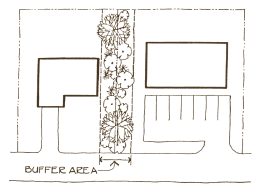
Buffer Area or Strip. Open spaces, landscaped areas, fences, walls, berms, or any combination thereof used to physically separate or screen one use or property from another so as to visually shield or block noise, lights, or other nuisances.
Building. Any structure having a roof supported by columns or walls, used or intended to be used for the shelter or enclosure of persons, animals or property. When such a structure is divided into separate parts by one or more un-pierced walls extending from the ground up, each part is deemed a separate building, except as regards minimum side yard requirements as herein provided.
Building Envelope. A three-dimensional space within which a structure is permitted to be built on a lot; it is defined by maximum building height regulations, minimum yard setbacks, and sky exposure plane regulations where applicable.
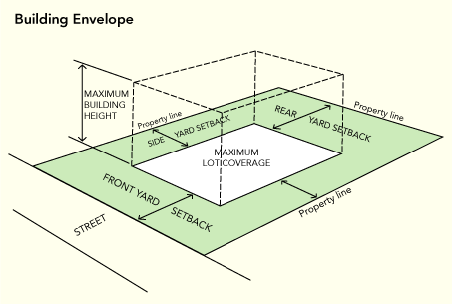
Building, Height of. The vertical distance from the average contact ground level at the front wall of the building to the highest point of the coping of a flat roof or to the deck line of a mansard roof, or to the mean height level between eaves and ridge of gable, hip or gambrel roofs. Chimneys, elevators, poles, spires, tanks, towers, and other projections (not including freestanding signs) not used for human occupancy may extend above the height limit.
Building Footprint. The area encompassed by a building's outer wall at ground level.
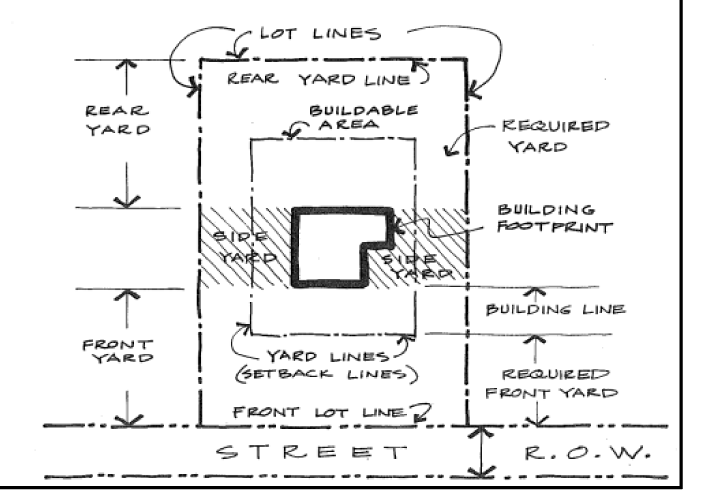
Building Line. A line parallel to the street right-of-way line or property line touching that part of a building closest to the street. A building line may be a setback line if a building is built up to a required setback line; however, a setback line is not always a building line. Where a building line lies behind a required setback line, requirements contained within this Code for required yard areas shall apply only to that portion of the lot lying between the property line and the required setback line.
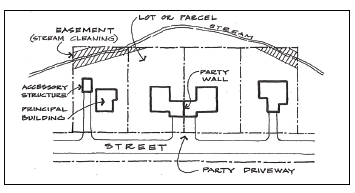
Building, Principal. A building in which is conducted the principal use of the building site on which it is situated. In any residential district any dwelling shall be deemed to be the principal building on the building site on which the same is located.
Building, Accessory. A subordinate building, located on the same parcel as the main building, the use of which is clearly incidental to the residential use of the parcel. Includes Accessory Dwelling Units (see Section 8.3.4).
Building Official. The Building Official of (a) the City of Bartlesville, and/or (b) Washington County.
Carport. A roofed structure providing space for the parking or storage of motor vehicles and enclosed on not more than three sides.
Cellar. A story the floor of which is more than one-half of its story height below the average contact ground level at the exterior walls of the building. A cellar shall be counted as a story, for the purpose of height regulations, only if used for dwelling purposes other than by a janitor or caretaker employed on the premises.
Child and Adult Care Facilities. As defined in Section 7.3.
City Attorney, City Engineer. The officials of the City of Bartlesville bearing these titles.
City Council. The City Council of the City of Bartlesville; the legislative branch of the city government.
Condominium. A building or group of buildings in which dwelling units, offices, or floors are owned individually and the structure, common areas, utilities, and facilities are owned by all the owners of a proportional, undivided basis with an association of owners organized for the purpose of maintaining, administering, and operating the common areas and facilities. The purchaser has title to his or her interior space in the buildings and an undivided interest in parts of the interior, the exterior, and other common elements, usually including the land underneath and surrounding the building, certain improvements on the land, and such items as plumbing, wiring, and major utility systems, the interior areas between walls, public interior spaces, exterior walls, parking areas, private roads, and recreational facilities.
County Attorney, County Engineer. The officials of Washington County bearing these titles.
Court. An open, unoccupied, and unobstructed space, other than a yard, on the same lot with a building or group of buildings.
Coverage, Lot or Site. The percentage of the lot or site area covered by the building or buildings on the lot.
Distance Between Structures. The shortest horizontal distance measured between the vertical walls of two structures as herein defined perpendicular to an axis, all points along which are midway between said walls.
Department Store. A store or group of shops under unified management selling a variety of merchandise groups, normally including clothing, appliances, hardware, furniture, etc.
District. A portion of the territory of the City of Bartlesville or Washington County within which certain uniform regulations and requirements or various combinations thereof apply under the provisions of these regulations.
District, Combined. Two or more districts grouped together and treated as a single district. For example, an R district or a residence district is a combined district consisting of the RA, RS, RM, and RT districts, and the RM district is a combined district consisting of the RM-3, RM-2, and RM-l districts.
District, Component. A district which, together with other component districts, forms a combined district.
Dwelling. Any building or portion thereof designed or used exclusively as the residence or sleeping place of one or more persons, but not including a tent, trailer, or mobile home.
Dwelling, Multi-Family. A building or portion thereof designed for or used by two or more families or housekeeping units located on the same zoning lot. This may include a duplex (two attached units), tri-plex (three attached units), four-plex or quadplex (four attached units), or a building(s) containing units that are located one over another such as a high-rise or mid-rise apartment building, or garden apartments.
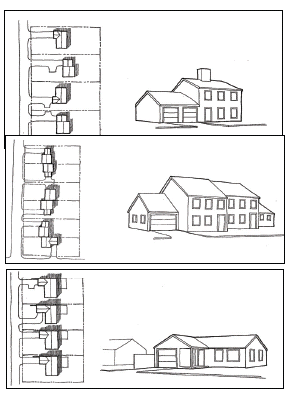
Dwelling, Single-Family. A building designed for or used exclusively for residence purposes by one family or housekeeping unit located on one zoning lot. This may include:
1)
a single-family detached dwelling unit: a building on one zoning lot not attached to any other dwelling by any means and surrounded by open space or yards,
2)
a single-family attached dwelling unit: a building attached to two or more single-family dwellings by common vertical walls without openings each located upon a separate zoning lot,
3)
a patio home: a dwelling on a separate zoning lot with open space setbacks on three sides,
4)
a town house: a single-family dwelling in a row of at least three such units in which each unit has its own front and rear access to the outside and its own zoning lot, where no unit is located over another unit, and each unit is separated from any other unit by one or more vertical common fire-resistant walls, or
5)
a condominium: a building or group of buildings in which dwelling units are owned individually and the structure, common areas, utilities, and facilities are owned by all the owners of a proportional, undivided basis.
Dwelling Unit. One room, or a suite of two or more rooms, designed for or used by one family for living and sleeping purposes and having only one kitchen or kitchenette.
Dwelling Group. A group of two or more detached dwellings located on a zoning lot and having any yard or court in common.
Family. A person living alone, or two or more persons related by blood, marriage or adoption, or a group of not more than four persons not related by blood or marriage, living together as a single housekeeping unit in a dwelling unit, as distinguished from a group occupying a boarding house, lodging house, motel, hotel, fraternity house, or sorority house. This definition includes the definition of Foster Family Home (as set forth in O.S.A. Title 10, Section 401, et al) which means a family home, other than the home of a parent, stepparent, grandparent, brother, sister, uncle or aunt, which provides full-time care for six or fewer children, including the foster parents' biological or adopted children. However, the total number of foster children placed in any home cannot exceed five.
Floor Area, Gross (GFA). The sum of the gross horizontal areas of all enclosed floors of a building, including cellars, basements, mezzanines, penthouses, corridors, and lobbies from the exterior face of exterior walls, or from the centerline of a common wall separating two buildings, but excluding any space with a floor-to-ceiling height of less than 6 feet 6 inches.
Floor Area, Net. The total of all floor areas of a building, excluding stairwells and elevator shafts, equipment rooms, interior vehicular parking or loading; and all floors below the first or ground floor, except when these are used or intended to be used for human habitation or service to the public. For ease of administration in calculating required off-street parking, net floor area may be defined as gross floor area minus 15 percent.
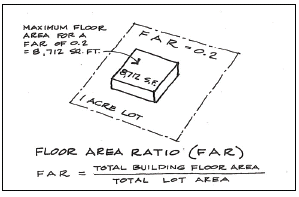
Floor Area Ratio. The numerical value obtained by dividing the gross floor area of all buildings and structures on a lot by the total lot area.
Free-Standing Mobile Home. Any mobile home not located in a mobile home park licensed by the Inspection Office in accordance with Section 7.5125.
Governing Body. The legislative branch of the government; the Board of County Commissioners is the governing body for Washington County; the City Council is the governing body for the City of Bartlesville.
Group Home for Children. As defined in Section 7.7.1(28).
Group Home for Handicapped. As defined in Section 7.7.1(27).
Home Occupation. As defined in Section 7.2.
Hotel. A building, or portion thereof, containing rooms occupied primarily by transients who are lodged with or without meals, in which provisions are not made for cooking in any individual apartment, and in which are provided such services as are incidental to the use thereof as a temporary residence.
Incinerator, Accessory. An incinerator, indoor or outdoor, for the burning of refuse produced on the premises, incidental to a use permitted on the premises.
Institution for Children and Aged. A 24-hour residential group care facility for: (1) thirteen or more unrelated children living together with adults other than their parent; (2) seven or more developmentally or disabled persons living together in a group care facility permitted by the State of Oklahoma; or (3) permanent living arrangement for six or more elderly persons (age 60 or older). Such institution shall provide living and sleeping facilities, meal preparation, laundry services and room cleaning, and may also provide other services such as transportation for routine social and medical appointments, and counseling.
Junk Yard. A place where waste, discarded, or salvaged materials are bought, sold, exchanged, baled, stored, packed, disassembled or handled, including auto wrecking yards, house wrecking yards, used lumber yards, and places for storage of salvaged house wrecking and structural steel materials and equipment; but not including such places where such uses are conducted entirely within a completely enclosed building, and not including pawn shops and establishments for the sale, purchase, or storage of used furniture and household equipment when conducted entirely within a completely enclosed building, sale of used cars in operating condition, or salvaged materials incidental to manufacturing operations.
Kennel. An establishment licensed to operate a facility housing dogs, cats or other household pets and where grooming, breeding, boarding, training or selling of animals is conducted as a business.
Live-Work Unit. A live-work unit is a building or space within a building used jointly for commercial and residential purposes where the residential use of the space is secondary or accessory to the primary use as a place of work. (See Section 7.7.1(30))
Lot. A zoning lot, as defined herein.
Lot Area. The total area within the lot lines of a lot, excluding any street rights-of-way.
Lot Area, Minimum. The smallest lot area established by the zoning code on which a use or structure may be located in a particular district.
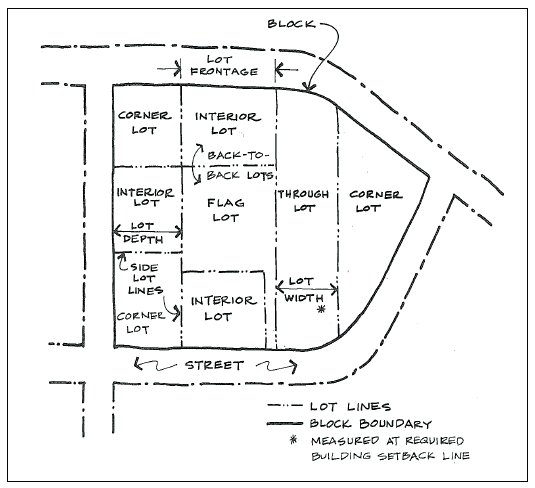
Lot, Through. An interior lot whose rear line abuts on a thoroughfare other than an alley. Also known as a double frontage lot.
Lot, Corner. A zoning lot abutting upon two or more streets at their intersection, or upon two parts of the same street, such streets or part of the same street, forming an angle of more than 45 degrees and of less than 135 degrees. The point of intersection of the street lines is the corner. Any portion of a corner lot which is more than 100 feet from the point of intersection of the two street lines or the two tangents of the same street shall be considered an interior lot.
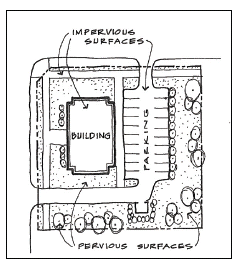
Lot Coverage. That part of the lot that is covered by impervious surfaces (a surface that has been compacted or covered with a layer of material so that it is highly resistant to infiltration by water).
Lot, Flag. A lot not meeting minimum frontage requirements and where access to the public road is by a private right-of-way or driveway.
Lot Depth. The mean horizontal distance between the front lot line and rear lot line of a zoning lot.
Lot, Interior. Any zoning lot which is not a corner lot.
Lot, Line. A boundary of a zoning lot.
Lot Line, Front. The street line at the front of a zoning lot. The owner, for the purpose of these regulations, may have the privilege of selecting any street lot line as the front lot line.
Lot Line, Rear. The lot line opposite and most distant from the front lot line.
Lot Line, Side. A lot line which is not a front lot line or rear lot line. A side lot line separating a zoning lot from a street other than an alley is an exterior side lot line.
Lot Width. The horizontal distance between the side lines of a lot measured at right angles to its depth along a straight line parallel to the front lot line at the minimum required building setback line.
Lot, Zoning. A piece, parcel, or tract of land which meets all of the following requirements at the date of adoption of these regulations, or amendment thereof:
A.
is located within a single block,
B.
has frontage on an improved and accepted public street which meets the standards of improvement specified by the City of Bartlesville and/or Washington County,
C.
is occupied or utilized or designated by its owner or developer to be occupied, developed, or utilized as a unit under single ownership or control for a principal use and uses accessory thereto, together with such open spaces as are required by these regulations.
A zoning lot may be subsequently divided into two or more zoning lots, provided each such new zoning lot complies fully with these regulations at the time of division. Conversely, a zoning lot may be two or more parcels, tracts, or lots combined under one ownership for the purposes of construction provided such zoning lot complies fully with these regulations and that such multiple parcels, tracts, or lots remain under one ownership. Therefore, a zoning lot may or may not coincide with a lot as shown on official tax maps or on any recorded subdivision or deed.
Metropolitan Area Planning Commission (MAPC). An advisory, consultative and coordinating agency, established to oversee the development and preserve the integrity of the Comprehensive Plan and Zoning Regulations.
Mobile Home, including manufactured home or factory-built home. A mobile home means a single-family dwelling that was fabricated in an off-site manufacturing facility, designed to be a permanent residence, for transportation on its own wheels or otherwise, and arriving at the site where it is to be occupied as a dwelling complete and ready for occupancy, except for minor and incidental unpacking and assembly operations, location on jacks or permanent foundations, connection to utilities, and similar operations. Unless otherwise indicated in the text of this regulation, the term "mobile home" shall refer to an "independent mobile home" which has a flush toilet and bath shower and is customarily connected to an external sewer treatment system.
For the purposes of these regulations, a mobile home shall also include any factory built manufactured, detached transportable structure that does not meet the International One and Two-Family Dwelling Code, but which is originally designed, constructed, and used for long-term occupancy as a complete single-family dwelling, and which is built on a permanent frame or base and is designed for use with or without a permanent foundation. This may include structures built prior to the enactment of the Federal Manufactured Home Construction and Safety Standards Act, or a structure which meets the Federal Manufactured Home Construction and Safety Standards Act, commonly known as the HUD Code.
Mobile Home Park. Any lot upon which are located one or more mobile homes, occupied for dwelling purposes, regardless of whether or not a charge is made for each accommodation; but excluding any lot upon which the only mobile home is one permitted by the Board of Adjustment under Subparagraph 7.5.1.2.
Modular Home. A structure intended for single-family residential use and manufactured off-site in accordance with the International One and Two-Family Dwelling Code.
Motel. A building or group of buildings, including either separate units or a row or rows of units which (1) contain living or sleeping accommodations primarily for transient occupancy, and (2) providing one off-street parking space on the same zoning lot for each individual living or sleeping unit.
Nonconforming Use. Any lawful use, whether of a building or other structure or a tract of land, which does not conform to the applicable use regulations for the district in which it is located, either at the effective date of the regulations or as a result of a subsequent amendment thereto. No principal use shall, however, be deemed nonconforming because of failure to provide required accessory off-street parking spaces or required accessory off-street loading spaces, nor because of the existence of accessory signs, business entrances, or show windows which are themselves nonconforming uses.
Nursing Home. Any premises where more than three persons are lodged and furnished with meals and nursing care.
Occupant. The individual, individuals, or entity in actual possession of a premise.
Owner. An individual, firm, association, syndicate, partnership, or corporation having sufficient proprietary interest to seek development of land.
Open Carport. A roofed structure providing parking or storage of motor vehicles and enclosed on not more than three sides.
Open Space. Area included in any side, rear, or front yard or any other unoccupied space on a lot is open and unobstructed to the sky except for the ordinary projection of cornices, eaves, or porches.
Parcel (for home occupation). As defined in Section 7.2.
Parking Space. A permanently surfaced area either within a structure or in the open, excluding paved area necessary for access under the provisions of these regulations for the parking of a motor vehicle. When a garage or carport is provided for the sole use of an occupant of a single-family or two-family residence, the driveway leading to said garage or carport may be considered an additional parking space if it is suitable for the purpose. (See Section 7.4.2)
Patio. A level, landscaped, and/or surfaced area, also referred to as a terrace, directly adjacent to a principal building at or within three (3) feet of the finished grade and not covered by a permanent roof.
Planning Commission. The Bartlesville Metropolitan Area Planning Commission.
Porch or Portico. A roofed, open area, which may be sheltering an entrance or screened, attached to or part of a building, and with direct access to or from said building.
Principal Use. The primary or predominant use of any lot or parcel. A principal use must exist on a lot before an accessory use can be added as a use on a lot.
Recreational Vehicles. Recreational vehicles encompass all vehicles primarily designed or later converted as temporary living quarters for recreation, camping or travel—either with their own motive power or mounted on or towed by another powered vehicle. A pickup cover designed to provide a protective enclosure over the bed of a pickup truck whereby the cover does not increase the height, width or length of the pickup shall not be included in this definition.
Right-of-Way (ROW). The land opened, reserved, or dedicated for a street, sidewalk, sewer, water line, drainage course, or other public purpose.
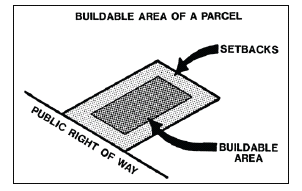
Setback Line. The minimum allowable horizontal distance from a given point or line of reference, such as a thoroughfare right-of-way or property line, to the nearest vertical wall or other element of a building or structure, as defined herein. This line defines the required yard areas (front, rear, and side) and establishes the buildable area, or that area within which the principal structure may be erected or placed. Location points of measurement on buildings or structures are subject to the exceptions in Section 9.5.
Sexually Oriented Business. As defined in Section 7.7.3.
Shelter/Rescue Mission, Temporary Housing for Homeless, Indigent. A facility which provides room and board for a temporary period not to exceed 60 days for transient, indigent or displaced children or adults.
Sign, Area of. The total exterior surface computed in square feet of a sign having but one exposed exterior surface; the aggregate exposed exterior surface computed in square feet of a sign having more than one such surface.
Sign. Any structure or part thereof, or any device attached to, painted on, or represented on a building or other structure, upon which is displayed or included any letter, work, model, banner, flag, pennant, insignia, decoration, device, or representation used as, or which is in the nature of, an announcement, direction, advertisement, or other attention directing device. A sign shall not include a similar structure or device located within a building except for illuminated signs within show windows. A sign includes any billboard, but does not include the flag, pennant, or insignia of any nation or association of nations, or of any state, city, or other political, charitable, educational, philanthropic, civic, professional, religious, or like campaign, drive, movement or event.
Sign, Advertising (Billboard). A sign which directs attention to a business, commodity, service, or entertainment which is entirely or primarily conducted, sold, or offered elsewhere than upon the lot on which the sign is located.
Sign, Bulletin. An accessory board or sign erected by a church, school, community center, public agency or institution on its own premises for announcement purposes.
Sign, Business. An accessory sign which directs attention to a profession, business, commodity, service, or entertainment conducted, sold or offered upon the same zoning lot.
Sign, Flashing. An illuminated sign on which the artificial or reflected light is not maintained stationary and constant in intensity and color at all times when in use. Any revolving illuminated sign shall be considered a flashing sign.
Sign, Identification. A sign whose content is limited to the name and/or occupation of the occupant of the premises.
Sign, Illuminated. A sign designed to give forth any artificial light, or designed to reflect light from one or more sources, natural or artificial.
Story. That portion of a building included between the surface of any floor and the ceiling next above it.
Story, First. The lowest story or the ground story of any building the floor of which is not more than 12 inches below the average contact ground level at the exterior walls of the building; except that any basement or cellar used for residence purposes, other than for a janitor or caretaker or his family, shall be deemed the first story.
Street. Any thoroughfare other than an alley.
Street, Collector. Any thoroughfare designated as a collector street in the Bartlesville Comprehensive Plan.
Structure. Anything constructed, the use of which requires permanent location on the ground or attachment to something having a permanent location on the ground. By this definition, all buildings are structures, however, not all structures, such as fences and swimming pools, are buildings.
Structural Alteration. Any change in the structural members of a building, such as walls, columns, beams, or girders.
Temporary Use. A use established for a limited duration with the intent to discontinue such use upon the expiration of the time period, which may include:
1)
a temporary building or structure without any foundation or footing; or
2)
a retail food establishment that operates at a fixed location for a temporary period of time in connection with a fair, carnival, circus, picnic, concert, public exhibition or similar transitory gathering, although temporary retail food establishments must be accessory to the principal permitted use, for instance, a fair or carnival;
3)
Temporary outdoor activities that are carried our primarily out-of-doors for a fixed period of time, including flea markets, fireworks, displays, speeches, farm stands, seasonal sales, swap and shop market, racing meets, circuses, carnival, concerts, and parades;
4)
Temporary uses usually do not involve the construction or alteration of any permanent building or structure, although the authorization of the temporary use does not necessarily preclude such construction.
Thoroughfare. Any public right-of-way which provides a public means of access to abutting property.
Thoroughfare, Major.Any thoroughfare designated as primary thoroughfare or secondary thoroughfare in the Bartlesville Comprehensive Plan.
Thoroughfare, Minor. Any thoroughfare other than a major thoroughfare.
Thoroughfare, Primary. Any thoroughfare so designated in the Bartlesville Comprehensive Plan.
Thoroughfare, Secondary. Any thoroughfare so designated in the Bartlesville Comprehensive Plan.
Use, Conditional. A use which is permitted in a district, subject to meeting certain conditions set forth herein.
Wireless Communications Towers/Antenna. As defined in Section 7.8.
Yard, Front. An open space extending the full width of a lot between a building and the front lot line.
Yard, Rear. An open space extending the full width of the lot between a building and the rear lot line.
Yard, Required. The minimum open space between a lot line and a required setback line within which no structure is permitted to be located except as specified elsewhere in these regulations.
Yard, Side. An open space extending from the front yard to the rear yard between a building and the nearest side lot line.
Yard, Side, Exterior. On a corner lot, a side yard abutting on a street.
Yard, Side, Interior. A side yard other than an exterior side yard.
Zoning Lot. See Lot, Zoning.
Zoning Map. The Zoning Map or Maps of the City of Bartlesville and County of Washington incorporated into these regulations as a part thereof.
Zoning Permit, Special. A permit for certain uses, issued by the proper Board of Adjustment in accordance with Section 10.5.
APPENDIX A
FEE SCHEDULE
Notes: In addition to the fees identified below, the following fess shall be collected by the City of Bartlesville on each construction permit issued or renewed:
1)
Fees required by the County, State or Federal government; and
2)
City administrative fees authorized by the County, State or Federal government.
The following fees do not include the cost of publication notice(s) which shall be billed to and paid by the applicant.
BUILDING PERMIT AND BUILDING RELATED FEES:
APPENDIX B
LIST OF ZONING TEXT AMENDMENTS
For the time period from April 1999

