
Bay City City Zoning Code
10.11 Supplementary-Special
Development Standards
10.11.010 Bed And Breakfast Establishments
- Bed and Breakfast Establishments shall comply with all requirements of the intensity zone in which they are located and shall also comply with the following:
- The number of guest bedrooms for rent on a daily basis to the public must be a minimum of two but maximum of five.
- The dwelling shall be owner occupied.
- Prior to occupancy a Bed and Breakfast Establishment shall obtain a Bed and Breakfast Food Service License from the Tillamook County Health Department - Environmental Services. The licenses must be renewed annually.
- In addition to required off-street parking for the dwelling, one off-street parking space for each guest bedroom shall be provided.
- Signs shall be limited to one non-illuminated sign not to exceed six square feet in area in the Shorelands 3 and Moderate Intensity Zone. No Vacancy signs shall be permitted. In the High Intensity Zones, signs shall conform to the requirements of Section 10.10.100, Sign Requirements.
- No Bed and Breakfast Establishments shall be placed within 200 feet of another Bed and Breakfast Establishment, measured from property line to property line. No variances from this standard shall be granted.
- The placement of Bed and Breakfast Establishments are subject to further restrictions as Single-Family STRs according to Section 8.10.100.
- Prior to occupancy a Bed and Breakfast Establishment shall be inspected by the Bay City Volunteer Fire Department to ensure that fire and safety considerations are addressed. The premises shall be inspected on an annual basis thereafter.
- The Bed and Breakfast Establishment must offer a breakfast meal as part of the cost of the room.
- The Bed and Breakfast Establishment.
- The meal is the meal served to guests during the a.m. or morning hours each day. The breakfast meal shall only be served to overnight guests, staff and owners only unless the establishment has obtained a restaurant license from the Tillamook County Health Department - Environmental Services, allowing meals to be served to other members of the public must have a separate toilet room with handwashing lavatory accessible to employees only, also known as a "Designated Employees'' Restroom," and a separate toilet room located in the area of the guest rooms, also known as a "Guests' Restroom."
- Compliance with the applicable license requirements per ORS 624.010(2), ORS 624.046, and OAR Chapter 333, Division 170.
Amended by Ord. 706 on 6/11/2024
Amended by Ord. 710 on 12/10/2024
10.11.020 Manufactured Dwellings And RV Parks
- Standards for Manufactured Dwellings. When a manufactured home is placed outside of a manufactured dwelling park in a zone which allows single family dwellings, it shall comply with the requirements for single family dwellings and the following placement standards:
- The manufactured dwelling shall be certified by the manufacturer to have an exterior thermal envelope meeting performance standards which reduce levels equivalent to the performance standards required of single family dwellings constructed under the state building code as defined in ORS 455.010.
- The manufactured dwelling shall be placed on an excavated and backfilled foundation and enclosed at the perimeter with concrete block such that the manufactured dwelling is located not more than 18 inches above grade.
- The manufactured dwelling shall be certified by the manufacturer to have an exterior thermal envelope meeting performance standards which reduce levels equivalent to the performance standards required of single family dwellings constructed under the state building code as defined in ORS 455.010.
- Recreation Vehicle Park and Campground.
- Recreation Vehicle (RV) parks or camping areas shall be in conformance with the standards of the Oregon Health Department, and in conformance with the standards and policies of the zone in which they are located.
- RV parks shall be at least 3 acres in size.
- RV parks shall be connected to city services, including sewer, water, and storm drainage. Parks shall also be connected to power and communications service. The ratio of lavatories and toilet facilities to RV spaces shall be prescribed by state law.
- The average square footage of RV spaces shall be at least 1500 square feet, and the individual RV spaces shall not be less than 1000 square feet. Square footage shall be calculated by excluding streets, driveways, restrooms, or common open space areas.
- Streets or private drives shall be surfaced with asphaltic concrete or oil mat surfacing material.
- Buffers and screening in accordance with Section 10.10.010 shall be required in order to separate RV parks from surrounding uses or public streets or roads. A sight obscuring fence or plantings shall be required except in clear vision areas.
- Where existing tree cover is present, it shall be retained on the site. Camping spaces shall be constructed so as not to harm root systems by fill.
- Camping spaces, restrooms, parking areas and other structures or alterations shall be at least 50 feet from streams or bodies of water to maintain riparian vegetation and the scenic values of the area. Public access shall be maintained to the water.
- At least 25% of the overall site shall be maintained in landscaped open area or natural vegetation. Buffers, screening, forested areas, or common open areas may be considered part of this requirement.
- All RV Parks in the Moderate and Shoreland 3 Intensity Zones shall abut U.S. Highway 101 and shall be appropriately buffered from surrounding residences. Landscaping and access control shall be required. Access to RV Parks shall be off of side streets, rather than directly off of U.S. 101.
- A Yurt may be allowed within a properly permitted Recreational Vehicle Park and Campground consistent with the standards of Bay City Development Ordinance Section 2.2145 6.12 Yurt. A Yurt within a Recreational Vehicle Park and Campground may not be occupied as a residential dwelling.
Amended by Ord. 706 on 6/11/2024
10.11.030 Travel Trailers/Recreational Vehicles Usage Requirements
- Periodic Use. Periodic use of travel trailers/recreational vehicles shall be allowed on the following conditions:
- Periodic use of travel trailers/recreational vehicles shall be allowed on all properties on which an occupied permanent dwelling, not exceeding three dwelling units, or an occupied manufactured home is currently located. The periodic use of the travel trailer/recreational vehicle must be with the consent of the property owner or resident of the property.
- No more than two travel trailers/recreational vehicles shall be allowed per each lot provided, however, that adequate space is available for off-street parking of the travel trailers/recreational vehicles on said properties.
- The periodic use of the travel trailer/recreational vehicle is limited to no more than fourteen (14) days within a 12-month period.
- No dumping of wastewater or sewage shall be allowed on the property. All wastewater and sewage must be dumped at approved recreational vehicle dumping stations. No hookups shall be allowed to the Bay City sewer system. Water hookups may be allowed if an approved backflow preventative device is provided on the service connection to the premises. No water hookup shall be allowed without first obtaining the approval of the City Public Works Superintendent.
- In addition to all other remedies provided in this Chapter, a person willfully violating the terms of this section may be fined up to $50.00 for each day of violation. Any fine that is not so paid may become a lien on the property on which the violation occurred.
- Temporary Residence. A recreation vehicle or travel trailer may be placed on site and occupied as a temporary residence for up to one year provided that:
- Applicant obtains a temporary placement permit from the City;
- Applicant holds a valid building permit;
- Applicant or other person authorized by Applicant who is residing in the temporary structure is actively constructing the building; and
- Applicant has paid the applicable sewer and water hookup fees, system development charges and all other related fees prior to occupancy. The actual sewer and water connections must be made within 90 days of obtaining the temporary placement permit. No dumping of wastewater or sewage shall be allowed on the property.
10.11.040 Multifamily Dwellings And Cottage Cluster
- Multifamily Dwellings
- At least 50% of the required open space shall be designed to be usable by the residents of the development. This can be in the form of lawns, outdoor play areas, swimming pools, patios or decks, or natural area.
- Structures shall meet the lot coverage, open area, and where applicable, common open space requirements of the zone in which they are located.
- Structures shall be placed to retain existing trees. Buffers and screens, as described in Section 10.10.030, shall be required by the Planning Commission.
- Parking areas are landscaped and separated into no more than 8 spaces per bay, are not located between the front building façade and the street, and are buffered from surrounding residential uses or other low intensity uses.
- Traffic is routed onto an existing or planned arterial or collector street, and safety of ingress and egress is considered.
- Cottage Cluster Development Standards
- Permitted Uses
- Where permitted. See Allowable Uses Matrix, Section 10.06.025.
- Sufficient Infrastructure. Applicants must demonstrate that Sufficient Infrastructure is provided, or will be provided, upon submittal of a cottage cluster development application.
- Where permitted. See Allowable Uses Matrix, Section 10.06.025.
- Development Standards
- Cottage clusters shall meet the development standards of the applicable base zone in the Zone Development Standards Matrix, Section 10.10.010, with the following exceptions:
- No maximum lot coverage shall apply to cottage clusters.
- Minimum open area, minimum landscaped open area, and minimum common open space shall not apply to cottage clusters.
- The minimum front yard setback shall be 10 feet in all zones.
- Minimum Density. A minimum density of four units per net acre shall apply to cottage clusters in all zones.
- Building Separation.
- Cottages shall be separated by a minimum distance of six (6) feet. The minimum distance between all other structures, including accessory structures, shall be in accordance with building code requirements.
- Unit Size. The maximum floor area for a dwelling unit in a cottage cluster is 900 square feet.
- Off-Street Parking. The minimum number of required off-street parking spaces for a cottage cluster project is one space per unit. Spaces may be provided at individual cottages or in shared parking clusters.
- Cottage clusters shall meet the development standards of the applicable base zone in the Zone Development Standards Matrix, Section 10.10.010, with the following exceptions:
- Design Standards. Cottage clusters shall meet the design standards in subsections a through h of this Section 3. No other design standards shall apply to cottage clusters unless noted in this section. Mandates for construction of a garage or carport and any other design standards are invalid, except as specified in this Section 3.
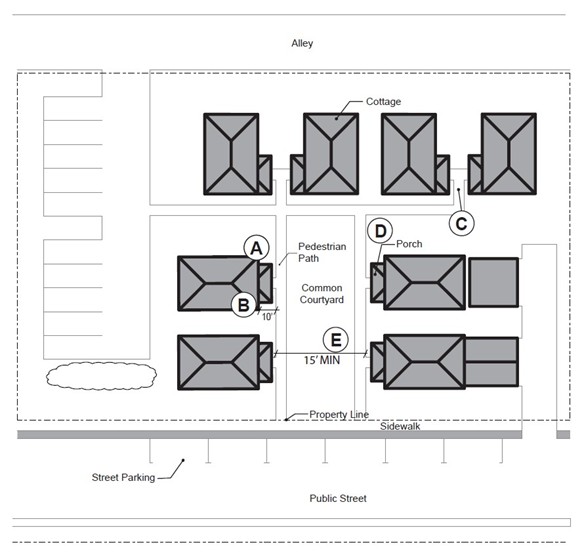
- Cottage Orientation. Cottages must be clustered around a common courtyard, meaning they abut the associated common courtyard or are directly connected to it by a pedestrian path, and must meet the following standards:
- Each cottage within a cluster must either abut the common courtyard or must be directly connected to it by a pedestrian path.
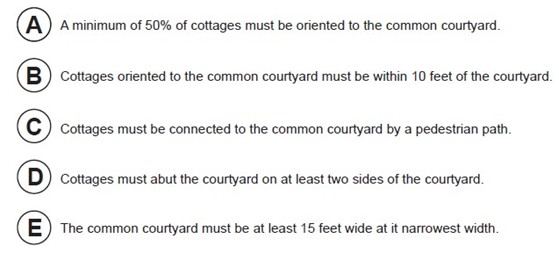
- A minimum of 50 percent of cottages within a cluster must be oriented to the common courtyard and must:
- Have a main entrance facing the common courtyard;
- Be within 10 feet from the common courtyard, measured from the façade of the cottage to the nearest edge of the common courtyard; and
- Be connected to the common courtyard by a pedestrian path.
- Cottages within 20 feet of a street property line may have their entrances facing the street.
- Cottages not facing the common courtyard or the street must have their main entrances facing a pedestrian path that is directly connected to the common courtyard.
- Common Courtyard Design Standards. Each cottage cluster must share a common courtyard in order to provide a sense of openness and community of residents. Cottage clusters are exempt from common open space standards in section 10.10.030.E.Common courtyards must meet the following standards:
- The common courtyard must be a single, contiguous piece.
- Cottages must abut the common courtyard on at least two sides of the courtyard.
- The common courtyard must contain a minimum of 150 square feet per cottage within the associated cluster (as defined in subsection a of this Section 3).
- The common courtyard must be a minimum of 15 feet wide at its narrowest dimension.
- The common courtyard shall be developed with a mix of landscaping, lawn area, pedestrian paths, and/or paved courtyard area, and may also include recreational amenities.
- Impervious elements of the common courtyard shall not exceed 75 percent of the total common courtyard area.
- Pedestrian paths must be included in a common courtyard. Paths that are contiguous to a courtyard shall count toward the courtyard’s minimum dimension and area. Parking areas, required setbacks, and driveways do not qualify as part of a common courtyard.
- Figure 10.11.040.B-1
- Community Buildings. Cottage cluster projects may include community buildings for the shared use of residents that provide space for accessory uses such as community meeting rooms, guest housing, exercise rooms, day care, or community eating areas. Community buildings may be no larger than 900 sq ft.
- Pedestrian Access.
- An accessible pedestrian path must be provided that connects the main entrance of each cottage to the following:
- The common courtyard;
- Shared parking areas;
- Community buildings; and
- Sidewalks in public rights-of-way abutting the site or rights-of-way if there are no sidewalks.
- The pedestrian path must be hard-surfaced and a minimum of 4 feet wide.
- An accessible pedestrian path must be provided that connects the main entrance of each cottage to the following:
- Parking Design
- Clustered parking. Off-street parking may be arranged in clusters, subject to the following standards:
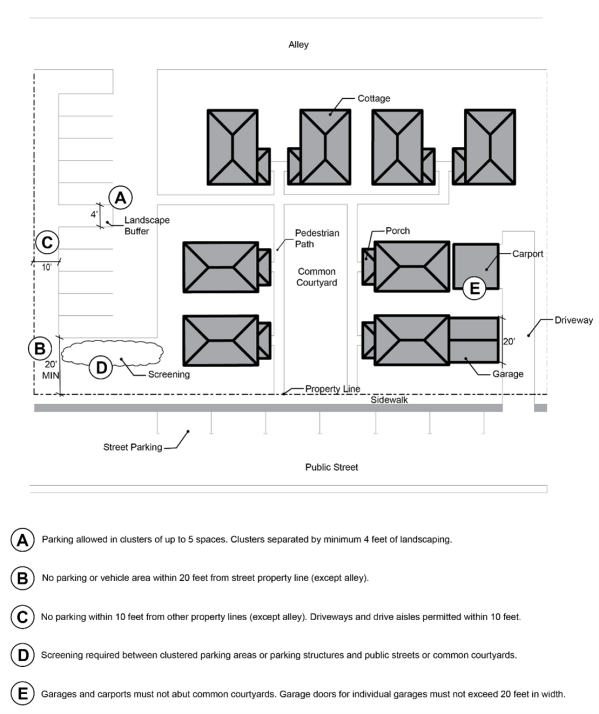
- Cottage cluster projects with fewer than 16 cottages are permitted parking clusters of not more than five (5) contiguous spaces.
- Cottage cluster projects with 16 cottages or more are permitted parking clusters of not more than eight (8) contiguous spaces.
- Parking clusters must be separated from other spaces by at least four (4) feet of landscaping.
- Clustered parking areas may be covered.
- Parking location and access.
- Off-street parking spaces and vehicle maneuvering areas shall not be located:
- Within of 10 feet from any street property line, except alley property lines;
- Between a street property line and the front façade of cottages located closest to the street property line. This standard does not apply to alleys.
- Off-street parking spaces shall not be located within 10 feet of any other property line, except alley property lines. Driveways and drive aisles are permitted within 10 feet of other property lines.
- Off-street parking spaces and vehicle maneuvering areas shall not be located:
- Screening. Landscaping, fencing, or walls at least three feet tall shall separate clustered parking areas and parking structures from common courtyards and public streets.
- Garages and carports.
- Garages and carports (whether shared or individual) must not abut common courtyards.
- Individual attached garages up to 200 square feet shall be exempted from the calculation of maximum building footprint for cottages.
- Individual detached garages must not exceed 400 square feet in floor area.
- Garage doors for attached and detached individual garages must not exceed 20 feet in width.
- Clustered parking. Off-street parking may be arranged in clusters, subject to the following standards:
- Accessory Structures. Accessory structures must not exceed 400 square feet in floor area other than a garage or carport as stated in f.(4) above are not allowed.
- Existing Structures. On a lot or parcel to be used for a cottage cluster project, an existing building on the same lot at the time of proposed development of the cottage cluster may remain within the cottage cluster project area under the following conditions:
- The existing building may be nonconforming with respect to the requirements of this code.
- The existing building may be expanded up to the maximum 900 sq ft.
- Cottage Orientation. Cottages must be clustered around a common courtyard, meaning they abut the associated common courtyard or are directly connected to it by a pedestrian path, and must meet the following standards:
- Permitted Uses
Amended by Ord. 715 on 6/10/2025
Amended by Ord. 720 on 8/13/2026
10.11.045 Triplex And Quadplex Dwellings And Townhouses
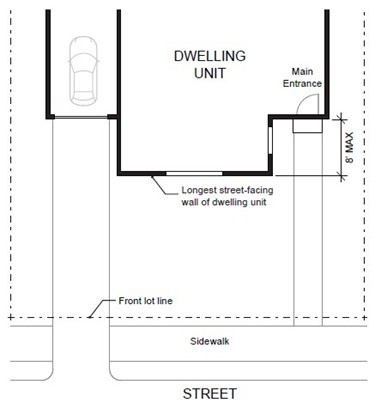
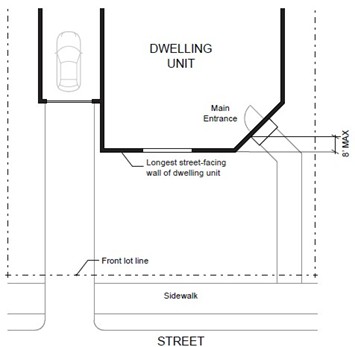
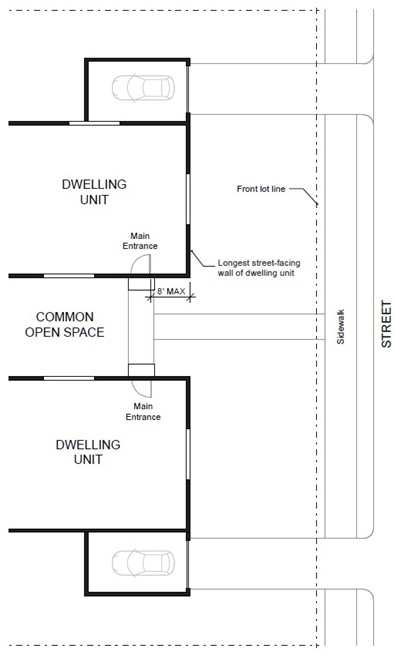
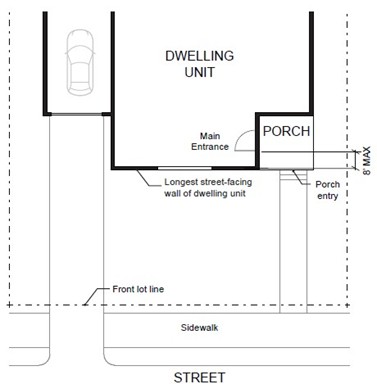
A. Triplex and Quadplex Dwellings 1. Permitted Uses a. Where Permitted. See Allowable Use Matrix, Section 10.06.025. b. Sufficient Infrastructure. Applicants must demonstrate that Sufficient Infrastructure is provided, or will be provided, upon submittal of a triplex or quadplex development application. 2. Development Standards. Triplexes and quadplexes shall meet the development standards of the applicable base zone in the Zone Development Standards Matrix, Section 10.10.010. 3. Design Standards. New triplexes and quadplexes shall meet the design standards of this section. a. Entry Orientation. At least one main entrance for each triplex or quadplex structure must meet the standards below. Any detached structure for which more than 50 percent of its street-facing facade is separated from the street property line by a dwelling is exempt from meeting these standards. (1) The entrance must be within 8 feet of the longest street-facing wall of the dwelling unit; and (2) The entrance must either: (A) Face the street (see Figure 10.11.045.A-1); (B) Be at an angle of up to 45 degrees from the street (see Figure 10.11.045.A-2); (C) Face a common open space that is adjacent to the street and is abutted by dwellings on at least two sides (see Figure 10.11.045.A-3); or (D) Open onto a porch that is at least 25 square feet in area, and that must have at least one entrance facing the street or have a roof (see Figure 10.11.045.A-4).
Figure 10.11.045.A-1
c. Garages, Carports and Off-Street Parking Areas. Garages, carports and off-street parking areas shall not be located between a building and a public street (other than an alley), except where they comply with the following standards:
(1) The garage, carport or off-street parking area is separated from the street property line by a dwelling; or
(2) The combined width of all garages and outdoor on-site parking and maneuvering areas does not exceed a total of 50 percent of the street frontage (see Figure 10.11.045.A-6, and note that driveways must meet the minimum separation required by Section 10.10.074.B).
Figure 10.11.045.A-6
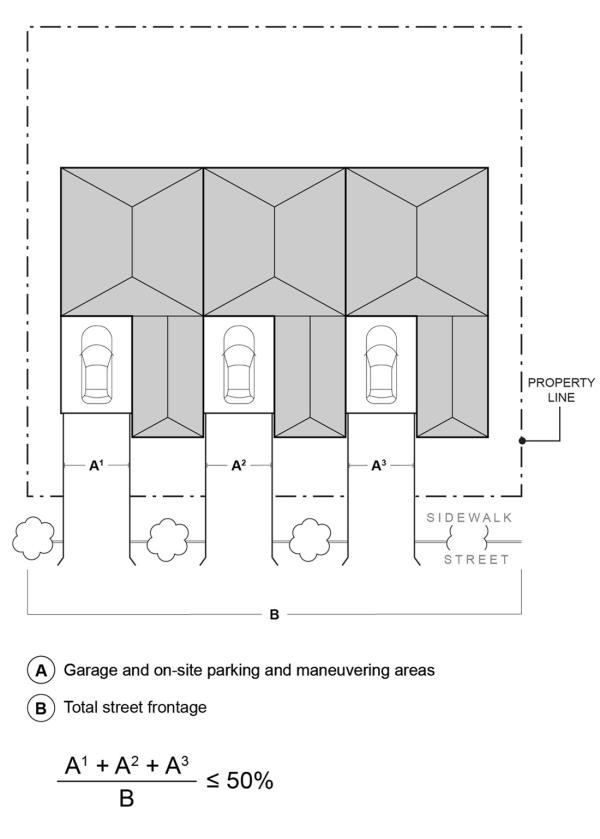
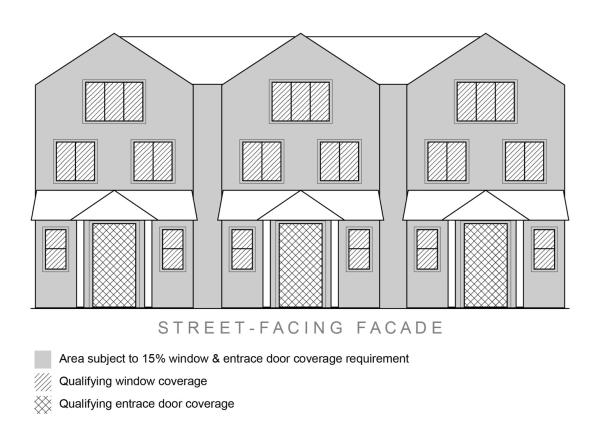
4. Conversions. Internal conversion of an existing detached single family dwelling or duplex to a triplex or quadplex, where permitted in the Allowable Use Matrix, Section 10.06.025, is subject to the following standards: a. Conversions are exempt from the Triplex and Quadplex standards of Section 10.11.045.A.1 through 3, and b. Conversions are exempt from the minimum parking requirements in Section 10.10.072. B. Townhouses 1. Permitted Uses a. Where Permitted. See Allowable Use Matrix, Section 10.06.025. b. Sufficient Infrastructure. Applicants must demonstrate that Sufficient Infrastructure is provided, or will be provided, upon submittal of a townhouse development application. 2. Development Standards. a. Townhouses shall meet the development standards of the applicable base zone in the Zone Development Standards Matrix, Section 10.10.010, with the following exceptions: (1) The minimum lot width shall be 20 feet in all zones, with a minimum lot frontage along a public street of 20 feet. (2) The minimum side yard setback for a common wall lot line where units are attached is zero feet. b. The maximum density for a townhouse project shall not exceed: (1) In the Low Intensity Zone, four dwelling units per 15,000 square feet. (2) In the Medium Intensity and Shoreland 3 Zones, four dwelling units per 7,000 square feet. c. A maximum of four attached townhouses is allowed in a townhouse project. d. Areas Owned in Common. Common areas must be maintained by a homeowners association or other legal entity. A homeowners association may also be responsible for exterior building maintenance. A copy of any applicable covenants, restrictions and conditions must be recorded and provided to the jurisdiction prior to issuance of a building permit. 3. Design Standards. New townhouses shall meet the design standards of this section. a. Entry Orientation. The main entrance of each townhouse must: (1) The entrance must be within 8 feet of the longest street-facing wall of the dwelling unit; and (2) The entrance must either: (A) Face the street (see Figure 10.11.045.A-1); (B) Be at an angle of up to 45 degrees from the street (see Figure 10.11.045.A-2); (C) Face a common open space that is adjacent to the street and is abutted by dwellings on at least two sides (see Figure 10.11.045.A-3); or (D) Open onto a porch that is at least 25 square feet in area, and that must have at least one entrance facing the street or have a roof (see Figure 10.11.045.A-4). b. Unit Definition. Each townhouse must include at least one of the following on at least one street-facing façade (see Figure 10.11.045.B-1): (1) A roof dormer a minimum of four feet in width, or (2) A balcony a minimum of two feet in depth and four feet in width and accessible from an interior room, or (3) A bay window that extends from the façade a minimum of two feet, or (4) An offset of the façade of a minimum of two feet in depth, either from the neighboring townhouse or within the façade of a single townhouse, or (5) An entryway that is recessed a minimum of three feet, or (6) A covered entryway with a minimum depth of four feet, or (7) A porch meeting the standards of subsection 10.11.045.A.3.a(2)(D). Balconies and bay windows may encroach into a required setback area.
Figure 10.11.045.B-1
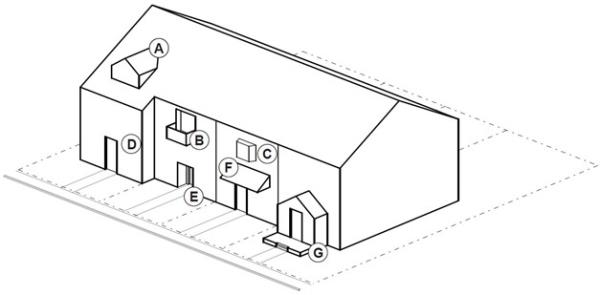
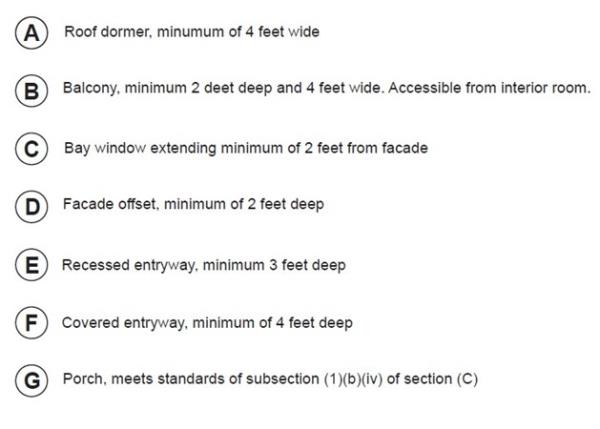
c. Windows. A minimum of 15 percent of the area of all street-facing facades on each individual unit must include windows or entrance doors. Half of the window area in the door of an attached garage may count toward meeting this standard. See Figure 10.11.045.A-5. d. Driveway Access and Parking. Townhouses with frontage on a public street shall meet the following standards: (1) Garages on the front façade of a townhouse, off-street parking areas in the front yard, and driveways in front of a townhouse are allowed if they meet the following standards (see Figure 10.11.045.B-2): (A) Each townhouse lot has a street frontage of at least 20 feet on a local street. (B) A maximum of one driveway per lot is allowed that does not exceed 12 feet wide, or 50 percent of the lot street frontage, whichever is greater. For two abutting lots in the same townhouse project, driveways are encouraged to be paired and abut along the lot line to create one shared driveway approach. (C) The garage width does not exceed 12 feet wide, as measured from the inside of the garage door frame.
Figure 10.11.045.B-2
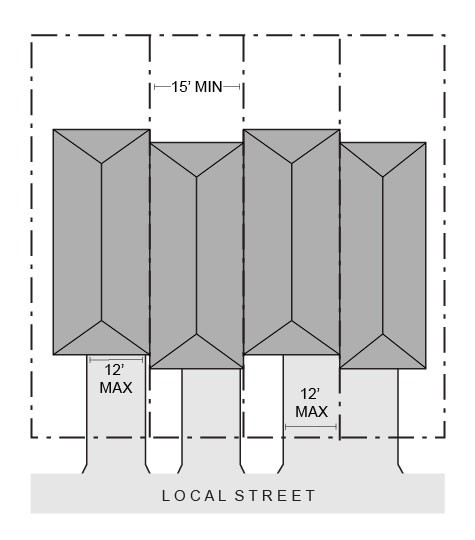
(2) The follow standards apply to driveways and parking areas for townhouse projects that do not meet all of the standards in subsection (1). (A) Off-street parking areas shall be accessed on the back façade or located in the rear yard. No off-street parking shall be allowed in the front yard or side yard of a townhouse. (B) A townhouse project that includes a corner lot shall take access from a single driveway approach on the side of the corner lot. See Figure 10.11.045.B-3.
Figure 10.11.045.B-3
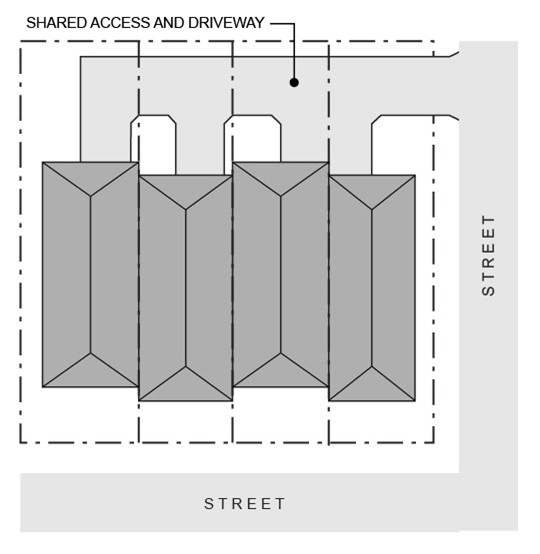
(C) Townhouse projects that do not include a corner lot shall consolidate access for all lots into a single driveway. The driveway and approach are not allowed in the areas directly between the front façade and the front lot line of any of the townhouses. See Figure 10.11.045.B-4.
Figure 10.11.045.B-4
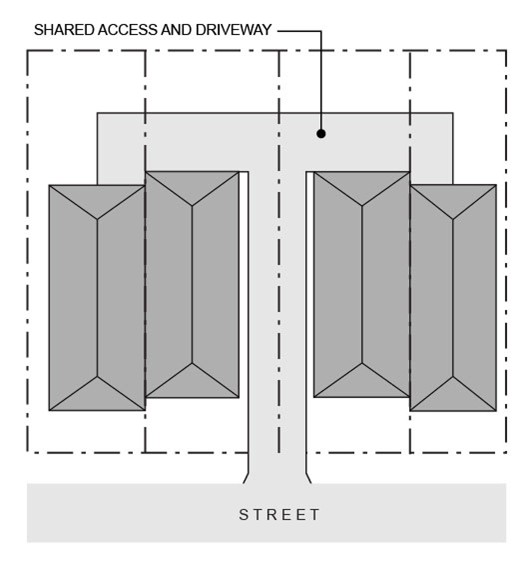
(D) A townhouse project that includes consolidated access or shared driveways shall grant access easements to allow normal vehicular access and emergency access.
(3) Townhouse projects in which all units take exclusive access from a rear alley are exempt from compliance with subsection (2).
Adopted by Ord. 715 on 6/10/2025
10.11.050 Public And Civic Uses
- Schools.
- Elementary schools shall provide a basic site area of 5 acres plus one additional acre for each 100 pupils of predicted ultimate enrollment.
- Secondary schools shall provide a basic site area of 10 acres plus one additional acre for each 100 pupils of predicted ultimate enrollment.
- Meeting Halls, Churches, and Schools
- The hours of operation of meeting halls and churches shall be controlled so as not to disrupt surrounding residential uses.
- Eating or drinking establishments or entertainment associated with meeting halls or churches shall meet the requirements of Section 10.11.060.C.
- Meeting halls, churches, and schools shall be designed in a manner which is compatible with the surrounding neighborhoods in terms of height, bulk, and maintenance of existing vegetation.
- Public Utility or Communication Facility
- The proposed site is best located to serve the intended area with a minimal effect on surrounding property.
- Structures such as towers, tanks, poles, overhead wires, pumping stations, and similar equipment shall be located so as not to degrade scenic views from a street or private property, particularly along the bayshore.
- All equipment storage or materials shall be buffered, screened, or fenced, or kept within a structure.
10.11.060 Commercial Uses
- Primary Commercial Uses
- Primary commercial (non-water dependent or related) uses are defined as small establishments intended to serve daily or frequent trade or service needs of the city or a localized area, as opposed to highway oriented or high traffic impact uses. Such uses include small grocery stores, laundries, repair shops, beauty shops, and similar uses. Excluded are large retail outlets, automobile service stations, and drive-in eating or drinking establishments.
- As a guideline, no such establishment shall be permitted closer than 500 feet from a zone in which it is permitted outright, in order to prevent the sprawl of primary commercial centers.
- Commercial Recreation
- Commercial recreation with high traffic volumes shall have access onto an arterial street and provide access on non-residential streets.
- Structures associated with low intensive recreation uses, such as club houses or indoor tennis courts, shall be designed to be compatible with the surrounding landscape and adjacent uses.
- Uses which could potentially generate high traffic volumes, such as spectator events, shall not be allowed.
- Eating or Drinking Establishments
- Eating or drinking establishments may be stand-alone uses or permitted in conjunction with motels in the High Intensity zones or in conjunction with a mixed use.
- Restaurants with drive-in service shall be permitted only in the South High Intensity Zone. Drive-in facilities shall meet the definition of eating or drinking establishment, drive-in pursuant to Section 10.02.020. No parking area for drive-in eating or drinking establishments shall be located between the street and the front façade of the building.
- Restaurants with facilities that accommodate late night entertainment shall be reviewed as provided in Section 10.10.060 Architectural Design Standards
10.11.070 Forest Management Practices
- Purpose. The purpose of this section is to ensure that forest practices are carried out in a manner that will protect soil integrity, water quality, fish and wildlife habitat, riparian vegetation, significant natural resources, scenic values and adjacent urban uses.
- Applicability. The following activities are considered forest management practices and are subject to the provisions of this section:
- Harvesting of trees for commercial purposes including but not limited to falling, bucking, yarding, decking, loading or hauling of such trees.
- Construction, reconstruction and improvements of roads as part of a forest harvesting operation.
- Site preparation for reforestation involving clearing or the use of heavy machinery.
- Clearing of forest land for conversion to a non-forest use.
- Disposal and treatment of slash.
- Precommercial thinning.
- Exceptions. The removal of trees in accordance with Section 7.04 is not considered a forest management practice.
- Forest Management Plan Approval Required.
- As part of a conditional use application, a forest management plan prepared by a forester shall be submitted.
- The written forest management plan shall contain specific information applicable to the proposed operation. Elements of the plan shall include, but not be limited to, the location of roads and landings, road and landing design and construction, drainage systems, disposal of waste material, falling and bucking, buffer strips, yarding system and layout, sensitive resource site protection measures and post operation stabilization measures.
- The applicant shall select a qualified forester to prepare the plan. The applicant shall bear the cost of the plan preparation as well as the cost of monitoring the forest management operation. The City may select a qualified forester to review the plan and pass the cost onto the applicant.
- The forest management plan shall conform to the standards of subsection E of this section.
- In the preparation of the forest management plan, the forester shall consult with state and federal agencies concerned with the forest environment, such as the Department of Fish and Wildlife, to obtain relevant information.
- Standards. Forest management plans shall be prepared in conformance with the following standards:
- Only selective harvesting of trees is permitted.
- A riparian zone shall be maintained adjacent to Type D, Type F, and Type N waters. Section 10.06.100 and Section 10.10.030 define the required setbacks in the riparian zone. There shall be no harvesting of trees in the riparian zone. Other activities in conjunction with forest practices, such as road construction, in the riparian zone shall be permitted only where there are no other feasible alternatives. The definitions of Type D, Type F, and Type N waters shall be those established in the Forest Practices Rules.
- Existing stream courses shall not be altered.
- No forest management operations shall occur in identified wetland areas.
- Where a forest operation is to be located within six hundred feet of a specific site involving a threatened or endangered species (as listed by the U.S. Fish and Wildlife Service or the Oregon Department of Fish and Wildlife) or a sensitive bird nesting, roosting or watering site, a specific habitat protection plan shall be prepared in consultation with the Oregon Department of Fish and Wildlife.
- There shall be no mining or mineral extraction as part of a forest operation.
- Forest practices shall not involve the application of herbicides, insecticides or rodenticides.
- Slash shall be controlled in a manner that does not require burning.
- Road construction shall be in accordance with the criteria of the Oregon Forest Practices Rules.
- Harvesting of trees shall be in accordance with the criteria of the Oregon Forest Practices Rules.
- Reforestation of lands intended to continue in forest use shall be stocked according to the levels specified in the Oregon Forest Practice Rules. The forest management plan shall include specified actions necessary for the maintenance of planted trees. Within one year following the harvest on lands not planned for reforestation, adequate vegetative cover shall be established to provide soil stabilization and to minimize aesthetic impacts within one year following the harvest.
10.11.080 Industrial Uses
- Industrial uses shall have limited or phased social and fiscal impacts on the community. Adequate public facilities (sewer, water, fire protection, schools, streets) shall be available to serve the industry prior to construction, or assurance shall be given the City in the form of performance bond that public facilities will be installed concurrently at the developer's expense.
- Industrial uses may be labor or capital intensive.
- Preference shall be given to industries which are related to the resources of the area, such as fishing, forest products, the dairy industry, or shipping.
- Industrial uses shall meet all applicable standards pertaining to buffers, screens, lot coverage, and open area. The Planning Commission may require additional buffer areas where it appears that existing adjacent uses warrant protection.
- Special attention shall be given to the emission standards pertaining to noise, smoke, odor, or glare.
10.11.090 Mining Or Removal Of Sand Or Gravel
- Mining or removal of sand or gravel in wetlands, lowlands, or water areas shall be done only after a permit from the Department of State Lands or U.S. Army Corps of Engineers is issued, if those agencies determine that they have jurisdiction in those areas.
- Sedimentation and erosion shall be controlled through the use of berms, catch basins, mulching, and revegetation as may be required by the Planning Commission.
10.11.100 Extensive Excavation And Grading
- All requirements of Chapter 70 of the Uniform Building Code are adhered to.
- The extent and nature of the proposed grading and/or filling are appropriate to the use proposed and will not create site disturbances to an extent greater than that required for use.
- The proposed grading and/or filling, and any related construction, will have a minimum impact on views from adjacent property.
- The proposed grading and/or filling will be designed in a manner that minimizes any adverse visual impacts on adjacent property.
- The proposed grading and/or filling will not have an adverse impact on the drainage on adjacent property.
10.11.110 Cottage Industries
In the Moderate and Low Intensity Zones, cottage industries may be allowed in order to promote a local economic base consistent with the character of the City. Allowable uses include crafts, small scale services, and other activities which have little impact on the neighborhoods in terms of traffic generation, noise, appearance, operating hours, or other factors. Activities are to be allowed on a limited conditional use basis, with the primary condition that the permit can be revoked for violation of the standards. It is intended that full scale or intensive uses be located in the high intensity zones.
- Standards: Standards of the intensity zone and conditional use standards shall apply to cottage industries. In addition, the following specific standards shall apply:
- The use shall be operated by a resident of a dwelling and no more than one employee, other than members of the household.
- Signs shall be no larger than 1 square foot and shall be no more than 4 feet from ground level.
- The use shall be carried out in the dwelling or in a structure attached thereto.
- Uses involving non-resident employees and the delivery of materials shall limit their hours of operation to between 8:00 a.m. and 6:00 p.m.
- The use shall be architecturally and aesthetically compatible with the surrounding residential area and the existing structures on the site.
- There shall be no storage of materials or equipment excess of the lot coverage requirements of the zone, except for plant materials such as nursery stock.
- Recreation vehicle or trailer parks, amusement, or gaming operations are not to be allowed as a home occupation.
- Conditional Use
- Complaint Procedure: The Planning Commission shall review cottage industries upon receipt of three written complaints from three separate households within two hundred fifty (250) feet of the boundary of the affected property, or a complaint from the Building Official. The City Recorder shall schedule a public hearing to review the complaints.
- Action by the Planning Commission: The Planning Commission shall hear the evidence presented and may, with adequate findings of fact:
- Approve the use as it exists.
- Require that it be terminated.
- Impose restrictions, such as limiting hours of operation or requiring construction of a fence.
- Decisions of the Planning Commission may be appealed to the City Council
10.11.120 Yurt Requirements
- Standards: Standards of this Chapter including but not limited to the Moderate Intensity Zone, the Section 10.07.300 Flood Protection Areas, the Hazard Overlay Zone, and the Conditional Use standards shall apply to the placement and operation of a yurt. In addition, the following specific standards shall apply:
- A full-time primary residential use shall be continuously occupied by the property owner or agent of the property owner who shall ensure on-site management and maintenance of the yurt;
- Signage shall not exceed 2 square feet. The bottom of the sign shall be no more than 4 feet from the ground;
- The use shall be designed and continuously maintained to be aesthetically compatible with the surrounding residential area. Fencing shall consist of attractive natural materials as far as is practicable. Storage shall be screened from view. Landscaped areas shall be maintained in native vegetation. Fencing and mature native plants shall adequately screen the use. Existing native trees shall be retained wherever practicable. Buffers may be required;
- The maximum square footage of a yurt shall be 768 square feet;
- Building height of a yurt shall be no more than 16 feet above the elevation required by the Section 10.07.300 Flood Protection Areas and shall not exceed 24 feet in height above existing grade;
- One parking space shall be provided and maintained for a yurt up to 400 feet in area; two parking spaces shall be provided and maintained for a yurt over 400 square feet in area;
- A yurt shall have bathroom facilities including a shower, sink and a toilet. A yurt may have kitchen appliances, but shall not be wired for 220 electrical current;
- A yurt shall not be used for full-time residential use. All requirements for transient lodging use of the structure shall be continuously met;
- A yurt shall be connected to water and sewer service through the primary residential use;
- Coastal Shoreland Goals and Policies shall be addressed in the application for a yurt. Adjacent Estuarine areas shall be protected from potential adverse impacts;
- A building permit shall be obtained. Prior to approval of the building permit, all conditions of site development established by this Chapter or required as a condition in granting a conditional use shall be met. The City shall obtain certification and evidence that the following criteria are met, as far as is reasonably practicable:
- The yurt shall meet all fire-resistive occupancy requirements (separations, required fire separation walls, parapet walls, and other fire-resistive requirements);
- The yurt has been approved by the Building Code Division and will be installed and used according to its intended design and purpose as identified by an Oregon Insignia of Compliance;
- With application, a site plan, occupancy classification, construction type, structure size, floor live load, roof live load, wind exposure, seismic area, energy zone, electrical service loads, plumbing fixture loads, number of modules and certification whether it is a permanent or re-locatable structure shall be submitted;
- The design and construction of the yurt foundation and structure shall be consistent with the standards established by the Oregon Building Code Division for prefabricated structures,
- The yurt shall comply with Oregon One and Two Family Dwelling Specialty Code, and shall be certified with an Oregon Insignia of Compliance.
- Conditions: All conditions of site development established by this Chapter or required as a condition in granting a conditional use shall be met prior to receiving a building permit to construct a yurt.
- Complaint Procedure: Upon receipt of evidence from staff of non-compliance with yurt conditional use requirements, upon receipt of a complaint signed by three or more persons filed with the City Recorder or a complaint from the Building Official. Upon receipt of any of the above complaints, the City Recorder shall schedule a public hearing before the Bay City Planning Commission for the Commission to review the complaints.
- Action by the Planning Commission: The Planning Commission shall hear the evidence presented and may, with adequate findings of fact:
- Approve the use as it exists;
- Require that the use be terminated;
- Impose additional conditions or restrictions, such as the limiting of hours of operation or requiring the construction of a fence. (Amended Ord. #630, 05- 07)
- Maintenance: The use and all site development requirements shall be continuously maintained consistent with this Chapter.
10.11.130 Home Occupations
A home occupation shall be carried out within the dwelling or in an accessory structure. A home occupation may have clients coming to site if adequate off-street parking is provided. It is a lawful commercial activity or occupation conducted within a dwelling and/or accessory building provided there is a dwelling on the property. Home occupations shall be a secondary/accessory use of the premises, permitted by right in all residential units, subject to the following standards:
- Appearance of Residence:
- The home occupation shall maintain the residential character of the building by assuring that the occupation is conducted in such a manner as not to give an outward appearance nor manifest any characteristic of a business in the ordinary meaning of the term nor infringe upon the right of neighboring residents to enjoy the peaceful occupancy of their homes.
- The home occupation shall not result in any structural alterations or additions to a structure that will change its primary use or building code occupancy classification.
- The home occupation shall not violate any conditions of development approval (i.e., prior development permit approval)
- No products and/or equipment produced or used by the home occupation may be displayed to be visible from outside any structure.
- The home occupation shall not exceed 25% of the ground floor of the dwelling; or occupy no more than 500 square feet of a garage, either attached or detached; or occupy no more than 500 square feet of any other outbuilding.
- Storage:
- Outside storage and use of yard areas for storage of tools, equipment and materials, visible from the public right-of-way or from inside a residence located on adjacent properties, is prohibited.
- On-site storage of hazardous materials (including toxic, explosive, noxious, combustible or flammable) beyond those normally incidental to residential use is prohibited.
- Storage of inventory products and all other equipment, fixtures, and activities associated with the home occupation shall be allowed in any structure.
- Outside yard areas may be used for playground equipment for home occupations involving the care of children by a baby sitter or day care facility.
- Employees:
- The home occupation shall be operated by members of the household residing within the dwelling with no more than one (1) full time, non-household equivalent employee at the home occupation site at any given time.
- Additional individuals may be employed by or associated with the home occupation, so long as they do not report to the home occupation site or pick-up at/deliver to the home.
- The home occupation site shall not be routinely used as a headquarters for the assembly of employees for instruction or other purposes, including dispatch to other locations.
- Advertising and Signs:
- One (1) sign shall be allowed for the home occupation. In no case shall the sign exceed the size of 3 square feet if inside or flush against the dwelling, or 2 square feet if located elsewhere.
- No visual advertisement signs specifically indicating the home occupation is anything more than a residential occurrence or advertising other products shall be allowed.
- No stock in trade shall be displayed upon the home occupation site.
- Vehicles, Parking and Traffic:
- One (1) commercially licensed vehicle associated with the home occupation is allowed at the home occupation site. It shall be of a size that would not overhang into the public right-of-way when parked in the driveway or another location on the home occupation site.
- There shall be no more than three commercial vehicle deliveries to or from the home occupation site daily. There shall be no commercial vehicle deliveries during the hours of 6 p.m. to 7 a.m.
- There shall be no more than one client or customer's vehicle at any one time and no more than eight (8) per day at the home occupation site.
- Parking for the business is to be the same as for the normal residential occupancy, with no additional parking for the establishment, either on, or off street. Traffic created by the business or customers of the business shall not be of a volume or frequency that will cause disturbance or inconvenience to nearby land uses.
- Business Hours:
- There shall be no restrictions on business hours, except that clients or customers are permitted at the home occupation from 7 a.m. to 6 p.m. only, subject to A & E above.
- Prohibited Home Occupation Uses:
- Any activity that produces radio or television interference, noise, glare, vibration, smoke or odor beyond allowable levels as determined by local, state or federal standards, or that can be detected beyond the property line is prohibited.
- Any activity involving on-site retail is prohibited, except the sale of items via telecommunications and mail, or that are incidental to a permitted home occupation is allowed. For example, the sale of lesson books or sheet music from music teachers, art or craft supplies from arts or crafts instructors, computer software from computer consultants, and similar incidental items for sale by the home business are allowed subject to A - F above.
- Any uses described in this section or uses with similar objectionable impacts because of motor vehicle traffic, noise, glare, odor, dust, smoke or vibration is prohibited, such as:
- Ambulance service;
- Animal hospital, veterinary services, kennels or animal boarding;
- Auto and other vehicle repair, including auto painting;
- Repair, reconditioning or storage of motorized vehicles, boats, recreational vehicles, airplanes or large equipment on-site.
10.11.140 Substandard Streets
- New Street Construction. All newly constructed streets within the City shall be constructed to full City standard street requirements as set forth in the City’s Public Works Standards unless otherwise provided by this Chapter.
- Building Permits. Any person or entity applying for a building permit within the City shall comply with the provisions of this Section prior to issuance of the building permit.
- Substandard Streets.
- Only standard City streets shall be allowed in subdivisions, cluster, and planned developments.
- Substandard street construction may be allowed outside of subdivisions, cluster, and planned developments, upon prior Council approval, under the following conditions:
- Construction on existing substandard street or on a pre-existing street. Any person or entity applying for a building permit for construction on property abutting an existing substandard or pre-existing street shall, as a condition of obtaining a building permit, either:
- Improve the street from the nearest pre-existing publicly maintained street for the entire street frontage of the property to be served to standard street requirements, or
- Sign a non-remonstrance agreement that would allow the City to create a Local Improvement District or other legal entity for construction of the street to a standard street.
- Construction of a new, but platted street. Any person or entity applying for a building permit for construction on property abutting a platted, but non-existent street shall, as a condition of obtaining a building permit:
- Improve the street to standard street requirements, or
- Obtain prior written approval of the City Council to construct a substandard street, and
- Sign a non-remonstrance agreement that would allow the City to create a Local Improvement District or other legal entity for the development of the street to City standards.
- Extension of a pre-existing street. Any person or entity applying for a building permit for construction on property abutting a platted, but non- existent street which is in part served by a pre-existing street shall as a condition to obtaining a building permit:
- Improve the street to standard street requirements from the nearest pre-existing publicly maintained street for the entire street frontage of the property to be served, or
- Obtain prior written approval of the City Council to construct a substandard street from the end terminus of the pre-existing street to the entire street frontage of the property to be served, and
- Sign a non-remonstrance agreement that would allow the City to create a Local Improvement District or other legal entity for the construction of the street to a standard street.
- Property served. All street construction or improvements shall be completed to the entire street frontage of the property to be served.
- Construction on existing substandard street or on a pre-existing street. Any person or entity applying for a building permit for construction on property abutting an existing substandard or pre-existing street shall, as a condition of obtaining a building permit, either:
- Maintenance of Pre-existing or Substandard Streets. Any pre-existing or substandard street may be maintained by the City to the extent that money and staff time allow. At any time that a street is improved and has been formally accepted by the City as a City Street, the City shall be responsible for maintenance of the street.
- Prohibition Against Less Than Substandard Streets. No street constructed in the City shall be less than substandard street construction standards unless the City Council finds that due to topographical or geological concerns, it would be impossible or impracticable to construct a street to substandard street conditions. Any request under this section shall be accompanied by an Oregon licensed engineer’s report explaining why a standard or substandard street cannot be constructed. The City Council shall determine what standards shall apply to any such street.
- Street Standards. The City adopts as standard street requirements those standards set forth in the City’s Public Works Standards, as may be amended from time to time.
- Engineered Streets. Any street constructed or extended under this section shall be engineered by an engineer licensed with the State of Oregon. Engineering plans or reports shall be submitted to the City as a prerequisite to obtaining a building permit.
- Sewer and Water Service. No sewer or water shall service the landowner’s property until such time as there has been full compliance with this Chapter. In the event that there has been violation of this Chapter after sewer and water has been provided to a property, the City shall have the right to disconnect such service until there has been full compliance with this Chapter.
- Non-remonstrance Agreement. All persons who have a recorded interest in the real property for which a building permit is applied shall be required to sign the non- remonstrance agreement. In the case of a land sales contract purchase, both the Sellers and the Buyers shall be required to sign the non-remonstrance agreement. The burden is on the applicant to provide the information necessary for the City to determine whether all necessary parties have signed the non-remonstrance agreement. In addition to any other fee charged, the City shall collect the recording fee for the recording of the non-remonstrance agreement with the Tillamook County Clerk at the time the City accepts the non-remonstrance agreement.
- Recording Required. All non-remonstrance agreements shall be recorded with the Tillamook County Clerk.
10.11.150 Estuarine And Shoreline Regulated Activites And Impact Assessment
- Purpose The purpose of this section is to provide an assessment process and criteria for local review and comment on state and federal permit applications which could potentially alter the estuarine ecosystem.
- Regulated Activities
- Regulated Activities are those actions requiring State and/or Federal Permits and include the following:
- Fill (either fill in excess of 50 c.y. or fill of less than 50 c.y., which requires a Section 10 or Section 404 permit from the U.S. Army Corps of Engineers).
- Dredging (either dredging in excess of 50 c.y. within a 12-month period, or dredging of less than 50 c.y., which requires a Section 10 permit from the U.S. Army Corps of Engineers).
- Dredged material disposal including flow lane disposal.
- Piling/dolphin installation.
- Shoreline stabilization, bankline, or stream alteration involving fill or dredging in excess of 50 c.y.
- In-water log storage.
- Procedure for Reviewing Regulated Activities
State and Federal permit notices shall be reviewed by the City. The review shall be based on the following:
- Requirements of the zone(s) in which the proposed uses and activities are to be located (Section 10.07),
- Standards relevant to the proposed uses and activities (Section 10.07),
- An impact assessment (Section 10.11.150.E),
- Resource capability and purpose determinations where applicable (Section 10.11.150.F),
- Requirements for degradations or reductions of estuarine natural values where applicable (Section 10.11.150.G), and
- Comments from State and Federal agencies.
- Based on this review, the City will decide whether the proposed uses and activities comply with this Ordinance and will forward their decision to the appropriate permitting agencies and the permit applicant prior to the final date set for comments. The decision of the City Staff may be appealed (Section 10.11.150.C). The Planning Commission shall consider comments of the State and Federal agencies made to the Planning Commission prior to Planning Commission consideration. The State and Federal permit notice shall serve as notice to these agencies that the Planning Commission will be performing its review. The City shall notify the following agencies if a conditional use review is necessary: Oregon Department of Fish and Wildlife, Oregon Division of State Lands, Oregon Department of Land Conservation and Development, Oregon Department of Economic Development, U.S. fish and Wildlife Service, National Marine Fisheries Service, Environmental Protection Agency, U.S. Army Corps of Engineers.
- Regulated Activities are those actions requiring State and/or Federal Permits and include the following:
- Appeals and Notification of Appeals Planning Commission decisions on regulated activities that involve a conditional use may be appealed according to the requirements of Section 7.7. If the decision of the Planning Commission is appealed, the City shall notify the appropriate state and federal permitting agencies and shall request an extension to the comment period to allow for the local appeals process.
- Zone Requirements Uses and activities shall be allowed only if they are allowed in the zones in which they are to be located. Accessory uses proposed for adjacent upland areas must be allowed in the upland zones in which they are to be located. Uses that are permitted with standards must comply with the standards of Section 10.07.400. Uses listed as conditional uses shall be reviewed according to the procedures of Section 10.15 and the standards of Section 10.07.400. If a conditional use review is required, the City shall notify the applicant and state and federal permitting agencies and shall request an extension of the comment period.
- Impact Assessments
All decisions authorizing uses in estuary zones that involve alterations of the estuary that could affect the estuary’s physical processes or biological resources shall include a written impact assessment. The impact assessment need not be lengthy or complex. The level of detail and analysis should be commensurate with the scale of expected impacts. For example, for proposed alterations with minimal estuarine disturbance, a correspondingly simple assessment is sufficient. For alterations with the potential for greater impact, the assessment should be more comprehensive. In all cases it shall provide a summary of the impacts to be expected. It should be submitted in writing to the local jurisdiction. The following considerations must be addressed in the impact assessment:
- The type and extent of alterations expected.
- The type of resource(s) affected, including but not limited to, aquatic life and habitats, riparian vegetation, water quality and hydraulic characteristics.
- The expected extent of impacts of the proposed alteration on water quality and other physical characteristics of the estuary, living resources, recreation and aesthetic use, navigation and other existing and potential uses of the estuary.
- The methods which could be employed to avoid or minimize adverse impacts.
- Requirements for Resource Capability Determination Uses and activities for which a resource capability determination is required, shall be allowed only if they are found to be consistent with the resource capabilities of the management unit(s) and the purposes of the zone(s) in which they are to be located. An activity will be found to be consistent with the resource capabilities of a management unit (as described in the Estuarine Resources Element of the Bay City Comprehensive Plan) when either (1) the impacts of the use on estuarine species, habitats, biological productivity and water quality are not significant or; (2) that the resources of the area are able to assimilate the use and activity and their effects and continue to function in a manner consistent with the purposes of the zone. The resource capability determination shall be based on information generated by the impact assessment.
- Significant Degradations or Reductions of Estuarine Natural Values
- Definition: Significant degradation or reduction of estuarine natural values include dredging, fill, and other activities which will cause significant off-site impacts as determined by the impact assessment (Section 10.11.150.E).
- Requirements: Dredging and fill must comply with the standards in Section 10.06.180 and 10.07.400 respectively. Other reductions and degradations of estuarine natural values shall be allowed only if:
- A need (i.e. a substantial public benefit) is demonstrated and the use or alteration does not unreasonably interfere with public trust rights.
- No feasible alternative upland locations exist.
- Adverse impacts are minimized as much as feasible.
- State and Federal Reviewing Agency Comments Where the review of regulated activities involves a resource capability and purpose determination or an impact assessment or a request for a single purpose dock or pier, the City shall notify the following agencies: Oregon Department of Fish and Wildlife; Oregon Department of State Lands; Oregon Department of Land Conservation and Development; Business Oregon; U.S. Fish and Wildlife Service; National Marine Fisheries Service; Environmental Protection Agency; U.S. Army Corps of Engineers. Notice will be mailed within seven (7) days of City receipt of the State or Federal permit notice. The notice will include the permit reference, identification of the local decision to be made, references to applicable policies and standards, and notification of comment and appeal periods. The City shall consider any comments received no later than seven days before the closing date for comments on the State or Federal permit notice.

