
Bay Harbor Islands City Zoning Code
ARTICLE I
- ZONING REGULATIONS
Sec. 23-1. - Definitions.
For the purposes of this article, certain terms and words are herein defined. Words used in the present tense include the future; the singular number includes the plural, and the plural the singular; the words "used for" include the meaning "designed for"; the word "structure" includes the word "building"; the word "shall" is mandatory and not discretionary; the word "lot" includes the words "plot" and tract."
Accessory building. A subordinate building, or portion of the main building which is located on the same lot as the main building or on an adjacent lot, the use of which building is clearly incidental to the use of the main building.
Adult congregate living facility: An "adult congregate living facility" shall comprise any dwelling unit, building or buildings, section of a building, or distinct part of a building, residence, private home, boarding home, home for the aged, or other place, whether operated for profit or not, which undertakes through its ownership or management to provide, for a period exceeding twenty-four hours, housing, food service, and one or more personal services for 15 or more adults, not related to the owner or administrator by blood or marriage, who require such services; or to provide extended congregate care, limited nursing services, or limited mental health services.
Apartment building. A multiple dwelling designed for occupancy otherwise than as a one-family dwelling, or a two-family dwelling. The term "multiple dwelling" shall be understood to include apartment houses, bungalow courts, and all other family dwellings of similar character, but not to include hotels or apartment hotels.
Apartment hotel: An apartment building, under resident supervision, which furnishes hotel service to tenants or guests.
Balcony: A platform projecting from the exterior walls of an upper story of a building enclosed by a low wall or railing. A balcony is an accessory structure that may extend into a minimum setback area pursuant to the applicable district or supplemental regulations.
Building: Anything constructed or erected, the use of which demands a permanent location on the land; or anything attached to something having a permanent location on the land.
Building coverage: That area of a building plot within the perimeter or perimeters of the main building and accessory building or buildings exclusive of: swimming pools, planting bins, balconies, and roof overhangs. The perimeter shall be measured around the maximum plan area inclusive of all floors and stairways, covered or uncovered.
Bungalow courts (house courts): A "bungalow court" (or "house court") is a group of two or more single-family dwellings on one or more adjoining lots, having a separate outside entrance on the ground floor level for each single-family dwelling.
Club, private: The term "private club" shall pertain to and include those associations and organizations of a fraternal or social character, not operated or maintained for profit. "Private clubs" shall not include casinos, nightclubs or other institutions operated as a business.
Community residential home: A "community residential home" shall mean a dwelling unit licensed to serve clients of the department of health and rehabilitative services, which provides a living environment for seven to 14 unrelated residents who operate as the functional equivalent of a family, including such supervision and care by supportive staff as may be necessary to meet the physical, emotional, and social needs of the residents.
Dwelling, multiple-family: See Apartment building and Apartment hotel.
Dwelling, two-family: A detached building, divided horizontally or vertically and designed for or occupied by two single-family housekeeping units; contained entirely under one roof and having one divided partition common to each unit or having the ceiling structure of the lower unit use the floor structure of the unit above.
Dwelling, single-family: A detached building designed for or occupied exclusively by one family.
Dwelling unit: A "dwelling unit" is defined as any independent housekeeping unit in an apartment building, apartment hotel, bungalow court or duplex, or any single family residence.
East Island: The island shown on plat recorded in plat book 46, page 5, of the public records of Dade County, Florida, which is situate west of Indian Creek and east of Bay Harbor Waterway.
Family: One or more persons occupying premises and living as a single housekeeping unit, as distinguished from a group occupying a boarding house, a lodging house, or hotel, as herein defined.
Finished grade: The elevation of a lot after grass, paving and landscaping have been completed.
Floor area, gross: The sum of the gross horizontal areas of the floors of a building or structure measured from the exterior face of exterior walls, or from the centerline of a wall separating two interior spaces.
Floor area, net: The total of all floor areas of a building or structure measured from the interior face of exterior walls, excluding stairwells and elevator shafts, equipment and mechanical rooms, interior vehicular parking or loading, permanent emergency access corridors, permanent shared bathrooms, permanent common lobby areas, and all areas below the ground level, except when used or intended to be used for human habitation or service to the public.
Florida room: An enclosed roofed area or room typically on the outside of a single-family house with direct access to or from the house (secondary access may also be provided directly to the outside as well) to allow enjoyment of the outdoors while being sheltered from adverse weather conditions such as rain and wind. Also referred to as a solarium or patio room. A Florida room is typically considered part of the principal structure of a single-family dwelling; therefore, it must comply with the setback requirements of the applicable district regulations.
Garage, private: A garage in which no business, service or industry connected directly or indirectly with motor vehicles is carried on.
Grade: The elevation of the highest point of the crown of the street abutting a lot.
Height of building or structure: The vertical distance from the highest minimum elevation required by state or federal law, including the base flood elevation (BFE) plus any additional freeboard per F.B.C. 1612, F.B.C. 322, and A.S.C.E, 24, to the highest point of the roof surface for a flat roof, to the deck line for a mansard roof or to the average height of the highest gable of a pitched, hip or gambrel roof. Decorative architectural roof features, mechanical equipment or rooms, elevator equipment rooms, water storage facilities, air conditioning equipment, accessory recreational facilities, fences, walls and similar facilities (non-habitable roof features) shall not be counted as part of the height. See subsection 23-12(25) for design guidelines.
Hedge: A continuous planting of trees, shrubs, thickets or other vegetation acting as a screen, barrier or boundary.
Hot tub, Jacuzzi, or spa. A large tub or small pool, typically designed for more than one person and often heated, water-filled enclosure, permanently constructed below the level of the surrounding land or above surface designed, used and maintained for hydrotherapy, relaxation or pleasure.
Hotel: A building or premises where lodging accommodations of more than five rooms are provided.
Loggia: An open-sided (at least one side) roofed gallery or arcade, either freestanding or along the front or side of a building serving as an open-air space or entrance typically at ground level but sometimes higher supported by columns or pierced openings in a wall. Typically found in commercial, community facility or multifamily structures.
Lot: The parcels of land into which Bay Harbor Islands was subdivided according to a plat thereof recorded in plat book 46, at page 5 of the public records of Dade County, Florida; all property described in this article is recorded in this plat, or is located on that strip of land connecting the West Island and the City of North Miami, known as Broad Causeway.
Mean high water line: The intersection of the tidal plain of mean high water with the shore. Mean high water is the average height of high waters over a 19-year period.
Mean sea level (MSL): The average height of the sea for all stages of tides. It is used as reference for establishing various elevations.
National Geodetic Vertical Datum (NGVD): As corrected in 1929, is a fixed vertical control used as a reference for establishing various elevations. NGVD does not take into account local changes in sea levels; therefore, it should not be confused with MSL.
North American Vertical Datum (NAVD): Established in 1988, a fixed reference for elevations determined by localized geodetic leveling.
Nonconforming use: A building or land occupied by a use that does not conform with the regulations or the use district in which it is situated.
Open space: Those areas on a plot that include permeable landscaped materials such as grass, trees, shrubs, ground covers, open earth with mulch or decorative materials, sand and any type of living landscaping. The term shall not include driveways, other paved areas, swimming pools, spas, ponds, walkways, patios and decks, and similar impervious areas. No partial credit shall be allowed for "pervious pavers." Artificial turf shall not count toward any required open space.
Parking areas: Parking structures intended to be used exclusively for the purpose of parking automobiles or other vehicles, whether such use is for a charge or fee, or without charge or fee, as an accommodation to users or occupants of the building are permitted in the RE and BAA zoning districts.
Parking lot: A lot or portion of a lot used exclusively for the purpose of parking automobiles, whether such use is for charge or fee, or without charge or fee, as an accommodation to users or occupants of buildings.
Parking, off-street: Vehicular parking for which the area provided does not occupy any part of the public street or alley right-of-ways or dedicated areas adjoining.
Parking, on-street: Vehicular parking for which the area provided or used occupies totally, or in part, public street right-of-ways or dedicated areas adjoining.
Porch: An enclosed roofed area or room on the outside of the main living space (not heated or air-conditioned) within the exterior walls of a building on an upper story of a building with direct access to or from a building. A porch is considered part of the principal structure; therefore, it must comply with the setback requirements of the applicable district regulations.
Public school: A public educational institution maintained and operated by the Dade County public school system.
Religious institutions: Churches and synagogues and ecclesiastical or denominational organizations or established physical places for worship at which nonprofit religious services and activities are regularly conducted and carried on.
Retail sales establishment: A commercial enterprise that provides food, goods and/or services directly to the consumer, where such goods are available for immediate purchase and removal from the premises by the purchaser. A professional office utilized by doctors, lawyers, accountants, realtors and other similar uses thereto shall not constitute a retail sales establishment.
Service station: A building or place of business where gasoline, oil and greases, batteries, tires and automobile accessories are supplied and dispensed to the motor vehicle trade, and also where the following services are rendered, and none other:
(1)
Sale and servicing of spark plugs and batteries.
(2)
Tire repair and servicing, but no recapping.
(3)
Replacement of mufflers and tail pipes, water hose, fan belts, brake fluid, light bulbs, floor mats, seat covers, wiper blades, arms for windshields and replacement of grease retainers and wheel bearings.
(4)
Radiator cleaning and flushing.
(5)
Washing and polishing.
(6)
Greasing and lubrication.
(7)
Exchanging fuel pumps and installing fuel lines.
(8)
Minor servicing or replacement of carburetors.
(9)
Emergency wiring repairs.
(10)
Adjusting brakes and installing exchange brake shoes.
(11)
Tuning engines, with the exception of grinding valves, cleaning carbon or removing the head of engine and/or crank case.
Setback: The minimum horizontal distance between any boundary line of a lot and the closest point permitted for any portion of any building or structure thereon.
Story means that portion of a building included between the surface of any floor and the surface of the floor next above it; or if there be no floor next above it, then the space between such floor and the ceiling next above it. A basement shall be counted as a story if its ceiling is equal to or greater than four feet above grade.
Structural alterations: Any change, except for repair or replacement, in the supporting members of a building, such as bearing walls, columns, beams or girders.
Structure: Anything constructed or erected, the use of which requires more or less permanent location on the land, or attached to something having a permanent location on the land.
Swimming pool. A water-filled enclosure, permanently constructed, having a depth of more than 18 inches below the level of the surrounding land, used and maintained for swimming.
Swimming pool, hot tub, jacuzzi or spa decks. A landscaped and/or surfaced area surrounding a swimming pool hot tub, Jacuzzi, or spa at grade level. Such decking can have multiple levels.
Terrace: A landscaped and/or surfaced area, also referred to as a patio, directly adjacent to a principal building at or within three feet of finished grade and not covered by a permanent roof.
Town: The Town of Bay Harbor Islands as the same is defined in chapter 28899, Laws of Florida 1953, Special Acts, as amended or may be amended.
Townhouse or townhouse development: A one-family dwelling unit in a group of three or more attached dwelling units with each dwelling unit having at least one interior common fire-resistant wall and a private exterior entrance. Townhouses may be either horizontal and/or vertical.
Unlicensed community residential home: An "unlicensed community residential home" shall comprise a dwelling unit unlicensed to serve clients of the department of health and rehabilitative services, which provides a living environment for five or more unrelated residents who operate as the functional equivalent of a family, including such supervision and care by a supportive staff in an attempt to meet the physical, emotional and social needs of the residents.
West Island: The island shown on plat recorded in plat book 46, at page 5 of the public records of Dade County, Florida, which is situated west of Bay Harbor Waterway and east of Biscayne Bay.
Yard: An open space on the same lot with a building, unoccupied and unobstructed from the ground upward.
Yard, front: An area between the front property line (which, in the case of waterfront properties, is the bulkhead line) and the front line of any main or accessory building extending from one side yard to the other, unoccupied. In case of corner lots, both yards abutting on the streets are considered front yards.
Yard, rear: Except for corner lots in the single-family district, the rear yard is an area extending across the full width of the lot between the rear line of any main or accessory building and the rear line of the lot, unoccupied. On corner lots in the single-family district, the rear yard is that area abutting the common east-west lot lines.
Yard, side: An area between a main or accessory building and the side line of the lot and extending from the front yard to the rear yard, unoccupied.
(Ord. No. 108, § 1, 6-10-57; Ord. No. 183, § 1, 11-9-64; Ord. No. 311, § 6(d), 11-8-76; Ord. No. 314, § 1, 2-14-77; Ord. No. 317, § 1, 6-13-77; Ord. No. 425, § 2, 4-8-85; Ord. No. 587, § 1, 2-12-96; Ord. No. 592, § 2, 7-8-96; Ord. No. 740, § 1, 3-8-04; Ord. No. 747, § 1, 8-16-04; Ord. No. 775, § 1(Exh. A), 6-20-05; Ord. No. 810, § 1(Exh. A), 10-9-06; Ord. No. 813, § 1(Exh. A), 1-8-07; Ord. No. 898, § 1(Exh. A), 4-12-10; Ord. No. 958, § 1(Exh. A), 12-9-13; Ord. No. 971, § 1(Exh. A), 10-11-14; Ord. No. 1024, § 1(Exh. A), 9-17-18; Ord. No. 1035, § 1(Exh. A), 9-9-19; Ord. No. 1070, § 2(Exh. A), 3-9-22)
Cross reference— Definition of "deterioration", § 23-12(1).
Sec. 23-2. - Districts.
In order to regulate and restrict the erection, construction, reconstruction, alteration, location and use of buildings, structures, land and water, for trade, business, residence or other purposes, and the location thereof, and to regulate the size of buildings and other structures hereafter erected or altered, to regulate and determine the size and dimensions of yards, courts and other open spaces and to regulate and limit the percentage of lot that may be occupied and the density of population, the town is hereby divided into use and area districts as follows:
Use districts:
(1)
RD—Single Family district.
(2)
RM-1—Multiple-Family district (waterfront lots).
(3)
RM-2—Multiple-Family district (non waterfront lots).
(4)
B-1—Business district.
(5)
RM-3—Multiple-Family district.
(6)
CA—Causeway district.
(7)
PUD district.
(8)
G—Gateway district.
Area districts: Area districts are as hereinafter set forth:
The town is hereby divided into area districts for specified uses, and the boundaries of such districts are as follows, to wit:
All of the lots and tracts appearing on the West Island, except Lots 68, 69, 70 and 71 in Block 23 thereof, are hereby designated as "use district RD"; Lots 3 through 25 in Block 1, Lots 2 through 29 in Block 2 and the northwesterly 20 feet of Tract "A", Lots 1 through 31 in Block 3 and Lots 1 through 36 in Block 4 are hereby designated as "use district RM-1"; Lots 1 through 15 in Block 5, Lots 1 through 20 in Block 6, Lots 1 through 20 in Block 7, Lots 1 through 21 in Block 8, Lots 1 through 25 in Block 9, Lots 1 through 12 in Block 10, Lots 1 through 18 in Block 13, Lots 1 through 18 in Block 14, Lots 1 through 18 in Block 15, Lots 1 through 13 in Block 16, Lots 1 through 10 in Block 17, Lots 1 through 16 in Block 18, Lots 1 through 16 in Block 19, and Lots 1 through 16 in Block 22 are hereby designated as "use district RM-2"; all of the lots appearing Blocks 11, 12, 20 and 21, of the East Island are hereby designated as "use district B-1"; Tracts A, less the northwesterly 20 feet thereof, and all of Tracts B, C, D, E and F, appearing on the plat of the East Island, are hereby designated as "use district RM-3"; all lots and tracts located on that portion of the Broad Causeway which comprises Lots 68, 69, 70 and 71 in Block 23 on the West Island, and the land and causeway extending westerly therefrom across Biscayne Bay to the west shore of Biscayne Bay are hereby designated as "use district CA"; Lots 1, 2 and 3 in Block 2 and Lots 35, 36 and 37 in Block 4 are hereby designated as "use district PUD"; and Lots 1 and 2 in Block 1, Lot 1 in Block 2, Lot 32 in Block 3 and Lot 37 in Block 4 are hereby designated as "use district gateway (G)".
No building shall be erected, constructed, reconstructed or structurally altered, nor shall any building or land be used for any purpose other than the use permitted in the use district in which such building or land is located.
No lot area shall be so reduced or diminished that the yards or other spaces shall be smaller than as prescribed by this article, nor shall the density of population be increased in any manner except in conformity with the area regulations established in this article.
Every building hereafter erected, constructed, reconstructed or structurally altered shall be located on a lot as herein defined, and in no case shall there be more than one building on one lot, except as hereinafter provided for.
(Ord. No. 108, § 2, 6-10-57; Ord. No. 797, § 1(Exh. A), 7-10-06; Ord. No. 831, § 1, 2-11-08; Ord. No. 971, § 1(Exh. A), 11-10-14; Ord. No. 1072, § 6(Exh. 1), 5-11-22)
Sec. 23-3. - Use regulations, RD-Single Family district.
(a)
In the RD-Single Family district, no building or land shall be used and no building shall hereafter be erected, constructed, reconstructed or structurally altered which is designed, arranged or intended to be used or occupied for any purpose, excepting for one or more of the following uses:
(1)
Single-family dwelling including duly licensed home occupation. Provided, however, transient rental use is hereby prohibited and which use is defined as the payment of compensation by a renter to a property owner for any use of any structure for a tenancy of less than six consecutive months during any twelve month period. Provided, further, that the property owner shall file an application for a rental occupational license with the town prior to the commencement of any rental use, indicating said use and the length thereof, as well as the identity of the rental user, and shall provide a copy of each rental agreement. Further, said property owner shall be permitted such rental use as defined herein, subject to the payment of an annual fee to the town as established by resolution, to be used for Code compliance related to rental uses and the prohibition and enforcement of transient rental uses.
(2)
Accessory building, including a private garage.
(3)
Community residential homes, but only upon specific approval and permit of the town council.
(4)
Homes of six or fewer residents which otherwise meets the definition of a community residential home shall be permitted in the RD-Single Family districts, provided such homes shall not be located within a radius of 1,000 feet of another existing such home with six or fewer residents, and that such home is otherwise in conformance with all of the town's zoning codes and high standards applicable to all other properties in the district.
(5)
Accessory uses and site improvements, including outdoor recreational game court facilities, subject to the provisions specified in section 23-12.
(b)
Violation of this section shall be subject to the imposition of penalties as provided by Miami-Dade County, Florida, and under sections 1-8, 23-17, 23-37, and any other penalty section(s) of the Code of the Town of Bay Harbor Islands, and under applicable Florida law.
(Ord. No. 108, § 3, 6-10-57; Ord. No. 574, § 1, 6-12-95; Ord. No. 587, § 2, 2-12-96; Ord. No. 744, § 1, 6-12-04; Ord. No. 893, § 1(Exh. A), 11-9-09)
Sec. 23-4. - Use regulations, RM-1 and RM-2 Multiple Family districts.
In the RM-1 and RM-2 Multiple Family districts, no building or land shall be used and no building shall hereafter be erected, constructed, reconstructed or structurally altered which is designed, arranged or intended to be used or occupied for any purpose, excepting for one or more of the following uses:
(1)
Two-family dwellings.
(2)
Multiple-family dwellings or apartments, including townhouses, and accessory buildings including duly licensed home occupation.
(3)
Accessory uses and site improvements, including outdoor recreational game court facilities, subject to the provisions specified in section 23-12.
(4)
Reserved.
(5)
Public schools, but only upon specific approval and permit of the town council.
(6)
Single-story drive-in bank tellers' structures and parking facilities for a national or state bank situated in an adjacent block of the national or state bank which block is zoned B-1, but only upon the specific approval and permit by the town council as to the precise location and type and kind of improvements as well as landscaping requirements.
(7)
Temporary sales and business offices, construction trailers, and model dwelling units, but only in connection with the construction of dwelling units, and upon specific approval and permit of the town council, including but not limited to such time limits and other any other conditions as may be imposed by the town council at its discretion.
(8)
Parks, recreation and open space as either a primary use or accessory use.
(9)
Public or private off-street parking facilities as either a primary use or accessory use. Commercially owned and/or operated parking facilities are not permitted without the prior approval of the town council.
(10)
Vacation rentals subject to the provisions in Chapter 23, Article VI of the Code of Ordinances of the Town of Bay Harbor Islands.
(Ord. No. 108, § 4, 6-10-57; Ord. No. 130, § 1, 6-8-59; Ord. No. 574, § 1, 6-12-95; Ord. No. 261, § 1, 8-14-72; Ord. No. 314, § 2, 2-14-77; Ord. No. 317, § 2, 6-13-77; Ord. No. 425, § 3, 4-8-85; Ord. No. 626, § 1, 11-10-97; Ord. No. 744, § 1, 6-12-04; Ord. No. 747, § 2, 8-16-04; Ord. No. 757, § 1(Exh. A), 12-13-04; Ord. No. 819, § 1(Exh. A), 7-9-07; Ord. No. 893, § 1(Exh. A), 11-9-09; Ord. No. 1003, § 1(Exh. A), 11-14-16)
Sec. 23-4.1. - Licensed home occupation in residential areas.
In recognition of the prevalence and desirability of various service-oriented home occupations, it is hereby specifically recognized that certain duly licensed home occupations may be undertaken in the RD-Single Family and RM-1 and RM-2 Multiple Family districts in the town.
(1)
Definition. "Home business" shall mean any activity for which a business tax receipt of the town is required by law which is conducted within a dwelling unit in a residential district.
(2)
Business tax receipt required. It shall be a violation of this Code for any person to conduct a home business without obtaining a business tax receipt therefore issued by the town.
(3)
Standards. Prior to issuance of a business tax receipt and as continuing operational standards, home business shall comply with the following:
(a)
No person shall be employed in a home business who is not a permanent domiciliary resident of the dwelling unit in which the home occupation exists.
(b)
The floor area within a dwelling unit devoted to a home business shall not exceed 25 percent of the gross floor area of the dwelling unit excluding porches, garages, carports and other areas which are not considered living areas.
(c)
The activities of a home business shall occur entirely within the dwelling unit, excluding accessory structures such as garages, carports and sheds.
(d)
There shall be no external evidence of the existence of a home business within a dwelling unit. Signs, displays on the premises, off-street parking areas or on driveways normally required for residential use are prohibited. Stationery, business cards and media advertisements of any type shall be permitted, however, the residential address shall not be utilized on any of the foregoing. Such business shall not result in an increase in parking required.
(e)
No goods or services of any kind shall be provided, sold or transferred to a customer, consumer or client on the premises of a home business, excluding facsimile machine, telephone and/or postal transactions. No inventory shall be stored on premises in more than 32 cubic feet. For the purposes of this subparagraph "Inventory" is defined as merchandise, stock in trade or goods of any nature, the purposes for which are to be sold, assigned and physically transferred or delivered to customers, clients and/or patrons of said business on the premises.
(f)
A home business shall not create noise, vibration, glare, fumes, odors, dust, smoke, electromagnetic disturbances or waste and trash other than normal household trash and normal recyclables. No equipment or processes shall be used which create visual or audible interference in any radio or television receiver located nearby. No explosives or chemicals or chemical equipment shall be used except those chemicals that are used for domestic or household purposes.
(g)
Vehicular and pedestrian traffic shall not be generated by a home business in a greater volume or a different vehicle type than that of the traffic typical in a residential neighborhood in the Town.
(h)
Deliveries of any kind required by and made to the premises of a home business shall not exceed one business delivery per day.
(4)
Affidavit of applicant required. An applicant for a business tax receipt for a home business shall at the time of application file an affidavit wherein the applicant:
(a)
Agrees to comply with the standards set forth in this section;
(b)
Agrees to comply with the conditions imposed by the town to insure compliance with such standards;
(c)
Acknowledges that a departure therefrom may result in a suspension or termination of the business tax receipt: and
(d)
Acknowledges that the town shall have the right to reasonably inspect the premises upon which the home business is conducted to insure compliance with the foregoing standards and conditions and to investigate complaints, if any, from neighbors.
(5)
Violation of standards or conditions deemed a Code violation. Failure by a home business to comply with the standards of this section and with the conditions imposed by the Town shall be deemed in violation of this Code.
(6)
Appeals. An applicant for a business tax receipt whose application is denied for failure to meet the standards set forth in this section or who objects to any condition imposed by the town may appeal the reasonableness of either to the town council which may direct that the business tax receipt be issued with or without or may modify, add to or delete the imposed condition.
(Ord. No. 574, § 3, 6-12-95; Ord. No. 757, § 1(Exh. A), 12-13-04; Ord. No. 837, § 1, 4-14-08)
Sec. 23-4.2. - Permit fees for mobile service occupations in the town.
In recognition of the prevalence and desirability of various service-oriented mobile services, it is hereby specifically recognized that certain mobile service occupations may be undertaken in the RD-Single Family and RE-Multiple Family districts in the Town of Bay Harbor Islands upon issuance of a permit by the town.
All such endeavors in the Town of Bay Harbor Islands shall be regulated as follows:
(1)
Definition. "Mobile service occupations" shall mean any activity for which a permit of the town is required by law and which is conducted out of a mobile vehicle or from a temporary or non-fixed location. Such mobile services are contemplated to include by way of example but are not limited to mobile pet groomers, mobile vehicle washers, certain health and fitness trainers and/or physical therapists, providers of medical services and supplies, pest exterminators, vendors of prepared foods and consumable goods at construction sites, etc.
(2)
Permit required. It shall be a violation of this Code for any person to conduct a mobile service occupation without obtaining a permit therefore duly issued by the town.
(3)
Standards. Prior to issuance of a permit and as continuing operational standards, mobile service occupations shall comply with the following:
a.
No persons involved in mobile service occupations shall conduct vending activities to the public generally or conduct such activities on public property in the town.
b.
All persons involved in mobile service occupations are required to be invited by the owner(s) or occupant(s) of one or more specific premises in the town, and must limit their vending activities and/or commercial transactions to those locations.
c.
The activities of a mobile service occupation shall occur entirely on private property, and entirely within the dwelling unit, where practicable and customary.
d.
A mobile service occupation shall not create noise, vibration, glare, fumes, odors, dust, smoke, electromagnetic disturbances or waste and trash other than normal household trash and normal recyclables. No equipment or processes shall be used which create visual or audible interference in any radio or television receiver located nearby. No explosives or chemicals or chemical equipment shall be used, except those chemicals that are regularly used for domestic or household purposes, including those chemicals specifically utilized for pest extermination processes.
e.
Vehicular and pedestrian traffic shall not be generated by a mobile service occupation in a greater volume or a different vehicle type than that of the traffic typical in a residential neighborhood in the town.
(4)
Affidavit of applicant required. An applicant for a permit for a mobile service occupation shall at the time of application file an affidavit wherein the applicant:
a.
Agrees to comply with the standards set forth in this section;
b.
Agrees to comply with the conditions imposed by the town to insure compliance with such standards;
c.
Acknowledges that a departure therefrom may result in a suspension or cancellation of the permit; and
d.
Acknowledges that the town shall have the right to reasonably inspect the premises upon which the mobile service occupation is conducted to insure compliance with the foregoing standards and conditions and to investigate complaints, if any, from neighbors.
(5)
Violation of standards or conditions deemed a Code violation. Failure by a mobile service occupation to comply with the standards of this section and with the conditions imposed by the town shall be deemed in violation of this Code.
(6)
Appeals. An applicant for a permit whose application is denied for failure to meet the standards set forth in this section or who objects to any condition imposed by the town may appeal the reasonableness of either to the town council which may direct that the permit be issued with or without conditions or may modify, add to or delete the imposed condition.
(Ord. No. 574, § 5, 6-12-95)
Cross reference— Occupational licenses, taxes and regulations, § 13-1 et seq.
Sec. 23-5. - Use regulations, B-1 Business district.
Intent. The purpose of the district is to provide appropriate land development regulations for the business/mixed-use properties on the eastern island of the town. The lots abut the Kane Concourse, the main roadway within the town. This area is the most urban in form with higher intensity development, narrow setbacks, on-street and/or garage parking facilities. The district regulations provide guidelines to encourage desired land uses such as restaurants and retail shops at street grade with other uses, including residential uses, above or behind the Kane Concourse frontage uses.
Permitted uses. In the B-1 business district, no building or land shall be used and no building shall hereafter be erected, constructed, reconstructed, or structurally altered which is designed, arranged, or intended to be used or occupied for any purpose, excepting for one or more of the following uses:
(1)
Multiple-family dwellings including condominiums, rental apartments, townhouses, lofts and similar dwelling units, provided the residential uses are part of a mixed-use development. No residential dwelling units may be located at ground level adjoining Kane Concourse; provided however, a lobby access is permitted. Single-family detached and two-family (duplex) dwellings are not permitted. Live/work dwelling units may be permitted if approved by the town council.
(1a)
Vacation rentals subject to the provisions in Chapter 23, Article VI of the Code of Ordinances of the Town of Bay Harbor Islands.
(2)
Business and profession office uses: Banks, savings and loan associations, business and professional offices, medical offices and clinics, stock and commodity broker, employment agency and similar uses.
(3)
Retail uses: Clothing and wearing apparel, neighborhood grocery stores, liquor and wine sales, tobacco sales, stationary, shoe sales and repairs, luggage and leather goods, sporting goods, electronic and music sales and service, telephones and communication goods, computers sales and service, optical and eye glasses, office supplies, florists, pharmacies licensed under F.S. ch. 465 (or any future amendments), medical marijuana treatment center dispensing facilities licensed under F.S. ch. 381 (or any future amendments), and sundries.
(4)
Personal service uses: Barber shop, beauty shop, skin care, day spas, dog grooming salon, nail salons, wigs and hair, fitness, exercise, weight loss, yoga, meditation center.
(5)
Miscellaneous uses: Antique display and sales, jewelry sales and repairs, furniture sales, confectionary and ice cream store, bakery and pastries, art galleries and studios, auction house, post office, theater, hardware store.
(6)
Restaurant uses: Sit-down restaurants including indoor, outdoor and sidewalk cafes; coffee shops, sandwich shops, except that no fast-food shall be permitted unless approved by the town council. A fast-food restaurant is defined as an establishment whose principal business is the sale of pre-prepared or rapidly prepared food directly to the customer in a ready-to-consume state for consumption either within the restaurant building, in cars on the premises, or off the premises.
(7)
Notwithstanding the foregoing, 100 percent of the ground floor space of any newly developed building or land facing Kane Concourse shall be used for the purposes set forth above excluding business and professional offices, including but not limited to physicians, attorneys, real estate offices, medical offices and clinics and stock and commodity broker offices. As used in this subsection, "newly developed" shall mean buildings constructed on vacant land or demolition of any existing building and subsequent construction of a new building. For existing buildings, at least 75 percent of the ground floor space facing Kane Concourse shall be used for the purposes set forth above excluding the above referenced office uses. For existing buildings with two or fewer ground floor uses, at least 50 percent of the ground floor space shall be used or the purposes set forth above excluding the above referenced office uses. If an existing nonconforming use vacates a ground floor space for more than 180 days, any future use shall conform to the use provisions herein.
(8)
Religious institutions provided any such use is located on the second floor or higher floors of buildings.
(9)
Private clubs, but only upon specific approval at a public hearing and permit from the town council. The applicant shall demonstrate compliance with subection (8.1)(c)1., 2. and 3. herein.
(10)
Hotels and customary accessory uses, including but not limited to, restaurants, bars, swimming pools, spas and other recreational facilities, and meeting facilities. This shall include the ability of a private school to operate a facility as part of hospitality education, provided the school is open to the general public.
(11)
Duly licensed home occupations are permitted subject to the requirements of the Town Code for those uses.
(12)
Convention organization services; community centers; show and film direction or production; import/export services; interior design; internet sales and service; municipal offices, parking facilities and related functions; parking of motor vehicles as accessory uses; valet parking services if approved by the town council.
(13)
Dry cleaning pick-up and delivery, provided no on-site dry cleaning occurs; tailors, clothing alterations.
(14)
Other similar uses as may be permitted by the town council, provided that such uses are compatible with and do not adversely affect the character of the district.
(15)
Activities occurring on the rooftop of the building shall be subject to the following restrictions:
(a)
Uses and facilities shall be limited to recreational facilities for the building tenants, such as jogging/walking paths, swimming pool and/or spa, sun decks, seating areas, food preparation and/or serving areas (barbecue grill/sink/storage) and similar facilities.
(b)
Passive recreational activities, such as jogging, walking, conversation, eating, meditation, and similar passive recreational activities shall be permitted, provided no such rooftop activities shall occur prior to 8:00 a.m. or after 11:00 p.m. from Sunday through Thursday, and prior to 8:00 a.m. or after 12:00 a.m. (midnight) on Friday and Saturday.
(c)
No commercial business activities shall operate on the building rooftop, unless specifically approved by the town council at an advertised public meeting. A commercial business is defined as one holding a valid town business tax receipt (formerly known as occupational license) or certificate of use.
(d)
All electrical loudspeakers, amplifiers or musical instruments shall limit sound emission for background music or entertainment purposes, regardless of whether it is "live" or recorded. Such sound emissions shall not exceed 70 decibels at any time at its source, in accordance with the town's noise ordinance (article II of chapter 12).
(e)
Certain limited events and/or functions such as charity events, fundraising receptions, cocktail parties and the like may be permitted for the building owner or tenants, their guests and invitees, if approved in writing by the town manager, prior to the event and/or function occurring. All such requests shall be submitted to the town manager's office, on a form provided by the town, at least 24 hours in advance of the event/function, except that the town manager may approve, but is not required to approve, an event/function on short-term notice based on special circumstances. At a minimum, the application form information shall include:
1.
The name, address, telephone number and e-mail address of the tenant/sponsor;
2.
The name, address, telephone number, e-mail address and signature of the building/property owner and any designated property manager;
3.
The estimated number of persons attending;
4.
A description of the purpose of the event/function;
5.
The hours of the event/function;
6.
A description of any planned beverage/food or entertainment; and
7.
An off-street parking plan to accommodate the attendees (if required).
(f)
All events and/or functions must be sponsored or hosted by the building owner or a building tenant, with the building owner's written consent. The building owner shall sign the town's request form or submit a separate written consent letter to the town with the request. No such limited rooftop event/function activities shall occur prior to 9:00 a.m. or after 11:00 p.m. on Sunday through Thursday and prior to 6:00 p.m. or after 12:00 a.m. (midnight) on Friday or Saturday.
(g)
No bright lights, globes, strobes or flashing lights shall be permitted.
(h)
The town reserves the right to order that any activities causing a nuisance be altered immediately to comply with Town Code provisions, or to close any activity immediately that is deemed to be in violation of this criteria that negatively affects properties both within the town and within adjoining communities.
(i)
Should these land development regulations conflict with any previously approved limitations for rooftop uses, the provisions set forth herein shall take precedence.
Prohibited uses. In the B-1 business district, no building or land shall be used and no building shall hereafter be erected, constructed, reconstructed, or structurally altered which is designed, arranged, or intended to be used or occupied for any of the following uses: Thrift shops or stores selling secondhand merchandise; pawn stores, gas stations; tattoo parlors or body piercing; check cashing stores; psychic or fortune tellers; flea markets; adult entertainment establishments; shops or stores selling dogs and cats; any use not specifically listed, unless permitted by the town council. Notwithstanding the above, bona fide antique or vintage stores selling clothing, accessories, jewelry and furnishings may be permitted by the town council so long as such stores are compatible with and do not adversely affect the character of the district. Antique and vintage sale items, as opposed to thrift or secondhand stores, are characterized as items from earlier periods of time. By way of example (in 2011), vintage items are typically from the time period prior to 1980 and antique items are typically from the time period prior to 1920 having some intrinsic value.
(Ord. No. 108, § 5, 6-10-57; Ord. No. 125, § 1, 1-12-59; Ord. No. 287, § 1, 1-13-75; Ord. No. 699, § 1, 3-11-02; Ord. No. 747, § 3, 8-16-04; Ord. No. 794, § 1, 4-10-06; Ord. No. 7997, § 1(Exh. A), 7-10-06; Ord. No. 893, § 1(Exh. A), 11-9-09; Ord. No. 915, § 1(Exh. A), 8-8-2011; Ord. No. 931, § 1(Exh. A), 3-12-2012; Ord. No. 963, § 1(Exh. A), 4-7-14;Ord. No. 1002, § 1(Exh. A), 11-14-16; Ord. No. 1003, § 1(Exh. A), 11-14-16; Ord. No. 1030, § 2(Exh. A), 4-18-2019)
Sec. 23-5.1. - Adult entertainment prohibited.
(a)
Definitions. For the purpose of this section, the following terms, phrases and words shall have the meaning given herein:
Adult bookstore means an establishment which sells, offers for sale or rents adult material for commercial gain. This definition includes establishments selling or renting adult videos when applicable under the above-stated conditions.
Adult booth means a small enclosed or partitioned area inside an establishment operated for commercial gain which is designed or used for the viewing of adult material by one or more persons and is accessible to any person, regardless of whether a fee is charged for access. The term "adult booth" includes, but is not limited to, a "peep show" booth, or other booth used to view adult material. The term "adult booth" does not include a foyer through which any person can enter or exit the establishment, or a restroom.
Adult entertainment establishment means any adult bookstore, adult booth, adult motion picture theater or nude dancing establishment as defined in this section.
Adult material means one or more of the following, regardless of whether it is new or used:
(1)
Books, magazines, periodicals or other printed matter; photographs, films, motion pictures, videocassettes, discs, slides or other visual representations; recordings, other audio matter; and novelties or devices; which have as their primary or dominant theme subject matter depicting, exhibiting, illustrating, describing or relating to sexual conduct or specified anatomical areas as defined in this section; or
(2)
Instruments, novelties, devices or paraphernalia which are designed for use in connection with sexual conduct as defined in this section, except for birth control devices or devices for disease prevention.
Adult motion picture theater means an enclosed building used for presenting for observation by patrons, motion pictures, films, or video media, distinguished or characterized by an emphasis on matter depicting, describing or relating to sexual conduct or specified anatomical areas as defined in this section. This definition includes, but is not limited to, prohibition of "X" rated motion pictures.
Commercial gain means operated for pecuniary gain, which shall be presumed for any establishment which has received an occupational license. For the purpose of this section, commercial or pecuniary gain shall not depend on actual profit or loss.
Nude dancing establishment means an establishment operated for commercial gain wherein performers or employees of the establishment display or expose to others specified anatomical areas as defined in this section, regardless of whether the performer or employee so exposed is actually engaging in dancing.
Sexual conduct means any sexual intercourse, masturbation, sodomy, bestiality, oral copulation, flagellation, any sexual act which is prohibited by law, erotic touching, caressing or fondling of the breasts, buttocks or any portion thereof, anus or genitals or the simulation thereof.
Specified anatomical areas as used in this section shall mean either of the following:
(1)
Less than completely opaquely covered human genitals, pubic region, anal cleft, cleft of the buttocks, and all or any part of the areola of the female breast; and
(2)
Human male genitals in a discernibly turgid state, even if completely and opaquely covered.
The word "used" as utilized in the definitions of "adult booth" and "adult motion picture theater" in this section shall describe a continuing course of conduct of exhibiting sexual conduct or specified anatomical areas as defined in this section.
(b)
[Prohibited.] No adult entertainment establishment shall be permitted on any parcel of land within 2,500 feet of any school in the Town of Bay Harbor Islands. Distance shall be measured and computed, in the case of a school, by following a straight line from the nearest point of the school grounds in use as part of the school grounds to the closest exterior door of the place of business. No application for an occupational license for such adult entertainment establishment shall be approved for zoning compliance unless such application is accompanied by a certified survey, from a registered land surveyor in the State of Florida, showing that such use meets with distance requirements as set forth herein.
(Ord. No. 660, § 1, 4-10-2000; Ord. No. 695, § 1, 11-13-01)
Sec. 23-5.2. - Sexual orientation or gender identity change efforts prohibited.
(a)
Definitions. The following words, terms, and phrases, when used in this article, shall have the meanings ascribed to them in this article, except when the context clearly indicates a different meaning:
Conversion therapy means any counseling, practice, or treatment performed with the goal of changing a person's sexual orientation or gender identity including, but not limited to, efforts to change behaviors, gender expression, or to reduce or eliminate sexual or romantic attraction or feelings toward a person of the same gender. Conversion therapy does not include counseling that:
(1)
Provides support to a person undergoing gender transition; or
(2_
Provides acceptance, support, and understanding of a person or facilitates a person's coping, social support, and identity exploration and development, including sexual orientation-neutral interventions to prevent or address unlawful conduct or unsafe sexual practices, if such counseling is not conducted with the goal of changing the person's sexual orientation or gender identity.
Minor means a person less than 18 years of age.
Reparative therapy has the same meaning as conversion therapy defined in this section.
(b)
Conversion therapy prohibited. A person who is licensed by the State of Florida to provide professional counseling, or who performs counseling as part of his or her professional training under Chapters 458, 459, 490, or 491 of the Florida Statutes, as such chapters may be amended, including, but not limited to, medical practitioners, osteopathic practitioners, psychologist, psychotherapists, social workers, marriage and family therapists, and licensed counselors, may not engage in conversion or reparative therapy with a minor.
(c)
Enforcement; penalties. A violation of section 23-5.2 shall be enforced pursuant section 1-8 of the Town Code. Each day that a violation occurs constitutes a separate offense.
(Ord. No. 1004, § 1(Exh. A), 11-14-16)
Sec. 23-6. - Use regulations, RM-3 district.
In the RM-3 Multiple Family Residential district, no building or land shall be used and no building shall hereafter be erected, constructed, reconstructed or structurally altered which is designed, arranged or intended to be used or occupied for any purpose, excepting for one or more of the following uses:
(1)
Any use permitted in the RM-1 or RM-2 Multiple Family districts.
(2)
Allowable residential uses shall not be construed to include hotels, motels, condo-hotels, and interval ownership (timeshare) units.
(3)
Vacation rentals subject to the provisions in Chapter 23, Article VI of the Code of Ordinances of the Town of Bay Harbor Islands.
(Ord. No. 108, § 6, 6-10-57; Ord. No. 907, § 1(Exh. A), 12-13-10; Ord. No. 972, § 1(Exh. A), 1-12-15; Ord. No. 1003, § 1(Exh. A), 11-14-16)
Sec. 23-7. - Use regulations, CA-Causeway district.
The use of any land or property in the CA-Causeway district shall be governed only by specific application and permit therefor from the town council, and such use as is made thereof shall be subject to all provisions and conditions as shall or may be imposed by the town council, and subject to the provisions of Resolution No. 13, adopted March 31, 1950.
(Ord. No. 108, § 7, 6-10-57)
Editor's note— Said resolution provides for the causeway construction bond issue.
Sec. 23-7.1. - Designated public forum.
(1)
Time. The town shall maintain Causeway Island as a designated public forum for residents of the town who wish to sponsor or erect unattended religious and/or holiday displays of their choosing from the Monday following Thanksgiving through the following January 7.
(2)
Place. The designated public forum shall begin on the far west side of Causeway Island and extend as needed to the east.
(3)
Manner. Residents of the town are invited to sponsor or erect unattended religious and/or holiday displays of their choosing in the designated public forum that depict or relate to the holidays that occur between the Monday after Thanksgiving through the following January 7. In order to accommodate all residents of the town, each resident of the town is allowed to sponsor or erect only one unattended religious or holiday display of their choosing. Furthermore, only one of each unattended religious and/or holiday display shall be erected in the designated public forum at a time (i.e. only one Christmas tree, menorah, Star of David, nativity scene, cross, crescent moon, angel, gift box, etc.) Residents of the town who wish to sponsor or erect unattended religious and/or holiday displays shall first complete and submit an application to the town no later than November 14 of this year (2005) and each year thereafter, no later than November 1. The town's approval of the application must be granted as a condition precedent to the resident's placement of his or her unattended religious and/or holiday display in the designated public forum. The application shall require the applicant to attach a picture or sketch of the unattended religious and/or holiday display of their choosing demonstrating the size and method for anchoring same for safety. The applicant shall also indicate whether the display requires electricity. The applicant shall pay the reasonable costs associated with the application, to wit: 1) the nominal cost associated with the town's review and processing of the application; 2) for the town public works department to meet with the applicant on Causeway Island to inspect and ensure that the unattended display is properly anchored so it will not dislodge and enter upon the heavily traveled Broad Causeway and to further ensure proper electrical hookup; 3) for the cost of the electricity used by the unattended display, if applicable; and 4) a refundable deposit to be held and used by the town in the event that the resident does not timely remove his or her unattended display from Causeway Island on or before January 8, and the town is required to remove same. The town manager shall establish an application and the costs for same. The application shall be rejected only for safety concerns or for the placement of duplicative unattended religious and/or holiday displays. In no event shall an application be rejected due to the content or viewpoint of the unattended religious and/or holiday display that a resident seeks to erect in the designated public forum. In order to allow sufficient space for all residents of the town to erect an unattended religious or holiday display of their choosing, each unattended display shall be of a size no greater than 15 feet × 12 feet. Once the unattended religious and/or holiday display is erected in the designated public forum, the display shall be unattended and no person shall be allowed to enter Causeway Island and the designated public forum to control, manipulate, gather or perform services at, by, or along side the designated public forum.
(Ord. No. 812, § 1, 11-13-06)
Sec. 23-8. - Nonconforming uses.
The lawful use of land existing at the time of the passage of this article or an amendment thereto, although such does not conform to the provisions hereof, may be continued, but if such nonconforming use is discontinued, any further use of said land shall be in conformity with the provisions of this article.
The lawful use of the buildings existing at the time of the passage of Ordinance Number 108 or of any amendment thereto, may be continued, although such use does not conform with the provisions hereof, and such use may be extended throughout the building, provided no structural alterations except those required by law or ordinance, or ordered by an authorized officer to assure the safety of the building, are made therein. If no structural alterations are made, a nonconforming use of the building may be changed to another nonconforming use of a higher restricted classification.
The foregoing provisions shall also apply to nonconforming uses in districts hereafter changed.
Nothing in this article shall be construed to prevent the restoration of a building destroyed to the extent of not more than 50 percent of its reasonable value by fire, windstorm, explosion or other casualty, or act of God, or the public enemy, nor the continued occupancy or use of such building after restoration. Notwithstanding anything herein to the contrary, all planned unit developments and all residential developments which received building permits prior to July 1, 2003, shall be permitted to restore and rebuild to the previously approved plans approved by the town, in the event that the damage or destruction is caused by a hurricane or other natural disaster affecting a substantial portion of the community and not primarily affecting an isolated property or development.
Whenever a nonconforming use of a building has been discontinued for a period of one year or more, such nonconforming use shall not thereafter be re-established, and the future use shall be in conformity with the provisions of this article; provided, however, that any use of any land or buildings in which a nonconforming use exists as hereinabove provided, by any branch of the military service of the United States of America, during a state of war, shall not be deemed, or held to be, an abandonment, or discontinuance, of the nonconforming use thus vested in said land.
(Ord. No. 108, § 8, 6-10-57; Ord. No. 731, § 1, 11-10-03)
Sec. 23-9. - Minimum size of living units in all use districts.
Every building hereafter erected, constructed, reconstructed or structurally altered, shall provide a floor area, per family, of no less than the following:
(1)
No single-family residence may be erected with floor area, exclusive of garage, carport, porches and terraces, of less than 1,500 square feet; provided, however, that on waterfront lots no residence may be erected or constructed with floor area, exclusive of garage, carport, porches and terraces, of less than 2,000 square feet.
(2)
No duplexes or two-family residences may be erected with floor area, exclusive of garage, carport, porches and terraces, of less than 2,000 square feet.
(3)
No apartment house, bungalow court, or hotel may be erected with a total floor area, exclusive of garage, carport, porches and terraces, of less than 2,500 square feet.
(4)
No dwelling unit shall contain less than 750 square feet of floor area within the limiting walls of any family unit; a one-bedroom apartment shall have a minimum of 900 square feet of floor area; a two-bedroom apartment shall have a minimum of 1,150 square feet of floor area; and there shall be a minimum of 200 square feet additional for each additional bedroom. All measurements are to be inside wall-to-wall measurements. Exterior terraces or unenclosed living areas are not intended to be included in computing the minimum areas as required by this section. A minimum of 25 square feet of area with at least seven feet of headroom must be added for each apartment for outside storage purposes, which space shall be located outside the apartment.
(5)
Hotel rooms (intending to mean a hotel room available for housing accommodation to hotel guests) must average at least 340 square feet, but may not be less than 300 square feet, inclusive of closet area and bathroom area, within the inside limiting walls of a hotel room unit.
(6)
For residential uses in the B-1 Business district, the following minimum square footages may be provided if included as part of a site development plan approved by the town: 750 square feet for a studio unit, 900 square feet for a one-bedroom unit and 1,150 square feet for a two-bedroom unit. For each additional bedroom, a minimum of 200 square feet of additional floor area shall be provided. Notwithstanding the above, for any development application received by the town prior to October 1st, 2019 the following minimum square footages may be provided if included as part of a site development plan approved by the town: 650 square feet for a studio unit, 800 square feet for a one-bedroom unit and 950 square feet for a two-bedroom unit. For each additional bedroom, a minimum of 150 square feet of additional floor area shall be provided.
(Ord. No. 108, § 9, 6-10-57; Ord. No. 125, § 2, 1-12-59; Ord. No. 183, § 2, 11-9-64; Ord. No. 799, § 1(Exh. A), 7-10-06; Ord. No. 1043, § 1(Exh. A), 1-13-20)
Sec. 23-10. - Minimum size of building site.
No building may be erected, constructed, reconstructed, or structurally altered in either RD-Single Family district, or RE-Multiple Family district, unless it shall be erected, constructed, reconstructed, or structurally altered upon at least one full sized lot, as the same has been platted, according to the plat of Bay Harbor Islands recorded in plat book 46, at page 5, of the public records of Dade County; and provided, however, that any such construction in such districts may consist of more than one lot if the property in addition to the basic or fundamental lot for the construction is contiguous to the basic lot.
If the building site shall be formed of property consisting of more than one lot as so subdivided, then it shall be of such combination of contiguous lots or contiguous portions of lots as will form an integral unit of land suitable for use as a site for a building of the type permitted in such district; provided, however, that such building site shall in each case extend from the street serving it to the rear boundary line of the lot or to the waterfront boundary line of the lot; provided, further, that no such building site shall have a street frontage of less than 75 feet on the East Island. On the West Island, waterfront building sites shall have a minimum of 75 feet in street frontage, and all other building sites shall have no less than 80 feet in street frontage.
(Ord. No. 108, § 10, 6-10-57)
Sec. 23-11. - Land development regulations.
In all area districts hereinabove set forth and designated, there shall be front, rear and side yard setbacks provided for of not less than the dimensions specified, and other land development standards, as follows, to wit:
(A)
RD-Single Family Area:
(1)
Front yard setback (any street frontage including corner lots).
All lots except Kane Concourse frontage: 25 feet.
All lots fronting Kane Concourse: 40 feet.
(2)
Rear yard setbacks (waterfront).
Block 23, Lots 29-95: 40 feet measured from the outside bulkhead wall.
Block 23, Lots 1-28 and Lots 96-104: 25 feet measured from the outside bulkhead wall.
(3)
Rear yard setbacks (non-waterfront).
Lots fronting Kane Concourse: Ten feet.
All other lots: 15 feet.
(4)
Side yard setbacks (all lots).
All lots: Ten feet.
(5)
Notwithstanding the above, as to triangular or otherwise odd-shaped lots, the town shall have the power to adjust the street or front yard setback restrictions in the interest of proper, useful and equitable planning.
(6)
Height limits.
a.
No building in RD-Single Family area, shall exceed two and one-half stories or 25 feet in height above the base flood elevation (BFE) plus any additional freeboard per the Florida Building Code, or as otherwise prescribed by United States, state or county flood control laws or regulations.
b.
Notwithstanding the above, roofs with a slope exceeding two and one-half inches per foot may exceed the above height restriction to a maximum height of 35 feet on waterfront properties and a maximum height of 30 feet on non-waterfront properties, provided that the point on the roof at which the slope begins such excess height is no closer to the property lines than as described below:
i.
On all lots in the RD-Single Family district: 15 feet from each side property line.
ii.
Block 23, Lots 29-95: 45 feet from the outside bulkhead wall, 60 feet from any street.
iii.
Block 23, Lots 1-28: 30 feet from the outside bulkhead wall, 55 feet from any street.
iv.
Lots facing Kane Concourse: 15 feet from the rear property line, 30 feet from any street.
v.
Corner lots in Blocks 30, 31, 33 and 34: 35 feet from any street.
vi.
On all other lots in the RD-Single Family district: 40 feet from any street (front) property line, 20 feet from any rear property line.
(7)
Building articulation. Architectural embellishments, including but not be limited to, windows, eyebrows, material changes, reliefs, reveals, ornamentation, banding, canopies, copings, etc., must be incorporated into the design to avoid large flat uninterrupted wall surfaces for at least 50 percent of the length of all elevations of the main house and any accessory structures.
(8)
Open space requirements.
a.
Each plot shall provide for a minimum of 35 percent open space at ground level for one-story homes. Each plot shall provide for a minimum of 40 percent open space at ground level for homes with any portion of the home above one story.
b.
Each plot shall provide for a minimum of 50 percent landscaped "green" pervious open space at ground level in the front yard area. The use of pervious pavers or landscape strips in driveways or walkways shall not be included in the 50-percent landscaping requirement. Within front setback areas sufficient open space and landscaping materials shall be provided to break large expanses of hardscapes, screen parking areas and provide shade.
(9)
Second story building area restrictions. For residences designed as two-story structures, the second story shall not exceed 80 percent of the first (ground) floor gross floor area inside exterior walls (air-conditioned/non-air-conditioned areas). The reduced secondary story percentage listed herein may be applied to the first floor, if approved by the design review board. Notwithstanding the above, the design review board may allow modifications to this requirement in instances where enhanced architectural articulation and detailing is provided on the exterior house façades to break the massing of the structure.
(B1)
RM-1 Multiple Family Residential district (Waterfront lots).
The purpose of the district is to provide appropriate land development regulations for the waterfront properties on the eastern island of the town. As the lots abut the wide waterways surrounding the island where no adjacent development occurs, the regulations reflect appropriate development criteria.
(1)
Front yard setback (street frontage). All lots in the RM-1 Multiple Family zoning district shall have a minimum front yard (street) setback as follows:
a.
Buildings less than 30 feet in height. Twenty feet.
b.
Buildings less than 45 feet in height. Twenty-five feet.
c.
Buildings less than 75 feet in height. Thirty feet.
(2)
Rear yard (waterfront) setback. All lots in the RM-1 Multiple Family zoning district shall have a minimum rear yard (waterfront) setback of 20 feet.
(3)
Side yard setbacks. All lots in the RM-1 Multiple Family zoning district shall have minimum side yard setbacks as follows:
a.
Buildings less than 30 feet in height. Ten feet.
b.
For each additional three feet of building height above 30 feet, there shall be one additional foot of building setback for that portion of the structure over 30 feet in height. Notwithstanding the above provision, for developments located on single lots, the maximum setback shall be 20 feet.
c.
Notwithstanding the above provisions for developments on more than one lot the minimum setback from each side lot line shall be equal to ten percent of the street frontage of the lot but not less than ten feet. The maximum required side setback width shall be 22.5 feet.
(4)
Flex setbacks. A project designer has the option to offer creative design solutions to the building configurations and the town council may allow portions of the building structure to encroach into the setback requirements above. The total amount of encroachment shall not exceed one-third of the allowable width or length of the building. This provision shall serve to create an architectural opportunity for creative design approaches while promoting the beneficial purposes of building setbacks in the district. In no case shall any portion of a building encroach into the base building setbacks set forth above for portions of the building below 30 feet in height.
(5)
The maximum overall length of any single building in a linear shape with no breaks or angles greater than 15 degrees shall not exceed 205 feet, except as hereinafter provided.
(6)
Maximum building length/breezeways. A building may exceed 120 feet in length if breezeways, divide such building, except for common floors and roofs, into parts not exceeding 120 feet in length. Such breezeways shall have a minimum unobstructed width, completely through the building, of 20 feet. Notwithstanding the above, this provision shall not apply to buildings less than 45 feet in height. The design review board may modify the application of this requirement for townhouse developments or in instances where enhanced architectural articulation and detailing is provided on the building facade to break the massing of the building.
(7)
[Minimum unobstructed distance.] The minimum distance, unobstructed, between buildings on a lot, plot or parcel of land shall be 20 feet; however, such buildings may be connected by a covered ground level walkway which must be open to the sides.
(8)
[Corner, waterfront lots.] In the case of corner lots and waterfront lots, side setbacks shall be regarded as those setbacks other than ones abutting streets and water.
(9)
Maximum building height: No building in the RM-1 Multiple Family area shall exceed the following height limits as measured from the base flood elevation (BFE) plus any additional freeboard per the Florida Building Code, or as otherwise prescribed by United States, state or county flood control laws or regulations:
Block 1. Seventy-five feet.
Block 2, Lots 1 through 13, inclusive. Sixty-five feet.
Block 2, Lots 14 through 29, inclusive. Seventy-five feet.
Block 3. Sixty-five feet.
Block 4. Seventy-five feet.
Each building level/story shall be a minimum of nine feet in height from floor to ceiling inside measurement. The term level/story shall refer to any floor within a residential development. Parking garage levels are not included.
(10)
Landscape requirements. Each plot shall provide for a minimum of 20 percent landscaped "green" open space at ground level. An applicant shall be required to submit a detailed landscape plan to the town for consideration at the time of site plan approval. Trees shall be provided to provided shade and accentuate the building design. Shrubs shall be provided as foundation plantings, to screen mechanical equipment and as buffering to adjacent properties. The plan shall be sensitive to surrounding properties and shall be utilized to enhance the subject property.
(11)
Maximum allowable density. The maximum allowable base density is 34 dwelling units per acre. The maximum allowable overall density (includes base density/TDR units) shall be 70 dwelling units per acre. Partial units below one-half are rounded down to the nearest whole number. Individual project densities may be increased on a case-by-case basis only through the process described elsewhere in Chapter 23.
(12)
Maximum number of hotel rooms. The maximum number of hotel rooms shall not exceed 70 rooms per acre.
(13)
Building roof design. All rooftops of buildings with flat roof decks shall be designed to minimize negative appearances by screening mechanical equipment, minimizing the ponding of stormwater and maintaining the roof surface in an attractive manner. The use of flat roof decks for on-site recreational facilities is encouraged, including the use of landscape materials for aesthetic and environmental "greenhouse gas reduction" purposes. If a flat roof deck is utilized for recreational purposes, a minimum of 15 percent of the area used for such purposes shall be landscaped. For the purposes of this section the term landscaping shall not include swimming pools, decks, patios or other impervious surfaces.
(B2)
RM-2 Multiple Family Residential district (Nonwaterfront).
Purpose. The purpose of the district is to provide appropriate land development regulations for the nonwaterfront properties on the eastern island of the town. As the interior lots abut other lots, and the relationship of buildings to other buildings require the regulations to reflect appropriate development criteria.
(1)
Front yard setback. All lots in the RM-2 Multiple Family areas shall have a minimum front yard setback as follows, the front yard being the yard abutting on any street:
a.
Buildings less than 30 feet in height. Twenty feet.
b.
Buildings less than 45 feet in height. Twenty-five [feet].
c.
Buildings less than 65 feet in height. Thirty feet.
(2)
Rear yard setback. All lots in the RM-2 Multiple Family areas shall have a minimum rear yard setback as follows:
a.
Buildings less than 30 feet in height. Ten feet.
b.
[Additional setback.] For each additional three feet of building height above 30 feet, there shall be one additional foot of building setback for that portion of the structure over 30 feet in height.
(3)
Side yard setbacks. All lots in the RM-2 Multiple Family areas shall have minimum side yard setbacks as follows:
a.
Buildings less than 30 feet in height. Ten feet.
b.
[Additional setback.] For each additional three feet of building height above 30 feet, there shall be one additional foot of building setback for that portion of the structure over 30 feet in height. Notwithstanding the above provision, for developments located on single lots, the maximum setback shall be 20 feet.
c.
Notwithstanding the above provisions, for developments on more than one lot the minimum setback from each side lot line shall be equal to ten percent of the street frontage of the lot but not less than ten feet. The maximum required side setback width shall be 22.5 feet.
(4)
Flex setbacks. A project designer has the option to offer creative design solutions to the building configurations and the town council may allow portions of the building structure to encroach into the setback requirements above. The total amount of encroachment shall not exceed one-third of the allowable width or length of the building. This provision shall serve to create an architectural opportunity for creative design approaches while promoting the beneficial purposes of building setbacks in the district. In no case shall any portion of a building encroach into the base building setbacks set forth above for portions of the building below 30 feet in height.
(5)
Maximum building length. The maximum length of any single building in a linear shape with no breaks or angles greater than 15 degrees shall not exceed 205 feet, except as hereinafter provided.
(6)
Maximum building length/breezeways. A building may exceed 120 feet in length if breezeways, divide such building, except for common floors and roofs, into parts not exceeding 120 feet in length. Such breezeways shall have a minimum unobstructed width, completely through the building, of 20 feet. Notwithstanding the above, this provision shall not apply to buildings less than 45 feet in height. The design review board may modify the application of this requirement for Townhouse developments or in instances where enhanced architectural articulation and detailing is provided on the building facade to break the massing of the building.
(7)
Minimum distance between buildings. The minimum distance, unobstructed, between buildings on a lot, plot or parcel of land shall be 20 feet; however, such buildings may be connected by a covered ground level walkway which must be open to the sides.
(8)
[Corner lots.] In the case of corner lots, side setbacks shall be regarded as those setbacks other than ones abutting streets.
(9)
Maximum building height. No building in the RM-2 Multiple Family district shall exceed 65 feet in height as measured from the base flood elevation (BFE) plus any additional freeboard per the Florida Building Code, or as otherwise prescribed by United States, state or county flood control laws or regulations.
Each building level/story shall be a minimum of nine feet in height from floor to ceiling, inside measurement. The term level/story shall refer to any floor within a residential development. Parking garage levels are not included.
(10)
Landscape requirements. Each plot shall provide for a minimum of 20 percent landscaped "green" open space at ground level. An applicant shall be required to submit a detailed landscape plan to the town for consideration at the time of site plan approval. Trees shall be provided to provided shade and accentuate the building design. Shrubs shall be provided as foundation plantings, to screen mechanical equipment and as buffering to adjacent properties. The plan shall be sensitive to surrounding properties and shall be utilized to enhance the subject property.
(11)
Maximum allowable density. The maximum allowable base density is 34 dwelling units per acre. The maximum allowable overall density (includes base density/TDR units) is 60 dwelling units per acre. Partial units below one-half are rounded down to the nearest whole number. Individual project densities may be increased on a case-by-case basis only through the process described elsewhere in Chapter 23.
(12)
Building roof design. All rooftops of buildings with flat roof decks shall be designed to minimize negative appearances by screening mechanical equipment, minimizing the ponding of stormwater and maintaining the roof surface in an attractive manner. The use of flat roof decks for on-site recreational facilities is encouraged, including the use of landscape materials for aesthetic and environmental "greenhouse gas reduction" purposes. If a flat roof deck is utilized for recreational purposes, a minimum of 15 percent of the area used for such purposes shall be landscaped. For the purposes of this section the term landscaping shall not include swimming pools, decks, patios or other impervious surfaces.
(C)
B-1 Business district.
Building setbacks:
(1)
Kane Concourse (96th Street): No building or structure or part thereof, other than permissible accessory and/or decorative structures specified in section 23-12, and permissible sidewalk cafes and other uses specified herein, shall encroach into the public right-of-way for the Kane Concourse (55 feet from the centerline of the roadway).
(2)
East Bay Harbor Drive, West Bay Harbor Drive, Bay Harbor Terrace, 95th Street and 97th Street: No building or structure or part thereof, other than permissible accessory and/or decorative structures specified in section 23-12, and permissible sidewalk cafes and other uses specified herein, shall be erected or altered to be less than an average of five feet from the aforementioned public rights-of-way. Within the required setback areas, landscaping including foundation plantings, plazas, sculptures and the like shall be installed. At least 75 percent of the area shall be provided with landscape materials. The remaining area may include hardscape such as walkways, pavers and the like. For each additional three feet of building height above 30 feet, there shall be one additional foot of building setback for that portion of the structure over 30 feet in height. Notwithstanding the above provision, for developments located on single lots, the maximum setback shall be 15 feet. The town council reserves the right to modify the additional building setback provisions listed above due to increased building height for parking garage structures on town-owned lands.
(3)
Alleys depicted on the recorded plat for Bay Harbor Islands between Blocks 11, 12, 20 and 21. No building or structure or part thereof, other than permissible accessory and/or decorative structures specified in section 23-12 shall encroach into the public right-of-way. Notwithstanding and above, setbacks shall be provided to provide for required loading areas and service deliveries so that the alley is not blocked from vehicular traffic movements.
(4)
Interior side setbacks: No setback is required along interior side property lines.
(5)
Special provisions for Lot 2 in Block 1:
(a)
East Bay Harbor Drive. The minimum setback shall be not less than 20 feet for buildings up to 25 feet in height. In addition, for any structure over 25 feet in height, the setback shall be increased one foot for each two feet in height for that portion of the building over 25 feet in height with a maximum setback of 30 feet.
(b)
Waterfront property line. The minimum setback shall be not less than 20 feet.
(c)
Side property lines. A side yard setback on the southerly side of the lot of not less than ten feet for buildings up to 25 feet in height. A side yard setback on the northerly side of the lot of not less than ten feet for buildings up to 25 feet in height. For each additional two feet of building height above 25 feet, there shall be one additional foot of building setback for that portion of the structure over 25 feet in height. Notwithstanding the above, if Lot 2 is developed as part of a unified development with Lot 1 in Block 1, a side setback shall not be required on the lot line separating the lots. If Lot 2 is developed independently from Lot 1 in Block 1, the maximum side yard setbacks shall be 15 feet.
(d)
[Exceptions.] Notwithstanding the above regulations, the Town Council may modify setback requirements for any building area above 25 feet in height on East Bay Harbor Drive and waterfront property lines if a continuous pedestrian plaza environment is constructed the full width of the setback area. Perpendicular vehicular driveways and/or drop-off areas may be permitted. In no instance shall any building setback be less than ten feet.
(6)
Flex setbacks. A project designer has the option to offer creative design solutions to the building configurations and the town council may allow portions of the building structure to encroach into the setback requirements above. The total amount of encroachment shall not exceed one-third of the allowable width or length of the building. This provision shall serve to create an architectural opportunity for creative design approaches while promoting the beneficial purposes of building setbacks in the district. In no case shall any portion of a building encroach into the base building setbacks set forth above for portions of the building below 25 feet in height.
(7)
Special residential/hotel setback provisions. If a residential or hotel use is provided as part of a mixed-use development, and the uses are located at ground level fronting the streets described in subsection (2) above, the minimum building setbacks shall be increased to a minimum of 20 feet. The minimum required setback areas may be utilized for landscaping, patios, stairs and terraces provided the area is walled and/or fenced from the adjoining roadway with landscaping between the right-of-way and the face of any wall/fence.
Miscellaneous regulations:
(8)
Building height: No building or portion thereof shall exceed 65 feet in height as measured from the base flood elevation (BFE) plus any additional freeboard per the Florida Building Code, or as otherwise prescribed by United States, state or county flood control laws or regulations, except for those allowable rooftop structures listed in subsection 23-12(25) ("standard height"). Notwithstanding the above, buildings or portions of buildings in the district may be increased with bonus height up to a maximum of 75 feet in height ("maximum height") except for those allowable rooftop structures listed in subsection 23-12(25), upon the submission of a written request setting forth the proposed participation and contribution into the town's public benefit program ("request"), as set forth below, provided:
a)
The town council approves the request at a public meeting; and
b)
The developer participates and contributes to the town's public benefits program as set forth herein.
(8.1)
Public benefits program. The intent of the public benefits program established in this section is to allow bonus building height in the B-1 Business District up to the maximum height in exchange for a developer's contributions to specified programs that provide benefits to the public. The bonus height may be permitted if the proposed development contributes toward the specified public benefits, in the manner and amount set forth herein.
(8.2)
The bonus height may be permitted from the standard height up to the maximum height in exchange for contribution to the town for one or more of the following public benefits:
•
Affordable/workforce housing equal to at least 25 percent of the number of dwelling units proposed (sales/rental costs 120 percent or less of the median family income of Miami-Dade County);
•
Dedication and construction of public parks and open space (land/facilities) of a size, location, and types of facilities acceptable to the town;
•
Undergrounding electrical, telecommunication and other overhead wire and pole facilities (min. underground one complete platted block in the business district, or payment in lieu of the cost to the town thereof);
•
Green buildings (USGBC Gold or Platinum only);
•
Excess parking spaces above the minimum Code requirements for the project that are available and open for general public use (at least 25);
•
Public buildings, land and facilities owned by the town;
•
Public infrastructure projects listed in the town's capital improvement plan (CIP); or
•
Any other contribution(s) acceptable to the town council, provided that the contribution(s) serve a public purpose.
(9)
[Recreational amenities:] Residential development shall provide recreational amenities for its residents. The recreational facilities shall be located on site or in near proximity to the subject site if approved as part of the site development plan for the property. The criteria shall be at least the standard in the town's adopted comprehensive plan and land development regulations (LDRs) and may include land dedications, construction of facilities, payment of monies in lieu thereof, or other arrangement as approved by the town.
(10)
Maximum allowable density: The maximum allowable base density shall be 34 dwelling units per acre. The maximum allowable overall density (includes base density/TDR units) is 80 dwelling units per acre. Partial units below one-half are rounded down to the nearest whole number. Individual project density may be increased on a case-by-case basis only through the process described in section 23-22 entitled Transfer of Development Rights (TDR).
(11)
Maximum number of hotel rooms: The maximum number of hotel rooms shall not exceed 70 rooms per acre.
(12)
Maximum building length/breezeways. A building containing residential uses may exceed 120 feet in length if breezeways, divide such building, except for common floors and roofs, into parts not exceeding 120 feet in length. Such breezeways shall have a minimum unobstructed width, completely through the building, of 20 feet. Notwithstanding the above, this provision shall not apply to buildings less than 45 feet in height nor buildings within 50 feet of the Kane Concourse. The design review board may modify the application of this requirement in instances where enhanced architectural articulation and detailing is provided on the building facade to break the massing of the building.
(13)
Transparent storefronts on Kane Concourse: Building facades fronting on Kane Concourse shall provide for a "storefront" appearance; that is, primarily glass windows to showcase products and activities. A minimum of 75 percent of the first floor building facade must be glass. No window film or interior improvements within ten feet of the window shall be constructed which have the effect of blocking visibility into the storefront. No existing storefronts shall be allowed to remodel with the replacement of glass storefronts to other materials.
(14)
Pedestrian walkways required from Kane Concourse, 95th Street and 97th Street to rear parking areas: Buildings constructed along the Kane Concourse, 95th Street or 97th Street frontage shall provide for periodic pedestrian walkways from the sidewalk on those roadways to any parking areas to the rear of the buildings unless otherwise approved by the town council during consideration of a site plan. A walkway shall be a minimum of five feet in width. This requirement shall apply to new developments and redevelopment activities. The exact location, spacing and design shall be determined at the time of site plan approval. At a minimum, the town's goal is to provide at least one walkway in each block fronting on the Kane Concourse. Pedestrian walkways between the Kane Concourse and any rear parking areas located less than 150 feet from West Bay Harbor Drive, East Bay Harbor Drive or Bay Harbor Terrace shall not meet the intent of this provision.
(15)
Shared parking/parking reduction for mixed-use development: Mixed-use developments may require less parking than indicated by traditional parking rates due to varying parking demands for each land use. If an applicant requests to reduce the parking requirements for a mixed-use development below the minimum requirements of this chapter, a shared parking study shall be submitted to the town for consideration. The town may elect to retain qualified professionals to review and comment on the request and the applicant shall reimburse the town for any expenses incurred in that review. The shared parking study shall be prepared and certified by a registered professional engineer, architect or planner experienced in parking studies. The shared parking study shall comply with the methodology in the Urban Land Institute's "Shared Parking" manual, as it may be amended. As a minimum, the study shall include tenant uses, square footage, the required parking code for each use, hours of operation, total parking provided, uses utilizing shared parking, hourly parking accumulation and requested reduction of parking spaces. The town council shall determine if shared parking arrangements will provide adequate parking for the development and any reasonably foreseeable future user(s) of the site.
(16)
Sidewalk cafes/outdoor seating for restaurants.
(a)
Purpose. To establish conditions and requirements under which a sidewalk cafe permit will be issued for sidewalk cafes.
(b)
Definitions.
1.
Accessory use is a use that (a) is located on the same lot as the principal use; (b) contributes to the comfort, convenience or necessity of the principal use; and, (c) does not exceed 30 percent of the gross floor area (the areas within the perimeter of the inside walls of the building/bay with no deductions for corridors, stairs, closets, thickness of wall, columns or other features, but excluding utility rooms).
2.
Sidewalk cafe is a portion of a restaurant or eating establishment located outside of the principal building (unenclosed, without a permanent structural roof covering) on a private or public sidewalk that provides a sit-down area for food and/or beverage consumption purposes.
3.
Sidewalk cafe permit is a permit issued after approval has been granted by the Town based on the criteria outlined below.
(c)
Uses permitted/permit application. Sidewalk cafes are permitted as an accessory use to a restaurant or eating establishment. Application for a sidewalk cafe permit shall be made to the town manager, or his/her designee. If approved, a permit for a sidewalk cafe will be issued for one year and shall be automatically renewed by the town if the use remains in compliance with all conditions stated herein. Such permit will not be transferable in any manner.
(d)
Permit types. Sidewalk cafes greater than 400 square feet in area shall be approved by the town council. Fees for sidewalk cafes greater than 400 square feet in area shall be paid in accordance to the fee schedule established by the town.
(e)
Submittal requirements. All site plans (including architectural plans) for sidewalk cafes shall include a sketch; existing interior floor plans; exterior floor plans; building elevations; setbacks; types of landscaping/ground covering; signs; lighting; location of tables, chairs and other furniture; pedestrian ingress and egress (clear path) and other information that is deemed necessary for review. In addition, photographs, drawings, or manufacturers' brochures describing the appearance of the proposed tables, chairs, umbrellas or other objects related to the sidewalk cafe shall be provided.
(f)
Development standards and criteria. In order to protect the public health, safety, convenience and general welfare of the surrounding uses, sidewalk cafes shall be subject to the following criteria:
1.
The operations of such sidewalk cafe seating area shall be conducted in such a way as to not interfere with the circulation of pedestrian or vehicular traffic on the adjoining streets or sidewalks. There shall be a minimum of five feet of clear distance for through pedestrian movements. The minimum five-foot requirement will be measured and maintained when chairs and tables are occupied and any umbrellas are open;
2.
All permanent kitchen equipment and refuse containers used to service the sidewalk cafes shall be located inside the primary restaurant; provided however, a portable service area for dishes, silverware, glassware, beverage service facilities and refuse may be permitted provided it is moved into the main building each night. Service counters or pass through windows are not permitted;
3.
Required parking for sidewalk cafes shall be calculated and provided in accordance with the provisions found in chapter 23, article II of the Town Code entitled Off-Street Parking;
4.
The restaurant owner/operator shall be responsible for maintaining the sidewalk cafe in a clean, neat, orderly and safe condition. All debris and litter shall be removed daily. The sidewalk shall be pressure washed not less than one time a month and more often when required. Private trash containers in the sidewalk cafe dining area are prohibited. Public sidewalk trash containers shall not be used as a means of disposing of table waste generated by restaurant consumers;
5.
Sidewalk cafe furniture must be kept in a clean, orderly and safe condition. Sidewalk cafe furniture must be moved into the main building each night. White plastic furniture is not permitted in sidewalk cafe areas. All white plastic furniture currently in place shall be removed within one year from the date of adoption of this subsection. Plastic furniture other than the color white is permitted, as well as metal or wood. The use of other furniture materials not listed above shall be first submitted to the design review committee for a recommendation to the design review board. The town is not obligated to approve alternative materials;
6.
Restaurants may serve alcoholic beverages in the sidewalk cafe dining area provided the restaurant complies with state law and applicable Town Code provisions;
7.
Audio/visual devices (televisions) are permitted in the sidewalk cafe dining area provided the devices are located under a permanent roof, are not visible from the public right-of-way and are not audible across property boundaries or through partitions common to two or more parties within a building. Loud speakers or public address systems in the sidewalk cafe dining area are prohibited for those sidewalk cafes where the sound may affect residential uses. Loud speakers or public address systems located in adjoining sidewalk cafe dining areas shall limit the volume to patrons within the boundaries of the establishment only;
8.
One menu board or sandwich sign is allowed per restaurant which shall meet the requirement set forth in subsection 17-20(V);
9.
The hours of operation for the sidewalk cafe shall be no greater than that of the principal restaurant and may be less as determined in the review process; and
10.
Upon the issuance of a hurricane warning, all outdoor furniture shall be removed from the sidewalk cafe dining area.
(g)
Liability and insurance for sidewalk cafe dining:
1.
Prior to the issuance of a permit, the applicant shall provide the town with certified copies of all insurance policies providing coverage as required.
2.
Prior to the issuance of a permit, the applicant shall furnish the town with a signed statement from an authorized officer, or legal representative, of the restaurant that the permittee shall hold harmless the town, its officers and employees and shall indemnify the town, its officers and employees for any claims for damages to property or injury to persons arising out of or in any way contributed by the use, maintenance, or operations of the restaurant. Proof of worker's compensation coverage shall also be provided.
3.
The applicant shall furnish and maintain such public liability, food products liability, and property damage insurance from all claims and damage to property or bodily injury, including death, which may arise from the use, maintenance or operations of the sidewalk cafe dining area. Coverage shall specifically include policies of not less than $500,000.00 for bodily injury, and property damage respectively per occurrence. Such insurance shall name as additional insured, the town, its officers and employees, and shall further provide that that policy shall not terminate or be canceled prior to the completion of the permit period without 30 days written notice to the town. Such insurance will be primary to any insurance or self-insurance whether collectible or not which may be available to the town, its officers or employees.
4.
For restaurants with sidewalk cafes that serve alcoholic beverages, liquor liability insurance in the amount of $1,000,000.00 per occurrence for bodily injury and property damage is required. The applicant shall furnish and maintain such public liability, liquor products liability, and property damage insurance form all claims and damage to property or bodily injury, including death, which may arise from operations under the permit or in connection therewith. Coverage shall not be less than $1,000,000.00 for bodily injury, and property damage respectively per occurrence. Such insurance shall be without prejudice to coverage otherwise existing therein and shall name as additional insured, the town, its officers and employees, and shall further provide that that policy shall not terminate or be canceled prior to the completion of the permit period without 30 days' written notice to the town. Such insurance will be primary to any insurance or self-insurance whether collectible or not which may be available to the town, its officers or employees.
5.
An endorsement must be issued as part of the policy reflecting compliance with these requirements.
6.
All of the policies of insurance so required to be purchased and maintained shall contain a provision or endorsement that the coverage afforded shall not be canceled, materially changed or renewal refused until at least 30 calendar days' written notice has been given to the town by certified mail.
7.
The required insurance coverage shall be issued by an insurance company duly authorized and licensed to do business in the state with the following minimum qualifications in accordance with the latest edition of A.M. Best's Insurance Guide: Financial Stability: B+ to A+.
(h)
Revocation, suspension of permit; emergencies:
1.
A sidewalk cafe permit may be revoked or suspended by the town manager or his/her designee upon a finding that a violation of the provisions of this subsection occurred, or the sidewalk cafe is being operated in a manner which constitutes a nuisance, that unduly impedes or restricts the movement of pedestrians, is a safety or public health concern, or in any way contributes an undue liability. The revocation or suspension shall be in writing, setting forth specific reasons and providing an effective date.
2.
A sidewalk cafe may be suspended by the town manager or his/her designee for community or special events, utility, sidewalk or road repairs, or emergency situations or violations of provisions contained herein. The length of the suspension shall be for a duration(s), as determined by the town manager or his/her designee. Removal of all tables, chairs and related obstructions shall be the responsibility of the restaurant owner/operator.
(17)
Flood proofing for ground floor uses: Because the current FEMA base flood elevation (+8.0 - +10.0 NGVD) is considerably higher than the existing ground/roadway/sidewalk elevation (+4.5 +/- NGVD) and the town desires to encourage pedestrian interaction from the sidewalk areas into the ground level building areas which would otherwise require steps or ramps, as an alternative, an owner may elect to flood-proof the building, or portion thereof, in accordance with allowable FEMA regulations from the ground level to the base flood elevation. Metal flood plates or other approved flood-proofing techniques may be utilized.
(D)
RM-3 Multiple Family Residential district.
Purpose. The purpose of the district is to provide appropriate land development regulations for the large waterfront properties (tracts A—F) located on the northern and southern tips of the eastern island of the town. As the platted lots are considerably larger than other multifamily sites in the town and abut wide waterways surrounding the island where no adjacent development occurs, the regulations reflect appropriate development criteria.
(1)
Front yard setback (street frontage). All lots shall have a minimum front yard (street) setback as follows:
(a)
Buildings up to 30 feet in height—Twenty feet.
(b)
Buildings up to 45 feet in height—Twenty-five feet.
(c)
Buildings up to 75 feet in height—Thirty feet.
(d)
For buildings over 75 feet in height as approved under subsection (11) below the front setback dimension shall be negotiated during the site plan process, but shall not be less than 30 feet.
(2)
Rear yard (waterfront) setback> All lots shall have a minimum rear yard (waterfront) setback of 20 feet.
(3)
Side yard setbacks. All lots shall have minimum side yard setbacks as follows:
(a)
Buildings up to 30 feet in height—Twenty feet.
(b)
For each additional three feet of building height above 30 feet, there shall be one additional foot of building setback for that portion of the structure over 30 feet in height. Notwithstanding the above provision, the maximum required setback shall be 30 feet.
(4)
Flex setbacks. A project designer has the option to offer creative design solutions to the building configurations and the design review board may allow portions of the building structure to encroach into the setback requirements stated above. The total amount of encroachment shall not exceed one-third of the allowable width or length of the building. This provision shall serve to create an architectural opportunity for creative design approaches while promoting the beneficial purposes of building setbacks in the district. In no case shall any portion of a building encroach into the base building setbacks set forth above for portions of the building below 30 feet in height.
(5)
Maximum building length. The maximum overall length of any single building in a linear shape with no breaks or angles greater than 15 degrees facing parallel to a street frontage shall not exceed 260 feet, except as hereinafter provided.
(6)
Maximum building length/breezeways. A building may exceed 120 feet in length if breezeways, divide such building, except for common floors and roofs, into parts not exceeding 120 feet in length. Such breezeways shall have a minimum unobstructed width, completely through the building, of 20 feet. Notwithstanding the above, this provision shall not apply to buildings less than 45 feet in height. The design review board may modify the application of this requirement for townhouse development or in instances where enhanced architectural articulation and detailing is provided on the building façade to break the massing of the building. A breezeway is not required on a building constructed on a single platted lot. For the purpose of this section platted lots are those depicted on the subdivision plat of Bay Harbor Island recorded in Plat Book 46, at Page 5 of the public records of Miami-Dade County, Florida.
(7)
Minimum distance between structures. The minimum distance, unobstructed, between buildings on a lot, plot or parcel of land shall be 20 feet; however, such buildings may be connected by a covered ground level walkway which must be open to the sides.
(8)
Maximum building coverage. The maximum building coverage of any lot shall not exceed 40 percent of the plot area for all principal structures. If an elevated parking garage structure is provided the combined total of all building coverage shall not exceed 60 percent of the plot. An elevated parking garage shall not include any living quarters, meeting rooms or recreational facilities. See section 23-1 for the definition of building coverage.
(9)
Maximum building height. No building shall exceed 75 feet in height above the base flood elevation (BFE) plus any additional freeboard per the Florida Building Code, or as otherwise prescribed by United States, state or county flood control laws or regulations, unless otherwise approved by the town residents and town council in accordance with section 86 of the Town Charter, but in no case more than 120 feet in height, which includes the primary building, parking garage or any other accessory structure, but does not include rooftop mounted structures as defined in subsection 23-12(25). The town council reserves the right, as part of any consideration to allow a building to exceed 75 feet in height, to require site plan modifications, project mitigation and/or tradeoffs (including but not limited to off-site improvements, on-site improvements, pedestrian walkways, enhanced view vistas to adjoining waterways, etc.).
Each building level/story shall be a minimum of nine feet in height from floor to ceiling, inside measurement. The term level/story shall refer to any floor within a residential development. Parking garage levels are not included.
(10)
Building roof design. All rooftops of buildings with flat roof decks, including parking garage roof decks, shall be designed to minimize negative appearances by screening mechanical equipment, minimizing the ponding of stormwater and maintaining the roof surface in an attractive manner. The use of flat roof decks for on-site recreational facilities is encouraged, including the use of landscape materials for aesthetic and environmental "greenhouse gas reduction" purposes. If a flat roof deck is utilized for parking or recreational purposes, a minimum of 15 percent of the area used for such purposes shall be landscaped. For the purposes of this section the term landscaping shall not include swimming pools, decks, patios or other impervious surfaces.
(11)
Landscape requirements. Each plot shall provide for a minimum of 20 percent landscaped "green" open space at ground level. An applicant shall be required to submit a detailed landscape plan to the town for consideration at the time of site plan approval. Trees shall be provided to provided shade and accentuate the building design. Shrubs shall be provided as foundation plantings, to screen mechanical equipment and as buffering to adjacent properties. The plan shall be sensitive to surrounding properties and shall be utilized to enhance the subject property.
(12)
Maximum allowable density. The maximum allowable base density is 34 dwelling units per acre. The maximum allowable overall density (includes base density/TDR units) is 80 dwelling units per acre. If the Town approves a development with a height exceeding 75 feet in accordance with the Town Charter provisions, the maximum density shall be as determined at the time of Site Development Plan/TDR approval. Partial units below one-half are rounded down to the nearest whole number. Individual project density may be increased on a case-by-case basis only through the process described in Chapter 23.
(13)
Interpretation of side lot lines. Side setbacks shall be regarded as those setbacks other than ones abutting streets and water.
(14)
Vested rights. Notwithstanding the above regulations, for those developments existing as of December 10, 2002, when section 86 of the Town Charter was approved by the town voters that established a maximum building height for any new building of 75 feet, the existing residential density, building height, lot coverage, building setbacks and other land development regulations are vested and may continue so long the owners elect to maintain the development as originally approved. If the existing development is damaged by a natural disaster, fire or flooding to the extent of 50 percent or more of the assessed value of the building improvements when the damage occurs, and the owners voluntarily elect to demolish and rebuild the project, the subsequent new development shall comply with all current land development regulations, except existing building height and residential density, which shall continue to be vested without the need to acquire TDR units. However, in no event shall the new development be greater in density or height than the development being replaced, unless TDR units are acquired or pursuant to section 86(1) of the Town Charter.
(15)
Parking garage structures. For any redevelopment of an existing RM-3 site after the effective date of Ordinance No. 907, not less than 90 percent of the required parking spaces shall be contained within a fully enclosed parking garage structure. The portion of a parking garage structure above finished grade shall be substantially screened from view from adjoining roads and adjacent properties. This shall not prohibit the parking garage structure driveway openings from being visible from an adjoining street. The exterior building façade of any parking garage structure not substantially screened by earthen berming, planters and adequate landscaping materials shall incorporate the same architectural features and elements on the main building façade to disguise the parking garage structure.
(E)
CA-Causeway Area.
(1)
No restrictions.
(Ord. No. 108, § 11, 6-10-57; Ord. No. 112, § 1, 1-13-58; Ord. No. 115, § 1, 1-13-58; Ord. No. 125, § 3, 1-12-59; Ord. No. 183, § 3(1)—(11), 11-9-64; Ord. No. 227, § 1, 3-9-70; Ord. No. 224, § 1, 8-9-71; Ord. No. 266, §§ 3, 4, 7-20-73; Ord. No. 303, § 1, 8-9-76; Ord. No. 313, § 1, 12-13-76; Ord. No. 314, § 3, 2-4-77; Ord. No. 317, § 3, 6-13-77; Ord. No. 425, § 4, 4-8-85; Ord. No. 481, § 1, 8-14-89; Ord. No. 592, § 3, 7-8-96; Ord. No. 627, § 1, 1-12-98; Ord. No. 713, § 1, 2-10-03; Ord. No. 721, § 1, 6-9-03; Ord. No. 757, § 1(Exh. A), 12-13-04; Ord. No. 759, § 1(Exh. A), 12-13-04; Ord. No. 771, § 1(Exh. A), 5-9-05; Ord. No. 775, § 1(Exh. A), 6-20-05; Ord. No. 798, § 1(Exh. A), 7-10-06; Ord. No. 799, § 1(Exh. A), 7-10-06; Ord. No. 819, § 1(Exh. A), 7-9-07; Ord. No. 820, § 1, 7-9-07; Ord. No. 867, § 1(Exh. A), 12-8-08; Ord. No. 868, § 1(Exh. A), 12-8-08; Ord. No. 907, § 1(Exh. A), 12-13-10; Ord. No. 946, § 1(Exh. A), 3-11-2013; Ord. No. 948, § 1(Exh. A), 5-13-2013; Ord. No. 956, § 1(Exh. A), 11-12-13; Ord. No. 957, § 1(Exh. A), 12-9-13; Ord. No. 960, § 1(Exh. A), 2-10-14; Ord. No. 961, § 1(Exh. A), 2-10-14; Ord. No. 967, § 1(Exh. A), 10-13-14; Ord. No. 972, § 1(Exh. A), 1-12-15; Ord. No. 1018, § 1(Exh. A), 1-18-18; Ord. No. 1021, § 1(Exh. A), 5-14-18; Ord. No. 1024, § 1(Exh. A), 9-17-18; Ord. No. 1045, § 1(Exh. A), 2-18-20; Ord. No. 1070, § 2(Exh. A), 3-9-22; Ord. No. 1103, § 2(Exh. A), 8-14-2024)
Sec. 23-12. - General provisions.
(1)
Nothing shall be done or suffered to be done or permitted to exist on any improved or unimproved property which may be or become an annoyance, blight, eyesore, danger or nuisance to the neighborhood, the inhabitants of buildings or the safety and welfare of the general public. Without limiting the foregoing, the following shall constitute a nuisance: deteriorated landscaping, deteriorated fences, deteriorated roofs, deteriorated windows, deteriorated shutters, deteriorated screens, deteriorated exterior paint, deteriorated railings, deteriorated facia boards, deteriorated exterior doors, deteriorated driveways, deteriorated parking areas, deteriorated garbage containers, deteriorated swimming pools and pool areas or any deteriorated part of structures to the extent it causes a blight on the neighborhood or endangers life or property. Deteriorated is defined as degeneration in the substance of the thing such as that arising from decay, corrosion, disintegration, lack of paint, broken parts, holes, or leaking in the case of roofs. No monkeys, apes, reptiles, horses, cattle, swine, goats, poultry, fowl or any other livestock shall be kept on any lot.
(2)
Excepting as is otherwise provided in the "sign ordinance" of the town, which is now chapter 17 of the Code, no sign of any character shall be erected displayed or maintained on any of the vacant land in the town unless the maintenance or erection of such sign shall first have been specifically approved by the town council.
(3)
No weeds, brush or other unsightly growths, shall be permitted to grow or remain upon the land in the town, and no refuse pile or garbage pile or unsightly objects including but not limited to building materials and equipment if no building permit exists for improvement on said land or if a certificate of occupancy has been issued for improvements on said land, shall be allowed to be placed or suffered to remain thereon; and in the event that the owner of any land in the town shall fail or refuse to keep his land free of growths, underbrush or refuse piles or other unsightly growths or objects, including but not limited to building materials and equipment if no building permit exists or if a certificate of occupancy has been issued, then the town may enter upon said land and remove the same at the expense of the owner; and such entry shall not be deemed a trespass. This paragraph includes the requirement that the owner of any land in the town shall empty or secure with a cover, dumpsters containing construction debris and materials, as well as remove or otherwise tie and secure yard debris and other trash, including tree trimmings, within three hours after notice of a Hurricane Watch has been posted for Miami-Dade County, Florida. Said requirements shall remain in full force until notice of an "all clear" has been posted for Miami-Dade County, Florida.
The foregoing paragraph creates a civil liability in addition to the penalty provision of section 23-17. The civil liability of the owner for any expenses of the of the town in removal of the weeds, brush, refuse, piles, garbage piles, or other unsightly growths or objects, construction debris and materials, yard debris and other trash including tree trimmings, may be enforced in any court of appropriate jurisdiction in the state.
(4)
For the purpose of insuring the development of the town as an area of high standards, the town reserves the right and power to control the type, kind and character of buildings, structures and improvements which may be sought to be placed on any land in the town. Therefore, no building or structure may be commenced or begun until all plans and specifications therefor have been submitted to the town, and shall have been first approved by the town. Refusal of the town to approve any plans or specifications submitted to the town for approval may be based upon any valid reason or concern with the general welfare of the town, including but not limited to aesthetic grounds.
(5)
No tents or temporary accessory buildings or structures shall be erected on any land in the town without the prior written approval of the town.
(6)
(a)
No boathouse or dock building shall be created on or adjoining any of the lots in the town, but a dock extending such as distance from the line of the outside face of the seawall cap of the waterfront lots as may be approved by the town manager may be permitted, provided:
(i)
No deck of any dock shall be higher than the existing height of the seawall cap, or a retaining wall attached directly to the seawall cap, or a retaining wall abutting the seawall; provided, however, if a property has a deck and/or walkway in the adjacent yard and wishes to carry the same material across the seawall cap onto the dock so that there is an unbroken appearance between the deck and/or walkway and dock with respect to materials, the dock may be higher than the seawall cap, but not to exceed 6.5 feet above mean sea level (MSL);
(ii)
No dock or deck constructed within the town shall bear any weight upon the seawall or seawall cap unless structural calculations (including vertical and lateral) are presented to the town by a licensed professional engineer. The engineer shall certify that the additional loading (including vertical and lateral) presented by the proposed dock is within the design loading calculations of the seawall;
(iii)
No dock shall extend more than 25 feet beyond the outside face of the seawall cap, except as provided hereinafter;
(iv)
As to those docks projecting into the Bay Harbor Waterway between the east island and the west island, none shall extend more than 15 feet beyond the outside face of the seawall cap. This restriction specifically applies to lots one through 12 in block two; lots one through 32 in block three; and lots one through 28 and lots 96 through 104 in block 23;
(v)
No dock which extends more than eight feet beyond the outside face of the seawall cap shall have a width of more than four feet, and shall have no obstructions to such width such as storage bins, benches, etc.;
(vi)
No cover shall be permitted to be erected in connection with any dock;
(vii)
No part of any dock shall be placed nearer than ten feet to a line formed by the projection of the sidelines of the dock;
(viii)
No boat landing, dock or pier shall be constructed until the plans and specifications therefore shall have been approved in writing by the town manager; and
(ix)
No portion of any vessel shall extend more than 30 feet beyond the outside face of the seawall cap in the Bay Harbor Waterway;
(x)
Notwithstanding the above provisions as related to the allowable projection of docks from the outside face of a seawall, because of shifting underwater land elevations and/or environmental characteristics in Biscayne Bay and the Bay Harbor Waterway, the Miami-Dade Department of Environmental Resource Management (DERM) may require alterations to the above stated criteria. Any variation from the above criteria shall require an owner to request and receive a variance from the town council prior to any construction commencing on a dock structure. Such variances shall be on a case-by-case basis, the application shall be accompanied by an environmental assessment from DERM of the waterway adjacent to the subject property, and any town approval shall be limited to the minimal variation of the criteria necessary to meet the unique environmental characteristics of the site;
(xi)
The minimum height of a dock surface (top) extending seaward of a seawall shall be at least five feet above mean sea level (MSL), unless otherwise approved by the applicable regulatory agency (Miami-Dade DERM/US Corp of Army Engineers).
(b)
Boat lifts and/or davits shall be permitted to be constructed and/or installed on or upon adjoining waterfront properties, subject to the following provisions:
(i)
Boat lifts and/or davits: Any device used to raise and/or lower a boat, or other water vehicle to and/or from the surface of the water.
(ii)
Boat lifts and/or davits shall not be constructed nor installed in such a manner which would allow any portion of the boat lift or davit or watercraft lifted or suspended from same to be any closer than ten feet to a line formed by the projection of the side property lines of the lot.
(iii)
No portion of a boat lift or davit shall extend more than 25 feet beyond the outside face of the seawall cap.
(iv)
No boat lift or davit shall be constructed or installed with any attachment or fastening to the seawall or seawall cap. Boat lifts and davits shall be structurally self-supporting and not dependent upon the seawall or seawall cap for structural integrity.
(v)
No cover or canopy shall be permitted to be erected in connection with any boat lift or davit.
(vi)
No boat lift or davit shall be constructed or installed until the plans and specifications therefore shall have been approved in writing by the town manager.
(7)
No boat canal or other waterway shall be dug or excavated into any of the waterfront lots. No ramp for aircraft shall be built without the approval in writing of the town. The town shall have the right to regulate the size and types of boats, yachts, or vessels which may be moored to any dock or mooring along the waters adjacent to the town, regardless of the location.
(8)
No mooring piles shall be placed more than 40 feet beyond the outside face of the seawall cap of any lot, provided however, no mooring piles shall be placed more than 30 feet beyond the outside face of the seawall cap of any lot on the Bay Harbor Waterway between the east and west island, and no mooring pile shall be nearer than seven and one-half feet to a line formed by the projection of the side lot lines to the lot. Notwithstanding the above provisions, because of shifting underwater land elevations and/or environmental characteristics in Biscayne Bay and the Bay Harbor Waterway, the Miami-Dade Department of Environmental Resource Management (DERM) may require alterations to the above stated criteria. Any variation from the above criteria shall require an owner to request and receive a variance from the town council prior to any construction commencing on a dock structure. Such variances shall be on a case-by-case basis, the application shall be accompanied by an environmental assessment from DERM of the waterway adjacent to the subject property, and any town approval shall be limited to the minimal variation of the criteria necessary to meet the unique environmental characteristics of the site.
(9)
No lot or parcel shall be increased in size by filling in the waters on which it abuts.
(10)
No seawall shall be erected, constructed or repaired in the town or adjacent thereto unless and until its location, design, materials, structures, strength, etc. shall have been approved in writing by the town.
(a)
Seawall permit for use of municipal seawall. Any person needing to access a municipal seawall shall first obtain a permit and register with the town. In addition to a permit fee, the town might require the posting of a bond.
(b)
Damaging municipal seawall. Any person injuring or damaging a municipal seawall shall be liable and shall immediately reimburse the town in an amount equal to the cost of repairing such damage or injury. The town shall have a specific lien on any vessel and its equipment that shall damage a municipal seawall due to the negligence in its operation or handling.
(c)
Height of seawalls. The elevation at the top of any seawall cap shall be 5.50 feet above mean sea level (MSL). Notwithstanding the above, the following properties that experience more frequent and turbulent wave action from Biscayne Bay may elect to raise the top of a seawall cap to 6.0 feet above MSL: Lots 11 through 29 of Block 2; Lots 1 through 4 of Block 3; Lots 1 through 5 of Block 4: Lots 29 through 95 of Block 23; and Tracts C through F, as denoted on the plat of "Bay Harbor Island" according to the plat thereof, as recorded in Plat Book 46, at Page 5 of the public records of Miami-Dade County.
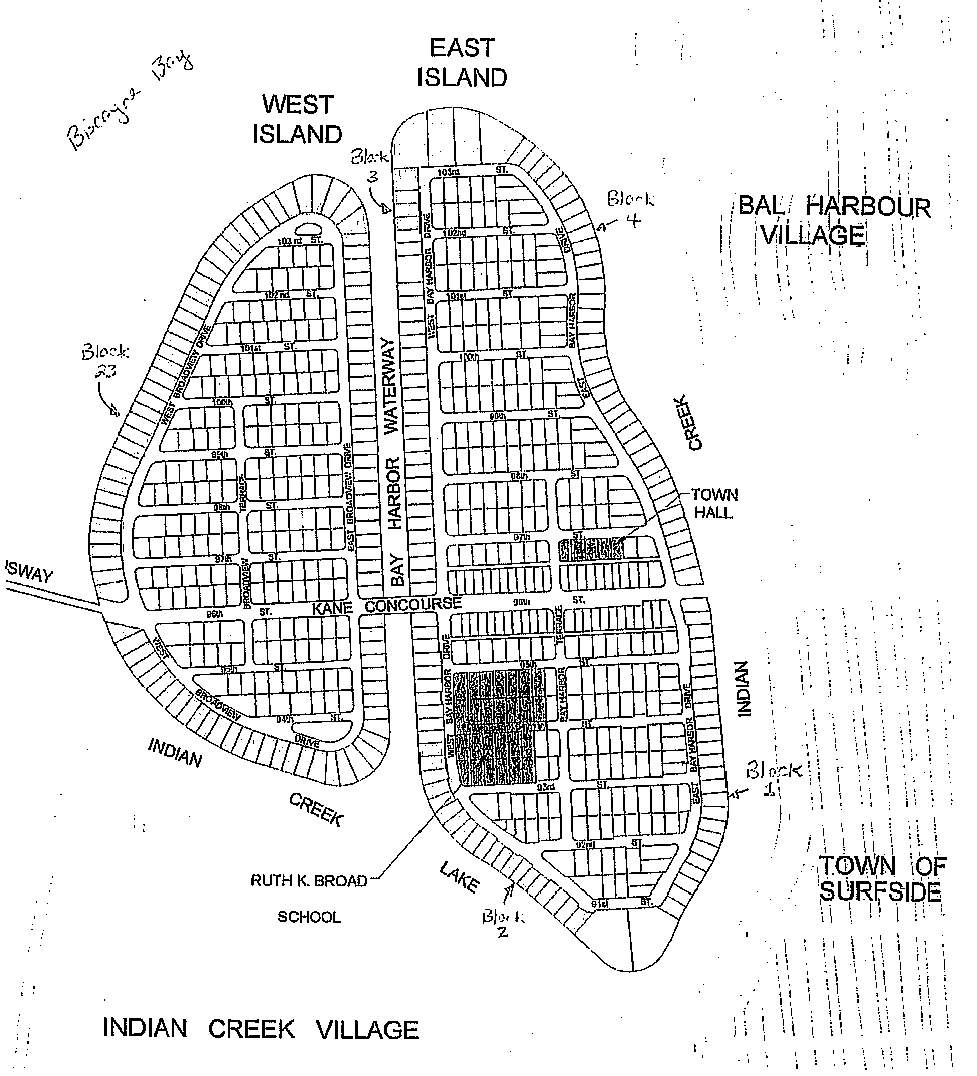
(d)
Design, construction of seawalls. All seawalls shall be designed and certified by a registered engineer and constructed by a licensed contractor.
(e)
Completion of construction, approval. Seawalls, when completed and backfilled to grade shall be plumb and the coping straight before its final acceptance and release of bond by the Town.
(f)
Extension of seawall into waterways. No part of any seawall, including slabs, may extend beyond any lot line into any waterway. Piles and the cap beam may encroach into the adjoining waterway, if approved by the town and regulatory agency having jurisdiction.
(g)
Construction methods. Seawalls shall be constructed of reinforced concrete, with a cap beam and supported on concrete pilings driven to bedrock. Seawalls shall penetrate into the soil at least two feet. No rip-rap shall be permitted in place of a seawall; however, rip-rap may be installed adjoining a seawall if approved by the town and regulatory agencies having jurisdiction. If a seawall is replaced all existing tie backs shall be removed. Property owners are encouraged to remove failed tie backs when possible due to frequent system failures and damage caused on upland lands.
(h)
Non-conforming seawalls. Existing seawalls and construction methods other than specified herein shall be allowed to remain as non-conforming structures and may continue to be repaired. Property owners are strongly encouraged to reconstruct and/or raise older low elevation seawalls to the heights specified in subsection (c) above and remove failed tie back systems as opportunities occur to increase flood protection and safeguard properties.
(11)
It shall be unlawful and a public nuisance for any property owner in the town to permit, or to fail to repair or reconstruct, any failed seawall upon his property. It is further declared unlawful and a public nuisance for any property owner to fail to remove from his property or an adjacent body of water the debris and rubble of any failed seawall.
(12)
The finished grade of any lot in the town may not be increased above the base flood elevation (BFE) prescribed by United States, state or county flood-control laws or regulations. All yards shall be sloped so as to drain to the street drainage gutter, seawall or on-site retention/discharge system, and shall not drain into adjacent property. Finished grades at adjoining lots shall be equal unless the town council approves a retaining wall system. All swale areas within adjoining roadways adjoining lots and yard areas adjacent to seawalls shall be designed to provide retention for sediments prior to discharge to meet NPDES permit requirements
(13)
The area of any lot, improved or unimproved, shall not be reduced or diminished so that the area of the lot is less than originally platted or as follows:
(a)
In the "RM-1" and "RM-2" Multiple-Family districts, the area of no lot shall be reduced to less than 11,250 square feet.
(b)
In the "RD"-Single Family district, the area of no lot shall be reduced to less than 10,000 square feet, except the area of Lots 1 to 28, inclusive, and Lots 96 to 104, inclusive, which shall not be reduced to less than 11,250 square feet, and Lots 29 to 95, inclusive which shall not be reduced to less than 13,125 square feet.
(c)
In the RM-3 Multiple-Family district, Tracts A, B, C, D, E, or F shall not be subdivided without prior approval by the town council of a subdivision plat. In any event, all lots in such subdivision shall contain a minimum of 11,250 square feet.
(14)
No kitchen or cooking facilities may be contained in any accessory building, but may only be contained in the main building on any building site.
(15)
Projections into setback areas:
(a)
Notwithstanding anything to the contrary set forth in this subsection, the following are permitted:
i.
[Reserved.]
ii.
[Reserved.]
iii.
In the RD-Single Family district, no part of any building or structure shall project into a side or rear yard setback, except for fences and walls, and eaves, in accordance with this subsection and/or as provided in section 5-23 of the Town Code.
iv.
[Reserved.]
v.
On the East Island for RM-1 (waterfront) lots, balconies extending from the exterior walls of the main building shall be permitted to encroach into the front, side and rear yard areas as follows:
Front (street) yards. Balconies may project into the minimum front yard area not more than four feet. However, if a building is set back on a lot more than the minimum setback requirement, a balcony may be deeper, provided no portion of any balcony shall encroach closer than four feet into the minimum front setback. Notwithstanding the above, no balcony adjoining a front lot line shall exceed six feet in depth, unless otherwise approved by the town as part of a site development plan.
Side yards. Balconies may project into the minimum side yard area not more than two feet. However, if a building is set back on a lot more than the minimum setback requirement, a balcony may be deeper, provided no portion of the balcony shall encroach closer than two feet to into a minimum side setback. Notwithstanding the above, no balcony adjoining a side lot line shall exceed eight feet in depth, unless otherwise approved by the town as part of a site development plan.
Rear yards. Balconies may project into the minimum rear yard area not more than six feet. However, if a building is set back on a lot more than the minimum setback requirement, a balcony may be deeper, provided no portion of the balcony shall encroach closer than six feet into the minimum rear setback. Notwithstanding the above, no balcony adjoining a rear lot line shall exceed eight feet in depth, unless otherwise approved by the town as part of a site development plan.
vi.
On the East Island for RM-2 (non-waterfront) lots, balconies extending from the exterior walls of the main building shall be permitted to encroach into the front, side and rear yard areas as follows:
Front (street) yards. Balconies may project into the minimum front yard area not more than four feet. However, if a building is set back on a lot more than the minimum setback requirement, a balcony may be deeper, provided no portion of any balcony shall encroach closer than four feet into the minimum front setback. Notwithstanding the above, no balcony adjoining a front lot line shall exceed six feet in depth, unless otherwise approved by the town as part of a site development plan.
Side yards. Balconies may project into the minimum side yard area not more than two feet. However, if a building is set back on a lot more than the minimum setback requirement, a balcony may be deeper, provided no portion of the balcony shall encroach closer than two feet into a minimum side setback. Notwithstanding the above, no balcony adjoining a side lot line shall exceed eight feet in depth, unless otherwise approved by the town as part of a site development plan.
Rear yards. Balconies may project into the minimum rear yard area not more than four feet. However, if a building is set back on a lot more than the minimum setback requirement, a balcony may be deeper, provided no portion of the balcony shall encroach closer than four feet into the minimum rear setback. Notwithstanding the above, no balcony adjoining a rear lot line shall exceed six feet in depth, unless otherwise approved by the town as part of a site development plan.
vii.
On the East Island for RM-3 (waterfront) tracts, balconies extending from the exterior walls of the main building into the minimum front, side and rear yard areas shall not be permitted.
viii.
On the East Island for Gateway "G" zoned lots, balconies extending from the exterior walls of the main building into the minimum front, side and rear yard areas shall be permitted. Balconies may project into the minimum front (street) yard or rear yard areas by not more than four feet. Balconies may project into the minimum side yard areas by not more than two feet. Notwithstanding the above, the town may approve variations to the above balcony projections, except for road right-of-way encroachments, as part of a site development plan.
(b)
No steps or platforms over three feet in height above the base flood elevation (BFE) shall extend into side, rear or front yard setback areas. Steps or platforms not exceeding three feet in height may be railed, provided that such railing shall not exceed in height above the base flood elevation (BFE), specified for walls in that district, and further, that there shall be clear, unobstructed passage of not less than three feet between such projection and the lot line adjacent. No portion of a sidewalk shall be constructed closer than three feet to a side lot line, five feet to a rear lot line nor closer than 15 feet to a front lot line, except for a public sidewalk parallel to the street and/or swale parking areas as part of a town-wide pedestrian plan. This provision shall not preclude a sidewalk placed perpendicular between the front lot line and building. No sidewalk shall exceed five feet in width.
(c)
Areaways, steps to basements and similar features will be permitted in side and rear yard areas, providing that no part of such feature shall exceed in height, three feet above grade, and further provided that there shall be a clear unobstructed passage of not less than five feet between such features and the lot lines adjacent. On corner lots, steps extending to more than four feet from the main building and not more than three feet in height above grade, leading to the basement or ground floor may be constructed in the front yard setback area parallel to the side yard setback areas.
(d)
Open-type, metal fire escapes may project four feet into side and rear yard setback areas, provided that the bottom run shall be counter-balanced and that when the bottom run is up there shall be at least nine feet of clear headroom below it. The bottom run shall be adjacent to the building and shall be so arranged that when down, there shall be at least three feet of clear unobstructed passage between it and the lot line adjacent. No open type, metal fire escapes shall be permitted in RD or RE districts. In RBA-Tract district that shall be permitted only on buildings designed for business or commercial use and then only on specific permission and approval as to location and design by the town council.
(e)
No main walls of any building shall encroach on setback areas; but eaves may project into setback areas which abut interior lot lines not more than two feet, and into setback areas which abut on street, alleys or waterways not more than two feet. Other architectural features and accessory structures shall be regulated as follows:
i.
[Reserved.]
ii.
[Reserved.]
iii.
Notwithstanding the provisions of subsection (19), as related only to waterfront lots on the West Island certain open, airy and decorative structures such as freestanding canopies and awnings, thatched huts, pool cabanas, fixed umbrellas and gazebos may project into the rear and side yard setback areas (or into the front and side yard setback areas of waterfront lots) to a point no closer than five feet from the lot line or the seawall for waterfront lots, subject to written approval by the design review board as required in accordance with the criteria and procedures set forth in section 5-23 of the Code and subsections thereto. Notwithstanding the foregoing, no such open, airy and decorative structure shall be installed or maintained which protrudes or extends beyond the imaginary extension of a line from the front wall of any building or structure to the side yard property line of said building or structure. No part of any building or structure shall project into the side or rear yard setback area of interior lots on the West Island, except for fences and walls, and eaves, in accordance with this subsection and/or as provided in subsection (19) and in section 5-23 of the Town Code.
iv.
A trellis shall be defined as an open, airy structure of thin wooden or metal strips crossing each other in an open pattern of squares, diamonds, etc., such as a lattice, on which vines or other creeping plants are growing, so as to cover and camouflage in whole or part, the trellis. As related to the West Island structures meeting this definition may project into the front yard setback areas of waterfront lots to the lot line, in accordance with the criteria and procedures set forth in section 5-23 of the Code and subsections thereto.
v.
[Reserved.]
vi.
Porticos shall be defined as a structure consisting of a roof supported from above or below or cantilevered, only for the protection of vehicular driveways, at the main entrance of hotels, apartment buildings, and single family residences. The portico shall give the appearance of being an integral part of the original structure to which it is attached and its architectural style, as well as materials, must be such that will complement, enhance, and blend with that of the main structure. Such porticos shall at no time be enclosed or transformed into anything other than for the protection of vehicular driveways. Porticos shall be permitted on the West Island to extend into setback areas which abut on a street, provided the projection shall not exceed 20 feet into the setback area, and the width shall not exceed 33.33 percent of the front footage of the building to which the portico is attached. Porticos shall be permitted on the East Island to extend out from the building wall for a distance not to exceed 20 feet, and the width shall not exceed 25 feet. For the purpose of measuring the maximum allowable width of a portico with ground-mounted support columns, the maximum width shall be measured from the inside edge of any such support columns. Provided however, no portico shall be constructed into property dedicated to the town for parking purposes. The construction of porticos shall be subject to prior approval of the design review board as provide in section 5-23.1 of the Town Code.
vii.
Covered pedestrian walkways, only in connection with hotels, apartment buildings and business buildings, may be erected in setback areas which abut on a street; provided, no part of the walkway may be located on public right of way and further provided that the location, size, materials, design and overall appearance of such structures or canopies must be approved by the design review board.
viii.
Anything to the contrary in this Code notwithstanding, roofs of buildings in the B-1, Business district, may project into setback areas not to exceed five feet.
(f)
Open terraces projecting into the front yard setback areas shall not exceed in height two feet above grade and the railing of such terrace shall in no case be more than three feet above the terrace. Where necessary to provide access through side yards, terraces shall be provided with steps or ramps and gates, not less than 36 inches in width. Such terraces may be used for dining provided they do not project into side yard setback areas.
(g)
Swimming pools, hot tubs, Jacuzzi, or spas may be constructed on any waterfront or nonwaterfront lot with following restrictions:
i.
Swimming pools, hot tubs, Jacuzzi, or spas may be constructed on waterfront lots on the side which abuts the water with the following restrictions:
a.
They must not exceed two feet above finish grade.
b.
They must not be closer than five feet to the seawall.
c.
They must not be constructed in the side yard setback areas.
ii.
Swimming pools, hot tubs, Jacuzzi, or spas may be constructed on waterfront lots on the side or sides which abut the street with the following restrictions:
a.
They must not exceed two feet above finish grade.
b.
They must not be closer than 20 feet to the rear lot line.
c.
They must not be constructed in the side yard setback areas.
iii.
Swimming pools, hot tubs, Jacuzzi, or spas may be constructed on nonwaterfront lots on the side or sides which abut the street with the following restrictions:
a.
They must not exceed two feet above finish grade.
b.
They must not be closer than 20 feet to the front yard lot line.
c.
They must not be constructed in the side yard setback areas.
iv.
Swimming pools, hot tubs, Jacuzzi, or spas may be constructed on nonwaterfront lots in the rear yard setback with the following restrictions:
a.
They must not exceed two feet above finish grade.
b.
They must not be closer than five feet to the rear yard lot line.
c.
They must not be constructed in the side yard setback areas.
v.
Swimming pools, hot tubs, Jacuzzi, or spas and equipment may be constructed in setback areas with the following restrictions:
a.
Swimming pool, hot tub, Jacuzzi, or spa and pool equipment must not be closer than five feet to the side or rear yard lot line.
b.
[Reserved.]
c.
Swimming pool, hot tub, Jacuzzi, or spa equipment must be screened from sight from adjacent property and from the street when viewed from ground level.
vi.
Except for the foregoing permitted construction and restrictions, no swimming pools, hot tubs, Jacuzzi, or spas or pool equipment may be constructed in any setback area.
vii.
All swimming pools, hot tubs, Jacuzzi, or spas to be constructed in areas abutting a street shall be screened from the street by a wall or fence and landscaping so that the pool cannot be seen from the street. Further, there shall be full compliance with all provisions of the town's ordinances regulating fences and walls.
viii.
The construction of swimming pool, hot tub, Jacuzzi, or spa decks shall be subject to prior approval by the town manager or the design review board. Plans showing the location of new or replacement decks shall be provided to the building department prior to issuance of a permit. A sample of the decking material will be required when submitting an application.
ix.
No portion of a swimming pool, hot tub, Jacuzzi, or spa deck shall be placed closer than five feet to a side or rear lot line. No portion of a swimming pool, hot tub, Jacuzzi, or spa deck shall be placed in the minimum front yard setback area.
x.
Notwithstanding the above restrictions, a swimming pool, hot tub, Jacuzzi, or spas and/or swimming pool decking may be constructed in a street side yard of a corner lot in the RD Single-family district and RM-2 Multi-family district with the following restrictions:
a.
Swimming pools, hot tubs, Jacuzzi, or spas, and swimming pool decking shall not be closer than five feet to the street side lot line.
b.
Swimming pools, hot tubs, Jacuzzi, or spas, swimming pool equipment and swimming pool decking shall be screened from sight from adjacent property and from the street when viewed from ground level pursuant to the provisions of subsection vii above.
c.
The street side yard is the yard area of a corner lot other than the yard that the front of the building faces. If a building is placed on a corner lot in an angled configuration the town will designate the front and street side yards. Swimming pool, hot tubs, Jacuzzi, or spas, and swimming pool decking shall not be placed in front yard areas on corner lots.
(h)
Air conditioning equipment and duct work may be installed in the side yard setback areas with the following restrictions:
i.
All replacement and new air conditioning equipment shall be installed in accordance with chapter [subsection] 7½-26(5) of the town's flood damage protection code;
ii.
All replacement and new air conditioning equipment shall be screened from view from the street and from adjacent property, when seen by a person at ground level;
iii.
No portion of air conditioning equipment and duct work shall protrude more than five feet from the wall of the structure into the setback area;
iv.
All screening material shall be approved by the town and constructed in such a way to minimize sound transmission to adjoining properties, and may be constructed of one of the following:
1.
Decorative concrete block.
2.
Concrete block with stuccoed finish.
3.
Wood fencing.
4.
Lattice work with growing vines.
5.
Hedge material of a height at planting equal to 50 percent or more of the height of the installed air conditioning equipment.
6.
Other materials as may be approved from time to time by the design review board.
v.
Air conditioning screening shall be constructed in such a manner as to allow proper ventilation and service access. The service access shall not be visible from the front of the property;
vi.
All replacement and new air conditioning equipment shall meet or exceed the minimum SEER ratings as determined by the current Florida Energy Code;
vii.
Plans showing the installation of new or replacement air conditioning equipment shall be provided to the building department prior to issuance of a permit and shall include the following:
1.
Location of equipment on property with dimensions.
2.
Type of screening and material.
3.
Elevation of equipment.
4.
SEER rating.
5.
Sound rating in bels as contained in the current Unitary Systems Manufacturer's ARI standard rating.
(i)
Within the B-1 Business district, decorative architectural features, including bay windows or showcase windows extending from the face of the main building facade shall be permitted to project into the setback areas, but in no instance project across or into public sidewalks, alleys or streets. Bay windows and/or showcase windows may only be installed on building facades where the use of the land abutting the site or across a street is commercial. For clarity of this section a hotel is defined as a commercial use per the comprehensive plan. Such bay windows and/or showcase windows shall not be installed on building facades facing a residential use. On those specified streets where an average five-foot setback is permitted, not less than one foot of setback shall be provided between any such decorative architectural feature and/or window projection and a property line. All such bay windows and/or showcase windows shall be maintained in proper working condition and appearance with all lighting operational, no broken glass and all structural members and framing maintained. All items displayed within bay windows and/or showcase windows shall be limited to the ground floor and only those products or services owned or sold by a tenant within the building upon which the bay window and/or showcase window is attached.
Editor's note— Ord. No. 866, § 1(Exh. A), adopted Nov. 10, 2008, added subsection (i)(ix) to subsection 23-12(15). The city has clarified that the material is to be codified as 23-12(15)(i) as herein set out.
(16)
All plans submitted for a building permit shall include a plan showing proposed landscaping. The landscape plan shall identify the type, size and location of all plantings, trees and other associated features.
(17)
No lot in any block as platted on the plat of the subdivision of Bay Harbor Islands shall be divided or subdivided so that any person whosoever shall own in area less than the whole of an adjacent platted lot; no person shall have the right to give or acquire, by deed, lease, mortgage or any instrument, which would have the effect of constituting a conveyance or transfer of title to land, either legal or equitable, as to the portions of any platted lot in any block of Bay Harbor Islands less in area than the whole of such lot. The provisions of this paragraph shall not apply to Tracts A, B, C, D, E, and F, according to the plat of Bay Harbor Islands. Notwithstanding the foregoing, it shall be permitted for an owner of a lot to acquire a one-half portion of an adjoining lot if, simultaneously therewith, the remaining one-half portion of such lot shall be acquired by the owner of the property adjacent to the remaining one-half portion. This is for the purpose of giving effect to ownership of a lot and one-half in the town which may be improved only as provided in section 23-10 and section 23-12.
(18)
No guest hotel room may be constructed without an adjoining private bathroom for exclusive use of occupants of that hotel room. All replacement and new air conditioning units shall comply with section 23-12(15)(h)(i), (ii), (iv), (v), (vi), (vii).
(19)
No awning or canopy shall be erected on any land or building in the Town of Bay Harbor Islands without a prior approval of the town manager of the town. No awning or canopy shall be erected in any side yard setback. No awning or canopy made of canvas shall be erected on any land or building in the town as a carport or shelter for parked vehicles.
(a)
If any awning or canopy erected outside of the BAA Business district of the town is not maintained in good condition as to material, frame, fastening and appearance, and if necessary replacements of such portions thereof as require replacing in the discretion of the town manager are not made, the awning or canopy shall be removed forthwith. If not removed forthwith, the town at its option may remove it at the cost of the permit holder or the owner of the premises.
(b)
No awning or canopy shall be erected outside of the BAA Business district of the town bearing any sign. However, the awning or canopy may bear the name of the structure with which it is connected if the structure does not have a sign. All provisions of the town's ordinances regulating signs must be complied with.
(c)
This ordinance [(a)—(d)] shall not apply to any awning or canopy (outside of the BAA Business district of the town) in existence at the time of the passage of this ordinance [No. 298] if that awning or canopy complies with the law in effect when that awning or canopy was erected. If the preerected awning or canopy is not maintained in good condition with the necessary replacements, it shall be subject to all provisions of this ordinance [No. 298] as if it were not a preerected awning or canopy.
(d)
This ordinance [(a)—(d)] does not affect any awning or canopy in the BAA Business District of the town which is regulated pursuant to Ordinance No. 297 [(20) following], and Ordinance No. 297 regulating awnings or canopies in the BAA Business District of the town shall not affect any awning or canopy not in the BAA Business District.
(e)
If an awning or canopy is to be erected on an easement, the awning or canopy will only be permitted upon the execution in recordable form of an agreement by the owner of the property running with the land granting to the Town of Bay Harbor Islands, its successors or assigns, the right to examine, repair, replace or remove any utility equipment under any part of the awning or canopy, holding the town harmless for any damages to the awning or canopy of its supports in exercising such right, agreeing that the owner will pay his own costs in his own restoring of the awning or canopy or supports thereof, and agreeing that the owner will pay the town all the town's added costs in removing portions of the awning or canopy or supports thereof in the exercise of the town's right with respect to the utilities.
Editor's note— The various ordinances amending this subsection (19) have, in many instances, continued previous ordinances in effect and therefore, at the editor's discretion, the designations of specific areas in subsection (19) have been retained and the area described in former subsection (20) combined herewith. The contents of Ord. No. 298 have been added to (19) as (a)—(d) at the editor's discretion. Ord. No. 297 has been inserted as a new (20) at the editor's discretion.
(20)
With respect to awnings and canopies sought to be erected on any land or building in the BAA Business district of the town:
(a)
No awning or canopy shall be erected without prior approval of the town manager of the town.
(b)
No awning or canopy shall be erected which extends more than three feet beyond the building line of any lot. Notwithstanding the foregoing, restaurants and sidewalk cafes shall be permitted to have retractable awnings and canopies or stationary awnings or canopies that extend beyond three feet as long as they comply with the Florida Building Code and other state and county laws.
(c)
If any awning or canopy shall be erected and is not maintained in good condition as to material, frame, fastening and appearance, and if necessary replacements of such portions thereof as require replacing in the discretion of the town manager are not made, the awning or canopy shall be removed forthwith. If not removed forthwith, the town at its option may remove it at the cost of the permit holder or the owner of the premises.
(d)
No awning or canopy shall be erected bearing any sign. However, the awning or canopy may bear the trade name of the establishment with which it is connected if the establishment does not have a sign on the same side of the building on which the awning or canopy is located. All provisions of the town's ordinances regulating signs must be complied with.
(e)
Awnings placed on a building must be uniform as to color, style and shape as all other awnings on that same building.
(f)
No awning or canopy made of canvas shall be erected on any land or building in the town as a carport or shelter for parked vehicles.
(g)
This ordinance [(20)] shall not apply to any awning or canopy in existence at the time of the passage of this ordinance if that canopy or awning complies with the law in effect when that awning or canopy was erected. If the preerected canopy or awning is not maintained in good condition with the necessary replacements, it shall be subject to all provisions of this ordinance as if it were not a preerected awning or canopy.
Note— See editor's note, (19) above.
(21)
Air-conditioning equipment and ductwork installed on the rooftop or on any portion of a single-family dwelling above the top floor in the town is hereby prohibited. Any permitted rooftop air-conditioning equipment in existence at the time of adoption of Ordinance No. 772 [May 9, 2005], shall constitute a nonconforming unit and shall be removed and replaced when the structure undergoes rehabilitation wherein the cost of rehabilitation is 50 percent or more of the assessed value of the existing structure as determined by the Miami-Dade County Property Appraiser's Office. As to all two-family, multifamily, commercial and any other land use or combination thereof, air-conditioning equipment and ductwork may be installed on the rooftop or on any portion of a building above the top floor provided the equipment and ductwork are so screened that they are not visible from the adjoining street or properties, and provided the screening is of such material and color that it matches or blends with the existing roof or portion above the top floor where it is installed. All installations of such air-conditioning equipment and ductwork, and the screening thereof, must be approved by the town manager or their designee prior to a permit being issued for such installation. This provision shall not be interpreted to require screening of air-conditioning equipment or ductwork from adjoining buildings that may exceed the height of the building upon which the equipment or ductwork is installed. In this instance, only screening to the maximum height of the equipment or ductwork is required from adjoining properties.
(22)
Walls and fences. The following provisions apply to the design, installation, location and maintenance of walls and fences:
(a)
Approval of town. No wall or fence of any kind shall be erected or maintained at any lot except as above set forth until the height, type, design, and location thereof shall have been approved by the [town]. Notwithstanding the above, walls will require approval by the design review board.
(b)
Maximum height of walls or fences; placement restrictions. No wall or fence may be erected or maintained in any setback areas on any lot in the town higher than six feet above the average finished grade of adjoining lots, except privacy walls or fences abutting Kane Concourse may be seven feet; all heights measured from the ground at the base of the wall or fence to the highest point of the wall or fence and shall in all cases be uniform and follow the contour of the land. Minor variations in the height of portions of walls, not to exceed four inches in any ten-foot section of a wall, may be permitted due to changing slopes of lots. The town may approve decorative columns with a height not exceeding one foot higher than the wall or fence. If a fence or wall is proposed in a front or side street setback area adjacent to a street right-of-way, the fence or wall shall not be placed in the public right-of-way nor closer than two feet to the property line. Within the two-foot area, landscape materials of a design and quantity, as deemed necessary by the town, shall be required.
(c)
Child-safe latch on swimming-pool gates. Any fence or wall installed at a property with a swimming pool must have a self-closing gate with a child-safe latch located at a minimum of four feet above grade.
(d)
Chain link fence or wire fence prohibited in front yard setback. No chain link or wire fence shall be installed or maintained which protrudes or extends beyond the imaginary extension of a line from the front wall of any building or structure to the side yard property line of said building or structure ("front yard setback").
(e)
Vinyl-clad material required. If chain link fencing is proposed for installation where permitted, only green or black vinyl-clad material shall be allowed.
(f)
Hedge material required for fencing and walls. All fencing or walls must have hedge material installed simultaneously with the installation of the fence or wall. Said hedge must be planted along the entire length of the fence or wall, except at gate locations or as otherwise approved by the town, and shall have a height at the time of planting of at least 50 percent of the height of the fence or wall and must be installed a maximum of two feet apart, measured from the center of the plants. Planting materials associated with fences or walls must be of a type that will grow to a height equal to or greater than the height of the fence or wall and shall be of a depth so as to engulf and hide the fence or wall. The location of any required hedge material shall be determined on a case-by-case basis. Hedges shall be kept and maintained in a neat and attractive manner. If the hedge deteriorates, new planting material to match the existing hedge shall be added.
(g)
Hedge planting material required with certain fences or walls. If a wall or fence is installed in the front (street) yard setback (or for corner lots the side yard facing a street) without fencing or wall material along the sides of the property, then the sides shall be planted with hedge material in accordance with the requirements stated in subsection (f) above.
(h)
Permit required for walls or fences. The installation or maintenance of any walls or fence shall require the application and receipt of a permit authorizing said installation. Each applicant for a permit authorizing said installation shall be required to submit to the town for its approval, prior to the commencement of such installation the following:
1.
A landscaping plan, indicating type, sizes and quantities of proposed landscaping materials to be used between the wall or fence and the street or adjoining properties.
2.
A color sample of the proposed stucco, plaster or other materials, or paint sample, representative of the proposed finish surface of the wall or fence.
3.
In the case of walls, architectural drawings indicating some type of architectural features such as banding, quoins, etc., on stuccoed walls. Said drawings shall clearly indicate the proposed shape and design of said wall. See below for minimum design standards.
4.
In the case of wood fences, a scale drawing, photograph or brochure of the proposed style, as well as a color sample of the paint or stain, shall be submitted to the town for approval.
5.
If any wall or fence is to be constructed on a common property line, written permission from any adjoining lot owner shall be required to be submitted to the town with the permit application to construct, finish and/or maintain the exterior of the wall facing the adjoining owners lot. Any damage done to an adjoining owners property shall be repaired and/or replaced by the applicant.
(i)
Minimum design standards for walls or fences. The design of any wall or fence shall comply, at a minimum, with the following design standards:
1.
If walls are to be stuccoed, they must be finished and architectural features shall be required on both sides of a wall (facing interior of lot as well as any adjoining lot, street or waterway). Plain walls with large unbroken surfaces shall be prohibited. The architectural design of the wall/fence shall be compatible with the main building architecture.
2.
The use of brick, stone, coral, glass block, metal or other decorative material is encouraged.
3.
The finished side of a wood fence shall face the street or any adjoining property with any exposed structural columns facing the interior of the lot.
4.
If any wall or fence is to be constructed on a common property line, all improvements including support structures (footers, etc.) shall be placed on the applicant's property and may not encroach onto any adjoining owners property, without the adjoining property owners written consent.
5.
For those portions of walls/fences within the front setback area (adjoining any street), the following additional design standards are established to avoid the appearance of large expanses of solid wall/fence surfaces:
a)
A maximum of three (3) feet of solid opaque wall/fence surface above grade shall be permitted, except as provided hereinafter.
b)
The balance of allowable wall/fence height up to the maximum heights may be constructed of non-opaque material such as wrought iron, aluminum, decorative open weave concrete or clay products, glass block and similar materials.
c)
Not more than 75 percent of any such overall wall/fence surface shall be opaque. Notwithstanding the above, portions of solid walls/fence surfaces not exceeding eight feet in width may be permitted for screening of parking areas, provided the design of the exterior surface of the wall/fence facing a street is approved by the town.
d)
The design review board may grant exceptions to the above criteria for specific sites based on creative and compatible design solutions and location issues.
6.
For walls/fences/hedges constructed on waterfront lots within the minimum rear setback area to the seawall, including any such wall/fence parallel to the seawall, or on a dock adjoining the seawall, at least 75 percent of that portion of the wall/fence and any hedge materials placed similarly, shall provide for see-through visibility to the adjoining water.
The town shall determine whether the installation and maintenance of a wall or fence (is) appropriate and harmonious to the other buildings, structures, walls, fences and overall design of the town. Prior to obtaining a permit, the applicant shall be required to submit a property survey to verify the proposed location of said fence or wall to the town. All fences and walls which require landscaping shall require prior approval of the town. If the application is approved by the town, a permit shall be issued for the installation and maintenance of the wall or fence.
(j)
Application to waterfront properties. With respect to waterfront properties, the provisions of this section shall apply to the rear yard setback, which is that portion of the property abutting the street.
(k)
Temporary construction fences. See section 5-5(f) for applicable installation, permitting, design and location requirements.
(23)
It shall be the duty of the immediately adjacent property owner, lessee, or mortgagee to properly and adequately maintain the area between the designated roadway and the property line of such property, regardless of whether such area is landscaping, parking of any kind, or sidewalks, or any combination thereof.
(24.1)
Shutters, screens, glass or any material which enclose balconies.
(a)
"Shutters, screens, glass or any material not flush with all original exterior walls of the building" are defined as covers, whether solid or partly solid, screens, glass, or any material any part of which projects beyond the original exterior walls of the building more than one inch.
(b)
"Shutters, screens, glass and any material enclosing balconies" are defined as covers, whether solid or partly solid, screens, glass or any material placed on or near the perimeter or edge of balconies in such a manner as to partially or completely enclose the area contained on the balcony, thereby creating an enlarged, enclosed floor area of a building beyond its original exterior walls.
(c)
No shutters, screens, glass or any material enclosing balconies or no shutters, screens, glass or any material not flush with all original exterior walls of the building may be installed on any building in the town. This prohibition shall not affect any shutters, screens, glass or any material which have been installed pursuant to a valid permit of the town prior to the passage of this subsection. Shutters shall be installed as close as practical to door openings. An illustration containing examples of prohibited and permitted installations is incorporated herein.
(d)
Shutters, screens, glass and any material enclosing balconies shall be subject to prior approval by the town manager or the design review board. See subsection (24.3) below for the town's approval process.
(e)
No balcony may be enclosed by jalousies or other types of windows. No wall and/or railings surrounding the balcony shall exceed four feet in height from the balcony floor surface.
(f)
Balconies may be screened only if all balconies on a building are screened at the same time. The architectural style and appearance of any screening shall be the same for all units in the building. If screening of balconies is provided the enclosed balcony must meet the primary building setback requirements.
(g)
Balconies may be used for outdoor living and may contain lawn furniture and plants; however, plants shall not be placed on balcony railings, furniture or external ledges of said balcony so as to avoid objects falling.
(h)
Balconies shall be specifically prohibited for the use of storage, mechanical equipment including air-conditioning units, laundry drying, barbecuing or cooking and sleeping quarters. Balconies are intended to be used for occasional use and as such, those activities that may lead to noisy or unsightly conditions to neighbors or passersby; will endanger the safety of the building; or will create weight loads beyond which the balcony was designed are prohibited.
(24.2)
Shutters, screens, glass or any material which enclose porches.
(a)
"Shutters, screens, glass or any material not flush with all original exterior walls of the building" are defined as covers, whether solid or partly solid, screens, glass, or any material any part of which projects beyond the original exterior walls of the building more than one inch.
(b)
Shutters, screens, glass and any material enclosing porches or in openings to porches from the building exterior, installed in such a manner as to partially or completely enclose the area contained on the porch, thereby creating an enlarged, enclosed floor area of a building beyond its original exterior walls is prohibited. This provision shall not be construed to prohibit the uniform enclosing of porches into heated and/or air-conditioned living spaces if approved by the design review board, provided all applicable principal building setbacks are met.
(c)
No shutters, screens, glass or any material enclosing porch openings not flush with all original exterior walls of the building may be installed on any building, unless otherwise approved by the design review board. See subsection (24.3) below for the town's approval process. This prohibition shall not affect any shutters, screens, glass or any material which have been installed pursuant to a valid permit of the town prior to the passage of this subsection. An illustration containing examples of prohibited and permitted installations is incorporated herein.
(24.3)
Shutter appearance and approvals.
(a)
All permanent shutters are to be uniform in color, material, design, configuration and type for each building. The building owners (sole owner, association, majority vote) shall select a uniform color, material, design, configuration and type of shutter for all units which shall be submitted to the town's design review board for approval. Written evidence of the building owner's shutter selection shall be provided to the town as part of the application. The town is not obligated to approve the shutters as selected by the building owners and may require modifications for safety and appearance. Once approved by the town, all future shutter installations shall comply with the uniform design.
(b)
Permanently installed shutters, storage boxes and tracks should be installed and designed to compliment the principal buildings architectural design.
(c)
Permanently installed wood shutters are prohibited. This shall not be construed to prohibit decorative nonfunctional shutters consistent with the building's architectural design.
(d)
All decorative shutters maintained on the exterior of buildings for periods in excess of five business days, as opposed to temporary shutters installed for an impending storm event, shall be painted to match the exterior color scheme of the dwelling.
(e)
Roll-up or accordion shutters should match the window or door size exactly. No part of the shutter, storage box, track or associated hardware should damage or obscure architectural, historical or decorative materials. Awnings or other decorative features are encouraged to screen the view of storage boxes or roll-up shutters.
(24.4)
Shutter placement and removal. Hurricane shutters and/or hurricane resistant windows and doors are encouraged for all structures in the town. However, the placement and timely removal of shutters after storm events is essential for the safety of occupants and to preserve the high quality appearance of the community. It is prohibited to maintain storm shutters on a structure beyond the officially declared hurricane season, unless hurricane conditions are expected to occur within 36 hours. In accordance with the provisions in the Florida Building Code, it is prohibited to maintain storm shutters during hurricane season in a closed/secured position on a structure for periods in excess of five business days unless:
(a)
A hurricane occurs during the five-day period, at which point the five-day period begins anew the day after hurricane conditions have subsided;
(b)
Hurricane conditions are expected to occur within 36 hours after the fifth day;
(c)
The structure is used for residential purposes, but no person is in residence for a period in excess of five business days and the owner/occupant registers with the police department on a form prepared by the town; or
(d)
At least two means of ingress and egress are provided through a door, window or garage.
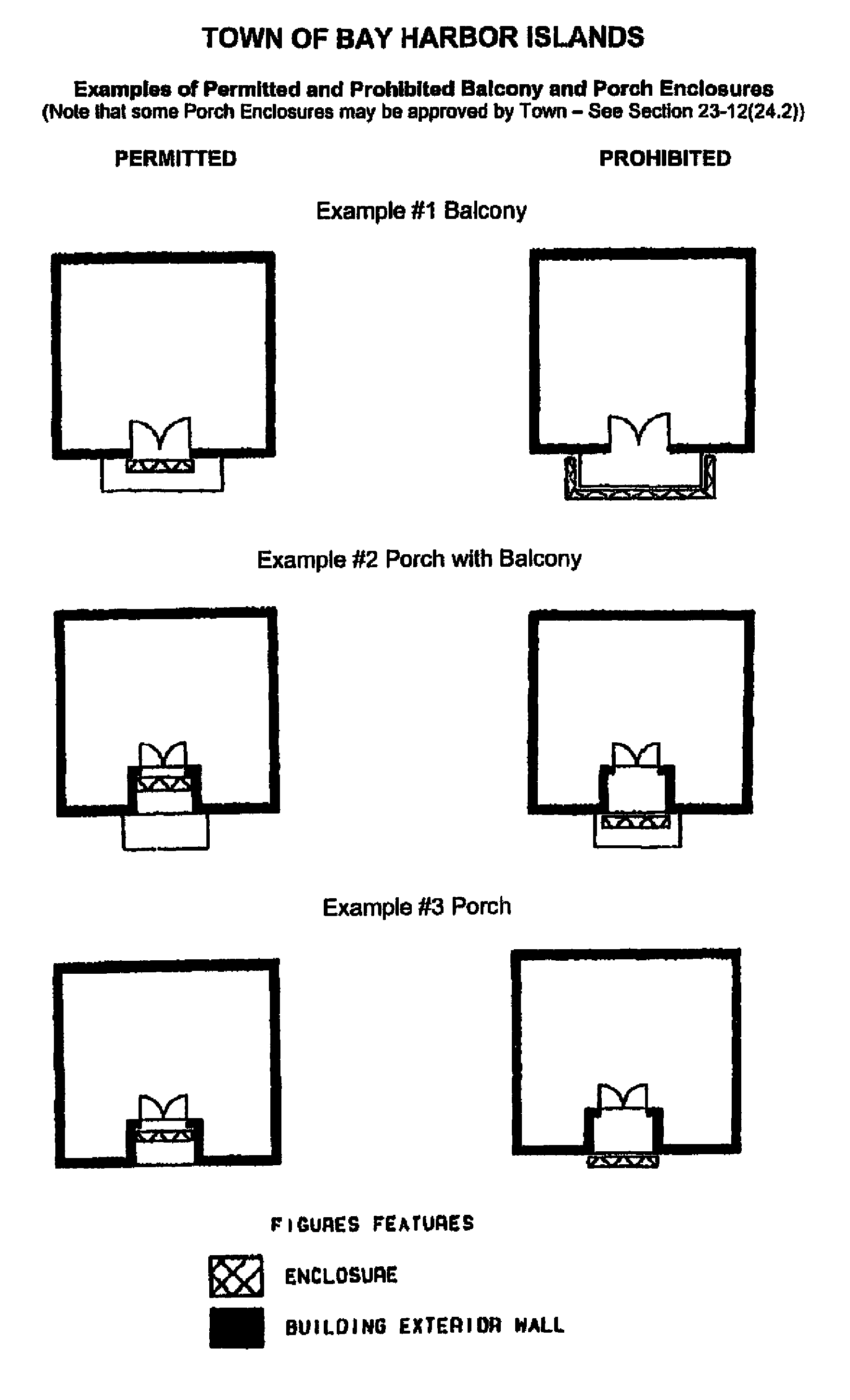
(25)
Exceptions and guidelines from height limits.
Single-family district. The height of all accessory roof structures in the RD single-family zoning district that are designed and utilized for any of the following may exceed the maximum allowable building height, provided such structure is architecturally compatible with the home design and the structure does not exceed five feet above that point of a flat roof or pitched roof utilized to determine building height, except as may be required to minimally comply with building codes for functional chimneys or similar features: chimneys, dormers, domes, spires, decorative architectural roof features, non-habitable structures such a tower or cupola limited to a maximum of 100 cubic feet, weather vanes, flag poles, sun lights, ventilating roof vents, roof-mounted decorative or functional walls or fences for roof decks, solar energy equipment, telecommunication equipment and antennas. Other items such as, weather stations and the like may be attached in a stealth manner to one or more of the above referenced structures. No security cameras or other surveillance devices shall be attached to any of the aforementioned accessory roof structures extending above the maximum allowable building height. All such security cameras and surveillance devices must be mounted on the dwelling facade or fascia below the maximum roof height and shall not be mounted to any roof surface. No equipment, fixtures or furniture shall be placed on any roof deck that exceeds the main roof height or any surrounding safety fence, railing or wall. All ventilating roof vents and equipment shall be painted to match the color of the roof material.
Business, causeway and multiple-family districts. The height of all accessory roof structures in the B-1, CA, RM-1, RM-2 and RM-3 zoning districts that are designed and utilized for the housing of mechanical equipment such as elevators, water storage, air conditioning and similar facilities, stairwells, chimneys, decorative architectural roof features, accessory recreational facilities, open-air trellis, canopies, fences, walls and similar facilities shall be limited to the following:
(a)
The structure is fully enclosed or screened and does not exceed 20 feet in height.
(b)
The outside walls of the roof structure are set back a minimum of 15 feet from the exterior walls of the principal structure. This provision shall not apply to parapet walls located at the edge of the building facade, open-air trellis located on roof surfaces at least ten feet below the maximum allowable building height, elevator shafts, elevator machine rooms or stairwells, if approved by the town during the site plan approval process.
(c)
No guest rooms, dwelling units, business establishments or other accommodations or public spaces, are contained within the structure. This restriction shall include enclosed exercise rooms, gyms, spas or other recreational facilities other than an open swimming pool, spa and deck areas. Notwithstanding the above, a maximum of two separate bathrooms (men/women/unisex) not exceeding the greater of 150 square feet in area each, or as otherwise required by the Florida Building Code to accommodate the minimum number of required fixtures based on occupancy and use, or to meet accessibility requirements for disabled persons (Chapter 11, Florida Accessibility Code) may be permitted, provided the exterior wall(s) of any bathroom structure are set back a minimum of 15 feet from the exterior walls of the principal structure. Bathroom facilities shall be integrated architecturally and structurally with other roof-mounted structures such as elevator shafts, stairwells or screened mechanical equipment areas, if possible, away from the edges of a building facade.
(d)
Rooftop accessory recreational facilities shall be visually screened horizontally from neighboring properties by fences, walls or other screening materials or features that are no shorter in height than the object to be screened, all as approved by the town.
(e)
Swimming pools, spas, accessory decks and any railings associated therewith shall not exceed five feet above the roof deck. Notwithstanding the above a safety railing, fence or wall surrounding a raised swimming pool, spa or deck as required by section 5-8 of the Town Code shall be permitted; provided however, such safety barrier is placed no closer than five feet to the edge of the roof and it is not visible above the parapet wall.
(f)
Trellis, pergolas and similar structures shall not exceed ten feet in height above the roof deck.
(g)
Skylights shall not exceed five feet in height above the roof deck.
(h)
Parapet walls shall not exceed five feet in height as measured from the highest point of the roof deck to the highest point of the parapet wall. Notwithstanding the above provision, a parapet wall may exceed five feet in height to create architectural detailing on a building, if approved as part of a site plan by the town.
(26)
Outdoor recreational game court facilities. The following regulations shall apply to all recreational game court facilities, including but not limited to tennis, racquetball, handball, basketball, shuffleboard, children's multipurpose and similar facilities, or any combination thereof:
a)
In the RD district the only outdoor recreational game court facilities permitted are tennis, basketball and/or children's multipurpose facilities. Such facilities may be approved by the town subject to site plan approval by the design review board, except for a permanent or portable basketball pole installed in accordance with the provisions listed herein.
b)
In all other zoning districts any individual or combination of recreational game court facilities may be approved by the town subject to site plan approval by the design review board.
Tennis courts.
i)
Fencing. The maximum height allowed for a tennis court fence shall be ten feet. Any such tennis court fencing shall be clad with either black or green vinyl on all posts and fence surfaces. Any fencing over five feet in height must be placed so as to comply with the minimum setback requirements within the district in which the tennis court is proposed.
ii)
Playing surface location. Within the RD district the playing surface of a tennis court may not be placed within 25 feet of a property line abutting a street or ten feet to either an interior side or rear property line. Within any other zoning district the playing surface of a tennis court may not be placed within the minimum base setback for the district in which the facility is proposed. The town council may consider variations to the above criteria for odd-shaped lots, corner lots or other special instances on a case-by-case basis through the submission of a variance application.
iii)
Hours of operation. The hours of operation of a tennis courts shall be between the hours of 9:00 a.m. and 10:00 p.m. during all days of the week. If any accessory lighting is provided the light fixtures shall not be illuminated outside of the hours of play specified herein. All such lighting shall be equipped with a timer switch to ensure the lighting will be controlled to operate in the specified time period listed herein. The town manager may authorize the temporary use of a tennis court and/or lighting for special occasions outside of the times listed herein on a case-by-case basis after a written request to do so is submitted to the town and approved by the town in writing.
iv)
Lighting. If any accessory lighting is provided, the lighting fixtures shall not produce more than one-half foot-candle at any property line nor more than 75 foot-candles overall. All such lighting shall be equipped with a timer switch to ensure the lighting will be controlled to operate within the specified time period listed herein. The color of any lighting fixture or pole shall match the fence color. No portion of an exterior lighting fixture may exceed ten feet in a required yard area nor a maximum of 18.5 feet in height in the RD district nor more than 25 feet in any other zoning district and shall be aimed and/or provided with cutoffs so that the light source is directed to the outdoor recreational play court facility so as to minimize negative impacts to adjoining properties.
v)
Screening requirements. Sufficient landscaping (trees and/or hedges) shall be approved as part of the site plan, installed when the facility is constructed, and maintained to opaquely screen the fence and all activities from view. The landscaping shall be at least six feet in height at the time of planting and equal to and maintained at the height of the fence within one year of the installation.
vi)
Miscellaneous requirements.
1)
No portion of an exterior wall surface shall be used for a backboard or rebound wall or structure.
2)
If multiple platted lots, or portions thereof, are required to allow for the principal structure as well as any accessory uses and structures, including recreational game courts, a unity of title declaration acceptable to the town attorney shall be provided and recorded in the public records prior to the issuance of building permits. This provision shall not be interpreted to prohibit a freestanding recreational game court as a principal use, provided the lands upon which the recreational game court is proposed are adequate "as is" to accommodate the use (i.e. setbacks/screening) or a unity of title declaration acceptable to the town attorney is provided and recorded in the public records prior to the issuance of building permits.
3)
In determining the percentage of coverage of a lot by buildings the area of a recreational game court shall not be provided in such computation. Notwithstanding the above, sufficient drainage shall be provided on-site so as not to negatively affect adjoining properties or public roads.
4)
Any recreational game court facilities constructed on the rooftop of a principal or accessory structure shall comply with the provisions contained in subsection (25).
Basketball.
i)
Outdoor basketball poles, including moveable relocatable poles, shall not be installed or placed within public road rights-of-way.
ii)
No exterior lighting shall be allowed specifically for basketball use, except as approved by the town manager.
iii)
No driveway may be enlarged to serve as a basketball game court.
iv)
No striping (paint/decal) for any basketball game court shall be placed on any public roadway. No striping (paint/decal) for a basketball game court shall be placed on any private roadway, driveway or sidewalk without the prior approval of the town. Any such striping or markings shall be limited to inconspicuous colors.
Other game court facilities.
i)
No other type of outdoor recreational game court facilities shall be placed closer than the minimum specified base setbacks for the zoning district in which the facility is proposed.
ii)
No exterior lighting shall be allowed, except as specifically approved by the design review board.
iii)
No driveway may be enlarged to serve as a recreational game court and no portion of a parking lot may be used as a recreational game court without the prior approval of the town.
iv)
No striping (paint/decal) for any recreational game court shall be placed on any public roadway. No striping (paint/decal) for a recreational game court shall be placed on any private roadway, driveway or sidewalk without the prior approval of the town. Any such striping or markings shall be limited to inconspicuous colors.
v)
Any accessory structures such as fences, canopies, etc. shall meet the minimum design standards and setback requirements listed in this section.
Nonconforming preexisting game court facilities. As to any outdoor recreational game court facilities that existed as of the date this subsection was adopted (November 9th, 2009), that were previously issued permits from the town, but are in some way in conflict with the provisions stated herein, those improvements shall be allowed to remain as nonconforming, if maintained in a safe and aesthetic manner. If an existing nonconforming outdoor recreational game court facility is altered, it must comply with the current town regulations, to the extent possible, and may be reestablished if in need of repair caused by normal wear and tear to the facility or acts of God. The design review board shall review and approve any alterations to non-conforming outdoor recreational game court facilities. The design review board is authorized to grant variations to the regulations listed herein above for nonconforming facilities. This shall not be construed to require a property owner seeking to repair a nonconforming outdoor recreational game court to file a formal zoning variance application, unless a request is being made to expand the nonconforming of the facility.
(Ord. No. 108, § 12, 6-10-57; Ord. No. 125, § 4, 1-12-59; Ord. No. 183, § 4, 11-9-64; Ord. No. 243, § 1, 5-13-71; Ord. No. 263, § 1, 10-9-72; Ord. No. 274, § 4, 2-11-74; Ord. No. 275, § 2, 2-11-74; Ord. No. 243, § 1, 5-13-74; Ord. No. 279, §§ 1, 2, 8-12-74; Ord. No. 297, § 1, 3-8-76; Ord. No. 298, §§ 1—5, 5-10-76; Ord. No. 299, § 1, 6-14-76; Ord. No. 309, § 1, 10-11-76; Ord. No. 311, § 6(e), (g), 11-8-76; Ord. No. 318, §§ 1, 2, 6-13-77; Ord. No. 326, § 1, 10-10-77; Ord. No. 337, § 1, 10-9-78; Ord. No. 338, § 1, 10-9-78; Ord. No. 458, §§ 1—3, 11-9-87; Ord. No. 545, § 2, 12-13-93; Ord. No. 551, §§ 1, 2, 6-13-94; Ord. No. 570, §§ 1—5, 4-10-95; Ord. No. 569, § 1, 5-10-95; Ord. No. 576, § 1, 9-11-95; Ord. No. 586, § 1, 10-9-95; Ord. No. 589, § 1, 4-8-96; Ord. No. 592, § 4, 7-8-96; Ord. No. 608, § 1, 11-12-96; Ord. No. 615, § 1, 4-14-97; Ord. No. 624, § 1, 11-10-97; Ord. No. 629, §§ 1—4, 2-9-98; Ord. No. 638, § 1, 9-14-98; Ord. No. 640, §§ 1—3, 12-14-98; Ord. No. 646, § 1, 3-8-99; Ord. No. 648, § 1, 6-14-99; Ord. No. 651, § 1, 7-12-99; Ord. No. 661, § 1, 4-10-00; Ord. No. 664, § 1, 7-10-00; Ord. No. 683, § 1, 7-9-01; Ord. No. 689, §§ 1, 2, 9-10-01; Ord. No. 725, § 1, 9-8-03; Ord. No. 749, § 1, 8-16-04; Ord. No. 772, § 1(Exh. A), 5-9-05; Ord. No. 775, § 1(Exh. A), 6-20-05; Ord. No. 776, § 1(Exh. A), 9-12-05; Ord. No. 785, § 1(Exh. A), 11-14-05; Ord. No. 808, § 1(Exh. A), 10-9-06; Ord. No. 830, § 1(Exh. A), 1-14-08; Ord. No. 849, § 1, 9-8-08; Ord. No. 852, § 1, 9-8-08; Ord. No. 853, § 1, 9-8-08; Ord. No. 865, § 1(Exh. A), 11-10-08; Ord. No. 866, § 1(Exh. A), 11-10-08; Ord. No. 893, § 1(Exh. A), 11-9-09; Ord. No. 898, §§ 2(Exh. A)—5(Exh. A), 4-12-10; Ord. No. 899, § 1(Exh. A), 5-10-10; Ord. No. 914, § 1(Exh. A), 8-8-2011; Ord. No. 922, § 1(Exh. A), 10-10-2011; Ord. No. 927, § 1(Exh. A), 11-14-2011; Ord. No. 958, § 2(Exh. A), 12-9-13; Ord. No. 971, § 1(Exh. A), 11-10-14; Ord. No. 975, § 1, 4-13-15; Ord. No. 988, § 1(Exh. A), 2-8-16; Ord. No. 991, § 1(Exh. A), 8-8-16; Ord. No. 1035, § 1(Exh. A), 9-9-19; Ord. No. 1075, § 2(Exh. A), 6-29-22; Ord. No. 1098, § 2(Exh. A), 5-8-2024; Ord. No. 1084B, § 2(Exh. A), 5-10-2023)
Editor's note— Ord. No. 922, § 1(Exh. A), adopted Oct. 10, 2011, set out provisions amending subsection 23-12(11)(c). To preserve the current subsection numbering, and at the editor's discretion, said provisions have been included as subsection 23-12(25)(c). Subsequently, Ord. No. 927, § 1(Exh. A), adopted Nov. 14, 2011, set out amendments to subsection 23-12(11), which have also been included as amendments to subsection 23-12(25).
Sec. 23-13. - Administration.
It shall be the duty of the town manager to enforce this article.
(Ord. No. 108, § 13, 6-10-57)
Sec. 23-14. - Certificate of occupancy.
(1)
A certificate of occupancy, either for the whole or a part of a new building or for alteration of an existing building, shall be applied for by any party in interest subsequent to or simultaneously with the application for final building inspection, and shall be issued within ten days after the erection or alteration of such building or part shall have been completed in conformity with the provisions of this article, and any other ordinance of the town.
(2)
A certificate of occupancy for the use or occupancy of vacant land, or for a change in the use of land, or for a change in the use of an existing building, shall be applied for and issued before any such land shall be occupied or used or changed in use, and such certificate shall be issued within ten days after application has been made, provided such proposed use is in conformity with the provisions of this article.
(3)
No vacant land shall be occupied or used, and no structure hereafter erected, constructed, reconstructed or structurally altered shall be used or changed in use until a certificate of occupancy shall have been issued by the town.
(Ord. No. 108, § 14, 6-10-57)
Sec. 23-15. - Interpretation, purpose and conflict.
In interpreting and applying the provisions of this article they shall be held to be the minimum requirements for the promotion of the health, safety, morals or general welfare of the community. It is not intended by this article to interfere with, abrogate or annul any easements, covenants or other agreements between parties, provided, however, that where this article imposes a higher standard upon the use of buildings or premises, or requires larger open spaces than are imposed or required by other ordinances, rules, regulations or by easements, covenants or agreements, the provisions of this article shall control.
(Ord. No. 108, § 15, 6-10-57)
Sec. 23-16. - Changes and amendments.
The town may, after holding public hearings and publishing notices as required by F.S. Ch. 166.041, amend, supplement, change, modify or repeal the regulations and boundaries herein established; provided however, that no amendment shall become effective except by the favorable vote of five-sevenths of all members of the town council, had on two successive meetings of the town council.
(Ord. No. 108, § 16, 6-10-57; Ord. No. 450, § 1, 8-10-87)
Sec. 23-16.1. - Moratorium.
(1)
Notwithstanding any other provisions contained in the ordinances of the town, the town council may impose building and zoning moratoria in accordance with the procedures herein established.
(2)
Purpose. The purpose of this section is to provide a legislative procedure whereby the town can impose a building moratorium whenever it shall be made to appear to the town that it is in the public interest to make a comprehensive determination as to whether existing zoning ordinances applying to a portion of the area of the Town of Bay Harbor Islands are appropriate, and that the said existing zoning ordinances may be detrimental to the said area should they continue to remain applicable and building permits be issued predicated thereon.
(3)
Should the town council determine that a building moratorium is reasonably necessary, it shall pass and adopt an ordinance to that effect. The ordinance shall establish the time frame for the building moratorium and direct that no permits be issued within the affected area(s). The ordinance shall also set forth a fixed time within which the town staff shall report back to the town council with their recommendations relating to the appropriate zoning districts and regulations for the affected areas. The said time limitation shall be a reasonable one, predicated upon the time needed for a comprehensive analysis of the area(s). The town council's determination shall be predicated on a consideration of the comprehensive plan and shall be designed to lessen congestion in the streets; to secure safety from fire, panic and other dangers; to promote health and the general welfare; to provide adequate light and air; to prevent the overcrowding of land; to avoid undue concentration of population; to facilitate the adequate provision of transportation, water, sewerage, schools, parks, and other public requirements; and with reasonable consideration, among other things, to the character of the district and its peculiar suitability for particular uses, and with a view to conserving the value of buildings and encouraging the most appropriate use of land throughout the town.
(4)
Any ordinance issued pursuant to this section shall be complied with by all town personnel and shall be effective until reversed, modified or superseded by order of the town council.
(5)
Upon the effective date of the moratorium, the moratorium shall only apply to projects or requests for action, which have not made a formal, complete submittal or application for approval (the "application") to the town. Once submitted, the application is not subject to the proposed moratorium but will proceed under the rules in place upon the date of submittal.
(6)
Procedure. When the town council or town manager is considering a zoning or building moratorium the town mayor or vice mayor acting for the town council or the town manager shall instruct the town clerk to call a meeting of the town council to consider the imposition of a moratorium, and the town manager shall further instruct the town clerk to post public notice of such meeting in an appropriate place in the town hall, and in such other locations as the council may direct, and to give notice in accordance with the notice provisions of the applicable state statutes.
(7)
Effective date. A moratorium shall commence upon the adoption of an ordinance by the town council after two duly noticed public hearings. Upon adoption by the town council, the moratorium shall be for a period not to exceed 180 days. The council on its own motion or otherwise may continue the moratorium for a longer period of time, if reasonably necessary.
(8)
At the public hearing the town council shall inquire into the propriety of a building moratorium and may reverse, modify or supersede any moratorium order previously issued. The council's determination shall be predicated upon the reasonable necessity for a detailed comprehensive analysis of the area in question and the probability of detriment to the character of the area by the continued application of the existing zoning ordinances.
(9)
Should the town manager be unable to report back to the council within the time prescribed by its moratorium order, upon timely request by the town manager and after public hearing on the need therefor, the council may reasonably extend the time limitation. The town manager shall submit his report simultaneously to the council and the zoning and planning board. The zoning and planning board shall make its findings and recommendations after public hearing to the council.
(10)
Upon the submission of the zoning and planning board findings and recommendations to the council, the clerk shall call a public hearing thereon before the council at the earliest practicable time, ten days after publication, in a manner authorized by law as provided in this Code in the town. After said public hearing the council shall make its determination as to whether the zoning ordinances shall remain the same or shall be changed. Should the council determine that the zoning ordinances shall remain the same, it shall immediately issue its order terminating the building moratorium. Should the council determine that the applicable zoning ordinances should be changed, or new ordinances created, or special exceptions, variances, conditional use permits and the like, altered or revoked, it shall issue its order continuing the building moratorium and shall immediately take the actions required to accomplish the same.
(11)
Upon the completion of all zoning changes relating to the affected area, the council shall issue its order terminating the building moratorium.
(12)
If any planning study performed by town officials or employees or a specially hired or appointed town agency, indicated the necessity for zoning changes, the provisions hereof may be utilized to restrict the issuance of building permits until such changes have been finally considered by the council.
(13)
Any person may make written application to the town council for the issuance of a building moratorium by the council. Such application to the council shall be filed with the town clerk, whose duty it shall be to place the matter before the town council as soon as is reasonably practicable for the council's determination as to whether a public hearing shall be called thereon. The town manager shall be notified by the clerk of the date that the matter is to be considered by the council. The word "person" as used in this subsection includes, but is not limited to, any individual, firm, corporation and governmental entity.
(14)
Notwithstanding the issuance of any moratorium order, the town manager may authorize the issuance of building permits for nondeleterious items including, but not limited to, fences, repairs, and the like matters, if he determines that such permit will not affect the outcome of the planning study, and such items are not subject to the approval of any other board or agency of the town.
(15)
During the existence of any building moratorium, no applications for variances, special exceptions or zoning district changes, minimum square footage requirement changes, unusual and new uses, modifications or elimination of conditions, restrictions or limitations with the affected area shall be acted upon by any town agency except as provided herein.
(16)
Appeal. An affected person may appeal the town's adoption of moratorium by filing a notice of appeal with the town manager.
(17)
Vested rights. A moratorium shall not be applied to the extent that vested rights are established in accordance with article V of this chapter.
(Ord. No. 108, § 16A, 6-10-57; Ord. No. 301, § 1, 6-14-76; Ord. No. 700, § 1, 4-8-02; Ord. No. 1080, § 2(Exh. A), 1-11-2023; Ord. No. 1093, § 2(Exh. A), 2-21-2024)
Sec. 23-16.2. - Zoning in progress.
(1)
Notwithstanding any other provisions contained in the ordinances of the town, the town council may impose zoning in progress in accordance with the procedures herein established.
(2)
Purpose. The purpose of this section is to provide a legislative procedure whereby the town can impose zoning in progress to place a temporary hold on development permits and approvals if there are pending active efforts underway to amend the town's zoning and planning code in a way that would preclude such permits and approvals should the pending amendment be adopted.
(3)
Applicability. A zoning in progress period shall be in place up to 180 days from the date that the town council adopts a resolution imposing zoning in progress pursuant to this section, unless the town council adopts, rejects, or withdraws the proposed amendment to the town zoning and planning code sooner. During the zoning in progress period, the town shall not grant any development permit or approval, or accept any application for a development permit or approval, that authorizes or proposes development that would not be allowed under the proposed amendment to the town zoning and planning code. Zoning in progress shall only apply to projects or requests for action, which have not made a formal, complete submittal or application for approval (the "application") to the town. Applications submitted prior to the imposition of zoning in progress will not be subject to the proposed amendments to the town's zoning and planning code but will proceed under the code provisions in place upon the date of submittal.
(4)
Procedure. When the town council or town manager is considering either a text amendment to the town's zoning and planning code or a change of zoning district, the town mayor or vice mayor acting for the town council or the town manager shall instruct the town clerk to call a meeting of the town council to consider the imposition of zoning in progress, and the town manager shall further instruct the town clerk to post public notice of such meeting in an appropriate place in the Town Hall, and in such other locations as the council may direct, and to give notice in accordance with the notice provisions of the applicable state statutes. Public notice of the town council meeting to consider the imposition of zoning in progress shall be provided not less than 30 days prior to said meeting.
(5)
Effective date. Zoning in progress shall commence upon the adoption of a resolution imposing zoning in progress by the town council at a duly noticed public hearing. Upon adoption by the town council, zoning in progress shall be for a period not to exceed 180 days. The council on its own motion or otherwise may continue zoning in progress for a longer period of time, if reasonably necessary.
(6)
Vested rights. Zoning in progress shall not be applied to the extent that vested rights are established in accordance with article V of this chapter.
(7)
Appeal. Any person aggrieved by the decision of the town council may appeal such decision to the 11th Judicial Circuit Court for Miami Dade County, Florida, as provided in F.S. § 26.012.
(Ord. No. 1080, § 3(Exh. A), 1-11-2023)
Sec. 23-17. - Validity and penalty.
Should any section, clause or provision of this article be declared by a court of competent jurisdiction to be invalid, the same shall not affect the validity of the article as a whole or any part thereof, other than the part so declared to be invalid.
Any person, firm or corporation who shall violate or fail to comply with any of the provisions of this article shall be punished by a fine of not less than $5.00 or more than $500.00, or be imprisoned for not more than 30 days, or both, in the discretion of the town judge. Each day that a violation is permitted to exist shall constitute a separate offense.
(Ord. No. 108, § 17, 6-10-57; Ord. No. 125, § 7, 1-12-59; Ord. No. 183, § 5, 11-9-64; Ord. No. 227, § 3, 3-9-70; Ord. No. 263, § 4, 10-9-75; Ord. No. 274, § 5, 2-11-74; Ord. No. 279, § 4, 8-12-74; Ord. No. 287, § 4, 1-13-75)
Editor's note— Pursuant to Art. V, § 20(d)(4), Fla. Const., municipal courts not abolished as of January 3, 1977, shall cease to exist as of that date. Thus, pursuant to state law the municipal court of the Town of Bay Harbor Islands has been abolished, and accordingly, the office of town judge is no longer applicable to the town.
Sec. 23-18. - Planned unit development (PUD) zoning overlay district.
(a)
Purpose and intent. The purpose and intent of the planned unit development (PUD) is to create living and working environments that are responsive to the needs of their inhabitants; to provide flexibility in planning, design and development; to encourage innovative approaches to the design of community environments; to provide for an efficient use of land; to provide an environment compatible with surrounding land use; to adapt the zoning process to changes in construction and development technology; and to promote the public health, safety and general welfare of the Town of Bay Harbor Islands. The PUD ordinance shall be deemed an overlay zoning district.
(b)
Ownership requirements. An applicant for approval of a PUD shall be the owner(s) of record, or a lessee with the sworn-to-consent of the owner(s) of the entire property encompassed by the PUD application (the "property").
(c)
Development parameters. All applications for PUD shall comply with the following applicable development parameters:
(1)
The property shall be contiguous to or adjacent to real property zoned B-1-Business district and shall not be contiguous or adjacent to existing residential development on more than one property line. For the purpose of this subsection only, contiguous to or adjacent to shall be defined to include real property that is separated from the subject property by a public road right-of-way but shall not include real property separated from the subject property by a waterway or canal.
(2)
The property shall be contiguous to a public street and shall have a minimum of 150 feet of frontage on said public street;
(3)
The property shall be deemed one parcel of land and in the event that two or more platted lots shall constitute a PUD, the applicant shall submit a unity of title in a form acceptable to the town attorney;
(4)
The following uses are permitted in a PUD district:
a.
Residential;
b.
Hotel/motel;
c.
Restaurant (indoor and/or outdoor);
d.
Retail stores, which shall be limited to the first floor only and shall not comprise more than 25 percent of the square footage of the building(s); and
e.
Office uses or executive suites;
(5)
The property shall be planned and developed as a single phase according to detailed plans including site plans, floor plans and elevations showing all proposed development on the property.
(d)
Application procedure. The applicant shall submit an application to the town manager on a form(s) prescribed by the town manager. The town manager shall require at least the following information which shall be considered the PUD application:
(1)
Letter of intent.
(2)
A detailed site plan showing dimensions of building(s), structures(s), setback(s), open space(s), landscaping and off-street parking. In the event that sufficient off-street parking is not available on site to meet existing Code requirements, the applicant shall furnish to the town manager written documentation of a cross parking agreement or other parking agreements, in a form satisfactory to the town attorney, which will provide sufficient parking as determined by the town council.
(3)
Proposed floor plans and elevations (including signage) for all buildings and structures.
(4)
A complete list of uses and the square footage for each use requested.
(5)
A certified copy of a land survey of the property.
(e)
Public hearing procedure. At the public hearing, the applicant shall have the burden of proof in demonstrating how his or her PUD application complies with the purpose and intent of the PUD ordinance. In determining whether to grant approval of the PUD application, with or without appropriate and necessary conditions and safeguards, the town council shall determine whether the application complies with the purpose and intent of this section and shall make the following findings:
(1)
Whether the application will have a favorable effect on the economy of the town;
(2)
Whether the application will generate or result in excessive noise or traffic congestion;
(3)
Whether the application will cause an undue or excessive burden on public facilities, including, water, sewer, solid waste disposal, recreation, transportation, streets, roads, highways or other such facilities which have been constructed or which are planned and budgeted for construction;
(4)
Whether the application will tend to create fire or other equally dangerous hazards;
(5)
Whether the application will cause excessive overcrowding or concentration of people or population;
(6)
Whether the application will be compatible with the surrounding area and its development; and
(7)
Whether the application is a reasonable use of the property and results in a public benefit including, but not limited to, the enhancement of the subject real property and/or the redevelopment of structures in deteriorated or poor condition.
(f)
Legal effect of PUD. Notwithstanding anything in the Code to the contrary, the approval of a PUD application shall be deemed a rezoning of the property. Notwithstanding anything in the zoning code to the contrary, breezeways shall not be required in this district unless the town council determines that a breezeway is necessary for aesthetic or other purposes. The approved PUD application shall constitute the approved development and the development regulations applicable to the property and shall not be subject to any variances as may be required by other sections of this Code, except that the town council shall be prohibited from approving a PUD application which would increase the intensity, density or height of development above that which is allowed by the comprehensive plan or underlying zoning district. Multiple uses or utilization of the provisions of the transfer of development rights (TDR) provisions shall be permitted.
Upon demonstration by an applicant that the provisions herein conflict with federal, state, and/or county laws, statutes, ordinances, or regulations, the town council is empowered to waive inconsistent provisions of this section.
Upon demonstration by an applicant that the provisions herein conflict with federal, state, and/or county laws, statutes, ordinances, or regulations, the town council is empowered to waive inconsistent provisions of this ordinance.
In the event that the owner wishes to modify an approved PUD application in any fashion which would increase the amount of square footage of the building(s) or lessen landscaping or open space or create an undue burden on any public facilities, a separate and new PUD application shall be filed and shall be subject to the terms and conditions of this section.
In the further event that the owner does not submit final working plans within the time permitted by section 5-23 and obtain building permit(s) within the time permitted by section 5-24, the town's PUD approval shall lapse.
The town council shall have full authority to approve, approve with modifications, or deny a PUD application based upon its legislative determination that the application, as proposed or modified, serves and protects or does not serve and protect the public health, safety and welfare to at least an equivalent degree as the underlying zoning. Likewise, the town council shall have authority to impose reasonable conditions and safeguards necessary to protect the public health, safety and welfare upon the approval of any PUD application.
(Ord. No. 449, §§ 1—6, 7-13-87; Ord. No. 832, § 1(Exh. A), 2-11-08; Ord. No. 983, § 1(Exh. A), 10-13-15)
Editor's note— Ordinance No. 449, adopted July 13, 1987, enacted the provisions set out above and directed that they may be made a part of the Code, but did not specify any exact location for such inclusion. At the editor's discretion, therefore, §§ 1—6 of Ord. No. 449 have been included herein as a new § 23-18.
Sec. 23-19. - Outdoor site lighting requirements.
(a)
Purpose and intent. Nonresidential and residential (single-family and multiple-family) buildings and projects shall be designed to provide safe, convenient, and efficient lighting for pedestrians and vehicles. Lighting shall be designed in a consistent and coordinated manner for the entire site. The lighting and lighting fixtures shall be integrated and designed so as to enhance the visual impact of the project on the community and/or should be designed to blend into the surrounding landscape. Lighting design and installation shall ensure that lighting accomplishes on-site lighting needs without intrusion on adjacent properties.
(b)
Applicability.
(1)
New development. These regulations shall apply to all new nonresidential or residential (single-family and multiple-family) development. A site lighting plan (photometric plan) shall be required for only nonresidential and multiple family developments to demonstrate compliance with these regulations. Such site lighting photometric plan shall include ground level, building mounted and any rooftop recreational facilities.
(2)
Expansion and remodeling. These regulations shall apply to any expansion or remodeling of existing nonresidential or residential (single-family and multiple-family) development that involves outdoor lighting alterations. Existing development sites are encouraged to retrofit outdoor lighting fixtures over time. A site lighting photometric plan shall be required for only nonresidential and multiple family developments to demonstrate compliance with these regulations. Such site lighting photometric plan shall include ground level, building mounted and any rooftop recreational facilities.
(3)
Repair and maintenance. These regulations shall apply to replacement of individual lighting fixtures in any nonresidential or residential (single-family and multiple-family) development. A permit is not required to reposition or switch out a fixture; however. all other electrical work is subject to compliance with the Florida Building Code. as may be amended from time to time.
(4)
Town-owned facilities. These regulations shall also apply to town-owned facilities; however, the town manager with approval from the town council, may waive or modify the Code provisions.
(c)
Site lighting design requirements.
(1)
Fixtures (luminaires). The light source shall be completely concealed within an opaque housing and shall not be visible from any street right-of-way or adjacent properties.
(2)
Fixture height. Lighting fixtures shall be a maximum of 20 feet in height within the parking lot and shall be a maximum of 15 feet in height within non-vehicular pedestrian areas.
(3)
Light source (lamp). Incandescent, fluorescent, metal halide, single-color light emitting diode (LED), color-corrected high-pressure sodium, or other lighting types invented in the future approved by the town may be used. The same light source type must be used for the same or similar types of lighting on any one site throughout any development.
(4)
Mounting. Fixtures shall be mounted in such a manner that the cone of light primarily directed towards the earth's surface or otherwise shielded. such that lighting is contained on-site and does not cross any property line of the site. This provision shall not apply to security lighting with motion detectors that allow temporary light spillage when activated.
(5)
Limit lighting to periods of activity.
a.
The use of sensor technologies, timers or other means to activate lighting during times shall be provided by business uses with exterior or garage parking facilities to illuminate the facility from 30 minutes prior to sunset until at least 30 minutes after the closing of any establishment served by the parking facility.
b.
Any parking facility that serves a residential use must maintain the minimum levels of illumination established by this section through the use of natural or artificial light 24 hours per day.
c.
No outdoor recreational facility shall be illuminated after 10:00 p.m. except to conclude a scheduled and sanctioned recreational or sporting event by the town or other authorized agency in progress prior to 10:00 p.m. The hours of illumination listed herein shall not retroactively apply to previously approved land development projects that included rooftop recreational facilities in the B-1 Business District prior to the adoption of this Code provision, unless an agreement of compliance with future Code updates was made, or a condition of approval limiting uses, hours of operation or lighting of a land development approval was included. The luminaries shall be extinguished after outdoor recreational events are completed and the site has been vacated. All such facilities shall be equipped with automatic timer switches to ensure the illumination timeframes are adhered to. Public recreational facilities that operate or are open to the public on a 24-hour basis are exempt.
d.
The regulations as to the hours of illumination shall not apply to town-owned or sponsored temporary seasonal decorations for holidays recognized by the town. The regulations as to the hours of illumination shall not apply to privately-owned or sponsored temporary seasonal decorations for holidays, provided a nuisance is not created.
(6)
Illumination levels.
a.
All site lighting shall be designed so that the level of illumination as measured in foot-candles at any one point meets the standards in the table below. Lighting levels up to 25 percent higher may be allowed by the town manager subject to the applicant demonstrating that higher lighting levels are necessary to meet objectives for environmental programs such as Crime Prevention Through Environmental Design (CPTED) and Leadership in Energy and Environmental Design (LEED) and will not conflict with subsection (d) concerning excessive illumination below:
Exterior Lighting and Parking Lots
Nonresidential and Multifamily Residential Parking Garages
b.
Minimum and maximum levels are measured on the pavement or other surface within the lighted area. Average level is the overall, generalized ambient light level, and is measured as a none-to-exceed value calculated using only the area of the site intended to receive illumination.
c.
Lighting for automated teller machines shall be required to meet the standards of F.S. § 655.962.
d.
Roadway lighting provided by the Florida Department of Transportation is exempt from these regulations.
e.
Lighting levels shall be limited to not more than one foot-candle along the waterways and on dock facilities adjoining the Town's islands for environmental and neighborhood intrusion reasons.
f.
Security lighting. All security lighting installations shall include timers, dimmers, and/or sensors to reduce the overall energy consumption and eliminate unneeded lighting.
g.
Decorative lighting for building and landscaping.
1.
Upwardly-directed lighting used to illuminate all or part of a structure or building facade shall use low-wattage architectural or decorative lighting so that direct light emissions are contained by the structure or facade and not be visible above the building roof line.
2.
Light fixtures used to illuminate flags, landscaping, statues, or other objects mounted on a pole, pedestal, or platform shall use a narrow cone beam of light that does not extend beyond the illuminated object and shall not be obtrusive or cause glare.
3.
Any light source forming a linear pattern shall be recessed within the structure in which it is located.
4.
Any light source or lamp that emits more than 900 lumens shall be concealed or shielded with full cut-off style fixture with an angle not exceeding 90 degrees to minimize glare and unnecessary light diffusion onto adjacent properties and streets. No light source or lamp may produce more than 1,800 lumens.
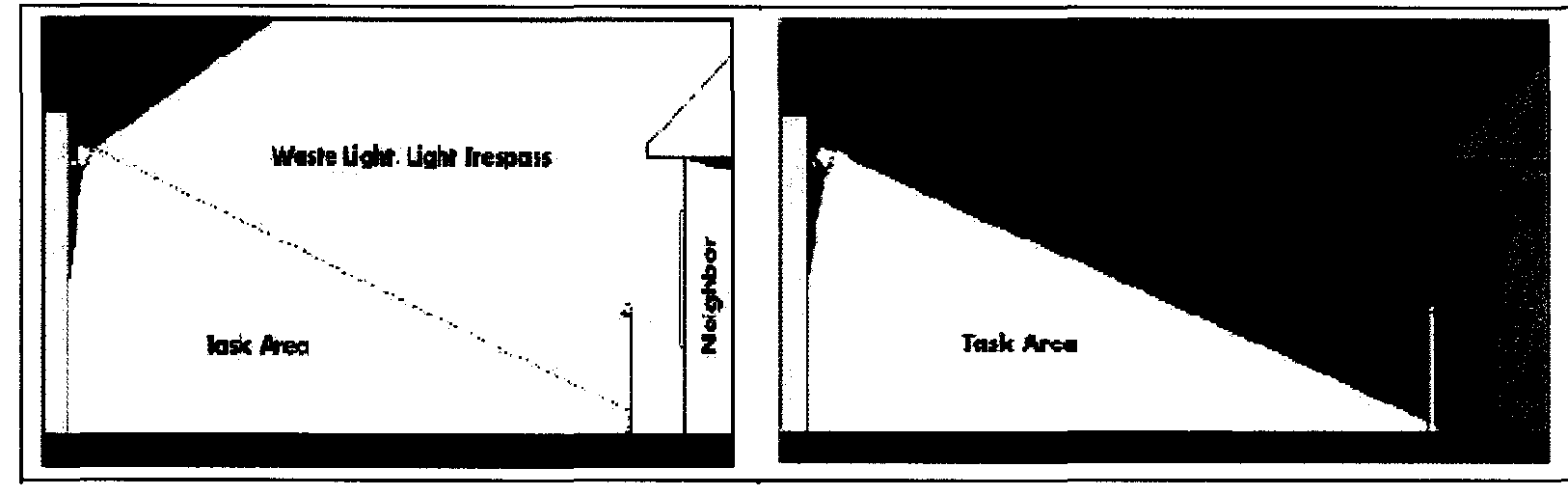
h.
Flickering or flashing lights. No flickering or flashing exterior lights shall be allowed except for temporary decorative seasonal lighting.
(d)
Excessive illumination.
(1)
Lighting within any lot that unnecessarily illuminates and substantially interferes with the use or enjoyment of any other lot, or which unnecessarily illuminates the night sky or neighboring properties is prohibited. Lighting unnecessarily illuminates another lot if it clearly exceeds the requirements of this section. Lighting unnecessarily illuminates the night sky if it directly projects into the night sky or if it clearly exceeds average lighting levels when measured at a height above the lighting fixture or its shield.
(2)
All outdoor lighting shall be designed and located such that the maximum illumination measured in foot-candles at the property line does not exceed one adjacent residential sites, adjacent commercial sites, the waterways adjoining the islands, and public road rights-of-way.
(3)
Lighting shall not be oriented so as to direct glare or excessive illumination onto streets in a manner that may distract or interfere with the vision of drivers on such streets.
(4)
Fixtures used to accent architectural features, landscaping or art shall be located, aimed or shielded to minimize light spill into the night sky and neighboring properties.
(5)
Illumination using illuminated tubing or strings of lights that completely outline or define property lines, sales areas, roofs, doors, windows or similar areas in a manner that is not primarily for safety purposes, as determined by the town manager, is generally prohibited, unless approved by the design review board. However, this shall not be construed to preclude holiday/seasonal light displays.
(6)
Rooftop deck or rooftop patio lighting shall be shielded to prevent light from spilling over the side of the building or any glare projecting upward or to neighboring properties: and all light sources shall be installed so as not be visible from the right-of-way and neighboring properties. Low-scale/low intensity type lights are required such as bollards or building mounted fixtures. Rooftop lighting systems shall be designed with timer switches to shut off all lighting during the restricted hours set forth in subsection (5) herein, except for pedestrian safety lighting installed not exceeding four feet in height above the roof deck.
(7)
All wiring for lighting fixtures and conduits shall be hidden from view, preferably enclosed in building components. No loose wiring shall be permitted.
(e)
Lighting plans. Plans for illumination of buildings and lighting zones shall be submitted at the time a building permit is submitted or with an application for site plan approval. At the time of submission of a site development plan preliminary site lighting photometric plans for the proposed ground level lighting, exterior building lighting and any rooftop recreational facility lighting shall be submitted. As part of a building permit submission an updated site lighting photometric plan shall be required, as well as fixture details noting lighting levels. A site lighting photometric plan shall be required for only nonresidential and multiple family developments to demonstrate compliance with these regulations (not single-family homes). The lighting plans shall comply with the standards listed below:
(1)
Design. Plans shall be prepared and sealed by an engineer registered in the State of Florida.
(2)
Plans Lighting plan or plans. including photometric plans. shall include the following information:
a.
Overall site plan.
b.
Vehicular and pedestrian access and circulation.
c.
Location of parking stalls.
d.
Adjacent property lines, including existing uses and future land use map and zoning district designations.
e.
Plan view of all fixtures, including pole and wall-mounted.
f.
Height of all fixtures.
g.
Photometric data and statistical analysis, including foot-candle values, the maximum to minimum uniformity ratio, the average initial or average maintained foot-candles, the minimum foot-candles, the maximum foot-candles, points of calculation for foot-candles, and similar information required by the town engineer.
h.
The location and description, including the mature height of all existing and proposed trees, and the location of light fixtures on both adjacent properties and the street rights-of-way within ten feet of the subject property.
i.
Light fixture data, including height, manufacturer, wattage, and lighting type.
j.
All plans shall be certified by a registered architect or engineer as providing illumination in accordance with the applicable minimum standards set forth in this section and that subsequent construction will comply with the approved lighting plan.
k.
Lighting installation shall not be placed in permanent use until a letter of compliance from a registered professional architect or engineer has been provided stating that the installation has been field checked and meets the specification set forth on the approved photometric plan.
(f)
Method of measurement. The light meter sensor shall be read at ground level or the established grade in a horizontal position, or from adjoining sites at equivalent heights. Readings shall be taken only after the light source has been exposed long enough to provide a constant reading. Measurements shall be taken after dark with the light sources to be measured on and subsequently off. The difference of the two readings shall be compared to the permitted illumination level for each lighting zone.
(Ord. No. 1023, § 1(Exh. A), 8-13-18)
Sec. 23-20. - Portable storage units.
(a)
Definitions.
Portable storage unit(s) means any container designed for the storage of personal property which is typically rented to owners or occupants of property for their temporary use and which is delivered and removed by truck.
Site means a piece, parcel, tract, or plot of land occupied or to be occupied by one or more buildings or uses and their accessory buildings and accessory uses which is general considered to be one unified parcel.
(b)
Number, duration and removal. There shall be no more than one portable storage unit per site. No portable storage unit shall remain at a site in a residential district in excess of 14 consecutive days, and portable storage units shall not be placed at any open site in a residential district in excess of 28 days in any calendar year. No portable storage unit shall remain at a site in a nonresidential district in excess of 30 consecutive days, and portable storage units shall not be placed at any one site in a nonresidential district in excess of 60 days in any calendar year.
If the chief building official determines that placement of a portable storage unit at a site where construction is taking place will not adversely impact the surrounding community and is otherwise appropriate, the chief building official may allow a portable storage unit to remain at the site for a period in excess of the time limitations which would otherwise apply.
(c)
Conditions. Portable storage units are subject to the following conditions when located on a property or site:
(1)
PSUs shall not exceed eight feet in width, 16 feet in length and nine feet in height.
(2)
PSUs shall be placed either on the driveway, approved parking area, or in the buildable portion of the lot and shall not be placed in the right-of-way, or in such other location as may be approved by the town.
(3)
All PSUs shall have the name and current phone number and address of the company providing the PSU, and the date the PSU was placed at the site clearly posted on the exterior. No other signage shall be allowed on a PSU. Allowed signage shall not exceed six feet square containing the signage and no more than two sides of any PSU shall contain signage.
(4)
PSUs shall be locked and secured by the owner or tenant of the unit or property at all times when loading or unloading is not taking place. Storage of hazardous material is prohibited.
(5)
If the National Weather Advisory Service or other qualified weather advisory service identifies weather conditions which are predicted to include winds of 75 mph or greater, all PSUs will be removed from all properties and placed in approved storage locations at least 24 hours prior to the predicted onset of such winds or as soon as reasonably practical if less notice is provided. This requirement may be modified by the chief building official upon receipt of adequate documentation from an architect or engineer or other professional qualified to give such opinion that a greater wind loading pertain to a particular PSU model or manufacturer so that the PSU is unlikely to be moved by winds greater than the predicted winds. As an alternative to removal, the PSU vendor may submit a tie-down proposal for approval by the chief building official and each PSU not removed shall be tied down in the approved manner.
(d)
Maintenance. The owner and operator of any site on which a portable storage unit is placed shall be responsible to ensure that the portable storage unit is in good condition, free from evidence of deterioration, weathering, discoloration, rust, ripping, tearing or other holes or breaks.
(e)
Permits. It shall be unlawful for any person to place or permit the placement of a portable storage unit on property which he or she owns, rents, occupies or controls without first having obtained a permit therefor. Application for a permit shall be made to the town on a form provided by the town. The application shall include the signature of the property owner or the property owner's agent in order to ensure that the property owner has full knowledge of and consents to placement of the portable storage unit on his or her property. A permit fee in the amount established by resolution of the town council shall accompany the application.
(Ord. No. 686, § 1, 8-13-01)
Sec. 23-21. - Gateway (G) zoning district.
(a)
Purpose and intent. The purpose and intent of the Gateway (G) district is to create a set of design standards for the properties at the entrances to the eastern island of the town that are to scale with the established and desired urban form and compatible with the town's desire to have a substantial and elegant pedestrian promenade along the Kane Concourse roadway frontage; to establish a living and working environment that are responsive to the needs of the town's inhabitants; to provide flexibility in planning, design and development; to encourage innovative approaches to the design of the properties; to provide efficient use of land; to provide an environment compatible with surrounding land use; to adapt the zoning process to changes in construction and development technology; and to promote the public health, safety and general welfare of the town.
(b)
Location of district. The Gateway district is applicable to the following properties: Lots 1 and 2 of Block 1; Lot 1 of Block 2; Lot 32 of Block 3; and Lot 37 of Block 4.
(c)
Permitted uses. In the Gateway district, no building or land shall be used and no building shall hereafter be erected, constructed, reconstructed or structurally altered which is designed, arranged or intended to be used or occupied for any purpose, excepting for one or more of the following uses:
(1)
For Lots 1 and 2 of Block 1. Those uses listed in section 23-5 of the town's Code.
(2)
For all other lots referenced in subsection (b) above. Those uses listed in section 23-4 of the Town Code.
(d)
Town approval. The property shall be planned and developed according to detailed plans including site plans, floor plans, phasing plans and elevations showing all proposed development on the property as approved by the town council.
(e)
Building setbacks, building height and maximum density.
(1)
Kane Concourse. All properties shall have a building setback of not less than 20 feet from the Kane Concourse right-of-way line. In addition, for any structure over 25 feet in height, the setback shall be increased one foot for each two feet of building height for that portion of the building over 25 feet in height. A pedestal underground parking structure with no more than five feet of the structure above grade (not including an inclined bridge) but completely opaque to the adjoining roadway by earthen berms and landscaping may encroach into the above building setback, but in no case less than (15) feet from the Kane Concourse right-of-way. Notwithstanding the above provision, a pedestal parking structure may be constructed within the above setback area to the Kane Concourse right-of-way line for Lot 1 in Block 1 and Lot 37 in Block 4 adjoining the bridge rising eastward towards and across the Indian Creek Waterway, provided that any such development shall provide for a continuous pedestrian environment at least 30 feet in width, including the sidewalk on the bridge, and continuing flush into the adjoining property appearing as a continuous plaza on the roof of a parking garage and tapered to be not visible toward East Bay Harbor Drive, except as otherwise allowed below. The area must appear as a common open plaza with both visual and physical access to the waterway as approved by the town. Also, notwithstanding the above provision, a ground level restaurant may extend an enclosed air-conditioned building area closer toward Kane Concourse, but it shall not extend farther than ten feet from the Kane Concourse right-of-way line. Any such ground level restaurant building extension may have a solid covered roof, but the exterior facade shall be primarily transparent (fixed or retractable glass/other clear weather barrier). An indemnification and hold-harmless agreement shall be required for any such extension in a form acceptable to the town attorney.
(2)
East Bay Harbor Drive/West Bay Harbor Drive. All properties shall have a minimum setback of 20 feet for buildings up to 25 feet in height. In addition, for any structure over 25 feet in height, the setback shall be increased one foot for each two feet of building height for that portion of the building over 25 feet in height with a maximum setback of 30 feet. A pedestal underground parking structure with no more than five feet of the structure above grade but completely opaque to the adjoining roadway by earthen berms and landscaping may encroach into the above building setback but in no case less than 15 feet from the adjoining roadway. To accommodate the need to provide access from East Bay Harbor Drive to the top of any parking structure as the bridge rises toward the Indian Creek waterway, stairs, ramps, lifts and/or supportive walls shall be permitted within the 15-foot setback area specified herein, provided they are located within 25 feet of the Kane Concourse right-of-way and provided the design and appearance are approved by the town during the site plan approval process. Notwithstanding the above, an extended structure covering a drop-off/lobby area may be permitted if approved as part of the site plan.
(3)
Side property lines. All properties shall have a minimum setback of ten feet for buildings up to 25 feet in height. In addition, for any structure over 25 feet in height, the setback shall be increased one foot for each two feet of building height for that portion of the building over 25 feet in height with a maximum setback of 25 feet. Notwithstanding the above provision, for developments located on single lots, the maximum setback shall be 20 feet. Pedestal parking structures must be completely screened to the adjoining property by earthen berms and landscaping.
(4)
Waterfront property lines. All properties shall have a minimum setback of 20 feet, regardless of building height. This shall also apply to underground parking structures. Notwithstanding the above, if an exterior seating area for a ground level restaurant is provided, an extended roof canopy over the seating may be provided, but the roof canopy shall not extend farther than ten feet from the property line. Clear retractable weather barriers may be affixed thereto.
(5)
Flex setbacks. A project designer has the option to offer creative design solutions to the building configurations and the town council may allow portions of the building structure over 25 feet in height to encroach into the setback requirements above. The total amount of encroachment shall not exceed one-third of the allowable width or length of the building. This provision shall serve to create an architectural opportunity for creative design approaches while promoting the beneficial purposes of building setbacks in the district. In no case shall any portion of a building encroach into the base building setbacks set forth above for portions of buildings below 25 feet in height.
(6)
Building height. On Lot 1 and 2 in Block 1, Lot 1 in Block 2, Lot 32 in Block 3 and Lot 37 in Block 4, no portion of a building or structure shall exceed 25 feet within the minimum principal building setback area but may be increased in height at a ratio of one foot for each two feet of building height over 25 feet. The maximum allowable height of buildings or structures is 75 feet in Block 1 and in Block 4 and the maximum allowable height of buildings or structures is 60 feet in Block 2 and in Block 3. Notwithstanding the above, if rooftop exterior seating areas for a restaurant located in the building is provided after receiving approval by the Town Council as set forth in the Code, clear vertical retractable weather barriers may be provided over seating areas attached to rooftop canopies, trellis or similar structures.
(7)
The maximum allowable residential density shall be in accordance with the adopted comprehensive plan provisions as to the base residential density and any additional allocated density as may be approved by the town council.
(f)
Pedestrian promenade. The town desires to continue the established pedestrian promenade along Kane Concourse between East Bay Harbor Drive and West Bay Harbor Drive on the Gateway properties to the adjoining waterways. A minimum ten-foot wide waterway access and landscape buffer shall be provided adjoining the Kane Concourse right-of-way. A minimum eight-foot wide pedestrian walkway shall be constructed within the corridor from the adjoining roadways to the seawall and shall connect to the sidewalks along the bridges together with such landscaping deemed compatible and consistent with the overall Kane Concourse promenade appearance. These provisions may be modified as provided for in subsection (e) above.
(g)
Public hearing procedure. At the public hearing, the applicant shall have the burden of proof in demonstrating how the proposed application complies with the purpose and intent of the Gateway zoning district code provisions. In determining whether to grant approval of the application with or without appropriate and necessary conditions and safeguards, the town council shall determine whether the application complies with the purpose and intent of this section and shall make the following findings:
(1)
Whether the site development plan design complies with at least the minimum standards contained herein;
(2)
Whether the application will have a favorable effect on the economy of the town;
(3)
Whether the application will generate or result in excessive noise or traffic congestion;
(4)
Whether the application will cause an undue or excessive burden on public facilities, including potable water, sanitary sewer, solid waste disposal, community recreation, transportation facilities or other such public facilities which have been constructed or which are planned and budgeted for construction;
(5)
Whether the application will cause excessive overcrowding or concentration of people or population;
(6)
Whether the application will be compatible with the surrounding area and its development in scale and appearance. The town shall base compatibility on the existing scale of adjoining development and the allowable scale under the applicable zoning district; and
(7)
Whether the application is a reasonable use of property and results in a public benefit including, but not limited to, the enhancement of the subject real property and/or the redevelopment of structures in deteriorated or poor condition.
The town council shall have full authority to approve, approve with modifications, or deny a site development plan application based upon its determination that the application, as proposed or modified, serves and protects or does not serve and protect the public health, safety and welfare. Likewise, the Town Council shall have authority to impose reasonable conditions and safeguards necessary to protect the public health, safety and welfare upon the approval of any development application.
(h)
Ownership requirements. An applicant for approval shall be the owner(s) of record, a contract purchaser of the property (provide consent from owner of record) or an authorized agent thereof of the entire property encompassed by the application (the "property").
(i)
Application procedure. The applicant shall submit an application to the town manager or his or her designee on a form(s) prescribed by the town manager. The town manager or his or her designee shall require a least the following information with the application:
(1)
Letter of intent.
(2)
A detailed site development plan showing dimensions of all buildings, structures, setbacks, open spaces, landscaping and off-street parking. In the event that sufficient off-street parking is not available on site to meet existing code requirements, the applicant shall furnish to the Town Manager written documentation of a cross parking agreement or other parking arrangement satisfactory to the town attorney, which will provide sufficient parking as determined by the town council.
(3)
Proposed floor plans and elevations (including signage) for all buildings and structures. Exterior building materials and colors shall be identified.
(4)
A complete list of uses and the square footage for each use requested.
(5)
A certified copy of a land survey of the property (not more than six monthsold).
(6)
Development review and processing fees as established by the town council by resolution shall be charged for all design review services provided by the town staff and any consultants. In addition, all costs for advertisements and mailing shall be borne by the applicant.
(7)
Such other documentation as the town manager reasonably determines is necessary to properly review the proposed project.
(j)
Legal effect of town approval. Notwithstanding anything in the code to the contrary, the approval of the application shall constitute the approved site development plan and the development regulations applicable to the property. The town council shall be prohibited from approving an application that would increase the intensity, density or height of development above that which is allowed by the adopted comprehensive plan and any land development regulations to implement the intensity standards.
Any prior land development permits issued by the town, including but not limited to the PUD Overlay designation on Lots 35 through 37 of Block 4, shall remain in effect until such time as the town or property owner seeks to remove the designation and/or modify the approved development plan. The development criteria contained in this section shall supersede any other code provisions, however, existing development shall be permitted to remain until re-development is requested.
In the event that the owner wishes to modify an approved site development plan application in any fashion which would increase the amount of square footage of the building(s) or lessen landscaping or open space or create an undue burden on any public facilities, a separate and new application shall be filed and shall be subject to the terms and conditions of this section.
In the further event that the owner does not submit complete plans for building permits of the main building to the town within 12 months and begin development within 18 months from the date of approval, the Town's approval shall lapse. For the purposes of this section, the term "begin development" shall mean substantial construction such as land clearing, utility construction, foundation work, etc. The term shall not include property fencing, placement of construction trailers, equipment and materials. Once construction commences, construction activities shall occur continuously with regular inspections. The town, upon a demonstration of just cause by the owner, may grant a reasonable extension of time to commence development. If construction ceases for more than 60 days, the project shall be deemed abandoned and the town's approval shall lapse.
(Ord. No. 753, § 1(Exh. A), 11-8-04; Ord. No. 831, § 1, 2-11-08; Ord. No. 833, § 1(Exh. A), 2-11-08; Ord. No. 982, § 1(Exh. A), 10-13-15; Ord. No. 1060, § 1, 6-9-21; Ord. No. 1060, § 1(Exh. A), 6-9-21)
Sec. 23-22.1. - Density monitoring system (DMS).
(a)
Purpose. The purpose of the density monitoring system is to:
(1)
Provide the town with an accurate accounting of the level of residential development existing, permitted and available within the limits of the town's comprehensive plan and future land use map (FLUM).
(2)
Secure compliance with the town's comprehensive plan by assuring the maximum number of units permitted is within the parameters allowed by the plan.
(b)
Annual report. The town manager shall submit an annual report to the town council identifying the number of existing dwelling units, committed dwelling units and available reserve units. The report shall be utilized by the town as an early warning system that would alert the town of any tendency to exceed the maximum number of dwelling units.
(c)
Development permits. No development permit shall be issued for any residential development that reflects a residential density higher than specified by the assured density unless the town council determines there are reserve units available or a transfer of development rights application is being simultaneously processed.
(Ord. No. 769, § 1(Exh. A), 5-9-05)
Sec. 23-22.2. - Transfer of development rights.
(a)
Purpose. The purpose of creating a transfer of development rights (TDR) program is to establish a TDR "reserve bank" comprised of available development rights that can be allocated to individual development projects to promote the types and location of desired development and re-development within the town.
The TDR program allows a property owner within the designated areas established by the town council to achieve a density/intensity bonus by purchasing and/or otherwise acquiring increased density/intensity from the town's TDR reserve bank or from a private property owner with land in a designated donor area. In order to increase density/intensity, the receiving site must meet the requirements within the designated receiving area and follow the procedures as described in this section. After development rights have been transferred from the donor parcel to the receiving parcel, an appropriate deed restriction shall be attached to the donor parcel and recorded in the public records restricting future development potential.
The TDR program is the required method for increasing density/intensity above the assured base density permitted by the property's future land use map (FLUM) designation, the applicable comprehensive plan text provisions and land development regulations.
(b)
Definitions.
Contract for sale and purchase of development rights. A valid contract for the sale of development rights for the purpose of increasing density on a receiving parcel.
Deed of transfer of development rights. A legal document that transfers ownership of specified development rights from one parcel of land to another, and that is recorded in the public records.
Development rights. The ability to develop residential dwelling units or hotel/motel rooms in specified locations on a parcel of land. The owner may sell, donate or transfer the development rights and retain title to the land and the right to use of the land on a limited basis.
Donor parcel. Parcels of land within an area designated by the town council that are permitted to sell, donate or transfer development rights pursuant to this section.
Receiving parcel. Parcels of land within an area designated by the town council that are permitted to increase density/intensity and receive development rights to purchase from the town's TDR reserve bank or owner of land designated as a donor parcel.
Transfer of development rights (TDR) reserve bank. An accounting and monitoring system empowering the town to purchase and sell development rights including development rights of town owned land. The town's TDR reserve bank offers an alternative to TDRs being transferred via the private market.
(c)
Administration.
General. Except as otherwise specified, the TDR program and the TDR reserve bank shall be administered by the town manager, who may designate responsibilities regarding the programs.
Responsibilities. The town manager shall be responsible for:
1.
Establishing, administering and promoting the transfer of development rights (TDR) program;
2.
Establishing and administering the transfer of development rights reserve bank;
3.
Ensuring orderly and expeditious processing of TDR applications;
4.
Ensuring the contracts for sale and purchase of development rights are executed and all deeds and deed restrictions are filed in the public records;
5.
Ensuring the property appraisers office is notified of all transfers of development rights; and
6.
Ensuring the densities approved through the TDR program are placed on the town's TDR allocation map as notations following the approval of the TDR.
Computation of development rights. The number of allowable dwelling units or hotel/motel rooms in specified locations shall be determined by multiplying the net acreage of the lot by the applicable FLUM density, including portions of lots previously conveyed to the town, if any, for parking spaces. The number of dwelling units or hotel/motel rooms being assigned to a receiving parcel shall be determined by the town council. Additional hotel/motel rooms shall be computed using a conversion factor of 0.486 dwelling unit. All development rights shall be in whole numbers.
Restriction on future use. Upon approval of the TDR, a deed restriction shall be recorded against both the donor and receiving lands in the public records. No development permit shall be issued to the receiving parcel until the appropriate deed restriction is recorded for the donor parcel. The deed restriction shall restrict the use of the parcels in perpetuity, unless modified by subsequent actions of the town.
Existing uses. Residential dwelling units or hotel/motel rooms that existed on a donor parcel prior to the transfer of development rights shall be permitted to remain as legal conforming uses. The rights of existing residential dwelling units or hotel/motel rooms on a donor parcel cannot be transferred unless the units are removed from the donor parcel. No development permit shall be issued to the receiving parcel for the transfer of existing dwelling units or hotel/motel room rights until a demolition permit is issued for the donor parcel and the demolition has occurred.
Remaining development rights. If all development rights assigned to a donor parcel are not transferred, the remaining land, if proposed for development or redevelopment, shall be developed in accordance with the applicable code provisions, in a manner that is compatible with the surrounding area and consistent with recorded deed restrictions.
(d)
Transfer of development rights (TDR) reserve bank.
General. The TDR reserve bank is hereby created in order to facilitate the purchase and transfer of development rights hereinafter provided and shall maintain an inventory through the density monitoring system of those development rights owned by the town.
Establishment of development rights for the reserve bank. Development rights for the TDR reserve bank shall be generated from multiplying the gross acreage of the future land use map (FLUM) categories by the allowable density limit and subtracting previously allocated dwelling units. A private property owner may transfer development rights to the bank. In addition, town-owned lands designated residential on the FLUM have certain development rights. The TDR reserve bank shall be maintained by the town manager.
The application, sale and value of development rights within the TDR reserve bank. The town may convey development rights within the TDR reserve bank to property owners who meet the receiving parcel criteria pursuant.
1.
A property owner seeking an increase in density/intensity must apply to become a receiving parcel and submit a draft contract for sale and purchase of development rights as part of the application.
2.
The town council shall set the value of any public development rights. The council may utilize current market value to set the price or develop an alternative value method consistent with the goals, objectives and vision of the town including but not limited to capital or land contributions for parks, open space or parking.
Annual report. The town manager shall present an annual report to the town council which outlines the number of rights currently in the bank; the number of rights available for sale; the number of rights sold during the year; the purchase price per development right; recommendations for improving the TDR program; and any other information deemed relevant.
Revenue from the sale of TDRs. The revenue generated from the sale of development rights from the TDR reserve bank shall be allocated to town infrastructure improvements including but not limited to wastewater, potable water and stormwater facilities, parking facilities, parks and recreational facilities, municipal buildings or other municipal purposes.
(e)
TDR: Donor parcel establishment and procedure.
Establishment. The town council shall designate areas within the town's East Island consistent with the goals, objectives and policies of the comprehensive plan as donor parcels and receiving parcels. Development rights shall only be transferred to those parcels that have been designated. All properties within the RM-1, RM-2 and RM-3 zoning districts and the properties in the gateway zoning district designated medium-high residential on the adopted FLUM are deemed donor receiving parcels. Properties within the B-1 business zoning district and the gateway zoning district designated commercial on the adopted FLUM are deemed donor parcels; however, any development rights on commercial lands must come from donor or receiving lands located only in the commercial areas, i.e., development rights may not be transferred into or out of the commercial lands to residential lands. Hotel, motel and other transient type uses are permitted only within the B-1 business zoning district or planned unit development (PUD) overlay zoning district and as such development rights for those uses may only be transferred within the applicable FLUM categories as set forth above.
Donor parcel application. The owner of lands that are designated as a donor parcel shall request a determination by the town manager. The purpose of the determination is to ascertain the exact number of development rights the property owner is entitled to. The application shall include:
1.
Proof of ownership;
2.
Legal description or survey of the property;
3.
Contract or option for the purchase and sale of development rights; and
4.
An administrative review and processing fee.
Written determination. The property owner shall receive a written determination from the town manager indicating how many development rights can be transferred from the property. The number of development rights for the site shall be documented and kept on file and noted in the town's density monitoring system.
The written determination shall be valid for a period of 12 months. If any modifications or alterations are made to the property during the 12-month period, the determination shall be null and void.
Deed restriction. Prior to the issuance of a development permit to the receiving parcel a deed restriction in a form and content acceptable to the town attorney shall be recorded in the public records. The deed restriction shall restrict the future use of both the donor and receiving lands.
Code compliance. The town shall require, as a condition of permitting any transfer of development rights, that the donor parcel and/or receiving parcel improve the site to meet as many current day code requirements as possible, as determined by the town. This may include the town's land development codes such as zoning, landscaping, signage and property maintenance. It may also include building code and life safety code improvements.
Re-submittal of application. A property owner of a donor parcel may re-apply for a determination until all development rights have been severed from the property.
(f)
TDR: Receiving parcel establishment and procedure.
Establishment. The town council shall designate areas in the town's East Island consistent with the goals, objectives and policies of the comprehensive plan as receiving parcels. Development rights shall only be transferred from and to those parcels that have been designated. All properties within the RM-1, RM-2 and RM-3 zoning districts and the properties in the gateway zoning district designated medium-high residential on the adopted FLUM are deemed receiving parcels. Properties within the B-1 business zoning district and the gateway zoning district designated commercial on the adopted FLUM are deemed receiving parcels; however, any development rights on commercial lands must come from donor or receiving lands located only in the commercial areas, i.e., development rights may not be transferred into or out of the commercial lands to residential lands. Hotel, motel and other transient type uses are permitted only within the B-1 business zoning district or planned unit development (PUD) overlay zoning district and as such development rights for those uses may only be transferred within the applicable FLUM categories as set forth above.
Maximum density. The maximum density permitted on a receiving parcel shall be as permitted by the adopted comprehensive plan, the individual zoning district(s) and any additional dwelling units or hotel/motel rooms allocated by the town as prescribed herein. Additional hotel/motel rooms shall be computed using a conversion factor of 0.486 dwelling unit.
Review process. The review process for TDR applications is based upon the requested density/intensity and type of development proposed. All TDR applications require approval by the town council and must be submitted with a proposed site plan.
Contents of application. In conjunction with the site plan application, an applicant for receiving parcels must submit a supplemental TDR application and processing fee as determined by the town council. The application shall be submitted in a form established by the town manager and made available to the public.
Standards. A receiving parcel applicant requesting a transfer of development rights shall comply with the following:
1.
The TDR is by deed, and the deed shall be recorded before a development permit is issued.
2.
The transfer is to a parcel of land designated as a receiving parcel and meets all the requirements of the code.
3.
The proposed development meets all concurrency requirements at the proposed density/intensity and/or mitigation measures are provided as necessary to offset by additional impacts generated by the development.
4.
If the transfer is between two private parties, at the time the transfer is approved by the town council, the donor parcel shall be subject to a deed restriction and shall be identified on a TDR map and within the density monitoring system (DMS). Pending recordation of the deed restrictions on the donor parcel, no development permits will be issued for the donor parcel or the receiving parcel.
5.
If the transfer rights are from the TDR reserve bank, all rights must be accounted for and there must be enough development rights in the bank to permit the project.
6.
The proposed development and density/intensity are compatible with the surrounding area and land use.
Contract for sale and purchase of development rights and deed of transfer of development rights. A contract for sale and purchase of development rights and deed of transfer of development rights shall be required as part of the approval of a TDR transfer. The deed transferring the development rights shall be recorded in the public records prior to the issuance of a development permit.
Notification to property appraiser. Upon recordation of the deed of transfer, the town manager shall notify, the property appraisers office in writing that development rights have been transferred from the donor parcel or TDR bank to the receiving parcel in perpetuity.
(Ord. No. 769, § 1(Exh. A), 5-9-05; Ord. No. 910, § 1(Exh. A), 4-11-2011)

