
Bay Harbor Islands City Zoning Code
ARTICLE II
- OFF-STREET PARKING2
Cross reference— Conformance of contiguous public parking area, § 19-21 et seq.
Sec. 23-23. - Definitions.
All definitions contained in section 23-1 are hereby incorporated herein by reference, with the same force and effect as if set forth herein at length.
(Ord. No. 130, § 3, 6-8-59)
Sec. 23-24. - Commercial parking approval required; enclosing commercial parking lots; parking of vehicles on certain unimproved lots; prohibition of parking spaces and parking structures on private property on the ground level within 60 feet of the pedestrian right-of-way of Kane Concourse and prohibiting visibility and access from Kane Concourse; number of parking spaces required generally.
(a)
In the B-1 business district commercial parking is prohibited except on specific approval of the town council. Commercial parking is defined as the operation of parking lots either with or without a charge. Such lots shall be enclosed on all sides, except at exits and entrances, by a solid masonry wall or hedge of a type approved by the town, or both, five feet in height just within the property lines. At all exits and entrances, the wall and/or hedge shall be installed and maintained at three feet in height for a distance of 25 feet on each side of each exit or entrance. Parking of vehicles on unimproved property on any lot in Blocks 11, 12, 20 and 21 is prohibited, excepting vehicles owned by the property owner, unless such parking fully complies with the provisions herein set forth. In the B-1 business district, parking spaces and parking structures are prohibited on an private property on the ground level within 60 feet of the pedestrian right-of-way of Kane Concourse, and visibility and access from Kane Concourse are prohibited.
(b)
Upon the occasion of any person seeking a permit for the erection, construction, reconstruction, structural alteration or addition to any buildings, the applicant for such permit shall, simultaneously with the submission of plans and specifications to the building department of the town, and simultaneously with the complying with any and all requirements therefor, specify in writing to the building department and designate on the plans for such building work an area or areas set aside for the exclusive use as parking and driveway facilities for vehicles on the building plot on which the proposed construction work is to be done, all in accordance with the provisions of this article.
(c)
The number of parking spaces to be provided in particular instances is as follows:
(d)
Whereas, multifamily buildings of more than one story in height generate a gross multitude of cars parked in the setback areas as well as all around the multifamily buildings themselves and thereby adversely affect the aesthetic beauty of the East Island of Bay Harbor Islands; and whereas multifamily buildings of one story do not create the poor appearance of a gross multitude of cars because not so many cars are parked around the perimeters of such one-story multifamily buildings; now, therefore, no automobiles or vehicles of any kind shall be parked in the setback area of any multifamily buildings in the East Islands which exceed one story in height, unless such multifamily buildings are presently constructed, except as allowed below.
Multifamily development parking design criteria.
(1)
A single-story multifamily building or townhouse may have required surface parking within the minimum building setback areas. A minimum ten-foot-wide landscape strip shall be provided between the street right-of-way line and any parking space or drive aisle and a minimum five-foot-wide landscape strip shall be provided between the interior lot line and any parking space or drive aisle. For townhouse developments, see subsection (5) below.
(2)
Off-street parking for multifamily buildings with more than one story shall be required to have, at a minimum, the following setbacks:
(3)
Below-grade parking must shield the parking spaces and structure from view from all sides with decorative walls, earthen berms and landscaping.
(4)
Parking garages must meet the minimum setback requirements found with the appropriate multifamily zoning district; however, a below grade parking structure may cantilever to the setbacks established in this section. If a parking garage structure is provided above grade, the building facades of the parking garage facing adjoining development sites shall be closed-in and/or screened as required by the design review board so that vehicular visibility, noise or odors emanating onto adjoining lots is minimized. If mechanical ventilation is used for the parking garage it shall be vented to outdoor areas and designed in such a manner to minimally impact adjoining residential development sites.
(5)
All multifamily developments shall provide for a designated drop-off area to a walkway at the building entrance into a lobby by the use of a driveway or shared driveway that does not block the normal flow of traffic for more than a few moments. This provision shall not apply to townhouse developments or development sites of one platted lot.
(6)
Special provisions for townhouse developments. Notwithstanding the above, due to the unique design characteristics of townhouse developments, the following variations in the design standards apply:
a.
Townhouse developments are strongly encouraged to provide access to on-site parking areas and parking garages through internal driveways and frontage roads to minimize the number of driveway connections to adjoining roadways. When possible, garage doors should face either side or rear property lines and adequate screening from adjoining properties shall be provided.
b.
For instances where townhouse units are approved in a row where each unit provides a direct driveway connection from an adjoining roadway to an on-site parking space or garage, driveway connections shall be limited to a maximum width of 12 feet for a single driveway and 18 feet for a double driveway at the curb line. Individual driveways shall be separated by landscaped islands of at least two feet in width and designed to include privacy walls or fences, shrubs and small trees/palm species to avoid a continuous hardscape appearance and to provide privacy between individual units. Not more than 50 percent of a property street frontage may have hard driveway surfaces. The remaining land must be landscaped area.
c.
Townhouse developments shall provide a minimum of two parking spaces. At least one of the parking spaces shall be within a fully enclosed garage within each unit. Each parking space shall be accessible without driving over or through another parking space.
(e)
Notwithstanding the above, existing buildings in the B-1 business district shall be exempt from the parking requirements of subsection (c)(5) and (6) as of the effective date of this ordinance [Ord. No. 1008, adopted May 8, 2017]. For purposes of this section an existing building is defined as one that is present, available and in operation as of the effective date of this ordinance and shall not include any future development that have not received a certificate of occupancy as of the date of this ordinance [Ord. No. 1008, adopted May 8, 2017].
(f)
Parking requirements for restaurants approved as a mixed-use development in the Gateway District which open only for dinner between the hours of 6:00 p.m. and 2:00 a.m are exempt from the parking requirements set forth above. Town licenses for restaurants which are open for business only between the hours of 6:00 p.m. and 2:00 a.m. shall specify on their faces that the license is restricted to the hours between 6:00 p.m. and 2:00 a.m., and if the restaurant is open for business before or after such hours, the license is void unless arrangements are made to secure additional parking spaces, pay into the parking trust, or the town has approved a parking reduction order. This exemption shall only be applicable to the Gateway District.
(g)
Buildings that are enlarged in floor area, volume, capacity or space occupied shall provide the additional off-street parking facilities as specified above.
(Ord. No. 130, §§ 4, 5, 6-8-59; Ord. No. 133, § 1, 12-14-59; Ord. No. 217, § 2, 3-31-69; Ord. No. 266, §§ 1, 2, 7-20-73; Ord. No. 350, § 1, 4-9-79; Ord. No. 387, § 1, 2-9-81; Ord. No. 405, § 1, 12-2-82; Ord. No. 659, § 1, 3-13-00; Ord. No. 688, § 1, 9-10-01; Ord. No. 738, 2-9-04; Ord. No. 740, § 2, 3-8-04; Ord. No. 747, § 4, 8-16-04; Ord. No. 770, § 1(Exh. A), 5-9-05; Ord. No. 779, § 1(Exh. A), 9-12-05; Ord. No. 810, § 1(Exh. A), 10-9-06; Ord. No. 813, § 1(Exh. A), 1-8-07; Ord. No. 949, § 1(Exh. A), 5-13-2013; Ord. No. 950, § 1(Exh. A), 6-10-2013; Ord. No. 951, § 1(Exh. A), 6-10-2013; Ord. No. 1008, § 1, 5-8-17)
Sec. 23-25. - Exclusive right in dedicated areas.
(a)
The owners, lessees, and mortgagees of any property which has been improved with newly constructed buildings or reconstructed buildings shall landscape the areas between the designated roadway and the structures on the property. Said landscaping shall be adequately maintained by the property owners, lessees, and/or mortgagees as otherwise provided in this Code and shall be under landscaping plans and specifications approved by the design review board of the town.
(b)
Where the owners, lessees, and mortgagees of any existing property have made the dedication, prior to the effective date of this section, in accordance with the law, and comply or have complied with the paving requirements pursuant to section 23-28, then the owners, lessees and mortgagees, or such persons as they may authorize, shall secure a license agreement from the town, as authorized and issued by the town manager or his or her designee; and pay a license fee in an amount determined by the town council, and shall have the exclusive right to park their vehicles in the parking area designated for that property, and no other person, firm or corporation shall park his or its vehicles in such parking area provided, however, that the reserved area be posted by the sign furnished by the town at a cost not exceeding the actual cost to the town.
If such owner, lessee, and mortgagee, prior to the effective date of this section, has made a dedication and such dedicated area is being used for a sidewalk or for paved parking, or both, then such dedication shall consist of the property owner's front 11-foot strip of land (a five-foot sidewalk to be on the property owner's side of the 11-foot strip and the parking area to be on the street side of the 11-foot strip), and if such owner shall have paved the area according to the requirements set forth in section 23-28 hereof, then such owner shall be permitted to use for parking purposes a corresponding strip of land consisting of public right-of-way contained between the present paved street and the property line. The provisions of this section shall not apply to blocks 11, 12, 20, 21, and lots 1 and 2 in block 1 of Bay Harbor Islands as recorded in plat book 46, at page 5, of the public records of Miami-Dade County, Florida.
(c)
In the event owners, lessees and mortgagees of any existing property, which have not made a dedication prior to the effective date of this section, request to utilize a portion of a right-of-way owned by the town for parking purposes, said owner, lessee or mortgagee shall comply with the paving requirements pursuant to section 23-28 and shall secure a license agreement from the town as authorized and issued by the town manager or his or her designee, and pay a license fee, in an amount determined by the town council, and shall have the exclusive right to park their vehicles in the parking area designated for that property, and no other person, firm or corporation shall park his or its vehicles in such parking area; provided, however, that the reserved area be posted by the sign furnished by the town at a cost not exceeding the actual cost to the town.
(d)
Any vehicle parked contrary to the provisions of this article may be towed away at the discretion of any member of the police department of the town and impounded at a suitable storage space, all at the cost of the owner of such vehicle. A vehicle so impounded shall not be released from storage except upon the payment by the vehicle owner of all costs of towing and storage.
(Ord. No. 117, §§ 1, 2, 3-10-58; Ord. No. 232, § 1, 8-10-70; Ord. No. 592, § 5, 7-8-96; Ord. No. 696, § 1, 1-14-02; Ord. No. 762, § 1, 1-10-05; Ord. No. 934, § 1, 5-14-2012)
Sec. 23-26. - Unity of title on adjacent offstreet parking lot.
In all cases where offstreet parking space is required under the terms of this article, such offstreet parking space can be provided on the same lot or building plot on which the improvement involved is erected or constructed, or, in the alternative, on an adjacent lot, provided, however, that such adjacent lot shall be under the same ownership as the property upon which the structure involved is located and provided further that if such offstreet parking as is required by this article is not provided on the same lot on which the structure involved is erected, then, in that event, the owner or owners thereof, as well as any lessees and mortgagees thereof, shall be required to enter into an agreement with the Town of Bay Harbor Islands, which agreement shall be binding upon all of the land in question and which shall provide for a unity of title so that the land other than the building site which may be used for offstreet parking shall be held and kept perpetually available for such offstreet parking and to prevent the alienation of the land other than the building site separate from the land of the building site.
(Ord. No. 130, § 6, 6-8-59)
Sec. 23-27. - Reserved.
Editor's note— Ord. No. 696, § 2, adopted Jan. 14, 2002, repealed § 23-27, which pertained to requirements in case of dedication of eleven foot strip and derived from Ord. No. 130, § 7, adopted June 8, 1959; Ord. No. 277, § 1, adopted June 10, 1974; and Ord. No. 592, § 6, adopted July 8, 1996.
Sec. 23-28. - Compliance with specifications.
All paving which shall be done by a property owner in accordance with the provisions hereof, shall be commenced only after applying for and receiving a permit therefor from the building department of the town, and in connection with the doing of such work, grades of drainage ditches, shoulder, pavement surface, sidewalk grades and the like shall be maintained to the satisfaction of the town engineer and the town building department. Materials, composition and thickness of the paving and concrete bumpers shall comply with the specifications of the town, in accordance with the specification requirements for paving promulgated by the town engineer and the town building department as they may exist from time to time.
(Ord. No. 130, § 8, 6-8-59; Ord. No. 592, § 7, 7-8-96; Ord. No. 696, § 3, 1-14-02)
Sec. 23-29. - Establishing parking area away from certain lots.
Notwithstanding anything heretofore contained in this article, an owner of property may, in complying with the provisions of this article, establish such parking area as is required away from his owner's building site, provided such parking area shall not be more than 500 feet therefrom measured from the closest point of the building site to the closest point of the parking area, following a pedestrian route along a sidewalk between the building site and parking area, irrespective of whether the sidewalk is actually in existence or is proposed to be constructed and the location of the sidewalk established. In the event an owner shall avail himself of the privilege provided for in this section, he shall, as a condition precedent thereto, along with any lessee or mortgagee of the proposed parking area, enter into an agreement with the town between the building site property and the parking area in accordance with the similar provisions therefore and to the same purpose and effect as has hereinabove been referred to and required under similar circumstances in 23-26 or enter into an off-site parking agreement between the property owner, other property owners, and the town. This may include the ability of an owner seeking to provide parking areas off-site to contribute to a town parking trust.
(Ord. No. 130, § 9, 6-8-59; Ord. No. 742, § 1(Exh. A), 5-10-04; Ord. No. 814, § 1(Exh. A), 2-12-07; Ord. No. 962, § 1(Exh. A), 4-7-14)
Sec. 23-29.1. - Town parking trust.
(1)
A town parking trust is hereby established to receive payments from property owners and/or developers in the town, when as a result of expansion or new growth, all required parking cannot be provided in part or total, onsite;
(2)
Payments made into the town parking trust shall be used to improve and/or expand existing or proposed town owned on and off-street parking facilities and to secure other sites where additional parking may be established for the public.
(3)
If the required number of parking spaces cannot or will not be provided onsite, a property owner and/or developer may meet his/her/its on-site parking requirements by payment into the town parking trust a fee for each of the required on-site parking spaces that cannot or will not be provided on-site (hereinafter the "parking trust fee"), subject to approval by the town council upon a finding that the parking trust fee, in lieu of providing the required on-site parking will not disrupt vehicle parking and traffic patterns or negatively affect adjacent land uses. The parking trust fee shall be established by resolution. Participation in the town parking trust shall be limited to non-residential use sites. Notwithstanding the above, a minimum of 40 percent of all required parking spaces must be provided on-site. The town reserves the right to grant deviations from the provisions of this section upon a demonstration from the applicant of the following:
(a)
Adequate off-street parking is available within 500 feet of the subject site;
(b)
The council determines that the surrounding area will not be adversely impacted by the granting of the deviation;
(c)
The town manager or his/her designee, in conjunction with the chief of police, issues a written recommendation in support of the application; and
(d)
The applicant demonstrates appropriate mitigation in the form of the Parking Trust Fee or other equivalent mitigation.
This section may be waived for municipal, state or federal uses only.
(3a)
The town shall require that residential developments provide all of their required parking onsite or on a nearby site as allowed in section 23-26 and section 23-29. For any residential site development plan that was approved by the town prior to September 14, 2022, that allowed participation in the town parking trust, any such approval is deemed grandfathered, as long as the development order approval is still valid.
(4)
Additional parking spaces created by the town parking trust shall be made available to the public on a first-come first-served basis. The town may elect to issue a parking certificate for reserved parking spaces created by the town parking trust.
(5)
Parking trust fees. The parking trust fee (for each required parking space) shall be set by resolution. The town council shall periodically re-evaluate the parking trust fee on at least a semi-annual basis.
(6)
Payment of parking trust fees. The parking trust fee payment shall be ratified via a written parking trust payment agreement prior to the issuance of building permits for a principal structure. The parking trust fee payment may be made:
(a)
In full;
(b)
Financed in annual installments; or
(c)
By annual payments.
(7)
Failure to make payment. Failure to make any parking trust fee payment required by the parking trust payment agreement or any other breach of the parking trust payment agreement may result in the imposition of late fees (as established by resolution and/or the parking trust payment agreement) and revocation of the town council's approval of the parking trust payment agreement. Any such revocation of the town council's approval of the parking trust payment agreement shall be approved by the town council at a public meeting after receiving a report from the town manager, and after posting the property and notifying the affected property owner in writing at least 30 days prior to the town council meeting date. If arrangements for payment are not made or alternative parking arrangements approved, the town reserves the right to declare the parking trust payment agreement as void and the revoke occupancy permits, including but not limited to business tax receipts and/or certificates of use until adequate parking is provided, as determined by the town and the property owner shall forfeit and any all rights there under, and any previous funds paid into the parking trust. The administrative costs of any enforcement actions, including staff time, notification and posting, postage, etc. shall be invoiced to the property owner and must be paid in full prior to the town approving construction or reinstating occupancy permits.
(8)
Notwithstanding the above, the town council may consider other alternative arrangements from those specified herein, upon receiving a recommendation from the town manager, based upon the submission of a written demonstration by an applicant that the alternative costs/terms will not be detrimental to properties in proximity to the subject site or to the town in general. Justifications may include, but are not limited to, economic hardship, economic incentives, cost changes, or practical application.
(Ord. No. 742, § 1(Exh. A), 5-10-04; Ord. No. 814, § 1(Exh. A), 2-12-07; Ord. No. 935, § 1(Exh. A), 7-9-2012; Ord. No. 962, § 1(Exh. A), 4-7-14; Ord. No. 1076, § 2(Exh. A), 9-14-2022)
Sec. 23-30. - Determining amount of parking spaces.
In determining the amount of space required to be set aside for the parking of vehicles, the following shall be used:
(a)
Where frontage is used in accordance with the provisions of section 23-27, all frontage parking will be at an angle of 90 degrees to the property line. A minimum width of eight and one-half feet measured at right angles to the parking space sidelines and a minimum length of 18 feet shall be paved as a basis for each parking space. Each parking space shall be permanently marked by white painted stripes four inches in width, which stripes will also delineate an area of 20 inches (included within the eight and one-half feet) to separate the cars. Toward the front end of each such parking space a car stop or bumper shall be provided which shall be six feet in length and made of materials which have been approved by the design review board for use in the town and placed on a line two feet from the end of the parking space furthest from the centerline of the street. The placing of the car stop is illustrated by the drawing attached and made a part hereof. A minimum width of 12 feet measured along said frontage shall be entirely clear of streetfront parking for each driveway access to offstreet parking. All parking shall be in accordance with the diagram attached.
(b)
All plans submitted for a building permit shall include a dimensioned plan showing all parking spaces, driveways and landscaping. All offstreet parking shall be so planned that each car can turn and exit forward.
(c)
For each off-street parking space, adequate ingress, egress and turning space of at least 23 clear feet shall be provided, and each parking space shall be directly accessible to a street, alley or driveway. Two-way driveways shall be a minimum of 23 feet in width unless otherwise approved by the town during the site plan approval process. One-way driveways shall be not less than 12 feet in width. At the intersection of a driveway with a public street, adequate provisions shall be made for the stacking of vehicles so that vehicles waiting to enter or exit a site do not block traffic on the adjoining street. Any security gates shall be set back to accommodate at least one in-bound vehicle inside the property line.
(d)
The minimum parking space for off-street parking shall be eight and one-half feet by 18 feet with striping as specified in subsection (a) and in accordance with the diagram attached.
(1)
In the BAA-Business district, for 90-degree angle parking and 60-degree angle parking or less, each parking space shall not be less than eight and one-half feet in width and 18 feet in length. For parallel parking, each space shall be eight and one-half feet in width and 25 feet in length.
(e)
No part of any off-street parking or driveway area shall be permitted on a five-foot-wide continuous planting strip measured in from the side and rear property line and ten feet from a front (street) property line in accordance with the minimum Miami-Dade County Landscape Code.
(f)
Notwithstanding the above provisions, due the limited land areas in the town, changes in parking requirements over the years and current off-street parking arrangements (including roadway swale parking), the town encourages innovative solutions to provide required parking spaces within lot areas. To that end, required parking spaces may be provided in alternate arrangements other than surface parking, if approved by the town council. This shall include, but is not limited to, tandem parking and mechanically stacked parking. This criteria shall apply in both residential and nonresidential developments.
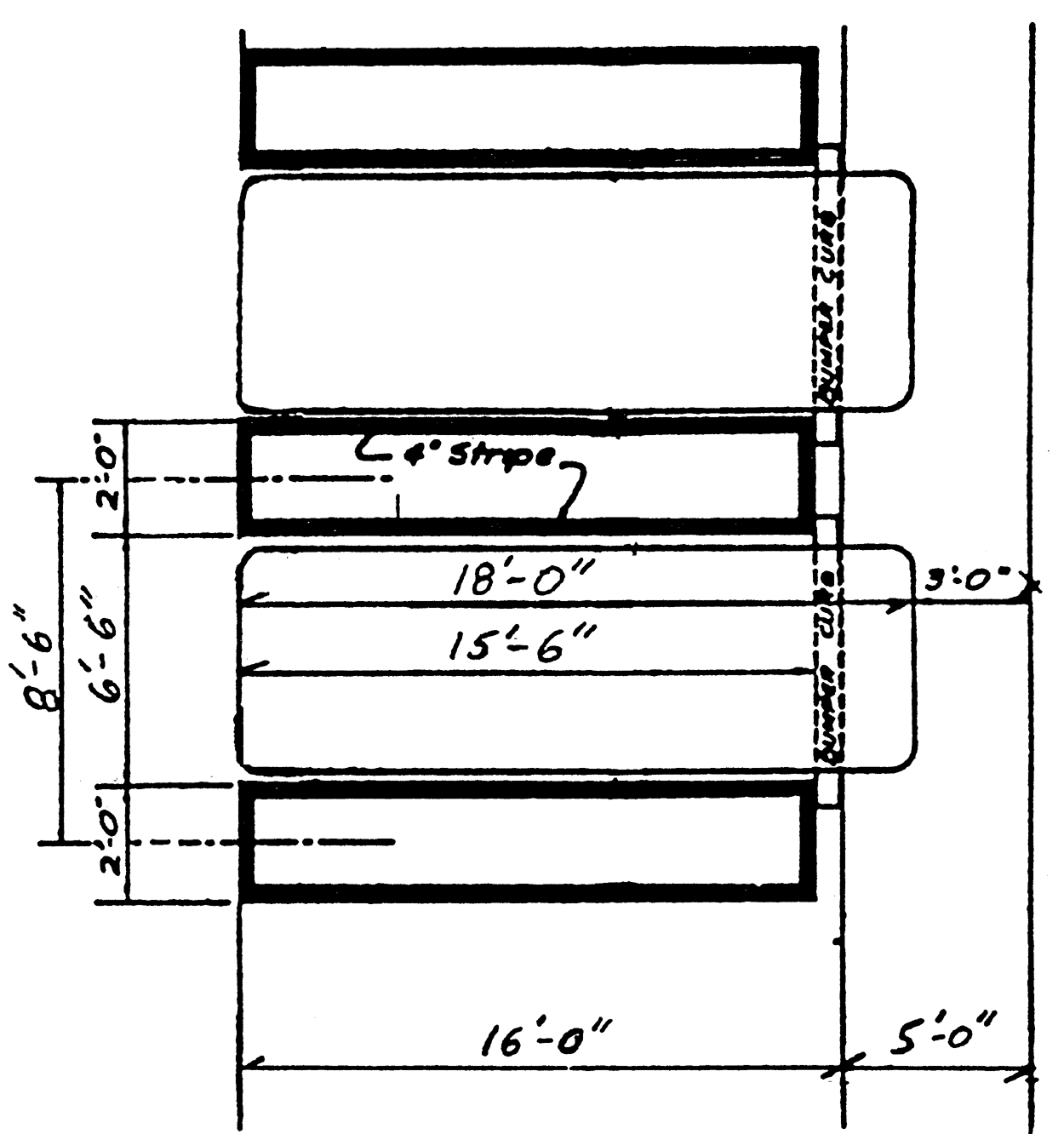
Illustration Following Sec. 23-30(e)
(Ord. No. 130, § 10, 6-8-59; Ord. No. 323, §§ 1—3, 8-8-77; Ord. No. 351, § 1, 4-9-79; Ord. No. 352, §§ 1, 3, 4-9-79; Ord. No. 386, §§ 1, 2, 2-9-81; Ord. No. 592, § 8, 7-8-96; Ord. No. 701, § 1, 4-8-02; Ord. No. 770, § 1(Exh. A), 5-9-05; Ord. No. 813, § 1(Exh. A), 1-8-07)
Sec. 23-30.1. - Mechanical and robotic parking systems.
(1)
Notwithstanding the above alternative parking arrangement provisions, due to the unattractiveness of such structures, and concerns with unsupervised operation of unattended vehicle lifts, mechanically stacked parking lifts shall be subject to the following basic provisions.
(a)
All mechanically stacked parking lifts shall be installed within a completely enclosed building or parking garage regardless of land use type, or at other locations approved by the town to ensure adequate screening, security and safety is provided.
(b)
Not more than 25 percent of the required quantity of parking spaces may be provided via mechanically or robotic parking lifts. This shall be interpreted to mean that the above percent limitation refers to those vehicles on elevated lifts
(c)
These provisions shall only apply to multifamily residential and commercial land development located on the East Island of the town and shall not apply to single-family homes on the West Island, nor two-family developments (duplex) or townhouse type developments on the East Island, expect that all such mechanical and robotic parking systems shall be installed within a completely enclosed building and a maximum of three lifts are permitted.
(2)
Definitions.
(a)
Mechanical parking means mechanical parking lifts, robotic parking systems, and/or vehicle elevators.
(b)
Mechanical parking lift means an automated mechanism that lifts vehicles to make space available to park other vehicles below it in a vertical tandem fashion.
(c)
Robotic parking system means a mechanical garage using elevator systems to hoist individual vehicles from receiving areas to separate auto storage areas.
(d)
Vehicle elevator means an elevator used for motor vehicles in lieu of ramps within a parking structure.
(3)
Parking spaces to be used to satisfy accessory off-street parking requirements must conform to the provisions of this chapter and include all-weather surface areas, meet minimum parking space dimensions, drive aisle widths, and required pavement markings. The use of mechanical parking devices, robotic parking systems and vehicle elevators to satisfy off-street parking requirements shall be permitted, subject to the provisions set forth herein.
(4)
Exceptions to the mechanical and robotic parking systems provisions may be considered by the town on a case-by-case basis.
(5)
All mechanical and robotic parking systems alternative parking arrangements shall be subject to the following provisions:
(a)
The system and components have a minimum service life of 20 years and specify periodic maintenance requirements in a maintenance manual to meet the life expectancy. Minimum life based upon minimum five lift cycles per day.
(b)
The contractor/manufacturer shall warrant all equipment and the installation (100 percent parts and labor) for a period of one year from date of final acceptance.
(c)
The parking lift stacker design shall provide for dependent parking spaces by lifting a vehicle onto a platform vertically so that a second vehicle can park underneath the first. In order to retrieve a vehicle from a lifted platform, the vehicle that is parked beneath the platform must be moved.
(d)
At a minimum all lifts shall have galvanized steel platforms and galvanized support steel legs/structures with suitable bases securely bolted to the floor. Lifts must be mechanically anchored (embedded or bolted) and cannot be glued or epoxied to the floor.
(e)
Platforms must be solid without gaps or holes in the platform and designed to catch any water, or other fluids, from dripping off of a raised vehicle onto a vehicle parked below the platform.
(f)
All surfaces of a vehicle platform where tires will touch shall have an anti-skid surface.
(g)
The minimum platform support length must be 16 feet in length with a minimum usable platform width of seven feet seven inches.
(h)
The platform design shall keep a vehicle level from side-to-side and from front to back during the entire lifting travel. All platforms shall have wheel stop mechanisms to alert the driver before driving too far onto a lift mechanism.
(i)
Have a minimum rated lift capacity of 2.7 tons.
(j)
Utilize a hydraulic lift mechanism with a shared power supply. Lift mechanisms may not use wire cables as part of the mechanism. Lifting mechanism shall utilize one hydraulic cylinder.
(k)
All raised platforms shall be capable of being lowered without the need of electrical power. However, an emergency power generator (EPG) or equivalent backup power supply acceptable to the town shall be provided to operate the lifts if electrical power is lost.
(l)
Safety device. Each parking lift unit shall have a redundant mechanical locking mechanism to prevent lowering of a raised vehicle platform due to loss of power or loss of hydraulic fluid. The locks shall be mechanically applied and electronically released.
(m)
The design of the mechanical lifts shall provide that the structural legs supporting the raised platform shall be positioned to allow easy access to vehicle doors parked on or below the platform.
(n)
All vehicle lifts shall be capable of operating with a minimum vertical clearance of 12 feet. Further, for each mechanical lift unit, one of the parking spaces (raised or ground floor) shall be capable of parking a standard SUV or similarly sized vehicle with a minimum of seven feet of vertical clearance.
(o)
The entire vehicle lift mechanism designed as a complete system, and its electronic control system shall be approved safe by an OSHA approved National Recognized Testing Laboratory (NRTL) such as Underwriters Laboratory, UL, TUV, INTERTEK or the like as listed on the OSHA website of approved NRTLs. Non-OSHA approved NRTL certificates shall not be accepted.
(p)
Valet parking for vehicle lift systems is mandatory for multifamily residential and commercial uses, including hotels and motels, unless the town council approved otherwise. If a multifamily residential complex has nine or less dwelling units, mandatory valet parking is not required due to the operational cost. In all instances, the property owner's association must ensure that lift systems are maintained and used regularly as intended. No person shall operate a mechanical vehicle lift unless trained in the operation thereof, and no off-site parking may occur that would negatively affect neighboring properties, unless specifically approved by the town. For clarity, for single-family homes, two-family homes (duplexes) or townhouse type developments valet parking is not required for vehicle lifts. The minimum quantity of parking spaces for single-family homes, two-family homes (duplexes) or townhouse type developments shall not count a raised vehicle lift parking space.
(q)
The valet operator shall provide a hold-harmless agreement and provide an insurance policy with an aggregate limit of at least $2,000,000.00 for injuries and damage to vehicles to the property owner.
(r)
The location of mechanical vehicle lifts and/or robotic parking systems shall be segregated away from standard parking spaces within a parking garage, to the maximum extent possible, to minimize danger to persons not trained in the operation of lifts.
(6)
Notwithstanding the above provisions, for any land development project that was approved by the town prior to the adoption of these Code provisions (December 15, 2022), such approvals and installations are deemed vested and grandfathered. The term "approved by the town" shall include any of the following:
(a)
A project that has received a site development plan approval from the design review board (DRB) and/or town council that has not expired (within specified timeframes to file for building permits/has been issued a valid project approval extension pursuant to Town Code/state law/executive order/etc.).
(b)
A project that has been reviewed and signed-off for technical sufficiency by the town's professional staff (development review committee (DRC)/other) and scheduled for a design review board (DRB) meeting.
(c)
A project that has been issued and holds a valid building permit for at least a principal structure on a site, and upon which active construction is ongoing.
(d)
A completed land development project that has received either a temporary certificate of occupancy or final certificate of occupancy from the town.
(7)
Any complexes with pre-existing installations are encouraged to modify and update their installations to the extent possible. If an existing mechanical lift system is replaced, any new lift system shall comply with the latest Town Code requirements.
(8)
Existing multifamily buildings. Existing multifamily buildings with a deficiency of parking may utilize mechanical parking devices within an existing parking structure area if approved by the town council. All parking lifts shall be located within a fully enclosed parking garage and shall not be visible from exterior view. No outside parking lifts shall be permitted.
(9)
As part of the town's review process for the use of mechanical parking devices, robotic parking systems and/or vehicle elevators under any of the provisions of this section, the following review criteria shall be evaluated when considering each application for the use of mechanical parking systems:
(a)
Whether the proposed use of mechanical parking results in an improvement of design characteristics and compatibility with the surrounding neighborhood and has demonstrated how the scale, mass, volume, and height of the building are reduced by the use of mechanical parking.
(b)
Whether parking lifts or mechanisms are located inside, within a fully enclosed building, and not visible from exterior view.
(c)
In cases where mechanical parking lifts are used for self-parking in multifamily residential buildings, whether approval is conditioned upon the proper restrictive covenant being provided limiting the use of each lift to the same unit owner.
(d)
In cases where mechanical parking lifts are used for valet parking, whether approval is conditioned upon the proper restrictive covenant being provided stipulating that a valet service or operator must be provided for such parking for so long as the use continues.
(e)
Whether a proposed operations plan, including hours of operation, number of employees, maintenance requirements, noise specifications, and emergency procedures, has been provided.
(10)
Mechanical parking devices, robotic parking systems, and/or vehicle elevators must also satisfy the following conditions.
(a)
The noise or vibration from the operation of mechanical parking lifts, car elevators, or robotic parking systems shall not be plainly audible to or felt by any individual standing outside the complex at any adjacent or nearby property. In addition, noise and vibration barriers shall be utilized to ensure that surrounding walls decrease sound and vibration emissions outside of the parking garage.
(b)
All mechanical lifts must be designed to prevent lowering of the lift when a vehicle is parked below the lift.
(c)
All mechanical parking systems, including lifts, elevators, and robotic systems, must be inspected, and certified as safe and in good working order by a licensed engineer or the elevator authority having jurisdiction at least once per year and the findings of the inspection shall be summarized in a report signed by the same licensed engineer or firm, or the elevator authority having jurisdiction. Such report shall be furnished to the planning director and the building official.
(d)
All parking lifts shall be maintained and kept in good working order.
(Ord. No. 1081, § 2(Exh. A), 1-11-2023)
Sec. 23-31. - Parking on corner lots.
In providing parking on corner lots, no portion of a standard eight and one-half-foot by 18-foot parking space shall come closer than 30 feet from the intersection of the extension of those property lines fronting the street.
(Ord. No. 130, § 11, 6-8-59; Ord. No. 366, § 2, 4-14-80; Ord. No. 592, § 9, 7-8-96)
Sec. 23-32. - Standing space on lots where parking spaces are provided away from the lot.
With respect to the provision for off-street parking as applied to any property on Blocks 11, 12, 20, or 21, and Lots 1 and 2 of Block 1 of Bay Harbor Islands as hereinabove described, there shall be provided on the same lot containing a structure, adequate space for standing, loading and unloading, in order to avoid interference with public use of the town's streets and alleys.
(Ord. No. 130, § 12, 6-8-59; Ord. No. 1103, § 2(Exh. A), 8-14-2024)
Sec. 23-33. - Off-street loading zone.
The off-street loading zone required by this article shall be located on the same plot or parcel of land they are intended to serve. Any building or structure currently in existence or constructed thereafter, which undergoes a structural alteration resulting in an increase in floor area of 25 percent or more, must include a designated loading zone within the property. For new construction utilizing enclosed structures for vehicle storage or parking, all required loading spaces must be located internally.
Effective from August 14, 2024, projects with an active issued building permit, under building permit review, or that have received development site plan approval from the design review board may proceed with their pre-approved plans if no changes are made, unless there is a floor area increase exceeding 25 percent. However, the town council has the discretion to grant exceptions if the property owner(s) demonstrate a public benefit. In cases where such an agreement exists and the floor area increases by 25 percent or more, town council approval is required.
(1)
Definitions.
a.
Off-street loading zone: A designated area within a property intended for the standing, loading, or unloading of trucks, situated off the public right-of-way.
b.
Commercial vehicle: Any vehicle used for the transportation of goods or materials as part of a commercial enterprise.
(2)
Loading zone requirements.
a.
Off-street loading spaces required for businesses, commercial establishments, offices, mixed-used, hotels, or motels shall be provided in addition to required parking spaces.
b.
Off-street loading zones shall have a minimum width of 12 feet, a minimum depth of 30 feet, and a vertical clearance of at least 14½ feet to accommodate standard commercial vehicles.
c.
Loading zones must be designated with markings and signage to clearly identify their location.
d.
Off-street loading zones are required to have a wearing surface consisting of at least one inch of asphalt concrete, situated atop a compacted lime rock base measuring six inches. This setup is designed to facilitate drainage, thereby minimizing the accumulation of standing water and potential damage to abutting properties and/or public rights-of-way (streets and alley).
e.
Loading zones shall be logically and conveniently arranged within the owner's private property, ensuring minimal interference with pedestrian and vehicular traffic. Off-street loading zones cannot be utilized or entered by neighboring properties. Each plot or parcel of land is required to designate its individual off-street loading area. Additionally, reversing out of off-street loading zones is prohibited.
f.
Multi-family only. All off-street loading must occur on private property, unless deemed as non-conforming. In such cases, loading and unloading activities are permitted to only utilize the swale area within the right-of-way and cannot last for more than 15 minutes.
g.
Non-confirming properties.
1.
Any non-conforming property undergoing structural alterations that result in a 25 percent or greater increase in floor area must include a designated loading zone within the property.
2.
Non-conforming properties in the town, which do not have adequate space for off-street loading, are permitted to utilize only the swale area within the right-of-way during designated hours: 6:00 a.m. to 10:00 a.m. and 7:00 p.m. to 11:00 p.m. Additionally, it is specified that at no time shall the alleys and Kane Concourse (96th Street) be used for an off-street loading space. The town manager or designee reserves the right to modify the timeframe if deemed necessary.
(3)
Prohibited.
a.
Commercial vehicles loading or unloading is strictly prohibited from parking or blocking Kane Concourse (96th Street) at any time. Additionally, commercial vehicles loading or unloading is strictly prohibited in the alleys depicted on the recorded plat for Bay Harbor Islands between Blocks 11, 12, 20, and 21 at any time.
b.
It shall be unlawful for any commercial vehicle to load or unload within the town between the hours of 11:00 p.m. and 6:00 a.m. The town manager or designee reserves the right to modify the timeframe if deemed necessary.
c.
The loading zones shall not be placed in a sight triangle.
d.
Reversing or backing out of an off-street loading zone into the public right-of-way is prohibited, excluding single-family, duplex and multi-family only.
(Ord. No. 1103, § 2(Exh. A), 8-14-2024)
Sec. 23-34. - Obedience to signs.
Where the owners or lessees of unimproved property in the town post a sign furnished for such purposes by the town prohibiting parking on such property, no person, firm or corporation shall park his or its vehicles in such parking area. The sign referred to herein shall be furnished by the town at a cost not exceeding cost to the town.
(Ord. No. 130, § 14, 6-8-59)
Sec. 23-35. - Towing and impounding of vehicles.
Any vehicle parked contrary to the provisions of this article may be towed away at the discretion of the town and impounded at a suitable storage space, all at the cost of the owner of such vehicle. A vehicle so impounded shall not be released from storage except upon the payment by the vehicle owner of all costs of towing and storage.
Any individual or entity wishing to have vehicles towed from private property must fully comply with F.S., § 715.07. In addition to the aforementioned requirements, anyone wishing to install tow-away signs must first file an application and receive approval from the building department prior to the installation of signs and before any towing or removal of vehicles can be authorized.
(Ord. No. 130, § 15, 6-8-59; Ord. No. 750, § 1, 8-16-04)
Sec. 23-36. - Severability.
Should any section, clause, or provision of this article be declared by a court of competent jurisdiction to be invalid, the same shall not affect the validity of the article as a whole or in part thereof, other than the part so declared to be invalid.
(Ord. No. 130, § 16, 6-8-59)
Sec. 23-37. - Punishment for violation.
Any person, firm, or corporation who shall violate or fail to comply with any of the provisions of this article shall be punished by a fine of not less than $5.00 nor more than $500.00 or be imprisoned for not less than 30 days, or both, in the discretion of the town judge. Each day that a violation exists shall constitute a separate offense.
(Ord. No. 113, § 4, 3-10-58; Ord. No. 130, § 17, 6-8-59)
Editor's note— Pursuant to Art. V, § 20(d)(4), Fla. Const., municipal courts not abolished as of January 3, 1977, shall cease to exist as of that date. Thus, pursuant to state law the municipal court of the Town of Bay Harbor Islands has been abolished, and accordingly, the office of town judge is no longer applicable to the town.

