
Bella Vista City Zoning Code
ARTICLE I
- IN GENERAL
Sec. 109-1.- Title.
The title of the ordinance from which this chapter is derived shall be known as the "Zoning Ordinance of the City of Bella Vista, Arkansas." The chapter shall consist of the text written herein as well as the map titled "Zoning District Map" which delineates individual districts within the corporate city limits.
(Zoning Ord., § 100.01; Ord. No. 2009-23, § 100.01, 1-8-2010)
Sec. 109-2. - Interpretations.
When dealing with this chapter, the following rules of interpretation shall be applied, except when the context clearly requires otherwise.
(1)
Terms used in the present tense shall include the future tenses. Terms in the singular number include the plural, and words in the plural number include the singular, except where the natural construction of the writing indicates otherwise:
(2)
The term "shall" is mandatory and not discretionary. The term "may" is permissive.
(3)
The particular shall control the general.
(4)
The text of this chapter shall control, in cases where the text differs in meaning or implication from any chart, graph, illustration, or table.
(5)
The terms "building" and "structure" are synonymous and include any part thereof.
(6)
The term "person" shall include individuals, firms, corporations, associations and any other similar entities.
(7)
The terms "parcel" and "tract" may be used interchangeably.
(8)
The term "City" means the areas of jurisdiction of the City of Bella Vista, Arkansas.
(9)
All public officials, bodies and agencies to which reference is made are those of the City of Bella Vista, Arkansas.
(10)
All yards required by this chapter shall be open and unobstructed by structures from the lowest level of the lot to the sky, except as specifically regulated herein.
(11)
The term "permitted" or "permitted by right" means permitted without meeting the requirements for a conditional use permit or site plan.
(Zoning Ord., § 100.01; Ord. No. 2009-23, § 100.01, 1-8-2010)
Sec. 109-3. - Definitions of terms and uses.
The following words, terms and phrases, when used in this chapter, shall have the meanings ascribed to them in this section, except where the context clearly indicates a different meaning:
Abutting means having property or district lines in common. Since zoning district lines fall to the centerline of a street, alley, or waterway, lots which appear physically separated abut at said district line.
Access means the way or means by which a piece of property is approached or entered.
Accessory building. See Building, accessory.
Accessory dwelling. See Dwelling, accessory.
Accessory structure building setback means a line starting at the two corners of the principal building footprint that form the edges of the building's front plane and extending to a lot or lots side property lines. The line will be of uniform length measured from the front property line to the principal building footprint corner. The depth of the line may vary from one side of the principal building footprint to the other, depending on the articulation of the front plane.
Accessory use means a use that is clearly incidental to, or customarily found in connection with, and on the same lot as, the main use of the premises. When the term "accessory" is used in the text, it shall have the same meaning as accessory use.
Addition means any construction which increases the size of the building or structure in terms of site coverage, height, length, width, or gross floor area. Examples include a porch, attached garage or carport, or a new room or wing.
Adjoining lot means a parcel of land that shares a common property line with another parcel of land located immediately adjacent to the subject parcel.
Adult day care center means an institution maintained and conducted, certified by the state, under public or private auspices which cares for more than two adults who require such care because of age, affliction or limited capacity and who are apart from their own family or relatives during a part of the day.
Agent of owner means any person showing written verification that he/she is acting for, and with the knowledge and consent of, a property owner.
Agricultural products processing means a facility which involves the operation of processing, preparing or packaging agricultural products which are not grown on the site.
Agriculture means farms and general farming, including horticulture, floriculture, dairying, livestock and poultry raising, farm forestry and other similar enterprises or uses, but no farms shall be operated for the disposal of garbage, sewage, rubbish, offal or rendering plants or for the slaughtering of animals, except such animals as have been raised on the premises or have been maintained on the premises for at least a period of one year immediately prior thereto and for the use and consumption of persons residing on the premises.
Alley means a public passage or way affording a secondary means of vehicular access to abutting property and not intended for general traffic circulation.
Alter means to change the size, shape, outline, intent or type of sign.
Alterations means any physical change, addition or modification in the internal arrangement of spaces, construction or type of occupancy, any change in the structural members of a building, such as walls or partitions, columns, beams or girders, the re-positioning on the site, or the appearance of the building or structure, with the consummated act of which may be referred to herein as "altered" or "reconstructed."
Animal breeder means any person who maintains an unaltered (unsterilized) dog or cat and breeds such animal for any consideration of profit, fee, or compensation.
Animal clinic orhospital (enclosed) means a facility without outside runs for the diagnosis and treatment of pets and other animals including, but not limited to, dogs, cats, birds and horses. All boarding of animals is within an enclosed structure and is incidental to clinic or hospital use.
Animal, domestic or household means animals which usually do not induce fear or apprehension by persons encountering said animal due to size or reputation; which have a tendency to voluntarily return to the domicile after escape, and which do not fall under the definition of farm animal, exotic animal, game animal or animal wild by nature. Such animals are customarily kept by humans for companionship, including, but not limited to, dogs, cats, birds, rabbits, hamsters, mice, and turtles.
Animal, exotic means animals that are not usually found running at large within the natural areas of the State of Arkansas; that do not meet the definition of household/domestic animals or farm animals; that are not usually considered as a food supply or animal of burden in the United States, and which close relative or parentage are usually imported from another country.
Animal, game means animals which are normally wild by nature, provide citizens with a portion of food for consumption, and are usually hunted under a license issued by the State of Arkansas.
Animal grooming establishments means any care or service provided to the exterior of an animal to change its looks or improve its comfort, but does not mean the treatment of physical diseases or deformities.
Animal shelter or kennel means a public or commercial facility including outside runs for enclosure of animals, especially stray or unlicensed pets, or for pets being boarded for short periods of time, with five or more animals.
Animal, wild by nature means animals which normally fall within the category of scavenger or predator; may instill fear and apprehension in persons of normal sensitivity, when encountered; require extraordinary precautions to prevent escape; and will not usually voluntarily return to the domicile after escape.
Animals, farm means animals normally maintained for the purpose of producing a food supply (i.e., bovine, swine, turkeys, chickens, rabbits, etc.) and animals of burden which reduce farm and/or rancher toiling, (i.e., mule, donkey, horse, oxen). Such animals are customarily raised in an agricultural, rather than urban, environment, for profit on farms and have the potential of causing a nuisance if not properly maintained. This definition does not include "hobby chicken" which is separately defined.
Antenna means any structure or device used to collect or radiate electromagnetic waves, including both directional antennas, such as panels, microwave dishes and satellite dishes and omni-directional antennas, such as whips but not including satellite earth stations.
Apartment means a room or suite of rooms with private bath and kitchen facilities comprising an independent, self-contained dwelling unit within a building or structure containing more than three such units. See Dwelling, multi-family.
Apiary means the assembly of one or more colonies of bees at a single location.
Apiculture means the maintenance of bees in hives or colonies for the production of honey and related products.
Applicant means any person, firm, or corporation applying for permits or other approvals required by this chapter.
Approving authority means the City Council, Planning Commission, or other code-identified designee.
Area means the amount of land surface in a lot or parcel of land.
Area requirement means the yard, lot area, width of lot, height of structure, and parking requirements as set forth for a specific zone in this chapter.
Arena/auditorium means a facility or closed area used for large public gatherings for viewing sports events, musical programs, public speeches or ceremonies. The allowed uses include but are not limited to arenas, auditoriums, fairgrounds, and stadiums.
Attached means having one or more walls in common with a principal building, or connected to a principal building by an integral architectural element, such as a covered passageway, façade wall extension, or archway.
Authorized agent means a person or persons authorized by the landowner to act on his behalf.
Auto auction means a facility for the sale of automobiles to the highest bidder.
Auto painting orbody rebuilding shop means a facility for restoring auto bodies, painting or refinishing.
Auto parts and accessory sales means a facility having auto parts, accessories and tools for sale.
Automobile or motorcycle display, sales or service means a facility for display, service and sale of new or used automobiles, motorcycles, recreational vehicles, and trailers.
Awning means a temporary hood or cover that projects from the wall of a building, and that may include a type that can be retracted, folded, or collapsed against the face of the supporting building; a type of canopy.
Banner means a temporary sign constructed of a lightweight material, such as cloth, canvas, fabric, or flexible plastic, either enclosed in a frame or mounted to allow movement caused by the atmosphere.
Bar, lounge, or tavern means an establishment, the primary activity of which is the sale and consuming on premises, of alcoholic and non-alcoholic beverages, where food service is secondary.
Basement means a story partly or wholly underground. For purposes of height measurement, a basement shall be counted as a story when more than one-half of its height is above the average level of the adjoining ground.
Bed and breakfast means an owner occupied dwelling unit that contains no more than five guest rooms where short-term lodging, with or without meals is provided for compensation. Short-term lodging shall be defined as lodging for a period not to exceed 21 days.
Bedroom means a space used primarily for sleeping purposes but may be part of an all-purpose room, study, or den. The room shall not be smaller in area than is required by current building codes.
Beekeeper means a person who owns or has charge of one or more colonies of bees.
Beekeeping equipment means anything used in the operation of an apiary, such as hive bodies, supers, frames, top and bottom boards and extractors.
Beginning of construction means the initial incorporation of labor and materials within the foundation of a building or structure.
Bicycle lane or path means a designated lane on a roadway or an exclusive path separated from a roadway that is specifically designated to accommodate the physical requirements of bicycling. These lanes and paths are ordinarily designed to also accommodate other forms of non-motorized vehicles, such as motorized wheelchairs, to provide access to people with disabilities.
Billboard means a type of freestanding sign which exceeds the height and square footage requirements for the district in which it is located, and which promotes or advertises commodities, goods, or services available at a location other than were the sign is located, including those signs whose message space is available for lease, rent, or hire.
Block means the area of land that is entirely bounded by a combination of streets, external subdivision boundary, waterbody, railroads, or other significant natural or man-made barriers. Customarily used as a designation on a plat for purposes of a legal description of property.
Board means the board of zoning adjustment.
Boathouse means an accessory building or structure especially designed for the storage of boats, normally smaller water craft for sports or leisure use, typically located on open water such as a lake or river. The term "boathouse" does not include accessory dwellings or other structures with dwelling units.
Bond means any form of security including a cash deposit, surety bond or other financial instrument of credit in an amount and form satisfactory to the City.
Body of water means any significant accumulation of water including, but not limited to, lakes, reservoirs, ponds, rivers, and streams.
Breeding facility means a structure or facility used for the purpose of breeding two or more litters of puppies or kittens within any 12-month period; a facility that keeps animals commercially and has open runs, outside play areas, or any areas where animals are kept or left outside.
Bufferyard means a strip of land established to protect one type of land use from another. A buffer yard is typically landscaped and kept in open space. The term "buffer zone" may be used more broadly to describe any area that separates two unlike zoning districts.
Buildable area means the space remaining for construction on a lot after the minimum area requirements (yards, setbacks, coverage) have been met.
Building means any structure including a roof supported by walls, designed or intended for the support, enclosure, shelter, house, or otherwise protect persons, animals, chattels, or property and forming a construction that is safe and stable; the term "building" includes the term "structure."
Building, accessory means an accessory building is a subordinate building or a portion of the main building, the use of which is clearly incidental to, or customarily found in connection with, and (except as otherwise provided in this chapter) located on the same lot as, the use of the main building or principal use of the land. If the building otherwise qualified as an accessory building is attached to the main building by a common wall or roof, such building shall be considered a part of the main building.
Building, attached means a building which shares a continuous roof with another adjacent building located on the same lot.
Building, detached means a building having no roof in common with another building located on the same lot.
Building coverage means the horizontal at-grade area of a site covered by buildings or roofed areas, excluding allowed projecting eaves, balconies, canopies, and similar features. The area also referred to as the building footprint.
Building elevation means the proposed or existing exterior wall of a building or structure exposed to public view.
Building envelope means the three-dimensional space within which a structure is permitted to be located after all zoning, building, and other applicable municipal requirements have been met.
Building facade means the area of a single building elevation which encompasses all of such elevation from ground or grade level to the top, and from one side to the other side of the building.
Building footprint means the area on a lot that is used by the building structure and that is defined by the perimeter of the building plan. Parking lots, landscaping, and other non-building facilities are not included in the building footprint.
Building height means the vertical distance measured from the average elevation of the finished grade of the lowest floor of the building to the highest point of the structure, exclusive of chimneys, ventilators, or other extensions above the roofline that are not intended for occupancy or internal usage by persons.
Building line means the outer boundary of a building or structure established by the location of its exterior walls.
Building material sales means a facility for the sale of materials and hardware to be used for the construction, renovation, remodeling or other alterations of primary or accessory buildings.
Building official means the person designated by the municipal code that is responsible for the enforcement of applicable building codes.
Building permit means the document(s) required by building codes to be issued by the building official's staff prior to the erecting, constructing, enlarging, altering, moving, improving, converting, or demolishing any building or structure as regulated by this chapter or the applicable building code. Issuance of a permit follows the review of plans and/or other documents by the appropriate authority to determine that the proposed use of the building, structure, and/or land complies with all provisions of the city code.
Building, principal means a building or structure in which is conducted the principal use of the lot on which it is located. In any residential district, any dwelling shall be deemed to be the principal building on the lot.
Building setback means a line drawn on plats and other property description maps delineating the area within which a structure can be built.
Bulk storage of highly flammable materials means a facility for the storage of chemicals, gases or liquids which are subject or could be caused to ignite or explode.
Bus or truck storage orgarage means a facility in which currently licensed buses or trucks are stored or repaired.
Canopy means an overhead protective, permanent porch or walkway cover which is either attached to a building or detached and supported by free-standing columns. Attached units may be decorative in nature and are usually located over an exterior building opening like a door or window while detached units are found above outdoor service areas. A canopy shall be constructed in a manner that allows passage of pedestrians and/or vehicles underneath its lowest protective edge.
Car wash means a facility for washing or steam-cleaning passenger automobiles (including a self-service operation), operating either as a separate facility or when installed and operated in conjunction with another use, and which installation includes equipment customarily associated with a car wash and is installed solely for the purpose of washing and cleaning automobiles.
Carport means a structure attached or made a part of the main structure, and which is open to the weather on at least two sides, intended for the use of sheltering motor driven vehicles. See also Garage.
Cemetery ormausoleum means a place or ground designated for burial of the deceased.
Certificate of occupancy means the official certification issued by the building official or his/her designated staff prior to occupancy that a building or structure is found to conform to provisions of this chapter and applicable building and municipal codes.
Change of use means the replacement of one existing use or owner with another.
Channel means the bed and banks of a natural stream or man-made drainageway that conveys the constant or intermittent flow of water (partially frozen or liquid), including storm run-off.
Chicken, hobby means fowl that are being raised on non-agricultural lots as a hobby instead of as a farming operation. Hobby chickens are used for the production of eggs, garden fertilizer, meat production or as pets for noncommercial purposes.
Child care facility means any child care facility is considered commercial in nature when the facility cares for five or more children under the age of 16 years, and not of common parentage, for care apart from their natural parents, legal guardians, or custodians, when received for regular periods of time for compensation, provided, however, this definition shall not include public or private schools organized, operated or approved under the laws of this state, custody of children fixed by a court of competent jurisdiction, or to children related by blood or marriage within the third degree to the custodial persons. These uses include, but are not limited to:
(1)
Commercial day care center.
(2)
Kindergarten.
(3)
Nursery school.
(4)
Preschool.
City means the City of Bella Vista, Arkansas.
Clinic (medical, dental, optical) means a facility for examining, consulting with, and treating patients; including offices, laboratories and outpatient facilities, but not including hospital beds for overnight care or treatment.
Club means an organization of persons for special purposes for the promulgation of sports, arts, sciences, literature, politics or the like, but not operated for profit. Also seeLodge.
Colocation means the use of a wireless telecommunications facility by more than one wireless telecommunications provider.
Colony or hive means an aggregate of bees consisting principally of workers, but having, when perfect, one queen and at times many drones, including brood, combs, honey and the receptacle inhabited by the bees.
Commercial vehicle means any vehicle licensed by any state as a commercial vehicle.
Commission means the Bella Vista planning commission.
Common open space means an area of land or water or a combination thereof that has been held, set aside or otherwise designated, designed, intended for the common and/or cooperative use and enjoyment of all residents and owners, and which is easily accessible. The term "common open space" may contain such complementary structures and improvements as are necessary and appropriate.
Common wall means a single interior wall of a structure, usually without a cross-connection or access between adjoining units. Typically found in multi-family or multi-commercial structures to provide separation between ownerships, rented or leased spaces, etc. and that often also serve the secondary purpose of a fire-break or separation. Common walls serve as the side property line where a zero-lot-line setback is permitted.
Community welfare and health center means a community service facility where social, recreational, welfare, health, medical, or child care assistance is provided for a public, quasi-public, tax-exempt, church or municipal agency. Also see Mental health center.
Compatibility means the degree to which two or more different land use types are able to exist together in close proximity with no single use having significant negative effects on any other use.
Compounding pharmacy means a pharmacy that can start with two or more certain elements or chemicals and combines them in specific proportions and through deliberate processes to create a new homogeneous substance with properties unlike its constituting elements or mixtures. To be a truly new compound, its processes cannot be reversed to re-form the original ingredients nor can the ingredients be otherwise separated by any physical means. A compounding pharmacy usually creates its compounds in customized dosages or formulations for a specific individual patient at the request of a physician via a prescription. There are national standards for compounding, transportation, storage, potency, and testing.
Comprehensive plan means the City of Bella Vista's long-range development policies for the area subject to urbanization in the foreseeable future and which includes, among other things, the master land use plan, the master street plan, and any current or future subdivision and zoning ordinances.
Conditional use means a use permitted in one or more districts as defined by this chapter upon approval by the planning commission, but which use, because of characteristics peculiar to it, or because of size, technological processes or type of equipment, or because of the exact location with reference to surroundings, streets and existing improvements or demands upon public facilities, requires a special degree of control to make such uses consistent with and compatible with other existing or permissible uses in the same district or districts, and to ensure that such uses shall not be detrimental to the public interest.
Conditional use permit means the documented evidence or authority granted by the planning commission to locate a conditional use to a specific individual, group, organization, or business at a particular location for a specified period of time. A conditional use permit is granted at the discretion of the planning commission after a public hearing. Special requirements or limitations may be placed on the applicant as a condition of approval for the permit. Lack of adherence to the conditions of approval may result in the revoking of the permit.
Contractor maintenance yard means an open storage yard for supplies and operational equipment, but not constituting a junk or salvage yard, that includes a buffer and is only located in a commercial zone.
Convalescent/maternity/nursing home means a facility providing care and minor treatment under the direction of a physician licensed by the State of Arkansas or a facility providing services to patients for the purpose of achieving rapid recovery. It may furnish basic provisions of food and laundry. It may also provide health care and minor treatment under direction of physician for pregnant woman until the birth of the child. These uses include, but are not limited to:
(1)
Convalescent home;
(2)
Maternity home;
(3)
Institution for aged or children; and
(4)
Nursing home.
Convenience store means a retail commercial establishment, not exceeding 2,500 square feet in gross floor area, supplying a limited range of food items, magazines, toiletries, and tobacco products to meet the day-to-day needs of residents in the immediate neighborhood and which may or may not include fuel sales.
Conveyance means any public or privately owned vehicle, method or means of transporting people, bicycles, motorized or non-motorized vehicle, handcart, pushcart, lunch wagon or any other device or thing, whether or not mounted on wheels.
Corner lot. See Lot, corner.
Country club, private membership means an area of ten acres or more, containing a golf course and a clubhouse available only to the membership. Such a club may contain, as adjacent facilities, a private club and dining room, swimming pool, tennis courts and similar service and recreation facilities.
County means Benton County, Arkansas.
Courtyard means an open, unoccupied space bounded on two or more sides by exterior building walls. Bounding walls are not required to be of the same structure.
Coverage means the lot area covered by the buildings including all overhanging roofs except where otherwise specifically designated.
Crematory means a building fitted with the proper appliances for the purposes of the cremation of the deceased and includes everything incidental or ancillary thereto.
Cultivation means the system of improving and preparing land by plowing, fertilizing, tending, weeding, trimming, thinning, and/or harvesting wanted plant materials for increased production of crop quality or quantity. This would include the processes used for the removal of unwanted pests and plants.
Cultivation facility (unless amended by the Arkansas State Legislature) means any entity:
• Licensed under by the medical marijuana commission and subject to the State of Arkansas' Alcoholic Beverage Control Division who administers and enforces the Arkansas Medical Marijuana Amendment; and
• That cultivates, prepares, manufactures, processes, packages, sell, and delivers usable marijuana to a dispensary.
Curb cut means any access to a vehicular use area from any right-of-way of any street, road, or highway.
Dance hall means any building, premises, pavilion, or place of business wherein dancing is permitted, conducted or engaged in by the public in general, including, but not limited to, private clubs as defined by ordinance and/or the laws of the state of Arkansas, either for profit or not.
Day care center. See Child care facility.
DBH is an abbreviation for diameter at breast height.
Density means the number of units (residential, commercial, or industrial) per gross acre of land within a single development or subdivision.
Department means the community development services department of the City, unless otherwise specified.
Design standards means the site and/or building improvement requirements that exist in addition to basic zoning district development regulations established by the municipal code or identified for a special development area.
Detached means fully separated from any other building or not joined to another building in such a manner as to constitute an enclosed or covered connection.
Developer means the legal owner(s) or authorized agent(s) of any land engaged in a proposed development.
Development means any man-made change to improved or unimproved real estate, including - but not limited to - buildings, structures, erecting, placing, mining, dredging, filling, grading, paving, excavating, or drilling operations.
Dispensary means a facility, institution, location, or operation where medical supplies, preparations, treatments and/or other legally controlled substances are prepared and distributed to patients for the administration of the items in the portions prescribed by a doctor for the treatment of an illness, injury, disability, or disease. In regards to marijuana, this means any entity licensed by the medical marijuana commission and subject to the State of Arkansas' Alcoholic Beverage Control Division who administers and enforces the Arkansas Medical Marijuana Amendment. For example, a hospital will have a dispensary for on-site patients that is in a different part of the building from where the public may come to have a pharmacist fill prescriptions for their use at home. Both are areas are dispensaries, but one is private (for internal patients) while the other is public.
Districtor zone means any section, sections, or divisions of the city for which the regulations governing the use of land, buildings, premises, density, bulk, height, and/or building area are uniform. A district or zone typically also has requirements for setbacks, open or green spaces.
District, commercial means any land within the city limits where retail businesses that provide personal goods and services are located. The term "commercial districts" includes C-1, C-2, C-3, and C-4 categories as well as others listed in section 109-67(a)(4). It may in certain circumstances also include the R-O district.
District, conservation means any land within the city limits where recreational and open space uses are located. The term "conservation districts" include P-1 as well as other categories listed in section 109-67(a)(1).
District, industrial means any land within the city limits where light manufacturing, assembly and accessory warehousing for products which present low risk of objectionable environmental influences are located. The term "industrial districts" includes I-1 and I-2 categories as well as others listed in section 109-67(a)(5).
District, nonresidential means any land within the city limits where single-family dwellings, townhomes, manufactured housing, recreational, and open space uses are not located.
District, residential means any land within the city limits where single-family dwellings, townhomes, and manufactured housing is located. The term "residential districts" includes R-E, R-1, R-2, R-3, R-MH, and SPR categories as well as others listed in section 109-67(a)(3). It may in certain circumstances also include the R-O district.
Dock means an accessory structure or group of structures involved in the handling of water craft, usually on or close to a shore, created by construction protruding into an existing open body of water such as a lake or river or by excavation within what would otherwise be dry land. The term "dock" does not include accessory dwellings or other structures with dwelling units.
Dockside recreational improvement means an accessory structure, ancillary to a boathouse or dock, used for recreational purposes built on or close to a shore of open water such as a lake or river. The term "dockside recreational improvement" does not include accessory dwellings or other structures with dwelling units.
Drainage means the removal of surface or ground water from land by drains, grading, or other means.
Drainage system means the system through which water flows from the land.
Drive-in services means the uses that involve the sale of products or provision of services to occupants in vehicles.
Drive-through means a business establishment so developed that its retail or service character is dependent on providing a driveway approach or parking spaces for motor vehicles to serve patrons while in the motor vehicle, rather than within the building or structure.
Duplex/two-family dwelling. See Dwelling, two-family.
Dwelling means any building, or portion thereof, which is designed for used as living quarters for one or more families, but not including house trailers, mobile homes, travel trailers, or other recreation vehicles. Each dwelling unit shall have its own independent provisions for cooking and bathing.
Dwelling, accessory means a separate dwelling unit that is either attached or detached from a structure the primary use of which is single-family, commercial or industrial.
Dwelling, attached means adjoining dwelling units, each of which is separated from the others by one or more unpierced common walls extending from ground to roof.
Dwelling, detached means a dwelling having open space on all sides.
Dwelling, manufactured. See Manufactured home.
Dwelling, modular. See Modular home.
Dwelling, multi-family means a residence designed for or occupied by three or more families with separate housekeeping and cooking facilities for each.
Dwelling, single-family means a detached residence primarily designed for or occupied by one family only.
Dwelling, townhouse or row house means two or more dwelling units attached at the side or sides, each unit of which has a separate outdoor entrance and is designed to be occupied and shall be owned by one family.
Dwelling, two-family means a residence designed for or occupied by two families only with separate housekeeping and cooking facilities for each.
Dwelling units means one or more connected rooms established for owner occupancy, rental or lease, and physically separate from any other rooms or dwelling units in the same structure and containing independent cooking and sleeping facilities.
Dwelling, zero lot line means a single detached dwelling unit that is constructed on a side property line of said lot; such that the wall located on the side property line should be blank with no openings of any type allowed.
Easement means a right-of-way or parcel of land specified or set aside for a specific use, normally used for access, utilities, and other public or private usages given by the owner or land to another party, the city or the public.
Eave means the weather protective overhanging lower edge of a roof.
Efficiency unit means a dwelling unit for not more than two adults that contains living, sanitation, sleeping, and cooking facilities, but not a separate bedroom for sleeping.
Enclosed means a roofed or covered space fully surrounded by walls or columns.
Engineer means a registered professional engineer in good standing, and licensed to practice in the State of Arkansas.
Erected means built, constructed, altered, reconstructed, or moved upon any physical operations on the premises which are required for the construction, excavation, fill, drainage and the like shall be considered a part of erection.
Essential services means the erection, construction, alteration or maintenance by public utilities or municipal departments of underground, surface or overhead gas, electrical, steam, fuel or water transmission or distribution systems, collection, communication, supply or disposal systems, including towers, poles, wires, mains, drains, sewers, pipes, conduits, cables, fire alarm and police call boxes, traffic signals, hydrants and similar equipment in connection, but not including buildings which are necessary for the furnishing of adequate service by such utilities or municipal departments for the general health, safety or welfare.
Establishment for care of alcoholic, narcotic or psychiatric patients means an establishment offering residence for outpatient treatment to alcoholic, narcotic or psychiatric patients. Also see Community welfare and health center.
Excavation means any breaking of ground, except common household gardening and ground care.
Existing use means the use of a lot or structure at the time of the effective date of this chapter.
Family means one or more persons related by blood, marriage or adoption, or a group of not more than five unrelated persons living together and subsisting in common as a single, nonprofit housekeeping unit utilizing only one kitchen. The term "family" may include domestic servants employed by said family. The term shall not be construed to include a fraternity, sorority club, or other groups of persons living together on a temporary commercial basis such as a hotel/motel, retirement or nursing home, boardinghouse, or lodging house arrangements.
Farm means a parcel of land including related structures thereon for the production of crops such as vegetables, fruit, cotton, or grain and includes their storage. It also includes the raising of farm animals such as poultry, horses, cattle, or swine on a limited basis as well as dairy products. Farming does not include the commercial raising of animals, commercial feeding, or the feeding of garbage or offal to swine or other animals.
Federal means pertaining to the Government of the United States of America.
Fence means an enclosure or barrier, constructed of resources such as wood, wire, iron, decorative metals, pipe, nails, screws, netting, or other materials that are used to mark a boundary; or to provide a means of protection, privacy screening, visual separation, or confinement. It may include the use of hedges, shrubs, trees, or other natural growth.
Financial Guarantee means an instrument warranting the initial placement and construction of required improvements or subsequent maintenance of those improvements taking the form of a cash deposit or cashier's check, irrevocable letter of credit, or bond issued by a surety company authorized to do business in the State of Arkansas.
Floodplain regulations means provisions of the city flood damage prevention code in Chapter 105.
Floor area means total gross area on all floors as measured to the outside surfaces of the exterior walls, excluding crawl spaces, garages, carports, breezeways, attics without floors and open porches, balconies and terraces.
Front plane means the plane of the front elevation of the principal façade(s) of the principal structure extending to the side property lines.
Front yard means any portion of a lot forward of the building footprint of the principal building on the lot. In the case of corner lots, the front yard shall be delineated by the orientation of the primary pedestrian entry to the structure.
Frontage means the length of a property line of any one premise abutting and parallel to a public street, private way, or court from which access is permitted.
Garage apartment means a dwelling unit for one family that is erected above a private garage, or part of it on the same level.
Garage, private means an accessory building or part of a main building primarily used for the parking and/or sheltering of motor-driven or human-powered vehicles, including but not limited to cars, trucks, vans, motorcycles, boats, kayaks, canoes, recreational vehicles, all-terrain vehicles, trailers, etc.
Garage, public or repair means a commercial building in which are provided facilities for the care, servicing, repair, or equipping of motor-driven vehicles.
Gasoline or service station means any building, structure, or land used primarily for the dispensing and sale of fuels, oils, accessories, or minor maintenance and repair services but not including painting, body work, or major repairs.
Gate means an opening in a fence and is an integral part of it. It also means the movable barrier that can be opened and/or closed at a fence opening or other separation barriers.
Golf course means a facility providing private or public golf recreation services and support facilities, excluding miniature golf facilities.
Goods, wares ormerchandise includes, but is not limited to, fruits, vegetables, farm products or provisions, dairy products, fish, game, poultry, meat, plants, flowers, appliances, wearing apparel, jewelry, ornaments, art work, cosmetics and beauty aids, health products, medicines, household needs or furnishings, food of any kind, whether or not for immediate consumption, confections or drinks.
Government services means buildings or facilities owned or operated by government entities and providing services for the public, excluding utilities and recreational services. Typical uses include administrative offices of government agencies (local, state, and federal) and utility billing offices.
Grade means the top surface elevation of lawns, walks, drives or other improved surface after completion of construction or grading operation.
Green space means areas that are devoid of hard or impervious surfaces such as building, driveways, and sidewalks. The term "green space" includes lawns, landscaping beds, and other natural vegetation but excludes areas utilized for stormwater detention or retention.
Greenhouse or nursery means an establishment primarily engaged in the raising and retail sale of horticultural specialties such as flowers, shrubs, and trees, intended for ornamental or landscaping purposes; also, a facility for growing and selling plants, shrubs or trees and other articles or implements which are involved in the transportation, installation and maintenance of landscaped areas.
Gross acreage means the total acreage of the proposed development including areas designated for internal streets and other public facilities.
Ground coverage ratio means the percentage of lot area included within the outside lines of the exterior walls of all buildings located on the lot, except garages and carports in Districts R-1 and R-2 and including the area of porches, decks, patios, breezeways, balconies, and bay windows, except patios not more than six inches above grade.
Gross floor area means the total enclosed horizontal area of all floors of a building.
Hauling and storage company means a facility for warehousing, transferring or keeping goods.
Hazardous material storage means a facility or outdoor area used to store materials which are poisonous, noxious, and otherwise are hazardous to the health of the general public. The facility may be used to store such things as acids, oils, chemicals, etc., prior to use or may be a permanent storage area for waste chemicals, etc. These uses include, but are not limited to, petroleum products storage.
Health studio or spa means a facility other than a regularly licensed hospital, operating for a profit to promote physical fitness or weight control, and where manipulated massage or manipulated exercises are practiced upon the human body by anyone not a duly licensed physician or chiropractor, whether with or without use of mechanical or therapeutic devices.
Height means the vertical distance as measured through the highest point in the structure from the ground floor.
Home occupation means an accessory occupational use carried on within a residential dwelling by its inhabitants, which is clearly subordinate to the residential use of the dwelling unit or structure and which does not outwardly change the residential character of the use, lot or structure.
Hospital means an institution providing health services, primarily for inpatients, and medical or surgical care of the sick or injured, including, as an integral part of the institution, such related facilities as laboratories, outpatient departments, training facilities, and central service facilities and staff offices. These uses include, but are not limited to:
(1)
General hospital;
(2)
Health center restricted to mental, narcotics or alcoholic patients; and
(3)
Ambulance service.
Hotel/motel means a structure designed, used or offered for residential occupancy for any period less than one month, including tourist homes and motels but not including hospitals or nursing homes; a temporary abiding place containing six or more guest rooms or units furnishing customary hotel services such as linen, maid service, service and the use of, and upkeep of furniture.
Household cleaning services means a service for cleaning independent households, including carpet cleaning, housecleaning, window cleaning.
Impervious coverage means the total horizontal area of all buildings, roofed or covered spaces, paved surface areas, walkways and driveways, and any other site improvements that decrease the ability of the surface of the site to absorb water, expressed as a percent of site area. The surface water area of swimming pools is excluded from this definition.
Improvement means any betterment of existing conditions of land such as, but not limited to, streets, curbs, gutters, sidewalks, trails, pavement, pedestrian ways, water mains, storm sewers, signs, monuments, landscaping, streetlights, fire hydrants, or other actions resulting in permanent changes in the condition of the land.
Improvement plans means the drawings showing types of materials and construction details for the physical structures, facilities, and other improvements excluding dwelling units to be installed in conjunction with the development of a property.
Industrial cleaning plant means a facility for the cleaning of commercial or industrial bulk items from retail or wholesale operations.
Industrial uses not listed (enclosed) means any completely enclosed industrial use which is not specifically listed in this chapter.
Inoperable vehicle means any vehicle, automobile, motorcycle, or boat that does not have a current license, is in a state of disrepair so that it cannot operate as intended, or lacks a component part which renders the vehicle unsafe and/or unfit for legal use upon the public right-of-way. "Unsafe" means any automobile, recreational vehicle, boat, trailer or semitrailer:
(1)
With a missing, broken, or shattered windshield or any exposed broken glass edges; and/or
(2)
With a missing fender, door, hood, steering wheel, trunk top, or trunk handle; and/or
(3)
Which has become the habitat of rats, mice, snakes, or any other vermin or insects; and/or
(4)
Left unattended on jacks, blocks, or elevated in any other way which constitutes a threat to the public health, safety, or welfare; and/or
(5)
Which because of its condition constitutes a threat to the public health, safety, or welfare.
Interior landscaped area means any landscaped area within a site exclusive of required perimeter landscaping.
Interior parking lot landscaping means planting areas within and adjacent to parking areas.
Irrevocable Letter of Credit means a legal financial instrument in a form approved by the City of Bella Vista that gives the right to a dollar amount to the City to guarantee construction or maintenance of improvements.
Junk means all old or scrap copper, brass, lead, or any other non-ferrous metal; old rope, rags, batteries, paper, trash, rubber debris, waste, used lumber or salvaged wood; dismantled or inoperable vehicles, unsafe vehicles, machinery and appliances or parts of such vehicles, machinery or appliances; iron, steel, or other old or scrap ferrous material; old discarded glass, tin ware, plastic, or old discarded household goods or hardware; cut brush, including dead or decaying plant material, except a contained compost pile or neatly stacked firewood located in the side or rear yard.
Junk or salvage yard means any parcel of land or building for which the principal or accessory use is the storing, keeping, dismantling, collection, salvaging, buying or selling of:
(1)
Scraps or discarded pieces of metal, paper, rags, tires, bottles, furniture and other materials.
(2)
Inoperable, wrecked, scrapped, ruined or discarded automobiles, automobile parts, machinery or appliances.
The term "junk or salvage yard" shall not include premises on which such uses are conducted entirely within a completely enclosed building, nor shall the term "junk or salvage yard" include premises used primarily for the sale or storage of operable automobiles or for the overhaul or full repair thereof, so long as no inoperable junk or wrecked automobile remains outside more than 30 days. Any premises on which there remains outside, more than 30 days, an inoperable, partially dismantled, wrecked, or junked automobile, shall be deemed for the purpose of this chapter, a junk or salvage yard.
Kennel means an establishment licensed to operate a facility housing dogs, cats, or other household pets, and where grooming, breeding, boarding, training, or selling of animals is conducted as a business.
Laboratory, dental ormedical means a laboratory which provides bacteriological, biological, medical, prosthetic, x-ray pathological and similar analytical or diagnostic services to doctors or dentists. No fabricating is conducted on the premises except the custom fabrication of dentures.
Laboratory, manufacturing means operations involving the compounding of products such as perfumes, pharmaceuticals and the development and assembly of instruments and similar items.
Laboratory, research means a building or part of a building devoted to the testing of any product or animal (including humans) for the purposes of providing written research reports on the results and utilizing those results to produce a new or improved product, medicine, or to better determine how animals function. No manufacturing is conducted on premises except for experimental or testing purposes.
Landscaped area means the area within the boundaries of a given lot, site or common development consisting primarily of plant material, including, but not limited to, grass, trees, shrubs, vines, ground cover, and other organic plant materials, or grass paver masonry units installed such that the appearance of the area is primarily landscaped.
Lattice tower means a support structure constructed of vertical metal struts and cross braces forming a triangular or square structure which often tapers from the foundation to the top.
Light fabrication and assembly process means the manufacture and assembly of items not involving an excessive generation of noise, odor, vibration, dust or hazard.
Livestock means animals that are kept or raised for use or pleasure, especially farm animals. The term "livestock" does not include wild animals or exotic animals. See also Animal farm. The term "livestock" includes, but is not limited to:
(1)
The species Equus caballus (domestic horse);
(2)
The species Equus asinus (asses/donkeys);
(3)
The species Bos Taurus (cattle);
(4)
The subspecies Ovis ammon aries (sheep);
(5)
The species Capra hircus (goats);
(6)
The subspecies Sus scrofa domestica (swine);
(7)
Domesticated races of the species Gallus or Meleagris gallopavo (poultry);
(8)
Domesticated races of the species Oryctolagus cuniculus (rabbits); and
(9)
All captive-bred members of the families Anatidae (ducks) and Columbidae (doves and pigeons).
Loading area means an off-street area used for the loading or unloading of goods from a vehicle in connection with the use of the site on which such area is located.
Lodge or fraternal organization means a private, nonprofit organization whose primary purpose is to promote the fellowship of its members and may conduct business associated with philanthropy or civic awareness. Also see Club.
Lot means a parcel of land, legally defined in a recorded deed or a recorded plat, fronting on a public dedicated right-of-way or other approved private drive. The lot shall not be divided by any public highway or alley, including any part thereof subject to any easement for any purpose other than a public highway or alley, but excluding any part thereof severed from another lot where the severance creates any nonconformity of use or structure. Said lot shall establish one building site and comply with all subdivision rules and regulations of the city. May be interchangeable with the term parcel or tract.
Lot area means the total horizontal area included within the lot.
Lot, corner means a lot which has an interior angle of less than 180 degrees at the intersection of two streets lines. A lot abutting upon a curved street shall be considered a corner lot if the tangents of the curve at the points of intersection of the side lot lines intersect at an interior angle of less than 135 degrees.
Lot coverage means the percentage of lot area occupied by the ground area of principal and accessory buildings on such lot.
Lot depth means the horizontal distance between the front lot line and the rear lot line measured at right angles or radial to the centerline of the street.
Lot, double-frontage means a lot which runs through a block having frontage on two non-intersecting streets, private ways, or courts. These lots are also sometimes called through lots.
Lot frontage means that dimension of a lot or portion of a lot abutting on a street, excluding the side dimension of a corner lot.
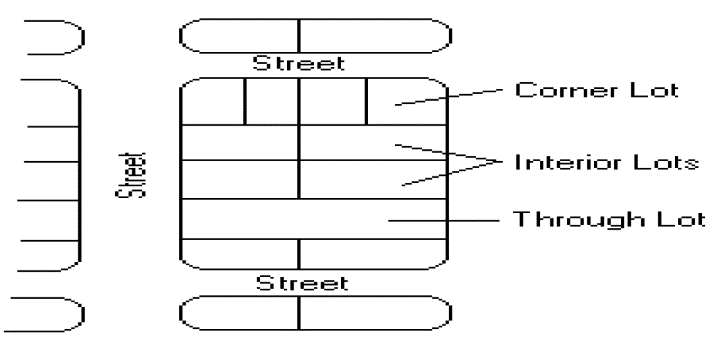
Lot, interior means a lot other than a corner lot, with sides not abutting a street.
Lot line means the property line(s) of record bounding a lot that divides one lot from another or a lot from a public or private street right-of-way or easement.
Lot line, front means, in the case of an interior lot, that line separating said lot from the street. In the case of a corner lot, or double-frontage lot, the term "front lot line" means that line separating said lot from that street which is designated as the front street in the plat and/or in the application for a building permit.
Lot line, rear means that lot line opposite the front lot line. In the case of a lot pointed at the rear, the rear lot line shall be an imaginary line parallel to the front lot line not less than ten feet long, farthest from and parallel to the front lot line and wholly within the lot.
Lot line, side means any lot line other than the front lot line or rear lot line. A side lot line separating a lot from a street is an exterior side lot line. A side lot line separating a lot from another lot or lots is an interior side lot line.
Lot of record means a parcel of land that is a lot in a subdivision recorded on the records of the Benton County circuit clerk's office, or that is described by a metes and bounds description which has been so recorded prior to the subdivision regulations in effect, or lots exempt from those regulations.
Lot widths means the mean horizontal distance between the side lot lines of a lot measured at right angles to the depth; measurements shall be made at the front building setback.
Lumens means a unit of measurement of the amount of brightness that comes from a light source. The term "lumens" defines "luminous flux," which is energy within the range of frequencies perceived as light.
Maintenance means the upkeep, care, repair, conservation, and/or preservation of the physical structures, facilities, and other improvements relating to the continued appearance, safety, health, and general condition of a property.
Manager/caretaker, residence means a person or persons whose permanent residence is in a multi-family complex, hotel/motel, business or special area of a private home for the purposes of managing the grounds and buildings and/or for security purposes.
Manufactured home means a detached single-family dwelling unit fabricated on or after June 15, 1976, in an off-site manufacturing facility for installation or assembly at the building site as a permanent structure with transport features removed, bearing a seal certifying that it is built in compliance with the Federal Manufactured Housing Construction and Safety Standards Code. This code means the standard for construction, design and performance of a manufactured home as set forth in the Code of Federal Regulations, Title 24, Parts 3280, 3282, 3283, and 42 USC 5401 et seq., as mandated in the United States of America and as administered by the United States Department of Housing and Urban Development.
Manufactured home park means a parcel of land which has been designed or improved or is intended to be utilized for occupancy by one or more manufactured homes and which conforms to the provisions of this chapter.
Manufactured home sales means a facility for the sale of manufactured home residences.
Manufacturing, hazardous means a facility and surrounding yard designed primarily for the preparation, production and distribution of objectionable materials such as chemicals, explosives, etc. Further, the production of such materials may create noxious odors or gases objectionable to businesses and residences. This may include manufacturing products from raw materials. Such uses include, but are not limited to:
(1)
Abattoir.
(2)
Aerosol containers filled.
(3)
Animal and marine fat and oils manufacturing or processing.
(4)
Animal bones, offal or waste; assembly, incinerator, processing or utilization.
(5)
Arsenals.
(6)
Chemicals compounding or packaging.
(7)
Coal preparation.
(8)
Creosoting or similar processing.
(9)
Explosives manufacture, storage warehousing or wholesaling.
(10)
Fireworks manufacture and storage.
(11)
Flammable gasses or liquids storage, warehousing, or wholesaling.
(12)
Foundry.
(13)
Mineral preparation; non-metallic.
(14)
Ore reduction.
(15)
Paint, enamel, lacquer, turpentine, or varnish manufacturing.
(16)
Paper manufacturing or processing.
(17)
Production of crude petroleum, natural gas natural gas liquids.
(18)
Recycling and reclamation.
(19)
Rendering of animals.
(20)
Rubber products; natural or synthetic manufacturing.
(21)
Tanning of hides and skins.
(22)
Tar or tar products manufacturing or processing.
Manufacturing, intensive means a facility operations and surrounding yard designed to produce or assemble products in a clean and quiet manner such as appliances, vehicles, etc. These manufacturing facilities do not create excessive demands for sewage, water, gas, electricity, etc. Uses include, but are not limited to:
(1)
Air conditioning and heating equipment manufacture.
(2)
Batching or mixing plant, asphaltic or Portland cement, concrete, mortar or plaster.
(3)
Beverages, non-alcoholic manufacture.
(4)
Brick, tile, clay or ceramic manufacture.
(5)
Compounding of cosmetics, toiletries, drugs, and pharmaceutical products.
(6)
Dry cleaning and dyeing plant.
(7)
Electronic equipment assembly and manufacture.
(8)
Freight depot, railroad or truck freight forwarding service.
(9)
Glass or glass products manufacturing.
(10)
Orthopedic or medical supplies manufacturing.
(11)
Instrument and meter manufacturing.
(12)
Railroad:
a.
Equipment storage or maintenance.
b.
Freight terminal.
(13)
Scrap or waste materials handling.
(14)
Scrap steel cutting on contract basis.
(15)
Sign painting.
(16)
Steel products; fabrication and assembly.
(17)
Venetian blind, window shade, and awning manufacture.
Manufacturing, light means a facility and surrounding yard designed to provide an area for wholesaling, storage, packaging, display, distribution, and those retail uses accessory to the operations and for light manufacturing, assembling and fabrication without creating a nuisance of odor, noise, dust, vibrations, etc. Uses include, but are not limited to:
(1)
Baked goods, candy, bread, dairy and ice cream manufacturing.
(2)
Book bindery.
(3)
Bottling works, all beverages.
(4)
Brooms and brushes manufacturing.
(5)
Electrical equipment assembly.
(6)
Furniture manufacturing.
(7)
Ice plant, dry or natural.
(8)
Industrial cleaning plant.
(9)
Jewelry manufacturing.
(10)
Leather goods fabrication.
(11)
Mattresses; rebuilding or renovating.
(12)
Outdoor advertising plant.
(13)
Processing and manufacturing that by reason of operation is not a nuisance in respect to odor, noise, dust, and vibration.
(14)
Vending machine sales, rental, repair and manufacturing.
(15)
Wood distribution.
(16)
Wood or lumber processing.
Massing means multiple rows of alternating plant materials with a combination of trees and shrubs.
Mausoleum means a building with places for entombment of the deceased.
Maximum area means the area of one side of the sign, measured as height by width.
Measurable area means the area within the outer boundaries of standard geometrical shapes, primarily squares, rectangles, and circles, containing and defined by the extreme reaches of information or graphic parts of the signs.
Medical appliance fittings and sales means a facility specializing in special purpose devices related to medical treatment.
Mental health center means a hospital or clinic where the primary activity is the treatment and care of persons suffering from mental or emotional disorders. Also see Community welfare and health center.
Minimum landscaped open space means the percentage of lot area which must be maintained in grass or other living vegetation.
Mining means a tract of land where various minerals, ore, etc., are extracted from under the earth that may also include a distribution area for truck/rail loading of ore and materials. Uses include but are not limited to: exploration for minerals, extraction of sand, gravel, clay, quarrying of rock, mining of coal, metal ores and non-metallic minerals other than fuels.
Mini-warehouse storage means one or more permanent structures, meeting applicable city building requirements, which contain separate storage units or cubicles that are intended to be leased by members of the public.
Mixed-use building means a building or structure that incorporates two or more use types within a single building or structure, provided that each use type is permitted within the individual base zoning district in which the building or structure is to be located.
Mixed-use development means a single development that incorporates complementary land use types into a single development.
Mobile home means a movable or portable structure built prior to June 15, 1976, the effective date for the Federal Mobile Home Construction and Safety Act of 1974, which is larger than 320 square feet, and designed to be used as a year-round residential dwelling unit. A mobile home also means any vehicle which was not built to a mandatory building code and which contains no state or federal seals.
Mobile home park means a site, lot, field, or tract of land upon which three or more mobile homes or manufactured homes, or a combination of any of these homes, are placed on developed spaces and operated as a for-profit enterprise with water, sewer or septic, and electrical services available. The term "mobile home park" shall not be construed to include manufactured or mobile homes, buildings, tents, or other structures temporarily maintained by any individual, educational institution, or company on their own premises and used exclusively to house their own labor or students.
Modular home means a dwelling unit constructed in accordance with the standards set forth in the city building code and composed of components substantially assembled in a manufacturing plant and transported to the building site for final assembly on a permanent foundation.
Monopole means a support structure constructed of a single, self-supporting hollow metal tube securely anchored to a foundation.
Motor freight terminal means a facility for freight loading and freight storage.
Motor vehicle includes all forms of motor vehicles, bicycles, skateboards, wagons, carts, trailers and any other constructed or manufactured device utilized for carrying and moving property or persons along public rights-of-way.
Multi-family dwelling. See Dwelling, multi-family.
Municipality means the City of Bella Vista, Arkansas.
Nonconforming development means a building, structure, or improvement which does not comply with the regulations for its zoning district set forth by this code, but which complied with applicable regulations at the time of construction.
Nonconforming lot means a lot which was lawful prior to the adoption, revision, or amendment of this code, but that fails by reason of such adoption, revision, or amendment to conform to the present requirements of the code. No action can be taken which would increase the nonconforming characteristics of the lot.
Nonconforming sign means a sign which had been issued a valid permit at the time it was erected but is not in accord with, or compliance with, the requirements of this article and was made nonconforming by annexation, rezoning, or ordinance amendment.
Nonconforming structure means a structure, or portion thereof, lawfully existing at the time these regulations became effective, or as amended, which does not comply with the setback, height, or other development standards applicable in the district in which the structure is located.
Nonconforming use means any structure or land lawfully occupied by a use at the time these regulations, or any amendment thereto, became effective, which does not conform to the use or area regulations of the district within which it is located.
Nuisance. An unreasonable and continuous invasion of the use and enjoyment of a property right which a reasonable person would find annoying, unpleasant, obnoxious, or offensive.
Office, general means a place/structure/facility where a particular type/kind of business is transacted of a service supplied such as a public office, business headquarters, etc., but not to include the occupation, retail sales, transfer of manufactured goods or storage of commodities. Uses include, but are not limited to:
1.
Addressing, duplicating, mailing lists, stenographic telephone messages and similar office services.
2.
Advertising agency.
3.
Employment service.
4.
Clinic:
a.
Dental.
b.
Medical or osteopathic.
c.
Chiropodist.
d.
Optical.
Office, warehouse means a facility combining office and warehouse functions in a single structure.
Off-site means located outside the boundaries of the parcel that is the subject of an application.
Open porch means a porch which has no side or front walls, screens or other enclosures, except structural roof supports where a roof is provided.
Open space means land devoted to conservation or recreational purposes and/or land designated by a municipality to remain undeveloped.
Ordinance means the zoning ordinance which includes both the zoning map and zoning regulations.
Ordinary high water mark means a point where the presence and action of the water is so continuous as to leave a distinct mark either by erosion, destruction of terrestrial vegetation, or other easily recognized characteristic. The line will be relatively constant with time and should not change appreciably as lake levels change.
Outdoor storage means the storage of materials, parts, or products related to the primary use of a site for a period exceeding three days.
Overlay district means a district established by this chapter that prescribes special regulations to be applied to a site only in combination with a base district.
Owner means an individual, firm, association, syndicate, partnership, or corporation having sufficient proprietary interest to seek development of land.
Packaging means the act, process, or industry of packing something. It also means the materials used to wrap or protect goods when used for shipping, distribution, and sale. It also means the presentation of an item in a manner that provides a positive image of the item inside.
Parcel means a legally recognized quantity or unit of real estate at a specific location such as a plotted lot in a subdivision. May be interchangeable with the term lot or tract.
Parent parcel means the entirety of a lot or tract of land before it is divided into two or more resulting (children) properties. For example, the Louisiana Purchase was the parent parcel of several states, including Arkansas.
Park means a recreational area characterized by open space typically utilized for outdoor sports and other leisure activities.
Park, community means a park that is between ten and 400 acres in size serving the residents of Bella Vista. It may consist of both active and passive recreation facilities including tennis courts, ball fields, pools, basketball courts, soccer fields, picnic areas, trails, and volleyball courts.
Park, mini means a park that is one acre or less in size with specialized facilities that serve a limited population. It may include a playground and passive areas for adults. A mini-park typically does not have parking facilities.
Park, neighborhood means a park that is between one and five acres in size with a service area of one-half to one mile. Facilities may include playing fields, playgrounds, shelters and restrooms to accommodate active recreation. Parking is typically provided.
Parking facility means any area subject to wheeled traffic, including access areas used for parking except for single-family or two-family developments; all open areas and open spaces on the land which are designated, used, required or intended to be used for parking, maintenance, service, repair, circulation, or operation of vehicles, including automobiles, buses, trailers, trucks, boats, and motorcycles; includes areas used or intended to be used for driveways to such vehicular use areas, but does not include improvements to public roads, streets, highways, and alleys. Uses include, but are not limited to:
(1)
Automobile parking or storage as principal use.
(2)
Garage or parking for commercial or public utility vehicles.
(3)
Parking commercial lot or garage.
(4)
Public off-street parking lot.
Parking space means an area of definite length and width, exclusive of drives, aisles or entrances, giving access thereto, and fully accessible for the storage or parking of permitted vehicles.
Parking space, off-street means a space for the parking of a motor driven vehicle within a parking lot and having a permanent means of access to a street right-of-way without requiring passage through another parking space.
Paved means a permanently surfaced area with poured concrete, pavers, or asphalt.
Performance bond means a surety bond or cash deposit posted by a contractor or developer made out to the city in an amount equal to the full cost of the improvements. The bond amount shall be that of the contract price and shall be legally sufficient to secure to the city that said improvements will be constructed in accordance with the terms of the contract documents within a period specified by this chapter.
Permitted use means a land-use type allowed as a matter of right in a zoning district, subject only to special requirements of this code.
Pedestrian accommodations means to provide continuous pedestrian travel, segregated from vehicular traffic, within the subdivisions and developments.
Perimeter landscaping or perimeter landscaped area means a peripheral planting strip along rear and side lot lines that separates uses.
Person means an individual, proprietorship, partnership, corporation, association or other legal entity.
Pet shop means a commercial establishment or facility which regularly sells pets such as dogs, cats, birds, rodents, reptiles and/or fish to the general public.
Petroleum products, storage and wholesale means a facility for the storage and sale of petroleum products.
Pharmacy means the art and science of preparing and dispensing certain chemical compounds or compounded mixtures by a health professional trained and licensed in the composition, uses, and effects of those items the professional (called a pharmacist) is responsible for - and which are generally recognized as drugs or medicine for the treatment of an illness, injury, disability, or disease. It can also mean the retail shop where these items are sold along with other items that do not require a prescription from a doctor. A pharmacy can be a dispensary, but the reverse is not necessarily true. A location with a pharmacy may also be called a drugstore.
Photography studio means a facility for taking and processing pictures, not a bulk processing plant.
Places of public assembly means a meeting place for more than 35 persons to which the public or membership group are assembled regularly or occasionally including, but not limited to, schools, churches, theaters, auditoriums, funeral homes, stadiums, and similar places of assembly.
Planned zoning district development means a development of land, which is under unified control, and is planned and developed as a whole in a single development operation or programmed series of development stages. The development may include streets, circulation ways, utilities, buildings, open spaces, and other site features and improvements.
Planning commission means the planning commission of the City of Bella Vista, Arkansas.
Planning official means the person designated by the municipal code that is responsible for the enforcement of applicable development codes (such as zoning and subdivisions).
Plant nursery. See Greenhouse or nursery.
Porch, unenclosed means a roofed or unroofed open structure projecting from an exterior wall of a building, and having no enclosed features more than 30 inches above its floor other than wire screening and a roof with supporting structure.
Premises means a lot, parcel, tract, or plot of land, contiguous and under common ownership or control, together with the buildings and structure thereon.
Pretreatment system means a septic system component that reduces the amount of potential pollution to a body of water by significantly reducing biochemical oxygen demand (BOD) and total suspended solids (TSS) from home wastewater; such components reduces residential strength effluent to levels that conform to a Class I National Sanitation Foundation (NSF) standard 40 residential wastewater treatment unit.
Primary highway means the entire primary system as officially designated, or as may hereafter be so designated, by the Arkansas Highway and Transportation Department.
Principal building. See Building, principal.
Principal street means a single street which provides the most access and/or the predominant business exposure for a particular business.
Principal use means the use which fulfills the primary function of an establishment, institution, household or other entity.
Private club means any association, person, firm, partnership or corporation, key club, bottle club, locker club, pool club, or any other kind of club or association excluding the general public from its premises or place of meeting or congregating or operating or exercising control over any other place where persons are permitted to drink alcoholic beverages other than private homes.
Processing means the series of steps or methods to treat, prepare, refine, convert, shape, develop, or package a product which was not grown, created, or manufactured where the processing occurs. The ultimate end of the processing procedure should be for the product to be ready for distribution and sale.
Property line means the boundary between separate property ownerships, as recorded by the legal description of a parcel. In subdivisions, property lines are usually, but not in every case, coincident with lot lines.
Public utility means any person, firm or corporation, municipal department, board or commission duly authorized to furnish and furnishing under federal, state or municipal regulations to the public; gas, steam, electricity, sewage disposal, communication, telegraph, transportation of water or cable television.
Public way means all areas legally open to public use such as public streets, sidewalks, roadways, highways, parkways, alleys, parks, as well as the areas surrounding and immediately adjacent to public buildings.
Publicly-owned service facility means a facility providing a service to the general public and paid for through public funds such as a police or fire station, postal facility, etc. Allowed uses include, but are not limited to:
(1)
Art gallery, museum or similar public use.
(2)
Civil defense and related activities facilities.
(3)
Community center: public.
(4)
Community welfare or health center.
(5)
Flood control works.
(6)
Fire protection and related activities facility.
(7)
Highway or street maintenance garage, yard or similar facility.
(8)
Library, private, nonprofit and public.
(9)
Police protection and related activities facility.
(10)
Postal service facility.
(11)
Public buildings.
(12)
Water filtration plant, pump station, elevated storage, treatment plant or reservoir.
Pushcart or handcart means any wheeled vehicles approved by the planning commission in accordance with these regulations designed for carrying property and for being pushed by a person without the assistance of a motor vehicle.
PZD is an acronym for planned zoning district.
Rear plane means the plane of the rear elevation of the principal structure extending to the side property lines.
Rear yard area means the distance between the rear lot line, measured at full width of the lot, and the wall or rear facade of a building parallel to such lot line.
Receive-only antenna means an antenna less than 50 feet in height privately owned and operated, including privately owned satellite dishes.
Reclassification means an amendment to or a change in this chapter reflecting a change or revision or modification of the zoning district boundary map.
Recreational facilities, indoor means any indoor facility providing active or passive recreational opportunities to the general public including, but not limited to, the following uses:
(1)
Bowling alley.
(2)
Billiard or pool parlor.
(3)
Exercise facility.
(4)
Indoor courts and fields, including tennis, racquetball, soccer.
(5)
Indoor swimming pool.
(6)
Skating rink.
Recreational facilities, outdoor means any tract of land providing active or passive recreational opportunities to the general public including, but not limited to, the following uses:
(1)
Baseball/softball fields.
(2)
Batting cages.
(3)
Driving range.
(4)
Day camp.
(5)
Golf course.
(6)
Miniature golf course.
(7)
Skate parks.
(8)
Soccer fields.
(9)
Swimming pool.
(10)
Tennis court.
Recreational vehicle means a vehicular type unit primarily designed as temporary living quarters for recreational, camping, or travel use, which either has its own motor power or is mounted on or drawn by another vehicle. The basic entities are: travel trailers, truck campers, and motor coach homes, converted buses and trucks, boats, and boat trailers. When used in the context of floodplain regulations only, "recreational vehicle" means a vehicle which is:
(1)
Built on a single chassis;
(2)
Four-hundred square feet or less when measured at the largest horizontal projection;
(3)
Designed to be self-propelled or permanently towable by a light duty truck; and
(4)
Designed primarily not for use as a permanent dwelling, but as temporary living quarters for recreational, camping, travel, or seasonal use.
Recreational vehicle park means a lot of land upon which two or more recreational vehicle sites are located, established, or maintained for occupancy by recreational vehicles of the general public as temporary living quarters for recreation or vacation purposes.
Recreational vehicle site means a plot of ground within a recreational vehicle park intended for the accommodation of a recreational vehicle, tent, or other individual camping unit on a temporary basis.
Recycling and reclamation means a facility for receiving, sorting, storing and reconditioning appliances, building materials, and any other salvaged or reclaimed materials.
Regulation means a specific requirement set forth by the municipal code that must be followed.
Religious facilities means a place of worship and religious training and including accessory housing facilities such as a rectory. A place where persons regularly assemble for religious worship, which is used only for such purpose and those accessory activities as are customarily associated therewith. Uses include, but are not limited to:
(1)
Church, synagogue or temple, including Sunday school facilities.
(2)
Convent or monastery or novitiate.
(3)
Parish house, parsonage or rectory.
(4)
Religious retreat facility.
Residence means a building or part of a building containing one or more dwelling units or rooming units. See also Dwelling). However, the term "residence" does not include:
(1)
Such transient accommodations as transient hotels, motels, tourist homes, or similar establishments;
(2)
Dormitories, fraternity or sorority houses, monasteries or convents, or similar establishments containing group living or sleeping accommodations; or
(3)
Nurses' residences, sanitariums, nursing homes, convalescent homes, rest homes, or other sleeping or living accommodations in community facility buildings or portions of buildings used for community facility uses.
Residential district means any land within the city limits zoned as R-E, R-1, R-2, R-3, R-MH, and SPR. It may in certain circumstances also include the R-O district.
Residential occupancy means those activities customarily conducted in living quarters in an urban setting. This excludes activities resulting in noise which constitutes a nuisance in a residential area, and activities which involve the storage, visible from off the lot, of motor vehicle parts, machinery or parts, junk or scrap materials.
Restaurant means a facility where food or beverages are cooked or prepared and offered for sale and where consumption is permitted on the premises whether or not entertainment is offered, and includes establishments commonly known as grills, cafes, drive-through and any fast food establishment permitting consumption on the premises.
Restaurant, drive-in means any restaurant designed to permit or facilitate the serving of meals, sandwiches, ice cream, beverages or other food, served directly to, or permitted to be consumed by, patrons in automobiles or other vehicles parked on the premises, or permitted to be consumed by patrons elsewhere on the site, outside the main building.
Restrictive covenant means a restriction usually set forth in the deed on the use of land.
Retail and service, general means a facility or group of facilities whose main use is the distribution and sale of products and/or services to the general public. In the general retail sales area facilities are grouped to serve persons traveling by vehicular means. Uses include, but are not limited to:
(1)
Antique store.
(2)
Apparel and accessory store.
(3)
Department store.
(4)
Direct selling organization: retail.
(5)
Fur sales, repair and storage.
(6)
Garden supply store.
(7)
Glass or glass products sales.
(8)
Gunsmith shop.
(9)
Household appliance store.
(10)
Medical appliance fittings and sales.
(11)
Office equipment: sales and service.
(12)
Radio, phonograph, television or other household goods store.
(13)
Sales, service, repair or rental of business machines service.
(14)
Secondhand store.
(15)
Sewing machine shop.
(16)
Shoe sales and repair.
(17)
Sporting goods store.
(18)
Toy store.
Retail and service, high impact means a facility and surrounding yard providing sale of retail products or personal services to the general public. Such facilities are generally located along major highways and are designed to serve people in automobiles. Special display and outdoor storage requirements may be required. Uses include but are not limited to:
(1)
Aircraft parts: sales, service rental or repair, including air frames and engines.
(2)
Armored car service.
(3)
Auctioneer.
(4)
Secondhand automotive parts, accessories, battery and tire dealer.
(5)
Automatic merchandising establishment.
(6)
Bicycle store.
(7)
Construction equipment repair, sales or storage.
(8)
Contractor:
a.
General or heavy construction; facilities other than office.
b.
Special trade; facilities other than office.
(9)
Custom ceramic products manufacturing.
(10)
Driving school, private.
(11)
Dry cleaning plant limited to 7,000 sq. ft. of floor space.
(12)
Farm equipment: sales, service, rental, supplies and repair.
(13)
Monument sales.
(14)
Repair service limited to equipment.
(15)
Swimming pool: sales and service.
(16)
Tattoo studio.
(17)
Taxicab garaging and maintenance.
(18)
Tool and equipment rental.
(19)
Tool sharpening.
(20)
Wholesale establishment:
a.
Floor sample stock.
b.
Stock unlimited.
Retail and service, restricted means an enclosed facility or group of facilities providing for the sale of retail products or personal service enterprises. These facilities are typically designed to serve surrounding residential neighborhoods. Uses include, but are not limited to:
(1)
Architect, artist, and engineer retail supplies.
(2)
Bakery or confectionary shop.
(3)
Barbershop or beauty shop.
(4)
Bookstore.
(5)
Camera and photographic supply store.
(6)
Catering service.
(7)
Clothing, custom dress making or altering.
(8)
Cigar, tobacco and candy store.
(9)
Drugstore or pharmacy.
(10)
Dry cleaning, pickup or self-service.
(11)
Dry goods store.
(12)
Florist shop.
(13)
General store; general merchandise store.
(14)
Gift, novelty, or souvenir shop.
(15)
Handcraft, ceramic sculpture or similar artwork sales.
(16)
Health studio or spa.
(17)
Hobby shop.
(18)
Ice vending machine establishment.
(19)
Jewelry: sales and repair.
(20)
Laundry, self-service and pickup station, laundry, laundromat.
(21)
Locksmith, key shop.
(22)
Music, musical instruments or phonograph record store.
(23)
Newsstand.
(24)
Picture framing.
(25)
Photography studio.
(26)
Stationery store.
(27)
Travel agency.
(28)
Variety store.
(29)
Video store.
Right-of-way means a strip of land, generally linear, occupied or intended to be occupied by a system that conveys people, traffic, fluids, utilities, or energy from one point to another. Rights-of-way may include streets and roads, crosswalks, bicycle paths, recreational trails, railroads or fixed guideway transit, electric transmission lines, gas pipelines, water mains, or sewer mains.
Salvage dealer means any person who buys, sells, transfers, delivers, or stores junk, including every person who carries on such business at a shop, a salvage yard or as a peddler, and any person who, by advertisement, sign, or otherwise holds himself or herself out as a salvage dealer or dealer in old or discarded metals, machinery, rags, paper stock, and the like.
Salvage yard means any place not fully enclosed within a building where a salvage dealer, in connection with the salvage dealer business, stores or deposits junk encompassing either:
(1)
An area of 200 square feet or more, or
(2)
Two or more inoperable motor vehicles, or used parts and materials thereof, which taken together equal the bulk of two or more motor vehicles.
School facilities means structures and/or tracts of land used for the conduct of educational activities. May also be an educational institution licensed by the State of Arkansas, except as parochial, denominational, or charitable school or institution which provides a basic academic education comparable to that provided in the public schools of the state, or one that provides special training or care suitable to persons with above average intelligence or defective, delinquent, or dependent persons such as retarded, dyslexia, autistic, or brain damaged persons. Uses include, but are not limited to:
(1)
College, junior college, professional school: public or equivalent private.
(2)
School, private: barber, beauty, business, commercial art, correspondence, stenographic, public or private.
(3)
Private school or kindergarten or institution for special education.
(4)
School, secondary: public or private.
(5)
School, commercial: trade or craft.
(6)
Studio: art, drama, speech, dance, music, ceramics.
(7)
School, elementary: public or private.
Screening means the method by which a view of one site from another adjacent site is shielded, concealed, or hidden. Screening techniques include fences, walls, hedges, berms, or other features, as may be permitted by the landscape provisions of this chapter.
Service station means a facility for furnishing fuels and lubricating oils or materials for use in the operation and maintenance of motor vehicles.
Setback means the required distance between every structure and any lot line on the lot to establish the horizontal component(s) of a building's envelope on which it is located, except in multi-family residential zones where building structure footprints are separately parceled from surrounding land. In such a case, said lot lines constituting the building structure footprint shall not be considered.
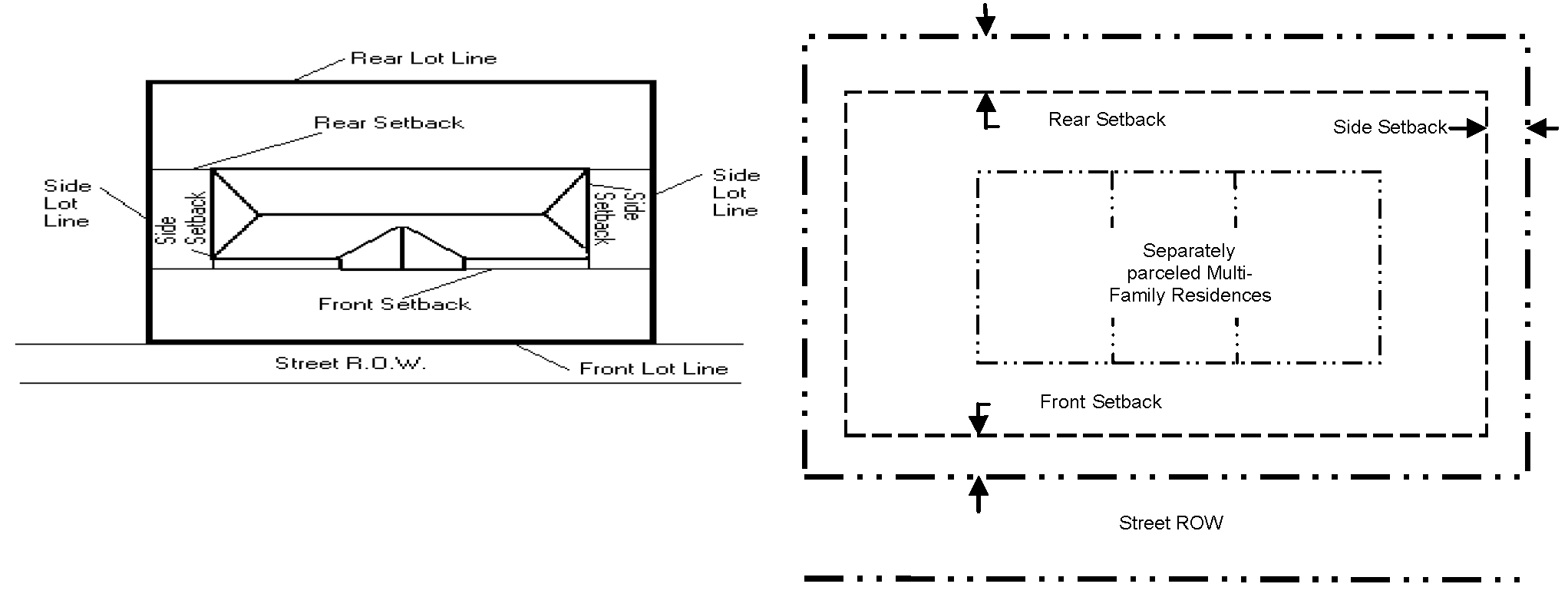
Sexually-oriented business means an adult arcade, adult bookstore or adult video store, adult cabaret, adult motion picture theater, or adult theater.
Shelter for abused persons means a residence for a limited number of persons providing temporary shelter for a person physically or mentally abused by family or other persons.
Shelter for the homeless means a place with authorized supervision granting temporary relief for displaced persons and/or families. Such place may or may not provide on-site meals but furnishes a safe haven for people.
Shelter, temporary means a residence for a limited number of persons providing temporary shelter for a person physically or mentally abused by family or other persons or a place with authorized supervision granting temporary relief for displaced persons and/or families. Such place may or may not provide on-site meals but furnishes a safe haven for people.
Short-term rental means a residential dwelling unit, portion of a dwelling unit, or bedroom within a dwelling unit, leased or rented to guests for a period of less than 30 consecutive days.
Side plane means either of the two planes of the two side elevations of the principal structure extending to the front and rear property lines.
Sidewalk means all that area legally open to the public used as a pedestrian public way between the curbline and the legal property line of the abutting property.
Sidewalk vendors means any person, traveling by foot, wagon, vehicle or any other type of conveyance from street to street carrying, conveying, or transporting goods, wares or merchandise and offering and exposing them for sale, or making sales and delivering articles to purchasers, or who, without traveling from place to place, exhibits, displays, sells or offers for sale such products from a wagon, handcart, pushcart, motor vehicle, conveyance or from his person while on the public ways of the City of Bella Vista. The term "sidewalk vendor" also includes any street vendor, hawker, huckster, itinerant merchant or transient vendor. This definition does not include a door-to-door peddler or solicitor.
Sidewall means an exterior building wall that is built perpendicular to the building's front plane. Sidewall height shall be measured from finished grade to the bottom of eave.
Sight triangle means a triangular area formed by a diagonal line connecting two points on intersecting rights-of-way, measured 35 feet along each pavement edge starting at the intersection point.
Sign means any words, lettering, parts of letters, figures, numerals, phrases, sentences, emblems, devices, designs, pictures, trade names or trademarks by which anything is made known; such as are used to designate an individual, a commodity, a firm, an association, a corporation, a profession, a business, a service, or a product, which are visible from any public street or right-of-way and designed to attract attention. "For Sale" and "For Rent" signs shall be deemed signs within the meaning of this definition, but the term "sign" shall not include the flag, a pennant or insignia of any nation, state, city, or other political, educational, charitable, philanthropic, civic, professional, religious or like campaign, drive, movement or event, that are used for a public purpose in the public interest. The term "sign" shall not include any of the foregoing located within a building, except for illuminated signs within show windows. Directional, warning or other signs posted by public officials in the course of their public duties are specifically excluded for the purpose of this chapter. Neither directional, warning, nor other signs posted by public officials in the course of their public duties, nor merchandise or materials being offered for sale shall be construed as advertising signs for the purpose of this chapter.
Sign, animated. See Sign, fluctuating illumination.
Sign area means the area of a sign which is measured by finding the area of an imaginary rectangle, circle or triangle which fully encloses the sign message, including background and logos but not including supports or braces. For multi-faced signs, sign area shall be computed from the vantage point which gives a view of the largest amount of sign area. If two identical signs are back to back, and are part of the same sign structure and are not more than 42 inches apart, the sign area shall be computed by the measurement of one of the faces.
Sign, awning means a sign which is a part of a fabric or other non-structural awning.
Sign, bulletin means a sign erected by a church, school, institution, or public agency on its premises for announcements and is of a temporary nature.
Sign, canopy means a sign on or attached to any overhead protective structure that is constructed in such a manner as to allow pedestrians and vehicles to pass under.
Sign, changeable copy means any sign where letters or numbers displayed on the sign can be changed periodically on the sign to display different messages.
Sign, commercial means a sign which directs attention to a service, product, profession, business, or entertainment conducted, sold, or offered on the same lot.
Sign, construction means a sign which identifies architects, engineers, contractors and other individuals or firms involved with construction on the premises, the name of the building or development, the intended purpose of the building, and/or the expected completion date. This sign is of a temporary nature.
Sign, directional means any sign that guides one to a specific destination.
Sign, door means a sign which is attached to, painted on, or etched onto or into a door. A sign in a window which is part of a door is a door sign for the purposes of this section.
Sign, fluctuating illumination means signs, or any means of advertising, with the illusion of movement by means of a preprogrammed repetitious sequential switching of action in which illuminated elements of the sign are turned off or on to visually simulate the impression of motion characteristic of chasing, running, blinking, oscillating, twinkling, scintillating, or expanding and contracting light patterns.
Sign, freestanding means a sign which is not attached to a building and is securely affixed to the ground by one or more poles or posts with open space between the bottom of the sign and the ground.
Sign, garage sale means any temporary, promotional sign for the occasional (i.e., not on-going) sale of personal household goods, typically displayed in a residential area or on the property of a nonprofit organization.
Sign height means the height of a sign which shall be the vertical distance from normal grade to the highest point of the sign. Any berm, filling or excavating solely for the purpose of locating the sign, shall be computed as part of the sign height.
Sign, identification means a sign that is commercially made, such as: building numbers, addresses, private parking signs, no trespassing signs, or dangerous animal signs.
Sign, incidental means an on-premises sign giving information or direction for the convenience and necessity of the public such as "entrance," "exit," "no admittance," "telephone," " parking," etc.
Sign, marquee means a sign used to identify a theater, assembly hall, or auditorium or a sign projecting over the entrance of a building.
Sign, maximum area means the area of one side of the sign, measured as height by width.
Sign, monument means any sign mounted to a solid base support at ground level with no open space between the bottom of the sign and the ground.
Sign, noncommercial means a sign which is not an on-premises or off-premises sign and which carries no message, statement, or expression related to the commercial interests of the sign owner, lessee, author or other person responsible for the sign message. The term "noncommercial sign" includes, but is not limited to: signs expressing political views, religious views or signs of nonprofit organizations related to their tax-exempt purposes.
Sign, obsolete means a sign relating to or identifying a business or activity which has not been conducted on the premises for six months, or to a transpired election or event, or to a political party or nonprofit organization that no longer exists. In addition, a sign that is not allowed under this chapter, does not comply with the height, size, or other physical requirements of this chapter, or a sign which has missing or broken panels, broken or damaged supports or frame, or otherwise displays inadequate maintenance, dilapidation, obsolescence or abandonment.
Sign, off-premises or off-site means a sign that directs attention to a business, profession, event, entertainment, product, or service that is located, offered or sold somewhere other than on the premises.
Sign, on-premises or on-site means a sign which advertises or directs attention to a business, commodity, or service conducted, offered, or sold on the premises, or directs attention to the business or activity conducted on the premises.
Sign, political means a sign that is for the purpose of advertising a particular political person, position, and/or election.
Sign, portable means any sign not permanently attached to the ground or other permanent structure, including, but not limited to; signs with attached wheels; converted to "A"- or "T"- frame signs; menu and sandwich board signs; gas, air or hot air filled displays; signs attached or painted on vehicles parked and visible from the right-of-way, unless said vehicle is used as a vehicle in the normal day-to-day operations of the business.
Sign, projecting means a sign forming an angle with a building, which extends from the building, and is supported by it.
Sign, public means a sign erected by or on behalf of a governmental body to post a legal notice, identify public property, convey public information and direct or regulate pedestrian or vehicular traffic.
Sign, roof means a sign lower than the roof peak of the building to which it is attached. Signs attached to the lower slope of a roof or attached to a parapet wall above a flat roof are considered wall signs. Signs on mansard or canopy roofs are considered wall signs.
Sign, suspended means a sign which is attached to the underside of a horizontal plane or arm and is supported by the horizontal plane.
Sign, temporary means any sign which is intended for temporary use or which is not permanently mounted and is intended for a designated period in time.
Sign, wall means any sign, other than a projecting sign or a banner sign, which is attached to or painted on any wall of any building. This definition shall not include freestanding walls. A sign attached to the lower slope of a mansard or canopy roof, or a sign affixed to or forming an awning or a canopy, shall be considered a wall sign for purposes of this chapter, notwithstanding the fact that certain portions of such a sign may project more than 12 inches. For purposes of this section only, a "wall" shall include any permanent architectural extension of a wall, including parapets, even if such extension projects beyond or above the enclosed portions of the building.
Sign, windblown means any flag, pennant, balloon, spinner, or blimp.
Sign, window means any sign which is not a temporary sign and which is attached to, painted on or etched into a window or which is displayed within 12 inches of the window and is legible from outside the window.
Signs, changeable copy, electronic means signs on which alphabetic, pictographic, or symbolic informational content can be changed or altered on a fixed surface composed of electronically-illuminated or mechanically-driven changeable segments.
Signs, changeable copy, manual means signs on which alphabetic, pictographic, or symbolic informational content can be changed or altered by manual means.
Single-family dwelling. See Dwelling, single-family.
Site means the parcel of land to be developed or built upon. A site may encompass a single lot or a group of lots developed as a common development under the special and overlay districts provisions of this chapter.
Site plan means a plan, prepared to scale, showing accurately and with complete dimensioning the boundaries of a site and the location of all buildings, structures, uses, and principal site development features that are either existing or proposed for a specific parcel of land, and any other information as required by the city. Buildings or other items to be removed or demolished shall also be shown.
Site plan review means the process whereby the planning commission and/or staff review the site plans and maps of a developer to ensure that they meet the stated purposes and standards of this chapter and subdivision regulations.
Slaughterhouse means a facility for the slaughtering of animals; processing and refining of their byproducts; and preparing for distribution; activities may include packing, treating, storage or sale of the product on the premises.
Solid waste disposal means the entire process of storage, collection, transportation, processing, and disposal of solid wastes by any city, authority, county or any combination thereof, or by any person engaging in such a process as a business. Uses include but are not limited to solid waste disposal and garbage or trash: assembly, incineration or processing.
Special event means any occasion including, but not limited to, fairs, shows, exhibitions, city-wide celebrations, and festivals taking place within a specifically defined area of the city.
Stable means a facility which boards livestock.
Stable, commercial means a facility which boards or rents horses to the public but does not include a sales barn, auction or similar trading activity.
Stand means any showcase, table, bench, rack, handcart, pushcart, stall or any other fixture or device that is used for the purpose of displaying, exhibiting, carrying, transporting, storing, selling or offering for sale any food, beverages, goods, wares or merchandise upon a sidewalk.
State means the State of Arkansas.
Storage, permanent means the storage of any item of personal property (as opposed to real property) for a period of more than 48 hours.
Story means that portion of a building, other than a basement, included between the surface of any floor and the surface of the floor next above it, or if there is no floor above it, then the space between the floor and the ceiling next above it.
Story, half means a space under a sloping roof which has the line of intersection of roof decking and wall face not more than three feet above the top floor level, and in which space not more than two-thirds of the floor area is finished off for use. A half-story containing independent apartment or living quarters shall be counted as a full story.
Street means any public or private thoroughfare which affords the principal means of access to abutting property. Public thoroughfares are typically strips of land dedicated by plat, deed, or other legal record of a defined width whose limits are referred to as right-of-way lines.
Street frontage. Street frontage shall be considered separately for each street the lot fronts, measured by property lines.
Street frontage buffer means a planting area parallel to a public street right-of-way.
Street, intersecting means any street which joins another street at an angle, whether or not it crosses the other.
Structural alterations means any change in the supporting members of a building, such as bearing walls or partitions, columns, beams or girders, or any substantial changes in the roof or in the exterior walls.
Structure means any object constructed, erected, placed, or built at a more or less permanent location on the ground, and which is designed for the support, enclosure, shelter or protection of persons, animals, chattels or property of any kind. It also includes installations of items such as signs, billboards, radio towers, and other facilities not designed for storage of property or occupancy by persons. When used in the context of floodplain regulations, "structure" means anything constructed, erected on, or otherwise attached to the ground.
Telecommunication means the technology which enables information to be exchanged through the transmission of voice, video, or data signals by means of electrical or electromagnetic systems.
Temporary uses means land uses that are not permanent in nature and often include, but are not limited to, carnivals, circus, tent revivals, real estate sales offices, construction facilities and Christmas tree stands.
Theater, indoor means a facility for showing motion pictures to an audience inside an enclosed structure.
Theater, outdoor means a facility arranged so that patrons can view the screen and receive the sound in the privacy of their cars, or while seated outside.
Throat length means the distance between the paved edge of street and the parking lot served by a driveway.
Townhouse means a dwelling unit having a common wall with one or more other dwelling units in a single structure. Each townhouse unit has its own separate private accesses to the outside and is not located above or below any other dwelling unit.
Townhouse structure means a single building formed by at least two and not more than six contiguous dwelling units. The separation between each unit in the building is created using common wall construction.
Tract means the entirety or portion of a public land survey section, a lot within an official plat, or a government lot. May be interchangeable with the term lot or parcel.
Transportation facilities means facilities providing surface transportation for the general public. These may or may not be publicly-owned. Uses include, but are not limited to: bus stations, truck, bus and train terminals, and taxicab stands or dispatching stations.
Travel trailer means an object designed for accommodation intended and used exclusively for travel, recreation and vacation and which is capable of being drawn or propelled by a motor vehicle or is self-propelled and includes tent trailers or similar transportable accommodation, but does not include a mobile home.
Unimproved lot means a parcel of land upon which primary or accessory structures have not been built.
Use area means a zone established for a certain type of use, such as commercial or residential.
Use means a purpose to which land is committed. It also includes the conduct or performance of an activity, function, or operation on a site or within a building or facility.
Utility facility means a facility, either open or enclosed, where a utility may store equipment or materials not in use or waiting for use; a station, which is subsidiary to a central station and at which a utility from the central station, is converted or passed on to another area. Uses include, but are not limited to:
(1)
Electric generating plant.
(2)
Electric utility maintenance facility.
(3)
Electric regulating substation.
(4)
Gas pressure control station.
(5)
Gas utility maintenance facility.
Vacation means the official abandonment of public right-of-way or easement by the city in accordance with state law.
Variance means a granting of a modification from certain regulations or the literal provisions of this chapter by the board of zoning adjustment under the authority provided by this chapter and state statutes in instances where strict enforcement of this chapter would cause undue hardship due to circumstances unique to the individual property under consideration. A variance requires an application stating why the modification should be granted. When used in the context of floodplain regulations, "variance" means a grant of relief by a community from their terms of the floodplain management regulations.
Vehicle means every device in, on, or by which a person or property may be transported or drawn along a street or sidewalk, including, but not limited to, devices moved by mechanical or human power.
Vehicle salvage means any establishment maintained, used or operated for the storing, keeping, dismantling, salvaging, buying or selling of inoperable, wrecked, scrapped, ruined, or dismantled or discarded automobiles, auto parts, trucks, machinery, or appliances.
Wall means one of the sides of a room or building connecting floor and ceiling or foundation and roof.
Warehouse or wholesaling means a facility for commodities stored or wholesaled.
Water treatment plant and related facilities means a facility for the systematic collection and treatment and dispersal of water.
Water's edge means, for stationary bodies of water, such as lakes, pond, and reservoirs, the ordinary high water mark for the body of water. For moving bodies of water, such as rivers and streams, the water's edge is defined by top of the watercourse's embankment.
Wireless communications antenna means the physical device through which electromagnetic, wireless telecommunications signals authorized by the Federal Communications Commission are transmitted or received. Antennas used by amateur radio operators are excluded from this definition.
Wireless communications equipment shelter means the structure in which the electronic receiving and relay equipment for a wireless telecommunications facility is housed.
Wireless communications facility means a land use facility that transmits and/or receives electromagnetic signals for the purpose of transmitting analog or digital voice or data communications. It includes antennas, microwave dishes, horns and other types of monopoles, or similar structures supporting said equipment, equipment buildings, shelters or cabinets, and other accessory development. Wireless communication facility includes personal wireless services as defined in the Federal Telecommunication Act of 1996, and as subsequently amended. The term "wireless communication facility" shall not include the following: federally licensed amateur radio stations and facilities used exclusively for receive-only antennas.
Wireless communications tower means a structure intended to support equipment used to transmit and/or receive telecommunications signals including monopoles, guyed and lattice construction steel structures.
Yard means an open space at grade between a building and the adjoining lot line, unoccupied and unobstructed by a portion of a structure from the ground upward, except where otherwise specifically provided in this chapter that the building or structure may be located in a portion of a yard required for main buildings. In measuring a yard for the purpose of determining the width of the side yard, the depth of the front yard, or the depth of the rear yard, the shortest horizontal distance between the lot line and the main building shall be used. A yard may include any required perimeter landscape areas or buffers, but not any internal parking lot landscaping or parking lot island landscaping that are not directly connected to the perimeter areas.
Yard, exterior means any yard which is adjacent or parallel to a public or private street. This area is also sometimes referred to as street side yard.
Yard, front means the required area of open space extending across the full width of the lot, the depth of which shall be the least distance between the front lot line and the nearest point of the main building or of any open, unenclosed porch or paved terrace as measured from the exterior face of the building foundation.
Yard, interior means any yard which does not run adjacent to or parallel with a public or private street.
Yard, rear means the required area of open space extending across the full width of the lot between the rear most main building and the rear lot line, the depth of which shall be the least distance between the rear lot line and the rear of such building.
Yard, side means the required area of open space between the main building and the side lot line, extending from the front yard or front lot line, where no front yard is required, to the rear yard, the width of which shall be the least distance between the side lot line and the nearest point of the main building.
Zero lot line. See Dwelling, zero lot line.
Zoning amendment means the process required to change the zoning district from one land classification to another at a particular location. Such a change can only be made at the discretion of the planning commission and agreement by the city council after a public hearing. Special requirements or limitations may be placed on the applicant as a condition of approval for the permit.
Zoning administrator means the city official authorized by the city codes to administer this chapter.
Zoning district boundary means that boundary line which separates unlike zoning districts.
Zoning district means a specified land classification within which all sites are subject to a list of standard types of use as well as a unified set of site development standards, both of which are set forth in this municipal code. All sections of the city are covered by a zoning district and which can only be changed by going through a public hearing as part of a zoning amendment.
(Zoning Ord., § 100.01; Ord. No. 2009-23, § 100.01, 1-8-2010; Ord. No. 2010-10, § 200.02, 10-2-2010; Ord. No. 2012-12, § 200.16, 11-9-2012; Ord. No. 2013-13, § 200.02, 1-3-2014; Ord. No. 2014-04, § 1, 3-24-2014; Ord. No. 2015-07, § 1, 4-27-2015; Ord. No. 2017-17, § 1(Exh. A), 4-24-2017; Ord. No. 2018-07, § 1(Exh. A), 3-26-2018; Ord. No. 2018-08, § 1(Exh. A), 4-23-2018; Ord. No. 2022-21, § 1, 12-19-2022)
Sec. 109-4. - Authority.
These regulations are adopted under the authority conferred on the City of Bella Vista by the General Assembly of the State of Arkansas by A.C.A. title 14, ch. 56, subch. 3 (A.C.A. § 14-56-301 et seq.).
(Zoning Ord., § 100.02; Ord. No. 2009-23, § 100.02, 1-8-2010)
Sec. 109-5. - Purpose.
(a)
The general purpose of this chapter is to develop and protect the various elements of the comprehensive plan which includes the land use plan, the subdivision regulations, the master street plan and other current and future elements of the regulations of the city. In doing so, the ordinance from which this chapter is derived promotes, in accordance with present and future needs, the safety, health, and general welfare of the citizens.
(b)
Specifically, this chapter supports the provisions of the land use plan which provides:
(1)
Efficiency and economy in the process of development;
(2)
The appropriate and best use of land;
(3)
Convenience of traffic and circulation of people and goods;
(4)
Safety from fire and other dangers;
(5)
Adequate light and air;
(6)
Healthful and convenient distribution of population;
(7)
Good civic design and arrangement;
(8)
Adequate public utilities and facilities; and
(9)
Other considerations deemed necessary.
(Zoning Ord., § 100.03; Ord. No. 2009-23, § 100.03, 1-8-2010)
Sec. 109-6. - Jurisdiction.
The provisions of this chapter shall apply to all land and structures within the corporate limits of the city, as they now or may hereafter exist. This chapter shall also apply to any land annexed into the city limits for whatever reason after the adoption of the ordinance from which this chapter is derived.
(Zoning Ord., § 100.04; Ord. No. 2009-23, § 100.04, 1-8-2010)
Sec. 109-7. - Nature and application.
For the purposes hereinbefore stated, the city has been divided into zoning districts in which the regulations contained herein will govern lot coverage; the height, area, bulk, location and size of buildings; open space and the uses of land, buildings and structures. In interpreting and applying the provisions of this zoning ordinance, these requirements contained herein shall be held to be the minimum requirements for the promotion of public health, safety, and general welfare. After the adoption of the ordinance from which this chapter is derived, the use of any land within the chapter's jurisdiction shall conform completely with its provisions, except as may be hereinafter set forth.
(Zoning Ord., § 100.05; Ord. No. 2009-23, § 100.05, 1-8-2010)
Sec. 109-8. - Use types.
The purpose of the use types is to establish a classification system for land uses and a consistent set of terms defining uses permitted or conditionally permitted within various zoning districts. This section also provides a procedure for determining the applicable use type of any activity not clearly within any defined use type.
(Ord. No. 2017-16, § 1(Exh. A), 4-24-2017)
Sec. 109-9. - Determinations.
(a)
Classification of uses. In the event of any question as to the appropriate use types of any existing or proposed use or activity, the zoning administrator of the city shall have the authority to determine the appropriate use type. A determination of the zoning administrator may be appealed to the board of zoning adjustment. In making such determinations, the zoning administrator and board of zoning adjustment shall consider such characteristics or specific requirements of the use in common with those included as examples of use types. Those examples, when included in use type descriptions, are intended to be illustrative, as opposed to exclusive lists.
(b)
Records. The zoning administrator shall make all such determinations of appropriate use types in writing. The record of the determination shall contain a report explaining the reasons for the determination.
(Ord. No. 2017-16, § 1(Exh. A), 4-24-2017)
Sec. 109-10. - Agricultural use types.
Agricultural use types include the planting, cultivating, harvesting, and storage of grains, hay, or plants commonly grown; or the raising and feeding of livestock or poultry.
Animal production means the raising of animals or production of animal products, such as eggs or dairy products, on an agricultural or commercial basis on a site which is also used for crop production or where grazing of natural vegetation is the major feed source, or the raising of animals for recreational or educational use. Typical uses include grazing, ranching, free range dairy farming, and poultry farming. Confined animal feeding operations shall only be allowed in industrial zones with a conditional use permit.
Crop production means the raising and harvesting of tree crops, row crops, or field crops on an agricultural or commercial basis. This definition may include accessory retail sales under certain conditions.
Horticulture means the growing of horticultural and floricultural specialties, such as flowers, shrubs, or trees intended for ornamental or landscaping purposes. This may include accessory retail sales under certain conditions. Typical uses include wholesale plant nurseries and greenhouses.
Livestock sales means the use of a site for the temporary confinement and exchange or sale of livestock. Typical uses include sales barns.
(Ord. No. 2017-16, § 1(Exh. A), 4-24-2017)
Sec. 109-11. - Residential use types.
Residential use types include uses providing wholly or primarily non-transient living accommodations. They include institutional living arrangements providing 24-hour skilled nursing or medical care, forced residence, or therapeutic settings.
Duplex residential means a residential use in which one dwelling unit is located on a single lot and is attached by a common vertical wall to only one other adjacent dwelling unit on the same lot. This excludes manufactured or mobile home units, but does allows modular housing units.
Group residential means the use of a site for the residence of more than five unrelated persons, not otherwise defined as a family, in which occupants are accommodated in rooms not defined as dwelling units. Group residential uses are limited to facilities that are officially recognized or operated by a college or university, government agency, or nonprofit organization. Typical uses include fraternity or sorority houses and dormitories not incorporated into a college and university use type.
Mobile home park means the use of a site under single ownership for one or more mobile home units. Generally, the land on which mobile homes are placed in a mobile home park is leased from the owner of the facility.
Multiple-family residential means a building with three or more dwelling units. Units may be individually owned or rented. Each may only be occupied by one family. Units are separated by vertical side walls. A residence may provide a range of building types and may also provide support services to residents, including but not limited to food service, general health supervision, medication services, housekeeping services, personal services, recreation facilities, and transportation services. The residence may accommodate food preparation in independent units or meal service in one or more common areas. Residences may include additional health care supervision or nursing care.
Single-family residential means a single-family residential use in which one dwelling unit is located on a single lot, with no physical or structural connection to any other dwelling unit. Mobile home units, as defined by this section, are not a single-family residential use type.
Townhouse residential means the use of a site for three or more attached dwelling units, each occupied by one family and separated by vertical side walls extending from foundation through roof without openings. Each townhouse unit must have at least two exposed exterior walls.
(Ord. No. 2017-16, § 1(Exh. A), 4-24-2017)
Sec. 109-12. - Civic use types.
Civic use types include the performance of utility, educational, recreational, cultural, medical, protective, governmental, and other uses that are strongly vested with social importance.
Administration means governmental offices providing administrative, clerical, or public contact services that deal directly with the citizen, together with incidental storage and maintenance of necessary vehicles. Typical uses include federal, state, county, and city offices.
Cemetery means the land used or intended to be used for the burial of the dead, and dedicated for cemetery purposes, including columbaria, crematoria, mausoleums, and mortuaries when operated in conjunction with and within the boundary of such cemetery.
Clubs means uses providing meeting, recreational, or social facilities for a private, nonprofit or noncommercial association, primarily for use by members and guests.
(1)
Clubs (recreational) means clubs that provide indoor and/or outdoor athletic facilities, with or without social or meeting facilities. Typical uses include country clubs, private or nonprofit community or recreation centers, and private golf courses and driving ranges.
(2)
Clubs (social) means clubs that provide primarily social or meeting facilities. Typical uses include private social clubs and fraternal organizations.
College and university facilities means an educational institution of higher learning that offers a course of study designed to culminate in the issuance of a degree certified by a generally recognized accrediting organization.
Convalescent services. A use providing bed care and inpatient services for persons requiring regular medical attention, but excluding a facility providing surgical or emergency medical services or that provides care for alcoholism, drug addiction, mental disease, or communicable disease. Typical uses include nursing homes.
Cultural services means a library, museum, or similar registered nonprofit organizational use displaying, preserving, and exhibiting objects of community and cultural interest in one or more of the arts and sciences.
Day care center means the use type includes all classifications of day care facilities regulated by the state that operate providing care for five or fewer persons. This term includes nursery schools, preschools, day care centers for children or adults, and similar uses but excludes public and private primary and secondary educational facilities.
Detention facilities means a publicly operated or contracted use providing housing and care for individuals legally confined, designed to isolate those individuals from the community.
Educational facilities means a public, private, or parochial school offering instruction at the elementary school, junior high, and/or high school level(s) in the branches of learning study required to be taught in schools within the state.
Emergency residential services means a facility or use of a building to provide a protective sanctuary for victims of crime or abuse, including emergency housing during crisis intervention for victims of rape, abuse, or physical beatings.
Group care facility means a facility licensed or approved by the state or other appropriate agency, which provides for the care and short- or long-term, continuous multi-day occupancy of more than four unrelated persons who require and receive therapy or counseling on site as part of an organized and therapeutic ongoing program for any of the purposes listed below. Group care facilities include facilities which provide for the:
(1)
Room and board, personal care, habilitation services, and supervision in a family environment as a child foster care facility.
(2)
Adaptation to living with, or rehabilitation from, the handicaps of physical disability.
(3)
Adaptation to living with, or rehabilitation from, the handicaps of emotional or mental disorder; or of mental retardation if such facility has an overnight occupancy of more than eight persons.
(4)
Rehabilitation from the effects of drug or alcohol abuse.
(5)
Supervision while under a program alternative to imprisonment, including but not limited to pre-release, work-release, and probationary programs.
Guidance/therapy services means a use providing counseling, guidance, recuperative, or similar services to persons requiring rehabilitation assistance as a result of mental illness, alcoholism, detention, drug addiction, or similar condition on a daytime care basis.
Health care means a facility providing medical, psychiatric, or surgical service for sick or injured persons exclusively on an outpatient basis including emergency treatment, diagnostic services, training, administration, and services to outpatients, employees, or visitors.
Hospital means a facility providing medical, psychiatric, or surgical service for sick or injured persons primarily on an inpatient basis, including emergency treatment, diagnostic services, training, administration, and services to patients, employees, or visitors.
Maintenance facilities means a public facility, supporting maintenance, repair, vehicular, or equipment servicing, material storage, and similar activities including street or sewer yards, equipment service centers, and similar uses having characteristics of commercial services or contracting or industrial activities.
Park services means publicly-owned and operated parks, playgrounds, and open spaces.
Postal facilities means postal services, including post offices, bulk mail processing, or sorting centers operated by the United States Postal Service.
Public assembly means facilities owned and operated by a public agency, charitable nonprofit or private organization, accommodating major public assembly for recreation, sports, amusement, or entertainment purposes. Typical uses include civic or community auditoriums, sports stadiums and arenas, convention facilities, fairgrounds, incidental sales, and exhibition facilities.
Recreation services means recreation facilities for organized sports, community centers, practice fields, and other open spaces dedicated to specific uses.
Religious assembly means a use located in a permanent building and providing regular organized religious worship and religious education incidental thereto (excluding private primary or private secondary educational facilities, community recreational facilities, day care facilities, and incidental parking facilities). A property tax exemption obtained pursuant to the property tax code of the state shall constitute prima facie evidence of religious assembly use.
Safety services means facilities for training and conduct of public safety and emergency services including police and fire protection services, and emergency medical and ambulance services.
Utilities means any above ground structures or facilities, other than lines, poles, and other incidental facilities, used for the production, generation, transmission, delivery, collection, or storage of water, sewage, electricity, gas, oil, energy media, communications, electronic or electromagnetic signals, or other services which are precedent to development and/or use of land.
(Ord. No. 2017-16, § 1(Exh. A), 4-24-2017)
Sec. 109-13. - Office use types.
Office use types include uses providing for administration, professional services, and allied activities. These uses often invite public clientele but are more limited in external effects than commercial uses.
General offices means use of a site for business, professional, or administrative offices who may invite clients from both local and regional areas. Typical uses include real estate, insurance, management, travel, or other business offices, organization and association offices, or professional offices.
Financial services means provision of financial and banking services to consumers or clients. Walk-in and drive-in services to consumers are provided on site. Typical uses include banks, savings and loan associations, credit unions, savings banks, and loan companies. An automatic teller machine (ATM) that is not accompanied on-site by an office of its primary financial institution is considered within the personal services use type.
Medical offices means use of a site for facilities which provides diagnoses and outpatient care on a routine basis, but which does not provide prolonged, in-house medical or surgical care. Medical offices are operated by doctors, dentists, or similar medical practitioners licensed for practice in the state.
(Ord. No. 2017-16, § 1(Exh. A), 4-24-2017)
Sec. 109-14. - Commercial use types.
Commercial uses include the sale, rental, service, and distribution of goods and the provision of services other than those classified under other use types.
(1)
Adult entertainment businesses.
a.
Any business activity that offers the opportunity to view specified sexual activities or view and touch specified anatomical areas in a manner that lacks serious literary, artistic, political, or scientific value. This category includes the sale or viewing of visual or print materials that meet these criteria. For the purposes of this definition, specified anatomical areas include the following if less than opaquely covered: human genitals, the pubic region, pubic hair, or the female breast below a point immediately above the top of the areola.
b.
Typical uses include retail services or stores which are distinguished by an emphasis on activities or materials that emphasize primarily sexual content in their inventory and marketing practices, businesses which offer live performances characterized by exposure of specified anatomical areas, and adult theaters. Businesses may be classified as adult entertainment businesses without regard to service of alcoholic beverages.
(2)
Agricultural sales and service. Establishments or places of business engaged in sale from the premises of feed, grain, fertilizers, farm equipment, pesticides, and similar goods, or in the provision of agriculturally-related services with incidental storage on lots other than where the service is rendered. Typical uses include nurseries, hay, farm implement dealerships, feed and grain stores, and tree service firms.
(3)
Auctioneering lots. Sale of items through a process of periodic auctions or bid procedures. Lots usually include large on-site storage or warehousing of items, materials, motor vehicles, equipment, and other facilities.
(4)
Automotive and equipment services. Establishments or places of business primarily engaged in sale and/or service of automobiles, trucks, or heavy equipment. The following are considered automotive and equipment use types:
a.
Automotive rental and sales. Sale or rental of automobiles, noncommercial trucks, motorcycles, motor homes, recreational vehicles, or boats, including incidental storage, maintenance, and servicing. Typical uses include new and used car dealerships, motorcycle dealerships, and boat, trailer, and recreational vehicle dealerships.
b.
Auto services. Provision of fuel, lubricants, parts, and accessories, and incidental services to motor vehicles, and washing and cleaning and/or repair of automobiles, noncommercial trucks, motorcycles, motor homes, recreational vehicles, or boats, including the sale, installation, and servicing of equipment and parts. Typical uses include service stations, car washes, muffler shops, auto repair garages, tire sales and installation, wheel and brake shops, and similar repair and service activities, but exclude dismantling, salvage, or body and fender repair services. No vehicle may be stored more than 30 days. Strictly auto parts sales facilities (no repair services) are included under retail sales.
c.
Body repair. Repair, painting, or refinishing of the body, fender, or frame of automobiles, trucks, motorcycles, motor homes, recreational vehicles, boats, tractors, construction equipment, agricultural implements, and similar vehicles or equipment. Typical uses include body and fender shops, painting shops, and other similar repair or refinishing garages.
d.
Equipment rental and sales. Sale or rental of trucks, tractors, construction equipment, agricultural implements, mobile homes, and similar heavy equipment, including incidental storage, maintenance, and servicing. Typical uses include truck dealerships, construction equipment dealerships, and mobile home sales establishments. With respect to subsection 38-143(c), the sale or rental of trucks shall only be applicable. All other land uses under equipment rental and sales are exempt for this provision.
e.
Equipment repair services. Repair of trucks, tractors, construction equipment, agricultural implements, and similar heavy equipment. Typical uses include truck repair garages, tractor and farm implement repair services, and machine shops, but exclude dismantling, salvage, or body and fender repair services.
(5)
Bed and breakfast. A lodging service that provides overnight or short-term accommodations to guests or visitors, usually including provision of breakfast. Bed and breakfasts are usually located in large residential structures that have been adapted for this use. For the purpose of this definition, bed and breakfasts are always owned and operated by the resident owner or resident manager of the structure, include no more than four units, and accommodate each guest or visitor for no more than 14 consecutive days during any one-month period. Also, food is served only to overnight guests.
(6)
Business support services. Establishments or places of business primarily engaged in the sale, rental, or repair of equipment, supplies, and materials, or the provision of services used by office, professional, and service establishments to the firms themselves, but excluding automotive, construction, and farm equipment. Typical uses include office equipment and supply firms, small business machine repair shops, hotel equipment and supply firms, messenger and delivery services, custodial or maintenance services, and convenience printing and copying.
(7)
Business or trade schools. A use providing education or training in business, commerce, language, or other similar activity or occupational pursuit, and not otherwise defined as a home occupation, college or university, or public or private educational facility.
(8)
Campground. Facilities providing camping or parking areas and incidental services for travelers in recreational vehicles or tents, which accommodate each guest or visitor for no more than 14 consecutive days during any one-month period.
(9)
Commercial recreation. Private businesses or other organizations which may or may not be commercial by structure or by nature, which are primarily engaged in the provision or sponsorship of sports, entertainment, or recreation for participants or spectators. Controlled impact commercial recreation uses typically take place entirely within enclosed buildings or, when outdoors, have limited effects related to lighting, hours of operation, or noise. High-impact commercial recreation uses are typically located outdoors and have operating effects caused by lighting, noise, traffic, or hours of operation that create substantial environmental impacts. Typical controlled uses include theaters, private dance halls, billiard or bowling centers, game arcades, indoor skating facilities, miniature golf courses, and private golf courses. Typical high-impact uses include shooting ranges, lighted driving ranges, go-kart tracks, amusement parks, race tracks, and private baseball complexes.
(10)
Communications services. Establishments primarily engaged in the provision of broadcasting and other information relay services accomplished through the use of electronic and telephonic mechanisms, but exclude those classified as utilities. Typical uses include television studios, telecommunication service centers, telegraph service offices, or film and sound recording facilities. Broadcast and communications towers, and their minor ancillary ground structures, are classified as "miscellaneous use types."
(11)
Construction sales and services. Establishments or places of business primarily engaged in the retail or wholesale sale, from the premises, of materials used in the construction of buildings or other structures other than retail sale of paint, fixtures, and hardware. This use type excludes those uses classified under automotive and equipment services. Typical uses include building materials sales or tool and equipment rental or sales.
(12)
Consumer services. Establishments that provide services, primarily to individuals and households, but excluding automotive use types. Typical uses include automated banking machines, appliance repair shops, watch or jewelry repair shops, or musical instrument repair shops.
(13)
Convenience storage/mini-storage. Storage services primarily for personal effects and household goods within enclosed storage areas having individual access, but excluding use of such areas as workshops, hobby shops, manufacturing, or commercial activity. Establishments may also include the storage and/or display of boats, campers, and motorized recreational vehicles. Typical uses include mini-warehousing.
(14)
Food sales. Establishments or places of business primarily engaged in the retail sale of food or household products for home consumption. Food sales establishments may include the sale of non-food items. Typical uses include groceries, delicatessens, meat markets, retail bakeries, and candy shops.
a.
Convenience food sales. Establishments occupying facilities characterized by sales of specialty foods or a limited variety of general items, and the sales of fuel for motor vehicles.
b.
Limited food sales. Establishments occupying facilities characterized by sales of specialty foods or a limited variety of general items, but excluding the accessory sale of fuel for motor vehicles. Typical uses include delicatessens, meat markets, retail bakeries, candy shops, and small grocery stores.
c.
General food sales. Establishments selling a wide variety of food commodities and related items. Typical uses include grocery stores and locker plants.
(15)
Funeral services. Establishments engaged in undertaking services such as preparing the human dead for burial, and arranging and managing funerals. Typical uses include funeral homes or mortuaries.
(16)
Gaming facilities. Establishments engaged in the lawful, on-site operation of games of chance that involve the risk of money for financial gain by patrons. Gaming facilities may include the accessory sale of liquor and food, pursuant to regulations of the city and/or the state.
(17)
Kennels. An establishment licensed to operate a facility housing dogs, cats, or other household pets and where grooming, breeding, boarding, training, or selling of animals is conducted as a business.
(18)
Laundry services. Establishments primarily engaged in the provision of laundering, cleaning, or dyeing services other than those classified as personal services. Typical uses include bulk laundry and cleaning plants, diaper services, or linen supply services.
(19)
Liquor sales. Establishments or places of business engaged in retail sale for off-premise consumption of alcoholic beverages. Typical uses include liquor stores, bottle shops, or any licensed sales of liquor, beer, or wine for off-site consumption.
(20)
Lodging. Lodging services involving the provision of room and/or board, but not meeting the classification criteria of bed and breakfasts. Typical uses include hotels, apartment hotels, and motels.
(21)
Pawn shop. A business that loans money on deposit, pledge of personal property, or other thing of value, or that deals in the purchasing of personal property or other things of value, on condition of selling the same back at a stipulated price, or that receives actual possession of personal property as security for loans with or without a bill of sale.
(22)
Personal improvement services. Establishments primarily engaged in the provision of informational, instructional, personal improvements, and similar services of a nonprofessional nature. Typical uses include driving schools, health or physical fitness studios, music schools, reducing salons, dance studios, handicraft, and hobby instruction.
(23)
Personal services. Establishments or places of business primarily engaged in the provision of services of a personal nature. Typical uses include beauty and barber shops; seamstress, tailor, or shoe repair shops; photography studios; television or electronics repair; or dry-cleaning stations serving individuals and households. Personal services include establishments providing for the administration of massage or massage therapy carried out by persons licensed by the state when performing massage services as a part of the profession or trade for which licensed or persons performing massage services under the direction of a person so licensed, or persons performing massage services or therapy pursuant to the written direction of a licensed physician.
(24)
Pet services. Retail sales, incidental pet health services, and grooming and boarding, when totally within a building, of dogs, cats, birds, fish, and similar small animals customarily used as household pets. Typical uses include pet stores, small animal clinics, dog bathing and clipping salons, and pet grooming shops, but exclude uses for livestock and large animals.
(25)
Research services. Establishments primarily engaged in research of an industrial or scientific nature. Typical uses include electronics research laboratories, space research and development firms, testing laboratories, or pharmaceutical research labs.
(26)
Restaurants. A use engaged in the preparation and retail sale of food and beverages, including the sale of alcoholic beverages when conducted as a secondary feature of the use.
a.
Restaurant (drive-in or fast food). An establishment that principally supplies food and beverages in disposable containers and is characterized by high automobile accessibility and on-site accommodations, self-service, and short stays by customers.
b.
Restaurant (general). An establishment characterized by table service to customers and/or accommodation to walk-in clientele, as opposed to drive-in or fast food restaurants. Typical uses include cafes, coffee shops, and restaurants.
(27)
Retail services. Sale or rental with incidental service of commonly-used goods and merchandise for personal or household use, but excludes those classified more specifically by these use type classifications. Typical uses include department stores, apparel stores, furniture stores, or establishments providing the following products or services: Household cleaning and maintenance products; drugs, cards, stationery, notions, books, tobacco products, cosmetics, and specialty items; flowers, plants, hobby materials, toys, and handcrafted items; apparel jewelry, fabrics, and like items; cameras, photograph services, and household electronic equipment; records; sporting equipment; kitchen utensils; home furnishing and appliances; art supplies and framing and arts and antiques; paint and wallpaper, hardware, carpeting, and floor covering; interior decorating services; and office supplies; mail order or catalog sales; bicycles; and automotive parts and accessories (excluding service and installation). General retail services include:
a.
Limited retail services. Establishments providing retail services for specialty retailing or retailing oriented to the City and its surrounding vicinity.
b.
General retail services. Establishments providing retail services, occupying facilities in a single establishment or multi-tenant facility that provide for specialty retailing or general retailing oriented to the city and its surrounding vicinity.
(28)
Stables and/or riding academies. The buildings, pens, and pasture areas used for the boarding and feeding of horses, llamas, or other equine not owned by the occupants of the premises. This use includes instruction in riding, jumping, and showing or the riding of horses/equine for hire.
(29)
Surplus sales. Businesses engaged in the sale, including sale by auction, of used items or new items which are primarily composed of factory surplus or discontinued items. Surplus sales uses sometimes include regular outdoor display of merchandise. Typical uses include flea markets, auction houses, factory outlets, or merchandise liquidators.
(30)
Taverns. A use engaged in the preparation and retail sale of alcoholic beverages for consumption on the premises, including taverns, bars, cocktail lounges, and similar uses other than a restaurant as that term is defined in this section.
(31)
Trade services. Establishments or places of business primarily engaged in the provision of services that are not retail or primarily dedicated to walk-in clientele. These services often involve services to construction or building trades and may involve a small amount of screened, outdoor storage in appropriate zoning districts. Typical uses include shops or operating bases for plumbers, electricians, or HVAC (heating, ventilating, and air conditioning) contractors.
(32)
Travel centers and truck stops. Facilities that provide for the sale of fuel, provisions, and supplies to motorists, including operators of over-the-road trucks. Travel centers include a mix of uses, including food sales, general retail services, auto and equipment services, and restaurants, and are typically located along or near interstate highways or other principal state and federal designated highway routes. See also convenience food sales.
(33)
Vehicle storage (short-term). Short-term storage of operating or non-operating vehicles for a period of no more than 30 days. Typical uses include storage of private parking tow-a-ways or impound yards, but exclude dismantling or salvage. Long-term storage beyond 30 days constitutes an industrial use type.
(34)
Veterinary services (general). Veterinary services and hospitals for small animals. Typical uses include pet clinics, dog and cat hospitals, and pet cemeteries and crematoria.
(35)
Veterinary services (large animal). Veterinary services and hospitals for large animals such as cows, bulls, horses, and other livestock. Typical uses include veterinary hospitals for livestock and large animals.
(Ord. No. 2017-16, § 1(Exh. A), 4-24-2017)
Sec. 109-15. - Parking use types.
(a)
Off-street parking. Parking use types include surface parking of motor vehicles on a temporary basis within a privately or publicly owned off-street parking facility.
(b)
Parking structure. The use of a site for a multilevel building which provides for the parking of motor vehicles on a temporary basis, other than as an accessory to a principal use on the same site.
(Ord. No. 2017-16, § 1(Exh. A), 4-24-2017)
Sec. 109-16. - Industrial use types.
Industrial use types include the on-site extraction or production of goods by nonagricultural methods, and the storage and distribution of products.
(1)
Agricultural industry. Establishments which include the storage, manufacture, sale, or distribution of agricultural supplies or products that create major external effects, including substantial truck or rail traffic and/or significant potential for hazard. Typical uses include grain elevators and storage of agricultural chemicals, such as anhydrous ammonia. Agricultural industries do not include retailers of farm equipment or other, generally non-hazardous agricultural supplies.
(2)
Construction yards. Establishments housing the facilities of businesses primarily engaged in construction activities, including incidental storage of materials and equipment on lots other than construction sites. Typical uses are building contractor's yards.
(3)
Custom manufacturing.
a.
Establishments primarily engaged in the on-site production of goods by hand manufacturing, within enclosed structures, involving:
1.
The use of hand tools, or
2.
The use of domestic mechanical equipment not exceeding two horsepower, or
3.
A single kiln not exceeding eight KW or equivalent.
b.
This category also includes the incidental direct sale to consumers of only those goods produced on site. Typical uses include ceramic studios, custom jewelry manufacturing, and candle-making shops.
(4)
Light industry. Establishments engaged in the manufacture or processing of finished products from previously-prepared materials, including processing, fabrication, assembly, treatment, and packaging of such products, and incidental storage, sales, and distribution. These establishments are characterized by having no major external environmental effects across property lines and include no unscreened or unenclosed outdoor storage. Typical uses include commercial bakeries, dressed beef processing plants, soft drink bottling, apparel assembly from fabrics, electronics, manufacturing, print shops, and publishing houses.
(5)
General industry. Enterprises engaged in the processing, manufacturing, compounding, assembly, packaging, treatment, or fabrication of materials and products from prepared materials or from raw materials without noticeable noise, odor, vibration, or air pollution effects across property lines, but often including outdoor storage of materials or products.
(6)
Heavy industry. Enterprises involved in the basic processing and manufacturing of products, predominately from raw materials, with noticeable noise, odor, vibration, or air pollution effects across property lines; or a use or process engaged in the storage of or processes involving potentially or actually hazardous, explosive, flammable, radioactive, or other commonly recognized hazardous materials.
(7)
Recycling collection. Any site which is used in whole or part for the receiving or collection of any post-consumer, non-durable goods including, but not limited to, glass, plastic, paper, cardboard, aluminum, tin, or other recyclable commodities.
(8)
Recycling processing. Any site which is used for the processing of any post-consumer, non-durable goods including but not limited to glass, plastic, paper, cardboard, aluminum, tin, or other recyclable commodities.
(9)
Resource extraction. A use involving on-site extraction of surface or subsurface mineral products or natural resources, excluding site grading for a specific construction project or preparation of a site for subsequent development. Typical uses are quarries, borrow pits, sand and gravel operations, mining, and removal of dirt for off-site use.
(10)
Salvage yard. Any place not fully enclosed in a building, which is used in whole or in part for the storage or deposit of junk encompassing either (1) an area of 200 square feet or more, or (2) one or more inoperable motor vehicles, or used parts and materials thereof, which taken together equal the bulk of one or more motor vehicles.
(11)
Vehicle storage (long-term). Long-term storage of operating or non-operating vehicles for a period exceeding 30 days. Typical uses include storage of private parking tow-a-ways or impound yards but exclude dismantling or salvage. Long-term storage of 30 days or less constitutes a commercial use type.
(12)
Warehousing (office records). The storage of office paper records in file boxes.
(13)
Warehousing (enclosed). Uses including storage, distribution, and handling of goods and materials within enclosed structures. Typical uses include wholesale distributors, storage warehouses, and van and storage companies.
(14)
Warehousing (open). Uses including open air storage, distribution, and handling of goods and materials. Typical uses include monument yards and open storage.
(Ord. No. 2017-16, § 1(Exh. A), 4-24-2017)
Sec. 109-17. - Transportation use types.
Transportation use types include the use of land for the purpose of providing facilities supporting the movement of passengers and freight from one point to another.
(1)
Aviation (private). Take-off or landing strips or fields within a parcel generally put to other uses, and primarily used for the convenience of the owner of the parcel. Typical uses include private airstrips for gliders, unmanned and remote-controlled aircraft, experimental equipment, weather balloons, powered parachutes, and/or ultralight aircraft. These aircraft could be models, replicas, or full-scale versions.
(2)
Trails. Facilities for bicycling, hiking, mountain biking, walking, and/or other non-motorized vehicles.
(3)
Transportation terminal. Facility for loading, unloading, and interchange of passengers, baggage, and incidental freight or package express, including bus terminals, railroad stations, and public transit facilities.
(4)
Truck terminal. Facility for the receipt, transfer, short term storage, and dispatching of goods transported by truck.
(Ord. No. 2017-16, § 1(Exh. A), 4-24-2017)
Sec. 109-18. - Miscellaneous type uses.
(a)
Alternative energy production devices. The use of a site for the production of energy-utilizing methods that do not involve the oxidation, combustion, or fission of primary materials. Typical uses include solar collector fields, geothermal energy installations, wind-generators, and water-powered mills or generating facilities.
(b)
Amateur radio tower. A structure(s) for the transmission or broadcasting of electromagnetic signals by FCC-licensed amateur radio operators.
(c)
Communications tower. A structure(s) for the transmission or broadcasting of radio, television, radar, or microwaves, ordinarily exceeding the maximum height permitted in its zoning district. Typical uses include broadcasting towers and cellular communications towers.
(d)
Construction batch plant. A temporary demountable facility used for the manufacturing of cement, concrete, asphalt, or other paving materials intended for specific construction projects.
(e)
Landfill (putrescible and non-putrescible solid waste disposal). The use of a site as a depository for solid wastes that do not readily undergo chemical or biological breakdown under conditions normally associated with land disposal operations, except hazardous and toxic waste as defined by the Federal Environmental Protection Agency and/or the state. Typical disposal material would include non-putrescible wastes such as ashes, concrete, paving wastes, rock, brick, lumber, roofing materials, and ceramic tile as well as putrescible wastes such as vegetation, tree parts, agricultural wastes (garbage), and manure.
(Ord. No. 2017-16, § 1(Exh. A), 4-24-2017)

