
Bella Vista City Zoning Code
ARTICLE VII
LANDSCAPING, SCREENING, AND BUFFERING2
Cross reference— See § 5-56.
Sec. 109-211.- Purpose.
The purpose of this article is to ensure a minimum of open space and green area as an integral part of new development and to protect the health and welfare of its citizens through the regulation of landscaping of new multifamily, commercial and industrial developments.
(1)
Landscaping enhances the environmental and visual character of the community.
(2)
Green space requirements preserve and stabilize the area's ecological balance by establishing a healthier environment.
(3)
Green areas help to mitigate the negative effects of air and noise pollution by using plants as buffers.
(Zoning Ord., § 800.01; Ord. No. 2010-10, § 800.01, 10-2-2010)
Sec. 109-212. - Objectives.
Landscaping should be an integral part of a development. This article is designed to promote high quality developments, protect property values and public investment in our community. Objectives of this article include, but are not limited to, the following:
(1)
To moderate the effects of sun, wind, and temperature changes;
(2)
To filter pollutants from the air and release oxygen;
(3)
To stabilize soil and prevent erosion; and
(4)
To encourage preservation of desirable trees.
(Zoning Ord., § 800.02; Ord. No. 2010-10, § 800.02, 10-2-2010)
Sec. 109-213. - Applicability.
(a)
The requirements of this article shall apply to:
(1)
New development. All new public, private, and institutional developments.
(2)
Additions. Additions over ten percent of the gross floor area of the building or more than 2,500 square feet, whichever is more.
(b)
Exemptions. Developments that meet the following requirements shall be exempt from the requirements of this section:
(1)
Residential. Single-family residential and duplex residential are exempt from these regulations with the exception of the requirements provided in section 109-214.
(2)
Additions. Additions to existing structures that are under ten percent of the gross floor area of the building or 2,499 square feet, whichever is less, are exempt.
(3)
Previous approval. Previously approved developments, which have been given a permit to begin building construction, are exempt.
(Zoning Ord., § 800.03; Ord. No. 2010-10, § 800.03, 10-2-2010; Ord. No. 2023-46, § 1, 8-28-2023)
Sec. 109-214. - Residential tree planting required.
(a)
Number of trees required. Newly constructed single-family residential and duplex residential structures. Two shade trees shall be planted in each front yard adjacent to the right-of-way. In the instance that a lot has two or more yards adjacent to the right-of-way, one shade tree shall be provided in each yard adjacent to the right-of-way certificate of occupancy may be held for those who fail to complete landscape requirements.
(b)
Tree size and location. Minimum tree size and location shall comply with section 109-220 at the time of planting.
(c)
Tree species. The required trees shall be of a species that is considered native and non-invasive or as recommended in section 109-221.
(d)
Existing trees. Existing trees may be preserved for a credit toward the number of required trees if such trees comply with section 109-222.
(e)
Septic field exception. Newly constructed single-family residential and duplex residential structures utilizing septic fields in the front yard shall be exempt from the requirements of this section.
(Ord. No. 2023-46, § 2, 8-28-2023)
Editor's note— Ord. No. 2023-46, § 2, adopted Aug. 28, 2023, repealed the former § 109-214 and enacted a new § 109-214 as set out herein. The former § 109-214 pertained to exemptions and derived from Zoning Ord., § 800.04; and Ord. No. 2010-10, § 800.04, adopted Oct. 2, 2010.
Sec. 109-215. - General provisions.
(a)
Sight distances.
(1)
Safe sight distances at intersections and points of access must be maintained.
(2)
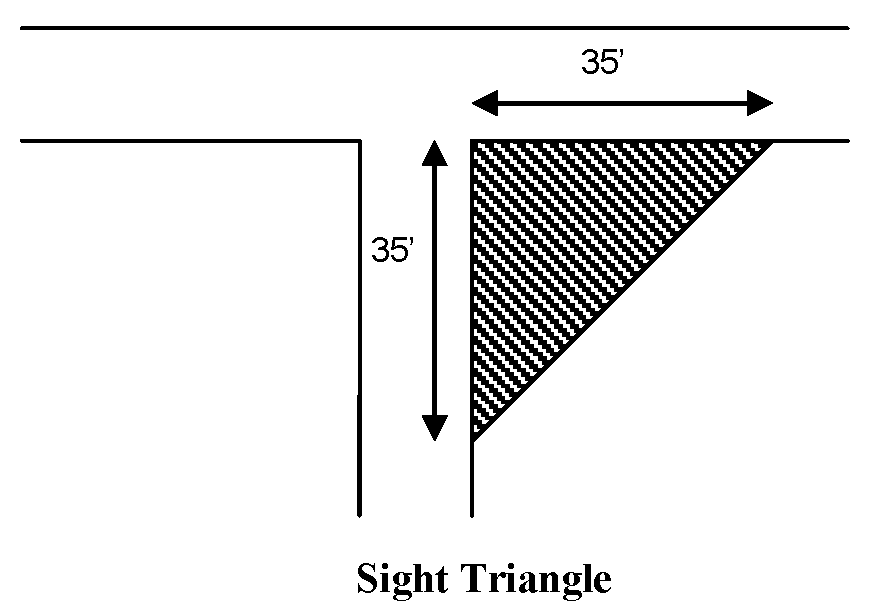
No landscaping between 30 and 60 inches in height shall be placed within the sight triangle of an intersection or curb cut.
(b)
Soil and climatic conditions. Trees and other vegetation shall be planted in soil and climatic conditions which are appropriate for their growth habits. Plants used in the landscape design shall to the greatest extent be:
(1)
Appropriate to the conditions in which they are to be planted;
(2)
Have non-invasive growth habits;
(3)
Encourage low maintenance, high-quality design; and
(4)
Be otherwise consistent with the intent of this article.
(c)
Financial guarantee.
(1)
The following vegetation, planted or preserved, that does not remain alive shall be replaced with equivalent vegetation for a period of one year from the date a certificate of occupancy is issued:
a.
Vegetation planted or preserved according to an approved landscape plan; and
b.
Preserved trees for which credit under section 109-222 tree preservation requirements was awarded but which subsequently die.
(2)
Procedures.
a.
Prior to the issuance of a building permit, the owner/developer will provide a cost estimate of the value of required and preserved vegetation to the department which is prepared by licensed landscape architect. Upon agreement to the estimate by the planning and development director, said building permit may be issued.
b.
At development final approval of a project requiring landscape improvements under this article, the owner/developer shall provide the city a one year financial guarantee in the form of cash deposit, letter of credit, or maintenance bond in the amount of 50 percent of the previously agreed to cost estimate prior to the issuance of a certificate of occupancy.
c.
The financial guarantee will warrant that all vegetative materials, planted or preserved, will survive for one year and name the city as the sole beneficiary. If any of the vegetative materials should fail to survive during that period, it should be replaced during the appropriate planting season.
Exemption: Any vegetation covered by subsection 109-215(c) that dies as a result of an act of God (e.g. tornados, straight line winds, flooding) shall be exempt from replacement. For this exemption to be effective, the owner/developer must notify the planning and development department within seven business days from the event. After a site inspection, any plant material destroyed will be credited toward the final inspection for guarantee release.
d.
The warranty period for financial guarantees shall run for one year from the date of the issuance of a certificate of occupancy.
e.
Final inspection. At the end of the one year warranty period, the planning and development department shall conduct a final inspection of guaranteed vegetation which must be completed prior to the release of financial guarantee.
f.
If, at time of final inspection, any vegetative material has failed to survive, the city shall be entitled to payment to replace said vegetative material under the terms of the financial guarantee. The city shall be entitled to use all of the money secured by the financial guarantee to assure the cost of completion of the work. The owner/developer shall not be entitled to any excess monies from the financial guarantee until vegetative material is replaced or the guarantee's time period has expired, whichever is longer.
g.
Guarantee released. Upon completion of the warranty period or replacement of any vegetative material that failed to survive the warranty period, whichever is longer, the department may release the unused balance from the financial guarantee back to the owner/developer.
(3)
Forms. Financial guarantees required under this article shall take the form of a cash deposit or cashier's check, letter of credit, or maintenance bond.
a.
Financial guarantees in the form of a cash deposit or cashier's check shall be made into a financial institution approved by the mayor and staff attorney pursuant to state statute.
b.
Financial guarantees in the form of a letter of credit will be irrevocable, in a form approved by the staff attorney, and list the city as the sole beneficiary.
c.
Financial guarantees in the form of a maintenance bond shall be issued by a surety company authorized to do business in the State of Arkansas.
(d)
Irrigation.
(1)
Except as provided below, required landscaping shall be irrigated by one of the following methods:
a.
An underground sprinkling system;
b.
Automatic drip system; or,
c.
Hose attachment within 100 feet of all landscaped areas.
(2)
Landscaping with native and drought tolerant species shall not require irrigation, provided the following certification is made on the landscape plan by a licensed landscape architect who is registered with the State of Arkansas:
"Automatic irrigation is not required on this project due to environmental conditions that do not warrant the installation of an irrigation system for plant establishment and survival."
(e)
Weed barrier. If utilized in a landscape design, a weed barrier shall be permeable to water. Non-permeable and plastic weed barriers are expressly prohibited.
(Zoning Ord., § 800.05; Ord. No. 2010-10, § 800.05, 10-2-2010; Ord. No. 2015-07, § 1, 4-27-2015; Ord. No. 2015-18, § 1, 8-24-2015; Ord. No. 2024-23, § 1(Exh.), 11-25-2024)
Sec. 109-216. - Landscape plans.
(a)
The landscaping plan is required to address three requirements:
(1)
Street frontage buffer as required in section 109-217;
(2)
Interior parking lot landscaping as required in section 109-218; and,
(3)
Perimeter landscaping as required in section 109-219.
(b)
The following information is required on landscape plans and shall be completed, stamped, and signed by a licensed landscape architect in order for the planning and development department to review them for compliance with this article:
(1)
Existing vegetation. Location, general type and quality of existing vegetation, including specimen trees.
(2)
Preservation. Existing vegetation to be saved.
(3)
Protection. Methods and details for protecting existing vegetation during construction and approved sediment control plan.
(4)
Proposed plants. Locations and labels for all proposed plants.
(5)
Landscape details. Plant lists with the botanical and common names, quantity, spacing and size of all proposed landscape improvements such as earth berms, walls, fences, screens, sculptures, fountains, street furniture, lights, and courts or paved areas.
(6)
Installation details. Planting and installation details as necessary to ensure conformance with all required standards.
(7)
Sight triangle. The sight triangle shall be indicated on the plan with a dimensioned shaded area.
(8)
Irrigation. The plans shall indicate the type of irrigation to be used, in accordance with section 109-215(d). If hose bibs are proposed, the locations shall be shown on the plan.
(9)
One-year guarantee. The plans shall note that all landscape vegetation material must be guaranteed for a period of one year from the issuance of a certificate of occupancy.
(Zoning Ord., § 800.06; Ord. No. 2010-10, § 800.06, 10-2-2010; Ord. No. 2015-18, § 1, 8-24-2015; Ord. No. 2024-23, § 1(Exh.), 11-25-2024)
Sec. 109-217. - Landscaped street frontage buffer.
(a)
Purpose. The landscaped street frontage buffer serves two primary purposes:
(1)
When a parking lot is located adjacent to a public right-of-way, a strip of landscaping helps shield projecting headlights that may impair the vision of passing motorists or pedestrians, therefore creating a safer environment.
(2)
It also provides an aesthetically pleasing transition from the public right-of-way to private property.
(b)
Prohibitions. Parking, merchandise display and off-street loading are prohibited in the landscaped street frontage buffer.
(c)
Buffer options. The site plan for any development, other than those exempt in section 109-214, shall show a landscaped street frontage buffer along all public rights-of-way. The applicant may choose one or a combination of four options illustrated in subsections (c)(1) through (c)(4) of this section to meet the particular site constraints of the development.
(1)
Ten-foot buffer strip.
a.
Minimum width: Ten feet.
b.
Minimum number of trees required: One shade tree and one ornamental tree per 25 linear feet of street frontage.
c.
Minimum number of shrubs: Ten shrubs per 25 linear feet of street frontage. A minimum of 50 percent of shrubs required shall be evergreen.
(2)
Earth berm.
a.
Minimum height: 2½ feet higher than the finished elevation of the parking lot
b.
Maximum slope: Maximum slope of the berm is 3:1.
c.
Minimum number of trees: One shade tree and one ornamental tree per 25 linear feet of street frontage.
d.
Minimum number of shrubs: Three shrubs per 25 linear feet of street frontage. A minimum of 50 percent of shrubs required shall be evergreen.
(3)
Six-foot buffer strip.
a.
Minimum width: Six-foot landscaped street buffer with three feet of fall.
b.
Minimum number of trees: One shade tree and one ornamental tree per 25 linear feet of street frontage.
c.
Minimum number of shrubs: Three shrubs per 25 linear feet of street frontage. A minimum of 50 percent of shrubs required shall be evergreen.
(4)
25-foot buffer strip. A landscaped buffer area with existing woodlands maintained in 25 foot strips along the street frontage.
(d)
Groundcover. All areas of the landscaped street buffer that are not dedicated to tree or shrub plantings shall be landscaped with ground cover.
(e)
Massing. Massing shall be integrated into a bed or in a curb to ease maintenance. The maximum distance between massing is 25 feet.
(Zoning Ord., § 800.07; Ord. No. 2010-10, § 800.07, 10-2-2010)
Sec. 109-218. - Interior parking lot landscaping.
(a)
Purpose. The interior parking lot landscaping requirement serves several purposes:
(1)
To provide necessary green space to give relief to expansive paved parking areas;
(2)
To provide shade and to serve as windbreaks; and
(3)
To assist with vehicular circulation.
(b)
Applicability. Interior parking lot landscaping requirements apply to all parking lots that are required in article IV of this chapter to have 14 or more parking spaces.
(c)
Requirement. The site plan shall show interior parking lot landscaping. A sliding scale to determine the amount of landscaping area per lot has been included in order for the applicant to include these landscaping requirements as an integral part of the site development.
(1)
Standard. Percentage of the total area of parking lot dedicated to interior planting shall be as follows:
INTERIOR LANDSCAPING REQUIREMENTS
(2)
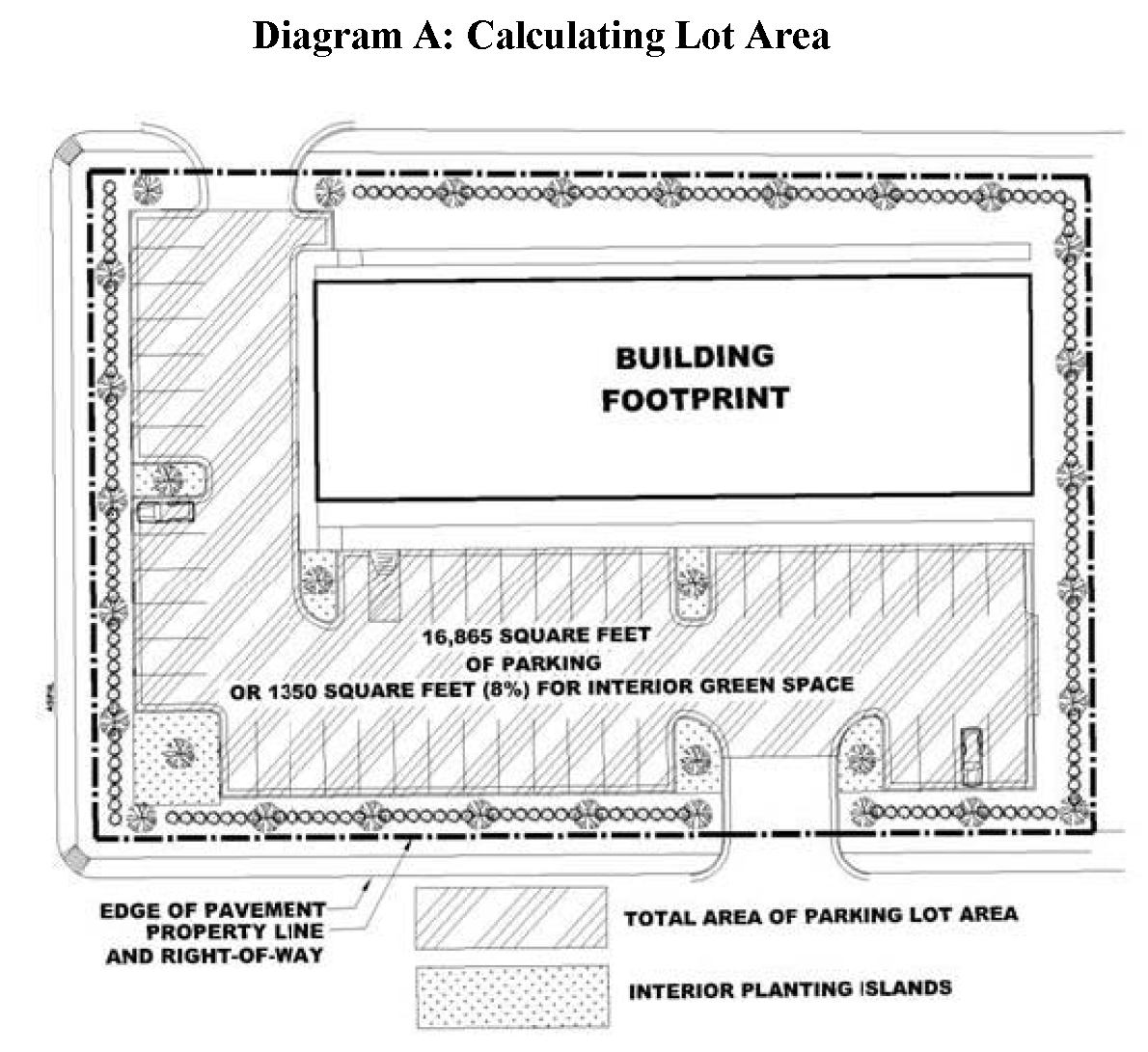
Calculating lot area. Diagram A, illustrates what areas of the lot are considered when determining the total area of the parking lot. The total amount of landscape area for the interior lot is determined by figuring five percent, eight percent, or ten percent of the total parking lot area as explained in subsections (c)(2)a. and (c)(2)b. of this section:
a.
Included in calculation. The square footage of all areas within the parking lot's perimeter are counted, including the planting islands required, curbed areas, corner lots, parking spaces and interior driveways and aisles.
b.
Excluded from calculation. Driveways and aisles with no parking spaces located on either side, buildings, street frontage buffer, and perimeter strips are not counted. Landscaped areas outside the parking lot may not be used to meet the interior planting requirement.
(3)
Planting islands. Planting islands are required as a part of the landscape area percentage in the interior parking lot area.
a.
Dimensions. The dimensions of a parking island must be a minimum of nine feet by 19 feet as measured from the face of the curb, the same as a parking space, and must be curbed to protect landscaping and trees.
b.
Minimum number required. No more than 14 parking spaces shall be permitted in a row without interruption by a parking island. In parking lots over 150,000 square feet, the number of parking islands can be reduced but the total square footage of landscape area must remain according to the requirements.
(4)
Trees. Trees are required to be planted in the interior parking area to offer shade from the heat and sun.
a.
Minimum number required. One shade tree per 14 parking spaces is required for the interior parking area.
b.
Location. Trees shall be planted within the island.
(5)
Groundcover. All interior parking lot landscaped areas not dedicated to preservation of existing vegetation shall be landscaped with groundcover.
(d)
Vehicular display areas. Applicants shall select one of the following options for vehicular display areas:
(1)
Compliance with standard. Comply with the interior parking lot landscaping requirements described in this section and the required street frontage requirements in section 109-217; or
(2)
Increase street frontage buffer. In lieu of the interior parking lot landscaping requirements, increase the required street frontage buffer to 25 feet wide and install the number of trees required for the interior landscape requirements within the street frontage buffer.
(Zoning Ord., § 800.08; Ord. No. 2010-10, § 800.08, 10-2-2010)
Sec. 109-219. - Landscaped perimeter.
(a)
Purpose. Perimeter landscaping has the following purposes:
(1)
Defines parking areas;
(2)
Prevents two adjacent lots from becoming one large expanse of pavement;
(3)
Provides vegetation in densely developed areas; and
(4)
Enhances the appearance of individual properties.
(b)
Requirement. The site plan for any development, other than that exempt in section 109-214, shall show perimeter landscaping, in addition to the landscaped street frontage buffer required in section 109-217.
(1)
Width. A ten-foot landscaped strip is required along the side and rear lot lines of a development.
(2)
Minimum number of trees. One shade tree and one ornamental tree per 50 linear feet.
(3)
Groundcover. All perimeter landscaped areas not dedicated to preservation of existing vegetation shall be landscaped with groundcover.
(4)
Vehicular access. The perimeter landscaping requirement does not preclude the need for vehicular access to be provided between lots.
(5)
Adjacent properties. The ten-foot perimeter strip is required for each development regardless if one is already in place from an adjacent, developed lot.
(Zoning Ord., § 800.09; Ord. No. 2010-10, § 800.09, 10-2-2010)
Sec. 109-220. - Landscape installation requirements.
(a)
Location. The following applies to location and installation of landscaping:
(1)
Drainage. Trees shall not be placed where they interfere with site drainage.
(2)
Overhead utilities. Trees shall not be placed where they require frequent pruning in order to avoid interference with overhead power lines. In such locations, small ornamental trees are encouraged.
(3)
Water lines. Landscaping shall be installed at locations that avoid placement directly above water lines.
(4)
Fire hydrants. Landscaping shall not be placed within three feet of a fire hydrant.
(b)
Minimum size. Immediately upon planting, trees shall meet the minimum requirements:
MINIMUM TREE SIZE
(c)
Species mix. When more than ten trees are to be planted to meet the requirements of this article, a mix of species shall be provided. The number of species to be planted shall vary according to the overall number of trees required to be planted. The minimum number of species to be planted is listed in the table below. Species shall be planted in proportion to the required mix. This species mix shall not apply to areas of vegetation required to be preserved.
REQUIRED SPECIES MIX
(Zoning Ord., § 800.10; Ord. No. 2010-10, § 800.10, 10-2-2010)
Sec. 109-221. - Trees and shrubs.
(a)
Criteria. The following lists indicate plantings that meet the landscaping requirements of this article. The lists are by no means comprehensive and are intended merely to suggest the types of flora which would be appropriate for screening and shading purposes. Plants were selected for inclusion on these lists according to four principal criteria:
(1)
General suitability for the climate and soil conditions for this area;
(2)
Unconstrained maintenance;
(3)
Tolerance of city conditions; and
(4)
Readily available from area nurseries.
(b)
Plant selection. When selecting new plantings for a particular site, a developer should first consider the type of plants that are thriving on or near that site. However, if an introduced species has proven highly effective for screening or shading in this area, it too may be a proper selection.
RECOMMENDED SHRUBS
EVERGREEN
DECIDUOUS
RECOMMENDED TREES
SHADE
EVERGREEN
ORNAMENTAL
(Zoning Ord., § 800.11; Ord. No. 2010-10, § 800.11, 10-2-2010)
Sec. 109-222. - Tree preservation requirements.
(a)
Healthy trees. No tree preservation credits will be allowed for any dead tree as classified by a registered arborist, any tree in poor health or any tree subjected to grade alterations.
(b)
Protection during construction. Trees for which credit is given shall be protected during construction from:
(1)
Mechanical injuries to root, trunk and branches;
(2)
Injuries by chemical poisoning;
(3)
Injuries by excavation; and
(4)
Injuries by paving.
(c)
Credit options. If an applicant is preserving trees, the applicant may use the existing trees as credit either toward a reduction in parking requirements or in a reduction of the number of trees required, as described below and as approved by the planning commission.
(1)
Reduction of parking requirements. To allow an existing or new development to preserve trees within or adjacent to a parking lot, the number of required off-street parking spaces may be reduced as described in the following chart:
PARKING SPACE REDUCTION CREDITS
(2)
Reduction of required trees. Preservation and protection of existing trees on the lot may be credited toward the tree planting requirements. Credit for preserved trees shall be permitted at the following rates:
TREE REDUCTION CREDITS
(Zoning Ord., § 800.12; Ord. No. 2010-10, § 800.12, 10-2-2010)
Sec. 109-223. - Enforcement and maintenance.
(a)
Certificates of occupancy. The planning and development director or his or her designee has the authority to enforce the requirements of this chapter. Certificates of occupancy and/or final plats will be held for those who fail to complete landscaping requirements. All landscaping shall comply with subsection 109-215(c) financial guarantee.
(b)
Maintenance. Once approved, the owner/applicant is required to guarantee the plants for one year or the owner/applicant must replace them. The owner/applicant shall maintain all trees and vegetation.
(Zoning Ord., § 800.13; Ord. No. 2010-10, § 800.13, 10-2-2010; Ord. No. 2015-07, § 1, 4-27-2015; Ord. No. 2015-18, § 1, 8-24-2015; Ord. No. 2024-23, § 1(Exh.), 11-25-2024)
Sec. 109-224. - Alternative methods of compliance.
An application for alternative landscaping schemes is justified only when one or more of the following conditions apply:
(1)
Space limitations. The site involves space limitations or unusually shaped parcels.
(2)
Site conditions. Topography, soil, vegetation, or other site conditions are such that full compliance is impossible or impractical.
(3)
Change of use. Due to a change of use of an existing site, the required buffer yard is larger than can be provided.
(4)
Safety. Safety considerations require a change.
(Zoning Ord., § 800.14; Ord. No. 2010-10, § 800.14, 10-2-2010)
Sec. 109-225. - Screening.
(a)
Standards. Every development shall provide sufficient screening that meets these standards:
(1)
Adjacent properties. Neighboring properties are shielded from any adverse external effects of that development.
(2)
Developing property. The development is shielded from the negative impacts of adjacent uses such as major street or railroads.
(3)
Dumpsters. Trash dumpsters are enclosed with opaque screening materials on all sides.
(b)
Requirements. Screening required shall be determined by the table of screening requirements.
TABLE OF SCREENING REQUIREMENTS
(Letters indicate screen type as described in subsection (c)of this section)
(c)
Description of screens. The following three types of screens are hereby established and are used as the basis for the table of screening requirements in subsection (b) of this section:
(1)
Type A:Opaque screen. An opaque screen is intended to exclude all visual contact between uses and to create a strong impression of spatial separation.
a.
Minimum height. The screen shall be opaque from the ground to a height of at least six feet, with intermittent visual obstructions from the opaque portion to a height of at least 20 feet.
b.
Materials. The opaque screen may be composed of a wall, fence, landscaped earth berm, planted vegetation, or existing vegetation.
c.
Vegetative screens. Compliance of planted vegetative screens or natural vegetation will be judged on the basis of the average mature height and density of foliage of the subject species, or field observation of existing vegetation. The opaque portion of the screen shall be opaque in all seasons of the year. At maturity, the portion of intermittent visual obstructions should not contain any completely unobstructed openings more than ten feet wide. The portion of intermittent visual obstructions may contain deciduous plants.
(2)
Type B:Semi-opaque screen. The semi-opaque screen is intended to partially block visual contact between uses and to create a strong impression of the separation of spaces.
a.
Minimum height. The screen shall be opaque from the ground to a height of three feet, with intermittent visual obstruction from above the opaque portion to a height of at least 20 feet.
b.
Materials. The semi-opaque screen may be composed of a wall, fence, landscaped earth berm, planted vegetation, or existing vegetation.
c.
Vegetative screens. Compliance of planted vegetative screens or natural vegetation will be judged on the basis of the average mature height and density of foliage of the subject species or field observation of existing vegetation. At maturity, the portion of intermittent visual obstructions should not contain any completely unobstructed openings more than ten feet wide. The zone of intermittent visual obstruction may contain deciduous plants.
(3)
Type C: Broken screen. The broken screen is intended to create the impression of a separation of spaces without necessarily eliminating visual contact between the spaces:
a.
Height. The broken screen shall be composed of intermittent visual obstruction from the ground to a height of at least 20 feet.
b.
Materials. The broken screen may be composed of a wall, fence, landscaped earth berm, planted vegetation, or existing vegetation.
c.
Vegetative screens. The screen may contain deciduous plants.
(Zoning Ord., § 800.15; Ord. No. 2010-10, § 800.15, 10-2-2010)

