
Belleair City Zoning Code
ARTICLE III
DEVELOPMENT DESIGN AND IMPROVEMENT STANDARDS
Sec. 74-131. - Purpose of article.
The purpose of this article is to provide development design and improvement standards applicable to all development activity within the town.
(Ord. No. 399, § 1, 11-20-01)
Sec. 74-132. - Responsibility for improvements.
All improvement required by this article shall be designed, installed and paid for by the developer.
(Ord. No. 399, § 1, 11-20-01)
Sec. 74-133. - Principles of development design.
The provisions of this article are intended to ensure functional and attractive development. Development design shall first take into account the protection of natural resources as prescribed in article VI of this chapter. All development shall be designed to avoid unnecessary impervious surface cover, to provide adequate access to lots and sites, and to avoid adverse effects of shadow, glare, noise, odor, traffic, drainage and utilities on surrounding properties.
(Ord. No. 399, § 1, 11-20-01)
Sec. 74-151. - Generally.
(a)
Purpose of division. This division establishes minimum requirements applicable to a development transportation system, including public and private streets, bikeways, pedestrian ways, parking and loading areas, and access control to and from public streets. The standards in this division are intended to minimize the traffic impacts of development, and to ensure that all developments adequately and safely provide for the storage and movement of vehicles consistent with good engineering and development design practices.
(b)
Construction specifications. All required elements of the transportation system shall be provided in compliance with the engineering design and construction standards prescribed by the town, and, where applicable, the county metropolitan planning organization (MPO).
(Ord. No. 399, § 1, 11-20-01)
Sec. 74-152. - Rights-of-way.
(a)
Width. Right-of-way requirements for road construction shall be as prescribed by the town and the county metropolitan planning organization traffic circulation element, where applicable. The right-of-way shall be measured from lot line to lot line.
(b)
Future rights-of-way. Future right-of-way requirements are identified in the traffic circulation element of the county metropolitan planning organization transportation plan. Where roadway construction, improvement or reconstruction is not required to serve the needs of the proposed development project, future rights-of-way shall nevertheless be reserved for future use. No part of the reserved area shall be used to satisfy minimum requirements of this land development code.
(c)
Protection and use.
(1)
No encroachment shall be permitted into existing rights-of-way, except for temporary use authorized by the town.
(2)
Use of the right-of-way for public or private utilities, including, but not limited to, sanitary sewer, potable water, storm sewer, telephone wires, cable television wires, gas lines or electricity transmission, shall be allowed subject to the placement specifications prescribed by the town and other applicable town or county regulations.
(3)
Sidewalks and bicycle ways shall be placed within the right-of-way.
(d)
Vacation. Applications to vacate a right-of-way shall be approved upon a finding that all of the following requirements are met:
(1)
The requested vacation is consistent with the traffic circulation element of the town comprehensive plan and the county metropolitan planning organization transportation plan.
(2)
The right-of-way does not provide the sole access to any property. Remaining access shall not be by easement.
(3)
The vacation would not jeopardize the current or future location of any utility.
(4)
The proposed vacation is not detrimental to the public interest and provides a positive benefit to the town.
(Ord. No. 399, § 1, 11-20-01; Ord. No. 430, § 2, 12-20-05)
Sec. 74-153. - Street design standards.
(a)
General standards.
(1)
All streets in a new development shall be designed and constructed pursuant to the standards prescribed by the town. Streets shall be dedicated to the town upon completion, inspection and acceptance by the town.
(2)
The street system of the proposed development shall, to the extent practicable, conform to the natural topography of the site, preserving existing hydrological and vegetative patterns, and minimizing erosion potential, runoff and the need for site alteration. Particular effort should be directed toward securing the flattest possible grade near intersections.
(3)
Streets shall be laid out to avoid environmentally sensitive areas.
(4)
Private streets may be allowed within developments that will remain under common ownership, provided they are designed and constructed pursuant to the standards prescribed by the town.
(5)
The street layout in all new development shall be coordinated with and interconnected to the street system of the surrounding area.
(6)
Streets in proposed subdivisions shall be connected to rights-of-way in adjacent areas to allow for proper interneighborhood traffic flow. If adjacent lands are unplatted, stub-outs in the new development shall be provided for future connection to the adjacent unplatted land.
(7)
Streets shall intersect as nearly as possible at right angles, and in no case shall the angle be less than 75 degrees.
(8)
New intersections along one side on an existing street shall, where possible, coincide with existing intersections. Where an offset (jog) is necessary at an intersection, the distance between centerlines of the intersecting streets shall be no less than 150 feet.
(9)
No two streets may intersect with any other street on the same side at a distance of less than 400 feet, measured from centerline to centerline of the intersecting streets. When the intersected street is an arterial, the distance between intersecting streets shall be no less than 1,000 feet.
(b)
Paving widths. Paving widths for each street classification shall be as prescribed by the town and, where applicable, in accordance with county metropolitan planning organization traffic circulation element standards.
(c)
Curbing requirements.
(1)
Curbing shall be required for the purposes of drainage, safety, and delineation and protection of pavement edge along all streets.
(2)
All curbing shall conform to the construction standards prescribed by the town.
(d)
Acceleration, deceleration and turning lanes.
(1)
Deceleration or turning lanes may be required by the town along existing and proposed streets as determined necessary by the town manager.
(2)
Deceleration lanes shall be designed to the following standards:
a.
The lane width shall be the same as the required width of the roadway moving lanes.
b.
The lane shall provide the full required lane width for its full length. It shall not be tapered.
c.
The minimum lane length shall be 165 feet.
(3)
Acceleration lanes are only required when indicated as needed by a traffic impact study. The design shall be in accordance with the recommendation of the town engineer. Where needed, a paved taper shall be provided for righthand turns.
(e)
Culs-de-sac. An obstructed 12-foot-wide moving lane with a minimum outside turning radius of 38 feet shall be provided at the terminus of every permanent cul-de-sac.
(f)
Stub streets.
(1)
Residential access and subcollector stub streets may be permitted only within subsections of a phase development for which the proposed street in its entirety has received final site plan approval.
(2)
Residential collector and higher order stub streets may be permitted or required by the town provided that the future extension of the street is deemed desirable by the town or conforms to an adopted city or county traffic circulation plan.
(3)
Temporary turnarounds shall be provided for all stub streets providing access to five or more lots or housing units. Where four or fewer units or lots are being served, a sign indicating a dead-end street shall be posted.
(g)
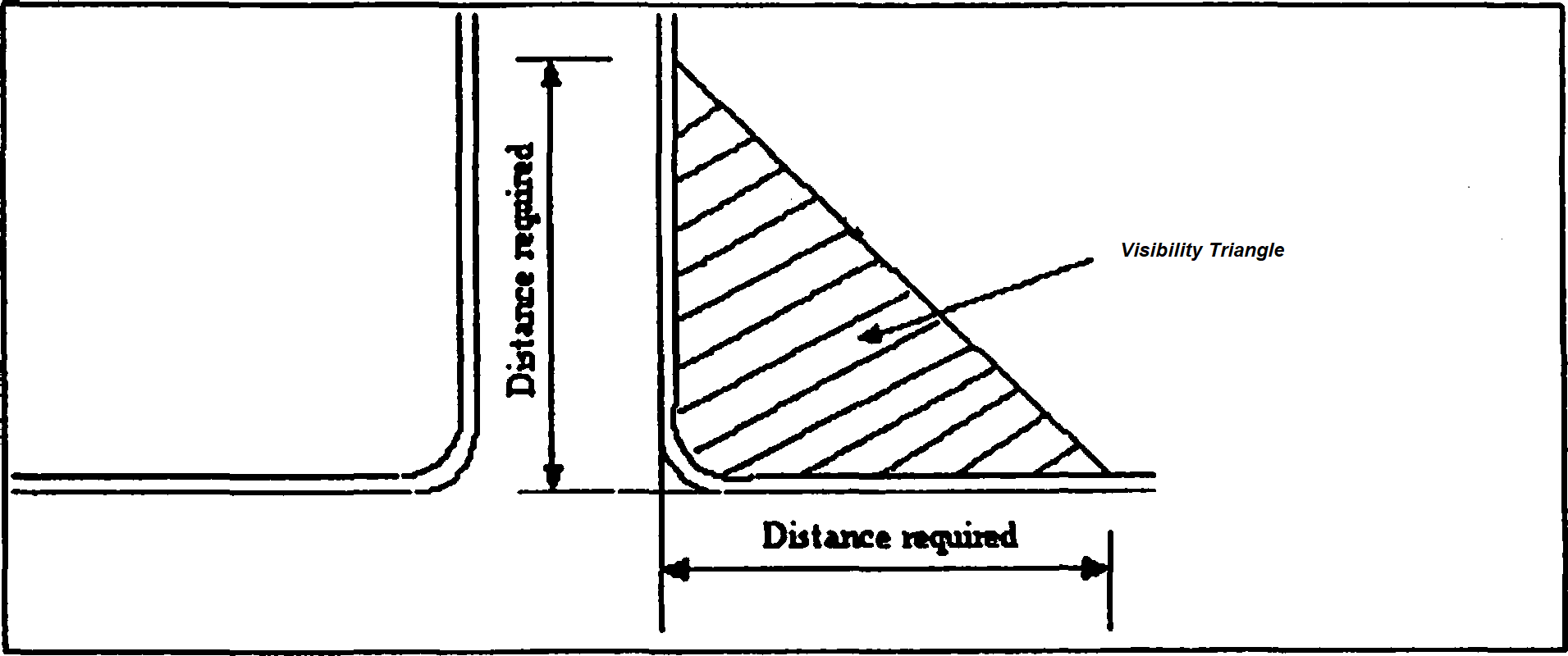
Clear visibility triangle. In order to provide a clear view of intersecting streets to the motorist, there shall be a triangular area of clear visibility formed by two intersecting streets or the intersection of a driveway and a street. The following standards shall be met:
(1)
Nothing shall be erected, placed, parked, planted or allowed to grow in such a manner as to materially impede vision between a height of two feet and ten feet above the grade, measured at the centerline of the intersection.
(2)
The clear visibility triangle shall be calculated as follows:
a.
Street intersections. Within 30 feet of the back of curb or pavement edge where no curb exists.
b.
Alleys. Within ten feet of the back of curb or pavement edge where no curb exists on the street with which the alley intersects.
c.
Driveways. Within ten feet of the back of curb or pavement edge where no curb exists on the street with which the driveway intersects.
The following illustration depicts how the visibility triangle is determined. Essentially, depending upon which of the above three intersection types is involved, the appropriate measurement is taken as shown in the drawing, and the two points most distant from the theoretical intersection of the two roadway lines are connected by a diagonal line. The shaded area on the drawing represents the determined visibility triangle.
(3)
Trees may be planted, with a minimum separation of 20 feet, within the above described areas provided that they are maintained as needed to ensure that no branch of the tree is nearer the ground than ten feet. In certain circumstances, the Town may require greater separation for reasons of public safety.
(h)
Signage and signalization. The developer shall deposit with the town sufficient funds to provide all necessary roadway signs and traffic signalization as may be required by the town, based upon town or state traffic standards. At least two street name signs shall be placed at each four-way street intersection, and one at each "T" intersection. Signs shall be installed under light standards and free of visual obstruction. The design of street name signs shall be consistent, of a style appropriate to the community, and of a uniform size and color.
(i)
Street trees.
(1)
Street trees shall be provided in accordance with the standards established in section 74-232.
(2)
No development shall be approved without reserving an easement authorizing the town to plant shade trees within five feet of the required right-of-way boundary. No street shall be accepted for dedication until the easement required by this subsection has been provided.
(j)
Blocks.
(1)
Where a tract of land is bounded by streets forming a block, the block shall have sufficient width to provide for two tiers of lots of appropriate depths.
(2)
The lengths, widths and shapes of blocks shall be consistent with adjacent areas. In no case shall block lengths in residential areas exceed 2,200 feet or be less than 400 feet.
(Ord. No. 399, § 1, 11-20-01; Ord. No. 579, § 1, 9-17-24)
Sec. 74-154. - Sidewalks.
(a)
Required facilities.
(1)
Projects abutting collector or arterial facilities shall provide sidewalks adjacent to the collector or arterial roadway. Location of sidewalks shall be consistent with planned roadway improvements.
(2)
Sidewalks shall be provided on both sides of all residential streets.
(3)
Where a proposed development includes improvements or new construction of collector or arterial facilities, facility designs shall include provision for sidewalks within the right-of-way.
(4)
Residential projects adjacent to or in the immediate vicinity of an activity center comprised of commercial, office, service or recreation activities shall provide pedestrian and bicycle access from the development to the activity center.
(5)
Pedestrian ways or crosswalks, not less than ten feet wide, with a sidewalk meeting the requirements of this land development code, may be required by the town manager or town commission to be placed in the center of blocks more than 800 feet long where deemed necessary to provide circulation or access to schools, playgrounds, shopping centers, transportation and other community facilities.
(b)
Design and construction standards. Design and construction of sidewalks, bikeways or other footpaths shall conform to the requirements prescribed by the town, including provisions for access by physically handicapped persons.
(Ord. No. 399, § 1, 11-20-01)
Sec. 74-155. - Access.
All proposed development shall meet the following standards for vehicular access and circulation:
(1)
Number of access points.
a.
All projects shall have access to a public right-of-way. The number of access points shall be as follows:
*Individual single-family driveway access; where distance from intersecting roadway intersections can be met, circular driveway connections may be allowed.
b.
Notwithstanding the provisions in subsection a. of this subsection:
1.
A nonresidential development or a multifamily residential development on a corner lot may be allowed two points of access. However, no more than one access shall be onto an arterial roadway.
2.
Schools may have one additional access, provided that the additional access drive is limited to school bus use only.
(2)
Separation of access points.
a.
The separation between access points, for developments other than individual single-family driveways, onto arterial and collector roadways, or between an access point and an intersection of an arterial or collector roadway with another road, shall be as shown in the following table:
*These distances do not apply to individual connections to the right-of-way on the same property for circular driveways.
b.
The distance between access points shall be measured from the centerline of the proposed driveway or roadway to the centerline of the nearest adjacent roadway or driveway.
c.
Adjacent uses may be required to share a common driveway provided that appropriate access easements are granted between or among the property owners.
(3)
Width and setback of driveways.
a.
Driveways for single-family dwellings shall be at least ten feet in width.
b.
For single-family dwellings, there shall be one driveway access point per street frontage except for circular driveways.
c.
Driveways for multi-family and nonresidential uses shall be at least 12 feet in width.
d.
No driveway shall exceed 24 feet in width at the property line, nor be located closer than three feet to a side-yard property line unless an agreement for a shared driveway is provided.
e.
Circular driveways beginning and ending at the right-of-way are allowed on all lots provided sufficient maneuvering space is provided and a safety hazard is not created. Circular driveways shall have a maximum of two driveway access points per street frontage, allowing two drives, one being a maximum of 20 feet in width and the other being a maximum of 12 feet in width, totaling not more than 30 feet in width combined at the property line, nor located closer than three feet to a sideyard property line unless an agreement for a shared access driveway is provided.
f.
Driveway flares at the street may be added to the allowable width provided they do not add more than two feet to the width of each driveway, and extend no further than three feet from street entry.
(4)
Alternative designs. Where natural features, the previous development pattern and provisions for access, or spacing of existing driveways and roadways cause the access requirements set out in subsections (1), (2) and (3) of this section to be physically or legally infeasible, alternate designs may be approved by the town commission only as a function of their approval of a site development plan.
(5)
Access to residential lots; access to nonresidential uses not to be through residential areas.
a.
Access to nonresidential uses shall not be through an area designed, approved or developed for residential use.
b.
All lots in a proposed residential subdivision shall have frontage on and access from an existing street meeting the requirements of this land development code.
c.
Access to all lots in a proposed residential subdivision shall be by way of a residential street.
(Ord. No. 399, § 1, 11-20-01; Ord. No. 491, § 5, 4-15-14; Ord. No. 576, § 2, 9-17-24)
Sec. 74-171. - Generally.
(a)
Applicability of division. Off-street parking facilities shall be provided for all development within the town pursuant to the requirements of this land development code. The facilities shall be maintained as long as the use exists that the facilities were designed to serve.
(b)
Computation of requirements.
(1)
When determination of the number of off-street spaces required by this land development code results in a fractional space, a fraction of one-half or less may be disregarded, and a fraction in excess of one-half shall be counted as one parking space.
(2)
In places of assembly in which those in attendance occupy benches, pews or other similar seating facilities, or which contain an open assembly area, the occupancy shall be based on the maximum occupancy rating given the building by the fire marshal.
(3)
Gross floor area shall be the sum of the gross horizontal area of all floors of a building measured from the exterior faces of the exterior walls.
(Ord. No. 399, § 1, 11-20-01)
Sec. 74-172. - Number of parking spaces.
(a)
Parking requirements matrix. The following parking requirements matrix specifies the required minimum number Off-street automobile parking spaces and notes any special requirements that may apply:
Parking Requirements Matrix
(b)
Uses not specifically listed. The number of parking spaces required for uses not specifically listed in the matrix shall be determined by the town manager. The manager shall consider requirements for similar uses and appropriate traffic engineering and planning data, and shall establish a minimum number of parking spaces based upon the principles of this land development code.
(c)
Mixed uses. Where a combination of uses is developed, parking shall be provided for each of the uses as prescribed by the matrix, unless a reduction is granted pursuant to subsections (g), (h) and (i) of this section.
(d)
Tandem parking spaces. The term "tandem parking space," as used in the matrix, means a parking space that abuts a second parking space in such a manner that vehicular access to the second space can be made only through the abutting (tandem) space.
(e)
Special parking spaces. Any parking area to be used by the general public shall provide suitable marked parking spaces for handicapped persons. The number, design and location of these spaces shall be consistent with the requirements of F.S. §§ 316.1955 and 316.1956, or succeeding provisions. No parking space required for the handicapped shall be counted as a parking space in determining compliance with this section. Optional spaces for the handicapped shall be paved.
(f)
Parking deferral.
(1)
To avoid requiring more parking spaces than actually needed to serve a development, the town commission may defer the provision of some portion of the off-street parking spaces required by this land development code if the conditions and requirements of this subsection are satisfied.
(2)
As a condition precedent to obtaining a partial deferral by the town commission, the developer must show any one or more of the following:
a.
A parking study that indicates that there is not a present need for the deferred parking.
b.
Public transportation satisfies transportation demands for a portion of the users of the facility that corresponds to the amount of parking sought to be deferred.
c.
The developer has established or will establish an alternative means of access to the use that will justify deferring the number of parking spaces sought to be deferred. Alternative programs that may be considered by town commission include but are not limited to:
1.
Private and public carpools and vanpools.
2.
Charging for parking.
3.
Subscription bus services.
4.
Flexible work-hour scheduling.
5.
Capital improvement for transit services.
6.
Ride sharing.
7.
Establishment of a transportation coordinator position to implement carpool, vanpool and transit programs.
d.
The percentage of parking spaces sought to be deferred corresponds to the percentage of residents, employees and customers who regularly walk, use bicycles and other non-motorized forms of transportation, or use mass transportation to come to the facility.
(3)
If the developer satisfies one or more of the criteria in subsection (2) of this subsection, the town commission may approve a deferred parking plan submitted by the developer. The number of parking spaces deferred shall correspond to the estimated number of parking spaces that will not be needed because of the conditions established.
(4)
A deferred parking plan shall:
a.
Be designed to contain sufficient space to meet the full parking requirements of this land development code, shall illustrate the layout for the full number of parking spaces, and shall designate which are to be deferred.
b.
Not assign deferred spaces to areas required for landscaping, buffer zones, setbacks or areas that would otherwise be unsuitable for parking spaces because of the physical characteristics of the land or the requirements of this code.
c.
Include a landscaping plan for the deferred parking area.
d.
Include a written agreement with the town that, one year from the date of issuance of the certificate of occupancy, the deferred spaces will be converted to parking spaces that conform to this code at the developer's expense should the town commission determine from experience that the additional parking spaces are needed.
e.
Include a written agreement that the developer will cover the expense of a traffic study to be undertaken by the town to determine the advisability of providing the full parking requirement.
(5)
When authorized by the town commission upon a preliminary finding that the parking is inadequate, but not sooner than one year after the date of issuance of the certificate of occupancy for the development, the town manager shall require the property owner to undertake a study to determine the need of providing the full parking requirement to satisfy the proven demand for parking.
(6)
Based upon the study and the recommendations of the town manager, the town commission shall determine if the deferred spaces shall be converted to operable parking spaces by the developer or retained as deferred parking area.
(7)
The developer may at any time request that the town commission approve a revised development plan to allow converting the deferred spaces to operable parking spaces.
(g)
Reduction for mixed or joint use of parking spaces. The town commission shall authorize a reduction in the total number of required parking spaces for two or more uses jointly providing Off-street parking when their respective hours of need of maximum parking do not normally overlap. Reduction of parking requirements because of joint use shall be approved if the following conditions are met:
(1)
The developer submits sufficient data to demonstrate that hours of maximum demand for parking at the respective uses do not normally overlap.
(2)
The developer submits a legal agreement approved by the town attorney guaranteeing the joint use of the off-street parking spaces as long as the uses requiring parking are in existence or until the required parking is provided elsewhere in accordance with the provisions of this land development code.
(h)
Reduction for low percentage of leasable space. The requirements of this section assume an average percentage of gross leasable building to total gross building area of approximately 85 percent. If a use has a much lower percentage of leasable space because of cafeterias, athletic facilities or covered patios, multiple stairways and elevator shafts, atriums, or conversion of historic residential structures to commercial use, or for other reasons, the town commission may reduce the parking requirements if the following conditions are met:
(1)
The developer submits a detailed floor plan describing how all of the floor area in the building will be used.
(2)
The developer agrees in writing that the usage of the square footage identified as not leasable shall remain as identified, unless and until additional parking is provided to conform fully with this land development code.
(i)
Historic preservation exemption. The preservation of any property that has been placed on the local register of historic places, or that is located in a historic district and contributes to the historic character of the district, shall be grounds for a grant by the town commission of a reduction in, or complete exemption from, the parking requirements in this section. The reduction or exemption needed to allow a viable use of the historic structure shall be granted unless a severe parking shortage or severe traffic congestion will result.
(j)
Authority to increase requirements. The number of required parking spaces may be increased by the town commission if a parking study demonstrates that the proposed use would have a parking demand in excess of the requirements in this section. The town commission may require the developer to provide a parking study when the town manager presents preliminary data indicating that an increase in the number of parking spaces may be warranted.
(k)
[Single-family residence parcels.] Parking of vehicles on single-family residence parcels shall be allowed only on driveways or on approved paved surfaces that must be at a minimum of 200 square feet, but not greater than 220 square feet per vehicle space.
(Ord. No. 399, § 1, 11-20-01)
Sec. 74-173. - Off-street loading.
(a)
Generally. Spaces to accommodate offstreet loading or business vehicles shall be provided as required in this section.
(b)
Number of spaces.
(1)
Schools, hospitals, nursing homes and other similar institutional uses and mid- and high-rise residential uses shall provide one loading space for the first 100,000 square feet of gross floor area or fraction thereof, and one space for each additional 100,000 square feet or fraction thereof.
(2)
Offices and financial institutions shall provide one space for the first 75,000 square feet of gross floor area or fraction thereof, and one space for each additional 25,000 square feet.
(3)
Retail commercial, service, road service and commercial entertainment uses shall provide one space for the first 5,000 square feet of gross floor area, and one space for each additional 10,000 square feet.
(4)
Industrial uses shall provide one space for every 5,000 square feet of gross floor area.
(c)
Adjustments to requirements. The town commission may, upon the recommendation of the town manager, require that a study be done to determine the actual number of loading spaces needed for a proposed use. The town manager shall recommend the need for a study when it appears that the characteristics of the proposed use require a greater or lesser number of loading spaces needed for a proposed use.
(Ord. No. 399, § 1, 11-20-01)
Sec. 74-174. - Alteration of conforming development.
(a)
Decreased demand for parking or loading. The number of offstreet parking or loading spaces may be reduced if the town manager or town commission finds that a diminution in floor area, seating capacity or other factor controlling the number of parking or loading spaces would permit the site to remain in conformity with this land development code after the reduction.
(b)
Increased demand for parking or loading. The number of offstreet parking or loading spaces must be increased to meet the requirements of this land development code if the manager or commission finds that an increase in floor area, seating capacity or other factor controlling the number of parking or loading spaces required by this code causes the site not to conform with this code.
(Ord. No. 399, § 1, 11-20-01)
Sec. 74-175. - Design standards.
(a)
Location of parking spaces.
(1)
Except as provided in this section, all required off-street parking spaces and the use they are intended to serve shall be located on the same parcel.
(2)
The town commission may approve offsite parking facilities as part of the parking required by this land development code if:
a.
The location of the offsite parking spaces will adequately serve the use for which they are intended. The following factors shall be considered:
1.
Proximity of the offsite spaces to the use that they will serve.
2.
Ease of pedestrian access to the offsite parking spaces.
3.
Whether or not offsite parking spaces are compatible with the use intended to be served, e.g., offsite parking is not ordinarily compatible with high turnover uses such as retail uses.
b.
The location of the offsite parking spaces will not create unreasonable:
1.
Hazards to pedestrians.
2.
Hazards to vehicular traffic.
3.
Traffic congestion.
4.
Interference with access to other parking spaces in the vicinity.
5.
Detriment to any nearby use.
c.
The developer supplies a written agreement, approved in form by the town attorney, ensuring the continued availability of the offsite parking facilities for the use they are intended to serve.
(3)
All parking spaces required by this code for residential uses should be located no further than the following distances from the units they serve:
a.
Resident parking: 200 feet.
b.
Visitor parking: 250 feet.
Distances shall be measured from a dwelling unit's entry to the parking space. Where a stairway or elevator provides access to dwelling unit, distances shall be measured from the entry to the stairway or elevator. For purposes of measuring these distances, each required parking space shall be assigned to a specific unit on the development plan, whether or not the developer will actually assign spaces for the exclusive use of the specific unit.
(b)
Size of spaces.
(1)
Parking spaces shall be sized according to the table following this subsection.
(2)
Spaces for handicapped parking shall be the size specified in F.S. § 316.1955.
(3)
The standard off-street loading space shall be ten-feet wide and 25-feet long, provide vertical clearance of 15 feet, and provide adequate area for maneuvering, ingress and egress. The length of one or more of the loading spaces may be increased up to 55 feet if full-length tractor-trailers must be accommodated. Developers may install spaces that are larger than the standard, but the number of spaces shall not be reduced on that account.
(4)
The town commission may modify the requirements of this subsection where necessary to promote a substantial public interest relating to environmental protection, heritage conservation, aesthetics, tree protection or drainage.
Parking Space Dimensions For Standard Cars
(1)
Pedestrian circulation facilities, roadways, driveways, and offstreet parking and loading areas shall be designed to be safe and convenient.
(2)
Parking and loading areas, aisles, pedestrian walks, landscaping, and the open space development plan and shall be properly related to existing and proposed buildings.
(3)
Buildings, parking and loading areas, landscaping and open spaces shall be designed so that pedestrians moving from parking areas to buildings and between buildings are not unreasonably exposed to vehicular traffic.
(4)
Landscaped, paved and gradually inclined or flat pedestrian walks shall be provided along the lines of the most intense use, particularly from building entrances to streets, parking areas and adjacent buildings. Pedestrian walks should be designed to discourage incursions into landscaped areas except at designated crossings.
(5)
Each offstreet parking space shall open directly onto an aisle or driveway that, except for single-family and two-family residences, is not a public street.
(6)
Aisles and driveways shall not be used for parking vehicles, except that the driveway of a single-family or two-family residence shall be counted as a parking space for the dwelling unit, or as a number of parking spaces as determined by the manager based on the size and accessibility of the driveway.
(7)
The design shall be based on a definite and logical system of drive lanes to serve the parking and loading spaces. A physical separation or barrier, such as vertical curbs, may be required to separate parking spaces from travel lanes.
(8)
Parking spaces for all uses, except single-family and two-family residences, shall be designed to permit entry and exit without moving any other motor vehicle.
(9)
Parking spaces for all uses except single-family and two-family residences shall be designed to permit entry and exit without moving any other motor vehicle.
(Ord. No. 399, § 1, 11-20-01)
Sec. 74-191. - Required utilities.
(a)
Generally. The following basic utilities are required for all developments, subject to the criteria listed in this division.
(b)
Electricity. Every principal use and every lot within a subdivision shall have available to it a source of electric power adequate to accommodate the reasonable needs of such use and every lot within such subdivision.
(c)
Telephone service. Every principal use and every lot within a subdivision shall have available to it a telephone service cable adequate to accommodate the reasonable needs of such use.
(d)
Water and sewer service. Every principal use and every lot within a subdivision shall have a central potable water and wastewater hookup.
(e)
Illumination. All streets, parking lots and other common areas and facilities in developments shall provide illumination meeting the standards prescribed by the town.
(f)
Fire hydrants. All development served by a central water system shall include a system of fire hydrants consistent with the standards prescribed by the town.
(Ord. No. 399, § 1, 11-20-01)
Sec. 74-192. - Design standards.
(a)
Compliance. All utilities required by this land development code shall meet or exceed the minimum standards prescribed by the town.
(b)
Placement of utilities underground.
(1)
All electrical, telephone, cable television and other communication lines, exclusive of transformers or enclosures containing electrical equipment, including but not limited to switches, meters or capacitors, which may be pad mounted, and gas distribution lines shall be placed underground within easements or dedicated public rights-of-way.
(2)
Lots abutting existing easements or public rights-of-way where overhead electric, telephone or cable television distribution supply lines and service connections have previously been installed may be supplied with such services from the utilities' overhead facilities, provided the service connection to the site or lot is placed underground.
(3)
Screening of any utility apparatus placed aboveground shall be required.
(Ord. No. 399, § 1, 11-20-01)
Sec. 74-193. - Easements.
(a)
When a developer installs or causes the installation of water, sewer, electrical power, telephone or cable television facilities and intends that such facilities shall be owned, operated or maintained by a public utility or any entity other than the developer, the developer shall transfer to such utility or entity the necessary ownership or easement rights to enable the utility or entity to operate and maintain such facilities.
(b)
The public utility or entity that possess the rights to a utility easement will not be held responsible for the reconstruction of any structure (defined or exempt) that has to be removed from the utility easement in order to maintain public services.
(Ord. No. 399, § 1, 11-20-01)
Sec. 74-211. - Standards; required permits.
(a)
This division is adopted by the town for the purpose of maintaining efficient, economic and safe operation of the separate storm sewer system, and for the protection of the health, safety, and general welfare of the public within the town. This division is intended to prevent and abate pollution through the regulation and control of connections and discharges to the separate storm sewer system of the city and to limit the use of the separate storm sewer system to the collection, conveyance, treatment, and disposal of stormwater through appropriate regulation and enforcement. The prohibitive discharge standards contained in this division were developed under the authority of 40 CFR 122, applicable FDEP, SWFWMD regulations and applicable home rule power.
(b)
The design and performance of all stormwater management systems shall comply with applicable state regulations (chapters 62-25 and 62-40, Florida Administrative Code) and rules of the county and the Southwest Florida Water Management District. In all cases, the strictest of the applicable standards shall apply. Permits from the county, the state department of environmental regulation and the Southwest Florida Water Management District must be issued to the developer prior to issuance of a permit by the town.
(c)
Failure to comply with the requirements of this division or any permit or approval granted or authorized under this division shall be punished as provided in section 66-413 of this Code.
(Ord. No. 399, § 1, 11-20-01; Ord. No. 430, § 2, 12-20-05)
Sec. 74-212. - Permit requirements.
(a)
General conditions.
(1)
Discharges to the town's MS4 shall be controlled so that they do not impair the operation of the town's MS4 or contribute to the failure of the town's MS4 to meet any applicable local, state, or federal law or regulation.
(2)
Stormwater from construction sites shall be controlled onsite using BMPs to protect water quality to the maximum extent practicable prior to discharge to the town's MS4.
(3)
The owners or operators of construction sites that will discharge stormwater to the town's MS4 must provide to the town written notification and obtain approval in the form of a site development permit prior to discharging.
(4)
Any person responsible for illicit discharges determined by the town to be contributing to the degradation of the town's MS4 either directly or indirectly, shall provide corrective measures in accordance with a schedule approved by the town and may be subject to paying fines and damages.
(b)
State permits.
(1)
Any person proposing to engage in construction activity which disturbs one acre of land or greater, or is part of a construction activity that will disturb one acre of land or greater is required to obtain coverage under the FDEP's generic permit for stormwater discharge from construction activities that disturb one or more acres of land; pursuant to section 62-621.300(4)(a), F.A.C., and shall submit proof of coverage to the town as a part of town site development approval.
(2)
Any person, who holds a NPDES permit which authorizes stormwater discharge to the town's MS4, shall provide proof of such stormwater discharge permit to the town no later than 60 calendar days after the effective date of this article or 60 calendar days after issuance of the permit.
(3)
Any person proposing to engage in construction activities that require coverage from FDEP or the Southwest Florida Water Management District Stormwater Discharge or Environmental Resource Permit (ERP), shall obtain such coverage as required by state or district regulations.
(4)
Permit coverage must be obtained, and proof of such permit coverage shall be submitted to the town, prior to the commencement of any land clearing or construction activities.
(c)
Erosion and sediment control plan. Prior to the commencement of any construction or land clearing activities, all permitted sites shall prepare and submit an erosion and sediment control plan to the town. This plan is to be consistent with requirements of the town as contained herein, the FDEP, the Southwest Florida Water Management District, and all erosion and sedimentation control regulations of the town, and the stormwater pollution prevention plan (SWPPP) prepared for the site pursuant to section 62-621.300(4)(a), F.A.C. Grading, erosion control practices, sediment control practices, and stabilization practices shall meet the design criteria set forth in the most recent version of the Florida Development Manual (Florida Department of Environmental Protection), and shall be adequate to prevent transportation of sediments or other pollutants from the site to the satisfaction of the town.
(d)
Modifications to the erosion and sediment control plan. Significant amendments to the erosion and sediment control plan shall be submitted to the town and shall be processed and approved, or disapproved, in the same manner as the original plans prior to implementing any changes in procedures established by the plan.
(Ord. No. 430, § 2, 12-20-05)
Sec. 74-213. - Exemptions.
The following development activities are exempt from the stormwater management requirements of this division, except that steps to control erosion and sedimentation must be taken for all development:
(1)
The construction of a single-family or duplex residential dwelling unit and accessory structures on a single parcel of land.
(2)
Any development within a subdivision if each of the following conditions have been met:
a.
Stormwater management provisions for the subdivision were previously approved and remain valid as part of a final plat or development plan; and
b.
The development is conducted in accordance with the stormwater management provisions submitted with the final plat or development plan.
(3)
Maintenance activity that does not change or affect the quality, rate, volume or location of stormwater flows on the site or of stormwater runoff.
(4)
Action taken under emergency conditions to prevent imminent harm or danger to persons, or to protect property from imminent fire, violent storms, hurricanes or other hazards.
(Ord. No. 399, § 1, 11-20-01; Ord. No. 430, § 2, 12-20-05)
Sec. 74-214. - Civil remedies.
(a)
Abatement. In addition to the penalties provided in section 66-413, the city commission is hereby authorized to institute any appropriate action or proceeding, including suit for injunctive relief, in order to prevent, clean up, or abate violations of this division.
(b)
Additional penalties. The city commission is also authorized in accordance with the Pinellas County Environmental Enforcement Act to impose and recover a civil penalty for each violation of this division in an amount not more than $5,000.00 for each offense. If a violation of this division is continued, each day of such violation shall constitute a separate offense.
(c)
Notification. Any person found in violation of the provisions of this division will be notified by means of an NOV.
(Ord. No. 430, § 2, 12-20-05)
Sec. 74-215. - Inspections and monitoring.
(a)
Authority for inspections. Whenever necessary to make an inspection to enforce any provisions of this division, or regulation or permit issued under this division, or whenever an authorized official has reasonable cause to believe there exists any condition constituting a violation of any of the provisions of this division, or regulation or permit issued under this division, any authorized official may enter any property, building or facility at any reasonable time to inspect the same or to perform any duty related to enforcement of the provisions of this division or any regulations or permits issued under this division; provided, that:
(1)
If such property, building or facility is occupied, such authorized official shall first present proper credentials and request permission to enter; and
(2)
If such property, building or facility is unoccupied, such authorized official shall make a reasonable effort to locate the owner or other person having charge or control of the property, building or facility, and shall request permission to enter.
Any request for permission to enter made under this section shall state that the owner or person in control has the right to refuse entry, and that in such event that entry is refused; the authorized official may enter to make inspection only upon issuance of a search warrant by a duly authorized magistrate. If the owner or person in control refuses permission to enter after such request has been made, the authorized official is hereby authorized to seek assistance from any court of competent jurisdiction in obtaining entry. Routine or areawide inspections shall be based upon such reasonable selection processes as may be necessary to carry out the purposes of this division, including but not limited to random sampling and sampling in areas with evidence of stormwater contamination, nonstormwater discharges, or similar factors.
(b)
Authority for monitoring and sampling. Any authorized official may install and maintain such devices as are necessary to conduct sampling or monitoring of discharges to the separate storm sewer system. During any inspections made to enforce the provisions of this division, or regulations or permits issued under this division, any authorized official may take any samples deemed necessary.
(c)
Requirements for monitoring. The town manager may require any person engaging in any activity or owning any property, building or facility, including but not limited to a site of industrial activity, to undertake reasonable monitoring of any discharge to the separate storm sewer system and to furnish periodic reports.
(d)
State inspections. As part of the NPDES program, FDEP and Pinellas County officials shall be considered authorized officials for purposes of this section and the inspection authority granted herein.
(Ord. No. 430, § 2, 12-20-05)
Sec. 74-216. - Administrative order.
The town manager may issue an order to any person to immediately eliminate any connection or cease any illicit discharge to the separate storm sewer, determined by the town manager to be in violation of any provision of this division, or in violation of any regulation or authorization issued under this division.
(Ord. No. 430, § 2, 12-20-05)
Sec. 74-217. - Prohibited discharges.
(a)
General prohibitions. Except as set forth under subsection (c) of this section or in accordance with a valid NPDES permit, any discharge to the separate storm sewer system or onto a town right-of-way draining to a separate storm sewer system that is not composed entirely of stormwater is prohibited.
(b)
Specific prohibitions. Any discharge to the separate storm sewer system or onto a town right-of-way draining to a separate storm sewer system containing any chemicals, petroleum products, automotive fluids of any kind, sewage, industrial waste, sediment, construction or building materials or other waste materials, or containing any materials in violation of federal, state, county, municipal, or other laws, rules, regulations, orders or permits, or which causes or contributes to a violation of state water quality standards contained in chapter 62, F.A.C., in the waters of the United States, is prohibited.
(c)
Authorized exceptions. The following discharges are exempt from the general prohibition set forth under subsection (a) of this section provided they meet state water quality standards as set forth in section 62.302, F.A.C.; flows from firefighting, water line flushing and other contributions from potable water sources, landscape irrigation and lawn watering, irrigation water, diverted stream flows, rising groundwaters, direct infiltration of groundwater to the separate storm sewer system, uncontaminated pumped groundwater, foundation and footing drains, water from crawl space pumps, uncontaminated air conditioning condensation, springs, individual residential car washing, nonparticulate filter backwash from residential swimming pools, and flows from riparian habitats and wetlands.
(d)
Prohibited connections. No person may maintain, use or establish any direct or indirect connection to the separate storm sewer system that results in any discharge in violation of this division. This prohibition applies to connections made in the past, regardless of whether made under a permit or other authorization, or whether permissible under laws or practices applicable or prevailing at the time the connection was made.
(Ord. No. 430, § 2, 12-20-05)
Sec. 74-218. - Spills and dumping.
Notification of spills. Any person who is responsible for any discharge to the separate storm sewer system or any town right-of-way draining to a separate storm sewer system in violation of this division shall immediately notify the town. Such person shall also take immediate action to ensure the containment and cleanup of such discharge and shall confirm such telephone notification in writing to the town within three calendar days.
(Ord. No. 430, § 2, 12-20-05)
Sec. 74-219. - Construction site discharges.
Construction sites must be contained appropriately using BMPs to prevent vehicle track out, accidental discharge or run-off of construction materials, including but not limited to sediment, mud, soil, sand, rubble, concrete, or any other building or site materials.
(Ord. No. 430, § 2, 12-20-05)
Sec. 74-220. - Stormwater utility established.
There is hereby established in the town a stormwater utility, which shall be responsible for the town's stormwater management system and which shall be part of the town's utility system.
(Ord. No. 478, § 3, 8-21-12)
Sec. 74-221. - Stormwater utility fee imposed; equivalent residential unit rate.
(a)
Fee imposed. There is hereby imposed a stormwater utility fee against all improved property in the town for services and facilities provide by the town's stormwater management system.
(b)
Scheduled ERU rate. The town hereby establishes an equivalent residential unit rate of $11.92 which shall be charged monthly on all developed real property in the town.
(Ord. No. 478, § 3, 8-21-12)
Sec. 74-222. - Stormwater utility fee calculation.
(a)
Calculation of fee. All properties shall be charged on the basis of the impervious area of the property in accordance with the following formula:
Impervious area (square feet) divided by 5,459 square feet = number of ERU's. A minimum value of 1.0 ERU shall be assigned to each property. ERU's shall be rounded to the next highest whole number.
(b)
Multiple dwelling or tenant properties. For those parcels that have multiple meters for potable water, each metered account shall be billed based upon an on-site visit or a meeting with the owner of the property to determine the proportion of ERU equivalent units applicable to each metered parcel. For this determination, the proportion of the impervious area of the building applicable to each meter shall be the square footage of the space served by that meter divided by the total square footage of metered space. Parking lots, nonmetered building spaces and other impervious areas appurtenant to the building shall be assumed to be proportionate to metered space.
(c)
Community and condominium associations. For properties of community associations or condominium associations where multiple dwellings do not have separate potable water meters, the ERU's for all dwellings or properties represented by such association shall be calculated and the association shall be charged the total stormwater fee for the aggregate dwellings or properties.
(d)
[Impervious surface measurements.] Except as otherwise provided, impervious surface measurements for properties shall be determined by the town using aerial photography, as-built drawings, field surveys or other engineering and mapping tools.
(e)
Unimproved parcels. No stormwater utility fee shall be charged against an undeveloped parcel.
(f)
Roads and rights-of-way. No stormwater utility fee shall be charged to public roads or other property within a public right-of-way. A stormwater utility fee shall be charged to owners of private alleys, streets and roads.
(Ord. No. 478, § 3, 8-21-12)
Sec. 74-223. - Adjustment of fees.
(a)
Requests for adjustment of the stormwater utility fee shall be submitted through the town manager, who shall be given authority to administer the procedures and standards, and review criteria for the adjustment of fees as established herein. All requests shall be judged on the basis of the amount of impervious area on the site, or the need for additional/enhanced stormwater facilities. No credit shall be given for the installation of facilities required by any agencies having jurisdiction for stormwater management. The following procedures shall apply to all adjustment requests of the stormwater utility fee:
(1)
Any owner who has paid his stormwater utility fees and who believes the impervious area determination to be incorrect may, subject to the limitations set forth in this article, submit an adjustment request to the town manager.
(2)
Requests for adjustment of stormwater utility fees shall be in writing on forms provided by the town, shall set forth, in detail, the grounds upon which relief it sought, and shall be filed with the town manager along with a processing fee as set by resolution.
(3)
Adjustment requests made during the first calendar year that the stormwater utility fee is imposed will be reviewed by the town manager within a four-month period from the date of filing of the adjustment request. Adjustments resulting from such request shall be retroactive to the beginning of billings, but shall not exceed one year.
(4)
The owner requesting the adjustment may be required, at his own cost, to provide supplemental information to the town manager including, but not limited to, survey data and engineering reports, performed by either a registered professional land surveyor (R.P.L.S.) currently registered in the State of Florida or a professional engineer (P.E.) currently registered in the State of Florida. Failure to provide such information may result in the denial of the adjustment request.
(5)
Adjustments to the stormwater utility fee will be made upon the granting of the adjustment request, in writing, by the town manager. Denials of adjustment requests shall be made in writing by the town manager.
(b)
The town manager or his designee shall prepare an administrative policy which sets forth an appeal procedure to be followed by an owner whose request for adjustment is denied. Such procedure shall be designed so that an owner may receive timely review of a denial of adjustment and shall provide for a final appeal of an adverse determination to the town commission.
(Ord. No. 478, § 3, 8-21-12)
Sec. 74-224. - Collection methods.
(a)
A stormwater system utility fee is to be paid monthly by the owner, tenant or occupant of each parcel which is subject to the fee. The owner, tenant, or occupant of a parcel subject to a stormwater system utility fee, who is a consumer of potable water shall be rendered a bill for the stormwater system utility fee at the same time and manner as for the potable water bill. Where the owner, tenant or occupant of a parcel subject to the stormwater system fee is not a consumer of potable water, the owner of the parcel shall be rendered bills or statements for the fees of the system, which bills or statements shall be payable at the same time and in the same manner and subject to the same penalties of a consumer of the other utilities of the town to pay the rates and charges imposed under the terms of this article. Failure to pay a stormwater system utility fee shall be grounds for discontinuance of all town utility services to the entity who has failed to pay such fee. The town may make collection arrangements with other governmental entities or other utilities for areas that are not served by town utilities other than the stormwater system.
(b)
Notwithstanding any other provision of this article to the contrary, the owner of each developed parcel shall be held liable and responsible for all stormwater system utility fees attributable to that parcel, irrespective of whether the premises is occupied by the owner or a tenant.
(c)
To the extent that it is not prohibited by law, the town shall have as security for the collection of stormwater system utility fees a lien upon the parcel to which the fees are attributable. Such liens shall become in full force and effect when the bill for the fee is past due and shall remain a lien until paid in full. No discontinuance of service nor any attempt to collect such utility fees, assessments or charges by any process shall in any way invalidate or waive the lien upon the premises. The town may foreclose such lien pursuant to the manner prescribed by law.
(Ord. No. 478, § 3, 8-21-12)
Sec. 74-225. - Payment of fees into fund; use of revenues.
(a)
Accounting and use of funds. All fees collected pursuant to this article shall be paid into and accounted for separately in the public utility operating fund. These monies shall be used exclusively to maintain, improve and extend the stormwater system. However, nothing shall prevent these monies from being transferred from the operating fund into the town's infrastructure repair and replacement fund to accomplish the purposes of this division. Notwithstanding any other provision of this article, nothing shall prevent the town from pledging these funds to back general public utility bond issues, to have such pledge as a prior lien on these revenues and from paying out these funds in accordance with that pledge.
(b)
Specific authorized uses of stormwater utility fee revenues. Stormwater revenues include: (1) all fees established by the town commission to cover the cost of administering the provisions of this chapter, including but not limited to, application and permit fees and fines; (2) all revenue collected from the imposition of the stormwater utility fee pursuant to section 74-221 of this article; and (3) all interest related to accrued stormwater utility fees.
(c)
Authorized uses of stormwater revenues shall include the following expenses:
(1)
Regulatory review and inspection of stormwater management, sediment control, and storm drainage for development permits.
(2)
Watershed, stormwater management, floodplain, and storm drainage conveyance studies and planning.
(3)
The study, design, purchase, construction, expansion, retrofit, repair, maintenance, landscaping, operation and/or inspection of stormwater management practices, storm drainage, and other watershed improvements.
(4)
Land acquisition (including easements and rights-of-way) for stormwater management practices or storm drainage.
(5)
Water quality programs related to state or federal laws, including requirements for the town's National Pollution Discharge Elimination System (NPDES) permit.
(6)
Water quality monitoring, inspection, and enforcement activities, including illicit discharge and illicit connection investigations.
(7)
Water quality and pollution prevention education and outreach activities.
(8)
Program administration and implementation, including reasonable operating and capital reserves to meet unanticipated or emergency requirements for stormwater management, storm drainage and water quality.
(9)
Other stormwater management, storm drainage, and water quality programs that are reasonably required to protect public safety or meet applicable regulatory requirements.
(Ord. No. 478, § 3, 8-21-12)
Sec. 74-231. - Exemption from division.
Lots or parcels of land on which a single-family home is used as a residence shall be exempt from all provisions of the landscaping regulations of this division. This shall not be construed to exempt any residential developments that require the approval of a development plan by the town commission.
(Ord. No. 399, § 1, 11-20-01)
Sec. 74-232. - Required landscaping.
(a)
Vehicle use areas.
(1)
A vehicle use area is any portion of a development site used for circulation, parking or display of motorized vehicles, except junk or automobile salvage yards.
(2)
All vehicle use areas containing more than 1,000 square feet shall be landscaped in accord with figure 1 and figure 2 following this section. Figure 3 identifies the areas of landscaping that may be counted towards fulfilling the vehicle use area landscaping requirement.
(3)
Proportional amounts of landscaping shall be provided for fractional areas.
(4)
Vehicle use areas designed to accommodate vehicles that are larger or smaller than automobiles, or that do not have designated parking areas, shall meet the requirements of the figures 1, 2 and 3, except that, in place of 24 parking spaces, the square footage of 4,800 square feet shall be used.
(b)
Buffer zones.
(1)
A buffer zone is a landscaped strip along parcel boundaries that serves as a buffer between incompatible uses and zoning districts, as an attractive boundary of the parcel or use, or as both a buffer and attractive boundary. This shall not be interpreted to mean that parcels within a planned mixed use development must meet these requirements.
(2)
The width and degree of vegetation required depends on the nature of the adjoining thoroughfares and uses. The standards of subsections (3) and (4) of this subsection prescribe the required width and landscaping of all buffer zones.
(3)
The standards for buffer zones are set out in figures 4, 5, 6 and 7 following this section, which specify the number of plants required per 100 linear feet. To determine the total number of plants required, the length of each side of the property requiring a buffer shall be divided by 100 and multiplied by the number of plants shown in the illustration. The plants shall be spread reasonably evenly along the length of the buffer.
(4)
Landscape buffering standards A through D shall be required for developing each existing parcel in excess of one acre as follows:
(5)
For developing existing parcels less than one acre, a five-foot buffer shall be required as provided in subsection (b)(1) of this section and as prescribed in figure 8 following this section.
(6)
The buffering standards set out in this section shall be applied along abutting thoroughfares as follows:
Abutting thoroughfare:
Arterial: Landscape standard C.
Collector: Landscape standard B.
Residential: Landscape standard A.
(7)
Wherever the principal structure on a site abuts a vehicle use area on the same site, a buffer zone between the vehicle use area and the principal structure shall be landscape standard A.
(8)
Buffering for mixed used developments shall be based on the more intense use in the building or cluster of buildings.
(9)
The use of existing native vegetation in buffer zones is preferred. See section 74-383 for tree protection requirements. If a developer proposes to landscape a buffer zone with existing native vegetation, the town manager may recommend, and the town commission may allow, a variance from the strict planting requirements of this section if:
a.
The variance is necessary to prevent harm to the existing native vegetation; and
b.
The buffering and aesthetic purposes of the buffer zone are substantially fulfilled despite the variance.
(10)
Responsibility for buffer zones.
a.
The desired width of a buffer zone between two parcels is the sum of the required buffer zones of the parcels. Where a new use is proposed next to an existing use that has less than the required buffer zone for that use, an inadequate buffer zone will be tolerated, except as provided in subsection b. of this subsection, until the nonconforming parcel is redeveloped and brought into conformity with the buffer zone requirements of this land development code. The developer of the new adjoining use is encouraged, however, to take into account the adequacy of the adjoining buffer zone in designing the site layout of the new development.
b.
Where a residential use is proposed next to an existing nonresidential use, or a nonresidential use is proposed next to an existing residential use, and the existing use does not have a conforming buffer zone abutting the property proposed for development, the proposed use shall provide 80 percent of the combined required buffer zones of the two uses. Where the existing use has a buffer zone, but such zone does not meet the requirements of this land development code, the proposed use may provide less than 80 percent of the combined required buffer zones if the provision of such lesser amount will create a buffer zone meeting 100 percent of the combined required buffer zone of the two uses. The town manager shall determine which areas may be counted as buffer zone of the existing use based on the buffering qualities of the areas.
(c)
Street trees.
(1)
The developer shall plant, within five feet of the right-of-way of each street within a residential development, one shade tree for every 50 linear feet of right-of-way. Except where property on one side of the right-of-way is not owned by the developer, the trees shall be planted alternately on either side of the street. Existing trees and native trees species that need less water and maintenance are preferred. See section 74-383 for tree protection requirements.
(2)
Trees planted pursuant to this section shall be selected from the town's approved list of canopy trees and shall have a minimum overall height of ten to 12 feet at time of planting. The county agricultural extension agent should be consulted in selecting appropriate tree species and planting procedures. Existing trees and native tree species that need less water and maintenance are preferred.
(d)
Use of landscaped areas. No accessory structures, garbage or trash collection points or receptacles, parking or any other functional use contrary to the intent and purpose of this land development code shall be permitted in a required landscape area. This does not prohibit the combining of compatible functions such as landscaping and drainage facilities.
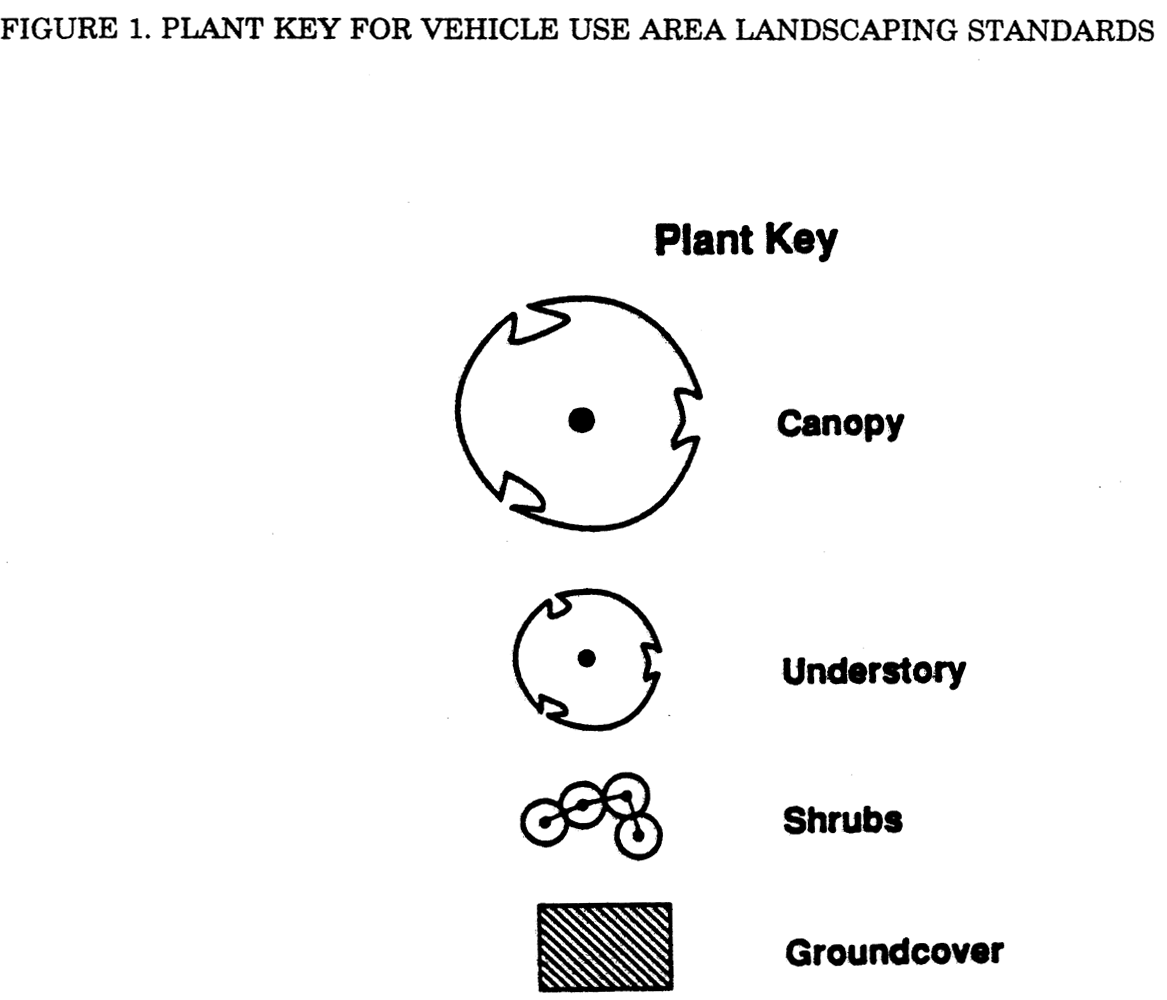
Figure 1—Plant Key for Vehicle Use Area Landscaping Standards
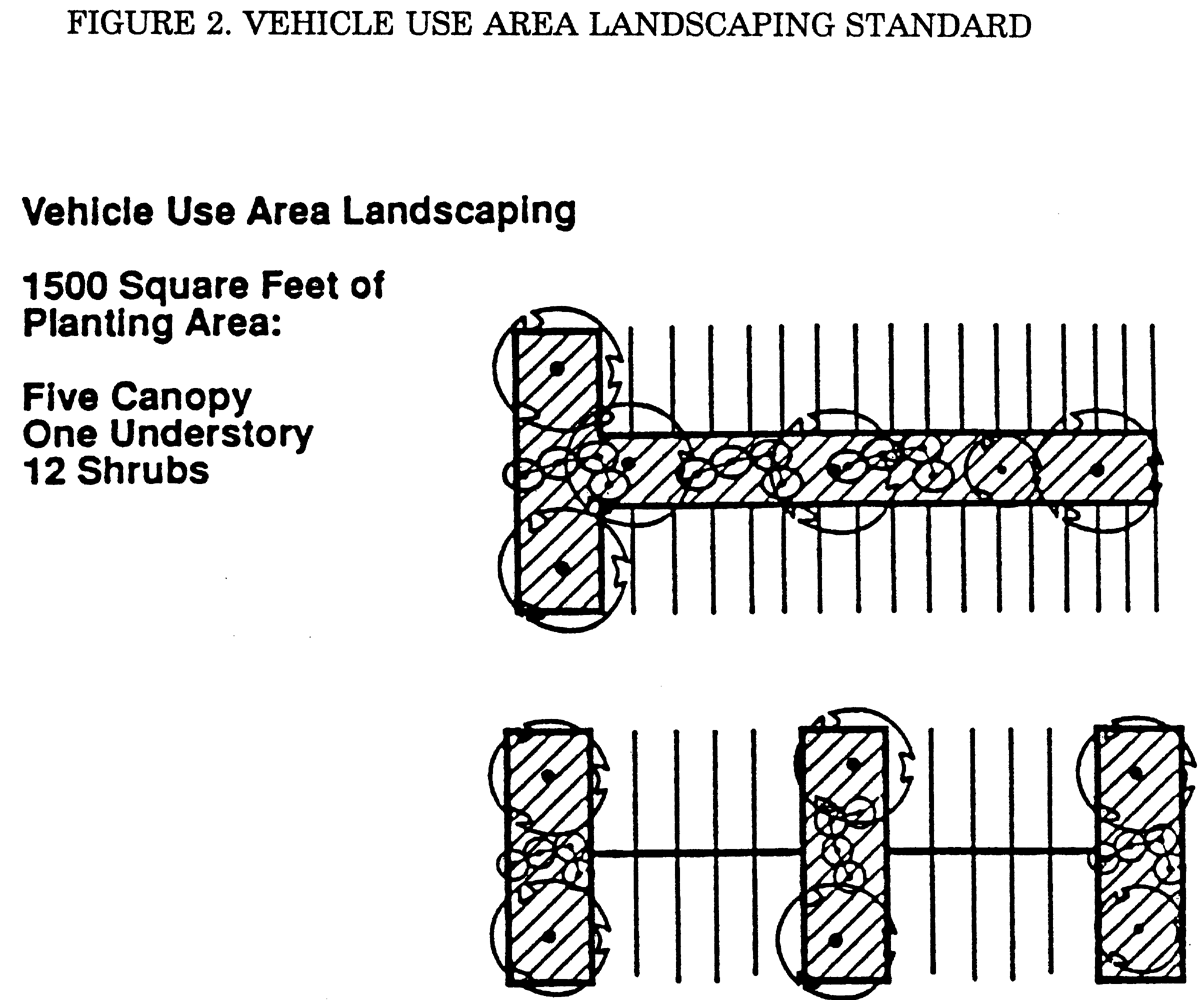
Figure 2—Vehicle Use Area Landscaping Standard
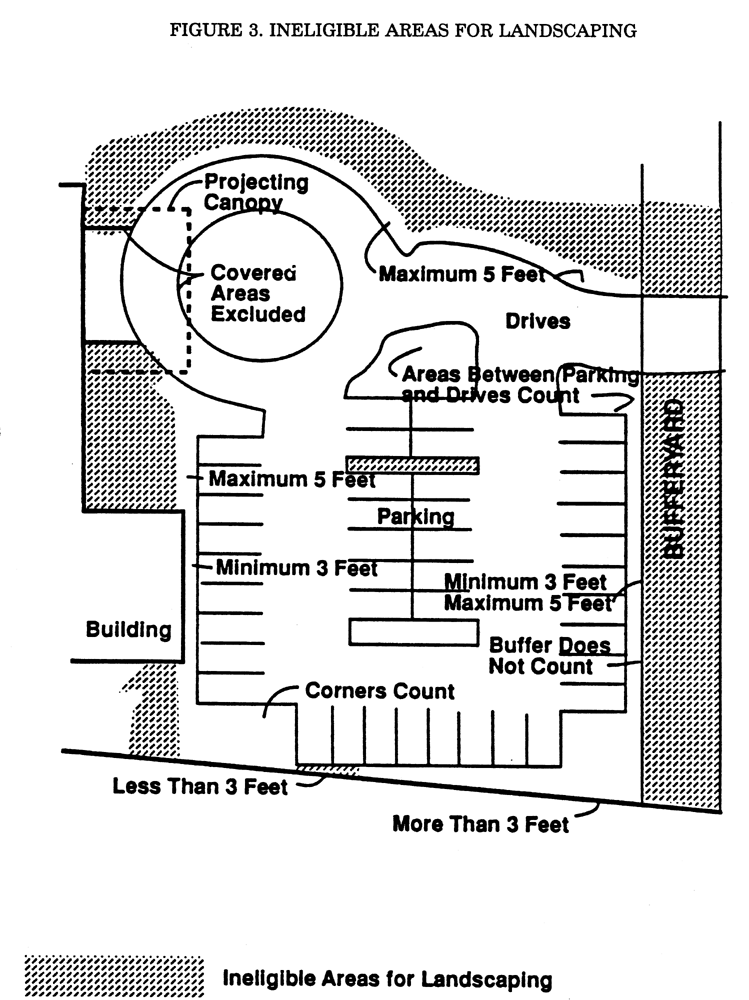
Figure 3—Ineligible Areas for Landscaping
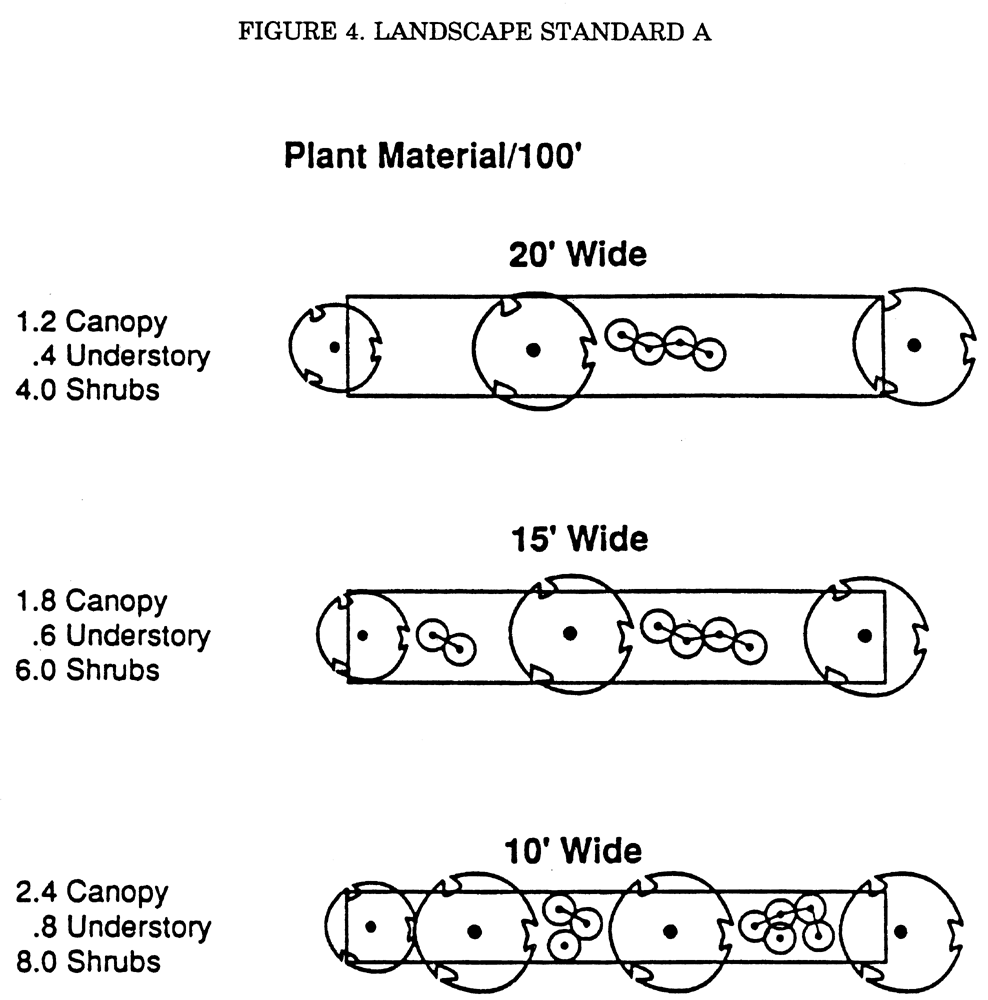
Figure 4—Landscape Standard A
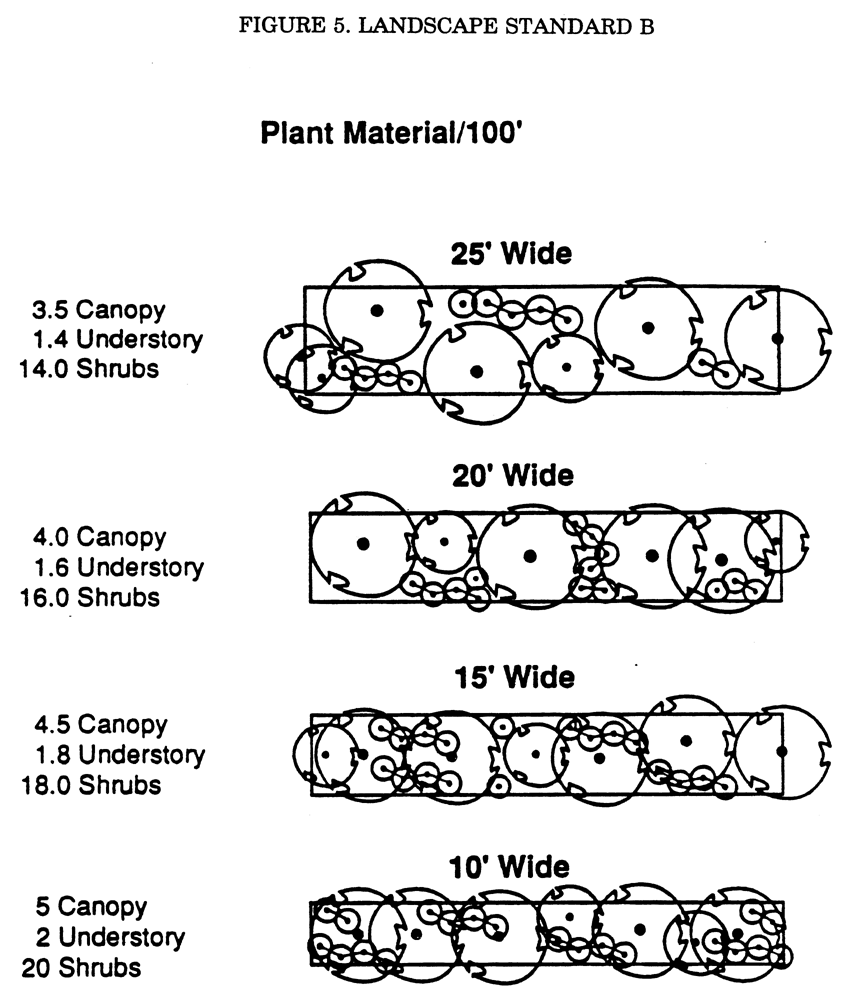
Figure 5—Landscape Standard B
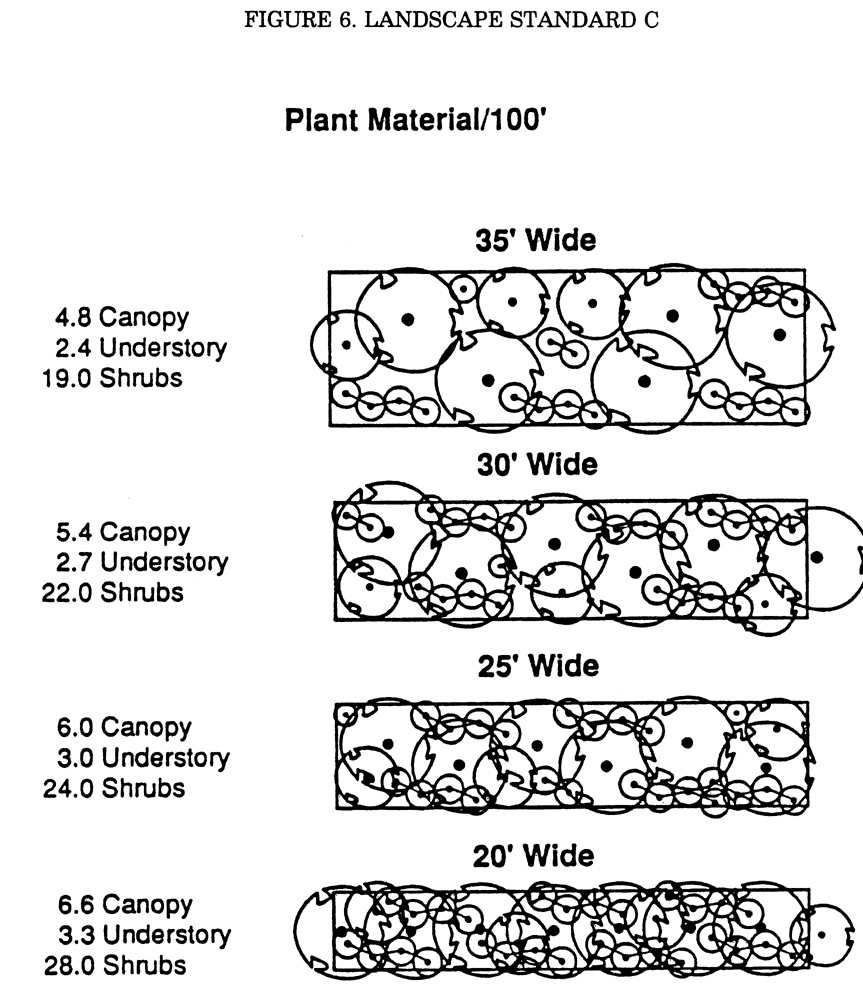
Figure 6—Landscape Standard C
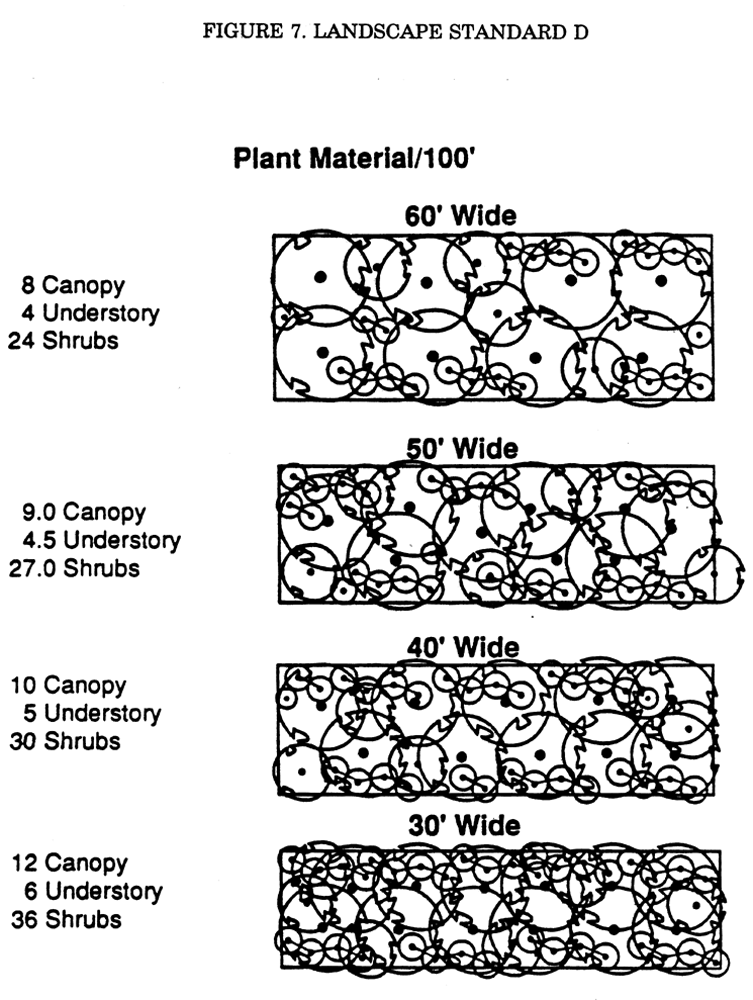
Figure 7—Landscape Standard D
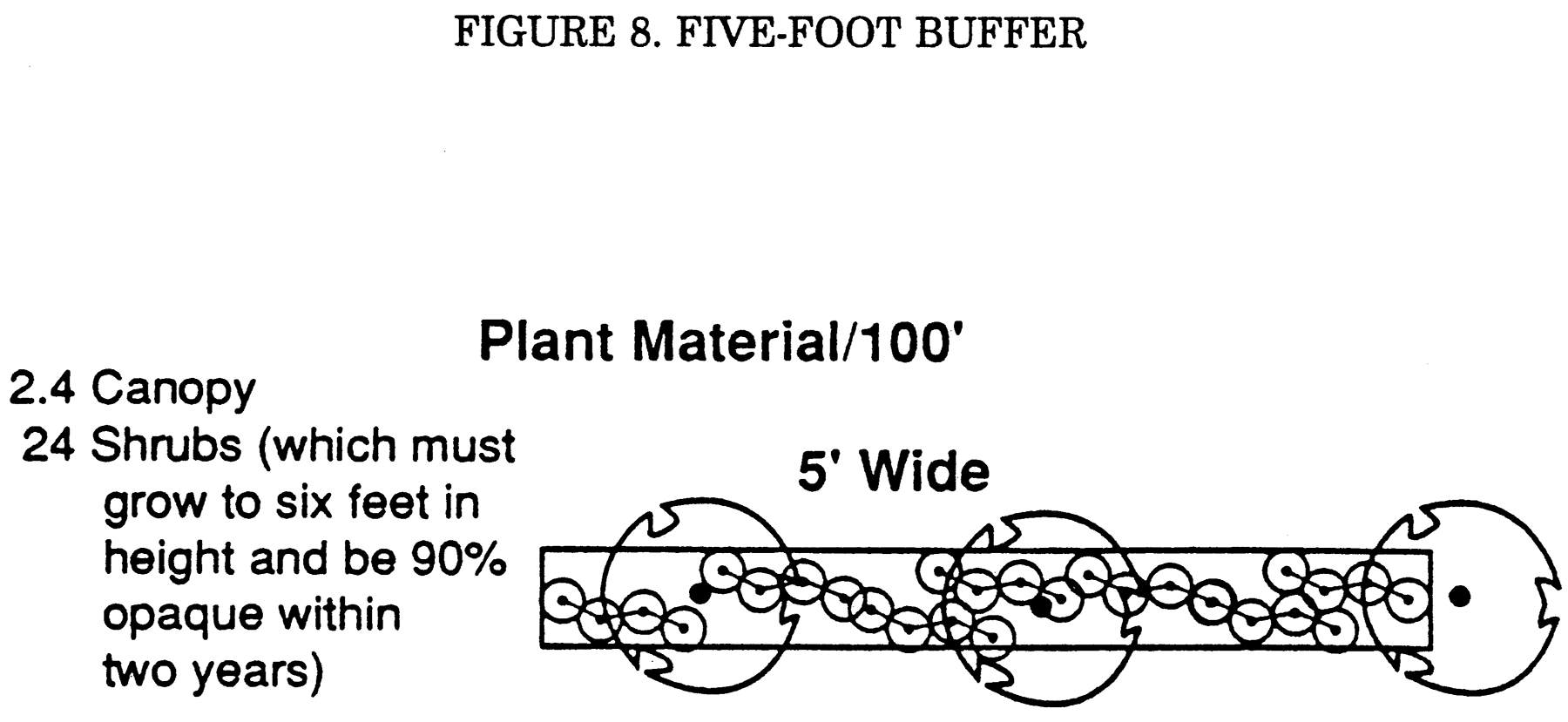
Figure 8—Five-Foot Buffer
(Ord. No. 399, § 1, 11-20-01)
Sec. 74-233. - Landscape design and materials.
(a)
Design principles. All landscaped areas required by this land development code should conform to the following general design principles:
(1)
Landscaping should integrate the proposed development into existing site features through consideration of existing topography, hydrology, soils and vegetation.
(2)
The functional elements of the development plan, particularly the drainage systems and internal circulation systems for vehicles and pedestrians, should be integrated into the landscaping plan.
(3)
Landscaping should be used to minimize potential erosion through the use of ground covers or any other type of landscape material that aids in soil stabilization.
(4)
Existing native vegetation should be preserved and used to meet landscaping requirements. See section 74-383 for tree protection requirements.
(5)
Landscaping should enhance the visual environment through the use of materials that achieve variety with respect to species of living material selected, textures, colors and size at maturity.
(6)
Landscaping design should consider the aesthetic and functional aspects of vegetation, both when initially installed and when the vegetation has reached maturity. Newly installed plants should be placed at intervals appropriate to the size of the plant at maturity, and the design should use shortterm and longterm elements to satisfy the general design principles of this section over time.
(7)
Landscaping should enhance public safety and minimize nuisances.
(8)
Landscaping should be used to provide windbreaks, channel wind and increase ventilation.
(9)
Landscaping should maximize the shading of streets and vehicle use areas.
(10)
The selection and placement of landscaping materials should consider the effect on existing or future solar access, of enhancing the use of solar radiation, and of conserving the maximum amount of energy.
No development plan shall be denied solely on the basis of the design principles in this section.
(b)
Installation of plants.
(1)
All plants shall be healthy and free of diseases and pests and shall be selected from the Southwest Florida Water Management District plant guide.
(2)
Plants shall be installed during the period of the year most appropriate for planting the particular species. If compliance with this subsection requires that some or all of the landscaping be planted at a time after the issuance of a certificate of occupancy, the developer shall post a performance bond sufficient to pay the costs of the required but not yet installed landscaping before the certificate shall be issued.
(3)
Landscaping shall be protected from vehicular and pedestrian encroachment by means of raised planting surfaces, depressed walks, curbs, edges and the like.
(4)
The landscaping shall not interfere, at or before maturity, with power, cable television or telephone lines, sewer or water pipes, or any other existing or proposed overhead or underground utility service.
(5)
All plants shall be installed according to generally accepted standards suggested by the agricultural extension agent.
(6)
The developer shall provide sufficient soil and water to sustain healthy growth of all plants.
(c)
Use of native plants. 40 percent of the total number of individual plants selected from each of the categories used to satisfy the requirements of this land development code shall be selected native species in the category. See section 74-383 for tree protection requirements.
(d)
Prohibited plants. The following plants shall not be installed as landscape material:
Punk tree (Malaleuca quinquenervia)
Australian pine (Casuarina spp.)
Brazilian pepper (Schinus terebinthefolius)
Eucalyptus (Eucalyptus globulus)
Ear tree (Enterolobium cyclocarpum)
Chinaberrry tree (Melia azedarach)
(e)
Irrigation. All landscaped areas shall be provided with an appropriate irrigation system. If a landscaped area contains primarily species native to the immediate region, or plants acceptable for xeriscaping, the town manager or town commission, as applicable, may waive the requirement for installation of an irrigation system. Consideration of a waiver of the irrigation requirement shall include, in addition to the area covered by native vegetation, such local conditions as sun or shade, use of fill soil, and depth to water table.
(f)
Nonliving materials. Mulches shall be a minimum depth of two inches, and plastic surface covers shall not be used.
(g)
Maintenance and replacement of plants.
(1)
All required plants shall be maintained in a healthy, pest-free condition.
(2)
Within six months of a determination by the town manager that a plant is dead or severely damaged or diseased, the plant shall be replaced by the developer in accordance with the standards specified in this land development code.
(Ord. No. 399, § 1, 11-20-01)
Sec. 74-234. - Development in public right-of-way.
Private or public landscape development in the public rights-of-way within the town shall be designed and planted in accordance with the master landscape plan (Ordinance No. 314).
(Ord. No. 399, § 1, 11-20-01)

